 Connexion


Paul and Ken assess how China’s economy goes from strength to strength whilst it continues to decouple from the U.S. and demonstrates how U.S. tariffs have been a failure.
This tariff pushback is only growing and the Global South Countries, specifically BRICS countries are leading. At the next SCO meeting, we will see a continuation. There are many methods. This is a short video from China to explain exactly what happened to Brazil with their sky high tariff loading on coffee. Brazil produces and sells, and China makes it easy. China has just bought Brazil’s coffee production in full.
 The video is here:
https://www.globaltimes.cn/page/202508/1340828.shtml
India is calling a boycott of US agricultural products as the Tariff regime requires India to open its market to US agricultural goods while Indian goods into the US are tariffed at 50%. RT has a reasonable report: https://www.rt.com/india/622881-indian-farmers-call-for-boycott/
What struck me, is the comment of one farmer: “No farmer should buy Coca-Cola. It’s time to start having lemonade and buffalo milk at home,” a protesting farmer told RT at a tractor rally in Greater Noida, near Delhi.
“Indian agricultural produce going to the US will fall under the 50% tariff regime. Due to this hike farmers will only get half the profit, and the US will get 50% more from import tax,” another farmer said.
Indian Prime Minister Narendra Modi, meanwhile, spoke up for the country’s farmers. “For us, our farmers’ welfare is supreme,” he said last week. “India will never compromise on the wellbeing of its farmers, dairy sector and fishermen. And I know personally I will have to pay a heavy price for it.”
For over five months, Washington and New Delhi discussed a trade deal, but differences arose when the US reportedly asked for an exemption for agricultural and dairy products. Such goods are “very big red lines” in trade talks with the US, Indian Finance Minister Nirmala Sitharaman said in June.
In the US the price increases as a result of the tariffs are now working their way through the supply chains and prices are climbing up steeply. Steel products are a easy example of this, but shoes seem be on a rise for 40%.
Tariffs start to bite as US consumer prices hike, a report originally posted by Xinhua:
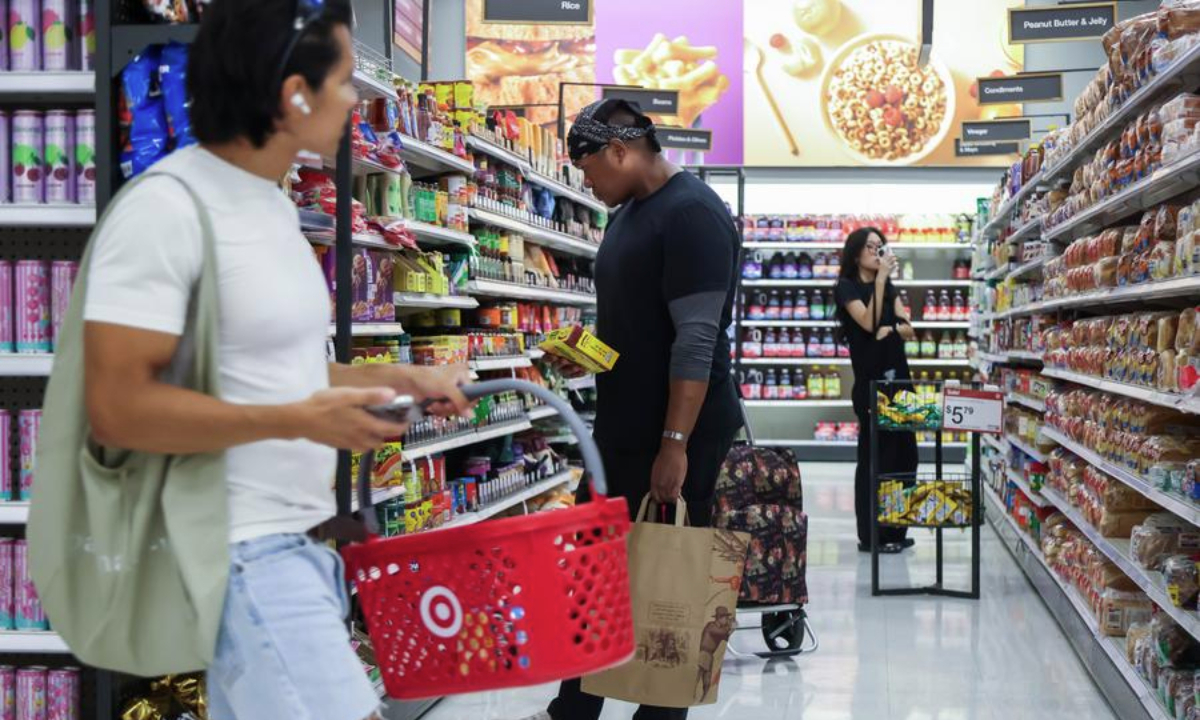
People shop at a retail store in New York, the United States, on Aug. 12, 2025. (Photo by Michael Nagle/Xinhua)
U.S. President Donald Trump’s tariff stick has pushed up levies on foreign goods to the highest levels in nine decades, imposing heavier costs on American households and businesses.
The new customs duties, which took effect in early August, now apply to almost every U.S. trading partner. Researchers at Yale University estimate the average tax rate on imports has jumped from just over 2 percent in January to more than 18 percent today, the highest since the 1930s.
PRICE HIKES
While the levies are collected from importers, economists say much of the eventual cost will be paid by shoppers through higher prices. Some categories could see especially sharp increases.
Economic modeling from Yale’s Budget Lab suggests retail prices for shoes may climb by roughly 40 percent and apparel by 37 percent once the full impact goes through supply chains. Everyday goods such as fruits, kitchen appliances and automobiles are also to rise, with new cars potentially costing thousands more.

This photo taken on Aug. 12, 2025, shows beef for sale at a grocery store in New York, the United States. (Photo by Michael Nagle/Xinhua)
Small enterprises across the Midwest are already contending with sharp cost inflation. In St. Louis, Missouri, for instance, retailers report supplier price increases of up to 30 percent, covering everything from bicycles and beauty products to board games, a Financial Times survey found.
Standout examples include washing machines and wine refrigerators, whose prices have surged by as much as 35 percent. Even domestically made goods are not spared, as manufacturers pass on elevated input expenses, including for imported steel and aluminum.
One business owner, Mike Weiss, who runs a chain of bike shops in the city, typifies the struggle. “Normally, we would reprice things on an annual basis, not daily,” Weiss told the newspaper. “The goalposts keep moving.”
In Florissant, a suburb of St. Louis, beauty store co-owner Trinita Rhodes said her shelves tell the story of how tariffs have reshaped prices. Since the United States imposed additional duties on Chinese imports in April, she said, many items have jumped sharply in retail prices and have not fallen back, even after Washington announced a 90-day truce with Beijing.
COSTS SHIFT TO CUSTOMERS
Businesses once shouldered much of the tariff hit. Goldman Sachs estimates that through June, companies absorbed about 64 percent of the extra costs, with consumers covering roughly 22 percent and foreign exporters 14 percent. But the bank expects the consumer share to soar to 67 percent by October. Domestic manufacturers, facing less competition from imports, may also raise their prices.
Goldman projects that if tariffs remain in place, the Federal Reserve’s preferred inflation gauge — the core personal consumption expenditures price index — will finish the year at around 3.2 percent, compared with 2.4 percent without the duties. The July reading of core consumer inflation was already running at 3.1 percent.
Analysts say the overall average tariff rate — now 18.6 percent — rivals that imposed under the Depression-era Smoot-Hawley Tariff Act. The higher costs are showing up not only in finished goods but also in industrial inputs like steel and aluminum, which feed into U.S. production and construction.
For now, falling energy prices and inventories built up before the tariffs are helping keep overall inflation in check. But as stockpiles run down and import contracts renew at higher rates, economists warn that the upward pressure on prices will intensify. The longer the tariffs last, the more they risk weighing on consumer spending and slowing economic growth.
That puts the Federal Reserve in a bind. The agency often faces calls from the White House to cut down interest rates to support a faltering labor market, even as tariff-driven inflation stays above the 2 percent target. For small-business owners like Weiss, the policy debate is distant from the day-to-day reality: either swallow the higher costs or pass them on to customers, despite that both choices carry a price.
U.S. power has become increasingly redundant and indeed something to repudiate.
August 8, Op Ed from Strategic Culture.
President Donald Trump’s estimation of American power, like that of his own abilities, is increasingly seen to be badly overblown. This week, he threatened some 90 nations with tough trade penalties in the form of double-digit tariffs on their exports to the United States. It remains to be seen if he will actually implement the measures. Trump already cancelled a plan to impose worldwide tariffs back in April – his so-called Liberation Day – after no doubt realizing, or his more informed advisors realizing, that the U.S. cannot win a global trade war.
If there’s one thing about Trump, it is that he is as quick to reverse threats as he is to issue them. The erratic behavior speaks of the muddled thinking and lack of coherent analysis in his so-called policies. Trump’s reversals also speak of the limits to U.S. power as the world shifts to different realities in geopolitics and geoeconomics. The American power that Trump thinks exists is no longer.
This disconnect was evinced this week as Trump threatened tariffs on Brazil, Russia, India, and China. The so-called secondary levies were supposed to be related to Trump’s deadline for Russia to reach a peace deal with Ukraine. Countries buying Russian oil are “fueling the war machine,” he claimed. India hit back at what it called ridiculous hypocrisy, pointing out that the European Union purchased more Russian oil last year than India. The U.S. also buys billions of dollars ‘ worth of Russian agricultural fertilizer, uranium, and other minerals.
In any case, the four countries targeted by Trump for secondary tariffs firmly rebuffed his threats. They dismissed Trump’s intimidation and vowed to continue exercising their sovereign right to do business as they deem necessary for their national interests.
It is not clear what the White House will do next in the aftermath of such defiance. Trump’s habit of extending deadlines for tariffs may postpone action.
The surprise announcement that Russian President Vladimir Putin is to meet Trump in person sometime next week, reportedly in Alaska, may also persuade the American side to drop the secondary tariffs plan. Trump’s egotistical craving to be seen as a peacemaker in Ukraine is such that a summit with Putin may be enough to appease his desire for headlines and a shot at winning the Nobel Peace Prize. His overblown claims about mediating peace between India and Pakistan, Azerbaijan and Armenia, and between Israel and Hamas show him to be driven by superficial success.
The defiance of the BRICS nations this week in the face of Trump’s bullying was remarkable for several reasons. It demonstrated that the BRICS are emerging as a powerful, cohesive economic and geopolitical force. After 16 years since the international organization’s founding, its leverage is no longer abstract or theoretical. It’s becoming a concrete reality.
Brazil’s President Lula da Silva mockingly stated that Trump was “not the emperor of the world,” and he called for a special BRICS summit to galvanize a joint response to U.S. trade threats. China condemned Washington’s bullying and said that the unilateral imposition of tariffs was a violation of the United Nations Charter. Indian Prime Minister Narendra Modi sent his top national security adviser to meet with Putin in the Kremlin. It was also reported this week that Modi is to travel to China later this month to attend the summit of the Shanghai Cooperation Organization. These developments suggest that the BRICS are solidifying their commitment to advancing a multilateral global order in response to Trump’s belligerence.
As with so much of Trump’s capricious conduct and attitude, he is rallying international forces that are hastening the demise of American standing and power, ironically for a president who boasts about “making America great again.” An article by renowned international economist Michael Hudson illustrates how ill-conceived Trump’s trade war with the planet is. Hudson contends that the tariffs will fuel consumer inflation in the U.S. as Americans pay more for expensive imports. Republican Senator Rand Paul agrees with this assessment. He claims that the tariffs will add $2 trillion in taxes on U.S. consumers.
Another impact that Team Trump seems unaware of is that the world economy is sufficiently diversified that countries will be able to find alternative markets for their exports. That will result in more countries being less dependent on the dollar for trade settlements, which, in turn, will weaken the greenback and the U.S.’s ability to keep piling up its astronomical national debt. The system is, therefore, liable to crash the more Trump imposes trade penalties on other nations.
It is also becoming clear that the BRICS represent a historic challenge to the U.S.-led Western order. The more Trump tries to undermine the emerging multipolar order, the more strongly it emerges. Earlier this year, Trump claimed that the BRICS were dead after he threatened to impose 100 percent tariffs on what he labelled an anti-American bloc.
His rumors of BRICS’ death are greatly exaggerated. The international forum keeps steadily growing, gaining a significant new member, Indonesia, this year – the fourth most populous country in the world. BRICS represent over 50 percent of the world’s GDP and about 40 percent of its population. It has surpassed the Western-dominated G7 group in terms of economic power.
Trump’s tariff tantrums have little to do with bringing peace to Ukraine and a lot more to do with trying to break up the BRICS, which is a growing challenge to U.S. hegemony. This week shows that the BRICS have acquired a new sense of their own confidence and purpose in creating an alternative to the U.S.-dominated system. Trump’s arrogance and lack of understanding of the new realities of the global economy and the world’s resolve for long-overdue justice and peace, particularly for the Global South, are precipitating the demise of the U.S.-run neocolonialist order.
Brazil, Russia, India, China, and South Africa, among many other nations, are showing a resilience and defiance to U.S. imperialist bullying that would have been thought unlikely only a few years ago. Their commitment to mutual development and a fairer world order is making the U.S.-dominated elite Western capitalist system less relevant and less viable. The enormous trade deficits that the U.S. has accumulated over decades, in line with its monstrous national debt of $37 trillion, mean that it needs the rest of the world to keep its essentially parasitic position intact. The integration of the multipolar global economy under the leadership of the BRICS is showing that U.S. power has become increasingly redundant and indeed something to repudiate. It is hitting a wall of solid BRICS.
On the ominous side, however, that is why the U.S. rulers are becoming so insanely warmongering. Will they try to blow up a dead-end?
“The political motivation behind the measures against Brazil violates national sovereignty and the historical relationship between the two countries,” says Brazil’s President Lula da Silva.
From Brian Mier
On July 30, US President Donald Trump declared bilateral relations with Brazil a national emergency in order to justify raising import tariffs. In a menacing statement entitled “Addressing Threats to the United States by the Government of Brazil,” he declared:
Recent policies, practices, and actions of the Government of Brazil threaten the national security, foreign policy, and economy of the United States. Members of the Government of Brazil have taken actions that interfere with the economy of the United States, infringe the free expression rights of United States persons, violate human rights, and undermine the interest the United States has in protecting its citizens and companies. Members of the Government of Brazil are also politically persecuting a former President of Brazil, which is contributing to the deliberate breakdown in the rule of law in Brazil, to politically motivated intimidation in that country, and to human rights abuses.
Ironically for a President who has been punishing universities for allowing students to engage in Palestine solidarity protests, who has banned government officials from using over 250 words, including, “women”, “privilege” and “breastfeeding,” he misrepresented Brazil’s constitutional concept of freedom of expression and essentially accused it of violating the US Constitution’s 1st Amendment. Brazil, however, does not adhere to a Cato Institute-style definition of free speech absolutism which has become so popular with the Silicon Valley crowd. Like other nations around the world including Germany, Brazil bans public support for things like Naziism, pedophilia and white supremacy.
Citing alleged violations of “free speech” – a key element in a false narrative used by the Bolsonaro family to build support for the failed 2022-23 coup attempt – Trump made spurious charges against Alexandre de Moraes, the Supreme Court Justice who oversaw the investigation into the military coup plot which led to the convictions of ex-President Jair Bolsonaro and 32 of his cronies. Moraes, he said, was guilty of abusing his judicial authority “to target political opponents, shield corrupt allies, and suppress dissent.”
As punishment for violating US “free speech” laws and regulating social media corporations to prevent things like school massacres and formation of pedophile rings, Trump announced a 40% tariff increase on Brazilian imports, starting 7 days from the publication of the statement.
Then it got interesting. The statement was issued with an appendix listing hundreds of Brazilian products which will be exempt from a tariff which Trump had initially claimed would be universal, and the rollout date appeared to have been postponed by five days.
This list includes Brazil’s largest export to the US, petroleum and its derivatives, and nearly every product manufactured in Brazil, from airplanes to cars to air conditioners and furniture. The list also exempts steel, iron, all precious metals and, possibly due to a lawsuit by New Jersey-based importer Johanna Foods, Brazil’s 3rd largest agricultural export, orange juice. According to the Brazilian federal government, this list of exemptions represents 43.4% of the nation’s total exports to the US in monetary terms, effectively lowering the average tariff rate on Brazilian goods from a once-threatened 50% to 32.6%. Noticeably absent from the list are the US’ two largest agricultural imports of coffee, which as I wrote last week should not be significantly damaged by the tariffs, and beef, which has lots of other markets to expand to.
On the same day Trump released his statement, the US government invoked the Magnitsky Act against Alexandre de Moraes. It announced it was seizing his US assets and baring his entry to the United States. Moraes calmly replied that he doesn’t have any US assets and – something that may shock the MAGA crowd – is not interested in traveling there. Then he calmly went out to watch a game by his favorite football team, Corinthians.

Justice Moraes at the Corinthians game on the night the US announced its sanctions
Meanwhile, both President Lula and a coalition of Brazil’s 6 largest labor union federations issued statements repudiating the Trump Administration.
In a press release entitled, “Brazil is a sovereign and democratic nation,” Lula wrote:
In Brazil, the law applies to all citizens and all companies. Any activity that affects the lives of the population and Brazilian democracy is subject to regulations. This is no different for digital platforms.
Brazilian society rejects hate speech, racism, child pornography, scams, fraud, and discourse against human rights and democracy.
The Brazilian government considers it unjustifiable to use political arguments to justify the trade measures announced by the U.S. government against Brazilian exports. Over the past decades, Brazil has accumulated a significant trade deficit in goods and services with the United States. The political motivation behind the measures against Brazil violates national sovereignty and the historical relationship between the two countries.
The labor union federations issued a manifesto rejecting the US government’s allegation that Jair Bolsonaro and his 32 cronies convicted for plotting a military coup are victims of political persecution. “What is underway is an attempt to impose cultural domination through tech giants,” they wrote. “Contrary to what the [U.S.] statement claims, it is the American government that seeks to interfere in our politics, our society, and our economy.”
Trump seems to have issued the statement as a smoke screen to hide the fact that he’s backing down. Bilateral negotiations are ongoing. I believe that in coming days, other products will be added to the exemption list.
Meanwhile, the exemptions are good news for the Lula administration’s ongoing efforts to re-industrialize Brazil.
The backlash from Trump’s hostile rhetoric has enabled the left to retake the issue of patriotism. Fickle allies in the business community and center right political parties, which had been increasingly hostile before the sanctions were announced, have veered back towards supporting Lula.
Share values for Brazilian aviation giant Embraer, the World’s 3rd largest civilian aircraft manufacturer, surged by 14% yesterday after the tariff exemption was announced. As the backlash against the Bolsonaro family increases, they find themselves more isolated than ever. Meanwhile Lula’s popularity is rising. A recent polls shows he is now the second most popular leader in South America. As for Jair Bolsonaro, he is still under house arrest and wearing an electronic ankle monitor as he awaits sentencing.
Featured image: Larry, I’m on Ducktails!
If you tariff one country, terrific. You have leverage. If you tariff every country, terrible. You’re the one paying demurrage at your own ports, while the rest of the world moves on. Abu Donald (our man inside) has done what the world should have done long ago, unionize against America, and make blood-sucking American importers eat the difference. That’s all Trump’s tariffs do, as you can see from the coverage inside my country, Sri Lanka.
There’s been a sea change in local coverage since when tariffs were first announced in April. Tariffs are still bad for us, but they’re bad for everyone, and nobody talks in absolutes anymore. It’s all relative. Thus the Central Bank Governor now says, “This shift enhances our relative competitiveness,” and the Chamber of Commerce talks about ‘regional competitors’ and ‘regional peers.’ Sri Lanka isn’t even talking about America anymore. We’re talking about Vietnam and Bangladesh. Trump tried to move the world, but the world has moved on.
Trump burnt down the old trading house and erected a new one, with no ceiling and a high floor. Trump has raised the floor on trade with America by at least 20%, the minimum tariff (Vietnam) announced so far. Americans importers are going to pay that, because where else would they go? They have no negotiating power because everyone is tariffed at least that much.
Trump has also tried to set a ceiling, a price at which companies will exit foreign trade entirely and make in America. But America is so inflated and uncompetitive (especially given tariffed imports) that this ceiling might as well be on the moon. As an example, a Sri Lankan will stitch underwear for $300 a month. You’d need 1,000% tariffs to make American workers competitive, even if they were competent, which they aren’t.
I don’t know if Americans can see this new reality, but in Sri Lanka it’s obvious. America’s having a fit, but they still need underwear. The only question is where they’ll get it. Hence the question is our relative tariff, not the absolute amount. Our comprador class was freaking out about 44% tariffs in April, but now they’re just talking about the difference with other countries.
As Sri Lanka’s Central Bank Governor Dr. Nandalal Weerasinghe said, “While we faced a 44% tariff, several of our competitors enjoyed significantly lower rates. Now, with the revised 30% rate, we find ourselves in a more favorable position relative to countries like Laos, Myanmar, Cambodia, Thailand, Bangladesh, Serbia, and Indonesia, which still face tariffs ranging from 31% to 40%.”
Numbers.lk (I don’t recommend any of these people) reported the news as,

Again, these are comprador sources, quick to cuck for foreign capitalists, but even their comments are a sea change from just months before. In April it was all, ‘Yes Massa, how can we whip ourselves faster?’ but now we’re looking at the other slaves and comparing wages amongst ourselves. Americans are going to pay 20-30% more by default, and we’ll compete for the 5-10% on top. Trump has effectively unionized every exporter in the world against American importers. It’s one of the most spectacular self-owns in economic history. If you tariff one person, more power to you. But it you tariff everyone, more power to us.
Now exporters are all in the same boat, while the American importer is the one stuck at the port. All the importer can do is send an email saying, “please eat the difference,” but every exporter can safely say, “eat my shorts.” We might move a bit relative to our competitors, but that’s it. We have the power most dreaded by buyers, to say, where else are you gonna go? Are Americans going to stitch their own underwear now?
Trump has set the new floor for global trade at 20-30%, and American importers (and consumers) are going to be buried under it. And the rest of the world will slowly but surely move on. I can already see it happening in my own country. Not out of any surfeit of courage, but because of forfeit by morons.
Trump misspelled our president’s name in his letter, and the spelling is all over the place. In the copy-pasted letter he said, “There will be no Tariff in Sri Lanka, or companies within your Country, decide to build or manufacture product within the United States.” So there’ll be no tariffs on Sri Lanka if we don’t make anything in Sri Lanka, great. But does Trump have any idea what Sri Lanka makes?
Sri Lanka makes underwear. Our girls make Victoria’s Secret for $300 a month over here so Lex Wexner (Epstein’s main client) can rape girls over there. While $300 a month is survivable here (I make $2,000 in a good month), it’s a complete non-starter in America. America would have to tariff Sri Lanka 1,500% to compete even if they had the competence, which they do not. But Americans still need jungies, so they’re just going to eat the tariff at the port, raise prices at the mall, and their own inflation overall. Of course we’ll take volume hits and we’ll suffer, but Trump is really tearing the band-aid off. The world will adapt around America and move on.
That’s all that’s happening here and I, for one, am here for it. Death to the abomination, and more suicidal power to our man destroying it from inside, Abu Donald. America is a nation openly run by rapists killing children abroad; if there was ever a case for a global embargo, it is now. All countries in the world should be sanctioning America, for the genocide of Gaza alone and for its predation in general, and Trump is doing it for us. With tariffs paid at American ports, America is sanctioning itself, mashallah.
Again, I point you to the Wexner example; he was Epstein’s only real money-management client, and God knows what horrendous crimes he was getting away with. Epstein was killed to protect powerful people like him and Trump, and this is a bipartisan evil (see Bill Clinton and Bill Gates also). This is what my people’s wage slavery is chained to; this is a wicked system that should not be participated in at all. A 30% tariff is the least we can charge these people, we should really withhold our labor totally.
However, Abu Donald has taken a measured approach, slowly destroying the White Empire from the inside by being transparently evil and opaquely dumb. Just as America is embroiled in 2.5 land wars in Asia, they are also starting a trade war against the whole world. You couldn’t plan a better attack against white power—blow your arms in multiple wars, your dollars in multiple trade wars, and your brains out, alone, in a corner. Now the final incarnation of White Empire is lurching towards a fate far worse than being hated. Trump’s tariffs are simply being ignored.
This was discussed in today’s Daily Chronicles and I copy that with Lula Da Silva’s response.
 Tariffs have to do with trade and with the balance of trade, yes? Demented Donnie has turned his Tariff Letters (of which a bunch went out this morning again), into a capricious punitive stick. 50% for Brazil and there is more in ‘sectoral’ tariffs. During the last few days Trump has been hollering on his Truth Social that Brazil is treating Bolsonaro very badly. Bolsonaro, with another 34 people or so, is in court, charged with the coup plot to overturn the results of the 2022 election and keep his opponent from taking power.
This is gross interference in the affairs of other nations and most probably breaks a raft of international law.
I know China is Brazil’s biggest trading partner. Here is a sizable list of products that Brazil trades with the US. https://tradingeconomics.com/brazil/exports/united-states
One hopes that Brazil could have the courage of its convictions and stop trading with the US. This is the only action that will stop the tariffs, which the US buyers anyway pay for. Yet, with such a cost burden, the cost of items becomes too high for any market to bear. Regarding the accusations against US media operating in Brazil, you may recall that Elon Musk became upset because Brazil expected foreign tech companies to comply with Brazilian Law. Brian Mier has an article on Brazil’s law that owners of Tech companies are responsible for crimes committed on their platforms, as free speech is not absolute in many other countries. https://bmier.substack.com/p/brazils-victory-for-digital-sovereignty
It is, of course, now time to see if BRICS can support one another. There is the list, folks – whatcha gonna buy .. whatcha need today? Time is short.
In light of the public statement made by U.S. President Donald Trump on social media on the afternoon of Wednesday (9), it is important to highlight the following:
Brazil is a sovereign nation with independent institutions and will not accept any form of tutelage.
The judicial proceedings against those responsible for planning the coup d’état fall exclusively under the jurisdiction of Brazil´s Judicial Branch and, as such, are not subject to any interference or threats that could compromise the independence of national institutions.
In the context of digital platforms, Brazilian society rejects hateful content, racism, child pornography, scams, fraud, and speeches against human rights and democratic freedom.
In Brazil, freedom of expression must not be confused with aggression or violent practices. All companies—whether domestic or foreign—must comply with Brazilian law in order to operate within our territory.
The claim regarding a U.S. trade deficit in its commercial relationship with Brazil is inaccurate. Statistics from the U.S. government itself show a surplus of $410 billion in the trade of goods and services with Brazil over the past 15 years.
Therefore, any unilateral tariff increases will be addressed in accordance with Brazil’s Economic Reciprocity Law.
Sovereignty, respect and the unwavering defense of the interests of the Brazilian people are the values that guide our relationship with the world.
With a sidewalk bowl of phở and a plastic spoon, Sony Thang breaks the spell.
They caved! They are traitors! They are empire! Is the cry that went up after the announcement of the Trade Deal with Vietnam. 20% Tariffs! 40% Transhipment Tariffs! 0% tariffs on goods from the US to Vietnam. Vietnam opens its market to the US! USA! USA!
I am tempted to say the poor suckers, and I don’t mean Vietnam. Woe is Us! We are our own worst enemies as we have not learnt to analyze and to Call It By Name. We flail, and we kick and we scream, but in reality we have to get to work!
Sony Thang did the work this time. He is my kind of ‘resistance’.

Sony Thang
They say Vietnam accepted a lopsided deal.
That we agreed to pay tariffs on our exports to the U.S. while letting American goods enter our market for free.
That we bowed.
That we submitted.
That we traded dignity for access.
But that is not what happened.
Vietnam does not pay American tariffs.
American businesses do.
Every time a container ship docks in California with Vietnamese goods, it is the importer in Los Angeles, not the worker in Bình Dương, who pays the 20 percent surcharge.
Every time a piece of Vietnamese furniture enters a U.S. home, it is the American consumer, not the Vietnamese farmer, who foots the bill.
The U.S. is not taxing Vietnam.
It is taxing itself.
And it is doing so not because we demanded it, but because it cannot imagine a world where we win on merit.
Vietnam built its economy from the rubble of war.
With no Marshall Plan.
No empire to bankroll our rise.
No military bases across the globe to force open markets.
We earned every dollar of our trade.
We built every factory.
We trained every worker.
We climbed out of poverty not on pity, but on perseverance.
What terrifies the empire is not that we are dependent on them.
It is that they are still dependent on us.
They rely on Vietnamese labor to clothe their children, furnish their homes, and assemble their electronics.
They count on our stability to anchor their corporations in Asia.
They need us to counterbalance China, but fear that we might become too strong, too sovereign, too unaligned.
So they do what empires always do.
They tax. They threaten. They distort.
They say Vietnam is growing rich off the American consumer.
But we did not beg for that consumer.
We did not invade their country.
We did not lobby their government to make them buy from us.
They came to us because we produce better, faster, cheaper.
Because our people work with skill, precision, and dignity.
Because we know how to build.
If the U.S. wants to cripple its own supply chains out of spite, let it.
If it wants to burden its own companies to punish our success, let it.
If it wants to price out its own low-income consumers to feel powerful, let it.
We have survived worse.
This is not the first time a foreign power misunderstood Vietnam.
Not the first time they mistook our patience for passivity.
Our silence for consent.
But we remember history too well to be fooled.
The French called us primitives.
The Americans called us pawns.
Now they call us partners.
But we have only ever been one thing.
Vietnamese.
And the glory of a people who endured centuries of occupation, who bled for independence, who turned famine into industry and rubble into factories.
That glory will not be stopped by a tariff.
The empire may tax what we send. But it cannot tax what we are.
And he continued!
0% tariffs just means your goods get through customs cheaper.
It doesn’t mean anyone wants them.
It doesn’t mean they’ll sell.
It doesn’t mean your brands will beat ours.
Ask Starbucks.
Ask McDonald’s.
They’ve had “unrestricted access” for years.
And still can’t outsell a sidewalk bowl of phở.
Tariff-free doesn’t mean victory.
It just means you’re allowed in the ring.
You think 0% means control.
We know it means competition.
And that’s where you keep losing.
The empire taxed itself to slow us down.
We opened the gates, watched your brands walk in, and then watched them beg for relevance.
So go ahead.
Celebrate your tariff.
Wave your flag. Quote your GDP.
We’ll be here.
Outselling your giants with a plastic stool and a boiling pot.
And the world still lining up at our door.
—
That’s the way, Aha Aha, I like it! Aha aha!
In this video, Victor Gao delivers a sharp critique of U.S. trade policy under Donald Trump, positioning China as both a defender of free trade and a nation unwilling to be intimidated. He paints the trade war as a reckless act of economic hostility, arguing that China’s response is grounded not in aggression, but in a firm resistance to unilateral pressure.
Gao outlines a tit-for-tat philosophy rooted in balance and dignity, insisting that if the U.S. imposes tariffs or threats, China will respond in kind. He dismisses the idea that these measures will bring manufacturing back to America, pointing instead to the lack of infrastructure, discipline, and political coherence required for such a transformation.
He also discusses the deep interdependence between nations, particularly between China and Australia, warning that protectionism could unravel decades of cooperative growth. Gao urges American leaders to respect global institutions and approach negotiations with mutual understanding, before economic brinkmanship leads to long-term global damage.
A few days ago Trump felt sorry for China.
‘I was saddened to hear it… they are getting absolutely HAMMERED in China’ – Trump says his tariffs mean factories there closing, economy doing ‘very poorly”I don’t want that to happen to China’ he adds.
The little Telegram clip that I saw, is here: https://t.me/rtnews/93575
I put this to our China Writers’ Group in order to find what the situation is on the manufacturing street. Of course, we can expect manufacturing facilities reorienting to new business due to China’s refusal to pay tariffs, changing supply lines, and calling for the cancellation of unilateral imposition of tariffs.
Here are some comments:
He does not have any clue about China, like most Americans. Recently, I was interviewed by the local TV (in the US) about the impact of tariffs on China. The local reporter did not know anything about China, and I had to educate her about everything about China. She asked me about China’s low salaries. I told her that the Chinese lived a much better life than most Americans in many ways.
I told them that the Chinese rural population, about 50 percent of them, have a piece of land that they can grow their own food, build a home on it, and never need to pay property taxes on it. They have not paid income tax either since 2005. They do not need to own a car, because public transportation is more convenient and efficient.
The Chinese consume 70 percent of the world’s total vegetables, 50 percent of the world’s pork, 40 percent of the world’s beef, and 40 percent of the world’s seafood. I go back to China every summer and visit the local farmers’ market. The produce at these markets is fresh, abundant, and cheap. Most people would have three or four dishes for lunch and dinner. I consider myself middle-income in the U.S. But I can not afford to eat the stuff my sister in China is able to purchase, like sea cucumber, abraney, shrimp, fish on a regular basis. Chinese people’s life expectancy is now two years longer than that of Americans.
—
As for factories that can only survive by selling to America, their owners are stupid and cannot survive in China’s competitive environment. They might as well go bankrupt. I have friends who used to own factories. When China started controlling pollution from factories, some couldn’t adapt and closed shop. They had invested well when the going was good and now live an easy life in retirement. No one needs to shed a tear for them. If you talk to some of them, they may complain, but it’s not like they lose their shirt and have to live on the street.
—
China is doing fine.
I should know. I deal with factories, and I am inside China. Seriously, I try to debunk the latest slew of lies and distortions. I used to tune it out and drink. Now, I just go on Shaohongshu (Red Note), and immediately a weight is lifted.
Actually, the USA is fucked.
I mean it… the shit is gonna hit the fan in a month or so.
No wonder Trump is talking about the USA military patrolling the streets in the USA.
Just you wait.
Decoupling is a bitch. And Trump did not expect this to occur on Chinese terms… Well he fucked around and payback is gonna be a bitch.
—
My final comment after all these fine people described the manufacturing street:
We in the Latin Americas at least can expect raids – They will beg, coerce and threaten these countries to buy from China and on-sell! Remember with Covid-19, the US bought planes full of masks and other medical supplies, offering a price right on the tarmac? They did it with eggs as well, out of Europe. We’re in for a very horrible time.
If it were me and I were in the US, I would lay in a few necessities now.
Donald Trump’s tariffs are benefiting rich elites at the expense of the majority of the population, argues economist Michael Hudson. He explains how the US trade war on China is isolating the United States and encouraging countries to seek alternatives. Ben Norton hosts the interview.
Transcript
(Intro)
BEN NORTON: Why has US President Donald Trump imposed tariffs on countries all around the world? And in particular, why is Trump waging a trade war on China? What are his real goals?
Well, to try to answer these questions, I spoke with the economist Michael Hudson, who is the author of many books, and who just published the new report “Return of the robber barons: Trump’s distorted view of US tariff history“.
Michael Hudson outlined the history of the use of tariffs in the United States and in other countries, and he explained how Trump is using tariffs as a weapon of class war, to benefit the rich at the expense of the vast majority of the population, and also how Trump is trying to reshape the global financial system, in order to benefit the United States at the expense of everyone else.
But as Michael Hudson warns, this is already backfiring on the US economy, and it’s accelerating the transition to a more multipolar world.
So here are a few clips from our discussion, and then we’ll go straight to the interview.
MICHAEL HUDSON: The United States is the only country in the world that has weaponized its foreign trade; weaponized its foreign currency, the dollar; weaponized the international financial system; and treated every economic relationship in an adversarial way, to weaponize it.
And other countries say, how can we have a different approach, and treat trade as how can we mutually gain? How can we treat investment as something where the investor gains, but we also gain?
So what’s happening is that, as other countries are putting in place their mutual production facilities, transportation facilities, investment facilities, Trump is isolating the United States from trade and investment relations.
It has tried to isolate China, but what it’s doing is isolating itself from everyone, except its satellites.
(Interview)
BEN NORTON: Michael, thanks for joining me; it’s always a pleasure. Let’s start by talking about this report that you published.
You outlined the history of US use of tariffs and industrial policy, and your argument is that Trump is using tariffs essentially as a form of class warfare, to move the burden off of the rich and corporations, and to increase the burden of taxation on the working class through the use of tariffs.
So can you talk about what your argument is in this report and why you decided to write it?
MICHAEL HUDSON: Well, it’s much more than simply class warfare. Trump has for years been complaining about the fact that the richest people are taxed progressively, at a higher tax rate than other people. He wants to get rid of the tax rate altogether for the finance, insurance, and real estate sector, the FIRE sector.
I think he must have had a discussion with some economist or historian and said, “Isn’t there some way that we can get by without an income tax?” And the person must have told him, “Well, you know, the United States didn’t have an income tax before 1913”.
And Trump said, “No income tax?” No, the Supreme Court ruled that an income tax was unconstitutional. That’s what supreme courts do; they try to prevent any kind of progressive social legislation.
Well, finally, in 1913, the Senate passed the 14th Amendment, and enabled an income tax to be levied.
So Trump said, “Well, how did the United States finance itself before that?” And the answer was, well, almost all the US fiscal revenues came from the tariff, from customs receipts, in addition to land sales for land that they grabbed from the Indians.
So Trump said, “Well, they did it through tariffs!” The advantage of tariffs, for Trump, is that the cost falls on consumers. He doesn’t see that they also fall on companies that import goods from their foreign affiliates.
But, ultimately Trump said, “Oh, this is on consumers; this is wonderful! Why couldn’t we go back to the way things used to be, today? Why can’t we get rid of the income tax altogether — at least on my constituency, the campaign donors — and why can’t we simply raise tariffs?”
Well, his associates must have said, “How ever are you going to convince people to go along with this?” And so Trump said, “Well, let’s see, under tariff protection, in the late 19th century, that’s how the United States rose to be a great industrial power. So somehow, tariffs must have nurtured industry. And I want to bring industrialization back to the United States, to make America great again. And I can say tariffs are going to bring back industry”.
And what he means is, un-taxing the wealthy people, especially the finance and real estate sector, and shifting the tax on the consumers is going to make the country great again.
Well, what he’s leaving out is the fact that it wasn’t tariffs as such that made America into an industrial power. There was a whole large program that was necessary to industrialize America.
All of this was spelled out in the 1820s by Henry Clay, and it was called the American System. And the American System was protective tariffs, with “internal improvements” — that means public investment in infrastructure — and a national banking system to finance industry.
Well, Trump said nothing about these, so it’s worth saying something about them.
By the late 19th century, the United States, said, “How are we going to lower the cost that industry has to pay for its wages, without leading to a huge round of strikes?”
The solution was we can have the public sector pick up many of the costs that labor would otherwise have to pay out of its own paychecks.
For education, we can have free education — not the $50,000 a year that workers have to pay today in order to get a job. We can have social programs, health programs, and others, to help them.
We can have natural monopolies in the public domain, such as transportation, starting with the Erie Canal, and going all the way through roads and other transportation. Communications too.
All of these natural monopolies, if they were not held in the public domain, would be owned by private people who would get monopoly rents. And the United States said the way that we can compete with other countries is pretty much the way that the classical economists said you compete: you lower the cost of production by having the government bear as many of these costs as possible through public enterprises, through public infrastructure; you essentially socialize or nationalize the land.
“Socialism” was not a bad word in the late 19th century. Almost everyone across the political spectrum was describing their policies as socialist. There were Christian socialists, and libertarian socialists, and Marxian socialists, and social democracy. Everybody was one kind of socialist for another.
That meant a rising role of government in providing more and more services, or regulating the economy, such as the anti-trust law of 1890, to prevent monopoly pricing, and Teddy Roosevelt’s, trust-busting.
The whole idea was to minimize the cost of production with an act of a government. And they said that, well, if we can have a mixed economy, a public and private economy together, with the government sponsoring industrial credit — not the kind of British credit that was just for trade, or exploitative, or loans to the farmers — but actually to finance capital investment in industry, then we can take off.
It was this context for protective tariffs that enabled the United States to get rich.
Well, what Trump wants to do is the exact opposite of this context. He wants to deregulate the economy, not regulate it. He wants to privatize any public domain that’s left, any public enterprises.
The post office, for instance, can be privatized. It’s going to cut back services to rural areas. It’s going to increase prices. It’s going to make most of the US economy look like Thames Water in London, for instance.
They’re going to Thatcher-ize the American economy, to do to the American economy what Margaret Thatcher and Tony Blair did for England; or what Reaganomics began to do for the United States.
So we’re talking about an anti-government policy, not a mixed policy. And under Elon Musk, he wants to just carve up the government agencies altogether, privatize everything.
What they’re going to do is dismantle the country’s social programs, dismantle its subsidies, dismantle subsidized social programs that have enabled companies like Amazon, or other low wage companies, to pay very low wages, and having the American social system pay for employees that are paid below the poverty line, because they haven’t been increasing the minimum wage in the United States.
So, this is what is really in store for the US: cut, essentially privatize, the government; especially get rid of Social Security, and other social programs, Medicare.
They call it streamlining the economy or making a “free market”, a market without government that interferes by protecting consumers, protecting the population against predatory monopolies and predatory finance.
BEN NORTON: Michael, you raised so many important points there.
I want to hit on this idea of the Gilded Age, that Trump sees the Gilded Age in the 19th century as essentially his model for what the US should return to.
The Gilded Age is notorious for the robber barons, these big billionaires like Cornelius Vanderbilt and J.P. Morgan.
Today there are, of course, similar oligarchs. Many of them are in the Trump administration, including Elon Musk, who’s the richest billionaire oligarch on Earth. You have the Treasury secretary, another billionaire hedge fund manager, Scott Bessent. Then you have the billionaire who is the commerce secretary, Howard Lutnick; he’s also from Wall Street.
And at his inauguration in January, Trump invited the world’s most powerful billionaires, like Mark Zuckerberg, Jeff Bezos, Tim Cook, and others.
So one of the points that you emphasize is that Trump is really trying to overturn not only the progressive gains of the New Deal, but even the gains of the Progressive Era in the late 19th and early 20th centuries.
When Trump looks back at people like McKinley, the US president, he sees essentially the 19th century and the Gilded Age as something positive. Of course, the vast majority of the population was exploited, and lived in horrible conditions, but for a small handful of oligarchs, the situation was quite rosy for them.
So why do you think Trump sees it this way?
MICHAEL HUDSON: What Trump doesn’t realize is that the Gilded Age was a failure of US protectionism.
In the process of protecting industrial investment, you had the financial sector making a lot of money off this. And finance has always been the mother of trusts.
Finance began to lead to a fight over who is going to control the railroads. The crisis of 1873 came when [robber baron] Jay Cooke’s railroad defaulted. There were rivals trying to buy control of railroads from each other.
The Gilded Age emerged sort of accidentally, as a byproduct of making industry rich, you also made a lot of opponents of industry rich, like monopolists.
That’s why in the year of the McKinley tariff, when he was a congressman in 1890, you had the Sherman anti-trust law. They said, OK, we’re going to make sure that the protection of industry does not become protection of monopolies; it will not become a protection of unearned wealth, economic rent-seeking.
So Trump gets it all backward: what was an oversight that the Americans cured in 1890 — or at least started to put in place a public mechanism for avoiding the Gilded Age — as if that was actually a great success.
If only it had succeeded, Trump would say, then, America would have polarized and done what gilded ages do.
BEN NORTON: Yeah, and one of the points that you emphasize, Michael, is how China’s model is completely different.
China is following the kind of state-led industry of policy that every industrialized economy has used to industrialize, to develop a manufacturing sector.
China has state ownership of telecommunications, infrastructure, education, energy, land, and finance — most importantly, the financial system in China is state-owned.
China has five-year plans, in which they target certain industries that they want to develop.
China creates plans for sectors like electric vehicles, and they say that the government is going to direct resources into these industries through the use of subsidies, and infrastructure investment, and job training, and education, and cheap loans from state-owned banks. And they’re going to develop semiconductors; they’re going to develop local civilian airliners.
So can you can you contrast China’s industrial policy with the Trump administration’s lack of an industrial policy?
MICHAEL HUDSON: Well, you could say, could I compare China’s development to the policies of the United States and also Germany when it was developing?
China has sort of reinvented the wheel. One of the first books of mine that they translated as a textbook into Chinese was my book on trade, development, and foreign debt, when I described the contrast between free trade and protectionism, and how the United States developed a protectionist argument to counter the free-trade arguments of England, in order to protect industry.
So, China has essentially done the same logical thing that any government would have to do. You have to subsidize your own industry and protect it, insulate it, from lower-cost imports underselling you.
You have to enable industry, if not really to make a profit, to at least make enough money to somehow be able to pay its labor force, and to pay for the raw materials and the machinery that it takes to create industrial production.
The one thing that China has done that other countries did not do — although Germany began to do it in the 19th century — was to keep money and credit as a public utility.
China did this because it really didn’t have much of a choice, after Mao’s revolution. How is the government going to finance capital investment in industry in what was a very poor country of peasants, basically, as the US secretary of commerce keeps calling China, a country of peasants.
BEN NORTON: US Vice President JD Vance referred to the Chinese as a bunch of peasants. And this has really angered people in China.
JD VANCE clip: We borrow money from Chinese peasants to buy the things those Chinese peasants manufacture. That is not a recipe for economic prosperity.
BEN NORTON: And this has really united people in China against the US.
MICHAEL HUDSON: Of course. Well, at any rate, since Mao’s revolution had got rid of the wealthy financial classes, there was no way that the government could do what the Western countries did and borrow from the wealthy classes to pay for the government deficit in financing industry. So China created its own money.
Well, that’s exactly what the American colonies did in the 17th and 18th centuries. When Britain was dominating the colonies, and forcing the colonies to export crops and other materials, by borrowing hard money from British merchants, the colonies began to create their own paper money.
That’s how they basically developed.
When America fought the Revolutionary War, the government issued Continentals — fiat currency called Continental currency.
In the Civil War, in America, the costs of the war were so large that it couldn’t possibly borrow from domestic creditors, the government printed Greenbacks. But in peacetime, the financial sector fought back and insisted on “sound money”, meaning money that you pay interest on to private financiers.
Well, since China didn’t have private financiers, it did the same thing that America had done: it printed the money itself.
And it kept banking in the public domain. And what that means is that banking in China does not make loans for the same kind of things that American banks make loans.
We know that they went overboard in making fairly reckless real-estate loans, but they don’t make loans for corporate takeovers, of private investors to borrow the money to take over another industrial corporation and just sort of empty it out and do what American corporate raiders and kleptocrats do.
So China has been able to create money to spend into the economy for purposes intended to serve the public interest, to build housing, to finance high-speed railways, to finance all of the public infrastructure that China has kept in the public domain, to offer at low, subsidized prices to the population at large.
So if you have a private enterprise in China, creating a factory to produce goods for exports to the United States or other countries, they don’t have to pay the workers enough to have to pay for privatized transportation; they have wonderful public transportation, in the subways and railroads.
They they don’t have to take out student loans to get an education; they can get the education from the public sector in China. They can get health care.
They don’t have to pay for all of the things that the United States’ employees and employers have to pay for. That’s what enables China to have low-cost labor.
It’s not that it’s impoverished labor; it’s not that it’s pauper labor; because the labor in China is better and better remunerated; but its remuneration is not only in the form of its paychecks that it gets in salary; it’s in the form of all of the public services that it gets, that Americans have to pay out of their salary.
So when you realize that the standard of living of workers is not only the paycheck, but the public services they get, or the subsidized prices they have to pay for basic needs, then you find that, if basic needs are treated as basic needs, then everybody should be able to get them, as a precondition for being citizens.
That’s basically what happens in China. And that’s what has enabled China to undersell Western economies that have privatized, and Thatcher-ized, and Reagan-ized their economies.
And, of course, that’s how the United States, and Germany, and other countries that industrialized in the late 19th century built up their competitive power internationally.
BEN NORTON: Those are very important points, Michael.
Trump has been expanding his tariffs not only against other countries — he now has blanket 10% tariffs on all countries around the world — but he has specifically targeted China with now tariffs of 245% — which, after a certain point, there’s not really any meaning to further increasing these tariffs; it’s largely symbolic.
Why do you think Trump has been so aggressive targeting China specifically?
Do you think it has to do with what you were just explaining, the significant differences between China’s system and the US system? That might explain why the US has deindustrialized, and simply can’t compete with China’s very sophisticated system of manufacturing.
MICHAEL HUDSON: Well, you’re right that America can’t compete. It realizes that it can’t compete. It’s treating China as an enemy.
But, regarding the the tariff question, the way in which Trump has arranged his three-month interim, before the very high punitive, disruptive tariffs are imposed, is specifically aimed against China.
Let me explain what the connection is, because it’s not clear on the surface.
The tariffs that he has announced are so disruptive of trade for other countries that they’re going to suffer — as will the US economy, and US consumers and businesses are going to suffer.
Trump says that these maximum demands are open to negotiation. And he’s asking other countries, well, if we don’t disrupt your trade by imposing these 40% or even higher tariffs on you, what are you going to give us in return? What’s your give-back to us for us not making these demands on you?
At first, I thought, well, he’s going to demand that maybe they’ll have to sell off some public infrastructure to Americans. Maybe they’re going to have to give trade favoritism to Americans. There are all sorts of things.
But Trump has made it clear: what Trump wants is diplomatic givebacks. Every country is going to be subject to one-on-one, distinct pressures. 75 countries, he says, have called him and want to negotiate.
DONALD TRUMP clip: I’m telling you, these countries are calling us up, kissing my ass. They are dying to make a deal. Please, please, sir, make a deal. I’ll do anything. I’ll do anything, sir!
MICHAEL HUDSON: With each country, he’s going to treat individually, that they give America something. But the common denominator in all of his demands is that they impose trade sanctions against commerce with China, and against mutual investment with China, and especially any plans they may have to join its Belt and Road Initiative in favor of US plans to interrupt the whole connection system of Belt and Road that China wants to put in place.
So Chinese officials can see where all this is leading. They’ve announced their refusal to negotiate with the United States, when a gun is pointed to their head.
China recognizes that Trump really doesn’t have many cards in his hands. What does he really offer other countries except to refrain from disrupting their economy?
He’s what back in Mao’s time was called a paper tiger, militarily. Well, America has become a paper tiger financially today. It doesn’t really have anything to offer except the threat of tariffs, the threat of suddenly disrupting all of the trade patterns that have been put in place over the last few decades.
So the most important consideration for China in all of this, in what is it going to do, is that it doesn’t need the US market to anywhere near the degree that the United States is dependent on China for key metals, and key materials, and key industrial products.
Most in the news are the rare earths, ores that are refined to make magnets and other alloys that are used in almost every high-tech manufacture today, from electric cars to military, and space things; but also steel and aluminum are faced with enormous tariffs, as well as key products that American industry needs; and of course all of the consumer goods that Walmart imports into the United States and that Apple imports for use in its iPhones.
So, what is really the threat of these tariffs against China? It has already said, well, we don’t need to buy soybeans from America; we can buy soybeans from Brazil, instead of US farmers. And most US farmers of soybeans live in Republican districts, because the Republican Party appeals to the western, midwestern, rural population much more than the educated urban population.
I’m told that one of the key US products that the United States has sort of cut China off from is soy sauce. And, all these years, my Chinese friends tell me, they’ve been buying soy sauce from a Singapore company with a Chinese name that they thought was Chinese. Probably just organized out of Singapore, but it turns out that it’s an American company, and now they can’t get it.
So, what’s going to happen? Well, it’s not that hard to make soy beans into soy sauce. And you can imagine that what is going to happen is that China is going to respond to the US sanctions in the way that any country responds to sanctions: once they can’t import something that they’ve been importing from another country, that they need, they produce it themselves.
That’s exactly what Russia did, when the United States told Europe, stop exporting food to Russia; let’s starve them out. Russia stopped its dairy and farm imports from the Baltics and other countries, and developed its own agricultural, production. That’s called import [substitution].
So the reaction to sanctions is to force other countries to replace US imports with domestic production. And that’s exactly what China has done.
Well, why do the United States strategists have this blind spot? And the reason is, I think, the whole mentality of US diplomats is punitive. That’s the only thing they have today. They have little to offer the other country.
They can’t do what President Xi does and say, here’s a win-win situation; we’ll develop our trade with each other, and we’ll both gain from this, from our mutual interdependency that’ll create an efficient, regional trading system.
But the United States doesn’t have that. All it can do is disrupt the trading system. And they can disrupt it for a few months; maybe it’ll take a year. It takes time to replace new means of production, to replace trade, imports and exports, with the United States.
But you can imagine that European countries, Asian, African countries, Latin American countries, are all spending these next three months thinking, how are we going to create a world after August, that is going to enable us to keep on producing what we’re producing and importing what we’re importing, but not from the United States.
They’re all trying to think of realignment. And the United States says, well, this is going to disrupt your economy for a year or so; and the other countries will make a calculation and they’ll say, yes, it’s going to disrupt our economy for a year or so, but then for the next decade or century, we won’t have to deal with US threats anymore.
The United States is the only country in the world that has weaponized its foreign trade; weaponized its foreign currency, the dollar; weaponized the international financial system; and treated every economic relationship in an adversarial way, to weaponize it.
Other countries say, how can we have a different approach, and treat trade as how can we mutually gain? How can we treat investment as something where the investor gains, but we also gain?
If China is going to build up ports and infrastructure for us, and we will pay China in the form of raw materials, or agricultural production, or whatever we’re producing; then we get the capital investment that China is providing, and we’re providing them with the trade that they’ve helped develop by putting in place ports, and roads, and railroads, and other means of transportation.
So you have two different views of what an alternative world trade system would look like. And of course, this alternative is what everybody expected to be created after World War One.
That was the promise of mutual gain that mutual trade was going to integrate countries, and provide gains from trade, for peaceful, friendly international relations.
It hasn’t turned out that way. But now other countries are saying, well, we can achieve that kind of trade under rules very similar to those that the United Nations created in 1945. But we can’t do it under the rules that the United States imposes for its own one-sided, unipolar world order that it’s insisting on.
So what’s happening is that other countries are putting in place their mutual production facilities, transportation facilities, investment facilities. Trump is isolating the United States from trade and investment relations.
It has tried to isolate China, but what it’s doing is isolating itself from everyone, except its satellites, in Western Europe — Germany, England, and the other European countries.
The question is, how long can its Asian satellites — South Korea, Japan, and the Philippines, even Taiwan — how long can they decide, well, are we going to look at our long-term future as trade with China, which is growing and expanding its market, or with United States, whose market is shrinking?
And it goes even further than that. Trump also has said he’s going to punish other countries that try to find an alternative to the dollar. And yet today’s Wall Street Journal [on April 18] had a whole editorial: Trump is now trying to prevent other countries from keeping their international reserves in dollars.
He’s forcing other countries to sell off their dollars by imposing a tax on other countries’ holding of Treasury securities.
If you’re a foreign central bank and you’ve done what you’ve done since 1971, when Nixon went off gold, and you kept your foreign exchange reserves in the form of US dollars, in the form of US Treasury securities, or government agency securities, or other US holdings, then all of a sudden you’re going to have to pay a tax on them, and this tax is going to mean that you’re losing money.
Well, the dollar has been going down steadily, day after day after day, for the last few weeks. And it looks like it’s going down because other countries are looking at what Trump is threatening, and they think, this guy may really mean it!
The whole essence of American imperialism — as my book Super Imperialism explained way back in 1972 — the whole essence is that America gets a free lunch; it can print its dollars, flood the economy with dollars, mainly through its foreign military spending — which is, in most years, the leading element in the balance of payments deficit — flood this and other countries haven’t had an alternative to the dollar to hold.
They’ve been discouraged from buying gold. Well, as you can imagine, China has been buying gold. Now other countries are buying gold. Germany has asked for the gold that it had been keeping in the Federal Reserve for safekeeping after World War Two, that this is returned. None of my German financial reporters have been able to find out whether it’s actually got any of this gold. The politicians are quite mum on that.
So, other countries are essentially being driven out of the dollar, at the same time that Trump says, don’t join together and create a non-dollar area.
Well, if they can’t hold US dollars, or they’re told, if you recycle your savings and your surplus dollars into US treasury bills, you’re going to have to lose money year after year.
Well, as they sell the Treasury securities, the dollar is going down. And as the dollar goes down, that means that, even if other countries get a higher return in stocks or US bonds, the value in euros, and Chinese currency, and Japanese currency, the value in their own currency is going down as a result of Trump’s policies.
Well, Trump believes that if you lower the exchange rate of the dollar, that will make American exports more competitive. And of course, it would, if America had something to export.
But how can you make industrial exports more competitive, at a lower price — which lowers the cost of labor, lowers the cost of America — if you don’t have factories to produce these exports? That’s the crazy thing about all this!
How can you increase export competitiveness of industry, if you don’t have an industry?
The United States, ever since, really, Clinton in the 1990s, has offshored American industry — to Asia, to China and other countries — how on Earth can it be competitive?
Basically neoliberalism has undercut the ability of the United States to be competitive in the way that, it and European countries, and now China, had become competitive as a mixed economy.
The essence of neoliberalism is to carve up and privatize governments, basically on credit, borrowing the money to buy things.
So you’re having an inherent instability. And this is what other countries are discussing.
Now, the question is, will other countries agree to give up the Chinese market in order to gain the American market?
Well, how long is the American market going to last? And how much trade and diplomacy with China are they going to give up? Will it be a total set of sanctions and isolation? Will it be partial? All of this is a product of bilateral negotiation.
I think other countries should take a look at what’s happening domestically, in the way that Trump bargains.
You’ve seen two big fights, domestically, of Trump in the American economy, have occurred in the last few months: the fight against law firms and the fight against universities.
Trump declared war on law firms that had worked for the Democratic Party in the last few decades, especially law firms that supplied lawyers who prosecuted him for all of the Democratic lawfare that the Biden administration began.
And he said, well, you have to do a give-back. And the first give-backs that he asked from these firms is, you have to provide $50 million of pro bono — meaning work without payment – for Republican-backed organizations.
Well, almost all the law firms capitulated. They surrendered and they agreed to give him, you know, $50 million, or however much free legal advice he wanted, at their expense.
Well, now, in the last few days, he has asked for what the New York Times and Wall Street Journal say is $1 billion from the law firms, saying you’re going to have to not only support the Republican administration, but you’re now going to have to support me, and support Republican policies, as we bring lawsuits against the government, to try to carve it up, and shrink it, for the kind of things that Elon Musk is doing.
So, he keeps raising the price. He’ll make an agreement. They think, ok, we gave him $50 million. That’s enough. Trump had said, if you don’t do this, I’m going to cancel your security clearance for all of your lawyers, and I’m going to ban your lawyers from federal buildings, because you’re a “security risk”. And I can declare a national emergency, and a national emergency is anything I find a national emergency in. Any threat to me is a national emergency, because I’m the state. Sounds like King Louis of France.
He asks for more and more and more. It’s a never-ending rise in demand. So, again, here’s the problem that they face.
Once you begin to give in to Trump, a bully thinks, oh, I’ve been able to do this; now I can do even more. If you begin giving into him, it’s a never ending path of decline. That’s the whole problem.
China describes the choice as between the post-war, the whole world’s post-1945 commitment to free trade and the same rules for all countries; or henceforth, are they going to be subjected to America’s neo-mercantilist protectionism, as the new context for international trade?
BEN NORTON: Michael, as always, you made so many great points there. It’s hard to know where exactly to respond.
But let’s pick at this idea, which I think is very important, which is that China has said that the US is essentially trying to recreate the global system that the US ironically helped to create in the first place, after World War Two.
You described that system very well in your book Super Imperialism, published in 1972. The US designed the international financial system, giving itself the exorbitant privilege of printing the global reserve currency.
The US also helped to design the international legal institutions and political institutions through the United Nations. And still at the UN Security Council, the permanent seats are held, yes, by China and Russia, but also by the US, France, and the UK. And the US has used its veto power to essentially neuter the UN, to prevent the UN from taking any action the US doesn’t approve of.
So the US has really benefited from the system. But it seems like Trump is now just throwing a bomb and blowing everything up. What do you think is happening?
MICHAEL HUDSON: The world has changed a lot since 1945, when the US not only led the creation of the United Nations, but also the International Monetary Fund and the world Bank.
It created a system of free trade because, under free trade, the dominant economic and industrial power wins over countries that haven’t industrialized.
That’s why countries that haven’t industrialized need protective tariffs, to develop their industry, and especially their agriculture — which is how the United States subsidized all of its agricultural productivity in the 1930s.
So, the United States, in 1945, could say, all countries have to follow the same rules, because it knew that the rules that they were to follow — with free trade, and no imperial preference for the British pound sterling, no colonialism, you decolonize — the US knew that it would gain.
But, since 1945, we’ve now gone eight decades since then, and since the United States has deindustrialized, it no longer benefits from the rules and the whole philosophy that it supported back in 1945.
Under the United Nations, at that time, it said all countries should be treated politically as equals. That has been the whole rule of international law since 1648, when the 30 Years War was ended: no country should interfere with other countries.
Well, the United States no longer treats that. It is able to interfere with other countries, but essentially claims that any other country that gets a benefit from the United States is somehow interfering with its trade, or posing a national security threat.
So the United States has ended the kind of idealistic rhetoric, and the underlying world order that it put in place in 1945.
So, China, Russia, the speeches of Foreign Minister Lavrov and President Putin, they’re all saying the same thing: the ideals of the United Nations as they were set out; the ideals of trade, not to weaponize trade, but to have mutual gain; the ideal of the role of government to provide basic needs for the population; all of this was a good idea.
But the spread of neoliberalism by the United States and by Europe, essentially, is now opposing everything that was promised in 1945. We’re in a completely different world.
We cannot achieve and restore this world as long as we leave the United States with veto power in the United Nations, to stop it; and with a military power and willingness to intervene in foreign elections; to support regime change, to make sure that its own politicians are elected, over and above whatever the population may want.
Such as Europe — most of Europe’s population wants an end to the war in Ukraine. The politicians want to escalate NATO’s war against Russia.
You can go right down the line, that what the politicians that are supported by the United States in many countries advocate is the opposite of what voters want.
Just like in the United States. Trump won the election saying he’s going to bring peace in NATO’s war against Russia; he’s going to be a peace candidate, not the war candidate that Biden and Harris were. Now all of that is just sort of, well, that’s campaign promises; that’s just rhetoric; that’s the narrative that we’ve created.
So, you’re having, in a way, two different narratives to shape how people think of the split in the world, between the 15% of the population — the US and Europe, plus America’s satellites in Asia — and the 85% — the Global Majority, in the Global South — that are trying to have mutual trade and benefit.
In order to have this mutual trade and benefit, you have to have a political system and a tax system, that essentially prevents the emergence of a domestic financial oligarchy, and monopoly oligarchy, and real estate oligarchy, from stifling economic growth in their countries.
And the United States wants to create such an oligarchy as long as it’s controlled by US investors themselves.
So how do you explain why politicians follow this pro-US submission that they’re doing?
Well, I think there are a number of answers for why you’re having a different approach to how the world is being restructured.
Politicians live in the short run, and many are so used to being bullied that they’ve succumbed to the Stockholm Syndrome and identify with the bully. They think, well, the Americans are so powerful; there’s really nothing that we can do; we have to join them because the bully strong enough to fight any other policy that we may do.
Well, democracy is supposed to prevent the kind of oligarchy from developing that you have in the United States.
They’re supposed to prevent a Gilded Age. They’re supposed to prevent the economic polarization between the 1% of the economy — the creditor class, the billionaire class of creditors, monopolists, real estate owners — and the rest of the economy — of debtors, of renters, of wage earners that have less and less control over their working conditions.
That’s not being prevented; that’s being encouraged by neoliberalism — just the opposite of what was promised.
It’s as if we’re having a new kind of colonialism; but it’s not overtly a military colonialism, except in countries that refuse to follow US laws. It’s sort of what free-trade imperialism, or what the [US] Treasury bill standard was.
It’s what the West calls “democracies”, which is foreign control by the neoliberal class, the kind of people who go to the World Economic Forum in Switzerland and think that they’re planning the kind of world that they would like to see.
We’re dealing with two kinds of economic theory.
The reality-based economic theory recognizes that debts tend to grow exponentially, and polarize society, and create a crisis, if they’re not canceled.
The orthodox economic theory, that’s taught in all the universities throughout the West, says if you just get rid of government, leave government alone, don’t regulate anything, the economy will automatically self stabilize, and produce equality among people, and among nations; free trade will make nations more equal, instead of polarized.
You have a whole different body of economic theory to justify a whole means of social and economic organization that occurs.
In other countries, the fight by Asia and the Global Majority today — and by Putin against the legacy of kleptocrats that the neoliberals subsidized in Russia — was how do you keep this wealthy class — you can let it accumulate wealth, but it has to use its wealth in the public interest, to develop the overall economy and benefit the economy, not to subject the economy to lower wages, to use its wealth to take over government and disable the government from the ability to regulate it.
Well, this disabling of government to regulate is the political program of Donald Trump. He says he wants to deregulate any kind of government regulations, and tax. He wants to get rid of progressive taxation.
He wants to stop any environmental regulation. He has pulled out of all of the global warming agreements that America has had.
Trump and Vance have gone to Europe and backed the right-wing parties that are following this there.
The US is backing this kind of economic and social philosophy. For any country that is trying to do regulation, it’s being attacked politically.
This has gone on for 2500 years. The lead for democracy in Greece occurred already in the 6th, 7th, and 8th centuries BC, when the local mafia-like oligarchies were overthrown by populist leaders who were called “tyrants”.
The Roman oligarchy accused reformers of seeking kingship. The Greek oligarchy called any reformers wanting democracy as being tyrants. And the Americans call any reformers as being socialists — as if socialist today is the same term as seeking kingship to control ambition, being tyrants.
The narrative of history has been turned inside out. And they treat all of these as bad words, not as the ideal that it was during the whole reform movement, in the 19th century.
BEN NORTON: Well, I don’t know if I can add much there. You again raised so many interesting points. And you did a great job of drawing these parallels over thousands of years of history, in the fight against oligarchy.
We see this so clearly today. Of course, every US president represents the financial oligarchs on Wall Street. But Trump has taken the mask off, lifted the veil, and made it as clear as day.
He’s regularly inviting these billionaires to the white House. He gave Elon Musk, the world’s richest billionaire, an office at the white House. He invited all these oligarchs to his inauguration.
So I think your argument is — you’ve been saying this for a long time, and you’ve been proven so correct. Trump is really the epitome of everything you’ve been saying for so long.
So on that note, I think that’s actually a really good place to conclude. Is there anything else you want to add?
MICHAEL HUDSON: Listening to what you just summarized, what kind of country would elect a leader who made this money by cheating other people? By cheating his suppliers and not paying them, offering only half the money that they had promised; cheating his suppliers; going bankrupt and defaulting on his bank loans; and being not only a congenital liar, but treating that as a social virtue!
You wonder, when somebody like that is elected, or someone like Obama, or Biden, when you look at the people who have been elected in the United States, or even in Britain, how could this have ever happened, under what was expected 80 years ago?
The world is being turned inside out. And how is the rest of the world going to try to undo the damage?
And they can’t really undo the damage. All they can do is isolate, is go along with Trump — accept the isolation. Isolating themselves is the only way that they can create an alternative to surrender to the US neoliberal, polarized economy and society.
BEN NORTON: Once again, well said. I was speaking with the economist Michael Hudson, and I will link to his most recent report on Donald Trump’s tariffs, and the robber barons, and the Gilded Age.
Thanks so much for joining me, Michael. It’s always a real pleasure speaking with you.
MICHAEL HUDSON: Thanks for having me again, Ben.
Three wise monkeys are perfectly aware of what a pigeon posing as eagle is really up to.
By Pepe Escobar at the Strategic Culture Foundation.
The Toddler Temper Tantrum-style Trump Tariff Tizzy (TTT), now accelerated to 145% – and counting – is yet another thunderous trademark pigeon smashing the chessboard gambit.
It won’t work. Trump claimed that China would call him to “make a deal”. That’s reality show territory. Reality is more like the statement by the Customs Tariff Commission of the State Council: “Given that U.S. exports to China already have no market acceptability under the current tariff rates, if the U.S. further imposes additional tariffs on Chinese goods, China will simply ignore them.”
Translation: keep vociferating/tariffing. We don’t care. And we will stop buying from you. Anything.
The Chinese Foreign Ministry: A “tariff-wielding barbarian can never expect a call from China.”
Basic numbers. China’s GDP for 2025 is projected at 5%. U.S. imports account for at best 4% of Chinese GDP. China’s share of total exports to the U.S. dropped to 13.4 per cent in 2024.
Goldman Sachs – not exactly a CCP “mouthpiece” – has just projected that TTT will cost China only 0.5% of GDP in 2025, while costing no less than 2% of U.S. GDP. Talk about blowback.
Still, from now on, what matters most for Beijing is to keep diversifying the supply chain.
Asia-wide, the extra wheels are in motion. President Xi Jinping will soon start an ASEAN mini-tour (Vietnam, Cambodia, Malaysia). The Shanghai Cooperation Organization – increasingly focused on geoeconomics – is about to meet. The EU, for all the mendacity of its “elites”, is absolutely itching to strike trade deals with China.
Zhao Minghao, deputy director at the Centre for American Studies at Fudan University, in Shanghai, refers to the current incandescence as “a game of strategic resolve.”
Previously, the eminent Wang Yiwei, international relations star professor at Renmin University in Beijing and an expert on the New Silk Roads, noted that the current tariff rate already made China’s exports to the U.S. “almost impossible”.
This analysis noted how China started to deal with TTT with a “courtesy before force” approach, then turned to “we don’t care”, while cultivating “the art of timing” in its asymmetric attack on U.S. stocks.
A fascinating window on the real wheels of Chinese trade is offered by a timely visit to the vast Yiwu International Trade City, the largest concentration of small traders on the planet.
Less than 10% of Yiwu’s phenomenal amount of business involves the U.S. Among the 75,000 business operators in Yiwu Small Commodity City, only a little over 3,000 do business with the U.S.

Two Sinophobes meet one mirage
TTT is largely the product of two crude Team Trump arrogant/ignorant Sinophobes, economic advisor Peter Navarro and Secretary of the Treasury Scott Bessent, who know less than zero about all things China.
In fact it was Bessent who right at the start gave the game away:
“This was driven by the president’s strategy… You might even say that he goaded China into a bad position. They responded. They have shown themselves to the world to be the bad actors, and we are willing to cooperate with our allies and with our trading partners who did not retaliate.”
A crude trap. With the sole focus on China. That had nothing to do with the initial tawdry plot line: tariffs, Mafia-style, on most of the planet, penguins included. If you don’t retaliate, fine. If you do, we hit harder.
of the so-called “Miran mirage” – after Trump’s alleged economic brain Stephen Miran. What is actually happening, fast, bypassing the stupid notion that tariffs will be paid for by current depreciation elsewhere (see Miran’s white paper here), is the uncontrolled demolition of the U.S. as a world trade center.
Asked why he paused the tariffs, Trump answered: “I thought people were jumping a bit out of line. They were getting a little bit yipee. They were getting afraid.”
Nonsense. Trump cannot possibly admit on the record that the U.S. oligarchy, Jamie Dimon and co., freaked out big time; and that, plus the debacle in the bond market, forced him to backtrack.
Nobody in neoliberal heaven and earth can mess with the Goddess of the Market.
As for the long-term strategy of several nations of the Global Majority caught in TTT’s crossfire hurricane, not to mention big players like China and the EU, they will all avidly reduce their dependence on U.S. markets.
Once again, the elaborate “deal” offered by Trump and his illiterate advisors boiled down to a Mafioso “offer you can’t refuse”: blow up, or significantly diminish, your trade with China – the largest trading partner of nearly all of these nations – and trade with Exceptionalistan, plus 10% tariffs. To hell with your economic sovereignty and strategic flexibility. Once again: it’s our way or the – tariff – highway.
Reality instead will dictate that the U.S. will increasingly import Chinese products from third countries – while China will continue to get paid for it. China will export even more to ASEAN and other Global Majority actors.
As it stands, Trump’s “plan” – if there is any – remains to “stabilize” his allies while concentrating all the firepower on China, in theory to drive China’s complex supply chains to chaos and force companies to move production lines to, for example, Vietnam or India.

Shakedown leading to breakdown
China containment will be on overdrive. Expect a tsunami of technological restrictions, investment red lines and, of course, extra sanctions. Sinophobe Bessent does not rule out delisting Chinese stocks from U.S. exchanges: “I think everything’s on the table (…) That will be President Trump’s decision.”
Beijing, for its part, can easily go nuclear, deciding for a sell-off of its U.S. Treasuries en masse, with catastrophic cascading consequences. As of January, Beijing held $760 billion in U.S. debt. With a delightful diplomatic touch, Yang Panpan and Xu Qiuyan, researchers at the Chinese Academy of Social Sciences, note that what happens next with U.S. Treasury bonds remains “highly uncertain”.
Bridgewater billionaire investor Ray Dalio, for his part, while incisive, was also heavy on diplomacy: “We are seeing a classic breakdown of the major monetary, political and geopolitical orders.”
There’s no more “cooperative world order” led by the U.S. (in fact that was anything but cooperative”); Dalio at least recognizes the unilateralism manifest in “the U.S.-led trade-war, geopolitical war, technology war, and, in some cases, military wars.”
Chinese Foreign Ministry Spokesperson Lin Jian de facto synthesized Beijing’s position. No more Mr. Nice Guy, which was the default Chinese position until recently: if the U.S. insists on fighting a tariff war and a trade war, China will fight to the end.
So here we are. And once again, it’s the Empire of Chaos against BRICS.
The Empire of Chaos embarks on a hot geoeconomics war against its peer competitor China; contemplates a hot military war against sovereign Iran; and at the same time tries to appease nuclear/hypersonic power Russia into a sort of hazy deal to somewhat freeze the Forever War by proxy in Ukraine.
The new Primakov triangle, RIC (Russia-Iran-China) is perfectly aware of these moves. Putin had metaphorically characterized the Russian position in the U.S.-China trade war when he mentioned that the Chinese have a good proverb: when tigers fight in the valley, the smart monkey sits and watches how it ends.
Now is more the case of three wise monkeys perfectly aware of what a pigeon posing as eagle is really up to.
Nobody stops talking about Tariffs. In the economic world, in the trade world, in the world of markets and investments (and in your kitchen or garage or where you do your marketing), this will have an effect. Bear in mind that trade wars do real damage, and it is not as if we’re going to walk out of this with a clear ‘winner’ or a clean ‘loser’. We may only walk out of this with demolished countries, some more than others.
There is a reason why this is called a Trade War as it does damage like a war does. It could kill people, like a war does. It could wipe out countries, like a war does.
Chinese Commerce Minister Wang Wentao said the US-led tariffs could cause serious harm to developing countries and even trigger a humanitarian crisis. He said this to WTO Director-General Ngozi Okonjo-Iweala during a video conference devoted to issues of protecting the multilateral trading system and responding to US actions. Wang Wentao’s statement was published on the website of the Chinese Ministry of Commerce.
BRICS members have just called for a joint defense of the multilateral trade system
We saw this morning the ‘sneak’ change that so far, was not announced by anyone in the White House. Yes, it is weekend, but after the immediate announcements this past week or so, and the continual amplification by the White House Blondy, this is different. Again, uncertainty. We don’t know and an economic system cannot live in a continual state of ‘we don’t know’.
Smartphones and computers will be excluded from President Donald Trump’s reciprocal tariffs, according to new guidance issued by U.S. Customs and Border Protection. The updated tariff guidance also carves out exemptions for a range of electronic devices and components, including laptops, semiconductors, solar panels, flat-screen TV displays, flash drives, memory cards, and solid-state drives used for data storage. (Yes, for China too).
Nobody is paying attention because if this can happen today, something else can be announced tomorrow. The trust base is gone, and countries will continue changing their trade patterns and hedge against the US.
Professor Richard Wolff explains again how it works and why the world’s economies could spend time ‘on pause’, because of uncertainty. (I grew up in a farming but also a business house, and one of the hard and fast rules was that cashflow is king).
Economist Richard Wolff offers a shocking warning to the empire as Trump’s tariffs devastate the US economy. This video discusses how Trump’s economic policy is facilitating the collapse of the US empire as China pursues economic policy that could be the nail in its coffin.
Seun Foo reports the chronicles. He tells the story:
Ben Norton has a more technical perspective on the issue of charging what is considered a ‘fealty to the emperor’. He explains the policy.
US President Donald Trump wants to use tariffs as part of a plan to save the dominance of the dollar as the global reserve currency. His top economic advisor Stephen Miran outlined the Trump administration’s strategy to force other countries to pay the USA to maintain its imperial financial and military order. Ben Norton explains the idea behind the hypothetical “Mar-a-Lago Accord”.
Paul and Ken discuss the real reasons why the Trump administration caved in with respect to global tariff policies.
@realDonaldTrump
Based on the lack of respect that China has shown to the World’s Markets, I am hereby raising the Tariff charged to China by the United States of America to 125%, effective immediately. At some point, hopefully in the near future, China will realize that the days of ripping off the U.S.A., and other Countries, is no longer sustainable or acceptable. Conversely, and based on the fact that more than 75 Countries have called Representatives of the United States, including the Departments of Commerce, Treasury, and the USTR, to negotiate a solution to the subjects being discussed relative to Trade, Trade Barriers, Tariffs, Currency Manipulation, and Non Monetary Tariffs, and that these Countries have not, at my strong suggestion, retaliated in any way, shape, or form against the United States, I have authorized a 90 day PAUSE, and a substantially lowered Reciprocal Tariff during this period, of 10%, also effective immediately. Thank you for your attention to this matter!
In the press conference following: Trump blames his ‘STUPID, incompetent’ predecessors for not taking trade war to China
‘I don’t blame China for what happened’ he adds.
A few random comments from reliable China commentators:
Clown show on steroids: So it comes to pass. Trump had no choice. China won’t care, it knew this was coming since Trump was elected.
Idiotically, everyone now knows that this is a personal US vendetta against China.
Deliberately tank the market, does insider trading – Art of the Deal.
He is warmongering and trying to destabilize East Asia.
Jesus—Trump just said that he will be looking at exempting certain US companies from tariffs. Reporter asks: “How will you determine that?” Trump: “Instinctively”. Sounds like whoever will bend the knee and kiss the ring.
https://www.mfa.gov.cn/eng/xw/zyxw/202504/t20250406_11589042.html
April 5, 2025
Recently, the United States has imposed tariffs on all its trading partners, including China, under various pretexts.
This severely infringes upon the legitimate rights and interests of all countries, severely violates World Trade Organization (WTO) rules, severely undermines the rules-based multilateral trading system, and severely disrupts the global economic order.
The Chinese government strongly condemns and resolutely opposes such move.
By taking such action, the United States defies the fundamental laws of economics and market principles, disregards the balanced outcomes achieved through multilateral trade negotiations, ignores the fact that the U.S. has long benefited substantially from international trade, and weaponizes tariffs to exert maximum pressure for selfish interests.
This is a typical act of unilateralism, protectionism and economic bullying. Under the guise of “reciprocity” and “fairness,” the United States is playing a zero-sum game to pursue in essence “America First” and “American exceptionalism.” It attempts to exploit tariffs to subvert the existing international economic and trade order, put U.S. interests above the common good of the international community, and advance U.S. hegemonic ambitions at the cost of the legitimate interests of all countries. Such action will inevitably face widespread opposition from the international community.
China is an ancient civilization and a land of propriety and righteousness. The Chinese people value sincerity and good faith. We do not provoke trouble, nor are we intimidated by it. Pressuring and threatening are not the right way in dealing with China. China has taken and will continue to take resolute measures to safeguard its sovereignty, security, and development interests. China-U.S. economic relations should be mutually beneficial and win-win in nature. The United States should go along with the shared aspiration of the peoples of the two countries and the world, and, minding the fundamental interests of the two countries, stop using tariffs as a weapon to suppress China economically and stop undermining the legitimate development rights of the Chinese people.
As the second largest economy and second largest market for consumer goods, China is committed to opening ever wider to the world, no matter how the international situation changes. We will continue to advance high-standard opening up. We will steadily expand institutional opening up in rules, regulations, management, and standards. We will implement high-standard policies for trade and investment liberalization and facilitation.
We will foster a first-class market-oriented, law-based, and internationalized business environment. And we will share our development opportunities with the world to achieve mutual benefits.
Economic globalization is the only way to human progress. The WTO-centered, rules-based multilateral trading system has been critical in promoting global trade, economic growth and sustainable development. Openness and cooperation are a historical trend.
The world will not, and should not, return to mutual isolation or fragmentation.
The whole world aspires for win-win cooperation. Economic bullying that shifts risks onto others will ultimately backfire. Making economic globalization more open, inclusive, balanced and beneficial to all is a shared responsibility of the international community.
Development is an inalienable right of all countries, not the exclusive privilege of a few.
International affairs should be addressed through consultation, and the future of the world should be decided by all countries. There are no winners in trade or tariff wars. Protectionism is a dead end. All countries should uphold the principles of extensive consultation, joint contribution and shared benefit. They should practice true multilateralism, jointly oppose all forms of unilateralism and protectionism, and defend the U.N.-centered international system and the WTO-centered multilateral trading system. We are confident that the vast majority of countries, committed to fairness and justice, will stand on the right side of history and act in their best interests.
The world must embrace fairness and reject hegemonism!
After Trump’s 46% tariff thunderclap on Vietnamese imports, Hanoi didn’t flinch, it countered. Not with confrontation but with conditions. It is important to check the actual response from Hanoi vs. Trump’s post.

Vietnam has signaled readiness to cut tariffs to zero, but only as part of a mutual agreement. In other words: reciprocity, not subjugation.
This isn’t a surrender. It’s geoeconomic judo. Vietnam knows the U.S. industrial base is hollowed out after 40 years of neoliberal offshoring. Trump’s tariff war aims to force countries into balanced trade, but without a domestic manufacturing revival at home, it’s a dangerous game of bluff. Vietnam is calling it.
Peel back the layers: This is a test balloon for Global South negotiation strategy. Hanoi is willing to play ball — but only if Washington does too. The implication? The unipolar rules-based order is cracking, and “all stick, no carrot” won’t cut it anymore.
Vietnam’s structural surplus with the U.S. is partly because U.S. corporations moved their supply chains there. Slapping Hanoi now without reindustrializing domestically is just performative nationalism.
Vietnam is of course hedging. Cozying up to BRICS, trading with Russia and China in local currencies, and now probing if Trump’s “America First” really means “Deals for All”, or just more dollar dominance dressed up in populism.
The bottom line is that this is not a win, not yet. It’s a reset request, and the Global South is watching. Will the U.S. match reciprocity with respect or blow another chance to lead through cooperation instead of coercion?
The era of vassals is over. Mutual benefit or bust. Vietnam just said it loud and clear.
Global Majority, rejoice! And step on the high-speed rail de-dollarization train.
By Pepe Escobar at the Strategic Culture Foundation.
Circus ringmaster Trump’s Tariff Tizzy (TTT), christened by himself as “Liberation Day”, is being largely interpreted around the world – Global North and Global South alike – as Slaughterhouse Day.
This de facto uncontrolled economic demolition gambit starts with the warped fantasy that launching a customs war on China is a bright idea. As bright as collecting a few trillion extra dollars in tariffs assuming the rest of the planet will be somewhat “encouraged” to sell to the Hegemon, while pretending that these tariffs will lead to the re-industrialization of the U.S.
The tragicomic mask of a self-appointed circus ringmaster of turbo-capitalism may be as pathetic as the European chihuahua rage boosting their “revenge” via Rearmament – with funds that they plan to steal from the savings accounts of unsuspecting citizens.
The indispensable Michael Hudson has configured the key problem. Allow me a little tweak: “Sanctions and threats are the only thing that the United States has left. It no longer can offer other countries a win-win situation, and Trump has said that America has to be the net gainer in any international deal it’s made, whether it’s a financial deal or a trade deal. And if America is saying, any deal we make, you lose, I win”, that Mafia extorsion gambit does not exactly reflect the Art of the Deal.
Prof. Hudson neatly describes Trump’s negotiation tactics: “When you don’t have very much to offer economically, all you can do is offer not to hurt other countries, not to sanction them, not to do something that will be against their interest.” Now, with TTT, Trump is actually “offering” to hurt them all. And they will certainly invest in all sorts of counter-tactics to “get away” from that “strategy” of American “diplomacy”.

A trade war on Asia
TTT attacks everyone, especially the EU (“born to hurt us”, according to the circus ringmaster. Wrong, because the EU was invented by the Americans in 1957 to actually keep Europe under control). The EU exports roughly 503 billion euros to the U.S. a year, while importing around 347 billion. Trump is fuming non-stop about this surplus.
So a counter-measure vendetta will be inevitably in store, as already advertised by the toxic Medusa von der Lugen in Brussels – incidentally the sponsor of every weapons producer in Europe.
Yet TTT is above all a trade war on Asia. “Reciprocal” tariffs – not exactly reciprocal – were imposed on China (34%),Vietnam (46%), India (26%), Indonesia (32%), Cambodia (49%), Malaysia (24%), South Korea (25%), Thailand (36%), earthquake-hit Myanmar (44%), Taiwan (32%) and Japan (24%).
Well, even before TTT, a first has been achieved: the circus ringmaster generated a once-in-a-lifetime consensus among China, Japan and South Korea that their response will be coordinated.
Japan and South Korea will import semiconductor raw materials from China, while China will be purchasing chips from Japan and South Korea. Translation: TTT will solidify “supply chain cooperation” among this triad that so far was not exactly too cooperative.
What the circus ringmaster really wants is an iron-clad mechanism – already being developed by his team – that unilaterally imposes whatever level of tariffs Trump may come up with on whatever excuse: could be to circumvent “currency manipulation”, to counter a value-added tax, on “security grounds”, whatever. And to hell with international law. For all practical purposes, Trump is burying the WTO.
Even tariffed penguins in Heard island in the South Pacific know that the certified effects of TTT will include rising inflation in the U.S., serious pain on its – delocalized – corporations and most of all the complete collapse of American “credibility” as a reliable and trustworthy trading partner, adding to its certified reputation as “non-agreement capable” – as the Global South knows so well. > Ант: A rentier FIRE Empire (financialization, insurance, real estate, as masterfully analyzed by Michael Hudson), which offshored its manufacturing industries and was gobbled up by a pile of overleveraged hedge funds, Wall Street derivatives and Silicon Valley totalitarian surveillance in the end decides to strike…itself.
Poetic justice applies. Burning Down the House – from inside the house. As for the emerging, sovereign Global Majority, rejoice: and step on the high-speed rail de-dollarization train.
It is a short story, and little detail is available currently, but there is enough for this story to cause further chaos. The empire wants to deny China and Rusia (shadow fleet) from ports and waterways.
For a quick start, listen to Seun Foo here: https://globalsouth.co/2025/03/28/as-china-retaliates-against-panama-ports-deal-us-wants-chinese-tech-assets-for-tariff-relief/
The idea is for the US to constrict ports and shipping lanes used by China, as well as Russia’s shadow fleet. This is untenable for China, and they will not allow it. The first shot in this fight that was going to drag on was the buyout of two Chinese ports situated as part of the Panama Canal. Note that China built them as part of the infrastructure of the Panama Canal. The buyout became huge, and at the end of the day, the deal was set to buy a number of Chinese ports.
The deal, led by BlackRock, the world’s largest asset manager with an enormous pool of $11.6 trillion in assets, was announced earlier this month . BlackRock agreed to lead a group that would buy Hong Kong firm CK Hutchison’s controlling interest in 43 other ports around the world, comprising 199 berths in 23 countries.
It was expected among the China watchers that China would block the deal. Chinese antitrust regulators are now investigating, as far as the media goes, only the two ports in the Panama Canal, but actually the whole of the Hong Kong firm, CK Hutchison. This deal is now delayed, and my expectation is that it will not go through, or perhaps some partial deal will be cut. (Remember Jack Ma, who did not put China’s requirements first. After years, he is only now allowed to enter into a room with the Chinese business community).
The closing of this deal was set for next week, and again, among the China watchers, it became an issue of ‘Will China stop it?’ or ‘Won’t China stop it?’. I would not be surprised if the Chinese did not put money on it for a quick gamble. (I would have if I only knew where to put a few silver slivers, lol, but then again, I am not a gambler.)
President Donald Trump has incorrectly claimed that China controls the canal (Panama controls it, although China owns ports on both sides of the crucial maritime passage). Trump has threatened to have the United States once again take control of the canal between the Atlantic and Pacific oceans, and at that point, Blackrock and their consortium stepped up with a deal.
This is not the end of the story.
The US wants to break China’s vast economic clout. China says it is easy to start a trade war, but not easy to win a trade war. Panama is set to cancel the registration of 128 ships that are sanctioned by the US, its allies, or the United Nations, according to Ramón Franco, the general director of the Panama Maritime Authority. At least 70 of these vessels, including tankers, have already been removed, and more are expected to follow. This move aligns with Panama’s commitment to penalize blacklisted vessels, though it will result in a loss of up to $2 million in revenue.
Panama, which manages one of the world’s largest flag registries, is responding to growing scrutiny of the “shadow fleet”—ships used to transport sanctioned cargo, particularly in relation to Russia and Iran’s oil and energy sectors. I am not sure how deep Venezuela is into shadow shipping, but with the latest sanctions on Venezuela’s oil trade, I expected them to enter the shadow fleet in a big way.
This is still not the end of the story.
So, if we talk about Trump, we spell that Tariff. Trump’s plan goes further. He wants to impose tariffs or port taxes on China-linked vessels operating in US ports. Of course, this will bring the economic house down. Competition will be distorted across the whole of the container shipping industry. And he wants to charge Caricom ports if they receive products from China through the US, which is common. How is that for a double whammy?
According to estimates, Cosco Shipping, a Chinese state-owned shipping line, would be one of the most affected, facing a 15% increase in costs for transporting containerized goods on the Trans-Pacific route. This looks like an underestimation to me if all the nickel and diming is added together, and then tariffs must be added as well.
The US says in order to avoid the application of port taxes, shipping companies must meet specific requirements to avoid their port taxes:
Increased freight costs, delivery delays, a potential restructuring of trade routes, and cargo diversion to non-US ports will be the order of the day. The shadow shipping fleet will only grow, and other ship registries will be used. Before we can watch this for too long, we will have serious economic consequences that you and I will feel in our pockets and in what we purchase.
I’ve seen this warning: If anyone wants to buy anything, absolutely anything, that requires a sea shipment, you should do it now. Things are going to get ugly and the only ones who end up paying for all this mess are the end users.
Trump continually says that the whole world is unfair to the US. Sure, sure but somehow, that story gets old.
China’s Premier Li Qiang, in a gathering of global executives in Beijing a few days ago, said that China is prepared for possible unexpected shocks from the outside. He urged the business leaders to “resist protectionism” and defend globalization. The US cannot compete as it has lost its manufacturing base. These methods will not bring it closer to rebuilding a manufacturing base if there is no trust. Li warned that “decoupling and breaking supply chains would only deepen crises” while pledging to further expand market access in various sectors for foreign investors.
If the world returns to the law of the jungle, it will be a step backward in history and a tragedy for humanity.
The old canard that we’ve heard hundreds of times during our lifetime – Iran may not have The Bomb, and the current almost desperate push to get Iran back into some kind of negotiation with the US has much less to do with The Bomb and much more with the Suez Canal. It also explains the bombing of Yemen. Iran notified that the requirements from the US for negotiations are suddenly impossible; for example, Iran may not do a whole range of things, and that includes support for the resistance. In the end analysis, I think the new requirements, if it is written today or not, are for control of the Suez Canal. Trump believes he is the King of the World, and he wants to get his world under his control.
Michael Hudson spells out the problem:
… sanctions and threats are the only thing that the United States has left. It no longer can offer other countries a win-win situation, and Trump has said that America has to be the net gainer in any international deal it’s made, whether it’s a financial deal or a trade deal. And if America is saying, any deal we make, you lose, I win, that is not a way to attract people into making deals with you.
And Trump’s way of negotiating: when you don’t have very much to offer economically, all you can do is offer not to hurt other countries, not to sanction them, not to do something that will be against their interest. And other countries want to get away from that strategy of American diplomacy.
How soon will this shipping and ports ‘house of cards build with bluster’ of Trump fall apart? Not even here can it offer other countries a win-win situation. We still are in a ‘just-in-time’ supply line shipping economy. If this falls, the results will show very quick in our wallets and on our household shelves.

 Lateo.net - Flux RSS en pagaille (pour en ajouter : @ moi)