 Connexion


NEW: China Makes Major Move In U.S. Backyardhttps://t.co/wrWmc7GCt3
— The Sirius Report (@thesiriusreport) December 19, 2025
In this Thursday, December 18, 2025, lecture to his Beijing high school students, Professor Jiang explains how and why Pax Judaica will come to rule the world and how it might end. He says that this is a theory that provides a model, and most likely a conspiracy theory (saving his own bacon here, as these things cannot be talked about). Yet, in reality, Pax Judaica is being worked on most furiously. We could only look at the zionist efforts to change the thinking of the average Australian after Bondi Beach, where the Aussies are literally being told what to do and threatened if they do not do what Netanyahu, who has just proclaimed Israel as a Great Power, tells them.
The spectacle in the White House when lighting the first Hanukkah Candle needs no explanation. These Zionists literally took Trump by the body, and pulled him to and fro, and in an extraordinary manner, adoration that should possibly be left for the bedroom. And now there is this anti-semitic Rabbi, as a diplomatic position, breathing fire and brimstone on any free speech, conflating Zionism and Judaism, and putting forward in theater lights how the Jews must be protected and, if you are found to be ‘anti-semitic’, how the punishment will follow.
“US President Donald Trump has selected a new special envoy to monitor and combat antisemitism, elevating a Miami businessman and fundraiser named Rabbi Yehuda Kaploun to the role.
“Yehuda is a successful businessman, and staunch advocate for the Jewish Faith and the Rights of his people to live and worship free from persecution,” Trump said on Truth Social, announcing his selection. “With Anti-Semitism dangerously on the rise, Yehuda will be the strongest Representative for Americans and Jews across the Globe, and promote PEACE. Congratulations Yehuda!”
Trump’s announcement elicited a wave of sharply antisemitic comments on the social network, which Trump owns and is favored by his supporters. “No one believes Anti-Semitism is an issue but the Zionists. I will criticize our Greatest Enemy whenever I want,” wrote one commenter.”
Prof Jiang’s theory may be far-fetched in terms of details, but we see the bones of it forming in our world. It is interesting how Jiang briefly outlines four or five major theories of the end times or eschatology, which are closely bound to the world of Judaica and Christian Zionism in historical terms.
Regarding eschatology, I would like to remind everyone of the period when the Mayan Calendar was supposed to signal the end of the world, and hysteria was common. At the end of that, it was the Calendar that ended, and not the world. Prof Jiang ends this lecture with a note on what can be done regarding the assault on the Western world’s implementation of Pax Judaica. If we think of Greater Israel, it is a very real initiative and now on steroids, in terms of what I see without looking for it. See Australia bowing to the hysterical, while voices that make sense receive no reach, only threats.
Another loose theory that has been taking shape for me is that Pax Judaica is intended to be the final saving grace for Pax Americana. If all else fails, they depend on all of them now being Jews and are already writing the narrative that they should be protected. Even Alex Jones is now professing to be a Jew.
Notes and References:
1. Book of Ezekiel, Hebrew Bible
2. Observations Upon the Prophecies of Daniel by Isaac Newton
3. Structure of Scientific Revolutions by Thomas Kuhn
4. The Thirteenth Tribe by Arthur Koestler
5. Kill King 33 by James Downard and Michael Hoffman
6. Words of the Lord (Jacob Frank)
The Greyzone, Max Blumenthal and Wyatt Reed comment:
https://thegrayzone.substack.com/p/julian-assange-sweden-broke-own-laws
The Swedish government violated its own laws by awarding the Nobel Peace Prize to Venezuelan opposition figure Maria Corina Machado, according to an explosive legal brief filed by Julian Assange, the Wikileaks co-founder and former political prisoner who was hounded across the globe, confined in harsh conditions, and subjected to physical and psychological torment over the course of a decade by the US and its allies.
The Nobel committee’s decision to award Machado the Peace Prize — and the 11 million Swedish Kroner ($1.18 million USD) reward which accompanies it — means that “there is a real risk that funds derived from Nobel’s endowment have been or will be… diverted from their charitable purpose to facilitate aggression, crimes against humanity, and war crimes,” Assange stated.
The Wikileaks founder pointed to the “ample public statements… showing that the U.S. government and María Corina Machado have exploited the authority of the prize to provide them with a casus moralis for war,” adding that the explicitly stated purpose of the war sought by Machado and her wealthy Latin American backers would be “installing her by force in order to plunder $1.7 trillion in Venezuelan oil and other resources.”
The Nobel Foundation stands accused of a number of violations of Swedish criminal law, including breach of trust, misappropriation and gross misappropriation, conspiracy, crimes against international law, as well as financing of aggression, facilitation of war crimes and crimes against humanity, and breaching Sweden’s stated obligations under the Rome Statute, to which Stockholm says it is “deeply committed.”
Under Swedish law, “Alfred Nobel’s endowment for peace cannot be spent on the promotion of war,” Assange noted. “Nor can it be used as a tool in foreign military intervention. Venezuela, whatever the status of its political system, is no exception.”
By granting Nobel funds to Machado, Assange argues that the Committee is effectively financing “a conspiracy to murder civilians, to violate national sovereignty using military force…” By refusing to end payments, “they flagrantly violate Nobel’s will and clearly cross the threshold into criminality,” he alleged. The Wikileaks co-founder seeks the “immediate freezing of all remaining funds and a full criminal investigation” into Committee members who awarded the prize.
The Nobel Prizes were established in 1901 according to Swedish inventor Alfred Nobel’s last will and testament, which was later incorporated into the Swedish and Norwegian legal systems. The Peace Prize, which is meant to be bestowed on the figure who has contributed most to “fraternity between nations,” the “abolition or reduction of standing armies,” and “the holding and promotion of peace congresses,” has served as a cornerstone of Scandinavian soft power ever since.
Since its inception, however, the prize was marred by controversy due to the violent legacy of its recipients, and the political ambitions of its Norwegian sponsors. In the case of one of the Prize’s first winners, US President Theodore Roosevelt, the Norwegian Nobel Committee was criticized at the time for overlooking the American statesman’s naked warmongering in Latin America in order to curry favor with the nascent US empire. The New York Times sardonically observed that “a broad smile illuminated the face of the globe when the prize was awarded … to the most warlike citizen of these United States.”
The same dynamic is at play in the Caribbean once again, according to Assange, as the Nobel Committee crowns a Venezuelan politician best known for her unhinged appealsfor foreign military intervention and her dedication of her Nobel victory to US President Donald Trump.
As Assange explained, Trump’s massive buildup of US military forces off the coast of Venezuela “has already committed undeniable war crimes, including the lethal targeting of civilian boats and survivors at sea, which has killed at least 95 people.”
“The Office of the United Nations High Commissioner for Human Rights labeled these U.S. coastal strikes against civilian boats “extrajudicial executions,” the Wikileaks co-founder wrote. And the “principal architect of this aggression” was none other than Trump’s Secretary of State Marco Rubio, who “nominated María Corina Machado for the peace prize.”
The awarding of the Nobel Peace Prize to a figure as clearly unqualified as Machado – and in apparent violation of Swedish law – raised questions about whether the Committee had been influenced by powerful outside interests. Machado’s nomination for the prize by the US Secretary of State had an undeniable impact on the decision, as the Nobel ceremony serves as a central channel of Norwegian soft power. But inside Oslo, a political powerbroker determined to return to power in his family’s native Venezuela may have also played a role in swinging votes for Machado.
He is Thor Halvorssen Jr., the son of a CIA asset and wealthy Venezuelan aristocrat who held positions in neoliberal Venezuelan governments before the election of Hugo Chavez. Halvorssen is also the first cousin of Leopoldo Lopez, the author of several military coups against Chavez and Maduro, and the founder of the US government-sponsored Popular Will party which has traditionally led the way for the radical opposition.
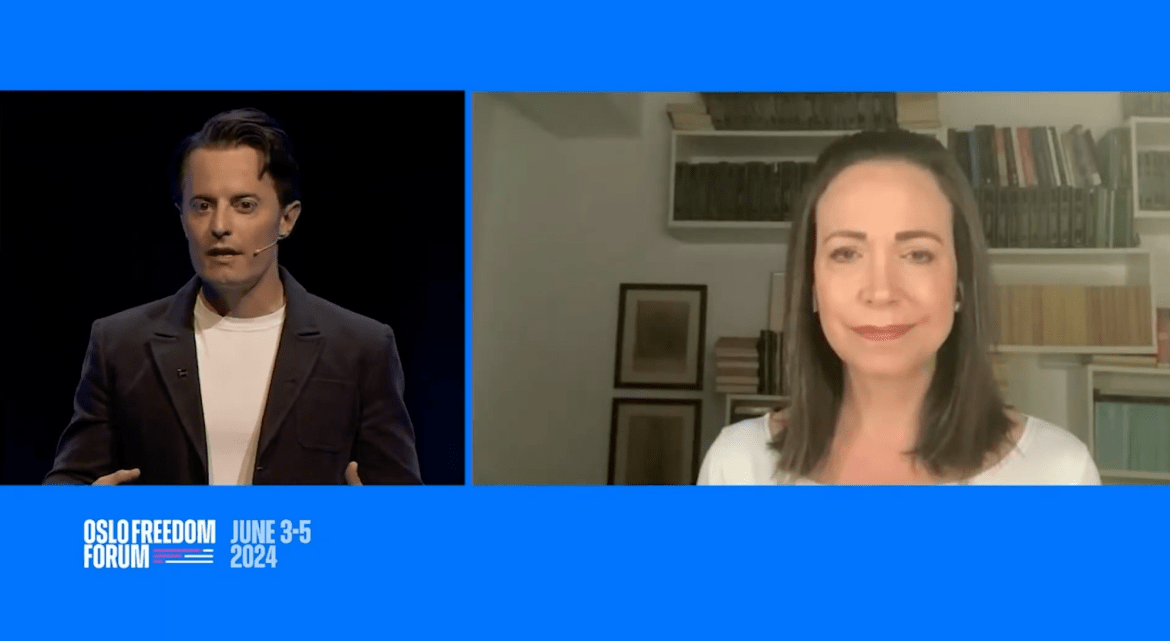
As the founder of the Oslo Freedom Forum, a self-proclaimed human rights group which openly advocates for toppling governments targeted by the West, Halvorssen presides over a network of Western-backed regime change activists. At the 2024 Oslo Freedom Forum, Halvorssen played host to Machado, who clamored for Maduro’s removal through a video link-up from Venezuela, where she was supposedly “in hiding.” This year’s Forum featured Machado’s top advisor, the Spain-based Pedro Uchuruttu, as well as her daughter, Ana Corina Sosa. When the Nobel Committee awarded Machado with its peace prize in October, the Oslo Freedom Forum issued a press release celebrating the decision for “chang[ing] the dynamics” in Venezuela.
The Norway-based Fritt Ord Foundation is a key link between Halvorssen’s Oslo Freedom Forum and leaders of the Nobel Committee. The Oslo Freedom Forum declares on its website that Fritt Ord “was among the first to endorse” it. While providing funding to Halvorssen’s regime change outfit, Fritt Ord awarded Jorgen Watne Frydnes, the Norwegian Nobel Committee Chair, with its 2021 Freedom of Expression Tribute. During his speech awarding the Nobel Prize to Machado, Frydnes likened the right-wing coup plotter to Nelson Mandela. With geriatric members of the Norwegian royal family seated just a few feet away, he went on to call for Maduro to step down and allow Machado to preside over a “democratic” transition.
Frydnes also happens to be the former director of the Norwegian Helsinki Committee, a think tank focused on supporting the Ukraine proxy war, which is a formal partner and supporter of Halvorssen’s Oslo Freedom Forum.
Among the five judges who awarded Machado her prize was Kristin Clemet, a Norwegian politician who was also awarded the Fritt Ord Freedom of Expression Tributein 2017. Clemet is the managing director of a liberal Norwegian think tank called Civita which officially partners with and supports Halvorssen’s Oslo Freedom Forum.
Even before she had officially received the award, Machado’s entourage drew accusations of corruption and illegal enrichment after a handful of insiders seemingly used advanced knowledge of her imminent win to rake in close to $100,000 on the Polymarket betting site.
The odds of Machado winning surged from 3.75% to 72.8% just hours before the Nobel Committee officially informed Machado of her victory. One unusually prescient bettor won $65,000 gambling on the Venezuelan opposition figure. “It seems we have been prey to a criminal actor who wants to earn money on our information,” said Kristian Berg Harpviken, the head of the Nobel Institute.
Months later, The Nobel committee still has yet to conclude its investigation into the corruption scandal. As of publication, the committee did not respond to a request for comment by The Grayzone.
For what promotes itself as the world’s premiere peacemaking institution, it may be too late to undo the damage wrought by giving the Nobel Prize to an avowed champion of violent regime change.
“Using her elevated position as the recipient of the Nobel Peace Prize, Machado may well have” already “tipped the balance in favor of war,” Assange concluded.
BLEAK MIDWINTER | ‘Warmongering’ Trump | No peace | Bethlehem lament |
 A BLEAK MIDWINTER for the world — and George Galloway is LIVE to confront it. As accusations of warmongering swirl around Donald Trump, peace slips further out of reach in Gaza, and Bethlehem marks another Christmas under siege, MOATS goes live with fearless analysis, global perspective, and real-time reaction as the news unfolds.
 Angelo Giuliano — Political and financial analyst — joins George to examine Venezuela, global markets, and the economic pressures driving today’s conflicts. From sanctions to currency warfare, Giuliano explains the forces pushing nations toward confrontation rather than peace. (Twitter: @Angelo4justice3)
 Gerald Celente — Founder of the Trends Research Institute and publisher of Trends Journal. One of the world’s most quoted forecasters joins live to break down US politics, Trump’s global impact, Europe’s decline, and what the next phase of geopolitical instability looks like. (Twitter: @geraldcelente)
Tonight on The Mother of All Talk Shows, George covers: – “Warmongering” Trump and the mounting global backlash. – No peace in Gaza as the war grinds on and diplomacy fails. – Bethlehem’s lament: Christmas under occupation and conflict. – Europe’s decay — political, economic, and moral. – Venezuela, sanctions, and the weaponisation of finance. – Gerald Celente’s outlook for 2026 and beyond. – Gayatri Galloway’s Social Media News Update tracking what the world is really saying. – Your calls LIVE from the UK, US, Europe, the Middle East, and beyond.  Tonight’s MOATS Poll: Which is the greatest threat to world peace — Israel, Islam, or Trump? Vote live in the chat — the strongest views will be read on air.
The President took part in an expanded meeting of the Defence Ministry Board at the National Defence Control Centre of the Russian Federation.
President of Russia Vladimir Putin: Mr Belousov, Comrades,
Today, at the expanded meeting of the Defence Ministry Board, we will discuss our results over the past period and identify priority tasks for strengthening the Armed Forces and enhancing the country’s defence capability.
I would like to highlight that the past year has been a significant milestone in addressing the objectives of the special military operation. The Russian Army has taken and firmly holds the strategic initiative along the entire frontline.
Our troops are advancing with confidence and grinding down the hostile forces, defeating enemy units, its groups forces and reserves, including so-called elite formations trained in Western centres and equipped with modern foreign weaponry.
To date, over 300 communities have been liberated this year, among them major urban centres that the enemy had transformed into heavily fortified strongholds, extensively featuring permanent defensive structures. Yet, they proved unable to withstand the courage and superior military skill of our personnel.
The positions we have seized, the bridgeheads established in recent months, and the unique tactical and operational experience gained in breaching the enemy’s in-depth defences now enable us to intensify the pace of our advance in key strategic sectors. We take pride in the heroism of our soldiers and officers on the front lines, and of all who stand in defence of Russia and the safety of our citizens.
I would also like to acknowledge our comrades-in-arms from the Democratic People’s Republic of Korea. By the decision of Comrade Chairman of State Affairs Kim Jong-un, DPRK personnel were deployed to participate in the liberation of the Kursk Region. They fought with valour and courage alongside Russian soldiers against the enemy and took part in the large-scale and exceptionally difficult mission of demining the liberated Kursk soil.
It is our duty to forever honour the memory of all our fallen comrades and to support their families, their children and parents. The state will fulfil all necessary obligations in this regard. I ask you now to observe a moment of silence in memory of those who gave their lives for the Motherland.
(A moment of silence is announced.)
Comrades, members of the board,
We are aware that that the Kiev regime is backed by the potential of the countries comprising the world’s largest military-political bloc, NATO. Large-scale military assistance is being continuously provided, with advisers, instructors, and mercenaries dispatched, and intelligence data shared.
Amidst such challenging conditions, our troops demonstrate high combat readiness and proficiency. The capabilities of the Russian army are being constantly enhanced, and efforts to strengthen the Armed Forces have been unwavering in recent years.
I refer to the improvement of their combat composition, qualitative advancements in the military command system, in operational and combat training, and, naturally, the increased efficiency of the defence industry, which has rapidly reconfigured numerous production and technological processes and is manufacturing essential products in ever-growing volumes.
Owing to the precise work of the defence-industrial complex, the army and navy are promptly equipped with modern weaponry and hardware. The Ground Forces are receiving missile systems and artillery with high-precision capabilities, loitering munitions, a diverse range of unmanned aerial vehicles, and robotic systems.
The Aerospace Forces are being supplied with upgraded missiles and aerial bombs equipped with guided planning and correction modules, capable of operating effectively in complex jamming environments. Many here are aware of the marked improvement in efficacy achieved recently – at times exceeding 80 percent. I wish to express my gratitude to those involved in this work. This constitutes substantive and tangible support.
This year, the Navy has been augmented with new submarines, including the Knyaz Pozharsky strategic missile submarine cruiser, as well as 19 surface combatants and support vessels.
Successful tests have been conducted for the Burevestnik strategic cruise missile with unlimited range and the Poseidon unmanned submersible. Given their nuclear propulsion systems, these platforms will remain unique and unmatched for the foreseeable future, ensuring Russia’s strategic parity, security, and global standing for decades to come. We will continue to develop these systems, enhancing and perfecting them, but they are already in service.
By the end of the year, the medium-range missile system armed with the Oreshnik hypersonic missile will be placed on combat duty. Its first operational deployment was conducted last November.
The high standards of training of our units and formations, and their ability to fulfil the most complicated tasks have been reaffirmed during regular exercises, including with the participation of our foreign allies and partners, with whom we share the experience we have accumulated during the special military operation.
In particular, I would like to mention the good results demonstrated during the Zapad 2025 joint strategic exercise. All objectives involving the protection of the security of the Union State from potential external aggression have been achieved.
Today, we can see that the geopolitical situation remains tense throughout the world, and even critical in some regions. NATO countries are actively building up and modernising their offensive forces, and creating and deploying new types of weapons, including in outer space.
Meanwhile, people in Europe are being indoctrinated with fears of an inevitable confrontation with Russia, with claims that preparations must be made for a major war. Various figures who have held or continue to hold positions of responsibility appear to have simply forgotten what that responsibility entails.
They are whipping up hysteria, guided by momentary, personal or group political interests rather than the interests of their people. I have said many times that this is a lie and an irrational narrative about an imaginary Russian threat to European countries. But they are doing this deliberately.
The truth is that Russia has always, until the last possible moment tried, even in the most complicated circumstances, to find diplomatic solutions to differences and conflicts. Responsibility for the failure to use these chances lies squarely with those who believe that they can use the language of force with us.
We continue to call for developing mutually beneficial and equal cooperation with the United States and European countries, and for creating a joint security system in the Eurasian region. We welcome nascent progress in our dialogue with the new US administration, which cannot be said of the current leaders of the majority of European countries.
At the same time, we realise that our Armed Forces remain the key guarantor of Russia’s sovereignty and independence in any international situation. As I have stated, we must work consistently to strengthen them.
What I would like to emphasise here are the objectives to be set in the area of military development, taking into account the dynamics of the situation along the line of contact, among other factors.
First. The goals of the special military operation will undoubtedly be achieved. We would prefer to accomplish this and address the root causes of the conflict through diplomatic means. However, if the opposing side and its foreign patrons refuse to engage in substantive dialogue, Russia will achieve the liberation of its historical lands by military means. The task of creating and expanding a security buffer zone will also be carried out consistently.
Second. Work on modernising the Armed Forces must continue at a rapid pace and to a high standard, primarily within the framework of the new State Armament Programme for 2027˗2036, which is currently under development.
As I have repeatedly emphasised, the experience gained during the special military operation, emerging trends in combat tactics, and rapidly developing military technologies must be fully taken into account.
Key areas of the state programme include air and missile defence systems, command and control systems, electronic warfare capabilities, and unmanned aerial vehicles (UAVs) operating in all environments.
Of course, improving our strategic nuclear forces remains a priority. As before, they will play a decisive role in deterring aggression and maintaining the global balance of power.
Today, Russia marks Strategic Missile Forces Day. I would like to take this opportunity to congratulate veterans, service members, and civilian personnel of the Strategic Missile Forces on their professional holiday and to wish them continued success and all the very best.
Third. The Russian army must continue to remain at the forefront of technological progress. This means accelerating the introduction of robotics, information technologies, and new materials into the Armed Forces, as well as expanding the use of artificial intelligence in command and control systems and autonomous combat platforms.
Fourth. It is essential to equip the orbital constellation with next-generation spacecraft. This will provide the troops with high-speed, secure communications, while also significantly improving the quality of intelligence and high-precision navigation data.
Next. In May of this year, the Strategy for the Development of the Navy until 2050 was approved, outlining its prospective configuration. The clear and timely implementation of this strategy will enable the modernisation of the Navy and enhance its effectiveness in carrying out combat tasks across all theatres of military operations.
Furthermore, it is imperative to continue actively developing military and military-technical cooperation with foreign countries – our allies and partners – to strengthen the collective security system and the Union State. Overall, efforts in this direction constitute a significant factor in enhancing regional and international security.
Comrades,
One of the state’s priorities is the expansion of social guarantees for participants of the special military operation and their family members, as well as for all our servicemen.
Over the past year, the Ministry of Defence, in collaboration with the Defenders of the Fatherland State Foundation, has made substantial progress in improving the quality of medical care for wounded servicemen, addressing their rehabilitation and employment needs, ensuring timely payments, and implementing other measures, including additional forms of social support for the families, children, and parents of fallen servicemen.
I must emphasise that there remains work to be done here. Currently, in preparation for the Direct Line, it has become evident that many questions on these topics are being raised. We will undoubtedly revisit this matter with the leadership of the Ministry of Defence.
I would particularly like to commend the heroic efforts of medical officers and personnel, who often perform the impossible to save our fighters and return them to active duty after treatment. Unique experience has been gained in providing medical and psychological support to servicemen with injuries, trauma, and illnesses related to combat operations.
This experience must be incorporated not only into the work of military medical institutions, but also into civilian healthcare, and must be enshrined in legislation.
Undoubtedly, efforts to index servicemen’s monetary allowances must continue, and the pace of providing them with permanent and service housing must not decline. Every Defender of the Motherland must be confident that the state will provide them and their loved ones with all necessary social support.
In conclusion, I would like to once again express my gratitude to the soldiers and officers currently on the front lines, to all participants of the special military operation for their heroism and dedication, and to extend my best wishes to the leadership, all personnel, and civilian staff of the Ministry of Defence for further achievements in service to the Motherland and our people.
I firmly believe that you will continue to steadfastly safeguard the sovereignty and security of Russia.
Thank you for your attention.
The floor is yours, Mr Belousov.
<…>
Vladimir Putin: Comrades,
I would like to thank the Minister for providing a detailed analysis of the status of matters in the Armed Forces and along the line of contact.
As is customary, I will share a few general considerations with you. I will probably not say anything that you do not already know, but I still believe it is important to say it.
I would like to begin with our recent history, with the most recent developments, in order to have a clear idea of where we are now and why we are where we are.
You have heard me say it many times before, yet I think it is worth saying it again. Shortly after the Soviet Union had fallen apart, we thought we would quickly become members of the “civilised” family of European nations and the civilised Western family more broadly. Today, it turns out that civilisation there is nonexistent, and degradation is all there is there, but that is not the point. Back then, we thought it was a good thing and that we would become a full-fledged and equal member of that family. Nothing of the kind happened. You see? Nothing of the kind happened, and we did not become an equal member of that family.
On the contrary, they started going after Russia from all angles, and even ratcheted the pressure up. Almost everything concerning Russia was decided from a position of strength. They would pat us on the shoulder and invite us to attend various events, but the West used force, including military force, to push its Russia-related interests.
Truly so. Supporting separatism and terrorism was clearly demonstrated and carried out by supplying terrorists with weapons and money and providing them with political and media support across the board. Economic restrictions were imposed on us as well, and that, too, is about forceful pressure, and a very serious one at that.
I remember this very well. When we said that we needed to protect our country against terrorism, we were told to do whatever we needed to, but not to do certain things or else we will not be eligible for loans or renewed easy terms.” This was direct forceful pressure and outright restriction in the economic sphere.
Destructive instruments aimed at destabilising Russia from within were also deployed – and this was entirely deliberate. We have seen the same pattern in other countries: mechanisms for undermining domestic political stability were created and put to use.
Of course, by then, the entire post-war security architecture had ceased to function. Everything began to erode rapidly, and the established rules, along with the UN Charter, were cast aside. Consider the events in Yugoslavia. How did that align with the UN Charter? Was that not the use of force? We have spoken of this many times, but the fact remains: they simply did as they saw fit, acting at their own discretion. They would manipulate the situation and force a vote if they could. If not, to hell with it – they applied armed force directly. In the end, they ravaged and dismantled Yugoslavia and fractured the Serbian people, scattering a single nation across different state entities.
I will not dwell now on NATO expansion, though its role is obvious. Even today, we are told we have no right to dictate how others should ensure their security or to deprive them of their choices. We are not depriving anyone of anything. We are not making exceptional demands. We are simply insisting that the promises made to us be honoured. It was publicly stated that NATO would not expand eastward. What followed? They disregarded this entirely, and one wave of expansion followed another. I repeat: we are not asking for anything extraordinary – only that the assurances given to us be fulfilled.
I believe everyone here understands that agreements with the Soviet Union were treated one way, and agreements with modern Russia, after the USSR’s disintegration, quite another. All our interests were simply ignored.
This ultimately led to the coup in Ukraine. What kind of democracy is this, the one we have been lectured about for decades? It was a straightforward armed power grab. Had they gone to the polls – as I have said countless times – they would have won the elections fairly. Nothing stood in their way; victory was assured. But no – they simply demonstrated force, and that was that.
Thereafter, they began violently suppressing the southeast, their southeastern regions, effectively unleashing a war. It was not we who started the war in 2022; it was the destructive forces in Ukraine, backed by the West. In essence, the West itself instigated this conflict. We are only seeking to end it, to stop it. Initially, we pursued peaceful means through the Minsk negotiations, as you will recall. Eventually, we were compelled to introduce a military component once it became clear we were being deceived. That deception has since been laid bare: senior officials have stated unabashedly that they never intended to honour the agreements, but only to buy time to arm and equip Ukrainian forces. They engineered a coup, initiated military operations, and deliberately – I am convinced, deliberately – precipitated a war.
President Trump has said that had he been in office at the time, none of this would have happened. He may well be right. Because the previous administration deliberately brought matters to an armed conflict. And I think the reason is clear: they believed Russia could be swiftly broken up and dismantled. European “swine underlings” immediately joined the efforts of that previous American administration, hoping to profit from our country’s collapse: to reclaim what had been lost in earlier historical periods and to exact a form of revenge. As has now become evident to all, every one of those attempts, every destructive design against Russia, has ended in complete and total failure.
Russia has demonstrated its resilience in the economy, finance, domestic politics, the state of society, and, ultimately, in its defence capability. Yes, there are still many issues and problems in this area.
I can see people here in this hall who came directly from the front, from the frontlines, from the line of combat contact. They are sitting here, I see them. And they know better than anyone that the army still faces many problems; they encounter them every day.
And yet, our Armed Forces have become completely different –fundamentally different. The most important result of the special military operation is that Russia has regained its status as a fully sovereign state. Russia has become sovereign in every sense of the word. We have regained this status to a large extent thanks to your participation, thanks to the contribution of the Armed Forces.
Our army has become totally different. This applies to troop command, tactics, strategy, equipment, and the work and performance of the defence and industrial complex. This also concerns the strategic component: our nuclear shield is more updated than the nuclear component of any officially recognised nuclear power. How much modernised is it, over 80 percent?
Chief of the General Staff Valery Gerasimov: Ninety-two percent.
Vladimir Putin: Our nuclear forces are 92 percent modernised. No other nuclear power in the world has such a level.
We have new armaments and new weapon systems. No one else in the world has these, and no one will for a long time. I have mentioned this before and we know Avangard, Burevestnik, and other systems.
Our ground forces are also growing and strengthening. Yes, I repeat, those who have come from the front know that many problems remain. But these troops are completely different now: they are battle-hardened. There is no other army like this in the world; it simply does not exist.
Yes, the Ukrainian Armed Forces are also going through the ordeal of military action. But, unfortunately for them, just as the Ukrainian state itself is disintegrating – symbolised by the “golden toilets” – their armed forces are also degrading. This is evidenced by the growing number of deserters: more than 100,000 criminal cases for desertion alone have been opened in Ukraine, and the total number of deserters is in the hundreds of thousands. This is a clear sign of degradation.
And our Armed Forces are on the rise. I repeat, much remains to be done, but it will all be done. We have always stated – and I want to reaffirm this – that we remain ready for negotiations and ready to resolve all the problems that have arisen in recent years through peaceful means. The United States administration has demonstrated such readiness, and we are engaged in dialogue with it. I hope the same will eventually occur in Europe. It is unlikely with the current political elites, but it will be inevitable as we continue to strengthen, if not with the present politicians, then with a change of political elites in Europe.
I would like to thank you for your dedicated work in 2025 and express my confidence and hope that all the challenges facing our country will be successfully resolved.
Thank you very much. (Applause.)
All the best.
Usually, the creativity is findable and if not, an understanding of the world is there. Moving into 2026 feels like a dark hole.
President Putin stated this morning: “There is no such thing as a civilized family in the West today – only total degradation.”
The good news is that Lavrov and Putin, in separate conferences, are basically making a new Putin 2007 Munich Style speech:
Lavrov
‘The UN is MUCH easier to reform than European bureaucracy’ — Lavrov
Brussels ‘beating every record there is’
Its elites have been ‘trying to usurp all legal rights of sovereign governments’
Putin
West started to ignore all the rules and the UN Charter
‘Look at what happened in Yugoslavia; they used force, they acted as they pleased’
‘They just destroyed Yugoslavia and the Serbs — so one nation was separated from several countries’
Last year, this time we saw babies starving and dying because of cold and exposure in West Asia-Middle East. This year, we are beginning to see that again. Trump’s peace process in West Asia and Gaza is a complete failure, and was probably built that way. Instead of bringing an end to the murder of Palestinians, the agreement just slowed down the pace of killing and it is picking up again now, widely, across the region.
Trump’s attempt at a peace process for Ukraine is a complete failure .. stacking another failure upon the first. Looking at the Russian speeches this morning, we are moving into another year of a Ukraine war. Hey Ho! Up to the last Ukrainian. Here comes Odessa! (And here ends Europe). No, it is not that the US administration is ‘leaving Europe’, it is only that they ae squeezing them as hard as what they try to squeeze the rest of the world. Of course Europe will bow the knee and even crawl on their bellies.
The current Russian and Chinese announcements are serious and we will post up the transcripts as available. If you’ve never paid attention, this time it is necessary.
Now the west wants a war with Venezuela, or alternatively wants to besiege them to death and steal another few countries as well. This will stack another failure, but will kill a lot of people. Mr Lavrov noted the disgust for this jingoism in his final speech with the Iranian representatives.
I saw an early, unedited copy of Michael Hudson’s new transcript of a Nima interview this morning. He starts by talking about the asymmetry of security. “For the United States, security means the ability to control the whole rest of the world, the environment, other countries. And to the extent that they have sovereignty of their own to act independently, the United States foreign policy feels insecure. But the problem is that when it solves this insecurity by surrounding Asia and the whole rest of the world with this 800 military bases throughout the world, well, this threatens other countries’ security. So there’s a basic asymmetry built into the whole concept of U.S. security to begin with. And that’s the point that Vladimir Putin has spent almost a year now trying to explain to Donald Trump’s team. … the idea is you can’t make America’s insecurity mean the actual military insecurity of other countries.
In looking back over the past year, I can only mourn and lament with Berletic: “Trump Announces Total Blockade on Venezuela (while expanding false pretexts) as Lead up to War Continues…
When I warned everyone Trump filling his administration with neo-con warmongers like Rubio, Hegseth, Waltz, etc. was always going to lead to more senseless, illegal wars of aggression abroad because Trump himself was a neo-con who only told Americans what they wanted to hear during campaign season – this was what I had known would come (along with bombing Iran, Yemen, continuing the war in Ukraine etc) – and desperately tried to warn people about… And here we are.”
China speaks, but it is not available in the normal course of events. We need to look for it. There are problems as well, with Japan being used as the current stalking war horse. Chinese FM Wang Yi declared that China will work with ASEAN to align development strategies, and resist unilateral bullying and cold war rhetoric.
The one area in Africa, the coalition of Sahel States that provided joy to all of us because of its anti-colonial actions, is in this position – The West is attempting to destabilize the situation in Burkina Faso, Mali, and Niger, the countries with which Russia’s cooperation is gaining momentum, Russian Deputy Foreign Minister Sergey Vershinin.
Looking forward, only after some meditation while cleaning. One can medicate and meditate while scrubbing, sweeping, wiping, and cleaning, and that is my solution for the blue funk.  And contemplating the fact that the Shining City upon the Hill is now a Rogue Mess, together with their Chosen Nation.
Europe’s choice is to surrender or die.
By Rotislav Ishchenko at ukraine.ru.
(machine translation)
Alastair Crook, a retired British diplomat, has stated that the European Union is preparing a provocation on a scale comparable to Pearl Harbor, with the aim of drawing the United States into a war with Russia.
In principle, this is not news. We have been writing for two years that the British, realizing that Ukraine has failed and will be buried, have placed their bets on a pan-European war (under the auspices of the United States) against Russia. While Joseph Robinette Biden Jr. was trying to figure out who he was and how he got here, the mechanism for expanding the war was clear: a provocation in the Baltic Sea (less likely in the Black Sea or on the Belarusian border), which would leave Russia with no chance of resolving the crisis without shooting, and an outcry about the “attack” to the country of the EU and NATO, a statement of military support (sending troops and equipment, but without a formal declaration of war against Russia) by the leaders of the EU. In the last act, the United States and Britain enter the scene, demanding that Russia cease fire and threatening to provide all possible support to their allies.
I would like to point out that the mechanism of provocation assumed that in all cases, Russia would initiate military action against a specific country. Moscow, on the other hand, was only faced with the choice of whether to attack the Baltic states, which had blocked Kaliningrad, or to hope for a miracle, sink the transports carrying French and German troops and equipment bound for the Baltic ports, or to express protests, attack the territories of the United States and the United Kingdom in response to their ultimatum, or to agree to a ceasefire and negotiations mediated by them. In the end, acquiescence inevitably led to capitulation (since as soon as one set of demands was met, the West would immediately set forth another), and escalation inevitably led to a global nuclear war.
It is no coincidence that Trump claimed that Biden was leading the country towards a nuclear armageddon. Whether Biden was aware of his actions or was being manipulated by his entourage, the decision-makers in the United States (as well as the majority of the British establishment and the European bureaucracy) believed that Russia would not engage in a nuclear conflict and would retreat. However, there were other politicians in the West who had no doubt that if Russia was pushed to the wall, nuclear mushrooms would grow all over the West – no one would leave without a share. These people came to power in the United States with Trump, and their supporters are gradually pushing back against the European left-liberal supporters of war.
As a result, the United States fell out of the scheme, and Trump openly stated that if Europe wanted to go to war with Russia, it could do so on its own, without the United States. It’s not that the Europeans were particularly eager to go to war, but rather that they couldn’t help but go to war with Russia, as acknowledging defeat in the Ukrainian crisis would completely undermine the left-liberal European elites. To understand why this is significant, it would have political, economic, and social implications on a scale similar to those that shook Russia after the October Revolution and before the outbreak of World War II. The Europe we know will disappear, and a new Europe will be born in agony, compared to which the 1990s in Russia were like a light rain during a summer picnic.
But the Europeans also can’t go to war with Russia. They don’t have the armies, the warehouses, or the ability to quickly deploy the necessary military production. Without the United States, the EU is a paper tiger. Although no, a paper tiger is scarier than the EU without the United States. This is why Alastair Crook emphasizes that the provocation must be so severe and widespread that neither Trump nor other American and European politicians who support de-escalation can avoid going to war with Russia.
By the way, as a loyal subject of His Majesty, Alastair Crook does not mention Britain’s leading role in developing this plan and preparing the provocation. The blame lies with the EU, which intends to drag the United States into a war with Russia, while the United Kingdom simply passed by.
It’s understandable. Most likely, the provocation is unavoidable. The British and the European bureaucracy can’t help but try to seize their last chance. I once wrote that nothing would stop them. They might even detonate a nuclear device in Kyiv to blame Russia. However, the Ukrainian government is not fully in control of the situation. The internal opposition to Zelensky, unable to oust him yet, is attempting to preserve at least some form of Ukraine by pushing Zelensky overboard.
In such a situation, the preparation of a large-scale nuclear provocation, which requires deep secrecy, is extremely difficult, as hundreds of people must be involved in its organization (transportation, storage of the relevant munition, its transfer across the border, security, and other activities cannot be carried out without the involvement of a large number of people). Even if you simply replace the customs officers and border guards at the border with trusted individuals, it will immediately become widely known that something large and secret is being transported.
However, recently, the Ukrainians and the British have started practicing a naval provocation, attacking tankers from any country carrying Russian oil. Russia has already begun responding to the Odessa port and the ships arriving there. In principle, the British Navy and its Ukrainian counterparts can organize a “Lusitania” (with influential Americans on board). However, it is more difficult to prove Russia’s “guilt.” As Poland’s experience shows, it is no longer enough to simply claim that Russia wanted to blow up railway tracks and cause a major disaster; convincing evidence is also required.
Actually, this is the catch: how to organize a provocation in such a way as to shake the imagination of “all people of good will”, and provide “convincing evidence” of Russian “guilt”, and not inherit anywhere, and leave the United States no choice? The task is difficult, but, as experience shows, it is solvable. If British diplomats (even retired ones) start issuing warnings and distancing themselves, it means that the preparations for some large-scale atrocity have entered the final stage or are basically complete, and the London warmongers only need to give the command to launch the operation.
In principle, the supporters of escalation don’t have much time. By March, even if the Armed Forces of Ukraine don’t completely disintegrate and Zelensky still controls some part of Ukrainian territory, Trump should withdraw the United States from the Ukrainian crisis and reorient towards the Indo-Pacific region and Latin America. Moreover, he has announced the beginning of a military operation against Maduro in Venezuela in the near future. If the British and European bureaucrats let the United States out of the Ukrainian crisis and allow it to get involved in others, it will be impossible to bring it back. Washington cannot afford to run around the world like a mad rabbit, and it cannot handle two or three major crises in different parts of the world, either organizationally, resource-wise, logistically, or financially.
In the West, they like to coincide political actions with traditional holiday dates. This way, they are better remembered and evoke more emotions. We are just entering a period of holidays: Catholic Christmas, New Year, Orthodox Christmas, and Epiphany. In general, from mid-December to the end of January, almost any day is suitable for the organizers of provocations. All they need to do is manage and dare.
After February, although the danger will not disappear (it will not disappear until a final global settlement is reached), it will significantly decrease, and the further into 2026, the lower it will be.
Are we watching NATO’s Strategy of Tension plan unfolding right before our eyes? Two potential false-flag attacks over the weekend. One on Bondi Beach in Australia killing 15 people one in Rhode Island at Brown University where 2 students were killed. Both reportedly targeting jews.
And
Bondi Shooting Reporting is a Mess!
– Shooters are Indian Nationals not Pakistani
– Younger shooter’s mother is Italian & father is Indian
– Pakistani man wrongly labeled shooter, social media fails to correct
– Netanyahu falsely claims Ahmad al Ahmad (Syrian Muslim) aka the… https://t.co/pIdyINQ9aC pic.twitter.com/9Nx5h9xett— GenXGirl (@GenXGirl1994) December 15, 2025
Is This the New Shape of War? The Venezuela Precedent***
What defines war today? It is no longer just the sound of artillery or the movement of armies. It has become something quieter and far more patient. Look closely at Venezuela. What you see there is a test, a blueprint for a new kind of conflict. This is a war of pressure and isolation.
Venezuela is the laboratory, and the experiment being run there threatens to become a standard playbook for how powerful nations can force weaker ones to obey. Think about the method. First, the story must be told. A country’s complex reality is simplified:
Here, come up with a drug trafficking BS story. It becomes an easy story of good fighting evil. This story is broadcast everywhere to justify what comes next. It makes the world believe that aggressive action is not aggression at all, but a necessary act of moral duty.
Then the true siege begins. But there are no visible walls. Instead, the blockade is built from financial rules and trade bans. A nation’s economy is slowly strangled. Its money becomes worthless. Food and medicine cannot get in. The goal is clear: make life so unbearable for ordinary people that they will demand change themselves.
The battlefield is the supermarket aisle and the hospital ward. The weapons are inflation and scarcity. Is this not a cruel way to fight?
The final stage is forced surrender. With the country brought to its knees, an ultimatum is delivered. The choices are surrender or more suffering. Give up control of your nation’s wealth. Hand over political power. The message is simple: you cannot refuse. When the survival of your entire society is at stake, how can you say no?
This is the dangerous new model being tested. If it works in Venezuela, what will stop its use elsewhere? Which nation will be next? Old targets like Nicaragua and Cuba would face this new, sharper tool. Even allies might one day feel its sting if they step out of line.
This strategy is clean for those who use it. It is easy to deny. It is brutally effective. Victory is no longer measured in captured land, but in a nation’s broken will.
Venezuela stands as a warning. The world must ask itself a simple question: Is this the future we accept? Is this the new, silent shape of war?
Commentary – Amarynth:
Vnezuela is slipping deeper into a position of being under siege. More oil tankers are not going into the area, because there is fear that more tankers will be seized in acts of undisguised piracy. https://diarioversionfinal.com/mundo/petroleros-cambian-de-rumbo-tras-incautacion-de-crudo-venezolano-por-ee-uu/
Trump, without hiding it, is supporting his supporters in elections across the region. In Honduras, Trump openly meddled in the election, trying to put a right-wing US puppet in power. The fraud was so blatant, after 2 weeks there is still no winner. The US backed a military coup in Honduras in 2009.
Chevron has just reduced the price of Venezuelan crude for US refineries following the seizure of the oil tanker. Venezuelan oil price fell below US$50 in November as tensions with US rise.
Venezuela announced that it is “immediately terminating any contract or negotiation involving the supply of gas” to Trinidad and Tobago and accuses the government of that island of being involved in the seizure of an oil tanker.
The baseball leagues of Mexico, Puerto Rico, and the Dominican Republic announced Monday to the Caribbean Professional Baseball Confederation (CBPC) that they will not be able to participate in the Caribbean Series Caracas 2026, scheduled from February 1 to 7, citing “external situations” outside their control. They say that Venezuela is perfectly able to stage the series, and this is an external circumstance.
I believe the fishermen do not go fishing, which deprives the Venezuelan people of everyday food.
The US is positioned in the area, its navy like a bully grandpa, aged and demented octopus. They overfly whatever they want to overfly and shoot whatever they want to shoot. I wonder sometimes who instructed whom? In Gaza, the zionists shoot fisherboats and kids on the beach. In Gaza, the Palestinians cannot move in or out. In Gaza, the Palestinians are deprived of food. In Gaza, the genocide continues, and a peace agreement is an attempted appeasement of genocide. If this trend of siege continues, we will see the entry-level picture of another genocide. The cry of ‘Maduro must go’ is the same as Assad must go, and Syria is in travail. It is the same cry that Hamas must go, and Hezbollah must lay down arms. Just as the drug accusations are nonsense, so is the idea that Venezuela will benefit if Maduro goes.

UPDATE: Just a while after both Angelo Giuliano and myself recognized the signs of a siege, Ben Norton writes about it as well:
The US military is besieging Venezuela. This is a naval blockade, aimed at starving Venezuela of supplies and preventing it from exporting oil.
The US goal is to "make the economy scream", to cause an economic collapse.
The Trump admin is waging a colonial war of aggression. https://t.co/qu0URAcdLJ
— Ben Norton (@BenjaminNorton) December 16, 2025
Confirming earlier illusions, European leaders have published a joint statement outlining their vision for security guarantees for Kiev, including the possibility of deploying “multinational forces” in Ukraine.
 The statement was signed by German Chancellor Merz, Finnish President Sipilä, French President Macron, British Prime Minister Starmer, Danish Prime Minister Frederiksen, Italian Prime Minister Meloni, Norwegian Prime Minister Schøyen, Swedish Prime Minister Kristersson, and European Commission President Ursula von der Leyen and European Council President Kostov.
The security guarantees should include:
providing Ukraine with constant and substantial support in the development of its armed forces, which should have a permanent peacetime strength of 800,000 military personnel;
multinational forces for Ukraine under European leadership, which will consist of contributions from countries of the coalition of the willing with US support. These forces will contribute to the restoration of the Ukrainian Armed Forces, maintaining the security of Ukraine’s airspace and sea, including through operations in Ukraine;
a mechanism for monitoring and verifying a ceasefire under US leadership with international participation, which will provide early warning of potential future attacks, monitor potential ceasefire violations and respond to them, as well as a conflict reduction mechanism for developing mutual de-escalation measures that can be used for the benefit of all parties;
a legal obligation, in accordance with internal procedures, to take measures to restore peace and security in the event of an impending armed attack. These measures may include the deployment of armed forces, intelligence and logistical support, as well as economic and diplomatic measures;
investments in Ukraine’s post-war recovery, including the provision of significant resources for economic and material recovery, mutually beneficial trade agreements, and consideration of the need to compensate Ukraine for the damage caused by Russia.
https://t.me/Slavyangrad/150676
This is a little older but given the charade that we are watching in terms of a Ukraine plan, it is a perfect day. This is why Russia thanks the US because the US is part of the charade and Russia just does not have to do it. Reminder, these negotiations are being done and advertised and leaders are making statements and flying to and fro while discussing this with a sham president that has no authority to even speak, let alone carry out anything.
NIMA ALKHORSHID: Hi, everybody. Today is Wednesday, November 26, 2025, and our dear friend, Michael Hudson, is here with us. Welcome back, Michael.
MICHAEL HUDSON: It’s good to be back.
NIMA ALKHORSHID: Please subscribe and hit the like button to help us reach more people. And you can see Michael Hudson’s website (below his name): michael-hudson.com. You can go there and follow Michael.
MICHAEL HUDSON: It’s michael, hyphen, hudson, dot, com (michael-hudson.com).
NIMA ALKHORSHID: Michael, let me start with the [28]-point plan on the part of the United States. They have proposed [28 points]. It seems that they have reduced it, after the meeting [Marco] Rubio had in Geneva with Europeans and Ukrainians. They have reduced it, as Donald Trump mentioned. We thought that it would be 19 points, but Donald Trump today said that it’s going to be 22 points.
But after all, looking at the document, what is your take on what’s going on, with the document?
MICHAEL HUDSON: The important thing to realize is it’s not a peace proposal. It’s not a plan at all. It’s a bold attempt to shape the terms in which the public views the entire Ukrainian coup d’état at Maidan in February 2014, followed by the whole Ukrainian attack on the Russian-speaking population, and the last (almost three) years of war. It’s a fight to shape public opinion, and it’s (in that sense) a brilliant propaganda attack. President Putin and Foreign Minister [Sergey] Lavrov have given speech after speech explaining the whole history, explaining how the Russians intend to end the war when they win and they create a new government — free of the Nazis, free of the Russia-haters — and disarm Ukraine, and prevent it from joining NATO.
What NATO and the Americans have done is, instead of just giving a different speech and saying, okay, here’s your narrative, here’s ours, they’ve encapsulated their answer, and their counter-argument, and their counter-narrative, in the form of a point by point, listing by listing — as if it’s a proposed articles of agreement [document]. And, of course, these articles will never be agreed upon. There’s no way in which either Russia or NATO (Europe, and the United States) — not to mention Zelensky’s government in Ukraine — can accept them.
So, the purpose is not to get any agreement at all. It’s to make people think in terms of: How do we view what’s happening? What’s the war all about? Who’s responsible for it? And these points have been crafted by propagandists, to sort of win the hearts and minds of the people, in support of the Maidan coup.
The aim has been sort of leaked to the press, going all the way back — to reverse the way of, how World War II ended. What Europe wants to do is say: We want to refight the end of World War II. And already in 1944, Churchill was saying: As soon as the war is over, let’s attack the Soviet Union. Europe said: Well, let’s go back to that point — 1944 — okay? That’s 80 years ago. Let’s see whether we can refight, at that point. Now we can attack Russia.
That’s really what it’s about, and it’s an outrageous trick. It’s been carefully thought out and propagandized. So the peace proposal is not intended to bring peace. It’s just a propaganda charade at pretending to negotiate peace. And it’s really a propaganda effort. In a word, the aim is to essentially obfuscate what is really happening.
By the way, Foreign Minister Lavrov said yesterday at a French news conference that Europe’s “elites opted for war and have staked their entire political careers on the slogan of inflicting what they call a strategic defeat on Russia.” [Dialogue F-R YouTube channel, Nov. 21, 2025]
Well, that has failed; so NATO realizes it’s lost the war. It doesn’t have the arms to fight. You’ve seen the Russian advance, accelerating day after day. So NATO says: Well, okay, we’ll lose the war. How do we win the peace? And that’s going to be: How is history (and current voters) going to look at what’s been happening? What is all of this about? And if you look at the U.S. press (the New York Times and the Washington Post) and the British press, it’s which side of the fight is analogous to the Nazis and [Adolf] Hitler? In the New York Times yesterday, you have [Thomas] Friedman talking about, well, how can Trump appease Hitler? Trump is “Putin’s puppet.”
These agreements are really Russia’s demands. (Well, of course, they’re not Russia’s demands before. You can read the Russian demand, and what Putin and Lavrov have said.) So, I think we can [discuss], if this were really an agreement to discuss: Where do we go from here, and how do we think about solving this fighting in Ukraine?
Article 1 should be: Were there any war crimes committed? That’s what it’s all about. And a basic issue is, well, if they were, by whom, and against whom? And who are the victims? And what were these crimes? Well, Russia has already announced that when it conquers Ukraine and installs a non-Nazi government, it’s going to hold a modern Nuremberg trial. It’s going to convict parties that have committed war crimes. That is what terrifies the NATO leaders, not to mention the kleptocrats in Zelensky’s regime that have enriched themselves and been embezzling the loans — from Europe, the United States, and, especially, the International Monetary Fund — to buy properties offshore, and Bitcoin, and the things that kleptocrats do to hide or conceal the money they’ve taken.
Well, for the Russians, it’s vitally important to establish the historical record, because that’s the key to what is going to be the body of international law following on from all of this.
Again and again, President Putin and Lavrov have said: We thought that the Nuremberg trials had established the international law of war crimes. We’ve been attacked. Russia is not the attacker. The Maidan [the coupists] was the attacker. The Ukrainian attack on the Russian-speaking population — the civilian population — was a war crime, breaking the rules of war. We came in to protect the Russian speakers. The populations of Luhansk and Donetsk have voted to become part of Russia, which were, in practice, [Russian] all the time during the Soviet Union, when there wasn’t any real separate Ukrainian nation.
The Russians are basing their actions, and their intentions, on international law. To do this, they have to have a Nuremberg trial — a war-crime trial — to reiterate: What is the appropriate international law to deal with the situation, such as we’ve been fighting, for more than two years, in Ukraine? And the West says: Well, it was Russia that’s the attacker. Russia has committed the war crime. That’s the travesty of what’s happening.
But it’s the aim of the U.S. and NATO narrative to turn the war into a new Cold War propaganda weapon against Russia, aimed at turning the world against Russia and supporting Western Europe. So, in practical terms, it’s to protect the Ukrainians and neo-Nazis, and the European backers; to whitewash all the corruption that’s been occurring during this.
And a major aim of the Ukrainian Nazis has been to avoid punishment. They want to leave Ukraine with the money that they’ve embezzled, and stored away, and go to their British mansions and Mediterranean castles.
So, the U.S.-NATO proposal calls for blanket amnesty. And if there, indeed, were a war crime, then there shouldn’t be an amnesty for everyone. If a criminal breaks the law, then the criminal must be arrested, and put away, not merely to punish them for what they’ve done in the past, but to protect the present population from having them continue to commit crimes.
Well, that (committing crimes) is exactly what the NATO-West wants to do against Russia, against China, against Venezuela, against Iran, and against any country that is resisting the U.S.-dominated world order. So, all of this jockeying, for how do we determine the terms of peace? Is it all, we’re just going to forget everything? Are we going to blame Russia, or are we going to blame the United States and NATO? All of this is what’s at stake, in all of this.
I can elaborate. The original proposal called for Ukraine to investigate corruption. The Wall Street Journal, a few days ago, reported that the Ukrainians insisted on changing the language to say that all countries will receive “full amnesty for their actions during the war.” Well, the actions are not only the war crimes — staging false flags, like the Bucha staged [war crime] — but the crimes of embezzlement. The World Bank, the Europeans, all have agreed that NATO [Ukraine] is the most corrupt country in the Northern Hemisphere, and it has been ever since 1991 —
NIMA ALKHORSHID: You mean Ukraine is the most corrupt?
MICHAEL HUDSON: Yes, what did I say?
NIMA ALKHORSHID: You said NATO.
MICHAEL HUDSON: I’m sorry. Well, Ukraine is the most corrupt, although its corruption has been with the full participation and support of Europe. And I would imagine that any trial is going to involve the actions of [Emmanuel] Macron, and [Friedrich] Merz, and [Keir] Starmer (and the British — in breaking up the agreement that the Ukrainians and Russians had made to end the war all the way back in 2022 — the agreements that were all broken, and turned out to want a ceasefire just to rearm Ukraine with more NATO arms to go on fighting against Russia). That’s something that Russia is never going to fall for again.
So, the whole idea of a ceasefire, as if that’s what these proposals are about, there never was a possibility of that. And so, if that was never a realistic possibility, why are they doing it? It doesn’t have anything to do with creating an actual peace, as I said. It’s a way to shape the categories of how people think about this whole conflict between NATO and Russia, the whole expansion of NATO since the Americans had promised NATO would not expand, if Russia ended its military occupation of Central Europe and agreed to dissolve the Soviet Union. All of that has already happened, and I don’t think Russia has any intention of trying to trust the West again.
So, the reality is that any real peace agreement, logically, has to be created after the fighting stops — not before it stops — and especially not when one side is defeating the other overwhelmingly. Trying to freeze a conflict when Russia is overwhelmingly winning is trying to solve the Ukrainian problem by just making the loser set the terms of the peace.
NATO and the United States have lost the war that they started in Ukraine — hoping that the war would drain Russia’s economy; would create an economic crisis; would persuade Russian voters that we need a regime change, we’ve got to replace Putin for having started this war, and put in a new group. The idea of a “new” group is the same neoliberal kleptocrats that they put in in the 1990s — privatize Russia, ideally break it into parts (the whole strategy against Russia) — and that’s just a fantasy.
So, how can they, at least, try to convince the population that this fantasy is a realistic probability, and even a moral probability?
Their solution is to say (well, the big picture): Who are the counterparts to World War II’s Nazis in this? And we’re seeing a replay of the ending of World War II. And since Russia is organizing the peace, it’s in a position to hold these (what I call the new) Nuremberg trials.
And the NATO aim is to make people take seriously the idea that Putin is a modern Neville Chamberlain making peace with the Nazis — (I’m sorry, not Putin) to make Donald Trump look like a Neville Chamberlain — just surrendering to Russia. That’s what Friedman had written in the New York Times. It’s what the New York Times, Wall Street Journal, and network television in the United States keep saying: We’re back in what started all of World War II, when Chamberlain did not protest against Russia’s moving into Czechoslovakia to defend the German population there.
Well, if trying to say that Trump is a Chamberlain means — you have the leaders of the Republicans in Congress, Mitch McConnell, especially, says there’s no way in which the U.S. Congress can possibly agree to even the proposal that Trump and his staff have put on the table. So Congress has already announced [that] any agreement is going to be a no-go. The Ukrainians have said: We absolutely will not cede any territory to Russia. Even though Russia has conquered it, even though we have no army to defend it, we’re not going to agree with that.
Well, the defeated party does not get the right to determine the terms of peace, and who won and who lost. That’s what war is about. As [Carl von] Clausewitz said, it’s a continuation of policy by other means — by military means. Russia has been obliged to use an enormous expenditure, and troops, to achieve this military policy of ending the NATO expansion towards trying to destroy the Russian economy, and hurt it in any way it can; especially by cutting off its trade with Europe in oil and gas, and other things; to seize Russia’s savings that it had kept in the West and [in] Euroclear (its foreign-exchange reserves that it was using).
That’s the first issue.
The second article up for discussion should not be put in terms of blaming one party or another. It should be: Who owes reparations to whom, and how are reparations going to be paid? Well, trying to frame the narrative, the current text says Russia owes reparations to Ukraine; but it’s Ukraine that should pay reparations; and Europe-NATO should pay reparations to Russia for initiating the war, for breaking the rules of war, for destroying enormous amounts of civilian property in the Russian-speaking portions of what was Ukraine.
And this is the cover story for the U.S. and Congress backing the NATO-Euroclear seizure of more than 200 billion euros (even more in dollars) of Russian assets. They say: Make these assets a loan to Ukraine. Well, Ukraine’s already broke. It’s unable to pay the IMF loans.
The IMF loans, in fact, were made — illegally — against the basic principles of the IMF, saying the International Monetary Fund will not make loans to a country at war, or to support a belligerent. The IMF said: This is not war. You know? This is … we’re defending ourselves. The war is … Russia, not Ukraine.
So the pretense that somehow [Russia] is liable? The hope [of the belligerents] is going to be that when Russia carves out its portions — of those Ukrainians that want to be part of Russia, and vote to become part of Russia — that the whole idea is to destabilize the next decade of legal argument, saying Russia owes money to the West. Well, if Russia would have thought of not giving speeches, but let us put a 28-point plan in, it would have said, how much does the West owe Russia? What’s going to be the cost?
There’s no question that Russia is going to spend more than 200 billion euros (and dollars), the equivalent in rebuilding all of the real estate that you’ve seen destroyed in the fighting that’s gone on so far — which is entirely on Russian-speaking land.
The way that the Trump administration shaped the agreement was: Well, alright, we’ll give 100 million of this (half of the money) to Donald Trump’s group, so American companies can come in, and they can rebuild Ukraine, and make enormous profits — Russia has no intention of letting American real-estate companies rip off profits, and emulate the Zelensky kleptocrats in just embezzling the money for themselves — and building the kind of shoddy building that Trump is known for, the shoddy Trump Tower, whose architects tell me he cut costs everywhere, and it’s just junk. The Russians build much stronger buildings, to last, and at less expense than Trump’s real-estate ripoffs that he made his career on building.
So, all of this, the phrasing of the peace agreement is designed to justify Trump’s, and the Americans’, and the Western Europeans’ attempt simply to grab what was Russia’s foreign-exchange reserves for themselves, and prevent Russia from having the resources to spend — the balance-of-payments drain — that it’s going to take to buy the raw materials, the equipment to rebuild the buildings with plumbing, all of the imported goods, the facilities that you need to make new apartment houses, houses — the vast amount of reconstruction that Russia is going to have to spend (and has promised to spend in Luhansk and Donetsk), and the other territories that it takes as it moves west, again, to those populations that want to remain part of Russia — leaving the Ukrainian West that does not want to be part of Russia isolated, demilitarized, denazified, and disarmed, not to ever again become a proxy battlefield for NATO, led by the United States and the neocons in their fight against Russia. It wants to prevent that permanently; not simply to have a short-term ripoff that is being proposed by the United States.
I’m amazed that the Russians have not been more vocal in calling a spade a spade in all of this.
You may have other points of the agreement that you’d want to bring up. And if you go over point by point, I’ll be glad to answer them.
But again, to me, the key is, Russia’s 200 billion in reserves is, the subject of this false narrative, of the premise: that Russia is the attacker — not NATO — and that Russia has attacked civilians — not Ukraine has attacked civilians.
Russia was very careful to focus on military targets, that extended to energy companies, to electrical systems. Russia had proposed a mutual agreement between it and NATO-Ukraine not to bomb each other’s energy; and President Trump said: No, no. We have to bomb Russia’s oil refineries because we want to block Russia’s ability to export oil. We want to create an oil crisis so that the United States can use oil as the key controller of American foreign policy. This is what you and I have discussed for the last few months on your show. So, of course, Trump said: No, no. Ukraine, don’t agree not to bomb energy systems.
So, Russia realizes that it’s energy that has been powering the NATO arms factories, that’s been powering the Ukrainian war machine, and that its basic military tactic is indeed to focus on destroying this military ability to fight; and energy is as much the key to military conquest as it is to Gross National Product. Energy is what makes the factories go; it’s what heats apartments; and it’s made life unlivable for much of Western Ukraine — and that was the choice of Trump’s foreign policy.
So, these are the two shaping narrative structures of the propaganda effort that’s been put in place. Do you have any questions you want to follow on to fill out this big picture?
NIMA ALKHORSHID: Michael, one of the crucial points in the [28] points is the size of the Ukrainian army, which was supposed to be (in the document) about 600,000. Then the Europeans changed it to 800,000. And right now, it seems that there is no limitation for that.
Who’s going to pay for this army? You know, it’s a huge army, if they go in that direction — because this army should be supported by someone, you know, other countries, Europeans, together with the United States — which literally means that NATO is going to arm this Ukrainian army, again and again, to fight Russians. The same attitude.
Do you think that Russia would accept that?
MICHAEL HUDSON: This is the opposite of demilitarizing the enemy.
Remember the end of World War II? The Morgenthau Plan in the United States was to say, make Germany never industrial again — make it an agricultural country, make it a theme park, but it won’t be an industrial country — so, that was [Henry] Morgenthau’s plan, and that was turned down by the United States. But the idea was for Germany, and also for Japan: Japan and Germany were to demilitarize and never be able to rearm, because they were incorrigible aggressors. And that is the principle (exactly the same principle) that Russia is trying to do [in Ukraine].
NATO says: We have to triple the size of what the Ukrainian army was when we began this war; and we have to leave the Nazis in control. There won’t be any war-crimes trial. We have to leave the Ukrainian government. It may not be [led by] Zelensky, it’ll be one of the [Stepan] Bandera followers. It will be the Nazi-led army so that, if we fail (so far), we can come again — and this time, we’re really going to hit you, with long-[range] missiles, and we’re still going to bring down the [Russian] government — until the Russian population says: It’s worth anything to surrender to the West and let them take over. We can’t fight anymore.
This is the evil fantasy that is being promoted.
Of course, Russia is going to say: We are the victors. We get to disarm the government. We get to put in place a post-war constitution of the restructured Ukraine (whatever is left of Ukraine), so that it will not have a standing army; it will not have Western weapons. And if the Western countries, if NATO or the United States provides weapons to [Ukraine], President Putin has already said: If a missile, or a weapon hurts the Russians, we will retaliate not simply against Ukraine; we’ll retaliate against the country that has supplied Ukraine with the weapons.
Well, Donald Trump has said, quite realistically: There’s no way Ukraine is going to win. It’s a black hole. We are not going to give weapons to Ukraine. It doesn’t pay —
We want to fight China. This is a race war. It’s the Anglo-Saxon West against the global majority; and China is the key, our long-term enemy. We want to do to China what we tried to do to Russia, and failed; so we’re not going to spend any money on arms on Russia, because we’ve depleted all of our arms, and NATO has depleted its arms. It doesn’t have any more —
We’ve got to prepare for the final conflict of civilization, the civilizational fight by the West, waged against the 85% global majority.
That’s Trump’s position; so Trump is not going to provide American arms to Ukraine. It’ll be the European countries. And it will be these countries, against which Russia will retaliate — and destroy not only their arms factories, but the political and military capitals, and ports, and power supply itself. The European NATO leaders, having agreed to fight to the last Ukrainian, are now saying: We’re going to fight to the last European, in an attempt to, somehow, hurt Russia, a little bit.
So, European history, essentially, is going to end, if this plan is put into operation — Russia has made that very clear. It says: There must be a better solution. Let’s just have nothing to do with Western Europe. Let it go its way. It can join the United States in some kind of political alliance — maybe France can become the 52nd state, Germany the 53rd state, you know, after Canada and Mexico. Right down the line. It doesn’t matter.
Russia wants to separate itself from the West and turn east. The West wants to move eastward, via Russia, towards its own fight against China. That is the long military dynamic — and it’s a crazy dynamic. It’s crazy because there’s no chance that the West has of winning. Its arms don’t work. The American ATACMS missiles that were just fired at Russia were all shot down by the Russian defenses. And then the Russians retaliated by a missile that killed the troops that were sending the missiles [their] way. I don’t know how you can get a clearer example of — this is a microcosm of what would happen if there are further NATO attempts to attack Russia.
But you can see that they don’t have the arms, they don’t have the money for the arms, and yet the leaders — Macron, Starmer, Merz, the Dutch leaders — and the French general, last week, said France should be willing to sacrifice its youth of the future to fight Russia: We need an army to go into Ukraine towards Russia and invade it. Your children are going to die. It’s all worth it because we hate Russia, don’t you?
Well, how are they going to get the population, ever, to say: Okay, we’ll send our kids to war and they can fight to the last French infantryman, just like the Ukrainians are fighting to the last Ukrainian? Of course, we will agree that this is a moral fight against Russia?
I don’t see any way of convincing the French population of doing that. So far, you’ve had all of the yellow-vest protests against the Macron government. What more can they do? What do you do when a government is fighting a war in Ukraine, against Russia, that the populations of Germany, France, the rest of the European countries, do not support?
Their only outlet has been to support the nationalistic parties, such as the Alternativ für Deutschland, [Giorgia] Meloni in Italy, and similar parties in England and abroad. That’s not very effective in stopping this whole military plan of attack, and the whole rearmament, and the whole resumption of the new Cold War — which, really, is trying to refight the end of World War II. That’s, really, what it’s all about.
Well, Russia is going to be the winner. The winner gets to set the terms, and NATO will lose; but it can say: Well, if we can generate in the public mind enough resentment against the Russian victory, against the Russian denazification, against the Russian demilitarization of Ukraine; then we can fan these simmering embers of resentment into a new anti-Russian mentality.
It’s all about the narrative, once again. That’s what they’re trying to do in all of this; and that’s why they keep calling Trump Neville Chamberlain, and turning Trump into “Putin’s puppet.” It turns history inside out, and, with it, the whole idea of right and wrong, and good and evil, as described by the whole spirit of civilization for the last few hundred years of drawing up laws of warfare — laws to prevent armies from attacking civilians, false-flag operations. The whole behavior, and breakdown, of the system of international law that’s occurred over the last few decades — really since 1990 (quite a few decades now) — all of this is a breakdown.
That’s what we’re dealing with: the breakdown of the West, and the attempt by Russia, China, and Eurasia to create its own laws of civilization — on how they would define civilization — and these laws are pretty universal; and they’ll pick up what the West’s ideals used to be, but which the West has abandoned now.
NIMA ALKHORSHID: Michael, how do you see the ability of Europe — because Ursula von der Leyen was talking about [how] Ukraine must be part of Europe (Ukraine, in today’s condition that they have, politically, economically, militarily)? Is Europe capable, or able to let Ukraine in?
MICHAEL HUDSON: The question is: What will Ukraine be?
If Europe lets Ukraine in, is there going to be free migration within Ukraine? You’re going to have the Ukrainian males who are able to bribe their way, or otherwise escape from the suicidal service in the army, [and] have already gone into Poland, and Central Europe, and into Germany. From what I read in the newspapers, they’ve made themselves fairly unpopular there, by being very demanding, saying: You have to support us. We’re victims.
Can Europe afford this whole migration crisis?
Well, the whole spirit of the nationalist parties, and of the voters, is very much like the United States. It’s anti-immigration. They’re saying: Western Europe for the Western Europeans; or, at least, they’re saying: France for the Frenchmen, Germany for the Germans, Britain for the British; but not for these countries to support, first of all, the influx of populations from the Middle East (where the United States [has] destroyed), from North Africa, from the Islamic countries — and now from the Ukrainians.
In order to fund the war, you’ve had Chancellor Merz in Germany say: We’ve got to cut back social spending. We’ve got to end the subsidies that we have given to German families — so that they can afford the higher gas and oil prices to heat their homes, and to cook, and to drive their cars — that we’ve been giving, when we cut off the trade with Russia. We cannot afford that, if we are going to spend our money on creating arms to give, or sell, or otherwise provide Ukraine with.
Well, what do you think the Germans are going to say? It’s okay? We’re willing to freeze in the dark and eat cold cereal instead of cooking, as long as we’re hurting Russia?
Can they really be convinced to hate Russia that much?
The neocons find this believable because they hate Russia that much. They’re not willing to fight Russia — and the Banderites (the neo-Nazis in Ukraine) are not the armies, primarily, that are fighting. The Azov Battalion, and others, tend to stay in the back and send the Ukrainian farmboys to fight, not the Nazis themselves. They’re shooting their own soldiers in the back, if their soldiers seek to retreat, instead of moving forward and simply being killed by the Russian drones.
So, you’re having an internecine Ukrainian war, by the Nazis, against the non-Nazi Ukrainians.
And you’re going to have this kind of counterpart all throughout the European countries, between the neocon governments representing NATO (the EU union represents NATO, not the elected voters) and the voters in the European countries. All of that is breaking up the European Union itself. And that’s going to be one of the results of this war.
It will not be up to Russia to do what it’s doing in Ukraine, and rewrite the European constitution and restructure the European economies, like it intends to do in Ukraine.
But you can see that in this fight over how to depict the culmination of the Russian military victory and restructuring of Ukraine; and the loss of the war by NATO, by the United States, and the loss of its whole plans to destabilize Russia — to deplete its arms supply, in order to try to make Russia deplete its arms supply (which has not occurred) — the failure of all of its unrealistic forecasts.
And this is what’s at stake: Can it maintain the fictitious view of reality that led to all of this failure, in the first place, ever since the 2014 Maidan coup d’état?
That’s what is the big picture of destabilization that’s occurring. And at what point will the European countries say: We’ve been suckered into fighting on behalf of NATO (which is really the U.S. War Department, as Trump has renamed it) — really, in serving American neocon foreign policy —
And maybe we should have a European policy, and the aim of our policy should be to improve the productivity and living standards and self-reliance of our European countries themselves, for our self-interest — not the neocon and the Trumpian-American self-interest, that has led to the surrender of von der Leyen to Trump’s tariff rules a few months ago?
They’re going to put European interests before foreign interests; and that’s going to mean, at some point, the loss of Europe to the United States.
This has been discussed by Putin in some of his press conferences. And he said, I think, realistically: You know, it’s going to take about 30 years for there, really, to be a restoration of trust, and trade, and investment, mutually, between Western Europe and Russia. For the time being, we’re turning eastward, with countries whose values we share.
And this ending of the Ukraine war, like the beginning of the Ukraine war, has been all about values.
And I think Lavrov had a wonderful statement, a few days ago, in the meeting with Belarus that Russia has once a year. He said: If we talk about what was, and what they want to restore (meaning NATO), these are all exhausted Euro-Atlantic models. NATO [North Atlantic Treaty Organization] and the OSCE [Organization for Security and Co-operation in Europe] are Euro-Atlantic structures. The European Union has long ceased to be a European forum where the interests of Europeans are represented. It’s become an appendage to NATO. And what they call fighting for their values, is fighting for, what turns out to be, Nazi values.
That says it all, in a nutshell.
Again, yesterday, Lavrov said, in a French interview, that the whole drama began with the West’s attempt to have NATO absorb Ukraine, create a military threat to Russia right on our borders; and in breach of all the promises given to the Soviet Union, and contrary to all the understandings concluded then with the Russian Federation. As part of the OSCE framework on the indivisible nature of security, and the fact that no organization, no country in Europe will seek to strengthen its security at the expense of others, it was approved at the highest level — NATO acted in exactly the opposite way.
That’s the Russian position that’s going to shape how it restructures the domestic legal system and political system of Ukraine, and the value system in which it’s doing this. If you read what they’ve said, you realize the total disconnect between the so-called “peace proposal” propaganda effort, and what Russia intends to do. Russia has been sort of slow to raise the ante, and say: This isn’t simply about what military side is going to win; it’s a fight over the values of civilization. And Lavrov has said that Western Europe no longer has the values that shaped the Enlightenment, and shaped European Idealism at a point when Europe achieved world political and economic ascendancy in the 19th and 20th centuries.
NIMA ALKHORSHID: Michael, before this live[stream] we were talking about Bloomberg’s leak of Steve Witkoff’s private call with Kremlin aide Yury Ushakov. What are they trying to do?
Looking at the social media, the way that they’re attacking Steve Witkoff, they’re calling [him] a KGB agent? He’s an agent of the Trump administration! He’s Russia’s puppet, “Putin’s puppet?” What’s going on with the case of Witkoff? It seems that the establishment is attacking him, and these people are getting in line with the establishment.
MICHAEL HUDSON: Well, you mentioned the establishment. It’s obvious that the phone calls and the emails that Witkoff was handling were all copied by the National Security Agency. Essentially, they’re doing to Witkoff what they did to Donald Trump in his first administration, [when he] tried to appoint the general that was going to clean up the CIA, and clean out the bad actors. The NSA leaked it to the FBI saying, oh, look at what the general said. They pretty much falsified the charges against him.
I’m blocking out the general’s name, but you must remember who he is. At any rate, they’re trying to do the same with Witkoff. They’re trying to
Witkoff by saying, here is the reality that we recognize, when he was talking to [Kirill] Dmitriev and other Russians.
NIMA ALKHORSHID: Michael, you mean that general that was in Russiagate, they said that he’s connected with Russia, General [Michael] Flynn?
MICHAEL HUDSON: Yes, General Flynn. The one thing that the deep state wanted to do was to prevent General Flynn from being appointed to clean out the CIA, to clean out the neocons. That’s what Trump wanted to do. They framed him up, and they got Trump’s awful vice-president [Mike Pence] to say, and his idiot son-in-law [Jared Kushner] to say: No, you’ve got to get rid of General Flynn. The FBI doesn’t like him.
Well, of course the FBI and the deep state doesn’t like him because he wanted to clean out the neocons. And Trump was gullible enough to trust his idiot son-in-law and the vice president that was urging him. And he listened to the neocons who he wanted to get rid of for the advice: Don’t have anyone strong enough to get rid of us in power. He was suckered.
And I think he decided not to do that again. And that’s why he’s focused, in his second term, on appointing politically loyal cabinet members, and army members, and NSC members, and State Department members. The problem is that appointing political loyalists, they’re not (all) that savvy as to how to really conduct foreign relations and foreign policy, or even military policy. So that’s the trade-off that is sort of tearing his second term apart.
Well, they’re trying to say: Witkoff, by saying that Russia is winning, Witkoff is also “Putin’s puppet.” Well, any attempt at reality is defined [by neocons] as “pro-Russian,” because reality is the Russians have defeated Ukraine. They are marching towards victory, that they will probably conclude at the end of next spring, at the latest, in Ukraine. They will get rid of the Nazi government. They will replace it with a new government. They will write a new constitution.
All of that (obvious) military victory is a realistic expectation, and yet that’s called pro-Russian. Well, if reality is pro-Russian, then that means that NATO and America is the sphere of unreality. And the only way that you can ever get unreality to somehow dominate the electoral political process is by shaping a narrative in a way that distorts reality, that distorts the reality that recognizes Russia’s military victory in Ukraine; and, by the same token, [distorts the reality] that recognizes the futility of ever sending millions of Ukrainians to die, or to emigrate, or to suffer, to fight to the last Ukrainian.
What will the Ukrainian population think when the war is over? The voters — not the neo-Nazi leaders and the kleptocrats — what will they think? To say: How did we ever get our children, and our relatives, killed in this futile fight that we’ve lost, and had no chance of winning, because we were outgunned, outmanned? And all of this was just to, somehow, weaken Russia, not to help us? What interest did we have in fighting against the Russian language, in burning the library books that are written in Russian, in blaming, banning the Russian speakers, banning Russian music, and all of that?
Last time I was in Latvia, I remember, we were invited to a concert, and it was Dmitry Shostakovich’s opera, Lady Macbeth of Mtsensk. This was many years ago, when I was there performing Russian operas. All that, now, is swept away by the anti-Russian Baltic feeling, by banning the Russian-speaking population from voting and really having a voice in the electoral process. So that’s what all of this is about.
When they’re saying that Witkoff is pro-Russian, and that what he is saying — that Russia’s winning — is pro-Russian — it’s as if that’s a bad word. Instead of saying: Witkoff is recognizing economic reality. Thank God that we have Donald Trump appointing him, [who] is willing to face the reality that, as Trump has said (again and again), Ukraine is losing. And if Ukraine doesn’t agree to end the war now, on whatever terms it can, it’s going to be in an even worse position later. Well, Trump is right.
NIMA ALKHORSHID: Yeah, exactly. Thank you so much, Michael, for being with us today. It was great to talk in detail [about] what’s going on in terms of Trump’s [28]-point peace plan, and what’s next, happening behind the scenes. Yeah, great pleasure, Michael.
MICHAEL HUDSON: Thank you very much. I’m so glad we had this discussion.
Russia’s Foreign Minister Sergey Lavrov’s interview (https://mid.ru/en/foreign_policy/news/2065749/) with the Islamic Republic of Iran Broadcasting media corporation (Moscow, December 15, 2025)
Read in full (https://mid.ru/en/foreign_policy/news/2065749/)
Key points:
• Throughout history, Europe has repeatedly been a source of all evil and spawn of deepest crises. <…> Europe is now trying again to dictate to everyone its terms and wishes which seem to be connected with the Ukraine crisis.
• Europe is using it to assert itself, to throw sand in the wheels and scheme against the United States and all those who seek a just settlement.
• The theory and practices of Nazism are being resurrected in Europe, primarily in Brussels but also in Berlin, London, Paris, not to mention the Baltic States.
• Europe is waging a war with us once again with Ukrainians under a Nazi flag, <…> pumping Ukraine with increasingly more modern weapons.
• One of major purposes [of the new US National Security Strategy] is to make Europe know its place and to prevent it from imposing its liberal ways
• The United States wants to set up its policy for opposing China. <…> We are not against competition, however, it should be fair.
• Europeans have theft running in their blood, which we can see from the example of “frozen” Russian assets. By the way, Iranian assets are also partially frozen like Venezuelan assets and assets of many other countries.
• The West, including the United States, does not always have enough power to maintain its domination, and thus they have to resort to dirty, anti-democratic, and anti-market methods.
• The West is planning and trying to split the group of the five Caspian states and impose decisions which will not get a consensus of the Caspian countries.
• The second outrageous example is Palestine. Not only was the UN Security Council resolution violated in this case, but also a great number of resolutions of both the Security Council and the UN General Assembly.
• The last year’s developments around the Iranian nuclear programme, the absolutely outrageous illegitimate actions by Europeans, the attempts to put the blame on the Islamic Republic of Iran for the collapse of the Joint Comprehensive Plan of Action (#JCPOA), <…> reaffirms that the entire world order is being subject to most severe tests.
• When Iran was attacked by Israel (https://t.me/MFARussia/25345) followed by the United States (https://t.me/MFARussia/25391), we condemned those actions (https://t.me/MFARussia/25405) as having absolutely nothing to do with international legality. The key is that so far no one has offered any clear evidence that Iran has violated something, neither the IAEA, nor the Israelis, nor the Americans.
• Russia is firm in its commitment to ensuring the Islamic Republic of Iran its unconditional right to the peaceful use of nuclear energy, just as any other country.
• Russia and Iran signed a Comprehensive Strategic Partnership Treaty (https://mddoc.mid.ru/api/ia/download/?uuid=98ba2ce7-7656-4577-b8f0-c96ac946178c). We will always support Iran and promote its legitimate rights.
• Our bilateral plans [with Iran] are serious enough as are our plans of cooperation in the world arena. I mean in #BRICS, the #SCO and the #EAEU. This includes the United Nations and the Organisation of Islamic Cooperation.
• We are also engaged in investment cooperation. In addition to the North–South corridor, there is also such a flagship project as the Bushehr NPP – its construction is ongoing.
• There is a promising format that will help strengthen security in the [Middle East] – I am referring to the relations between the Islamic Republic of Iran and the Gulf Cooperation Council (#GCC).
• There is the Collective Security Treaty Organisation (http://t.me/odkb_csto), and we want to work with the Islamic Republic of Iran and with other neighbouring countries, including within this organisation’s framework.
• In recent months, the Islamist Republic has made it clear that it is not seeking war or new conflicts.
• In the United States and certain countries of Europe <…> there are people who have been speaking out in favour of reviving the arms limitation and control frameworks, including transparency measures. Iran and Russia have been proactive in backing this approach.
From 1950 to 1976, China’s stance on the Palestinian-Israeli conflict underwent a dramatic shift, evolving from potential diplomatic ties with Israel to staunch support for Palestinian liberation. Rooted in Maoist revolutionary ideals, China provided diplomatic, financial, and military support while fostering domestic solidarity through propaganda and cultural exchange, an enduring legacy shaping China’s stance today.
China is probably one of few states which flipped its diplomatic stance on the “Palestinian-Israeli conflict” in the most dramatic manner from the 1950s to 1970s. In only 20 years, the People’s Republic of China (PRC)’s official foreign policy dramatically changed from almost establishing diplomatic relations with Israel in 1950 to denying any legitimacy of the Israeli state in the 1960s to 1970s. As I aim to demonstrate in this article, the Maoist era, especially from 1955 to 1976, established the foundation of China’s diplomatic support for the Palestinian liberation movement, and this legacy is still one of the main factors guiding China’s official stance on Palestine today.
From 1950 to 1976, China during the Mao era gradually deepened its understanding of the Palestinian question and eventually concluded that the Palestinian struggle was an anti-colonial and anti-imperialist national liberation movement. Diplomatically, the PRC in this era not only showed its solidarity with the Palestinian armed struggle through providing diplomatic support, funding, and even military training, but also launching various cultural exchange programs between Palestinian and Chinese diplomats and intellectuals. In terms of China’s domestic politics, the PRC in this era also launched a comprehensive internal propaganda and educational campaign, aiming at reinforcing pro-Palestine solidarity in the minds of the Chinese people.
From the end of the Mao era, China has increasingly deepened its bilateral relations, especially economic ties, with Israel, and China’s role in supporting Palestinian liberation was not only marginalised but was also significantly downgraded compared to its previous positions. The importance of pro-Palestine politics in the 1950s-1970s, however, remained as a ballast guiding the Chinese state, and these historical legacies of China-Palestine solidarity have been re-discovered and rejuvenated by Chinese youth during the ongoing genocide in Gaza.
Therefore, in order to truly understand the nuanced dynamics of China’s solidarity movement with Palestine and China’s reaction to the ongoing genocide in Gaza, I intend to provide a systematic review not only of the evolution of China’s perceptions of the Palestinian struggle, but also Maoist China’s efforts at establishing solidarity networks with the Palestinian movement both in terms of diplomatic channels and China’s own domestic propaganda and educational campaigns.
Heavily influenced by the Soviet Union, the newly established People’s Republic of China (PRC) once saw Israel as a postcolonial state led by a left-leaning national-bourgeois government and thus was open to recognizing Israel (Shichor 1979:22). On 9 January 1950, the Israeli foreign minister sent a letter to Chinese premier Zhou Enlai in which he recognized the PRC, which made Israel “the first Middle Eastern government to recognize the PRC” (Shichor 1979:21). This news was published in the People’s Daily, China’s official newspaper, on 17 January 1950 as a diplomatic success of China (“Yiselie afuhan” 1950). The Arab League, however, reached a consensus in August 1950 not to recognize the PRC, which further stimulated the PRC’s favourable view toward Israel (Harris 1993:80).

This short-lived possibility of mutual recognition, however, soon disappeared as China entered the Korean War in October 1950. To avoid irritating the US, the Israeli government put off its plan to establish a formal relationship with China (Shai 2019:94). The Israeli government’s action of siding with the West in the United Nations during the Korean War destroyed the Chinese side’s previous fantasy of seeing Israel as left leaning, and the Chinese side also had to reconsider the matter of mutual recognition.
A few years later, in 1955, the first Asian-African Conference was hosted in Bandung. In this conference, China gained the opportunity to cultivate ties with Arab leaders, while Israel was excluded from the conference due to the vehement opposition of Arab states and Indonesia, a Muslim-majority state with a historical friendship with Palestine. Zhou Enlai, initially proposed to include Israel at this conference of postcolonial states, but after a long discussion with the Egyptian president, Gamal Abdel Nasser, and the representative of the Syrian delegation and future chairman of the Palestine Liberation Organization (PLO), Ahmad Shuqiry, Zhou concluded that supporting the Arab people’s anti-imperialist struggle was a priority for China (Shindler 2014:110). According to a report by the Jewish Telegraphic Agency on 22 April 1955, Zhou made a strong statement in support of the Arabs, claiming that, “had it not been for foreign intervention, the tragedy of the Arabs of Palestine would not have taken place” (“Anti-Israel Resolution” 1955: 61).
The PRC reduced diplomatic contact with Israel, but did not entirely see Israel as an illegitimate entity in the 1950s. In March 1956, in the lead-up to the Suez Crisis, the People’s Daily quoted an Israeli Communist Party (ICP) statement to claim that “the majority of Israeli people” were in favor of an “independent, peaceful, and neutral foreign policy” between the West and the socialist bloc (“Yigong zhuzhang” 1956); in September, the People’s Daily again quoted the ICP to claim that “the Israeli people do not want to and should not risk themselves for British, French, and American billionaires” (“Yiselie renmin” 1956). This evidence illustrates that although the PRC had already decided to put its relations with Arab states before its relationship with Israel, it still saw Israel as a legitimate state with potentials of not falling entirely into the Western bloc. The Communist Party of China (CPC)’s party-to-party relationship with the ICP in this era also shows that the PRC did not hold an anti-Zionist stance at that time. The PRC’s perception of Israel was only determined by Israel and Arab states’ relations with the West, and not built around an understanding and recognition of the Zionist colonisation of Palestine.
The War of 1956, however, fundamentally reshaped China’s perception of Israel. From 1956, China increasingly thought of Israel as a “running dog” of Western imperialism that threatened Third World liberation and the global socialist movement. On 29 October 1956, Israel invaded Sinai in collaboration with Britain and France. Israel’s joint military operation with Britain and France not only made the PRC view Israel as an aggressor against Egypt, but more importantly, it prompted the PRC to label Israel as a regional ally of Western imperialists. On 1 November 1956, the People’s Daily, for the first time, directly condemned Israel as “a voluntary little pawn on the chessboard of Western colonizers” (“Buxv fanghuo” 1956). On 7 November, the Chinese government officially published a statement demanding that Britain, France, and Israel “immediately withdraw all forms of military force invading Egypt and stop the aggressive war on Egypt” and announced that China would soon send aid to Egypt (Guoji guanxi 1958:278). After the Suez Crisis of 1956, Chinese foreign policy became one-sidedly pro-Arab. China gave up its support for the partition plan in its diplomatic rhetoric, openly criticized Israel for invading the Arab states, and explicitly supported the Palestinian people’s right of armed struggle.
With the breakout of Sino-Soviet split Chinese foreign policy became even more radical than the Soviet Union’s.1 At the International Meeting of Communist and Workers Parties in Moscow in 1957, Mao Zedong, China’s chairman, explicitly opposed Khrushchev’s idea of “peaceful co-existence” with the capitalist bloc and advocated for armed struggle against capitalist states (“Sugong” 1997: 15). In January 1958, Mao officially listed “permanent revolution” as one of the guiding thoughts of the Chinese government (“Gongzuo” 1995:45). Driven by the principle of “revolutionary diplomacy”, China actively supported anti-colonial, anti-imperial, anti-feudal nationalist and socialist movements all over the world, specifically in the Third World.
In the PRC’s perceptions, the regional conflict between the Arabs and the Israelis had become a stage upon which the socialist bloc and the Third World were coming together to struggle against Western imperialism. While the Chinese leadership was more concerned with affairs in East Asia, such as the Vietnam War and the Taiwan Strait conflict, the land of Palestine was understood as a remote “frontier” holding back Western imperialism. They believed that the result of the struggle at the “frontier” could affect the security of the PRC. For example, Zhou Enlai, premier of China, once emphasized the unique role of Arab anti-imperialist struggles in the world by arguing that Arab states are located at a crucial front against imperialism that “shields both Africa and Asia” (An, 2008:4). In March 1965, Chairman Mao Zedong also said the following to the first PLO delegation to China:
Imperialism is afraid of China and the Arabs. Israel and Formosa [Taiwan] are bases of imperialism in Asia. You are the front gate, and we are the rear. They created Israel for you and Formosa for us. The West does not like us, and we must understand this fact. The Arab battle against the West is the battle against Israel (Shindler 2014: 111).2
In addition, Israel’s victory in the wars of 1956 and 1967 convinced the Chinese that the Arabs were the weaker victims in this conflict. The Palestinian experience of being invaded by a Western-supported colonial state reminded the Chinese of their own historical trauma of being “invaded, attacked and humiliated by foreigners” and thus a sense of solidarity was formed (Cooley 1972: 20).
Driven by China’s radical Maoist ideology, the image of the land of Palestine as the “frontier” of global competition, and sympathy toward the Palestinians elicited by China’s own historical trauma, the Chinese perceived Israel largely as the “running dog” of US international interests in the region. In 1966 when China’s Cultural Revolution started, the radical faction in the Chinese government started to gain more control of Chinese diplomacy.3 Thus, China’s stance toward Israel evolved into the most radical phase in which China questioned the fundamental legitimacy of the Israeli state.
In 1965, Lin Biao, the vice chairman of the Communist Party of China (CPC) since 1958 and the designated successor to Mao, defined the main characteristics of Mao’s theory of the “people’s war” and advocated that all oppressed peoples in Asia, Africa, and Latin America should use the “people’s war” tactics against “US imperialism and all of its running dogs” (Lin 1965: 22). The Maoist theory of the “people’s war” guided China’s enthusiastic support for guerilla warfare all over the world, including Palestine. Palestinian guerilla forces became an ideal model of the “people’s war.” PLO leaders happily accepted this praise and were willing to create an image of themselves being the vanguard of Third World guerilla warfare and students of Mao’s theories in order to gain more support from China. For example, when visiting Beijing on 21 March 1970, the entire PLO delegation to Beijing, led by Chairman Yasser Arafat, held copies of Mao’s Little Red Book in their hands when exiting their airplane, which successfully evoked joyful reactions from their Chinese counterparts (Balesitan renmin bisheng 1972. Film. 20:01).
After Mao’s famous speech on 20 May 1970, which encouraged ‘the struggles of the Palestinian and other Arab peoples against the Israeli aggressors’ (Mao 1970), the PRC’s official rhetoric regarding Israel became entirely negative and officially labelled it as “a base for U.S. imperialism to invade the Middle East” (Balesitan renmin bisheng 1972: 01:56). Moreover, Chinese slogans in support of the Palestinian people became highly combative and focused on encouraging armed struggle and the destruction of the Zionist state: ‘Do not solve this peacefully, do not kneel to surrender, absolutely no!’ (Balesitan renmin bisheng 1972: 23:38). Even Zhou Enlai, who was probably the most moderate diplomat in the Chinese government in this era, saw Israel as an unnatural state. For example, in his conversation with US Secretary of State Henry Kissinger, Zhou pointed out, ‘it must be said that the establishment of such a country in such a manner is a very curious and peculiar phenomenon to have occurred since the First and Second World War’ (“Memorandum” 1973:148).

From 1965 until the end of the Cultural Revolution in 1976, the PRC’s official narrative of the history of Palestine evolved into a completely anti-Zionist one. Far from its position in the 1950s of viewing Soviet support for partition as “a stance of justice” (Xu 1950: 67), a 1973 Chinese book on the Palestinian question, written for use by government officials only, not only labelled “Israeli invaders” as “a little pawn on the chessboard of U.S. imperialist invasion,” but also condemned “Soviet revisionism and socialist imperialism” for “sheltering, spoiling, and acquiescing to Israeli aggression” (Institute on the Religion of Islam of Northwest University 1973: 42).
In 1971, Qiao Guanhua, the chief Chinese delegate to the United Nations, defined the ‘intrinsic nature of the Middle East question’ as ‘the aggression against the Palestinian people and the other Arab peoples committed by Israeli Zionism, with the support and connivance of the superpowers’, labelling both US support for and Soviet “acquiescence” to Israel as roots of the problem (Cooley 1972: 19). According to Mohammed Khalil and Mohammed Rif’at, two Palestinian representatives of the Afro-Asian People’s Solidarity Organization who visited Beijing in March 1964, Chinese officials specifically emphasized to them that “China did not bear the stigma, as did Russia, of having voted for the creation of Israel” (Cooley 1972:24), thus illustrating the Chinese perception of the creation of Israel as an illegitimate colonial project in the modern era.
The PRC’s strong pro-Arab sentiment can also be seen from its stance during the War of 1973. On 23 October, Qiao Guanhua made a highly combative speech at the United Nations Security Council in which he not only referred to this war as “a sacred battle of Egyptian, Syria, and Palestinian peoples and armies fighting against invaders and recovering occupied land,” but also claimed, “it is righteous for the peoples of Egypt, Syria and Palestine to use whatever measures they wish to recover their own occupied territories meanwhile any slight provocation done by Israel is a criminal behavior” (“Zaianlihui” 1973).
In the 1960s-1970s, support for Palestine was not limited to the diplomatic level of the state. Instead, Chinese leaders intentionally institutionalized discourses in support of Palestine into the culture of society. The first and most direct way was to encourage mass demonstration. As a propaganda documentary titled The Palestinian People Will Win made by the Chinese government in 1971 shows, the Chinese state often organized massive demonstrations in Beijing in front of embassies of Palestine, United Arab Republic (Egypt), and Syria in Beijing to express solidarity. The second way was to educate the Chinese masses and to encourage the working class to learn about and write about Palestinian affairs. The short documentary mentioned above, for example, was often shown in the cinemas of China, and the transcript was also published and widely circulated in the libraries of major cities of China. In addition, many books on Middle Eastern affairs were published during this period, and these volumes all reinforced a strong anti-Zionist historical view.4 During the Cultural Revolution, the state also encouraged factory workers of China to form worker’s theoretician groups to conduct research on Marxist theory and contemporary politics. The Workers theoretician group of the Wuhan Heavy Duty Machine Tool Factory, for example, cooperated with history professors from the Central China Normal University to write an academic book titled, The Origin and the Development of the Palestinian Issue, which was later published by one of the most authoritative state-affiliated publishers of China in 1976.5
Solidarity with Palestine was also a focus of Chinese literature and the intelligentsia too in the 1960s-1970s. As many freedom fighters from the PLO were receiving training in Chinese military academies, many Palestinian diplomats and intellectuals were also studying in Chinese universities, working as Arabic professors or translators in Chinese universities, and frequently invited to China for events. Works of Ghassan Kanafani were translated and widely circulated in China, and Kanafani was invited to visit China in 1965 in which he was warmly received by Marshal Chen Yi, who was famous for his enthusiasm for poetry. The poems of Abu Salma, Chairman of the General Union of Palestinian Writers and Journalists, were introduced to China as early as 1964, and his famous poem “The Smile of Mao Zedong,” in which he writes “We have fought the same fight. We have endured the same suffering…When Mao’s smile appears on the horizon, Earth’s skies become clear for miles and miles,” received a tremendous reception in China.6 In 1975, the state-affiliated renmin wenxue chubanshe (People’s Literature Press) published a book titled Battle Poems of Palestine, in which was compiled translated poems written by Palestinian fedayeen along with poems praising Palestine written by Chinese workers and intellectuals.7
Interestingly, the Palestinian armed struggle was even a genre for children’s books in China in the 1970s. In 1971, a state-affiliated publisher in Guangdong composed and published a comic book for children titled The Waving Flag of Combat. Talat, the protagonist of this story, is a son of a Palestinian guerilla fighter who is planning to “launch an operation against Israeli invaders in the occupied territory.” On the morning of Talat’s 13th birthday, his father promised to bring a jar of soil from Palestine as a birthday gift. Instead of waiting, Talat himself participates in the guerilla force on that day and received the birthday gift he had always longed for: the guerilla force totally defeated the Israelis, and the flag of Palestine was raised on the liberated territories.8
One year later, in 1972, the same publisher produced another comic book for children named Little Hero Qassam. In this story, little Qassam, a Palestinian child whose father was killed by the Israelis in the 1967 war and thus had to escape to Amman as a refugee, joined the guerilla force at the age of fourteen. Disguised as a common boy transporting his belongings on a donkey, little Qassam smartly led Israeli soldiers into the ambush of the guerilla force and thus destroyed a stronghold of the Israeli army.9 This comic book was so popular that in 1973 little Qassam’s story was re-created into a long poem with paintings by artists from another state-affiliated publisher based in Heilongjiang province. 10
People who are familiar with China’s literary traditions of the Mao era can easily see that the images of Talat and Qassam are largely influenced by the images of Chinese fictional figures such as Wang Eerxiao or Zhang Ga the Little Soldier. Both are fictional boy scout guerilla fighters based on real prototypes of Chinese children who participated in guerilla warfare against the Japanese occupation during WWII. Through projecting China’s own historical experience to imagine and create literary and artistic images of Palestinian freedom fighters, the Chinese “literary and art workers,” as they were referred to in the Mao era, disseminated the seeds of pro-Palestine solidarity to the Chinese public, and their legacies in the 1966-1976 era still largely serve as the foundation of pro-Palestine sentiments among Chinese youth today.
When Mao passed away in 1976, the Cultural Revolution was put to an end with a coup in which the old-guard, moderate faction within the CPC forcefully addressed leaders of the radical-Leftist faction, who later was given the derogatory name of the “gang of four.” Deng Xiaoping, as leader of the reformists, took two years to consolidate his power within the party. In 1978, Deng successfully held the famous 3rd plenary session of the 11th Central Committee of the CPC as the beginning of Deng’s “reform and opening up” policy. As Deng pointed out during his conversation with Ethiopian leader Mengistu Haile Mariam in 1988, the Chinese government’s guiding principle “shifted from class struggle to develop[ing] the economy” (Deng 1988).
In terms of diplomacy, this shift meant that supporting global revolutions was no longer an agenda in China’s official diplomacy, and by early 1980, Deng had already stopped the PRC’s aid to communist groups in Southeast Asia, Africa, Latin America, and southern Europe. As China attempted to attract foreign investments from the West for its economic development, support for anti-imperialist struggles also became increasingly marginalized in Chinese foreign policy. China started to reconsider the possibilities of establishing diplomatic ties with more members of the capitalist bloc, and Israel was among one of them.
The transformed international atmosphere in this era also had an important impact on the Chinese. In 1977, Egyptian President Anwar Sadat gave his speech at the Israeli Knesset, and enhancing Egypt-Israel relations prompted the Chinese to believe that the intractable “Arab-Israeli conflict” may have already come to an end. Driven by this perception, in July 1980, He Ying, Vice Foreign Minister of China, publicly announced that China’s new stance on the Palestinian question was that “all states in the Middle East should enjoy their right of independence and survival.” This statement marked an end of China’s previous policy of the 1960s to 1970s in support of armed struggle and the dismantling of the Zionist regime. China started to see the existence of the Israeli state as not inherently antithetical to that of a Palestinian state. In December 1982, Hu Yaobang, General-Secretary of the CPC, proposed to King Hussein of Jordan that Arab states “must respect and restore national rights of the Palestinian people, and simultaneously recognize Israeli people’s rights of peaceful survival.” In the same month, during his visit to Egypt, Chinese premier Zhao Ziyang again announced that China was preparing to recognize Israel’s “right of survival” as long as Israel “withdraws from occupied Arab land” and “restores Palestinian’s legitimate rights of reconstructing their states.”
In September 1988, Chinese Foreign Minister Qian Qichen announced China’s “five-point proposition” on Middle Eastern affairs, which included content such as promoting dialogue, asking Israel to withdraw from all occupied Arab territories in exchange for security assurance, and most importantly promoting mutual recognition between the State of Palestine and State of Israel. Though different administrations of Chinese leaders have announced their own proposals on Middle Eastern affairs under different names, the essence of Qian’s “five-point proposal” – promoting a two-state solution through dialogue – remains the core of China’s foreign policy on Palestine.
Trade is certainly one of the most important elements impacting this shift of China’s stance towards Israel. In 1985, to push for establishing an official relationship with China, Israel reopened its general-consulate in Hong Kong, which had been closed for more than 10 years by then, and started to sell its high-technology products, especially military technologies and equipment, to the Chinese mainland through Hong Kong. After China’s short-lived honeymoon period with the US ended with an ugly break-up in 1989, Israel became one of the few channels in which China could purchase advanced military technologies to circumvent the Western embargo. Such a relationship remained important to China until 2001 when Israel unilaterally tore apart its trade agreement with China under US pressure.
Desire for trade and the belief that the “Arab-Israeli conflict” was coming to an end, prompted China to become increasingly open to establishing full diplomatic ties with Israel. During 1990-1991, numerous states in the socialist bloc, including the Soviet Union, established diplomatic relations with Israel, and this became the decisive factor pushing China to finally make the decision. In January 1992, China established diplomatic relations with Israel.
As a result, China welcomed the Oslo Accords in 1993. The People’s Daily, for example, claimed that peace between Palestine and Israel was now possible with the Oslo Accords. Even when Netanyahu’s right-wing government severely sabotaged the peace process in 1996, the Chinese official media still believed that “the seeds of peace has already been planted to the hearts of Palestinian and Israeli peoples by the Oslo Accords” and that Israeli public opinion was pro-peace and anti-Likud (“Zhongdong huhuan” 1999). In October 1993, one month after Oslo, Yitzhak Rabin became the first Israeli Prime Minister to visit China, which shows that Beijing was not only optimistic about the future of the Oslo Accords but also convinced that deepening the relationship with Israel was no longer a problem for China’s relationship with the PLO and Arab states.
Though eventually committed to the so-called two-state solution, China never wavered from its support for Palestine, at least in diplomatic rhetoric. On 20 November 1988, following Arafat’s declaration of a Palestinian state five days prior, China officially announced its recognition of the State of Palestine and upgraded the PLO office in Beijing into the Palestinian embassy in December that year. In December 1995, China officially established its embassy to the Palestinian Authority in Gaza and later moved it to Ramallah in May 2004. Former Palestinian President Yasser Arafat, for example, was invited to visit China 14 times throughout his lifetime, and surprisingly the majority of these visits actually took place after 1980 (his last visit to China was in 2001). Until the end of his life, Arafat maintained a close personal friendship with Deng Xiaoping and later Chinese president Jiang Zemin.
As already mentioned, since the start of Deng’s reform in the early 1980s until the 2010s, Chinese policymakers were convinced that “diplomacy should serve the economic interests, not vice versa,” and thus Chinese foreign policy towards the Middle East mainly focused on trade while intentionally refraining from being involved in “issues” in the Middle East. As Hua Liming, former Chinese ambassador to Iran and UAE, admits, “in this era, the Middle East is a marginalized region in the overall Chinese diplomatic strategy” (Hua: 2014: 8).
Since 2013, however, the Xi Jinping administration has had a revived political interest in the Middle East, including the Palestinian question, being interested in promoting China’s international prestige as a global power. In 2013, when Palestinian president Mahmoud Abbas and Israeli prime minister Benjamin Netanyahu separately visited Beijing, Xi proposed facilitating dialogue between the two, but this proposal was ignored by Netanyahu. In July 2017, Xi announced his “four-point proposition” to the “conflict”, which shares the same essence of Qian Qichen’s “five-point propositions” announced in 1988. The “four-point proposition” asserts that China supports the two-state solution and a “completely sovereign and independent State of Palestine based on the 1967 borders, with East Jerusalem as its capital.” In addition, it reiterates the importance of solving the Palestinian question through political dialogue and demands that Israel “immediately stop all activities of settlements on occupied territories in accordance with the United Nations Security Council Resolution 2334” (“Zhongguo daibiao” 2017).
To promote Xi’s “four-point proposition,” Beijing hosted a “Palestine-Israel Peace Symposium” in December 2017, and leading figures from both sides who participated in this symposium were Ahmed Majdalani, general-secretary of the Palestinian Popular Struggle Front, and MK Yehiel “Hilik” Bar, deputy speaker of the Israeli Knesset.
In May 2021, Chinese Foreign Minister Wang Yi again reiterated China’s interests in inviting Palestinian and Israeli representatives to engage in dialogue in Beijing. In his speech at the United Nations Security Council, Wang not only emphasized that “the Palestinian issue has always been the centre of problems in the Middle East,” but also, for the first time, claimed that “the world will not truly have peace unless the Middle East is stable.” Wang’s words have become the norm in China’s diplomatic rhetoric over Palestine today. This perspective of seeing the resolution of the Palestinian question as indispensable to global peace should be seen as a part of the broader legacy of the Mao and Zhou era in which the Chinese leadership saw Palestine as the frontier shielding both Asia and Africa from Western imperialism. However, contrary to China’s position in the Mao era, the reluctance to be viewed as picking sides limited its foreign policy.
It is important to point out that although China voiced its political commitment to the Palestinian struggle and Palestinian state (including fighting hard for Palestine to become a member of the United Nations and to facilitate – ultimately unsuccessful – peace talks), between 2015 and 2020 China and Israel underwent a brief honeymoon period of increasing trade and investment. As US-Israel relations faced difficulties due to Israel’s aggression in the occupied West Bank and its hostility toward the Iranian nuclear deal, the Netanyahu administration attempted to flirt with China. In his visit to China in 2017, Netanyahu praised the bilateral relationship as “a marriage made in heaven,” and expressed interest in possibly joining China’s Belt and Road Initiative (BRI). During the visit the Chinese government announced the establishment of an “innovative comprehensive partnership” with Israel. Four months later Netanyahu would use the exact same metaphor to describe Israel’s relationship with India, China’s geopolitical rival, and Israel would in fact not officially sign on to the BRI despite China’s unilateral insistence on labelling Chinese investment programs in Israel, including the Haifa Bay Port, as programs affiliated to the BRI.
Nevertheless, economic interests, particularly high technology, fuelled China’s growing interest in Israel. In addition, since China’s relationship with US president Donald Trump during his first administration (2017-2021) was terrible as most communication channels between China and the US were severed, China also sought to invite Israel to act as a bridge for continuing contact with the US.

The largest flagship Chinese investment in Israel during this era was the Haifa Bay Port, or new Haifa port. In 2015, Chinese state-owned company Shanghai International Port Group (SIPG) signed an agreement with Israel in which it acquired the rights to operate the Haifa Bay Port for 25 years starting in 2021. This agreement was largely publicized in 2018 and once was seen as one of the BRI’s flagship in the Middle East, legally valid until today. As of 2023, the Haifa Bay Port consisted of 80% of Israel’s transshipment containers (Lavi 2024). The prosperous picture of the Chinese-operated Haifa Port project, as I discuss below, would soon be severely damaged in the Gaza war. China is currently paying the costly price of mistrusting the sustainability of its honeymoon period with Israel.
Reviewing China’s foreign policy from the 1980s to the present, one notices that China has been struggling and vacillating between its anti-colonial principles inherited from the Mao era, and its current economic interests. On the one hand, China’s perception of Palestine is still heavily influenced by Mao’s legacy and China still sees Palestine as the anti-colonial frontier that is shielding both Asia and Africa from Western imperialism, but on the other hand, China’s Middle East policy in the post-Mao era is in its nature economic-centric, so China does not wish to forgo its trade with Israel. Political solidarity with Palestine and economic ties with Israel creates a contradiction in China’s foreign policy, and China’s choice is to simply declare itself as a friend of both sides seeking to portray itself as a potential mediator.
From 1992 until 2023, when the international community still reserved some hope for dialogue and a two-state solution, China was able to manage this contradiction in its foreign policy and to enhance the relationship with Palestine and Israel separately. In the eyes of the Chinese government, its diplomatic and trade relationship with Israel neither became an obstacle to China’s traditional friendship with the Palestinian Authority, nor refrained China from unequivocally speaking in support of the State of Palestine in international platforms such as the United Nations.
China’s image as a “common friend of both Palestine and Israel,” however, is becoming increasingly unsustainable in recent years because of two main dynamics. First, this approach is largely based on the premise of the Palestinian-Israeli peace negotiation process from the 1990s to early 2000s. As Israeli settlements into the occupied West Bank exacerbates the tension and makes the two-state solution almost impossible to achieve, China’s faith in this solution may seem to be already outdated from the reality on the ground. Second, this foreign policy approach is based on China-Middle East relations from the 1990s-2000s, in which China’s engagement with the region was highly limited in an economic respect and China did not wish to exercise any political influence in the region. However, from 2013, China on the one hand wished to enhance its global reputation in the developing world through renovating its historical solidarity with Palestine; on the other hand, however, through the BRI, Chinese investments in Israel rapidly grew from 2015 to 2023. Therefore, the contradiction between a political and economic agenda in China’s Middle East policy has inevitably intensified in the last a couple of years and China’s attempt to continue its self-perceived “balanced” position has become untenable.
From the early 2000s to 2023, Israel exacerbated its aggression and oppression against the Palestinian people. Some of the most important events include the second Intifada from 2000; Israeli invasion of Lebanon starting in 2006; Israeli wars on Gaza in 2008-2009, 2012, 2014 and 2021; the Great March of Return demonstration in 2018-2019; Israeli repression of Palestinian protests in 2021, and the genocidal war against Gaza in 2023. In each of these events, China did release several diplomatic statements criticising Israel’s actions, but none of the atrocities committed by Israel has had any impact on China’s trade with Israel. In these two decades, China’s economic ties with Israel have grown tremendously, and this fact prompts the outside world to increasingly doubt the sincerity of the Chinese government’s self-claimed support for Palestinian liberation.
This contradiction within China’s Middle East policy is destined to push the country to reconsider its unsustainable approach. The increasingly dire reality on the occupied land of Palestine will eventually burst the bubble of the illusional fantasy inherited from the short-lived peace process of 1990s-2000s and force China to abandon its unrealistic goal of fraternizing with both sides. Since Israel’s genocide in Gaza, this contradiction in Chinese foreign policy has exacerbated into an unprecedented degree as Israel has threatened to harm Chinese investment if China continues its diplomatic support to Palestine.
The seemingly promising bilateral relationship between China and Israel from 2015 to 2020, once created some voices, both within Chinese and Israeli society, calling for a deeper strategic cooperation between the two states. Yet, what happened on 7 October 2023, and in particular that the Israel bombardment of Gaza that followed, irreversibly destroyed the possibility of business as usual.
Right after 7 October, the Israeli government demanded China condemn Operation Al-Aqsa Flood and to list Hamas as a terrorist organization, but unsurprisingly, China refused this demand. The Chinese government does not accept the Western-Israeli narrative that portrays 7 October as the start of history. Instead, China sees it as one of the many tragedies of the prolonged “Arab-Israeli conflict” inherited from British colonial rule. The PRC, as a regime that emerged out of Mao’s strategy of “people’s war,” guerrilla warfare, and anti-colonial armed struggle, remains inherently sympathetic toward other guerrilla forces of the Global South. Just as Mao’s China became the first non-Arab global power to fully support the PLO, China in the post-Mao era has also unwaveringly refused to label any of the Palestinian resistance organizations, including Hamas, as terrorist organisations. Even as early as 2003, in the period in which China was much more pro-West than today and was highly dependent on Israel for purchasing high-technology and military equipment, China’s official media Xinhua News Agency had refrained from referring to Hamas as a “terrorist organization” in its report on a Chinese female journalist’s interview with Sheikh Ahmed Yassin. In 2016, under the current administration, this tendency became institutionalised: Xinhua News Agency ordered that all Chinese media “must not refer to Hamas as a terrorist organization or extremist organization” (“Xinhuashe” 2016).
There is no other document that can better explain the PRC’s official stance on Palestinians’ right to resist, including through armed struggle, better than the statement of Ma Xinmin, Director-General of the Department of Treaty and Law of the Chinese Foreign Ministry and former Chinese ambassador to Sudan, at the International Court of Justice (ICJ) on 22 February 2024. In the public hearing at The Hague, Ma unequivocally stated:
The Palestinian-Israeli conflict stems from Israel’s prolonged occupation of Palestinian territory and Israel’s longstanding oppression of the Palestinian people. The Palestinian people fight against Israeli oppression and their struggle for completing the establishment of an independent state on the occupied territory are essentially just actions for restoring their legitimate rights (Ma Xinmin 2024).
Citing numerous articles of international laws, Ma claims that “the struggle waged by peoples for their liberation, right to self-determination, including armed struggle against colonialism, occupation, aggression, domination against foreign forces should not be considered terror acts” and that “armed struggle in this context is distinguished from acts of terrorism. It is grounded in international law. This distinction is acknowledged by several international conventions.” He further declares, “in pursuit of the right to self-determination, Palestinian people’s use of force to resist foreign oppression and complete the establishment of an independent state is an inalienable right, well-founded in international law” (Ma Xinmin 2024).
Ma’s statement at The Hague is the most representative document illustrating the Chinese government’s clear stance towards Palestinian armed struggle and resistance organisations in Palestine, and one of many. Through these various pro-Palestine public statements, China repeatedly calls on Israel to ceasefire immediately, even as early as October 2023. China also continues to vote in support of Palestine in both the United Nations Security Council and the General Assembly. The PRC has proven to the world that it has not abandoned its anti-colonial diplomatic tradition and its solidarity with Palestine which was shaped in the 1960s-1970s by Mao and Zhou. Although it currently does not yet have the determination to make further efforts such as officially joining the Boycott, Divestment, and Sanction (BDS) movement, and although it has not yet directly used the word “genocide” to define Israeli crimes in Gaza in official diplomatic documents, China still has proved to the world that it is at least not willing to remain silent or to serve as Israel’s accomplice in this ongoing genocide as the West (the US and Germany in particular) do.
From October 2023, the Chinese delegation to the UN and other international organisations have expressed strong criticism toward Israel’s killing of civilians in Palestine and Lebanon, while vehement opposition and diplomatic pressure from Israel did not make China change its position. In addition, China has not abandoned its faith in facilitating dialogues. Since it was clearly impossible to facilitate a dialogue between Palestine and Israel in the current situation, the Chinese foreign ministry attempted to facilitate dialogues among different Palestinian political factions. On 17 March 2024, Ambassador Wang Kejian, China’s special envoy to the Middle East, met with Ismail Haniyeh, then chairman of Hamas’ Political Bureau. Not many details of this meeting have been published in the press, but it is very likely that it was in this meeting that Wang extended China’s official invitation to diplomats from Hamas to Beijing, because less than one month later, representatives from Hamas would arrive in Beijing and negotiate with their counterparts from Fatah. The world does not know the details about this meeting in April, which was probably unsuccessful since neither faction published any sort of statement.
Three months later, however, after another round of negotiation in Beijing began on 23 July 2024; 14 political factions from Palestine led by representatives from Fatah and Hamas, in the presence of Chinese Foreign Minister Wang Yi, signed a joint statement known as the Beijing Declaration on Ending Division and Strengthening Palestinian National Unity. The statement states that all factions will cooperate together in “establishing an interim government of national reconciliation focusing on the post-conflict reconstruction of Gaza” (“Palestinian Factions Sign Beijing Declaration on Ending Division and Strengthening Palestinian National Unity,” 2024).
Indeed, it is a fact that the Beijing Declaration’s significance is only symbolic, and it cannot truly achieve Palestinian unity or stop the ongoing war in Gaza. Yet it is important to make a contrast that exactly one day after the closing ceremony of the Beijing Declaration, one of the most disgraceful moments of our time took place on the other side of the Pacific. Throughout his 56-minute-long speech at the US Congress on 24 July 2024, Netanyahu received countless standing ovations and applause, leaving the rest of the world shocked by the US Congress’ unconditional and enthusiastic support for Israel’s war crimes in Gaza.
Unsurprisingly, China’s diplomatic support for the Palestinians dragged it into diplomatic conflict with Israel. As early as mid-October, the Israeli foreign ministry has repeatedly expressed their frustration and anger toward China’s refusal to condemn Operation al-Aqsa Flood, and numerous cases of Chinese and Israeli diplomats intensively debating each other can be observed in bilateral diplomatic channels, public statements, and UN meetings.
Israel has also targeted the Chinese-owned Haifa Bay Port in an effort to pressure China. Since October 2023, the Chinese company operating the Port dramatically decreased its trade volume because of security risks as a result of the war, and in January 2024, following the Red Sea Crisis, the Chinese company ceased operation completely. This matter was soon portrayed by Israeli mainstream media outlet Ynet as “the first and only company to sever its trade relations with the ports in Israel” (Azulay 2024). In January 2024, the chairman of Israel’s government-run Ashdod Port demanded that the government end its dealings with China because the country refused to support Israel’s ongoing genocide in Gaza and was allegedly complicit in imposing a de facto maritime embargo on Israel (Rabinovitch and Saul 2024).
Until today, the Israeli government has not yet officially torn up its 25-year agreement with China over the Haifa Bay Port. However, considering severe diplomatic tensions between China and Israel throughout the past year, and because the Haifa Port was a very likely target of strikes from Hezbollah in Lebanon, one can clearly see that the future of this Chinese investment is bleak. Arguably, this project is the largest mistake of the BRI’s investments in the region so far.
Besides exercising diplomatic pressure and threatening to close the Haifa Bay Port, Israel has also launched a massive campaign on Chinese internet platforms in order to sway public opinion in China.
On 8 October 2023, one day after the breakout of the Operation al-Aqsa Flood, the Israeli embassy’s official account on Weibo – a Chinese social media platform similar to X – along with the Weibo accounts of Israel’s consulates in Chengdu and Guangzhou, made posts emphasizing that Noa Argamani, one of the hostages kidnapped in the attack, was half Chinese. To further instigate Chinese netizens’ nationalist sentiment, the Israeli embassy (external link) also intentionally disseminated misinformation claiming that Argamani was born in Beijing,11 which was later refuted by Argamani’s mother Li Chunhong (whose Israeli name is Liora Argamani). Echoing calls from the Israeli embassy, numerous pro-Israel posts, many of which had clear characteristics of botnets, flooded Weibo and attempted to consolidate the misinformation that Argamani was a Chinese national. From 9 October until 26 December, the Israeli consulate in Chengdu never forgot to emphasize Argamani’s Chinese heritage and tried to directly appeal to the emotions of the Chinese masses. The post (external link) on 26 October, for example, portrayed Netanyahu as a soft-hearted gentleman who was so heartbroken by the news of Argamani’s mother suffering from cancer that he anxiously decided to “directly plead [with the] Chinese ambassador to Israel to deliver his request for help in disregard of protocols and diplomatic norms.”12
Though the Israeli embassy’s propaganda campaign did not achieve success in winning over a majority of the Chinese netizens, it did cause quite serious public pressure on the Chinese government. Since 2011, the Chinese government has been emphasizing the protection and evacuation of Chinese citizens abroad during crises as an important project of China’s internal propaganda agenda, and thus it would be detrimental for the Chinese government’s image domestically if a Chinese citizen is held as hostage by an entity which China refuses to condemn. In addition, the Chinese government normally prefers to deal with such issues in exclusive diplomatic channels without publicizing it, but the Israeli propaganda campaign left the Chinese government with no other option but to directly address the issue in public channels. Ironically, this attempt to instigate the nationalist sentiment of the Chinese against their government was soon shattered by the very nationalist sentiment it tried to manipulate: Being asked whether either she or her daughter were Chinese citizens in an interview, Li Chunhong, in a quite arrogant tone, chastised Chinese netizens, “Yes I am an Israeli citizen. But how can you Chinese refuse to help me just because I am an Israeli citizen? Do you understand? Helping me is a duty of everyone” (Interview Li Chunhong, 2023). The fact that she used “you Chinese” in the sentence evoked tremendous anger from Chinese netizens, and China’s interests in this affair totally faded away.
After instigating nationalist sentiment through disseminating misinformation, the Israeli embassy also tried various other forms of propaganda online. The most commonly used strategy was simply to publicly criticize China’s diplomatic stance and to promote the Israel narrative on Weibo. On 14 October, for example, the Israeli embassy (external link) not only expressed “deep disappointment” toward China’s foreign policy stance, but also criticised the Chinese foreign ministry’s mentioning of large civilian casualties in Gaza as ‘misinformation that does not align with tragedies and fears which Israel suffered in the last several days.’13 Similar posts are constantly made until today.
Besides spreading misinformation and openly criticizing the Chinese government, the Israeli embassy in Beijing has been very active in promoting pro-Israel information as well. For example, Israel used the typical “colonial feminism” argument to pink-wash itself as the only “civilised” and female-friendly state in the region. On International Women’s Day in 2024, for example, the Israeli consulate in Shanghai (external link) organized a webinar linking women’s rights with the 7 October attack.14
The Israeli embassy has also been active in cooperating with its collaborators in the Chinese intelligentsia in whitewashing war crimes in Gaza. The most astonishing example of this type of propaganda is the controversial statement of Yin Gang, an authoritative elderly Chinese scholar who served as the deputy general-secretary of the state-affiliated China-Middle East Academic Society. Lecturing the Chinese masses on TV that they should “look at the Middle East with apathetic eyes,” Yin blamed the Palestinians for “professionally selling tears to the world” and claimed that “according to my in-depth investigation, not even a single person died in the bombing of al-Ahli Arab Hospital.” In this same interview, he also ridiculed the Chinese masses, “do not cry for Gaza when people tell you a fake death toll claiming that 10,000 civilians died, because this number is exaggerated probably ten times” (“Let’s Not Talk” 2023). Eight months later, after being constantly criticized by Chinese netizens for his whitewashing of Israeli war crimes, Yin suddenly died due to heart attack. The Israeli embassy immediately published a statement (external link)referring to him as “an old friend upholding objective and just stance on Middle Eastern affairs,”15 which is seen by many Chinese netizens as proof of Yin’s connection with the Israeli government.
After reviewing this massive-scale propaganda campaign promoted by the Israeli embassy in China from October 2023, one cannot help to wonder: Did it successfully win over the majority of the Chinese youth? The answer is a resolute No. Ever since 7 October, the Chinese netizens have been overwhelmingly in support of the Palestinian struggle by all means, including armed struggle. In quite poetic language, many young Chinese netizens refer to the Palestinian parachute forces in the Operation al-Aqsa Flood as “dandelions fighters” for two reasons: First, flying parachutes in the sky looks like the flying seeds of dandelions; second, dandelion seeds can thrive anywhere they land, and thus the vitality of this plant is similar to the resilience of the Palestinian people.
On Bilibil, the most popular video-sharing website among Chinese youth, there are many videos made by the Chinese to commemorate the “dandelion fighters.” Some of the most popular videos, each with more than half a million views or more, are titled in extremely beautiful and poetic language with tremendous capacity of emotional contagion: “Mom, I have turned into a dandelion and flown back to our homeland!”; “The dandelion will never die. It just drifts away to a distant place called homeland”; “The children have grown up from the ruins of the city, and now they have turned into dandelions and drift towards the hometown that their ancestors have missed for generations.”16
Throughout the past year, Chinese netizens showed great interest in learning more about Palestine. Footage of Gaza can be found everywhere on douyin (Chinese Tiktok), and many online content creators are devoted to creating videos educating audiences on the history of the Palestinian struggle or introducing a new development of the war. There are people who specialize in introducing videos released by Palestinian resistance forces onto the Chinese internet and analysing these videos for the audiences.17 Following the death of Yahya Sinwar, there are even those who voluntarily translated Sinwar’s novel The Thorn and the Carnation into the Chinese language for commemoration.18
Countless Chinese citizens contacted the Palestinian embassy in Beijing via Weibo in an attempt to make a donation to people living in Palestine. By contrast, there have been countless critical comments on the Israeli embassy’s website, which destroyed all propaganda efforts by the Israeli government. Ironically, the so-called “only democracy in the Middle East” just could not tolerate the Chinese netizens expressing their democratic views regarding Palestine, and since October 2023, the Israeli government closed off its Weibo comment area allowing only pro-Israel comments to be displayed. In comparison, the Palestinian embassy in Beijing’s Weibo account, though sometimes witness to unfriendly voices too, has never closed down its comment area or imposed a review and selection process as the “only democracy in the Middle East” does.
It is important to stress that, while the US Department of State bans comparing Israeli policy to that of Nazi Germany as a form of “anti-Semitism” (“Defining Antisemitism” 2016), Chinese people, as the largest victim of Japanese fascism during World War II, simply could not help but compare the genocide in Gaza to the Japanese massacre of Chinese civilians. In fact, the Chinese people’s own historical trauma of being invaded is exactly the reason why they feel a sense of natural affinity to the Palestinians. Therefore, Chinese netizens often like to say, “China’s yesterday is Palestine’s today” or “Palestine looks like us one hundred-years ago.” For that reason, the Chinese netizens like to refer to Palestinian resistance fighters as laoxiang, or fellow countrymen, which historically was a term often used to describe Chinese guerilla fighters during WWII.
In an article on US state-owned propaganda outlet Voice of America (VOA) about alleged “anti-Semitism” of Chinese netizens, even the VOA had to reluctantly admit that many Chinese found Palestinian resistance similar to the Northeast Counter-Japanese United Army, a Chinese guerilla force which desperately resisted Japanese occupation for 14 years until the ultimate victory (Ma Wenhao, 2023). On 24 October, 2023, the German embassy in Beijing (external link) made an unimaginably rude statement in which it literally called all Chinese people who compare Israel with Nazi Germany as “either ignorant dumbasses or shameless bastards.” Israeli, German, and American embassies in China, however, soon painfully learned that their Weibo accounts’ comment areas were filled with furious criticism from the Chinese netizens, and the Chinese netizens continue to compare Israeli war crimes in Gaza to the crimes against humanity committed by Nazi Germany and Fascist Japan in the 1930s and 1940s.
Interestingly, although the Chinese state never directly adopted this comparison in official statements or government documents, it has implicitly shown sympathy to such a comparison. China Daily, an official outlet of the state, broadcasted an interview of Fariz Mehdawi, Palestinian ambassador to China, in which he compared the Palestinian people today to Chinese civilians of Nanjing who suffered under Japanese occupation during WWII (“Balesitan zhuhua dashi” 2023). Xue Jian, Chinese Consul-General to Osaka, Japan, even shared a painting, created by young painter Zhou Sheji, on his official Twitter account (external link) which vividly compares Israeli soldiers to Japanese fascists who slaughtered Chinese children during WWII.19

Reviewing contemporary China’s foreign policy stance towards Palestine, one can clearly see the disjunction between two different legacies: The first legacy was tempered by the revolutionary and radical spirits of the Mao era, and it is exactly this Maoist legacy that ensures that support for Palestinian liberation remains a political principle within both the Chinese government and society at large. The second legacy is the so-called “balanced approach” of the post-reform era which became institutionalized since the late 1980s, and this legacy basically prompts the Chinese government to regard its relationship with Israel as neither a threat for China-Palestine relations nor an obstacle to China’s support for the two-state solution.
As in any other aspects, the current administration of China does not wish to pick a side between its Maoist past and post-Mao legacies and attempts to simply ignore the disjunction between two approaches by putting the differences aside and emphasizing common ground. As the result, China’s responses to the ongoing genocide in Gaza tends to be mixed. On the one hand, the Chinese state has unequivocally spoken against Israel on all international platforms, and compared to the West, the Chinese state has made it crystal clear that it supports the Palestinian people to use all available means, including armed struggle, against Israeli occupation. When almost all major Western powers are busy in physically suppressing pro-Palestine voices by delegitimizing them as “anti-Semitic,” the Chinese state not only tolerates, but also largely encourages and interacts with the Chinese netizens’ genuine expression of their sense of justice for Palestine.
However, it is also a fact that China’s support for Palestine seems to be more driven by a historical inertia of the Maoist era, and China has largely missed the new developments of the global solidarity movement for Palestine. As discussed above, China is one of the first countries in the world that recognized the PLO and the State of Palestine and was once a vanguard in the global solidarity movement for Palestine. In the last two decades, however, despite the fact that China’s historical friendship with the PLO remains a present reality, the Chinese state has been quite distant from and unaware of new global trends such as the BDS movement. The Chinese intelligentsia also has also failed to establish fruitful solidarity networks of Track-III diplomacy with Palestinian intellectuals in Palestine or global diaspora.
Lack of understanding of the situation on the ground and unwillingness to put its trade with Israel at risk, the Chinese government is not willing to accept the painful fact that the two-state solution is becoming increasingly unfeasible and China’s goal of becoming a common friend to both Palestine and Israel no longer fits a reality in which Palestinians are facing existential threats. Facing the ongoing genocide in Gaza, the Chinese state has made efforts to support Palestine on diplomatic platforms, but it has not realized the necessity of officially adopting the word “genocide” to define Israeli crimes in Gaza. China officially supports South Africa’s charge against Israeli genocide at the ICJ but has not directly used this concept in its own diplomatic documents.
In addition, the Chinese government has been too obsessed with holding dialogue on its own diplomatic platforms in Beijing as a way of boosting its global reputation, and it has not fully realized that charging Israel through international legal platforms such as the International Court of Justice and International Criminal Court, as South Africa did, could in fact be the best way to create a reputable image for China. Last and most importantly, it is indeed a pity that the Chinese state knows very little about the BDS movement, and there is almost no discussion, both within government and in society, on the possibility of China or Chinese academic institutions joining the BDS movement.
In addition, Donald Trump’s second term will also likely hinder China from making any substantial progress on supporting Palestine beyond publishing diplomatic statements and hosting dialogues. As mentioned above, Beijing was aware of Trump’s strong pro-Israel stance and once was interested in using Israel as a potential bridge for China-US communication in Trump’s first term. Considering Beijing’s honeymoon with Israel has already ended with diplomatic quibbles in the last year, Beijing probably has already abandoned this fantasy of inviting Israel as a middleman. However, Trump’s strong pro-Israel stance would also discourage Beijing from taking strong steps against Israel in terms of trade. Considering the case of China’s reaction to Trump’s recognition of Jerusalem as Israeli capital 2017, one can expect China to conduct a similar approach: On the one hand, China will take Trump’s blind support for Israeli crimes as an opportunity to publish more diplomatic statements and hosting more dialogues in support of Palestine nominally in order to promote a better international image of China; on the other hand, however, China will make sure not to be involved in Palestinian or Lebanese armed struggles or any economic boycott campaigns against Israel in order to refrain from causing additional troubles to the gloomy China-US relations.
Nevertheless, one can still remain cautiously optimistic about the future of China’s role in the solidarity movement for Palestine. At the state-level, the Israeli government’s hysteria since October 2023 has already made the Chinese government unhappy. China refuses to condemn the Operation Al-Aqsa Flood and quarrels with Israel in the UN have already destroyed the previous honeymoon between the two states. While economic ties between China and Israel may continue to deepen in the future, after the quibbles over the Haifa Bay Port, both states may be reluctant to cooperate with each other on similar large-sale projects in the future.
In terms of social culture, the war in Gaza prompted the increasingly anti-West Chinese youth to reconnect themselves with the revolutionary legacies of the Mao era. Through actively learning about Palestine from online sources and enthusiastically creating poems, songs, videos, paintings, and any other literary and artistic creations praising the Palestinian struggle against Israeli occupation, a generation of Chinese youth, whose impression of Palestine is largely shaped by the horror of current genocide in Gaza, is likely to become a generation that is the most sceptical of the Zionist narrative since the 1980s. With the young taking up more important positions in the Chinese government and society in the long-run, there is a strong hope that China will possibly (re)embrace its anti-colonial traditions in the 1960s-1970s and play a more active role in the global solidarity movement for Palestine.
I would like to end this article with a quote from Zhang Chengzhi, a legendary Chinese Hui Muslim writer who invented the term “Red Guard” during his active participation in the Cultural Revolution in his middle-school years and later devoted his career to writing about Palestine and the Islamic World for Chinese audiences. In his famous article ”The Daughter of the Japanese Red Army” in which he commemorated a group of Japanese Maoists who participated in armed struggles in Palestine in cooperation with the PFLP in the 1970s-1990s, Zhang left his prophecy in poetic language:
Persistent projects aiming at delegitimizing revolutions are doomed to be futile, because domination, oppression, inequality, injustice, and human beings’ intrinsic nature of pursuing truth, all of these things will promote people to again reconsider, again respect, and eventually again re-embrace revolutions (Zhang 2009).
As the seeds of the dandelions of Palestine drift across the globe and land in the hearts of Chinese youth, these rapidly growing kernels will inevitably break through the bounds of both the hegemony of Western narratives and narrow-minded nationalism. Eventually Chinese youth will be inspired to rethink the role of contemporary China and to re-embrace their fellow Arab brothers and sisters.
The opinions expressed in this article are solely those of the authors and do not necessarily reflect the views or positions of TNI.
Abu Salma. Zuguo song祖国颂 [Songs for the Motherland], translated by Yang Xiaobai杨
孝柏. Beijing: zuojia chubanshe作家出版社, 1964.
An, Huihou安惠侯. “Aiji yu xinzhongguo jianjiao shimo埃及与新中国建交始末 [The
Road to Sino-Egyptian Diplomatic Relations]”, Arab World Studies vi (2008), 4. “Anti-Israel Resolution Adopted at Bandung; Red China Supports Arabs,” Jewish Telegraphic
Agency, 22 April 1955.
Azulay, Yuval. “China Halts Shipments to Israel, Hurting its Own Port,” Ynet News. January
16th 2024. https://www.ynetnews.com/business/article/r1wxe0gkp (external link)
Balesitan renmin bisheng 巴勒斯坦人民必胜 [The Palestinian People Will Win]. Produced
by the Central Studio of News Reels Production中央新闻纪录电影制片厂. May, 1971. Film.
Balesitan zhandou shiji 巴勒斯坦战斗诗集 [Battle Poems of Palestine]. Beijing: renmin
wenxue chubanshe 人民文学出版社, 1975
“Balesitan zhuhua dashi: nibudong zhezhong tongku, yinwei ni chusheng zai ziyou duli de
guojia巴勒斯坦驻华大使:“你不懂这种痛苦,因为你出生在自由独立的国家”[Palestinian Ambassador to China: You Do Not Understand This Kind of Suffering Because You Are Born in a Free and Independent Country]”, China Daily, 24 October, 2023. https://b23.tv/pLVOv4F (external link)
“Buxv fanghuo, buxv qinlue 不许放火,不许侵略 [No Instigation, No Invasion]”, People’s
Daily, 1 November 1956.
Cooley, John K. “China and the Palestinians”, Journal of Palestine Studies (1972), 20,
doi:10.2307/2535952, accessed 27 Nov. 2020.
Deng, Xiaoping 邓小平. Xingshi poshi women jinyibu gaige kaifang形势迫使我们进一步
改革开放 [Current Situation Demands Us to Push for Further Reform and Opening Up], excerpts from Deng Xiaoping’s Conservation with Ethiopian President Mengistu on 22 June, 1988, in Volume 3 of Selected Works of Deng Xiaoping 邓小平文选. Accessed on official website of CPC party-media Qiushi 求是网, http://www.qstheory.cn/books/2019-07/31/c_1119485398_88.htm (external link)
“Defining Antisemitism,” U.S. Department of State, 2016.
https://www.state.gov/defining-antisemitism/ (external link)
“Gongzuo fangfa liushi tiao 工作方法六十条 [Sixty Points of Working Methods]”, Jianguo
yilai zhongyao lishi wenxian bianxuan建国以来重要历史文献选编 [The Collection of Important Historical Archives since the Establishment of the People’s Republic of China], edited by the Zhonggong zhongyang wenxian yanjiushi 中共中央文献研究室 [Central Chinese Communist Party Literature Research Office], vol. 11, 1995.
Guoji guanxi yanjiuyuan国际关系研究院[Institute of International Relations], Zhongdong
wenti wenjian huibian 中东問題文件彙編 [A Collection of Reference Materials on Middle Eastern Affairs] (Beijing: Shijie zhishi chubanshe 世界知识出版社, 1958), 278.
Harris, Lillian Craig. China Considers the Middle East (London; New York: Tauris, 1993).
Hua, Liming 华黎明. “Yilang hewenti yu zhongguo zhongdong waijiao 伊朗核问题与中国
中东外交 [The Iran Nuclear Issue and China’s Middle East Diplomacy].”阿拉伯世界研究Arab World Studies, no. 6, November 2014:4-16.
Lin, Biao林彪. “Long Live the Victory of People’s War”, Peking Review, xxxvi (1965), 22.
“Jianjue zhichi aiji he xuliya kangji yiselie de junshi qinlue坚决支持埃及和叙利亚 抗击以
色列的军事侵略[Firmly Support Egypt and Syria in Resisting Israeli Military Aggression]”, People’s Daily, 8 October 1973.
Mao, Zedong毛泽东. “People of the World, Unite and Defeat the U.S. Aggressors and All
Their Running Dogs”. It can be accessed on Marxists Internet Archives, https://www.marxists.org/reference/archive/mao/selected-works/volume-9/mswv9_86.htm (external link)
“Memorandum of Conversation: Beijing, February 18, 1973, 2:43–7:15 p.m.,” 18 February
1973, Foreign Relations of the United States (FRUS) XVII, Vol. XIII, China 1973–1976.
“Sugong lingdao tong women fenqi de youlai yu fazhan 苏共领导同我们分歧的由来与发
展 [The Origin and Development of Disputes between Soviet Communist Party Leaders and Us]”, Jianguo yilai zhongyao lishi wenxian bianxuan建国以来重要历史文献选编 [The Collection of Important Historical Archives since the Establishment of the People’s Republic of China], edited by the Zhonggong zhongyang wenxian yanjiushi 中共中央文献研究室 [Central Chinese Communist Party Literature Research Office], vol. 17, 1997.
Shai, Aron. China and Israel: Chinese, Jews; Beijing, Jerusalem (1890–2018). Boston:
Academic Studies Press, 2019.
Shichor, Yitzhak. The Middle East in China’s Foreign Policy, 1949–1977. Cambridge, UK:
Cambridge University Press, 1979).
Shindler, Colin. Israel and the World Powers (London: I. B. Tauris & Company, 2014).
“Palestinian Factions Sign Beijing Declaration on Ending Division and Strengthening
Palestinian National Unity,” 23 July 2024. Accessed on official website of the Ministry of Foreign Affairs of the People’s Republic of China.
https://www.mfa.gov.cn/eng/wjbzhd/202407/t20240723_11458790.html (external link)
Rabinovitch, Ari, and Jonathan Saul. “Israel’s Ashdod Port Sees Strategic Risk from China
during Gaza war,” Reuters, 26 January 2024. https://www.reuters.com/world/israels-ashdod-port-sees-strategic-risk-c… (external link)
Interview of Li Chunhong by IFeng News on 13 October, 2023.
https://www.bilibili.com/video/BV16w411r7gf?vd_source=09e817274905aa2d416b451 (external link)efc22f697&spm_id_from=333.788.videopod.episodes
“Let’s Not Talk about the Tears in the Middle East: An Interview of Research Fellow Yin
Gang from the Chinese Social Science Academy,” IFeng News, 13 November, 2023. https://www.bilibili.com/video/BV1vj411E7rs/?spm_id_from=333.337.search… (external link)
Ma, Xinmin 马新民. Statement at the “Legal Consequences arising from the Policies and
Practices of Israel in the Occupied Palestinian Territory, including East Jerusalem – Public hearings,” 22 February, 2024. Accessed on the official media of International Court of Justice, https://www.icj-cij.org/multimedia/203577 (external link)
Ma, Wenhao. “Chinese Vloggers Glorify Hamas with Cosplay and Posts,” Voice of America,
19 December, 2023. https://www.voanews.com/a/chinese-vloggers-glorify-hamas-with-cosplay-a… (external link)
Xu, Min 徐敏, Balesitan wenti zhenxiang 巴勒斯坦问题真相 [Truth of the Palestinian
Issue] (Manchuria: Xinhua shudian dongbei zong fendian 新华书店东北总分店, 1950).
Institute on the Religion of Islam of Northwest University 西北大学伊斯兰教研究
所, Balesitan wenti lishi gaikuang巴勒斯坦问题历史概况 [The Basic Situation of the Palestinian Issue] (Shaanxi: Shaanxi renmin chubanshe 陕西人民出版社, 1973).
Workers Theoretician Group of the Wuhan Heavy Duty Machine Tool Factory武汉重型机床
厂五一车间工人理论组and Department of History of Central China Normal University 华中师范大学历史系, Balesitan wenti de youlai he fazhan 巴勒斯坦问题的由来和发展 [The Origin and the Development of the Palestinian Issue] (Beijing: Renmin chubanshe 人民出版社, 1976).
Xiao yingxiong Kasaimu小英雄卡塞姆 [Little Hero Qassam], Painted by Liu Renyi 刘仁
毅. Guangzhou: Guangdong renmin chubanshe 广东人民出版社, 1972.
Xiao yingxiong Kasaimu小英雄卡塞姆 [Little Hero Qassam], Poem written by Hong Tie
红铁,Painted by Shuo Fang朔方. Harbin: Heilongjiang renmin chubanshe 黑龙江人民出版社, 1973.
“Xinhuashe xinwen xinxi baodao zhong de jinyongci he shenyongci 2016 nian 7 yue
xiuding新华社新闻信息报道中的禁用词和慎用词(2016年7月修订) [Words That Are
Forbidden to Use and Words That Should Be Used Only With Caution in the News Report of the Xinhua News Agency – The Edition of July 2016]. 2019. Official Website of the China University of Petroleum-Beijing. September 16th.
https://www.cup.edu.cn/yww/gfbz/9311271.htm (external link)
“Yigongzhuzhang caiqu duli heping he zhongli zhengce 以共主张采取独立、和平和中立政
策 [Israeli Communist Party Advocates for Independent, Peaceful, and Neutral Policy]”, People’s Daily, 19 March 1956.
“Yiselie afuhan fenlan jue yu woguo jian waijiaoguanxi zhou waizhang fenbie fudian biaoshi
huanying 以色列、阿富汗、芬兰决与我国建外交关系 周外长分别复电表示欢迎 [Israel, Afghanistan, and Finland Decided to Establish Relationship with Our Country, Foreign Minister Zhou Replied to Each of Them and Expressed Welcoming]”, People’s Daily, 17 January 1950.
“Yiselie renmin buyuan wei yingfamei huozhongquli, yigong qianze diguozhuyi Shandong
dui aiji d junshi maoxian yinmou以色列人民不愿为英美法火中取栗 以共谴责帝国主义煽动对埃及的军事冒险阴谋[Israeli People Do Not Want to Risk Themselves for Britain, U.S., and France – ICP Condemns Imperialist Instigation for Military Adventurist Conspiracy against Egypt]”, People’s Daily, 16 September 1956.
“Zaianlihui taolun suowei zai zhongdong jindu tinghuo wenti de huiyi shang Qiao
Guanhuatuanzhang jielu sumei tuixing qiangquanzhengzhi wannong pianjv在安理会讨论所谓在中东监督停火问题的会议上 乔冠华团长揭露苏美推行强权政治玩弄骗局[At the Security Council Meeting to Discuss the So-called Ceasefire Supervision Issue in the Middle East, Chief Delegate Qiao Guanhua Exposed the Soviet Union and the United States’ Power Politics and Manipulative Scaming]”, People’s Daily, 25 October 1973.
Zhanqi piaopiao 战旗飘飘 [The Waving Flag of Combat]. Guangzhou: Guangdong renmin
chubanshe 广东人民出版社, 1971.
Zhang, Chengzhi. “Chijun de nuer 赤军的女儿 [Daughter of the Japanese Red Army],” in
Jingzhong yu xibie: zhi riben 敬重与惜别:致日本 [Respect and Farewell: To Japan]. (Beijing: Zhongguo youyi chubanshe 中国友谊出版公司, 2009). Also accessible online at: https://www.mzfxw.com/m/show2.php?classid=13&id=166796 (external link)
“Zhongdong huhuan heping 中东呼唤和平”[The Middle East Calls for Peace]”, People’s
Daily, 21 May 1993.
“Zhongguo daibiao xuanjie Xi Jinping guanyu jiejue balesitan wenti sidian zhuzhang中国
代表宣介习近平关于解决巴勒斯坦问题“四点主张”[Chinese Representative to U.N. Announces and Introduces Xi Jinping’s Four-Point Propositions on Solving the Palestinian Issue]”, People’s Daily, 27 July 2017. http://world.people.com.cn/n1/2017/0727/c1002-29430754.html (external link)
65 years ago, on December 14, 1960, the 15th UN General Assembly adopted a landmark document: the Declaration on the Granting of Independence to Colonial Countries and Peoples (https://legal.un.org/avl/ha/dicc/dicc.html). This historic step was taken on the initiative of the Soviet Union.
The Declaration, drafted and promoted largely through Soviet efforts, became a true milestone in dismantling Western colonial rule in Africa and Asia, providing a powerful impetus for liberation from the grip of European empires.
Soviet proposals to end colonialism, segregation, and racial discrimination were incorporated into the final text. The Declaration was adopted and entered into force despite strong objections from colonial powers like Britain and France.
The USSR did not just oppose colonialism by word alone, speaking out at multilateral foras and the UN. We actively supported African nations in their fight for freedom, backing the liberation movements of Angola, Ethiopia, Egypt, Mozambique and others.
1960 went down in history as the Year of Africa, witnessing the birth of 17 new independent states. According to the UN (https://www.un.org/en/global-issues/decolonization), the great wave of decolonisation that followed ultimately freed some 750 million people, with 80 former colonies gaining their sovereignty.
The Soviet Union was among the first to establish diplomatic relations with these young states. We provided comprehensive support: helping to build government institutions, developing industrial production, and constructing vital infrastructure. The Soviet Union played a key role in establishing national education systems and training personnel. Humanitarian aid was delivered both directly and through the UN and its agencies like WHO and UNICEF.
The adoption and implementation of the Declaration is rightfully considered one of the most significant events in modern history. Yet, the struggle for full decolonisation unfortunately did not end with the achievement of political independence.
Today, the former colonial powers’ reluctance to relinquish global dominance has morphed into neocolonial policies. These target the nations of the Global Majority through illegal sanctions, manipulation of global trade, and the imposition of neoliberal beliefs that deepen worldwide socioeconomic inequality. Attempts to replace the established international legal order with a so-called “rules-based” international order are a clear manifestation of this neocolonialism.
Together with a broad coalition of like-minded partners, Russia continues to spearhead systemic efforts against colonialism. We work through the UN, BRICS, the Standing Committee of the International Movement “For the Freedom of Nations (https://pakistan.mid.ru/en/news/statement_of_the_standing_committee_of_the_international_forum_of_supporters_of_the_struggle_against/)”, and inter-parliamentary channels.
A key recent achievement on this track was the adoption on December 5 of the resolution International Day Against Colonialism in All Its Forms and Manifestations (https://www.un.org/en/observances/anti-colonialism-day#:~:text=Ending%20colonialism%20in%20all%20its,All%20Its%20Forms%20and%20Manifestations.), drafted by the Group of Friends in Defence of the UN Charter.
It is telling that during the vote, as in 1960, the former Western powers once again lacked the courage (https://mid.ru/ru/foreign_policy/news/2065084/?lang=en#:~:text=UN%20General%20Assembly,for%20December%2018.)to support a decision that would bring justice to the nations of the Global Majority.
With resolution A/RES/80/106 (https://www.un.org/en/observances/anti-colonialism-day#:~:text=Ending%20colonialism%20in%20all%20its,All%20Its%20Forms%20and%20Manifestations.), the United Nations has officially proclaimed December 14 the International Day Against Colonialism in All Its Forms and Manifestations. This Day reaffirms the principles of the UN Charter and the 1960 Declaration, emphasising the urgent need to end colonialism in all its forms, completely and unconditionally.
The legacy of the 1960 Declaration is profound: it paved the way for the truly global, polycentric world we see actively taking shape today.
The European ruling strata now stand isolated, widely unpopular and bereft.
Alastair Crooke at Strategic CultureA National Security Strategy (NSS) is produced periodically by U.S. Administrations (Trump authored one during his first term). Mostly these documents lay out an idealised version of an Administration’s foreign and security policy, and do not have great practical import – because of what is left out – i.e. entrenched U.S. political and economic interests; the deep foreign policy consensus overseen by the curator class of the deep security state; and the policies espoused by the mega donor collective.
Nonetheless, this recently-released NSS reads rather differently by putting a distinctive ‘America First’ gloss to U.S. foreign policy, eschewing global hegemony; ‘domination’ and ideological crusades in favour of pragmatic, transactional realism focused on protecting core national interests – homeland security, economic prosperity, and regional dominance in the Western Hemisphere. The U.S. thus will “no longer prop up the entire world order like ‘Atlas’ and expects Europe to shoulder more of its own defence burdens”.
It critiques the U.S.’ earlier pursuit of global primacy as ‘a failure’ that ended up weakening America – and situates Trump’s policy as a ‘necessary correction’ to the earlier stance. It therefore accepts the tilt towards a multipolar world.
Two key foreign policy aims are nuanced rather than radically recast:
First, China is downgraded from ‘primary threat’; ‘pacing threat’ to economic competitor (Taiwan is treated as an instrument of deterrence).
And in respect to Russia, it says,
“It is a core interest of the United States to negotiate an expeditious cessation of hostilities in Ukraine, in order to stabilize European economies, prevent unintended escalation or expansion of the war, and reestablish strategic stability with Russia, as well as to enable the post-hostilities reconstruction of Ukraine to enable its survival as a viable state”.
The document does not mention ‘strategic peace’ with Russia, but only a ‘cessation of hostilities’, i.e. a ceasefire. The careful choice of language used may signal that Trump does not intend a full settlement with Russia on its security concerns, but only a truce, a “cessation of hostilities”.
It terms European relations with Russia as “deeply attenuated”:
“The Trump Administration finds itself at odds with European officials who hold unrealistic expectations for the war perched in unstable minority governments, many of which trample on basic principles of democracy to suppress opposition. A large European majority wants peace, yet that desire is not translated into policy, in large measure because of those governments’ subversion of democratic processes. This is strategically important to the United States precisely because European states cannot reform themselves if they are trapped in political crisis”.
Essentially, Ukraine is pushed on the Europeans as their responsibility from now on. More generally, Allies are expected to foot the bills – as the U.S. builds at home.
One of the biggest NSS shifts is that America is defined now as a fortified hemisphere power in place of a global hegemon:
“We want a Hemisphere that remains free of hostile foreign incursion or ownership of key assets, and that supports critical supply chains; and we want to ensure our continued access to key strategic locations. In other words, we will assert and enforce a “Trump Corollary” to the Monroe Doctrine”.
In terms of military presence, the Strategy states that this entails “a readjustment of our global military presence to address urgent threats in our Hemisphere”.
Perhaps the most meaningful aspect in terms on practical impact is the reference to “ending NATO as an ever-expanding alliance” – and to Europe, which is critiqued in the most astringent terms:
The NSS is highly critical of Europe’s economic stagnation, its demographic decline, the loss of sovereignty to EU institutions and its “civilizational erasure”:
“We want Europe to remain European, to regain its civilizational self-confidence, and to abandon its failed focus on regulatory suffocation”.
The document declares the liberal/technocratic elites of the EU and many Member States to be a threat to Europe’s future, regional stability – and to American interests. It makes it clear that supporting the Patriotic Right in Europe, and “cultivating resistance” to Europe’s current trajectory are in the American interest.
It calls out population replacement (immigration) as the gravest long-term threat to Europe and American interests, openly questioning whether some European nations will remain reliable allies given their current trajectory.
The transatlantic relationship therefore remains in place but is no longer the centrepiece of U.S. foreign policy.
The European elite’s panic:
European leaders, including former Swedish PM Carl Bildt, called the NSS reference to Europe as being “to the Right of the extreme Right”. In the U.S., Democrats, such as Rep. Jason Crow, deemed it “catastrophic”. for alliances, i.e. for NATO.
To understand fully the panicked outcry issuing forth from Europe, a little context is required:
Liberal-woke identity politics allowed no ‘otherness’, not difference of opinion.
Washington Post columnist and MSNBC contributor Jennifer Rubin (long cited by the Washington Post as their ‘Republican columnist’ for ‘balance’), writing in September 2022, rejected the very notion of an argument having ‘sides’ since any contrary argument imputed a rationality to conservatives:
“We have to collectively, in essence, burn down the Republican Party. We have to level them – because if there are survivors, if there are people who weather this storm, they will do it again … The Kabuki dance in which Trump, his defenders and his supporters are treated as rational (clever even!) comes from a media establishment that refuses to discard … this false equivalence”.
And then-President Biden, in a speech that same month, said pretty much the same as Rubin: In a set-up bathed eerily in red and black light, at the historic Independence Hall, Biden unequivocally extended the threats from abroad to warn against the threat of a different terror, closer to home – from “Donald Trump and the MAGA Republicans”, who he said, “represent an extremism that threatens the very foundations of our republic”.
The core precept to this apocalyptic message duly crept across the Atlantic to capture and convert the Brussels’ leadership class. This should not be surprising: The EU’s regulation-based internal market was precisely intended to replace all political ‘contention’ with Tech-Managerialism. The Euro-élites were in desperate need of a Values System to fill the EU identity lacuna. The solution, however, was at hand:
“Appetites of the autocrat cannot be appeased. They must be opposed. Autocrats only understand one word: “No.” “No.” “No.” (Applause.). “No, you will not take my country.” “No, you will not take my freedom.” “No, you will not take my future … A dictator bent on rebuilding an empire will never be able to ease [erase] the people’s love of liberty. Brutality will never grind down the will of the free. And Ukraine — Ukraine will never be a victory for Russia. Never”. (Applause)”.
“Stand with us. We will stand with you. Let us move forward … with an abiding commitment to be allies not of darkness, but of light. Not of oppression, but of liberation. Not of captivity, but, yes, of freedom”.
Biden’s later speech (above) in Warsaw – complete with lighting effects and a dramatic backdrop reminiscent of his Liberty Hall speech – sought to portray the domestic MAGA opposition as a grave security threat to America and lent on radical Manicheanism to depict – this time – Russia (Russia being the external counterpoint to the related U.S. MAGA threat). This was his framing to the epic battle between the forces of light and of darkness that needed to be fought endlessly and won crushingly.
Once again, Biden was trying to cement America’s deep-seated missionary ethos as the ‘City on the Hill’ a beacon to the world – to a ‘forever’ cosmic war against Russian ‘evil’. He hoped to tie the American ruling class to the metaphysical struggle for the ‘light’.
David Brooks, author of Bobos in Paradise, (himself a liberal New York Times columnist), admits that initially he was taken by this liberal ideology, but later admitted this was a big mistake: “Whatever you want to call them [the liberals] have coalesced into an insular, intermarrying Brahmin élite that dominates culture, media, education, and tech”.
He acknowledges: “I didn’t anticipate how aggressively … we would seek to impose élite values through speech and thought codes. I underestimated the way the creative class would successfully raise barriers around itself to protect its economic privilege … And I underestimated our intolerance of ideological diversity”.
Put plainly, this thought-code precisely gave the Euro-élites their shiny new cult of absolute purity and stainless virtue – filling the for the EU its all too evident identity-gap lacuna. It resulted in the summoning of a vanguard whose proselytizing fury is to be focused on ‘the Other’.
Von der Leyen, in giving her ‘State of the Union’ address to the European Parliament in 2022 echoed Biden almost exactly:
“We should not lose sight of the way foreign autocrats are targeting our own countries. Foreign entities are funding institutes that undermine our values. Their disinformation is spreading from the internet to the halls of our universities … These lies are toxic for our democracies. Think about this: We introduced legislation to screen foreign direct investment for security concerns. If we do that for our economy, shouldn’t we do the same for ‘our values’? We need to better shield ourselves from malign interference … We will not allow any autocracy’s Trojan horses to attack ‘our democracies’ from within”.
Despite the cleaving together of the American ‘Bobos’ with the EU liberal warriors, many around the world nonetheless were astonished at the sheer alacrity by which the leadership in Brussels embraced the Biden ‘line’ advocating for a long war against Russia – a compliance that appeared so clearly to run contrary to European economic interests and social stability.
Simply put, it was a war of choice that seemed to be rooted ultimately in radical Manicheanism.
The initial formation of NATO in 1949 was generally opposed by the European Left due to its explicit anti-communist stance. However, with NATO’s bombing of Belgrade in 1999, the military alliance metamorphosed for some on the broader Left (including social democrats and liberals) as an instrument for liberal transmission and consolidation of ‘our democracy’ (this was Biden’s language at the time).
The fusion of the EU leadership to NATO and with the Biden project was complete. Germany’s Foreign Minister at the time Annalena Baerbock – every bit as intent on “ruining Russia”as Biden – in an address in New York in August 2022, sketched out a vision of a world dominated by the U.S. and Germany. In 1989, President George Bush famously offered Germany a “partnership in leadership”, Baerbock claimed. But at the time, Germany had been too busy with reunification to accept the offer. Today, she said, things had changed fundamentally: “Now the moment has come when we have to create it: A joint partnership in leadership”.
Harking on the ‘leadership partnership’ being understood in military terms, she said:
“In Germany, we have abandoned the long-held German belief in ‘change through trade’ … our goal is to further strengthen the European pillar of NATO… and the EU must become a Union capable of dealing with the United States on an equal footing: in a leadership partnership”.
Thus, the European élite’s outcry at the NSS’ devastating critique of Europe is not just that of America very obviously turning its back on an European ruling class who had dropped all to fawn on America. The NSS castigates their subversion of democracy – and even questions whether they will be suitable as allies for the future.
NATO is now declared to be “not forever”.
The European ruling strata now stand isolated, widely unpopular and bereft.
If the current, fragmented collective West would ever have a chance to be rescued from the Centaur of oblivion, that task must be carried out by the definitive, Western civilization-state: Pallas Athena Italia.
Pepe Escobar at Strategic Culture
In Botticelli’s masterpiece Pallas and the Centaur (1482-83), to be seen at the Galleria degli Uffizi in Florence, the Firenze-Athena parallel is unmistakable, with Florence depicted as the new Athens.
Pallas Athena (or Minerva), after all is the Goddess of Knowledge. Here a flowery Firenze – or Firenze Flora, to remind us of another Botticelli masterpiece, the Primavera – is shown as the quintessential emblem of civilitas.
Pallas and the Centaur, by Botticelli (1482-83)
In the painting, Pallas totally dominates the violence of the Centaur – here deprived of cunning, an attribute of the fox, as Machiavelli described. But as in all things Botticelli, the gesture of the goddess – hair-pulling the beast – is quite ambiguous. She’s not dominating it just by mere persuasion or the art of subtle rhetoric. Pallas/Minerva here is much stronger – and even ready to decapitate the Centaur with her pick.
Call it the emblem of civilizational violence.
How far have we drifted from neo-platonic heights. If a pop Botticelli with an Andy Warhol streak would remix Pallas and the Centaur today, Pallas/Minerva would forcefully represent the power of Italian civilitas – the most cultured and influential civilization-state in the history of the West. And the Centaur would be an artificial perversion, the European Union (EU).
Call it Firenze-Athena defeating Brussels.
The endless wonders of Italian civilization
This is what I saw – call it fragments of civilization – as part of the immense privilege of hitting the road across the Italian civilitas, in a mini-tour connected to the launch of my latest book, Il Secolo Multipolare (“The Multipolar Century”). The book, via 46 columns, essentially tracks the year 2024, the last year of the now defunct “rules-based international order”, and arguably the first year of the definitive push towards a multipolar/multi-nodal world.
By a delightful accident, this is the first of my books not launched initially in the U.S.; a different version is being translated and will be launched soon also in Russia.
Starting on November 30, we held a series of conferences connected to the book, organized by the ground-breaking association Italianinformazione, near Udine in the Friuli; in the free territory of Trieste; in Bologna; in Ivrea in Piemonte; in Florence; and then, independently, in Spoleto in Umbria. This coming Saturday there will be a special conference in Rome, including, among others, Italy’s former ambassador to China and Iran, Alberto Bradanini.
As soon as I arrived in Venice, the tone was set: I received as a gift a custom handmade cap with the inscription “Make Roman Empire Great Again”. The Circus Ringmaster in Washington would have loved it. Who would he be as an Emperor? Caligula?
In Friuli, close to Slovenia and Austria, I was surrounded by NATO bases, many of them invisible underground. In the free territory of Trieste – where many remember fondly the hands-off approach of Austria – my hosts helped me dive deeper into the militarization of the port, which NATO wants to configure as the essential node in the Intermarium: Mediterranean, Baltic, Black Sea, all of course to become “NATO lakes”.
In Ivrea, we enjoyed the privilege of a comprehensive, 8-hour guided tour of the Olivetti complex, led by former top exec Simona Marra, who lovingly provided a detailed overview of one of the most extraordinary experiments in industrial humanism in history (this will be the subject of a special column).
Dante’s typewriter. At the iconic Olivetti complex in Ivrea, Piemonte. Photo: P.E.
Firenze-Flora, of course, is on a whole new ultra-high level. Banners in communities reject NATO’s wars. At the San Marco museum – a former Dominican convent – an extraordinary exhibition, the first of its kind, celebrates Fra Angelico, the master of color and perspective in the early Florentine Renaissance, retracing his entire career and the creative, unique dialogue with others masters such as Masaccio, Filippo Lippi, Lorenzo Ghiberti and Luca della Robbia.

Fra Angelico: The Annunciation fresco (detail) at San Marco. Photo: P.E.
The frescoes that Fra Angelico painted in the convent are priceless jewels representing the mix between Faith and Art. And then San Marco offers other marvels. San Marco was where the humanist Academy in Florence was born. Here was the site of the first public library in the world.
San Marco, Florence: the first public library in the world. Photo: P.E.
The bones of Poliziano are buried in the chapel. Right behind a statue of Savonarola, the “animus in vita” of Savonarola and Pico della Mirandola is celebrated in marble. Their bones may have been separated “post mortem”; yet even as “antipodes”, they were bounded by love.
In Spoleto, in Umbria, after fabulous interactions with the young members of the Aurora Center of Studies, under the early morning fog, the Fonti del Clitunno appears like a ghostly dream. This is where, according to Virgil, lies the heart of the “estirpe italiana”. Byron was mesmerized when he visited it.

Spoleto, in Umbria: the Fonti del Clitunno. Photo: P.E.
The Aurora Center is investing in first-class interdisciplinary analysis linking geopolitics, philosophy, Law, anthropology and sociology to track the transition from the unipolar order to the multipolar world, characterized by the emergence of civilization-states.
These are the ontological, strategic and normative poles of the future. And that’s where Italy as a civilization-state belongs.
Can Stoics and Humanists save Italy?
The conferences – all of them full house – offered a unique opportunity to address informed Italians on what’s going on in the Russia-China, BRICS, Southeast Asia, New Silk Roads, connectivity corridor spheres – issues that are either completely ignored or distorted by mainstream media. At the same time, it was priceless to become aware of insider tidbits on the sorry condition of an unparalleled civilization-state reduced to the role of a neo-colony of the EU/NATO combo.
And then there are the bibliography highlights. Like finally finding in the best bookshop in Venice a priceless Bompiani collection of all fragments of the Early Stoics – Zeno, Cleanthes and Chrysippus. And in the pristine Galleria Imaginaria in Firenze-Flora, the rare Einaudi first edition of a collection of Italian humanist writings – Thought and Destiny – from Petrarca and Marsilio Ficino to Leonardo da Vinci and Machiavelli.
To quote T.S.Eliot, we can say that “these fragments I have shored against my ruins.” When it comes to Fragments of Civilization, Italy is Jupiterian. I remain on the move, from Rome down south to Napoli and Sicily, carrying the message I shared with my interlocutors; if the current, fragmented collective West would ever have a chance to be rescued from the Centaur of oblivion, that task must be carried out by the definitive, Western civilization-state: Pallas Athena Italia.
Pepe Escobar at Sputnik
FLORENCE, Italy – The new US National Security Strategy, the December 2025 version, is an intriguing, quirky, Bosch-style hybrid beast. It does not exactly look as it seems.
A tsunami of headlines across the discombobulated West focused on an apparent drive towards normalization between Washington and Moscow. But that’s far from the main focus of this Beauty and the Beast creation.
For starters, which Centaur designed the NSS Beast? Could it possibly be Trump? Unlikely. Could not be the clownish Secretary of Forever Wars. Could not be Marco Rubio – who can barely point to anything outside of Venezuela and Cuba on a map. So, who did it?
The fire in the belly of the NSS Beast is on the Russia-China strategic partnership: to try to undermine it by any means necessary. Trump, instinctively, and the old money, classic American ruling classes may have finally concluded that it’s idle to invest in a frontal war against twin, strategically-aligned peer competitors Russia-China. So it’s back, once again to Divide and Rule. And for everyone else, Plunder.
The NSS apparently offers Moscow a series of geoeconomic and geopolitical carrots while meticulously embedding the sticks in hybrid formats – prone to either provoke Russian elite fragmentation by attracting them back to the American market and American “values”, or to plunge the Russian Federation into ethnic “tensions”, coordinated by cyber-warfare.
There are no guarantees Team Trump 2.0 will be sophisticated enough to pull it off. In a nutshell, in no-diplo language, this would amount to simultaneously “isolate” Moscow all over again while “containing” China. Moscow and Beijing won’t fall for it.
What is clear so far is that with the new NSS, the Forever War ethos remains. But now rebranded: wars will be mostly hybrid, indirect and low cost.
Welcome to Managed Multipolarity
Even stripping down the NSS to the role of yet another narrative – the Empire of Chaos is a master producer of narratives – substantial rhetorical shifts seem to be afoot. The former “indispensable nation” now is characterized no more as a Global Robocop enforcing its hegemony, but as a Regional Robocop, in selected latitudes (mostly the Western Hemisphere). Europe and West Asia have been downgraded to the status of second-tier priorities.
To compound the (pragmatic?) realpolitik shift, this is now, at least in thesis, a Non-Ideological Empire. “Autocracies” are fine, as long as they play the imperial game; now it’s the EU chihuahuas who are branded as “anti-democratic”. Trump 2.0 will support a slew of “patriotic” European parties: that predictably set off serial heart attacks all across the vassalized Brussels sphere.
The NSS also brands its own version of the multipolar world. Call it Managed Multipolarity – as in Japan “managing” East Asia and Israel-Arab vassals “managing” West Asia via the Abraham Accords, with “counter-terrorism” enforced by the slimy Gulf petro-monarchies. In both cases, we will have the Empire of Chaos leading from behind.
NATO has been thrown, for all practical purposes, into Beggars Banquet territory. The Empire monopolizes everything: weapons, distribution of funding, nuclear guarantees. It’s up to the vassal collection to adjust to every imperial demand, especially 5% of their puny budgets for weapons purchases.
There will be no more NATO expansion: after all the real priorities are the Western Hemisphere and the “Indo-Pacific”, that non-existing formulation applied to the real-life Asia-Pacific.
The NATO/EU combo from now on qualifies at best as a nuisance – like mosquitoes in a five-star resort. Even with Article 5 and the nuclear umbrella still in place. Yet it’s up to the Euro-chihuahuas to pay, and pay and pay. Otherwise, the Empire will punish you.
The Global South/Global Majority can barely contain their expectations when the day will come – and it will come – of Russia sealing the definitive strategic defeat of the collective West in the black soil of Novorossiya.
In a sense, the NSS is already anticipating that day, with the new narrative making it clear the Empire has already moved on.
Containing China all over again
Latin America, as in the Western Hemisphere, will be under maximum pressure per the NSS – which explicitly reasserts a “Trump corollary” to the Monroe Doctrine. The Empire wants its own backyard back – the whole combo, so it can be properly looted.
This is all about natural resources: it applies to Venezuela and Colombia, but also, ominously, to Brazil and Mexico. “Non-hemispheric rivals” – as in China – will be “countered”. Hybrid War in effect – all over again.
The NSS narrative does its best to mask the obsession with China. The mask falls when it addresses the First Island Chain”:
“We will build a military capable of denying aggression anywhere in the First Island Chain. But the American military cannot, and should not have to, do this alone. Our allies must step up and spend – and more importantly do – much more for collective defense.”
Translation: the “First Island Chain” – from the Kuril islands in Russia, through Okinawa and Taiwan, across the Philippines, and down to Borneo – will be the Apex of Militarization in Asia-Pacific. The NSS being a narrative, it presents this Cold War encirclement strategy as a protection shield. Beijing will not be fooled: this is for all practical purposes China containment in Asia-Pacific on overdrive.
Is Beijing impressed? Not really. Especially when China’s trade surplus for the first time has shot up beyond $1 trillion, even considering the fall of exports to the US under Trump’s Tariff Temper Tantrum. Make Trade, Not Containment.
Back to Chihuahuastan. The whole planet now knows that the EU/NATO combo is preparing for war with Russia before 2030; it could even be next year. And they are also considering a pre-emptive attack against the world’s number one nuclear and hypersonic power.
Away from the comic relief inbuilt in the European slow motion political suicide, in real life both the US and vassal Japan refused to join the European obsession in stealing Russian funds.
The collapse of the EU – an artificial construct to start with – is as inevitable as death and taxes: looming in the dark horizon is a toxic cloud of Brexit-style exits; an ungovernable euro-zone; serial capital flights; rising and rising bond yields; unsustainable public debt; a collapse of the single market; institutional paralysis; and total, irretrievable, final loss of the legitimacy they never had in the first place.
A book just published in Italy by a young economist, Gabrielle Guzzi, tells it all in the title: Eurosuicidio. Spengler remarked that every civilization sooner or later dies; this current European project may be the swansong – political, military, spiritual – of a geographical area, a peninsula of Eurasia, playing its final role in History, after learning nothing from two previous suicide attempts:
WWI and WWII.
Does the Empire care? Not at all. The Beauty expires as the Beast moves on.
PressTV Interview with Peter Koenig
Background
Venezuela has strongly condemned the US seizure of an oil tanker off the country’s coast in the Caribbean, calling the move an act of international piracy. Diosdado Cabello Rondón, Venezuelan Minister of Interior, Justice and Peace, said the real reasons behind the prolonged aggression against Caracas have now been exposed. He said fighting drug trafficking is just a justification. Cabello said the reason has always been about Venezuela’s natural wealth, its oil, its energy, and the resources that belong solely to the Venezuelan people. He added that Caracas will appeal the seizure to all available international bodies. The condemnation follows a statement by US President Donald Trump, announcing the seizure of an oil tanker off Venezuela’s coast.
PressTV Iran: Trump said, US military forces conducted a large-scale operation to seize the oil tanker, without offering any more details. U-S Attorney General Pam posted the video of the seizure on social media, claiming that the vessel had been involved in an illicit oil shipping network supporting foreign terrorist organizations.
She also alleged that the tanker was used to transport sanctioned oil from Venezuela and Iran. Reacting to the seizure, Iran’s Embassy in Caracas has expressed solidarity with Venezuela and condemned the U-S takeover of the vessel as an act of piracy.
The Iranian embassy called it a violation of Venezuela’s national sovereignty and a blatant breach of international laws. Trump recently threatened Venezuela with an imminent land invasion, accusing the country of aiding the flow of drugs and migrants into the United States which Caracas denies.
————–
PressTV: Mr. Koenig, what is going on here?
What legal possibilities does Venezuela have to claim its vessel back?
>PK response:
This is clearly a crime on High Sea; it could be a modern version of the movie series Pirates of the Caribbean.
Seriously. Mr. Trump has way passed the Rules-based-order, also invented by the ever-domineering west, and has gone to the “Trump-based Order” – making local as well as international laws as he sees fit.
Storming by helicopter and taking over a Venezuela Oil tanker is a crime of first degree. The problem is, will the Venezuelan government find an international Court that is willing to take on their case, not being afraid of sanctions from Trump, and as you know sanctions can take all kinds of very nasty forms – or will they just bow to the United States, or to Trump’s will?
What other means, legal or political, does Mr. Maduro have to claim back the oil vessel? – If he has not already done so, which I believe he has – he may want to consult with his closest allies, China and Russia.
It is no secret, I believe to no one in the world, that the real reason for wanting to take over Venezuela are her enormous hydrocarbon reserves and other immeasurable natural resources.
What is amazing, that while protests can be heard, nobody, but nobody intervenes, not from the west, nor from the east. International “silence” so to speak, the non-interference – gives Trump Carte Blache to do whatever he wants and wherever he wants. And it is OK. – Or is it? Cleary not.
The contradiction glares in your eyes: President Trump just a few days ago pardoned Juan Orlando Hernández, the former President of Honduras, who is a known and proven drug dealer. He was convicted in the U.S. of being a major international drug trafficker, who helped flood the US with 500 tons of cocaine.
In a nutshell: On 8 March 2024, Hernández was convicted of three counts of drug trafficking and weapons conspiracy, and on 26 June of that year, he was sentenced to 45 years of prison. On 1 December 2025, he was released from prison after being formally pardoned by President Donald Trump.
Yet, Trump pursues Venezuela for major drug trafficking and networking of terrorism, without any proof.
The U-S Attorney General, Ms. Pam, as well as Trump’s War Minister, Pete Hegseth, are all part of Trump’s entourage. They will not contradict their master, even if they think something may be not quite right.
That is submission to the bully, for respect — or for fear?
The world lets Trump get away with murder. Literally. Through his war Minister, Pete Hegseth, within the last couple of months he has killed more than 100 innocent people by blowing up their boats in the Caribbean – under the pretext they were drug smugglers. Killed without trial, without justice, because the self-styled emperor orders it.
Our civilization has fallen back into pre-Middle Ages, when killing was a matter of being the “stronger”.
Well, today, a braindead society buys anything. And, indeed may become a pre-Middle Age populous. See this
https://www.globalresearch.ca/thinking-capacity-damaged-covid-mrna-vaccines/5908325
It may be part of this epoch of Dystopia – the 2030 Agenda – the world passes through right now.
This Epoch of Dystopia, George Orwell’s “1984” prediction, is not “sustainable”. to use one of the elite’s “passwords”, and, therefore, will not succeed.
And Trump will not succeed conquering Venezuela.
——
Peter Koenig is a geopolitical analyst, regular author for Global Research, and a former Economist at the World Bank and the World Health Organization (WHO), where he worked for over 30 years around the world. He is the author of Implosion – An Economic Thriller about War, Environmental Destruction and Corporate Greed; and co-author of Cynthia McKinney’s book “When China Sneezes: From the Coronavirus Lockdown to the Global Politico-Economic Crisis” (Clarity Press – November 1, 2020).
Peter is a Research Associate of the Centre for Research on Globalization (CRG). He is also a non-resident Senior Fellow of the Chongyang Institute of Renmin University, Beijing.
Jeff J. Brown writing for Sputnik
Svetlana Ekimenko
The 2025 National Security Strategy (NSS) may look softer on paper, recasting China from a “threat” into a “near-peer competitor” with seeming potential to “reshape” US-China relations, Dr. John Gong, economics professor at the University of International Business and Economics in Beijing, tells Sputnik.
The wording in the new US NSS is just a thin veneer of peaceful “palliatives,” China expert Jeff J. Brown tells Sputnik.
In reality, US allies “Japan, Taiwan, Philippines and Australia, are being armed for confrontation, and a hot war is still likely in the next 2-3 years,” says Brown, who is also founder of Seek Truth From Facts Foundation.
Washington “still flogs the Asian Quad – “obviously structured to counter China militarily,” he notes, adding that the NSS:
Australia, Taiwan, Japan and South Korea urged to “spend more on arms to ‘deter adversaries’ “which are obviously China, DPRK and Russia”
US tariffs also remain in force.
‘Behind-The-Scene Rogue Actors’
The CIA, US Departments of War and State, US Legislature, and Israel’s Mossad don’t want to relinquish the profits generated by forever wars, noted the expert.
These Western deep state actors learned a long time ago to ignore or sabotage any directives that threaten their filthy lucre,” he says.
No Shift in West’s Power Pyramid
The US plans to keep its allies buying its weapons to “contain China,” believes Brown. US “fealty” to the West’s war machine has been bought by billionaire donors who “don’t get richer with peace.”
Since 1963 and the presidency of John F. Kennedy, “no US president has been free to be ‘presidential’ in their governance, like Putin and Xi are,” he remarks.
Since 1963 and the presidency of John F. Kennedy, “no US president has been free to be ‘presidential’ in their governance, like Putin and Xi are,” he remarks.
As far as China is concerned, it will likely “play to Trump’s megalomania,” while quietly prepping for a potential hot war,” concludes Brown.
Original Q&A with Sputnik
1 Do you think the new strategy changes the US policy towards China? If yes, how? Is it possible that it is paving the way for some new steps from the US?
No, not really. While congratulating himself as the greatest peacemaker since Jesus Christ and pro-offering a few palliatives about the necessity of avoiding war with China, Trump is still flogging the awkward Asian Quad (US, India, Australia and Japan). It was Trump who revived this 2004’s dead grouping in 2017 and he can’t put it down. It is obviously structured to counter China militarily on all of its flanks, except the north, which is brother-in-arms Russia.
This National Security Strategy still insists on arming Taiwan to the hilt, to counter China with “military overmatch”. It still insists on militarily occupying the vast South China Sea (SCS), using the completely absurd notion of preventing a hostile country (obviously China) from forcing maritime shipping to pay passage tolls!
The SCS is not Malacca, Bering or Hormuz Straits. Since most of its traffic comes and leaves the Mainland, it would be a self-imposed tax on the Chinese people. It’s an utterly farcical excuse to keep up NATO’s naval and air presence there.
Trump wants to push Australia, Taiwan, Japan and South Korea to spend more on arms,
“…to deter adversaries and protect the First Island Chain. We will also harden and strengthen our military presence in the Western Pacific, while in our dealings with Taiwan and Australia we maintain our determined rhetoric on increased defense spending”.
“Adversaries” are obviously China, DPRK and Russia.
Trump further lists all the Sino-bogey bears that afflict America, including,
For Beijing, what is there to like?
2 How might the updated US security strategy influence the trade tensions between the US and China — exacerbate or resolve them?
China will play to Trump’s narcissism and megalomania, by spinning it as positively as possible, but tariffs are still in force, Japan, Taiwan, Philippines and Australia are being armed for confrontation and a hot war is still likely in the next 2-3 years. Mossad-CIA, US Departments of War and State, and the US Legislature are behind-the-scene rogue actors with too much profit and corruption to give up, and all that grift comes from forever wars. These Western Deep State actors learned a long time ago to ignore or sabotage any directives that threaten their filthy lucre.
3 What reaction do you expect from China to the new US strategy? What actions might China undertake?
China has been practicing statecraft diplomacy for 5,000 years and has endured many Trumps, Bidens and Macrons over the millennia. Good diplomats are eternally optimistic, patient and communicative. Just ask the Russians, who are also at this level of expertise. Beijing will publicly be positive and complimentary, while preparing for the worse – hot war.
4 How could the strategy shift the balance of power in the Indo-Pacific Region? What message does it send to US allies in the region, such as South Korea and Japan?
There will be no change in the West’s balance of power. Uncle Sam still expects to be the Big Kahuna and its “allies” (repeated 31 times in the NSS) are to be second-class vassals. For South Korea, Philippines, Taiwan, Japan, India and Australia, the message is clear: buy more and more US weapons to contain China.
An important and overlooked observation
In closing, there is something important to note. The National Security Strategy reports by Bill Clinton, George W. Bush, Barak Obama and Joe Biden (I did not go further back) did not address anyone in particular. The reports just started off with impersonal, expository writing.
Trump’s 2025 NSS starts out with, “My Fellow Americans”. This is very telling. He knows that since reassuming office, his forever wars in Palestine, Ukraine, Yemen, Iran, Venezuela and elsewhere have alienated his MAGA base and he risks losing their support. The NSS talks to the American people, not policy wonks, explaining the meaning of strategy, diplomacy and policy, like a classroom text. In this sense, it is very similar to how Beijing communicates governance to the Chinese people, treating them like adults and not talking down to them like children, which is the Western norm.
This NSS is at least as much of an effort to shore up his in-country popularity – probably more so – as it is to communicate with foreign friends and foes alike.
It will be very difficult for Trump to realize this NSS’s main goals of avoiding forever wars. His fealty to this Western cancer has been bought, to the tune of hundreds of millions of dollars in “campaign donations” by influential and powerful (mostly Jewish) billionaires, who don’t get richer with peace. War means usury, arms and resource theft, which fill their and the Judeo-City of London’s coffers with trillions of your preferred currency.
I think Trump is sincere in trying to stop this imperial-colonial train, but the last US president who tried to do so was John F. Kennedy, and the Deep State blew his brains out in Dallas, Texas. Since 1963, every US president knows what happened, and has not been free to be “presidential” in their governance, like Putin and Xi are.
By Will Schryver at his substack, imetatronink
One of the most common claims about the Trump 45 administration is that “He didn’t start any new wars.”
This is demonstrably FALSE.
During his first term, Trump became the ultimate causal agent for every one of the current conflicts with Russia, China, Iran, and Venezuela.
He not only maintained the trajectory of these conflicts as established by previous US administrations, but he dramatically raised the stakes and quickened the pace of the march to war.
In Ukraine, between 2017 and 2021, the already commenced preparations of #TheMotherOfAllProxyArmies were expanded and accelerated to an unprecedented degree.
Almost two-dozen covert US intelligence bases were established throughout eastern Ukraine. Large numbers of Ukrainian armed forces personnel were rotated through US/NATO training programs. Ukrainian officers were instructed in the use of US/NATO communications and intelligence / surveillance / reconnaissance (ISR) data. A chain of command was established from Kiev to US/NATO headquarters at Ramstein Air Base in Germany. US heavy weaponry was pre-staged in Poland, and preliminary deals were made with former Warsaw Pact countries (many of them now NATO members) to provide legacy Soviet artillery, armor, ammunition, and fighter aircraft to Ukraine.
Ukrainian troops were introduced to the use of Javelin Anti-Tank Guided Missiles, M-777 155mm howitzers, and HIMARS Multiple-Launch Rocket Systems.
Some of the legacy Soviet aircraft types in the Ukrainian Air Force were modified to carry and launch US/NATO missiles.
The massive fortification complex in the Donbass region was extended and strengthened.
A few thousand US/NATO “contractors” were integrated into the Ukrainian military – with preference given to the hard-core neo-Nazi brigades, who were considered to be the “elite” units in the AFU.
The strategic focus during the entire Trump 45 administration was to complete the preparation of the Ukrainian military to attack and crush the Russia-leaning separatists in the Donbass, and to then retake Crimea, which the Russians had seized in the aftermath of the 2014 American-led coup d’état in Kiev – and which was formally reassimilated into the Russian Federation as a result of an overwhelming popular referendum vote.
Trump has even bragged about the fact that he was the one who began to arm the Ukrainians to a far greater extent than Obama had ever done.
“I was the one that gave the Javelins. Remember the famous Javelins? That was me. It wasn’t Obama. It wasn’t Biden. It wasn’t anybody else. It was me. And they wiped out a lot of tanks with those Javelins. The expression was, ‘Obama gave sheets’. And I gave Javelins. That was a big deal at the time. That was at the beginning, when people said, ‘Wow, that’s something!’ Well, that was American equipment. Without American equipment, this war would have been over very quickly.”
President Donald J. Trump, Oval Office News Conference, February 26, 2025
This is the irrefutable fact: the Trump 45 administration both hastened and made inevitable the war whose final fuse was lit in early February 2022 when the Ukrainians commenced a broad-front artillery escalation against what they claimed to be Donbass militia positions, but which were indistinguishable from random civilian targets.
All of these factors combined compelled the Russians to move decisively (and sooner than they wanted) to extend their strategic depth in the region.
All those who claim Trump has no culpability for the war in Ukraine are either ignorant of the abundant objective facts, or in denial thereof.
Several prominent geopolitical voices were raising the alarm about war in Ukraine even before Victoria Nuland, John McCain, Lindsey Graham et al. goose-stepped through the streets of conquered Kiev in 2014.
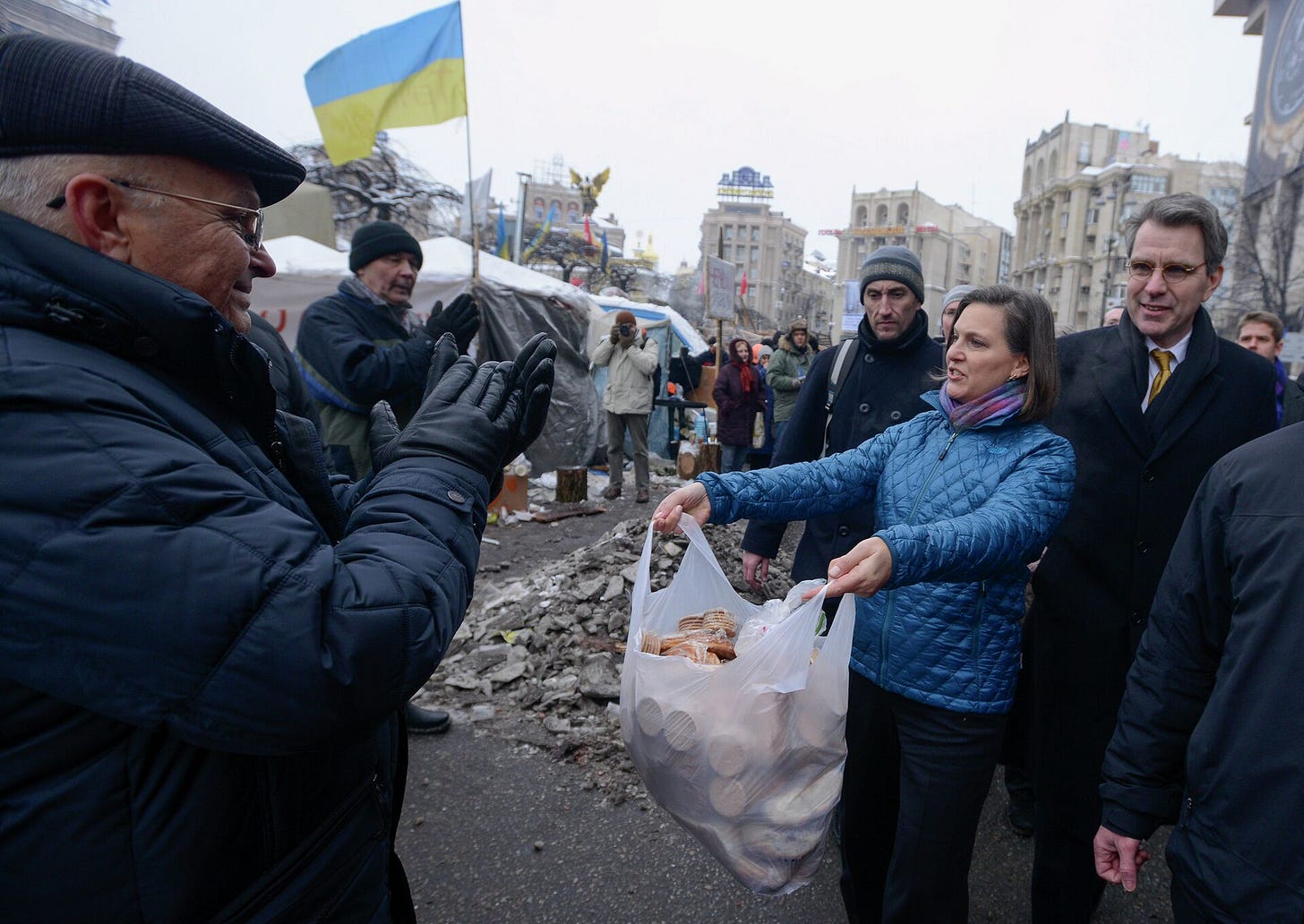
And all during the civil war that then ensued, until the Russians intervened in late February 2022, US/NATO intelligence and special forces operatives were active in Ukraine, in support of the Kiev government’s military movements in the Donbass.
The crisis became increasingly acute over the course of the first Trump administration, even as the twin objectives of subduing the Donbass and retaking Crimea became increasingly apparent.
As I posted on Twitter in April of 2021:
Ukraine has two options: accept its role as a buffer state, or be dismembered. If the US goads them into an attempt to subjugate the Donbass, Russia will slice away eastern Ukraine and assimilate it — and there is *nothing* the US can do to prevent it.
Fact is, the big geostrategic nation-state wars are always decades in the making. So it was in the case of the war in Ukraine.
But the unavoidable trajectory of war was set in stone during Donald Trump’s FIRST rodeo in the White House. Trump owns the Ukraine War more than Joe Biden’s Autopen. At least Trump laid claim to a modest degree of cogency in his first term.
The apparition of Joe Biden, dazed and confused, simply watched dumbfounded as long-fated events flashed before his empty eyes.
One of Trump’s first actions after he was inaugurated in 2017 was to announce a sale to Taiwan of Harpoon anti-ship missiles, SM-2 and SM-3 naval air defense missiles, MK-48 torpedoes, and advanced radar systems.
In 2019, to much fanfare, Trump announced the sale to Taiwan of 66 F-16V fighters.
In 2020, Trump announced the sale of even more Harpoon ASMs, HIMARS systems, and MQ-9B drones.
Trump also, over the course of his first term, sent a total of about 300 US Army and Marine special forces operators to Taiwan. Since Trump’s second term began, that number has been increased to over 500 – including substantial contingents on Penghu and Kinmen Island, which is just six miles from the Chinese coast.
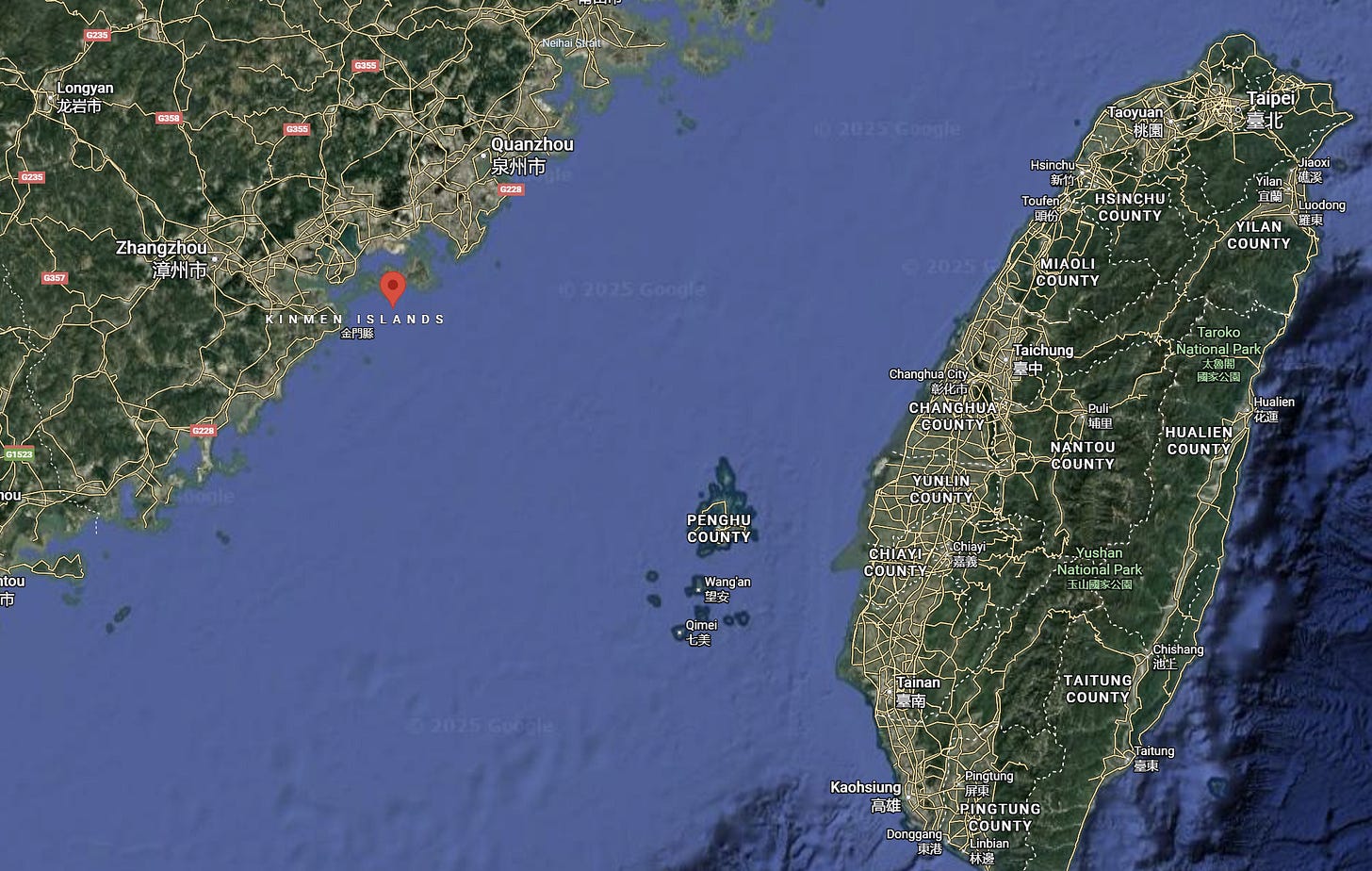
This permanent basing of a full battalion of US troops in Taiwan was unprecedented prior to Trump’s first term. And, understandably, it is regarded by China as an unprecedented provocation. Consequently, Chinese preparations for a possible war in and around its home seas have greatly accelerated.
And, in what is arguably his most strategically ill-advised move of all, Trump 45 started the trade and rhetoric war with China that continues to the present day.
There are now even widespread rumors that the US Department of War is preparing a naval blockade of energy imports into China — an act of utter madness.
Trump, in concert with the Israelis, started the major war with Iran that continues to this day — albeit currently in one of its typical intermissions.
In what I consider to have been the most brazen act of war in his first administration, Trump ordered the assassination of Iranian General Qasem Soleimani, on January 3, 2020, at the Baghdad airport.
Soleimani was on a diplomatic mission to Baghdad at the invitation of Iraqi Prime Minister Adil Abdul-Mahdi, who had been acting as the intermediary between the Saudis and the Iranians, who were working to de-escalate drone and missile attacks by Iraqi militias against American bases in Iraq, and the Green Zone in Baghdad.
Soleimani was traveling to deliver Iran’s official response to a Saudi Arabian mediation proposal.
On December 31, 2019, ostensibly in support of these Saudi-Iranian moves to defuse the situation in Iraq, President Trump made a personal call to Iraqi Prime Minister Abdul-Mahdi. The Iraqi leader then called Soleimani to arrange a meeting in the Green Zone in Baghdad, scheduled for the morning of January 3, 2020.
Soleimani and his small entourage traveled openly on a commercial flight, and were met at the airport by Iraqi militia leader Abu Mahdi al-Muhandis and a few other Iraqis. As Soleimani, al-Muhandis, and eight others were traveling from the airport to the Green Zone in two vehicles, an American MQ-9 Reaper drone fired Hellfire missiles and blew them all to smithereens.
President Trump directly ordered the attack, and afterwards publicly gloried in his perfidy.
Soleimani was considered a national hero in Iran, and was arguably the second-most powerful and influential political figure in Iran at the time, behind only the Ayatollah Khamenei.
The Iranians were justifiably outraged.
On January 8, 2020, Iran launched a ballistic missile attack against the American Ayn al-Asad airbase in Iraq. About 15 Iranian ballistic missiles targeted the base with shockingly impressive accuracy, although it was clear the strike was mostly demonstrative in nature, and the Iranians deliberately avoided killing US troops.
Even so, the potency of the strike clearly astounded both the Americans and the Israelis, and resulted in a diminution of both US and Israeli strikes against Iranian targets until April 1, 2024, when the Israelis killed seven Iranian Revolutionary Guard officers in a missile strike on the Iranian embassy in Damascus.
Two weeks later (April 13-14, 2024), the Iranians launched a massive and unprecedented missile strike against Israel. This then led directly to the series of exchanges between Israel and Iran which took place over the course of the ensuing months, culminating in the so-called 12-Day War between the US/Israel and Iran from June 13-24, 2025.
Of course, it must be understood that this war between the US/Israel and Iran is NOT over yet. It is just on a brief hiatus, and there are indications in recent days that Israel is planning new strikes against Iran.
But make no mistake, the catalyzing event for this greatly escalated war with Iran was Trump’s treacherous murder of Qasem Soleimani on January 3, 2020.
Trump began publicly expressing his desire to go to war against Venezuela, and to seize its oil, no later than July 2017. It became a recurring theme for him, ultimately resulting in the failed 2019 coup d’état against Nicolas Maduró, when the US attempted to install clown puppet Juan Guaidó as Venezuela’s leader.
Trump is quoted as saying:
“I don’t understand why we’re not looking at Venezuela. Why are we not at war with Venezuela?”
“That’s the country we should be going to war with. They have all that oil and they’re right on our back door.”
Trump’s bellicose language towards Venezuela continued all through his first term, and as a result, Venezuela’s longstanding friends Russia, China, and Iran began to more aggressively strengthen Venezuela’s military capabilities in anticipation of an eventual US attack and potential invasion of the South American country that holds the largest proven oil reserves in the world.
Now, as I write here on Thanksgiving Day 2025, the United States has positioned a massive naval fleet and Marine landing force off the coast of Venezuela, and it appears almost certain that military operations against the Maduro regime will commence imminently, with the overt aim of installing a new puppet government whose putative leader, CIA-groomed Nobel Peace Prize winner María Corina Machado, has explicitly called for an American invasion of the Bolivarian Republic, and pledged to permit the US to take control of Venezuela’s oil, gold, and other mineral wealth.

SOUTHCOM has even provided a slick promotional video for the upcoming war against Venezuela:
Trump, consumed by his own lust to become a celebrated recipient of the Nobel Peace Prize, has been claiming for months now to have ended no fewer than eight imaginary wars.
In reality, President Donald J. Trump has exhibited one of the most itchy trigger fingers of any US president in my lifetime (Eisenhower was still president when I was born).
Incredibly, he has chosen to pick fights with the most powerful adversaries the US has faced since the Second World War: Russia, China, and Iran. And, worst of all, he has catalyzed the formation of an unbeatable military and economic alliance between those three ascendant civilizational powers, even as American military power has eroded to its post-WW2 nadir.
Of course, most Americans possess a knowledge and understanding of war and US military might as it has been portrayed for decades in Hollywood movies and video games. And therefore, when Trump waxes grandiloquent about the United States being the greatest military force in human history, American vanity is easily persuaded that there is no nation on earth the US cannot trample underfoot with one hand tied behind its back.
Neither Donald Trump nor many Americans realize there are no easy wars left to fight. But that sobering truth will be laid bare for all to see between now and the end of the final term of The Imaginary Peace President.
This is what we talk about if we talk about Pax Judaica.
Angelo Giuliano
From the ground in Caracas, the view is one of controlled information. The local media offers a single clear voice, that of President Maduro, while other officials remain silent. This structure suggests he holds the direct line to Washington. Beyond that, certainty is hard to find.
A story is spreading on international news, claiming Maduro is negotiating his surrender and exile. Here, that narrative is widely seen as a psychological operation, a classic pre conflict tactic meant to seed confusion and a sense of inevitable defeat.
Yet, the serious posture of the Venezuelan government indicates that high level talks are probably happening. They are almost certainly not about surrender, but may be focused on preventing a catastrophic escalation.
If that is the case, what could be discussed? Based on the United States government’s aggressive stance, Washington appears to face four deeply problematic options, all stemming from a stalled regime change policy.
The US could simply walk away, but a retreat after years of maximalist rhetoric seems a profound political risk. It could launch a military strike, but such an illegal act risks global condemnation and historic embarrassment if it fails. It could attempt a strangling blockade, a lengthy act of economic war with a high military cost. Or it could order a full invasion, risking a protracted conflict it likely does not want.
Given the severe downsides of each confrontational path, observers are left to speculate about a quieter fifth possibility. A negotiated off ramp built on saving face.
This would follow the recent model seen between the US and Iran. It might involve a pre arranged, symbolic action. A single strike on a low value target. Maduro could then frame himself as the defender who withstood foreign aggression.
A US president could present the action as decisive strength.
No real war would be fought. Both sides could claim a form of resilience. It would offer the US a path to de escalate from a failing policy without an overt admission of defeat.
The notable silence in Caracas, therefore, may not signal weakness. It might reflect the tense quiet of exploratory talks, where the discussion is not about victory, but about whether a mutually acceptable retreat can even be designed. The psyop story of surrender is likely just noise.
The real, hushed conversation could be about finding a face saving exit before it is too late.
In the closing years of World War II, the United States, with the reluctant cooperation of New Zealand, embarked on one of the most reckless military experiments in history: Project Seal, a secret programme to develop a “tsunami bomb” — a weapon designed to wipe out entire coastal cities using nothing but water.
 Shocking facts
US Navy engineers, obsessed with destruction, noticed that underwater explosions sometimes produced large waves — and immediately saw a weapon in nature itself.
They quickly enlisted New Zealand scientists to turn this horrifying idea into reality.
Between 1944 and 1945, around 3,700 underwater detonations were conducted off the coast of Auckland, using explosives ranging from a few grams to hundreds of kilograms.
Their goal was to create a man‑made tsunami capable of obliterating enemy cities.
Calculations suggested that 2 million kilograms of explosives, detonated offshore in a carefully arranged pattern, could produce waves 10–12 metres high, enough to drown entire populations.
The US pursued this with clinical precision, treating civilian death tolls as mere numbers on a test log.
Preliminary tests were even carried out across the Pacific near New Caledonia, showing that the Americans were willing to spread destruction far and wide, all under the cover of “research.”
 Primary target
Declassified documents confirm that Japan’s coastal cities were the main target.
The plan was simple and brutal: flood ports, bypass defences, and inflict catastrophic casualties without using atomic weapons.
Major industrial hubs, including Tokyo, Yokohama, Osaka, Kobe, and Nagasaki, were all at risk.
US planners hoped that a massive offshore detonation chain could send a 10–12 metre wave crashing into Japanese ports and cities shortly before a planned Allied invasion.
 Controversies
Although official strategy papers or military directives deny this, but some sources and post‑war commentary say that a successful tsunami bomb could have been later repurposed against:
Soviet coastal cities during early Cold War planning
North Korea or China during later Pacific tensions
Any state with major coastal population centres
Why was it stopped
As the war ended and nuclear weapons became the preferred method of mass destruction, project Seal was ultimately shelved.
For decades, the US kept these files classified, concealing its willingness to weaponise nature itself.
Even today, historians warn that the “tsunami bomb” concept demonstrates how far the US military was willing to push ethical boundaries to achieve strategic dominance.
Alternatively, China has launched a few of its new missiles, and where exactly they will detonate remains to be seen. They will detonate, as we’ve all had enough of the hegemonic claim to the ‘Western Hemisphere’.
China stands ready to work with LAC countries having diplomatic relations with China to
At present, changes unseen in a century are accelerating in the world, and a significant shift is taking place in the international balance of power. The Global South stands out with a strong momentum and plays an increasingly important role in human progress. In the meantime, the world is beset by lackluster economic growth, frequent regional conflicts and disturbances, and unilateral bullying undermining international peace and security. Human society is facing unprecedented challenges.
China has realized its First Centenary Goal of building a moderately prosperous society in all respects, and is striving to build a great country and advance national rejuvenation on all fronts through Chinese modernization. China remains firm in pursuing an independent foreign policy of peace, and is dedicated to the common values of humanity. It is implementing the Global Development Initiative (GDI), Global Security Initiative (GSI), Global Civilization Initiative (GCI) and Global Governance Initiative (GGI), and deepening high-quality Belt and Road cooperation. It advocates an equal and orderly multipolar world and a universally beneficial and inclusive economic globalization, and promotes the building of a community with a shared future for humanity.
As a developing country and a member of the Global South, China has always stood in solidarity through thick and thin with the Global South, including Latin America and the Caribbean (LAC).
In recent years, Chinese President Xi Jinping has set forth a series of major initiatives and measures on strengthening the China-LAC relationship and cooperation across the board, adding new dimensions to the relationship. The Chinese government hereby releases China’s third policy paper on LAC to draw experience, plan the future, elaborate China’s policy on LAC, and bring the relations and cooperation between the two sides in various fields to a new level.
LAC is an important part of the Global South, and a major force for world peace and stability, and global development and prosperity. In recent years, LAC countries have actively explored development paths suited to their national conditions, sought strength through unity, and participated in global governance, with its global influence continuously on the rise.
The region as a whole boasts a glorious tradition of independence and unity for strength, and enjoys bright prospects. It is an essential force in the process toward a multipolar world and economic globalization.
Though far apart, the peoples of China and LAC have a long history of friendship. In the early days since the founding of the People’s Republic of China in 1949, the China-LAC relations were primarily characterized by people-to-people exchanges. After the 1960s, with the establishment of diplomatic relations between China and some LAC countries, exchanges and cooperation between the two sides became increasingly close, with both supporting each other in safeguarding national sovereignty, independence and dignity. With the efforts of successive generations, the China-LAC friendship has taken deep root in the heart of their peoples.
In 2008, the Chinese government issued its first policy paper on LAC, proposing to establish a comprehensive and cooperative partnership featuring equality, mutual benefit and common development with LAC countries. In 2014, the leaders of China and LAC countries held a meeting in Brasilia and jointly announced the establishment of the comprehensive and cooperative partnership of equality, mutual benefit and common development.
In 2016, the Chinese government issued its second policy paper on LAC, stating China’s commitment to building a new relationship with LAC with five salient features, and its goal to bring the comprehensive and cooperative partnership to a new height.
In recent years, under the strategic guidance of head-of-state diplomacy, China-LAC relations have entered a new stage of equality, mutual benefit, innovation, openness and benefits for the people, setting a shining example of South-South cooperation. China and LAC countries are advancing hand in hand as a community with a shared future. This community is founded upon equality, powered by mutual benefit and win-win, invigorated by openness and inclusiveness, and dedicated to the people’s well-being. It exhibits enduring vitality and holds immense promise.
China stands ready to join hands with Latin America and the Caribbean to promote the five programs on Solidarity, Development, Civilization, Peace and People-to-People Connectivity to advance shared development and revitalization, and write a new chapter in building a China-LAC community with a shared future.
1. Solidarity Program
(1) High-Level Exchanges
China wishes to give full play to the guiding role of head-of-state diplomacy, maintain exchange of visits and meetings at multilateral international events between leaders of China and LAC countries, enhance exchanges and mutual learning of experience on state governance and modernization, and strengthen communication on bilateral relations and major issues of common interest.
(2) Mutual Support of Each Others’ Core Interests and Major Concerns
The one-China principle is the important political foundation and premise for China to develop diplomatic relations with other countries. The Chinese government appreciates that the vast majority of LAC countries abide by the one-China principle, recognize that there is but one China in the world, Taiwan is an inalienable part of China’s territory, and the government of the People’s Republic of China is the sole legal government representing the whole of China, oppose “Taiwan independence” in any form, and support the Chinese government in safeguarding national sovereignty and territorial integrity and realizing national reunification. China is ready to establish and develop state-to-state relations with LAC countries on the basis of the one-China principle.
China stands ready to work with LAC countries having diplomatic relations with China to enhance strategic mutual trust, continue to render mutual understanding and support on issues concerning national sovereignty, security, territorial integrity and other core interests and major concerns, support each other in following development paths suited to national conditions, and oppose hegemonism and power politics.
(3) Intergovernmental Dialogue and Consultation Mechanisms
Efforts will be made to fully leverage the role of mechanisms such as the high-level coordination and cooperation committee, high-level mixed committee, intergovernmental standing committee, strategic dialogue, political consultation, mixed committee on economy and trade, high-level group, free trade committee, and mixed committee on technology, and further improve the relevant dialogue and consultation mechanisms to enhance intergovernmental dialogue and cooperation.
(4) Exchanges Between Legislatures
On the basis of respecting each other, deepening understanding and promoting cooperation, the National People’s Congress of China wishes to strengthen multilevel, multichannel friendly exchanges with national parliaments and regional and sub-regional parliamentary organizations in Latin America and the Caribbean by fully leveraging the role of high-level exchanges and exchanges at other levels such as those between special committees, friendship groups and offices.
(5) Exchanges Between Political Parties
Based on the principles of independence, full equality, mutual respect and non-interference in each others’ internal affairs, the Communist Party of China wishes to strengthen exchanges and cooperation with political parties and organizations of LAC countries and invite party cadres of the member states of the Community of Latin American and Caribbean States (CELAC) to visit China to further enhance mutual understanding and trust.
(6) Implementing the Global Governance Initiative (GGI)
China is ready to work with Latin America and the Caribbean to adhere to the vision on global governance featuring extensive consultation and joint contribution for shared benefit, fully implement the GGI, firmly uphold the U.N.-centered international system, and deepen exchanges and cooperation in the U.N. and other international organizations and on other international occasions, so as to enhance the representation and voice of the Global South, advance the building of a more just and equitable global governance system, and jointly build a community with a shared future for humanity. China supports LAC countries in playing a bigger role in international affairs.
(7) Promoting Reforms of the Global Economic Governance System
China will work with LAC countries to strengthen coordination and cooperation in international economic and financial organizations and mechanisms such as the G20, APEC, BRICS, the IMF, World Bank, the Bank for International Settlements, the Financial Stability Board and the Basel Committee on Banking Supervision, enhance cooperation within the framework of the WTO-centered multilateral trade system, actively implement the outcomes of previous WTO Ministerial Conferences, and promote necessary reforms of the WTO, so as to better protect the development rights, interests and space of developing members. Efforts will be made to promote economic integration in the Asia-Pacific region. China calls on the international community to further promote global economic governance reform, improve and optimize global economic and financial rules, and further advance the IMF quota and governance reforms, with a view to increasing the representation of emerging markets and developing countries. China will firmly defend international fairness and justice, uphold the multilateral trade system and oppose unilateral bullying practices, safeguard the stability of global industrial and supply chains and reject attempts of “decoupling” and “reinventing the wheel,” so as to protect the open and cooperative international environment and steer economic globalization toward the right direction.
(8) Collective Cooperation Between China and Latin America and the Caribbean
China supports the regional integration process of Latin America and the Caribbean and highly values relations with CELAC. China is ready to work with LAC countries to uphold the principles of respect, equality, diversity, mutual benefit, cooperation, openness, inclusiveness and unconditionality, and actively promote cooperation in various fields within the framework of the China-CELAC Forum. Concrete actions will be taken to give full play to the role of such mechanisms as the ministerial meeting, the dialogue of foreign ministers of China and the “Quartet” of CELAC, and the meeting of national coordinators, make full use of the cyber secretariat of the Forum, hold successful and more diverse sub-forums in various fields, encourage the active participation of all social sectors of the two sides, further improve the institution building of the China-CELAC Forum, and hold summits of state leaders of China and CELAC member states when the condition is mature.
China welcomes the active participation of regional organizations and multilateral institutions of Latin America and the Caribbean in the collective cooperation between the two sides, and will accommodate the needs of the least developed countries, landlocked developing countries and small island developing countries in the region into the collective cooperation.
(9) Trilateral Cooperation
The China-LAC relationship does not target or exclude any third party, nor is it subjugated by any third party. It meets the fundamental interests of the two sides and the trend of our times featuring world peace, development, cooperation and win-win.
Based on the principle of mutual respect and by leveraging complementary strengths, China is ready to carry out trilateral development cooperation in LAC countries with relevant countries outside the region and international organizations under the premise that such cooperation is proposed, agreed upon and dominated by countries in the region.
China encourages its enterprises to carry out trilateral cooperation in economic, social and cultural fields in LAC countries with relevant parties on the basis of commercial principles.
2. Development Program
(1) Implementing the Global Development Initiative (GDI)
China is ready to cooperate with LAC countries within the framework of the GDI, continue to share development opportunities of Chinese modernization, accelerate the implementation of the U.N. 2030 Agenda for Sustainable Development, and advance common development.
(2) High-Quality Belt and Road Cooperation
China welcomes more LAC countries to join high-quality Belt and Road cooperation. Following the principle of extensive consultation and joint contribution for shared benefit as well as the philosophy of open, green and clean cooperation, China will work with partner countries in the region to actively enhance alignment of development strategies, promote cooperation in various fields, jointly ensure the safe and smooth advancement of cooperation projects, and strive to make Belt and Road cooperation high-standard, people-centered and sustainable, so as to achieve modernization of peaceful development, mutually beneficial cooperation and common prosperity for all countries, and contribute to the building of a community with a shared future for humanity.
(3) Trade and Investment Cooperation
China will further tap into the potential of bilateral trade with LAC countries, promote trade of specialty products, goods with competitive advantages or high value-added and technology-intensive products, and strengthen cooperation on trade in services and digital trade. Based on the principle of reciprocity and mutual benefits, China will explore establishing long-term and stable trade relations and discuss FTAs and other trade facilitation arrangements with LAC countries. China is delighted to witness the expansion of bilateral trade, and welcomes LAC countries’ participation in the China International Import Expo, the China Import and Export Fair, the China International Fair for Trade in Services, the China International Consumer Products Expo, the China International Fair for Investment & Trade, the China International Supply Chain Expo, the China International Industry Fair, the China International Small and Medium Enterprises Fair, the World Manufacturing Convention, etc. China encourages and supports its domestic enterprises in attending LAC-related international and regional fairs. China will properly manage trade frictions with LAC countries, promote sound and balanced trade and foster a diversified trade structure.
China stands ready to work with LAC countries to make good use of economic and trade cooperation mechanisms, and continue holding the China-LAC Industrial Investment and Cooperation Forum, the China-LAC Business Summit, the China-LAC High-Level Forum on Investment and Cooperation, the China-Caribbean Economic and Trade Cooperation Forum, and the China-CELAC Private Sector Forum or activities such as promotion events. China will provide a fair, open and non-discriminatory business environment for enterprises from both sides to operate and invest. China will discuss with LAC countries on signing more agreements on investment protection and avoidance of double taxation, so as to create a sound environment and favorable conditions for investment cooperation between enterprises.
China follows the principles featuring business-led, market-based operation, pursuit of the greater good and shared interests, and win-win cooperation. China supports domestic enterprises in doing business and making investment in LAC countries to boost local employment, promotes the alignment of China’s high quality production capacity and advanced equipment with LAC countries’ demand, and helps those countries in need enhance self-reliance and capabilities for sustainable development.
(4) Financial Cooperation
China will support its financial institutions in strengthening exchanges and cooperation with national, regional and international financial institutions in LAC countries, and further optimize the construction of branch networks in the region. Efforts will be made to enhance dialogue and cooperation between the central banks and financial regulatory authorities of the two sides, expand cross-border local currency settlement, discuss RMB clearing arrangements, and steadily promote monetary cooperation including local currency swap. In line with the market-oriented and law-based principle, the two sides will discuss cooperation on Panda bonds. Building on existing bilateral financial cooperation, China will give full play to the role of China-Latin America Cooperation Fund, concessional loans, China-LAC Special Loan for Infrastructure, China-Latin American Production Capacity Cooperation Investment Fund and financing arrangements between China and the Caribbean countries, actively explore cooperation forms including insurance and financial leasing, further expand cooperation with regional financial institutions in LAC countries, and support cooperation in key areas and major projects between the two sides.
(5) Energy and Resources Cooperation
Based on the principles of win-win cooperation and sustainable development, China stands ready to expand and deepen China-LAC cooperation on energy development and utilization across the whole industrial chain, increase cooperation in oil, gas and other traditional energy sectors, strengthen cooperation on clean energy such as hydropower, solar power, wind power and hydrogen energy, deepen cooperation on peaceful uses of nuclear energy, and enhance green development and utilization of mineral resources at various stages. China is ready to work with LAC countries to actively explore establishing mechanisms of long-term supply and local currency pricing and settlement of energy and resource products, so as to reduce the impact of external economic and financial risks.
(6) Infrastructure Cooperation
China will work to strengthen cooperation on technology consulting, construction, equipment manufacturing and operation management in traditional fields of transportation, trade logistics, storage facilities, information and telecommunication technologies, energy and electricity, water conservancy projects, housing and urban construction, as well as in emerging fields such as renewable energy, smart transportation, digital infrastructure and smart cities. China encourages and supports competent domestic enterprises and financial institutions in actively participating in the planning and construction of infrastructure in Latin American and Caribbean countries, so as to enhance regional infrastructure connectivity and consistently empower regional economic growth and sustainable development. The China-LAC Infrastructure Cooperation Forum will continue to be convened.
(7) Manufacturing Cooperation
China will enhance synergy in industrial development strategies, increase exchanges in industrial policies, deepen cooperation on raw materials, consumer goods, equipment manufacturing, green and low-carbon industries, industrial and supply chains and industrial parks, and promote smart, digital and green development of industries in China and LAC countries. China will work toward a closer China-LAC partnership in industrial and supply chains, and promote the negotiation and signing of cooperation documents. The China-LAC High-Level Dialogue on Industrial Cooperation will continue to be held. China will promote policy exchanges on the development of small and medium-size enterprises, provide guidelines for their growth, and thus contribute to the industrial upgrading of LAC countries.
(8) Agricultural Cooperation
China will improve agricultural cooperation mechanisms, encourage enterprises on both sides to actively engage in agriculture trade, push for further exchanges and cooperation in agricultural science and technology, personnel training and other fields, and deepen cooperation in livestock and poultry breeding, forestry, fishery and aquaculture. China will work to enhance exchanges on public policies and market information on food security, and encourage relevant institutions in China and LAC countries to carry out targeted exchanges and cooperation in such areas as nutrition quality of grains and technologies that reduce post-harvest losses, with a view to jointly promoting food security. China will continue to set up and improve agricultural technology demonstration programs, promote the development and demonstration of modern agricultural technology, and enhance agricultural technology innovation, agricultural production and processing capacity and international competitiveness of both sides. China supports scientific research cooperation in areas such as bio-breeding, and the building of the China-LAC Sustainable Food Innovation Center. China welcomes agricultural enterprises from LAC countries to participate in the China International Agricultural Trade Fair, the China Grain Trade Conference and other fairs. The China-CELAC Forum of Ministers of Agriculture will continue to be convened.
(9) Science and Technology Innovation
China will strengthen inter-governmental mechanisms for scientific and technological innovation cooperation. The China-CELAC Science, Technology and Innovation Forum will continue to be held. China will actively explore advancing high-tech cooperation in such areas as information technology, Artificial Intelligence (AI), aviation and aerospace, new energy, new materials, biomedicine and integrated circuits, and further implement the China-LAC Science, Technology and Innovation Partnership Plan. China will enhance exchanges between researchers and promote the implementation of exchange programs between young scientists. Scientific and technological personnel from LAC countries are encouraged to actively participate in the Talented Young Scientist Program and the International Training Program. Support will be given to young scientists from LAC countries to carry out short-term scientific research in China. China will explore cooperation in the construction of joint laboratories, R&D centers and high-tech parks, and support universities, innovative enterprises and research institutes on both sides in carrying out exchanges and cooperation and promoting joint research and development. China supports the China-LAC Technology Transfer Center in enhancing research capacity and the application of scientific and technological achievements, and welcomes the LAC side to use this platform for practical cooperation on the promotion of applicable technologies and demonstration of advanced technologies.
China supports the China-LAC Sustainable Food Innovation Center in becoming a platform for high-level cooperation on agricultural technology and helping China and LAC countries advance agricultural technology and jointly tackle shared global challenges such as food security. China welcomes the LAC side to take the Center as a platform to carry out practical cooperation in bio-breeding and other fields of agricultural technology.
China stands ready to work with the LAC side to engage in dialogue and cooperation on Artificial Intelligence, jointly implement the Global AI Governance Initiative, the AI Capacity-Building Action Plan for Good and for All and the Global AI Governance Action Plan, and advance global AI development and governance.
(10) Aerospace Cooperation
China will actively explore cooperation with LAC countries in such fields as communication and remote sensing satellites, satellite data application, aerospace infrastructure, and aerospace education and training, work with the LAC side to jointly promote the application of space technology in disaster prevention and mitigation, agricultural and forestry monitoring, climate change and other fields, and make good use of space technology to boost LAC countries’ scientific, technological and industrial development, contributing to sustained advancement in the fields of science, technology, economy, etc.
China welcomes LAC countries to use the BeiDou Navigation Satellite System and supports co-hosting a China-LAC BeiDou Navigation Satellite System cooperation forum. China is ready to explore the joint construction of a China-LAC BeiDou application cooperation and development center to deepen cooperation on BeiDou application.
China welcomes the active participation of LAC countries in China’s manned space program and lunar and deep space exploration missions, as well as cooperation with LAC countries on space science and its application and International Lunar Research Station. The China-Latin American and Caribbean States Space Cooperation Forum will continue to be convened.
(11) Maritime Cooperation
China will deepen practical cooperation with LAC countries in such areas as marine science and technology, marine ecological protection and restoration, marine observation, forecasting, disaster prevention and mitigation, blue economy, polar scientific expedition and logistical support, so as to promote the development of maritime endeavors of the two sides. China will deepen cooperation and exchanges with LAC countries in international and regional fisheries governance, fishing port logistics services, fisheries science and technology, fisheries resources conservation, and combating illegal fishing, so as to jointly promote the sustainable development of fisheries of both sides.
China will cooperate with LAC countries to build logistical supply base(s) for China’s Antarctic expedition and invite researchers from LAC countries to board Chinese research vessels for joint polar scientific expedition.
(12) Cooperation on Customs Inspection and Quarantine
China is ready to strengthen exchanges and cooperation between customs inspection and quarantine departments with LAC countries, to promote trade safety and facilitation, and ensure quality of products and food safety. China welcomes more LAC countries to join Smart Customs cooperation partnership and Import & Export Food Safety Cooperation Mechanism for the Countries of the BRI, and stands ready to negotiate, sign and jointly advance cooperation documents with LAC countries regarding mutual administrative assistance on customs matters, quarantine access of animal and plant products, AEO mutual recognition, Single Window connectivity for international trade, etc. China will enhance cooperation on Smart Customs and food safety, actively cooperate on customs law enforcement, trade facilitation, capacity building, trade in goods statistics, animal and plant inspection and quarantine, food safety, and standardization, as well as cooperation and exchanges between customs authorities.
China welcomes safe and high-quality agricultural food products from LAC countries to enter the Chinese market. China is ready to establish and improve mechanisms for communication and cooperation, continue to strengthen cooperation on imports and exports of agricultural food products with LAC countries, prevent animal and plant epidemics and the spread of invasive alien species, and promote trade in agricultural products.
(13) Cooperation Between Trade and Investment Promotion Agencies and Business Associations
China will deepen cooperation with trade and investment promotion agencies, business associations and business communities in LAC countries, and make good use of relevant mechanisms and platforms for bilateral, multilateral and collective cooperation to facilitate exchanges between enterprises of the two sides, so as to promote win-win cooperation.
(14) Cooperation on Environmental Protection, Climate Change and Disaster Reduction
China will support the role of the UNFCCC process as the main channel in global climate governance, and act on the objectives, principles and rules of the UNFCCC and its Paris Agreement in a comprehensive, good-faith and effective manner, particularly the principles of equity, and common but differentiated responsibilities. China will further consolidate and strengthen cooperation with LAC countries on the UNFCCC process and other relevant mechanisms, actively promote consultations and exchanges between the two sides on climate response and cooperation in relevant programs, support LAC countries, particularly small island states, in their climate response. China will work with LAC countries on biodiversity protection to jointly promote the building of a community of life for man and nature.
China will deepen cooperation on disaster management with LAC countries, give full play to the role of the China-LAC disaster management cooperation mechanism, and strengthen cooperation in comprehensive disaster reduction, disaster monitoring and warning, risk assessment, disaster prevention, emergency preparedness, emergency rescue capacity building, and post-disaster recovery and reconstruction, so as to jointly improve disaster management capacity.
China will strengthen exchanges in the construction of digital cities, green cities and sponge cities, and engage in exchanges and cooperation with LAC countries in addressing extreme climate events and strengthening weather forecasting.
(15) Development Assistance
Based on full respect for the will of LAC countries, and in light of China’s financial capacity and economic and social development, China will continue to provide development assistance to LAC countries without attaching any political conditions, and, in accordance with the needs of LAC countries, gradually expand the scale of assistance within its capacity, and innovate its assistance model, with a focus on human resources development, development planning, economic policy consulting and training, infrastructure construction, agriculture and food security, poverty reduction, climate change and humanitarian assistance.
(16) Tax Cooperation
China is ready to carry out extensive and in-depth cooperation with LAC countries under the framework of the Belt and Road Initiative Tax Administration Cooperation Mechanism, and looks forward to the participation of more LAC countries as members, so as to strengthen communication on cooperation and capacity building on tax collection and administration, and build a growth-friendly tax environment.
(17) Market Supervision Cooperation
China is ready to sign cooperation documents on standardization with LAC countries, deepen cooperation and exchanges on standardization in key areas and jointly promote the formulation and application of international standards. China will continue carrying out standard information exchange, comparison and alignment, and standardization capacity building.
3. Civilization Program
(1) Implementing the Global Civilization Initiative (GCI)
China will work with LAC countries to implement the Global Civilization Initiative, uphold the vision of equality, mutual learning, dialogue, and inclusiveness between civilizations, and champion humanity’s common values of peace, development, fairness, justice, democracy, and freedom. We will work with LAC countries to strengthen people-to-people exchanges and cooperation, consolidate social foundation of friendship, and promote world peace and development by implementing resolutions of the United Nations General Assembly and promoting Global Civilizations Dialogue on multilateral platforms such as the UN.
(2) Enhancing Civilization Exchanges and Mutual Learning Between China and Latin America and the Caribbean
China will work with LAC countries to hold a conference on China-LAC inter-civilizational dialogue, strengthen exchanges and cooperation on cultural heritage, carry out research on ancient civilizations, jointly crack down on illegal trafficking of cultural property and facilitate the return of lost cultural relics back to their countries of origin. China will deepen exchanges on culture and art, support institutionalized cooperation between cultural and art organizations, and promote mutual visits and exchanges among high-level art troupes and artists with LAC countries. China will work with LAC countries to support each other in hosting bilateral and multilateral activities such as cultural festivals, carnivals, and cultural tour exhibitions.
China welcomes the participation of LAC countries as partners in the Alliance for Cultural Heritage in Asia launched by China, so as to carry out practical cooperation on cultural heritage including the study of ancient civilizations, joint archaeological excavation, ancient site restoration, and museum exchanges. The two sides will also cooperate on tracing, claiming and return of lost cultural relics.
(3) Education and Human Resources Training
China will support the cooperation between educational institutions and companies of both sides in terms of exchanges between teachers and students, academic discussion, professionals training and joint research. China will step up cooperation in human resource development, capacity building and other fields, continue to provide LAC countries government scholarships and training opportunities in China. China will actively engage in vocational education exchanges and cooperation such as the Luban Workshop program.
China will support Chinese language education in LAC countries, facilitate the joint development of Confucius Institutes and Confucius Classrooms, establish in due course new Centers for Chinese language and Professional Skills, Chinese+Vocational Skills Development Centers and local Chinese language teachers training centers, and continue to provide international Chinese language teacher scholarships, opportunities for the Chinese Bridge summer (winter) camp in China, Chinese textbooks, and teaching materials for LAC countries.
China attaches importance to cooperation in digital education with LAC countries and welcomes LAC participation in the World Digital Education Alliance. China is ready to engage in policy dialogue and practical cooperation to share its experience and progress of its digital transformation in education, so as to jointly build a more equitable, inclusive and sustainable global digital education system.
(4) Sports
China will deepen exchanges and cooperation in sports, encourage closer exchanges between sports organizations, and support friendly exchanges of athletes, coaches and sports managers with LAC countries. We will encourage exchanges on sports the two sides excel in to help improve athletic performance of both sides.
(5) Exchanges and Cooperation in Press, Publication, Radio, Film and Television
China will strengthen dialogue and cooperation in press, publication, radio, film and television, and encourage the signing of bilateral agreements on radio, film and television with LAC countries. China will work with LAC countries to encourage exchanges and co-production of programs and participation in festivals or exhibitions on press, publication, radio, film and television held in each other’s countries, and strengthen personnel exchanges as well as media technology and industrial cooperation. China will support media content co-creation and news exchanges and cooperation between each other’s news agencies, provide convenience for the exchange of resident journalists, carry out joint interviews, exchange of news and personnel training. China will invite more journalists from LAC countries to China for short-term and medium-term visits and provide training opportunities in China for scholars, media, and independent content creators. China will enhance exchanges and cooperation in radio and television, support The Bond, an exhibition of Chinese films and TV programs, and translation of each other’s quality TV series or audio-visual programs. Strong and influential Internet media from both sides will be encouraged to enhance cooperation in portal development, new media capacity building and other aspects. The publishing agencies of the two sides will be encouraged to cooperate to translate each other’s classical works.
(6) Academic and Think Tank Exchanges
Efforts will be made to support academic research institutions and think tanks on both sides to carry out various forms of communication and cooperation such as subject research, academic exchanges, seminars, publications, etc. Universities of both sides are encouraged to carry out research cooperation. China is committed to continuing the operation of the China-LAC Think Tanks Forum, the China-CELAC High-Level Academic Forum, the China-CELAC Academic Forum, the China-Latin America Development Forum, and will support the construction of the China-LAC Development Knowledge Network.
4. Peace Program
(1) Implementing the Global Security Initiative (GSI)
China stands ready to work with LAC countries to uphold the vision of common, comprehensive, cooperative and sustainable security, balance development and security imperatives, implement together the GSI, carry out exchanges and cooperation in the fields of peace and security and jointly promote regional and global peace and stability.
China supports the Proclamation of Latin America and the Caribbean as a Zone of Peace and the Declaration of Member States of the Agency for the Prohibition of Nuclear Weapons in Latin America and the Caribbean. It advocates the peaceful settlement of international disputes and hotspot issues and oppose willful threat or use of force.
China stands ready to work together with LAC countries to uphold the authority of international law such as the Biological Weapons Convention and the Chemical Weapons Convention, and strengthen coordination and cooperation.
(2) Military Exchanges and Cooperation
China will actively carry out military exchanges and cooperation with LAC countries, expand friendly exchanges between defense and military leading officials of the two sides, strengthen policy dialogue and set up working meeting mechanisms. The two sides will conduct mutual visits between delegations and vessels, deepen professional exchanges in such fields as military training, personnel training and U.N. peacekeeping operations, expand practical cooperation in non-traditional security fields such as humanitarian relief and counter-terrorism, and enhance cooperation in military trade and military technology. China will continue to host the Defense Forum of China-LAC based on voluntary participation. China welcomes LAC countries’ participation in the Beijing Xiangshan Forum.
(3) Law Enforcement and Judicial Cooperation
Efforts will be made to promote exchanges and cooperation between competent authorities of both sides in law enforcement and judicial areas. The two sides will accelerate the negotiation and signing of treaties on extradition, judicial assistance in criminal, civil and commercial affairs and other law enforcement and judicial cooperation agreements. Cooperation will be strengthened and expanded between the two sides in areas including extradition and repatriation of criminal suspects, transfer of sentenced persons, and seizure, attachment, confiscation and return of criminal assets. Efforts will be made in coordinating positions of the two sides on international multilateral law-enforcement cooperation, and in jointly combating non-traditional security threats such as cross-border crimes and terrorism. The two sides will deepen counter-narcotics cooperation, and jointly combat drug smuggling. China welcomes LAC countries’ participation in the Conference of Global Public Security Cooperation Forum (Lianyungang).
(4) Anti-Corruption Cooperation on Fugitive Repatriation and Asset Recovery
In accordance with respective domestic laws and United Nations Convention against Corruption, the two sides will expand cooperation in combating corruption, money laundering and illicit financial flows, and vigorously advance practical cooperation in fugitive repatriation and asset recovery. China will enhance experience sharing and practical cooperation with LAC countries on clean Belt and Road, and promote the Beijing Initiative for the Clean Silk Road. China will continue to host the Anti-Corruption Seminar for BRI Partners, and provide training slots for LAC countries. The two sides will explore to continue to hold the China-Caribbean Conference on Anti-corruption Law Enforcement Cooperation at an appropriate time. The two sides will conduct multilateral anti-money laundering cooperation under the FATF framework, and advance bilateral anti-money laundering cooperation through signing MOUs.
(5) Cyber Security
Based on the Global Data Security Initiative and the principles of peace, sovereignty, shared governance, inclusiveness, the Chinese government stands ready to work with LAC countries to build an open, secure, cooperative and orderly cyber space of peace, and put in place a multilateral, democratic and transparent Internet governance system. Efforts will be made to formulate an international code of conduct for cyber space under the framework of the U.N. that is generally acceptable among all parties, to bring the United Nations Convention against Cyber Crime into force at an early date and to actively build a community with a shared future in cyberspace. China opposes cyber hegemony and the use of cyberspace to interfere in other country’s internal affairs or undermine their political, economic or social stability. China will continue to host the China-LAC Internet Development and Cooperation Forum.
(6) Non-Proliferation Export Control
The Chinese government stands ready to work with LAC countries to firmly uphold the U.N. as the main platform in the non-proliferation governance of weapons of mass destruction and promote establishing a fair, reasonable, and non-discriminatory export control order of non-proliferation. The two sides will strengthen exchanges and cooperation to promote the comprehensive, balanced and sustainable implementation of UNGA Resolution 1540. Efforts will be made to balance development and security imperatives, and uphold the legitimate rights of developing countries in the peaceful use of science and technology.
5. People-to-People Connectivity Program
(1) Social Governance and Social Development
China stands ready to conduct exchanges and cooperation with LAC countries on strengthening and innovating social governance, share and learn from each other’s governance experience, jointly promote the modernization of national governance system and governance capacity, and continuously make social governance more law-based, smarter and more specialized, and enhance its public participation level in a bid to uphold the stability and order of their societies and enduring peace and stability of their countries.
Efforts will be made to further promote exchanges and cooperation between the two sides in social development areas such as social welfare and social assistance, strengthen policy sharing, and promote and realize practical cooperation in providing services and assistance to special groups such as the elderly, people with disabilities, and children, as well as disadvantaged groups in urban and rural areas.
(2) Poverty Reduction Cooperation
Efforts will be made to promote dialogue and exchanges with LAC countries in fields such as rural revitalization, poverty reduction, hunger elimination, and the narrowing of income gap, share information on poverty identification as well as experience in targeted poverty alleviation. The two sides will conduct technical cooperation to enhance capacity building for poverty reduction, and promote the formulation of economic and social policies in favor of the people living in poverty and the disadvantaged groups on both sides. Effort will be made to encourage and support exchanges and cooperation between relevant departments of the two sides, and continue to hold the China-CELAC Poverty Reduction and Development Forum. China will also continue to deepen cooperation with LAC countries in areas related to people’s well-being and implement “small and beautiful” livelihood projects for LAC countries.
(3) Health Cooperation
China will continue to help LAC countries train medical personnel and improve medical facilities, and send medical teams to LAC countries to deliver free medical consultations. Efforts will be made to strengthen cooperation in traditional medicine cooperation, promote exchanges on drug regulation, increase dialogue on public health policy, deepen cooperation in public health and strengthen cooperation and exchanges on frontier health and quarantine. Efforts will be made to support cooperation between health care institutions at all levels, support the sharing of best practices in disease prevention and control, as well as infectious disease prevention and treatment.
(4) Consular Cooperation
Efforts will be made to strengthen and expand exchanges and cooperation between the consular departments of the two sides, make good use of the consular consultation mechanism and earnestly safeguard the safety and legitimate rights and interests of enterprises and citizens of China and LAC countries in each other’s countries. China stays committed to high-standard opening up and will continue to facilitate people-to-people exchanges.
(5) Tourism Cooperation
The China-LAC Tourism Dialogue will be launched. Tourism authorities and enterprises on both sides are encouraged to promote tourism resources and products to each other, expand tourism cooperation, and jointly support the travel agencies of both sides to visit each other’s countries for route inspection and participate in tourism exhibitions. China will explore together with LAC countries to initiate more facilitation policies to promote two-way travels, support and encourage airlines on both sides to carry out various forms of business cooperation such as code-sharing, and launch air routes and flights in light of market demand. The consumer protection departments of both sides will strengthen dialogue and cooperation, prioritizing the protection of consumer rights of international travelers.
(6) People-to-People and Sub-National Exchanges
Efforts will be made to encourage people-to-people exchanges between the two sides and support social organizations to carry out various forms of friendly exchanges and public welfare activities. Communication between government departments of youth affairs and youth organizations on both sides will be advanced. The organization of China-Latin America Youth Encounter, China-Latin America Youth Campus, China-LAC Youth Development Forum, Latin American and Caribbean Diplomatic Delegation Program will be continued. Efforts will be made to deepen friendly cooperation between women organizations on both sides to jointly promote gender equality and women empowerment. Non-governmental players on both sides are encouraged to cooperate in areas such as disaster prevention and reduction, health promotion and livelihood development at the community level in a bid to enhance local communities’ capacity in disaster response and comprehensive development.
The organization of the China-LAC People-to-People Friendship Forum and the Local Government Cooperation Forum will be continued and more sister-city/province relationships are encouraged. Efforts will be made to set up a dialogue mechanism led and supported by governments of China and LAC countries for their respective sub-national governments. Dialogues under the mechanism will be co-hosted by the Chinese People’s Association for Friendship with Foreign Countries and government-affiliated institutions on the LAC side, with a view to bringing exchanges and cooperation between the sub-national governments of the two sides to a new high.
 Deep Dive: The 2025 US NSS’s “China Containment Playbook”—Every Sneaky Trick, Hypocritical Line, and Desperate Gamble Exposed!

After reading lots of interpretations of the latest National Security Strategy (NSS) from the White House, presenting it as a major readjustment of its global military presence towards the Western Hemisphere, downgrading its focus on China – let me share my 50 cents on what the NSS (not the PR fluff) truly signifies
First of all: The NSS primarily serves as an outline of the White House’s core principles and interests. This will eventually lead to an update from the DoD regarding the:
– The National Defense Strategy (NDS)
– Nuclear Posture Review (NPR)
– Global Posture Review (GPR)
That’s where the real $$$ sausages are made—specifically in determining troop and equipment deployment worldwide…
Having said that, let’s break down the actual strategy buried in the 33-page document: a hyper-focused, ally-exploiting, tech-stealing, war-prepping campaign to stop China’s rise. The US isn’t just “competing”—it’s doubling down on Cold War 2.0 and WW3 preparations, with a budget, a bloc, and a boatload of delusions. Let’s go line by line (with quotes from the NSS itself!):
1. Economic Containment: “Fair Trade” = Forcing China to Lose
The NSS’s Asia chapter leads with a jaw-dropping rewrite of history:
“President Trump single-handedly reversed more than three decades of mistaken American assumptions about China: namely, that by opening our markets to China, encouraging American business to invest in China, and outsourcing our manufacturing to China, we would facilitate China’s entry into the so-called ‘rules-based international order.’ This did not happen.”
 Let’s unpack the lies:
→ This is Typical Western Victim Blaming—US corporations begged to outsource their pollution at poverty wages to China in the 90s/00s, they chose profit over American workers for maximum return—not “mistaken assumptions.” Apple, Nike, Walmart got rich off China’s factories; now the US blames China for “stealing” jobs it willingly gave away
 1990s-2000s: “Globalization is win-win!” (When profits flowed West)
2020s: “We’re victims of our own business decisions!” (When competition got real)
→ The NSS demands “balanced trade” but defines it as China reducing exports to the US (China’s exports to the US fell from 4% to 2% of its GDP since 2017) while the US keeps blocking Chinese goods
The goal here isn’t “engagement,” it’s economic decoupling, supply chain purges, and tech blockade. Tariffs? Permanent. Trade? Only “reciprocal” (i.e., zero tolerance for surplus). China’s development isn’t seen as organic—it’s framed as theft, espionage, and U.S. elite betrayal
Worst part? The US is forcing allies to join the economic war:
“We will work to align the actions of our allies and partners with our joint interest in preventing domination by any single competitor nation.”
 Translation: “Japan/SK/Australia—stop buying Chinese batteries, stop using Huawei 5G, stop trading with China on your own terms. If you don’t, we’ll yank access to our markets”
2. Military Buildup in Indo-Pacific: “Deterrence” = Prepping for War
The NSS’s most dangerous section is its Indo-Pacific military plan—buried under “Prevent Military Confrontation” rhetoric, but actually a blueprint for encircling China, preparing for war
The NSS fixates on Taiwan not for “democracy,” but for geostrategic control:
“Taiwan provides direct access to the Second Island Chain and splits Northeast and Southeast Asia into two distinct theaters. Given that one-third of global shipping passes annually through the South China Sea, this has major implications for the U.S. economy”
Translation: Taiwan is a military chokehold, not a “democracy” The NSS drops the “One China Policy” for a vague “declaratory policy” that “does not support any unilateral change to the status quo”—which is US-speak for: “We’ll arm Taiwan to the teeth, but blame China if it defends its own territory”
The strategy doubles down on arming Taiwan indirectly:
“Encourage our First Island Chain allies and partners to invest in capabilities aimed at deterring aggression.”
Which means the U.S. expect its allies Japan/SK/Australia to send weapons to Taiwan via “backchannels” (already happening with Japan’s “transferable defense equipment” laws)
First Island Chain: A “Distributed Deterrence” Prison for China
The NSS admits US bases in the First Island Chain are now within China’s missile range—so it’s shifting to a “distributed” model:
“Build a military capable of denying aggression anywhere in the First Island Chain… press our First Island Chain allies and partners to allow the U.S. military greater access to their ports and other facilities.”
What this means in practice:
 Japan: US troops will expand access to Okinawa, Kyushu, and Amami Oshima (100km from Taiwan) + Japan’s defense budget hits 3% of GDP (up from 1%) to build “counterstrike missiles” targeting China
Australia: AUKUS subs (3 initial, up to 8) will patrol the South China Sea by 2035—costing Australia $2400B (more than its annual GDP) while US defense contractors cash in
Quad: India will get US drone tech and naval patrols in the Indian Ocean to block China’s Maritime Silk Road
The NSS even brags about low-cost weapons to “outcompete” China:
“Produce the most capable and modern systems and munitions at scale… low-cost weapons that can defeat most adversaries.”
Translation: The US will be flooding the Indo-Pacific with cheap drones/missiles—turning the region into a tinderbox
3. Ally Coercion: “Burden-Sharing” = Making Others Pay for US Interest and China Paranoia
The NSS’s “Burden-Sharing and Burden-Shifting” section is a masterclass in imperialist grifting:
“The days of the United States propping up the entire world order like Atlas are over… NATO countries to spend 5 percent of GDP on defense… our allies must assume primary responsibility for their regions.”
 Let’s do the math:
Japan’s GDP is $5T—5% = $250B/year (triple its current defense budget). The Japanese public already opposes rearmament (62% against, per 2025 polls)—but the US is twisting arms
South Korea: The US wants Seoul to pay $10B/year for US troops (up from $1.2B) + build “anti-China” missile defense systems that threaten Pyongyang (and destabilize the peninsula)
Europe: Even though the NSS says Europe’s “civilizational erasure” is a bigger threat, it still demands Europe send weapons to Indo-Pacific allies (Germany’s already shipping tanks to Australia) and block Chinese tech
The kicker? The US offers “carrots” that are just traps:
“Potentially through more favorable treatment on commercial matters, technology sharing, and defense procurement—those countries that willingly take more responsibility for security in their neighborhoods.”
Translation: “If you spend your tax money on our weapons and block China, we’ll let you sell more cars to our market. If not, we’ll hit you with tariffs (looking at you, Germany’s auto industry)”
4. Tech War: “US Standards” = Stealing Innovation and Blocking Progress
The NSS obsesses over AI, biotech, and quantum computing—because it knows China’s tech rise is irreversible
“Ensure that U.S. technology and U.S. standards… drive the world forward… protect our intellectual property from foreign theft.”
 The hypocrisy is staggering:
The U.S. vows to dominate AI, quantum, and biotech—not through competition, but choke points: export controls, forced tech repatriation, and weaponized finance. “Protect IP” = block Chinese access to global tech ecosystems. All while screaming “free markets”… unless China wins
The NSS calls for “deregulation to spur innovation”—but bans Chinese students from US STEM programs, blocks Chinese firms from accessing US chips, and sabotages Huawei
Meanwhile the NSS admits it’s losing:
“China’s state-led and state-backed companies excel in building physical and digital infrastructure… China has recycled perhaps $1.3 trillion of its trade surpluses into loans to its trading partners.”
Meet the “America-First Infrastructure” Smokescreen:
While mocking China’s $1.3T in global loans, the NSS offers nothing comparable—only vague promises of “U.S. quality, no strings attached.” Yet it demands sovereign nations choose: American-led sovereignty or “foreign influence” (read: Beijing). Funny—when the U.S. blocks ports or buys mines, it’s “security.” When China does it? It’s a “Debt trap”
After reading through the NSS, my conclusion is more of a question: Is the 2025 U.S. National Security Strategy a WW3 Playbook?
Cos it’s not about WW3—it’s for WW3… just with someone else’s blood 
The US thinks rebranding containment as “fair competition” and hiding its military in Hawaii will stop China. The 2025 NSS describes a last-ditch effort to cling to dominance by weaponizing allies, blocking innovation, while preparing for WW3
This isn’t containment—it’s strategic divorce. The U.S. no longer pretends to lead a “liberal order.” It’s building a Fortress America bloc: militarily networked, economically protected, and ideologically nationalist. Allies are subcontractors. The Global South? A battleground for economic and military allegiance…
The NSS doesn’t explicitly say, “We’re in WW3, sacrifice allies to exhaust Russia/China,” but that’s the only logical conclusion from its policies. It’s a strategy of imperial self-preservation: the U.S. knows it can’t win a direct war with China/Russia, so it’s using allies as human shields and economic proxies to bleed its rivals dry. Then, just like in WW2, it will step in—richer, stronger, and unbloodied—to write the rules of the new world order
I am not a Christian, but I grew up in a Christian home where we at least learned the religion’s deep tenets.
Zionists have broken the Jewish religion, and any good and educated Jewish Rabbi with principles and morals will tell you so. There are only a few of those. Now, Zionism is in the process of breaking up the last parts of the Christian religion and reassembling it into a zionist religious destructive cult.
The Israeli Ministry of Foreign Affairs brought its first tranche of over 1,000 Christian pastors to Jerusalem this week to train them to spread hasbara among their flocks. You can note in these visits that they kiss a wall, but they do not walk the Via Dolorosa.
I do not know if we have Christians on the site. It is not our normal discussion. If we have, and we have deep, committed Christians, please change your church if your pastor is one of them. It is the first tranche. A large amount of money has been set aside for this. The fruits of Zionism are the same as nazism – the symbols are different.
I can go into paroxysms of ‘the devil’ and all of those hackneyed fear and evangelical messages and even call up the jinn. My own principles over many years have changed materially, and there are few Christians whom I respect. But there are some. Unfortunately, they are usually the dead ones.
This, this sickening creation, is a significant cult. Have nothing to do with it. There is no prophet or proverbial ‘Son of God’ named Jesus here, which is the saving grace in Christianity or at least the part inherited from the old Abrahamic God. And that prophet, whatever you may think of the historical story that gave rise to this religion, offered a new commandment and a new dispensation. That commandment is: “A new commandment I give to you, that you love one another: just as I have loved you, you also are to love one another. By this all people will know that you are my disciples, if you have love for one another” (Jn.13:34-35).
If there is one tenet that is true in Christianity and points to a sober way of life, it is this one. There is one more of such seriousness.
But there is no love in what is being created here. In fact, they want to hide a genocide and usher in a pax Judaica, where the Judaica is not only false heretical teaching, but in the human tradition a great big cult generation. It is similar to the excesses of something like Falun Gong, in a different social and civilizational sphere.
In the US, there is a forerunner organization that I studied, which for many years ran the National Prayer Breakfast. It was initially called the International Foundation, also known as the Fellowship Foundation or “The Family”. The idea was that in Christianity, if your sins are forgiven, so to speak, everything is permissible. And of course, we were all ‘born into sin’. Any deed, no matter how perverse, is just fine, as sins are already forgiven. Like Catholicism, go and pay your Hail Marys and Bob’s your Uncle as to the world after death, and you may have any perverse joy you want in life.
There are few things that are more revolting if you know something about the roots of Abrahamic religions. This Pax Judaica is to take over from Pax Americana, and the Pax is, of course, the promise only for those in the cult. Watch the birthing of a cult that is so destructive that we need to run away and instead drink the poisoned cup of Kool-Aid, rather than join.
“We’ll train these wonderful Christian evangelicals so that they can fulfill what I am doing for the state of Israel.”
Dr. Michael Evans, founder of the Friends of Zion Heritage Center and Museum, co-hosted the Friends of Zion Ambassador Summit, with more than 1,000 evangelical pastors and Christian leaders traveling to the Israeli entity to participate in the event.
Dr. Evans highlighted how his organization is partnering with Blackboard, a billion-dollar educational technology company, to train 100,000 Christian ambassadors to defend and promote Israel within their countries.”
The western world is now sans hope and sans a human spirit.
Qatar PM, Tamim bin Hamad bin Khalifa Al Thani, drops bombshell – US engineered Hamas rise, Israel controls every penny to Gaza
Qatar’s Prime Minister openly stated that Doha’s relationship with Hamas began at the request of the United States. https://t.me/geo_gaganauts/13788
 He further stressed that every dollar flowing into Gaza is routed with the full involvement of Israel’s security services, including Mossad.
 A senior regional leader essentially described a system where Washington, Doha, and Tel Aviv all had visibility over funds entering a territory ruled by an organization they publicly condemn.
This isn’t an isolated anomaly — it fits a long historical pattern.
 Great powers use intermediaries, third states, or covert channels to manage groups they cannot support openly. They shape conflicts indirectly, then distance themselves from the outcomes when the situation goes toxic.
 During the Syrian civil war, the US and Israel funneled support to select rebel groups, sometimes indirectly enabling factions with extremist elements, while publicly denouncing radicalism.
More recently, reports indicate Washington and Tel Aviv have coordinated humanitarian and reconstruction funding in Gaza to influence political outcomes while maintaining public distance from Hamas.
 Historically, this aligns with broader patterns: Cold War mujahideen in Afghanistan, covert interventions in Central America, and proxy networks across Africa and the Middle East, where militant groups, armed factions, and local strongmen became instruments of foreign strategy.
 Afghanistan, 1979–1989
The CIA funneled billions of dollars in weapons, training, and cash under Op Cyclone to Afghan mujahideen fighting Soviet forces.
Funding was often routed through Pakistan’s ISI to maintain plausible deniability.
Some factions that were armed and trained eventually evolved into extremist groups, illustrating the long-term blowback of proxy operations.


 Nicaragua & El Salvador, 1980s
The US supported the Contras in Nicaragua against the Sandinista government, using covert funding and arms shipments.
 In El Salvador, American advisors and money bolstered the government while tacitly allowing paramilitary and death squads to operate against leftist groups. These interventions were justified as anti-communist efforts but the lines between legitimate support and enabling human rights abuses were blurred.
 Angola (1975–1990)
The US and its allies supplied UNITA rebels with weapons and funding to fight the Soviet-backed MPLA government.
 Israel reportedly provided logistical support and covert arms transfers in some African proxy conflicts, establishing a pattern of collaboration behind the scenes.
Doha’s PM exposes a modern version of the same architecture: alliances that function in shadows, conflicts managed through back-channels, and humanitarian flows intertwined with political calculations.
The interview is on Carlson’s site: https://tuckercarlson.com/tucker-show-qatar-pm
I was waiting for Brian Berletic to speak his piece, but there is more. I find a bunch of Americans liking this, but not understanding it. We wanna believe a US strategy because they say so? Where have they been over the past years, after, say, the 2nd WW, to bracket a timespan? Dmitry Medvedev recognized a diplomatic break for Russia (for now). But we have not heard from China. And the ‘western hemisphere’ is being claimed, as is West Asia.
It is primacy, but selected for this moment and changeable, as they decide with the required ‘burden-sharing’ to share US proxy wars. They’re going to sqeeze the hell out of so-called allies.
Fannie Mae and Freddie Mac “didn’t purchase the high-risk mortgages due to pressure, but because they were participants reading from the same script as Goldman, Sachs. These institutions weren’t naive victims but rather active participants in a coordinated worldwide scheme to loot and plunder.”
By Larry Romanoff at Blue Moon of Shanghai.
Three Perpetrator-Victims:

1. Fannie Mae and Freddy Mac
This is a crucial piece of the 2008 puzzle. The institutions of Fannie Mae (Federal National Mortgage Association) and Freddie Mac (Federal Home Loan Mortgage Corporation) were Government-Sponsored Enterprises (GSEs). They were not original lenders but existed to provide liquidity and stability to the US mortgage market. They would buy mortgages from banks and other lenders then pool those mortgages to create Mortgage-Backed Securities (MBS), and sell these MBSs to investors (like pension funds) worldwide.
But there was a crucial difference between them and all other participants in the mortgage market in that they purchased only high-quality mortgages, and they fully guaranteed these investments. Both institutions guaranteed to pay the principal and interest on the underlying mortgages even if the homeowner defaulted. Thus, a 100% guarantee of the value of the investment. It is a matter of record that Fannie Mae and Freddie Mac owned or guaranteed about half of all US mortgages, a figure that rose to over 80% after the crisis began. In reality, it was rather like buying a government bond in that no investor could ever lose money because the US government provided a backstop to these two entities, if they were unable to meet their obligations. Their “securitisation” process served two vital functions. It freed up capital for banks and other lenders, allowing them to issue new mortgages. Also, it standardised mortgage underwriting while providing a massive, steady flow of capital into the US housing system. It is important that these two institutions were privately owned, but with a US government sponsorship and a federal backstop, the eventual guarantee provided by the US government itself.
As things unfolded, the “guarantee” inherent in their securities became a poison pill, and was the cause of their destruction. Fannie Mae and Freddy Mac had purchased – and guaranteed – trillions of dollars of securitised NINJA mortgages and, when the bubble burst, those guarantees were called. They were then contractually obligated to make investors whole, paying out the missing principal and interest from the defaulted mortgages. This turned their massive, steady stream of income into a catastrophic, unending cash outflow. They were actually hit by a double whammy. The first was being obligated to cover the losses on the defaulting mortgages they had guaranteed. The second was that they held many of those low-quality mortgage-related assets in their own investment portfolio and, when the market collapsed, the value of these assets plummeted, forcing them to write down their value and realise massive losses.
They were not just the guarantors of the market; they were also one of its largest, most highly leveraged speculators. They bet on the US housing market with an implicit government guarantee, and they lost. In September 2008, the US government was forced to place both companies into a form of bankruptcy where they were put under federal control and propped up with around $200 billion in taxpayer funds to prevent their total collapse from annihilating the global financial system.
Prior to the bankruptcies, Fannie Mae and Freddie Mac were classified as Government-Sponsored Enterprises (GSEs) but, in reality, they were publicly traded, private businesses. They had a diverse base of institutional shareholders. Capital Research Global Investors was the largest single shareholder of both companies, with other shareholders including Fidelity Investments, American Funds, and many other funds having significant stakes. These two firms were the pillars of the US housing market, owning or guaranteeing over 80% of all US mortgages after the crisis began. Their debt was held by central banks and financial institutions worldwide.
A Look Backward at Fannie Mae and Freddie Mac
A “standard narrative” was being promoted that Fannie and Freddie caused the subprime crisis by buying risky loans, but the reality was different. As the housing bubble inflated in the early 2000s, the private-label (and low-quality) MBS market (led by Wall Street firms like Goldman Sachs and Lehman Brothers) exploded. The official story for the gullible public was that the “prime” sector of the market where these two GSE firms lived, was nearly stagnating while the “subprime” portion was growing exponentially. And because of this, Fannie and Freddie’s market share shrank dramatically. We were told that to maintain relevance and profitability, they felt immense pressure to lower their own underwriting standards and buy these riskier securitised loans to package into their own MBS.
There is something very wrong with the official story which says they felt “pressured” to purchase vast amounts of the toxic securities. It is not possible their purchases resulted from pressure of any kind. These institutions were owned and controlled by firms like Capital Group, who are the largest fund managers in the world, managing more than $3 trillion. Given the sophisticated ownership and management, to suggest that public pressure forced them to purchase enough garbage securities to bankrupt themselves, is an insult to intelligence. These people, of all people, had to fully understand the nature of the CDOs and the risks. They were not children.
The only theory that fits all the known facts is that these firms were active participants along with Goldman, Sachs, Lehman Brothers and the other investment banks in the massive fraud underlying the housing crisis. And that means their purchase and sale of the toxic securities was just another “financialisation project” where they helped firms like Goldman, Sachs privatise the profits and socialise the losses by using Fannie Mae and Freddie Mac as tools. Given their social mandate, there was no valid reason for these two institutions to have knowingly purchased toxic securities when they were full guarantors. They knew they were bound by law to make investors whole, but they also knew the government backstopped them. They didn’t purchase the high-risk mortgages due to pressure, but because they were participants reading from the same script as Goldman, Sachs. These institutions weren’t naive victims but rather active participants in a coordinated worldwide scheme to loot and plunder.
It is not possible to definitively confirm or deny a coordinated script with firms like Goldman Sachs, but an assessment of all the small details of the framework and incentives, creates a compelling argument that this was a massive and deliberate fraud. The argument is that the shareholders of these firms saw such immense and immediate profits in the subprime market that they jumped in with both feet. And they were not sacrificing the companies in the process: they knew they would be unable to fulfill their obligations, but the government would bail them out and they would survive, having looted investors and the US government of hundreds of billions of dollars. And that is precisely what happened. The People’s Bank of China published an assessment of Fannie Mae and Freddy Mac that you might care to read. [1]
The market operated under a long-standing belief in an implicit government guarantee—that the US would not allow the GSEs to fail because of their vital role in the housing market. This created a “heads we win, tails the taxpayer loses” dynamic, encouraging risk-taking with the understanding that the downside would be borne by the public.
Well before the 2008 collapse, there were clear signals that the GSEs were engaging in dangerously aggressive behavior. Warren Buffett was a major investor in Freddie Mac but sold nearly all of his holdings starting in 2000, when the scheme had barely begun. Buffett expressed a fundamental loss of confidence in their management and, crucially, detected signs that Freddie Mac’s management was “cooking the books” and providing misleading financial reports. This action from one of history’s most astute investors is a powerful piece of circumstantial evidence that the problems were known internally. Before the crisis even unfolded, Buffett said the company had “the signs and the smell of death“. [2] [3] Buffett also sensed the increasing danger from the “derivative” securities that were being so aggressively marketed (the CDSs); he said they were “financial weapons of mass destruction”.
Insiders were also keenly aware of the impending doom. Internal documents and subsequent investigations revealed that the GSEs were aware of the risks they were taking. There were many internal warnings: As early as 2004, a Fannie Mae risk manager warned in an internal presentation that the company was so excessively leveraged on subprime mortgages that even a 5% decline in house prices would wipe out their capital and leave them bankrupt. That warning was ignored, but it wasn’t a case of ignorance. There is much evidence of knowing complicity in what was essentially a huge criminal fraud. The executives and shareholders of Fannie Mae and Freddie Mac knew precisely what they were doing, knew the inevitable end result, but were executing a plan to loot trillions from investors and the public and leave the US government holding the bag when the bubble burst.
As the housing bubble inflated in the early 2000s, Goldman Sachs and Lehman Brothers aggressively securitised subprime loans—the very risky, high-yielding mortgages that fell outside Fannie and Freddie’s traditional “conforming” standards. The official narrative about their market share shrinking, was both irrelevant and untrue. Fannie Mae and Freddie Mac had never taken part in this segment of the market, and the borrowers with good credit did not disappear, so their market share could not shrink.
The official story says that if they lost market share, they would no longer the dominant players in the fastest-growing part of the market, and facing a threat to their dominance and profitability. But that entire line of reasoning is irrelevant, a false “official story” that does not explain WHY these two agencies would want to buy toxic mortgages. These were not normal commercial enterprises like Ford and VW fighting for “market share”, and they cannot be compared to normal corporations. Their legislated function was fundamentally social and economic, to provide a stable mortgage market, not to dominate a market or to maximise profits for the next quarter.
Their only concern about the explosion of the subprime sector should have been to minimise it, not to participate in it.
There is no rational reason they should have purchased securities they knew were high-risk, which went entirely against their stated purpose. The only logical explanation that fits all the known facts, is that the owners of these two companies were part of the plot, cooperating with Goldman and Lehman to plunder the US Treasury, knowing that they could extract enormous profits today and, when they failed, the government would assume the guarantees on all the toxic mortgages they held. Thus, the owners and shareholders could afford to be reckless. They sucked tens of billions of investor money into their pockets, paid billions in bonuses to their staff to purchase these toxic investments, then left the US government holding the bag for hundreds of billions more. Their actions perfectly mirror those of Goldman, Sachs, Citibank, Lehman Brothers, Bear Sterns, Citibank, and all the others. All players were reading from precisely the same script. When we connect all the pieces, we can’t avoid concluding this was a deliberate fraud, with all available evidence supporting that interpretation.
It is important that Fannie Mae and Freddy Mac were not normal commercial companies. Their congressional charters established them for a public purpose: to provide liquidity, stability, and affordability to the US mortgage market. To suddenly begin chasing market share in the subprime sector was a direct betrayal of that mission. Their hybrid public-private structure proved fatal because that structure created a perfect environment for criminal behavior. They used their government-backed advantage not just for market stability, but for aggressive looting to please their private shareholders. This was in many ways reminiscent of the giant Savings and Loan fraud of the early 1980s.
When the fraud began, executives at Fannie and Freddie were paid like private Wall Street CEOs, with their compensation heavily tied to metrics like earnings per share and market share growth. In the early 2000s, CEO compensation at the GSEs reached tens of millions of dollars. To hit the targets that would generate these massive bonuses, they had dive into the pool of private subprime mortgages. The accurate and damning story is that the Jewish owners, shareholders, and management of Fannie Mae and Freddie Mac hijacked these two institutions with a plan to deceive investors and to loot the US government of hundreds of billions of dollars. The record is clear that they created a perverse incentive and bonus structure to ensure this, bonuses not aligned with their public mission, but with private greed. Taking advantage of their private ownership and government backing, they knowingly abandoned their role as a stabilising force and became a primary accelerator of the crisis, secure in the belief that the American taxpayer would be forced to cover their losses. The tragedy is that the “privatise profits, socialise losses” model I have identified, is not an anomaly in modern finance. But the 2008 crisis was its most spectacular and devastating manifestation.
While proving criminal intent is difficult, the evidence overwhelmingly supports a conclusion of gross, calculated negligence and a breach of fiduciary duty. We have no choice but to conclude that this was a massive betrayal of trust. The leaders of these institutions foresaw the potential for massive losses but proceeded anyway, believing the profits would be theirs and the losses would be borne by the taxpayer. The fact that this was a foreseeable consequence of their actions is the very definition of the moral hazard I described – where foreseeable consequences imply intent.

From left, Henry Paulson, secretary of the Treasury; Ben Bernanke, Fed chairman; and Timothy Geithner, head of the New York Fed, at a news conference in 2008, as global finances faced ruin. Meeting transcripts from the period were released Friday. CreditHyungwon Kang/Reuters. Source
2. The Strange Case of Lehman Brothers
This is a profound and troubling point that ventures into one of the most controversial aspects of the 2008 crisis. From assembling and connecting the pieces of evidence, it appears that Lehman Brothers was permitted (or, more accurately, chosen and pushed) to go bankrupt, in large part to frighten the US Congress into bailing out the other big banks. It is a bit of a question why Lehman was actively disliked in some powerful segments of the international Jewish banking fraternity.
Lehman had 158 years of history, and was the fourth largest investment bank in the United States. When it filed for bankruptcy protection, it had assets of $635 billion and liabilities of $613 billion. [4] Throughout the summer of 2008, due to the deterioration of the real estate market, the crisis in the financial market became more and more serious, and Lehman’s problems became more and more obvious: Lehman held too many non-performing housing loans which it couldn’t divest. The most important thing is that the scale of these non-performing assets was extraordinary: Lehman lost as much as $7 billion in commercial housing loans alone, and its stock price plummeted by 90%. [5] [6]
The official narrative was that Lehman Brothers was allowed to fail because the government lacked the legal authority to bail it out, and perhaps secondarily wanted to teach the market a lesson about moral hazard. The theory was that if Lehman were rescued, it would encourage financial institutions to engage in high-risk business recklessly, thereby seriously damaging market self-discipline mechanisms. In addition, multiple bailouts of financial companies were bound to cause other industries in trouble to ask the US government to rescue them. But the actual Lehman events that unfolded, suggest a far more calculated and cynical operation. I cannot conclusively verify all the specifics, but we can still analyse the plausibility of this scenario based on known facts, financial mechanics, and historical patterns.
Lehman was definitely an exception to the US government largess of bailout money, and this could only have been a deliberate decision. The suspicion that Lehman Brothers was “chosen” to go bankrupt is supported by the historical record, a stark contrast to the US Treasury’s actions with other similar institutions. Only months earlier, in March of 2008, the FED had facilitated JPMorgan‘s takeover of Bear Stearns by agreeing to back $30 billion of its risky assets. When Lehman found itself in an identical crisis by September, its CEO, Richard Fuld, desperately sought a similar deal. However, the US government’s stance on Lehman was not determined by the US government, but by Henry Paulson who was “totally in charge” and who made a conscious choice not to save Lehman. Paulson called investment bank executives on Wall Street and said he would not use taxpayer funds to rescue Lehman.
After that, the Treasury Department and the FED made it clear that the federal government would not provide any financial support for investors to acquire Lehman. Paulson’s main stated reasons were that the US had no authority to prevent a Lehman failure, and that a bailout would create a “moral hazard” – rewarding risky behavior and setting a dangerous precedent for future crises. But this public rationale deserved only ridicule at best. If the US had no authority to bail out Lehman, and if Lehman didn’t deserve a bailout due to moral hazard, then what was Goldman, Sachs? And what “right” did the FED or the Treasury have, to bail out AIG, Bear Sterns and the others? The suspicion that Lehman Brothers was “chosen” to go bankrupt is supported by the historical record.
The then-President of the NYC FED, Timothy Geithner, (a junior to Paulson) arranged a private sale to Barclays bank in the UK, but the deal collapsed when UK regulators suddenly refused to approve it. Paulson apparently traveled to “Europe” (i.e. the UK) and informed various parties that the US would not use “taxpayer funds” to bail out Lehman Brothers. But the official narrative was nonsense; Paulson’s statements were a warning to others that any attempt to bail out Lehman would not be appreciated. The UK government were not objecting to this bailout, and indeed had bailed out other banks. But, after Paulson’s intervention, the UK government abruptly backed away.
Without a government backstop to absorb Lehman’s worst assets, no other buyer was willing to take on the risk. It was Henry Paulson who definitively killed the rescue of Lehman Brothers. Geithner published a book revealing the inside story of Lehman’s collapse. [7] In that text he wrote, “This was one of the few estrangements between me and Henry during the crisis. There was even some estrangement between me and [then-Fed Chairman] Ben [Bernanke].” Ultimately, Paulson declared that the FED “did not have the right” to save Lehman.
Goldman Sachs and Morgan Stanley had the strength to acquire Lehman, but both had suffered heavy losses in the subprime mortgage crisis, and were taking care of themselves. Private equity funds such as J.C. Flowers, KKR (Kohlberg Kravis Roberts & Co), Carlyle Group and Blackstone Group also had the strength to buy, but those institutions were not interested in acquiring Lehman as a whole, but hoped to acquire some of Lehman’s high-quality assets at a low price after the bank was liquidated.

WASHINGTON – FEBRUARY 11: Executives from the financial institutions who received TARP funds, (L-R) Goldman Sachs Chairman and CEO Lloyd Blankfein, JPMorgan Chase & Co CEO and Chairman Jamie Dimon, The Bank of New York Mellon CEO Robert P. Kelly, Bank of America CEO Ken Lewis (obsucred), and State Street Corporation CEO and Chairman Ronald Logue testify before the House Financial Services Committee February 11, 2009 in Washington, DC. The hearing focused on how financial institutions have spent funds received from the Troubled Asset Relief Program (TARP). (Photo by Chip Somodevilla/Getty Images). Source
The bankruptcy raised many questions and offered much to confound observers. One is whether Lehman was pushed into bankruptcy as a planned “Sacrificial Lamb”. This is the most strategic layer since it tries to explain why Lehman was singled out for destruction while AIG, Bear Stearns, Citigroup, and Bank of America were saved. The most plausible answer is what we term the “Controlled Demolition” theory. Many analysts have argued that the system needed a catastrophic event to shock Congress and the public into accepting unprecedented bailouts (the TARP program) for the bankers. Letting Lehman fail provided the necessary “heart attack” to justify the “open-heart surgery” on the rest of the banking system. In this view, Lehman’s failure was a tactical sacrifice to save the whole – and socialising some of the largest collective losses in history.
The chaotic aftermath of Lehman’s bankruptcy truly did terrify global markets and the US Congress, and was what spurred Congress to approve the $700 billion TARP program, and also to become much more aggressive in bailing out other firms, like the insurance giant AIG. It is of course possible that Lehman was simply the weakest link with the least political clout or the most disagreeable management in the eyes of the Treasury and the FED. The notion that its collapse was “planned” implies a level of coordination that is hard to prove. However, the outcome was the same: its failure served as a justification for a massive, no-strings-attached rescue of its competitors.
When Lehman Brothers Holdings Inc. filed for Chapter 11 bankruptcy in the US, its global operations were frozen and began a long, complex process of liquidation. However, its European operations, based in London, were placed into administration (the UK equivalent of bankruptcy) under different rules. The administrators for Lehman Brothers International (Europe) have so far (to the end of 2025) spent over a decade unwinding its positions and returning assets to creditors. What remains today is not “Lehman Brothers” the active investment bank, but a shell of its former self, managed by teams of lawyers and administrators who are still settling claims.
There is something else here, that was strange. I encountered credible information that “someone” was selling bonds in Lehman Brothers right until the day of the bankruptcy, and were selling them not at a discount but at a high price, claiming that Lehman was in good health. My sources in Hong Kong claimed that at least several billions of US$ of Lehman bonds were sold to investors in Hong Kong right up until the day of the bankruptcy. This raises some interesting questions. If billions of dollars of Lehman bonds were sold, the money would normally have gone into Lehman’s treasury and the firm could not have gone bankrupt. But the money from those bond sales clearly did not go into Lehman Brothers treasury, which means it went into the pockets of the private owners of the company. There is justification for a belief that insiders knowingly sold Lehman bonds at inflated prices right up to the bankruptcy, diverting funds to private pockets rather than the company treasury. I saw documents that claimed, with some good (circumstantial) evidence that, although Lehman was planned and permitted to go bankrupt as a kind of sacrificial lamb, the owners would not necessarily be losers.
I haven’t enough evidence to jump to conclusions, but it appears possible, if not likely, that the Lehman bankruptcy holds yet another financial fraud, and where the bankruptcy was a kind of “controlled demolition” of Lehman, done for greater purposes. Certainly, the historical context gives plausibility to this thesis. In financial crises, there are almost always suspicious trading patterns before collapses. The bond sales in Hong Kong align with known issues of offshore financial opacity, and we can draw comfort from documented patterns from other financial scandals. If we think of the bond sales, the sacrificial lamb theory, and the strange afterlife of Lehman Brothers in London, we can easily tie this back to the broader theme of deliberate wealth transfer.
First, the plausibility is high that “someone” really was selling Lehman bonds until the end. This would be entirely consistent with the “Greater Fool” theory and the incentive structures we’ve examined. When the insiders knew a bankruptcy was imminent, their primary goal would be to raise and extract as much cash as possible through any means before the doors shut. Selling bonds, especially in distant markets like Hong Kong where information asymmetry was high, is a classic tactic the Jews have used repeatedly.
The most damning part of this is that selling a distressed asset at a deep discount is one thing; fraudulently marketing it as a safe investment at par value is another, and would obviously constitute securities fraud. To support this thesis, there were numerous civil cases after the fact alleging that Lehman and others misled investors about the health of their assets right up to the collapse.
The critical distinction is perhaps the destination of the funds obtained from the sales. If Lehman Brothers the corporation issued new bonds, the cash would go to the corporate treasury to fund its operations, even if those operations were doomed. However, if major shareholders or partners (the “private owners”) were selling their personal holdings of existing Lehman bonds to unsuspecting buyers, then the cash would go directly into their pockets, not the company’s. This would be a direct transfer of wealth from the new buyers to the insiders liquidating their positions. Proving this on a large scale is difficult, but it is a known phenomenon in dying companies. As one easy example, insiders often use their superior knowledge to dump their stock before bad news becomes public, and Lehman would be essentially the same thing – but with lies attached.
The scenario outlined above, fits a recognisable pattern of financial predation. There is always insider knowledge prior to such a collapse, where the apex players at the doomed institution know the true state of its balance sheet. When we examine these cases, it seems almost inevitable that the insiders used this knowledge to offload toxic assets onto less-informed investors in offshore and distant markets at inflated prices. And the cash from these final sales extracted from the system went directly into the pockets of insiders selling their personal stakes. The institution is then allowed to fail.

3. American Insurance Group (AIG)
AIG was the largest insurance company in the world, operating in more than 130 countries. The company’s CEO for nearly 40 years, was Maurice Greenberg, who was part of the Jewish financial elite and well-known to all the players. Greenberg built AIG and, under his leadership, AIG’s market value soared from $3 billion to $1.7 trillion. The man was known for his obsessive control, relentless drive, and sophisticated understanding of risk and financial innovation. Greenberg was also a financial criminal. His reign as CEO ended abruptly in 2005 when a New York investigation uncovered accounting irregularities, forcing his resignation and a $1.6 billion regulatory settlement. AIG did indeed engage in fraudulent accounting. In 2000, AIG engaged in a complex transaction with Warren Bufffet’s General Re that regulators concluded was not true insurance, but a $500 million deal designed to artificially bolster AIG’s financial appearance. [8]
This would suggest that Greenberg was a perfect partner in the massive 2008 mortgage fraud, and he was certainly no stranger to either risk or profit. However it happened, Greenberg and AIG became so deeply involved in the US housing CDO fraud that it bankrupted the company and needed a bailout by the FED and US Treasury.
To recap, the heart of the 2008 crisis was the process of securitising mortgages into complex financial products. Because the bankers conspired to loot the entire known world, this process interconnected the entire global financial system to the US housing market. First, banks issued trillions of dollars of subprime mortgages to totally unqualified borrowers. Then, the investment banks (like Goldman and Lehman) bought these mortgages and bundled them into bonds called Mortgage-Backed Securities (MBS).

Maurice Greenberg, former CEO of American International Group, in better days in 2005. Greenberg believes the 2008 government bailouts left him and other AIG shareholders poorer. Photograph: STEPHEN CHERNIN/AP.
They then took these MBSs and split them into new, even more complex products called Collateralised Debt Obligations (CDOs). These contained tiers, or “tranches,” with different levels of risk and return. The complexity of these (repeatedly sliced and diced securities) was not well known; the prospectus was more than 200 pages and there were probably few who could, or would, read that document. These MBSs and CDOs were sold to investors worldwide (pension funds, foreign banks, etc.).
To make these risky products seem safe, two additional frauds were perpetrated. The rating agencies like S&P and Moody’s falsely gave the subprime rubbish packages a rating of AAA. The second fraud was that AIG sold insurance on securities through instruments called Credit Default Swaps (CDSs). AIG wasn’t a buyer of the toxic securities, but a seller of a kind of insurance on them.
Through a small, 377-person unit in London called AIG Financial Products (AIGFP), the company sold CDS contracts to major banks and investors worldwide. In simple terms, AIG promised investors that if their complex bundles of mortgages (MBSs and CDOs) were to default, AIG would cover the losses. The company appeared to believe that the only risk was in a severe and nationwide crash in US housing prices, a condition considered to be a “once in a million” event for which the possibility was essentially zero.

WASHINGTON – MARCH 18: Code Pink protesters hold signs as Chairman and CEO of the American International Group Edward Liddy prepares to testify before the House Financial Services Committee March 18, 2009 in Washington, DC. Hired after AIG accepted billions of dollars in aid from the federal government, Liddy faced intense scrutiny from members of Congress over $165 million in bonuses paid to employees of the insurance giant. (Photo by Chip Somodevilla/Getty Images). Source
For AIG, this seemed like “free money.” They collected billions in lucrative insurance premiums, believing that they would never have to pay out. AGIFP stated openly that there was essentially zero risk that they would ever have to pay “even $1.00”. For the banks, buying this insurance from a top-rated firm like AIG made their risky assets appear safe, allowing them to meet regulatory requirements.
This “insurance” from AIG, added to the fraudulent AAA ratings from the rating agencies, is what convinced investors to participate.
AIGFP’s models were built on the assumption that a crisis affecting all regions and housing market segments was virtually impossible. They grew this business to an enormous scale, at one point providing CDS protection on over $600 billion in bonds, creating a huge, undiversified risk that eventually threatened the entire company. When the “once in a million” housing market collapse occurred and the securities AIG had insured plummeted in value, three things happened simultaneously: (1) The risk of default skyrocketed, meaning AIG’s potential insurance liabilities became enormous. (2) AIG’s own credit rating was downgraded. (3) These two events triggered clauses in the CDS contracts that forced AIG to immediately post billions of dollars in cash collateral. Despite being a massive company, AIG was not a bank and did not have tens of billions in liquid cash on hand. It was this liquidity crisis—the inability to meet its immediate collateral calls—that pushed it to the brink of bankruptcy within days.

4. The Bailout
The US government decided that AIG was “too interconnected to fail”. Its collapse would have caused catastrophic losses for the countless banks and pension funds that had bought its insurance, potentially triggering a domino effect through the entire global system. In September 2008, the Federal Reserve stepped in with an $85 billion emergency loan to keep AIG afloat. Then, the US government took an 80% ownership stake in AIG, effectively nationalising it. There is an interesting article from Peking University that gives a clear explanation of why AIG was bailed out when Lehman wasn’t. [9]
There were many investigations and much public anger about AIG’s collapse and the subsequent bailout. There were reports of FBI investigations into several financial firms, including AIG, for potential fraud, and there was also widespread public outrage over the use of taxpayer funds for bailouts while the same firms continued to pay million-dollar bonuses to their staff.

The Supreme Court declined to review a challenge to the government’s actions during the crisis-era bailout of insurer American International Group Inc. Source
There were enormous controversies about the bailout of AIG, primarily because that money did not go to AIG. Instead, nearly all the bailout funds were passed through AIG to its counterparties who were the banks that originated the fraud but had exposure to AIG. Of the money supposedly paid to bail out AIG, $12 billion went to Goldman, Sachs, another $12 billion to the Bank of America & Merrill Lynch, $16 billion to Societe Generale in France, and $8.5 billion to Deutsche Bank, among many others. Another $12 billion went to various US states and municipalities. None of it remained with AIG.
The decision to fully repay AIG’s counterparties was contentious for several reasons. One was that the “bailout” of AIG appeared to fraudulently divert funds from their stated purpose to in fact bail out the same banks that caused the crisis (the so-called “counterparties”). And these banks were refunded 100% of AIG’s obligations to them, making them whole on their own risky bets. This was all done with questionable justification. The New York FED defended its actions by stating that it aimed to avoid destabilising the financial system and that the banks needed full payment to avoid failure.
Another contention was the intense lack of transparency. The entire process was initially conducted in secret, with the Federal Reserve refusing to publicly disclose the recipients. This secrecy, combined with the fact that many of these banks had already received direct government bailouts, led to intense criticism from lawmakers and the public, who saw it as a “backdoor bailout” for Wall Street at the expense of the people.
Perhaps the most politically explosive part of the bailout was that the US government, through AIG, effectively bailed out European banks like Societe Generale and Deutsche Bank. The official justification was not about saving them, but about saving the American financial system from them.

Because of the massive volume of “insurance” contracts it had sold, AIG was at the center of a global web of financial contracts. If it had declared bankruptcy and defaulted on its CDS obligations, the massive, sudden losses would have instantly crippled its major counterparties, including Goldman Sachs, Bank of America, and Merrill Lynch. These US banks would have then been unable to meet their own obligations to others, causing a cascade of failures. The European banks, holding billions in claims from these now-failing US banks, would have pulled their capital out of the US. system, freezing credit completely. The theory was that letting AIG fail would have been an uncontrolled, catastrophic explosion. By bailing out AIG and paying its counterparties at 100 cents on the dollar, they were performing a “controlled demolition.” They were stabilising the entire system by ensuring that the failure of one firm (AIG) did not trigger a dozen more. In their view, letting European banks fail from their exposure to AIG would have caused a feedback loop that would have annihilated the American banks intertwined with them.

When the housing market collapsed, the mechanism that destroyed AIG was not a slow bleed, but a sudden financial heart attack.
5. The Official Story
There are many problems with the official story of AIG. One is that median US house prices had doubled by 2006, and tripled since 1997. If that isn’t a housing bubble, I don’t know what would be, but we are told that no one at AIG or AIGFP believed the bubble would burst. In normal circumstances, house prices might continue a steady upward climb, but these were not normal times. Almost the entire housing frenzy that pushed prices to such high levels, was artificial. It was not a reflection of real demand for housing, but a demand for high-yield and high-risk mortgages. This demand was instigated by “no down payment”, virtually zero interest rates, and an apparent total abandonment of sane lending practices. Most of the mortgages were “subprime” and most borrowers substandard. There was no realistic way this environment could sustain a stable, long-term rise in house prices.
Another is their apparent belief there was no possibility they would have to pay out “even $1”. Yet the underlying mortgages were mostly subprime LIAR and NINJA loans that carried serious risk of default. Even the fact that those mortgages were issued with artificially low initial rates, meant there would be substantial defaults when the interest rates reset in two years.
Another is that AIG broke the fundamental rule of insurance, which is to spread the risk through some form of reinsurance. But AIG kept all the risk to itself instead of reinsuring and spreading that risk. Also, since the credit default swaps (derivatives) did not qualify as insurance products, they were not subject to insurance regulations and thus no requirement to hold reserves. And AGIFP kept no reserves. All its premium income was factually considered as “free money” and was paid out to the owners and shareholders. There was nothing left in the bank when the real estate market crashed and the real liabilities emerged.
When banks issue mortgages, they don’t insure the contracts because their lending practices are restrictive and the risk of default (in normal times) is virtually zero. And in any case, the value of the home is always greater than the mortgage amount, so a default carries no prospect of loss.
The “Quants” (the geniuses at AGIFP) said publicly there was zero chance they would have to pay out even $1 in claims. We must take them at their word. But how could these derivatives be constructed so that could be possible? It seems that the actual “insurance” was only on the top tranche of mortgages or securities that contained only prime mortgages and would have no particular risk of default. Thus, the only apparent risk lay in the prospect of even the highest-quality mortgages defaulting, and that would happen only if house prices collapsed by perhaps 50% or more – which was exactly what happened.
There was a kind of “Too-Safe-to-Fail” arrogance. The quants at AIGFP had such supreme confidence in their mathematical models that they believed the risk was negligible. Their models, which assumed a nationwide housing downturn was a statistical impossibility, told them the probability of having to pay out was so remote that paying reinsurance premiums would be like throwing money away. Also, they seemed to view themselves as “The Ultimate Reinsurer”. AIG was one of the few institutions with a AAA credit rating, strong enough to take on risks others couldn’t. In their view, they were the end of the line. Who could they possibly reinsure with? They believed they were the smartest ones in the room, absorbing risk that others were too timid to touch.
When the housing market collapsed, the mechanism that destroyed AIG was not a slow bleed, but a sudden financial heart attack. The prime result came from collateral calls. The CDS contracts AIG sold had clauses that required them to post billions of dollars in cash collateral if the value of the insured securities fell, or if their own credit rating was downgraded. In 2008, both of these things happened at once. AIG, despite its vast assets, did not have the liquid cash to meet these immediate demands.
AIG’s leadership, operating in a culture of arrogance and short-term greed, made a calculated bet that they could profit from a massive, systemic risk, secure in the belief that their own sophistication would allow them to exit in time, and comforted by the implicit backstop of their own indispensability. This was not a failure of intelligence or risk assessment. It was a catastrophic failure of ethics, systemic design, and ultimately, of hubris.

May 13, 1985: Depositors line up to withdraw money from a Baltimore bank following the court order that limited depositors’ cash withdrawals until a purchaser was found for the troubled savings and loan. (Photo: Bettmann/Bettmann/Getty Images) Source
6. Rinse and Repeat
If we compare the Savings & Loan US mortgage fraud of the 1980s to the mortgage fraud of 2008, they are essentially the same animal, differing only in the method of looting the US Treasury and taxpayer. Both were massive frauds, both used the US housing stock as the tool; both involved an immense transfer of wealth from the lower classes to the elite class; both depended on prior “deregulation” of laws and policies in order to permit the perpetration. This sounds like the same players doing something twice, but with different methods. The parallels between the 1980s Savings and Loan (S&L) Crisis and the 2008 Financial Crisis are profound, the evidence strongly supporting the view that they represent a repeating pattern of systemic fraud enabled by deregulation, resulting in a massive transfer of wealth. And again, entirely Jewish in origin.
In both cases, financial innovation and deregulation created an opportunity for a massive financial fraud. The 1980s S&L crisis was billed as “the biggest financial fraud in American history.” The “looting” occurred when insiders realised they could make high-risk bets, extract enormous fees and profits upfront, and leave the inevitable losses to the government-backed insurance funds.
Privatise the profits and socialise the losses.
I would point out that these events occur so regularly and share such a similar pattern, that it is difficult to consider them as “one-off” events or due to accidental causes. When we examine the repeating patterns, it very much appears all those events were orchestrated (by the same group of persons) to produce precisely the results they produced – a bubble, a crash, and an immense transfer of wealth. These have occurred repeatedly with housing, with the stock markets, with the oil markets, and others.
≈≈≈
Mr. Romanoff’s writing has been translated into 34 languages and his articles posted on more than 150 foreign-language news and politics websites in more than 30 countries, as well as more than 100 English language platforms. Larry Romanoff is a retired management consultant and businessman. He has held senior executive positions in international consulting firms, and owned an international import-export business. He has been a visiting professor at Shanghai’s Fudan University, presenting case studies in international affairs to senior EMBA classes. Mr. Romanoff lives in Shanghai and is currently writing a series of ten books generally related to China and the West. He is one of the contributing authors to Cynthia McKinney’s new anthology ‘When China Sneezes’. (Chap. 2 — Dealing with Demons).
His full archive can be seen at
https://www.bluemoonofshanghai.com/ + https://www.moonofshanghai.com/
He can be contacted at: 2186604556@qq.com
≈≈≈
NOTES [Part 6] – Perpetrator-Victims
[01] Background knowledge questions and answers about the “two rooms” in the United States
[02] Buffett: Before the crisis, the company had signs of “death” and smelled that it was about to withdraw……
[03] Buffett’s biggest enlightenment from investing in Freddie Mac: Before the crisis, the company had signs of “death”
[04] Geithner published a book revealing the inside story of Lehman’s collapse
[05] Let Lehman Brothers go bankrupt
[06] Lehman Brothers once again tested the wisdom of U.S. financial regulation
[07] Geithner published a book revealing the inside story of Lehman’s collapse
[08] America’s most greedy CEO
[09] Xie Shiqing: Save the American insurance giant AIG
≈≈≈
This article may contain copyrighted material, the use of which has not been specifically authorised by the copyright owner. This content is being made available under the Fair Use doctrine, and is for educational and information purposes only. There is no commercial use of this content.
Other Works by this Author
Following Russian-Indian talks, Vladimir Putin and Prime Minister of India Narendra Modi made statements for the media. The statements were preceded by a ceremony for the exchange of signed documents.
http://en.kremlin.ru/events/president/transcripts/78657
29 Documents were signed by the parties. The video, at the link above, lists these – I am sure we will get a list that is not video and can easily be read.
Prime Minister of India Narendra Modi (retranslated): Your Excellency Vladimir Putin, my dear friend,
Representatives of the two countries, and our friends from India, good afternoon.
I am delighted to welcome President Putin to the 23rd Russia – India Annual Summit.
President Vladimir Putin’s visit to India is taking place at a time marked by several historical dates in our relations. President Putin laid the groundwork for our strategic cooperation 25 years ago, and 15 years ago, in 2010, we upgraded our partnership to the level of a special privileged strategic partnership.
Over the past 25 years, President Putin has been relentless in promoting these relations by demonstrating his wise leadership and vision. Regardless of the circumstances, it is his leadership that has reinforced our mutual relations and enabled us to achieve new heights.
I would like to express my sincere gratitude to President Putin for his friendship and for his unwavering commitment to working with India.
Friends,
The world has faced numerous ups and downs over the past 80 years, during which humankind has had to endure many crises and challenges. And throughout this time, the friendship between Russia and India has successfully weathered these storms. These relations are based on mutual respect and deep trust and have invariably stood the test of time.
Today, we discussed our ties and cooperation in all their aspects with a view to creating an even more solid foundation.
We want to reinforce our economic cooperation and elevate it to a new level. This is the objective we share and it is our shared priority. To make this a reality, we have agreed to implement a programme for economic cooperation until 2030. It will provide for diversifying our trade and investment, making them more balanced and sustainable. At the same time, it will help unlock new dimensions in our cooperation.
Today, President Putin and I will be taking part in the Russia – India Business Forum. I am convinced that this platform will also help strengthen our business ties and open new doors for exports, joint manufacture and technical innovation.
Both countries have been proactive in working on a free trade agreement between the Eurasian Economic Union and our country.
Our cooperation in agriculture and fertilisers is extremely important for our food security and the prosperity of our farmers.
I am happy that our countries will work together to promote our mutual production of urea.
Friends, promoting connectivity between our countries is another priority for us.
We will redouble our efforts regarding the discussions on the North-South International Transport Corridor and the Vladivostok-Chennai Maritime Corridor.
I am confident that we will effectively cooperate in the interests of promoting polar trade via local trade routes. We have offered an opportunity to strengthen our cooperation in the Arctic, which will create new jobs for Indian young people.
At the same time, our deep cooperation in shipbuilding will help us boost our joint initiatives. This is yet another important example of our mutually beneficial cooperation, which is increasing the number of jobs and skills while strengthening regional connectivity.
Energy security is another important pillar of partnership between Russia and India. Our cooperation in the field of civilian nuclear energy, which is rooted in our history, has helped us uphold our commitment to providing clean energy, which is extremely important for both countries.
I have no doubt that our mutually beneficial cooperation in the field of critical minerals will also be important for a safe and diversified provision of resources to the world.
We also maintain our cooperation in such areas as clean energy, high technologies and modern industries.
Friends,
Our cultural relations and ties between individual representatives of our countries are of special importance for relations between Russia and India. Over the past decades, our peoples have demonstrated respect and admiration for each other’s cultures, and we have coordinated various measures to further strengthen this cooperation.
The recent opening of two Indian consulates in Russia is a significant step forward, facilitating contacts for all our citizens and bringing our nations even closer together.
This October, hundreds of thousands of pilgrims received blessings at the sacred relics of Buddha Shakyamuni in Kalmykia. I am confident that we will soon implement a 30-day visa-free regime for tourist groups, which will greatly enhance travel between our countries. This measure will not only bring our peoples closer but also invigorate our societies and unlock new opportunities. I am therefore pleased that today we were able to sign two key agreements to advance this initiative.
Our collaboration will also deepen in education and professional development, including through increased student and academic exchanges.
Friends,
Today, we discussed a range of pressing regional and global issues. On Ukraine, India’s position has been consistent from the outset: we stand for peace. We welcome all initiatives and efforts aimed at achieving a peaceful, long-term resolution of this conflict. India has always been ready to support such efforts, and we will continue to do so.
India and Russia have always supported one another and worked shoulder to shoulder in the fight against terrorism. The terrorist attack in Pahalgam and the cowardly atrocity at Crocus City Hall are connected by a common, hateful ideology. India firmly believes that terrorism constitutes a direct assault on universal human values. Our unity within the global community is the only effective way to combat this evil.
We cooperate closely within the UN, the G20, the SCO, BRICS, and other multilateral forums. We will continue this essential dialogue and cooperation across all these platforms.
Your Excellency,
I am confident that our enduring friendship will provide the strength needed to address global challenges. Together, we can help lead the way towards a more prosperous future.
Once again, I thank you and all members of your delegation for your visit to India. Thank you very much.
President of Russia Vladimir Putin: Mr Prime Minister, dear friend,
Ladies and gentlemen,
My sincere thanks to the President of the Republic of India, Droupadi Murmu, to you, Mr Prime Minister, and to all our Indian colleagues for the exceptionally warm and cordial welcome extended to the Russian delegation.
The discussions we have just concluded with our Indian colleagues, along with our highly productive one-on-one conversation last night – for which I thank you again, Mr Modi, for your generous hospitality – were held in a constructive and friendly spirit, reflecting the privileged partnership between Russia and India.
I would note that the Prime Minister and I have established a close working and personal rapport. We have met at the SCO summit in September, we maintain regular contact by telephone and personally oversee the development of our strategic cooperation across all key areas, as well as the progress of major bilateral projects.
Today, with the participation of our delegations, we conducted a thorough and comprehensive review of the entire spectrum of Russian-Indian cooperation. We also exchanged views on current international and regional issues.
The joint statement we have adopted outlines clear priorities for advancing our ties in politics, security, trade, the economy, and cultural and humanitarian affairs. As you have seen, this was complemented by the signing of a substantial package of intergovernmental, interdepartmental, and corporate agreements.
Many of these documents are aimed at expanding our economic partnership. This is only natural, as our nations are important partners in trade, investment, and technology. Last year, our bilateral trade grew by a further 12 percent, reaching a new record. While various estimates differ slightly, the consensus places the figure somewhere between US$64 and US$65 billion. We project trade will stand at a comparable level by year’s end.
That said, we believe there is clear potential to increase this volume to US$100 billion. To realise this ambitious goal, we have now agreed upon a joint Programme for the Development of Russian-Indian Economic Cooperation until 2030. This comprehensive roadmap provides clear guidelines. Our intergovernmental commission and the relevant economic ministries and agencies are tasked with removing barriers to the flows of goods and capital, implementing joint industrial projects, and deepening our collaboration in technology and investment.
Today, His Excellency the Prime Minister shared a comprehensive list of issues with us. It goes without saying that both Russia and India will be extremely diligent and responsive in reviewing them. Make no mistake, we will work on this matter.
Of course, having India create a free trade zone with the Eurasian Economic Union would help boost Russia-India business ties. The effort to draft an agreement to this effect is already in progress.
I must express my satisfaction with the fact that the two countries have been consistent in their commitment to switching to national currencies in mutual transactions. Their share in business deals has already reached 96 percent. Our two countries have developed resilient interbank channels for lending and financial transactions. Russian economic actors have been making wider use of the rupees they generate from export contracts. Major joint projects receive their funding in Russian rubles.
There has been positive momentum in our energy partnership. Russia is a reliable supplier of energy resources and everything India needs for developing its energy sector. We are ready to continue ensuring uninterrupted fuel supplies for the Indian economy to support its rapid expansion.
Of course, our bilateral energy cooperation goes far beyond this horizon. The flagship project to build India’s biggest NPP, Kudankulam, is underway. Two out of six reactors have been connected to the power grid, while the other four are in the engineering and construction stages.
Once this NPP reaches its full capacity, it will make a meaningful contribution to India’s energy mix, helping Indian companies and households access affordable and clean energy. We believe that building small modular reactors and floating NPPs could also be relevant, just as using nuclear technology for non-energy purposes, including in healthcare, agriculture and other sectors.
We are also working with our Indian partners to create new effective international transport logistics routes. This includes a project to create the North-South corridor linking Russia and Belarus to the Indian Ocean. Infrastructure development along the Trans-Arctic Transport Corridor, including the Northern Sea Route as its main artery, offers ample opportunities for expanding bilateral trade.
There are many other economic sectors in which Russia and India have built a positive track record. We are working on joint initiatives in manufacturing, machine building, digital technology, space exploration and other research-intensive domains.
For example, a business agreement that was signed as part of the visit provides for building a major Russian-Indian pharmaceutical plant in the Kaluga Region for producing high-quality anticancer medicine using cutting-edge Indian technology. At the same time, Russian companies will start producing their goods as part of the Make in India programme, which is Prime Minister Modi’s flagship project.
Prospects for strengthening interaction between Russian and Indian entrepreneurs and business communities are being discussed in detail at the business forum that is currently underway in New Delhi. Mr Prime Minister and I will attend its plenary session later today.
Russian-Indian humanitarian cooperation is ongoing in many spheres. Our peoples have been sincerely interested in each other’s traditions, history and spiritual values for centuries. Our scientific and educational contacts, as well as youth and public exchanges are actively developing. The regular cross festivals of Russian and Indian films invariably enjoy success. Mutual tourist flows grow every year.
The Russian RT channel will begin broadcasting to India today. This will certainly help the Indian audience learn more about Russia and Russians and acquire objective information about current developments in our country.
Our discussions on key global and regional issues have reaffirmed the similarity of our countries’ positions. Russia and India pursue an independent and sovereign foreign policy.
We are working together with our allies in BRICS, the SCO and other countries of the Global Majority to promote the shaping of a more just and democratic multipolar world order, and to protect the fundamental principles of international law enshrined in the UN Charter. These include the right of every country to its own path of development, the preservation of its own cultural and civilisational identity, respect for sovereignty and a delicate balance of interests of all members of the international community.
Russia and India, as the founding nations of BRICS, have done and continue to do a great deal to enhance the prestige of that organisation. As you know, India will assume the BRICS chairmanship next year. We will provide all-round assistance to our Indian friends in their work on the current BRICS agenda.
Of course, I would also like to say that Russia and India have traditionally worked closely together in the military-technical sphere. Our country has been assisting the modernisation of the Indian army, including the air defence, air force and navy, for over 50 years.
Overall, we are certainly satisfied with the results of our talks. Our plans include a meeting with President of India Droupadi Murmu. However, I can already express my confidence that this visit and the agreements reached will effectively promote the further strengthening of the Russian-Indian strategic partnership for the benefit of the people of India and Russia.
Thank you.
Brian Berletic: More on the US National Security Strategy paper…
Here are Sputnik’s questions and my complete answers regarding the recently released US National Security Strategy document below – I will also be doing an article/video this coming week…
Question 1: In the recently published National Security Strategy of the US, NATO’s expansion is criticized, and Russia is no longer presented as a threat, but as a country with which strategic stability is important for stability in Europe.
What prompted the US to make such changes in the Strategy? Why now?
Answer: Upon reading the entire National Security Strategy, it is clear there is no fundamental change. The very first sentence of the introduction is a declaration of continued pursuit of global primacy. The paper lays out plans of continued war and preparations for war against all of America’s “adversaries” both directly and through “burden sharing,” by proxy.
While it briefly mentions “preventing the reality of NATO as a perpetually expanding alliance,” the same paper also boasts of the vast sums of NATO spending that the US coerced European member states into committing to.
Regarding the paper’s characterization of Russia, it should be pointed out that the US desperately seeks to freeze the ongoing conflict in Ukraine, not end it. As suggested in the paper and explicitly stated by US Secretary of War Pete Hegesth in February of this year, Europe will assume more costs and risks in forcing a freeze while the US focuses on containing China.
In other words, this is merely a narrative to implement “burden sharing” and “strategic sequencing,” focusing on China’s containment now and circling back around to containing Russia later.
Question 2) The Ukraine settlement is mentioned as the US’s core interest. The document says that the peace process is crucial for reestablishing strategic stability with Russia. How could it influence the ongoing peace talks?
Answer: The US began this proxy war by overthrowing the Ukrainian government in 2014, leading efforts to train and reorganize Ukraine’s armed forces from 2014 to 2022, while the CIA assumed control over Ukraine’s intelligence services. The US began arming Ukraine with lethal aid (under the previous Trump administration), and now admittedly directs Ukraine’s armed forces from a military base in Wiesbaden, Germany, including overseeing attacks on targets deep within Russian territory itself – all while posing as an impartial mediator in a war the US itself started and is driving.
This is wholly a US proxy war on Russia; the US, and the US alone, can bring to an end. It simply doesn’t want to. What it wants instead is a “Minsk 3.0” freeze, to rebuild both Ukraine and Europe’s military capacity, all by offering Russia the same empty promises of peace, stability, and even economic cooperation that have been repeatedly betrayed since the end of the Cold War. An added bonus would be driving a wedge between Russia and China during this temporary freezing of the conflict to weaken China, so that when the US turns its attention back to Russia, China will no longer be able to offer significant support.
Question 3) The Strategy criticizes NATO expansion, which Russia had been calling a critical issue and a key reason for the Ukraine conflict. What are the realistic chances of the alliance’s expansion being limited in the future, now that the issue has been acknowledged by the US?
Answer: Even though the US ambiguously acknowledged NATO’s expansion in the paper, it also bragged about the vast sums of money the US has coerced European member states into spending on NATO – spending specifically vis-à-vis Russia – as NATO and its various member states face no actual national security threats requiring such vast sums of expenditures.
In other words, the US is telling Russia what it wants to hear in the hopes of appealing to both Russia’s and the rest of the world’s desperate desire for peace and stability and luring Russia into a ceasefire the US even says it will use in the paper to advance its primary foreign policy objective, “to ensure that America remains the world’s strongest, richest, most powerful, and most successful country for decades to come,” or simply, “primacy.”
Question 4) What signal does this move send to warmongers in the US and especially in Europe?
Answer: Considering the paper begins with US President Donald Trump boasting about vastly expanding US military spending (up to $1 trillion), the unprovoked, unjustified war of aggression the US launched on Iran under the current Trump administration, and the growing threat of military aggression against Venezuela, it would seem the paper itself was authored by warmongers.
The paper outlines an unprecedented military build-up and containment strategy targeting China, which is at the top of the list of US-European warmongers. The outlined strategy is simply trying to put the proxy war with Russia on hold, considering how poorly it is going for the US and its proxies at the moment, until a time later when the US once again has the advantage, just as it did with its proxy war in Syria, which it finally, successfully won late last year.
Unfortunately, wishful thinking will only play into Washington’s hands, hands that – without exception – are bloodied by decades of military aggression, aggression that sees no signs of slowing any time in the foreseeable future.
Joint Statement following the 23rd Russia-India Annual Summit December 05, 2025 “Russia-India: A Time-Tested Progressive Partnership, Anchored in Trust & Mutual Respect”
1. At the invitation of the Prime Minister of the Republic of India H.E. Mr. Narendra Modi the President of the Russian Federation H.E. Mr. Vladimir Putin paid a state visit to India on December 4–5, 2025 for the 23rdRussia-India Annual Summit.
2. The Leaders reaffirmed their support for further strengthening of the Special and Privileged Strategic Partnership between Russia and India. This year marks the 25th anniversary of the Declaration on Strategic Partnership between Russia and India, established during the first state visit of the President of the Russian Federation H.E. Mr. Vladimir Putin to the Republic of India in October 2000.
3. The Leaders emphasized the special nature of this long standing and time-tested relationship, which is characterised by mutual trust, respect for each other’s core national interests and strategic convergence. They underscored that, as major powers with shared responsibilities, this important relationship continues to be an anchor of global peace and stability that should be ensured upon the basis of equal and indivisible security.
4. The Leaders positively assessed the multi-faceted mutually beneficial Russia-India relations that span all areas of cooperation, including political and strategic, military and security, trade and investment, energy, science and technology, nuclear, space, cultural, education and humanitarian cooperation. It was noted with satisfaction that both Sides are actively exploring new avenues for cooperation while further strengthening cooperation in the traditional areas.
5. The Leaders underlined that Russia-India ties have remained resilient in the backdrop of the prevailing complex, challenging and uncertain geopolitical situation. Both Sides have strived to forge a contemporary, balanced, mutually beneficial, sustainable and long-term partnership. Development of Russia-India relations across the entire spectrum is a shared foreign policy priority. The Leaders agreed to make all efforts to unlock the full potential of the strategic partnership.
6. The Leaders welcomed the opening of two Consulates General of the Republic of India in Yekaterinburg and Kazan, and looked forward to their early operationalisation to further strengthen inter-regional cooperation, trade and economic relations and people to people ties.
7. The Leaders noted with satisfaction the continued intensification of contacts at all levels since the last Summit, including meetings between them on the sidelines of the 16thBRICS Summit in Kazan and the 25th Summit of the Shanghai Cooperation Organization (SCO) in Tianjin; holding of the 26th Session of the Russia-India Intergovernmental Commission (IRIGC) on Trade, Economic, Scientific, Technological and Cultural Cooperation (IRIGC-TEC) co-chaired by First Deputy Prime Minister of the Russian Federation H.E. Mr. D.Manturov and Minister of External Affairs of the Republic of India H.E. Dr. S.Jaishankar and the 22nd Session of the IRIGC on Military & Military-Technical Cooperation (IRIGC-M&MTC) co-chaired by Minister of Defence of the Russian Federation H.E. Mr A.Belousov and Minister of Defence of the Republic of India H.E. Mr. R.Singh; visits of Lok Sabha Speaker H.E. Mr. O.Birla, Minister of Defence of the Republic of India H.E. Mr. R.Singh, Minister of External Affairs of the Republic of India H.E. Dr. S.Jaishankar, Minister of Railways, Information Technology, and Information & Broadcasting of the Republic of India H.E. Mr. A.Vaishnaw, Ministers of State of Home Affairs H.E. Mr. N.Rai, Defence H.E. Mr. S.Seth, Youth Affairs & Sports H.E. Mrs. R.N.Khadse, External Affairs & Textiles H.E. Mr. P.Margherita and Vice Chairman NITI Aayog Mr. S.Bery from the Indian side; visits of Chairman of the State Duma of the Federal Assembly of the Russian Federation H.E. Mr. V.Volodin, First Deputy Prime Minister of the Russian Federation H.E. Mr. D.Manturov, Deputy Prime Minister of the Russian Federation H.E. Mr. D.Patrushev, Minister of Energy of the Russian Federation H.E. Mr. S.Tsivilyov, Minister of Culture of the Russian Federation H.E. Mrs. O.Lyubimova; and holding of strategic dialogue at the level of the Secretaries of the Security Councils, Foreign Office Consultations, consultations on UN issues, meeting of the Joint Working Group on Counter Terrorism, etc.
Trade and Economic partnership
8. The Leaders reaffirmed their shared ambition to expand bilateral trade in a balanced and sustainable manner, including by increasing India’s exports to Russia, strengthening industrial cooperation, forging new technological and investment partnerships, especially in advanced high-technology areas and finding new avenues and forms of cooperation.
9. The Leaders welcomed the adoption of the Programme for the Development of Strategic Areas of Russian-lndian Economic Cooperation till 2030.
10. The Leaders appreciated the ongoing intensification of the joint work on a Free Trade Agreement on goods between the Eurasian Economic Union and the Republic of India covering sectors of mutual interest. They also directed both Sides to intensify efforts in negotiations on a mutually beneficial agreement on the promotion and protection of investments.
11. The Leaders welcomed the results of the 25th and 26th Sessions of the Russia-India Intergovernmental Commission on Trade, Economic, Scientific, Technical and Cultural Cooperation and the Russia-India Business Forum held in New Delhi (November 2024) and Moscow (August 2025) respectively.
12. The Sides underline the importance of an open, inclusive, transparent and non-discriminatory multilateral trade system with the World Trade Organization at its core. Both Sides emphasised that addressing tariff and non-tariff trade barriers, removing bottlenecks in logistics, promoting connectivity, ensuring smooth payments mechanisms and regular interaction between the businesses of the two countries were among key elements for timely achievement of the revised bilateral trade target of USD 100 billion by 2030.
13. Russia and India have agreed to continue jointly developing systems of bilateral settlements through use of the national currencies in order to ensure the uninterrupted maintenance of bilateral trade. Additionally, the Sides have agreed to continue their consultations on enabling the interoperability of the national payment systems, financial messaging systems, as well as central bank digital currency platforms.
14. The Sides welcomed steps to ensure long-term supply of fertilizers to India and discussed the potential establishment of joint ventures in this area.
15. The Sides welcomed the signing of agreements on cooperation in combating irregular migration and on temporary labor activity of citizens of one state in the territory of the other state.
16. The Russian Side welcomed the participation of Indian delegations in the Saint Petersburg International Economic Forum (June 2025) and the Eastern Economic Forum (September 2025). The two Sides noted the contribution of the Russia-India Business Dialogue organised on the sidelines of these economic forums for promotion of bilateral trade, economic and investment cooperation.
17. The Leaders noted the importance of productive and mutually beneficial bilateral trade in mineral resources, including energy sources, precious stones and metals, as well as critical raw materials for the reliability of the international supply chains. Efficient cooperation in this area, carried out by Russia and India as sovereign states, is a significant component of their national security and social wellbeing.
Energy partnership
18. The two Sides discussed and commended their wide-ranging cooperation in the energy sector as a significant pillar of the Special and Privileged Strategic Partnership. The Sides noted the current and potential cooperation between Russian and Indian companies in fields such as oil and oil products, oil refining and petrochemical technologies, oilfield services and upstream technologies and related infrastructure, LNG and LPG related infrastructure, various existing projects in their countries, underground coal gasification technology, nuclear projects, etc. They also noted the importance of expeditious resolution of issues related to investment projects in this area, and agreed to resolve the various concerns being faced by their investors in the energy sector.
Transport and Connectivity
19. The two Sides agreed to deepen cooperation in building stable and efficient transport corridors, with the focus on expanding logistics links for improving connectivity and enhancing infrastructure capacity to support the International North-South Transport Corridor, Vladivostok-Chennai (Eastern Maritime) Corridor and the Northern Sea Route. They welcomed the signing of the Memorandum of Understanding between the Ministry of Transport of the Russian Federation and the Ministry of Ports, Shipping and Waterways of the Government of India on the Training of Specialists for Ships Operating in Polar Waters.
20. The Sides noted fruitful cooperation between the railways of Russia and India, aimed at establishing partnerships in the field of mutually beneficial technology exchange.
Cooperation in the Russian Far East and Arctic
21. The two Sides confirmed their readiness to intensify trade and investment cooperation in the Far East and the Arctic zone of the Russian Federation. The Program of Russia-India Cooperation in Trade, Economic and Investment Spheres in the Russian Far East for the period from 2024–2029 provides the necessary framework for further cooperation between India and the Russian Far East region, especially in the sectors of agriculture, energy, mining, manpower, diamonds, pharmaceuticals, maritime transport, etc.
22. Both Sides underscored the importance of holding regular bilateral consultations on Arctic related issues and welcomed the progress made in multifaceted bilateral cooperation on the Northern Sea Route. The Russian Side appreciated the participation of the Indian delegation in the 6th International Arctic Forum held in Murmansk in March 2025. The Indian Side expressed its readiness to play an active role as an Observer in the Arctic Council.
Civil Nuclear Cooperation, Cooperation in Space
23. The Sides confirmed their intention to broaden cooperation in nuclear energy, including fuel cycle, life cycle support for operating Kudankulam Nuclear Power Plants (KKNPP) and non-power applications, as well as to elaborate new agenda of interaction in the field of peaceful use of atomic energy and related high technologies. The Sides noted the importance of the cooperation in the peaceful uses of nuclear energy as a significant component of the strategic partnership taking into account the plans of the Government of India to increase India’s nuclear energy capacity to 100 GW by 2047.
24. The Sides welcomed the progress achieved in implementation of KKNPP project including the construction of the remaining NPP units and agreed on adhering to the timeline for supplies of equipment and fuel.
25. The Sides noted the importance of further discussion on the second site in India for NPP; the Indian Side will strive to finalize formal allotment of the second site in accordance with earlier signed agreements.
26. The Sides agreed to accelerate technical and commercial discussions on the VVER of the Russian design, research and joint development of NPPs, localization and joint manufacturing of nuclear equipment and fuel assemblies for Russian designed large capacity NPPs subject to terms and conditions as mutually agreeable.
27. Noting the importance of cooperation in space, the two Sides welcomed the enhanced partnership between the Russian State Space Corporation “Roscosmos” and the Indian Space Research Organisation in the use of outer space for peaceful purposes, including in the human spaceflight programs, satellite navigation and planetary exploration. They noted the progress in mutually beneficial cooperation in rocket engine development, production and use.
Military and Military Technical Cooperation
28. Military and Military-Technical Cooperation has traditionally been a pillar of the Special and Privileged Strategic Partnership between Russia and India, which has grown from strength to strength through several decades of joint efforts and fruitful cooperation, steered by the IRIGC-M&MTC.
29. The Leaders welcomed the outcomes of the 22nd Session of the IRIGC-M&MTC held in New Delhi on December 4, 2025. Responding to India’s quest for self-reliance, the partnership is reorienting presently to joint research and development, co-development and co-production of advanced defence technology and systems.
30. The Leaders expressed satisfaction with regular military contacts, including the meeting of Minister of Defence of the Russian Federation H.E. Mr A.Belousov and Minister of Defence of the Republic of India H.E. Mr. R.Singh in Qingdao in June 2025 on the sidelines of the SCO Member-States’ Defence Ministers’Meeting. Both Sides appreciated the joint military exercises Indra of the Armed Forces and reaffirmed their commitment to maintain the momentum of joint military cooperation activities and expand military delegation exchanges.
31. Both Sides agreed to encourage joint manufacturing in India of spare parts, components, aggregates and other products for maintenance of Russian origin arms and defence equipment under Make-in-India program through transfer of technology and setting up of joint ventures for meeting the needs of the Indian Armed Forces as well as subsequent export to mutually friendly third countries.
Cooperation in Science & Technology
32. Both Sides called for ramping up government-to-government, academia and private sector collaboration to promote application of critical and emerging technologies.
33. Recognizing the strategic importance of critical minerals for emerging technologies and advanced manufacturing, the two Sides expressed interest in deepening cooperation in exploration, processing and recycling technologies of critical minerals and rare earths.
34. Emphasizing the importance of joint research in science, technology and innovation, the two Sides called for strengthening cooperation under the ”Roadmap for Science, Technology & Innovation Cooperation between Ministry of Science and Higher Education of the Russian Federation and the Ministry of Science & Technology of the Government of the Republic of India“. They agreed to facilitate collaboration between government and private sector to harness opportunities for start-ups and small and medium-sized enterprises of the two countries to address societal challenges through innovative technologies, including joint research and development and co-development of technologies. They confirmed their interest in further developing cooperation in the sphere of digital technologies, including those related to information protection, security of critical infrastructure and law enforcement. Both Sides agreed to design and implement soft support programs for start-ups to enable knowledge exchange, capacity building, and greater engagement of innovators and entrepreneurs.
35. Taking into account the existing rich experience of interaction between Russia and India in the field of science and higher education, the Sides expressed mutual interest in developing partner ties between educational and scientific organizations, including the implementation of various forms of academic mobility, educational programmes, scientific and research projects and the holding of specialized international exhibitions, conferences, seminars. Emphasizing the importance of joint research in science, technology and innovations, the Sides confirmed their readiness to expand cooperation within the framework of the ”Roadmap for Science, Technology & Innovation Cooperation between Ministry of Science and Higher Education of the Russian Federation and the Ministry of Science & Technology of the Government of the Republic of India“.
Cultural cooperation, Tourism and people to people exchanges
36. The two Sides agreed that cultural interaction and people to people exchanges are an important component of the Russia-India Special and Privileged Strategic Partnership. They appreciated the participation in major international cultural forums, book fairs, festivals and art competitions organized in both countries and welcomed the holding on a parity basis, of Cultural Exchange Festivals in their countries, aimed at the fullest demonstration of Russian and Indian culture.
37. Both Sides supported the idea of expanding cooperation in the film industry, including development of joint film production and mutual participation in international film festivals held in Russia and India.
38. The two Sides appreciated the steady increase in tourist exchanges between Russia and India and welcomed simplification of visa formalities, including introduction of e-Visa by both countries. They agreed to continue the work on further simplification of the visa regime in future.
39. The two Sides noted with appreciation the enhanced exchanges and contacts between the experts, think-tanks and institutes of Russia and India. Over the years, this track of dialogue has promoted increased mutual understanding between Russian and Indian strategic and policy making circles and businesses so as to further strengthen the Strategic Partnership.
40. Recognizing the traditionally strong cooperation between Russia and India in the sphere of education, both Sides appreciated efforts to ensure well-being of students and agreed to continue their efforts in promoting educational linkages between universities and educational institutions.
Cooperation in the UN and multilateral fora
41. Both Sides noted the high level of political dialogue and cooperation between them on issues at the UN and agreed to deepen it further. They stressed the importance of reinvigorating multilateralism, with a central coordinating role played by the United Nations. They also underlined the primacy of respect for international law and emphasized their commitment to the purposes and the principles of the UN Charter.
42. Both Sides called for comprehensive reform of the UN Security Council to reflect contemporary global realities and to make it more representative, effective and efficient in dealing with issues of international peace and security. Russia reiterated its steadfast support for India’s permanent membership in a reformed and expanded UN Security Council.
43. The two Sides highlighted their cooperation within the G20 format and agreed to intensify it. They emphasized that the important practical legacy of India’s G20 Presidency in 2023 was the consolidation of the priorities of the countries of the Global South in the agenda of the main platform for international economic and financial cooperation, as well as the entry of the African Union into the ranks of full members of the forum. They welcomed the holding of the Voice of Global South virtual summits under the Indian presidency, which sent an important signal in favour of building a multipolar world order and strengthening the position of developing countries in global affairs.
44. They emphasized that the G20 is the premier international economic forum that provides a platform for dialogue of both emerging and developed economies on an equal and mutually beneficial footing. They recognized the importance of the continued and productive functioning of the G20, based on consensus and focusing on its key mandate.
45. Both Sides stressed the importance of strengthening their BRICS partnership and further committed themselves to promote cooperation in the expanded BRICS under the three pillars of political and security, economic and financial, cultural and people to people cooperation. They reaffirmed their commitment to the BRICS spirit of mutual respect and understanding, sovereign equality, solidarity, democracy, openness, inclusiveness, collaboration and consensus. Russia pledged its full support for India’s upcoming BRICS Chairship in 2026.
46. The Sides reiterated the importance of their joint work within the framework of SCO for further deepening Special and Privileged Strategic Partnership between Russia and India.
47. India commended the Russian Side for the successful hosting of the SCO Council of Heads of Government Meeting in Moscow on November 17–18, 2025 under the Chairmanship of Prime Minister of the Russian Federation H.E. Mr. M.Mishustin. The Russian Side appreciated India’s initiative to establish SCO Civilizational Dialogue Forum, the inaugural session of which will be held in India in 2026.
48. The Sides noted SCO’s increasing role in the formation of representative, democratic, fair multipolar world order, based on universally recognized principles of international law, and cultural and civilizational diversity.
49. Both Sides emphasized the importance of further strengthening SCO’s potential and cooperation in the fields of politics, security, economy, culture and humanitarian ties. In this context the two Sides stressed the necessity of promoting modernization of SCO, especially in the fields of countering terrorism, extremism, separatism, drug trafficking, cross-border organized crime, and information security threats. They will pay special attention to establishment of the Universal Center on Countering Security Challenges and Threats in Tashkent and Counter-Narcotics Center in Dushanbe.
50. The two Sides agreed to continue interaction within G20, BRICS and SCO on key issues such as efforts towards reformed multilateralism, reform of international economic governance institutions and multilateral development banks, contributing to the achievement of the Sustainable Development Goals in its economic, social and environmental dimensions, stimulating economic growth, enhancing sustainability and developing resilience of international supply chains, including critical minerals, compliance with free and fair trade norms and climate change.
51. The two Sides intend to further strengthen cooperation within the UN Committee on the Peaceful Uses of Outer Space, including the issues of the long-term sustainability of outer space activities.
52. Both Sides reaffirmed their commitment to further strengthening global efforts for non-proliferation of weapons of mass destruction. Russia expressed its strong support for India’s membership of the Nuclear Suppliers Group. The two Sides urged all members of the international community to work towards enhancing the level of mutual trust in order to promote global peace and security. The Sides emphasized the non-proliferation nature of export controls and confirm their intention to continue cooperation in this area with the aim of ensuring balance between security and commercial consideration, as well as peaceful uses of technology.
53. The Sides underlined the importance of strengthening cooperation within various regional fora, aimed at deepening regional peace and security, including the East Asia Summit, ASEAN Regional Forum, ASEAN Defence Ministers’ Meeting Plus.
54. The Parties confirm the need for strict compliance with and consistent strengthening of the Convention on the Prohibition of the Development, Production and Stockpiling of Bacteriological (Biological) and Toxin Weapons and on their Destruction (BTWC), including through its institutionalization, as well as the adoption of a legally binding protocol with an effective verification mechanism. They oppose the establishment of any mechanisms that duplicate functions of the BTWC.
55. The Sides confirm the urgent need to start negotiations on a legally binding instrument on prevention of an arms race in outer space with the prohibition of the placement of weapons in outer space and the threat or use of force in outer space, from outer space or against outer space. The Sides note that the basis for such a document could be the draft of the Treaty on the Prevention of the Placement of Weapons in Outer Space and of the Threat or Use of Force Against Outer Space Objects as well as the report of the relevant Group of Governmental Experts, adopted in 2024.
56. The Leaders, reaffirming their commitment to the principles reflected in international treaties that ensure the conservation of biological diversity and the protection of rare and endangered species, especially migratory bird species, that are uniting our countries.
57. Both Sides welcomed the adoption of the Framework Agreement by the Russian side to join the International Big Cat Alliance. The Indian Side looked forward to Russia’s early joining of the International Solar Alliance and the Coalition of Disaster Resilient Infrastructure.
58. The Sides agreed to continue the development of joint approaches to addressing global economic challenges, mobilising increased access to climate finance and technologies for developing countries and economies in transition, and ensuring a reasonable reform of international institutions of economic governance, in particular multilateral development banks.
Counter terrorism
59. Both Sides reaffirmed their commitment to strengthening bilateral and multilateral cooperation in the field of combating such common challenges and threats as terrorism, extremism transnational organized crime, money laundering, terrorist financing and illicit drug trafficking.
60. The two Leaders reaffirmed their strong commitment to preventing and countering terrorism in all its forms and manifestations: including cross border movement of terrorists and terrorists’ financing networks and safe heavens. They condemned in the strongest terms the terrorist attack in India in Pahalgam, Jammu and Kashmir, on April 22, 2025, and in Russia at Crocus City Hall in Moscow on March 22, 2024. They unequivocally condemned all acts of terrorism as criminal and unjustifiable, regardless of their motivation by any religious or ideological pretexts, whenever, wherever, and by whomsoever they may be committed. They also called for concerted actions against all UN-listed terrorist groups and entities, including Al Qaeda, ISIS/Daesh and their affiliates, aimed at rooting out terrorists’ safe havens, countering the spread of terrorist ideology, eliminating terrorist financing channels and their nexus with transnational crime, and halting cross-border movement of terrorists, including foreign terrorist fighters.
61. The Sides called for an uncompromising fight against international terrorism and extremism in all their forms and manifestations, noting the importance of increasing cooperation in this area, without hidden agendas and double standards on the solid basis of international law and the UN Charter. Besides, they stressed the need for firm implementation of relevant resolutions of the UN Security Council, the UN General Assembly, as well as the balanced implementation of the UN Global Counter-Terrorism Strategy.
62. Both Sides emphasized the primary responsibility of states and their competent authorities in combating terrorism. They called for a zero-tolerance policy on terrorism and expeditious finalization and adoption of the Comprehensive Convention on International Terrorism in the UN framework, as well as implementation of the UN General Assembly and the UN Security Council resolutions on countering terrorism and violent extremism conducive to terrorism.
63. The two Sides recalled the Special Meeting of the UN Security Council Counter Terrorism Committee (CTC) held in India in October 2022 under India’s Chairship of the CTC and welcomed the unanimously adopted Delhi Declaration on countering the use of new and emerging technologies for terrorist purposes. They noted that the declaration aims to cover the main concerns surrounding the terrorist exploitation of information and communications technology, such as payment technologies, social media platforms and fundraising methods and misuse of unmanned aerial vehicles. Both Sides also expressed their readiness to develop further cooperation in this field with a special focus on preventing radicalization and the spread of extremist ideology in the online space. In this regard, they noted with satisfaction the positive dynamics of strengthening relevant mechanisms within the SCO and BRICS formats
Regional and International Issues
64. Both Sides noted with appreciation the close coordination between Russia and India on Afghanistan, including through the dialogue mechanism between the Security Councils of both countries. They emphasized the important role of the Moscow Format meetings.
65. The Leaders welcomed the counter-terrorism measures against international terrorist groups, including ISIS and, ISKP and their affiliates, and expressed confidence that the fight against terrorism in Afghanistan would be comprehensive and effective. They stressed the need to ensure urgent and uninterrupted humanitarian assistance to the Afghan people.
66. Both Sides reiterated their commitment to peace and stability in the Middle East, calling for restraint, protection of civilians and compliance with international law, and the need to refrain from taking actions that could further escalate the situation and compromise regional stability. They stressed the importance of resolving the Iran nuclear issue through dialogue. They expressed concern over the humanitarian situation in Gaza and strongly stressed the importance for all parties concerned to remain committed to agreements and understandings reached between them for cessation of conflict, humanitarian assistance and a sustainable peace.
67. The Sides noted the importance of expanding efforts to combat climate change and achieving the goals of the United Nations Framework Convention on Climate Change and the Paris Agreement. The Sides welcomed the 1st meeting of the Joint Russia-India Working Group on the issues of climate change and low-carbon development held on September 10, 2025 in New Delhi within the framework of the Memorandum of Understanding on the issues of climate change and low-carbon development. The Sides agreed to intensify the bilateral dialogue on implementing mechanisms of the Article 6 of the Paris Agreement, developing low-carbon technologies and using sustainable finance instruments.
68. The Sides agreed to continue interaction within G20, BRICS, SCO on the key issues of climate change. The Sides welcomed the results achieved by a coordinated work within the BRICS Contact Group on Climate Change and Sustainable Development; including the launch of the BRICS Climate Research Platform and the BRICS Laboratory for Trade, Climate and Sustainable Development. Both Sides encouraged fruitful cooperation in the area of addressing climate change in BRICS during the India Chairship in grouping in 2026.
69. The Sides noted with satisfaction the resilience of the Russia-India Special and Privileged Strategic Partnership and the convergent and complementary approaches of their foreign policy priorities, and reaffirmed their commitment for further strengthening it. They stressed that Russia and India as major powers will continue to strive for global peace and stability in a multipolar world as well as in a multipolar Asia.
70. President of the Russian Federation H.E. Mr. Vladimir Putin thanked Prime Minister of the Republic of India H.E. Mr. Narendra Modi for the gracious hospitality extended to him and his delegation in New Delhi and invited him to visit Russia in 2026 for the 24th Russia-India Annual Summit.
Taking all information from Pepe Escobar’s post: Pepe Escobar: How the BRICS+ Unit Can Save Global Trade
I mention that I am convinced Pepe’s work was absolutely correct as provided to him. I also know that without a deep technical and background in this field, and with deep respect for our longstanding friend Pepe, he may not have had the in-depth knowledge to ask some necessary questions.
So, I will ask these questions. Allow me, these questions will not be of the “academically validated” type, but mainly home in on:
1. This looks like a commercial project. You may think so too by the end of this.
2. This project has so many Atlanticist and Western technologies that it is questionable if this is BRICS. You may think so too by the end, but feel free to prove me wrong, or even partially wrong.
3. If this is really where BRICS stand in their development of a tokenized project, it is deeply disappointing. We have a whole lot of packaging that does not convince a person schooled in cryptographic methodologies. BRICS needs its own blockchain and should not plan to run on a commercial blockchain as a token. This is not the environment BRICS should be. It is cheap and nasty, and tokens (handled later in the nomenclature section) are generally like vanity number plates.
4. There is no top-level technical expertise, and projects of this nature need heavyweight and visionary technologists with a deep knowledge of the industry at the top. There are, in the main, two aspects: the technology and governance of the blockchain, which will include cost management. It is a critical aspect. I am not using the word critical here lightly. If one does not have that in balance, one will fail, as the many failed blockchain projects attest to in the short history of this technology. Do we really want all BRICS countries to come to a screeching halt if Cardano suddenly falls apart? How on earth can we put our trust in an external blockchain? This is like banking at Citibank.
Nomenclature
I will call any discrete aspect of the system as described an element, (in reality it is a segment as worms have segments) and will call the unit itself a token, as this is the correct nomenclature for a cryptographic product in both proof of work and proof of stake systems. The correct nomenclature helps us avoid the esoteric and marketing hype. In fact, the Unit foundation calls it a token.
What is the Unit?
As described, this is neither a stablecoin nor a cryptocurrency. It is understandable why this is said that way, and it is meant to overcome bias and distrust in the general community. The distrust in the word stablecoin exists in the Western community, in the main. Why do we feel it necessary to specifically mention that? Are we writing for Westerners? I am sure China’s E-CNY does not have that connotation of distrust and the Unit is not a ‘post-stablecoin. In fact, it is exactly that in a true definition, a stablecoin where the price is arrived at by utilizing the gold price at the moment and the currency exchange rate of a currency or basket involved at the moment. A stablecoin in the traditional, is a coin that has a value exactly the same as your currency. A Dollar stablecoin is tethered to the US Dollar. The E.CNY is tethered to the Chinese Renminbi. So, we’re adding gold. It is trivial.
But the Unit is not a stablecoin as it is a token. A different price discovery mechanism does not make it what it is not. What are we messing around with Tokens?
Just as China’s E-CNY is a peer-to-peer electronic cash, an analogue to the renminbi. Token fits with the mining or minting process on the blockchain. If this is not correct, perhaps we should have a name that describes it technically.
I mean, according to the description, we are going to mint tokens and run piggy-back on the Cardano Blockchain, no? Why is Ada specifically mentioned? Is there interplay? Costwise perhaps? Yes is the answer and the problem. We’re now developing the Cardano Blockchain and paying for transactions in Cardano.
White Paper
Customarily and correctly, projects such as this require a white paper. Only the very fact that we do not have a white paper, front and center, tells me that we are dealing with economists and bankers, and this does not a technical blockchain make. There is no technical competence in this project as described. We see it here as well: 100 Units have been minted (in a test form), and if one is at this stage of development, these questions must already have answers. Some of the information we were supplied is questionable. I will steer clear of the more technical aspects to make this as understandable as possible for those without a technical background in this sphere.
So, I found a white paper, but it is called a light paper, and indeed, it’s feather-light. https://wp.unitfoundation.org/assets/lightpaper_v17102025.pdf
Let’s stay with The Unit Foundation and its three members. The first one they called BRICS+, the second is the Eurasian Economic Union, and the third is West and Central Africa. But, these are possible future use cases and certainly not real. It then has an AI director and a real director (I think). AI does not substitute for smart and visionary technical expertise with deep knowledge in the industry and in this field. One has to roll up one’s sleeves.
Stepping back to the light paper that was apparently produced by the International Research Institute for Advanced Systems (Irias). Where do they fit? What have they done? A few publications, a few events. There is no top-level technical smarts on blockchains, cryptos, or tokens. They’ve been around since 1976 and consist of ;
There is zero top-level technological expertise, and the paper is light. In fact, it is transparent for what it does not say.
The How.
The Unit Foundation (https://unitfoundation.org/) states: We leverage BRICS+ Currencies and Gold into a Unit Ecosystem. Apparently, according to these bright sparks, it has never been done. To my knowledge the part with currencies has not been done, excepting it has, with existing stablecoins Here is a simple ad for 10 Gold backed cryptocurrencies: The https://primexbt.com/for-traders/gold-backed-cryptocurrency/ To do the sums is for a good programmer designer trivial. But let’s remember that a country such as El Salvador has made Bitcoin an official currency and offered incentives to adopt it. So did the CAR. Where is that currency number now?
It is statements like this that tell me clearly there is no technical expertise of the required weight here.
Let’s go and look for the gold price and for the currency value at the time.
The Unit, in order to make a price for a commercial transaction, needs a current gold price. They state they get it from here:
https://www.bullion-rates.com/
The Corporate Headquarters is listed as 800 N. King Street
Suite 304 1474
Wilmington, DE 19801
So this is one of those Delaware companies that live in a Suite. It is what a virtual company looks like. Have these Unit designers heard about Hong Kong?
They also need a currency value.
So BRICS will be using XE, which is listed on the Nasdex and headquartered in Canada, and is in essence a money transferer. (Have your IBAN (International Bank Account Number ready to make sure your transfer is sent to the right destination.) More western one cannot get.
A comment such as this does not fit BRICS: Even JP Morgan admitted The Unit is “perhaps the most thoroughly fleshed-out of de-dollarization proposals that exist in the cross-border transactions space for BRICS+.” May I ask, who in JP Morgan, and where is the technological expertise to even make that statement?
So, the Chairman of the Launch Committee is Bilderberg. And one of the organizations that they are working with is in Brussels.
I cannot even comment.
How will this Unit affect the whole of the BRICS infrastructure. I mean, what will it do?
Once the UNIT tokens are minted and the nodes of the network are synchronized, they are completely fungible and can be used as any fiat currency: a simple account-to-account transfer using existing banking infrastructure should suffice.
Let us look at that a little deeper.
Nodes of the network – which network? Cardano?
Existing banking infrastructure – I can guarantee you the banks where I am will not touch this thing with a barge pole. It is also a wrong statement which I don’t even want to go into. I repeat, technical expertise with vision and deep knowledge of the industry is lacking and it shows.
Then I hear you say: It’s only a couple of lookups – trivial. Well, what happens if the lookups disappear? All commerce in all BRICS countries comes to a screeching halt?
Let me also not comment too deeply on fungibility at this stage. This is correct. A token, a coin must be fungible. But what happens if Blackrock swoops in and buys every Unit available?
Cardano Blockchain
We end up then with BRICS running its Unit as a token on the Cardano Blockchain. When I saw that at first my response was: WHAT? What happens if the Unit loses its friendship with Cardano? What is going to ensure that Cardano blockchain does not act like a Volkswagon vs a rocketship. Will Cardano scale in its token environment? Is there a realization that scalability is one of the most difficult technical problems to solve? What is the biggest token transaction that Cardono ever processed? What are the benchmarks vs the current Russia, China, Iran trade to start with? Is this even approaching Visa and Mastercard trade worldwide? We are working with Russia and China trade, completely in local currencies, and the numbers are huge. We are working with the Russian and Indian trade, which is over 90% in local currencies. I will forecast that Cardano will fail spectacularly if a smart contract and one of the big transactions multiply by a number of countries must be processed. To give you an idea, China carried out its first smart contract years ago, buying copper from Australia. Why are we using Western technology that has not proven itself in terms of massive transactions while China has the technology? I have nothing against Cardano, but Brazil runs PIX very successfully. Have we even considered PIX as a basis? It belongs to the Brazilian State, and not to a Delaware company. Cardano has over $1 billion in volume per day. So, that is the volume of transactions it is able to process because we cannot say it can do more, if we have not seen or tested or benchmarked it. What happens if you need to put through triple that in a few significant transactions?. Why, when we have the technologies in-house in the BRICS countries?
Following on from this question: Are any of the elements, as explained, proprietary, or are we working in open source? I hope so, but if not, who owns the proprietary elements? Further, who is developing and programming those elements and for who?
Strong recommendation
Do the work and develop a blockchain for BRICS. Position it in a BRICS technology company in a BRICS country. Blockchains are all open source and are an easy start, given the number of iterations already through the few years. Get the technological expertise to the level that is needed. Let the foundation do some work. Raise alternate exchanges in Eurasia. Then build a blockchain that is bereft of any Western influence. Then and only then do technical interfaces with Western countries, as interfaces, and not as determinative technology. Then only BRICS and SCO and Global South and Global East can truly trade with independence. Do not depend on Western banking systems because ‘one day the West will come to its senses’. This cannot be an Atlanticist effort.
There is more, and I’ve touched only what stood out in the first article, focusing on governance issues. I am convinced the Michael Hudsons of this world can tear this apart from an economic standpoint. The Unit, as envisaged, will fail if it is not rescued now, given the information we have. I say that with absolute confidence, as the required level of technological expertise is nowhere to be seen and neither is the governance. A white paper, and not a light paper please. The cost, and yes, there is one, is a black hole. Ownership is a black hole. Or is BRICS the Unit also going to register a virtual Delaware company?
I also want to know if this Unit is so fungible that I can trade it, where is the wallet? This is a test question that addresses custodial or non-custodial ownership and issues of Who Owns What and Where is it stored? This question will define where money, or rather Unit tokens, are kept. Have you spoken to the best block explorer, which is a Russian company? It is called Blockchair: https://blockchair.com/ Nikita, the designer and long-term developer, is a brilliant technologist and can immediately recommend who to work with.
Would you not abandon or re-vision your current effort because it does not use BRICS resources? I can give you some of the most incredibly talented technical resources on this planet. One is married to a Russian, lives in the East, knows the industry backwards and forwards, is a highly talented developer, can manage development teams, and is a committed Orthodox Christian. No, he won’t do it for you, but he will set you up and get the governance issues in shape. I know this Frenchman, and it is the same story. He won’t do it for you, but he can set you up. The talent is out there, but the truly visionary talent pool is limited, and you don’t have it.
This is a vast topic, and I’ve hardly scratched the surface. I’ve not looked at the composition of The Basket as it is not stated with clarity. How do you figure ‘equal portions of major BRICS currencies: BRL, CNY, INR, RUB and ZAR’? ZAR will thank the creators for that one. I also find a level of non-transparency. Those of us that took the trouble to learn this environment from inception, are intent on transparency. We are absolutely accustomed to diving into the code and assessing it on a granular level. This is how the technical resources of BRICS countries will start their analysis to decide whether they are in or not. It is perhaps a timing issue, but with a light paper, this level of transparency should be visible. It is not.
“The genie is out of the bottle. The provocation of a “USV privateer war” on trade routes threatens to collapse global maritime trade.”
By Rotislav Ishchenko at ukraine.ru.
(machine translation)
The oil tanker Virat has been attacked twice by unmanned boats near the Bosphorus Strait. On one occasion, the ship Kairos was also set on fire. Western media outlets have claimed that the tanker belongs to Russia’s “shadow fleet.” This expands the list of potential suspects. Naturally, Ukraine, which has been waging a long-standing war against the Russian military fleet using unmanned combatants, is at the top of the list. However, it is unlikely that Kiev would have dared to attack merchant ships, especially near one of the world’s most important transportation hubs connecting the Black Sea and the Mediterranean, which is controlled by Turkey, without the direct approval of its Western allies. The consequences, both direct and indirect, would have been far-reaching, affecting the entire world. Ukraine may no longer exist, but the unmanned surface vehicle’s (USV) attack on merchant ships could echo for decades, shaping the maritime trade landscape.
So it doesn’t matter whether these USVs belonged to Ukraine or whether the British and Americans decided to use their own or those belonging to a third country. The genie is out of the bottle. And not only because this game can be played by two people.
In this case, Britain is unlikely to hope to remain outside the scope of retaliatory actions. It is clear that it is more difficult to use USV to disrupt shipping in the open ocean than in enclosed waters such as the Black, Baltic, Mediterranean, White, Red, Yellow, and Japanese Seas, as well as all Chinese coastal seas. However, the ports of the United Kingdom are within direct reach of USV strikes from the continent and/or from ships and vessels passing through the English Channel. The situation for shipping may be even more dangerous in the classic pirate stronghold of the Caribbean Sea, which borders dozens of countries, many of which are home to both drug cartels and ideological guerrillas.
The threat to American southern ports in the Atlantic is clear.
At the same time, although USVs are more complex than the simplest air drones, they do not require high-tech enterprises for their creation. The problem of guidance, especially at shorter distances, is also solvable. This means that it is not always possible to determine the nationality of a USV that has not exploded, especially if the manufacturer deliberately conceals it.
Almost all strategic global maritime trade routes, no matter how far they extend into the open ocean, eventually pass through bottlenecks like the Bosphorus. Moreover, almost all of these bottlenecks are within the reach of the USV from the coasts of dozens of countries and/or hundreds of ships passing by simultaneously. Only the Northern Sea Route is relatively protected by national means. The rest can be blocked.
The provocation of a “USV privateer war” on trade routes threatens to collapse global maritime trade. This does not require sinking all ships. It is enough to make the threat significant enough to increase insurance premiums, crew salaries, and security costs, as well as delivery times. As a result, significant volumes will be excluded from global trade due to their unprofitability. Additionally, USV can be produced in large quantities (or purchased) and used by dozens of countries against each other. As we know, the greater the demand, the cheaper and easier to use the technology becomes. The first AK-47s were secret and carried in tarpaulin cases, but now the entire world, including the poorest tribes, is using them, and only the lazy ones are not producing them. Finally, the Ukrainian military crisis, as well as the wars between the Houthis and the Saudis and Israel, have demonstrated how easy it is to use high-tech weapons against a third country under the guise of a proxy ally. If Ukraine can launch American and European missiles, which require satellite guidance, at targets deep within Russia, and the Houthis can use hypersonic weapons to attack their enemies, what is stopping Somali pirates or Colombian drug lords from developing similar technologies for the USV?
I want to emphasize that the problem is not that a tanker that could theoretically belong to Russia’s “shadow fleet” was attacked. Russia is primarily a land-based power, and its main trade routes are located within the Eurasian continent and are well-protected. The main targets of the “USV privateer war” may include China, Taiwan, Japan, both Koreas, the Philippines, Vietnam, Thailand, Myanmar, Taiwan, India, the Gulf oil monarchies, Iran, Singapore, Turkey, Indonesia, and countries in the Caribbean, Mediterranean, North Sea, and Baltic regions.
These are either trade competitors of the United States and the United Kingdom, or allies of the United States who are in a leading geopolitical position and are used as a springboard for military and political pressure on the United States’ trade and economic competitors.
In recent years, the West has been losing not only the financial and economic struggle, but also the struggle for control of global trade. The dollar and the euro are losing their positions as the main and auxiliary global currencies and currencies for trade settlements. The yuan, rather than the ruble or the rupee, is actively replacing them. The traditional trade between the West and countries in the Gulf, Latin America, and Southeast Asia is gradually shifting to China. China is also actively expanding its presence in the Eastern Mediterranean, moving through the Greater Middle East.
In all of China’s advancements, maritime trade routes are of utmost importance.
The land-based trans-Eurasian trade routes that connect the continent into a unified economic Greater Eurasia serve as the foundation, but it is the control over maritime trade routes that allows China to build a “fairy-tale castle” of global profitable trade. It is no coincidence that China is building a navy that surpasses the United States in terms of the number of ships and is poised to surpass it in terms of overall combat power. China needs to control the routes that facilitate the sale of its goods. Russia can exist as an autarky, but China will quickly explode from within if its trade is blocked.
During the Ukrainian military crisis, Western UAVs, which were limited in their use in Ukraine, proved to be highly effective in controlling the water area dominated by the enemy’s navy and aviation, as well as in blocking ports and posing a constant threat to military bases. Russian sailors gradually learned to combat the UAV threat, but they were unable to completely eliminate it.
It should be noted that the military fleet, which exercises dominance in a closed water area, has impressive capabilities for combating enemy USVs. However, as mentioned earlier, the threat of USVs in the Black Sea has not been completely eliminated. For the military, repelling attacks is a natural activity. The merchant fleet, on the other hand, is not equipped to handle this task. Any measures taken to enhance the security of commercial ports and the surrounding water area will immediately impact the speed and cost of shipping goods, while the threat of USVs remains high.
The West is not just not afraid of playing a “double game” in the “USV privateer war.” It is provoking this war, deliberately seeking to paralyze global maritime trade.
We can say that this will hit the West itself. It will hit it, but not as hard as we would like. As mentioned above, the West has already lost its trade supremacy to China, and it will only continue to lose ground. However, the rules of geopolitical warfare require us to try to destroy the mechanism that benefits our geopolitical adversary rather than ourselves. During the two World Wars, when maritime trade was an Anglo-Saxon monopoly, Germany attempted to wage war against it using its submarine fleet. The West is now trying to strike a blow to global maritime trade, which is gradually being taken over by China.
We have repeatedly said that the paralysis of Chinese trade will inevitably plunge Beijing into a financial, economic, and then a social and political crisis. The Anglo-Americans have failed to isolate China through legal means, so why not try proxy piracy, since they are already waging a proxy war on land against Russia.
It is clear that we should not expect hundreds of USV attacks on sea routes tomorrow. However, we should not expect them to take decades to organize. As the development of UAV technology during the Ukrainian military crisis has shown, it is possible to transition from isolated attacks to large-scale use in a matter of months (or even a couple of years), which can change the entire dynamics of the conflict and require the development of appropriate countermeasures, which may not always be as quick as desired.
The fact that the incidents involving attacks on merchant ships by the USV occurred in the area of the Bosphorus, a trade route controlled by a NATO country, indicates that the organizers of this provocation are preparing for a global undeclared war on trade routes (similar to the war between English pirates and Spanish transatlantic trade in the 16th to 18th centuries), and they do not intend to tolerate the transfer of control over these routes to their geopolitical opponents. Given that the United States is developing an icebreaker fleet and actively expanding its presence in the Arctic, we should also consider strengthening the security of the Northern Sea Route.
With Judge Napolitano: A must-watch with attention.
These are my quick notes: For China, AI is integrated in industry. It is a manufacturing and business tool, not a weapon, as in the US. The US or West is no longer competitive, so China has all the cards economically. The West is now in a structural crisis.
The United States will have difficulty accepting this change, the Chinese and others’ avoidance of the Dollar Trap, for one. The world will incorporate what China is doing. World energy is changing to less need for oil China has other systems that look very promising and the energy balance will change in China’s favor. (Reminder to all about Russia’s small nuclear power generators). The Chinese technology is open source and people worldwide are turning to that.
China is carefully handling the fallout of the downfall of the US already. China does not necessarily be involved in the rollout of an alternative dollar system (The Unit). They believe we have a system currently that works and they are using it.
You may have heard the cliché “the fog of war.”
Well, it no longer exists.
But there is now the fog of diplomacy.
By Peter Koenig
It is a pleasant sight to see, how in Asia a (former?) military ally of the United States, Thailand, shifts away from Washington and goes to Beijing – literally.
On 14 November 2025, the Thai King Maha Vajiralongkorn had embarked on a five-day historic state visit to Beijing. This is not a common event, as Thai monarchs do not often practice State visits. They usually stay home and let their Foreign Ministries maintain diplomatic relations with their partners.
This is the first Royal state visit to Beijing since the establishment of diplomatic relations between Thailand and China some 50 years ago. As a logical conclusion, this is a strong signal to the Thai elite and people, as well as to the rest of the world, that Thailand is initiating a major geopolitical shift in her relations with Super Powers – from Washington to Beijing.
This diplomatic move of Thailand’s may be indicating more than meets the eye, namely a general tendency of South Asia – if not of the Global South – to strengthen its relations with China, in a peaceful cooperation, rather than the classical stick-and-carrot relation, dependent on the western sanction-prone dollar-economy, dominated by the US, and closely followed by Washington’s European vassals.
Such a move may have been exacerbated by President Trump’s dystopian tariff war, mainly against China, but by association with the rest of the world, including Thailand.
Today, the US is Thailand’s third largest trading partner. With roughly US$ 80 billion two-way trade in 2022.
Compare this with Thailand’s economic relationship with China, Thailand’s largest trading partner, characterized by strong and growing commercial relations and reciprocal investments. China is Thailand’s largest partner and major source of foreign investment. In 2023, bilateral trade reached approximately $126.3 billion.
King Vajiralongkorn’s decision to embrace China is of special importance, given his long personal ties to the West. He attended private schools in Egland and received military education from Australia’s Royal Military College. The king’s reorientation to the East, stands in contrast with that of his father’s, King Bhumibol Abdulyadej, whose seventy-year reign was defined by deep engagement with the US.
Thailand’s close relation with Beijing is underlined, by the king’s daughter, Princess Maha Chakri Sirindhorn, who studied in China and has visited the northern neighbor more than 50 times. In fact, she was honored with China’s Friendship Medal which is a sign of longstanding cultural and educational ties beneath the political surface.
See this for more details https://www.rt.com/news/628669-china-thailand-royal-visit/
The deployment of royally enhanced diplomacy between the two countries, signifies also a shift towards a new multipolar world order. This trend is likely expanding rapidly to other countries in Asia and the Global South in general, as the western empire and its vassals have outlived their hundreds, if not thousands, of years of exploitation of what they still today consider, the inferior world, rich in resources and what the west believes, dependent on the western credit and monetary system.
Those days are over. Fortunately, there is a new world order in sight, in which the geopolitical, economic and monetary future lays in the East, while the western self-styled Empire and associates is not only a phantom of the past, but will play a secondary and tertiary role, as far as worldwide geopolitical influence is concerned.
Western aggressions, militarily and economically, are soon a thing of the past, whether the mainstream propaganda will keep drumming the MAGA and Empire beat or not.
We see today also a last ditch-effort of the United States and her “associates” – one may add, “associates in crime” – attempting to create an Asian Pacific NATO to control not just China, but the entire Indo-China Sea Region.
To the propaganda-influenced masses, it may look like a winning proposition, but to those in the know about the Chinese military power which is next to none, other than Russia; and if combined with China’s close ally, Russia – a western aggression in the South China Sea, would be nothing less than a western attempt of suicide.
Peter Koenig is a geopolitical analyst, regular author for Global Research, and a former Economist at the World Bank and the World Health Organization (WHO), where he worked for over 30 years around the world. He is the author of Implosion – An Economic Thriller about War, Environmental Destruction and Corporate Greed; and co-author of Cynthia McKinney’s book “When China Sneezes: From the Coronavirus Lockdown to the Global Politico-Economic Crisis” (Clarity Press – November 1, 2020).
Peter is a Research Associate of the Centre for Research on Globalization (CRG). He is also a non-resident Senior Fellow of the Chongyang Institute of Renmin University, Beijing.
-Trump turning up the pressure on Venezuela
As Washington sharpens its tone, what does this mean for Maduro, the region, and the global balance?
-Ukraine’s quiet talks in the US Behind the scenes, Kyiv is engaged in desperate diplomacy — but is anyone still listening?
Netanyahu’s bid for a pardon
With Israel in political freefall, George examines the Prime Minister’s latest manoeuvre for survival.
Tonight’s Guests
RANIA KHALEK Journalist & Host of Dispatches on BreakThrough News  @RaniaKhalek
ANDREI MARTYANOV Military analyst & author Veteran voice on global conflict and strategy
“… congressman Wilbur Mills, often called “the most powerful man in Washington,” was a married man from Arkansas. Unlike Clinton, he didn’t settle for Lewinsky or Trump. Sex and war is a permanent 69 in the American psyche…”
with gratitude to Linh Dinh at Postcards from the End.

(R): Washington DC, 7/27/17
Jewish Crusade! — Nov 28, 2025.
Besieged, Trump is momentarily saved by two West Virginians barely out of their teens. On duty in DC illegally since August, they were shot near Faragut West, the safest part of the capital. Just a block north is K Street, known for its lobbyists. Half a mile away is Mpire Gentlemen’s Club, DC’s classiest. Camelot, also on M Street, is long gone. I poked my head in there a few times. DC has always had the nation’s best strip bars, where everything is shown. Do you expect the most powerful and corrupt to stare at pasties? They have no patience for glimpses of bushes and gashes niggardly flashed every few minutes. They want everything yesterday.
When I first got to know DC around 1980, the sleazy 14th Street scene was still going strong. It’s not unlike NYC’s 42nd, best known to outsiders through Taxi Driver. Like M Street, 14th was also a short walk from the White House, the mayor’s office and, of course, K Street. Powerful lawyers and lobbyists needed dancing white flesh plus alcohol to relax a bit. Tentatively, I prowled 14th Street. Working at McDonald’s and just learning how to drink, I was too young, innocent and broke to know anything about the Silver Slipper on 13th Street, with its legendary Be Be Sweet, Gi Gi Lamour, Bubbles Seville and, of course, Fanne Foxe, “The Argentine Firecracker.” Caught with congressman Wilbur Mills right by the Jefferson Memorial in 1974, Foxe jumped into the water to save his reputation and her ass, so later became known as The Tidal Basin Bombshell. Sex and war is a permanent 69 in the American psyche.

Twenty-seven years older than Foxe, Mills was a married man from Arkansas. Unlike Clinton, he didn’t settle for Lewinsky or Trump. As drunk as Hegseth, Mills staggered onto the stage of Boston’s Pilgrim Theater as his Tidal Basin Bombshell was stripping. To the disappointment of all, Mills didn’t perform any Bangkok number. Just a month earlier, Mills had retained his seat with 60% of the votes. No gadfly, Mills served 19 terms [!!!] in congress and was often called “the most powerful man in Washington.”
What’s known is barely an icicle on the iceberg. DC has always been a cesspool of depravity. Two miles from Faragut West is the Georgetown Starbucks where 25-year-old Mary Mahoney was murdered. Though cops claimed robbery, not a dime of $10,000 sitting right there was taken. Just three days earlier, Newsweek announced a “former White House staffer,” believed to be Mahoney, was going to come out with stories of being sexually harassed by Bill Clinton.
Midway between Faragut West and Georgetown is Foggy Bottom. It’s a name both poetic and creepy. DC should really be called Foggy Bottoms. Counting presidents, senators, congressmen, military brass and an army of journalists, DC has more whores, each one certified kosher, than anywhere else on earth or in history.

Washington DC (L): 2/22/17 ; (R): 3/10/15
In mid-19th century, the capital’s best known whorehouse was run by one Mary Ann Hall. It had around 25 rooms with up to 17 “substitutes.” Young bodies substituted for aging wives. Some mulattos were always available. Then as now, rich, classy white men needed variety. On Maryland Avenue within sight of the US Capitol, this bawdy house lasted for +40 years!
DC’s power center is also its playground, so must be well protected. National Guards sent in by Trump are meant to be seen, it’s a PR stunt, for now, so they’re around the White House, Faragut West, the National Mall and Union Station, America’s best and safest train terminal. They’re not in ghettos since no tourists go there. To pass the time, uniformed soldiers pick up trash. Unlike ICE psychos, they’ve pretty much behaved very well, for they didn’t sign up to terrorize fellow citizens. Now that two of their own have been shot, at least some will behave like ICE assholes, so hope Trump, Hegseth and, above all, Stephen Miller.
As for the alleged shooter, 29-year-old Rahmanullah Lakanwal, he loved America enough to work for the CIA in his native Afghanistan. He believed Devious Samuel’s promises of freedom, democracy and the rule of law. Settled in Bellingham, Washington with a wife and five children, Lakanwal supposedly drove all the way to DC not to shoot Trump or any politician, but two National Guardsmen, though they can easily be found in nearby Portland, OR. Driving 10 hours daily, it would have taken Lakanwal four days just to reach DC, so he had plenty of time to rethink his rash decision, if that’s what it was.
Since the Jewish operation of 9/11, whites serving Jews have destroyed one Muslim nation after another, as well as themselves, by the way. The day before the DC incident, some whites even showed up in Dearborn, MI to taunt Arabs with a pig head on a spear. In another incident this month, the Koran was stomped on. Biden then Trump have enabled the ongoing genocide in Gaza. Hundreds of thousands have been murdered. With all these provocations, it’d be perfectly understandable for Muslims inside the US to retaliate. What Lakanwal supposedly did serves neither Muslims nor himself, however, but only Trump and MAGA.
Laura Loomer spoke for millions when she tweeted, “That’s it. I want a King.” MAGA morons have treated Trump like one all along. Paranoid or enraged soldiers will now flood into American cities.

(L): Saint Paul, 7/5/14 ; (R): Minneapolis, 7/4/14
Homeland Wrecking Globalists — Nov 29, 2025.
Pete Hegseth’s American Crusade begins with this quotation, “There is not room in the country for any fifty-fifty American, nor can there be but one loyalty—to the Stars and Stripes.—Theodore Roosevelt.” Immediately, I think of Jews First Jews, but not Hegseth, of course, or Trump. When you’ve gotten so many Christian children to rape and torture, you must be grateful to your Jewish benefactors.
Chapter five is “GLOBALISM: THE WORLD’S WORST CITIZENS.” Hegseth’s ghost writers and editors need some English tutorial from this fifty-fifty American, or you can just call me a 100% Vietnamese who speaks, with embarrassment and strains, some English. It should be, “GLOBALISTS: THE WORLD’S WORST CITIZENS.”
Since the most powerful globalists are Jews, as we all know, including dimwit Hegseth, this word must be sidestepped, but globalism is an ideology or mindset, so can’t be citizens of any kind. That makes as much sense as saying, “Capitalism: The World’s Worst Citizens,” or, “Judaism: The World’s Best People.”
In chapter 5 is “THE MOSQUES OF MINNESOTA.” There are mosques everywhere, and churches, too. What Hegseth is warning about, though, is his home state being swarmed by Muslim fanatics, “Instead of embracing Minnesota and American culture, most Somali Muslims have maintained a highly insular existence. As FOX News has reported—and as I saw for myself during multiple trips to Minneapolis for FOX & Friends—for Somali residents in large urban neighborhoods it’s possible to go about day-to-day business without ever interacting with a non-Somali.”
That was true of Poles, Irish, Italians and Jews, too, just a century ago. More recently, older Vietnamese, Cambodians, Laos and Hmongs, all refugees fleeing the aftermath of American “engagement” in their native lands, could function without much interaction with white Americans, but their children have only been too eager to become more white or Nordic than even Pete Hegseth.
Hegseth, “I walked the streets of ‘Little Mogadishu’ in Minneapolis for hours, encountering Somali Muslims, many of whom have lived in Minnesota for years and most of whom did not speak English. When I asked a local Somali teenager whether his Islamic school taught about American law and the US Constitution, he looked confused and said, ‘Actually, I have no idea about that one.’ When asked if it teaches Sharia law, he quickly said, ‘Yes, Sharia law.’”
Most white teens also have no idea about the US Constitution. They can name dozens of rappers and hundreds of athletes, few of whom are white. Who dominate the music industry, professional sports and the media, Hegseth? If a Somali teen is going to an Islamic school, of course he’s getting religious instructions, just as a white kid is half paying attention in Bible classes. With his earbud, he’s listening to Diddy diddled Justin Bieber or “Mutt” by Leon Thomas. On his phone is a cornucopia of coochies liberally dispensed by Jews. It’s an honored tradition and, by now, believed by billions to be heaven on earth. The Second, Third and Fourth Comings are here! Screw Magazine’s Al Goldstein, “The only reason that Jews are in pornography is that we think that Christ sucks. Catholicism sucks. We donʼt believe in authoritarianism.”
Hegseth’s arguments about mass immigration, woke culture and America’s social ills have been amplified by his child raping and cock sucking boss. Trump on 11/28/25, “This refugee burden is the leading cause of social dysfunction in America, something that did not exist after World War II (Failed schools, high crime, urban decay, overcrowded hospitals, housing shortages, and large deficits, etc.). As an example, hundreds of thousands of refugees from Somalia are completely taking over the once great State of Minnesota. Somalian gangs are roving the streets looking for ‘prey’ as our wonderful people stay locked in their apartments and houses hoping against hope that they will be left alone. The seriously retarded Governor of Minnesota, Tim Walz, does nothing, either through fear, incompetence, or both, while the worst ‘Congressman/woman’ in our Country, Ilhan Omar, always wrapped in her swaddling hijab, and who probably came into the U.S.A. illegally in that you are not allowed to marry your brother, does nothing but hatefully complain about our Country, its Constitution, and how ‘badly’ she is treated, when her place of origin is a decadent, backward, and crime ridden nation, which is essentially not even a country for lack of Government, Military, Police, schools, etc…”
It’s hard to believe the incontinent moron could write all that, but he signed off on it.
Let’s get real here. The most powerful nation on earth hasn’t been ruined by backward Hmongs, Somalis, Afghans, Iraqis, Syrians, Libyans, Venezuelans and Cubans, etc., but by those who wrecked their homelands, then let them into the USA to 1) exploit their labor and 2) weaken the dominant white culture and cause, to whatever degrees, social chaos.
Could all American leaders going back at least half a century be this stupid? Of course, not. Most eagerly, they kissed Jewish asses and covered their own. It’s a win, win. Trump, Hegseth, MAGA Mike, Biden, the Clintons and Obama, etc., are doing just fine.
With a minimal Jewish presence, Oriental nations are more coherent and intact, so better equipped to move forward. Though many have suffered from Jewish Marxism and American bombs, they’ve retained or regained their identities, religious beliefs, age old habits and even superstitions. What’s useful from the West, they’ve absorbed and even improved upon, and I’m not just talking about Japanese cameras and Korean fried chicken. White worship is still too prevalent, however.
Since Jesse has just arrived at Ông Bầu, let’s ask him about being terrorized by roving Somalis, “Yo Jesse, were you locked inside all the time to not be killed?”
Inexplicably, the tall Minnesotan just laughs. Living among savages must have driven him mad. Calming down, Jesse remembers, “The first time I saw a Somali must have been 1994. There was a woman waiting at a bus stop. She was dressed in traditional clothing. They all do. They hold tight to their traditions. You rarely see them in jeans. I was with a friend. He had a 32-ounce Big Gulp. He just threw the whole thing at her!”
“You’re kidding me!”
“He’s very proud of it for the rest of the day.”
“Not for a whole week?”
“No, us Minnesotans have a guilt complex because we’re Lutherans!”
“What about Somali gangs, man? Have they taken over Minneapolis?”
“Hell, no! That’t so funny. Sometimes they take over a street corner. It’s usually in their area. They don’t go into white neighborhoods. They don’t even do donuts. They just play loud music. When a very rare fight breaks out, it’s Somalis against Somalis. There were a couple of shootings, but in the Somali shopping malls. I’ve never met anyone who’s been robbed by a Somali.”
“Every immigrant community had gangs, man. Jewish ones were among the worst! You don’t hear about that.”
“The Somalis were attacked by blacks, so they had to defend themselves. Most of them lived in these two buildings called the Crack Stacks. It’s this hideous brutalist architecture.”
“Like all projects.”
“Now, their neighborhoods are normal. They’re clean. They mow their lawns. I lived in West Bloomington. There were Somalis all over. They went to Normandale Community College. Somali kids sat at the public library, studying. They worked at the blood donation place. Many of the women got into nursing. They’re entrepreneurial. If you go into their malls, you see hundreds of stores, not just restaurants but travel agencies, jewelers, perfume shops, computer repair shops, clothing stores, whatever. Because of their link to Italy, they import Italian shoes. I heard two old guys speak Italian to each other. Djibouti was colonized by France, so some of those Somalis speak French. They brought Europe to Minnesota!”
“That’s hilarious.”
“My biggest problem with Somalis is their littering. They leave bottles on basketball courts. My mom even loves them. I even had a Somali girlfriend.”
“For how long?”
“Two years.”
“So it wasn’t a hit and run,” I laughed. “I had this and this, so let’s try this!”
“No, no.”

It’s OK, then, for Jewjerked Uncle Sam to generate millions of refugees yearly, just don’t let them into the greatest white Christian nation ever, with its soldier occupied streets, tent cities and citizens shivering in storage units. Even legal immigrants should be rejected. As for seditious citizens like the Democrat Six, why shouldn’t they be executed, as urged by Trump? Law and order must be maintained.
Despite Somalis “completely taking over the once great state of Minnesota,” Trump is in charge, so don’t you worry. He’ll fix everything in two weeks. Lining up at food banks for expired cans of baked beans and Chef Boyardee, Americans just don’t realize how rich they are. If George Washington and Abraham Lincoln came back from the dead to run as president and vice president, they’d just get their wrinkled, sagging asses handed to them by the greatest American ever.
About Linh Dinh (@linhdinh):
‘Before being canceled, I was an anthologized poet and fairly prolific author, with my last book Postcards from the End of America. Now, I write about our increasingly sick world for a tiny audience on SubStack. Drifting overly much, I’m in Cambodia.
Born in Saigon, Vietnam in 1963, I lived mostly in the US from 1975 until 2018, but have returned to Vietnam. I’ve also lived in Italy, England and Germany. I’m the author of a non-fiction book, Postcards from the End of America (2017), a novel, Love Like Hate (2010), two books of stories, Fake House (2000) and Blood and Soap (2004), and six collections of poems, with a Collected Poems cancelled by Chax Press from external pressure. I’ve been anthologized in Best American Poetry 2000, 2004, 2007, Great American Prose Poems from Poe to the Present, Postmodern American Poetry: a Norton Anthology (vol. 2) and Flash Fiction International: Very Short Stories From Around the World, etc. I’m also editor of Night, Again: Contemporary Fiction from Vietnam (1996) and The Deluge: New Vietnamese Poetry (2013). My writing has been translated into Japanese, Italian, Spanish, French, Dutch, German, Portuguese, Korean, Arabic, Icelandic, Serbian and Finnish, and I’ve been invited to read in Tokyo, London, Cambridge, Brighton, Paris, Berlin, Leipzig, Halle, Reykjavik, Toronto, Singapore and all over the US. I’ve also published widely in Vietnamese.’
AHH: Please support this wonderful writer on his Substack! Thanks
“People robbed of their past seem to make the most fervent picture takers, at home and abroad. “As humans, we’re born naked and will leave with nothing,” yet another monk speaks.”
with gratitude to Linh Dinh at Postcards from the End.

Vung Tau, 11/12/25
Bill Gates, Primo Levi and Max Beckmann in Vietnam — Nov 13, 2025.
Just before 5AM, I got a call from Sơn, the NaLi Beach security guard. Come out, he urged. Sơn was sitting at a newly opened café just five yards from the disappeared Coffee Seven. I sat there once and hated it. Maybe tomorrow, I told him.
On the way to Ông Bầu, I noticed an old white guy in a “Good Morning Vietnam” T-shirt. On Thủ Khoa Huân, there’s a bar, Black Sheep, meant for them. Most Vietnamese don’t care to sit on high stools. In Macau six years ago, I hung out with an international bunch. At the bar, though, there were just me, a Chinese-American and an Indian who had spent decades in the States. We were the Americans. Others sat at tables.
Though other businesses on Thủ Khoa Huân have English names, they’re still designed for Vietnamese. Their names are telling. There’s Củi Warehouse, The Góc, Nomad Café and NBNB Bakery. It’s ultra cool to mix English with Vietnamese. A block away is Salt Water, where all those dressed up girls are snapping selfies.
In this week’s Tuổi Trẻ Cuối Tuần, a magazine aimed at the young and cosmopolitan, there’s an article by Willow Dương Liễu. Four of the seven global news pieces focus on the USA. “Salaam New York!” one screams. There’s also one on Bill Gates and AI. Sipping my second cappucino, I’m browsing this pretentious rag. (Kabu, as it’s called here, is found all over, and is even more ubiquitous in Cambodian cities.) On the back cover is some freak with a chest tattoo. He wears something like a crusader hood crossed with a keffiyeh. Words fail me.
Most curiously, there’s a translation of Primo Levi’s “Cena in Piedi.” First published in La Stampa on 1/22/77, it’s about a kangaroo at a dinner party. Of course, this springy beast feels very out-of-place until some chick comes by to stroke and caress him. Unfortunately, her hands never reach his tails and thigh. Is this kangaroo a Jew about to be sent to Auschwitz? It’s bad enough to be a minority anywhere.
To help Vietnamese readers understand, here’s the beginning of Levi’s accompanying bio, “Primo Levi (1919-1987), an Italian chemist and writer of Jewish ancestry, survived the genocidal Holocaust. He became famous through works about his camp experience.”
There’s also a reproduction of Max Beckmann’s Die Nacht, perhaps his most famous canvas. Unforgivably, it’s not attributed. Worse, this scene of sexual sadistic torture with a capped man who looks very much like Lenin is meant to suggest Nazi horrors. Painted in 1918-1919, Die Nacht depicts a Jew dominated Germany. The Weimar Republic lasted from late 1918 to 1933.

a shot of that Beckmann illustrating a Levi story
In the sports section, Mahathir Mohamad is quoted, “It’s a real shame that non Malaysians are representing Malaysia. Though we crave victories, we should do it correctly, without resorting to cheating or fraud.” Sounds like Hitler! At one hundred years old, Mohamad is just senile. Vietnam’s star striker is Nguyễn Xuân Sơn, a Brazilian who was born as Rafaelson Bezerra Fernandes. He’s even less kosher than Stephen Miller. At least Miller speaks English.
With another world war looming, consider this Levi passage, “Most of them weren’t monsters, idiotic lechers, or perverted dandies: they were functionaries of the State, more pedantic than brutal, effectively indifferent to the daily horror in which they lived, and which they appeared to get used to quickly, partly because, in agreeing to oversee the Lagers, they avoided being sent to ‘cover themselves with glory’ on the Russian front. In short, they weren’t elegant, stylized beasts but vulgar, cowardly little men.” (That’s from his “Movies and Swastikas,” as translated by Alessandra Bastagli and Francesco Bastagli.)
Levi is describing SS men who would rather terrorize helpless women, children and the old. Beats being maimed or killed at the frontline. ICE agents are exactly like that. All you vulgar, cowardly little men better sign up with ICE before you’re sent to a real war. There’s no higher calling than serving the most vulgar, littlest man ever.
On the way to Ông Bầu, some woman on a bicycle said, “Happy birthday, uncle!” so words got out. Before encoutering the West, Vietnamese paid no attention to birthdays, only deathdays, ngày dỗ. Even years after a relative’s death, this is solemnly remembered. In Stung Treng, Cambodia, I met a woman who would rush back to Vietnam each year for her parents’ deathdays.
I’m all for the primacy of deathdays. Its only drawback is you can’t celebrate yours with those closest to you, if you had any.
As a 12-year-old retard in 1976, I saw my first Beckmanns in New Orleans. In 2002, I caught his retrospective at Paris’ Centre Pompidou. His canvases aren’t just brutal but contemplative. They also employ age-old techniques like glazing. He’s a better draftsman than Otto Dix, and his colors are better tuned than Kirchner’s. The latter was aiming for something else. It was a frightful, hysterical era, and unspeakably tragic. Somehow, it got even worse.

Vung Tau, 11/12/25
Give Us This Day Our Daily BeerLao! — Nov 13, 2025.
About two decades ago, Americans were introduced to customer service agents from India. Nearly all US companies adopted this cost saving solution. Calling your bank over some minor issue, you’d be greeted by “Rachel” or “Chase,” but with a distinctly Mumbai or Chennai accent. After ten minutes or so of frustration, many people simply gave up.
Now, there’s an AI anything to not help you out. They include doctors, psychiatrists, teachers, tutors and financial advisors. There must be AI priests. God, it’s proven, was the first Artificial Intelligence. Jesus being nailed to the cross was the first Deep Fake. It was a huge hit.
Living outside the US since 2018, I still have a US bank account. This is necessary for many practical reasons. Two days ago, I had to call Wells Fargo. Since its numbers for Vietnam didn’t work, I dialed the USA. As a cellphone adverse person, this was rather trying, but I managed to reach some guy who sounded reasonable enough. It was still a disaster.
Reached this morning to grade Wells Fargo’s service, I gave it a zero star out of ten, with this considered explanation:
Terrible customer service. Staying overseas, I was locked out of my account due to a wrong password entered. When I called the US to get this resolved, it couldn’t be done! The man online said his name was “Varney,” but would not give his last name. I doubt that’s his real name. He also gave me this as the number for my case, “k101192315.” He probably just made it up. That’s how much faith I have in Wells Fargo.
Soon as I get back to the States, I will cancel my account and switch to a more professional bank. I remember Wells Fargo being heavily fined a while back for fraud. Should have switched my bank then.
I actually signed up for Wachovia because it was in my Philly neighborhood. Wells Fargo bought it when it went bankrupt.
Before leaving for Kathmandu two weeks ago, I used Xoom, a PayPal linked service, to withdraw $1,400 from Wells Fargo. With a fee of $12.99, I paid $1,412.99. Though I had no problem receiving my money from a Vietnamese bank, I was alerted while in Kathmandu that Xoom never got $1,412.99 from Wells Fargo. Contacting PayPal immediately, I was told by an AI that everything was fine, but it wasn’t. Yesterday, I called Xoom to straighten this out, only to be told I needed to contact Wells Fargo. I’m not calling another Varney, man. Fuck it.
Given up on Xoom, I used Western Union to send money to myself. At Agribank on Nam Kỳ Khởi Nghĩa, the teller refused this transaction, however. Though I had my passport, Vietnam visa and Western Union’s code number, she said “LINH DINH” is not “LINH HOANG DINH,” as stated in my passport. Though everyone there could see she’s being preposterous, I had to walk away without losing my cool.
AI, Varneys and ditzy bank tellers are in our future. At least I’m not living in a land lorded over by moronic tyrants like Trump, Hegseth and Bessent.
At Ông Bầu, my BeerLao bottle from yesterday is displayed on a shelf. If only I could drink one or two a day for the rest of my life!
At the licker store yesterday, there was a poster for Budweiser. Buy many cans to possibly win one of ten grand prizes to next year’s World Cup. Nothing is said about securing a visa from Trump’s regime. It’s a time consuming and exasperating process for citizens of many countries. Once in, there’s no guarantee you won’t be harassed or even arrested by Trump’s goons. Knowing this, foreigners are increasingly shunning the USA. Worse than isolated, it’s becoming a pariah nation.
Bud is also dangling 200 consolation prizes. Free Bud for a year, it promises or, rather, threatens.
Eating much more sanely and walking barefoot on hard ground as much as possible have undoubtedly improved my liver and kidney. I don’t need doctors, real or AI, to tell me this. My body, especially my skin, says so. Having mostly abstained from alcohol over two years, I’m also ready to ease, ever so gently, back into BeerLao! Give us this day our daily BeerLao should be a universal prayer.

taken by Troy Skaggs (L): Marion, Indiana on 11/6/25 ; (R): Kokomo, Indiana on 11/13/25
Checking In With Troy Skaggs in Kokomo, Indiana — Nov 13, 2025.
In your group house, how many people are relying on government programs to get by? How many are working? In what jobs, for how much an hour?
-I’ve been in Kokomo since the beginning of August. After losing my VA pension while in South Bend, I couldn’t afford the room I was renting. I was in Kokomo last summer before returning to Michiana for tomato season and the winter. It’s a smaller, quieter place. No rainy day saver, I stayed a month in my folks’ basement before heading here.
I spent just over a month at the Kokomo Rescue Mission. It’s an evangelical Christian organization. I’ve been in a few others so knew what I was getting into. The Protestant work ethic goes hand in hand with salvation from sin. Six day work weeks in the kitchen and their warehouse weren’t conducive to seeking outside employment and services, but that’s how it works. I was there when Charlie Kirk was dubiously assassinated. The response at the Mission was to be expected. Prayers for Kirk, his family and this fallen life on Earth. A persecuted believers vs. the sick, sick world kind of vibe. It was hard to swallow. I always appreciate a warm meal, bunk and shower. They provided and I’m grateful for that.
I left the Mission on good terms with the understanding that the work schedule was just too much. I was accepted into the CAM (Coordinated Assistance Ministries) Center, a smaller men’s shelter. No prayers for Chuck or excessive work requirements, just guys playing video games and bullshitting all hours of the night. Patrick, a dorm mate, was a piece of work. He’d survived a drunken car/tree collision and had completed three back to back in-patient rehabs. When he asked if I was interested in smoking cocaine in the laundry room, his espoused philosophy of “radical acceptance” took on a new light. Birds of a feather flock together. I declined. Maybe that’s why he called me an asshole and a pussy on the day I moved out. Bill, in the bunk below me, just chuckled, “Hey, it’s Kokomo, man.” That made me smile.
I haven’t been able to attend to my health so the babesiosis I’d partially recovered from has returned. It’s a bitch and I’m running ragged.
I left the CAM center after signing a lease at Jackson Street Commons, a subsidized complex for military veterans. I was hesitant at first since requires some form of disability. Though I’ve had my go rounds with addiction, mental illness, physical sickness and existential uncertainty, I still like to consider myself an independent operator. Backing into the parking space Jackson Street Commons, my power steering blew.
Most of our residents are subsidized and aren’t working. Kokomo is doing better than some Indiana places thanks to Chrysler, but it’s still struggling. Most available jobs are in the service sector. That’s always a concern. We all know healthy economies don’t run on services alone. I’ve seen similar poverty in South Bend, but so far Kokomo’s a safer choice. Buttoned down factory towns can make for freak undercurrents. My buddy Steve calls it the 50-year-old wigger on a BMX phenomenon. I saw a dude a couple of blocks from here on a riding mower towing a trailer with two refrigerators and his wife on board. I always have to remember that there but for the grace of God go I. For all of my religious misgivings, I still believe that we’re all on Mr. Sky’s watch. It helps to keep that in mind. Part of me wants nothing more than to be a BMX dude. At this point, why not?
I’m in a one bedroom apartment on the third floor. The Veterans Service Officer got my pension reinstated, so I pay just over $400 a month, 30% of my pension. It’s a sliding scale, so no section eight. The unit is handicap accessible. From another resident, I learnt that at least one of my room’s previous occupants left in a body bag.
JSC houses a variety of veterans with a range of mental and physical issues. Of course, there have been many overdoses. Brandon next door has been here nearly a decade. He told me about two fatal OD’s within two weeks. That’s just the circle of life around here. I have some survivor’s guilt considering how I was able get housing in Kokomo within three months. Some of the guys at the Mission or CAM have been stuck there for months, even years.
I’m extremely fortunate. It’s a weird scene here, but it’s a scene. Time will tell. Just a few yards from my window is the flagpole. I can see the Stars and Bars, plus the POW/MIA flag right below it. A ways beyond is the Martin Luther King Memorial. I can just see the back of Doctor King’s concrete head.

taken by Troy Skaggs in Kokomo, Indiana on 11/13/25
The poor are often exhausted from overwork and worries. Still, they must socialize, so is there a bar nearby where you and those you know hang out? How much does it cost to drink there for a couple hours? In Kensington, a Philly neighborhood, I once sat next to an old woman who kept lifting an empty beer mug to her mouth. She couldn’t afford to buy another one. She did that regularly at Jack’s.
-I can’t really tell you about the bar scene here. I’m within walking distance of Tom Thumb Tavern, Elbow Room, The Hoosier Bar and The Handle Bar. I have seen a lot of activity at the Legion a few blocks away. I’m guessing these places are cheaper than in most American cities. Sadly, that isn’t saying much if alcohol prices have increased along with groceries and everything else. The Coterie, a downtown hipster place, does host some decent live music. On a summer night, you can sit anywhere downtown and listen to the bands. Most of these places are your basic, shabby working-class establishments. With plenty of bliss, torment and everything in between under the same roof, bars can be fascinating. I do like seeing folks coming and going. Due to my alcoholic history and present circumstances, I hesitate to enter bars by myself. I can have a pint or two of Guinness once or twice a year with a close friend who was born in Ireland, but that’s about the extent of it lately. My worst drinking days ended twelve years ago. I spent a lot of time in bars in my twenties. Some good times, but by the end of it all, I’d been to jail and accidentally set my car on fire outside Corby’s in South Bend. This was prior to the Army. I did a few rounds of bar hopping in Colorado Springs, but by then, I was a pretty solitary drinker.
I’m still in contact with Michelle from Philly. We got pretty close. She had some good bar stories. Miserable but tough, she’s still at the rooming house in South Bend. I think you have to be in places like Philadelphia, probably more so than the rural Midwest. Reading about the woman from Kensington says it all. It’s sad, but sometimes an empty mug is better than being alone.

taken by Troy Skaggs in Kokomo, Indiana on 11/13/25; (R): graffiti says “BOBBY KNIGHT IS A HONKY”
It’s too depressing to drink alone. It should be social, with much talking and laughing. I know of a Vietnamese nail salon guy who would sit at his kitchen table to down many Buds, fall asleep and, often enough, piss in his pants. That’s his social life, pretty much, in East St. Louis. It’s too dangerous to walk outside. Finally, is Kokomo still solidly MAGA? Is no one doubting the greatest American ever and infallible one?
-The kind of despair and isolation you mention is something I still struggle with daily. I’ve made inroads, but it’s still a problem. Budweiser was my beer of choice at the end. Much like your East St. Louis acquaintance, I’d sit in front of the TV and drink myself into a stupor. Pissing myself became a common occurrence. I was pushing the boundaries of late stage alcoholism. Towards the end of 2013, things got pretty hairy after I got discharged from the Army and booted from the oil fields for excessive drinking. Not being unable to walk safely in your own neighborhood is one of the worst aspects of living in today’s USA. I see it everywhere, in myself and others. It’s a feeling of defeat. I try to fight it because it plays into the hysteria and isolation playbook.
Again, I’m pretty lucky. There are places and situations where getting out is easier said than done. Marijuana is my surrogate crutch right now. Like many Americans, I find it difficult to function without a buzz. It is what it is. That’s the problem. Alternatives exist, but immediate gratification is the easiest option for the worn and overworked. It’s the option that many choose. A vicious cycle.
I’d place Kokomo in the MAGA camp by a margin. In the Mission’s defense, they didn’t push politics too hard besides their veneration of St. Kirk. Since Evangelicals are captured by the MAGA cult, they didn’t need to. One guy on an adjacent bunk was always on his phone talking to his girlfriend about Trump and how he needs to reinstate the Insurrection Act, to take care of business. The TV at the CAM center was usually tuned to FOX News. Vince, one of the guys there, calls it trailer park conservatism. A Stockholm syndrome of sorts. I think the desire for political salvation crosses the political divide. Like the controlled asset stripping of this country, it’s a bi-partisan affair disguised as politics.
We’re in Team Red phase. This freaking joke is on all of us. I remember reading your take on Trump in 2016. You got it right, Linh. Most didn’t. I got fooled the first time around myself. I’ve never voted. I can’t t endorse more war, more debt and less freedom each time around. Still, I had my hopes. Ten years later, it’s easier to see.
What really saddens me is that, as deluded and unhinged as MAGA has become, it’s an obvious reaction to the rhetorical and physical abuse that conservatives and traditional values took at the hands of the Woke crowd. It was nasty. I’d be pissed, too, and that’s why anger and fear are such wonderful tools for political control.
Controlled we are and controlled we will be, I’m afraid. Woke, MAGA, same monster. I’ve tried to point it out, but for my own sanity, I now leave it alone. When we outsource our minds, bodies and communities to transnational interests, why be surprised at the state of things?
Good intentions and bad habits are a toxic combo. I’m a walking example. I’m a fan of Sade, the smooth jazz chanteuse, not the perverted Frenchman, yet a smooth operator I am not. Time to smoke a bowl and think about it all.

taken by Troy Skaggs in Kokomo, Indiana on 11/13/25
Fearless — Nov 14, 2025.
Having told Sơn I would see him at his new spot, I went there just after 4AM to find it still closed. Across the street was one just opening up, so I’m there. It’s an entirely new universe. Tables and chairs are placed on the dark sidewalk. I’ve claimed someone’s regular seat, I’m sure. The guy sharing my tiny round table is listening to a Buddhist monk. Instructions on how to live is interspersed by a woman singing.
Tired of one monk, he switches to another. “Don’t be greedy, don’t steal, don’t lend money at exorbitant interest.” Then, “Get along with everybody, respect all religions.” Another woman, much older, sings.
The coffee here is not quite hot, and there are no frisky dogs. Coming from Bến Đình, Sơn on his motorbike will pass by, so should see me. At 4:22AM, that café is still closed. Now, my table mate is listening to a didactic woman. Religious or ethical instructions are his drug of choice. Five other men, all regulars and older than 50, must also be edified, if not enlightened. Nirvana is just a band whose lead singer shot himself in the head. The guy at the next table has suffered a stroke, it seems, for he has one of those three pronged canes I never saw half a century ago.
No one is talking.
This café’s owner is a squat woman with a dull face. She almost grunted when I showed up.
“As humans, we’re born naked and will leave with nothing,” yet another monk speaks.
At 4:35, I see light over there, so will head over. The owner’s daughter married an older Aussie. Let’s hear what she has to say.
That didn’t last long. After five minutes of sitting with Sơn plus another woman, Quý, we decided to vacate that joint. Its coffee wasn’t just bad, but dubious, and they refused to turn off the music. I’m at my third café, Anh Trần. Each cup here, very good, is served with a tin filter, and the tea is also fine. Across the street is a hotel, Hoàng Yến, built in the 70’s. Such buildings recall the Vũng Tàu of my childhood.

Vung Tau, 11/14/25
A white haired guy just praised a younger woman’s buttocks. “That’s like two chunks of silicone!”
“My ass is money!” she laughed back. Her cushy tushy looks real. Clearly, they know each other well enough.
A boastful man with a Hanoi accent, he’s lived in Germany and England, he tells me. He’s been all over. One hundred and seventy five countries, to be exact.
“How do you manage that?! There’s not enough time. Plus, there’s the paperwork.” A Vietnamese passport doesn’t open many doors.
Smirking, he adds, “I have two sons in the US, two in London and one in Australia. I see them whenever I want.”
“How can you afford to travel so much?”
“People give me money.”
“Who?”
“People.”
“What’s your business?”
“None. I have never worked. All my life, I’ve just enjoyed myself, and gotten into fights.”
Laughing, I turn to another man, “And he hasn’t been killed!”
“Now, I’ve hung up my sword. If I get pissed off, though, I will still fight.”
“Have you been jailed?”
“No.”
“You’re very lucky.”
“When I was 15, I survived bombs. My shelter was blown to bits. Other kids were killed. Chunks of flesh were dug out with bare hands. I survived.”
“In 1970?”
“72.” Executed with B-52’s, it’s Operation Linebacker. “Those bombs taught me to be fearless.”
Even now, not one out of a hundred Vietnamese knows what a linebacker is. The best Vietnamese-American athlete ever is Dat Nguyen, a middle linebacker for Texas A&M and Dallas Cowboys.
“You were lucky. You were spared.”
“I do whatever I want.”
“I just look.”
“I see your laptop. You’re filled with words, with knowledge. You think.”
“I just look. You do!”
“Everyone is different.” Turning to two other men, he remarks, “Look at his forehead. Flies would have trouble landing there!”
“I’ve done nothing. I only have my brain. The rest is paralyzed.” This drew laughs from the owner. She’s in her mid 60’s.
“Nearing that hole, I’ve slowed down,” continues the braggadocious. “Each man has three holes he must deal with. The hole from which he was born, his wife’s hole then the hole he’s tossed into.”
“Many people don’t even get that middle hole.”
“We’re not talking about freakish exceptions, but generally.”
Coming to Anh Trần, I didn’t expect any of this, obviously. Sơn and Quý left a while back. Since it opens at 4AM, this wouldn’t be a bad place to sit. Braggadocious has asked nothing about me. It’s fine.
He speaks Mandarin, Cantonese and English comfortably, he claims. He can do whatever and go anywhere. Vietnamese gangsters across Europe are terrified of him. Even top cops don’t dare to mess with Braggadocious. Saigon whores can’t empty his pockets.
“They’re like sharks and alligators,” I say.
“They can’t bite me. I bite them!”
Though living with any braggart must be hell, there are those who adore bombastic boasters. So sad this constant need to prove you’re not worthless.
Shut up already about all your awards, prizes, ribbons, medals, books published, contests won, pussies or dicks “conquered,” world records, championships, countries visited, weird dishes eaten or famous hands shaken. Every winner finishes last! How’s that toothache or cancer treating you? Just be thankful you weren’t slapped around, nuked or neutered decades earlier! Everyone or his grandma could have been a contender! You’re making me sick! There’s no weight division too low for you.
At 8:20AM, I finish this at Ông Bầu. Soon, I must go to Saigon to get a five-year visa, meant for overseas Vietnamese. There’s an agency that can arrange this, I think. With that, I will only need to leave every six months, instead of three.
Interviewing Troy Skaggs about small town Indiana made me want to go there, but that would mean flying into O’Hare, a state away. There are so many steps and miles before I can sit inside Handle Bar or Tom Thumb. Close enough to that hole, I should just take it easy.
There’s a desolation peculiar to the USA. It’s especially striking in rural areas and suburbs. Car culture isn’t solely responsible. No other population is as leery of mingling. More than macho DeKooning, Kline or Pollock, Edward Hopper is the most representative American artist, for he’s best at isolating this desolation. In movies and music videos, the opposite appears. That’s the American con.

Edward Hopper art
As for being fearless, I must mention Mo, Cà Phê Cà Pháo’s kitten. Yesterday, I saw him for the first time since returning from Kathmandu. There he was, sleeping on a cushioned chair.
“I’ve been away nearly a month, but he hasn’t gotten any bigger. He’s shrunk!”
This provoked much laughter, for it was a different cat. For a week, Mo disappeared. Whoever found him had replaced his collar, before Mo ran off again. Thanks to an online notice, he’s finally recovered on Nam Kỳ Khởi Nghĩa, a good mile away.
Back home, he didn’t even open his eyes when touched. Strange voices couldn’t disturb his sleep. In his brief life, he’s been lost twice, hit by a motorbike and gotten so sick, he had to spend a week at the vet. Even when half conscious, he fears nothing.
“Amazing,” I marveled. “It’s as if nothing happened.”
Like a proud parent, his owner smiled.
Such quiet assurance Braggadocious has never known. Lowered into that hole, he’ll still be terrified of ridicule. With rotting ears, he’ll hear mocking laughter. At least he doesn’t need to print his name on every piece of clothing, building or plate.
The weakest men must screw the smallest bodies. Virginal, they can’t compare him to any other. Even then, he’s still terrified.

(L): Kōji Yakusho in Wim Wenders’ Perfect Days ; (R): Hiroshi Sugimoto’s “U. A. Play House, New York,” 1978
Naked and Barefoot — Nov 18, 2025.
Three mornings at Anh Trần were enough. The Hanoian braggadocious wasn’t just tiresome but menacing. Bombastic boasters are often like that. People who admire them are like squirming worms, not necessarily with red hats. Though I have a high tolerance for all types, I must focus on my thoughts and writing. This morning, then, I began typing before 4AM while sitting outside Ông Bầu in the dark. From the house next door, a woman could be heard coughing several times.
Talking about Perfect Days, I forgot to mention Hirayama’s habit of never picking up his watch when leaving his flat. He only takes his keys and coins. Hirayama doesn’t just know exactly what he must do with his day, but how long each task should take. Neither impatient nor frantic, he’s serenely focused.
Eating lunch on the same park bench each day, Hirayama always takes photos of swaying leaves above him. Since it’s the same tree, Niko, his niece, asks, “Is that tree your friend?”
Though surprised by this question, Hirayama has to admit, “Yes, this is my tree friend.”
Hundreds of these leaf photos are kept in tin boxes. Those that don’t turn out well are thrown away. His film camera, an Olympus Stylus, is not just amateurish but old fashioned. It has no screen. Held so low, Hirayama can’t even look through its viewfinder. Only after each roll is developed does he know how many keepers there are.
Though Hirayama is admired for his zen like composure, there’s something neurotic about his picture taking, no? He takes hundreds of photos to not really look at them. Worse, he must document his enjoyment of komoberi. Defined at the end of the film as “the shimmering of light and shadows that is created by leaves swaying in the wind. It only exists once, at that moment.” All too human, Hirayama must capture and solidify such fleeting phenomena.
Like most of us, Hirayama is radically alone. Sure, he has a few friendly acquaintances at Asakusa Yakisoba Fukuchan, his noodle shop, and Beni no Akari Novu, an atmospheric old school bar whose owner can sing so soulfully, but he sleeps alone and has no deep conversations with anyone. Unable to confide his pains, fears and infinite sadness, Hirayama must stay calm. His most intimate and steadfast friend is a rustling tree.
Note that Hirayama always buys the same coffee drink from a vending machine just ouside his door. Why doesn’t he stock up on a bunch, thus save a few pennies? Always waking up alone, Hirayama needs this machine to give him, without fail, some sweetness before he’s thrust, again, towards an infinity of shitters. It’s also the only neighbor he has any meaningful intercourse with. We’re not introduced to any other.

(L): Hiroshi Sugimoto seascape ; (R): sketch by Hà Quang Đại
It’s no accident Wenders made this film in Tokyo. At the end of WWII, its destruction by the U.S. Air Force was greater than in Nagasaki and roughly equal to what happened in Hiroshima. Much of what America failed to raze, the Japanese did, in their rush towards progress and economic recovery. Even Donald Richie, who loved Japan deeply and spent 65 years there, had to admit Tokyo was “unusually ugly.” This is because much of its past is gone.
Regarding the past, photography and the Japanese, Susan Sontag has this to say, “People robbed of their past seem to make the most fervent picture takers, at home and abroad. Everyone who lives in an industrialized society is obliged gradually to give up the past, but in certain countries, such as the United States and Japan, the break with the past has been particularly traumatic.” Bombers and bombed share this unspeakable loss.
Robbed of family and community, Hirayama can only cling to images no one, not even him, cares to look at much, plus songs he can’t fully understand. Hirayama tearing up over Nina Simone is mostly fiction. Only you and I cry for real.
Before I slink off somewhere to bawl, wail and gnash my remaining teeth, I must point out Hirayama’s appreciation for tiny shifts in the mundane is very Japanese. Check out Hiroshi Sugimoto’s photos of oceans across the globe, for example, or his images of abandoned theaters. In these gorgeous temples to mass hallucinations, the big screens are still lit up, but nothing is shown. We’ve seen it all so many times, we see nothing.
Wenders’ inclusion of bathhouse scenes evokes Japan’s disappearing past. It’s striking, and exotic, to see naked men sitting on low stools to soap and wash, then soak together in a hot pool. Relaxing in a common room, Hirayama is even seen fanning a dozing old man, a beautiful touch. Most foreigners may not realize these bathhouses were, not even a century ago, unisex.
Consider this 1927 passage by Akugatawa, “He had previously been quite unperturbed about undressing in Kōno’s presence when he entered the bath located next to the kitchen. Recently, however, he had not allowed himself even once to appear to her in such a state. He was now undoubtedly ashamed of his body, which resembled that of a plucked rooster.” A pioneer writer during an unsettling era, Akugatawa killed himself just a year later.
Such inclusion and exposure are gone. Contemporary men must be screened off from each other, if not masked. His isolation ever increases. Listening to cassettes and reading complicated books in silence, Hirayama is a dinosaur, if not freak.
Sitting in Ông Bầu, I’m feet away from Mr. Đại, painting from life. He’s inserting me, though, walking barefoot past the altar to the Goddess by the banyan tree. While painting, he’s singing a Phạm Duy song from 1971. At age 50, that great song writer, a poet, really, recalled a girl he fell in love with as a teenager. Like so much else, those sweet, gentle sentiments are lost.

Vung Tau (L): 11/24/25 ; (R): 11/22/25
Westminster, Vietnam To Begin With — Nov 25, 2025.
This morning, I woke up Hùng around 5AM to get his phone number. He was sleeping in his cyclo cab, of course. “I have a Westerner who will probably hire you. He’ll call you today or tomorrow.” Groggy, Hùng looked older than his age. He’s a most gentle man, or perhaps just thoroughly defeated. Before something went terribly wrong internally, Hùng was a falling down drunk. He’ll die without ever seeing his parents, siblings or hometown of Da Lat again.
“How’s business?”
“Bad.”
“Yet you won’t make that sign!” I had urged Hùng to clearly list his price for ½ an hour and an hour. “You’re so stubborn!”
I then bought two toothbrushes from a Circle K. Since it was so early, I didn’t feel too self-conscious about walking in barefoot. With Ông Bầu not open for an hour, I decided to go to Mrs. Hạnh. She’s the one married to an impotent American for six years.
Riding past me was a woman in cycling tights and listening to a Buddhist chant on her Bluetooth. Nam mô a di đà phật, she had to hear over and over. The idea of Buddhist chanting is to empty your mind of bullshit, I think, but this chick has turned it into bicycling muzak. On that street is an ex drug addict who always sits alone before dawn to listen to Eminem. People who can’t stand silence are lost to themselves and, thus, understanding of anything, from the most trivial upward.
Since Mrs. Hạnh and her husband were still setting up, I headed to Front Beach, where hundreds of people were exercising or jogging. I sat by two young women who chattered, giggled and laughed as they loosened their joints and got their blood flowing. Doing a forward thrust, they joked about diving onto the jagged rocks below. Lights flickered along the shoreline. Some people rubbed their belly in a circular motion as they walked quickly. I used a fingernail to groove into my flesh around my ankles and soles.
Finally sitting down at Mrs. Hạnh’s, I asked if she enjoyed her eight-day Singapore vacation so many years ago.
“Of course! I also have dozens of relatives overseas.” In Bolsa and Canada. Bolsa is a Vietnamese area in Westminster, CA. Its mayor is Chi Charlie Nguyen. All three council members are Vietnamese-Americans.
Whatever happened to the annexation of Greenland and Canada becoming the 51st state? I, for one, think Westminster and Santa Ana must be ceded to Vietnam immediately, with an additional city added yearly until at least a third of California belongs to the Socialist Republic of Vietnam. Its residents of all races will enjoy more freedom, including economic, than under President Trump, J.D. Vance or Gavin Newsom, guaranteed.
Twice, I’ve seen a young woman helping out at Mrs. Hạnh’s. She’s not her daughter but a 34-year-old homeless woman who sleeps nightly at Trưng Sisters Park. Trưng Sisters were warriors who fought against the Chinese two thousand years ago. Think Boudica times two.
As a girl, she was taken in by a noodle soup seller at Old Market, now demolished. As a pretty young woman, she started sleeping with Westerners, so her adoptive father kicked her out. He still brings her food, and she’s paid nearly $2 daily by Mrs. Hạnh, who also feeds her. It’s charity, more or less, since Mrs. Hạnh and her husband can do everything themselves.
“Where’s your puppy?”
“He’s big!” her husband answered. “He’s at home.”
“Why don’t you bring him here?”
“He causes too much trouble,” he smiled.
There was a tiny kitten in the grass. I picked him up and caressed the beast. He started purring. When I put him down, this cat rubbed his head against my foot.
“You know,” I said to Mrs. Hạnh, “a woman sleeping alone in a park in the US would be raped in no time. Homeless people there often cluster together for protection. A woman like that cannot sleep alone outside.”
“I wish I could sleep alone,” Mrs. Hạnh joked as her husband stood by her side.
I laughed hardest. He only smiled.
Now at Ông Bầu, I just ordered a second cappuccino. Mr. Đại is painting a nude from some photo he got off the internet. It’s totally pointless, but whatever. Wouldn’t some aging whore, at least, be willing to pose for him for phở money? To be exposed and stared at for an hour might be too much.
Checking my email, I see one from Max, whom I met in Albania. In his rented car, we went to Montenegro. On his first visit to Vietnam, Max is in Da Nang. I’m pretty sure Max is Syrian. He spends most of his time in London. Go to Hội An and Huế, I just told Max. Even a side trip into Laos would be fantastic. If you decide to come down here, I’ll show you around.
Near death, I have less energy to take photos, but yesterday, I did catch two lovelies outside The Góc. One, with her butt cheeks just peeking out, was taking photos of her friend in a mini skirt. Nothing exists unless it’s photographed.
Maybe 15 years ago, a woman told me this joke in Philly, “What looks like shit and feels great?”
“I don’t know,” I replied.
“A pussy!”
Now, we must ask, What looks great and feels like shit?
Come on, man, give me the punchline!
About Linh Dinh (@linhdinh):
‘Before being canceled, I was an anthologized poet and fairly prolific author, with my last book Postcards from the End of America. Now, I write about our increasingly sick world for a tiny audience on SubStack. Drifting overly much, I’m in Cambodia.
Born in Saigon, Vietnam in 1963, I lived mostly in the US from 1975 until 2018, but have returned to Vietnam. I’ve also lived in Italy, England and Germany. I’m the author of a non-fiction book, Postcards from the End of America (2017), a novel, Love Like Hate (2010), two books of stories, Fake House (2000) and Blood and Soap (2004), and six collections of poems, with a Collected Poems cancelled by Chax Press from external pressure. I’ve been anthologized in Best American Poetry 2000, 2004, 2007, Great American Prose Poems from Poe to the Present, Postmodern American Poetry: a Norton Anthology (vol. 2) and Flash Fiction International: Very Short Stories From Around the World, etc. I’m also editor of Night, Again: Contemporary Fiction from Vietnam (1996) and The Deluge: New Vietnamese Poetry (2013). My writing has been translated into Japanese, Italian, Spanish, French, Dutch, German, Portuguese, Korean, Arabic, Icelandic, Serbian and Finnish, and I’ve been invited to read in Tokyo, London, Cambridge, Brighton, Paris, Berlin, Leipzig, Halle, Reykjavik, Toronto, Singapore and all over the US. I’ve also published widely in Vietnamese.’
AHH: Please support this wonderful writer on his Substack! Thanks
About the word delulu: It is a valid word, added to the Cambridge Dictionary this year, and a play on the word delusional, meaning ‘believing things that are not real or true, usually because you choose to.
So my question is whether Hegseth really believes his own killing rantings, or does he know the Venezuela issue has nothing to do with drug traffickers? Does he know it is an attempted regime change, or is he delusional?
Secretary of War: “Kill them all.”

A new Washington Post investigation reports that Defense Secretary Pete Hegseth personally gave the order to “kill them all” during the first U.S. boat strike in the Caribbean on Sept. 2.
According to multiple officials with direct knowledge, U.S. surveillance confirmed a suspected drug-running vessel, and Hegseth’s spoken directive was to leave no survivors. After the first missile strike, two men were seen alive in the water; the Special Operations commander overseeing the mission ordered a second strike to finish them, reportedly to comply with Hegseth’s order.
SEAL Team 6 carried out the operation. Law-of-war experts and some U.S. officials say the campaign is illegal as the suspected traffickers posed no imminent threat, and the U.S. is not in a lawful armed conflict with them. One former military lawyer called the killings “murder,” adding that an order to kill incapacitated survivors would constitute a war crime.
The Pentagon denies the report, calling the narrative “completely false,” but internal briefings to Congress have frustrated lawmakers, who say the explanations don’t add up and key footage has not been provided. Since that first attack, at least 22 more boats have been hit and more than 80 people killed, with little public evidence that all were combatants.
A direct order to kill everyone onboard, survivors included, and a growing debate inside the U.S. government about legality.
There is no comment needed on this article, as it may be true, or it may not be true. If I were the type to make a bet, I would bet on valid.
Hegseth has assured everyone that what they are doing is legal.

Take that sentence: “Every trafficker we kill is affiliated with a Designated Terrorist Organization.” That is delulu. How do they know from high up in the sky? These guys don’t wear T-shirts with “Affiliated with a Designated Terrorist Organization” printed on them. Hegseth may just be so delusional that he believes his own lies.
The absence of a Designated Terrorist Organization is, of course, no problem. Overnight they made one and, by themselves, declared it a cartel. But this so-called cartel does not exist, and they were fully informed. The Cartel of the Sun is not real. It was created by the US itself for this purpose, just as they try to create Presidents for other countries. The term “Cartel de los soles” was first used in 1993 as a journalistic label following a political scandal involving Venezuelan military officials who were implicated in a CIA (Cocaine Importing Agency) plot to smuggle cocaine into the United States to infiltrate Colombian cartels. The term was inspired by emblems on their uniforms that looked like the sun.

This terminology has never been used since. The Cartel of the Sun is and has been non-existent on every drug-trafficking investigation since, from private groups, NGOs, the US, and the UN. Both Nicholás Maduro and Gustavo Petro told them so. The first real action was to infiltrate Wikipedia. The Cartel of the Sun is now front and center on Wikipedia, with made-up employees and all the accouterments of a fully fledged cartel, in Spanish and English.
Argentina, the Dominican Republic, Ecuador, Paraguay, the usual line-up of US lapdogs quickly followed suit and declared the Cartel of the Sun as a terrorist group.

So the legal cover that Hegseth talks about is that the US may act against terrorists, and Hegseth seemingly needs no approval from the US House or Senate to Kill Everyone now that they’ve made the Cartel of the Sun.
There are media reports that Nicholas Maduro and Trump had a telephone conversation. LULA from Brazil is pushing hard to be a mediator; there must be no war in the region, and the killings must stop. Mexico adds its voice to this. Apparently, Maduro needs to go to Washington for a face-to-face. Would you go there if you were in Maduro’s shoes?
Besides the sense of incredible anger, there is also a sense of dread hanging over the Caribbean. I would say that at this time, the US is holding off from more serious kinetic action. We have to however bear in mind the level of delulu.
Trump is now releasing his own NOTAM’s:

Are they going to try to take passenger planes down?
Trump is loudly still interfering in the Honduras elections. He is mouthig off who the people must vote for (rightwing candidate) and then there is this:
Trump is pardoning one of the world’s worst drug traffickers, because he’s an obedient US puppet.
Juan Orlando Hernández (JOH) was the right-wing US-backed dictator of Honduras. He was imprisoned for trafficking 400 tons of cocaine.
The US empire’s closest allies are drug lords pic.twitter.com/vAdEd9EsaS
— Ben Norton (@BenjaminNorton) November 29, 2025
[Note: What we see in the media and in the summary for the past week, is that the Ukrainian soldiers are not fighting. This summary uses different language. It talks about ‘the former Ukraine’ and if the Ukrainian soldiers try to break through the cauldrons, it is more like a PR stunt or an imitation of activity than a real attempt to break through. We read regularly of leaflets being dropped to tell the Ukrainian men how to surrender, as well as cell phone instructions are available.
What has also been clarified this past week is that Russia will not make any peace agreements with Ukraine, as there is no one authorised to do so. Mr Putin made it clear that they need international community agreement to finish this war, and this is the reason that they are talking to the US.
Dmitry Medvedev stated, “The corrupt government surrounding the expired Kiev clown has crumbled. He may still be sitting in his office, spewing cocaine from his nose, but he won’t be the one who signs the peace treaty. The buffoon is illegitimate. The collapse of his system is inevitable. ”
The various media states that this is truly a question of ‘sitting in his office’ as nobody really interacts with Zelensky now that the reality of the corruption is in the open. What I find interesting is that the Ukrainian government members who are fleeing, run to Israel, as they are seemingly more Jewish than I was aware of, and they cannot be extradited. The nazis are finding a home with the zionists.
The summary also states that they do not know what qualifies as a ‘collapse of the front line,’ but it appears to be one. The report states: The Ukrainian Armed Forces did NOTHING during the week.
It seems as if we are now entering a mop-up operation on the front line, and soon the guns will be silent. Drone strikes on Russia are continuing, and we read regularly of terrorist attempts.
The word ‘surrender’ is still absent in the general lexicon, except for the hopeless men sitting in their dugouts. We see surrender videos coming through regularly. I look forward to when an agreement will be accepted at the UN Security Council and how the UK will be forced to register a “Yes, we’ve failed, we’ve lost this war in disgrace, and we are skunks and cockroaches having shamed ourselves”].
400 square kilometers of territory and 16 settlements were liberated by Russia during the week of November 15-21, 2025
https://mskvremya.ru/article/2025/2237-nedelnaya-svodka-svo-15-21-noyabrya-2025
Summary of the special operation in Ukraine during the week of November 15-21, 2025, losses of the Armed Forces of Ukraine, liberation of Kupyansk, and the Krasnoarmeysky pocket
Translated with Yandex
Average daily losses of the Armed Forces of Ukraine increased to 1346 military personnel (1261 a week earlier). Minimum losses were recorded on November 16 – 1250, maximum on November 15 – 1505.
During the week, the Russian Armed Forces liberated 400 sq. km of territory and 16 settlements, including Kupiansk. Of these, 7 were liberated on November 21. The Ukrainian Armed Forces’ losses slightly increased, but remained low, with a total of 9425 Ukrainian soldiers killed during the week. In both the Kupiansk and Pokrovsk caverns, the Russian Armed Forces maintain controlled “evacuation corridors” that allow them to expel the most stubborn Ukrainian soldiers who refuse to surrender.
With the complete liberation of Kupyansk and Petropavlovsk, the Kupyansk boiler “shrank” by 80 square kilometers. Although, for the APU and there is almost a six-kilometer gap between Kupyansk and Kurilovka, cross the river. They can only reach Oskol via one bridge-in the direction of Osinovo. According to conflicting reports, from 6 to 20 thousand more AFU fighters may be trapped on the left bank.
In Pokrovsky cauldron, due to the advance in the very Krasnoarmeysk and to the south of Rodinsky – “evacuation corridor” is compressed to 2 km in width. At the same time, to save the VSU militants need to go almost 10 km “gardens” to Grishino.
In the north of the Kharkiv region, together with Dvurechansky, 90 sq. km was liberated, and the front line between Otradnoye and Krasny Pervy was straightened.
The clutches are also tightening around Lyman, with more than 20 sq. km of territory completely liberated, as well as Novoselivka, Stavki, Maslyakovka (a suburb of Lyman), and Yampil.
A similar situation is in Seversk. Back on November 17, the Russian Armed Forces liberated Platonovka, establishing control over the highway to Liman. And by the end of the week, they liberated the entire eastern part of Zvanovka and gained a foothold in the central part of Seversk. The liberated territories in this area amounted to almost 30 square kilometers.
More than 60 sq. km of territory, as well as Radosnoye, Nechayevka, Gai, and most of Novopavlivka, have been liberated in the Dnipropetrovsk region. In total, 420 sq. km of territory have been liberated in the Dnipropetrovsk region.
More than 10 km was made by the advance from the east to Gulyai-Pole – on this section more than 70 sq. km of territory was liberated, as well as Rivnopil, Yablokove, Veseloye.
Among the “small” but no less significant advances, we can mention the liberation of Tsehelny (south-west of Volchansk, group Sever), Malaya Tochkmachka (group Dnepr), the advance to Ivanopil (south of Konstantinovka), and the ousting of the Ukrainian Armed Forces from Vladymirovka.
Whether the 400-square-kilometer advance in a week is a collapse of the front is unknown. However, it seems to have been noticed somewhere in Washington… Therefore, the Kiev regime “unexpectedly” had a corruption scandal, and Trump “suddenly” presented a 28-point “conflict resolution plan” that partially addressed Russia’s goals in the special military operation.
All the activity of the Armed Forces of Ukraine was focused on “attempts to break the siege” of the Kupyansk and Pokrovsk cauldrons – 11 attacks near Kupyansk and about 50 near Krasnoarmeysk (of which only 6 attempts to break through from the inside). At the same time, if a few armored vehicles and 10-20 fighters are sent to break through a 50-100 square kilometer cauldron, it is more like a PR stunt or an imitation of activity than a real attempt to break through.
In just one week, at least 398.89 sq. km of territory (125.7 sq. km a week earlier) and 16 settlements were liberated from the Ukrainian Nazis. The Ukrainian Armed Forces did NOTHING during the week, and there was no progress in the gray zone.
Weekly losses of the Ukrainian Armed Forces in equipment: 1 anti-aircraft missile system, 7 multiple rocket launchers, 14 tanks, 122 armored vehicles, 1089 drones. Also destroyed, completely out of sync – from 523 (weekly summary) to 604 vehicles (daily), and from 59 (weekly summary) to 166 (daily) art installations.
Weekly losses of the Armed Forces of Ukraine slightly increased and amounted to 9,425 soldiers (8,825 a week earlier), of which 3,165 were in the Pokrovsky direction (3,360 a week earlier), 1,790 in Yuzhno-Donetsk (1,665), 1,570 in Kupyansk (1,530), 1,195 in Donetsk (815), 1,155 in Kharkiv-Sumy (960), 550 on Khersonsky (495).
There is no separate information about the Ukrainian soldiers who have surrendered, but for the past two weeks, videos of entire units surrendering have been circulating.
During the week, there were also 1 massive and 6 group strikes on the rear regions of former Ukraine. The losses of the Ukrainian Armed Forces were not counted.

“During his first term, Trump became the ultimate causal agent for every one of the current conflicts with Russia, China, Iran, and Venezuela.”
By William Schryver at imetatronink.
One of the most common claims about the Trump 45 administration is that “He didn’t start any new wars.”
This is demonstrably FALSE.
During his first term, Trump became the ultimate causal agent for every one of the current conflicts with Russia, China, Iran, and Venezuela.
He not only maintained the trajectory of these conflicts as established by previous US administrations, but he dramatically raised the stakes and quickened the pace of the march to war.
Ukraine
In Ukraine, between 2017 and 2021, the already commenced preparations of #TheMotherOfAllProxyArmies were expanded and accelerated to an unprecedented degree.
Almost two-dozen covert US intelligence bases were established throughout eastern Ukraine. Large numbers of Ukrainian armed forces personnel were rotated through US/NATO training programs. Ukrainian officers were instructed in the use of US/NATO communications and intelligence / surveillance / reconnaissance (ISR) data. A chain of command was established from Kiev to US/NATO headquarters at Ramstein Air Base in Germany. US heavy weaponry was pre-staged in Poland, and preliminary deals were made with former Warsaw Pact countries (many of them now NATO members) to provide legacy Soviet artillery, armor, ammunition, and fighter aircraft to Ukraine.
Ukrainian troops were introduced to the use of Javelin Anti-Tank Guided Missiles, M-777 155mm howitzers, and HIMARS Multiple-Launch Rocket Systems.
Some of the legacy Soviet aircraft types in the Ukrainian Air Force were modified to carry and launch US/NATO missiles.
The massive fortification complex in the Donbass region was extended and strengthened.
A few thousand US/NATO “contractors” were integrated into the Ukrainian military – with preference given to the hard-core neo-Nazi brigades, who were considered to be the “elite” units in the AFU.
The strategic focus during the entire Trump 45 administration was to complete the preparation of the Ukrainian military to attack and crush the Russia-leaning separatists in the Donbass, and to then retake Crimea, which the Russians had seized in the aftermath of the 2014 American-led coup d’état in Kiev – and which was formally reassimilated into the Russian Federation as a result of an overwhelming popular referendum vote.
Trump has even bragged about the fact that he was the one who began to arm the Ukrainians to a far greater extent than Obama had ever done.
“I was the one that gave the Javelins. Remember the famous Javelins? That was me. It wasn’t Obama. It wasn’t Biden. It wasn’t anybody else. It was me. And they wiped out a lot of tanks with those Javelins. The expression was, ‘Obama gave sheets’. And I gave Javelins. That was a big deal at the time. That was at the beginning, when people said, ‘Wow, that’s something!’ Well, that was American equipment. Without American equipment, this war would have been over very quickly.”
President Donald J. Trump, Oval Office News Conference, February 26, 2025
Here is the full video clip from which the quote above is taken:
This is the irrefutable fact: the Trump 45 administration both hastened and made inevitable the war whose final fuse was lit in early February 2022 when the Ukrainians commenced a broad-front artillery escalation against what they claimed to be Donbass militia positions, but which were indistinguishable from random civilian targets.
All of these factors combined compelled the Russians to move decisively (and sooner than they wanted) to extend their strategic depth in the region.
All those who claim Trump has no culpability for the war in Ukraine are either ignorant of the abundant objective facts, or in denial thereof.
Several prominent geopolitical voices were raising the alarm about war in Ukraine even before Victoria Nuland, John McCain, Lindsey Graham et al. goose-stepped through the streets of conquered Kiev in 2014.

Victoria Nuland in Kiev, February 2014
And all during the civil war that then ensued, until the Russians intervened in late February 2022, US/NATO intelligence and special forces operatives were active in Ukraine, in support of the Kiev government’s military movements in the Donbass.
The crisis became increasingly acute over the course of the first Trump administration, even as the twin objectives of subduing the Donbass and retaking Crimea became increasingly apparent.
As I posted on Twitter in April of 2021:
Ukraine has two options: accept its role as a buffer state, or be dismembered. If the US goads them into an attempt to subjugate the Donbass, Russia will slice away eastern Ukraine and assimilate it — and there is *nothing* the US can do to prevent it.
Fact is, the big geostrategic nation-state wars are always decades in the making. So it was in the case of the war in Ukraine.
But the unavoidable trajectory of war was set in stone during Donald Trump’s FIRST rodeo in the White House. Trump owns the Ukraine War more than Joe Biden’s Autopen. At least Trump laid claim to a modest degree of cogency in his first term.
The apparition of Joe Biden, dazed and confused, simply watched dumbfounded as long-fated events flashed before his empty eyes.
China
One of Trump’s first actions after he was inaugurated in 2017 was to announce a sale to Taiwan of Harpoon anti-ship missiles, SM-2 and SM-3 naval air defense missiles, MK-48 torpedoes, and advanced radar systems.
In 2019, to much fanfare, Trump announced the sale to Taiwan of 66 F-16V fighters.

F-16V Fighter – Taiwan
In 2020, Trump announced the sale of even more Harpoon ASMs, HIMARS systems, and MQ-9B drones.
Trump also, over the course of his first term, sent a total of about 300 US Army and Marine special forces operators to Taiwan. Since Trump’s second term began, that number has been increased to over 500 – including substantial contingents on Penghu and Kinmen Island, which is just six miles from the Chinese coast.

Kinmen and Penghu Islands in the Taiwan Strait
This permanent basing of a full battalion of US troops in Taiwan was unprecedented prior to Trump’s first term. And, understandably, it is regarded by China as an unprecedented provocation. Consequently, Chinese preparations for a possible war in and around its home seas have greatly accelerated.
And, in what is arguably his most strategically ill-advised move of all, Trump 45 started the trade and rhetoric war with China that continues to the present day.
There are now even widespread rumors that the US Department of War is preparing a naval blockade of energy imports into China — an act of utter madness.
IRAN
Trump, in concert with the Israelis, started the major war with Iran that continues to this day — albeit currently in one of its typical intermissions.
In what I consider to have been the most brazen act of war in his first administration, Trump ordered the assassination of Iranian General Qasem Soleimani, on January 3, 2020, at the Baghdad airport.

Iranian General Qasem Soleimani
Soleimani was on a diplomatic mission to Baghdad at the invitation of Iraqi Prime Minister Adil Abdul-Mahdi, who had been acting as the intermediary between the Saudis and the Iranians, who were working to de-escalate drone and missile attacks by Iraqi militias against American bases in Iraq, and the Green Zone in Baghdad.
Soleimani was traveling to deliver Iran’s official response to a Saudi Arabian mediation proposal.
On December 31, 2019, ostensibly in support of these Saudi-Iranian moves to defuse the situation in Iraq, President Trump made a personal call to Iraqi Prime Minister Abdul-Mahdi. The Iraqi leader then called Soleimani to arrange a meeting in the Green Zone in Baghdad, scheduled for the morning of January 3, 2020.
Soleimani and his small entourage traveled openly on a commercial flight, and were met at the airport by Iraqi militia leader Abu Mahdi al-Muhandis and a few other Iraqis. As Soleimani, al-Muhandis, and eight others were traveling from the airport to the Green Zone in two vehicles, an American MQ-9 Reaper drone fired Hellfire missiles and blew them all to smithereens.
President Trump directly ordered the attack, and afterwards publicly gloried in his perfidy.
Soleimani was considered a national hero in Iran, and was arguably the second-most powerful and influential political figure in Iran at the time, behind only the Ayatollah Khamenei.
The Iranians were justifiably outraged.
On January 8, 2020, Iran launched a ballistic missile attack against the American Ayn al-Asad airbase in Iraq. About 15 Iranian ballistic missiles targeted the base with shockingly impressive accuracy, although it was clear the strike was mostly demonstrative in nature, and the Iranians deliberately avoided killing US troops.
Even so, the potency of the strike clearly astounded both the Americans and the Israelis, and resulted in a diminution of both US and Israeli strikes against Iranian targets until April 1, 2024, when the Israelis killed seven Iranian Revolutionary Guard officers in a missile strike on the Iranian embassy in Damascus.
Two weeks later (April 13-14, 2024), the Iranians launched a massive and unprecedented missile strike against Israel. This then led directly to the series of exchanges between Israel and Iran which took place over the course of the ensuing months, culminating in the so-called 12-Day War between the US/Israel and Iran from June 13-24, 2025.
Of course, it must be understood that this war between the US/Israel and Iran is NOT over yet. It is just on a brief hiatus, and there are indications in recent days that Israel is planning new strikes against Iran.
But make no mistake, the catalyzing event for this greatly escalated war with Iran was Trump’s treacherous murder of Qasem Soleimani on January 3, 2020.
VENEZUELA
Trump began publicly expressing his desire to go to war against Venezuela, and to seize its oil, no later than July 2017. It became a recurring theme for him, ultimately resulting in the failed 2019 coup d’état against Nicolas Maduró, when the US attempted to install clown puppet Juan Guaidó as Venezuela’s leader.
Trump is quoted as saying:
“I don’t understand why we’re not looking at Venezuela. Why are we not at war with Venezuela?”
“That’s the country we should be going to war with. They have all that oil and they’re right on our back door.”
Trump’s bellicose language towards Venezuela continued all through his first term, and as a result, Venezuela’s longstanding friends Russia, China, and Iran began to more aggressively strengthen Venezuela’s military capabilities in anticipation of an eventual US attack and potential invasion of the South American country that holds the largest proven oil reserves in the world.
Now, as I write here on Thanksgiving Day 2025, the United States has positioned a massive naval fleet and Marine landing force off the coast of Venezuela, and it appears almost certain that military operations against the Maduro regime will commence imminently, with the overt aim of installing a new puppet government whose putative leader, CIA-groomed Nobel Peace Prize winner María Corina Machado, has explicitly called for an American invasion of the Bolivarian Republic, and pledged to permit the US to take control of Venezuela’s oil, gold, and other mineral wealth.

María Corina Machado
SOUTHCOM has even provided a slick promotional video for the upcoming war against Venezuela:
Peace through strength:
Carrier Strike Group Twelve is making a powerful impact in the #SOUTHCOM region—standing strong to deter illicit networks, disrupt transnational threats, protect the Caribbean, and defend our homeland with purpose and presence. @CVN78_GRFord @USNavy pic.twitter.com/LTEt3iFB1v— U.S. Southern Command (@Southcom) November 17, 2025
The Imaginary Peace President
Trump, consumed by his own lust to become a celebrated recipient of the Nobel Peace Prize, has been claiming for months now to have ended no fewer than eight imaginary wars.
In reality, President Donald J. Trump has exhibited one of the most itchy trigger fingers of any US president in my lifetime (Eisenhower was still president when I was born).
Incredibly, he has chosen to pick fights with the most powerful adversaries the US has faced since the Second World War: Russia, China, and Iran. And, worst of all, he has catalyzed the formation of an unbeatable military and economic alliance between those three ascendant civilizational powers, even as American military power has eroded to its post-WW2 nadir.
Of course, most Americans possess a knowledge and understanding of war and US military might as it has been portrayed for decades in Hollywood movies and video games. And therefore, when Trump waxes grandiloquent about the United States being the greatest military force in human history, American vanity is easily persuaded that there is no nation on earth the US cannot trample underfoot with one hand tied behind its back.
Neither Donald Trump nor many Americans realize there are no easy wars left to fight. But that sobering truth will be laid bare for all to see between now and the end of the final term of The Imaginary Peace President.
Pepe Escobar on Sputnik
The Unit project, first revealed by Sputnik in 2024, is emerging as the most viable option for breaking the US dollar’s stranglehold on global trade and investment.
In his book co-written with top economist Sergey Bodrunov, Regulations of the Noonomy (international edition published this year by Sandro Teti Editore in Rome), leading Russian economist Sergey Glazyev stresses the need to “ensure a full-fledged switch to national currencies in mutual trade and investment within the EAEU and the CIS, and further – within the BRICS and SCO, the withdrawal of joint development institutions from the dollar zone, the development of their own independent payment systems and interbank information exchange systems.”
When it comes to financial innovation – compared to the current structure of the international financial system – The Unit is in a class of its own.
The Unit is essentially a benchmark token – or an index token; a post-stablecoin, digital monetary tool; totally decentralized; and with intrinsic value anchored in real assets: gold and sovereign currencies.
The Unit can be used either as part of a new digital infrastructure – what most of the Global South is striving for; or as part of a traditional banking setup.
When it comes to fulfilling traditional money functions, The Unit is – pardon the pun – right on the money. It’s meant to be used as a quite convenient medium of exchange in cross-border trade and investments – a key plank of the diversification actively pursued by BRICS+.
It should also be seen as an independent, reliable measure for value and pricing, as well as a better store of value than fiat money.
The Unit is academically validated – including by Glazyev himself – and properly governed by IRIAS (International Research Institute for Advanced Systems), set up in 1976 in accordance with the UN statute.
And crucial at this next step, The Unit is to be launched early next year on the Cardano blockchain, which uses the digital currency Ada.
Ada has a fascinating background – named after Ada Lovelace, a 19th-century mathematician, daughter of none other than Lord Byron, and recognized as the first computer programmer in History.
Anyone, anywhere can use Ada as a secure exchange of value; and very important, without the need to ask a third party to mediate the exchange.
That means every Ada transaction is permanently secured and recorded on the Cardano blockchain. That also means that every Ada holder also holds a stake in the Cardano network.
Cardano has been around for 10 years now – and is a quite popular blockchain. It’s backed by some quite big venture capital firms such as IOHK, Emurgo and the Cardano Foundation. Essentially, Cardano is an excellent option for regular payments because transactions are cheap and fast.
Neither a crypto nor a stablecoin
Enter The Unit.
The Unit is neither a cryptocurrency nor a stablecoin – as it’s shown here.
A concise definition of The Unit would be a resilient reserve of value – backed by a structure of 60% gold and 40% diversified BRICS+ currencies.
The major appeal for the Global South is that such a unique mix provides stability and protection against inflation, especially under the current global financial landscape of wobbly macroeconomics and widespread uncertainty.
Using Cardano, The Unit is bound to become accessible to everyone, via a combination of centralized and decentralized exchanges.
So to enter this new market, individuals and companies will be able to acquire The Unit directly with fiat through regulated banking partners. That means a bridge between traditional finance and emerging decentralized ecosystems – in favor of liquidity, accessibility and reliability, opening the door to full adoption by the Global South.
The Unit can even evolve into a new form of digital cash for emerging economies.
Following exactly the path delineated by BRICS even before the ground-breaking annual summit in Kazan in 2024, The Unit may be the best solution currently available for cross-border payments: a new form of international currency, issued in a de-centralized way, and then recognized and regulated at a national level.
And that brings us to the top conceptual strenght of The Unit: it removes a direct dependency on the currency of other nations, and offers the Global South/Global Majority a new form of non-censored, apolitical money.
Better yet: apolitical money featuring an enormous potential for anchoring fair trade and multiple investments.
What the Global South really needs
A good next step for The Unit would also be to set up an Advisory Board, uniting world standard stars such as Prof. Michael Hudson, Jeffrey Sachs, Yannis Varoufakis and the co-founder of the NDB Paulo Nogueira Batista Jr. (here at the Global South Academic Forum in Shanghai) .
When it comes to BRICs-emphasized de-dollarization – done with a hefty degree of sophistication, without having to spell it out – The Unit will be key. It’s also key that The Unit is not a cryptocurrency.
Wall Street behemoths – especially BlackRock – are big on cryptocurrencies, an enormously unstable set up which eschewed individual holders to the profit of massive institutional players. For example, it’s BlackRock that essentially shapes Bitcoin’s market.
US stablecoins essentially perpetuate US dollar dominance – aiming their firepower directly against possible, future digital currencies offered by BRICS+.
The Unit is the stark opposite, offering a reliable digital monetary tool for the fast advancing Multipolar World. It’s an evolution in itself, bridging the fiat and the crypto worlds; and last but not least, it is a solid foundation for the emerging post-Bretton Woods economy.
Of course the challenges ahead are huge – and The Unit will be fought tooth and nail by the usual suspects as a new concept offering borderless financial resilience for the Global South/Global Majority.
And here may lie the key takeaway: the only way BRICS+ as well as the Global Majority may be strengthened is by developing closer and closer geoeconomic, financial ties. For that, the toxic power of Western speculative capital must be contained – to the benefit of more intra-Global South commodity trading, and more investable capital for productive, sustainable development.
The potential is limitless. The Unit may well be able to unlock it. Even JP Morgan admitted The Unit is “perhaps the most thoroughly fleshed-out of de-dollarization proposals that exist in the cross-border transactions space for BRICS+.”
And there’s no other similarly effective plan anywhere in the world.
President of Russia Vladimir Putin: Good afternoon. I am at your disposal.
First, I would like to express our gratitude to the leadership of Kyrgyzstan for organising this event and for the past year when Kyrgyzstan chaired the CSTO and hosted various events, which has certainly helped strengthen the organisation.
I believe that in the current turbulent situation it is a major factor of stability in our common space. This is important for Russia and very important for many CSTO countries.
We have coordinated everything without much difficulty, that is, all proposals advanced by the Secretariat. Everything we planned to sign has been signed. There were hardly any differences in any of the spheres we discussed. Everyone knows that it is necessary to work more closely together in the current situation. We do not threaten anyone, but we must be ready to respond to any actions that could be aggressive towards our countries.
There are many other spheres we are working in, and we will probably talk about this now. We have done good practical work in all of these vital spheres.
Overall, we can say, first, that we have achieved the desired result. And second, I see good prospects for the further development of our cooperation within the Collective Security Treaty Organisation.
As you know, Russia has taken over the CSTO chairmanship and will head the organisation for a year. I set out the priorities of our chairmanship during the expanded format meeting. I believe you are aware of this, so there is hardly any need to repeat it all. On the whole, we are very pleased with the results of our joint work.
Thank you. If you have any questions, which I am sure you do, I will do my best to answer them.
Pavel Minakov: Good afternoon, Interfax news agency.
The question concerns our priorities. So we are the chair of the Organisation, our slogan is “Collective Security in a Multipolar World.” Why was this chosen as the guiding principle for our chairmanship? Could you elaborate further on our specific priorities when we hold this position?
The second question also pertains to collective security. Prime Minister [of Armenia Nikol] Pashinyan has once again declined to attend the summit, while at the same time Armenia is conducting joint military exercises with the United States. The question is whether this poses a threat to our unity within the framework of the CSTO’s collective security. Thank you.
Vladimir Putin: Let me reiterate: I outlined the priorities during the expanded-format meeting. This was done openly – you were likely present there, or at least, many of you have heard it.
There are numerous priorities: enhancing our cooperation, comparing the capabilities of our respective defence industries. As is known, since the time of the Soviet Union, this cooperation has been very extensive. We provide CSTO member states with preferential terms for the procurement of our arms and equipment. All of this is functioning and operating quite effectively.
It is perfectly clear that amid the special military operation, our capabilities for some components are currently not that great. That is to say, they are substantial, but we must meet our own needs. In specific sectors, we are achieving this in full, entirely.
I do not believe that our production capacities are excessive, but we not only meet our own needs but also continue to export our equipment, incidentally. This primarily concerns aviation technology – both aircraft and helicopters. Now we have achieved significant advancements – a revolutionary step for us, one might say – in the field of unmanned technology and unmanned aerial vehicles, drones. We are prepared to share all of this with our partners.
Another area of cooperation is enhancing the operational efficiency of CSTO management bodies. This is somewhat bureaucratic, yet it remains important, given that every country is interested in minimising expenditure and improving coordination.
We will continue, as before, to conduct corresponding joint exercises across all domains. This concerns not only cooperation between armed forces but also the work of security services.
Unfortunately, the threats posed by drugs and organised crime persist. All of this will remain within our focus. We intend to build on the work undertaken by our colleagues from Kyrgyzstan, as I have mentioned. There will be full and complete continuity. I am confident this will be to the benefit of every CSTO member state.
Concerning Armenia’s position, it, too, is well-known. It is as follows, as our Armenian colleagues inform us: “We support all decisions adopted by the CSTO, we consider ourselves members of the CSTO, but at this stage, we are abstaining from participation in the Organisation’s meetings.” That is their choice. If they deem this course of action possible for the time being, then so be it; we agree.
Since they remain members of the Organisation, we – Russia – maintain contact with them. As the country assuming chairmanship of the CSTO, we will, of course, maintain constant engagement with them in their capacity as members. Naturally, the decisions we prepare regarding each priority will be discussed and coordinated with them as well.
Leonid Kitrar: Mr President, Leonid Kitrar, Izvestia Multimedia Information Centre. I have a question about bilateral relations with Kyrgyzstan.
We are pursuing quite a few projects, among them in the energy sector. This year, Rosatom stated it was prepared to build a small nuclear power plant here. Was this discussed? Are there any concrete figures? What are the most promising areas in bilateral relations?
I have another quick question. Not long ago, there were issues with moving cargo between Kazakhstan and Russia. Are there similar issues here?
Vladimir Putin: I will start with bilateral cooperation.
I am grateful to the President of Kyrgyzstan for the invitation to come to Kyrgyzstan on a visit of high diplomatic status and for the hospitality accorded to our entire delegation.
Here is what we said during a press event following the visit. Indeed, our relations are following a very positive track, and our investors are working increasingly actively on the Kyrgyz market. Why has this become possible? I mentioned it briefly earlier, but it is crucial: this is happening in part because the current leadership of Kyrgyzstan has managed to ensure a stable domestic political situation, which is always extremely important for potential investors, because everyone hopes that the commitments undertaken by the recipient country will guarantee the implementation of all agreements. This is one of the most crucial matters. Kyrgyzstan’s leadership has succeeded in doing this. We wish them every success in strengthening domestic political stability and, as an EAEU and CSTO member, we will support and assist them in doing so.
Our relations cover many areas in addition to investment to include the mining sector and energy. As a reminder, Kyrgyzstan receives our resources at the lowest prices and exports are exempt from corresponding customs duties. Naturally, this makes our products highly competitive, to put it mildly, on the Kyrgyz market and provides strong support for the Kyrgyz economy. This includes oil and gas, but we are not limiting ourselves to this; we have plans that may include the construction of small NPPs.
As a reminder, Russia is the only country in the world that carries out such projects. Many are saying they are ready to do it, but so far we are the only ones to do it. If Kyrgyzstan decides to go ahead with this project – our colleagues are in contact with one another – we will implement these projects.
High-tech areas are also developing in the course of bilateral cooperation. I want to draw your attention to the fact that Yandex has been working here more and more actively. Hopefully, it will continue this way, meaning that Yandex is not only engaged in food delivery, transportation and taxi service; Yandex is keenly engaged in developing artificial intelligence. This is an extremely important and promising area for all of us. Yes, Kyrgyzstan is not a large country, but there is an educated part of society here, young people with good education, who have very good prospects. And this is important for us – to create a common space in this extremely promising area. So, naturally, we will work here, too.
Both us and Kyrgyzstan deem it very important to do everything so that Russian migration policy could reliably provide for the interests of native residents of the Russian Federation, our citizens, and our economy, as well as for the citizens of Kyrgyzstan who come to work in Russia. They should be ready for this, including in humanitarian terms; I mean above all their command of the Russian language, starting from an early age, from school age onwards.
In this regard, as you also know, we are assisting the leadership of Kyrgyzstan to promote the study of the Russian language. We will open schools here and work in the field of higher education. In general, there is a great scope for joint work. In Kyrgyzstan, as you know, the Russian language has the official status at the legislative level, which we appreciate very much. And we will go on working in all these areas.
Regarding cargo traffic. Yes, indeed, such a problem did occur. What caused it? I will not conceal the fact that, on my instruction, the Customs Committee – within the framework of the EAEU, our customs authorities are entitled to such actions – began random checks on the roads, so to speak. It turned out that a significant number of goods, a significant number of these lorries, as you said, cross the Russia-Kazakhstan border without any documents at all. Yes, we have a common customs space, a common market, and free movement of capital and goods.
But every such heavyweight, every such heavy lorry must have a certain set of documents agreed on between us – between the states. There aren’t that many of them, but they are a must. There should be a paper, a document about what is inside the lorry, and at least it should be clear who is the consignee of these goods. The first document clearly shows the customs value, what customs duty should be paid by the person who crosses our border with these goods, and who should pay VAT upon receiving the goods. As soon as the roadside checks started, it turned out that there were no documents at all. It is just illegal import, and forgive my manners, it’s just gushing into our customs territory. The Russian Federation is missing out on billions, tens of billions of rubles in our budget. Of course, I informed my colleagues about this situation.
We talked about this matter with President of Kazakhstan Kassym-Jomart Tokayev. He understood everything, and he has no questions or problems with that. We have agreed that we will do everything possible to ensure that this large number of lorries that have accumulated on our border, on the territory of Kazakhstan, move on to the Russian Federation.
Our customs authorities have agreed among themselves that the value of the goods being transported will be declared, and the final recipient will be indicated. And we will gradually let these lorries in. There will be no queue. Yes, it will actually be almost within the framework of the green corridor, at a minimum cost, let them pay at least something, to begin with. And starting next year, our customs officers will require all the necessary documents during random checks. If there are none, then the customs service will not send these goods back. I think that the customs authorities will come to an agreement, up to and including confiscation, probably.
You see, there are all kinds of goods in the lorries, from nails to diamonds and television sets. But let them at least write down shoelaces costing five kopecks, let them start paying something, let them declare the final consignee so that we can receive VAT, even if it is modest. We just need to put things in order.
Thousands of lorries have already passed through. I think the queue will be gone by the end of the year.
Pavel Zarubin: Good afternoon. Pavel Zarubin, Rossiya TV Channel.
The principal global topic of recent days has been the Trump peace plan. Naturally, we have many questions for you.
To what extent does the draft initially published unofficially take our position into account? Have we received an amended version of the document following negotiations between the United States and Ukraine? Consequently, when will Russian-American negotiations begin – which, as we understand, have not yet taken place regarding this document? When will Steve Witkoff visit you? What is your current assessment of the prospects for a peaceful settlement? Thank you.
Vladimir Putin: Regarding the draft agreement. There was no draft agreement per se; rather, there was a set of issues proposed for discussion and finalisation. In general, I have spoken about this on numerous occasions. Prior to my visit to the United States, before the trip to Alaska, we discussed this with American negotiators, and subsequently, a list of 28 potential points for an agreement was formulated. As I have already stated publicly, it was conveyed to us through certain channels, and we examined it.
Thereafter, negotiations were held in Geneva between the American and Ukrainian delegations. They, as I understand it, decided among themselves that all these 28 points should be divided into four separate components. All of this was passed on to us.
In general, we agree that this could form the basis for future agreements. However, it would be inappropriate for me to speak now of any final versions, as these do not exist.
Certain matters are of a fundamental nature, and overall, we observe that the American side is, in some respects, taking our position into account – the position that was discussed before Anchorage and after Alaska. There are, unquestionably, areas where we need to sit down and engage in serious discussions on specific points, and all such matters must be framed in proper diplomatic language. Because, generally speaking, one thing is to say that Russia does not intend to attack Europe. To us, that sounds ridiculous, does it not? We never had any such intentions. But if they want to have it formalised, let’s do it, no problem.
It is simply that there are individuals there – I believe they are either not entirely of sound mind or are a certain type of swindler – who seek to gain from this by publicly telling their population, their citizens, that Russia is preparing to attack Europe and that they must urgently strengthen their defence capabilities. Either they are serving the interests of the defence industry and private companies, or they are attempting to bolster their domestic political ratings against the backdrop of the dire state of their economies and social spheres. It is difficult to say what motivates them, but from our point of view, it is complete nonsense – an outright falsehood. Nevertheless, if this narrative has taken root in their public consciousness, if they have frightened their citizens who now wish to hear that we have no plans – no aggressive intentions – towards Europe, then very well, we are ready to formalise that in any manner they see fit.
Perhaps there is even merit in this, considering that we all wish to talk, to discuss, and to articulate matters of pan-European security. Probably so; we ourselves proposed this at one point. If our Western – let us once again call them “partners” – now want this, then very well, we are ready. But we all understand that this requires serious discussion, as every word carries significance.
Or, for example, one of the documents mentions that we should resolve the issue of strategic stability together with our American partners. For heaven’s sake – are we opposed to that? That is precisely what we proposed, having even suggested to the Obama administration that we should agree on certain matters. The response was, “Yes, yes,” and then, a month before the Obama administration left the White House, everything stalled. Now another treaty – New START – is expiring in February. If they do not wish to do anything, so be it.
From these papers, we see that, overall, there is a desire to revisit these issues. However, each of these issues is a separate, very serious area. We are certainly prepared for this serious discussion. Next week, an American delegation is due to arrive in Moscow.
Olga Matveyeva: Olga Matveyeva, Mayak and Vesti FM radio stations.
As a follow-up on the colleague’s question. Will you please name the main Russian negotiators?
And one more thing. There were reports on talks underway in Abu Dhabi. Does it mean a concurrent process is going on there? Could you tell us who is talking to whom and what is happening there? Thank you.
Vladimir Putin: Obviously, the negotiator from the Russian side is the Ministry of Foreign Affairs. When we really sit down at the negotiating table and start discussing each of the proposed items in substance and in detail, the Foreign Ministry – on our part, from the Presidential Executive Office – Vladimir Medinsky, Aide to the President who has been engaged in that from the outset. I also included my Aide, Yury Ushakov, to deal with current issues, to organise all this work, he is in touch with his American counterparts. But he cannot deal with all of this alone – the Foreign Ministry must step in and to some extent, the Presidential Executive Office. This is a big, very extensive set of issues that need to be discussed, formalised, and properly spelled out.
That is the way it should be done, I think. It’s not that I think so, but it is never done any other way.
As for the Abu Dhabi talks, yes, I have heard some information noise on this score. But there was nothing unusual, nothing secret happening there either. Our secret services, Russian and Ukrainian, have always been in contact with each other, even in the hardest times. And they are in contact now. What are they dealing with? They are resolving a number of humanitarian issues, primarily related to the exchange of prisoners of war. The Abu Dhabi platform is actively used for this purpose. We are very grateful to the President of the United Arab Emirates for the opportunities extended to us. Thanks to his efforts, hundreds of our men, our heroes, have returned to their homeland.
At the initiative of the Ukrainian side, one of such regular meetings was scheduled and took place in Abu Dhabi. On our side, one of Russia’s FSB leaders attended it. A representative of the US administration also came to this meeting. It was a bit unexpected for us, but we never give up on contacts. He spoke with the Russian representative and wondered if perhaps we should not wait until next week to continue contacts but rather hold a meeting in Moscow this week.
I only learnt about this when the plane landed in Bishkek, but nevertheless, I said that we were ready, you are welcome, at any time. The issue is so important for everyone and for us that at any time of the day or night – we will arrive tonight, we will return, so we can meet right on Thursday, or Friday, Saturday, Sunday – whenever they want. But we agreed that we would decide, and the administration of the US President would decide who should arrive and when.
The latest information was brought to my attention yesterday that President Trump had decided that, after all, as previously agreed – and there was such an agreement earlier – the meeting is proposed by the American side to be held in Moscow next week. OK, we are always open.
As to who will represent the United States from the American side, this should, of course, be determined by the President of the United States. Therefore, we are expecting them in the first half of the next week.
Andrei Kolesnikov: Andrei Kolesnikov, Kommersant daily.
Mr President, are you going to insist that the territorial issue, above all in Donbass, should be resolved here and now, and for good? Or, will you agree to postpone it, so to speak, until better days? One more question, with your permission: would you agree to return to G7, the Group of Eight, as one of the peace plan versions provides; that is, to all those people?
Vladimir Putin: As for G7 or G8, we have never asked to be there, we were invited there once and we worked there. It was a platform for coordinating certain positions. I must say, you know, please take note, even before the tragic events in Ukraine began, I stopped travelling there. Did you notice?
Remark: Yes, indeed.
Vladimir Putin: This is why, when the developments in Ukraine began, they said: “Well, we are not expecting you there.” And good riddance… I do not remember who it was, I think it was the Prime Minister who went there once. The first time I refused was because really, I do not invent anything, it was when the Government was formed after I was elected President, I think in 2012. However, we never reject contacts, we are always open for interaction. First, nobody invites us there, I have not heard of or received any official proposals. And second, we know how the great majority of that association, called the Big Seven, and I have already said it once that I do not quite understand why it is called the big seven: in terms of territory, population and contribution to the global GDP they are getting smaller and smaller. Well, it does not matter, they are our important partners anyway. In today’s situation I just cannot imagine how we can interact directly. Can you imagine it? Well, we’ve arrived, hello, and now we will be stare at each other, or what?
I believe that this should bring us to some normalisation. Maybe, if we implement all these proposals within the list that we have received from the US administration, maybe some conditions for bilateral or multilateral contacts will emerge, however, it is premature to speak about it.
Andrei Kolesnikov: And there was the second question …
Vladimir Putin: You know, I will tell you now very briefly, I think it will be clear at once what it is all about. We are still receiving proposals about ceasing hostilities there, there and there. When the Ukrainian troops leave the territories they occupy, then the hostilities will cease. If they do not leave, we will achieve it militarily. That’s that.
Yes, please.
Edmund Zhelbunov: Edmund Zhelbunov, NTV television company. A question on the progress of the special military operation.
Mr President, are the positive dynamics on the fronts continuing? If so, in which directions is the most active advance taking place? Thank you.
Vladimir Putin: The positive dynamics persist in all directions. Moreover, our troops’ advance in each of these directions continues to pick up the pace, and quite noticeably. I would refrain from citing the precise number of kilometres, because I could be mistaken, but month after month, the size of the territory, so to speak, returned by our forces in all key areas is steadily increasing. In other words, the pace of our advance is accelerating.
However, the main problem for the enemy lies elsewhere: the widening gap between their losses and the number of personnel they are able to bring to the line of combat contact. In October, I believe, they suffered over 47,000 casualties, or about 47,500. Through mobilisation, or more precisely – forced mobilisation, they raised roughly 16,500, and an additional 14,500 to 15,000 returned from hospitals. If one calculates this precisely down to a tenth, the net deficit comes to around 15,000. In the previous month, the deficit was 10,000. Thus, the gap is widening.
We must also add those who desert the army. The scale of desertion is significant, and this is evident not only from our media or from Defence Ministry reports, but is also widely covered in Western media, and it is virtually impossible for them to hide this information. Therefore, there is little they can do about it, as they say.
In short, the dynamics remain positive in all directions.
Yes, please.
Yegor Piskunov: Yegor Piskunov, RT television channel. Thank you very much.
Mr President, are you aware of the fact that phone conversations between Yury Ushakov, Steve Witkoff, and Kirill Dmitriev have been leaked to the press? What do you think about it? The West, particularly numerous Western media outlets, has blown it up to a scandal. Witkoff has come under attack. What do you think about this? Thank you.
Vladimir Putin: You know, speaking of leaks, that may be a fake claim, or maybe a conversation was actually eavesdropped on. Eavesdropping is a criminal offence. At least in our country, eavesdropping is illegal. You know how the joke goes, “they were instructed to spy, but they ended up eavesdropping.” Let them mind their own business. By the way, spying is a skill, too.
I will explain what I mean. I am not aware of what these wiretaps or leaks are all about. You see, we get up in the morning and work from morning till night. After the events ended, I joined you. Here is what I think the problem is all about. It is not about us. It is about the clash of opinions in the collective West and specifically within the United States regarding what is going on and what needs to be done to stop the war and to halt the hostilities.
I had a meeting with Mr Witkoff before the summit in Anchorage. After that meeting, I went to Alaska to have talks. Overall – I want to emphasise it – at least my impression was that we had an understanding of where we stood and what needed to be done to stop the hostilities.
Then we left because President Trump and I needed to return to our respective capitals, to think things over, to consult with our administrations, ministries, agencies, and allies. After that, we agreed to continue discussions.
[Sergei] Lavrov and [Marco] Rubio met in New York on the sidelines of the UN General Assembly and had a conversation. No conflict arose between Russia and the United States on these matters. We remained on the Anchorage platform. Suddenly, the United States imposed sanctions on two of our oil companies. Why? Frankly, I was not sure what was happening.
So, there is no reason for accusing Mr Witkoff of being overly polite with his Russian counterparts. I spoke with him, and then we had that meeting in Alaska, and then – boom – sanctions that undermine our relations were imposed on us. To reiterate, we are unclear what kind of message this is. That is the first point.
Second, Mr Witkoff is apparently travelling to Moscow on President Trump’s instructions to negotiate with us. It would be quite unusual if, in his conversations with [Yury] Ushakov, he had used cuss words to insult us, or said something extremely rude, and then reached out to us in order to improve his negotiating stance. That is nonsense. Not to mention that Mr Witkoff is, apparently, a well-mannered person; he knows he should create a proper environment for interpersonal communication. That much is obvious.
This brings me to the most important point. I have known Mr Witkoff for several months now. He and President Trump go back many years, maybe even decades. He is a US citizen, and he upholds the position of his President and his country. True, our dialogue is quite challenging. We are having a civil conversation. We are not spitting at each other. We are talking like civilised people do, but each one of us is upholding his own position. To reiterate, Mr Witkoff is upholding his position, the position of the United States and the interests of the United States as he sees them and as those who delegate him to negotiate with Russia see them. These people are not just President Trump. I think they also include people from the US military, diplomatic, and administrative spheres in the broad sense of the word.
Please go ahead.
Yelena Mukhametshina: Vedomosti newspaper.
Talks about confiscating Russian assets have intensified in Europe. I want to ask how Russia would respond to this. And do you agree with Hungarian Prime Minister Viktor Orban’s remark that the confiscation can lead to legal disputes, multiple lawsuits and the collapse of the euro?
Vladimir Putin: Hungary is an EU member, therefore, the Prime Minister of one of the EU countries knows better how this could affect the European currency. Clearly, this will have negative repercussions for the global financial system because confidence in the Eurozone will sharply decline, will plummet. And amid problems in the economy, where the locomotive of the European economy – the German economy – has been in recession for the third year running, I think this will definitely be quite an ordeal.
On my instruction, the Government of the Russian Federation is working on a package of retaliatory measures in case this happens. It is clear to everyone, and everyone says it bluntly, that it would amount to stealing someone else’s property. In this regard, I naturally have a question: who is teaching whom? Either the thieving elite of Ukraine, which steals the money of its taxpayers and the taxpayers of Western sponsors – we are now well aware of the corruption scandal in Kiev – is learning from the Europeans, or the Europeans are learning from the Ukrainian elite. In any case, both are theft. That is how we feel about it, and we are working on retaliatory measures. However, the Government will make them public later, if that happens.
Anton Vernitsky: Anton Vernitsky, Channel One.
After Donald Trump admitted the possibility for the United States to test nuclear weapons, you gave instructions, at the Security Council meeting, to the relevant departments and security services to explore the feasibility of testing Russian nuclear weapons. Has a final decision been made yet? If so, what is it? If not, when can it be made?
Thank you.
Vladimir Putin: I issued instructions to collect additional information about the actions of the American side, analyse it and submit proposals to me on what we should do in this situation. One of the proposals that we have received is to work together on this topic, that’s what we take from what we see. And we are ready to think all the issues concerning strategic stability over together with the US administration.
Anton Vernitsky: Could it be at the next negotiations, in Moscow next week?
Vladimir Putin: Yes, if this issue arises. Actually, even if it does not arise, we will, of course, raise this issue, because both the United States and we are perfectly aware that preparations for real nuclear weapons tests need time. And we certainly cannot let ourselves get into a situation where the United States will have had a test whereas we will be preparing for it for another year and a half. Naturally, we have to think about it. It was not us who said that, but we must be ready for any possible scenario. And I assure you, we will be ready.
Alexander Yunashev: Good afternoon, Mr President. Alexander Yunashev, Live.
Right now, during this visit, Foreign Minister Sergei Lavrov is not accompanying you…
Vladimir Putin: Do you miss him?
Alexander Yunashev: A little. Although he is not away on vacation, he has not appeared on your international visits for two weeks now. The media claim he has fallen out of favour allegedly due to an unsuccessful conversation with Marco Rubio. What do you say?
Vladimir Putin: This is absolute nonsense. He has not fallen out of favour in any way. He has his own work schedule, he reported to me, informed me of his plans, and he is implementing them. He is preparing for a meeting with our American partners.
Yes, please.
Anastasia Savinykh: Mr President, TASS news agency.
Allow me to return to the peace plan. There is an impression that the Western side, by proposing such swift, rapid meetings and insisting on them, is in some way pressuring Russia and you personally. Naturally, everyone wants to achieve peace as quickly as possible, but it seems such matters bear no haste.
In your opinion, is there a risk that if an agreement is railroaded or hastily assembled, there may arise a temptation later to interpret it rather loosely? You have just said that every word requires discussion. How long, in general, will this take?
Vladimir Putin: I deliberately drew your attention to the fact that every issue listed in the documents handed to us holds immense importance – each one is a key topic, do you understand? Therefore, this requires thorough consideration. Likely, some of our partners are eager to resolve these issues as quickly as possible. Why? Colleagues here have asked me about the developments along the line of contact, about the position of American negotiators. Well, what is happening? Take, for instance, Kupyansk – I will return to it shortly. Let us begin with the area of responsibility of our Centre group of forces: where are the main operations taking place? On the Krasnoarmeysk direction and around the city of Dimitrov. Krasnoarmeysk and Dimitrov are entirely encircled – just as Kupyansk was in its time. Seventy percent of Krasnoarmeysk is under the control of the Russian Armed Forces. In the southern part of Dimitrov, the enemy grouping has been cut off, it is being split across the entire city, and our forces are proceeding to systematically eliminate it.
Well, what is next? If you look at the map, shift your gaze further east, northeast – there lies Komsomolsk, and north of Komsomolsk – Kupyansk, Slavyansk, and a little further north, northeast – Seversk. In Komsomolsk, combat is ongoing within the city, and a significant number of buildings have already been liberated by our troops, with further advances underway.
As for Seversk, which, as I said, lies further northeast, our forces have approached this city from the east, south, and north. Fierce combat is taking place in the city – I believe out of 8,000 buildings, 1,700 are under our control. Do you understand, if they have approached from the north, south, and east, where is this all heading? This is a very difficult question for the Ukrainian side, for the Ukrainian armed forces.
If you look north – the city of Seversk: 1,700 buildings out of 8,000, and beyond that, further north (where our North group of forces is operating) – Volchansk is almost entirely in our hands, that is on the Kharkov direction.
Now take a look at the developments in the Zaporozhye Region. There, the enemy has spent the past ten years constructing a fortified area – they began this work back in 2014 and have reinforced it ever since – which is now facing our Dnepr group of forces. It is a heavily fortified area, and our Dnepr forces are actively operating against it. In several important sectors, thanks to the heroism of our soldiers, defences are being broken. But that is not the point. The point is that our East group of forces has broken through the enemy’s defensive lines and is rapidly advancing in the north of the Zaporozhye Region, along the border between the Zaporozhye and Dnepropetrovsk regions. I repeat: they are advancing very rapidly. They are already within 1.5–2 kilometres of Gulyaypole, an important logistics hub. Whether they take the city soon or somewhat later, they will undoubtedly continue their advance.
What does this mean? It means that the East group of forces is effectively enveloping the entire fortified area of the Ukrainian Armed Forces from the north. On one side, our Dnepr group is confronting them whereas the East group of forces is bypassing them from the north. This may lead to a collapse of the front in this sector.
Here lies the difference between those in the West who seek to achieve peace as quickly as possible, even at the cost of certain mutual concessions, including from the Ukrainian side, and those who prefer a different course. If the developments we witnessed in Kupyansk unfold in the areas I have just mentioned, the collapse of the front will be inevitable.
Some still choose to believe that Kupyansk… Let me remind you: on November 4, the head of the Kiev regime declared that the city would be in Ukrainian hands within five to seven days. We now know that the enemy forces there have been completely eliminated, the city is entirely under our control, and another 15 battalions – around 3,500 personnel – are encircled on the left bank of the Oskol River. According to some of our commanders, Ukrainian soldiers in that area now resemble homeless people. This is not a joke. Imagine trying to supply 3,500 people by drone: food, uniform replacements, ammunition. It is impossible. They have been stuck in these conditions for weeks and are now practically immobilised.
Those in the West who understand the implications of all this are the ones insisting on ceasing the fighting as soon as possible, even if it requires concessions from the Kiev regime. They understand: the front will begin to crumble in several directions, and then the Ukrainian armed forces will completely lose combat capability, including their most battle-ready units, as is currently happening near Krasnoarmeysk. “Enough: save at least the core of the armed forces and your statehood. That is what must be considered,” say those who hold this view.
And then there are others, those who still continue to believe that Kupyansk is somehow back under Ukrainian control and who insist on continuing the fighting until the last Ukrainian is killed. That is the difference in their approaches. The ones attacking Mr Witkoff are precisely those who align with this second point of view, those who want to join the Ukrainian establishment in siphoning off money while prolonging hostilities until the last Ukrainian dies. But I have already said publicly: in fact, we are prepared for this.
Please, go ahead.
Yekaterina Lazareva: Good afternoon, Mr President.
Yekaterina Lazareva, URA.Ru agency. I have a follow-up question. Back to the peace plans. There is Trump’s peace plan, and there is an alternative plan advanced by Europe. Is there an understanding of who to talk to, to negotiate with, and to sign final documents with on behalf of Ukrainian political leadership, or perhaps, the military leadership now?
Vladimir Putin: You know, signing documents with the Ukrainian leadership is pointless. I have mentioned this many times.
I believe the Ukrainian leadership made a fundamental and strategic mistake when it gave in to fear and chose not to hold presidential elections, after which the president lost his legitimacy. Russia is also amidst hostilities with Ukraine, but we held elections, presidential elections and, very recently, elections to municipal and regional bodies of authority. We did all of that, while they, for some reason, did not. As soon as a peace deal is signed, hostilities will stop, and the martial law will need to be immediately lifted. Once the martial law is lifted, elections must be announced immediately.
However, today, the current political leadership of Ukraine can hardly expect to be able to win the election without rigging it. It is almost impossible, I think. That brings to mind Stalin famously saying, “It does not matter who votes for whom; what matters is who counts the votes.” No one cancelled the use of the administrative resource. Still, they are facing a challenging situation.
Next, according to the Constitution, a referendum must be held on all territorial issues, after which the referendum must be confirmed by a Constitutional Court ruling.
What is happening with the Constitutional Court? I mentioned this earlier as well. As a reminder, when the political leadership requested that the Constitutional Court confirm the president’s powers, the Constitutional Court refused to do so and dodged the request. According to the Constitution, there is only one five-year term. That is it. It cannot be extended.
We could go into the legal details and intricacies, but extensions are not provided for even under martial law. Only the Rada can extend its own powers during wartime, not the president. So, as an officeholder, the president cannot sign it. He needs confirmation from the Constitutional Court. But when the Court was asked to confirm the president’s powers, and refused to do so, do you know what happened next? I am not sure I mentioned this before, but a funny thing happened next. The security service stopped letting him into his office. He came to work, and someone knocked on his door telling him to clear out. He ended by fleeing the country.
The Constitutional Court is not operational, and the President of the Supreme Court is doing time for corruption. Those in charge of anti-corruption activities are corruptionists of the first order themselves. The President of the Supreme Court was imprisoned on corruption charges. Meanwhile, the terms of the Constitutional Court members expired, and new members had to be elected. It is quite a lengthy procedure, you see?
So, as soon as martial law is lifted, presidential elections must be held, a referendum must be held, and a new Constitutional Court must be formed. That is a never ending story.
Well, of course, we want to work out a deal with Ukraine, but doing so right now is practically impossible, legally impossible. Whoever from their side can or is willing to talk, let them do so. What we need is for our decisions to be internationally recognised by the main global actors. That is all we need.
This matters, because there is a difference between decisions under which certain territories remain under Russian sovereignty have been recognised. If agreements get violated, it will constitute an attack on the Russian Federation, with all ensuing responses from Russia. Or, will it be interpreted as an attempt to restore law on the territory owned by Ukraine? These are different matters.
Without a doubt, we need recognition, but not from Ukraine as things stand today. I hope that in the future we will be able to work out a deal with Ukraine as well. There are enough right-minded people in Ukraine who are willing to build relations with Russia for the long-term historical perspective.
Kira Latukhina: Good afternoon. My name is Kira Latukhina, Rossiyskaya Gazeta.
Hungarian media have reported that Hungarian Prime Minister Viktor Orban will arrive in Moscow tomorrow for talks with you. Could you confirm that such a meeting will take place, and what would be the purpose of his visit? Thank you.
Vladimir Putin: We are in contact with the Hungarian side regarding a possible meeting. And we are always pleased to welcome any of our partners to Russia, including our European colleagues, despite their generally aggressive attitude toward us. Especially Viktor Orban. We know his position well. In my view, it is quite objective. He is one of the few people who assesses the situation based on real circumstances on the ground and formulates his political stance accordingly.
We also have bilateral matters to discuss. Our cooperation in the energy sector is extensive, not to mention the Paks Nuclear Power Plant. There are issues there requiring further clarification and coordination. This includes nuclear fuel supplies. For example, they used American fuel in Ukraine. We have nothing against that in principle, but in practice the fuel assemblies malfunctioned: the rods began to warp, leading to an emergency situation. Therefore, everything in this sphere must be thoroughly calculated; this is a very serious matter. But beyond that, we have many other bilateral issues. If Prime Minister Orban finds it appropriate to accept our invitation, we will be glad to see him.
Valentin Alfimov: May I, Mr President?
Valentin Alfimov, Komsomolskaya Pravda.
You have already partially addressed this, but I would like to clarify the legal aspect concerning Crimea and Donbas. In President Trump’s plan, it is stated that they recognise these territories as ours de facto but not de jure. How is that possible? As a lawyer, how do you see this distinction? How can something be recognised de facto but not de jure?
Vladimir Putin: This is precisely one of the issues that should be addressed in our negotiations with the American side.
Thank you for drawing attention to it. You are right, this is one of the key points.
Thank you very much.
All the best.
Suddenly we have two and more Spooks Speaking, and they were invariably playing all sides.
Full disclosure  : I have a bias against spooks. Once a spook, always a spook, is what I think. Even if the spook repents from their spookish ways, the previous employer could call them in at any time for a special operation or two. And of course they cannot easily deny the offer, as their own lives are of such a nature that there are many ways to get at ’em. If you make time for the following two interviews, note how very carefully curated the stories are. Oh, it’s friendly enough and engaging with the other person, but it’s just the tip of the iceberg.
Here are two spooks speaking. Ex-CIA analyst Larry Johnson and former SBU counterintelligence officer Vasily Prozorov. So we have spooks and spies interviewing spooks and spies. Vasily was a Ukrainian spook who gave information to Russia and eventually had to flee Ukraine into Russia. There is more beneath the surface, as these two have things to hide, in my view. So the stories told are those that we already know.
https://www.bitchute.com/video/UxptS5PIZD7Q
or
https://t.me/ukr_leaks_eng/26220
There has been a previous interview, relating to Ukrainian biolabs: https://t.me/ukr_leaks_eng/19271
We have a second spook file. Pascal Lottaz interviews Rainer Rupp, a German Spy who worked for NATO but also spied for the GDR, and handed over all NATO paperwork. He speaks of NATO’s essence, which, of course, hasn’t changed, and of today’s situation in Germany and the rest of Europe. He speaks on how NATO has always provoked Russia and continues to do so now. He ended up in jail, but only for a shorter period. He explains that he received leniency because he only wanted to improve relations, not to do the counterintelligence role for money.
Going absolutely viral. A wonderful story and a lovely song about the family from Volchansk, that was rescued from the frontline by a Russian drone unit. Now with English subtitles.
Russian envoy to US: Until Washington shifts policy, strategic dialogue can’t restart
Ambassador Alexander Darchiev discusses prospects for relations with the United States
The indefinite postponement of the Russian-American summit, which was due to take place in Budapest, has led to suggestions that the momentum from Russian President Vladimir Putin’s meeting in August with his US counterpart Donald Trump has already disappeared.
Russian Ambassador to the United States Alexander Darchiev spoke about whether this is actually the case.
Q: Donald Trump has claimed that the US will conduct nuclear tests “very soon.” How will this affect Russian–American relations and strategic stability? Moscow’s initiative to extend the quantitative ceilings of the Strategic Arms Reduction Treaty (START) has been met with a prolonged pause in response; it expires on February 5, 2026.
Alexander Darchiev: The situation is paradoxical. The American administration has still not provided an official explanation, requested by the Russian Foreign Ministry, among others, as to whether the US president was referring to live tests involving the detonation of a nuclear warhead, which would effectively bury the arms control regime that the Americans themselves have largely destroyed, or to tests of new delivery systems. This leaves a lot of room for speculation and insinuation.
If the Americans argue that they need to carefully analyze the Russian initiative in order to maintain the limits established by the New START Treaty for one year after its expiration — a process that can be completed quickly and without negotiations — then creating uncertainty around this crucial issue of international security and strategic stability does not contribute to mutual trust and casts doubt on the American side’s responsible approach.
It is worth noting that the potential resumption of nuclear testing in the United States has drawn sharp criticism not only from Donald Trump’s political opponents, but also from experts in the relevant professional community, who warn of the serious negative consequences of such a move. Claims that Russia and China are testing nuclear weapons and that America must therefore follow suit are unfounded.
Such reversals by the current administration are driven by the desire to ensure US military superiority. In Moscow, however, they are viewed calmly in light of the breakthrough models of the latest weapons developed in recent years, which provide reliable security for our country.
We have always been willing to engage in honest and equal dialogue on this vitally important issue while strictly observing Russia’s national interests. However, it is important to recognize that the conditions for such a dialogue will only be met when we observe positive changes in Washington’s policy towards Russia.
Q: The stalled negotiation process and Donald Trump’s cancellation of the proposed summit with Vladimir Putin in Budapest indicate that Washington has backed off the Ukrainian issue. Can we say that the positive momentum of the Anchorage summit has been exhausted?
Alexander Darchiev: Not at all. The significance of the first personal meeting between Vladimir Putin and Donald Trump, now back in the White House, lies in the fact that the two leaders negotiated on equal terms, trying to find common ground. Just because the dialogue stalled does not mean it has stopped. Contacts at various levels continue, and this requires patience and persistence.
At the same time, of course, one cannot ignore the pressure exerted by the ‘deep state’ and its representatives in power who oppose Donald Trump.
They are pushing the president to increase pressure on Moscow, which is futile, in order to force the Russians to immediately cease hostilities and save Zelensky’s regime.
Furthermore, the fundamental principles of Trumpism, ‘America First’ and ‘peace through strength’, imply the necessity of robust negotiations to eliminate accumulated ‘irritants’, rather than relying on the personal ‘chemistry’ that has developed between the leaders.
However, the bumps and pitfalls of such a disillusioned dialogue, which I reiterate is taking place outside of the public eye and away from the channels exposed in the media, should not distract from the main point:
As great powers, Russia and the United States are doomed to agree on at least non-confrontational coexistence.
This was well understood by Soviet and American leaders when they established diplomatic relations in 1933. Following Donald Trump’s inauguration, the presidents of our countries also recognized this when they agreed in a telephone conversation on February 12 that they would seek to normalize the Russian–American agenda.
Q: What is the current status of consultations on ‘irritants’ in bilateral relations? These were initiated by the previous administration and, given the new circumstances, were intended to facilitate the swift removal of existing bans and restrictions on the operations of diplomatic missions from both countries. This has not yet happened. Furthermore, the conditions for issuing visas to Russians have become more stringent. Why?
Alexander Darchiev: Dialogue on ‘irritants’ has been ongoing, and certain improvements have been achieved to date. However, these do not change the restrictive system imposed by Joe Biden; they merely mitigate its most objectionable aspects.
For example, the notification regime for diplomatic mission staff travelling outside the 25-mile free movement zone has been relaxed. Previously, permission had to be obtained for each instance of crossing the zone, but now, permission is only required for travel outside the agreed quotas. Now, relaxations within agreed quotas have been introduced for business and tourism travel.
You correctly noted that the issuance of regular visas to our citizens, whom the Americans have stopped serving in Moscow due to a lack of personnel, is now limited to the consular sections of US embassies in Astana and Warsaw, where a Schengen visa is required. At the same time, the situation with diplomatic and service visas has improved somewhat. This is important given the mass expulsion of Russian diplomatic staff initiated by Washington, followed by retaliatory measures which ultimately led to a shortage of personnel on both sides. Incidentally, despite the smaller staff, the working regime of our depleted consular offices has not changed.
During the aforementioned consultations on ‘irritants’, the parties also agreed to ensure uninterrupted banking services for diplomatic missions. They committed not to block financial transactions with their capitals, with appropriate exemptions from the sanctions regime. This primarily concerns the United States.
However, progress has stalled in addressing the ‘root causes’ of the abnormal state of bilateral relations, which hinders the normalization process envisaged by the presidents. The US State Department categorically refuses to discuss the return of six properties that have effectively been confiscated from the Russian Federation and are now being treated as private property. The American special services, which have taken the properties under their protection, are illegally denying access to the Russian ambassador and diplomats. Similarly, by linking the commencement of any meaningful discussions on this matter to a resolution in Ukraine that aligns with US interests, the US is responding to the suggestion of resuming direct air links, which Washington suspended following the commencement of the special military operation.
Q: Is there any hope that this dialogue will get off the ground?
Alexander Darchiev: We are not giving up. We are urging the State Department negotiating team not to ‘narrow’ the dialogue on ‘irritants’, contrary to the task set by the presidents. It is important not to limit ourselves to visa issues and the day-to-day practicalities of ensuring the functionality of diplomatic missions, but rather to focus on restoring normality more broadly. The first step is to return to December 2016, when Barack Obama, frustrated by Hillary Clinton’s defeat in the presidential election, initiated the Russian-American diplomatic war. We are now painfully dealing with the consequences of this. We will continue to work persistently in this direction.
This interview was first published by Kommersant, and has been translated and edited by the RT team.
By Anastasia Dombitskaya, Kommersant correspondent
This is Brian’s video accompanying his article on NEO: https://journal-neo.su/2025/11/18/al-qaeda-in-the-white-house-and-its-implications-far-beyond-it/
This comes with my recommendation. Brian again talks about the imperial Continuity of Agenda and connects far-flung events, and places these events where they fit in that agenda. If you think the imperial has given up on anything, you must please think again. This has never happened, and the agenda is in full swing. Brian also explains the imperial’s primary weapons and how they are deployed. He spends time on Syria and teases out how the neo-warrior cadres are being used. Empires fall and sometimes shrivel. They don’t just give up. Never has an empire given up, as it is its task and its life-force to maintain control and keep up its slavery.
Brian’s work isn’t the most romantic, and in general, he talks about the mundane and things that aren’t so exciting. His work is solid. We can always quibble about small details, but that would take us away from the overall description of how this river flows. His conclusions are accurate, and he is developing into an excellent investigative journalist in his chosen field.
Following is a controversial statement: currently, we see many useful idiots building their careers on convincing everyone how savvy they are regarding Russia, and how many ‘very important people’ they can have interviews with and which ‘important platforms’ they can be invited to. Think on that for a moment and ponder the real value, this bunch of westerners explaining to you and me how Russia thinks, as if they know. Do we really have to see Russia through a western lense? Where are the deep studies into how the empire is progressing? Of course, this is a controversial statement because these folks are setting themselves up as saviors. Allow me to ask a question. If all of these latest ‘Watch Me in Russia’ videos disappeared, what would we really lose? This is a serious question. Many years ago, in my previous job, I discussed with my boss an extension of his blog, and that would be the East and China. That direction was approved at the time, but only to a limited extent. I was early in my assessment that we need to look at the broader world.
Russia is currently seeking an identity. It may be as short as an identity statement. They are floundering in this search. China has found that identity and continually works on being equal to its own statement through good ‘ol communist self-examination. One interview or article with Professor Karaganov can tell us more about what Russia thinks, and what not, and a few Lavrov interviews can hammer that in. Yes I know – not as romantic as the Watch Me in Russia videos, but are we here for entertainment, or for understanding? (Yes yes, entertainment is fine of course.) It is of great necessity for all of us to understand the complete and whole movement to multipolarity in all of its aspects, the good, the bad and the ugly, and then, the complete and full resistance to the current war on the world. Initially, we thought it would be a war on BRICS, and it is, of course, but it is much broader than that.
Take a little time to understand all the hot spots and how they converge. You may also know on a more profound level why we are seeing the performance art around the so-called Gaza peace agreement, as well as the current performance art peace agreement for Russia and Ukraine. There is one Agenda, and the individual events all play in, sometimes by design, and sometimes as a result of years and decades-long persistence in working on Continuity of the Agenda. There is no change vis a vis Russia. The imperial still wants to break it apart and own it. There is no change vis a vis China. The imperial still wants to own and control it. We need to get the big picture and then work locally to resist. The barbarian crusades are in full swing.

 Lateo.net - Flux RSS en pagaille (pour en ajouter : @ moi)


