 Connexion


Europe’s choice is to surrender or die.
By Rotislav Ishchenko at ukraine.ru.
(machine translation)
Alastair Crook, a retired British diplomat, has stated that the European Union is preparing a provocation on a scale comparable to Pearl Harbor, with the aim of drawing the United States into a war with Russia.
In principle, this is not news. We have been writing for two years that the British, realizing that Ukraine has failed and will be buried, have placed their bets on a pan-European war (under the auspices of the United States) against Russia. While Joseph Robinette Biden Jr. was trying to figure out who he was and how he got here, the mechanism for expanding the war was clear: a provocation in the Baltic Sea (less likely in the Black Sea or on the Belarusian border), which would leave Russia with no chance of resolving the crisis without shooting, and an outcry about the “attack” to the country of the EU and NATO, a statement of military support (sending troops and equipment, but without a formal declaration of war against Russia) by the leaders of the EU. In the last act, the United States and Britain enter the scene, demanding that Russia cease fire and threatening to provide all possible support to their allies.
I would like to point out that the mechanism of provocation assumed that in all cases, Russia would initiate military action against a specific country. Moscow, on the other hand, was only faced with the choice of whether to attack the Baltic states, which had blocked Kaliningrad, or to hope for a miracle, sink the transports carrying French and German troops and equipment bound for the Baltic ports, or to express protests, attack the territories of the United States and the United Kingdom in response to their ultimatum, or to agree to a ceasefire and negotiations mediated by them. In the end, acquiescence inevitably led to capitulation (since as soon as one set of demands was met, the West would immediately set forth another), and escalation inevitably led to a global nuclear war.
It is no coincidence that Trump claimed that Biden was leading the country towards a nuclear armageddon. Whether Biden was aware of his actions or was being manipulated by his entourage, the decision-makers in the United States (as well as the majority of the British establishment and the European bureaucracy) believed that Russia would not engage in a nuclear conflict and would retreat. However, there were other politicians in the West who had no doubt that if Russia was pushed to the wall, nuclear mushrooms would grow all over the West – no one would leave without a share. These people came to power in the United States with Trump, and their supporters are gradually pushing back against the European left-liberal supporters of war.
As a result, the United States fell out of the scheme, and Trump openly stated that if Europe wanted to go to war with Russia, it could do so on its own, without the United States. It’s not that the Europeans were particularly eager to go to war, but rather that they couldn’t help but go to war with Russia, as acknowledging defeat in the Ukrainian crisis would completely undermine the left-liberal European elites. To understand why this is significant, it would have political, economic, and social implications on a scale similar to those that shook Russia after the October Revolution and before the outbreak of World War II. The Europe we know will disappear, and a new Europe will be born in agony, compared to which the 1990s in Russia were like a light rain during a summer picnic.
But the Europeans also can’t go to war with Russia. They don’t have the armies, the warehouses, or the ability to quickly deploy the necessary military production. Without the United States, the EU is a paper tiger. Although no, a paper tiger is scarier than the EU without the United States. This is why Alastair Crook emphasizes that the provocation must be so severe and widespread that neither Trump nor other American and European politicians who support de-escalation can avoid going to war with Russia.
By the way, as a loyal subject of His Majesty, Alastair Crook does not mention Britain’s leading role in developing this plan and preparing the provocation. The blame lies with the EU, which intends to drag the United States into a war with Russia, while the United Kingdom simply passed by.
It’s understandable. Most likely, the provocation is unavoidable. The British and the European bureaucracy can’t help but try to seize their last chance. I once wrote that nothing would stop them. They might even detonate a nuclear device in Kyiv to blame Russia. However, the Ukrainian government is not fully in control of the situation. The internal opposition to Zelensky, unable to oust him yet, is attempting to preserve at least some form of Ukraine by pushing Zelensky overboard.
In such a situation, the preparation of a large-scale nuclear provocation, which requires deep secrecy, is extremely difficult, as hundreds of people must be involved in its organization (transportation, storage of the relevant munition, its transfer across the border, security, and other activities cannot be carried out without the involvement of a large number of people). Even if you simply replace the customs officers and border guards at the border with trusted individuals, it will immediately become widely known that something large and secret is being transported.
However, recently, the Ukrainians and the British have started practicing a naval provocation, attacking tankers from any country carrying Russian oil. Russia has already begun responding to the Odessa port and the ships arriving there. In principle, the British Navy and its Ukrainian counterparts can organize a “Lusitania” (with influential Americans on board). However, it is more difficult to prove Russia’s “guilt.” As Poland’s experience shows, it is no longer enough to simply claim that Russia wanted to blow up railway tracks and cause a major disaster; convincing evidence is also required.
Actually, this is the catch: how to organize a provocation in such a way as to shake the imagination of “all people of good will”, and provide “convincing evidence” of Russian “guilt”, and not inherit anywhere, and leave the United States no choice? The task is difficult, but, as experience shows, it is solvable. If British diplomats (even retired ones) start issuing warnings and distancing themselves, it means that the preparations for some large-scale atrocity have entered the final stage or are basically complete, and the London warmongers only need to give the command to launch the operation.
In principle, the supporters of escalation don’t have much time. By March, even if the Armed Forces of Ukraine don’t completely disintegrate and Zelensky still controls some part of Ukrainian territory, Trump should withdraw the United States from the Ukrainian crisis and reorient towards the Indo-Pacific region and Latin America. Moreover, he has announced the beginning of a military operation against Maduro in Venezuela in the near future. If the British and European bureaucrats let the United States out of the Ukrainian crisis and allow it to get involved in others, it will be impossible to bring it back. Washington cannot afford to run around the world like a mad rabbit, and it cannot handle two or three major crises in different parts of the world, either organizationally, resource-wise, logistically, or financially.
In the West, they like to coincide political actions with traditional holiday dates. This way, they are better remembered and evoke more emotions. We are just entering a period of holidays: Catholic Christmas, New Year, Orthodox Christmas, and Epiphany. In general, from mid-December to the end of January, almost any day is suitable for the organizers of provocations. All they need to do is manage and dare.
After February, although the danger will not disappear (it will not disappear until a final global settlement is reached), it will significantly decrease, and the further into 2026, the lower it will be.

 TotalEnergies est sous le feu des critiques en France, son pays d’origine, suite à une plainte déposée par le Centre
L’article TotalEnergies dénoncé en France pour complicité de crimes de guerre ! est apparu en premier sur STRATPOL.
“Now let them seek a delicate exit from the mess they’ve gotten themselves into — but we will achieve our objectives.” — VVP
By William Schryver at imetatronink.
My coalescing sense of the underwhelming Alaska Chats is that Russia has not materially varied from its longstanding terms.
Trump rolled into town with his “stealth” flyover, imagining he was the one giving an audience to Putin.
From start to finish it was perfectly evident to any discerning observer that it was just the opposite, and that Putin was there to repeat and to emphasize Russia’s apparently inviolable terms.
As I understand it, the Russians have said they will implement a conditional temporary ceasefire in the south while NATO/AFU forces withdraw from Donetsk.
No one has said anything about ending the Special Military Operation, nor of the disposition of territories.
In essence, the Russians are saying:
“We’ll temporarily stop destroying you on the southern part of the line of contact while you retreat from the northern part, and then we’ll demand you also withdraw from the southern part, and lay down your arms.”
I cannot understand how so many people seem to doubt the resolve of the Russians to continue fighting western forces for years to come pursuant to their clearly enunciated objectives.
In each successive year of this war, Russian strength has augmented across the spectrum. Russia is not only outproducing the combined west by several multiples, but their military hardware is now indisputably superior in most key categories.
The only exit route for the US/NATO is capitulation, which in this instance entails withdrawing NATO military presence to the 1997 borders, as stipulated in the NATO-Russia Founding Act of 1997.
How they opt to frame that capitulation is up to them.
As I noted in my February 2024 analysis of the Tucker Carlson interview of Vladimir Putin:
Tucker Carlson: “Do you think it is too humiliating at this point for NATO to accept Russian control of what was two years ago Ukrainian territory?
Vladimir Putin: I said let them think how to do it with dignity. There are options if there is a will.
Up until now there has been the uproar and screaming about inflicting a strategic defeat on Russia on the battlefield. Now they are apparently coming to realize that it is difficult to achieve, if possible at all. In my opinion, it is impossible by definition. It is never going to happen.
It seems to me that now those who are in power in the West have come to realize this as well. If so, if the realization has set in, they have to think what to do next. We are ready for this dialogue.”
That both Tucker Carlson and others have failed to correctly interpret Putin’s words is incomprehensible to me. So permit me to paraphrase them in language that is perhaps more understandable to the dimwitted and disingenuous people in the West who continue to misrepresent them:
“We offered them an early out, and they rejected it in favor of an appeal to arms in order to inflict what they imagined would be a severe strategic defeat against Russia on the field of battle. But their reach greatly exceeded their grasp. They cannot defeat us. Now let them seek a delicate exit from the mess they’ve gotten themselves into — but we will achieve our objectives.”
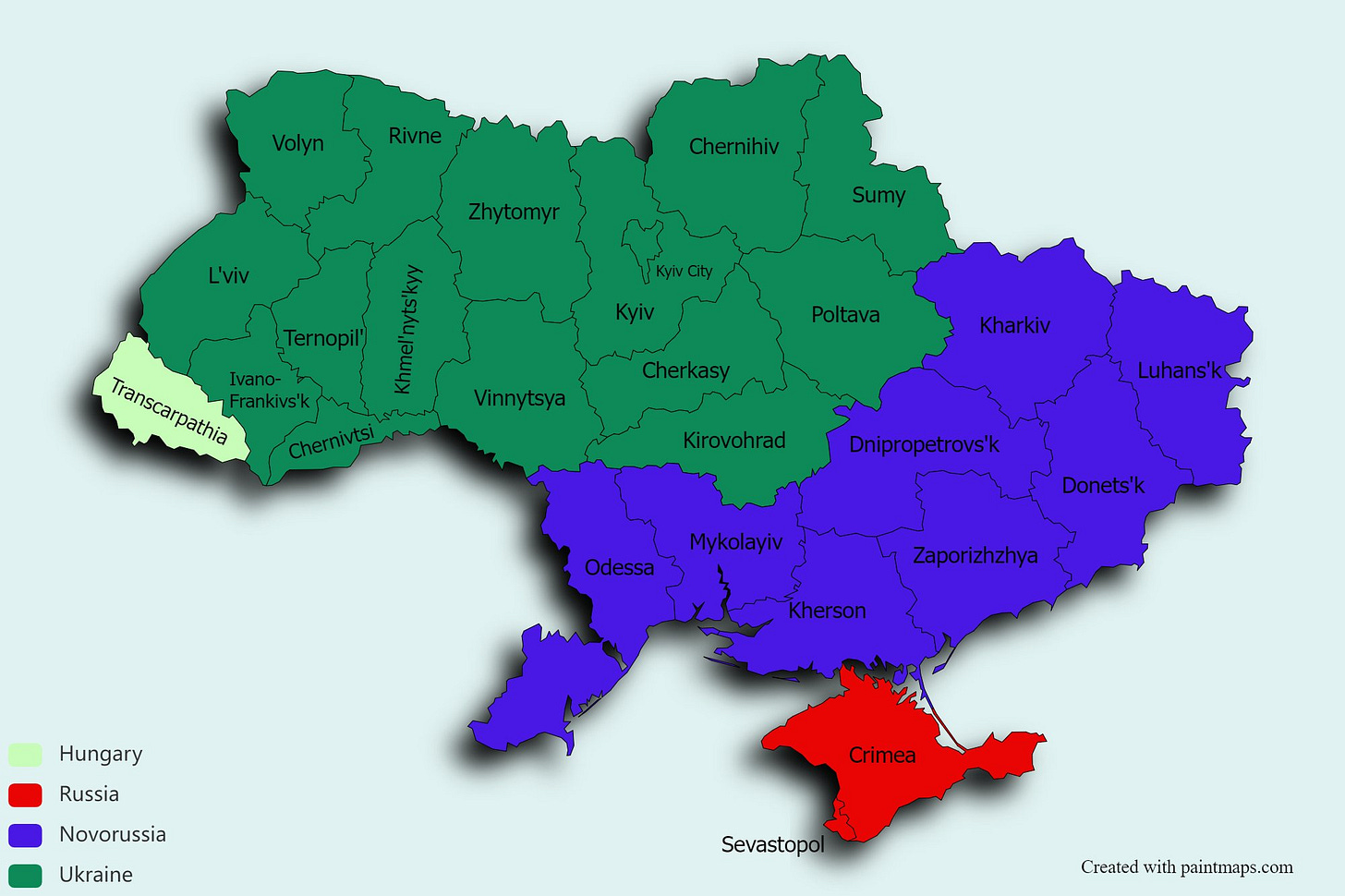
Novorossiya
No matter how the would-be masters of empire try to spin defeat into victory, most everyone around the world will still know the score. And it is this disabused illusion of imperial military supremacy that will rapidly accelerate its inexorable decline.
Leader of Ansar Allah, Abdul-Malik Badreddin al-Houthi, on the developments of the Israeli aggression on Gaza and the latest regional and international updates – 22 Muharram 1447 AH, July 17, 2025:
The Israeli enemy continues the genocide against the Palestinian people and seeks to accumulate its criminal record.
The Israeli enemy is using American bombs intensively, perhaps even more than firing bullets, and the Americans supply them in continuous shipments.
The aggression against the Palestinian people in Gaza is almost an American aggression before it is Israeli, with the Israeli role being that of execution.
The Americans endorse everything the Israeli enemy does and support and share it because they both operate based on the belief in the Zionist agenda.
The view towards the Americans should be based on insight and awareness grounded in the Holy Quran and clear, established facts.
The prevailing attitude among Arab and Islamic regimes, as well as in most media outlets, is to present the Americans in a different light, as if there is still hope for them to change their position.
The Israelis and Americans have no regard for human life, which, in their view, is permissible for the sake of desire or interest.
The Israeli enemy targets Gaza’s inhabitants by depriving them of water and turns the issue of obtaining drinking water into an adventure.
The policy of pushing towards loyalty to the American side and relying on it leads to significant distortions in orientations, morals, and values at the expense of the principles of Islam.
Many of the people of our Islamic Ummah, more than other nations, behave as if they are deaf, dumb, and blind to what is happening in the Gaza Strip.

The whole world is watching these developments with great interest.
By William Schryver at imetatronink.
They will endeavor to talk tough and “keep up appearances” for a while yet, but as a credible and capable military/political alliance, NATO is irreparably broken.

Confederate Field Fortifications, Petersburg, Virginia, USA. 1865

Union Trench Mortars, Petersburg, Virginia, USA. 1865
I’ve watched a LOT of drone footage from this war. I’ve seen, from a bird’s eye view, as it were, the design of the field fortifications Ukraine constructed, with NATO guidance, over the course of eight years.
The logic of these miles and miles of fortifications harkens back to the 1864-65 Battle of Petersburg (US Civil War), with a few World War I innovations thrown in for good measure.
It is a logic where victory largely depends on you not running out of men, heavy weaponry, and ammunition — and the enemy being comparatively stupid.
In many ways, the revealed logic of Ukraine’s long-prepared strategy for this war is a reflection of American military delusions and vanities, which multiplied and solidified over the course of the brief and fleeting “unipolar moment”.
Despite not having won a war since 1945, the US military is consumed with the vanity that it has always dominated opposing forces in every conflict.
There is a measure of truth in this perspective. But it is irrelevant. Because, since no later than the Korean War, the US has not faced a peer or near-peer adversary in a high-intensity conflict. The US military has not been, for almost three-quarters of a century, truly tested “under-fire”.
The US has measured its battlefield mettle, for decades, against brave sandal-shod men with AK-47s, RPGs, and a certain savoir faire for constructing IEDs.

Taliban Fighters, Afghanistan.
But they have never faced anything like Russian artillery or missiles – not even in Hollywood movies or video games.
Consequently, the Pentagon’s self-perception of unquestioned supremacy has served to disinform and corrupt its doctrinal and procurement decisions for multiple generations of its officer corps. For most US generals and admirals, all putative opponents are underestimated.
That said, I believe a great many have now been awakened from their intellectual slumber by the manner in which the Russian armed forces quickly assessed the Ukrainian order of battle, and then professionally adapted their strengths and tactics to decisively defeat it.
The Battle of the Donbass
Here is a brief summation of the Russian tactical approach to the Battle of the Donbass:
Step #1: Advance reconnaissance units (often in force, with dozens or hundreds of drones overhead) to assess the situation; draw fire; relay to commanders raw video and geo-coordinates.
Step #2: With target-correcting drone swarms overhead, relaying real-time strike video, proceed to savage the fortifications with towed and mobile artillery, Multiple Launch Rocket Systems (in gradations of strength and precision), and even horrific thermobaric munitions for particularly suitable targets.
Let smoke clear.
Repeat Step #1.
Still something moving there?
Repeat Step #2.
Repeat Step #1.
Dead bodies everywhere?
Step #3: Send in tanks and infantry to mop up.
Move to next series of fortifications.
And so on and so forth …
This is why Ukraine now suffers hundreds of battle deaths every single day. And why, for months, the Russians have suffered very few casualties — likely as low as a 1:8 ratio, and quite possibly even lower.
Artillery, airstrikes, and precision guided munitions are doing almost all the fighting.
The Fatal Hubris of NATO War Strategy in Ukraine
But back to Ukraine’s apparent strategy for this war, and the apparent US influence on that strategy.
I will preface my commentary on this issue by stating that Ukraine’s fatal blunder was buying into NATO’s over-confident delusion that they (the Armed Forces of Ukraine) actually had a reasonable opportunity to defeat the Armed Forces of the Russian Federation in a high-intensity conflict.
I initially believed NATO military leaders must have had a sober view, far in advance, that their half-million-strong, well-armed, trained-to-NATO-standards Ukrainian proxy army had almost no chance of prevailing on the field of battle against Russia.
But watching drone video of Ukrainian fortifications has convinced me the US military brain trust, in the course of their eight-year-long preparation of the eastern Ukrainian battlefield, effectively disdained the Russian military and its commanders.
Their vanity persuaded them the Russians would mindlessly smash themselves to pieces against an entrenched well-armed force.
Indeed, they were so confident of the genius of their plan that they persuasively encouraged many hundreds of now-killed or captured NATO veterans to “share in the glory” of humiliating the Russians and bringing down the Putin regime once and for all.
They deluded themselves into believing the Russians lacked strategic and logistical acumen, a sufficiently well-trained force, and – arguably the biggest miscalculation of all – sufficient stockpiles of ammo to conduct a protracted high-intensity conflict.
In short, I have come to believe US/NATO commanders actually persuaded themselves that this “Mother of All Proxy Armies” had an excellent chance to soundly whip the Russians in a battle situated in their own back yard.
In other words, they disregarded centuries of European history that they somehow convinced themselves had no relevance to their 21st century aspirations to defeat Russia militarily and take a great spoil of its resources.
But, as is now readily apparent to all objective, knowledgeable military analysts around the globe, the Ukrainian proxy army has been pulverized by a patient, methodical, and significantly outnumbered Russian force, using long-established Russian doctrines and tactics.
Even more revealing is that once-vaunted and universally feared US/UK weaponry – almost all of it actually rather antiquated – has proven to be far less “game-changing” than the pea-brained strategists in Washington and Whitehall mistakenly believed.
Javelins, NLAWs, and Stingers have been exposed as mostly ineffective against their intended targets (tanks, helicopters, and low-flying jets). M-777 howitzers break down after just a few fires. GPS-guided “precision” munitions are routinely jammed by Russian electronic warfare counter-measures.
Worse yet, the inculcation of NATO field doctrines in the minds of the Ukrainian officer cadre has resulted in pervasively inflexible responses to battlefield events that develop contrary to expectations. Consequently, discipline has disintegrated, and improvisation has been paralyzed.
To be sure, if one were to go by the laughable assessments of western think-tank propagandists and their dutiful lackeys in the media, “Ukraine is winning” and “the inept Russian military has been humiliated”.
But more discerning observers around the world know better.
Sober military men in potential adversary countries across the globe see with clarity that Russia has, with one hand tied behind its back, eviscerated the massive, relatively well-armed and well-trained Ukrainian military. The US/NATO intimidation factor has been forever compromised.
More geopolitically significant, at least in the near future, is that European NATO members can also read the scorecard of this war: they now understand as they never could previously that standing on the NATO side of the field is hardly a guarantee of security.
I am convinced NATO will not survive the results of this war in Ukraine. Sure, they’ll “keep up appearances” for the time being, but there can be no doubt most now understand that siding with a rapidly declining empire is fraught with great risk and minimal gain.
More concerningly, the Chinese have been watching all of these developments with great interest. They are almost certain to be emboldened to act decisively to secure their sphere of influence in the emerging multipolar world.
Great dangers now await in east Asia …
WAR ON IRAN: Rania Khalek’s Dispatches w/ Elijah Magnier
Veteran war correspondent Elijah Magnier joins Rania Khalek for a special live episode of Dispatches to break down what just happened, what’s coming next, and whether the region is now spiraling into all-out war.
Israel has launched an all out war on Iran, with hundreds of strikes across the country on military, nuclear and civilian infrastructure as well as assassinations of military commanders and scientists. This shocking escalation comes as the U.S. publicly distances itself, even as prominent American politicians cheer it on and while Washington pretended to pursue nuclear negotiations with Tehran.
Ed. comments:
The first ever ASEAN-China-GCC trilateral summit was a de facto celebration of the New Silk Road spirit.
By Pepe Escobar at the Strategic Culture Foundation.
The first ever ASEAN-China-GCC trilateral summit earlier this week in Malaysia – with 17 Global South nations at the table – was a de facto celebration of the New Silk Road spirit.
Malaysian Prime Minister and current ASEAN chair Anwar Ibrahim summed it all up: “From the ancient Silk Road to the vibrant maritime networks of Southeast Asia to modern trade corridors, our peoples have long connected through commerce, culture, and the sharing of ideas.”
That inspires a lot of reflection. Let’s try a first, succint approach matching East and West – and what divides them – guided by an extraordinary study, La Mediterranee Asiatique: XVI-XXI Siecle, by CNRS research director Francois Gipouloux, also a specialist in the Chinese economy.
The European tradition is far from monolithic – and it’s only part of the picture – when it comes to global perceptions about political philosophy and the conception of the State. There are stark differences even when referred to Hobbes, Locke and Rousseau.
The heart of the matter used to be the land/sea opposition. For Carl Schmitt, land/sea relates to friend/enemy – the matrix of politics – providing a key interpretation of world history, yet one among many.
It’s on “continental” Europe – to borrow the Anglo terminology –, mostly in France and Prussia, and not in England, that the Hobbesian concept of the State materialized. Britain became a world power thanks to its navy and trade, eschewing the characteristic institutions of the state such as a written constitution and a legislative codification of law.
Anglo-Saxon international law in fact voided the continental conception of the State and also war. According to Schmitt, it developed its own concepts of “war” and “enemy” out of maritime and trade conflicts which did not make a distinction between combatants and non-combatants (when it comes to its lasting legacy, think “the war on terror”).

My war is Just, because I said so
The opposition then solidified between the right to wage war on land – war is “just” if it happens between sovereign states, via regular armies, and sparing civilians – and waging war on sea, which does not imply a state-to-state relation. What mattered was attacking the trade and the economy of the enemy. And methods of total war were directed against either combatants or non-combatants.
That led to a new Western concept of “Just War” and international law: when the enemy is turned into a criminal, juridical and moral equality between belligerents is shattered.
That’s the perverse logic behind psycho-pathological genocidals legitimizing the destruction of Palestine.
These differences in the formulation of law came out of two different conceptions of space: closed, overland – featuring sovereign states, territorially delimitated – and open, over the seas – a unique space, unlimited, free of every state control, where primacy is about securing communication links. The British did not think about space in terms of territory, but of routes of communication, just like the Portuguese and the Dutch before them.
Schmitt identifies in the State an entity linked to land and territory. So, as startling as it seems, it’s Behemoth, the terrestrial animal of the Old Testament, and not the marine monster Leviathan that should have been chosen by Hobbes as a symbol of the State.
In the development of the West, three institutional forms – equally viable – were in competition: Leagues of Cities – like the Hanseatic Legue; City-States – especially in Italy; and the Nation-State, especially in France.
Few across the West may remember that the Hanseatic League and the powerful Italian city-states, for at least two centuries, were viable alternatives to the territorial state. Two top researchers, Douglass North and Robert Paul Thomas, in The Rise of the Western World: A New Economic History, argue that the modern state was imposed on Western Europe because it was the best equipped to fulfill two key tasks: to efficiently guarantee property rights and the physical security of people and goods.
If we go back to Europe in the 14th century, before the Renaissance, there were at least a thousand states, of all sizes. That means no concentration of power – and some sort of creative competition in store. There was a reasonable amount of choice for those who wanted to find better places to exercise their freedom.
We had for instance Germany, with its three main actors constituted as the Emperor, the nobility and cities; Italy, with its main actors as the Papacy, the Emperor and cities. And France with its three main actors as the King, nobility and cities. In each case, different alliances proliferated.
In Germany, the Emperor allied with the nobility against the cities. In Italy, nobility was urbanized, and cities profited from endless squabbles. In France, nobility was very suspicious of the bourgeoisie, and the King allied himself with the cities against nobility. England chose a completely different path. Even before France, the Brits created a centralized state, but under a quite original political set up.

Asia and the Mandala State
Asia is a completely different story. Here we cannot use the terminology of “state” to designate the political constructions of Southeast Asia before decolonization. In Southeast Asia, the borders were arbitrary between the tribe, so-called “primitive” political formations (from a Western perspective) and the State.
Springing up from political concepts prevailing in India, Islam and the West, states showed up in the Insulindia (maritime Southeast Asia) archipelago, for instance, as courtly bureaucracies, based on a network of complex alliances. Whatever the degree of institutionalization, the distinction between The King, The Vassal and The Bandit was tenuous at best.
Vietnamese researcher Nguyen The-Anh has remarked how “political fragmentation is generally the preliminary conclusion of the first Europeans who made contact with Southeast Asia. Marco Polo saw in the north of Sumatra ‘eight kingdoms and eight crowned Kings…each kingdom possesses its own language.”
China, on the other hand, featured a unitary state imposing – via a quite efficient administration – social order over a vast territory. There was no competition against the centralized state issuing from a landed aristocracy; no urban bourgeoisie; and no military contesting the imperial order, as in Europe. That’s the major difference between China and the West.
Thomas Aquinas decreed that if the power of the king belongs to a multitude, it’s not unjust that the king is deposed or sees his power restrained by this very own multitude if he turns into a tyrant and abuses royal power.
This distinction is completely alien to the Chinese tradition. What happened over the past century or so in China is that the peculiar configuration – and competition – between local actors and central power led to what could be defined as an unstructured empire, whose force comes from its shape-shifting borders and the diffused character of transnational networks.
In a global economy, this gives China an exceptional projection capacity. When borders become fuzzy, and the link between the state and individuals is fuzzy, the unstructured character of this Empire allows the Asian periphery of China to develop in an arc from Japan and the DPRK to Singapore and Indonesia. This is exactly the subtext of some of the key discussions in Kuala Lumpur at the ASEAN-China-GCC summit. Jeffrey Sachs totally got the picture beforehand.
Now, the opposition between a system of international relations deemed “backwards” and irrational in Asia and modern and rational – because based on realpolitik – in the West is over. Cultural factors now shape reality in Asia as well as in the West about the conception of the state and international relations.
China is finally self-assured enough to start disengaging from the current, Western-dominated system of international relations – because it has the means to do so.
The Chinese concept of harmony in international relations used to be linked to the proclamation of a natural order of which China would be the guarantor. But now we are a long way away from the 18th century, when the international environment of the China of 18 provinces was constituted by Korea, Manchuria, Mongolia, Chinese Turkestan, Tibet, Burma, Annam, the Ryuku archipelago and Japan. The Qin dynasty was keen to reassert its suzerainty on the political and cultural domains, assuring the protection of China by managing a belt of favorably disposed states.
Today a self-assured China sees a new system of international relations directly linked to a Belt and Road network of geoeconomic opportunities for all. That underlies the relationship between China and ASEAN, GCC, CELAC, Central Asia and the whole of Africa.

Welcome to the archipelagic world
The world has surpassed the “overland” or “maritime” dilemma, beyond Mackinder and Mahan. The world is now best defined, as Gipouloux coined it, as archipelagic (italics mine), linking urban nebulas of different sizes and vocations.
Globalization accelerated the transformation of a terrestrial world into an archipelagic world. New technologies, economic and financial pressure, disinformation on a mass scale – China is navigating all these rocks in shallow straits in the quest to solidify itself as a global power.
All that implies the progressive, thalassocratic advance of China: a flexible and tolerant Empire (“community of shared destiny for mankind”), a rich confederation with a capacity for global influence supported by polymorphic communities – the “bamboo internet” of the Chinese diaspora.
This is what was on display in Kuala Lumpur – and will continue to evolve via an array of multilateral organizations. Mandala at work, Chinese-style.
Never interrupt your enemy when he is committing serial suicide.
By Pepe Escobar at the Strategic Culture Foundation.
Never interrupt your enemy when he is committing serial suicide (in reverse American gore-style, when the serial killer always resurrects). In the case of the EU kakistocracy, serial self-destruction is always a given, and always skyrocketing.
So the EUrocrats in Brussels have just adopted their 17th round of sanctions against Russia – the sky is the limit – targeting nearly 200 tankers of the so-called Russian shadow fleet. The package, endorsed by EU member states, includes proverbial scores of asset freezes and visa bans.
The EU + UK combo is also scheming how to tighten the oil price cap on Russia to $50 a barrel, aiming to “hurt” Russia’s energy revenue.
Cue to a monster pipeline of laughter from the whole Global South, especially India and China. As if they would impeach any vessels of the shadow fleet, or if OPEC+ would care about a puny unilateral EUrocrat oil price cap.
To qualify EU actions as self-destructive anti-intellectualism is actually benign. The IQ of people at the top in Brussels is at dismembered worm level, exemplified by the Estonian batshit crazy chick in theory representing the foreign policy of 450 million EU citizens. Brussels has been reduced to a pathetic Estonian propaganda snake pit with a whiff of British accent.
The SVR has noted how there is a groundswell of despair in Brussels for the “mistake” of appointing the imbecile Estonian, universally known for “absolute incompetence” and a cringing “inability to build bridges” with EU leaders. She has already been removed from EU strategic defense policy planning.
Still, the sanctions package dementia will keep rollin’ on – redacted by careerists with fat salaries who only care about their own retirement gold package.
The next, the 18th, is supposed to be the largest sanctions package in History, according to the Brussels rumor mill, not only accusing Russia of multiples stances of Hybrid War and alleged use of chemical weapons (when it’s actually the neo-nazis of country 404 who resort to it) but targeting several Russian defense sector companies plus companies and intermediaries from third countries supplying sanctioned products to Russia.
Add to it the German BlackRock chancellor actively lobbying for an EU ban on the Nord Stream pipeline – blocking any possibility of a U.S.-Russia business cooperation, already signaled by Trump. This ban will be part of the 18th package.
Cue to Grandmaster Sergey Lavrov, who recently felt the need to emphasize that political EUro-trash banning the return of NordStream are “either sick or suicidal.”

Stealing Russia blind: good luck with that
On the Baltic front, there’s more, of course – in a “Pirates of the Baltics” register: that’s the SIGINT-heavy Baltic Sentry mission, which aims to block Russian maritime activity. France is on it – which implies a non-regional NATO member directly involved, unlike, for instance, Norway.
The Russians are unfazed. A strong possibility is that they will escort Russian ships with multi-functional naval and aerial drones fully equipped with reconnaissance and combat gear.
Yet on the Orwellian front, nothing beats the anti-Russian “tribunal” announced on May 9 by EU foreign ministers in Lviv, together with Kiev, to “hold top representatives of the Russian leadership accountable.” That involves 30 partner countries, incuding UK and Australia. The U.S. is out.
The scam was minutely deconstructed by Thomas Roper, who is now viciously demonized and censored by the EU, even though he is a journalist and EU citizen of German nationality. Yes, Brussels now sanctions its own citizens capable of critical thinking, to the point of freezing their assets and forbidding them to visit their home country. And this is just the beginning.
The new EU kangaroo “court” will be set up by the Council of Europe – and will issue judgments even in absentia, via 15 judges elected for 9 years each, the whole thing costing the EUrocracy around 1 billion euros.
Needless to add that this kangaroo “court” has absolutely no basis in international law, as it’s not approved by the UN; instead, it’s a private club of the fragmented West. Follow the money to understand the rationale.
Few people today remember that last year the European Commission (EU) gave a $50 billion loan to Kiev; actually $35 billion by the EU and $15 billion by the G7. The problem is only Brussels is responsible for repaying this joint EU-G7 loan. And the loan is supposed to be paid from the annual revenues generated by Russian assets frozen – i.e. stolen – in the EU, which Brussels refuses to release before the next 45 years.
These are all official EU decisions, enshrined in Regulation 2024/277. Translation: no, I repeat, no European mainstream media has informed taxpaying citizens across the union that the EU has formally decided to be at war with Russia for at least the next 45 years.
Brussels has done everything trying to steal for good the “confiscated” Russian assets. The problem is the EC EUrocrats have not found a mechanism to bypass international law.
Enter the “court”. The EUrocracy will force the kangaroo “tribunal” to blame Russia for everything related to the war and the SMO; sentence Russian government members to long-term prison sentences – in absentia; and then decide that Russia has to pay reparations. Endgame: the kangaroo “court” decides to steal for good the frozen Russian assets.
Once again: under international law, this is a robbery. Key inevitable consequence: no one across the Global South will trust the euro and European financial centers anymore.
This Russian demonization EUro-dementia scenario is in play just as Trump 2.0 still bets on some sort of normalization with Russia via a solution for Ukraine. Yet the key factor here is the cowardly collective fear of the EU kakistocracy: if they don’t rob Russia blind, they have no means to repay that fateful $50 billion loan to the Kiev goons.
That should be the main factor explaining why this collection of political mutts needs, badly, to non-stop escalate what is a de facto Forever War against Russia.
So expect only dementia coming from Brussels in the foreseeable future. Like the brilliant idea of setting up a single military bank to alocate loans for weapons production, a replica of the World Bank with a HQ in London. Since they could not find 120 billion euros to come up with a single European military fund – the German economy, for instance, continues to collapse – their plan B is this bank.
For all that cornucopia of sound and fury, Russia remains, once again, unfazed. Putin top aide and former National Security Adviser Nikolai “Yoda” Patrushev has noted how NATO has been “conducting exercises at our borders at a scale unseen in decades. … They are training for conducting a broad offensive from Vilnius to Odessa, seizing Kaliningrad region, imposing a naval blockade in the Baltic and the Black Seas and executing preventive strikes on the staging locations of Russian nuclear deterrence forces.”
Good luck with that. Good luck with the military bank. And good luck with stealing Russia blind with no blowback.

 Lateo.net - Flux RSS en pagaille (pour en ajouter : @ moi)