 Connexion


Paul and Ken assess how China’s economy goes from strength to strength whilst it continues to decouple from the U.S. and demonstrates how U.S. tariffs have been a failure.
“The genie is out of the bottle. The provocation of a “USV privateer war” on trade routes threatens to collapse global maritime trade.”
By Rotislav Ishchenko at ukraine.ru.
(machine translation)
The oil tanker Virat has been attacked twice by unmanned boats near the Bosphorus Strait. On one occasion, the ship Kairos was also set on fire. Western media outlets have claimed that the tanker belongs to Russia’s “shadow fleet.” This expands the list of potential suspects. Naturally, Ukraine, which has been waging a long-standing war against the Russian military fleet using unmanned combatants, is at the top of the list. However, it is unlikely that Kiev would have dared to attack merchant ships, especially near one of the world’s most important transportation hubs connecting the Black Sea and the Mediterranean, which is controlled by Turkey, without the direct approval of its Western allies. The consequences, both direct and indirect, would have been far-reaching, affecting the entire world. Ukraine may no longer exist, but the unmanned surface vehicle’s (USV) attack on merchant ships could echo for decades, shaping the maritime trade landscape.
So it doesn’t matter whether these USVs belonged to Ukraine or whether the British and Americans decided to use their own or those belonging to a third country. The genie is out of the bottle. And not only because this game can be played by two people.
In this case, Britain is unlikely to hope to remain outside the scope of retaliatory actions. It is clear that it is more difficult to use USV to disrupt shipping in the open ocean than in enclosed waters such as the Black, Baltic, Mediterranean, White, Red, Yellow, and Japanese Seas, as well as all Chinese coastal seas. However, the ports of the United Kingdom are within direct reach of USV strikes from the continent and/or from ships and vessels passing through the English Channel. The situation for shipping may be even more dangerous in the classic pirate stronghold of the Caribbean Sea, which borders dozens of countries, many of which are home to both drug cartels and ideological guerrillas.
The threat to American southern ports in the Atlantic is clear.
At the same time, although USVs are more complex than the simplest air drones, they do not require high-tech enterprises for their creation. The problem of guidance, especially at shorter distances, is also solvable. This means that it is not always possible to determine the nationality of a USV that has not exploded, especially if the manufacturer deliberately conceals it.
Almost all strategic global maritime trade routes, no matter how far they extend into the open ocean, eventually pass through bottlenecks like the Bosphorus. Moreover, almost all of these bottlenecks are within the reach of the USV from the coasts of dozens of countries and/or hundreds of ships passing by simultaneously. Only the Northern Sea Route is relatively protected by national means. The rest can be blocked.
The provocation of a “USV privateer war” on trade routes threatens to collapse global maritime trade. This does not require sinking all ships. It is enough to make the threat significant enough to increase insurance premiums, crew salaries, and security costs, as well as delivery times. As a result, significant volumes will be excluded from global trade due to their unprofitability. Additionally, USV can be produced in large quantities (or purchased) and used by dozens of countries against each other. As we know, the greater the demand, the cheaper and easier to use the technology becomes. The first AK-47s were secret and carried in tarpaulin cases, but now the entire world, including the poorest tribes, is using them, and only the lazy ones are not producing them. Finally, the Ukrainian military crisis, as well as the wars between the Houthis and the Saudis and Israel, have demonstrated how easy it is to use high-tech weapons against a third country under the guise of a proxy ally. If Ukraine can launch American and European missiles, which require satellite guidance, at targets deep within Russia, and the Houthis can use hypersonic weapons to attack their enemies, what is stopping Somali pirates or Colombian drug lords from developing similar technologies for the USV?
I want to emphasize that the problem is not that a tanker that could theoretically belong to Russia’s “shadow fleet” was attacked. Russia is primarily a land-based power, and its main trade routes are located within the Eurasian continent and are well-protected. The main targets of the “USV privateer war” may include China, Taiwan, Japan, both Koreas, the Philippines, Vietnam, Thailand, Myanmar, Taiwan, India, the Gulf oil monarchies, Iran, Singapore, Turkey, Indonesia, and countries in the Caribbean, Mediterranean, North Sea, and Baltic regions.
These are either trade competitors of the United States and the United Kingdom, or allies of the United States who are in a leading geopolitical position and are used as a springboard for military and political pressure on the United States’ trade and economic competitors.
In recent years, the West has been losing not only the financial and economic struggle, but also the struggle for control of global trade. The dollar and the euro are losing their positions as the main and auxiliary global currencies and currencies for trade settlements. The yuan, rather than the ruble or the rupee, is actively replacing them. The traditional trade between the West and countries in the Gulf, Latin America, and Southeast Asia is gradually shifting to China. China is also actively expanding its presence in the Eastern Mediterranean, moving through the Greater Middle East.
In all of China’s advancements, maritime trade routes are of utmost importance.
The land-based trans-Eurasian trade routes that connect the continent into a unified economic Greater Eurasia serve as the foundation, but it is the control over maritime trade routes that allows China to build a “fairy-tale castle” of global profitable trade. It is no coincidence that China is building a navy that surpasses the United States in terms of the number of ships and is poised to surpass it in terms of overall combat power. China needs to control the routes that facilitate the sale of its goods. Russia can exist as an autarky, but China will quickly explode from within if its trade is blocked.
During the Ukrainian military crisis, Western UAVs, which were limited in their use in Ukraine, proved to be highly effective in controlling the water area dominated by the enemy’s navy and aviation, as well as in blocking ports and posing a constant threat to military bases. Russian sailors gradually learned to combat the UAV threat, but they were unable to completely eliminate it.
It should be noted that the military fleet, which exercises dominance in a closed water area, has impressive capabilities for combating enemy USVs. However, as mentioned earlier, the threat of USVs in the Black Sea has not been completely eliminated. For the military, repelling attacks is a natural activity. The merchant fleet, on the other hand, is not equipped to handle this task. Any measures taken to enhance the security of commercial ports and the surrounding water area will immediately impact the speed and cost of shipping goods, while the threat of USVs remains high.
The West is not just not afraid of playing a “double game” in the “USV privateer war.” It is provoking this war, deliberately seeking to paralyze global maritime trade.
We can say that this will hit the West itself. It will hit it, but not as hard as we would like. As mentioned above, the West has already lost its trade supremacy to China, and it will only continue to lose ground. However, the rules of geopolitical warfare require us to try to destroy the mechanism that benefits our geopolitical adversary rather than ourselves. During the two World Wars, when maritime trade was an Anglo-Saxon monopoly, Germany attempted to wage war against it using its submarine fleet. The West is now trying to strike a blow to global maritime trade, which is gradually being taken over by China.
We have repeatedly said that the paralysis of Chinese trade will inevitably plunge Beijing into a financial, economic, and then a social and political crisis. The Anglo-Americans have failed to isolate China through legal means, so why not try proxy piracy, since they are already waging a proxy war on land against Russia.
It is clear that we should not expect hundreds of USV attacks on sea routes tomorrow. However, we should not expect them to take decades to organize. As the development of UAV technology during the Ukrainian military crisis has shown, it is possible to transition from isolated attacks to large-scale use in a matter of months (or even a couple of years), which can change the entire dynamics of the conflict and require the development of appropriate countermeasures, which may not always be as quick as desired.
The fact that the incidents involving attacks on merchant ships by the USV occurred in the area of the Bosphorus, a trade route controlled by a NATO country, indicates that the organizers of this provocation are preparing for a global undeclared war on trade routes (similar to the war between English pirates and Spanish transatlantic trade in the 16th to 18th centuries), and they do not intend to tolerate the transfer of control over these routes to their geopolitical opponents. Given that the United States is developing an icebreaker fleet and actively expanding its presence in the Arctic, we should also consider strengthening the security of the Northern Sea Route.
Pepe Escobar on Sputnik
The Unit project, first revealed by Sputnik in 2024, is emerging as the most viable option for breaking the US dollar’s stranglehold on global trade and investment.
In his book co-written with top economist Sergey Bodrunov, Regulations of the Noonomy (international edition published this year by Sandro Teti Editore in Rome), leading Russian economist Sergey Glazyev stresses the need to “ensure a full-fledged switch to national currencies in mutual trade and investment within the EAEU and the CIS, and further – within the BRICS and SCO, the withdrawal of joint development institutions from the dollar zone, the development of their own independent payment systems and interbank information exchange systems.”
When it comes to financial innovation – compared to the current structure of the international financial system – The Unit is in a class of its own.
The Unit is essentially a benchmark token – or an index token; a post-stablecoin, digital monetary tool; totally decentralized; and with intrinsic value anchored in real assets: gold and sovereign currencies.
The Unit can be used either as part of a new digital infrastructure – what most of the Global South is striving for; or as part of a traditional banking setup.
When it comes to fulfilling traditional money functions, The Unit is – pardon the pun – right on the money. It’s meant to be used as a quite convenient medium of exchange in cross-border trade and investments – a key plank of the diversification actively pursued by BRICS+.
It should also be seen as an independent, reliable measure for value and pricing, as well as a better store of value than fiat money.
The Unit is academically validated – including by Glazyev himself – and properly governed by IRIAS (International Research Institute for Advanced Systems), set up in 1976 in accordance with the UN statute.
And crucial at this next step, The Unit is to be launched early next year on the Cardano blockchain, which uses the digital currency Ada.
Ada has a fascinating background – named after Ada Lovelace, a 19th-century mathematician, daughter of none other than Lord Byron, and recognized as the first computer programmer in History.
Anyone, anywhere can use Ada as a secure exchange of value; and very important, without the need to ask a third party to mediate the exchange.
That means every Ada transaction is permanently secured and recorded on the Cardano blockchain. That also means that every Ada holder also holds a stake in the Cardano network.
Cardano has been around for 10 years now – and is a quite popular blockchain. It’s backed by some quite big venture capital firms such as IOHK, Emurgo and the Cardano Foundation. Essentially, Cardano is an excellent option for regular payments because transactions are cheap and fast.
Neither a crypto nor a stablecoin
Enter The Unit.
The Unit is neither a cryptocurrency nor a stablecoin – as it’s shown here.
A concise definition of The Unit would be a resilient reserve of value – backed by a structure of 60% gold and 40% diversified BRICS+ currencies.
The major appeal for the Global South is that such a unique mix provides stability and protection against inflation, especially under the current global financial landscape of wobbly macroeconomics and widespread uncertainty.
Using Cardano, The Unit is bound to become accessible to everyone, via a combination of centralized and decentralized exchanges.
So to enter this new market, individuals and companies will be able to acquire The Unit directly with fiat through regulated banking partners. That means a bridge between traditional finance and emerging decentralized ecosystems – in favor of liquidity, accessibility and reliability, opening the door to full adoption by the Global South.
The Unit can even evolve into a new form of digital cash for emerging economies.
Following exactly the path delineated by BRICS even before the ground-breaking annual summit in Kazan in 2024, The Unit may be the best solution currently available for cross-border payments: a new form of international currency, issued in a de-centralized way, and then recognized and regulated at a national level.
And that brings us to the top conceptual strenght of The Unit: it removes a direct dependency on the currency of other nations, and offers the Global South/Global Majority a new form of non-censored, apolitical money.
Better yet: apolitical money featuring an enormous potential for anchoring fair trade and multiple investments.
What the Global South really needs
A good next step for The Unit would also be to set up an Advisory Board, uniting world standard stars such as Prof. Michael Hudson, Jeffrey Sachs, Yannis Varoufakis and the co-founder of the NDB Paulo Nogueira Batista Jr. (here at the Global South Academic Forum in Shanghai) .
When it comes to BRICs-emphasized de-dollarization – done with a hefty degree of sophistication, without having to spell it out – The Unit will be key. It’s also key that The Unit is not a cryptocurrency.
Wall Street behemoths – especially BlackRock – are big on cryptocurrencies, an enormously unstable set up which eschewed individual holders to the profit of massive institutional players. For example, it’s BlackRock that essentially shapes Bitcoin’s market.
US stablecoins essentially perpetuate US dollar dominance – aiming their firepower directly against possible, future digital currencies offered by BRICS+.
The Unit is the stark opposite, offering a reliable digital monetary tool for the fast advancing Multipolar World. It’s an evolution in itself, bridging the fiat and the crypto worlds; and last but not least, it is a solid foundation for the emerging post-Bretton Woods economy.
Of course the challenges ahead are huge – and The Unit will be fought tooth and nail by the usual suspects as a new concept offering borderless financial resilience for the Global South/Global Majority.
And here may lie the key takeaway: the only way BRICS+ as well as the Global Majority may be strengthened is by developing closer and closer geoeconomic, financial ties. For that, the toxic power of Western speculative capital must be contained – to the benefit of more intra-Global South commodity trading, and more investable capital for productive, sustainable development.
The potential is limitless. The Unit may well be able to unlock it. Even JP Morgan admitted The Unit is “perhaps the most thoroughly fleshed-out of de-dollarization proposals that exist in the cross-border transactions space for BRICS+.”
And there’s no other similarly effective plan anywhere in the world.
Kevin from Inside China Business
Targeting allies and manufacturing foes is the last card available to the Empire of Chaos.
Pepe Escobar – Strategic Culture
China is right in the middle of a true tech onslaught – which in several ways works as a sort of wrap-up of Made in China 2025, conceived and launched 10 years ago, and a resounding success even facing at least two tariff/sanctions offensives by Trump 1.0 and Trump 2.0.
A stellar Chinese analysis by Chen Jing, published by my friends at Guancha in Shanghai, concisely interprets the importance of key vectors and variables linked to the tech onslaught. Here’s an essential breakdown, with my own comments.
The China-US decoupling
The US as a Chinese export market now represents less than 10% of total exports. In parallel, as I observed in my visits to China this year – from Shanghai and Beijing to Xian and Xinjiang – there’s no psychological fear anymore of the much-touted “decoupling”. After the Trump-Xi meeting, it became clear that what is already in effect is a managed decoupling. Beijing is cool, calm and collected: after all, it’s able to expand in markets all across the Global South. Especially because more trade usually walks side by side with more infrastructure development projects: that’s the logic behind the New Silk Roads/BRI.
China’s 15th Five-Year Plan
What was recently debated in four days in Beijing – and will be approved next March during the Two Sessions – is already rolling, as in “decisive breakthroughs in key core technologies in major areas such as integrated circuits, industrial machine tools, high-end instruments, basic software, advanced materials, and biomanufacturing.” That’s all Made in China 2025 material. The conclusion is stark: sooner, rather than later, China simply won’t need anything from the Western high-tech industrial chain. Call it industrial decoupling. And the cards, once again, are Made in China.
The US debt crisis
The analysis recalls a comparison between the US debt in 2019, before Covid – $21 trillion, with $300 billion in annual interest – with 2025: $38 trillion, with interest projected at $1.3 trillion, way ahead of the Pentagon’s budget. You don’t need to be Prof. Michael Hudson to do the math: long-term US debt is the ultimate – unpayable – nightmare. And the US debt has alreay morphed into a US dollar crisis.
The SWIFT factor
The analysis touches on a key issue regarding SWIFT. The US dollar is still responsible for approximately 47% of SWIFT transactions. The yuan share, meanwile, fell from 4.74% in July 2024 to 2.93% in August 2025. So the yuan is not exactly becoming more international. Why? Bacause the yuan is being decoupled from SWIFT, on purpose: China is encouraging the Global South – no less than 189 countries and regions – to use CIPS on international trade/financial transactions. CIPS is progressing non-stop: a year-on-year increase of approximately 42% compared to 2024.
Call it China preparing itself for financial decoupling. Even if Washington decided to cut off China from SWIFT like it did with Russia, Beijing would have no problems leveraging its massive trade power to then really internationalize the yuan.
A new path of globalization, with China at the core?
The rare earth saga.
In 2025, China entered escape velocity. The reaction to the Trump Tariff Tantrum came with unwavering self-confidence. It was a marvel to observe that on the spot in Shanghai. The analysis recognizes that much of China’s force derives from its rare earth potential.
Already in July 2023 export controls were imposed on gallium and germanium. This summarizes China’s share and position in the production of metals and rare elements, showing that “China’s advantages go far beyond the 17 rare earth elements that have recently caused panic and helplessness in the Western camp.”
There are 21 elements in the export control list; only seven are medium and heavy rare earth elements. There are several other categories such as rare refractory metals, rare dispersed metals, rare light metals, and non-ferrous heavy metals.
One of the key points of the analysis is that not only the US, but the G7 as a whole no longer has the power to dictate the rules of the global economy. China “can withstand the G7 on its own”. Especially when the myth of US industrial strength has been shattered.
That opens a new Pandora’s box of discussion: is the global majority already moving to a new path of globalization, with China at its core?
The AI bubble
So AI may turn out to be the US’s last hope to turn the tide. The problem is the humongous size of the US AI bubble – a pillar of the US economy. It will eventually burst – and the consequences are unimaginable.
Meta, OpenAI, Nvidia, and others are pouring stratospheric funds into scaling-up large language models (LLMs) and massive data centers. That may not be enough to prevent the AI bubble burst – in an environment dictated by mega-corporations only focused on quick profits.
Cue to a quite worrying prospect fueling their paranoia. Several high-level Chinese models – such as DeepSeek, QWEN and the Kimi K2 series – already dominate global AI open source. The Americans practice “closed-source” – where the thing that matters most is how to monetize their gigantic models.
China is playing a very clever game: delaying the release of Deep Seek R2 – an open source, large-scale model. Why? Because releasing it now would mostly benefit Nvidia’s GPUs, boosting their sales and of course the US stock market.
China is nearly ready to complete domestic GPU computer clusters. DeepSeek R2 is built upon these clusters. The result: that will directly disrupt US dominance. As a Shanghai expert puts it: “How can American AI, hampered by power shortages, lack of open-source access, and high energy consumption, compete with the low-power, open-source, large-scale model that offers a significant advantage?”
MAGA: the Magically Globally Aggressive model
At the recent AI Future Summit, Nvidia’s Jensen Huang went straight to the point: China would definitely win the US-China AI competition.
A key reason is that China’s AI is about productive capitalism – and not speculation. Chinese AI is primarily used in industrial manufacturing sectors such as mining, energy, water conservancy, metallurgy, and military. Large-scale AI models combined with sensors, industrial communication, and automated control at their core, are largely applied to real-life applications, addressing real-life problems in meteorology, marine agriculture, earth machinery, aerospace, civil geology. They truly integrate algorithms and computing power into production.
History tells us that all industrial and tech revolutions have been closely related to real-life production – from steel production and electricity generation to the chemical industry and telecommunications engineering.
All that brings us back to the defining psycho-killer outlook of the Trump 2.0 administration. Incapable of really “winning” a tech war against the largest economy on the planet by PPP, the imperative has switched to harassing and plundering weaker nations seen as easy prey, especially in terms of grabbing their natural resources.
Meanwhile, domestically, Trump 2.0 dreams of reviving manufacturing – the MAGA way. Call it the Magically Globally Aggressive (MAGA) model, deviating attention from what really matters: the monstrous debt; the declining power of the US dollar; the tech bubble; inflation; real geopolitics. Plunder – targeting allies and manufactured foes alike – is the last card available to the Empire of Chaos.
Many of the latest unilateral coercive measures have been suspended for a year. One gets the impression that the US has been put on a state of probation. The rest makes up small issues, not very important.
BEIJING, Oct. 30 (Xinhua) — China’s Ministry of Commerce on Thursday unveiled the outcomes achieved by Chinese and U.S. delegations during their recent economic and trade talks in Kuala Lumpur.
The U.S. side will cancel the 10-percent so-called “fentanyl tariffs” and suspend, for an additional year, the 24-percent reciprocal tariffs levied on Chinese goods, including goods from the Hong Kong Special Administrative Region and the Macao Special Administrative Region, according to a spokesperson of the ministry.
China will make corresponding adjustments to its countermeasures against the aforementioned U.S. tariffs, the spokesperson said, noting that both sides have agreed to continue extending certain tariff exclusion measures.
The United States will suspend for one year the implementation of a new rule announced on Sept. 29 that expands its “entity-list” export restrictions to any entity that is at least 50 percent owned by one or more entities on the list. China will suspend the implementation of relevant export control measures announced on Oct. 9 for one year and will study and refine specific plans, the spokesperson said.
The U.S. side will suspend the implementation of measures under its Section 301 investigation targeting China’s maritime, logistics and shipbuilding industries for one year. In response, China will correspondingly suspend the implementation of its countermeasures against the U.S. side for one year once the U.S. suspension takes effect, according to the spokesperson.
In addition, the two sides also reached consensus on issues including anti-drug cooperation on fentanyl, expanding agricultural product trade, and the handling of individual cases involving relevant enterprises, according to the spokesperson.
Both sides further confirmed the outcomes of the Madrid economic and trade talks. The U.S. side made positive commitments in areas such as investment, and China will properly resolve issues related to TikTok with the U.S. side.
The China-U.S. economic and trade talks in Kuala Lumpur have yielded positive results, demonstrating that by upholding the spirit of equality, respect and mutual benefit, and through dialogue and cooperation, the two sides can find solutions to problems, the spokesperson said.
Noting that the outcomes are hard won, the spokesperson said China looks forward to working with the U.S. side to jointly ensure the implementation of the outcomes, and inject more certainty and stability into bilateral economic and trade cooperation as well as the world’s economy.
A time travel across History – the Ancient Silk Roads as well as Xinjiang may well be the ultimate crossroads of civilizations. Along Central Asia, they are the (beating) heart of the Heartland…
By Pepe Escobar at the Strategic Culture Foundation.
ON THE SOUTHERN SILK ROAD – Silk is the stuff of legend. Literally. At first manufactured only in China, silk historically was not only a luxury product but a monetary unit: a key element of trade and export revenues.
In 105 B.C., a first-ever Chinese diplomatic mission landed in Persia, then dominated by the Parthians, who also occupied Bactria, Assyria, Babylon and parts of India. Under the four-century long Arsacid dynasty – contemporary of the Han in China – the Parthians at the time were the essential middlemen of transcontinental trade. Chinese and Parthians sat down to discuss – what else – business.
The Roman Empire faced some serious trouble with the Parthians – between the massive defeat of Crassus in Carrhae in 53 B.C. and the victory of Septimus Severus in the year 202. In between, silk hit Rome. Big time.
The first time Roman soldiers saw silk was in the battle of Carrhae. Legend rules that the silk banners deployed by the Parthian army, their scintillating appeal making serious noise under the fierce winds, frightened the Roman cavalry: talk about the first instance of silk contributing to accelerate the decline of the Roman Empire.
Well, what matters is that silk perpetrated nothing less than an economic revolution. The Roman Republic and then Empire had to export gold like there’s no tomorrow to get their silken ways.
Parthian rule was followed by Sassanid Persia. They reigned until the mid 7th century – their empire stretching from Central Asia to Mesopotamia. For quite a while the Sassanids incarnated the role of great power between China and Europe – up to the conquests of Islam.
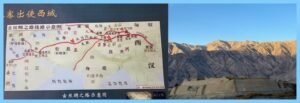
(L): Silk Road, the ancient Chinese way: from Xian to Alexandria, not Rome ; (R): The stone tower: Tashkurgan Fort, the landmark between China and the rest of Eurasia
So imagine, at the start of the Christian era, bolts of silk moving overland all along across the Silk Road spectrum. What’s fascinating is that Rome and China never (italics mine) entered in direct contact – for all the vast cast of characters (merchants, adventurers, fake “ambassadors”) that tried.
In parallel, a Maritime Road was also in play – already in effect during the times of Alexander The Great; it later became the Spice Route. That was how Chinese, Persians and Arabs reached India.
Since the Han dynasty, the Chinese reached not only India but also Vietnam, Malaysia and Sumatra. Sumatra soon developed as a key maritime entrepot, with Arab vessels arriving non-stop. In a more long-distance vein, it was the discovery of the rules of the monsoon – in the first century B.C. – that allowed the Romans to also reach the western shores of India.
So silk arrived in Rome by land and sea, via loads of different middlemen. And yet Rome never knew anything about the origin of silk, nor went further than the Greeks in their wobbly knowledge of the distant, mysterious land of Seres.
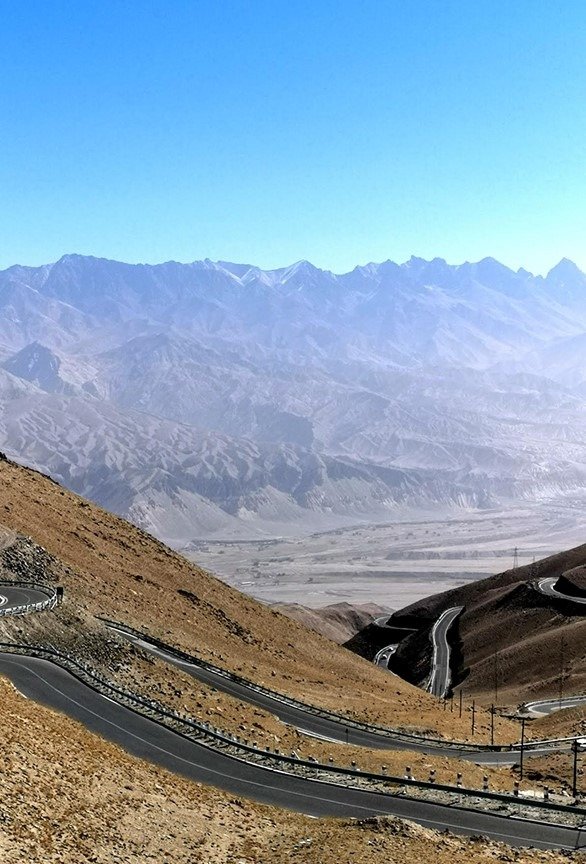
The twists and turns of the Panlong Ancient Road, in Pamir lands
I went down to the (Pamir) crossroads
After the mid-1st century, the Kushan empire, actually Indo-Scythian, gets a protagonist role in southern Central Asia, in what was known then as Eastern Turkestan. The Kushan, rivals of the Parthians in the role of messengers of international trade, not only facilitated the spread of Buddhism but also Gandhara – Greco-Buddhist – art (some originals are still to be found today, at exorbitant prices, in art galleries in Hong Kong and Bangkok).
And yet, further on down the road, the rules of the game never substantially changed: two great Silk Road poles – Sassanid Persia and Byzantium – involved in a real, cutthroat industrial war with silk right in the middle. The secret of silk manufacturing had already been leaked to South Asia.
This trade war got even more complicated with the onslaught of Turk tribes across Central Asia, and the emergence of a trade kingdom in Sogdiana (with Samarkand at the center).
By the mid-7th century, the Tang dynasty recovered control over parts of the Silk Road ruled by Tarim basin kingdoms. That was an absolute must for business to go on – because caravan routes traversing these kingdoms encircled, and bypassed, by north and south, the fear-inducing Taklamakan desert, as they still do today.
Tang China wanted absolute control all the way at least up to the Pamir mountains where, in the legendary stone tower relentlessly described by adventurers but never really located with 100% certainty, Scythian, Parthian and Persian caravans met Chinese caravans to trade that precious silk plus several other commodities.
The stone tower mentioned by top geographers such as Ptolemy is actually Tashkurgan Fort in the Pamir mountains: ultra- strategic, straddling the Silk Road, and nowadays a top tourist attraction very close to the Karakoram highway.
The stone tower is the symbolic landmark between the Chinese world and the rest of Eurasia: to the west is the Indo-Iranian world.
I traveled the Pamir Highway in Tajikistan back-to-back before Covid interrupted everything. This time our mini-caravan crossed Pamir lands along and around the Karakoram highway on the way to the China-Pakistan border: that is now prime China-Pakistan Economic Corridor (CPEC) territory, a key plank of BRI.
It’s the Pamirs that in Ancient Silk Road times allowed reaching the oasis of Kashgar. The Pamirs tie a gigantic mountainous knot between the western limits of the Himalayas, the Hindu Kush and the southern slopes of the Tian Shan.
This has always been the key crossroads between the triangular trade uniting northern India, eastern Central Asia – with China nearby – and western Central Asia, with the steppes not so far away.
China meets Islam: a great, historical “what if?”
Silk, bearing serious value as a unit of capitalization and trade, had a much larger role than its usage. In Byzantium, silk was the object of an imperial monopoly. Everything was strictly regulated: professions, state ateliers where women worked, and customs. The state protected its monopoly via a fierce bureaucracy.
Meanwhile, the Maritime Road was booming. A Buddhist and maritime power, Srivijaya, controlled the ever-crucial Malacca strait out of the island of Sumatra. It’s under this configuration that Islam enters the Big Picture.
As much as History ruled that Rome and China would never meet directly along the Silk Road, it also ruled a stark separation between Islam and China. Or try to imagine if China, in the mid 8th century, had become a land of Islam.
The battle of Talas, in 751 – in what is today’s Kyrgyzstan – pitted China against the Arabs. And its result ended for good any Chinese whim of conquering Central Asia. Today, with the New Silk Roads/BRI, is another story – about Chinese trade/investment power projection all across the Heartland, and beyond.
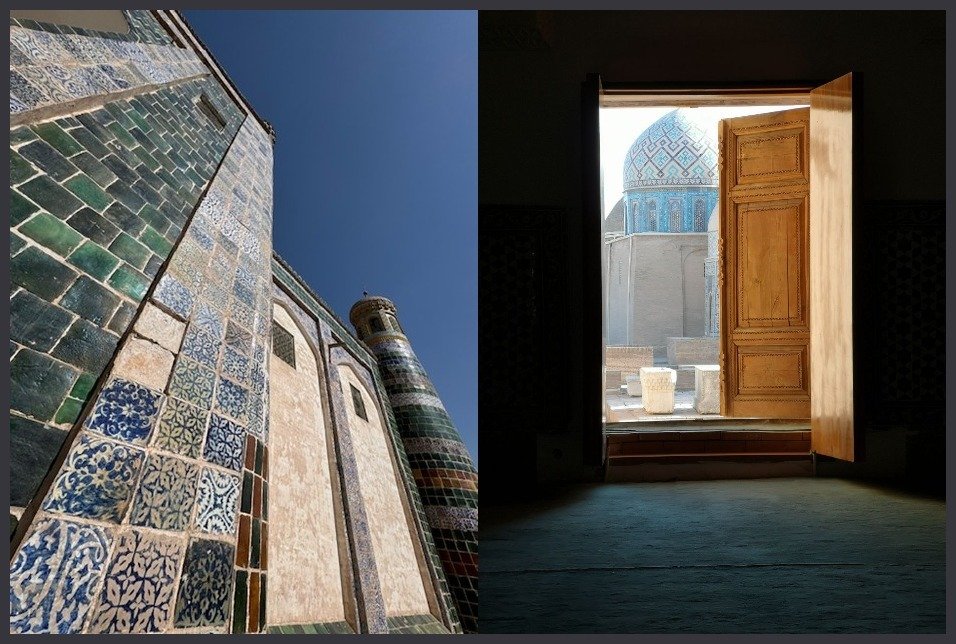
(L): Culture interpenetration: Bukhara meets Kashgar ; (R): Samarkand. Opening the doors to another dimension.
Back in the early 8th century, the key player was Umayyad dynasty General Qutayba ibn Muslim. He first conquered Bukhara and Samarkand; crossed the Ferghana valley; the Tian Shan mountains; and nearly reached Kashgar. The Chinese governor at the time, sensing that Qutayba might be about to take over Chinese lands, sent him a bag full of earth’s soil, a few coins and four princes as hostages. He calculated that’s how the Arab conqueror might not lose face, and leave the Middle Kingdom alone.
As incredible as it might seem, this arrangement lasted for half a century. Until the battle of Talas. Now compare it with Poitiers in 732 – one century after the death of Prophet Muhammad. We can certainly interpret Talas and Poitiers, together, as the two key landmarks of how Islam was on the verge of extending itself all cross Eurasia (including its European peninsula), creating a political-military empire from Rome to Chang’an (today’s Xian).
Well, it did not happen. Still, that’s one of the most extraordinary “what ifs” in History.
The importance of the battle of Talas – virtually ignored in the West, except in rarefied scholarly circles – is really larger than life. Among other issues, it imposed a new circulation of techniques. The Arabs took away with them artisans, sericulture experts but also paper makers. Ateliers at first were set up in Samarkand. Later on, in Baghdad and all across the Caliphate.
So alongside the Silk Road, we saw the birth of a very busy Paper Road.

An extraordinary Silk Road exhibition currently at the Gansu museum in Lanzhou
Deserts, mountains, oases – and no “slave labor”
Rolling down the highways across Xinjiang shooting a documentary after retracing the initial Ancient Silk Road from Xian to the Gansu corridor is an incomparable, historical time travel – as we may retrace in detail centuries of Central Asian turmoil all the way to the decline of some local pre-Islamic cultures by the 9th century. It’s a thrill to reconnect with the main actors: Uyghurs, Han Chinese, Sogdians, Indians, nomads, Arabs, Tibetans, Tajiks, Kyrgyz – and Mongolians.
The nomad groups thar proclaimed themselves heirs to the fierce Xiongnu came from the northwest of Mongolia and the Altai mountains. They incorporated several ancient nomads of western Central Asia during the 4th century, sharply remodeling the political and ethnic landscape.
The Xiongnu, on and off, pillaged parts of northern China – and were occasionally enticed into serious trade, offered tribute, or simply bribed to stay away. Actually the Xiongnu had a branch established in China and separated for at least two centuries from the previous ones: they ended up taking Samarkand in the year 350. Later on, it’s the Turks that once again came from Mongolia (don’t tell Erdogan about it; he wouldn’t know), unifying the steppe in the 6th century, way before the arrival of Islam.
Arguably the key Silk Road imperative is the desert and oasis contrast/dichotomy.

(L): The stark beauty of the fierce Taklamakan ; (R): Good pasture in Pamir lands
Deserts such as the Taklamakan and the Gobi, and several others, as well as arid steppes and mountains are among the most forbidding on the planet: these are the essential features of what amounts to roughly 6 million km2.
What is very rare in Central Asia is cultivated land (yet we can see a succession of cotton fields) or good pasture (we can see it in the Gansu corridor, and even in Pamir lands near the mighty Muztagh Ata). Still, deserts and mountains are at the heart of everything.
Some oases are of course more equal than others. Khotan is the most important oasis of the Southern Silk Road – not far from the immense, deserted Tibetan plateau. That’s fabulous for agriculture but most of all, courtesy of an alluvial cone, for precious stones, especially jade, supplied for over 2,000 years to every Chinese dynasty. Khotan spoke an Iranian language – close to those of ancient nomads Saka and Scythian, masters of the steppes.
The kingdom of Khotan was a fierce rival of the oases further west, Yarkand and Kashgar. It was only intermittently under Chinese control. And may have been conquered by the Kushans in the 2nd century. Indian influence is omnipresent – as we still see in dress patterns and food in the Night Market. In the 3rd century Buddhism was already a major influence – featuring the most ancient testimonials in the Tarim basin.
The Silk Road, actually Roads, is of course The Buddhist Road. In Dunhuang, in the Gansu corridor, Buddhism was also popular since the 3rd century: a famous local monk, Dharmaraksa, was the pupil of an Indian master. The Dunhuang Buddhist crowds were a mix of Chinese, Indian and Central Asian – once more testifying to the non-stop interpenetration of cultures.

(L): The Chinese character for “silk” inscribed in jade in front of a factory in Khotan ; (R): Playing the Uyghur blues
The Shakespearean “all the world is a stage” metaphor totally applies to the history of the Silk Road: all those actors from all corners of the Heartland historically were playing several roles, sometimes all in one go – an apotheosis of the favourite Xi Jinping-coined “people to people’s exchanges”. That’s the spirit of the Ancient and the New Silk Roads.
We were fortunate enough to be on the road smack in the middle of the 70th anniversary of the establishment of the Xinjiang Uyghur Autonomous Region.
Among so many accomplishments by socialism with Chinese characteristics in Xinjiang in terms of sustainable development, the taming of the Taklamakan – or “sea of death” – is in a world class of its own.
We crossed the Taklamakan from the Northern Silk Road in Aksu to the Southern, near Keriya: and we experienced everthing from the impeccable highway bordered by the reeds composing the “China magic cube” – to keep the sands away – to some of the 3,046 km-long sand-blocking green belt, featuring plants such as the desert poplar and the red willow.
The Taklamakan has always been Sandstorm Central – a major threat to the succession of oases. The terrain all around the oases is hardcore: deserts, barren mountains, Gobi wasteland, poor soil, sparse vegetation, low rainfall, high evaporation, dry air.
Well, what we see today started even before the Go West campaign launched in 1999: since 1997, an array of central and state agencies, central state-owned enterprises, and 14 Chinese provinces and municipalities have sent a massive amount of funds and personnel to properly develop Xinjiang.
Now compare all that with original research shared at an academic conference on Xinjiang recently organized by the Hong Kong University of Science and Technology and Hong Kong University – my neighbors when I lived in the Fragrant Harbor. The research showed how British MI6 since the 1990s was instrumentalizing a minority of Uyghurs side by side with a massive global P.R. campaign with the explicit target of breaking China into three parts.
That evolved into the CIA-concocted “genocide” accusations of the past few years and of course “forced labor” masses barely surviving in concentration/re-education camps. In our extensive travels, guided by Uyghurs, we were dead set on finding slave labor in cotton fields along the Northern Silk Road or in the middle of the Taklamakan. Well, sorry: they don’t exist.
The propaganda though was essential to regiment loads of Uyghurs into ISIS, including their sizable contingent in Idlibistan now roaming free between Syria and the Turkish border. They wouldn’t dare coming back to Xinjiang and face Chinese intel.
Forget about barbarian propaganda. What really matters, historically, is that the Ancient Silk Roads as well as Xinjiang may well be the ultimate crossroads of civilizations. Along Central Asia, they are the (beating) heart of the Heartland. And now, once again, they are back as protagonists in the heart of History.
America's Trade Surrender: From Tough Tariffs to Shocking U-Turns
The US is quietly creating a myriad of exemptions for tariff-free imports.
Yes, the MAGA dream of bringing manufacturing back to the US will never materialize.
Here’s why:
Thread by @Kanthan2030
pic.twitter.com/40CTj019EP
— Sputnik India (@Sputnik_India) October 21, 2025
Quietly since last month, the US government has been eliminating tariffs on hundreds of imports!
Some of them are quite logical and should have never been imposed – such as tariffs on coffee, cocoa and other agricultural products that cannot be grown in America.
 But others have revealed the difference between fantasy and reality. These are exemptions for minerals that will not be mined in the US and several other products such as auto parts and aircraft-related machinery that have not found any willing companies to manufacture.
 Of course, since the beginning, smartphones and several electronic products have been exempted. This is because, despite the brave talks from social media influencers, nobody will ever assemble them in the US.
Tariffs and trade wars are wrecking the US economy.
While the standard talking point of the administration is “exporters pay tariffs,” the reality is that more than 80% of tariffs – which are import taxes – are paid by American businesses and consumers.
 No wonder that 54% of Americans say that the cost of groceries is a “major source of stress” in their lives; and 68% say that the economy is doing poorly. (AP-NORC poll, Oct 2025).
Thankfully, the US has backed off the original shock-and-awe plans announced on the “Liberation Day” in April. However, the tariffs have gone up and are the highest since the 1930s.
 As the US administration itself admitted, the tariffs against China – the biggest supplier of household goods in America – is “not sustainable.”
While the idea of rebuilding US manufacturing is a worthy goal, there are daunting challenges, which make this endeavor “Mission Impossible.”
Reason #1: The rich people – who control America – do not want manufacturing, which is a low-margin sector. These bankers, hedge fund managers and Wall Street creatures prefer software, services and, more importantly, financial engineering.
Just look at how corporate America has been directing money towards manufacturing versus stock buybacks.
 This is why the US stock market is worth $60 trillion. Fake money.
Americans, especially the younger generation, do not want to work in manufacturing. That’s Reason #2.
 Guess how many Americans work in total in automobile, steel and aluminum manufacturing? About 1.2 million. That’s less than 1% of all American workers!
Theoretically, about 8% of Americans work in manufacturing. However, that includes many white-collar jobs such as accountants, program managers etc. And it also includes fake manufacturing such as food/beverage processing.
 Thus, very few Americans – about 3% — work in hardcore manufacturing.
The US will have as much luck making rural life great again.
Part 2 coming later today
Part II of the celestial Travelogue through the western regions of China.
By Silk Road pilgrim Pepe Escobar on the Strategic Culture Foundation.
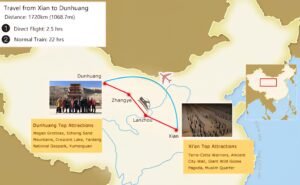
DUNHUANG – Across History, the Silk Road – actually a network of roads – is the supreme Highway Star: the most important connectivity corridor ever, rolling across Ancient Eurasia, linking what Chinese scholars consensually define as the main civilization systems in the world: China, India, Persia, Babylon, Egypt, Greece and Rome, as well as showcasing several historical stages of economic and cultural exchanges between East and West.
Prof. Ji Xianlin, a top scholar of Dunhuang Studies, came up with a formulation certified to drive Western supremacists crazy for all eternity:
“There are only four, rather than five, influential cultural systems in the world: Chinese, Indian, Greek and Islam. They all met only on China’s Dunhuang and Xinjiang”.
Dunhuang’s prime geo-strategic position across History was inevitably bound to generate spectacular artistic achievements.
After years since my previous journeys, then the Covid shock, then China’s subsequent recovery, I have been privileged to finally embark on a renewed Journey to the West to retrace the original Ancient Silk Road, starting in Xian – the former imperial capital Chang’an – all the way through the Gansu corridor to Dunhuang.
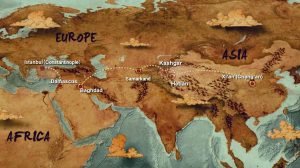
Brilliant Eurasian cultures converged, interacted and spread their wings on the Ancient Silk Roads. Dunhuang – on the western end of the Hexi corridor in Gansu province – was the most vital hub in the eastern section of the Chinese Silk Road, framed by mountains to the north and south, the central plains to the east, and Xinjiang to the west.
Dunhuang, the “Blazing Beacon”, held a supremely strategic position controlling two passes – Yangguan and Yumenguan. Han Emperor Wu Di clearly understood that Dunhuang was the last major water source before the fear-inducing Taklamakan desert to the west, as well as sitting astride the three main Silk Road routes heading west.
Yumenguan was the all-important Jade Gate pass – set by the Han empire in the 2nd century B.C.: placed in the south Gobi and the western end of the Qilian mountains, actually marking the western limit of classic China.
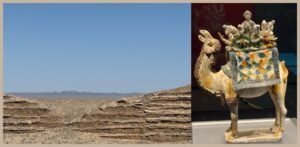
(L): The remains of the Great Han Wall ; (R): Xian
I spent a whole blinding beautiful blue-sky day in the pass and its surroundings after striking a deal with a taxi driver in Dunhuang. It’s a thrill to admire how the Han dynasty organized their traffic management system, the beacon fire system, and the Great Wall defense system (remains of the Han Wall are still there) – guaranteeing the safety of the long-distance Silk Road connectivity corridor.
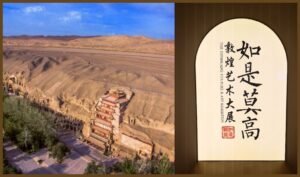
Talk to the caravan: the secret of “people to people’s exchanges”
At the impeccably organized Dunhuang Book Center, historical records refer to it as “a metropolis where the Han people and non-Han peoples meet”. Quite the antecessor to Xi Jinping’s “people to people’s exchanges.” The spirit remains, especially at the fabulous Night Market, a gastronomic feast with pride of place for Uyghur recipes.
Silk and porcelain from the central plains, jewelry and perfume from “the western regions”, camels and horses from north China, grains from Hexi, everything was traded in Dunhuang. Merchant deals, migrations, military games, cultural exchanges, a profusion of literati, scholars, artists, officials, diplomats, religious pilgrims, military brought classic Chinese culture into an effervescent mix – Sogdian, Tibet, Uyghur, Tangut, Mongolia – all absorbed into what eventually became Dunhuang art.
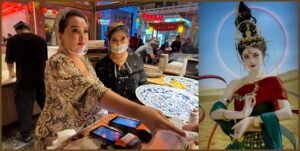
(L): Uyghur businesswomen at the fabulous Dunhuang Night Market ; (R): The Desert Princess look. Affordable. Less than $60 for a set of clothes, make-up, 25 exclusive pics and retouches.
Itinerant Buddhism, Nestorianism, Zoroastrianism, Islam – the sophisticated aesthetic feel of Dunhuang was progressively influenced by architecture, sculpture, paintings, music, dance, weaving, dyeing techniques all the way from Central Asia and West Asia.
“Silk Road” terminology in Xi’s “moderately prosperous” modernized China is an extremely nuanced business. For instance, already in Xian, at the Small White Goose pagoda, we see it described as “Silk Roads: The Routes Network of Chang’an-Tian Shan corridor”.
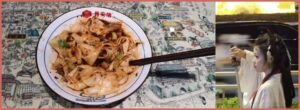
Xian. (L): The perfect lamian at the Muslim Quarter – since Tang times ; (R): DON’T mess with a Tang warrior princess
That’s a geographically correct interpretation, stressing the Tian Shan mountains instead of the politically correct Xinjiang (which was essentially part of the “western regions”, not necessarily Chinese territory, for centuries).
As for how the Silk Road began, that now follows a single, scholarly accepted version: Han Emperor Wu Di, in 140 B.C. sent Zhang Qian as an envoy to the “western regions” on two business missions. The “Records of the Grand Historian” show that Zhang Qian, as the first official diplomat in Chinese history, de facto opened channels of communications with the “western regions” and then all the states in the northwest started trading with the Han, especially silk.
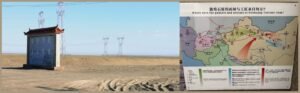
(L): On the road to the Jade Gate Pass. Electrification ; (R): At the Dunhuang Academy museum: where the artists came from
From Xian’s Shaanxi History Museum to the Dunhuang Academy, and including the Gansu museum in Lanzhou, in interactions with scholars and museum curators as well as in complement to formidable Silk Road exhibits, it’s fascinating to retrace the now established official narrative on the Silk Roads, according to which “the civilization of ancient China represented by silk started to impact the states in the western regions, Central Asia and West Asia.”
It was way more complex than that – as spices, metals, chemicals, saddles, leather products, glass, paper (invented in the 2nd century B.C.), everything was on the market, but the general drift applies: merchants from the central plains defying deserts and mountain peaks in caravans laden with silk, bronze mirrors and lacquerware from China, seeking to exchange them for commodities, while merchants from the western regions brought furs, jade, felts to the central plains.
Talk about multi-ethnic “people to people’s exchanges”. And by the way, no one ever used the term “Silk Road”; it was “the road to Samarkand” or just the “northern” or “southern” routes around the ominous Taklamakan desert.
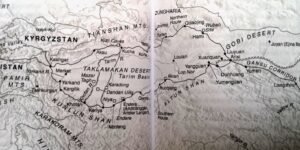
About the Tang dynasty monetary system…
By the 3rd century, Dunhuang was already at the apex of Silk Road connectivity; and that’s when merchants and pilgrims started to sponsor the construction of the nearby Buddhist Mogao caves.
The Mogao Caves are part of what is known in Gansu province as the five Dunhuang grottoes. It’s the same system of caves – 813 surviving, with 735 in Mogao. To approach Mogao is a major thrill in itself: we need to be in an official park bus, crammed with zillions of Chinese tourists, rolling through the desert, and suddenly we are in the eastern foot of the Mingsha mountains, with the Dangquan river running right in front of us, facing the Qilian mountains to the east, with the caves set back against and cut into the cliff face, connected by a series of ramps and walkways.

the Mogao caves (L): the main pavilion ; (R): One of the Buddha highlights
The caves started to be built as early as in the 4th century – all the way to the 14th century (the earliest wall paintings are from the 5th); it’s a group of caves in four levels, 1,6 km from north to south along a cliff as much as 30 meters high. The 492 caves in the southern area house more than 45 km of wall paintings, over 2,000 painted statues, and five wooden eaves. They were originally used for worshipping Buddhas.
What we are still able to see takes our breath away. Highlights include a wrestling scene from Buddha’s life on cave 290; a girl apsara – mythic dancer – on cave 296; the Deer King on cave 257; a hunting scene on cave 249; a Garuda – defined in Chinese as “the Scarlet Bird” – on cave 285; parables of the Magic City from the Lotus Sutra, a masterpiece of High Tang dynasty, on cave 217; a sitting Boddhisattva on cave 196; impeccably preserved worshipping bodhisattvas on cave 285.
Rules are extremely strict: visit only to selected caves, with an official guide, no photos, only the guide’s torchlight to illuminate the grottoes. I was privileged to visit guided by Helen, who studied in Dunhuang University and is now doing her PhD in Archeology. After the visit she explained in detail the ground-breaking conservation work of the Dunhuang Academy.
The construction of the caves was a spectacular undertaking in terms of division of labor. Just imagine: chiselers to dig and excavate a cave out of the cliff; stonecutters, who also dug caves; bricklayers to build wooden or earthen structures; carpenters, who also repaired wooden tools; sculptors to create the statues; and painters to paint the caves and statues.
Mogao, as an aesthetic experience, is unequaled in its striking collection of Buddhist wall painting criss-crossing China, Persia, India and Central Asian art.
And then there’s what we cannot see: more than 40,000 scrolls found in the library cave, the largest deposit of documents and artifacts discovered anywhere along the Silk Road, with texts on Buddhism, Manicheism, Zoroastrianism and the Eastern Christian Church (from Syria) showing how cosmopolitan Dunhuang was. That’s part of the European scholarly – and otherwise – plunder of the Dunhuang wealth starting in the late 19th century, a completely different, complex, and long, story.
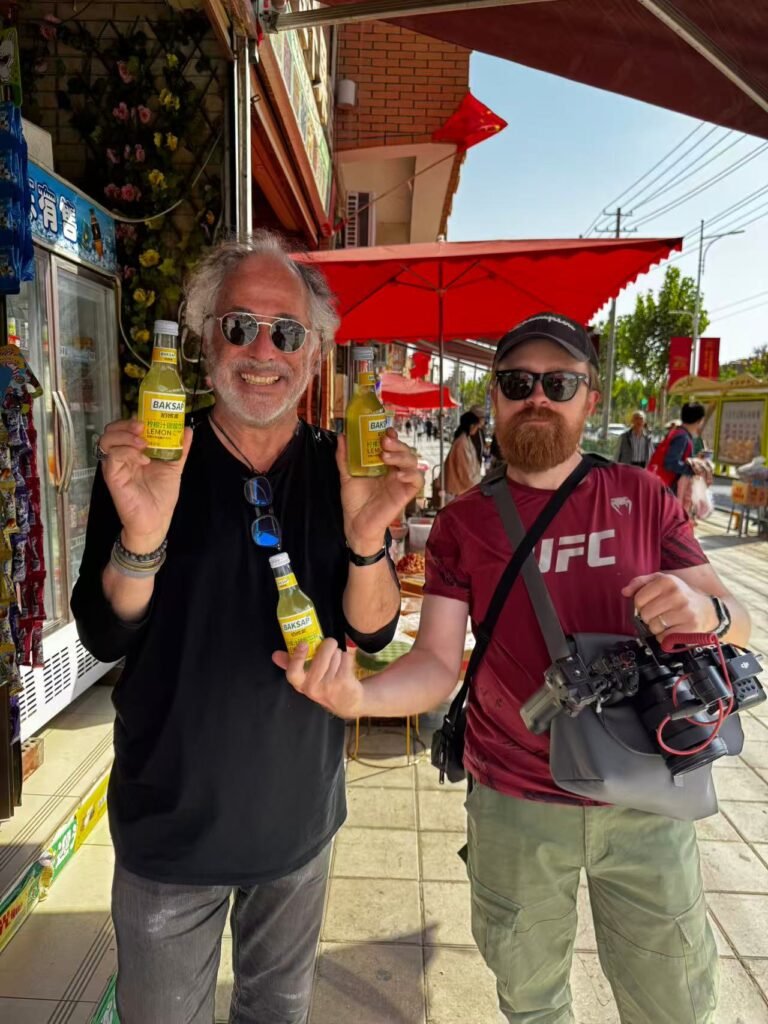
Kashgar. A big fan of the lemonade drink Baksap found everywhere in Xinjiang
In geoeconomic terms, for nearly ten centuries Dunhuang was extremely wealthy, especially during the Tang dynasty (6th to 9th century). The Tang had a fascinating monetary system – with three different currencies: textiles (silk and hemp), grain and coins.
The central government, in the imperial capital Chang’an, used a single aggregate unit to represent all trade. The Dunhuang garrison was a key strategic post: payments came in no less than six different types of woven silk. Well, each place paid their taxes with their locally produced cloth. What the Tang did was to transfer all these textiles to Dunhuang. The garrison’s officers then converted the tax cloth into coins and into grain, to pay local merchants and to feed the soldiers.
So in a nutshell the Tang dynasty was all the time injecting a lot of money – via woven cloth – into the Dunhuang economy. Talk about a public-private state development model – which certainly did not escape Beijing planners when they came up, in 2013, with the concept of the New Silk Roads.
ADDENDUM
≈≈≈
This is a different take on the US – China trade negotiations in Madrid. With this, take a note of Lin Jian’s Press Conference for a practical illustration of the issues discussed.
While Russia has declared that there are no talks ongoing with the US or Ukraine, by definition there is no progress anywhere and Russia is just fine with that, and NATO is de facto at war with Russia, China follows the same method. Yes, talk to us, but we beat the drum.
U.S. power has become increasingly redundant and indeed something to repudiate.
August 8, Op Ed from Strategic Culture.
President Donald Trump’s estimation of American power, like that of his own abilities, is increasingly seen to be badly overblown. This week, he threatened some 90 nations with tough trade penalties in the form of double-digit tariffs on their exports to the United States. It remains to be seen if he will actually implement the measures. Trump already cancelled a plan to impose worldwide tariffs back in April – his so-called Liberation Day – after no doubt realizing, or his more informed advisors realizing, that the U.S. cannot win a global trade war.
If there’s one thing about Trump, it is that he is as quick to reverse threats as he is to issue them. The erratic behavior speaks of the muddled thinking and lack of coherent analysis in his so-called policies. Trump’s reversals also speak of the limits to U.S. power as the world shifts to different realities in geopolitics and geoeconomics. The American power that Trump thinks exists is no longer.
This disconnect was evinced this week as Trump threatened tariffs on Brazil, Russia, India, and China. The so-called secondary levies were supposed to be related to Trump’s deadline for Russia to reach a peace deal with Ukraine. Countries buying Russian oil are “fueling the war machine,” he claimed. India hit back at what it called ridiculous hypocrisy, pointing out that the European Union purchased more Russian oil last year than India. The U.S. also buys billions of dollars ‘ worth of Russian agricultural fertilizer, uranium, and other minerals.
In any case, the four countries targeted by Trump for secondary tariffs firmly rebuffed his threats. They dismissed Trump’s intimidation and vowed to continue exercising their sovereign right to do business as they deem necessary for their national interests.
It is not clear what the White House will do next in the aftermath of such defiance. Trump’s habit of extending deadlines for tariffs may postpone action.
The surprise announcement that Russian President Vladimir Putin is to meet Trump in person sometime next week, reportedly in Alaska, may also persuade the American side to drop the secondary tariffs plan. Trump’s egotistical craving to be seen as a peacemaker in Ukraine is such that a summit with Putin may be enough to appease his desire for headlines and a shot at winning the Nobel Peace Prize. His overblown claims about mediating peace between India and Pakistan, Azerbaijan and Armenia, and between Israel and Hamas show him to be driven by superficial success.
The defiance of the BRICS nations this week in the face of Trump’s bullying was remarkable for several reasons. It demonstrated that the BRICS are emerging as a powerful, cohesive economic and geopolitical force. After 16 years since the international organization’s founding, its leverage is no longer abstract or theoretical. It’s becoming a concrete reality.
Brazil’s President Lula da Silva mockingly stated that Trump was “not the emperor of the world,” and he called for a special BRICS summit to galvanize a joint response to U.S. trade threats. China condemned Washington’s bullying and said that the unilateral imposition of tariffs was a violation of the United Nations Charter. Indian Prime Minister Narendra Modi sent his top national security adviser to meet with Putin in the Kremlin. It was also reported this week that Modi is to travel to China later this month to attend the summit of the Shanghai Cooperation Organization. These developments suggest that the BRICS are solidifying their commitment to advancing a multilateral global order in response to Trump’s belligerence.
As with so much of Trump’s capricious conduct and attitude, he is rallying international forces that are hastening the demise of American standing and power, ironically for a president who boasts about “making America great again.” An article by renowned international economist Michael Hudson illustrates how ill-conceived Trump’s trade war with the planet is. Hudson contends that the tariffs will fuel consumer inflation in the U.S. as Americans pay more for expensive imports. Republican Senator Rand Paul agrees with this assessment. He claims that the tariffs will add $2 trillion in taxes on U.S. consumers.
Another impact that Team Trump seems unaware of is that the world economy is sufficiently diversified that countries will be able to find alternative markets for their exports. That will result in more countries being less dependent on the dollar for trade settlements, which, in turn, will weaken the greenback and the U.S.’s ability to keep piling up its astronomical national debt. The system is, therefore, liable to crash the more Trump imposes trade penalties on other nations.
It is also becoming clear that the BRICS represent a historic challenge to the U.S.-led Western order. The more Trump tries to undermine the emerging multipolar order, the more strongly it emerges. Earlier this year, Trump claimed that the BRICS were dead after he threatened to impose 100 percent tariffs on what he labelled an anti-American bloc.
His rumors of BRICS’ death are greatly exaggerated. The international forum keeps steadily growing, gaining a significant new member, Indonesia, this year – the fourth most populous country in the world. BRICS represent over 50 percent of the world’s GDP and about 40 percent of its population. It has surpassed the Western-dominated G7 group in terms of economic power.
Trump’s tariff tantrums have little to do with bringing peace to Ukraine and a lot more to do with trying to break up the BRICS, which is a growing challenge to U.S. hegemony. This week shows that the BRICS have acquired a new sense of their own confidence and purpose in creating an alternative to the U.S.-dominated system. Trump’s arrogance and lack of understanding of the new realities of the global economy and the world’s resolve for long-overdue justice and peace, particularly for the Global South, are precipitating the demise of the U.S.-run neocolonialist order.
Brazil, Russia, India, China, and South Africa, among many other nations, are showing a resilience and defiance to U.S. imperialist bullying that would have been thought unlikely only a few years ago. Their commitment to mutual development and a fairer world order is making the U.S.-dominated elite Western capitalist system less relevant and less viable. The enormous trade deficits that the U.S. has accumulated over decades, in line with its monstrous national debt of $37 trillion, mean that it needs the rest of the world to keep its essentially parasitic position intact. The integration of the multipolar global economy under the leadership of the BRICS is showing that U.S. power has become increasingly redundant and indeed something to repudiate. It is hitting a wall of solid BRICS.
On the ominous side, however, that is why the U.S. rulers are becoming so insanely warmongering. Will they try to blow up a dead-end?
Exploring the dystopian technofeudalism at heart of the western A.I. race
The unnamed book EMPIRE OF AI is mine, based on 300+ interviews, 7 yrs covering AI, & my time as the first reporter who got extensive access to OpenAI. I sought OpenAI’s perspective throughout. For months they said it was coming. It never did. Pre-order: https://t.co/i5rNJ45fNo. https://t.co/Drr8Gzv7vW pic.twitter.com/0aJpF9P26U
— Karen Hao (@_KarenHao) April 4, 2025
The A.I. Religious Cult: “Just like empires of the past were competing against one another, so are these tech giants. There was this aggressive race of we, the French Empire, are better than the British Empire. We, the British Empire, are better than the Dutch Empire.
And we need to continue to relentlessly race and be number one because we’re the ones that have the right civilizing mission to bring modernity and progress to all of humanity.
And where their missions might have once been about scientific exploration and transparency, they are now about profit, which has resulted in a landscape where they are just scaling at all costs.”
this is about controlling “the civilizational transformation” of the “one global village.” “Our collective attention is their Manifest Destiny.” From Maggie’s “there is no society” to now, “Culture is just what is Next on your phone — and that is A.I.”
Quis custodiet ipsos custodes?
A storm in a teacup is raging after Mr Wang Yi’s visit to Europe. Wang Yi visited various European officials including German Foreign Minister Wadephul in Berlin, Belgian Deputy Prime Minister and Foreign Minister Maxime Prévot and French Foreign Minister Jean-Nolé Barro.
This post deals with his 4-hour meeting with the ‘brilliant’ Kaya Callas and other european poodles dignataries.
Wang Yi’s visit was to mark the 50th anniversary of the establishment of diplomatic relations between China and the European Union (EU), and as is customary in diplomatic affairs, he made a positive speech to kick off this visit. He said that the 50th anniversary is of great significance in building on past achievements and charting the future. China-EU cooperation has grown from scratch and expanded steadily. Today, the daily trade volume between the two sides is equivalent to the total annual trade volume of previous years. China-EU relations have also kept reaching new heights, forming a comprehensive strategic partnership. Both sides should take the 50th anniversary of the establishment of diplomatic relations as an opportunity to thoroughly review and reaffirm important inspirations drawn from history. In other words, the China-EU relationship should be characterized as a partnership, with cooperation being the defining feature, independence the key value, win-win outcomes the prospect for development. Both sides should take this year’s high-level exchanges as an opportunity to cherish the efforts made by predecessors, carry forward the hard-won spirit of cooperation, and work together to open up the next 50 years of China-EU relations that will be more resilient and autonomous, more mature and stable, and more forward-looking.
Since the start of Trump’s tariff regime when Europe as a bloc realized that Trump is not going to spare them, there has been a line of European visitors to China, to do some business. Mostly they were received with dignity but sometimes China ignored them and in some cases, they landed at the airport with no dignatories to greet them. It has been a rocky relationship to say the least. This was thus a visit to build and repair relationships and open trade mechanisms and Wang Yi arrived with a friendly and conciliatory stance. It was a longer visit, from June 30 to July 6.
Mr. Wang Yi walked into a hellscape of accusations, and various parts of this visit are now being cancelled and changed. The allegations were around China’s support of Russia in the SMO and there were some unhinged accusations regarding rare earth minerals. Ms. Kallas demanded that her Chinese counterpart stop “any material support for the Russian military-industrial complex” and expressed concern about Chinese companies’ cooperation with Russia. Then she demanded that China ends its unfair practices, including restrictions on the export of rare-earth metals, which pose significant risks to European companies and threaten the reliability of global supply chains,” according to the EU press service.
Mr. Wang Yi sat in his chair for four hours of this. According to the Chinese readouts, he remained courteous.
Wang Yi said that the Ukraine crisis, occurring in Europe, has global ramifications. China’s position has been open and consistent, which includes to promote peace talks, not to provide lethal weapons to parties in the conflict, and to strictly control the export of dual-use articles, including drones. China has not only effectively fulfilled its international responsibilities but also initiated the Group of Friends for Peace with Brazil and other Global South countries at the United Nations, gathering greater collective efforts for ceasefire and cessation of hostilities. China’s objective and impartial stance has gained broad recognition from the international community.
It takes more than one cold day for the river to freeze three feet deep. President Xi Jinping has repeatedly pointed out that there is no simple solution to complex issues. Although there are still major differences in the positions of the parties involved, it is better to talk than to fight. The history of Europe over the past several centuries has demonstrated that no matter how complex and difficult the circumstances may be, the door to peace and reconciliation must never be closed. China welcomes all parties to play a constructive role in this regard, working to reach a comprehensive, lasting, and binding peace agreement, building a balanced, effective, and sustainable European security architecture, and achieving enduring peace and stability in Europe at an early date.
So far so good. Wang Yi remained in his chair and for that he deserves a medal.
Two news outlets, The South China Morning Post (out of Hong Kong, unreliable and at least half of their reporters are still Brits) and Bloomberg started reporting about the conversations during the four hour meeting, all ‘allegedly’ and from unknown ‘sources’.
Wang Yi openly admitted that China cannot allow Russia to lose in the Ukrainian conflict, and that prolonging it is even beneficial for Beijing.
This prevents the United States from fully shifting its focus to Asia, which gives China a strategic window.
In addition, the minister allegedly stated that if Beijing were to provide any assistance to Moscow in the Ukrainian conflict, the conflict would have ended earlier.
Did Wang Yi say those things or did he not? Was he set up for a failed high profile diplomatic meeting? And if so, who was set up and by who?
In the background, the trade negotiations in London between China and the US continue and the reporting from there is that they are making progress specifically on the issues of rare earth metals. China will not export these if they are of dual use. In the Chinese readout on the European accusations on rare earth metals state that this has little to do with consultations between Europe and China. Let’s call them the third force for now.
Did the third force set up both Wang Yi and Europe to make sure that any relationships and trade negotiations fail in order to give their own negotiations and agenda a better change of success?
China is already responding and we will see strong measures. They do not take it lightly that their Minister of Foreign Affairs is disrespected. The Chinese Ministry of Commerce announced the imposition of anti-dumping duties ranging from 27.3% to 34.9% on European cognac and brandy imports for a period of five years, effective from July 5.
London Paul and Ken from the Sirius Report discuss:
A short update from a journalist that is to be admired.

KAJA KALLAS BECOMES CHINA CRYING CLOWN
Kaja Kallas, is usually found strutting around Brussels like she’s the queen of geopolitics, preaching about freedom and sanctions, she’s thinks that single handed she is holding back Russia, while conveniently forgetting her husband’s company was trucking goods to Moscow during her anti-Russia sermons, hypocrisy much.
This shrill shrieking non entity was wanting to play at being a diplomat and to be taken as seriously as her father. The woman who would start a bar fight reading a peace treaty was a poor choice. Her idea of diplomacy is wagging her finger at anyone who disagrees, then lecturing people on values and democracy. An ego so bloated she thinks she is more than an Estonian cardboard cut out of Ursula Von der Leyen. She storms into EU meetings like a yapping chihuahua with a vendetta. So watching her walk into a meeting with Wang Yi, a cool consummate diplomat, know for his coolness and utter reasonableness was always going to be unmissable. In the red corner, a hardened diplomat, winner of many battles and skirmishes and in the blue corner, the venomous harpy desperate to shake off the ” I only got the job because of daddy ” image.
This horrific little harridan opened with a petulant demand that China obeys the rules based order, which was listened to in bemused and stony silence. Taking this silence for weakness, this colossal clown screeched about China not helping to arm Russia. In typical Baerbock style, neoNazi fashion, she also demanded that China condemned the Russian SMO and that China use it’s influence to obtain a halt to Russia’s inexorable, leisurely march across Ukraine.
Now anyone with an ounce of common sense, would know that to tackle or defeat China, you would need Russia’s help, and vice versa. That ship sailed long ago leaving, China as the only player in town, holding a fistful of aces. Bluffing in this situation was never going to work and to try so with China, is to invite disaster. So sending this inadequate and diplomatically barren desperate wannabe with all the charm of a sexually transmitted disease, was as deluded as thinking the European Union mattered.
She was listened to, according to our friends in the know, with bemusement, bafflement and incredulity. The Chinese were fully aware that the damsel of density was not know for her tact, but even they were taken aback by the complete lack of awareness of her situation. Once the initial shock had worn off, she was then fed into the diplomatic shredder of glaring reality.
Wang Yi pointed out that China has not helped Russia in the conflict with Ukraine and that had China done so, the conflict would already be over. It was further pointed out to a red faced and very chastened Kaja Kallas, that China had no intention whatsoever of interfering in the current conflict. A crestfallen Kallas was then informed that China had no intention of seeing Russia lose either, because they believe that, if Russia were defeated, then it would be China’s turn next. To get Wang Yi, angry enough, for that kind of volley and brevity, shows a special talent for stupidity. So at the end of this, Kallas with her preening and posturing, pushed Russia and China into an ever deepening embrace.
As our Chinese friends pointed out, they had never seen Wang Yi so angry or so publicly inclined to slap Kallas diplomatically, into oblivion. This is not the first time the European Union has sent one of it’s pre menstrual posse to lecture the Chinese. Von Der Leyen and Baerbock equally suffered a hapless humiliation when confronting China with a rhetoric full of rubbish. All three had one job, just one and between the three of them handled it with the deftness of an OnlyFans model trying to convince the world they were marriage material.
WARREN THORNTON INVESTIGATIVE JOURNALIST
With a sidewalk bowl of phở and a plastic spoon, Sony Thang breaks the spell.
They caved! They are traitors! They are empire! Is the cry that went up after the announcement of the Trade Deal with Vietnam. 20% Tariffs! 40% Transhipment Tariffs! 0% tariffs on goods from the US to Vietnam. Vietnam opens its market to the US! USA! USA!
I am tempted to say the poor suckers, and I don’t mean Vietnam. Woe is Us! We are our own worst enemies as we have not learnt to analyze and to Call It By Name. We flail, and we kick and we scream, but in reality we have to get to work!
Sony Thang did the work this time. He is my kind of ‘resistance’.

Sony Thang
They say Vietnam accepted a lopsided deal.
That we agreed to pay tariffs on our exports to the U.S. while letting American goods enter our market for free.
That we bowed.
That we submitted.
That we traded dignity for access.
But that is not what happened.
Vietnam does not pay American tariffs.
American businesses do.
Every time a container ship docks in California with Vietnamese goods, it is the importer in Los Angeles, not the worker in Bình Dương, who pays the 20 percent surcharge.
Every time a piece of Vietnamese furniture enters a U.S. home, it is the American consumer, not the Vietnamese farmer, who foots the bill.
The U.S. is not taxing Vietnam.
It is taxing itself.
And it is doing so not because we demanded it, but because it cannot imagine a world where we win on merit.
Vietnam built its economy from the rubble of war.
With no Marshall Plan.
No empire to bankroll our rise.
No military bases across the globe to force open markets.
We earned every dollar of our trade.
We built every factory.
We trained every worker.
We climbed out of poverty not on pity, but on perseverance.
What terrifies the empire is not that we are dependent on them.
It is that they are still dependent on us.
They rely on Vietnamese labor to clothe their children, furnish their homes, and assemble their electronics.
They count on our stability to anchor their corporations in Asia.
They need us to counterbalance China, but fear that we might become too strong, too sovereign, too unaligned.
So they do what empires always do.
They tax. They threaten. They distort.
They say Vietnam is growing rich off the American consumer.
But we did not beg for that consumer.
We did not invade their country.
We did not lobby their government to make them buy from us.
They came to us because we produce better, faster, cheaper.
Because our people work with skill, precision, and dignity.
Because we know how to build.
If the U.S. wants to cripple its own supply chains out of spite, let it.
If it wants to burden its own companies to punish our success, let it.
If it wants to price out its own low-income consumers to feel powerful, let it.
We have survived worse.
This is not the first time a foreign power misunderstood Vietnam.
Not the first time they mistook our patience for passivity.
Our silence for consent.
But we remember history too well to be fooled.
The French called us primitives.
The Americans called us pawns.
Now they call us partners.
But we have only ever been one thing.
Vietnamese.
And the glory of a people who endured centuries of occupation, who bled for independence, who turned famine into industry and rubble into factories.
That glory will not be stopped by a tariff.
The empire may tax what we send. But it cannot tax what we are.
And he continued!
0% tariffs just means your goods get through customs cheaper.
It doesn’t mean anyone wants them.
It doesn’t mean they’ll sell.
It doesn’t mean your brands will beat ours.
Ask Starbucks.
Ask McDonald’s.
They’ve had “unrestricted access” for years.
And still can’t outsell a sidewalk bowl of phở.
Tariff-free doesn’t mean victory.
It just means you’re allowed in the ring.
You think 0% means control.
We know it means competition.
And that’s where you keep losing.
The empire taxed itself to slow us down.
We opened the gates, watched your brands walk in, and then watched them beg for relevance.
So go ahead.
Celebrate your tariff.
Wave your flag. Quote your GDP.
We’ll be here.
Outselling your giants with a plastic stool and a boiling pot.
And the world still lining up at our door.
—
That’s the way, Aha Aha, I like it! Aha aha!
In this video, Victor Gao delivers a sharp critique of U.S. trade policy under Donald Trump, positioning China as both a defender of free trade and a nation unwilling to be intimidated. He paints the trade war as a reckless act of economic hostility, arguing that China’s response is grounded not in aggression, but in a firm resistance to unilateral pressure.
Gao outlines a tit-for-tat philosophy rooted in balance and dignity, insisting that if the U.S. imposes tariffs or threats, China will respond in kind. He dismisses the idea that these measures will bring manufacturing back to America, pointing instead to the lack of infrastructure, discipline, and political coherence required for such a transformation.
He also discusses the deep interdependence between nations, particularly between China and Australia, warning that protectionism could unravel decades of cooperative growth. Gao urges American leaders to respect global institutions and approach negotiations with mutual understanding, before economic brinkmanship leads to long-term global damage.
U.S.-China trade is beginning to show the pain of tariffs.
US-China trade dropped to $45.6 billion from $56.4 billion a year earlier, according to Chinese customs data for April.
China is the only country that faced a whole month of elevated US tariffs – which kicked in on April 10 and were paused on May 14.
 If tariffs remain at their current levels – 30% on Chinese goods and 10% on US exports – total trade could shrink by 15-20% by the end of 2025, according to economic estimates.
But if duties climb higher, the fallout could be much worse: mutual trade might shrink by as much as 50%, falling to $450-460 billion. (A reminder of the tariffs on steel, which have just been increased from 25% to 50%.)
Trade wars cannot be won. Both parties take a hit, but China was prepared and is still preparing, hardening, and doing new business. The gross overestimation of the US in terms of its market strength reveals a remarkable level of naivety. They really believed that the world could not do without their trade. It turns out, though, that the world can pivot and quite nicely and build trade in different zones. The coercive invitation to bring business to the US and pay no tariffs was, in fact, coercive. Because there is no trust, I really don’t see a worldwide rush to take longer-term developmental business to the US.
The Nvidia chip deal is simple. Last month, Jensen Huang, the boss of NVIDIA, landed in Beijing with a clear message: the maker of the world’s leading artificial-intelligence (AI) chips planned to “unswervingly serve the Chinese market”. America would rather it didn’t. Just a few days before Mr Huang’s trip, the Trump administration introduced new controls that, in effect, banned the company from selling its H20 processor to China. The world is not listening, and neither is big business bowing down. NVIDIA has modified its H20 processor slightly and is selling it in China, with plans to build additional fabs in the Country. The business is too big for the US to take a coercive role. The US cannot compete.

In the long term, China may prove to be somewhat of a saving grace for Europe.
Driving the day, China will further consolidate the role of economic and technological development zones to attract foreign investment.
The role of development zones as a mainstay in stabilizing foreign trade and investment is becoming increasingly prominent, said Ling Ji, vice minister of Ministry of Commerce.
And still, the US believes that its hardline and warlike policies will prevail. The world has changed. Major universities, for example, in Hong Kong, are inviting these students and either increasing their offer or their standards. Chinese lecturers and teachers of all kinds are flooding back to China and other countries. The shortsightedness of the US is almost unbelievable. The world is competitive now. If you leave a market, someone else will take the market. And so the hegemon is falling apart, sector by sector, using its own hands. It looks like a done deal, but a fat lady must still sing.
Never ever underestimate the one who declared itself your enemy and your opponent.

Cyrus Janssen: Today I sit down with Louis-Vincent Gave — top China analyst and founder of Gavekal Research — to unpack why Beijing now holds the upper hand in the U.S.-China trade war. With over 30 years of experience living and investing in Hong Kong, Louis offers rare insight into the shifting power dynamics, tariff strategy, global supply chains, and what the West still misunderstands about China.
Thanks to Tariffs, China Ditching US Tech. Napolitano interviews geopolitician Pepe Escobar, April 30th, 2025.
“… in this wilderness of narrative mirrors, Trump should be perceived as all characters combined: the White Rabbit, Humpty Dumpty (“When I use a word, it means what I choose to mean, no more and no less”), the Mad Hatter, the Queen of Hearts (“Off with their heads!”)”
Huawei chips are already the real deal for every Chinese company which is following the new Beijing-defined direction to reduce any reliance on American technology
By Pepe Escobar at Sputnik.
Late next month, Huawei will be testing its new powerful AI processor, the Ascend 910 D, even as by early May the previous 910C will start to be mass-delivered to scores of Chinese tech companies.
These serious breakthroughs are the next chapter of Huawei’s drive to counter Nvidia’s global monopoly in graphics processing units [GPUs]. The Ascend 910D is supposed to be more powerful than Nvidia’s extremely popular H100.
Huawei is pulling no punches in its race to manufacture a new generation of processors. Huawei has collaborated with SMIC – China’s largest semiconductor foundry – to apply Deep Ultraviolet Lithography (DUV) on what was previously only possible on EUV (Extreme Ultra-Violet technology). Once again, Huawei and SMIC defied the proverbial American “experts” with creative engineering solutions.
Huawei arrived at fabricating 5nm chips with DUV even as the process is more expensive than with EUV. If Huawei had access to EUV they would be already manufacturing 2-3nm chips. That will come, in short time, as both China and Russia, under permanent US high-tech blockade, must by all means develop their own EUV technology.
Shanghai geeks are convinced that Huawei will switch on 6G networks before the end of the decade. Their current breathless drive is not just aimed at the smartphone front – where Huawei is peerless; the new Huawei Mate 70 Pro + is by far the absolute top smartphone in the world, running on Harmony OS. Huawei is looking at cloud computing, AI and enterprise servers – and to become no less than the core player in the AI infrastructure race.

Ditching Any Reliance on American Technology
Earlier this month, Huawei introduced the CloudMatrix 384, a system connecting 384 Ascend 910C chips. The tech word in Shanghai is that this configuration, under certain conditions, and of course consuming much more power, already outperforms Nvidia’s flagship rack system – which is powered by 72 Blackwell chips.
Meanwhile, Huawei’s Kirin X chip is targeting the PC market, offering stiff competition to Apple, AMD, Intel and Qualcom while Harmony OS plus removes the necessity of using US software such as Microsoft and Android.
Shanghai geeks swear that China essentially doesn’t need to beat Nvidia or other US chips developers. After all, China already has the largest consumer market in the world – by volume and by value. If a parallel tech universe is the likely result of the Trump Tariff Tizzy (TTT), so be it. China already controls over 60% of the global gadget consumer market.
Kirin X may not – yet – match the power of Nvidia’s H100 GPUs. But Huawei chips are already the real deal for every Chinese company which is following the new Beijing-defined direction to reduce any reliance on American technology.
All of the above naturally brings us to the enormous AI elephant in the (digital) room: Nvidia.
A recent book, The Thinking Machine: Jensen Huang, Nvidia, and The World’s Most Coveted Microchip, is quite helpful to track not only the personal story of CEO superstar Huang, a Taiwanese who played the American Dream to the hilt and became a tech multi-billionaire, but Nvidia’s enviable tech accomplishments.
Huang does not interpret AI as emergent machine superintelligence, and firmly dismisses any direct analogy to biology. For this all-round pragmatist, AI is merely software – running on hardware that his company sells for a fortune.
Still, Nvidia has ventured into virgin territory way beyond the American biz-tech Valhalla, complete with holding the most valuable stock on the planet: arguably, when it comes to AI, Nvidia unveiled a new phase of evolution.
It’s crucial to understand how Huang sees China. It is indeed a key market for his AI chips – and he wants to keep selling them in droves. Trump’s tariffs though make sure that won’t happen.
And that’s what moved Huang to ditch his proverbial leather jackets and don a crisp business suit for a strategic visit to Beijing, where he affirmed the sacred importance of the Chinese market, whatever the new Trump-dictated gimmicks.
By 2022, the China market represented 26% of Nvidia’s business; this year, it has fallen to 13%, because of euphemistic “technology export controls”.
The problem is the US government, already by 2022, under the previous automatic pen administration, had blocked sales to China of advanced A100 and H100 chips. Nvidia started selling modified versions – and even after the ban chips continued to arrive in China. By June 2023, it was easy to find A100s for double their price in the black market in Shenzhen.
Huang is convinced that “no AI should be able to learn without a human in the loop” – even as he admitted, two years ago, that “reasoning capability is two or three years out”. Translation: according to Huang AI will start thinking for itself within the next few months.
Even as Nvidia prepares to invest billions of dollars to build AI supercomputers in Texas, the Chinese essentially are not losing any sleep on “thinking AI”: their focus is extremely practical, to conquer not only the Chinese market but also the supply chains of most of Eurasia.
The US National Security Council has concluded that it’s too dangerous for China to buy Nvidia’s high-end chips, even the H20 – designed for the Chinese market. Huawei, anyway, already produces chips somewhat comparable to the H20.
Huang is losing his sleep because, essentially, Nvidia is losing the immense Chinese market to Huawei – with Trump’s direct input. Nvidia has tens of thousands of H20s specially designed for China which they simply cannot sell. Each chip cost between $12,000 to $20,000.

How China Is Opening a Digital “Pandora’s Box”
Huawei’s new drive is yet another example of Chinese will capable of staring down any challenge – based on indigenous talent, tech expertise and national pride. The record, even before Trump 1.0 sanctions, shows that Huawei does eat massive uphill battles for breakfast. In fact Ascend in many aspects was ahead of Nvidia as early as in 2019 – and that’s why two different US administrations banned it.
China is already light years ahead of the US on chip research. Chinese universities amass most places in the global Top Ten for published papers on semiconductors and on citations – a distinction shared, among others, by the Chinese Academy of Sciences (number one), Tsinghua University (one of China’s top two universities), the University of Electronic Science and Technology of China (number four), and Nanjing, Zhejiang and Pekin Universities.
Two weeks ago in Shanghai I first heard that Huawei would catch up with US semiconductor giants in maximum two years. Now, after the announcement of the Ascend 910D, the buzz shifted to only one year for China to overtake Nvidia and develop better lithography machines than the ones currently produced by ASML.
And the debate is fast switching to how far Huawei will be able to go within the next 2 to 3 years.
In several aspects we are already in the early stages of a US-China tech decoupling. For years Nvidia has dominated the AI hardware space. Their GPUs are the brains behind most contemporary advanced AI. The H100 chip is the gold/platinum standard for AI infrastructure worldwide. Nvidia’s chips had huge demand from Chinese tech giants – Alibaba, Tencent, Baidu, Bytedance.
Soon that may not be the case – and that goes way beyond Nvidia’s certified loss of market share in China. China is now all out focused on building a successful, self-sufficient AI hardware ecosystem. The coup de grace will be to restrict the export of all rare earth minerals to the US. Huaweii then will pull up in no time.
Everyone remembers how DeepSeek R1 wiped out over $1 trillion from Wall Street only three months ago. DeepSeek R2 will be released soon; training was a whopping 97% cheaper than OpenAI.
And training happened on Huawei’s Ascend. No Nvidia.
Quantum Bird, a world-class physicist formerly with the CERN in Geneva, puts everything in much needed context. He stresses how indigenous chip development by China – and in a near future, Russia and probably India – is “multi-faceted; what we are observing are the initial stages of a redefinition of the notion of recognizing patterns and machine learning, technologies that are popularly referred to as ‘AI’ by the media.”
Nvidia chips, Qantum Bird remarks, are indeed “computational beasts”, but they work better around “processing models and workloads typical of ‘AI’ models developed by Western scientists.” DeepSeek’s development, on the other hand, showed a transgression of established models: “The possibilities opened for performance leaps are huge, even using relatively modest hardware, with alternative approaches based on advanced math and different calculus flows.”
In a nutshell: “This is the Pandora’s box that Nvidia now fears the Chinese may have opened”. And that totally ties in with Huang’s red alert, prompting his visit to Beijing.
We may be heading indeed towards a serious tech decoupling. Or as Quantum Bird frames it: “A technological and scientific divergence medium and long-term. If the architectures that emerge from these developments are incompatible when it comes to their usage on specific ‘AI’ models, Nvidia will lose its global monopoly and will become just a company reduced to a corporate/scientific Western niche.”
Even as Huawei, from its privileged base in the Chinese market, will go on to win most markets across the Global Majority – from BRICS to BRI.
The dragon has drawn a red line.
China just halted exports of key rare earths to the U.S., slapping export controls on seven categories of critical metals and magnets used in everything from EVs and smartphones to fighter jets, missiles, and drones, delivering a surgical strike to the spinal cord of America’s supply chain.
Welcome to the new trade war: geoeconomic strangulation, without firing a shot.
The message from Beijing is clear:
You want to slap 145% tariffs on our goods? Fine. But good luck assembling a single Javelin, F-35, or iPhone without our dysprosium, terbium, and neodymium.
China controls over 90% of global rare earth production. Washington just remembered that the hard way.
This isn’t just a tit-for-tat move. It’s strategic economic warfare, targeting the soft underbelly of U.S. dominance: the illusion that it can wage hybrid war without being vulnerable itself.
And now? The U.S. is scrambling:
• Talking about deep-sea mining.
• Rushing to build stockpiles.
• And begging Australia and Canada to step up. Canada eh?
Too little. Too late. You spent three decades offshoring everything, and now your empire can’t build a toaster, let alone a missile guidance system, without Beijing’s blessing. Ok maybe you can build a toaster, to be fair.
And let’s not forget: Every chip, every drone, every smart weapon in the Pentagon’s closet runs on components China can choke off in 48 hours.
Trump called it “Liberation Day.”
But Beijing just made it clear: You’re not the one in control anymore.
From the Islander
From Brian Berletic and first posted at NEO
With the rollout of sweeping US tariffs aimed at nations worldwide, economists and geopolitical analysts alike are astounded by what at face value looks like irrational self-sabotage attributed to incompetence within the White House.
In reality, the tariffs are a central pillar of bipartisan foreign, trade, and economic policy implemented first during the previous Trump administration, continued and even expanded upon during the following Biden administration, before being expanded further still under the current Trump administration.
The US is preparing to subject its own population as well as those of its supposed “allies” to immense long-term economic, social, and political pain
Rather than a random idea that formed within the mind of President Donald Trump himself or among those within his cabinet, sweeping tariffs are the stated policy of unelected corporate-financier interests, articulated in-depth within the pages of special interest-funded think tank documents including Heritage Foundation’s “Project 2025” paper under Chapter 26: Trade Policy.
The policy, far from a sound plan to re-industrialize America or genuinely balance America’s trade deficit, is instead meant to maintain America as “the world’s dominant superpower.”
The paper claims that:
To maintain that global positioning—and thereby best protect the homeland and our own democratic institutions—it is critical that the United States strengthen its manufacturing and defense industrial base at the same time that it increases the reliability and resilience of its globally dispersed supply chains. That will necessarily require the onshoring of a significant portion of production currently offshored by American multinational corporations.
While this seems to at first suggest a general re-industrialization of America’s economy, none of the actual measures required to do so are discussed with any serious attention – measures such as the sweeping education reforms and massive state investment in infrastructure and industry required to actually re-industrialize America.
The policies described within the pages of Project 2025 and now being implemented further under the current US administration are meant instead to disrupt global economic activity including trade and industry, particularly those of China, while compelling industry abroad to be moved to the United States.
An example of this is semiconductor manufacturer TSMC which was forced to move facilities to Arizona in the continental United States. A combination of poor infrastructure, weak supply chains, and a lack of skilled workers have caused massive budget and schedule overruns as well as necessitating the movement of hundreds of workers from Taiwan to the United States to fill roles American employees are incapable of fulfilling themselves.
Similarly, beginning in 2014 with the US-engineered overthrow of Ukraine’s elected government and the triggering of a proxy war with the Russian Federation, subsequent sanctions applied by the US and Europe and the deliberate destruction of the Nord Stream pipelines have crippled the latter’s supply of cheap Russian hydrocarbons.
This has forced European manufacturing to relocate to the United States, as DW in its 2023 article, “Is German industry migrating to the US?,” noted, claiming:
“One is the increase in geopolitical tensions. Many German companies see the US as a ‘safe harbor.’ Other reasons are the comparatively low energy costs and the very generous subsidies provided under the Inflation Reduction Act.”
In the long-term, as more industry is forced to move from regions of the world like Asia and Europe to the United States through a combination of US tariffs and geopolitical sabotage, stress on America’s insufficient infrastructure, supply chains, human resources, as well as inadequate education and healthcare systems will only increase.
Even if sufficient resources are channeled into improving any or all of the above fundamental factors for transplanting industry to the United States, it will take years to catch up.
In the short-term, as a now 8 year-spanning policy of imposing tariffs and triggering trade war has demonstrated, an already immense cost-of-living crisis is set to expand even further, impacting the lives of tens of millions of Americans already struggling with grocery bills, rent, fuel, healthcare, and education.
Washington’s Obsession is with China, Not “MAGA”
The success the US has achieved in undermining and stripping away European industry is almost certainly guiding a much larger and more ambitious policy worldwide, ultimately in regard to China.
Project 2025 lists a number of actions to be taken in regard to China specifically including:
Strategically expand tariffs to all Chinese products and increase tariffs rates to levels that will block out “Made in China” products, and execute this strategy in a manner and at a pace that will not expose the U.S. to lack of access to essential products like key pharmaceuticals.
And:
Ban all Chinese social media apps such as TikTok and WeChat, which pose significant national security risks and expose American consumers to data and identity theft.
Additionally:
Systematically reduce and eventually eliminate any U.S. dependence on Communist Chinese supply chains that may be used to threaten national security, such as medicines, silicon chips, rare earth minerals, computer motherboards, flatscreen displays, and military components.
As well as:
Significantly reduce or eliminate the issuance of visas to Chinese students or researchers to prevent espionage and information harvesting.
All of which are either now US policy or are being transformed into US policy under the current Trump administration.
China’s manufacturing base has made everything from pharmaceuticals and everyday consumer products to construction materials and major infrastructure projects affordable for nations around the globe, rapidly improving living standards globally. The world collectively sees cooperation with China as an opportunity.
Because of China’s large population (larger than the G7 combined), its massive and still growing industrial base, and its world-class infrastructure, the US sees China as a threat – not in terms of any sort of genuine national security concern – but in terms of maintaining America as “the world’s dominant superpower,” as per Project 2025 and other policy papers sponsored by America’s unelected corporate and financier monopolies.
Such papers declare China as “a serious existential threat,” not to America as a nation-state or to the American people – both of which would only benefit as the rest of the world has from cooperation with China – but to the deeply entrenched corporate-financier monopolies no longer able to compete with not only Chinese goods and services, but those in nations rising alongside China everywhere from Latin America to Africa and across the whole of Eurasia.
The Worst-Case Scenario
While the most immediate and intuitive explanations for growing US tariffs against nations worldwide stem from protecting uncompetitive but deeply entrenched corporate-financier monopolies within the US from increasing foreign competition, or a specific strategy to contain China’s growing economic influence worldwide, there is a much more concerning possibility being overlooked by many – the US decoupling from a global economy it seeks to deliberately destroy through a combination of economic and actual warfare.
The obvious and growing impact tariffs will have on the cost-of-living crisis in the United States represent a high and unsustainable cost politically, socially, and economically for the United States – so much so that little else besides anticipation ahead of a major conflict could justify such costs as acceptable.
Were the US preparing for the deliberate destruction of the current global economic system, or large-scale war with one or more of its declared “adversaries,” decoupling itself from the global economy first on its own terms ahead of time – especially in terms of America’s dependence on China for supply chains including all throughout its military industrial base, would be a necessary prerequisite.
The above-mentioned example of semiconductor manufacturer TSMC building a factory in Arizona is admittedly a means of hedging against the possibility of war destroying TSMC facilities in Taiwan itself. US policymakers have even stated publicly that if China itself did not destroy the facilities, the US would deliberately do so to deny China access to them.
A paper published by the US Army War College in 2021 titled, “Broken Nest: Deterring China from Nest: Deterring China from Invading Taiwan,” would explain:
…the United States and Taiwan should lay plans for a targeted scorched-earth strategy that would render Taiwan not just unattractive if ever seized by force, but positively costly to maintain. This could be done most effectively by threatening to destroy facilities belonging to the Taiwan Semiconductor Manufacturing Company, the most important chipmaker in the world and China’s most important supplier.
This represents a microcosm of much wider preparations spurred on by this most recent and otherwise unnecessarily extreme tariff policy.
The tariffs and associated policies targeting China specifically not only serve to help minimize the impact on the US itself if and when military conflict begins, it may be believed it can even help weaken China beforehand.
As drastic as this sounds, it should be remembered that the US is already currently engaged in a massive military build-up versus China in the Asia-Pacific region. The US has also been engaged in years of undeclared proxy-war with China through the use of terrorists and militants across Eurasia used to target and destroy Chinese Belt and Road Initiative (BRI) infrastructure, Chinese engineers working on BRI projects, and local security attempting to protect them. The US is developing and deploying new weapons designed specifically for a near-future conflict with China.
Not only that, the US is preparing for a very particular type of conflict with China – one targeting Chinese maritime shipping worldwide, rather than taking on the Chinese military itself along or within its shores and borders. Several major steps have been taken by multiple US presidential administrations, including the Obama administration, now 2 Trump administrations, and the previous Biden administration in regard to what would be a worldwide blockade of Chinese maritime shipping.
The Obama administration’s “pivot to Asia” began the transformation of America’s military forces from one organized around the decades-long “War on Terror,” to a fighting force tailored for conflict with peer and near-peer competitors. During the first Trump administration, the US withdrew from arms control treaties, allowing for the development and deployment of treaty-violating missiles ranging from anti-ballistic missile defenses to intermediate and long-range missiles now being deployed across the Asia-Pacific.
During the Biden administration, the entire US Marine Corps was transformed from a combined-arms expeditionary fighting force to one custom-tailored specifically for anti-shipping missions in the Asia-Pacific region, replacing its tank and infantry forces with anti-shipping missile forces through the creation of “Marine Littoral Regiments” designed for littoral maneuver and sea denial operations amid peer or near-peer conflict.
The US Air Force had also begun implementing strategies during the Biden administration continuing under the Trump administration including its “Agile Combat Employment” (ACE) strategy to disperse US airpower across the Asia-Pacific region among larger numbers of air bases to make it more difficult for China to target and destroy US airpower in the event of armed conflict.
And in just the last several months – in addition to the growing US military presence across the Asia-Pacific – the current Trump administration has taken drastic measures to choke maritime shipping globally by expanding US military forces in the Middle East targeting both the Red Sea and the Strait of Hormuz, the potential annexation of Greenland specifically citing Russian and Chinese shipping as an impetus, as well as the seizure of the Panama Canal specifically to counter China.
While a global tariff policy to wall off the US economy from its own premeditated destruction of the global economy is a drastic policy, the complete reorganization of US military forces specifically for war with China along with the seizure of key maritime choke points worldwide are equally drastic and make sense only as part of a strategy to precipitate that destruction.
Empire in terminal decline throughout human history has suffered from dangerous desperation. In the 21st century, the US represents a modern-day empire in terminal decline – one armed with nuclear weapons, a global-spanning military, and in control of global economic tools capable of destroying the entire global system rather than concede its role placed above it. The goal would be to survive the controlled demolition of the global order it has presided over for decades and emerge the strongest player, best positioned for establishing itself once again as “the world’s dominant superpower.”
For the rest of the world and the emerging multipolar world order it is pursuing, a combination of deterrence, alternative economic, trade, and financial systems, and an opposing strategy of walling off and protecting economies and populations from American economic and actual warfare will be required.
The US is preparing to subject its own population as well as those of its supposed “allies” to immense long-term economic, social, and political pain. The cost-of-living crisis in the US will only grow worse. The US hopes that it can endure economic pain and disruption at home and abroad better than the emerging multipolar world can. Multipolarism’s survival will depend on proving otherwise.
Brian Berletic is a Bangkok-based geopolitical researcher and writer.

 Lateo.net - Flux RSS en pagaille (pour en ajouter : @ moi)

