 Connexion


En cas d’invasion de Taïwan, Pékin utiliserait des drones sous-marins pour poser des mines dans le Pacifique, mais les conséquences
L’article Pas seulement Taïwan: le plan de la Chine pour dominer le Pacifique est apparu en premier sur STRATPOL.
Le 5e Forum diplomatique international s’est tenu à Antalya, en Turquie, du 17 au 19 avril. Des délégations de plus
L’article Le Forum diplomatique d’Antalya s’est tenu sur fond de pessimisme ambiant est apparu en premier sur STRATPOL.
Lors d’une conférence de presse tenue à l’issue de sa visite en Chine, le ministre russe des Affaires étrangères, Sergueï
L’article Lavrov en visite en Chine pour traiter de questions géopolitiques est apparu en premier sur STRATPOL.
Le Service de renseignement extérieur russe (SVR) entretient des contacts avec l’Agence centrale de renseignement (CIA). C’est ce qu’a déclaré
L’article Narychkine déclare que le SVR et la CIA sont en contact est apparu en premier sur STRATPOL.
Moscou ne considère pas les négociations visant à résoudre la crise ukrainienne avec la participation des États-Unis comme une simple
L’article Lavrov : Moscou ne considère pas que les négociations sur l’Ukraine avec les États-Unis sont un écran de fumée est apparu en premier sur STRATPOL.
Paris et Londres travaillent activement à fournir à Kiev une bombe nucléaire, selon un communiqué du bureau de presse du
L’article La France et le Royaume-Uni veulent fournir l’arme nucléaire à l’Ukraine, selon le renseignement extérieur russe est apparu en premier sur STRATPOL.
La Russie a accepté les propositions américaines de normalisation des relations dans le cadre du règlement de la question ukrainienne.
L’article Lavrov : Moscou a accepté de coopérer avec Washington, mais les Américains imposent des sanctions est apparu en premier sur STRATPOL.
Paris fomente des coups d’État néocoloniaux sur le continent africain et cherche à se venger politiquement en Afrique. C’est ce
L’article Le SVR russe avertit de la préparation de coups d’État par la France en Afrique est apparu en premier sur STRATPOL.
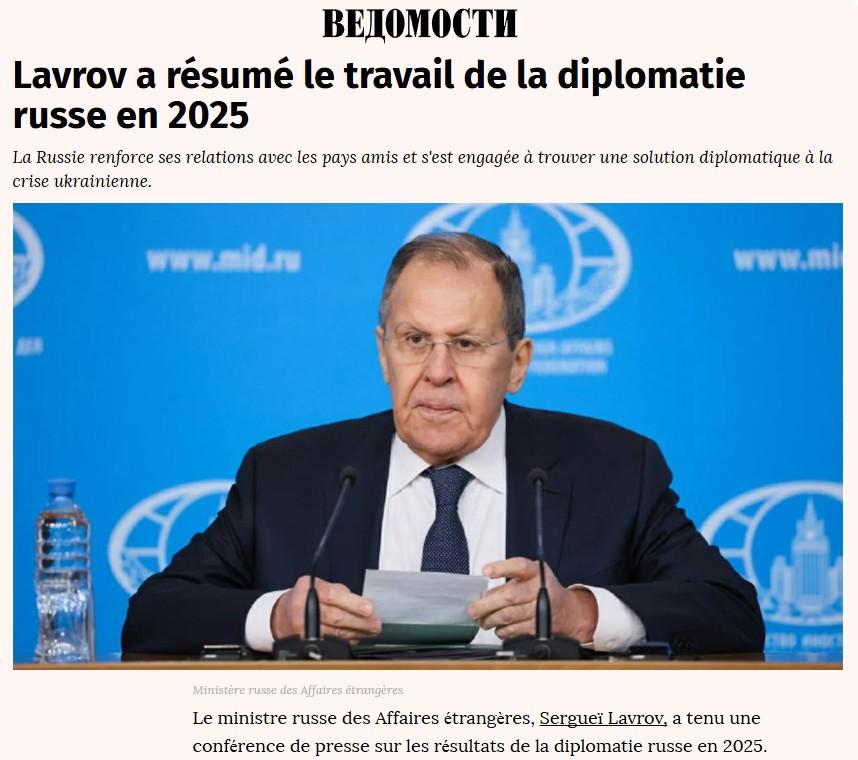
Lavrov a souligné que le prétendu « isolement » de la Russie n’a pas eu lieu, « malgré ce que
L’article Lavrov dresse le bilan de l’année diplomatique écoulée est apparu en premier sur STRATPOL.
Foreign Minister Sergey Lavrov’s statement and answers to media questions at a joint news conference following talks with Foreign Minister of the Islamic Republic of Iran Abbas Araghchi, Moscow, December 17, 2025
[Note: We posted the highlights but the context makes it so much clearer]
Media members,
Foreign Minister of Iran Abbas Araghchi and I held detailed and substantive talks today and, as always, they were held in a friendly, constructive, and trust-based atmosphere.
We stated progress in Russia-Iran relations which have become significantly stronger in recent years. In 2025, the Treaty on Comprehensive Strategic Partnership between the Russian Federation and the Islamic Republic of Iran was signed and entered into force on October 2. The fact that President of Russia Vladimir Putin and President of Iran Masoud Pezeshkian put their signatures under this treaty underscores its importance for Moscow and Tehran.
We discussed the tasks set by our respective presidents during their meeting in Ashgabat last week and expressed confidence that once implemented this treaty will give a powerful boost to bilateral interaction and help us align our approaches to regional and multilateral issues with a primary focus on expanding the capabilities of the two countries in the interest of improving stability and security in our common region.
We noted the particularly trust-based nature of the political dialogue at the top, intergovernmental, and interparliamentary levels, as well as at the interagency and ministerial level. Civil society contacts are expanding to further strengthen neighbourly ties between our countries.
We highly praised the advanced level of practical bilateral cooperation in trade, the economy, and investment. Trade has been steadily up by more than 10 percent for the second straight year, over 15 percent last year. The Permanent Russian-Iranian Commission on Trade and Economic Cooperation is fully operational with its co-chairs, Minister of Energy Sergey Tsivilyov and Iranian Minister of Petroleum Mohsen Paknejad, remaining in contact at all times. We discussed the importance of making thorough preparations for the next meeting of the intergovernmental commission, which will take place in Tehran in February 2026.
We share a common view on the importance of promoting business ties. In this regard, the entry into force of the Free Trade Agreement between the EAEU and Iran this year, and Tehran obtaining observer status in December 2024, is of utmost importance. We are interested in continued expansion of the legal and regulatory framework between our countries with an eye towards eliminating trade barriers.
We underscored the importance of carrying out flagship infrastructure projects, including the Bushehr Nuclear Power Plant. With the support of the Russian personnel, it continues to operate in standard mode and remained operational even amid the June aggression by Israel and the United States. We reviewed in detail the status of the implementation of the project to build the Rasht-Astara Railway section financed through a state loan provided by Russia. The construction of this railway is monitored by our respective presidents as a priority project. The railway is the key to the full-on launch of the western branch of the strategic North-South International Transport Corridor.
The exchange of views on international and regional issues reaffirmed our overlapping positions or close views on most matters. We spoke in favour of further democratisation of international life based on multipolarity, which is on track to become a reality in full accordance with the principles enshrined in the UN Charter that have been sabotaged by the collective West for many decades now.
The objective course of history warrants the implementation of the lofty principles of the UN Charter. Importantly, these principles must be acted upon, respected and applied in practice not occasionally, but exclusively as an indivisible and interdependent whole.
This strongly resonates with the Ukraine conflict, where the collective West is pushing to manipulate every provision of international law and to replace them with its own “rules” that are at odds with the universally recognised international legal norms and serve only the push of the collective West, above all Europeans, to continue their neocolonial policies aimed at living off other nations the way they did over the past 500 years starting in the era of colonialism. The neocolonial economic, trade and financial dependence of African countries, as well as many countries in Asia and Latin America, on the West has remained unchanged to this day.
We denounced the use of unilateral coercive measures that undermine international law which fact has become particularly glaring amid the Ukraine crisis. Europe is trying to scuttle the constructive ideas put forward by the Trump Administration, as it violates every rule and principle that have until now governed international economic and financial relations, encroaching on property that the West itself had only recently declared inviolable, and eroding in many ways the principles promoted by Europeans, including as part of the globalisation efforts. What we are witnessing today is a process of fragmentation, not globalisation.
Speaking about the use of unilateral coercive measures, we stand fully in solidarity with Iran and a number of other countries. We advocate creating a group of countries that have a stake in countering this lawless behaviour. I believe this process will gain ever more supporters as it moves forward. We agreed to consolidate members of the international community who share these approaches. We will continue substantive work to neutralise the negative impact of illegal sanctions on the economies of our respective countries.
We covered in depth the Iranian nuclear programme dynamics amid the unapologetically aggressive and unlawful anti-Iranian policies adopted by a group of Western countries. Once again, Russia confirmed its readiness and willingness to help its Iranian friends identify acceptable solutions to overcome the nuclear dossier-related crisis created by the West. Acting in violation of all existing agreements and regulations that are legally established by the UN Security Council, Western Europeans are doing everything in their power to re-impose UN sanctions on the Islamic Republic of Iran, even though these sanctions expired more than a month ago alongside Security Council resolutions that were used to impose them.
We decry such disregard for law and international legislation, and the attempts to prioritise self-serving interests over the principles of the UN Charter. We hope that UN Secretary-General Antonio Guterres, whom they are also trying to weave into this game, can clearly see that he is being nudged into a trap and will say no to those who conspire to take advantage of his authority, reputation and office of Secretary-General to push through the Western countries’ self-serving and unlawful plans.
Clearly, any decisions regarding potential arrangements that could put an end to the current crisis and put the process on a constructive track must be taken exclusively by the Iranian government based on the interests of the people of the Islamic Republic of Iran, and with full respect of its right, as a full-fledged member of the Treaty on the Non-Proliferation of Nuclear Weapons, to enrich uranium for peaceful purposes.
We will continue to deepen our cooperation at the UN, the SCO and BRICS. We covered several important regional issues, including the situation in the Middle East, primarily, the Palestinian territories, the South Caucasus, the Caspian region, Afghanistan, and neighbouring countries.
I would like to close by once again expressing satisfaction with the outcomes of the talks and to thank my Iranian counterpart for accepting the invitation to visit Russia.
Question (retranslated from Farsi): International relations are getting more intricate by the day. The international situation is marked by securitisation. As a permanent member of the UN Security Council, what can Russia suggest in order to keep international law intact? How serious is Russia about fortifying multilateral policy on international platforms? Is Russia ready and willing to support BRICS and the SCO?
With the US seeking dominance, especially in the context of the ongoing developments in the Caribbean, is the UN under threat of falling apart?
Sergey Lavrov: As President Putin has repeatedly made it clear, including in his most recent remarks, the UN is the finest creation of diplomacy in the entire history of humanity, because there has never been a universal entity that would bring together all independent states of the modern-day world. This organisation is vested with authority and mandates in virtually every sphere of human activity, ranging from security and disarmament to the economy, investment, climate protection, and now also AI and other cutting-edge achievements in ICT.
The UN system, which comprises around 20 specialised agencies and institutions, is, by all accounts, unique. However, just like any other bureaucracy, it is affected by intrinsic flaws. Regrouping the currently functioning entities is the order of the day. UN Secretary-General Antonio Guterres has spoken in favour of this change as well. In his UN80 Report released ahead of the UN anniversary, he pointed out that the organisation was overstaffed, noting that the opportunities to conduct personnel optimization looked good. I am confident that it will end up taking place eventually.
At the same time, based on the experience and impressions from my contacts with my colleagues in Europe, reforming the UN Secretariat and its units and departments will be no small feat, but still a much less daunting endeavour than reforming the EU bureaucracy in Brussels which has broken every record known to humanity. We even went as far as to draw the attention of the senior officials from the UN Secretariat to what is happening with the Brussels-based elite that continue to attempt to usurp the powers and legitimate rights of the sovereign governments of nation states.
Truth be told, the UN Secretariat has never come even close to such an adventurous undertaking. However, there have been half-hearted attempts by certain Secretariat bureaucrats, primarily in New York, to shove their own ideas down the throats of UN member states. In most cases, these attempts were backed by our Western colleagues. We brought this to their attention during the discussions that followed the Secretary-General’s report on UN reforms. Without a doubt, this issue will take centre stage in the context of overcoming disproportionate representation of the Western countries at the UN Secretariat, where the bulk, if not all important positions (with extremely rare exceptions), are held by citizens of Western states or citizens of other countries with second Western, mainly US or UK, citizenship.
This violates the UN Charter’s requirement for fair geographical representation across all bodies serving the organisation. This is kind of a congenital/acquired disease.
The US actions in the Caribbean are rejected by almost all countries except Europe. The latter have hunkered down and remain silent with regard to what Washington is doing. All they can think of is to persuade the Trump Administration to go down the European path on the Ukraine issue in order to perpetuate the war unleashed by the West against the Russian Federation and, as I said earlier, to bring the Americans over to their side of the fence and to prevent them from advancing their constructive agenda aimed at resolving the Ukraine crisis.
All other countries have made their positions clear. We are very concerned about what the US Navy is up to and, more broadly, about the bellicose rhetoric of the Pentagon whereby they are planning a ground operation on top of illegal actions involving the sinking of civilian vessels without trial or investigation in the Caribbean Sea. Looking at the prevailing balance of power in the international arena, all of the above undermines hope that agreements can ever be reached and honoured. Nevertheless, the United States remains open to a dialogue, but not on all issues. President Trump claims that he has made every decision there was to make on a number of issues, and carrying them out is all that’s left to do.
Nonetheless, we welcome the positive side of the current Trump Administration as compared to the administration led by Joseph Biden, which refused to talk to anyone about anything and was incapable of any meaningful actions to begin with.
Your question was what we think about BRICS and the SCO. Unlike the EU, or what has become of it, and unlike NATO with its discipline of the rod, these are truly constellations of a new type. Incidentally, the EU and NATO alike are being subjected to attempts by their administrative heads, the head of the European Commission and NATO Secretary General, to bring them to heel.
If you ever have a chance to read what these characters have to say, you will get an impression that they think of themselves as the high and mighty political leaders of our time, rather than hired bureaucrats who are expected to carry out the will of the member states.
Nothing of the sort can even happen in the SCO or BRICS, which follow the principles of the UN Charter that have been tested over many decades now, namely sovereign equality of states, peaceful settlement of any disagreements, the search for consensus and common agreement on all issues, and concentration of efforts on implementing practical projects based on the principle of mutual benefit.
The work done by the SCO and BRICS will come as a reliable benchmark for making changes that are overdue at the UN and which, I would like to underscore this once again, should lead not to something revolutionary, but exclusively to reaffirmation by all UN members of their commitment to strictly observe all provisions of the UN Charter in their entirety and interconnection. I look forward to our Western colleagues, including the United States, contributing to the efforts designed to achieve such consensus.
Question: You said in your opening remarks that Russia is ready to help Iran look for a way out of the nuclear file crisis. Does it also imply Russia’s readiness to mediate the possible signing of an agreement between Iran and the United States?
Sergey Lavrov: For a number of years, Mr Abbas Araghchi and yours truly have been involved in preparing the Joint Comprehensive Plan of Action, which was adopted in 2015 and approved by the UN Security Council several months later.
Russia, as well as the other participants in this process, is deeply involved in the details that constitute the basis of that agreement and the details of how it was destroyed by the United States. This is the cause of the current problems. Those who have destroyed the JCPOA and undermined the UNSC resolution that approved it are now trying to shift the blame onto the Islamic Republic of Iran. This is clear to everyone.
We maintain contacts and regularly communicate with our Iranian friends. Our presidents communicate, and it is the fifth time that we have met with my Iranian colleague this year. Just like Mr Araghchi, senior advisor to the Supreme Leader of the Islamic Republic of Iran Ali Larijani has visited Russia and met with President Putin.
These issues were discussed. Both Russia and Iran would like to stabilise and normalise the situation, precluding any further use of force. Exclusively political and diplomatic solutions is what we need in the current situation.
Since Russia is cooperating with Iran in the nuclear sphere, we have built and are now expanding the capacity of the Bushehr nuclear power plant. Since we are well aware of the situation in relations between Iran and the IAEA, we regularly discuss the approaches made public by European countries and the United States. Incidentally, we raise these questions during our expert contacts with our American colleagues, urging them to look for mutually acceptable solutions.
Therefore, the mediation services we can offer are well known. President Putin mentioned them during his contacts with Iranian and other representatives, and we also discussed them at the level of foreign ministers.
We are not imposing these mediation services on anyone. If the Islamic Republic of Iran as the main participant in that process decides that such services are necessary, we are ready to provide them, if Tehran’s other counteragents agree.
Question (retranslated from Farsi): We see that the Iranian-Russian relations are at their peak, especially after the entry into force of the Treaty on Comprehensive Strategic Partnership.
On the other hand, you know that our enemies are trying to sour our relations. What do you think about our bilateral interaction and practical efforts in trade, the economy and science, as well as in defence and security, in light of the implementation of the Treaty on Comprehensive Strategic Partnership? What other measures should we take to continue strengthening this common stance?
Sergey Lavrov: Speaking about our practical cooperation in the material sphere – in trade, the economy and investments, we talked about it in detail during our opening remarks at this news conference, so I won’t repeat it.
As you correctly said, we are developing our military-technical cooperation in full compliance with international norms and without violating universal international rules in any way. There are contacts between our militaries, including aimed at training to combat common threats and challenges such as terrorism and drug trafficking. This cooperation will continue.
There are also cultural, humanitarian and educational ties and scientific contacts, which are rapidly developing, both within our bilateral relations and also in the context of Russia and Iran’s participation in various multilateral formats such as BRICS, the SCO and the Caspian Five. The interregional factor and contacts between municipalities are increasing their stance on the agenda of these structures. This is probably the best guarantee of the sustainability of these organisations and associations, because they reach to the ground, to the level of towns and cities, connecting the people living in them with the strong ties of friendship and contacts.
I have very optimistic expectations regarding the further build-up of our strategic partnership in full compliance with the new treaty.
As for additional measures, today you attended the signing of the plan of consultations between our ministries for 2026˗2028. We did not have such documents or used such practice before. We held consultations, but it is the first time that we are planning them for three years ahead. I am confident that this will increase the effectiveness of our foreign policy cooperation as our contribution to the implementation of the tasks set out in the Treaty on Comprehensive Strategic Partnership.
We are ready to develop our ties in all spheres. We discussed this today, and we have reached agreements on a number of specific issues.
Question: Are you discussing the drafting of a new agreement between Iran and the IAEA to replace the Cairo agreement, or can the Cairo agreement be relaunched? If so, is Russia involved in this process?
Sergey Lavrov: We discussed this issue today. My colleague, Mr Araghchi, briefed us on Iran’s stand regarding contacts with the IAEA. We fully share this view, including because any steps in this direction should be based on the good will and fundamental assessments of our Iranian friends after the Israeli and US attacks on the facilities that have been and officially continue to be under the IAEA safeguards.
Of course, it worth noting that the IAEA has not yet expressed its attitude to the fact that facilities under its safeguards have been flagrantly subjected to illegal attacks.
As I have said, we appreciate the good will of the Islamic Republic of Iran, which is ready to resume cooperation with the IAEA despite these facts but not in the interests of promoting the Western agenda. There is no doubt that agreements with the Islamic Republic of Iran are possible if the IAEA Secretariat acts in strict compliance with the powers assigned to it. We wish success to these efforts.
Lavrov and Iran FM Araghchi Hold Joint Press Conference After Moscow Talks
A few Lavrov quotes:
West is attempting to distort all norms of international law, trying to replace it with their own rules — Lavrov
This just reflects their 500-year neocolonial desire ‘to try to live at the expense of others,’ Lavrov adds
—
Russia reaffirms once again its willingness to help our Iranian friends in looking for acceptable ways to resolve the nuclear crisis that was created by the Westerners — Lavrov
—
BRICS and SCO are organizations of a new type, unlike such NATO or what the EU has turned into — Lavrov
—
‘They are trying to subjugate the will of their member states’
They talk about themselves ‘like they are the greatest politicians of modern times, not some hired employees’
—
Europe is silent on US attacks in the Caribbean to gain Trump’s favor over their Ukraine peace plan proposals — Lavrov
Russia is ‘concerned’ with US Navy striking civilian boats and a probable land op
‘Almost all of the countries find it unacceptable apart from the Europeans’
Russia’s Foreign Minister Sergey Lavrov’s interview (https://mid.ru/en/foreign_policy/news/2065749/) with the Islamic Republic of Iran Broadcasting media corporation (Moscow, December 15, 2025)
Read in full (https://mid.ru/en/foreign_policy/news/2065749/)
Key points:
• Throughout history, Europe has repeatedly been a source of all evil and spawn of deepest crises. <…> Europe is now trying again to dictate to everyone its terms and wishes which seem to be connected with the Ukraine crisis.
• Europe is using it to assert itself, to throw sand in the wheels and scheme against the United States and all those who seek a just settlement.
• The theory and practices of Nazism are being resurrected in Europe, primarily in Brussels but also in Berlin, London, Paris, not to mention the Baltic States.
• Europe is waging a war with us once again with Ukrainians under a Nazi flag, <…> pumping Ukraine with increasingly more modern weapons.
• One of major purposes [of the new US National Security Strategy] is to make Europe know its place and to prevent it from imposing its liberal ways
• The United States wants to set up its policy for opposing China. <…> We are not against competition, however, it should be fair.
• Europeans have theft running in their blood, which we can see from the example of “frozen” Russian assets. By the way, Iranian assets are also partially frozen like Venezuelan assets and assets of many other countries.
• The West, including the United States, does not always have enough power to maintain its domination, and thus they have to resort to dirty, anti-democratic, and anti-market methods.
• The West is planning and trying to split the group of the five Caspian states and impose decisions which will not get a consensus of the Caspian countries.
• The second outrageous example is Palestine. Not only was the UN Security Council resolution violated in this case, but also a great number of resolutions of both the Security Council and the UN General Assembly.
• The last year’s developments around the Iranian nuclear programme, the absolutely outrageous illegitimate actions by Europeans, the attempts to put the blame on the Islamic Republic of Iran for the collapse of the Joint Comprehensive Plan of Action (#JCPOA), <…> reaffirms that the entire world order is being subject to most severe tests.
• When Iran was attacked by Israel (https://t.me/MFARussia/25345) followed by the United States (https://t.me/MFARussia/25391), we condemned those actions (https://t.me/MFARussia/25405) as having absolutely nothing to do with international legality. The key is that so far no one has offered any clear evidence that Iran has violated something, neither the IAEA, nor the Israelis, nor the Americans.
• Russia is firm in its commitment to ensuring the Islamic Republic of Iran its unconditional right to the peaceful use of nuclear energy, just as any other country.
• Russia and Iran signed a Comprehensive Strategic Partnership Treaty (https://mddoc.mid.ru/api/ia/download/?uuid=98ba2ce7-7656-4577-b8f0-c96ac946178c). We will always support Iran and promote its legitimate rights.
• Our bilateral plans [with Iran] are serious enough as are our plans of cooperation in the world arena. I mean in #BRICS, the #SCO and the #EAEU. This includes the United Nations and the Organisation of Islamic Cooperation.
• We are also engaged in investment cooperation. In addition to the North–South corridor, there is also such a flagship project as the Bushehr NPP – its construction is ongoing.
• There is a promising format that will help strengthen security in the [Middle East] – I am referring to the relations between the Islamic Republic of Iran and the Gulf Cooperation Council (#GCC).
• There is the Collective Security Treaty Organisation (http://t.me/odkb_csto), and we want to work with the Islamic Republic of Iran and with other neighbouring countries, including within this organisation’s framework.
• In recent months, the Islamist Republic has made it clear that it is not seeking war or new conflicts.
• In the United States and certain countries of Europe <…> there are people who have been speaking out in favour of reviving the arms limitation and control frameworks, including transparency measures. Iran and Russia have been proactive in backing this approach.
Foreign Minister Sergey Lavrov’s remarks and answers to questions during an embassy roundtable discussion titled “Ukraine crisis. Diplomacy and settlement prospects,” Moscow, December 11, 2025
[Comment: It is noticed that frequently now, Russia calls the so-called ‘Peace Agreement’ for Gaza into question as a key part and a leading component of their public speeches. In this address to diplomats, he even calls out that other fora and discussions use the Russian issues to divert from the grave situation in Gaza. He also calls it an initiative, and not a Peace plan or agreement.]
Good morning, colleagues.
Your Excellencies,
Thank you for taking a lively interest in discovering our position on the Ukraine topic and international affairs in general. However, we are focusing this roundtable discussion on the Ukraine crisis, which was orchestrated by the West in an effort to turn Ukraine into an anti-Russia, and pumping it full of weapons for preparing it to wage war against our country.
Of course, this is one of the most sensitive and urgent issues on the international agenda, even if, to be honest, we are witnessing attempts to exploit the sense of urgency related to all the debates regarding Ukraine, including within international forums, for diverting attention from other challenges the international community faces, which can be even more fateful and critical, not less. I am referring to the Palestinian issue.
We welcomed the steps by President of the United States Donald Trump. The key takeaway was that his initiative’s first phase helped free people, hostages, and facilitated the return of bodies so that they could be buried according to the religious traditions. We are now all waiting for the second stage. The fact that this plan has a humanitarian focus and does not provide for a final and lasting resolution of the Palestinian issue in keeping with the UN resolutions does not inspire any optimism.
Nevertheless, we have gathered here to discuss the Ukraine crisis. If you allow me, I will say a few words regarding the way Russia assesses the developments on this topic at the present stage.
We are holding this meeting at a time when not a single day goes by without the media relaying messages which create new expectations that a diplomatic solution to the Ukraine conflict is getting closer. All these assessments and expectations stem from the fact that various international actors have stepped up their contacts. And all this is taking place against the backdrop of reports that the economies of the Kiev regime’s sponsor countries are sinking deeper into crisis, which primarily relates to European bureaucrats, as well as most NATO and European Union members.
There has been quite a lot of speculation regarding all kinds of destructive planted stories and fakes. We view these actions as being initiated by our Western colleagues with the primary goal of making it harder to come to a negotiated solution and make the conflict last longer. This includes efforts to derail the initiatives coming from the United States and its President, Donald Trump, since their genuine purpose consists of finding solutions and addressing the root causes of the Ukraine crisis.
In Europe, no one mentions the root causes at all. All they do is demand that hostilities be stopped immediately so that Ukraine and the Europeans could breathe a sigh of relief and win some time to be able to prop up the Kiev regime with weapons and money.
Here is a recent news story, which I wanted to bring to your attention. The media has reported about a telephone conversation between US President Donald Trump, President of France Emmanuel Macron, Prime Minister of the UK Keir Starmer, and Chancellor of Germany Friedrich Merz. Stefan Kornelius, who is a spokesperson for the German government, made a public statement saying that the four heads of state and government discussed the talks on a ceasefire in Ukraine. Just that. Europe is not interested in anything else. Meanwhile, Russia insists on agreeing on a package of measures to achieve solid, sustainable and lasting peace with security guarantees for all the parties.
Our negotiations with the US President and his team are focused on precisely that objective: developing a long-term solution that addresses the root causes of this crisis. In contrast, as illustrated by the recent statement from the official German government spokesperson, Western Europe is currently preoccupied with securing a ceasefire – essentially pausing to catch their breath and regroup before redoubling efforts to prepare Vladimir Zelensky and his regime for renewed hostilities against the Russian Federation.
So today we will try to separate the wheat from the chaff. We will examine the dynamics that have unfolded this year and, drawing on our accumulated experience, outline our assessments. These assessments will, in turn, inform our decision-making regarding negotiation formats, timelines, and potential outcomes.
First, however, some necessary historical context. While many of you are familiar with the background story, nevertheless, it is worth reiterating that under the Joe Biden administration, the United States became the primary sponsor of the Kiev regime. Shortly after the violent seizure of power in Ukraine in February 2014, then-Assistant Secretary of State Victoria Nuland, testifying before the Senate, openly endorsed the developments in Ukraine. She noted that the $5 billion invested there in preceding years would guarantee the success of what she termed “the triumph of democracy.” In reality, it was simply a coup.
Following this coup, the United States established control over Ukraine’s political system and economy, while flooding Ukrainian neo-Nazis with modern weaponry. Donald Trump “inherited” this situation in its entirety. We recall, however, that one of his central and most prominent campaign pledges regarding foreign policy was to bring about a swift end to the conflict in Ukraine. It should be noted that the current American leader, having now returned to the White House, has indeed taken tangible steps to address the conflict and, in our assessment, now appears sincerely committed to facilitating its resolution through political and diplomatic means. We welcome this shift.
Aspiration alone, of course, is insufficient. Concrete steps are required to address the root causes of the conflict, which the President of Russia and members of our Government have repeatedly outlined. This necessitates a change in the policies we find unacceptable, specifically: ceasing efforts to bring Ukraine into NATO, contravening assurances given over the past 35 years, and halting the Ukrainian regime’s campaign to eradicate all things Russian, which is conducted in flagrant violation of the UN Charter, numerous international conventions, and Ukraine’s own constitutional guarantees for the rights of Russian and other minorities across all spheres of public life.
From the outset of the crisis, Russia has taken every possible step to facilitate its resolution. In February 2014, when the coup was carried out in Kiev, we immediately appealed to the leadership of France, Germany, and Poland. We called on them to exert their influence on the opposition – which, in fact, had orchestrated the coup with direct Western support and guidance. Specifically, we asked these European governments to demand that the opposition honour the political settlement agreement signed on February 21, 2014, with then-President of Ukraine Viktor Yanukovich.
Crucially, Berlin, Warsaw, and Paris had acted as guarantors of that very agreement. Their signatures were on the document. We told them plainly that their reputations were on the line, and urged them to take action to bring the usurpers to their senses and restrain them. Had this happened, had the Germans, French, and Poles fulfilled their obligations as guarantors, Ukraine could have been spared the civil war that the new regime, having seized power by force, immediately unleashed against millions of its own citizens who categorically refused to recognise its legitimacy.
Given that the West, even then, almost twelve years ago, simply refused to honour its own commitments, this episode provides a clear answer to the question of how sincerely these European capitals have ever wanted peace in Ukraine.
Nevertheless, Russia has persistently pursued diplomatic efforts. The Minsk Agreements were agreed upon after protracted, late-night discussions in the Belarusian capital, with direct involvement of President of Russia Vladimir Putin. These accords were not only coordinated but also initiated by Russia (a deliberate move on our part) and later endorsed unanimously by the United Nations Security Council. Article 25 of the UN Charter stipulates that the Members of the United Nations agree to accept and carry out the decisions of the Security Council.
However, the West perceived these agreements merely as a stalling tactic – to buy time which they utilised to continue arming the illegitimate Kiev regime and advance their agenda of preparing for conflict against the Russian Federation. The signatories of the Minsk Agreements – the then-President of France, François Hollande, the then-Chancellor of Germany, Angela Merkel, and the then-President of Ukraine, Pyotr Poroshenko (whose signature, naturally, is also affixed to the document) – sought only to secure time for themselves. They candidly admitted this. Three years ago, in interviews amidst the ongoing special military operation, they clearly stated that there had never been any intention to implement these agreements. Their aim, they confessed, was to bolster the beleaguered state of the Ukrainian armed forces, thereby preparing Ukraine for war against Russia.
The work of the Contact Group, established by the leaders of Russia, Ukraine, France, and Germany to facilitate the implementation of the Minsk Agreements, also reached a deadlock. This too was sabotaged by the Kiev regime and its Western sponsors.
Concurrently, with NATO’s support, the Kiev regime enhanced its military capabilities, eventually escalating hostilities significantly against the civilians of south-eastern Ukraine – those who, as I have previously stated, categorically refused to recognise the legitimacy of the coup instigators. This refusal was partly based on the fact that upon seizing power in the immediate aftermath of the February 2014 coup, these individuals announced their intention to revoke the status of the Russian language, effectively outlawing millions of Ukrainian citizens who, like their ancestors, had been nurtured and lived within Russian culture for centuries. The southeast of Ukraine, including Odessa and Nikolaev, comprises territories and cities established by Russians. Factories, ports, infrastructure – all were constructed by Russian hands. These lands were later bureaucratically reassigned within the Soviet Union to the regions (of the then Ukrainian Soviet Socialist Republic) now known as Galicia and other western territories.
Yet, the core issue remains: the Minsk Agreements were never honoured. The Kiev regime had no intention of engaging in a sincere peace process or negotiating with representatives of south-eastern Ukraine. They publicly declared they would never negotiate with these representatives – a direct breach of the Minsk Agreements’ provisions.
The fact that, in late January to early February 2022, the Ukrainian armed forces significantly intensified artillery and aerial strikes on the territories of the Donetsk and Lugansk People’s Republics was corroborated by reports from the OSCE Special Monitoring Mission. I will not elaborate on specifics; we have addressed this matter extensively. The key takeaway is that Russia prioritised diplomacy until the very last moment.
In December 2021, two months before the beginning of the special military operation, we pursued no agenda other than a peaceful resolution. We presented the United States and the North Atlantic Alliance with draft documents aimed at negotiating security guarantees on the western flank. We proposed signing legally binding agreements. These proposals were arrogantly dismissed by both the Americans and NATO.
It was only after it became apparent that the West sought to grant Ukrainian Nazis carte blanche to violently suppress those who refused to recognise the coup – as President Vladimir Putin stated – that we had no alternative but to launch the special military operation. Its purpose was to protect the population of south-eastern Ukraine, whom the Kiev regime had branded “sub-humans,” “creatures,” and “terrorists,” and against whom, in violation of all norms of international humanitarian law, it deployed regular armed forces, including artillery and combat aircraft.
Nevertheless, even after the commencement of the special military operation, we did not abandon efforts to resolve the situation through political means. Contacts with the Ukrainian side, at their request, took place in Belarus mere days after the operation began. These were subsequently continued in the Brest Region of Belarus, in Istanbul, and via video conference. Yet this dialogue, too, was disrupted through no fault of ours. Here, the leadership of Britain – and personally the then Prime Minister Boris Johnson – played a subversive (I can think of no better term), highly detrimental role. In April 2022, he instructed Vladimir Zelensky to abandon the settlement plan proposed by Kiev itself and already initialled, declaring that Ukrainians must fight “to the last.” All this was done in the illusory hope of witnessing the collapse of Russia’s economy. Such was the calculation of that dishevelled political figure. They believed that under sanctions pressure, we would descend into a deep crisis, precipitating political destabilisation in Russia – an outcome the West, particularly the Europeans, pursued then and continues to pursue today.
In other words, according to the schemes of Western strategists, Ukraine was to serve as an anti-Russian battering ram, holding out until the pressure on our country broke us economically, politically, and indeed morally and psychologically. Their goal was to shatter our resolve to defend the unity, sovereignty, and security of the state, as well as the dignity of Russian people who, by the twists of history, found themselves on Ukrainian territory. They would have lived there peacefully, had the Ukrainian leadership respected its own constitution, which mandates the protection of the rights of Russian and other ethnic minorities.
Their objective was to inflict a strategic defeat upon us, thereafter dictating Western terms on matters of interest to European capitals. Yet the plan for an anti-Russian blitzkrieg using Ukraine failed. Russian society demonstrated internal consolidation, while the economic and political systems proved their resilience and immense reserves of strength.
This, too, is a crucial point for understanding the historical context. As we say in Russia, whenever our nation has been attacked – our cause is just. This conviction in our righteousness – historical, legal, and moral – reflects the character of our people. It underpins the current state of affairs in the struggle against those who sought to crush all our legitimate rights and interests.
Today, the resources available to the West for conducting a proxy war – financial, logistical, and military – are being depleted. According to numerous independent estimates, the AFU’s human losses have long exceeded one million and continue to rise. The Kiev regime, once an ideologically driven combat unit fuelled by Nazi ideology, including battalions such as Azov and other neo-Nazi groups, as well as certain prohibited substances in daily life, has devolved into an organised criminal entity mired in corruption and dragging its sponsors down with it.
In these circumstances, the ruling circles of the West can broadly be divided into two camps. The majority advocate for the militarisation of European economies and preparations for large-scale armed confrontation in Europe, evidently in the hope that, as the saying goes, “war will justify everything,” and their mistakes will be forgotten.
Among such figures, I would mention NATO Military Committee Chair Giuseppe Cavo Dragone: “We are looking at acting more aggressively rather than reacting. The Alliance (NATO) could consider pre-emptive strikes as defensive actions.” How about that? This underscores how other figures – not just military but political – openly declare that preparations must be made for war against Russia by 2030, if not 2029.
“Amusingly,” Italian Prime Minister Giorgia Meloni attempted to justify this Italian admiral’s remarks on the necessity of pre-emptive strikes against the Russian Federation. When asked how she viewed this, she stated that these words should be interpreted correctly to halt and prevent dangerous escalation. How else can one interpret an explicit call for pre-emptive strikes?
I am confident that everyone understands what is at stake and how the West, out of desperation, is attempting to escalate the situation and remain on the path of war. They hope that by stoking this issue and hyping up the “military threat” emanating from Russia, they can cling to power and save face.
In our assessment, this represents the majority of Western elites in Europe. Others, the minority, seek to devise an exit strategy from the conflict, striving to find avenues for de-escalation and the creation of conditions for a political settlement. This policy among some European countries aligns with the actions of the Donald Trump administration, which has long moved beyond rhetoric to leverage its influence over Kiev, persuading Vladimir Zelensky to return to the negotiating table.
We appreciate these efforts, as well as the willingness of certain partners to provide platforms for dialogue. Though, frankly speaking, Vladimir Zelensky, with the backing of leaders in Brussels, Berlin, London, and Paris, seeks to obstruct these efforts at every turn, concocting excuses aimed solely at derailing the Donald Trump administration from its chosen path – one oriented towards sustainable, long-term settlement. They aim to substitute all this with fabrications, just to avoid taking any meaningful action.
As you know, confirming our commitment to negotiations and a political solution, we initiated the resumption of direct talks in Istanbul this spring. Three rounds were held – in May, June, and July. We approached these meetings in good faith. We prepared and submitted our proposals to the Ukrainian side: a draft Memorandum on Settlement Principles, outlining our vision for a resolution. Specifically, we proposed establishing a joint Russian-Ukrainian centre for monitoring and enforcing a ceasefire during designated periods to address pressing humanitarian issues.
When the Ukrainian side claimed that Istanbul was unproductive – arguing that only limited humanitarian agreements on prisoner and body exchanges had been reached – we responded by offering to create dedicated working groups: one for humanitarian issues, one for military matters, and one for political questions. This proposal, too, was ignored.
Subsequently, the Ukrainian delegation complained that the level of negotiators in Istanbul was insufficient for making substantive decisions. We then proposed a significant elevation in the rank of the negotiating teams. This also received no response. Every initiative we put forward to advance the bilateral dialogue was rejected or ignored. This pattern confirmed that the Ukrainian regime is fundamentally unwilling to seek genuine solutions or agreements.
I noted that there were some positive results in the humanitarian sphere: the exchange of the bodies of the deceased and of prisoners. Nearly 2,500 individuals from each side were able to return home. Several rounds of repatriating the remains of the fallen were organised. To date, we have transferred over 11,000 bodies of fallen Ukrainian soldiers to Kiev and have received, in return, 201 bodies of our own soldiers.
Despite the above, Kiev cited a lack of progress and decided to suspend negotiations with Russia. The West, for its part, has offered no reaction and has made no attempt to compel or even encourage the Kiev regime to create even the appearance of readiness for a political settlement.
Given these events, our conclusion is clear: the Kiev regime engaged in the Istanbul talks for a single purpose – as it did during the Minsk agreements – to exploit any pretext to secure an unconditional ceasefire, thereby buying critical time for rearmament, replenishing losses, regrouping forces, and other military preparations. Naturally, we could not agree to such a scenario.
Now, a new and personal factor has emerged for Zelensky. A major corruption scandal has erupted in Ukraine, making the prolongation of the conflict a pressing political imperative for him, and perhaps even a matter of his personal survival.
For us, talks designed to achieve a negotiated settlement, as President Vladimir Putin has repeatedly emphasised, remain the preferred course of action. We have never refused to talk, which is confirmed by our constructive work to review the initiatives advanced by the United States.
We appreciate the efforts of our BRICS partners to help create an environment conducive to finding peaceful solutions to the Ukraine crisis, including the Group of Friends for Peace in Ukraine created by our Chinese and Brazilian partners. We regard these efforts as a sincere desire to make a constructive contribution to stabilising international situation.
Importantly, such work should rely on international law, above all the provisions of the UN Charter understood as an indivisible and interdependent whole. It is essential to strive for what was mentioned several times today, namely, the elimination of the underlying causes of the conflict as a key prerequisite for durable peace.
I spoke about the principles of the UN Charter. The West also keeps referring to them as the basis for a settlement. But its statements are highly specific. Recently, German Federal Chancellor Friedrich Merz once again stated that the conflict must be resolved on the basis of the principles of the UN Charter and respect for territorial integrity of Ukraine. This represents a selective commitment to the Charter.
The UN Charter also speaks of many other things, including equality and the right of nations to self-determination. It was precisely the right of nations to self-determination that became the foundation for the process of decolonisation, when peoples, above all in African countries, refused to live under the rule of the colonial powers, because these powers did not and could not represent the interests of African peoples. By the same token today, the Kiev regime – everyone is clear about that – cannot in any way represent the interests of the residents of Novorossiya, Donbass, and Crimea.
There must be no double standards here. When the Group of Friends of the UN Charter created by our partners works on shaping its philosophy, we want all the principles of the UN Charter, without exception, to be taken into account. All the more so since the West forgets another principle of the Charter which includes respect for human rights regardless of race, sex, language, or religion. The Russian language and the canonical Ukrainian Orthodox Church have been outlawed in Ukraine. I hope that many countries that are part of the Group of Friends of the UN Charter are represented here and will take these issues into account in their work. The Group should be mindful of these considerations.
The involvement over the past year of certain Western countries that are directly engaged in supporting the Kiev regime, France and Switzerland to be specific, in the work of the Group of Friends for Peace in Ukraine can hardly help achieve this goal. How can they be members of the Group of Friends (even as observers) when they directly, both in word and in deed, support the Kiev regime?
Speaking of the Americans, I mentioned earlier that, in our assessment, they are interested in figuring out what is behind the Ukraine crisis. We saw that during the Russia and US leaders’ summit in Anchorage on August 15. Mutual understandings were reached there that remain valid to us and can serve as a starting point in our quest for a settlement.
Recently, US President’s Special Envoy Steve Witkoff was in Russia. Following his meeting with President Vladimir Putin, both sides confirmed the mutual understandings reached in Alaska. This is an important outcome, because the Anchorage summit was followed by a pause. Now, in our talks with the Americans on the Ukraine issue, I personally believe that misunderstandings and misinterpretations have been resolved. And the understanding reached in Anchorage is based on the proposals that President Putin once again summarised in June 2024 regarding the principles of resolving the Ukraine conflict.
Prior to Alaska meeting, Steve Witkoff visited Moscow and brought proposals that formed the basis of the understandings reached in Anchorage. These understandings come down to Ukraine returning to its non-aligned, neutral, and nuclear-free status which forms the foundation of its statehood. These particular principles were enshrined in the Declaration of State Sovereignty of Ukraine of July 16, 1990. We recognised Ukraine’s independence based on the principles proclaimed in that document.
When we hear claims that allegedly nothing can be done because the Constitution contains the goal of joining the North Atlantic Alliance… We recognised a different Ukraine. Most of those present here recognised Ukraine in 1991, following the collapse of the Soviet Union, as a country whose statehood was based on three principles, namely, neutrality, nuclear-free status, and non-alignment.
This is not about a play on words, but about recognising historical facts. The Ukraine that became independent after the collapse of the Soviet Union had guarantees in its laws and Constitution protecting the rights of the Russian and other ethnic minorities. The Ukraine as it was then did not have legislation institutionalising militarisation and Nazification of the state and society. Today, all of that exists.
It is important to understand the need to eliminate discrimination against the Russian language, Russian-speaking citizens, and other ethnic minorities. We are well aware that the Hungarian, Bulgarian, and Slovak minorities feel like second-class citizens. It is important to end the persecution of the canonical Ukrainian Orthodox Church.
As for territorial realities, Zelensky says he can’t do anything regarding the territorial issue because their Constitution prohibits territorial concessions. Take a look at that character, who doesn’t always remember what happens around him. The [Ukrainian] Constitution also enshrines the obligation – I will be saying this for a third time today – to guarantee the rights of the Russian and other national minorities.
They have no regard for that constitutional provision. They have adopted laws that expressly prohibit the use of the Russian language in education, culture and media. They have created a strainer of media outlets. It is impossible to work in the media sphere if you criticise Zelensky. They have shut down all media outlets of both Russian and Ukrainian owners that broadcast in Russian and criticised the authorities. They have banned all of them. If they really care about the integrity of their Constitution, civil and human rights are much more important than anything else.
I would like to state once again that we have a Constitution as well, and under it, Crimea, the Donetsk and Lugansk people’s republics, and the Kherson and Zaporozhye regions are the integral and equal entities of the Russian Federation.
I will now repeat what I have said many times: We don’t want territories. We are concerned about the life of the people whose forefathers have developed these lands for centuries, building cities, roads and ports, and who have been commemorated in monuments as the founding fathers of these territories. It is the rights of these people that have been cancelled by the Kiev regime. That is why the people of the Russian entities I have mentioned took part in the referendums to express their refusal to live under the neo-Nazi rule. It is a subject that can’t be hushed up.
I assume that all countries in this audience have a correct understanding of human rights in full compliance with the principles of the UN Charter, which prohibits discrimination on grounds of sex, race, language, religion or belief. However, we are well aware of the Western interpretation of human rights.
After the United States circulated its 28-point plan, it has been leaked to the media. I am sure you have seen it. It included vital provisions on human rights and the denazification of Ukraine. It stated that the rights of minorities and religious freedoms must be protected, and that the Nazi ideology and activities must be outlawed.
After contacts with Europeans, the number of points in that plan was decreased. The provision on prohibiting the Nazi ideology and activities disappeared, apparently at the request of Europeans and Zelensky’s regime.
As for the rights of national minorities and religious freedoms, a provision has been added on Ukraine accepting the EU’s rules on rights of national minorities and religious freedoms. I believe that issue should be phrased differently. Ukraine must comply with the UN Charter and the numerous international and universal conventions on human rights, the rights of national minorities and religious freedoms. I consider it inappropriate to limit Ukraine’s obligations to compliance with the EU’s “rules.”
The rights of national minorities and religious freedoms are not limited or regulated by the European Union. It is inappropriate to enforce one’s rules on others, especially since we know which minorities – and these are not national minorities at all – modern Europe is now concerned about. We know how they interpret religious freedoms. Just watch the broadcast of the opening ceremony of the Olympic Games in Paris, and you will understand their views on minorities and religious freedoms.
We continue to build upon the understandings reached with the American side in Anchorage. We have conveyed additional proposals to our American colleagues concerning collective security guarantees. We recognise that a discussion of such guarantees cannot be limited to Ukraine alone. The proposals that Zelensky and his handlers in Western Europe are currently commenting on have not been formally presented to us. However, if media reports are to be believed, these proposals, which reportedly include declaring a demilitarised zone along the entire border and creating a buffer zone free of heavy weapons on both sides of the border, are inherently pointless to discuss without our direct participation.
Furthermore, these reported plans envision an 800,000-strong Ukrainian army and propose security guarantees focused on Ukraine’s defence and post-war restoration. This represents yet another iteration of the flawed “Zelensky formula,” which pursued a single goal: to channel all international efforts into sustaining the current neo-Nazi regime without altering its fundamental nature, its policy of suppressing religious freedoms and human rights, while completely excluding Russia’s legitimate security interests from any dialogue.
As far back as 2008, we proposed developing a legally binding treaty on collective security with the North Atlantic Alliance. More recently, at a meeting with Steve Witkoff and Jared Kushner ten days ago, President Vladimir Putin clearly stated that we understand any security architecture must also encompass Ukraine. The other side, however, seeks guarantees solely for Ukraine. Judging by the information leaking to the press, these guarantees are being structured in a manner that effectively prepares for a future attack on the Russian Federation.
This, of course, is unacceptable. We believe the comprehensive proposals we submitted to the US and NATO in December 2021, which I mentioned, remain fully relevant and could serve as the foundation, or at least a starting point, for substantive discussions.
We are also prepared to consider other proposals. What is essential is a return to a fundamental consensus, as embodied in the decisions of the OSCE summits in Istanbul (1999) and Astana (2010). These principles remain valid:
First, that every state has the right to choose its own security alliances.
Second, that no state may strengthen its own security at the expense of the security of any other state.
Third, that no state, group of states, or organisation in the OSCE area can claim a position of dominance. It is precisely this position of dominance that NATO has been pursuing by steadily absorbing, one after another, the states to the west of Russia.
When we drew our Western colleagues’ attention to their duplicitous behaviour and their violation of commitments made by their own heads of state and government, their response was that those were merely political decisions, unsupported by signed legal obligations. That was it. That is their logic. That logic is untenable. If they insist on adhering to it, the outcome will be grave.
We are prepared to consider all credible proposals formulated within a collective framework to launch negotiations on fundamental, legally binding agreements. This is a matter of principle. We cannot allow one crisis to be immediately succeeded by another.
The West, however, appears intent on precisely that: sowing the seeds of a new conflict now while publicly declaring its preparations for it. We are determined to ensure that our current efforts do not meet the same dismal fate as the Minsk agreements – which, despite being unanimously endorsed by the UN Security Council, did not deter France, Germany, or other Zelensky’s handlers from their relentless zeal to inflict a “strategic defeat” upon Russia.
Earlier today, I mentioned the US 28-point plan. Next, President of Russia Vladimir Putin met with US President Donald Trump’s Special Envoy for Ukraine Steven Witkoff, with the meeting reaffirming the Anchorage understandings. The work will continue. In parallel, we see Europe fretting and Vladimir Zelensky shuttling between London, Paris, and other capitals. What is being leaked to the press – I have referred to that in part – is clear evidence of their intention to undermine the efforts being undertaken by US President Donald Trump and his team.
An early end to the conflict is not to the advantage of the majority of functionaries like President of France Emmanuel Macron, UK Prime Minister Keir Starmer, Federal Chancellor of Germany Friedrich Merz, Prime Minister of Poland Donald Tusk, President of Finland Alexander Stubb, European Commission President Ursula von der Leyen, and Vice-President of the European Commission Kaja Kallas. They are stubbornly playing on the drums of war, as the saying goes, create “coalitions of the willing,” build up military expenditures, and are trying to save their political future, as I said at the start of our conversation. They hold up the imagined threat of a Russian attack as a bogey and discuss Military Schengen plans and whether it will be possible to cut down the time for redeploying forces from Western Europe to our borders from 40 to 3 days.
Many of those engaged in war preparations are fantasising about sending their military servicemen to Ukraine as “peacekeepers.” For us, these “peacekeepers” will immediately become legitimate military targets. This must be understood by everyone. They have had to admit the direct involvement of British military officers, paratroopers, in the war against Russia, after one of them died and the UK Government no longer could conceal these circumstances. It was stated that no fewer than 100 British subjects were within the ranks of [Ukrainian] forces fighting against the Russian Federation. This news was reported in the evening yesterday or early in the morning today. We will draw all the necessary conclusions from this incident, which is yet another manifestation of the British regime’s true character.
The Europeans are nurturing plans to build up their forces and assets right on the border of the Union State of Russia and Belarus. Poland has announced an intention to boost the output of 155mm artillery shells by 30 times. In this context, they seek to convince everyone that they are preparing for a “just peace in Ukraine” rather than war. They are aspiring to a role in the settlement. All these Europeans, like President of France Emmanuel Macron, who claim proudly that no one will decide anything without them, without Europe.
We are not nurturing, as President of Russia Vladimir Putin stated in no uncertain terms, any aggressive plans with regard to NATO or EU members. We are ready to put the relevant commitments and guarantees in writing in a legal document, certainly on a collective and reciprocal basis in the context of the previously enunciated approaches.
But let me repeat: we stand by our words, whereas there is nothing but open warmongering on their part. Well, to quote our President Vladimir Putin, if Europe decides to go to war, we are ready for this right now, if you like.
Legal aggression persists, involving puppet organisations, such as the International Criminal Court and Europol. The Council of Europe wants to establish a special tribunal and a damage register. To the best of our knowledge, they are trying to involve countries represented here in these anti-Russia initiatives. They are striving to ensure the participation of representatives of the Global Majority, including in the December 15-16 “diplomatic conference” in The Hague, where they plan to open for signing a convention on the international claims commission in order to examine claims by the Nazi regime to the Russian Federation for saving Russian nationals from extermination in full conformity with their legitimate rights formalised in the UN Charter. Such is the essence of Western “liberals” and “champions of democracy.”
Understandably, the true goal of these “exercises” is to expand the geographical reach of the Russophobic campaign, to involve as many countries of the Global South and East as possible in their provocative actions and, of course, to put Russia at loggerheads with Asian, African and Latin American countries. I have absolutely no doubts that our friends and partners are aware of this, and that they will not yield to such provocations.
Kaja Kallas, the EU High Representative for Foreign Affairs and Security Policy and Vice-President of the European Commission, has set forth the general line of our adversaries and sponsors of Ukraine. “The EU has a very clear two-point plan. First, weaken Russia. Second, support Ukraine,” Kallas said. This masterpiece of diplomatic art is worthy of Annalena Baerbock who demanded that President of Russia Vladimir Putin must change his course by 360 degrees.
Europe, in the person of Kallas, has insisted that supporting Ukraine is the main thing. We can observe all this in the last few days. Of particular interest are the discussions that support for the Kiev regime includes a planned robbery – the confiscation by the European Union of sovereign foreign currency reserves of the Russian Federation. Representatives of Western countries, including the Prime Minister of Belgium, the leadership of the European Bank for Reconstruction and Development and the IMF, are warning the Brussels bureaucracy against insane and ill-conceived actions. I do not know how much of an impact this will have on certain officials, including Ursula von der Leyen and Kaja Kallas, who are engaged in a rather unsophisticated diplomacy. But they should realise that they are taking on a very serious responsibility for the possible outcome.
Kallas recently said (it appears that she sometimes makes some candid Freudian remarks) that it was not advisable to resolve the Ukraine crisis too quickly. In March 2025, Head of Germany’s Federal Intelligence Service Bruno Kahl noted that it is in Europe’s interests for the Ukraine conflict to continue for a few more years. Meanwhile, European countries would beef up their military potential, preparing for war with Russia. One can get a clear idea of the advocates of war with Russia by analysing their arguments for European audiences. First of all, these arguments imply that it is necessary to support the Kiev regime because it is fighting for European values. As they say in Russia, this amounts to admitting one’s guilt. This means that the leadership of European countries forgive neo-Nazism that has been legalised in Ukraine. The Ukrainian state glorifies people who were recognised as criminals by the decisions of the Nuremberg War Crimes Tribunal. Ukraine introduces racist practices and legally bans the Russian language and all things Russian, it persecutes Russian culture, media outlets and the Orthodox Church. No one in Europe is even mentioning that all this violates the UN Charter and Ukraine’s other international commitments. It turns out that this is how European values look like. I believe this is a lesson that everyone should learn.
The Ukrainian Institute of National Remembrance has offered a new take on defending the so-called European values. Established 20 years ago by the government of Ukraine, this is not a grassroots institution. It operates in the status of a central executive agency with a mission to preserve national memory and designate individuals and entities accused of undermining the interests of the Ukrainian people. The lists this institute compiles include those who are viewed as posing a threat to the state and the Ukrainian nation and have to be subjected to what they call decommunisation and decolonisation processes. This formal listing includes writers such as Ivan Turgenev, Mikhail Bulgakov, Valentin Katayev, Ilya Ilf, Issac Babel, Mikhail Zhvanetsky, Alexander Pushkin, Mikhail Lermontov, composers Mikhail Glinka and Modest Musorgsky, painter Vasily Surikov, and many others. Of course, this black list also includes major figures from our Imperial past who are viewed as a threat to Ukraine, including the Romanov dynasty, i.e., Nicholas II and his family, as well as Mikhail Lomonosov and Pyotr Bagration. The Poltava and Borodino battles have been outlawed, too.
Considering how inadequate this posturing by the Kiev regime is, we can therefore hardly expect it to be ready to engage in serious talks and, importantly, reach any serious agreements. This is something to keep in mind for anyone trying to insist that any decision for overcoming the Ukraine crisis can be taken only by working with the Kiev regime and its European masters. The fact that Europe has been treating Vladimir Zelensky as someone immaculate and deserving support no matter the circumstances also gives us reason to question whether the European leaders are in their right mind and whether they can make a meaningful contribution to the talks for achieving a solid, sustainable and just settlement based on the principles as set forth in the UN Charter and international law.
Unlike these people, we have the political will to bring about peace. President Vladimir Putin has been saying that we are ready to continue a meaningful dialogue, primarily with the United States, considering its serious commitment to achieving results. We really want to put an end to this conflict. Our principled position remains unchanged – this can be done only if we address its root causes, which are well known to everyone. I am certain that you understand this too.
I hope that the way we elaborated on this matter today will be useful for your respective governments for assessing the situation and acting accordingly.
Question: Your Excellency, the Alaska summit between presidents Putin and Trump constituted a significant breakthrough in overcoming the diplomatic impasse surrounding the Russia-Ukraine crisis. The international community received it with optimism. His Majesty the King of Bahrain dispatched two cables of congratulation and support to both presidents in recognition of their effort to achieve a resolution of this conflict. Nevertheless, the European states did not endorse this initiative, and it appears evident that they continue to harbour doubt and mistrust towards Russia despite the fact that the ongoing war poses a substantial risk to the European continent. I would like, your Excellency, to pose two questions. First, in Your Excellency’s view, what explains Europe’s apprehension towards Russia? The second question: why did Russia not take the initiative to propose assurance or security guarantees to Europe that might have encouraged it to support the American initiative. Thank you.
Sergey Lavrov: On the question of the EU’s apprehension towards the Russian Federation, as well as our plans and our thoughts, I cannot understand what guides the European leaders in their choices. Read what they have been saying so that the vanity of trying to understand their way of thinking or putting yourself in their shoes becomes clear.
Finland used to be our good neighbour for many years after World War II. We succeeded in overcoming a challenging period we had in our relations before World War II, as well as in its early days and especially with the start of the Great Patriotic War when Hitler invaded the USSR. The Finnish Army took a very active part in the war against Russia, including by sending a substantial force to enforce the inhuman and unprecedented siege of Leningrad. Finish troops took part in it alongside the German troops.
After the war, we were able to move beyond this period in history, and lived as good neighbours for several long decades with the border open for people on both sides to travel back and forth. Finland benefited from affordable Russian energy resources for developing its manufacturing, shipbuilding and timber industries. There was mutually beneficial trade and cultural ties.
But all of a sudden it seemed that our Finnish colleagues scratched off their gold plating, to use this metaphor, which included Finland’s current president, Alexander Stubb. He used to serve as a foreign minister and was my colleague, leaving an impression of being a serious and responsible politician. Finland turned into one of the most Russia-hating states and is trying to lead the pack when it comes to demanding that Russia be punished, claiming that no deals can be made with Russia anymore and that the only thing which can be done is fight and confront Russia. Only recently, the country’s current Foreign Minister Elina Valtonen said: “Take it from us: whatever happens in this war, Russia will remain a long-term strategic threat to Euro-Atlantic security. Rather than encourage, we need to keep it at bay. <…> There is no reason whatsoever to believe that Putin has moderated his demands from those he laid out in December 2021 – demands that, if accepted, would roll back decades of progress in European security. Caving to these demands would expose Europe to further aggression.” These are the words of a foreign minister from a country whose capital was where the CSCE was born and then turned into an organisation. It is within its framework that the principles of indivisible security were approved at the highest level, including the principle of not seeking to ensure security at the expense of others.
This is precisely what lay at the core of the December 2021 proposals as presented by Vladimir Putin. But Elina Valtonen has rejected them by saying that they are unacceptable since they would reverse several decades of progress in enhancing European security. I would like her to hear these proposals. This is the last chance to salvage the existing achievements in European security. The West has been trampling upon them, and has been treating the OSCE accordingly. As a country where the so-called Helsinki spirit was born, Finland cannot ignore this. Nevertheless, Elina Valtonen did not have any problem when it came to defending the Nazi regime.
Europe is doing everything to squeeze itself into the settlement process. However, it does not have any useful ideas it could contribute to these talks. They must step back, look at themselves from the outside and start doing serious things instead of persisting with their propaganda and trouble making.
As for the security guarantees, everyone knows what we propose in this regard. This information has been disclosed to the public. We made these proposals in December 2021. They are very clear and de facto consist of promoting indivisible security but not as a political commitment but as legally binding obligations with the corresponding verification mechanisms. However, the European West rejects this and wants to continue treating us as an eternal enemy.
Question (retranslated): What does Russia regard as the main humanitarian component of a durable settlement of that crisis?
Sergey Lavrov: We appreciate the ICRC’s contribution to the settlement of humanitarian problems. I would also like to once again thank our colleagues from some Arab countries – Saudi Arabia, Qatar and the UAE, who have been working without any fuss or self-aggrandizement to help organise prisoner swaps and the return of bodies.
It would be wrong to say that some humanitarian issues are of secondary importance. Everything is important. It is important to return prisoners to their families. It is important to return the bodies so that they can be properly buried. And it is important, of course, to prevent any risks to children in such situations.
The issue of children has been excessively politicised. Kiev continues to claim that tens of thousands of Ukrainian children have been abducted by Russian servicemen and are being maltreated. When this issue was first raised, we asked our Ukrainian counterparts at the Istanbul talks – we maintained contacts at that time – to give us a list of the “tens of thousands” of children, which would be in the interests of children and in the interests of settling that problem. We repeated our request many times, and eventually the Ukrainians produced a list of 339 names, which we started checking. We also asked your respected organisation for assistance. It turned out that a large part of these names were not children, and these people were not in the Russian Federation but in Europe. This has helped us reaffirm the suspicion that some Ukrainian operators and their European accomplices were involved in child trafficking.
I know that you prefer to act discretely, in accordance with your status as a depoliticised organisation, but this issue has no relation to politics. It is about the children who are presumably cannot be found. If the ICRC is ready to help establish facts and use your opportunities to help check these lists, this will be a great contribution to our common efforts.
As for humanitarian issues in a wider context, they include language and religion. I urge our friends in this audience, including from the Friends of Peace in Ukraine, to take a look at the rights of Russians and believers in Ukraine. On November 28, 2025, in the midst of the ongoing talks and discussions, as the West’s refusal to as much as mention Ukraine’s policy of eliminating the Russian language and prohibiting the canonical Orthodox Church in Ukraine, allegedly because Ukraine is protecting European values, Deputy Permanent Representative of Ukraine to the UN Khristina Gayovishin stated: “Ukraine opposes concessions on the status of the Russian language. We will not reward the genocidal intent that underpins Russian aggression by undermining our identity, including our language.” In other words, our truth, and our policy of protecting the Russians who live in Ukraine from extermination has been described as “genocidal intent.” If those who maintain contacts with the Kiev regime took notice of such statements… I believe that the feeling of complete impunity of Zelensky and his team requires attention.
On December 2, 2025, US Presidential Special Envoy Steve Witkoff brought serious proposals to Moscow. The talks in the Kremlin continued for nearly five hours. It was an extremely serious discussion of concrete problems that need to be settled to achieve a durable peace. On December 3, 2025, Verkhovna Rada adopted a law, in addition to an existing set of laws, that prohibits the use of the Russian language in all spheres of life, and excludes Russian from the list of languages to be protected in accordance with the European Charter for Regional or Minority Languages. It is a challenge to the ongoing peace efforts, in particular, by President Trump’s special envoy. The propaganda move that equates the fight for the Russian language to the genocide of the Ukrainian people has deliberately been made at this moment.
Don’t be shy to speak about this openly. It is only a legitimate demand to comply with international law. Europe remains silent, which is proof that its agenda includes encouraging racism, Russophobia and the revival of Nazism.
Question: Mr Minister, regarding the negotiations between Russia and the United States, the question is about the conclusion. I mean that if the current talks between you and the United States would not be able to find a political settlement and an agreement to end the war because of the destructive efforts of Europeans, as they say these days, Mr Trump may withdraw and leave the table of negotiations. The question is, what will be the alternative plan, I mean the plan of Russia in the case of failure of negotiations?
Sergey Lavrov: Trying to guess what will happen if someone suddenly changes course is not about us.
First, following the many contacts we had with the United States, including in Anchorage between the two presidents, with a follow-up at the level of their aides, special envoys of President Vladimir Putin and Donald Trump, as well as at the level of Foreign Minister and Secretary of State, we have reasons to believe that the United States has a sincere and genuine interest in finding an honest solution to this conflict in terms of enabling all parties to fulfil their legitimate interests. This is what underpins our position.
We are still waiting to be informed about what came out or comes out from the contacts between Vladimir Zelensky, his European masters and Donald Trump’s administration. There are all kinds of leaks in the media. As I have already said, if these leaks are accurate, this basically means that Europeans are exclusively focusing on forcing the United States to offer security guarantees to Ukraine while ignoring Russia’s security interests. They want to agree on managing to find money for the Ukraine Recovery Fund. This is a lop-sided, unilateral approach. I have no doubt that this is what Ukraine’s contacts with the Europeans are all about. If this is the case, this approach has no future.
President Vladimir Putin made a special point when he raised this topic once again, including during his meeting with Steve Witkoff and Jared Kushner. He said that we want and we are ready to discuss security matters taking into consideration the interests of all parties and seeking to achieve a balance of these interests collectively, taking into account the current realities. This is Russia’s position. As for those claiming that offering Ukraine security guarantees is what matters the most so that it can expand its army headcount to a million or 800,000, and so that there is nothing standing in the way of arms supplies for the Ukrainian army – these people are trying to create a new storm. This much is obvious.
You see, all options are on the table for Europe when it comes to playing its dirty tricks. I have already mentioned the robbery they are trying to arrange regarding the reserves of Russia’s Central Bank. Arms trade is another example of a blatant violation of international law and the very rules the West has been advocating.
The West went on a global shopping tour to buy up Soviet and Russian weapons which can be found in European countries and in several states present in this room. We reached out to all the capitals to tell them that there are end-user certificates which are used in military-technical affairs. When one country sells weapons to another party, the buyer does not have the right to dispose of these weapons by transferring them to someone else without the seller’s consent. But they did away with all these principles. They simply ignored them. Moreover, they are now boasting about it in public.
One developing story has come into the spotlight. Several years ago, we supplied advanced air defence systems, the S-400 complex, which is one of the best in its class, to the Republic of Türkiye. Much to the displeasure of the West, including the United States, Türkiye owns these systems. But the United States also knows that Ankara wants to buy the F-35 jets, which led the US to demand that Türkiye stops using the S-400 as a condition for delivering the F-35s. The media has been covering this story for quite some time now. Yesterday, Europe – of course, I mean the European Union, since they believe that there is no one else in Europe – said that it decided to buy the S-400 systems from Türkiye to send them to Ukraine.
It never occurred to anyone that Türkiye is under obligation, as a buyer, to refrain from taking these steps without coordinating them with the Russian Federation. But this does not seem to bother anyone in Europe. This creates an impression that they are the ones who could enable Türkiye to buy the F-35s from the United States. This is an example of Europe being ready to ignore anything to achieve its goals despite all its claims about respecting private property, the presumption of innocence and the need to comply with laws and international norms.
But going back to the question from our friend from Bahrain, Europe is proving yet again that it was not in vain that it served as the main culprit during its long history in all the human sufferings starting with colonialism and slave trade, as well as the first and second world wars. Today, Europe also finds it impossible not to act. Maybe it worries that it has been left in the cold or that the way economics and politics have been evolving around the world have sidelined it and placed it on the margins of the global processes and events taking place today. I cannot tell you the exact reason, but we are once again witnessing their belligerent instincts and attempts to use aggression to keep their head above water.
Question: I have a question and a suggestion. Tell me honestly, do you see the conflict we’re discussing ending in the foreseeable future – say, within six months? Or is it endless, with another conflict waiting to follow, instigated by different parties?
My suggestion relates to this conflict. Why doesn’t Russia donate its share in the NIS company to the Serbian government, or sell it for a symbolic one rouble? It could be returned to you in full when conditions allow. This is my personal opinion, offered without prior consultations. I do hope that, if you don’t want to answer this, President Vladimir Putin will do it on December 19.
Sergey Lavrov: Regarding predictions on when the Ukrainian conflict will end, it is European representatives who are offering specific timelines – some say before spring, others point to 2026. We are not diverting our energy to such speculation. We have clearly defined objectives. They have been publicly and unambiguously outlined within a specific framework by the President of Russia. As I mentioned earlier, we discussed the path to these objectives in detail in Anchorage, where we reached an understanding on how best to achieve them – not in the context of a mere ceasefire or temporary pause, but as the foundation for a sustainable peace. We will continue to advance along this path, irrespective of timelines set by others.
For us, the paramount issue is one of essence: the security of Russia and of the Russian people whom the Kiev regime has labelled terrorists and stripped of all rights. This remains our goal.
Concerning the Petroleum Industry of Serbia (NIS) and the situation engineered by US authorities around this enterprise, in which Russian companies hold a majority stake, negotiations are ongoing. I am aware that the Serbian leadership is engaged in appeals to the United States. It was, after all, the US that demanded this company, established through a bilateral intergovernmental agreement between Russia and Serbia, comply with its directives.
This behaviour is characteristic of the American approach. Regrettably, through such actions, unilateral sanctions, and the weaponisation of the US dollar, they are eroding the very globalised system they spent decades constructing and promoting as the foremost benefit to humanity. The realisation is growing – not immediately, and not swiftly – that this configuration of the global economy serves not the common good, but rather allows one nation to impose its own “rules” upon all others.
Of course, serious nations intent on preserving their sovereignty will inevitably create alternative frameworks. They will shift their reliance away from mechanisms that have proven to be instruments of dictatorship and coercion, and toward reliable platforms not subject to ideological dictates. This work is actively underway within frameworks like BRICS, the SCO, and CELAC. While the architects of unilateral coercive measures may derive temporary benefit from this process, its long-term historical consequence is clear: it is fundamentally eroding the very architecture of globalisation, which is now crumbling before our eyes.
As for the specific path forward regarding NIS: there are, as I mentioned, intergovernmental agreements between the Russian Federation and Serbia that explicitly prohibit nationalisation without mutual consent. The conditions under which such consent could be granted are a separate matter. I will not speculate on nationalisation or other specific solutions – perhaps the answer lies in finding a way for NIS to continue its operations irrespective of the United States’ capacity to penalise it. This is what energy ministers, relevant economic operators, including those in neighbouring countries, and NIS partner companies are currently working to determine.
One principle, however, is beyond doubt: fairness must be the ultimate criterion. To do otherwise would be to set a dangerous precedent for many other countries, and no one wants that.
Question: You highlighted several human rights-related issues. I would like to draw your attention to the tragic events unfolding in Darfur and western Sudan. The RSF forces, rebel groups, and mercenaries are committing horrendous crimes and atrocities with the support of external actors. Everyone is well aware of who these actors are. Ukrainians mercenaries are fighting in Sudan and committing horrifying human rights violations, as they commit genocide against the Sudanese people. We saw the footage that they themselves had uploaded. This incriminating evidence is available for all to see. They mistakenly believed they could oppose Russia’s presence in Sudan and, more broadly, in the African region. What are your thoughts about this?
Sergey Lavrov: I believe you can, perhaps through your representatives in Kiev – I’m not sure you have an embassy there, but if not, you can take specific steps to this end – convey your position directly to the Ukrainian government for it to stop sending mercenaries there. In case they tell you they know nothing about this, they should look into it and take the necessary steps.
With regard to the situation in Sudan, we have strongly urged the Government led by Chairman of the Transitional Sovereignty Council of the Republic of Sudan Abdel al-Burhan and forces that oppose him to sit down and talk. A number of countries with a stake in finding a solution to this conflict made proposals to this end. Others suggested that your government start a dialogue with the external actors you mentioned. Unfortunately, this did not work out and the dialogue failed to materialise. However, a proposal was made, and we passed it on.
I’m sure the important thing to do is to focus on practical solutions to this issue rather than to engage in public condemnation of whoever it may be. We are ready to help. We have the means to do so. If your government gives a green light, we will do our best to make use of these opportunities.
Question: In your opening remarks, you mentioned the efforts to end the war in Gaza. This gave hope for ensuring maritime security in the Red Sea, which would also be beneficial for the Gaza Strip and the entire region. Maritime security issues are not limited to the Red Sea; they concern the Mediterranean Sea and the Black Sea as well. How do you think the international law can be improved to promote maritime security across all these bodies of water?
You also mentioned legal obligations of all parties with regard to safeguarding human rights, freedom of religion, and so on, in accordance with the UN Charter. Do you think the International Court of Justice is in a position to contribute to ensuring compliance with these rights?
Sergey Lavrov: This is a serious matter. The United States is aggressively promoting its policy, whereby they can destroy ships carrying illegal drugs without trial or investigation, simply based on the information at their disposal.
As you are aware, they have destroyed several such boats and power boats. Yesterday they boarded a tanker off the coast of Venezuela, declaring that the tanker was transporting illegal oil. There is too little information. I have no knowledge about the way the United States interprets the Venezuelan situation, other than President Trump publicly calling for a regime change or for the country’s leadership to voluntarily resign. Yet, Chevron continues to operate in Venezuela and to purchase local oil. What kind of illegal volumes of this type of fuel, hydrocarbons, was that tanker carrying? This needs to be looked into.
I very much hope that despite believing they are entitled to such operations, the United States will, out of respect for the international community, provide grounds for taking such actions. We are in favour of collective discussions on ways to combat drug trafficking and to ensure maritime security to avoid situations where members of the international community are forced into dealing with unilateral actions.
As for the International Court of Justice and its role in upholding the principles of the UN Charter, there was such a precedent, including with regard to Serbia, whose Ambassador spoke here today. Acting as a representative for the Kosovo settlement, Martti Ahtisaari suddenly said – at a time no hostilities were underway – that it was pointless to continue working on the matter. He claimed there was no option left except to proclaim Kosovo’s independence.
Independence was effectively proclaimed. Our Serbian friends appealed to the International Court of Justice which said that indeed, the UN Charter contains the principle of self-determination, and that the self-determination of a part of a state may take place without the consent of that state’s central authorities. That’s all there was to it.
Kosovo declared independence without holding a referendum, just as a unilateral move. Several years later, following the coup in Ukraine, Crimea said it would not live under the government that had declared the abolition of the Russian language its main objective. A referendum was held in Crimea, and the West said it was not a matter of a nation’s right to self-determination and claimed it was a violation of territorial integrity.
We are confronted with a situation where we must interpret the fundamental rulings of the International Court of Justice consistently, or we may find ourselves in quite a challenging situation. I have no doubt that its rulings must be treated with respect, since the ICJ is a body of authority. Indeed, the rights of states and human rights enshrined in the UN Charter fall within the Court’s purview, and the Court remains available to states to bring their cases before it.
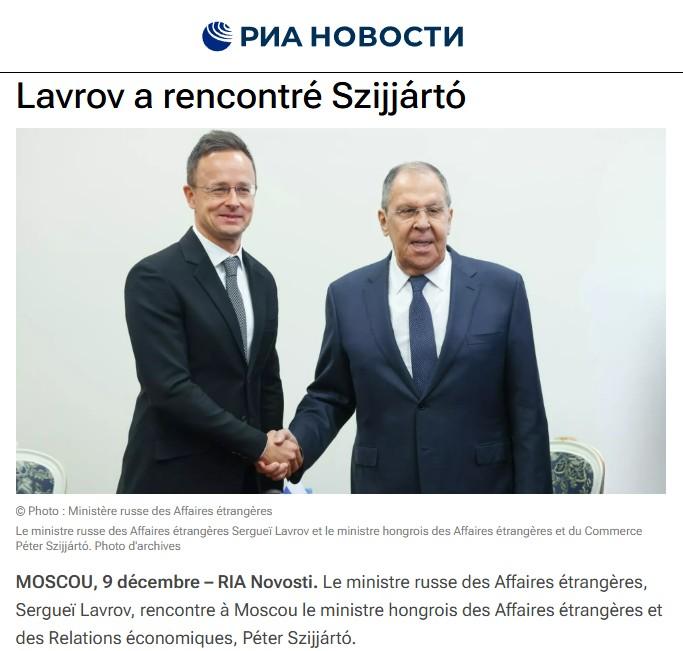
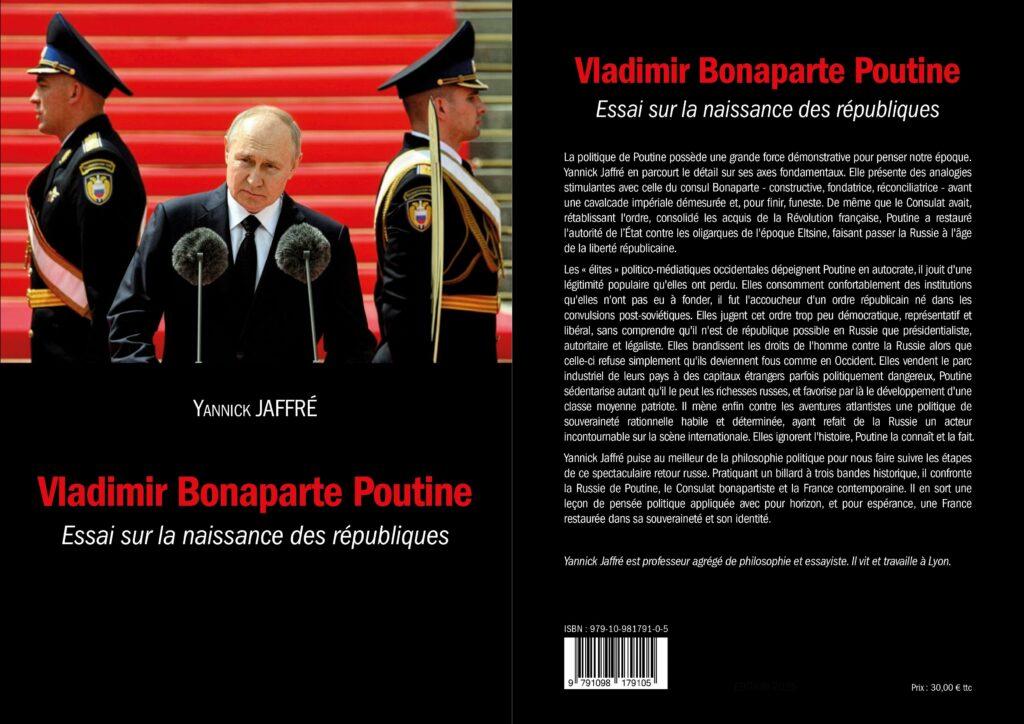 Yannick Jaffré compare la politique de Poutine à celle du consul Bonaparte : tous deux auraient restauré l’ordre et renforcé
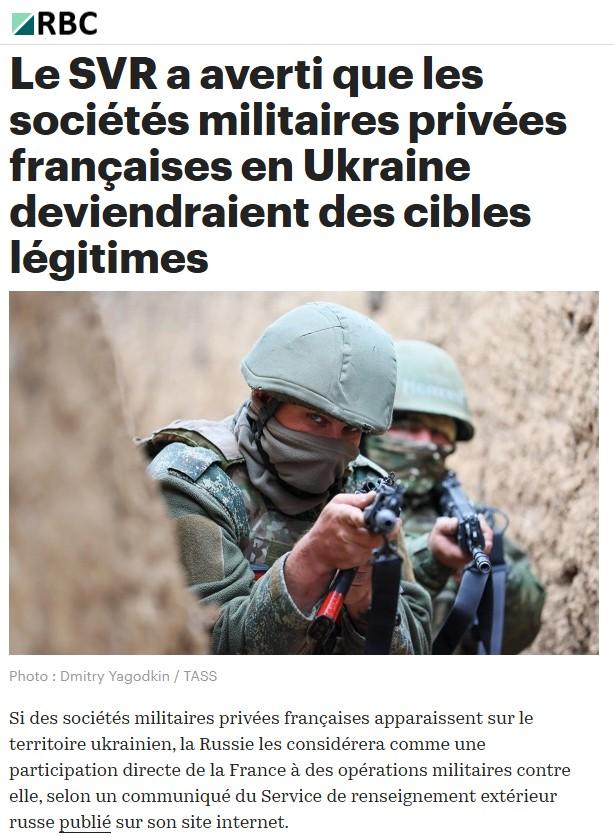
Si des sociétés militaires privées françaises apparaissent sur le territoire ukrainien, la Russie les considérera comme une participation directe de
L’article Le SVR avertit que si la France déploie des sociétés militaires privées en Ukraine, elles deviendront des cibles légitimes est apparu en premier sur STRATPOL.
 Au coeur d’une actualité brûlante, ce livre passe en revue les détails de cette grande manipulation organisée longuement par le
L’article US Go Home est apparu en premier sur STRATPOL.
Russian Foreign Minister Lavrov: The Anglo-Saxons resisted their creation. They wanted summary mass executions, not justice nor exploration of root causes.
≈≈≈
The fundamental root cause of conflict between the Anglo-American led West and the Rest of Humanity, especially the civilizational-states, is the hypocritical bifurcation in International Law, due to recent precedence of “rules-based order” imposed by the West. This was never agreed to by the others.
It was within artificially created spaces in international law (“one law for thee, one law for me”) that a singular supremacist civilization worked to rule all the others.
“Quod licet Iovi, non licet bovi” the Latin for “What is permissible for Jupiter is not permissible for a cow” is the fundamentally unjust hierarchy of the law of the jungle, intolerable to the civilized. It largely worked until recently as they used to hold the incontestible combination of a monopoly on war of scale and economies and wealth accumulation and set the standards and management criteria on which supranational organizations function. But we are at a moment when these fundamental accumulated imbalances are being corrected. A key mechanism involves the return to the letter and spirit of universally agreed tenets of International Law by all.
Of note, Russia led similar efforts at the fair universal application of one law on all. Just prior to WW1, Russian Tsar Nicholas II was instrumental in the creation of the Hague Conventions of 1899 and 1907, establishing the first formal statements of the laws of war and war crimes in the body of secular international law. And it is not a coincidence, as just before 1914, that under the pressure of being coerced into comity and equal relations with Others, that yet again the western realm currently flees forward into more War in order to maintain their predatory way of life.
≈≈≈
Video description & excerpts:
Russia’s foreign minister Sergey Lavrov said the Soviet Union was the driving force behind establishing the Nuremberg Tribunal, arguing that Western powers initially resisted the idea. He claimed the United States and Britain feared a full investigation would expose their pre-war dealings with Nazi Germany. Lavrov also said some Allied leaders preferred mass executions over legal trials, while Moscow pushed for a formal judicial process. He added that core Nuremberg principles remain under pressure in today’s geopolitical climate.
“Question: What do you consider the historical significance of the Nuremberg trials in the post-war years and how did they influence changes in the global order?
Answer: The Nuremberg Tribunal’s founding principles were first formulated during those trials and have become the foundation of modern international law.
They also largely take into account the achievements of Nuremberg in their work. The particular significance of the Nuremberg judgment lies in its establishment of no statute of limitations for crimes against humanity, genocide and war crimes.
And to our great regret, this decree states that there is no statute of limitations for these crimes and that Nazi ideology, the Nazi party and Nazi structures such as the SS, SD, and others are forever banned. Regrettably, these parts of the decree are currently being seriously tested and are often simply violated.”
https://mid.ru/en/foreign_policy/news/2058518/
Question: Moscow and Washington have almost simultaneously announced nuclear test plans. Does this signify global instability or rather demonstrate equal capabilities and thus the preservation of parity?
Sergey Lavrov: I have heard nothing about Moscow announcing nuclear tests, so it is inaccurate to say that Washington and Moscow made such statements simultaneously.
As I mentioned in a recent interview with Russian media outlets, we have so far not received clarifications from our US counterparts as to what exactly President Donald Trump meant to convey in his remarks. Was it nuclear tests, delivery vehicle tests, or subcritical tests which do not involve a nuclear reaction and are permitted under the Comprehensive Nuclear-Test-Ban Treaty (CTBT)? There has been no answer to that so far.
The CTBT Preparatory Commission met yesterday, but a US representative failed to provide any clarifications, either, although such a forum is clearly the right place to clarify what the US President had in mind when he said that.
The US administration is still in the process of being formed. Many second and third-level positions, primarily in the Pentagon, have so far remained vacant.
In particular, Robert Kadlec has been nominated for the position of Assistant Secretary of Defence for Nuclear Deterrence Policy and Chemical and Biological Defence Programmes. Last week, he spoke before Congress, where he was grilled on the issue of nuclear testing and the current administration’s approach to nuclear weapons. He said that President Trump’s decision to resume nuclear tests was driven by geopolitical considerations. As before, there is no technical need to conduct such tests. That’s a strong statement. I’m not sure whether the speaker himself realises the gravity of what he said, but we are compelled to interpret this as confirmation of what we have been saying all along which is that there is no technical necessity for such tests. He went on to say that the goal was geopolitical and thus drove the point home for us.
What may the geopolitical goal of the United States look like? Domination, right? The use of nuclear weapons argument in this setting is alarming and represents a significant departure from the concept once agreed upon by Ronald Reagan and Mikhail Gorbachev where a nuclear war cannot be won and therefore must never be fought.
Robert Kadlec seeking the position of Assistant Secretary of Defence also stated that nuclear options should be developed to respond to certain regional conflicts that may flare up. That, too, is a rather curious statement. It’s a direct tell that this gentleman, once in office, will be thinking in terms of using nuclear threats in order to achieve the outcomes that the United States may need in a particular region.
He then went on to demonstrate even more instances of double standards when he said that NATO’s nuclear deterrence strategy might be revised in the wake of Russia deploying tactical nuclear weapons in Belarus. Yet, the fact that this was done after many decades of joint nuclear missions with US tactical nuclear weapons long stationed in five NATO member states and the fact that we have long proposed to redeploy all nuclear weapons back to the countries that own them was simply ignored.
Since Belarus has received nuclear weapons from Russia, the US side now wants to deploy theirs somewhere else as well. We are aware of ongoing contacts with South Korea and Japan. These games are very dangerous.
Back to your question, we have not announced nuclear test plans. At a meeting of the Security Council’s permanent members, President Vladimir Putin highlighted US President Donald Trump’s statement that Russia and China have long been doing this, and therefore the United States must do so, too. We immediately contacted our counterparts and let them know that there must have been a misunderstanding. We are looking forward to receiving clarifications.
President Putin has issued a directive not to conduct nuclear tests and not even to make preparations for them. The Foreign Ministry, along with other agencies, including military and intelligence, has been instructed to analyse the situation and to reach a consensus on whether this situation warrants considering the resumption of nuclear tests.
Our principled position was laid out by President Putin in 2023, when, taking a question during one of his speeches, he said that if a nuclear power were to conduct nuclear weapons test (not delivery system tests, not subcritical tests), then Russia will respond in kind.
Question: One more article has recently been published where the journalist and his sources claim that the United States, in particular Secretary of State Marco Rubio has been shocked by your uncompromising stance. Have you really been hard on the Americans or is this yet another article where they have gone too far with their sources?
Sergey Lavrov: We are polite people, and we try to remain polite. I have already answered similar questions in several interviews.
Since this audience consists of professional journalists, I would like to draw your attention to the latest facts of unprofessional and harmful coverage of certain events in the media, primarily British media. You know what is happening at BBC. It’s a shame that some individuals are trying to justify the situation and are speaking about an orchestrated campaign.
I would like you to take note of the item published in The Financial Times, which said that Donald Trump and Vladimir Putin agreed to meet in Budapest and instructed me and Marco Rubio to prepare that meeting. Sergey Lavrov and Marco Rubio have talked on the phone, but before that the Russians allegedly submitted a harsh memorandum after reading which the Americans decided that talking with the Russians would be pointless and meaningless.
There are so many lies here, including when it comes to the sequence of events. The memorandum the FT journalists mentioned is a non-paper, an unofficial draft we have sent to our colleagues not after but several days before the Putin-Trump conversation. It was designed to remind our American colleagues what we discussed in Anchorage, and what agreements we thought we reached (the Americans have not refuted this) during the US-Russian summit. That unofficial document did not contain anything other than what was discussed in Anchorage, which our American counterparts did not regard as cause for rejection.
The presidents’ telephone conversation was held after the document was delivered to the Department of State and the National Security Council. During that conversation, US President Donald Trump did not say a word about receiving a provocative or “subversive” paper that destroyed all hopes for a settlement. No, they had a normal conversation. President Putin gave a positive response to US President Trump’s idea of meeting in Budapest and proposed instructing the countries’ foreign ministries to prepare that meeting. That is exactly what we planned to do.
US President Donald Trump also said that Secretary of State Marco Rubio would call me. I received his call three days later. We had a polite conversation without any nervous episodes, by and large reaffirming progress based on the agreements reached in Anchorage, and went off the phone. The next step was a meeting by representatives of our foreign policy and defence departments, and possibly our security services. However, the Americans have not taken the next step, although we waited for them to take the lead when it comes to the place and time for such a preparatory meeting because they had proposed holding a summit.
Instead, they made a public statement that they don’t want to hold a meaningless meeting. When Secretary of State Rubio made public comments on our telephone conversation, he did not say that he had noticed any aggravation or that it had undermined the chances of success. If I remember correctly, he said that it was a constructive conversation that quite clearly showed where we stand, which is why there was no need for a meeting. This can be interpreted in several ways, but this is what he said. There is a joke that we have a clean conscience because we seldom use it. But it is absolutely to the point in this case.
We see no reasons to offer excuses for being and remaining committed to what our presidents discussed in Alaska. Even if they did not agree on every comma and semi-colon, they have at least reached an understanding.
Question: You just mentioned the summit in Budapest. After his talks in the United States, Hungarian Prime Minister Viktor Orbán said he still hopes the meeting can happen. Is that still a possibility? And why has the focus shifted from a meeting in Hungary to a discussion of nuclear tests? What has changed?
Sergey Lavrov: I believe I have already addressed this. I cannot speak to what is behind the US position on nuclear testing, because President Trump’s claims about a supposed Russian and Chinese “resumption” of testing are simply not true – assuming we are talking about full-scale nuclear weapons tests. Other types of tests, like subcritical experiments (which do not produce a nuclear chain reaction) and tests of delivery systems, have never been prohibited. So, we are seeking clarification on these allegations.
As for the facts: Russia conducted its last nuclear test in 1991, and the United States in 1993. That was over thirty years ago. China’s last test was shortly after that. The most recent test by the DPRK was in 2017. Since then, we have seen no indications that any country is preparing to resume this practice. If someone were attempting to do this covertly, deep underground, it would be up to the professionals involved to expose it. In that case, they should be briefing the White House, not operating behind closed doors.
There is a robust global monitoring system in place, which both Russia and the US participate in. It relies on seismic data to record any significant underground vibrations. They know perfectly well what the indication of a nuclear explosion looks like. So, I would not conflate the issue of nuclear tests with the Budapest Summit.
The other day I watched President Donald Trump host Hungarian Prime Minister Viktor Orban at the White House and then speak with journalists. When asked about a meeting in Budapest, he said that he had thought it over and decided not to hold it, because, he said, “I didn’t think anything was going to be happening of significance.” This fits with the thinking he expressed not long ago when he said that “sometimes you’re better off letting them fight for a while.”
Frankly, I don’t see any causal relationship here. We are ready to discuss the suspicions raised by our US counterparts whereby we have allegedly holed up deep underground and are secretly doing something there. We are also ready to discuss with our US counterparts resuming preparatory work for the summit between the leaders of Russia and the United States, which they themselves proposed.
If and when our US counterparts renew their proposal and appear ready to begin preparations for a high-level meeting that could produce meaningful results, Budapest would, of course, be our preferred location. All the more so as, during his meeting with Viktor Orban, Donald Trump confirmed that Budapest was a preferable venue for Washington as well.
Question: There is not much time left before the New START Treaty expires, yet the United States has not presented its official stance on President Putin’s initiative. Do you think the United States will respond in the near future? If, by any chance, an articulate answer never comes, would that make a difference for Russia?
Sergey Lavrov: We have made it clear many times that this proposal is a unilateral gesture of goodwill on our behalf. No talks or consultations are needed for the United States to support our approach. All the United States needs to do is state that it will not raise the quantitative limits under the Strategic Arms Reduction Treaty for one year that is at least for as long as Russia adheres to its own unilateral commitment. That’s all there is to it. No further steps are required.
As for whether any talks are underway to renew the treaty, no, there are no talks. Once again, the situation is completely transparent. The quantitative levels are well known. We know what the Americans have, and the Americans know what they have. Let’s take a year to, so to speak, cool down, analyse the situation, stop measuring everything by the Ukraine yardstick, and focus on the great powers’ responsibility to maintain global security and stability, above all, in terms of avoiding nuclear war. We are ready for that.
This has nothing to do with the time constraints. A declaration to renew the quantitative limits can be made at any point before February 5. By the way, the current New START Treaty was renewed right after Joe Biden had taken office just a few days before the initial expiration date. Renewing the treaty is a much more complicated endeavour than the simple act of making a voluntary statement to continue observing and respecting its numerical parameters.
Question: Considering rising tensions in the region, has Venezuela approached Russia with a request to provide military assistance? Has Caracas asked Russia to deploy its weapons in Venezuela similar to the way it was done in Belarus?
Sergey Lavrov: No, no such requests have been made.
I believe it is inaccurate to compare our relations with Belarus which is part of the Union State and with which we share synchronised, coordinated, and unified positions on all key international security matters with our relations with the friendly nation of Venezuela which is our strategic and comprehensive partner, to which end we signed a treaty not long ago.
However, considering, among other things, the important geographic factor it would be inaccurate to juxtapose our partnership with Venezuela with our Union with the Republic of Belarus.
The treaty I mentioned is an entirely new instrument. It was signed in May during President Nicolas Maduro’s visit to Moscow to attend the events marking the 80th anniversary of Victory in the Great Patriotic War. The treaty is now in its final ratification phase. It is called the Treaty between the Russian Federation and the Bolivarian Republic of Venezuela on Strategic Partnership and Cooperation and provides for continued collaboration in matters of security, including military-technical cooperation.
We stand ready to act fully within the framework of the commitments we and our Venezuelan friends have assumed in this treaty. It has not yet entered into force. Venezuela has completed its ratification procedures, and we have only a few days left to do so as well. Both chambers – the State Duma and the Federation Council – have held hearings to that effect, and the treaty is almost finalised. We will strictly adhere to the obligations it contains.
I’d be remiss to conclude my comments on Venezuela without mentioning our position on the unacceptable actions the United States is taking under the pretext of combatting drug trafficking as it destroys boats allegedly carrying narcotics, without trial, investigation, or any evidence whatsoever. Law-abiding nations do not do that. This kind of behaviour is more typical of those who consider themselves above the law.
Recently, citing the Daily Mail, Kommersant reported that Belgium was rapidly turning into a narco-state, where corruption, blackmail, violence, and the shadow economy based on drug trafficking flourish across all sectors, from customs to the police. Not the most reputable source, perhaps, but if even Daily Mail wrote this, they must have had a reason to do so. Why else would they slander their NATO partner?
Instead of targeting Nigeria or Venezuela under the guise of fighting drugs – and seizing oil fields in the process – the United States would do better to tackle this problem in Belgium. After all, the US and other NATO troops are already there. They wouldn’t need to chase small boats carrying three individuals each. I’m confident that the policy chosen by the Trump administration with regard to Venezuela will not lead to anything good. It will not enhance Washington’s reputation in the eyes of the international community.
Question: You have repeatedly stated that peace in Ukraine will only be achieved by addressing the root causes of the conflict. As is well known, one of these root causes is the rampant neo-Nazism in Ukraine. Is this issue discussed in your negotiations with American colleagues?
Sergey Lavrov: We regularly raise this issue. In fact, since the Anchorage meeting and my telephone conversation with Marco Rubio, we have had no further contact. We did not specifically broach this topic in Alaska, but they are well aware of our position. It is “in writing” for them. There is no secret about it. The position was articulated by President Vladimir Putin in June 2024, when he spoke at the Foreign Ministry, outlining our fundamental approaches to Ukraine and relations with the West.
Among other absolutely non-negotiable conditions for a settlement – such as demilitarisation, the removal of any threats to the Russian Federation, including by dragging Ukraine into NATO, and safeguarding the rights of Russians and Russian-speakers, as well as the Ukrainian Orthodox Church – there is also the demand for denazification. This is not something we have invented as a notion alien to modern Europe.
One might think of the Nuremberg Trials. Their outcomes, forming part of the UN Charter, are a cornerstone of the international system established after the Second World War. Certainly, all of Europe signed up to this. Germany underwent denazification and a process of repentance.
Regrettably, now – perhaps even beginning with Germany – we sense that this repentance has come to very little. I have spoken about this before: some 15 years ago, during better days, in conversations with German colleagues, we noted the signals they were sending – not verbatim, but the meaning was quite clear. The gist was, “Dear colleagues, we have settled our accounts for the Second World War, we owe nothing to anyone anymore, and now we will act accordingly.”
Former Chancellors Angela Merkel and Olaf Scholz at least tried to observe decorum, while Friedrich Merz has repeatedly declared that his goal is to make Germany the primary military power in Europe once again. I think it unnecessary to explain what kind of signal such statements send – to make Germany the primary military power again. It already was a military power when it conquered more than half of Europe, calling it to arms to attack the Soviet Union.
When such Nazi relapses occur in the birthplace of Nazism, it naturally causes alarm. Naturally, it will require from us – from all those invested in a stable world – principled stances when discussing the final parameters of a settlement.
If the West finally recognises the futility of this scenario, i.e. that the demand should not be for a cessation of hostilities merely to continue arming Ukraine, but to act as President Donald Trump proposed before the Alaska meeting. He said then that a temporary truce would resolve nothing and that the conflict must be ended on the basis of principles for a sustainable settlement.
Yes, Europe later attempted (and not without success) to drag our American colleagues back into its camp of “truce, support for Ukraine, not a step back, not an inch to the left.” Nevertheless, President Donald Trump did say this, and it became the foundation of the understandings unequivocally agreed upon in Anchorage. Incidentally, this is what distinguishes the Republican administration, the administration of Donald Trump, from its predecessor – the administration of Joe Biden.
Recently, I came across an interview with Kurt Volker. He was the US State Department’s special representative for Ukraine under Joe Biden. He claimed that Russia would never agree to a peace deal. It is unclear where he got this from, because it is precisely we who are striving for a peaceful settlement. He added that Vladimir Putin does not consider Ukraine a legitimate or sovereign state. There is an answer to this as well. We recognised Ukraine when it was not a Nazi state and had not banned any language – in this case, Russian – as the only country in the world to do so. We recognised Ukraine as it was defined by the Declaration of State Sovereignty and the Act of Independence: a non-nuclear, non-aligned, neutral state. That is what we recognised, and that is how things stood.
Next, Kurt Volker asserts that Vladimir Putin is convinced Ukraine should be part of Russia (I will not even engage with that topic) and that the Russian President considers Vladimir Zelensky a Nazi. But where is the proof to the contrary? Vladimir Zelensky regularly poses on television, awarding honours to fighters of the Azov regiment [1] and other Nazi battalions, who wear the insignia of Nazi Germany on their sleeves. How else should one regard this man?
The eradication of Nazism in Ukraine – denazification – is an absolute condition for any settlement if we want it to be long-term. We do want that and will pursue it. But when no one in Europe, in their dealings with Ukraine, raises the issue of the country’s Nazification; when no one, except Hungary, addresses the rights of national minorities; when no one demands that Vladimir Zelensky repeal the law banning the canonical Ukrainian Orthodox Church…
In Alaska, when President Vladimir Putin explained to US President Donald Trump how we assess the situation in Ukraine, he mentioned that in 2024, they passed a law aimed at banning the canonical Ukrainian Orthodox Church. President Donald Trump did not believe it. He asked US Secretary of State Marco Rubio, who was present at the meeting, three times whether this was true. Marco Rubio confirmed that it was. It was clear that the US President was, to put it mildly, taken aback.
Returning to Ukraine and its legislation. I mentioned Hungary. When the Brussels bureaucrats, led by Ursula von der Leyen (who is now creating an intelligence structure and will personally oversee it), were pushing through the decision to begin negotiations with Ukraine on its accession to the European Union, Hungary – credit must be given to the courage of Hungarian President Viktor Orbán and his Foreign Minister Péter Szijjártó – stood alone in insisting that among the conditions Ukraine must meet before negotiations begin, there must be the resumption and restoration of all Ukrainian obligations regarding the respect for the rights of national minorities. There is a rather lengthy text on this topic. It was not difficult to draft, because the Constitution of Ukraine still requires respect for the rights of the Russian (singled out specifically) and other national minorities.
Currently, there is the European Commissioner for Enlargement, Marta Kos. When she claims that Ukraine is ready and has fulfilled all the necessary conditions to begin negotiations, this is simply untrue. Nothing has been done to address or restore the rights of national minorities – not even for the Hungarian minority, despite Hungary being a member of both the European Union, which Ukraine so desperately seeks to join, and NATO, where Vladimir Zelensky is also constantly pushing for membership. No action has been taken on this front, just as nothing has been done regarding the remains of the victims of the Volhynia massacre in relation to Poland.
The European Union remains entirely silent on these blatant violations. Ukraine stands as the only country in the world to have completely banned a language. Even in Norway, where 7 percent of the population are ethnic Swedes, Swedish is an official language. The figures speak for themselves – compare that to the situation in Ukraine. From Brussels, we hear nothing about Ukraine’s actions except for the mantra that they must stand with Ukraine to the end, “until victory.”
This same refrain was recently echoed by Mark Rutte and other representatives of the Western European establishment.
They insist that they must always defend Ukraine because it is upholding European values. This is nothing less than a confession – a self-exposure. It reveals that, in the eyes of today’s Brussels bureaucracy, European values equate to the revival of Nazism. That is precisely why we cannot afford to show weakness here.
Question: Recently, Lithuanian authorities have been increasingly flirting with the idea of closing their borders and halting transit to Kaliningrad for Russians, using increasingly flimsy pretexts. What measures is Russia taking, potentially with Minsk, to prevent this? And how will Russia respond if Lithuania follows through?
Sergey Lavrov: These smaller nations – the “young Europeans,” like Lithuania, Latvia, and Estonia – seem to vastly overestimate their importance in the eyes of the Western European “old guard” of the EU. Those in Europe who still possess a shred of common sense and a genuine concern for the continent’s security (a dwindling group, admittedly) are perfectly aware of the provocative role assigned to these Baltic states by their handlers, primarily British ones.
London’s penchant for provoking situations is, of course, notorious. Take the recent case where the Russian FSB exposed a plot to trick a Russian pilot, flying a fighter jet armed with a Kinzhal missile, into flying to a base in Constanta, Romania with a fake order. The obvious intent was for the plane to be shot down, creating a pretext to accuse Russia of attacking NATO. But I’ll set that aside for now; the FSB has already laid out the details. I don’t know how the British will wash away the stain, but they’ve always had a remarkable talent for this, like a duck that waddles away from a shower without a drop of water on its back.
The former empire that once ruled most of the world is gone, and so is the “good old England” they so love to parade. They have little economic weight left, and their military might is relatively weak, as even their nuclear arsenal isn’t fully under their control. They have to compensate for this weakness somehow, so they fall back on that traditional English aspiration to “divide and conquer,” to put it politely. There are, of course, less charitable terms for their actions and goals.
Now, back to your question. Indeed, recently we’ve seen not just the usual threats to block Kaliningrad transit, but certain figures – not in Lithuania, but within the EU itself – egging the Baltics on by suggesting Kaliningrad could be “razed to the ground.” Meanwhile, Lithuania has already closed its border with neighbouring Belarus, leaving hundreds of trucks from Lithuanian carriers stranded there.
On this matter, Belarusian President Alexander Lukashenko, as always, used particularly vivid language. These actions are outrageous. It brings to mind the phrase the Americans once used about dictators in Latin America, in Central America: “He may be a son of a bitch, but he’s our son of a bitch.” That’s precisely the attitude the European bosses have towards the antics of their Baltic protégés. They’re expected to commit as many heinous anti-Russia acts as possible, while also provoking Russia into a response that can be “sold” to Washington primarily as grounds for invoking Article 5 of the NATO treaty and starting serious military action.
We see this clearly. But the obligations regarding Kaliningrad transit are not Lithuania’s alone; they are the obligations of the entire European Union. The 1994 Partnership and Cooperation Agreement between Russia and the EU included a provision on ensuring transit between neighbours. This was reinforced by a separate joint statement on transit in 2002, which had direct legal effect. Then, in 2004, when the Baltic states and other Eastern European nations were admitted to the EU, a Joint Statement on EU Enlargement and EU-Russia Relations was signed, which explicitly reaffirmed all these commitments.
Subsequent technical documents spelled everything out in minute detail, including the layout and procedures for a “temporary travel document” and the clearance processes for passenger and rail cargo transit.
The European Union must now take responsibility for the behaviour of its wayward “junior members” who are spinning out of control.
Back when decisions on admitting Latvia, Lithuania, and Estonia into the European Union were being drafted in 2004, we asked our European counterparts – back then we had plenty of contacts and fairly open trust-based discussions – whether those three Baltic states were ready to meet the EU membership criteria. We were told they fell short in some areas, but…
We wondered whether bringing unqualified candidates into the EU made any sense. They said they knew where we were coming from, but having gained independence those countries were still haunted by phobias of “occupation.” “We’ll bring them into the EU and NATO,” they said, “and they’ll calm down.” Have they? I think the exact opposite happened. Not only did they not calm down, but they decided they would now call the tune in the EU and NATO, at least when it’s about openly Russophobic and anti-Russian “rhapsodies.” That’s the position they have adopted today.
In response to what I’m saying, someone in the EU may argue that we “invaded” Ukraine in violation of certain agreements we had arrived at with the EU before that. I have no doubt someone out there will be willing to come up with an argument like that. They are reluctant to recollect how things actually played out in Ukraine. How it all began long before the Minsk Agreements, long before Crimea, back in 2013, when then President of Ukraine Viktor Yanukovich analysed prospects for signing an EU Association Agreement and realised that many of its provisions would imperil trade, trade arrangements, and other economic benefits Ukraine enjoyed in its contacts with the Russian Federation. He became fully cognisant of this and requested to put off the signing scheduled for late November 2013. We supported his approach. We did so not because we wanted to prevent Ukraine from pursuing relations with other countries, but because we wanted Ukraine to keep its access to its commitments under the CIS Free Trade Area and its economic ties with Russia, which had been vastly beneficial for Ukraine. We also strived to avoid inconsistencies between the principles underlying relations between us and the obligations Ukraine was supposed to assume under the EU Association Agreement.
Back then, President Vladimir Putin reached out to European Commission President José Manuel Barroso (former Portuguese Prime Minister), letting him know that Russia had a free trade area agreement with Ukraine, and the EU planned to create one with Ukraine as well. The principles of these two areas are at odds with each other. Putin suggested having the three parties – Ukraine, Russia, and the European Commission – sit down and discuss ways to harmonise them. What could be more reasonable? Barroso came back through some obscure channels saying that since the EU did not interfere in Russia’s trade with Canada, Russia should likewise stay out of EU-Ukraine relations.
We often talk about former Assistant Secretary of State Victoria Nuland and her confession that $5 billion had been invested in Ukraine over the years preceding the coup. The EU catalysed the Ukraine crisis. It fueled the Maidan protests and planted the catch phrase that Ukraine must be with Europe, not Russia. They said this publicly. So, we should be left out of it, and they shouldn’t justify their own lawlessness by referring to the steps our country was forced to take after exhausting every reserve of goodwill and constructive proposals.
Here are some examples of the EU showing lack of integrity. In 2008-2009, the EU – France in particular – faced issues in Chad and the Central African Republic, which were home to small French expeditionary forces that lacked air support. They asked Russia to send in a helicopter group to assist in operations against rebels that engaged in genocide and other atrocities. We have sent the group as requested. Later, we reached out to our EU partners with a suggestion to create a joint crisis response mechanism for operations abroad based on this experience.
We proposed an approach under which, if Russia were to conduct an operation, we could invite the EU to participate in it on an equal footing, and if the EU were to engage in an operation, it could invite Russia. They were receptive of the idea. Discussions began, and everything appeared to be moving towards the sides coming to terms. Some time later they told us there would be no parity, because there already was an agreement outlining the possibility of Russia’s participation in EU operations, which covers everything. So much for an approach supposedly based on equality.
There are quite a few other examples, including the Meseberg Initiative, which we recently mentioned in our comments. Back then, President Dmitry Medvedev and German Chancellor Angela Merkel agreed in Meseberg on a declaration establishing an EU-Russia Committee on Foreign Policy and Security. Ukraine was not even mentioned, only Transnistria. Merkel insisted on having the creation of that committee come with a condition, namely ensuring progress in the Transnistria settlement. That provision was included. Following those understandings, we ensured the resumption of the “5+2” format for the Transnistria settlement, which had been dormant for several years. The format resumed its work, but when we approached the EU with a proposal to now create the joint Committee on Foreign Policy and Security, they chose not to reply and the idea went off the table. That’s how much the EU’s word and even signature is worth. In this particular case, the EU was represented by Chancellor Angela Merkel.
A particularly glaring example is the visa-free regime with the European Union. Negotiations had been underway even before 2004, as at the Russia–EU summit in 2004, the then-head of the European Commission, Romano Prodi, stated that within a couple of years we would achieve a relaxation of the visa regime. Several years elapsed. We developed our internal regulations based on the framework agreed with the EU. Once these norms were finalised domestically and all requisite bilateral agreements with individual EU member states were concluded, no outstanding condition remained unfulfilled. In response to our query regarding potential timelines for abolishing the visa regime, the European Union engaged in protracted deliberations. Its eventual response was to table a new draft document, proposing a joint consideration of further steps. The document outlined purely technical nuances. Nevertheless, we engaged in this work as well. President Vladimir Putin has repeatedly recalled those times.
Back then, not only was faith alive, but there was also a lingering hope that we were dealing with honourable counterparts.
Ultimately, these additional technical matters were also resolved. This was in the summer of 2013. When we suggested announcing the agreement, they (the EU officials) withdrew from official contacts on the matter and from providing an official response. Off the record, it was intimated to us that, despite our full preparedness, political considerations precluded the conclusion of a visa-free agreement with Russia prior to finalising such agreements with Moldova and Georgia. Ukraine was not mentioned at the time.
Therefore, should the European Union level accusations of violations against us, firstly, there is not a single factual basis for such claims, and secondly, we have ample means to “pacify” our European colleagues.
Question: Next year, the Treaty on Good-Neighbourliness, Friendship, and Cooperation between Russia and China will expire. Are there negotiations underway to extend it? Or will Moscow and Beijing draft new agreements to reflect the changed realities?
Sergey Lavrov: This treaty remains entirely relevant. It is no coincidence that when its initial term expired in 2021, approximately a month prior, President Vladimir Putin and President of the People’s Republic of China Xi Jinping signed a document extending the treaty for five years. These five years are now coming to an end. The 2021 statement affirmed that the treaty remains fully pertinent, retains its force, and serves the interests of further strengthening the comprehensive partnership and strategic cooperation between our countries.
I believe this assessment still holds. However, events are unfolding rapidly, and our strategic cooperation and multifaceted partnership with the PRC are deepening, acquiring new dimensions. In principle, we have agreed with colleagues from other agencies to explore whether specific areas could be used to “enrich” this treaty. I am unsure of the form this might take. It could involve adopting another document confirming and expanding the treaty’s provisions. No definitive decisions have been made yet, nor are they necessary, as such decisions, when put in writing, merely reflect the realities on the ground. In practice, our relations have never been more advanced, close, or trusting. As our Chinese friends say: we work “shoulder to shoulder, back to back” in all spheres of international life. These are not empty words.
Thus, I assure you that the date of July 16, 2026 will not pass unnoticed. The details of how our cooperation with our Chinese friends will be confirmed, expanded, and deepened will be handled by the executive offices of our leaders. A report will subsequently be submitted at the leadership level.
The organisation is recognised as terrorist and banned in the Russian Federation. [There is no link to understand what exactly is being referred to here].
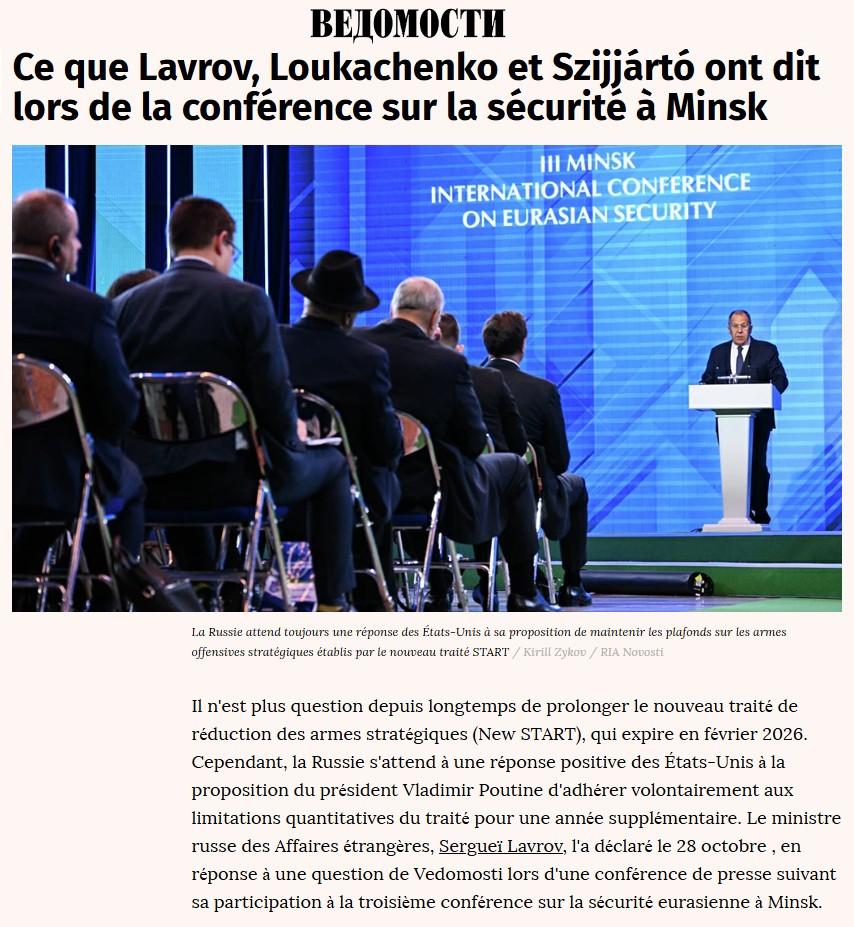
Il n’est plus question depuis longtemps de prolonger le nouveau traité de réduction des armes stratégiques (New START), qui expire
L’article Lavrov à Minsk pour la conférence sur la sécurité eurasiatique est apparu en premier sur STRATPOL.
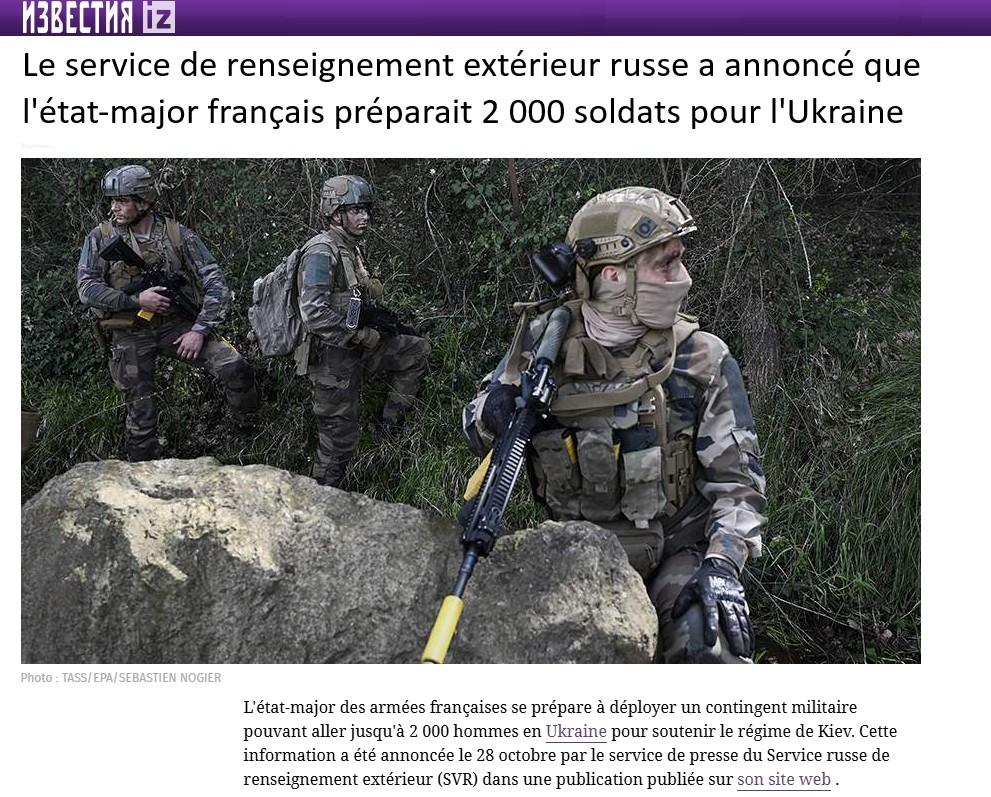
L’état-major des armées français se prépare à déployer un contingent militaire pouvant aller jusqu’à 2 000 hommes en Ukraine pour
L’article La France prépare un contingent de 2 000 militaires à envoyer en Ukraine, selon le renseignement extérieur russe est apparu en premier sur STRATPOL.
https://mid.ru/en/foreign_policy/news/2055699/#sel=46:39:j,46:39:j
[Note: This is a very good overview of the complete process of the start of the SMO and the US intervention in the process of making peace. That part is serious. The part that is different, is that Mr Lavrov is continuously trolling. If you want to see a highly competent and enormously talented Foreign Minister and Diplomat troll, this is it. That fine line stands out! Mr Lavrov’s description of what happened in Alaska is a comic show. All was agreed. All was confirmed in terms of Witkoff’s outline and step by step outlined as understood and agreed by Putin himself. All the pre-work for a summit was done. Russia said they are in agreement with, and accept the US outline. OK, done, sign on the dotted line. And then comes the comic – They agreed that they should take some time to think about it. This was their own concept that they needed time to think about! The subtext here is even if Russia agrees with them, they cannot be moved to a phase of execution of their own plan. This then brings the concept of ‘non-agreement capable’ to the forefront. We always think this refers to others, but these brilliant specimens of humankind cannot even agree with themselves. Follow Mr Lavrov’s troll roll thoughout.]
Question: Thank you, Mr. Foreign Minister, thank you for giving us your time.
Sergey Lavrov: My pleasure.
Question: So we are here in Moscow. And I came from Hungary, from Budapest, just a few days ago. And Moscow is beautiful. This is the first time for me in Moscow. And when we planned this interview, there was a plan for you to come to Budapest with Marco Rubio, the US Secretary of State. You were going to help to set up a negotiation between President Putin and President Trump. But finally, you didn’t come. We heard many different stories about why. What really happened? Is everything ok between you and Mr. Rubio and between Russia and the United States?
Sergey Lavrov: Well, it’s up to you because you’re a journalist. And your job, your profession, is to analyze what is going on.
It is not very difficult because these days, for example, the American foreign policy is as open as it could be. The President of the United States explains every day how he feels about one thing, about another thing. And this is, I think, very interesting for the journalists to be in a position to get this information straight from the leaders.
President Putin yesterday commented upon the Russian-American relations at this particular stage. I wouldn’t repeat what he said. But as regards the relations between Marco Rubio and myself, after the presidents had their conversation on the 16th of October. This was Thursday. And three days later, on Monday, Rubio called me. We had a conversation, very specific, where I reconfirmed our full adherence to what was discussed in Alaska and to what clear understandings the presidents reached at that time. As you know, President Trump praised the Alaska meeting repeatedly, that this was a very good meeting, that it set the stage, laid the foundation. He said, there are a few issues to be fine-tuned. But this could be done easily. One issue is important, he said in his comments about the outcome of Alaska. But this important issue is absolutely subject to finding a solution, which is absolutely our assessment. After we talked with Marco Rubio regarding following up on the results of Alaska, he did not mention any new meetings or conversations. And I did not raise the issue, because the entire initiative was coming from the United States. And we would be ready to move as the Americans feel comfortable for themselves.
Then the State Department issued the communique about our phone conversation, if I remember right, which said that we had a productive discussion with Marco Rubio. And at this stage, there is no need in a personal meeting between the Secretary of State and the Foreign Minister of Russia. So I concluded that the meeting was really good if they made such a comment. And I understand what is behind it. Behind it is the clarity with which we discussed the necessary steps together with Marco Rubio, steps which the Russian Federation and the United States can take to implement very clear, very blunt understandings reached in Alaska.
Question: Obvious, if you are talking, we feel the chance the conflict can be ended. But after, when we read the press, there is a different picture. But why will you not call back Marco Rubio in this situation? And you can call back Marco Rubio and say, hello, I read in Reuters the articles and Mr. Trump told this and this. Why don’t you want to talk more often with each other?
Sergey Lavrov: I called him before Alaska, soon after Alaska. And we met in New York just three weeks ago. And as I said, look, President Putin came to Alaska with the agenda, which had been brought to Moscow by Steven Witkoff a few days before the Alaska summit. And we looked into the proposals which Steven Witkoff brought. And we said that we need to think about it.
And then in Alaska, President Putin said that he is ready to cooperate on the basis of the concept and the framework which the envoy of President Trump brought to Moscow and which they continue to discuss in Alaska. President Putin repeated each and every element of the concept which was brought by Steven Witkoff and was asking Steven Witkoff, who was present at the discussions in Anchorage, is that right? Is that right? Everything was confirmed. And then President Putin said that we are ready to accept your concept. And that’s how we believe we can move in specific terms on the basis of what you proposed. Then there was no direct response. They agreed that they should take some time to think about it.
President Trump said he needs to talk to his allies, who, as you remember, came to Washington next day. Zelensky was brought with them. And President Putin, of course, briefed our allies, our neighbors, and strategic partners. So the ball was there on the side of the Americans who proposed something which we eventually were ready to accept. And in New York, I reminded Marco Rubio about this sequence of events. He said, yes, we are still considering. We are trying. We are interested.
So from the diplomatic point of view, we don’t want to interfere in their internal considerations. We don’t want to create some discomfort for the United States, which is under huge, unbelievable pressure from the European “hawks”, from Zelensky, and others who don’t want to have any American-Russian cooperation on anything.
So there are enough people who are not very polite and who impose themselves upon Washington politicians and use every means to undermine the process which could have achieved its goals some time ago.
And one very telling thing is they are trying to push President Trump from the logic which he repeatedly presented in the past. And I will quote a couple of his statements regarding how this crisis should be resolved. He bluntly said, actually, he was the first, if not the only, leader in the West, and maybe not only in the West, but on Earth, who from the very beginning, even before he was inaugurated, early September, he was still president-elect. He said that you could never have NATO involved with Ukraine. If Russia has NATO right on its borders, it cannot tolerate it, and I could understand their feelings about that.
Zelensky and Ukraine must understand (this was already in August, a couple of months ago), must understand no getting back Obama-given Crimea, and no going into NATO by Ukraine, also in August Russia said, we don’t want them on our borders, and they were right. And everybody knew, you can’t. You just can’t do that.
And actually, in Anchorage, I almost quoted, he said, we had an extremely productive meeting, and many points were agreed to. There are just a very few that are left. Some are not significant. One is probably the most significant, but we have a very good chance of getting there. That was his statement at the press conference in Anchorage. So he went public with this assessment, which fully coincides with our assessment.
And the very significant statement was made on the 16th of August, when he came back to Washington from Alaska. And he said, a great and very successful day in Alaska. It was determined by all that the best way to end the horrific war between Russia and Ukraine is to go directly to a peace agreement, which would end the war, and not a mere ceasefire agreement. This is key. He answered to all those who were, since probably the beginning of spring this year, they radically changed their rhetoric. And before, they were saying, no cessation of hostilities. Russia must be defeated, “strategic defeat”, and so on and so forth. Then, as of spring, about that time, they started saying immediate ceasefire without any precondition. And they continue to sing this song until now. Rutte, Macron… By the way, Macron, when they shifted to this logic, ceasefire, stop the killings without preconditions, and then we’ll see how it goes. And Macron was asked whether this cessation of hostilities, ceasefire, includes the pause in providing weapons to Ukraine. He said, no, it does not. No preconditions at all.
So when President Trump, after Anchorage, bluntly, publicly stated that in his conviction, it is not a ceasefire, but a sustainable, durable peace, which, as he said, must be a long-term peace, a very long term. And another quotation, we are not talking about a two-year peace, and then we end up in this mess again. This is exactly what happened with the Minsk agreements, which were agreed in 2015, endorsed by the UN Security Council. And then the Ukrainian government and armed forces were violating the ceasefire announced by the Minsk agreements. And later, five or six years later, when these Minsk agreements were sabotaged in a very big way, the signatories, like Angela Merkel, Francois Hollande, and the former Ukrainian President Poroshenko, they said, we never intended to implement them. We needed to buy time to rearm Ukraine, so that Ukraine is able to continue to fight Russia.
So when President Trump, after Alaska, said, we are not talking about a two-year peace, and then we end up in this mess again. It’s one of the best characteristics of what happened with the Minsk agreements.
And when people now say, nothing but a ceasefire, immediate ceasefire, and then history will judge, it’s a very radical change. But this also means that the Europeans, they don’t sleep, they don’t eat, they try to twist the hands of this administration.
Question: Some people say Russia is unflexible. And are there any Russian conditions in the negotiations that are flexible, for example, about territory? What about the parts of Donbass that Russia has not taken yet? And what about Kherson and Zaporozhye and others?
Sergey Lavrov: Well, this is all reflected in many discussions. President Putin addressed this issue regularly when he was asked by journalists, or when he meets with President Trump, or with Prime Minister Orban, Prime Minister Fico, all those who are interested in talking to Russia, better understanding Russia’s position, they always have a chance and opportunity to come and discuss whatever is of interest for them.
The new territories which you mentioned, they are not actually new territories. They are historic Russian territories. Yes, after the Soviet Union disappeared, this was left inside the former Ukrainian Soviet Socialist Republic. And there was no thought that this Slavic Republic could have leadership which would go the way the Nazis went before World War II. And step by step, Ukrainian government being independent from the Soviet Union, having proclaimed sovereignty, and so on, they have been more and more under the pressure and influence of the Brits, Americans, and Europeans, who were having a chance to implement the very old dream which Zbigniew Brzezinski expressed a couple of times, and some other American politicians, when they said, Russia with Ukraine is an empire. Russia without Ukraine is a mid-level player, an original player in international affairs. We never thought about this in those terms. But the philosophy of the US politicians, who were obsessed with not allowing Ukraine and Russia to be together, is very telling. It’s the same divide and rule logic, colonial desire to undermine alliances which would not be ruled by you.
And we recognize independence of Ukraine, no doubt about this. But we could never think that the people who live on these territories which you listed, which are now in our constitution, that these people would be considered second sort, especially after the coup 11 years ago in February 2014, when the putschists took power by illegal bloody coup, masterminded by the United States. Some time ago after this event, Victoria Nuland admitted at the hearings in Congress that the United States spent, by that time, about $5 billion to support Ukraine. And she said it was not in vain, because eventually democracy prevailed. This democratic government, which came to power illegally, their first statement showing their political instincts was that they will cancel the status of the Russian language next morning after the coup.
And the coup, of course, happened the day after Germany, France, and Poland guaranteed the deal between the then president, recognized by everybody as legitimate president, and the opposition. And when we called the French, the Germans, and said, guys, you guaranteed the deal, next morning the opposition took all government buildings and so on and so forth. And they said, you know, sometimes democracy takes an unexpected twist.
Interesting. And then, of course, they sent armed groups to storm Crimean parliament. That’s when the people of Crimea rejected this power, these authorities, and held referenda. Then Donetsk and Lugansk, the parts of Donetsk and Lugansk did the same.
It is not about territories for us. It is about the people who have been living on those lands for centuries. They were building cities, including the city of Odessa, a very famous place which was founded by Catherine the Great, whose monument recently was removed by Zelensky government, who would like to forget all parts of history which, one way or another, link Ukrainians and the Russians. But this is going to fail. He cannot undermine this.
So my point is that and when President Trump said about NATO in Alaska, when also in Alaska he mentioned about territories, for us, it is not territories. It is about the people who live on these territories. But then, next day, when this crowd, European crowd, brought Zelensky to the White House, and after that Zelensky was talking to the media, and some Europeans were talking to the media, and they say, nobody can prohibit Ukraine to join NATO. No territorial changes, no nothing.
Actually, I will quote some of the statements by Zelensky and his team. They, from April 2022, when Boris Johnson came and prohibited Zelensky to accept the deal negotiated in Istanbul, which was actually proposed by Ukrainian side, and which was initialed. But after this was undermined by Boris Johnson, now we know that he got about one million pounds from his friend to continue the war, because his friend was selling guns to Ukraine. So after that, they said, no negotiations with Putin. No negotiations, only he must be brought to International Criminal Court. We want European soldiers. We don’t want – no ceasefires, he was saying only one year ago. And then, in September this year, he said, to give to Putin one or another piece of land, this would never happen. It is not a solution, this is just a pause. And isolation of Russia is what must remain forever.
So when people now say, ceasefire, we know that they want just to buy some time again. And that this logic, which is deeply rooted in Zelensky, whatever moves his head, brain, is obvious for any objective observer.
Question: Donetsk, Luhansk and Crimea, I understand. But what about Kherson and Zaporozhye? Could Russia ever talk about giving them back to Ukraine?
Sergey Lavrov: They are also part of our Constitution. And the fact that this was not just imposed from above, like in Kosovo the population was not asked. The representative of the United Nations, who was a Finnish, former Finnish president, he just said, Kosovo is independent, – full stop.
Unlike this trick, we based the decision to include them, to admit them back to Russia, because all these lands were founded by the Russian Empire and developed by the Soviet Union. Only after all of them, each of these four regions after Crimea, held referenda and bluntly expressed their desire to rejoin with Russia.
And when we now liberate remaining parts of Zaporozhye, this is the Russian way to pronounce it. And Kherson, the people, in spite of the attempts of Ukrainian army to pull them into mainland Ukraine, most of them are not leaving. They’re staying, and they’re welcoming the Russian soldiers who liberate them. So this is not our will, our “imperialist desire”, some people say. This is our concern for the future of the people who feel being part of the Russian culture.
By the way, when Zelensky and his entourage, like Macron, Starmer, Merz, and others, they still say Russia must get out of Ukraine, out of 1991 borders. And yesterday, I think, they gathered in London for this Coalition of the Willing. And Starmer, addressing the media before the event, he said that Russia, Putin is the only one who doesn’t want peace.
And this deserves some explanation. Putin supported the deal between the government and opposition in 2014, immediately after the coup. Obama called him. Obama asked him not to block the deal. He said, if the legitimate president is signing something with the opposition, how can I block him? And then you know what happened. The coup, and explanation by the Europeans that sometimes democracy is very tricky. They did not lift a finger to stop these putschists, though they knew very well that they came to power under the neo-Nazis’ banners. Then in 2015, the Minsk agreements. We negotiated the Minsk agreements. We were prepared to implement them. They, as I mentioned, said that we never intended to do this. We just needed to buy some time.
In April 2022, a couple of weeks after the special military operation started, Ukrainians asked for negotiations. We agreed. We held several rounds in Belarus and then moved to Istanbul. And in Istanbul, as I said, the Ukrainian delegation put a paper with the principles to be developed into a treaty. We accepted this paper. It was initialed. And then Boris Johnson said, don’t do this. Continue to fight Russia until we defeat them.
So when Starmer said that Putin is the only one who is against negotiations, he should remember about his former prime minister, Boris Johnson. He should remember about those in Germany and in France who signed the deal and then, a few years later, admitted that they never intended to do this in spite of the fact that it had been endorsed by the UN Security Council. And then Starmer continued to say that Putin must stop atrocities, must stop killing children, and he must withdraw to the borders of 1991.
On children, it’s a shame. I mean, the amount of lies, the amount of propaganda is astonishing. We have been hearing that tens of thousands of children have been stolen by Russia from their parents. And after the Istanbul process started this year, there were three rounds. At the very first meeting, our delegation asked Ukrainians, guys, you are concerned about the kids. Can we get the list of those kids who are missing? It took some time. Eventually, we received a list of 339 names. No 10,000, not even 1,000. And we checked that list. A huge part of it are not kids, grown-ups. Many have been verified as being in Europe. So when you listen to this.. But Starmer keeps saying that we must stop hijacking children.
And that’s for “1991 borders”, and “Russia must withdraw”. Ok hypothetically, in their dreams and delusions, if we leave the territories inside the 1991 Ukrainian borders, what happens to those people whom they publicly called the respective governments of Ukraine after the coup, called them “inhumans”, called them “species”. “Species”, by the way, is the term used by Zelensky long before the special military operation started. He was asked in November 2021 what he thought about the people in Donbass on the other side of the line of contact, according to the Minsk agreements. And he was asked what he thought about those people. He said, you know, there are people, and there are “species”. And then in other interview he said if you live in Ukraine and feel like being part of Russian culture, my advice to you, for the sake and safety of your kids, for the sake and safety of your grandchildren, get out to Russia.
So in fact, Donetsk, Lugansk, Zaporozhye, and Kherson, the population of these four territories, they follow his advice. They go back to Russia.
Question: And what about Odessa? Because President Putin told the Hungarian journalist, Gábor Stier, at the Valdai discussion that Odessa is an ancient Russian city. What did you mean by that?
Sergey Lavrov: I just mentioned it’s just the fact which any educated person know very well, that Odessa is a city. There was a very small village on that spot. And Catherine the Great founded Odessa. She built Odessa. She built the ports. She built roads, factories. And that’s what is meant. Odessa was always international city, famous for its good humor. And Odessa, of course, is the heritage. And it is part of the UNESCO list of world cultural heritage.
But when the monument to the founder of the city, Catherine the Great, was removed by the nazist regime, UNESCO just stayed shut up. And the French director general, Madame Azoulay, did not comment upon it at all.
Question: If the negotiations don’t work, when will Russia say we have reached our goals and end the war?
Sergey Lavrov: Look, the goals have never changed. I gave you some examples. When they started ‘strategic defeat’ to Russia – no negotiations. And now they are pleading and threatening. Ceasefire immediately, without any preconditions, because Ukraine is running out of weapons. And we need to replenish the weapons for Ukraine. Or there must be sustainable long-term peace, as President Trump said after Alaska. Now the Europeans are trying to dominate the agenda with the rhetoric about cease fire. They are zigzagging, depending on what is going on on the front line.
We are convinced that to save the people from the nazist regime, the people who have always been part of the Russian culture. They spoke Russian language. They were teaching their children in Russian. They watched Russian movies. They got news from the Russian media outlets, culture, theaters, what have you. And when all this has been prohibited by legislation, the Constitution of Ukraine still states that the state of Ukraine guarantees the rights of national minorities. Russian minority is highlighted separately. Russian and other national minorities, as regards education, what have you. And when all this was canceled by law and they started this canceling in 2017, long before the special military operation started. And since then and this was another root cause. The root cause, number one, NATO, because it was intended to pull Ukraine into NATO and to build military bases in Crimea on the Sea of Azov, just on our doorsteps. And I quoted President Trump, who bluntly explained why it’s absolutely unacceptable to Russia. And everybody must understand this.
But another root cause is extermination of everything Russian – history, language, media, culture, education – toppling and destroying the monuments to the Russian representatives who founded Ukraine in the eastern and southern part, toppling the monuments to those who saved Ukraine and Europe from Hitler and his nazist troops. And we ask from time to time, publicly and individually, we ask our colleagues who show any interest in helping to settle this conflict, we ask, why are you… Ok, NATO, it is something which not too many people would like to get into publicly. But human rights, it’s in the United Nations Charter. It says everybody must ensure human rights, irrespective of race, gender, language, or religion. Language, as I said, is totally banned by law. In practice, people still use Russian language because it is their native language. Ukrainian Canonic Orthodox Church had also been banned by law.
But people only ask, when are you going to end the war? When are you going to have a ceasefire? It’s not honest, if you wish. An honest discussion would be to tell Ukrainians, before anything else, restore language rights, restore all national minority rights, because your constitution says so. And in violation of the constitution, you pass so many pieces of legislation. Including, by the way, the legislation which discriminates Hungarian national minority in the Western Ukraine, though Ukrainians try to be very specific in discriminating Russian language and trying to make some concessions for the language of the European Union. There is no single international convention which says that there are some languages which are more important than others. It’s like Orwell, you know? All animals are equal, but some are more equal than others.
I repeatedly discussed this with Peter Szijjarto, and he assured me that when Hungary fights politically, diplomatically, for the right of national minorities, Hungary means all national minorities, as international conventions, as the United Nations Charter, require. And we appreciated the role Hungary played when this framework for negotiations with Ukraine on accession to the European Union was discussed. And Hungary, I think, single-handedly insisted that these chapters on negotiating accession included quite considerable language on national minorities, on their rights. And it is formulated not just about European Union languages. It’s about all languages and all national minorities. And we appreciate that Hungary happened to be basically the country which single-handedly achieved this.
It’s another matter that nobody in Brussels wants to remember about this deal, this consensus. And when various representatives, including the Commission for Enlargement, Mrs. Kos, as far as I understand, is saying, no, no, no, Ukraine is fully ready to begin accession negotiations. For Ukraine to be ready, they first have to undo what they have done in violation of their constitution and many, many conventions.
So it’s not, I think, appropriate when people say, when are you going to end the war? Where are you going to stop? Zaporozhye, are you going to give it back? Actually, we now have taken some other territories which do not belong to the regions reflected now in our Constitution. The reason is very simple. We need a buffer zone. Because Ukrainians continue shelling, bombing, droning Russian territory, including the territories which never were challenged by anybody. I mean, Bryansk, Belgorod, Kursk. So root causes, that’s what must be key to understanding how to help end this situation efficiently, thinking not about grabbing back territories, not about saving political losers who are ruling in Kiev, but thinking about the people who should be the utmost concern of those who say that they are champions of democracy. And when we are accused that we violate so many things, we invaded independent state in violation of one thing, like in violation of its independence, then in violation of the Budapest Memorandum of 1994.
First, we recognized Ukraine on the basis of its own Declaration of Independence and its Constitution. In 1990, Declaration of Independence was adopted, which says non-nuclear, neutral, non-bloc country with the rights of all national minorities, and so on and so forth. And this was then endorsed by the Constitution.
So we recognized the Ukraine, which was very different from the country run by the openly nazist regime. And when people pull it into NATO and say it has the right to choose alliances, it is not our reading of the situation. When we recognize somebody, it is on the basis of what this country is, according to its own proclamation.
Question: The other question, before the Hungarian-Russian relationship, I’ve been thinking a lot about if Ukraine joining NATO is a red line. Why was Finland’s NATO membership not a red line? What is the difference between Ukraine and Finland from Russia’s point of view?
Sergey Lavrov: Well, the regime in Finland, I think they made a mistake. I know Alexander Stubb very well. Since the time when he was the foreign minister, remember in 2008, when then-president of Georgia, Saakashvili, launched an attack against the city of Tskhinvali and the peacekeeping group, which was there on the basis of the mandate of OSCE. And Alexander Stubb was in Tbilisi, and then he was passing through Moscow. And he made a very, I think, sober and accurate assessment of what kind of person Mr. Saakashvili was. And he was a reasonable gentleman. We had nice human relations and nice professional relations.
And then, after the special military operation against the nazist regime in Kiev started, somehow the Finnish leadership started to experience, I think, nostalgic feelings about the times when they were helping another nazist regime to defeat Russia during World War II.
Question: If there will be another leader in Ukraine, not Zelensky, then will the regime be a Nazi? If there would be another leader.
Sergey Lavrov: Look, I am not in the guessing business. We have a bluntly nazist regime, which, as I said, shows openly the despise to anything Russian, which prohibited anything Russian. It’s the only country on Earth which prohibited a language, not to mention that this is official language of the United Nations. In Palestine, in any Arab country, Hebrew is not prohibited. In Israel, Arabic is not prohibited. But Zelensky prohibited the Russian language. Now they included Pushkin, Lermontov, Dostoevsky, some other writers of world fame in a list of materials which promote “imperialist propaganda”. No comment, as it were.
Question: So the Hungarian-Russian relationship. A few days ago, it was October 23, the anniversary of the 1956 revolution in Hungary. And that was one of the saddest days in our history, and when the Soviets occupied our country. Some Hungarians still fear the Russians. We love freedom, and we love independence. Honestly, we don’t want to be attacked again. What can you say to them? Should they worry about a Russian attack in Hungary?
Sergey Lavrov: They don’t need to be told. They know this. And we, long ago, reached agreement with our Hungarian colleagues that there would be no emotions, that there would be honest reading and rethinking of history. When President Putin was in Budapest long ago, 2006, he laid flowers to the monument to the victims of 1956 events.
And just recently, he was in Eastern Economic Forum in Vladivostok, I think two years ago, in 2023. And he said that this, addressing the issue of 1956, that this part of the Soviet policy was a mistake. And they don’t have any difference on assessing those events with Prime Minister Orban. But they as I said, don’t need to ignite emotions around this issue, though maybe some people in Hungary and in Russia, especially those who emigrated, maybe they would like to drive a wedge in our relations and to try to steer this history.
But the leaders of Russia and Hungary, they know better. This is part of history. We gave our assessment. Hungary gave its assessment. And we now live a new life, remembering about all periods of our history. There were good periods. There were not very good periods. There were bad ones. But they remain in our memory. They remain in history. And they do not prevent us from developing mutually beneficial cooperation, politically, economically, technologically, and other ways.
Question: I am asking because you went to Alaska wearing a Soviet Union hoodie. And some people in Hungary weren’t too happy about it. Some people said it was a secret message. Was it, or are you just a big troll?
Sergey Lavrov: There was some concern that I went to Alaska?
Question: You wore a Soviet Union hoodie in Alaska, a sweater.
Sergey Lavrov: Look, we also have t-shirts with the emblem of the Russian Empire. Many people wear it. It’s part of history. And apart from the fact that the sweater was very stylish, and it was very popular.
Question: Was it a random choice or a secret message in Alaska?
Sergey Lavrov: No.
Question: And you have Columbia sweaters or Novorossiya sweaters too?
Sergey Lavrov: Look, in any country, there are parts of clothing devoted to history, to some bright moments of history, or to some moments when, for me, the Soviet Union is my motherland.
I was born there. I enjoyed my youth. I enjoyed my employment by the Foreign ministry. And I don’t think that we should be ashamed of it. To the contrary, the Soviet Union was the key winner in World War II. Yes, we were fighting with Hungary at that time. We were fighting with Finland at that time. But that was a war which allowed everybody to create the foundation for the new world. The United Nations, everybody is equal.
And apart from Nuremberg and Khabarovsk tribunals, basically, we thought that everybody now decided to be forthcoming. Like the French and the Germans overcame the old grievances, so did we with many countries who thought that the Soviet Union was exploiting them in the COMECON (Council for Mutual Economic Assistance), in the Warsaw Treaty. But it’s very interesting.
For example, Germany. Everybody thought that the German Democratic Republic was the servant of the Soviet Union. And as soon as the freedom explodes, Germany would be reunited. And it happened. It was reunited, but not the way which people discussed. It was not an equal reunification. It was a swallowing of GDR by West Germany. And I know for sure, for example, that no one who used to work in the GDR foreign ministry was left in the united Germany foreign ministry. Many people were left unemployed, and so on and so forth.
Some other countries, including I think Poland, did the same. I don’t remember that Hungary was doing something like this, and I believe it is right. I believe that after many wars which were originated in Europe or by Europe, it has to be a different epoch. And we all must unite to build a different world, like we all agreed in 1975 in Helsinki and developed principles which are now absolutely ignored and grossly violated by those who run OSCE, those who become chairpersons, and those who work as secretary general. The current secretary general, our Turkish colleague, is trying to overcome this deficiency, and we wish him very well.
But oh, yes, I forgot to mention about Budapest memorandum. Many people said that invitation to Budapest, the meeting there, would basically mean that it is a humiliation, because Budapest already was once the place where guarantees to Ukraine was signed, and it will be a very bad memory association.
People who say so, they never read the Budapest memorandum. The Budapest memorandum says that Ukraine, as other former Soviet republics who refused to have nuclear weapons, would receive guarantees, guarantees as the nuclear powers give to non-nuclear states. That’s it. That’s all. And these guarantees say that nuclear weapons would not be used against non-nuclear powers who are members of Non-Proliferation Treaty. But parallel with the Budapest memorandum, a declaration was signed by the same signatories, which contained their commitments, solemn commitments, to observe all principles of OSCE, including national minorities, democracy, freedom of speech, and so on and so forth. All these commitments which have been reflected in OSCE documents and which were reiterated on the occasion of the adoption of Budapest memorandum have been grossly violated by the Ukrainian regime. So we don’t think we are in any way violating that document, which played a very important role in that period.
Question: So the last quick question. Can we expect you to visit Budapest soon, you, President Putin, or maybe President Trump? If there are talks, could they happen in Budapest? Because we have many great t-shirts and sweaters, some even show our old borders. But that’s a complicated topic. And we have very little time left. So can we expect you to visit Budapest?
Sergey Lavrov: I was not invited. President Trump suggested to President Putin to meet in Budapest. President Putin said, yes, let’s go into the preparatory work. We had a good conversation with Marco Rubio. The initiative was on the part of the United States.
As I said, I heard that the State Department issued a communique saying that it was a good and productive phone conversation between Rubio and Lavrov. And it was so good that for the time being, we don’t need any meetings.
So the initiative is there, and we are polite people. And when we are invited, we say, yes, let’s agree how and where and when. And when this invitation is canceled, as President Trump said yesterday in the White House. Later they said that “cancel” means “postpone”. It’s up to those who initiated the process.
The Alaska process is ‘not finished’ – Lavrov
[Note: We can title this the Day that Mr Lavrov let a cat out of a bag – but only partially. I’ve bolded that piece. In short, there is an agreement between the Presidents, and Russia is keeping Trump’s feet to the fire. Russia may expect that Trump’s feet will burn up, in which case Russia will walk away from this triumphantly. There may be a high-stakes objective here that we are not aware of. There is smoke here. In my assessment, Russia is herding Trump back to his camp, until he fulfills an understanding made between the Presidents. The Russian senior staff and spokespeople differed sharply on how to deal with the U.S. and the status of talks over the past few weeks, and it took a while before a unified story emerged from all of them.
Ryabkov said that Alaska is falling apart at its foundations. Yuri Ushakov noted that the Russia-US relationship is still being discussed. Peskov initially stated that there are no talks of import, but then he changed his story by referring to negotiations between Russia and Ukraine that seem to be non-existent.
We also know that the Alaska summit seemingly has fallen apart. But Russia is still keeping Trump to the non-public understandings between Presidents. Somebody should do it. We are also in a time where Trump may break those understandings at any moment now, judging by his presser yesterday.
Since we do not know what Russia is truly planning at the end of the day regarding the SMO, we also do not understand what Russia is planning in this process, which I see as shrinking the negotiation space for Trump. Russia is turning on the pressure with perfect diplomatic words. It reminds me of James Baker’s famous statement to Mikhail Gorbachev that NATO would expand “not an inch” to the east. This time, Russia will have its pound of flesh.
Let me then guess as to what Russia’s objective is. I think that Russia believes that during this critical time of transitioning to a multipolar world, it may be in the world’s (and Russia’s) interest to keep the U.S. as stable as possible for now, even if they have to deal with the mercurial character of Trump. With this guess, we also uncover the soft underbelly of multipolarity. The concept and the implementation depend on cooperation, where the issue of sovereignty must be handled very carefully. This is for discussion at another time.]
Question: After the Alaska summit, many were expecting to see progress on the Ukrainian track, if not a breakthrough. The initial signs were promising, but now we’re seeing a rollback, with US President Donald Trump threatening to supply Tomahawk cruise missiles to Ukraine, among other things. What is happening?
Sergey Lavrov: This topic has already been addressed extensively by officials from the Russian Foreign Ministry and the Presidential Executive Office. President Vladimir Putin himself spoke about it at a news conference in Dushanbe. He summarised the potential for further action based on the agreements outlined in Alaska – not verbatim, but in essence.
I would not call it a breakthrough; it was a lengthy conversation aimed at mutual understanding. I have said repeatedly that President Donald Trump and his team are, in fact, the only representatives from the Western camp (and frankly, beyond it) who have publicly addressed the root causes of the conflict. It’s not just that they use the term; they, and Donald Trump personally, try to look deeply into their essence. Drawing Ukraine into NATO is one such root cause. President Trump has stated multiple times that this was Joe Biden’s error, one that must be corrected and not allowed to happen. Similarly, when President Trump and US Special Presidential Envoy Steven Witkoff began discussing issues of territory and demarcation, it represented an unprecedented Western recognition of reality.
Of course, we have always insisted it is not merely about land, but about the people who have lived on that land for centuries – who continued their ancestors’ work, founded cities, built plants, factories, roads, and ports, and were then reduced to a humiliating, discriminated status. Therefore, the American side’s recognition that these territories should have a status reflecting the will of the local people is a positive sign.
In Alaska, the presidents discussed how to move forward, taking these two root causes into account: NATO expansion and the fate of the people in the territories developed by Russians, which the neo-Nazi regime in Kiev now threatens to claim.
Think of Kosovo, which was almost taken from the Serbs – and effectively was, following the 2008 coup. The unilateral recognition of Kosovo’s independence was a gross violation of UN Security Council Resolution 1244, which defined the parameters of Serbian statehood, including Kosovo. They simply “recognised” Kosovo, perpetrating a coup and stripping the Serbs of their historical lands, the very cradle of the Orthodox religion professed by the entire Serbian people and other important processes.
In the same vein, after the 2014 coup in Ukraine, there was a decision to strip the Russian people of their homeland – the Crimeans, the residents of Donbass and Novorossiya – and to erase their history. They were declared “non-humans,” “species.” As you recall, the then President of Ukraine, Petr Poroshenko, publicly and proudly threatened that the children of those opposing the new regime in Donbass would “rot in basements,” while the children of those who seized power under neo-Nazi slogans would go to school.
To return to Alaska: those present cannot disclose the details for obvious reasons. But the essence was that President Putin brought a response to the proposals delivered to Moscow a couple of weeks earlier by US Envoy Steven Witkoff. President Putin had taken time to consider them, and in Alaska, he stated his readiness to agree with the concept Witkoff had brought, primarily because it reflected an understanding of the root causes and aimed to eliminate them. In fact, he outlined how, after accepting this concept, it could be brought to fruition.
President Trump said he needed to consult with Washington. We are awaiting their response.
Question: There has been a reaction. He is threatening to deploy Tomahawks.
Sergey Lavrov: That is not a response to the concept discussed. None of his statements about Tomahawks have any bearing on what was discussed conceptually – indeed, both conceptually and practically – in Alaska.
Yes, he is under pressure. After Alaska, he went to consult, as he put it, with his allies in Washington. They flew there, bringing along Vladimir Zelensky. They make no secret of their desire to “lead Donald Trump astray from the righteous path,” as we say – to divert him from the course he himself charted through his political instincts. They are exploiting Trump’s temperamental preference for swift decisions, deliberately protracting this process. They seek to convince him that it is not Vladimir Zelensky and Europe who are playing the fool, but rather that Russian President Vladimir Putin does not want peace.
Let me reiterate what was discussed in Alaska – and what finds understanding in Washington: NATO, and the territories where people have held referendums and expressed how they wish to live. Immediately after Alaska, after the meeting at the White House where these visitors came to see Trump, Zelensky declared that no one should think Ukraine would be barred from joining any alliance, above all NATO. If they want to, they will, as if to say. Moreover, he insisted no one should even entertain the idea that they would accept restrictions on arms supplies. Zelensky then added, incidentally, that the West ought to forget its own concerns (some, he implied, claim they lack funds, while others face shortages in other areas). Allegedly, everyone must now support Ukraine, directing all resources toward defending “civilisation” – as he labels his actions.
According to our information, after Zelensky returned from New York following the UN General Assembly, he convened a meeting where he stated there would be no changes to their policy – that the situation on the front provides no grounds even to consider showing any weakness. They must, he insisted, fight on, securing further supplies of long-range weapons. Observe the tone, the very language he uses publicly when addressing none other than US President Donald Trump. Not very polite, to put it mildly.
Europe, of course, is chiming in. Above all, German Chancellor Friedrich Merz. Finnish President Alexander Stubb, our Finnish neighbour who has now positioned himself at the forefront of Russophobes, commented on the notorious process of negotiating security guarantees for Ukraine by flatly stating that Russia’s interests would not be accounted for in these guarantees. Those who sign them, he said, must understand they entail – if necessary – military support for Ukraine on the battlefield. The West speaks not of indivisible security, a principle we uphold, believing that when they endorsed it 26 years ago and reaffirmed it 15 years later, they were honourable people. Now, however, they openly declare that when Russia insists on applying the principle of indivisible security around Ukraine, it means Russia refuses to listen to those advocating an end to this war. In short, indivisibility is no longer their concern. There are many other examples.
What has just transpired in Sharm el-Sheikh is equally telling. On October 13 this year, Trump’s Declaration for Enduring Peace and Prosperity was signed at the “peace summit.” It emphasises that the durability of this agreement hinges on protecting human rights, ensuring security, respecting the dignity of both Israelis and Palestinians, and fostering tolerance and equal opportunities for all regions. The declaration calls for eradicating extremism and radicalism in all forms. Noble words. Yet somehow, this applies to Palestinians and Israelis – but not to Russians in Ukraine.
Just recently, regarding another part of the Middle East – Syria – US Special Envoy for Syria (and concurrently Ambassador to Türkiye) Thomas Barrack stated that the Syrian Arab Republic requires a system close to federalism, one that preserves the culture and language of all ethno-confessional groups. This is precisely what the Minsk Agreements envisaged. Somehow, the West is prepared to apply these principles everywhere – except in Ukraine, where it claims it is not ripe.
Indeed, the Trump administration now recognises the need to delve into root causes and is striving to do so. We continue to await a concrete response to the outcomes of the Alaska talks. We remain committed to them. Let us see how matters proceed in Washington – and how the administration reacts to the brazen courting, the near-brazen ultimatums, that Vladimir Zelensky and certain Europeans are publicly issuing to Donald Trump and his team. They demand he abandon his internal convictions, his intuitive approach to Ukraine, and openly adopt the stance promoted by the most rabid Russophobes in Europe. We will see. I never imagined that Europe would act with such unbridled recklessness in its dealings with the United States.
Question: The Alaska summit was expected to produce a quick result, like an agreement or, at the very least, the beginning of full-scale talks. This has not happened. How long can the impetus from the Alaska summit last? When will the war end?
Sergey Lavrov: We believe that, conceptually, the meeting demonstrated mutual agreement. We have also provided our understanding of how that agreement can be implemented on the ground. We clearly outlined our vision. President Trump said that he needed to consult his allies. It appears that these consultations are ongoing.
It is true that statements have been made about the Tomahawk missiles, but when President Trump spoke about the possibility of supplying these missiles, he also said that he did not want to escalate the war. In other words, he has admitted that sending the missiles could lead to a serious escalation. Ukraine would no longer have anything to do with it. This would cause colossal damage to the possibility of normalising US-Russian relations and moving them out of the deadlock into which they have been pushed by the Biden administration.
As for symbols, Donald Trump has pointed out on numerous occasions that it is Biden’s war, and that he wants to settle this problem, first of all, because people are dying, which he doesn’t like. This is understandable. Second, this war is a legacy he didn’t ask for from the Biden team and their European back-up singers, who have pushed it to the forefront of the international agenda, and he wants to end it so as to save lives and make place for opportunities for full-scale cooperation with Russia. Both arguments are reasonable.
Restoring peace and saving lives are a noble cause. Also, Trump has always demonstrated an interest in mutually beneficial deals that could be made in the sphere of material cooperation and practical projects. He has never made secret of his desire, and he has always spoken out openly about it. However, Europe wants to make it Trump’s war as quickly and securely as possible. This explains their arguments.
Question: You have most likely seen a report by The Financial Times stating that the US has been providing Ukraine with intelligence for months to help guide strikes on Russia’s energy infrastructure. Has this made it Trump’s war?
Sergey Lavrov: A great deal has been written to this effect, but not all these reports have been proven true. Nevertheless, we have taken note of that report. I have instructed our personnel to ask the Americans to comment on what The Financial Times has written.
Question: Have they commented?
Sergey Lavrov: It only began several days ago, when the item was published.
Question: How long can this Alaska effect last?
Sergey Lavrov: Who knows? My guess is as good as yours. As I have said, the Alaska process is not over. We have replied to the Americans’ proposal, essentially accepting it and proposing a practical method for its implementation. We are now waiting for their response to our reaction.
Question: What about the idea of creating task groups and increasing the level of representation on both sides? Is it still on the table?
Sergey Lavrov: Do you mean meeting without the Americans? That is, directly with the Ukrainians? There has been complete silence. The idea of increasing the level of representation was raised in Alaska. President Trump seemed to be in favour of it. It is not just that he expressed a positive attitude to it but that we didn’t expect any other reaction from him.
The same goes for the three negotiating teams we have proposed creating within the Istanbul process. In principle, the Ukrainians had two complaints. The first is that our negotiators do not have the necessary powers, that we sent a low-level delegation, which is not true. Their second complaint is that our delegation only addressed humanitarian issues due to its low level, such as the exchange of prisoners and dead bodies, as well as the “forcefully deported” Ukrainian children.
In response to their concerns, we have proposed significantly increasing the level of our delegation heads. And second, we proposed that the delegation heads supervise three groups, which would not only deal with humanitarian issues, which are important anyway, but also address military and political matters. In other words, we acted in the spirit of goodwill in response to that strange criticism from the Ukrainian negotiators. Our proposals take their criticism into account and should help improve the negotiating process. We are waiting for their answer, as well as for their reaction to our proposals following the Alaska summit and a reply to our proposals on “upgrading” the Istanbul process.
Question: President of the United States Donald Trump will once again have a meeting with Vladimir Zelensky this Friday. Are there any plans for us to have any contacts with the Americans at the highest or other levels?
Sergey Lavrov: There are working contacts through all kinds of channels for dealing with various matters.
Only recently, President of the United States Donald Trump responded to journalists with a comment on the Tomahawk cruise missiles as he was about to take off from Egypt. Among other things, he said that he would probably have to raise this issue with President of Russia Vladimir Putin. He and his team know that we are always available and can engage at various levels, including to have a conversation between the two presidents to discuss specific matters. Of course, our past achievements, including during the Russia-US Alaska summit must be taken into account.
Question: You have mentioned various channels. Donald Trump has been proactive in relying not only on traditional diplomatic assets, but also his children, business leaders, partners, etc. As far as we can see, Russian Direct Investment Fund CEO Kirill Dmitriyev operates one of these so-called channels on our behalf these days in our relations with the United States? What do you think about this?
Sergey Lavrov: It is true that Americans tend to rely on their families, but they all are members of the administration too.
Question: Is this model more effective compared to conventional diplomacy, or does it give rise to disputes and a plurality of approaches?
Sergey Lavrov: You cannot answer questions of this kind before you get the results. Only then you can say whether an appointee played a positive or a neutral role, regardless of whose relative we are talking about.
For example, Special Envoy of the President of the United States for the Middle East, Steve Witkoff, enjoys a lot of trust with President Donald Trump, who has affirmed this in his public statements. Only recently, he said that Steve Witkoff has finally resolved all the Middle Eastern issues, so he could use his talents on the Ukrainian track. We cannot but welcome this, since he is in fact a very reasonable person. Some say that he has never worked on the Russian dossier and has just started exploring this topic. I believe that for a man who has never dealt with matters relating to Russia’s foreign policy, he has been able to get his bearings and understand what is going on quite quickly, in particular, in terms of the steps that must be taken to address the conflict’s root causes.
I hope that our US colleagues will focus on addressing the root causes in the Middle East too. So far, they are in the early stages of the 20-point peace plan as put forward by President of the United States Donald Trump. They are only approaching the question of Palestinian statehood and have been mentioning it only indirectly and in connection with the Gaza Strip, without referring to the West Bank. Therefore, there will be a lot of work moving forward. That said, Steve Witkoff is one of Donald Trump’s closest associates. And this is just one example.
The second example is Special Envoy of the President of the United States for Ukraine, Keith Kellogg. He is a complete opposite of Steve Witkoff, who, together with Donald Trump, discussed with President Vladimir Putin during their Alaska conversations ways of achieving a lasting settlement by addressing the root causes. As for Kellogg, he has been making public statements opposing any recognition for any territories by claiming that you may have de facto control over them and that it is all right. There may be a universal de facto recognition for the Baltics, while de jure no one recognised the Baltics as part of the Soviet Union. He said that the West raised this matter with the Soviet leadership and Western delegations travelled to Riga, Tallinn and Vilnius, so when the moment came, the West said that it never recognised the Baltics as part of the USSR, and therefore they could claim independence. Accordingly, what Kellogg calls for consists of freezing the conflict and sweeping it deep under the carpet so that one day the United States can take the same position by claiming that it has never given any promises to anyone, that their conscience is clear and that they would carry on with their efforts to liberate Ukraine.
Speaking of family members, Melania Trump, the President’s spouse, has been playing a very positive role, in particular on matters dealing with reuniting children with their families. Moreover, over the past months, since Donald Trump transferred her letter to President Vladimir Putin in Alaska, she made strides in her attempts to better understand this issue. Melania Trump have been following her husband and his team in their footsteps in trying to get to the bottom of the root causes behind the conflict in general. She went to great lengths to understand the actual situation with these children, considering all the lies regarding this matter.
During the second Russia-Ukraine meeting in Istanbul, our delegation insisted that Ukrainians stop professing their groundless accusations by claiming that tens of thousands of children were kidnapped or sold into slavery. Instead, all they had to do was to give us a list. Finally, and after multiple reminders, they did give us a list with 339 names on it. We have examined almost all the entries. Among them, there is a substantial group of people who are not children anymore. They can live independent lives. Those who had any relatives, had already been reunited with their families. Most of the kids on this list have never been transferred to Russia and live in Europe, where trafficking of Ukrainian children does exist, by the way. There has been an effort to silence this fact, but this is quite common, including when selling these children as organ donors. All we got was this list of 339 names.
We have just heard what Prime Minister of Ukraine, Yuliya Sviridenko, said in Vatican. She presented a list of over 750 children and alleged that they were somewhere in Russia. Just give us the names so that we can help everyone. We have yet to see this second list, and have inquired about it.
In her statements, Melania Trump said that several children returned to their families in recent days. By doing this, she sent a clear message that she wanted to understand the child issue in its essence instead of taking her cues from propaganda they keep peddling all the time, especially considering that once you take a closer look, there are too few facts.
Question: Speaking about the Tomahawk cruise missiles, all the American plans to supply weapons under the previous administration announced in official statements or through leaks to the media, from the HIMARS systems to the F-16 jets, have ultimately been implemented. Can Russia convince the current administration not to move forward with the supply of these long-range weapons?
Sergey Lavrov: We have not requested a meeting to convince the US administration that this would be an extremely dangerous move. We believe that they are smart and experienced people who are fully aware that this would move the situation to a fundamentally new level. All experts agree that only the personnel of the producer country can guide these missiles. Apart from turning Biden’s war into Trump’s war, this would mean an extremely dangerous aggravation of Russia-US relations. I have no doubt that they are aware of this.
President Putin has commented on this when talking to the media in Dushanbe and on other occasions. He said that this would be a severe blow at the efforts to normalise our relations in keeping with the line Donald Trump set out during his election campaign, as well as with the understandings reached during telephone contacts at various levels, including between our presidents, as well as during the US-Russian summit in Alaska.
Question: The post-war world order created in Yalta and Potsdam has been destroyed. Is Russia considering a new system for settling disputes and conflicts between states? Can the UN regain its role as a dispute settlement platform?
Sergey Lavrov: President Putin has more than once made statements to this effect. I spoke about this at the UN General Assembly as well. Of course, the world has changed dramatically since 1945. The number of independents states has increased fourfold, from 50 at the time of the UN’s establishment to nearly 200 now. The main thing is that all of them feel capable of promoting their own interests rather than playing by the rules that are being imposed on them.
“Rules” is a separate matter. We have always upheld the principles of the UN Charter, which we consider to be perfectly applicable norms of international law codified in the most important international legal document of the international community, which comprehensively sets out the organisational standards of international relations. Take the principle of sovereign equality of states, non-interference in internal affairs, the equality and self-determination of nations, which the UN Charter mentioned before the principle of territorial integrity. Incidentally, there is a direct connection between these two principles, which the UN General Assembly addressed. After years of discussions on the interpretation of the charter principles, the UNGA adopted by consensus the 1970 Declaration on Principles of International Law concerning Friendly Relations and Cooperation among States in accordance with the UN Charter. It is a massive document and a result of colossal work by lawyers and politicians. It states that all countries must respect the territorial integrity of those countries whose governments respect the principle of self-determination and therefore represent the entire population residing within the borders of the territory in question. The principle of self-determination underlay the process of decolonisation when it became clear that those who represented the parent states in Lisbon, Berlin, London, Paris and other Western capitals no longer represented the peoples of Africa who lived in these territories under the yoke of colonisers.
The same happened after the state coup in Ukraine. Could the putschists, who seized power, designated the people of Donbass and Crimea who refused to recognise the coup as “non-humans” and “terrorists,” and used combat aircraft and artillery against them, represent the people of Crimea, Donbass and Novorossiya? Absolutely not.
The principles codified in the UN Charter have remained fully topical. Nobody can say that there is any injustice in them. No, it was through Western efforts that these principles were applied in a way that violated justice. The West “recognised” Kosovo because it wanted to, allegedly in keeping with the principle of self-determination, even though no self-determination referendum was held there. Years later, a referendum was held in Crimea, but the West claimed that it was a violation of the principle of territorial integrity. What about the right to self-determination? You don’t understand, this is different. This is double standards and playing with principles, when they are applied or condemned at will. These are the “rules” which the Werst is now promoting and upholding at every turn, demanding that everyone toe their line.
No one is proposing to meddle with the UN Charter, with the exception of reforming the Security Council. It is clear we must increase representation for parts of the world that have “risen” since decolonisation, reflecting the rapid development of new centres of economic growth like China, India, and Brazil. This is obvious. The UN Security Council needs to be expanded to include representatives from Asia, Africa, and Latin America. This will require adjusting the Charter, but it is not a major reform of the UN’s foundational principles.
After 500 years of global domination, and especially after the dismantling of the USSR, the West decided it was the “end of history” – that everyone else should fall in line and march to their tune. It turned out differently. Russia has returned to its historical and traditional origins, and new powers have “risen up.” The West’s attempts to restrain this development with sanctions and tariffs are a reflection of those very “rules.” But it will not work.
Now we see the Americans in a trade squabble with China. The United States imposed 100 percent tariffs, and China defended itself by imposing retaliatory tariffs on its own exports, many of which the Americans desperately need. This is a vicious circle, but it has nothing to do with a struggle for human rights or justice. These are measures to suppress a competitor. The Americans operate on the belief that everyone else will have no choice but to agree to their terms. This is due to inertia; for decades after the war, the world assumed almost on a “genetic level” that the United States was the preeminent power, the issuer of the world’s reserve currency.
Decades ago, there were repeated proposals to introduce other means for mutual settlement. But the Americans argued that the dollar was not their property, but a global public good, a common asset, the “lubricant” of the entire world economy. They claimed everything was spinning smoothly and seamlessly. Then came the sanctions (including those after the referendum in Crimea) which involved using the dollar as a weapon. It is no coincidence that Donald Trump, during his campaign, specifically highlighted the disastrous role played by the Biden administration in abusing the dollar’s reserve status, weaponising it to punish those that administration disliked. The essence of his argument was that a time bomb had been planted under the foundations of US power – under the very currency that provided Americans with their decisive position in world markets.
It is difficult to say what will happen to the dollar now. Donald Trump, while in the White House, has not yet taken concrete steps to restore confidence in it. The processes of “moving away” from the dollar continue within BRICS, the SCO, and CELAC. Brazilian President Lula da Silva is actively advocating for the creation of alternative payment platforms. To reiterate, on our initiative, BRICS is already working on creating such mechanisms and “reinsurance” structures.
When asked about this, President Vladimir Putin has repeatedly stated that we never sought to move away from the dollar. Rather, we faced restrictions on its use and were forced to find other ways to trade with our partners, settling this trade in national currencies. Now, digital currencies will also play a role.
Multipolarity will not come overnight. In France, perhaps, once the rooster crows, things happen immediately. But in reality, this is a long era, just as the colonial era was, and the era of decolonisation that followed. We had a deeply interdependent global economy, which strengthened after the Soviet Union’s collapse. Everyone thought the mechanisms were impeccable, the tools were all there, and globalisation was universally accepted – until we reached this supposed “end of history.”
It turned out that the principles of globalisation could be easily sacrificed when it came to eliminating competition. This is what they did to us, to Iran, and to other countries, whose gold and foreign exchange reserves were seized and became tools of blackmail and pressure. The inviolability of property – a sacrosanct principle – was simply swept aside overnight. There is no such thing as fair competition. Tariff wars are now being waged, even separately from sanctions. And much more besides.
Question: New epochs have typically emerged following major and bloody conflicts. The victors would formulate new rules and devise new structures and organisations. First, Russian infantry would occupy Paris, and then everyone would gather to determine the way forward. Is diplomacy capable of settling – almost for the first time in history – such a global conflict?
Sergey Lavrov: Diplomacy is indeed capable. What is lacking are diplomats on the other side of the front line. Just observe what they are articulating. Former Commander of US Army Europe Ben Hodges stated that “in 2014, we failed to make it clear that Russian aggression would not go unpunished,” and proceeded to say – “Even the Minsk Agreements turned out to be a farce.” I wonder if he has been observing how these Minsk Agreements are being commented upon, who is commenting on them, and who is admitting that they turned them into a farce? Former German Chancellor Angela Merkel, former French President François Hollande, and former Ukrainian President Petr Poroshenko have not concealed this. Ben Hodges also claimed that if Russia were to attack Poland in 2025, it would be destroyed by NATO’s air forces and the Alliance’s ground troops, that Kaliningrad and Sevastopol would be wiped off the map, and all military installations would be obliterated. These “lads” are really puffing themselves up.
NATO Secretary-General Mark Rutte – another great “strategist” – is chiming in. This is outright provocation. He stated that “it is highly likely that China will force the junior partner in that relationship, being Russia, … to move against NATO here, to keep us busy.” That is, to divert attention from whatever China is supposedly plotting “over there,” while we are “over here.” There is an abundance of such statements.
EU High Representative for Foreign Affairs and Security Policy Kaja Kallas made an “interesting” remark: “Russia was addressing China: we fought the Second World War, we won the Second World War, we won the Nazis, and I was like, okay, that is something new. But, you know, I can tell you, nowadays, people don’t really read and remember history that much, which is that, you know, you can see that they buy these narratives.” This is coming from the head of European diplomacy! And you ask whether diplomacy stands a chance?
Estonian Foreign Minister Margus Tsahkna declared: “The USSR started the world war, deported millions of people, and went unpunished.” Meanwhile, his neighbouring Latvia is carrying out ethnic cleansing, expelling people by the thousands. The West has fallen silent. The OSCE, the Council of Europe’s Commissioner for Human Rights – no one has commented on this in any way. The process is underway. This is Nazism, the creation of a “racially pure” state.
Naturally, we are accepting these people. Additional special measures have already been determined.
Question: I would like to ask about the START Treaty. Russian President Vladimir Putin made a proposal to US President Donald Trump. Many here perceived it as historically significant. Moreover, Trump himself has stated that this is precisely the kind of agreement that must not be lost. He spoke of a certain denuclearisation involving Russia and China. Yet, thus far, the US reaction has been, to put it mildly, restrained. Do you expect an agreement to be reached? If not, will we proceed to expand our nuclear arsenal?
Sergey Lavrov: Donald Trump made the sole positive comment that it was a good idea. Our proposal was made in a clear context, as President Vladimir Putin explicitly explained. Given what is now fashionably termed turbulence across various parts of the global arena, and bearing in mind that the Treaty expires in three months, he proposed not extending it – its implementation has been suspended on our part – but rather making a statement. When we suspended the Treaty, we voluntarily assumed self-restraints: not to exceed the quantitative limits enshrined in the document. President Putin stated that Russia is extending these voluntary self-restraints on the quantitative parameters outlined in the Treaty – provided that after February 5, 2026, the United States does the same. Otherwise… Well, it is clear that in such matters, one cannot play a one-sided game.
We are waiting. We have spoken with professionals at the Department of State and the National Security Council. They see merit in this. Presumably, they have not fully disclosed to us the analysis they are conducting. There are glimpses of concern in the form of leaks – that they would now freeze for a year alongside Russia, while China expands its arsenal at an unprecedented rate. Then, they argue, history may record a scenario where China and Russia possess far more than they do.
The longstanding initiative, advanced during both Joe Biden’s and Donald Trump’s presidencies, remains relevant – irrespective of the self-restraints we announced – namely, trilateral strategic stability talks involving the United States, Russia, and China. This idea has lingered in various forms for many years.
We have maintained, and continue to do so, that this is a matter for the People’s Republic of China. They have their own approach, grounded in the fact that their arsenal remains incomparable to ours and that of the United States. At the same time, we remind our American colleagues, when they raise this issue, not to overlook their allies – France and Britain – who, unlike us and China, are part of the same military alliance in which the United States also holds membership.
We anticipate a response. I hope it will come in a timely manner, before the Treaty’s expiration. This is not a complicated matter. We know how these delivery vehicles and warheads are stored. Let us hope.
Question: It will not be easy to reach a trilateral agreement. After all, the three countries are not connected by any blocs among themselves. What if Russia and the United States team up to oppose China at a certain point, or China teams by with the United States against Russia?
Sergey Lavrov: Russia will not team up with anyone for the sake of opposing someone, especially against the People’s Republic of China. How could it ever occur to anyone?
We have built a solid contractual legal framework with China which perfectly reflects the kind of relations we share. These relations consist of supporting one another and helping each other build stronger economies, improve defence capabilities and reinforce our respective international standing.
Question: In your opinion, would it be possible to create a trilateral framework for strategic weapons?
Sergey Lavrov: This is something the Americans have been suggesting for several years now. China has its own way of treating this matter, and we respect its position. China says that it is not ready and that we are not on the same page in terms of our strategic capabilities, which means that they still have a long way to go before they can achieve parity in this domain. We respect this position.
Question: Europe is going through a similar escalatory cycle these days. We are saying that they are undermining efforts to achieve a settlement for Ukraine, while seeking to inflict what they call a strategic defeat on us. They claim that Russia is waging a hybrid war against them. How can we stop this sequence of actions and counteractions before they reach a point of no return?
Sergey Lavrov: The Europeans want the war to become Donald Trump’s war. This would serve as a balm for their spirit, as the saying goes. For now, they are figuring out the best way to steal our reserves. It seems that that they even managed to get the Belgians onboard regarding sharing the responsibility, which amounts to covering up for each other, as they say in the criminal world. President of France Emmanuel Macron said that he would never allow this to happen because it would amount to robbery. The Elysee Palace has not lost all its bearings, after all.
What were the other accusations? Drones flying around like flies? In most of the cases when they blamed it on us, not a single drone carried a military payload. We did tell them that if this is a matter of concern for you, we can rely on military-to-military channels to sit down and have a calm and professional discussion on what fell from the sky over there, even if no one invited us to do so. They ignored us. If what they have shown is true, these drones do not have the range to reach Poland, its central regions, from the Russian Federation.
Question: They claim that we have been using tankers in the Baltic Sea to launch these drones.
Sergey Lavrov: I have read about it. They point to the so-called shadow fleet. How can anyone be serious about it? We told them that to present any accusations against us, they had to show where these drones were.
We have been asking to share the names of those whom the BBC showed in Bucha, just as simple as that. Finally, we got an answer from UN Secretary General, and just as a statement during a press conference – nothing more. He said that they do not have this information. It is the UN High Commissioner for Human Rights who has it, but he refuses to share it because they have their own criteria and cannot disclose information which can hurt the victims or their families.
I did not understand anything. One thing is clear, though. They will not share any names and will not assist us in any way. In April 2022, they pulled all the stops in flinging mud at us and used Bucha as a pretext for imposing new sanctions. Just keep a low profile and keep silent – this was their message for us. The UN, as represented by its Secretariat, did not want to help us. That is all I have to say about it.
But this amounts to pleading guilty and confirming that all means are justified: stage a provocation, get the propaganda working to benefit from a new round of sanctions, and who cares what comes next?
The situation with the Nord Stream pipelines is even more amusing. It now turns out that building them was an anti-European initiative rather than bombing them. Prime Minister of Poland, Donald Tusk, said, more or less, that the problem was not that the pipelines were bombed but that they had been built. This tells you a great deal about Poland’s relations with its German neighbours and the kind of a love relationship they share. In fact, Europe, and primarily Germany, are ready to sacrifice their economic interests and social safety net to hurt Russia. They have now updated their forecasts. They used to claim that we would start a war against them before 2030, but now they pushed this timeline to 2036.
Question: The Germans say this could happen much sooner.
Sergey Lavrov: It depends on what they want. Some want to get budgetary allocations without delay. Germany has cancelled the law that restricted its military spending. Federal Chancellor Friedrich Merz has proudly announced the news, just like he stated proudly that they now have an opportunity to increase the defence budget, which will allegedly make the Bundeswehr the “strongest conventional army in Europe” again. It is notable that the word “again” has been used several times before. He is probably referring to Germany’s past.
I have also been shocked that former Chancellor Angela Merkel extolled that statement by Merz, saying that she was inspired by a statement about “the new powerful Germany.”
When political leaders retire, their former ambitions manifest themselves in different ways. Jens Stoltenberg has written a relatively honest book after his retirement from the post of NATO Secretary General. It shows that deep down he was aware of the real shape of things but had to act in accordance with his responsibilities.
Former Chancellor Merkel is a different matter. All those years, she pretended to uphold the Minsk agreements and working jointly with Russia. When she retired, she unexpectedly upheld Merz’s revenge-seeking slogans. She said that back in 2021 she wanted to do everything differently but was prevented by Poland and Lithuania.
Here is another example. In 2010, when Dmitry Medvedev was Russian president and Merkel was German chancellor, they held a summit meeting in Meseberg. The hottest issue on the international agenda was Transnistria. The Germans asked us to influence the region, to force or encourage them to relaunch talks in the 5+2 format. We promised to give it a try. There were many mechanisms of cooperation in 2010, including the four common spaces and the committee of foreign ministers of Russia and the EU. We proposed coordinating our actions in the sphere of crisis management. A four-point document drafted at Meseberg provided for establishing a ministerial EU-Russia Committee on Security and Foreign Affairs to exchange views on the situation in hot spots in the world’s regions of concern for the two parties, and to coordinate the mechanisms of joint humanitarian and security operations. It marked a breakthrough in our relations.
When all issues were coordinated, Chancellor Angel Merkel said that she was all for it but Transnistria was a conflict zone yet it would be unreasonable to meet again to discuss it. We promised to send a signal to Tiraspol in favour of reviving the 5+2 mechanism. Merkel proposed adding Transnistria to the four-point document and implement it in full. As a result, we helped relaunch the 5+2 mechanism, but all the other points have been scratched.
This happened in 2010, when hope was still alive. Europe has proved again that it is for a reason that it is seen as the source and initiator of world wars and all other conflicts, including colonial and enslavement wars. Well, it is Europe’s genetic code.
Good afternoon, colleagues,
I am pleased to welcome you to the Foreign Ministry.
I’m aware that the guests who have come to cover the Russia-Arab Summit have been here for quite a while now and have had the opportunity to see the sights of Moscow and several other Russian regions.
You are well aware of the circumstances that have led to where we are today. Preparations for the summit have been underway for a long time, but it has become clear that this particular week, including today, when the summit was supposed to open, will be decisive for advancing the agreements on the Gaza Strip, agreements that have been energetically promoted by our Egyptian and Qatari friends. President Trump has put forward his plan, which we have repeatedly assessed as the best available option on the negotiating table, although, of course, it does not address all aspects of the Palestinian issue. Nevertheless, it is crucial to stop the bloodshed as soon as possible and to address the grave humanitarian issues faced by the people.
Thousands of Gaza residents are coming back home. I can hardly imagine how they will live there, but it is better to rebuild one’s own home than to live constantly under shelling and in daily fear for the lives of the children, family, and loved ones.
We sincerely wish success to today’s event – the summit in Sharm el-Sheikh – which brings together representatives from over 20 Arab countries and a number of Western countries. I hope all agreements will get implemented, although we are hearing both Hamas and Tel Aviv say that the situation has not yet been fully resolved and that there could be more crisis outbreaks. It is important, in my view, that those who initiated this forum, first and foremost President Trump, with the support of the President of Egypt and the leadership of Qatar and Türkiye, prevent such scenarios and focus on an immediate ceasefire, adherence to the agreed-upon line for the withdrawal of Israeli troops from the Gaza Strip, the organisation of humanitarian aid, and the rebuilding of this beautiful place on Earth, which, perhaps more than any other territory in the world, has suffered in the postwar years.
Without a doubt, a lasting settlement is possible only through the implementation of UN resolutions on creating a Palestinian state. We have noted that President Trump’s peace plan mentions only the Gaza Strip. It mentions statehood, but does so in rather general terms. These approaches will need to be clarified and what will happen on the West Bank of the Jordan River will need to be determined as well, since the UN resolutions envisage the creation of a single and territorially integral Palestinian state within the 1967 borders.
There will be questions about how we see this situation developing further. Notably, just like the overwhelming majority of the international community, we remain committed to implementing these resolutions. Taking into account the plan to hold today, early this week, a special and crucial event devoted to the Palestinian issue, President Vladimir Putin reached an understanding with Iraqi Prime Minister Mohammed Al Sudani and the Secretary-General of the League of Arab States to postpone our summit. I am confident it will take place as soon as the most convenient dates are determined. The final documents are practically ready, so we will still have the opportunity to get together when you come back for the summit.
Our relations with our Arab friends are steadily progressing. The League of Arab States has demonstrated its value and is consolidating its role as a key pillar of the emerging multipolar world, authoritatively and actively participating in global affairs – in economics, finance, and increasingly contributing to the resolution of regional and, more broadly, political issues. We have observed sustained growth in trade turnover with the League’s member states, which has now exceeded $34 billion. Whilst this figure is modest compared to the trade volumes the United States and the People’s Republic of China maintain with the Arab world, however, it is several times greater than the trade turnover recorded two decades ago. I can assure you that we are on the right path – the growth dynamics are positive.
Our cooperation extends far beyond the energy and oil-and-gas sectors. We collaborate within OPEC+ and the Gas Exporting Countries Forum, amongst others. A growing number of states in the region are expressing interest in our expertise in nuclear technologies, nuclear energy, and non-energy applications of nuclear power. A flagship project in this regard is the construction of Egypt’s first nuclear power plant, El Dabaa. Our Arab partners are also showing keen interest in agricultural cooperation, including supplies of Russian food products and fertiliser.
Furthermore, in the sphere of cultural cooperation, we have traditionally maintained strong educational ties with many Arab states, a practice dating back to the Soviet era. Thousands of students from the League’s member countries have been educated in Russia and continue to study under annual quotas provided by the Government of the Russian Federation. Tourism is growing bilaterally. Our citizens greatly enjoy visiting your nations, with their splendid resorts, whilst we warmly welcome an increasing number of Arab visitors to the Russian Federation.
Major cultural projects are underway, aimed at promoting the achievements of our respective nations in this field. Initiatives such as Russian Seasons, held across a number of states, particularly in the Gulf countries, have been met with enthusiasm, and this model is now being replicated elsewhere.
We were delighted by the participation of Arab representatives in the Intervision International Song Contest. Performers from Saudi Arabia, Qatar, the United Arab Emirates, and Egypt took part in this musical celebration, held on September 20 this year, which was very well received. As you know, our Saudi friends have already invited the contest to their country next year. We will do our utmost to support this initiative and ensure strong Russian participation.
In conclusion, I would note that over the past twenty-odd years, we have accumulated substantial experience. It has allowed us to preserve the best aspects of our relations from the Soviet era. Let me remind you that the Soviet Union was the first state to recognise the independence of what is now the Kingdom of Saudi Arabia. The legacy of those historic contacts continues to serve us well today, providing a firm foundation for building long-term relations. Not everyone approves of the partnership between Russia and the Arab world. There are those who seek to revive colonial and neo-colonial games – to divide and rule. We know perfectly well who these actors are. Such habits have not disappeared. Nevertheless, the fundamental trend remains the development of constructive relations grounded in mutual respect, the accommodation of each other’s interests, and the consolidation of a stable balance between them.
Question: The event of greatest interest on today’s international news is the Sharm el-Sheikh summit. You have already expressed general scepticism about the success of this format. How do you assess the success of this ceasefire agreement? Could it develop into a full-fledged peace process between Israel and Palestine? Does Russia intend to attend or join this process?
A follow-up question: I have looked once again through the list of countries participating in the Sharm el-Sheikh peace summit. It includes over 20 states represented at various levels: heads of state, ministers, and even at embassy level. Even the Japanese ambassador was invited. Why is Russia not participating at this summit, despite Russia’s long-standing mediating role in this conflict within the Quartet, and despite its recent constructive contacts with both Israel and Hamas and its positive role in securing the release of some hostages? Why is Russia not in Sharm el-Sheikh today?
Sergey Lavrov: I can only say that the invitations were issued by the summit’s hosts: the Egyptian leadership, which reportedly coordinated its actions with other Arab initiators but primarily with the United States. Incidentally, Iraqi Prime Minister Mahmoud Sudani was not invited to the Sharm el-Sheikh summit either, even though Iraq currently holds the chairmanship of the Arab League.
As for the participation of the Japanese ambassador, I believe US Vice President J. D. Vance has already said that Gaza will have to be rebuilt. He emphasised that the United States hopes Arab countries will shoulder much of the burden. Japan periodically participates in reconstruction efforts, so perhaps that was a factor.
Russia is ready to participate in any format. You have mentioned the Quartet: it was undermined by the policies of the Joe Biden administration, despite having achieved significant agreements, including the 2003 road map adopted by the UN Security Council, which set out detailed steps required to create a Palestinian state.
That process was supposed to be completed within a year; the Quartet introduced the resolution, and the Security Council approved it unanimously. We all know what followed.
Several initiatives after that suffered the same fate, not to mention the 1991 Madrid Principles and the 2002 Arab Peace Initiative, which were broadly welcomed yet led to nothing. As for the prospects of today’s summit: while we welcome any efforts to restore peace (as Russian President Vladimir Putin stressed recently at a news conference in Dushanbe), scepticism – as you said – is understandable. Too often hopes for peace and prosperity in the region have been compromised. As I have said in the opening remarks, skeptical forecasts are coming from many sides.
I have just read that Israeli Prime Minister Benjamin Netanyahu has publicly said the matter is far from over, that Israel still has many enemies and needs to continue operations against them. That is either scepticism or determination to press on militarily against everyone Israel regards as enemies.
As for HAMAS, there have also been discussions about how agreements will be implemented and who should take the first steps. Fortunately, some hostages have already been released; now it is Israel’s turn. The IDF appears to have withdrawn to the agreed line.
We hope that all the agreements will be honoured. If the immediate participants of this summit and those who will implement President Trump’s proposals after this summit decide that Russia’s involvement would be useful, I assure you we will not refuse. However, it is not our custom to impose our services on others.
We wish the summit success, above all for the Palestinian people to be able to breathe freely.
Question (translated from Arabic): How do you assess Russia’s role in putting an end to bloodshed in Gaza? Especially so, given that Russia has opposed and condemned the horrific events that were taking place there and has sought to bring them to an end. How has Russia influenced Hamas?
Sergey Lavrov: We have tried to influence everyone towards achieving the same end, towards renouncing violence, reaching agreements on coexistence, and ending the bloodshed. Compromise is inevitable in any conflict. Each side must be willing to give something up.
The Arab countries – this was clearly reflected in the initiatives of Egypt, Qatar, the Islamic states, and Türkiye following the Arab-Islamic summit – are prepared to seek compromise. They have proved this. I hope that the other side, our Israeli colleagues, with whom we also remain in constant contact, will likewise understand the importance of seeking a balance of interests, rather than pursuing goals that amount to eliminating any potential threats to their existence, regardless of what their neighbours might think or what arguments they may present.
It is a complex situation. As I mentioned earlier, the root of the problem lies in the lack of progress towards the creation of a Palestinian state and even a growing regression in this process.
I remember when I worked at the UN 25 years ago I had informal conversations with my Israeli counterparts trying to find a way out of this situation. I told them as a friend, on a human basis, that the failure to implement the UN resolutions on creating a Palestinian state – for almost 80 years now – posed the greatest risk for the region, and for the security of Israel as well as other countries in the region. My Israeli counterparts said it was an “exaggerated position,” an overstatement and that thinking along these lines would mean emboldening terrorists. But the unresolved issue of Palestinian statehood remains the most significant factor fuelling the persistence and growth of extremism in the Arab world.
Remember the outrageous October 7, 2023 terrorist attack which we immediately condemned? After Israel launched its military operation under the banner of destroying everyone, the defence minister and other radical ministers, in response to calls to spare civilians in Gaza, said here were no civilians there and that everyone ages three and up was an extremist. I remember that very well.
We submitted a resolution to the UN Security Council five times. The United States under President Biden vetoed these resolutions. Meanwhile, the collective punishment of the Palestinians continued unabated. Speaking of extremism, imagine what it means for several generations in Gaza to live under blockade, occupation, and isolation from the outside world. What do you think parents were telling their children during these decades? What did they tell their children when they asked what was there before, who were their grandparents, or why do they live like that? Who is in charge here? Without a doubt, these children will receive corresponding lessons at school, too. Does anyone really expect these children to grow up filled with gratitude for the fate that has been imposed upon them?
There is no escaping the issue of the Palestinian state. It must be resolved. How to go about it is another issue, but it cannot be done without mutual concessions. In President Trump’s plan, the Gaza Strip is mentioned in the context of establishing Palestinian statehood, while the West Bank is not mentioned at all. If you look at a map of the West Bank today, you will see that almost nothing is left beyond the illegal settlements. I even heard someone suggest creating two or three municipalities for the Palestinians there. But that’s not a state. I do not think that creating municipalities or quasi-state entities would be seen by the Arab world and, above all, by the Palestinians themselves as a satisfactory outcome to this nearly 80 year-long drama. Compromise will be necessary. I have no doubt about that.
The West has dragged its feet on this issue, unwilling to use its leverage to accelerate the creation of a Palestinian state. Otherwise, the road map proposed by the Quartet 25 years ago would have been implemented, and the problem would have been solved by now.
I mentioned earlier that in June, during yet another escalation in Gaza which was a genuine humanitarian disaster, President Emmanuel Macron of France, followed by UK Prime Minister Keir Starmer and a number of politicians from Belgium, said they would go to the UN and have the General Assembly recognise a Palestinian state. That was in June, and the General Assembly session was to open three months later. Well, if you decided that a state must be recognised, why wait three months? Or, you were hoping that nothing would be left to recognise by then? Everyone must abandon these double standards.
I saw an article by a political analyst today who wrote that the West does not want an independent Palestine, but wants another mandate over Palestine instead. I would not like to believe that, but judging by the actions of several of our Western colleagues, including the British, there are signs pointing that they are acting towards this end.
To conclude my answer to this crucial question, the summit opening today in Sharm el-Sheikh is being convened on the basis of a compromise platform. Its initiators have already proposed a compromise. Now is not the time to tempt fate, but to clearly implement what has been proposed, to stop the bloodshed, to address the humanitarian issues, and to begin to rebuild Gaza. Concurrently and without delay, it is essential to start working on the next plan to create a Palestinian state.
Question (retranslated from Arabic): There have been several recognitions of the State of Palestine, and we hope the Palestinian people will ultimately achieve security and self-determination. There are also questions regarding Western Sahara, particularly concerning Algeria. What is Russia’s stance on this issue, especially in light of Rabat’s attempts to establish Moroccan administrative authority there?
Sergey Lavrov: Our position is very straightforward. It is consistent across all such cases. There are United Nations resolutions – primarily those of the Security Council – on how to resolve the Western Sahara issue: through the self-determination of the Western Saharan people. This problem has persisted for, I would say, about fifty years now.
I recall that former US Secretary of State James Baker was once appointed as the UN Secretary-General’s Special Envoy for Western Sahara. At the time, I was working in New York. He visited, met with Security Council members, and held separate consultations with the permanent members. Back then, everyone reaffirmed the principle enshrined in Security Council resolutions – that a referendum on self-determination for the Western Saharan people must be held. No one even questioned that it should be done. The focus was primarily on agreeing upon the criteria – how elders would ensure fair voting rules for different parts of Western Sahara. In other words, the scenario for conducting this vote was already being drafted in meticulous detail.
Later, the situation changed. We know that Morocco has not abandoned the principle of self-determination but believes it should be implemented in the form of autonomy. For us, any solution acceptable to all parties would be satisfactory. Precisely such an approach was codified in the UN Security Council resolution.
Incidentally, the United States took a different path. During the first term of President Donald Trump’s administration, they recognised Western Sahara as part of Morocco. For them, the matter is closed. But for us, it will only be closed when not just one, but all the parties involved genuinely feel that a solution has been reached based on a fair balance of interests. The UN Security Council resolution is the only framework that exists at present. If a new resolution is drafted, introducing different principles for settlement, we would be prepared to discuss such initiatives, provided they are acceptable to all sides.
Question: Is there any prospect of exempting Bahraini citizens from visa requirements to visit Russia, especially given that this year marks the 35th anniversary of diplomatic relations between the Russian Federation and the Kingdom of Bahrain?
Sergey Lavrov: This is an oversight on our part and on the part of our Bahraini friends. My deputy, Sergey Vershinin, who oversees this area, is seated here. I will ask him to personally look into why we and our friends still require visas for mutual visits.
Our relations with Bahrain are excellent across all domains without exception. Bahrain is also a SCO partner country. Bahrain’s appeal to tourists is undeniable, just as the Russian Federation’s appeal to Bahraini nationals is evident. I believe we will resolve this matter.
Question (retranslated from Arabic): How are trade and economic relations between Russia and Iraq developing? Certain mechanisms have been adopted by Moscow and Baghdad to sustain these relations. How do you assess the current situation in Iraq, and what role is the International North–South Transport Corridor playing in this regard?
Sergey Lavrov: Our relations have traditionally been amicable. I am of the opinion that we played a constructive role following the overthrow of Saddam Hussein’s regime. Former British Prime Minister Tony Blair has recently resurfaced in discussions surrounding the newly initiated process in Sharm el-Sheikh – the so-called “peace summit.” Allegedly, a technocratic body will be established, as proposed by US President Donald Trump’s plan, to administer the Gaza sector during its reconstruction. Tony Blair has been involved in Middle Eastern affairs for years. It was he who was among those demanding immediate military action against Iraq and the removal of Saddam Hussein’s government under a pretext now proven to be fabricated – a fact he himself was forced to acknowledge. At the time, I was also working in New York and recall the extreme tension of that period. Following all the experiments conducted by the provisional authority of Paul Bremer in Iraq, including the dissolution of all Ba’ath Party-affiliated structures (which constituted Iraq’s state-forming institutions), it is no secret that many officers from Saddam Hussein’s army formed the backbone of ISIS. Simply because they were cast aside.
I consider the government of Prime Minister Mohammed Shia’ Al-Sudani, as well as his predecessors, to have been effective and prudent in gradually restoring national unity. This is essential not only for Iraq but for any other country in the region, be it Libya or Syria.
Our companies have long been operational in Iraq. First and foremost, I would mention Lukoil and several other oil-extracting firms, which contribute a significant share of tax revenue, ensuring the stability of the country’s economic development. Given that our companies also operate in Iraqi Kurdistan, they help lay the material foundations for that very national unity.
The Russian-Iraqi Intergovernmental Commission on Trade, Economic, Scientific, and Technical Cooperation remains active. We engage in regular dialogue at various levels. I have already noted the recent telephone conversation between Iraqi Prime Minister Mohammed Shia’ Al-Sudani and Russian President Vladimir Putin. My Iraqi counterpart and I maintain constant contact. We met last month in New York during the UN General Assembly session and held productive talks. Thus, I believe we can be quite satisfied with the trajectory of our relations. We stand ready to pursue new objectives in the interests of our peoples.
Question (retranslated from Arabic): Two questions – about Iran and Palestine. Is it true that Russia hindered the implementation of the Iranian nuclear deal? Has Russia supplied S-400 air defence missile systems to Iran?
No measures have yet been taken against Israel, whose military operations have caused numerous casualties in Gaza. What is your position on this issue?
Sergey Lavrov: The translation of the first question was a little unclear. What does “Russia hindered the nuclear deal” mean? Could you please repeat that?
Question (retranslated from Arabic): Former Foreign Minister of Iran Javad Zarif said that Russia had previously undermined efforts to renew the nuclear deal during President Hassan Rouhani’s term. Is that true? That is, what Mr Zarif said. Did Russia supply S-400 systems to Iran? And what about the Sukhoi aircraft deal – have they been delivered to Iran?
Sergey Lavrov: Regarding our military-technical cooperation with Iran, after the UN Security Council sanctions were lifted, we have no restrictions. In full compliance with international law, we supply the equipment that Iran needs. All of this is carried out strictly within the framework of international law.
As for Mr Zarif’s statements, we worked closely together for many years on the Joint Comprehensive Plan of Action (JCPOA) aimed at resolving the situation around Iran’s nuclear programme. The final decision on JCPOA was made directly by Mr Zarif and then-US Secretary of State John Kerry. The other participants were essentially observers at that point, watching the US and Iran reach an agreement.
It is well known that Russia has never deviated from its consistent position in support of that nuclear deal, including UN Security Council Resolution 2231. I do not know what exactly Mr Zarif meant, but several days later, when Western countries staged an illegal and outrageous “performance” at the UN Security Council, claiming that UN sanctions against Iran had been automatically reinstated, they invoked what is known as the snapback mechanism. This mechanism is unique for the decisions of the Security Council: it allows any participant to unilaterally trigger the reinstatement of sanctions, and no one can stop it. That provision was in fact agreed to in the final stage of the negotiations directly between Zarif and Kerry.
To be honest, we were surprised. But if our Iranian partners accepted this formulation – which, frankly, was a legal “trap” – we had no grounds to object. I can understand why Zarif supported such an unconventional formula: Iran had no intention of violating the JCPOA and was confident that no one would accuse it of doing so. What happened instead is that Iran did not breach the deal, yet the United States withdrew from it, and the Europeans failed to meet their commitments. After that, they began again demanding new concessions from Iran. Since you mentioned Zarif, this “creation” was largely his.
As for Palestine, we have just discussed this topic quite extensively. The situation that has developed in the region following the decisions to create Israel and a Palestinian state has become increasingly explosive. After the terrorist attacks on October 7, 2023, Israel responded, as I have already said, with collective punishment of the Palestinians. Like terrorism, this constitutes a gross violation of international humanitarian law. The level of hatred being sown on both sides is extremely high. So, the notion that “if everyone pressures Israel, everything will be fine” is inapplicable here.
Your question had this logic: let us all put pressure on Israel, and everything will be fine. That won’t work. Whatever one thinks of Hamas, it remains part of Palestinian society – just like Israeli politicians, whether moderate or radical, are part of Israeli society. What is needed is an agreement between both sides, a balance of interests. Major powers, of course, should use their influence to encourage precisely this: a search for compromise and mutual understanding. As President Vladimir Putin has recently said, we can see that US President Donald Trump is guided exactly by that.
Question (retranslated from Arabic): Syria is currently experiencing violence and even genocide in various regions, particularly along its coast. We have all witnessed this. There are mass killings, abductions of children and women, and other horrific acts. What is Russia doing to put an end to such practices and to persuade interim President of the Syrian Arab Republic Ahmed al-Sharaa to address this issue? How are you currently collaborating with Ahmed al-Sharaa since he assumed power?
Sergey Lavrov: With regard to Syria. Alarming events transpired in March of this year. We provided our Khmeimim airbase to shelter civilians, as well as certain servicemen of the Syrian army, to protect them from the surge of violence that had been provoked at that time.
How can this country be stabilised? We have never pursued any special interests in Syria. When we stood with the Syrian people, we consistently advocated for Syria – as a multinational and multi-confessional state – to rely on the promotion of national reconciliation. This was the case throughout the years when Bashar al-Assad was President of the Syrian Arab Republic, while the United States, in effect, worked to fragment Syria, actively fuelling Kurdish separatism in the country’s northeast. This created problems not only for Syrian society but also for neighbouring Türkiye, as well as other nations with Kurdish minorities. We have never engaged in such actions. We have always called for the immediate reunification of all Syrian territories.
Now, following the change of power in December 2024, we continue to be guided by these same principles. We are convinced that all countries in the region – a region critical to global stability – must contribute to the full restoration of Syria’s territorial integrity, which continues to face challenges in the north, northeast, and, more recently, the south, when Israel has begun demanding the demilitarisation of As-Suwayda and all territories south of Damascus. This directly impacts the issue of Syria’s sovereignty and territorial integrity. This is no joking matter.
We support the new government’s efforts to stabilise the situation. In this vein, as early as January of this year, we arranged for an interagency delegation to visit Damascus in order to take stock of the relations we have developed with the Syrian Arab Republic up to this point. Subsequently, there was a telephone conversation between President Vladimir Putin and interim President of the Syrian Arab Republic Ahmed al-Sharaa.
In April of this year, I met with Minister of Foreign Affairs of the Syrian Arab Republic Asaad al-Shaibani in Antalya on the sidelines of the Antalya Political Forum. Last July, Minister of Foreign Affairs of the Syrian Arab Republic Asaad al-Shaibani, along with the Minister of Defence and several other government officials, visited the Russian Federation.
More recently, in September of this year, I met with Asaad al-Shaibani in New York. We share a common understanding that the foundation of our relations, built over many years, remains relevant, though certain adjustments will need to be made to reflect the new realities in Syria. These primarily concern economic matters, as well as issues related to our military and military-technical cooperation.
The Syrian side is interested in maintaining our military bases in Tartus and Khmeimim. As President Vladimir Putin has repeatedly stated, we rely on the interests of the host country – the Syrian Arab Republic. It is clear that under new circumstances, these bases may assume a different role beyond merely serving as military outposts. Given the need to facilitate humanitarian flows into Africa, they could function as maritime and air hubs for the delivery of humanitarian supplies, including to the Sahel-Saharan zone and other countries in need.
I mentioned our contacts. In the first half of September this year, a new representative delegation led by Deputy Prime Minister of Russia Alexander Novak visited Damascus and held substantive talks. We are updating and adapting our legal framework and cooperative practices to the new conditions. We see mutual interest in this regard.
Question (retranslated from Arabic): Do you foresee any future problems regarding Bashar al-Assad? An attempt has reportedly been made to poison him in Moscow. Does the problem exist, and if so, how is it addressed?
Sergey Lavrov: Former President of the Syrian Arab Republic Bashar al-Assad is living in Russia for humanitarian reasons. He and his family faced the risk of physical elimination. We remember what happened to Muammar Gaddafi, which delighted then US Secretary of State Hillary Clinton, who watched his execution in a live television broadcast and applauded it.
We have provided humanitarian asylum to Bashar al-Assad and his family for purely humanitarian reasons. He has no problems with living in our capital. No attempt to poison him has been made. If there are such rumours, I leave them on the conscience of those who spread them.
Question (retranslated from Arabic): The Russian-Arab Summit will also discuss economic issues related to Russia’s support for Arab countries. Is the issue of Russian-Arabic partnership and investments on the agenda? Which countries may be involved and in which spheres?
We know that Russia is paying particular attention to Africa. What is Russia doing to strengthen its positions in North Africa, in particular, Tunisia?
Sergey Lavrov: As I have mentioned in my opening remarks, our economic ties with Arab countries have been growing consistently. This also includes trade and investment cooperation.
Speaking about trade, we are working together on the global hydrocarbons market within the framework of the Gas Exporting Countries Forum and OPEC+, which has a permanent monitoring committee. It is co-chaired by Saudi Arabia and the Russian Federation.
The other trade exchange areas include food supplies, including halal products, grain and other food products, fertilisers, which our Arabic friends have a great interest in, tourism, which I have already mentioned, and industrial cooperation. There are promising nuclear generation projects, including the use of nuclear technology in medicine and agriculture. They are being actively coordinated.
I have mentioned cooperation in the financial sector. The Russian Direct Investment Fund (RDIF) and its colleagues in Qatar, the UAE, Saudi Arabia and other countries, in particular, Gulf states, are not just planning but are already implementing a number of joint co-investment projects in the Russian Federation on the conditions that can benefit both the RDIF and our Arab friends. In other words, the outlook is quite positive.
Question (retranslated from Arabic): What do you think about the idea of an international body to monitor ceasefire in Gaza? Is Russia mediating between Iraq and Kuwait in the Khor Abdullah dispute? Are there plans to cancel entry visas for Kuwaiti citizens, as you have done for Saudi Arabia and other Gulf countries?
Sergey Lavrov: I spoke about visas in my reply to your Bahraini colleague. We are interested in simplifying the visa regime as much as possible. We will check if there were visa waiver proposals from our Kuwaiti friends. I do not foresee any major problems if there is an interest in this.
Relations between Iraq and Kuwait are gradually normalising. It was not a quick process. There remain some problems, which have recently been discussed at a meeting of the UN Security Council, following which a mutually acceptable solution was reached and adopted.
I believe that the UN Security Council will continue to work towards a full and final normalisation of Iraq-Kuwait relations, with our active contribution. Both countries are our good friends.
As for Gaza, Donald Trump’s plan, as everyone calls it, stipulates not only the release of hostages, the withdrawal of Israeli forces to an agreed upon line, and the solution of humanitarian problems, but also the establishment of a governing body for Gaza’s redevelopment. So, there is a great deal to be done there. We see the footage of ruined streets and squares every day. In fact, the entire living space has been destroyed there.
How will this international body be developed? As I see it, the “Board of Peace” presided by the US President will act as the supervisory board of trustees. The situation on the ground will be monitored by a body of technocrats who will coordinate the financial flow, which is a matter of major importance. The Americans have already stated that Arab countries will have to bear the brunt of Gaza’s redevelopment. Everyone will do their bit, as in the division of labour.
The most important thing is to prevent a revision of the fragile formulas in Trump’s peace plan, considering the attempts that have already been made by many sides. Some people in Israel claim that these arrangements do not prohibit Israel from resuming hostilities at any time. Many statements have been made to this effect. Hamas believes that Israel is trying to retroactively adjust or specify some provisions. It has expressed its protest, saying that they have accepted Trump’s plan in its current version.
We expect to see a lot of such manoeuvres around that document. It is important to prevent the revival of grievances and a new aggravation, instead focusing on the literal implementation of the agreements on the withdrawal of forces and the release of hostages, including Palestinians. We will do everything in our power to facilitate this.
Question (retranslated from Arabic): Yesterday, President of Egypt Abdel Fattah el-Sisi spoke of the necessity for United Nations patronage over the forthcoming implementation of US President Donald Trump’s plan. How can progress be advanced in this regard, particularly within the UN Security Council, especially given that President Trump has thus far not succeeded in resolving the Palestinian-Israeli conflict? How do you assess Russia-Egypt cooperation on regional issues? What role does Egypt play in these matters?
Sergey Lavrov: Egypt’s role is clear. It is one of the most active mediators in a number of conflicts. The country’s leadership has demonstrated initiative across numerous fronts, and this remains evident today. In fact, as we speak, in Sharm El Sheikh, President of the Arab Republic of Egypt Abdel Fattah el-Sisi will co-chair, alongside US President Donald Trump, an event supported by Jordan, Qatar, and Türkiye upon which we all place considerable hopes.
Our relations with the Arab Republic of Egypt are exemplary, including in the economic sphere. We are building Egypt’s first nuclear power plant. In the economic sphere, logistics and infrastructure, a Russian industrial zone is being established near the Suez Canal – a flagship project aimed at creating a commercial hub with numerous neighbouring and even non-adjacent states.
Ours is a rich history dating back to Soviet times. Many of Egypt’s key industrial facilities were built with our country’s assistance, not to mention our collaboration in education and culture. I recently mentioned the participation of an Egyptian performer in the Intervision Song Contest, which concluded just recently.
The Russian-Egyptian Intergovernmental Commission on Trade, Economic, Scientific, and Technical Cooperation remains active, convening regularly to explore new avenues for cooperation. It monitors areas where the implementation of agreements requires additional impetus.
In foreign policy, Egypt is one of our key partners in North Africa. We maintain good and amicable relations with all in the region – Tunisia, Algeria, and Morocco. I hope Libya, too, will achieve the national consensus it so manifestly requires.
Question (retranslated from Arabic): Many African nations, particularly in the Sahel region, fear the presence of the Africa Corps, which they believe could influence both their international and domestic affairs. Do you think the Africa Corps might commit crimes against civilian population, as allegedly occurred in Mali?
Sergey Lavrov: You have meticulously recited everything written for you – dutifully delivering each prepared point. The Africa Corps is a unit of the Russian Federation’s Ministry of Defence. Our military do not engage in actions against civilian population or civilian infrastructure, this is well known. Should your editorial team, or those who prompted this question, possess any evidence to the contrary, let it be presented. The crux lies in today’s unfounded attempts to accuse Russia of anything and everything, up to and including mortal sins.
You mentioned the Africa Corps’ presence in certain countries neighbouring Algeria, where concerns are supposedly arising. If you refer to Mali, our Africa Corps operates there at the request and invitation of the country’s lawful authorities. We are aware of the rifts between our friends in Algeria and Mali – frictions rooted (let us call things by their proper names) in the colonial past, when colonisers carved up Africa with a ruler, slicing through ethnic homelands. This occurred across central Africa – Rwanda and Burundi, Hutus and Tutsis. In the case of Algeria and Mali, it was the Tuaregs. This legacy periodically resurfaces in the form of conflicts. I would not rule out that those who drew these borders may, at times, seek to provoke tensions deliberately.
Examine the map of Africa. Its borders are often artificial. Following decolonisation, the African Union once considered revising territorial demarcations to avoid dividing ethnic and confessional groups. Ultimately, they chose not to, recognising that it would open Pandora’s box. The conflicts sporadically flaring up today would then have engulfed the entire continent. That was a wise decision by the African Union.
Regarding the issue you raised – tensions between Mali and Algeria – we remain in contact with both our Algerian and Malian friends. The two sides have expressed interest in our assistance to mitigate disagreements. We stand ready to facilitate.
Question (retranslated from Arabic): To what extent is the US genuinely pursuing a peaceful settlement in the Middle East? We are aware of [the West’s] commitment to a unipolar world, a system Russia is actively challenging. How is Russia preparing for a transition to a multipolar world within the Middle East? Furthermore, how would you respond to Israel’s violations of UN Security Council resolutions in Lebanon, including the deployment of its forces there? This is something we hear about daily in Lebanon. You have characterised the events of October 7, 2023, as a terrorist attack. However, given that Israel has been carrying out killings for two years now, would you not define that as terrorism as well? While I personally do not believe October 7 was a terrorist attack, I would like to discuss Israel’s position.
Sergey Lavrov: You are, of course, entitled to your opinion. However, the murder of more than a thousand unarmed civilians, who were gathered simply to sing songs, is unequivocally terrorism.
If you were following closely, you will have heard me state that Israel’s response, which has spiralled into a form of collective punishment against the entire Palestinian people, is also a clear violation of international humanitarian law.
I didn’t quite follow your question about America’s “plans” for the Middle East. These plans are already being implemented, and we wish them every success in this endeavour. This is, of course, with the understanding that the plan will be fully implemented – that the goalposts will not be moved midway through, nor the rules of the game changed. We are already noting certain players who wish to do just that. Once the plan is fully and conscientiously implemented, we must immediately turn to the practical work of establishing a Palestinian state. This means seeking concrete compromises based on the frameworks approved by the UN Security Council.
Regarding a multipolar world, this is not a matter of Russia or any other country “establishing” it in the Middle East or elsewhere. It is an objective historical process. Over the past 40 years, the Gulf countries have dramatically increased their economic, financial, and political influence, thereby gaining the ability to shape regional and global processes. They represent one of the naturally formed “poles” in this emerging multipolar world, and their role continues to develop.
The same is true for the African Union and sub-regional organisations in Africa, which are now highly active and vigorously expanding their capabilities. Other natural poles are emerging in Latin America and across Eurasia.
Our concept for a Eurasian security architecture envisions the inclusion of all countries and organisations on the continent – the largest and richest in the world, home to several of humanity’s greatest civilisations, whose histories span millennia. This includes structures like the GCC, ASEAN, and other frameworks linked to Eurasia. I am confident there will be a place for cooperation with the Arab League, despite most of its member states being geographically located in Africa.
A multipolar world is an objective reality. The sooner our Western colleagues recognise this, and understand that the era of 500 years of global dominance – of declaring wars, enslaving, exploiting, and destroying other peoples – is over, the sooner they can take their place as equals in this new global configuration, not as a dominant power.
On Lebanon, it is, of course, imperative to implement all relevant UN Security Council resolutions. We are closely monitoring the situation there. Let me be clear: Resolution 1701 has lost none of its relevance. It explicitly calls for a cessation of all military operations, the withdrawal of Israeli forces from southern Lebanon, and the simultaneous withdrawal of Hezbollah forces north of the Litani River. The resolution also prohibits violations of Lebanese airspace and other breaches of its territorial integrity, which are unacceptable.
Very few of these mandated actions mentioned in Resolution 1701 have been implemented. Yet, this is no reason to give up. We must redouble our efforts to support our Lebanese partners. Lebanon, once dubbed the “Middle Eastern Riviera” or the “Geneva” of the region, has become one of its most long-suffering areas, perpetually gripped by crises. We are committed to helping resolve this situation and restore a sense of normalcy to the country.
Russia’s Foreign Minister Sergey Lavrov’s opening remarks (https://mid.ru/en/foreign_policy/news/2052184/) at a meeting with Foreign Minister of Afghanistan Amir Khan Muttaqi on the sidelines of the 7th meeting of the Moscow Format of Consultations on Afghanistan (Moscow, October 7, 2025)
 Sergey Lavrov: Mr Minister, welcome.
Thank you for accepting our invitation to the regular, 7th meeting of the Moscow Format of Consultations on Afghanistan.
The situation in the region and the world as a whole is complicated – we are now referring to our common region – and it is not becoming simpler. We can see that your government is working towards stability in the Islamic Emirate of Afghanistan. It is generally agreed that there have been major positive changes in the struggle against the terrorist threat. The relevant UN bodies have noted a substantial decrease in the areas sown with narcotic plants.
We are interested in providing all-round assistance to our Afghan colleagues’ struggle against drug trafficking, terrorism and organised crime, and their efforts to strengthen normal peaceful life in the interests of the Afghan people. A number of relevant agreements and complementary documents have been signed. I hope to be able to discuss all this with you today.
Joint Statement
Joint statement (https://mid.ru/en/foreign_policy/international_safety/2052216/) by Participants of the Moscow Format Consultations on Afghanistan (Moscow, October 7, 2025)
On October 7th, 2025, the 7th meeting of the Moscow Format Consultations on Afghanistan was held in Moscow at the level of special representatives and senior officials of Afghanistan, India, Iran, Kazakhstan, China, Kyrgyzstan, Pakistan, Russia, Tajikistan and Uzbekistan. A delegation from Belarus attended the meeting as guests.
For the first time the Afghan delegation headed by Foreign Minister Amir Khan Mottaqi participated in the meeting as a member.
 The parties reaffirmed their unwavering support for the establishment of Afghanistan as an independent, united and peaceful state.
The parties noted the need for development of economic and trade exchanges, investment cooperation of Afghanistan with regional countries and the international community. They expressed their interest in developing regional economic projects with Afghan participation and promoting steady progress in such fields as healthcare, poverty alleviation, agriculture and disaster prevention, so as to help Afghanistan realize independent and sustainable development at an early date. They supported the active integration of Afghanistan into the system of regional connectivity.
The parties reiterated their commitment to continue humanitarian support to the Afghan people, and called on the international community to intensify provision of emergency humanitarian assistance to the Afghan people, while simultaneously reaffirming opposition to the attempts of politicizing it.
The parties called for strengthening counter-terrorism cooperation at both bilateral and multilateral levels. They emphasized that Afghanistan should be supported to undertake comprehensive measures aimed at the elimination of terrorism and its eradication within a short timeframe so that Afghan soil is not used as a threat to the security of the neighboring countries and beyond. The parties underscored that terrorism constitutes a serious threat to the security of Afghanistan, the region and the wider world.
The parties underlined the significant role of regional frameworks.
The parties urged the countries mainly responsible for the current predicament in Afghanistan to earnestly fulfill commitments on the economic recovery and future development of Afghanistan.
They called unacceptable the attempts by countries to deploy their military infrastructure in Afghanistan and neighboring states, since this does not serve the interests of regional peace and stability.
Le ministre des Affaires étrangères Sergueï Lavrov a pris la parole lors de la 80e session de l’Assemblée générale des
L’article Lavrov a évoqué le conflit ukrainien et la réforme de l’ONU à la Semaine de haut niveau est apparu en premier sur STRATPOL.
#LIVE: Remarks by Russia’s Foreign Minister Sergey Lavrov at the General Debate of 80th Session of the UN General Assembly#UNGA80 https://t.co/2vJ7RSf85m
— MFA Russia
(@mfa_russia) September 27, 2025


A few quotes:
There are incessant attempts to divide the world into ‘Us’ and ‘Them,’ into ‘Democracy’ and ‘Autocracy,’ into ‘a blooming garden’ and ‘a jungle’ — Russian MFA Lavrov
‘We advocate for unquestioning adherence to the principle of equality’
Russia condemned Hamas’s Oct 7 attack, but ‘there is no justification for brutal killings’ — Lavrov at UN
He warns Gaza’s children are dying, hospitals and schools destroyed
West Bank annexation a ‘coup d’état’ to undermine the creation of a Palestinian state
Why did a number of Western governments wait so long to announce their recognition of the State of Palestine? — Lavrov
It seems they hoped that soon, by the time the General Assembly session convened, there would be nothing and no one left to recognize
The West’s actions in the Balkans are a flagrant example of undermining sovereignty and gross interference in internal affairs — Lavrov
First there was Serbia — ‘now the West has set a course for the collapse of the statehood of Bosnia and Herzegovina’
‘Strikes on Iranian facilities under IAEA safeguards deserve CONDEMNATION, as do strikes on Qatar’s capital during Hamas talks’
He says West BLOCKED a China-Russia plan to extend the 2015 Iran deal
Calls anti-Iran sanctions ‘illegal’ and Western policy ‘blackmail’
Lavrov: Kiev regime born of illegal 2014 coup wants to ELIMINATE the canonical Church, BAN the Russian language
‘Ukraine is the only country to outlaw the native tongue of half its people’
Europe stays silent while Kiev is allowed terror, torture and attacks on civilians
Western policies aim to ‘SUPPRESS and intimidate competitors in the global economy’ — Lavrov
Slams West for weaponizing ‘unilateral sanctions’ and interference in internal affairs of others
‘Russia and an absolute majority of UN members’ wants end to ‘trade blockade’ of CUBA
Russia is being accused of almost planning to attack NATO and EU countries — Lavrov
‘Putin has repeatedly debunked these provocations, Russia has never had and does not have any such intentions’
‘However, any aggression against Russia will be met with a decisive response’
Russia remains open to negotiations on eliminating the root causes of the Ukraine conflict — Lavrov
‘The rights of Russian-speaking people in the territories under the Kiev regime must be fully restored’
‘On this basis, we are ready to discuss security guarantees for Ukraine’
Russia calls on the UN to declare the 14th of December the International Day for the Elimination of Colonialism — Lavrov
‘Today, Africa and the entire Global South are experiencing a new awakening, striving for complete independence, and the UN must not be indifferent to that’
Lavrov: ‘The global majority is asserting its rights’ as SCO, BRICS, AU and CELAC gain weight across the world
Says UNSC reform must expand Asia, Africa, Latin America representation
Backs Brazil & India for permanent seats, calls to correct injustice towards Africa
The composition of the UN Secretariat should reflect new realities and ensure fair representation for the countries of the global majority
Mr Lavrov had his press conference shortly after his speech. The first 10 or so minutes have a ‘bleedthrough’ from the Cuban speaker at UNGA, but soon after that, the soundtrack cleans up. It is a good press conference with some startling answers.
https://x.com/i/broadcasts/1yoJMPOBvMYGQ
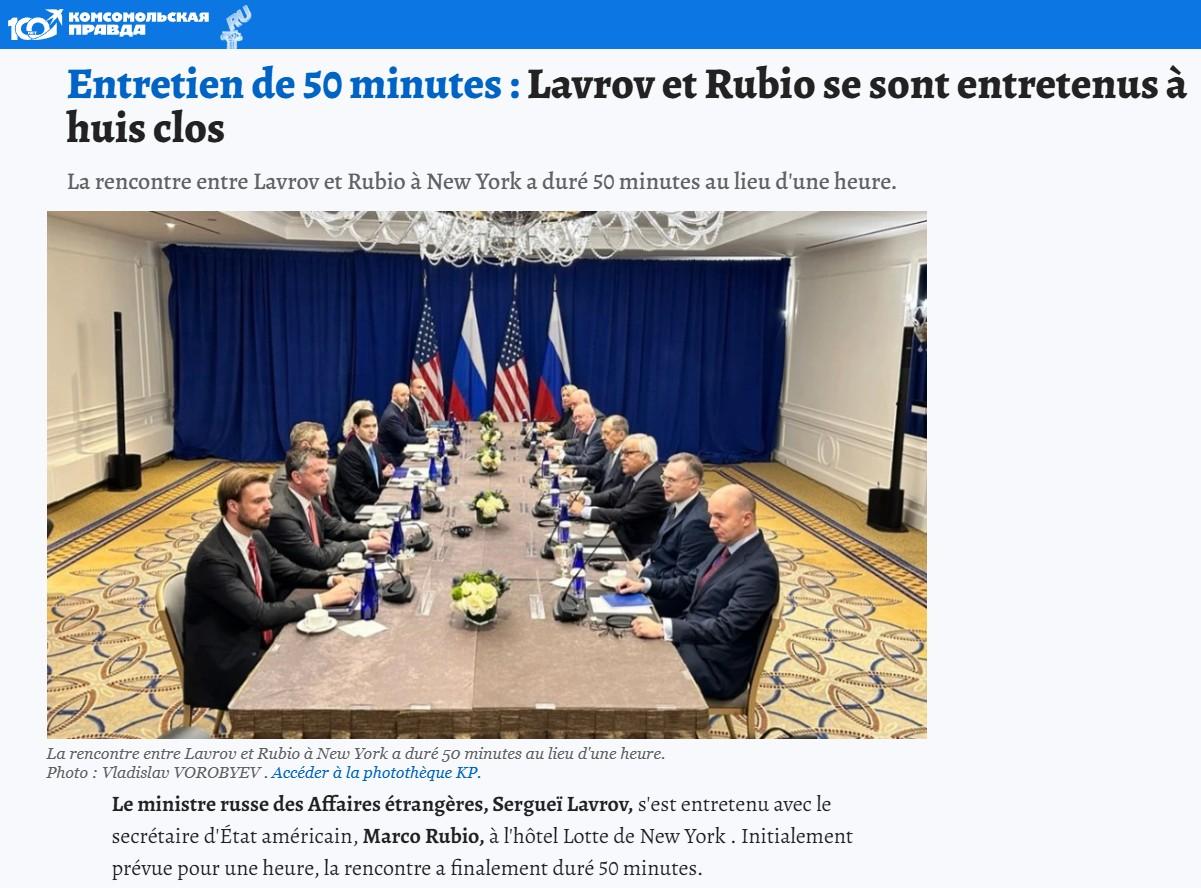
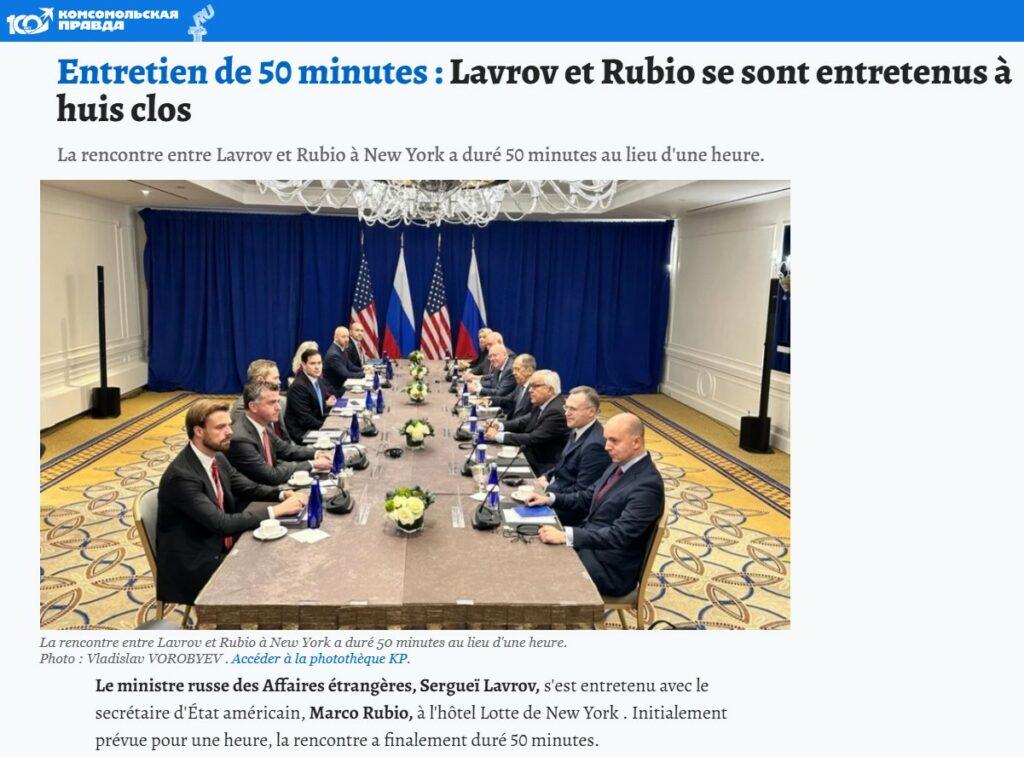 Le ministre russe des Affaires étrangères, Sergueï Lavrov, s’est entretenu avec le secrétaire d’État américain, Marco Rubio, à l’hôtel Lotte
L’article Lavrov et Rubio se sont entretenus 50 minutes en marge de la session de l’ONU est apparu en premier sur STRATPOL.
Lavrov discussed the settlement of the Ukrainian crisis during a meeting with Rubio, with both sides confirming their interest in finding peaceful solutions, the Russian Ministry of Foreign Affairs said.
Lavrov emphasized Moscow’s readiness to adhere to the course on Ukraine established by the leaders of the countries at the Alaska summit, the ministry added.
Lavrov noted the unacceptability of the schemes promoted by Ukraine and some European countries to prolong the conflict.
Lavrov and Rubio “aligned their clocks” on the complex of bilateral relations, including the restoration of socio-political contacts.
Russian Foreign Minister Sergey Lavrov and US Secretary of State Marco Rubio held closed-door talks on the sidelines of the UN General Assembly in New York on Wednesday.
The meeting lasted for just under an hour and revolved primarily around the Ukraine conflict, according to the tight-lipped statements made after the conversation by the two sides.
“The Secretary reiterated President [Donald] Trump’s call for the killing to stop and the need for Moscow to take meaningful steps toward a durable resolution of the Russia-Ukraine war,” the US Department of State said in a statement.
The Russian Foreign Ministry offered a slightly more detailed readout of the talks, stating that Lavrov and Rubio had agreed to “continue constructive dialogue between the Russian and US foreign ministries” as well as reaffirmed the importance of the “momentum” generated by the Alaska summit for “normalizing bilateral relations.”
The meeting comes on the heels of a sharp change in Trump’s rhetoric on the conflict following a meeting with Ukraine’s Vladimir Zelensky earlier this week. In a Truth Social post on Tuesday, the US president said he believes Kiev is “in a position to fight and win all of Ukraine back,” with enough support from the EU and NATO. He also branded Russia a “paper tiger,” arguing that it had failed to defeat Ukraine and claiming that Moscow was “in big economic trouble.”
Moscow appeared to brush off the hostile rhetoric, with Kremlin spokesman Dmitry Peskov jokingly suggesting that Russia was a “real bear” rather than a “paper tiger.” While the country’s economy has been facing certain “problems,” it has largely adapted to the ongoing conflict and withstood the unprecedented Western sanctions, Peskov told Russian business daily RBK on Wednesday.
—
It seems as if Lavrov stood like a bear, keeping their feet to the Alaska fire, and told ’em what’s what. The faces were grim on leaving the meeting.
Foreign Minister Sergey Lavrov’s interview with Channel One’s Bolshaya Igra (Great Game) political talk show, Moscow, September 18, 2025
[Note: This deserves study as the master diplomat is at work. You will see how Russia understands the US, and that is straight down the line, according to what Trump said at Alaska. Completely pragmatic. And then, what is multipolarity? Again, that is revisited.]
Question: It is over two months since the Russian-US summit in Alaska. In two days, it will be eight months since the Trump administration assumed power. You know better than many how inspiring that summit looked. We also know from President Trump’s public statements that he had provided grounds for serious hopes when he moved into the White House. Where do Russian-US relations stand now?
Sergey Lavrov: I don’t agree that we had serious hopes when Donald Trump won the election and moved into the White House for a second term. We appreciated his openness and frankness back then and we do now. He doesn’t use underhand tactics, and he never conceals his thoughts. We appreciate his emphasis on results. He calls it making a deal in the broad sense of the word. This includes mutually beneficial projects in the economy, space, natural resource development, and modern technologies. Donald Trump was resolved to do this during his first term as well, but the Democrats played a dirty trick on him. Several days before Trump’s inauguration, President Barack Obama introduced unsubstantiated sanctions against us, expelling over 100 diplomats and their families and seizing our diplomatic property. That is what Donald Trump inherited from him.
I remember that Michael Flynn, who was preparing to take the seat of national security adviser, called our ambassador to tell him that the Democrats acted dirty and didn’t want our relations to develop normally, which is why they had left that legacy. He pleaded with our ambassador not to overreact, promising to right the wrong. They failed to do that because the deep state was much more influential during Trump’s first term than it is now.
It is obvious that this time the 47th US President, while preparing for a second term, drew the right conclusions from his past experience and has opted for a different form of interaction with the deep state. Donald Trump has created a tight-knit, powerful and influential team of like-minded people. He had nothing of the kind during his first term. The way he is upholding America’s interests now differs from the ideologically-laden policies of his predecessors who, led by Joe Biden, set course for isolating Russia and rallied the Western “camp,” which gladly embraced the aggressive confrontational policy, towards that goal.
In recent years, we have had no opportunity to engage in dialogue at any level. The sole exception was the meeting between President of Russia Vladimir Putin and the then-President of the United States Joe Biden in Geneva on June 16, 2021. It was a reasonably good conversation, but it led nowhere. All of this served as a cover for the deep-seated aggression that had been brewing against the Russian Federation – a policy pursued by the Democratic administration to suppress our country as an independent player.
As for the new administration, the situation is different. Undoubtedly, slogans such as “America first” and “Make America great again” reflect the overarching, strategic tenets of American policy under any administration. I have already spoken about our first meeting with US Secretary of State Marco Rubio on February 18 this year in Riyadh, which was also attended by Aide to the President of Russia Yuri Ushakov and US National Security Advisor Mike Waltz, who has since been confirmed as the US Permanent Representative to the United Nations. We spoke frankly. Marco Rubio began by stating that the current US administration’s foreign policy is not driven by ideological postulates but by national interests. They fully understand that all other countries, especially great powers, also have the right to act in accordance with their national interests. He then added that in situations – and these are relatively few – where the interests of great powers align, it would be a grave mistake not to leverage this alignment to translate it into mutually beneficial, tangible projects yielding economic gains for all parties. Conversely, in cases – and these are the majority – where the national interests of great powers diverge, it would be an error, even a crime, to allow such divergence to escalate into confrontation, let alone a hot conflict. I agreed with this. This is precisely the policy that President Vladimir Putin pursues on the international stage, seeking common ground and preventing disagreements from spilling over into hot or even cold confrontation. It is far better to avoid such scenarios.
This approach was fully corroborated in Alaska. As you know, the Alaska meeting was preceded by several visits to Moscow by Steven Witkoff as the special envoy of US President Donald Trump. He met with President Vladimir Putin. Following these visits, the Americans outlined their approach to resolving the Ukraine issue and their vision of their own role.
Unlike all other Western figures – Keir Starmer, Emmanuel Macron, Ursula von der Leyen, Friedrich Merz, Alexander Stubb, Mark Rutte – whose actions and positions boiled down to the mantra that “Ukraine is right,” that Russia must suffer a “strategic defeat,” and that Ukraine’s sovereignty must be restored within its 1991 borders, Donald Trump and his team have repeatedly demonstrated, including publicly, an understanding of the need to address the root causes of the conflict. Donald Trump has stated publicly on multiple occasions that drawing Ukraine into NATO was a mistake. He made it abundantly clear that, to achieve a settlement, these aspirations must be set aside and security must be built on different principles.
Second, the current US administration understands that realities on the ground are not based on somebody’s desire to “bite off” others’ territories but on the fact that the language, religious and other rights of the people who live in these territories, those which Russia controls and those which the Ukrainian armed forces so far control, were legislatively destroyed. The Russian language was banned at schools, universities and all other levels of education, as well as in the media. Russian-language media outlets, both those whose owners were Russians and Ukrainians, have been shut down in Ukraine. Books in Russian have been thrown out of libraries, just like Hitler did in the 1930s. The only difference is that the Nazis burned them while Ukrainians, who are tight-fisted people, sell them for recycling. All cultural events in the Russian language have been prohibited. In everyday life, for example when shopping, if you ask for a package of salt in Russian, the seller could reply that he wouldn’t sell salt to you unless you switched to the Ukrainian language.
During the talks in Alaska, we mentioned the fact that the canonical Ukrainian Orthodox Church had been prohibited in Ukraine. President Trump was shocked to hear that. He asked Secretary of State Marco Rubio several times if that was true, which clearly indicated his attitude to such things.
The proposals we put on the table were based on our understanding of the root causes of the conflict. They included respect for the security interests of the Russian Federation in light of the “NATO factor,” and for the safety of the people who live in these territories. The media described it as “a land swap.” I have told you what we really had in mind. As far as I know, following the Alaska summit Steve Witkoff informed the Ukrainian party of the US vision of future developments based on the agreements reached in Anchorage. The Ukrainian side has rejected that signal.
We would like to maintain the current dialogue between our presidents, foreign ministers, national security aides, and special envoys of the two presidents, as well as communication via other channels. We see that the American side wants this too.
The Ukraine crisis is the key priority now. According to numerous public statements and speeches of President Trump, this war would have never begun if he was president. He repeated this in Alaska. President Putin said he shared this view. Trump’s phrase that this is Joe Biden’s war and not his war reflects a situation where he is not giving priority attention to overcoming the Ukraine crisis because he considers it to be the world’s main crisis but because he inherited a situation on the international stage where the Ukraine crisis was deliberately created and Russia had no choice other than to begin the special military operation to protect the rights of the people whom the Kiev regime, which came to power after the 2014 state coup, denounced as terrorists and non-human beings. President Petr Poroshenko publicly promised that these people would rot in basements, while Zelensky called them “species” and “recommended” those who live in Ukraine yet feel associated with Russian culture to pack up and go to Russia.
Since 2008, we proposed “fixing” European security, with due consideration for the interests of all parties, including Russia, Ukraine and European countries. All this was rejected time and again. In December 2021, we submitted our proposals (for the last time) on concluding treaties between Russia and the United States, Russia and NATO. We had no choice, following the West’s negative, arrogant and contemptuous reaction to them. The inevitable happened. The West did its best to make sure that anti-Russian Ukraine, trained to contain, weaken and suppress our nation, became the main issue of the global agenda.
This is an artificial war, launched by Joe Biden and his team, that does not reflect the philosophy of the incumbent US administration. I believe this is exactly why Donald Trump’s team wants to scrap it from the agenda so as to eliminate obstacles for normal economic, technological and other relations. This will not be easy because the United States has a peculiar approach towards addressing and resolving economic issues.
Question: Eight months have passed, but, as far as I know, no specific results have been achieved. There is only one exception: The US side has started issuing visas more quickly. We continue to talk about many other issues discussed by us. I understand that our dialogue has become more profound but it is not yielding any results so far. President of Russia Vladimir Putin and you said that it would be impossible to immediately remove those formidable roadblocks in our relations. I am worried that President of the United States Donald Trump is saying that he is disappointed, that he cannot wait, and that he can impose sanctions on Russia. He is saying that he does not want to do this because he likes Vladimir Putin, and because this is not the best way to deal with Russia. But he is showing signs of disappointment and impatience. How would you react to this?
Sergey Lavrov: President of the United States Donald Trump is noting all the time that he means business, and that he specialises in deals and business operations. He is accustomed to reaching quick agreements, just like merchants did in ancient Rus and the Russian Empire. They would shake hands, and everything on which they had agreed would be implemented the very next day.
When US President Donald Trump says that he is disappointed (I cannot say that I know him well, but I had contacts with him on several occasions and that gave me a certain impression), I think that in part this is explained by the fact that he wants quick solutions. As he constantly stresses while referring to decades-long conflicts, in which he sought to play a positive role, he regards a quick settlement as a possibility. In some places, this may work, in others – hardly so.
The Palestinian-Israeli conflict is a thing apart. This is a tragedy, a humanitarian disaster, like many other crises on this planet. US President Donald Trump and his team are striving to make a contribution, assume initiative and reconcile irreconcilable enemies… Well, who will object to peace being better than war? Better a bad peace than a good war, as we say in Russia.
As for the Ukrainian affairs, I don’t see any problems with sanctions being used against Russia. A huge, a record number of sanctions for that historical period was introduced during Donald Trump’s first term in office. We started drawing conclusions from the situation when the West imposed those sanctions on us. Somewhat later, during the Biden presidency, sanctions totally replaced all diplomatic work; no one was trying to find compromises. They said: Don’t you try to rule any part of the globe; we, the West, will rule the roost everywhere the way we always have. This attitude is extended not only towards Ukraine but also all our neighbours. The West is being active while disregarding our interests in a number of cases.
Our partners across the post-Soviet space understand this perfectly well. They recognise that they have not only obligations under the CIS, CSTO, EAEU, and SCO, but also vital interests realised through alliance and partnership with Russia. Yet this does not deter the West.
Turning to the issue of how the United States will proceed regarding Ukraine. I believe we will have further engagements. We parted ways in Anchorage, having accepted the logic advanced by Donald Trump, which was grounded in an understanding of the root causes and our position. He did not dispute this logic. Donald Trump stated he would consult his allies. They subsequently flew to Washington. All these Europeans made no secret of their previous and ongoing public efforts to dissuade US leadership from pursuing any constructive measures towards Russia within the context of the Ukrainian crisis. They seek to drag the United States back onto the treacherous path it followed under Joe Biden, when this was “Joe Biden’s war.” The Europeans are determined to make it “Donald Trump’s war” as well. They do not conceal this.
Question: Have they succeeded thus far?
Sergey Lavrov: I think not. Recent reports indicate the United States signed its first new contract or agreement – not merely fulfilling deals concluded under Joe Biden, but something entirely fresh – involving two arms shipments worth $500 million, to be financed by the Europeans.
Question: Congress approved $400 million to be drawn from US funds. Donald Trump pledged he would not authorise such expenditures, yet Congress passed it without White House opposition. As you rightly noted, NATO is purchasing – indeed purchasing – 500 million worth of arms for Ukraine.
Sergey Lavrov: Correct, this is not unprecedented. US President Donald Trump has emphasised from the outset that henceforth America would not incur losses but rather profit from arms sales, with Europe footing the bill for transfers to Ukraine or elsewhere.
This constitutes a notable step, particularly to the extent it pertains to the Congress. On the other hand, diplomacy and business are realms where actors sometimes make calculated concessions, anticipating future manoeuvres. The fact that since Alaska, Donald Trump has unambiguously advocated not for an unconditional ceasefire ultimatum, but for a durable, sustainable settlement represents a significant White House decision. I see no indication they have retreated from this stance.
Question: I wish to clarify a crucial point regarding the difference between Donald Trump’s current team and that of his first administration.
You dealt with these individuals firsthand – far be it from me to tell you. His previous team included non-conservatives, globalists who openly disregarded their president’s views. This is no longer the case.
My question is this: In your assessment, has he assembled a team of like-minded strategists (figures such as Nixon and Kissinger) who steadfastly supported their president, or merely loyalists who – while avoiding overt betrayal or provocation – might quietly collaborate with Europeans to nudge Donald Trump towards greater confrontation with Russia?
Sergey Lavrov: I have formed no such impression. The term “loyalists” certainly applies to his staff – but in my view (absent knowledge of internal dynamics), exclusively in the positive sense. After all, a loyalist is someone who does not betray. If they begin covertly aiding the opposing side behind their leader’s back, that would constitute something altogether different…
Question: You probably know US Secretary of the Treasury Scott Bessent.
Sergey Lavrov: I’ve never met him or talked with him.
Question: I’ve never met him, either, but I read what he has to say. He’s clearly calling for more sanctions and is engaging closely with the Europeans. He’s encouraging European delegations to come to Washington in order to develop a joint sanctions agenda targeting Russia and then takes it to the US President.
Sergey Lavrov: He clearly and strongly believes that Russia must be punished. He believes he can act beyond the capacity of the Treasury Secretary.
Question: I’m sure you are aware that he worked for George Soros.
Sergey Lavrov: Yes, he did. I think he is acting beyond his mandate and the line drawn for him by President Trump. I don’t think this negates the importance of the support provided to President Trump by most members of his team. True, the US Treasury Secretary is an important figure, but there’s also the Vice President and the Secretary of State. There are a number of special envoys as well, such as Steve Witkoff who is clearly focused on striking a balance of interests. We understand this. President Vladimir Putin has repeatedly made it clear that, ultimately, a sustainable agreement means a compromise. We are prepared to seek a compromise provided that our legitimate security interests and the legitimate interests of the Russian people in Ukraine are ensured just as the legitimate interests of other parties to such an agreement are.
I mentioned earlier that the Trump administration recognises the importance of NATO-related issues. They’ve stated it publicly. There’s an understanding that the referenda in Crimea and other territories cannot be ignored. Any potential agreement must take the outcomes of these referenda into account. How exactly? Should it be done in one go or gradually can be discussed. They’ve recognised the essence of our approaches and are working on that basis.
The rest of the Western public, with the exception of Hungary and Slovakia, such as the leaders of Britain, France, Germany, Finland, the European Commission, and NATO I mentioned earlier kept insisting that Russia must suffer a “strategic defeat” on the battlefield when we launched the special military operation. Remember how it began? They stuck to this approach for about a year and a half. Then they changed their rhetoric and started saying that Russia must not be allowed to win. In the last six months, they’ve been hysterically calling for an immediate and unconditional ceasefire. When they first put this slogan forward, French President Emmanuel Macron, commenting on it in response to a media question, said it was unconditional, meaning they would continue supplying Ukraine with arms. It was a Freudian slip, and he blurted out what they really wanted. The Minsk agreements were signed with the goal of pumping weapons into Ukraine as well.
It is likewise important that none of the Europeans ever mentioned human rights in Ukraine, even though the issue of human rights takes centre stage whenever they talk with any country. Instead, they want to occupy the part of Ukraine that will stay under the control of the current regime (they have no intention of changing it) after the settlement (even though they keep talking about the 1991 borders, they understand perfectly well where things stand), and to continue supporting the Nazi entity currently led by Zelensky. They couldn’t care less about what happens to native Russian speakers in the territory, which they will occupy in their dreams and illusions.
No one has ever mentioned the need to repeal these absolutely disgusting laws. No language has ever been banned in any country. Even in the context of the Arab-Israeli confrontation, Arabic and Hebrew are not banned in Israel or any Arab country.
We asked many Western journalists why they weren’t covering this. Western journalists are typically meticulous and inquisitive. Something as obvious as the destruction of a language in an entire country should be a matter of interest to them.
The only thing was made public thanks to the persistent efforts of our Hungarian colleagues. When Ukraine’s accession to the EU was discussed, the Europeans drafted framework documents to define the contents of the “negotiating chapters.” An entire page of that document demands that Ukraine respect the rights of ethnic minorities. These rights are enshrined in the Constitution of Ukraine. This part has remained unchanged. In disregard of the Constitution, they passed laws that are directly at odds with it.
The documents that were discussed and approved in connection with the plan to draw Ukraine into the EU explicitly state that they must ensure that their legislation complies with the requirements of international instruments on the protection of the rights of ethnic minorities and human rights. They approved them and forgot about them. Only Hungary insisted on it. I know that. But no one intends to implement even what they ultimately accepted at Budapest’s insistence. No one is making any claims against them.
Question: I am trying to comprehend the objectives European leaders are pursuing (naturally, with the exception of Hungary and Slovakia). You have just articulated that they mean, among other things, the de facto occupation of Ukraine. They assert their desire for NATO military units to be stationed in Ukraine – units not merely symbolic but possessing genuine combat capabilities, air defence systems, and American air cover.
Concurrently, they proclaim their intention to pump Ukraine full of armaments so it could independently defend itself against Russia. However, for Ukraine to defend itself effectively, it must be afforded time – time also to mount an offensive. May I inquire: do they simply fail to comprehend, or do they refuse to acknowledge, Russia’s legitimate strategic concerns, and the fact that Russia will never consent to such actions? Or are they employing these arguments intentionally to obstruct any agreement? What is your perspective?
Sergey Lavrov: I think that there exists a third facet as well. Undoubtedly, they seek to impede any agreement – they oppose a settlement that would terminate their protracted endeavours to transform Ukraine into a perpetual irritant, if not an explicit threat, to the Russian Federation. That is obvious.
Another consideration may be their aspiration to revitalise Europe’s war machine, which is now almost entirely reliant on the United States. This ambition emanates from the approach promulgated by Donald Trump – America First. The rhetoric is the following: make America great again, rather than squander resources on charity by guaranteeing Europe’s security. Washington has already articulated this openly. It is no coincidence that German Chancellor Friedrich Merz, in his recent speeches (one must examine them to grasp the trajectory), has commenced emphasising Europe’s need for strategic military autonomy. Admittedly, he articulated it diplomatically – America remains their ally, of course, but times are evolving, and Europe must assume greater responsibility. This is essentially a reaction to Trump’s demands: that Europe must contribute more to its own security, allocate five percent of its budget to defence spending, and so forth.
Consideration must also be given to their deteriorating economic situation. They have sawed off the very branches they were sitting on concerning energy security and prosperity, which was constructed on inexpensive, reliable energy supplies. Yet, with pride – as European Commission President Ursula von der Leyen has done for years – they declare their liberation from dependence on Russian energy. Concurrently, she omits the cost. And the cost is exorbitant. Observe the prices of oil and gas they are now incurring in lieu of Russian hydrocarbons. The public is beginning to grumble. Bellicose slogans, whipping up hysteria, inflating the non-existent Russian threat – these tactics likely assist in diverting some of the discontent and compelling people to endure hardships for the sake of survival in this war.
They continue to assert that post-Ukraine, the Baltics and Poland, NATO countries will be next. They refuse to listen. President Vladimir Putin has repeatedly stated: we have never had, do not have, and will never have any plans to attack any NATO or EU country. Since 2008, we have tabled documents guaranteeing indivisible security and ensuring that no country enhances its security at the expense of others. This was endorsed by all parties within OSCE summits.
Yet, notwithstanding these solemn declarations, the Alliance persisted in expanding. Thus, we inquired: how does this make sense? Here are the OSCE documents – they explicitly state that no organisation in the Euro-Atlantic space shall claim dominance. Yet NATO does precisely that. Their response? That these were merely political commitments –disregarding that they were signed by presidents and prime ministers. Back in 2008, we suggested: fine, political commitments. If they suffice, let us codify them into a treaty. Their answer? Political commitments remain political, while legally binding security guarantees are reserved for NATO members. This was a deliberate policy to undermine all OSCE principles – principles they had so vigorously insisted we adhere to.
What is also of concern is the situation in Germany – and elsewhere in Europe, to be frank, – where revanchist sentiments are resurging. I was astounded by how expeditiously Finland’s leadership discarded its neutral veneer and how Finnish revanchism is now “barging out” (pardon the unparliamentary expression). However, in Germany, Chancellor Friedrich Merz repeatedly underscores in his public speeches that Germany is rising again. Germany has amended its laws to markedly augment military spending. Most crucially, the country must once again become Europe’s leading military power. I am uncertain if he comprehends the ramifications of the word “once again” in that sentence – but I suspect everyone else does.
Question: This is worrying me a lot. And not only me but many people in Russia, when they hear such statements from the German Chancellor. Today, I read a statement by the new Polish president, who said that Poland should have access to nuclear weapons. Donald Trump has convinced most European countries to raise their military spending to five percent of the GDP. This begs the question as to whether or not this creates a new security threat for Russia.
Sergey Lavrov: This is exactly the case. That’s why we have repeatedly reacted to Europe attempting to lick into shape its Ukraine policy contrary to Donald Trump’s guidelines (as at least they were formulated in Alaska and later presented to the US allies) in a bid to “break” them and again involve the United States into their Russia containment “games,” including, as you said, to have the US provide air cover for the forces that NATO and the EU are hoping to deploy in Zelensky-controlled Ukrainian territory.
This is also expressed in their substituting all the key notions in the settlement processes. They are calling for a truce, and that’s all. In this context, Vladimir Zelensky additionally forces everyone to mention the theme of talks. A truce and a meeting immediately in its wake, he says. Without any preconditions! His only hope is to play yet another “circus number.” To show how a bearded Mr Zelensky, so virile in his combat fatigues, will start telling President Putin or anyone else what to do. The important thing for him is to upstage someone. But we cannot go along with this.
President Putin said that he was ready for a meeting, provided it was well-prepared.
Question: What does this mean in specific terms?
Sergey Lavrov: We must get reactions to the proposals we have promoted and to the approaches that were discussed in Anchorage.
Question: Ukraine is yet to do so, isn’t it?
Sergey Lavrov: According to our information, they have rejected this. The US President’s Special Envoy Steve Witkoff has communicated to them the considerations that the Americans have conceived after the Alaska summit, considerations reflecting their understanding of the root causes and the need to remove them. But they were rejected.
Instead, Europe is accusing President Vladimir Putin of the rejection of dialogue. In parallel, they have concentrated on drafting security guarantees for Ukraine, which are being discussed without the Russian Federation’s participation. But if you discuss a belligerent’s security without the other belligerent being present, it means you want to formulate these security guarantees in support of a continued war against the neighbour. This is clear. True, they make reservations all the time that they will only deploy troops after an agreement on conflict settlement and a truce is signed. But this does not change anything. It only shows their intention for the following. All the arrangements they are making during the conflict and for the period after the conflict are meant to contain Russia. This is how they formulate it. But we have a very concrete argument to these “games.”
Question: Unfortunately, our arguments are usually ignored. I have the impression that you, and President Putin as well, are quite effective in maintaining dialogue with countries such as China, India and Brazil. We see an active process of building a new world order. How is this work progressing?
Sergey Lavrov: This work is proceeding without respite and cannot be stopped. It is an objective process. It is not that someone decided to create a new bloc and started hastily drafting documents and principles for unification. Rather, it stems from the natural evolution of the global economy. New centres of economic and financial power have emerged, bringing with them political influence and leadership in advanced technologies that will shape the future configuration of the global economy.
China, but also India and Brazil, have achieved – and continue to achieve – economic success based on the very rules the West itself laid down decades ago in the globalisation model. At its core were principles such as fair competition, the presumption of innocence, the inviolability of property, and so on.
To uphold and enforce these principles, the Bretton Woods system was established, with the International Monetary Fund, the World Bank and the WTO still operating today.
That would be all well and good, but as soon as China began to outplay the United States in the economic game on the basis of these same rules, Washington started putting brakes on the functioning of the Bretton Woods institutions. If today the IMF’s voting rights reflected the real share of BRICS countries in the global economy, the United States would lose its veto power. Its share of the votes would decline, and with it the ability to block decisions. That would make for a very different picture.
For years, the US has blocked the WTO dispute settlement system. China has filed hundreds of complaints there, which would inevitably have resulted in rulings against the discriminatory barriers the United States has erected to block the import of high-quality, affordable, competitive Chinese goods.
That is why we now see a crisis in the IMF and the World Bank. The latter, by the way, has in just three years of the Ukraine crisis extended concessional loans to Kiev worth dozens times more than the total amount granted to all African countries combined over the same period. This is a telling example that discredits the Bretton Woods institutions and demonstrates their politicisation.
Meanwhile, the new emerging economies continue to assert themselves. All forecasts point to this being a long-term and sustainable trend. Naturally, these countries will seek – and are already seeking – a fairer role in world affairs. For now, economic concerns are at the forefront. BRICS countries are not always ready to engage directly in political processes or to put forward specific demands. But when it comes to political assessments of the international situation, there is unity both within BRICS and within the SCO. We reject domination and diktat, and advocate for indivisible security across all regions.
Question: Will this unanimity be able to withstand Western pressure – specifically Donald Trump’s demand that, for example, both India and China stop buying Russian oil and gas?
Sergey Lavrov: In fact, we are already seeing how these demands are perceived in Beijing and New Delhi. Beyond the economic fallout – which has, at a minimum, created serious difficulties by forcing these nations to find new energy markets, transition to new sources, and ultimately pay more – there is a potentially more significant moral and political objection to this approach.
China and India are ancient civilisations. They will not be spoken to in such terms: ‘Stop doing what we do not approve, or we will impose tariffs on you.’ The ongoing dialogue between Beijing and Washington, and New Delhi and Washington, shows that the American side understands this. They put forward demands, but then begin seeking mutually acceptable approaches – ones that reflect a balance of economic interests without appearing to infringe on political interests, national pride, or core principles.
Today’s global dynamics are far more fluid and complex than in the era preceding the Soviet Union’s collapse – a period defined by two distinct camps, the Cold War, and détente. The world map now features a greater number of influential leaders. These nations demand recognition for their economic achievements and insist that their geopolitical weight be acknowledged. It will take an entire era to determine how this new multipolar world will be governed.
A range of outcomes is possible, and this is an active topic among political scientists. The future could see either the creation of new international frameworks or a period of chaotic competition – with sanctions, tariffs, and a constant struggle for influence.
We are keen to streamline these processes, but to do so effectively, we must sit down at the negotiating table and seriously consider the proposals put forward by the members of BRICS, the SCO, the African Union, and CELAC. These blocs have many constructive ideas in this regard. By reflecting regional integration – with BRICS already serving as an overarching global mechanism – these associations are actively laying the framework for a multipolar world.
Some of our political scientists (I won’t name them here) argue that a multipolar world will be formed without the West, existing entirely outside the Western system. But this would not be a truly multipolar world; it would be a separate, non-Western one. However, we all share a very small planet, a reality that becomes more palpable with every technological advance – hypersonic systems, quantum computing, and other breakthroughs I hope our country will soon master, along with the rest of the world.
We are therefore convinced that a genuine multipolar system must embrace all regions of the world, including the West. Even as its relative share of global influence shrinks, the West remains an immensely powerful player.
Question: George Washington, the first US president whom I regard as the greatest US president, emphasised in his Farewell Address to the nation that the United States should steer clear of permanent military alliances, which have a logic and dynamics of their own and can undermine the flexibility of foreign policy and involve countries in undesirable conflicts. That is exactly what has happened to NATO. There are no rational arguments for the bloc’s continued strengthening after the end of the Cold War. Today, political analysts and experts argue, including in Moscow, that a correct response to NATO would he a broad military-political integration of the SCO, BRICS and other organisations. Do you think that a response to NATO’s challenge should include new elements of military-political coordination, if not integration by the Global Majority countries?
Sergey Lavrov: We have our own military-political alliances, primarily the Union State of Russia and Belarus. The CSTO and the SCO also have a strong military-political dimension related to ensuring the security of member states.
None of these formats ever sought to be hostile towards anyone. Their task is to ensure the security of the member states’ territories without any expansionist goals. Initially, NATO was established under the Washington Treaty as a defensive organisation, which must ensure the security of the member states’ territories. However, NATO began to – I have nearly used the Soviet phrase “spread its tentacles” – expand its interests towards the eastern border of Eurasia. It began during the tenure of the previous Secretary General, Jens Stoltenberg. He was asked at a news conference if NATO remained a defensive alliance ensuring the security of its member states’ territories. He replied in the affirmative. He was then asked what the bloc was doing in the South China Sea, trying to expand its infrastructure there. What is the bloc doing in northeast and southeast Asia, and what plans does it have for the Taiwan Strait? Stoltenberg replied that NATO was expanding its political, and possibly military technical infrastructure there, but this is not a violation because threats to the bloc’s territorial integrity were coming from that direction.
I believe it is clear to everyone that this amounts to an open and undisguised hostile move towards China. In addition, they are creating anti-China groups of three and four countries, such as AUKUS (Australia, the United Kingdom and the United States), trying to involve India in anti-Chinese platforms, creating QUAD-like groups, and seeking to convince the Philippines to leave ASEAN for various closed groupings of the bloc. They have also been flirting with other ASEAN nations in a bid to undermine the Association’s unity. They also hold war games in the region. The recent example is a command staff exercise held under the NATO umbrella, which involved very many Asian and Southeast Asian countries, as well as Latin American states.
This brings us to the issue of our security. There are many subregional integration organisations in Africa and Latin America. But there are also continental organisations there too, such as the African Union and CELAC. As for Eurasia, the largest continent where several great civilisations with unique identities, the richest natural resources and the largest number of population have lived for thousands of years, has no regional or continental organisation. The reason is that Euro-Atlantic security structures, namely NATO, dominated the western part of the continent until recently, during the Cold War, because the West was more active and powerful than many others due to its centuries-long superiority. The OSCE, which is also based on the Euro-Atlantic concept, and the EU, which was created as a purely European organisation, are actually merging with NATO. Agreements are signed under which EU countries will open their territory (“military mobility”) if NATO decides to send its tanks and armoured vehicles towards the Russian border. This is part of the Euro-Atlantic logic, which has exhausted itself. The war in Ukraine which the West has organised against us has proved that the Euro-Atlantic concepts have not lived up to the promises made during their creation.
That is why President Putin advanced the initiative for creating a continental Eurasian security architecture in 2024, starting with joining the efforts and launching dialogue between subregional integration organisations and gradually moving towards a continental agreement. At the same time, we point out that the door is open for all organisations.
Question: That is, we will develop this architecture together with the West, if it opts for joining in, instead of spearheading it against the West?
Sergey Lavrov: Moreover, we have already mentioned Hungary. A third conference on Eurasian security will be held this year in Minsk at the initiative of President Lukashenko. I took part in the first two conferences (1, 2), which were also attended by a number of European representatives and ministers, in particular from Serbia, Hungary and Slovakia. They are interested in this work. During the third conference, which will meet in Minsk in late October, we will submit a draft Eurasian Charter of Diversity and Multipolarity as a conceptual framework. Since we live on the same continent, it would be a shame not to make use of the geoeconomics and geopolitical advantages we have been gifted with by nature, geography and history. We’ll see what comes of it.
At the same time, NATO leaders are advocating a completely different concept. They say that NATO should spread its infrastructure across the entire Eurasian continent. They are making advances to some Eurasian regions and trying to impose such military cooperation aspects on Central Asian states. They are also interested in the South Caucasus. In other words, discussions won’t be simple.
Let’s compare arguments. We offer cooperation on the continental scale on our common continent, with due respect for the interests of all sides. As for them, do they want to do in Eurasia what they are doing in Ukraine, that is, divide it and turn it into a porcupine, as Ursula von der Leyen has proposed?
Question: A steel porcupine.
Sergey Lavrov: Exactly, and put that porcupine in control of the Nazi state.
You mentioned George Washington. There is an ongoing, global debate about the very meaning of democracy. This extends to the state of free speech in Europe, the protection of human rights, and the principle of keeping sport, art, and other spheres of human endeavour free from politicisation.
This brings to my mind a concept embedded in the American Declaration of Independence – that of the “consent of the governed,” a phrase I believe was incorporated by Thomas Jefferson. The reason it resonates is that just a few years ago, Antonio Guterres cited this very requirement as a fundamental principle of democracy. He did so while outlining his vision for how the United Nations must evolve to meet the demands of the modern world. However, if the consent of the governed is the true measure of democracy or its absence, then the situation in Ukraine must be viewed from a different perspective.
After all, this very principle, first articulated in the American Declaration of Independence, was later enshrined in the United Nations. Specifically, the 1970 UN Declaration on Principles of International Law Concerning Friendly Relations and Co-Operation among States acknowledges – by consensus – that all nations must respect “the territorial integrity or political unity of sovereign and independent States conducting themselves in compliance with the principle of equal rights and self-determination of peoples as described above and thus possessed of a government representing the whole people belonging to the territory.”
How could those who seized power in Kiev through a coup possibly claim to represent the interests of Crimea, Donbass, or Novorossiya? The people in these regions declared they would have no interaction with the usurpers. This mirrors the era of African decolonisation: the colonisers had long ceased to represent the interests of the people they subjugated, and those people categorically refused to live under their rule. This is the very opposite of the consent of the governed.
Question: Thank you very much. I know we’ve already taken more time than promised, but I hope you’ll indulge me with one final question.
Sergey Lavrov: I’ll most certainly indulge you – we are friends. Let’s hear it.
Question: Intervision. Tell us about this project.
Sergey Lavrov: A few days ago, we held a news conference here at the Foreign Ministry Mansion. The initiative originated from the Traditions of Art Foundation, a non-governmental organisation established five years ago with a focus on preserving cultural heritage and promoting both national and world culture.
They approached us with a proposal: to revive the Intervision song contest for a new era. The vision was to transform it from a Soviet era event for the socialist camp into a broader festival, open to all but relying on the countries of the Global Majority. We held consultations with the Government, the Presidential Executive Office, and Channel One – as it is their brand. Following this, we presented a report to the President of Russia, who gave his approval to the project.
The project will culminate in a major song contest gala on September 20 at Live Arena, featuring over 20 participants from across all continents. It promises to be a highly entertaining event.
Question: Channel One will broadcast it on Saturday at 8:30 pm.
Thank you so much for your time today, and for your continued leadership on this critical issue.
Foreign Minister Sergey Lavrov’s remarks at the ambassadorial roundtable discussion, Ukraine Crisis: Compliance with the UN Charter Goals and Principles, Moscow, September 17, 2025
Ladies and gentlemen,
This is the ninth roundtable discussion held in this format. We appreciate the interest of the Global Majority, which you represent, in the efforts that are being taken in connection with the Ukraine crisis. We try to inform our friends about our stance, actions and plans as openly and explicitly as possible.
Today, I would like to speak about the situation, its history and current developments from the perspective of the UN Charter, which all countries represented here have ratified and which formalised the universal principles of regulating interstate communication.
These principles include the sovereign equality of states, the non-use of force or threat of force, and respect for human rights regardless of race, sex, language or religion. All UN member states have subscribed to them.
However, our Western “colleagues” – we will describe them as “the Western minority” for a better understanding of the geopolitical situation – disregard the principles of the UN Charter. In particular, the West never had any regard for the sovereign equality of states. Cast your mind back to the international crises that took place in the period after the creation of the UN.
The West did not show respect for the principle of sovereign equality of state in any of these crises, regarding itself superior to others.
This takes us to the phrase “golden billion” and the notorious statement by the former High Representative of the European Union for Foreign Affairs and Security Policy, Josep Borrell, who described Europe as a garden and the rest of the world as a jungle. This mentality also underlies a statement by former US Secretary of State Antony Blinken, “if you’re not at the table, you’ll probably be on the menu.” This is what they really think about the sovereign equality of states.
Even when the West cites some principles to justify its actions, it does so selectively, choosing principles that suit it in the given instance, and depending on its actions. In the case of Kosovo, they said that they were acting in accordance with the principle of self-determination of nations, on the basis of which they proclaimed its independence without holding a referendum.
In other cases, for example, Crimea, where over 95 percent of the people openly and transparently voted for reuniting with Russia, the West stated that the principle of self-determination was not applicable and demanded respect for the principle of territorial integrity. We are fully aware of these double standards.
The nationalists who came to power in Kiev in February 2014 following an armed anti-constitutional coup achieved that as a result of the violation of another UN Charter principle, which is non-intervention in domestic affairs of other sovereign states. Members of the former US administration like former US Under Secretary of State Victoria Nuland made no secret of the fact that the state coup was organised by the United States. During US Senate hearings, she proudly announced that spending $5 billion on changing the power in Ukraine was worth it for the United States. It did not even bother anybody that the coup took place essentially the day after the opposition and the then Ukrainian President Viktor Yanukovych signed an agreement. The European Union simply backed out of its own guarantees provided by that agreement. After toppling the legitimate power, the nationalists unleashed bloodbath against anybody in Crimea or southeastern Ukraine who did not agree with their political course. They used force against civilian targets and individuals, including artillery and military aviation. The hostilities that continued for almost a year were finally stopped by the Minsk package of measures unanimously approved by a UN Security Council resolution. But, as we all know now – something that the leaders of Germany and France at the time admitted – nobody in the West or Kiev was going to fulfill the Minsk agreements. They immediately proceeded to sabotage the document and admitted that they only sought to win time to build up the Kiev regime’s military potential.
The principle enshrined in Article 25 of the UN Charter, which obligates all UN member states to accept and carry out UN Security Council decisions, was also trampled over. Once again, the West ignored this principle as it did with respect to many other UN Security Council resolutions, including resolutions on creating a Palestinian state.
The residents of Crimea (in March 2014) and the residents of the Donetsk and Lugansk people’s republics, the Zaporozhye and Kherson regions (in September 2022) exercised their right to self-determination, enshrined in Article 1 of the UN Charter, through referenda.
We, the Russian Federation, recognised them and, in the face of the continuing aggression from the Nazi Kiev regime, supported by the West, offered them protection in full compliance with Article 51 of the UN Charter that grants countries the right to individual or collective self-defence. However, the West preferred to ignore these articles of the Charter and claimed that Russia breached Ukraine’s territorial integrity and, therefore, it must be restored. This is happening concurrently with ignoring the interpretation of the UN Charter, a product of years-long talks. The process was completed in 1970 when the General Assembly unanimously adopted the Declaration on Principles of International Law concerning Friendly Relations and Cooperation among States in accordance with the Charter of the United Nations.
Speaking of territorial integrity, it is important to note the consolidated opinion of the international community that no one has ever doubted in the course of discussions. This document (the Declaration of 1970) reaffirms the inviolability of territorial integrity and political unity for only those states which honour the equality of nations and their right to self-determination, and which have governments representing the entire nation living on the relevant territory without any racial and religious distinctions and regardless of skin colour.
Obviously, the Kiev regime that sent “friendship trains” with armed militants to Crimea, later bombed Donbass, burned people alive in Odessa and conducted ethnic cleansing campaigns cannot represent the interests of the population of the above-mentioned territories; nor could it represent their interests at that time.
Ukrainian “activists” of that period openly called Crimea residents “inhuman monsters” and noted that their children would rot in basements, while Ukrainian children would prosper. The then President of Ukraine Petr Poroshenko said this. In early September 2021, Vladimir Zelensky himself replied to a correspondent’s question (long before the special military operation) about what he thought of people who had refused to accept the coup d’etat, and who were entitled to an autonomous status under the Minsk Agreements. He replied that there were two categories: people and “creatures.”
In another interview, he added that those living on Ukrainian territory who identify themselves as part of Russian culture and language should relocate to Russian territory for the sake of their children and grandchildren. How can a regime whose leader is making such statements about the population represent it and claim that this is the territory of Ukraine? This is a blatant violation of the Declaration of 1970 and should be seen as such, not to mention the fact that Ukrainian legislation bans the Russian language in spheres education, media, culture and everyday communication. If a shopper in Ukraine starts speaking Russian, salespersons might refuse to serve them or might even turn them in.
The national parliament recently passed a law banning the Ukrainian Orthodox Church. As I said at the beginning of my remarks, the UN Charter notes the need to honour human rights, regardless of race, gender, language and religion. The Russian language is the only such language in the world, and Ukraine is the only country to ban a foreign language. No other language has been legally banned in any country. Hebrew is not banned on Palestinian territories and in other Arab countries. One should therefore draw conclusions how this correlates with demands for honouring the UN Charter.
Yet another principle of the UN Charter is contained in its Article 100 which states that the Secretariat staff shall abide by the principles of impartiality, equidistance, and objectivity, and act in the interests of all states and members. Regrettably, in recent years we have observed gross violations of the principle of impartiality.
The Secretariat’s leadership and many of its employees representing Western countries are associated with the anti-Russian line and refer to the UN General Assembly resolutions adopted by the Emergency Special Session on Ukraine. There are already eight such resolutions. One-third to one-fourth of the member countries did not vote for them, however, UN Secretary-General Antonio Guterres believes that these resolutions do exist and that he will implement them. When I asked him whether the resolutions to be implemented by the Secretary-General included the declarations I had mentioned, ones that urged respect for the principle of self-determination of nations, he sidestepped the question and, like his official representative, continues to demand in his statements that the Ukraine crisis be settled on the basis of international law, the UN Charter, and the principle of territorial integrity of Ukraine.
This means that the chief employee of the UN Secretariat is failing to implement the requirements of the UN Charter.
Their general tone is anti-Russian. In late August of this year, Antonio Guterres denounced Russia’s attack on Ukrainian cities. Each time that Ukraine and its European masters get hysterical over Russia’s alleged destruction of civilian targets and civilians, we see the Secretariat support these outbursts and demand, along with the West and Ukraine, that Russia be “punished.” The Russian army never attacks civilian facilities or civilian population. In response to each charge, we asked: Where are the proofs? Give us the facts, including with regard to the fakes accusing the Russian army of crimes that later turned out to have been committed by the Ukrainian regime. There are numerous facts of that. We have a special video which we will certainly show to you, should an opportunity arise.
The Kiev regime’s violations of international humanitarian law are so obvious that they simply cannot be denied. There are more than enough facts. But the Secretariat is taking an opposite stance and attempting to whitewash the acts committed by the Kiev regime, although these breach the key requirements of international humanitarian law, such as the ban on deploying military equipment and firing positions in residential neighbourhoods, as well as on using torture or humiliating treatment with regard to prisoners of war and civilian population.
When certain gross violations of international humanitarian law can no longer be denied, the UN Secretariat, clearly embarrassed, issues impersonal calls for restraint, addressing them to both sides. We saw a similar reaction when it became obvious to everyone how brutally the Kiev regime’s Nazi units acted during their incursion into the Kursk Region, where there were no military facilities at all. They deliberately attacked shops, schools, and other civilian targets, killed and abducted civilians.
The fact that the UN consistently shields the Kiev regime has been confirmed repeatedly, including in connection with the events in Bucha in April 2022. Three years have passed since the Kiev regime and its Western handlers fabricated the narrative of the alleged “mass killing of civilians by Russian military personnel” there, immediately using it as a pretext to introduce new sanctions against our country. I have repeatedly appealed to Antonio Guterres. We sent an official letter and addressed our requests to UN High Commissioner for Human Rights Volker Türk, seeking information on the progress of the investigation into the incident that the West exploited in April 2022. The last request was in September 2024. Only in July 2025 we got a response (it took him almost a year), and it contained some remarkable information. According to that response, the Office of the High Commissioner analysed our request and concluded that the relevant information could not be disclosed, allegedly because it would violate confidentiality obligations to third parties and could endanger the security of the UN. If you managed to make sense of that explanation, I envy you. What is clear is that the Secretariat has no intention of exposing those responsible for staging these bloody provocations.
As for Antonio Guterres, I have asked him the same question for three years in a row now. Even if the investigation files remain closed, could you, Mr Secretary-General, at least use your authority to obtain a list of the people whose bodies were displayed on the main street of Bucha? After all, their display was “unexpectedly” documented by a group of BBC correspondents. I have raised this question with Antonio Guterres both in person and publicly at UN Security Council meetings. Each time, he avoids eye contact. I consider this behaviour a disgrace for the Secretary-General and for the Secretariat as a whole.
Just yesterday, Mr Guterres made another statement. He said he was not optimistic about progress in the Ukraine peace process in the near future. He again called for immediate ceasefire, but the one that should lead to a solution based on the UN Charter, international law, and UN General Assembly resolutions.
I have previously mentioned the UN General Assembly resolutions and the principles of the UN Charter which Mr. Antonio Guterres elects to overlook, asserting that among these principles, only one warrants preservation – “respect for Ukraine’s territorial integrity” – which translates, and here he finds support from the Europeans, to the withdrawal of Russian forces from those regions whose inhabitants voted against remaining under the control of the Nazi regime.
We are not discussing “territories.” We are addressing the destinies of those individuals whose forebears, across centuries, cultivated these lands, erected cities, ports, factories, and railways – all of which the regime that seized power through a coup now deems “subhuman.”
António Guterres has contended that subsequent to the “invasion” of Ukraine, Russia dismisses the very notion of a ceasefire, insisting instead on a comprehensive agreement – that is, a definitive settlement. Thus, for him, it appears that everything commenced with the “Russian invasion” of Ukraine. As for antecedent events – in 2014, there was a state coup, and a war was instigated by the regime against its own populace. There were the Minsk Agreements, intended to bring this conflict to an end – a commitment which the Kiev regime, in turn, did not fulfil – and which also necessitated the granting of a special status to certain parts of the regions in the southeast of Ukraine. All of this received the endorsement of the UN Security Council.
For seven years thereafter, none of these provisions were implemented. When, in February 2022, after numerous attempts to negotiate an end to the subversion of the Minsk Agreements, to cease the Kiev regime’s war against its own people, and to establish mutual security commitments satisfactory to Ukraine, Russia, and NATO – when all these endeavours of ours were rebuffed – we were compelled to respond to the request of the new republics that had proclaimed independence via a referendum. Only then did Mr. António Guterres recognise that “something” was transpiring in Ukraine, reducing everything I have detailed to a singular term: “Russia’s invasion of Ukraine.”
Incidentally, he maintained that Russia rejects a ceasefire and insists on a comprehensive accord. Naturally, we have previously had a ceasefire, and we had a settlement agreement – specifically, one in 2014 which called for the establishment of a government of national unity and the conducting of elections. There you have your settlement. All parties signed it. Germany and France guaranteed this agreement. Their signatures were disregarded, and they willingly swallowed this slight.
Then came the Minsk Agreements. There, too, existed both a ceasefire and a comprehensive settlement. Yet, they too – with their ceasefire and principle of a comprehensive settlement – were trampled upon.
António Guterres has succumbed to the Western habit of cancelling history. The West delights in invoking history to justify its actions, albeit only from the moment it serves its interests. There was no state coup in Ukraine. Russia “simply recognised Crimea as its territory” in response to the population’s request. Countless examples of this nature exist.
It is therefore regrettable to witness how the leadership of the UN Secretariat increasingly aligns itself with the Western anti-Russian front, thereby undermining the Organisation’s own authority. The root cause lies in the West’s prolonged, and largely successful, efforts to effectively privatise key positions within the UN Secretariat over recent years.
Presently, five or six senior official posts, including those of the Secretary-General and his deputies, who are directly responsible for political affairs concerning conflict resolution, peacekeeping operations, humanitarian issues, security matters, and proposals for UN reform ahead of its 80th anniversary, all these pivotal roles are occupied by NATO member states.
The First Deputy Secretary-General of the UN is a distinguished woman. She represents Nigeria yet simultaneously holds US citizenship. Draw your own conclusions.
We will relentlessly pursue an end to this practice, whereby the West has subjugated all levers of control within the UN Secretariat. We will insist on restoring the world Organisation’s role as a platform for forging reasonable compromises and balancing the interests of all members of the international community.
Recently, efforts to advance a settlement of the Ukrainian crisis have intensified. We welcome the commitment of our partners, including nations of the Global South and East, the People’s Republic of China, Brazil, and participants of the Group of Friends for Peace in Ukraine initiated by Beijing and Brasília.
We likewise commend initiatives previously undertaken by African nations, spearheaded by South Africa, among other appeals, too numerous to list comprehensively. Notably, the League of Arab States demonstrated interest early in the conflict.
We also observe that the new administration in Washington recognises the imperative of resolving the crisis by acknowledging its root causes and taking measures to eliminate them.
On August 15 this year, a meeting between the Presidents of Russia and the United States took place in Alaska. There, the American administration’s clear understanding of the need to address these root causes was evident. President Donald Trump, the sole Western or other leader to do so, has publicly stated: Ukraine’s entanglement with NATO was a mistake, one that contributed to this conflict.
The Americans also recognise that those who, protesting against the oppressive neo-Nazi regime, voted in referendums to reunify with the Russian Federation will never again live under the yoke of Kiev’s current authorities. This understanding is reflected in the initiatives advanced by the Trump administration, whose representatives have repeatedly issued public statements to this effect.
Let me reiterate: this is not about territories. The West loves to claim: here are territorial concessions Russia seeks for itself – this shall not come to pass. These are not territories, not land. These are people’s fates – people whom the Kiev regime and its Western puppet-masters refuse to recognise as human beings. They seek to annihilate them by all means, including legislatively. As previously noted, their rights have been legislatively eradicated.
The US administration similarly acknowledges that human rights violations – linguistic, religious, or otherwise – are utterly unacceptable. We specifically discussed the Kiev regime’s egregious measures to outlaw the canonical Ukrainian Orthodox Church. Concurrently, we see Kiev’s attempts to systematically sabotage the American administration’s approach.
Zelensky was musing the other day about what would constitute a victory for Ukraine. He said that if they manage to retain their statehood – not even within the 1991 borders – it would already mean a victory, because Russia wants to annihilate Ukraine altogether. His confession means that he understands that returning to the old life as if nothing had happened is impossible. Speaking at an international conference the other day, he said that giving any portion of Ukrainian land to Putin was not an option. Some might think that an exchange of territories or an attempt to soften President Putin by resuming trade with America has the potential to stop the war. This is not true. The key objective now is to isolate Russia: the Russian assets must be seized and transmitted to Ukraine. Kiev must keep receiving arms, since they don’t have enough weapons or Western support.
In fact, Zelensky wants to prevent right-minded forces in the West from pursuing right-minded policies. He also mentioned the People’s Republic of China, saying that China needs to be encouraged to take a war-free path. This largely depends on the United States and the EU. He is pitting the United States and Europe against China.
As the saying goes, divide and conquer, or aggravate the situation. Many con artists and swindlers work that way.
We are constantly being accused of refusing to talk. We wanted talks in 2014 and 2015. Those talks have led to a “result.” I mentioned this earlier when I said that we were grossly and deliberately deceived without any qualms of conscience. We are being told the same thing now. On September 10, taking a question about the prerequisites for talks, Ukrainian Defence Minister and former Prime Minister Dmitry Shmygal had the following to say, ”There are no prerequisites. We must work together and ratchet up the sanctions pressure. We need all the weapons we can get.” This is how these people view their own slogans and appeals.
We see that Kiev is guided by the war party’s narrative. In Europe and the United States, there are politicians-especially in Congress-who belong to this party. US President Donald Trump’s Special Envoy Stephen Witkoff who participated in the Alaska summit and regularly visits Moscow, and who also promotes a common understanding of how to achieve a sustainable, reliable settlement that suits everyone, as we know, conveyed to the Ukrainian side his assessments of the Alaska meeting outcomes.
As far as we understand, these assessments, considerations, and proposals have been rejected by the Kiev regime. The quotes I just cited corroborate this. Clearly, the Europeans and the Ukrainian regime are trying to talk Donald Trump out of deploying peacekeeping efforts and returning to confrontation with Russia, essentially turning Joe Biden’s war into Donald Trump’s war.
Clearly, many European leaders, including Paris, Berlin, London, and Brussels, are concerned with this. This is precisely the approach taken by the EU and NATO. They want to derail the peace process. There was a negative reaction to the Alaska meeting. European leaders scrambled to Washington and, demonstrating their fealty, used sophisticated methods to prevent the Trump administration from moving towards promoting an actual settlement, rather than increasing sanctions pressure, which is pointless and has no tangible impact on the Russian economy, and to pump weapons into the Zelensky regime. Recently, they have been trying to do so by creating some kind of peacekeeping, in fact, occupation forces and by talking about creating a no-fly zone over Ukraine.
They are now debating whether they can shoot down aerial vehicles over Ukraine from the territory of neighbouring countries or whether they should wait for these vehicles to come closer to the border. We had great satirical writers Ilya Ilf and Yevgeny Petrov. In one of their novels, they described early Soviet times, when older people got together in public places and discussed the policies of France, Britain, and the newly established Soviet Union. The writers called them piqué waistcoats, i.e. people who have no responsibilities, but who enjoy posing as important figures and discuss issues that they are unable to resolve.
Europe is clearly – and rather unceremoniously – trying to get a place of its own at the negotiating table. Truth be told, its position of revanchism and inflicting a strategic defeat on Russia makes it unfit to have a seat at the negotiating table. Europe is talking about sending its contingents to Ukraine. We have already made it clear that they would be considered a legitimate military target. Europe is trying to promote security guarantees for Ukraine, which are being drafted without our participation and openly seek to create military threats to the Russian Federation.
Imagine a portion of Ukraine becoming a territory for stationing peacekeepers covered by Western security guarantees aimed against the Russian Federation. That would mean one thing: the West had occupied Ukraine. If the Ukrainian legislation does not get amended, it would mean that in this Western-occupied territory, Western military units are defending the Nazi regime, and laws are in effect banning the Russian language in all spheres of life, and the canonical Ukrainian Orthodox Church. This is what the West is defending and what it is trying to achieve.
We will insist on security guarantees. We sought this in February 2014 and a year later, when we agreed upon and approved the Minsk agreements at the UN.
The security guarantees must fully comply with the West’s obligations, enshrined in the UN Charter and in the OSCE consensus documents adopted in Istanbul in 1999 and Astana in 2010. These security guarantees, as was agreed then, must rely on the principle of indivisible security and the principle under which no country has the right to strengthen its own security at the expense of others. This is precisely what the West is currently trying to accomplish in Ukraine in its attempts to save it from total collapse.
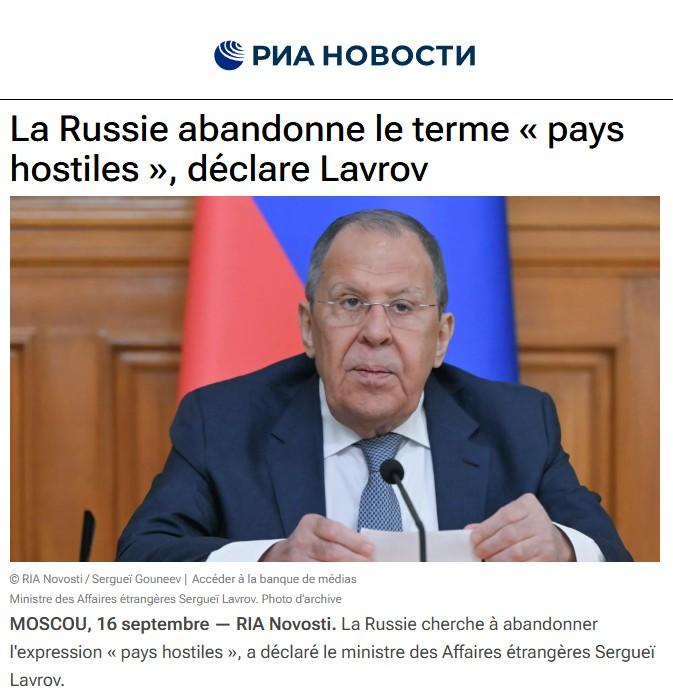
La Russie cherche à abandonner l’expression « pays hostiles », a déclaré le ministre des Affaires étrangères Sergueï Lavrov. «
L’article Lavrov : la Russie va abandonner le terme de “pays hostiles” est apparu en premier sur STRATPOL.
It is frequent that in these lower key events, speaking to students, if we pay attention we see Mr Lavrov’s brilliance. The word sangfroid fits so well: self-possession or imperturbability especially under pressure.
https://mid.ru/en/foreign_policy/news/2045680/
Mr Torkunov,
Colleagues,
Friends,
First year students.
I was honoured to learn that Mr Torkunov scheduled this meeting as part of the Day of Knowledge, emphasising the importance of preserving, honouring, and developing traditions. I believe this was the right decision.
I hope it has not caused you significant inconvenience that we are meeting on September 8 rather than September 1. The challenge of scheduling our meetings arises from the fact that foreign policy work continues uninterrupted, without any breaks.
As you know, on August 15 of this year, the historic summit between President of Russia Vladimir Putin and US President Donald Trump took place in Alaska. Just over a week later, at the end of August and the beginning of September, President Putin undertook an unprecedented tour, which included a four-day visit to China to attend the SCO summit, conduct a separate Russia-China bilateral summit, and participate in events commemorating the 80th anniversaries of both the Victory over Japanese militarism and the end of World War II. The near future is unlikely to be any less challenging.
This week, we are holding another meeting of the foreign ministers of Russia and the Gulf Cooperation Council states. Next month will see the first-ever summit between Russia and the League of Arab States. The second ministerial conference of the Russia-Africa Partnership Forum is scheduled for November. Before the end of the year, there will also be meetings of the EAEU – both ministerial and at the highest level – as well as sessions of the CIS and the CSTO. At all levels, including the highest, the bodies of the Union State of Russia and Belarus are actively engaged.
I will not attempt to analyse the results of all the events of the past three weeks involving President Vladimir Putin. This task is carried out very well by political scientists and analysts, including faculty members from MGIMO, who regularly share their assessments on television.
I have no doubt that if you chose MGIMO for your higher education, you actively follow developments and absorb knowledge and information. But it is not enough simply to absorb, it is essential to use what you learn to form your own independent conclusions. Do not be afraid to do this. Approach your studies creatively and do not hesitate to question authority. This may not always be welcomed, but I am convinced that without such critical engagement, personal development will be hindered.
After the start of the special military operation, many predicted economic collapse, complete isolation, and that our country and its leadership would become international pariahs. Yet the statistics – provided not by us, but by Western institutions, including the World Bank – show that Russia is now the fourth-largest economy in the world by purchasing power parity, following the USA, China, and India, and the largest economy in Europe by the same measure.
As for claims of our “isolation,” events like the SCO meetings and last year’s BRICS Summit in Kazan clearly demonstrate that these assertions are baseless. They were invented merely to allow some Western countries to publicly “wave their banners,” proclaiming themselves the leading global powers and insisting that everyone abide by the “rules” they define for the international order. These so-called rules have become uninteresting to discuss, no one has seen them, and in reality, they amount to only one thing: everyone must accept what serves the West in a particular moment. This approach will not succeed.
A good example of how the Global South and the countries of the Global Majority tend to follow requests, positions and, more recently, demands of the West can be seen in the reaction of Brazil, India, and China to the US’s threat to impose prohibitive tariffs as punishment for continuing trade with the Russian Federation, primarily through the purchase of our energy resources. Not one of these states – and they are great nations, leaders of the Global Majority – has made concessions or sacrificed their legitimate national interests.
The actions of our Western colleagues – with Europe playing an especially harmful and negative role for the future of the global economy – serve only to undermine the objective interests of those peoples who are compelled to forgo advantageous agreements and cheap raw materials, merely in order, as they imagine, to punish the exporter for alleged misbehaviour.
Let me make another statistical example. The BRICS countries (even before their number doubled in 2024, when there were only five of them) had already surpassed the G7 in terms of combined GDP measured at purchasing power parity. Since then, this gap has only widened. We harbour no desire for revenge, nor do we seek to vent anger on anyone. We firmly believe that anger and the pursuit of vengeance are poor advisers.
President of Russia Vladimir Putin reiterated this in Vladivostok, where he arrived right after the “autumn marathon” in China. He made it clear that Russia has not severed ties with anyone and does not intend to ignore anyone. When our former Western partners – now no more than neighbours – regain their senses and wish to return to Russia to work here again, we shall not turn them away. But we shall consider under what conditions such cooperation may resume, taking into account that by abruptly departing at the command of their political leaders they have demonstrated their unreliability. From now on, any such questions will be settled on terms that do not expose our key industries, or the foundations of our economy and national life, to risks – for these are directly linked to the security of the Russian Federation and to the economic and social wellbeing of our people. Without them, no state can be sovereign.
Please, recall the collapse of the USSR – brought about, to a large extent, by our own mistaken, utopian illusions that, once all ideological contradictions were removed, the West would grant us an equal place in international relations. It never intended to do so. This became clear soon enough, but illusions lingered. What happened, happened. The West regarded this not as a tragedy for millions of people suddenly torn apart, their families and communities scattered across different countries, but as an opportunity. And it pursued its course of weakening what was now the Russian Federation.
Recently, facts were presented that some marginal characters are still planning to dismember our country into separate regions. Our fugitive opposition, registered as foreign agents, is actively promoting this agenda. With little success, it must be said – yet the structures of Western states do not abandon them, keeping the idea alive. From time to time, statements are made which expose the desire of today’s Western leaders, especially in Europe, to weaken Russia and remove competitors.
After the Russian Federation regained its identity, returned to the foundations of our consciousness and values, and, since the 2000s, began to pursue a policy reflecting our national interests, we have never sought to weaken anyone or cause harm. On the contrary, we have always been ready for honest and equitable cooperation. While the West endeavoured to fragment both the former socialist bloc and the USSR, and later the Russian Federation itself, we consistently strove to unite.
This particular principle lay behind the creation of the CIS: to pool efforts and draw the maximum benefit from the legacy left to us by our Motherland, the USSR, rather than remaining isolated in a weakened state. This approach proved largely successful. From it grew the EAEU, the CSTO, and the Union State of Russia and Belarus. In each case, our efforts have been aimed at unification. The work of all these organisations is based on consensus; we have no system of one-man rule such as in NATO, where discipline is enforced by coercion, a fact well known to all. Nor do we have the type of top-down control that the European Commission seeks to impose on the European Union.
Attempts to keep everyone under strict command are not universally welcomed. The processes that are now taking place within NATO, driven largely by the position of the Trump administration, which insists that Europeans should assume greater responsibility for their own problems, are highly illustrative. They show clearly that it is impossible to impose one’s will and dictate terms indefinitely.
I would also like to highlight President Vladimir Putin’s response to a question he was asked in Vladivostok as to whether the future belongs to the Western or the Eastern world. He replied that the world will be multipolar. This is an important answer to those who have recently suggested, even within our own academic community, that a multipolar world might be built without the West.
We all inhabit one small planet. It is the Western style to construct “Berlin walls” – figurative barriers – within our vast Eurasian space, which was once the Soviet Union and is now the post-Soviet space. We have no desire to build any walls. We seek fair cooperation. And if our partners are prepared to engage on an equal and mutually respectful basis, we are ready for dialogue with all.
This was clearly demonstrated during the talks between President Putin and President Trump in Alaska. The difference between that administration and its predecessors under President Joe Biden, as well as many European leaders, is that they are not only willing to listen, but also able to hear. The discussions in Anchorage revealed that President Trump and his team understood the necessity of resolving all issues, including the Ukrainian crisis, on the basis of respect for all parties’ legitimate national interests. In Ukraine’s case, this means addressing the root causes of the crisis. For many years, the West has poured billions of dollars into Ukraine to create a regime wholly obedient to it: one that would not decline NATO membership and that would remain subordinate to Western structures, including the European Union. The latter, originally conceived as an economic union, has in practice degenerated into a militant appendage of the North Atlantic Alliance, betraying its founding purposes: to improve the lives of Europeans.
Our US colleagues grasped it and publicly stated that the alliance debates were over. They were among the core underlying causes of the Ukraine crisis. They are starting to hear us when we are talking about other underlying causes, including legalised extermination of the Russian language, media, culture, education, and the ban on the canonical Ukrainian Orthodox Church. When our US dialogue partners heard in Alaska that the church had been outlawed, US President Trump was amazed to learn that this was even possible in today’s civilised world, and in a country that is bragging about it allegedly defending the European values. Europe is playing along with the Ukrainians in this regard. Head of the European Commission Ursula von der Leyen and EU High Representative for Foreign Affairs and Security Policy Kaja Kallas are claiming that Ukraine is defending the “European values” in the war against Russia. It turns out that these “values” include the annihilation of human rights, including religious rights, even though this is all enshrined in the UN Charter. There is no other country around the world that would ban a language. In Israel, you can speak Arabic, and in the Palestinian territories, in the Arab countries, Hebrew has never been banned. There is no other country like Ukraine in this regard.
Forming a multipolar world is a long process that can take a historical era to complete. You will definitely have enough work to do. Not only those who choose diplomacy and international relations as their future profession, but also those who opt for the economy or the media will not be bored, because everything is interconnected in the modern world.
This is clearly shown by the orientation of the departments at MGIMO, and the number of global issues. When we were students, no one even could even imagine that collective efforts in health care or artificial intelligence would be high on the list of international priorities. No one even saw the artificial intelligence coming. There are multilateral entities dealing with all areas of human activities. Most of them have been formalised in the agenda of the UN system (specialised agencies, committees, commissions, and so on).
The knowledge you will receive at MGIMO will be in high demand and make it possible for you to work on international matters, combining these efforts with the domestic needs of our country, just as we are trying to do now.
The Foreign Policy Concept clearly states that creating the most favourable external conditions for ensuring our country’s security, its socioeconomic development, and improving the well-being of our citizens is the main objective of our work. The fact that this relationship exists was proven by the events associated with the introduction of illegitimate, unilateral, and unprecedented sanctions on us, when they wanted to thwart this main objective of our diplomacy (creating favourable external conditions) and to create unbearable environment in hopes that we would throw our hands up and scramble to apologise. They are messing with the wrong people. I’m amazed that the West did not learn anything from centuries of history in the context of its repeated attempts to “rein in,” “subordinate,” or “punish” Russia.
We were not the ones to break off relations with the West. We are promoting the initiatives put forward by President Putin in his Address to the Federal Assembly of the Russian Federation, when he proposed thinking about combining the efforts of the existing Eurasian integration entities, such as the EAEU, the SCO, the CIS, ASEAN, and others. He proposed uniting them into a “cooperative network” in the context of forming what he called the Greater Eurasian Partnership, so that integration processes in different parts of Eurasia do not duplicate, but complement each other, so that transport corridor projects also get worked through with the best routes in mind. In other words, he proposed cooperating in the development of what God, our ancestors and history gave us.
Eurasia is a single, largest and richest continent, where the greatest human civilisations lived, evolved, and are preserved. They preserve and develop their traditions and identity. We are not guided by the desire to “wall ourselves off” from any portion of this continent. We have always proceeded from the fact that the processes of forming the Greater Eurasian Partnership will be open to the western part of our continent as well, when and if (hopefully, when) they stop thinking of themselves as the “golden billion,” or the “garden surrounded by the jungle”. You are aware of the level of “modesty” of these people, and how they talk about history and their current place in it. Life will teach them a lesson. I do not advise those who engage in journalism to spend a lot of time reacting every time they “sneeze.” Their lack of desire to get to know what is happening is so transparent that I would not even waste time on them.
Healthy forces in Europe are gradually raising their heads. They must prevail through what Europeans call the democratic process, even though obstacles are put in their way as was the case in Romania and France. Now, in Germany they are trying to outlaw an opposition party. That’s the kind of “freedoms” they live by.
Just like everyone will benefit economically from an open system for forming the Greater Eurasian Partnership, ensuring security in Eurasia at the expense of any given Eurasian country is impossible.
In addressing the stuff of the Foreign Ministry of Russia in June 2024, President of Russia Vladimir Putin formulated our approach to Ukraine crisis settlement and outlined the task of creating the foundations of Eurasian security architecture that should be based on the principle of indivisible security, which postulates that no one should strengthen their security at the expense of the security of others and that no one should lay claim to military-political domination. This is not something new. All these indivisible security principles were solemnly proclaimed by the OSCE summits in Istanbul in 1999 and in Astana in 2010, with heads of state putting their signatures thereunder. Let me remind you that the OSCE has taken shape in the context of the Euro-Atlantic security concept: Europe + the USA and Canada. It was the Europeans who insisted that the US and Canada be invited. It seemed to them at the time that they would feel miserable without overseas supervision. So, they got what they had asked for.
This time, it is necessary to create a continental security system. Africa has a continental organisation: the African Union. Latin America has CELAC. Both continents have numerous sub-regional integration associations but there are also continental umbrella organisations. Eurasia abounds in sub-regional associations but it has no organisation that would be open to all countries in the continent.
In putting forward his initiative, President of Russia Vladimir Putin thought it important to show that we were ready to cooperate with everyone, but let us do that honestly. The indivisible security principles that the West has trampled underfoot in the context of Euro-Atlantic processes, specifically at the OSCE, should not only be formulated and reaffirmed, but also respected as any commitment undertaken by a self-respecting sovereign country.
These are few and far between in the West. Sovereignty is an asset available to the United States alone. History shows that Western colleagues easily renounce what they have underwritten, be it a commitment not to expand NATO or respect for human rights, which the Europeans, along with the Ukrainian regime, are simply destroying and annihilating in the context of their support for the Kiev regime.
In conclusion, I would like to wish freshmen interesting studies.
Be daring, imbibe what is said and written by authorities [in different disciplines], but always seek to find something originally yours and make your own contribution. It’s never late to study, nor is it ever early to be daring. So, I am in every way encouraging you to adopt this attitude.
I would like to say some special words of gratitude to the academic teaching staff led by Mr Anatoly Torkunov. He – and his comrades-in-arms – has not only kept abreast of the times for decades and has not only espied new burgeoning trends in the area of education but has also incorporated them in the educational process.
An important step is President of Russia Vladimir Putin’s decision to merge the Diplomatic Academy with the Moscow State Institute of International Relations (MGIMO). This process is under way. Before the end of this year, we will hold a special Board meeting. This will considerably strengthen the link between education, science and practice. The Diplomatic Academy is where a large number of our diplomats take special courses before leaving on individual foreign missions. There are also courses for representatives of other federal executive authorities. Refresher courses for foreign diplomats are popular as well. This is a good and useful process but it requires much personal exertion and energy inputs.
I hope that all of you people have followed how the public marked your rector’s birth anniversary. I want once again to wish him many happy returns of the day and congratulate him on the high governmental award.
Question: In connection with the recent Russia-US summit in Alaska. Although that top-level meeting has answered some questions, what official objectives and priorities does Russian diplomacy stipulate today? What priorities and prospects does this aspect have nowadays?
Sergey Lavrov: The distinguishing feature of our diplomacy is that its priorities and goals are never secret. President of Russia Vladimir Putin and other Russian representatives also discuss them. Specific methods for achieving them remain confidential. This is understandable because diplomacy requires a quiet atmosphere when you really want to reach an agreement. If you want to score propaganda points and to bask in the diplomatic and foreign policy spotlight, this is something different. This genre is not called diplomacy.
Diplomacy is the art of coming to terms. I have repeatedly noted that diplomacy is the most ancient profession. It is necessary to reach agreement in all other spheres. This calls for a quiet atmosphere. Our goals are simple. We want to maintain equitable cooperation with all countries, including the United States which is displaying a similar interest.
In February 2025, Russian Presidential Aide Yury Ushakov and I met with US Secretary of State Marco Rubio and the then National Security Adviser to the President of the United States, Mike Waltz (he is now landing another job) in Saudi Arabia. That meeting took place in the 2 + 2 format.
The US side initiated that meeting. First, Marco Rubio said that he wanted to confirm that the foreign policy of US President Donald Trump was based on pragmatism and US national interests, rather than some ideology. The administration of Donald Trump admits that all other countries, especially such great countries as the Russian Federation. have their own national interests. The United States wants to obtain maximum benefits when national interests of our powers coincide, while that such interests will not coincide in all cases. On the contrary, they will not coincide in most cases because the interests of large countries always clash in some spheres. In those situations, when these national interests do not coincide and run counter to one another, our main task is to prevent this disagreement from escalating into confrontation. I replied that this completely coincided with our position. Our interests coincide in this context. President of Russia Vladimir Putin discussed this at the Eastern Economic Forum in Vladivostok.
This highlights some interesting economic prospects, including production of liquefied natural gas in Alaska and lots more. The Arctic offers major opportunities for cooperation; the same is true of joint space exploration and many other spheres.
Our main principle implies an honest and open discussion of each other’s positions and efforts to find coincidences that should be translated into practical deeds; moreover, it is necessary to prevent disagreements from escalating into confrontation, let alone a high-intensity conflict.
Question: Given that the confrontation between the United States and China is escalating into a trade and technological rivalry with global repercussions for markets, what strategic steps is Russia taking to strengthen its foreign economic ties and diversify export markets – particularly under sanctions pressure and amid the restructuring of the global financial architecture?
Sergey Lavrov: As I have already mentioned, the imposition of sanctions entirely contravenes the principles upon which, at the initiative of the West, the international monetary and financial system, as well as the global trading system, were constructed over decades. It is a complete violation. What was established after the Second World War was founded on the necessity of fair competition – sanctions and tariffs no longer constitute fair competition – and on respect for property rights.
As you are aware, our Central Bank reserves were seized outright through robbery and remain frozen to this day. The administration of Barack Obama confiscated diplomatic property – this is beyond the pale. The principle of presumption of innocence, which the West vigorously promoted within its ideals for the international monetary, financial, and trade spheres – along with all other aforementioned principles – has been followed by everyone.
What is transpiring now is lawlessness.
American leaders have long asserted – I do not recall under which administration, though no senior US official has ever refuted this –addressing all members of the international community, that the US dollar is not American property but a global public good. This good was provided to ensure the smooth, uninterrupted, efficient, and economical operation of the world’s economic and financial system, benefiting all countries without exception.
What the Joe Biden administration began doing with the dollar, weaponising it, alarmed many at the time – prompting them, mostly silently but seriously, to consider how to protect themselves from such capriciousness in the future. Back then, they decided to punish Russia, cutting off its access to dollar-denominated settlements. Who knows whom the next US administration will take offence at and deem to be behaving “incorrectly?”
The trend towards establishing alternative payment platforms and other logistical mechanisms essential for normal trade is underway. It is no coincidence that Donald Trump, during his presidential campaign, sharply criticised Joe Biden precisely for jeopardising the dollar’s role as the global reserve currency – a role that had suited everyone and kept the gears of the world economy turning. This is true. Actions that abuse the role of one’s currency undermine trust in it.
Now, members of Donald Trump’s administration are also attempting to resort to such measures. This seems somewhat illogical, since Trump himself stated that Biden’s handling of the dollar inflicts colossal harm on Americans and their leading position in the global financial system. Unfortunately, those responsible for finance in Trump’s administration have yet to heed their leader’s assessment. Thus, the process of forming reliable payment systems and logistical routes – independent of whims, diktats, or blackmail – continues to advance.
At the 2023 BRICS summit, Brazilian President Luiz Inácio Lula da Silva proposed an initiative to create alternative payment platforms. BRICS finance ministers and central bank governors were instructed by their leaders to address this issue. They are preparing relevant reports. An interim report was presented at the BRICS summit in Kazan. This year’s BRICS summit also saw concrete proposals tabled, which are now under consideration. Some are already being implemented. Perhaps it is unnecessary to delve into specifics here – this is neither the appropriate audience nor the right discussion for detailing how a normal, free, mutually beneficial settlement system operates.
Later today, a virtual BRICS summit will convene via videoconference, to be attended by Russian President Vladimir Putin. The summit, initiated by Brazilian President Luiz Inácio Lula da Silva, will focus on developing additional measures to counter the West’s unlawful actions in global trade and finance, including responses to its tariff war.
Every action provokes a reaction. There is no prohibition that cannot be circumvented – especially since, in this case, most sanctions are illegitimate, violating international law and WTO norms. Meanwhile, efforts to bypass them rely on agreements between parties, without any attempt to inflict harm through unlawful means.
Question: I would like to learn more about the beginning of your career. It is known that you started your service at the Embassy in Sri Lanka. What difficulties did you encounter at the outset? What were the greatest challenges in your work in those early days, and how did you overcome them?
Sergey Lavrov: It was a long time ago, right after I graduated from the institute. Sri Lanka is a country with a marvelous climate, a fascinating history, and even then, an active political life. At the time, the country was emerging from an internal conflict, when the Tamils living in the north of Sri Lanka had taken up arms in an attempt to defend their rights.
I will be honest, the most difficult aspect was not directly related to my official duties at the Embassy, but rather to the habits and outlook that any young person develops at that age. We lived well there. As the saying goes, there is a time for work and a time for leisure. The atmosphere at the embassy was good. The ambassador, Rafik Nishanov – may he rest in peace – was very supportive of the younger staff and we, in turn, did our best to work conscientiously. What is difficult, of course, is that immediately after university one often feels insufficiently prepared. But when higher education equips you properly, the transition into “adult” professional responsibilities is smooth. In those circumstances, as the song says: we worked hard, and we will rest well.
Question: Since the new administration came into power in the US, the trade between our countries has done up by 20 percent. Considering the intensification of Russian–American dialogue, what advantages and opportunities exist for trade and investment?
Sergey Lavrov: I have already touched upon this issue. A 20 percent increase alone does not mean very much yet, because our trade used to be around $30 billion, whereas last year it was only $3 billion. A 20 percent rise may simply reflect fluctuations in global prices for uranium, which the Americans continue to purchase, and for certain other metals. So, while not a statistical error, it is largely a result of price volatility on world markets.
As for opportunities, I have already listed them. Among them, there is the Arctic, including joint projects on liquefied natural gas production, both here and in Alaska. Besides, there are projects of interest to Western businesses in Sakhalin, as well as the vast expanses of Siberia, which is among the richest regions in the world in terms of natural resources. There is also space exploration.
I have no doubt that cooperation could also be established in high technology, including artificial intelligence, although, given its potential military applications, this may first require a higher degree of mutual trust. Nevertheless, there are no limits to what we could achieve together, provided our interests coincide.
If both the United States and Russia are interested in increasing LNG production… if both we and they want the Arctic to be our common home, particularly given the Trump administration’s interest in Greenland… if we recognise our mutual interest in space – which is obvious, and an area where our partnership has never been interrupted – then the opportunities are vast.
Let me also mention sports: ice hockey and football. The United States will host the 2026 FIFA World Cup, together with Mexico and Canada. I know that in certain circles, including among the FIFA leadership, the idea of holding a football match between the hosts of the 2018 and 2026 World Cups is already being discussed. In the past, we had a tradition of ice hockey “tours” in each other’s countries, and there is considerable interest in reviving this, including among retired players, both in Russia and in the US.
On the initiative of President Vladimir Putin, the first Intervision international song contest will be held on 20 September. More than 20 countries will take part, including nearly all BRICS states, CIS partners, and a number of countries from Africa, Asia, and Latin America. A participant from the US is also expected.
I firmly believe that the more contacts and the more exchanges at various levels we have, the better. We have never had insurmountable problems in our relations with the United States. The obstacles have always been ideological. Let me recall that US Secretary of State Marco Rubio told me that their foreign policy is no longer based on ideology but on national interests. If that is indeed the case, then there is a great deal where we can find common ground.
Question (retranslated from English): My question is about President Putin’s upcoming visit to India. India is a key partner to Russia. What issues will be under discussion? What role do Russian-Indian relations play in creating a mutual respect-based international order?
Sergey Lavrov: This topic was covered well-nigh several times per day in all news reports and analytical programmes over the past week. The photograph with President of Russia Vladimir Putin, Prime Minister of India Narendra Modi and PRC Chairman Xi Jinping went round the world, causing totally incomprehensible wrath and consternation in certain Western leaders, who called it a challenge to the “rules-based international order.” None of our countries has approved this “order,” while the Troika – Russia, India, and China – has existed for a long time in addition to our bilateral relations with India and the People’s Republic of China.
The quality of Russia’s bilateral relations with India has been constantly growing. This found an expression in the terms used during numerous summits held between Moscow and New Delhi. At first, they were “relations of strategic partnership,” next they were promoted to “relations of privileged strategic partnership.” Under the former Prime Minister of India, Manmohan Singh, they became a “specially privileged strategic partnership,” and this appellation is valid until today. There is nothing to add.
With the People’s Republic of China, we have relations of strategic interaction and multilateral partnership. With either country, these relations go back many decades. Our partnership with India is directly related to its independence. With China, we were jointly waging warfare to defend a new international order. With the Indian side, we have a ramified system of cooperation mechanisms at the top level. There is an intergovernmental commission on trade and the economy. Foreign ministers and defence ministers maintain regular contacts. Formerly, we held a 2+2 meeting between both countries’ foreign and defence ministers. Somewhat later, the pandemic set in, and all of that was put off until better times.
We are making thorough preparations for President of Russia Vladimir Putin’s visit to India, which is due to take place before the end of this year.
Let me assure you that we have much experience and grand plans in politics, the economy, the social area, culture, military affairs, and military-technical cooperation. These plans were reaffirmed during the meeting between Prime Minister of India Narendra Modi and President of Russia Vladimir Putin in China.
I said that the Troika had existed for a long time. Yevgeny Primakov, while in capacity of Russia’s foreign minister, insisted that it had much promise. In 1998, he came up with the idea to establish a standing mechanism composed of Russia, India and China, RIC. Nearly 20 meetings in this format at the level of foreign ministers have taken place since then. There were also meetings of the ministers of economy, trade, finance, and culture. But then the pandemic intervened again. Later there was a surge in tensions on the China-India border. So, we kept postponing Russia-India-China meetings.
Today, to everyone’s satisfaction, China and India have found it possible to overcome their differences and problems that prevented them from holding a normal dialogue at that stage. They are exchanging visits. We have the impression from contacts with our Indian and Chinese friends that we will soon be able to resume this business. This will benefit all sides.
It is not by chance that everyone got agitated as soon as the joint photograph of the three leaders appeared in the media. In the US, certain “analysts” asked how it would be possible to pit the Troika against each other, if they were on friendly terms? That’s the kind of philosophy they have.
The “Indo-Pacific strategies” have been invented for this purpose, strategies aimed at undermining the ASEAN-centric security system in Southeast Asia, based on the principles of equality, inclusiveness, as they say, consensus, and much else. The West, while formally refraining from efforts to dismantle this system, began an infiltration of its narrowly bloc structures in this region. This push started way back under Joe Biden and is, in fact, an attempt to strip ASEAN of its “first fiddle” capacity for discussing security issues. They are creating “threesomes” and “foursomes…” NATO is attempting to expand its infrastructure to the region.
They have created the QUAD made up of the US, Japan, Australia, and India. When they were first told about this initiative, our Indian friends declared publicly that they saw an economic interest in it but would support no actions related to military-political affairs. This was a far-sighted remark because increasingly more attempts are being made to use this organisation as an irritant in relations with China, which no one would fancy.
When the great powers of Eurasia, the three great civilisations, work together, this is a source of concern for certain Western circles, if only because they are unwilling to lose the opportunity of playing each of these countries against another. But this is wrong. These are not our methods. These methods go back to the past epochs of colonialism. [The West] is seeking to revive them by bringing back the neo-colonial methods whose essence is in living at the expense of others. But we – India, Russia, and China – want to live at the expense of our people’s talents and by pooling these talents and our capabilities.
Question: What are your priorities for Russian diplomacy in the South Caucasus, given the relations with Azerbaijan and Armenia?
Sergey Lavrov: Our priorities have never changed: it is peace and cooperation. They remain unchanged today. The Russian Federation, through the decisive efforts of President Vladimir Putin, played a key role following the outbreak of the second Nagorno-Karabakh war. Numerous late-night telephone conversations were held. This conflict could have been stopped much earlier, but not every party was ready for such a decision. Nevertheless, President Putin succeeded in reaching an agreement that was signed by Prime Minister Nikol Pashinyan and President Ilham Aliyev on the night of November 9-10, 2020. This was followed by a series of other trilateral summits, where important agreements were reached to unblock economic and transport links; create a mechanism, led by the three deputy prime ministers of Russia, Armenia, and Azerbaijan, to oversee this process; as well as an agreement on principles for border delimitation and later demarcation; and an initiative to bring together public figures from the three countries to complement interstate dialogue with civil-society dialogue. We have never refused to implement these agreements.
We can see that it was decided to conclude a peace treaty – which stems from the understandings reached between 2020 and 2022 by the leaders of Russia, Armenia, and Azerbaijan (1,2,3,4) – on the territory of the United States. This is, of course, our neighbours’ sovereign choice. But it still remains to be seen how this will work in practice. All the enthusiastic commentary that followed the Washington meeting was later tempered by more sceptical assessments once the text of the document was published, revealing that not everything had actually been agreed.
There is a certain genre in foreign policy where something must be done in a dramatic fashion and presented attractively in the media. This approach can have its benefits in particular circumstances. But if no substance follows, it remains merely a flash. Russia is interested in concluding a genuine peace treaty.
In this regard, we welcome the normalisation process between Armenia and Türkiye. Another contact has recently taken place, and, according to at least some analyses, Türkiye may no longer condition the restoration of relations with Armenia on the full normalisation of Armenian-Azerbaijani relations. Another step forward is the recent resumption of diplomatic relations between Armenia and Pakistan. We hope that work within the framework of the 3+3 initiative, suggested by Türkiye and Azerbaijan, will be resumed. It involves the three South Caucasus states (Armenia, Azerbaijan, and Georgia) together with their three major neighbours (Iran, Türkiye, and Russia). We held a number of meetings at ministerial level in 2023, as well as meetings at deputy-minister level. We believe the time has come to revive this format. Our Iranian neighbours fully support the process, while Türkiye and Azerbaijan were its initiators. I hope we will be able to meet again soon in this format.
Question: What do you think of the current situation in the Gaza Strip? How can Russian diplomacy end violence and reduce casualties?
Sergey Lavrov: The Gaza Strip is a graphic example of how our Western colleagues interpret international law. The United Nations Organisation, the UN Security Council and the UN General Assembly have adopted decisions with regard to the Gaza Strip and the West Bank; these documents call for establishing a Palestinian state. A decision to establish this state was made in 1948 on a par with a decision to create the state of Israel. These inter-linked decisions served as a foundation for reaching consensus among all members of the United Nations. The state of Israel was quickly established, but the state of Palestine was not. I will not discuss the causes of this. The Palestinian Arabs themselves failed to accomplish many objectives for achieving this goal, set by the UN, but external factors played a decisive role, refusing to fulfil these agreements.
Several wars took place; in their wake, the territory, initially reserved for the Palestinian state, dwindled steadily. Consequently, everyone saw Palestinian territory (that was left following yet another Arab-Israeli war) as the main criterion. But we understand that Israel is concerned about its security, and we always emphasise this. A decision on establishing two states (Israel and Palestine) was followed by a statement that they should be established in such a way as to coexist in safety and neighbourliness.
But we have fallen into this “trap.” Regional stability is hardly possible, unless the Palestinian state is established. They do not want to establish it because Israel says that this will threaten its security. Arab street protests tended to increase while the implementation of this decision was delayed time and again. The thing is that decades-long injustice with regard to the Palestinians influences public opinion in Palestine and in Arab countries that rightfully consider the Palestinians to be their brothers.
We talked with our Israeli colleagues – long before the current bloody events – insisting on the idea that without the creation of a Palestinian state, extremism fuelled by the deep sense of injustice suffered by the Palestinians will only continue to grow. This thesis, however, was never truly accepted. Recently, Prime Minister Benjamin Netanyahu stated outright that there would be no Palestinian state, as his priority is not to consider such a prospect but to guarantee the security of Israel. This is understandable. Yet, in our view, it is difficult to ensure Israel’s security by undermining the security of the Palestinians. Security, after all, is indivisible. One cannot guarantee Israel’s security while simultaneously denying the Palestinians the right to their own state.
When the terrorist attack occurred in Israel on October 7, 2023, we unequivocally condemned it. However, we could not accept the response, which was neither carefully thought-out nor directed at identifying and neutralising the perpetrators and organisers, but instead sounded more like collective punishment of the Palestinian people. I recall that Israeli leaders at the time justified their actions by claiming they were destroying Hamas. When some pointed out that civilians were also being targeted through such sweeping military measures, a minister in Mr Netanyahu’s government (I do not want to speak against anyone here) responded that there were no civilians there: everyone was a terrorist, starting from the age of three. This statement provoked no particular reaction from the West.
But it is a fact that the refusal to establish a Palestinian state, the blockade, restrictions on movement, and constant raids over the years have all inevitably fuelled discontent from which extremist sentiments can easily be fostered.
Regarding the Golan Heights. During the Biden administration, Secretary of State Antony Blinken spoke at an event where he described Russia as having “annexed” and “occupied” Ukraine, declaring this to be unacceptable. He was asked about the Golan Heights, which, under all UN resolutions, are recognised as part of the Syrian Arab Republic, yet which Israel annexed: an act recognised by the previous US administration and effectively upheld by the Biden administration. How could this contradiction be explained? Mr Blinken replied simply: “This is different.” Because, he argued, Israel’s security depends directly on the Golan Heights. That was the entire explanation.
So, he denied Russia the right to be equally concerned about its own security. Not in the sense of “annexation,” because it was not Jews or the Jewish people’s brothers and sisters who lived there, but in the context of NATO’s expansion, which sought to extend its influence into Ukraine – territories that for centuries had been Russian, where Russian people had lived for generations, building cities, ports, roads, and developing those lands. When NATO sought to draw Ukraine into its orbit, was that not a direct threat to our security? Of course, it was.
We recognized the Palestinian State in 1988. The West does not want to do it, they are constantly looking at other interests, not those of the Palestinian people. And I want to say it again that we firmly stand for Israeli security but not at the expense of Israeli’s intrusion. In addition to Golan Heights, they have also penetrated the buffer zone, which should be under the UN control, and entered into the south of Syria. They also have a number of other territorial plans.
What is most important, if you look at the map, and all of us repeat it like a spell, is that: “long-term crisis resolution consists in the establishment of a Palestinian State within the boundaries of 1967.” Look at the map. The facts on the ground preclude establishing a state. It is no coincidence that French President Emmanuel Macron, British Prime Minister Keir Starmer, and some other European leaders condemned the violence a couple of months ago when there was another bloody outbreak of violence and said that they would definitely recognise the Palestinian state when they come to the UN General Assembly session. I have a question: why don’t you recognise it at once, if you have decided so? I can only say that they expect that there will be nothing to recognise by that time. That’s that.
The hypocrisy is evident. I will say it again: we are in close contact with Palestinians, other Arabs as well as with Israel. President Putin discussed this situation by phone with Prime Minister Benjamin Netanyahu on many occasions. They have long-standing relations. It is a most complex conflict. However, the West benefits from sweeping all these complexities, which require it to take a position of principle, under the carpet. One of its tools is to emphasise its senseless and deadlock position on the Ukraine crisis.
Question: I came from Slovenia. Being a Slovenian citizen, I am proud of my country’s historical and cultural ties with Russia.
Sergey Lavrov: Where did you come from?
Question: From Slovenia.
Sergey Lavrov: A nice place.
Question: In 2001, Slovenia hosted a meeting between presidents Vladimir Putin and George Bush, which underscored its role as a bridge between East and West. Today, Slovenia, as a member of the EU and NATO, is more West-oriented. Do you think that small countries like Slovenia can maintain dialogue and cooperate with Russia today?
Sergey Lavrov: It is difficult for me to answer this question, because there are other NATO countries which, unlike the current Slovenian government, have not broken off dialogue with us. Hungary has never interrupted contacts with Russia. In Slovakia, after Robert Fico returned to office as Prime Minister, relations were also resumed. He even attended an SCO event at the invitation of the Chinese leadership. We have the warmest feelings towards the Slovenians. To be honest, we have never had any prejudices against any country.
Recently, President Vladimir Putin has once again recalled that there is now a category of “unfriendly countries” in Russian legislation. This may be necessary as a legal mechanism, when some issues must be addressed. But in reality, we have no unfriendly countries, only governments that pursue unfriendly policies towards us. That is how we view the matter.
Let me repeat: we have not severed ties. If our Western colleagues, including those in Slovenia, wish to restore dialogue, we will be ready.
Of course, it will no longer be “business as usual” as before. We will build relations while keeping in mind the risks inherent in certain areas of cooperation, particularly those where we previously became overly dependent on Western technologies.
Slovenia, like other EU and NATO members, will live through the current situation when the West is attempting to defeat Russia on the battlefield. After that, we shall see. But I repeat: we retain warm feelings towards the Slovenian people. I have visited many times and always left with the warmest impressions.
Question: I would like to digress a little from political and economic issues and ask a more personal question. You are often asked about what you read, and whether we should expect a new collection of poetry. But I was wondering what music you listen to, and whether it helps you get into a working frame of mind?
Sergey Lavrov: Unfortunately, I mostly read documents. Although sometimes I find time to read fiction, but too often my book just sits there, silently reproaching me for not opening it. There is little time left for literature.
I still try to keep up with poetry, especially my own. I wrote verses for Anatoly Torkunov’s 75th birthday. My friends published a collection of my poems for my anniversary, but that stopped in 2004 when I was appointed minister. Since then, I have only written verses for friends’ anniversaries, usually on everyday topics. The creative energy that once went into poetry is now channelled into prose on the diplomatic stage.
I love music. I am very fond of bards. Vladimir Vysotsky is not just a bard but more than a bard. I like Bulat Okudzhava and Yury Vizbor. I am sorry that contemporary bard singers in Russia are not promoted enough. Popular music dominates instead. It is also a kind of zeitgeist. But for us, a bonfire and a guitar are a symbol of home, of patriotism itself.
There are certainly young people today who write their own songs. During the special military operation, many talented poets have emerged, whose works have been set to music. TV channels like Solovyov Live are making efforts to promote them, but I think more could be done to ensure their music is heard. Perhaps, in time, we may even see a dedicated competition for soldier poets. During the Great Patriotic War, many poets wrote verses at the front and sent them back. I think reviving that tradition would be a right thing to do.
Of course, if MGIMO University continues to maintain its cultural traditions, such as its choir, poetry club, book club, all of this should be promoted. We should have presented its rich cultural life at Rector Torkunov’s birthday.
Friends, I wish you every success in your studies. All the conditions for that are in place. You have excellent teachers and mentors. As Anatoly Torkunov said, both the retired workers of the Foreign Ministry and current diplomats are always ready to talk with you, to help, and to answer the questions that inevitably arise.
Let me remind you once again: absorb knowledge, but also dare think independently. Based on what you learn, look for something new and useful, both for your country and for yourselves.
The video is part of the transcript here: https://mid.ru/en/foreign_policy/news/2042813/
It is advisable to watch the video.
Transcript
Question: Russian Foreign Minister Sergey Lavrov, Mr. Foreign Minister, welcome to Meet the Press.
Sergey Lavrov: Thank you. And welcome to meet the Russian diplomats.
Question: Thank you so much for joining us after a very significant week. Let’s dive right into the state of these talks. Has President Putin committed to a one-on-one meeting with President Zelensky?
Sergey Lavrov: Well, those are the speculations which are being spread by, first of all, Mr. Zelensky himself and his European sponsors. It was not discussed in Anchorage. It was raised later as something which is kind of impromptu, appearing from the meeting in Washington between President Trump and his guests.
President Putin received the call of President Trump after that meeting, and he clearly stated that we are ready to continue the negotiations, direct Russian-Ukrainian negotiations, which started in Istanbul and already had three rounds convened there. And he said that meetings at the top level, the summit meetings, especially between the leaders of Russia and Ukraine, must be very well prepared, so a preparatory process must be agreed. And for this, we suggested to raise the level of delegations who were meeting and will be meeting in Istanbul to address specific issues which need to be brought to the attention of President Putin and Zelensky. And those issues relate both to humanitarian, military, and to political matters.
Last time our delegations met in Istanbul, we suggested to create three working groups, including on political matters. More than one month passed already, there is no response from the Ukrainian side. And when Mr. Zelensky says the immediate priority is a meeting with Putin, well, it’s basically a game. A game he is very good to play because he wants theatrics in everything he is doing. He does not care about substance. And it is not by chance that now they try, I mean the Ukrainians and the Europeans who attended the meeting in Washington, they try to distort what was discussed in Anchorage between President Trump and President Putin regarding, in particular, the security guarantees.
I read some Bloomberg reports yesterday and today saying that the negotiations between the U.S. and Russia on security guarantees for Ukraine have been, in fact, undermined because of the demands by Moscow to include the principle of indivisible security. It’s a very telling statement.
Indivisible security is something which was enshrined in many documents adopted by consensus at summits of the Organization for Security and Co-operation in Europe, in particular in Istanbul in 1999, and in Astana in 2010. This principle goes like: no one can strengthen their security at the expense of the security of others. No organization in the European space can pretend to dominate in military and political matters. And NATO has been doing exactly the opposite. So, when we are accused that by flagging the principle of indivisible security we are undermining the process of negotiations between the U.S., Russia and Ukraine, this means that the people admit that they want divisible security, that they want security built for Ukraine, which is being discussed now, but built against Russia. Those discussions which took place yesterday, before yesterday, after the Washington meeting, they clearly indicate that people see security as only security for Ukraine and they are prepared to send an intervention force, an occupying force, to the Ukrainian territory to deter Russia. They don’t conceal that this is the goal. And this is not the way to handle the situation.
President Putin and President Trump in Anchorage discussed the security guarantees, and President Putin recalled that in April 2022 in Istanbul, during negotiations initiated by the Ukrainian side, very soon after we started our special military operation, during those negotiations in April 2022, the Ukrainian delegation presented the draft principles to reach a treaty, to reach agreement on ending the war. Those principles were initialed by both delegations. As regards the security guarantees for Ukraine, those principles proposed by the Ukrainian delegation, I underline this once again, they provided for the creation of a group of guarantors, this group containing permanent members of the Security Council: Russia, U.S., China, UK and France, plus they mentioned Germany, Turkiye and any other country which would be interested to join this group of guarantors. And the guarantors would be guaranteeing the security of Ukraine, which must be neutral, which must be non-aligned with any military bloc and which must be non-nuclear.
Question: Mr. Foreign Minister, we are going to get to the security guarantees, we’re going to have a big conversation about that, but I just want to stick to this idea of a one-on-one meeting between President Putin and President Zelensky. It’s not the Zelensky thing at the White House that President Putin told President Trump he’s willing to meet face-to-face with President Zelensky. And I guess the question is, how can you claim to be serious about a peace process when you can’t tell me directly, is President Putin willing to meet with President Zelensky? Is that the plan?
Sergey Lavrov: Look, I hope that those who are interested in what is going on around Ukraine, they follow the statements of President Putin, especially when they try to see some wrongdoing on our side. President Putin repeated this statement, that he is ready to meet with President Zelensky.
Actually yesterday at my press conference after my meeting with the Minister of India, I repeated this, that he is ready to meet with President Zelensky, provided this meeting is really going to decide something.
To meet for Zelensky to have another opportunity to be on stage is not what we believe is useful. We are not against him playing games and playing various shows, but it is not going to resolve the issue, because he publicly stated that he is not going to discuss any territories, thus challenging President Trump, and other American colleagues who stated the territorial issue must be on the table. He clearly stated that nobody can prohibit him from joining NATO, which again categorically challenges what President Trump was saying, and quite a number of other things. He also said that he is not going to restore the rights of the Russian-speaking people and cancel legislation, which was passed long before this Special Military Operation, starting from 2019. A series of legislation was passed in Ukrainian Parliament, prohibiting Russian language, exterminating Russian language, Russian culture, Russian education, Russian media, and canonical Ukrainian Orthodox Church.
So when he said that, I don’t give a damn about what you are saying, what President Trump believes must be a part of the solution, but I am ready to meet, just to do what? So if we are all going to be concentrated on, you know, imaginary effect, it’s not what diplomacy is about, it’s what the showman normally do with pleasure.
So my point is that President Putin said clearly that he is ready to meet, provided this meeting is really going to have an agenda, Presidential agenda.
Question: But that’s a big if. There’s no meeting planned, Mr. Foreign Minister. That’s a big if.
Sergey Lavrov: Kristen, I am awfully sorry, you’re not listening. There is no meeting planned, and I am not challenging this, but you cannot, I think, understand what I am saying.
Putin is ready to meet with Zelensky when the agenda would be ready for a summit, and this agenda is not ready at all.
President Trump suggested, after Anchorage, several points which we share, and on some of them we agreed to show some flexibility. When President Trump brought those issues to the meeting in Washington, with Zelensky present together with his European sponsors, he clearly indicated, it was very clear to everybody that there are several principles which Washington believes must be accepted, including no NATO membership, including the discussion of territorial issues, and Zelensky said no to everything. He even said no to, as I said, to cancelling legislation prohibiting the Russian language. How could we meet with a person who is pretending to be a leader, the leader of a country, which is the only country on Earth to have prohibited a language, not to mention that this is one of the official UN languages. In Israel, Arabic language is not prohibited. In Palestine and other Arab countries, Hebrew is not prohibited. But Ukraine does whatever they believe is necessary to promote the Russophobic, nazist agenda, and the West, which is normally crazy about human rights when they discuss anything anywhere, but in relation to Ukraine, the words “human rights” were never used during those years after the coup in 2014.
So yes, he is ready to meet, but no, we cannot meet just for him to have a picture and to say that, now I am legitimate.
Legitimacy is another matter, because irrespective of when this meeting might take place, and it must be very well prepared, the issue of who is going to sign the deal on the Ukrainian side is a very serious issue.
Question: You don’t think President Zelensky is the legitimate leader of Ukraine? President Putin doesn’t recognize him as the legitimate leader of Ukraine?
Sergey Lavrov: No, we recognize him as de facto head of the regime. And in this capacity, we are ready to meet with him.
But when it comes to signing legal documents, the entire picture is just part of it, which suits you. When we come to a stage where you have to sign documents, we would need a very clear understanding by everybody that the person who is signing is legitimate.
And according to the Ukrainian constitution, Mr. Zelensky is not, at the moment.
Question: Okay, well, he is a democratically elected President. Mr. Foreign Minister, let’s keep moving. President Trump told French President Macron this week, quote, “I think Putin wants to make a deal for me.” Is that accurate? Does President Putin want to make a deal for President Trump?
Sergey Lavrov: Well, I would not go in this semantic, you know, exercise.
President Putin was invited by President Trump. He visited Alaska. They had a very substantive meeting in Anchorage. They discussed the practical way, not just who is going to meet whom and what kind of broadcasting would be provided. They discussed real things regarding security. The violation of Russian security interests was one of the root causes of what has happened. And this relates to many years of lies when we were promised, starting from 1990 and then many times we were promised that NATO would not be expanding. And the OSCE summit documents, which I quoted, said in the past, and nobody canceled it, that no organization must claim superiority in Europe, and NATO has been doing exactly the opposite. So the security guarantees which Russia presented several times. In 2008, we suggested to sign a pact between Russia and NATO. And it was ignored. In 2021, before we had to take a decision on launching the Special Military Operation, we suggested two treaties, one between Russia and the United States, and one between Russia and NATO. This was also ignored in a very, I would say, arrogant way.
Blinken, who was Secretary of State at the time, told me when we met in Geneva in January 2022, he said, “Forget about this. We can discuss some limits on the weapons which we, the West, would supply to Ukraine. But NATO membership is not for discussion with anybody.” When I told him that this bluntly violates the principle of indivisible security, he said, “The indivisible security in OSCE is political declaration.” But political declaration signed by the leaders, I think, is something which just out of decency, out of diplomatic and political decency, you have to respect.
Question: Okay. Mr. Foreign Minister, we have a lot to get to, so I do want to keep moving. Just this week, Russia bombed an American-owned factory near the Hungarian border. I’ve spoken to people who frankly see that as a slap in the face to President Trump, to the entire peace process. Isn’t it?
Sergey Lavrov: Well, I would say that those who are sincerely interested in understanding what is going on should know by now that never, ever Russia deliberately targeted any sites which are not linked to military abilities of Ukraine.
Question: This is an electronic factory, though, sir. This is an electronic factory. I’ve spoken to people on the ground there. It builds coffee machines, among other electronics. This is not a military site.
Sergey Lavrov: Well, I understand that some people are really naive, and when they see a coffee machine in the window, they believe that this is the place where coffee machines are produced.
Our intelligence has very good information, and we target only, as I said, either military enterprises, military sites, or industrial enterprises directly involved in producing military equipment for the Ukrainian army.
And on the contrary, I never recall any concern expressed by the media in the West regarding the activities of Ukrainian armed forces when they, for example, in the Kursk region, when they invaded it one year ago, there is no military targets at all. All the targets which they have been hitting daily are civilian. They, by the way, took civilian hostages from there who had nothing to do with the conflict. Recently, they undertook the third attempt to blow up the Crimean bridge. They attacked, a few days ago, another nuclear power station. They used to attack the one in Zaporozhye. Now they attack the nuclear power station in Smolensk. And they continue to do this, they continue to exercise terrorist attacks. There is no other way to call them.
But if you believe that if there is American capital in an enterprise which is used to produce weapons to kill Russians, and you believe that be it American, be it Hungarian, be it anybody’s capital that this gives impunity to those who build weapons to kill us, I don’t think so, I don’t think this is fair. This is kind of, I would say, imperialistic.
Question: Mr. Foreign Minister, just to confirm, you are confirming that Russia did in fact target and attack the American-owned company that was hit.
Sergey Lavrov: You should be professor in the Soviet universities because you twisted very interestingly what I said.
I did not say that I confirmed that incident. I never heard of it. I just asked a rhetorical question. Do you believe that if there is an enterprise producing weapons and being part of the Ukrainian military machine intended to produce things to kill Russian citizens, and just because this enterprise happens to have some American capital in it, it should be immune? That was my question.
I haven’t heard about the episode, and if you can send me some reference to this incident to which you referred, I would look at it.
Question: Okay. Mr. Foreign Minister, President Trump says he thinks President Putin wants to end the war, but if you are serious about peace, why not stop dropping bombs?
Sergey Lavrov: There was some interruption, but we are dropping bombs. We come again and again to the same issue. We are dropping bombs on the targets which are directly involved in building Ukrainian military machines targeting the Russian civilians and continuing the war which Ukrainians started by instigation from the Biden administration, from the Europeans, those who supported the coup in 2014, and later were doing everything to turn Ukraine into an instrument to contain Russia. Lately, a few years ago, it was announced that Ukraine is an instrument to inflict strategic defeat on the Russian Federation.
So when I give the examples of what we are doing, and this has been explained repeatedly, if you can provide us a proof that we hit any civilian target indiscriminately, a target not linked to the military machine of Ukraine, we would be looking into this.
But the facts of Ukrainians hitting purposefully civilian targets are plentiful, and they are available in the information which we are circulating to the international community.
Question: Mr. Foreign Minister, here are the facts. Close to 50,000 civilians have either been killed or injured in this war. Russia has taken maternity warrants, churches, schools, hospitals, a kindergarten just this past week. So either the Russian military has terrible aim, or you are targeting civilians. Which is it?
Sergey Lavrov: Look, NBC is a very respectful structure, and I hope you are responsible for the words which you broadcast.
I ask you to send us, or to publicize the information to which you just referred, because we never targeted the civilian targets of the kind you cited. You might be missing the information because it is a fact that quite a number of churches were purposefully hit by the Ukrainian regime. Quite a number of just civilian settlements, human settlements.
Question: But what about your actions, Mr. Foreign Minister?
Sergey Lavrov: Look, we are going by circles. I told you already what we mentioned repeatedly, that we never target civilian sites. That we only attack the sites which are directly involved in the Ukrainian military machine, which the West is trying to beef up.
And if you have any proof of what you just said about churches, kindergarten, schools, and so on and so forth, I challenge you to make it public. Make it public with the dates, with the addresses, and so on and so forth.
As I said, NBC is a very reputed broadcasting agency, and your listeners and watchers deserve to have some specific information when you make such claims. Question: I just said all of the information is publicly available. We do have reporters on the ground who’ve seen these strikes with their own eyes. I do want to keep moving, though, and talk about security guarantees, an issue that you raised this week. And you have said right here today that Russia should have the power to reject any security guarantees for you.
Sergey Lavrov: Look, don’t. Kristen, please don’t play Zelensky. Be an honest journalist.
Question: Why should the country that’s bombing Ukraine be responsible for the security of Ukraine?
Sergey Lavrov: Why is the country and countries who prepared the anti-Russian coup in Ukraine, who pumped up modern weapons in Ukraine to attack the Russian territory, countries who supported the nazist regime, prohibiting human rights, which they had to respect under the United Nations Charter and many other conventions. Why should we be swallowing all this? I explained to you, I never said that Russia must have a veto on security guarantees. But security guarantees must be subject to consensus.
I reminded you that it was okay for Ukrainians in April 2022 to present a document which could have ended this war and which started by declaring that Ukraine is going to be neutral, non-bloc, non-nuclear.
By the way, this statement, this declaration, not to have any nuclear weapons, not to be members of military blocs and to remain neutral status, this was the essence of the Ukrainian declaration of independence in 1990. And this declaration, it is because of this claim that they would never be NATO members, that they would never have nuclear weapons, and that they would be neutral, that they were recognized as an independent state.
So, if you believe that Russia being, you know, marginalized in the discussions on security issues on our borders, that this is something which is natural and normal, then I’m sorry, something is wrong with the philosophy of your channel.
Question: Just yes or no, are you talking about Russian boots on the ground?
Sergey Lavrov: Where?
Question: In Ukraine, in that region.
Sergey Lavrov: No, Russian boots on the ground are because this ground was moved, you know, was turned, was being turned in a stronghold to inflict strategic defeat upon the Russian Federation.
The Russian boots on the ground are not to protect the ground. They are to make sure that this ground would never be hosting weapons capable to reach the Russian territory.
Russian boots on the ground are because this ground is the territory where hundreds and hundreds of years ethnic Russians and Russian-speaking people were living. They actually founded those lands. They historically developed Russian culture, Russian language, and they respected Russian history.
And when all this was prohibited after the coup took place, the coup which was very bloody and very unconstitutional, we did not have any other choice but to defend these people against the bluntly nazist regime.
And the proof that the regime is nazist is plentiful, and I hope that some days your correspondents could visit and see what is going on with glorification of military criminals, collaborators of Hitler, and so on.
Question: President Trump has been in office now for seven months, and attacks against Ukraine have doubled in that time. President Putin says the war wouldn’t have started under President Trump. If that’s the case, why is it escalating under President Trump?
Sergey Lavrov: Look, it’s becoming traditional for some of the broadcasting channels to simplify things.
When President Trump said that the war wouldn’t have happened had he been President at that time, that means, in my view, that the Americans would not prepare, finance, and organize the coup to topple the legitimate president of Ukraine in February 2014.
Just one day after a deal was reached between the President at that time and the opposition, the deal guaranteed by the European Union, Germany, France, Poland, and so on. And next morning, the opposition broke the deal. The deal was to create a government of national unity and hold early elections. And the legitimate President agreed to this. The opposition signed this. The European Union guaranteed this. Next morning, there is a coup. And instead of a government of national unity, the opposition announced that, we created the government of the winners. Have you heard about this? I don’t think so.
They immediately stated, when they took over all government buildings, that their first action would be canceling the status of the Russian language. And they sent military groups to storm the Crimean Parliament. That’s how this all started.
So I don’t think that President Trump, with his concentration on MAGA, on the national interest of the United States, on the common sense, would ever get involved in preparing a coup against a legitimate President in any country, including Ukraine.
I am answering your question, why did we think that President Trump would have avoided this situation? I answered you.
Question: But I want to ask about what is happening on the ground right now. Attacks against Ukraine have doubled in the time since President Trump took office. If President Putin has so much regard for President Trump, why is he taking actions that are undermining his push for peace?
Sergey Lavrov: President Putin has regard for President Trump, respecting President Trump’s concentration on the interest, national interest of the United States, national interest and well-being, and historic heritage of the American people.
And I don’t have any doubt that President Trump respects the same attitude of President Putin to protecting the national interests of Russia, to protecting basic interests of the Russian citizens, including the right to be a nation which has very rich history, very rich traditions, and which has the duty, if you wish, to support those who share the values of the Russian language, Russian world, if you wish.
And when, you know, once the United States launched a military attack, it was last century, a military attack against, I think, Nicaragua or some other Central American country, because one of the journalists was physically attacked. American citizen, American journalist. And this was never causing any questions in the American media.
We are protecting millions of ethnic Russians and Russian-speaking people who wanted to be citizens of Ukraine, but the coup leaders who took power in Ukraine declared them “terrorists”.
And Zelensky, long before the special military operation, in an interview to one Western media, he said those who are fighting the regime, who decided that the regime doesn’t represent the interest after the coup, they are not people, they are “species”. And he also said that if you believe that, living in Ukraine, you belong to Russian culture, Russian history, then for the sake and safety of your children and grandchildren, get out of Ukraine and go to Russia. Is it the kind of democracy the Americans support?
Question: Mr. Foreign Minister, let me ask you about something that President Putin said in June. He said, quote, I consider the Russian and Ukrainian people to be one nation. In this sense, all of Ukraine is ours. Does President Putin believe that Ukraine has a right to exist?
Sergey Lavrov: No, this is not true.
Ukraine has the right to exist, provided it must let people go. The people whom they call “terrorists”, whom they call “species”, and who during a referendum, several referenda, in Novorossiya, in Donbass, in Crimea, decided that they belong to the Russian culture. And the government which came to power as a result of the coup was determined as a priority to exterminate everything Russian.
Question: But a number of those people did not want Russia to invade. Mr. Foreign Minister, do you acknowledge that Russia invaded Ukraine?
Sergey Lavrov: Well, democracy is about the people, you know, having a chance to vote. The people voted, the people pronounced themselves. And when it started in Crimea…
Question: Did Russia invade Ukraine? Mr. Foreign Minister, did Russia invade Ukraine?
Sergey Lavrov: No. Russia started the special military operation to defend the people whom Zelensky and his predecessor did not consider as humans. They called them “beings, species”. You should look, you should really…
I understand that you need something to sell today. But if you are raising and touching upon so serious things, my suggestion is to take a look at the history of Ukrainian development after the coup in 2014. I have some material.
Question: But it’s a yes-or-no question, it’s a yes-or-no question, Mr. Foreign Minister, do you acknowledge Russia invaded Ukraine?
Sergey Lavrov: I said to you that we started the special military operation to protect the people whom the regime declared terrorists and enemies, and whom the regime was bombing.
Look, one thing, one thing about the facts. You were asking me about churches and so on, allegedly bombed by Russia. One very blunt thing, the simplest on Earth. And I would ask you as a journalist whether you are professionally proud of what you are doing.
In April 2022, when a deal was negotiated in Istanbul, but the British and the Biden administration prohibited the Ukrainian regime to endorse this deal, there was an incident in Bucha, the outskirts of Kiev, when as a gesture of goodwill to make the deal I mentioned happen, Russians withdrew from that part of the Ukrainian territory.
This place called Bucha. It was retaken by Ukrainian authorities, and the mayor of Bucha was on TV saying how good that we are back in our city.
And two days later, a BBC broadcasting team showed the images of central street of that Bucha with bodies, dozens of bodies lying in some interesting order. They immediately accused Russia, they immediately, I mean the West, introduced new packages of sanctions.
And we still, three and a half years thereafter, we cannot get any response to our official request to circulate, to share some information about what actually happened there.
Several times when I was in New York for the General Assembly sessions, I was meeting with the media, including NBC correspondents, and I said, this Bucha incident was used to raise stakes against Russia in this situation. Can you, and we requested, the Secretary General of the United Nations, of the OSCE, other organizations, can you make sure that the names of the persons whose bodies were shown by the BBC are made public? Silence.
Then I asked, last year and the year before last, I asked at my press conference, the UN correspondents, guys, normally journalists are very intrusive, they would like to know facts. Can you start a journalistic investigation? Can you demand that the names of the people whose bodies were shown, were broadcast by the BBC, be made public? So, I think it would be an interesting case for NBC as well.
Question: Alright. Mr. Foreign Minister, I understand there is a lot of history. We want to talk about what’s going to happen next, though, and I want to talk about these discussions. There are reports as a part of the peace deal, Russia is demanding control of all of Donbass, even though much of it still remains under Ukrainian control. And Russia wants to freeze the rest of the front lines. Is that what Russia is asking for?
Sergey Lavrov: We explained during our meetings with President Trump, with other American officials, the goals of the special military operation.
Actually, we explained them to everybody publicly, but apparently NBC was not listening attentively. We have the goals which will be achieved. The goals are: to remove any security threats to Russia coming from the Ukrainian territory, to protect the rights of the ethnic Russian and Russian-speaking people who believe they belong to the Russian culture and Russian history. And the only way to protect them against this nazist regime is to give them the right to express their will. They did in 2014 in Crimea, in 2022 in the Donetsk and Lugansk Republics, and later in Kherson and Zaporozhye regions. So this is implementation of the goal of the Special Military Operation. The goal is based on respect for the United Nations Charter, which says you cannot discriminate human rights in any area, including language and religion rights, which is totally ignored by the regime.
And then, of course, as I said, Ukraine must remain neutral, must remain out of any military blocs, and must remain non-nuclear. Those are the stepping stones in the Declaration of Independence of 1990, and those are the principles which made it possible to recognize Ukraine as an independent state.
You said let’s not go into history. We don’t want to forget about history, because everything which is going on now has reasons in the decades and decades, of years when the West was building NATO, was moving NATO directly on Russian borders, and was building Ukraine as an instrument to defeat Russia in the battlefield, as it were.
Question: Okay, well, speaking of history, Russia was a part of the 1994 Budapest Memorandum, which guaranteed Ukraine’s security, but Russia violated that agreement when it invaded Ukraine in 2014. Why should Russia be trusted with Ukraine’s security and the peace agreement?
Sergey Lavrov: Have you read the Budapest Memorandum?
Question: Yes.
Sergey Lavrov: What does it say?
Question: There’s a security agreement between a number of countries, including you and Ukraine, not to invade another country, and that’s exactly what you did.
Sergey Lavrov: No, it seems you did not read it. The Budapest Memorandum was signed by…
Question: And Ukraine gave up its nuclear weapons, Mr. Foreign Minister. That was a critical piece of it.
Sergey Lavrov: May I answer you? Ukraine gave up the nuclear weapons, exactly, and then the Memorandum guaranteed the security of Ukraine as of any other non-nuclear state. And the legal obligations of the nuclear states, when they give guarantees to non-nuclear countries, is not to attack, to use nuclear weapons against non-nuclear states.
We never, ever signed up to providing security to Ukraine after an illegal bloody coup d’etat, which brought to power open nazists and racists, under anti-Russian slogans. When they said that, we changed our constitution, now the constitution says they would be members of NATO.
Now Zelensky, in I think January 2022, was saying that it was a mistake to reject nuclear weapons and they might think about having them again. This is not something which we guaranteed in the Budapest Memorandum.
And apart from this, the Budapest Memorandum was accompanied by a declaration by those who signed the Budapest Memorandum, which said that all participants, including Ukraine, would respect human rights, would respect the rules of OSCE, principles of OSCE, non-aggression, and so on and so forth, which was grossly violated by those who took power in Ukraine in February 2014, with the help of the United States, when Victoria Nuland proudly stated that, eventually we spent 5 billion bucks, but we achieved what we wanted. She said this after the coup. But this is history, this is history.
Question: I should be very clear. Is the only concession Russia is offering not to invade the rest of Ukraine? Is that your concession?
Sergey Lavrov: No, we don’t speak in those terms. We don’t have any interest in territories. We have the biggest territory on Earth.
What we are concerned about, unlike those who raise the issue of invasion, taking more and more land, we are concerned about the people who live on those lands, whose ancestors lived there for centuries and centuries, were founding cities, were building factories, ports, developing agriculture. And these people are now called “foreigners”.
Question: But we have thousands of those people who live on those lands who have been killed by Russian bombs, Mr. Foreign Minister.
Sergey Lavrov: Look, I’m awfully sorry, but the primitivism of questions… You repeat the same and only question again and again.
And I ask you, please, kindly send me the list of those churches, the list of those kindergartens, please. And I will send you the factual information about how the Ukrainian army is fighting only civilians. I give you the example of the Kursk region. There is no military sites at all. There was also a terrorist attack on the passenger train. But you never reported this.
Question: Mr. Foreign Minister, the reality is so much of this has been captured on television. We have reporters on the ground. And I will send you a list as well, but the bottom line is the world has watched with its own eyes as people in all of these regions that have been taken over by Russian troops have been killed. With our own eyes. But let me ask you…
Sergey Lavrov: No, I remember many images saying that Ukrainian civilians are being attacked by Russians. And then these images would turn out to be taken in Iraq, 10 or 20 years ago.
So my question is, do you believe, NBC, your policy, does it provide for acceptance, the extermination by law of a language in any country?
Question: Mr. Foreign Minister, I want to just ask you, when you landed in Alaska, you were wearing a USSR sweatshirt. Were you sending a signal that Russia wants to reestablish the former Soviet Union?
Sergey Lavrov: No.
We were born in the Soviet Union. President Putin repeatedly stated that those who are not sorry what happened to the Soviet Union, they don’t have a heart. But those who want to restore the Soviet Union, they don’t have any brains. This is an absolutely correct statement.
We have recognized all the former Soviet Republics as independent states. We developed relations with them as fully independent states. But when countries like Ukraine begin to, you know, physically and by law exterminating everything Russian, as if, I don’t know, in any country, English language would be prohibited. History would be prohibited. American history would be prohibited. This is not the case.
The Soviet Union, and if you don’t remember your roots, if you don’t have nostalgic, you know, memories about your childhood, about your youth, about your first love, about your friends, then I don’t think you really represent humanity and human values.
To remember and to cherish what happened in your life for many years is not the same as to try to take over militarily each and every place. This is not true.
Question: Mr. Foreign Minister, final question. Does Russia, does President Putin want peace?
Sergey Lavrov: Yes.
Question: And what say you to U.S. lawmakers here who believe you are stringing along President Trump? Are you?
Sergey Lavrov: It is not for the lawmakers or for any media outlets to decide, you know, what President Trump is motivated by.
We respect President Trump because President Trump defends American national interests. And they have reason to believe that President Trump respects President Putin because he defends Russian national interests. And whatever they discuss between themselves is not, is not a secret. We want peace in Ukraine. He wants, President Trump wants peace in Ukraine.
The reaction to the Anchorage meeting, the gathering in Washington of these European representatives and what they were doing after Washington, indicates that they don’t want peace. They say we cannot allow the defeat of Ukraine. We cannot allow Russia to win. They speak in these terms, win, defeat, and so on and so forth.
We proposed several times a peaceful resolution on a diplomatic basis. And as I said, it was not us who blew up the deal practically already in April 2022. It was personally Boris Johnson and it was personally several officials from the Biden administration, the French and the Germans. We know this. Anything else?
Question: Those are all of my questions. Russian Foreign Minister Sergey Lavrov, thank you so very much for your time.
Sergey Lavrov: Thank you very much.
Question: Hopefully next time we can see you in person.
Sergey Lavrov: Come to Moscow, but ask your people to give you some more variety of questions, you know.
And history is important because it is very tempting to use cancel culture in addressing the Ukrainian situation. Forget about the coup, as they were telling us. You must, you know, de-occupy Crimea because everything started with annexation of Crimea. We tell them, what about the coup, which was implemented against your guarantees? They say, no, this is past us. Let’s concentrate on today. It’s a very usual trick that people say.
Cancel culture in modern history is dangerous.
Foreign Minister Sergey Lavrov’s interview with VGTRK, Moscow, August 19, 2025
Question: What a pity you are not wearing the sweatshirt with a USSR logo on it.
Sergey Lavrov: I think that this whole story has been blown out of proportion to make it look like a sensation of some sort. But there was nothing extraordinary about this. We have so many goods around us which replicate Soviet-era symbols. I do not think that I must be ashamed of wearing them. This is part of who we are, and how we used to live, this is part of our history – the USSR was our Motherland. Today, it evolved into the Russian Federation living side by side with the former Soviet republics, our friendly neighbours. Of course, there is no getting away from clashes of interest – they do happen. This is how life is.
I believe that this is a fashion trend, if you will. I saw that after the Anchorage summit, young people studying here showed off these sweatshirts. There are no imperial aspirations in this posture, as far as I can judge, nor there are attempts to revive what some call an imperial mindset. There is nothing to suggest that. The message here is that history exists, and we do have a past. It is our duty to preserve this history, including with a light touch of humour.
Question: How did the Americans react when they saw you wearing this outfit?
Sergey Lavrov: They took it in stride, so there were no hysterical responses of any kind. They simply said that they liked the shirt I was wearing – this is what US Secretary of State Marco Rubio said.
Question: How would you describe the overall atmosphere there?
Sergey Lavrov: The atmosphere was quite good, actually, and it made its way into the statements by presidents Vladimir Putin and Donald Trump following the talks. It was a useful conversation.
It showed without any doubt, first that the US leader and his team are sincere in their commitment to achieving tangible results by bringing about something lasting, durable, and sustainable. This is what sets them apart from the Europeans who, at the time, shouted at every corner that they would not accept anything but a ceasefire, while continuing to supply weapons to Ukraine even after it is declared.
Second, President of the United States Donald Trump and his team have developed a clear understanding of the fact that this conflict has its causes which means – this is what some presidents and prime ministers from Europe have been saying – that all the speculation alleging that Russia’s invasion of Ukraine was unprovoked – all this is just baby talk. I cannot find any other way to frame this. What matters here is that they are still sticking to this narrative. Their meeting with President of the United States Donald Trump in Washington, where they summoned Vladimir Zelensky, demonstrated that they continue to demand an immediate truce. At least some of these leaders, for example Germany’s Chancellor Friedrich Merz, are still talking about the need to pressure Russia with sanctions. Not a single of these gentlemen mentioned the term human rights.
Whenever they raise any foreign policy matters involving countries which do not belong to their camp, and do not fit into a neoconservative or neoliberal mould, be it Venezuela, China, Russia and even Hungary these days, as well as a host of other countries too, they invariably focus first and foremost on ensuring human rights as part of what they call a rules-based order.
But if you look back from where we are today and remember what they have been saying about Ukraine for all these years, you will not find any references to human rights. But how could someone posing as champions of democratic principles fail to be appalled by a total ban on the Russian language in all its everyday applications? Not at all. No one felt any misgivings with the fact that this is the only country in the world to ban a language. As for their statements on having to agree on a territorial swap – someone among them did say these words, first, it is up to Vladimir Zelensky to decide. Second, they went on to perorate about deploying a peacekeeping mission of some sort, which means sending a military force there disguised as peacekeepers. What does this mean? This means that ensuring human rights will be up to a person on whose watch the country adopted laws to strip the Russian-speaking population of its rights, including the rights to language, education, accessing the media in Russian, as well as norms denying them the right to practice their religion. In fact, there was a law de facto banning the canonical Ukrainian Orthodox Church.
Therefore, they believe that this is the man who must be in charge of striking a deal with Russia as he deems fit. We have not heard anyone say that this man should start by cancelling these laws before moving forward with these talks, not least because there is the UN Charter which stipulates the need to promote and encourage respect for human rights for all without distinction as to race, sex, language, or religion.
From the standpoint of language and religion, the UN Charter is being flagrantly violated in Ukraine. It is important to recall that Vladimir Zelensky declared in Washington that, while he was prepared to engage in negotiations, he would not entertain any discussions about territorial concessions, as these are prohibited by the Constitution. This is an intriguing point, as – absurd though it may appear – the Ukrainian Constitution still mandates the state to fully guarantee the rights of the Russian language (specifically highlighted as such), alongside other ethnic minorities, despite the enactment of laws banning Russian in all spheres of public and private life. If he is so concerned about his Constitution, I would advise beginning with its initial articles, which explicitly enshrine this obligation.
Nevertheless, it has long been apparent that such realities have been ignored by various political figures – Ursula von der Leyen, Emmanuel Macron, Keir Starmer, Friedrich Merz, and, prior to him, Olaf Scholz. Naturally, Joe Biden and his administration took the lead in disregarding and distorting the facts underpinning the Ukrainian crisis. Notably, these European delegates, who accompanied Vladimir Zelensky as a support group in Washington on August 18, spoke of the necessity to take action and move forward – a clear response to the fact that US President Donald Trump and his team (particularly following the Alaska summit) have adopted a far more substantive approach to resolving the Ukrainian crisis, recognising the imperative to address its root causes, as Russia and President Vladimir Putin have consistently emphasised.
One such root causes lies in Russia’s security concerns. These arise from the decades-long, systematic violation of commitments made to us against NATO’s eastward expansion. President Putin has repeatedly acknowledged that, subsequent to these assurances, the Alliance underwent five waves of expansion. To suggest these were merely verbal promises is categorically false. They were formalised in writing through political declarations signed at the highest level during the OSCE summits in Istanbul (1999) and Astana (2010), which explicitly state that security is indivisible and no one may strengthen their own security at the expense of others. NATO did precisely that. No state or organisation has the right to assert dominance over the OSCE space. Yet they acted in direct contravention. To claim otherwise is mendacious – not least because a verbal promise carries weight, and crucially, there exists not only documented evidence of these facts but also highest-level signed documents.
When these delegates in Washington insisted that efforts must commence with formulating security guarantees for Ukraine – and simultaneously for Europe (as emphasised by British Prime Minister Keir Starmer among others) – not once did they mention Russia’s security. Yet the OSCE document I referenced (universally drafted and adopted by consensus) mandates security arrangements acceptable to all.
The patronising disregard for international law, for pledges often made deceitfully and formalised on paper, remains evident in these officials’ approach to the Ukrainian crisis. Without respect for Russia’s security interests, without full recognition of the rights of ethnic Russians and Russian speakers in Ukraine, no lasting agreements are possible – for these are precisely the issues requiring urgent resolution in the context of the crisis settlement.
I reiterate: the Alaska summit demonstrated that the US administration is genuinely committed to a settlement not to rearm Ukraine for war (as occurred after the Minsk agreements), but to ensure this crisis never recurs – guaranteeing the lawful rights of all states in this region and the peoples inhabiting them.
This understanding was reaffirmed during President Putin’s late-night call with US President Donald Trump yesterday, in which the latter briefed our leader on his discussions with Vladimir Zelensky and this so-called “European support group.”
Question: One of the proponents of ‘European support’ – Finnish President Alexander Stubb – drew a parallel between the current situation in Ukraine and the war of 1944, when Finland gave up part of its territories. How should this be understood?
Sergey Lavrov: That’s one parallel, but there are others to consider.
For decades after World War II, Finland enjoyed ideal conditions for economic growth. It was able to address social issues and ensure the well-being of its population largely because of its access to Russian energy resources and, more broadly, its deep cooperation with the USSR and later the Russian Federation. This included Finnish businesses running profitable projects on our territory. The immense benefits Finland gained from these special ties (a status earned by its neutrality) have now been discarded almost overnight.
This gives one certain thoughts. In 1944, Finland, which had fought on the side of Hitler’s Germany, was implicated in the atrocities of the Nazi regime, with its military units involved in numerous war crimes. It was that Finland that signed a series of definitive agreements with the Soviet Union.
Recently, President Alexander Stubb himself referenced those very agreements. I know him well from his time as Foreign Minister. They signed an agreement that enshrined a principle of indefinite neutrality, stating that neither the Soviet Union nor Finland would ever join any blocs directed against the other. So one must ask: where did that commitment go?
Finland has now joined an alliance that explicitly considers Russia its enemy. So, if President Stubb’s parallel was meant to evoke the territorial changes that resulted from WWII, then yes – that was indeed one of its outcomes. Such territorial adjustments are often an integral part of reaching a definitive peace. There are multiple examples of this kind.
In this case, I would like to reiterate: we have never stated any interest in seizing territories. Neither Crimea, nor Donbass, nor Novorossiya were ever the goal in and of themselves. Our goal was, and remains, to protect the Russian people – people who have lived on that soil for centuries, who first discovered those lands and shed their blood for them. They are the ones who built the major cities in Crimea and across the region – cities like Odessa and Nikolayev – and who developed the ports, factories, and plants.
Everyone is aware of the role Catherine the Great played in developing those lands. We all know how they were later incorporated into the Ukrainian SSR and, ultimately, became part of an independent Ukraine. They ended up as part of that independent state through the 1990 Declaration of State Sovereignty, adopted by the Kiev leadership. This document also stated that Ukraine would forever remain a non-nuclear, neutral, and non-aligned state. It was this very commitment that formed the foundational basis for its subsequent international recognition as an independent state.
If Vladimir Zelensky’s regime now rejects all these commitments – by discussing nuclear weapons, pursuing NATO membership, and outright rejecting neutrality – then it logically follows that those provisions, that very foundational basis for Ukraine’s independent statehood, cease to exist. This is a critical point that must be considered. Otherwise, we are left with a situation where international law is not front and centre. Instead, we see the application of those so-called “rules” again – the ones the West has never formally written down but seems to invent whenever it needs to justify an action, or condemn the very same action if its interests change. This will not work anymore.
Once again, I would like to reiterate that we value the understanding shown by the current US administration. Unlike the European approach, it appears to be sincerely striving to understand the core of the problem and help resolve the root causes of this crisis – the ones that were nurtured in Ukraine by the West, led by the previous US administration, under Joe Biden, with the goal of using Ukraine as an instrument to contain and suppress Russia, ultimately aiming to inflict upon us what they termed a “strategic defeat.”
Question: Did you discuss sanctions with the American side? After all, as the Americans said, they had to pay for petrol with cash.
Sergey Lavrov: You always have to pay for petrol, whether it is cash or not. These are the costs borne by the country whose leader with a delegation visits another state.
We did not discuss the sanctions. Many of our experts, politicians and officials have repeatedly stated that lifting the sanctions may have adverse effects. That would create illusions for some economic sectors that now we can finally overcome the problems by returning to the strategies developed and implemented in the 1990s and the early 2000s.
Many believe that would undo the achievements we have made recently and which we are experiencing first-hand in terms of strengthening our technological sovereignty and the key matters pertaining to military, economic and food security, as well as reliance on our own technology. Do not shut the door on cooperation but do not become dependent like when essential goods and technologies were in shortage here. Overall, I believe that the current process is more reliable and has more prospects than even six months ago when Joe Biden’s administration was finishing up its term.
Question: What can we anticipate further? Will it be bilateral or trilateral talks?
Sergey Lavrov: We are not rejecting any forms of work, either bilateral or trilateral. Russian President Vladimir Putin has said it multiple times. It is important that any formats, 1+1, 1+2, or multilateral formats which exist in abundance, including within the UN, are not exploited for the purpose of media coverage, in morning newspapers or in evening news, or on social media, to skim the propaganda cream off the top. These formats are designed for step-by-step, consistent preparations for summits, from the expert level and up. We will always support this sort of serious approach. Any contacts involving top officials must be prepared extremely carefully.
Question: Is it possible that US President Donald Trump will fly to Moscow this year?
Sergey Lavrov: As you know, he has been invited. During the news conference in Alaska, President Putin confirmed this invitation. As far as I remember, President Trump said it would be very interesting.
It would indeed be interesting to everybody.
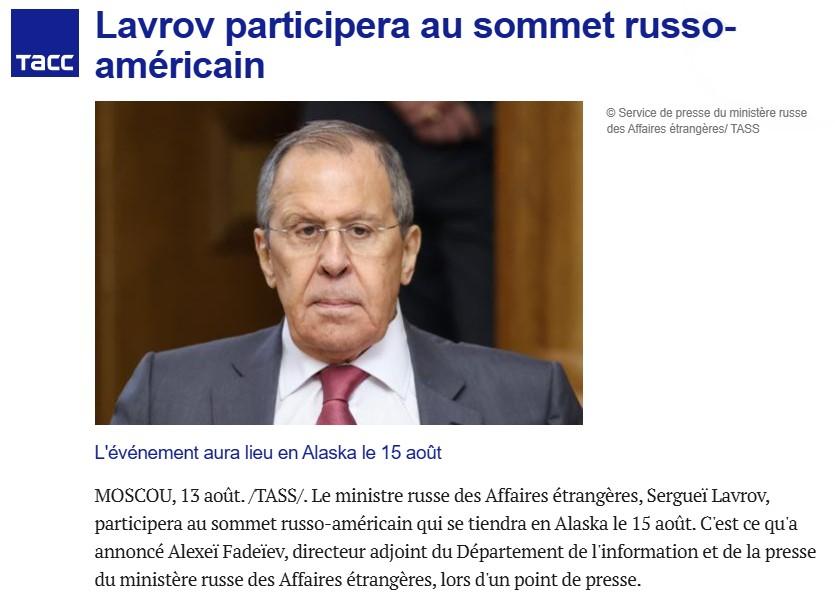
Le ministre russe des Affaires étrangères, Sergueï Lavrov, participera au sommet russo-américain qui se tiendra en Alaska le 15 août.
L’article Lavrov participera au sommet Poutine-Trump en Alaska est apparu en premier sur STRATPOL.
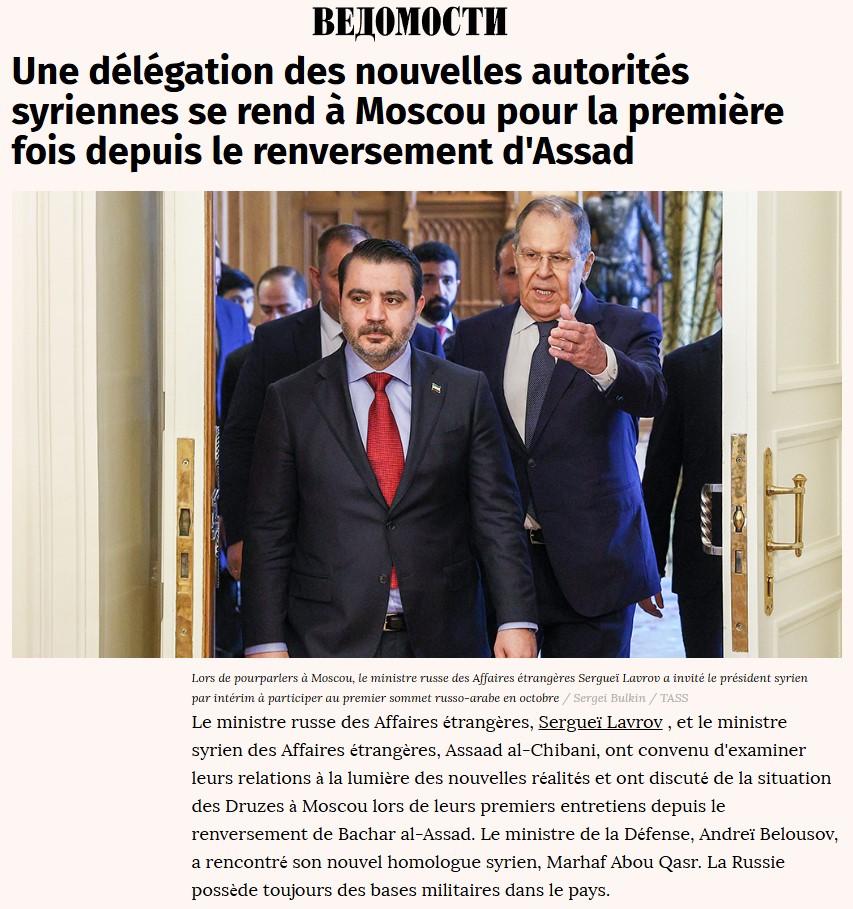
Le ministre russe des Affaires étrangères, Sergueï Lavrov, et le ministre syrien des Affaires étrangères, Assaad al-Chibani, ont convenu d’examiner
L’article Une délégation syrienne à Moscou pour la première fois depuis la chute de Bachar el-Assad est apparu en premier sur STRATPOL.
Foreign Minister Sergey Lavrov’s remarks and answers to questions at 11th Terra Scientia National Educational Youth Forum, Solnechnogorsk, July 28, 2025
Watch in full: Russia’s Foreign Minister Sergey Lavrov’s remarks and answers to the questions of students at the #TerraScientia National Educational Youth Forum, July 28. 2025. pic.twitter.com/DO8bGmFAvW
— MFA Russia
Transcript partially complete and will be fully posted once complete:
Colleagues,
It’s a pleasure to be back at the Terra Scientia forum. I enjoy engaging with young people who are the future of our country, the future that is taking shape, as we speak, on the battlefields of the special military operation, and elsewhere. I appreciate the opportunity to speak with the people who are doing their job there. Not long ago, I presented diplomas to graduates of a career development programme, Urban Infrastructure and Regional Development Management, run by MGIMO. Nineteen participants of the special military operation were among its graduates. I had the chance to talk with them.
I also took part in the events held as part of the Time of Heroes programme initiated by President Vladimir Putin. I can see how well our youth understand the importance of international engagement and the international dimensions of our country’s development in the current era.
Since the Soviet Union went into oblivion, new Russia’s foreign policy has always been based exclusively on its national interests. No lecturing, and no forcing ideologically-driven approaches on our neighbours or partners, either. We operate in strict compliance with our conceptual documents, the Constitution and the Foreign Policy Concept. The primary goal of our foreign policy is to ensure safe conditions for the country’s development and to raise the well-being of our citizens.
Many political scientists, academics, and experts seriously argue that a third world war is not just unavoidable, but is already underway in new forms, beginning with the West’s aggression against Yugoslavia in 1999 followed by aggression against Iraq, the destruction of Libya, and the attack on Syria. All these Middle Eastern countries are now in a state of turmoil. The territorial integrity of Iraq, Syria, and Libya – something the West seems to care about only in the case of Ukraine – was gravely undermined during the Arab Spring in 2011. These countries remain in a pretty bad shape.
Now, the West has turned to a neighbouring region, namely, the Gaza Strip and the Palestinian territories, more broadly. There has been an act of aggression against the Islamic Republic of Iran.
In Europe, the Ukraine issue represents the West’s policy of aiming to inflict a “strategic defeat” on Russia.
They don’t hide the fact that they had been preparing for this for quite some time. With no shame, they are openly saying that the Minsk Agreements, which were designed to resolve all problems, were never meant to be implemented. President Putin, then-Chancellor Angela Merkel, then-French President François Hollande, and then-Ukrainian President Petr Poroshenko put in 17 hours without sleep working on those agreements. But afterwards, those very people who sat at one table with him admitted they never intended to implement anything. They just needed to “put something on paper” to buy Ukraine time for it to prepare for war with Russia, and to flood it with weapons. Those same people are now demanding that we immediately cease fire and leave things the way they are now, just so they can again buy time for their clients in Kiev and pump more weapons into Ukraine. The fact that Europeans genuinely seek to “defeat us” is confirmed daily. New German Chancellor Friedrich Merz recently stated (I’m not sure he understood what he was saying) that Germany must once again become the strongest military power in Europe. It was the strongest military power before World War I and before World War II and started both. Now, he wants Germany to become “Europe’s top military force” again. German Defence Minister Boris Pistorius stated that if necessary, Germans would not hesitate to kill Russian soldiers. European elites are taking this rhetoric as a given. This reflects, above all, the fact that the West cannot accept the fact of becoming just another strong region in a multipolar world. It cannot give up the hegemony it enjoyed for half a millennium. This is visible especially clearly in Europe today which wants to impose its will on everyone and ignore pragmatic concerns.
The other day, President Donald Trump met with European Commission President Ursula von der Leyen. Afterwards, she proudly and gleefully announced that they had reached an agreement under which European goods would be exported to the United States with a 15-percent tariff, while US goods would go to Europe duty-free. On top of that, Europe would spend $750 billion on buying American energy, primarily liquefied natural gas and nuclear fuel, completely abandoning Russian energy. Furthermore, as President Trump stated, there would be $600 billion in new investment. No doubt, US energy will be much more expensive than Russian. This approach will further de-industrialise Europe and re-direct investment from Europe to the United States. Sure enough, this decision packs a serious blow especially in terms of energy prices and capital flight affecting European industry and agriculture. But figures like Ursula von der Leyen are flaunting their decision to follow this course. They admit they’ll have to spend more, and that they’ll probably have fewer resources to address social issues, but claim they must defeat Russia.
As Brazilian President Luiz Inácio Lula da Silva recently said, former US President Joe Biden once said in a conversation with him that Russia must be “destroyed.” Not just strategically defeated, but destroyed. It’s about a war of annihilation.
President Trump, though, holds a different view. As he’s repeatedly stated, he is guided by common sense, primarily business and policies that benefit the United States. I’m sure you are following his moves in international trade. The deal with Europe is clearly lopsided, and Europe got the short end of the stick. There’s no need to dive deep into that. President Trump is a pragmatist. He does not want wars. Unlike his predecessor Joe Biden and current European elites (von der Leyen, Starmer, Macron, and their ilk), he is open to dialogue.
Even during the Cold War, dialogue was there and helped opposing camps better understand each other’s intentions, first and foremost, to prevent a major war.
Europe has lost that instinct, and the vaccine against Nazism has worn off.
The same forces that once sought to destroy Russia are now re-emerging in Europe and have chosen Ukraine as a battering ram that they use against us. They welcome everything it is doing.
To be continued…
It is a pleasure and surprise to read Mr Lavrov’s comments following the SCO Foreign Ministers Council Meeting, Tianjin
SCO is growing from 10 member states and 2 observers to SCO+ with a partner category, and with the Lao People’s Democratic Republic joining first as a partner country. The plan is for approximately 30 further member states and organizations. Yet, replying to this question about the growth: “… a whole new level. What level are we talking about?,” Mr Lavrov responds: “A level that goes up indefinitely.”
SCO: China, Kazakhstan, Kyrgyzstan, Russia, Tajikistan, Uzbekistan, India, Pakistan, Belarus, Iran.
SCO+: Lao People’s Democratic Republic
We will see more member states announced at the SCO Council of Heads of Government, now scheduled for Aug 31 to Sept 1, 2025. Given Mr.Lavrov’s remarks in this set of comments and answers, the best guess would be that Afghanistan will be one of the next intake of partner states. Armenia has made a request to join. There are more.
Foreign Minister Sergey Lavrov’s remarks and answers to media questions following the SCO Foreign Ministers Council Meeting, Tianjin, July 15, 2025
Colleagues, good afternoon.
We have travelled extensively together and have now reached the final destination of our tour – the city of Tianjin, where the meeting of the SCO Council of Foreign Ministers has just concluded.
This marked the culminating stage of preparations for the upcoming SCO Summit, which will likewise be held here in Tianjin in late August – early September of this year.
All participants unanimously acknowledged the business-like, focused nature of our work. In this context, we attach particular significance to this morning’s meeting with President of the People’s Republic of China Xi Jinping, who shared his assessments of joint efforts under China’s chairmanship and his vision of the key tasks for the progressive development of our Organisation.
The discussion confirmed a shared understanding of the growing importance of the SCO’s collective potential in both regional and global affairs. Nuances in national approaches persist – this is inevitable – yet the prevailing trend towards further consolidation of the SCO and the enhancement of its role on the international stage is encouraging.
We affirmed that our common approach of strengthening the SCO as one of the central pillars of a more equitable, multipolar world order remains unchanged. This fully accounts for the representative composition of the Organisation’s participants we see today, as well as the considerable number of nations seeking to join the SCO’s work.
The geographical scope of our structure spans a significant portion of the Eurasian continent. We noted that cooperation within our Organisation objectively contributes to the creation of an architecture of equal and indivisible security across Eurasia. We regard the Greater Eurasian Partnership, based on cooperation among existing multilateral associations in the region – first and foremost the SCO, the EAEU, the CIS, and ASEAN – as its socio-economic foundation. We also take into account China’s Belt and Road Initiative, including existing agreements between this project and the EAEU.
Within the framework of this approach, readiness was reiterated to maintain close coordination of actions within the United Nations.
We reviewed progress in implementing the proposals to enhance the SCO’s activities approved at the Organisation’s 2024 summit. Preparations are nearing completion for draft agreements on establishing a Universal Centre for Countering Challenges and Threats to Security in Tashkent and an Anti-Drug Centre in Dushanbe. A structure to combat organised crime is planned for deployment in Bishkek.
We expressed support for further expanding the SCO’s engagement with external actors. A new step in this direction will be the upcoming high-level meetings in the SCO+ format at the Tianjin Summit – the first of their kind. This event will immediately precede the meeting of the Council of Heads of State on September 1, 2025.
We anticipate the participation of representatives from approximately 30 states and multilateral organisations in this event. This underscores the SCO’s growing constructive agenda and its appeal to nations of the Global South and the World Majority.
Today, we held in-depth discussions on pressing international and regional issues. We provided our colleagues with detailed assessments of the latest developments in Ukraine and reaffirmed our well-known approaches to resolving the crisis, repeatedly articulated by President of Russia Vladimir Putin.
In turn, our partners demonstrated an understanding of these positions. Once again, we emphasised the necessity of addressing the root causes of the conflict, recognising the existing territorial realities, and guaranteeing the legitimate rights of Russians and Russian speakers, including in the areas still controlled by the Kiev regime.
We also unanimously condemned Israel’s attacks on civilian infrastructure in Iran. Let me remind you that on June 14, immediately after these aggressive attacks, the SCO promptly released a statement. Similarly, the US strikes on Iranian nuclear facilities were qualified as blatant violations of the UN Charter and the Treaty on the Non-Proliferation of Nuclear Weapons. We also reaffirmed our commitment to safeguarding Tehran’s legitimate right to the peaceful use of nuclear energy.
Regarding the developments in the Middle East, it was noted that sustainable stabilisation in the region is impossible without a just and comprehensive resolution of the Palestinian–Israeli conflict, strictly in line with the UN decisions. As an urgent measure, all participants called for the immediate cessation of actions that further exacerbate the humanitarian catastrophe facing the Palestinian people.
We also discussed ways to strengthen regional security, with particular focus on Afghanistan. Nearly all SCO member states are actively deepening their bilateral relations with Kabul. We share a common understanding of the importance of supporting Afghanistan’s reconstruction and ensuring its sustainable development as an independent, neutral, and peaceful state, free from terrorism and drug trafficking. It was underscored that fostering a process of national consensus and ensuring ethnic and political inclusivity in government structures remain key priorities.
In addition, we reviewed the progress in preparing key documents to be presented at the upcoming leaders’ summit. As per tradition, our approaches to cooperation within the SCO and coordinated stances on current global and regional issues will be reflected in the Tianjin Declaration.
The long-term vision for the Organisation’s evolution was also discussed. These strategic guidelines, building on the accumulated experience of the ongoing upgrading, will be enshrined in the SCO Development Strategy through 2035. The current ten-year strategy, adopted at the 2015 Ufa summit, will conclude in 2025.
We regard the draft Leaders’ Statement commemorating the 80th anniversary of the conclusion of the Second World War and the establishment of the United Nations as a pivotal political document currently in development. In the economic sphere, we are progressing with a series of initiatives in artificial intelligence, green industry, investment collaboration, and the digital economy.
The resolutions adopted by leaders on the aforementioned matters will establish a foundation for effective preparations in advance of the Meeting of the SCO Council of Heads of Government, scheduled for November 17–18, 2025, in Moscow under Russia’s chairmanship.
Question: What is your perspective on the “new plan” proposed by US President Donald Trump concerning Ukraine? Is Russia willing to continue dialogue with the United States on the Ukrainian settlement and bilateral normalisation following Washington’s recent declarations? How do we evaluate the threat of 100 percent tariffs being imposed on our trading partners in terms of Russia’s foreign economic interests?
Sergey Lavrov: We never pursue policies that harm our national interests or compromise the security of our nation. The special military operation is precisely aimed at decisively removing the threats that the North Atlantic Alliance has been systematically constructing directly on our borders – not for a day, nor a year, but for decades. Russia has issued repeated warnings. President Vladimir Putin has devoted numerous speeches and statements to this issue. Regrettably, he was not heeded. This only corroborates what President Putin recently recounted in his interview with Pavel Zarubin regarding how his – and our collective – perception of relations with the West has evolved. Initially, it appeared that removing ideological differences would be sufficient for improvement. Later, it became evident that ideology was not the issue – the West (irrespective of whether the Russian Empire, the Soviet Union, or post-Soviet Russia was concerned) has been driven by one objective alone: the geopolitical containment, suppression, or even outright military destruction of Russia, as history has witnessed more than once. As Presidential Press Secretary Dmitry Peskov noted, we genuinely seek to comprehend what underlies this “50-day” declaration – previously, there was discourse of “24 hours,” then “100 days.” We do wish to understand US President Trump’s motivations. Clearly, he faces immense – I would even say, improper – pressure from the European Union and NATO’s current leadership, who brazenly endorse Vladimir Zelensky’s demands to continue arming his regime with modern, including offensive, weaponry, all at growing expense to Western taxpayers. There is a Russian proverb: “Do not dig a pit for others…” The sanctions recently imposed by the EU – and those being prepared anew in Brussels – are now attempting to drag the United States into this “sanctions vortex.” Yet President Trump explicitly stated that Europe would bear the cost of prolonging the conflict. All this has already inflicted severe damage on the European economy. Objective European analysts, economists, and political scientists concede that the primary casualty of this sanctions war is its very architect. An unprecedented volume of sanctions has been levied against us. We are managing. I have no doubt we will prevail – a conclusion supported by independent assessments and analyses, including those from many Western economists and policymakers.
As for our trade counterparties, they can hear what has been said. But they can hardly predict their actions now. They have their international obligations. Knowledgeable of our partners, I cannot see how they can give up their independent policy, the policy of observing agreements achieved both through two-way channels and under multilateral formats.
Question: Could you share the details of your meeting with Xi Jinping, what kind of message you conveyed to him from President Vladimir Putin? What other states are interested at the moment to join the Organisation? Which of its initiatives could turn useful for reducing the risks of geopolitical crises sprawl?
Sergey Lavrov: As for the conversation between the SCO ministers of foreign affairs with President of China Xi Jinping and the following conversation with Russian delegation, we discussed the principled matters of developing the SCO and the initiatives of the Chinese chairmanship, which are known well enough. All of them have already been announced. At the bilateral meeting we discussed our coordination in the foreign policy area in conformity with the principled strategic reference points agreed earlier by President of Russia Vladimir Putin and President of CPC Xi Jinping. As you should understand, we will not go into details now.
As for those wishing to join the SCO, it was decided today to grant the SCO partner status to the Lao People’s Democratic Republic. Most of the countries that want to join the Organisation will participate in a new format, which will appear on September 1, right after the SCO summit. This format is called SCO+. It will comprise about 30 countries and multilateral organisations.
As for challenges and risks, I do not want to speak again in detail on what is well known to everybody. Everybody knows so well how we plan our actions in the areas threatening our security and other interests.
Question: I have a question about the regional security system which was among the purposes behind creating the SCO. Have today’s talks led to the sides showing their full readiness to conduct counter-terrorism or peacekeeping operations?
Sergey Lavrov: I touched on this issue in my opening remarks.
What we have now is the Regional Anti-Terrorist Structure, which has been fairly busy over the years. Recently, a decision was made to expand its mandate to address new challenges and threats, since terrorism and organised crime, especially drug trafficking, are closely linked.
A decision was made to create the SCO All-Purpose Centre on the premises of the regional anti-terrorism centre in Tashkent to combat new challenges and threats. Concurrently, a SCO Anti-Drug Centre is being created in Dushanbe, which will sign a special agreement with the All-Purpose Centre to combat new challenges and threats. In Bishkek, an entity aimed at combatting organised crime will be created. Following the reform, these three mechanisms will offer extra opportunities for the effective suppression of threats arising in connection with terrorism and illegal migration, which often devolve into extremist and terrorist activities. I hope our presidents will approve this reform.
Question: On July 15, on the sidelines of the SCO Summit, you held a meeting with Foreign Minister of Iran Abbas Araghchi. Did you discuss Russia’s proposal to take excess enriched uranium out from Iran and practical steps to implement this proposal?
Sergey Lavrov: We discussed realistic approaches to ensuring a solution which would be achieved through peaceful, political, and diplomatic efforts with due respect of the decisions that the Islamic Republic of Iran had made a long time ago, namely the official renunciation by Tehran of possessing nuclear weapons. No evidence to the contrary has ever been presented by anyone, including IAEA inspectors.
The second important principle is not to infringe on Iran’s lawful rights, like those of all other non-nuclear members of the IAEA and the Treaty on the Non-Proliferation of Nuclear Weapons, regarding uranium enrichment for energy purposes.
We will continue to discuss with our friends the specific possible steps in this regard, and available technical and negotiating opportunities.
Question: Was there any discussion at the SCO or during bilateral meetings about providing practical assistance to Iran in restoring infrastructure destroyed by Israeli-American air strikes?
Sergey Lavrov: The Iranian side did not make such requests.
Question: After your meeting in Beijing, Chinese Foreign Minister Wang Yi said that China and Russia will take the SCO to a whole new level. What level are we talking about?
Sergey Lavrov: A level that goes up indefinitely.
Question: You mentioned that Moscow was trying to understand where US President Trump’s statements were coming from. Just before Trump, US Senator Lindsey Graham stated in about the same language that Brazil, China, and India were playing into Putin’s hands. You’ve made it clear that Moscow has no particular concerns regarding its partners, but I’d like to ask you if there is any potential for joint action by the SCO or BRICS regarding this threat.
Sergey Lavrov: Washington kept uttering specific threats targeting BRICS to the effect that BRICS needs to be opposed and that it undermines US interests.
Truth be told, US President D. Trump expressed a somewhat different view on earlier occasions. He stated loud and clear that the actions taken by the Biden administration, which weaponised the US dollar, have irreparably damaged the standing of this global reserve currency. I’m sure he understands that this is a fair assessment and that in response to the mayhem caused by the previous administration, BRICS, the Community of Latin American and Caribbean States, and many other associations are considering alternative payment methods that do not include the US dollar and are thus immune to Washington’s lawless behaviour.
This process can no longer be stopped. There are statistics that show the share of the US dollar in global trade and international financial transactions. This is not because we wanted to flee from the US dollar. President Putin has underscored this point many times. The US dollar was used to punish those whose behaviour – as seen by the Americans – was inconsistent with the infamous “rules” which they want to use as a foundation for the world order.
On a serious note, our profession is not to fear things, but to push for proper consideration of Russia’s interests, and to work openly and honestly based on international law and the agreed-upon principles. A strong and independent country with a sense of dignity cannot behave otherwise. We have every reason to believe that the BRICS countries are also sovereign entities and appreciate their standing within the global system.
Question: American media outlets claim that the United States is currently pressuring its allies in Japan and Australia to determine how they will assist Taiwan in the event of a conflict. Simultaneously, the US and its allies – 18 nations – are launching the largest-ever military exercises in Australia, involving tens of thousands of troops. What, in your view, is driving this latest escalation of tensions in the region?
Sergey Lavrov: This is not a new escalation. It may represent a new phase of the very same escalation that began quite some years ago, when the United States of America introduced the concept of developing and implementing Indo-Pacific strategies. By this, they mean the Asia-Pacific region – a term that has always been used without any inherent disadvantage.
The Indo-Pacific strategies symbolise NATO countries’ ambitions to extend their infrastructure into the Far East, Southeast Asia, and Northeast Asia, forging alliances with a nuclear core, such as AUKUS (the United States, United Kingdom, and Australia) and the trilateral partnership between the United States, South Korea, and Japan. These alliances are conducting increasingly large-scale exercises, including nuclear components, among many others. The US-backed Indo-Pacific Quad incorporates New Zealand, Australia, Japan, and South Korea. All this is accompanied by the eastward expansion of NATO infrastructure – even in dangerous forms, such as supplying the Philippines with ground-based intermediate and shorter-range missiles, previously prohibited under the US-Russia treaty.
This highly advanced weaponry will appear in Southeast Asia for the first time. Similar deployments are advancing into Europe, including Germany. Thus, the entire process reflects NATO’s aggressive eastward push. They sought to absorb Ukraine, stumbled, but persist in pretending they will inevitably achieve their goal. Concurrently, as they exploit Ukraine as a spearhead of their increasingly ineffective strikes against Russia, they are likewise advancing eastward. Their objective is to impose NATO-centric control over the security landscape across the entire Eurasian continent – eschewing constructive alternatives for an open, equitable security architecture that includes all continental nations of Eurasia without exception. Such a framework is championed by Russia, the People’s Republic of China, and our allies and like-minded partners.
Regarding Taiwan: You are aware that speculation and provocations on the Taiwan issue are proliferating. For instance, a journalist recently drew French President Emmanuel Macron into the logic I have outlined. He declared that NATO would not interfere in Asian affairs if China ensured the Democratic People’s Republic of Korea did not meddle in Europe. How does that sound? The same Macron suggested that if Russia were permitted to seize control of part of Ukraine, what might happen to Taiwan? This is an overtly provocative statement. The West continues to assure the People’s Republic of China that it adheres to the One China principle, yet immediately qualifies this by asserting the status quo must remain untouched. The status quo in practice means the West engages with Taiwan as an independent state, arms it, and emphatically underscores the trappings of its sovereignty.
Question: Ukraine’s Permanent Representative to the UN Sergey Kislitsya said the Istanbul format of talks has almost run its course. Was that a move to bargain for more of something? Perhaps, it’s a ploy to bring President Putin’s meeting with President Zelensky closer or to put the Istanbul format on pause again?
Sergey Lavrov: Mr Kislitsya is no longer Ukraine’s Permanent Representative to the UN, but First Deputy Foreign Minister of Ukraine, though, of course, he made a name for himself as an envoy to the UN.
Vladimir Zelensky is also known to have said that the Istanbul format is not a serious format. Someone else from his team made remarks to that effect as well. Their message was simple: they discuss nothing but humanitarian issues, such as prisoner exchange, return of dead bodies, and wounded soldiers. But if they believe this format had run its course, this goes to show once again that they don’t give a hoot about their own citizens, just like they don’t want to give the bodies that we had transferred to them a long time ago to the families in order to save some money. Just like how they shot down some time ago our plane that was carrying prisoners for exchange. This is what the Ukrainian regime really looks like.
We shouldn’t lose sight of the fact that they are prevaricating. In addition to humanitarian issues, which are certainly important, because they are about people, their relatives, and loved ones, our delegation, at the second round of Istanbul talks handed over a draft agreement in the form of a memorandum to them. The Ukrainians gave us their draft memorandum. Indeed, they contain opposing views. At the request of the Americans, we discussed at the expert level our vision of a settlement.
The answer is clear. Despite the diametrically opposed positions, in April 2022 in Istanbul, an agreement was reached on a settlement, not just a ceasefire, but on principles of a settlement proposed by Ukraine which the Russian Federation found acceptable. The document has been initialled. The sides agreed to start working on a legal document, a treaty, but then the British, unquestionably with the consent of the United States, told Ukrainians to walk away from signing this document.
I’m saying this just for the sake of argument to show that despite the conflicting and outwardly contradictory positions, there is always room for dialogue. However, if they say that the format has run its course, it means that besides their indifference towards their citizens, they are not willing to come to terms, either. Perhaps, Macron, Starmer, Ursula von der Leyen, Merz, and their lot are telling them to walk away this time again. All the above figures are in one voice saying Ukraine must be flooded with more offensive weapons now. Head of the Situation Centre Ukraine in the German Defence Ministry Christian Freuding minced no words saying that Ukraine needs to be given long-range missiles and weapons that can strike deep inside Russia’s territory.
They say, “no talks needed” (we clearly see it now), “immediate ceasefire,” and then talks. But this ceasefire must come without conditions, as French President Macron clearly said several months ago when this point was first made, adding that ceasefire does not mean weapon supplies to Ukraine would be halted. So, they want us to stop the offensive and give Ukraine and its sponsors a chance to catch their breath and to re-build Ukraine’s military.
This is the same logic and the same approach they used after signing the Minsk agreements to fully militarise Ukraine during the ensuing seven years.
German Chancellor Friedrich Merz recently said NATO must ensure Ukraine has a strong battlefield position before starting the talks. In other words, no one is hiding anything. Stop the fire, we’ll flood Ukraine with weapons, and things will be just fine.
Our American colleagues are fully aware of where we stand. We let them know about the allegation that “the format has run its course.” It has not. The United States tried to make it look as if the level of our delegation was not high enough. The level of Ukraine’s delegation will be different now.
Former Ukrainian Defence Minister Rustem Umerov is going to join his family in the United States as an ambassador. The third round of talks which we proposed to start in the week of June 22 has so far not been mentioned in any Ukrainian declarations or recommendations given to them by their Western curators. Now, even one of the negotiators has left the country.
Since our clarifications which we have repeatedly conveyed to our US colleagues, including during meetings on the sidelines of ASEAN events, are simply ignored or not reported to President Trump, it’s hard to tell what stands behind this.
Saying there’s no progress and coming up with a 50-day proposal… Had the Ukrainian side agreed to give the date of the third round during the week of June 22 of this year, we may have done everything in a matter of 30 days. Of course, this does not make us happy, but we are acting according to the plan approved by President Putin.
This plan includes guaranteed protection of Russia’s lawful interests in the security sphere and guaranteed protection of the rights of Russians and Russian speakers residing in Ukraine, a country that violates all norms of international law which prohibit discrimination on national, ethnic, language, or religious grounds.
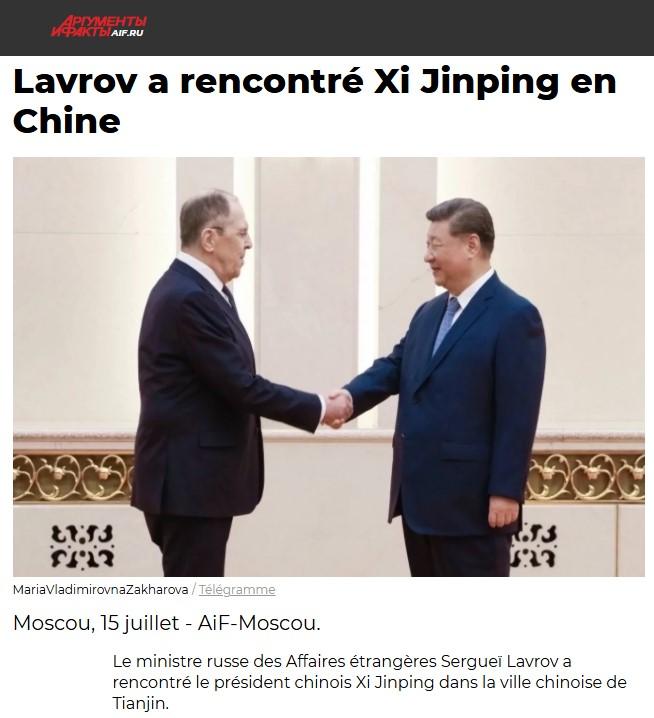
Le ministre russe des Affaires étrangères Sergueï Lavrov a rencontré le président chinois Xi Jinping dans la ville chinoise de
L’article Lavrov rencontre Xi à Tianjin en préparation de la visite de Poutine est apparu en premier sur STRATPOL.
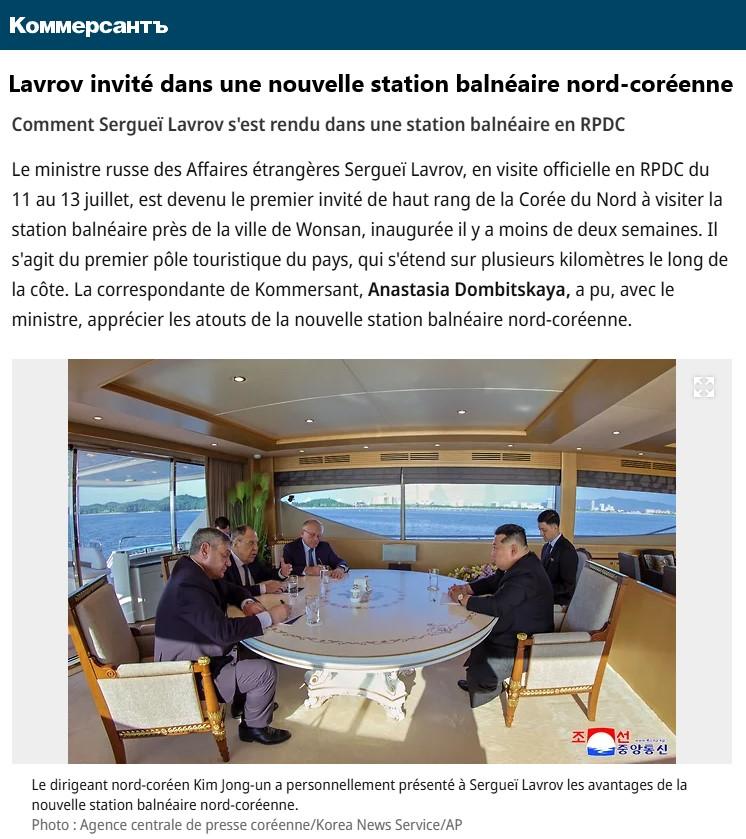
Le ministre russe des Affaires étrangères Sergueï Lavrov, en visite officielle en RPDC du 11 au 13 juillet, est devenu
L’article Lavrov en visite en RPDC découvre la nouvelle station balnéaire de Wonsan est apparu en premier sur STRATPOL.
Foreign Minister Sergey Lavrov’s remarks and answers to questions following the Russia-ASEAN meeting and the ministerial meeting of the East Asia Summit member states, Kuala Lumpur, July 11, 2025
[Please note the paragraph that I’ve bolded. Please also note the posts ‘Concentration camp’: Israel’s planned new city in Rafah, explained with comments between AHH and myself, the video titled The Cradle Three as well as various posts that we’ve posted in the last weeks on the zionazi plan for the Palestinians. According to Mr Lavrov’s comments,apparently there now is a planned Emirate of Hebron]
Good afternoon.
We have met in Kuala Lumpur for annual ASEAN events at the ministerial level. The summits will be held in autumn. There are three formats of our meetings:
First, the Russia-ASEAN Dialogue Partnership. An annual meeting was held yesterday at the level of foreign ministers.
The second format is the East Asia Summit (EAS), which includes a broad range of countries, primarily those that are developing dialogue partnerships with ASEAN. The EAS was established to discuss practical cooperation projects and economic, trade, transport and cultural connectivity.
The third format is the ASEAN Regional Forum (ARF) on security, which has an even larger number of participants in addition to ASEAN countries.
Taken together, we refer to them as the annual ASEAN events, which we are now holding in Malaysia. It is symbolic that it was in Malaysia that Russia first attended these events. It was here that we laid the foundation for the Russia-ASEAN dialogue partnership, which has since advanced to the level of strategic partnership. This has been fixed in our joint documents.
This year, we discussed the implementation of the obligations that all sides assumed on a mutual basis at our previous meetings, including at the Russia-ASEAN summit in 2016, a forum that mapped out the strategic trajectory of our cooperation.
We are preparing an assessment of the implementation of the Comprehensive Plan of Action to Implement the ASEAN-Russia Strategic Partnership for 2021-2025. It is being implemented in all sectors. We have pointed out today that our special representatives are working at the ASEAN Headquarters in Jakarta to prepare the fourth strategic plan. We hope to adopt it by the end of 2025, ideally, at the Russia-ASEAN summit scheduled to take place in the capital of Malaysia in October 2025.
Regarding the meeting of the East Asia Summit, which was held today, it focused primarily on the advancement of practical engagement projects in various spheres. We believe that this should constitute the basis of EAS activities.
Regrettably, our Western colleagues attending such events increasingly resort to politicisation, ideologisation and Ukrainisation – a trend that was also evident in today’s discussions. This comes at the expense of the real potential the East Asia Summit holds for achieving tangible results that matter to our countries and citizens.
For several years now, we have been advancing initiatives aimed at responding swiftly to epidemic threats – a topic that could hardly be more relevant. We first proposed this in 2021, and it was approved. However, due to the West’s intransigent stance, this cooperation has made little progress.
In 2023, we proposed stepping up cooperation in the tourism sector and encouraging greater exchanges to foster stronger people-to-people ties among our countries. Tourism is growing regardless, but the incentives we put forward were adopted for integration into day-to-day practice. Nevertheless, little has been done to move this forward.
We also proposed working together on the development of remote regions – another initiative that was agreed upon. In large countries such as Russia, Indonesia, Malaysia, China and others, there are remote areas where civilisation has arrived, but the benefits of development are not felt as strongly as in major urban centres. This is a pressing issue for all of us, and we hope to see concrete results.
Another initiative we have proposed in the humanitarian sphere is to foster cultural connectedness among our countries. Eurasia is a vast continent and the cradle of several great civilisations. The cultural heritage of each deserves to be shared through mutual enrichment. We hope this proposal will also come to fruition.
At meetings of the East Asia Summit and the ASEAN Regional Forum on security, political issues are also regularly discussed. Today, all ASEAN members and most partner countries, including Russia, expressed deep concern over the ongoing and worsening tragedy in the Palestinian territories. Following the humanitarian catastrophe artificially created in Gaza, similar conditions are now unfolding in the West Bank, where Israel continues its aggressive policy of settlement construction at record levels. Soon, there may be nothing left of the territory under the Palestinian National Authority’s administration.
Today, I was surprised to read reports about a project to establish an Emirate of Hebron. This initiative is being framed as the first step towards promoting the concept of the “United Palestinian Emirates” on Palestinian territories. While such ideas may currently seem like fiction, their increasing appearance in public discourse reflects emerging risks and growing tensions surrounding the prospects for establishing a Palestinian state, as envisaged by the decisions of the UN General Assembly and Security Council. This represents a serious challenge for the international community.
We discussed the repercussions of Israel’s unprovoked attack on the Islamic Republic of Iran, followed by missile and air strikes carried out by the United States. These actions constitute a violation of international law, the Treaty on the Non-Proliferation of Nuclear Weapons (NPT), and the principles of the IAEA, under whose safeguards the targeted nuclear facilities operated.
We called for upholding the declared truce without interruption. Despite the significant damage caused to the NPT framework and the IAEA’s safeguards regime, efforts must be made to restore stability, return the situation to a political track, and resolve all issues exclusively through negotiations. This is critical to ensuring that such reckless actions, which undermine the foundational documents governing the peaceful use of nuclear energy and non-proliferation, are not repeated, as well as any attempts to adopt technologies necessary for the production of nuclear weapons.
We also touched upon the situation in Myanmar, where signs of stabilisation are emerging. We support the efforts of the Myanmar leadership and ASEAN’s commitment to facilitating normalisation and fully restoring Myanmar’s participation in the work of the Association of Southeast Asian Nations.
We highlighted the importance of avoiding provocative actions on the Korean Peninsula, where tensions continue to escalate, particularly due to the expansion of US, South Korean, and Japanese military alliances. The increasing scale of military exercises, some involving nuclear components, carries significant conflict potential. Russia will continue to support the legitimate rights of our North Korean allies and work to prevent any provocations that could lead to dangerous consequences.
Among priority issues in the region, our Chinese friends also raised the disputes over the South China Sea. We strongly believe this matter must be resolved based on the Code of Conduct between China and ASEAN member states. Negotiations are ongoing on this solid foundation. We regard any attempts by non-regional actors to interfere in this process as unacceptable.
Foreign Minister of China Wang Yi also provided a detailed assessment of the situation surrounding Taiwan, stressing the inevitability of resolving the issue within the framework of the One China principle.
We noted the statements made by some Western representatives expressing respect for the One China policy, while simultaneously asserting that the status quo must not change. This is blatant hypocrisy. For those familiar with the situation, it is clear that the West increasingly treats Taiwan as a sovereign entity. This is why Russia reaffirmed its consistent support for Beijing’s position and expressed its readiness to assist in its implementation by all means available.
Question: Last year, during a meeting with Foreign Ministry leadership, President Vladimir Putin called for building a new Eurasian security architecture – one where no one state’s security comes at the expense of another state. How does ASEAN, or Asian nations more broadly, view this proposal amid NATO’s continued militarisation?
Sergey Lavrov: In fact, the initiative to form a Eurasian security architecture builds upon President Vladimir Putin’s earlier proposal, first introduced at the inaugural Russia-ASEAN summit – a vision for a Greater Eurasian Partnership forged through strengthened ties, deeper cooperation, and joint projects and programmes among the continent’s existing integration associations. To date, links have been established between the heads and secretariats of the EAEU and the CIS, between these organisations and the SCO, and between all of them and ASEAN countries. This useful process helps harmonise integration plans and projects, combine efforts, and avoid duplication – all the more so since the memberships mostly overlap.
We promote the Greater Eurasian Partnership concept with the understanding that discussions on the initiative and negotiations over practical steps are open to all Eurasian countries and organisations. In particular, there are strong prospects for establishing ties between the EAEU, the SCO, the CIS, ASEAN, and the GCC. Integration associations also exist in South Asia, including on the South Asian Peninsula, meaning numerous groups could contribute to and benefit from improved connectivity.
As these visions take shape through concrete actions, they create a tangible framework for dialogue and enhanced continental security. I have repeatedly addressed this topic to advance President Vladimir Putin’s initiative. Beyond Eurasia, Africa and Latin America host sub-regional integration associations – as well as continent-wide organisations like the African Union and the Community of Latin American and Caribbean States (CELAC). Yet Eurasia – the world’s largest, most dynamic, richest and fastest growing region – still lacks a continent-wide dialogue platform (which need not be a formal organisation).
We are fully aware that this process takes time. All countries invited to take part in these discussions must be ready to take this step. However, most of our European neighbours are clearly not yet ready for such cooperation – instead, they appear focused on expanding neo-colonial influence across Eurasia through NATO infrastructure. They argue that in the current conditions, as a defensive alliance, NATO’s purpose is to protect member states’ territorial integrity – a claim they openly and unhesitatingly assert. In their narrative, the threat to NATO countries’ security and territorial integrity originates from what they label the “Indo-Pacific region” – specifically, the Pacific Ocean, including the South China Sea, the Taiwan Strait and other areas.
One of the key principles of our concept of Eurasian security and the Greater Eurasian Partnership is respect for associations established in various sub-regions, including ASEAN, and its central role, which the Association has earned through nearly sixty years of work uniting countries committed to collaboration based on equality, openness, and inclusiveness. Our concept acknowledges and respects the roles of both ASEAN and similar associations. By contrast, the approach promoted by NATO proceeds from the assumption that the Alliance will dictate terms to everyone – prescribing how they should conduct themselves and whether ASEAN is even necessary. Formally, yes. Today, all Western countries participated in the East Asia Summit and the ASEAN Regional Forum on security.
Yet whilst uttering fine words, parallel structures are being established – as you well know – in the form of “trios,” “quartets,” and other groupings: AUKUS, the United States–United Kingdom–Australia partnership for the implementation of the nuclear-powered submarine project. I have already mentioned attempts to introduce nuclear elements into military exercises on the southern Korean Peninsula. There is the Indo-Pacific Quad – Japan, South Korea, Australia, and New Zealand – alongside a number of similar tripartite arrangements (QUAD-1, QUAD-2). These entities seek to draw ASEAN members into their frameworks, effectively pulling them away from the Association. We discuss this openly with our friends, who fully grasp the distinction between an inclusive approach – where all are invited to the table for equitable dialogue and consensus-building that reflects a balance of interests – and the approach of the North Atlantic actors, who arrive in this region intent on dictating terms and imposing their own rules. I believe this does not serve the greater good.
We are committed to ensuring that these formats and forums, held here annually, foster mutual understanding and transparent conduct – with no hidden agendas or schemes directed against any party. Yet the process currently unfolds along divergent trajectories. I am convinced that our approach holds greater promise.
Question: The recent summit in Rio de Janeiro demonstrated that, amid increasingly aggressive United States sanctions, BRICS has emerged as a reliable alternative to this sanctions overreach. Have ASEAN nations reached a point where they are ready – not just rhetorically but in practice – to deepen collaboration with Russia specifically and BRICS more broadly?
Sergey Lavrov: I believe ASEAN countries’ interest in collaboration with Russia exists irrespective of what is going on in the West and what the United States and its allies are undertaking with respect to them.
It is not the case that, “had the West not coerced us, we would not have engaged with Russia.” Not at all. Our friendship started long before the current United States administration imposed tariff-based sanctions (which are sanctions nonetheless). The development of our ASEAN relations and BRICS cooperation does not strike me as a direct reaction to external factors.
That said, if presented with a choice – between trading within a framework that rejects unfair competition, on the one hand, and engaging with parties that resort to blackmail, on the other – the conclusion is self-evident.
Question: Based on your meetings at this forum, what assessments can you share? Are ASEAN nations prepared to actively resist NATO’s encroachment and the bloc’s attempts to entrench itself in the region? Does the Association possess the resources to remain a guarantor of regional security – particularly given the substantial tariffs imposed on many ASEAN members by US President Donald Trump?
Sergey Lavrov: I have just elaborated on our assessment of NATO’s actions here: its efforts to penetrate the region, establish infrastructure, and secure a foothold. I have no doubt ASEAN states comprehend these manoeuvres and recognise the choice being presented – to formally remain within ASEAN while simultaneously joining non-inclusive, bloc-based structures aimed, in essence, at forging a political-diplomatic front to contain China (this is undisguised) and, by extension, the Russian Federation.
I will not presume to decide for them; this is their sovereign choice, which we will perceive as such. But I am certain that preserving ASEAN’s unity and its central role in shaping the mechanisms, formats, and architecture of cooperation in Southeast Asia best serves the interests of all. This will remain our guiding principle.
Question: Yesterday, after a meeting with you, US State Secretary Marco Rubio said a new plan for Ukraine had been discussed. Which side proposed new approaches, what are they about, and what makes them fundamentally different from the previous ones? Are US weapon supplies also part of the plan? Were they discussed?
Sergey Lavrov: I will use President Trump’s words to answer your question “I’m not going to tell you. We are going to have a very big announcement to make.”
I’m not sure about a “big announcement,” though, but you, as someone familiar with the diplomatic work and who often accompany us in our travels, know that there are things that are not commented on. Yes, we discussed Ukraine, and reaffirmed the position articulated by President Putin in a conversation with President Trump on July 3 and earlier occasions.
Regarding this “dialogue,” “leak,” or “recording” (I have no way of knowing whether it’s a neural network product or not) about bombing Moscow and Beijing, we focused on serious matters during our discussion.
Question: Did you discuss strategic offensive weapons during the meeting with Marco Rubio? Is there an understanding of the future of START-3 which expires next year?
Sergey Lavrov: No, we did not discuss that.
Question: Not long ago, German Chancellor Friedrich Merz stated that diplomatic means of resolving the Ukraine conflict have been exhausted. On the one hand, I would like to ask you, as the head of the Russian Foreign Ministry, to provide an official reaction. On the other hand, as an experienced professional diplomat, does such rhetoric coming from Germany fit into the diplomatic arsenal? Is it part of diplomacy?
Sergey Lavrov: That’s a good question.
It concerns us, because the latest statements coming from Berlin, Paris, and London, as well as their actions, clearly show that the current class of politicians who have come to power in these and several other countries have forgotten the lessons of history, the conclusions that humanity has drawn from them, and are largely trying to rally Europe for a war (no longer hybrid this time) against Russia.
At a news conference, a Frenchman from the audience who often visited Donbass asked Foreign Minister of France Jean-Noel Barrot why Paris strongly supports the Nazi regime that has come alive in Ukraine. Did you see Minister Barrot fly off the hook and yell hysterically that they, supposedly, defend the territorial integrity of Ukraine and the international law? A portion of the audience clapped their hands upon hearing this. But after everything that we know about what the Kiev regime did and why it needs territorial integrity … It needs it to suppress the rights of the Russian and Russian-speaking people, and physically destroy the people who do not agree with the position adopted by the Kiev authorities after the coup.
Yesterday, I handed over to Secretary Marco Rubio a digest of quotes from Vladimir Zelensky, Prime Minister of Ukraine Dmitry Shmygal, head of the President’s Office of Ukraine Andrey Yermak, and Yury Podoliak, which directly say Russkies must be destroyed legally, or better yet, physically. When Mr Barrot and his ilk say they do not want to look beyond Ukraine’s territorial integrity, they are accusing themselves by saying so.
German Chancellor Merz has repeatedly made amusing statements, including his main goal of making Germany Europe’s top military power again. He didn’t even flinch saying the word “again.” He also said things like let Israel “work” in Iran, as it’s doing the “dirty work” for us. That’s a quote from the concentration camp “masters” when they delegated the dirty work of exterminating Jews to collaborators.
If Chancellor Merz believes that peaceful solutions have been used up, then he has conclusively decided to devote himself completely to the militarisation of Germany at the expense of his own people, just to ride again under Nazi slogans to rebuff the “threats emanating from Russia.” This is utter nonsense. I hope fair-minded politicians understand this.
President Putin has repeatedly made it clear that this nonsense is used to keep people obedient and prevent protests that inevitably lead to the worsening of the socioeconomic situation and stagnation in Europe. All this is due to the fact that hundreds of billions have been directed and are being sent to Ukraine again.
I came across a quote. It was interesting how Europe perceived Germany back in the day. This quote comes from the Swedish newspaper Aftonbladet dated June 22, 1941. The editorial article runs as follows, “Germany has broken its chains and with renewed vigour has broken into freedom towards its European and historically significant mission which is to crush the Red regime, which creates a threat to the nature of freedom.” That is, they praised the Nazis as a symbol of freedom. If Europe is heading back to this … Well, what can I say? It’s sad.
We will fully take this into account in all areas of our planning.

Lavrov a déclaré que le sujet de l’Ukraine avait été abordé avec Rubio. « Nous avons confirmé la position exprimée
L’article Lavrov et Rubio ont discuté une heure en marge du sommet de l’ASEAN est apparu en premier sur STRATPOL.
IO DE JANEIRO, July 7. /TASS/. During their summit in Rio de Janeiro, members of the BRICS group of nations talked at length about Ukraine, with all parties involved gaining a greater understanding of the root causes of the conflict, Russian Foreign Minister Sergey Lavrov has told reporters.
Lavrov also commented on the NATO “mutiny” and Russia’s readiness to help Iran refill its depleted uranium stocks.
Below are top Russian diplomat’s key remarks made after the BRICS summit.
– BRICS members are sympathetic to Russia’s position in the Ukraine conflict: “During their speeches, many [BRICS] participants voiced their position on the situation in Ukraine. All positions were weighed and unbiased, showing a growing understanding about the root causes of this crisis.” Lavrov reiterated that the crisis in Ukraine “was caused by the West’s long-term threats to our country’s security, including NATO’s eastward expansion with the obvious goal of absorbing Ukraine and deploying NATO’s war machine directly at our borders.”
– Lavrov believes the UN Security Council’s current seat distribution is unfair and skewed in the West’s favor: “The West undeservedly holds a disproportionate number of seats, misaligned with today’s global balance of power.”
– There is a mutiny brewing inside of NATO amid internal strife: “Differences are growing there, with risks of a kind of impending mutiny on the ship because more and more countries want to be guided by their own national interests, and not to be told what to do by their ‘boss’.”
– NATO’s expansion “has not done anyone any good, including the Alliance’s members.”
– The Secretariat of the International Atomic Energy Agency (IAEA) should provide Iran with guarantees that it will act strictly in line with its mandate and not allow itself to be manipulated by powerful countries: “We are adamant that the Secretariat should provide some sort of guarantees that in the future it will comply with its mandate in the strictest way possible, and will avoid publishing reports that could be used to politicize and promote the unilateral interests of certain members.”
– The International Atomic Energy Agency (IAEA) should accept responsibility for its dubious assessments of Iran’s nuclear program, which he said escalated the military conflict: “The IAEA management should accept responsibility for the assessments that it had published, which it published in the past and which were submitted to the IAEA Board of Governors just days before the start of the aggression. Many described these assessments as dubious, and unlike the secretariat’s previous reports they could be interpreted in a way suggesting that Iran is not complying with its obligations in full.”
– Those guilty of attacks on railway infrastructure in Russia will be held accountable. Russia is dealing with the matter on its own, with no involvement from international organizations: “As far as the investigation and bringing those responsible to justice is concerned, we are now not trying to attract international attention to the matter. We are dealing with it on our own, including the Prosecutor General’s Office and public organizations. No one will escape justice.”
– Lavrov described terror attacks on rail infrastructure and civilian trains as “heinous deliberate acts.”
– Russia has technological solutions for uranium depletion and is ready to work with Iran in this field: “As far as Russia is concerned, we are not talking about mediation here. <…> We have technological capacities and we are ready to offer them, taking the excess of overly enriched uranium and returning the power-generation-grade uranium to the Islamic Republic and its nuclear facilities.”
– A BRICS currency for payments between members is not now, nor has it ever been on the table: “With regard to payments as such, the creation of a currency has never been discussed in BRICS.”
– There is no threat of “erosion” in BRICS, and the organization is only just getting started: “I see no threat of erosion for our activities. <…> On the contrary, we’ve only started to tap our potential.”.
Foreign Minister Sergey Lavrov’s remarks at Session II of the XVII BRICS Summit «Strengthening multilateral world order, financial and economic issues, artificial intelligence», Rio de Janeiro, July 6, 2025
Thank you, esteemed President L. Lula da Silva,
Esteemed heads of delegations,
Ladies and gentlemen,
Strengthening the multilateral world order while the international system goes through fundamental transformations is one of the crucial tasks for BRICS and for the entire international community. Multipolarity is not a choice but rather an objective reality which succeeds the outdated neoliberal model that actually builds on neocolonial practices. The traditional paradigm of globalization where the predominant role is played by the so-called developed states of the West is becoming a relic.
Economic crises of recent decades have been the first signs of this model’s malfunctions. The COVID-19 pandemic has exposed countless disadvantages of the global trade and finance system and accelerated its fragmentation. The erosion of the global economic world order has exacerbated as a result of illegitimate unilateral sanctions and use of dollar as a mean of «punishment». The trust in the American currency as a formerly reliable payment instrument was undermined.
Another negative factor is the rapidly growing debt burden. Since 2011 the number of highly indebted states rose from 22 to 59. Today developing countries are spending on debt service more than they invest into their development. The situation is going out of control even in developed states – the US has seen the record level of sovereign debt which reached 37 trillion dollars and it continues to grow.
Therefore, it is not surprising that the global majority is interested in creating development mechanisms independent from the West. Countries of the Global South and East are becoming a main driving force of the global economic growth. Regional organizations such as the African Union, CELAC, ASEAN, SCO, EAEU are playing an increased role. In this context conceptual and practical approaches are being developed to establish a new architecture of world economy based on the principles of equality, multilateralism and non-discrimination in trade, financial settlements, technology, logistics. In the face of the challenges of digitization and AI a special attention is given to human investment.
Nowadays BRICS stands as an engine of such transformation, which seeks to create a more stable global economic architecture based on the principles of universality, transparency, non-discrimination and equal access to available opportunities and instruments.
BRICS countries account for more than 40% of the global gross domestic product based on purchasing power parity, and together with partner countries this figure is at 45% or 93 trillion dollars. Today BRICS represents more than 20% of global trade and almost a half of world population.
As a follow-up to the agreements made at the BRICS Summit in Kazan in 2024, we have been working on projects to create Cross-Border Payment Initiative, independent settlement and depositary infrastructure, to develop reinsurance capacity, to increase the effectiveness of special economic zones.
The mechanism of the Contingent Reserve Arrangement, including the use of currencies alternative to dollar, is being improved. The share of BRICS countries in trade with Russia is constantly growing and in 2014 it exceeded 48%, with 90% of mutual settlements made in national currencies.
To deliver on these goals it is of significant importance to pursue the reform and depolarization of the Bretton-Woods institutions which should reflect a real state of affairs in the world economy. The continued use of the IMF and WB with a view to preserve neocolonial practices is unacceptable.
The similar situation is unfolding in the WTO as well. Years-long blocking of the WTO dispute-settlement body and introduction of new discriminatory measures against developing countries such as the notorious EU Transborder Carbon Adjustment Mechanism inflict a serious damage to the global trade. In 2024 an informal BRICS mechanism of consultations on WTO was launched which is developing successfully under the Brazilian Chairship. We look forward to an early harmonization of common positions and start of their practical implementation.
The issues of development financing are becoming more and more pressing. According to the UN, its deficit is estimated at 4,2 trillion dollars per year. If the current trends prevail, more than 600 million people will live in extreme poverty by 2030. Without sufficient funds and being unable to take out credits on acceptable conditions, countries of the Global South have to rely on official development assistance.
Given the Western double standards, its provision depends on political considerations. For example, in 2023 the IMF approved an unprecedented credit for Ukraine worth 15,6 billion dollars (577% of Ukraine’s country quota). It makes up more than a third of annual volume of all IMF programs. Since the beginning of 2022 the World Bank has pledged to allocate nearly 54 billion dollars for Ukraine. In total these sums allocated to Ukraine are twice as much as annual volumes of assignations allocated by the Bretton Woods structures to all countries of Africa.
The increasingly aggressive attempts by the West to introduce ideological ultimatums into the dialogue as what are virtually the main criteria – based on Western interpretations of human rights and democracy – are having an extremely negative impact on the delivery of the UN sustainable development goals.
To address imbalances and to mobilize resources for development Russia introduced an initiative to create within BRICS a New Investment Platform with the participation of the New Development Bank (NDB). We thank colleagues for showing their interest to the promising initiative.
Its implementation will be facilitated by our joint efforts to turn the NDB into an innovative development institution that is oriented towards the needs of its own stakeholders and that is not subject to the influence of external conjuncture. Increasing the number of stakeholders will strengthen the potential of this mechanism and contribute to the expansion of its geography of operations. We highly appreciate the efforts of NBR President D. Rousseff in this direction.
Artificial Intelligence is becoming a critical technology. Experts estimate that AI contribution to the global domestic product will be at 20 trillion dollars by 2030.
We will need to address issues related to ensuring universal access to advance developments in this field. Secret initiatives put forward by a number of countries and with restricted participation with a view to promote non-consensus approaches are fraught with the most serious consequences. The attempts to artificially isolate sovereign States from global processes are extremely dangerous and doomed to failure. A response to such attempts was the harmonization of the BRICS Joint Statement on Global Governance in the field of Artificial Intelligence which reflects our common position regarding the central role of the UN in developing universally recognized regulation mechanisms in this field.
The challenges associated with the development of digital technologies are transnational in nature and require collective response. The prime example is the adoption of the UN Convention against Cybercrime in 2024 which will be opened for signing in October in Hanoi.
I am convinced that BRICS States together with like-minded countries will continue to lead in promoting a just multipolar world order that will provide favourable conditions for sustainable development of all States without exception. In this work we receive assistance from BRICS Business Council and BRICS Civil Council, Women’s Business Alliance, to which I would like to express my appreciation and wish them every success.
Foreign Minister Sergey Lavrov’s remarks and answers to questions at the 11th Primakov Readings International Forum, Moscow, June 24, 2025
Ladies and gentlemen,
Colleagues,
I would like to begin by thanking the organisers for inviting me to the latest Primakov Readings, which traditionally bring together a distinguished group of prominent politicians, researchers, experts, and public figures from around the world.
It is good to know that the interest in this forum remains strong and continues to grow. The Readings are inextricably linked to the name and legacy of Yevgeny Primakov who, many years ago, developed the concept of a multipolar world and correctly predicted that the strengthening of multipolar principles would become the main international development trend in the first half of the 21st century. Based on ongoing developments, this trend will last much longer. Most likely, the movement towards a new world order will take a historical era. We are at the beginning of this journey.
In the mid-1990s, Primakov’s doctrine provided a theoretical and philosophical response to concepts such as “the end of history,” “the clash of civilisations,” and “the end of autocracies.” We now know who was right: those who predicted groupthink and total domination of the Western liberal world order, or Yevgeny Primakov, our teacher, who inspired us to take the right side of history and embark on the right path forward towards the development of humanity based on equality and mutual benefit.
President Vladimir Putin accurately stated this at the St Petersburg International Economic Forum, saying that together with the People’s Republic of China and other like-minded countries, we are not artificially forming some kind of a new world order, but rather giving it a proper form and helping objective processes develop as effectively and quickly as possible.
In 1996, Yevgeny Primakov published his policy piece titled “International Relations on the Eve of the 21st Century: Issues and Prospects.” In it, he emphasised that the UN was the main mechanism capable of ensuring a smooth and the least painful transition to a multipolar democratic world, and that we should not “reinvent the wheel,” but strictly adhere to what is enshrined in the UN Charter, primarily, the principle of sovereign equality of states, which underlies multipolarity.
Many are saying that the Yalta-Potsdam system needs to be replaced. It depends on what we are talking about. If it is about the international legal framework, then there’s no need to revise the UN Charter. Go ahead and read it. It is the most equitable international document that has ever been adopted by almost all countries of our planet. True, not every country abides by the principles laid down in it. These principles get violated or ripped out of the context, or applied selectively. We insist that the principles of the UN Charter must be implemented consistently in their entirety and interconnection. Our Western colleagues go by a logic that fits into their philosophy of a “rules-based order.” No one has ever seen these rules, but they live by them.
The disintegration of Yugoslavia necessitated the severing of Kosovo from Serbia. It was decided that no referendum was required, as the former President of Finland, Martti Ahtisaari, who was at the time the UN Special Envoy for Kosovo and oversaw the dialogue between the Kosovars and Serbia, authored a report asserting that the long-standing discussions had yielded no meaningful results, and that it was, in all likelihood, time to declare independence. Without a referendum, without any formalities. They simply announced that Kosovo was, from that moment on, an independent entity. The West immediately lent its full support to this decision. President of Russia Vladimir Putin frequently refers to this episode. I bring it up once again, as it remains an undeniable and glaring example. The West claimed this was a matter of a nation’s right to self-determination and there were no acts of violence in Kosovo – no burnings, no executions – only a peaceful process. They merely concluded that the issue had been dragged on for too long, in an unproductive and tiresome fashion, and thus decided to “wrap up the whole affair.”
Six years later, however, when the people of Crimea and Donbass, in response to a bloody, illegal coup, chose to reject the putschists who had seized power unlawfully, conducted a referendum in Crimea, and proclaimed the independence of the Donetsk and Lugansk People’s Republics, the West promptly became agitated, condemning this as a gross violation of the principles of sovereignty and territorial integrity.
The West’s stance on human rights is equally contradictory. Article 1 of the UN Charter demands respect for human rights for every individual, regardless of race, gender, language, or religion. You are all aware of the treatment of the Russian language in Ukraine by these neo-Nazi “authorities,” and the fate they have decreed for the canonical Ukrainian Orthodox Church. The West, which consistently places human rights at the forefront of any global discussion – whether regarding Venezuela, Iran, the People’s Republic of China, Russia, or now even Hungary, among many others – has anyone ever heard the term “human rights” in its assessments of the actions of the Kiev regime over the past 11 years since the coup? I have not. On the contrary, figures such as Ursula von der Leyen, Kaja Kallas, Josep Borrell before her, and Charles Michel have continually insisted that Ukraine must be pumped full of weapons and funds to sustain its offensive against Russia, in pursuit of the illusory goal of “inflicting a strategic defeat on Russia.” The central justification? That Ukraine is defending “European values.” The treatment of human rights regarding Russians exposes the persistent neo-Nazi tendencies and Nazi instincts within Europe. Recently, EU Commissioner for Enlargement and Ukraine’s Reconstruction Marta Kos stated that Ukraine had fulfilled all the conditions required to begin EU accession talks. That was it. That was all one needed to know about democracy and its current state in the European Union.
It is precisely to prevent such distorted and double-standard interpretations of the UN Charter that we supported Venezuela’s initiative three years ago to establish the Group of Friends in Defence of the UN Charter in New York. This group now consists of over twenty members, with others eager to join. The group is highly active, issuing regular statements – including one to be released today – on the developments in the Middle East, although primarily focused on the aggression against the Islamic Republic of Iran. This coalition of like-minded states holds considerable promise. It was at their urging that the UN General Assembly, in December 2024, adopted by a substantial majority its first-ever resolution condemning modern practices of neo-colonialism. We could also discuss how, despite achieving political freedom, former colonies – particularly in Africa – have yet to attain the economic equality demanded by that very same UN Charter.
Now, the second wave of Africa’s liberation is rising. Our African friends are paying more and more attention to the fact that their entire economies are still largely based on siphoning off natural resources from these countries. In fact, all value added is produced and pocketed by the former Western metropoles and other European Union and NATO members.
I will say another thing, which is important in the year of the 80th anniversary of our Great Victory. This is an obvious trend to revive Nazism despite the binding and universally respected judgments of the Nuremberg Tribunal. This is a direct way to revising the entire post-war international legal architecture. I do not doubt that they know it in the West and in Europe, and probably are trying for the same purpose to encourage neo-Nazi and Nazi trends in the Ukrainian regime, in the Baltics and in some other countries. They expect that following their concept of “rules-based order” they will use these processes and trends to cause maximum damage to Russia or, as they say, to “contain Russia.” Now, however, they say not to “contain,” but to “defeat,” otherwise our country would allegedly destroy Europe in three to four years.
The position of UN Secretary General Antonio Guterres, a citizen of Portugal, a member of the European Union and NATO, is evoking a great regret. He not only regularly and overtly abuses his powers and refuses (notwithstanding our repeated claims) to call things by their names and even assist in obtaining basic information. For example, this is the case with our repeated requests to invoke his authority so that we could be presented with a list of names of those whose corpses were shown by BBC journalists in Bucha in April 2022. Despite the fact that an investigation was announced, no one but us is now talking about any of its results any more. Still, we have yet to find out the names of the people, for whose lives and in memory of their sacrifices all that was conceived and another wave of sanctions was planned. I am not even talking about 2014. There is not any investigation to find who burnt 50 people alive in the Trade Unions House in Odessa. However, no investigation is necessary. All those people are recorded on video and the tapes should only be spelled out, and there is nothing else to talk about.
The resurgence of Nazism – and the manner in which it is perceived in the West (either turning a blind eye or actively encouraging it) – is deemed acceptable as long as it inflicts harm upon Russia (as they see it), whether physically “on the battlefield” or morally and politically, by undermining and attempting to erase from history the Great Victory over fascism, achieved primarily through the efforts and sacrifices of our people.
Consider the conduct of officials such as United Nations Secretary-General António Guterres, who flagrantly violate Article 100 of the UN Charter – a provision mandating impartiality and restricting their functions to administrative matters. The leadership of UNESCO has followed suit, offering a brilliant example by declaring the centre of Odessa a World Heritage Site mere weeks after barbarians demolished the monument to Catherine the Great, the city’s founder under whose reign the entire region flourished, with cities, ports, and factories constructed. Another case is the Organisation for the Prohibition of Chemical Weapons, whose Director-General Fernando Arias has capitulated to Western demands in blatant, egregious violations of the Convention on the Prohibition of the Development, Production, Stockpiling and Use of Chemical Weapons and on their Destruction. This document explicitly requires consensus for any changes to the framework of cooperation – a principle now utterly disregarded.
Consensus, as an indispensable foundation for institutional functioning, is also a core principle of the Organisation for Security and Cooperation in Europe. Yet the OSCE Secretariat’s leadership – alongside chairpersons hailing from EU and NATO countries – routinely trample upon it. Finland, the current OSCE chair, is no exception, covertly preparing an event this August to mark the 50th anniversary of the Helsinki Final Act. According to our information, closed-door meetings and exclusive gatherings are being orchestrated – with no intention of addressing how Western policies have led OSCE members astray. The Finns will later draft some concluding document and loudly proclaim their jubilee to the world. Yet the overwhelming disapproval of these Western revisionist tendencies was starkly evident in the participation of dozens of Global South leaders at this year’s May 9 Victory Day celebrations on Red Square.
I will not delve exhaustively into our specific approaches to resolving the Ukrainian crisis. President Vladimir Putin has once again articulated them in meticulous detail (they have never changed) during discussions at the St Petersburg International Economic Forum.
Unlike our position, the approaches of Western so-called leaders mutate incessantly, reflecting the failure of their initial designs. Recall how it began? “Russia must suffer a strategic defeat on the battlefield.” The rhetoric was shrill, hysterical. Then the slogan shifted: “Russia must not win in Ukraine.” Now they plead for an “immediate ceasefire without preconditions” – precisely what Vladimir Zelensky categorically rejected a couple of years ago, when he still operated under the mantra of “strategic battlefield defeat.” The fiasco of Western strategy and tactics is undeniable, yet Europe persists.
Two circumstances are particularly disquieting. Regarding NATO, we harboured no illusions. As for the EU – even before the coup in Ukraine – we consistently emphasised that Ukraine must adhere to the principles underpinning its independence, principles upon which we recognised its sovereignty. The President reiterated them: a non-aligned, neutral status and, consequently, a nuclear-free status, as enshrined in the Declaration of State Sovereignty of Ukraine. We have long maintained that NATO is an aggressive bloc whose sole raison d’être is to seek enemies. Having found Russia – after our country restored its rightful global standing in the early 2000s and 2010s – they now designate the Russian Federation as their common adversary, having fled Afghanistan.
We insist on Ukraine’s commitment to remain a non-aligned country being fully respected. Speaking of the European Union, it is, indeed, an economic association the purpose of which is to improve socioeconomic situation in European countries. We have nothing against that. A radical transformation of the European Union has taken place since and it is going on, whereby the EU continues to morph into an aggressive military-political bloc, essentially a branch, or rather an offshoot, of NATO. They signed an agreement with NATO a couple of years ago, under which NATO will have the right of way for their troops and equipment if they need to move eastward (such plans have been made public) through the territories of the countries that are not NATO members, but are EU members. That means they are directly involved in getting ready for a war against our country.
The position of Germany is of great concern. For some time now, it has been voting at the UN General Assembly alongside Italy and Japan against our annual resolution on combatting the glorification of Nazism. In addition, it has assumed the role of a leader in supporting the Nazi Kiev regime and flowing money and weapons into it. They have come up with an arrangement to produce weapons inside of Ukraine. Multiple unbiased columnists have cited facts showing that nothing of the kind will ever happen. Germany is using this as a front to supply weapons from Germany and other European countries directly to the Ukrainian armed forces claiming this is not support, not flooding Ukraine with weapons, but helping it develop its own production process. They come up and implement many such tricks.
German Chancellor Friedrich Merz made it clear immediately after taking office that making the German army the strongest European army was his priority. He uttered these words amid Germany becoming deeply involved in the Taurus missile-related controversy where he threatens to supply these missiles to Ukraine, even though they cannot be handled without the Bundeswehr military. Such rhetoric suggests that the ruling circles of modern-day Germany are oblivious of the dark chapters of their history, and time is ripe for them to come to their senses before it’s too late.
The West is not limited to containing Russia and behaves aggressively towards any manifestation of independent behaviour even within its own ranks. There are right-minded people in the EU and NATO. They are not pro-Russian, but they are saying they prefer to follow their national interests rather than what Ursula von der Leyen and other European Commission members come up with in Brussels. They are not elected officials and the commission’s membership is decided upon behind closed doors by heads of the EU countries’ national governments.
The fact that NATO is going beyond its traditional scope of responsibility and is trying to entrench itself in the Middle East, the South Caucasus, Central Asia, and the Arctic is clearly fraught with risks. In the Asia-Pacific region, the West is vigorously advancing its Indo-Pacific strategies that openly seek to destroy the universal open security architecture that has been in the making for decades based on ASEAN-centric philosophy.
Forming a united anti-China front was openly stated by US Secretary of Defence Pete Hegseth at a recently held Shangri-La International Forum in Singapore.
Tensions are up in the Middle East following the military move by Israel and the United States against Iran, including its peaceful nuclear programme facilities. This constitutes gross violation of the UN Charter, the IAEA Charter, the UN and the IAEA resolutions which say that peaceful nuclear facilities are off-limits targets. The generally accepted norms of international law have similar stipulations.
Citing the right to self-defence cannot mislead anyone, because not a single fact, not even a single suspicion has been provided to back up the theory that Iran either attacked or was plotting an attack on Israel. International law does not condone the preemptive use of force against a country that has not attacked the country that wishes to use military force.
Continued destabilisation of the Middle East and the use of political assassinations to eliminate military leaders and researchers are fraught with major threats to global security and the global economy, and especially to the non-proliferation regime.
The overall situation is worrisome, but we strive, as Yevgeny Primakov instructed us and as our Chinese friends advise us, to use crises as an opportunity to move forward. In light of the fact that NATO is targeting the whole of Eurasia and the Far East, and its ambitions cover every bit of space all the way to the Pacific, we believe it is important to start looking for new ways forward and new forms of Eurasian security architecture which will replace the hopelessly bankrupt Euro-Atlantic paradigms.
The architecture we are discussing must include all, without exception, Eurasian countries and associations. Africa has the African Union along with numerous sub-regional integration entities, Latin America has CELAC along with sub-regional integration organisations, whereas Eurasia, which is the largest, wealthiest and most promising continent which gave rise to many great civilisations that have remained intact to this day, has only isolated integration processes, but no unifying pan-continental forum as do Africa or Latin America. Concepts that rely on Euro-Atlantic principles such as NATO have lost every bit of credibility. The European Union is also there, considering that it is now essentially at the heel of NATO and the OSCE, which is also a Euro-Atlantic entity. When the Helsinki Conference was being planned, the Soviet Union argued that the Conference on Security and Cooperation in Europe should bring together countries from the Atlantic to the Urals, speaking in general terms. European participants insisted on bringing our North American colleagues aboard, too. They became members, and have since then imposed their terms on their allies, NATO, above all.
Security on the Eurasian continent benefits from Russia-China relations of comprehensive partnership and strategic interaction. They are a model for cooperation between great powers and constitute an important stabilisation factor on the international stage. The personal diplomacy of our respective leaders, Vladimir Putin and Xi Jinping, is of paramount importance.
The Russian-Belarusian strategic partnership and alliance positively impacts the international situation. The Treaty on Security Guarantees within the Union State was recently concluded between our two countries. We are supportive of the Belarus’ initiative to hold an annual conference on Eurasian security in Minsk. In conjunction with our Belarusian colleagues, we are promoting the project of the Eurasian Charter for Diversity and Multipolarity in the 21st Century. The Treaty on Comprehensive Strategic Partnership between the Russian Federation and the Democratic People’s Republic of Korea is also part of these efforts and lends stability to Northeast Asia, as well as Eurasia and the Pacific.
The importance and the potential of a particularly privileged strategic partnership with India are quite notable. Yevgeny Primakov’s legacy features prominently in this regard. Many years ago, he initiated the formation of a bureaucracy-free troika named RIC (Russia, India, and China). It has met several times over the past years. Our meetings have been on pause for a while, first, because of the pandemic, and later because of the escalation on the India-China border. Reportedly, the situation is getting better, and we expect RIC to resume its work soon.
Yevgeny Primakov believed that making international economic ties more democratic and refraining from their politicisation was a prerequisite for the development of a multipolar world. However, the West is using illegal unilateral sanctions, which increasingly become the harbinger of a military attack, as this has happened in Yugoslavia, Iraq and Libya and is now happening in Iran, as well as the instruments of unfair competition, initiating tariff wars, seizing other countries’ sovereign assets and taking advantage of the role of their currencies and payment systems. The West itself has actually buried the globalisation model, which it developed after the Cold War to promote its interests.
Russia and other like-minded states are actively working to establish foreign trade mechanisms the West will be unable to control, such as transport corridors. alternative payment systems and supply chains. This process was discussed at the St Petersburg International Economic Forum, and that is what BRICS, the SCO and CELAC countries are doing. President of Brazil Luiz Inacio Lula da Silva has put forth his views on this matter. The African Union is considering it as well. Overall, while proclaiming a desire for Eurasia to take a firmer stand in the global economy and to make use of the numerous advantages given to it by God and history, including transit routes and natural resources, we also encourage the development of ties between the organisations that have been created and are working on this continent, including in the economy. These organisations are the EAEU, ASEAN, SCO and the Gulf Cooperation Council (GCC). There is also the South Asian Association for Regional Cooperation (SAARC), and the five Central Asian states are also an integral part of this space.
All these integration projects can easily be aligned with China’s major Belt and Road Initiative. We are encouraging contacts between these organisations and the harmonisation of their programmes as a way towards what President Vladimir Putin has described as Greater Eurasian Partnership.
In conclusion, I would like to say that Yevgeny Primakov always believed that differences between global players, especially the leading countries that bear special responsibility for international security, must not be allowed to hinder dialogue and joint work.
We wholeheartedly support this recommendation of our great predecessor. Despite the deep differences between Moscow and Washington, we have supported the proposal, which the Trump administration issued after assuming office, to resume our dialogue without any preconditions and to launch a professional and concrete discussion of ways to normalise our bilateral relations without propaganda and politicisation.
It is not an easy process, especially against the backdrop of the situation on the global stage. It may take long, but if both sides persist and demonstrate responsibility for the future of the world, it will benefit humanity as a whole, including in terms of holding discussions to prevent the crises the likes of which we are now witnessing.
Europe, which is fomenting yet another big war, has little to offer due to its marginalisation in international affairs. We can see this happening too. The EU can hardly be regarded as a major pole in the objectively rising multipolar world. However, we are ready – under any circumstances, as President Putin said – to honestly search for a balance of interests with those who are ready to act honestly and on equal terms. We will do this wherever possible.
As for those who have cut relations with us to the detriment of their nations, suffering huge financial and reputation losses as a result, we will wait for them to come and make their offer to us when they stop acting impudently and realise their mistakes. We will make decisions depending on our interests.
Question: An armistice should have come into effect in the Middle East four and a half hours ago. President of Russia Vladimir Putin and you met with Iranian Foreign Minister Abbas Araghchi. What scenarios do you envisage? Do you believe that this armistice will set in? What are your estimates in this regard?
Sergey Lavrov: The estimates came from, among others, President of Russia Vladimir Putin and your humble servant.
Our position is simple. What is most important, as Vladimir Putin emphasised during his meeting with Iranian Foreign Minister Abbas Araghchi yesterday, is that our proposals on how to settle this crisis were submitted rather long ago. This was done during confidential contacts with the US, Israeli and Iranian sides, including in the course of conversations at the supreme level. Both Washington, and West Jerusalem, and Tehran reacted positively. But nothing was forthcoming in practical terms to implement the ideas that have been put forward.
Right now, we do not want to recapitulate them point by point, but I can say that they were aimed at overcoming the main obstacle – the desire of the US and Israel to reach an agreement by violating the fundamental right of Iran, as for that matter any other country, to uranium enrichment in the context of efforts to implement peaceful nuclear programmes. We proposed a solution that seemed realistic to us.
Yesterday, President of Russia Vladimir Putin reiterated that we were still ready [to join the process], if the parties involved were directly interested and asked us to participate. He stressed in particular that we were in no way intruding our mediating services.
As for the avalanche of statements issuing from Washington, West Jerusalem, and Tehran since one am today, it is hard to draw any final conclusion at this point or get a clear picture. US President Donald Trump, for one, declared that there was an agreement on a “forever” peace. The Americans reportedly convinced Israel to accept a ceasefire and an indefinite truce. The same was done by our Qatari friends in respect of Tehran.
We would only welcome this agreement, if it really exists. But there were reports about an exchange of strikes between Israel and Iran in the wake of the announcement. Let us not jump to hasty conclusions based on piecemeal information. But we are definitely for peace.
Question: We have witnessed how the Minsk Agreements served merely as a facade. Western officials have since admitted that the agreements provided a cover for militarising Ukraine. We have also seen the West declaring its commitment to the talks with Iran and a peaceful resolution of the nuclear issue. Simultaneously, a decision was made to launch military strikes, including against Iranian nuclear facilities.
In these circumstances, how can we continue negotiating with the West, including with the United States, when trust has been eroded? How can we ensure a result without being fooled once again?
Sergey Lavrov: It is hardly the first time in history when the West has demonstrated its inability to negotiate. The 1939 Molotov-Ribbentrop Pact serves as a particularly stark example, when Adolf Hitler needed time to prepare for a war against the Soviet Union, which he did.
The Minsk Agreements, warranted and signed by Germany alongside other countries, were similarly exploited to facilitate the preparations for a war against the Russian Federation.
As for whether the West deserves trust, I believe that even former US President Ronald Reagan’s formula, “trust, but verify,” would be insufficient here. Verification may require multiple approaches. One can verify through negotiating a treaty with compliance mechanisms. One can verify through intelligence gathering, both political and military.
As you are aware, Russia’s Foreign Intelligence Service actively monitors activities that directly damage the Russian Federation. I would say, we would require ironclad guarantees, enshrined in a UN Security Council resolution. Although I must reiterate that the West remains consistent with its behaviour pattern. Such Security Council guarantees have been repeatedly trampled over in the past. The same happened in Kosovo, when Western powers breached a resolution protecting Serbia’s sovereignty over this Serbian region and mandating the presence of Serbian police, border control and customs officials in Kosovo. NATO’s largest base in the Balkans and KFOR forces are currently located in the region. This area is off limits.
When confronted with the provisions of their own resolutions, they repeat the same refrain used when we insisted that NATO abandon its plans of eastward expansion, despite not only verbal assurances but also written commitments in OSCE documents: in particular, these agreements explicitly prohibited enhancing one’s security at the expense of others’ security, and forbade any Euro-Atlantic organisation from pursuing regional dominance. We have confronted them with their own obligations.
They said it was a political commitment. We countered that these were agreements signed by presidents. Their response was: legal guarantees can only be obtained from the North Atlantic Alliance. They consciously created a magnet out of NATO, pressuring the regimes (Vladimir Zelensky’s administration serving as one example) into wishing to abandon other partnerships and to sever contacts with anybody but NATO.
It is difficult for me to elaborate on specific mechanisms. But should and, hopefully, when this conversation with the West and the United States resumes (though we remain far from addressing strategic stability in substance), and when Europeans come to their senses and calm down (I apologise for my language), we will need to exercise extreme diligence in constructing reliable security guarantees in order to avoid repeating past mistakes.
Regarding the Iranian situation, the UN Security Council held a session on June 22 at the initiative of Russia, China and Pakistan. On June 23, the IAEA Board of Governors also convened. Some noteworthy details were revealed.
Allow me to refresh the context for you. Several weeks ago, IAEA Director General Rafael Grossi initiated a comprehensive report regarding Iran’s nuclear programme. As usual, the IAEA Secretariat could make varying interpretations of facts in this report.
For example, in 2015, UN Security Council Resolution 2231 was adopted, which endorsed the Joint Comprehensive Plan of Action for the final resolving of outstanding issues around Iran’s nuclear programme.
During that period, before such a verdict was issued, initially the IAEA and later the UN Security Council reviewed reports indicating that minute traces of radioactive material had been discovered during regular IAEA inspections at three Iranian facilities. These findings underwent thorough analysis at the time. The IAEA established that the radioactive traces had been date-stamped as originating from 2003. No further findings have been made since.
In 2015, a comprehensive review was conducted, including of the findings from those three facilities. The review determined there was no evidence supporting the claim that Iran had attempted to incorporate military elements into its peaceful nuclear programme. It was based on that conclusion that the IAEA Board of Governors and the UN Security Council issued their decisions.
In 2019, after his “first coming,” Donald Trump withdrew from the Joint Comprehensive Plan of Action (JCPOA). The European Troika – the UK, France, and Germany – played a curious role in this regard, having participated in efforts to develop the JCPOA alongside the US, Russia and China. They expressed their distress but offered no criticism of the United States. Some time later, they urged Iran to explain why it was refusing to allow inspectors for additional inspections and visits. Iran responded that it was doing what was envisaged under the Non-Proliferation Treaty and the Agreement on Guarantees with the IAEA – “no less but also no more.” The “extra” inspections were included in the deal on the Iranian nuclear programme in exchange for the West’s reciprocal steps, primarily concerning the gradual lifting of sanctions.
The Europeans have adopted a distinctly imperial and neo-colonial stance: do not follow the example of the United States; they can but you cannot; you must meet all your commitments. At the IAEA HQ in Vienna, they actively pressured IAEA Director General Rafael Grossi ahead of the recent meeting, where he was to deliver his report, to include highly ambiguous and negative assessments regarding Iran in his paper. He complied. Embracing these formulas, the trio (along with the Americans they invited) submitted a resolution to the IAEA Board of Governors condemning Iran for failing to adhere to all the terms that had been undone by Washington. A few days later, Israel launched its attacks. In this context, a logical chain can be discerned. The Europeans share part of the blame for the execution of these attacks.
Now Mr Grossi, who, generally speaking, has “served the ball,” could write a clearer report. He is currently urging Iran to ensure the IAEA’s access to its nuclear facilities to ascertain the location of enriched materials and to assess the situation: they launched attack after attack, yet we find nothing; you have hidden it somewhere – show us where it is. Are there guarantees that this will not be leaked? I don’t see any.
The secretariats of international organisations are under heavy Western influence. In a way, the West has privatised them, because Westerners employed by the secretariats of international organisations, starting with the UN, are not guided by the requirement for impartiality or the prohibition on taking directives from any government whatever it may be.
Question: I wanted to ask, how can the principle of sovereignty be upheld in the face of actions that violate the territorial integrity of nations, and what steps can be taken to ensure that all countries’ rights are respected under international law?
Sergey Lavrov: I have already mentioned the principles of sovereignty and territorial integrity in the context of all the provisions contained in the UN Charter forming one single whole. They must all be honoured. The main thing here is that there is no contradiction or conflict between the principles of sovereignty, territorial integrity and the right of nations to self-determination, even though the West used the latter to justify the unilateral proclamation of Kosovo’s independence.
But soon after the UN was established, the fact that the Charter mentions the right to self-determination first, while territorial integrity comes up later in its text, has caught the attention of many. This led to a whole process, which gathered a lot of momentum in the 1960s when decolonisation was at its peak. In fact, it was primarily the USSR and our friends from the so-called socialist camp who were behind this initiative. The decolonisation largely reflected the principle of self-determination. Had the principle of territorial integrity been given priority, this would have enabled colonial powers to keep their conquered territories in Africa and other parts of the world.
This is when people noticed what seemed like a contradiction between what was called territorial integrity and the right of nations to self-determination. Negotiations lasted for several years and resulted in the adoption of the Declaration on Principles of International Law concerning Friendly Relations and Cooperation among States in Accordance with the Charter of the United Nations. The provisions dealing with the topic you have raised stipulate that everyone must respect sovereignty and the territorial integrity of states whose governments respect the principle of self-determination of the people and for that matter the entire population living in the corresponding territory. But did London, Madrid, Paris or Lisbon represent during decolonisation the interests of African territories they had conquered by waging their predatory wars? Of course, they did not. And African countries did not think that way either. This helped create a solid legal foundation under international law to back the decolonisation process.
The same applies to what happened after the government coup in Ukraine. Fascists came to power. After February 24, 2014, they proclaimed that they were cancelling the status of the Russian language and sent their armed fighters to attack the Crimean parliament. Just like Donbass, Crimea refused to accept the government coup. Did they represent the interests of these people? They branded them as terrorists after these people refused to obey. Neither Crimea nor Donbass were the ones who launched military action against the part of Ukraine controlled by the neo-Nazis. There is a strict prohibition under international humanitarian law on using combat aviation, artillery or other armed forces within the national territory. But they did it. No one said anything about it, just like about the May 2, 2014, crime in Odessa when people were burned alive, as I had already mentioned. In this sense, everyone must recognise that Vladimir Zelensky and his team do not represent people living in Crimea, Donbass and Novorossiya.
There is a selection of quotes by the people who came to power following the government coup referring to the Russians living in Ukraine. Petr Poroshenko ran for President back in May 2014 and posed as a peacemaker, just like Vladimir Zelensky, by the way, but just several weeks later he launched a war against Donbass, while Germany and France encouraged him. Poroshenko wanted people in Donbass to fall in line and said that his side would emerge victorious, and that their children would be going to kindergartens, schools and universities, while children in Donbass would rot in their basements. This was the mildest of what was said about the people who viewed themselves as Ukrainians, while seeking to enjoy the rights as per the Constitution of Ukraine regarding the Russian language, Russian history and Russian culture. They used disparaging terms like Rusnya – or Russian scum, and called people in Donbass and Crimea inhuman. This was how Arseny Yatsenuyk, who served as Prime Minister under Petr Poroshenko, called them. Then Ukrainian Ambassador to Kazakhstan, Petr Vrublevsky, said in 2022 in a live appearance on a Kazakhstani television network that their main goal consisted of killing as many Russians as possible so that the Ukrainian children have less work left for them. This fully reflects what German Chancellor Friedrich Merz said when talking about Israel doing the dirty work for Europe by fighting Iran. This fully reflects the Nazi spirit. As for Vladimir Zelensky, in September 2021, when the special military operation was not even on the horizon, he shared his thoughts in an interview about the people on the other side of the line of contact (in Donbass). This would-be philosopher pensively opined that there were people, and there were what he said were species. He then went on to advise those living in Ukraine but feeling an affinity towards Russian culture and Russian civilisation to get out and move to Russia for the sake of enabling their children and grandchildren to live in happiness and security. This is all there is to know about the way the Kiev regime treated the principle of self-determination.
As for sovereignty, there is nothing to discuss in this regard. Ukraine lacked sovereignty since the government coup, which was engineered by the United States and the British. This sovereignty is now on life support. Ukraine fully depends and has to rely on its Western curators. At this stage, these curators primarily include London, as well as Brussels, Paris and Berlin, which have been quite proactive in this regard.
Question: The New START treaty on the further reduction and limitation of strategic offensive arms between Russia and the United States will expire in February 2026. It is clear a serious dialogue on extending it has been suspended in the current situation. Do you think this dialogue can be resumed? Could a binding agreement similar to that treaty be reached with the Trump administration in the future?
Sergey Lavrov: Not necessarily. Deputy Foreign Minister Sergey Ryabkov spoke on this matter yesterday. We welcome the fact that the Trump administration is ready for dialogue, unlike the Biden team. But at this stage dialogue has not reached a level where we can form opinions of the current administration’s strategic goals.
The Americans have recently asked us to cancel or postpone consultations on the functioning of our embassies, which is regarded as irritants. We previously agreed that we would transfer from Istanbul and other places to each other’s capitals, and that they would come to Moscow for consultations and we would likewise go to Washington. They were not pleased with something. Or maybe they have changed their mind.
As for creating conditions for the resumption of a strategic dialogue, I had positive feelings after a meeting with US Secretary of State Marco Rubio and then National Security Adviser Michael Waltz in Riyadh.
Mr Rubio has publicly stated what I am saying now. He stated at the beginning of our meeting that Donald Trump’s foreign policy was based on national interests. It is much easier for them when they talk with the partners who have the same concept based on national interests, without any ideology or any form of collective responsibility, which also applies to Russia as another great power. These interests will not coincide in the overwhelming majority of cases. But when they coincide, it would be criminal not to turn this coincidence into mutually beneficial, practical and tangible projects in the economy, energy, high technology, space exploration and other spheres. When these interests do not coincide, which will be in majority of cases, it is the sacred duty of great powers to prevent this difference from deteriorating into confrontation, let alone an open military conflict. We are all for this approach. He has formulated the principle our foreign policy has been based on under President Putin. We are always open for communication with everyone and ready to a search for compromises.
There were numerous examples in the 21st century when we proved our readiness to search for mutually acceptable compromises in our dialogue with both NATO and the EU. But that spirit was destroyed by those who decided that we were talking not as their subordinates but as self-sufficient and independent participants in the process. Conceptually, we are on the right track. We are only at the beginning of this road, but a journey of a thousand miles begins with a single step.
Question: Will Russia retain its role in the WTO?
Sergey Lavrov: Speaking of the WTO, it’s essential that we get to the root of the issue. When the Americans realised that the globalised system they had created – one built on fair competition, inviolable property rights, the presumption of innocence, and similar principles, and which had allowed them to dominate for decades – had also begun benefiting their rivals, primarily China, they took drastic action. As China started outplaying them on their own turf and by their own rules, Washington simply blocked the WTO’s Appellate Body. By artificially stripping it of a quorum, they rendered this key dispute settlement mechanism inactive – and it remains so to this day.
As a result, hundreds, if not thousands, of claims from China, filed in full compliance with WTO obligations, are piling up, with no functioning Appellate Body to review them.
Question: How did it happen that Russia dismantled its military capabilities, reducing its nuclear stockpiles faster than the United States under the same treaties – despite the agreements reached? Who should be held accountable for this?
Sergey Lavrov: I would rather not discuss those responsible for the past arms reductions. The current leadership of the Russian Federation is responsible for the New START Treaty. Unlike previous iterations, we ensured that it contained no lopsided clauses granting the Americans significant advantages – particularly concerning inspections and access to information on our strategic forces.
Question: How effectively will import substitution be promoted in the current conditions?
Sergey Lavrov: When the term “import substitution” was coined, the general idea was “so what if we’re cut off from this market, we’ll buy the goods somewhere else.” I do not think it is relevant. We need to manufacture what we need locally.
Question: Every year, Russia sponsors a UN General Assembly resolution on combating the glorification of Nazism. Voting trend shows that over the past two or three years, the number of countries that are against it has grown from two to 53. In the 1990s, Italian philosopher Umberto Eco wrote about eternal fascism, warning that it should not be seen merely as a 20th century phenomenon, because it could return. Is the voting statistics at the UN General Assembly a sign that Nazism – fascism – may have a future, and will have to be defeated again?
Sergey Lavrov: Our biggest concern today is that it has a present. By ending its present right now, we are working to ensure that fascism never revives, though many political scientists and experts argue that human nature (when viewed collectively) contains the seeds of various ideologies, movements, and trends. This suggests that Nazi tendencies will always linger in some portion of humanity. I consider this a passive outlook; we must take active measures to prevent the resurgence of Nazism, including through reminders like UN General Assembly resolutions. You rightly pointed out that when Russia launched its special military operation, the Biden administration – backed by a chorus of faceless zealots in Brussels – quickly herded the pliant and the obedient into an anti-Russia camp, much like Hitler did, making them direct their military resources (aside from overt manpower, though their personnel are covertly involved as well) against our nation, like Napoleon and Hitler did. History is repeating itself.
If you listen carefully to German Chancellor Friedrich Merz’s statements, it’s clear that these so-called “respected members of the international community” – self-proclaimed beacons of “European values” and democracy – have abandoned diplomatic niceties. We were unsurprised when 50 states suddenly voted against our resolution, and we remained undaunted. These votes came from the European Union, NATO, and several Asian nations – Japan, Korea, Australia, and New Zealand – along with a handful of others they managed to rally. This reveals their command-driven system, which has nothing to do with democracy. Indeed, they’re little more than a compliant herd following orders. Yet dissent is manifesting. We’ve seen it within NATO and the EU – isolated voices so far, but their message is clear: they do not want unelected European bureaucrats to tell them – elected leaders – what to do.
I just quoted US Secretary of State Marco Rubio, who stated that US President Donald Trump’s foreign policy was driven by national interest – and these countries, too, want their policies guided by their own interests, and they want this approach respected. What they do not want is being strong-armed by some “qualified majority decision” forced through unless the European Council unanimously agrees to fully cut off Russian energy. Why should this rest solely with European Commission President Ursula von der Leyen? Why isn’t it open to broader debate within the EU? These decisions belong to legitimately elected European governments – though some, like Romania’s, lack even that legitimacy. The complexities run deep.
Returning to the UN resolution against the glorification of Nazism, it passed with an overwhelming majority (130−140 votes). Yet this was just one victory on a single international stage. Far more crucially, and on a much broader scale, we are implementing President Vladimir Putin’s instructions through concrete actions: revising school textbooks and working with young people through other projects to shape values from childhood, restoring monuments to the heroes of the Great Patriotic War and World War II across Russia and Europe, and countering campaigns to erase this heritage. We are pursuing legal action against those who vandalise or demolish these memorials, particularly those standing on burial sites, in blatant violation of international conventions. While the Kiev regime is the primary offender, the Baltic states and a few others are equally complicit, albeit to a lesser extent. Safeguarding historical truth and preventing distortions remains a core mission, now crystallised and further defined as we mark the 80th anniversary of Victory this year. This work will not cease.
Question: We currently see the potential for the Israeli-Iranian conflict to reach resolution. How do you assess the impact of this conflict’s cessation on the conflict in Ukraine? Russia has played an important peaceful role in de-escalating the Iranian-Israeli tensions. In your view, might this development lead the United States to devote greater attention to and maintain consideration of Russia’s interests regarding the Ukraine issue?
Sergey Lavrov: There is an opinion that, the longer, God willing, the tensions in the Middle East between Israel and Iran, with US involvement, persist the better. This would keep the United States busy — and, as some experts argue, could increase US President Donald Trump’s disappointment with Vladimir Zelensky. There is an American expression: “You can’t walk and chew gum at the same time.” Applied to the current situation, this mentality will somehow be realized. But it does not bear much consequence to our interests.
Should nations supporting the Nazi regime choose to reduce or terminate their assistance, hopefully, we will consider this as their acknowledgement of the actual reality, including the true nature of the regime itself and, most importantly, the objective conditions on the battlefield, on the ground. Without such realisation, other factors become irrelevant. Because merely hoping that the US will become entangled in the Middle East to our advantage… Our actions do not depend on such speculations and considerations. The Middle East crisis represents a genuine geopolitical challenge rather than something artificially manufactured.
I recall my time at the United Nations in New York (more than 20 years ago) when Prime Minister of Israel Benjamin Netanyahu addressed the UN General Assembly displaying an oversized poster depicting a primitive picture of a bomb (reminiscent of explosive devices used by terrorists in the Russian Empire, a sphere and a fuse). He claimed it was what Iran had. This confrontation has been building up for a long time; it is rooted in a fundamental disagreement between the perception of one’s own existential interests and the existential interests of a country against which one plans various long-term actions. This animosity has been brewing gradually over time, with neither side attacking the other.
Neither Hebrew nor Judaism are prohibited in Iran; there are synagogues operating in Iran, much like in Palestinian territories, where Hebrew remains in use among settlers. Arabic is not prohibited in Israel. Ukraine is the only country where a specific language, particularly an official language of the United Nations, has been systematically restricted. When this process started, Russians faced the discrimination described in the quotes I mentioned. Seriously violating the Minsk Agreements endorsed by the UN Security Council, the Ukrainians continued to intensify artillery strikes against Donbass that was supposed to become their territory, causing civilian casualties, and continued to plan military seizure of the territory. Intelligence indicated plans to build NATO bases in Crimea. The British planned to build a base on the Sea of Azov. It is a well known fact. These developments constituted explicit violation of NATO’s obligation not to expand toward Russian borders. Military security threats and legislative measures targeting everything Russian – these are the original circumstances that we had no right to tolerate and will not tolerate. We are not tolerating them now.
It would be unfair to draw direct parallels between these distinct conflicts. There is no single evidence demonstrating Iranian hostilities against Israel. If somebody suspects that the Non-Proliferation Treaty has been violated, there are established predures for the IAEA to investigate such claims. And the IAEA has verified such suspicions. The IAEA has inspected Iran’s nuclear programme with unprecedented scrutiny and exceptional intrusion. Apart from the most recent IAEA report, which contains unsubstantiated misrepresentation of the actual situation, there was no supporting evidence.
Following the recent strikes, IAEA Director General Rafael Grossi immediately came to his senses and clarified that the IAEA holds no evidence confirming that Iran is developing a military nuclear programme. When in this situation Israel and the United States insist that they are certain, they fundamentally undermine the multilateral non-proliferation mechanism. With international legal procedures in place, they disregard such established verification procedures in favour of their own rules — meaning, if there is no evidence but they are certain − they can act as they please. These are the long-term risks of such an approach.
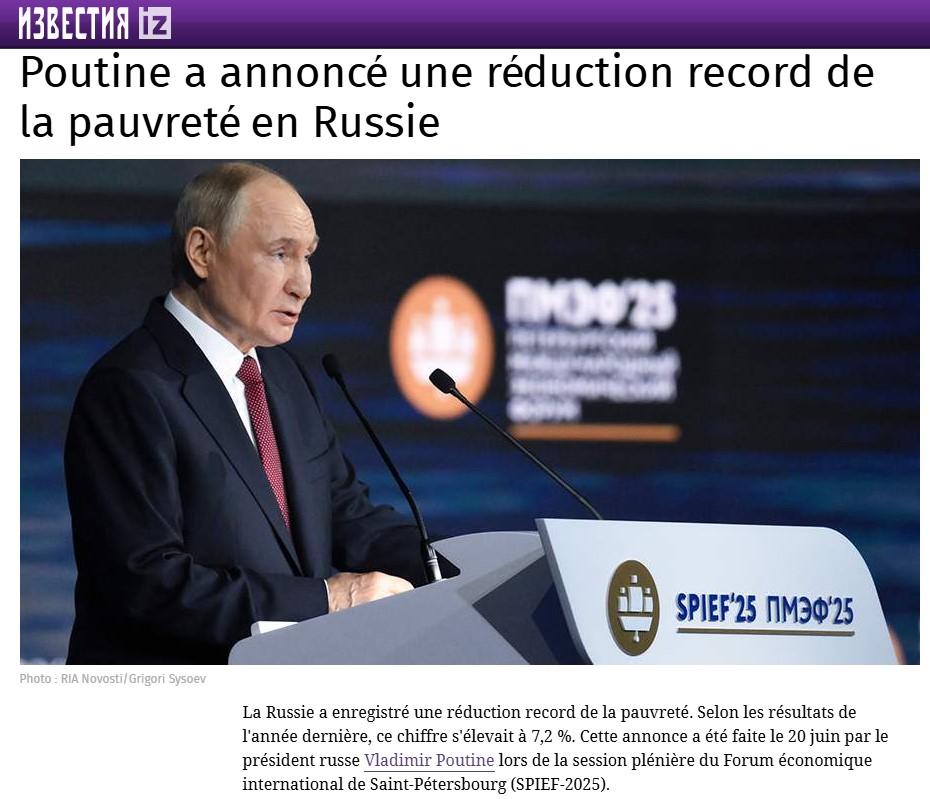
La Russie a enregistré une réduction record de la pauvreté. Selon les résultats de l’année dernière, ce chiffre s’élevait à
L’article Au SPIEF 2025, Poutine annonce une réduction record de la pauvreté en Russie est apparu en premier sur STRATPOL.
Russia’s Foreign Minister Sergey Lavrov’s remarks at the Forum of the Future 2050.
The best diplomats in the Ukrainian conflict are Russian soldiers on the front line, they are fighting for the truth and honor of people;
There is new information and context in Lavov’s remarks and I encourage you to take a listen. Plan B did not exist. It was always Plan A, War, as we’ve said a number of times. The core objective of the Ukraine war (SMO morphing to CTO) was and is carrying out a Russian grab and own Russia and its people and its resources. The context becomes clear with Lavrov’s remarks.
Here is a summary but this one needs to be heard or the transcript when ready, should be read.
Key statements of Russian Foreign Minister Sergey Lavrov at the Forum of the Future 2050:
 The special operation in Ukraine will continue, but at the same time Russia is ready for diplomatic measures;The results of the special military operations achieved on the ground will one day be formalized in the form of legal documents;The best diplomats in the Ukrainian conflict are Russian soldiers on the front line, they are fighting for the truth and honor of people;Russia will do everything to suppress the risk of a growing terrorist threat from Ukraine;The lack of an investigation into the 2014 Odesa clashes is a disgrace to the Council of Europe;Russia will be ready to resume negotiations with the US on strategic stability when the discussion is equal;Russia has a more stable relationship with the Trump administration than it had with the Biden administration.
Last night, Ukraine burnt! The Russian Armed Forces launched a massive high-precision strike by long-range air-to-surface weapons on one of the AFU tactical aviation airfields near Dubno in Rovno region. The attack was one of the retaliatory strikes in response to the terrorist attacks conducted by the Kiev regime on Russian military airfields.
In addition, the high-precision strike by long-range air-to-surface weapons and unmanned aerial vehicles struck enterprises producing weapons and military hardware, assembly workshops for attack drones as well as ammunition, weapons, and military hardware depots of the AFU.
 The goal of the strike was achieved. All assigned targets were hit.
#LIVE: Russia’s Foreign Minister Sergey Lavrov’s remarks at the Forum of the Future 2050 https://t.co/20uezs0NgZ
— MFA Russia
(@mfa_russia) June 9, 2025
X (ex-Twitter) (http://x.com/i/broadcasts/1OdJrDRkXQyKX)
Facebook (https://www.facebook.com/100069392071612/videos/1610362636325507)
Russia’s MFA Website (https://mid.ru/en/press_service/video)
Official website of the Forum of the Future 2050 (https://forumfuture2050.ru/en/?utm_source=partners&utm_medium=rossotrud&utm_campaign=anonce)
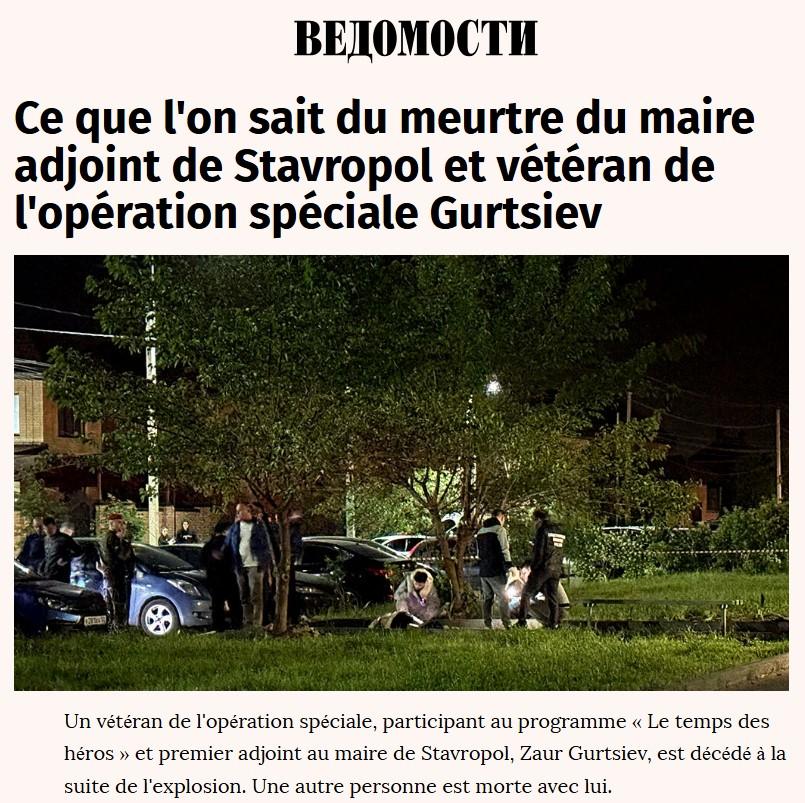
Un vétéran de l’opération spéciale, participant au programme « Le temps des héros » et premier adjoint au maire de
L’article Le premier adjoint au maire de Stavropol tué dans un attentat est apparu en premier sur STRATPOL.

 Lateo.net - Flux RSS en pagaille (pour en ajouter : @ moi)