Connexion


Verily, it is Victory or Martyrdom.
Venezuelans have a “true sense of belonging to a project worth saving.. This is a project of collective self-emancipation. .. Those who are committed to the Bolivarian revolution assume themselves as subjects of transformation, not as victims. And this is something to be reckoned with.”
Video Description:
“I’m joined by Cira Pasqual Marquina, author and educator at the Pluriversidad Patria Grande and co-host with Chris Gilbert of the Marxist education program and podcast Escuela de Cuadros.
I ask her:
≈≈≈

Cira Pascual Marquina interviews at Venezuelanalysis.
The Imperialist Offensive is Nothing New for the Bolivarian Revolution’: A Conversation with Ana Maldonado
A Chavista organizer examines the US militarization of the Caribbean and the Bolivarian Revolution’s enduring resistance to imperial aggression.
In recent months, Washington has stepped up its military presence in the Caribbean, sending warships, aircraft, and even a nuclear submarine to waters near Venezuela amid extrajudicial attacks on fishing vessels. For many, this new phase of aggression is all too familiar — part of a decades-long campaign of hybrid warfare designed to undermine Venezuela’s sovereignty.
In this context, Cira Pascual Marquina spoke with Ana Maldonado, a sociologist, international relations coordinator for the Francisco de Miranda Front—a national Chavista movement—and member of the Venezuelan chapter of ALBA Movements. In this interview, Maldonado offers her perspective on how Venezuelans are experiencing the latest imperialist escalation, reflects on the country’s long resistance to hybrid war, and situates the current threat within the broader struggle for sovereignty in Latin America and the Caribbean.
How are the Venezuelan people experiencing this new imperialist escalation?
President Nicolás Maduro has said that in this scenario of maximum pressure, our response must be maximum preparation. At the same time, he has called on us to combine vigilance with calm, to continue our daily lives, and to defend the peace with social justice that has cost us so much to build and preserve.
You can see this clearly in the fact that, even amid the current military escalation, the new school year began normally across the country. More than 20,000 educational institutions opened their doors without disruption, and over six million children and youth returned to class, as they do every year around this time.
While we are indeed facing a serious threat of war, people are also carrying on with their everyday lives and that, in itself, is a victory, since the enemy seeks precisely to disrupt our life.
People abroad are often surprised to learn that daily routines here continue undisturbed and that Venezuelans are not living in a state of panic. How do you explain this?
This is far from our first encounter with imperialist aggression. The tactics may shift, but the strategy remains unchanged: hybrid warfare. For years, US imperialism and its allies have waged a relentless campaign against Venezuela, beginning in earnest in April 2002 with the coup d’état and the people’s heroic counteroffensive that restored democracy. That was followed by the oil sabotage, mercenary incursions, and global media campaigns against our democracy.
After Comandante Chávez passed in 2013, a new and sustained period of aggression began. Initially, they bet that we would fail to hold peaceful elections or that President Maduro would never be elected. The dominant narrative was “Maduro is not Chávez.” With that simplistic argument, they sought to demoralize the Chavista social base, implying that the Bolivarian project would not withstand the loss of the Comandante. Yet we won the elections and, even as we mourned Chávez, the project continued.
But the US and their local agents were determined not to let us go on with our revolution. In 2014, the opposition launched a violent campaign called “La Salida” [The Exit], led by Voluntad Popular and María Corina Machado, the same factions now openly calling for foreign intervention. The following year, the United States took another war-like step: Obama’s 2015 executive order declaring Venezuela an “unusual and extraordinary threat.”
That decree was followed by the 2016 economic strangulation, marked by deliberate shortages aimed at making everyday life unbearable. Ten years later, we remain under a blockade that has killed tens of thousands.
In 2017, the most extreme factions of the opposition returned to the streets with fascist violence, committing atrocities such as the burning alive of a young Black man, Orlando Figuera, targeted simply for looking like a Chavista. More than 100 people were killed during this period of intensified fascist terror.
President Maduro responded by calling for a National Constituent Assembly, once again raising the banner of peace and democracy in the face of fascist violence. People from all sectors, including residents of middle-class neighborhoods whose polling centers had been attacked, were able to vote in peace at the Poliedro de Caracas.
Since then, we’ve lived through multiple phases of hybrid war: Juan Guaidó’s self-proclamation as “interim president” in 2019 and the “Battle of the Bridges,” when the opposition attempted to stage a false-flag operation on the Colombian border under the guise of a humanitarian aid effort. That was followed by massive blackouts that left the country in darkness for days and the 2020 Operation Gideon, recently further exposed in a Max Blumenthal interview with its US organizer, Jordan Goudreau, a former Green Beret.
None of these were isolated incidents: they are coordinated fronts in a sustained hybrid war combining political, psychological, economic, and military aggression.
Yet, in each of these moments, the government and the organized pueblo have responded effectively. During the 2019 electrical sabotage, for example, communities mobilized to ensure access to water and basic needs, while Operation Gideon was defeated by the same fisherfolk who are now being attacked in the Southern Caribbean.
So, to return to your original question: yes, people are alert because the threat is real, but we are also seasoned and organized. We know we are capable of defending the Revolution with unity and discipline. We are in a phase of maximum preparation, with millions voluntarily enrolling in the militia and preparing for the defense of the Patria [homeland].
Indeed, people are not only enlisting in the Bolivarian Militia but also preparing collectively. You’ve given us a historical account of the attacks faced by the Bolivarian Revolution over the past 25 years. But as we know, the current military buildup in the Caribbean is not only against Venezuela: it is an attack on the continent. How do you understand its broader implications?
The imperialist onslaught on the Caribbean is nothing new. Haiti, still punished today for its revolution more than two centuries ago, remains under siege. Now, armed gangs tied to the Dominican Republic are also involved. Puerto Rico continues to endure capitalist dispossession, with five million Puerto Ricans now living in the US while barely three million remain on the island. All the while, revolutionary Cuba has faced a brutal blockade for many decades.
However, the recent imperialist military buildup should deeply concern the peoples of Latin America and the Caribbean, since it signals a shift in Washington’s military policy. Around 10,000 US troops are currently stationed in the Caribbean, mainly in Puerto Rico, to say nothing of the destroyers, nuclear submarine, and air force deployments.
They are not there only to threaten Venezuela; this is the revival of the Monroe Doctrine. As Trump once said, “Why pay for Venezuelan oil, if we can just take it?” That’s how they think about the resources of the continent.
When it comes to Venezuela, beyond seizing our resources, the US also aims to strip away our sovereignty and destroy the example that we represent. If our project succeeds, it will inspire the entire continent. From Canada to Patagonia, people are struggling for liberation, and the Bolivarian Revolution represents a living example of how that can be done.
Attacking Venezuela serves two purposes: to loot our resources and to extinguish the example of participatory democracy. Since 2021, Venezuela has experienced renewed economic growth and the strengthening of its communes and popular power.
That is precisely what Washington wants to halt: they fear that the peoples of Latin America, and even within the United States, will draw inspiration from our experience.
Why the military escalation at this particular moment?
Trump’s slogan “Make America Great Again” is itself an admission of decline. The US is no longer what it once was, and its elites are desperate to recover lost ground. Yet even within those elites, fractures abound between the neoconservatives, the Zionist zealots, and the MAGA bloc. Their internal contradictions often produce erratic foreign policy decisions.
However, on one point they all agree: war is profitable. The military-industrial complex remains central to sustaining the US economy. So even amid domestic tensions, there is a bipartisan consensus around war as business.
Before the recent attacks on Venezuelan vessels, President Maduro warned that they might attempt to recreate a Gulf of Tonkin incident, because their hunger for war is insatiable. He was right: this aggression is ultimately driven by the economic imperative of feeding the war machine. In a post-Cold War world, it survives through perpetual “hot wars”—and what better front than Venezuela, which is rich in resources and defiant of imperial domination?
Let’s close with Chávez. He declared the Bolivarian Revolution anti-imperialist in 2004, but in truth, it always had a sovereign and anti-imperialist character. Could you reflect on Chávez’s anti-imperialism?
Indeed. The formal declaration came during a historic rally at the Botanical Garden in 2004, but the Revolution was Bolivarian from the start, and Bolívar himself was profoundly anti-imperialist. He warned that the United States seemed “destined by Providence to plague the Americas with misery in the name of liberty.” That same spirit lives in our revolution since day one.
Chávez revived Bolívar’s anti-imperialist legacy as early as 1977, when he created the People’s Army for the Liberation of Venezuela, whose founding document enshrined Bolivarianism and anti-imperialism as guiding principles. Later, in The Blue Book [1991], he outlined the vision of sovereignty and dignity that still guides us. President Maduro calls that text a “historical compass” pointing us steadfastly, no matter how much we have to maneuver, toward our strategic goal: the defense of sovereignty and the rejection of imperial domination.
For us, being anti-imperialist means not only refusing to surrender our resources, but also defending our identity, our dignity, and our very being. The empire’s elites belong nowhere; they want the world to belong to them. We, by contrast, define ourselves by belonging to a land, to a pueblo, and to a history.
That is why even symbolic aggressions, such as the attempt to erase “Bolivarian” from the Republic’s name during the 2002 coup, or mocking us as “venecos” in an attempt to erase our identity, are part of the war.
Bolivarianism and anti-imperialism are also deeply rooted in your organization, the Frente Francisco de Miranda. Can you tell us about it?
Indeed. In 2003, Fidel and Chávez founded the Frente Francisco de Miranda as a movement of Bolivarian, anti-imperialist social workers. However, anti-imperialism isn’t limited to my organization; it’s in the bloodstream of millions of Venezuelans who have resisted International Monetary Fund impositions since 1989 and continue defending the Bolivarian project today.
To be Chavista is to be anti-imperialist. Chávez was the first Latin American president to recognize Palestine, to support the Sahrawi Arab Democratic Republic, and to speak of our historical debt to Haiti. His backing of these and other liberation struggles was not just a matter of words but also about material support. He also linked the defense of Haiti to a history that, for him, didn’t begin with Pétion and Dessalines, but with Hatuey, the first known hero of an anti-colonial Caribbean rebellion.
That is our Chávez—the anti-imperialist Chávez—whose legacy continues to guide us!
≈≈≈
Cira Pascual Marquina is a Political Science professor at the Universidad Bolivariana de Venezuela in Caracas. She is also co‐producer and co‐host (with Chris Gilbert) of the Marxist education program Escuela de Cuadros. She is actively engaged with grassroots organizations in Venezuela and abroad, and is dedicated, both as a militant and as an investigator, to communal initiatives.
“Don’t fight city hall.” That bit of American folk wisdom goes back to the early 20th century and had its origins in New York City, where the Tammany Hall crooked political machine made challenges to the authorities appear quixotic and unlikely to succeed.
Though some members of this Community will surely disagree with me, this is my best advice to Harvard University in its present direct confrontation with the Trump administration.
To be sure, corruption of those in power has nothing to do with this conflict. Political ideology is what it is all about. Trump stands for traditional family, religious, societal values, for veneration of our historical heroes, for an end to the forever wars that American foreign policy has given us these past 30 years. Though few American lives have been lost in these wars, they have literally cost hundreds of billions if not trillions of dollars and driven the U.S. federal deficit to unsustainable levels.
Harvard has for several decades stood for ‘woke,’ for dethroning American heroes after whom monuments are erected and university buildings are named due to their connection to slavery or to their holding ethnic, religious, sexual or other prejudices that are no longer acceptable in polite society. More to the point, Harvard has been an intellectual leader in forging a foreign policy based on American global hegemony that brooks no potential competitors and launches destructive, murderous proxy wars around the world.
That Harvard-inspired foreign policy is said to be ‘values based,’ meaning promoting human rights and democracy. Anyone who doubts the intimate connection between the Harvard professorate and our ‘values based’ foreign policy would do well to read the obituary essays in honor of Joseph Nye, author of ‘Soft Power,’ this past week. Still better, pick up my 2010 volume Great Post-Cold War American Thinkers on International Relations which dissects the writings of the ten most popular political scientists of the preceding two decades as they delineated a road map into the future now that the USA was the sole remaining super power. As I understood after I completed my manuscript, nine of these ten intellectual leaders had a close relationship with Harvard University.
By contrast, the Trump foreign policy today is ‘interests based,’ in the tradition of the Realistic School that was last seen as guiding Washington’s behavior under Richard Nixon. The flag of Realism flies highest at the University of Chicago, where Professor John Mearsheimer holds forth as the continuator of ideas long championed in the post WWII years by Hans Morgenthau, author of the seminal work Politics Among Nations.
From the very start of his presidency in this, his second mandate, Donald Trump began his assault on the elite universities which set the Leftist, anti-Trump tone for neary all of American higher education. The pretext for this attack was their tolerance for pro-Palestinian views and demonstrations on campus which, according to the government, jeopardized the safety of their Jewish students. This essentially phony allegation of anti-Semitism was carefully chosen by Team Trump to consolidate its support among the Zionist majority in both parties on Capitol Hill. It fit nicely with the blind eye that Trump turned to the genocide Israel has been perpetrating in Gaza. This was, as I have said elsewhere, political calculus to find support for Trump’s domestic and foreign policy initiatives that run counter to prevailing views of the American political establishment. Included in this otherwise unpopular Trump agenda is closure of the Russia-Ukraine war on terms close to those demanded by Vladimir Putin and the implementation of a new wide-ranging détente with Moscow.
The attack of Team Trump on several elite universities over alleged anti-Semitism focused first on Harvard and Columbia universities. Federal grants and contracts to these two universities were or suspended or cancelled pending their providing to federal authorities information about some, mainly foreign students enrolled there and their putting in place rules which Team Trump said would stamp out anti-Semitism on campus.
Columbia University initially protested when $400 million in grants and contracts were provisionally terminated, but then reversed course, knelt down and kissed the ring of Team Trump. Although the original grants and contracts have not yet been reinstated, there have been no further attacks on Columbia.
Harvard from the beginning refused to submit to what it called illegal pressure and punishment from the federal government. It initiated law suits to reinstate the funds. In response the government has escalated the punishment meted out to Harvard as I will mention further below to the point where it currently threatens the vital interests of the university.
Meanwhile, the Columbia President and administration have been criticized in both mainstream and in Alternative Media for failing to defend free speech guaranteed by the First Amendment and for submitting to the Trump demands. In my view, criticism of the Columbia administration is misguided. The university is guilty of much greater errors of judgment than what its detractors in the media are saying. I see a far more serious threat to the university’s standing as a defender of liberal values and common decency in its extension of professorial positions to two unindicted war criminals – Hilary Clinton and Victoria Nuland. Their presence on campus before students, the prestige that has been accorded to them levels to the ground Columbia University’s moral standing in U.S. higher education. I say that as an alumnus.
*****
Harvard’s president has listened too closely to the advice of its smart-assed, litigious lawyers from its world-renowned Law School. Consequently, Harvard will undergo serious reputational and financial damage before it ultimately succumbs to pressure from donors and alumni organizations, submitting to the will of Team Trump.
After suspending three billion dollars in federal grants to Harvard, Team Trump threatened and then took action to strip Harvard’s tax-exempt status. One major consequence of that action is to raise taxes on its endowment. Another is to dissuade potential donors from contributing to the endowment, since they personally will now get no tax credits for their generosity.
In the past week, Team Trump reached for the hatchet and issued an order terminating Harvard’s certificate of participation in the foreign student registration system which facilitates visa issuance and comes under the Department of Homeland Security. This order would compel these students to either transfer to some other university which enjoys that registration right or to lose their visa and be compelled to leave the country.
I note that the justification for this decision goes beyond the allegations of anti-semitism on campus to direct attention as well to cooperation with the Chinese Communist Party in areas harmful to U.S. interests.
Nearly 7,000 students at Harvard presently are registered in the visa registration system, representing one quarter of student enrollments. Their departure would impact greatly on the current operating budget of the university given that many if not most of the foreign students pay full tuition. The sum in question amounts to several hundred million dollars annually. Revocation would put in question the continued employment of nontenured faculty who would have considerably lower headcounts in their classes. More importantly, it would be a catastrophe for the international standing of Harvard, making it a less desirable place to teach.
The Harvard administration is putting a brave face on the situation. It contested the ruling in the courts and a district federal judge has just issued a temporary block on the de-certification. Presumably the motivation for the court to step in was that we are less than a month from the end of the school year and many students awaiting award of their diplomas would be compelled to leave the country with empty hands.
It is an open question how long the courts can block execution of the Department of Homeland Security decision. However, in any case whatever the ultimate court decisions may be, in time present Harvard’s ability to enroll foreign students will be in limbo and such uncertainty is fatal to the chances of maintaining present levels of enrollment.
While the administrators may be stiff-necked, I have little doubt that they will soon face massive pressure from the university’s wealthy donors to swallow their pride and seek some accommodation with Washington. We are speaking about businessmen, and businessmen never, ever go head-to-head against their nation’s government in pursuit of private interests; principles be damned. Moreover, it is inconceivable that alumni associations across the country and across the world will not counsel negotiation instead of litigation. I say this as a Harvard alumnus.
The only question now is how long it will take for Harvard men to understand that you ‘don’t fight city hall.’
©Gilbert Doctorow, 2025
Translation below into German (Andreas Mylaeus)
Harvard im Fadenkreuz der US-Regierung
„Leg dich nicht mit der Stadtverwaltung an.“ Dieser amerikanische Spruch stammt aus dem frühen 20. Jahrhundert und hat seinen Ursprung in New York City, wo die korrupte politische Maschinerie der Tammany Hall jegliche Auseinandersetzung mit den Behörden als unrealistisch und aussichtslos erscheinen ließ.
Auch wenn einige Mitglieder dieser Community mir sicherlich widersprechen werden, ist dies mein bester Rat an die Harvard University in ihrer derzeitigen direkten Konfrontation mit der Trump-Regierung.
Natürlich hat die Korruption der Machthaber nichts mit diesem Konflikt zu tun. Es geht hier um politische Ideologie. Trump steht für traditionelle Familien-, Religions- und Gesellschaftswerte, für die Verehrung unserer historischen Helden und für ein Ende der endlosen Kriege, die uns die amerikanische Außenpolitik in den letzten 30 Jahren beschert hat. Obwohl in diesen Kriegen nur wenige Amerikaner ihr Leben verloren haben, haben sie buchstäblich Hunderte von Milliarden, wenn nicht sogar Billionen Dollar gekostet und das Defizit des US-Bundeshaushalts in unhaltbare Höhen getrieben.
Harvard steht seit mehreren Jahrzehnten für „Woke“, dafür, dass amerikanische Helden, denen Denkmäler errichtet und nach denen Universitätsgebäude benannt worden waren, aufgrund ihrer Verbindung zur Sklaverei oder aufgrund ihrer ethnischen, religiösen, sexuellen oder anderen Vorurteile entthrohnt werden, die in einer höflichen Gesellschaft nicht mehr akzeptabel sind. Genauer gesagt ist Harvard eine intellektuelle Führungskraft bei der Gestaltung einer Außenpolitik, die auf der globalen Vorherrschaft Amerikas basiert, die keine potenziellen Konkurrenten duldet und weltweit zerstörerische, mörderische Stellvertreterkriege führt.
Diese von Harvard inspirierte Außenpolitik wird als „wertorientiert“ bezeichnet, was die Förderung von Menschenrechten und Demokratie bedeutet. Wer die enge Verbindung zwischen der Harvard-Professorenschaft und unserer ‚wertorientierten‘ Außenpolitik anzweifelt, sollte die Nachrufe auf Joseph Nye, den Autor von „Soft Power“, lesen, die in der vergangenen Woche erschienen sind. Noch besser wäre es, mein 2010 erschienenes Buch „Great Post-Cold War American Thinkers on International Relations“ zu lesen, in dem ich die Schriften der zehn populärsten Politikwissenschaftler der letzten zwei Jahrzehnte analysiere, die einen Fahrplan für die Zukunft entworfen haben, nachdem die USA zur einzigen Supermacht geworden waren. Wie ich nach Fertigstellung meines Manuskripts festgestellt habe, hatten neun dieser zehn intellektuellen Führer enge Beziehungen zur Harvard University.
Im Gegensatz dazu ist die Außenpolitik von Trump heute „interessenorientiert“ und steht in der Tradition der Realistischen Schule, die zuletzt unter Richard Nixon das Verhalten Washingtons bestimmte. Die Flagge des Realismus weht am höchsten an der Universität von Chicago, wo Professor John Mearsheimer als Fortführer der Ideen auftritt, die in den Jahren nach dem Zweiten Weltkrieg von Hans Morgenthau, dem Autor des wegweisenden Werks „Politics Among Nations“, vertreten wurden. Seit Beginn seiner zweiten Amtszeit hat Donald Trump einen Angriff auf die Eliteuniversitäten gestartet, die den linken, anti-Trump-Ton für fast das gesamte amerikanische Hochschulwesen vorgeben. Der Vorwand für diesen Angriff war ihre Toleranz gegenüber pro-palästinensischen Ansichten und Demonstrationen auf dem Campus, die laut der Regierung die Sicherheit ihrer jüdischen Studenten gefährdeten. Diese im Wesentlichen falsche Behauptung des Antisemitismus wurde vom Trump-Team sorgfältig ausgewählt, um seine Unterstützung unter der zionistischen Mehrheit in beiden Parteien im Kapitol zu festigen. Sie passte gut zu der Blindheit, mit der Trump den Völkermord Israels in Gaza ignorierte. Wie ich bereits an anderer Stelle gesagt habe, handelte es sich hierbei um politisches Kalkül, um Unterstützung für Trumps innen- und außenpolitische Initiativen zu finden, die den vorherrschenden Ansichten des amerikanischen politischen Establishments zuwiderlaufen. Zu dieser ansonsten unpopulären Agenda Trumps gehören auch die Beendigung des Krieges zwischen Russland und der Ukraine zu Bedingungen, die denen von Wladimir Putin nahekommen, und die Umsetzung einer neuen weitreichenden Entspannungspolitik gegenüber Moskau.
Der Angriff von Team Trump auf mehrere Eliteuniversitäten wegen angeblichen Antisemitismus richtete sich zunächst gegen die Universitäten Harvard und Columbia. Bundeszuschüsse und -verträge für diese beiden Universitäten wurden ausgesetzt oder gekündigt, bis sie den Bundesbehörden Informationen über einige, hauptsächlich ausländische Studierende, die dort eingeschrieben sind, vorlegen und Regeln einführen, die laut Team Trump den Antisemitismus auf dem Campus ausmerzen sollen.
Die Columbia University protestierte zunächst, als Zuschüsse und Verträge in Höhe von 400 Millionen Dollar vorläufig gekündigt wurden, schwenkte dann aber um, kniete nieder und küsste dem Team Trump die Hand. Obwohl die ursprünglichen Zuschüsse und Verträge noch nicht wieder aufgenommen wurden, gab es keine weiteren Angriffe auf die Columbia University.
Harvard weigerte sich von Anfang an, sich dem, wie es es nannte, illegalen Druck und den Strafen der Bundesregierung zu beugen. Es reichte Klagen ein, um die Mittel wieder zu erhalten. Als Reaktion darauf hat die Regierung die Strafen gegen Harvard verschärft, wie ich weiter unten noch näher ausführen werde, sodass sie derzeit die lebenswichtigen Interessen der Universität gefährden.
Unterdessen wurden der Präsident und die Verwaltung der Columbia University sowohl in den Mainstream- als auch in den alternativen Medien dafür kritisiert, dass sie die durch den Ersten Verfassungszusatz garantierte Meinungsfreiheit nicht verteidigt und sich den Forderungen Trumps gebeugt haben. Meiner Ansicht nach ist die Kritik an der Verwaltung der Columbia University fehlgeleitet. Die Universität hat sich weitaus schwerwiegenderer Fehleinschätzungen schuldig gemacht, als ihre Kritiker in den Medien behaupten. Eine weitaus ernstere Bedrohung für das Ansehen der Universität als Verfechterin liberaler Werte und allgemeiner Anstandsregeln sehe ich in der Vergabe von Professuren an zwei nicht angeklagte Kriegsverbrecherinnen – Hillary Clinton und Victoria Nuland. Ihre Anwesenheit auf dem Campus vor den Studierenden und das ihnen entgegengebrachte Ansehen zerstören das moralische Ansehen der Columbia University im US-amerikanischen Hochschulwesen. Das sage ich als Absolvent dieser Universität.
*****
Der Präsident der Harvard University hat zu sehr auf den Rat seiner klugscheißerischen, prozesssüchtigen Anwälte aus der weltberühmten juristischen Fakultät gehört. Infolgedessen wird Harvard einen schweren Reputations- und finanziellen Schaden erleiden, bevor es schließlich dem Druck von Spendern und Alumni-Organisationen nachgibt und sich dem Willen des Trump-Teams beugt.
Nachdem das Trump-Team drei Milliarden Dollar an Bundeszuschüssen für Harvard ausgesetzt hatte, drohte es mit dem Entzug der Steuerbefreiung für Harvard und setzte diese Drohung in die Tat um. Eine wichtige Folge dieser Maßnahme ist die Erhöhung der Steuern auf das Stiftungsvermögen. Eine weitere Folge ist, dass potenzielle Spender davon abgehalten werden, dem Stiftungsvermögen Geld zu spenden, da sie nun persönlich keine Steuervergünstigungen mehr für ihre Großzügigkeit erhalten.
In der vergangenen Woche griff das Trump-Team zur Axt und erließ eine Anordnung zur Aufhebung der Teilnahmebescheinigung Harvards am Registrierungssystem für ausländische Studenten, das die Erteilung von Visa erleichtert und dem Heimatschutzministerium untersteht. Diese Anordnung würde diese Studenten zwingen, entweder an eine andere Universität zu wechseln, die dieses Registrierungsrecht genießt, oder ihr Visum zu verlieren und das Land verlassen zu müssen.
Ich stelle fest, dass die Begründung für diese Entscheidung über die Vorwürfe des Antisemitismus auf dem Campus hinausgeht und auch auf die Zusammenarbeit mit der Kommunistischen Partei Chinas in Bereichen hinweist, die den Interessen der USA schaden.
Derzeit sind fast 7.000 Studenten in Harvard im Visaregistrierungssystem gemeldet, was einem Viertel der Studentenzahl entspricht. Ihr Weggang hätte erhebliche Auswirkungen auf den aktuellen Betriebsetat der Universität, da viele, wenn nicht sogar die meisten ausländischen Studenten die Studiengebühren in voller Höhe bezahlen. Die betreffende Summe beläuft sich auf mehrere hundert Millionen Dollar pro Jahr. Eine Aufhebung würde die Weiterbeschäftigung von nicht fest angestellten Lehrkräften in Frage stellen, die dann deutlich weniger Studierende unterrichten müssten. Noch wichtiger ist, dass dies eine Katastrophe für das internationale Ansehen von Harvard wäre und die Universität als Lehrort weniger attraktiv machen würde.
Die Harvard-Verwaltung gibt sich angesichts der Situation tapfer. Sie hat die Entscheidung vor Gericht angefochten, und ein Bundesbezirksrichter hat gerade eine vorübergehende Aussetzung der Entziehung der Zertifizierung verfügt. Vermutlich war der Grund für das Eingreifen des Gerichts, dass wir weniger als einen Monat vor Ende des Schuljahres stehen und viele Studenten, die auf ihre Diplome warten, gezwungen wären, das Land mit leeren Händen zu verlassen.
Es ist offen, wie lange die Gerichte die Umsetzung der Entscheidung des Heimatschutzministeriums blockieren können. Unabhängig davon, wie die endgültigen Gerichtsentscheidungen ausfallen mögen, wird die Fähigkeit der Harvard University, ausländische Studierende aufzunehmen, mit der Zeit in der Schwebe hängen, und diese Unsicherheit ist fatal für die Chancen, das derzeitige Niveau der Einschreibungen aufrechtzuerhalten.
Auch wenn die Verwaltungsbeamten hartnäckig sind, habe ich kaum Zweifel daran, dass sie bald massivem Druck von den wohlhabenden Spendern der Universität ausgesetzt sein werden, ihren Stolz zu überwinden und sich mit Washington zu einigen. Wir sprechen hier von Geschäftsleuten, und Geschäftsleute stellen sich niemals aus privaten Interessen gegen die Regierung ihres Landes, Prinzipien sind ihnen egal. Außerdem ist es unvorstellbar, dass Alumni-Vereinigungen im ganzen Land und auf der ganzen Welt nicht zu Verhandlungen statt zu Rechtsstreitigkeiten raten werden. Ich sage das als Harvard-Alumnus.
Die einzige Frage ist nun, wie lange es dauern wird, bis die Harvard-Leute verstehen, dass man „nicht gegen die Stadtverwaltung kämpft“.
gilbertdoctorow
Trump loves tariffs because they fall mainly on the consumers, not his class.
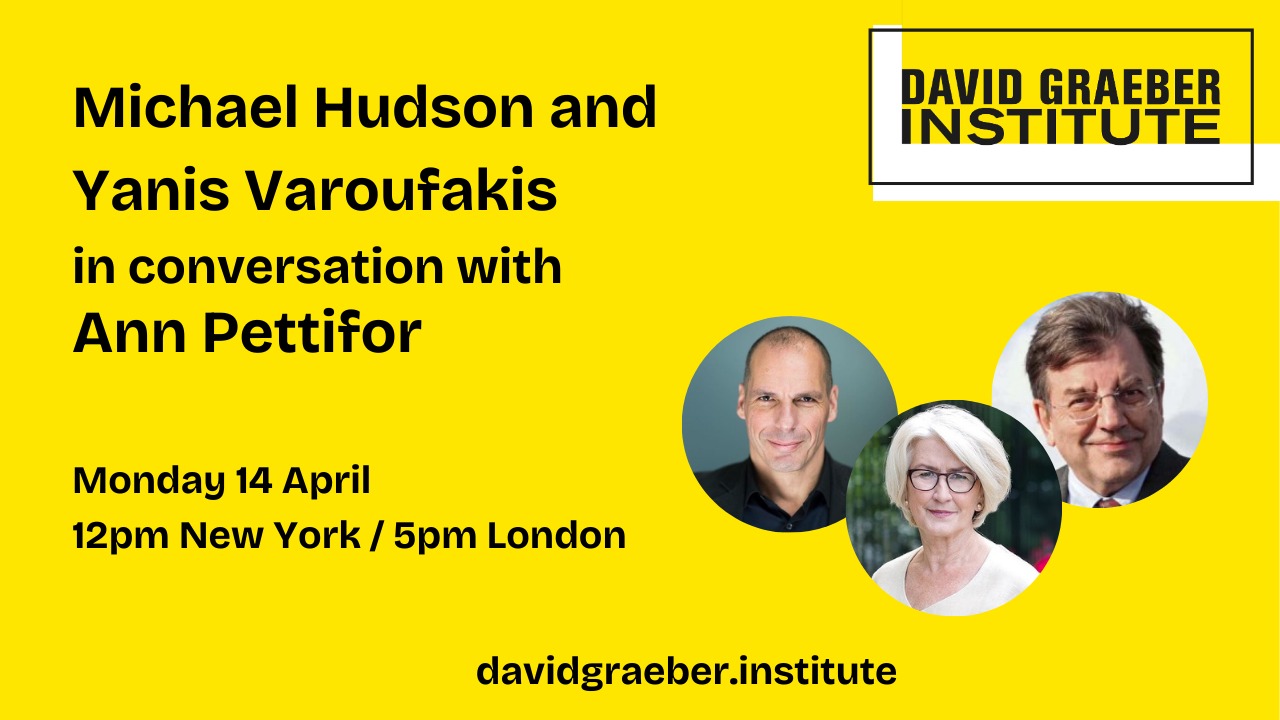
Yanis Varoufakis and Michael Hudson in conversation with Ann Pettifor on debt and its implications for Global South – North relations
Nika Dubrovsky: Hi everyone. It’s a real honor to welcome you on behalf of the David Graeber Institute. We’re especially grateful to our speakers — many of whose work aligned closely with David’s thinking and values — for joining us to reflect on how radically our world is changing.
It’s in this spirit that we hope to better understand the transformations unfolding around us.
Today’s conversation marks the beginning of a new series of public discussions hosted by the David Graeber Institute. With that, I’m happy to hand over to Ann Pettifor, who will be moderating today’s session.
Ann Pettifor: Thank you very much, Nika. And can I say how wonderful it is for Michael and Yanis and myself to be gathering here in the name of our very dear friend David Graeber, whom we loved very much and were so sad at his loss. And thank you to Nika in particular for establishing the Institute and for facilitating these exchanges and reminding us all of how important David was to the current public debate. So I’m feeling quite emotional even thinking about him.
So anyway, great. So I want to just begin. Everyone here knows Michael Hudson, I’m assuming, and Yanis Varoufakis.
They will speak about their work. And what we have in common, I think, is A, David Graeber, but B, an understanding of the international financial system and its impact on Europe, on the United States and on the South. And that’s what is going to be the major theme of this today.
And I hope to begin with Michael Hudson’s latest paper, which is superb. And Michael, you give us the title because it’s escaped me for the minute. But it really is a wonderful paper, which I think Nika will be distributing more widely.
So, Michael, you begin our conversation by talking to us about what is actually going on, really. What is the real motives of the Trump administration? And why are we where we are right now?
Michael Hudson: Well, there are two things that are key in this. I think that a few years ago, Trump was talking to some economists, and he said, isn’t there some way that America can get rid of the income tax? We want to get rid of taxes, at least on my constituency, the donor class, the 1%.
And the economists told him, well, you know, America didn’t really have an income tax until 1913. And Trump said, well, how did we get by from the revolution until World War I? And the economists said, well, we had tariff revenues. That was almost the entire source of the American government and the Treasury, along with the sale of land that had been grabbed from the Indians.
And so Trump said tariffs. That’s wonderful. Trump loves tariffs because they fall mainly on the consumers, not his class.
They don’t fall on the class that he wants to untax. So he somehow thought, how do we justify a tariff policy? And if only we can go back to that golden age, of course, we have to shrink government, at least the government social spending. And how do we justify a tariff policy? Well, I think that we’re now talking about him imposing tariffs to threaten other countries with destabilizing their economy.
And that’s the only thing that America has to offer now. It can’t offer industrialization because it’s deindustrialized. It can’t really offer much financialization because it’s weaponized the dollar.
Trump wants to weaponize foreign trade as well. And he’ll tell foreign countries, well, of course, we can roll back the tariffs and let’s sit down and negotiate. What can you give back to the United States? And it’s almost as if he’s read Yanis’s articles on the role of information technology is dominating the new economic shape of the world and that of empire builders.
They want to gain dominance in information technology and various platforms and in ship making technology with a view to making other countries dependent on paying monopoly rents to U.S. companies, especially those in Silicon Valley, which are Trump’s large campaign contributors. So it’s as if information technology monopoly rents are going to be the new buttress of the American balance of payments. If other countries can be blocked from creating their own independent technology.
Well, U.S. diplomats can impose sanctions on this. They can try to prevent China from developing IT. They can try to lock Europe and other countries into this.
And the magnitude of this issue today is as large as that of the 19th century fight against landlords. And it was the fight against landlords that inspired classical economists from Adam Smith to John Stuart Mill to Marx and the socialists to define economic rent. And they said, if we’re going to free our economies from the legacy of feudalism, a hereditary aristocratic landlord class, then we’ve got to take away their economic rents, mainly by either taxing rents away or by just socializing the land and making it a public utility.
So they developed the whole concept of economic rent as the excess of market price over intrinsic cost value. Well, they didn’t succeed in getting rid of the landlord class, but they did define rents in a way that can be applied to monopoly rents. Again, excessive price over income and that the fight against the kind of monopoly rents that Yanis has described as the ideal of the platforms of information technology and all of its associated dynamics are a parallel to the fight today to the 19th century fight against landlords.
To free economies from economic rent. And in this case, from economic rent that’s been sponsored and controlled by the United States as a means of replacing the form of dominance that it had over the rest of the world since 1945.
Ann Pettifor: Fantastic. That does lead us into Yanis’ book and Yanis’ work on technology. Yanis, what would you say to Michael’s analysis of what’s happening right now?
Yanis Varoufakis: Well, of course, I agree. How can I not? Ever since he wrote the great book, Super Imperialism, and now he’s even alluding to my work on techno-feudalism.
Look, it’s not technology. It’s got nothing to do with technology. I mean, technology is everything.
Since the Iron Age, we’ve had technology. And it’s not information technology either. Because look, compare and contrast, for instance, OpenAI, which is, you know, heavy duty information technology, right? But in the end, it was so easy to append it.
DeepSeek came out and offered a cheap version of it and essentially damaged that business model spectacularly. So what I think Michael Hudson is very poignantly bringing into the conversation about the global order of things is what I call cloud capital. So you can have an industrial robot, which is very technologically advanced, uses information technology and algorithms and so on to assemble Teslas, right? You can have OpenAI, which produces a standard service in a standard capitalist model.
But what lives in here? What lives in here? In Google? In Facebook? In Meta? In X? In all these platforms, this is not just information technology. We get it wrong. It’s a new form of capital.
Because every form of capital we’ve had up until now, since we created the first tool to the old singing, old dancing industrial robots that assemble Teslas, they’ve been produced means of production. That’s what capital was. With this, we had a mutation of capital.
For the first time, we have automated systems that are not produced by means of production, but are purely produced means of behavioral modification. So unlike the machines that Henry Ford employed to produce other machines, Model Ts, and create a monopoly capitalist system whereby he’ll use the monopoly profits in order to buy newspapers to influence people and governments and to rip up all the streetcars, trams, in order to replace them with his own cars. Unlike that, you know, Jeff Bezos doesn’t sell anything.
I mean, he doesn’t sell anything he makes. His capital, his cloud capital has created a digital fiefdom in which he’s encased producers and consumers charging the equivalent of ground rent, of the feudal ground rent, which are called cloud rent. And today, most of the value in the New York Stock Exchange and NASDAQ, it comes from cloud rent.
It doesn’t come from capitalist profit. It’s exactly what Michael was saying. So when you saw this cabal of Bezos and Peter Thiel and Elon Musk and Tim from Apple and all these nice boys around Trump during his inauguration, I would call it the coronation this time around.
And what you saw was these cloudalists, the owners of cloud capital, who some of them are losing a lot from the tariffs, like Elon Musk loses a lot from the tariffs. They don’t like the tariffs, but what they see in Trump is the gateway towards the complete political domination of this new form of capital, cloud capital. We all suffered for decades now, the neoliberalism.
Friedman, Hayek’s return and domination of economics, as both of you and Michael know very well. For me, neoliberalism, I mean, methodologically, from an economic point of view, from a philosophical point of view, was completely bunk and not even interesting. What made it interesting was that it was the ideology which was necessary for the emancipation of financial capital after the end of Bretton Woods.
To unshackle the bankers from the shackles of the Bretton Woods system of the war economy, of the New Deal, they needed an ideology. And that was liberalism. Today, there is the unshackling of cloud capital.
It was financial capital back then, now it’s cloud capital. And Trump is a vehicle for that. And we have to see, as Michael said, what he does, not just in terms of tariffs, maybe he’s got his own fixation that comes from the 19th century, McKinley and so on and all of that.
But there is an interesting plan happening here. Essentially, his team, if you look at Stephen Miran and his famous paper, if you look at what Scott Bessett has been saying, they have a clear plan. Not so much Trump himself.
Trump is very much influenced by the last person he speaks to, right? But his team. Don’t forget that Nixon changed the world, even though he wasn’t truly familiar with the Nixon shock. He didn’t have the depth of thinking of somebody like Paul Volcker, who was in the team with Henry Kissinger.
These people knew what they were doing. They were bringing in what Michael’s book refers to as Super Imperialism, what I much later described in my own Greek way as the global minotaur. The same story, right? It starts with Michael’s idea.
These people want, they’re really worried that the world of the dollar, the dollar universe, has become so large relative to the manufacturing sector of the United States, that they want to bring some manufacturing back to the United States in order to rebalance this ratio between the dollar sphere and the actual machine sphere. They are worried about the possibility that the dollar bubble will burst. I’m not saying that they are right to worry about this or not, but they are worried.
And for them, what is going to give the next impetus, in the same way that in the 70s and 80s it was financial capital that gave the financialized world, whereby essentially the rest of the world was selling stuff to the United States, and also sending the dollars that they were getting paid with back to the United States in order to recycle them through Wall Street. Now it’s the rise of cloud capital. And the merge, the seamless merging of three things.
Cloud capital, what lives in here, like Google and X and all that. Digital payment systems. Digital payment systems, like stable coins.
This goes hand in hand with the project of dividing the dollar without the yuan or the euro taking precedence. Because if you make the Japanese sell some of their 1.2 trillion dollars of savings and buy Tether, a US dollar linked crypto, you have increased the supply of dollars, you’ve brought the value of the dollar down, but that money goes into what? American long term debt. Because Tether, the company, if you give them more dollars for their Tether coins, they will invest in 30 year long US treasuries.
So this is the plan. But the real driver of extractive power on behalf of the super ruling class of this super imperialist new vision by the Trumpists is cloud capital. And they will have a serious, serious, serious run for their money by the Chinese cloud capital, which is already seamlessly interwoven with Chinese finance and the digital currency of the Central Bank of China.
That, I think, is the reason why the Trumpists began the new Cold War against China, because they see the clear and present danger from this merging of cloud capital and finance into what I call cloud finance.
Ann Pettifor: Wow, that’s fascinating. Thank you, Yanis, for that.
Hang on a minute. I just want to say to the audience that Nika and I would like it very much if you posed questions and asked and comments about the talk, because we’re going to address those afterwards. And already, Paul Brandon has noted that much of tech today borrows land based metaphors, platforms, domain sites, even digital real estate.
Yet the economic consequences are rarely treated as land like, he says. Anyway, that’s one comment. And there are going to be others.
So I want to make sure that we address those at the end. So please submit your questions. I just wanted to add one thing to the conversation and to what Michael has said, and that is that, yes, you know, the United States may be deindustrializing, but there is one thing that they now control and that is causing mayhem across the world.
And that is the US dollar as the world’s reserve currency. And the transition away from the US dollar as the world’s as the world’s reserve currency is going to be tumultuous, really. And the impact on the South is going to be devastating.
And the other thing that really worries me is the rise of bond deals in the United States, the rise of interest, because as Michael and I, when we first met, seems like 100 years ago, was to talk about the levels of global debt. And we know from the Institute of International Finance, that both private and public debt globally is something like three hundred and thirty three percent of global GDP. So that is particularly a burden for countries on the South.
But it’s the role of the dollar in the global economy and the fact that it’s weakening right now, the implications of that for debt repayments in dollars, for example. But for the transition away from that without anyone offering an alternative plan. And I keep wanting to talk about the International Clearing Union as proposed by Keynes as an answer to the question of the reserve currency.
And in particular, to talk about regional clearing unions, in particular for Africa and African Payments Union, which will enable Africa to decouple from the dollar and trade with its partners and allies on the continent. Anyway, I want us to bring the dollar into the discussion as well and very much welcome your comments, Michael, as well as yours, Yanis.
Michael Hudson: Well, I think what all three of us have talked about is, of course, the point that Yanis pointed out, that finance is the mother of monopolies.
And indeed, the financial sector has not only been I’m sorry, the IT sector has not only been sponsored by the financial sector as it’s been financialized, but the entire economy has turned away really from what began, you could say, as profit seeking to rent seeking. And Yanis makes the point that Meta and the others certainly began as capital, but capital makes profits. And what these sectors want is much more than profits.
They want economic rent. They want to turn what began as an industrial sector in information technology into the kind of rent seeking that land was. And I think Yanis pointed out, most of the financial sector credit is for real estate.
And what the financial sector wants is not only real estate land rent, but as it loads down real estate with larger and larger loans relative to the value of and the purchase price of the homes and the office building that it’s making, it is into capital gains. And the same thing with the economic rent that’s extracted by Meta and the other IT platforms. The financial sector wants to use this dominance to create economic rents that will have an increasing financial value, which is why Nvidia and Google and Amazon and Apple have all been really the drivers of the U.S. stock market in the last few years.
So you have a symbiosis between economic rent seeking, finance, and any kind of opportunity that the financial sector and the IT sector and the real estate sector can impose an access price on users that is very much like landlords controlling the rents that have gone up and up and up as home ownership in the United States is plunged by about 10 percentage points since the Obama bailout of the financial sector after 2009. So you’re having a transformation of the economy away from the textbook idea of companies making profits to companies making rent to the entire U.S. economy, thinking, how can we use this rent seeking to achieve U.S. dominance over the rest of the world.
Ann Pettifor: And Michael, can I say this? You know, I think that’s absolutely right. But what we have is, if you like, the creation of credit relative to finite assets, assets that are, as you say, declining in value and that are finite.
And I want us all, Yanis and you, Michael, to think about these in relation to the climate as well and to the biosphere.
Yanis Varoufakis: Before the climate, I need to answer your question about the dollar.
Ann Pettifor: Yes, let’s get there. But let’s not forget, because we always do the role of the biosphere in all of this, how much more extraction and exploitation are these guys capable of before we, you know, collapse the whole ecosystem? Anyway, I just want to say, Michael, are you still with us? You are somewhere there. Yanis, why didn’t you respond to that?
Yanis Varoufakis: Well, first on the dollar, and then I’ll talk to you about the climate. You won’t like what I have to say about the climate and the state of our world.
I don’t like it either, but I have to be honest with you in answering it. Okay, let’s start from the question of the dollar. It is the end game.
American hegemony depends on the exorbitant privilege of the United States, still to this day. Now, I think it is a mistake to assume that the dollar is waning as we speak. I don’t believe it is waning.
We would like to see it wane. I would like to see the exorbitant privilege of the dollar go. I would like to see a multipolar world with different currencies competing with, as you said, along the lines of the ideas of Keynes in 1944 and so on, but I don’t see it yet.
It may well happen. This is an opportunity for it to happen, but let’s not take it for granted. Let’s not forget that the Nixon shock was utterly successful in doing two things at once:
Reducing the value of the dollar, increasing bonds, bond yields at the same time, and seriously enhancing the dominance of the U.S. dollar. The dollar was devalued and enhanced simultaneously. That is what the Trump administration wants to do, and we should not take it for granted that they shall fail.
I want to see them fail, but let’s not take it for granted. What it will depend on is on whether they succeed in getting holders of dollars to sell them, but at the same time not to purchase other currencies that will then essentially become competitors to the reserve currency status of the dollar. Now, you mentioned the International Clearing Union, the brilliant idea which was rejected so scathingly by Harry Dexter White in 1944.
Now, look, I don’t believe that the African Union can do that, simply because the African Union, as long as it continues to rely on to run a massive trade surplus with China, with other countries, such an ICU cannot work. But where the ICU idea could work is if China decides to internationalize the yuan and to turn the BRICS area, not into a common currency area, but in a Bretton Woods-like system with the yuan playing the dollar in the BRICS area that the dollar played in the Bretton Woods system. In other words, the United States was the surplus country in the Bretton Woods system, and it was recycling its surpluses in the form of direct injections either through aid or through loans to the rest of the Bretton Woods area.
China can do that. It can do that within the BRICS area. And that is very different from the BRICS pay, which is now simply an alternative to SWIFT.
But to do that, they will have to decide to take on the exorbitant power of the dollar. And at the moment, and I think the Trump people know that, I don’t know whether Trump knows it, but the Trump people surrounding him know that, the greatest ally of the exorbitant privilege of the United States dollar is China, is the Beijing government, because they have not decided yet. They may decide it soon, but they have not decided yet to compete for reserve currency status with the United States.
If you are a Chinese capitalist in Shenzhen and you’re exporting aluminum to the United States, you don’t want to see the exorbitant privilege of the dollar wane, because the dollar is a kind of IOU that you’re receiving from California. And then you take this money and you take it back to New York and you buy real estate in Miami.
Ann Pettifor: No, no, no, no, you don’t. You buy financial assets. You don’t buy real estate. You buy financial assets and then buy real estate.
Yanis Varoufakis: Increasingly, they buy real estate, because they don’t trust the financial assets as they used to. But anyway, the point is this. The point is that the Chinese Communist Party has not decided yet to pull the plug, to go for a Bretton Woods ICU version of the Bretton Woods within BRICS.
Some of us are working towards convincing them to do it, because that will be of great benefit to the global South.
Ann Pettifor: But, Yanis, does that mean you are proposing that what should happen is an alternative hegemonic currency? Why, I mean, why should we?
Yanis Varoufakis: Not at all, Anne. I mean, the reason why you and I love the Keynes idea of the ICU is that it is exactly the opposite of a hegemonic currency.
The whole point of the ICU is no hegemonic currency. You have the banker. You have a common accounting unit.
And you have simultaneously, you put levies symmetrically on surpluses and deficits in order not to have a hegemon. So this is what I’m proposing that the BRICS should aim at. Not another hegemonic based on China system, but a non-hegemonic multipolar world without the United States and Europe in it.
Because the United States doesn’t want to, and Europe is too stupid to understand that it needs it.
Michael Hudson: Well, in order to achieve this independence, you have to deal with the problem of the enormous dollar-denominated debt that the Global South countries and other countries have accumulated since World War II. Well, Trump has just given a wonderful excuse for breaking away from this dollar debt, because other countries have said, with the tariffs that Trump has imposed, it makes it impossible for Global South countries, which are the most highly taxed under Trump’s threat, to obtain the dollars to pay their dollar debt. So Trump has turned this dollar debt into odious debt, debt that can’t be paid.
And indeed, that buildup of debt was the whole objective of the U.S. alternative to the Keynesian proposals for how the post-war 1944-1945 world was going to work. And the key, in addition to suspending or moratorium on the Global South’s dollar debt, it cannot invest in its own economic infrastructure and advancement and at the same time pay the dollar debt. That’s what makes it odious.
Well, the key to what Keynes proposed as an alternative to Bretton Woods was the fact, the intergovernmental character of this debt, that we’re not talking about a BRICS currency as such, and you really can’t have a BRICS currency without a political union of everybody deciding who gets what from this. But what you can get is an intergovernmental currency, like the Bancor that Keynes said, that would govern the debts between the surplus countries. In this case, it will probably be China and a few other oil-producing countries and the deficit countries.
And what Keynes said was, if you have one country achieving dominance and chronic surplus under the international trade payments and investment relations, then at a certain point the surplus that’s accumulated will have been deemed exploitative. We’ll write that down and the countries that have become dependent, the Global South countries, will have their debts erased. Well, Keynes had in mind the US dollar and England at that time, obviously.
He thought that the United States aimed at creating a post-war order in 1945 that would take control of the British Empire, ending British imperial preference, making a British loan that prevented Britain from devaluing overvalued sterling until about 1949. All of this structuring of an international market was an artificially created, politically-run, American-dominated market. And Keynes’ plan for the Bancor would be to wipe out the enormous dollar debt that had been accumulated at the expense of other countries, liberating other countries from this dependency relation that the combination of the IMF and its awful, destructive austerity plans, anti-labor plans that it’s imposed, and the World Bank that has blocked other countries from creating their own domestic food independence from the United States, to force them into plantation exports and to oppose land reform and oppose any investment in domestic food independence so that the United States could its food exports, the buttress of its trade balance like oil, and giving it the ability to turn off the food spigot and starve other countries as it tried to starve China right after Mao’s revolution.
These are the preconditions for how you break free of the dollar area, and de-dollarization has to impose a debt write-down of the dollar debt, I think.
Ann Pettifor: So we agree on most of this then, but what I’m puzzled about, Yanis, was your comment about the dollar not weakening, because there are clear signs already of money leaving, of dollars leaving the United States, mainly because of the lack of confidence in the way in which tariff policy is being mismanaged. So, I mean, I see it happening and I see a general disillusion and fear of the dollar, the fear of the United States, because it’s destabilizing. No?
Yanis Varoufakis: No, I don’t think so. I don’t think we should confuse the drop in the exchange value, the exchange rate of the dollar, with a weakening of the dollar as the reserve currency. This is exactly what happened after 1971.
You had a massive devaluation of the dollar, and yet its hegemonic position was enhanced. It may very well happen again, may very well happen again. I see no evidence.
Look, if you want to see an example of a loss of, a tiny loss of hegemonic power by the dollar, I think a better example is the war in Ukraine. The moment the Europeans and the Americans confiscated hundreds of billions of Russian central bank monies, dollars, I’m not judging it, whether they should have done it or not. Matter of factly, I’m saying the moment they did that, there was an immediate increase in the amount of money that especially Saudis and Emiratis and Indonesian capitalists and landlords from Malaysia and so on started funneling through the Chinese digital currency system, because they were scared of confiscation, right? Not tariffs.
Tariffs they don’t care about. Confiscation they care about. So if anything, if there was a blow at the hegemonic position of the dollar, it was a Ukraine war.
It was not what Trump is doing. Now, of course, we’ll have to wait. Look, Ann, if you put it in terms of the timeline of the 1971 Nixon shock, which started on the 15th of August 1971, as we know very well, today we’re somewhere around October 1971.
The dust has not settled. It is very possible, especially when the tax cuts come in, because he, you know, remember Trump has two weapons or two bullet cartridges in his shotgun. One was a tariff. The other one was those obscene tax cuts for the ultra rich. I bet you when that happened, there was going to be an influx of capital into the United States. So don’t count our chickens or the dollar’s chickens yet.
Ann Pettifor: Right. Okay. I take that point.
Yanis Varoufakis: I haven’t asked you a question about climate.
Ann Pettiffor: But tell me what you think, Yannis, is Europe’s role in all of this? You know, what is Europe?
Yanis Varoufakis: We’re the stupid continent. We’re the stupid continent.
Look at our leaders. They’re running around like decapitated chickens. They are fighting with one another.
There is no plan. Nobody’s having the conversation you should be having in Europe. One conversation is the conversation of how do you boost investment to boost aggregate demand so you don’t need to rely on exporting deflationary forces to the United States by means of the 240 billion of net exports every year to the United States.
Nobody’s having this conversation. They are arguing with one another as to whether they will convince Trump to take things back through cajoling him, kissing his ass, as he said, in very scientific terms, or begging him. This is the difference between France this morning. Macron and Merz had an almighty fight. Macron was saying, oh, we have to tax services, digital services. I’m all in favor of cloud taxes, right? But if they think they will defeat Trump’s tariffs through that, they are more idiotic than I thought they were.
And then Merz says, oh, no, no, we need a trade deal. If we need to eat lots of chlorinated chicken, let’s do it because that’s the way to get on the right side. So Europe, 30 years ago, I was talking about the need to have 5% of aggregate investment, an aggregate investment vehicle in the euro area, which was being put together back then.
And that was rejected. Then when I was in the finance minister’s council in Europe, I proposed 5%, and I proposed exactly how it should be done, through a net issue of EIB bonds, European Investment Bank bonds, with the support of the European Central Bank. It was rejected by Mario Draghi.
Mario Draghi comes last year out and says, we need 5% of investment. These people, when they leave office, they have the right ideas, only because they know that they cannot be implemented. Now, we’re not having this conversation. Instead, the only conversation they’re having is what? Because for 15 years, the combination of austerity for the many, and money printing for the very, very few, has produced an investment strike. There’s been no investment, zero net investment in Germany for 15 years. So the result is Volkswagen cars cannot be sold.
Nobody wants to buy them. So what they’re doing is they’re retiring production lines of the Volkswagen, and they’re making us buy tanks that Rheinmetall would be making on those production lines. Tanks we neither need nor want.
And as if the European Union can emulate the American military industrial complex, as if we can start a new war every year or two, which we cannot do. So Europe is a stupid continent. I’m saying this with a lot of pain as a committed Europeanist, and very patriotic about Greece, about Europe, but we are going to go down in history as the most idiotic cabal of politicians and economists in the history of the world.
Why? Because we’re not like Africa. We don’t lack resources. We don’t lack wealth.
We don’t lack technology. We don’t lack the great universities. What we lack is a political system that can organize the escape out of a brown paper bag.
Ann Pettifor: I think we get your point, Yanis, about Europe. But Michael, tell me, what role for China now? How is China going to handle this? I’m conscious we’ve not got a lot of time to talk about this, but Michael, what are your views on China’s role in all this?
Michael Hudson: Well, I’m surprised at how passive China has been all of this. And Yanis has said, what is their plan? Well, finally, they’ve taken the gloves off and said, well, now that the United States has offshored its industry and its dependency on China for refining vital raw materials, not only the rare earths, but even aluminum and other products, China has the ability to turn Trump’s tariff policy and U.S. economic policy against itself by isolating itself.
Trump has set out with the American sanctions to isolate China, Russia, and the rest of the world, but he’s overplayed his hand so much that he’s left the United States isolated. And that creates a free reign for other countries, essentially the global majority countries, to create an alternative to the dollar. Well, I think one of the things that Trump has tried to do with the tariffs and demanding givebacks from other countries, he wants to make the European idiocy, for instance, that Yanis has talked about, an official aim of American tariff policy by saying, well, one of your givebacks is you have to create a political system that is dominated not only by pro-U.S. politicians, but dominated by a right-wing, anti-labor, pro-Rentier, anti-government free market policy that defines a free market as something that the United States has created and shaped in its own self-interest.
So the question for China and the global majority countries will be, what kind of a market are they going to create? To me, the essence of this alternative market would be to do what the 19th century classical economists wanted to do. You want to free that market from exploitation, especially exploitation in the form of economic rent, not only land rent, but monopoly rent, and especially financial rent. China has made money creation and banking a public utility.
That is its great advantage, and that’s what’s enabled it to avoid the financialization of industry that has been responsible for de-industrializing the United States and the European economies. So that’s a precondition. But China hasn’t followed through with the logic of 19th century free market economies to want to free its own economy from land rent and from the mortgage debt that’s developed into its own economy and sort of paralyzed the financial sector for the last few years.
And one of the problems is China hasn’t really federalized its economy. In the late 1970s, when Milton Friedman came there with a hundred flowers bloom, China said, okay, we’re going to let a hundred flowers bloom. And it left local localities, towns and entire cities to depend on their own revenue to develop.
Well, how did they achieve this revenue from an economy that didn’t have a tax base? They began selling off the land or leasing the land to real estate developers. And that leasing led to a kind of symbiosis of finance with the real estate sector, finance, insurance and real estate, the fire sector.
China has let this sector develop. And if it’s going to create a model that’s an alternative to the U.S. financialization model, it has to go back to looking at tackling the problem of economic rent. And that entails freeing its localities from dependence on privatizing and financializing its real estate as a means of financing their fiscal policy. I’ve not had very much success in China.
And I’m trying to remind them that when they claim to be Marxist, they have to follow volume two and three of capital and theories of surplus value also, and realize that it’s all about economic rent seeking and land rent, especially as part of the socialist reform. So I think they’re operating partially in the dark as to what to do. And they really don’t know, haven’t set aside as America is threatening China and Iran with its military attack on Ukraine and on Russia.
This is the wildcard, as you pointed out.
Ann Pettifor: So can we just for a moment address the whole question of the biosphere? And to come back to your point about cloud capital, which I think is very powerful, Yanis, how far can these guys go in extracting rent without also just extracting the finite assets that make up the biosphere? And there’s got to be a limit to the extent to, because ultimately that rent must depend on something real. It cannot only depend on synthetic assets. It has to also depend on real assets. And how far can they go before they blow up the ecosystem? My goodness.
Yanis Varoufakis: And look, back in 2015, 2016, before Trump was elected first time around, I was particularly concerned that maybe humanity has gone past the point of no return in terms of climate catastrophe.
That was in 2016. After that, we had two terms of, well, we’re in the second term of Trump and one term of Biden who waxed lyrical about the green transition, but essentially did nothing towards that except some tax credits for some green stuff along the massive subsidization of the fossil fuel industry. So if I was worried back then, you know, 10 years ago about us going past the point of no return, imagine how terrified I am now.
And I see no evidence that we are doing anything to stop that from becoming our reality. Now, look, it’s a tale of two cities, cloud capital. Compare and contrast OpenAI with DeepSeek.
OpenAI, which is based on the pure rent extraction model that, you know, Michael was talking about as well, cloud to rent extraction. They are in the business of throwing as much computing power into the AI machine as possible, hoping that data will come in on one side and the output will be intelligence. That will never happen.
But anyway, this is an extremely energy intensive process because it is accumulative. DeepSeek, on the other hand, they use smart software engineering in order to produce even better results from their AI using a tiny, tiny proportion of the energy. Okay, but what is the main, why can DeepSeek do it? Because they’re not extracting any rents out of it.
They have provided us with that service for free as a social gift, right? So ownership and rent seeking is at the heart of the connection between cloud capital and the impact on the environment.
Ann Pettifor: That’s really interesting. I don’t know if you know, we had a catastrophe at Heathrow Airport recently when the local energy substation collapsed.
Apparently, the energy generated for the whole of Heathrow is a third of what is needed for a similar substation, not far away, just for generating data processing. So it is burning up huge quantities of energy. So, and making that link, of course, with economic rent is right.
Now, Yannis, there is a question for you that I don’t fully understand and I hope you can answer. Do you know the copyleft and the free software movement are behind you? Will you work with the EFF, I’m not sure who they are, to start a mass movement to change the property rights of the cloud infrastructure?
Yanis Varoufakis: Well, I’m always glad to have people behind or with me or alongside or just in front of me, even better so I can follow them. Look, it is true that some of us have been working very hard to free up software, to socialise cloud capital, to start imagining how beautiful cloud capital would be if it is socially owned.
Let me give you a simple example. Why do we need Airbnb, Uber, Deliveroo, and even our banks, private banks, payment apps? Imagine if you’re a municipality, and it’s really that easy to get coders to code their own municipal, original, publicly owned cloud capital. So that I’m here and I want to go to the airport and instead of getting Uber that will always try to maximise the cloud rents of the owners of Uber that will end up in the Cayman Islands, it belongs to the municipality.
And I can say, look, my name is Yanis and I want to go to the airport. What do you recommend? And one recommendation is a local taxi that retains all the rents from taking me to the airport. Or the attendant says, don’t be so stupid. There is a metro bus that is much faster or it costs almost nothing. Take that. Uber will never do that.
What about Airbnb? Why can’t our municipality decide on the democratic principles what percentage of our housing we want to rent out for how many days a year instead of effectively pushing everything into the tourist section and where Airbnb is lapped? Decide this democratically and run a socially responsible Airbnb. What about food delivery? What about payments? We can have the very same principles that govern the digital currency of the Central Bank of China. Imagine if we had payment systems which allowed us even to store our money and to receive the overnight interest rate of the Central Bank for zero fees.
This is a beautiful world powered by cloud capital as long as it is socially owned.
Ann Pettifor: Right. So you are in agreement and you do like what they’re doing, which is fantastic.
While we’re at this stage of the conversation, can I just bring in our dear friend David Graeber and the role of the state in all of this? As you know, David was essentially an anarchist in the true sense of the word. What do we think the role of the state ought to be in this period? And can I say why we’ve only got a few minutes left, but I’m deeply pessimistic about this transition. When we’ve had these tensions in the past, they haven’t led to peace and prosperity, but to the reverse.
So I worry about that and then I worry about the role. What do we expect as socialists, as people who want socially owned institutions? What do we think about the role of the state? Michael.
Michael Hudson: Can you rephrase the question?
Ann Pettifor: In the context of David Graeber’s ideas about how…
Michael Hudson: Well, David and I spent… The whole focus of what we were doing was a debt cancellation and the fact that the world is so heavily burdened by debt service, that their debt service has crowded out the money, the income needed for new investment, whether it’s infrastructure or private investment, and it’s crowded out personal consumption.
And without a writing down of debt, you cannot go forward. Each recovery since World War II has been on a higher and higher debt level. And the debt is so high that it’s stifling economies.
Well, what we’ve been talking about earlier today in this show is here we have a perfect example of how to at least free the global South countries and many global majority countries from their debt overhead because of Trump’s tariff policy as announced so far this may enlist countries agree to a give back in the form of abolishing democratic policy and putting forth a right-wing anti-government policy of free markets defined as those controlled by the financial sector and the monopolies that the financial sector controls in order to have a stranglehold over economies.
Debt has become a stranglehold and the debt in conjunction with being run up to finance economic rent is a two-pronged stranglehold. And this is what classical economics is all about, is a logical extension of land rent by what Europe and the West inherited from feudalism, not only a landed aristocracy, but the usury oriented banks not making, creating credit for industrialization and industrial investment, but for real estate monopolies to control.
And the very idea of monopoly rent, so land rent, monopoly rent and financial rent were the aims of classical free market economics. And I think David and I focused upon the role of debt cancellations is the key of this because it’s finance that has backed this rent seeking all the way from real estate rent to monopoly rent, to the privileges of the financial banking system and taking control of government. That’s the role of central banks to take control of government policy.
Ann Pettifor: Sure. And what’s your view, Yanis, about the role of the states in this transition and what’s coming now?
Yanis Varoufakis: I think that Michael will appreciate when I start my answer by mentioning that when I resigned to the finance ministry, my major clash with the prime minister who had just accepted the perpetration of our debt bondage and that thus led me to resign, he turned around and said to one of his colleagues, explaining why our ways had to part, Yanis, has this fixation with debt cancellation for which I said, yes, in the same way that if I were a prisoner of war, I would have a fixation with escape. So I think Michael understands that, right? Now, regarding the question about the state and the role of the state.
Look, we live in a world, in a socioeconomic mode of production, distribution, exchange, and so on, which is founded at the ideological level on a major motivated error. And it is that we produce value privately. That is the error.
The ideology that we produce value privately and then the state comes and collectivizes it through the tax system. When in reality, we produce value collectively and then those with the power, either the market power or the state bureaucratic power come in and privatize it, right? So if we’re going to use the state, it should be to diffuse power in order to make sure that value that is produced collectively is enjoyed collectively. Yeah.
Ann Pettifor: I mean, that’s my view. And this is why I look always to Roosevelt for all his weaknesses, and they were many. He was able to defy Wall Street and he was able to make Wall Street pay the costs of the depression, if you like, by removing the power over the dollar and effectively over interest rates from Wall Street and taking that back to the treasury.
So for me, he is the model. I mean, he was the one courageous leader that was happy for Wall Street to hate him. And he welcomed his hatred as is known for one of his great speeches.
Right. Well, I think we’ve tackled the big subjects here of the day. Have we said enough about the climate? I worry that for many low-income countries being flooded and suffering from droughts when they are often, you know, producers of commodities and need to be able to produce those commodities to deal with, to actually survive, that actually we haven’t yet, the low-income countries haven’t yet come into focus in this crisis.
Entirely, the West is entirely the focus of these discussions around the Trump shock. And I want us to be thinking about both the climate impact, but also the economic impact of what’s going on.
And I know that’s something that Nika is also particularly concerned about in low-income countries. Now, of course, it’s largely debt, but it’s largely also toxic emissions from the North, poisoning, if you like, the planet and making it so much harder for people in low-income countries to survive. We’re pretty much at the end of this conversation.
I’d just like to say what an honour it has been to discuss with my comrades, Yanis and Michael, and to thank Nika once again for organising this and to all of those listening. I hope you enjoyed that conversation as much as I did. Thank you.
Yanis Varoufakis: Goodbye. Thank you, Ann, for organising this. And thank you, Nika, for running the Institute.
And thank you to Michael for sharing your platform.
Michael Hudson: Well, we’ve tried to redefine the whole terms of the debate.
Ann Pettifor: Absolutely. Goodbye.

 Lateo.net - Flux RSS en pagaille (pour en ajouter : @ moi)