 Connexion


 Au menu cette semaine: 00:00 Géopolitique profonde 04:45 Économie 14:45 Politico-diplomatique 20:04 Armement 22:04 Terrorisme 25:40 Empire du mensonge 28:40
L’article Bulletin STRATPOL N°293/ Victoire électorale ! Bunker Bardella, ukroterrorisme. 05.06.2026 est apparu en premier sur STRATPOL.
 Utiliser flèches haut et bas pour redimensionner le panneau de la boîte méta. Au menu cette semaine: 00:00 Géopolitique profonde
L’article Bulletin STRATPOL N°292: Ukroterrorisme : Starobelsk et Melnik, Grand remplacement à l’ukrainienne. 29.05.2026 est apparu en premier sur STRATPOL.
Utiliser flèches haut et bas pour redimensionner le panneau de la boîte méta. Au menu cette semaine: 00:00 Géopolitique profonde
L’article Bulletin STRATPOL N°291: La menace balte, Poutine à Pékin, Retailleau à Kiev. 22.05.2026 est apparu en premier sur STRATPOL.
Au menu cette semaine: 00:00 Géopolitique profonde 07:05 Économie 12:30 Politico-diplomatique 25:30 Terrorisme 27:00 Armement 30:10 Empire du mensonge 41:54
L’article Bulletin STRATPOL N°290: Trump à Pékin, la guerre bientôt finie ? SARMAT en force. 15.05.2026. est apparu en premier sur STRATPOL.
Aujourd’hui, l’exclave russe sur la Baltique appelée région de Kaliningrad est de plus en plus connue des citoyens de l’UE
L’article Les Allemands sont de plus en plus fascinés par la Russie est apparu en premier sur STRATPOL.
Au menu cette semaine: 00:00 Géopolitique profonde 10:50 Économie 19:45 Politico-diplomatique 28:15 Armement 30:10 Empire du mensonge 37:20 Considérations militaires
L’article Bulletin STRATPOL N°289: Retailleau terroriste ? 9 mai sous tension, Kiev parle russe. 08.05.2026 est apparu en premier sur STRATPOL.
Au menu cette semaine: 00:00 Géopolitique profonde 14:25 Économie 23:20 Politico-diplomatique 33:30 Terrorisme 34:40 Armement 37:50 Empire du mensonge 42:30
L’article Bulletin STRATPOL N°288: Offensive de printemps, Alloncle vs gauche bourgeoise, Mali. 01.05.2026 est apparu en premier sur STRATPOL.
Au menu cette semaine: 00:00 Géopolitique profonde 02:05 Économie 08:30 Politico-diplomatique 15:10 Armement 21:20 Empire du mensonge 22:45 Carte des
L’article Bulletin STRATPOL N°287: Nicolas paie €90 Mlrds, Poloniaiseries, Bulgarie libre ! 24.04.2026 est apparu en premier sur STRATPOL.
L’ancien président bulgare Roumen Radev a annoncé la victoire de son parti Bulgarie progressiste aux élections législatives du 19 avril.
L’article L’ancien président Radev, considéré comme prorusse par les Européens, annonce sa victoire aux législatives bulgares est apparu en premier sur STRATPOL.
Au menu cette semaine: 00:00 Géopolitique profonde 02:25 Économie 12:05 Politico-diplomatique 25:05 Terrorisme 28:06 Armement 33:08 Empire du mensonge 36:35
L’article Bulletin STRATPOL N°286: ORBAN = MAGYAR, Petroyuan, Bunker Budanov, Meeting à Moscou. 17.04.2026 est apparu en premier sur STRATPOL.
Au menu cette semaine: 00:00 Géopolitique profonde 07:50 Économie 12:30 Politico-diplomatique 22:25 Terrorisme 29:25 Armement 32:55 Empire du mensonge 34:50
L’article Bulletin STRATPOL N°285: Iran, l’heure de vérité, Gamelin Mandon, riche Russie. 10.04.2026 est apparu en premier sur STRATPOL.
Au menu cette semaine: 00:00 Géopolitique profonde 06:09 Économie 15:50 Politico-diplomatique 26:45 Armement 29:13 Empire du mensonge 30:50 Considérations militaires
L’article Bulletin STRATPOL N°284: Sénégal vs gauche LGBT, Kallas sort du bunker, Tsahal vs Hezbollah. 02.04.2026 est apparu en premier sur STRATPOL.
Au menu cette semaine: 00:00 Géopolitique profonde 09:35 Économie 22:05 Politico-diplomatique 30:03 Terrorisme 33:45 Armement 37:10 Empire du mensonge 40:35
L’article Bulletin STRATPOL N°283: JOE KENT, STARLINK russe, Iran : l’escalade. 27.03.2026 est apparu en premier sur STRATPOL.
Au menu cette semaine: 00:00 Géopolitique profonde 11:10 Économie 23:25 Politico-diplomatique 36:55 Terrorisme 40:22 Armement 43:30 Empire du mensonge 45:10
L’article Bulletin STRATPOL N°282: Iran, l’enlisement ? Barrot devant les tribunaux, candidat 2026. 20.03.2026 est apparu en premier sur STRATPOL.
Au menu cette semaine: 000:00 Géopolitique profonde 06:04 Économie 16:00 Politico-diplomatique 24:05 Terrorisme 29:43 Armement 30:05 Empire du mensonge 38:49
L’article Bulletin STRATPOL N°281: Crise énergétique, Troupes au sol, Trump appelle Poutine. 13.03.2026 est apparu en premier sur STRATPOL.
Six personnes ont été tuées et 42 autres blessées lors d’une frappe de missile Storm Shadow menée par les forces
L’article L’Ukraine frappe Briansk avec des Storm Shadow, plusieurs morts est apparu en premier sur STRATPOL.
Au menu cette semaine: 00:00 Géopolitique profonde 02:35 Économie 13:20 Politico-diplomatique 25:28 Terrorisme 30:02 Armement 34:45 Empire du mensonge 35:40
L’article Bulletin STRATPOL N°280: Poutine maître du jeu, crise économique globale, doctrine nucléaire. 06.03.2026 est apparu en premier sur STRATPOL.
Au menu cette semaine: 00:00 Géopolitique profonde 05:05 Économie 20:00 Politico-diplomatique 21:05 Terrorisme 28:55 Empire du mensonge 40:50 Considérations militaires
L’article Bulletin STRATPOL N°279: OTAN : 4 ans de défaites, 400 Ukrainiennes pour Epstein. 27.02.2026. est apparu en premier sur STRATPOL.
Au menu cette semaine: 00:00 Géopolitique profonde 37:14 Carte des opérations militaires 09:15 Économie 14:50 Politico-diplomatique 29:40 Armement 27:35 Empire
L’article Bulletin STRATPOL N°278: Offensive ukro-magique, blocus slovaquo-hongrois, Freedom is bulls… 20.02.2026 est apparu en premier sur STRATPOL.
Les discussions ont débuté dans le Salon Vert du Grand Palais du Kremlin entre le président russe Vladimir Poutine et
L’article Poutine a reçu le dirigeant malgache de transition Randrianirina est apparu en premier sur STRATPOL.
Au menu cette semaine: 00:00 Géopolitique profonde 06:20 Économie 21:50 Politico-diplomatique 27:00 Terrorisme 29:40 Armement 31:38 Empire du mensonge 36:38
L’article Bulletin STRATPOL N°277: Dictature du réel, €17 milliards de plus, dépopulation ukrainienne. 13.02.2026 est apparu en premier sur STRATPOL.
Au menu cette semaine: 00:00 Géopolitique profonde 14:10 Économie 20:15 Politico-diplomatique 27:20 Armement 26:21 Empire du mensonge 30:40 Considérations militaires
L’article Bulletin STRATPOL N°276: Epstein vs KGB, STARLINK, Abou Dabi. 06.02.2026 est apparu en premier sur STRATPOL.
L’analyste du renseignement Pietrobon prend la parole ! Epstein est de nouveau au centre de l’attention mondiale, et ce n’est pas
L’article « Quand on parle de pizza, de fromage et de hot-dogs dans les dossiers Epstein, on parle en réalité d’enfants et de bébés tués et maltraités.» est apparu en premier sur STRATPOL.
Le fils de l’ancien dirigeant libyen Mouammar Kadhafi, Saïf al-Islam, âgé de 53 ans, a été tué mardi 3 février
L’article Le fils de Kadhafi assassiné est apparu en premier sur STRATPOL.
Au menu cette semaine: 000:00 Géopolitique profonde 05:08 Économie 17:21 Politico-diplomatique 21:55 Armement 26:21 Empire du mensonge 27:55 Considérations militaires
L’article Bulletin STRATPOL N°275: Négociations tripartites, al-Charaa à Moscou, UE vs Europe. 30.01.2026. est apparu en premier sur STRATPOL.

Dans cette nouvelle édition de « ICI MOSCOU », Xavier Moreau commente la tenue du forum de Davos. Le nouvel
L’article Ici Moscou: La fin d’un monde est apparu en premier sur STRATPOL.

Au menu cette semaine: 00:00 Géopolitique profonde 04:20 Économie 12:50 Politico-diplomatique 24:15 Armement 26:40 Empire du mensonge 36:35 Considérations militaires
L’article Bulletin STRATPOL N°274: Le nouveau monde de Davos, Zelenski convoqué. 23.01.2026 est apparu en premier sur STRATPOL.

Dans cette nouvelle édition de « ICI MOSCOU », Xavier Moreau revient sur les trois lubies du moment de Donald
L’article Ici Moscou : Trump hors contrôle est apparu en premier sur STRATPOL.

Au menu cette semaine: 00:00 Géopolitique profonde 07:30 Économie 16:35 Politico-diplomatique 26:35 Terrorisme 27:38 Armement 31:30 Empire du mensonge 34:30
L’article Bulletin STRATPOL N°273: SOS Groenland, Oreshnik pour tous, Lithium pour Trump. 16.01.2026 est apparu en premier sur STRATPOL.

Face aux menaces d’annexion du Groenland proférées par Trump, plusieurs pays européens – l’Allemagne, la Suède, la France et la
L’article Six pays européens ont décidé d’envoyer des troupes au Groenland est apparu en premier sur STRATPOL.

Par Pepe Escobar – Culture stratégique [Traduction : Paolo Hamidouche] Le tableau d’ensemble du secteur pétrolier vénézuélien est donc bien plus
L’article Pepe Escobar – Comment les rêves pétroliers de Trump pourraient s’effondrer dans un gouffre vénézuélien obscur ! est apparu en premier sur STRATPOL.

Au menu cette semaine: 00:00 Géopolitique profonde 04:18 Économie 09:45 Politico-diplomatique 28:00 Terrorisme 33:20 Armement 34:38 Empire du mensonge 36:25
L’article Bulletin STRATPOL N°272: Trump en roue libre, Gamelin Richoux. 09.01.2026 est apparu en premier sur STRATPOL.

Le président sortant de la République centrafricaine (RCA), Faustin-Archange Touadéra, a remporté l’élection présidentielle, selon les résultats préliminaires. Cette information
L’article Touadéra reconduit comme président centrafricain avec 76 % des voix est apparu en premier sur STRATPOL.

Le président américain Donald Trump a déclaré samedi que les États-Unis avaient lancé une frappe majeure contre le Venezuela. Il
L’article Les États-Unis ont mené des frappes contre le Venezuela et enlevé le président Maduro est apparu en premier sur STRATPOL.

De Chávez à Maduro, le Venezuela a résisté à toutes les formes de guerres non conventionnelles. Aujourd’hui, le monde assiste
L’article Venezuela 1999-2026 : un quart de siècle sous les attaques américaines et aujourd’hui sous les bombes ! est apparu en premier sur STRATPOL.

L’opération américaine au Venezuela suscite un vif débat aux États-Unis quant à sa légitimité. L’administration du président Donald Trump a
L’article Venezuela, l’escalade souhaitée par Rubio qui piétine la loi et le droit international est apparu en premier sur STRATPOL.

Au menu cette semaine: 00:00 Géopolitique profonde 05:25 Économie 11:45 Politico-diplomatique 18:15 Terrorisme 21:30 Empire du mensonge 24:50 Considérations militaires
L’article Bulletin STRATPOL N°271: Bilan 2025, prospectives 2026. 02.01.2026 est apparu en premier sur STRATPOL.

Au menu cette semaine: 00:00 Joyeux Noël. Géopolitique profonde 06:35 Économie 16:30 Politico-stratégique 21: 40 Armement 23:00 Empire du mensonge
L’article Bulletin STRATPOL N°270: JOYEUX NOËL, JEAN-NOËL ! Petit chaudron sympa à Gouliaïpole. 26.12.2025 est apparu en premier sur STRATPOL.

Au menu cette semaine: 00:00 Géopolitique profonde 22:05 Économie 25:05 Politico-diplomatique 30:55 Terrorisme 33:20 Armement 35:40 Empire du mensonge 43:20
L’article Bulletin STRATPOL N°269: Nouvel attaché de presse : JN BARROT, Poutine persiste et signe. 19.11.2025 est apparu en premier sur STRATPOL.
This is a little older but given the charade that we are watching in terms of a Ukraine plan, it is a perfect day. This is why Russia thanks the US because the US is part of the charade and Russia just does not have to do it. Reminder, these negotiations are being done and advertised and leaders are making statements and flying to and fro while discussing this with a sham president that has no authority to even speak, let alone carry out anything.
NIMA ALKHORSHID: Hi, everybody. Today is Wednesday, November 26, 2025, and our dear friend, Michael Hudson, is here with us. Welcome back, Michael.
MICHAEL HUDSON: It’s good to be back.
NIMA ALKHORSHID: Please subscribe and hit the like button to help us reach more people. And you can see Michael Hudson’s website (below his name): michael-hudson.com. You can go there and follow Michael.
MICHAEL HUDSON: It’s michael, hyphen, hudson, dot, com (michael-hudson.com).
NIMA ALKHORSHID: Michael, let me start with the [28]-point plan on the part of the United States. They have proposed [28 points]. It seems that they have reduced it, after the meeting [Marco] Rubio had in Geneva with Europeans and Ukrainians. They have reduced it, as Donald Trump mentioned. We thought that it would be 19 points, but Donald Trump today said that it’s going to be 22 points.
But after all, looking at the document, what is your take on what’s going on, with the document?
MICHAEL HUDSON: The important thing to realize is it’s not a peace proposal. It’s not a plan at all. It’s a bold attempt to shape the terms in which the public views the entire Ukrainian coup d’état at Maidan in February 2014, followed by the whole Ukrainian attack on the Russian-speaking population, and the last (almost three) years of war. It’s a fight to shape public opinion, and it’s (in that sense) a brilliant propaganda attack. President Putin and Foreign Minister [Sergey] Lavrov have given speech after speech explaining the whole history, explaining how the Russians intend to end the war when they win and they create a new government — free of the Nazis, free of the Russia-haters — and disarm Ukraine, and prevent it from joining NATO.
What NATO and the Americans have done is, instead of just giving a different speech and saying, okay, here’s your narrative, here’s ours, they’ve encapsulated their answer, and their counter-argument, and their counter-narrative, in the form of a point by point, listing by listing — as if it’s a proposed articles of agreement [document]. And, of course, these articles will never be agreed upon. There’s no way in which either Russia or NATO (Europe, and the United States) — not to mention Zelensky’s government in Ukraine — can accept them.
So, the purpose is not to get any agreement at all. It’s to make people think in terms of: How do we view what’s happening? What’s the war all about? Who’s responsible for it? And these points have been crafted by propagandists, to sort of win the hearts and minds of the people, in support of the Maidan coup.
The aim has been sort of leaked to the press, going all the way back — to reverse the way of, how World War II ended. What Europe wants to do is say: We want to refight the end of World War II. And already in 1944, Churchill was saying: As soon as the war is over, let’s attack the Soviet Union. Europe said: Well, let’s go back to that point — 1944 — okay? That’s 80 years ago. Let’s see whether we can refight, at that point. Now we can attack Russia.
That’s really what it’s about, and it’s an outrageous trick. It’s been carefully thought out and propagandized. So the peace proposal is not intended to bring peace. It’s just a propaganda charade at pretending to negotiate peace. And it’s really a propaganda effort. In a word, the aim is to essentially obfuscate what is really happening.
By the way, Foreign Minister Lavrov said yesterday at a French news conference that Europe’s “elites opted for war and have staked their entire political careers on the slogan of inflicting what they call a strategic defeat on Russia.” [Dialogue F-R YouTube channel, Nov. 21, 2025]
Well, that has failed; so NATO realizes it’s lost the war. It doesn’t have the arms to fight. You’ve seen the Russian advance, accelerating day after day. So NATO says: Well, okay, we’ll lose the war. How do we win the peace? And that’s going to be: How is history (and current voters) going to look at what’s been happening? What is all of this about? And if you look at the U.S. press (the New York Times and the Washington Post) and the British press, it’s which side of the fight is analogous to the Nazis and [Adolf] Hitler? In the New York Times yesterday, you have [Thomas] Friedman talking about, well, how can Trump appease Hitler? Trump is “Putin’s puppet.”
These agreements are really Russia’s demands. (Well, of course, they’re not Russia’s demands before. You can read the Russian demand, and what Putin and Lavrov have said.) So, I think we can [discuss], if this were really an agreement to discuss: Where do we go from here, and how do we think about solving this fighting in Ukraine?
Article 1 should be: Were there any war crimes committed? That’s what it’s all about. And a basic issue is, well, if they were, by whom, and against whom? And who are the victims? And what were these crimes? Well, Russia has already announced that when it conquers Ukraine and installs a non-Nazi government, it’s going to hold a modern Nuremberg trial. It’s going to convict parties that have committed war crimes. That is what terrifies the NATO leaders, not to mention the kleptocrats in Zelensky’s regime that have enriched themselves and been embezzling the loans — from Europe, the United States, and, especially, the International Monetary Fund — to buy properties offshore, and Bitcoin, and the things that kleptocrats do to hide or conceal the money they’ve taken.
Well, for the Russians, it’s vitally important to establish the historical record, because that’s the key to what is going to be the body of international law following on from all of this.
Again and again, President Putin and Lavrov have said: We thought that the Nuremberg trials had established the international law of war crimes. We’ve been attacked. Russia is not the attacker. The Maidan [the coupists] was the attacker. The Ukrainian attack on the Russian-speaking population — the civilian population — was a war crime, breaking the rules of war. We came in to protect the Russian speakers. The populations of Luhansk and Donetsk have voted to become part of Russia, which were, in practice, [Russian] all the time during the Soviet Union, when there wasn’t any real separate Ukrainian nation.
The Russians are basing their actions, and their intentions, on international law. To do this, they have to have a Nuremberg trial — a war-crime trial — to reiterate: What is the appropriate international law to deal with the situation, such as we’ve been fighting, for more than two years, in Ukraine? And the West says: Well, it was Russia that’s the attacker. Russia has committed the war crime. That’s the travesty of what’s happening.
But it’s the aim of the U.S. and NATO narrative to turn the war into a new Cold War propaganda weapon against Russia, aimed at turning the world against Russia and supporting Western Europe. So, in practical terms, it’s to protect the Ukrainians and neo-Nazis, and the European backers; to whitewash all the corruption that’s been occurring during this.
And a major aim of the Ukrainian Nazis has been to avoid punishment. They want to leave Ukraine with the money that they’ve embezzled, and stored away, and go to their British mansions and Mediterranean castles.
So, the U.S.-NATO proposal calls for blanket amnesty. And if there, indeed, were a war crime, then there shouldn’t be an amnesty for everyone. If a criminal breaks the law, then the criminal must be arrested, and put away, not merely to punish them for what they’ve done in the past, but to protect the present population from having them continue to commit crimes.
Well, that (committing crimes) is exactly what the NATO-West wants to do against Russia, against China, against Venezuela, against Iran, and against any country that is resisting the U.S.-dominated world order. So, all of this jockeying, for how do we determine the terms of peace? Is it all, we’re just going to forget everything? Are we going to blame Russia, or are we going to blame the United States and NATO? All of this is what’s at stake, in all of this.
I can elaborate. The original proposal called for Ukraine to investigate corruption. The Wall Street Journal, a few days ago, reported that the Ukrainians insisted on changing the language to say that all countries will receive “full amnesty for their actions during the war.” Well, the actions are not only the war crimes — staging false flags, like the Bucha staged [war crime] — but the crimes of embezzlement. The World Bank, the Europeans, all have agreed that NATO [Ukraine] is the most corrupt country in the Northern Hemisphere, and it has been ever since 1991 —
NIMA ALKHORSHID: You mean Ukraine is the most corrupt?
MICHAEL HUDSON: Yes, what did I say?
NIMA ALKHORSHID: You said NATO.
MICHAEL HUDSON: I’m sorry. Well, Ukraine is the most corrupt, although its corruption has been with the full participation and support of Europe. And I would imagine that any trial is going to involve the actions of [Emmanuel] Macron, and [Friedrich] Merz, and [Keir] Starmer (and the British — in breaking up the agreement that the Ukrainians and Russians had made to end the war all the way back in 2022 — the agreements that were all broken, and turned out to want a ceasefire just to rearm Ukraine with more NATO arms to go on fighting against Russia). That’s something that Russia is never going to fall for again.
So, the whole idea of a ceasefire, as if that’s what these proposals are about, there never was a possibility of that. And so, if that was never a realistic possibility, why are they doing it? It doesn’t have anything to do with creating an actual peace, as I said. It’s a way to shape the categories of how people think about this whole conflict between NATO and Russia, the whole expansion of NATO since the Americans had promised NATO would not expand, if Russia ended its military occupation of Central Europe and agreed to dissolve the Soviet Union. All of that has already happened, and I don’t think Russia has any intention of trying to trust the West again.
So, the reality is that any real peace agreement, logically, has to be created after the fighting stops — not before it stops — and especially not when one side is defeating the other overwhelmingly. Trying to freeze a conflict when Russia is overwhelmingly winning is trying to solve the Ukrainian problem by just making the loser set the terms of the peace.
NATO and the United States have lost the war that they started in Ukraine — hoping that the war would drain Russia’s economy; would create an economic crisis; would persuade Russian voters that we need a regime change, we’ve got to replace Putin for having started this war, and put in a new group. The idea of a “new” group is the same neoliberal kleptocrats that they put in in the 1990s — privatize Russia, ideally break it into parts (the whole strategy against Russia) — and that’s just a fantasy.
So, how can they, at least, try to convince the population that this fantasy is a realistic probability, and even a moral probability?
Their solution is to say (well, the big picture): Who are the counterparts to World War II’s Nazis in this? And we’re seeing a replay of the ending of World War II. And since Russia is organizing the peace, it’s in a position to hold these (what I call the new) Nuremberg trials.
And the NATO aim is to make people take seriously the idea that Putin is a modern Neville Chamberlain making peace with the Nazis — (I’m sorry, not Putin) to make Donald Trump look like a Neville Chamberlain — just surrendering to Russia. That’s what Friedman had written in the New York Times. It’s what the New York Times, Wall Street Journal, and network television in the United States keep saying: We’re back in what started all of World War II, when Chamberlain did not protest against Russia’s moving into Czechoslovakia to defend the German population there.
Well, if trying to say that Trump is a Chamberlain means — you have the leaders of the Republicans in Congress, Mitch McConnell, especially, says there’s no way in which the U.S. Congress can possibly agree to even the proposal that Trump and his staff have put on the table. So Congress has already announced [that] any agreement is going to be a no-go. The Ukrainians have said: We absolutely will not cede any territory to Russia. Even though Russia has conquered it, even though we have no army to defend it, we’re not going to agree with that.
Well, the defeated party does not get the right to determine the terms of peace, and who won and who lost. That’s what war is about. As [Carl von] Clausewitz said, it’s a continuation of policy by other means — by military means. Russia has been obliged to use an enormous expenditure, and troops, to achieve this military policy of ending the NATO expansion towards trying to destroy the Russian economy, and hurt it in any way it can; especially by cutting off its trade with Europe in oil and gas, and other things; to seize Russia’s savings that it had kept in the West and [in] Euroclear (its foreign-exchange reserves that it was using).
That’s the first issue.
The second article up for discussion should not be put in terms of blaming one party or another. It should be: Who owes reparations to whom, and how are reparations going to be paid? Well, trying to frame the narrative, the current text says Russia owes reparations to Ukraine; but it’s Ukraine that should pay reparations; and Europe-NATO should pay reparations to Russia for initiating the war, for breaking the rules of war, for destroying enormous amounts of civilian property in the Russian-speaking portions of what was Ukraine.
And this is the cover story for the U.S. and Congress backing the NATO-Euroclear seizure of more than 200 billion euros (even more in dollars) of Russian assets. They say: Make these assets a loan to Ukraine. Well, Ukraine’s already broke. It’s unable to pay the IMF loans.
The IMF loans, in fact, were made — illegally — against the basic principles of the IMF, saying the International Monetary Fund will not make loans to a country at war, or to support a belligerent. The IMF said: This is not war. You know? This is … we’re defending ourselves. The war is … Russia, not Ukraine.
So the pretense that somehow [Russia] is liable? The hope [of the belligerents] is going to be that when Russia carves out its portions — of those Ukrainians that want to be part of Russia, and vote to become part of Russia — that the whole idea is to destabilize the next decade of legal argument, saying Russia owes money to the West. Well, if Russia would have thought of not giving speeches, but let us put a 28-point plan in, it would have said, how much does the West owe Russia? What’s going to be the cost?
There’s no question that Russia is going to spend more than 200 billion euros (and dollars), the equivalent in rebuilding all of the real estate that you’ve seen destroyed in the fighting that’s gone on so far — which is entirely on Russian-speaking land.
The way that the Trump administration shaped the agreement was: Well, alright, we’ll give 100 million of this (half of the money) to Donald Trump’s group, so American companies can come in, and they can rebuild Ukraine, and make enormous profits — Russia has no intention of letting American real-estate companies rip off profits, and emulate the Zelensky kleptocrats in just embezzling the money for themselves — and building the kind of shoddy building that Trump is known for, the shoddy Trump Tower, whose architects tell me he cut costs everywhere, and it’s just junk. The Russians build much stronger buildings, to last, and at less expense than Trump’s real-estate ripoffs that he made his career on building.
So, all of this, the phrasing of the peace agreement is designed to justify Trump’s, and the Americans’, and the Western Europeans’ attempt simply to grab what was Russia’s foreign-exchange reserves for themselves, and prevent Russia from having the resources to spend — the balance-of-payments drain — that it’s going to take to buy the raw materials, the equipment to rebuild the buildings with plumbing, all of the imported goods, the facilities that you need to make new apartment houses, houses — the vast amount of reconstruction that Russia is going to have to spend (and has promised to spend in Luhansk and Donetsk), and the other territories that it takes as it moves west, again, to those populations that want to remain part of Russia — leaving the Ukrainian West that does not want to be part of Russia isolated, demilitarized, denazified, and disarmed, not to ever again become a proxy battlefield for NATO, led by the United States and the neocons in their fight against Russia. It wants to prevent that permanently; not simply to have a short-term ripoff that is being proposed by the United States.
I’m amazed that the Russians have not been more vocal in calling a spade a spade in all of this.
You may have other points of the agreement that you’d want to bring up. And if you go over point by point, I’ll be glad to answer them.
But again, to me, the key is, Russia’s 200 billion in reserves is, the subject of this false narrative, of the premise: that Russia is the attacker — not NATO — and that Russia has attacked civilians — not Ukraine has attacked civilians.
Russia was very careful to focus on military targets, that extended to energy companies, to electrical systems. Russia had proposed a mutual agreement between it and NATO-Ukraine not to bomb each other’s energy; and President Trump said: No, no. We have to bomb Russia’s oil refineries because we want to block Russia’s ability to export oil. We want to create an oil crisis so that the United States can use oil as the key controller of American foreign policy. This is what you and I have discussed for the last few months on your show. So, of course, Trump said: No, no. Ukraine, don’t agree not to bomb energy systems.
So, Russia realizes that it’s energy that has been powering the NATO arms factories, that’s been powering the Ukrainian war machine, and that its basic military tactic is indeed to focus on destroying this military ability to fight; and energy is as much the key to military conquest as it is to Gross National Product. Energy is what makes the factories go; it’s what heats apartments; and it’s made life unlivable for much of Western Ukraine — and that was the choice of Trump’s foreign policy.
So, these are the two shaping narrative structures of the propaganda effort that’s been put in place. Do you have any questions you want to follow on to fill out this big picture?
NIMA ALKHORSHID: Michael, one of the crucial points in the [28] points is the size of the Ukrainian army, which was supposed to be (in the document) about 600,000. Then the Europeans changed it to 800,000. And right now, it seems that there is no limitation for that.
Who’s going to pay for this army? You know, it’s a huge army, if they go in that direction — because this army should be supported by someone, you know, other countries, Europeans, together with the United States — which literally means that NATO is going to arm this Ukrainian army, again and again, to fight Russians. The same attitude.
Do you think that Russia would accept that?
MICHAEL HUDSON: This is the opposite of demilitarizing the enemy.
Remember the end of World War II? The Morgenthau Plan in the United States was to say, make Germany never industrial again — make it an agricultural country, make it a theme park, but it won’t be an industrial country — so, that was [Henry] Morgenthau’s plan, and that was turned down by the United States. But the idea was for Germany, and also for Japan: Japan and Germany were to demilitarize and never be able to rearm, because they were incorrigible aggressors. And that is the principle (exactly the same principle) that Russia is trying to do [in Ukraine].
NATO says: We have to triple the size of what the Ukrainian army was when we began this war; and we have to leave the Nazis in control. There won’t be any war-crimes trial. We have to leave the Ukrainian government. It may not be [led by] Zelensky, it’ll be one of the [Stepan] Bandera followers. It will be the Nazi-led army so that, if we fail (so far), we can come again — and this time, we’re really going to hit you, with long-[range] missiles, and we’re still going to bring down the [Russian] government — until the Russian population says: It’s worth anything to surrender to the West and let them take over. We can’t fight anymore.
This is the evil fantasy that is being promoted.
Of course, Russia is going to say: We are the victors. We get to disarm the government. We get to put in place a post-war constitution of the restructured Ukraine (whatever is left of Ukraine), so that it will not have a standing army; it will not have Western weapons. And if the Western countries, if NATO or the United States provides weapons to [Ukraine], President Putin has already said: If a missile, or a weapon hurts the Russians, we will retaliate not simply against Ukraine; we’ll retaliate against the country that has supplied Ukraine with the weapons.
Well, Donald Trump has said, quite realistically: There’s no way Ukraine is going to win. It’s a black hole. We are not going to give weapons to Ukraine. It doesn’t pay —
We want to fight China. This is a race war. It’s the Anglo-Saxon West against the global majority; and China is the key, our long-term enemy. We want to do to China what we tried to do to Russia, and failed; so we’re not going to spend any money on arms on Russia, because we’ve depleted all of our arms, and NATO has depleted its arms. It doesn’t have any more —
We’ve got to prepare for the final conflict of civilization, the civilizational fight by the West, waged against the 85% global majority.
That’s Trump’s position; so Trump is not going to provide American arms to Ukraine. It’ll be the European countries. And it will be these countries, against which Russia will retaliate — and destroy not only their arms factories, but the political and military capitals, and ports, and power supply itself. The European NATO leaders, having agreed to fight to the last Ukrainian, are now saying: We’re going to fight to the last European, in an attempt to, somehow, hurt Russia, a little bit.
So, European history, essentially, is going to end, if this plan is put into operation — Russia has made that very clear. It says: There must be a better solution. Let’s just have nothing to do with Western Europe. Let it go its way. It can join the United States in some kind of political alliance — maybe France can become the 52nd state, Germany the 53rd state, you know, after Canada and Mexico. Right down the line. It doesn’t matter.
Russia wants to separate itself from the West and turn east. The West wants to move eastward, via Russia, towards its own fight against China. That is the long military dynamic — and it’s a crazy dynamic. It’s crazy because there’s no chance that the West has of winning. Its arms don’t work. The American ATACMS missiles that were just fired at Russia were all shot down by the Russian defenses. And then the Russians retaliated by a missile that killed the troops that were sending the missiles [their] way. I don’t know how you can get a clearer example of — this is a microcosm of what would happen if there are further NATO attempts to attack Russia.
But you can see that they don’t have the arms, they don’t have the money for the arms, and yet the leaders — Macron, Starmer, Merz, the Dutch leaders — and the French general, last week, said France should be willing to sacrifice its youth of the future to fight Russia: We need an army to go into Ukraine towards Russia and invade it. Your children are going to die. It’s all worth it because we hate Russia, don’t you?
Well, how are they going to get the population, ever, to say: Okay, we’ll send our kids to war and they can fight to the last French infantryman, just like the Ukrainians are fighting to the last Ukrainian? Of course, we will agree that this is a moral fight against Russia?
I don’t see any way of convincing the French population of doing that. So far, you’ve had all of the yellow-vest protests against the Macron government. What more can they do? What do you do when a government is fighting a war in Ukraine, against Russia, that the populations of Germany, France, the rest of the European countries, do not support?
Their only outlet has been to support the nationalistic parties, such as the Alternativ für Deutschland, [Giorgia] Meloni in Italy, and similar parties in England and abroad. That’s not very effective in stopping this whole military plan of attack, and the whole rearmament, and the whole resumption of the new Cold War — which, really, is trying to refight the end of World War II. That’s, really, what it’s all about.
Well, Russia is going to be the winner. The winner gets to set the terms, and NATO will lose; but it can say: Well, if we can generate in the public mind enough resentment against the Russian victory, against the Russian denazification, against the Russian demilitarization of Ukraine; then we can fan these simmering embers of resentment into a new anti-Russian mentality.
It’s all about the narrative, once again. That’s what they’re trying to do in all of this; and that’s why they keep calling Trump Neville Chamberlain, and turning Trump into “Putin’s puppet.” It turns history inside out, and, with it, the whole idea of right and wrong, and good and evil, as described by the whole spirit of civilization for the last few hundred years of drawing up laws of warfare — laws to prevent armies from attacking civilians, false-flag operations. The whole behavior, and breakdown, of the system of international law that’s occurred over the last few decades — really since 1990 (quite a few decades now) — all of this is a breakdown.
That’s what we’re dealing with: the breakdown of the West, and the attempt by Russia, China, and Eurasia to create its own laws of civilization — on how they would define civilization — and these laws are pretty universal; and they’ll pick up what the West’s ideals used to be, but which the West has abandoned now.
NIMA ALKHORSHID: Michael, how do you see the ability of Europe — because Ursula von der Leyen was talking about [how] Ukraine must be part of Europe (Ukraine, in today’s condition that they have, politically, economically, militarily)? Is Europe capable, or able to let Ukraine in?
MICHAEL HUDSON: The question is: What will Ukraine be?
If Europe lets Ukraine in, is there going to be free migration within Ukraine? You’re going to have the Ukrainian males who are able to bribe their way, or otherwise escape from the suicidal service in the army, [and] have already gone into Poland, and Central Europe, and into Germany. From what I read in the newspapers, they’ve made themselves fairly unpopular there, by being very demanding, saying: You have to support us. We’re victims.
Can Europe afford this whole migration crisis?
Well, the whole spirit of the nationalist parties, and of the voters, is very much like the United States. It’s anti-immigration. They’re saying: Western Europe for the Western Europeans; or, at least, they’re saying: France for the Frenchmen, Germany for the Germans, Britain for the British; but not for these countries to support, first of all, the influx of populations from the Middle East (where the United States [has] destroyed), from North Africa, from the Islamic countries — and now from the Ukrainians.
In order to fund the war, you’ve had Chancellor Merz in Germany say: We’ve got to cut back social spending. We’ve got to end the subsidies that we have given to German families — so that they can afford the higher gas and oil prices to heat their homes, and to cook, and to drive their cars — that we’ve been giving, when we cut off the trade with Russia. We cannot afford that, if we are going to spend our money on creating arms to give, or sell, or otherwise provide Ukraine with.
Well, what do you think the Germans are going to say? It’s okay? We’re willing to freeze in the dark and eat cold cereal instead of cooking, as long as we’re hurting Russia?
Can they really be convinced to hate Russia that much?
The neocons find this believable because they hate Russia that much. They’re not willing to fight Russia — and the Banderites (the neo-Nazis in Ukraine) are not the armies, primarily, that are fighting. The Azov Battalion, and others, tend to stay in the back and send the Ukrainian farmboys to fight, not the Nazis themselves. They’re shooting their own soldiers in the back, if their soldiers seek to retreat, instead of moving forward and simply being killed by the Russian drones.
So, you’re having an internecine Ukrainian war, by the Nazis, against the non-Nazi Ukrainians.
And you’re going to have this kind of counterpart all throughout the European countries, between the neocon governments representing NATO (the EU union represents NATO, not the elected voters) and the voters in the European countries. All of that is breaking up the European Union itself. And that’s going to be one of the results of this war.
It will not be up to Russia to do what it’s doing in Ukraine, and rewrite the European constitution and restructure the European economies, like it intends to do in Ukraine.
But you can see that in this fight over how to depict the culmination of the Russian military victory and restructuring of Ukraine; and the loss of the war by NATO, by the United States, and the loss of its whole plans to destabilize Russia — to deplete its arms supply, in order to try to make Russia deplete its arms supply (which has not occurred) — the failure of all of its unrealistic forecasts.
And this is what’s at stake: Can it maintain the fictitious view of reality that led to all of this failure, in the first place, ever since the 2014 Maidan coup d’état?
That’s what is the big picture of destabilization that’s occurring. And at what point will the European countries say: We’ve been suckered into fighting on behalf of NATO (which is really the U.S. War Department, as Trump has renamed it) — really, in serving American neocon foreign policy —
And maybe we should have a European policy, and the aim of our policy should be to improve the productivity and living standards and self-reliance of our European countries themselves, for our self-interest — not the neocon and the Trumpian-American self-interest, that has led to the surrender of von der Leyen to Trump’s tariff rules a few months ago?
They’re going to put European interests before foreign interests; and that’s going to mean, at some point, the loss of Europe to the United States.
This has been discussed by Putin in some of his press conferences. And he said, I think, realistically: You know, it’s going to take about 30 years for there, really, to be a restoration of trust, and trade, and investment, mutually, between Western Europe and Russia. For the time being, we’re turning eastward, with countries whose values we share.
And this ending of the Ukraine war, like the beginning of the Ukraine war, has been all about values.
And I think Lavrov had a wonderful statement, a few days ago, in the meeting with Belarus that Russia has once a year. He said: If we talk about what was, and what they want to restore (meaning NATO), these are all exhausted Euro-Atlantic models. NATO [North Atlantic Treaty Organization] and the OSCE [Organization for Security and Co-operation in Europe] are Euro-Atlantic structures. The European Union has long ceased to be a European forum where the interests of Europeans are represented. It’s become an appendage to NATO. And what they call fighting for their values, is fighting for, what turns out to be, Nazi values.
That says it all, in a nutshell.
Again, yesterday, Lavrov said, in a French interview, that the whole drama began with the West’s attempt to have NATO absorb Ukraine, create a military threat to Russia right on our borders; and in breach of all the promises given to the Soviet Union, and contrary to all the understandings concluded then with the Russian Federation. As part of the OSCE framework on the indivisible nature of security, and the fact that no organization, no country in Europe will seek to strengthen its security at the expense of others, it was approved at the highest level — NATO acted in exactly the opposite way.
That’s the Russian position that’s going to shape how it restructures the domestic legal system and political system of Ukraine, and the value system in which it’s doing this. If you read what they’ve said, you realize the total disconnect between the so-called “peace proposal” propaganda effort, and what Russia intends to do. Russia has been sort of slow to raise the ante, and say: This isn’t simply about what military side is going to win; it’s a fight over the values of civilization. And Lavrov has said that Western Europe no longer has the values that shaped the Enlightenment, and shaped European Idealism at a point when Europe achieved world political and economic ascendancy in the 19th and 20th centuries.
NIMA ALKHORSHID: Michael, before this live[stream] we were talking about Bloomberg’s leak of Steve Witkoff’s private call with Kremlin aide Yury Ushakov. What are they trying to do?
Looking at the social media, the way that they’re attacking Steve Witkoff, they’re calling [him] a KGB agent? He’s an agent of the Trump administration! He’s Russia’s puppet, “Putin’s puppet?” What’s going on with the case of Witkoff? It seems that the establishment is attacking him, and these people are getting in line with the establishment.
MICHAEL HUDSON: Well, you mentioned the establishment. It’s obvious that the phone calls and the emails that Witkoff was handling were all copied by the National Security Agency. Essentially, they’re doing to Witkoff what they did to Donald Trump in his first administration, [when he] tried to appoint the general that was going to clean up the CIA, and clean out the bad actors. The NSA leaked it to the FBI saying, oh, look at what the general said. They pretty much falsified the charges against him.
I’m blocking out the general’s name, but you must remember who he is. At any rate, they’re trying to do the same with Witkoff. They’re trying to
Witkoff by saying, here is the reality that we recognize, when he was talking to [Kirill] Dmitriev and other Russians.
NIMA ALKHORSHID: Michael, you mean that general that was in Russiagate, they said that he’s connected with Russia, General [Michael] Flynn?
MICHAEL HUDSON: Yes, General Flynn. The one thing that the deep state wanted to do was to prevent General Flynn from being appointed to clean out the CIA, to clean out the neocons. That’s what Trump wanted to do. They framed him up, and they got Trump’s awful vice-president [Mike Pence] to say, and his idiot son-in-law [Jared Kushner] to say: No, you’ve got to get rid of General Flynn. The FBI doesn’t like him.
Well, of course the FBI and the deep state doesn’t like him because he wanted to clean out the neocons. And Trump was gullible enough to trust his idiot son-in-law and the vice president that was urging him. And he listened to the neocons who he wanted to get rid of for the advice: Don’t have anyone strong enough to get rid of us in power. He was suckered.
And I think he decided not to do that again. And that’s why he’s focused, in his second term, on appointing politically loyal cabinet members, and army members, and NSC members, and State Department members. The problem is that appointing political loyalists, they’re not (all) that savvy as to how to really conduct foreign relations and foreign policy, or even military policy. So that’s the trade-off that is sort of tearing his second term apart.
Well, they’re trying to say: Witkoff, by saying that Russia is winning, Witkoff is also “Putin’s puppet.” Well, any attempt at reality is defined [by neocons] as “pro-Russian,” because reality is the Russians have defeated Ukraine. They are marching towards victory, that they will probably conclude at the end of next spring, at the latest, in Ukraine. They will get rid of the Nazi government. They will replace it with a new government. They will write a new constitution.
All of that (obvious) military victory is a realistic expectation, and yet that’s called pro-Russian. Well, if reality is pro-Russian, then that means that NATO and America is the sphere of unreality. And the only way that you can ever get unreality to somehow dominate the electoral political process is by shaping a narrative in a way that distorts reality, that distorts the reality that recognizes Russia’s military victory in Ukraine; and, by the same token, [distorts the reality] that recognizes the futility of ever sending millions of Ukrainians to die, or to emigrate, or to suffer, to fight to the last Ukrainian.
What will the Ukrainian population think when the war is over? The voters — not the neo-Nazi leaders and the kleptocrats — what will they think? To say: How did we ever get our children, and our relatives, killed in this futile fight that we’ve lost, and had no chance of winning, because we were outgunned, outmanned? And all of this was just to, somehow, weaken Russia, not to help us? What interest did we have in fighting against the Russian language, in burning the library books that are written in Russian, in blaming, banning the Russian speakers, banning Russian music, and all of that?
Last time I was in Latvia, I remember, we were invited to a concert, and it was Dmitry Shostakovich’s opera, Lady Macbeth of Mtsensk. This was many years ago, when I was there performing Russian operas. All that, now, is swept away by the anti-Russian Baltic feeling, by banning the Russian-speaking population from voting and really having a voice in the electoral process. So that’s what all of this is about.
When they’re saying that Witkoff is pro-Russian, and that what he is saying — that Russia’s winning — is pro-Russian — it’s as if that’s a bad word. Instead of saying: Witkoff is recognizing economic reality. Thank God that we have Donald Trump appointing him, [who] is willing to face the reality that, as Trump has said (again and again), Ukraine is losing. And if Ukraine doesn’t agree to end the war now, on whatever terms it can, it’s going to be in an even worse position later. Well, Trump is right.
NIMA ALKHORSHID: Yeah, exactly. Thank you so much, Michael, for being with us today. It was great to talk in detail [about] what’s going on in terms of Trump’s [28]-point peace plan, and what’s next, happening behind the scenes. Yeah, great pleasure, Michael.
MICHAEL HUDSON: Thank you very much. I’m so glad we had this discussion.
The European ruling strata now stand isolated, widely unpopular and bereft.
Alastair Crooke at Strategic CultureA National Security Strategy (NSS) is produced periodically by U.S. Administrations (Trump authored one during his first term). Mostly these documents lay out an idealised version of an Administration’s foreign and security policy, and do not have great practical import – because of what is left out – i.e. entrenched U.S. political and economic interests; the deep foreign policy consensus overseen by the curator class of the deep security state; and the policies espoused by the mega donor collective.
Nonetheless, this recently-released NSS reads rather differently by putting a distinctive ‘America First’ gloss to U.S. foreign policy, eschewing global hegemony; ‘domination’ and ideological crusades in favour of pragmatic, transactional realism focused on protecting core national interests – homeland security, economic prosperity, and regional dominance in the Western Hemisphere. The U.S. thus will “no longer prop up the entire world order like ‘Atlas’ and expects Europe to shoulder more of its own defence burdens”.
It critiques the U.S.’ earlier pursuit of global primacy as ‘a failure’ that ended up weakening America – and situates Trump’s policy as a ‘necessary correction’ to the earlier stance. It therefore accepts the tilt towards a multipolar world.
Two key foreign policy aims are nuanced rather than radically recast:
First, China is downgraded from ‘primary threat’; ‘pacing threat’ to economic competitor (Taiwan is treated as an instrument of deterrence).
And in respect to Russia, it says,
“It is a core interest of the United States to negotiate an expeditious cessation of hostilities in Ukraine, in order to stabilize European economies, prevent unintended escalation or expansion of the war, and reestablish strategic stability with Russia, as well as to enable the post-hostilities reconstruction of Ukraine to enable its survival as a viable state”.
The document does not mention ‘strategic peace’ with Russia, but only a ‘cessation of hostilities’, i.e. a ceasefire. The careful choice of language used may signal that Trump does not intend a full settlement with Russia on its security concerns, but only a truce, a “cessation of hostilities”.
It terms European relations with Russia as “deeply attenuated”:
“The Trump Administration finds itself at odds with European officials who hold unrealistic expectations for the war perched in unstable minority governments, many of which trample on basic principles of democracy to suppress opposition. A large European majority wants peace, yet that desire is not translated into policy, in large measure because of those governments’ subversion of democratic processes. This is strategically important to the United States precisely because European states cannot reform themselves if they are trapped in political crisis”.
Essentially, Ukraine is pushed on the Europeans as their responsibility from now on. More generally, Allies are expected to foot the bills – as the U.S. builds at home.
One of the biggest NSS shifts is that America is defined now as a fortified hemisphere power in place of a global hegemon:
“We want a Hemisphere that remains free of hostile foreign incursion or ownership of key assets, and that supports critical supply chains; and we want to ensure our continued access to key strategic locations. In other words, we will assert and enforce a “Trump Corollary” to the Monroe Doctrine”.
In terms of military presence, the Strategy states that this entails “a readjustment of our global military presence to address urgent threats in our Hemisphere”.
Perhaps the most meaningful aspect in terms on practical impact is the reference to “ending NATO as an ever-expanding alliance” – and to Europe, which is critiqued in the most astringent terms:
The NSS is highly critical of Europe’s economic stagnation, its demographic decline, the loss of sovereignty to EU institutions and its “civilizational erasure”:
“We want Europe to remain European, to regain its civilizational self-confidence, and to abandon its failed focus on regulatory suffocation”.
The document declares the liberal/technocratic elites of the EU and many Member States to be a threat to Europe’s future, regional stability – and to American interests. It makes it clear that supporting the Patriotic Right in Europe, and “cultivating resistance” to Europe’s current trajectory are in the American interest.
It calls out population replacement (immigration) as the gravest long-term threat to Europe and American interests, openly questioning whether some European nations will remain reliable allies given their current trajectory.
The transatlantic relationship therefore remains in place but is no longer the centrepiece of U.S. foreign policy.
The European elite’s panic:
European leaders, including former Swedish PM Carl Bildt, called the NSS reference to Europe as being “to the Right of the extreme Right”. In the U.S., Democrats, such as Rep. Jason Crow, deemed it “catastrophic”. for alliances, i.e. for NATO.
To understand fully the panicked outcry issuing forth from Europe, a little context is required:
Liberal-woke identity politics allowed no ‘otherness’, not difference of opinion.
Washington Post columnist and MSNBC contributor Jennifer Rubin (long cited by the Washington Post as their ‘Republican columnist’ for ‘balance’), writing in September 2022, rejected the very notion of an argument having ‘sides’ since any contrary argument imputed a rationality to conservatives:
“We have to collectively, in essence, burn down the Republican Party. We have to level them – because if there are survivors, if there are people who weather this storm, they will do it again … The Kabuki dance in which Trump, his defenders and his supporters are treated as rational (clever even!) comes from a media establishment that refuses to discard … this false equivalence”.
And then-President Biden, in a speech that same month, said pretty much the same as Rubin: In a set-up bathed eerily in red and black light, at the historic Independence Hall, Biden unequivocally extended the threats from abroad to warn against the threat of a different terror, closer to home – from “Donald Trump and the MAGA Republicans”, who he said, “represent an extremism that threatens the very foundations of our republic”.
The core precept to this apocalyptic message duly crept across the Atlantic to capture and convert the Brussels’ leadership class. This should not be surprising: The EU’s regulation-based internal market was precisely intended to replace all political ‘contention’ with Tech-Managerialism. The Euro-élites were in desperate need of a Values System to fill the EU identity lacuna. The solution, however, was at hand:
“Appetites of the autocrat cannot be appeased. They must be opposed. Autocrats only understand one word: “No.” “No.” “No.” (Applause.). “No, you will not take my country.” “No, you will not take my freedom.” “No, you will not take my future … A dictator bent on rebuilding an empire will never be able to ease [erase] the people’s love of liberty. Brutality will never grind down the will of the free. And Ukraine — Ukraine will never be a victory for Russia. Never”. (Applause)”.
“Stand with us. We will stand with you. Let us move forward … with an abiding commitment to be allies not of darkness, but of light. Not of oppression, but of liberation. Not of captivity, but, yes, of freedom”.
Biden’s later speech (above) in Warsaw – complete with lighting effects and a dramatic backdrop reminiscent of his Liberty Hall speech – sought to portray the domestic MAGA opposition as a grave security threat to America and lent on radical Manicheanism to depict – this time – Russia (Russia being the external counterpoint to the related U.S. MAGA threat). This was his framing to the epic battle between the forces of light and of darkness that needed to be fought endlessly and won crushingly.
Once again, Biden was trying to cement America’s deep-seated missionary ethos as the ‘City on the Hill’ a beacon to the world – to a ‘forever’ cosmic war against Russian ‘evil’. He hoped to tie the American ruling class to the metaphysical struggle for the ‘light’.
David Brooks, author of Bobos in Paradise, (himself a liberal New York Times columnist), admits that initially he was taken by this liberal ideology, but later admitted this was a big mistake: “Whatever you want to call them [the liberals] have coalesced into an insular, intermarrying Brahmin élite that dominates culture, media, education, and tech”.
He acknowledges: “I didn’t anticipate how aggressively … we would seek to impose élite values through speech and thought codes. I underestimated the way the creative class would successfully raise barriers around itself to protect its economic privilege … And I underestimated our intolerance of ideological diversity”.
Put plainly, this thought-code precisely gave the Euro-élites their shiny new cult of absolute purity and stainless virtue – filling the for the EU its all too evident identity-gap lacuna. It resulted in the summoning of a vanguard whose proselytizing fury is to be focused on ‘the Other’.
Von der Leyen, in giving her ‘State of the Union’ address to the European Parliament in 2022 echoed Biden almost exactly:
“We should not lose sight of the way foreign autocrats are targeting our own countries. Foreign entities are funding institutes that undermine our values. Their disinformation is spreading from the internet to the halls of our universities … These lies are toxic for our democracies. Think about this: We introduced legislation to screen foreign direct investment for security concerns. If we do that for our economy, shouldn’t we do the same for ‘our values’? We need to better shield ourselves from malign interference … We will not allow any autocracy’s Trojan horses to attack ‘our democracies’ from within”.
Despite the cleaving together of the American ‘Bobos’ with the EU liberal warriors, many around the world nonetheless were astonished at the sheer alacrity by which the leadership in Brussels embraced the Biden ‘line’ advocating for a long war against Russia – a compliance that appeared so clearly to run contrary to European economic interests and social stability.
Simply put, it was a war of choice that seemed to be rooted ultimately in radical Manicheanism.
The initial formation of NATO in 1949 was generally opposed by the European Left due to its explicit anti-communist stance. However, with NATO’s bombing of Belgrade in 1999, the military alliance metamorphosed for some on the broader Left (including social democrats and liberals) as an instrument for liberal transmission and consolidation of ‘our democracy’ (this was Biden’s language at the time).
The fusion of the EU leadership to NATO and with the Biden project was complete. Germany’s Foreign Minister at the time Annalena Baerbock – every bit as intent on “ruining Russia”as Biden – in an address in New York in August 2022, sketched out a vision of a world dominated by the U.S. and Germany. In 1989, President George Bush famously offered Germany a “partnership in leadership”, Baerbock claimed. But at the time, Germany had been too busy with reunification to accept the offer. Today, she said, things had changed fundamentally: “Now the moment has come when we have to create it: A joint partnership in leadership”.
Harking on the ‘leadership partnership’ being understood in military terms, she said:
“In Germany, we have abandoned the long-held German belief in ‘change through trade’ … our goal is to further strengthen the European pillar of NATO… and the EU must become a Union capable of dealing with the United States on an equal footing: in a leadership partnership”.
Thus, the European élite’s outcry at the NSS’ devastating critique of Europe is not just that of America very obviously turning its back on an European ruling class who had dropped all to fawn on America. The NSS castigates their subversion of democracy – and even questions whether they will be suitable as allies for the future.
NATO is now declared to be “not forever”.
The European ruling strata now stand isolated, widely unpopular and bereft.
If the current, fragmented collective West would ever have a chance to be rescued from the Centaur of oblivion, that task must be carried out by the definitive, Western civilization-state: Pallas Athena Italia.
Pepe Escobar at Strategic Culture
In Botticelli’s masterpiece Pallas and the Centaur (1482-83), to be seen at the Galleria degli Uffizi in Florence, the Firenze-Athena parallel is unmistakable, with Florence depicted as the new Athens.
Pallas Athena (or Minerva), after all is the Goddess of Knowledge. Here a flowery Firenze – or Firenze Flora, to remind us of another Botticelli masterpiece, the Primavera – is shown as the quintessential emblem of civilitas.
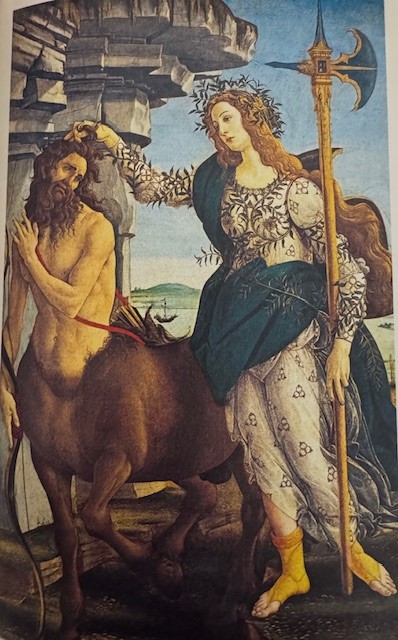
Pallas and the Centaur, by Botticelli (1482-83)
In the painting, Pallas totally dominates the violence of the Centaur – here deprived of cunning, an attribute of the fox, as Machiavelli described. But as in all things Botticelli, the gesture of the goddess – hair-pulling the beast – is quite ambiguous. She’s not dominating it just by mere persuasion or the art of subtle rhetoric. Pallas/Minerva here is much stronger – and even ready to decapitate the Centaur with her pick.
Call it the emblem of civilizational violence.
How far have we drifted from neo-platonic heights. If a pop Botticelli with an Andy Warhol streak would remix Pallas and the Centaur today, Pallas/Minerva would forcefully represent the power of Italian civilitas – the most cultured and influential civilization-state in the history of the West. And the Centaur would be an artificial perversion, the European Union (EU).
Call it Firenze-Athena defeating Brussels.
The endless wonders of Italian civilization
This is what I saw – call it fragments of civilization – as part of the immense privilege of hitting the road across the Italian civilitas, in a mini-tour connected to the launch of my latest book, Il Secolo Multipolare (“The Multipolar Century”). The book, via 46 columns, essentially tracks the year 2024, the last year of the now defunct “rules-based international order”, and arguably the first year of the definitive push towards a multipolar/multi-nodal world.
By a delightful accident, this is the first of my books not launched initially in the U.S.; a different version is being translated and will be launched soon also in Russia.
Starting on November 30, we held a series of conferences connected to the book, organized by the ground-breaking association Italianinformazione, near Udine in the Friuli; in the free territory of Trieste; in Bologna; in Ivrea in Piemonte; in Florence; and then, independently, in Spoleto in Umbria. This coming Saturday there will be a special conference in Rome, including, among others, Italy’s former ambassador to China and Iran, Alberto Bradanini.
As soon as I arrived in Venice, the tone was set: I received as a gift a custom handmade cap with the inscription “Make Roman Empire Great Again”. The Circus Ringmaster in Washington would have loved it. Who would he be as an Emperor? Caligula?
In Friuli, close to Slovenia and Austria, I was surrounded by NATO bases, many of them invisible underground. In the free territory of Trieste – where many remember fondly the hands-off approach of Austria – my hosts helped me dive deeper into the militarization of the port, which NATO wants to configure as the essential node in the Intermarium: Mediterranean, Baltic, Black Sea, all of course to become “NATO lakes”.
In Ivrea, we enjoyed the privilege of a comprehensive, 8-hour guided tour of the Olivetti complex, led by former top exec Simona Marra, who lovingly provided a detailed overview of one of the most extraordinary experiments in industrial humanism in history (this will be the subject of a special column).
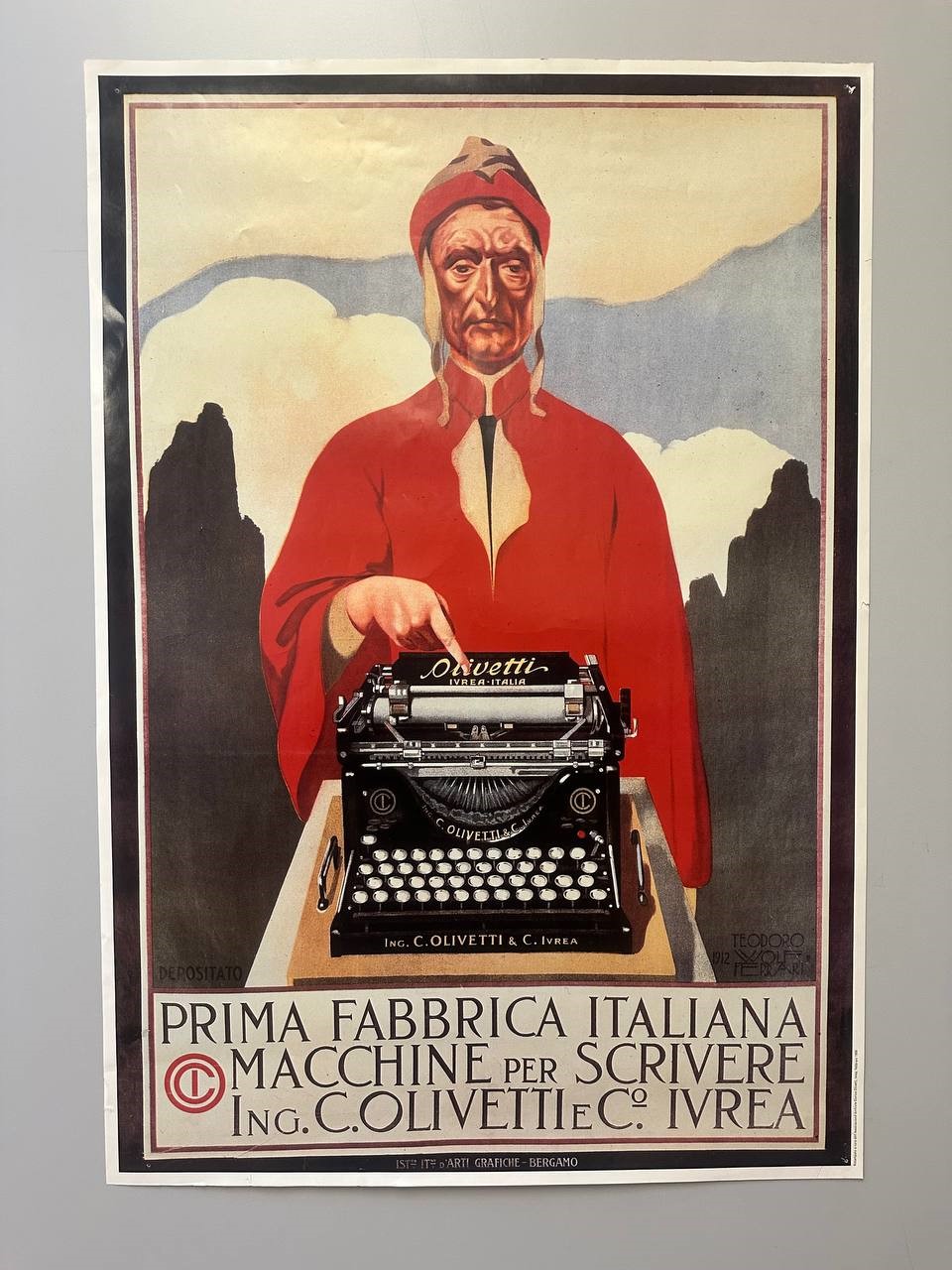
Dante’s typewriter. At the iconic Olivetti complex in Ivrea, Piemonte. Photo: P.E.
Firenze-Flora, of course, is on a whole new ultra-high level. Banners in communities reject NATO’s wars. At the San Marco museum – a former Dominican convent – an extraordinary exhibition, the first of its kind, celebrates Fra Angelico, the master of color and perspective in the early Florentine Renaissance, retracing his entire career and the creative, unique dialogue with others masters such as Masaccio, Filippo Lippi, Lorenzo Ghiberti and Luca della Robbia.
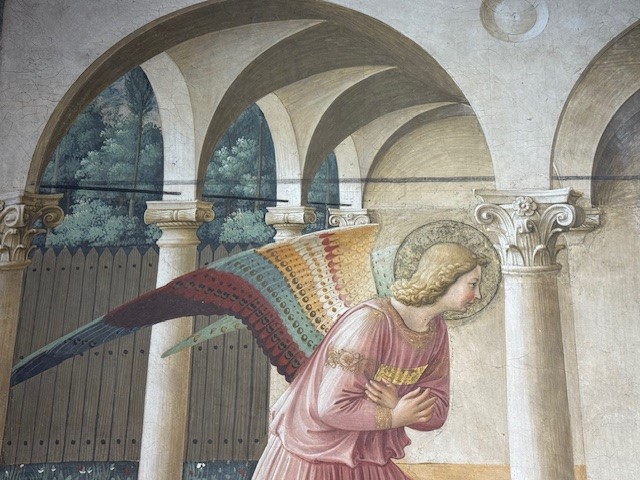
Fra Angelico: The Annunciation fresco (detail) at San Marco. Photo: P.E.
The frescoes that Fra Angelico painted in the convent are priceless jewels representing the mix between Faith and Art. And then San Marco offers other marvels. San Marco was where the humanist Academy in Florence was born. Here was the site of the first public library in the world.
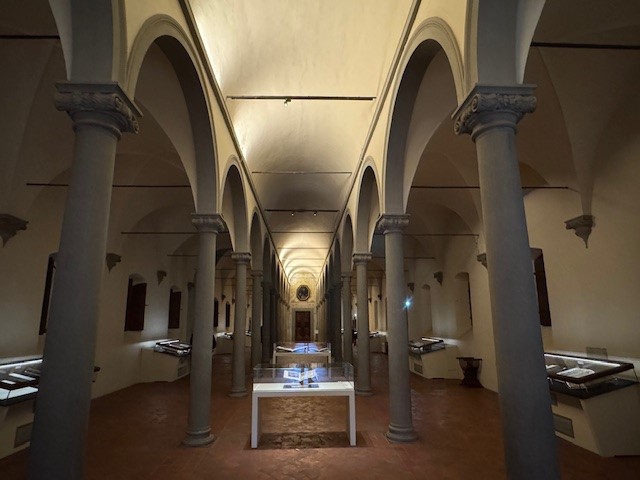
San Marco, Florence: the first public library in the world. Photo: P.E.
The bones of Poliziano are buried in the chapel. Right behind a statue of Savonarola, the “animus in vita” of Savonarola and Pico della Mirandola is celebrated in marble. Their bones may have been separated “post mortem”; yet even as “antipodes”, they were bounded by love.
In Spoleto, in Umbria, after fabulous interactions with the young members of the Aurora Center of Studies, under the early morning fog, the Fonti del Clitunno appears like a ghostly dream. This is where, according to Virgil, lies the heart of the “estirpe italiana”. Byron was mesmerized when he visited it.

Spoleto, in Umbria: the Fonti del Clitunno. Photo: P.E.
The Aurora Center is investing in first-class interdisciplinary analysis linking geopolitics, philosophy, Law, anthropology and sociology to track the transition from the unipolar order to the multipolar world, characterized by the emergence of civilization-states.
These are the ontological, strategic and normative poles of the future. And that’s where Italy as a civilization-state belongs.
Can Stoics and Humanists save Italy?
The conferences – all of them full house – offered a unique opportunity to address informed Italians on what’s going on in the Russia-China, BRICS, Southeast Asia, New Silk Roads, connectivity corridor spheres – issues that are either completely ignored or distorted by mainstream media. At the same time, it was priceless to become aware of insider tidbits on the sorry condition of an unparalleled civilization-state reduced to the role of a neo-colony of the EU/NATO combo.
And then there are the bibliography highlights. Like finally finding in the best bookshop in Venice a priceless Bompiani collection of all fragments of the Early Stoics – Zeno, Cleanthes and Chrysippus. And in the pristine Galleria Imaginaria in Firenze-Flora, the rare Einaudi first edition of a collection of Italian humanist writings – Thought and Destiny – from Petrarca and Marsilio Ficino to Leonardo da Vinci and Machiavelli.
To quote T.S.Eliot, we can say that “these fragments I have shored against my ruins.” When it comes to Fragments of Civilization, Italy is Jupiterian. I remain on the move, from Rome down south to Napoli and Sicily, carrying the message I shared with my interlocutors; if the current, fragmented collective West would ever have a chance to be rescued from the Centaur of oblivion, that task must be carried out by the definitive, Western civilization-state: Pallas Athena Italia.

Au menu cette semaine: 00:00 Géopolitique profonde 09:17 Économie 21:20 Politico-diplomatique 32:04 Terrorisme 33:48 Armement 35:00 Empire du mensonge 42:13
L’article Bulletin STRATPOL N°268: Sanctions pour tous ! Doctrine Trump, Seversk libéré ! 12.11.2025. est apparu en premier sur STRATPOL.

Paul and Ken assess how China’s economy goes from strength to strength whilst it continues to decouple from the U.S. and demonstrates how U.S. tariffs have been a failure.

 Au menu cette semaine: 00:00 Géopolitique profonde 03:33 Économie 13:00 Politico-diplomatique 20:52 Terrorisme 23:40 Armement 24:58 Empire du mensonge 33:18
There comes a time when one has to give credit where credit is due. This does not mean sudden trust, it does not mean that one throws knowledge away and suddenly become love partners with the Arab states, it only means we give credit where it is due, at this moment. The future will tell. The Doha forum unfortunately had everyone and the kitchen sink taking part. We had Kaja Kallas and such people taking part. But, the Qatar and Türkiye leaders spoke truth, clearly, with no ambiguity.
Gaza Ceasefire Lacks Stability, Say Regional Leaders
This is from https://interbellumnews.com/conflicts/palestine/qatar-t%C3%BCrkiye-warn-gaza-ceasefire-is-fragile-incomplete
Top mediators Qatar and Türkiye issued a stark warning that the nearly two-month pause in Gaza is fragile and incomplete, stating that a genuine ceasefire cannot be achieved without the full withdrawal of Israeli forces and an end to the ongoing violence that continues to claim Palestinian lives.
Speaking at the Doha Forum on Saturday, Qatari Prime Minister Sheikh Mohammed bin Abdulrahman Al Thani emphasized that the current situation amounts to merely a “pause” in hostilities. He asserted that stability, freedom of movement for Palestinians, and a complete Israeli military withdrawal are non-negotiable prerequisites for a lasting peace. This call was echoed by regional leaders who stress that without addressing the core issue of Palestinian rights and sovereignty, any agreement risks repeating cycles of violence.
Despite the truce that began on October 10, the Israeli military campaign has not ceased, with Palestinian authorities reporting over 600 violations in seven weeks. Since the truce started, Israeli attacks have killed at least 360 Palestinians, including 70 children.
Just on Saturday, seven people were killed in separate incidents across northern Gaza. This ongoing violence underscores the mediators’ point that the current arrangement fails to provide genuine safety for Gaza’s civilian population.
Furthermore, key provisions of the first phase of the U.S.-brokered plan remain unfulfilled. The agreed-upon daily target of 600 aid trucks entering Gaza has never been reached, and the Rafah border crossing has not been reopened for two-way movement as stipulated. Egypt, alongside other nations, has condemned an Israeli plan to open Rafah exclusively for Palestinian departures, warning it could facilitate permanent displacement and blocks aid entry, a move seen as a breach of the peace plan.
The proposed second phase of the deal, which has yet to begin, involves a complex set of interlinked challenges that mediators are urgently trying to solve. The phase calls for a full Israeli withdrawal, the deployment of an International Stabilization Force (ISF), the establishment of a new Palestinian governance mechanism, and the disarmament of Hamas.
The issue of Hamas’s disarmament presents a major stumbling block. The group has stated it will not disappear and remains a central part of Palestinian political life, and is only open to handing over weapons as part of an internal Palestinian political process, not as an act of surrender to Israel.
Experts warn that attempting forcible disarmament would be a “recipe for disaster,” likely leading to renewed conflict. A viable plan would require a sequenced, Palestinian-led process that offers reintegration pathways for fighters.
Parallel to this, efforts are underway to build a post-war security infrastructure. Egypt, with EU support, has begun training thousands of Palestinian police officers intended to form a future Gaza security force loyal to the Palestinian Authority. This force is envisioned to work alongside, and eventually take over from, the proposed ISF. However, the composition and mandate of the ISF itself are still unresolved.
While Türkiye has indicated a willingness to participate, Israel openly opposes its involvement. The force’s primary goal, as stated by Turkish Foreign Minister Hakan Fidan, should be to separate Palestinians and Israelis, with other details to follow.
With the humanitarian situation still catastrophic and winter approaching for a displaced population lacking shelter, mediators are pressing for immediate action. Norway’s foreign minister insisted that the stabilization force and a governing peace council “must be formed this month,” warning the current pause “cannot hold for many more weeks in its current phase”.
—
Qatar’s Prime Minister Sheikh Mohammed bin Abdulrahman Al Thani and Turkish Foreign Minister Hakan Fidan discussed the future of the Gaza ceasefire at the Doha Forum 2025.
Al Thani emphasized that the current pause in fighting is not yet a full ceasefire, highlighting the need for Israeli withdrawal, stability in Gaza, and free movement for residents.
Both leaders stressed ongoing collaboration between Qatar, Turkey, Egypt, and the US to advance negotiations and establish an International Stability Force (ISF) to separate Palestinians and Israelis at the border.
Fidan noted that the ISF’s mission must be realistic, supported by local Palestinian police, and coordinated with a peace board for long-term stability.
This is the speech that I concur with. Veracity? Future will tell but so far the Arab states held strong to a Palestinian State.
This is a “Danny” title. I post this to hear Ben Norton’s comment both on Venezuela and on the new US National Security Policy.

 Lateo.net - Flux RSS en pagaille (pour en ajouter : @ moi)