 Connexion


By Will Schryver at his substack, imetatronink
One of the most common claims about the Trump 45 administration is that “He didn’t start any new wars.”
This is demonstrably FALSE.
During his first term, Trump became the ultimate causal agent for every one of the current conflicts with Russia, China, Iran, and Venezuela.
He not only maintained the trajectory of these conflicts as established by previous US administrations, but he dramatically raised the stakes and quickened the pace of the march to war.
In Ukraine, between 2017 and 2021, the already commenced preparations of #TheMotherOfAllProxyArmies were expanded and accelerated to an unprecedented degree.
Almost two-dozen covert US intelligence bases were established throughout eastern Ukraine. Large numbers of Ukrainian armed forces personnel were rotated through US/NATO training programs. Ukrainian officers were instructed in the use of US/NATO communications and intelligence / surveillance / reconnaissance (ISR) data. A chain of command was established from Kiev to US/NATO headquarters at Ramstein Air Base in Germany. US heavy weaponry was pre-staged in Poland, and preliminary deals were made with former Warsaw Pact countries (many of them now NATO members) to provide legacy Soviet artillery, armor, ammunition, and fighter aircraft to Ukraine.
Ukrainian troops were introduced to the use of Javelin Anti-Tank Guided Missiles, M-777 155mm howitzers, and HIMARS Multiple-Launch Rocket Systems.
Some of the legacy Soviet aircraft types in the Ukrainian Air Force were modified to carry and launch US/NATO missiles.
The massive fortification complex in the Donbass region was extended and strengthened.
A few thousand US/NATO “contractors” were integrated into the Ukrainian military – with preference given to the hard-core neo-Nazi brigades, who were considered to be the “elite” units in the AFU.
The strategic focus during the entire Trump 45 administration was to complete the preparation of the Ukrainian military to attack and crush the Russia-leaning separatists in the Donbass, and to then retake Crimea, which the Russians had seized in the aftermath of the 2014 American-led coup d’état in Kiev – and which was formally reassimilated into the Russian Federation as a result of an overwhelming popular referendum vote.
Trump has even bragged about the fact that he was the one who began to arm the Ukrainians to a far greater extent than Obama had ever done.
“I was the one that gave the Javelins. Remember the famous Javelins? That was me. It wasn’t Obama. It wasn’t Biden. It wasn’t anybody else. It was me. And they wiped out a lot of tanks with those Javelins. The expression was, ‘Obama gave sheets’. And I gave Javelins. That was a big deal at the time. That was at the beginning, when people said, ‘Wow, that’s something!’ Well, that was American equipment. Without American equipment, this war would have been over very quickly.”
President Donald J. Trump, Oval Office News Conference, February 26, 2025
This is the irrefutable fact: the Trump 45 administration both hastened and made inevitable the war whose final fuse was lit in early February 2022 when the Ukrainians commenced a broad-front artillery escalation against what they claimed to be Donbass militia positions, but which were indistinguishable from random civilian targets.
All of these factors combined compelled the Russians to move decisively (and sooner than they wanted) to extend their strategic depth in the region.
All those who claim Trump has no culpability for the war in Ukraine are either ignorant of the abundant objective facts, or in denial thereof.
Several prominent geopolitical voices were raising the alarm about war in Ukraine even before Victoria Nuland, John McCain, Lindsey Graham et al. goose-stepped through the streets of conquered Kiev in 2014.
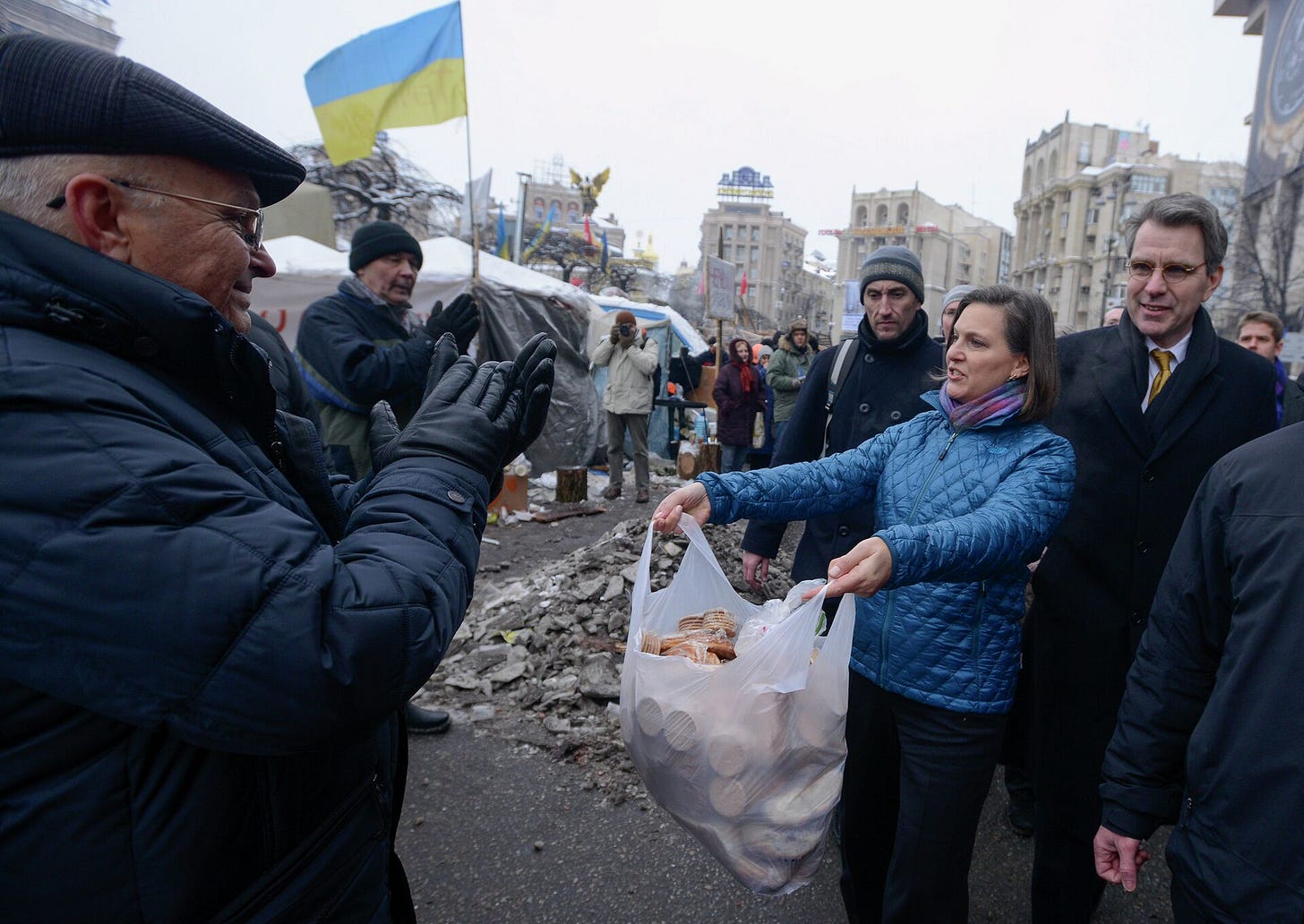
And all during the civil war that then ensued, until the Russians intervened in late February 2022, US/NATO intelligence and special forces operatives were active in Ukraine, in support of the Kiev government’s military movements in the Donbass.
The crisis became increasingly acute over the course of the first Trump administration, even as the twin objectives of subduing the Donbass and retaking Crimea became increasingly apparent.
As I posted on Twitter in April of 2021:
Ukraine has two options: accept its role as a buffer state, or be dismembered. If the US goads them into an attempt to subjugate the Donbass, Russia will slice away eastern Ukraine and assimilate it — and there is *nothing* the US can do to prevent it.
Fact is, the big geostrategic nation-state wars are always decades in the making. So it was in the case of the war in Ukraine.
But the unavoidable trajectory of war was set in stone during Donald Trump’s FIRST rodeo in the White House. Trump owns the Ukraine War more than Joe Biden’s Autopen. At least Trump laid claim to a modest degree of cogency in his first term.
The apparition of Joe Biden, dazed and confused, simply watched dumbfounded as long-fated events flashed before his empty eyes.
One of Trump’s first actions after he was inaugurated in 2017 was to announce a sale to Taiwan of Harpoon anti-ship missiles, SM-2 and SM-3 naval air defense missiles, MK-48 torpedoes, and advanced radar systems.
In 2019, to much fanfare, Trump announced the sale to Taiwan of 66 F-16V fighters.
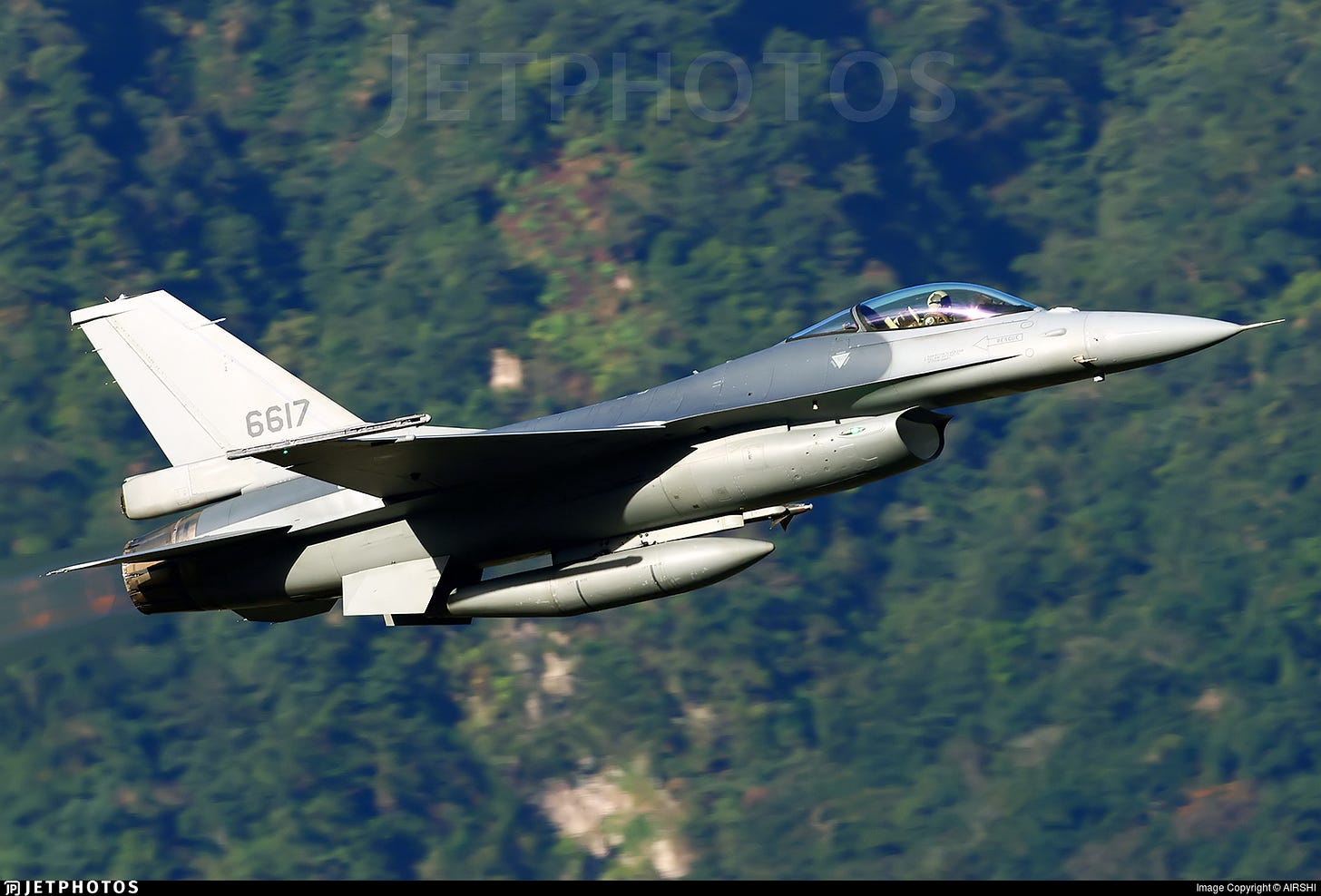
In 2020, Trump announced the sale of even more Harpoon ASMs, HIMARS systems, and MQ-9B drones.
Trump also, over the course of his first term, sent a total of about 300 US Army and Marine special forces operators to Taiwan. Since Trump’s second term began, that number has been increased to over 500 – including substantial contingents on Penghu and Kinmen Island, which is just six miles from the Chinese coast.
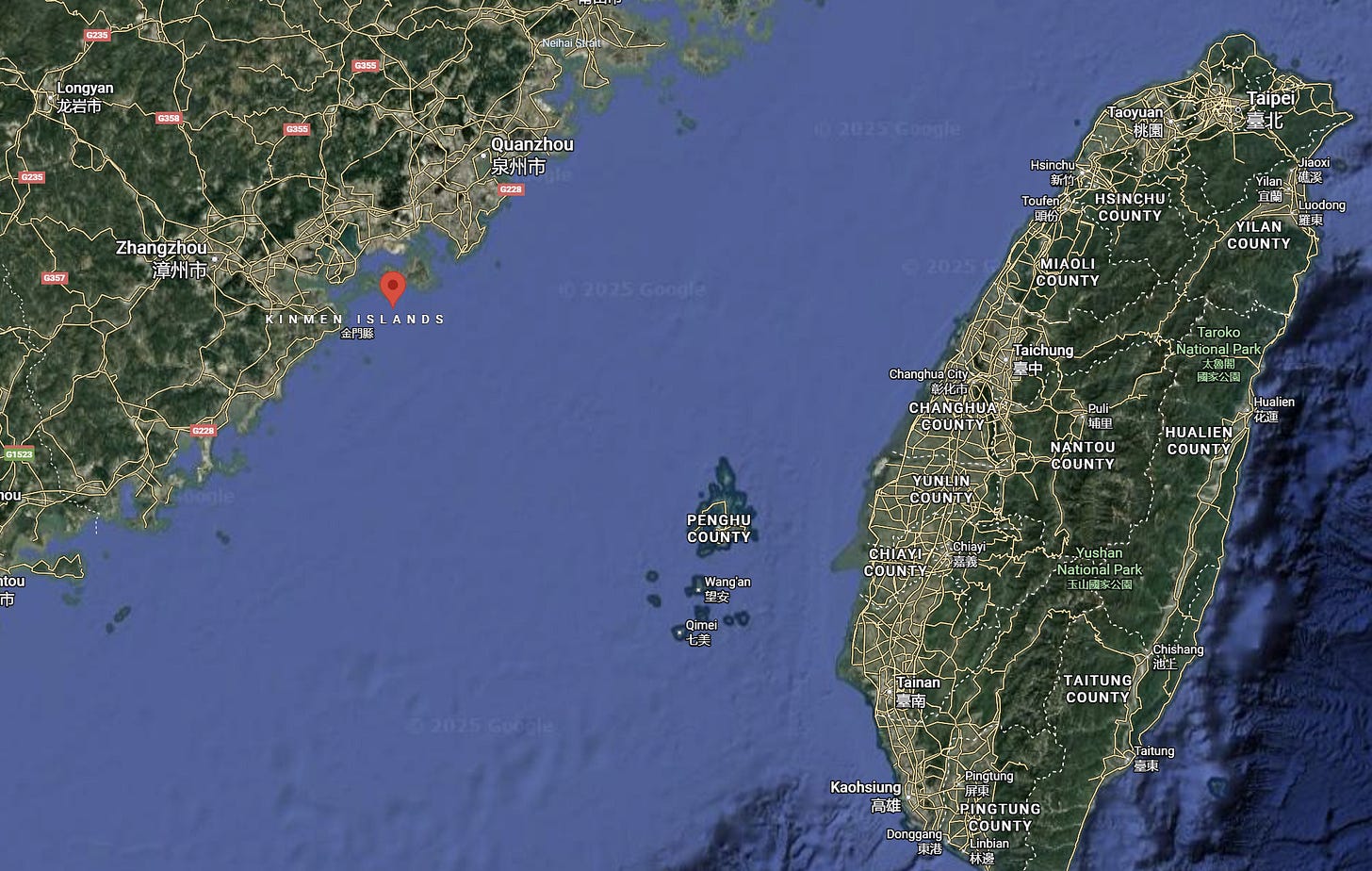
This permanent basing of a full battalion of US troops in Taiwan was unprecedented prior to Trump’s first term. And, understandably, it is regarded by China as an unprecedented provocation. Consequently, Chinese preparations for a possible war in and around its home seas have greatly accelerated.
And, in what is arguably his most strategically ill-advised move of all, Trump 45 started the trade and rhetoric war with China that continues to the present day.
There are now even widespread rumors that the US Department of War is preparing a naval blockade of energy imports into China — an act of utter madness.
Trump, in concert with the Israelis, started the major war with Iran that continues to this day — albeit currently in one of its typical intermissions.
In what I consider to have been the most brazen act of war in his first administration, Trump ordered the assassination of Iranian General Qasem Soleimani, on January 3, 2020, at the Baghdad airport.
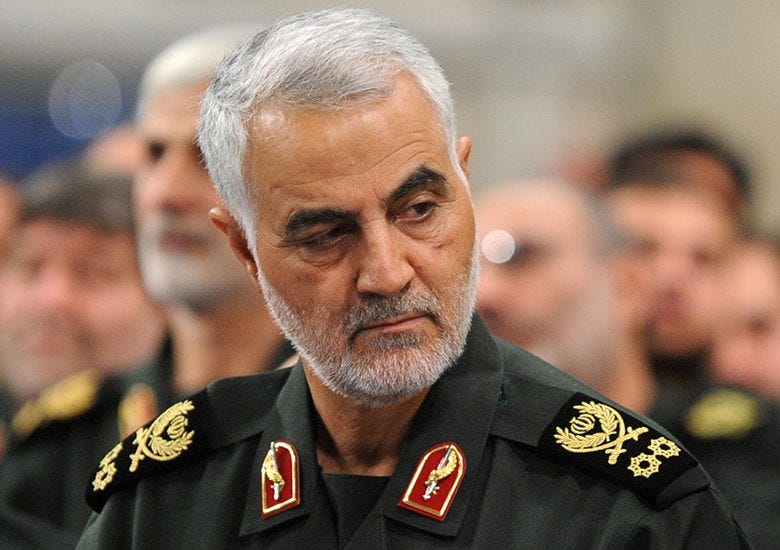
Soleimani was on a diplomatic mission to Baghdad at the invitation of Iraqi Prime Minister Adil Abdul-Mahdi, who had been acting as the intermediary between the Saudis and the Iranians, who were working to de-escalate drone and missile attacks by Iraqi militias against American bases in Iraq, and the Green Zone in Baghdad.
Soleimani was traveling to deliver Iran’s official response to a Saudi Arabian mediation proposal.
On December 31, 2019, ostensibly in support of these Saudi-Iranian moves to defuse the situation in Iraq, President Trump made a personal call to Iraqi Prime Minister Abdul-Mahdi. The Iraqi leader then called Soleimani to arrange a meeting in the Green Zone in Baghdad, scheduled for the morning of January 3, 2020.
Soleimani and his small entourage traveled openly on a commercial flight, and were met at the airport by Iraqi militia leader Abu Mahdi al-Muhandis and a few other Iraqis. As Soleimani, al-Muhandis, and eight others were traveling from the airport to the Green Zone in two vehicles, an American MQ-9 Reaper drone fired Hellfire missiles and blew them all to smithereens.
President Trump directly ordered the attack, and afterwards publicly gloried in his perfidy.
Soleimani was considered a national hero in Iran, and was arguably the second-most powerful and influential political figure in Iran at the time, behind only the Ayatollah Khamenei.
The Iranians were justifiably outraged.
On January 8, 2020, Iran launched a ballistic missile attack against the American Ayn al-Asad airbase in Iraq. About 15 Iranian ballistic missiles targeted the base with shockingly impressive accuracy, although it was clear the strike was mostly demonstrative in nature, and the Iranians deliberately avoided killing US troops.
Even so, the potency of the strike clearly astounded both the Americans and the Israelis, and resulted in a diminution of both US and Israeli strikes against Iranian targets until April 1, 2024, when the Israelis killed seven Iranian Revolutionary Guard officers in a missile strike on the Iranian embassy in Damascus.
Two weeks later (April 13-14, 2024), the Iranians launched a massive and unprecedented missile strike against Israel. This then led directly to the series of exchanges between Israel and Iran which took place over the course of the ensuing months, culminating in the so-called 12-Day War between the US/Israel and Iran from June 13-24, 2025.
Of course, it must be understood that this war between the US/Israel and Iran is NOT over yet. It is just on a brief hiatus, and there are indications in recent days that Israel is planning new strikes against Iran.
But make no mistake, the catalyzing event for this greatly escalated war with Iran was Trump’s treacherous murder of Qasem Soleimani on January 3, 2020.
Trump began publicly expressing his desire to go to war against Venezuela, and to seize its oil, no later than July 2017. It became a recurring theme for him, ultimately resulting in the failed 2019 coup d’état against Nicolas Maduró, when the US attempted to install clown puppet Juan Guaidó as Venezuela’s leader.
Trump is quoted as saying:
“I don’t understand why we’re not looking at Venezuela. Why are we not at war with Venezuela?”
“That’s the country we should be going to war with. They have all that oil and they’re right on our back door.”
Trump’s bellicose language towards Venezuela continued all through his first term, and as a result, Venezuela’s longstanding friends Russia, China, and Iran began to more aggressively strengthen Venezuela’s military capabilities in anticipation of an eventual US attack and potential invasion of the South American country that holds the largest proven oil reserves in the world.
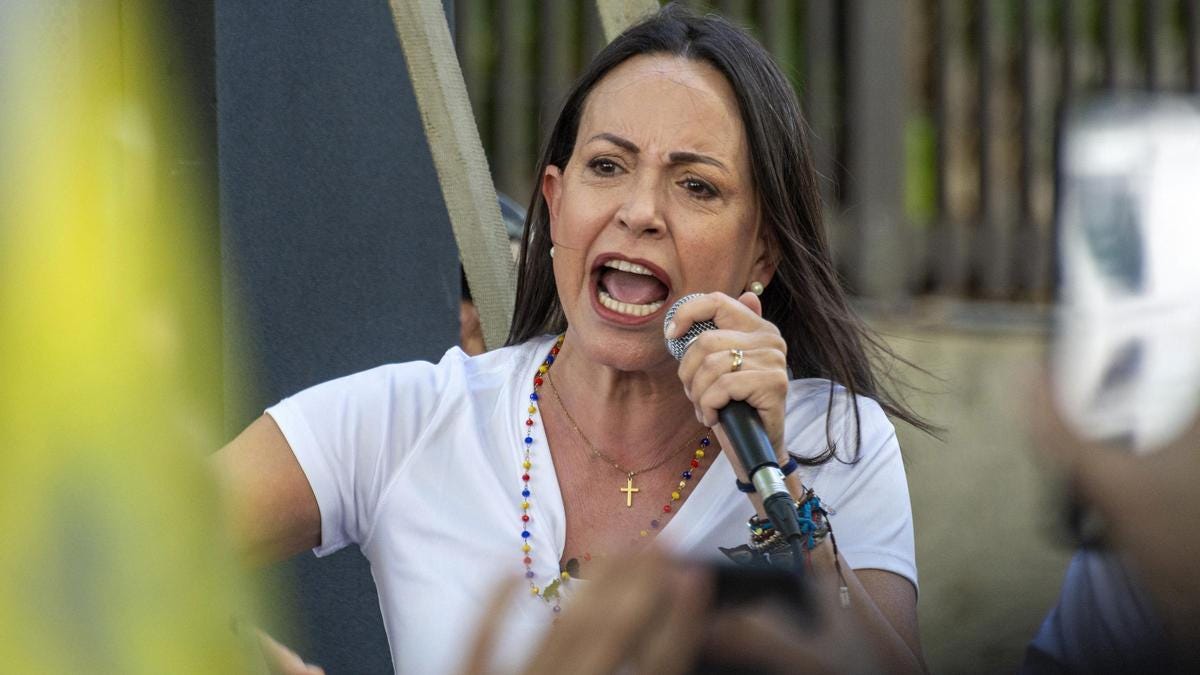
Now, as I write here on Thanksgiving Day 2025, the United States has positioned a massive naval fleet and Marine landing force off the coast of Venezuela, and it appears almost certain that military operations against the Maduro regime will commence imminently, with the overt aim of installing a new puppet government whose putative leader, CIA-groomed Nobel Peace Prize winner María Corina Machado, has explicitly called for an American invasion of the Bolivarian Republic, and pledged to permit the US to take control of Venezuela’s oil, gold, and other mineral wealth.
SOUTHCOM has even provided a slick promotional video for the upcoming war against Venezuela:
Trump, consumed by his own lust to become a celebrated recipient of the Nobel Peace Prize, has been claiming for months now to have ended no fewer than eight imaginary wars.
In reality, President Donald J. Trump has exhibited one of the most itchy trigger fingers of any US president in my lifetime (Eisenhower was still president when I was born).
Incredibly, he has chosen to pick fights with the most powerful adversaries the US has faced since the Second World War: Russia, China, and Iran. And, worst of all, he has catalyzed the formation of an unbeatable military and economic alliance between those three ascendant civilizational powers, even as American military power has eroded to its post-WW2 nadir.
Of course, most Americans possess a knowledge and understanding of war and US military might as it has been portrayed for decades in Hollywood movies and video games. And therefore, when Trump waxes grandiloquent about the United States being the greatest military force in human history, American vanity is easily persuaded that there is no nation on earth the US cannot trample underfoot with one hand tied behind its back.
Neither Donald Trump nor many Americans realize there are no easy wars left to fight. But that sobering truth will be laid bare for all to see between now and the end of the final term of The Imaginary Peace President.
The first ever ASEAN-China-GCC trilateral summit was a de facto celebration of the New Silk Road spirit.
By Pepe Escobar at the Strategic Culture Foundation.
The first ever ASEAN-China-GCC trilateral summit earlier this week in Malaysia – with 17 Global South nations at the table – was a de facto celebration of the New Silk Road spirit.
Malaysian Prime Minister and current ASEAN chair Anwar Ibrahim summed it all up: “From the ancient Silk Road to the vibrant maritime networks of Southeast Asia to modern trade corridors, our peoples have long connected through commerce, culture, and the sharing of ideas.”
That inspires a lot of reflection. Let’s try a first, succint approach matching East and West – and what divides them – guided by an extraordinary study, La Mediterranee Asiatique: XVI-XXI Siecle, by CNRS research director Francois Gipouloux, also a specialist in the Chinese economy.
The European tradition is far from monolithic – and it’s only part of the picture – when it comes to global perceptions about political philosophy and the conception of the State. There are stark differences even when referred to Hobbes, Locke and Rousseau.
The heart of the matter used to be the land/sea opposition. For Carl Schmitt, land/sea relates to friend/enemy – the matrix of politics – providing a key interpretation of world history, yet one among many.
It’s on “continental” Europe – to borrow the Anglo terminology –, mostly in France and Prussia, and not in England, that the Hobbesian concept of the State materialized. Britain became a world power thanks to its navy and trade, eschewing the characteristic institutions of the state such as a written constitution and a legislative codification of law.
Anglo-Saxon international law in fact voided the continental conception of the State and also war. According to Schmitt, it developed its own concepts of “war” and “enemy” out of maritime and trade conflicts which did not make a distinction between combatants and non-combatants (when it comes to its lasting legacy, think “the war on terror”).

My war is Just, because I said so
The opposition then solidified between the right to wage war on land – war is “just” if it happens between sovereign states, via regular armies, and sparing civilians – and waging war on sea, which does not imply a state-to-state relation. What mattered was attacking the trade and the economy of the enemy. And methods of total war were directed against either combatants or non-combatants.
That led to a new Western concept of “Just War” and international law: when the enemy is turned into a criminal, juridical and moral equality between belligerents is shattered.
That’s the perverse logic behind psycho-pathological genocidals legitimizing the destruction of Palestine.
These differences in the formulation of law came out of two different conceptions of space: closed, overland – featuring sovereign states, territorially delimitated – and open, over the seas – a unique space, unlimited, free of every state control, where primacy is about securing communication links. The British did not think about space in terms of territory, but of routes of communication, just like the Portuguese and the Dutch before them.
Schmitt identifies in the State an entity linked to land and territory. So, as startling as it seems, it’s Behemoth, the terrestrial animal of the Old Testament, and not the marine monster Leviathan that should have been chosen by Hobbes as a symbol of the State.
In the development of the West, three institutional forms – equally viable – were in competition: Leagues of Cities – like the Hanseatic Legue; City-States – especially in Italy; and the Nation-State, especially in France.
Few across the West may remember that the Hanseatic League and the powerful Italian city-states, for at least two centuries, were viable alternatives to the territorial state. Two top researchers, Douglass North and Robert Paul Thomas, in The Rise of the Western World: A New Economic History, argue that the modern state was imposed on Western Europe because it was the best equipped to fulfill two key tasks: to efficiently guarantee property rights and the physical security of people and goods.
If we go back to Europe in the 14th century, before the Renaissance, there were at least a thousand states, of all sizes. That means no concentration of power – and some sort of creative competition in store. There was a reasonable amount of choice for those who wanted to find better places to exercise their freedom.
We had for instance Germany, with its three main actors constituted as the Emperor, the nobility and cities; Italy, with its main actors as the Papacy, the Emperor and cities. And France with its three main actors as the King, nobility and cities. In each case, different alliances proliferated.
In Germany, the Emperor allied with the nobility against the cities. In Italy, nobility was urbanized, and cities profited from endless squabbles. In France, nobility was very suspicious of the bourgeoisie, and the King allied himself with the cities against nobility. England chose a completely different path. Even before France, the Brits created a centralized state, but under a quite original political set up.

Asia and the Mandala State
Asia is a completely different story. Here we cannot use the terminology of “state” to designate the political constructions of Southeast Asia before decolonization. In Southeast Asia, the borders were arbitrary between the tribe, so-called “primitive” political formations (from a Western perspective) and the State.
Springing up from political concepts prevailing in India, Islam and the West, states showed up in the Insulindia (maritime Southeast Asia) archipelago, for instance, as courtly bureaucracies, based on a network of complex alliances. Whatever the degree of institutionalization, the distinction between The King, The Vassal and The Bandit was tenuous at best.
Vietnamese researcher Nguyen The-Anh has remarked how “political fragmentation is generally the preliminary conclusion of the first Europeans who made contact with Southeast Asia. Marco Polo saw in the north of Sumatra ‘eight kingdoms and eight crowned Kings…each kingdom possesses its own language.”
China, on the other hand, featured a unitary state imposing – via a quite efficient administration – social order over a vast territory. There was no competition against the centralized state issuing from a landed aristocracy; no urban bourgeoisie; and no military contesting the imperial order, as in Europe. That’s the major difference between China and the West.
Thomas Aquinas decreed that if the power of the king belongs to a multitude, it’s not unjust that the king is deposed or sees his power restrained by this very own multitude if he turns into a tyrant and abuses royal power.
This distinction is completely alien to the Chinese tradition. What happened over the past century or so in China is that the peculiar configuration – and competition – between local actors and central power led to what could be defined as an unstructured empire, whose force comes from its shape-shifting borders and the diffused character of transnational networks.
In a global economy, this gives China an exceptional projection capacity. When borders become fuzzy, and the link between the state and individuals is fuzzy, the unstructured character of this Empire allows the Asian periphery of China to develop in an arc from Japan and the DPRK to Singapore and Indonesia. This is exactly the subtext of some of the key discussions in Kuala Lumpur at the ASEAN-China-GCC summit. Jeffrey Sachs totally got the picture beforehand.
Now, the opposition between a system of international relations deemed “backwards” and irrational in Asia and modern and rational – because based on realpolitik – in the West is over. Cultural factors now shape reality in Asia as well as in the West about the conception of the state and international relations.
China is finally self-assured enough to start disengaging from the current, Western-dominated system of international relations – because it has the means to do so.
The Chinese concept of harmony in international relations used to be linked to the proclamation of a natural order of which China would be the guarantor. But now we are a long way away from the 18th century, when the international environment of the China of 18 provinces was constituted by Korea, Manchuria, Mongolia, Chinese Turkestan, Tibet, Burma, Annam, the Ryuku archipelago and Japan. The Qin dynasty was keen to reassert its suzerainty on the political and cultural domains, assuring the protection of China by managing a belt of favorably disposed states.
Today a self-assured China sees a new system of international relations directly linked to a Belt and Road network of geoeconomic opportunities for all. That underlies the relationship between China and ASEAN, GCC, CELAC, Central Asia and the whole of Africa.

Welcome to the archipelagic world
The world has surpassed the “overland” or “maritime” dilemma, beyond Mackinder and Mahan. The world is now best defined, as Gipouloux coined it, as archipelagic (italics mine), linking urban nebulas of different sizes and vocations.
Globalization accelerated the transformation of a terrestrial world into an archipelagic world. New technologies, economic and financial pressure, disinformation on a mass scale – China is navigating all these rocks in shallow straits in the quest to solidify itself as a global power.
All that implies the progressive, thalassocratic advance of China: a flexible and tolerant Empire (“community of shared destiny for mankind”), a rich confederation with a capacity for global influence supported by polymorphic communities – the “bamboo internet” of the Chinese diaspora.
This is what was on display in Kuala Lumpur – and will continue to evolve via an array of multilateral organizations. Mandala at work, Chinese-style.

 Lateo.net - Flux RSS en pagaille (pour en ajouter : @ moi)