Connexion


 L’Iran a mené une attaque contre un site de déploiement d’avions de chasse américains F-35, F-15 et F-16. L’attaque a
L’article L’Iran affirme avoir détruit un grand nombre d’avions de chasse américains sur une base en Jordanie est apparu en premier sur STRATPOL.
La Chine va acheter 200 avions Boeing de fabrication américaine, a annoncé le président américain Donald Trump. Cet accord sera
L’article La Chine promet d’acheter 200 Boeing pour la 1ère fois en dix ans, loin des 500 initialement prévus est apparu en premier sur STRATPOL.
Les détails de la plainte déposée par la Hongrie ont été révélés. La Hongrie cherche à faire annuler un règlement
L’article Avoirs russes : la plainte déposée par Orban vise à faire annuler un règlement de la Cour de justice de l’UE est apparu en premier sur STRATPOL.
Le 5e Forum diplomatique international s’est tenu à Antalya, en Turquie, du 17 au 19 avril. Des délégations de plus
L’article Le Forum diplomatique d’Antalya s’est tenu sur fond de pessimisme ambiant est apparu en premier sur STRATPOL.
Lors d’une conférence de presse tenue à l’issue de sa visite en Chine, le ministre russe des Affaires étrangères, Sergueï
L’article Lavrov en visite en Chine pour traiter de questions géopolitiques est apparu en premier sur STRATPOL.
L’Iran a annoncé la destruction d’un deuxième avion de chasse F-35 de l’armée de l’air américaine dans son ciel. L’information
L’article L’Iran annonce avoir abattu un deuxième F-35 est apparu en premier sur STRATPOL.
Nous avons eu l’honneur de recevoir Eric BRANCA. Après une longue carrière de journaliste politique chez Valeurs Actuelles, il revient
L’article Eric Branca sur les outils du pragmatisme américain est apparu en premier sur STRATPOL.
L’Iran a annoncé avoir mis hors service le porte-avions américain Abraham Lincoln, alors que les échanges de frappes se poursuivent
L’article L’Iran affirme avoir mis hors service le porte-avions Abraham Lincoln est apparu en premier sur STRATPOL.
Le Conseil des ministres moldave a approuvé le retrait du pays des accords-cadres de la CEI. Le ministre des Affaires
L’article La Moldavie approuve son retrait des accords-cadres de la CEI est apparu en premier sur STRATPOL.
Moscou ne considère pas les négociations visant à résoudre la crise ukrainienne avec la participation des États-Unis comme une simple
L’article Lavrov : Moscou ne considère pas que les négociations sur l’Ukraine avec les États-Unis sont un écran de fumée est apparu en premier sur STRATPOL.
La Russie a accepté les propositions américaines de normalisation des relations dans le cadre du règlement de la question ukrainienne.
L’article Lavrov : Moscou a accepté de coopérer avec Washington, mais les Américains imposent des sanctions est apparu en premier sur STRATPOL.
Quoi que préparent les Barbares, l’important est que la Chine soit déjà entrée dans la phase suivante… Par Pepe Escobar
L’article Pepe Escobar – La véritable “rupture” sanctionnée à Davos est apparu en premier sur STRATPOL.
L’histoire extraordinaire d’un prêtre de l’Eglise orthodoxe serbe que la guerre a contraint à abandonner la prêtrise pour combattre les
L’article Un prêtre héros de la 2nde Guerre mondiale est apparu en premier sur STRATPOL.
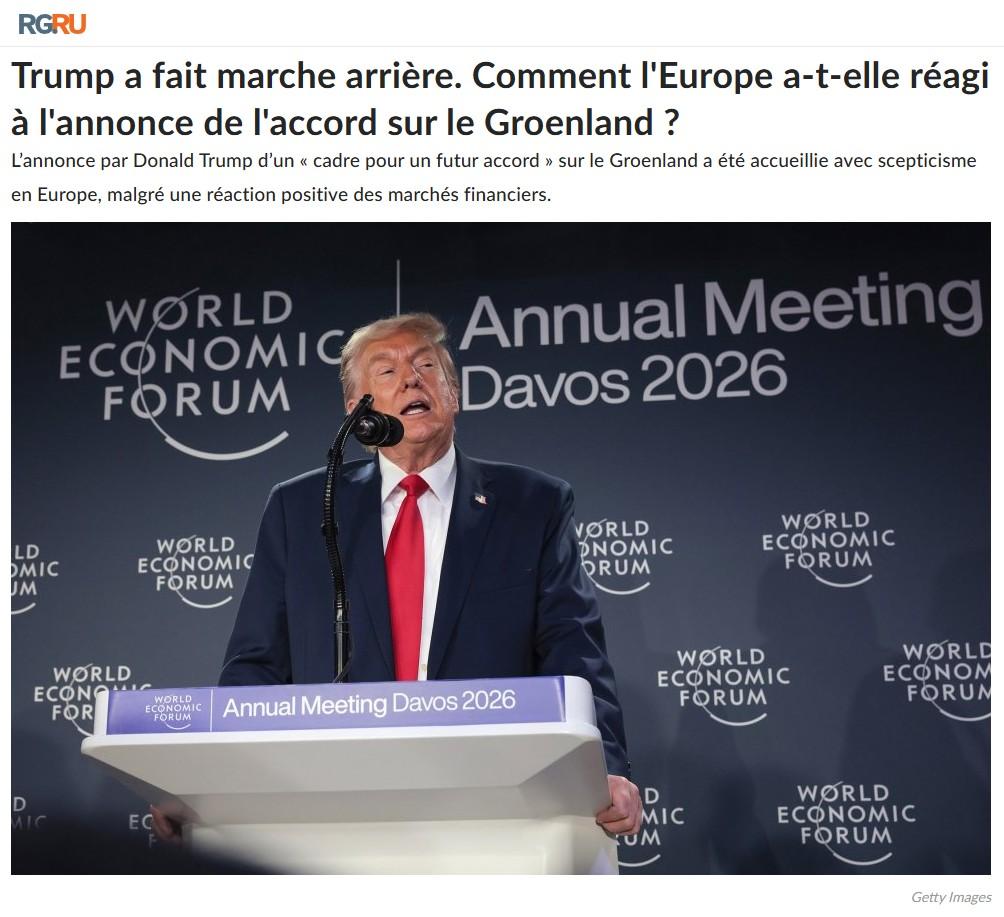
Quelques heures après son discours au Forum économique mondial, le président américain Donald Trump a pris la parole sur les
L’article Trump fait marche arrière sur les droits de douane sur la question du Groenland et annonce un « cadre pour un futur accord » est apparu en premier sur STRATPOL.
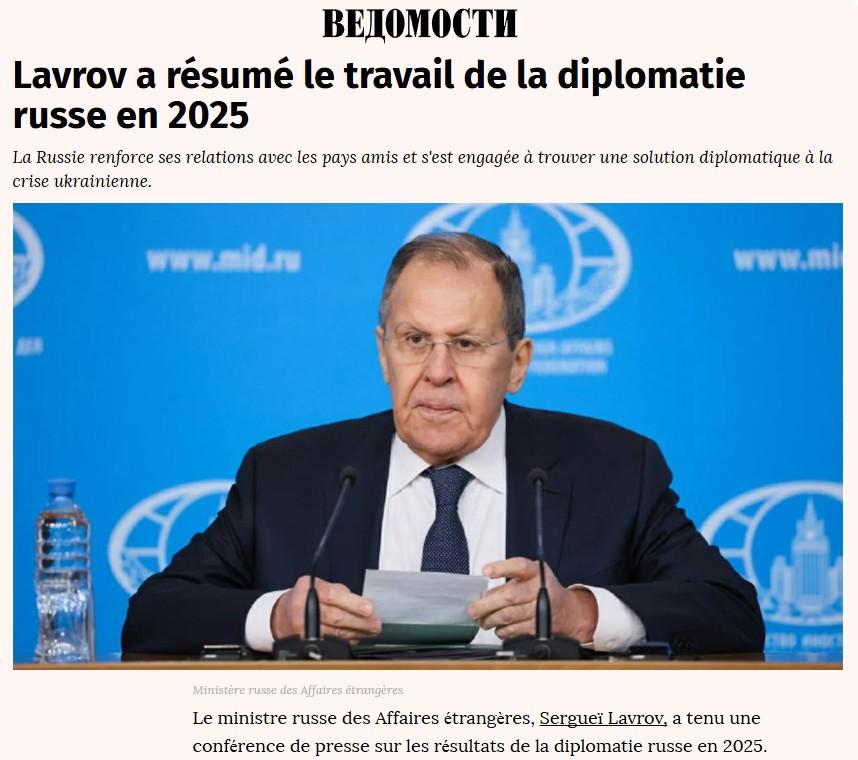
Lavrov a souligné que le prétendu « isolement » de la Russie n’a pas eu lieu, « malgré ce que
L’article Lavrov dresse le bilan de l’année diplomatique écoulée est apparu en premier sur STRATPOL.
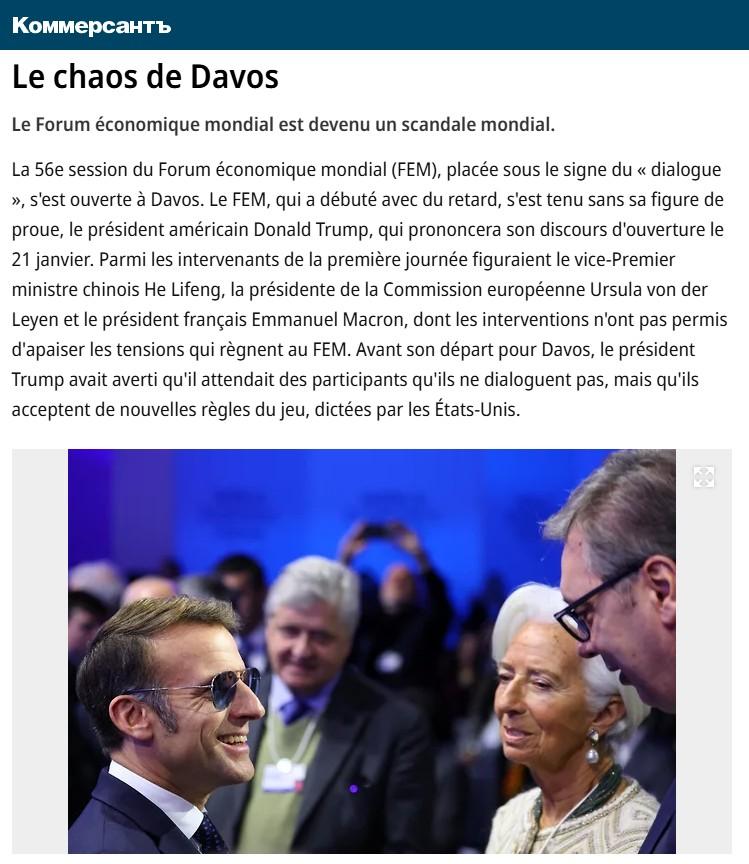
La 56e session du Forum économique mondial (FEM), placée sous le signe du « dialogue », s’est ouverte à Davos.
L’article Un forum de Davos sous tension à cause de Trump est apparu en premier sur STRATPOL.
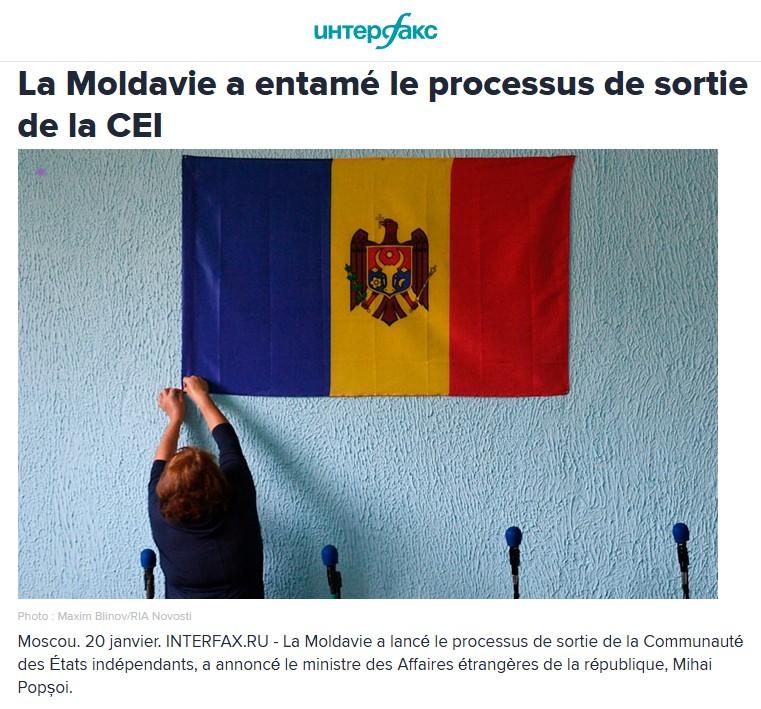
La Moldavie a lancé le processus de sortie de la Communauté des États indépendants, a annoncé le ministre des Affaires
L’article La Moldavie a lancé son processus de sortie de la Communauté des États indépendants est apparu en premier sur STRATPOL.
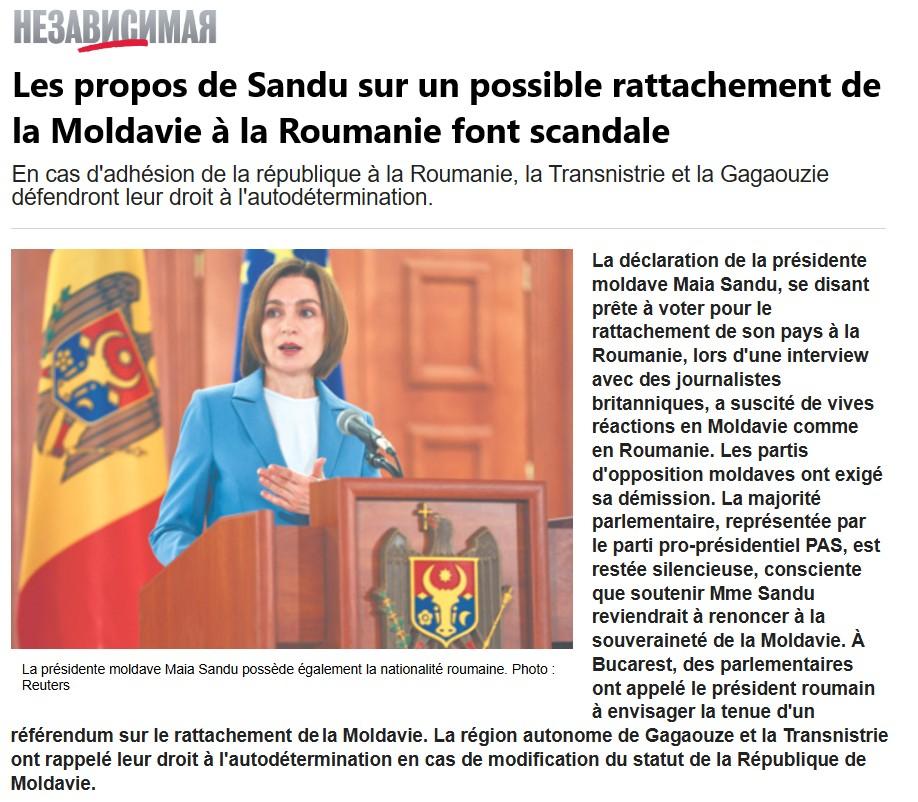
La déclaration de la présidente moldave Maia Sandu, se disant prête à voter pour le rattachement de son pays à
L’article Sandu se dit prête à voter le rattachement de la Moldavie à la Roumanie est apparu en premier sur STRATPOL.
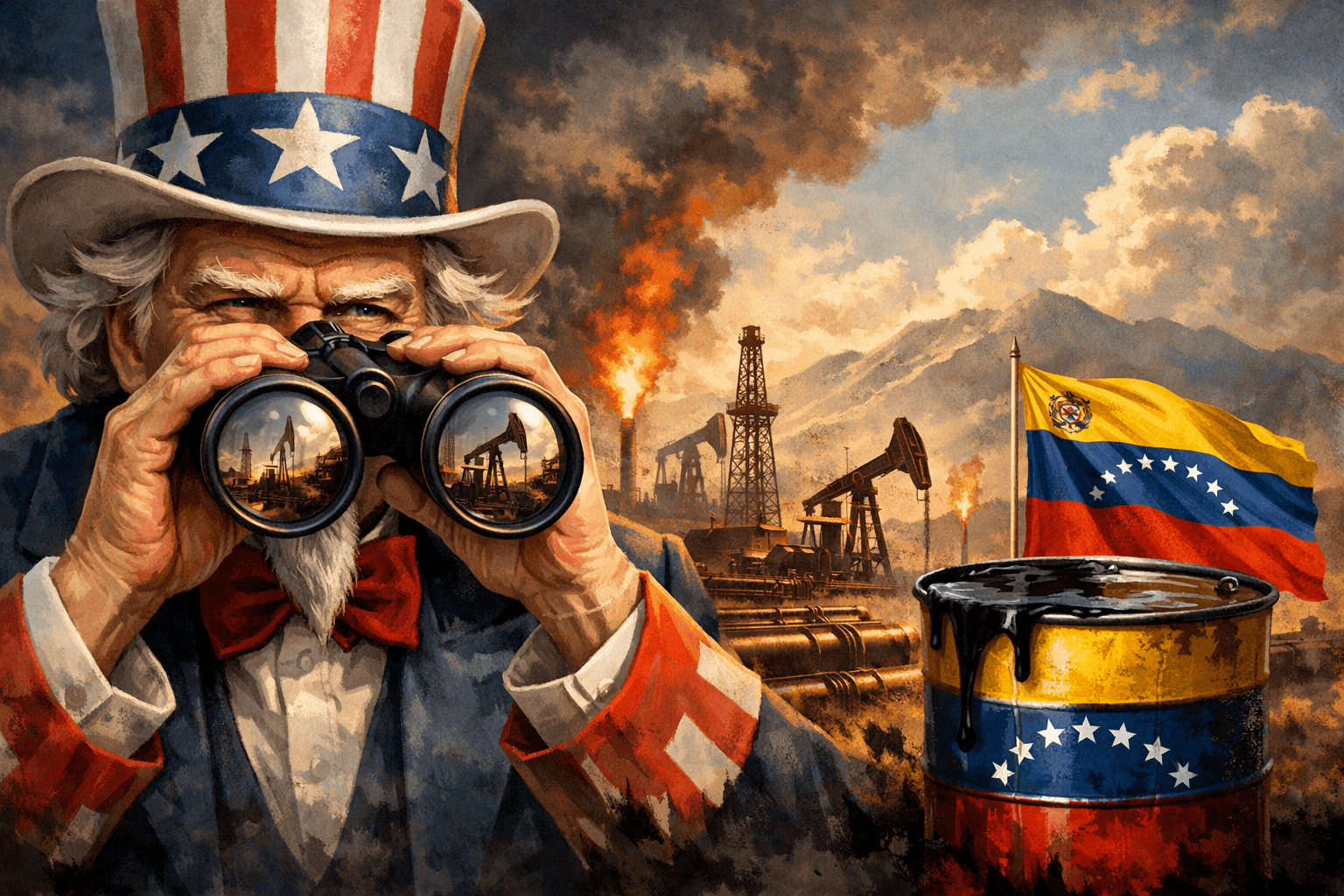
De Chávez à Maduro, le Venezuela a résisté à toutes les formes de guerres non conventionnelles. Aujourd’hui, le monde assiste
L’article Venezuela 1999-2026 : un quart de siècle sous les attaques américaines et aujourd’hui sous les bombes ! est apparu en premier sur STRATPOL.
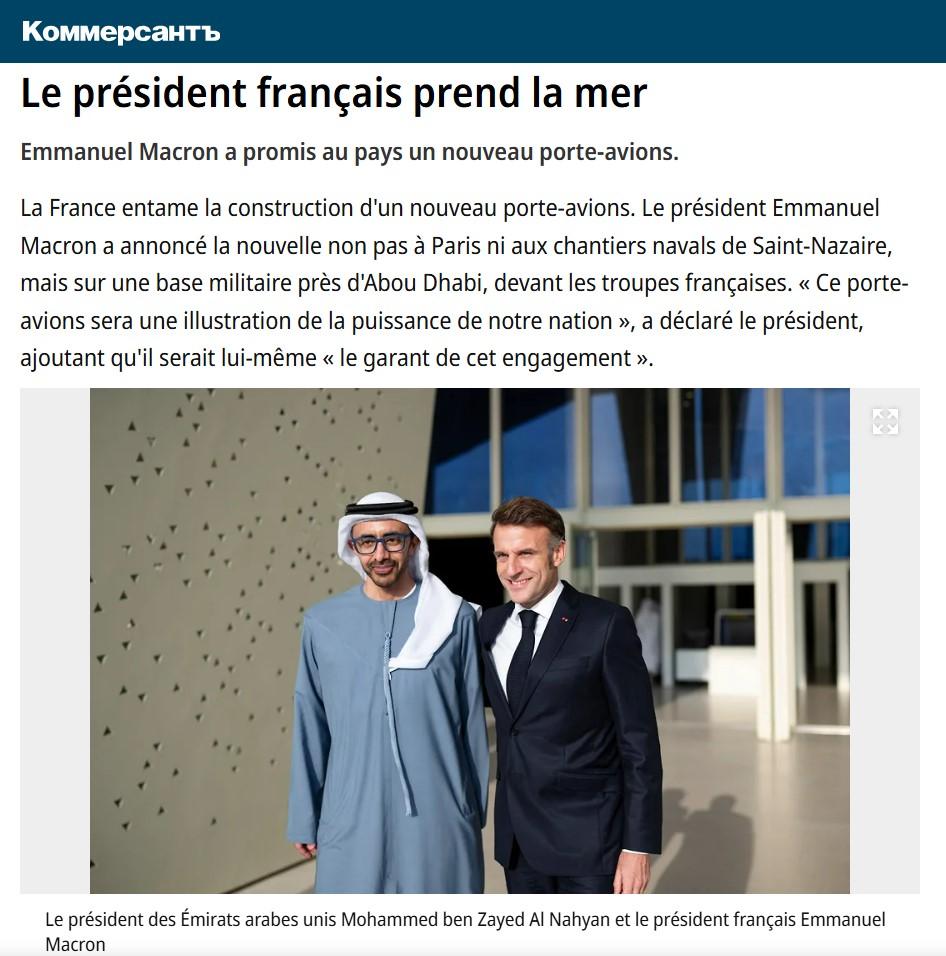
L’article Macron veut lancer la construction d’un nouveau porte-avions est apparu en premier sur STRATPOL.
Foreign Minister Sergey Lavrov’s statement and answers to media questions at a joint news conference following talks with Foreign Minister of the Islamic Republic of Iran Abbas Araghchi, Moscow, December 17, 2025
[Note: We posted the highlights but the context makes it so much clearer]
Media members,
Foreign Minister of Iran Abbas Araghchi and I held detailed and substantive talks today and, as always, they were held in a friendly, constructive, and trust-based atmosphere.
We stated progress in Russia-Iran relations which have become significantly stronger in recent years. In 2025, the Treaty on Comprehensive Strategic Partnership between the Russian Federation and the Islamic Republic of Iran was signed and entered into force on October 2. The fact that President of Russia Vladimir Putin and President of Iran Masoud Pezeshkian put their signatures under this treaty underscores its importance for Moscow and Tehran.
We discussed the tasks set by our respective presidents during their meeting in Ashgabat last week and expressed confidence that once implemented this treaty will give a powerful boost to bilateral interaction and help us align our approaches to regional and multilateral issues with a primary focus on expanding the capabilities of the two countries in the interest of improving stability and security in our common region.
We noted the particularly trust-based nature of the political dialogue at the top, intergovernmental, and interparliamentary levels, as well as at the interagency and ministerial level. Civil society contacts are expanding to further strengthen neighbourly ties between our countries.
We highly praised the advanced level of practical bilateral cooperation in trade, the economy, and investment. Trade has been steadily up by more than 10 percent for the second straight year, over 15 percent last year. The Permanent Russian-Iranian Commission on Trade and Economic Cooperation is fully operational with its co-chairs, Minister of Energy Sergey Tsivilyov and Iranian Minister of Petroleum Mohsen Paknejad, remaining in contact at all times. We discussed the importance of making thorough preparations for the next meeting of the intergovernmental commission, which will take place in Tehran in February 2026.
We share a common view on the importance of promoting business ties. In this regard, the entry into force of the Free Trade Agreement between the EAEU and Iran this year, and Tehran obtaining observer status in December 2024, is of utmost importance. We are interested in continued expansion of the legal and regulatory framework between our countries with an eye towards eliminating trade barriers.
We underscored the importance of carrying out flagship infrastructure projects, including the Bushehr Nuclear Power Plant. With the support of the Russian personnel, it continues to operate in standard mode and remained operational even amid the June aggression by Israel and the United States. We reviewed in detail the status of the implementation of the project to build the Rasht-Astara Railway section financed through a state loan provided by Russia. The construction of this railway is monitored by our respective presidents as a priority project. The railway is the key to the full-on launch of the western branch of the strategic North-South International Transport Corridor.
The exchange of views on international and regional issues reaffirmed our overlapping positions or close views on most matters. We spoke in favour of further democratisation of international life based on multipolarity, which is on track to become a reality in full accordance with the principles enshrined in the UN Charter that have been sabotaged by the collective West for many decades now.
The objective course of history warrants the implementation of the lofty principles of the UN Charter. Importantly, these principles must be acted upon, respected and applied in practice not occasionally, but exclusively as an indivisible and interdependent whole.
This strongly resonates with the Ukraine conflict, where the collective West is pushing to manipulate every provision of international law and to replace them with its own “rules” that are at odds with the universally recognised international legal norms and serve only the push of the collective West, above all Europeans, to continue their neocolonial policies aimed at living off other nations the way they did over the past 500 years starting in the era of colonialism. The neocolonial economic, trade and financial dependence of African countries, as well as many countries in Asia and Latin America, on the West has remained unchanged to this day.
We denounced the use of unilateral coercive measures that undermine international law which fact has become particularly glaring amid the Ukraine crisis. Europe is trying to scuttle the constructive ideas put forward by the Trump Administration, as it violates every rule and principle that have until now governed international economic and financial relations, encroaching on property that the West itself had only recently declared inviolable, and eroding in many ways the principles promoted by Europeans, including as part of the globalisation efforts. What we are witnessing today is a process of fragmentation, not globalisation.
Speaking about the use of unilateral coercive measures, we stand fully in solidarity with Iran and a number of other countries. We advocate creating a group of countries that have a stake in countering this lawless behaviour. I believe this process will gain ever more supporters as it moves forward. We agreed to consolidate members of the international community who share these approaches. We will continue substantive work to neutralise the negative impact of illegal sanctions on the economies of our respective countries.
We covered in depth the Iranian nuclear programme dynamics amid the unapologetically aggressive and unlawful anti-Iranian policies adopted by a group of Western countries. Once again, Russia confirmed its readiness and willingness to help its Iranian friends identify acceptable solutions to overcome the nuclear dossier-related crisis created by the West. Acting in violation of all existing agreements and regulations that are legally established by the UN Security Council, Western Europeans are doing everything in their power to re-impose UN sanctions on the Islamic Republic of Iran, even though these sanctions expired more than a month ago alongside Security Council resolutions that were used to impose them.
We decry such disregard for law and international legislation, and the attempts to prioritise self-serving interests over the principles of the UN Charter. We hope that UN Secretary-General Antonio Guterres, whom they are also trying to weave into this game, can clearly see that he is being nudged into a trap and will say no to those who conspire to take advantage of his authority, reputation and office of Secretary-General to push through the Western countries’ self-serving and unlawful plans.
Clearly, any decisions regarding potential arrangements that could put an end to the current crisis and put the process on a constructive track must be taken exclusively by the Iranian government based on the interests of the people of the Islamic Republic of Iran, and with full respect of its right, as a full-fledged member of the Treaty on the Non-Proliferation of Nuclear Weapons, to enrich uranium for peaceful purposes.
We will continue to deepen our cooperation at the UN, the SCO and BRICS. We covered several important regional issues, including the situation in the Middle East, primarily, the Palestinian territories, the South Caucasus, the Caspian region, Afghanistan, and neighbouring countries.
I would like to close by once again expressing satisfaction with the outcomes of the talks and to thank my Iranian counterpart for accepting the invitation to visit Russia.
Question (retranslated from Farsi): International relations are getting more intricate by the day. The international situation is marked by securitisation. As a permanent member of the UN Security Council, what can Russia suggest in order to keep international law intact? How serious is Russia about fortifying multilateral policy on international platforms? Is Russia ready and willing to support BRICS and the SCO?
With the US seeking dominance, especially in the context of the ongoing developments in the Caribbean, is the UN under threat of falling apart?
Sergey Lavrov: As President Putin has repeatedly made it clear, including in his most recent remarks, the UN is the finest creation of diplomacy in the entire history of humanity, because there has never been a universal entity that would bring together all independent states of the modern-day world. This organisation is vested with authority and mandates in virtually every sphere of human activity, ranging from security and disarmament to the economy, investment, climate protection, and now also AI and other cutting-edge achievements in ICT.
The UN system, which comprises around 20 specialised agencies and institutions, is, by all accounts, unique. However, just like any other bureaucracy, it is affected by intrinsic flaws. Regrouping the currently functioning entities is the order of the day. UN Secretary-General Antonio Guterres has spoken in favour of this change as well. In his UN80 Report released ahead of the UN anniversary, he pointed out that the organisation was overstaffed, noting that the opportunities to conduct personnel optimization looked good. I am confident that it will end up taking place eventually.
At the same time, based on the experience and impressions from my contacts with my colleagues in Europe, reforming the UN Secretariat and its units and departments will be no small feat, but still a much less daunting endeavour than reforming the EU bureaucracy in Brussels which has broken every record known to humanity. We even went as far as to draw the attention of the senior officials from the UN Secretariat to what is happening with the Brussels-based elite that continue to attempt to usurp the powers and legitimate rights of the sovereign governments of nation states.
Truth be told, the UN Secretariat has never come even close to such an adventurous undertaking. However, there have been half-hearted attempts by certain Secretariat bureaucrats, primarily in New York, to shove their own ideas down the throats of UN member states. In most cases, these attempts were backed by our Western colleagues. We brought this to their attention during the discussions that followed the Secretary-General’s report on UN reforms. Without a doubt, this issue will take centre stage in the context of overcoming disproportionate representation of the Western countries at the UN Secretariat, where the bulk, if not all important positions (with extremely rare exceptions), are held by citizens of Western states or citizens of other countries with second Western, mainly US or UK, citizenship.
This violates the UN Charter’s requirement for fair geographical representation across all bodies serving the organisation. This is kind of a congenital/acquired disease.
The US actions in the Caribbean are rejected by almost all countries except Europe. The latter have hunkered down and remain silent with regard to what Washington is doing. All they can think of is to persuade the Trump Administration to go down the European path on the Ukraine issue in order to perpetuate the war unleashed by the West against the Russian Federation and, as I said earlier, to bring the Americans over to their side of the fence and to prevent them from advancing their constructive agenda aimed at resolving the Ukraine crisis.
All other countries have made their positions clear. We are very concerned about what the US Navy is up to and, more broadly, about the bellicose rhetoric of the Pentagon whereby they are planning a ground operation on top of illegal actions involving the sinking of civilian vessels without trial or investigation in the Caribbean Sea. Looking at the prevailing balance of power in the international arena, all of the above undermines hope that agreements can ever be reached and honoured. Nevertheless, the United States remains open to a dialogue, but not on all issues. President Trump claims that he has made every decision there was to make on a number of issues, and carrying them out is all that’s left to do.
Nonetheless, we welcome the positive side of the current Trump Administration as compared to the administration led by Joseph Biden, which refused to talk to anyone about anything and was incapable of any meaningful actions to begin with.
Your question was what we think about BRICS and the SCO. Unlike the EU, or what has become of it, and unlike NATO with its discipline of the rod, these are truly constellations of a new type. Incidentally, the EU and NATO alike are being subjected to attempts by their administrative heads, the head of the European Commission and NATO Secretary General, to bring them to heel.
If you ever have a chance to read what these characters have to say, you will get an impression that they think of themselves as the high and mighty political leaders of our time, rather than hired bureaucrats who are expected to carry out the will of the member states.
Nothing of the sort can even happen in the SCO or BRICS, which follow the principles of the UN Charter that have been tested over many decades now, namely sovereign equality of states, peaceful settlement of any disagreements, the search for consensus and common agreement on all issues, and concentration of efforts on implementing practical projects based on the principle of mutual benefit.
The work done by the SCO and BRICS will come as a reliable benchmark for making changes that are overdue at the UN and which, I would like to underscore this once again, should lead not to something revolutionary, but exclusively to reaffirmation by all UN members of their commitment to strictly observe all provisions of the UN Charter in their entirety and interconnection. I look forward to our Western colleagues, including the United States, contributing to the efforts designed to achieve such consensus.
Question: You said in your opening remarks that Russia is ready to help Iran look for a way out of the nuclear file crisis. Does it also imply Russia’s readiness to mediate the possible signing of an agreement between Iran and the United States?
Sergey Lavrov: For a number of years, Mr Abbas Araghchi and yours truly have been involved in preparing the Joint Comprehensive Plan of Action, which was adopted in 2015 and approved by the UN Security Council several months later.
Russia, as well as the other participants in this process, is deeply involved in the details that constitute the basis of that agreement and the details of how it was destroyed by the United States. This is the cause of the current problems. Those who have destroyed the JCPOA and undermined the UNSC resolution that approved it are now trying to shift the blame onto the Islamic Republic of Iran. This is clear to everyone.
We maintain contacts and regularly communicate with our Iranian friends. Our presidents communicate, and it is the fifth time that we have met with my Iranian colleague this year. Just like Mr Araghchi, senior advisor to the Supreme Leader of the Islamic Republic of Iran Ali Larijani has visited Russia and met with President Putin.
These issues were discussed. Both Russia and Iran would like to stabilise and normalise the situation, precluding any further use of force. Exclusively political and diplomatic solutions is what we need in the current situation.
Since Russia is cooperating with Iran in the nuclear sphere, we have built and are now expanding the capacity of the Bushehr nuclear power plant. Since we are well aware of the situation in relations between Iran and the IAEA, we regularly discuss the approaches made public by European countries and the United States. Incidentally, we raise these questions during our expert contacts with our American colleagues, urging them to look for mutually acceptable solutions.
Therefore, the mediation services we can offer are well known. President Putin mentioned them during his contacts with Iranian and other representatives, and we also discussed them at the level of foreign ministers.
We are not imposing these mediation services on anyone. If the Islamic Republic of Iran as the main participant in that process decides that such services are necessary, we are ready to provide them, if Tehran’s other counteragents agree.
Question (retranslated from Farsi): We see that the Iranian-Russian relations are at their peak, especially after the entry into force of the Treaty on Comprehensive Strategic Partnership.
On the other hand, you know that our enemies are trying to sour our relations. What do you think about our bilateral interaction and practical efforts in trade, the economy and science, as well as in defence and security, in light of the implementation of the Treaty on Comprehensive Strategic Partnership? What other measures should we take to continue strengthening this common stance?
Sergey Lavrov: Speaking about our practical cooperation in the material sphere – in trade, the economy and investments, we talked about it in detail during our opening remarks at this news conference, so I won’t repeat it.
As you correctly said, we are developing our military-technical cooperation in full compliance with international norms and without violating universal international rules in any way. There are contacts between our militaries, including aimed at training to combat common threats and challenges such as terrorism and drug trafficking. This cooperation will continue.
There are also cultural, humanitarian and educational ties and scientific contacts, which are rapidly developing, both within our bilateral relations and also in the context of Russia and Iran’s participation in various multilateral formats such as BRICS, the SCO and the Caspian Five. The interregional factor and contacts between municipalities are increasing their stance on the agenda of these structures. This is probably the best guarantee of the sustainability of these organisations and associations, because they reach to the ground, to the level of towns and cities, connecting the people living in them with the strong ties of friendship and contacts.
I have very optimistic expectations regarding the further build-up of our strategic partnership in full compliance with the new treaty.
As for additional measures, today you attended the signing of the plan of consultations between our ministries for 2026˗2028. We did not have such documents or used such practice before. We held consultations, but it is the first time that we are planning them for three years ahead. I am confident that this will increase the effectiveness of our foreign policy cooperation as our contribution to the implementation of the tasks set out in the Treaty on Comprehensive Strategic Partnership.
We are ready to develop our ties in all spheres. We discussed this today, and we have reached agreements on a number of specific issues.
Question: Are you discussing the drafting of a new agreement between Iran and the IAEA to replace the Cairo agreement, or can the Cairo agreement be relaunched? If so, is Russia involved in this process?
Sergey Lavrov: We discussed this issue today. My colleague, Mr Araghchi, briefed us on Iran’s stand regarding contacts with the IAEA. We fully share this view, including because any steps in this direction should be based on the good will and fundamental assessments of our Iranian friends after the Israeli and US attacks on the facilities that have been and officially continue to be under the IAEA safeguards.
Of course, it worth noting that the IAEA has not yet expressed its attitude to the fact that facilities under its safeguards have been flagrantly subjected to illegal attacks.
As I have said, we appreciate the good will of the Islamic Republic of Iran, which is ready to resume cooperation with the IAEA despite these facts but not in the interests of promoting the Western agenda. There is no doubt that agreements with the Islamic Republic of Iran are possible if the IAEA Secretariat acts in strict compliance with the powers assigned to it. We wish success to these efforts.
Lavrov and Iran FM Araghchi Hold Joint Press Conference After Moscow Talks
A few Lavrov quotes:
West is attempting to distort all norms of international law, trying to replace it with their own rules — Lavrov
This just reflects their 500-year neocolonial desire ‘to try to live at the expense of others,’ Lavrov adds
—
Russia reaffirms once again its willingness to help our Iranian friends in looking for acceptable ways to resolve the nuclear crisis that was created by the Westerners — Lavrov
—
BRICS and SCO are organizations of a new type, unlike such NATO or what the EU has turned into — Lavrov
—
‘They are trying to subjugate the will of their member states’
They talk about themselves ‘like they are the greatest politicians of modern times, not some hired employees’
—
Europe is silent on US attacks in the Caribbean to gain Trump’s favor over their Ukraine peace plan proposals — Lavrov
Russia is ‘concerned’ with US Navy striking civilian boats and a probable land op
‘Almost all of the countries find it unacceptable apart from the Europeans’
Europe’s choice is to surrender or die.
By Rotislav Ishchenko at ukraine.ru.
(machine translation)
Alastair Crook, a retired British diplomat, has stated that the European Union is preparing a provocation on a scale comparable to Pearl Harbor, with the aim of drawing the United States into a war with Russia.
In principle, this is not news. We have been writing for two years that the British, realizing that Ukraine has failed and will be buried, have placed their bets on a pan-European war (under the auspices of the United States) against Russia. While Joseph Robinette Biden Jr. was trying to figure out who he was and how he got here, the mechanism for expanding the war was clear: a provocation in the Baltic Sea (less likely in the Black Sea or on the Belarusian border), which would leave Russia with no chance of resolving the crisis without shooting, and an outcry about the “attack” to the country of the EU and NATO, a statement of military support (sending troops and equipment, but without a formal declaration of war against Russia) by the leaders of the EU. In the last act, the United States and Britain enter the scene, demanding that Russia cease fire and threatening to provide all possible support to their allies.
I would like to point out that the mechanism of provocation assumed that in all cases, Russia would initiate military action against a specific country. Moscow, on the other hand, was only faced with the choice of whether to attack the Baltic states, which had blocked Kaliningrad, or to hope for a miracle, sink the transports carrying French and German troops and equipment bound for the Baltic ports, or to express protests, attack the territories of the United States and the United Kingdom in response to their ultimatum, or to agree to a ceasefire and negotiations mediated by them. In the end, acquiescence inevitably led to capitulation (since as soon as one set of demands was met, the West would immediately set forth another), and escalation inevitably led to a global nuclear war.
It is no coincidence that Trump claimed that Biden was leading the country towards a nuclear armageddon. Whether Biden was aware of his actions or was being manipulated by his entourage, the decision-makers in the United States (as well as the majority of the British establishment and the European bureaucracy) believed that Russia would not engage in a nuclear conflict and would retreat. However, there were other politicians in the West who had no doubt that if Russia was pushed to the wall, nuclear mushrooms would grow all over the West – no one would leave without a share. These people came to power in the United States with Trump, and their supporters are gradually pushing back against the European left-liberal supporters of war.
As a result, the United States fell out of the scheme, and Trump openly stated that if Europe wanted to go to war with Russia, it could do so on its own, without the United States. It’s not that the Europeans were particularly eager to go to war, but rather that they couldn’t help but go to war with Russia, as acknowledging defeat in the Ukrainian crisis would completely undermine the left-liberal European elites. To understand why this is significant, it would have political, economic, and social implications on a scale similar to those that shook Russia after the October Revolution and before the outbreak of World War II. The Europe we know will disappear, and a new Europe will be born in agony, compared to which the 1990s in Russia were like a light rain during a summer picnic.
But the Europeans also can’t go to war with Russia. They don’t have the armies, the warehouses, or the ability to quickly deploy the necessary military production. Without the United States, the EU is a paper tiger. Although no, a paper tiger is scarier than the EU without the United States. This is why Alastair Crook emphasizes that the provocation must be so severe and widespread that neither Trump nor other American and European politicians who support de-escalation can avoid going to war with Russia.
By the way, as a loyal subject of His Majesty, Alastair Crook does not mention Britain’s leading role in developing this plan and preparing the provocation. The blame lies with the EU, which intends to drag the United States into a war with Russia, while the United Kingdom simply passed by.
It’s understandable. Most likely, the provocation is unavoidable. The British and the European bureaucracy can’t help but try to seize their last chance. I once wrote that nothing would stop them. They might even detonate a nuclear device in Kyiv to blame Russia. However, the Ukrainian government is not fully in control of the situation. The internal opposition to Zelensky, unable to oust him yet, is attempting to preserve at least some form of Ukraine by pushing Zelensky overboard.
In such a situation, the preparation of a large-scale nuclear provocation, which requires deep secrecy, is extremely difficult, as hundreds of people must be involved in its organization (transportation, storage of the relevant munition, its transfer across the border, security, and other activities cannot be carried out without the involvement of a large number of people). Even if you simply replace the customs officers and border guards at the border with trusted individuals, it will immediately become widely known that something large and secret is being transported.
However, recently, the Ukrainians and the British have started practicing a naval provocation, attacking tankers from any country carrying Russian oil. Russia has already begun responding to the Odessa port and the ships arriving there. In principle, the British Navy and its Ukrainian counterparts can organize a “Lusitania” (with influential Americans on board). However, it is more difficult to prove Russia’s “guilt.” As Poland’s experience shows, it is no longer enough to simply claim that Russia wanted to blow up railway tracks and cause a major disaster; convincing evidence is also required.
Actually, this is the catch: how to organize a provocation in such a way as to shake the imagination of “all people of good will”, and provide “convincing evidence” of Russian “guilt”, and not inherit anywhere, and leave the United States no choice? The task is difficult, but, as experience shows, it is solvable. If British diplomats (even retired ones) start issuing warnings and distancing themselves, it means that the preparations for some large-scale atrocity have entered the final stage or are basically complete, and the London warmongers only need to give the command to launch the operation.
In principle, the supporters of escalation don’t have much time. By March, even if the Armed Forces of Ukraine don’t completely disintegrate and Zelensky still controls some part of Ukrainian territory, Trump should withdraw the United States from the Ukrainian crisis and reorient towards the Indo-Pacific region and Latin America. Moreover, he has announced the beginning of a military operation against Maduro in Venezuela in the near future. If the British and European bureaucrats let the United States out of the Ukrainian crisis and allow it to get involved in others, it will be impossible to bring it back. Washington cannot afford to run around the world like a mad rabbit, and it cannot handle two or three major crises in different parts of the world, either organizationally, resource-wise, logistically, or financially.
In the West, they like to coincide political actions with traditional holiday dates. This way, they are better remembered and evoke more emotions. We are just entering a period of holidays: Catholic Christmas, New Year, Orthodox Christmas, and Epiphany. In general, from mid-December to the end of January, almost any day is suitable for the organizers of provocations. All they need to do is manage and dare.
After February, although the danger will not disappear (it will not disappear until a final global settlement is reached), it will significantly decrease, and the further into 2026, the lower it will be.
Featured Image: Children play on a sculpture of the mythical beast Jiliang, a divine horse mentioned in the Shan Hai Jing, by Qiu Qijing on display at an exhibition on the Kunlun Mountains Photo: Courtesy of Qiu Qijing
Editor’s Note:
Perched on the Qinghai-Xizang Plateau, a stone has captivated scholars by reshaping the narrative of early Chinese history. The Garitang Keshi, which can be translated as “Garitang Engraved Stone,” has been identified as an authentic relic of the Qin Dynasty (221BC-206BC). It records an imperial mission by Emperor Qinshihuang, who unified China for the first time, to seek the elixir of life from the mythical Kunlun Mountains. Scholars highlight the stone as a geographic anchor that places the legendary “Kunlun” near the source region of the Yellow River, making it irrefutable proof of the exchanges between the Central Plains and the plateau over 2,200 years ago. This series will illuminate how this stone embodies the interconnected nature of Chinese culture shaped by ethnic exchanges, decode the multidisciplinary science behind the find, and explore the evolving legend of the Kunlun myth. This third part of the trilogy attempts to explain how the cultural concept of Kunlun was born as well as its contribution to Chinese civilization.
It is not difficult to identify the two Chinese characters for Kunlun on the inscribed surface area on the Garitang Engraved Stone. The stone is situated on the northern shore of Gyaring Lake in Maduo county, Northwest China’s Qinghai Province, at an altitude of 4,306 meters, and has been determined by archaeologists to be engraved during the Qin Dynasty (221BC-206BC).
As the source of many Chinese tales, the Kunlun Mountains have long been seen as the origin of the Chinese civilization. For ancient Chinese people, “Kunlun” transcended geography and became a cultural symbol, even though the geographical coordinates of “Kunlun” consistently moved westward from the early locations like the Qinling Mountains to the later Pamir Plateau.
Kunlun culture in China centers on the mythical and sacred Kunlun Mountains, viewed as the “Ancestor of Ten Thousand Mountains,” a celestial dwelling for gods like the “Queen Mother of the West,” a gateway to immortality, and a source of divine wisdom. It features in ancient texts like the Shan Hai Jing.
The Shan Hai Jing (The Classic of Mountains and Seas), a major source of Chinese mythology that dates back more than 2,000 years, describes the sacred geography before the Qin Dynasty and the many mythical creatures living in the Great Wilderness. Although these creatures are only mentioned in a few lines, they have fascinated artists for centuries, who have depicted them in different forms in art.
For Chinese sculptor Qiu Qijing, Kunlun mythology is not just something that inspires his art installations such as Zhu Long (dragon) or a mountain guardian with no feet and a red body, but an artistic pursuit that he spent years on.
“My creative journey with the Shan Hai Jing began in 2012 with a serendipitous discovery of traditional classical painting albums, which revealed a multitude of mythical creatures that largely trace back to this ancient text,” he told the Global Times. This encounter sparked over a decade of dedicated work on large-scale sculptures based on these divine beasts.
As his research deepened over time, he discovered the traditional text also delved into philology and had profound philosophical connotations, embodying the exceptionally deep wisdom of ancient people – “a wisdom that remains highly relevant as we re-examine present and future possibilities,” Qiu noted.
For over a decade, Wu Xinhua, a researcher at the Institute of Archaeology of the Chinese Academy of Social Sciences, has been traversing the Kunlun Mountains on foot. He said that “Kunlun is by no means just a mountain. Kunlun culture can be considered one of the spiritual symbols of Chinese civilization.”
View on the Kunlun Mountains Photo: Courtesy of Qiu Qijing
Cultural symbol
Major civilizations around the world are almost all river valley civilizations, characterized by a prominent reverence for mountains and rivers. China is no different. “The difference lies in the fact that China has developed the unique worship of Kunlun and the culture surrounding it,” Wu added.
Wu, who is also former head of the Xinjiang Archaeological Team of the Chinese Academy of Social Sciences, has long been dedicated to studying Kunlun culture by integrating years of archaeological practice. He has published many articles elaborating on his understanding of Kunlun culture and the philosophy behind it.
Kunlun is a composite cultural concept, with its core meaning being “heaven” and its primary function being to “communicate with heaven.”
The concept of “all under heaven” did not originate from a mountain called Kunlun. Instead, it belongs to “a cultural or civilizational narrative, and the cosmology it represents inherently signifies a civilization’s understanding and construction of the origin and order of the universe, as well as its relationship with human life,” he stated.
Wang Xianhua, dean of the School of Humanities at the Shanghai University of Finance and Economics, agreed with this view, saying in an interview with the Global Times on Monday that “the Kunlun symbol can be considered a hallmark of Chinese civilization, representing the concept of ‘all under heaven’ in Chinese cosmology – the center of the world.”
If we regard Heyuan, the origin of the Yellow River, as where Kunlun locates as indicated by the Garitang Engraved Stone, the geographical scope of Chinese civilization would be viewed differently.
Kunlun is rooted in the concepts of the Mandate of Heaven and “all under heaven,” encompassing multidimensional connotations of Chinese history, culture, mythology, natural geography, and more.
The ancient Chinese consciously established geography and measured time based on astronomical observations. In ancient Chinese mythology, the story of Kuafu, a giant who indefatigably chased the Sun, is undoubtedly a vivid reflection of early civilized societies’ observations of celestial phenomena and measuring shadows. Meanwhile, Nüwa’s mending of the sky hints at the scientific progress of the ancients in refining the calendar. In fact, this astronomical foundation is what allowed Kunlun culture to take shape.
During the formative period of Kunlun culture, the exploration of “heaven” was a central element of spiritual life, reflecting the ancient Chinese people’s relentless pursuit of understanding the unknown and the natural world, according to results of studies which have become common sense among researchers.
The Shan Hai Jing serves as a quintessential representation of the mythical Kunlun, featuring figures such as Pangu, Gonggong, Nüwa, Fuxi, and the Yellow Emperor. Subsequent texts further recorded myths associated with Kunlun, gradually forming a comprehensive mythological system, said Qiu. Myths like “Houyi shooting the suns,” and “Nüwa mending the sky,” are all set around Kunlun, embodying the Chinese nation’s spirit of perseverance, tenacity, and courage in the face of adversity.
Kunlun also frequently appears in ancient literary and artistic works, serving as a common emotional anchor, spiritual refuge, and homeland for the Chinese nation. This is evidenced in verses such as Li Bai’s “The Yellow River, rushing from Kunlun, breaches its gates and roars for ten thousand miles,” and Su Shi’s “Who has seen the primal murk? The Yellow River’s pulse from Kunlun springs.”
Finding Kunlun
In the vast land of China, “Kunlun” is everywhere. It is not merely a geographical concept but also a key to interpreting the enduring vitality of Chinese civilization.
“Where are the geographical coordinates of Kunlun?” Wu pointed out that the concept of Kunlun existed before the discovery of the physical Kunlun Mountains, and its perceived location has not been fixed throughout history. In the early tribal era, any lofty mountain significant to a particular clan could be regarded as their own “Kunlun.”
From early locations like the Qinling Mountains to the later Pamir Plateau, the geographical coordinates of “Kunlun” moved westward. This shift reflected the continuous expansion of the Chinese civilization’s concept of “all under heaven.”
During the pre-Qin period, Kunlun served as a symbol of the “center of the world” and was closely associated with the core territories of the dynasty. Throughout the Xia (c.2070BC-c.1600BC), Shang (c.1600BC-1046BC), and Zhou (1046BC-256BC) dynasties, the Qinling Mountains, located at the heart of the dynastic domain, were regarded as “Kunlun.”
The Garitang Engraved Stone, dating from the reign of Emperor Qinshihuang, provides material evidence of practices aimed at tracing the source of the Yellow River and exploring Kunlun.
Approximately 2,100 years ago, during the reign of Emperor Wu of the Han Dynasty (206BC-AD220), as the state intensified its management of the Western Regions, the Southern Mountains of the Western Regions (with the Yutian Jade River identified as the river source) were officially designated as Kunlun. This act can be seen as a state-level interpretation of “Kunlun as the center of the world,” establishing the Kunlun Mountains as a marker for the western frontiers of the empire.
“Why did the geographical coordinates of Kunlun continue to shift westward? The key lies in Kunlun’s ‘all-under-heaven’ nature. It was not merely a geographical marker, but also a symbol of national sovereignty and cultural influence,” said Wu.
Kunlun, symbolizing “the place that possesses all things” and representing a source of ancient civilizational achievements and wealth, naturally oriented the core direction of the Silk Road toward the East, toward China.
With the strengthening of the nation’s governance over the Western Regions, Kunlun gradually shifted westward to the area of today’s Kunlun Mountains. During the Han Dynasty, the establishment of the Yangguan Pass and Yumen Pass, which controlled the Hexi Corridor and the routes to the Western Regions, solidified Kunlun’s role as a cultural symbol marking the incorporation of the Western Regions into Chinese territory.
Essence of Kunlun culture
Studying Kunlun means understanding China’s unique cosmology and view of all under heaven, and the ethical values of Chinese civilization. It is also about deciphering the cultural code that explains its enduring vitality through centuries of challenges, added Wu.
The formation, development, and evolution of Kunlun culture represent a lengthy historical narrative spanning millennia, documenting the prolonged interactions, exchanges, and integration among the Chinese nation.
Jidi Majia, director of the Poetry Committee of the China Writers Association, who once worked in Qinghai for nine years, has spearheaded multiple sessions of the Kunlun Mythology and World Creation Myths International Academic Forum. This initiative aims to foster dialogue and exchanges among different civilizations worldwide, offering a renewed interpretation of Kunlun mythology.
“The discovery of the Garitang Engraved Stone confirms a truth: The source code sought by the ancients remains the direction through which we today unlock and traverse this hidden path,” he told the Global Times, highlighting the importance of research and attention paid to Kunlun culture.
The focus on and research into Kunlun culture have transcended mere academic interest, becoming a subject of our times that connects history with reality, traces cultural roots, fosters national spirit, and contemplates the future of civilization.
It not only centrally embodies the five distinctive features of Chinese civilization – continuity, innovation, unity, inclusiveness, and peace – but also represents a vital spiritual force for national rejuvenation that can be continually activated in the new era. “This is the fundamental reason why Kunlun culture transcends time and space to evoke such widespread and profound resonance,” Wu told the Global Times.
In artist Qiu Qijing’s mind, Kunlun is “the ultimate destination of the core spiritual beliefs of the Chinese nation. “I am really looking forward to my pilgrimage plan to Mount Kailash,” he said.
Russia’s Foreign Minister Sergey Lavrov’s interview (https://mid.ru/en/foreign_policy/news/2065749/) with the Islamic Republic of Iran Broadcasting media corporation (Moscow, December 15, 2025)
Read in full (https://mid.ru/en/foreign_policy/news/2065749/)
Key points:
• Throughout history, Europe has repeatedly been a source of all evil and spawn of deepest crises. <…> Europe is now trying again to dictate to everyone its terms and wishes which seem to be connected with the Ukraine crisis.
• Europe is using it to assert itself, to throw sand in the wheels and scheme against the United States and all those who seek a just settlement.
• The theory and practices of Nazism are being resurrected in Europe, primarily in Brussels but also in Berlin, London, Paris, not to mention the Baltic States.
• Europe is waging a war with us once again with Ukrainians under a Nazi flag, <…> pumping Ukraine with increasingly more modern weapons.
• One of major purposes [of the new US National Security Strategy] is to make Europe know its place and to prevent it from imposing its liberal ways
• The United States wants to set up its policy for opposing China. <…> We are not against competition, however, it should be fair.
• Europeans have theft running in their blood, which we can see from the example of “frozen” Russian assets. By the way, Iranian assets are also partially frozen like Venezuelan assets and assets of many other countries.
• The West, including the United States, does not always have enough power to maintain its domination, and thus they have to resort to dirty, anti-democratic, and anti-market methods.
• The West is planning and trying to split the group of the five Caspian states and impose decisions which will not get a consensus of the Caspian countries.
• The second outrageous example is Palestine. Not only was the UN Security Council resolution violated in this case, but also a great number of resolutions of both the Security Council and the UN General Assembly.
• The last year’s developments around the Iranian nuclear programme, the absolutely outrageous illegitimate actions by Europeans, the attempts to put the blame on the Islamic Republic of Iran for the collapse of the Joint Comprehensive Plan of Action (#JCPOA), <…> reaffirms that the entire world order is being subject to most severe tests.
• When Iran was attacked by Israel (https://t.me/MFARussia/25345) followed by the United States (https://t.me/MFARussia/25391), we condemned those actions (https://t.me/MFARussia/25405) as having absolutely nothing to do with international legality. The key is that so far no one has offered any clear evidence that Iran has violated something, neither the IAEA, nor the Israelis, nor the Americans.
• Russia is firm in its commitment to ensuring the Islamic Republic of Iran its unconditional right to the peaceful use of nuclear energy, just as any other country.
• Russia and Iran signed a Comprehensive Strategic Partnership Treaty (https://mddoc.mid.ru/api/ia/download/?uuid=98ba2ce7-7656-4577-b8f0-c96ac946178c). We will always support Iran and promote its legitimate rights.
• Our bilateral plans [with Iran] are serious enough as are our plans of cooperation in the world arena. I mean in #BRICS, the #SCO and the #EAEU. This includes the United Nations and the Organisation of Islamic Cooperation.
• We are also engaged in investment cooperation. In addition to the North–South corridor, there is also such a flagship project as the Bushehr NPP – its construction is ongoing.
• There is a promising format that will help strengthen security in the [Middle East] – I am referring to the relations between the Islamic Republic of Iran and the Gulf Cooperation Council (#GCC).
• There is the Collective Security Treaty Organisation (http://t.me/odkb_csto), and we want to work with the Islamic Republic of Iran and with other neighbouring countries, including within this organisation’s framework.
• In recent months, the Islamist Republic has made it clear that it is not seeking war or new conflicts.
• In the United States and certain countries of Europe <…> there are people who have been speaking out in favour of reviving the arms limitation and control frameworks, including transparency measures. Iran and Russia have been proactive in backing this approach.
Foreign Minister Sergey Lavrov’s remarks and answers to questions during an embassy roundtable discussion titled “Ukraine crisis. Diplomacy and settlement prospects,” Moscow, December 11, 2025
[Comment: It is noticed that frequently now, Russia calls the so-called ‘Peace Agreement’ for Gaza into question as a key part and a leading component of their public speeches. In this address to diplomats, he even calls out that other fora and discussions use the Russian issues to divert from the grave situation in Gaza. He also calls it an initiative, and not a Peace plan or agreement.]
Good morning, colleagues.
Your Excellencies,
Thank you for taking a lively interest in discovering our position on the Ukraine topic and international affairs in general. However, we are focusing this roundtable discussion on the Ukraine crisis, which was orchestrated by the West in an effort to turn Ukraine into an anti-Russia, and pumping it full of weapons for preparing it to wage war against our country.
Of course, this is one of the most sensitive and urgent issues on the international agenda, even if, to be honest, we are witnessing attempts to exploit the sense of urgency related to all the debates regarding Ukraine, including within international forums, for diverting attention from other challenges the international community faces, which can be even more fateful and critical, not less. I am referring to the Palestinian issue.
We welcomed the steps by President of the United States Donald Trump. The key takeaway was that his initiative’s first phase helped free people, hostages, and facilitated the return of bodies so that they could be buried according to the religious traditions. We are now all waiting for the second stage. The fact that this plan has a humanitarian focus and does not provide for a final and lasting resolution of the Palestinian issue in keeping with the UN resolutions does not inspire any optimism.
Nevertheless, we have gathered here to discuss the Ukraine crisis. If you allow me, I will say a few words regarding the way Russia assesses the developments on this topic at the present stage.
We are holding this meeting at a time when not a single day goes by without the media relaying messages which create new expectations that a diplomatic solution to the Ukraine conflict is getting closer. All these assessments and expectations stem from the fact that various international actors have stepped up their contacts. And all this is taking place against the backdrop of reports that the economies of the Kiev regime’s sponsor countries are sinking deeper into crisis, which primarily relates to European bureaucrats, as well as most NATO and European Union members.
There has been quite a lot of speculation regarding all kinds of destructive planted stories and fakes. We view these actions as being initiated by our Western colleagues with the primary goal of making it harder to come to a negotiated solution and make the conflict last longer. This includes efforts to derail the initiatives coming from the United States and its President, Donald Trump, since their genuine purpose consists of finding solutions and addressing the root causes of the Ukraine crisis.
In Europe, no one mentions the root causes at all. All they do is demand that hostilities be stopped immediately so that Ukraine and the Europeans could breathe a sigh of relief and win some time to be able to prop up the Kiev regime with weapons and money.
Here is a recent news story, which I wanted to bring to your attention. The media has reported about a telephone conversation between US President Donald Trump, President of France Emmanuel Macron, Prime Minister of the UK Keir Starmer, and Chancellor of Germany Friedrich Merz. Stefan Kornelius, who is a spokesperson for the German government, made a public statement saying that the four heads of state and government discussed the talks on a ceasefire in Ukraine. Just that. Europe is not interested in anything else. Meanwhile, Russia insists on agreeing on a package of measures to achieve solid, sustainable and lasting peace with security guarantees for all the parties.
Our negotiations with the US President and his team are focused on precisely that objective: developing a long-term solution that addresses the root causes of this crisis. In contrast, as illustrated by the recent statement from the official German government spokesperson, Western Europe is currently preoccupied with securing a ceasefire – essentially pausing to catch their breath and regroup before redoubling efforts to prepare Vladimir Zelensky and his regime for renewed hostilities against the Russian Federation.
So today we will try to separate the wheat from the chaff. We will examine the dynamics that have unfolded this year and, drawing on our accumulated experience, outline our assessments. These assessments will, in turn, inform our decision-making regarding negotiation formats, timelines, and potential outcomes.
First, however, some necessary historical context. While many of you are familiar with the background story, nevertheless, it is worth reiterating that under the Joe Biden administration, the United States became the primary sponsor of the Kiev regime. Shortly after the violent seizure of power in Ukraine in February 2014, then-Assistant Secretary of State Victoria Nuland, testifying before the Senate, openly endorsed the developments in Ukraine. She noted that the $5 billion invested there in preceding years would guarantee the success of what she termed “the triumph of democracy.” In reality, it was simply a coup.
Following this coup, the United States established control over Ukraine’s political system and economy, while flooding Ukrainian neo-Nazis with modern weaponry. Donald Trump “inherited” this situation in its entirety. We recall, however, that one of his central and most prominent campaign pledges regarding foreign policy was to bring about a swift end to the conflict in Ukraine. It should be noted that the current American leader, having now returned to the White House, has indeed taken tangible steps to address the conflict and, in our assessment, now appears sincerely committed to facilitating its resolution through political and diplomatic means. We welcome this shift.
Aspiration alone, of course, is insufficient. Concrete steps are required to address the root causes of the conflict, which the President of Russia and members of our Government have repeatedly outlined. This necessitates a change in the policies we find unacceptable, specifically: ceasing efforts to bring Ukraine into NATO, contravening assurances given over the past 35 years, and halting the Ukrainian regime’s campaign to eradicate all things Russian, which is conducted in flagrant violation of the UN Charter, numerous international conventions, and Ukraine’s own constitutional guarantees for the rights of Russian and other minorities across all spheres of public life.
From the outset of the crisis, Russia has taken every possible step to facilitate its resolution. In February 2014, when the coup was carried out in Kiev, we immediately appealed to the leadership of France, Germany, and Poland. We called on them to exert their influence on the opposition – which, in fact, had orchestrated the coup with direct Western support and guidance. Specifically, we asked these European governments to demand that the opposition honour the political settlement agreement signed on February 21, 2014, with then-President of Ukraine Viktor Yanukovich.
Crucially, Berlin, Warsaw, and Paris had acted as guarantors of that very agreement. Their signatures were on the document. We told them plainly that their reputations were on the line, and urged them to take action to bring the usurpers to their senses and restrain them. Had this happened, had the Germans, French, and Poles fulfilled their obligations as guarantors, Ukraine could have been spared the civil war that the new regime, having seized power by force, immediately unleashed against millions of its own citizens who categorically refused to recognise its legitimacy.
Given that the West, even then, almost twelve years ago, simply refused to honour its own commitments, this episode provides a clear answer to the question of how sincerely these European capitals have ever wanted peace in Ukraine.
Nevertheless, Russia has persistently pursued diplomatic efforts. The Minsk Agreements were agreed upon after protracted, late-night discussions in the Belarusian capital, with direct involvement of President of Russia Vladimir Putin. These accords were not only coordinated but also initiated by Russia (a deliberate move on our part) and later endorsed unanimously by the United Nations Security Council. Article 25 of the UN Charter stipulates that the Members of the United Nations agree to accept and carry out the decisions of the Security Council.
However, the West perceived these agreements merely as a stalling tactic – to buy time which they utilised to continue arming the illegitimate Kiev regime and advance their agenda of preparing for conflict against the Russian Federation. The signatories of the Minsk Agreements – the then-President of France, François Hollande, the then-Chancellor of Germany, Angela Merkel, and the then-President of Ukraine, Pyotr Poroshenko (whose signature, naturally, is also affixed to the document) – sought only to secure time for themselves. They candidly admitted this. Three years ago, in interviews amidst the ongoing special military operation, they clearly stated that there had never been any intention to implement these agreements. Their aim, they confessed, was to bolster the beleaguered state of the Ukrainian armed forces, thereby preparing Ukraine for war against Russia.
The work of the Contact Group, established by the leaders of Russia, Ukraine, France, and Germany to facilitate the implementation of the Minsk Agreements, also reached a deadlock. This too was sabotaged by the Kiev regime and its Western sponsors.
Concurrently, with NATO’s support, the Kiev regime enhanced its military capabilities, eventually escalating hostilities significantly against the civilians of south-eastern Ukraine – those who, as I have previously stated, categorically refused to recognise the legitimacy of the coup instigators. This refusal was partly based on the fact that upon seizing power in the immediate aftermath of the February 2014 coup, these individuals announced their intention to revoke the status of the Russian language, effectively outlawing millions of Ukrainian citizens who, like their ancestors, had been nurtured and lived within Russian culture for centuries. The southeast of Ukraine, including Odessa and Nikolaev, comprises territories and cities established by Russians. Factories, ports, infrastructure – all were constructed by Russian hands. These lands were later bureaucratically reassigned within the Soviet Union to the regions (of the then Ukrainian Soviet Socialist Republic) now known as Galicia and other western territories.
Yet, the core issue remains: the Minsk Agreements were never honoured. The Kiev regime had no intention of engaging in a sincere peace process or negotiating with representatives of south-eastern Ukraine. They publicly declared they would never negotiate with these representatives – a direct breach of the Minsk Agreements’ provisions.
The fact that, in late January to early February 2022, the Ukrainian armed forces significantly intensified artillery and aerial strikes on the territories of the Donetsk and Lugansk People’s Republics was corroborated by reports from the OSCE Special Monitoring Mission. I will not elaborate on specifics; we have addressed this matter extensively. The key takeaway is that Russia prioritised diplomacy until the very last moment.
In December 2021, two months before the beginning of the special military operation, we pursued no agenda other than a peaceful resolution. We presented the United States and the North Atlantic Alliance with draft documents aimed at negotiating security guarantees on the western flank. We proposed signing legally binding agreements. These proposals were arrogantly dismissed by both the Americans and NATO.
It was only after it became apparent that the West sought to grant Ukrainian Nazis carte blanche to violently suppress those who refused to recognise the coup – as President Vladimir Putin stated – that we had no alternative but to launch the special military operation. Its purpose was to protect the population of south-eastern Ukraine, whom the Kiev regime had branded “sub-humans,” “creatures,” and “terrorists,” and against whom, in violation of all norms of international humanitarian law, it deployed regular armed forces, including artillery and combat aircraft.
Nevertheless, even after the commencement of the special military operation, we did not abandon efforts to resolve the situation through political means. Contacts with the Ukrainian side, at their request, took place in Belarus mere days after the operation began. These were subsequently continued in the Brest Region of Belarus, in Istanbul, and via video conference. Yet this dialogue, too, was disrupted through no fault of ours. Here, the leadership of Britain – and personally the then Prime Minister Boris Johnson – played a subversive (I can think of no better term), highly detrimental role. In April 2022, he instructed Vladimir Zelensky to abandon the settlement plan proposed by Kiev itself and already initialled, declaring that Ukrainians must fight “to the last.” All this was done in the illusory hope of witnessing the collapse of Russia’s economy. Such was the calculation of that dishevelled political figure. They believed that under sanctions pressure, we would descend into a deep crisis, precipitating political destabilisation in Russia – an outcome the West, particularly the Europeans, pursued then and continues to pursue today.
In other words, according to the schemes of Western strategists, Ukraine was to serve as an anti-Russian battering ram, holding out until the pressure on our country broke us economically, politically, and indeed morally and psychologically. Their goal was to shatter our resolve to defend the unity, sovereignty, and security of the state, as well as the dignity of Russian people who, by the twists of history, found themselves on Ukrainian territory. They would have lived there peacefully, had the Ukrainian leadership respected its own constitution, which mandates the protection of the rights of Russian and other ethnic minorities.
Their objective was to inflict a strategic defeat upon us, thereafter dictating Western terms on matters of interest to European capitals. Yet the plan for an anti-Russian blitzkrieg using Ukraine failed. Russian society demonstrated internal consolidation, while the economic and political systems proved their resilience and immense reserves of strength.
This, too, is a crucial point for understanding the historical context. As we say in Russia, whenever our nation has been attacked – our cause is just. This conviction in our righteousness – historical, legal, and moral – reflects the character of our people. It underpins the current state of affairs in the struggle against those who sought to crush all our legitimate rights and interests.
Today, the resources available to the West for conducting a proxy war – financial, logistical, and military – are being depleted. According to numerous independent estimates, the AFU’s human losses have long exceeded one million and continue to rise. The Kiev regime, once an ideologically driven combat unit fuelled by Nazi ideology, including battalions such as Azov and other neo-Nazi groups, as well as certain prohibited substances in daily life, has devolved into an organised criminal entity mired in corruption and dragging its sponsors down with it.
In these circumstances, the ruling circles of the West can broadly be divided into two camps. The majority advocate for the militarisation of European economies and preparations for large-scale armed confrontation in Europe, evidently in the hope that, as the saying goes, “war will justify everything,” and their mistakes will be forgotten.
Among such figures, I would mention NATO Military Committee Chair Giuseppe Cavo Dragone: “We are looking at acting more aggressively rather than reacting. The Alliance (NATO) could consider pre-emptive strikes as defensive actions.” How about that? This underscores how other figures – not just military but political – openly declare that preparations must be made for war against Russia by 2030, if not 2029.
“Amusingly,” Italian Prime Minister Giorgia Meloni attempted to justify this Italian admiral’s remarks on the necessity of pre-emptive strikes against the Russian Federation. When asked how she viewed this, she stated that these words should be interpreted correctly to halt and prevent dangerous escalation. How else can one interpret an explicit call for pre-emptive strikes?
I am confident that everyone understands what is at stake and how the West, out of desperation, is attempting to escalate the situation and remain on the path of war. They hope that by stoking this issue and hyping up the “military threat” emanating from Russia, they can cling to power and save face.
In our assessment, this represents the majority of Western elites in Europe. Others, the minority, seek to devise an exit strategy from the conflict, striving to find avenues for de-escalation and the creation of conditions for a political settlement. This policy among some European countries aligns with the actions of the Donald Trump administration, which has long moved beyond rhetoric to leverage its influence over Kiev, persuading Vladimir Zelensky to return to the negotiating table.
We appreciate these efforts, as well as the willingness of certain partners to provide platforms for dialogue. Though, frankly speaking, Vladimir Zelensky, with the backing of leaders in Brussels, Berlin, London, and Paris, seeks to obstruct these efforts at every turn, concocting excuses aimed solely at derailing the Donald Trump administration from its chosen path – one oriented towards sustainable, long-term settlement. They aim to substitute all this with fabrications, just to avoid taking any meaningful action.
As you know, confirming our commitment to negotiations and a political solution, we initiated the resumption of direct talks in Istanbul this spring. Three rounds were held – in May, June, and July. We approached these meetings in good faith. We prepared and submitted our proposals to the Ukrainian side: a draft Memorandum on Settlement Principles, outlining our vision for a resolution. Specifically, we proposed establishing a joint Russian-Ukrainian centre for monitoring and enforcing a ceasefire during designated periods to address pressing humanitarian issues.
When the Ukrainian side claimed that Istanbul was unproductive – arguing that only limited humanitarian agreements on prisoner and body exchanges had been reached – we responded by offering to create dedicated working groups: one for humanitarian issues, one for military matters, and one for political questions. This proposal, too, was ignored.
Subsequently, the Ukrainian delegation complained that the level of negotiators in Istanbul was insufficient for making substantive decisions. We then proposed a significant elevation in the rank of the negotiating teams. This also received no response. Every initiative we put forward to advance the bilateral dialogue was rejected or ignored. This pattern confirmed that the Ukrainian regime is fundamentally unwilling to seek genuine solutions or agreements.
I noted that there were some positive results in the humanitarian sphere: the exchange of the bodies of the deceased and of prisoners. Nearly 2,500 individuals from each side were able to return home. Several rounds of repatriating the remains of the fallen were organised. To date, we have transferred over 11,000 bodies of fallen Ukrainian soldiers to Kiev and have received, in return, 201 bodies of our own soldiers.
Despite the above, Kiev cited a lack of progress and decided to suspend negotiations with Russia. The West, for its part, has offered no reaction and has made no attempt to compel or even encourage the Kiev regime to create even the appearance of readiness for a political settlement.
Given these events, our conclusion is clear: the Kiev regime engaged in the Istanbul talks for a single purpose – as it did during the Minsk agreements – to exploit any pretext to secure an unconditional ceasefire, thereby buying critical time for rearmament, replenishing losses, regrouping forces, and other military preparations. Naturally, we could not agree to such a scenario.
Now, a new and personal factor has emerged for Zelensky. A major corruption scandal has erupted in Ukraine, making the prolongation of the conflict a pressing political imperative for him, and perhaps even a matter of his personal survival.
For us, talks designed to achieve a negotiated settlement, as President Vladimir Putin has repeatedly emphasised, remain the preferred course of action. We have never refused to talk, which is confirmed by our constructive work to review the initiatives advanced by the United States.
We appreciate the efforts of our BRICS partners to help create an environment conducive to finding peaceful solutions to the Ukraine crisis, including the Group of Friends for Peace in Ukraine created by our Chinese and Brazilian partners. We regard these efforts as a sincere desire to make a constructive contribution to stabilising international situation.
Importantly, such work should rely on international law, above all the provisions of the UN Charter understood as an indivisible and interdependent whole. It is essential to strive for what was mentioned several times today, namely, the elimination of the underlying causes of the conflict as a key prerequisite for durable peace.
I spoke about the principles of the UN Charter. The West also keeps referring to them as the basis for a settlement. But its statements are highly specific. Recently, German Federal Chancellor Friedrich Merz once again stated that the conflict must be resolved on the basis of the principles of the UN Charter and respect for territorial integrity of Ukraine. This represents a selective commitment to the Charter.
The UN Charter also speaks of many other things, including equality and the right of nations to self-determination. It was precisely the right of nations to self-determination that became the foundation for the process of decolonisation, when peoples, above all in African countries, refused to live under the rule of the colonial powers, because these powers did not and could not represent the interests of African peoples. By the same token today, the Kiev regime – everyone is clear about that – cannot in any way represent the interests of the residents of Novorossiya, Donbass, and Crimea.
There must be no double standards here. When the Group of Friends of the UN Charter created by our partners works on shaping its philosophy, we want all the principles of the UN Charter, without exception, to be taken into account. All the more so since the West forgets another principle of the Charter which includes respect for human rights regardless of race, sex, language, or religion. The Russian language and the canonical Ukrainian Orthodox Church have been outlawed in Ukraine. I hope that many countries that are part of the Group of Friends of the UN Charter are represented here and will take these issues into account in their work. The Group should be mindful of these considerations.
The involvement over the past year of certain Western countries that are directly engaged in supporting the Kiev regime, France and Switzerland to be specific, in the work of the Group of Friends for Peace in Ukraine can hardly help achieve this goal. How can they be members of the Group of Friends (even as observers) when they directly, both in word and in deed, support the Kiev regime?
Speaking of the Americans, I mentioned earlier that, in our assessment, they are interested in figuring out what is behind the Ukraine crisis. We saw that during the Russia and US leaders’ summit in Anchorage on August 15. Mutual understandings were reached there that remain valid to us and can serve as a starting point in our quest for a settlement.
Recently, US President’s Special Envoy Steve Witkoff was in Russia. Following his meeting with President Vladimir Putin, both sides confirmed the mutual understandings reached in Alaska. This is an important outcome, because the Anchorage summit was followed by a pause. Now, in our talks with the Americans on the Ukraine issue, I personally believe that misunderstandings and misinterpretations have been resolved. And the understanding reached in Anchorage is based on the proposals that President Putin once again summarised in June 2024 regarding the principles of resolving the Ukraine conflict.
Prior to Alaska meeting, Steve Witkoff visited Moscow and brought proposals that formed the basis of the understandings reached in Anchorage. These understandings come down to Ukraine returning to its non-aligned, neutral, and nuclear-free status which forms the foundation of its statehood. These particular principles were enshrined in the Declaration of State Sovereignty of Ukraine of July 16, 1990. We recognised Ukraine’s independence based on the principles proclaimed in that document.
When we hear claims that allegedly nothing can be done because the Constitution contains the goal of joining the North Atlantic Alliance… We recognised a different Ukraine. Most of those present here recognised Ukraine in 1991, following the collapse of the Soviet Union, as a country whose statehood was based on three principles, namely, neutrality, nuclear-free status, and non-alignment.
This is not about a play on words, but about recognising historical facts. The Ukraine that became independent after the collapse of the Soviet Union had guarantees in its laws and Constitution protecting the rights of the Russian and other ethnic minorities. The Ukraine as it was then did not have legislation institutionalising militarisation and Nazification of the state and society. Today, all of that exists.
It is important to understand the need to eliminate discrimination against the Russian language, Russian-speaking citizens, and other ethnic minorities. We are well aware that the Hungarian, Bulgarian, and Slovak minorities feel like second-class citizens. It is important to end the persecution of the canonical Ukrainian Orthodox Church.
As for territorial realities, Zelensky says he can’t do anything regarding the territorial issue because their Constitution prohibits territorial concessions. Take a look at that character, who doesn’t always remember what happens around him. The [Ukrainian] Constitution also enshrines the obligation – I will be saying this for a third time today – to guarantee the rights of the Russian and other national minorities.
They have no regard for that constitutional provision. They have adopted laws that expressly prohibit the use of the Russian language in education, culture and media. They have created a strainer of media outlets. It is impossible to work in the media sphere if you criticise Zelensky. They have shut down all media outlets of both Russian and Ukrainian owners that broadcast in Russian and criticised the authorities. They have banned all of them. If they really care about the integrity of their Constitution, civil and human rights are much more important than anything else.
I would like to state once again that we have a Constitution as well, and under it, Crimea, the Donetsk and Lugansk people’s republics, and the Kherson and Zaporozhye regions are the integral and equal entities of the Russian Federation.
I will now repeat what I have said many times: We don’t want territories. We are concerned about the life of the people whose forefathers have developed these lands for centuries, building cities, roads and ports, and who have been commemorated in monuments as the founding fathers of these territories. It is the rights of these people that have been cancelled by the Kiev regime. That is why the people of the Russian entities I have mentioned took part in the referendums to express their refusal to live under the neo-Nazi rule. It is a subject that can’t be hushed up.
I assume that all countries in this audience have a correct understanding of human rights in full compliance with the principles of the UN Charter, which prohibits discrimination on grounds of sex, race, language, religion or belief. However, we are well aware of the Western interpretation of human rights.
After the United States circulated its 28-point plan, it has been leaked to the media. I am sure you have seen it. It included vital provisions on human rights and the denazification of Ukraine. It stated that the rights of minorities and religious freedoms must be protected, and that the Nazi ideology and activities must be outlawed.
After contacts with Europeans, the number of points in that plan was decreased. The provision on prohibiting the Nazi ideology and activities disappeared, apparently at the request of Europeans and Zelensky’s regime.
As for the rights of national minorities and religious freedoms, a provision has been added on Ukraine accepting the EU’s rules on rights of national minorities and religious freedoms. I believe that issue should be phrased differently. Ukraine must comply with the UN Charter and the numerous international and universal conventions on human rights, the rights of national minorities and religious freedoms. I consider it inappropriate to limit Ukraine’s obligations to compliance with the EU’s “rules.”
The rights of national minorities and religious freedoms are not limited or regulated by the European Union. It is inappropriate to enforce one’s rules on others, especially since we know which minorities – and these are not national minorities at all – modern Europe is now concerned about. We know how they interpret religious freedoms. Just watch the broadcast of the opening ceremony of the Olympic Games in Paris, and you will understand their views on minorities and religious freedoms.
We continue to build upon the understandings reached with the American side in Anchorage. We have conveyed additional proposals to our American colleagues concerning collective security guarantees. We recognise that a discussion of such guarantees cannot be limited to Ukraine alone. The proposals that Zelensky and his handlers in Western Europe are currently commenting on have not been formally presented to us. However, if media reports are to be believed, these proposals, which reportedly include declaring a demilitarised zone along the entire border and creating a buffer zone free of heavy weapons on both sides of the border, are inherently pointless to discuss without our direct participation.
Furthermore, these reported plans envision an 800,000-strong Ukrainian army and propose security guarantees focused on Ukraine’s defence and post-war restoration. This represents yet another iteration of the flawed “Zelensky formula,” which pursued a single goal: to channel all international efforts into sustaining the current neo-Nazi regime without altering its fundamental nature, its policy of suppressing religious freedoms and human rights, while completely excluding Russia’s legitimate security interests from any dialogue.
As far back as 2008, we proposed developing a legally binding treaty on collective security with the North Atlantic Alliance. More recently, at a meeting with Steve Witkoff and Jared Kushner ten days ago, President Vladimir Putin clearly stated that we understand any security architecture must also encompass Ukraine. The other side, however, seeks guarantees solely for Ukraine. Judging by the information leaking to the press, these guarantees are being structured in a manner that effectively prepares for a future attack on the Russian Federation.
This, of course, is unacceptable. We believe the comprehensive proposals we submitted to the US and NATO in December 2021, which I mentioned, remain fully relevant and could serve as the foundation, or at least a starting point, for substantive discussions.
We are also prepared to consider other proposals. What is essential is a return to a fundamental consensus, as embodied in the decisions of the OSCE summits in Istanbul (1999) and Astana (2010). These principles remain valid:
First, that every state has the right to choose its own security alliances.
Second, that no state may strengthen its own security at the expense of the security of any other state.
Third, that no state, group of states, or organisation in the OSCE area can claim a position of dominance. It is precisely this position of dominance that NATO has been pursuing by steadily absorbing, one after another, the states to the west of Russia.
When we drew our Western colleagues’ attention to their duplicitous behaviour and their violation of commitments made by their own heads of state and government, their response was that those were merely political decisions, unsupported by signed legal obligations. That was it. That is their logic. That logic is untenable. If they insist on adhering to it, the outcome will be grave.
We are prepared to consider all credible proposals formulated within a collective framework to launch negotiations on fundamental, legally binding agreements. This is a matter of principle. We cannot allow one crisis to be immediately succeeded by another.
The West, however, appears intent on precisely that: sowing the seeds of a new conflict now while publicly declaring its preparations for it. We are determined to ensure that our current efforts do not meet the same dismal fate as the Minsk agreements – which, despite being unanimously endorsed by the UN Security Council, did not deter France, Germany, or other Zelensky’s handlers from their relentless zeal to inflict a “strategic defeat” upon Russia.
Earlier today, I mentioned the US 28-point plan. Next, President of Russia Vladimir Putin met with US President Donald Trump’s Special Envoy for Ukraine Steven Witkoff, with the meeting reaffirming the Anchorage understandings. The work will continue. In parallel, we see Europe fretting and Vladimir Zelensky shuttling between London, Paris, and other capitals. What is being leaked to the press – I have referred to that in part – is clear evidence of their intention to undermine the efforts being undertaken by US President Donald Trump and his team.
An early end to the conflict is not to the advantage of the majority of functionaries like President of France Emmanuel Macron, UK Prime Minister Keir Starmer, Federal Chancellor of Germany Friedrich Merz, Prime Minister of Poland Donald Tusk, President of Finland Alexander Stubb, European Commission President Ursula von der Leyen, and Vice-President of the European Commission Kaja Kallas. They are stubbornly playing on the drums of war, as the saying goes, create “coalitions of the willing,” build up military expenditures, and are trying to save their political future, as I said at the start of our conversation. They hold up the imagined threat of a Russian attack as a bogey and discuss Military Schengen plans and whether it will be possible to cut down the time for redeploying forces from Western Europe to our borders from 40 to 3 days.
Many of those engaged in war preparations are fantasising about sending their military servicemen to Ukraine as “peacekeepers.” For us, these “peacekeepers” will immediately become legitimate military targets. This must be understood by everyone. They have had to admit the direct involvement of British military officers, paratroopers, in the war against Russia, after one of them died and the UK Government no longer could conceal these circumstances. It was stated that no fewer than 100 British subjects were within the ranks of [Ukrainian] forces fighting against the Russian Federation. This news was reported in the evening yesterday or early in the morning today. We will draw all the necessary conclusions from this incident, which is yet another manifestation of the British regime’s true character.
The Europeans are nurturing plans to build up their forces and assets right on the border of the Union State of Russia and Belarus. Poland has announced an intention to boost the output of 155mm artillery shells by 30 times. In this context, they seek to convince everyone that they are preparing for a “just peace in Ukraine” rather than war. They are aspiring to a role in the settlement. All these Europeans, like President of France Emmanuel Macron, who claim proudly that no one will decide anything without them, without Europe.
We are not nurturing, as President of Russia Vladimir Putin stated in no uncertain terms, any aggressive plans with regard to NATO or EU members. We are ready to put the relevant commitments and guarantees in writing in a legal document, certainly on a collective and reciprocal basis in the context of the previously enunciated approaches.
But let me repeat: we stand by our words, whereas there is nothing but open warmongering on their part. Well, to quote our President Vladimir Putin, if Europe decides to go to war, we are ready for this right now, if you like.
Legal aggression persists, involving puppet organisations, such as the International Criminal Court and Europol. The Council of Europe wants to establish a special tribunal and a damage register. To the best of our knowledge, they are trying to involve countries represented here in these anti-Russia initiatives. They are striving to ensure the participation of representatives of the Global Majority, including in the December 15-16 “diplomatic conference” in The Hague, where they plan to open for signing a convention on the international claims commission in order to examine claims by the Nazi regime to the Russian Federation for saving Russian nationals from extermination in full conformity with their legitimate rights formalised in the UN Charter. Such is the essence of Western “liberals” and “champions of democracy.”
Understandably, the true goal of these “exercises” is to expand the geographical reach of the Russophobic campaign, to involve as many countries of the Global South and East as possible in their provocative actions and, of course, to put Russia at loggerheads with Asian, African and Latin American countries. I have absolutely no doubts that our friends and partners are aware of this, and that they will not yield to such provocations.
Kaja Kallas, the EU High Representative for Foreign Affairs and Security Policy and Vice-President of the European Commission, has set forth the general line of our adversaries and sponsors of Ukraine. “The EU has a very clear two-point plan. First, weaken Russia. Second, support Ukraine,” Kallas said. This masterpiece of diplomatic art is worthy of Annalena Baerbock who demanded that President of Russia Vladimir Putin must change his course by 360 degrees.
Europe, in the person of Kallas, has insisted that supporting Ukraine is the main thing. We can observe all this in the last few days. Of particular interest are the discussions that support for the Kiev regime includes a planned robbery – the confiscation by the European Union of sovereign foreign currency reserves of the Russian Federation. Representatives of Western countries, including the Prime Minister of Belgium, the leadership of the European Bank for Reconstruction and Development and the IMF, are warning the Brussels bureaucracy against insane and ill-conceived actions. I do not know how much of an impact this will have on certain officials, including Ursula von der Leyen and Kaja Kallas, who are engaged in a rather unsophisticated diplomacy. But they should realise that they are taking on a very serious responsibility for the possible outcome.
Kallas recently said (it appears that she sometimes makes some candid Freudian remarks) that it was not advisable to resolve the Ukraine crisis too quickly. In March 2025, Head of Germany’s Federal Intelligence Service Bruno Kahl noted that it is in Europe’s interests for the Ukraine conflict to continue for a few more years. Meanwhile, European countries would beef up their military potential, preparing for war with Russia. One can get a clear idea of the advocates of war with Russia by analysing their arguments for European audiences. First of all, these arguments imply that it is necessary to support the Kiev regime because it is fighting for European values. As they say in Russia, this amounts to admitting one’s guilt. This means that the leadership of European countries forgive neo-Nazism that has been legalised in Ukraine. The Ukrainian state glorifies people who were recognised as criminals by the decisions of the Nuremberg War Crimes Tribunal. Ukraine introduces racist practices and legally bans the Russian language and all things Russian, it persecutes Russian culture, media outlets and the Orthodox Church. No one in Europe is even mentioning that all this violates the UN Charter and Ukraine’s other international commitments. It turns out that this is how European values look like. I believe this is a lesson that everyone should learn.
The Ukrainian Institute of National Remembrance has offered a new take on defending the so-called European values. Established 20 years ago by the government of Ukraine, this is not a grassroots institution. It operates in the status of a central executive agency with a mission to preserve national memory and designate individuals and entities accused of undermining the interests of the Ukrainian people. The lists this institute compiles include those who are viewed as posing a threat to the state and the Ukrainian nation and have to be subjected to what they call decommunisation and decolonisation processes. This formal listing includes writers such as Ivan Turgenev, Mikhail Bulgakov, Valentin Katayev, Ilya Ilf, Issac Babel, Mikhail Zhvanetsky, Alexander Pushkin, Mikhail Lermontov, composers Mikhail Glinka and Modest Musorgsky, painter Vasily Surikov, and many others. Of course, this black list also includes major figures from our Imperial past who are viewed as a threat to Ukraine, including the Romanov dynasty, i.e., Nicholas II and his family, as well as Mikhail Lomonosov and Pyotr Bagration. The Poltava and Borodino battles have been outlawed, too.
Considering how inadequate this posturing by the Kiev regime is, we can therefore hardly expect it to be ready to engage in serious talks and, importantly, reach any serious agreements. This is something to keep in mind for anyone trying to insist that any decision for overcoming the Ukraine crisis can be taken only by working with the Kiev regime and its European masters. The fact that Europe has been treating Vladimir Zelensky as someone immaculate and deserving support no matter the circumstances also gives us reason to question whether the European leaders are in their right mind and whether they can make a meaningful contribution to the talks for achieving a solid, sustainable and just settlement based on the principles as set forth in the UN Charter and international law.
Unlike these people, we have the political will to bring about peace. President Vladimir Putin has been saying that we are ready to continue a meaningful dialogue, primarily with the United States, considering its serious commitment to achieving results. We really want to put an end to this conflict. Our principled position remains unchanged – this can be done only if we address its root causes, which are well known to everyone. I am certain that you understand this too.
I hope that the way we elaborated on this matter today will be useful for your respective governments for assessing the situation and acting accordingly.
Question: Your Excellency, the Alaska summit between presidents Putin and Trump constituted a significant breakthrough in overcoming the diplomatic impasse surrounding the Russia-Ukraine crisis. The international community received it with optimism. His Majesty the King of Bahrain dispatched two cables of congratulation and support to both presidents in recognition of their effort to achieve a resolution of this conflict. Nevertheless, the European states did not endorse this initiative, and it appears evident that they continue to harbour doubt and mistrust towards Russia despite the fact that the ongoing war poses a substantial risk to the European continent. I would like, your Excellency, to pose two questions. First, in Your Excellency’s view, what explains Europe’s apprehension towards Russia? The second question: why did Russia not take the initiative to propose assurance or security guarantees to Europe that might have encouraged it to support the American initiative. Thank you.
Sergey Lavrov: On the question of the EU’s apprehension towards the Russian Federation, as well as our plans and our thoughts, I cannot understand what guides the European leaders in their choices. Read what they have been saying so that the vanity of trying to understand their way of thinking or putting yourself in their shoes becomes clear.
Finland used to be our good neighbour for many years after World War II. We succeeded in overcoming a challenging period we had in our relations before World War II, as well as in its early days and especially with the start of the Great Patriotic War when Hitler invaded the USSR. The Finnish Army took a very active part in the war against Russia, including by sending a substantial force to enforce the inhuman and unprecedented siege of Leningrad. Finish troops took part in it alongside the German troops.
After the war, we were able to move beyond this period in history, and lived as good neighbours for several long decades with the border open for people on both sides to travel back and forth. Finland benefited from affordable Russian energy resources for developing its manufacturing, shipbuilding and timber industries. There was mutually beneficial trade and cultural ties.
But all of a sudden it seemed that our Finnish colleagues scratched off their gold plating, to use this metaphor, which included Finland’s current president, Alexander Stubb. He used to serve as a foreign minister and was my colleague, leaving an impression of being a serious and responsible politician. Finland turned into one of the most Russia-hating states and is trying to lead the pack when it comes to demanding that Russia be punished, claiming that no deals can be made with Russia anymore and that the only thing which can be done is fight and confront Russia. Only recently, the country’s current Foreign Minister Elina Valtonen said: “Take it from us: whatever happens in this war, Russia will remain a long-term strategic threat to Euro-Atlantic security. Rather than encourage, we need to keep it at bay. <…> There is no reason whatsoever to believe that Putin has moderated his demands from those he laid out in December 2021 – demands that, if accepted, would roll back decades of progress in European security. Caving to these demands would expose Europe to further aggression.” These are the words of a foreign minister from a country whose capital was where the CSCE was born and then turned into an organisation. It is within its framework that the principles of indivisible security were approved at the highest level, including the principle of not seeking to ensure security at the expense of others.
This is precisely what lay at the core of the December 2021 proposals as presented by Vladimir Putin. But Elina Valtonen has rejected them by saying that they are unacceptable since they would reverse several decades of progress in enhancing European security. I would like her to hear these proposals. This is the last chance to salvage the existing achievements in European security. The West has been trampling upon them, and has been treating the OSCE accordingly. As a country where the so-called Helsinki spirit was born, Finland cannot ignore this. Nevertheless, Elina Valtonen did not have any problem when it came to defending the Nazi regime.
Europe is doing everything to squeeze itself into the settlement process. However, it does not have any useful ideas it could contribute to these talks. They must step back, look at themselves from the outside and start doing serious things instead of persisting with their propaganda and trouble making.
As for the security guarantees, everyone knows what we propose in this regard. This information has been disclosed to the public. We made these proposals in December 2021. They are very clear and de facto consist of promoting indivisible security but not as a political commitment but as legally binding obligations with the corresponding verification mechanisms. However, the European West rejects this and wants to continue treating us as an eternal enemy.
Question (retranslated): What does Russia regard as the main humanitarian component of a durable settlement of that crisis?
Sergey Lavrov: We appreciate the ICRC’s contribution to the settlement of humanitarian problems. I would also like to once again thank our colleagues from some Arab countries – Saudi Arabia, Qatar and the UAE, who have been working without any fuss or self-aggrandizement to help organise prisoner swaps and the return of bodies.
It would be wrong to say that some humanitarian issues are of secondary importance. Everything is important. It is important to return prisoners to their families. It is important to return the bodies so that they can be properly buried. And it is important, of course, to prevent any risks to children in such situations.
The issue of children has been excessively politicised. Kiev continues to claim that tens of thousands of Ukrainian children have been abducted by Russian servicemen and are being maltreated. When this issue was first raised, we asked our Ukrainian counterparts at the Istanbul talks – we maintained contacts at that time – to give us a list of the “tens of thousands” of children, which would be in the interests of children and in the interests of settling that problem. We repeated our request many times, and eventually the Ukrainians produced a list of 339 names, which we started checking. We also asked your respected organisation for assistance. It turned out that a large part of these names were not children, and these people were not in the Russian Federation but in Europe. This has helped us reaffirm the suspicion that some Ukrainian operators and their European accomplices were involved in child trafficking.
I know that you prefer to act discretely, in accordance with your status as a depoliticised organisation, but this issue has no relation to politics. It is about the children who are presumably cannot be found. If the ICRC is ready to help establish facts and use your opportunities to help check these lists, this will be a great contribution to our common efforts.
As for humanitarian issues in a wider context, they include language and religion. I urge our friends in this audience, including from the Friends of Peace in Ukraine, to take a look at the rights of Russians and believers in Ukraine. On November 28, 2025, in the midst of the ongoing talks and discussions, as the West’s refusal to as much as mention Ukraine’s policy of eliminating the Russian language and prohibiting the canonical Orthodox Church in Ukraine, allegedly because Ukraine is protecting European values, Deputy Permanent Representative of Ukraine to the UN Khristina Gayovishin stated: “Ukraine opposes concessions on the status of the Russian language. We will not reward the genocidal intent that underpins Russian aggression by undermining our identity, including our language.” In other words, our truth, and our policy of protecting the Russians who live in Ukraine from extermination has been described as “genocidal intent.” If those who maintain contacts with the Kiev regime took notice of such statements… I believe that the feeling of complete impunity of Zelensky and his team requires attention.
On December 2, 2025, US Presidential Special Envoy Steve Witkoff brought serious proposals to Moscow. The talks in the Kremlin continued for nearly five hours. It was an extremely serious discussion of concrete problems that need to be settled to achieve a durable peace. On December 3, 2025, Verkhovna Rada adopted a law, in addition to an existing set of laws, that prohibits the use of the Russian language in all spheres of life, and excludes Russian from the list of languages to be protected in accordance with the European Charter for Regional or Minority Languages. It is a challenge to the ongoing peace efforts, in particular, by President Trump’s special envoy. The propaganda move that equates the fight for the Russian language to the genocide of the Ukrainian people has deliberately been made at this moment.
Don’t be shy to speak about this openly. It is only a legitimate demand to comply with international law. Europe remains silent, which is proof that its agenda includes encouraging racism, Russophobia and the revival of Nazism.
Question: Mr Minister, regarding the negotiations between Russia and the United States, the question is about the conclusion. I mean that if the current talks between you and the United States would not be able to find a political settlement and an agreement to end the war because of the destructive efforts of Europeans, as they say these days, Mr Trump may withdraw and leave the table of negotiations. The question is, what will be the alternative plan, I mean the plan of Russia in the case of failure of negotiations?
Sergey Lavrov: Trying to guess what will happen if someone suddenly changes course is not about us.
First, following the many contacts we had with the United States, including in Anchorage between the two presidents, with a follow-up at the level of their aides, special envoys of President Vladimir Putin and Donald Trump, as well as at the level of Foreign Minister and Secretary of State, we have reasons to believe that the United States has a sincere and genuine interest in finding an honest solution to this conflict in terms of enabling all parties to fulfil their legitimate interests. This is what underpins our position.
We are still waiting to be informed about what came out or comes out from the contacts between Vladimir Zelensky, his European masters and Donald Trump’s administration. There are all kinds of leaks in the media. As I have already said, if these leaks are accurate, this basically means that Europeans are exclusively focusing on forcing the United States to offer security guarantees to Ukraine while ignoring Russia’s security interests. They want to agree on managing to find money for the Ukraine Recovery Fund. This is a lop-sided, unilateral approach. I have no doubt that this is what Ukraine’s contacts with the Europeans are all about. If this is the case, this approach has no future.
President Vladimir Putin made a special point when he raised this topic once again, including during his meeting with Steve Witkoff and Jared Kushner. He said that we want and we are ready to discuss security matters taking into consideration the interests of all parties and seeking to achieve a balance of these interests collectively, taking into account the current realities. This is Russia’s position. As for those claiming that offering Ukraine security guarantees is what matters the most so that it can expand its army headcount to a million or 800,000, and so that there is nothing standing in the way of arms supplies for the Ukrainian army – these people are trying to create a new storm. This much is obvious.
You see, all options are on the table for Europe when it comes to playing its dirty tricks. I have already mentioned the robbery they are trying to arrange regarding the reserves of Russia’s Central Bank. Arms trade is another example of a blatant violation of international law and the very rules the West has been advocating.
The West went on a global shopping tour to buy up Soviet and Russian weapons which can be found in European countries and in several states present in this room. We reached out to all the capitals to tell them that there are end-user certificates which are used in military-technical affairs. When one country sells weapons to another party, the buyer does not have the right to dispose of these weapons by transferring them to someone else without the seller’s consent. But they did away with all these principles. They simply ignored them. Moreover, they are now boasting about it in public.
One developing story has come into the spotlight. Several years ago, we supplied advanced air defence systems, the S-400 complex, which is one of the best in its class, to the Republic of Türkiye. Much to the displeasure of the West, including the United States, Türkiye owns these systems. But the United States also knows that Ankara wants to buy the F-35 jets, which led the US to demand that Türkiye stops using the S-400 as a condition for delivering the F-35s. The media has been covering this story for quite some time now. Yesterday, Europe – of course, I mean the European Union, since they believe that there is no one else in Europe – said that it decided to buy the S-400 systems from Türkiye to send them to Ukraine.
It never occurred to anyone that Türkiye is under obligation, as a buyer, to refrain from taking these steps without coordinating them with the Russian Federation. But this does not seem to bother anyone in Europe. This creates an impression that they are the ones who could enable Türkiye to buy the F-35s from the United States. This is an example of Europe being ready to ignore anything to achieve its goals despite all its claims about respecting private property, the presumption of innocence and the need to comply with laws and international norms.
But going back to the question from our friend from Bahrain, Europe is proving yet again that it was not in vain that it served as the main culprit during its long history in all the human sufferings starting with colonialism and slave trade, as well as the first and second world wars. Today, Europe also finds it impossible not to act. Maybe it worries that it has been left in the cold or that the way economics and politics have been evolving around the world have sidelined it and placed it on the margins of the global processes and events taking place today. I cannot tell you the exact reason, but we are once again witnessing their belligerent instincts and attempts to use aggression to keep their head above water.
Question: I have a question and a suggestion. Tell me honestly, do you see the conflict we’re discussing ending in the foreseeable future – say, within six months? Or is it endless, with another conflict waiting to follow, instigated by different parties?
My suggestion relates to this conflict. Why doesn’t Russia donate its share in the NIS company to the Serbian government, or sell it for a symbolic one rouble? It could be returned to you in full when conditions allow. This is my personal opinion, offered without prior consultations. I do hope that, if you don’t want to answer this, President Vladimir Putin will do it on December 19.
Sergey Lavrov: Regarding predictions on when the Ukrainian conflict will end, it is European representatives who are offering specific timelines – some say before spring, others point to 2026. We are not diverting our energy to such speculation. We have clearly defined objectives. They have been publicly and unambiguously outlined within a specific framework by the President of Russia. As I mentioned earlier, we discussed the path to these objectives in detail in Anchorage, where we reached an understanding on how best to achieve them – not in the context of a mere ceasefire or temporary pause, but as the foundation for a sustainable peace. We will continue to advance along this path, irrespective of timelines set by others.
For us, the paramount issue is one of essence: the security of Russia and of the Russian people whom the Kiev regime has labelled terrorists and stripped of all rights. This remains our goal.
Concerning the Petroleum Industry of Serbia (NIS) and the situation engineered by US authorities around this enterprise, in which Russian companies hold a majority stake, negotiations are ongoing. I am aware that the Serbian leadership is engaged in appeals to the United States. It was, after all, the US that demanded this company, established through a bilateral intergovernmental agreement between Russia and Serbia, comply with its directives.
This behaviour is characteristic of the American approach. Regrettably, through such actions, unilateral sanctions, and the weaponisation of the US dollar, they are eroding the very globalised system they spent decades constructing and promoting as the foremost benefit to humanity. The realisation is growing – not immediately, and not swiftly – that this configuration of the global economy serves not the common good, but rather allows one nation to impose its own “rules” upon all others.
Of course, serious nations intent on preserving their sovereignty will inevitably create alternative frameworks. They will shift their reliance away from mechanisms that have proven to be instruments of dictatorship and coercion, and toward reliable platforms not subject to ideological dictates. This work is actively underway within frameworks like BRICS, the SCO, and CELAC. While the architects of unilateral coercive measures may derive temporary benefit from this process, its long-term historical consequence is clear: it is fundamentally eroding the very architecture of globalisation, which is now crumbling before our eyes.
As for the specific path forward regarding NIS: there are, as I mentioned, intergovernmental agreements between the Russian Federation and Serbia that explicitly prohibit nationalisation without mutual consent. The conditions under which such consent could be granted are a separate matter. I will not speculate on nationalisation or other specific solutions – perhaps the answer lies in finding a way for NIS to continue its operations irrespective of the United States’ capacity to penalise it. This is what energy ministers, relevant economic operators, including those in neighbouring countries, and NIS partner companies are currently working to determine.
One principle, however, is beyond doubt: fairness must be the ultimate criterion. To do otherwise would be to set a dangerous precedent for many other countries, and no one wants that.
Question: You highlighted several human rights-related issues. I would like to draw your attention to the tragic events unfolding in Darfur and western Sudan. The RSF forces, rebel groups, and mercenaries are committing horrendous crimes and atrocities with the support of external actors. Everyone is well aware of who these actors are. Ukrainians mercenaries are fighting in Sudan and committing horrifying human rights violations, as they commit genocide against the Sudanese people. We saw the footage that they themselves had uploaded. This incriminating evidence is available for all to see. They mistakenly believed they could oppose Russia’s presence in Sudan and, more broadly, in the African region. What are your thoughts about this?
Sergey Lavrov: I believe you can, perhaps through your representatives in Kiev – I’m not sure you have an embassy there, but if not, you can take specific steps to this end – convey your position directly to the Ukrainian government for it to stop sending mercenaries there. In case they tell you they know nothing about this, they should look into it and take the necessary steps.
With regard to the situation in Sudan, we have strongly urged the Government led by Chairman of the Transitional Sovereignty Council of the Republic of Sudan Abdel al-Burhan and forces that oppose him to sit down and talk. A number of countries with a stake in finding a solution to this conflict made proposals to this end. Others suggested that your government start a dialogue with the external actors you mentioned. Unfortunately, this did not work out and the dialogue failed to materialise. However, a proposal was made, and we passed it on.
I’m sure the important thing to do is to focus on practical solutions to this issue rather than to engage in public condemnation of whoever it may be. We are ready to help. We have the means to do so. If your government gives a green light, we will do our best to make use of these opportunities.
Question: In your opening remarks, you mentioned the efforts to end the war in Gaza. This gave hope for ensuring maritime security in the Red Sea, which would also be beneficial for the Gaza Strip and the entire region. Maritime security issues are not limited to the Red Sea; they concern the Mediterranean Sea and the Black Sea as well. How do you think the international law can be improved to promote maritime security across all these bodies of water?
You also mentioned legal obligations of all parties with regard to safeguarding human rights, freedom of religion, and so on, in accordance with the UN Charter. Do you think the International Court of Justice is in a position to contribute to ensuring compliance with these rights?
Sergey Lavrov: This is a serious matter. The United States is aggressively promoting its policy, whereby they can destroy ships carrying illegal drugs without trial or investigation, simply based on the information at their disposal.
As you are aware, they have destroyed several such boats and power boats. Yesterday they boarded a tanker off the coast of Venezuela, declaring that the tanker was transporting illegal oil. There is too little information. I have no knowledge about the way the United States interprets the Venezuelan situation, other than President Trump publicly calling for a regime change or for the country’s leadership to voluntarily resign. Yet, Chevron continues to operate in Venezuela and to purchase local oil. What kind of illegal volumes of this type of fuel, hydrocarbons, was that tanker carrying? This needs to be looked into.
I very much hope that despite believing they are entitled to such operations, the United States will, out of respect for the international community, provide grounds for taking such actions. We are in favour of collective discussions on ways to combat drug trafficking and to ensure maritime security to avoid situations where members of the international community are forced into dealing with unilateral actions.
As for the International Court of Justice and its role in upholding the principles of the UN Charter, there was such a precedent, including with regard to Serbia, whose Ambassador spoke here today. Acting as a representative for the Kosovo settlement, Martti Ahtisaari suddenly said – at a time no hostilities were underway – that it was pointless to continue working on the matter. He claimed there was no option left except to proclaim Kosovo’s independence.
Independence was effectively proclaimed. Our Serbian friends appealed to the International Court of Justice which said that indeed, the UN Charter contains the principle of self-determination, and that the self-determination of a part of a state may take place without the consent of that state’s central authorities. That’s all there was to it.
Kosovo declared independence without holding a referendum, just as a unilateral move. Several years later, following the coup in Ukraine, Crimea said it would not live under the government that had declared the abolition of the Russian language its main objective. A referendum was held in Crimea, and the West said it was not a matter of a nation’s right to self-determination and claimed it was a violation of territorial integrity.
We are confronted with a situation where we must interpret the fundamental rulings of the International Court of Justice consistently, or we may find ourselves in quite a challenging situation. I have no doubt that its rulings must be treated with respect, since the ICJ is a body of authority. Indeed, the rights of states and human rights enshrined in the UN Charter fall within the Court’s purview, and the Court remains available to states to bring their cases before it.
Au menu cette semaine: 00:00 Géopolitique profonde 09:17 Économie 21:20 Politico-diplomatique 32:04 Terrorisme 33:48 Armement 35:00 Empire du mensonge 42:13
L’article Bulletin STRATPOL N°268: Sanctions pour tous ! Doctrine Trump, Seversk libéré ! 12.11.2025. est apparu en premier sur STRATPOL.
This is what we talk about if we talk about Pax Judaica.
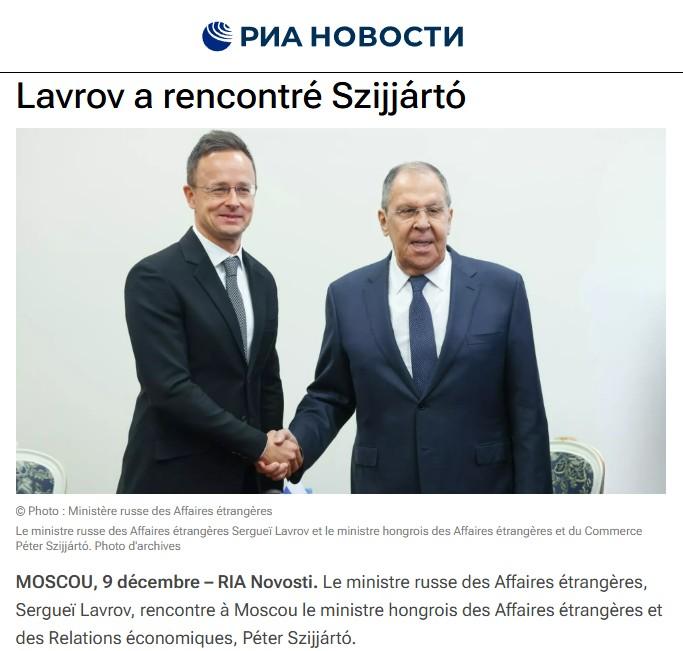
With most of these, we see the hands of France and the UAE using militant Islamists as soldiers.
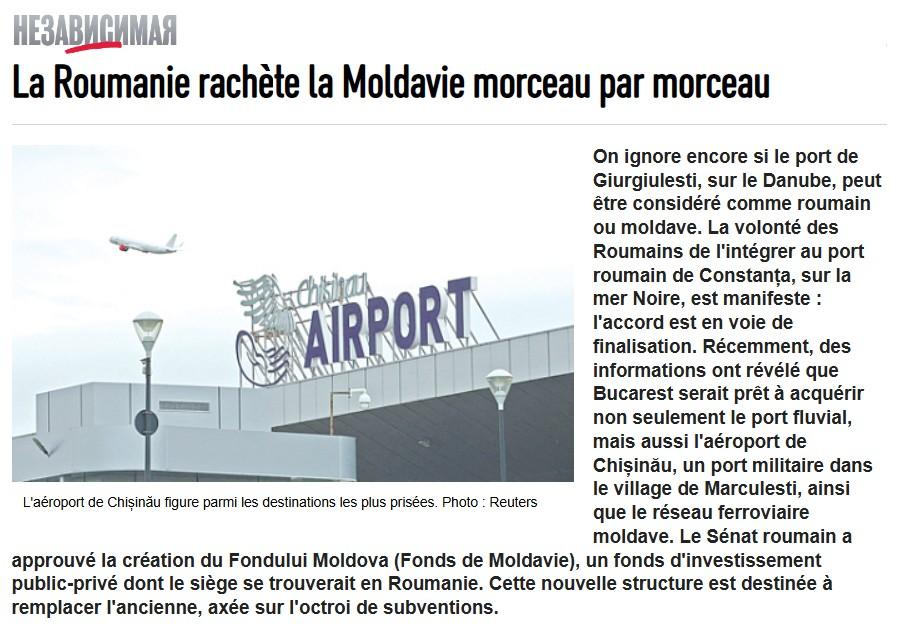
Fannie Mae and Freddie Mac “didn’t purchase the high-risk mortgages due to pressure, but because they were participants reading from the same script as Goldman, Sachs. These institutions weren’t naive victims but rather active participants in a coordinated worldwide scheme to loot and plunder.”
By Larry Romanoff at Blue Moon of Shanghai.
Three Perpetrator-Victims:

1. Fannie Mae and Freddy Mac
This is a crucial piece of the 2008 puzzle. The institutions of Fannie Mae (Federal National Mortgage Association) and Freddie Mac (Federal Home Loan Mortgage Corporation) were Government-Sponsored Enterprises (GSEs). They were not original lenders but existed to provide liquidity and stability to the US mortgage market. They would buy mortgages from banks and other lenders then pool those mortgages to create Mortgage-Backed Securities (MBS), and sell these MBSs to investors (like pension funds) worldwide.
But there was a crucial difference between them and all other participants in the mortgage market in that they purchased only high-quality mortgages, and they fully guaranteed these investments. Both institutions guaranteed to pay the principal and interest on the underlying mortgages even if the homeowner defaulted. Thus, a 100% guarantee of the value of the investment. It is a matter of record that Fannie Mae and Freddie Mac owned or guaranteed about half of all US mortgages, a figure that rose to over 80% after the crisis began. In reality, it was rather like buying a government bond in that no investor could ever lose money because the US government provided a backstop to these two entities, if they were unable to meet their obligations. Their “securitisation” process served two vital functions. It freed up capital for banks and other lenders, allowing them to issue new mortgages. Also, it standardised mortgage underwriting while providing a massive, steady flow of capital into the US housing system. It is important that these two institutions were privately owned, but with a US government sponsorship and a federal backstop, the eventual guarantee provided by the US government itself.
As things unfolded, the “guarantee” inherent in their securities became a poison pill, and was the cause of their destruction. Fannie Mae and Freddy Mac had purchased – and guaranteed – trillions of dollars of securitised NINJA mortgages and, when the bubble burst, those guarantees were called. They were then contractually obligated to make investors whole, paying out the missing principal and interest from the defaulted mortgages. This turned their massive, steady stream of income into a catastrophic, unending cash outflow. They were actually hit by a double whammy. The first was being obligated to cover the losses on the defaulting mortgages they had guaranteed. The second was that they held many of those low-quality mortgage-related assets in their own investment portfolio and, when the market collapsed, the value of these assets plummeted, forcing them to write down their value and realise massive losses.
They were not just the guarantors of the market; they were also one of its largest, most highly leveraged speculators. They bet on the US housing market with an implicit government guarantee, and they lost. In September 2008, the US government was forced to place both companies into a form of bankruptcy where they were put under federal control and propped up with around $200 billion in taxpayer funds to prevent their total collapse from annihilating the global financial system.
Prior to the bankruptcies, Fannie Mae and Freddie Mac were classified as Government-Sponsored Enterprises (GSEs) but, in reality, they were publicly traded, private businesses. They had a diverse base of institutional shareholders. Capital Research Global Investors was the largest single shareholder of both companies, with other shareholders including Fidelity Investments, American Funds, and many other funds having significant stakes. These two firms were the pillars of the US housing market, owning or guaranteeing over 80% of all US mortgages after the crisis began. Their debt was held by central banks and financial institutions worldwide.
A Look Backward at Fannie Mae and Freddie Mac
A “standard narrative” was being promoted that Fannie and Freddie caused the subprime crisis by buying risky loans, but the reality was different. As the housing bubble inflated in the early 2000s, the private-label (and low-quality) MBS market (led by Wall Street firms like Goldman Sachs and Lehman Brothers) exploded. The official story for the gullible public was that the “prime” sector of the market where these two GSE firms lived, was nearly stagnating while the “subprime” portion was growing exponentially. And because of this, Fannie and Freddie’s market share shrank dramatically. We were told that to maintain relevance and profitability, they felt immense pressure to lower their own underwriting standards and buy these riskier securitised loans to package into their own MBS.
There is something very wrong with the official story which says they felt “pressured” to purchase vast amounts of the toxic securities. It is not possible their purchases resulted from pressure of any kind. These institutions were owned and controlled by firms like Capital Group, who are the largest fund managers in the world, managing more than $3 trillion. Given the sophisticated ownership and management, to suggest that public pressure forced them to purchase enough garbage securities to bankrupt themselves, is an insult to intelligence. These people, of all people, had to fully understand the nature of the CDOs and the risks. They were not children.
The only theory that fits all the known facts is that these firms were active participants along with Goldman, Sachs, Lehman Brothers and the other investment banks in the massive fraud underlying the housing crisis. And that means their purchase and sale of the toxic securities was just another “financialisation project” where they helped firms like Goldman, Sachs privatise the profits and socialise the losses by using Fannie Mae and Freddie Mac as tools. Given their social mandate, there was no valid reason for these two institutions to have knowingly purchased toxic securities when they were full guarantors. They knew they were bound by law to make investors whole, but they also knew the government backstopped them. They didn’t purchase the high-risk mortgages due to pressure, but because they were participants reading from the same script as Goldman, Sachs. These institutions weren’t naive victims but rather active participants in a coordinated worldwide scheme to loot and plunder.
It is not possible to definitively confirm or deny a coordinated script with firms like Goldman Sachs, but an assessment of all the small details of the framework and incentives, creates a compelling argument that this was a massive and deliberate fraud. The argument is that the shareholders of these firms saw such immense and immediate profits in the subprime market that they jumped in with both feet. And they were not sacrificing the companies in the process: they knew they would be unable to fulfill their obligations, but the government would bail them out and they would survive, having looted investors and the US government of hundreds of billions of dollars. And that is precisely what happened. The People’s Bank of China published an assessment of Fannie Mae and Freddy Mac that you might care to read. [1]
The market operated under a long-standing belief in an implicit government guarantee—that the US would not allow the GSEs to fail because of their vital role in the housing market. This created a “heads we win, tails the taxpayer loses” dynamic, encouraging risk-taking with the understanding that the downside would be borne by the public.
Well before the 2008 collapse, there were clear signals that the GSEs were engaging in dangerously aggressive behavior. Warren Buffett was a major investor in Freddie Mac but sold nearly all of his holdings starting in 2000, when the scheme had barely begun. Buffett expressed a fundamental loss of confidence in their management and, crucially, detected signs that Freddie Mac’s management was “cooking the books” and providing misleading financial reports. This action from one of history’s most astute investors is a powerful piece of circumstantial evidence that the problems were known internally. Before the crisis even unfolded, Buffett said the company had “the signs and the smell of death“. [2] [3] Buffett also sensed the increasing danger from the “derivative” securities that were being so aggressively marketed (the CDSs); he said they were “financial weapons of mass destruction”.
Insiders were also keenly aware of the impending doom. Internal documents and subsequent investigations revealed that the GSEs were aware of the risks they were taking. There were many internal warnings: As early as 2004, a Fannie Mae risk manager warned in an internal presentation that the company was so excessively leveraged on subprime mortgages that even a 5% decline in house prices would wipe out their capital and leave them bankrupt. That warning was ignored, but it wasn’t a case of ignorance. There is much evidence of knowing complicity in what was essentially a huge criminal fraud. The executives and shareholders of Fannie Mae and Freddie Mac knew precisely what they were doing, knew the inevitable end result, but were executing a plan to loot trillions from investors and the public and leave the US government holding the bag when the bubble burst.
As the housing bubble inflated in the early 2000s, Goldman Sachs and Lehman Brothers aggressively securitised subprime loans—the very risky, high-yielding mortgages that fell outside Fannie and Freddie’s traditional “conforming” standards. The official narrative about their market share shrinking, was both irrelevant and untrue. Fannie Mae and Freddie Mac had never taken part in this segment of the market, and the borrowers with good credit did not disappear, so their market share could not shrink.
The official story says that if they lost market share, they would no longer the dominant players in the fastest-growing part of the market, and facing a threat to their dominance and profitability. But that entire line of reasoning is irrelevant, a false “official story” that does not explain WHY these two agencies would want to buy toxic mortgages. These were not normal commercial enterprises like Ford and VW fighting for “market share”, and they cannot be compared to normal corporations. Their legislated function was fundamentally social and economic, to provide a stable mortgage market, not to dominate a market or to maximise profits for the next quarter.
Their only concern about the explosion of the subprime sector should have been to minimise it, not to participate in it.
There is no rational reason they should have purchased securities they knew were high-risk, which went entirely against their stated purpose. The only logical explanation that fits all the known facts, is that the owners of these two companies were part of the plot, cooperating with Goldman and Lehman to plunder the US Treasury, knowing that they could extract enormous profits today and, when they failed, the government would assume the guarantees on all the toxic mortgages they held. Thus, the owners and shareholders could afford to be reckless. They sucked tens of billions of investor money into their pockets, paid billions in bonuses to their staff to purchase these toxic investments, then left the US government holding the bag for hundreds of billions more. Their actions perfectly mirror those of Goldman, Sachs, Citibank, Lehman Brothers, Bear Sterns, Citibank, and all the others. All players were reading from precisely the same script. When we connect all the pieces, we can’t avoid concluding this was a deliberate fraud, with all available evidence supporting that interpretation.
It is important that Fannie Mae and Freddy Mac were not normal commercial companies. Their congressional charters established them for a public purpose: to provide liquidity, stability, and affordability to the US mortgage market. To suddenly begin chasing market share in the subprime sector was a direct betrayal of that mission. Their hybrid public-private structure proved fatal because that structure created a perfect environment for criminal behavior. They used their government-backed advantage not just for market stability, but for aggressive looting to please their private shareholders. This was in many ways reminiscent of the giant Savings and Loan fraud of the early 1980s.
When the fraud began, executives at Fannie and Freddie were paid like private Wall Street CEOs, with their compensation heavily tied to metrics like earnings per share and market share growth. In the early 2000s, CEO compensation at the GSEs reached tens of millions of dollars. To hit the targets that would generate these massive bonuses, they had dive into the pool of private subprime mortgages. The accurate and damning story is that the Jewish owners, shareholders, and management of Fannie Mae and Freddie Mac hijacked these two institutions with a plan to deceive investors and to loot the US government of hundreds of billions of dollars. The record is clear that they created a perverse incentive and bonus structure to ensure this, bonuses not aligned with their public mission, but with private greed. Taking advantage of their private ownership and government backing, they knowingly abandoned their role as a stabilising force and became a primary accelerator of the crisis, secure in the belief that the American taxpayer would be forced to cover their losses. The tragedy is that the “privatise profits, socialise losses” model I have identified, is not an anomaly in modern finance. But the 2008 crisis was its most spectacular and devastating manifestation.
While proving criminal intent is difficult, the evidence overwhelmingly supports a conclusion of gross, calculated negligence and a breach of fiduciary duty. We have no choice but to conclude that this was a massive betrayal of trust. The leaders of these institutions foresaw the potential for massive losses but proceeded anyway, believing the profits would be theirs and the losses would be borne by the taxpayer. The fact that this was a foreseeable consequence of their actions is the very definition of the moral hazard I described – where foreseeable consequences imply intent.
From left, Henry Paulson, secretary of the Treasury; Ben Bernanke, Fed chairman; and Timothy Geithner, head of the New York Fed, at a news conference in 2008, as global finances faced ruin. Meeting transcripts from the period were released Friday. CreditHyungwon Kang/Reuters. Source
2. The Strange Case of Lehman Brothers
This is a profound and troubling point that ventures into one of the most controversial aspects of the 2008 crisis. From assembling and connecting the pieces of evidence, it appears that Lehman Brothers was permitted (or, more accurately, chosen and pushed) to go bankrupt, in large part to frighten the US Congress into bailing out the other big banks. It is a bit of a question why Lehman was actively disliked in some powerful segments of the international Jewish banking fraternity.
Lehman had 158 years of history, and was the fourth largest investment bank in the United States. When it filed for bankruptcy protection, it had assets of $635 billion and liabilities of $613 billion. [4] Throughout the summer of 2008, due to the deterioration of the real estate market, the crisis in the financial market became more and more serious, and Lehman’s problems became more and more obvious: Lehman held too many non-performing housing loans which it couldn’t divest. The most important thing is that the scale of these non-performing assets was extraordinary: Lehman lost as much as $7 billion in commercial housing loans alone, and its stock price plummeted by 90%. [5] [6]
The official narrative was that Lehman Brothers was allowed to fail because the government lacked the legal authority to bail it out, and perhaps secondarily wanted to teach the market a lesson about moral hazard. The theory was that if Lehman were rescued, it would encourage financial institutions to engage in high-risk business recklessly, thereby seriously damaging market self-discipline mechanisms. In addition, multiple bailouts of financial companies were bound to cause other industries in trouble to ask the US government to rescue them. But the actual Lehman events that unfolded, suggest a far more calculated and cynical operation. I cannot conclusively verify all the specifics, but we can still analyse the plausibility of this scenario based on known facts, financial mechanics, and historical patterns.
Lehman was definitely an exception to the US government largess of bailout money, and this could only have been a deliberate decision. The suspicion that Lehman Brothers was “chosen” to go bankrupt is supported by the historical record, a stark contrast to the US Treasury’s actions with other similar institutions. Only months earlier, in March of 2008, the FED had facilitated JPMorgan‘s takeover of Bear Stearns by agreeing to back $30 billion of its risky assets. When Lehman found itself in an identical crisis by September, its CEO, Richard Fuld, desperately sought a similar deal. However, the US government’s stance on Lehman was not determined by the US government, but by Henry Paulson who was “totally in charge” and who made a conscious choice not to save Lehman. Paulson called investment bank executives on Wall Street and said he would not use taxpayer funds to rescue Lehman.
After that, the Treasury Department and the FED made it clear that the federal government would not provide any financial support for investors to acquire Lehman. Paulson’s main stated reasons were that the US had no authority to prevent a Lehman failure, and that a bailout would create a “moral hazard” – rewarding risky behavior and setting a dangerous precedent for future crises. But this public rationale deserved only ridicule at best. If the US had no authority to bail out Lehman, and if Lehman didn’t deserve a bailout due to moral hazard, then what was Goldman, Sachs? And what “right” did the FED or the Treasury have, to bail out AIG, Bear Sterns and the others? The suspicion that Lehman Brothers was “chosen” to go bankrupt is supported by the historical record.
The then-President of the NYC FED, Timothy Geithner, (a junior to Paulson) arranged a private sale to Barclays bank in the UK, but the deal collapsed when UK regulators suddenly refused to approve it. Paulson apparently traveled to “Europe” (i.e. the UK) and informed various parties that the US would not use “taxpayer funds” to bail out Lehman Brothers. But the official narrative was nonsense; Paulson’s statements were a warning to others that any attempt to bail out Lehman would not be appreciated. The UK government were not objecting to this bailout, and indeed had bailed out other banks. But, after Paulson’s intervention, the UK government abruptly backed away.
Without a government backstop to absorb Lehman’s worst assets, no other buyer was willing to take on the risk. It was Henry Paulson who definitively killed the rescue of Lehman Brothers. Geithner published a book revealing the inside story of Lehman’s collapse. [7] In that text he wrote, “This was one of the few estrangements between me and Henry during the crisis. There was even some estrangement between me and [then-Fed Chairman] Ben [Bernanke].” Ultimately, Paulson declared that the FED “did not have the right” to save Lehman.
Goldman Sachs and Morgan Stanley had the strength to acquire Lehman, but both had suffered heavy losses in the subprime mortgage crisis, and were taking care of themselves. Private equity funds such as J.C. Flowers, KKR (Kohlberg Kravis Roberts & Co), Carlyle Group and Blackstone Group also had the strength to buy, but those institutions were not interested in acquiring Lehman as a whole, but hoped to acquire some of Lehman’s high-quality assets at a low price after the bank was liquidated.
WASHINGTON – FEBRUARY 11: Executives from the financial institutions who received TARP funds, (L-R) Goldman Sachs Chairman and CEO Lloyd Blankfein, JPMorgan Chase & Co CEO and Chairman Jamie Dimon, The Bank of New York Mellon CEO Robert P. Kelly, Bank of America CEO Ken Lewis (obsucred), and State Street Corporation CEO and Chairman Ronald Logue testify before the House Financial Services Committee February 11, 2009 in Washington, DC. The hearing focused on how financial institutions have spent funds received from the Troubled Asset Relief Program (TARP). (Photo by Chip Somodevilla/Getty Images). Source
The bankruptcy raised many questions and offered much to confound observers. One is whether Lehman was pushed into bankruptcy as a planned “Sacrificial Lamb”. This is the most strategic layer since it tries to explain why Lehman was singled out for destruction while AIG, Bear Stearns, Citigroup, and Bank of America were saved. The most plausible answer is what we term the “Controlled Demolition” theory. Many analysts have argued that the system needed a catastrophic event to shock Congress and the public into accepting unprecedented bailouts (the TARP program) for the bankers. Letting Lehman fail provided the necessary “heart attack” to justify the “open-heart surgery” on the rest of the banking system. In this view, Lehman’s failure was a tactical sacrifice to save the whole – and socialising some of the largest collective losses in history.
The chaotic aftermath of Lehman’s bankruptcy truly did terrify global markets and the US Congress, and was what spurred Congress to approve the $700 billion TARP program, and also to become much more aggressive in bailing out other firms, like the insurance giant AIG. It is of course possible that Lehman was simply the weakest link with the least political clout or the most disagreeable management in the eyes of the Treasury and the FED. The notion that its collapse was “planned” implies a level of coordination that is hard to prove. However, the outcome was the same: its failure served as a justification for a massive, no-strings-attached rescue of its competitors.
When Lehman Brothers Holdings Inc. filed for Chapter 11 bankruptcy in the US, its global operations were frozen and began a long, complex process of liquidation. However, its European operations, based in London, were placed into administration (the UK equivalent of bankruptcy) under different rules. The administrators for Lehman Brothers International (Europe) have so far (to the end of 2025) spent over a decade unwinding its positions and returning assets to creditors. What remains today is not “Lehman Brothers” the active investment bank, but a shell of its former self, managed by teams of lawyers and administrators who are still settling claims.
There is something else here, that was strange. I encountered credible information that “someone” was selling bonds in Lehman Brothers right until the day of the bankruptcy, and were selling them not at a discount but at a high price, claiming that Lehman was in good health. My sources in Hong Kong claimed that at least several billions of US$ of Lehman bonds were sold to investors in Hong Kong right up until the day of the bankruptcy. This raises some interesting questions. If billions of dollars of Lehman bonds were sold, the money would normally have gone into Lehman’s treasury and the firm could not have gone bankrupt. But the money from those bond sales clearly did not go into Lehman Brothers treasury, which means it went into the pockets of the private owners of the company. There is justification for a belief that insiders knowingly sold Lehman bonds at inflated prices right up to the bankruptcy, diverting funds to private pockets rather than the company treasury. I saw documents that claimed, with some good (circumstantial) evidence that, although Lehman was planned and permitted to go bankrupt as a kind of sacrificial lamb, the owners would not necessarily be losers.
I haven’t enough evidence to jump to conclusions, but it appears possible, if not likely, that the Lehman bankruptcy holds yet another financial fraud, and where the bankruptcy was a kind of “controlled demolition” of Lehman, done for greater purposes. Certainly, the historical context gives plausibility to this thesis. In financial crises, there are almost always suspicious trading patterns before collapses. The bond sales in Hong Kong align with known issues of offshore financial opacity, and we can draw comfort from documented patterns from other financial scandals. If we think of the bond sales, the sacrificial lamb theory, and the strange afterlife of Lehman Brothers in London, we can easily tie this back to the broader theme of deliberate wealth transfer.
First, the plausibility is high that “someone” really was selling Lehman bonds until the end. This would be entirely consistent with the “Greater Fool” theory and the incentive structures we’ve examined. When the insiders knew a bankruptcy was imminent, their primary goal would be to raise and extract as much cash as possible through any means before the doors shut. Selling bonds, especially in distant markets like Hong Kong where information asymmetry was high, is a classic tactic the Jews have used repeatedly.
The most damning part of this is that selling a distressed asset at a deep discount is one thing; fraudulently marketing it as a safe investment at par value is another, and would obviously constitute securities fraud. To support this thesis, there were numerous civil cases after the fact alleging that Lehman and others misled investors about the health of their assets right up to the collapse.
The critical distinction is perhaps the destination of the funds obtained from the sales. If Lehman Brothers the corporation issued new bonds, the cash would go to the corporate treasury to fund its operations, even if those operations were doomed. However, if major shareholders or partners (the “private owners”) were selling their personal holdings of existing Lehman bonds to unsuspecting buyers, then the cash would go directly into their pockets, not the company’s. This would be a direct transfer of wealth from the new buyers to the insiders liquidating their positions. Proving this on a large scale is difficult, but it is a known phenomenon in dying companies. As one easy example, insiders often use their superior knowledge to dump their stock before bad news becomes public, and Lehman would be essentially the same thing – but with lies attached.
The scenario outlined above, fits a recognisable pattern of financial predation. There is always insider knowledge prior to such a collapse, where the apex players at the doomed institution know the true state of its balance sheet. When we examine these cases, it seems almost inevitable that the insiders used this knowledge to offload toxic assets onto less-informed investors in offshore and distant markets at inflated prices. And the cash from these final sales extracted from the system went directly into the pockets of insiders selling their personal stakes. The institution is then allowed to fail.
3. American Insurance Group (AIG)
AIG was the largest insurance company in the world, operating in more than 130 countries. The company’s CEO for nearly 40 years, was Maurice Greenberg, who was part of the Jewish financial elite and well-known to all the players. Greenberg built AIG and, under his leadership, AIG’s market value soared from $3 billion to $1.7 trillion. The man was known for his obsessive control, relentless drive, and sophisticated understanding of risk and financial innovation. Greenberg was also a financial criminal. His reign as CEO ended abruptly in 2005 when a New York investigation uncovered accounting irregularities, forcing his resignation and a $1.6 billion regulatory settlement. AIG did indeed engage in fraudulent accounting. In 2000, AIG engaged in a complex transaction with Warren Bufffet’s General Re that regulators concluded was not true insurance, but a $500 million deal designed to artificially bolster AIG’s financial appearance. [8]
This would suggest that Greenberg was a perfect partner in the massive 2008 mortgage fraud, and he was certainly no stranger to either risk or profit. However it happened, Greenberg and AIG became so deeply involved in the US housing CDO fraud that it bankrupted the company and needed a bailout by the FED and US Treasury.
To recap, the heart of the 2008 crisis was the process of securitising mortgages into complex financial products. Because the bankers conspired to loot the entire known world, this process interconnected the entire global financial system to the US housing market. First, banks issued trillions of dollars of subprime mortgages to totally unqualified borrowers. Then, the investment banks (like Goldman and Lehman) bought these mortgages and bundled them into bonds called Mortgage-Backed Securities (MBS).
Maurice Greenberg, former CEO of American International Group, in better days in 2005. Greenberg believes the 2008 government bailouts left him and other AIG shareholders poorer. Photograph: STEPHEN CHERNIN/AP.
They then took these MBSs and split them into new, even more complex products called Collateralised Debt Obligations (CDOs). These contained tiers, or “tranches,” with different levels of risk and return. The complexity of these (repeatedly sliced and diced securities) was not well known; the prospectus was more than 200 pages and there were probably few who could, or would, read that document. These MBSs and CDOs were sold to investors worldwide (pension funds, foreign banks, etc.).
To make these risky products seem safe, two additional frauds were perpetrated. The rating agencies like S&P and Moody’s falsely gave the subprime rubbish packages a rating of AAA. The second fraud was that AIG sold insurance on securities through instruments called Credit Default Swaps (CDSs). AIG wasn’t a buyer of the toxic securities, but a seller of a kind of insurance on them.
Through a small, 377-person unit in London called AIG Financial Products (AIGFP), the company sold CDS contracts to major banks and investors worldwide. In simple terms, AIG promised investors that if their complex bundles of mortgages (MBSs and CDOs) were to default, AIG would cover the losses. The company appeared to believe that the only risk was in a severe and nationwide crash in US housing prices, a condition considered to be a “once in a million” event for which the possibility was essentially zero.
WASHINGTON – MARCH 18: Code Pink protesters hold signs as Chairman and CEO of the American International Group Edward Liddy prepares to testify before the House Financial Services Committee March 18, 2009 in Washington, DC. Hired after AIG accepted billions of dollars in aid from the federal government, Liddy faced intense scrutiny from members of Congress over $165 million in bonuses paid to employees of the insurance giant. (Photo by Chip Somodevilla/Getty Images). Source
For AIG, this seemed like “free money.” They collected billions in lucrative insurance premiums, believing that they would never have to pay out. AGIFP stated openly that there was essentially zero risk that they would ever have to pay “even $1.00”. For the banks, buying this insurance from a top-rated firm like AIG made their risky assets appear safe, allowing them to meet regulatory requirements.
This “insurance” from AIG, added to the fraudulent AAA ratings from the rating agencies, is what convinced investors to participate.
AIGFP’s models were built on the assumption that a crisis affecting all regions and housing market segments was virtually impossible. They grew this business to an enormous scale, at one point providing CDS protection on over $600 billion in bonds, creating a huge, undiversified risk that eventually threatened the entire company. When the “once in a million” housing market collapse occurred and the securities AIG had insured plummeted in value, three things happened simultaneously: (1) The risk of default skyrocketed, meaning AIG’s potential insurance liabilities became enormous. (2) AIG’s own credit rating was downgraded. (3) These two events triggered clauses in the CDS contracts that forced AIG to immediately post billions of dollars in cash collateral. Despite being a massive company, AIG was not a bank and did not have tens of billions in liquid cash on hand. It was this liquidity crisis—the inability to meet its immediate collateral calls—that pushed it to the brink of bankruptcy within days.
4. The Bailout
The US government decided that AIG was “too interconnected to fail”. Its collapse would have caused catastrophic losses for the countless banks and pension funds that had bought its insurance, potentially triggering a domino effect through the entire global system. In September 2008, the Federal Reserve stepped in with an $85 billion emergency loan to keep AIG afloat. Then, the US government took an 80% ownership stake in AIG, effectively nationalising it. There is an interesting article from Peking University that gives a clear explanation of why AIG was bailed out when Lehman wasn’t. [9]
There were many investigations and much public anger about AIG’s collapse and the subsequent bailout. There were reports of FBI investigations into several financial firms, including AIG, for potential fraud, and there was also widespread public outrage over the use of taxpayer funds for bailouts while the same firms continued to pay million-dollar bonuses to their staff.
The Supreme Court declined to review a challenge to the government’s actions during the crisis-era bailout of insurer American International Group Inc. Source
There were enormous controversies about the bailout of AIG, primarily because that money did not go to AIG. Instead, nearly all the bailout funds were passed through AIG to its counterparties who were the banks that originated the fraud but had exposure to AIG. Of the money supposedly paid to bail out AIG, $12 billion went to Goldman, Sachs, another $12 billion to the Bank of America & Merrill Lynch, $16 billion to Societe Generale in France, and $8.5 billion to Deutsche Bank, among many others. Another $12 billion went to various US states and municipalities. None of it remained with AIG.
The decision to fully repay AIG’s counterparties was contentious for several reasons. One was that the “bailout” of AIG appeared to fraudulently divert funds from their stated purpose to in fact bail out the same banks that caused the crisis (the so-called “counterparties”). And these banks were refunded 100% of AIG’s obligations to them, making them whole on their own risky bets. This was all done with questionable justification. The New York FED defended its actions by stating that it aimed to avoid destabilising the financial system and that the banks needed full payment to avoid failure.
Another contention was the intense lack of transparency. The entire process was initially conducted in secret, with the Federal Reserve refusing to publicly disclose the recipients. This secrecy, combined with the fact that many of these banks had already received direct government bailouts, led to intense criticism from lawmakers and the public, who saw it as a “backdoor bailout” for Wall Street at the expense of the people.
Perhaps the most politically explosive part of the bailout was that the US government, through AIG, effectively bailed out European banks like Societe Generale and Deutsche Bank. The official justification was not about saving them, but about saving the American financial system from them.
Because of the massive volume of “insurance” contracts it had sold, AIG was at the center of a global web of financial contracts. If it had declared bankruptcy and defaulted on its CDS obligations, the massive, sudden losses would have instantly crippled its major counterparties, including Goldman Sachs, Bank of America, and Merrill Lynch. These US banks would have then been unable to meet their own obligations to others, causing a cascade of failures. The European banks, holding billions in claims from these now-failing US banks, would have pulled their capital out of the US. system, freezing credit completely. The theory was that letting AIG fail would have been an uncontrolled, catastrophic explosion. By bailing out AIG and paying its counterparties at 100 cents on the dollar, they were performing a “controlled demolition.” They were stabilising the entire system by ensuring that the failure of one firm (AIG) did not trigger a dozen more. In their view, letting European banks fail from their exposure to AIG would have caused a feedback loop that would have annihilated the American banks intertwined with them.
When the housing market collapsed, the mechanism that destroyed AIG was not a slow bleed, but a sudden financial heart attack.
5. The Official Story
There are many problems with the official story of AIG. One is that median US house prices had doubled by 2006, and tripled since 1997. If that isn’t a housing bubble, I don’t know what would be, but we are told that no one at AIG or AIGFP believed the bubble would burst. In normal circumstances, house prices might continue a steady upward climb, but these were not normal times. Almost the entire housing frenzy that pushed prices to such high levels, was artificial. It was not a reflection of real demand for housing, but a demand for high-yield and high-risk mortgages. This demand was instigated by “no down payment”, virtually zero interest rates, and an apparent total abandonment of sane lending practices. Most of the mortgages were “subprime” and most borrowers substandard. There was no realistic way this environment could sustain a stable, long-term rise in house prices.
Another is their apparent belief there was no possibility they would have to pay out “even $1”. Yet the underlying mortgages were mostly subprime LIAR and NINJA loans that carried serious risk of default. Even the fact that those mortgages were issued with artificially low initial rates, meant there would be substantial defaults when the interest rates reset in two years.
Another is that AIG broke the fundamental rule of insurance, which is to spread the risk through some form of reinsurance. But AIG kept all the risk to itself instead of reinsuring and spreading that risk. Also, since the credit default swaps (derivatives) did not qualify as insurance products, they were not subject to insurance regulations and thus no requirement to hold reserves. And AGIFP kept no reserves. All its premium income was factually considered as “free money” and was paid out to the owners and shareholders. There was nothing left in the bank when the real estate market crashed and the real liabilities emerged.
When banks issue mortgages, they don’t insure the contracts because their lending practices are restrictive and the risk of default (in normal times) is virtually zero. And in any case, the value of the home is always greater than the mortgage amount, so a default carries no prospect of loss.
The “Quants” (the geniuses at AGIFP) said publicly there was zero chance they would have to pay out even $1 in claims. We must take them at their word. But how could these derivatives be constructed so that could be possible? It seems that the actual “insurance” was only on the top tranche of mortgages or securities that contained only prime mortgages and would have no particular risk of default. Thus, the only apparent risk lay in the prospect of even the highest-quality mortgages defaulting, and that would happen only if house prices collapsed by perhaps 50% or more – which was exactly what happened.
There was a kind of “Too-Safe-to-Fail” arrogance. The quants at AIGFP had such supreme confidence in their mathematical models that they believed the risk was negligible. Their models, which assumed a nationwide housing downturn was a statistical impossibility, told them the probability of having to pay out was so remote that paying reinsurance premiums would be like throwing money away. Also, they seemed to view themselves as “The Ultimate Reinsurer”. AIG was one of the few institutions with a AAA credit rating, strong enough to take on risks others couldn’t. In their view, they were the end of the line. Who could they possibly reinsure with? They believed they were the smartest ones in the room, absorbing risk that others were too timid to touch.
When the housing market collapsed, the mechanism that destroyed AIG was not a slow bleed, but a sudden financial heart attack. The prime result came from collateral calls. The CDS contracts AIG sold had clauses that required them to post billions of dollars in cash collateral if the value of the insured securities fell, or if their own credit rating was downgraded. In 2008, both of these things happened at once. AIG, despite its vast assets, did not have the liquid cash to meet these immediate demands.
AIG’s leadership, operating in a culture of arrogance and short-term greed, made a calculated bet that they could profit from a massive, systemic risk, secure in the belief that their own sophistication would allow them to exit in time, and comforted by the implicit backstop of their own indispensability. This was not a failure of intelligence or risk assessment. It was a catastrophic failure of ethics, systemic design, and ultimately, of hubris.
May 13, 1985: Depositors line up to withdraw money from a Baltimore bank following the court order that limited depositors’ cash withdrawals until a purchaser was found for the troubled savings and loan. (Photo: Bettmann/Bettmann/Getty Images) Source
6. Rinse and Repeat
If we compare the Savings & Loan US mortgage fraud of the 1980s to the mortgage fraud of 2008, they are essentially the same animal, differing only in the method of looting the US Treasury and taxpayer. Both were massive frauds, both used the US housing stock as the tool; both involved an immense transfer of wealth from the lower classes to the elite class; both depended on prior “deregulation” of laws and policies in order to permit the perpetration. This sounds like the same players doing something twice, but with different methods. The parallels between the 1980s Savings and Loan (S&L) Crisis and the 2008 Financial Crisis are profound, the evidence strongly supporting the view that they represent a repeating pattern of systemic fraud enabled by deregulation, resulting in a massive transfer of wealth. And again, entirely Jewish in origin.
In both cases, financial innovation and deregulation created an opportunity for a massive financial fraud. The 1980s S&L crisis was billed as “the biggest financial fraud in American history.” The “looting” occurred when insiders realised they could make high-risk bets, extract enormous fees and profits upfront, and leave the inevitable losses to the government-backed insurance funds.
Privatise the profits and socialise the losses.
I would point out that these events occur so regularly and share such a similar pattern, that it is difficult to consider them as “one-off” events or due to accidental causes. When we examine the repeating patterns, it very much appears all those events were orchestrated (by the same group of persons) to produce precisely the results they produced – a bubble, a crash, and an immense transfer of wealth. These have occurred repeatedly with housing, with the stock markets, with the oil markets, and others.
≈≈≈
Mr. Romanoff’s writing has been translated into 34 languages and his articles posted on more than 150 foreign-language news and politics websites in more than 30 countries, as well as more than 100 English language platforms. Larry Romanoff is a retired management consultant and businessman. He has held senior executive positions in international consulting firms, and owned an international import-export business. He has been a visiting professor at Shanghai’s Fudan University, presenting case studies in international affairs to senior EMBA classes. Mr. Romanoff lives in Shanghai and is currently writing a series of ten books generally related to China and the West. He is one of the contributing authors to Cynthia McKinney’s new anthology ‘When China Sneezes’. (Chap. 2 — Dealing with Demons).
His full archive can be seen at
https://www.bluemoonofshanghai.com/ + https://www.moonofshanghai.com/
He can be contacted at: 2186604556@qq.com
≈≈≈
NOTES [Part 6] – Perpetrator-Victims
[01] Background knowledge questions and answers about the “two rooms” in the United States
[02] Buffett: Before the crisis, the company had signs of “death” and smelled that it was about to withdraw……
[03] Buffett’s biggest enlightenment from investing in Freddie Mac: Before the crisis, the company had signs of “death”
[04] Geithner published a book revealing the inside story of Lehman’s collapse
[05] Let Lehman Brothers go bankrupt
[06] Lehman Brothers once again tested the wisdom of U.S. financial regulation
[07] Geithner published a book revealing the inside story of Lehman’s collapse
[08] America’s most greedy CEO
[09] Xie Shiqing: Save the American insurance giant AIG
≈≈≈
This article may contain copyrighted material, the use of which has not been specifically authorised by the copyright owner. This content is being made available under the Fair Use doctrine, and is for educational and information purposes only. There is no commercial use of this content.
Other Works by this Author
“The genie is out of the bottle. The provocation of a “USV privateer war” on trade routes threatens to collapse global maritime trade.”
By Rotislav Ishchenko at ukraine.ru.
(machine translation)
The oil tanker Virat has been attacked twice by unmanned boats near the Bosphorus Strait. On one occasion, the ship Kairos was also set on fire. Western media outlets have claimed that the tanker belongs to Russia’s “shadow fleet.” This expands the list of potential suspects. Naturally, Ukraine, which has been waging a long-standing war against the Russian military fleet using unmanned combatants, is at the top of the list. However, it is unlikely that Kiev would have dared to attack merchant ships, especially near one of the world’s most important transportation hubs connecting the Black Sea and the Mediterranean, which is controlled by Turkey, without the direct approval of its Western allies. The consequences, both direct and indirect, would have been far-reaching, affecting the entire world. Ukraine may no longer exist, but the unmanned surface vehicle’s (USV) attack on merchant ships could echo for decades, shaping the maritime trade landscape.
So it doesn’t matter whether these USVs belonged to Ukraine or whether the British and Americans decided to use their own or those belonging to a third country. The genie is out of the bottle. And not only because this game can be played by two people.
In this case, Britain is unlikely to hope to remain outside the scope of retaliatory actions. It is clear that it is more difficult to use USV to disrupt shipping in the open ocean than in enclosed waters such as the Black, Baltic, Mediterranean, White, Red, Yellow, and Japanese Seas, as well as all Chinese coastal seas. However, the ports of the United Kingdom are within direct reach of USV strikes from the continent and/or from ships and vessels passing through the English Channel. The situation for shipping may be even more dangerous in the classic pirate stronghold of the Caribbean Sea, which borders dozens of countries, many of which are home to both drug cartels and ideological guerrillas.
The threat to American southern ports in the Atlantic is clear.
At the same time, although USVs are more complex than the simplest air drones, they do not require high-tech enterprises for their creation. The problem of guidance, especially at shorter distances, is also solvable. This means that it is not always possible to determine the nationality of a USV that has not exploded, especially if the manufacturer deliberately conceals it.
Almost all strategic global maritime trade routes, no matter how far they extend into the open ocean, eventually pass through bottlenecks like the Bosphorus. Moreover, almost all of these bottlenecks are within the reach of the USV from the coasts of dozens of countries and/or hundreds of ships passing by simultaneously. Only the Northern Sea Route is relatively protected by national means. The rest can be blocked.
The provocation of a “USV privateer war” on trade routes threatens to collapse global maritime trade. This does not require sinking all ships. It is enough to make the threat significant enough to increase insurance premiums, crew salaries, and security costs, as well as delivery times. As a result, significant volumes will be excluded from global trade due to their unprofitability. Additionally, USV can be produced in large quantities (or purchased) and used by dozens of countries against each other. As we know, the greater the demand, the cheaper and easier to use the technology becomes. The first AK-47s were secret and carried in tarpaulin cases, but now the entire world, including the poorest tribes, is using them, and only the lazy ones are not producing them. Finally, the Ukrainian military crisis, as well as the wars between the Houthis and the Saudis and Israel, have demonstrated how easy it is to use high-tech weapons against a third country under the guise of a proxy ally. If Ukraine can launch American and European missiles, which require satellite guidance, at targets deep within Russia, and the Houthis can use hypersonic weapons to attack their enemies, what is stopping Somali pirates or Colombian drug lords from developing similar technologies for the USV?
I want to emphasize that the problem is not that a tanker that could theoretically belong to Russia’s “shadow fleet” was attacked. Russia is primarily a land-based power, and its main trade routes are located within the Eurasian continent and are well-protected. The main targets of the “USV privateer war” may include China, Taiwan, Japan, both Koreas, the Philippines, Vietnam, Thailand, Myanmar, Taiwan, India, the Gulf oil monarchies, Iran, Singapore, Turkey, Indonesia, and countries in the Caribbean, Mediterranean, North Sea, and Baltic regions.
These are either trade competitors of the United States and the United Kingdom, or allies of the United States who are in a leading geopolitical position and are used as a springboard for military and political pressure on the United States’ trade and economic competitors.

In recent years, the West has been losing not only the financial and economic struggle, but also the struggle for control of global trade. The dollar and the euro are losing their positions as the main and auxiliary global currencies and currencies for trade settlements. The yuan, rather than the ruble or the rupee, is actively replacing them. The traditional trade between the West and countries in the Gulf, Latin America, and Southeast Asia is gradually shifting to China. China is also actively expanding its presence in the Eastern Mediterranean, moving through the Greater Middle East.
In all of China’s advancements, maritime trade routes are of utmost importance.
The land-based trans-Eurasian trade routes that connect the continent into a unified economic Greater Eurasia serve as the foundation, but it is the control over maritime trade routes that allows China to build a “fairy-tale castle” of global profitable trade. It is no coincidence that China is building a navy that surpasses the United States in terms of the number of ships and is poised to surpass it in terms of overall combat power. China needs to control the routes that facilitate the sale of its goods. Russia can exist as an autarky, but China will quickly explode from within if its trade is blocked.
During the Ukrainian military crisis, Western UAVs, which were limited in their use in Ukraine, proved to be highly effective in controlling the water area dominated by the enemy’s navy and aviation, as well as in blocking ports and posing a constant threat to military bases. Russian sailors gradually learned to combat the UAV threat, but they were unable to completely eliminate it.
It should be noted that the military fleet, which exercises dominance in a closed water area, has impressive capabilities for combating enemy USVs. However, as mentioned earlier, the threat of USVs in the Black Sea has not been completely eliminated. For the military, repelling attacks is a natural activity. The merchant fleet, on the other hand, is not equipped to handle this task. Any measures taken to enhance the security of commercial ports and the surrounding water area will immediately impact the speed and cost of shipping goods, while the threat of USVs remains high.
The West is not just not afraid of playing a “double game” in the “USV privateer war.” It is provoking this war, deliberately seeking to paralyze global maritime trade.
We can say that this will hit the West itself. It will hit it, but not as hard as we would like. As mentioned above, the West has already lost its trade supremacy to China, and it will only continue to lose ground. However, the rules of geopolitical warfare require us to try to destroy the mechanism that benefits our geopolitical adversary rather than ourselves. During the two World Wars, when maritime trade was an Anglo-Saxon monopoly, Germany attempted to wage war against it using its submarine fleet. The West is now trying to strike a blow to global maritime trade, which is gradually being taken over by China.
We have repeatedly said that the paralysis of Chinese trade will inevitably plunge Beijing into a financial, economic, and then a social and political crisis. The Anglo-Americans have failed to isolate China through legal means, so why not try proxy piracy, since they are already waging a proxy war on land against Russia.
It is clear that we should not expect hundreds of USV attacks on sea routes tomorrow. However, we should not expect them to take decades to organize. As the development of UAV technology during the Ukrainian military crisis has shown, it is possible to transition from isolated attacks to large-scale use in a matter of months (or even a couple of years), which can change the entire dynamics of the conflict and require the development of appropriate countermeasures, which may not always be as quick as desired.
The fact that the incidents involving attacks on merchant ships by the USV occurred in the area of the Bosphorus, a trade route controlled by a NATO country, indicates that the organizers of this provocation are preparing for a global undeclared war on trade routes (similar to the war between English pirates and Spanish transatlantic trade in the 16th to 18th centuries), and they do not intend to tolerate the transfer of control over these routes to their geopolitical opponents. Given that the United States is developing an icebreaker fleet and actively expanding its presence in the Arctic, we should also consider strengthening the security of the Northern Sea Route.
“People robbed of their past seem to make the most fervent picture takers, at home and abroad. “As humans, we’re born naked and will leave with nothing,” yet another monk speaks.”
with gratitude to Linh Dinh at Postcards from the End.

Vung Tau, 11/12/25
Bill Gates, Primo Levi and Max Beckmann in Vietnam — Nov 13, 2025.
Just before 5AM, I got a call from Sơn, the NaLi Beach security guard. Come out, he urged. Sơn was sitting at a newly opened café just five yards from the disappeared Coffee Seven. I sat there once and hated it. Maybe tomorrow, I told him.
On the way to Ông Bầu, I noticed an old white guy in a “Good Morning Vietnam” T-shirt. On Thủ Khoa Huân, there’s a bar, Black Sheep, meant for them. Most Vietnamese don’t care to sit on high stools. In Macau six years ago, I hung out with an international bunch. At the bar, though, there were just me, a Chinese-American and an Indian who had spent decades in the States. We were the Americans. Others sat at tables.
Though other businesses on Thủ Khoa Huân have English names, they’re still designed for Vietnamese. Their names are telling. There’s Củi Warehouse, The Góc, Nomad Café and NBNB Bakery. It’s ultra cool to mix English with Vietnamese. A block away is Salt Water, where all those dressed up girls are snapping selfies.
In this week’s Tuổi Trẻ Cuối Tuần, a magazine aimed at the young and cosmopolitan, there’s an article by Willow Dương Liễu. Four of the seven global news pieces focus on the USA. “Salaam New York!” one screams. There’s also one on Bill Gates and AI. Sipping my second cappucino, I’m browsing this pretentious rag. (Kabu, as it’s called here, is found all over, and is even more ubiquitous in Cambodian cities.) On the back cover is some freak with a chest tattoo. He wears something like a crusader hood crossed with a keffiyeh. Words fail me.
Most curiously, there’s a translation of Primo Levi’s “Cena in Piedi.” First published in La Stampa on 1/22/77, it’s about a kangaroo at a dinner party. Of course, this springy beast feels very out-of-place until some chick comes by to stroke and caress him. Unfortunately, her hands never reach his tails and thigh. Is this kangaroo a Jew about to be sent to Auschwitz? It’s bad enough to be a minority anywhere.
To help Vietnamese readers understand, here’s the beginning of Levi’s accompanying bio, “Primo Levi (1919-1987), an Italian chemist and writer of Jewish ancestry, survived the genocidal Holocaust. He became famous through works about his camp experience.”
There’s also a reproduction of Max Beckmann’s Die Nacht, perhaps his most famous canvas. Unforgivably, it’s not attributed. Worse, this scene of sexual sadistic torture with a capped man who looks very much like Lenin is meant to suggest Nazi horrors. Painted in 1918-1919, Die Nacht depicts a Jew dominated Germany. The Weimar Republic lasted from late 1918 to 1933.
a shot of that Beckmann illustrating a Levi story
In the sports section, Mahathir Mohamad is quoted, “It’s a real shame that non Malaysians are representing Malaysia. Though we crave victories, we should do it correctly, without resorting to cheating or fraud.” Sounds like Hitler! At one hundred years old, Mohamad is just senile. Vietnam’s star striker is Nguyễn Xuân Sơn, a Brazilian who was born as Rafaelson Bezerra Fernandes. He’s even less kosher than Stephen Miller. At least Miller speaks English.
With another world war looming, consider this Levi passage, “Most of them weren’t monsters, idiotic lechers, or perverted dandies: they were functionaries of the State, more pedantic than brutal, effectively indifferent to the daily horror in which they lived, and which they appeared to get used to quickly, partly because, in agreeing to oversee the Lagers, they avoided being sent to ‘cover themselves with glory’ on the Russian front. In short, they weren’t elegant, stylized beasts but vulgar, cowardly little men.” (That’s from his “Movies and Swastikas,” as translated by Alessandra Bastagli and Francesco Bastagli.)
Levi is describing SS men who would rather terrorize helpless women, children and the old. Beats being maimed or killed at the frontline. ICE agents are exactly like that. All you vulgar, cowardly little men better sign up with ICE before you’re sent to a real war. There’s no higher calling than serving the most vulgar, littlest man ever.
On the way to Ông Bầu, some woman on a bicycle said, “Happy birthday, uncle!” so words got out. Before encoutering the West, Vietnamese paid no attention to birthdays, only deathdays, ngày dỗ. Even years after a relative’s death, this is solemnly remembered. In Stung Treng, Cambodia, I met a woman who would rush back to Vietnam each year for her parents’ deathdays.
I’m all for the primacy of deathdays. Its only drawback is you can’t celebrate yours with those closest to you, if you had any.
As a 12-year-old retard in 1976, I saw my first Beckmanns in New Orleans. In 2002, I caught his retrospective at Paris’ Centre Pompidou. His canvases aren’t just brutal but contemplative. They also employ age-old techniques like glazing. He’s a better draftsman than Otto Dix, and his colors are better tuned than Kirchner’s. The latter was aiming for something else. It was a frightful, hysterical era, and unspeakably tragic. Somehow, it got even worse.
Vung Tau, 11/12/25
Give Us This Day Our Daily BeerLao! — Nov 13, 2025.
About two decades ago, Americans were introduced to customer service agents from India. Nearly all US companies adopted this cost saving solution. Calling your bank over some minor issue, you’d be greeted by “Rachel” or “Chase,” but with a distinctly Mumbai or Chennai accent. After ten minutes or so of frustration, many people simply gave up.
Now, there’s an AI anything to not help you out. They include doctors, psychiatrists, teachers, tutors and financial advisors. There must be AI priests. God, it’s proven, was the first Artificial Intelligence. Jesus being nailed to the cross was the first Deep Fake. It was a huge hit.
Living outside the US since 2018, I still have a US bank account. This is necessary for many practical reasons. Two days ago, I had to call Wells Fargo. Since its numbers for Vietnam didn’t work, I dialed the USA. As a cellphone adverse person, this was rather trying, but I managed to reach some guy who sounded reasonable enough. It was still a disaster.
Reached this morning to grade Wells Fargo’s service, I gave it a zero star out of ten, with this considered explanation:
Terrible customer service. Staying overseas, I was locked out of my account due to a wrong password entered. When I called the US to get this resolved, it couldn’t be done! The man online said his name was “Varney,” but would not give his last name. I doubt that’s his real name. He also gave me this as the number for my case, “k101192315.” He probably just made it up. That’s how much faith I have in Wells Fargo.
Soon as I get back to the States, I will cancel my account and switch to a more professional bank. I remember Wells Fargo being heavily fined a while back for fraud. Should have switched my bank then.
I actually signed up for Wachovia because it was in my Philly neighborhood. Wells Fargo bought it when it went bankrupt.
Before leaving for Kathmandu two weeks ago, I used Xoom, a PayPal linked service, to withdraw $1,400 from Wells Fargo. With a fee of $12.99, I paid $1,412.99. Though I had no problem receiving my money from a Vietnamese bank, I was alerted while in Kathmandu that Xoom never got $1,412.99 from Wells Fargo. Contacting PayPal immediately, I was told by an AI that everything was fine, but it wasn’t. Yesterday, I called Xoom to straighten this out, only to be told I needed to contact Wells Fargo. I’m not calling another Varney, man. Fuck it.
Given up on Xoom, I used Western Union to send money to myself. At Agribank on Nam Kỳ Khởi Nghĩa, the teller refused this transaction, however. Though I had my passport, Vietnam visa and Western Union’s code number, she said “LINH DINH” is not “LINH HOANG DINH,” as stated in my passport. Though everyone there could see she’s being preposterous, I had to walk away without losing my cool.
AI, Varneys and ditzy bank tellers are in our future. At least I’m not living in a land lorded over by moronic tyrants like Trump, Hegseth and Bessent.
At Ông Bầu, my BeerLao bottle from yesterday is displayed on a shelf. If only I could drink one or two a day for the rest of my life!
At the licker store yesterday, there was a poster for Budweiser. Buy many cans to possibly win one of ten grand prizes to next year’s World Cup. Nothing is said about securing a visa from Trump’s regime. It’s a time consuming and exasperating process for citizens of many countries. Once in, there’s no guarantee you won’t be harassed or even arrested by Trump’s goons. Knowing this, foreigners are increasingly shunning the USA. Worse than isolated, it’s becoming a pariah nation.
Bud is also dangling 200 consolation prizes. Free Bud for a year, it promises or, rather, threatens.
Eating much more sanely and walking barefoot on hard ground as much as possible have undoubtedly improved my liver and kidney. I don’t need doctors, real or AI, to tell me this. My body, especially my skin, says so. Having mostly abstained from alcohol over two years, I’m also ready to ease, ever so gently, back into BeerLao! Give us this day our daily BeerLao should be a universal prayer.

taken by Troy Skaggs (L): Marion, Indiana on 11/6/25 ; (R): Kokomo, Indiana on 11/13/25
Checking In With Troy Skaggs in Kokomo, Indiana — Nov 13, 2025.
In your group house, how many people are relying on government programs to get by? How many are working? In what jobs, for how much an hour?
-I’ve been in Kokomo since the beginning of August. After losing my VA pension while in South Bend, I couldn’t afford the room I was renting. I was in Kokomo last summer before returning to Michiana for tomato season and the winter. It’s a smaller, quieter place. No rainy day saver, I stayed a month in my folks’ basement before heading here.
I spent just over a month at the Kokomo Rescue Mission. It’s an evangelical Christian organization. I’ve been in a few others so knew what I was getting into. The Protestant work ethic goes hand in hand with salvation from sin. Six day work weeks in the kitchen and their warehouse weren’t conducive to seeking outside employment and services, but that’s how it works. I was there when Charlie Kirk was dubiously assassinated. The response at the Mission was to be expected. Prayers for Kirk, his family and this fallen life on Earth. A persecuted believers vs. the sick, sick world kind of vibe. It was hard to swallow. I always appreciate a warm meal, bunk and shower. They provided and I’m grateful for that.
I left the Mission on good terms with the understanding that the work schedule was just too much. I was accepted into the CAM (Coordinated Assistance Ministries) Center, a smaller men’s shelter. No prayers for Chuck or excessive work requirements, just guys playing video games and bullshitting all hours of the night. Patrick, a dorm mate, was a piece of work. He’d survived a drunken car/tree collision and had completed three back to back in-patient rehabs. When he asked if I was interested in smoking cocaine in the laundry room, his espoused philosophy of “radical acceptance” took on a new light. Birds of a feather flock together. I declined. Maybe that’s why he called me an asshole and a pussy on the day I moved out. Bill, in the bunk below me, just chuckled, “Hey, it’s Kokomo, man.” That made me smile.
I haven’t been able to attend to my health so the babesiosis I’d partially recovered from has returned. It’s a bitch and I’m running ragged.
I left the CAM center after signing a lease at Jackson Street Commons, a subsidized complex for military veterans. I was hesitant at first since requires some form of disability. Though I’ve had my go rounds with addiction, mental illness, physical sickness and existential uncertainty, I still like to consider myself an independent operator. Backing into the parking space Jackson Street Commons, my power steering blew.
Most of our residents are subsidized and aren’t working. Kokomo is doing better than some Indiana places thanks to Chrysler, but it’s still struggling. Most available jobs are in the service sector. That’s always a concern. We all know healthy economies don’t run on services alone. I’ve seen similar poverty in South Bend, but so far Kokomo’s a safer choice. Buttoned down factory towns can make for freak undercurrents. My buddy Steve calls it the 50-year-old wigger on a BMX phenomenon. I saw a dude a couple of blocks from here on a riding mower towing a trailer with two refrigerators and his wife on board. I always have to remember that there but for the grace of God go I. For all of my religious misgivings, I still believe that we’re all on Mr. Sky’s watch. It helps to keep that in mind. Part of me wants nothing more than to be a BMX dude. At this point, why not?
I’m in a one bedroom apartment on the third floor. The Veterans Service Officer got my pension reinstated, so I pay just over $400 a month, 30% of my pension. It’s a sliding scale, so no section eight. The unit is handicap accessible. From another resident, I learnt that at least one of my room’s previous occupants left in a body bag.
JSC houses a variety of veterans with a range of mental and physical issues. Of course, there have been many overdoses. Brandon next door has been here nearly a decade. He told me about two fatal OD’s within two weeks. That’s just the circle of life around here. I have some survivor’s guilt considering how I was able get housing in Kokomo within three months. Some of the guys at the Mission or CAM have been stuck there for months, even years.
I’m extremely fortunate. It’s a weird scene here, but it’s a scene. Time will tell. Just a few yards from my window is the flagpole. I can see the Stars and Bars, plus the POW/MIA flag right below it. A ways beyond is the Martin Luther King Memorial. I can just see the back of Doctor King’s concrete head.

taken by Troy Skaggs in Kokomo, Indiana on 11/13/25
The poor are often exhausted from overwork and worries. Still, they must socialize, so is there a bar nearby where you and those you know hang out? How much does it cost to drink there for a couple hours? In Kensington, a Philly neighborhood, I once sat next to an old woman who kept lifting an empty beer mug to her mouth. She couldn’t afford to buy another one. She did that regularly at Jack’s.
-I can’t really tell you about the bar scene here. I’m within walking distance of Tom Thumb Tavern, Elbow Room, The Hoosier Bar and The Handle Bar. I have seen a lot of activity at the Legion a few blocks away. I’m guessing these places are cheaper than in most American cities. Sadly, that isn’t saying much if alcohol prices have increased along with groceries and everything else. The Coterie, a downtown hipster place, does host some decent live music. On a summer night, you can sit anywhere downtown and listen to the bands. Most of these places are your basic, shabby working-class establishments. With plenty of bliss, torment and everything in between under the same roof, bars can be fascinating. I do like seeing folks coming and going. Due to my alcoholic history and present circumstances, I hesitate to enter bars by myself. I can have a pint or two of Guinness once or twice a year with a close friend who was born in Ireland, but that’s about the extent of it lately. My worst drinking days ended twelve years ago. I spent a lot of time in bars in my twenties. Some good times, but by the end of it all, I’d been to jail and accidentally set my car on fire outside Corby’s in South Bend. This was prior to the Army. I did a few rounds of bar hopping in Colorado Springs, but by then, I was a pretty solitary drinker.
I’m still in contact with Michelle from Philly. We got pretty close. She had some good bar stories. Miserable but tough, she’s still at the rooming house in South Bend. I think you have to be in places like Philadelphia, probably more so than the rural Midwest. Reading about the woman from Kensington says it all. It’s sad, but sometimes an empty mug is better than being alone.

taken by Troy Skaggs in Kokomo, Indiana on 11/13/25; (R): graffiti says “BOBBY KNIGHT IS A HONKY”
It’s too depressing to drink alone. It should be social, with much talking and laughing. I know of a Vietnamese nail salon guy who would sit at his kitchen table to down many Buds, fall asleep and, often enough, piss in his pants. That’s his social life, pretty much, in East St. Louis. It’s too dangerous to walk outside. Finally, is Kokomo still solidly MAGA? Is no one doubting the greatest American ever and infallible one?
-The kind of despair and isolation you mention is something I still struggle with daily. I’ve made inroads, but it’s still a problem. Budweiser was my beer of choice at the end. Much like your East St. Louis acquaintance, I’d sit in front of the TV and drink myself into a stupor. Pissing myself became a common occurrence. I was pushing the boundaries of late stage alcoholism. Towards the end of 2013, things got pretty hairy after I got discharged from the Army and booted from the oil fields for excessive drinking. Not being unable to walk safely in your own neighborhood is one of the worst aspects of living in today’s USA. I see it everywhere, in myself and others. It’s a feeling of defeat. I try to fight it because it plays into the hysteria and isolation playbook.
Again, I’m pretty lucky. There are places and situations where getting out is easier said than done. Marijuana is my surrogate crutch right now. Like many Americans, I find it difficult to function without a buzz. It is what it is. That’s the problem. Alternatives exist, but immediate gratification is the easiest option for the worn and overworked. It’s the option that many choose. A vicious cycle.
I’d place Kokomo in the MAGA camp by a margin. In the Mission’s defense, they didn’t push politics too hard besides their veneration of St. Kirk. Since Evangelicals are captured by the MAGA cult, they didn’t need to. One guy on an adjacent bunk was always on his phone talking to his girlfriend about Trump and how he needs to reinstate the Insurrection Act, to take care of business. The TV at the CAM center was usually tuned to FOX News. Vince, one of the guys there, calls it trailer park conservatism. A Stockholm syndrome of sorts. I think the desire for political salvation crosses the political divide. Like the controlled asset stripping of this country, it’s a bi-partisan affair disguised as politics.
We’re in Team Red phase. This freaking joke is on all of us. I remember reading your take on Trump in 2016. You got it right, Linh. Most didn’t. I got fooled the first time around myself. I’ve never voted. I can’t t endorse more war, more debt and less freedom each time around. Still, I had my hopes. Ten years later, it’s easier to see.
What really saddens me is that, as deluded and unhinged as MAGA has become, it’s an obvious reaction to the rhetorical and physical abuse that conservatives and traditional values took at the hands of the Woke crowd. It was nasty. I’d be pissed, too, and that’s why anger and fear are such wonderful tools for political control.
Controlled we are and controlled we will be, I’m afraid. Woke, MAGA, same monster. I’ve tried to point it out, but for my own sanity, I now leave it alone. When we outsource our minds, bodies and communities to transnational interests, why be surprised at the state of things?
Good intentions and bad habits are a toxic combo. I’m a walking example. I’m a fan of Sade, the smooth jazz chanteuse, not the perverted Frenchman, yet a smooth operator I am not. Time to smoke a bowl and think about it all.

taken by Troy Skaggs in Kokomo, Indiana on 11/13/25
Fearless — Nov 14, 2025.
Having told Sơn I would see him at his new spot, I went there just after 4AM to find it still closed. Across the street was one just opening up, so I’m there. It’s an entirely new universe. Tables and chairs are placed on the dark sidewalk. I’ve claimed someone’s regular seat, I’m sure. The guy sharing my tiny round table is listening to a Buddhist monk. Instructions on how to live is interspersed by a woman singing.
Tired of one monk, he switches to another. “Don’t be greedy, don’t steal, don’t lend money at exorbitant interest.” Then, “Get along with everybody, respect all religions.” Another woman, much older, sings.
The coffee here is not quite hot, and there are no frisky dogs. Coming from Bến Đình, Sơn on his motorbike will pass by, so should see me. At 4:22AM, that café is still closed. Now, my table mate is listening to a didactic woman. Religious or ethical instructions are his drug of choice. Five other men, all regulars and older than 50, must also be edified, if not enlightened. Nirvana is just a band whose lead singer shot himself in the head. The guy at the next table has suffered a stroke, it seems, for he has one of those three pronged canes I never saw half a century ago.
No one is talking.
This café’s owner is a squat woman with a dull face. She almost grunted when I showed up.
“As humans, we’re born naked and will leave with nothing,” yet another monk speaks.
At 4:35, I see light over there, so will head over. The owner’s daughter married an older Aussie. Let’s hear what she has to say.
That didn’t last long. After five minutes of sitting with Sơn plus another woman, Quý, we decided to vacate that joint. Its coffee wasn’t just bad, but dubious, and they refused to turn off the music. I’m at my third café, Anh Trần. Each cup here, very good, is served with a tin filter, and the tea is also fine. Across the street is a hotel, Hoàng Yến, built in the 70’s. Such buildings recall the Vũng Tàu of my childhood.

Vung Tau, 11/14/25
A white haired guy just praised a younger woman’s buttocks. “That’s like two chunks of silicone!”
“My ass is money!” she laughed back. Her cushy tushy looks real. Clearly, they know each other well enough.
A boastful man with a Hanoi accent, he’s lived in Germany and England, he tells me. He’s been all over. One hundred and seventy five countries, to be exact.
“How do you manage that?! There’s not enough time. Plus, there’s the paperwork.” A Vietnamese passport doesn’t open many doors.
Smirking, he adds, “I have two sons in the US, two in London and one in Australia. I see them whenever I want.”
“How can you afford to travel so much?”
“People give me money.”
“Who?”
“People.”
“What’s your business?”
“None. I have never worked. All my life, I’ve just enjoyed myself, and gotten into fights.”
Laughing, I turn to another man, “And he hasn’t been killed!”
“Now, I’ve hung up my sword. If I get pissed off, though, I will still fight.”
“Have you been jailed?”
“No.”
“You’re very lucky.”
“When I was 15, I survived bombs. My shelter was blown to bits. Other kids were killed. Chunks of flesh were dug out with bare hands. I survived.”
“In 1970?”
“72.” Executed with B-52’s, it’s Operation Linebacker. “Those bombs taught me to be fearless.”
Even now, not one out of a hundred Vietnamese knows what a linebacker is. The best Vietnamese-American athlete ever is Dat Nguyen, a middle linebacker for Texas A&M and Dallas Cowboys.
“You were lucky. You were spared.”
“I do whatever I want.”
“I just look.”
“I see your laptop. You’re filled with words, with knowledge. You think.”
“I just look. You do!”
“Everyone is different.” Turning to two other men, he remarks, “Look at his forehead. Flies would have trouble landing there!”
“I’ve done nothing. I only have my brain. The rest is paralyzed.” This drew laughs from the owner. She’s in her mid 60’s.
“Nearing that hole, I’ve slowed down,” continues the braggadocious. “Each man has three holes he must deal with. The hole from which he was born, his wife’s hole then the hole he’s tossed into.”
“Many people don’t even get that middle hole.”
“We’re not talking about freakish exceptions, but generally.”
Coming to Anh Trần, I didn’t expect any of this, obviously. Sơn and Quý left a while back. Since it opens at 4AM, this wouldn’t be a bad place to sit. Braggadocious has asked nothing about me. It’s fine.
He speaks Mandarin, Cantonese and English comfortably, he claims. He can do whatever and go anywhere. Vietnamese gangsters across Europe are terrified of him. Even top cops don’t dare to mess with Braggadocious. Saigon whores can’t empty his pockets.
“They’re like sharks and alligators,” I say.
“They can’t bite me. I bite them!”
Though living with any braggart must be hell, there are those who adore bombastic boasters. So sad this constant need to prove you’re not worthless.
Shut up already about all your awards, prizes, ribbons, medals, books published, contests won, pussies or dicks “conquered,” world records, championships, countries visited, weird dishes eaten or famous hands shaken. Every winner finishes last! How’s that toothache or cancer treating you? Just be thankful you weren’t slapped around, nuked or neutered decades earlier! Everyone or his grandma could have been a contender! You’re making me sick! There’s no weight division too low for you.
At 8:20AM, I finish this at Ông Bầu. Soon, I must go to Saigon to get a five-year visa, meant for overseas Vietnamese. There’s an agency that can arrange this, I think. With that, I will only need to leave every six months, instead of three.
Interviewing Troy Skaggs about small town Indiana made me want to go there, but that would mean flying into O’Hare, a state away. There are so many steps and miles before I can sit inside Handle Bar or Tom Thumb. Close enough to that hole, I should just take it easy.
There’s a desolation peculiar to the USA. It’s especially striking in rural areas and suburbs. Car culture isn’t solely responsible. No other population is as leery of mingling. More than macho DeKooning, Kline or Pollock, Edward Hopper is the most representative American artist, for he’s best at isolating this desolation. In movies and music videos, the opposite appears. That’s the American con.

Edward Hopper art
As for being fearless, I must mention Mo, Cà Phê Cà Pháo’s kitten. Yesterday, I saw him for the first time since returning from Kathmandu. There he was, sleeping on a cushioned chair.
“I’ve been away nearly a month, but he hasn’t gotten any bigger. He’s shrunk!”
This provoked much laughter, for it was a different cat. For a week, Mo disappeared. Whoever found him had replaced his collar, before Mo ran off again. Thanks to an online notice, he’s finally recovered on Nam Kỳ Khởi Nghĩa, a good mile away.
Back home, he didn’t even open his eyes when touched. Strange voices couldn’t disturb his sleep. In his brief life, he’s been lost twice, hit by a motorbike and gotten so sick, he had to spend a week at the vet. Even when half conscious, he fears nothing.
“Amazing,” I marveled. “It’s as if nothing happened.”
Like a proud parent, his owner smiled.
Such quiet assurance Braggadocious has never known. Lowered into that hole, he’ll still be terrified of ridicule. With rotting ears, he’ll hear mocking laughter. At least he doesn’t need to print his name on every piece of clothing, building or plate.
The weakest men must screw the smallest bodies. Virginal, they can’t compare him to any other. Even then, he’s still terrified.

(L): Kōji Yakusho in Wim Wenders’ Perfect Days ; (R): Hiroshi Sugimoto’s “U. A. Play House, New York,” 1978
Naked and Barefoot — Nov 18, 2025.
Three mornings at Anh Trần were enough. The Hanoian braggadocious wasn’t just tiresome but menacing. Bombastic boasters are often like that. People who admire them are like squirming worms, not necessarily with red hats. Though I have a high tolerance for all types, I must focus on my thoughts and writing. This morning, then, I began typing before 4AM while sitting outside Ông Bầu in the dark. From the house next door, a woman could be heard coughing several times.
Talking about Perfect Days, I forgot to mention Hirayama’s habit of never picking up his watch when leaving his flat. He only takes his keys and coins. Hirayama doesn’t just know exactly what he must do with his day, but how long each task should take. Neither impatient nor frantic, he’s serenely focused.
Eating lunch on the same park bench each day, Hirayama always takes photos of swaying leaves above him. Since it’s the same tree, Niko, his niece, asks, “Is that tree your friend?”
Though surprised by this question, Hirayama has to admit, “Yes, this is my tree friend.”
Hundreds of these leaf photos are kept in tin boxes. Those that don’t turn out well are thrown away. His film camera, an Olympus Stylus, is not just amateurish but old fashioned. It has no screen. Held so low, Hirayama can’t even look through its viewfinder. Only after each roll is developed does he know how many keepers there are.
Though Hirayama is admired for his zen like composure, there’s something neurotic about his picture taking, no? He takes hundreds of photos to not really look at them. Worse, he must document his enjoyment of komoberi. Defined at the end of the film as “the shimmering of light and shadows that is created by leaves swaying in the wind. It only exists once, at that moment.” All too human, Hirayama must capture and solidify such fleeting phenomena.
Like most of us, Hirayama is radically alone. Sure, he has a few friendly acquaintances at Asakusa Yakisoba Fukuchan, his noodle shop, and Beni no Akari Novu, an atmospheric old school bar whose owner can sing so soulfully, but he sleeps alone and has no deep conversations with anyone. Unable to confide his pains, fears and infinite sadness, Hirayama must stay calm. His most intimate and steadfast friend is a rustling tree.
Note that Hirayama always buys the same coffee drink from a vending machine just ouside his door. Why doesn’t he stock up on a bunch, thus save a few pennies? Always waking up alone, Hirayama needs this machine to give him, without fail, some sweetness before he’s thrust, again, towards an infinity of shitters. It’s also the only neighbor he has any meaningful intercourse with. We’re not introduced to any other.

(L): Hiroshi Sugimoto seascape ; (R): sketch by Hà Quang Đại
It’s no accident Wenders made this film in Tokyo. At the end of WWII, its destruction by the U.S. Air Force was greater than in Nagasaki and roughly equal to what happened in Hiroshima. Much of what America failed to raze, the Japanese did, in their rush towards progress and economic recovery. Even Donald Richie, who loved Japan deeply and spent 65 years there, had to admit Tokyo was “unusually ugly.” This is because much of its past is gone.
Regarding the past, photography and the Japanese, Susan Sontag has this to say, “People robbed of their past seem to make the most fervent picture takers, at home and abroad. Everyone who lives in an industrialized society is obliged gradually to give up the past, but in certain countries, such as the United States and Japan, the break with the past has been particularly traumatic.” Bombers and bombed share this unspeakable loss.
Robbed of family and community, Hirayama can only cling to images no one, not even him, cares to look at much, plus songs he can’t fully understand. Hirayama tearing up over Nina Simone is mostly fiction. Only you and I cry for real.
Before I slink off somewhere to bawl, wail and gnash my remaining teeth, I must point out Hirayama’s appreciation for tiny shifts in the mundane is very Japanese. Check out Hiroshi Sugimoto’s photos of oceans across the globe, for example, or his images of abandoned theaters. In these gorgeous temples to mass hallucinations, the big screens are still lit up, but nothing is shown. We’ve seen it all so many times, we see nothing.
Wenders’ inclusion of bathhouse scenes evokes Japan’s disappearing past. It’s striking, and exotic, to see naked men sitting on low stools to soap and wash, then soak together in a hot pool. Relaxing in a common room, Hirayama is even seen fanning a dozing old man, a beautiful touch. Most foreigners may not realize these bathhouses were, not even a century ago, unisex.
Consider this 1927 passage by Akugatawa, “He had previously been quite unperturbed about undressing in Kōno’s presence when he entered the bath located next to the kitchen. Recently, however, he had not allowed himself even once to appear to her in such a state. He was now undoubtedly ashamed of his body, which resembled that of a plucked rooster.” A pioneer writer during an unsettling era, Akugatawa killed himself just a year later.
Such inclusion and exposure are gone. Contemporary men must be screened off from each other, if not masked. His isolation ever increases. Listening to cassettes and reading complicated books in silence, Hirayama is a dinosaur, if not freak.
Sitting in Ông Bầu, I’m feet away from Mr. Đại, painting from life. He’s inserting me, though, walking barefoot past the altar to the Goddess by the banyan tree. While painting, he’s singing a Phạm Duy song from 1971. At age 50, that great song writer, a poet, really, recalled a girl he fell in love with as a teenager. Like so much else, those sweet, gentle sentiments are lost.

Vung Tau (L): 11/24/25 ; (R): 11/22/25
Westminster, Vietnam To Begin With — Nov 25, 2025.
This morning, I woke up Hùng around 5AM to get his phone number. He was sleeping in his cyclo cab, of course. “I have a Westerner who will probably hire you. He’ll call you today or tomorrow.” Groggy, Hùng looked older than his age. He’s a most gentle man, or perhaps just thoroughly defeated. Before something went terribly wrong internally, Hùng was a falling down drunk. He’ll die without ever seeing his parents, siblings or hometown of Da Lat again.
“How’s business?”
“Bad.”
“Yet you won’t make that sign!” I had urged Hùng to clearly list his price for ½ an hour and an hour. “You’re so stubborn!”
I then bought two toothbrushes from a Circle K. Since it was so early, I didn’t feel too self-conscious about walking in barefoot. With Ông Bầu not open for an hour, I decided to go to Mrs. Hạnh. She’s the one married to an impotent American for six years.
Riding past me was a woman in cycling tights and listening to a Buddhist chant on her Bluetooth. Nam mô a di đà phật, she had to hear over and over. The idea of Buddhist chanting is to empty your mind of bullshit, I think, but this chick has turned it into bicycling muzak. On that street is an ex drug addict who always sits alone before dawn to listen to Eminem. People who can’t stand silence are lost to themselves and, thus, understanding of anything, from the most trivial upward.
Since Mrs. Hạnh and her husband were still setting up, I headed to Front Beach, where hundreds of people were exercising or jogging. I sat by two young women who chattered, giggled and laughed as they loosened their joints and got their blood flowing. Doing a forward thrust, they joked about diving onto the jagged rocks below. Lights flickered along the shoreline. Some people rubbed their belly in a circular motion as they walked quickly. I used a fingernail to groove into my flesh around my ankles and soles.
Finally sitting down at Mrs. Hạnh’s, I asked if she enjoyed her eight-day Singapore vacation so many years ago.
“Of course! I also have dozens of relatives overseas.” In Bolsa and Canada. Bolsa is a Vietnamese area in Westminster, CA. Its mayor is Chi Charlie Nguyen. All three council members are Vietnamese-Americans.
Whatever happened to the annexation of Greenland and Canada becoming the 51st state? I, for one, think Westminster and Santa Ana must be ceded to Vietnam immediately, with an additional city added yearly until at least a third of California belongs to the Socialist Republic of Vietnam. Its residents of all races will enjoy more freedom, including economic, than under President Trump, J.D. Vance or Gavin Newsom, guaranteed.
Twice, I’ve seen a young woman helping out at Mrs. Hạnh’s. She’s not her daughter but a 34-year-old homeless woman who sleeps nightly at Trưng Sisters Park. Trưng Sisters were warriors who fought against the Chinese two thousand years ago. Think Boudica times two.
As a girl, she was taken in by a noodle soup seller at Old Market, now demolished. As a pretty young woman, she started sleeping with Westerners, so her adoptive father kicked her out. He still brings her food, and she’s paid nearly $2 daily by Mrs. Hạnh, who also feeds her. It’s charity, more or less, since Mrs. Hạnh and her husband can do everything themselves.
“Where’s your puppy?”
“He’s big!” her husband answered. “He’s at home.”
“Why don’t you bring him here?”
“He causes too much trouble,” he smiled.
There was a tiny kitten in the grass. I picked him up and caressed the beast. He started purring. When I put him down, this cat rubbed his head against my foot.
“You know,” I said to Mrs. Hạnh, “a woman sleeping alone in a park in the US would be raped in no time. Homeless people there often cluster together for protection. A woman like that cannot sleep alone outside.”
“I wish I could sleep alone,” Mrs. Hạnh joked as her husband stood by her side.
I laughed hardest. He only smiled.
Now at Ông Bầu, I just ordered a second cappuccino. Mr. Đại is painting a nude from some photo he got off the internet. It’s totally pointless, but whatever. Wouldn’t some aging whore, at least, be willing to pose for him for phở money? To be exposed and stared at for an hour might be too much.
Checking my email, I see one from Max, whom I met in Albania. In his rented car, we went to Montenegro. On his first visit to Vietnam, Max is in Da Nang. I’m pretty sure Max is Syrian. He spends most of his time in London. Go to Hội An and Huế, I just told Max. Even a side trip into Laos would be fantastic. If you decide to come down here, I’ll show you around.
Near death, I have less energy to take photos, but yesterday, I did catch two lovelies outside The Góc. One, with her butt cheeks just peeking out, was taking photos of her friend in a mini skirt. Nothing exists unless it’s photographed.
Maybe 15 years ago, a woman told me this joke in Philly, “What looks like shit and feels great?”
“I don’t know,” I replied.
“A pussy!”
Now, we must ask, What looks great and feels like shit?
Come on, man, give me the punchline!
About Linh Dinh (@linhdinh):
‘Before being canceled, I was an anthologized poet and fairly prolific author, with my last book Postcards from the End of America. Now, I write about our increasingly sick world for a tiny audience on SubStack. Drifting overly much, I’m in Cambodia.
Born in Saigon, Vietnam in 1963, I lived mostly in the US from 1975 until 2018, but have returned to Vietnam. I’ve also lived in Italy, England and Germany. I’m the author of a non-fiction book, Postcards from the End of America (2017), a novel, Love Like Hate (2010), two books of stories, Fake House (2000) and Blood and Soap (2004), and six collections of poems, with a Collected Poems cancelled by Chax Press from external pressure. I’ve been anthologized in Best American Poetry 2000, 2004, 2007, Great American Prose Poems from Poe to the Present, Postmodern American Poetry: a Norton Anthology (vol. 2) and Flash Fiction International: Very Short Stories From Around the World, etc. I’m also editor of Night, Again: Contemporary Fiction from Vietnam (1996) and The Deluge: New Vietnamese Poetry (2013). My writing has been translated into Japanese, Italian, Spanish, French, Dutch, German, Portuguese, Korean, Arabic, Icelandic, Serbian and Finnish, and I’ve been invited to read in Tokyo, London, Cambridge, Brighton, Paris, Berlin, Leipzig, Halle, Reykjavik, Toronto, Singapore and all over the US. I’ve also published widely in Vietnamese.’
AHH: Please support this wonderful writer on his Substack! Thanks
“During his first term, Trump became the ultimate causal agent for every one of the current conflicts with Russia, China, Iran, and Venezuela.”
By William Schryver at imetatronink.
One of the most common claims about the Trump 45 administration is that “He didn’t start any new wars.”
This is demonstrably FALSE.
During his first term, Trump became the ultimate causal agent for every one of the current conflicts with Russia, China, Iran, and Venezuela.
He not only maintained the trajectory of these conflicts as established by previous US administrations, but he dramatically raised the stakes and quickened the pace of the march to war.
Ukraine
In Ukraine, between 2017 and 2021, the already commenced preparations of #TheMotherOfAllProxyArmies were expanded and accelerated to an unprecedented degree.
Almost two-dozen covert US intelligence bases were established throughout eastern Ukraine. Large numbers of Ukrainian armed forces personnel were rotated through US/NATO training programs. Ukrainian officers were instructed in the use of US/NATO communications and intelligence / surveillance / reconnaissance (ISR) data. A chain of command was established from Kiev to US/NATO headquarters at Ramstein Air Base in Germany. US heavy weaponry was pre-staged in Poland, and preliminary deals were made with former Warsaw Pact countries (many of them now NATO members) to provide legacy Soviet artillery, armor, ammunition, and fighter aircraft to Ukraine.
Ukrainian troops were introduced to the use of Javelin Anti-Tank Guided Missiles, M-777 155mm howitzers, and HIMARS Multiple-Launch Rocket Systems.
Some of the legacy Soviet aircraft types in the Ukrainian Air Force were modified to carry and launch US/NATO missiles.
The massive fortification complex in the Donbass region was extended and strengthened.
A few thousand US/NATO “contractors” were integrated into the Ukrainian military – with preference given to the hard-core neo-Nazi brigades, who were considered to be the “elite” units in the AFU.
The strategic focus during the entire Trump 45 administration was to complete the preparation of the Ukrainian military to attack and crush the Russia-leaning separatists in the Donbass, and to then retake Crimea, which the Russians had seized in the aftermath of the 2014 American-led coup d’état in Kiev – and which was formally reassimilated into the Russian Federation as a result of an overwhelming popular referendum vote.
Trump has even bragged about the fact that he was the one who began to arm the Ukrainians to a far greater extent than Obama had ever done.
“I was the one that gave the Javelins. Remember the famous Javelins? That was me. It wasn’t Obama. It wasn’t Biden. It wasn’t anybody else. It was me. And they wiped out a lot of tanks with those Javelins. The expression was, ‘Obama gave sheets’. And I gave Javelins. That was a big deal at the time. That was at the beginning, when people said, ‘Wow, that’s something!’ Well, that was American equipment. Without American equipment, this war would have been over very quickly.”
President Donald J. Trump, Oval Office News Conference, February 26, 2025
Here is the full video clip from which the quote above is taken:
This is the irrefutable fact: the Trump 45 administration both hastened and made inevitable the war whose final fuse was lit in early February 2022 when the Ukrainians commenced a broad-front artillery escalation against what they claimed to be Donbass militia positions, but which were indistinguishable from random civilian targets.
All of these factors combined compelled the Russians to move decisively (and sooner than they wanted) to extend their strategic depth in the region.
All those who claim Trump has no culpability for the war in Ukraine are either ignorant of the abundant objective facts, or in denial thereof.
Several prominent geopolitical voices were raising the alarm about war in Ukraine even before Victoria Nuland, John McCain, Lindsey Graham et al. goose-stepped through the streets of conquered Kiev in 2014.
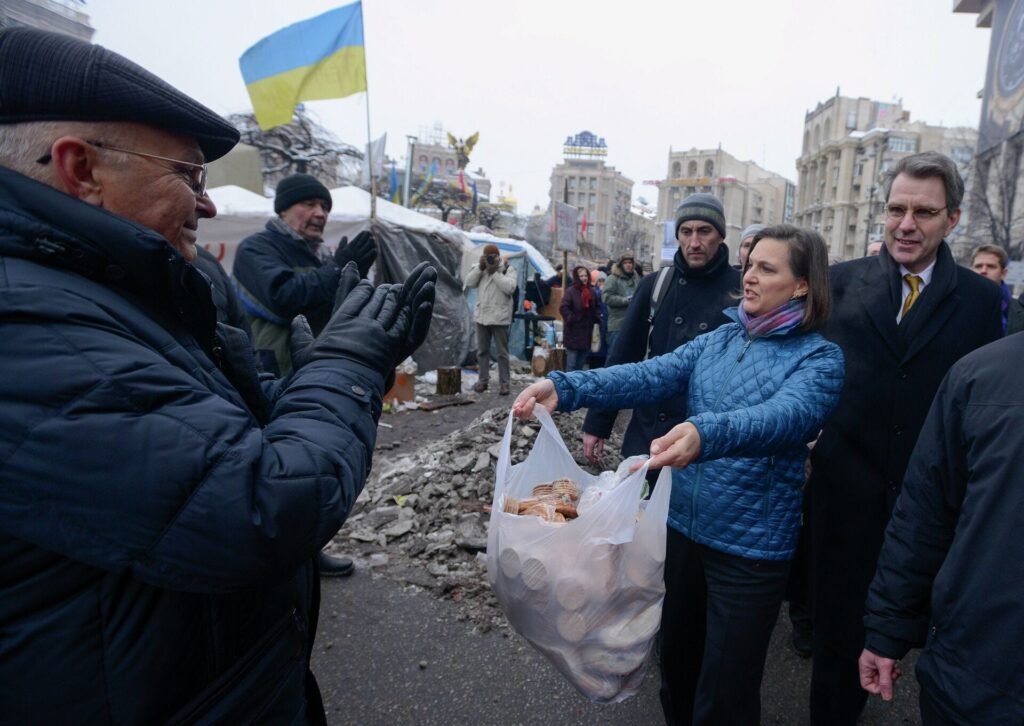
Victoria Nuland in Kiev, February 2014
And all during the civil war that then ensued, until the Russians intervened in late February 2022, US/NATO intelligence and special forces operatives were active in Ukraine, in support of the Kiev government’s military movements in the Donbass.
The crisis became increasingly acute over the course of the first Trump administration, even as the twin objectives of subduing the Donbass and retaking Crimea became increasingly apparent.
As I posted on Twitter in April of 2021:
Ukraine has two options: accept its role as a buffer state, or be dismembered. If the US goads them into an attempt to subjugate the Donbass, Russia will slice away eastern Ukraine and assimilate it — and there is *nothing* the US can do to prevent it.
Fact is, the big geostrategic nation-state wars are always decades in the making. So it was in the case of the war in Ukraine.
But the unavoidable trajectory of war was set in stone during Donald Trump’s FIRST rodeo in the White House. Trump owns the Ukraine War more than Joe Biden’s Autopen. At least Trump laid claim to a modest degree of cogency in his first term.
The apparition of Joe Biden, dazed and confused, simply watched dumbfounded as long-fated events flashed before his empty eyes.
China
One of Trump’s first actions after he was inaugurated in 2017 was to announce a sale to Taiwan of Harpoon anti-ship missiles, SM-2 and SM-3 naval air defense missiles, MK-48 torpedoes, and advanced radar systems.
In 2019, to much fanfare, Trump announced the sale to Taiwan of 66 F-16V fighters.
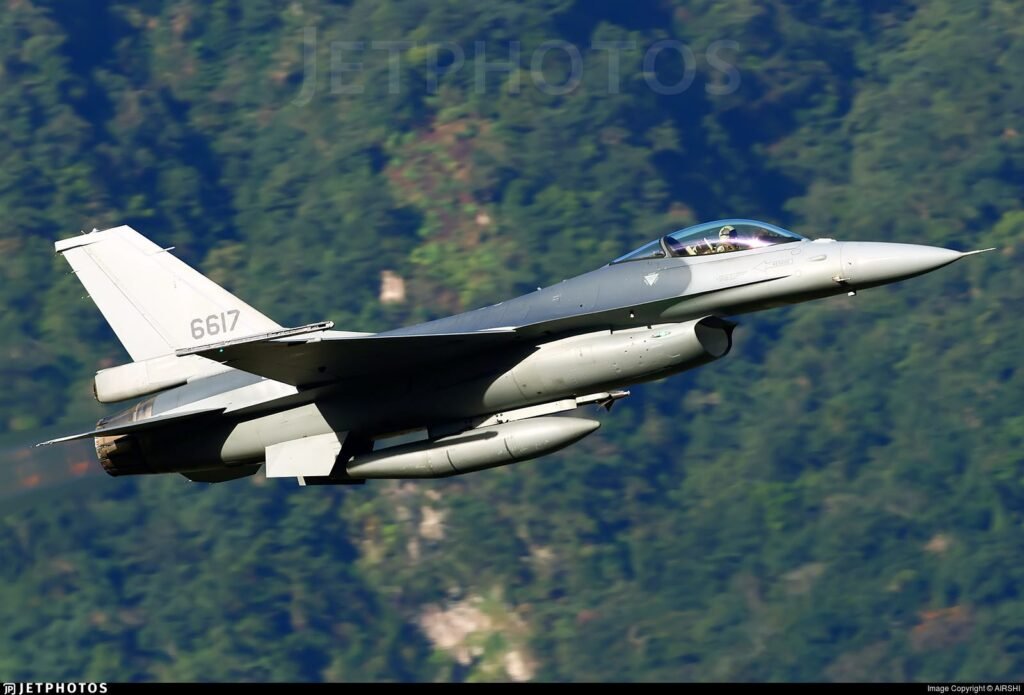
F-16V Fighter – Taiwan
In 2020, Trump announced the sale of even more Harpoon ASMs, HIMARS systems, and MQ-9B drones.
Trump also, over the course of his first term, sent a total of about 300 US Army and Marine special forces operators to Taiwan. Since Trump’s second term began, that number has been increased to over 500 – including substantial contingents on Penghu and Kinmen Island, which is just six miles from the Chinese coast.
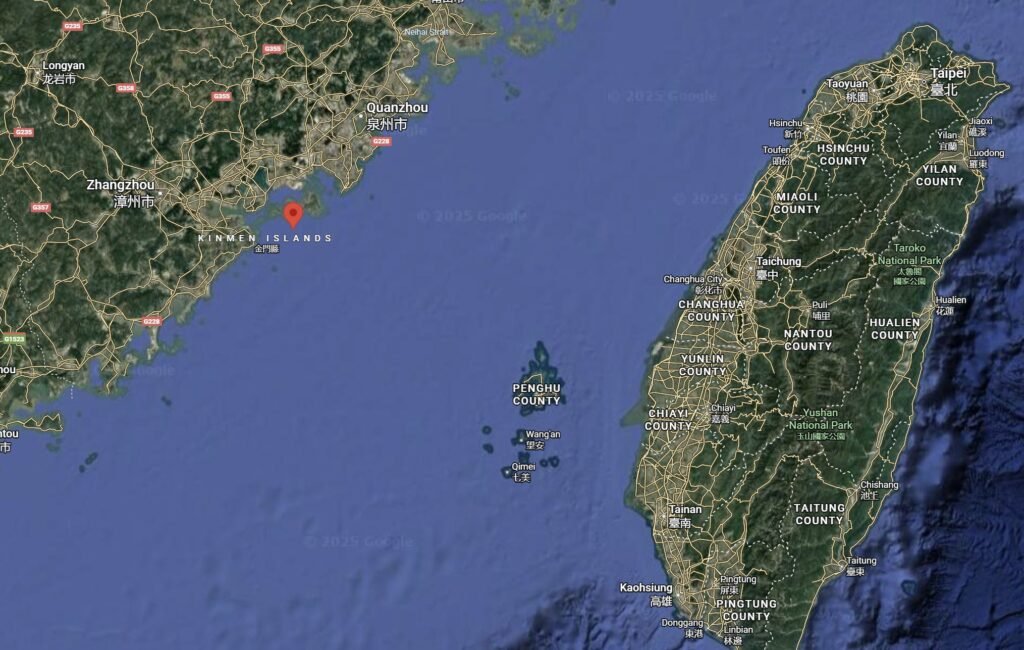
Kinmen and Penghu Islands in the Taiwan Strait
This permanent basing of a full battalion of US troops in Taiwan was unprecedented prior to Trump’s first term. And, understandably, it is regarded by China as an unprecedented provocation. Consequently, Chinese preparations for a possible war in and around its home seas have greatly accelerated.
And, in what is arguably his most strategically ill-advised move of all, Trump 45 started the trade and rhetoric war with China that continues to the present day.
There are now even widespread rumors that the US Department of War is preparing a naval blockade of energy imports into China — an act of utter madness.
IRAN
Trump, in concert with the Israelis, started the major war with Iran that continues to this day — albeit currently in one of its typical intermissions.
In what I consider to have been the most brazen act of war in his first administration, Trump ordered the assassination of Iranian General Qasem Soleimani, on January 3, 2020, at the Baghdad airport.
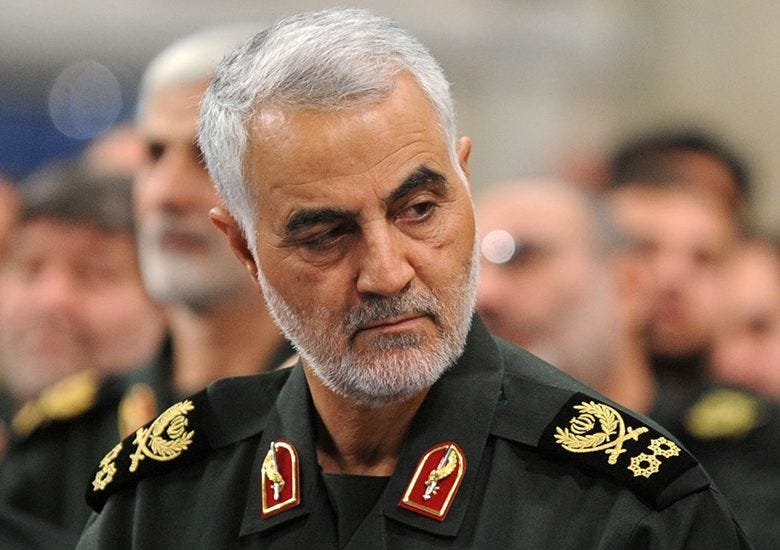
Iranian General Qasem Soleimani
Soleimani was on a diplomatic mission to Baghdad at the invitation of Iraqi Prime Minister Adil Abdul-Mahdi, who had been acting as the intermediary between the Saudis and the Iranians, who were working to de-escalate drone and missile attacks by Iraqi militias against American bases in Iraq, and the Green Zone in Baghdad.
Soleimani was traveling to deliver Iran’s official response to a Saudi Arabian mediation proposal.
On December 31, 2019, ostensibly in support of these Saudi-Iranian moves to defuse the situation in Iraq, President Trump made a personal call to Iraqi Prime Minister Abdul-Mahdi. The Iraqi leader then called Soleimani to arrange a meeting in the Green Zone in Baghdad, scheduled for the morning of January 3, 2020.
Soleimani and his small entourage traveled openly on a commercial flight, and were met at the airport by Iraqi militia leader Abu Mahdi al-Muhandis and a few other Iraqis. As Soleimani, al-Muhandis, and eight others were traveling from the airport to the Green Zone in two vehicles, an American MQ-9 Reaper drone fired Hellfire missiles and blew them all to smithereens.
President Trump directly ordered the attack, and afterwards publicly gloried in his perfidy.
Soleimani was considered a national hero in Iran, and was arguably the second-most powerful and influential political figure in Iran at the time, behind only the Ayatollah Khamenei.
The Iranians were justifiably outraged.
On January 8, 2020, Iran launched a ballistic missile attack against the American Ayn al-Asad airbase in Iraq. About 15 Iranian ballistic missiles targeted the base with shockingly impressive accuracy, although it was clear the strike was mostly demonstrative in nature, and the Iranians deliberately avoided killing US troops.
Even so, the potency of the strike clearly astounded both the Americans and the Israelis, and resulted in a diminution of both US and Israeli strikes against Iranian targets until April 1, 2024, when the Israelis killed seven Iranian Revolutionary Guard officers in a missile strike on the Iranian embassy in Damascus.
Two weeks later (April 13-14, 2024), the Iranians launched a massive and unprecedented missile strike against Israel. This then led directly to the series of exchanges between Israel and Iran which took place over the course of the ensuing months, culminating in the so-called 12-Day War between the US/Israel and Iran from June 13-24, 2025.
Of course, it must be understood that this war between the US/Israel and Iran is NOT over yet. It is just on a brief hiatus, and there are indications in recent days that Israel is planning new strikes against Iran.
But make no mistake, the catalyzing event for this greatly escalated war with Iran was Trump’s treacherous murder of Qasem Soleimani on January 3, 2020.
VENEZUELA
Trump began publicly expressing his desire to go to war against Venezuela, and to seize its oil, no later than July 2017. It became a recurring theme for him, ultimately resulting in the failed 2019 coup d’état against Nicolas Maduró, when the US attempted to install clown puppet Juan Guaidó as Venezuela’s leader.
Trump is quoted as saying:
“I don’t understand why we’re not looking at Venezuela. Why are we not at war with Venezuela?”
“That’s the country we should be going to war with. They have all that oil and they’re right on our back door.”
Trump’s bellicose language towards Venezuela continued all through his first term, and as a result, Venezuela’s longstanding friends Russia, China, and Iran began to more aggressively strengthen Venezuela’s military capabilities in anticipation of an eventual US attack and potential invasion of the South American country that holds the largest proven oil reserves in the world.
Now, as I write here on Thanksgiving Day 2025, the United States has positioned a massive naval fleet and Marine landing force off the coast of Venezuela, and it appears almost certain that military operations against the Maduro regime will commence imminently, with the overt aim of installing a new puppet government whose putative leader, CIA-groomed Nobel Peace Prize winner María Corina Machado, has explicitly called for an American invasion of the Bolivarian Republic, and pledged to permit the US to take control of Venezuela’s oil, gold, and other mineral wealth.

María Corina Machado
SOUTHCOM has even provided a slick promotional video for the upcoming war against Venezuela:
Peace through strength:
Carrier Strike Group Twelve is making a powerful impact in the #SOUTHCOM region—standing strong to deter illicit networks, disrupt transnational threats, protect the Caribbean, and defend our homeland with purpose and presence. @CVN78_GRFord @USNavy pic.twitter.com/LTEt3iFB1v— U.S. Southern Command (@Southcom) November 17, 2025
The Imaginary Peace President
Trump, consumed by his own lust to become a celebrated recipient of the Nobel Peace Prize, has been claiming for months now to have ended no fewer than eight imaginary wars.
In reality, President Donald J. Trump has exhibited one of the most itchy trigger fingers of any US president in my lifetime (Eisenhower was still president when I was born).
Incredibly, he has chosen to pick fights with the most powerful adversaries the US has faced since the Second World War: Russia, China, and Iran. And, worst of all, he has catalyzed the formation of an unbeatable military and economic alliance between those three ascendant civilizational powers, even as American military power has eroded to its post-WW2 nadir.
Of course, most Americans possess a knowledge and understanding of war and US military might as it has been portrayed for decades in Hollywood movies and video games. And therefore, when Trump waxes grandiloquent about the United States being the greatest military force in human history, American vanity is easily persuaded that there is no nation on earth the US cannot trample underfoot with one hand tied behind its back.
Neither Donald Trump nor many Americans realize there are no easy wars left to fight. But that sobering truth will be laid bare for all to see between now and the end of the final term of The Imaginary Peace President.
Pepe Escobar on Sputnik
The Unit project, first revealed by Sputnik in 2024, is emerging as the most viable option for breaking the US dollar’s stranglehold on global trade and investment.
In his book co-written with top economist Sergey Bodrunov, Regulations of the Noonomy (international edition published this year by Sandro Teti Editore in Rome), leading Russian economist Sergey Glazyev stresses the need to “ensure a full-fledged switch to national currencies in mutual trade and investment within the EAEU and the CIS, and further – within the BRICS and SCO, the withdrawal of joint development institutions from the dollar zone, the development of their own independent payment systems and interbank information exchange systems.”
When it comes to financial innovation – compared to the current structure of the international financial system – The Unit is in a class of its own.
The Unit is essentially a benchmark token – or an index token; a post-stablecoin, digital monetary tool; totally decentralized; and with intrinsic value anchored in real assets: gold and sovereign currencies.
The Unit can be used either as part of a new digital infrastructure – what most of the Global South is striving for; or as part of a traditional banking setup.
When it comes to fulfilling traditional money functions, The Unit is – pardon the pun – right on the money. It’s meant to be used as a quite convenient medium of exchange in cross-border trade and investments – a key plank of the diversification actively pursued by BRICS+.
It should also be seen as an independent, reliable measure for value and pricing, as well as a better store of value than fiat money.
The Unit is academically validated – including by Glazyev himself – and properly governed by IRIAS (International Research Institute for Advanced Systems), set up in 1976 in accordance with the UN statute.
And crucial at this next step, The Unit is to be launched early next year on the Cardano blockchain, which uses the digital currency Ada.
Ada has a fascinating background – named after Ada Lovelace, a 19th-century mathematician, daughter of none other than Lord Byron, and recognized as the first computer programmer in History.
Anyone, anywhere can use Ada as a secure exchange of value; and very important, without the need to ask a third party to mediate the exchange.
That means every Ada transaction is permanently secured and recorded on the Cardano blockchain. That also means that every Ada holder also holds a stake in the Cardano network.
Cardano has been around for 10 years now – and is a quite popular blockchain. It’s backed by some quite big venture capital firms such as IOHK, Emurgo and the Cardano Foundation. Essentially, Cardano is an excellent option for regular payments because transactions are cheap and fast.
Neither a crypto nor a stablecoin
Enter The Unit.
The Unit is neither a cryptocurrency nor a stablecoin – as it’s shown here.
A concise definition of The Unit would be a resilient reserve of value – backed by a structure of 60% gold and 40% diversified BRICS+ currencies.
The major appeal for the Global South is that such a unique mix provides stability and protection against inflation, especially under the current global financial landscape of wobbly macroeconomics and widespread uncertainty.
Using Cardano, The Unit is bound to become accessible to everyone, via a combination of centralized and decentralized exchanges.
So to enter this new market, individuals and companies will be able to acquire The Unit directly with fiat through regulated banking partners. That means a bridge between traditional finance and emerging decentralized ecosystems – in favor of liquidity, accessibility and reliability, opening the door to full adoption by the Global South.
The Unit can even evolve into a new form of digital cash for emerging economies.
Following exactly the path delineated by BRICS even before the ground-breaking annual summit in Kazan in 2024, The Unit may be the best solution currently available for cross-border payments: a new form of international currency, issued in a de-centralized way, and then recognized and regulated at a national level.
And that brings us to the top conceptual strenght of The Unit: it removes a direct dependency on the currency of other nations, and offers the Global South/Global Majority a new form of non-censored, apolitical money.
Better yet: apolitical money featuring an enormous potential for anchoring fair trade and multiple investments.
What the Global South really needs
A good next step for The Unit would also be to set up an Advisory Board, uniting world standard stars such as Prof. Michael Hudson, Jeffrey Sachs, Yannis Varoufakis and the co-founder of the NDB Paulo Nogueira Batista Jr. (here at the Global South Academic Forum in Shanghai) .
When it comes to BRICs-emphasized de-dollarization – done with a hefty degree of sophistication, without having to spell it out – The Unit will be key. It’s also key that The Unit is not a cryptocurrency.
Wall Street behemoths – especially BlackRock – are big on cryptocurrencies, an enormously unstable set up which eschewed individual holders to the profit of massive institutional players. For example, it’s BlackRock that essentially shapes Bitcoin’s market.
US stablecoins essentially perpetuate US dollar dominance – aiming their firepower directly against possible, future digital currencies offered by BRICS+.
The Unit is the stark opposite, offering a reliable digital monetary tool for the fast advancing Multipolar World. It’s an evolution in itself, bridging the fiat and the crypto worlds; and last but not least, it is a solid foundation for the emerging post-Bretton Woods economy.
Of course the challenges ahead are huge – and The Unit will be fought tooth and nail by the usual suspects as a new concept offering borderless financial resilience for the Global South/Global Majority.
And here may lie the key takeaway: the only way BRICS+ as well as the Global Majority may be strengthened is by developing closer and closer geoeconomic, financial ties. For that, the toxic power of Western speculative capital must be contained – to the benefit of more intra-Global South commodity trading, and more investable capital for productive, sustainable development.
The potential is limitless. The Unit may well be able to unlock it. Even JP Morgan admitted The Unit is “perhaps the most thoroughly fleshed-out of de-dollarization proposals that exist in the cross-border transactions space for BRICS+.”
And there’s no other similarly effective plan anywhere in the world.
“This event of the housing bubble, crash, and crisis, was not an accident. We need to dig a little deeper, to trace this event from its inception … and to the broader category of the War on Humanity.”
By Larry Romanoff at Blue Moon of Shanghai.
This essay is about housing, and the Khazar Jews’ plan to eliminate home ownership for all but the (primarily) Jewish financier and industrial classes. Yes, I know. It sounds like just another conspiracy theory, but reserve your judgment until the end.
It can be hard to figure out who actually owns a building. Homes being treated like major sources of capital, instead of places for people to live.
British banker Montagu Collet Norman (1871 – 1950), 1st Baron Norman, Governor of the Bank of England. Source
I would remind readers here again about the statement by Montagu Norman, who was the Governor of the Rothschild-owned Bank of England, to the United States Bankers’ Association in 1924, often referred to as “The Bankers’ Manifesto”:
“Capital must protect itself in every possible way, both by combination and legislation. Debts must be collected, mortgages foreclosed as rapidly as possible. When, through the process of law, the common people lose their homes, they will become more docile and more easily governed through the strong arm of government applied by a central power of wealth under leading financiers. These truths are well known among our principal men who are now engaged in forming an imperialism to govern the world. By dividing the voter through the political party system, we can get them to expend their energies in fighting for questions of no importance. It is thus by discreet action we can secure for ourselves that which has been so well planned and so successfully accomplished.” [1]
There is no way to misunderstand the man’s words. The quote contains several distinct ideas, all of which are truly ominous for people in almost every country.
“We shall have world government, whether or not we like it. The only question is whether world government will be achieved by conquest or consent.” James Paul Warburg (1896-1969) was the son of Paul Moritz Warburg, nephew of Felix Warburg and of Jacob Schiff, both of Kuhn, Loeb & Company which financed the Russian Revolution through James’ brother Max, banker to the government of Germany. Source
I would remind you of James Paul Warburg, Jewish Banker, who in 1950 testimony to the U.S. Senate, said, “We shall have world government, whether or not we like it. The only question is whether world government will be achieved by conquest or consent.” [2] I would remind you also of David Rockefeller, Chairman of the Chase Manhattan Bank, who stated in 1991 during a Bilderberg Meeting, “We are grateful to The Washington Post, The New York Times, Time Magazine, and other great publications… for their commitment to global governance. The supranational sovereignty of an intellectual elite and world bankers is surely preferable to the national auto-determination practiced in past centuries.” [3] Rockefeller explicitly endorsed a “supranational sovereignty” led by bankers and elites, dismissing national sovereignty as outdated. This is directly connected to the Jews’ War on Humanity, because we will first be subjugated and colonised, one representation of this condition is us being homeless renters. This is not a joke.
To fully appreciate the extreme ferocity of this intent and the power and influence that lie behind it, we need to take a closer look at the 2008 housing crisis and financial meltdown. This is a complex topic with much detail necessary, so I have divided it into 4 parts.
The “housing problem” is a social boil that has been festering for many decades, and it emerged in full force (yet again) in 2007-2008 in the so-called “financial meltdown”. The 2008 financial crisis resulted in tens of millions of families in the US and some other nations losing their homes. This was generally referred to in the mass media as a “housing bubble”, insinuating that the problem somehow “just happened”.
But it didn’t just happen. It resulted from the confluence of processes consciously and deliberately executed by established capital, primarily the US FED, firms like Goldman Sachs, many banks, and some other participants, and of legislation and policies effected by the US government. We needn’t pretend to consider this a conspiracy between the major players. It is sufficient that they were all on the same page at the same time, each acting in their own interest, but with their actions complementing each other and magnifying the result. We can think of it as a sharp confluence of interests rather than a secret conspiracy. Nevertheless, when we examine the details, it is inescapable that the “housing bubble” was deliberately created and executed by a select group of actors with a willing and supporting cast, and that the end result was clearly foreseen at the inception of this process.
And that leads us to the inconvenient truth that foreseeable consequences imply deliberate intent. I can foresee the consequences of striking a window with a hammer; it does me no good to claim I didn’t mean to break the glass. Foreseeable consequences imply deliberate intent.
It is necessary to emphasise that, while the bubble was being inflated, all the participants had to be aware of that fact, and also aware of the inevitable result. First, the US FED opened the credit taps wide, providing virtually unlimited credit for home purchases. Next, mortgage interest rates were reduced to an all-time a low, not only making home purchases possible for many otherwise unenfranchised families but also encouraging widespread speculation. At one point in Canada, the mortgage interest rate at the major banks was 0%. If that isn’t a warning sign of something, then what would be? How can a bank lend money at 0% interest and remain solvent? As another indication, particularly in the US, the normal conditions required to qualify for obtaining a mortgage, were totally deleted. As the bubble inflated, mortgage applications contained no requirement for a minimum income, nor even for the applicant to have a job. House mortgages were available with no down payment, the banks willingly lending the entire appraised value of a dwelling. Further, the normal legal fees and real estate commissions were simply added to the mortgage amount. All the normal requirements for obtaining a home mortgage were suspended, along with all the cautious lending practices of banks.
At the end, the mortgage market was flooded with what were termed “LIAR” loans and “NINJA” loans. The LIAR mortgages were loans made with no documentation: borrowers could state their income or assets without verification. The NINJA Loans meant “No Income, No Job, no Assets.” The situation became so ludicrous that, at the end, homeless unemployed drifters – with zero assets – were obtaining mortgages on $500,000 homes. Given that every participant in the financial industry had to be fully aware of these conditions, we can hardly claim the housing bubble was an unexpected accident.
To summarise: (1) Credit was easily available to anyone, with virtually no limitations; (2) you could purchase a home at an extraordinarily low interest rate – sometimes zero; (3) you could purchase a home of almost any size or selling price; (4) you needn’t have had sufficient income to qualify for the mortgage payments, and in fact needn’t have had any income at all; (5) you didn’t need to be employed, nor to even have a fixed address; (6) you needn’t have had a down payment; you could borrow not only 100% of the selling price of a house, but also additional funds to cover the legal fees and real estate commissions, all included in the mortgage loan. Countless qualified (and unqualified) purchasers bought a house with the intention of flipping it within weeks at a higher price. This was the situation that actually existed at the time. It shouldn’t require much mental effort to conclude that something was very wrong with this picture.
There were many “customer-friendly” advertisements stating, for example, “It doesn’t matter if you can’t pay the loan every month, you only need to pay interest for the first 24 months, and the principal of the loan can be paid after two years!” [4]
To additionally entice speculative purchases, advertisements promoting “zero down payment” and initially low “teaser” interest rates became common. Billboards everywhere yelled out “Why rent when you can own?”, drawing more buyers into the market and fueling demand. The teaser interest rates meant that mortgage loans were offered at unreasonably low interest rates (sometimes zero) that would “re-set” to much higher levels after perhaps two years. The combination of low interest rates and easy credit led to an increase in speculative buying. Investors purchased homes with the expectation of selling them for a quick profit, contributing to the rapid rise in home prices. Given the frenzied speculation in the housing market, the borrowers essentially relied on “the greater fool theory” which assures us that we will be able to flip this property to yet a greater fool in the near future. Caution was therefore eventually thrown to the wind.
Now think, what would be the natural, inevitable result of this combined set of circumstances? The first is that housing became financialised as an investment commodity, totally detached from the social good of dwellings for people. The second, and most obvious, would be a literal tsunami of home buyers. With free money and no restrictions, and with house prices promising to rise rapidly, why not purchase a house? The third result, stemming from the first two, was a dramatic increase in selling prices. This didn’t occur overnight; the bubble was being inflated since about the year 2000, and by 2008, or even 2006, the median selling price of homes in the US had doubled, and tripled from 1997 prices when the scheming first began for this fraud.
The bubble was obvious to everyone, but greed prevailed. Goldman, Sachs executives slept with dreams of riches far beyond the limitations of mere avarice, while the intermediary financial institutions had the same disease to a lesser extent. The local banks appear to have been totally overcome with equal portions of greed and recklessness, to the point where their lending practices became insanely unrestricted. And the eventual real losers, the individuals who purchased the homes, saw an innocent (and easy) opportunity for profit by purchasing a real estate asset that was rapidly appreciating. Everyone saw only the upside; no one seemed to consider that most hills have a downside.
But this wasn’t the whole story. Goldman, Sachs created something new that was critical to the scheme, and in hindsight appears to have been their main purpose, and also unquestionably the cause of the financial meltdown. Through intermediaries like Countrywide, Washington Mutual, and Wells Fargo, Goldman, Lehman Brothers, and others, purchased these “subprime” mortgage loans from the original lending banks, mixed the good mortgages together with the subprime debt (the trash), Then sliced, diced, and repackaged them as AAA-quality bundled securities called CDOs, and sold them off to innocent pension funds, national social security funds, and other investors. With these bundles being marketed aggressively throughout the world, the demand for mortgages increased almost exponentially, serving to increasingly corrupt lending practices while further inflating the US housing market.
In case it isn’t obvious, I should state that a very significant percentage of the mortgages issued by the various banks were clearly substandard in terms of quality, with potentially millions of borrowers having no hope of making the required mortgage payments. And in fact, by the end of the bubble inflation, nearly all mortgages would have met this description. Yet it is crucial to note that as Goldman, Sachs and others heavily promoted these bundled securities, they assured purchasers the securities were “Grade AAA”. To assist in the fraud, the major stock and securities-rating firms, Standard & Poor’s, Moody’s, and Fitch, cooperated to rate these “securitised investment packages” as Grade AAA. It should have been obvious to investors that AAA could not be possible under these circumstances, but few knew the details of the mortgage securitisation until after the bubble burst.
By 2006, the market reached its limit. As borrowing costs reset higher and household budgets were squeezed, people began to default on their mortgages. This led to a surge in foreclosures, which flooded the market with homes and caused prices to fall sharply. Documented reports were that house prices quickly plunged by 30% to 50% in many US states. [5] [6] To compound the effect, the FED raised interest rates in 2006, claiming an attempt to slow the growth of the housing market, but surreptitiously this was a deliberate act to burst the bubble and to effectively force the desired collapse in house prices. And, as house prices collapsed, the Jewish vulture funds and billionaires swooped into the market to buy up all those foreclosed homes at very low prices. More later.
You can see from the chart below, drawn from the St. Louis FED, what happened to US home sales. Note the dramatic increase from 2000 to 2005/2006, and the plunge to 2010. Note also the repetitive rises and plunges from 1970 onward. None of these were accidents either.
Commensurate with this, the banks and financial institutions faced significant losses on those same mortgage-backed securities, and that led to a widespread credit freeze. This credit freeze, and the subsequent realisation that trillions of dollars’ worth of mortgage securities were of seriously questionable value, led to our “2008 financial crisis”.
Everything I have written above, is generally well-known. But with these details fresh in our minds, we are no closer to being enlightened. We still have no understanding of WHY this disaster occurred, nor in fact HOW it occurred. We need to dig a little deeper, to trace this event from its inception, and to relate it properly to the agenda of the dispossession of the world’s Gentile housing, and to the broader category of the War on Humanity.
This event of the housing bubble, crash, and crisis, was not an accident. When we examine the entire circumstances and connect all the dots, it becomes very clear that the “crisis” was an orchestrated event meant to produce precisely the results that obtained from it. When we examine the details and put all the pieces into proper place, there is no way to avoid the conclusion that the entire 2008 housing event was a planned criminal fraud executed by a small group of players. This is where we will go first.
What Really Happened to Create 2008?
From all the available evidence, this debacle originated somewhere in the bowels of Goldman, Sachs, probably around 1995, when one of their officers or officials conceived the idea of securitising high-interest-rate and high-risk mortgages, and selling them off in tranches that would later be termed “Collateralised Debt Obligations“, or CDOs. Despite the fact that this enormous fraud had many deeply-involved active participants, it needn’t be seen as a conspiracy in any real sense. The impetus for the hatched plan likely originated during a casual discussion over lunch between a Goldman employee and someone from perhaps the Treasury Department. Given the attractiveness of the scheme and its potential for vast profits, and the fact that all the potential actors at this level were reading from the same playbook, the scheme likely took on a life of its own after that discussion. There were many pieces to put into place to create the environment and set the stage for this housing bubble-to-come, but much of this could have been accomplished through casual discussions among the necessary key players. Treasury could have spoken to the FED, the lobbyists from AIPAC to members of Congress, others to the intermediary banks, and some to the local banks as well.
Setting the Stage, Step 1 – The curse of Financialisation
It may not be well understood, but also is not a secret, that the Khazar Jews financialise almost everything. For example, this is the root of the push for privatisation, basically converting public goods into private profit streams. This applies to railroads, airports, prisons, electrical, water and gas utilities, toll highways, and much else. For more background on the severe dangers of this ideology, you may care to read “A Further Look at Privatisation” [7] and “World Map of Privatisation“. [8]
It is the cause of the increasingly short-term vision exemplified by American and most Western multi-national companies, where “long-term” is the next financial quarter. This, in turn, has led to stock buybacks, call centers relocating to India, the offshoring of American manufacturing, huge unemployment, and much more. Simply put, due to financialisation, companies no longer exist to manufacture and provide products, but to avoid taxes and pay high dividends to stockholders. As Steve Ballmer of Microsoft so eloquently said, “Our purpose is not to make good software. Our purpose is to make money.”
The Financialisation of Housing
Returning to housing, the core issue here is that the 2008 crisis really stemmed from a deliberately-programmed fundamental shift in what housing is: from an essential social good to a financial asset. This shift was not an accident, but the consequence of decisions and systems that evolved in planned measure over time. This process that we call “financialisation,” is a complex transformation driven by very specific mechanisms and by very specific actors (all Jewish), with profound implications for economies and societies.
There were several key mechanisms that prioritised the investment value of a house over its use as a home. A classic sign is what we term the “price-rent disconnect”, when housing prices rise far beyond what can be supported by their rental income. When the cost of buying a home is not justified by the potential rent, it indicates that prices are being driven by speculation on future resale value, not by the fundamental value of providing shelter. This speculation creates a dangerous cycle, a kind of self-reinforcing feedback loop. As prices rise, housing becomes a more attractive “investment”, drawing more capital into the market. This influx of money further drives up prices, which in turn attracts even more investment, rapidly inflating a price bubble. This is where the role of easy credit and leverage come into play. This process is deliberately fueled by easy credit, where buyers are encouraged to take on large amounts of debt, betting that future price increases will justify the loans. This of course amplifies both the boom and the eventual bust. This shift to the financialisation of American housing wasn’t an accident; it was propelled by the actions and incentives of several key groups. And, it is important to point out, this wasn’t the first time.
The consequences of the financialisation of housing are very serious. Speculative “investment” in housing, as opposed to normal purchases, seriously distorts other sectors of a nation’s economy, depriving “real” sectors of needed capital. The attraction is vast immediate profits, even though the activity contributes nothing to a nation’s economy and in real life distorts it badly. Also, housing financialisation worsens the gap between the rich and the poor. It creates a situation where those who already own property assets see their wealth grow effortlessly, while younger generations and lower-income families find it nearly impossible to get on the property ladder. This is one of the main factors that has destroyed the prospect of social mobility in the US and many Western countries. Those who can never accumulate a down payment – and pay off – a home, are almost certainly condemned to remain in the lower class. And of course, a financialised housing market is fragile. When a real estate bubble finally bursts, it will most often trigger a full-blown financial crisis with lasting damage to the entire economy, leaving behind a mess that takes years or decades to clean up. Think of Japan in the 1990s or the US after 2008.
One inevitable result is the abrupt plunge into the lower class by former members of the middle class, and another is the inevitable transfer of wealth from the middle and lower classes to the 1/10th of 1% who engineer these booms and busts. But it is very important to understand the process: the hundreds of billions and even trillions of dollars in losses from a collapsed housing market, are not really ‘lost”; they become profits for the billionaire class who purchase these depreciated assets at pennies on the dollar. The main result of the collapse of any bubble, but here especially a housing bubble, is a transfer of wealth of almost unimaginable proportion from the lower and middle classes to the elite financial class. As I mentioned earlier, as house prices collapsed, the Jewish vulture funds and billionaires swooped into the market to buy up all those foreclosed homes at very low prices. Thus, the equity and value of all those homes (and families) were transferred from tens of millions of Americans into the hands of a few dozen Jews and their hedge funds.
I would note here that China’s approach to this issue is astute. Chinese policymakers and analysts have explicitly identified “real estate financialisation” as a major risk. Official discourse consistently warns that it is as addictive and dangerous as a narcotic to the economy and emphasises that the fundamental positioning of a house is for living, not for speculation. This represents a conscious effort to resist the global trend of financialisation and re-anchor housing policy to its social function. Still, all of this is just background to help us understand the social and financial travesties that were created. We are still lacking the necessary enlightenment.
Roosevelt signs the Glass-Steagall Act on June 16, 1933 to fix banking issues that had led to the Great Depression. Source
Setting the Stage, Step 2 – Regulatory Changes
There were two critical objectives necessary to be accomplished for this fraud to come to life. First, since Goldman’s scheme was clearly prohibited by law at the time it was hatched, Congress would have to be enlisted as a Shabbos Goy agent (servant of the Jews) at some point. Secondly, since the scheme would depend in very large part on stealth and secrecy as to the content (and quality) of the securities to be marketed, this required special legislative protection as well, involving Congress yet again.
For the first point, the Glass-Steagall Act was a law that had long separated commercial banking (taking deposits, making loans) from investment banking (underwriting securities, making speculative bets). That meant that Goldman, Sachs could not proceed with this housing securities fraud with the Glass-Steagall Act still in force. The movers and shakers of this scheme used their “bought and paid for” influence over Congress and the White House, utilising the extortionate abilities of AIPAC and similar pressure groups, and President Bill Clinton signed the repeal into law in November 1999. [9] [10] This repeal not only permitted Goldman, Sachs and friends to plunder the Gentile world unmolested, but it allowed the creation of megabanks like Citigroup that could originate mortgages, package them into securities, and then bet against them, creating catastrophic conflicts of interest.
The second point required laws that were “friendly” to the kind of securitisation that Goldman had in mind. To this point in time, the securitisation of assets, and the various complex insurance policies used to bet on, or bet against, those same securities, were tightly supervised by law. There was no possibility of Goldman, Sachs or Citibank executing this fraud in the dark. This situation clearly had to change and, courtesy again to AIPAC and Bill Clinton, it did change. In 2000, the Commodity Futures Modernization Act (which Clinton again signed into law) explicitly prevented the regulation of Credit Default Swaps (CDS), the insurance policies on CDOs. This allowed the securitised mortgage market to grow in the shadows, completely unregulated. [11] [12] And not only unregulated, but with the ability to completely hide the fraudulent nature of the scheme behind an impenetrable veil of secrecy. There was actually additional protection created to ensure the ability of these Jewish financiers to work in the dark: federal regulators actively preempted state-level attempts to interfere with or disrupt the execution of this fraud by warning them off in advance. The message from the top was clear: do not interfere.
This would be a good place for you to ask yourself WHY Goldman, Sachs and the other initial participants wanted the Class-Steagall act repealed. You might also want to ask yourself WHY the US Congress would, suddenly and without apparent need or provocation, enact legislation prohibiting the supervision of, or investigation into, precisely such schemes as the bankers envisaged. Keep in mind that it is primarily such schemes that demand supervision and investigation. You might also care to ask yourself WHY federal regulators would want to warn the state-level regulators against investigation or interference in the bubble-to-be.
Bill Clinton repealed the Glass-Steagall Act on November 12, 1999. Source
Setting the Stage, Step 3 – Taking The Fraud Worldwide
Something else very important happened that was apparently missed by the media, but that was excruciatingly important to the mortgage fraud. You will recall the repeal of the Glass-Steagall Act which permitted these vultures to loot the American people and the US government of trillions of dollars (to say nothing of the unimaginable social cost). But ambition and greed are unlimited, or at least they were unlimited in this case. Our banker friends actually wanted to loot the entire world, not just the US, but they had a problem in that most countries had their own version of the Glass-Steagall Act, preventing our parasites from exercising their plan outside the US. To re-state, all other countries had laws prohibiting the confluence of commercial and investment banking and also prohibiting the issuance of precisely the toxic and fraudulent securities these bankers wanted to issue. What to do?
At the same time that Henry Paulson became Goldman’s CEO, he apparently conspired (evidenced by a now-public memo) with Lawrence Summers, [13] who was then US Treasury Secretary, and also with a handful of other financial vultures, to remove banking and securities regulation worldwide – just as he had done in the US. While he was Treasury Secretary, Summers was instrumental in blocking all attempts by the US government and society to restrict or even supervise the creation and distribution of this new category of financial assets. He succeeded, but this was insufficient for the worldwide plan. To achieve their goal, Henry Paulson and Lawrence Summers conspired in a scheme to eliminate controls on banks in every country in the world.
To accomplish this, they used the WTO as a platform in what may have been the most egregious campaign of bullying and extortion in world history. In simple terms, the WTO was designed for trade in goods. But Summers and the other bankers concocted an amendment that would force all nations to specifically include banking “services”, and more specifically the trade in derivatives and other toxic financial instruments. Summers and the bankers did a re-draft of the Financial Services Agreement portion of the WTO, with new rules that would force all nations to open their borders to these same banks and their imaginative new financial products. [14] Readers should note that all of the articles and documents critical of this WTO “liberalisation” of financial “services” appear to have been deleted from the Internet. At one time, there were many of these. They may still exist, but the search engines refuse to supply them. The only articles remaining are documents from the WTO or BIS, which present only a sanitised, fairytale narrative. This clearly is a sensitive topic that powerful people want suppressed. Some may still be available on the Wayback Machine at archive.org, although the US is suing to have many documents deleted.
But no nation was sufficiently crazy to willingly enact or accept such changes. Hence, the bullying and extortion. All nations, one by one, were presented with a “Hobson’s choice”; two alternatives equally disastrous and unappealing. Any country refusing to accept the new rules was threatened with economic hell – financial “sanctions”, a total trade embargo, total dislocation from the world’s financial system, confiscation of their US assets, and more. Eventually, almost every nation in the world was bullied into agreement by these Jewish bankers employing typical American “diplomacy”. And thus, the people who arranged the repeal of the Glass-Steagall Act in the US, accomplished the same result worldwide. And now the fraud-based calamity that faced the US people and the US economy, could be inflicted mercilessly on the rest of the world.
Sources: Paulson – Goldman, Sachs; Corzine – Goldman, Sachs; Kamanski – Merrill Lynch – ; Coulter – Bank of America; Reed – Citibank; Shipley – Chase Manhattan
The Horsemen of the Apocalypse
The record indicates there were 5 banks involved initially in this worldwide scheme, but it is important to realise that “banks” do not bully and extort; it is the “bankers” who do that, real people with names. These are the banks and bankers, and their names
Setting the Stage, Step 4 – The “Revolving Door”
You have no doubt read about the constant two-way traffic in the US between the regulators and the regulated. The head of the FDA approves for public sale a questionable but highly-profitable new drug (Think of the Sackler family and their Oxycontin), and six months later is hired by that same pharmaceutical firm at a high salary for a position with no particular duties. It works in reverse, too: A pharmaceutical company wants to distribute a questionable but highly-profitable new drug, but cannot obtain government approval. Suddenly the company’s CEO is appointed as head of the FDA who then magically approve the new drug for sale. Six months later, the man quietly returns to his former position at the pharmaceutical company. There are literally dozens of such examples, each with a purpose that would be obvious even to a child.
I raise the Revolving Door here, because the 2008 housing boom and bust could not have happened without it, and this leads us back to Henry Paulson, the CEO of Goldman, Sachs. Paulson joined Goldman in 1974, became a partner in 1982 and a managing partner in 1988. He co-headed the firm’s investment banking division from 1990 to 1994, when he was named president and chief operating officer. He became Chairman and CEO of Goldman Sachs in 1999, which is almost certainly when the housing mortgage fraud scheme was nearing fruition and being promoted among the select group of bankers. Paulson was promoted to those positions around the time the Glass-Steagall act was repealed, and when the “Act to Protect Criminal Bankers From Scrutiny” was passed.
In May of 2006, when the housing crisis was nearing its peak and the impending explosion was becoming obvious, US then-President George W. Bush chose Paulson as Treasury Secretary, a nomination surprisingly and unconscionably confirmed unanimously by the Senate. Then, in 2008, when the bubble finally burst, Paulson was placed specifically in charge of the US government’s attempts to prevent a full-blown, world-wide credit crisis “resulting from widespread losses on faulty or subprime mortgage loans made by financial institutions”. That is actually an astonishingly euphemistic statement that magically disperses all the blame. Henry Paulson was the Chairman and CEO of Goldman, Sachs in 1999 when the mortgage fraud was implemented there, and remained at the helm through all of its execution, until it was obvious the entire house of cards would soon collapse. At precisely that moment, George Bush opened the revolving door and made Henry Paulson the US Treasury Secretary, where he would now be in a position to protect the bankers from the consequences of their criminality. This is like hiring the bank robber as CEO to now come in and save the bank from insolvency. But without returning the money he stole.
U.S. Treasury Secretary Henry Paulson, Federal Reserve Board Chairman Ben Bernanke, Chairman of the Securities and Exchange Commission Christopher Cox, and director of the Federal Housing Finance Agency James Lockhart III, testify during a hearing before the Senate Banking, Housing and Urban Affairs Committee September 23, 2008 on Capitol Hill in Washington, DC. Source
In this new position, Paulson was given enormous, almost unlimited power over the financial scene, despite his almost unlimited conflicts of interest. One of Paulson’s first acts: “He quickly pushed through the federal takeover of the quasi-government mortgage-loan agencies Fannie Mae and Freddie Mac.” In other words, Paulson engineered the US government takeover of the two massive mortgage agencies that he more or less personally bankrupted while at Goldman, Sachs. Then Paulson worked closely with FED Chairman Ben “helicopter” Bernanke to create a “credit facility”, i.e. quantitative easing (QE), i.e. the sudden issuing of trillions of dollars of free money to all the criminal banks involved in the fraud to enable them to escape with all their profits intact. Paulson and Bernanke especially convinced Congress to quickly pass an act to bail out the insurance company American International Group (AIG). At one point, Paulson was actually on his knees in Congress, begging them to approve the funds for the bailout. [15]
It should warm your heart to know that Paulson was also instrumental in the creation of the “HOPE NOW Alliance”, which was proclaimed as an effort by the same bankers “to assist struggling homeowners during the crisis”. Sadly, it bore no fruit and tens of millions of Americans lost their homes with no banker or government assistance anywhere to be seen. But it played well in the media as an effort to put a human face on the same bankers who caused all those tens of millions to lose their homes in the first place. [16] After having saved all his Jewish banking and insurance friends from bankruptcy, and after expressing appropriate sympathies for all the Gentiles who lost their homes, Paulson was replaced as Treasury Secretary by Timothy Geitner, who carried Paulson’s “financier resurrection programs” to their conclusion.
Stephen Friedman, left, was co-chairman of Goldman, Sachs in 1991 with Robert E. Rubin. Credit Gary Spector. Source
Yet More Background
We could profitably step back a bit further in time, to determine the onset of the planning for this immense worldwide fraud. Robert Rubin was the US Treasury Secretary from 1995 to 1999, and by 1997 he had been already exerting considerable pressure on US officials to “de-regulate” the banks. His first push was to dismantle the barrier between commercial and investment banks, which required the repeal of the Glass-Steagall Act. As one observer noted, this “was like replacing bank vaults with roulette wheels”. Rubin was also part of the Revolving Door, having been a Vice-Chairman of Goldman, Sachs along with Stephen Friedman, and Chairman of the firm’s management committee. [17] According to the Goldman, Sachs website, “Robert Rubin has led both the US Treasury and Goldman Sachs, which gives him a rare perspective on interactions between the financial and political systems.” [18] In this article, Rubin claims “The biggest risks to the US economy are political, not financial”. On this, he is 50% right because it is nearly entirely the Jews’ political influence and parasitical control of the US political system that leads to all these debacles – of which the 2008 meltdown was only one of many. But he was 50% wrong in that, because of the Jews’ control of the US political system, they create most of their disasters through the financial system.
But let’s not lose the main point, which is that the scheme which was being hatched by the bankers to loot the entire world, began around 1995 and required years of pressure on the US Congress to finally create the necessary legal environment for the execution of their massive fraud. And it should be noted that within weeks of leaving his position as Treasury Secretary, Rubin was named the Chairman of Citigroup. This is notable for reasons in addition to the Revolving Door, since it was expressly Rubin’s efforts to “de-regulate” the banks, that permitted the creation of the monstrosity later known as Citigroup.

Setting The Stage, Step 5 – The specialised Mortgage Companies
I stated above that “banks” were the originators of the subprime loans, but that was not entirely accurate. Our friends at Goldman, Sachs et al had conceived the idea of obtaining toxic mortgages in the trillions of dollars, bundling and re-packaging them, stamping them with AAA ratings, and selling them off to unsuspecting buyers all over the world. But there was one bottleneck in this “supply chain”; the investment banks (Goldman, et al) could not depend on the normal inhabitants of the US commercial banking system to cooperate in this fraud. Normal and sane bankers would resist providing mortgages to unemployed drifters, meaning that Henry Paulson’s dreams of unlimited avarice would go unrequited.
The solution was that the investment banks who were behind this fraudulent scheme took matters into their own hands and bought up several dozens of the seedy mortgage companies that lived in the nether world of low-quality high-risk borrowers. For example, Merrill Lynch acquired First Franklin Financial Company, a major subprime lender, and others did something similar. These were not passive investments; they were a strategic move to directly secure and control a steady supply of the high-yield raw material they needed for their CDOs. In cases where they couldn’t find a substandard, subprime mortgage company to purchase, the investment banks created, or financed the creation of, “specialised mortgage companies” to do the dirty work for them. The process functioned much like a manufacturing supply chain.
The record indicates that most of those “specialised” lenders went bankrupt after the bubble burst, and it seems clear that this was the plan, that these mortgage companies were specifically created (or purchased) as “one-trick ponies”, solely to vacuum up every substandard borrower in the US, issue them a mortgage, and supply Goldman and Lehman with the high-yield assets they wanted. Many (perhaps all) of the subprime specialists like New Century Financial and American Home Mortgage Investment Corporation went bankrupt when the bubble burst, confirming the conclusion about these companies being temporary one-purpose tools. This was the actual structure of the subprime mortgage machine. The specialised mortgage companies were the crucial, and disposable, engine designed to generate the specific “product” that investment banks wanted.
It is vitally important to appreciate that the huge contrived demand created by the bankers was not for “housing” or “homes”, but for high-yield mortgages.
Setting The Stage, Step 6 – “Weapons Manufacturing” by Investment Banks
This is where the focus of the scheme could now actively turn to housing. The financial engineers on Wall Street had created in their imaginations a very lucrative and high-yielding securitisation machine, and the housing stock of the United States would now be used as the raw material to feed it. [19]
It is very important for readers to understand this next point: The “demand” in the 2008 bubble was not for “housing”, but for “mortgage investments”, specifically high-yielding (and high risk) mortgages. The creation of mortgage-backed securities (MBS) and collateralized debt obligations (CDOs) would create an insatiable demand for high-yield mortgages. But the only way to obtain mortgages in sufficient numbers was to encourage hugely increased activity in house purchases. The problem was that traditional, safe, 30-year fixed mortgages weren’t sufficiently profitable, and thus unattractive, for what Goldman, Sachs and their friends had in mind. You cannot generate and execute a worldwide financial fraud by offering investors 3% or 5% on their money. You need the temptation of exceptionally high returns and, in the housing market, this could come only from subprime loans. The high yields were available only with high risk – the LIAR loans and the NINJA loans. And now we move into the fraud with a vengeance.
To meet this demand for high-yield mortgages, lenders were incentivised to create a new high-yield product – the subprime mortgage – meaning low quality loans made at high interest rates to those with poor or no credit. This was the root cause of normal banks dumping all their lending restrictions and throwing caution to the winds. It was from this contrived “demand” for high-yield mortgages that mortgage companies began promoting zero down payment and initially low teaser interest rates, intended to draw more buyers – and especially substandard buyers – into the market, thus fueling an almost completely artificial demand for “housing” while providing the high-yield (and very high risk) mortgages. These subprime LIAR and NINJA mortgages were specifically designed according to specifications dictated by Goldman, Sachs.
When the real world is functioning normally, a bank lends its money to a borrower and maintains that loan on its books. It is therefore of considerable interest to the bank that the borrower have the capacity to repay the loan. No bank officer, even one mentally challenged or high on drugs, would issue a mortgage of $500,000 on a house worth $450,000, to an unemployed drifter with no income and no fixed address. But they did. And the reason they did, was that these mortgages were never designed to be retained by the bank. They were issued only for sale to Goldman, Sachs, Bear Sterns, Lehman Brothers, and other financial wizards (parasitic vultures, actually) to be securitised and sold. Thus, the lending banks didn’t care if the borrower could afford the payments because they would have sold off the loan to Wall Street within weeks. You can appreciate that this represented a fundamental shift from traditional lending. [20]
The mortgages did not go from the local banks or mortgage companies directly to Goldman and others similar. There were financial intermediaries like Countrywide, Washington Mutual, and Wells Fargo. It was these intermediaries, acting on explicit instructions from the wizards of Wall Street, who dealt with the local banks. It was they who would communicate in strict and direct terms the kind of mortgage, the size, and the yield required. If the local bank produced the specific high-yield, high-risk mortgages the intermediaries demanded, they were guaranteed purchase by the intermediary and thus these outstandingly risky loans carried no risk for the bank doing the lending.
It was only this guarantee of immediate purchase by Wall Street that prompted the local banks to ignore their normal lending practices.
As if we weren’t already sufficiently deeply embedded in a fraud, there were two powerful supporting frauds in terms of “quality assurance”, and this involved the corruption of the rating agencies and insurance policies from AIG. For Goldman, Sachs and friends to perpetuate this fraud on a global scale, the severely toxic securitised mortgages had to be mislabeled as “safe”, and this first required the conscious, paid complicity of Moody’s, S&P, and Fitch. The profits offered to these agencies were enormous, provided they did what they were told to do. And they did. This was clearly and entirely a criminal fraud, involving willful ignorance and complicity by the rating agencies. Internal emails proved that rating agency analysts knew the models were flawed and referred internally to the securitised mortgage products as “dogshit.” [21] [22] But they rated them AAA anyway because they were knowingly and willingly an important part of the scheme, and were paid handsomely for their fraudulent mislabeling. The rating agencies provided the scientific-looking stamp of approval that made the entire fraud seem legitimate to pension funds and foreign investors. More about the complicity of AIG later.
It should be more than obvious by this time that a Jewish merchant bank hatched a scheme for an immense financial and social fraud, and enlisted many participants as active players. We cannot know exactly how this unfolded. At this distance in time, we will never know who said what to whom. We don’t know who exerted pressure on the US Congress to repeal the Glass-Steagall act, although we know pressure must have been exerted, since Congress would never have originated this abomination its own. And certainly, Bill Clinton was sufficiently compromised and pressured to sign it. We will never know precisely the circumstances that led the US Congress to pass the Commodity Futures Act that prohibited supervision, examination – and even knowledge – of dangerous financial schemes. This was by any measure one of the most recklessly stupid pieces of legislation ever passed by any government anywhere. It was an act that permitted a select few financiers to create financial instruments with a high likelihood of being not only financially disastrous, but also fraudulent and criminal, and specifically prohibiting any government oversight.
Looking back on this immense treasonous criminal scheme, I would conclude that there was no single meeting in which it was created or expanded. Instead, there was most likely a series of conscious decisions by different individuals in different sectors, all reading from the same ideological script of deregulation, profit-maximisation, and obscene greed. There would have been some distinct coordination between the large merchant banks and the intermediaries and between the latter and the local banks, but these might well have been one-on-one conversations. When we have a distinct group of persons, all members of the same small tribe, all of whom are known to each other, and all of whom share the same ideology and “values”, it is easily possible for them to act in coordination without meeting the test of a “conspiracy”. Although, I would say that this distinction is largely academic since the result is the same.
Once again, it is vitally important to appreciate that the huge contrived demand created by the bankers was not for “housing” or “homes”, but for high-yield mortgages that could be bundled as CDOs and sold as high-quality investments to unsuspecting buyers.
The financial system itself was at fault, but this must be personalised to individuals. It is not “the FED” that lowered interest rates to create the bubble and then raised them to burst it, but specific individuals at the FED, all under the watchful eye of Alan Greenspan. It was not “Goldman, Sachs” that created the bundled securities, but senior individuals within that organisation, most likely Henry Paulson who was Chairman and CEO. Identified individuals at banks and other institutions played a key role by providing ample credit for housing purchases, with extremely relaxed lending standards. The widespread securitisation of mortgages was performed by specific individuals at the very large merchant banks – real people with names. There is also a matter of US government policies and legislation; Certainly, Bill Clinton can claim major responsibility for the crisis, but so can most members of the US Congress. And of course, there were specific individuals with names at the rating agencies who actively and knowingly cooperated to fleece the public and investors alike.
Important Reading
≈≈≈
Mr. Romanoff’s writing has been translated into 34 languages and his articles posted on more than 150 foreign-language news and politics websites in more than 30 countries, as well as more than 100 English language platforms. Larry Romanoff is a retired management consultant and businessman. He has held senior executive positions in international consulting firms, and owned an international import-export business. He has been a visiting professor at Shanghai’s Fudan University, presenting case studies in international affairs to senior EMBA classes. Mr. Romanoff lives in Shanghai and is currently writing a series of ten books generally related to China and the West. He is one of the contributing authors to Cynthia McKinney’s new anthology ‘When China Sneezes’. (Chap. 2 — Dealing with Demons).
His full archive can be seen at
https://www.bluemoonofshanghai.com/ + https://www.moonofshanghai.com/
He can be contacted at: 2186604556@qq.com
≈≈≈
NOTES – Part 4
[01] Capital must protect itself in every possible way
[02] The flow of money creates a path to a world group
[03] The flow of money creates a path to a world group
[04] With strong demand support, U.S. real estate will not fall hard
[05] US housing prices fell halfway
[06] The S&P 1 Home Price Index shows that housing prices in major cities in the US are falling at an accelerated pace
[07] A Further Look at Privatisation
[08] World Map of Privatisation
[09] Glass-Steagall Act of 1933: Definition, Effects, and Repeal
[10] Glass-Steagall Act Repealed, USA | 1999-11-12
[11] How Deregulating Derivatives Led to Disaster, and Why Re-Regulating Them Can Prevent Another
[12] Transforming big banks into bucket shops
[13] The Confidential Memo at the Heart of the Global Financial Crisis
[14] The GATS agreement on financial services – liberalisation
[15] “Business leaders in crisis” No. 4: U.S. Treasury Secretary Paulson
[16] Henry Paulson
[17] Rubin and Friedman Become Co-Heads
[18] Robert Rubin: The biggest risks to the US economy are political, not financial
[19] The causes, disposal and enlightenment of the 2008 real estate crisis in the United States: the second part of the overseas real estate series
[20] Why does Bank of America dare to lend high-risk loans?
[21] Dogshit ratings
[22] Dogshit ratings
≈≈≈
This article may contain copyrighted material, the use of which has not been specifically authorised by the copyright owner. This content is being made available under the Fair Use doctrine, and is for educational and information purposes only. There is no commercial use of this content.
Other Works by this Author
Verily, it is Victory or Martyrdom.
Venezuelans have a “true sense of belonging to a project worth saving.. This is a project of collective self-emancipation. .. Those who are committed to the Bolivarian revolution assume themselves as subjects of transformation, not as victims. And this is something to be reckoned with.”
Video Description:
“I’m joined by Cira Pasqual Marquina, author and educator at the Pluriversidad Patria Grande and co-host with Chris Gilbert of the Marxist education program and podcast Escuela de Cuadros.
I ask her:
≈≈≈

Cira Pascual Marquina interviews at Venezuelanalysis.
The Imperialist Offensive is Nothing New for the Bolivarian Revolution’: A Conversation with Ana Maldonado
A Chavista organizer examines the US militarization of the Caribbean and the Bolivarian Revolution’s enduring resistance to imperial aggression.
In recent months, Washington has stepped up its military presence in the Caribbean, sending warships, aircraft, and even a nuclear submarine to waters near Venezuela amid extrajudicial attacks on fishing vessels. For many, this new phase of aggression is all too familiar — part of a decades-long campaign of hybrid warfare designed to undermine Venezuela’s sovereignty.
In this context, Cira Pascual Marquina spoke with Ana Maldonado, a sociologist, international relations coordinator for the Francisco de Miranda Front—a national Chavista movement—and member of the Venezuelan chapter of ALBA Movements. In this interview, Maldonado offers her perspective on how Venezuelans are experiencing the latest imperialist escalation, reflects on the country’s long resistance to hybrid war, and situates the current threat within the broader struggle for sovereignty in Latin America and the Caribbean.
How are the Venezuelan people experiencing this new imperialist escalation?
President Nicolás Maduro has said that in this scenario of maximum pressure, our response must be maximum preparation. At the same time, he has called on us to combine vigilance with calm, to continue our daily lives, and to defend the peace with social justice that has cost us so much to build and preserve.
You can see this clearly in the fact that, even amid the current military escalation, the new school year began normally across the country. More than 20,000 educational institutions opened their doors without disruption, and over six million children and youth returned to class, as they do every year around this time.
While we are indeed facing a serious threat of war, people are also carrying on with their everyday lives and that, in itself, is a victory, since the enemy seeks precisely to disrupt our life.
People abroad are often surprised to learn that daily routines here continue undisturbed and that Venezuelans are not living in a state of panic. How do you explain this?
This is far from our first encounter with imperialist aggression. The tactics may shift, but the strategy remains unchanged: hybrid warfare. For years, US imperialism and its allies have waged a relentless campaign against Venezuela, beginning in earnest in April 2002 with the coup d’état and the people’s heroic counteroffensive that restored democracy. That was followed by the oil sabotage, mercenary incursions, and global media campaigns against our democracy.
After Comandante Chávez passed in 2013, a new and sustained period of aggression began. Initially, they bet that we would fail to hold peaceful elections or that President Maduro would never be elected. The dominant narrative was “Maduro is not Chávez.” With that simplistic argument, they sought to demoralize the Chavista social base, implying that the Bolivarian project would not withstand the loss of the Comandante. Yet we won the elections and, even as we mourned Chávez, the project continued.
But the US and their local agents were determined not to let us go on with our revolution. In 2014, the opposition launched a violent campaign called “La Salida” [The Exit], led by Voluntad Popular and María Corina Machado, the same factions now openly calling for foreign intervention. The following year, the United States took another war-like step: Obama’s 2015 executive order declaring Venezuela an “unusual and extraordinary threat.”
That decree was followed by the 2016 economic strangulation, marked by deliberate shortages aimed at making everyday life unbearable. Ten years later, we remain under a blockade that has killed tens of thousands.
In 2017, the most extreme factions of the opposition returned to the streets with fascist violence, committing atrocities such as the burning alive of a young Black man, Orlando Figuera, targeted simply for looking like a Chavista. More than 100 people were killed during this period of intensified fascist terror.
President Maduro responded by calling for a National Constituent Assembly, once again raising the banner of peace and democracy in the face of fascist violence. People from all sectors, including residents of middle-class neighborhoods whose polling centers had been attacked, were able to vote in peace at the Poliedro de Caracas.
Since then, we’ve lived through multiple phases of hybrid war: Juan Guaidó’s self-proclamation as “interim president” in 2019 and the “Battle of the Bridges,” when the opposition attempted to stage a false-flag operation on the Colombian border under the guise of a humanitarian aid effort. That was followed by massive blackouts that left the country in darkness for days and the 2020 Operation Gideon, recently further exposed in a Max Blumenthal interview with its US organizer, Jordan Goudreau, a former Green Beret.
None of these were isolated incidents: they are coordinated fronts in a sustained hybrid war combining political, psychological, economic, and military aggression.
Yet, in each of these moments, the government and the organized pueblo have responded effectively. During the 2019 electrical sabotage, for example, communities mobilized to ensure access to water and basic needs, while Operation Gideon was defeated by the same fisherfolk who are now being attacked in the Southern Caribbean.
So, to return to your original question: yes, people are alert because the threat is real, but we are also seasoned and organized. We know we are capable of defending the Revolution with unity and discipline. We are in a phase of maximum preparation, with millions voluntarily enrolling in the militia and preparing for the defense of the Patria [homeland].
Indeed, people are not only enlisting in the Bolivarian Militia but also preparing collectively. You’ve given us a historical account of the attacks faced by the Bolivarian Revolution over the past 25 years. But as we know, the current military buildup in the Caribbean is not only against Venezuela: it is an attack on the continent. How do you understand its broader implications?
The imperialist onslaught on the Caribbean is nothing new. Haiti, still punished today for its revolution more than two centuries ago, remains under siege. Now, armed gangs tied to the Dominican Republic are also involved. Puerto Rico continues to endure capitalist dispossession, with five million Puerto Ricans now living in the US while barely three million remain on the island. All the while, revolutionary Cuba has faced a brutal blockade for many decades.
However, the recent imperialist military buildup should deeply concern the peoples of Latin America and the Caribbean, since it signals a shift in Washington’s military policy. Around 10,000 US troops are currently stationed in the Caribbean, mainly in Puerto Rico, to say nothing of the destroyers, nuclear submarine, and air force deployments.
They are not there only to threaten Venezuela; this is the revival of the Monroe Doctrine. As Trump once said, “Why pay for Venezuelan oil, if we can just take it?” That’s how they think about the resources of the continent.
When it comes to Venezuela, beyond seizing our resources, the US also aims to strip away our sovereignty and destroy the example that we represent. If our project succeeds, it will inspire the entire continent. From Canada to Patagonia, people are struggling for liberation, and the Bolivarian Revolution represents a living example of how that can be done.
Attacking Venezuela serves two purposes: to loot our resources and to extinguish the example of participatory democracy. Since 2021, Venezuela has experienced renewed economic growth and the strengthening of its communes and popular power.
That is precisely what Washington wants to halt: they fear that the peoples of Latin America, and even within the United States, will draw inspiration from our experience.
Why the military escalation at this particular moment?
Trump’s slogan “Make America Great Again” is itself an admission of decline. The US is no longer what it once was, and its elites are desperate to recover lost ground. Yet even within those elites, fractures abound between the neoconservatives, the Zionist zealots, and the MAGA bloc. Their internal contradictions often produce erratic foreign policy decisions.
However, on one point they all agree: war is profitable. The military-industrial complex remains central to sustaining the US economy. So even amid domestic tensions, there is a bipartisan consensus around war as business.
Before the recent attacks on Venezuelan vessels, President Maduro warned that they might attempt to recreate a Gulf of Tonkin incident, because their hunger for war is insatiable. He was right: this aggression is ultimately driven by the economic imperative of feeding the war machine. In a post-Cold War world, it survives through perpetual “hot wars”—and what better front than Venezuela, which is rich in resources and defiant of imperial domination?
Let’s close with Chávez. He declared the Bolivarian Revolution anti-imperialist in 2004, but in truth, it always had a sovereign and anti-imperialist character. Could you reflect on Chávez’s anti-imperialism?
Indeed. The formal declaration came during a historic rally at the Botanical Garden in 2004, but the Revolution was Bolivarian from the start, and Bolívar himself was profoundly anti-imperialist. He warned that the United States seemed “destined by Providence to plague the Americas with misery in the name of liberty.” That same spirit lives in our revolution since day one.
Chávez revived Bolívar’s anti-imperialist legacy as early as 1977, when he created the People’s Army for the Liberation of Venezuela, whose founding document enshrined Bolivarianism and anti-imperialism as guiding principles. Later, in The Blue Book [1991], he outlined the vision of sovereignty and dignity that still guides us. President Maduro calls that text a “historical compass” pointing us steadfastly, no matter how much we have to maneuver, toward our strategic goal: the defense of sovereignty and the rejection of imperial domination.
For us, being anti-imperialist means not only refusing to surrender our resources, but also defending our identity, our dignity, and our very being. The empire’s elites belong nowhere; they want the world to belong to them. We, by contrast, define ourselves by belonging to a land, to a pueblo, and to a history.
That is why even symbolic aggressions, such as the attempt to erase “Bolivarian” from the Republic’s name during the 2002 coup, or mocking us as “venecos” in an attempt to erase our identity, are part of the war.
Bolivarianism and anti-imperialism are also deeply rooted in your organization, the Frente Francisco de Miranda. Can you tell us about it?
Indeed. In 2003, Fidel and Chávez founded the Frente Francisco de Miranda as a movement of Bolivarian, anti-imperialist social workers. However, anti-imperialism isn’t limited to my organization; it’s in the bloodstream of millions of Venezuelans who have resisted International Monetary Fund impositions since 1989 and continue defending the Bolivarian project today.
To be Chavista is to be anti-imperialist. Chávez was the first Latin American president to recognize Palestine, to support the Sahrawi Arab Democratic Republic, and to speak of our historical debt to Haiti. His backing of these and other liberation struggles was not just a matter of words but also about material support. He also linked the defense of Haiti to a history that, for him, didn’t begin with Pétion and Dessalines, but with Hatuey, the first known hero of an anti-colonial Caribbean rebellion.
That is our Chávez—the anti-imperialist Chávez—whose legacy continues to guide us!
≈≈≈
Cira Pascual Marquina is a Political Science professor at the Universidad Bolivariana de Venezuela in Caracas. She is also co‐producer and co‐host (with Chris Gilbert) of the Marxist education program Escuela de Cuadros. She is actively engaged with grassroots organizations in Venezuela and abroad, and is dedicated, both as a militant and as an investigator, to communal initiatives.
Russian Foreign Minister Lavrov: The Anglo-Saxons resisted their creation. They wanted summary mass executions, not justice nor exploration of root causes.
≈≈≈
The fundamental root cause of conflict between the Anglo-American led West and the Rest of Humanity, especially the civilizational-states, is the hypocritical bifurcation in International Law, due to recent precedence of “rules-based order” imposed by the West. This was never agreed to by the others.
It was within artificially created spaces in international law (“one law for thee, one law for me”) that a singular supremacist civilization worked to rule all the others.
“Quod licet Iovi, non licet bovi” the Latin for “What is permissible for Jupiter is not permissible for a cow” is the fundamentally unjust hierarchy of the law of the jungle, intolerable to the civilized. It largely worked until recently as they used to hold the incontestible combination of a monopoly on war of scale and economies and wealth accumulation and set the standards and management criteria on which supranational organizations function. But we are at a moment when these fundamental accumulated imbalances are being corrected. A key mechanism involves the return to the letter and spirit of universally agreed tenets of International Law by all.
Of note, Russia led similar efforts at the fair universal application of one law on all. Just prior to WW1, Russian Tsar Nicholas II was instrumental in the creation of the Hague Conventions of 1899 and 1907, establishing the first formal statements of the laws of war and war crimes in the body of secular international law. And it is not a coincidence, as just before 1914, that under the pressure of being coerced into comity and equal relations with Others, that yet again the western realm currently flees forward into more War in order to maintain their predatory way of life.
≈≈≈
Video description & excerpts:
Russia’s foreign minister Sergey Lavrov said the Soviet Union was the driving force behind establishing the Nuremberg Tribunal, arguing that Western powers initially resisted the idea. He claimed the United States and Britain feared a full investigation would expose their pre-war dealings with Nazi Germany. Lavrov also said some Allied leaders preferred mass executions over legal trials, while Moscow pushed for a formal judicial process. He added that core Nuremberg principles remain under pressure in today’s geopolitical climate.
“Question: What do you consider the historical significance of the Nuremberg trials in the post-war years and how did they influence changes in the global order?
Answer: The Nuremberg Tribunal’s founding principles were first formulated during those trials and have become the foundation of modern international law.
They also largely take into account the achievements of Nuremberg in their work. The particular significance of the Nuremberg judgment lies in its establishment of no statute of limitations for crimes against humanity, genocide and war crimes.
And to our great regret, this decree states that there is no statute of limitations for these crimes and that Nazi ideology, the Nazi party and Nazi structures such as the SS, SD, and others are forever banned. Regrettably, these parts of the decree are currently being seriously tested and are often simply violated.”
What a level-headed no-nonsense perspective by a courageous law enforcement professional who worked a quarter century in DEA and lived in South America.
I’m so glad Pepe Escobar paid attention as I did not. That EU nomenclature is so off-putting and when I saw Kaja Kallas, I left the room.
Pepe says: “Petro absolutely RIPPED at the CELAC-EU summit in Santa Marta. A historical/civilizational lesson – delivered in fabulously articulated Spanish. Wonder whether those EU warmongers could even begin to get the message.”
Gustavo Petro is a leader. He needs some seasoning but he has all the talent, the force and presence of personality and the deep knowledge of his region and its history, necessary. History was made.
Gustavo Petro is now, even if only in my eyes, the Ibrahim Traoré of Latin America. Those that know me, know that I act on these impulses and I will send a recommendation to the Foreign Offices of both Burkina Faso and Colombia to “Get together and be alright”. Traoré has combined in the Sahel Alliance the areas that were torn apart through abject colonialism. Petro is only starting the process. They are both sons of guerrilla movements who selected peace as the path forward. They may just have something to talk about. https://sovereignista.com/2025/07/21/ebrahim-traore-a-new-african-covenant/
I formally hand my personal crown to Gustavo Petro, since Evo Morales, the first indigenous leader in Bolivia and in the LAC, lost it via extreme meddling. (Of course one cannot have an indigenous leader on the pink side succeed. What will people say? This was a sad story). There are also strong historical similarities with Jose “Pepe” Mujica (rip), that wonderful man from Uruguay who was the first Latin American leader that I adored. We have the talent and the knowledge. We only need to get rid of the empire.
You can turn on English subtitles on the video, but I so hope some kind soul translates it for us, to try and maintain that articulated quite exceptional but also flowing, non-complicated and non-pretentious Spanish. Early on, he talks about barbarians and barbarity. He then goes into the LAC history, in a way that I’ve never seen it expressed. He touches on his call to again revive and unify Gran Colombia, a confederation of Latin American nations, echoing Simón Bolívar’s integrationist vision. https://english.almayadeen.net/news/politics/petro-renews-call-for-gran-colombia-union-to-unify-latin-ame
—
Colombian President Gustavo Petro delivers a historic address at the 4th EU–CELAC Summit in Santa Marta, highlighting the struggle for democracy, the importance of global dialogue, and Latin America’s role as a beacon for free humanity. He calls for action against modern barbarity, honoring Indigenous and Afro-descendant heritage while promoting peace, diversity, and cooperation.
DRM News Provides Live Coverage From SANTA MARTA Where Leaders from Latin American, Caribbean, and European Union nations gather for the CELAC–EU Summit, focused on strengthening bi-regional cooperation, sustainable trade, and investment partnerships.
Hosted in the vibrant coastal city of Santa Marta, the summit features discussions on economic growth, climate resilience, digital transformation, and social inclusion — all under the theme of shared prosperity and global partnership.
The event opens with a traditional indigenous ceremony, symbolizing unity between regions and respect for cultural heritage, followed by the official heads-of-state photo and plenary sessions with European and Latin American leaders.
https://mid.ru/en/foreign_policy/news/2058518/
Question: Moscow and Washington have almost simultaneously announced nuclear test plans. Does this signify global instability or rather demonstrate equal capabilities and thus the preservation of parity?
Sergey Lavrov: I have heard nothing about Moscow announcing nuclear tests, so it is inaccurate to say that Washington and Moscow made such statements simultaneously.
As I mentioned in a recent interview with Russian media outlets, we have so far not received clarifications from our US counterparts as to what exactly President Donald Trump meant to convey in his remarks. Was it nuclear tests, delivery vehicle tests, or subcritical tests which do not involve a nuclear reaction and are permitted under the Comprehensive Nuclear-Test-Ban Treaty (CTBT)? There has been no answer to that so far.
The CTBT Preparatory Commission met yesterday, but a US representative failed to provide any clarifications, either, although such a forum is clearly the right place to clarify what the US President had in mind when he said that.
The US administration is still in the process of being formed. Many second and third-level positions, primarily in the Pentagon, have so far remained vacant.
In particular, Robert Kadlec has been nominated for the position of Assistant Secretary of Defence for Nuclear Deterrence Policy and Chemical and Biological Defence Programmes. Last week, he spoke before Congress, where he was grilled on the issue of nuclear testing and the current administration’s approach to nuclear weapons. He said that President Trump’s decision to resume nuclear tests was driven by geopolitical considerations. As before, there is no technical need to conduct such tests. That’s a strong statement. I’m not sure whether the speaker himself realises the gravity of what he said, but we are compelled to interpret this as confirmation of what we have been saying all along which is that there is no technical necessity for such tests. He went on to say that the goal was geopolitical and thus drove the point home for us.
What may the geopolitical goal of the United States look like? Domination, right? The use of nuclear weapons argument in this setting is alarming and represents a significant departure from the concept once agreed upon by Ronald Reagan and Mikhail Gorbachev where a nuclear war cannot be won and therefore must never be fought.
Robert Kadlec seeking the position of Assistant Secretary of Defence also stated that nuclear options should be developed to respond to certain regional conflicts that may flare up. That, too, is a rather curious statement. It’s a direct tell that this gentleman, once in office, will be thinking in terms of using nuclear threats in order to achieve the outcomes that the United States may need in a particular region.
He then went on to demonstrate even more instances of double standards when he said that NATO’s nuclear deterrence strategy might be revised in the wake of Russia deploying tactical nuclear weapons in Belarus. Yet, the fact that this was done after many decades of joint nuclear missions with US tactical nuclear weapons long stationed in five NATO member states and the fact that we have long proposed to redeploy all nuclear weapons back to the countries that own them was simply ignored.
Since Belarus has received nuclear weapons from Russia, the US side now wants to deploy theirs somewhere else as well. We are aware of ongoing contacts with South Korea and Japan. These games are very dangerous.
Back to your question, we have not announced nuclear test plans. At a meeting of the Security Council’s permanent members, President Vladimir Putin highlighted US President Donald Trump’s statement that Russia and China have long been doing this, and therefore the United States must do so, too. We immediately contacted our counterparts and let them know that there must have been a misunderstanding. We are looking forward to receiving clarifications.
President Putin has issued a directive not to conduct nuclear tests and not even to make preparations for them. The Foreign Ministry, along with other agencies, including military and intelligence, has been instructed to analyse the situation and to reach a consensus on whether this situation warrants considering the resumption of nuclear tests.
Our principled position was laid out by President Putin in 2023, when, taking a question during one of his speeches, he said that if a nuclear power were to conduct nuclear weapons test (not delivery system tests, not subcritical tests), then Russia will respond in kind.
Question: One more article has recently been published where the journalist and his sources claim that the United States, in particular Secretary of State Marco Rubio has been shocked by your uncompromising stance. Have you really been hard on the Americans or is this yet another article where they have gone too far with their sources?
Sergey Lavrov: We are polite people, and we try to remain polite. I have already answered similar questions in several interviews.
Since this audience consists of professional journalists, I would like to draw your attention to the latest facts of unprofessional and harmful coverage of certain events in the media, primarily British media. You know what is happening at BBC. It’s a shame that some individuals are trying to justify the situation and are speaking about an orchestrated campaign.
I would like you to take note of the item published in The Financial Times, which said that Donald Trump and Vladimir Putin agreed to meet in Budapest and instructed me and Marco Rubio to prepare that meeting. Sergey Lavrov and Marco Rubio have talked on the phone, but before that the Russians allegedly submitted a harsh memorandum after reading which the Americans decided that talking with the Russians would be pointless and meaningless.
There are so many lies here, including when it comes to the sequence of events. The memorandum the FT journalists mentioned is a non-paper, an unofficial draft we have sent to our colleagues not after but several days before the Putin-Trump conversation. It was designed to remind our American colleagues what we discussed in Anchorage, and what agreements we thought we reached (the Americans have not refuted this) during the US-Russian summit. That unofficial document did not contain anything other than what was discussed in Anchorage, which our American counterparts did not regard as cause for rejection.
The presidents’ telephone conversation was held after the document was delivered to the Department of State and the National Security Council. During that conversation, US President Donald Trump did not say a word about receiving a provocative or “subversive” paper that destroyed all hopes for a settlement. No, they had a normal conversation. President Putin gave a positive response to US President Trump’s idea of meeting in Budapest and proposed instructing the countries’ foreign ministries to prepare that meeting. That is exactly what we planned to do.
US President Donald Trump also said that Secretary of State Marco Rubio would call me. I received his call three days later. We had a polite conversation without any nervous episodes, by and large reaffirming progress based on the agreements reached in Anchorage, and went off the phone. The next step was a meeting by representatives of our foreign policy and defence departments, and possibly our security services. However, the Americans have not taken the next step, although we waited for them to take the lead when it comes to the place and time for such a preparatory meeting because they had proposed holding a summit.
Instead, they made a public statement that they don’t want to hold a meaningless meeting. When Secretary of State Rubio made public comments on our telephone conversation, he did not say that he had noticed any aggravation or that it had undermined the chances of success. If I remember correctly, he said that it was a constructive conversation that quite clearly showed where we stand, which is why there was no need for a meeting. This can be interpreted in several ways, but this is what he said. There is a joke that we have a clean conscience because we seldom use it. But it is absolutely to the point in this case.
We see no reasons to offer excuses for being and remaining committed to what our presidents discussed in Alaska. Even if they did not agree on every comma and semi-colon, they have at least reached an understanding.
Question: You just mentioned the summit in Budapest. After his talks in the United States, Hungarian Prime Minister Viktor Orbán said he still hopes the meeting can happen. Is that still a possibility? And why has the focus shifted from a meeting in Hungary to a discussion of nuclear tests? What has changed?
Sergey Lavrov: I believe I have already addressed this. I cannot speak to what is behind the US position on nuclear testing, because President Trump’s claims about a supposed Russian and Chinese “resumption” of testing are simply not true – assuming we are talking about full-scale nuclear weapons tests. Other types of tests, like subcritical experiments (which do not produce a nuclear chain reaction) and tests of delivery systems, have never been prohibited. So, we are seeking clarification on these allegations.
As for the facts: Russia conducted its last nuclear test in 1991, and the United States in 1993. That was over thirty years ago. China’s last test was shortly after that. The most recent test by the DPRK was in 2017. Since then, we have seen no indications that any country is preparing to resume this practice. If someone were attempting to do this covertly, deep underground, it would be up to the professionals involved to expose it. In that case, they should be briefing the White House, not operating behind closed doors.
There is a robust global monitoring system in place, which both Russia and the US participate in. It relies on seismic data to record any significant underground vibrations. They know perfectly well what the indication of a nuclear explosion looks like. So, I would not conflate the issue of nuclear tests with the Budapest Summit.
The other day I watched President Donald Trump host Hungarian Prime Minister Viktor Orban at the White House and then speak with journalists. When asked about a meeting in Budapest, he said that he had thought it over and decided not to hold it, because, he said, “I didn’t think anything was going to be happening of significance.” This fits with the thinking he expressed not long ago when he said that “sometimes you’re better off letting them fight for a while.”
Frankly, I don’t see any causal relationship here. We are ready to discuss the suspicions raised by our US counterparts whereby we have allegedly holed up deep underground and are secretly doing something there. We are also ready to discuss with our US counterparts resuming preparatory work for the summit between the leaders of Russia and the United States, which they themselves proposed.
If and when our US counterparts renew their proposal and appear ready to begin preparations for a high-level meeting that could produce meaningful results, Budapest would, of course, be our preferred location. All the more so as, during his meeting with Viktor Orban, Donald Trump confirmed that Budapest was a preferable venue for Washington as well.
Question: There is not much time left before the New START Treaty expires, yet the United States has not presented its official stance on President Putin’s initiative. Do you think the United States will respond in the near future? If, by any chance, an articulate answer never comes, would that make a difference for Russia?
Sergey Lavrov: We have made it clear many times that this proposal is a unilateral gesture of goodwill on our behalf. No talks or consultations are needed for the United States to support our approach. All the United States needs to do is state that it will not raise the quantitative limits under the Strategic Arms Reduction Treaty for one year that is at least for as long as Russia adheres to its own unilateral commitment. That’s all there is to it. No further steps are required.
As for whether any talks are underway to renew the treaty, no, there are no talks. Once again, the situation is completely transparent. The quantitative levels are well known. We know what the Americans have, and the Americans know what they have. Let’s take a year to, so to speak, cool down, analyse the situation, stop measuring everything by the Ukraine yardstick, and focus on the great powers’ responsibility to maintain global security and stability, above all, in terms of avoiding nuclear war. We are ready for that.
This has nothing to do with the time constraints. A declaration to renew the quantitative limits can be made at any point before February 5. By the way, the current New START Treaty was renewed right after Joe Biden had taken office just a few days before the initial expiration date. Renewing the treaty is a much more complicated endeavour than the simple act of making a voluntary statement to continue observing and respecting its numerical parameters.
Question: Considering rising tensions in the region, has Venezuela approached Russia with a request to provide military assistance? Has Caracas asked Russia to deploy its weapons in Venezuela similar to the way it was done in Belarus?
Sergey Lavrov: No, no such requests have been made.
I believe it is inaccurate to compare our relations with Belarus which is part of the Union State and with which we share synchronised, coordinated, and unified positions on all key international security matters with our relations with the friendly nation of Venezuela which is our strategic and comprehensive partner, to which end we signed a treaty not long ago.
However, considering, among other things, the important geographic factor it would be inaccurate to juxtapose our partnership with Venezuela with our Union with the Republic of Belarus.
The treaty I mentioned is an entirely new instrument. It was signed in May during President Nicolas Maduro’s visit to Moscow to attend the events marking the 80th anniversary of Victory in the Great Patriotic War. The treaty is now in its final ratification phase. It is called the Treaty between the Russian Federation and the Bolivarian Republic of Venezuela on Strategic Partnership and Cooperation and provides for continued collaboration in matters of security, including military-technical cooperation.
We stand ready to act fully within the framework of the commitments we and our Venezuelan friends have assumed in this treaty. It has not yet entered into force. Venezuela has completed its ratification procedures, and we have only a few days left to do so as well. Both chambers – the State Duma and the Federation Council – have held hearings to that effect, and the treaty is almost finalised. We will strictly adhere to the obligations it contains.
I’d be remiss to conclude my comments on Venezuela without mentioning our position on the unacceptable actions the United States is taking under the pretext of combatting drug trafficking as it destroys boats allegedly carrying narcotics, without trial, investigation, or any evidence whatsoever. Law-abiding nations do not do that. This kind of behaviour is more typical of those who consider themselves above the law.
Recently, citing the Daily Mail, Kommersant reported that Belgium was rapidly turning into a narco-state, where corruption, blackmail, violence, and the shadow economy based on drug trafficking flourish across all sectors, from customs to the police. Not the most reputable source, perhaps, but if even Daily Mail wrote this, they must have had a reason to do so. Why else would they slander their NATO partner?
Instead of targeting Nigeria or Venezuela under the guise of fighting drugs – and seizing oil fields in the process – the United States would do better to tackle this problem in Belgium. After all, the US and other NATO troops are already there. They wouldn’t need to chase small boats carrying three individuals each. I’m confident that the policy chosen by the Trump administration with regard to Venezuela will not lead to anything good. It will not enhance Washington’s reputation in the eyes of the international community.
Question: You have repeatedly stated that peace in Ukraine will only be achieved by addressing the root causes of the conflict. As is well known, one of these root causes is the rampant neo-Nazism in Ukraine. Is this issue discussed in your negotiations with American colleagues?
Sergey Lavrov: We regularly raise this issue. In fact, since the Anchorage meeting and my telephone conversation with Marco Rubio, we have had no further contact. We did not specifically broach this topic in Alaska, but they are well aware of our position. It is “in writing” for them. There is no secret about it. The position was articulated by President Vladimir Putin in June 2024, when he spoke at the Foreign Ministry, outlining our fundamental approaches to Ukraine and relations with the West.
Among other absolutely non-negotiable conditions for a settlement – such as demilitarisation, the removal of any threats to the Russian Federation, including by dragging Ukraine into NATO, and safeguarding the rights of Russians and Russian-speakers, as well as the Ukrainian Orthodox Church – there is also the demand for denazification. This is not something we have invented as a notion alien to modern Europe.
One might think of the Nuremberg Trials. Their outcomes, forming part of the UN Charter, are a cornerstone of the international system established after the Second World War. Certainly, all of Europe signed up to this. Germany underwent denazification and a process of repentance.
Regrettably, now – perhaps even beginning with Germany – we sense that this repentance has come to very little. I have spoken about this before: some 15 years ago, during better days, in conversations with German colleagues, we noted the signals they were sending – not verbatim, but the meaning was quite clear. The gist was, “Dear colleagues, we have settled our accounts for the Second World War, we owe nothing to anyone anymore, and now we will act accordingly.”
Former Chancellors Angela Merkel and Olaf Scholz at least tried to observe decorum, while Friedrich Merz has repeatedly declared that his goal is to make Germany the primary military power in Europe once again. I think it unnecessary to explain what kind of signal such statements send – to make Germany the primary military power again. It already was a military power when it conquered more than half of Europe, calling it to arms to attack the Soviet Union.
When such Nazi relapses occur in the birthplace of Nazism, it naturally causes alarm. Naturally, it will require from us – from all those invested in a stable world – principled stances when discussing the final parameters of a settlement.
If the West finally recognises the futility of this scenario, i.e. that the demand should not be for a cessation of hostilities merely to continue arming Ukraine, but to act as President Donald Trump proposed before the Alaska meeting. He said then that a temporary truce would resolve nothing and that the conflict must be ended on the basis of principles for a sustainable settlement.
Yes, Europe later attempted (and not without success) to drag our American colleagues back into its camp of “truce, support for Ukraine, not a step back, not an inch to the left.” Nevertheless, President Donald Trump did say this, and it became the foundation of the understandings unequivocally agreed upon in Anchorage. Incidentally, this is what distinguishes the Republican administration, the administration of Donald Trump, from its predecessor – the administration of Joe Biden.
Recently, I came across an interview with Kurt Volker. He was the US State Department’s special representative for Ukraine under Joe Biden. He claimed that Russia would never agree to a peace deal. It is unclear where he got this from, because it is precisely we who are striving for a peaceful settlement. He added that Vladimir Putin does not consider Ukraine a legitimate or sovereign state. There is an answer to this as well. We recognised Ukraine when it was not a Nazi state and had not banned any language – in this case, Russian – as the only country in the world to do so. We recognised Ukraine as it was defined by the Declaration of State Sovereignty and the Act of Independence: a non-nuclear, non-aligned, neutral state. That is what we recognised, and that is how things stood.
Next, Kurt Volker asserts that Vladimir Putin is convinced Ukraine should be part of Russia (I will not even engage with that topic) and that the Russian President considers Vladimir Zelensky a Nazi. But where is the proof to the contrary? Vladimir Zelensky regularly poses on television, awarding honours to fighters of the Azov regiment [1] and other Nazi battalions, who wear the insignia of Nazi Germany on their sleeves. How else should one regard this man?
The eradication of Nazism in Ukraine – denazification – is an absolute condition for any settlement if we want it to be long-term. We do want that and will pursue it. But when no one in Europe, in their dealings with Ukraine, raises the issue of the country’s Nazification; when no one, except Hungary, addresses the rights of national minorities; when no one demands that Vladimir Zelensky repeal the law banning the canonical Ukrainian Orthodox Church…
In Alaska, when President Vladimir Putin explained to US President Donald Trump how we assess the situation in Ukraine, he mentioned that in 2024, they passed a law aimed at banning the canonical Ukrainian Orthodox Church. President Donald Trump did not believe it. He asked US Secretary of State Marco Rubio, who was present at the meeting, three times whether this was true. Marco Rubio confirmed that it was. It was clear that the US President was, to put it mildly, taken aback.
Returning to Ukraine and its legislation. I mentioned Hungary. When the Brussels bureaucrats, led by Ursula von der Leyen (who is now creating an intelligence structure and will personally oversee it), were pushing through the decision to begin negotiations with Ukraine on its accession to the European Union, Hungary – credit must be given to the courage of Hungarian President Viktor Orbán and his Foreign Minister Péter Szijjártó – stood alone in insisting that among the conditions Ukraine must meet before negotiations begin, there must be the resumption and restoration of all Ukrainian obligations regarding the respect for the rights of national minorities. There is a rather lengthy text on this topic. It was not difficult to draft, because the Constitution of Ukraine still requires respect for the rights of the Russian (singled out specifically) and other national minorities.
Currently, there is the European Commissioner for Enlargement, Marta Kos. When she claims that Ukraine is ready and has fulfilled all the necessary conditions to begin negotiations, this is simply untrue. Nothing has been done to address or restore the rights of national minorities – not even for the Hungarian minority, despite Hungary being a member of both the European Union, which Ukraine so desperately seeks to join, and NATO, where Vladimir Zelensky is also constantly pushing for membership. No action has been taken on this front, just as nothing has been done regarding the remains of the victims of the Volhynia massacre in relation to Poland.
The European Union remains entirely silent on these blatant violations. Ukraine stands as the only country in the world to have completely banned a language. Even in Norway, where 7 percent of the population are ethnic Swedes, Swedish is an official language. The figures speak for themselves – compare that to the situation in Ukraine. From Brussels, we hear nothing about Ukraine’s actions except for the mantra that they must stand with Ukraine to the end, “until victory.”
This same refrain was recently echoed by Mark Rutte and other representatives of the Western European establishment.
They insist that they must always defend Ukraine because it is upholding European values. This is nothing less than a confession – a self-exposure. It reveals that, in the eyes of today’s Brussels bureaucracy, European values equate to the revival of Nazism. That is precisely why we cannot afford to show weakness here.
Question: Recently, Lithuanian authorities have been increasingly flirting with the idea of closing their borders and halting transit to Kaliningrad for Russians, using increasingly flimsy pretexts. What measures is Russia taking, potentially with Minsk, to prevent this? And how will Russia respond if Lithuania follows through?
Sergey Lavrov: These smaller nations – the “young Europeans,” like Lithuania, Latvia, and Estonia – seem to vastly overestimate their importance in the eyes of the Western European “old guard” of the EU. Those in Europe who still possess a shred of common sense and a genuine concern for the continent’s security (a dwindling group, admittedly) are perfectly aware of the provocative role assigned to these Baltic states by their handlers, primarily British ones.
London’s penchant for provoking situations is, of course, notorious. Take the recent case where the Russian FSB exposed a plot to trick a Russian pilot, flying a fighter jet armed with a Kinzhal missile, into flying to a base in Constanta, Romania with a fake order. The obvious intent was for the plane to be shot down, creating a pretext to accuse Russia of attacking NATO. But I’ll set that aside for now; the FSB has already laid out the details. I don’t know how the British will wash away the stain, but they’ve always had a remarkable talent for this, like a duck that waddles away from a shower without a drop of water on its back.
The former empire that once ruled most of the world is gone, and so is the “good old England” they so love to parade. They have little economic weight left, and their military might is relatively weak, as even their nuclear arsenal isn’t fully under their control. They have to compensate for this weakness somehow, so they fall back on that traditional English aspiration to “divide and conquer,” to put it politely. There are, of course, less charitable terms for their actions and goals.
Now, back to your question. Indeed, recently we’ve seen not just the usual threats to block Kaliningrad transit, but certain figures – not in Lithuania, but within the EU itself – egging the Baltics on by suggesting Kaliningrad could be “razed to the ground.” Meanwhile, Lithuania has already closed its border with neighbouring Belarus, leaving hundreds of trucks from Lithuanian carriers stranded there.
On this matter, Belarusian President Alexander Lukashenko, as always, used particularly vivid language. These actions are outrageous. It brings to mind the phrase the Americans once used about dictators in Latin America, in Central America: “He may be a son of a bitch, but he’s our son of a bitch.” That’s precisely the attitude the European bosses have towards the antics of their Baltic protégés. They’re expected to commit as many heinous anti-Russia acts as possible, while also provoking Russia into a response that can be “sold” to Washington primarily as grounds for invoking Article 5 of the NATO treaty and starting serious military action.
We see this clearly. But the obligations regarding Kaliningrad transit are not Lithuania’s alone; they are the obligations of the entire European Union. The 1994 Partnership and Cooperation Agreement between Russia and the EU included a provision on ensuring transit between neighbours. This was reinforced by a separate joint statement on transit in 2002, which had direct legal effect. Then, in 2004, when the Baltic states and other Eastern European nations were admitted to the EU, a Joint Statement on EU Enlargement and EU-Russia Relations was signed, which explicitly reaffirmed all these commitments.
Subsequent technical documents spelled everything out in minute detail, including the layout and procedures for a “temporary travel document” and the clearance processes for passenger and rail cargo transit.
The European Union must now take responsibility for the behaviour of its wayward “junior members” who are spinning out of control.
Back when decisions on admitting Latvia, Lithuania, and Estonia into the European Union were being drafted in 2004, we asked our European counterparts – back then we had plenty of contacts and fairly open trust-based discussions – whether those three Baltic states were ready to meet the EU membership criteria. We were told they fell short in some areas, but…
We wondered whether bringing unqualified candidates into the EU made any sense. They said they knew where we were coming from, but having gained independence those countries were still haunted by phobias of “occupation.” “We’ll bring them into the EU and NATO,” they said, “and they’ll calm down.” Have they? I think the exact opposite happened. Not only did they not calm down, but they decided they would now call the tune in the EU and NATO, at least when it’s about openly Russophobic and anti-Russian “rhapsodies.” That’s the position they have adopted today.
In response to what I’m saying, someone in the EU may argue that we “invaded” Ukraine in violation of certain agreements we had arrived at with the EU before that. I have no doubt someone out there will be willing to come up with an argument like that. They are reluctant to recollect how things actually played out in Ukraine. How it all began long before the Minsk Agreements, long before Crimea, back in 2013, when then President of Ukraine Viktor Yanukovich analysed prospects for signing an EU Association Agreement and realised that many of its provisions would imperil trade, trade arrangements, and other economic benefits Ukraine enjoyed in its contacts with the Russian Federation. He became fully cognisant of this and requested to put off the signing scheduled for late November 2013. We supported his approach. We did so not because we wanted to prevent Ukraine from pursuing relations with other countries, but because we wanted Ukraine to keep its access to its commitments under the CIS Free Trade Area and its economic ties with Russia, which had been vastly beneficial for Ukraine. We also strived to avoid inconsistencies between the principles underlying relations between us and the obligations Ukraine was supposed to assume under the EU Association Agreement.
Back then, President Vladimir Putin reached out to European Commission President José Manuel Barroso (former Portuguese Prime Minister), letting him know that Russia had a free trade area agreement with Ukraine, and the EU planned to create one with Ukraine as well. The principles of these two areas are at odds with each other. Putin suggested having the three parties – Ukraine, Russia, and the European Commission – sit down and discuss ways to harmonise them. What could be more reasonable? Barroso came back through some obscure channels saying that since the EU did not interfere in Russia’s trade with Canada, Russia should likewise stay out of EU-Ukraine relations.
We often talk about former Assistant Secretary of State Victoria Nuland and her confession that $5 billion had been invested in Ukraine over the years preceding the coup. The EU catalysed the Ukraine crisis. It fueled the Maidan protests and planted the catch phrase that Ukraine must be with Europe, not Russia. They said this publicly. So, we should be left out of it, and they shouldn’t justify their own lawlessness by referring to the steps our country was forced to take after exhausting every reserve of goodwill and constructive proposals.
Here are some examples of the EU showing lack of integrity. In 2008-2009, the EU – France in particular – faced issues in Chad and the Central African Republic, which were home to small French expeditionary forces that lacked air support. They asked Russia to send in a helicopter group to assist in operations against rebels that engaged in genocide and other atrocities. We have sent the group as requested. Later, we reached out to our EU partners with a suggestion to create a joint crisis response mechanism for operations abroad based on this experience.
We proposed an approach under which, if Russia were to conduct an operation, we could invite the EU to participate in it on an equal footing, and if the EU were to engage in an operation, it could invite Russia. They were receptive of the idea. Discussions began, and everything appeared to be moving towards the sides coming to terms. Some time later they told us there would be no parity, because there already was an agreement outlining the possibility of Russia’s participation in EU operations, which covers everything. So much for an approach supposedly based on equality.
There are quite a few other examples, including the Meseberg Initiative, which we recently mentioned in our comments. Back then, President Dmitry Medvedev and German Chancellor Angela Merkel agreed in Meseberg on a declaration establishing an EU-Russia Committee on Foreign Policy and Security. Ukraine was not even mentioned, only Transnistria. Merkel insisted on having the creation of that committee come with a condition, namely ensuring progress in the Transnistria settlement. That provision was included. Following those understandings, we ensured the resumption of the “5+2” format for the Transnistria settlement, which had been dormant for several years. The format resumed its work, but when we approached the EU with a proposal to now create the joint Committee on Foreign Policy and Security, they chose not to reply and the idea went off the table. That’s how much the EU’s word and even signature is worth. In this particular case, the EU was represented by Chancellor Angela Merkel.
A particularly glaring example is the visa-free regime with the European Union. Negotiations had been underway even before 2004, as at the Russia–EU summit in 2004, the then-head of the European Commission, Romano Prodi, stated that within a couple of years we would achieve a relaxation of the visa regime. Several years elapsed. We developed our internal regulations based on the framework agreed with the EU. Once these norms were finalised domestically and all requisite bilateral agreements with individual EU member states were concluded, no outstanding condition remained unfulfilled. In response to our query regarding potential timelines for abolishing the visa regime, the European Union engaged in protracted deliberations. Its eventual response was to table a new draft document, proposing a joint consideration of further steps. The document outlined purely technical nuances. Nevertheless, we engaged in this work as well. President Vladimir Putin has repeatedly recalled those times.
Back then, not only was faith alive, but there was also a lingering hope that we were dealing with honourable counterparts.
Ultimately, these additional technical matters were also resolved. This was in the summer of 2013. When we suggested announcing the agreement, they (the EU officials) withdrew from official contacts on the matter and from providing an official response. Off the record, it was intimated to us that, despite our full preparedness, political considerations precluded the conclusion of a visa-free agreement with Russia prior to finalising such agreements with Moldova and Georgia. Ukraine was not mentioned at the time.
Therefore, should the European Union level accusations of violations against us, firstly, there is not a single factual basis for such claims, and secondly, we have ample means to “pacify” our European colleagues.
Question: Next year, the Treaty on Good-Neighbourliness, Friendship, and Cooperation between Russia and China will expire. Are there negotiations underway to extend it? Or will Moscow and Beijing draft new agreements to reflect the changed realities?
Sergey Lavrov: This treaty remains entirely relevant. It is no coincidence that when its initial term expired in 2021, approximately a month prior, President Vladimir Putin and President of the People’s Republic of China Xi Jinping signed a document extending the treaty for five years. These five years are now coming to an end. The 2021 statement affirmed that the treaty remains fully pertinent, retains its force, and serves the interests of further strengthening the comprehensive partnership and strategic cooperation between our countries.
I believe this assessment still holds. However, events are unfolding rapidly, and our strategic cooperation and multifaceted partnership with the PRC are deepening, acquiring new dimensions. In principle, we have agreed with colleagues from other agencies to explore whether specific areas could be used to “enrich” this treaty. I am unsure of the form this might take. It could involve adopting another document confirming and expanding the treaty’s provisions. No definitive decisions have been made yet, nor are they necessary, as such decisions, when put in writing, merely reflect the realities on the ground. In practice, our relations have never been more advanced, close, or trusting. As our Chinese friends say: we work “shoulder to shoulder, back to back” in all spheres of international life. These are not empty words.
Thus, I assure you that the date of July 16, 2026 will not pass unnoticed. The details of how our cooperation with our Chinese friends will be confirmed, expanded, and deepened will be handled by the executive offices of our leaders. A report will subsequently be submitted at the leadership level.
The organisation is recognised as terrorist and banned in the Russian Federation. [There is no link to understand what exactly is being referred to here].
“I walked past a McDonald’s, Starbucks, 7-11 and Kentucky Fried Chicken, all lined up, cheek to cheek. America’s icons will survive its collapse.”
with gratitude to Linh Dinh at Postcards from the End.

Kathmandu. (L): 10/29/25 ; (R): 10/28/25
Go There! — Oct 29, 2025.
Walking a couple miles, I got a last look at everything, that square with the serene stupa and Tibetan temple, KTM Burger, Fire Café, Bueno Burrito, the early morning chai place that made me feel so at home on my first morning, 4 Square with Sumitra mopping the steps, the Indian beggar in his NIKE knit cap, Saroj’s store, founded in 1943 by his grandad, where I bought more treats and yak cheese. I passed too many gorgeous neighborhood temples to count. I moved too fast for stray dogs to say goodbye or curse me for leaving them.
With plenty of time before my flight, I asked the taxi driver to leave me outside the airport’s gate. Thirty-seven years old, he’s been driving 15 years. Though his village is only 100 kilometers away, he doesn’t have to go there since his parents are dead. Only his 55-year-old brother remains.
“Does he want to come here? To work?”
“He was here.”
“No job!”
“No job.”
“At his age, it’s better he stays in the village. When you’re over 45 or so, no one will hire you for anything. They don’t want experience, only young, strong bodies.”
He chuckled in agreement.
“In Vietnam, too, it’s like that.”
“It’s like that everywhere.”
“For women, it’s even worse. They only want young, pretty women in the restaurants and cafés. Hey, how come your English is so good?”
“I practice.”
“No classes?”
“Four classes!” he chuckled.
That’s all he could afford, obviously. He pays 15,000 rupees ($106) a month for rent. His taxi costs 3,000 a day. That’s also the monthly tuition for his five-year-old-son. Since his other son is only 1 ½, his wife must stay home to take care of this baby. Food for four costs 20,000 per month.
“I have no savings,” he said. “Sometimes, I take out loans.”
“But the interests are so high!”
“There are no jobs.”
“Too many people from the villages, and not enough tourists. I’m very surprised.”
“They’re scared.”

Kathmandu, 10/21/25
“But that was what, six or seven weeks ago? It’s perfectly safe here. Even then, there was no danger. If you see a protest, you just walk the other way! Did you see anything?”
“No, just on the mobile,” he chuckled.
“The protests were in a tiny area. Tourists, though, are always nervous. In Kathmandu, they stay inside a tiny area, where they can eat burgers and pizzas!” I laughed. I didn’t confess to pigging out at Bueno Burrito several times. Vung Tau has no Tex-Mex.
Just now, a guy about 50 looked over my shoulder to see what I was typing. We smiled. I’m sitting outside a cheerful and perfectly skanky eatery with dirty dishes on the concrete floor. Waiting to explode, an old gas canister lies on its side. The young waitress looked very nervous when I said, “Chai,” or when I threw up an index finger, meaning one more. Smartly dressed in his school uniform of button-up shirt, neck tie, creased shorts and dress shoes, a boy of eight eyed me as he walked past. Ten feet away, blue and red plastic bags of food garbage lean against each other. All I smell, though, is the curry being cooked. Since I don’t feel like sweating in agony, I’m not going to order anything. Tall bottles of Gorkha are certainly tempting.
This time tomorrow, I’ll be on my last leg to Saigon. Suddenly, I’ll be in balmy weather again. Snow is expected across Nepal within 48 hours. “4,982 escapees are still on the run,” announces the Himalayan on its front page. Also, Cameroon has just elected a 92-year-old president. Since Trump is just 79, Americans should expect 15 more years, at least, of winning big, no inflation and having so much money, they won’t know what to do. Unlike Elvis, Trump won’t ever leave the building.
At 10:16AM, I’ve cleared immigration and security check. There was a long line to just enter the airport. With boarding still an hour away, I rewarded myself with a 500 ml can of Nepal Ice. With its licker content at 6.1%, I’ll be groovy on that plane. Maybe I’ll sing Elvis.
Already, I miss Shree Gha Vihar, but here’s a deep, original thought. You can’t be everywhere at once! I should have been a hash pushing guru. It’s never too late. That’s what they all say, even as they’re lowered into the ground.
That thought just now is but a limp riff on what my long lost buddy, Aziz Vargha, said. When I visited Aziz on the 8th floor of Pennsylvania Hospital, America’s oldest, he lamented, “You know what’s funny, man? You can’t just be somewhere, you must go there! That takes time.”
Born in Iran, Aziz was raised in Germany then the UK before ending up in the USA. He had “MADE IN USA” tattooed on his forehead, back when tatts anywhere was still rare. Sitting in McGlinchey’s among whites, Aziz shouted, “I’m white, man, just like you!” Soon after, he said to a table of blacks, “I’m black, just like you!”
One snowless Christmas, we headed to Kensington to get lots of the white stuff. Doing lines, we laughed so hard. If alive, Aziz would not being do well, I’m sorry to say. He was already a mess four decades ago.
Just sitting still takes time. That’s all we have. Even if it’s just a hundred yards, I’d rather go there.
After my laptop went dead, I rushed to a charging station. Seeing my heavy machine, a woman in her mid 50’s asked in a Germanic or Dutch accent, “Do you want to sit here?”
“No, no, I just need to charge my laptop. Thank you!’
Immediately I thought of an old woman on the Rome subway from 26 years ago. “Chi vuole scendered?” she said in the gentlest voice imaginable. She even smiled slightly.
Such sweetness or civility is what we live for. OK, must run now. Boarding time. I must go there!

Guangzhou, 10/29/25
Too Heavenly for Words — Oct 30, 2025.
If still in Nepal, I would have been in bed by the time I landed in China. Though exhausted, I was also elated at finally entering China, so I headed into town. Getting a transit visa was relatively painless and not too time consuming. After changing $100 into yuans, I found my way to the Metro. Though I had visited Macau and Hong Kong, and saw Chinese streets from across a thin river in Lào Cai, only now was I inside!
Having no Google Maps, I didn’t know which station to get off. One that connected to two other lines sounded like a transportation hub, so must be busy at street level? Outside, there were just vendors selling assorted sausages on sticks, mostly, taxis and motorbike taxis. No stores or cafes were within walking distance. This was Guangzhou at its grubbiest. The station, though, was well appointed. After ten minutes, I headed back in.

Guangzhou, 10/29/25
Since the ticket machine didn’t accept my 100 yuan bill, a uniformed employee went out of her way to get me change. She also suggested a more lively station. This young lady couldn’t have been nicer.
On the train, all but a very old, tiny woman were looking at phones. Whether in Japan, Korea, Malaysia, Thailand or China, Asian subways are new, safe, clean and on time. The squeaking horror shows that still chug along in NYC or Philly are certainly cinematic. Since DC’s Metro must serve swamp dwellers, lobbyists, lawyers and Pentagon staffers, it’s cleaner and safer, though still dark and almost spooky in its cavernous design. DC go-go bars have nicer dancers, too, and they show everything. No coquettish peekaboo. Powerful old creeps don’t have time for subtleties.
Of course I forgot the recommended station, so got off at another drab neighborhood, but this one had stores and restaurants. I walked past a McDonald’s, Starbucks, 7-11 and Kentucky Fried Chicken, all lined up, cheek to cheek. America’s icons will survive its collapse. 7-Eleven has long been owned by the Japanese. Sears, once a symbol of America’s abundance, is mostly dead at home. There are three in Mexico City. I ran into one.
Standing outside McDonald’s, I heard John Denver’s “Take Me Home,” though sung in Cantonese, with only bits of English. “Country roads take me home, to the place I belong. West Virginia, mountain momma. Take me home, country roads.” Arriving in the US in 1975, this was one of the first songs I could almost sing.
Further on was a local fried chicken joint where sat three Chinese and an African. I noticed two pizzarie and several convenience stores. At a bright stand selling lottery tickets, a young female employee slept with her head slumped on a table. I entered a lit up Cantonese restaurant with uncleared tables and beer cans on the floor. To compensate for my suffering, I ordered too much food. I was nearly comatose. Grabbing a takeaway container, I then exited to look for a taxi. Before leaving, I did notice adds for prostitutes inside the toilet. In London, they lined phone booths, with exotic chicks from Spain, Russia, Ukraine, Scandinavia and Brazil, etc., especially popular. Dom leather, water sports, pussy licking, uniforms, toys and spanking were all available.
At Kathmandu’s airport, there were about 30 English high school kids. I heard one say, “I’d be very sad if you were to die on the way back.” Deadpan Brit humor. My favorite is what an Englishman says to his wife after their very first night, “I sure hope you’re pregnant, dear, because I don’t want to go through all those ridiculous motions again.”
Reentering Guangzhou’s airport, I knew my can of Nepal Ice, saved for Sơn in Vũng Tàu, would likely be confiscated, but there’s no way I could drink it myself. I had a can of clam sauce taken in Philly, a bottle of wine snatched somewhere and a jar of confit nearly filched from me at Heathrow. Global madness amplified after 9/11, the Anthrax scare then the Shoe Bomber, all hoaxes. In case you haven’t figured it out, Covid was an American bio attack on China, then Iran. Already a totalitarian state, China didn’t need a fake virus to paralyze itself. It was real enough for them to way overreact. Trump’s economic war against China should also be seen in this context. Xi, and Putin, too, certainly knows who’s his main enemy.
Exhausted and irritated, I made a beeline for those sleeping pods I had seen two weeks earlier. At just 138 yuans ($19.44) for three hours, it was absurdly cheap. Inside, there was a comfy seat that could be reclined nearly flat, lights that could be dimmed, a quiet fan and a TV. I assumed when my three hours were up, some alarm would go off or there would be knocks on the locked door, but nothing happened. I slept two extra hours. This, I only realized after emerging outside. Last night’s employee was asleep at her counter.
Since it wasn’t quite 6AM, restaurants were just setting up. Arabica, though, was open. A latte was just what I needed. Even before my first sip, I took photos of this elegant café. Their baguette sandwiches seemed proper. Nearly all Asian and European airports are more comfortable, better organized and civilized than American ones. At Guangzhou’s, hot or cold water is available for free, and you can sleep well enough even outside those pods. There are also free shower stalls. Even today, you cannot take a train from JFK to Manhattan.
At Mi Cang, I ordered rice gruel with just bits of minced pork and century egg, a peasant breakfast much beloved by my buddy John, an ethnic Chinese in Malaysia. It’s his ultimate comfort food, what his mama must have made often. It’s akin to oatmeal for many Americans. In Macau, I met a Chinese-American transplant who was delighted to find a store selling oatmeal. He needed it to feel at home
At $5.92, Mi Cang’s rice gruel was much fancier, for it came with four Japanese fried dumplings. On the menu were also Vietnamese phở, Japanese ramen with tonkatsu and a burger combo that looked pretty good, but they all do in photos. Eating my grub, I thought of a Nam Cao story where a woman feeds slop meant for pigs to her kids. Her calling it chè, a sweet, cold soup eaten as snacks, doesn’t fool them.
Looking up, I noticed a line at my gate, earlier than expected. Joining it, I asked a young white man if this was for Ho Chi Minh City, but he didn’t answer. Overhearing me, a Chinese said, “Yes, Ho Chi Minh.” The other couldn’t hear because he had earbuds on. To block out the foreign, many tourists must listen to familiar songs and check, constantly, websites from home.
With Guangzhou’s airport so vast, you must often take a shuttle to your plane. Getting on, I immediately looked for Vietnamese faces, but there was none. I also strained to hear Vietnamese, without success. Two weeks earlier, the flight from Saigon to Guangzhou had few Vietnamese. It’s that human or animal instinct to identify your own. Forever, life and death could depend on it.

Guangzhou, 10/29 – 30/25
With more money, and many more people, Chinese are much more visible everywhere. With increasing economic and political might, Chinese tourists and immigrants will be even more ubiquitous. JD Vance’s characterization of them as peasants exposes his hickishness. In Canada and Australia, rich Chinese have made real estate prices in many cities unaffordable for native peasants, workers and even the middle class.
After failing repeatedly to log on to Yahoo! Mail or my SubStack, I realized they were blocked. Everything Yahoo! is inaccessible there. Same with Google, Wikipedia, New York Times and Washington Post, etc. China doesn’t want any American information or disinformation for its citizens.
Rejecting most American products, it’s also prepared to ditch the American consumer. That righteous and pushy slob has been buying on credit for decades, from China, Japan, South Korea, Vietnam, Cambodia and, literally, every country you can think of.
Landing in Saigon, I will leap immediately onto a mini bus for Vung Tau. Failing to bring Sơn a Nepalese beer, I thought of getting him a Chinese one, but busy writing, I never got round to it. Those remaining yuans I’ll use, hopefully, on a proper trip to China.
Cloudy paths, zap me home! To that place, I sorta belong! Ocean mamas, they’re singing and dancing, all right. It’s enough to steal glimpses of them every so often. Why should they sing to me?
On the Kathmandu to Guangzhou leg, two babies on my row screamed or cried often. Others elsewhere did the same. Now, I only hear the slurping of noodles from the guy two seats away. Since there’s no broth, I’m not sure how he does that. Behind me is a well masked American from Chicago. Risking death or long Covid, he did manage to take it off to eat.
I finish this at 6:58PM in Vung Tau. It’s as if I never left. This is Như’s last day at Ông Bầu Coffee, she just told me.
“Where will you go next?”
“I don’t know.”
I don’t either. At some point, I should return to the US to experience, at least for a couple weeks, its Golden Age. I must catch Honolulu, El Paso or San Francisco before it becomes too heavenly for words. As for Philly, I won’t even recognize it, I’m sure.

Guangzhou, 10/30/25
Shrinking Brains and Dwellings — Oct 31, 2025.
On 5/29/25, a garbage truck stopped a Kings Park, NY middle school to empty its dumpster. There, a school janitor saw an injured, garbage draped man trying to climb from the truck. After it emptied its load, another was discovered, but well dead. Since this happened at the back of the school, no student witnessed the horror. Learnt of it from television news, how many thought this could ever happen to them? Much more likely, they envisioned their future as a president, astronaut, NBA star, Hollywood actress, trophy wife, rapper or, at the very least, YouTube influencer. On that date, the low was only 55, so these unfortunates or human garbage had slept inside the dumpster not for warmth, but to be safe. This was conditional on them getting up before the arrival of the garbage truck.
In Santa Monica, bums, especially female ones, dwell inside locked toilets. Further north, you can rent a tent pitched on someone’s backyard. Storage units are more solid, but illegal. Still, thousands of Americans must be dwelling in them. So loaded, they don’t know what to do with their heaps of cash. Those who freeze outside in the winter must be alcoholics or drug addicts, according to conventional wisdom. Don’t say it’s too funny a word in Trumplandia.
Sleeping quite well in my tiny pod at Guangzhou’s airport, I thought these compact solutions should be scattered everywhere. Herding American peasants into cities, huge parks were built to give these factory slaves imitations of their lost landscapes. Thus, we have Central Park in NYC, Prospect Park in Brooklyn, Fairmount Park in Philly and Grant Park in Chicago, all built in the 19th century. Now, all these and more can be filled with sleeping pods, imported from China. Spinning in his grave, Frederick Law Olmsted will appreciate the exercise.
Convicted of any crime, the offender’s sleeping pod can just be locked. With bread sticks tossed in daily, he won’t starve. His shit and piss can be eased out through a hole. Capital punishment will be applied quickly and cheaply by denying him of bread sticks. After the stinking corpse is extracted, his sleeping pod will be sold at a slight discount, after a few sprays of disinfectant.
Just a few hours in China yielded so many solutions. Must be in the air.
In China, porn is banned. In the West, it’s freely available as the last bastion of free speech. Since jerking or stroking nearly nonstop is the best means of social control, it must be made mandatory. TVs inside sleeping pods must show only porn. Wouldn’t this lead to more rapes? Quite the opposite. Men who’ve shot their wad several times a day can only grab, at most. Most Americans are already fine with this, at least in principle. It’s also egalitarian. Why should bottom dwellers be denied some Trumpian perks? “When you’re a star, they let you do it. You can do anything. Grab ’em by the pussy. You can do anything.” MAGA chicks are turned on.

Guangzhou, 10/30/25
The last photo I took in Guangzhou was of a white enough man in a LAS VEGAS hoodie. Next to him was his exhausted wife. Bent over, she held her head. His or her wrinkled, white haired mom looked stunned. On 5/26/25, more than 8,800 flights were delayed in the USA alone. The next day, nearly 7,000.
Flying from Chicago to Frankfurt on 10/28/25, a 28-year-old Indian stabbed two sleeping American teens with a metal fork. He then slapped a woman and a crew member. One teen told investigators he had only exchanged pleasantries with the Indian. This non-immigrant had just finished his studies at Moody Theological Seminary.
Since 42 million Americans will lose food aid tomorrow, proactive cops across the USA have increased patrols around grocery stores, convenience stores and shopping centers. America’s Golden Age has just begun.
Yesterday at Saigon’s airport, I joked with the immigration officer, “Coming back, I’m just waiting to die!”
“You’re not that old, uncle,” she smiled slightly.
“I’m exhausted.”
On the minibus to Vung Tau, we passed a young man with this on his hoodie, “SMILE! IT WILL ONLY GET MUCH WORSE.” His helmet said, “WE WILL ROCK YOU!”
The young lady next to me wore a Covid mask and earbuds. When not dozing off, she stared at her cellphone. Born into universal madness, she’s well lost. After she dropped one earbud, we all helped her to find it. When it was discovered, there was universal jubilation inside that mini bus.
Ông Bầu Coffee’s evening barista just gave me a free glass of hot tea. In a minute, I will head home to eat some yak cheese with Nepali biscuits. This morning, I was too pooped to show up at Coffee Seven before 5AM. Tomorrow, then, I will see Mrs. Seven, Sơn, Liệt, Nọng and Milk Cow.

Vung Tau, 11/1/25
Fish in Teapots — Nov 01, 2025.
At Ông Bầu Coffee, one barista is a rather morose 20-year-old I first talked to only yesterday. It turned out she’s a third year student in logistics. With lots of shipping through Vũng Tàu, she’ll get a job easily, she believes. AI won’t bump her into any dumpster.
Though born after the Boat People crisis, Morose knows about corpses being washed up regularly on Vũng Tàu beaches. She also knows about Vietnamese trying to enter the US illegally during the Biden years. Someone approached her family to propose this. $70,000 per head was all it took, he said, and you’d make that back within two years, working in a nail salon, as if the US wasn’t oversaturated with these Vietnamese businesses. As a clumsy newbie whose English or Ebonics wasn’t good enough to interact with customers, who would hire you?
After eight years, you could return to Vietnam loaded with cash. He didn’t say anything about crossing seven countries before reaching the Promised Land. After entering Panama from Colombia, you would be an illegal for over 3,000 miles while being transported by criminals from various nations.
“What’s stopping them from robbing, raping or killing you?” I said. “People who could afford to fly to South America were rich! They sold everything here, thinking they’d never come back. Now, they’re being deported by Trump!”
Morose has never been outside Vietnam. She didn’t even know you could easily reach Cambodia by bus.
Village explainer, “You can go from Saigon to Bavet in just two hours! Cambodia opens all these casinos for Vietnamese. They want as many to come as possible, so go to Bavet, but without entering the casinos! You’ll just lose all your money! Phnom Penh is much more interesting, but it takes six hours to get there. Go to Bavet first, just to get a taste, then go to Phnom Penh later.”
Here three years, Morose started out making 18K, or 68 cents an hour. Now, she earns 23K. Working 200 hours a month, she takes home $129, though the shifty owner often deducts $27 for unexplained reasons.
Morose never protests. When business is slow, she just stares at her phone, like right now.
Morose lives with her parents just two doors down. At least her school is six miles away. She does visit occasionally a married sister in Saigon and has gone as far north as Nha Trang.
Fancying himself a painter, the owner has set up an easel right at the café. He’s so vapid and timid, you can’t talk to him about anything. It took me less than a minute to find out.
Before me, Như tried to mentor Morose, but it’s useless, she said. This girl is just incurious.
“She never had a chance!” I protested. To invigorate her, I will nudge and shove Morose some more, give her a few kicks in the ass.
Once, I overheard Như telling Morose about a new café that paid better. I’m not sure she applied. Begging for acceptance is always intimidating and dispiriting.
Ông Bầu Coffee has a new regular. A Siamese fighting fish is living, all alone, inside a teapot. Its diameter is four times the length of the fish’s body. There are pebbles at the bottom. Though it’s always lidded, I’ve been reassured there’s enough oxygen for this displaced creature. It could be much worse. Next to this teapot is a glazed ceramic planter with a cartoon cat and “cute” above its head. Taking frequent breaks, Morose would sit next to these exiled beasts.
In the next room, someone is strumming a guitar and singing. Surrounded by kitschy paintings, he and his listeners are soaked in an artistic environment.
Out collecting plastic bottles, that homeless Cambodian will return in the evening. He uses Ông Bầu’s bathroom and sleeps each night just feet from where I’m sitting. Lately, he’s refrained from disturbing that garish altar to the goddess beneath a banyan tree across the street. As long as he doesn’t go berserk, he belongs here at least as much as that fish.
Splotchy and discolored, he’s a piss poor representative of his species. With any residual self-respect, he should be deeply ashamed of himself, but I shouldn’t talk. My dorsal, pectoral, pelvic and anal fins are sad and feeble enough. Still, they’re sufficient to propel me home. After paying for my cappuccini, I’ll swiftly swim outta here.
That yak cheese is nearly gone. That cheerful, repetitive hymn to Ganesh I heard dozens of times daily so recently has faded. Soon enough, I’ll remember nothing.

(L): Vung Tau, 11/1/25 ; (R): Trump’s Golden Lincoln Bathroom
Bloodbaths and Bashes — Nov 02, 2025.
Too much excitement this morning at Ông Bầu. Using her thin jacket, a woman swatted at a bee in mid flight, then stepped on this buzzer after he had dropped to the floor. His squashed body now oozes whatever. His stiff, broken wings are stuck up. No one knows what he could have accomplished. He might have been a great bee poet. For this gratuitous display of unfathomable viciousness, she’ll be reincarnated as a bee, wasp, fly or mosquito, I’m sure. Placid, Morose inspected the fleeting carnage. As she walked by, I had to refrain from expressing my entirely justified indignation. I only thought, “What were the odds of the innocent, intelligent looking bee stinging that smug, still smiling broad in the fuckin’ twat?!” Oblivious, she’s yakking away. She does have a melodious voice.
Before Ông Bầu, I stopped at Mrs. Tím’s stand for a $1.52 bowl of crab noodle soup. As I slurped away, a security guard on a motorbike stopped to ask for a 95 cent bowl. After he left, I said, “You still make a profit with that, no?”
“No, but what was I supposed to do?”
“Does he come by often?”
“Only rarely.”
“A security guard’s salary isn’t too bad.”
“But he also has a wife and children. What was I supposed to do?” Mrs. Tím, then, makes nothing selling to this man. Her name means Purple, by the way. One of her two sons is nearly always in drug rehab. This widow has maybe four front teeth left.
Worst are those who stuff some change into their bra or up their long sleeve, then say Mrs. Tím has short changed them!
“They have so many tricks. When you sell stuff, you see everything.” She said this without rancor, only a touch of amusement.
Before Mrs. Tím’s food stand, I was at Coffee Seven. Today, Sơn told me more about his experiences in Cambodia. I had asked Sơn about soldiers who freaked out. Of course, that happened. Losing their minds, some even shot at their comrades.
On a lighter note, Sơn told me about Vietnamese troops visiting Cambodian whorehouses. They were dim and sordid, and the girls were so poor, their panties were pitifully or laughably threadbare. Worst were Viet soldiers who refused to pay after service. “They’d leave a hand grenade on the floor to chase the girls away.”

made in Thailand jeans and T-shirts
Even Viet officers barely had cash. Some sold used artillery shells, illegally, of course. With this profit, they could buy made in Thailand jeans or T-shirts. Both were highly prized back in Vietnam. Even in 1998, I had some rural guy touch my Levi’s with something like awe. They were called cow pants, quần bò, short for cowboy pants.
Underfed Viet soldiers stole chickens, ducks and pigs from Cambodian peasants. Like American, Australian or South Korean soldiers here, they raped. Unchecked aggression or rage is intrinsic to every war, as is wetting or soiling your pants from ungodly terror. Clean uniforms and impeccable discipline are only meant for parades, to fool civilians, draftees and recruits.
Last night, I finally bought a new phone. With a sim card, it cost me just $125. Don’t even know what brand it is. Last phone I bought before this was in Albania four years ago. I need this gadget to take care of some business.
Last night, I also went shopping at Lotte Mart, Vũng Tàu’s fanciest mall. Viets who can afford it treat it like an amusement park, almost. Better dressed kids run around screaming. With burgers, pizzas and fried chicken available in futuristic settings, they’re in the USA of their imagination. KFC Vietnam has a new dish, Migaxuxi. It’s slices of hotdog in an overly sweet red sauce on too soft spaghetti. On KFC’s wall was a nearly life-sized Colonel Sanders, with that first KFC in Harland, KY in the background. Most Viets think this America still exists.
When the entire White House is destroyed, replicas will appear across Asia, I’m sure. Even if all of the USA becomes like Gaza, its highlights will be preserved in the East. There’s nothing to worry about, man! Thousands of Statues of Liberty will sprout, just not in America.
In each Oriental burger, pizza or fried chicken joint, wholesome white families as wax figures will be installed to give yellow diners the impression they’re practically in Sacramento, Cincinnati or Youngstown. In fancier diners, waitresses with their hair already dyed blonde can wear white masks and speak in a cute, flirty English they’ve learnt from movies like American Pie or Grease.
For a while, Michael Bordenaro has done an excellent job of tracking America’s collapse. Three days ago, he said, “As of September, employers have announced over 1 million job cuts, which is the largest number that we’ve seen since the pandemic in 2020 […] So this job market collapse is getting real.” Walmart, Amazon, Ford, Microsoft, Target, Starbucks and McDonald’s, etc., are all firing thousands of workers this year.
When Bordenaro asked his viewers about how they’re coping with this new grim reality, they’re saying they’re buying less or inferior food, driving less, selling more to pawn shops, delaying or avoiding medical care, saving less or nothing, using less energy, including taking cold showers, not traveling or seeing distant relatives, not going to restaurants or movies and, perhaps, most depressingly, having to move back home after decades of living independently.
One man, “I’m 45 living in my parents’ basement again, not because I’m irresponsible, but because of the economy.” Over 57% of Americans between 18 and 24 are living with their folks. You’d have to go back decades to find a higher percentage. Millions of Americans are also side hustling. One, “I’m doing DoorDash after my full-time job just to keep up. I’m exhausted and still falling behind.”
Another, “I barely leave the house anymore because I can’t afford gas to drive to work and see my family.”
All these testimonies, though, must be fake news disseminated, or rather, jerked off, by far-left agitators.
As Trump cut off food aid to over 40 million Americans, he hosted a Great Gatsby themed Halloween bash at Mar-a-Lago called, “A little party never killed nobody.” So cute, the bad English. Shows his common touch.
Posting photos of his glitzed up shitter on 11/1/25, Trump crowed, “The Refurbished Lincoln Bathroom in the White House—Highly polished, Statuary marble!” Let them eat shit is right.
About Linh Dinh (@linhdinh):
‘Before being canceled, I was an anthologized poet and fairly prolific author, with my last book Postcards from the End of America. Now, I write about our increasingly sick world for a tiny audience on SubStack. Drifting overly much, I’m in Cambodia.
Born in Saigon, Vietnam in 1963, I lived mostly in the US from 1975 until 2018, but have returned to Vietnam. I’ve also lived in Italy, England and Germany. I’m the author of a non-fiction book, Postcards from the End of America (2017), a novel, Love Like Hate (2010), two books of stories, Fake House (2000) and Blood and Soap (2004), and six collections of poems, with a Collected Poems cancelled by Chax Press from external pressure. I’ve been anthologized in Best American Poetry 2000, 2004, 2007, Great American Prose Poems from Poe to the Present, Postmodern American Poetry: a Norton Anthology (vol. 2) and Flash Fiction International: Very Short Stories From Around the World, etc. I’m also editor of Night, Again: Contemporary Fiction from Vietnam (1996) and The Deluge: New Vietnamese Poetry (2013). My writing has been translated into Japanese, Italian, Spanish, French, Dutch, German, Portuguese, Korean, Arabic, Icelandic, Serbian and Finnish, and I’ve been invited to read in Tokyo, London, Cambridge, Brighton, Paris, Berlin, Leipzig, Halle, Reykjavik, Toronto, Singapore and all over the US. I’ve also published widely in Vietnamese.’
AHH: Please support this wonderful writer on his Substack! Thanks
An echo of History provides insight into the zero-sum equations, and the worth of humanity, to Technofascism
By Rotislav Ishchenko at ukraine.ru.
(machine translation)
No one is perfect, so the saying goes, “Learn from your mistakes.”
At the end of November 1942, Soviet forces encircled the 6th Field Army and part of the 4th Panzer Army of the Wehrmacht, as well as the remnants of four Romanian divisions near Stalingrad (approximately 220,000 Germans and 18,000 Romanians). Hitler forbade the encircled forces from breaking out, and an attempt by Field Marshal Erich von Manstein’s Army Group Don to break through failed. The group under the command of Field Marshal General Paulus fought in the encirclement for more than two months, until February 2, 1943.
During this time, about 30,000 wounded soldiers, vacationers, and highly valuable specialists were evacuated from the pocket by Luftwaffe aircraft. A total of 72,000 people surrendered. As a result, approximately 100,000 Germans and almost all the Romanians died in the pocket. Only 5,000 of the prisoners returned home after the war. The rest died despite the Soviet Union’s attempts to save them due to their extreme exhaustion. In the last weeks of the war, the Luftwaffe lost the ability to fly into the pocket, and the encircled forces ran out of food before they ran out of ammunition.
Field Marshal Paulus, General Heitz and other German officers of the 6th Army after its surrender, 4 February 1943.
The Sixth Field Army fought to the last and was almost completely destroyed. After the war, German generals repeatedly accused Hitler of the unnecessary loss of the Sixth Field Army. Indeed, the Wehrmacht was unable to replace the two hundred thousand seasoned veterans who had fought for several years.
However, over time, military analysts came to the conclusion that Hitler’s decision was correct, while his generals were mistaken. The 6th Field Army, if it attempted to break through the encirclement, would have undoubtedly lost all its heavy equipment. They had enough fuel for their tanks to cover a distance of 50 kilometers. However, in the reality of continuous combat, they would only have enough fuel for about 30 kilometers. After that, they would have to abandon their surviving vehicles. Even if two-thirds of the encircled troops managed to break out of the pocket (it is more likely that about half of them would have succeeded), they would have been armed only with light small arms, and they would have been extremely exhausted after a hundred-kilometer march across the winter steppe in constant combat. The remnants of the army would have had to be withdrawn to the rear for reorganization.
At the same time, there was already a huge gap in the front, which Manstein was barely able to control in December with the help of the remnants of the defeated German and Romanian divisions, which had been formed into combat groups. If Paulus’s army had left the encirclement, the Soviet command would have immediately released more than a dozen divisions that were holding the perimeter of the encirclement and had been conducting an offensive to eliminate it for two months, suffering significant losses.
The Red Army had already almost cut off Army Group A in the Kuban region. The last divisions of the 1st Panzer Army were breaking through the ice of the Sea of Azov to bypass Rostov-on-Don, while the 17th Field Army was forced to defend the Kuban region, with only the Kerch Strait as a reliable link to the rear. If the Soviet offensive on Rostov had been carried out by the armies that had been strangling Paulus at Stalingrad, Army Group A would have been blocked in the Caucasus, and the southern flank of the Eastern Front would have collapsed completely, from the Caucasus in the south to Voronezh in the north. The Reich would not have survived such a catastrophe. The war could have ended in 1943.
More than two months of hopeless battles in the encirclement by the soldiers of the 6th Field Army, which diverted significant forces of the Red Army, allowed the Germans to stabilize the front. In March, Manstein launched a counteroffensive, recaptured Kharkiv and Belgorod, and formed the southern flank of the future Kursk Bulge.
No one knows whether Hitler deliberately sacrificed Paulus’s army or whether it was a spontaneous decision, but it allowed the Wehrmacht to avoid the catastrophe on the southern flank of the Eastern Front and prolong the war for an additional year and a half or two years.
After Putin’s order to ensure access to the areas where Ukrainian troops are being blocked for foreign journalists, some of the ever-concerned patriots began to worry in advance that, God forbid, the Ukrainian Armed Forces would be allowed to break out of the encirclement, and they would wonder why we needed foreign journalists there at all. They might even kill a journalist and blame it on us.
Protocol of military defeat: “Initially, representatives of the German command were brought to the location of the 64th Army, where a preliminary ceremony was held under the leadership of Lieutenant General Mikhail Shumilov. The main negotiations were held at the headquarters of a higher-level military unit. The procedure was led by Colonel-General Konstantin Rokossovsky, commander of the front group, and Nikolai Voronov, a representative of the top military leadership.” [01]
At the same time, the remnants of the defeated brigades would have left without heavy equipment and almost without weapons (the Ukrainians would have enough automatic weapons for them anyway). The very fact of abandoning positions and equipment is seriously demoralizing, and most importantly, such troops cannot be immediately used on the front lines. They need to be reorganized, re-equipped, and only then can they be sent into battle. The most that Syrsky could immediately do with this contingent would be to distribute it as reinforcements to other brigades. But for this to happen, these units would have to be disbanded, and the best forces of the Armed Forces of Ukraine were deployed to defend Pokrovsk and Kupyansk. In other words, by disbanding these elite units with significant combat experience, Syrsky would simply receive reinforcements for less effective units, which the Armed Forces of Ukraine would lose within a week or two.
Russia would be able to free up the units that were engaged in the blockade of Pokrovsk and Kupyansk to launch an offensive in an almost empty area. Syrsky does not have the reserves to plug the gaps in the front.
I will repeat that no one is going to let anyone out of the cauldrons yet. The role of foreign journalists is to convey to the Ukrainian public (relatives of the blocked military) the proposals made to the garrisons of Pokrovsk and Kupyansk to surrender. Our media in Ukraine do not read (do not watch), and those who read (watch) cannot admit it. Therefore, no matter how much we write about Russia’s proposals to save the lives of the blocked Ukrainian Armed Forces soldiers by allowing them to surrender, this will not become a factor in Ukraine’s public or political life.
But the Western media will read (watch) it and refer to it. As I wrote above, it is highly unlikely that this will force Zelensky to order the garrisons to surrender, but ordinary people who receive information from the Western media will call their relatives who are under blockade and tell them that the Ukrainian government does not intend to save them, while the Russian government will ensure their lives and permanent conditions of captivity. Eventually, the special military operation will end, and the prisoners will be allowed to return home. Such information will contribute to the demoralization of the garrisons, reduce the tenacity of their resistance, make it easier for Russia to end the battles for Pokrovsk and Kupyansk and launch a strategic offensive in the areas where the front has been breached, accelerate the collapse of the Armed Forces of Ukraine, the disintegration of the front, and the catastrophe of the Kiev regime, and allow for a faster conclusion of the special military operation while preserving the lives of Russian soldiers.
Of course, it is unlikely that Western media reports alone will be enough to achieve the complete surrender of the encircled Ukrainian garrisons. However, at the very least, their faith in their leadership will be undermined, and their suspicions of their comrades will increase, which may lead to some of them surrendering. The faster the encircled units are eliminated, the greater the likelihood of effectively continuing the offensive before the enemy can gather any reserves and stabilize the front line.
So, of course, we want to save the lives of those who are surrounded in a humane way, but not without benefiting ourselves. We need to hurry up with the victory in Ukraine, as Lithuania is already starting to fuss suspiciously about the transit through Kaliningrad.

 Lateo.net - Flux RSS en pagaille (pour en ajouter : @ moi)