 Connexion


Takaichi: the Honeymooner. When will the divorce come?
with gratitude to Julian Macfarlane at News Forensics.
Japanese Prime Minister Sanae Takaichi’s poll numbers have risen to over 65%. I am not sure whether Takaichi is the Japanese Thatcher— or the Japanese Blair both of whom came into power with great numbers. .
She has already sparked controversy.
One is her work-life concept, where “work” IS “life” – as it used to be in the 60s in Japan. Her conservative values are not exactly female-friendly. Men are supposed to work – do overtime – and women stay home and have babies as they once did. They can’t make any money in the workplace anyway.
Not that young men aren’t willing to die trying either.
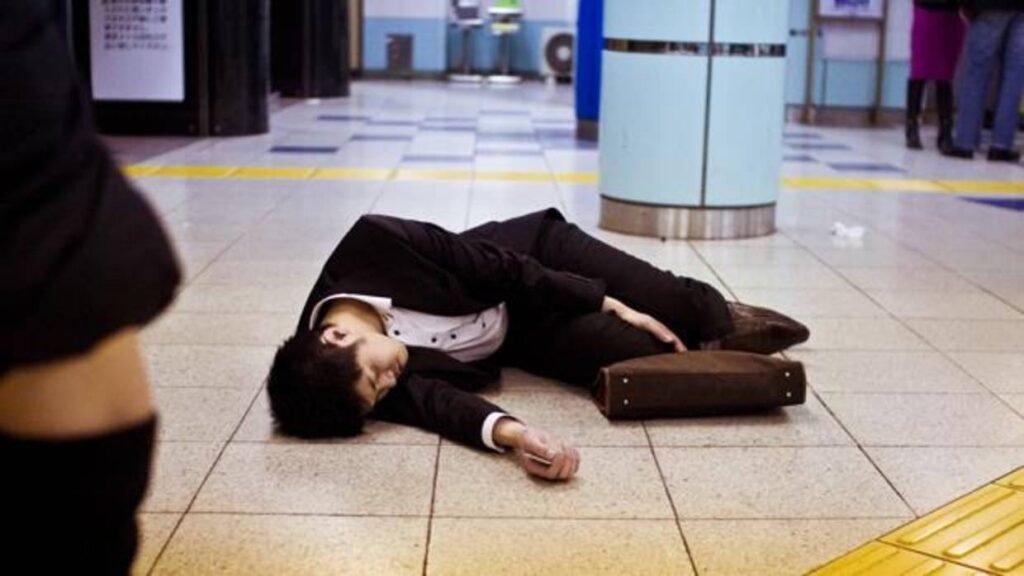
“Karoshi” – “death by overwork” – what’s that?
Takaichi thinks that its’ something positive.
In a speech after winning the party leadership race on Saturday, Takaichi said, “I will work, work, work, work and work.”
She also called on LDP lawmakers to “work like a horse.”
While such remarks seem to demonstrate her resolve to shoulder heavy responsibilities, they apparently came as a surprise to Prime Minister Shigeru Ishiba.
“As she clearly said she would throw away her work-life balance, I can’t help but wonder if that’s okay. But I believe that is her expression of determination,” said Ishiba, who gave an address after Takaichi’s victory speech.
That appears to be how middle class Japanese women are taking the speech—determination. After all, they saw their mothers working around the clock, including part-time.
Takaichi grew up in a middle class family too.
But this is not the only example of her ultra right views.
Sinophobia, of course, has been a Japanese things since…forever… maybe because of a an unspoken, hidden suspicion that the Imperial Family is Chinese, or at least Korean. The average Japanese still has nothing much good to say about China – or Chinese people.
Takaichi has already angered the Chinese by suggesting Japanese intervention should the Chinese seek a military solution to Taiwan.
She cites reasons of “self defense” , saying Taiwan is only 60 miles from Japan, by which she means from the Diaoyu Islands which both China and Taiwan claim, with considerable reason.
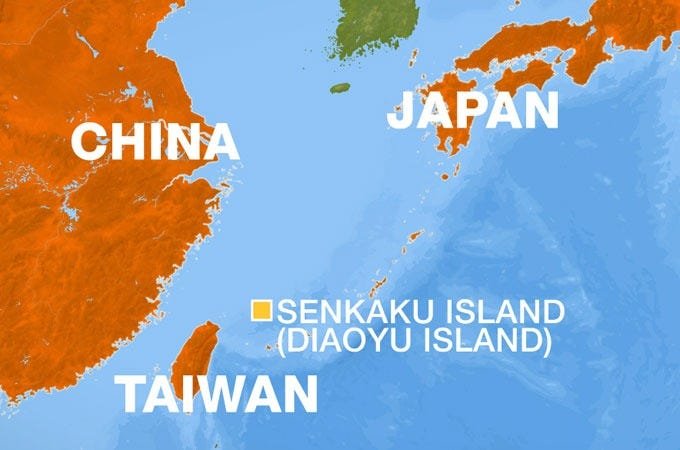
Senkaku / Diaoyu Islands
Keep in mind that the Ryukyus were not part of Japan until 1879. The Ryukyus were an independent and prospered through trade with China. The Japanese took over, banned the language and culture.
Then there is Dokdo Island, which is occupied by South Korea and which the Japanese call Takeshima. She has said that a Cabinet Minister should attend the ceremony to mark “Takeshima Day,” held in Shimane every February to demonstrate Japan’s sovereignty over the islet — although this is a local rather than national event.
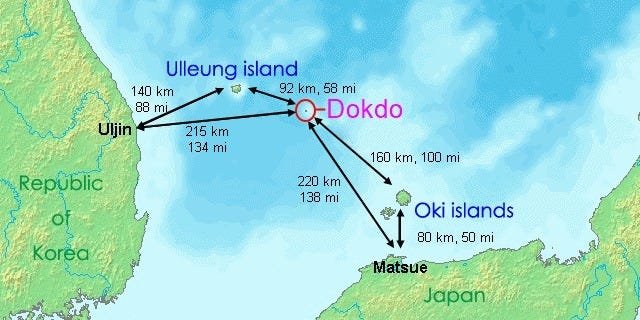
Dokdo / Takeshima Island
OK. Not exactly WWII again . But. .
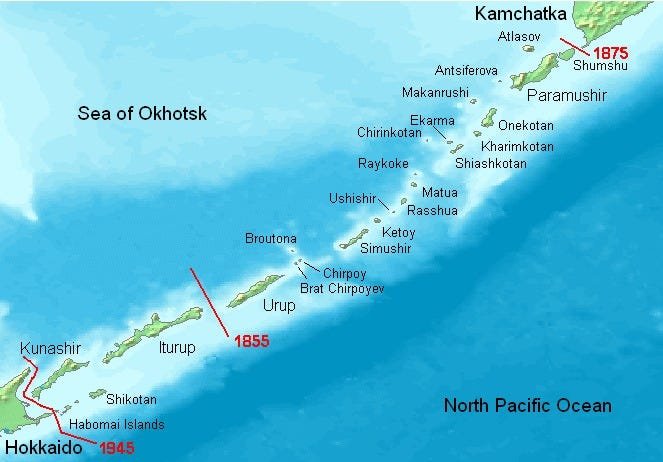
Kurile Islands / Hokkaido
Let us keep in mind that Japan only took Hokkaido after the Boshin War of 1869. It was its first step towards emulating the colonialism and imperialism of the West. The Ainu peoples were to the Japanese what Native Americans were to Americans. Japan’s first attempt at genocide.
The Russians understand history only too well.
Japan’s new prime minister, Sanae Takaichi, in a speech last week, scolded Russia for its “aggression against Ukraine” but also said that Japan maintains “its policy of resolving the territorial issue and concluding a peace treaty.”
The territorial issue is of course the Kurils which Japan lost as a consequence of WWII, just as Russia lost the southern part of Sakhalin as a consequence of the Russo Japanese War fo 1904. What goes round, comes round.
Russian Foreign Ministry spokeswoman Maria Zakharova said she had not seen anything new in the remarks by Takaichi, and that for any progress Tokyo would have to change its tone.
“We have repeatedly stated before that the path to resuming dialogue with Japan will open only after Tokyo actively abandons its anti-Russian course aimed at harming our country and its citizens,” Zakharova told reporters when asked by Reuters about the prospects for a peace deal.
Zakharova said Tokyo’s “unfriendly” policy towards Russia had led relations towards a dead-end.
“This unfriendly dead-end approach was chosen by the Japanese side, not by us,” Zakharova added.
Prime Minister Sanae Takaichi has sidestepped a commitment to maintain Japan’s decades-old pledge not to produce, possess or host nuclear weapons over apparent concerns about the U.S. “nuclear umbrella.”
Formulated in 1967 and known formally as the country’s Three Non-Nuclear Principles, the pledge has consistently been upheld by governments since.
Takaichi told opposition lawmakers in parliament Tuesday that, as her government gears up to revise the country’s key national security documents by the end of 2026, “it is not yet at the stage” where she could “definitively state” that the wording of the principles will remain the same.
Of course, the Three Principles is an excuse for permitting American bases all over the country. Do they have nuclear weapons? Japan allows nuclear armed American ships and aircraft to “transit” through Japan How long is the stopover? Don’t ask, don’t tell.
Without the three principles, things get complicated. Japan might want to develop its own weapons and reduce the number of American bases.
Let us remember, however, that this winging to the right is what that declining nations do.
We see this in Europe too. Beat the drums of war, build up a sense of threat and fear, so that people will invest their hopes for the future in a strong leader, who is somehow “different”, but adhering to traditional beliefs. Change but no change. Or as Obama said, “Change you can believe in”.
But Japan needs China —not just for its huge market but for its technologies ==for example the rare earth magnets that Japanese consumer electronics rely on.
Should China — Japan’s main trading partner — stop cooperating economically, Japan is in trouble. The G7 economies no longer represent viable markets for its products in the future.
Japan needs Russia and South Korea too. So alienating these countries is not a recipe for economic success.
In addition, Japan needs access to the vast resources of Russia— not just Russian gas and oil, but wood, minerals, and the like, including foodstuffs.
Economic cooperation with South Korea is important too. Again, technologies matter.
As for “work-life” balance, a grueling balance between men in the workplace, women in the home was an aspect of Japan’s reindustrialization in the 50s and 60s. Ironically Japanese society then was one of the most egalitarian in the world—except for women, of course. 90% of Japanese then thought themselves “middle class”.
It must be said also that in those days Japanese white collar workers at least rarely did much from 9 to 5 — everything was accomplished in overtime—which paid extra.
Now things have changed.
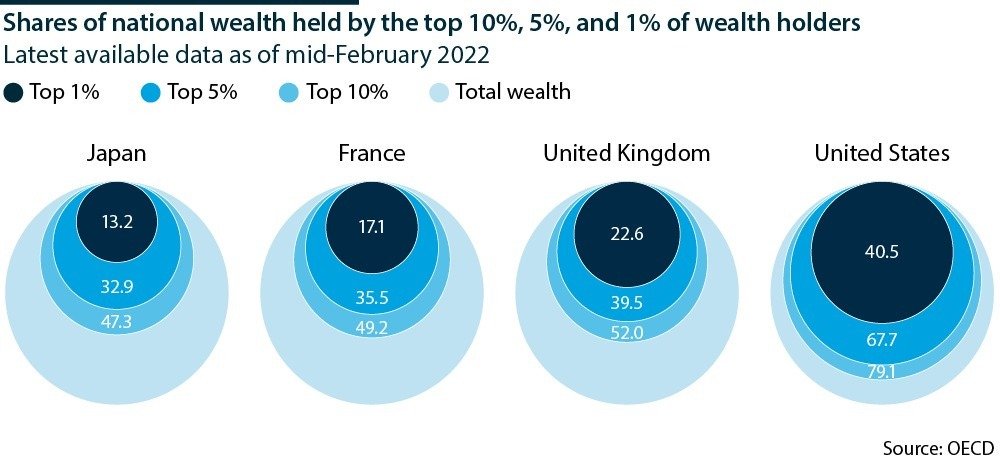
Wealth in Japan today is flowing upwards as it is in all financialized societies. It isn’t as bad as in the France or the UK or the US— but is that a valid comparison?
Japan is more and more unequal. Of course it was always unequal for women But with future money earning partners in short supply, things are worse.
Marriage rates have dropped. Birthrates too. Nobody has sex anymore.
How long before the Japanese population reaches 50,000,000?
This is Takaichi’s honeymoon but it will be over sooner or later. She might well win the next election but she has no new ideas, no solutions, just same-old, same-old. Yes, she’s a woman— an honorary member of the Old Boys Club.
Just like Thatcher was.
what toxic confluence of factors has crystallized into a hot war in the heart of Southeast Asia? It starts with a family feud – involving the Thai Shinawatra and the Cambodian Hun Sen clans
By Pepe Escobar at Sputnik.
Fog of war rules. A crack Thai analyst worries about the intersection of so many vectors not making sense: “There’s something so odd about this war. It feels like someone is pushing both sides to escalate.”
Escalation, so far, also rules. Even with Tariff Temper Tantrum Trump (T4) now repositioned as Peacemaker and touting his own Art of Ceasefire “deal”.
Yet this Monday, it’s actually Malaysia – currently the chair of ASEAN – that de facto mediates, with Prime Minister Anwar Ibrahim hosting ceasefire talks in Putrajaya. As previously confirmed by Foreign Minister Mohamed Hasan, “this is an ASEAN matter, and as chair, we should lead.”
Malaysia, in the end, did lead. Prime Minister Anwar Ibrahim personally broke a ceasefire between the belligerents.
And that brings us to the inevitable question: what toxic confluence of factors has crystallized into a hot war in the heart of Southeast Asia?
It starts with a family feud – as stated by a top Thai intel source, involving the Thai Shinawatra and the Cambodian Hun Sen clans. Thaksin Shinawatra, from Chiang Mai in the north, billionaire, former prime minister, recently pardoned by King Maha Vajiralongkorn, is the perennial strongman of Thai politics. One of his daughters, Paetongtarn, is the current Thai Prime Minister.
Hun Sen, a former Khmer Rouge soldier — he defected in 1977 — former Prime Minister in two stints (1985-1983 and 1998-2023), currently President of the Senate, is the perennial strongman in Cambodia.
The Shinawatra-Hun Sen clans used to be very close, but they recently had an “irreconcilable” falling out, partly due to Thaksin’s daughter Yingluck’s new husband — by the way, she is also a former Prime Minister — planning to open a large casino in the tourist paradise Phuket, something directly connected to the relaxation of Thai gambling laws.
The new venture will heavily affect Hun Sen’s enormous profits from his casinos located in Poi Pet, along the Thai border.
It gets way more complex when we factor what lies behind the long unresolved border dispute, now flaring up again because of — what else — Pipelineistan: it’s all about oil and gas exploration.
The current Thai-Cambodian border is demarcated mostly along the watershed of the Dangrek mountain range. Hun Sen is eager to gain even tiny pieces of land on the Thai side of the watershed, using ancient Khmer temples as an excuse. The whole area was once part of the mighty Khmer empire.
Hun Sen’s gamble is to set up a legal precedent for the border to be adjusted at the coastline. That of course would affect the maritime borders in the Gulf of Thailand, and who controls how much of the oil and gas fields. Currently multiple Western companies — including Chevron — hold drilling rights on the Thai side of the maritime border, hence the Western ‘support’ for Thailand.
Enter China. Beijing has a very significant trading relationship with Thailand: a $135 billion turnover. Compare it to a mere $12 billion when it comes to China-Cambodia. The Chinese and Thai militaries are very close. In terms of strategic interest, as much as China may be investing a lot in Cambodia modernization, including a mega new business hub outside of Phnom Penh, Beijing will not support Hun Sen’s — now backfiring — gamble.
Now we enter the most sensitive part of the equation. Thaksin was essentially brought back to the Thai political chessboard by the King’s close advisors in order to keep the liberal “menace” at bay. But now the optics are that Thaksin has messed up. And the echoes coming from the monarchy circles is that the King is extremely angry — and has taken the conflict with Cambodia personally.
There are several factions in the Thai military — an extremely complex environment. The commanders currently in control of the situation at the border are known as the ‘King’s men’.
So what next? For quite a while, insiders of the highly volatile Thai political environment have been stressing that the Kingdom has once again played a complex balancing act, in many aspects getting both the US and China on its side.
So there is a strong possibility the Thai military would push deeper into Cambodia, fulfilling irredentist demands coming from deeply nationalist quarters. In parallel, that might turn out to be a priceless opportunity to correct the colonial borders drawn by the France-Siam treaty of 1907.
To make it even more intractable, the moves overlap with powerful comprador elites in Bangkok abhorring — and bribed into blocking — increased Global South cooperation.
Yes, this is also part of the war on BRICS
Now for the Big Picture. Both Thailand and Cambodia, important nodes of the 10-member ASEAN, are deeply China-connected – from geography to geoeconomics. Ergo, imperial divide and rule applies – in spades, and subordinated to the maximum imperative, as in Mackinder and Mahan revisited: burning down the Rimland all around the Heartland.
That’s the current thrust, on steroids, by the Empire of Chaos. We ain’t seen nothin’ yet. And never forget: Thailand is also a BRICS partner. Chaos simultaneously destabilizes both ASEAN and BRICS.

The 6,000 km Pan-Asian Railway, transforming Southeast Asia.
Now for blood on the tracks — literally. A key New Silk Road project is the 6,000 km plus high-speed rail line that will eventually connect Kunming, capital of Yunnan province, to Southeast Asia all the way to Singapore.
Kunming-Vientiane in Laos is already up and running; a roaring success. The Thai extension all the way to Nong Khai – plagued by immense corruption problems – may finally be up and running by 2030. A Vietnam-Cambodia extension will link Ho Chi Minh city and Phnom Penh to Bangkok.
The current war broke out exactly at the Thai-Cambodia border. The Desperation Row playbook is as predictable as ever: blow up ASEAN’s new connectivity corridors from the inside, with a tariff war coupled with a possible regional war.
Globalsouth.co has been providing invaluable analysis, even suggesting a roll call of Highways to Hell promoted by the Empire of Chaos. So here’s a not exhaustive list of divide and rule instances encircling China, Iran and Russia, what I call the revamped “RIC” Primakov triangle.
It all starts with Gaza – and Palestine, on the forefront of the War on the Axis of Resistance.
Then there’s the ongoing disintegration of Syria via rehabilitated Salafi-jihadis; the projected carve up of Lebanon; Sultan Erdogan’s perennial double/triple game; and most of all the Zionist Axis to-be-renewed attack on Iran.
Russia will have to deal non-stop with several new fronts beyond the collapsing proxy war in Ukraine: the new Iron Curtain in the Baltics, and the dream of turning it into a ‘NATO lake’; terror in the Black Sea — the supreme MI6 obsession; instrumentalization of Moldova and the planning of an attack on Transnistria; MI6’s inroads among budding jihadis across Central Asia; and Azerbaijan’s mafioso game spearheaded by Aliyev.
Ali Akbar Velayati, senior adviser to Ayatollah Khamenei, is warning that the proposed US take over of the strategic Zangezur corridor is a geopolitical gamble by “the US, Israel, NATO and pan-Turkist movements” to “weaken the Resistance Axis, sever Iran’s link with the Caucasus, and impose a land blockade on Iran and Russia in the region’s south.”
Moving to South Asia, East Asia and Southeast Asia, we have on-and-off chaos to be imposed on India-Pakistan relations (both SCO members); every possible attempt in the book and off the book to destabilize the South China Sea – all the way to forcing Taiwan into a final provocation against China; renewed shenanigans on China-Japan via the Diaoyutai/Senkaku islands; and attempts at fostering a regional war between Thailand and Cambodia coupled with possible color revolutions — Myanmar all over again.
All of the above does not even feature the Africa front — from Somalia to Nigeria, a BRICs partner, all the way to the Alliance of Sahel States and the Democratic Republic of Congo (DRC). And in South America, the target of choice is of course Brazil, especially after the success of the BRICS summit in Rio; Brasilia, regarded as a BRICS weak link in DC, is now under relentless trade and geo-economic attack by Trump 2.0.
The Chinese Foreign Ministry, unfailingly polite, has at least summarized the pulse of the Global South: “The United States has lost its legitimacy to lead the world in the eyes of nations. It is no longer morally qualified to speak of values or peace while supporting genocide in Gaza.”
That means virtually no takers across all Asian latitudes to become a Ukraine 2.0 subordinated to CIA/MI6/NATO plans to manufacture a war on China. That’s exactly what Malaysia’s rotating presidency of ASEAN will be imparting today on both Bangkok and Phnom Penh. The ASEAN annual summit will take place in Malaysia next November. [01][02]
So what should BRICS do in the short run, as incandescence prevails? Move with discretion and cunning, and take the long view, for instance privileging “ASEAN centrality”. In the end the US may turn out to be the swing state after all, as the core divide and rule power centers of the West remain Tel Aviv and London.
…any division within ASEAN benefits the USA, and Uncle Sam loves nothing better than any ally of China to be roughed up.
with gratitude to Linh Dinh at Postcards from the End.
On 7/24/25, just hours after conflict erupted between Cambodia and Thailand, a 24-year-old was assaulted in Chanthaburi, 300 miles from the actual fighting. Employed at a slaughterhouse, he was just returning from work when two strangers jumped out of a car to ask if he was Cambodian? When he said yes, they jumped him.
Since Cambodians are generally darker than Thais, they could identify him. Notice how it took two assholes to beat up one unsuspecting dude, but that’s how it usually is. Most men are cowards. The bravest drop bombs on old ladies and babies from 50,000 feet. With its bloody, stinking and exhausting work requiring the strength and stamina of athletes, American slaughterhouses, too, are filled with immigrants.

going from Pong Nam Ron, Thailand towards the Cambodian border on 3/24/18
In 2013, I was stuck at Kansas City’s Greyhound Station due to a snowstorm. Having not bathed for days, I went outside to gently scrub my balls with snow. Back inside, I met a Vietnamese with white GI blood who was returning to his job in Minnesota.
My note from 4/6/13, “Tùng, 43, had been in the US 11 years, and was working as a boner at a pork processing plant in Greenbush, MN, making $16 an hour, for $400 net a week. He had been employed at a beef plant in Sioux City, Iowa, but that place only paid $300 per week. Greenbush is near the Canadian border, and the region is almost entirely white, but 80% of the workers at this pork plant are non-white, with many Africans, Mexicans and Asians, with the Burmese so adept at this grueling work, they’re allowed to chew betel leaves on the job, with trash cans nearby to catch their spittle. Saving what he could from his modest pay, Tùng had returned to Vietnam eight times, with six months his longest stay. Back in tropical Can Tho in the Mekong Delta, he would eat and drink well, and idle his time away, but that too would get tiresome, and his dollars would evaporate, so back to frozen Minnesota he would fly. Recently he passed out at the slaughterhouse and woke up in an emergency room, but since it happened just before he clocked in, it wasn’t considered a work place incident. Tùng spoke wistfully of a fellow Vietnamese who had gotten clipped by a forklift. The lucky man broke his chin, so thereafter was assigned the easiest tasks, on top of his medical compensation.”
A version of this is already in my Postcards from the End of America, but hey, I’m allowed to cannibalize myself. Plus, Dan Simon hasn’t sent me a royalty check in years. Jewish accounting can be most creative. One of Dan’s writers once barged into his office to grab him by the neck.

looking at Kamrieng, Cambodia from Thep Nimit, Thailand on 3/24/18
Back to Southeast Asia! With borders between Thailand and Cambodia closed, that roughed up Cambodian can’t go home anyway. Thousands are actually trying. Half a million Cambodians are working or studying in Thailand. A million Thais are ethnic Cambodians. Fifty thousand Thais live in Cambodia. Demographic realities are always messier than maps, with their clean, often straight borders and countries separated by colors. Green Poland abuts orange Ukraine abuts blue Romania.
The most visible minority in Chanthaburi are not Cambodians but Vietnamese, with their magnificent Catholic church. Though Wikipedia English claims it was built by the French, how many Frenchmen, let me ask you, ever lived there? Red and gold in its altar already proves it was erected by Vietnamese, and surrounding it are nothing but Viet businesses. By 1707, there were already Vietnamese Catholics in Chanthaburi. Visiting this parish in 2018, I heard people praying in a language that was neither Thai nor Vietnamese. Having been there so long, they could no longer speak or even pronounce a single Vietnamese word. Still, they thought they were praying in Vietnamese. Their ethnic solidarity is reinforced by a common religion.

Cambodians in Thep Nimit, Thailand on 3/24/18
Through an interpreter, I asked an old man who would he fight for should war between Thailand and Vietnam break out? Looking alarmed, my interpreter refused to translate.
During the Mexican-American War, hundreds of Irish immigrants defected from the US Army to fight for Mexico. Seventy one died in battle or were hanged, after capture. In the Mexico City suburb of San Angel, there’s a plaque honoring these San Patricios, also known as “Los Colorados” for their red hair. Many were actually Germans, Canadians, English, French, Italians, Poles, Scots, Spaniards, Swiss and even a few black ex slaves.
The more multicultural a nation, the more fragmented its citizens’ loyalties. Would Mexican Americans fight against Mexico? Would Chinese Americans cheer an American attack on China? What about Chinese majority Singapore? Despite the European Union, there are still only Frenchmen, Spaniards and Poles, etc., with each group further divided by regions. A Milanese is not a Napolitano. Bavarians can’t stand Prussians.

Poi Pet, Cambodia on 11/22/22, among travelers about to cross into Thailand
Everything is cool, though, until someone like you bleeds.
On 7/24/25, the FaceBook page of Warin Chamrap, a Thai district of 163,000, posted this letter, “I’m a Cambodian studying at the University of Ubon Ratchathani for nearly a year. Honestly, everything here is fantastic. I can feel the kindness and generosity of Thai people. Each day, everyone encourages and assists me everywhere I go, to help me learn Thai and absorb Thai culture. But ever since conflict broke out, my heart has sunk. I’ve never been so depressed. Each day, I worry about the future, about how people see me, and I’ve started to ask myself if Thai people will hate me just because I’m a Cambodian? To think this way is very painful because I’ve stopped seeing Thailand as a foreign country, but my second homeland, from my very first day here. I’ve never had any bad intention. My only goal is to learn and respect everything about Thailand while living here. With this current tension, I feel like an isolated Cambodian, but despite my fear and constant worries, I still believe in peace, and in the goodness of man. I wish with all my heart both sides will choose dialog instead of prolonging this conflict.”
Earlier this year, there was a 17-day mini war between India and Pakistan, both nuclear powers. After it cooled off, Trump claimed credit despite strong, indignant protest from India. The American buffoon had nothing with this ceasefire.
Now, Trump is again pretending to be a peacemaker, but let’s be clear here: any division within ASEAN benefits the USA, and Uncle Sam loves nothing better than any ally of China to be roughed up. Thailand is using American planes and Israeli drones to punish Cambodia while accusing China of supplying Phnom Penh with new, more advanced missiles.

departure gate in Poi Pet, Cambodia, right on the border with Thailand, on 11/22/22
As I finish this at 8:01PM on 7/27/25, Bangkok and Phnom Penh time, this war continues. For years, the world has expected the USA to use Taiwan to attack China. Though that will, most likely, still happen, we have another front opened by the Empire of Chaos. When you manufacture nothing but missiles, bombs and bullshit, it’s all you can do. For Uncle Sam, mass death isn’t just a motto but survival tool.
About Linh Dinh (@linhdinh):
‘Before being canceled, I was an anthologized poet and fairly prolific author, with my last book Postcards from the End of America. Now, I write about our increasingly sick world for a tiny audience on SubStack. Drifting overly much, I’m in Cambodia.’
AHH: Please support this wonderful writer on his Substack! Thanks
As always, us fleas are squashed when geopolitical mammoths collide.
with gratitude to Linh Dinh at Postcards from the End.
This flareup between Cambodia and Thailand deserves a much closer scrutiny. Before you go to Brian Berletic, Danny Haiphong or, God forbid, Scott Ritter, it’s best you pay the utmost attention to every syllable, pause and mispronunciation tumbling from my tea washed mouth, as I perch most pompously on this concrete bench at Coffee Seven at dawn on 7/26/25, with a white bitch at my feet.

Phnom Penh, Cambodia, 10/28/23
In 1970, an 18-year-old Hun Sen joined the Khmer Rouge. In 1977, he defected to Vietnam with most of his battalion. In 1978, Hun Sen was a part of the Vietnamese invasion of Cambodia. Having helped to dislodge his ex comrades, Hun Sen was installed as Deputy Prime Minister and Minister of Foreign Affairs of a new, pro Vietnamese government. By 1985, Hun Sen had become Cambodia’s top dog. He still is. His son, Hun Manet, is Prime Minister.
Though Cambodia’s democracy is as corrupt and fraudulent as the USA’s, at least their young men aren’t sent all over the world to die for bullshitty reasons. Like Trump, Hun Sen has used his office to enrich himself, but unlike that grotesque self lover, he’s doing what he thinks is best for his nation. He’s not cynically discrediting and bankrupting it to global laughter and mockery.

Phnom Penh, Cambodia, 11/13/22
Having installed Hun Sen, Vietnam saw him drift towards China. On 7/26/16, the ten members of ASEAN couldn’t release a joint statement about its beef with China in the South China Sea, which the Vietnamese label the East Sea, by the way. This statement was blocked by Cambodia, China’s favorite Southeast Asian tagalong buddy. (I didn’t want to say eunuch or courtesan.)
From 2022 to 2025, China overhauled Cambodia’s Ream Naval Base. In 1974, this pitiful installation near Sihanoukville had just 20 Swift Boats and 4 River Patrol Boats, plus, possibly, a tin tub large enough for a tiny general and his mistress to bathe in. After ousting the Khmer Rouge, Vietnam improved this base, but it’s China’s now, though warships from the USA, Canada and Japan have visited. This is China’s closest port to the critical Strait of Malacca, where most of its Middle East oil must pass. [01][02]
In August of 2024, China began constructing the Funan Techo Canal. When finished, it will allow Cambodian container traffic to bypass, almost entirely, Vietnamese ports, most notably Vũng Tàu’s Cái Mép. Regarding concerns this canal will also dry up Vietnamese agricultural land downstream, Cambodia says it will actually reduce floods, so shut up already! [03][04][05]

Kolab, Cambodia, 10/23/23
Under Hun Sen, Chinese gangs have operated vast cyber scam centers in Cambodia. These enslave thousands of Thais, Vietnamese, Laos, Filipinos, Indonesians, Malaysians, Singaporeans and Burmese, so citizens of all ASEAN states except tiny Brunei. They are forced to scam their compatriots, to enrich Chinese bosses, with Hun Sen taking a nice cut, undoubtedly. When these slaves resist or fail to perform, they’re tortured or even killed. Some have jumped from upper floor windows to their death.
With China backing him, Hun Sen got cocky enough to leak a phone call between him and Thai Prime Minister Paetongtarn Shinawatra. Just 37-years-old, she was elected only because of her dad. Speaking to the 72-year-old Hun Sen, Shinawatra was too deferential, perhaps. This outraged ordinary Thais. The key takeaway from this scandal, though, is Hun Sen’s break of protocol. Who would want to discuss anything with this clown? Are you taping me?!
On 7/5/25, Vietnamese General Phan Văn Giang welcomed Thai General Songwit Noonpackdee to Hanoi on an official visit, then on 7/14/25, Royal Thai Navy Commander-in-Chief Jirapol Wongwit landed in Hai Phong with his sizable delegation.
With the entire ASEAN bloc irked or infuriated with Hun Sen’s Cambodia, Thailand can give it a nice slap, at least. This also pleases Uncle Sam enormously. Beforehand, the Thais had to make sure Hanoi wouldn’t intervene to protect its ex protégé. If the Thais go too far, though, China has the perfect excuse to sail warships towards that port it already paid for.
As always, us fleas are squashed when geopolitical mammoths collide. Cambodian rockets hitting that Thai 7-11 killed 11 civilians. At least some were likely Cambodians. They’re all over Si Sa Ket and Suri. Their Thai citizenship is only an accident of history.

Kolab, Cambodia, 10/23/23
Another subtext is Cambodia’s bitterness at having fallen so far. Until 600 years ago, it towered over all of Southeast Asia. If not for the French, it would have lost even Angkor to the Thais. Luckily, Americans will be spared such anguish. Six centuries from now, there won’t be enough left to contest what remains of the Obama or Trump Presidential Library. Here and there, MAGA hats as heirlooms will still be treasured by select morons.
“To honor the Donald, our great great great great grandpa joined a pedophile cult. Wearing a Trump mask, he got to fuck so many beautiful women on the younger side. So what if all of these were just miniature sex dolls? It was still America’s Golden Age! We had no fake news, libtards, tourists or manufactured goods, it is claimed. There was no inflation because no one had cash. Trumpian heretics did beg Canada or Greenland for annexation, but nothing came of it.”
About Linh Dinh (@linhdinh):
‘Before being canceled, I was an anthologized poet and fairly prolific author, with my last book Postcards from the End of America. Now, I write about our increasingly sick world for a tiny audience on SubStack. Drifting overly much, I’m in Cambodia.’
AHH: Please support this wonderful writer on his Substack! Thanks
A soulful globe-trotter reports from Vietnam, traveling from Cambodia, of life and timeless imperial pyrotechnics
Linh Dinh at Postcards from the End.
Since I’ve shown an interest in her past, Mrs. Seven, a 63-year-old widow living with two dogs, keeps telling me more. In Hai Phong 40 years ago as part of a performance troupe, she was told to never go out alone. Seeing a young southern woman wandering around looking lost, local savages would just grab her breasts. During the Vietnam War, southerners ate much better, so there’s more to grab, that’s true.
My only visit to Hai Phong was in 1995. As North Vietnam’s major seaport, it was most heavily bombed by the USA. Domestically, it’s known for a soup of red pasta with fresh water crab, bánh đa cua. Just two days ago, Typhoon Wipha slammed into it, to cause considerable damage to properties, but no reported death. Houses were wrecked, cars were crushed from falling trees and crops spanning hundreds of miles were destroyed. Extreme weather everywhere has become more common. If you haven’t, look into climate engineering as the key factor. Six decades ago, the USA used Vietnam and Vietnamese to test various techniques, along with the effects of novel weapons.

Vung Tau, Ho Chi Minh City, Vietnam, 7/24/25
Napalm is lovingly described as sticking “like shit to a blanket.” In Vietnam Inc., Philip Jones Griffith quotes a US pilot, “We sure are pleased with those backroom boys at Dow. The original product wasn’t so hot—if the gooks were quick they could scrape it off. So the boys started adding polystyrene — now it sticks like shit to a blanket. But then if the gooks jumped under water it stopped burning, so they started adding Willie Peter (WP – white phosphorous) so’s to make it burn better. It’ll even burn under water now. And just one drop is enough, it’ll keep on burning right down to the bone so they die anyway from phosphorous poisoning.”
Can you believe it, it’s already the next day! Do check to see if it’s still 2025. Though a nightmare year, it’s only a prelude. Having arrived at Coffee Seven too early, I’m sitting just outside in the dark. In minutes, Mrs. Seven’s two dogs will appear. They’re sleeping on her bedroom floor. With junkies needing quick cash roaming the night, they can’t be let outside too early. Now I hear her rubber flip flops, then her lock jiggling. Suddenly, there’s light! Happy to see me, the white bitch comes running, with that stub of a tail half wagging.
Coming here, I passed Bluetooth listening to old school rap, when lyrics still had social messages, and not just I’m gonna to wet yo nigga ass and shag yo ho. Next to him was a woman of at least 70 doing exercises while sitting on a plastic chair. Any joint that could still be swiveled, she rotated.

Vung Tau, Ho Chi Minh City, Vietnam, 7/24/25
Presently, the security guard, Sơn, will show up on his motorbike. Yesterday, he was listening to all these songs of homesick soldiers, composed in South Vietnam before 1975. The North’s heroic compositions, as demanded by the state, have mostly disappeared. We talked a bit about the absence of music about Vietnam’s wars against Cambodia and China. State control of culture was still in force.
I can’t think of one song reflecting the ordeals of being an American grunt in Vietnam, Iraq or Afghanistan. Those still capable of reading should check out Tim O’Brien’s The Things They Carried and Bruce Weigle’s Song of Napalm. Nearly all my books are in New Jersey. Before leaving the US in 2018, I gave hundreds to my buddy, Ian Keenan. Though super erudite, Ian’s a conformist liberal, so has stopped talking to me. Via Megabus, we traveled together to Buffalo, New Orleans, Raleigh and New Orleans.
Sơn means mountain. The absurdity of being maimed or killed just as your life is beginning is a profound tragedy worth meditating or brooding on. At 4:37AM, he’s two chairs from me. Those songs of lives suspended, menaced or about to be smashed I expect to hear, again, any second now.
When I left Amman just a week ago, Israel had just attacked Syria. Having helped to prop up Ahmed al-Sharaa, Jews are already done with this ex terrorist. Their goal has always been to grab more land from Syria, so they’ve opened a new front in their never ending war against Arabs. They’re still fighting Hamas and the Houthis. Of course, it’s confusing. Like Uncle Sam, Jews are always plotting or fighting against so many people.
In Southeast Asia, another war has broken out. In recent years, Cambodia has gotten very close to China. In that nation, I’ve traveled on Chinese built highways and visited Sihanoukville, a fishing village transformed into a city filled with Chinese casinos. In Phnom Penh, I checked out NagaWorld. At this luxurious Chinese gambling mecca, I noticed with amusement a forlorn blonde Russian tinkling on a piano for bored Chinese patrons, lounging nearby. NagaCorp is building a casino/resort in Vladivostok, so there, too, classically trained Russian musicians will perform for yawning Chinese.
Has pissed Uncle Sam prodded Thailand to war against its supposedly weaker neighbor? Don’t underestimate the ferocity of the Khmers, however.

Vung Tau, Ho Chi Minh City, Vietnam, 7/24/25
At 6:32AM, I’m at Trung Nguyen, a Vietnamese chain. Even with many books, it has little character. There’s no anchored mind behind any of this. Right outside on a bench are two fat boys with dull faces. Each has an iPhone and bulging belly. Closing his eyes from virtual reality overload, the older boy still clutches his orbitofrontal cortex masturbator. Ten yards away is an old broad, sitting alone yet masked. We’ve been conditioned to trust nothing unmediated, so why not oxygen? This deranged crone feels safer breathing air through chemically treated polypropylene.

Vung Tau, Ho Chi Minh City, Vietnam, 7/24/25
All these phenomena are actually linked, Bluetooth listening to American rap, a war veteran still figuring out what the hell happened, phone hooked children alienated from their environment and more wars caused hidden hands not just indifferent, but glorying in how many lives they can pulverize. We’re but deracinated fleas blown every which way.
In the USA, millions of brokeassed chumps still think a billionaire child rapist is their savior. Those outside the Judeo Christian world can see more clearly than ever who these monsters really are. They’re so casual, if not cheerful, about their serial crimes. Even the most degenerate Orientals, Arabs and Black Africans don’t try to excuse away such prolific and protean Satanism.
It’s smeared on them like crap on a Christmas sweater or homey comforter. Shit, man, with a dark night of the soul so insistent and marathon, Jeezus must appear before peeping dawn. Maybe it won’t ever again. Meanwhile, they have their flaming Donald. Towering over their smudged out faces, America’s greatest president glows like white phosphorus. Barely basking in his flickering orangeness, they crack hellish grins.
It’s 8:24AM at Pato’s Bingsu. In the next room is a 27-year-old South African I’ve just met. Teaching English at three schools, he’s also learning Vietnamese. We joked about South African linguistic idiosyncrasies like “lekker” and “robot.” Drop me off at the next robot, brah! Like me, he was nearly mugged in Cape Town. Sitting in a car’s passenger seat, he managed to kick the guy off. I commended him for not freezing.
Wolfheze. As a Dutchman living in Budapest, Wolfheze is one, too. Even if you’ve never stepped outside your hometown, you’re also waiting in a departure lounge, hoping, if only half consciously, to not be left behind or swatted like an annoying insect. In three days, Wolfheze and I will chatter about this and more.
Linh Dinh (@linhdinh):
Before being canceled, I was an anthologized poet and fairly prolific author, with my last book Postcards from the End of America. Now, I write about our increasingly sick world for a tiny audience on SubStack. Drifting overly much, I’m in Cambodia.
AHH: Please support this wonderful writer on his Substack! Thanks
I break down the origin of the Thailand-Cambodia border dispute that led to the present fighting in RT: pic.twitter.com/y3o6tz0LLu
— Carl Zha (@CarlZha) July 24, 2025
Brian Berletic, Sputnik
Earlier on Thursday, there was an escalation of clashes between troops of Thailand and Cambodia on the border, which began with a shootout between ground forces in a disputed area.
The US sees the Thailand-Cambodia escalation “through the lens of divide and rule,” Brian Berletic, geopolitical analyst and former US Marine, told Sputnik.
He warned that if the conflict spirals out of control, it could add to regional conflicts the US is also playing a hand in.
“It will create regional instability, slow growth and development, and give the US an opportunity to reassert influence over the region,” Berletic pointed out.
The analyst noted that the standoff sets back the very economic and political unity China has encouraged across the region. That unity allowed many regional nations “to work out from under generations of Western primacy and outright colonialism,” according to him.
“While both the US and China see the region as a sphere of interest – China sees it through the lens of cooperation and joint development,” Berletic emphasized.
China enjoys close relations with both Cambodia and Thailand, he stressed, adding that Chinese authorities “will almost certainly encourage peace and stability and a quick resolution of the conflict.”
This week’s clashes between Thai and Cambodian forces near the Ta Muen Thom and Ta Kwai temples are the latest flare-up in a century-old border dispute dating back to French colonial rule.
The Conflict Zone: The disputed areas lie in Surin Province (Thailand) and Oddar Meanchey Province (Cambodia), near the Dangrek Mountains. Both Ta Muen Thom and Preah Vihear are ancient Khmer temples that sit directly on or near the border.
A Colonial Legacy: France drew the original border in the early 1900s, favoring Cambodia. Thailand contests these lines, especially in areas where the watershed boundary doesn’t match the temple locations.
Key Flashpoints: Preah Vihear: In 1962, the ICJ ruled in Cambodia’s favor, giving it sovereignty over the temple but Thailand still disputes the surrounding land.
Ta Muen Thom & Ta Kwai: Thailand maintains that these temples are on its soil. Cambodia disagrees and has stationed troops nearby for years.
Clashes erupted after a Thai soldier was wounded by a landmine, prompting artillery fire, RPG launches, and reported F-16 strikes on Cambodian positions. Both sides have now downgraded diplomatic relations, expelled ambassadors, and closed borders.
In other words, this isn’t a new war, and tensions here have been building exponentially since May.
At a press conference on Thursday, Chinese Foreign Ministry spokesperson Guo Jiakun, when responding to a related question related to the Thailand-Cambodia border clash, stated that Thailand and Cambodia are both friendly neighbors of China and important members of ASEAN. Maintaining good-neighborly relations and properly handling differences serve the fundamental and long-term interests of both sides.
He added that China is deeply concerned about the current escalation and hopes both parties will resolve the issue through dialogue and consultation. In light of the common interests and aspirations of regional countries, China, upholding a fair and impartial stance, has been and will continue to play a constructive role in promoting dialogue and de-escalation in its own way.
On Thursday, Thailand and Cambodia exchanged fire along their shared border. According to AFP, both Cambodia and Thailand accused each other of firing the first shot in what is the latest clash stemming from a longstanding territorial dispute near two ancient temples.


A Chinese military expert is warning of further escalation.
The clashes continue:
Following this morning’s clash between Thai and Cambodian forces near Chong Anma, Ubon Ratchathani, the Royal Thai Air Force deployed six F-16s.
Thai jets reportedly struck and destroyed the headquarters of Cambodia’s 8th and 9th Infantry Divisions.
The border clash erupted near the disputed area in Nam Yuen District. This marks the first confirmed use of airstrikes in the conflict so far.
Thailand’s Ministry of Public Health has activated emergency protocols following border clashes near Ta Muen Thom Temple.
Phnom Dong Rak Hospital has fully evacuated its patients. Kap Choeng Hospital is currently relocating patients to safer locations as the situation escalates.
Sources: DD Geopolitics, Various Chinese publications. GlobalSouth.co does not have expertise in this area, but we do have contacts and will reach out for local comments should this issue persist. Further sources are Brian Berletic and Ria Novosti.
Brian Berletic has reported on this for many years. The following are his comments:
On the Recent Thailand-Cambodia Conflict – Details the Western Media Won’t Report
 Following Thai soldiers injured by Cambodian-placed mines along a disputed border and downgraded diplomatic ties, Cambodia has launched Grad MLRS strikes on populated areas, causing indiscriminate death and destruction;
Thai forces are responding with greater but still measured force against Cambodian military targets near disputed areas – Thailand’s military is several times larger in size than Cambodia’s and possesses vastly greater capabilities than Cambodia, calling into further suspicion Cambodia’s provocative actions;
Western media is pretending not to know who started the shooting and is deliberately trying to link China to Cambodia and its actions – however – Thailand has a by far larger relationship with China than Cambodia and by far greater amounts of modern weapons from China than Cambodia including a Chinese main battle tank fleet, long-range precision guided rocket launchers, drones, APCs/IFVs, and Chinese air defense systems;
This border dispute has erupted into violence over the past years (2008 and 2011) – at both previous junctures, US-backed client regimes were either struggling to stay in power or were attempting to get into power – and now fighting has begun again as a US-backed client regime is likewise hanging in the balance.
Cambodian PM Hun Sen, while having a growing relationship with China and having been targeted by US-backed regime change himself, has systematically aided US-backed sedition in neighboring Thailand for 20 years – Cambodia also maintains the US as its largest and most important export market – an outlier in Southeast Asia which mostly exports to China and others in the region;
Like every other conflict around the globe, people need to be cautious about accepting Western news reports at face value – this will NOT be the “first” conflict they report on honestly and without ulterior motives; always remember – conflict and division suits the nation pursuing empire (US) – and disrupts multipolarism – so if you’re looking for a motive – that is likely at the very absolute center – having a smaller nation attack a larger nation (think Georgia-Russia 2008) creates needless conflicts, animosity, suiting the interests of neither party of the conflict – and division in a world that would otherwise be moving forward together into multipolarism…
External Factors Regarding Thai-Cambodian Conflict …
While ASEAN is growing closer to China, Thailand has done so to a greater extent than Cambodia;
Look at this 2023 summary of Thai and Cambodian exports per partner – Thai exports are around 18% (14% China, 4% Hong Kong which is still China) while exports to the US are 16%. The majority of Thai exports are to other destinations in Asia;


Cambodian exports are overwhelmingly dependent on the US and the West in general with a minority of exports going to other nations within Asia itself – the US dollar itself is used for transactions INSIDE Cambodia itself;
While not an absolute metric, this economic dependence on the US manifests itself in Washington’s ability to pressure, coerce, and otherwise shape policies of a target nation;
Cambodia has worked to reverse this – but as can be seen, US influence over Cambodia is still significant – this is in addition to US political interference which is extensive in both Thailand & Cambodia;
In addition to external factors from Ria Novosti:
What threats the international community faces in the event of an escalation of the conflict between Thailand and Cambodia:
 The Thai Tuna Industry Association: the world may face a serious shortage of canned tuna due to Thailand’s dominant position in the market;
The UN Comtrade: the disruption of Thailand’s trade could lead to problems with the supply of pet food to world markets, as Thailand is the second largest supplier in 2024;
The UN Comtrade: the disruption of Thailand’s foreign trade could cause problems in the automotive market, as Thailand accounts for two-thirds of global supplies of raw materials for tire manufacturing;
Leonid Khazanov, an independent industry expert: if the supply of rubies, sapphires, and emeralds is stopped, it will hit the jewelry industry; the consequences would be felt by the US and EU, as Thailand is their largest stone processor.
Pravin Sawhney of FORCE Magazine clarifies & discloses a number of agreements, undercurrents & commitments which are not commonly discussed.
Six Observations:

War is Not An Option
A triangular security matrix comprising India, Pakistan and China adds to India’s vulnerability
By Pravin Sawhney at FORCE Magazine.
Heated debates are happening in television studios after the terrorists’ attack in Pahalgam on April 22. Senior veterans, much sought after by TV anchors, are the flavour of the moment, with some running from one studio to another offering advice on how the government should punish Pakistan for its dastardly act. Four assumptions have been made: Pakistan is behind the attack; it is a bilateral India-Pakistan matter; defeating Pakistan military in war would be a walk in the park; and the Narendra Modi government with the reputation of being the strongest one since Independence will not let Pakistan get off the hook without genuine retribution for its heinous act.
Cutting short his visit to Saudi Arabia, Prime Minister Modi returned to India and convened a meeting with his top security team comprising the defence minister, national security advisor, chief of defence staff and the three services’ chiefs at his residence on April 29. Photograph of the meeting was released to the media with Modi’s message that he had given a free hand to the three services to decide the time, place and quantum of response to Pakistan. This event, the experts said, was an indication that India would not let Pakistan go unpunished.
Subsequently, news was leaked that Modi met the navy and air force chiefs separately at his residence on two consequent days. With this news, the choice of reprisal narrowed down to action by the air force and the navy. While various scenarios were discussed with visuals and war gaming models displayed on television raising hopes of punishing Pakistan for the emotionally charged nationalist viewers, most expert veterans from the army did not rule out options on the Line of Control (LC). Moreover, the news that the Union home ministry has issued an advisory to all border states to carry out civil defence action drills needed to protect people from Pakistani air strikes reinforced the belief of an early kinetic war.
Meanwhile, heightened action on the LC by both sides started after the Pahalgam killings. Increased small arms firing leading to perhaps an end of the ceasefire by India is expected. Long range artillery fires and even raids (where enemy posts are attacked by special forces) by both sides, which have been a norm in earlier decades, might come back soon. While all such activities are manageable to keep an escalation in check, they are unlikely to satisfy most Indians who have great expectations from Modi, seen as a strong leader.
Strangely, two important issues were missed by the media, both print and electronic. The first was that after India removed Articles 370 and 35A from Jammu and Kashmir, downgraded the state to two union territories of J&K and Ladakh, and printed new maps showing Aksai Chin under China as a part of Ladakh UT, the traditional India-Pakistan binary ended. Instead, a triangular security matrix comprising India, Pakistan and China emerged with negative security implications for India. The evidence of this was the repeated statement and pronouncement by all Chinese leaders after 5 August 2019 that China will support Pakistan’s territorial integrity and security. This was particularly significant when China after a telephonic call between Chinese foreign minister Wang Yi and his Pakistani counterpart Ishaq Dar, following the Pahalgam incident, released a statement quoting Wang Yi reiterating China’s support to Pakistan’s sovereignty.
The triangular security relationship was formed after 5 August 2019, when Pakistan’s then prime minister and army chief went to China to consult with their strategic ally. In a personal meeting, China’s President Xi Jinping advised army chief, Gen. Qamar Bajwa to focus on connectivity and development for Pakistan’s progress. Thereafter, Xi took it upon himself to discuss Pakistan’s security issues with India. Thus, in October 2019, Xi met up with Prime Minister Modi at the second informal summit in Chennai and suggested triangular peace between India, Pakistan and China. Modi did not accept Xi’s suggestion.
Given this, no one should doubt that in case of India-Pakistan war, China will help Pakistan in at least five ways, without showing its hand. However, before we get to that, there are three reasons why China will not enter the fray with its full war capabilities (kinetic and non-kinetic): its non-kinetic capabilities are enough to tilt balance in hot war between India and Pakistan in Islamabad’s favour; China will not do anything to jeopardise its strategic narrative of peaceful rise at time when the world in undergoing momentous geopolitical changes; and a war with India would freeze bilateral relations for at least a decade. This is something that Beijing would not do until it decides to reclaim its territories (Arunachal Pradesh and Ladakh) from India.
Let’s briefly see how China can help Pakistan with its non-kinetic capabilities. One, the PLA with heightened grey zone activities on LAC would ensure that the Indian Army’s and the Indian Air Force’s limited combat assets get divided with very little left for the Pakistan front. Two, in the India-Pakistan war theatre, the PLA will provide Pakistan military with round the clock battlefield watch, military keyholes of Baidu satellite system for accurate targeting for Pakistan missiles, and real time Intelligence, Surveillance and Reconnaissance (ISR). Three, Pakistan military, unlike the Indian military, would have regular supply of ammunitions, missiles, spares and critical assembles for war surge for salvo firing at intense rates. Four, given its huge cyber and non-kinetic anti space assets, China can, without being accountable, bring civilian life to a standstill across India. The experience gained by undertaking large cyber-attacks amounting to cyber war would help the PLA with the first mover advantage in this war against its peer competitor, the US military. And five, China has ships in the region capable of cutting subsea internet cables that come into India. India does not have any ships for internet laying and repairs.
Thus, not only will the next India-Pakistan war not end favourably for India. But there is a possibility of India losing territory in Kashmir. To top it all, India will lose its standing in its neighbourhood with small nations of South Asia, which are already onboard China’s Belt and Road Initiative, tilting decisively in Beijing’s favour.
The other issue underplayed by the analysts and media is Modi government’s track record on national defence since 2014. A fast learner, Modi has learnt from the Vajpayee government that doing full mobilisation for war without political will to fight with Pakistan gets egg on one’s face. Without much thought and adequate war appreciation, Prime Minister Vajpayee ordered full mobilisation within four days of terrorists’ attack on Indian Parliament on 13 December 2001. It was hoped that Pakistan’s ruler Gen. Musharraf would either get coerced by mobilisation of 1.2 million strong Indian army. Or he would be pressurised by US President George Bush to end his proxy war in Jammu and Kashmir. Nothing of the sort happened. Much like the present Pakistan army chief, Gen. Asim Munir, Musharraf turned belligerent and started test firing its ballistic missiles. Thus, after 10 months of military standoff, Vajpayee had to find a face saver to demobilise the army, which suffered loss of men due to mine accidents, funds and equipment owing to wear and tear, with nothing real to show. The face saver was provided by a retired army chief, General V.P. Malik, who declared that all objectives of the mobilisation had been met. Never mind that in May 2002 after the terrorists’ attack on Kaluchak military camp, tempers ran so high on both sides that Vajpayee’s National Security Advisor had to seek his US’ counterpart’s help to calm things down in Pakistan.
FORCE Magazine is an 80-page monthly print magazine (with an Internet edition www.forceindia.net) on national security: defence, homeland and civil aerospace. It started in August 2003 with an edition dedicated to Indian Army operations on the Line of Control with Pakistan.

 Lateo.net - Flux RSS en pagaille (pour en ajouter : @ moi)


