 Connexion


Lors de son discours devant le Congrès américain, le roi Charles III de Grande-Bretagne a appelé à l’unité au sein
L’article Le monarque britannique pour la 1ère fois au Congrès américain depuis 1991 afin de défendre l’unité de l’OTAN est apparu en premier sur STRATPOL.
Nous avons eu l’honneur de recevoir Eric BRANCA. Après une longue carrière de journaliste politique chez Valeurs Actuelles, il revient
L’article Eric Branca sur les outils du pragmatisme américain est apparu en premier sur STRATPOL.
Michael tells what most probably happened with the so-called announcement of action or war against Venezuela. Michael and Richard also explains the National Security Strategy and how it really is intended to work.
This is a little older but given the charade that we are watching in terms of a Ukraine plan, it is a perfect day. This is why Russia thanks the US because the US is part of the charade and Russia just does not have to do it. Reminder, these negotiations are being done and advertised and leaders are making statements and flying to and fro while discussing this with a sham president that has no authority to even speak, let alone carry out anything.
NIMA ALKHORSHID: Hi, everybody. Today is Wednesday, November 26, 2025, and our dear friend, Michael Hudson, is here with us. Welcome back, Michael.
MICHAEL HUDSON: It’s good to be back.
NIMA ALKHORSHID: Please subscribe and hit the like button to help us reach more people. And you can see Michael Hudson’s website (below his name): michael-hudson.com. You can go there and follow Michael.
MICHAEL HUDSON: It’s michael, hyphen, hudson, dot, com (michael-hudson.com).
NIMA ALKHORSHID: Michael, let me start with the [28]-point plan on the part of the United States. They have proposed [28 points]. It seems that they have reduced it, after the meeting [Marco] Rubio had in Geneva with Europeans and Ukrainians. They have reduced it, as Donald Trump mentioned. We thought that it would be 19 points, but Donald Trump today said that it’s going to be 22 points.
But after all, looking at the document, what is your take on what’s going on, with the document?
MICHAEL HUDSON: The important thing to realize is it’s not a peace proposal. It’s not a plan at all. It’s a bold attempt to shape the terms in which the public views the entire Ukrainian coup d’état at Maidan in February 2014, followed by the whole Ukrainian attack on the Russian-speaking population, and the last (almost three) years of war. It’s a fight to shape public opinion, and it’s (in that sense) a brilliant propaganda attack. President Putin and Foreign Minister [Sergey] Lavrov have given speech after speech explaining the whole history, explaining how the Russians intend to end the war when they win and they create a new government — free of the Nazis, free of the Russia-haters — and disarm Ukraine, and prevent it from joining NATO.
What NATO and the Americans have done is, instead of just giving a different speech and saying, okay, here’s your narrative, here’s ours, they’ve encapsulated their answer, and their counter-argument, and their counter-narrative, in the form of a point by point, listing by listing — as if it’s a proposed articles of agreement [document]. And, of course, these articles will never be agreed upon. There’s no way in which either Russia or NATO (Europe, and the United States) — not to mention Zelensky’s government in Ukraine — can accept them.
So, the purpose is not to get any agreement at all. It’s to make people think in terms of: How do we view what’s happening? What’s the war all about? Who’s responsible for it? And these points have been crafted by propagandists, to sort of win the hearts and minds of the people, in support of the Maidan coup.
The aim has been sort of leaked to the press, going all the way back — to reverse the way of, how World War II ended. What Europe wants to do is say: We want to refight the end of World War II. And already in 1944, Churchill was saying: As soon as the war is over, let’s attack the Soviet Union. Europe said: Well, let’s go back to that point — 1944 — okay? That’s 80 years ago. Let’s see whether we can refight, at that point. Now we can attack Russia.
That’s really what it’s about, and it’s an outrageous trick. It’s been carefully thought out and propagandized. So the peace proposal is not intended to bring peace. It’s just a propaganda charade at pretending to negotiate peace. And it’s really a propaganda effort. In a word, the aim is to essentially obfuscate what is really happening.
By the way, Foreign Minister Lavrov said yesterday at a French news conference that Europe’s “elites opted for war and have staked their entire political careers on the slogan of inflicting what they call a strategic defeat on Russia.” [Dialogue F-R YouTube channel, Nov. 21, 2025]
Well, that has failed; so NATO realizes it’s lost the war. It doesn’t have the arms to fight. You’ve seen the Russian advance, accelerating day after day. So NATO says: Well, okay, we’ll lose the war. How do we win the peace? And that’s going to be: How is history (and current voters) going to look at what’s been happening? What is all of this about? And if you look at the U.S. press (the New York Times and the Washington Post) and the British press, it’s which side of the fight is analogous to the Nazis and [Adolf] Hitler? In the New York Times yesterday, you have [Thomas] Friedman talking about, well, how can Trump appease Hitler? Trump is “Putin’s puppet.”
These agreements are really Russia’s demands. (Well, of course, they’re not Russia’s demands before. You can read the Russian demand, and what Putin and Lavrov have said.) So, I think we can [discuss], if this were really an agreement to discuss: Where do we go from here, and how do we think about solving this fighting in Ukraine?
Article 1 should be: Were there any war crimes committed? That’s what it’s all about. And a basic issue is, well, if they were, by whom, and against whom? And who are the victims? And what were these crimes? Well, Russia has already announced that when it conquers Ukraine and installs a non-Nazi government, it’s going to hold a modern Nuremberg trial. It’s going to convict parties that have committed war crimes. That is what terrifies the NATO leaders, not to mention the kleptocrats in Zelensky’s regime that have enriched themselves and been embezzling the loans — from Europe, the United States, and, especially, the International Monetary Fund — to buy properties offshore, and Bitcoin, and the things that kleptocrats do to hide or conceal the money they’ve taken.
Well, for the Russians, it’s vitally important to establish the historical record, because that’s the key to what is going to be the body of international law following on from all of this.
Again and again, President Putin and Lavrov have said: We thought that the Nuremberg trials had established the international law of war crimes. We’ve been attacked. Russia is not the attacker. The Maidan [the coupists] was the attacker. The Ukrainian attack on the Russian-speaking population — the civilian population — was a war crime, breaking the rules of war. We came in to protect the Russian speakers. The populations of Luhansk and Donetsk have voted to become part of Russia, which were, in practice, [Russian] all the time during the Soviet Union, when there wasn’t any real separate Ukrainian nation.
The Russians are basing their actions, and their intentions, on international law. To do this, they have to have a Nuremberg trial — a war-crime trial — to reiterate: What is the appropriate international law to deal with the situation, such as we’ve been fighting, for more than two years, in Ukraine? And the West says: Well, it was Russia that’s the attacker. Russia has committed the war crime. That’s the travesty of what’s happening.
But it’s the aim of the U.S. and NATO narrative to turn the war into a new Cold War propaganda weapon against Russia, aimed at turning the world against Russia and supporting Western Europe. So, in practical terms, it’s to protect the Ukrainians and neo-Nazis, and the European backers; to whitewash all the corruption that’s been occurring during this.
And a major aim of the Ukrainian Nazis has been to avoid punishment. They want to leave Ukraine with the money that they’ve embezzled, and stored away, and go to their British mansions and Mediterranean castles.
So, the U.S.-NATO proposal calls for blanket amnesty. And if there, indeed, were a war crime, then there shouldn’t be an amnesty for everyone. If a criminal breaks the law, then the criminal must be arrested, and put away, not merely to punish them for what they’ve done in the past, but to protect the present population from having them continue to commit crimes.
Well, that (committing crimes) is exactly what the NATO-West wants to do against Russia, against China, against Venezuela, against Iran, and against any country that is resisting the U.S.-dominated world order. So, all of this jockeying, for how do we determine the terms of peace? Is it all, we’re just going to forget everything? Are we going to blame Russia, or are we going to blame the United States and NATO? All of this is what’s at stake, in all of this.
I can elaborate. The original proposal called for Ukraine to investigate corruption. The Wall Street Journal, a few days ago, reported that the Ukrainians insisted on changing the language to say that all countries will receive “full amnesty for their actions during the war.” Well, the actions are not only the war crimes — staging false flags, like the Bucha staged [war crime] — but the crimes of embezzlement. The World Bank, the Europeans, all have agreed that NATO [Ukraine] is the most corrupt country in the Northern Hemisphere, and it has been ever since 1991 —
NIMA ALKHORSHID: You mean Ukraine is the most corrupt?
MICHAEL HUDSON: Yes, what did I say?
NIMA ALKHORSHID: You said NATO.
MICHAEL HUDSON: I’m sorry. Well, Ukraine is the most corrupt, although its corruption has been with the full participation and support of Europe. And I would imagine that any trial is going to involve the actions of [Emmanuel] Macron, and [Friedrich] Merz, and [Keir] Starmer (and the British — in breaking up the agreement that the Ukrainians and Russians had made to end the war all the way back in 2022 — the agreements that were all broken, and turned out to want a ceasefire just to rearm Ukraine with more NATO arms to go on fighting against Russia). That’s something that Russia is never going to fall for again.
So, the whole idea of a ceasefire, as if that’s what these proposals are about, there never was a possibility of that. And so, if that was never a realistic possibility, why are they doing it? It doesn’t have anything to do with creating an actual peace, as I said. It’s a way to shape the categories of how people think about this whole conflict between NATO and Russia, the whole expansion of NATO since the Americans had promised NATO would not expand, if Russia ended its military occupation of Central Europe and agreed to dissolve the Soviet Union. All of that has already happened, and I don’t think Russia has any intention of trying to trust the West again.
So, the reality is that any real peace agreement, logically, has to be created after the fighting stops — not before it stops — and especially not when one side is defeating the other overwhelmingly. Trying to freeze a conflict when Russia is overwhelmingly winning is trying to solve the Ukrainian problem by just making the loser set the terms of the peace.
NATO and the United States have lost the war that they started in Ukraine — hoping that the war would drain Russia’s economy; would create an economic crisis; would persuade Russian voters that we need a regime change, we’ve got to replace Putin for having started this war, and put in a new group. The idea of a “new” group is the same neoliberal kleptocrats that they put in in the 1990s — privatize Russia, ideally break it into parts (the whole strategy against Russia) — and that’s just a fantasy.
So, how can they, at least, try to convince the population that this fantasy is a realistic probability, and even a moral probability?
Their solution is to say (well, the big picture): Who are the counterparts to World War II’s Nazis in this? And we’re seeing a replay of the ending of World War II. And since Russia is organizing the peace, it’s in a position to hold these (what I call the new) Nuremberg trials.
And the NATO aim is to make people take seriously the idea that Putin is a modern Neville Chamberlain making peace with the Nazis — (I’m sorry, not Putin) to make Donald Trump look like a Neville Chamberlain — just surrendering to Russia. That’s what Friedman had written in the New York Times. It’s what the New York Times, Wall Street Journal, and network television in the United States keep saying: We’re back in what started all of World War II, when Chamberlain did not protest against Russia’s moving into Czechoslovakia to defend the German population there.
Well, if trying to say that Trump is a Chamberlain means — you have the leaders of the Republicans in Congress, Mitch McConnell, especially, says there’s no way in which the U.S. Congress can possibly agree to even the proposal that Trump and his staff have put on the table. So Congress has already announced [that] any agreement is going to be a no-go. The Ukrainians have said: We absolutely will not cede any territory to Russia. Even though Russia has conquered it, even though we have no army to defend it, we’re not going to agree with that.
Well, the defeated party does not get the right to determine the terms of peace, and who won and who lost. That’s what war is about. As [Carl von] Clausewitz said, it’s a continuation of policy by other means — by military means. Russia has been obliged to use an enormous expenditure, and troops, to achieve this military policy of ending the NATO expansion towards trying to destroy the Russian economy, and hurt it in any way it can; especially by cutting off its trade with Europe in oil and gas, and other things; to seize Russia’s savings that it had kept in the West and [in] Euroclear (its foreign-exchange reserves that it was using).
That’s the first issue.
The second article up for discussion should not be put in terms of blaming one party or another. It should be: Who owes reparations to whom, and how are reparations going to be paid? Well, trying to frame the narrative, the current text says Russia owes reparations to Ukraine; but it’s Ukraine that should pay reparations; and Europe-NATO should pay reparations to Russia for initiating the war, for breaking the rules of war, for destroying enormous amounts of civilian property in the Russian-speaking portions of what was Ukraine.
And this is the cover story for the U.S. and Congress backing the NATO-Euroclear seizure of more than 200 billion euros (even more in dollars) of Russian assets. They say: Make these assets a loan to Ukraine. Well, Ukraine’s already broke. It’s unable to pay the IMF loans.
The IMF loans, in fact, were made — illegally — against the basic principles of the IMF, saying the International Monetary Fund will not make loans to a country at war, or to support a belligerent. The IMF said: This is not war. You know? This is … we’re defending ourselves. The war is … Russia, not Ukraine.
So the pretense that somehow [Russia] is liable? The hope [of the belligerents] is going to be that when Russia carves out its portions — of those Ukrainians that want to be part of Russia, and vote to become part of Russia — that the whole idea is to destabilize the next decade of legal argument, saying Russia owes money to the West. Well, if Russia would have thought of not giving speeches, but let us put a 28-point plan in, it would have said, how much does the West owe Russia? What’s going to be the cost?
There’s no question that Russia is going to spend more than 200 billion euros (and dollars), the equivalent in rebuilding all of the real estate that you’ve seen destroyed in the fighting that’s gone on so far — which is entirely on Russian-speaking land.
The way that the Trump administration shaped the agreement was: Well, alright, we’ll give 100 million of this (half of the money) to Donald Trump’s group, so American companies can come in, and they can rebuild Ukraine, and make enormous profits — Russia has no intention of letting American real-estate companies rip off profits, and emulate the Zelensky kleptocrats in just embezzling the money for themselves — and building the kind of shoddy building that Trump is known for, the shoddy Trump Tower, whose architects tell me he cut costs everywhere, and it’s just junk. The Russians build much stronger buildings, to last, and at less expense than Trump’s real-estate ripoffs that he made his career on building.
So, all of this, the phrasing of the peace agreement is designed to justify Trump’s, and the Americans’, and the Western Europeans’ attempt simply to grab what was Russia’s foreign-exchange reserves for themselves, and prevent Russia from having the resources to spend — the balance-of-payments drain — that it’s going to take to buy the raw materials, the equipment to rebuild the buildings with plumbing, all of the imported goods, the facilities that you need to make new apartment houses, houses — the vast amount of reconstruction that Russia is going to have to spend (and has promised to spend in Luhansk and Donetsk), and the other territories that it takes as it moves west, again, to those populations that want to remain part of Russia — leaving the Ukrainian West that does not want to be part of Russia isolated, demilitarized, denazified, and disarmed, not to ever again become a proxy battlefield for NATO, led by the United States and the neocons in their fight against Russia. It wants to prevent that permanently; not simply to have a short-term ripoff that is being proposed by the United States.
I’m amazed that the Russians have not been more vocal in calling a spade a spade in all of this.
You may have other points of the agreement that you’d want to bring up. And if you go over point by point, I’ll be glad to answer them.
But again, to me, the key is, Russia’s 200 billion in reserves is, the subject of this false narrative, of the premise: that Russia is the attacker — not NATO — and that Russia has attacked civilians — not Ukraine has attacked civilians.
Russia was very careful to focus on military targets, that extended to energy companies, to electrical systems. Russia had proposed a mutual agreement between it and NATO-Ukraine not to bomb each other’s energy; and President Trump said: No, no. We have to bomb Russia’s oil refineries because we want to block Russia’s ability to export oil. We want to create an oil crisis so that the United States can use oil as the key controller of American foreign policy. This is what you and I have discussed for the last few months on your show. So, of course, Trump said: No, no. Ukraine, don’t agree not to bomb energy systems.
So, Russia realizes that it’s energy that has been powering the NATO arms factories, that’s been powering the Ukrainian war machine, and that its basic military tactic is indeed to focus on destroying this military ability to fight; and energy is as much the key to military conquest as it is to Gross National Product. Energy is what makes the factories go; it’s what heats apartments; and it’s made life unlivable for much of Western Ukraine — and that was the choice of Trump’s foreign policy.
So, these are the two shaping narrative structures of the propaganda effort that’s been put in place. Do you have any questions you want to follow on to fill out this big picture?
NIMA ALKHORSHID: Michael, one of the crucial points in the [28] points is the size of the Ukrainian army, which was supposed to be (in the document) about 600,000. Then the Europeans changed it to 800,000. And right now, it seems that there is no limitation for that.
Who’s going to pay for this army? You know, it’s a huge army, if they go in that direction — because this army should be supported by someone, you know, other countries, Europeans, together with the United States — which literally means that NATO is going to arm this Ukrainian army, again and again, to fight Russians. The same attitude.
Do you think that Russia would accept that?
MICHAEL HUDSON: This is the opposite of demilitarizing the enemy.
Remember the end of World War II? The Morgenthau Plan in the United States was to say, make Germany never industrial again — make it an agricultural country, make it a theme park, but it won’t be an industrial country — so, that was [Henry] Morgenthau’s plan, and that was turned down by the United States. But the idea was for Germany, and also for Japan: Japan and Germany were to demilitarize and never be able to rearm, because they were incorrigible aggressors. And that is the principle (exactly the same principle) that Russia is trying to do [in Ukraine].
NATO says: We have to triple the size of what the Ukrainian army was when we began this war; and we have to leave the Nazis in control. There won’t be any war-crimes trial. We have to leave the Ukrainian government. It may not be [led by] Zelensky, it’ll be one of the [Stepan] Bandera followers. It will be the Nazi-led army so that, if we fail (so far), we can come again — and this time, we’re really going to hit you, with long-[range] missiles, and we’re still going to bring down the [Russian] government — until the Russian population says: It’s worth anything to surrender to the West and let them take over. We can’t fight anymore.
This is the evil fantasy that is being promoted.
Of course, Russia is going to say: We are the victors. We get to disarm the government. We get to put in place a post-war constitution of the restructured Ukraine (whatever is left of Ukraine), so that it will not have a standing army; it will not have Western weapons. And if the Western countries, if NATO or the United States provides weapons to [Ukraine], President Putin has already said: If a missile, or a weapon hurts the Russians, we will retaliate not simply against Ukraine; we’ll retaliate against the country that has supplied Ukraine with the weapons.
Well, Donald Trump has said, quite realistically: There’s no way Ukraine is going to win. It’s a black hole. We are not going to give weapons to Ukraine. It doesn’t pay —
We want to fight China. This is a race war. It’s the Anglo-Saxon West against the global majority; and China is the key, our long-term enemy. We want to do to China what we tried to do to Russia, and failed; so we’re not going to spend any money on arms on Russia, because we’ve depleted all of our arms, and NATO has depleted its arms. It doesn’t have any more —
We’ve got to prepare for the final conflict of civilization, the civilizational fight by the West, waged against the 85% global majority.
That’s Trump’s position; so Trump is not going to provide American arms to Ukraine. It’ll be the European countries. And it will be these countries, against which Russia will retaliate — and destroy not only their arms factories, but the political and military capitals, and ports, and power supply itself. The European NATO leaders, having agreed to fight to the last Ukrainian, are now saying: We’re going to fight to the last European, in an attempt to, somehow, hurt Russia, a little bit.
So, European history, essentially, is going to end, if this plan is put into operation — Russia has made that very clear. It says: There must be a better solution. Let’s just have nothing to do with Western Europe. Let it go its way. It can join the United States in some kind of political alliance — maybe France can become the 52nd state, Germany the 53rd state, you know, after Canada and Mexico. Right down the line. It doesn’t matter.
Russia wants to separate itself from the West and turn east. The West wants to move eastward, via Russia, towards its own fight against China. That is the long military dynamic — and it’s a crazy dynamic. It’s crazy because there’s no chance that the West has of winning. Its arms don’t work. The American ATACMS missiles that were just fired at Russia were all shot down by the Russian defenses. And then the Russians retaliated by a missile that killed the troops that were sending the missiles [their] way. I don’t know how you can get a clearer example of — this is a microcosm of what would happen if there are further NATO attempts to attack Russia.
But you can see that they don’t have the arms, they don’t have the money for the arms, and yet the leaders — Macron, Starmer, Merz, the Dutch leaders — and the French general, last week, said France should be willing to sacrifice its youth of the future to fight Russia: We need an army to go into Ukraine towards Russia and invade it. Your children are going to die. It’s all worth it because we hate Russia, don’t you?
Well, how are they going to get the population, ever, to say: Okay, we’ll send our kids to war and they can fight to the last French infantryman, just like the Ukrainians are fighting to the last Ukrainian? Of course, we will agree that this is a moral fight against Russia?
I don’t see any way of convincing the French population of doing that. So far, you’ve had all of the yellow-vest protests against the Macron government. What more can they do? What do you do when a government is fighting a war in Ukraine, against Russia, that the populations of Germany, France, the rest of the European countries, do not support?
Their only outlet has been to support the nationalistic parties, such as the Alternativ für Deutschland, [Giorgia] Meloni in Italy, and similar parties in England and abroad. That’s not very effective in stopping this whole military plan of attack, and the whole rearmament, and the whole resumption of the new Cold War — which, really, is trying to refight the end of World War II. That’s, really, what it’s all about.
Well, Russia is going to be the winner. The winner gets to set the terms, and NATO will lose; but it can say: Well, if we can generate in the public mind enough resentment against the Russian victory, against the Russian denazification, against the Russian demilitarization of Ukraine; then we can fan these simmering embers of resentment into a new anti-Russian mentality.
It’s all about the narrative, once again. That’s what they’re trying to do in all of this; and that’s why they keep calling Trump Neville Chamberlain, and turning Trump into “Putin’s puppet.” It turns history inside out, and, with it, the whole idea of right and wrong, and good and evil, as described by the whole spirit of civilization for the last few hundred years of drawing up laws of warfare — laws to prevent armies from attacking civilians, false-flag operations. The whole behavior, and breakdown, of the system of international law that’s occurred over the last few decades — really since 1990 (quite a few decades now) — all of this is a breakdown.
That’s what we’re dealing with: the breakdown of the West, and the attempt by Russia, China, and Eurasia to create its own laws of civilization — on how they would define civilization — and these laws are pretty universal; and they’ll pick up what the West’s ideals used to be, but which the West has abandoned now.
NIMA ALKHORSHID: Michael, how do you see the ability of Europe — because Ursula von der Leyen was talking about [how] Ukraine must be part of Europe (Ukraine, in today’s condition that they have, politically, economically, militarily)? Is Europe capable, or able to let Ukraine in?
MICHAEL HUDSON: The question is: What will Ukraine be?
If Europe lets Ukraine in, is there going to be free migration within Ukraine? You’re going to have the Ukrainian males who are able to bribe their way, or otherwise escape from the suicidal service in the army, [and] have already gone into Poland, and Central Europe, and into Germany. From what I read in the newspapers, they’ve made themselves fairly unpopular there, by being very demanding, saying: You have to support us. We’re victims.
Can Europe afford this whole migration crisis?
Well, the whole spirit of the nationalist parties, and of the voters, is very much like the United States. It’s anti-immigration. They’re saying: Western Europe for the Western Europeans; or, at least, they’re saying: France for the Frenchmen, Germany for the Germans, Britain for the British; but not for these countries to support, first of all, the influx of populations from the Middle East (where the United States [has] destroyed), from North Africa, from the Islamic countries — and now from the Ukrainians.
In order to fund the war, you’ve had Chancellor Merz in Germany say: We’ve got to cut back social spending. We’ve got to end the subsidies that we have given to German families — so that they can afford the higher gas and oil prices to heat their homes, and to cook, and to drive their cars — that we’ve been giving, when we cut off the trade with Russia. We cannot afford that, if we are going to spend our money on creating arms to give, or sell, or otherwise provide Ukraine with.
Well, what do you think the Germans are going to say? It’s okay? We’re willing to freeze in the dark and eat cold cereal instead of cooking, as long as we’re hurting Russia?
Can they really be convinced to hate Russia that much?
The neocons find this believable because they hate Russia that much. They’re not willing to fight Russia — and the Banderites (the neo-Nazis in Ukraine) are not the armies, primarily, that are fighting. The Azov Battalion, and others, tend to stay in the back and send the Ukrainian farmboys to fight, not the Nazis themselves. They’re shooting their own soldiers in the back, if their soldiers seek to retreat, instead of moving forward and simply being killed by the Russian drones.
So, you’re having an internecine Ukrainian war, by the Nazis, against the non-Nazi Ukrainians.
And you’re going to have this kind of counterpart all throughout the European countries, between the neocon governments representing NATO (the EU union represents NATO, not the elected voters) and the voters in the European countries. All of that is breaking up the European Union itself. And that’s going to be one of the results of this war.
It will not be up to Russia to do what it’s doing in Ukraine, and rewrite the European constitution and restructure the European economies, like it intends to do in Ukraine.
But you can see that in this fight over how to depict the culmination of the Russian military victory and restructuring of Ukraine; and the loss of the war by NATO, by the United States, and the loss of its whole plans to destabilize Russia — to deplete its arms supply, in order to try to make Russia deplete its arms supply (which has not occurred) — the failure of all of its unrealistic forecasts.
And this is what’s at stake: Can it maintain the fictitious view of reality that led to all of this failure, in the first place, ever since the 2014 Maidan coup d’état?
That’s what is the big picture of destabilization that’s occurring. And at what point will the European countries say: We’ve been suckered into fighting on behalf of NATO (which is really the U.S. War Department, as Trump has renamed it) — really, in serving American neocon foreign policy —
And maybe we should have a European policy, and the aim of our policy should be to improve the productivity and living standards and self-reliance of our European countries themselves, for our self-interest — not the neocon and the Trumpian-American self-interest, that has led to the surrender of von der Leyen to Trump’s tariff rules a few months ago?
They’re going to put European interests before foreign interests; and that’s going to mean, at some point, the loss of Europe to the United States.
This has been discussed by Putin in some of his press conferences. And he said, I think, realistically: You know, it’s going to take about 30 years for there, really, to be a restoration of trust, and trade, and investment, mutually, between Western Europe and Russia. For the time being, we’re turning eastward, with countries whose values we share.
And this ending of the Ukraine war, like the beginning of the Ukraine war, has been all about values.
And I think Lavrov had a wonderful statement, a few days ago, in the meeting with Belarus that Russia has once a year. He said: If we talk about what was, and what they want to restore (meaning NATO), these are all exhausted Euro-Atlantic models. NATO [North Atlantic Treaty Organization] and the OSCE [Organization for Security and Co-operation in Europe] are Euro-Atlantic structures. The European Union has long ceased to be a European forum where the interests of Europeans are represented. It’s become an appendage to NATO. And what they call fighting for their values, is fighting for, what turns out to be, Nazi values.
That says it all, in a nutshell.
Again, yesterday, Lavrov said, in a French interview, that the whole drama began with the West’s attempt to have NATO absorb Ukraine, create a military threat to Russia right on our borders; and in breach of all the promises given to the Soviet Union, and contrary to all the understandings concluded then with the Russian Federation. As part of the OSCE framework on the indivisible nature of security, and the fact that no organization, no country in Europe will seek to strengthen its security at the expense of others, it was approved at the highest level — NATO acted in exactly the opposite way.
That’s the Russian position that’s going to shape how it restructures the domestic legal system and political system of Ukraine, and the value system in which it’s doing this. If you read what they’ve said, you realize the total disconnect between the so-called “peace proposal” propaganda effort, and what Russia intends to do. Russia has been sort of slow to raise the ante, and say: This isn’t simply about what military side is going to win; it’s a fight over the values of civilization. And Lavrov has said that Western Europe no longer has the values that shaped the Enlightenment, and shaped European Idealism at a point when Europe achieved world political and economic ascendancy in the 19th and 20th centuries.
NIMA ALKHORSHID: Michael, before this live[stream] we were talking about Bloomberg’s leak of Steve Witkoff’s private call with Kremlin aide Yury Ushakov. What are they trying to do?
Looking at the social media, the way that they’re attacking Steve Witkoff, they’re calling [him] a KGB agent? He’s an agent of the Trump administration! He’s Russia’s puppet, “Putin’s puppet?” What’s going on with the case of Witkoff? It seems that the establishment is attacking him, and these people are getting in line with the establishment.
MICHAEL HUDSON: Well, you mentioned the establishment. It’s obvious that the phone calls and the emails that Witkoff was handling were all copied by the National Security Agency. Essentially, they’re doing to Witkoff what they did to Donald Trump in his first administration, [when he] tried to appoint the general that was going to clean up the CIA, and clean out the bad actors. The NSA leaked it to the FBI saying, oh, look at what the general said. They pretty much falsified the charges against him.
I’m blocking out the general’s name, but you must remember who he is. At any rate, they’re trying to do the same with Witkoff. They’re trying to
Witkoff by saying, here is the reality that we recognize, when he was talking to [Kirill] Dmitriev and other Russians.
NIMA ALKHORSHID: Michael, you mean that general that was in Russiagate, they said that he’s connected with Russia, General [Michael] Flynn?
MICHAEL HUDSON: Yes, General Flynn. The one thing that the deep state wanted to do was to prevent General Flynn from being appointed to clean out the CIA, to clean out the neocons. That’s what Trump wanted to do. They framed him up, and they got Trump’s awful vice-president [Mike Pence] to say, and his idiot son-in-law [Jared Kushner] to say: No, you’ve got to get rid of General Flynn. The FBI doesn’t like him.
Well, of course the FBI and the deep state doesn’t like him because he wanted to clean out the neocons. And Trump was gullible enough to trust his idiot son-in-law and the vice president that was urging him. And he listened to the neocons who he wanted to get rid of for the advice: Don’t have anyone strong enough to get rid of us in power. He was suckered.
And I think he decided not to do that again. And that’s why he’s focused, in his second term, on appointing politically loyal cabinet members, and army members, and NSC members, and State Department members. The problem is that appointing political loyalists, they’re not (all) that savvy as to how to really conduct foreign relations and foreign policy, or even military policy. So that’s the trade-off that is sort of tearing his second term apart.
Well, they’re trying to say: Witkoff, by saying that Russia is winning, Witkoff is also “Putin’s puppet.” Well, any attempt at reality is defined [by neocons] as “pro-Russian,” because reality is the Russians have defeated Ukraine. They are marching towards victory, that they will probably conclude at the end of next spring, at the latest, in Ukraine. They will get rid of the Nazi government. They will replace it with a new government. They will write a new constitution.
All of that (obvious) military victory is a realistic expectation, and yet that’s called pro-Russian. Well, if reality is pro-Russian, then that means that NATO and America is the sphere of unreality. And the only way that you can ever get unreality to somehow dominate the electoral political process is by shaping a narrative in a way that distorts reality, that distorts the reality that recognizes Russia’s military victory in Ukraine; and, by the same token, [distorts the reality] that recognizes the futility of ever sending millions of Ukrainians to die, or to emigrate, or to suffer, to fight to the last Ukrainian.
What will the Ukrainian population think when the war is over? The voters — not the neo-Nazi leaders and the kleptocrats — what will they think? To say: How did we ever get our children, and our relatives, killed in this futile fight that we’ve lost, and had no chance of winning, because we were outgunned, outmanned? And all of this was just to, somehow, weaken Russia, not to help us? What interest did we have in fighting against the Russian language, in burning the library books that are written in Russian, in blaming, banning the Russian speakers, banning Russian music, and all of that?
Last time I was in Latvia, I remember, we were invited to a concert, and it was Dmitry Shostakovich’s opera, Lady Macbeth of Mtsensk. This was many years ago, when I was there performing Russian operas. All that, now, is swept away by the anti-Russian Baltic feeling, by banning the Russian-speaking population from voting and really having a voice in the electoral process. So that’s what all of this is about.
When they’re saying that Witkoff is pro-Russian, and that what he is saying — that Russia’s winning — is pro-Russian — it’s as if that’s a bad word. Instead of saying: Witkoff is recognizing economic reality. Thank God that we have Donald Trump appointing him, [who] is willing to face the reality that, as Trump has said (again and again), Ukraine is losing. And if Ukraine doesn’t agree to end the war now, on whatever terms it can, it’s going to be in an even worse position later. Well, Trump is right.
NIMA ALKHORSHID: Yeah, exactly. Thank you so much, Michael, for being with us today. It was great to talk in detail [about] what’s going on in terms of Trump’s [28]-point peace plan, and what’s next, happening behind the scenes. Yeah, great pleasure, Michael.
MICHAEL HUDSON: Thank you very much. I’m so glad we had this discussion.
The EU: There is nothing left, besides hatred of Russia. That is the only political message that they have, and they will keep on working it. The stakes now are so high and what is at stake is the physical, military and demographic survival of Europe itself.
What the EU is attempting is to inculcate a deep belief in the citizenry that their position over the past 500 years can be re-established and preserved against what looks to be the rise of China. If the leadership cannot tell that story, then it is over for them. The situation in Europe is dire. The people know it is not going well. That is why Kallas talks nonsense, as she has to rewrite world history to try and do this. The United States couldn’t care about the Europeans. The Europeans ‘ idea that the US could protect them is childishly silly.
We’re watching the death paroxysms of the European idea that they have something for the world. It is a sad reality.
Prof Wolff continues to talk about the shooting of little boats in the Caribbean.
Michael Hudson covers the failure of the tariff policy and the real on the ground results, developing into what resembles a domestic class war. “All we can see is the breakdown” … “The march forward into decline.”
“Whatever was the real story behind the 28 pointer … the messy, even infantile “plan” posing as Hegemon in Control and mocking the BRICS/SCO is completely unworkable.”
By Pepe Escobar at the Strategic Culture Foundation.
The Circus Ringmaster’s 28-point “peace plan” for Ukraine may be seen as a pet seal splashing around in a pond to amuse the galleries. And up next, we move to another attraction.
Yet if taken seriously – and that requires not a pinch but a barrel of salt – it’s like a twin to the Circus Ringmaster’s “plan” for Gaza, this time with the objective of snatching a pitiful “victory” from the jaws of the Empire of Chaos’s own, de facto strategic defeat.
Let’s check the reactions. Here you will find Larry Johnson’s analysis – which I share – , but most of all the video of the stunning two-hour interview we had mid-week in Moscow with stellar Maria Zakharova, the most articulated Foreign Ministry spokeswoman on the planet.
What Mrs. Zakharova essentially told us is that by mid-week there was no Russian reaction because Moscow had not received anything concrete: “When we have some official information, when we receive it via a relevant channel, naturally, we will always be open to work.”
The same applied to the Kremlin. Presidential spokesman Dmitry Peskov: “No, we haven’t received anything officially. We see some innovations. But officially, we haven’t received anything. And there hasn’t been any substantive discussion of these items.”
Kupyansk has been liberated – Gerasimov told Putin
The political leadership of Ukraine does not give orders to its troops to surrender, Gerasimov said
— Sputnik (@SputnikInt) November 20, 2025
The first actual, terse response that came from President Putin was stunningly graphic: in camouflage, visiting a command center, and stressing that the set up in Kiev can no longer be described as a “political leadership” because it’s just “a criminal organization”.
After a few frantic days buried in a tsunami of spin concocted by NATOstan mainstream media, supporting but essentially against the 28-pointer, someone in Washington – and not necessarily Russian middleman Kirill Dmitriev – may have delivered it, officially, to the Kremlin.
So this past Friday we had, finally, President Putin’s own response, during a session of the permanent members of Russia’s Security Council.
The key Putin points must be stressed:
Alaska: “The main point of the Alaska summit, its main purpose, was that during the talks in Anchorage we confirmed that, despite some difficult issues and complexities, we nevertheless agreed with these proposals and were prepared to demonstrate the requested flexibility.”
Global South reaction: “We provided detailed information to all our friends and partners in the Global South on these matters – including China, India, the DPRK, South Africa, Brazil, many other countries, and, of course, the CSTO states. All our friends and partners, and I want to emphasise this – without exception – supported these potential arrangements.”
U.S. non-response: “However, after the negotiations in Alaska, we have seen a certain pause on the part of the U.S., and we know this is due to Ukraine’s de facto refusal to accept the peace plan proposed by President Trump. I believe this is precisely why a new version has emerged – essentially an updated plan consisting of 28 points.” Note that “updated” is the key operative word here – as in an extension of Alaska.
What the 28-pointer really means: “We have the text. We received it through our existing channels of communication with the U.S. Administration. I believe it too could form the basis of a final peace settlement, but this text is not being discussed with us in substance. And I can suggest why.
The reason, I believe, remains the same: the U.S. Administration still cannot secure Ukraine’s consent – Ukraine rejects it.
Evidently, Ukraine and its European allies remain under illusions and still dream of inflicting a strategic defeat on Russia on the battlefield. I think this position is rooted not so much in a lack of competence – I will leave this topic aside for now – but rather in the absence of objective information about the real situation on the ground.”
Expanding on the EU and Ukraine: “All things considered, neither Ukraine nor Europe grasp the consequences of this path. Just one very recent example – Kupyansk. Not long ago, on 4 November – just two weeks ago – officials in Kiev publicly stated that no more than 60 Russian servicemen were present in the city, and that within the next few days, as they claimed, Ukrainian forces would fully unblock it.
But I would like to inform you that already at that moment, on 4 November, the city of Kupyansk was practically entirely secured by the Russian Armed Forces. Our guys were, as they say, simply finishing the job – clearing the remaining streets and neighbourhoods. The fate of the city had already been fully determined.
What does this tell us? Either the Kiev leaders do not have objective information about the situation at the front, or, having it, they are simply unable to assess it objectively.”
The SMO will go on: “If Kiev does not want to discuss President Trump’s proposals and rejects them, then they – and their European war-instigators – must understand that the situation in Kupyansk will inevitably be repeated on other key sectors of the front. Perhaps not as quickly as we would like, but the outcome will be inevitably repeated.”
The inevitable conclusion: “On the whole, this is acceptable to us, as it leads to achieving the objectives of the special military operation by military means. But, as I have said many times before, we are also ready for peace negotiations and for resolving problems by peaceful means. However, this requires a substantive discussion of all details of the proposed plan. We are ready for that.”
Deconstructing an incoherent mish-mash
So here we have finally come back to the essentials – what everyone with an IQ over room temperature following the imperial proxy war against Russia in Ukraine already knows: Russia is ready for peace, but in Putin’s own words, “is also satisfied with the current dynamics of the SMO”. Because this is leading – slowly but surely, “to the achievement of its goals” in the battlefield.
Whatever was the real story behind the 28 pointer – assuming it was Dmtriev and Witkoff holed up in Miami for three days; and then lowly neo-con Marco Rubio and zero-expert on anything Zionist asset Jared Kushner (!) chiming in – the messy, even infantile “plan” posing as Hegemon in Control and mocking the BRICS/SCO is completely unworkable.
What if it was designed to be exactly that?
The new frantic spin is that the sweaty sweatshirt in Kiev has been given an ultimatum by Trump 2.0: under a new “aggressive timeline”, he has to get on board. Or else.
Kiev’s backers – the proverbial assortment of chihuahuas comprising the EU, the European Commission (EC) and “leaders” in selected capitals – have rejected the 28-pointer, and so did Kiev, right from the start.
The 28-pointer indeed manages the feat of assembling an incoherent mish-mash that is unworkable not only for Russia but also for the EU/NATO combo. A few examples:
Point 4: “A U.S.-mediated Russia–NATO dialogue will be launched to resolve security issues and promote cooperation”. NATO is a brainchild of the Empire of Chaos. It will never “cooperate” with “existential threat” Russia.
Point 9: “European fighter jets will be stationed in Poland.” That means NATO still ready to attack Russian territory.
Point 10: “The U.S. security guarantee [to Ukraine] comes with conditions: – The U.S. receives compensation.” That’s pure “offer you can’t refuse” Mafia territory.
Point 13: “Russia will be reintegrated into the global economy:
That’s what this is all about, per the Circus Ringmaster himself: grabbing Russian natural resources. Moreover Russia does not need the G8: Moscow’s focus is on BRICS/SCO.
Point 14: “Frozen Russian assets will be allocated as follows:
That’s peak Theater of the Absurd: not only the Americans want to use Russian funds to rebuild Ukraine – which they were instrumental in destroying – but their “10 per cent for the Big Guy” turns out to be a hefty 50%.
Point 17: “The U.S. and Russia will extend nuclear arms-control treaties, including New START.” A non-starter: Moscow has been stressing non-stop that arms-control treaties will not be negotiated in relation to the SMO.
Point 21: “Territorial arrangements:
Total non-starter – and not only for the EU/NATO-Kiev combo. Kherson and Zaporozhye, constitutionally, are now fully Russian – and will be liberated on the battlefield.
Point 26: “Full amnesty for all parties for all actions taken during the war: no prosecutions, no war-crimes claims.” Total non-starter: Kiev forced the draft document to use “amnesty” instead of “audit”. Moscow will settle for nothing less that full prosecution of members of the “criminal organization”. Yes, there will be a war crimes tribunal.
Point 27: “The agreement will be legally binding and enforced by a Peace Council chaired by Donald J. Trump.” That’s a Gaza replay. As if Putin and the Russian Security Council would accept a “Peace Council” chaired by a Circus Ringmaster whose expiry date is fast approaching, not to mention be subordinated to the losers in a vicious proxy war.
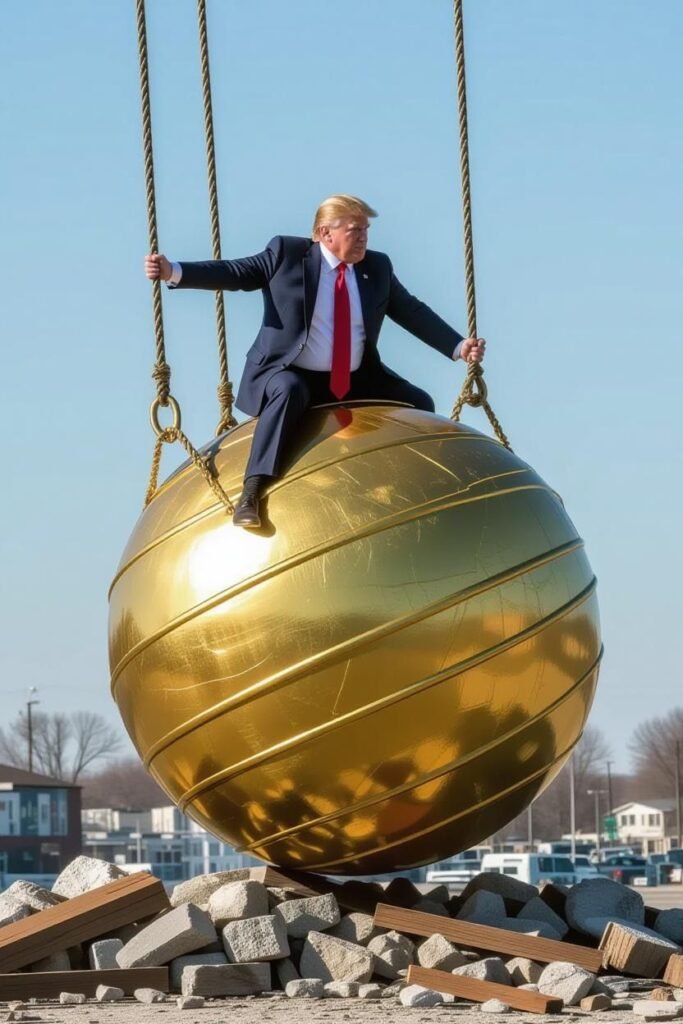
About a really intriguing takeaway
One plausible takeaway of the 28-pointer is that the selected oligarchy running the Empire of Chaos continues to run a protection racket – and the only way to salvage the de facto strategic defeat in country 404 is to turn a quick buck.
Another more intriguing, plausible takeaway is that the 28-pointer was never meant to be accepted by the EU-Kiev combo. It’s all about the Circus Ringmaster’s exit strategy from the debacle in Novorossiya.
Trump is already preparing the terrain – as in I tried everything, but Zelensky won’t comply. So it’s now his – and his gang’s – problem only, side by side with the EU chihuahuas. Up next: an immediate change of narrative. What else: the Empire of Chaos cannot manage reality, only narratives.
Trump 2.0 may start to work on improving U.S.-Russia relations – while blame for the collapse of the “peace process” is laid on the EU-Kiev combo. The optics of the 28-pointer P.R. op are everything: packaged as it is asking Moscow to strike a compromise, even as Russia is winning in the battlefield, while making sure the “criminal organization” in Kiev cannot agree to the main provisions.
Provisional endgame: the chihuahuas of war will keep barking while the SMO will keep rollin’ along.
Interviewer: Nima from Dialogue Works
Professor Wolff describes the slavery of Europe. He states that the psychological insight is that the demonization of Russia is the displacement of the rage and anger against the United States. This cannot be expressed so it conflates or becomes conflated in the rage against Russia. The real oppression of Europe is now being carried out by Mr.Trump. Because of the relationship they (Europe) cannot say so. They cannot face it but in reality, they act out the slavery. They have to heap onto Russia all of the hostility that is felt from Trump, but cannot be discussed. It is projection and an evasion of the problem.
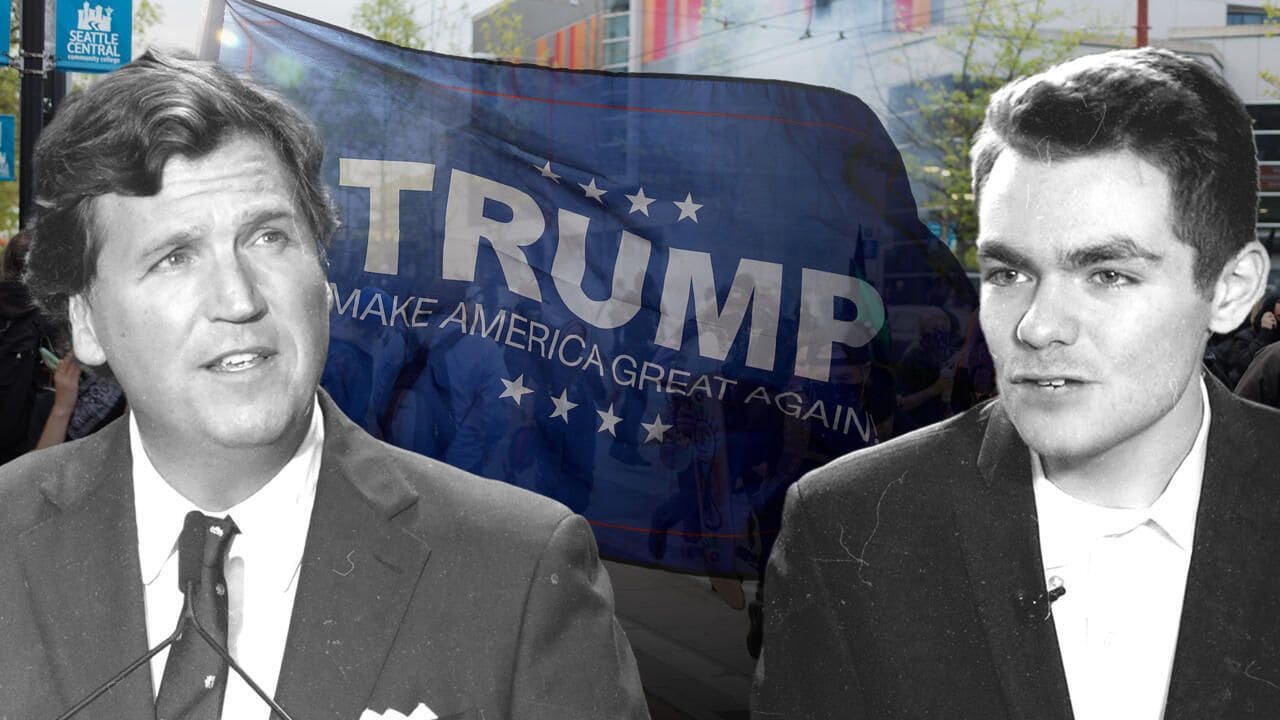
 Le conflit interne au sein des conservateurs américains et du mouvement MAGA soutenant le président Donald Trump persiste. Au cœur
L’article L’interview de Carlson-Fuentes divise les partisans de Maga : conflit total sur l’alliance américano-israélienne ! est apparu en premier sur STRATPOL.
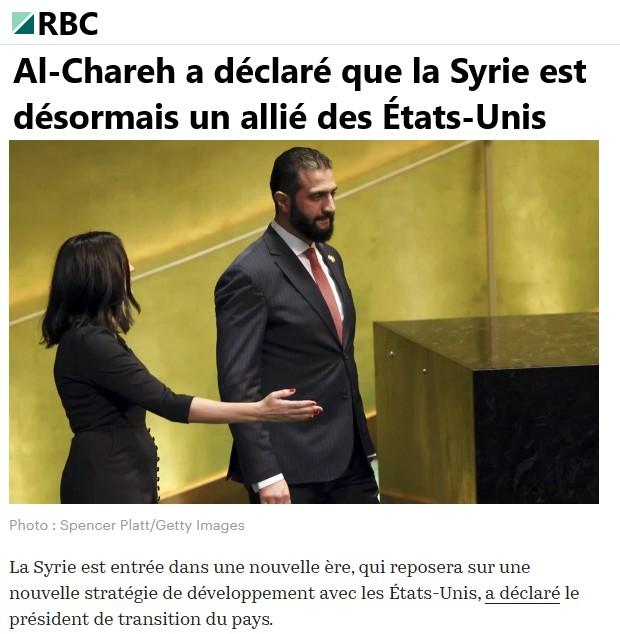
La Syrie est entrée dans une nouvelle ère, qui reposera sur une nouvelle stratégie de développement avec les États-Unis, a
L’article Al-Chareh : la Syrie est désormais un allié des États-Unis est apparu en premier sur STRATPOL.
Modest concessions from China that were not a sacrifice. Xi enabled Trump to get what he really wants, a public relations orchestration.
With Transcript
The money that America has given Ukraine isn’t to Ukraine — it’s not to the people — it’s to the kleptocrats that have said: We are willing to fight to the last Ukrainian. We are willing to try to drain Russia’s resources by sending Ukrainians there; and if the Ukrainian army tries to flee and retreat, we’re going to shoot them in the back — that’s what the Azov Battalion is for. So, all of this money has gone, not really to Ukraine, but to the Lvov group — the Azov Battalion — to, really, the neo-Nazis who are in charge of Ukraine. And the Ukrainians are hopeless to do anything.
NIMA ALKHORSHID: Hi, everybody. Today is Thursday, October 23rd, 2025, and our dear friends, Michael Hudson and Richard Wolff, are back with us. Welcome back, Richard and Michael.
MICHAEL HUDSON: Good to be here.
RICHARD WOLFF: Hi, glad to be here.
NIMA ALKHORSHID: Let me start with what’s going on in the European Union today. They’re talking about seizing Russian assets and sending them to Ukraine. The situation in Ukraine is getting critical in the minds of those countries who are trying to deal with the dominance of the United States, the U.S. dollar.
The question is this: If the United States and EU can freeze and seize Russia’s gold and dollar reserves, how safe is any country’s wealth under the Western financial system?
I’m going to start with you, Michael. Go ahead.
MICHAEL HUDSON: Well, it’s obvious that other countries do not feel safe. That’s why they’re buying gold. I think the rise in gold prices and central bank gold holdings reflects the inability so far of the Global Majority — China, Russia, other countries — to create an alternative vehicle for keeping their international savings in London, or in New York — in central bank assets loaned to the central banks of England, and America by investing in U.S. Treasury securities under the dollar standard, investing in European currencies. When all of this can be grabbed, all of a sudden, there’s no safe holding for other countries to hold their international reserves.
In the past, they’ve held it in New York, partly — and their gold in London — because that’s where the foreign-exchange markets were. And the purpose of holding international reserves, since World War II, has been to manage the exchange rate, so you can stabilize the exchange rate by borrowing and lending. And other countries, under the rules that the United States set up in 1944, that created the International Monetary Fund and the World Bank, were linked — all of this intervention in world currency markets — to the dollar, because that was the market at that time. That was where they had to operate.
Well, all of a sudden, this vestigial survival, from 1945, has been rendered unsafe and, hence, obsolete. So, you could say that the whole surge in gold prices means that countries are trying to find some way to avoid holding them in [that] form.
And the risk is twofold. On the one hand, the EU is still discussing how to turn this $300 billion that it’s confiscated from Russia, how to give it to Ukraine’s kleptocrats, in payment for their selling their population as, in effect, the mercenary army to NATO.
The money that America has given Ukraine isn’t to Ukraine — it’s not to the people — it’s to the kleptocrats that have said: We are willing to fight to the last Ukrainian. We are willing to try to drain Russia’s resources by sending Ukrainians there; and if the Ukrainian army tries to flee and retreat, we’re going to shoot them in the back — that’s what the Azov Battalion is for. So, all of this money has gone, not really to Ukraine, but to the Lvov group — the Azov Battalion — to, really, the neo-Nazis who are in charge of Ukraine. And the Ukrainians are hopeless to do anything.
Well, the problem’s not only, therefore, with foreign countries dealing with the central banks and the government of the United States; it’s the whole international court system that is going to — according to the EU — we are going to make sure that we never have to pay this $300 billion, because we’re going to ask for trillions of dollars of reparations for Russia defending Ukraine’s Russian-speaking population — in Luhansk and Donetsk — and now Odessa, that said: We want to be part of Russia.
And their defense is really an attack: We, the West, are allowed to attack Ukraine, to announce that the Russian speakers are subhuman. We can break the rules of law, by attacking consumer areas, civilian areas; not focus on military at all, but just try to destroy whatever is left for Russia to have. But, then, we’re going to say that they are attacking us by fighting back.
It’s like Israel accusing Gaza of attacking Israel, by fighting back against the eighty-year war against the Palestinians.
As long as you’re having the Western financial system backed by a judicial court system that, like the International Monetary Fund and EU, acts as an arm of NATO, the rest of the world is trying to break away; and the line of least resistance, for now, is to buy gold.
Well, the problem with buying gold, of course, is — in the past, countries would invest their foreign reserves in gold — Venezuela invested its reserves of gold, and it kept its reserves (as we’ve discussed before) in the Bank of [England], so that it could use these reserves as collateral when it borrowed money to intervene in the foreign-exchange market to try to stabilize its currency. That’s why countries kept their gold in either London or New York, where the major international foreign-exchange markets were.
But now, they can’t do this anymore. The Bank of England grabbed Venezuela’s gold, and it looks like the United States has grabbed Germany’s gold — and Germany’s an ally! A few years ago, Germany asked for its gold reserves to be returned from New York — [from] the Fed in New York’s basement — to Germany, for its central bank to hold itself. The United States said: Well, you know, this gold is very heavy. We’re going to have to find airplanes for that — and that’s the last that (in public) we’ve heard.
German reporters and journalists have been calling me to say: Do you know anything about what’s ever happened to this? They tell me that they’ve asked the German politicians about it. The politicians will not answer. Nobody can find out whether Germany’s got any of its gold back. And the United States is still holding onto this gold, and the rest of Europe’s gold.
So, holding gold only makes sense if you hold it in your own central banks, where the only way that it can be grabbed is for NATO to invade your country, seize the government, empty out your gold reserves and take it away — like they did in Libya, and other Middle Eastern countries. The problem that they’re really dealing with — the gold problem — is, how are we going to move beyond “gold isn’t a [practical] alternative?”
Well, the other line of least resistance that they’ve talked about is currency swaps: We’ll hold each other’s currencies (among the Global Majority). The problem with holding your currencies is, the currencies go up and down. And if you’re a creditor nation, like the United States was to Europe and the world in 1945 — and like China is today to many of the Belt-and-Road-Initiative countries that it deals with — how are you going to deal with the fact that the currency you’re holding is declining?
Russia has accumulated enormous holdings of Indian rupees that have been declining in value. And the last few days have seen the Trump administration go to Argentina, and they say: We know that you have been dealing with China very heavily, and you have a currency swap, and you owe them a lot of money; but this $40 billion that we’re giving you to support the peso long enough to get [Javier] Milei re-elected next week? In exchange for this, and our not pulling the plug on you, we want you to break all your relations to China; to not honor the currency swap; just to say, well, we’re just not going to pay you, China — what are you going to do about it?
So, currency swaps themselves are not a solution. And the BRICS currency is no solution, because in order to create a common currency among BRICS countries, it has to be like the United States creating a central bank, in which all of the American states and politicians are connected. For the EU, all of the countries had to create a political union because, if you have your own currency, who is going to get this currency? How will it be distributed? And how will various countries pay?
Until you have a political union among all the BRICS countries — which is not on the horizon, by any stretch of the imagination — you’re going to have to go back, and have the solution that John Maynard Keynes came up with in 1944, as an alternative to the U.S. designs for an International Monetary Fund: You create a new central bank, a collective central bank, that will manage the credits and debts among its member countries, in order to denominate their foreign exchange and currency swaps, to denominate these currency credits and debts in a common denominator based, basically, on the prices of their collective exports and relationships with each other. That’s the only logical solution.
I described the long debate over this in my book Super Imperialism. It took a lot of political maneuvering just for Keynes to come up with that. And of course, the United States said: No, we don’t want other countries to make any means of settlement among themselves. Any country’s settlement with any other country has to go through Washington, and the U.S. dollar.
And other countries — first of all, you had Britain surrendering to this; and the result was the loss of the British Empire and its currency reserves. Its colonies and countries using the pound were all transferred to the United States by 1950, and the pound collapsed in value, and Britain began its long deindustrialization. The rest of the European countries, once Britain had surrendered — well, there was nothing they could do but go along with it.
For the first time now, the world has gone back to 1944-1945, to create a kind of mutual foreign-bank relation to handle relations among currencies that is not run by NATO, the United States, and the Cold War. And the more gold goes up, the more you realize the inability so far for the other countries of the world to address, and solve, this problem.
NIMA ALKHORSHID: Richard, jump in.
RICHARD WOLFF: Yeah, let me put this in a context, but also to scare you.
The same logic that leads the Europeans to look gleefully at the $300 billion as a way to make it appear to their own people that the horrible mistake they made in going into a war like this — the enormous damage the war has done to their economy — to make it look as though they’re making, now, somebody else pay — which is really what this is about. It’s not enough money to change the basic layout of what’s going on. It sounds like an awful lot, and it’s a big chunk of money, but it is not adequate to alter the basic situation.
Number two: Let me scare you. China has (last time I looked) $750 billion worth of U.S. Treasury bills. What’s to prevent the United States from telling them that these are now toilet paper? We are not going to pay you the interest, and we’re not going to pay you the principal, and we’re going to deal with the rest of the world, henceforth. When we have to borrow for the American government, we will borrow from the rest of the world — end of conversation. Or, we’ll do it for half of the $750 billion.
What’s to prevent them? You know, this is crazy.
Here’s what we are watching: we are watching the end of the empire. These are the kinds of things that happen when the empire can no longer function. The United States is facing a fundamental contradiction: It cannot keep the world arrangements of the post-45 period, and fight Russia and China; and be involved in a war in Ukraine; and be gearing up to take the oil away from Venezuela — it can’t do it. That’s the problem. It can’t do it. It doesn’t want to admit it can’t do it, so it’s coming up with crazy stuff, stuff that makes no sense, other than as the end of an empire.
So, one of them is, we’re going to take — by the way, if I understand correctly, they’ve already taken the interest income from the $300 billion, and used it for the Ukraine war. Clearly, that great move didn’t change anything. And so, now, they want to take the principal. Of course, they do. You know, this is the same game. And what does it do? Everything that Michael just said, and a dozen more things.
Everybody is wondering where to keep their money now, because the empire, the emperor, is not in a position to do it anymore. The United States had said to the world: You can keep your money here because we are the safest place for anyone to keep any kind of wealth. We are the ones who will tax it the least. We are the ones who will threaten it the least. We don’t even have a socialist, or communist, party worthy of the name, in terms of its political power; so you don’t have to worry about that. We have a docile, unorganized labor force. You know, we offer you wonderful conditions. So please take a good portion of your wealth and bring it here — which gives us yet more power of an empire to give you the guarantees. You are, in fact, by locating your wealth here, funding our ability to guarantee that wealth.
That’s what an empire is. That’s what an empire does. That’s what the British did in the previous century. And now it can’t do it anymore.
Let me give you, what you wouldn’t perhaps see as, another sign. We are now executing people in boats on either side of the Western Hemisphere. We did it for a while in the Caribbean with the Venezuelans and the Caribbean [peoples]. And, now, I learned in the last two days, we’ve gone on the Pacific Ocean side, and we’ve done it again. We don’t arrest these people — no trial, no jury, no lawyers, no nothing. Summary execution — in the name of what? Of a war on drugs?
Friends, the United States has had an official war on drugs for at least the last seventy-five years. It proves unable to stop them. You can get all of these drugs anywhere in the United States — urban, rural, east, west, north, and south. We are not able to stop it.
Killing people summarily is an absurd thing for the upholder of values of law and order and, if I dare say so, a rules-based international order. What rule exactly is it? Killing people in boats?
If you arrest a person for the drug trade inside the United States, you do not kill them. Even if they are found guilty, you don’t kill them. We haven’t killed anybody in the drug trade for that crime in anyone’s memory.
Okay, so these are signs of an empire that cannot function. Of course, people are running to gold. It’s one of those things which — and I don’t believe it’s correct, but that’s another matter — but it’s a thing that people think is safer than those other alternatives. Well, what I hope people focus on is not whether it’s safer or not — In my judgment, it isn’t — but that, we can disagree. The important thing is they are running away from what is now, clearly — even though they dare not say so — a break in the behavior of an empire.
For the Europeans — look, they’ve even had a debate among themselves about it. Their lawyers are telling them: You are taking an incredible step here. Are you sure that it will not hurt Europe to have been the one to do it? Because wherever you’re wealthy, if it’s the Europeans that are doing it, then it’s Europe you’re going to be sure not to keep your wealth in. And this is something the Europeans, at a time when everyone admits their economies are in serious trouble — above all, the British, the French, and the Germans, and those are the major three in that part of the world —
You really want to, now, damage your standing as a place to hold wealth, which is where wealth has been held disproportionately for the last 500 years? This is bizarre. This is the end of the Western Empire.
Last point, before you go back [to Michael]. Part of the reason the BRICS have not developed their own currency, their own ability — which, by the way, all of these developments will provoke them to do, and to return to do, sooner rather than later. Michael is right about that —
But one of the reasons they haven’t done it, we have to keep in mind, because these are important points going on in the debates inside China: The spectacular growth of China in the last thirty-five years was itself, in part, dependent on the empire of the dollar. It was within that context that the Chinese found a way to grow faster than the United States; to become the manufacturing core of the world economy.
So, they are rightly worried — don’t make the transition out, before you are pretty damn clear that the benefits of doing so will outweigh the inevitable costs of not having what worked so well for you. There’s a joke that goes around in China about, you know, not cutting off from the United States while it is doing very useful things for the Chinese: in having the SWIFT system, in having the dollar as the universal exchange, even to the diminished degree that is now the case.
In other words, it’s the old dialectic, and we should be careful not to get caught on either side. And let me explain very quickly, then I’ll stop.
On the side of the United States is the following argument: China is only a superpower because it brought in private capitalists thirty years ago. After Mao died, and the end of the Cultural Revolution, you had a change, and in come foreign private capitalists — Japanese, European, American — and then the allowance for the Chinese themselves.
So, that’s one side of the dialectic. That happened — no question — and that was very important to Chinese growth — no question — but, at the same time, the Chinese government held on to the absolute dominant position in the Chinese economy. The government did, and the Communist Party within the government kept its power. And that is just as important a part of the growth and success of the Chinese economy. Otherwise, you can’t explain why China did so much better than any other country in the global south under the regime of American empire.
Alright, so the dialectic is the interplay between the public and the private sector. The reason they outperform the United States, is the United States doesn’t understand the dialectic, and is so caught up in its own ideology that it holds back the government from doing all kinds of things it needs the government to do. [The] Chinese don’t have that problem, and the Americans can’t see it.
So, the dialectical process now has shifted. It’s costing the West, every day. The war in Ukraine is a wonderful metaphor, despite everything. Every escalation, including the new sanctions on oil companies announced over the last twenty-four hours — like the F-16, like the Abrams tank, like the various missiles (like the Patriot system, like the HIMARS) — all of them — they didn’t work. They didn’t work. That’s why you have the escalation, at every step.
And if I were a betting person (I’m not, but if I were), I’d bet that all of this stuff, with sanctioning the oil companies, these are just ways for Mr. Trump to cut his losses. Ukraine is going down, and there will be — there already is — an enormous blame-game going on between Europeans and Americans. Who’s at fault? And so, yeah, sure, let’s sanction that, sure. The United States did its part. It’s not us. We did our part. It’s you, Europeans.
And the Europeans will say exactly the opposite.
And this game of blame will be yet another sign of an empire dissolving.
MICHAEL HUDSON: Nima, is it okay if I return to the monetary topic? International finance?
RICHARD WOLFF: Sure.
NIMA ALKHORSHID: Go ahead, Michael.
MICHAEL HUDSON: And yet, despite all of these things, the U.S. dollar has been going up. It’s certainly viewed as a safe haven for anybody. And why is it? How can the U.S. dollar be going up, while other central banks are moving out? Obviously, it’s private-sector money, and that means new credit creation. Private investors are moving their money into the dollar.
Well, this is exactly the strategy that the United States — way beyond Trump — has tried to put in place. It’s the strategy between Trump saying: Japan has to pay us $350 billion, or we will wreck their economy by blocking their trade with the United States; Korea has to pay us $350 billion, or we will block Korean exports of automobiles and computers and steel, other Korean exports, to the United States.
So, the United States has tried to make it a safe haven, despite the fact of all of the problems that we’ve been discussing — why it’s unsafe for central banks to hold their reserves here. The United States has the power of making it a safe haven, by the extent to which it can wreck other countries’ economies, by blocking them off for trade with the United States.
But there’s another reason. There’s a more positive reason. And this is what I think we really should be discussing in the time we have remaining.
Money has been coming into the United States because we’ve had an enormous real-estate bubble. A Ponzi scheme, virtually, has been financed, first of all, by the low interest rates — the Federal Reserve provides the banks with low interest, to lend to its customers for spending.
Well, what do central banks, and what do commercial banks, lend for? They don’t lend for goods and services. They don’t lend for people to buy consumer goods. And so, the effect of central bank credit isn’t on commodity prices. They lend for the purchase of assets already in place as collateral. That’s how banks have operated for the last thousand years. Eighty percent of the bank loans, as we’ve said before, are for real estate — and the effect of this bank-lending is to raise real estate prices.
More and more recently, you’ve had the banks lend an enormous amount of money, coupled with the Trump administration’s policies to create an enormous bubble in the stock market — well, Trump went to the Silicon Valley heads, and the biggest monopolies in America, and said: I want to build a billion-dollar East Wing of the White House. I want to make it bigger than the White House, and put in gold “Trump’s Ballroom,” so that people will look at me and my name, instead of at the White House. That’s going to cost maybe $250 billion. I want each of you to give me $25 billion. And in exchange, I promise I’m not going to impose anti-monopoly laws against Silicon Valley, or the oil industry, or all of the other monopolies. And I will promise to cut your taxes, so I’m only taxing labor, industry, agriculture — but not you financial guys.
And, of course, they went along with it. And so, Trump has been able, in order to get the money that he wants, to get other people to contribute to his political campaign, to buy his cryptocurrency, to make billions of dollars for himself — and, well, you can contribute to my campaign by buying my cryptocurrency, and that’ll push it up; you can contribute to my ballroom, to make my name immortal.
And the result is that he’s made the deal of making and permitting an enormous price inflation. He’s imposed tariffs on foreign imports so that this creates a price umbrella for American producers of similar goods, to say: Raise your domestic prices all you want, and blame it on the tariffs; and say, well, that’s pricing at the margin, and the margin is what we import.
So, you’ve had this enormous stock-market bubble. And it’s a Ponzi scheme, because a Ponzi scheme is where you have the economy borrowing so much money — to try to break even, if you’re a wage-earner — or to keep current on your debts, if you’re a corporate financial manager, that you lend the customers the money to pay —
There are a lot of homeowners that, all of a sudden, they’re finding, as a result of global warming and bad weather, that there’s massive flooding. And the insurance that they have to pay on their houses has gone up so much, that they cannot afford to pay their mortgage, and to pay their living costs, and pay this rising insurance. So, all of a sudden, their housing — in Miami and throughout Florida, and in the western states that are homes of hurricane and tornado areas — all of a sudden, this has become unavailable.
Well, the banks have gone to them [to] say: Well, we don’t want you to lose your home. Of course, you want to keep living there. Take out an equity loan — and the banks will lend the money — the equity loan — so that families can be able, instead of repaying their mortgage, they can simply keep on adding personal equity loans to the mortgage. They can pledge, and draw down, their retirement savings funds.
All of this money is going to increase asset prices. So, the real inflation that the United States has had, that has stabilized the dollar, is not the consumer price inflation that people are talking about — it’s the asset price inflation for stocks, bonds, and real estate.
And many of the banks today who have lent to automobile-buyers — you’re having default rates on auto loans go way up; default rates on real estate, way up. Well, the banks that are heavily exposed to these areas, that have said: Well, we make so much money in high-priced auto loans and high-risk loans, that we’ve decided to make loans to whomever will pay the highest interest — and the people who pay the highest interest are the most desperate.
And the result is that now these banks are insolvent — just like in 2009, most of the big Wall Street banks, and the systemically-important financial institutions, were insolvent. They were in negative equity: the debts that they owed to their depositors and their counterparties were higher than the value of their assets.
Well, that’s the danger that the United States is going to fall into today. And this is why so many of the professional investors — certainly the ones I know — that think, we can’t explain why the stock market is going up. There [are] higher profits — all of that’s true — but the whole economy is being hollowed out by debt.
All money creation is debt creation, because it’s credit creation. Money is a form of credit. And the question is: If the credit is used to either help people pay their debts, or to run into debt to buy stocks and bonds and real estate that they think will go up, then at some point, all of this debt becomes increasingly fragile, and has to collapse — and that’s what Hyman Minsky called the “Ponzi” phase of the financial instability cycle.
And the U.S. is coping with its financial instability and the dependency (that we’ve talked about for the last forty-five minutes), by essentially creating a Ponzi scheme that is also going to collapse.
So, the insecurity of central bank holdings, of their dollars in U.S. Treasury securities, is nothing compared to the insecurity of private investors — foreign investors, and also domestic investors — who have decided to try to participate in the stock market. Well, you don’t know when it’s going to stop. The only way you can know when a bubble is going to stop is when it begins to turn down.
And the market in U.S. stocks and bonds recently has been pushed, above all, by domestic American small investors, not big institutional investors — they’ve sold out, and are moving into long-term Treasuries, 10- to 30-year Treasuries, not short-term. They want to lock in the gains while they can.
It’s the small investors that have done this, because they somehow imagine that — they don’t believe that — there’s a boom, until it’s almost over. And also Canadian investors. I did a study to see foreign investment in the stock and bond markets. Canadian investors don’t like to buy stocks until they reach the top. They think, okay, now we see the trend, now we’ll buy. Then it goes way down, and, finally — when it gets near the bottom — they say, okay, we’ll sell, it looks like it’s a trend — and then it begins to go up again. Well, that’s what the small investors in America do.
So, the American economy is becoming just as exposed to all of this instability as foreign economies are. And so, the result is — I think we’ve used the word “desperation” before — that’s how the United States is flailing around. And it looks like, if there is a meeting between Trump and China, China is going to say: You know, maybe we should just go our own way. Yes, you’re going to prevent other countries, to ban any country’s exports to each other that do not use American computer language, American electronics, as the basis for it.
Well, this is going to drive other countries to say: Well, I guess we’ve lost the U.S. market. I guess we’ve lost the market of America’s satellites in Europe. I guess we’re going to have to have a new computer language, in order to trade with the world’s growing market — China and the rest of Asia. And so, these new sanctions that Trump’s team has been describing in the last day or two, are going to be driving other countries to a total break with the United States.
Well, if there’s a break in the United States, it’s not only a break in U.S. trade, it’s a break with their mutual investments, the loans and credits they have to each other. Each country will take whatever they have. It’ll be a clean slate. Nobody’s going to pay any of the debts to each other. It’s all grab — China will grab the American investments there; America will grab China’s, and Russia’s, investments here —
That’s where the Trump administration is leading, because it really believes that other countries can’t afford to lose the American market. And yet, if the American market is collapsing, because it’s all so debt-ridden and financialized, then why would other countries worry about losing the American market, if the price of holding it is to lose the Chinese, Asian, and Global-Majority market?
That’s the big choice that they’re having to make. And you can imagine that their choice is not that which the America-firsters imagine, in their collective narcissism, that other countries cannot survive without the United States’ leadership and control, at the price of absorbing all of their international surplus — for us, Americans — instead of for them. That’s the blind spot of this self-destructive American policy that, as Richard said at the end, is catalyzing other countries to create their own alternative, as an economic life and death issue.
NIMA ALKHORSHID: Richard, breaking news here. The Wall Street Journal reports that President Trump has pardoned Changpeng Zhou, the convicted founder of the cryptocurrency exchange Binance. The decision follows months of efforts by this guy to support Trump’s family cryptocurrency company. And he was pardoned by Donald Trump.
RICHARD WOLFF: Yeah, that part, there’s no end to — and for me, by the way, that’s another sign of a declining empire — its Emperor (you know, whoever it is) taking care of his cousin and his uncle; it’s the French leader famous for the phrase, “après moi, le déluge” — “after me comes the deluge:” it’s all over, and I’m going to grab as much as I can, before the flood comes and shakes it away.
But I want to pick up on the last point Michael makes. You know, he reminds us that Japan and South Korea have been told, you have to invest $350 billion. Ursula von der Leyen was told that the Europeans have to buy twice that much in U.S. energy in the years ahead; and invest $700 billion in the United States.
Well, I’ve got news. If the Europeans are willing to take the money from Europe, then I can assure you that before they go down, they will turn to the United States, whether Mr. Trump is president or not, and say: It’ll be a cold day in hell before you ever see any of that money. You made a demand on us, and we told you we’d give it to you. But the world has changed. You know, like we told the Russians it was safe to keep their money in London, or Western Europe, and, well, the conditions have changed.
That’s what we’re talking about. All bets are off.
There is a small correction. The dollar has not gone up. If you look at the dollar, from the time Mr. Trump becomes president (back in January) to today, it is significantly lower in value — at least, against the Euro, and a good bit of other currencies as well. I think Michael’s analysis stands. I think the reason it didn’t go much lower is not because wealth isn’t being withdrawn from the United States — it is, to gold, and to all many other things —
But I think the reason is the second part of what Michael said: You have a classic unsustainable inflation. And he’s quite right. It’s not the inflation of goods and services that they’ve kept under control; but the price of keeping that under control is an uncontrolled inflation in the asset markets and, above all, in real estate and the stock market.
People have done very well in the stock market. People are doing very well now in the stock market. That’s one of the reasons the ruling class in this country — even though it doesn’t like what Mr. Trump is doing — isn’t going to do anything about it because they’re the ones who own the shares, and their monthly statement is telling them he’s okay for them. He may be a disaster everywhere else, but he’s okay for them.
You know, the mass of people? No, the mass of people are going in a different direction. They’re about to elect a Muslim socialist mayor of New York City. They’re about to elect Catherine Connolly in Ireland as the new president of Ireland, whose perspective and whose positions are quite like those of Mr. [Zohran] Mamdani in New York — sometimes right down to the literal sameness. So, things are happening that are coming out of the movement from below — the absurdity of the French government, which Mr. [Emmanuel] Macron is no longer the real leader of; and Mr. [Keir] Starmer, likewise; and Mr. [Friedrich] Merz, soon. These are signs of diminution.
And the inflation in asset markets is nothing new. It is a very old business. That’s why we tell people a credit is good if it is used to be productive, so it produces the wealth that can justify, retroactively, the debt. You get that if you borrow to produce. You don’t get that if you borrow to bid up asset prices.
The joke then becomes — and we’ve had this in the United States, repeatedly, in the last hundred years: You have a borrowing binge. It bids up the price of real estate. As the price of real estate goes up, the owners of the real estate go back to the bank, and say: I have a much more valuable piece of land here. Let me borrow more money because you have the collateral. Oh, sure, here’s more money — which is then used to bid up the price. You understand? The loan bids up the collateral, which enables a bigger loan. There’s no end of this until, well, what?
Those two automobile loaning companies that collapsed over the last two or three weeks? And notice, not just that they collapsed, but the immediate news — extraordinary! Literally like what happened at the beginning of the collapse of the subprime mortgages back in 2007-2008. An immense debate between a small group who says: Uh-oh, this could be the beginning of the collapse — versus an army of responders saying: No, no, no, it’s different this time.
That’s exactly what we have each time. And, by the way, sometimes one of them is correct, sometimes the other one of them is correct.
The important thing is to see what we are seeing: Any one of a dozen phenomena could blow this out of the water.
If the Russians finish in Ukraine — the battle of the city of Pokrovsk, which is now in play, is the end, basically, of this war — Odessa and Kiev are all that’s left to be fought over, and it’s obvious where this is going.
Likewise, it’s obvious, to those who watch, that the sanctions on these two oil companies [Rosneft and Lukoil] is a symbolic act. It’s not a real, you know. It’s an irritant. If you look at the price of oil, which it’s supposed to drive down — the price of oil has been going down from the beginning of the war in Ukraine. If you look at the global oil price in the early part of 2022, and you look at it today, it’s a line that goes up and down; but it basically goes down, from roughly $120 a barrel, to roughly $60. That’s a tremendous cut — and that has not inhibited the Russians, at all. Right?
So, you have sanctions, and a global cut in the oil price — should have done Russia in, if you believed any of that story from the beginning — it never did. And this little addition isn’t going to do it either. The joke today — today — the price of oil went up two, three bucks a barrel, not down.
You know, it’s just extraordinary the way this is playing out, and the utter blindness of the West in terms of understanding its own position. No one knows how long it will take for the BRICS and the Chinese to develop their own equivalent. But I think, if I had to pick the most important thing that Michael told us, it’s his recognition — as he spun out the logic of his own argument just now — that the end result is the United States building a wall around itself. It is this self-isolation of the United States that’s underway.
We have seen tariffs imposed, but we have not yet seen retaliation. That’s coming. And no one knows how bad that will be. And all of it — Mr. Trump is busy, desperately trying to hold on, for example, to the Milei government in Argentina: giving them $20 to $40 (depending on how you count) billion dollars to keep their currency going; dropping the tariff against their beef, so that they can bring cheap meat into the country; freaking out the beef ranchers in several states, without which he can’t be president anymore.
He has to screw the cattle farmers in this country by bringing in the cheap beef. Why? To keep one of the few governments going that supports him. This is impossible.
And there’s a good chance — Mr. Milei, having gotten this total bribe — of the people of their country being told that they must vote for him or else they will lose all of these benefits —
So, talk about interfering in other people’s elections! Remember? That was Russiagate we were very upset about? That was nothing, compared to — you buy that entire country here, openly, publicly, with a threat: You don’t get the money, you don’t get the beef exports, unless we get a re-election of this particular candidate, who, the polls in Argentina show, is like Mr. Macron and Mr. Starmer: you know, hated; not loved, except by the extreme right wing there, which is too small to keep him going. So, for me, again, signs of a decrepit, desperate empire having a hard time holding on.
MICHAEL HUDSON: I want to pick up on just two topics that Richard’s brought up: Argentina and oil.
Obviously, after the election, Argentina cannot pay, not only the $40 million, but all of the other debt that it’s taken on from the International Monetary Fund. Milei will probably be voted out of power, and the IMF is going to say: We only lend money to American-backed dictators. We don’t lend money to left-wing groups that want to increase living standards. We only lend to our client countries.
So, Argentina cannot pay the debts. And the problem, that I should have mentioned before, is neither can almost all of the global south countries today. They cannot afford to pay the debts. If there is the break that we’ve discussed, the global south countries cannot pay the foreign-dollar debts they owe — not only to the U.S. and the official institutions like the IMF, but to bondholders.
There are going to be a lot of banks that are very heavily exposed to this break that we’re talking about. And the break, of the scale that we’ve talked about, the break of international trade and payments between the West and the Global Majority, is going to lead to many bank failures, too.
Also, Richard pointed, quite rightly, about oil. I didn’t mention that the most heavily exposed countries of all are Saudi Arabia and the Middle Eastern oil exporters. The deal that they made back in 1974 and ‘75 — and I was at the White House sitting in on these deals — was that they can charge whatever they want for their oil, but they have to invest all their oil-export earnings in the U.S. stock and bond markets — not buying control of U.S. companies, but stocks and bonds.
Well, all of this money is just as exposed as other countries are. And I think this is the explanation for why the oil prices have been going down. The Americans have strong-armed OPEC countries: You must reduce oil prices because we want to squeeze Russia’s foreign-exchange earnings that come very largely from its exports of oil and gas.
The Americans think of Russia as a gas station with atom bombs, not realizing that Russia now exports agriculture, and all sorts of other goods, besides oil and gas. So, Russia’s been doing just fine. It’s growing much more rapidly than the West.
But the U.S. has strong-armed OPEC into providing such a heavy supply of Near Eastern oil that this has driven down the prices. This is done largely to support America’s control of the Near East.
All of that is going to be called into question also. The whole political division of the world between the Middle East countries — literally in the middle between the East and the West — is going to be all up for grabs — all instability, all up for diplomatic maneuvering between China, Russia, and the BRICS countries, on the one hand; and the United States and its European satellites, on the other.
All of that is going to be enough to supply your show with a lot of audience for the next year or two, Nima.
NIMA ALKHORSHID: Yeah. Thank you so much. Richard, do you want to add something before wrapping up?
RICHARD WOLFF: No. No, I want to apologize [to] people: I don’t mean to beat the proverbial dead horse, with this “desperation” and “declining empire;” but I also want to justify that I keep returning to it because it is the context that is often missing in the discussions — so we don’t get lost in the weeds. Important as the details are, we need to periodically remind ourselves, and our audience, of how to see the larger picture within which — otherwise, we will be whipsawed by each day’s evolution.
You know, you take the president seriously, when he tells you that by going after Lukoil and Rosneft, he’s done this major — this is all really what folks used to call “smoke and mirrors” — you know, a game, a performance — that has really only to do with the fact that the Europeans know that it’s over in Ukraine, and that their program of demonizing Putin as the (sort of) way to cope with this loss isn’t doing the job. It’s not reviving their popularity; it is not recouping their economy; it is not squeezing out of the United States more support — none of it. Absolutely none of it.
And so, they are desperate. They really don’t know where, quite, to turn. And believe me, there are people — there must be — maybe I’m wrong, Michael knows this stuff better than I do — but there must be people in the White House with enough economics history in their head to be able to tell Mr. Trump, and the people who advise him, what the risks are of a stock market —
Even the financial press is full of articles — today, yesterday, last week — wondering whether the overpriced stock market is going to blow at any second. It’s not just left wingers, like Michael and me. People should understand, this is a widespread anxiety. When we say people are rushing to gold for safety, that’s what’s happening: they’re leaving the stock market — not enough yet to offset the built-in rising of the borrowing, and the asset inflation.
And the inflation you don’t see at the supermarket is because you do see it in the stock market. And beware, if it stops in the stock market, it might really take off in the goods market. And then where will the mass of Americans be?
NIMA ALKHORSHID: Since you’ve mentioned the situation with the White House, Richard, before wrapping up, here is the situation with Trump’s White House. Here is what he said about India:
REPORTER (CLIP): And, you know, you even mentioned that in a recent phone call with Prime Minister [Narendra] Modi, and that Modi had said his country would stop purchasing the Russian oil. But India said that they were not aware.
DONALD TRUMP (CLIP): Well, then they’re going to just keep paying a lot of tariffs. If they said that, but I don’t believe they said that. No, I spoke with Prime Minister Modi of India, and he said he’s not going to be doing the Russian oil thing.
REPORTER (CLIP): Well, why would India say that they’re not going to do that?
DONALD TRUMP (CLIP): I don’t know. But if they want to say that, then they’ll just continue to pay massive tariffs. And they don’t want to do that.
NIMA ALKHORSHID: The guy makes things up. [Laughs] How can you imagine that?
RICHARD WOLFF: Yeah, and he’s going to threaten the whole world with tariffs. It’s his answer, half the time, and with his assistants, it’s the answer all of the time. You know, this reminds me of a famous image. It’s the two guys in trench coats, entering the dry cleaner in some urban area of America, and explaining to the little owner of the dry-cleaning establishment: We’re here to pick up our weekly $200 protection fee. And the little owner turns to them and says: What are you talking about? What do I need protection from? And the two of them smile, and they say to him: You need it — from us. You have to pay so we don’t hurt you.
It’s really what Michael said a little bit earlier: You have to pay, or else we will hurt you.
Goldman Sachs released this last week their estimate of what the actual tariffs are that have been levied (so far) in the Trump regime, and what portion of them have been absorbed by the businesses, what portion passed on to consumers, and what portion hurting the original exporters. Here we go. Ready? The exporters have lost under 10% — that is, only 10% of the burden of the tariffs has actually fallen on the exporting country; 61% has fallen (if I remember the numbers) on American businesses; and the remainder on American consumers.
So, American businesses and American consumers have been whacked by the tariffs. The rest of the world, not so much. Not really anywhere near so much. And that’s before — as the Goldman people point out, correctly — that’s before we get the retaliation that is being planned, debated, and, hesitantly, brought forward in the rest of the world. At which point, the balance will shift.
And all they can discuss among themselves at Goldman is: Which is worse for the American economy? The damage to the business’s profits, or the damage to the consumer’s pocketbook? What a place to be, in looking at the effect of the “liberation,” as Mr. Trump called it.
NIMA ALKHORSHID: Thank you so much, Richard and Michael. Great pleasure, as always.
RICHARD WOLFF: Bye-bye.
NIMA ALKHORSHID: See you.
NIMA ALKHORSHID: Hi, everybody. Today is Thursday, October 16, 2025, and our friends, Richard Wolff and Michael Hudson, join us today. Welcome, Richard and Michael.
MICHAEL HUDSON: Good to be here.
RICHARD WOLFF: Hello.
NIMA ALKHORSHID: Richard, let’s start with you, and with the reports we had in the New York Times that Donald Trump and his administration have authorized the CIA to do some sort of covert operation in Venezuela to overthrow [President Nicolás] Maduro. And here is what we’ve learned from Republican Senator Rick Scott on Fox News:
RICK SCOTT, U.S. Senator, R-FL, Senate Armed Services Committee (CLIP): I think if Maduro’s smart he’s going to go ahead and move to Russia, or China, some place like that, because his days are numbered. You know, the public of Venezuela don’t want him. They rejected him in the last election. He stole the election. He’s a dictator, a drug cartel leader. So, his days are numbered. However they do it, I look forward to the day that he is no longer in Venezuela. It’ll be great for the world.
NIMA ALKHORSHID: What do you expect, Richard, from what’s going on?
RICHARD WOLFF: Well, the only interesting thing about Rick Scott — and let me tell you, it takes a lot of work to find an interesting thing about Rick Scott — but the only interesting thing about his remark was that little remark at the end: whatever it takes. Because that’s where we are.
And also, I like the way the television station juxtaposed the camera on him making the statement and, likewise, on the boat, somewhere in the Caribbean, that is being targeted by the missile.
I want to say here for the record: The United States is, therefore, engaged, by the president, with the approval of people like Mr. Scott, in being the police, the army, the judge, the jury, and the lawyer, for people it is executing. Those people were not arrested. Those people never had a chance to have a lawyer explain who they were, what they are. By the way, it’s not just Venezuelans. Today’s newspaper indicates that Colombians have also been killed in boats. So, who knows how widespread this is? Who knows how much we’re being told?
I want to also stress to people that being in the drug trade is not treated as a capital crime inside the United States. People are arrested for the drug traffic in this country every day. They are not executed. Those that are found guilty are subject to various kinds of imprisonment and punishment, but they are not executed. So, we arrest people in this country; we give them a lawyer; they have their day in court; they get a judgment; and they are not killed.
What are we doing in the rest of the world? We are showing the rest of the world a little bit — a junior version — of what the Israelis have done in Gaza. We’re killing people. We’re killing people who are alleged to be involved in a crime that we don’t kill people for in our own country. You know, I’ve been around a while. I don’t recall anyone being executed in the United States for drug traffic, ever. I may be wrong, there may be somebody who once was, but it is hardly ever done. So, what are we doing here?
We’re showing the world that we’re a tough guy. You know, that’s what the tariffs were: a big piece of theater, but it didn’t cost anyone’s life. Now, we’re saying we’re prepared — and we’re not only prepared to kill people — with no judge, no jury, no lawyer, no due process, none of the guarantees that we say we revere as intrinsic to the Constitution and the values of the United States — all out the window — that is a remarkable statement to make. And we don’t like Mr. —
Everybody who studies the drug traffic knows that the major problem of drugs comes from the Pacific side of the continent, not the Atlantic side; that there are loads of people involved who seem to be able to continue, with very little interference. Nor has the United States ever acknowledged, or admitted, that the problem begins with the fact that the United States is the world’s richest market for the drugs — the endpoint of the trade is mostly here — and that we could do a lot more here without violating our Constitution to deal with it, if we were — we’re not.
It’s another message to the rest of the world that the United States is going it alone, that the United States is isolated, that the United States is relying on military power because its economic and political reach is now so weak. You know, we start — at this point, when you behave like this, then things have to be called by their proper name, not by their polite name.
The people, the immigrants, who came to this country for a chance to do what immigrants have always come to this country for a chance to do, are now being hounded by a special police force, and detained in concentration camps — that’s what they are.
Let’s be clear. Let’s stop playing these silly games. We are killing people. We’re promising to overthrow governments in the worst replay of the ancient activity of the United States in Latin America, which is as old as the Monroe Doctrine — and let me remind you, that’s from the 1830s. What in the world do you expect, now? What are the countries in the BRICS going to think, given what Mr. Trump has said about them? Are they being overthrown by the CIA? Are we really back in that world?
Well, if we are, if we are using the CIA to go after the serious enemies, you know, enemies who can do something to the United States — Venezuela can’t. It’s too far away. It’s too poor. It’s too small. You’re picking on somebody — you know, it’s a little bit like the British fighting in Grenada, or the Falkland Islands — it’s a joke. So, assumedly, they’re going to go after the big guns, you know, Russia, China. So, the message to them is, that’s what the United States is now reduced to. Get ready for that.
And let me make a message to my fellow Americans. You are messing with an enemy now that is much richer, and much stronger, than they have ever been. Be very careful because you will likely not prevail. Let me remind you: The CIA was busy in Vietnam, before that war — it failed. And the war that came after it, after the failure of the CIA? That failed too. Ditto for Afghanistan. Ditto for Iraq. Ditto, now, for the Ukraine. Wow. Be careful. Be very careful what you are doing.
There is an alternative — whether it’s in the drug war, or any other conflict — and that is, you sit down with whomever else is involved — other countries, other enterprises — and you work something out: a deal that allows you not to be engaged in killing people and overthrowing them, because that is a game everyone can play. And now, more than ever in the history of the United States, the enemies that you are making by this behavior are strong, very strong.
So, this is now more dangerous than it has ever been, and it was never a good policy in the first place.
MICHAEL HUDSON: Well, Richard, if you try to work something out, then you’re treating other countries as equals. And the United States has rejected that very concept. The reason that it’s doing these assassinations and killings is for control. So, Trump has called Venezuela a narco-state, as if every Venezuelan is a drug dealer. And this is like [Benjamin] Netanyahu, as you pointed out, saying that every Gazan is a Hamas terrorist. So, the whole Caribbean belongs to the United States.
It’s not really about drugs at all. It’s about control. And I think — you’ve been describing — the United States has turned into a terrorist state. And it has been a terrorist state, since 1945, as a deliberate arm of foreign and domestic policy for what it calls “promoting democracy.” The former head of the CIA, [Mike] Pompeo, has said the CIA is like Murder, Inc.: He found out that they’ve been killing people all over the world, beginning with Patrice Lumumba in Africa; Aldo Moro in Italy, when Moro tried to achieve a rapprochement with Soviet Russia. You know what happened to Libya with [Muammar] Gaddafi. You know what happened in Chile with Salvador Allende, and the whole terrorist actions throughout Latin America that the CIA began.
So, this is already official U.S. policy — long before Trump. And I think that on a larger scale, the U.S. is backing terrorist groups, like ISIS and al-Qaeda, throughout the Middle East, in order to maintain control of Near Eastern oil; and at home, you have the FBI assassinating Martin Luther King [Jr.], Malcolm X, and many others. This is called “managed democracy.” You need assassinations to make sure that “democracy” works. That is, it works for the aim of enabling the United States to meddle, not only in foreign countries’ elections — to make sure that they don’t allow elections of leaders who follow policies adverse to those of the United States and its desire to control — but in the United States itself, the meddling [in] elections here.
These killings are merely the tip of the iceberg of America’s attempt to control foreign policy and politics, and domestic policy; and it does not accept the United Nations rules of non-interference in other nations’ affairs. That’s been the rule of international law ever since the 1648 Peace of Westphalia, saying you have to agree [that] every country and every state has its sovereign power. The United States rejects that.
The United States says: We alone have the sovereign power; and we use that sovereign power not only to control who will be the rulers and the ruling parties of these states, but what countries various states can deal with, and in what commodities they can deal with. We have the power, not only to impose sanctions on other countries, but to confiscate companies that are following trade policies that interfere with the United States demand for unipolar control.
This is being done under the slogan of “national security.” The United States government, the neocons specifically, feel insecure if they cannot control other governments, and international trade, and foreign investment, to make sure that the United States can decide who gets what, who trades what, and who owns what. It feels that if it doesn’t control this, it will no longer have the unipolar ability to decide what countries do. And that control is at the center of U.S. foreign policy.
I think you have to begin with that, and realize that these killings are simply — well, in the case of Venezuela, it’s killing the chickens to frighten the monkeys. What the United States is doing in shooting these Venezuelan fishermen (and also, I’m told, from Trinidad, fishermen), is saying: The Mediterranean is an American lake. We control the seas. We have no boundaries to what constitutes U.S. authority to control the world’s geography.
All of this is simply a reflection of a larger picture that the press, and many observers are just too embarrassed to come right out and say; but the neocons have already spelled it all out, that that’s the plan of U.S. diplomacy. You can use U.S. statements themselves for all of the evidence you need for that.
NIMA ALKHORSHID: Two citizens were killed from Trinidad and Tobago, Richard, in addition to what the Colombians were talking about.
Let me play a clip of the former director of the CIA talking about meddling in the elections in other countries.
LAURA INGRAHAM (CLIP): [Have we ever tried to] meddle in other countries’ elections?
JAMES WOOLSEY (CLIP): Oh, probably. But it was for the good of the system, in order to avoid the communists from taking over. For example, in Europe in ‘47, ‘48, ‘49, the Greeks and the Italians, we — CIA —
LAURA INGRAHAM (CLIP): We don’t do that now, though? We don’t mess around in other people’s elections, Jim?
JAMES WOOLSEY (CLIP): Well, [indeterminate vocalization]. Only for a very good cause.
LAURA INGRAHAM (CLIP): [Laughing] Can you do that? Do a Vine video on this former CIA director [vocalizing] —
JAMES WOOLSEY (CLIP): Only for a very good cause, in the interest of democracy.
LAURA INGRAHAM (CLIP): Alright. Thanks for being here.
NIMA ALKHORSHID: “Only for a very good cause.” [Laughing]
RICHARD WOLFF: Yeah, you know, it is very naive — and it’s no longer working. You know, the United States, when I was growing up here, going to the schools in the United States, where I’m born, and lived and worked all my life, we were told stories about what the United States stood for, and what it was. And all of that had to be kept secret — that’s why we have a secret CIA — because it clashes (what they do), with what we are told as a people. And that’s why it has to be kept secret.
But when things get difficult, it becomes harder and harder to keep a secret. Part of what we’re observing is that the secrets, you know, the word is out. Those fishermen who went out are now dead. They’re not coming home. And their widows and their children are talking. We’re in a connected world, and we hear about it. The world is different from what it was.
Let me give you another example. You don’t have a clip, perhaps, but the President of the United States, if I heard him correctly, has told one of the largest countries in Latin America — namely Argentina — that he will give their government $20 billion to stave off the collapse of their currency — if they vote for Mr. [Javier] Milei in the election coming up there. Okay. You know what that’s called? Interference in the election of another country. It’s literally — because the United States is wealthy and Argentina is not — it’s a bribe. It’s an attempt to say to the Argentinian voter: Look. If you vote for the one you don’t want, you’ll get all this money; and if you vote for someone else, because you prefer the other person, well, then I won’t give you this money. What? You know, legally, we don’t allow that in this country; although I understand Mr. [Elon] Musk was running around last November giving money to people in various states for voting, or something pretty close to it.
We are becoming desperate. It’s a word you hear me using on this program, elsewhere, when I talk. I believe you’re watching a government that is becoming desperate. These things that it is doing are not new. But what is new is that they’re being exposed almost — almost — as fast as they’re happening. More and more people around the world, more and more governments, are speaking up about it. Mr. Maduro isn’t the only one. There are plenty of others. If you talk to anyone from Cuba, you will hear a story of, I don’t know, I think twenty-five CIA efforts to either kill him [Fidel Castro] or overthrow his government, over the period of the Cuban Revolution, since 1959. You know, it’s all now more and more — and, given Latin America, it will circulate. This information, and all of this, will be known everywhere in Latin America, if it isn’t already.
MICHAEL HUDSON: I want to interject here. Trump just doubled the $20 billion and said he’s trying to round up private capital at $20 billion. After he made the statement that you quoted, he said, quote, if he [Milei] loses, we are not going to be generous with Argentina. The $20 million was spent to support Argentina’s exchange rate, and this has two purposes. Number one: It helps the flight capitalists, the wealthiest Argentinians — it’s an oligarchy in Argentina. Supporting the exchange rate enables them to move their money out of Argentina into foreign currencies. And they’ve run up a huge debt.
And Trump says: If you do not vote for the oligarchic candidate to continue doing this, now we’re going to insist, with the International Monetary Fund, that you repay this $20 billion (or $40 billion), plus the few hundred billion that the IMF has lent. Well, suppose that a non-right-wing dictatorship comes into power in Argentina? That’s when the IMF will say: We’ll clamp down and withdraw all the support for the capital flight — and, of course, the currency will plunge. It could be a 50%, 60%. Enormous plunge. That’s what the IMF does.
[Number two:] And so, when what it calls a left-wing dictatorship, meaning a country that elects a government that is not backed by the United States, its currency plunges and the inflation goes up, unemployment spreads, and the United States and the United Nations and the West say: You see? Socialism doesn’t work. Only the right-wing works. They [Argentina’s oligarchs] get the loans; they [the working tax-paying population] get the debt.
And of course, this debt is simply to enable the United States and the IMF and Europe to pull the plug and make sure, financially, as much as on war, that other countries cannot survive — unless they are subordinate to the United States.
RICHARD WOLFF: I also want to point out, just as a matter of history, that Argentina has an oligarchy that is among the greatest players of this game in the world. Argentina has borrowed money like almost no other country.
The last infusion that this extreme-right-wing government — which is the government of the oligarchs, who are in power, even when you had [Juan] Peron and you had [Néstor and Cristina] Kirchner, and the others — this government’s last infusion of cash to keep itself going — was $20 billion, in April of this year! So, we’re looking at, a few months later, another $20 billion, and yet another $20 —
The Argentinian oligarchs are laughing all the way to the bank, as America uses the taxpayer money of American citizens to enable them to convert their worthless (or about to be worthless) currency into dollars, to join the rest of the world in buying gold — because they haven’t the confidence in the dollar they used to have, either? So, they’re going to do a one-two jump: Get rid of the Argentinian [peso], get the dollar, use the dollar, buy the gold, and hold it somewhere in Europe — that’s what they’re going to do. It’s a farce, what we’re watching! An extreme-right-wing government, which has managed, in a very short number of months, to make itself hated — that’s why Mr. Trump is stepping in — because that right-wing government has shot itself in the foot and is about to be kicked out by the Argentinian people.
MICHAEL HUDSON: This is all part of the broader fight that’s happening in the world economy, to isolate, not only Argentina, but China, Russia, and the other countries. It’s part of a much bigger picture.
RICHARD WOLFF: But it shows you the level of desperation that is now governing all of this kind of behavior. I would like to believe (I mean that) that even the CIA director, giggling on the right-wing show that he appears on — that’s a right-wing woman, person, I forget her name right now, the clip that you just showed us — I’d like to believe that they, too, don’t really want to kill fishermen, or whatever those people were, in the boats. We obviously don’t know because there’s not a shred of evidence provided by the President who has now authorized at least five — if I’m keeping score correctly, five — such attacks. If they had some evidence — right? — they would show it because they don’t want to appear to be doing what they are clearly doing.
But when you’re desperate, you can’t afford it anymore. They have to have some “show.” They have to show how tough they are. That’s why we had the other bizarre (and maybe we can discuss it, the other bizarre) — the President of the United States tells us, yesterday, that India has agreed to stop buying Russian oil. He said that! And this morning, the Indian news reports coming out of India are that the government knows no such thing. There’s been no such conversation, and no such commitment.
I don’t know who to believe — and by the way, that’s what’s happening to most people: they don’t know who to believe anymore. It is so chaotic. But you’re not in good control. That’s not a sign that the United States — Michael is right: that’s what they want. But I’m right: it’s what they want, but don’t have anymore — and that makes you desperate.
NIMA ALKHORSHID: Yeah. Michael, the other point that Donald Trump was talking about is the case of India. He said that India promised him not to buy Russian oil, which was rejected later on by Indian officials. And not only that, Scott Bessent said that the Congress and the administration is ready to impose 500% tariffs on China, in case they decide to import Russian oil, and gas. Where are we going with the case of Russia, in your opinion?
MICHAEL HUDSON: Well, the real problem is not only isolating Russia, but isolating China. And that’s where all of the action has been recently. The United States is trying to decide just which countries are permitted to deal with other countries, and what they’re allowed to buy, and sell to these countries. And that’s an extension of the control that we’ve been talking about.
This is the neocon strategy. If you can’t have a U.S.-based “democracy” — a “democracy” means a country that has agreed to become a satellite of the United States (has nothing to do with the political system) — you can’t have a “democracy” (meaning a unipolar world), without the ability to make sure that you can control other countries’ elections and who they trade with.
Now, much more than the U.S. and Trump’s demands on India — that essentially means you’re going to try to block India’s foreign trade with the enormous 50% tariff that’s already put on — or the huge tariffs that you just mentioned on China (that means you block all trade with China) — this is going to essentially ensure, if it were applied, the most serious depression that you’ve had yet in the United States.
The kind of confrontation we’re talking about began a month ago with TikTok. Trump used the “national security” claim, that somehow TikTok is looking at what Americans like to watch; and if you discover that, then you can control the way they think, with the narrative.
And TikTok further violated the United States’ ban on free speech: it became a site for public discussion of politics.
So, you had many political people, views, treating it almost like X, or the other social media — and that included a criticism of genocide, and an insistence that the mass-killing was wrong. And that infuriated the United States. So Trump said: You have to sell TikTok to a group of billionaire Zionists — who will change the algorithm to prevent any discussion of the Middle East that is not in favor of Israel. There can be no use of the terms “Gaza” or the “Left Bank.” It’s “Judea and Samara” now. You have to control the dialogue and the discussion in order to shape what people think so that they will elect governments that are “democratic,” meaning governments that are controlled by the right-wing alliance between the neocons and the financial sector (the 1%, the deep state, the Americans).
So, you have that again: you have the neocons feeling insecure, if you could have TikTok permit personal opinions and analyses — and, especially, they were having photographs of the children that were killed in Gaza. They were having photographs — Israel has done [its] very best — targeted photographers and reporters for assassination — precisely to prevent this. They were targeting doctors for assassination, so that there would be no photographs of the destruction of the hospitals, the destruction of the babies.
Now, if the TikTok deal is permitted to go through, the United States will control all of the social media and prevent any discovery of this. That will enable the United States to shape “democratic” opinion to vote in the way that “managed democracies” are supposed to do.
I know you have a tape that is a wonderful tape that I want you to show, Nima, but I’d like to talk about what happened two days ago when Holland was the first country outside the United States to confiscate a Chinese company, on the grounds that China — it was producing computer chips for automobiles, in Holland, [in] what had been a subsidiary of Philips — and the United States said any company — passed a rule — any [company] with more than 50% Chinese ownership must be confiscated if it in any way affects “national security” — if it makes batteries, if it makes computer chips, if it does anything that we consider “national security.” I can go into that in detail if you want, but you probably want to shape the discussion first.
NIMA ALKHORSHID: Yeah, let me play the clip, Richard, that Michael mentioned. Scott Bessent talking about China:
SCOTT BESSENT (CLIP): No mistake. This is China versus the world. They have put these unacceptable export controls on the entire world. China is a command and control economy, and we and our allies will neither be commanded nor controlled. They are a state economy, and we are not going to let a group of bureaucrats in Beijing try to manage the global supply chain.
MICHAEL HUDSON: This is wonderful. Well, Trump said that, for the first time in history, nothing like this has ever occurred. And of course, it has occurred! It’s what the United States —
What China has done is, [it] passed a series of rules that were almost word for word the same rules that the United States had imposed on other countries dealing with China — for “national security.” China is finally doing to the United States exactly what the United States did to China.
The difference is that China doesn’t really need the United States, in the sense it doesn’t need U.S. exports, because the United States isn’t exporting anything that China really needs. And if it does need something, like replacement parts for Boeing airlines, then it’s going to avoid the fact that the United States has weaponized its foreign trade — so that it can stop the export of replacement parts for Boeing airlines, in the hope that the Boeing planes won’t be able to fly anymore and [that] China will have a problem — because China has indeed developed its own commercial airliner.
But the United States has told foreign countries, and the international transportation licensing authority: Don’t approve China. Only approve airplanes made by the United States and its satellites, like Airbus. Do not let any Chinese-made airplane land, because it doesn’t have official U.S. approval. This matches with the United States intention that we must control all of the airplane, and other, essentials.
I want to talk about what happened last week in Holland, when the Dutch confiscated the Chinese ownership of a company called Nexperia. The Financial Times has been focusing on this by saying, for the first time, Europe has, and especially Holland has, moved away from the whole idea of open investment, free trade, free investment, to say: All domestic investment is now controlled by the United States. Any foreign-owned firm, specifically a Chinese-owned firm, should be confiscated; and any Chinese firm that uses American exports as part of its products, its trade must be banned.
Well, the company that China bought was a company specializing in making batteries for automobiles because China has become the world leader in making batteries. The United States wants to prevent China’s leadership in batteries so that the United States can supply batteries that cost approximately ten times as much. The intention is to prevent Europe from using low-priced batteries designed by China, so that it cannot compete with American cars using American batteries.
So, you have this semiconductor company and battery company — with 12,500 employees all over the world, not only in Holland — and all of that has just been confiscated. It was sold to a Chinese conglomerate in 2017, and it was bought by a Chinese group, Wingtech, in 2019. And everything has been going fine, until the last few months when the U.S. State Department told Holland: You have to close down this Chinese company. We want to make sure that China cannot make any money in Europe, or any other “democracy” which we control.
So, the words that were used in your wonderful clip — a [command and] control economy — that’s what the United States is: that’s “democracy.” If you do not centralize control (and, essentially, be a police state) then you are not assuring the U.S. unipolar control of the world. And China has fought back.
But if you go into the details, I mean, this is an escalation, this confiscation of Chinese companies. The Financial Times wrote that “Wingtech is a landmark moment in Europe’s evolution, from one of the world’s most open trading blocks to increasingly preoccupied with economic security.” And the “economic security” is dominated, is defined, by the United States.
And just as the United States forced TikTok to be sold — either you sell at a giveaway price to the Americans, or we’re just going to close you down — it’s now using the same policy towards Europe. And China [has] essentially decided to fight back against all this. The court documents in the case that the Financial Times have been quoting is that The Hague (the government in Holland) was acting under pressure from the U.S. to back the control.
Well, look at what’s happening. Lenin had made a quip once; that capitalist countries would sell [the U.S.S.R.] the rope from which to hang them [attributed to Lenin], metaphorically speaking — meaning the arms. Well, China has no intention of selling the United States the military materials — rare earth metals, and other metals, and other tools — to destroy it in missiles. The United States said: We expect war with China as our existential enemy in the next two or three years. We must destroy China. Again and again, from Biden to Trump, and to Congress, there is an announcement: We intend to go to war. We’re preparing the way.
Well, of course, China’s blocked what you need to make the missiles, the rare earth magnets to make the missiles. China blocked what you need to make the computers to guide the missiles, and to spread your control of the internet, control of the public media platforms, really, to control the direction that the world’s moving in.
And China has watched what the United States did to Japan, with the Plaza Accords and the Louvre Accords that insisted that Japan raise its exchange rates, and essentially [brought] on its depression. And it’s watched America’s demands that Japan pay tribute of $350 billion to the United States, in order to have access to the U.S. market, even subject to the high U.S. tariffs. And China [has] watched the demand on Korea to pay just as large a $350 billion “choice.”
China has no intention of surrendering on these terms, and it has no intention of letting the United States have, what it says is, the new equivalent of controlling the world’s oil reserves; controlling the world’s food; controlling the world’s information technology; controlling the world’s computer technology (computer chip technology, the programming technology, the engraving of computer chips — the blocking of Dutch companies from selling computer chip engraving machinery to China).
China has realized that if the United States has a monopoly on computers, on missiles, on automotives, on military technology, it’s going to use this to attack China. And it’s taking moves to stop it. And Trump has said he’s willing to create a depression that will be like the 1930s in America. His threat to impose these multi-hundred-percent tariffs on Chinese goods means we are blocking all trade with China — that means with China technology.
Well, China has what the United States needs for its military domination. The United States doesn’t have anything that China needs. China will grow. The United States will move into a crisis. And, as Richard said, this is an act of desperation; but it’s a desperation that’s worth following, because 90% of the Americans are going to be downgraded in their standard of living, their wages, what they can afford; but the 1% of Americans, the Silicon Valley billionaires and the financial banks, will make a profit.
And what’s so amazing is that [on] today’s New York Times first page: “U.S. Banks Score Big Helping China Firms Go Global” — Well, you can imagine what’s going to happen. Who is going to win? Will American foreign policy be what the banks want — which is usually what foreign policy is all about for the United States? Or will it be what the neocons want? [Neocons:] We want war. We cannot have another country being independent from the United States. We cannot have a country of equals.
So, we’re back at what we talked about with Venezuela: You cannot negotiate with other countries and make a reasonable deal because that would be to treat them as equals; that would be to treat them as sovereign countries. There is only one sovereign nation: the United States. All other nations are to be treated as, or turned into, satellites for the United States. And I think that’s why Richard brought up what was happening in Argentina — to make sure that it’s locked into a satellite controlled by a client oligarchy in Argentina; just as you could say the same thing is happening in Europe.
RICHARD WOLFF: Let me comment a little bit about Scott Bessent (and I don’t mean to pick on him, although I’m not opposed to doing that either, but that’s not what I’m doing).
Watch the fuzziness of the way he speaks. So: We’re not going to allow bureaucrats in Beijing because they are a state economy —
This is a minister of finance whose boss just did the following: took a 10% ownership of the Intel Corporation; imposed a partnership of the U.S. government on AMD and NVIDIA; is busy taking other positions in American corporate governance — ownership. I mean, we are more of a state economy than we have ever been!
Tariffs are the biggest imposition of taxes any government of the United States has ever done. We are taxing everybody. The whole world is being affected by us because if you choose tariffs, it’s international. You’re taxing your own people, hugely. Look how proud Mr. Bessent was a few days ago, telling us that the tariffs have raised $60 billion already in their first x months. He’s proudly telling you what previous Republicans would have been horrified — they’re a party against taxes! No, now they’re a party for taxes.
Every government that has ever taken a bigger and bigger share of the economy has used “national security” as its rationale. That’s not new. That’s what Republicans used to make fun of. It’s really, it’s remarkable. He’s denouncing China for wanting to control the world. As Michael correctly says, China is demanding what the United States has always fought for, has acquired, and is now desperate because it’s losing it. It’s angry at China — for what? For wanting pretty much the same thing, if Mr. Bessent is right.
It used to be the argument, here in the United States, that a free-trade regime was the best protection against war, against hostility. People used to talk about the competing empires — British, French, German, Russian — before World War I, as the reason they destroyed each other. The League of Nations after World War I, and the United Nations after World War II, were created because countries that used “national security” to shape their economic policy ended up in war against each other. The whole point of these international organizations was to not have that happen again.
The United States’ withdrawal from the United Nations — which has been going on for twenty years — is also, as we should have seen before, a withdrawal from that whole project; and a return to being a national security state, in which the state and the leaders — the oligarchs of business — are becoming the same people. Remember who was sitting behind Mr. Trump when he was inaugurated? The ten billionaires from the leading few industries the country has. It was an advertisement for the merger of oligarchs and government, which is a hallmark of fascism — Italian fascism, German fascism, Japanese fascism, Spanish fascism — come on! We know these things.
The difference is that the United States is now not the dominant country. The G7 is not the dominant player in the world economy. And all the pretense, and all the fuzzy ideology of Mr. Bessent, who conveniently forgets that his government is now becoming more “statist” with each passing week, and therefore not different from “China,” but indeed rather more like “it” —
China is also not — because he should know better — it’s not a state economy. Half of it is private enterprise. People are critical of China’s claim that socialism has developed faster and further in the last forty years in China than any other system has developed; and they like to criticize that by saying, yes, yes, yes — but that’s because of the “private” sector.
Okay, if you want to make that argument (I think it’s stupid but, okay, if you want to make that argument), then you can’t turn around the next morning and refer to them as a “statist” economy. You’ve just explained that they are a “private” economy — and that’s why they’re so rich and big and powerful — richer than you are.
And let me remind you: In the contest before World War I of competing “national security” — economic nationalisms built around Europe and its colonies — nobody had an outstanding advantage of population.
But that’s not true, folks. The United States has 4.5% of the world’s people. China and the BRICS have 60% of the world’s people. What kind of a conflict are you imagining you’re going to be able to have? What are your chances? This is very stupid.
You ought to be working your rear-end off, trying to come up with a revived United Nations to work out a way for the G7 to function, and for the Chinese and their BRICS allies to function. The planet is big enough for both of them.
Or, are we going to descend into another world war, even knowing the disasters of the first two? And in case you’ve forgotten, World War I ended up with the Soviet Union. World War II ended up with the Soviet Union — plus China. You notice something? You know where World War III will likely end up? Yeah, yeah. It ought to make you stop, and think a little bit about what you are doing.
NIMA ALKHORSHID: Michael, go ahead.
MICHAEL HUDSON: Today’s international conflict between the NATO West and China is being fought over what kind of strategy the world will have. Given the inequality of population and size, the United States wants to be the only country that is able to wage war with the best armaments. It wants to be the only sovereign nation. All the other countries are to be turned into dependencies: trade dependencies, by weaponizing foreign trade; financial dependencies, by dollarization; and military dependencies. [It] is a precondition for their very survival. That’s the only way in which the United States can possibly achieve the strategy that you say can’t work.
Well, of course, it can’t work in the end because other countries are going to retaliate. But the essence of U.S. foreign policy is to cripple other countries’ ability to retaliate by things like controlling their oil supply, so they can’t survive, if they retaliate; by denying them ownership of and production of information technology — computer chips, basic electronic technology — and monopoly of the internet, if they don’t comply.
The United States says: Yes, of course, we know that there’s this inequality of population and productive power. We’ve deindustrialized, they have not deindustrialized, but we can win anyway — by the policies (that I’ve just developed) of total control, and the narrative that is needed to impose that control.
And I think the policy of targeted assassination, of killings — like you’ve seen, from Venezuela to Gaza — are all part of this demonstration of America’s willingness for total control, even to the point of preparing for the Near Eastern war against Iran, that many of Nima’s guests believe is imminent.
NIMA ALKHORSHID: Richard, you mentioned G7 and compared it to BRICS. And once (we know, once), Donald Trump said that Spain is part of BRICS. He was trying to lecture the reporters in the room, and he said Spain is part of BRICS. Here is his latest comment on BRICS:
TRUMP (CLIP): I told anybody who wants to be in BRICS, that’s fine, but we’re going to put tariffs on your nation. Everybody dropped out. They’re all dropping out of BRICS.
BRICS was an attack on the dollar. And I said, You want to play that game? I’m going to put tariffs on all of your product coming into the U.S. They said like I said, we’re dropping out of BRICS. And BRICS is, like, they don’t even talk about it anymore.
NIMA ALKHORSHID: Dropping out of BRICS? [Laughs]
RICHARD WOLFF: But, you know, it’s it is important to understand that if you have a leader who forever makes things up like this — everybody’s dropping out of BRICS —
You know, I pay a lot of attention to BRICS. I’d be very interested. Could that happen? Yes.
By the way, Argentina is the only example I know of. They did withdraw — with this fellow, Milei, who’s on his way out. He withdrew. They [Argentina] actually joined, and then they withdrew — because it happened in a very short period of time, between when they joined, and when Milei took them out — and that was an act of him, as an extreme-right-wing neoliberal person, which he proudly says of himself. It’s not a label I’m putting on him.
But when you have a president, like we do, who makes these casual comments — India has decided not to buy Russian oil — and turns out, no. And the BRICS are falling apart — no. Or I will put tariffs on them — as if that’s the end of the whole story. This is becoming pathological, sure, but it’s a pathology that has a place. It has an origin. It has a set of supports. It is to be taken seriously — he isn’t; but the fact that he has to talk like that is an interesting phenomenon, right? Most leaders don’t do that.
Why is it important for him to do it? It’s like asking the question that should have been asked when he first ran for office — and he descended the escalator in one of his buildings in New York City; and he made the famous comment that the Mexicans here are all rapists and killers, and which he had, of course — you have to ask: Why would a personality aspiring to be a politician say such crazy stuff? Because in our environment, there’s a need for it. He’s meeting a need. His instincts tell him — and he was right. Politically, there was a constituent out there that needed to beat up on immigrants. Mostly from Mexico, they come.
So, it was important. He’s meeting a need, and he discovered that there’s a whole community of people whose peculiar experience in the last thirty years has been to be — what? They are white male Christian union members who lost their jobs because corporations wanted to replace white Christian male union people — because they were the highest paid part of the working class. So they were the targets: Replace them, either with automation, or by moving your production to China. And so they were left to die in their cities across the Midwest and the South, to become MAGA, his support.
He understood without — you know, he doesn’t have the capacity, or the vocabulary, or the education, but he understood, instinctually, that there was a need out there to demonize Mexicans as immigrants. That’s why you now have this Christian fundamentalist community cheering on the concentration camps for immigrant children — which violates their Christian commitments. And somewhere they know that.
But they’re so needy — I want to get that across. Mr. Trump is needy for saying this. We should understand, because it’s important, what the need is, that this dismissal of the BRICS is about. And the need? The BRICS is overwhelming. The BRICS is the biggest danger he faces economically because it’s the option for China to behave in the way Michael has laid out.
Because they have the BRICS, and all that that means, they can now afford, finally, to be taking steps, like what they did in response to the action of Holland. If I were to make a guess about the decision to hold back the rare earths? Michael is right. The precipitate act was not the fees charged to the boats that are made in China, which the United States is doing, or the slippage here or there — it was that: that act of trying to literally organize the whole world economy to be focused against China; to take Chinese property, the way they took the $300 billion of Russian assets at the beginning of the Ukraine war.
Okay, now is the time. And my guess is it took a difficult, long debate inside China as to whether this was the moment to move. And it should be taken seriously because the Chinese are responding to a deep need they have in taking their action, just like Mr. Trump is responding to a deep need that comes out of the dilemmas of the United States.
MICHAEL HUDSON: Well, what Richards brought up is the fact that this international trade war finds its counterpart in the U.S. and international class war. It’s a war, not only of the U.S. to dominate other countries; but for the rentier class — the elites — to dominate labor, as its policies — by making revenue and wealth for itself, in the form of creditor claims, monopoly claims, and the capture, the privatization of government to prevent public social spending — all of this is going to impoverish the population. All of that goes hand in hand with the international class war to promote Thatcherism, privatization, financialization, and the whole economic philosophy that we’ve discussed so much in earlier episodes.
RICHARD WOLFF: And let me — a concluding thing: When you hear Mr. Trump and some of his lieutenants — as you are already hearing, and you will be hearing more — talk about how, even if it takes a depression, even if it takes mass suffering, this is a matter of the “national survival” and our “security” — you know what they’re gearing up for? It probably means they are getting the advice that the tariff game is leading us into a stagflationary situation, one way or another: a very troubling combination of 3% or more inflation, with a decline in our employment situation.
Jamie Dimon was quoted everywhere yesterday, talking about the collapse of two automobile companies, and saying, where there’s a few “cockroaches” — his word, not mine — there’s always lots more. What is that? That’s a statement that a credit crash is underway, or likely, or possible, with all that that has meant. Let me remind you of how the 2008 crisis got going. That, too, was a credit problem. That’s why it’s called the subprime mortgage crisis.
So, they’re getting ready to even carry their craziness to the point of a mass depressive recessionary onslaught, because they are convinced it’s the necessary price to pay — of course, always for the working class — to get them through the crisis they face, which is one of a world no longer willing to be the colonial territory; because that’s really what this is about: it’s a resurgence of colonialism.
It’s not an accident that Mr. Trump meanders about Greenland, or Canada, or Panama or, now, Venezuela. These are all imaginaries; but they’re logical, if the whole world is going to be controlled, because that’s the control that a metropolitan country used to have over its colonies. It’s the United States rehashing the end of the British Empire, hoping to reverse the flow of history.
Well, I am one of the masses of the world saying to the Americans: too little, too late, not available.
It’s like explaining to Israelis that settler colonialism was something that worked two centuries ago, but now? Doesn’t work anymore; puts you in an impossible situation.
MICHAEL HUDSON: Well, Richard, unemployment and economic collapse is not a price to be paid by the ruling elite.
It’s easier to make money and get wealth in a crash, than it is in slow growth. The crash is going to lead, as I think you pointed out, to many mortgage foreclosures. People are going to lose their homes, as they did after [President Barack] Obama’s bailouts in 2009. All of this led to a huge asset grab by the 1%. While home ownership declined in the United States, and GDP and wage levels for the 90% remained pretty stable, all of this wealth grew for the [1%]. Same thing in the world.
Well, when Trump withdrew support for the Agency for International Development [USAID], withdrew support for the United Nations health agencies and cultural and social-spending agencies, the intention was to create mass starvation and famine in the rest of the world — just like Trump’s attack on global warming to maintain the oil supremacy is causing rising sea levels — it’s going to create mass destruction.
All of this is viewed [by] the United States as a collateral benefit, not a collateral [damage]. You have to realize that when something like this happens, not everybody loses.
It will be a negative-sum game for the economy of nations, and the world as a whole, but very positive as a wealth grab by the 1%. And the United States is trying to make that the American 1%, not foreign 1%.
NIMA ALKHORSHID: Thank you so much, Richard and Michael. Bye-bye. Great pleasure, as always, talking to you.
RICHARD WOLFF: Talk to you again next week.
NIMA ALKHORSHID: Talk to you next week.
The US has already decided on nuclear war – Hudson.
This is certainly not comfortable to listen to. The question today, is who is first? Iran or Venezuela? Col Wilkerson sees what is happening now clearly.
First objective: Preservation of Bibi Netanyahu’s coalition and Bibi Netanyahu.
Second objective: Keeping the United States from causing him to do something he does not want to do wrt Gaza, Syria, Lebanon and elsewhere.
We’re going to war Nima!
Nima cut in a discussion that he had with Michael Hudson and Richard Wolff (not posted yet as I am waiting for the transcript) where Michael says in no uncertain terms that a decision for nuclear war has been made.
NIMA ALKHORSHID: Hi everybody. Today is Thursday, September 18, 2025, and our friends Michael Hudson and Richard Wolff are back with us. Welcome back.
RICHARD WOLFF: Glad to be here.
NIMA ALKHORSHID: Michael, you told me that you watched my talk with Scott Ritter about the defense budget, and all of that. What’s your point on that?
MICHAEL HUDSON: Well, he picked up on my point that I’ve been making fifty years ago, that there’s a great difference between the balance of payments effect of America’s military spending and other countries.
Ever since the Korean War broke out in 1950, the entire balance of payments deficit for the United States, from the 50s, 60s, and the 70s, has been military spending abroad. The private sector trade and investment are exactly in balance over all these years. I published all of these statistics first for Arthur Andersen and then in my book Super Imperialism. And immediately, when my book Super Imperialism came out, Herman Kahn hired me for the Hudson Institute and said the largest buyers of the book were the State Department and the military — the CIA and the military. Immediately, the military gave a contract to the Hudson Institute for me to explain how going off the gold standard essentially enabled the United States to fund its balance-of-payments deficit, meaning its military spending abroad, by pumping dollars into the global economy and having these dollars end up in foreign central banks and be recycled.
Well, what that means is that America’s whole military spending for the last fifty years depends upon the dollarization system in other countries, using dollars as their monetary reserves in place of gold, and instead of their own currencies. That means that, as they move away from the dollars, there’s no way that the United States can finance its eight hundred military bases abroad and its military spending. Russia doesn’t have this problem. The military generals don’t study the balance of payments. And many of them are right-wingers that have a sort of crude monetarist Chicago School neoliberal view of money, without understanding that money is debt. And, specifically, monetary reserves are not only America’s treasury debt, but the monetization of America’s military spending.
Now, what Scott pointed out is that Russia doesn’t have this problem. China doesn’t have this problem because they’re not trying to create a foreign empire. They’re not trying to put military bases in other countries where they have to somehow spend their domestic currency, and buying local currencies, to do whatever military operations do there. So they don’t have the constraints that the United States have. And that’s what’s essentially leading the United States to say: we’re not only at war with Russia and China militarily, we’re at war with them financially. We don’t want the BRICS — China, Russia, Iran, and their other countries — to have an alternative of not using the dollar so that the dollars that we spend abroad for all these military operations are going to be somehow recycled to the United States.
That’s why you’re having Trump try to browbeat India, Japan, Korea, and Europe into somehow promising to recycle all the dollars to the United States. Why is he doing this? It’s not simply to pay tariffs so that the Treasury will have more money and can cut taxes on the wealthy even more. It’s so that the dollar will not be forced down so that there will be a huge inflow to support the dollar, basically, despite Trump’s hope of devaluing the dollar slightly, slowly downwards — as if that’s going to make American exports more competitive. The whole fight over the dollar isn’t really about U.S. exports being more competitive because the United States doesn’t have much industry to export. It’s really about the balance of payments, which is primarily military in character — not the trade deficit, not the investment deficit.
The government used to realize that. But again, Trump and his team just think of sort of running a protection racket: Either you spend your money to the United States — $350 billion from you, Japan, you promise to send here to invest — another $350 billion from you, Korea — or we’re just going to raise tariffs and deny you the U.S. market. The American strategy — and it’s a military strategy as well as an economic strategy — imagines that other countries need the American market, and they don’t have a choice but to support the dollar, and by supporting the dollar, supporting America’s ability to wage war and have military operations abroad.
They don’t realize that this is the whole thing. And yet this protection racket has essentially overplayed its hand. And last week, Korea said: Wait a minute. You just told Japan to pay you $350 billion, and you get all the profits from what they spend in — you get 90% of the profits and give us 10% — if there are any profits at all, you know, from the way you arrange it with your Hollywood-Pentagon bookkeeping.
You need America’s market; we can deny it, and that’s chaos for you.
Well, it’s not really chaos. They tried the same thing with China last week, and China protested and said — I’m sorry, they tried it with Korea last week — Korea protested and they said: We’re not Japan. We don’t have $350 billion. We’re much smaller. And you’re blocking our automobile exports from the U.S. market. We just can’t pay.
And then, Howard Lutnick, the Commerce Secretary, said: The Koreans either accept the deal, or pay the tariffs. Black and white: pay the tariffs, or accept the deal.
Well, yesterday, Korea’s foreign minister went to China. And there’s not a word in the paper about what they’re discussing. But you can just imagine. Korea realizes that Trump is going to insist: We need your money to continue our military spending abroad and to finance our budget deficit. We’re going to close the market to you. And Korea finally is saying, well — for Hyundai and for Samsung, all of its computer industries — what if we don’t have the U.S. market? Do we have a Plan B? And I suspect they’re talking about China. And they’re talking to China. And they’re saying, well, you know, if we walk away from the U.S. market, we’ll walk away from that factory in Georgia. Obviously, there’s such a reaction in Korea that we can’t afford it. If we walk away, can you figure out a way that we can work our industrial capacity in partnership with you as part of your Chinese new prosperity sphere?
And by the way, if we do that, will you help back us up when we tell the Americans to leave their military bases here? We don’t want their military bases if they’re going to hold us up and essentially declare: We’re treating you like a defeated power. Like we defeated you in 1951. There’s never really been an end to the Korean War. We’re still fighting you, just like we’re still fighting World War II against Japan. You don’t have a choice.
If Korea and Japan, and India all make a choice to say, well, we cannot afford access to the U.S. market on these terms. We can use the $350 billion — or Japan can use the same amount — we can use that $350 billion to subsidize our own industry and keep our employment and support our workforce, while we transition radical change, from orienting our trade with the United States and Europe, to orienting it with our new Asian partners.
That’s what it all is. And that commercial balance-of-payments consideration is a fundamental military consideration at the root. And that’s what really frightens the United States. It was the Vietnam War that forced the United States off gold in 1971. Its spending in Vietnam depleted the gold stock by spending so many dollars abroad that General de Gaulle, in France, and Germany, just cashed them in for gold. And America finally just stopped the drain.
Well, now it’s other countries that are preventing the United States from solving this drain problem by saying we’re not going to accept any dollars that are just the monetization of your military spending to surround us with military bases. We’re going to stop the financial bloodstream that’s funding your whole new Cold War. And this goes beyond the investment in missiles and the investment in boats. Other countries are not going to fight a war by invading any other country. And America cannot control another country, not even Ukraine, without troops invading it. And the cost of a military invasion, an infantry invasion, is very different from the domestic cost of sending missiles. China and Russia, Iran have no intention or ability to mount an army to send into other countries. All they have is missiles, basically. And that’s what the next few years of war are going to be all about.
NIMA ALKHORSHID: Yeah. Go ahead, Richard.
RICHARD WOLFF: Okay, another way of saying this is that the United States cannot afford the empire. The problem is, it can’t do it. In the early decades after World War II, the balance of payments — correct me if I’m wrong, Michael — saw export surplus from the United States, generating the capital and the money with which then to finance the seven or eight hundred bases around the world. And so you had the rest of the world dependent on exports from the United States, having to pay for them in the money that was then used to subordinate them militarily to keep this game going.
By the 1970s, this game was over because the Germans, the Japanese, and the Europeans had recovered from the war, as we knew they would. That’s what they were doing in the decades from 1945 to 1975. In that thirty-year period, the United States lost its preeminent position in the world economy as an exporter. It would either have had to stop because it could no longer finance its military adventures abroad by its export surplus, or it would have had to do what Michael so nicely described. It would have to have found another way, another way, and the dollarization making all oil contracts denominated in dollars — and hyping the threat of the Soviet Union, which the Europeans are copying today because they don’t know any other politics — this enabled them to then create the deficit program. They would make the United States a net importer, switch its own production out of the country, no longer needing these exports, no longer being able to afford them (they weren’t profitable enough to produce in the United States), and you replaced all the workers, either with machinery and with automation, or by exporting the jobs.
So, your end result was the story Michael just told. You could continue to finance your global military adventures, but now you finance them by means of imposing, if you like, on the world the need to hold reserves for their currency because the agreed relationship among currencies was gone. That’s what we had coming out of the Bretton Woods, and that’s what we ended when Nixon took us off the gold standard in 1971. So then, you have Michael’s story.
But let me do something we don’t do enough of. Let me tell you a little bit on this program about the limits to all of this. In order to sustain, now, when you have no exports and when the ability of the United States to import is shrinking every day, because the mass of our people is simply too poor — I mean, the statistic came out this week that the top 10% (if I have it right), the top 10% of the income distribution accounts for 50% of the consumer demand in our society. Alright, that’s another way of saying that the bottom 90% are piss poor. They can’t afford anything. Right?
Well, given that we depend on imports, that’s not a good basis for the future. We’re not running; we’re not going to be able to run the kinds of deficits that we used to. That’s my guess, at this point. Alright, what then is going to sustain the story Michael told? How are we going to pay for all of those bases? We don’t have the exports to do it, and we’re not running the kinds of deficits, nor is the rest of the world eager to accumulate dollars in the way that they were before — and that was true before BRICS became important. The decline of the dollar as a reserve currency is at least thirty years old. The Chinese once had $1.2 trillion. They have $750 billion. I know these are big numbers, but that’s a big decline. It’s not surprising, but it’s a big decline.
So for me, I’m beginning to wonder, how long can you keep this up? And when you add the degree to which military payments in this country are a Keynesian support of aggregate demand in our society, then you see he can’t afford a military, but he can’t afford not to have the military. And I suspect that’s the reason why Mr. Trump, who comes into office promising to stop the endless wars, has neither stopped them, nor has he been able to avoid proliferating more war. He attacked Iran, and he’s busily now provoking Venezuela, and taking extraordinary steps to do it. And giving carte blanche to Mr. [Benjamin] Netanyahu is extraordinary.
You know, we wonder, why would the government do these extraordinary things? And in a way, Michael’s story gives the beginning of an answer: that there’s more going on here than macro-management. That’s important. And there’s more going on than the balance of payments. That’s important. There’s also managing the military — the budget and the activity — when you’re so badly out of whack, you can’t beat the Russians in Ukraine. That’s what’s obvious. It’s obvious to the whole world. They can’t let go. What’s the matter here? Even in Vietnam, they understood: we’ve been defeated. And the Americans withdrew, and the Communist Party of Vietnam took over, and has remained the government ever since. That’s thirty-five years ago, right? That is extraordinary. What is it now? Maybe more than that. Fifty years ago.
Then they were defeated in Afghanistan, and they withdrew. Mr. Biden, in the end, did what the previous presidents couldn’t dare do, which is to say: this is hopeless. And so they’re losing. You know, Harper’s Magazine just came out this last week, and on the front page is the lead story of the magazine, which — here’s the title: Why does the American Military Keep Losing All the Wars? Wow, you’re now even able to ask, in a public way, the forbidden question. And if the rest of the world is worried about the United States economically, we have to remember it was also worried about it militarily, and that danger is receding, as we see what’s going on in the world. The desperation inside the United States, the fascistic turn that we are assaulted with every day is a reflection of all of these dead ends confronting the people who run this system.
MICHAEL HUDSON: Richard, there’s a common denominator that links the dynamics you’ve just meant, and that’s oil and foreign investment in oil. Much of the build-up of the reason that there was a gold inflow to the United States from 1945 to 1950 when the Korea War broke out was not simply U.S. exports, it was the sale of oil by the American oil industry that was in control of the world’s oil. And for the last hundred years — and I’ve made this point before on our show, Nima — the cornerstone of America’s control of money, and the balance of payments and military coercion, has been oil, along with food and agriculture, because if you have the ability to monopolize oil, you have the ability to cut off other countries’ industrial potential — just like depriving Germany and Europe of Russian oil and gas has ended Germany’s and Europe’s industrial potential.
Now, that explains a number of things that you’ve seen recently. Not only has America continued to do everything that it can to isolate foreign purchases of Russian oil — the same thing with Iranian oil, it’s tightened all of the sanctions against it. And the reason that Iran was overthrown in [1953] was largely because it wanted to nationalize the oil and the Americans and British together — it was a British-Iranian oil company at that time — felt they were losing control of the oil leverage.
Well, fast forward to today, you’re seeing in the nightly news, every night here has been taking off with Venezuela. Why Venezuela? It’s not really drugs. Just like Israel claims that all Palestinians are Hamas, the United States claims that all Venezuelans — their fishermen, their population — are drug dealers. Well, the reason that the news leads off with blowing up a fishing boat every night, or another boat that has no seeming connection to drug dealing at all, is the United States is trying to create a narrative that this fight against Venezuela is a fight against drugs.
It’s a fight not only to regain control of Venezuelan oil, but, more specifically, to prevent China’s recent negotiations with Venezuela to invest in developing Venezuela’s enormous oil reserves under Lake Maracaibo. And imagine what the United States is worried about. Not only is China making itself independent of America’s allies’ supply and control of the oil industry from Russia, but now China can get its oil from Venezuela itself; and the fight in the Middle East, using the alliance of Israel with the Wahhabi jihadists, to create a disaster, there is to prepare the war for controlling Iraqi, Syrian, and, most of all, Iranian oil.
The United States still dreams of reestablishing its diplomatic, economic, political, and military control of other countries by controlling oil and food — that’s the other basic means of control: that America can impose sanctions on its food exports to starve other countries into submission to its policy, as it tried to do against Mao after the 1945 revolution, until Canada broke the blockade.
Well, right now, you’re seeing China voluntarily shift its imports for soybeans away from the United States to Brazil, to buy its soybeans there. And China has, until this year, accounted for 50% of all soybean production in the United States — and it’s 70% of soybean production in the case of North Dakota. All of a sudden, there’s zero demand from China for soybeans. And yet you have a perfect storm for American agriculture. You have the corn and soybean crop — a bumper crop this year because of the extreme weather — all of this crop is piling up. There’s nowhere to sell it. They don’t have enough storage capacity to put the soybeans and corn in silos. There’s a huge market now in big plastic bags to begin storing them in. This is a disaster, and the farmers are pressuring Trump to say, you know, you’ve got to be able to reestablish our market next year. We’ve been dependent on soybeans, and what can we shift to? We can’t shift to corn. People are not buying our agricultural exports anymore.
So not only has America lost its ability to use food, like it’s used oil, to starve other countries, denying them American exports, but it’s lost its agricultural sector. And the result is that land prices are collapsing in North Dakota and other areas. They’re falling because the farmers are not able to meet their debts. For the last 150 years, all of the financial crises in America, Europe, and the Northern Hemisphere have occurred in the autumn, in September and October. And there’s a reason for that. It was called the autumnal drain. It’s when farmers would have to borrow the money to move the crops to sell them for markets. Well, right now, that autumnal drain threatened to lead to a break in the chain of payments. Insolvencies, arrears, bankruptcies, and foreclosures, that’s what they’re talking about now in the American Northwest and Midwest: foreclosures on agricultural land that doesn’t have a customer. And there’s nothing that Trump can do about this now because the shift is irreversible.
Now that China is making a deal with Brazil, saying we cannot rely on America’s soybean exports any longer because Trump has weaponized every element of foreign trade. He’s weaponized the oil trade. He’s weaponized the agricultural food trade to try to make other countries dependent enough to shake them down for his protection racket. Well, we don’t need the American market. Thank heavens we have you in Brazil! So, the Brazilian farmers are reorganizing, replanting their agriculture, to shift into soybeans. Once they do this, if Trump goes back and tells China, okay, you know, you can depend on us again for our soybean exports, China is going to say, well, wait a minute, we’re not going to double-cross Brazil, where we’ve just made an agreement to trade with them and to trade in our own currency, not trade in dollars, but trade in our currency. Once we’ve made this shift, and the whole national economy (Brazil) has been shifting to dependence on our market, we’re not going to turn on a dime, like you do in the United States, and just say, okay, we’re going to change and have a new market.
A change is irreversible. You can imagine how the threat of America losing the ability to use food — soybeans, grain, wheat — and oil because of the moves by China and other countries to become alternative suppliers to the United States means that America’s lost the two leading elements, not only of its exports, but of foreign investments in oil and farmland that American investors have controlled. They’ve lost the ability to support the dollar. And by not supporting the dollar, it means not providing the foreign exchange that the United States needs in order to maintain its military presence abroad, that remains as heavy a drain today as it was during the Vietnam War that forced the dollar off gold to begin with.
So, when you put the military strategy and imperial strategy in the context of the balance of payments, you find the great constraint that confronts the United States. And that’s what my book Super Imperialism was all about. And as I said, the major audience was not foreign readers wanting to fight against imperialism. It was the Defense Department, State Department, and CIA that used it as a how-to-do-it book: this is how you have to look at the context of America’s military and non-military diplomacy.
NIMA ALKHORSHID: Richard, before going to your comment, one other aspect of what Michael said is Donald Trump imposing tariffs on steel and aluminum that raise industrial costs, destroy jobs, and weaken America’s manufacturing capabilities.
RICHARD WOLFF: Yes, and that’s a perfect segue. I want to take us to a slightly different aspect of this problem. It has now become clear, with each passing day — and Michael has given us the context — what the purpose is, on the one hand, of raising tariffs and, on the other hand, of using them as bargaining chips to get other countries to agree to invest money in the United States.
For example, in the last two or three days, there has been a flurry of statements coming out of England because Trump is visiting England, Britain, and big boasting of huge amounts of money — hundreds of billions of dollars that the British are going to invest in the United States, and vice versa — okay, a very interesting story. But let’s take a look at what the reality is. Number one: The purpose of the tariffs was to do something that now the country is desperate to do. I want to underscore this because I don’t think it’s very well understood: We are watching a Republican president leading a Republican party that, for a hundred years, has been the carrier of the notion that taxing is bad and the government shouldn’t tax anybody, that we are in favor of private enterprise, not state enterprise, and the government should not — blah, blah, blah, blah. And what is he doing? Imposing an enormous tax on the American economy. That’s what tariffs are: they are a tax.
So, we should wonder what would make ideologically driven conservative business people who hate to pay taxes, who have been supporting the Republican Party for a century to keep their taxes down, and have had that work well for them — why would they suddenly reverse everything and impose an enormous tax? Answer: they’re desperate. They have no other way to go. Their borrowing is out of control — let’s remember, in 1970, the total debts of the United States were a few hundred billion dollars. Today, it’s $37 trillion. That’s an increase that dwarfs production and prices — nothing goes like that. We have borrowed crazy. Why? Because we had already reached difficulties, that meant the government, to finance itself, couldn’t tax the rich who controlled politics and wouldn’t permit it, and had pushed the tax burden onto the mass of people so much that by the 60s and 70s we had tax revolts: that’s what they were called — in California, all over the United States.
And then began the solution. When the politicians cannot dare tax their donors, and can no longer tax the people, what do they do? They borrow, as if it were a magic alternative. And who do they borrow from? The corporations and the rich who lend the government the money they did not have to pay in taxes. This is “Schweinerei,” the Germans would say. This is pure fakery.
But now we get to where we are today. We’ve borrowed so much playing this absurd game. We got the rest of the world to get in on this, holding their wealth in the form of U.S. treasuries, and so on, that we have gotten to the point which was already reached under the short tenure of Elizabeth Truss in England, where the capital markets say: We’re not lending to you anymore. You’re not a reliable borrower. You have gone so far in your borrowing that we can see you’re getting close to that political point where your own people will not allow their taxes to be used to pay interest on debt, rather than to feed their children. And in that game, it’s the creditor who loses. We don’t want to lose.
Alright, so what is the U.S. going to do? Tariff. It will, in fact, put a tax; it’ll put it on businesses — because most of the tariffs are paid by businesses that import into the United States — and they will say to those businesses: It’s your job, you have to pay for this. It’s your job to figure out whether you can squeeze the foreigners to lower their price to offset the tariff, or you squeeze the American consumer via inflation, and solve the problem that way. But we, the government, are no longer squeezing the masses. You (irony: you, the business community), are doing it through inflation. That’s the effort.
Now you understand why Mr. Trump is eager to do the tariffs, but because they are resisted and because they are not generating anywhere near enough money to deal with this problem, he has the second half of it: He’ll bargain away the tariff that wasn’t doing the job anyway if you promise to move capital into the United States. Hence, Michael is quite right. It’s a protection racket: You have to help us because we are a flailing, declining empire, and the only way we can continue to protect you — that’s what they say to the Europeans — you’ve got to help us. You’ve got to give us all this money.
Keir Starmer, yesterday, in a spectacle as pathetic as any I’ve ever seen, boasts that the United States has committed to investing [$]150, or maybe even [$]250 — it’s a little fuzzy, [the] numbers — of money over the next ten years in Britain. And he says with real pride: it’s going to produce, we hope, 7,900 jobs.
So, I looked at the statistics. What’s the job story in England between August of 2024 and August of this year? They lost 127,000 jobs. He’s boasting of something that can’t offset even 10% of the decline of the British Empire — and it’s coming over ten years! That’s an admission of failure that’s been dressed up as an achievement.
Last point. If the rest of the world — to quote Michael — is being charged an entrance fee to sell their stuff in the United States — and that’s what a tariff is, you got to pay this if you’re going to sell stuff in the United States — that’s hurting the exporters around the world because their market is going to shrink. That’s elementary. They’re screaming bloody murder to their governments, who are therefore desperate to give them something to support this craziness that’s hurting them. And what do they give them? They give them these announcements: The United States will invest, if we invest in the United States. And that’s the bigger story. Suppose that works? Suppose that these leaders in Europe and beyond do, in fact, deliver hundreds of billions of dollars of capital investment in the United States? Frankly, I don’t see it. I see the United States becoming less attractive as a place to make investments, with [the passing of] each day.
But let’s assume I’m wrong; the money comes. Then, in those countries, austerity is already being imposed on the people in every one of the European countries. Now, only the rate of doing that is different, not the phenomenon. In that country, it will be possible for the radical left opposition — and for that matter, perhaps also the right opposition — to say what we would say here: We have leaders who have arranged that the money that might have been invested to create jobs in our country has, instead, been shipped over to that other country. And why? Because it has been smacking us with tariffs.
This is impossible. You will not survive politically when that is the program that you are effectively running.
MICHAEL HUDSON: Well, Richard, let me give a particular example of the point that you just made that ties that together. I think an example can sort of walk the audience through. Your first point was the tariffs are a tax on consumers. Quite right. Well, what does America import that affects the farmers? Let’s go back to the farm example, because that’s where everything converges, more or less. America imports an enormous amount of fertilizer, including from Russia, but it also imports farm machinery. And one of the problems is that the collapse of the soybean market means a collapse of the income and the ability to buy new farm machinery for companies, like John Deere and Company — that has just laid off, I think, over 1,000 or 2,000 workers because the farmers don’t have enough money to buy new harvesting equipment. They’re trying to buy old harvesting equipment.
Much of this harvesting equipment is not only produced here by John Deere, but it’s produced in Germany. And America also imports harvesting equipment from Deere’s rival companies, also in Germany. Well, all of a sudden, they find their costs are going way up, as a result of the inability to get energy and steel. So, they are exporting, trying to supply the market here with the products that they produce in Germany.
And imagine the surprise that these companies suddenly have, that are saying this is a threat to their making any profits at all this year on their imports, because not only is the United States charging the 15% tariff on imports from Europe, but it’s saying you are liable for the 50% tariffs because you’re making your machinery out of steel, and out of aluminum — and we’re trying to support the American steel industry, and the aluminum industry, because that’s the only labor union that I can get that actually is going along with my pretense that my policies for the wealthiest 10% are really the policies for labor. I need to make a narrative symbolic act. And so, my symbolic act is going to sacrifice an all-American industry that makes its products out of steel and aluminum.
Well, you can imagine what this crazy political ploy has done. It means that Deere and Company, and other German exporters, all of a sudden, find that when they’re trying to provide the harvesting equipment that American agriculture needs, all of a sudden, the price has gone way, way up. And you pointed out, well, can they get around this by investing in the United States? Well, if they invest in the United States, they’re still going to have to import many of the parts that they use from other countries, because America doesn’t have the supply chain that’s necessary for all of the different things that go into harvesting equipment, just like automobiles. All of that, these tariffs have stifled the profitability of imports by companies, by raising the price so high that, as you say, either the companies absorb the cost, in which case they don’t make profits, and yet having a corporation is all about making a profit.
So, there’s a limit to what you can do. They’ll just stop producing, as Deere has stopped producing in some of its plants; or they pass it on to consumers, and the consumers are squeezed. The farmers are squeezed because not only is farm income going way down, as a result of Trump’s crazy weaponization of agricultural exports — when there is an alternative now that did not exist in the 1940s — but they’re broke and they can’t afford to borrow from the banks because the banks say: Well, you know, what are you going to pledge as collateral? Your collateral is your farmland, and the farmland prices are going down, and you’re already fully mortgaged.
By the way, Treasury Secretary [Scott] Bessent earns $1 million a year in rent for one of his landed properties in North Dakota, that’s used largely for producing all of this. This was accused of being a conflict of interest by Congress, and he has to sell this land by mid-December into a collapsing market. Well, you can imagine how happy he is. At least the Federal Reserve cut its interest rates the other day.
And the newspapers all said: Gee, with interest rates going down half a percent, that’s going to lower the mortgage rates for housing and for equipment purchases. But that’s a fantasy. Short-term rates went down yesterday — yes, by a quarter percent — long-term rates went up, because they said this is going to be inflationary. For the short term, you could lower the interest rates, but we’re not going to buy long-term bonds because living in the short run is going to lead to a huge inflation, just as you described, Richard — the inflation from cutting taxes on the rich, and stifling the rest of the economy by tariffs, and all of the other things that Trump’s doing — ending government support of all of the social programs and the medical programs and the educational programs that it’s been doing. You’re finding the American economy is turning into something just like you’ve described in the German and European economies. It’s almost economic suicide, except they don’t know that it’s suicide. There’s a narrative that’s being created of junk economics that pretends that all of this is going to work out. And it’s a cover story, trying to cover up the actual dynamics at work, which we’ve been talking about for the last hour.
RICHARD WOLFF: I also think — you know, I don’t want to over-push it, but I do think that there is a self-delusion going on here — that the top 10% of the people play the stock market, they own the most of the shares, they are the CEOs, they’re related to them, and all of that; and for them, they hold on to a lot of their wealth. It’s the other 90%. And that’s why you get more and more of that old notion of a split economy, you know, that 10% of us live in a world of fancy restaurants and plenty of food, and all the rest; and the rest of us are the ones that are traumatized every time we go to the grocery store by what we can no longer afford.
Here’s a statistic to think about. Compared to the year 2020 — so five years ago — the price of beef in the United States has risen by more than 50%. You know, hamburgers are like a basic part of an American diet, at least for those people who can afford meat. Think about what it means that the cost of the hamburger has gone up 50%, more or less, since the year 2020. You’re seeing a division, which explains our politics, but it’s a division that I don’t think is sustainable — neither by the ideology here, which keeps promising that this situation will continue, even though the foundation of it, as we’re trying to show, is harder and harder. And I see some of these policies as a kind of wild Trump-type — if I can use the football metaphor — of the Hail Mary pass. You’re going to attack Iran? Maybe you can win. Maybe Iran disappears. Maybe the West can snatch all of the oil in Iran — and blah, blah. Until the Russians point out, you know, we have a deal with the Iranians. If you really come here, we’re going to have to fight with you. And one thing we can assure you, you’ll never get that oil.
What do we do?
Well, we go and fight against Mr. [Nicolas] Maduro, who can’t defend himself, at least not in the conventional sense. And we keep provoking, you know. We become judge, jury, and executioner of the hapless Venezuelans who take a boat ride 1,000 miles from the United States and get incinerated, with the whole thing being handled by the President — with no evidence at all that these people were doing something illegal for which even the punishment isn’t execution, and yet they were executed for the crime for which that’s not the punishment that’s legally — I mean, okay, these are fairly desperate acts.
And hoping that the Israelis will somehow be able to pull the rabbit out of the hat of the Middle East and become an acceptable dominant power? Really, you have got to believe in lots of magic to line up your policies in that way.
MICHAEL HUDSON: You mentioned how the American economy is being squeezed by these, and a desperate thing. Part of the desperation is when you cut your policies into segments and not look at the interactions. One of the big factors in rising prices that Americans have to pay, in addition to the food that you’ve just mentioned, and the hamburgers, is electricity. And that’s gone way up, largely because Trump is pandering to his MAGA crazies, who insist that there’s no such thing as global warming. So again, Trump said: If we’re going to put all of our faith in controlling the world of the oil industry, I’m going to support the oil industry, and my MAGA base, by saying, stop all of the investment that we’re doing in wind power and solar power. So, he’s withdrawn the American government support for wind power, which had been increasing it, and he’s also ending the support for solar power because China has a great scientific advantage in producing solar power.
And the result is that opposing — global warming is a big factor in disrupting the economy, but also Trump’s support for trying to increase the artificial intelligence monopoly is projected as being largely responsible for an enormous increase in electrical usage. This is going to raise electrical prices. And already, the electric utilities in this country are raising their prices because one of the Trump policies — to please his 1% constituents, which we didn’t mention — is the electric subsidies that he’s been giving. It costs basically ten years to go through all of the public filings that you have to do, in order to get a new electric utility built to supply the energy for not only the rising computer and artificial intelligence industry, but for just the normal growth in electric utility, that’s especially coming from air conditioning to cope with global warming that’s increasing because Trump has withdrawn from the Paris Agreement and all the other agreements to try to stop global warming. Everything he’s doing is to exacerbate the cost-squeeze and the shortfall of things we need.
Well, electricity doesn’t play much of a role in the Consumer Price Index. Neither does rent: that’s not much in the Consumer Price Index. Or health care. All these things that are squeezing the budgets of the Americans that you just described are excluded from the statistics that the government’s talking about — thinking if you just don’t describe them, maybe we can convince people of our cover story.
And it’s as much of a fantasy as the American hot war against Russia, saying, well, we’re really winning in Ukraine because Russia’s economy is falling apart. It’s not falling apart because it’s a self-sufficient economy. It produces all of its own needs, instead of becoming import-dependent, thanks largely to the American sanctions that it’s imposed. By imposing sanctions on the rest of the world, America has enabled other countries to respond out of the need to become independent of the U.S. market.
So Trump has essentially created a situation where the rest of the world is independent. And as Trump copes with this, by making even more demands that are unrealizable in practice, the more he’s isolating the American and European NATO countries and their allies from the whole rest of the world. So, we’re seeing all of the convergence of all of these bad policies to support special interests — to support the oil industry, to support Wall Street, to support the banking industry, to support labor unions that support Trump — all of this is basically falling apart. And it’s causing the American economy to fall apart, slowly — a slow crash, but a crash that cannot be reversed without a radical change, not only in the economy, but in the whole Constitution, and the whole way in which the legal system and political system are responsible for this mess.
RICHARD WOLFF: And last irony: As you can no longer blame the immigrants — since you’ve effectively stopped the inflow and reversed it to an outflow — you must find a new comparable scapegoat. And if you watch the internal closing-down of criticism that extends even to late-night comedians, you can see that building up the domestic left becomes the new scapegoat to justify why all of those things done by ICE to the immigrants didn’t work. There’s no huge resurgence of investment here. Not at all. There’s no resurgence of manufacturing. Not at all. It’s all smoke and mirrors and scapegoating, because that’s the sum total of where his first eight months have gotten him.
NIMA ALKHORSHID: Yeah. Thank you so much, Richard and Michael, for being with us today. Great pleasure, as always.
RICHARD WOLFF: Talk to you again next week.
NIMA ALKHORSHID: Yeah, thank you.
Excerpt from Michael’s short discussion on the modern history of balance of trade:
Other countries are preventing the US from solving its problem of draining money. They say; We will not accept any dollars that are just the monetization of your military spending to surround us with military bases. We’re going to stop the financial bloodstream that is funding your whole new cold war.
This goes beyond only investment in missiles and boats. Other countries are not going to fight a war by invading and America cannot control another country, not even Ukraine, without troops invading it. Missiles is what the next few years of war is going to be all about.
I discovered this book review from a Chinese Perspective when taking a look at the speeches at China’s 12th Beijing Xiangshan Forum.
First let’s take a look at the Amazon review, and then at the Chinese review.
Amazon:
A thought-provoking and original reassessment of World War II, from Britain’s leading military historian
A New York Times bestsellerRichard Overy sets out in Blood and Ruins to recast the way in which we view the Second World War and its origins and aftermath. As one of Britain’s most decorated and respected World War II historians, he argues that this was the “last imperial war,” with almost a century-long lead-up of global imperial expansion, which reached its peak in the territorial ambitions of Italy, Germany and Japan in the 1930s and early 1940s, before descending into the largest and costliest war in human history and the end, after 1945, of all territorial empires.
Overy also argues for a more global perspective on the war, one that looks broader than the typical focus on military conflict between the Allied and Axis states. Above all, Overy explains the bitter cost for those involved in fighting, and the exceptional level of crime and atrocity that marked the war and its protracted aftermath—which extended far beyond 1945.
Blood and Ruins is a masterpiece, a new and definitive look at the ultimate struggle over the future of the global order, which will compel us to view the war in novel and unfamiliar ways. Thought-provoking, original and challenging, Blood and Ruins sets out to understand the war anew.
British historian highlights China’s pivotal resistance and challenges Eurocentric timelines of history, Yang Feiyue reports.
When British historian Richard Overy set out to write about World War II from a new perspective, he was acutely aware that he was stepping into a field saturated with sweeping accounts, well-trodden battle narratives, and Euro-American interpretations that have long dominated the historiography.
Yet, his latest work, Blood and Ruins: The Great Imperial War, 1931-1945, distinguishes itself by challenging the Eurocentric timeline of the war and offering a broader, global vision.
Overy, an internationally renowned expert in war history, especially that of World War II, argues that the war did not truly begin in 1939 with Germany’s invasion of Poland but in 1931, with Japan’s occupation of Northeast China. Chinese historians have long described this as the start of the “Fourteen-Year War of Resistance”, a conflict that marked not only the opening of the Chinese People’s War of Resistance Against Japanese Aggression (1931-45) but also the first act of what would become a global war.
As victors of World War I, Britain and France continued to dominate the international order, ruling vast colonial empires. Their supremacy, however, festered discontent among rising powers such as Italy, Japan and Germany. These late-19th-century newcomers to the world stage were also eager to carve out empires of their own, only to discover that little space remained for their ambitions.
The global economic crisis of 1929 further deepened their frustrations, turning long-simmering resentment into aggressive expansionist action, which first manifested itself in the Japanese invasion of China. Italy’s invasion of Ethiopia followed in 1935, and Germany remilitarized the Rhineland in 1936. By 1939, when German forces stormed into Poland, Britain and France declared war in response. Soon after, both the Soviet Union and the United States were drawn into the maelstrom, recounts the preface of Overy’s book.
The war’s reach was unprecedented. It extended from the Aleutian Islands in the North Pacific to Madagascar in the Southern Indian Ocean, touching even the remotest corners of the globe.
“It is genuinely global, because it involves every part of the globe. I want you to get away from the idea that this is a European-centered war,” Overy says.
By shifting the chronological anchor back to Asia, Overy gives overdue recognition to what Chinese historians have long insisted: that the war against Japan between 1931 and 1945 was an integral part of the wider world war.
Situating the conflict within the context of late-19th-century imperial rivalries, Overy shows it was from the outset a struggle against aggression that engulfed Asia and Europe alike.
“For so long, the West ignored what happened in Asia. They focused on the Pacific War — America versus Japan — because it’s dramatic, with territory changing hands. The war in Asia is more complicated,” he explains.
Overy stresses that China’s role was decisive. For much of the war, it fielded more soldiers than Britain or the US, tying down over half of the Japanese army. Without this prolonged resistance, Japan might have expanded far more aggressively into Southeast Asia or the Soviet Far East, he says.
Integrating the Chinese experience into the mainstream narrative, he argues, is not only just but essential. “If we look at the way in which (the war) influenced what happened in Africa, in the Middle East, in Asia, we can make much better sense of the system that emerged after 1945,” he says.
The old-fashioned idea of territorial empire was already disintegrating by 1945. Over the next 20 years, the British and French tried to defend their colonies, often violently, but the momentum had shifted. The war marked the beginning of a world increasingly dominated by nation-states.
“To understand, for example, why China has now become a major country, we need to go back and look at the roots of that process. It began in the 1930s and 1940s, prompted by the Second World War,” he says.
Overy also challenges the inertia of Cold War historiography, which often diminished China’s role due to geopolitical alignments. In his book, the massive human cost borne by China — over 18 million deaths, millions more displaced, and widespread devastation — is not treated as background tragedy but as central evidence of China’s pivotal place in the war’s history.
His work also reexamines the idea of victory. While Anglo-American accounts frequently highlight the Normandy landings, the Battle of Britain, or Pacific island campaigns, Overy emphasizes that Allied success was cumulative and interdependent. Britain and the US provided military materials and equipment and global logistics; the Soviet Union broke the Wehrmacht on the Eastern Front, he says.
For Overy, recognizing China’s role is not merely a matter of scholarly accuracy but of contemporary relevance. In a world still marked by competing historical narratives, his book attempts to bridge perspectives and show that World War II cannot be understood solely through the lens of the West. It must also pass through the battlefields of Nanjing, Jiangsu province, and Chongqing.
Hu Dekun, professor of humanities and social sciences at Wuhan University, says that Overy’s book corrects long-standing biases in Western interpretations of the war. While fully acknowledging the contributions of the US, Britain, and the Soviet Union on the European and Pacific fronts, the book also recognizes the diverse forms of participation in China, North Africa, Southeast Asia, and the Middle East. Hu notes that it lays bare the atrocities committed by German, Italian and Japanese fascists, and presents the immense suffering endured by the peoples under invasion.
“At the same time, it highlights the war’s far-reaching impact on the postwar world, showing how it awakened the peoples of colonies and semicolonies, setting China and others on the path to socialism or national independence and transforming the global political landscape,” Hu comments.
He deems the book a work of high scholarly caliber that is global in vision, innovative in perspective, and fair in its evaluation of the conflict.
Martyrs are used by messianic movements to sanctify violence. To show any mercy or understanding toward the enemy is to betray the martyr and the cause the martyr died defending.
Featured Image: Shot Heard Around the World – by Mr. Fish (clowncrack.com)
Chris Hedges at Substack
The assassination of Charlie Kirk presages a new, deadly stage in the disintegration of a fractious and highly polarized United States. While toxic rhetoric and threats are lobbed across cultural divides like hand grenades, sometimes spilling over into actual violence — including the murder of Minnesota House of Representatives Speaker Emerita Melissa Hortman and her husband and the two assassination attempts against Donald Trump — Kirk’s killing is a harbinger of full-scale social disintegration.
His murder has given the movement he represented — grounded in Christian nationalism — a martyr. Martyrs are the lifeblood of violent movements. Any flinching over the use of violence, any talk of compassion or understanding, any effort to mediate or discuss, is a betrayal of the martyr and the cause the martyr died defending.
Martyrs sacralize violence. They are used to turn the moral order upside down. Depravity becomes morality. Atrocities become heroism. Crime becomes justice. Hate becomes virtue. Greed and nepotism become civic virtues. Murder becomes good. War is the final aesthetic. This is what is coming.

“We have to have steely resolve,” said conservative political strategist Steve Bannon on his show “War Room,” adding, “Charlie Kirk is a casualty of war. We are at war in this country. We are.”
“If they won’t leave us in peace, then our choice is to fight or die,” wrote Elon Musk on X.
“The entire Right has to band together. Enough of this in-fighting bullshit. We are up against demonic forces from the pit of Hell,” wrote commentator and author Matt Walsh on X. “Put the personal squabbles aside. Now’s not the time. This is existential. A fight for our own existence and the existence of our country.”
Republican Congressman Clay Higgins wrote that he will use, “Congressional authority and every influence with big tech platforms to mandate immediate ban for life of every post or commenter that belittled the assassination of Charlie Kirk…” He further states “I’m also going after their business licenses and permitting, their businesses will be blacklisted aggressively, they should be kicked from every school, and their drivers licenses should be revoked. I’m basically going to cancel with extreme prejudice these evil, sick animals who celebrated Charlie Kirk’s assassination.”
Palantir co-founder Joe Lonsdale capitalized on Kirk’s death to advocate for a takedown of the “red-green alliance” of “Communists and Islamists” who he claims have united to destroy Western civilization. He proposes an app where citizens can upload pictures of crime and homelessness in exchange for “property-tax rebates.”
Far-right comedian Sam Hyde, who has nearly half a million followers on X, wrote in response to Trump’s announcement of Kirk’s death that it is, “Time to do your fucking job and seize power… if you want to be more than a footnote in the ‘American Collapse’ section of future history books, it’s now or never.” In his tweet, he tags members of the administration and private military contractors.
Conservative actor James Woods warned, “Dear leftists: we can have a conversation or a civil war. One more shot from your side and you will not get this choice again.” His tweet was reposted by almost 20,000 people, received 4.9 million views and over 96,000 likes.
These are a sample of the slew of vitriolic sentiments shared and cheered on by tens of millions of Americans.
The dispossession of the working class, 30 million who have been laid off because of deindustrialization, has engendered rage, despair, dislocation, alienation and fostered magical thinking. It has fed conspiracy theories, a lust for vengeance and a celebration of violence as a purgative for social and cultural decay.
Christian fascists — like Kirk and Trump — have astutely preyed on this despair. They stoked the embers. Kirk’s killing will set it alight.
Dissidents, artists, gays, intellectuals, the poor, the vulnerable, people of color, those who are undocumented or who do not mindlessly repeat the cant of a perverted Christian nationalism, will be condemned as human contaminants to be excised from the body politic. They will become, as in all diseased societies, sacrificial victims in the vain attempt to achieve moral renewal and recapture a lost glory and prosperity.
The cannibalization of society, a futile attempt to recreate a mythical America, will accelerate the disintegration. The intoxication of violence — many of those reacting to Kirk’s killing seemed giddy about a looming bloodbath — will feed on itself like a firestorm.
The martyr is vital to the crusade, in this case ridding America of those Trump calls the “radical left.”
Martyrs are memorialized in ceremonies and acts of remembrance to remind followers of the righteousness of the cause and the perfidy of those who are blamed for the martyr’s death. This is what Trump did when he called Kirk “a martyr for truth and freedom” in a video message on September 10, awarded Kirk the Presidential Medal of Freedom and ordered flags to be flown at half-staff until Sunday. It is why Kirk’s casket will be flown back to Phoenix, Arizona on Air Force Two.
Kirk was a poster child for our emergent Christian Fascism. He peddled the Great Replacement Theory, which claims liberals or “globalists” allow immigrants of color into the country in order to replace whites, distorting immigration trends into conspiracy. He was Islamophobic, tweeting “Islam is the sword the left is using to slit the throat of America,” and that it is “not compatible with western civilization.”
When children’s YouTuber Ms. Rachel said “Jesus says to love God and to love your neighbor as yourself,” Kirk retorted that “Satan has quoted scripture plenty” and added “by the way Ms. Rachel, you might wanna crack open that Bible of yours, in a lesser referenced part of the same part of scripture is in Leviticus 18, is that thou shall Lay with another man and be stoned to death.”
He demanded we roll back the Civil Rights Act of 1964 and disparaged civil rights leaders such as Martin Luther King. He was demeaning towards Black people, “If I’m dealing with somebody in customer service who’s a moronic Black woman…is she there because of affirmative action?” He said “prowling Blacks” are targeting white people “for fun.” He blamed Black Lives Matter for “destroying the fabric of our society.”
Kirk insisted the 2020 election was stolen from Trump. He founded Professor Watchlist and School Board Watchlist to purge professors and teachers with what he called “radical leftist” agendas. He advocated televised public executions which he insisted should be mandatory viewing for children.
The idea that he championed free speech and liberty is absurd. He was an enemy of both.
Kirk, who was a cheerleader for the cult of Trump, embodied the hypermasculinity that is at the core of fascist movements. This was perhaps his primary attraction to youth, especially white men. He claimed there is “a war on men,” fetishized guns and sold Trump to his followers as a man’s man.
“There’s a lot you can call Donald Trump,” he wrote. “No one has ever called him feminine. Trump is a giant middle finger to all the screeching hall monitors that attacked young men for just existing. He’s a giant F YOU to the feminist establishment that was never challenged before he came down the golden escalator. Most of the media missed this. Young men did not.”
History has shown what comes next. It won’t be pleasant. Kirk, elevated to martyrdom, gives those seeking to extinguish our democracy the license to kill, just as Kirk was killed. It lifts what few constraints still exist to protect us from state abuse and vigilante violence. Kirk’s name and visage will be employed to accelerate the road to tyranny, which is as he would have wanted it.
The economic and financial war against allies and recreation of colonialism. Somebody else must pay! There is hardly any coverge in the US press of these issues.
China’s Ministry of State Security discloses espionage case involving overseas individuals disguised as charity workers
China’s Ministry of State Security on Tuesday revealed that a foreign organization sent operatives into remote southwestern regions in China disguised as mountaineers and charity workers, where they posed as providing medical aid to gain villagers’ trust and recruit guides to illegal investigate into local politics, economy, geographic resources, and social governance.
Investigations found that an individual surnamed Xia from the overseas organization had received specialized training from an institution linked to a foreign defense ministry, covering emergency response, battlefield survival, cross-country swimming, and GPS mapping. Xia also maintained close ties with overseas investigative and consulting firms, focusing on China’s political trends, defense, military affairs, and territorial interests, according to an article released by the Ministry of State Security on its WeChat account.
Xia repeatedly instructed associates to use advanced surveying equipment to infiltrate areas near Chinese military zones, conduct illegal mapping, and transmit the data abroad in encrypted form. After a detailed investigation, China’s national security agencies gathered solid evidence of Xia’s unlawful activities and took action in accordance with the law, said the article.
The ministry noted that according to China’s Counter-Espionage Law, espionage activities carried out by foreign institutions, organizations, or individuals, or those they instigate or finance others to carry out, as well as espionage activities carried out in collusion between domestic institutions, organizations, or individuals and foreign counterparts, shall all be subject to legal liability. Espionage constituting a crime shall be subject to criminal prosecution in accordance with the law.
Also, China’s Law on the Protection of Military Installations strictly bans unauthorized personnel, vehicles, or vessels from entering land or water military restricted zones, and prohibits aircraft from flying at low altitudes over such areas.
It also forbids photographing, filming, recording, surveying, mapping, positioning, sketching, or otherwise documenting military restricted zones without approval from the relevant military authorities. Any disclosure of state secrets related to military facilities — or acts of stealing, probing, purchasing, or illegally providing such secrets to foreign entities or individuals — constitutes a crime and will be prosecuted under the law.
—
So what is your guess? US, Britain ???
From Global Times
What is the whole idea of SCO, BRICS and Global South and what was discussed?
Michael: How to become independent of the West .. how do we NOT get involved in their business. “We don’t want to fight with you, we want to get rid of you!”.
The US, the West is in Late Stage Barbarism.
NIMA ALKHORSHID: Hi, everybody. Today is Thursday, August 21, 2025, and our friends Richard Wolff and Michael Hudson are back with us. Welcome back.
RICHARD WOLFF: Glad to be here.
NIMA ALKHORSHID: Michael, I want to start with you. You believe that the outcome of those two meetings between the United States and Russia, then Europeans coming to the United States together with Zelensky, somehow shows that Trump is pushing NATO into new proxy wars after Ukraine collapsed. What’s your logic? What’s your understanding of that?
MICHAEL HUDSON: Well, part of the logic is the fact that everybody seemed so harmonious when the meetings in Washington ended. And the mainstream media said, look how Europe has capitulated to the United States. Trump said, I want peace in Ukraine and peace with Russia. And, basically, Trump’s position is to forget Ukraine. The war in Ukraine is over. We know what’s going to happen. Russia is going to take over. There’s nothing that Zelensky or that the European countries can do by giving arms that is going to prevent Russia’s victory. So let’s forget that.
Of course, we will support Zelensky in trying to have his troops. He’s called up apparently the Azov Battalion themselves to actually go to the front and fight and be decimated. Let him fight and bother Russia and Ukraine as much as possible. But let’s talk about what we really want. We really still hate Russia. I hate Russia as much as you do, Trump said, but we’re not going to beat Russia in Ukraine. So let’s talk about where we can beat Russia.
Well, we can begin to trouble it, we’ve already shown, we can trouble it in the Baltic. We can sabotage its tankers. We can block Russia’s Baltic tanker trade. We can bother Russia in Azerbaijan and Armenia. We can build that road to not only threaten Russia, as Azerbaijan is already pretty much broken with Russia, but we can threaten Iran also, the whole Russian-Iranian mutual support. We can threaten Russia in Syria by backing Netanyahu’s takeover of and alliance with the al-Qaeda al-Nusra Wahhabi terrorists there to prepare to attack Russia and Iran, Russia from the south, so we can beat Russia in Syria. We can look all over the world where we can destabilize not only Russia, but also the BRICS.
And that’s where we have a chance to really build up and open new fronts against Russia, make it fight on a number of fronts. And I think the Europeans said, oh, are we relieved? We thought you wanted peace. And I think Trump said, look, forget it. The reason that I’m making such a big stink about wanting the peace prize and calling the former head of NATO, who’s now Norway’s finance minister, and saying, Do you think I can get the peace prize?
He wants to make it appear as if he’s a man of peace when actually he’s worked with the deep state to plan a whole war, not only against Russia and Iran, but against the BRICS as well. There’s talk now of him planning an attack on Venezuela, sending in the special forces to kidnap or kill Maduro. He said, well, you know, just in case there’s a chance of winning the peace prize, what do you have to do to win it? You have to be like Kissinger. Kissinger sent in attackers to murder Allende and put in the fascist Pinochet government.
Well, Trump’s going to send in attackers to kidnap or murder Maduro and put in a U.S. proxy right-wing government and spread that throughout Latin America. You’re already having the Bolivia elections moving to the right. I think Trump has planned to follow the neocons in the CIA and the National Security Agency and the military right down the line. But he wants to sort of prevent the rest of the world from realizing that we’ve really got to organize and this is really going to be a war. He’s trying to deaden their realization as to what he’s really trying to do.
And everything that he’s done is the opposite of anyone who wants peace. It’s trying to prepare as strong a case for what he looks at as the final battle. And by the final battle, I think he’s bought the neocon argument that, well, we are losing the empire. We are losing our influence. And given that, if our influence is going to wane, then the sooner we go to war, the less costly it will be. Because the longer we wait to go to war, the longer we have peace, the more China, Russia, Iran, the BRICS, the global majority is going to gain power.
So what Trump was able to convince the Europeans of was: okay, we’re not going to give up Ukraine. Of course, we’re going to try to stabilize our control. We’re going to insist on, well, we have to support Ukraine’s security. Well, what does security mean for the United States? It means the ability to totally control a puppet government.
If you don’t control a puppet government, you feel insecure. If you don’t have the power to destroy it, you feel insecure, just like Netanyahu feels insecure if he can’t exterminate the Palestinians. To America and Zelensky, Russian-speaking Ukraine is Ukraine’s Gaza. It’s exactly the same feeling of hatred that he’s tried to spur there. And you could say that he has this same antagonism; it’s almost a religious fight of supporting American values and autocracy, the ability to control the rest of the world.
This is the last time there’s any chance of doing it. And if we don’t fight now, we’re certainly going to lose a fight if we fight labor. So I think that Russia immediately understood this two days ago when it bombed Odessa’s oil export, oil refineries and export facilities. These were the export facilities owned by Azerbaijan to export Azerbaijani oil to the rest of the world. I think this accounted for maybe 25% of Azerbaijan’s foreign trade. So Russia immediately saw this and the fact that it is now focusing on fighting against Azerbaijan.
I don’t know what it’s going to do in Syria. I think that the Russians and the Americans understand what’s happening. I don’t see any discussion in the media. And even some of your guests are optimistic that maybe Putin really does want to go down in history as the Prince of Peace instead of the War Devil.
NIMA ALKHORSHID: Richard, coming to you, here is what Scott Bessent said about the case of Ukraine.
[clip starts]
Scott Bessent said, “Trump is very vigilant. Right now, we are selling arms to the Europeans, who are then selling them on to the Ukrainians. And President Trump’s taking a 10% markup on the arms. So maybe that 10% will cover the cost of the air cover.”
[clip ends]
NIMA ALKHORSHID: Yeah. I was wondering, what is your take on the two meetings? The first with Russia, then in the United States with Europeans coming, it’s somehow amazing. I don’t know if you saw the pictures that we had from Washington. Here is Donald Trump. Compare this to, I don’t know if you remember, Richard, those pictures from 2016 or 2017, where Donald Trump was sitting at a table and everybody was above him and trying to, you know, somehow attack him or talk to him.
And then this picture is totally different. It shows how European leaders are somehow so desperate in their sort of manner toward the U.S. president. What’s going on? What’s your take on what has happened, Richard?
RICHARD WOLFF: Well, it’s interesting. I come at it a little bit differently from Michael, but I suspect that if we have the time, we can figure out how the two points of view might, in fact, be consistent with each other. So let me respond. I begin with Scott Bessent. And all I can say is I’m sure his mother is very taken with him, but for the rest of us, not so much. I mean, that is embarrassing.
Almost every time he speaks, it is embarrassing. I have no idea half the time where he’s coming from. His fealty to Mr. Trump ranges from disgusting to pathetic, but beyond that, I wouldn’t know what to say. To look at the arrangement between the United States and Europe and to focus the attention on the 10% markup in the movement of the weapons, I mean, that is looking at an enormous tableau, and you’re at one infinitesimally unimportant dimension, and that’s what you’re going to talk about. It really, you have to take a step back.
And you’re right, Nima, you’re right to look at the different pictures of the Europeans relative to Mr. Trump then and now, because that’s Mr. Bessent, too. What’s important here is the subordination of Europe. This is the end of Europe’s maybe 500 years since the Renaissance, where Europe could be the center of the world through its colonial takeover of the rest of the world, through its early development of capitalism, through its early period of industrialization. When it could be said, it was in the lead in some sense. And perhaps it wasn’t the only part of the world then. I don’t know much about what was going on in China that many centuries ago, et cetera.
But for much of the world, this was the power, the center, the wealth. And now look at it. It’s like a group of children from the kindergarten being taken by their teacher to the big man’s building, the White House, where they are gathered in the chairs to orate or to listen to the blather that comes out of Mr. Trump. I mean, I know what they secretly think of him because they have said that in many interviews in their own country.
I follow some of those in France and Germany. I know what leaders, including those sitting there, have said about him. And there they are like puppies. For me, historically, that is the most important. And I know we may not have time today to talk about it, but if you look at the trade agreement that has been reached between Mr. Trump and von der Leyen and the Europeans, the Americans have imposed basically a 15% across-the-board tariff that all Europeans will have to basically submit to. And in exchange, the Europeans took away whatever tariffs they had so that the United States has virtually carte blanche.
By the way, that’s not enough to accomplish very much. But in terms of economics, and certainly in the short run, it is enough to show that the colonial country has become the colony and the colony has become the colonizer. Britain and Europe are now minor players in a game orchestrated by Mr. Trump and the United States. And the irony of it all is that the United States is doing this, as Michael correctly says, because the empire is going down.
They don’t want to spend the money. They want to take advantage of those they control to impose the costs of a declining empire on them so that they have to commit to investing in the United States. They have to commit to buying liquid natural gas and other energy products from the United States. They have to open up their fishing and agriculture to American products, which is an important business, and so on.
And so it’s wonderful. You have to do all these things because we’re running short of money. And the irony is that Mr. Bessent knows that. He kind of gets that. And for someone like him, this is an achievement. And the way you see it is he focuses on the 10% markup…what? You know, only a person who’s doing the nickel-and-dime counting…
I find it in the history of Europe, the humiliation. And I believe, and I know my belief is partly based on hope. I understand that. But of course, let me remind everyone, that’s true of everybody else also. I’m just admitting it. My hope is that the European people will be disgusted by what they’re watching and that you will see inside the European countries on the left and on the right a desire not to be dragged into this subordination.
Let me remind everyone, including the Europeans, if the United States can do what it is now doing, why do you imagine that the next president will not do more of this? Because you’re telling the Americans, here’s a way to ease your problems. Put them on us. How are the Europeans going to sustain their social welfare program? Western Europe’s welfare for its people is way ahead of what the United States does. They were able to afford that because they had no military outlays. The United States took care of that.
It was a wonderful arrangement to give a military Keynesian boost to the United States, which needed it, since we never got out of the depression. World War II got us out, and the warfare budget has sustained us ever since. So we took care of that for Europe so they could use the money they would have had to spend on military to give their people health care, free education, and all the other benefits that they get and that Americans don’t know about because it would be very difficult to get away with not giving it to Americans if they did.
Okay, now what’s going to happen in Europe now if they’re not getting these benefits, if they have to pay all kinds of costs, if they have all kinds of adjustments to make, they’re going to cut their welfare. So they’re already busy doing it. They’re going to keep cutting their welfare.
Well, here are two things. In Germany, as Michael, I believe, pointed out last week, the polling shows that the Alternative für Deutschland now gets a bigger polling result than the Christian Democratic Party, which used to be the dominant party in Germany, sometimes in partnership with the Social Democrats. But nowadays, the Social Democrats have largely collapsed. So the Alternative, that’s the right wing saying, we don’t want to be in this position. In France, it’s the left wing. The right wing is there and has importance, but the left-wing is where the action is.
The left wing is the largest faction in the parliament, and they have just declared, and I’m following this real closely: the bloc en tout – let’s blockade everything is the slogan in english. And on September 10th, they are going into the streets of Paris, Lyon, Marseille, Nice, all the major parts of France to shut the country down. And boy, they’ve shown with their yellow jackets, they’ve shown with their history going back to the French Revolution: don’t push these people too far because they have in them a gene that seems lacking in the rest of us of mobilizing their people.
I would add, therefore, it is an empire going down and it is taking extraordinary steps. If we want to give Mr. Trump credit for recognizing that the war in Ukraine was a vast amount of money was wasted over three years, okay. But meanwhile, what the other things they’re doing, whether they’re neocons or not, these are minor. This is not going to work.
Fooling around with Azerbaijan, you got to be kidding. What are you going to accomplish by murdering Mr. Maduro? I mean, really, these are the desperate acts of a declining empire, and they will be seen that way. Look, I suspect, just my own vision from it, that much of the Azerbaijan noise, and Michael’s right about looking at it, or in Syria or in Venezuela, or if they renew the Taiwan noise once the Ukraine thing is put to sleep, these are indeed typical Washingtonian punches. But to me, they look like a desperate effort to maintain the theater of American imperialism once the reality is no longer available.
Their problem, which they know, is China and the BRICS. And those places are growing way faster than the United States is. They grew faster throughout the Ukraine war. I want to remind people: China’s economic growth per year is in the 5% range, American growth per year: half that, if that. And India’s is even faster. Russia grew faster during the war than it had been growing before, and grew faster than any European country, including the United States. You’re losing. You’re losing left, right, and center.
And much of these efforts, indeed, I would argue the Ukraine war itself is a demonstration they can’t do it. And I think that’s a crisis for Europe that we’re not appreciating. All those people sitting around the desk that you just showed us of Mr. Trump in the Oval Office. These are the leaders who were born into – grew their entire careers as the American ally, as the allies of the United States, the subordinate allies, the ones who had been defeated in World War II, emerged from it ruined if they were on the winning side, ruined if they were on the losing side. The United States is dominant, and they’re going to rebuild Europe, as it’s all over for them.
They are desperate people, desperate in terms of their own careers, desperate in terms of their own worldview. They picked the wrong horse and it’s too late to get off. So they’re going to ride him as long as he’s still standing. They will continue the war in Ukraine forever if they have to look at them. That’s how they talk. They see no defeat. They see Russia keeps moving X kilometers to the West. They don’t see it. It is an extraordinary display of weakness. And the theater around it shouldn’t obscure that.
NIMA ALKHORSHID: Go ahead, Michael.
MICHAEL HUDSON: Richard, we always end up in agreement. I think that the European response has gone beyond disgust. They are now afraid. There is a wonderful editorial in today’s Financial Times, an op-ed by Professor Schock, saying that the new arena, the most important arena between the United States and Europe is, and really the rest of the world, has to do with artificial intelligence.
She says that America’s policy, especially under Trump, has been to weaponize any form of trade into a form of threatening to make your trading partner dependent on you. And in the past, America has been doing precisely this with oil and with grain exports, willing to turn off the taps and turn off the food and to start to isolate, to put sanctions on and isolate other nations and starve them out or cut off their energy if they don’t obey. Schock says that the new weaponization of American foreign trade, specifically against Europe, because that’s what she’s writing for the Financial Times, is artificial intelligence.
She says that one of the focal points of this agreement that America has been pressuring Europe to sign is that they do not follow through on their plans to regulate artificial intelligence, the computerized internet, the cloud, and all of these things. They leave, they remain dependent on the United States for the algorithms, the way that the whole artificial intelligence system is programmed in such a way as to lock in users. And it locks in users by the fact that as the system spreads and becomes more widely used, the cost of creating an alternative system is larger and larger and larger.
And that if Europe does not prevent the American domination of AI now and tries to assert its own ability in AI, in chip making, and basically in the way in which the artificial intelligence system is structured, the logic system of it – I’m not a computer specialist, so I can’t get into the details – but she gets into the details and says that essentially the U.S. can impose a garbage in, garbage out system on the rest of the world.
She doesn’t call it that. She calls it just building in the algorithm in a way that reflects American values and policy. And in the process, she says, Trump is turning America into an autocracy, not a democracy. And its mode of control of Europe is in the new growth industry, replacing oil, replacing food. Now that other countries have alternative sources of oil and are producing their own food, the one thing that is up for grabs is artificial intelligence. And I think it’s the magic seven AI stocks that have been accounting for 80% of the value of the increase in stock exchange prices in the United States. This economic arena is very important.
Also, you make the important point: what about where the opposition is in Europe? Well, let’s imagine, going back to Monday’s meeting, if Trump really had wanted to show up Europe, imagine if he had said, well, I know that many of you leaders now are carryovers from past elections, but you got to realize in the next election, we’re going to have the Alternative für Deutschland replace Merz. We’re going to have the French left replace Macron. And in England, one would expect Starmer and the collapsing Labour Party will be replaced either by Corbyn on the left or an alliance between Corbyn and the nationalist party, the Brexit leader over there.
He would have had them and say, let’s all get in the same room and see what they have. And you’d have these other groups all saying, well, we’re against the war with Russia. We’re against the war in Ukraine. But Trump didn’t do that. And that’s because they would also have been against his requirement to say, yes, I’ll go along with you. We’ll expand the Cold War. We’ll fight Russia. But you have to follow our leadership in this economic growth industry, the artificial intelligence.
And it’s a wonderful editorial on all of this saying that by weaponizing technology, by weaponizing any area of foreign trade in which the United States can establish dependency on other countries, that indicates a policy of preventing other countries from creating an alternative. And that’s what America’s definition of security is. Security is preventing other countries from having an alternative. Then they can feel secure.
So that’s what they mean by security for Ukraine. There’s no alternative to American control of a puppet government. So you have to have a puppet government. But that military idea of security is exactly the same economically. You can’t have any independent technology capable of becoming a rival.
Well, what doesn’t this include? This may or may not work for Europe, but it certainly isn’t going to work for China, which is already forging ahead in artificial intelligence and computerization and chipmaking and the whole sphere of technological breakthroughs, including rare-earth magnets and all of the high technology, including hypersonic missile development. America is behind in all of this. And its question is: what part of the world do we have the power to prevent that part of the world from having an alternative? It’s trying to lock in Europe. Europe today, tomorrow, BRICS. And that means the world.
So through all of this, I think America has told Europe, don’t worry, we’ll do it together, but together under American hegemony. And that ‘together’ will be turned against somehow through trying to establish a critical mass of artificial intelligence. Through a way of programming that will try to pry away other countries, global south countries, other BRICS countries, from China. And by having their own independent AI system that presumably Europe would ultimately have to adopt. If China and its neighboring Asian countries can create their own artificial intelligence system and prevent backdoors from being imposed, then the United States will end up completely isolated. And isolated means without its export markets to create its balance of payments and to posit its trade balance by the technology services.
And you can already see this in the fight over Intel and the fight to prevent blocking out NVIDIA from exporting more to China. America says you can export all you want. We want a backdoor location controller so at a certain flick of the switch, we can disable every NVIDIA switch in China, paralyze their machines, and turn off all of their computers if they use your chips. So China has just moved to block NVIDIA’s export of chips until it can secure itself to make sure that there’s no back door.
But how do you do this? It takes so long to go through the millions of commands that are built into the chip that how do you know they haven’t put in this geolocator and the on-off switch that can enable them to paralyze China very much like Germany sabotaged the Iranian refiners, the centrifuges, and blew them all up by putting in a secret control there. That’s what America wants to do with AI for the rest of the world.
And it’s become so apparent that it’s insisted on this. It has insisted on doing this for Britain and for continental Europe as well. This is the most immediate arena of the parallel fight to the military rivalry and fight that’s going on.
RICHARD WOLFF: Yeah, you could see that already earlier. Remember, arresting the daughter of the Chinese gentleman, CEO of Huawei Corporation, when she was in Canada, and forcing the Canadians to arrest her. And I mean, hysterical anxiety about what you just said: that the Chinese had the capacity already then, and that’s many years ago now, already then to do this kind of warfare. I don’t want to beat the dead horse but I want to make it clear: the scariest part of what Michael has outlined for us is the part that says that this is the strategy of the United States. But then the really crucial part is: that strategy is being frustrated by an equivalent opposite strategy in China and the BRICS.
Okay, that means that the United States confronts a situation where it either has to act militarily now or risk losing this contest. And if it loses it, well, then the game is over and the military won’t solve your problem. But they might try it. And you know, the irony there is that then gives the American left its opening.
Here’s what happens: the American left becomes a movement. It’s, of course, not there yet, to say the least, but it becomes a movement that says the best thing for the United States is not a confrontation with China, which costs us too much in the way of lost quality of life in this country, given the risk that we’re going to lose, that China is just too much bigger. And with the BRICS, it’s ridiculous how much bigger they are. And that bigness is in the end going to overwhelm us. Therefore, stop it now.
Change the policy, work out a live and let live deal with China as the alternative to the confrontation. It’s a little bit like saying, and if we go in that direction, we will be saying: you had a chance in April of the year 2022 when you sat down in, if I remember correctly, Istanbul, and you worked out most of a deal that would have ended the Ukraine war weeks after it began, you would have had a better deal for Ukraine, much better than what you’re going to get now. You lost it. You’re now embarking.
This becomes the mantra. You’re embarking on the same losing proposition in your struggle with China. Only it’ll be longer and more costly and with greater risk than was involved. Learn from Ukraine. Don’t do it again. Right now in the United States, that position would get an enormous number of people supporting it, left, right, and center.
MICHAEL HUDSON: That’s why they’re trying to make sure that elections can still be financed. I want to add one thing. What really gives Asia and China the advantage, a total winning advantage over the West in AI? It’s open source. Everything China is doing and AI is open source. That makes it impossible to put back doors in. It makes it impossible to sabotage chips. America cannot win in a fair competition.
It can only win by sabotage, bribery, assassination, and by playing dirty. But in a fair play with everything’s open, sort of the equivalent of free trade, it cannot win. That’s the dilemma that Trump and the neocons have in common. And I think you should look at Trump, really as the neocon leader for all of this, because he’s willing to do explicitly what other neocons never thought they could possibly get away with.
And Trump is able to play the Christian card, saying God is telling him to do all of this, and he’s found religion, and he talks about what he has to do to go to heaven. I don’t think any of the neocons who were not that kind of Christian ever would have conceived that being a winning ploy to produce MAGA behind them. But the purpose of all of this flimflam is to prevent open source, prevent free trade, and prevent other countries from making a choice.
That’s what national security is: preventing other countries from making a choice other than to subordinate themselves to the United States and to sacrifice their own growth to pay their foreign debts to the United States, to rely on the United States for its military support for locking in their military arms systems, their Air Force, their ships, American airplanes, ships, and guns requiring replacement parts and continual fix-ups by the United States. Without replacement parts, it’s as if the United States militarily has the ability to flip a switch and just turn off the ability for foreign supersonic airplanes, fighters, ships, and submarines to operate. You could apply this system of “how do we turn off and disable other countries” right across the board.
So while the global majority thinks, how can we provide means of technology raising living standards for the rest of the world? America says, how can we sabotage this effect? That’s all that they can do to delay the decline of the American demand for control. They can’t prevent it in the end. They can delay it, and that’s all they’re playing for. It’s a short-run game, but it’s the short-run game that is the center of politics and financial markets.
NIMA ALKHORSHID: Richard, before coming to you, here is what Scott Bessent said in terms of what the nature of the economic ties between Russia and China and India is – how dependent they have become during the war in Ukraine.
[clip starts]
Scott Bessent said, “China importing it is suboptimal. But if you go back and look pre-22, pre-invasion, 13% of China’s oil was already coming from Russia. Now it’s 16%. So China has a diversified input of their oil. If you go back and look now, I believe India had less than 1% of their oil, 1%, and now I believe it’s up to 42%. So India is just profiteering. They are just profiteering. They are reselling. They made 16 billion in excess profits, some of the richest families in India.”
[clip ends]
NIMA ALKHORSHID: So yeah, they’re reselling to whom? To Europeans. Two days ago, Richard, there was a meeting in which the foreign minister of China went to India to talk with Modi, and Modi posted on his X account. He said that the situation between the ties between India and China are improving like never before. I think Donald Trump is doing everything to unify. He’s just achieving something that nobody could have ever achieved in terms of what’s going on in BRICS.
RICHARD WOLFF: Well, for me, what I see is the relentless march of the decline of the American Empire. It is in the interest of India to get discounted oil because the Russians give them a very good price. They’re just doing business. The Russians can’t sell oil and gas in Europe. That was a European decision and an American decision. Close the market, bring Russia to its knees by depriving it of its export markets.
The Russians turned to the Indians, with whom they had long trading relations and military relations anyway, and gave them a price they couldn’t believe. And of course, the Indians… What is it you want? India isn’t in Europe. India is not interested in the fight between East and West over Ukraine. India is interested in developing its economy, which is the number one demand upon the government by its people. And getting cheap energy from Russia is a way to do it.
I remember listening to the very able foreign minister from India now, who’s very, very good, looking incredulous at the newsmen asking him: why is India buying oil from Russia? He said, you know the answer. Why did Germany buy oil from Russia? Why did Europe buy oil? What are you asking us? You want us to take sides in a war we had nothing to do with? Well, we’re not required to take sides in a war we had nothing to do with. You don’t take sides in your country in wars, you have nothing to do with. So, what is there? There are no answers to these questions.
And there are no answers because of what’s going on. And I think that’s why China and India are discovering that they have lots of interests in common. They always did, right? India was a colonial property. China never was, but was almost. And so, they have a great deal in common. Britain has been a problem for both of them. They all know that, et cetera, et cetera, et cetera. And they all know that they would be better off if they were less dependent on the West and more dependent on others, like one another. I mean, of course, they should expand exports and imports between them.
They are the two biggest countries on this planet. They are desirable markets for each other. They ought to be developing their countries in a coordinated way because it will be a faster growth for both of them rather than being oriented to the West, which intrudes its interests on their exchanges. By the way, they know that. They talk about it, they’re aware of it. Economists I know at the university in New Delhi, they have debates about this.
By the way, they have radical economists in a way that American universities don’t tolerate. So, they actually could get a diversity of points of view. Americans celebrate it, but don’t have it. They don’t make such a big deal of it because they have it. And so, they are able to build on diverse perspectives, many of which agree, left, right, and center, that, of course, their relationship to China has to develop. And the cheap energy from Russia makes that easier, makes it quicker, gives them a boost because they become an important manufacturing country.
I mean, India is not where China is and won’t be for a while, but it is becoming important, so it needs energy. It’s a developing country. It needs a lot of energy. Russia is in a position to provide. The idea that India, to satisfy Britain and the West, would sacrifice its own growth development is preposterous. That it should even occur to a journalist just shows you how lost those journalists are in their country of origin and the mentality of the colonial mind. It is pathetic.
Of course, Mr. Bessent, you know, he can’t spell colony, so he won’t bring that to bear in his thinking. He will look at numbers like, gee, India is making a lot of money. Notice him again. He was fascinated with the 10% markup on weapons. Now he’s fascinated by the fact that discounted oil from Russia is making families in India rich. Of course it is. But again, that is the least important dimension. But for Mr. Bessent, it’s what he wants to talk about in the 30 seconds he has on national television. You’re talking here about a true mental midget.
MICHAEL HUDSON: I want to add the balance of payments dimension to this Indian-Russian trade. You pointed out that the families are getting rich because Russian oil is less expensive to India than foreign oil. But the most important feature of this is that the payments are denominated in their own currencies. Well, the result is that Russia’s accumulated a very large volume of Indian currencies and probably more than it needs, but it’s still willing to do this to establish the principle of trading in their own currencies instead of in the dollars.
Well, that’s spread throughout the whole world. You’ve had China especially leading all of this, and one result is that as a result of China’s holding foreign currencies that it receives in payment for its exports, its dollar holdings have fallen to the lowest level in 20 years to about $750 billion. So it’s lowering dollars. Now, just imagine what would happen if America really does attack Venezuela. That is a sign that this is the first step: today Venezuela, tomorrow the BRICS. You can imagine the BRICS countries accelerating their flight out of the dollar.
They said, well, how did America start this whole war with Venezuela? It confiscated Venezuela’s whole investments in the United States held by the government, by the oil company, in the oil distribution that it had here. And it told its puppet Britain, the Bank of England, to confiscate China’s gold and give it to Mr. Guiadó, whom America designated as the president. Well, for the rest of the BRICS, this is in the forefront of their memory. They say, okay, we know the buildup of the escalation procedure. And if they’ve already gone military in Venezuela, we can expect them to begin financially eating away at us.
You’re going to have an acceleration away from the dollar. Well, Trump is happy with that because he thinks the lower dollar value is going to help American industrialization, but it’s not going to. But I think that that is basically the key to all this. And along with that, I want to point out that, since we’re talking about the balance of payments, which I always end up talking about, you’re having the effect of capital movements, hot money, and financial flows in determining the price of the dollar. The headlines every day in the United States financial press have been that Trump wants to fire the Federal Reserve Chairman to force the Fed to lower the interest rates.
Well, CNBC announced on Tuesday something very interesting. Trump has invested $100 million of his own money in buying municipal bonds and corporate bonds. Well, he’s bought these bonds yielding fairly high interest rates. And if he succeeds in replacing the head of the Fed or arm-twisting him into lower interest rates, this is going to create an enormous capital gain for Trump. It can double from 100 million to 200 million. So you have Trump putting his personal fortune behind this manipulation of U.S. foreign policy. And you can believe that for him, with his foreshortened view, his personal fortune comes first, American strategy the second.
And in Trump’s case, they tend to converge in all of this. So you’re having an American financial war against the rest of the world, saying we’re going to lower the dollar’s value. That means if you hold U.S. dollars in your foreign reserves, as we lower the interest rates here, these dollars are going to be worth less and less and less in your own currency. So your private banks, your central banks, and your corporations that hold dollar balances are all going to show a loss in their profit and loss statements and their net worth statements. And this financial maneuvering is trying to impair the financial resilience of other countries. And that’s a dimension that is left out of discussion because the balance of payments analysis is not a topic taught in American universities, much less discussed in the public press.
RICHARD WOLFF: Yeah, and just a footnote: if Russia is accumulating rupees, you know, Indian currency out of the oil exports to India, well, here’s one thing you can be sure the Russian central bank is figuring out: it would be interesting to use those rupees to stimulate the production in India of goods that Russia would otherwise have to produce itself, or even worse, might have to import from Western Europe or the United States. They won’t have to. They can build on India. In other words, it allows the BRICS to help each other by opening up the channels for currency movements among them.
So rupees go to Russia for oil and then from Russia back to India for exports, or maybe not. Maybe the rupees will be accepted by the Chinese to pay for things they export to Russia because the Chinese know they can use them to buy who knows what from India, thereby recreating what made all the other currencies, including the dollar, become bigger than wherever they started. And this is part of the BRICS replacing America in the empire story.
And it’s relentless, and it is much more powerful than anything they can do in Azerbaijan or Venezuela or Syria. That may look good and may make a good headline here. Michael’s right about that, but it is not stopping in the same way that the Ukraine war did not stop all the things that led up to that war. They’re right, continuing. The war started, the war developed, and now the war is ending. And the other processes we’ve been talking about, they march on.
MICHAEL HUDSON: Wonderful, Richard. So now they can call us Modi’s puppets.
RICHARD WOLFF: Yes. It would work, except in America, given our level of reporting. Nobody knows who Modi is.
MICHAEL HUDSON: That’s our advantage.
NIMA ALKHORSHID: Yes. Yeah, we’re going to be pro-India. They’re going to call us pro-India. Thank you so much, Richard and Michael, for being with us today. Great pleasure, as always.
MICHAEL HUDSON: And a good discussion.
NIMA ALKHORSHID: Thank you.
Judge Nap interviews our roving eye nomad on taking on the entire BRICS in one fell swoop. “Moneyprinters with nukes: CHARGE!”

Le ministère du Commerce et de l’Intégration du Kazakhstan a rapporté sur sa chaîne Telegram que les autorités de la
L’article Le Kazakhstan obtient un allègement des sanctions antirusses et peut exporter son charbon à l’UE via les ports russes est apparu en premier sur STRATPOL.
Those whose calculus of a US/Iran war assumes overwhelming American air superiority will abruptly find the parameters of their equations altered.
By William Schryver at imetatronink.
How soon people have forgotten that, earlier this year, the US dispatched two carrier strike groups and a half-dozen B-2s (and other USAF assets) to disarm the Yemeni and open the selectively blockaded Red Sea.
They failed. Abysmally. For the second time!
First of all, in 2024, the USS Brave Sir Robin (CVN-69), USS Teddy Bear (CVN-71), and USS Fraidy Abe (CVN-72) gave it a try, only to eventually run away with their tail between their legs. The Brave Sir Robin left behind an F/A-18 at the bottom of the sea.
They were followed up by the USS Trembling Puppy (CVN-75) and the USS Timid Vinny (CVN-70). But they fared no better, with the Trembling Puppy losing two additional F/A-18 fighters over the course of its traumatic tour of the northern Red Sea.
And, not only did the Yemeni increase their score of MQ-9 Reaper drones to 23, they also targeted and credibly threatened both F-35s and B-2s, such that both platforms were summarily withdrawn from the fight for fear of one getting shot down.
Remember, Yemen is absolutely the bottom rung on the escalatory ladder of formidable adversaries.
Anyone who seriously believes the US Navy can operate in Iranian waters is just plain delusional.
Even if no ships got damaged or sunk, they’d still run out of munitions in a couple weeks or less — and they sure as hell won’t be able to reload in Bahrain.
As for an air campaign … well, I have yet to see any persuasive evidence that US/Israeli aircraft penetrated Iranian airspace to any appreciable extent in Act I of this war. Consequently, I am dubious that Iranian medium- and long-range air defenses were even used.
There is also zero credible evidence of top-shelf Iranian air defenses being destroyed.
From all indications, the Iranians were shooting down Israel’s big strike drones with short-range AD. And they shot down several.
The Israeli long-range air-launched ballistic missiles were apparently effective, but they simply don’t have very many of them, and as the war progressed into its second week, we saw fewer and fewer of them with each passing day.
In any case, when Act II of this war gets started (and it won’t be long), it will almost certainly entail penetration of Iranian airspace. And we will see not only the emergence of Iranian long-range AD, but I strongly suspect Russian and/or Chinese mobile air defense systems will suddenly appear on the battlefield.
Those whose calculus of a US/Iran war assumes overwhelming American air superiority will abruptly find the parameters of their equations altered.
The Russians and Chinese are not going to stand idly by and watch the US smash up their important southwest Asia ally in the rapidly emerging multipolar world.
And keep in mind: the US simply cannot logistically sustain a high-intensity air campaign for more than 2-3 weeks. And if even a dozen or so manned US aircraft are shot down, and a couple ships severely damaged … well, that will cause such overwhelming consternation in Washington that it might even result in a coup d’état, or something closely approximating one.
Michael’s opinion is that if Ukraine was not Trump’s war before, it is so now, as a result of the so-called mineral (and other) sham deal with Ukraine. He explains the reasons and results of this deal.
There is discussion on Europe and what the possible future is. Richard proposes that the Europeans have to show that they are no longer Trump puppets, although they are that, and have always been. He talks about desperation, as they know they are going down. Ukraine for them is a liferaft. He explains the chaos of the times well.
Both agree we are looking at political theater, but theater where the consequences are real, and cannot be rolled back.
It is a cold war grift. It turns out that this whole idea of imposing radical tariffs is all about the cold war with China. Trump says he has three months to negotiate with other countries making a deal:
Here’s the deal:
“I’ll agree not to disrupt your trade and investment and cause you bankruptcies if you’ll agree NOT to trade with China and in fact pose sanctions on trade with China. You will do to China what we asked Europe to do to Russia. You will forgo the prospects of increasing trade with the most rapidly growing economies of China, Russia and Asia. If you will agree to that, we will roll back your tariffs to only 10%. That will cause just a little pain with you. Remember, we are protecting you against the threat to trade with China … ” What is being offered to China is economic suicide.
What Mr.Trump has done has irreversibly altered the world’s economic situation.
Revenge Economics: How Trump’s Trade War Hurts America First
NIMA ALKHORSHID: Hi, everybody. Today is Thursday, April 3rd, 2025, and our friends, Michael Hudson and Richard Wolff are back with us. Welcome back.
Let’s talk about the “Liberation Day,” and the new tariffs on each and every country on this planet. And here is what the White House press secretary said about the tariffs.
[clip_start]
Karoline Leavitt: They’re not going to be wrong. It is going to work. And the president has a brilliant team of advisors who have been studying these issues for decades. And we are focused on restoring the golden age of America and making America a manufacturing superpower. And again, Peter, I would point you to the investments that have already trickled into this country.
[clip_end]
NIMA ALKHORSHID: Yeah, let’s put the main question right now. What is the main economic fallacy that President Trump is perpetuating regarding the U.S. trade deficit? Michael, go ahead.
MICHAEL HUDSON: Well, the fallacy is the way in which he’s calculated his statistics. And the fallacy is somehow that tariffs are going to re-industrialize the United States. The way that he’s structured them, he has not taken into account that a very large share of U.S. imports are from foreign affiliates of American firms. And these affiliates, all of a sudden, that have made foreign investments – not only in Canada and Mexico, but in Asia and Vietnam, and other countries – are now going to have their costs very sharply increased. The result of the tariffs are actually going to be causing, as we’ve discussed before, vast instability and destabilization.
Richard and I have talked in two of your shows about tariffs. And the fact is, I don’t think we expected this to happen. We thought that the United States, like other countries, were going to act in its self-interest. And, of course, you realize that this self-interest is that of the corporate elite and the big financial investors, and Trump’s donor class.
But they didn’t expect any of this either. And that’s the biggest surprise. The stock market yesterday actually rose throughout the day, as people thought, well, he can’t really mean it. And this plunge so quickly after his speech. And this morning, it continued to plunge. It opened with the Standard & Poor down 4%, and the Dow Jones losing 1,500 points, by 3.5%. These are gigantic plunges, and Japan was hit even harder.
So, now we know why he timed his announcements to 4 p.m: that’s when the stock market closed. If TV viewers of his talk were able to see it during stock market hours, they’d see him talking, on the one hand, and the split screen would show the stock market plunging. In other words, this is Big Capital. This is the corporate sector. This is what the bulk of investors think the effect is going to be on the stock market, and they think it’s a disaster. I don’t know how much money’s been wiped out just in the first hour of trading, but it’s been gigantic.
So, this shows the degree to which corporations and investors thought, well, this is all bluster. And in a way, I think it is bluster. And we’ve seen that by what’s happened with what Trump has been talking about for the last month, and that’s the tariffs on Canada and Mexico. If you look at the tariffs, the threats that he had – 25% tariffs – he’s backed down on just about everything. The mainstream press, you know, is talking about a “Mar-a-Lago Accord:” a new Plaza Accord, referring to the 1985 agreement with Japan that ended up pushing that economy into [a] thirty years’ depression. But that was part of a negotiated G7 agreement, where the U.S. brought everybody together.
But this is different. Trump is acting unilaterally, and his strategy is to divide and conquer. He’s going to negotiate with each country separately and agree to soften his tariff, if they give America something of value. For instance, in China, I’m sure he wants to say: You’ve got to sell TikTok to U.S. investors. You’ve got to do whatever the neocons are insisting (that he tells them to do).
So, the right to buy out any key industry or real estate is what other countries are doing.
Basically, what Trump did yesterday is these disruptions that he’s threatening are so large that he’s going to destabilize other countries, unless they give in to what turns out to be a shakedown.
I just want to talk about the details of Canada because they were not made clear yesterday. He’s already said there’s not going to be a tariff on auto parts, at least until May 3rd. That’s a month from now. And there’s going to be a partial exemption for cars made in Mexico and Canada that meets the terms of the NAFTA agreement. After all, there’s been a huge back-down in all of this, on vehicles. He’s only going to try to tax the foreign-made parts that are in these vehicles.
But that’s still a threat. And the question is whether this is going to prevent General Motors – which has a very large proportion of its autos made in Mexico and Canada (for the auto parts) – is this going to prevent them from making a profit?
And [I] suppose it looks like the head of General Motors may have called Trump in the last month and said: Look, if you’re going to impose the tariffs the way you threaten to do, then we’re not going to be able to make a profit. And if we’re not able to make a profit, what are we going to do? Are we going to lay off the labor force? Suppose Mr. Trump, that I, head of GM, went to, and threatened to make a public announcement: We’re putting GM up for sale. There’s no way we can make a profit any longer under the way in which Trump did the profit, the tariffs. We’re going to tell our labor: We may have to lay you off. Maybe a foreign auto company will want to buy us, but we’re being prevented from making a profit, unless we raise the price of American cars so high that Americans can’t afford it, as the economy is moving into the depression that Trump is driving it into. We’ll have no recourse but to do that.
And other industries may follow suit. Look at Apple in China. It’s another multinational company importing the parts for its iPhones and computers. A hundred percent of U.S. oil imports are made by U.S. oil companies. The same is true of much of the mineral trade.
So, the question is, why aren’t U.S. corporate leaders speaking up more verbally than they have? You remember, back in the 60s, General Motors’ famous head Charlie Wilson said: What’s good for General Motors is good for the country? Well, the new motto is, what Donald Trump says is good for the country is bad for General Motors. It’s still going to be one of the hardest auto companies hit because of its proportion abroad.
So, where is the power elite in all of this?
NIMA ALKHORSHID: Richard, it seems that Donald Trump believes that the deficit is the outcome of unfair trade practices. But, in your opinion, does trade deficit reflect a country spending more than it produces, or saving less than it invests?
RICHARD WOLFF: Okay, there’s so much noise, and chaos, around this, that we are in danger. And that may be Mr. Trump’s area of wisdom: manipulating the noise level, and distractions, and claims. You know, you made a joke, and I understand it, about Liberation Day. But that’s a very important part of the story he wants us to come away with.
So, we can go at it in a number of ways. I’m going to choose two, but then, you know, you take it where you think it should go, Nima, in setting this up.
First, the notion that we have been victimized by foreigners. This is the largest nonsense I’ve heard in a long time. You know, it reminds me of the kind of conversation you get with a white supremacist who explains and whines that white people are at the wrong end of discrimination in this country. The attempt to snatch from the black and brown people who’ve actually suffered centuries of repression from white people, to try to erase all of that by telling some story that makes it all reversed.
It is preposterous, it is outrageous, and it is a manipulation by demagogues who use the difficulties white people have – and those are genuine economic difficulties for whites, have been serious. But to blame victimization at the hands of black and brown people is a spectacular effort to shift to the right what is a problem with American capitalism, and has been from the beginning.
The notion that the people of Vietnam, who got a tremendous increase in their tariff, are oppressing the United States, are foreigners oppressing, is catastrophic in its misunderstanding.
The last fifty years were times in which Americans lost jobs. That’s correct. But the reason they did, was the profit-maximizing strategy of American corporations, who left! The Chinese couldn’t have done it by themselves. They’re over there. No one held a gun to anyone’s head and said: Close your factory in Cincinnati and open it in Shanghai. That was done because the American corporations saw a gain: They could pay workers a lot less, and they’d be located in the fastest-growing market on earth. The United States couldn’t compete on either one of those things, and so has lost. But the agent of the change was corporate America, the very industries.
It’s fantastic to have a leader like Mr. Trump suggest that the blame for that falls on the foreign country. What a strange effort to get the corporate leaders of America, who made the key decisions, off the hook. They’re not part of the story. It’s Liberation from the Evil. And who’s the Evil? Foreigners! This is as old as Methuselah. It is really BS of the first rank, liberating us.
The whole rest of the world has been working for two or three centuries to liberate itself from imperialists and colonialists, like the United States. And here he is, turning it around: We’re going to liberate from them. Just like a white supremacist: We have to be liberated from the pressure of black and brown people and their allies.
Nobody should be fooled by this, number one.
Now, number two: tariffs are not new. Tariffs have been used by countries, including the United States, at various points in their history. There is a huge literature, books and articles. Courses are taught in every economics department, called international trade, or international economics, and they have a segment of the course on tariffs. I’ve taught the courses, I know what I’m talking about. Mr. Trump clearly doesn’t.
What does the literature teach us? The impact of a tariff depends on the circumstances in all of the countries affected by the tariff. You cannot know in advance it will have this particular outcome. Why not? Because it depends on interest rates, on exchange rates, on monetary movements, on whether or not the countries retaliate; and if they do retaliate, how will there then be a response on the United States’ part? The Secretary of the Treasury made a statement yesterday that he hopes no country retaliates. And when the reporter asked him, why, he said: Because then there’ll be escalation.
As if what Mr. Trump has just done isn’t escalation?
The level of BS here is overwhelming. Mr. Trump cannot know what the consequence will be. Will there be an inflation? Probably. Will it be hard and terrible? Could be. Will it be mild? Could be.
You know, there is no way to do this. The important thing here, is that this is a declaration of desperation, not liberation. This is an economy that has to now attack the whole world. That’s it. That’s what it’s doing. It’s making difficulties for every other country.
And it’s now holding the gun to every country. As Michael just explained, it now is going to say: We will negotiate bilaterally, one by one. And we will play with these tariffs in order to squeeze you for some other agenda that we have, or will develop. We want a piece of this mine. We want you not to pass that law. We want you to give us this money, or maybe give us Greenland. Or whatever else he has in mind.
But let me clarify: Every country now understands that the United States has changed. It is not going to administer an empire of the whole world, keeping the peace, and having everyone rely on it doing that.
It is just like Mr. Trump sometimes says: We’re throwing all of that out the window. We are now going to weaponize our remaining assets. We’re no longer the biggest economic bloc in the world – that’s China and the BRICS – but we’re big enough that we can threaten, and weaponize, and force the rest of the world to give us a portion of its wealth.
You know what that means, beyond a change of the last fifty years’ economic policy? It means the United States is advertising itself as the new number one rogue nation in this world.
Even China, Japan, and South Korea announced they’re getting together. Those three countries have a history of tension, and conflict, and bitterness. All of that was put aside. They’re meeting together and, I quote, to coordinate their response to Mr. Trump.
Europe, who could never unify, and therefore gave up the ghost as an economic powerhouse when they were allied with the United States, may, by result of Mr. Trump, be able to unify against the United States. I admit, it’s a long shot. Disunity in Europe is intrinsic to that poor continent.
But that’s the reality. No one should be fooled. The isolation of the United States is what we are watching. Big time.
MICHAEL HUDSON: I want to get into the nitty-gritty of the details because that’s where the devil is.
NIMA ALKHORSHID: Michael, let me ask you the question, which is so important. Why will Trump’s tariffs fail to close the U.S. trade deficit? Are the tariffs addressing the root causes of the trade deficit?
MICHAEL HUDSON: Because the trade deficit is a result of the de-industrialization that we’ve been talking about on your show for the last few months, there’s no way that tariffs can suddenly, within one week, one month, or five years, create a domestic ability to produce these products. What there’s no mention of is, if you impose the tariffs in order to produce here the autos, parts, and all of the manual labor that we’ve been importing from Southeast Asia, it takes five years to organize a factory, to make the planning, to organize the labor force, to raise the money, to organize the marketing distribution.
Trump believes that in one week, we can suddenly re-industrialize. He’s leaving out the time element. If you’re going to re-industrialize the United States, you’re going to have to build factories here.
And, as we’ve discussed in the past, I really don’t want to go over the past shows that we’ve done, except to do what Richard has done, and sort of describe the setting. But suppose we set up factories here to make, hire the labor, to do the manual labor, to make the toys, and all of the kinds of consumer goods that Walmart has been importing from China. You’re going to have to raise the tariffs by, I’d say, about 300%. You will have to raise the cost of doing bus[iness], the consumer price index by maybe 40%.
Because if the Americans produce these, how are you going to hire labor, that you have to provide with health insurance, that you have to provide with enough money to buy housing, that’s rising, medical costs, that are soaring. And the cost of employing labor in the United States has been escalating, partly because of the privatization that’s occurred, of public services that, hitherto, were provided at subsidized rates so that corporations did not have to pay high enough wages, because the government was taking care of a lot of basic needs. All of this has made America a high-cost economy.
But I really would like to talk about what Trump’s specific strategy is, within all of this.
RICHARD WOLFF: Could I just add something, before Michael?
NIMA ALKHORSHID: Go ahead.
RICHARD WOLFF: There is another thing. Everything Michael said is right. I just want to add something.
Mr. Trump’s herky-jerky behavior – the Canada-Mexico tariff, go up, then it goes down, then it is modified, then it is adjusted – and now we are told that he’s willing to negotiate with all of the other tariff victims, to get this from this one, to get that from…
Here’s what that means. It means that none of these tariffs are a certainty. No planning corporation can say: Okay, this is the new level of expenses I have, with the tariff being what it is, so I’m going to compare, when I decide where to build my next factory, all my options. He can’t do that, because the tariff that he’s counting may not be there next month, may not be there next year, in which case the enormous expense… That’s why it’s so important, what Michael just said: It takes years, and a lot of money, to move a production facility from one place to another, or to re-organize your supply chain, because instead of building in this country over the next ten years, as you had planned, you’re going to have to move your new factories. And that means you have to rearrange your supply line… all of that is enormously expensive.
No corporation is going to undertake those expenses, only to discover, after having spent $2 billion, that the $5 billion project is now to be abandoned, because the tariffs were changed – on your supplier, on you… He can’t do what he is doing. It’ll mean that corporations are hesitant, will hold back on these decisions, will delay them.
And, as every undergraduate student in economics learns, in capitalism, we are all held hostage to corporate plans about investment. The working class gets money and spends it. End of conversation. Not interesting.
The corporate sector earns profits, and then decides whether or not to invest them, if it’s profitable. If it isn’t, they’ll lend it to the United States government, or put it in some other non-productive activity. And that will cause us depressions, recessions, delays, all kinds of stuff. No one talks about this.
Mr. Trump wants the freedom. He likes the “deal” to be made. Yeah? Well, no one explained to him. None of his advisors (who all have PhDs – or many of them do – from fancy universities, just like Michael and me), but they didn’t explain to him: You can’t do that. As if it had no effect.
The United States isn’t the overwhelming powerhouse that it was in the second half of the 20th century. That’s the empire that’s over. And this is the desperate, largely blind, desperate gesture of a government that cannot admit where it is, and fantasizes that it can do all these things as if they’re automatic. They aren’t.
Now let’s go and let Michael explain that in the most important statistical focus.
MICHAEL HUDSON: When you look at the statistics in Trump’s explanation, you realize how really goofy all of this is. And the goofiness is something new that we haven’t – neither Richard, nor I, nor anyone else could have – imagined would have come up.
Commentators have been puzzling over, how did Trump come up with these charts explaining how other countries were exploiting us with tariff and trade policies of enormous magnitude, far above their actual tariff rates? How is it that we can impose tariffs of 50%, or 40%, because they’re punishing us with 100% tariffs, and 80% tariffs?
These are goofy figures.
I got calls last night from former presidential candidates, and research foundations, asking me, what do these numbers mean? And it took me hours to figure out how goofy they all were. So, it’s worthwhile taking a minute – it’s actually going to take about ten or fifteen minutes – to explain how Trump calculated these tariffs. At first, it seems like he wants just to beat up the poorest and weaker countries, like Myanmar, Burma, Bangladesh. That’s what bullies do. And he wants to cut out Chinese proxy factories in Vietnam. But when one looks at his numbers, you see the deception of the work.
He explained that the tariff rates attributed to other countries against the United States were not merely the official tariff rates that we all look at, but some countries are attacking us in two ways. Some are buying U.S. dollars, by holding their reserves in dollars. They do this to recycle their dollars to the United States to prevent their currencies from rising – and they hold their foreign reserves in dollars. This is the U.S. Treasury Bill standard. This is what enabled America to get a free lunch: by blocking other countries from buying gold and depleting America’s gold stock and forcing them to use their economic and trade surplus to lend to the U.S. Treasury.
Trump says that instead of recognizing that that’s been the key to America’s financial imperialism, that’s been an attack on us.
And the other problem, that they’ve been attacking us, is being too poor to buy as many exports from us as we’ve been buying from them. So, Taiwan is accused of a 64% tariff. China: 67% tariff. India: 52% tariff. Vietnam: 90% tariffs. And in addition to Vietnam, there are Laos and Cambodia, with 49% tariffs. Thailand and Indonesia are imposed tariffs of 36% and 32%.
Who would have thought that these are the countries that are leading an economic war against the United States to take advantage of us? This seems bizarre at first sight.
As Richard pointed out, South Korea and Japan are singled out. Many of the imports from them are from affiliates of U.S. multinationals. They’re our allies! Well, Trump claims that other countries are recycling their export earnings into buying dollars.
That’s artificial. That’s currency manipulation. And if they didn’t buy U.S. Treasury bonds, if they didn’t buy U.S. stocks, then their currencies would have gone up and presumably made American industrial exports more competitive – if we had in any industry to produce these exports, which we don’t anymore.
So, I think what’s upside down here, is that it’s not that other countries have fought to manipulate their currency, it’s that the United States dollar has risen against every other currency in the world in the last decade.
And this began with Obama’s resolution of the junk mortgage fraud in 2008. The solution of the Obama administration was for the Federal Reserve to come in and pursue a zero interest rate policy that caused an enormous amount of gain for the stock market. And the biggest bond rally in history has resulted from lowering the price of bonds, you know, from 5%, 6%, all the way down to 0.1%.
Well, if you look at the distribution of wealth in America, the bottom 50% haven’t increased their wealth at all. It’s a teeny little sliver of their stock market holdings and wealth since 2008. All of this increase in wealth has accrued to the top 10%, and almost entirely in stock and bond and real estate prices.
So, the United States dollar has been soaring against other countries. It’s not because we’re exporting more, because we’re de-industrializing. It’s not because of our budget moving into surplus, because we’ve been running a budget deficit of huge proportions. And we’ve been spending military money all over the world.
How is it that America – de-industrializing, huge military spending, with a huge budget deficit – has been raising the dollar’s exchange rate, except by creating this hothouse, artificial, manipulated stock market boom that has attracted speculative investment capital from all the other countries.
The reason for these exchange rate shifts has nothing to do with trade. It’s all about the financial sector.
And not a word about that from Trump.
RICHARD WOLFF: Michael, let me just add. Let me break in and add just very quickly.
MICHAEL HUDSON: Please.
RICHARD WOLFF: The phony, or goofy, numbers that are being put out here. If you get these crazy tariff rates that have been imposed on the United States by counting in, in this bizarre way, the deficits.
I want to remind people that the trade deficit, that the fact that we send out dollars to buy tons and tons of stuff. That’s what puts the dollars in the hands of the countries from which we buy. And why do we do that? Because the American companies moved over there. There’s also local companies over there, and French and German and British; but the American companies are a very large part of why we send all those dollars over there.
Now, what do they do with the dollars? Let’s be real clear. They lend them back to the United States. They buy treasuries. And let’s be clear what that means. Is that an oppression of the United States? Of course not.
Here’s what it has made possible: The United States has been able to fight the Vietnam War, the Afghanistani War, the Iraq War, and the Ukraine War. Last week, the New York Times published how big the United States has been in that war from the beginning. And we were able to do that without taxing the American people. You know why? Because all of those holders of dollars lent the money to the United States government to pay for the war.
Patriotic Americans ought to be grateful. We got them, those countries, many of whom, let me make it clear to you, are on Russia’s side – like China – lent money to the United States to fight a war against Russia.
And we are wanting to claim, now, they oppressed us, those foreigners oppressed us.
Believe me, if the American people had been taxed to pay for those wars, if they were taxed today to pay for the war in Ukraine, the war in Gaza, and all the other things they’re paying for, these wars would have stopped.
So this recalculation to fit into the crazy narrative that Mr. Trump wants to put forward is really bizarre.
And the last point, the rest of the world has not been dumping on us. We have tariffs that have been in place for fifty years. And I keep wanting to remind Americans: Over fifty years ago, we imposed a tariff on European makers of pick-up trucks – a big, fat 25% tariff. It’s been in effect for the last fifty years. Americans are not in love with pickup trucks because they make men feel manly.
The advertising that made men feel that way came once it was profitable to produce a pick-up truck, and you needed to convince Americans to buy that thing, rather than a car, which has only a 2% or 2.5% tariff on it.
The United States has been wielding tariffs.
Last point. We used to call tariffs “justified” tariffs, it’s the way you teach it in a university, because it has something to do with an event we call “infant industry.” The idea here is, when you’re a poor country, when you’re just coming out from being a colony, for example, like the United States once was, and you want to build up your industry, you have a hard time competing against those who’ve been doing that industry for fifty years.
So, there is a notion: Temporarily, you put a tariff just to get your infant to maturity, then you take away the tariff because you want the benefits, so-called, of competition. That’s the story told in every textbook.
Well, we’re not a little country with an infant industry. That’s what all those other countries are, like Bangladesh and Vietnam. They have a reason and a justification. We don’t. This is turning all of it on its head.
We’re all supposed to believe now that two hundred years of economic theory, fifty years of experience in free trade, which the United States benefited from, and the solution is to throw it all out the window and go with that “stable genius” of economic policy, Donald Trump. You must be kidding.
MICHAEL HUDSON: So you’re saying that we’re protecting decadence, not infant industry. I love it.
But you also mentioned that when we import, we provide countries with money. But this is exactly the imbalance that Trump, how this worked out from what the government announced. For every country, they took the trade deficit with that country, and they divided it by that country’s export to us.
So, if we have an $18 billion trade deficit with Indonesia that supports and its exports at $28 billion, then, if you divide 18 by 28, that’s 64%. That’s where that crazy number for Indonesia came. And he claims that that’s the tariff rate that Indonesia charges us.
It’s not a tariff rate. It’s a measure of the imbalance of trade.
And of course, the imbalance of trade is largest with the poorest countries in the world because they can’t afford to pay very much, largely because of the polarization of the world economy that the United States created after World War II. So, of course, we import from Vietnam low-wage products, and from Iraq, and raw materials exporters on the list. They’re too poor to buy the United States, and that has zero to do with tariffs at all.
There’s a rationalization for this treatment, and that’s what I want to talk about, because that’s so crazy. And I mentioned briefly in summary what that was before: If a country’s exchange rate falls against the dollar, that’s considered an attack on the U.S. economy, against what Trump is responding in kind.
So, let’s look at the most guilty. Again, Myanmar, Madagascar, 93%, Lesotho, 99%, Serbia, Botswana, 74%, Guyana, 76%. How can these poorest countries that are running a trade deficit be aggressing to the United States?
Well, the answer is either that they’re poor, or that their exchange rates are plunging, or that they’re recycling money that they earn into loans to the U.S. Treasury – because of the dollar’s exorbitant privilege of what used to be, what I’ve called “Super-Imperialism.” That’s not trade aggression.
And Trump has even, in separate talks for the last month, talked about charging a financial tariffs for other countries to buy U.S. securities, treasury securities or stocks. In other words, if they buy stocks, they’ll have to pay a 5% penalty, or tariff, to recycle their money.
Well, that means that the money that has been re-flowing into treasury securities is going to stop. What’s it going to do? Five percent is a huge amount on treasury securities that are earning less. In other words, either they lose money on treasury securities, or they buy something else. What’s happening? I didn’t mention it, but gold prices are way up. Trump is driving other countries out of the dollar into gold, and he’s driving other countries together, to create their own mutual holdings of each other’s currencies.
But, Trump says, that if other countries, if the BRICS countries get together and find an alternative to the dollar and buy their currencies, then that’s another form of trade aggression against the United States, and he’s going to retaliate, to prevent them from having an alternative to the dollar.
So what he wants to do is lock them into the U.S. dollar, losing money where the interest they get on the dollar will be less than the trade penalty, the investment penalty, they have to pay.
And that is an unprecedented form of financial exploitation, this financial tariff for buying U.S. securities. That’s something entirely new.
The whole rest of the world is supposed to be turned into a tributary economy to the United States, based on blocking them from having an alternative to the dollar, but making them lose money on every stock, bond, or treasury security that they buy.
That’s the big picture that he’s trying to impose, and he’s saying that if you don’t submit to this, we’re going to wreck your economy by interrupting your exports. What’s going to happen to all your factories and the labor that’s working in these factories? Now, you can’t make money exporting them to the United States, unless we raise our consumer prices by 10% or 20% this year.
Well, the result is they are going to continue exporting because the United States doesn’t have an alternative to these exports because it takes time to build the factories. And as Richard pointed out, how are you going to take the time to build the factories, if the tariff terms are going to be renegotiated every year or so by Trump?
It’s chaos: that’s the plan. Somehow, chaos is going to save the United States and be able to protect our de-industrialized decadence.
NIMA ALKHORSHID: Richard, what I’m understanding from you both that the contribution of America’s corporate ruling class and fiscal irresponsibility, which is the budget deficit caused by the tax cuts for the wealthy, and the spending on wars, and the excessive budget of the militaries. How is that going to influence? Are they the main reasons for the budget deficit, which finally leads to a trade deficit?
RICHARD WOLFF: Well, the way to understand this is to understand that we have a very peculiar political economy in the United States.
Think of it this way. We have the 3% of our population that are employers. That’s the top of our economic system. And that becomes the self-reproducing group of people. They make all the decisions whether or not to invest the money. They’re the ones who set the prices we pay, and they’re the ones who pay the wages, or not, that we depend on. So we are controlled by the 3%, of the employer. That’s the way capitalism is set up. Okay?
They long ago understood, the people at the top, what they have to do, because we have a political system that is a little odd to go with a top-down economic system. In our political system, we have universal suffrage. Everybody gets one vote. Well, the vast majority of people, 97%, are not employers. Three percent are. It would be easy to mobilize a majority of the 97% to limit the wealth of the 3%. In fact, you would expect that to happen, because the 3% are the ones with all the money, and the 97% are the ones who control the majority in the voting.
So what did the ruling class of 3% do in America? They bought the government, of course! That’s how they protect their situation in a world of universal suffrage.
And how did they do it? They did it with two political parties. Each of them depends on the 3% for their money – the donor class, if you like, the 3%. And now they divide: Half of them go to the right and mobilize in mass support, you know, for things like guns and white supremacy and against abortion, and all of that; and the other ones, they go for more liberal, progressive, social welfare, all of that, and minorities and women.
And so we have two parties, both of whom control the mass of the vote.
Now the punchline. What the system does is it goes to the rich people, says: You’re the donors, so we won’t tax you. Then it goes, each party to its mass base: We’ll take care of you, we’ll give you this, we’ll give you that.
Here’s the problem. You can’t buy the mass of people unless you tax where the wealth is.
But there is a way out, in the craziness of capitalism.
You don’t tax the wealthy. You do provide for the mass of people. And the way you do it is you go to the wealthy and you say: Since we didn’t tax you, you have all this money, please lend it to us. We’ll give it back to you after a few years, plus pay you interest while you wait.
That’s called the deficit. And the reason we have a deficit is a deference to those at the top to not tax them to pay for the masses.
I’ll give you one simple example. Elon Musk, the last I looked, has $350 billion, or more, of personal wealth. If you taxed away – because we, the majority, voted for it – half his money, he’d still be the richest person on earth, but the government would have $250 billion with which to solve social problems.
And you know who would be better off if we solved the social problems with his money? Mr. Musk. He would live in a less conflicted society. He would be less at risk from angry poor people, etc., etc., etc.
It is irrational. And what you’re watching with Mr. Trump in the Rose Garden is the irrational effort to deal with an irrational problem whose irrationality you dare not admit.
So you’re going to now do what? Punish the rest of the world.
You know what that reminds me of? Every now and then here in the United States, a city – New York, Philadelphia, any – tries to solve its economic problems – once again not taxing the rich – by taxing commuters. New York has famously toyed with that idea.
The people of New Jersey get enraged because a government – not of them, another state, New York – is solving its problems in part on the back of people that are not New York voters, have no say in any of this. And so it usually comes to grief. You can’t do that.
You know why? Because it risks blowing the United States apart.
And you know what Mr. Trump is doing? He’s risking not blowing the world apart – it’ll stay – but making the United States the isolated, rogue nation that this looks like to the rest of the world. beware. That is a very large danger that will come back and bite this country in places I don’t even want to think about.
MICHAEL HUDSON: Well, Richard’s quite right in shifting the focus from tariffs to taxes, because Trump’s whole focus on tariffs is, as he said, to idealize the Gilded Age of President McKinley.
And until 1913, the United States didn’t have an income tax on rich people. The U.S. government budget was funded mainly by tariff revenues, but also by land sales, of the land that it seized from the Native Americans, including my ancestors. And so no income tax at all.
And Trump says: Look, there was a Gilded Age in which the rich people weren’t taxed. And then what happened? Trump said it was a disaster. In 1913, you had an income tax. And the income tax fell almost entirely, only 2% of the American population had to pay an income tax –
RICHARD WOLFF: The richest 2%.
MICHAEL HUDSON: – there were the financial sector, the real estate, the monopolists, and the property owners. Economic rent is what was taxed. Not labor. Not industry, very much.
And so Trump says: What I want to do is roll back history, and reverse it, to make history run backwards to the time when we can restore tariffs as a tax on labor and on industry, and leave all the economic surplus in the hands of the financial class, the monopolists, and the real estate sector: the rentier sector.
That’s his big plan: to essentially reduce the whole dynamic of industrial capitalism that Richard and I have been talking about for the last half year, back towards the kind of feudal ideal where you had a rentier sector receiving unearned income: economic rent, land rent, monopoly rent, and financial interest and fees.
That’s basically the kind of world that he wants to restore. And he said: Look how rich it was.
But it was the most unequal distribution of wealth and income in American history. That’s why it was called the Gilded Age.
In the rest of the country, you had the growth of the populist parties, fighting, and saying: You have to have a reform.
It was the populists of the Western states and the Midwestern states that tried already in the 1880s to get an income tax, and to support the eight-hour day, and to support labor unionization, and to make federal laws against companies calling in strike-breakers to violently break up attempts by labor to unionize.
If you look at how that world was – the great Pullman strikes and the massacres, and the terrorism that was taking place, and the absolute corruption of government – that is the ideal that Trump wants to present as making America great again, is rolling back history to before the whole century and a half of democratic reform.
NIMA ALKHORSHID: What you’ve just mentioned is all about the federal budget deficit, which would be reflected in the trade deficit, isn’t it, Richard?
RICHARD WOLFF: Yes, those two are linked very closely because in order to run a deficit, you have to issue treasury securities. And in order to sell the treasury securities, you have to have the rest of the world, because America can’t buy back its own treasury securities at the level that need to be sold.
So you have this problem. That’s how the American empire organized itself.
Now that that empire is declining, it is dissolving its own organization. It’s very internal to what is going on. If the United States were still a superpower, it wouldn’t need to do this. That’s why Obama didn’t. That’s why Bush didn’t. That’s why Clinton. It’s not that they’re any less smart than Mr. Trump, or any less committed to making America number one. They didn’t need to.
We supported free trade for the last fifty years because the United States did real well for the people that matter in this country, and dribbled off enough to the rest to keep them quiet. They can’t do it anymore. So they now want, as Michael says, tributary, a tributary economy: You better give us TikTok; you better give us the Panama Canal; you better give us Greenland; you better give us your minerals… Look at the deal they’re imposing on Mr. Zelensky, etc., etc.
This is now thievery, open and undisguised the way it had been before.
But it’s a sign of desperation. You don’t want to do this.
Let me tell you where this is going to go, because Americans have a stunning inability to imagine that other people have the same understanding they do.
The people of the world are understanding the United States has become their enemy. Look at the numbers. Canadians are not coming here as tourists anymore. European governments are telling trans people around the world it’s not safe to travel to the United States. Well, that anger and that bitterness will now be enhanced by the governments there who are wanting to get out of the blame for the difficulties this is going to cause.
If Germany cannot sell its BMWs and its Mercedes in this country anymore because of these whopping tariffs, and they have to lay off large numbers of German workers, that’s going to be explained to the German people: That’s Mr. Trump. The Americans are doing that to you.
Now, guess what? Angry people around the world are going to – here we go – stop buying American.
Look at what has happened in the last three months to the Tesla automobile. Nobody will touch it. Mr. Musk is discovering that there are real costs to prancing around the stage with a chainsaw, celebrating how he’s firing tens of thousands of workers.
Well, guess what? They have a way of getting back at him, whether it’s damaging a Tesla car, or anything.
American goods in the rest of the world? They’re not going to all be wearing jeans because Americans are. They’re going to find a new pair of pants not produced in the United States and the jeans market will dissolve. And that’s just the tip of the iceberg here.
Mr. Trump is telling a story, a fanciful story, about these wonderful things that are going to flow from what he’s done. He doesn’t tell you, even the most elementary honesty of all the things that could go wrong here. And the notion that none of them will happen, that’s so preposterous, he can’t afford to be honest. He has to be a huckster, an advertiser.
Remember what an advertiser is.
A person who figures out real and imagined good things about his client’s project and product, and he makes disappear all the bad ones.
(This can only help you, it won’t hurt you: it’s the mentality of the advertiser.)
Only this person is now the leader, and he’s telling us desperate stories because his client is an empire going down.
MICHAEL HUDSON: I’m glad you mentioned tourism and demographics because that is a very major contributor to the U.S. balance of payments, especially from Canada: tourists – the snowbirds, they call them, going into Florida – but also students.
Universities in America are very largely, increasingly reliant on students from China and other countries that pay the whole $75,000 tuition a year. Now, all of a sudden, with ICE arresting students that talk out and say we’re against genocide in principle, you know, we think that the Gaza Palestinians shouldn’t be killed. They’re all of a sudden seized and deported. Now, this has had a paralyzing effect on other countries sending their students here.
The Canadians have already canceled – are reported to be canceling – many of their travel meetings that they’d planned for the summer to the United States, and for the winter.
There’s the non-trade elements of the U.S. balance of payments, in the form of tourism, students, is another damage that is going to push the U.S. deficit even further.
And the United States is blocking other countries from financing this deficit by buying treasury bills. So you can expect a very sharp decline in the dollar. And that means that foreign goods are going to be much more expensive.
There’s going to be a very large inflation here that’s going to squeeze the wage-earning class that already is falling behind in its home loans, in its student debt, in its credit card debt, in its bank debt.
The worry of the stock market is there’s going to be a break in the chain of payments, defaults.
And unless you can bring Obama back in to say: We’re going to foreclose on the poor people and kick them out of their houses – like he kicked out eight million homeowners that were victimized by junk mortgages – unless you can repeat Obama’s class war, you’re going to have polarization in the United States that may actually lead other people to begin discussing the kind of alternative that Richard and I have been talking about.
RICHARD WOLFF: Yeah, I think it’s very serious. I do think if you’re looking for a way to hold in your mind the complexity of all of this, coupled with all the noise around it, it is beginning to make clear what MAGA means. It wants to go back to the end of the 19th century to an economy utterly controlled by a private capitalist elite that was much bigger then, because our industries weren’t so concentrated. Now, you know, the many companies have become many fewer companies, so the ruling class is much more condensed, much smaller, much able to coordinate a little bit better, and they want to run the show. They’re convinced that private enterprise – namely them – are better than anything else, so they’re going to privatize, and they’re going to go after poor people in this country.
Look at the efforts to cut Medicaid that are now getting some traction in Congress, coupled with these efforts to smash down the poorest countries on Earth. Can you imagine? Myanmar had one of the worst earthquakes in history a few days ago, and he still went ahead and included them in it. Look at the mentality! You are destroying the poorest people, blaming immigrants – among the poorest people who have ripped themselves out of Central America where they were poor to begin with, grabbing the stuff on the back that they can carry with their children and their elderly, coming to the United States – and making a big, proud effort of expelling them.
A country that claimed it owed its greatness to being a melting pot for immigrants is now not melting in the old sense. It’s melting by literally killing these people, in terms of what it’s doing to them.
Extraordinary way to make your own country healthier economically on the backs of the poorest of the poor. Wow. And to think you can keep doing that without retribution coming is an amazing act of stupidity.
MICHAEL HUDSON: And without immigrant labor, who’s going to make all of the toys and the textile and the Walmart consumer goods that are being made by foreign labor? It’ll be a labor shortage here because it’s very unlikely that you’re going to have college graduates, or high school graduates, or, let’s say, American-style labor, performing the kind of duties that the Asians have been.
RICHARD WOLFF: But careful. When I talk to those people, here’s what – you know, I use their idioms so I don’t frighten them – they will explain to me: No, no, no, no, no, no, no. That’s what AI is for. AI is going to substitute for all of the world. We’re going to be able to do all of this because robots will be doing everything. And then I say to them: And what happens to the millions then who have no job? And they look at me, and they say (the honest ones): We will wait for them to die off.
We’re living in a country where this is becoming the humane way to cope. You cannot criticize the economic system, so you have to welcome mass death. Wow. That’s a commitment to an economic system that shows above all that that system needs to go.
NIMA ALKHORSHID: Michael, so the budget deficit is primarily due to tax cuts for the rich, reckless military spending and the interest payments on the growing national debt, not waste in civil servant salaries?
RICHARD WOLFF: Of course. Let me do that quickly, just, again, to remind. Civilian labor force of the federal government: two and a half million people. The other two and a half that the federal government pays are the military. I’m going to put them aside. So two and a half million people are federal government.
If you wanted to have efficiency, you would look at the federal government. But we have two other levels of government: state government and local government. And they’re much bigger. State government across fifty states is five million civilian employees. And local government, fifteen million. So state and local is twenty million. Federal government is one-tenth, two and a half million. If you’re interested in efficiency, why would you go after the smallest one? That’s stupid.
But here’s the stupidity. Even worse. In the 1960s, if you look at the list, the government’s federal civilian employees? Two and a half million. Here we are, a half-century later, our population a hundred million people bigger, and we still service them with two and a half million civilian federal employees. You know what economists call that? “Efficiency.” Two and a half million are servicing a hundred million more. That’s the last place then you would go and cut.
If you’re interested in government efficiency, have a program to deal with state and local. If you actually… this is all fake. This is all foolery. Or, if you like, advertising. He’s advertising: Look at me. I am… (hoping that no one knows what I just told you).
But that is the reality. I didn’t make these numbers up.
And you’ll never hear those numbers from the spokespersons because of what they obviously tell you.
Talk about Mr. Trump’s fake news. He’s generating fake news at a speed way ahead of all of those he criticized for that over his lifetime.
NIMA ALKHORSHID: So, Michael, what are the broader implications of Trump’s trade and fiscal policies for the United States, and the global economy? It seems that the United States could make the U.S. the enemy of the world, by harming both domestic and global economies.
MICHAEL HUDSON: We’ve just explained that the purpose of tariffs is to protect decadence, not an infant industry.
What you’d have to roll back is the whole transition of the United States into a post-industrial, financialized, rent-seeking economy.
But the rentiers have cannibalized industry, and there is no political party that is supporting an alternative.
That’s what we’ve also been speaking about on your show.
Not the Democrats and not the Republicans. There’s no populist party today, as arose in the 1880s and 1890s. There’s no William Jennings Bryan to say: Don’t crucify labor on the “cross of gold,” which is now the cross of debt: personal debt that they can’t pay, local debt, corporate debt, government debt.
There’s none of that even being discussed.
So, at least in the Gilded Age, you did have alternatives being discussed, and you had the populist party representing between a quarter and 40% of Americans – voters – in the 1880s. Where are they today? There’s no sign of them emerging. There’s no academic alternative, as there was in the American School of Protectionist Economics.
The whole logic of industrialization in the 1890s, including under the Democrats, Grover Cleveland as well as McKinley, said: If America is going to get rich and become the industrial power, we need high-wage labor. High-wage labor can drive out pauper labor. We need to raise living standards. And we don’t want the corporations to have to pay high wages, so we’re going to have the government provide all sorts of public services so that industrial corporations can employ labor that is raising its productivity, raising its living standards, because of public investment, government railroads, education, healthcare, communication, parks, urban improvements.
None of that.
All of that has become privatized, and thatcherized. We’re really rolling history back in time without any understanding of the time we’re returning to as an idealized autocracy, a time only for the wealthiest ruling class, not for the agriculture and the industry that was being so highly exploited in what Trump considers to be the Gilded Age.
NIMA ALKHORSHID: Richard, it seems that programs like Medicaid, Social Security, Medicare, are at risk of being cut to fund additional tax breaks for the real [estate]. I don’t know if the Congress would go along with Donald Trump, if that happens.
RICHARD WOLFF: Yeah, that’s the only question. The Democrats will be the ones who do all of this kind of stuff, more slowly. And they will appeal to their base, as they always do: Now that you’re suffering from what the Republicans are doing to you, wouldn’t you prefer if this were done more slowly?
They won’t say it quite like that, but most people will know. Remember, half the American people have figured out that this is silly and don’t bother voting or paying attention, even if they do vote. They vote for other reasons, but not out of an engagement with the material, which is denied them. It’s not their fault, it really isn’t. Appealing to them to vote and making it absurd to do so is a bad combination.
But I think we’re not anymore in the Tweedledum, Tweedledee game. That’s what those parties will do, because that’s what they’ve always done. And they don’t have the competitor, as Michael just pointed out, that would make that risky.
For that to happen, you have to have an upsurge of a new, and an independent, political movement that puts their feet to the fire, and exposes what this Tweedledum and Tweedledee have done to the United States.
Mr. Trump inherited from Biden. Biden inherited — and you can go backwards — they’re all complicit in this game. They’ve all been playing it.
All that Mr. Trump is doing is correctly surmising that people are getting sick and tired, so he decided to be a more extreme version of the Republican Party. But that’s all he is.
He is taking us back to what Republican employer-class mentality has always wanted: Everything should be done by the private employer. He should not be regulated by the government. He should not be taxed by the government. Because if the government gets out the old laissez-faire nonsense, well, then everything will work.
Well, the last time we tried that, it eventuated in the greatest crash of capitalism in its history: 1929.
If we allow that to happen again, the world is very different then.
The United States had no serious economic competitor in 1929.
It’s got one now, and the whole world is different, and abusing the world, as we go into the risk of a crash or even a recession, is terribly stupid, and would only be done by people who no longer can see any other way to hold on to the notion that the best thing this country needs is to damage the poor, restrict the working class, and do everything possible to protect the people at the top.
Come on, folks, you all know enough about history. When the empires of the past, Greek, Roman, Persian, any of them, when they go down, you know what always happens? The people at the top, the richest and the most powerful, use their position to be the last ones to lose as the empire goes down, to hold on to what’s theirs. And that means the costs of a declining empire are offloaded from them on to the rest of us. That’s what’s happening.
MICHAEL HUDSON: Yep.
NIMA ALKHORSHID: Thank you so much, Richard and Michael. Great pleasure as always.
The Geopolitical Chessboard: Trump, Iran, and the Shadow of War
Ed Note: This interview was done BT – before Tariffs. I look forward to hear this dreamteam discuss the tariffs. Yes, this is my dreamteam because of the rich historical knowledge and the skill in which current affairs are placed into the ‘what is really happening’ spectrum against that historical backdrop. Read on or listen on for the gauche underlying Trump plan, filleted and laid bare like a fresh-caught fish, for all to see, in the big scheme of things.
NIMA ALKHORSHID: Hi, everybody. Today is Thursday, March 27, 2025, and our friends Michael Hudson and Richard Wolff are back with us. Welcome back.
RICHARD WOLFF: Thank you, Nima. Glad to be here.
NIMA ALKHORSHID: Let’s get started with the situation in the Middle East. It seems that Donald Trump is preparing for a war to put, at least he’s doing everything to put pressure on Iran, and he’s preparing for that, to make a new war in the Middle East. In 2019 he mentioned that going into the Middle East is the worst decision ever made. But right now he’s the President of the United States, he’s talking about a new war in the Middle East. What’s your take, Michael, on that? And how is it going to influence Russia, China, and the Third World?
MICHAEL HUDSON: Well, I think Trump is preparing two scenarios: Plan A and Plan B. And the most obvious one that everybody’s discussing is to show Iran that he may indeed join Israel in attacking it, and saying how awful this will be. He always begins with the threat to hurt an adversary. And then he offers not to hurt it so badly, if it gives him, and the United States, what he wants. And in this case, I think what he wants in Iran, if he doesn’t attack it, is for it to stop supporting Yemen, and Hezbollah, and Hamas in Gaza.
So Trump’s second scenario is to obtain this in exchange for removing the sanctions that he put on Iran when he broke the deal that Obama had made with it, and pulled out of the agreement. Just in the last few days, Nima, the National Security Council has come out with its annual review. In the section on Iran, it says that it agrees that Iran is not working on an atom bomb, and hasn’t been working on an atom bomb. So none of this rhetoric that Trump and Netanyahu are saying has any basis in reality at all.
So, why are they saying these things? I think that one hint that Trump is planning Option A to attack Iran in the next few months is his increasingly hurried attempt to offer Russia what it’s asking for in the negotiations over Ukraine and the transportation deal throughout the Black Sea. I think most immediately, the access to grain exports via the Black Sea is what Russia wants.
Unlike much of the press reports in America, this access is only for grain exports, not for all other exports, and especially not for arms and military exports by Europe into Ukraine.
I think that the U.S. strategists, last time, they nullified this promise by saying, okay, you know, we agree on free trade. And then immediately the U.S. neocons called up the world’s insurance companies and said, you know, deny insurance or raise the rates to unsupportably high rates on Black Sea transportation. And they told Europe, don’t let any payments be made to Russia for this grain. Make sure that it’s cut out of SWIFT.
Well, all of this is connected to Iran, as I’ll get into.
All of this now, Trump is saying, well, let’s let Russia once again receive payments. Russian banks will be off the sanctioned list and they can deal with SWIFT, in order to get the normal payments. Let’s give Russia what it wants. Immediately, I thought, why is he giving it? I know that he wants to solve, to get the Nobel Prize for making peace in Ukraine, but why is he going overboard and giving Russia so easily what it wants?
I think it’s because he wants to be able to turn around and say, now that you have everything that you wanted, we’re going to attack Iran in a few days. And if you were to somehow take Iran’s side and defend it, well then, of course, I couldn’t possibly maintain these agreements that I’ve made with you. And everything that we’ve offered you, everything that you think that you were going to get through trusting the United States, we can take away, because that’s our policy. Any agreement can be pulled back just like we pulled back Obama’s agreement with Iran concerning the sanctions before.
So I think, in a way, he is trying to prepare this ground to convince Iran that it’s not going to be able to get Russian support because he can separate Russia from Iran – I don’t think he can, but that’s Trump’s fantasy – in the hope that Iran then will say, okay, we’re going to withdraw our support for the Houthis, we’re not going to support Lebanon and Hezbollah, we’re not going to support Gaza, we will do everything that the United States would want us to do if they really did bomb us and take over.
I think that’s the fantasy that Trump is working on but it’s a fantasy that I think his administration shares. And that really is the setting. The question is what’s going to happen when the fantasy comes right up against reality? When Russia says, I’m sorry, Iran is our partner and we don’t double-cross our partners, that’s what you do. We’re different. We have a different strategy.
For Russia, Iran’s survival is absolutely the key because beyond Iran is Central Asia and if anything were to lead to a regime change and a restoration of the Shah, or a U.S. proxy government in Iran, then NATO could move right into Central Asia and attack Russia from bases in the south: Uzbekistan, Kazakhstan with its oil, the whole area there. Now, it could also block China’s Belt and Road Initiative that is supposed to run through Central Asia.
So, Iran is really the key to China’s long-term foreign policy of the Belt and Road Initiative, to Russia’s defense against attack from the south, and so defending Iran is an absolute need. That doesn’t mean that Iran or Russia would oppose Iran saying, okay, we’re not going to provide any more weapons to Yemen and the other countries. But what this would do would be to let Israel just consolidate its control over the Near East, unless Erdogan in Turkey tries to confront the ISIS regime that the Israelis and United States have installed there.
If there is a war and there are hostilities, Europe would be the immediate victim because Iran has always said, if under attack, its first response is going to be to sink a ship in the Strait of Hormuz and block the Suez Canal trade in oil. It dropped hints that in the past, before it had signed the friendship group with Saudi Arabia, it could even block the Saudi oil export ports. One way or another, the price of oil would soar, Europe would suffer, Russia would be the main beneficiary. That’s what makes all this so ironic. And it is what makes the U.S. tunnel-vision strategy so self-destructive. If it really wants only to back Israel, it’s going to lose the whole Cold War plan that it’s outlined. That’s my view of the big picture.
NIMA ALKHORSHID: Go ahead, Richard.
RICHARD WOLFF: Yeah, let me just add a few things. I think that Michael has laid out much of what’s going on here. I would add that one of the basic platforms of Mr. Trump that enabled him to win was that he would not persist in, what I believe has now been coined as, “the Forever Wars.” In other words, he attacked the Democrats for “Forever Wars,” such as the one in Ukraine. It would be a bizarre and risky thing to close out one war only then to start another one, not even so far away from the first one, and again involving Russia as an opponent, directly or indirectly. That strikes me as very dangerous politics.
Whatever the importance he assigns to Israel, he’s not going to do that for Israel. He would rather see Israel disappear and make his Gaza resort deal with maybe some Palestinians, if he could find them. I don’t see it, I really don’t see it. There are many reasons for him not to do this, not the least of which is the fact that he is now under increasing difficulty at home. I think this now needs to be factored into the equation. It’s only a few months, but it seems as though the November election victory –
NIMA ALKHORSHID: It seems that we’ve lost the connection with Richard.
MICHAEL HUDSON: You’re frozen, Richard. Frozen and silent.
NIMA ALKHORSHID: There’s something going on with his connection.
MICHAEL HUDSON: I should say, there’s a problem with what Richard and I both say. What we’re analyzing is what is reasonable to happen. We’re analyzing what happens if the United States, Europe, Russia, and Iran act in their self-interest. But we’re dealing with not only actors not acting in their self-interest, I don’t know whether they even know what their self-interest is. That’s the problem. How can you be reasonable in analyzing the behavior of unreasonable people? That’s really the problem.
NIMA ALKHORSHID: Michael, in the new leaks of the Trump administration’s officials in which they were talking about if they attack Yemen, what would be the outcome of these attacks? J.D. Vance said that the interest of the Europeans in the Red Sea is much more than those of us. We are not that much dependent on the Red Sea. It’s all about the Europeans. Do you think that in their sort of analysis, they’re going to bring the Europeans into the conflict, even much more than before, and that would be the main reason to put pressure on them, to bring them into the conflict?
MICHAEL HUDSON: I think they’re too unreasonable for pressure to be on them. The question is, who is them? What is called the Europeans are two crazy women who have an almost psychopathic hatred of Russia: Van der Leyen and Kaja Kallas, the Estonian lady. So, if these Europeans are the head of the European Union, they’re not the Europeans at all. They’re U.S.-appointed NATO people in charge of Europe.
So the European populace may be completely against the war there. What do they want? They want lower energy prices again, they want to heat their homes and do cooking. The industrialists want oil and gas, and they don’t want to have to close down their companies.
But the two European neocons of the E.U. don’t care about any of this. And as Annalena Baerbock (of the Greens) said: We don’t care what the voters say. This is destiny, to fight Russia, to sacrifice everything to fight Russia.
So again, we’re not dealing with reasonable self-interest, or even the ability of Europe to make any kind of agreement with Trump right now, especially given all the strains of the tariff, the strains over Europe’s desire to throw a monkey wrench into Trump’s negotiations with Russia.
Glad you’re back, Richard.
RICHARD WOLFF: Yes, I’m very sorry. I do not know what happened. All the computers in the building where I’m sitting went off, and now they have come back. But it is, as usual, one of the great mysteries. You know, in the Middle Ages they worried about the mysteries of the Church. We worry about the mysteries of the Internet. So it is bizarre.
Shall I continue where I left off?
NIMA ALKHORSHID: Go ahead.
RICHARD WOLFF: I wanted just to make the point that the level of chaos and trouble and opposition is building, and quite quickly, by American standards. The latest effort, the tariffs against Canada and Mexico, adding a whole other layer of trouble, and difficulty, and uncertainty, to all the others that have been added on. You know, there are demonstrations around the country. The collapse of Mr. Musk’s position, his reputation, the shares, the value of Tesla collapsing around him; suddenly, Americans are talking about the BYD Corporation in China, about which most Americans had never heard a word.
Now, suddenly, as they become a bigger phenomenon in the auto market than Tesla, this has to be dealt with. And suddenly Americans are discovering that there’s a 100% tariff against those cars, which is the reason you don’t see them, and they’re beginning to learn a little bit about tariffs because they don’t know anything, you know.
For example, the American love of the pick-up truck. That is a feature of tariffs. It’s not that he-men like a truck. They learned to like a truck in the 1960s, when the United States imposed a tariff against pick-up trucks brought in from Europe which were taking the market. Those were blocked. And by the way, that tariff has been in existence the entirety of the last half-century of the United States. We’ve protected it, and you therefore can do prices of pick-up trucks much higher, relative to their cost, than you can with a sedan car.
And that’s why it was important to have a he-man standing next to his pick-up truck to get American men to think there’s something sexy about having a pick-up truck. That’s not a culture. That’s a cultural artifact brought into being because it’s profitable, which it was made by means of a tariff. There’s nothing new here.
Well, I don’t want to have the conversation now, although I think it’s very valuable to do.
My point is simply, there’s an enormous growing upset about a whole lot of issues. They will be made even worse, in my judgment, by continuing the Forever Wars, by literally starting a new one when you’ve barely finished, or maybe haven’t even finished, the old one. This will allow the Democrats to say the usual nonsense that each party that’s out of office says against the one that’s in office.
I don’t think he’s going to do that. I don’t think it’s worth it. Especially if Michael is right, and that by threatening – as usual – you can work out some in-between that will make it look as though the threat was terribly effective: Mr. Trump can be more peacemaker, which I think right now is more his political objective. Certainly by what he did with the Black Sea deal he seems to have been willing to cut, he wants it. It’s very clear around the world, that’s certainly the interpretation, that Mr. Trump wants a deal and is willing to give the Russians everything.
And if you pick up today’s European papers, you will see the renewed outrage of Starmer and Macron, and the others, who don’t want to see what it is they’re seeing. And so their even crazier fantasy that they are going to control any of this is already on display. There’s a conference in Paris of countries… Mr, Starmer has announced again that they’re going to have these military forces that they’re going to put into Ukraine.
They are really desperate, looking like it. I don’t think this charade is going to last much longer. And if they’re dumb enough to actually do any of this, they’re going to see in their own countries an opposition that is going to put all of them on notice that their political careers may soon be over.
MICHAEL HUDSON: Well, what you say, Richard, is relevant to the question that Nima asked while you were off the air. He said: What role does Europe play in this triangular U.S.-Iran-Russia deal? And you were right to bring up tariffs because when yesterday Trump said, yes, the 20% tariffs are going to go against autos, the Europeans said, all right, we’re going to increase tariffs, especially against Musk’s cars, his electric vehicles. They’re targeting Musk specifically.
And I think if Europe then opposes, tries to counter, Trump’s act by saying, all right, we’re going to let in the Chinese cars and trucks, then you’re going to have the eve of Trump’s decision (Do I attack Iran or not?) be, well, how do I pull Europe in?
The points that you’ve made of disagreement between Europe and America, especially the Europeans Macron and Starmer saying, we are going to prevent any peace deal with Russia because we’re going to have our own troops there, and we’re going to put our own missiles there, and we’re going to attack Russia to make sure that there cannot be any agreement, until Russia is basically destroyed and Ukraine recovers the areas of Russian speakers so that it can kill them all. This is the craziness that’s at work, and I think it makes it almost impossible to get all of these people in an agreement. Trump’s going to say, well, what can I do now that Europe is having countervailing duties against America, including American whiskey, and the other things they’ve talked about.
He’s going to up the ante and he’s going to try to hurt them, And all of a sudden his retaliation and resentment is going to make it almost impossible for there to be an agreement between Europe and America as it is between Russia and Ukraine. So, the good news for that is it makes it very difficult to imagine any real attack on Ukraine, given the fact that America is not going to be able to get much European support for an attack on Iran, and that Iran will realize this and can say, well, you know, we’re really not responsible for the Houthis. They’re independent people. There’s nothing we can do to stop them. You know, we’ll be nicer. That’s about it.
Uh-oh…
NIMA ALKHORSHID: We’ve lost Richard again.
Michael, when you look at the United States, there are people who are arguing that the United States, in terms of the economy, is self-sufficient ,and it is not that much dependent on the situation in the Middle East, if something big happens between the United States and Iran, a big war.
Do you think that the United States is not going to be that much influenced by the war? It’s going to be just the European Union the war’s going to hit?
MICHAEL HUDSON: No, the United States is not self-sufficient, nor is Europe. Europe has hardly anything to offer, and Europe’s lack of self-sufficiency is going to spill over to demands for the United States, saying, we went along with you destroying our energy economy and our trade with Russia and our trade with China; but now that you’ve destroyed our trade with the Near East and our access to oil, we don’t have any way of surviving.
This cannot help but lead to a break between Europe and America. And America certainly is dependent on many imports, not only of its industrial goods, but for the raw materials that China has threatened to sanction, and that Russia has already sanctioned, against the United States. And if you take what makes America especially not self-sufficient? Trump has interrupted the supply lines! First of all, to the automotive industry, he says, well, now that General Motors and the auto companies can’t get their auto parts from Mexico, let them build factories here.
Nobody told him it takes more than a week to build a factory, and to hire the labor force. It takes a couple of years. So, yes, America can rebuild its self-sufficiency, probably by 2200. It’ll take a revolution to be self-sufficient.
So, it’s going to have the supply chain interruptions, the trade interruptions, the shipping interruptions from the Near East. The decision by Saudi Arabia and the Arab states, what to do with all of their dollar investments in the United States? Trump has asked Saudi Arabia for $1 trillion worth of a commitment to buy American arms, even though they don’t work, even though they’ve [been] shown to be irrelevant in Ukraine, because big countries don’t fight with tanks anymore: they fight with drones. They don’t fight with people anymore: they fight with drones and missiles. There’s no need for American arms that it makes. [They] are not relevant for the wars of the 21st century (that, you know, probably last only half an hour anyway, given all of the missiles).
So yes, America is not yet self-sufficient, and the interruptions are going to cause huge dislocations that are going to raise prices very sharply and cause the stock market to go down. I’m amazed the stock market didn’t go down before. When I turned on the computer, you know, when I got up this morning, and the Wall Street Journal had the Dow Jones Industrial Average Futures, [they] were actually up. And I thought, how can that be, with all of the tariffs? Well, certainly when they opened at 9.30 (New York time), they went down because of the decline and the car company [?], but only marginally, you know, less than one point.
I’m amazed that the stock market seems to really believe that none of these disruptions are going to happen. It’s almost saying, well, if we did think that they were going to happen, if we planned for it, then we would be Dr. Doom, and tell people: Don’t invest in stocks, they’re all going to crash. And that’s not what companies that sell stocks, or mutual funds that sell stocks, are very eager…
So there’s a kind of pacification of the American public, both by the media and by the Wall Street press to sort of downplay all of these disruptions that are coming up. And if you point out what the disruptions are, again, you say, well, this is benefiting Russia, this is benefiting Iran, you’re just trying to stop the war that we need in order to save civilization and promote democracy. So all of this is the fabric that is going to be suddenly torn.
NIMA ALKHORSHID: Richard, we were talking, the question was: Is the United States self-sufficient when it comes to a bigger war in the Middle East and the Trump administration? That’s why he thinks that Europeans are going to get hit by the war. You’re not going to be that much influenced by the war in the Middle East. What’s your take on that?
Because J.D. Vance… the reason that I’m asking this is because of the leaks of this forum, that the Trump administration’s officials were talking, and J.D. Vance mentioned the situation in the Red Sea is going to influence Europe. It’s not that much influence on us. That’s why I’m asking this.
RICHARD WOLFF: Yeah, I’m not interested in the prediction. I’m not good at predictions. I’ve never found anyone else very good at it either. I think there’s a problem with the whole idea of it.
But anyway, what I was struck by, by looking at the transcripts and the very conversations that were leaked (and that Mr. Trump has now branded a hoax), the beautiful thing about it, the thing I found interesting, was the level of hostility to Europe. I mean, wow. People use words like: I loathe Europe.
All right, that’s very American. America is a place where, when you have a disagreement with somebody else, and, you know… maybe that’s our Puritan heritage or whatever that is. But there’s a need to demonize, right? Mr. Putin is the worst thing imaginable. You know? Everybody is the ultimate evil Stalin and Hitler. You know? A little guy like Gaddafi in Libya, you know, or Saddam Hussein, are made into staggeringly evil… The use of the word loathe… Or Mr. Vance’s comment: Why are we taking our military to worry about ships? We don’t use the Red Sea, the Europeans do. Wow. Talk about the end of NATO. That’s the end of NATO.
NATO is now, I mean… I don’t know what those people over there are thinking, but this is the worst condition NATO has ever been in. The whole rationale of being the means to contain Russia. Remember George F. Kennan and all of that literature? It’s over. The United States is busy cutting deals with the Russians. The Europeans are left out. They built their entire career around this notion of the evil danger of Russia. They have excused everything. They’ve built a political machine in most countries barely strong enough, with half the people, to hold back the social democratic left, which has the other half of the people. And the whole thing has been built around we… See, the left is not a reliable partner to hold back the Russians. We are.
Okay. It’s something. The United States played that card for a long time. They have no other cards. They’re in real trouble, so they hold on to this. I mean, if you take a step back, what do we know? We know that at the end of World War II, in which the Germans were finally defeated by the power of the Russians coming from the east, and the power of the United States with Western Europe coming from the west… and that defeated the Germans. And with the defeat, Europe was reorganized, into what? The United States and a corridor called NATO (the European Allies), and on the other side, the Soviet Union with its corridor called the Warsaw Pact, (Eastern Europe). Okay. Over the last thirty years, NATO expanded, and the Warsaw Pact disappeared. All of the countries on the border of Russia were transferred over to the enemy.
So, if anything, Russia is made much more vulnerable and the West is made much, much, much stronger. To resurrect the evil danger of Russia under these circumstances, that’s crazy. The West is the one that won that game. They took over the protective cordon that the Warsaw Pact had represented. They have less danger, more territory. Russia is barely recovered from the catastrophe of post-1990 difficulties in Russia. Yes, they have a military. And it’s impressive, I don’t question it. And yes, they are coming back.
But come on! I mean, the situation should have made the West less worried. That’s presumably why they worked so hard to get Poland into NATO and to get Romania and Bulgaria and all the rest… Come on! So you have to ask, what in the world? And now you see the United States with the final blow, saying, Russia’s not a danger. We don’t want to deal with Russia as a danger. We want to cut a deal!
And there’s a small point here I would not overlook. They now confront the United States which is going alone. Europe is in terrible trouble. Every way. I mean, look at the gas problem looming this winter, look at their energy problem, look at their price structure. Britain just downgraded its economic growth estimates for next year, down to 1% or less. And now they’re going to be hit by these tariffs.
Here’s what they’re going to have now to deal with. That part of their population that looks upon all of this as a failure of political leadership, their social democratic left is going to cash in on that. Number one. Number two, they’re being frozen out as the United States wants to hold on to as much of what the western capitalist empires can still produce in the face of China and the BRICS. The United States is going to grab it. If you’re not helping us economically, said Mr. Trump, we’re going to hit you hard. Mr. Trump wants to save for this country. They can’t do anything about that.
So there are going to be now voices inside the capitalist sector of these countries, wanting themselves to cut a deal with China. See, here’s the irony of it all. Where are they going to go? With whom are they going to make profitable deals? Where will they sell their cars if they can’t sell them in the U.S.? Might the rest of the world, might they make a deal? They’re going to have to look at that because they don’t have many options left.
That’s why we’re in this period in which a declining empire… Think of Rome, the collapse of Rome. And suddenly everybody in Rome is beginning to pay attention to what they used to call “the savage tribes out there” in the hinterland: the Goths, the Franks, all the… Suddenly they become important to understand. These are people with a history, with a culture, with a religion, with an army. You have to take them seriously. Before, they were undistinguishable savages. Before, Asia was a secondary issue for Europe. Now, it may be the only thing left to save them. And they’re going to have to come to terms with their own former colonial subjects who are now in the driver’s seat.
These are the kinds of reversals that go with a declining empire, which is the story that keeps returning through the details.
MICHAEL HUDSON: Well, the big question is: Can they come to terms with it? Is it really part of their character? Secretary Lavrov gave an explanation of Russia’s view of the West a week ago. (Karl Sanchez has it on his website.) I want to quote what Lavrov said: Over the past five hundred years, when the West was more or less formed in the form in which it has survived to this day, with some changes, all the tragedies of the world originated in Europe, or happened, thanks to European politics: colonization, wars, crusaders, the Crimean War, Napoleon, the First World War, Adolf Hitler. Who demands this continuation of the bank… in the form of the war?
In other words, Russia looks at Europe and the West as basing their views on the form of what you pointed out, the hatred that America has shown towards Europe. Even in terms of juxtaposing the comments that Trump’s cabinet recently made disparaging Europe, you juxtaposed how Trump has indeed tried to end America’s war with Russia, so that it can fight China,
I think there is a subtext to this. To cut a deal is to be able to threaten to break the deal. That’s Trump’s modus operandi.
And I suppose that Trump is trying to make this deal with Russia only to say, now that we’ve given you what you wanted, we can take it all away if you don’t obey American foreign policy in the Near East and ally yourself with us, first against Iran, and then against China. So, you have a choice: If you don’t want us to break the deal, you’ve got to break your deal with Iran and China.
I think that is basically the Trump strategy, and I think Lavrov has got the western strategy right. He traces it all the way back to the medieval period when the Roman church sought to conquer southern Italy, Sicily, Spain, the Balkans, and ultimately Constantinople, in its fight to take control of Christianity away from the Roman Orthodox church in Constantinople. They considered themselves the real Romans, not the occupants of Rome who were taking it over.
And from the Russian point of view, this fight over religion is just typical of a whole mobilization of hatred against Russia and the East that’s gone on for a whole millennium. So, I’m not sure that Germany, Russia, certainly not the E.U. and Parliament is able to suddenly reverse its policies and become reasonable. You’d have to change the people involved. You’d have to change the political parties involved. People don’t really change. You replace them with a whole new group, and I don’t see right now in Europe the prospects of another new group emerging. If you’re looking at German politics, the only group that I can see with a realistic approach, such as Richard and I take, and most of your guests take, Nima, is the Sahra Wagenknecht group. They didn’t even reach the 5% limit to get represented in parliament.
So, Richard is absolutely right as to what is needed and what is reasonable and what is in the self-interest of Europe, but I don’t see Europe acting in its self-interest or being reasonable, being Europeans.
NIMA ALKHORSHID: Let me play a clip of Lavrov talking about the way that they’re seeing the relationship between Russia and other countries. Here is what they said.
[clip start]
SERGEY LAVROV VIA INTERPRETER: Our comprehensive partnership and strategic interaction with China are very productive. Our strategic relations with India are developing, and the deepening of friendly ties with countries such as the Islamic Republic of Iran, the Democratic People’s Republic of Korea, are flourishing.
[clip end]
NIMA ALKHORSHID: Richard, there is no Europe in the way that he was talking about. And what’s the strategy on the part of Russia? Do you think they’re thinking of getting back to the West, they’re getting closer to the West, or they’re just giving up on the West, and the way that the Europeans are treating them right now?
RICHARD WOLFF: Well, I think it’s a combination. The way that the West has treated them, the whole experience here in the Ukraine situation, up until now. Trump has changed that, but up until then, it was sort of a classic NATO alliance having gotten much stronger, at least in terms of its numbers. You know, it’s always that mistake that analysts make: You look at the growth of NATO, you would have been very comfortable. They basically not only defeated the Warsaw Pact, which was their opponent, but they absorbed what was left of the Warsaw Pact. And so they moved everything closer to the Russian [border]. They did everything that Soviet foreign policy and then Russian foreign policy had hoped to prevent. Right up to the border, now, is the West.
That’s why they made their decision to say: Stop. But why did they make it? Why didn’t they stop Poland or the Czech Republic, or any of the others? Because they were too weak. I mean, to be blunt: they couldn’t. They were still in the chaos of the post-1990 adjustment, or whatever you want to call it, the end of the Soviet Union and the emergence of a new system there. But they tried very hard to get stronger. And then the West found itself getting weaker, not so much because of Russia, but because of China, and its own internal contradictions. So there was a different balance of forces. By the time they wanted to incorporate Ukraine, Russia was now stronger, and they were, in fact, weaker.
And this new technology of war that Michael talks about? Very, very important. Nobody can understand what happened in the World Wars without understanding the mistake, for example, that the power of France made when it had the Maginot Line. You remember all of that? That proved to be useless.
The old joke, everybody fights this war with the last war’s strategy and technology. Well, we may be seeing a very graphic example of that being replayed. As you can kind of see, drones are a new way of doing these sorts of things, and missiles in their now multiplicity of capabilities, and the ability of the Russians to apparently have one that is ahead (until someone else catches up, of course). And if you’re constantly fomenting arms races – which we are are, and they are – well then, you know, it’s a crapshoot who wins that race at any given moment, and therefore wins that particular war.
But you have to have a bigger view than that. And again, Europe is in real trouble. Now, Michael is right. It would take big changes, especially the way things look now, for them to get out of the rut that they’re in, in which everything is premised on an aggressive Russia, without that being the case. That puts you in a very odd place, if you do that. The United States has been in that place for a long time, and that’s a key to many of our problems.
We tell a story here about the evil of communism. This becomes hard when the Soviet Union collapses. Even now, the hostility to China doesn’t know how to theorize itself. So you have the people who have no understanding at all: so it’s the communist party (because they remember the Cold War, and so you’ve got to be against communist parties). The Chinese have one of those, so you can focus your anger…
But for most other people, that seems irrelevant. The danger is that China out-produces the United States. So we have this 100% tariff against the BYD Corporation’s electric cars. Why? Because they are the best and the cheapest in the world. They defeated the United States in the technology race in the automobile industry, which is the most important reality we have
– until we make the transition to mass transit which, of course, is a much more rational way of dealing with transportation than going from the gas-guzzling car to the electric car. That’s stupid, right? But that’s where we are. We are still trying to make money off of the private car, for as long as we can, and if that means shifting to electric…
All right. My point: the Europeans need to chart a new direction. If I may suggest it to the leftist parties in Europe, that’s your slogan. The old is dead: it’s dead anti-communism, dead anti-Russia, dead alliance with the United States… We need a new… they haven’t figured that out yet. Luckily, the existing power[s] haven’t figured it out either. All right, a new one will come, and then it will go… and here I perhaps disagree with Michael. I think it can go very quickly. I think the left is institutionally stronger in Europe than it is in the United States. In both cases, half the country is open to that – and that’s quite similar, Europe and America – but organizationally, the Europeans are way ahead of the Americans.
So I think it could happen, and here’s why. In the 1930s and 40s, here in the United States, the left was able to get an extraordinary degree of popular support. The Great Depression here drove the working class to the left, not to the right. We didn’t have Hitler, we didn’t have Mussolini, or anything like it. We all went to the left. Two socialist and one communist party took the American working class to the left; built the CIO, the labor movement, together with the unions… extraordinary watch. Social security, unemployment compensation, federal jobs, first minimum wage… there’s no comparable moment in American history. And it was paid for by taxing corporations and the rich, and borrowing from them. Okay?
And the president, the only one in American history ever to confront an organized demand from below on that scale, the president who then made it happen, brought out the taxes… gets re-elected three times. No president had ever had that before. So we had a real movement to the left.
And then during World War II, which is the only thing got us out of that depression, we were allied with the Soviet Union, which meant that the ruling class here was confronted with the New Deal coalition, the strongest threat from the left it ever faced, that forced it to fund social security, unemployment, and all the rest of it, and then allied with the Soviet Union. No wonder after the war they brought in Joe McCarthy and conducted a massive purge of the left! You can see it.
But here’s my point. Overnight the left went from the savior of the country in a depression, from the savior of the fight with fascism afterwards… Overnight, from 1945, by 1947, they had redesigned Russia to be the greatest threat to everything decent and human and Christian and – fill in the blank. That didn’t take very long. They needed a change, and they mobilized everything they had: the media, the academics… You know, leftist professors were thrown out of their jobs, media personnel… come on. If you look at the history… I suspect we may be in the early stages of a comparable event in Europe. And not because they’re copying the U.S., but because they have no other way to go. If they don’t do that, they will become the opposite of what Lavrov correctly said: Instead of being the center of the world, the shaper of the world, they will become a relatively unimportant corner of the world visited, occasionally, by tourists from the rest of the world.
MICHAEL HUDSON: Well, Richard, the implications of what you’re saying and what I’m saying, over the long term, is the salvation of Europe and the United States is to be more like China. That’s really what we’re saying. Because what China is, is what the United States was in the late 19th century: the same protectionist idea, the same public infrastructure spending. That is exactly how Germany industrialized in the late 19th century, with the state theory of money, taking over the monetary system to finance industry, not the Anglo-American approach of letting industry be financialized, but industrializing banking. It’s how Britain got rich under the mercantilist period.
What Europe and America have done is erased their own history. It’s their own history that was indeed going in the direction – that you and I have described the world seeming to go through in the 20th century – of industrialization and industrial capitalism, leading towards socialism because of its reliance on an increasing role of government.
Well, that’s the big fight today. The entire fight from Margaret Thatcher and Tony Blair in London to Donald Trump and Elon Musk today is to get rid of government. This is the mentality that has been drilled into a generation of people that have no memory at all of their own country’s history, how they got rich under industrialization. And the horror is to think that the one country of the world that is most successful is doing just what America, Germany and England did to be most successful in times past.
There is a narrative of history that is at stake here, and somehow we’re dealing not only with what voters want, but who is going to promote the narrative. And, in a way, you could say that this isn’t inherently either right or left. It is reality versus unreality, and it’s a historical view of how civilization has developed and where it’s going; as opposed to the idea of let’s just reinvent the world from scratch today without looking at history but looking at it the way that Trump does, as a transaction. It’s a fight of mentality more than anything else, and I don’t see the groundwork for a mentality being developed either in Europe or the United States.
That’s what Neoliberalism has done. It has wiped out the consciousness of economic history, of social history, in people, so that they’re not aware of what you and I have been talking about, as what was most successful in the United States and Europe throughout the 20th century.
RICHARD WOLFF: You know, that helps me understand something that I was having trouble placing. I have been struck by the ease… And remember, Michael and I are professional economists. We’ve been professors of economics, in my case, all my adult life, in Michael’s case, for much of it. So we know the power of the whole neoliberal mentality because that’s what the universities teach.
The politician, the business leader, the academic, the media writer, whatever they know of economics – which is usually not all very much, because economic literacy is poor in the United States. But what people do know, they got from school. And in school they learned that markets are a fantastic institution that, in a neutral way, serves everybody to get the “optimum” outcome. They actually use words like “optimum” and all of that. It’s the best thing there is, upon which no improvement can be achieved. They think like that. The best government is the least government. You can quote laissez-faire, or you quote Thomas Jefferson. It doesn’t matter.
I’ve been struck, though, that in the Trump administration, in a relatively short time historically, we now see a large part of the country very comfortable having the government intervene everywhere. What is a tariff? A tariff is a governmental act interfering in the free market. You know, blocking migration is an interference in the free choice of individuals, à propos where they’re going to live and work. Taking Greenland, or taking back the Canal, or making Canada the 51st… these are massive government interventions in the economy. Announcing, the other day, that any country that buys oil and gas from Venezuela will be an appropriate target for tariffs, that’s like a secondary boycott. We have laws against doing stuff like that!
This is remarkable, I think, for people. Look at the change. It is so weird and fast. That there are Democrats who don’t know the history, just as Michael just said, there are Democrats who are beginning to line up behind Neoliberalism as a counterweight to the governmental initiative taking… it’s role reversal! Republicans used to attack the Roosevelt New Deal Democrats for wanting the government to have a role (you know, John Kenneth Galbraith, and all of that).
So we’re seeing a desperate struggle – here’s my point – a desperate struggle inside the United States over this new switch. And the irony I enjoy? In the post-war period, we went from Keynes, government intervention, management, to a free-market ideology, and then Reagan and Thatcher, and all of that. But we went very quickly. And the Soviet Union went from friend to enemy. Now we’re going quickly the other direction, and Russia goes from enemy to friend. I mean, the malleability suggests – and I like this as a radical – that the ideological commitment to neoclassical economics is very thin. It’s been repeated endlessly, it’s in the minds of the people, but it is thin, and hasn’t settled halfway as deeply as we might have expected it to.
And so maybe – time will tell – the Europeans will show more ability to change direction and gear, although I certainly agree with Michael that the current leadership is so embedded in the old that they will have to go. There’s no place for Starmer or Macron or Van der Leyen, or any of that. They’re not quite believable, listening to them now, and their future is dim. And the extremity of what they say and do is a sign of how desperate they really are.
I mean, at this point, they are the only ones who want the war in the Ukraine to never stop. They’re seriously thinking about bringing their own troops to sit and work side by side with the Ukrainians in a situation in which open war or under-the-cover war will be the norm for an indefinite future. They can talk peace all they want, but they’re not making peace, they’re doing the opposite. And I don’t think many people are fooled.
MICHAEL HUDSON: Well, what I fear, Richard, is that when you talk about the United States looking at Russia as a friend, it’s in the sense that the enemy of my enemy is a friend. Russia is a friend only as long as Trump believes that it can turn Russia against China and against Iran. And once it realizes that it can’t do that, that Russia and other countries don’t change their alliances from day to day, from opportunity to opportunity. But once they look at the long term, Russia is going to remain a friend of China and a friend of Iran, and that means that it will not be the enemy of my enemy, and that kind of a friend, and Russia will simply be added back to the enemy list, as Europe is treating it now. That’s my fear.
RICHARD WOLFF: Look, that’s another one of the outcomes of the conundrum that we’re actually in. That’s right.
But what’s valuable here in this conversation is the kinds of dimensions, the aspects that we talk about. We’re not predictors, right? None of us. We don’t know the future. You know, if you want to know the future, go to the carnival and give that lady a few bucks and she’ll tell you what your future is. It’s an amusement.
What we’re trying to do is point out some of the real potentials, good and bad, that are percolating here, right under the surface, that are going to shape what goes on.
Let me make an appeal, though, to you, Nima, and to our audience. I do think that we need constantly to go back and forth, as you’re doing, Nima, as you design what we talk about, between the international, but also the class struggles inside each of these units, because each shapes the other of those two, but it’s the interaction between them that gives us the understanding.
MICHAEL HUDSON: Well, that’s Richard’s and my hope, the class struggle within these groups. That’s it.
NIMA ALKHORSHID: Thank you so much, Michael and Richard. Great pleasure as always. Take care.
RICHARD WOLFF: Thank you, Nima, and thank you, Michael. Talk to you soon.

C’est l’hérédité collective d’une aristocratie recueillant la succession du Sénat de Rome qui donna la durée et la force à l’Empire romain. Des trois races de nos Rois, celle qui fit la France fut précisément celle qui évolua dans les meilleures conditions d’hérédité monarchique, lesquelles ont permis la régulière transmission, la continuité rigoureuse de leurs desseins.
La valeur de tout effort personnel est dominée par l’immense principe historique en vertu duquel les vivants sont « de plus en plus, et nécessairement, gouvernés par les morts », et chaque vivant par ses morts particuliers. Cette nécessité bienfaisante est la source de la civilisation. Mais il y a longtemps que la démocratie s’est insurgée contre cette condition d’un ordre civilisé ; elle a choisi la barbarie, elle veut se recommencer tout entière à chaque individu qui vient au monde, sauvage et nu. C’est à l’humanité des cavernes que la démocratie veut nous ramener.
Charles Maurras, Sans la muraille des cyprès (J. Gibert, 1941)
Le Sénat romain n’était pas élu, ses membres étaient, en quelque sorte, cooptés parmi les magistrats issus des grandes familles aristocratiques, et du sang neuf, les « hommes nouveaux », s’y introduisait au compte-goutte. Un ambassadeur reçu par le Sénat dit qu’il avait cru être introduit devant une assemblée de rois !
L’Empire romain semble, à première vue, ne pas avoir connu l’hérédité. Il l’a connue, en réalité, mais de manière cachée : la plupart des empereurs n’ont pu avoir de successeurs directs parce qu’ils n’eurent pas de fils ou que ces derniers moururent en bas âge ; mais une étude généalogique prouve que, dans l’ensemble, l’empire fut transmis par les femmes. Si les féministes apprenaient cela, le latin reviendrait à la mode !
Carolingiens, Mérovingiens, Capétiens, des trois races de nos Rois la dernière connut une hérédité heureuse qui fit la France. Après cette constatation, Maurras cite Auguste Comte qui n’a cessé de répéter : « les morts gouvernent les vivants ». Culte des ancêtres, coutumes des ancêtres, mos majorum, tous les peuples civilisés, et même la plupart des autres, ont vécu sur ces principes, et plus l’aventure humaine avance, plus, « nécessairement » l’expérience du passé a enrichi la civilisation.
Mais Rousseau vint. Alors que toutes les sociétés, des primitives aux plus élaborées, avaient postulé que la civilisation était un capital transmis et augmenté, le citoyen de Genève piétina la plus belle réalisation du génie humain, la France d’Ancien Régime, et les privilégiés s’enthousiasmèrent pour ce faune, comme les bourgeois d’aujourd’hui, gavés et repus, accompagnent leur digestion d’un militantisme en faveur de la faim dans le monde. Rousseau chantait déjà la chanson impie : « du passé faisons table rase. »
La démocratie a choisi la barbarie. Rousseau ne disait-il-pas dans son Discours sur l’inégalité que l’homme qui médite est un animal dépravé ? Oui, la démocratie est une barbarie : le citoyen électeur ne cesse de dire, ouvertement ou in petto « moi, je pense que… », sans expérience ni compétence. Dès la prime jeunesse, le malheureux enfant de démocrate, futur électeur et futur fossoyeur de la civilisation, apprend à l’école rousseauiste à étaler, à exhiber, son petit moi barbare et inorganique : son barbouillage de gouache ou d’aquarellepassera pour une œuvre digne de Michel-Ange, et les premiers mots qu’il jettera sur un papier relègueront Homère au musée des vieilleries. Ne connaissons-nous pas, quand nous visitons certains musées subventionnés, « l’humanité des cavernes » ?
Né de parents inconnus et mort célibataire, l’homme dénoncé par Renan restait encore un malheureux instruit. L’école moderne a fait de son successeur un sauvage. Saluons une fois de plus la qualité d’analyse d’un Maurras. Il est tellement intelligent, son esprit de déduction est tellement puissant qu’il nous semble un prophète.
Rangés derrière son autorité, formons-nous à sa méthode.
Gérard Baudin
L’article HÉRÉDITÉ ET CIVILISATION est apparu en premier sur L'Action Française.
Certains catholiques ont reproché à Maurras de substituer aux lois de la morale les lois purement physiques de la politique.
Le grief ne résiste pas à une étude impartiale de la philosophie de Maurras qui, loin de supprimer les valeurs orales, les remet à leur juste place.« L’infaillible moyen d’égarer quiconque s’aventure dans l’activité politique, c’est d’évoquer inopinément le concept de la pure morale, au moment où il doit étudier les rapports des faits et leurs combinaisons. Telle est, du reste, la raison pour laquelle l’insidieux esprit révolutionnaire ne manque jamais d’introduire le concept moral à ce point précis où l’on a que faire de la morale. Il a toujours vécu de ce mélange et de cette confusion qui nuisent à la vraie morale autant qu’à la vraie politique. La morale se superpose aux volontés ; or, la société ne sort pas d’un contrat de volontés, mais d’un fait de nature ». (Démocratie religieuse, p. 246)
Maurras précise encore cette idée dans un texte moins connu : « Pour savoir ce que le sujet doit faire, il faut savoir ce que sa nature le rend capable de faire, comment il est constitué. Avant d’aborder le devoir social, discipline des volontés sociales, il fait connaître la structure de la société… L’étude de la structure politique des États ou des Sociétés ne peut se confondre avec celle de l’action politique, l’action est un fait volontaire, donc sujet à la morale, la structure sociale participe de la nature des choses. Ceci subit des lois, objet de pure connaissance, cela reconnaît des règles qui, une fois définies, sont objet de confiance et d’obéissance ». (Préface du livre de J.L. Lagor, La Philosophie politique de saint Thomas d’Aquin, Paris, 1948)
Politique et Morale sont donc choses distinctes. La confusion est cependant régulièrement faite par les démocrates-chrétiens et les progressistes, qui en profitent pour recouvrir du manteau d’une morale abstraite leurs partis pris idéologiques. Un des plus grandes thomistes de notre temps, le R.P. de Tonquédec S.J. a rétabli les distinctions nécessaires :
Toute sociologie correctement bâtie et complète enferme plusieurs parties bien distinctes, irréductibles les unes aux autres. D’abord une partie purement spéculative, toute d’observation et d’expérience, où la morale n’a encore rien à voir, qui fournit au sociologue les matériaux, l’objet même de son étude ; les phénomènes sociaux, tels qu’ils se déroulent en faits ; « c’est ainsi que les choses se passent ». Puis, une seconde partie, où le sociologue, s’il est chrétien, ou simplementhonnête homme, appréciera et jugera lesdites phénomènes selon le bien et le mal qu’ils comportent ; et alors il dira le droit, formulera les principes qui doivent régler la conduite humaine dans le domaine social comme dans tous les autres : « il faut faire le bien éviter le mal ». Cette intuition, est d’un tout autre ordre que ce qui la précède. Ce n’est pas la perception sensible, la collection des renseignementsextérieurs qui la fournit, mais une lumière intérieure ; celle qui luit dans une conscience droite. Avec elle se dessine une frontière qu’on ne peut absolument pas effacer. Prenons un exemple vulgaire. Un homme en frappe un autre. C’est là un fait patent qui s’impose à tous les spectateurs et sur lequel aucun dissentiment n’est possible. Mais celui qui frappe a-t-il raison ? a-t-il tort ? Est-il dans son droit ? Cela ne se voit pas avec les yeux, ne se décide point par la description de l’incident. Et là-dessus es avis pourront se partager (bien qu’un seul d’entre eux soit juste). En tout cas, il s’agit maintenant d’un jugement de valeur, d’une qualification morale du fait qui n’a rien de commun avec sa simple constatation.
Quant à la cause d’où proviennent en suprême ressortla bonté, la justice des actions humaines, quant à la Fin vers laquelle toute vie morale se trouve, de ce chef, orientée, ce n’est plus l’observation pure ni même cette intuition du bien et du mal, commune à toutes les consciences droites, qui peuvent la découvrir, mais le raisonnement métaphysique ou la foi religieuse. Si, dans sa partie préceptive, une sociologie complète doit tenir compte de ces vérités transcendantes, cela ne suffit pas à les assimiler à son objet propre. Elles lui sontextérieures et supérieures. Subordination n’est pas identité. À partir de l’idée du bien et du mal humains, on peut s’élever jusqu’à l’idée d’un Bien absolu, et d’un Législateur suprême, déduire l’une de l’autre, mais toute déduction suppose des termes divers et le passage de l’un à l’autre.
De ces trois parties, la second e seule appartient à la morale. C’est là son domaine propre, située entre les deux autres. Elle reçoit de plus bas qu’elle, de l’observation des faits sociaux, la matière à quoi elle devra s’appliquer. Elle ne la crée pas : une autre l’a préparée pour elle et la lui offre. A l’inverse, c’est au-dessus d’elle qu’elle trouverasa source, son fondement et les titres de sa légitimité.
La morale ne recouvre donc pas le champ entier des sciences sociales. Affirmer une identité absolue, une coïncidence rigoureuse entre elles, c’est brouiller les espèces.
L’article Doctrine : science politique et morale est apparu en premier sur L'Action Française.

Les éditions DMM viennent d’éditer un livre qui fera certainement date – il ne peut en être autrement ! -, Le dogme de l’antiracisme. Origine, développement et conséquences écrit par Pierre de Meuse, lequel s’est déjà remarquablement illustré lors de précédents ouvrages à l’instar de son Idées et doctrines de la Contre-Révolution (DMM) ou encore de son petit opuscule consacré à la famille, La famille en question. Ancrage personnel et résistance communautaire (Editions de La Nouvelle librairie). Pierre de Meuse a cette formidable capacité de s’attaquer frontalement à tous les sujets importants qui agitent notre société en y apportant des réponses, certes, inattendues, mais salutaires. La pensée contre-révolutionnaire revenant sur le devant de la scène, il nous permettra aussitôt d’avancer la question centrale : celle de l’holisme et du personnalisme, celle de la place de la doctrine chrétienne. La famille est attaquée et les conservateurs la défendent, certes, mais est-ce que le christianisme ne porta pas le premier coup à cette institution ? A l’heure où le racialisme revient dans les discours des indigénistes en même temps que l’antiracisme est érigé en dogme inattaquable – à la fois par la gauche et par la droite qui hurle au racisme anti-blanc -, il saisit le sujet à bras-le-corps et ne cède rien au politiquement correct. Pierre de Meuse a cette vertu rare de traiter des sujets les plus brûlants en ne cédant rien, ni à la pensée dominante, ni aux dogmatismes de nos écoles de pensée. Un livre à mettre entre toutes les mains.

L’Action Française : Cher monsieur, merci infiniment de nous accorder cet entretien. La première partie de votre ouvrage traite du chemin parcouru. J’aimerais que nous commencions par une question simple : peut-on tracer en quelques lignes une histoire de l’antiracisme et du racisme ? Il semble aujourd’hui extrêmement difficile de définir ce qu’est réellement la race, le racisme et l’antiracisme. Est-ce que cette histoire permettrait de mieux définir ces termes ?
Pierre de Meuse : Il y a deux interrogations dans votre question. J’y réponds donc successivement.
Sur l’histoire du racisme. Si la discrimination est aussi vieille que l’être humain, parce qu’elle est une attitude propre à tous les groupes naturels et leur permettant de survivre, le racisme posé comme une science est un pur produit de la modernité. Il est en effet la conséquence directe de la propension de l’esprit postcartésien à vouloir fonder le monde en raison. Les anciennes sociétés étaient hiérarchiques et connaissaient une multitude de déterminations et de barrières acceptées sans que quiconque les discutât, prenant en compte la puissance, la place dans le système des rangs, la richesse, la confiance en soi (la grande mine), l’ancienneté, l’éthique, le degré de dépendance aux autres. Et, bien entendu, le phénotype, mais la race biologique n’était qu’un marqueur parmi bien d’autres. Cependant lorsque l’économie de traite se met en place et que les cultures coloniales emploient des milliers d’esclaves désocialisés, les philosophes des Lumières comme Kant, Locke ou Voltaire considèrent leur infériorité comme une évidence et leur servitude comme la suite inévitable de cette place au bas de l’« échelle humaine ». C’est de là que procède l’anthropologie raciale qui, dans sa forme la plus affirmée, aboutit à faire de la race biologique le moteur de l’histoire. Pourtant, l’esclavage n’est pas l’application de ces théories : les traitants qui achètent les esclaves aux roitelets islamisés d’Afrique ne voient que la disponibilité de cette main-d’œuvre et les revenus que leur apporte le trafic du « bois d’ébène » et ne cherchent pas à justifier leur commerce. La traite négrière va être interdite dès le début du XIX° siècle, puis progressivement l’esclavage lui-même. C’est alors que vont prendre naissance les attitudes racistes, qui sont, selon l’expression du Pr Dupuy, un réflexe émanant des classes de Blancs pauvres face à l’égalité imposée ressentie comme une agression. Surtout que ces populations ne voyaient dans les masses négro-africaines que des concurrents, car elles n’avaient jamais possédé d’esclaves. Ces attitudes sont donc une réaction de défense des « petits Blancs », dans une société où l’argent devient la seule source de discrimination sociale. Ici, je voudrais signaler que, dès le XVIII° siècle, on constate la présence dans l’administration coloniale française, aux Antilles et aux Mascareignes d’une méfiance pour l’extension de l’esclavage, avec la présence d’une population servile devenue largement majoritaire ; une situation propice aux insurrections sanglantes qui ne manqueront pas d’arriver à Saint-Domingue et à la Guadeloupe, à partir de 1791.
J’en viens maintenant à la définition de la race, du racisme et de l’antiracisme, qui est l’essentiel de la question. Car il n’y en a pas ou plutôt il y en a beaucoup, qui sont toutes incompatibles les unes avec les autres. Race dérive de ratio, qui signifie catégorie, c’est pourquoi elle peut désigner les subdivisions animales au sein de la même espèce, un certain type d’homme (la race des entrepreneurs), ou une famille identifiable, par exemple une dynastie, une caractéristique culturelle (la race latine). Et bien entendu, la même variabilité se retrouve dans le « racisme », compliquée en plus par le degré et la nature de l’affect qu’on y imprime. Ainsi se trouvent taxées de racisme aussi bien l’hostilité que la simple reconnaissance d’une altérité ou même l’affirmation d’une simple identité collective dont on se sent dépositaire. Cette imprécision est extrêmement grave, et elle est à l’origine, nous le verrons, du caractère mortel du piège qui nous est tendu.
L’Action Française : Permettez une petite digression, quelle fut dans cette histoire la position de l’Action Française ? Comment assuma-t-elle la notion de race ?
Pierre de Meuse : Je crois que là, il faut formuler la chose de façon plus directe, car la réflexion personnelle de Maurras est essentielle et directive pour le mouvement. Maurras emploie sans cesse dans ses écrits le mot « race », ainsi que le mot « sang », et toujours de façon laudative ; mais il exprime aussi sa méfiance pour les théories sur les races humaines lorsqu’elles se présentent comme des sciences et qu’elles prétendent avoir inventé la pierre philosophale : le moteur de l’histoire. Toute sa vie, il suivra cette ligne de crête en justifiant sa position par deux arguments : celui de l’incertitude (les savants ne donnent pas d’éléments probants pour étayer leur hiérarchie des races) ; et aussi celui de la piété filiale : on ne peut pas suivre des gens qui mettent les Français à un niveau inférieur aux Scandinaves, aux Anglais, aux Allemands. Le premier argument est de l’ordre de la connaissance, le second de la volonté. La pensée de Maurras est toujours très structurée.
L’Action française : Selon vous, quel élément déterminant instaura l’antiracisme comme un dogme inattaquable dans nos sociétés ? Il semble bien, en effet, que si une seule chose paraît inconcevable dans l’esprit des peuples, c’est de toucher à cette vérité première : « je ne suis pas raciste, je ne reconnais pas l’existence des races ». Et, de fait, si l’extension des lois antiracistes peut gêner ou agacer nos concitoyens, ils ne remettent jamais en question le fondement de ces lois. Qu’est-ce qui fonde si solidement cette doctrine ? Allons plus loin : il semble que ce soit même l’antiracisme qui fonde le principe plus général de l’anti-discrimination et non l’inverse. En effet, la plupart de nos concitoyens, s’ils ne sont guère à l’aise avec le principe de non-discrimination, ne s’élèvent pas contre certaines de ses applications mais ce, tant qu’il ne s’agit pas de discriminations racistes !
Pierre de Meuse : Je réponds à vos deux questions successivement. L’antiracisme existe depuis fort longtemps, mais il a pris sa forme inquisitrice et dogmatique avec l’effondrement du III° Reich. Ce que je dis est un peu enfoncer une porte ouverte, car François Furet a développé ce thème avec plus de talent que moi. Sur le plan de la pensée normative on assiste alors à la polarisation quasi-religieuse entre les idées du Bien (celles des vainqueurs) et les idées du Mal (celles des vaincus). Or la doctrine hitlérienne est fondée sur un bricolage racialiste issu d’un digest des anthropologues anglais et allemands. Donc plus on s’éloigne du pôle du Mal, plus on va vers le Bien. Tel est le réflexe conditionné que la pensée de Gauche a favorisé, puis exploité. C’est absurde, mais cela fonctionne. Et l’antiracisme fut alors inventé comme une machine rhétorique au service des idées de la révolution. En s’appuyant sur le fait qu’aucune définition rigoureuse n’était donnée (et ne devait l’être) du racisme, les ennemis de la France et de l’héritage européen reprirent le schéma de l’antifascisme, qui avait fait ses preuves, lorsque la loi Pleven fut adoptée, en 1972.
Il avait pour but de mobiliser le Droit pénal au service d’une ingénierie sociale qui permettait de déclencher une accusation redoutable à laquelle aucune réponse ne pouvait être faite, parce que cette accusation ne connaissait aucune limite. C’est pourquoi ceux qui croient qu’il est possible de se disculper en prouvant que, non, croyez-nous, nous ne sommes pas racistes, sont conduits à des reniements sans fin.
Je rappellerai un souvenir déjà ancien. Après la publication d’une petite Lettre ouverte que j’avais commise il y a vingt ans, Pierre Pujo m’avait admonesté en me faisant remarquer que Maurras et Mistral, lorsqu’ils employaient le mot race, ne lui donnaient pas le même sens que celui que nous entendons aujourd’hui. Ce à quoi je lui avais répondu : « Tu as parfaitement raison, sauf que l’antiracisme criminalise tous les sens du mot, sans exception. »
Alors vous me demandez ce qui fonde cette « doctrine ». Eh bien c’est la terreur, tout simplement, et tout l’enchaînement de concessions qu’elle nous conduit à faire, sans aucun espoir de nous glisser hors de la troupe des vaincus. Tout soupçon d’hérésie sera férocement sanctionné, et à ce titre, l’antiracisme s’est approprié le dogmatisme et l’universalisme des grandes religions messianiques.
Vous constatez que le principe de non-discrimination est moins efficace que l’antiracisme et vous avez raison, mais c’est parce qu’ils n’ont pas la même origine : celui-là est issu du libéralisme anglo-saxon alors que la matrice de l’antiracisme, c’est tout simplement le terrorisme humaniste révolutionnaire et sa machine à écraser toute résistance.
L’Action Française : In fine, quel est le projet antiraciste ? Pourquoi s’impose-t-il et quelles sont les volontés de ceux qui le portent ?
Pierre de Meuse :
Le projet antiraciste, c’est l’indifférenciation. C’est-à-dire une société où toutes les différences humaines auront disparu, et où il sera même interdit de les voir. Personne n’aura plus le droit de nous demander de qui nous sommes les fils.
Les sociétés n’auront plus de mémoire spontanée et on ne pourra recourir à l’héritage culturel reçu des ancêtres parce que nous n’aurons plus d’ancêtres et que la filiation sera devenue une obscénité ; d’ailleurs une série de lois est venue depuis 1972 réduire le sens et la portée des patronymes. Toute diversité culturelle aura disparu. S’y rejoindront le rêve libéral d’humains mus par leur seul intérêt totalement standardisé et le rêve babouviste de l’égalité absolue des hommes. Ce projet est bien entendu une utopie, et il est irréalisable, ne fût-ce que par le fait que les Européens – et les Américains du nord – sont les seuls à l’appliquer, mais il a déjà réussi à accomplir de nombreuses destructions. L’antiracisme a bénéficié aussi de la culpabilisation sans limite de nos nations. De surcroît, ce projet, comme toute idéologie déductive, est imperméable à toute perception de la réalité : ses échecs ne sont jamais attribués à l’inexactitude de ses postulats, mais à la duplicité des méchants qui lui sont insuffisamment soumis. Ainsi, alors que les lois antiracistes existent depuis cinquante-trois ans et n’ont pas cessé d’aggraver leurs peines, les partisans du woke affirment que leur échec est la conséquence d’une culture sous-jacente conduisant les Blancs à discriminer les racisés de manière semi-consciente. Autrement dit, on n’a pas assez sanctionné !

L’Action Française : Votre deuxième partie traite de la réaction que nous pouvons avoir face à l’antiracisme. Ma première question est toute simple, les races existent elles et ont-elles un lien avec la culture d’un peuple ? Autrement dit, existe-t-il un lien entre nature et culture ?
Pierre de Meuse : Oui, les races existent, mais la perception en est culturelle. Les anthropologues et les biologistes au service de l’antiracisme passent leur temps à répéter que la notion de race humaine est fausse et discréditée. Ils énumèrent des marqueurs génétiques qui, disent-ils, sont communs à toute l’humanité comme le groupe sanguin, le trou occipital, la forme du crâne etc… Et constatent que ces marqueurs sont présents dans toutes les races. Par conséquent, assènent-ils, « les races n’existent pas. » Mais c’est une acception arbitraire de la race, qui cache en réalité une autre maxime : « les races ne doivent pas exister ». Car s’il existe des humains de race africaine ou asiatique qui ont les yeux clairs, par exemple, ils n’en sont pas moins extrêmement rares. Le résultat est que la race est perçue par celui qui en fait partie comme par celui qui appartient à une autre race et qui va lui attribuer un nom collectif. Ayant vécu douze années en Afrique, travaillant dans une entreprise en bonne entente avec les Noirs, je peux dire que j’étais identifié comme un toubab et qu’à aucun moment cette conscience ne nous a quittés, eux et moi.
D’autre part, vous me posez la question de savoir si l’héritage racial détermine la culture des hommes. Eh bien je vous répondrai que je n’en sais rien et que les sciences n’ont pas apporté de preuve acceptable sur ce point, ni d’ailleurs sur le contraire. Ce qui est sûr, c’est que, contrairement à ce que pensaient les biologistes d’il y a cinquante ans, les prédispositions des hommes à l’égard des maladies, la durée de la grossesse, la résistance aux températures extrêmes et bien d’autres choses sont différentes selon les races considérées. Il n’est donc pas déraisonnable de penser que le postulat béhavioriste selon lequel l’esprit humain n’est qu’une table rase ne soit pas exact. En tout état de cause, la prudence devrait être la règle. Et, justement, puisque vous me parlez de nature et culture,
ne serait-il pas temps de relativiser cette frontière entre nature et culture. Car enfin la culture étant une production de la société reste un prolongement de l’instinct et ne peut se fixer pour but d’éradiquer cette même société. C’est un peu le problème devant lequel nous sommes placés. Revenons à Aristote qui disait que la société est un fait de nature et nous y verrons plus clair.
L’Action Française : Ceci étant dit, pourquoi est-il nécessaire que cette question revienne avec toute sa force dans notre débat politique et que les hommes politiques osent s’y attaquer avec courage ? Est-ce une question vitale pour la France ? Est-ce par essence, la seule question irréversible qui nous menace ?
Pierre de Meuse : Ne nous le cachons pas, l’antiracisme est une maladie mortelle de nos sociétés, car elle s’attaque à l’existence même des groupes humains. Elle est d’ailleurs une variante des idées fausses qui nous contaminent depuis le XVI° siècle. En combattant l’antiracisme, nous ne faisons que continuer la même guerre que nous menons depuis cinq cents ans, contre le même ennemi qui se cache derrière des masques différents. Et aujourd’hui, c’est la réalité de la France qui est menacée de dissolution imminente. Dans vingt ans, dix peut-être, les français de souche seront minoritaires dans leur propre pays. Et alors l’héritage capétien sera évaporé car nous ne serons plus un peuple. Nous aurons subi le sort de centaines de nations défuntes : Sybaris, la Phrygie, la Lydie, l’empire Inca, et tant d’autres ; et il adviendra des Français ce qui advint aux Caraïbes et aux Arawaks, c’est-à-dire la submersion et l’oubli de soi. Il nous manque deux choses pour nous y opposer efficacement : la mobilisation de notre volonté, qui est une vertu, et la chance. Celle-ci finira bien par tourner en notre faveur. Encore faut-il la saisir !
L’Action Française : Selon vous, dans ce combat, quelle doit être la place d’un mouvement comme celui de l’Action française ? De quelles armes disposons-nous ?
Pierre de Meuse : Nous disposons de notre esprit critique et c’est par là qu’il faut commencer. Car le système actuel repose sur le mensonge. Depuis vingt ans, le mensonge a pris des proportions inouïes dans nos sociétés, et c’est logique, parce que la philosophie qui les sous-tend postule qu’il n’y a pas de vérité, dans les grandes questions comme dans les petites : il n’y a que des « narratifs ». Notre rôle est d’ameuter le peuple contre les menteurs. Et le jour où les explications fournies par les « narrateurs » patentés deviendront invraisemblables aux peuples, nous aurons gagné.
L’Action française : Merci infiniment pour vos réponses !
Pierre de Meuse, Le dogme de l’antiracisme. Origine, développement et conséquences, Poitiers, DMM, 2024, 278 pages.
L’article Le dogme de l’antiracisme – entretien avec Pierre de Meuse est apparu en premier sur L'Action Française.

 Lateo.net - Flux RSS en pagaille (pour en ajouter : @ moi)
