 Connexion


 Tant qu’un choix entre l’UE et l’UEEA ne sera pas inévitable, l’Arménie restera dans cette dernière, a déclaré Pachinian. Il
L’article Pachinian promet de rester dans l’UEE tant que le choix avec l’UE n’est pas inévitable est apparu en premier sur STRATPOL.
87,15 % des électeurs ont approuvé la nouvelle Constitution du Kazakhstan lors du référendum national du 15 mars, selon Nurlan
L’article La nouvelle constitution kazakhe approuvée par référendum à 87 % est apparu en premier sur STRATPOL.
Now Live
https://x.com/i/broadcasts/1LyGBXADpgpxN
https://www.rt.com/russia/629671-putin-nation-press-conference/
Russian President Vladimir Putin will hold his annual year-end press conference in Moscow on Friday, once again combined with the nationwide “Direct Line” question-and-answer session with citizens. The event is scheduled to begin at 12:00 Moscow time (09:00 GMT).
This annual broadcast is traditionally among the year’s most significant political events, serving as a forum for President Putin to address crucial domestic and international topics, covering key social, economic, and political spheres.
Interest in the combined format remains high. According to the Russian TV channel, the number of appeals submitted to the Direct Line exceeded 2.5 million just four hours before the start of the broadcast.
Historically, the Direct Line and the large annual press conference were held as separate events. During the Direct Line, the President responded directly to questions from citizens, including letters, text messages, phone calls and live video links from across the country. The press conference, in turn, focused on dialogue with Russian and foreign journalists.
Since 2001, Russia has hosted 18 separate Direct Line sessions and 16 large-scale presidential press conferences. The two formats were first merged in 2020 due to restrictions caused by the COVID-19 pandemic, which made it impractical to hold both events separately. In 2021, the Kremlin briefly returned to the traditional, standalone formats.
However, beginning in 2023, the combined format was adopted on a permanent basis, bringing together public appeals and media questions into a single extended event.
Lavrov and Iran FM Araghchi Hold Joint Press Conference After Moscow Talks
A few Lavrov quotes:
West is attempting to distort all norms of international law, trying to replace it with their own rules — Lavrov
This just reflects their 500-year neocolonial desire ‘to try to live at the expense of others,’ Lavrov adds
—
Russia reaffirms once again its willingness to help our Iranian friends in looking for acceptable ways to resolve the nuclear crisis that was created by the Westerners — Lavrov
—
BRICS and SCO are organizations of a new type, unlike such NATO or what the EU has turned into — Lavrov
—
‘They are trying to subjugate the will of their member states’
They talk about themselves ‘like they are the greatest politicians of modern times, not some hired employees’
—
Europe is silent on US attacks in the Caribbean to gain Trump’s favor over their Ukraine peace plan proposals — Lavrov
Russia is ‘concerned’ with US Navy striking civilian boats and a probable land op
‘Almost all of the countries find it unacceptable apart from the Europeans’
“Whatever was the real story behind the 28 pointer … the messy, even infantile “plan” posing as Hegemon in Control and mocking the BRICS/SCO is completely unworkable.”
By Pepe Escobar at the Strategic Culture Foundation.
The Circus Ringmaster’s 28-point “peace plan” for Ukraine may be seen as a pet seal splashing around in a pond to amuse the galleries. And up next, we move to another attraction.
Yet if taken seriously – and that requires not a pinch but a barrel of salt – it’s like a twin to the Circus Ringmaster’s “plan” for Gaza, this time with the objective of snatching a pitiful “victory” from the jaws of the Empire of Chaos’s own, de facto strategic defeat.
Let’s check the reactions. Here you will find Larry Johnson’s analysis – which I share – , but most of all the video of the stunning two-hour interview we had mid-week in Moscow with stellar Maria Zakharova, the most articulated Foreign Ministry spokeswoman on the planet.
What Mrs. Zakharova essentially told us is that by mid-week there was no Russian reaction because Moscow had not received anything concrete: “When we have some official information, when we receive it via a relevant channel, naturally, we will always be open to work.”
The same applied to the Kremlin. Presidential spokesman Dmitry Peskov: “No, we haven’t received anything officially. We see some innovations. But officially, we haven’t received anything. And there hasn’t been any substantive discussion of these items.”
Kupyansk has been liberated – Gerasimov told Putin
The political leadership of Ukraine does not give orders to its troops to surrender, Gerasimov said
— Sputnik (@SputnikInt) November 20, 2025
The first actual, terse response that came from President Putin was stunningly graphic: in camouflage, visiting a command center, and stressing that the set up in Kiev can no longer be described as a “political leadership” because it’s just “a criminal organization”.
After a few frantic days buried in a tsunami of spin concocted by NATOstan mainstream media, supporting but essentially against the 28-pointer, someone in Washington – and not necessarily Russian middleman Kirill Dmitriev – may have delivered it, officially, to the Kremlin.
So this past Friday we had, finally, President Putin’s own response, during a session of the permanent members of Russia’s Security Council.
The key Putin points must be stressed:
Alaska: “The main point of the Alaska summit, its main purpose, was that during the talks in Anchorage we confirmed that, despite some difficult issues and complexities, we nevertheless agreed with these proposals and were prepared to demonstrate the requested flexibility.”
Global South reaction: “We provided detailed information to all our friends and partners in the Global South on these matters – including China, India, the DPRK, South Africa, Brazil, many other countries, and, of course, the CSTO states. All our friends and partners, and I want to emphasise this – without exception – supported these potential arrangements.”
U.S. non-response: “However, after the negotiations in Alaska, we have seen a certain pause on the part of the U.S., and we know this is due to Ukraine’s de facto refusal to accept the peace plan proposed by President Trump. I believe this is precisely why a new version has emerged – essentially an updated plan consisting of 28 points.” Note that “updated” is the key operative word here – as in an extension of Alaska.
What the 28-pointer really means: “We have the text. We received it through our existing channels of communication with the U.S. Administration. I believe it too could form the basis of a final peace settlement, but this text is not being discussed with us in substance. And I can suggest why.
The reason, I believe, remains the same: the U.S. Administration still cannot secure Ukraine’s consent – Ukraine rejects it.
Evidently, Ukraine and its European allies remain under illusions and still dream of inflicting a strategic defeat on Russia on the battlefield. I think this position is rooted not so much in a lack of competence – I will leave this topic aside for now – but rather in the absence of objective information about the real situation on the ground.”
Expanding on the EU and Ukraine: “All things considered, neither Ukraine nor Europe grasp the consequences of this path. Just one very recent example – Kupyansk. Not long ago, on 4 November – just two weeks ago – officials in Kiev publicly stated that no more than 60 Russian servicemen were present in the city, and that within the next few days, as they claimed, Ukrainian forces would fully unblock it.
But I would like to inform you that already at that moment, on 4 November, the city of Kupyansk was practically entirely secured by the Russian Armed Forces. Our guys were, as they say, simply finishing the job – clearing the remaining streets and neighbourhoods. The fate of the city had already been fully determined.
What does this tell us? Either the Kiev leaders do not have objective information about the situation at the front, or, having it, they are simply unable to assess it objectively.”
The SMO will go on: “If Kiev does not want to discuss President Trump’s proposals and rejects them, then they – and their European war-instigators – must understand that the situation in Kupyansk will inevitably be repeated on other key sectors of the front. Perhaps not as quickly as we would like, but the outcome will be inevitably repeated.”
The inevitable conclusion: “On the whole, this is acceptable to us, as it leads to achieving the objectives of the special military operation by military means. But, as I have said many times before, we are also ready for peace negotiations and for resolving problems by peaceful means. However, this requires a substantive discussion of all details of the proposed plan. We are ready for that.”
Deconstructing an incoherent mish-mash
So here we have finally come back to the essentials – what everyone with an IQ over room temperature following the imperial proxy war against Russia in Ukraine already knows: Russia is ready for peace, but in Putin’s own words, “is also satisfied with the current dynamics of the SMO”. Because this is leading – slowly but surely, “to the achievement of its goals” in the battlefield.
Whatever was the real story behind the 28 pointer – assuming it was Dmtriev and Witkoff holed up in Miami for three days; and then lowly neo-con Marco Rubio and zero-expert on anything Zionist asset Jared Kushner (!) chiming in – the messy, even infantile “plan” posing as Hegemon in Control and mocking the BRICS/SCO is completely unworkable.
What if it was designed to be exactly that?
The new frantic spin is that the sweaty sweatshirt in Kiev has been given an ultimatum by Trump 2.0: under a new “aggressive timeline”, he has to get on board. Or else.
Kiev’s backers – the proverbial assortment of chihuahuas comprising the EU, the European Commission (EC) and “leaders” in selected capitals – have rejected the 28-pointer, and so did Kiev, right from the start.
The 28-pointer indeed manages the feat of assembling an incoherent mish-mash that is unworkable not only for Russia but also for the EU/NATO combo. A few examples:
Point 4: “A U.S.-mediated Russia–NATO dialogue will be launched to resolve security issues and promote cooperation”. NATO is a brainchild of the Empire of Chaos. It will never “cooperate” with “existential threat” Russia.
Point 9: “European fighter jets will be stationed in Poland.” That means NATO still ready to attack Russian territory.
Point 10: “The U.S. security guarantee [to Ukraine] comes with conditions: – The U.S. receives compensation.” That’s pure “offer you can’t refuse” Mafia territory.
Point 13: “Russia will be reintegrated into the global economy:
That’s what this is all about, per the Circus Ringmaster himself: grabbing Russian natural resources. Moreover Russia does not need the G8: Moscow’s focus is on BRICS/SCO.
Point 14: “Frozen Russian assets will be allocated as follows:
That’s peak Theater of the Absurd: not only the Americans want to use Russian funds to rebuild Ukraine – which they were instrumental in destroying – but their “10 per cent for the Big Guy” turns out to be a hefty 50%.
Point 17: “The U.S. and Russia will extend nuclear arms-control treaties, including New START.” A non-starter: Moscow has been stressing non-stop that arms-control treaties will not be negotiated in relation to the SMO.
Point 21: “Territorial arrangements:
Total non-starter – and not only for the EU/NATO-Kiev combo. Kherson and Zaporozhye, constitutionally, are now fully Russian – and will be liberated on the battlefield.
Point 26: “Full amnesty for all parties for all actions taken during the war: no prosecutions, no war-crimes claims.” Total non-starter: Kiev forced the draft document to use “amnesty” instead of “audit”. Moscow will settle for nothing less that full prosecution of members of the “criminal organization”. Yes, there will be a war crimes tribunal.
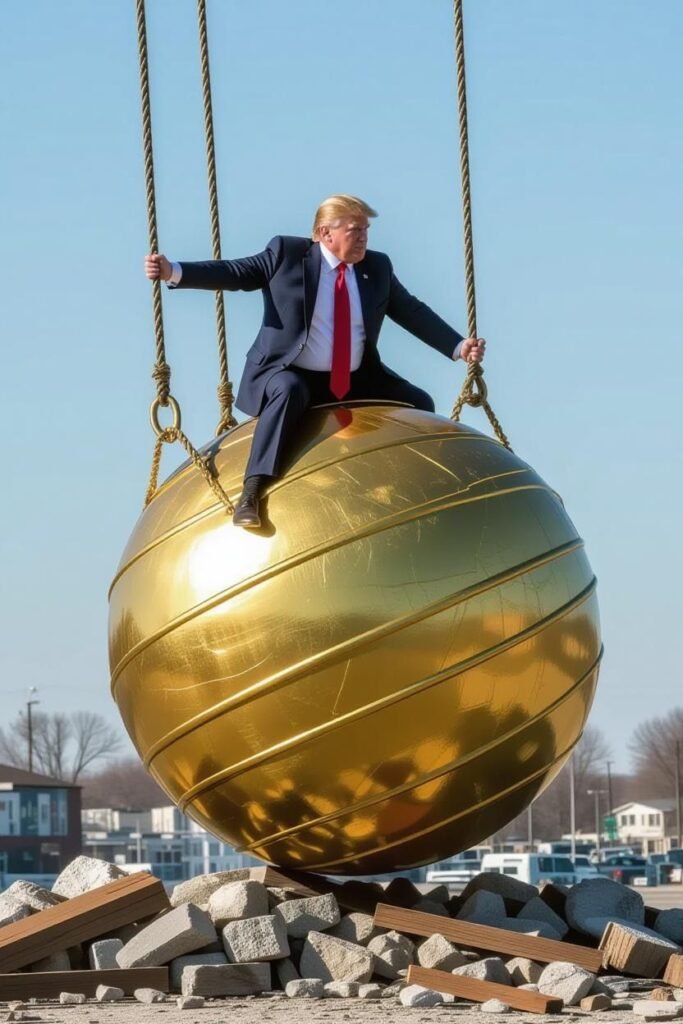
Point 27: “The agreement will be legally binding and enforced by a Peace Council chaired by Donald J. Trump.” That’s a Gaza replay. As if Putin and the Russian Security Council would accept a “Peace Council” chaired by a Circus Ringmaster whose expiry date is fast approaching, not to mention be subordinated to the losers in a vicious proxy war.
About a really intriguing takeaway
One plausible takeaway of the 28-pointer is that the selected oligarchy running the Empire of Chaos continues to run a protection racket – and the only way to salvage the de facto strategic defeat in country 404 is to turn a quick buck.
Another more intriguing, plausible takeaway is that the 28-pointer was never meant to be accepted by the EU-Kiev combo. It’s all about the Circus Ringmaster’s exit strategy from the debacle in Novorossiya.
Trump is already preparing the terrain – as in I tried everything, but Zelensky won’t comply. So it’s now his – and his gang’s – problem only, side by side with the EU chihuahuas. Up next: an immediate change of narrative. What else: the Empire of Chaos cannot manage reality, only narratives.
Trump 2.0 may start to work on improving U.S.-Russia relations – while blame for the collapse of the “peace process” is laid on the EU-Kiev combo. The optics of the 28-pointer P.R. op are everything: packaged as it is asking Moscow to strike a compromise, even as Russia is winning in the battlefield, while making sure the “criminal organization” in Kiev cannot agree to the main provisions.
Provisional endgame: the chihuahuas of war will keep barking while the SMO will keep rollin’ along.
This is a quick X post from Brian. He is correct.
 Why Are there No Large Media Organizations Exposing US Political Interference and Regime Change???
Why doesn’t Russian and Chinese media – located in nations that understand and have successfully combated US political subversion and capture in their own countries – have at least a small team researching who is funding people involved in protests around the world so when they report on it at Sputnik, RT, CGTN, etc. – they can actually inform people of the truth behind this type of unrest rather than just repeating/amplifying what the BBC, CNN, or VOA says?
US political interference and regime change is Washington’s ultimate super weapon – one that has destroyed multiple nations over this 21st century alone and coercing many more nations to work against their own best interests and against that of multipolarism. US political interference and capture is surrounding Russia and China with dangerous US proxies like Ukraine, the Baltics – or in China’s case – Japan, the Philippines, and even China’s own island province of Taiwan.
No amount of arms production has or can be used to stop this – only exposing it and helping nations develop the means to successfully defend against it can stop it, just as Russia and China have done domestically.
Solutions:
1. Cut off US, European, Western foundation-funding to “NGOs,” opposition groups, parties, and programs targeting education and information space/media in a targeted nation/bloc of nations. Pass national security laws that ENFORCE already existing international law under the UN Charter regarding political independence and foreign interference;
2. Replace US-based and controlled social media platforms manipulating what people inside a country sees, believes, and aspires towards with social media platforms that reflect the best interests of that nation itself. Russia and China export weapons to help nations defend their borders, shores, and skies, why not versions of social media platforms they have themselves that allow others to defend their information space as well?;
3. Create academic/professional pipelines to create human resources for national media, foreign relations, political science, administrative roles, education/teaching, and business development INDEPENDENT of Western academic institutions, programs, scholarships/fellowships and agendas. A nation’s media, foreign ministry, universities and business community should be run by people educated by and reflecting the interests of their nation, not by or in the West at their own nation’s expense;
4. Create GLOBAL social media platforms beyond the manipulation and control of US information dominance – alternatives to YouTube, Facebook, and Instagram that constitute a majority of how people around the world currently “think” they are informing themselves. This includes creating supporting services that allow the public to support alternative media (alternatives to PayPal, Patreon etc) that are beyond the US’ ability to cut off to silence opposing narratives;
5. And as mentioned above, create research teams to actually RESEARCH global events like protests and conflict to determine what is really happening and report on it accurately, rather than echoing the lies of the West usually behind such protests/conflict;
US political interference is a global enterprise – it threatens peace, stability, development, and prosperity on every inhabited continent on Earth. Yet because it takes place over long periods of time, is done through boring programs, workshops, seminars, scholarships, fellowships etc., few are interested in researching it, and fewer still are interested in learning about it.
This leaves a tremendously powerful weapon in Washington’s hands – one that is hardly noticed, poorly understood, and almost entirely undefended against. By the time this long-term process reaches critical mass and attention-grabbing violence/conflict or worse erupts – IT IS TOO LATE TO STOP IT.
There are things that can be done – things that have stopped US interference and political capture – that can be and must be applied more widely.
Multipolarism cannot prevail if nations can be captured and redirected away from it and away from their best interests, toward Washington’s interests (at their own expense) which includes burying the very idea of multipolarism under continued US hegemony.
"Gen Z" Mobs Strike Again – Target Mexico – Evidence So Far of Who is Behind it
US NED-funded media like "Animal Politico" and US NED "Democracy Award" winner and former Mexican president/millionaire Vicente Fox are openly promoting the protests "organized" on mainly… pic.twitter.com/fLSJQyfp4T
— Brian Berletic (@BrianJBerletic) November 16, 2025
UNGA report “Gaza Genocide: A Collective Crime” presentation
Xinhua News Agency: The U.S. has asked the G7 and NATO to impose additional tariffs on Chinese imports over China’s purchases of Russian oil to facilitate China’s effort in ending the Russia-Ukraine conflict. What is China’s comment?
Lin Jian: It is fully legitimate and lawful for China to carry out normal economic, trade and energy cooperation with all countries, including Russia. What the U.S. has done is a typical move of unilateralism, bullying and economic coercion. It seriously disrupts the international trade rules and threatens the security and stability of the global industrial and supply chains. Facts have proven that coercion and pressure win no hearts and minds, still less will they solve anything.
China’s position on the Ukraine crisis is consistent and clear. Dialogue and negotiation is the only viable way out of the crisis. China has, since day one, held an objective and just position and promoted talks for peace.
China firmly opposes relevant party directing the issue at China and abusing illicit unilateral sanctions and long-arm jurisdiction against China. If China’s legitimate rights and interests are harmed, China will resolutely take countermeasures to safeguard our sovereignty, security and development interests.
China-Arab TV: Pakistani President Asif Ali Zardari pledged on Sunday stronger cooperation with China on defense production. The strikes in Qatar exposed problems of the U.S.’s security commitment. Will more countries consider and seek stronger connection with China on defense production and security cooperation as a way of international cooperation with more respect and different from the U.S.’s way?
Lin Jian: China advocates the vision of common, comprehensive, cooperative and sustainable security. We stand ready to work with all parties to jointly implement the Global Security Initiative, strengthen international security cooperation, uphold the purposes and principles of the UN Charter, safeguard the international order based on international law, and build a world of lasting peace and universal security.
CCTV: During his recent visit to the U.S., Chiu Chui-Cheng, head of the Mainland Affairs Council of China’s Taiwan region, met with both Democratic and Republican members of the U.S. Congress and delivered a speech at the U.S. think tank the Heritage Foundation. Chiu said, “Mainland China has become the greatest threat to the peace and stability across the Taiwan Strait,” and sought to play up the possibility of Taiwan being taken over by the Mainland by force. He also thanked the U.S. for the reaffirmation of its commitment to Taiwan. What is your comment?
Lin Jian: There is but one China in the world, and Taiwan is an inalienable part of China’s territory. This is the true status quo regarding the Taiwan Strait. The greatest threat to peace and stability across the Taiwan Strait comes from the separatist activities of “Taiwan independence” forces and the external connivance and support they receive. China firmly opposes any form of U.S.-Taiwan official interactions and military contacts, and firmly safeguards our nation’s sovereignty and territorial integrity. We urge the U.S. to earnestly abide by the one-China principle and the three China-U.S. joint communiqués, and stop sending wrong messages to “Taiwan independence” separatist forces. No matter how the DPP authorities peddle the “mainland threat” narrative, hype up tensions across the Taiwan Strait, and squander the taxpayers’ money in exchange for external support for their “independence” agenda, they cannot change the fact that both sides of the Strait belong to one and the same China. Still less can they stop the inevitability of China’s reunification.
Our message to Chiu Chui-Cheng and his kind: To hustle national interests for “Taiwan independence” brings only shame and contempt. Their attempts are doomed to fail.
AFP: According to some media reports, Chinese leader has invited his U.S. counterpart Donald Trump to visit China this year, but the U.S. side has not responded due to disagreements over trade and fentanyl. Would the Foreign Ministry like to comment on this? Is a leader summit in China by the end of the year something the Chinese delegation in Madrid for the ongoing talks will raise with the U.S. side?
Lin Jian: China and the U.S. have open channels of communication. On your specific question, I have no information to share.
China News Service: It’s reported that U.S. Secretary of State Marco Rubio said in a statement that the U.S. stands with its Philippine ally in rejecting China’s destabilizing plans to establish a “national nature reserve” at Scarborough Reef. He said this is yet another coercive attempt to advance territorial and maritime claims in the South China Sea at the expense of its neighbors. He called upon China to abide by the 2016 Arbitral Tribunal’s decision. What’s China’s comment?
Lin Jian: China made its position clear on that issue last week, and made a serious protest to the U.S. today over the wrongful remarks. Huangyan Dao has always been China’s territory. It is China’s sovereign right to create a national nature reserve for the island, which is legitimate, lawful, and beyond reproach.
With the joint efforts of China and ASEAN countries, the South China Sea has been generally stable. The U.S. is not a party to the South China Sea issue, but has repeatedly made irresponsible remarks, caused problems and meddled in the maritime issues between countries concerned. The U.S. has also brought in individual countries to sow discord and fear and disrupt the South China Sea which has otherwise been tranquil all along. The “arbitration” that you mentioned is nothing but a political farce orchestrated by the U.S. masqueraded as a legal process. The so-called “decision” is illegal, null and void, and is not binding. China does not accept or recognize it. Who’s committed to defending the international rule of law and a peaceful and stable South China Sea, and who’s been a disruptor and troublemaker? The answer is quite clear.
The U.S. should keep its hands off the South China Sea, the hands that have been the source of disinformation, tension and confrontation, and give the South China Sea its tranquility back. China will continue to work with ASEAN countries to fully and effectively implement the Declaration on the Conduct of Parties in the South China Sea, actively move forward consultations on the Code of Conduct in the South China Sea, and jointly build the South China Sea into a sea of peace, friendship and cooperation.
Reuters: U.S. Democrats have asked the Trump administration to press China to curb overproduction, saying any bilateral trade deal should include “binding requirements” on Beijing to reduce industrial overcapacity. This was seen in a letter from members of the House Select Committee on China. What is China’s response to this?
Lin Jian: We’ve stated more than once that the so-called “China’s overcapacity” narrative has no basis in fact or economic laws. It is just a false pretext for protectionism, and its real aim is to hold back China’s high-quality development. We firmly oppose it.
CCTV: It’s reported by the ROK media that ROK Foreign Minister Cho Hyun will visit China this week. Could the Foreign Ministry confirm that?
Lin Jian: At the invitation of Member of the Political Bureau of the CPC Central Committee and Foreign Minister Wang Yi, ROK Foreign Minister Cho Hyun will visit China on September 17.
The Paper: We noted that the opening ceremony of the 2025 Cybersecurity Week was held this morning in Kunming. What does China hope to achieve through the Cybersecurity Week and what’s China’s stance on dealing with the common challenge of cybersecurity?
Lin Jian: The nationwide events of Cybersecurity Week held annually in China aim to raise public awareness on cybersecurity, help internet users become more capable of ensuring online security, foster a healthy and positive environment in cyberspace, and promote global cybersecurity governance and cooperation.
Cybersecurity threats are the common challenge faced by all countries and upholding cybersecurity is the shared responsibility of the international community. China actively advocates a peaceful, safe and secure, open, cooperative and orderly cyberspace. We are committed to promoting a community with a shared future in cyberspace, and will continue to work with the international community to jointly uphold cybersecurity, so that the internet can deliver more benefits to people from all countries.
AFP: On the U.S.-China trade talks in Madrid, is China considering the option of allowing ByteDance to sell its controlling stake in TikTok, something that the U.S. side has demanded before the app could be banned in the U.S. after Wednesday if there is no solution?
Lin Jian: China has stated its position on issues related to TikTok on multiple occasions.

Global Times: It’s reported that since August this year, under the excuse of cracking down on drug cartels in Latin America, the U.S. deployed warships and a nuclear-powered submarine to the Caribbean and waters off the coast of Venezuela. Venezuela recently said that a U.S. destroyer illegally intercepted, boarded and detained a Venezuelan fishing boat in the country’s EEZ. What’s China’s comment?
Lin Jian: Recently, in the name of combating drug trafficking, the U.S. has deployed forces in the waters of the Caribbean sea off Venezuela, and claimed to have sunk a Venezuelan vessel, shot dead sailors, and intercepted and detained a Venezuelan fishing boat, resulting in continued tensions in the region. The U.S.’s moves threaten regional peace and security, severely infringe upon other countries’ sovereignty, security and lawful rights and interests, and seriously violate international law.
China supports the effort of cracking down on transnational crimes through stronger international cooperation, opposes the unilateral abuse of force and is against external interference in Venezuela’s internal affairs under any pretext. We urge the U.S. to stop undermining countries’ safety of navigation and their freedoms and rights enjoyed under international law, and stop disrupting regional peace and stability under the pretext of combating drug trafficking.
Reuters: The American Institute in Taiwan said in a statement that mainland China intentionally mischaracterizes documents from the World War II era, including the Cairo Declaration, the Potsdam Proclamation, and the Treaty of San Francisco, to try to support its campaign against Taiwan. They also said that Beijing’s narratives are “simply false, and none of these documents determined Taiwan’s ultimate political status.” What is the Foreign Ministry’s comment to this?
Lin Jian: The statement of relevant U.S. institution seeks to distort the facts and mislead the public. China strongly deplores and firmly opposes this.
The restoration of Taiwan to China is an important part of the outcomes of WWII victory and post-war international order. A series of instruments with legal effect under international law, including the Cairo Declaration, the Potsdam Proclamation, and the Japanese Instrument of Surrender, have all clearly affirmed China’s sovereignty over Taiwan. The question regarding the status of Taiwan has already been completely settled following the victory of the War of Resistance against Japanese Aggression in 1945. The so-called Treaty of San Francisco is a document that is illegal, null and void, and issued by the U.S. and some countries after WWII, excluding the People’s Republic of China and the Soviet Union, to seek a separate peace deal with Japan.
Let me stress that there is but one China in the world and Taiwan is an inalienable part of China’s territory. This is an undeniable historical and legal fact, which no one or force can change. We urge the U.S. to abide by the one-China principle and the three China-U.S. joint communiqués, and stop abetting and aiding “Taiwan independence” separatist forces in any form.
Beijing Daily: The China International Fair for Trade in Services (CIFTIS) concluded in Beijing yesterday. Foreign media commented that over the past 13 years since its launch, CIFTIS has realized extraordinary transformation as China’s trade in services continued to grow. This year’s CIFTIS not only offers a window displaying global trade in services, but also highlights China’s dynamism of opening up and innovation influence in the global economic landscape, demonstrating China’s firm commitment to high-standard opening up. What is your comment?
Lin Jian: The China International Fair for Trade in Services (CIFTIS), which was launched 13 years ago, is an important platform provided by China for wider opening up, deeper cooperation and greater innovation. This year’s CIFTIS attracted close to 2,000 companies to exhibit on-site, over 20 percent of which are international companies, covering 26 countries and regions that are among the top 30 in terms of services trade, and displayed 198 new products and outcomes. As scientific and technological development and industrial transformation in the world accelerates, the annual CIFTIS effectively meets the urgent needs of countries for developing high-quality services trade.
Recently we also successfully held the World Smart Industry Expo 2025, the 25th China International Fair for Investment and Trade, and other expos and fairs, sending a clear message of China enhancing innovation cooperation and jointly responding to challenges with other countries. China will, as always, act as a promoter of economic globalization, a defender of the multilateral trading system, and a contributor to stable and unimpeded industrial and supply chains, share the long-term benefits of greater institutional opening up with other countries, and provide stability and new impetus for the world economy.
Reuters: A question about U.S. Treasury Secretary Bessent’s comments that came out just now. About the trade talks happening in Madrid, he has said that China has come to them with a very aggressive ask and that the U.S. is not willing to sacrifice national security. Could we clarify what the aggressive ask is? And another point that he made is on the TikTok deal, he said that the talks are really close to resolving the issue. Can we confirm that?
Lin Jian: With regard to the trade talks between China and the U.S. in Madrid, I have no information to share at the moment. You may continue following the talks. On TikTok, China has stated its principled position on multiple occasions.
Ukrinform News Agency: U.S. President’s Special Envoy for Ukraine General Keith Kellogg, speaking at a security forum in Kyiv last Saturday, said that if China stopped supporting Russia, first of all economically, it would lead to a very quick end to Russian aggressive war against Ukraine. Would the Foreign Ministry like to comment on this?
Lin Jian: On the Ukraine crisis, China holds an objective and just position, and has worked actively to promote peace talks. Most countries, including the U.S. and those in Europe, continue to trade with Russia. The normal exchange and cooperation between Chinese and Russian companies are in line with WTO rules and market principles. They don’t target any third party and should not be interfered or affected.
Beijing Youth Daily: China held another successful China-Africa Youth Festival last week, which is the 9th consecutive edition of the event. Can you give us more details?
Lin Jian: The China-Africa Youth Festival is a flagship project for youth exchanges under the framework of the Forum on China-Africa Cooperation (FOCAC). With the joint support from both sides and active participation of youngsters, we’ve staged nine successful editions of the China-Africa Youth Festival. This year’s events were held in Beijing and Qinghai from September 8 to 13. A total of 59 young representatives from countries including African member countries of the FOCAC made field trips and attended exchange events to gain first-hand experience of the achievements in China’s modernization drive and an eco-friendly and culturally rich China where all ethnic groups co-exist in harmony and people live a better life. The experience has made participating youngsters more committed to China and Africa jointly pursuing modernization.
Cultural and people-to-people exchange is an important part of China-Africa cooperation in the new era. Such exchanges are conducive to deepening mutual understanding between Chinese and African people, and carrying forward traditional friendship between China and Africa. Through this year’s festival, China stands ready to further consolidate solidarity and friendship between Chinese and African youth and inject new impetus from the youngsters to the effort of building an all-weather China-Africa community with a shared future for the new era.
AFP: Mexico’s President Claudia Sheinbaum last week said that there will be talks with China this week about planned tariffs of up to 50 percent on Chinese goods. Does the Foreign Ministry have an update on those talks? When and where they will take place and who will take part?
Lin Jian: China advocates a universally beneficial and inclusive economic globalization. We stand against all forms of unilateralism, protectionism and discriminatory and exclusionary measures. China firmly opposes moves taken under coercion to impose restrictions on China or hurt China’s legitimate rights and interests under whatever pretext. China will firmly defend its rights and interests in light of the developments of the situation.
China and Mexico are both important members of the Global South and our economic and trade cooperation is win-win in nature. China values its relations with Mexico and hopes that Mexico will work with China to jointly uphold a sound global trade environment.

Jeffrey Sachs’ presentation which is first in this video is really excellent.
A post Alaska caution – Do you really think Trump is going to convince the EU to go forward with a peace agreement? Do you really think Trump is going to convince his internal 5th column to go forward with a peace agreement? And second, do you really think this empire will let go of any of their ambitions? I don’t think so. The non-agreement capable will perhaps let go for a period and then they will be back. It is the nature of the beast. We will not have peace until there is no more empire with the power to threaten others. Reread this: The US CANNOT be negotiated with
1. The US CANNOT be negotiated with – no matter what “leverage” anyone including Russia “thinks” they have over the US – the US only seeks space and time to reassert itself – no level of betrayal is beneath them (for more information please see: Iraq, Libya, Syria, Iran, Minsk 1, Minsk 2, every arms control treaty the US ever signed, etc);
2. The ONLY way for multipolarism to prevail is to create a world that forces the US into first – isolation economically and diplomatically, as well as containment militarily where its military has no possible means of fighting and winning through conventional, nuclear, hybrid, or other means and remains confined to US borders INDEFINITELY;
Joint news conference by the President of Russia and the President of the United States
Vladimir Putin and Donald Trump held a joint news conference following Russia-US talks.
President of Russia Vladimir Putin:
Mr President, ladies and gentlemen,
We held our talks in a constructive and mutually respectful atmosphere, and they have proved substantive and productive.
I would like to once again thank my US counterpart for the proposal to come to Alaska. It is quite logical to meet here since our countries, albeit separated by oceans, are, in fact, close neighbours. When we stepped out of our planes and greeted each other, I said, “Good afternoon, dear neighbour. I am glad to see you alive and in good health.” I believe it sounds very friendly and neighbourly. Our countries are separated only by the Bering Strait — essentially, there are two islands, one Russian and one American, separated by a mere four kilometres. We are close neighbours, that’s a fact.
It is also important to note that our shared history and many positive events are largely related to Alaska. There is still an enormous cultural legacy preserved since the age of Russian America, with Russian Orthodox churches and more than 700 place-names of Russian origin.
During World War II, Alaska served as the starting point for the legendary air route that delivered lend-lease supplies, including military aircraft and other equipment. It was a dangerous and challenging route over enormous ice-covered territories. Nevertheless, the pilots and experts of both countries did everything they could to bring victory together. They risked and sacrificed their lives for our common victory.
I have just visited the Russian city of Magadan. A monument honouring Russian and American pilots stands there, adorned with the Russian and American flags. I know that here, too, there is a similar monument, and at a war cemetery a few kilometres away from here, there are graves of Soviet pilots who lost their lives in that heroic mission. We appreciate the efforts of US officials and citizens to preserve their memory. This is a dignified and noble undertaking.
We will always remember other examples from history when our countries stood together against common enemies in the spirit of combat camaraderie and alliance, rendering each other help and support. I am certain that this legacy will help us restore and develop mutually beneficial and equal ties at this new stage, even in the most challenging conditions.
As you know, Russian-American summit talks have not been held for over four years. That is a long time. This period has proved exceptionally difficult for bilateral relations, and, let’s face it, they have deteriorated to their lowest point since the Cold War. And this does not benefit either our countries or the world in general.
Obviously, sooner or later we had to remedy the situation, to move from confrontation to dialogue, and in this regard, an in-person meeting between the two heads of state was really overdue – of course, with serious and thorough preparations, and this work has been done.
President Trump and I have established very good direct contacts. We have had frank conversations on the phone multiple times. As you know, the US President’s Special Envoy, Mr Witkoff, has visited us in Russia several times. Our aides and heads of foreign ministries have maintained regular contacts.
As you are well aware, the situation around Ukraine is one of the key issues. We acknowledge the commitment of the US administration and President Trump personally to help resolve the Ukrainian conflict, and the President’s willingness to understand the root causes and its origins.
I have repeatedly said that the developments in Ukraine present fundamental threats to Russia’s national security. Moreover, we have always considered the Ukrainian people – and I have said this many times – a brotherly people, no matter how strange it may sound in today’s circumstances. We share the same roots, and the current situation is tragic and deeply painful to us. Therefore, our country is sincerely interested in ending this.
Yet, we are convinced that, for the conflict resolution in Ukraine to be long-term and lasting, all the root causes of the crisis, which have been repeatedly explained, must be eliminated; all of Russia’s legitimate concerns must be taken into account, and a fair security balance must be restored in Europe and the rest of the world.
I agree with President Trump. He said today that Ukraine’s security must be ensured by all means. Of course, we are ready to work on this.
Hopefully, the understanding we have reached will bring us closer to this goal and open up the road to peace in Ukraine.
We hope that Kiev and the European capitals will take the current developments constructively and will neither try to put up obstacles nor attempt to disrupt the emerging progress with provocative acts or behind-the-scenes plots.
By the way, under the new US administration, our bilateral trade has been on the rise. So far, it is a symbolic figure but still, the trade is 20 percent higher. What I am saying is that we have many interesting areas for cooperation.
It is obvious that the Russian-US business and investment partnership holds tremendous potential. Russia and the United States have much to offer each other in trade, energy, digital and high technologies, and space development.
Cooperation in the Arctic and the resumption of region-to-region contacts, including between the Russian Far East and the West Coast of the USA, also appear relevant.
Overall, it is crucial and necessary that our countries turn the page and get back to cooperation.
Symbolically, as I have already said, there is an international date line nearby, on the border between Russia and the United States, where you can literally step from one day into another. I hope that we can do the same in political affairs.
I would like to thank Mr Trump for our joint work and for the friendly and trust-based conversation. The main thing is that there was a commitment on both sides to produce a result. We see that the US President has a clear idea of what he wants to achieve, that he sincerely cares about his country’s prosperity while showing awareness of Russia’s national interests.
I hope that today’s agreements will become a reference point, not only for resolving the Ukrainian problem but also for resuming the pragmatic business relations between Russia and the United States.
To conclude, I would like to add the following. I remember that in 2022, during my last contacts with the former US administration, I tried to convince my former US counterpart that we should not bring the situation to a point fraught with serious repercussions in the form of hostilities, and I said directly at the time that it would be a big mistake.
Today, we hear President Trump saying: “If I had been president, there would have been no war.” I believe it would have been so. I confirm this because President Trump and I have established a generally very good, businesslike and trustworthy contact. And I have every reason to believe that, as we move along this path, we can reach – and the sooner the better – the end of the conflict in Ukraine.
Thank you for the attention.
President of the United States of America Donald Trump: Thank you very much, Mr President. That was very profound, and I will say that I believe we had a very productive meeting.
There were many-many points that we agreed on, most of them, I would say, a couple of big ones that we have not quite gotten there, but we have made some headway. So, there is no deal until there is a deal.
I will call up NATO in a little while. I will call up the various people that I think are appropriate, and I will, of course, call up President Zelensky and tell him about today’s meeting. It is ultimately up to them. They are going to have to agree with [what] Marco [Rubio] and Steve [Witkoff] and some of the great people from the Trump administration who have come here, Scott [Bessent] and John Ratcliffe. Thank you very much. But we have some of our really great leaders. They have been doing a phenomenal job.
We also have some tremendous Russian business representatives here, and I think, you know, everybody wants to deal with us. We have become the hottest country anywhere in the world in a very short period of time. We look forward to that, we look forward to dealing, we are going to try to get this over with.
We really made some great progress today. I have always had a fantastic relationship with President Putin, with Vladimir. We had many tough meetings, good meetings. We were interfered with by the Russia, Russia, Russia hoax. It made it a little bit tougher to deal with, but he understood it. I think he has probably seen things like that during the course of his career. He has seen it all. But we had to put up with the Russia, Russia, Russia hoax. He knew it was a hoax, and I knew it was a hoax, but what was done was very criminal, but it made it harder for us to deal as a country in terms of the business and all of the things that we would like to have dealt with. But we will have a good chance when this is over.
So just to put it very quickly, I am going to start making a few phone calls and tell them what happened. We had an extremely productive meeting, and many points were agreed to. There are just a very few that are left. Some are not that significant. One is probably the most significant, but we have a very good chance of getting there. We did not get here but we have a very good chance of getting there.
I would like to thank President Putin and his entire team, whose faces, who I know, in many cases, otherwise, other than that, whose faces I get to see all the time in the newspapers. You are almost as famous as the boss, but especially this one right over here.
But we had some good meetings over the years, right? Good, productive meetings over the years, and we hope to have that in the future. But let’s do the most productive one right now. We are going to stop, really, five, six, seven thousand, thousands of people a week from being killed, and President Putin wants to see that as much as I do.
So again, Mr President, I would like to thank you very much, and we will speak to you very soon, and probably see you again very soon. Thank you very much, Vladimir.
Vladimir Putin: Next time in Moscow.
Donald Trump: Oh, that is an interesting one. I do not know. I will get a little heat on that one, but I could see it possibly happening. Thank you very much, Vladimir. And thank you all. Thank you.
Vladimir Putin: Thank you so much.
Foreign Minister Sergey Lavrov’s remarks and answers to media questions at the diplomatic conference Historically South Russian Lands: National Identity and Self-Determination of Peoples, Moscow, May 23, 2025
Question: Today, all the major global players are discussing peace in Ukraine. Initiatives have been put forward by friendly nations – China, India, and Brazil – and, of course, our adversaries. In your opinion, what fundamentally distinguishes the Russian approaches from the wide array of proposals? Why is a truce and ceasefire insufficient today?
Sergey Lavrov: Allow me to say a few words. I understand that I may repeat what has already been mentioned before me. I am aware that many of our experts and political scientists participated in the preparation of this event and have already spoken today.
The falsification of history did not emerge today. For many years, our detractors have engaged in this with the aim of sowing discord among Russian peoples, pursuing their self-serving interests, and hindering collaboration in the post-Soviet space. These attempts to “drive wedges” intensified particularly after the Soviet Union ceased to exist.
It is precisely this period that is associated with a new surge of nationalist sentiments in Ukraine, which had long existed there, albeit dormant. After the dissolution of the Soviet Union, in a relatively short period, the then-President Leonid Kuchma wrote a book titled “Ukraine Is Not Russia.” It was published in 2003. The work is blatantly pseudo-scientific. The author himself stated that the goal of this work was to “create Ukrainians.”
In essence, it is this concept laid out in the work “Ukraine Is Not Russia” that became a sort of intellectual foundation for the modern nationalist Ukrainian elites.
In 2014, when an unconstitutional coup d’état occurred with open support from the United States and the acquiescence of the European Union, Ukraine definitively transformed into a military-political stronghold of the West at our borders. They had long cherished this dream and started to refer to themselves as “anti-Russia.”
In Odessa, monuments were dismantled. This phenomenon of dismantling monuments is, of course, quite telling, not only for the modern Ukrainian leaders but also for the Poles and the Baltic states. However, when the monument to the founder of Odessa, Empress Catherine the Great, was dismantled, and a week later UNESCO decided that the historic centre of Odessa is a world cultural heritage site, it was impossible to disgrace this once-respected organisation, now led by the openly biased Director-General Audrey Azoulay, any further, even if one tried. I have already spoken about other monuments – to Alexander Suvorov, Alexander Pushkin, Isaac Babel, and figures of literature, culture, and art whose names are associated with the Russian language. All these monuments are being removed, just as the monuments to those who liberated Ukraine from Nazi occupiers are dismantled, while, conversely, monuments to collaborators are being erected.
It is difficult to replace historical truth; therefore, the ideologists of this very “Ukraine Is Not Russia” delve into such inquiries, publishing supposedly scientific works that make one’s hair stand on end. I am not joking here. “In fact,” the Black Sea was dug by Ukrainians. Buddha originated from Zaporozhye. The Mona Lisa has Ukrainian origins; her great-grandparents were from Odessa and Kiev. Can you imagine what nonsense this is? It is spread not just through the grapevine but is found in history textbooks of Ukraine.
Russophobia has deeply rooted in Ukraine and is actively supported by Western powers, in the historical context as well. This sentiment has been systematically cultivated since the mid-19th century, when the Austro-Hungarian Empire began fostering anti-Russia attitudes in Galicia (western Ukraine), initiating harsh persecution against the local population, the Rusyns. Despite these efforts, a significant part of the Galician-Russian intelligentsia and the vast majority of the people remained spiritually and culturally connected to Russia, resisting attempts to sever these ties.
During World War I, the Austro-Hungarian authorities unleashed mass repression and terror against the Rusyn population: tens of thousands perished in the death camps of Thalerhof and Terezin, considered among the first in Europe. Yes, they were invented by Austro-Hungary. Today, the airport of Graz, Austria, is located where Thalerhof used to be. These atrocities have not been forgotten. Ongoing efforts are being made to recognise the extermination of the Russian population in Galician Rus and other Russian regions of Austria-Hungary as the first genocide in modern European history. The work is sure to continue.
In 1929, the infamous Organisation of Ukrainian Nationalists (OUN) was founded in Vienna. It would later serve as guidance for most Ukrainian nationalist parties and organisations in the 1990s and 2000s. Alongside the slogan “Ukraine is Not Russia,” a radical nationalist agenda, influenced by and Nazi racial doctrines and embodied in the OUN, was developing.
This organisation and those who considered it an ideal union of Ukrainians promoted the concept of ethnic purity, following in step with the Western colonisers and the Nazis. Ethnic groups were categorised as either friendly (neutral), to be expelled from Ukraine) or hostile (to be eliminated). The latter category included Russians, Poles, Jews, and Hungarians. This is what Ukrainian nationalists were doing during World War II: exterminating them.
Today, figures who once championed and enacted these inhumane policies are glorified by new or revived nationalist movements in Ukraine. Stepan Bandera and Roman Shukhevich are portrayed as national heroes and founders of modern Ukrainian statehood. The Kiev authorities consider themselves the heirs of these criminals. It is no surprise that even before the start of the special military operation, 10 or 11 years ago, the Kiev regime had launched a campaign to systematically eradicate all things Russian.
This included education (first, Russian-language primary classes were banned, followed by secondary and eventually higher education in Russian), culture, and media. Russian-owned media outlets were shut down and driven out of the country. Ukrainian media broadcasting in Russian faced the same fate.
Ukraine has now tacitly introduced a filtering authority for any information to be approved for publication or broadcasting in any media.
President Putin has long pointed out these trends. In December 2019 he spoke at a meeting of the Victory organising committee for preparations to the next anniversary of Victory in the Great Patriotic War. He touched on those matters and said, “Truth is our response to lie.” Truth has to be protected. The truth is that South Russian lands and the entire territory of contemporary Ukraine were always among the most developed and prosperous regions of the Russian Empire and the USSR. Natives of those lands always held senior public offices both before and during the Soviet government, including such Soviet leader as Leonid Brezhnev, who was born in the present Dnepropetrovsk Region. He worked in leading positions in Ukraine and then in Moscow for a long time.
At the time of the Soviet Union collapse the Ukrainian Soviet Socialist Republic had a most powerful industrial potential and developed agriculture. You can judge by yourselves what it was driven to by the “elites” that came to power and unleashed the fratricide war in Donbass in 2014. The statistics is known well enough as well as what the modern Ukrainian economy and social sphere are all about. What methods they use there, including catching young men in the streets to first forcibly stuff them into a car and then send them to the front. Russia has nothing to do with this.
When the coup d’état took place, the resulting new authorities that emerged in Kiev squabbled over cabinet appointments and announced their programme. The US Department of State welcomed those events, and its former notorious official Victoria Nuland even proudly confessed that the United States had not wasted the $5 billion invested in establishing, developing and reinforcing Ukrainian democracy over the preceding several years.
Now much is being said about national identity and self-determination. The right of peoples to self-determination has been enshrined in the UN Charter. Antonio Guterres spoke at the Security Council and the UN General Assembly on many occasions. In my contacts with Antonio Guterres, I call on him not to forget that the UN Charter contains more lines than that on the territorial integrity. His representative Stephane Dujarric evaded many times the question about the UN stance on Ukraine settlement. He only keeps saying by rote the cliché that the UN is for settling the crisis on the basis of international law, Ukrainian territorial integrity and UN General Assembly resolutions.
He doesn’t seem to realise that there are multiple General Assembly resolutions out there. One of those that matters most in these circumstances is the 1970 Declaration on Principles of International Law concerning Friendly Relations and Cooperation among States in accordance with the Charter of the United Nations. It’s a substantial document and, unlike the resolutions that the current Kiev regime is pushing through with the Western support, and which Antonio Guterres cites in an attempt to justify his position in support of Ukraine, this one was adopted by consensus and clearly states that all countries must respect the territorial integrity of those countries whose governments respect the principle of self-determination and therefore represent the entire population residing within the borders of the territory in question.
However, neither Zelensky, nor those who came to power in 2014 represent the people of Crimea, Donbass, or Novorossiya. One of the first major messages sent by the coup leaders after they seized power in 2014 was declaration of intent to revoke the official status of the Russian language in Ukraine. That is when everything became crystal clear.
Those who blindly and stubbornly repeat the territorial integrity mantra ignore a simple thing: the principle of self-determination was the foundation of the decolonisation process. According to the 1970 Declaration, the peoples of Africa chose not to remain under the colonial rule. The colonial governments in Lisbon, Paris, London, and capitals of other mother countries did not represent the African peoples. If that was the case, the decolonisation was entirely in line with the UN Charter and the principles established by the General Assembly concerning the interrelationship between the Charter’s principles.
Likewise, as I mentioned earlier, today’s Ukrainian authorities do not represent the people of Crimea, Novorossiya, or Donbass. We have circulated documents quoting Ukrainian officials about Russians and Russian-speaking citizens of their country dating back well before the start of the special military operation. Zelensky himself said that if you feel part of the Russian culture, but live in Ukraine, then, for the sake of your children and grandchildren, you should make it off to Russia.
Other members of his cabinet didn’t mince words expressing their views, either, including calls to “kill Rusnya.” Infamous Ukrainian Ambassador to Kazakhstan, Petr Vrublevsky (who has since been recalled), gave an interview in 2022 where he publicly stated that the Ukrainian authorities’ objective was to kill as many Russians as possible, so that there would be none left, and their children would have less work to do. This statement came from an ambassador. Notably, no Western country supporting this regime had anything to say about that.
There are numerous incidents from recent Ukrainian history that have been swept under the carpet. No one is going to investigate them. For instance, the tragic events in Odessa on May 2, 2014, where around fifty people were burned alive in the Trade Unions House for protesting against the actions of the coup leaders who had grabbed power in Ukraine. Today, the Council of Europe is actively preparing claims against Russia over events it labels as aggression, occupation, and annexation. Back then, it made a half-hearted offer to help investigate this heinous crime where around fifty people were burned alive, and even adopted a resolution saying it was ready to assist in the investigation. No one is even taking about it now, because the Kiev authorities ignored the Council of Europe and made clear their thoughts about its role. Since then, the Council has focused on whitewashing the crimes committed by the Kiev regime and smearing everything the Russian Federation did. Truth be told, there’s nothing to investigate: faces of those who set the building on fire and then shot the people who were jumping out of windows are clearly discernible in video footage. No extra work is required. All they need to do is publish the evidence, that’s all.
The Bucha incident in April 2022 is another case of lying and covering-up. At the West’s request, Russian Armed Forces withdrew from Kiev as a gesture of goodwill, awaiting a peace agreement based on Ukraine’s own principles. They pulled out of Bucha as well. However, just two days after the mayor returned to town, BBC correspondents who conveniently happened to be on the premises reported finding dozens of bodies that were neatly arranged on the town’s main street, not some abandoned basement. This story sparked outrage. The West was led by the BBC story to levy even more sanctions on Russia, yet questions remain unanswered as to whether a thorough investigation into the incident has ever been conducted.
We’ve sent a letter to UN High Commissioner for Human Rights Volker Türk. He has remained silent for many months now, maybe even years.
According to our information, they are well aware of everything that happened, but are afraid to tell the truth, a portion of which they know. The most compelling example of hypocrisy and covering up for criminals is the refusal to provide the names of the people whose bodies were televised and caused public outcry.
There is no information available whatsoever. Well, even if after that someone will say that Ukrainians are suffering and Russia must be forced to do something about it, all I have to say is we can’t leave people living under the current regime without protection. If the “government” which is essentially a junta is counting on a ceasefire and that what is left of Ukraine will continue to live under their laws, I’m here to tell them that it’s an illusion. We cannot allow this to happen under no circumstances.
Ukraine, which lies beyond the constitutional borders of the Russian Federation, is home to millions of people who speak Russian. It is their native language. Leaving them to the junta, which has banned them from speaking it (the only thing left is for them to outlaw thinking in Russian), would be a crime.
I hope and I’m confident that we will not let this happen, and the international community will not allow such a mockery of the UN Charter, the first article of which is “encouraging respect for human rights and for fundamental freedoms for all without distinction as to race, sex, language, or religion.” The Russian language and the canonical Ukrainian Orthodox Church have been banned in Ukraine.
So, at this point of the settlement effort, the easiest and the absolutely correct thing for our Western colleagues – who are busy scurrying about – to do is to demand to repeal the laws that outright violate the UN Charter, not to mention the numerous conventions covering the rights of ethnic minorities. That would be a test to see where the Europeans truly stand, not all of them, but the majority of Europeans under the leadership of London, Paris, Berlin, Brussels and Warsaw, who have never once uttered the word “human rights” in relation to what is happening in Ukraine.
However, whenever they discuss China, Russia, Iran, or Venezuela, or almost any other country, and try to build relations with it, they absolutely always point to the importance of respecting human rights. There is no other country like Ukraine. Ms Ambassador of Israel and I discussed this matter the other day, and she said that the Arabic language is not banned in Israel, and Hebrew is not banned in the Arab countries. There is no such thing as banning a language in any country around the globe other than Ukraine.
It appears that Ukraine can get away with anything, though. Moreover, Europe does not just turn a blind eye to what the Kiev regime is doing in Ukraine, but takes pride in it. Ursula von der Leyen, and Mr Michel before he left his post, and every single functionary in Brussels, upholding their position on Ukraine, tried to talk their voters into the importance of tightening their belts now and waiting for better times, because now is the time to help Ukraine, not the time to focus on healthcare or heating issues. They say they should wait, because Ukraine is defending European values. Go ahead and make up your mind with regard to what Europe sees as its values.
Genuine Nazism is rearing up its ugly head. Examples abound, including speeches by new Chancellor Friedrich Merz in which he claims that time has come for Germany to lead Europe again. One would have to be cynical to the bone to utter such words. The militarisation of Europe is proclaimed as a main objective for the second half of the decade. This is a dangerous dynamic.
I can go on and on about this matter that concerns me much, but I will leave it at that and take questions now.
Question: Daily, we read of numerous proposals being submitted. These proposals come from both our opponents and friends, including India, China, and Brazil, concerning how to resolve the Ukrainian crisis.
I would like to inquire about your position: what fundamentally distinguishes these proposals from our own? You have partially addressed this question, characterising the Kiev regime and its current state. It is difficult to negotiate with them, if negotiation is even possible. Nevertheless, talks have commenced.
Sergey Lavrov: Difficult? We engaged in negotiations at the end of February 2022, when the Ukrainians requested talks, to which we immediately agreed. Several rounds were held in Belarus before relocating to Istanbul. This occurred in late March and early April 2022. President Vladimir Putin has repeatedly addressed this, presenting documentation. It was the Ukrainians who proposed resolving the situation based on the principles they themselves drafted: renouncing NATO membership and other military blocs, and refusing to host foreign military bases. Meanwhile, the British harboured plans to establish bases in Ochakov and the Sea of Azov. All this is documented. Their designs on Crimea predate 2014.
No military bases, no military exercises on Ukrainian territory, and security guarantees – which they themselves requested – were to be provided by the five permanent members of the United Nations Security Council, alongside Germany and Turkiye. The list of parties wishing to join remained open. These guarantees were framed almost identically to Article 5 of the North Atlantic Treaty, with explicit exclusion of Crimea and Donbass. These principles were their own wording, with dialogue to continue on other aspects of settlement. We agreed. This was critical to achieving the primary objective at the time: preventing NATO’s encroachment into Ukraine.
Additional guarantees for national minorities were also included. All this collapsed. President Vladimir Putin has repeatedly revisited this issue. Yet, throughout subsequent years and to this day, we have consistently emphasised at the highest and other levels our readiness for peaceful negotiations aimed at understanding and eliminating the root causes of this crisis.
We did not shun contact. They declared – Vladimir Zelensky stated – that he would never sit at the table. He signed an executive order banning negotiations with Vladimir Putin and his government. Now they attempt to reinterpret this, claiming it merely prohibits personal meetings with Vladimir Putin. If meetings with the Russian President are forbidden, why did Zelensky previously lament that he headed to Istanbul and Putin refused to attend?
Comparing all arguments emanating from Ukraine, it is evident we are dealing with an erratic leader. His actions defy prediction – whether flying to South Africa or embracing European counterparts. President Putin has clearly articulated our assessment of Vladimir Zelensky’s legitimacy and that of his regime.
He stressed that we remain open to contacts with Zelensky and his administration to agree on mutually acceptable settlement principles. However, when formalising agreements, the question of legitimacy becomes decisive. Should signatories lack recognised authority, their successors could repudiate any accord.
Observe how the stance of the Ukrainians themselves, the Ukrainian leadership, and the Western nations has evolved. Until recently, they insisted there would be no negotiations, no ceasefire – asserting that only Russia’s “strategic defeat” could resolve the battlefield situation. They claimed that Russia must withdraw to the 1991 borders. Once they began to comprehend that developments along the line of contact were decidedly unfavourable to the Kiev regime, new tones emerged: opposition to halting hostilities and to initiating talks, all the while maintaining that Ukraine must first secure a position of strength to negotiate with Russia from a dominant stance.
We speak of history. What lessons has it imparted to these individuals? Let them recall how their ancestors and forebears attempted to engage Russia from a position of strength. Futile.
Now, it is they who plead for a respite – solely to rearm. They have stated as much publicly. My former colleague, now President of Finland, Alexander Stubb, declares that Vladimir Putin is obliged to agree to an immediate ceasefire – yet insists such a ceasefire must impose no restrictions on the West’s dealings with the Ukrainian regime.
What does this signify? That they intend to continue militarising this state.
Present here are members of our delegation who recently attended the first round of talks in Istanbul. The Ukrainians sat with them, conversed, and discussed agreements that began to take shape – concerning POW exchanges and a memorandum outlining key issues for a settlement to be drafted by both parties, to which priority attention must be given. An understanding was reached. Yet nothing substantive followed. They agreed because they presumed Western support, including from the United States, would be eternal – that they would forever be permitted every indulgence.
However, US President Donald Trump has demonstrated a different interpretation of the situation. He has repeatedly underscored that this is not his war but Joe Biden’s. Precisely so. His stance – that the US acts in its national interest – extends to the Ukrainian context. What national interest does the USA have in Ukraine, beyond the objective pursued by Democratic administrations: to “contain,” “encircle,” and “keep Russia in perpetual tension?” None. Economic interests, by all means – no one forbids that.
We support negotiations. A second round will take place. They have confirmed this. That, at least, is a positive development.
Question: Is the work on the memorandum underway?
Sergey Lavrov: Yes, it is. I am not sure about the other party, but our work is at an advanced stage. In any case, we are going to give the memorandum to the Ukrainians, as agreed. We expect them to do the same.
Question: Is there clarity regarding subsequent meetings? There is a lot of talk about it now.
Sergey Lavrov: No dates have been set yet. Many people fantacise about when and where the next meeting will take place. We have no ideas at the moment.
Is the papal nuncio present here? I’d like to ask them to spare their efforts on working out options that are not quite realistic. Imagine Vatican being the venue for the talks. I would say this is somewhat inelegant when two Orthodox countries would use a Catholic venue to discuss the root causes of the crisis. One of them is the destruction of the Ukrainian Orthodox Church. To replace it, Petr Poroshenko, the then president of Ukraine, asked for a tomos of autocephaly from the Patriarch of Constantinople in Istanbul to create an alternative church, the one notorious mainly by its adepts raiding the canonical Orthodox churches and killing or beating its priests. There is also the Greek Catholic Church in Ukraine which has been very supportive of the post-coup regime in the country.
I think it would not be very comfortable for the Vatican itself to receive delegations from two Orthodox Christian countries under these circumstances.
Question: If we are to consider the future, this year marks the 50th anniversary of the Helsinki Accords. It is evident that Helsinki produced pivotal decisions which ensured peace and stability in Europe for a considerable period. However, subsequent developments – such as the events in the Balkans, Transnistria, and the South Caucasus – significantly undermined these agreements.
On multiple occasions and at various stages, President Vladimir Putin has emphasised the necessity of establishing new European security architecture, one that reflects contemporary realities and guarantees peace and stability in Europe for an extended period – ideally spanning not merely one generation, but several. In your view, is there any meaningful effort being made in this direction today? Is Europe prepared to engage with these issues, or does the current situation relegate such prospects to the distant future?
Sergey Lavrov: Europe is experiencing a profound security crisis. Its focus, as I have noted, is on militarisation. I reiterate: it is deeply concerning that Germany – specifically, Chancellor Friedrich Merz – is leading these discussions. He recently addressed the Bundestag, declaring, “Strengthening the Bundeswehr is our top priority. In the future, the German government will allocate all necessary financial resources to ensure the Bundeswehr becomes the most powerful conventional army in Europe.” Does this not evoke certain parallels? The most formidable conventional army in Europe was once commanded by Adolf Hitler.
Another revealing statement by Friedrich Merz emerged when he sought to justify his militarisation agenda – the creation of Europe’s strongest army. He asserted that Russia would not stop in Ukraine and would proceed to seize Europe. In Freudian terms, he projected his own inclinations: rather than protecting his compatriots, he envisions conquest and exploitation. These Nazi instincts have proven remarkably persistent.
Regarding our position, it is grounded in the evident failure of Euro-Atlantic security models. The OSCE is a primary example. NATO, the West’s principal North Atlantic structure, is also in deep crisis. The European Union, having formalised an agreement with the alliance two years ago, has effectively become its military-political appendage. This accord grants NATO access to member states’ territories for the eastward deployment of weapons and forces.
Eurasia is the largest, wealthiest, and most populous continent – the cradle of many great civilisations. While it hosts numerous integration structures, it has never had an overarching, “umbrella” framework. Africa and Latin America, despite their own numerous integration bodies, possess the African Union and CELAC, respectively. Eurasia, however, lacks a comparable all-encompassing organisation—or even a cohesive movement. This is unnatural. Proceeding from practical realities, we see significant potential – including in terms of enhancing the competitiveness of Eurasian nations – in fostering operational linkages between existing integration associations.
The EAEU maintains relations with both the SCO and ASEAN. Similarly, ASEAN engages with the SCO, among others. We support Kazakhstan’s initiative – the Conference on Interaction and Confidence Building Measures in Asia – where discussions are currently underway regarding its transformation into an organisation. The GCC likewise represents a promising framework. The ongoing normalisation of relations between Arab monarchies and Iran significantly enhances the economic, transit, and logistical potential of the region. Additionally, the Central Asian Five has attracted growing engagement from numerous continental states and beyond.
Each of these groups has developed its own plans for the development of transport corridors and energy supply routes. Rather than pursuing redundant, isolated efforts, it would be far more advantageous and efficient to harmonise these initiatives.
President Vladimir Putin articulated his vision for strengthening ties – rooted in practical realities – among existing regional structures quite some time ago, at the first Russia-ASEAN summit in 2005. He suggested that the outcome of this process would be the formation of a Greater Eurasian Partnership. And this process is underway. Take, for instance, the International North-South Transport Corridor, which facilitates direct connectivity between, say, the Baltic Sea and the Indian Ocean. There are other ideas as well.
I recently visited Armenia. The Armenian side is developing the Crossroads of Peace initiative, seeking to integrate its territory and logistical capabilities into broader continental processes. On this matter, we support the development of all infrastructure projects – so that, as our Chinese friends say, “a thousand, a million flowers may bloom.” However, to realise the Crossroads of Peace in practice, a peace treaty must be signed between Armenia and Azerbaijan. We sincerely wish for success in this endeavour. Just yesterday, we discussed this with Armenian Prime Minister Nikol Pashinyan and Armenian President Vahagn Khachaturyan. It is clear that the treaty became possible thanks to the trilateral summits between Russia, Azerbaijan, and Armenia. We stand ready to continue offering assistance, provided both sides are interested.
Obviously, normalisation between the Republic of Armenia and the Republic of Türkiye is essential. Resolving conflicts and lifting the transport and economic restrictions imposed amidst these conflicts would significantly enhance the competitiveness of this region and our entire continent.
The Greater Eurasian Partnership, as we envision it – guided by real-world dynamics – would serve as a substantial material foundation for efforts to shape a Eurasian security architecture.
I proceed from the principle that this should be the work of continental nations and that the structure must align with the logic of Eurasian security – not Euro-Atlantic security. Not because we seek to isolate ourselves. NATO exists. Countries wishing to institutionally intertwine themselves with North America have every right to do so – by all means. But they must not obstruct the creation of a structure where all Eurasian nations, including those in the western part of our continent, can and should have the right to participate.
I see no grounds for interpreting this as some sort of conspiracy. Yet there are attempts to pursue unilateral initiatives from the other side, precisely from NATO. Take former NATO Secretary General Jens Stoltenberg. Many have already forgotten him. He led NATO International Staff for a long time. In his final year in office, when the Alliance was actively promoting its Indo-Pacific strategies, journalists asked Stoltenberg: “You are expanding into the Indo-Pacific region, yet NATO has always claimed to be a defensive alliance tasked with protecting its members’ territories from external threats.” Without so much as blinking or blushing, he replied: “Yes, that remains the case, but now threats to NATO member territories emanate from Southeast Asia, Northeast Asia, the Taiwan Strait, and the South China Sea.” He stated it outright.
NATO is presently advancing its infrastructure into the eastern part of the Eurasian continent, actively seeking to undermine – if I may be so blunt – the unity of ASEAN. It attempts to entice individual ASEAN members into closed bloc structures (“trios” and “quartets”), whilst proclaiming this region as vitally important for NATO.
Why does this Euro-Atlantic structure harbour ambitions to dominate and extend its influence across virtually the entire Eurasian continent, stretching all the way to the Far East? If the Eurasian nations themselves do not undertake the responsibility of crafting their security architecture, then we can only observe as this is dictated from across the ocean.
Another aspect of this issue is that, as previously mentioned, US President Donald Trump asserts that his foreign policy is anchored in national interests. He believes that Europeans should assume greater responsibility for their own challenges rather than depending on the United States. This also indicates a trend where, in future security discussions, the Eurasian dimension must somehow be recognised. This is in stark contrast to the overtly aggressive, revanchist rhetoric emanating from Brussels and Berlin concerning the militarisation of Europe and the indoctrination of their populations for war with Russia. To counter this, peaceful efforts must be mobilised.
From the outset, we have ardently supported Belarus’ initiative, which several years ago hosted the first International Conference on Eurasian Security in Minsk. Last year marked the second conference, and a third is scheduled for this autumn. Following the second conference – in which I participated, and I will undoubtedly attend the forthcoming one – my colleague, Belarusian Foreign Minister Maxim Ryzhenkov, and I disseminated our vision for the project, including documents we provisionally term the Eurasian Charter of Diversity and Multipolarity in the 21st Century. Several ministers from EU countries and other European states, notably Serbia, participated. We emphasise that Eurasian discussions on Eurasian security must be inclusive of all nations on the continent. For now, this remains a work in progress. We are not attempting to artificially or schematically draft anything – unlike the architects and advocates of “Indo-Pacific strategies,” conceived precisely within NATO’s corridors.
Instead, we aim to discern practical trends in real life. These illustrate that numerous structures established across Eurasia are eager to construct bridges; many such bridges already exist and have been utilised to implement mutually beneficial, tangible projects.
Question: It is abundantly clear that the Eurasian framework remains a priority, particularly in matters pertaining to security. I must note that experts have begun actively engaging with these issues. At the upcoming Primakov Readings in June, a dedicated session will focus on this Eurasian framework – on Eurasian security.
You mentioned the United States and Donald Trump. If we consider the Russian-American track of relations, setting aside for a moment the Ukrainian issue (since it is not the sole item on the bilateral agenda), how would you assess the state of affairs beyond matters linked to the Ukrainian crisis?
Sergey Lavrov: A return to normalcy. When, at the Americans’ suggestion, I met in Riyadh with US Secretary of State Marco Rubio and then-National Security Advisor Mike Waltz, alongside Aide to the President the Russian Federation Yury Ushakov, we noted a clear mutual understanding on both sides: that the foreign policy of any normal country must be rooted in national interests. This is the position of US President Donald Trump, and the position of Russian President Vladimir Putin. We are not talking about some ideological ambition to spread one’s influence as far as possible. If we take national interests as our foundation – and I hope US Secretary of State Marco Rubio will not take offence – he stated that the United States respects the fact that every country has its own national interests, especially when it comes to great powers.
From this, two conclusions follow. First, the national interests of any two states – let alone two major great powers – will never fully align. More than that, in most cases, they will not align. But when they do, it would be a colossal mistake not to leverage this circumstance – this convergence of national interests – to steer the situation towards joint, mutually beneficial tangible projects in economics, technology, and so forth.
Second, when these interests do not align but instead collide, the duty and responsibility of the respective powers is to prevent this collision from escalating into confrontation – let alone into open conflict. This was the conceptual foundation of our discussions in Riyadh.
Observing developments in real time, I sense that, at this stage, the Trump administration is acting precisely in this manner. We have always conducted ourselves this way: never lecturing others, never presuming to teach anyone how to live. This marks a substantial shift in Washington’s policy compared to previous Democratic administrations.
Nonetheless, we do see that this White House approach has stirred significant unease among the elites, including within Republican circles. Many are unaccustomed to living in a world where they do not dictate everything or do not seek to control all things. Naturally, we are politically sober-minded. It is crucial not to indulge in illusions and remain realists, understanding that there have been numerous occasions when the United States has abruptly shifted its stance. That is life. There is no escaping it. But we must undoubtedly account for it. And we do, as we plan our steps.
All else being equal, we are prepared to pursue mutually beneficial projects. Mutually beneficial is key here. This includes space, advanced technologies, energy. American companies have operated in our market before. All of this is possible if our American partners are willing – and I believe they are – to agree on principles that ensure equality and mutual advantage.
Question: Returning to the Ukrainian crisis, do you think is has influenced – and does it continue to influence – the shaping of a new world order? What irreversible changes have occurred? To what extent are these changes favourable or unfavourable for our Fatherland, for Russia?
Sergey Lavrov: I believe the trend towards a multipolar world is indeed healthy. Many consider this an unattainable dream, as even major powers – primarily among the countries of the World Majority – are reluctant to quarrel with the United States.
We, for our part, do not seek to quarrel with anyone. However, we do insist on working earnestly. Let me reiterate what I have stated in this very forum when we gathered to discuss Ukraine. We see no need to dismantle the international legal foundation of the world order as enshrined in the UN Charter. However, it must be respected in its entirety – the full corpus and interconnectedness of the principles contained therein.
There is a textbook example: when it became necessary to dismantle the remnants of Yugoslavia, the West unilaterally declared Kosovo’s independence, invoking the right of nations to self-determination – even though by that point, no force had been used for quite some time. UN Security Council Resolution 1244 was in effect, affirming Kosovo’s status as part of Serbia. This was back in 2008, when the Socialist Federal Republic of Yugoslavia still existed. Six years later – not in a peaceful setting, but following a bloody coup in Ukraine – the junta that seized power launched military operations against its own people after Crimea and Donbass refused to recognise the coup’s legitimacy. Combat aircraft were deployed, bombing the city centre of Lugansk. No one remembers this now – how people were burned alive. When Crimeans, faced with armed thugs sent by “friendship trains” to seize the Crimean Supreme Council building, rose up against this and held a referendum, the West declared it illegitimate, citing a violation of territorial integrity. But what about Serbia back then? “Oh, that’s different,” they said. Subsequently, Serbia appealed to the UN International Court of Justice, which ruled that a declaration of independence by part of a state does not require the consent of central authorities. One would think the matter was settled. Period. Yet to this day, no one wishes to acknowledge it – despite everything that has long been known, despite even the fact that the US, under the Trump Administration, took a realistic view of the Ukrainian situation.
Donald Trump was the first – if not the only – leader to publicly state that pushing Ukraine into NATO was a grave mistake. It would never happen. The blame lies with the Biden Administration. Now, even representatives of the current US administration openly admit that the territorial issue will inevitably have to be resolved based on realities, and so forth.
Europe, stubbornly and rather foolishly, keeps repeating that “the Russians must withdraw to the 1991 borders.” I have said before: when this conflict ends – and I hope it will – what will remain beyond the constitutional borders of the Russian Federation? What kind of order will prevail there? Will it be Vladimir Zelensky’s regime, which will continue to suppress all things Russian in violation of international law? When Europe demands that we return to the 1991 borders, does it truly intend to hand over Crimea, Novorossiya, and Donbass residents to this regime? They are not demanding changes to Ukrainian laws. They claim these laws uphold “European values.” I hardly think this is straightforward work.
The memorandum we agreed to prepare and deliver to the Ukrainians is being drafted with utmost regard for fundamental principles – for the root causes underlying this conflict and how they must be excised like a malignant tumour.
Question: First, I would like to express gratitude for your steadfast position that we will not retreat from addressing the root causes of the Ukrainian crisis. I have compiled a volume examining this matter in detail. I wish to present to the Russian Foreign Ministry a document of considerable significance – the Epistle of His Holiness Patriarch Tikhon, which affirms that “the Russian Church cannot recognise a peace under which Kiev, the mother of Russian cities, and other Russian lands are severed from Russia forever.” I would like to hand this to you for potential use in the Ministry’s work.
I have no further questions – only words of full support for your stance.
Sergey Lavrov: Thank you.
Question: I would like to pose a somewhat personal question. As Minister, and the Ministry as a whole, what lessons have you drawn from the Ukrainian crisis – its progression and its current state? I understand the Russian Foreign Ministry has engaged in profound reflection on these matters. I believe this would be of interest to the audience.
Sergey Lavrov: What conclusions?
Question: I mean – for yourself and for the Ministry.
Sergey Lavrov: With each passing day of our work – particularly on the Ukrainian issue in recent years – I am ever more convinced, time and again, that ours is a just cause.
Question: A fine answer, and succinct.
Sergey Lavrov: Colleagues, I thank you most sincerely for your attention. I would also like to express gratitude to Anatoly Torkunov and the leadership of the Diplomatic Academy of the Russian Foreign Ministry for their efforts in organising events for the diplomatic corps in Moscow. We will continue to uphold and actively support this tradition. I trust you find it both engaging and beneficial.
Two days ago, a young couple who worked for the Israeli Embassy were shot dead outside a Jewish museum in Washington, DC.
Police say the victims, Yaron Lischinsky and Sarah Lynn Milgrim, were killed by a man who shouted “free, free Palestine” while he was arrested. Elias Rodriguez has been charged with first-degree murder.
The fallout is tremendous. The rhetoric is violent. The backdrop is trying to get some aid into Gaza, while Netanyahu’s Gideon’s Chariots have increased the rate of killing to 150 or 200 people (children included) per day and Gaza is being broken up in small segments behind razor wire, where the Israeli defense forces marches Gazan’s into, as safe areas. In reality, these are outdoor jails for control and eventual removal of the population as per the Trump plan.
Settlers are storming the few aid trucks and, under the cover of the Israeli military, looting and burning them. We have from Israeli media and starting this Sunday, under the infamous US-Israeli plan, the Gaza Humanitarian Foundation will distribute aid at three sites in southern Gaza near the Morag Corridor, and a fourth site south of the Netzarim Corridor, according to a report by Israel’s Channel 14, adding these sites will be secured by the Israeli military. Yet, the aid is a drop in the ocean, and Israeli lawmakers have already stated that it will be at a minimum. The Gaza Humanitarian Foundation is suspect as it is not a humanitarian foundation and is weaponized.
Militarized aid breaks International Law.
Less than a month ago, Smotrich (Israeli Finance Minister) vowed to quit the government if any aid entered Gaza. “If a single grain of humanitarian aid reaches Hamas, I will leave the cabinet. I told the Prime Minister I do not agree. Over my dead body.” Yet, a deal was made, and Smotrich has been given the go-ahead to start building 22 more settler enclaves in the West Bank.
We’ve seen, fwiw, condemnation of Israel and its genocide come in from some European states. A new global campaign called Protect Palestine is growing fast. This campaign calls for military intervention from their own governments to stop the genocide in Gaza. The organizers stress that this demand is rooted in international law. In their statement, campaign organizers said: “We’ve tried protests, boycotts, and legal accountability. None of this has stopped the killing. The ONLY way to stop the genocide in Gaza is through direct military intervention.”
And then, we have the shooting of the two Israeli embassy staffers. Initially, it looked like a man who could not take it anymore and undertook a drastic action. Looking at the fallout, one has to investigate a false flag given the extreme world reaction and international isolation that Israel now faces.


Israel’s Foreign Minister Gideon Sa’ar has claimed that criticism of Israel’s ongoing war by foreign leaders is fueling anti-Semitic violence, describing the recent shooting in Washington, DC as “an anti-Semitic attack.”
Newly elected U.S. Republican legislator Randy Fine described the Palestinian cause as “evil” and suggested that Gaza should be “nuked” like Hiroshima and Nagasaki during World War II. “We nuked the Japanese twice to get unconditional surrender; that needs to be the same here,” said U.S. Republican Congressman Randy Fine in a Fox News interview, calling for the same approach toward Palestinians and Muslims.
Prime Minister Benjamin Netanyahu said he was “outraged by the horrifying antisemitic murder” of the victims. He accused Keir Starmer, Emmanuel Macron, and Mark Carney of “emboldening Hamas to continue fighting forever” by calling for Israel to end its war in Gaza. He said many things, but this is the standout:
Free Gaza is the same as Heil Hitler.
The question is: Was this shooting a false flag in order to stem the tide of condemnation against Palestine now?
Increased carnage, mass killings, burning, shooting, and bombing of Gazans continue.
Violent suppression of protestors, and street violence, pick up.
Captain Chaos definitely does not have the cards – which as even South Pacific penguins know, are all made in China.
By Pepe Escobar at the Strategic Culture Foundation.
SHANGHAI and HONG KONG – So, predictably, Captain Chaos did blink first. As much as he – and his sprawling media circus – could not possibly admit it.
It all started with “tariff exemptions” – from smartphones and computers to auto parts – on products imported from China. Then it veered towards carefully manicured leaks implying tariffs “could” be reduced to a range between 50% and 65%. And finally a terse admission that if there’s no deal, a “tariff number” will be unilaterally set.
China’s Ministry of Commerce was unforgiving: “Trying to trade away others’ interests for temporary gains is like bargaining with a tiger for its skin – it will only backfire”.
And it got fiercer. The Ministry was adamant that any Trump 2.0 claims of any progress on bilateral negotiations have “no factual basis” – de facto depicting the US President as a purveyor of fake news.
Tigers, tigers burning bright: the image does not recall poetry superstar William Blake, but Mao’s legendary depiction of the US Empire as a “paper tiger” – a flashback that struck me over and over again last week in Shanghai. If the US Empire was a paper tiger already in the 1960s, the Chinese argue, imagine now.
And the pain will increase, not only for the paper tiger: any dodgy deals made by foreign – vassal – pussycat governments at the expense of Chinese interests simply will be not be tolerated by Beijing.
Last week in Shanghai I was reminded over and over again – by academics and business people – that the weaponized Trump Tariff Tizzy (TTT) goes way beyond China: it is a desperate offense ordered by the US ruling classes against a peer competitor that scares the hell out of them.
The best Chinese analytical minds know exactly what’s going on in Washington. Take for instance this essay originally published by the influential Cultural Horizon magazine breaking down the “triangular power structure” of Trump 2.0.
We have all-power Trump forming a “super-establishment”; Silicon Valley money politics, represented by Elon Musk; and the new right-wing elite represented by VP J.D. Vance. End result: a “governance system that is almost parallel to the federal government.”
European chihuahuas – caught in the crossfire of Trump 2.0 – are simply incapable of such synthetic and precise conceptualization.
Paper tiger meets fiery dragon
What a deep dive in Shanghai has revealed is that China has been handed over a rare earth-like opportunity by Trump 2.0 to consolidate its strategic initiative solidifying the role of leader of the Global South/Global Majority, at the same time carefully managing the risk of a New Cold War.
Call it a Sun Tzu move that may paralyze the Empire in its tracks. Professor Zhang Weiwei, with whom I had the pleasure to share a seminar in Shanghai on the Russia-China strategic partnership, would agree.
China is on the move across the spectrum. Chinese Premier Li Qiang sent a letter to Japanese Prime Minister Shigeru Ishibe urging a joint drive, right now, to counteract the tariff dementia.
President Xi’s top message in his Southeast Asia tour last week was to stand up against “unilateral bullying”.
Xi deftly moved between Malaysia – current rotating chair of ASEAN, always avoiding taking sides – and Vietnam – with its “bamboo diplomacy” always hedging between US and China.
Xi told Malaysia’s Prime Minister Anwar Ibrahim, directly: “We must safeguard the bright prospects of our Asian family”. Translation: let’s create an exclusive sphere of influence close to the ‘community of shared destiny’ but that does not include outside powers such as the US.
In parallel, there has been a strong debate – from Shanghai to Hong Kong – that transcends the role of China as the world’s factory: what matters now is how to redirect some of China’s astonishing manufacturing capacity towards the domestic market.
Of course there are problems – such as the lack of purchasing power among scores of Chinese domestic consumers, even as the bulk of national China income is directed to fixed-asset investments. A great deal of China’s rural elderly population survives on a monthly pension of roughly $30 a month, and the hourly rate for the gig economy has stagnated at around $4.
Meanwhile, in several high-tech fronts, China just built the fastest high-speed train on the planet: 400km/h, soon to run between Beijing and Shanghai. China is already receiving orders for the C919 commercial wide-bodied airliner. And China has come up with the world’s first thorium-powered nuclear reactor. Translation: unlimited cheap and clean energy is at hand.

The Mafia way of doing business
Hong Kong is a very special case. HSBC executives, for instance, worry about a possible decoupling between US and China – and wonder whether Hong Kong may survive without US trade.
Yes, it can. The US is Hong Kong’s third largest trade partner; yet Hong Kong’s export and import to the US are only 6,5% and 4%, respectively, of its total global exports and imports, including transshipment of goods back and forth from the mainland.
HK is a world-class logistics hub and free port. So as long as Trump 2.0 does not forbid trade with Hong Kong – well, anything can happen – imports should not be affected. Anyway, most of what HK exports – electronics, luxury goods, clothes, toys – can easily find alternative markets in Southeast Asia, West Asia and Europe.
The crucial point is that over half of Hong Kong trade is with the mainland. And the key fact is that China can easily survive without US trade. Beijing has been carefully preparing for it since Trump 1.0.
From Shanghai to Hong Kong, the best analytical minds are in tune with the inestimable Michael Hudson, who has emphasized, over and over again, how “the United States is the only country in the world that has weaponized its foreign trade; weaponized its foreign currency, the dollar; weaponized the international financial system; and treated every economic relationship in an adversarial way, to weaponize it.”
A self-confident, high-tech savvy China, from academics and business people to xiao long bao and pulled noodles vendors, graphically understands that the Empire of Chaos, in its drive to “isolate” China, is only isolating itself (and its chihuahuas).
Moreover it’s such a joy to see Michael Hudson also referring to the same “paper tiger” syndrome that I witnessed in Shanghai these past few days: “Well, America has become a paper tiger financially today. It doesn’t really have anything to offer except the threat of tariffs, the threat of suddenly disrupting all of the trade patterns that have been put in place over the last few decades.”
In Shanghai, I heard serial implacable dismissals of the so-called “Miran plan” – as in the paper published last November by Trump’s economic advisor “restructuring the global trading system”. Miran is the brain behind the Mar-a-Lago accord – whose rationale is to weaken the US dollar by forcing major economies – from China to Japan and the EU – to sell US dollar assets and swap short-term US Treasuries for 100-year bonds with zero interest.
Miran’s brilliant idea boils down to nations having only two options:
Zhao Xijun, co-dean of the China Capital Market Research Institute at Renmin University, destroyed the scheme succinctly: transferring money to the US Treasury like this is like “collecting protection money on the streets”. Translation: that’s the Mafia way, “a thuggish and domineering act, merely dressed up with the lofty justification of providing public goods”.
Meanwhile, in the Grand Chessboard, Beijing keeps working steadily side by side with Russia towards a Eurasian-wide security architecture anchored on a balance of powers: it’s all about the new Primakov triangle (RIC – Russia, Iran and China).
Top BRICS members Russia and China will not allow the Empire to attack fellow BRICS member Iran. And support comes in more ways than one. Example: more imperial energy sanctions on Iran? China will increase imports via Malaysia, and invest even more in Iran’s infrastructure, in tandem with Russia in respect to the International North South Transportation Corridor (INSTC).
In a nutshell: Captain Chaos definitely does not have the cards – which as even South Pacific penguins know, are all made in China.
By Peter Koenig
“Peace is the most powerful weapon for mankind.”—Mahatma Gandhi
***
Peace is an economic driver for every country, for the world and even more so in a globalized world, where countries and regions are connected. Conflicts and wars interrupt not only supply chains, harming also economies that have nothing directly to do with the conflict, but they destroy countries physically and economically.
From 2020 until recently, Covid was a bio-war. Applied measures and dictates wiped out entire economies and left countries, especially the poorer ones, at the bottom, with unheard-of numbers of bankruptcies and resulting astronomical numbers of unemployment and extreme poverty, leading to many other diseases than covid – and for many to death.
A WHO study puts the economic loss at 1% of world GDP (US$ 110 trillion in 2024), i.e., about US$ 1.1 trillion. Another study, assessing the value of lives lost – which is only partially addressing the economy – puts the figure at US$ 4.4 trillion – see this https://jamanetwork.com/journals/jama/fullarticle/2771764 .
In reality, the economic losses due to Covid and imposed subsidiary measures from 2020 up to the end 2024 may easily be estimated in tens if not hundreds of trillions of dollars. Assets were wiped out, and their real values transferred from the bottom to the top which worldwide statistics prove without a shadow of a doubt: Poverty for the lower half of the population increased drastically, while the riches of the multi-multi billionaires duplicated manifold in the same period.
To be sure, the economic impact of Covid and the ensuing coerced vaccination campaign is not finished yet. Covid clearly was a war, a new kind of bio-war (soon to come molecular wars), killing and disabling silently, without shots, bombs, and explosions.
Economic health and prosperity are questions of Peace. And Peace is often a matter of diplomacy. Over the last thirty years or so, diplomacy has gradually vanished and today is practically non-existent, especially in the west. Foreign Ministries, Ambassadors and other diplomats should have the capacity of talking with conflicting partners, of shaking hands with them, of listening and using their professional skills to mediate. This, ideally before a war breaks out, and at the latest, when a conflict has started – to bring it to a halt.
This capacity is gone. Just look at the European Union. To bring the Ukraine war to an end, instead of going to Russia or inviting the Kremlin to Brussels for Peace talks, Ms. Von der Leyen, the unelected EU President, as well as the EU’s authority for external relations, are on belligerent footing, promising a Euro 800 billion to a trillion war-budget to confront Russia by 2030, if not earlier. Germany does the same.
This is sheer economic suicide.
The German and European economies in general are on a free-fall and these resources could be used to for productive and infrastructure investments, instead of destruction.
Diplomacy is also missing in the US. Big-mouthing about “we are the best and greatest… like never before seen in history” (Trump), does not help diplomacy a bit. President Trump promised Peace on day One of his Presidency. Even if it was meant symbolically only, it is meaningless. Under Trump Washington has sent and committed tens of billions-worth of weaponry to Israel, to continue genociding Palestinians in Gaza, in the West Bank and for taking over Lebanon, Syria and who knows how far they will go to attack Iran.
In the Ukraine-Russian conflict, so-called US diplomats are shuttling from Moscow to Kiev, to the Middle East (Saudi Arabia, soon Qatar), while Washington keeps promising – and supplying the Zelenskyy regime with billions-worth of weaponry. – A clear encouragement to break ceasefires, something Kiev has been doing numerous times from the very beginning of these recent ceasefires, including the one initiated for Easter by President Putin.
So, the killing will not die.
——
Where is diplomacy?
In the olden days, Switzerland was known and famous for her diplomatic services, for mediating between conflicting countries. Switzerland’s Neutrality was engrained in the Swiss DNA. Neutrality is the “raison d’être” for Switzerland.
A Neutral Switzerland for Good Services; that is diplomacy at its best, what Swiss tradition has carved out for the Swiss Confederates for almost 400 years.
Swiss neutrality dates to 1515 when Switzerland was defeated at the Battle of Marignano and to the Treaty of Westphalia of 1648, which drew a line under the Thirty Years’ War. Swiss neutrality was, however, only formally recognized by the international community in 1815, at the Congress of Vienna.
As a neutral state, Switzerland does not take part in external armed conflicts, provides no armed assistance, and is not a member of any military alliances. In 1907 Switzerland formalized this position with the signing of the Hague Convention governing the rights and obligations of neutral states in the event of war. Therefore: No to NATO.
But Neutrality was never enshrined in the Swiss Constitution. The Swiss Federal Constitution, Article 2 states that Switzerland “shall pursue a policy of peace and non-intervention.” This comes close to Neutrality, but not quite.
This may be the legal grounds, why in the last twenty years or so Swiss Neutrality has been “softened” – mostly for economic reasons, financial greed and for politically “doing the right thing” – being in tune with the EU, and those who give the EU orders, Washington. For example, one of the big “not-to-dos” for a neutral country, is taking over the US and EU sanctions against Russia, or any country for that matter.
This has unfortunately happened over the past years. Every time the two regional blocks, Washington and Brussels, issued new sanctions against Russia, Switzerland went along.
When Switzerland offered her good services to mediate the Russia-Ukraine conflict, Russia’s Foreign Minister Lavrov said in no uncertain words – NO, Switzerland is no longer neutral, no longer credible as a neutral mediator. So, Peace Talks were held in Saudia Arabia instead of Geneva. Now the traditional Swiss role of neutrality to mediate conflicts, are taken over by Riyadh, Istanbul, Doha – and who else is next?
The Swiss weapon industry is not significant compared with the rest of the world, but significant enough for the greed of its shareholders to benefit from the lucrativeness of wars. Therefore, Switzerland is moving ever closer to NATO – the worldwide war machine.
This must be reversed, and it may. A people’s referendum for Swiss Neutrality is pending and may be voted on in early 2026. If accepted by the people, Swiss Neutrality will be enshrined in the Swiss Constitution.
——
The resolution of conflicts is essential for a well running economy, worldwide, as well as regionally and all the way down to the sovereign local national levels. Peace economics, be it in Switzerland, or other countries that do not just profess neutrality but also practice it, like Vietnam, Indonesia, Malaysia, not least China, and to some extent India, and certainly others, are benefitting from their political position. Their economic performance over the last few years with a GDP growth from between 5% and 7%, is testimony for Neutrality and Peace leading to economic prosperity.
The BRICS are not quite there yet, but one of their stated objectives is being neutral in world affairs. With ever-more BRICS associates a growing network of Peace-loving and Peace-promoting nations is emerging.
The future lies in Neutrality by which, We, the People, will win Peace.
———–
Peter Koenig is a geopolitical analyst, regular author for Global Research, and a former Economist at the World Bank and the World Health Organization (WHO), where he worked for over 30 years around the world. He is the author of Implosion – An Economic Thriller about War, Environmental Destruction and Corporate Greed; and co-author of Cynthia McKinney’s book “When China Sneezes: From the Coronavirus Lockdown to the Global Politico-Economic Crisis” (Clarity Press – November 1, 2020).
Peter is a Research Associate of the Centre for Research on Globalization (CRG). He is also a non-resident Senior Fellow of the Chongyang Institute of Renmin University, Beijing.

 Lateo.net - Flux RSS en pagaille (pour en ajouter : @ moi)

