Connexion


“Today’s Big Debate” on News X Live, 22 January“The Big Debate” was aired live at prime time in India (9pm) yesterday. However, there was a wide time differential with the cities where each of the three panelists from abroad weas based: 4.30 pm in Brussels, 11.30 pm in Hong Kong and 10.30 am in Washington, D.C. We have Zoom to thank for the way we were brought together seamlessly with the studios in India and with the Indian panelist.
I have identified the first of my fellow panelists, whose contribution was likely the most consequential: Raymond Vickery, former United States Assistant Secretary of Commerce for Trade Development who is a senior associate with the Chair in US-India Policy Studies at the Center for Strategic & International Studies, Washington, DC. Accordingly, Vickery is a person well-known to Indian elites. He has a law degree from Harvard. And he is an upstanding member of the Cold Warrior contingent in the U.S. foreign policy establishment, as becomes crystal clear from his remarks here. It was entirely in character for him to deplore Trump’s Board of Peace initiative for being “top down”, as if any of the global steering committees like the G-7 or the G-20 are “bottom up” – which would be against the laws of nature. It was also in character that he deplored the invitation onto the Board of non-democratic, authoritarian states like Russia.
The second panelist, based in Hong Kong, was singing from the same choral hymn book. This was Andrew Leung Kwan-yuen, a prominent Hong Kong politician and businessman who from 2016 until his retirement in 2025 was the President of the Legislative Council of Hong Kong.
The fourth panelist, Sumit Peer in India, was more welcoming to the Trump initiative and saw the refusal of China to join as giving the Indians a strong reason to sign up and take active part. His LinkedIn entry tells us that he is a renowned Geo-Political Commentator, visionary Columnist, Business Advisor, and a concerned citizen with a mission of contributing towards nation building.
I thoroughly enjoyed the opportunity to explain why no one knows what the dynamics inside the Board of Peace and its subordinate Executive Board will be, so it is gratuitous and senseless to condemn or approve the Board at this point. I also expect Moscow to sign on because to refuse to join now would be an insult to Trump, with whom they wish to stay in good relations.
gilbertdoctorow
Following Russian-Indian talks, Vladimir Putin and Prime Minister of India Narendra Modi made statements for the media. The statements were preceded by a ceremony for the exchange of signed documents.
http://en.kremlin.ru/events/president/transcripts/78657
29 Documents were signed by the parties. The video, at the link above, lists these – I am sure we will get a list that is not video and can easily be read.
Prime Minister of India Narendra Modi (retranslated): Your Excellency Vladimir Putin, my dear friend,
Representatives of the two countries, and our friends from India, good afternoon.
I am delighted to welcome President Putin to the 23rd Russia – India Annual Summit.
President Vladimir Putin’s visit to India is taking place at a time marked by several historical dates in our relations. President Putin laid the groundwork for our strategic cooperation 25 years ago, and 15 years ago, in 2010, we upgraded our partnership to the level of a special privileged strategic partnership.
Over the past 25 years, President Putin has been relentless in promoting these relations by demonstrating his wise leadership and vision. Regardless of the circumstances, it is his leadership that has reinforced our mutual relations and enabled us to achieve new heights.
I would like to express my sincere gratitude to President Putin for his friendship and for his unwavering commitment to working with India.
Friends,
The world has faced numerous ups and downs over the past 80 years, during which humankind has had to endure many crises and challenges. And throughout this time, the friendship between Russia and India has successfully weathered these storms. These relations are based on mutual respect and deep trust and have invariably stood the test of time.
Today, we discussed our ties and cooperation in all their aspects with a view to creating an even more solid foundation.
We want to reinforce our economic cooperation and elevate it to a new level. This is the objective we share and it is our shared priority. To make this a reality, we have agreed to implement a programme for economic cooperation until 2030. It will provide for diversifying our trade and investment, making them more balanced and sustainable. At the same time, it will help unlock new dimensions in our cooperation.
Today, President Putin and I will be taking part in the Russia – India Business Forum. I am convinced that this platform will also help strengthen our business ties and open new doors for exports, joint manufacture and technical innovation.
Both countries have been proactive in working on a free trade agreement between the Eurasian Economic Union and our country.
Our cooperation in agriculture and fertilisers is extremely important for our food security and the prosperity of our farmers.
I am happy that our countries will work together to promote our mutual production of urea.
Friends, promoting connectivity between our countries is another priority for us.
We will redouble our efforts regarding the discussions on the North-South International Transport Corridor and the Vladivostok-Chennai Maritime Corridor.
I am confident that we will effectively cooperate in the interests of promoting polar trade via local trade routes. We have offered an opportunity to strengthen our cooperation in the Arctic, which will create new jobs for Indian young people.
At the same time, our deep cooperation in shipbuilding will help us boost our joint initiatives. This is yet another important example of our mutually beneficial cooperation, which is increasing the number of jobs and skills while strengthening regional connectivity.
Energy security is another important pillar of partnership between Russia and India. Our cooperation in the field of civilian nuclear energy, which is rooted in our history, has helped us uphold our commitment to providing clean energy, which is extremely important for both countries.
I have no doubt that our mutually beneficial cooperation in the field of critical minerals will also be important for a safe and diversified provision of resources to the world.
We also maintain our cooperation in such areas as clean energy, high technologies and modern industries.
Friends,
Our cultural relations and ties between individual representatives of our countries are of special importance for relations between Russia and India. Over the past decades, our peoples have demonstrated respect and admiration for each other’s cultures, and we have coordinated various measures to further strengthen this cooperation.
The recent opening of two Indian consulates in Russia is a significant step forward, facilitating contacts for all our citizens and bringing our nations even closer together.
This October, hundreds of thousands of pilgrims received blessings at the sacred relics of Buddha Shakyamuni in Kalmykia. I am confident that we will soon implement a 30-day visa-free regime for tourist groups, which will greatly enhance travel between our countries. This measure will not only bring our peoples closer but also invigorate our societies and unlock new opportunities. I am therefore pleased that today we were able to sign two key agreements to advance this initiative.
Our collaboration will also deepen in education and professional development, including through increased student and academic exchanges.
Friends,
Today, we discussed a range of pressing regional and global issues. On Ukraine, India’s position has been consistent from the outset: we stand for peace. We welcome all initiatives and efforts aimed at achieving a peaceful, long-term resolution of this conflict. India has always been ready to support such efforts, and we will continue to do so.
India and Russia have always supported one another and worked shoulder to shoulder in the fight against terrorism. The terrorist attack in Pahalgam and the cowardly atrocity at Crocus City Hall are connected by a common, hateful ideology. India firmly believes that terrorism constitutes a direct assault on universal human values. Our unity within the global community is the only effective way to combat this evil.
We cooperate closely within the UN, the G20, the SCO, BRICS, and other multilateral forums. We will continue this essential dialogue and cooperation across all these platforms.
Your Excellency,
I am confident that our enduring friendship will provide the strength needed to address global challenges. Together, we can help lead the way towards a more prosperous future.
Once again, I thank you and all members of your delegation for your visit to India. Thank you very much.
President of Russia Vladimir Putin: Mr Prime Minister, dear friend,
Ladies and gentlemen,
My sincere thanks to the President of the Republic of India, Droupadi Murmu, to you, Mr Prime Minister, and to all our Indian colleagues for the exceptionally warm and cordial welcome extended to the Russian delegation.
The discussions we have just concluded with our Indian colleagues, along with our highly productive one-on-one conversation last night – for which I thank you again, Mr Modi, for your generous hospitality – were held in a constructive and friendly spirit, reflecting the privileged partnership between Russia and India.
I would note that the Prime Minister and I have established a close working and personal rapport. We have met at the SCO summit in September, we maintain regular contact by telephone and personally oversee the development of our strategic cooperation across all key areas, as well as the progress of major bilateral projects.
Today, with the participation of our delegations, we conducted a thorough and comprehensive review of the entire spectrum of Russian-Indian cooperation. We also exchanged views on current international and regional issues.
The joint statement we have adopted outlines clear priorities for advancing our ties in politics, security, trade, the economy, and cultural and humanitarian affairs. As you have seen, this was complemented by the signing of a substantial package of intergovernmental, interdepartmental, and corporate agreements.
Many of these documents are aimed at expanding our economic partnership. This is only natural, as our nations are important partners in trade, investment, and technology. Last year, our bilateral trade grew by a further 12 percent, reaching a new record. While various estimates differ slightly, the consensus places the figure somewhere between US$64 and US$65 billion. We project trade will stand at a comparable level by year’s end.
That said, we believe there is clear potential to increase this volume to US$100 billion. To realise this ambitious goal, we have now agreed upon a joint Programme for the Development of Russian-Indian Economic Cooperation until 2030. This comprehensive roadmap provides clear guidelines. Our intergovernmental commission and the relevant economic ministries and agencies are tasked with removing barriers to the flows of goods and capital, implementing joint industrial projects, and deepening our collaboration in technology and investment.
Today, His Excellency the Prime Minister shared a comprehensive list of issues with us. It goes without saying that both Russia and India will be extremely diligent and responsive in reviewing them. Make no mistake, we will work on this matter.
Of course, having India create a free trade zone with the Eurasian Economic Union would help boost Russia-India business ties. The effort to draft an agreement to this effect is already in progress.
I must express my satisfaction with the fact that the two countries have been consistent in their commitment to switching to national currencies in mutual transactions. Their share in business deals has already reached 96 percent. Our two countries have developed resilient interbank channels for lending and financial transactions. Russian economic actors have been making wider use of the rupees they generate from export contracts. Major joint projects receive their funding in Russian rubles.
There has been positive momentum in our energy partnership. Russia is a reliable supplier of energy resources and everything India needs for developing its energy sector. We are ready to continue ensuring uninterrupted fuel supplies for the Indian economy to support its rapid expansion.
Of course, our bilateral energy cooperation goes far beyond this horizon. The flagship project to build India’s biggest NPP, Kudankulam, is underway. Two out of six reactors have been connected to the power grid, while the other four are in the engineering and construction stages.
Once this NPP reaches its full capacity, it will make a meaningful contribution to India’s energy mix, helping Indian companies and households access affordable and clean energy. We believe that building small modular reactors and floating NPPs could also be relevant, just as using nuclear technology for non-energy purposes, including in healthcare, agriculture and other sectors.
We are also working with our Indian partners to create new effective international transport logistics routes. This includes a project to create the North-South corridor linking Russia and Belarus to the Indian Ocean. Infrastructure development along the Trans-Arctic Transport Corridor, including the Northern Sea Route as its main artery, offers ample opportunities for expanding bilateral trade.
There are many other economic sectors in which Russia and India have built a positive track record. We are working on joint initiatives in manufacturing, machine building, digital technology, space exploration and other research-intensive domains.
For example, a business agreement that was signed as part of the visit provides for building a major Russian-Indian pharmaceutical plant in the Kaluga Region for producing high-quality anticancer medicine using cutting-edge Indian technology. At the same time, Russian companies will start producing their goods as part of the Make in India programme, which is Prime Minister Modi’s flagship project.
Prospects for strengthening interaction between Russian and Indian entrepreneurs and business communities are being discussed in detail at the business forum that is currently underway in New Delhi. Mr Prime Minister and I will attend its plenary session later today.
Russian-Indian humanitarian cooperation is ongoing in many spheres. Our peoples have been sincerely interested in each other’s traditions, history and spiritual values for centuries. Our scientific and educational contacts, as well as youth and public exchanges are actively developing. The regular cross festivals of Russian and Indian films invariably enjoy success. Mutual tourist flows grow every year.
The Russian RT channel will begin broadcasting to India today. This will certainly help the Indian audience learn more about Russia and Russians and acquire objective information about current developments in our country.
Our discussions on key global and regional issues have reaffirmed the similarity of our countries’ positions. Russia and India pursue an independent and sovereign foreign policy.
We are working together with our allies in BRICS, the SCO and other countries of the Global Majority to promote the shaping of a more just and democratic multipolar world order, and to protect the fundamental principles of international law enshrined in the UN Charter. These include the right of every country to its own path of development, the preservation of its own cultural and civilisational identity, respect for sovereignty and a delicate balance of interests of all members of the international community.
Russia and India, as the founding nations of BRICS, have done and continue to do a great deal to enhance the prestige of that organisation. As you know, India will assume the BRICS chairmanship next year. We will provide all-round assistance to our Indian friends in their work on the current BRICS agenda.
Of course, I would also like to say that Russia and India have traditionally worked closely together in the military-technical sphere. Our country has been assisting the modernisation of the Indian army, including the air defence, air force and navy, for over 50 years.
Overall, we are certainly satisfied with the results of our talks. Our plans include a meeting with President of India Droupadi Murmu. However, I can already express my confidence that this visit and the agreements reached will effectively promote the further strengthening of the Russian-Indian strategic partnership for the benefit of the people of India and Russia.
Thank you.
CIA secretly engineered 1962 war which ruined China-India relations for decades
The month-long October-November 1962 border conflict between China and India killed up to 6.2k people, and poisoned ties between the fledgling Asian powers for decades to come.
But according to a groundbreaking new academic study by Lakshmana Kumar cited by Kit Klarenberg, it was the CIA that helped push the nations to the brink of war, and then cross over it, using a 1950s campaign of paramilitary training, airdrops and arms support for Tibetan separatists in a brutal secret conflict that claimed the lives of up to 80k Chinese soldiers.
 China blamed India for the CIA campaign, with New Delhi’s provision of territory as a base of operations, and welcome for refugees during a 1959 uprising heightening Beijing’s ire, and triggering a series of violent border clashes the same year.
US machinations aimed at poisoning China-India relations go back to a September 1951 State Department memo urging Tibet’s use “as a weapon for alerting [India] to the danger of attempting to appease any Communist government and, specially, for maneuvering [it] into a position where it will voluntarily adopt a policy of firmly resisting Chinese Communist pressure in South and East Asia.”
Under Allen Dulles, the CIA built a base to train Tibetan separatists in the Rockies, and coordinated an army of up to 14k separatist fighters in Tibetan China.
Days before the 1962 war broke out, Secretary of State Rusk outlined US plans to take advantage of the conflict by expressing public “sympathy for the Indians,” but without giving Beijing a “pretext for alleging any American involvement.”
Rusk detailed a contingency for providing India military transport and communications support, should New Delhi request it, which it subsequently did.
The Tibetan trump card worked, and India backslid on its non-aligned foreign policy. In a triumphant December 1962 report, the CIA predicted that India would “almost certainly continue to open up new opportunities for the West,” and prove susceptible to “influence by the US and the UK, particularly in the military field.”
Joint Statement following the 23rd Russia-India Annual Summit December 05, 2025 “Russia-India: A Time-Tested Progressive Partnership, Anchored in Trust & Mutual Respect”
1. At the invitation of the Prime Minister of the Republic of India H.E. Mr. Narendra Modi the President of the Russian Federation H.E. Mr. Vladimir Putin paid a state visit to India on December 4–5, 2025 for the 23rdRussia-India Annual Summit.
2. The Leaders reaffirmed their support for further strengthening of the Special and Privileged Strategic Partnership between Russia and India. This year marks the 25th anniversary of the Declaration on Strategic Partnership between Russia and India, established during the first state visit of the President of the Russian Federation H.E. Mr. Vladimir Putin to the Republic of India in October 2000.
3. The Leaders emphasized the special nature of this long standing and time-tested relationship, which is characterised by mutual trust, respect for each other’s core national interests and strategic convergence. They underscored that, as major powers with shared responsibilities, this important relationship continues to be an anchor of global peace and stability that should be ensured upon the basis of equal and indivisible security.
4. The Leaders positively assessed the multi-faceted mutually beneficial Russia-India relations that span all areas of cooperation, including political and strategic, military and security, trade and investment, energy, science and technology, nuclear, space, cultural, education and humanitarian cooperation. It was noted with satisfaction that both Sides are actively exploring new avenues for cooperation while further strengthening cooperation in the traditional areas.
5. The Leaders underlined that Russia-India ties have remained resilient in the backdrop of the prevailing complex, challenging and uncertain geopolitical situation. Both Sides have strived to forge a contemporary, balanced, mutually beneficial, sustainable and long-term partnership. Development of Russia-India relations across the entire spectrum is a shared foreign policy priority. The Leaders agreed to make all efforts to unlock the full potential of the strategic partnership.
6. The Leaders welcomed the opening of two Consulates General of the Republic of India in Yekaterinburg and Kazan, and looked forward to their early operationalisation to further strengthen inter-regional cooperation, trade and economic relations and people to people ties.
7. The Leaders noted with satisfaction the continued intensification of contacts at all levels since the last Summit, including meetings between them on the sidelines of the 16thBRICS Summit in Kazan and the 25th Summit of the Shanghai Cooperation Organization (SCO) in Tianjin; holding of the 26th Session of the Russia-India Intergovernmental Commission (IRIGC) on Trade, Economic, Scientific, Technological and Cultural Cooperation (IRIGC-TEC) co-chaired by First Deputy Prime Minister of the Russian Federation H.E. Mr. D.Manturov and Minister of External Affairs of the Republic of India H.E. Dr. S.Jaishankar and the 22nd Session of the IRIGC on Military & Military-Technical Cooperation (IRIGC-M&MTC) co-chaired by Minister of Defence of the Russian Federation H.E. Mr A.Belousov and Minister of Defence of the Republic of India H.E. Mr. R.Singh; visits of Lok Sabha Speaker H.E. Mr. O.Birla, Minister of Defence of the Republic of India H.E. Mr. R.Singh, Minister of External Affairs of the Republic of India H.E. Dr. S.Jaishankar, Minister of Railways, Information Technology, and Information & Broadcasting of the Republic of India H.E. Mr. A.Vaishnaw, Ministers of State of Home Affairs H.E. Mr. N.Rai, Defence H.E. Mr. S.Seth, Youth Affairs & Sports H.E. Mrs. R.N.Khadse, External Affairs & Textiles H.E. Mr. P.Margherita and Vice Chairman NITI Aayog Mr. S.Bery from the Indian side; visits of Chairman of the State Duma of the Federal Assembly of the Russian Federation H.E. Mr. V.Volodin, First Deputy Prime Minister of the Russian Federation H.E. Mr. D.Manturov, Deputy Prime Minister of the Russian Federation H.E. Mr. D.Patrushev, Minister of Energy of the Russian Federation H.E. Mr. S.Tsivilyov, Minister of Culture of the Russian Federation H.E. Mrs. O.Lyubimova; and holding of strategic dialogue at the level of the Secretaries of the Security Councils, Foreign Office Consultations, consultations on UN issues, meeting of the Joint Working Group on Counter Terrorism, etc.
Trade and Economic partnership
8. The Leaders reaffirmed their shared ambition to expand bilateral trade in a balanced and sustainable manner, including by increasing India’s exports to Russia, strengthening industrial cooperation, forging new technological and investment partnerships, especially in advanced high-technology areas and finding new avenues and forms of cooperation.
9. The Leaders welcomed the adoption of the Programme for the Development of Strategic Areas of Russian-lndian Economic Cooperation till 2030.
10. The Leaders appreciated the ongoing intensification of the joint work on a Free Trade Agreement on goods between the Eurasian Economic Union and the Republic of India covering sectors of mutual interest. They also directed both Sides to intensify efforts in negotiations on a mutually beneficial agreement on the promotion and protection of investments.
11. The Leaders welcomed the results of the 25th and 26th Sessions of the Russia-India Intergovernmental Commission on Trade, Economic, Scientific, Technical and Cultural Cooperation and the Russia-India Business Forum held in New Delhi (November 2024) and Moscow (August 2025) respectively.
12. The Sides underline the importance of an open, inclusive, transparent and non-discriminatory multilateral trade system with the World Trade Organization at its core. Both Sides emphasised that addressing tariff and non-tariff trade barriers, removing bottlenecks in logistics, promoting connectivity, ensuring smooth payments mechanisms and regular interaction between the businesses of the two countries were among key elements for timely achievement of the revised bilateral trade target of USD 100 billion by 2030.
13. Russia and India have agreed to continue jointly developing systems of bilateral settlements through use of the national currencies in order to ensure the uninterrupted maintenance of bilateral trade. Additionally, the Sides have agreed to continue their consultations on enabling the interoperability of the national payment systems, financial messaging systems, as well as central bank digital currency platforms.
14. The Sides welcomed steps to ensure long-term supply of fertilizers to India and discussed the potential establishment of joint ventures in this area.
15. The Sides welcomed the signing of agreements on cooperation in combating irregular migration and on temporary labor activity of citizens of one state in the territory of the other state.
16. The Russian Side welcomed the participation of Indian delegations in the Saint Petersburg International Economic Forum (June 2025) and the Eastern Economic Forum (September 2025). The two Sides noted the contribution of the Russia-India Business Dialogue organised on the sidelines of these economic forums for promotion of bilateral trade, economic and investment cooperation.
17. The Leaders noted the importance of productive and mutually beneficial bilateral trade in mineral resources, including energy sources, precious stones and metals, as well as critical raw materials for the reliability of the international supply chains. Efficient cooperation in this area, carried out by Russia and India as sovereign states, is a significant component of their national security and social wellbeing.
Energy partnership
18. The two Sides discussed and commended their wide-ranging cooperation in the energy sector as a significant pillar of the Special and Privileged Strategic Partnership. The Sides noted the current and potential cooperation between Russian and Indian companies in fields such as oil and oil products, oil refining and petrochemical technologies, oilfield services and upstream technologies and related infrastructure, LNG and LPG related infrastructure, various existing projects in their countries, underground coal gasification technology, nuclear projects, etc. They also noted the importance of expeditious resolution of issues related to investment projects in this area, and agreed to resolve the various concerns being faced by their investors in the energy sector.
Transport and Connectivity
19. The two Sides agreed to deepen cooperation in building stable and efficient transport corridors, with the focus on expanding logistics links for improving connectivity and enhancing infrastructure capacity to support the International North-South Transport Corridor, Vladivostok-Chennai (Eastern Maritime) Corridor and the Northern Sea Route. They welcomed the signing of the Memorandum of Understanding between the Ministry of Transport of the Russian Federation and the Ministry of Ports, Shipping and Waterways of the Government of India on the Training of Specialists for Ships Operating in Polar Waters.
20. The Sides noted fruitful cooperation between the railways of Russia and India, aimed at establishing partnerships in the field of mutually beneficial technology exchange.
Cooperation in the Russian Far East and Arctic
21. The two Sides confirmed their readiness to intensify trade and investment cooperation in the Far East and the Arctic zone of the Russian Federation. The Program of Russia-India Cooperation in Trade, Economic and Investment Spheres in the Russian Far East for the period from 2024–2029 provides the necessary framework for further cooperation between India and the Russian Far East region, especially in the sectors of agriculture, energy, mining, manpower, diamonds, pharmaceuticals, maritime transport, etc.
22. Both Sides underscored the importance of holding regular bilateral consultations on Arctic related issues and welcomed the progress made in multifaceted bilateral cooperation on the Northern Sea Route. The Russian Side appreciated the participation of the Indian delegation in the 6th International Arctic Forum held in Murmansk in March 2025. The Indian Side expressed its readiness to play an active role as an Observer in the Arctic Council.
Civil Nuclear Cooperation, Cooperation in Space
23. The Sides confirmed their intention to broaden cooperation in nuclear energy, including fuel cycle, life cycle support for operating Kudankulam Nuclear Power Plants (KKNPP) and non-power applications, as well as to elaborate new agenda of interaction in the field of peaceful use of atomic energy and related high technologies. The Sides noted the importance of the cooperation in the peaceful uses of nuclear energy as a significant component of the strategic partnership taking into account the plans of the Government of India to increase India’s nuclear energy capacity to 100 GW by 2047.
24. The Sides welcomed the progress achieved in implementation of KKNPP project including the construction of the remaining NPP units and agreed on adhering to the timeline for supplies of equipment and fuel.
25. The Sides noted the importance of further discussion on the second site in India for NPP; the Indian Side will strive to finalize formal allotment of the second site in accordance with earlier signed agreements.
26. The Sides agreed to accelerate technical and commercial discussions on the VVER of the Russian design, research and joint development of NPPs, localization and joint manufacturing of nuclear equipment and fuel assemblies for Russian designed large capacity NPPs subject to terms and conditions as mutually agreeable.
27. Noting the importance of cooperation in space, the two Sides welcomed the enhanced partnership between the Russian State Space Corporation “Roscosmos” and the Indian Space Research Organisation in the use of outer space for peaceful purposes, including in the human spaceflight programs, satellite navigation and planetary exploration. They noted the progress in mutually beneficial cooperation in rocket engine development, production and use.
Military and Military Technical Cooperation
28. Military and Military-Technical Cooperation has traditionally been a pillar of the Special and Privileged Strategic Partnership between Russia and India, which has grown from strength to strength through several decades of joint efforts and fruitful cooperation, steered by the IRIGC-M&MTC.
29. The Leaders welcomed the outcomes of the 22nd Session of the IRIGC-M&MTC held in New Delhi on December 4, 2025. Responding to India’s quest for self-reliance, the partnership is reorienting presently to joint research and development, co-development and co-production of advanced defence technology and systems.
30. The Leaders expressed satisfaction with regular military contacts, including the meeting of Minister of Defence of the Russian Federation H.E. Mr A.Belousov and Minister of Defence of the Republic of India H.E. Mr. R.Singh in Qingdao in June 2025 on the sidelines of the SCO Member-States’ Defence Ministers’Meeting. Both Sides appreciated the joint military exercises Indra of the Armed Forces and reaffirmed their commitment to maintain the momentum of joint military cooperation activities and expand military delegation exchanges.
31. Both Sides agreed to encourage joint manufacturing in India of spare parts, components, aggregates and other products for maintenance of Russian origin arms and defence equipment under Make-in-India program through transfer of technology and setting up of joint ventures for meeting the needs of the Indian Armed Forces as well as subsequent export to mutually friendly third countries.
Cooperation in Science & Technology
32. Both Sides called for ramping up government-to-government, academia and private sector collaboration to promote application of critical and emerging technologies.
33. Recognizing the strategic importance of critical minerals for emerging technologies and advanced manufacturing, the two Sides expressed interest in deepening cooperation in exploration, processing and recycling technologies of critical minerals and rare earths.
34. Emphasizing the importance of joint research in science, technology and innovation, the two Sides called for strengthening cooperation under the ”Roadmap for Science, Technology & Innovation Cooperation between Ministry of Science and Higher Education of the Russian Federation and the Ministry of Science & Technology of the Government of the Republic of India“. They agreed to facilitate collaboration between government and private sector to harness opportunities for start-ups and small and medium-sized enterprises of the two countries to address societal challenges through innovative technologies, including joint research and development and co-development of technologies. They confirmed their interest in further developing cooperation in the sphere of digital technologies, including those related to information protection, security of critical infrastructure and law enforcement. Both Sides agreed to design and implement soft support programs for start-ups to enable knowledge exchange, capacity building, and greater engagement of innovators and entrepreneurs.
35. Taking into account the existing rich experience of interaction between Russia and India in the field of science and higher education, the Sides expressed mutual interest in developing partner ties between educational and scientific organizations, including the implementation of various forms of academic mobility, educational programmes, scientific and research projects and the holding of specialized international exhibitions, conferences, seminars. Emphasizing the importance of joint research in science, technology and innovations, the Sides confirmed their readiness to expand cooperation within the framework of the ”Roadmap for Science, Technology & Innovation Cooperation between Ministry of Science and Higher Education of the Russian Federation and the Ministry of Science & Technology of the Government of the Republic of India“.
Cultural cooperation, Tourism and people to people exchanges
36. The two Sides agreed that cultural interaction and people to people exchanges are an important component of the Russia-India Special and Privileged Strategic Partnership. They appreciated the participation in major international cultural forums, book fairs, festivals and art competitions organized in both countries and welcomed the holding on a parity basis, of Cultural Exchange Festivals in their countries, aimed at the fullest demonstration of Russian and Indian culture.
37. Both Sides supported the idea of expanding cooperation in the film industry, including development of joint film production and mutual participation in international film festivals held in Russia and India.
38. The two Sides appreciated the steady increase in tourist exchanges between Russia and India and welcomed simplification of visa formalities, including introduction of e-Visa by both countries. They agreed to continue the work on further simplification of the visa regime in future.
39. The two Sides noted with appreciation the enhanced exchanges and contacts between the experts, think-tanks and institutes of Russia and India. Over the years, this track of dialogue has promoted increased mutual understanding between Russian and Indian strategic and policy making circles and businesses so as to further strengthen the Strategic Partnership.
40. Recognizing the traditionally strong cooperation between Russia and India in the sphere of education, both Sides appreciated efforts to ensure well-being of students and agreed to continue their efforts in promoting educational linkages between universities and educational institutions.
Cooperation in the UN and multilateral fora
41. Both Sides noted the high level of political dialogue and cooperation between them on issues at the UN and agreed to deepen it further. They stressed the importance of reinvigorating multilateralism, with a central coordinating role played by the United Nations. They also underlined the primacy of respect for international law and emphasized their commitment to the purposes and the principles of the UN Charter.
42. Both Sides called for comprehensive reform of the UN Security Council to reflect contemporary global realities and to make it more representative, effective and efficient in dealing with issues of international peace and security. Russia reiterated its steadfast support for India’s permanent membership in a reformed and expanded UN Security Council.
43. The two Sides highlighted their cooperation within the G20 format and agreed to intensify it. They emphasized that the important practical legacy of India’s G20 Presidency in 2023 was the consolidation of the priorities of the countries of the Global South in the agenda of the main platform for international economic and financial cooperation, as well as the entry of the African Union into the ranks of full members of the forum. They welcomed the holding of the Voice of Global South virtual summits under the Indian presidency, which sent an important signal in favour of building a multipolar world order and strengthening the position of developing countries in global affairs.
44. They emphasized that the G20 is the premier international economic forum that provides a platform for dialogue of both emerging and developed economies on an equal and mutually beneficial footing. They recognized the importance of the continued and productive functioning of the G20, based on consensus and focusing on its key mandate.
45. Both Sides stressed the importance of strengthening their BRICS partnership and further committed themselves to promote cooperation in the expanded BRICS under the three pillars of political and security, economic and financial, cultural and people to people cooperation. They reaffirmed their commitment to the BRICS spirit of mutual respect and understanding, sovereign equality, solidarity, democracy, openness, inclusiveness, collaboration and consensus. Russia pledged its full support for India’s upcoming BRICS Chairship in 2026.
46. The Sides reiterated the importance of their joint work within the framework of SCO for further deepening Special and Privileged Strategic Partnership between Russia and India.
47. India commended the Russian Side for the successful hosting of the SCO Council of Heads of Government Meeting in Moscow on November 17–18, 2025 under the Chairmanship of Prime Minister of the Russian Federation H.E. Mr. M.Mishustin. The Russian Side appreciated India’s initiative to establish SCO Civilizational Dialogue Forum, the inaugural session of which will be held in India in 2026.
48. The Sides noted SCO’s increasing role in the formation of representative, democratic, fair multipolar world order, based on universally recognized principles of international law, and cultural and civilizational diversity.
49. Both Sides emphasized the importance of further strengthening SCO’s potential and cooperation in the fields of politics, security, economy, culture and humanitarian ties. In this context the two Sides stressed the necessity of promoting modernization of SCO, especially in the fields of countering terrorism, extremism, separatism, drug trafficking, cross-border organized crime, and information security threats. They will pay special attention to establishment of the Universal Center on Countering Security Challenges and Threats in Tashkent and Counter-Narcotics Center in Dushanbe.
50. The two Sides agreed to continue interaction within G20, BRICS and SCO on key issues such as efforts towards reformed multilateralism, reform of international economic governance institutions and multilateral development banks, contributing to the achievement of the Sustainable Development Goals in its economic, social and environmental dimensions, stimulating economic growth, enhancing sustainability and developing resilience of international supply chains, including critical minerals, compliance with free and fair trade norms and climate change.
51. The two Sides intend to further strengthen cooperation within the UN Committee on the Peaceful Uses of Outer Space, including the issues of the long-term sustainability of outer space activities.
52. Both Sides reaffirmed their commitment to further strengthening global efforts for non-proliferation of weapons of mass destruction. Russia expressed its strong support for India’s membership of the Nuclear Suppliers Group. The two Sides urged all members of the international community to work towards enhancing the level of mutual trust in order to promote global peace and security. The Sides emphasized the non-proliferation nature of export controls and confirm their intention to continue cooperation in this area with the aim of ensuring balance between security and commercial consideration, as well as peaceful uses of technology.
53. The Sides underlined the importance of strengthening cooperation within various regional fora, aimed at deepening regional peace and security, including the East Asia Summit, ASEAN Regional Forum, ASEAN Defence Ministers’ Meeting Plus.
54. The Parties confirm the need for strict compliance with and consistent strengthening of the Convention on the Prohibition of the Development, Production and Stockpiling of Bacteriological (Biological) and Toxin Weapons and on their Destruction (BTWC), including through its institutionalization, as well as the adoption of a legally binding protocol with an effective verification mechanism. They oppose the establishment of any mechanisms that duplicate functions of the BTWC.
55. The Sides confirm the urgent need to start negotiations on a legally binding instrument on prevention of an arms race in outer space with the prohibition of the placement of weapons in outer space and the threat or use of force in outer space, from outer space or against outer space. The Sides note that the basis for such a document could be the draft of the Treaty on the Prevention of the Placement of Weapons in Outer Space and of the Threat or Use of Force Against Outer Space Objects as well as the report of the relevant Group of Governmental Experts, adopted in 2024.
56. The Leaders, reaffirming their commitment to the principles reflected in international treaties that ensure the conservation of biological diversity and the protection of rare and endangered species, especially migratory bird species, that are uniting our countries.
57. Both Sides welcomed the adoption of the Framework Agreement by the Russian side to join the International Big Cat Alliance. The Indian Side looked forward to Russia’s early joining of the International Solar Alliance and the Coalition of Disaster Resilient Infrastructure.
58. The Sides agreed to continue the development of joint approaches to addressing global economic challenges, mobilising increased access to climate finance and technologies for developing countries and economies in transition, and ensuring a reasonable reform of international institutions of economic governance, in particular multilateral development banks.
Counter terrorism
59. Both Sides reaffirmed their commitment to strengthening bilateral and multilateral cooperation in the field of combating such common challenges and threats as terrorism, extremism transnational organized crime, money laundering, terrorist financing and illicit drug trafficking.
60. The two Leaders reaffirmed their strong commitment to preventing and countering terrorism in all its forms and manifestations: including cross border movement of terrorists and terrorists’ financing networks and safe heavens. They condemned in the strongest terms the terrorist attack in India in Pahalgam, Jammu and Kashmir, on April 22, 2025, and in Russia at Crocus City Hall in Moscow on March 22, 2024. They unequivocally condemned all acts of terrorism as criminal and unjustifiable, regardless of their motivation by any religious or ideological pretexts, whenever, wherever, and by whomsoever they may be committed. They also called for concerted actions against all UN-listed terrorist groups and entities, including Al Qaeda, ISIS/Daesh and their affiliates, aimed at rooting out terrorists’ safe havens, countering the spread of terrorist ideology, eliminating terrorist financing channels and their nexus with transnational crime, and halting cross-border movement of terrorists, including foreign terrorist fighters.
61. The Sides called for an uncompromising fight against international terrorism and extremism in all their forms and manifestations, noting the importance of increasing cooperation in this area, without hidden agendas and double standards on the solid basis of international law and the UN Charter. Besides, they stressed the need for firm implementation of relevant resolutions of the UN Security Council, the UN General Assembly, as well as the balanced implementation of the UN Global Counter-Terrorism Strategy.
62. Both Sides emphasized the primary responsibility of states and their competent authorities in combating terrorism. They called for a zero-tolerance policy on terrorism and expeditious finalization and adoption of the Comprehensive Convention on International Terrorism in the UN framework, as well as implementation of the UN General Assembly and the UN Security Council resolutions on countering terrorism and violent extremism conducive to terrorism.
63. The two Sides recalled the Special Meeting of the UN Security Council Counter Terrorism Committee (CTC) held in India in October 2022 under India’s Chairship of the CTC and welcomed the unanimously adopted Delhi Declaration on countering the use of new and emerging technologies for terrorist purposes. They noted that the declaration aims to cover the main concerns surrounding the terrorist exploitation of information and communications technology, such as payment technologies, social media platforms and fundraising methods and misuse of unmanned aerial vehicles. Both Sides also expressed their readiness to develop further cooperation in this field with a special focus on preventing radicalization and the spread of extremist ideology in the online space. In this regard, they noted with satisfaction the positive dynamics of strengthening relevant mechanisms within the SCO and BRICS formats
Regional and International Issues
64. Both Sides noted with appreciation the close coordination between Russia and India on Afghanistan, including through the dialogue mechanism between the Security Councils of both countries. They emphasized the important role of the Moscow Format meetings.
65. The Leaders welcomed the counter-terrorism measures against international terrorist groups, including ISIS and, ISKP and their affiliates, and expressed confidence that the fight against terrorism in Afghanistan would be comprehensive and effective. They stressed the need to ensure urgent and uninterrupted humanitarian assistance to the Afghan people.
66. Both Sides reiterated their commitment to peace and stability in the Middle East, calling for restraint, protection of civilians and compliance with international law, and the need to refrain from taking actions that could further escalate the situation and compromise regional stability. They stressed the importance of resolving the Iran nuclear issue through dialogue. They expressed concern over the humanitarian situation in Gaza and strongly stressed the importance for all parties concerned to remain committed to agreements and understandings reached between them for cessation of conflict, humanitarian assistance and a sustainable peace.
67. The Sides noted the importance of expanding efforts to combat climate change and achieving the goals of the United Nations Framework Convention on Climate Change and the Paris Agreement. The Sides welcomed the 1st meeting of the Joint Russia-India Working Group on the issues of climate change and low-carbon development held on September 10, 2025 in New Delhi within the framework of the Memorandum of Understanding on the issues of climate change and low-carbon development. The Sides agreed to intensify the bilateral dialogue on implementing mechanisms of the Article 6 of the Paris Agreement, developing low-carbon technologies and using sustainable finance instruments.
68. The Sides agreed to continue interaction within G20, BRICS, SCO on the key issues of climate change. The Sides welcomed the results achieved by a coordinated work within the BRICS Contact Group on Climate Change and Sustainable Development; including the launch of the BRICS Climate Research Platform and the BRICS Laboratory for Trade, Climate and Sustainable Development. Both Sides encouraged fruitful cooperation in the area of addressing climate change in BRICS during the India Chairship in grouping in 2026.
69. The Sides noted with satisfaction the resilience of the Russia-India Special and Privileged Strategic Partnership and the convergent and complementary approaches of their foreign policy priorities, and reaffirmed their commitment for further strengthening it. They stressed that Russia and India as major powers will continue to strive for global peace and stability in a multipolar world as well as in a multipolar Asia.
70. President of the Russian Federation H.E. Mr. Vladimir Putin thanked Prime Minister of the Republic of India H.E. Mr. Narendra Modi for the gracious hospitality extended to him and his delegation in New Delhi and invited him to visit Russia in 2026 for the 24th Russia-India Annual Summit.
Interview with Aaj Tak and Indian Today TV channels
Anjana Om Kashyap: Dear viewers,
Hello and a very warm welcome. You are watching India Today, and I’m Anjana Om Kashyap and we’re at the Kremlin today and you’re about to witness history: a very historic moment.
It is said that when two old friends meet, they have their private jokes, they have a lot of fun and they have a bond of camaraderie but the others in the room might feel a little uncomfortable. And why do I say this – I say this because as the President of the Russian Federation Vladimir Putin meets Prime Minister Narendra Modi in New Delhi, the world will be watching very very closely.
Vladimir Putin is undoubtedly one of the most influential politicians of the world, whose decisions don’t just affect Russia, but numerous nations across the world. He is a very compelling and enigmatic figure on the world stage and it just doesn’t get more exciting than this.
Geeta Mohan: Yes, Anjana.
Hello and welcome, I’m Geeta Mohan. We have with us the man who is known to be one of the world longest serving leaders. He has seen it all – through wars and economic recessions, from disintegration of countries to a changed world order, from Boris Yeltsin to Donald Trump, from Atal Bihari Vajpaee to Manmohan Singh and to Narendra Modi. He’s seen the world change right in front of him and he is taking Russia through very turbulent times and yet has cemented his position as a force to reckon with.
Thank you so much, Mr President, for doing this for us, you are in conversation with India Today and Aaj Tak, and that’s the President of the Russian Federation for you.
Thank you so much for joining us on our network.
How are you doing?
President of Russia Vladimir Putin: I hope you’ll enjoy your stay in Russia. Hope that you like Moscow and the Kremlin where we are currently collaborating together.
As you see, everything is going on as planned. On the whole, we are satisfied with the current economic situation.
Most importantly, I am delighted to be meeting, as you’ve mentioned, my friend Prime Minister Modi. We have made a specific arrangement to do so in India because there are numerous topics on which we need to talk, and our collaboration with India spans an extensive array – and, of course, the unique nature of our relationship adds another layer of significance.
I also want to highlight that India’s progress over the past 77 years since gaining independence – an extremely brief span in historical terms – has been substantial indeed, and India has truly come a long way in development. I will discuss this further below.
You know, as we go about our daily lives, we often fail to notice the changes happening right before our eyes; we scarcely ever take note of them. Yet if you glance even slightly into the past and reflect on what has occurred in India – it’s almost like a miracle. For example, few people recognise that life expectancy in India has nearly doubled during this period.
Geeta Mohan: We will talk about longevity in some time from now.
Vladimir Putin: We will definitely discuss that. Anyway, our relationship with India is advancing in numerous fields. It’s a pleasure to meet Prime Minister Modi again, with whom we have both a professional and a personal, friendly relationship.
Anjana Om Kashyap: May I ask you a question?
You just talked about the Indian-Russian ties. It all dates back to almost more than seven decades, this dostee, this druzhba in Russian, this friendship dates back to more than seven decades.
My question is, how do you assess the strength of this friendship in today’s time and what would you say about Prime Minister Narendra Modi and to Prime Minister Narendra Modi whom you call your dost?
Vladimir Putin: About the Prime Minister?
Anjana Om Kashyap: Yes. And to him.
Vladimir Putin: You know, the world is evolving rapidly – and this pace keeps getting faster, which is plainly visible to all. The global configuration is changing, with new centres of power emerging, and the global power landscape is changing too. Therefore, it’s crucial to ensure stability among major nations, since this forms the groundwork for gradual progress in both bilateral and international relations.
In this context, our collaborative endeavours with Prime Minister Modi carry significant weight because they transcend our mutual ties. Given its direct relevance to both nations, ensuring stability in key areas of engagement is crucial, as it helps secure the fulfilment of our objectives. Prime Minister Modi sets very challenging tasks for the country – and for himself in the first place, then for the administration, and eventually for the nation.
Take, for example, his famous pitch, “Make in India.” It has a practical dimension, including for our bilateral relations. When we meet, he always says, “Let’s do this, let’s do that, let’s look at this area and that.” I can list them all. Therefore, we have a lot of practical areas of cooperation.
Anjana Om Kashyap: Before Geeta takes on to the next question, one little, small very interesting question, because when you met Prime Minister Modi at the SCO there was this picture and video of you and him going in a car. And we are showing it to our viewers right now how you were traveling in a car with him – was it preplanned or how did it go about, how did it happen? And what did you discuss in the car?
Vladimir Putin: We have just gone over the current topics. This wasn’t prearranged; we simply stepped out, and my car was waiting. I asked, ”Would you like to come along?“ That’s all there is to it – a gesture of human solidarity, camaraderie, and friendship. No hidden scheme was involved. We climbed into the car like old friends and talked en route. We always have things to discuss.
What’s more, we continued our conversation and just remained in the car. Eventually, I suggested: ”Let’s go, they are already waiting for us. “ There is nothing special here; it simply indicates that we have matters to discuss and those matters are very important to us.
Geeta Mohan: Thank you, Mr President. The fact that you are going to India. You just said that both leaders are going to cement the guarantees that you give each other. What are the kind of announcements that we can expect? We’ve heard about technology transfer, we’ve heard about trade enhancement. What are the solid announcements during this visit? And I ask you this, because the world – and you know who I mean – would be watching.
Vladimir Putin: The world would be watching our visit – there’s no big deal here. India is an enormous country, home to one-and-a-half billion people, boasting a growing economy with a seven-percent annual growth rate, leading among major global powers. After all, Mr Modi has made this possible. It’s something both the Indian nation and Prime Minister Modi himself can rightfully claim as their achievement. Naturally, there will always be critics who think that improvements could have been more significant. But that’s an achievement.
We’ve laid out an ambitious plan for our collaboration in key domains. The most critical areas are indeed forward-looking. I’m referring specifically to high technology. Our partnership with India encompasses such fields as space exploration, energy (notably nuclear power, exemplified by the prominent Kudankulam Nuclear Power Plant project), shipbuilding, and aviation.
There are many interesting areas for cooperation that are looking to the future. Take, for example, artificial intelligence. We’ll likely discuss it further down the line. AI represents a crucial technology shaping the future, rapidly transforming the world, amplifying possibilities exponentially while simultaneously presenting certain challenges.
These are the matters we will discuss, choosing the ones that are the most significant for us, as both Prime Minister Modi and I believe. That’s what we will focus on and what we will work on.
Geeta Mohan: Are there any specific agreements?
Vladimir Putin: Well, of course. However, perhaps we shouldn’t reveal them just yet; we will do that during the visit, when we can unveil everything publicly. Then, our colleagues will first share with us all the documents they have prepared, and it would require our final approval.
Geeta Mohan: I suggest we switch to the energy sector. Just talking about sustainability and trade. There’s immense pressure on India and on Russia when it comes to oil. India has suffered in terms of the kind of pressure that we’re seeing from West. How can both countries handle this Western pressure and sanctions?
Vladimir Putin: The issue here is that the pressure you have referred to typically involves employing political instruments to influence normal competition.
Our energy cooperation with India remains unaffected by current conditions, fleeting political swings, or indeed the tragic events in Ukraine.
Regarding hydrocarbons: well before the Ukrainian situation, our business entities had already built a solid and efficient commercial relationship that is based on mutual trust.
It’s widely known that one of our leading companies acquired an oil refinery in India – this investment represented one of the largest foreign inflows into the Indian economy, totalling more than US$20 billion. Our company has been continuously expanding operations of this refinery, working with its partners, operating successfully year after year. As a result, India has become one of the major refined product suppliers to Europe – not just because it buys our oil with a discount. It took years to achieve and is in no way connected to the current economic environment.
Certain actors clearly dislike India’s growing role in international markets owing to its ties with Russia. Consequently, they’re seeking means to constrain India’s influence for political reasons by imposing artificial obstacles.
Anjana Om Kashyap: Economy is a very important point, but my question to you now would be about defence. India continues to be the biggest defence buyer, roughly 38% of the market from Russia is bought by India.
My question is in view of the sanctions by the US or the load they have laid on India, the arm-twisting methods that are being adopted – and I name, it’s America – how do you plan to circumvent all this? Will you pull back or push harder?
Vladimir Putin: It appears that both India and the world recognise that India cannot continue to be treated the way it was treated 77 years ago. India is a major global player, not a British colony, and everyone must accept this reality.
Furthermore, Prime Minister Modi is not someone who succumbs to pressure easily. The Indian people can certainly take pride in their leader. This is absolutely obvious. His stance is unwavering and straightforward, without being confrontational. Our goal is not to provoke conflict; rather, we aim to protect our lawful rights. India does the same.
What are the obstacles? Obstacles in settlements.
However, over 90% of our transactions are already conducted in national currencies. While some complications arise due to the presence of numerous intermediaries, there are also solutions: we can switch to the existing systems for exchanging electronic messages on financial transactions of the Bank of Russia and of our partners in India.
These efforts are ongoing and advancing. Those who attempt to hinder economic ties with third countries ultimately encounter difficulties and suffer losses. I am confident that once this perspective becomes firmly established, such tactics of applying external pressures will fade away.
Anjana Om Kashyap: Three specific questions, Sir.
Number one: because during Operation Sindoor the weapons we had acquired from Russia have proved to be very crucial in our victory. That is why I would like to ask you specifically about S400, the air defence system, the five S400 that are awaited – by when can we expect that?
The second question is on S500, an even more advanced air defence system.
And the third question is about the fifth generation fighter jet Su-57. How are you going to push for this and what are the updates?
Vladimir Putin: You seem to be an expert on the issue, as if we are engaged in negotiations on military-technical cooperation.
If we delve into the substance, India stands out as one of our reliable and privileged partners in this area. We are not merely selling something to India and India isn’t merely buying something from us in the sphere of defence and security. No. It is a different level, a different quality of relations we have with India, and we value this. We see how India values this relationship too.
Why? Allow me to emphasise again: we are not simply selling technology – we are sharing it, and it is a very rare thing to see in the sphere of military-technical cooperation. It speaks to the level of trust between the two countries and the level of trust between the two peoples, I would put it this way. We have a broad portfolio indeed, including naval construction, rocket and missile engineering, and aircraft engineering.
You just mentioned the Su-57 aircraft. India operates several other Russian-made aircraft too. And there’s the production of armoured vehicles. India is manufacturing our renowned T-90 tanks. Trust me when I tell you that these tanks rank among the best in the world. Moreover, the famous BrahMos missile – a joint venture between Russia and India – is manufactured primarily at Indian facilities.
Therefore, Prime Minister Modi’s “Make in India” initiative should be implemented in this area as well.
Geeta Mohan: And the Kalashnikovs.
Vladimir Putin: The Kalashnikov is certainly an important weapon. But we have been discussing high, one might even say cutting-edge technologies. Given the combat experience in using certain types of weapons, their value has multiplied manyfold.
Now, Indian military specialists – thanks to their strong ties with our military – understand clearly how and in what circumstances a particular weapon performs best, and where and when it should be deployed. This is an extremely important understanding, which is shared by both the Indian and Russian sides.
Geeta Mohan: Mr President, I have to go back to your oil question, because you spoke about strategic autonomy, which is what India has been talking about. Strategic autonomy decides for India’s interests, but has India reduced Russian intake of oil after pressure from the West?
Vladimir Putin: Well, there is a certain decline in overall trade turnover during the first nine months of this year. This is just a minor adjustment. Overall, our trade turnover stands almost at the same level as before.
I can’t give you exact monthly figures right now, but trade in petroleum products and crude oil, as well as the production of petroleum products for consumers of oil, Russian oil, is running smoothly in India. I know the sentiment of Russian partners, of Russian companies: they believe their Indian counterparts are reliable and very serious people.
Geeta Mohan: The other important aspect in terms of cooperation between India and Russia is the nuclear front. Russia has been one of the biggest movers when it comes to nuclear facilities in India. Are we looking at important announcements on the nuclear front? Nuclear today is a sensitive issue for Russia.
Vladimir Putin: Yes, of course we have some announcements to make.
We are indeed one of the biggest ”movers,“ as you have noted. Speaking seriously, we are not ”movers,“ we are producers of the world’s most advanced and reliable equipment for nuclear power plants. The Russian company Rosatom builds and operates more nuclear reactors for nuclear power plants abroad than any other company in the world – 22 nuclear units. The well‑known facility and our joint project, the Kudankulam plant, is one of the leaders in this regard.
These are large units, they operate efficiently and, I reiterate, have proven to be very useful.
There are some announcements you have just asked about. What is it about? The news is that Russia is probably the only country in the world today capable of building – and actually does build – small nuclear power plants. Such plants are already operational in Russia, and we can make them either floating or ground-based. It’s an excellent option for specific regions where big power stations are not needed or where connecting electricity grids between generators and end-users isn’t feasible. These compact nuclear power modules can thus be deployed in isolated and hard-to-access locations.
Geeta Mohan: That’s a lot of collaboration and cooperation. You’re talking about
”Make in India, Make With Russia.“
How do you think President Trump is going to react to all of this?
Vladimir Putin: You know, neither me nor Prime Minister Modi, despite certain external pressure we face, have ever – and I want to emphasise this, I want you to hear it – approached our collaboration to work against someone.
President Trump has his own agenda, his own goals, whereas we focus on ours – not against anyone, but rather aimed at safeguarding our respective interests, India’s and Russia’s interests. In our dealings, we cause no harm to others, and I believe that leaders from other countries should appreciate this.
Anjana Om Kashyap: With regard to Mr Donald Trump. My second question is also about him, because recently he said that if you are buying oil from Russia, – about India – you are funding the Russian-Ukrainian war.
How would you characterise Mr Donald Trump, the President of the United States of America?
Vladimir Putin: You know, I never give character assessments about my colleagues – neither those I’ve worked with in the past nor current leaders of individual states. These assessments should be made by citizens who vote for their leader during elections.
As for India’s purchases or purchase of energy resources from Russia… Well, I would like to note and have already mentioned this publicly once –
the United States itself still buys nuclear fuel from us for its own nuclear power plants. That is also fuel – uranium for the reactors operating in the United States. If the US has the right to buy our fuel, why shouldn’t India have the same privilege? This question deserves thorough examination, and we stand ready to discuss it, including with President Trump.
Geeta Mohan: You are being very kind, you say you are not characterising Trump, but he certainly does that with regard to you. Having said this, he has weaponised tariffs. And he has weaponised it against India. How do you think the two countries should be handling Donald Trump and the US administration?
Vladimir Putin: You know, he pursues his own policy, and he has advisors – his decisions aren’t made out of thin air. He has advisors who believe that implementing such tariff policies, involving the imposition of additional duties on trade partners, ultimately benefits the US economy. He is acting in good faith, I presume. Our experts believe there are risks involved, but it is the choice of each country and its leadership to decide which economic policy to adopt.
We have never engaged in such practices, do not do so now, and have no intention of doing so in the future. Our economy is open. We hope that, in the end, all violations of World Trade Organisation regulations will be rectified.
Geeta Mohan: Mr President, things have changed a little between the US and Russia. The fact that America is engaging you, we would have loved to be a fly on the wall when you were meeting with Jared Kushner and Steve Witkoff. That was an important meeting. Were there red lines that Russia reiterated? What really happened?
Vladimir Putin: It’s premature to discuss that now. I doubt it would interest you to hear about it, as it lasted five hours. Frankly, even I grew weary of it – five hours is too much. However, it was necessary because…
Anjana Om Kashyap: Five hours! Witkoff and Kushner?
Vladimir Putin: Yes, and I was alone. Can you imagine it?
But speaking seriously, it was a very productive conversation, as what our American colleagues presented was, in one way or another, based on our prior agreements made before my meeting with President Trump in Alaska. We had discussed these very issues, to some extent, at the meeting in Anchorage. However, what the Americans brought us this time was truly new; we hadn’t seen it before. Therefore, we had to go through practically every point, which is why it took so much time. So it was a meaningful, highly specific, and substantive conversation.
Anjana Om Kashyap: Were there certain specific points of disagreement?
Vladimir Putin: Yes, such issues were raised, we discussed them. But this is a complex task and a challenging mission that President Trump took upon himself – fair enough, I say without irony, because achieving consensus among conflicting parties is no easy task. But President Trump, truly, I believe, he sincerely tries to do this.
We went through each point again, let me reiterate this. Sometimes we said, “yes, we can discuss this, but with that one we cannot agree.” That was how the work proceeded. To say now what exactly doesn’t suit us or where we could possibly agree seems premature, since it might disrupt the very mode of operation that President Trump is trying to establish.
But that’s what they do – shuttle diplomacy. They spoke with Ukrainian representatives, then with Europeans, came here, had another meeting with Ukrainians and Europeans. I think we should engage in this effort rather than obstruct it.
Geeta Mohan: You are saying that the 28 points peace proposal is not on the table?
Vladimir Putin: They’re discussing – that’s what they’re discussing right now. They simply broke down those 28 points, then 27, into four packages and proposed discussing these four packages. But essentially, it’s still just the same old 27 points.
Anjana Om Kashyap: We will go back to that and try to understand how it’s going forward.
What happened in Alaska? You met President Trump and it was all about the peace deal, right? What happened? Did you actually have sense of or see a sincere intent?
Vladimir Putin: Yes, there was indeed a sense – no, more than just a sense, I have absolutely no doubt that President Trump had genuine intentions (we won’t discuss here what caused them or why they appeared, but they’re definitely present). Both the United States and President Trump likely have their own understanding of why this needs to be resolved quickly.
Moreover, by the way, on humanitarian grounds too. I truly believe that is one of the motives behind President Trump’s actions regarding this matter because he constantly speaks about his wish to minimise losses, and I’m confident that his sincerity is genuine. He undoubtedly considers these humanitarian concerns when formulating his decisions.
However, other factors also come into play: political considerations and economic interests. Therefore, I believe that the US is actively seeking a solution to this problem.
Geeta Mohan: Yes, he has spoken about intentions, you’re right about. He claimed he would end wars and conflicts – causing consternation in India when he claimed that he had brought peace between India and Pakistan, now he’s looking at Russia and Ukraine. Do you really think he’s a peacemaker?
Vladimir Putin: Regarding the situation in Ukraine – yes, let me repeat once again, I am absolutely certain, with no doubt at all, he sincerely aims for a peaceful resolution.
Let me stress once again: the United States may have various reasons for this – humanitarian ones personally for Trump because he genuinely wants to end hostilities and prevent further loss of life, but there could also be political interests tied to ending the confrontation between Russia and Ukraine, or economic motives too. By the way, they can be in the energy area and in other areas. There are numerous areas where restoring economic relations between the US and Russia would benefit both sides.
I showed you some letters – I won’t go into this now – large US companies sent to us. We should remember this.
Comment: Really?
Vladimir Putin: Of course. About their existence. They’re waiting until all problems are solved, and they’re ready to return to us, they want this, asking us not to forget about them. The letters are there.
Comment: It’s surprising.
Vladimir Putin: What’s so surprising about that? Many want to return. So, of course, the Indian government is saying right: “Why should we leave…?”
Geeta Mohan: They arrived with letters from companies – quite astonishingly unexpected indeed.
Vladimir Putin: No, I believe there has been a misunderstanding. We have letters from American companies – letters they have sent us, where they urge us not to forget about their existence. These are our former partners, who did not leave by choice. They express a clear desire to resume cooperation and are waiting, among other things, for a corresponding political signal.
Anjana Om Kashyap: This conversation is becoming very interesting because there are so many highlights of understanding and it is really pleasant to see you, and your sense of humour, and how you are putting things forth.
But now we are going to go into a very serious matter – and that is the Russia-Ukraine war. So what, in your view, would constitute a victory for Russia in the Russia-Ukraine war? What are the red lines? Because you have, and I quote you, you have said very clearly that Russia will lay down arms only if Kiev’s troops withdraw from the territories claimed by Russia, which parts would that be?
Vladimir Putin: You know, it’s not about victory, like you have said. The point is that Russia is determined – and will certainly do so – to protect its interests. Protect its people living there, protect our traditional values, Russian language, and so on. Protection, by the way, of religion that has been cultivated on these lands for centuries. Yet you know that the Russian Orthodox Church in Ukraine is almost banned: they seize churches, drive people out of temples, etc. – it is a problem. And I’m not even mentioning the ban on the Russian language, etc. It is all part of a big set of issues.
Let me remind you: we were not the ones to start this war. The West egged Ukraine on and supported the events, orchestrating a coup d’état. That was the point that triggered the events in Crimea, followed by developments in southeastern Ukraine, in Donbass.
They don’t even mention it – we’ve tried to resolve these issues peacefully for eight years, signed the Minsk agreements, hoping that they could be resolved through peaceful means. But Western leaders openly admitted later that they never intended to honour those agreements, signing them merely to allow Ukraine to arm itself and continue fighting against us. After eight years of relentless violence against our citizens of Donbass – something the West hasn’t uttered a word about – we were forced to recognise these republics first, and secondly, provide support.
Our special military operation isn’t the start of a war, but rather an attempt to end one that the West ignited using Ukrainian nationalists. That’s what is really happening now. That’s the crux of the problem.
We will finish it when we achieve the goals set at the beginning of the special military operation – when we free these territories. That’s all.
Anjana Om Kashyap: What is the end gain for Vladimir Putin in Ukraine?
Vladimir Putin: I have said that already. Listen, we didn’t recognise these self-proclaimed republics for eight years. Eight years. They declared independence, while we were trying to establish relations between the rest of Ukraine and those republics. But when we realised this was impossible, that they were simply being destroyed, we had no choice but to recognise them – and not just their existence on part of the territory, but within administrative boundaries established during Soviet times, then later under independent Ukraine after its independence, still within those administrative borders.
And right away we told Ukraine, the Ukrainian troops: ”People don’t want to live with you anymore. They voted in a referendum for independence. Withdraw your troops from there, and there won’t be any military actions.“ No, they chose to fight instead.
Now they have pretty much fought themselves into a corner, all this boils down to one thing: either we take back these territories by force, or eventually Ukrainian troops withdraw and stop killing people there.
Anjana Om Kashyap: Before we move to the other one, just one last question. On March 8, 2014, during the annexation of Crimea, you were addressing the Federation Council and you said, ”Kiev is the mother of all Russian cities.“ What did you mean?
Vladimir Putin: Here I haven’t made up anything – historically this is how it was said. Originally, the Russian state was formed from several centres. The first capital, according to history, was in Novgorod in the northwest. Later the federal status moved to the city of Veliky Novgorod, and then it moved to Kiev. This was Ancient Rus. And since then, Kiev has been known as the ”mother of all Russian cities.“
Later, historical events unfolded in such a way that the ancient Russian state split into two parts. One part began developing with Moscow as its centre, while another part fell under other countries. For instance, the part with Kiev, along with some other lands, these parts first formed a state with Lithuania, subsequently merged with Poland, forming the Polish-Lithuanian Commonwealth. Thus, this part of the ancient Russian state ended up in Poland, and by the seventeenth century, it sought to return back to Russia.
Geeta Mohan: The fact that you know, you were mentioning the history and it brings me to what I did when the conflict was underway. I had travelled to Donetsk, I had travelled to Lugansk, Zaporozhye, Kherson, and most of the people there are Russian-speaking, they speak Russian language. They were very disappointed that Kiev had banned that language in eastern Ukraine. But they were also a little shocked at how Putin is doing this to us, we are his people. A lot of women I spoke to were in shock. So, what do you have to say to people in eastern Ukraine who actually have families in Russia, who, on a daily basis, move from Ukraine to Russia. What do you have to say to them?
Vladimir Putin: I didn’t understand the question. What exactly shocked them?
Geeta Mohan: They were shocked that there was an operation that happened, and their homes were destroyed, because they lived in eastern Ukraine. And they have love for Russia and the Russian people, and they are Russian-speaking themselves.
Vladimir Putin: The answer is quite straightforward. These individuals presumably resided in those parts of Ukraine – specifically, in the areas of the Lugansk or Donetsk region – that remained under the control of the Kiev authorities at the time. Meanwhile, that part of the Lugansk or Donetsk region outside their control was being subjected to intense military action by the Kiev authorities. We were consequently forced to extend support to those areas that had declared independence. That is the first point.
Secondly, we provided people with an opportunity to express their will in an open referendum. Those who believed it was in their interest to join Russia voted accordingly. Those who did not were free to leave unhindered for other parts of the Ukrainian state. We have never placed any obstacles in the way of that choice.
Geeta Mohan: What do you make of President Zelensky? He was promised NATO, the European Union promised him the EU. But nothing really happened. Was NATO ever on the table for Ukraine?
Vladimir Putin: When this gentleman came to power, he declared that he would pursue peace at all costs, using every means possible, without sparing even his career. But now we see things differently. He follows the same pattern as his predecessors – putting the interests of a narrow nationalist group, particularly radical nationalists, ahead of those of the people. Essentially, he is addressing their concerns rather than those of the nation.
This regime’s mindset truly resembles a neo-Nazi regime because extreme nationalism and neo-Nazism are almost indistinguishable concepts. Today, undeniably, military action dominates their approach. However, they haven’t achieved much success here either.
I have already said before that what matters most for them is realising that the best way to resolve the problems is through peaceful negotiations, and we attempted to negotiate with them back in 2022. What exactly they plan to do remains to be asked from them directly.
Anjana Om Kashyap: That would be interesting to see what they have to say on that, and how this peace process goes forward.
But you have always said that the eastward expansion of NATO is your real concern. Ukraine has not got this NATO membership as of now. My question to you – is NATO expansion a real threat or just a pretext for what you think is a part of Ukraine which is probably you want control over? Or you think that injustice is being done, the Russian language is being banned – these are the real issues?
Vladimir Putin: Listen, NATO is another matter altogether. The Russian language, Russian culture, religion, and even territorial issues – these are very important topics, one subject. NATO is something entirely different. We don’t demand anything exclusive for ourselves here.
First of all, there are general agreements that the security of one state cannot be guaranteed by undermining the security of others. This idea might seem somewhat obscure, but I’ll explain it simply. Each country, including Ukraine, has the right to choose its own means of defence and ensure its own safety. Correct? Absolutely correct. Do we deny Ukraine this? No. But it’s not acceptable if done at Russia’s expense. Ukraine believes it would benefit from joining NATO. And we say: that threatens our security, let’s find a way to secure yours without threatening us.
Secondly, we are not asking for anything unusual or unexpected, nothing falling from the sky. We are just insisting on fulfilling the promises already made to us. These weren’t invented yesterday. They were pledged to Russia back in the ’90s: no expansion eastward—this was stated publicly. Since then, several waves of expansion took place, culminating with Ukraine being drawn into NATO. This completely displeases us and poses a serious threat. Let’s remember that NATO is a military-political alliance, and Article Five of the Washington Treaty establishing NATO hasn’t been repealed. It’s a threat to us. Nobody bothers to take us seriously.
Lastly, when Ukraine became independent, few people recall this: what was the first document ratifying independence? It was the Declaration of State Sovereignty, Independence of Ukraine. That forms the foundation of Ukrainian sovereignty and modern statehood. And it clearly states that Ukraine is a neutral state.
Geeta Mohan: Was that also the basis for what happened when you decided to annex Crimea, you only seized the water port, a very important strategic port for Russia? And then Russia was no longer part of the G8. Today, the West claims, or says, that you actions in the recent past are the reason for, and I quote-unquote, the isolation of Russia.
Vladimir Putin: We didn’t need to seize that important port in Crimea because it was ours already – our Navy had been stationed there under the agreement with Ukraine, which is a fact. After the collapse of the Soviet Union, our fleet remained there regardless. The matter isn’t about that, though it’s significant, but that’s not what we’re talking about here.
And we did not annex Crimea, I want to emphasise this point. We simply came to help people who didn’t want their lives or fate tied to those who staged a coup in Ukraine. They said: “Hey, nationalist extremists took over in Kiev. Did anyone ask us? Ok, we ended up as part of independent Ukraine after the dissolution of the USSR. So be it, history happened like that. Fine, ok, now we’ll live that way. But we believe that we exist in a democratic state. And if coups happen here with unknown consequences, then we won’t accept that, we don’t want to live like that.” There was a threat not just of pressure, but of outright violence against the Crimeans. Russia stepped in to help them. How could we do otherwise? If someone believes differently, thinking that Russia would act differently, they’re deeply mistaken. We’ll always defend our interests and our people.
Geeta Mohan: One brief question before we move on to the other part. Dou you want to go back to being a part of the G8, because there are a lot of reports on that. Is that something Russia is looking at?
Vladimir Putin: No.
Anjana Om Kashyap: Interesting answer. You are clear about that?
Vladimir Putin: Yes. The fact of the matter is that I myself, at a certain point – such were the circumstances, I won’t go into details now – I stopped attending those meetings. This is the first point.
The second thing is that as I have said before, it’s not entirely clear why the countries that form the G7, call themselves the ”Big seven“? What’s so big about them? In terms of purchasing power parity, India’s economy is the third largest in the world. And where are the countries like the United Kingdom in terms of purchasing power parity? What is their ranking now, tenth or thereabouts?
Of course, these are all countries with advanced, high-tech economies; a robust foundation exists, it hasn’t gone anywhere, although their share in the global economy is shrinking year after year, like a piece of Shagreen leather. This is an obvious fact, we all see it.
The trend is obvious, and it will keep going like that, as far as can be seen, among other things, due to what I would cautiously call the deeply flawed economic policies pursued by the leadership of many of those countries. A recession in Germany is evident, for the third year in a row; France is in a difficult situation, also on the brink of recession, as are other leading European nations. Nevertheless, it is an important platform; they do work there, they do make decisions, they do discuss matters among themselves, and so may they all be healthy by God’s grace. This is a good story as such.
But I will say it again, at a certain moment I simply stopped going there. And this was not connected to the events in Ukraine, but to some other events; I won’t go into details now. Incidentally, we informed our American partners about this.
Geeta Mohan: You informed them during this meeting?
Vladimir Putin: Yes, during this meeting as well.
Anjana Om Kashyap: With Mr Witkoff?
Vladimir Putin: Yes, we discussed this topic among others.
Anjana Om Kashyap: That’s a very important aspect…
Vladimir Putin: You think so? I don’t believe it’s that significant. But if you feel that way, okay.
Anjana Om Kashyap: So, coming back to…No, I just wanted to put it in perspective before we go ahead. So, you are just telling us that in your recent meeting with Mr Witkoff it was offered to you that you could make it back to G8 and you categorically said that you are not interested?
Vladimir Putin: No, this topic just came up on its own.
I explained to Mr Witkoff why I stopped attending those events long time ago. It wasn’t a suggestion or even a question, nothing like that. We just mentioned that subject. I recalled when I stopped going there – it was in 2012 after the Russian presidential elections. Then I seemed to come back there, then stopped coming again – and anyway, that’s no longer important now. But the platform still exists, I wish them to continue their job and Lord give them all the best. But other major international alliances are forming now -such as the Shanghai Cooperation Organization (SCO), BRICS, and the G20. We’re involved everywhere, and we definitely have a completely non-confrontational approach.
However, there’s another aspect here. Look at the current relationship between Russia and European countries. These relationships are far from being called normal. How do you imagine that I come to the G8 meeting, how would I talk to its members if they don’t want to talk to me? What am I supposed to do there then? Well, if they do want to talk about it, fine – we can come back to this topic later.
Anjana Om Kashyap: You said that countries like India whose gross trade is far exceeding a lot of European countries need to just calm down and understand some things. The other thing you say is that organisations like probably G7 are losing their relevance and what would I do if they don’t want to talk to me.
But the third thing you mentioned was BRICS, and so there is my question to you: is there a new world order falling in place, because you are not going to G7, but you just visited China, and you are about to visit India. Russia, India, China. RIC. BRICS. SCO. Global South. What do you see as a new power centre in the multi-polar world?
Vladimir Putin: You asked whether the world is changing, and a new order is forming? The world changes constantly – everything flows, cuncta fluunt. The pace of change varies, but the world always evolves.
Nowadays, this rate of change is fast, indeed very high. We can see it, we can feel it, I’ve already said that. And primarily, we’re witnessing the global economic processes unfolding. These processes aren’t linked to events in Ukraine or other hotspots – they’re just happening generally. We could talk about this for hours, and I’d be happy to discuss it with you, but our viewers might grow tired from such discussions.
One fact remains, however: new centres of growth are emerging of rapid, strong growth. These include countries of the Global South, notably South Asia, India, and Indonesia, which has nearly 300 million people and is rising quickly. Of course, it’s not one and a half billion people living there, like in India, but still these are very rapidly developing countries. Let me say it again: Africa is already advancing swiftly and will accelerate even more. With its young population, these countries would be our future. They’ll strive toward higher living standards, which is inevitable. In the future, rates of change in the global economy will continue to accelerate steadily and significantly.
By the way, we often hear that Russia recently recalibrated its relationships with the Global South and Asia. That’s not true, because we’ve been doing so since the early 2000s.
Anjana Om Kashyap: Actually this picture ruffled a lot of feathers across the world. Vladimir Putin, Xi Jinping and Narendra Modi. Three nation heads together. And people were going all over social media and America.
Geeta Mohan: But even if you’d look at that picture, how do you have these alternative blocs and how can they become a real force, if there are fundamental unresolved issues between key member states in that bloc?
Vladimir Putin: You know, conflicts always exist. But tell me what period of history there was no conflict at all? Let’s take a look at the historical development of major world centres or regions – wherever we point our finger in time, we will always find a conflict somewhere.
Though the point is elsewhere: it’s about finding solutions to these conflicts, seeking most effective ways to resolve them. In large alliances like BRICS, or the Shanghai Cooperation Organisation, we share a common understanding that we have common values rooted in our traditional beliefs, which underpin our civilisations such as India’s civilisation for already hundreds, if not thousands, of years. Drawing on this heritage of the past, we work together instead of suppressing opportunities. When efforts are combined, the resulting synergy turns out unexpectedly strong and high.
We never set out to come up with ways to deceive, outsmart, or hinder someone’s development. Nothing like that has ever happened. We always focus only on positive agendas. I believe that’s important.
Geeta Mohan: That’s an important answer.
But are there alternatives? Because the biggest thing when you have these blocs is how do you make it economically viable. Are we looking at alternative payment systems? Is there going to be a BRICS currency? Or are we looking at alternative payments in terms of national currencies, rupee or ruble? Moving towards de-dollarisation basically.
Vladimir Putin: You know, there’s no rush in this, festina lente and you’ll avoid big mistakes.
For instance, we were talking about Europe. They set up the euro system and dragged in there certain countries that weren’t economically ready for one single strong currency. And now they’re dealing with some difficult social matters. There’s more than just playing around with inflation there, right? This question is far more complex than just tinkering with inflation a little bit and calling it done. Their entire economy is tied to just one stable currency, therefor social problems arise and budgetary issues emerge.
Right now we don’t aim at having a single currency within BRICS. In this process, there’s no rush anywhere, and we aren’t rushing either. There is a need to expand the use of national currencies, you’ve mentioned this already. We must make better use of the BRICS New Development Bank’s opportunities.
For example, we propose creating a new investment platform using electronic payments (with an initial capital of 100 billion dollars) to encourage joint investments both in our economies and those of developing nations in the Global South. I believe this could be very appealing option, because these investments would help us, and they would also benefit the recipient countries, since together we would produce high-quality goods at reasonable prices. These products could help the countries of the South to develop further, while also advancing our own growth.
There will be more and more tools like this. Modern payment systems and digital money exist already and they are evolving rapidly. And for us, this is definitely not about working against anyone – we see it more as refining tools that are already widely used worldwide.
Geeta Mohan: Rupee and ruble payment then?
Vladimir Putin: There are no obstacles here. These are purely economic issues. We fully understand and realise that we do have a certain trade imbalance. However, India’s government does not impose restrictions on our mutual trade. Why? Because they need both oil and petroleum products. The Indian government needs to expand its purchases of Russian fertilisers because these are crucial for Indian farmers, and Prime Minister Modi constantly raises this issue: ”Please increase the volume of deliveries.“
The issue is entirely different. It’s not about rupees; it’s about what those rupees can buy respectively for our companies. We’re also thinking about this, not only the Indian government, but we also do. And we agree that this disparity must be addressed, but not through bans, rather by finding areas beneficial for both sides.
Therefore, during my visit and at our initiative, there will be an exhibition showcasing our importers from India. I want to share with you something completely candidly: this was my direct instruction to the Government of Russia, which is to consider what else we could purchase from India. We’re considering this matter together, including from the perspective of the Russian Federation.
Anjana Om Kashyap: My next question before we move to other issues is – how do you balance – I’m going to ask that directly – how do you balance India and China? Because it is very clear that you are keen on good relations with both these countries. How do you balance them, seeing some tensions between us.
Vladimir Putin: We know this very well. India and China are our closest friends – we treasure that relationship deeply, and I do not believe we have the right to interfere in your bilateral relations. But I know that both Prime Minister Modi and President Xi Jinping are committed to finding solutions to all issues, even to the most complex interstate problems.
I know about it because both Prime Minister Modi and President Xi Jinping see that some specific tension is rising, and they both try to find solutions to these issues, exerting maximum effort – I know this well and can see it clearly. And the key reason why they would succeed would be their wisdom, which we appreciate immensely. At the same time Russia does not feel entitled to intervene, because these are your bilateral affairs.
Anjana Om Kashyap: The next important issue with regard to India is terrorism. We faced two major terrorist attacks, one in Pahalgam and then one in Delhi. My question to you is that we see a dual ideology on terror in the world from different countries. What is the solution in your eyes? Because Russia also faces terrorism, India faces it. What in your eyes is the solution to your terrorist – my – freedom – fighter ideology?
Vladimir Putin: It’s very simple. To achieve freedom, we must use lawful means only. Any actions involving criminal methods or those harming people cannot be supported – this has been decided long ago. As you’ve correctly noted, Russia has repeatedly faced acts of extreme terrorism throughout its recent history. In these matters, India is our full ally, and we completely support India’s fight against terrorism.
Geeta Mohan: But there’s another country in the neighbourhood, very important – important to Russia, important to India: Afghanistan. You are a very rare country to have recognised the Taliban regime. What really made you look at that as a strategic interest – to recognize the Taliban at the time, when the world is still saying “they have not given equal rights to women,” when there are still a lot of issues with Afghanistan actually becoming a country that holds women and men equally. And there are many other human rights issues there.
Vladimir Putin: In every country there are enough problems. And Afghanistan is not an exception, considering that for decades this country has been embroiled in a civil war. It’s just horrible. But the Taliban clearly controls the situation in Afghanistan and this is evident. Here’s what needs to be said first, and you have to accept it because it’s reality.
Secondly, what’s important to note is that the Afghan government takes many actions to combat terrorism and various terrorist organisations, including ISIL and others like them. This we also know very well.
Afghan authorities have significantly reduced opium production in their country and are actively addressing drug threats from within its borders.
There are several other important issues here. The main point is that in order to influence events happening in the country, you must stay in contact with current leadership there – exactly what we’re doing.
Geeta Mohan: Afghanistan’s Taliban minister Muttaqi was in India, and we weren’t allowed – women weren’t allowed to attend the press conference, and we fought back, and then he had to hold a press conference with women as part of that entire violation. Isn’t it interesting? I was just sharing it with you.
Vladimir Putin: There’s truth in what you say, but on the other hand, if he hadn’t come here, you wouldn’t have had any chance to influence these events at all. And now you’ve got both connections and the minister who has arrived. You were able to express your reaction to what happened. How do we measure whether that’s little or much? It seems to me that at least this is part of your influence and your partners’ influence on the situation.
But imagine there were no contacts at all. Then what? Everything remains exactly as before. And nobody, including yourself, would influence anything, or express any opinion about this. In contrast, now such an opportunity is available to you. Contacts are better than no contacts at all.
Anjana Om Kashyap: The other flash point is Gaza. And it is now being known that you, Sir, Vladimir Putin, have a new peace plan for Gaza. Trump also has one. What is your Gaza peace plan? What do you propose, Sir?
Vladimir Putin: We don’t offer any special plan. We’ve always believed that the only way to solve the Palestinian problem is by implementing the solutions adopted and considered by the United Nations over many years. And the most important one is establishing an independent Palestinian state. That’s the key to resolving all issues.
Geeta Mohan: The other important issue when you talk about Israel and Gaza that Anjana just did is the fact that the Arab world when it comes to the issue of Gaza and Palestine did not do as much as your ally, your friend Iran did. How do you look at this entire scenario? Well, this is a changed world order. We never thought that Iran would fight back for Palestinians more than the Arab world.
Vladimir Putin: Each of these countries in its way is concerned about Palestine and the Palestinian people, worrying for them. And each of them tries to contribute in resolving the situation. Some things are obvious, others remain hidden in the shadows. But it doesn’t mean that no one is doing anything. This is a complex issue that no one has managed to resolve over the years. Hence, it can’t be fixed in just a few months by clicking a button. However, we should aim precisely at achieving this goal: establishing a Palestinian state.
What has been done until now was done by President Trump. Naturally, primarily the return of Israeli hostages and Hamas took this step. I think, frankly speaking, this was the most important thing that was done as part of the latest steps for the settlement in Gaza. I believe it would be correct, perhaps, to think about the possibility of organising the governance in such a way as to transfer all authority to the Palestinians. There are such options. They are being discussed both by Arab countries and the neighbours, and beyond it. It’s being discussed in the United States as well, I know it. As part of the United Nations, we have always taken part in this process. We will continue to do that with our friends.
Geeta Mohan:Well. President Putin, we have discussed a lot of geopolitics, we’ve stick to it for a while.
Let’s talk about your journey. You are a man from the intelligence community. How would you rate intelligence agencies today? Which one, do you think, is the best? I am sure you will say Russia but I am still saying, which one is the second best then? And how does the CIA fair?
Vladimir Putin: Well, there are several powerful intelligence services in the world. There is CIA and our, Soviet and Russian intelligence. There is, as it is well-known, a very efficient service Mossad, Israeli intelligence. Many countries of the world have tradition of intelligence services.
You know, I think it is better not to give evaluation to the efficiency of other peoples’ intelligence. I am happy with the quality of work of our intelligence service.
Anjana Om Kashyap: Fair enough. So we would like to because this is a rare opportunity we get to interact with you. We want to understand what shaped Vladimir Putin and as we peep into your early years, we’ve read a little about your KGB days when you were working in Germany and then you moved on to Saint Petersburg and then Moscow, you worked with Mr. Yeltsin.
What actually shaped the man you are today, the leader you are today? Which what it is?
Vladimir Putin:My family, the family that I lived in and that I was born into, my parents, my closest people. I think that everyone is shaped, primarily, by our closest surroundings. Naturally, the social situation around, the colleagues and as you have fairly noted that work in the intelligence service because it has strict discipline, strict ideology that primarily has to do with the defence of the interests of Motherland and that was the entire point of the intelligence service of the Soviet Union and I lived in that system for many years.
Anjana Om Kashyap: I watched in your interview when I think you were interacting with schoolchildren and one of the children asked you, a girl, I think, asked you what has been the most shattering experience of your life has been. And you said the disintegration of USSR. How did that affect you? And what is your vision of Russia?
Vladimir Putin:It had an impact in a sense that we always need to very carefully look at our every step and we need to understand the consequences of that. That’s number one.
Number two. It is very important not only for the former Soviet Union but it applies also to Russia. What was the conclusion that I came to? It is that the Soviet Union at a certain point of time was in such a state that its leadership and possibly even ordinary citizens always believed that it was so big, so great that nothing, ever, under any circumstances would happen to it. And this idea of grandeur is the point when a country starts to make one mistake after another, thinking that everything is alright: yes, we made a mistake here and it was a small failure there but we are so big that it will all pass, we’ll survive. And the number of mistakes grows like a snowball and it is getting harder to manage that. I see the same is happening with some other countries today. Therefore, I am keeping an eye…
Anjana Om Kashyap: Would you name them?
Vladimir Putin:No.
Anjana Om Kashyap: Let’s return to the USSR because you talked about one mistake was rolling into another. Whom to hold responsible for the situation? I mean, you are talking about people also thought that it would probably would never happen with us. They’ll never be in disintegration but I am sure you have seen Gorbachev as you saw Yeltsin went on. Whom to hold responsible? What was the phase in which decisively USSR was disintegrating, breaking up?
Vladimir Putin:I would not want to pin-point the guilty and who is to blame more. In general, it was the system that turned out not to be viable. We need to recognise that and we need to think about it. We should not look for specific culprits but we need to think how to create a system that will not simply protect itself but develop. That’s the point. And if such system is in place, it would be self-sufficient, autonomous and effective.
Geeta Mohan: How are you looking at reintegration then?
Vladimir Putin:Reintegration of what? Of the Soviet Union.
Geeta Mohan: Yes, of the Soviet Union.
Vladimir Putin:No, of course not, that’s simply not on the table. We do not have such a goal and it won’t make any sense. There is also a question of rationale. It does not make sense in current circumstances because it would critically change the national and religious composition of the Russian Federation. It does not make sense.
Mohan: You should say about it to some Western newspapers constantly writing about how you really want the old Soviet Union back because that’s what they keep doing.
Vladimir Putin:I won’t tell it to them. You know why? Because they still do not want to listen to what I am saying. They want to listen to themselves only or they want to comment on what I am saying the way they like it.
Anjana Om Kashyap: You make a point. As Geeta said, they speak and they type a lot about you, that you are building empire back.
Vladimir Putin:Yes, they do that in order to scare their population. They abuse their monopoly in the global media. It is called manipulation of the public opinion and the goal is to justify their aggressive policy towards Russia. I don’t see another goal.
Anjana Om Kashyap: Then, if you are different, how would you, Vladimir Putin, summarise Vladimir Putin’s life and ideology?
Vladimir Putin: No, I think it is too early for me to summarise my life. I have some work ahead of me.
Geeta Mohan: I like it because we are going to talk about longevity but before there is a very important question. You are going to India. Prime Ministers of India had a huge, huge role to play in strengthening India-Russia ties. Who do you think in you span of being a leader of Russia really made that difference, since you have been in power enhancing India-Russia ties? Which of the prime ministers?
Vladimir Putin:Well, you have already asked me to characterise other leaders of other countries. I do not think it is very polite. You know, now we are working with Prime Minister of India, His Excellency Narendra Modi. Indeed, we have very trustworthy and friendly relations. He is a very reliable person. In that sense, I am speaking very sincerely. India got lucky. He lives India. I am talking to him and I know him. I hope he won’t be cross with me – I am just saying what I am seeing and what I am thinking. It is very pleasant to me to talk to such person, a person of integrity, you know. And that’s number one.
Number two, indeed, he is very sincere when it goes about strengthening Indian-Russian ties across the whole range of areas, especially crucial issues of economy and defence and humanitarian cooperation, development of hi-tech. It is very interesting to meet with him. He travelled here and we sat with him at my residence and we drank tea for the whole evening, and we discussed different topics. We simply had an interesting conversation purely like humans.
So I am looking forward to this meeting. I am sure it will be very interesting and useful.
Anjana Om Kashyap: I am sure he has this mutual admiration for you as well.
Quick question on the future because AI is the force to reckon with. You have your viewpoint on this. Do you think it is a force for chaos or it’s a force for good and where is Russia in this AI-weapon war?
Vladimir Putin:You know like any other achievement of progress it can be both good and evil. It’s clear that it’s cross-cutting technology that changes the life of an ordinary person and, of course, in the near future it will change the lives of the whole humanity. And those who will be the first to master this technology, use it most effectively would gain a tremendous benefit in the economy, in social sphere, in defence as well as in every sphere, in education, in science, healthcare, everywhere because the effective use of artificial intelligence in each of the spheres will have a multiplier effect for efficiency and productivity.
There are also challenges here and specialists know it fully well. The fact is that it is all based on processing major data sets, big data. Here comes personal data of people as well. That’s number one. And, naturally, we need to take steps to guarantee safety and protection, to ensure human rights in the widest sense of the word.
But here is yet another very important thing. It is that the people who have these databases, in essence, they can use their capacities, the capacities of the developing technologies to shape the world view of people.
Geeta Mohan: We are talking about future. You are talking about health also and you just spoke about health. There was a hot mighty moment between you and President Xi Jinping and it was reported very widely when you spoke about longevity and the stride of medicine by bio hacking. Do you think immortality is achievable?
Vladimir Putin:Everything has an end. Only God is eternal. We can extend longevity of life, one hundred percent, I am sure we can. Seventy seven years ago, average lifespan of a person in India was thirty one years and now it’s about seventy. That’s what healthcare does. In India, infant mortality was cut fourfold. We congratulate you.
These are all the results of the healthcare effort and if you use AI in healthcare and you use it to produce medical drugs, for example using genetic engineering and so on, that means it would have a tremendous effect. Nevertheless, everything comes to an end.
Anjana Om Kashyap: I would not like to mention you age but there have been recently a lot of gen-Z protests across the world.
How do you connect with the young generation? We have a lot of leaders who are looking now younger and younger and younger. How does this happen? And how do you connect with the young people in Russia?
Vladimir Putin:You know, there is nothing new here. In literature and in art, this topic of contradiction of the older generation and the younger generation, of fathers and sons in our classic literature, these images have always existed, fathers and sons. There is nothing new here.
You know what’s new? The technology: those messengers, Telegram and so on. They are used to influence the youth.
The younger generation, this generation is more or less the same. Young people are always more mobile, more radical. The younger people, a young person thinks that they are coming across this injustice and so on and no one saw it before them. And now they saw that and they will tell it to everyone around, and they think that these injustices are very easy to deal with, they can be easily solved.
And when a person becomes more mature, he or she is trying to change something, it turns out that they start to understand that it’s possible to find the solution but it’s not as easy as it seemed at first glance.
Therefore, we need to work with people. We can’t just say that you are just young, you don’t understand anything, you are just sitting there in your homes; it does not work like that. You need to always keep in touch with young people and to use their tools, their devices of obtaining information, to use feedback, social networks and so on. You need to work there.
And I am sure that you partly do that. I’d like to wish you every success.
Geeta Mohan: Mr. President, we would spend hours talking but we are reaching the end of our conversation with you.
You just mentioned religion a while ago and the Orthodox Church, a very important aspect. I have travelled to Moscow a few times now and every time you are coming here around Christmas, it is unbelievably lit, unbelievable to see how beautiful Moscow as a city looks like.
Anjana Om Kashyap: I am for the first time here.
Geeta Mohan: That’s why she was surprised, it was better than any European city.
But religion does play a very important role now. How do you see spirituality when it comes to the morality question and leadership, to the Russian society and for you personally?
Vladimir Putin:Well, that’s the foundation. We always turn to our traditional values as we call them, at least that’s what we have been doing lately.
This does not mean that we use these traditional values to just sit idly, this is simply the foundation that we feel very solid on but we need to look forward, naturally, we need to develop and use all modern means of development. And only with that, using our basic fundamental values and vision of the future, that’s the only way to efficiently achieve the goals that we are setting for ourselves. And that’s the way we have shaped or formulated our goals – the goals of national development.
I would really like our national goals and the goals of India shaped by government of India headed by Prime Minister Modi, I would really hope that they coincide so we could join efforts and achieve maximum result.
Anjana Om Kashyap:Welcome with open heart to India and we look forward to whatever it comes out of the meetings.
But I don’t know how much of Hindi films or songs you’ve ever heard. There is a song that was very popular in Russia “Sar pē lāl ṭōpī Rūsī, phir bhī dil hai Hindustānī”. Actually, it just means there is red cap on the head, you are wearing a red Russian hat but the heart is Indian. It was very popular even in Russia, a lot of people knew about it.
Anything that you wanted to say about India, Indian society and Indian culture? And what is your message to all Indians, who like you a lot and who would want to listen to what Mr. Putin has to say to them.
Vladimir Putin:You’ve just mentioned the Indian culture and the Russian culture. You know I think that we have a lot of citizens in the Russian Federation also having notion of Indian culture as about a fairy tale, a beautiful, bright, colourful fairy tale. From the time of the Soviet Union, people here like Indian movies and Indian music. I would even say that certain known people from Russian society have a cult of the Indian culture and I like that very much because I think that it is, as they say, from heart to heart.
And we’ll be doing everything in our power so that this interest would not lose its spark. I would like people in India to know that.
Anjana Om Kashyap: Mr President, we are very thankful to you for this very open interview that we had with you and the best part, I think, of this entire interview is that we touched everything we talked about. Everything but this is a bond, India-Russia bond, it’s a friendship that is to be cherished forever, there are seasonal friendships but there are friendships that last a lifetime. It means a classic vintage and let’s see what comes out of it.
We are very thankful to you for this interview.
Geeta Mohan: You watched the interview with Russian President Vladimir Putin.
The interview was conducted by Aaj Tak and India Today. We discussed Russia. Russia will not be isolated and it will protect its interests. And it says that it would make part of the developed world but not part of any society like G8.
India and the whole world are looking at you. Thank you, Mr President.
Vladimir Putin: Thank you.
Modi welcomed Putin himself. The dancing girls were appreciated, and Putin is at Modi’s house now.
It looks like RT is front and center for Russian media. The interview with India Today is here:
https://www.rt.com/on-air/628971-putin-interview-indian-media/
And the welcome, short for now, is here:
https://www.rt.com/india/628905-putin-set-to-arrive-in/
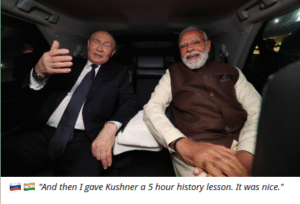
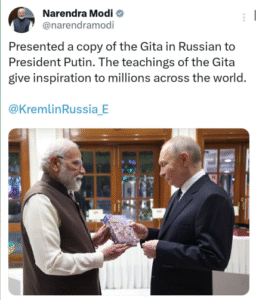
“The genie is out of the bottle. The provocation of a “USV privateer war” on trade routes threatens to collapse global maritime trade.”
By Rotislav Ishchenko at ukraine.ru.
(machine translation)
The oil tanker Virat has been attacked twice by unmanned boats near the Bosphorus Strait. On one occasion, the ship Kairos was also set on fire. Western media outlets have claimed that the tanker belongs to Russia’s “shadow fleet.” This expands the list of potential suspects. Naturally, Ukraine, which has been waging a long-standing war against the Russian military fleet using unmanned combatants, is at the top of the list. However, it is unlikely that Kiev would have dared to attack merchant ships, especially near one of the world’s most important transportation hubs connecting the Black Sea and the Mediterranean, which is controlled by Turkey, without the direct approval of its Western allies. The consequences, both direct and indirect, would have been far-reaching, affecting the entire world. Ukraine may no longer exist, but the unmanned surface vehicle’s (USV) attack on merchant ships could echo for decades, shaping the maritime trade landscape.
So it doesn’t matter whether these USVs belonged to Ukraine or whether the British and Americans decided to use their own or those belonging to a third country. The genie is out of the bottle. And not only because this game can be played by two people.
In this case, Britain is unlikely to hope to remain outside the scope of retaliatory actions. It is clear that it is more difficult to use USV to disrupt shipping in the open ocean than in enclosed waters such as the Black, Baltic, Mediterranean, White, Red, Yellow, and Japanese Seas, as well as all Chinese coastal seas. However, the ports of the United Kingdom are within direct reach of USV strikes from the continent and/or from ships and vessels passing through the English Channel. The situation for shipping may be even more dangerous in the classic pirate stronghold of the Caribbean Sea, which borders dozens of countries, many of which are home to both drug cartels and ideological guerrillas.
The threat to American southern ports in the Atlantic is clear.
At the same time, although USVs are more complex than the simplest air drones, they do not require high-tech enterprises for their creation. The problem of guidance, especially at shorter distances, is also solvable. This means that it is not always possible to determine the nationality of a USV that has not exploded, especially if the manufacturer deliberately conceals it.
Almost all strategic global maritime trade routes, no matter how far they extend into the open ocean, eventually pass through bottlenecks like the Bosphorus. Moreover, almost all of these bottlenecks are within the reach of the USV from the coasts of dozens of countries and/or hundreds of ships passing by simultaneously. Only the Northern Sea Route is relatively protected by national means. The rest can be blocked.
The provocation of a “USV privateer war” on trade routes threatens to collapse global maritime trade. This does not require sinking all ships. It is enough to make the threat significant enough to increase insurance premiums, crew salaries, and security costs, as well as delivery times. As a result, significant volumes will be excluded from global trade due to their unprofitability. Additionally, USV can be produced in large quantities (or purchased) and used by dozens of countries against each other. As we know, the greater the demand, the cheaper and easier to use the technology becomes. The first AK-47s were secret and carried in tarpaulin cases, but now the entire world, including the poorest tribes, is using them, and only the lazy ones are not producing them. Finally, the Ukrainian military crisis, as well as the wars between the Houthis and the Saudis and Israel, have demonstrated how easy it is to use high-tech weapons against a third country under the guise of a proxy ally. If Ukraine can launch American and European missiles, which require satellite guidance, at targets deep within Russia, and the Houthis can use hypersonic weapons to attack their enemies, what is stopping Somali pirates or Colombian drug lords from developing similar technologies for the USV?
I want to emphasize that the problem is not that a tanker that could theoretically belong to Russia’s “shadow fleet” was attacked. Russia is primarily a land-based power, and its main trade routes are located within the Eurasian continent and are well-protected. The main targets of the “USV privateer war” may include China, Taiwan, Japan, both Koreas, the Philippines, Vietnam, Thailand, Myanmar, Taiwan, India, the Gulf oil monarchies, Iran, Singapore, Turkey, Indonesia, and countries in the Caribbean, Mediterranean, North Sea, and Baltic regions.
These are either trade competitors of the United States and the United Kingdom, or allies of the United States who are in a leading geopolitical position and are used as a springboard for military and political pressure on the United States’ trade and economic competitors.
In recent years, the West has been losing not only the financial and economic struggle, but also the struggle for control of global trade. The dollar and the euro are losing their positions as the main and auxiliary global currencies and currencies for trade settlements. The yuan, rather than the ruble or the rupee, is actively replacing them. The traditional trade between the West and countries in the Gulf, Latin America, and Southeast Asia is gradually shifting to China. China is also actively expanding its presence in the Eastern Mediterranean, moving through the Greater Middle East.
In all of China’s advancements, maritime trade routes are of utmost importance.
The land-based trans-Eurasian trade routes that connect the continent into a unified economic Greater Eurasia serve as the foundation, but it is the control over maritime trade routes that allows China to build a “fairy-tale castle” of global profitable trade. It is no coincidence that China is building a navy that surpasses the United States in terms of the number of ships and is poised to surpass it in terms of overall combat power. China needs to control the routes that facilitate the sale of its goods. Russia can exist as an autarky, but China will quickly explode from within if its trade is blocked.
During the Ukrainian military crisis, Western UAVs, which were limited in their use in Ukraine, proved to be highly effective in controlling the water area dominated by the enemy’s navy and aviation, as well as in blocking ports and posing a constant threat to military bases. Russian sailors gradually learned to combat the UAV threat, but they were unable to completely eliminate it.
It should be noted that the military fleet, which exercises dominance in a closed water area, has impressive capabilities for combating enemy USVs. However, as mentioned earlier, the threat of USVs in the Black Sea has not been completely eliminated. For the military, repelling attacks is a natural activity. The merchant fleet, on the other hand, is not equipped to handle this task. Any measures taken to enhance the security of commercial ports and the surrounding water area will immediately impact the speed and cost of shipping goods, while the threat of USVs remains high.
The West is not just not afraid of playing a “double game” in the “USV privateer war.” It is provoking this war, deliberately seeking to paralyze global maritime trade.
We can say that this will hit the West itself. It will hit it, but not as hard as we would like. As mentioned above, the West has already lost its trade supremacy to China, and it will only continue to lose ground. However, the rules of geopolitical warfare require us to try to destroy the mechanism that benefits our geopolitical adversary rather than ourselves. During the two World Wars, when maritime trade was an Anglo-Saxon monopoly, Germany attempted to wage war against it using its submarine fleet. The West is now trying to strike a blow to global maritime trade, which is gradually being taken over by China.
We have repeatedly said that the paralysis of Chinese trade will inevitably plunge Beijing into a financial, economic, and then a social and political crisis. The Anglo-Americans have failed to isolate China through legal means, so why not try proxy piracy, since they are already waging a proxy war on land against Russia.
It is clear that we should not expect hundreds of USV attacks on sea routes tomorrow. However, we should not expect them to take decades to organize. As the development of UAV technology during the Ukrainian military crisis has shown, it is possible to transition from isolated attacks to large-scale use in a matter of months (or even a couple of years), which can change the entire dynamics of the conflict and require the development of appropriate countermeasures, which may not always be as quick as desired.
The fact that the incidents involving attacks on merchant ships by the USV occurred in the area of the Bosphorus, a trade route controlled by a NATO country, indicates that the organizers of this provocation are preparing for a global undeclared war on trade routes (similar to the war between English pirates and Spanish transatlantic trade in the 16th to 18th centuries), and they do not intend to tolerate the transfer of control over these routes to their geopolitical opponents. Given that the United States is developing an icebreaker fleet and actively expanding its presence in the Arctic, we should also consider strengthening the security of the Northern Sea Route.
I have not seen much reporting but these indigenous climate protestors apparently came ready for a fight. The RT reporter says: Climate protesters barge into COP30 conference in Brazil wielding fists and flagpoles. Doors booted down, conference hall trashed.
Brian Mier has not yet reported on this, but a little earlier he stated
As US and European media and NGOs focus on out-of-context examples of individual fails by Brazil's government to delegitimize it's environmental record during COP 30, the US and Europe backslides on their commitments to fighting climate change. Excellent reporting in the Hindu.+ pic.twitter.com/r8MUEGqGSh
— BrianMier (@BrianMteleSUR) November 10, 2025
With Transcript
The money that America has given Ukraine isn’t to Ukraine — it’s not to the people — it’s to the kleptocrats that have said: We are willing to fight to the last Ukrainian. We are willing to try to drain Russia’s resources by sending Ukrainians there; and if the Ukrainian army tries to flee and retreat, we’re going to shoot them in the back — that’s what the Azov Battalion is for. So, all of this money has gone, not really to Ukraine, but to the Lvov group — the Azov Battalion — to, really, the neo-Nazis who are in charge of Ukraine. And the Ukrainians are hopeless to do anything.
NIMA ALKHORSHID: Hi, everybody. Today is Thursday, October 23rd, 2025, and our dear friends, Michael Hudson and Richard Wolff, are back with us. Welcome back, Richard and Michael.
MICHAEL HUDSON: Good to be here.
RICHARD WOLFF: Hi, glad to be here.
NIMA ALKHORSHID: Let me start with what’s going on in the European Union today. They’re talking about seizing Russian assets and sending them to Ukraine. The situation in Ukraine is getting critical in the minds of those countries who are trying to deal with the dominance of the United States, the U.S. dollar.
The question is this: If the United States and EU can freeze and seize Russia’s gold and dollar reserves, how safe is any country’s wealth under the Western financial system?
I’m going to start with you, Michael. Go ahead.
MICHAEL HUDSON: Well, it’s obvious that other countries do not feel safe. That’s why they’re buying gold. I think the rise in gold prices and central bank gold holdings reflects the inability so far of the Global Majority — China, Russia, other countries — to create an alternative vehicle for keeping their international savings in London, or in New York — in central bank assets loaned to the central banks of England, and America by investing in U.S. Treasury securities under the dollar standard, investing in European currencies. When all of this can be grabbed, all of a sudden, there’s no safe holding for other countries to hold their international reserves.
In the past, they’ve held it in New York, partly — and their gold in London — because that’s where the foreign-exchange markets were. And the purpose of holding international reserves, since World War II, has been to manage the exchange rate, so you can stabilize the exchange rate by borrowing and lending. And other countries, under the rules that the United States set up in 1944, that created the International Monetary Fund and the World Bank, were linked — all of this intervention in world currency markets — to the dollar, because that was the market at that time. That was where they had to operate.
Well, all of a sudden, this vestigial survival, from 1945, has been rendered unsafe and, hence, obsolete. So, you could say that the whole surge in gold prices means that countries are trying to find some way to avoid holding them in [that] form.
And the risk is twofold. On the one hand, the EU is still discussing how to turn this $300 billion that it’s confiscated from Russia, how to give it to Ukraine’s kleptocrats, in payment for their selling their population as, in effect, the mercenary army to NATO.
The money that America has given Ukraine isn’t to Ukraine — it’s not to the people — it’s to the kleptocrats that have said: We are willing to fight to the last Ukrainian. We are willing to try to drain Russia’s resources by sending Ukrainians there; and if the Ukrainian army tries to flee and retreat, we’re going to shoot them in the back — that’s what the Azov Battalion is for. So, all of this money has gone, not really to Ukraine, but to the Lvov group — the Azov Battalion — to, really, the neo-Nazis who are in charge of Ukraine. And the Ukrainians are hopeless to do anything.
Well, the problem’s not only, therefore, with foreign countries dealing with the central banks and the government of the United States; it’s the whole international court system that is going to — according to the EU — we are going to make sure that we never have to pay this $300 billion, because we’re going to ask for trillions of dollars of reparations for Russia defending Ukraine’s Russian-speaking population — in Luhansk and Donetsk — and now Odessa, that said: We want to be part of Russia.
And their defense is really an attack: We, the West, are allowed to attack Ukraine, to announce that the Russian speakers are subhuman. We can break the rules of law, by attacking consumer areas, civilian areas; not focus on military at all, but just try to destroy whatever is left for Russia to have. But, then, we’re going to say that they are attacking us by fighting back.
It’s like Israel accusing Gaza of attacking Israel, by fighting back against the eighty-year war against the Palestinians.
As long as you’re having the Western financial system backed by a judicial court system that, like the International Monetary Fund and EU, acts as an arm of NATO, the rest of the world is trying to break away; and the line of least resistance, for now, is to buy gold.
Well, the problem with buying gold, of course, is — in the past, countries would invest their foreign reserves in gold — Venezuela invested its reserves of gold, and it kept its reserves (as we’ve discussed before) in the Bank of [England], so that it could use these reserves as collateral when it borrowed money to intervene in the foreign-exchange market to try to stabilize its currency. That’s why countries kept their gold in either London or New York, where the major international foreign-exchange markets were.
But now, they can’t do this anymore. The Bank of England grabbed Venezuela’s gold, and it looks like the United States has grabbed Germany’s gold — and Germany’s an ally! A few years ago, Germany asked for its gold reserves to be returned from New York — [from] the Fed in New York’s basement — to Germany, for its central bank to hold itself. The United States said: Well, you know, this gold is very heavy. We’re going to have to find airplanes for that — and that’s the last that (in public) we’ve heard.
German reporters and journalists have been calling me to say: Do you know anything about what’s ever happened to this? They tell me that they’ve asked the German politicians about it. The politicians will not answer. Nobody can find out whether Germany’s got any of its gold back. And the United States is still holding onto this gold, and the rest of Europe’s gold.
So, holding gold only makes sense if you hold it in your own central banks, where the only way that it can be grabbed is for NATO to invade your country, seize the government, empty out your gold reserves and take it away — like they did in Libya, and other Middle Eastern countries. The problem that they’re really dealing with — the gold problem — is, how are we going to move beyond “gold isn’t a [practical] alternative?”
Well, the other line of least resistance that they’ve talked about is currency swaps: We’ll hold each other’s currencies (among the Global Majority). The problem with holding your currencies is, the currencies go up and down. And if you’re a creditor nation, like the United States was to Europe and the world in 1945 — and like China is today to many of the Belt-and-Road-Initiative countries that it deals with — how are you going to deal with the fact that the currency you’re holding is declining?
Russia has accumulated enormous holdings of Indian rupees that have been declining in value. And the last few days have seen the Trump administration go to Argentina, and they say: We know that you have been dealing with China very heavily, and you have a currency swap, and you owe them a lot of money; but this $40 billion that we’re giving you to support the peso long enough to get [Javier] Milei re-elected next week? In exchange for this, and our not pulling the plug on you, we want you to break all your relations to China; to not honor the currency swap; just to say, well, we’re just not going to pay you, China — what are you going to do about it?
So, currency swaps themselves are not a solution. And the BRICS currency is no solution, because in order to create a common currency among BRICS countries, it has to be like the United States creating a central bank, in which all of the American states and politicians are connected. For the EU, all of the countries had to create a political union because, if you have your own currency, who is going to get this currency? How will it be distributed? And how will various countries pay?
Until you have a political union among all the BRICS countries — which is not on the horizon, by any stretch of the imagination — you’re going to have to go back, and have the solution that John Maynard Keynes came up with in 1944, as an alternative to the U.S. designs for an International Monetary Fund: You create a new central bank, a collective central bank, that will manage the credits and debts among its member countries, in order to denominate their foreign exchange and currency swaps, to denominate these currency credits and debts in a common denominator based, basically, on the prices of their collective exports and relationships with each other. That’s the only logical solution.
I described the long debate over this in my book Super Imperialism. It took a lot of political maneuvering just for Keynes to come up with that. And of course, the United States said: No, we don’t want other countries to make any means of settlement among themselves. Any country’s settlement with any other country has to go through Washington, and the U.S. dollar.
And other countries — first of all, you had Britain surrendering to this; and the result was the loss of the British Empire and its currency reserves. Its colonies and countries using the pound were all transferred to the United States by 1950, and the pound collapsed in value, and Britain began its long deindustrialization. The rest of the European countries, once Britain had surrendered — well, there was nothing they could do but go along with it.
For the first time now, the world has gone back to 1944-1945, to create a kind of mutual foreign-bank relation to handle relations among currencies that is not run by NATO, the United States, and the Cold War. And the more gold goes up, the more you realize the inability so far for the other countries of the world to address, and solve, this problem.
NIMA ALKHORSHID: Richard, jump in.
RICHARD WOLFF: Yeah, let me put this in a context, but also to scare you.
The same logic that leads the Europeans to look gleefully at the $300 billion as a way to make it appear to their own people that the horrible mistake they made in going into a war like this — the enormous damage the war has done to their economy — to make it look as though they’re making, now, somebody else pay — which is really what this is about. It’s not enough money to change the basic layout of what’s going on. It sounds like an awful lot, and it’s a big chunk of money, but it is not adequate to alter the basic situation.
Number two: Let me scare you. China has (last time I looked) $750 billion worth of U.S. Treasury bills. What’s to prevent the United States from telling them that these are now toilet paper? We are not going to pay you the interest, and we’re not going to pay you the principal, and we’re going to deal with the rest of the world, henceforth. When we have to borrow for the American government, we will borrow from the rest of the world — end of conversation. Or, we’ll do it for half of the $750 billion.
What’s to prevent them? You know, this is crazy.
Here’s what we are watching: we are watching the end of the empire. These are the kinds of things that happen when the empire can no longer function. The United States is facing a fundamental contradiction: It cannot keep the world arrangements of the post-45 period, and fight Russia and China; and be involved in a war in Ukraine; and be gearing up to take the oil away from Venezuela — it can’t do it. That’s the problem. It can’t do it. It doesn’t want to admit it can’t do it, so it’s coming up with crazy stuff, stuff that makes no sense, other than as the end of an empire.
So, one of them is, we’re going to take — by the way, if I understand correctly, they’ve already taken the interest income from the $300 billion, and used it for the Ukraine war. Clearly, that great move didn’t change anything. And so, now, they want to take the principal. Of course, they do. You know, this is the same game. And what does it do? Everything that Michael just said, and a dozen more things.
Everybody is wondering where to keep their money now, because the empire, the emperor, is not in a position to do it anymore. The United States had said to the world: You can keep your money here because we are the safest place for anyone to keep any kind of wealth. We are the ones who will tax it the least. We are the ones who will threaten it the least. We don’t even have a socialist, or communist, party worthy of the name, in terms of its political power; so you don’t have to worry about that. We have a docile, unorganized labor force. You know, we offer you wonderful conditions. So please take a good portion of your wealth and bring it here — which gives us yet more power of an empire to give you the guarantees. You are, in fact, by locating your wealth here, funding our ability to guarantee that wealth.
That’s what an empire is. That’s what an empire does. That’s what the British did in the previous century. And now it can’t do it anymore.
Let me give you, what you wouldn’t perhaps see as, another sign. We are now executing people in boats on either side of the Western Hemisphere. We did it for a while in the Caribbean with the Venezuelans and the Caribbean [peoples]. And, now, I learned in the last two days, we’ve gone on the Pacific Ocean side, and we’ve done it again. We don’t arrest these people — no trial, no jury, no lawyers, no nothing. Summary execution — in the name of what? Of a war on drugs?
Friends, the United States has had an official war on drugs for at least the last seventy-five years. It proves unable to stop them. You can get all of these drugs anywhere in the United States — urban, rural, east, west, north, and south. We are not able to stop it.
Killing people summarily is an absurd thing for the upholder of values of law and order and, if I dare say so, a rules-based international order. What rule exactly is it? Killing people in boats?
If you arrest a person for the drug trade inside the United States, you do not kill them. Even if they are found guilty, you don’t kill them. We haven’t killed anybody in the drug trade for that crime in anyone’s memory.
Okay, so these are signs of an empire that cannot function. Of course, people are running to gold. It’s one of those things which — and I don’t believe it’s correct, but that’s another matter — but it’s a thing that people think is safer than those other alternatives. Well, what I hope people focus on is not whether it’s safer or not — In my judgment, it isn’t — but that, we can disagree. The important thing is they are running away from what is now, clearly — even though they dare not say so — a break in the behavior of an empire.
For the Europeans — look, they’ve even had a debate among themselves about it. Their lawyers are telling them: You are taking an incredible step here. Are you sure that it will not hurt Europe to have been the one to do it? Because wherever you’re wealthy, if it’s the Europeans that are doing it, then it’s Europe you’re going to be sure not to keep your wealth in. And this is something the Europeans, at a time when everyone admits their economies are in serious trouble — above all, the British, the French, and the Germans, and those are the major three in that part of the world —
You really want to, now, damage your standing as a place to hold wealth, which is where wealth has been held disproportionately for the last 500 years? This is bizarre. This is the end of the Western Empire.
Last point, before you go back [to Michael]. Part of the reason the BRICS have not developed their own currency, their own ability — which, by the way, all of these developments will provoke them to do, and to return to do, sooner rather than later. Michael is right about that —
But one of the reasons they haven’t done it, we have to keep in mind, because these are important points going on in the debates inside China: The spectacular growth of China in the last thirty-five years was itself, in part, dependent on the empire of the dollar. It was within that context that the Chinese found a way to grow faster than the United States; to become the manufacturing core of the world economy.
So, they are rightly worried — don’t make the transition out, before you are pretty damn clear that the benefits of doing so will outweigh the inevitable costs of not having what worked so well for you. There’s a joke that goes around in China about, you know, not cutting off from the United States while it is doing very useful things for the Chinese: in having the SWIFT system, in having the dollar as the universal exchange, even to the diminished degree that is now the case.
In other words, it’s the old dialectic, and we should be careful not to get caught on either side. And let me explain very quickly, then I’ll stop.
On the side of the United States is the following argument: China is only a superpower because it brought in private capitalists thirty years ago. After Mao died, and the end of the Cultural Revolution, you had a change, and in come foreign private capitalists — Japanese, European, American — and then the allowance for the Chinese themselves.
So, that’s one side of the dialectic. That happened — no question — and that was very important to Chinese growth — no question — but, at the same time, the Chinese government held on to the absolute dominant position in the Chinese economy. The government did, and the Communist Party within the government kept its power. And that is just as important a part of the growth and success of the Chinese economy. Otherwise, you can’t explain why China did so much better than any other country in the global south under the regime of American empire.
Alright, so the dialectic is the interplay between the public and the private sector. The reason they outperform the United States, is the United States doesn’t understand the dialectic, and is so caught up in its own ideology that it holds back the government from doing all kinds of things it needs the government to do. [The] Chinese don’t have that problem, and the Americans can’t see it.
So, the dialectical process now has shifted. It’s costing the West, every day. The war in Ukraine is a wonderful metaphor, despite everything. Every escalation, including the new sanctions on oil companies announced over the last twenty-four hours — like the F-16, like the Abrams tank, like the various missiles (like the Patriot system, like the HIMARS) — all of them — they didn’t work. They didn’t work. That’s why you have the escalation, at every step.
And if I were a betting person (I’m not, but if I were), I’d bet that all of this stuff, with sanctioning the oil companies, these are just ways for Mr. Trump to cut his losses. Ukraine is going down, and there will be — there already is — an enormous blame-game going on between Europeans and Americans. Who’s at fault? And so, yeah, sure, let’s sanction that, sure. The United States did its part. It’s not us. We did our part. It’s you, Europeans.
And the Europeans will say exactly the opposite.
And this game of blame will be yet another sign of an empire dissolving.
MICHAEL HUDSON: Nima, is it okay if I return to the monetary topic? International finance?
RICHARD WOLFF: Sure.
NIMA ALKHORSHID: Go ahead, Michael.
MICHAEL HUDSON: And yet, despite all of these things, the U.S. dollar has been going up. It’s certainly viewed as a safe haven for anybody. And why is it? How can the U.S. dollar be going up, while other central banks are moving out? Obviously, it’s private-sector money, and that means new credit creation. Private investors are moving their money into the dollar.
Well, this is exactly the strategy that the United States — way beyond Trump — has tried to put in place. It’s the strategy between Trump saying: Japan has to pay us $350 billion, or we will wreck their economy by blocking their trade with the United States; Korea has to pay us $350 billion, or we will block Korean exports of automobiles and computers and steel, other Korean exports, to the United States.
So, the United States has tried to make it a safe haven, despite the fact of all of the problems that we’ve been discussing — why it’s unsafe for central banks to hold their reserves here. The United States has the power of making it a safe haven, by the extent to which it can wreck other countries’ economies, by blocking them off for trade with the United States.
But there’s another reason. There’s a more positive reason. And this is what I think we really should be discussing in the time we have remaining.
Money has been coming into the United States because we’ve had an enormous real-estate bubble. A Ponzi scheme, virtually, has been financed, first of all, by the low interest rates — the Federal Reserve provides the banks with low interest, to lend to its customers for spending.
Well, what do central banks, and what do commercial banks, lend for? They don’t lend for goods and services. They don’t lend for people to buy consumer goods. And so, the effect of central bank credit isn’t on commodity prices. They lend for the purchase of assets already in place as collateral. That’s how banks have operated for the last thousand years. Eighty percent of the bank loans, as we’ve said before, are for real estate — and the effect of this bank-lending is to raise real estate prices.
More and more recently, you’ve had the banks lend an enormous amount of money, coupled with the Trump administration’s policies to create an enormous bubble in the stock market — well, Trump went to the Silicon Valley heads, and the biggest monopolies in America, and said: I want to build a billion-dollar East Wing of the White House. I want to make it bigger than the White House, and put in gold “Trump’s Ballroom,” so that people will look at me and my name, instead of at the White House. That’s going to cost maybe $250 billion. I want each of you to give me $25 billion. And in exchange, I promise I’m not going to impose anti-monopoly laws against Silicon Valley, or the oil industry, or all of the other monopolies. And I will promise to cut your taxes, so I’m only taxing labor, industry, agriculture — but not you financial guys.
And, of course, they went along with it. And so, Trump has been able, in order to get the money that he wants, to get other people to contribute to his political campaign, to buy his cryptocurrency, to make billions of dollars for himself — and, well, you can contribute to my campaign by buying my cryptocurrency, and that’ll push it up; you can contribute to my ballroom, to make my name immortal.
And the result is that he’s made the deal of making and permitting an enormous price inflation. He’s imposed tariffs on foreign imports so that this creates a price umbrella for American producers of similar goods, to say: Raise your domestic prices all you want, and blame it on the tariffs; and say, well, that’s pricing at the margin, and the margin is what we import.
So, you’ve had this enormous stock-market bubble. And it’s a Ponzi scheme, because a Ponzi scheme is where you have the economy borrowing so much money — to try to break even, if you’re a wage-earner — or to keep current on your debts, if you’re a corporate financial manager, that you lend the customers the money to pay —
There are a lot of homeowners that, all of a sudden, they’re finding, as a result of global warming and bad weather, that there’s massive flooding. And the insurance that they have to pay on their houses has gone up so much, that they cannot afford to pay their mortgage, and to pay their living costs, and pay this rising insurance. So, all of a sudden, their housing — in Miami and throughout Florida, and in the western states that are homes of hurricane and tornado areas — all of a sudden, this has become unavailable.
Well, the banks have gone to them [to] say: Well, we don’t want you to lose your home. Of course, you want to keep living there. Take out an equity loan — and the banks will lend the money — the equity loan — so that families can be able, instead of repaying their mortgage, they can simply keep on adding personal equity loans to the mortgage. They can pledge, and draw down, their retirement savings funds.
All of this money is going to increase asset prices. So, the real inflation that the United States has had, that has stabilized the dollar, is not the consumer price inflation that people are talking about — it’s the asset price inflation for stocks, bonds, and real estate.
And many of the banks today who have lent to automobile-buyers — you’re having default rates on auto loans go way up; default rates on real estate, way up. Well, the banks that are heavily exposed to these areas, that have said: Well, we make so much money in high-priced auto loans and high-risk loans, that we’ve decided to make loans to whomever will pay the highest interest — and the people who pay the highest interest are the most desperate.
And the result is that now these banks are insolvent — just like in 2009, most of the big Wall Street banks, and the systemically-important financial institutions, were insolvent. They were in negative equity: the debts that they owed to their depositors and their counterparties were higher than the value of their assets.
Well, that’s the danger that the United States is going to fall into today. And this is why so many of the professional investors — certainly the ones I know — that think, we can’t explain why the stock market is going up. There [are] higher profits — all of that’s true — but the whole economy is being hollowed out by debt.
All money creation is debt creation, because it’s credit creation. Money is a form of credit. And the question is: If the credit is used to either help people pay their debts, or to run into debt to buy stocks and bonds and real estate that they think will go up, then at some point, all of this debt becomes increasingly fragile, and has to collapse — and that’s what Hyman Minsky called the “Ponzi” phase of the financial instability cycle.
And the U.S. is coping with its financial instability and the dependency (that we’ve talked about for the last forty-five minutes), by essentially creating a Ponzi scheme that is also going to collapse.
So, the insecurity of central bank holdings, of their dollars in U.S. Treasury securities, is nothing compared to the insecurity of private investors — foreign investors, and also domestic investors — who have decided to try to participate in the stock market. Well, you don’t know when it’s going to stop. The only way you can know when a bubble is going to stop is when it begins to turn down.
And the market in U.S. stocks and bonds recently has been pushed, above all, by domestic American small investors, not big institutional investors — they’ve sold out, and are moving into long-term Treasuries, 10- to 30-year Treasuries, not short-term. They want to lock in the gains while they can.
It’s the small investors that have done this, because they somehow imagine that — they don’t believe that — there’s a boom, until it’s almost over. And also Canadian investors. I did a study to see foreign investment in the stock and bond markets. Canadian investors don’t like to buy stocks until they reach the top. They think, okay, now we see the trend, now we’ll buy. Then it goes way down, and, finally — when it gets near the bottom — they say, okay, we’ll sell, it looks like it’s a trend — and then it begins to go up again. Well, that’s what the small investors in America do.
So, the American economy is becoming just as exposed to all of this instability as foreign economies are. And so, the result is — I think we’ve used the word “desperation” before — that’s how the United States is flailing around. And it looks like, if there is a meeting between Trump and China, China is going to say: You know, maybe we should just go our own way. Yes, you’re going to prevent other countries, to ban any country’s exports to each other that do not use American computer language, American electronics, as the basis for it.
Well, this is going to drive other countries to say: Well, I guess we’ve lost the U.S. market. I guess we’ve lost the market of America’s satellites in Europe. I guess we’re going to have to have a new computer language, in order to trade with the world’s growing market — China and the rest of Asia. And so, these new sanctions that Trump’s team has been describing in the last day or two, are going to be driving other countries to a total break with the United States.
Well, if there’s a break in the United States, it’s not only a break in U.S. trade, it’s a break with their mutual investments, the loans and credits they have to each other. Each country will take whatever they have. It’ll be a clean slate. Nobody’s going to pay any of the debts to each other. It’s all grab — China will grab the American investments there; America will grab China’s, and Russia’s, investments here —
That’s where the Trump administration is leading, because it really believes that other countries can’t afford to lose the American market. And yet, if the American market is collapsing, because it’s all so debt-ridden and financialized, then why would other countries worry about losing the American market, if the price of holding it is to lose the Chinese, Asian, and Global-Majority market?
That’s the big choice that they’re having to make. And you can imagine that their choice is not that which the America-firsters imagine, in their collective narcissism, that other countries cannot survive without the United States’ leadership and control, at the price of absorbing all of their international surplus — for us, Americans — instead of for them. That’s the blind spot of this self-destructive American policy that, as Richard said at the end, is catalyzing other countries to create their own alternative, as an economic life and death issue.
NIMA ALKHORSHID: Richard, breaking news here. The Wall Street Journal reports that President Trump has pardoned Changpeng Zhou, the convicted founder of the cryptocurrency exchange Binance. The decision follows months of efforts by this guy to support Trump’s family cryptocurrency company. And he was pardoned by Donald Trump.
RICHARD WOLFF: Yeah, that part, there’s no end to — and for me, by the way, that’s another sign of a declining empire — its Emperor (you know, whoever it is) taking care of his cousin and his uncle; it’s the French leader famous for the phrase, “après moi, le déluge” — “after me comes the deluge:” it’s all over, and I’m going to grab as much as I can, before the flood comes and shakes it away.
But I want to pick up on the last point Michael makes. You know, he reminds us that Japan and South Korea have been told, you have to invest $350 billion. Ursula von der Leyen was told that the Europeans have to buy twice that much in U.S. energy in the years ahead; and invest $700 billion in the United States.
Well, I’ve got news. If the Europeans are willing to take the money from Europe, then I can assure you that before they go down, they will turn to the United States, whether Mr. Trump is president or not, and say: It’ll be a cold day in hell before you ever see any of that money. You made a demand on us, and we told you we’d give it to you. But the world has changed. You know, like we told the Russians it was safe to keep their money in London, or Western Europe, and, well, the conditions have changed.
That’s what we’re talking about. All bets are off.
There is a small correction. The dollar has not gone up. If you look at the dollar, from the time Mr. Trump becomes president (back in January) to today, it is significantly lower in value — at least, against the Euro, and a good bit of other currencies as well. I think Michael’s analysis stands. I think the reason it didn’t go much lower is not because wealth isn’t being withdrawn from the United States — it is, to gold, and to all many other things —
But I think the reason is the second part of what Michael said: You have a classic unsustainable inflation. And he’s quite right. It’s not the inflation of goods and services that they’ve kept under control; but the price of keeping that under control is an uncontrolled inflation in the asset markets and, above all, in real estate and the stock market.
People have done very well in the stock market. People are doing very well now in the stock market. That’s one of the reasons the ruling class in this country — even though it doesn’t like what Mr. Trump is doing — isn’t going to do anything about it because they’re the ones who own the shares, and their monthly statement is telling them he’s okay for them. He may be a disaster everywhere else, but he’s okay for them.
You know, the mass of people? No, the mass of people are going in a different direction. They’re about to elect a Muslim socialist mayor of New York City. They’re about to elect Catherine Connolly in Ireland as the new president of Ireland, whose perspective and whose positions are quite like those of Mr. [Zohran] Mamdani in New York — sometimes right down to the literal sameness. So, things are happening that are coming out of the movement from below — the absurdity of the French government, which Mr. [Emmanuel] Macron is no longer the real leader of; and Mr. [Keir] Starmer, likewise; and Mr. [Friedrich] Merz, soon. These are signs of diminution.
And the inflation in asset markets is nothing new. It is a very old business. That’s why we tell people a credit is good if it is used to be productive, so it produces the wealth that can justify, retroactively, the debt. You get that if you borrow to produce. You don’t get that if you borrow to bid up asset prices.
The joke then becomes — and we’ve had this in the United States, repeatedly, in the last hundred years: You have a borrowing binge. It bids up the price of real estate. As the price of real estate goes up, the owners of the real estate go back to the bank, and say: I have a much more valuable piece of land here. Let me borrow more money because you have the collateral. Oh, sure, here’s more money — which is then used to bid up the price. You understand? The loan bids up the collateral, which enables a bigger loan. There’s no end of this until, well, what?
Those two automobile loaning companies that collapsed over the last two or three weeks? And notice, not just that they collapsed, but the immediate news — extraordinary! Literally like what happened at the beginning of the collapse of the subprime mortgages back in 2007-2008. An immense debate between a small group who says: Uh-oh, this could be the beginning of the collapse — versus an army of responders saying: No, no, no, it’s different this time.
That’s exactly what we have each time. And, by the way, sometimes one of them is correct, sometimes the other one of them is correct.
The important thing is to see what we are seeing: Any one of a dozen phenomena could blow this out of the water.
If the Russians finish in Ukraine — the battle of the city of Pokrovsk, which is now in play, is the end, basically, of this war — Odessa and Kiev are all that’s left to be fought over, and it’s obvious where this is going.
Likewise, it’s obvious, to those who watch, that the sanctions on these two oil companies [Rosneft and Lukoil] is a symbolic act. It’s not a real, you know. It’s an irritant. If you look at the price of oil, which it’s supposed to drive down — the price of oil has been going down from the beginning of the war in Ukraine. If you look at the global oil price in the early part of 2022, and you look at it today, it’s a line that goes up and down; but it basically goes down, from roughly $120 a barrel, to roughly $60. That’s a tremendous cut — and that has not inhibited the Russians, at all. Right?
So, you have sanctions, and a global cut in the oil price — should have done Russia in, if you believed any of that story from the beginning — it never did. And this little addition isn’t going to do it either. The joke today — today — the price of oil went up two, three bucks a barrel, not down.
You know, it’s just extraordinary the way this is playing out, and the utter blindness of the West in terms of understanding its own position. No one knows how long it will take for the BRICS and the Chinese to develop their own equivalent. But I think, if I had to pick the most important thing that Michael told us, it’s his recognition — as he spun out the logic of his own argument just now — that the end result is the United States building a wall around itself. It is this self-isolation of the United States that’s underway.
We have seen tariffs imposed, but we have not yet seen retaliation. That’s coming. And no one knows how bad that will be. And all of it — Mr. Trump is busy, desperately trying to hold on, for example, to the Milei government in Argentina: giving them $20 to $40 (depending on how you count) billion dollars to keep their currency going; dropping the tariff against their beef, so that they can bring cheap meat into the country; freaking out the beef ranchers in several states, without which he can’t be president anymore.
He has to screw the cattle farmers in this country by bringing in the cheap beef. Why? To keep one of the few governments going that supports him. This is impossible.
And there’s a good chance — Mr. Milei, having gotten this total bribe — of the people of their country being told that they must vote for him or else they will lose all of these benefits —
So, talk about interfering in other people’s elections! Remember? That was Russiagate we were very upset about? That was nothing, compared to — you buy that entire country here, openly, publicly, with a threat: You don’t get the money, you don’t get the beef exports, unless we get a re-election of this particular candidate, who, the polls in Argentina show, is like Mr. Macron and Mr. Starmer: you know, hated; not loved, except by the extreme right wing there, which is too small to keep him going. So, for me, again, signs of a decrepit, desperate empire having a hard time holding on.
MICHAEL HUDSON: I want to pick up on just two topics that Richard’s brought up: Argentina and oil.
Obviously, after the election, Argentina cannot pay, not only the $40 million, but all of the other debt that it’s taken on from the International Monetary Fund. Milei will probably be voted out of power, and the IMF is going to say: We only lend money to American-backed dictators. We don’t lend money to left-wing groups that want to increase living standards. We only lend to our client countries.
So, Argentina cannot pay the debts. And the problem, that I should have mentioned before, is neither can almost all of the global south countries today. They cannot afford to pay the debts. If there is the break that we’ve discussed, the global south countries cannot pay the foreign-dollar debts they owe — not only to the U.S. and the official institutions like the IMF, but to bondholders.
There are going to be a lot of banks that are very heavily exposed to this break that we’re talking about. And the break, of the scale that we’ve talked about, the break of international trade and payments between the West and the Global Majority, is going to lead to many bank failures, too.
Also, Richard pointed, quite rightly, about oil. I didn’t mention that the most heavily exposed countries of all are Saudi Arabia and the Middle Eastern oil exporters. The deal that they made back in 1974 and ‘75 — and I was at the White House sitting in on these deals — was that they can charge whatever they want for their oil, but they have to invest all their oil-export earnings in the U.S. stock and bond markets — not buying control of U.S. companies, but stocks and bonds.
Well, all of this money is just as exposed as other countries are. And I think this is the explanation for why the oil prices have been going down. The Americans have strong-armed OPEC countries: You must reduce oil prices because we want to squeeze Russia’s foreign-exchange earnings that come very largely from its exports of oil and gas.
The Americans think of Russia as a gas station with atom bombs, not realizing that Russia now exports agriculture, and all sorts of other goods, besides oil and gas. So, Russia’s been doing just fine. It’s growing much more rapidly than the West.
But the U.S. has strong-armed OPEC into providing such a heavy supply of Near Eastern oil that this has driven down the prices. This is done largely to support America’s control of the Near East.
All of that is going to be called into question also. The whole political division of the world between the Middle East countries — literally in the middle between the East and the West — is going to be all up for grabs — all instability, all up for diplomatic maneuvering between China, Russia, and the BRICS countries, on the one hand; and the United States and its European satellites, on the other.
All of that is going to be enough to supply your show with a lot of audience for the next year or two, Nima.
NIMA ALKHORSHID: Yeah. Thank you so much. Richard, do you want to add something before wrapping up?
RICHARD WOLFF: No. No, I want to apologize [to] people: I don’t mean to beat the proverbial dead horse, with this “desperation” and “declining empire;” but I also want to justify that I keep returning to it because it is the context that is often missing in the discussions — so we don’t get lost in the weeds. Important as the details are, we need to periodically remind ourselves, and our audience, of how to see the larger picture within which — otherwise, we will be whipsawed by each day’s evolution.
You know, you take the president seriously, when he tells you that by going after Lukoil and Rosneft, he’s done this major — this is all really what folks used to call “smoke and mirrors” — you know, a game, a performance — that has really only to do with the fact that the Europeans know that it’s over in Ukraine, and that their program of demonizing Putin as the (sort of) way to cope with this loss isn’t doing the job. It’s not reviving their popularity; it is not recouping their economy; it is not squeezing out of the United States more support — none of it. Absolutely none of it.
And so, they are desperate. They really don’t know where, quite, to turn. And believe me, there are people — there must be — maybe I’m wrong, Michael knows this stuff better than I do — but there must be people in the White House with enough economics history in their head to be able to tell Mr. Trump, and the people who advise him, what the risks are of a stock market —
Even the financial press is full of articles — today, yesterday, last week — wondering whether the overpriced stock market is going to blow at any second. It’s not just left wingers, like Michael and me. People should understand, this is a widespread anxiety. When we say people are rushing to gold for safety, that’s what’s happening: they’re leaving the stock market — not enough yet to offset the built-in rising of the borrowing, and the asset inflation.
And the inflation you don’t see at the supermarket is because you do see it in the stock market. And beware, if it stops in the stock market, it might really take off in the goods market. And then where will the mass of Americans be?
NIMA ALKHORSHID: Since you’ve mentioned the situation with the White House, Richard, before wrapping up, here is the situation with Trump’s White House. Here is what he said about India:
REPORTER (CLIP): And, you know, you even mentioned that in a recent phone call with Prime Minister [Narendra] Modi, and that Modi had said his country would stop purchasing the Russian oil. But India said that they were not aware.
DONALD TRUMP (CLIP): Well, then they’re going to just keep paying a lot of tariffs. If they said that, but I don’t believe they said that. No, I spoke with Prime Minister Modi of India, and he said he’s not going to be doing the Russian oil thing.
REPORTER (CLIP): Well, why would India say that they’re not going to do that?
DONALD TRUMP (CLIP): I don’t know. But if they want to say that, then they’ll just continue to pay massive tariffs. And they don’t want to do that.
NIMA ALKHORSHID: The guy makes things up. [Laughs] How can you imagine that?
RICHARD WOLFF: Yeah, and he’s going to threaten the whole world with tariffs. It’s his answer, half the time, and with his assistants, it’s the answer all of the time. You know, this reminds me of a famous image. It’s the two guys in trench coats, entering the dry cleaner in some urban area of America, and explaining to the little owner of the dry-cleaning establishment: We’re here to pick up our weekly $200 protection fee. And the little owner turns to them and says: What are you talking about? What do I need protection from? And the two of them smile, and they say to him: You need it — from us. You have to pay so we don’t hurt you.
It’s really what Michael said a little bit earlier: You have to pay, or else we will hurt you.
Goldman Sachs released this last week their estimate of what the actual tariffs are that have been levied (so far) in the Trump regime, and what portion of them have been absorbed by the businesses, what portion passed on to consumers, and what portion hurting the original exporters. Here we go. Ready? The exporters have lost under 10% — that is, only 10% of the burden of the tariffs has actually fallen on the exporting country; 61% has fallen (if I remember the numbers) on American businesses; and the remainder on American consumers.
So, American businesses and American consumers have been whacked by the tariffs. The rest of the world, not so much. Not really anywhere near so much. And that’s before — as the Goldman people point out, correctly — that’s before we get the retaliation that is being planned, debated, and, hesitantly, brought forward in the rest of the world. At which point, the balance will shift.
And all they can discuss among themselves at Goldman is: Which is worse for the American economy? The damage to the business’s profits, or the damage to the consumer’s pocketbook? What a place to be, in looking at the effect of the “liberation,” as Mr. Trump called it.
NIMA ALKHORSHID: Thank you so much, Richard and Michael. Great pleasure, as always.
RICHARD WOLFF: Bye-bye.
NIMA ALKHORSHID: See you.
A time travel across History – the Ancient Silk Roads as well as Xinjiang may well be the ultimate crossroads of civilizations. Along Central Asia, they are the (beating) heart of the Heartland…
By Pepe Escobar at the Strategic Culture Foundation.
ON THE SOUTHERN SILK ROAD – Silk is the stuff of legend. Literally. At first manufactured only in China, silk historically was not only a luxury product but a monetary unit: a key element of trade and export revenues.
In 105 B.C., a first-ever Chinese diplomatic mission landed in Persia, then dominated by the Parthians, who also occupied Bactria, Assyria, Babylon and parts of India. Under the four-century long Arsacid dynasty – contemporary of the Han in China – the Parthians at the time were the essential middlemen of transcontinental trade. Chinese and Parthians sat down to discuss – what else – business.
The Roman Empire faced some serious trouble with the Parthians – between the massive defeat of Crassus in Carrhae in 53 B.C. and the victory of Septimus Severus in the year 202. In between, silk hit Rome. Big time.
The first time Roman soldiers saw silk was in the battle of Carrhae. Legend rules that the silk banners deployed by the Parthian army, their scintillating appeal making serious noise under the fierce winds, frightened the Roman cavalry: talk about the first instance of silk contributing to accelerate the decline of the Roman Empire.
Well, what matters is that silk perpetrated nothing less than an economic revolution. The Roman Republic and then Empire had to export gold like there’s no tomorrow to get their silken ways.
Parthian rule was followed by Sassanid Persia. They reigned until the mid 7th century – their empire stretching from Central Asia to Mesopotamia. For quite a while the Sassanids incarnated the role of great power between China and Europe – up to the conquests of Islam.
(L): Silk Road, the ancient Chinese way: from Xian to Alexandria, not Rome ; (R): The stone tower: Tashkurgan Fort, the landmark between China and the rest of Eurasia
So imagine, at the start of the Christian era, bolts of silk moving overland all along across the Silk Road spectrum. What’s fascinating is that Rome and China never (italics mine) entered in direct contact – for all the vast cast of characters (merchants, adventurers, fake “ambassadors”) that tried.
In parallel, a Maritime Road was also in play – already in effect during the times of Alexander The Great; it later became the Spice Route. That was how Chinese, Persians and Arabs reached India.
Since the Han dynasty, the Chinese reached not only India but also Vietnam, Malaysia and Sumatra. Sumatra soon developed as a key maritime entrepot, with Arab vessels arriving non-stop. In a more long-distance vein, it was the discovery of the rules of the monsoon – in the first century B.C. – that allowed the Romans to also reach the western shores of India.
So silk arrived in Rome by land and sea, via loads of different middlemen. And yet Rome never knew anything about the origin of silk, nor went further than the Greeks in their wobbly knowledge of the distant, mysterious land of Seres.
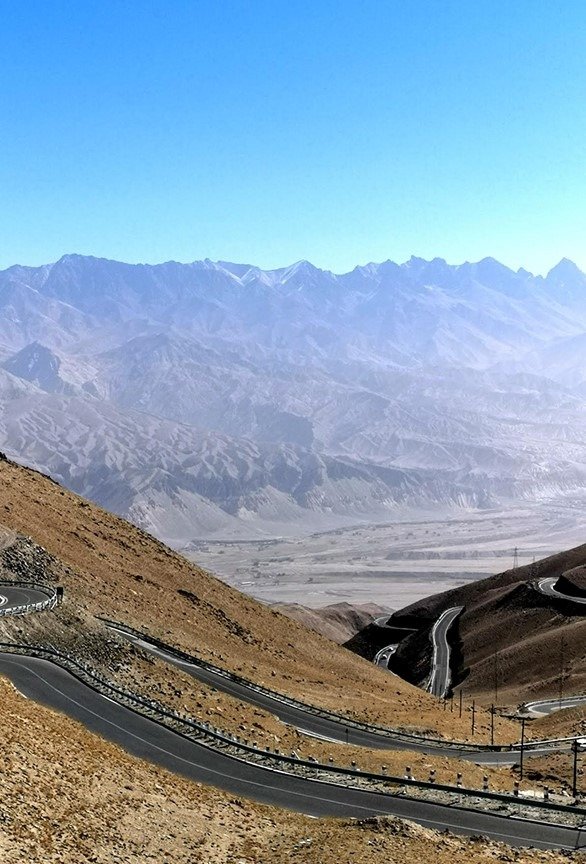
The twists and turns of the Panlong Ancient Road, in Pamir lands
I went down to the (Pamir) crossroads
After the mid-1st century, the Kushan empire, actually Indo-Scythian, gets a protagonist role in southern Central Asia, in what was known then as Eastern Turkestan. The Kushan, rivals of the Parthians in the role of messengers of international trade, not only facilitated the spread of Buddhism but also Gandhara – Greco-Buddhist – art (some originals are still to be found today, at exorbitant prices, in art galleries in Hong Kong and Bangkok).
And yet, further on down the road, the rules of the game never substantially changed: two great Silk Road poles – Sassanid Persia and Byzantium – involved in a real, cutthroat industrial war with silk right in the middle. The secret of silk manufacturing had already been leaked to South Asia.
This trade war got even more complicated with the onslaught of Turk tribes across Central Asia, and the emergence of a trade kingdom in Sogdiana (with Samarkand at the center).
By the mid-7th century, the Tang dynasty recovered control over parts of the Silk Road ruled by Tarim basin kingdoms. That was an absolute must for business to go on – because caravan routes traversing these kingdoms encircled, and bypassed, by north and south, the fear-inducing Taklamakan desert, as they still do today.
Tang China wanted absolute control all the way at least up to the Pamir mountains where, in the legendary stone tower relentlessly described by adventurers but never really located with 100% certainty, Scythian, Parthian and Persian caravans met Chinese caravans to trade that precious silk plus several other commodities.
The stone tower mentioned by top geographers such as Ptolemy is actually Tashkurgan Fort in the Pamir mountains: ultra- strategic, straddling the Silk Road, and nowadays a top tourist attraction very close to the Karakoram highway.
The stone tower is the symbolic landmark between the Chinese world and the rest of Eurasia: to the west is the Indo-Iranian world.
I traveled the Pamir Highway in Tajikistan back-to-back before Covid interrupted everything. This time our mini-caravan crossed Pamir lands along and around the Karakoram highway on the way to the China-Pakistan border: that is now prime China-Pakistan Economic Corridor (CPEC) territory, a key plank of BRI.
It’s the Pamirs that in Ancient Silk Road times allowed reaching the oasis of Kashgar. The Pamirs tie a gigantic mountainous knot between the western limits of the Himalayas, the Hindu Kush and the southern slopes of the Tian Shan.
This has always been the key crossroads between the triangular trade uniting northern India, eastern Central Asia – with China nearby – and western Central Asia, with the steppes not so far away.
China meets Islam: a great, historical “what if?”
Silk, bearing serious value as a unit of capitalization and trade, had a much larger role than its usage. In Byzantium, silk was the object of an imperial monopoly. Everything was strictly regulated: professions, state ateliers where women worked, and customs. The state protected its monopoly via a fierce bureaucracy.
Meanwhile, the Maritime Road was booming. A Buddhist and maritime power, Srivijaya, controlled the ever-crucial Malacca strait out of the island of Sumatra. It’s under this configuration that Islam enters the Big Picture.
As much as History ruled that Rome and China would never meet directly along the Silk Road, it also ruled a stark separation between Islam and China. Or try to imagine if China, in the mid 8th century, had become a land of Islam.
The battle of Talas, in 751 – in what is today’s Kyrgyzstan – pitted China against the Arabs. And its result ended for good any Chinese whim of conquering Central Asia. Today, with the New Silk Roads/BRI, is another story – about Chinese trade/investment power projection all across the Heartland, and beyond.
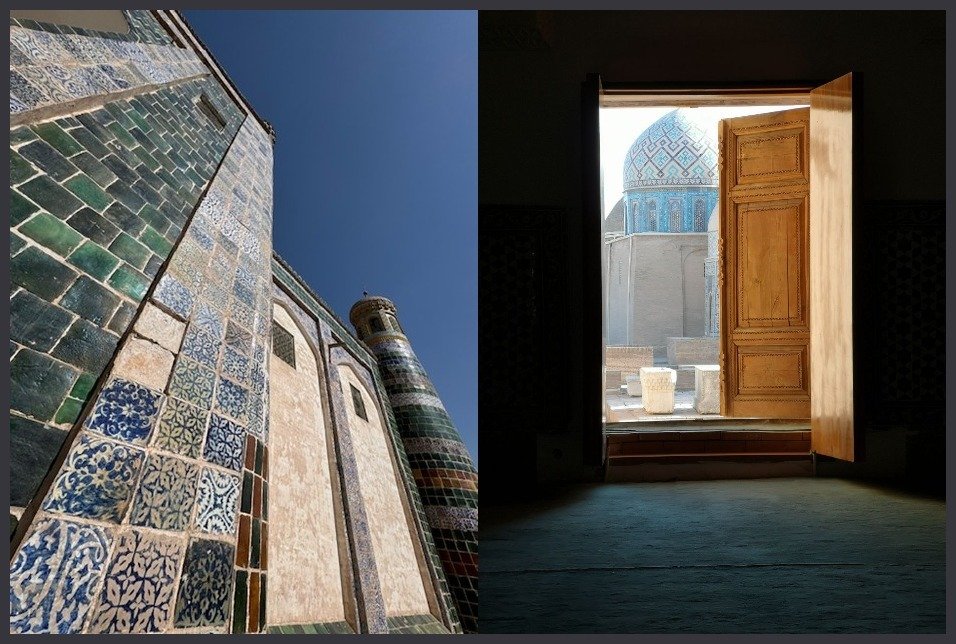
(L): Culture interpenetration: Bukhara meets Kashgar ; (R): Samarkand. Opening the doors to another dimension.
Back in the early 8th century, the key player was Umayyad dynasty General Qutayba ibn Muslim. He first conquered Bukhara and Samarkand; crossed the Ferghana valley; the Tian Shan mountains; and nearly reached Kashgar. The Chinese governor at the time, sensing that Qutayba might be about to take over Chinese lands, sent him a bag full of earth’s soil, a few coins and four princes as hostages. He calculated that’s how the Arab conqueror might not lose face, and leave the Middle Kingdom alone.
As incredible as it might seem, this arrangement lasted for half a century. Until the battle of Talas. Now compare it with Poitiers in 732 – one century after the death of Prophet Muhammad. We can certainly interpret Talas and Poitiers, together, as the two key landmarks of how Islam was on the verge of extending itself all cross Eurasia (including its European peninsula), creating a political-military empire from Rome to Chang’an (today’s Xian).
Well, it did not happen. Still, that’s one of the most extraordinary “what ifs” in History.
The importance of the battle of Talas – virtually ignored in the West, except in rarefied scholarly circles – is really larger than life. Among other issues, it imposed a new circulation of techniques. The Arabs took away with them artisans, sericulture experts but also paper makers. Ateliers at first were set up in Samarkand. Later on, in Baghdad and all across the Caliphate.
So alongside the Silk Road, we saw the birth of a very busy Paper Road.

An extraordinary Silk Road exhibition currently at the Gansu museum in Lanzhou
Deserts, mountains, oases – and no “slave labor”
Rolling down the highways across Xinjiang shooting a documentary after retracing the initial Ancient Silk Road from Xian to the Gansu corridor is an incomparable, historical time travel – as we may retrace in detail centuries of Central Asian turmoil all the way to the decline of some local pre-Islamic cultures by the 9th century. It’s a thrill to reconnect with the main actors: Uyghurs, Han Chinese, Sogdians, Indians, nomads, Arabs, Tibetans, Tajiks, Kyrgyz – and Mongolians.
The nomad groups thar proclaimed themselves heirs to the fierce Xiongnu came from the northwest of Mongolia and the Altai mountains. They incorporated several ancient nomads of western Central Asia during the 4th century, sharply remodeling the political and ethnic landscape.
The Xiongnu, on and off, pillaged parts of northern China – and were occasionally enticed into serious trade, offered tribute, or simply bribed to stay away. Actually the Xiongnu had a branch established in China and separated for at least two centuries from the previous ones: they ended up taking Samarkand in the year 350. Later on, it’s the Turks that once again came from Mongolia (don’t tell Erdogan about it; he wouldn’t know), unifying the steppe in the 6th century, way before the arrival of Islam.
Arguably the key Silk Road imperative is the desert and oasis contrast/dichotomy.
(L): The stark beauty of the fierce Taklamakan ; (R): Good pasture in Pamir lands
Deserts such as the Taklamakan and the Gobi, and several others, as well as arid steppes and mountains are among the most forbidding on the planet: these are the essential features of what amounts to roughly 6 million km2.
What is very rare in Central Asia is cultivated land (yet we can see a succession of cotton fields) or good pasture (we can see it in the Gansu corridor, and even in Pamir lands near the mighty Muztagh Ata). Still, deserts and mountains are at the heart of everything.
Some oases are of course more equal than others. Khotan is the most important oasis of the Southern Silk Road – not far from the immense, deserted Tibetan plateau. That’s fabulous for agriculture but most of all, courtesy of an alluvial cone, for precious stones, especially jade, supplied for over 2,000 years to every Chinese dynasty. Khotan spoke an Iranian language – close to those of ancient nomads Saka and Scythian, masters of the steppes.
The kingdom of Khotan was a fierce rival of the oases further west, Yarkand and Kashgar. It was only intermittently under Chinese control. And may have been conquered by the Kushans in the 2nd century. Indian influence is omnipresent – as we still see in dress patterns and food in the Night Market. In the 3rd century Buddhism was already a major influence – featuring the most ancient testimonials in the Tarim basin.
The Silk Road, actually Roads, is of course The Buddhist Road. In Dunhuang, in the Gansu corridor, Buddhism was also popular since the 3rd century: a famous local monk, Dharmaraksa, was the pupil of an Indian master. The Dunhuang Buddhist crowds were a mix of Chinese, Indian and Central Asian – once more testifying to the non-stop interpenetration of cultures.

(L): The Chinese character for “silk” inscribed in jade in front of a factory in Khotan ; (R): Playing the Uyghur blues
The Shakespearean “all the world is a stage” metaphor totally applies to the history of the Silk Road: all those actors from all corners of the Heartland historically were playing several roles, sometimes all in one go – an apotheosis of the favourite Xi Jinping-coined “people to people’s exchanges”. That’s the spirit of the Ancient and the New Silk Roads.
We were fortunate enough to be on the road smack in the middle of the 70th anniversary of the establishment of the Xinjiang Uyghur Autonomous Region.
Among so many accomplishments by socialism with Chinese characteristics in Xinjiang in terms of sustainable development, the taming of the Taklamakan – or “sea of death” – is in a world class of its own.
We crossed the Taklamakan from the Northern Silk Road in Aksu to the Southern, near Keriya: and we experienced everthing from the impeccable highway bordered by the reeds composing the “China magic cube” – to keep the sands away – to some of the 3,046 km-long sand-blocking green belt, featuring plants such as the desert poplar and the red willow.
The Taklamakan has always been Sandstorm Central – a major threat to the succession of oases. The terrain all around the oases is hardcore: deserts, barren mountains, Gobi wasteland, poor soil, sparse vegetation, low rainfall, high evaporation, dry air.
Well, what we see today started even before the Go West campaign launched in 1999: since 1997, an array of central and state agencies, central state-owned enterprises, and 14 Chinese provinces and municipalities have sent a massive amount of funds and personnel to properly develop Xinjiang.
Now compare all that with original research shared at an academic conference on Xinjiang recently organized by the Hong Kong University of Science and Technology and Hong Kong University – my neighbors when I lived in the Fragrant Harbor. The research showed how British MI6 since the 1990s was instrumentalizing a minority of Uyghurs side by side with a massive global P.R. campaign with the explicit target of breaking China into three parts.
That evolved into the CIA-concocted “genocide” accusations of the past few years and of course “forced labor” masses barely surviving in concentration/re-education camps. In our extensive travels, guided by Uyghurs, we were dead set on finding slave labor in cotton fields along the Northern Silk Road or in the middle of the Taklamakan. Well, sorry: they don’t exist.
The propaganda though was essential to regiment loads of Uyghurs into ISIS, including their sizable contingent in Idlibistan now roaming free between Syria and the Turkish border. They wouldn’t dare coming back to Xinjiang and face Chinese intel.
Forget about barbarian propaganda. What really matters, historically, is that the Ancient Silk Roads as well as Xinjiang may well be the ultimate crossroads of civilizations. Along Central Asia, they are the (beating) heart of the Heartland. And now, once again, they are back as protagonists in the heart of History.
What matters is Thầy Thím’s perseverance against tyranny and misfortune.
with gratitude to Linh Dinh at Postcards from the End.
Vung Tau, 10/8/25
Holy Water Puddles — Oct 11, 2025.
I’m typing my first words at 6:03PM. Yesterday, I ate beef wrapped in piper lolot leaves dipped in a fermented fish sauce, mắm nêm, which is very salty. This morning I woke up with a headache it took all day to recover from. My system can no longer forgive even small indiscretions. Today, I ate just spaghetti with olive oil, black pepper and cayenne pepper. At age 19 or so, I read about DuChamp eating just spaghetti with butter near the end of his life, and he wasn’t poor.
I had come to Ông Bầu hoping to run into Như, but she’s not around. This afternoon, I did send her an eBook version of my Postcards from the End of America. I have no hard copies. Since she did study anthropology, my book would be of interest. For more than four years, I took trains and buses all over the United States or, more often, just around the Philly area, to simply look and listen.
Just shut up and nearly everyone will tell you nearly everything.
Of course, they’re not likely to open up about their abject yearnings or weird lusts, though clues may seep out. Jerking and stroking their secrets to the last, the old finally croak, relieved at having never been found out.
Some, though, are exposed. Just look at your Dear Leader, suicidal soybean and corn farmers! As an extra fuck you, he just sent twenty billion of your “In God We Trust” greenbacks to Argentina! Since you laughed off his puckering sickness slobbering over virginal white flesh, you’re complicit in the raping of your own children! Be proud in your red hat. Unlike those coastal elite creeps, you’re the heart and soul of America!
Had I more money, I would have stayed longer in distant cities. I spent just one night in Portland or Cheyenne, none in Youngstown, Salt Lake City or Charleston. Too often I slept on buses and trains. I slept at the bus station in Kansas City, Denver and Pasco. You do what you must with what you have.
In Boston, I met Katie, who tried to avoid sleeping indoors. This was outright dangerous for a young woman. Even in Alaska, she had curled up outside. Katie also walked everywhere, for hundreds of miles, sometimes, over days. Though most people would dismiss her as foolish, if not mad, Katie had to act this way to recover something essential in herself. Last I checked, Katie had become more fixed and cozy.
Since the lesser known is always caricatured, many Westerners believe Orientals are conformists incapable of creativity. Don’t let me dissuade you. To Như, though, I would point out Vietnam has never lacked for individualists or eccentrics.
Just 12 miles from Vung Tau is Long Sơn, the realm of an anti-French fighter turned holyman, Lê Văn Mưu (1855-1935). His followers still adhere to unusual practices, such as being buried within 24 hours in unmarked graves, with no funeral to speak of. They don’t look for auspicious days for weddings. They don’t set up altars to divers gods. Lê Văn Mưu is simply called Ông Trần, or Mister Bare (head and feet). Live most simply was his message.
Sixty miles north is a holy couple, Thầy Thím, or Master and Mistress. Unjustly persecuted by King Gia Long (1762-1820), they had to flee to this remote region. Tigers still abounded. Among their miracles was the appearance overnight of an elaborate village hall. Of course, it’s nonsense. Those villagers, like Borges’ Yahoos, had to have built it themselves. What matters is Thầy Thím’s perseverance against tyranny and misfortune.
Just now, Như showed up, so I ranted on about Ông Trần and Thầy Thím, plus the Coconut Monk of Mỹ Tho. There are so many of these weirdos across Vietnam, throughout history. I also talked about poets Bùi Giáng (1926-1998) and Nguyễn Đức Sơn (1937-2020). Here’s a Sơn poem:
Holy Water Puddle

I will come who knows when
mouth parched nirvana path distant
oh one night bush like a body coiled
you haven’t pissed yet my soul is wet
Educated in the US since grade 9th, Như never knew about these figures. I cite them to show she’s not alone.

Vung Tau, 10/9/25
Before the Fall of Saigon, Nguyễn Đức Sơn was a teacher. From 1979 until his death, he, his wife and nine children barely survived in remote Lâm Đồng. A third Saigon eccentric poet, Phạm Công Thiện, fared much better. From 1970 to 2011, he lived in Israel, Germany, France and the US. In Toulouse, he taught Western Philosophy. In Los Angeles, he lectured at the College for Buddhist Studies. At age 23, Phạm Công Thiện did have a nervous breakdown. He recovered at Nha Trang’s Hải Đức Pagoda.
Since Ông Bầu closed at 9PM, I had to run to Coffee Seven, where I was ecstatically greeted by Nọng and Milk Cow.
“Where were you this morning?” Mrs. Seven asked.
“I woke up with a headache, so couldn’t get here.”
With Mrs. Seven’s bedtime at 10PM, I only managed a couple hundred words before moving on. Now, I’m back at Ông Bầu. Sitting in the dark outside, I can still use its wifi.
That homeless Cambodian guy is going on, “I was too slow to be hired by the fishermen. They wouldn’t let me onto their boats. My brother carried bricks [back in Trà Vinh]. For a hundred bricks, he made 100K ($3.80). I just couldn’t do it. My legs nearly fell off. My father yelled at me and beat me up. I just couldn’t do it.”
With his pillow and a thin blanket, he wanders away. He’s been told to stop sleeping right outside Ông Bầu. He had on a newish navy blue polo shirt, “HAVANA COFFEE.”
These words, then, are what I’ve salvaged from a day I thought wasted. Now, I will head home. Như has fascinating stories I’ve urged her to write down. “Try to be as honest as you can,” I said, but she already knew that. There are so many layers. Don’t just park your fat ass so smugly on the surface.

Image Psychosis Detoxification — Oct 13, 2025.
According to the Harris Poll, 41% of Americans under 44-years-old, or Gen Z/Millennials, would consider hiring witches, astrologers, etc., for major life planning decisions. 63% of Gen Zers and 52% of millennials are also thinking about getting the fuck out. The youngest Americans, then, are the most disenchanted about the American Dream.
If you must stay, it’s past time to research which witch doctors are most reputable in your area. There must be a Djinn Wolf, Rebecca Nurse, Higuayagua Taino, Karen Rose, John Proctor, Martha Carrier or Juliet Diaz within driving distance? Going to the wrong one, just like voting at all, will have you standing on a chair sporting a clumsily knotted noose. Kicking it, the last sound you’ll hear are four or five pennies jangling in your pocket. Since there’s nothing in your small, large or whatever the fuck intestine, nothing will squirt out, so your underwear will be clean, at least.
Wisconsinitos, a white woman in her 40’s, shares, “My husband and I were sitting on the porch this morning, and we were just discussing the culture in the United States, and how there’s always this undercurrent of violence and hostility, and it’s everywhere all the time, and you feel very vulnerable to it.” Is it that bad? You tell me.
Wisconsinitos, “When you go to a movie theater, do you assess who’s in the room, and who might be a threat, and who might be hiding something in their coat, and what you would do if they stood up and started shooting? How are you going to get out of the room?”
I’d say she’s a bit too paranoid, but even without anyone ready to shoot you in seconds, it’s bad enough to feel simmering hostility or insecurity all the time. It’s a natural byproduct of being hyper self-conscious. From infancy, Americans are conditioned to carefully curate their self-image, and to read, immediately, anything that’s off about anyone. Any US eight-year-old can detect, from clear across any room, the wrong dot, stripe, sneakers or haircut. Although its brand has been severely tarnished by Trump, Hegseth, Vance, Biden and Harris, etc., image is still America’s best selling commodity. With even its “rebels” minutely calibrated, it’s the most image psychotic culture ever.
Noticing this yearning to escape among America’s youngest, its future, 30-ish Zach Abroad asks, “Who’s going to be left in the country if all the young people want to go somewhere else?” Trumpers, Bernie Bros, Hillary-bots, AOC freaks, Groypers, Christian nationalists and all the hardcore illegal immigrant criminals ICE cowards are too scared to track down?
They’re a lot harder to gang tackle than septuagenarian grocers or schoolgirls with braces. If you can’t even grab their pussies, Trumpian fashion, what’s the point? Still, with such a promising foundation, why would anyone want to leave?
Zach Abroad, “Where do these people want to go, you might ask? Well, the top five countries that they want to move to are Canada, the UK, Australia, France, and Italy.” I’d say those nations must soon erect barriers for blue passport holders.
Would you want a guy like this? Adam.c, “I move to Sweden I can’t wait I’m disabled and I’m 25 with 4pets and my partner I’m so exited I figured Sweden would b a great fit BC of prices rent and grocies and the country and ppl stick to themswlf witch is what I like [blue heart].” A man so disrespectful of his own language can’t be expected to give a flying fuck about any foreign one, or its culture, so good luck to Sweden, with its affordable “grocies.”
Witches breed witch hunters. With 99.999% of Americans now functionally illiterate, contemporary Cotton Mathers must appear in YouTube videos or TikTok skits. Audio books, too, overtax shriveled heads, and shit like this must be updated, “They which lie, must go to their father, the devil, into everlasting burning […] When they bed and pray in hell fire, God will not forgive them,” and you can’t use words like “impudent,” “scurrilous” or “wicked,” bitch!
Keep it simple. Hairless hoo ha hopheads must have their hoses slowly hacked. Did you know the most popular Netflix movie ever is K-pop Demon Hunters? Yo masters are way ahead.
Who’s the most awesome witch alive? With the answer so obvious, you’ll get no heart shaped or fly imprinted fentanyl cookies! Who’s bewitching millions, if not billions?
Sitting at Ông Bầu, I’ve just been approached by an old head who said he wanted to draw my face. He’s sitting with another trauma survivor who, twenty minutes ago, was strumming on a guitar. To not be rude, I will go talk to them, so will cut this short.
Mrs. Tim’s crab noodle stand this morning
Yesterday, Như let me sniff some leaves that smelled like root beer. Not everything is fake. The Vietnamese name for root beer, xá xị, is exactly what they call the cinnamomum parthenoxylon. Keeping it simple will increase your chance of survival.
Walking to Ông Bầu, I passed Mrs. Tím’s crab noodle soup stand. With a light rain coming down, she had the crudest canopy propped up with three thin branches against the splotchy yellow wall right behind her. White smoke rose from a wooden fire. At home, I still have a small bottle of BeerLao. I should drink it before heading to Kathmandu.

Vung Tau, 10/14/25
Amor Fati or Else! — Oct 14, 2025.
Centuries ago or just yesterday, Mrs. Seven almost went to Japan with her dance troupe. All the girls were warned to not get an abortion in the land of salarymen, too often drunk. Dental care would also be too expensive. With minders always watchful, their chances of getting pregnant with a broken tooth, to boot, was nearly nil. Still, one had to warn these gorgeous and nimble girls on a very rare trip overseas, but it didn’t happen anyway.
Hearing about my trip to Nepal, Mrs. Seven told me this amusing tale. Since men can also get pregnant, as we all know, I should plan for a possible abortion in Kathmandu, though how this can happen without my having sex is a mystery, or conundrum, I’ll address on another day. When is sex not a conundrum, whatever that means?
The exercise music at Morning Star Kindergarten is nearly loud enough to cause brain damage. Stumbling about, trapped toddlers half lift their limbs. Looking lost, they sway. Smiling brightly, their teachers break out moves.
On the way to Coffee Seven, I noticed the homeless Cambodian was still sleeping outside Ông Bầu, his usual spot. His dark feet stuck out, corpse like, from his clean Tweety Bird blanket.
Inside Ông Bầu, there’s a new exhibition of paintings, all terrible. The artist is a man in his 60’s with a pony tail, wire framed glasses and pensive expression. Duly artistic in appearance, he’s devoted his entire life to these pointless canvases. Getting a preview last night, I told Như about Jim Shaw and his thrift store paintings. Those are interesting because they reveal the goofy or even bizarre personalities behind them. The ones at Ông Bầu betray nothing.

Vung Tau, 10/14/25
Not even funny some dog with a flowing scarf on a motorbike or a timid odalisque with hazy Islamic domes in the background.
“These are bad not because of poor technique, but because he sees very poorly. Hands, breasts, water, boat, everything he paints is very poorly observed!”
Ears are rarely painted well, but there are no reasons for breasts to be so ugly! Their shapes aren’t overly complicated. If a man can’t appreciate specific breasts, or their variety, he’s legally blind.
The homeless Cambodian needs his spot outside Ông Bầu to feel anchored. Just now, I checked with satisfaction the score between my Mariners and the damned Blue Jays. That I should care at all is entirely irrational. When the homeplate umpire cheated Logan Gilbert on two clear strikes, as graphed on my screen, I was outraged. Arriving in Kennewick, WA years ago, I was cheered and calmed by the Seahawks pennants on the walls of the first bar I entered. I had recovered a portion of my childhood. For over a century in the USA, team loyalty has mostly replaced a genuine sense of community. It also patches over divisions within each.
Toronto’s defeat of the New York Yankees in this year’s playoffs must have deeply satisfied all Canadians. They’re sick of the endless insults from Trump. The Blue Jays do have a Canadian star, Vladimir Guerrero Jr.. Of Dominican ancestry, he’s born in Montreal.
In Kennewick, I found out about Thai farm laborers imported into the US, for they were even cheaper than Mexicans, and also easier to abuse. MAGA farmers didn’t vote for Trump because they wanted to replace dirt cheap illegal immigrants with Americans. Wake up, man! Even American employers don’t want American workers.
MAGA farmers believed Trump would bring them virtual slaves, in the form of legal immigrants, through the little scrutinized H-2A visas. If mistreated, illegals can just walk away. Legal ones are trapped on farms, to be underpaid, overworked and abused, even sexually. Your Heartland farmers aren’t these Norman Rockwell sweeties, but slave drivers. Promising them slaves, Trump delivers bankruptcies and suicides, so he does have a sense of humor after all.
In Cairo and West Jerusalem, Trump just delivered two rambling, self-centered speeches. The second is wrily described by Al Jazeera as “stream-of-consciousness,” with the diapered fool having the “the time of his life,” since he was showered “with applause, laughs and too many standing ovations to count” from Knesset members. Jews consider genocides orgasmic celebrations.
As for the fake ceasefire that, to my surprise, even Kevin Barrett terms a “crushing victory for the Resistance,” Jews are just taking a much needed breather before resuming their assaults on Palestinians, Lebanese and Iranians. The ethnic cleansing of Gaza will continue. Sending at least 200 American soldiers to Israel, Trump still envisions Trump towers, plus a giant golden statue of himself, in Palestinian-free Gaza. Lounging by a pool next to another aging blob, Trump will sip some mocktail not quite blood red.
 [ “… Initially, President Lyndon B. Johnson sent about 33,000 American military personnel to Vietnam, primarily as non-combat advisors to assist the South Vietnamese Army…”]
During five years in power, Trump has waged wars against Afghanistan, Iraq, Syria, Somalia, Yemen, Iran and Venezuela. Plus, he’s threatened Canada, Mexico, Panama and Greenland. Still, Trump expected a Nobel peace prize! Most pathetically, nearly half of Americans shared his delusion. When Trump confused Albania with Armenia, or said Iran borders Qatar, most Americans didn’t flinch either. It is an insular society mired in self-infatuation.
Today, I cleared out my fridge. For breakfast, I ate a tomato, onion, cucumber and egg salad. I finally drank that small BeerLao. Even though too many BeerLaos in Pakse edged me closer to the precipice, I remember with fondness my several months there. The café across my Pakse hotel was called Amor Fati, or Love Your Fate.
Before Laos became a fabled drug destination, it was Nepal. Within walking distance of Hotel Pristine, where I’ll be staying, is Freak Street. Two of my closest high school friends, Phil Brenner and Brian Robertson, were freaks. Brian, though, became a hardcore Republican, and even served under Trump.
Married to an anti LGBTQ crusader, MAGA Mike Johnson has just been exposed as a Tinder cruiser who loves to be butt plugged! Almost nothing is as it seems.
With still hours left before I must board that van for Saigon’s airport, I might just go for another BeerLao. The Mariners up 2 games to 0 will be my excuse. Another reason is the demise of Sammy Davis Clemens. That outstanding author didn’t even last two weeks! Canceling me again, gazillionaire Jeff Bezos also stiffed me of 50 measly bucks. Making no rules, we can only watch, so watch it well, you hear?
Kathmandu, 10/15/25
Back Home in Kathmandu — Oct 16, 2025.
Around midnight, I woke up knowing I was in Kathmandu. Still, it was surprising to open my eyes to see a completely strange room, and it was cold, too. I hadn’t had to use my blanket in a long time. Going back to sleep, I woke up around 3AM, my usual time, so was out on the street shortly after. Of course, I had no map and no phone, but if you keep walking in circles, you’ll end up inside your childhood home in no time. With the earth so small and your life so short, it’s impossible to get lost.
Coming from the airport yesterday, I had two phrases, “Chhetrpati Chowk” and “Hotel Pristine.” I hadn’t even learnt downtown Kathmandu is called Hamel. Though my taxi driver spoke minimal English, he got me where I needed. With clipped sentences, we still had a meaningful conversation.
“How long have you been driving, taxi?”
“Twenty-eight years.”
“Do you live inside city?”
“Yes.”
“Where is your village?”
“Three hours.”
“Three hours away! Very far!”
Twice a year during festivals, he goes home to see his parents. His wife and kids are here. He won’t celebrate the next festival, however, because a relative died less than a year ago. A Hindu, he must mourn for a year, he said.
Of course, he assumed I was Chinese. There are many here. “Vietnam,” I told him. Then, “Have you been outside?”
“No, I am poor man.”
“Not even to India,” so close.
“Only border, not inside,” so technically, he’s been outside.
Though his brother runs organized tours, he, too, is poor. Everyone and his grandma run trekking tours here.
My room is on the 5th floor, so trekking up and down several times a day is equivalent to climbing Mount Everest, I’m sure. Let’s not overdramatize every little gesture, OK? Sherpa guides my ass. I must contact the Guinness Book of World Records to tell those losers about my superhuman feat.
Getting out of the taxi, I was exhausted, but also exhilarated. Despite all the burger or fried chicken joints I had seen on the ride, plus English language schools, I was in a new universe. Before this, I had spent just a month in South Asia, in Bengaluru and Chennai. Nepalese, though, are more varied in appearances than southern Indians. There are folks who look almost like me.
Without wandering cows to piss and shit all over, Nepal is certainly cleaner than its southern neighbor, and much less congested, too. Sadly, perhaps, pot is now legal only one day a year. Though I myself have never inhaled, snorted or dropped anything too unusual, people should be free to unwind with natural enough assistance.
Failing to find an atmospheric café to get my bearings, I settled for GHR Pizzeria and Coffee House. Despite its indifferent name and sterile appearance, it introduced me to an excellent ruby lager, Gorkha, and a fantastic plate of buffalo meat momos. My grand prize, though, was the presence of a radiant waitress whose constant smiles made me so happy, I couldn’t help but tell her, though this made this angel so self conscious, she stopped smiling so much. Worse, she retreated to the next room for a while.

Guangzhou, 10/15/25
On the layover in Guangzhou, there was a psycho security lady who barked one word commands to all passengers. Her English was so bad, it wouldn’t have helped much had she spoken more slowly and calmly. There was no reason for her not to smile, though. “Very strange, that lady,” I said to a South Asian man. “Mentally ill!”
Since he only smiled back, he may not have understood. He may have been Nepalese. Already, I can tell English is not as widespread here as in India, but this country was never colonized by the Brits.
So in the dark this morning, I wandered into the unknown, past small temples, wooden balconies, ancient wells and even graves. Pedaled by a skeletal man in the dark, a bicycle rickshaw rolled past. Another, just as bony, used a broom with too short a handle to sweep the street. Having done this for decades, he’s folded nearly in half, so that must be his preferred posture. Since this was still Asia, I had no fear of being mugged. Seeing a small group huddled at a tiny store, I headed over to ask for chai.
“Cha?” the old lady answered. In her sari, she was sitting with folded legs behind a portable gas stove, on which rested an aluminum pot and a huge tin kettle, with its spout like an elephant trunk, so charming. There were only three other customers. With my hot glass, I was at home. Soon, a Korean looking man showed up, but he was no tourist. Speaking fluently to the lady, he settled snugly into his usual spot.
The tiny store had instant noodles, eggs, candies, cookies, salt, MSG and Lay’s potato chips, so rush here when the bombs go off before everything runs out. You can never have too much of Smoky Popping Candies or Monaco Biscuits, especially in pizza flavor. Suddenly, there was a tallish Oriental who called to two dogs in the middle of the street. Surprisingly, they came. After petting them, I headed to our, notice how naturally I say that, neighborhood café to sit right next to me. Together, we represented Chinese imperialists, perhaps, ready to overwhelm Nepal. Though its Maoist government has just been deposed, we, notice how naturally I say that, have backup plans.
Paying 60 rupees or 43 cents for my two glasses, I headed off again, so am now sitting at KTM Burgers, with my fourth cup of cappuccino. On the way, I passed all these Chinese restaurants and hotels catered to Chinese. I also noticed a Japanese restaurant and a South Korean flag outside a nightclub. With so many Oriental men here, there must be prostitutes, of course. I spotted a thick thighed one in a skirt not quite mini.
Entering KTM, I saw an old black dog lying near an uneaten momo, so he’s not starving. At a nearby table, a young man listened to rap. Typing this, I was interrupted by a beggar who squatted at my feet. In exchange for a photo, I gave him 70 rupees or 50 cents, which made him very happy. Smiling, nearly laughing, he waved those bills at the waiters as he walked out. Had I given him too much, it would have pissed off the waiters, for they must work hard for their daily momos and kati rolls. Although he had a scab on his grimy knee, the beggar’s teeth were better than mine ever were.

Kathmandu (L): 10/15/25 ; (R): 10/16/25
Wanting nothing, the half dead dog approached to see how I was doing. His phlemy eyes clearly said, “I’ve seen it all, too, motherfucker.”
A white bearded man with weary eyes and an earring stirred his coffee with a hand too soft to have ever been familiar with a hammer, screwdriver or rifle. He would head home to write more poems no one will ever read, I’m sure. Just burn those batches, bitch. Don’t even try to publish them on Amazon or Kobo.
I finish this at The Nook. Walking between cafés allowed thoughts to surface. Yesterday’s Gorkha was so good, I actually thought, too many BeerLaos nearly killed me in Pakse, so maybe I’ll die in Kathmandu, more than happy, clutching a bottle of Gorkha.
All the recent unrest in South and Southeast Asia made me think Uncle Sam must be up to his tricks again. This isn’t to downplay local dissatisfactions or outrages. “All political parties here are bad,” someone has already told me.
At 7:38AM, I will wrap this up. Though paying just $9.40 a night, I get free breakfast, so will head back to Hotel Pristine, if I can find it before the Second Coming. My Rapture Sit Rep has also been rejected by Kobo, by the way, so my disappearance continues. Chattering in the background, the waiters and baristas sound cheerful, but laughter is actually much more common outside the angry USA, believe it or not. They’re chuckling now.
Smiling, I will reenter a familiar enough street whose name I don’t even know.
About Linh Dinh (@linhdinh):
‘Before being canceled, I was an anthologized poet and fairly prolific author, with my last book Postcards from the End of America. Now, I write about our increasingly sick world for a tiny audience on SubStack. Drifting overly much, I’m in Cambodia.
Born in Saigon, Vietnam in 1963, I lived mostly in the US from 1975 until 2018, but have returned to Vietnam. I’ve also lived in Italy, England and Germany. I’m the author of a non-fiction book, Postcards from the End of America (2017), a novel, Love Like Hate (2010), two books of stories, Fake House (2000) and Blood and Soap (2004), and six collections of poems, with a Collected Poems cancelled by Chax Press from external pressure. I’ve been anthologized in Best American Poetry 2000, 2004, 2007, Great American Prose Poems from Poe to the Present, Postmodern American Poetry: a Norton Anthology (vol. 2) and Flash Fiction International: Very Short Stories From Around the World, etc. I’m also editor of Night, Again: Contemporary Fiction from Vietnam (1996) and The Deluge: New Vietnamese Poetry (2013). My writing has been translated into Japanese, Italian, Spanish, French, Dutch, German, Portuguese, Korean, Arabic, Icelandic, Serbian and Finnish, and I’ve been invited to read in Tokyo, London, Cambridge, Brighton, Paris, Berlin, Leipzig, Halle, Reykjavik, Toronto, Singapore and all over the US. I’ve also published widely in Vietnamese.’
AHH: Please support this wonderful writer on his Substack! Thanks
Discussion between foreign affairs expert, Dr. Sreeram Chaulia, and the founder of the BRICS Lab at the Massachusetts Institute of Technology (MIT), Dr. Mihaela Papa, on the changes underway in BRICS and its future evolution.
Topics covered include whether BRICS is becoming more radical and anti-Western, how the arrival of five new member states is altering the agenda of BRICS, the role and purpose of ten partner countries of BRICS, the attempts by BRICS to represent and take leadership of the entire Global South, and potential new domains and issue areas in which BRICS could be making interventions and innovations in time to come.
A celestial Travelogue through the western regions of China.
By Silk Road pilgrim Pepe Escobar on Sputnik.
ON THE ROAD IN XINJIANG – Xuanzang, the itinerant Buddhist monk, has got to be one of the most extraordinary figures in History. He certainly is regarded as such in China.
In the early Tang dynasty in the 7th century, Xuanzang set out from the imperial capital Chang’an (today’s Xian), breaching a veto to travel to the “Western regions”, to go to India to fetch Buddhist manuscripts that he planned to translate into Chinese.
(L): The one and only Yumenguan – the Jade Gate Pass, marking the western limits of China for centuries. ; (R): Xinjiang. Flying over the Tian Shan mountains.
He crossed the Jade Gate Pass; kept walking further West; almost died of thirst in the desert; crossed the snow peaks of the Tian Shan mountains on horseback to Transoxiana; and finally reached India, where he studied for several years before returning to Chang’an 15 years after his departure with 22 horses loaded with Buddhist manuscripts in Sanskrit, plus religious relics and priceless Buddha images.
That’s my kind of guy. Since the late 1990s, I have followed on Xuanzang’s footsteps, on and off, along several stretches of the Ancient Silk Roads. Xuanzang was fictionally reincarnated in a magic-tinged 16th century novel which became quite popular in China, titled Xiyouji, or Journey to the West. That’s exactly what I set out to do – a compact Journey to the West for the digital era – this past month of September.
Sericulture was developed as early as 5,000 years ago in the Yellow River – in China’s historically traditional heartland. It spread out to Korea and Japan but mostly traveled West, along the larger-than-life Silk Road(s).
The start of the silky story is shrouded in historical mist. It is widely accepted in China that under the reign of Emperor Wu Di, in the second century B.C., special envoy Zhang Qian was twice dispatched to the “vast regions” to the West of China on a business mission.
At the glorious Shaanxi History Museum in Xian. (L): Drop-dead chic Tang Barbie, where I had a fab Silk Roads conversation with one of the curators ; (R): Silk Road golden splendour
Soon after, cross-border trade entered a new stage, with silk fabric among the key exports. Thus Zhang Qian was officially credited as the opener of the Silk Road – and granted the title of Duke. Today, at the fabulous Shaanxi History Museum in Xian, his exploits and the subsequent development of the Silk Road connectivity corridors are detailed alongside a mesmerizing collection of Silk Road artifacts.
Xian. (L): TikTok Tang Barbies on a roll. ; (R): Happiness is a bowl of perfect lamian in the Muslim Quarter
The Silk Road, actually a maze of roads, started in Chang’an, the old imperial capital, today’s Xian. Then it headed west through the spectacular gorges of the Wei river to the garrison city of Lanzhou, at the eastern end of the Hexi corridor. North is the Gobi desert; south is the snow-covered peaks of the Qilain Shan. The road keeps going from oasis to oasis all the way to Yumenguan, the Jade Gate Pass – which marked the western limit of China.
Lanzhou. (L): Downtown: dancin’ in the streets ; (R): The Flying Horse of Gansu: the epitome of Chinese bronze craftmanship
For a Silk Road pilgrim like this foreign correspondent, this is the trip of a lifetime – combined with the journey further west, to Xinjiang. I’ve tracked the original Silk Road before, and that’s my fifth time in Xinjiang; yet those journeys were in the late 1990s and the 2000s. Combined, now, that makes it the first trip in 10 years and the first one after Covid.
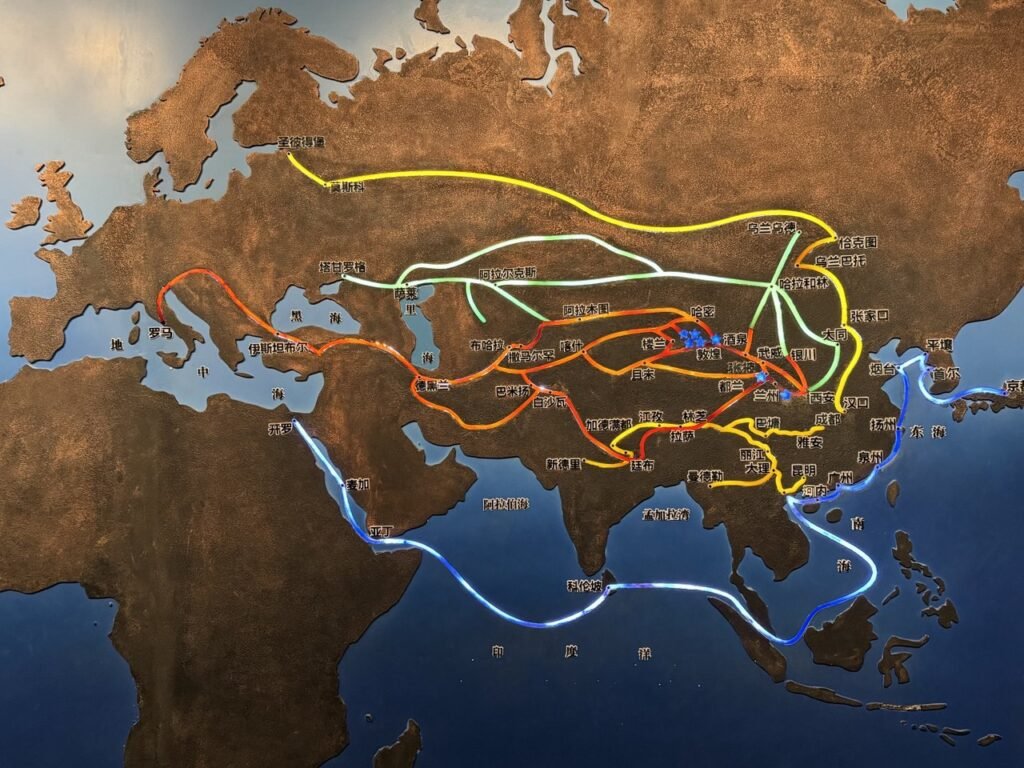
New Silk Roads on the move. At the fabulous Gansu museum in Lanzhou
Go West, past the Jade Gate Pass
The timing could not be more appropriate: right after the ground-breaking SCO summit in Tianjin in late August/early September and the Victory Day parade in Beijing on October 3, celebrating the 80th year of the Chinese defeat of Japanese aggression and Nazi-fascism in Asia.
It was the time to check in detail how a self-confident China had engineered its development of the West, boosted by the “Go West” campaign launched in 1999. That also coincided with the 70th year of the establishment of the Xinjiang Uyghur Autonomous Region. The whole of Xinjiang was engulfed in “70” red flags.
Xinjiang. (L): Yurt time ; (R): The ancient city of Jiaohe
Xinjiang. (L): On the Northern Silk Road, from Aksu to Kucha ; (R): Northern Silk Road. Cotton fields. No slaves. No victims of “genocide”
The first stretch of my travels was solo, retracing the traditional Ancient Silk Road, from Xian to strategically located Lanzhou by the Yellow River, dominating all traffic between central China and the northwest, then all the way to fabled Dunhuang and the Jade Gate Pass. I made a deal with a local taxi driver to spend the day visiting the Pass, including the remains of the Han Great Wall. He loved the notion of a lone foreigner riding his taxi into the deep desert.
Then I caught the high-speed train from Lanzhou to Urumqi (this line was started already 11 years ago), the high-tech capital of Xinjiang, to join a Chinese-Uyghur production team and start shooting a documentary on the road in Xinjiang.
Xinjiang, or “New Territories”, the size of Western Europe, is the former Chinese Turkestan. That’s classic Silk Road territory as well, treading along the northern and southern rims of the Tarim basin, one of the most extraordinary geographical hot spots on earth. At the center lie the ever-shifting sands of the mighty Taklamakan desert – surrounded by three mountain ranges: the Kunlun Shan, the Tian Shan and the Pamirs.
We started by following the Northern Silk Road, from the key oasis of Turfan to the high-tech hub Urumqi, all the way to Kucha; crossed the Taklamakan desert to the Southern Silk Road; and proceeded across key oasis such as Yutian and Khotan all the way to the immensely venerable oasis of Kashgar, at the foot of the Tian Shan and the Pamir, and at the start of the Karakoram highway, arguably the pivot of the Ancient Silk Road leading to the heart of the Heartland: southern Central Asia.
Countless caravans perished over centuries in the sands of the Taklamakan (“you can get it but you won’t get out”): today, modernization of China-style, we can do it in an immaculate highway in a mini-convoy of Toyota Land Cruisers. [01][02][03]
We kept going via the Karakoram, a two-lane, extra-busy, connectivity corridor, the first stretch of the China-Pakistan Economic Corridor (CPEC), past the blinding beauty of glaciers, peaks and deep blue lakes all the way to Pamir lands and the high-altitude Tajik boom town of Tashkurgan; further on is the Khunjerab pass and the China-Pakistan border, all the way to South Asia.
To the west, the main historical Silk Road is subdivided in the three, key Chinese borders with Tajikistan, Kyrgyzstan and especially Kazakhstan: Alashankou in northern Xinjiang is China’s premier Eurasian hub – where all trains carrying laptops from Chongqin or household wares from Yiwu stop before heading further West, all the way to Europe.
(L): Khotan. In the – Carpet – Silk Road ; (R): On the road to Pamir land
Socialism with Chinese characteristics in practice
China has always been a Heartland power – not a maritime power. From the time of unification under Qin Shi Huang in 221 B.C., the territorial imperative has always been Go West, towards the Heartland/Southern Central Asia. That set up a series of intermittent clashes with primarily nomadic peoples – Turkic, Tibetan, Mongols. Only at times of serious Chinese strength – especially under the Han, Tang and Qin dynasties – Chinese imperial power was conclusively projected into Western Central Asia.
What we see now in a Xi Jinping-defined “moderately prosperous China”, inscribed within the mindset of a self-confident geoeconomic superpower, is how socialism with Chinese characteristics has successfully integrated the “Western regions” into the officially-termed “Chinese dream”.
Xinjiang. (L): Urumqi – symbol of the development of the “Western regions” ; (R): Kashgar. In the Old City, in front of Id Kah mosque
Urumqi is now a high-tech hub, a replica of those mega-cities in the eastern seaboard but 4,000 km away from Beijing. With over 4 million residents, it’s considered at best a Tier 3 city. The level of development compared to the start of the century is simply mind-boggling.

Xinjiang. (L): Urumqi on Saturday night – buildings celebrating the 70th year of the development of Xinjiang under a unified China. Xi will be in town today ; (R): On the Northern Silk Road. Stan and I at the spectacular Grand Canyon near Aksu.
We traveled in Xinjiang with a crack Uyghur team. Our on-site producers, translators, ultra-skilled drivers were all Uyghurs. We talked to everyone – from cotton pickers to bazaar whiz kids to enterprising business women (no, we did not find “genocide” victims). We attended two traditional weddings – one relatively low-key, the other a Bollywood-style production.
As @RealPepeEscobar, @RealJermWarfare and I checked into the hotel in Turpan, Xinjiang, we crashed a Uyghur wedding party (after asking for permission to film).
Absolute highlight of our evening! Uyghur wedding is the next level!!! pic.twitter.com/0Al52W8du8
— Carl Zha (@CarlZha) September 20, 2025
(L): With the ultra-pro Tajik MC of a lively dancin’ party ; (R): Kashgar princess
In parallel, a tsunami of middle-class families from all over China could be seen in every latitude enjoying Xinjiang for the first time in a self-driven Tank 300 jeep rented for only $60 a day (less than 1 in 10 Chinese have been to Xinjiang). The boom of domestic tourism is something to watch – as in the packed camel parking lot right before whole families immortalize their camel caravan adventure in the sand dunes outside Dunhuang. The Old City in Kashgar during Golden Week – an 8-day holiday that every Chinese dreams about – was so packed it was virtually impossible to walk most of the time in the main alleys.
This is just a first approach to the trip of a lifetime – which will be part of a book on the Ancient and New Silk Roads to be published next year and a documentary to be released before the end of 2025 (we have two terabytes of images). But among a wealth of highlights, a few have got to be inescapable.
Energy. Xinjiang is an energy Mecca. From Urumqi to Turfan [04], from the point of view of the proverbial impeccable highway, we see Massive Electrification, forests of solar panels, forests of wind turbines, and at least two massive solar farms. Xinjiang produces so much energy that it lavishly exports to the rest of China. And of course the key Pipelineistan superstars – from Turkmenistan, Kazakhstan and soon Power of Siberia – all arrive here.
(L): Xian. At the Great Mosque. Having a fabulous time with the Hui. There are only 20k still living in Xian ; (R): Welcome to Xinjiang. At the astonishing 5th century ruins of Buddhist Gaochang kingdom
Integration of Hui (Chinese Muslims). Xian’s fabled Muslim quarter, quite close to the iconic Drum Tower, is a direct connectivity corridor to the former imperial capital’s Silk Road prominence. Itinerant Muslim merchants – Arabs, Turks, Sogdians, Persians – and religious teachers chose to live in the tolerant metropolis ever since the Tang dynasty. In the 8th century, Xian was the largest and most sophisticated city on the planet. Today at least 50,000 Huis – mostly prosperous bazaaris – live in Xian’s Old City. [05] The food in the Muslim quarter of course is to die for.
XINJIANG. Karakoram Highway. BRI/CPEC connectivity corridor. White Sand lake – on the way to Pamir lands
From oasis life to deep blue mountain lakes
Respect for History – The Shaanxi History Museum in Xian and the Gansu Provincial Museum in Lanzhou, side by side, offer an unparalleled collection of absolutely priceless Silk Road artifacts. Both are free, packed at all times and endlessly fascinating throngs of the TikTok/Bilibili generation with immense Silk Road cultural wealth, including the iconic Flying Horse of Gansu: excavated in 1969 in Wuwei, representing the “heavenly steed” of Heartland tradition and cast by an unknown craftsman of the early Han dynasty no less than 2,000 years ago. That’s arguably the most elegant and sophisticated Chinese bronze artifact ever.
Dunhuang. (L): The All China Camel Caravan is on the move ; (R): The unparalleled beauty of the remaining Buddhist paintings in the Mogao caves
Dunhuang. A “Blazing Beacon” since the times of Han emperor Wu Di, who understood the strategic importance of the oasis: the last major watering hole before the fear-inducing Taklamakan, and sitting astride the three main Silk Roads heading west, linked to the key Jade Gate Pass nearby (that refers to the fine jade brought to China from Khotan in Xinjiang).
Yet Dunhuang’s claim to a selected global cultural pantheon resides in the Buddhist Mogao caves, sponsored by merchants and pilgrims since the 3rd century and especially during the Tang dynasty, cut into the soft rock face of the Mingsha hills. [06] That’s China’s – and the world’s – most extensive collection of Buddhist statuary, painting and manuscripts. Unfortunately, many of the original materials were stolen by European barbarians, scholarly and otherwise, and are now in foreign museums. Beijing cares for the Mogao in millimetric detail. We can only visit with a scholar/guide; no photos whatsoever; and the only light inside the caves comes from the guide’s torch. A magical experience. I was privileged to enjoy a detailed explanation of Mogao history by Helen, a member of the remarkable Dunhuang Academy who’s doing a PhD in Archeology.
(L): At the Bezeklik Buddhist – and Manichean – caves, outside of the privileged oasis of Turfan. Classic Silk Road ; (R): Yutian. Carl Zha: [Pepe’s] holding up a $10,000 USD Hotan jade bracelet
Across the Southern Silk Road, we can literally touch and feel the essence of its allure: the best jade from both Khotan and Yutian (Marco Polo visited in the 13th century); the best silk and the best silk carpets in Khotan; and the best decorated knives in Yengisar – the knife capital of the world (every Uyghur man has a knife, to prove his manhood and to slice melons at any time).
And then there’s the mystery of ridiculously delicious Uyghur cuisine. No mystery: crystal clear water from the Tian Shan mountains; uncontaminated soil; lots of sunshine; everything organic; less than zero GMOs. Now get down and celebrate devouring a whole lamb.

In the heart of the Taklamakan desert. (L): the pilgrim finally made it ; (R): The fierce beauty of the Taklamakan
Crossing the Taklamakan – The Holy Grail of every Silk Road explorer. Today, no need to be engulfed by mellifluous shifting sands or unexpected sandstorms. We drove the Desert Highway back-to-back, nearly 500 km: impeccable tarmac; the notorious green belt encircling the desert on both extremities; the reeds compounding the “Chinese magic cube” by the side of the road, protecting it from the sands; plus an extra green fence.
Overall, a marvel of engineering and environmental protection. And we doubled down the day after, driving a backbreaking 170 km across the real shifting sands to see something stunning: the ancient small village of Daliyabuyi, right in the middle of the Taklamakan, arguably the most remote place in Xinjiang. The locals, known in China as “the lost tribe of the Taklamakan” are now getting into serious business: they showed us how they are building a few, comfortable B&Bs to cater for the budding Chinese off-road crowd. We crossed some of them in the sands. No wifi – yet.
(L): Xinjiang meets Pamir lands. The Muztagh Ata blesses the Karakoram highway ; (R): Lake Karakul
The Pamir lands – One of the top blinding beauty lands on earth – to be rivalled only by the Pamir highway and selected spots in the Tian Shan, the Karakoram in northern Pakistan, the Hindu Kush in Afghanistan and the Himalayas. You drive by the proverbial impeccable highway and you have the mighty Muztagh Ata (7,500 m high) practically in front of you. Lake Karakul, at 3,900 m high, is unparalleled in its blue, transparent tranquility. We can see no less than 14 different glaciers from the lakeshore. Cool Kyrgyz nomad cowboys hang out nearby; you can ride their yaks or stay in their yurts. [07] Further on down the road is Tashkurgan, mentioned by Ptolemy in the 2ⁿᵈ century as the westernmost point of the “Land of Ceres” – that is, China. Xuanzang was here in the 7th century, when he was already laden with the Buddhist sutras he carried from India to Xian.
From Xinjiang, the real challenge is to take the G216: 816 km in ultra-high altitude, considered the most dangerous road in China, all the way to Tibet. Talk about total integration of the Western regions. Well, sounds like a plan for 2026. The Silk Roads go on forever.
1 September 2025
Transcript submitted by a reader
https://www.youtube.com/watch?v=zgEZmp-sBk8
Diesen: 0:00
Hi everyone, and welcome back. We are joined again by Gilbert Doktorow, an historian, international affairs analyst, and author of “War Diaries, the Russia-Ukraine War”. So welcome back to the program.
Doctorow;
Well, it’s my pleasure.
Diesen:
So we now see that– we’re watching the SCO meeting in China. That is the Shanghai Cooperation Organization. And of all the members attending, I think the most important aspect of this meeting is now India, China and Russia coming together, these three Eurasian giants. Indeed, we have now all these pictures and videos of Modi, Xi and Putin looking extremely friendly. And I know optics isn’t everything, but Modi of course is traveling to China for the first time in seven years. And we have pictures of Modi hugging Putin, reassuring each other that this is an enduring partnership between India and Russia. They’re not going to walk it back. If anything is underutilized, they have to build on it further.
1:09
We also see Modi shaking hands with Xi after all these tensions over the past years, both calling for improving China in their relations as these two Eurasian giants. So recognizing that they should perhaps sort out their relationship. Now this, well, to me seems very historic. I was wondering, what do you make of this huge meeting?
Doctorow: 1:37
The meeting was historic, I agree completely. And I find that perhaps some observers in India, and not only in the West, are missing that point. I have been under siege, in fact, as you probably picked up the recording of this telephone call that was coming in, because I have received multiple phone calls starting at 6 A.M. This morning from different Indian broadcasters. And I have participated in their programs.
It was one thing to talk, it’s another thing to listen. And I was listening to what _they_ are saying, because these were not just one-on-one interviews, but they were panel discussions with various prominent Indians in the country and outside and Western experts invited to speak. And what I heard was a bit surprising, a bit disappointing, because I don’t think that they, India, of all places, that their experts are fully appreciating what’s happened in the past two days. I believe that Mr. Modi has, and if he has, then he will be regretting that he is not going to be at the Beijing military parade on Wednesday.
2:41
But what is, to answer your question directly, what I think we are witnessing is the rise of India. The Indians themselves are exulting over what they see as the humiliation of Pakistan in one of the points in the joint declaration adopted by the SCO at its closing, that point being the condemnation of cross-border terrorism and the attack on India. Well, we know where the cross-border came from. It came from Pakistan. And so the Indians are celebrating that as the, can you imagine the SCO has just put Pakistan in its place.
That is exaggerated. Let us remember that Pakistan is a protege of China and this slap on the wrist for Pakistan could not have been proved without Xi approving it. Furthermore, the situation overall is much more complicated than these several Indian journalists would have us believe. After all, Pakistan is a close supporter of Iran. Iran is an important transit country for the North-South Corridor, which India wants very much, because it would give India access to the whole of Central Asia, which under the present conditions where everybody is scrambling to find new markets, is all the more important to India’s economic future.
4:17
So there are complications here of many [coms]. I hope we can get into some of them because, astonishingly, they haven’t been brought to light. And one of them, which I’ll just mention here, to seed our discussion, is the presence of the Prime Minister of – my goodness, I’m speaking now about Pashinyan, Armenia, and his warm discussion, tete-a-tete, unforeseen in the program, with Vladimir Putin, which was featured on yesterday’s wrap-up of the week’s news hosted by Mr. Kiselyov. I hope we get to that because it shows how all of these countries, that are members or observers or guests of the SCO, have interests that are intertwined, and some of them are conflicting.
5:16
When you have 25, 26 countries, it’s not surprising that there will also be conflicting interests. And there you have a summit like the one of the last two days, which provides a platform, a venue for these various parties to get together in quick sequence so that discussions between two could then be extended to their circle. And that is what’s happened in the last two days. I believe that, for example, that Armenia was roped into this, probably by the Indians or by Xi. As you may be aware, Mr. Macron in France has done his best to ruin relations between Russia and Armenia.
6:03
And what you had and was shown on Russian television yesterday was the two of them, Putin and Pashinyan, sitting next to one another, Pashinyan said, “Oh yes, Vladimir Vldimirovich, you are my good friend.” And well, this of course was lapped up by the Russian news commentators. But there are all these little details. And they tell you the part that is visible. I have to tell you that a lot is going on that is invisible.
But coming back to the question of India, and coming back to what the SCO stands for, because there’s a lot of confusion in the broad public. How is this different from BRICS? And well, BRICS is a global organization, and it has in its membership key founding members, countries like Brazil or South Africa, which are not terribly interested in issues that move Russia and China, for example. And they hold up progress in the integration of BRICS because they have their own concerns about relations with the United States and whether or not they’re tipping too far against the United States and so forth.
7:13
The ISHOR, as the Russians call it, or SCO, it was founded about 30 years ago and had at its job description, as its mission, to bring security to that East Asian region. It was founded by Russia and China, primarily, first of all, to moderate their competition for the Central Asian countries and also for the two of them to coordinate actions to keep the United States and other interlopers out of the region. Officially its task was to combat terrorism and to combat narcotrafficking.
Now what we saw in the last two days is a vast expansion of its remit, of its self-definition. It is taking on features of BRICS that is an economic dimension. Mr. Xi rolled out the plans, or the announced plans, to create a CSO, sorry, SCO bank, a bank for development. This is remarkable. We have, we see, oh my goodness, the friends are back.
8:39
We see the attempt to integrate this vast region financially and economically, recalling that its global contribution of GDP is 24 trillion dollars. Now, it does not do away with the importance of the United States as a global trade influencer, But it is very significant. The concentration is on Eurasia. There are the margins Belarus, Mr. Lukashenko was there and was warmly greeted. There is the entrance of the Middle Eastern countries, and that is Perseio, the United Arab Emirates. I think they fit into the financial dimension as possible supporters, backers, of this new bank that is planned for the Shanghai Cooperation Organization.
9:56
The… Now, what about the languages? Well, the working languages of the Shanghai Cooperation Organization are Russian and Mandarin. That tells you who runs the show. This is a point that somehow commentators in the West just don’t talk about. They talk about 25 countries are there, la, la, la, but who was running the show? It is Russia and China.
I think for India, judging by the body language between Xi, Putin, and Modi in the final hours when they’re all together, and they were conferring together, we see the prospect or the invitation for India to rise as one of the governing countries of the SCO. And that is, if that is fulfilled, it’s dramatic change.
10:52
At the same time, coming into this, I think Mr. Modi missed opportunities. I think his stopping in Japan was a mistake. Obviously, it was a message. He was giving a message to the Chinese that “Don’t think that we’re going to fall into bed with you tomorrow, but we have our own options.” And his decision not to participate in the or not to witness the military parade in Beijing, I think that was a bad decision. After all, the parade is celebrating the end of the war in the Pacific. India was not a country in 1945, but there were a lot of Indian soldiers who fought the Japanese in the Pacific as soldiers in the British Empire.
11:43
The Indians in both fronts, both in Europe and in Asia, lost one and a half million soldiers in World War II. And I think it was a mistake for Modi not to honor the memory of those compatriots who died putting an end to World War II in the Pacific. By the same token, I think it is very sad that Donald Trump will not be there, because of course the Americans had a decisive role also in liberation of island after island of occupied territory from the Japanese, and he’s not going to be there. The United States will not be represented at the proper level at this landmark event. The Chinese, since nobody talks about it much, they have very few military parades. They are not like the Russians, every year. And this is a big deal. And so for Modi not to be there, for Trump not to be there, I think is a big mistake.
Diesen: 12:48
You mentioned the SCO developing and yeah, because originally it was intended as focusing on security, that is terrorism and such, but [was] managing Russia and China so they wouldn’t have the security competition and the power competition in Central Asia. But once they began to take on economic competencies, they also, that would mean to hand over some of the leading role from Russia to China.
So when they brought in all these other large powers, be it India or let’s extend Pakistan, but Iran, then I think the Russians became more comfortable, because the Chinese would still be the leading one, but they wouldn’t be in a dominating position with all these other giants.
13:32
But that being said, it seems often that when, when I read the Western commentary on the SCO, it’s often focused on, “Well, look at all this competing interests they have. They’re not aligned.” But again, this is a very different form of organizing security though. It’s not the alliance system where you have a group of countries working together for security against an external non-member of the bloc. Instead you’re having security arrangements where you seek security with other members of the grouping. I mean, China, India, Pakistan, there are tensions behind this country.
But the whole point is that if they’re able to solve the political differences, then they can have some mutual economic benefits. It just seems that often in the West, we tend to assess everything based on how, if the interests are completely aligned. But often this means, you know, the way we often achieve it in the West is by framing everything in the language of ideology, which often results in countries not being able to pursue their national interests, as we see in Europe. But if you have all these countries with competing national interests, all pursuing their national interests, which at times is in competition, the goal surely isn’t some utopia where everyone agrees on everything, is it?
Doctorow:
No, it isn’t and can’t be. These countries have their diverse interests and some of them, visitors of course, understand this as solitude and are unwilling to compromise on it. As India is shown by its refusal to follow the dictat of Donald Trump respecting their trade in Russian petroleum. And this subject has been much in discussion among the commentators on the Indian broadcasters. And these are NewsX, NewsX World– they are two different companies– CNN 18; and they are talking about what Trump has done only in the terms of what is obvious and evident, that they are being treated in a discriminatory manner, that China buys more oil than Russia does and is not being penalized, that this is double standards and so on.
16:02
They are not looking at what was in the last paragraph of the “Financial Times”‘s discussion of the impact of the tariffs on US-Indian relations a couple of days ago. They were talking about the impact on the Indian economy. In point of fact, the impact is on manufactured goods and precisely textiles. And textiles for export mostly to the States has two percent of the Indian workforce, as I understand.
That’s not a great number, but considering the size of India, still it has to be said. Now, the… what… This is quite distracting. I regret it.
[ringing telephone not heard on recording]
But you see the insistence of the Indian broadcasters. I am now losing my train of thought. So let’s go back to your question, if we may.
Diesen: 17:23
Well, it’s to what extent the SCO arrangements and the cooperation between India and China and Russia should be assessed based on the extent to which competing interests are eliminated or simply how the differences are addressed.
Because it has a very different system than this assumption we have in the West that everything has to fit in this alliance system. But as we know from political realists, I guess permanent peacetime alliances is not very attractive always, because it locks in countries and prevents them from pursuing national interest. John Hertz even wrote in 1950 that these peacetime alliances, it removes the right to make war and replaces it [with] a responsibility to make war. So this is why the Chinese don’t want alliance systems essentially. They want to be in a more loose organization where they don’t have to push national interests aside in order to align policies.
18:39
Well, now I understand why I was jumping to the following issue, of where Mr. Trump stands on this. And this was something which I expressed with several of the broadcasters to their enormous surprise. I hope it gives them reason to reflect. They were all focusing on the superficial side of what Trump has done, just as the “Financial Times” in its article on the Indian relations with United States focused on the economic side of the tariffs, what this means to their trade after all, it is only on manufacturers, particularly textiles, doesn’t affect the very big and important $80 billion trade in IT, where India is a major supplier of programming and business intelligence to American corporations or the pharmaceutical industry.
19:31
So it affects a lot of people. It has a political impact because these are textile workers, after all, and they are going to lose their jobs. But if the very last paragraph, the “Financial Times” said, [“And by the way, this is going to really damage the quadrilateral arrangements that the United States has constructed carefully over the last 25 years to bring India into containment policy and directed against what’s said to be China’s aggressive ambitions and expansion, destroyed in several weeks.”]
And my point is this was not an accidental consequence. It was the _reason_ for the tariffs to be imposed, because the tariffs are illogical. Everyone knows that. And they are discriminative. And why India is being hit and China isn’t, it was precisely, I believe, because Mr. Trump in his, insofar as he has a foreign policy and concept, this is exactly what you’re describing.
20:39
And he didn’t think it up. He got it from Henry Kissinger, who was closely advising him during his presidential campaign in 2016, and whose ideas were reflected in Trump’s first national security strategy papers in December of 2017. And this is relationships between competitors and not adversaries. It rejects completely the fundamental principles of neoconservatism. And people who think that Trump doesn’t have an idea in his head had better reread Kissinger, 1994, “Diplomacy” and reread the 2017 American National Security strategy papers.
21:34
It’s one and the same idea. The idea that Kissinger was promoting in ’94 and had to move away from when he did his “World Order” in 2014, was a world of pre-World War I nature, of several major powers who were competitors, but no bloc. But, well, I say you go earlier, still earlier, because by the 1890s, there were blocs, of course.
But earlier than that, and certainly going back to the period that Kissinger loved most, 1815, the concert of powers, the balance of powers notions that predominated at least until 1870. That is the vision that Kissinger had in 1994 when people like him were making roadmaps for the post-Cold War period, and that was his vision. And I believe it’s a vision that he passed along to Donald Trump, who is trying his best within the limited possibilities he has, to break up the blocs.
Diesen: 22:42
Well, this, yeah, ’94 book on world order, though, it’s, he always made the point that world order, if it’s going to be stable and sustainable, it needs to balance just both the power and legitimacy. And I guess this was always the problem of unipolarity. It’s not durable in terms of the distribution of power and it’s not going to have the legitimacy of one center ruling. And also in order to have this he also recognized you need the balance of having this what Chinese call civilizational diversity and also agreeing on some key principles. But you know so how do you, yeah some ways we will always be different, the nationalist idea, and then some principles we need to have the same.
23:25
I think under the liberal hegemony, we tilted too much to the idea that everything has to be shared principles and we forgot about the cultural distinctiveness, which kind of lays the foundation for sovereignty. And from my perspective, it also builds in a bit to Trump’s perhaps domestic ideas, because he sees that this liberal hegemony is eating up some of the values in terms of America’s own civilizational distinctiveness and turning into this, what he would consider liberal blob, I guess. But do you think he’s still working according to the Kissinger’s manual? I know they did speak ahead of his, you know, after he won the election. But how much do you think he’s influenced by these ideas?
Doctorow: 24:14
Well, you can ask the Kissinger to follow his own recommendations of ’94. Of course not. There is a big change in Kissinger between what he wrote in “Diplomacy” and what he wrote in “World Order”. And that was that he got beaten up over his vision of ’94 by the neocons, for being an unforgiving realist who was discarding values. And of course, Americans make a great deal out of values to drive foreign policy.
So in the end, in 2014, after saying that the foreign policy would be interest-based, he threw a bouquet to his opponents and said, yes, and of course there also should be democracy values uniting some parts of the world community. But that is not such a big concession, when you consider going back to his dissertation work on 1815, it all ended. Yes, there was a realist approach, but it was all framed by monarchical principles, and so these– which were the values of the time. These ideas, which are in competition, did not completely rule out the other side of the story. The question is where is the basic thrust?
25:50
And the basic thrust of Kissinger’s thinking was realism and eschewing all ideology; and I believe that Donald Trump remains in that camp. And people who say “Oh, he surrounded himself with Rubios.” Well, if you’re going to look for people who share that view, you wouldn’t have anybody around him. There are very few realists in high position, or with recent government experience, whom he could have as counselors and implementers. So he engages, as I’ve said, in double talk, and he does within the limits that one man can do when he is in a power situation surrounded by many other forces. After all, there are limitations on the president’s power, however much “New York Times” would like to say he’s overriding it all.
26:44
And he pursues a destruction of blocs. NATO is hard to get rid of. To really get rid of it, he needs two-thirds of the Senate backing him, which is not available. The quadrilateral arrangement never received that kind of formation, formal formation, where it cannot be undone. He’s undoing it. So I firmly believe that Trump has an idea or two in his head, And I believe that the ideas that he holds closest to his heart, as he has a heart also, are coming from Kissinger. I remember that Kissinger was very, very pleased to have the ear of Donald Trump, because for the first time in 30 years, he was not admitted by Obama to the Oval Office, who didn’t, who simply despised Kissinger and didn’t want to hear his advice.
27:45
Whereas Trump was very glad to take his advice. Of course, the role of Kissinger lasted almost a year. I wouldn’t say long. That’s understandable. There were many other competitors for Donald Trump’s ear. But I don’t believe that he has forgotten those lessons from Kissinger and that he is, I believe that he’s trying to implement them within his powers.
Diesen: 28:13
But on the topic of Kissinger though, one of the great achievements in the geopolitics was in the 1970s, splitting the Soviets from the Chinese. The general Machinder idea that you shouldn’t allow two Eurasian giants to get too close. Same with Germany and Russia. But the key criticism of Trump was always of Biden that the hostility towards Russia meant that the Russians were pushed into the arms of the Chinese.
But these recent pressures from Trump against India or his administration in terms of the tariffs and also the threats of a– pressuring of India not to trade with Russia, it appears to now be pushing India also towards the arms of China. Again, despite, I accept the premise, this idea that Trump is very hostile to all these alliance systems as a way of locking in America, preventing the reforms it needs. However, from every aspect, this seems to have been a colossal mistake, because America needs India if they want to have some balance against the Chinese or just some good relations in the East. This just seems like a disaster though, isn’t it?
29:44
I think it’s a temporary situation. I think this was a body blow intended to end India’s involvement in the containment policy against China and the formation of a new military bloc in Asia. The situation between Russia and China and India and China cannot be compared. India and China do not have the common economic interests that Russia and China have.
As the Indians say openly, what do we have to sell to the Chinese? Nothing. All we can do is buy from the Chinese. So that is not a prospect to be compared with the Russian situation. This was mentioned yesterday on Russian state television as they were discussing these various relationships. Russia is probably the only major country that has a proficit, not a deficit, in its trade relations with China.
30:51
And it is not just that they are supplying hydrocarbons and also more recently, a lot of agricultural commodities. They also are about to supply the jet engines for China’s newest middle-range passenger airliner, which is left engineless because of sanctions by the United States. Yes, as they said yesterday, you can count the world’s producers of advanced jet engines for passenger airliners on one hand, and Russia is one of them. And this is now being finalized. So the Russians are not just selling commodities, they’re also selling some high-tech and some pharmaceuticals. The Russians’ pharmaceuticals are now entering the Chinese market.
31:52
Nothing like this, not of this scale, can be anticipated for India with respect to China. What is in prospect is not a full unlimited friendship or partnership, but an end to enmity, an end to these border skirmishes, and cooperation on a common development of economic and securityinterests in Eurasia.
Diesen:
Well, that in itself seems quite important, because whenever you have two great powers, of course, if you choose to put India in that category or at least an aspiring great power, once they have some tensions between them, these tensions or conflicts can be exploited by external parties who want to get some concessions from one or balance, contain the other.
32:51
But I guess, yes, the last question going back to the beginning. How much do you think this is, if not a change in the world order or development or shift away from the unipolar system, how significant should we interpret the direction we’re going now? Because I see the lack of trade compatibility between India and China. I don’t expect any alliance systems from come out of this, but the ability to deal with the competing or political conflicts, it’s quite significant in order to, I guess, organize an alternative international economic architecture, given that there’s less trust in both the ability of the United States to hold this role. I mean, even the US now seems to be recognizing that the dollar, it can’t be the only reserve currency. It will surely have a very leading role, but alternatives have to come in place to actually reflect the distribution of power as it is.
Doctorow: 34:02
There is an acceleration in the movement towards a multipolar world. And what we saw in these last two days are a significant landmark in that trail. So it is, we should not exaggerate, as you’re saying, we should not exaggerate the prospects for rapprochement or warming between China and India. But what comes out of this, as I was just hinting a moment ago, is the, raising the flag of sovereignty. India did that by its refusal to take phone calls from Donald Trump and demonstration in every which way that is not going to submit to the American efforts to break its reliance on Russian hydrocarbons, in fact, intending to increase by at least 10 percent its import of Russian hydrocarbons in the coming month.
35:00
This is a declaration of sovereignty. The Russians were talking sovereignty a year ago. And I was saying that this is the word of the year. But I think now we’re witnessing it spreading to other major powers. Sovereignty dictates against participation in a military alliance or bloc.
The Chinese were the first to realize that and to practice it. Going back, and just to take one comment on your remark with respect to Kissinger and the cleavage that America drove between Russia and China for its own benefit, I think you’re being unkind to Richard Nixon.
Diesen:
I’m unkind to…?
Doctorow:
Being unkind to Richard Nixon.
Diesen:
Oh yeah.
Doctorow:
I believe that was _his_ idea and that Kissinger was the implementer. Of course, Kissinger would not bring that fact out in his memoirs. Who can blame him. But Nixon was no fool. And from the perspective of today, the Nixon that was the nasty man who was unpleasant with the press, well, he looks like a gentleman, a dignified man. By accident, on YouTube I saw a year ago, the Kennedy-Nixon debates. Remarkable. These people were civilized. It’s been a descent from civilization ever since.
36:41
So Nixon looks a lot better in that optic, and he was smart enough to see that opportunity and to have a very good implementer in the person of Henry Kissinger.
Diesen:
Yeah, the decline in decency. It’s quite remarkable if you go back a few decades and look at those presidential debates. Hopefully we reach the bottom of the barrel and there will be some improvements coming. But no, it is interesting, because when I saw Peter Navarro making these comments, that is the adviser to Trump, that, you know, “India is the largest democracy, how can you cozy up with the Chinese? You should be loyal to us.”
In other words, “bend to our pressure.” I think it exposes how much of the world actually sees it whenever someone refers to liberal democracy. It’s often translated almost always into sovereign inequality, which means in the name of liberal democracy, you should not pursue your national interest. But India keeps saying, well, our national interest has to come first.
37:54
And that means they’re taking into consideration the neighborhood they live in also, of course, and not cutting themselves off from very vital partnerships. So no, this could be a huge shift. I’m just curious if it’s going to change American policies, because so far the US appears to be doubling down on this, that “How dare China go continue along this path? They should fall in line. Maybe the problem is we haven’t put enough tariffs on them.”
38:27
This is kind of the logic, what else can be done, as opposed to reflecting a bit on what the actual Indian position is, that they see this being an issue of sovereignty. And it pains me to say this as a European, but if you look towards the ones who are bending too much to fall in line and compromising on their national interests, it’s the Europeans. Whenever the Europeans bow to daddy and do as they’re told, every time you ignore your national interest, you’re going to come out in a weaker position. So it doesn’t seem like a model that Indians would like to emulate.
39:11
Sorry, that was just my last question. Do you see any changes coming from the US position now, given the pictures coming out of China of Modi, Xi and Putin essentially being defiant and not responding in terms of allowing divisions, but instead further decoupling and diversifying their ties?
Doctorow:
I think we have to give this a bit of time. As I’ve said, I don’t think that Donald Trump has any intention of severing commercial ties with India or maintaining his present punitive tariffs for long. I believe that he is fully expectant that Putin will destroy Ukraine in the coming weeks to months, and therefore these punitive tariffs will not go on all that long. This is a message to break up the quadrilateral NATO information in the Indo-Pacific.
40:17
And Russia– as for China, of course, they read the Riot Act to the Americans. They explained how they will destroy American industry by cutting off rare earth metals and other vital supplies to American industry. And that is what caused the drawback from imposition of punitive tariffs on China and delaying it and it’s moving along with horizon on when they will be imposed. So let’s give this a bit of time. Let’s look beyond the two weeks or three weeks.
I believe that relations will foot back. The Indians are very keen to maintain relations with the United States, because as we just said, China is not a replacement for the American market, and there is no replacement for India in the immediate-, even in the medium-term future, for the American market. So of course they’ll find the competition. But that will be after the Americans drop their belligerency over whom India trades with.
Diesen:
Yeah, and I think that’s the main point, that the Indians don’t want to join a Eastern bloc against America. They literally just want to be non-aligned and diversify their trade. And no, which is why I think if United States walked us back and not– doesn’t tell India what to do, I think India’s greatest interest would be to also trade, have close relations with the US. Indeed, I would put Russia in the same category. They always saw this as a balance of dependence. That is yes, China might be the most important, but you have to balance out and diversify, so trading with the Europeans and Americans will always be important. Which is why I think they’re putting so much efforts to restoring bilateral ties with the United States. It’s just they’re not going to be lured into an anti-Chinese camp. And I think that dream has to be dropped with the Indians as well.
42:24
But yes, thank you so much. This is fascinating times. And indeed, the weakening, if not the sabotage of these alliance systems altogether is quite revolutionary in terms of changing the international system. So thanks again.
Doctorow: 42:46
Yeah, my pleasure.
gilbertdoctorow
Transcript submitted by a reader
https://www.youtube.com/watch?v=IY5m7e5wPjw
NewsX: 0:00
China-India bilateral trade does not replace India-US bilateral trade. We lose a hundred billion dollars to the Chinese, OK? What products are the Chinese going to buy from us when they make everything? So the only imports they really have is iron ore, OK? So let’s be realistic, that doesn’t fix that problem.
But away from, as Mitali is saying, from the problems, there’s a fundamental agreement. That yes, we have our problems and we’ll have to settle our own problems and if we can’t do anything serious let’s take the temporary measures, because there’s an even bigger problem that the world is facing. Now, together these countries represent a global GDP, just the three of them represent a global GDP of just over 24 trillion dollars, OK? So even all three together don’t match up to the GDP of America. And nobody’s wishing away America.
0:51
So some balancing act has happened, but clear messaging has happened. So now let’s get Gilbert Doctorow into this conversation. Professor Doctorow was telling us yesterday that it’s a good thing that the eyes of India have been opened and they’ve been made to smell the roses. And if the quad ends with nothing special and the entire bloc system is dismantled, that’s a good thing. And you know, let’s take the positives out of it. With the posturing that’s happened and very obvious posturing that has happened, Gilbert Doctorow, what do you feel now?
Doctorow: 1:30
I think– I was listening to your remarks on the body language of Modi and Putin and Xi. And I was also listening to your remarks about the humiliation of Pakistan, which I think you are overdoing. Pakistan after all is a protege of China, and the remarks made about their terror attacks on India could not have– in the declaration of the of the SCO, could not be made without China’s agreement. So let’s not overdo it.
What I see is not the fall of Pakistan, but the rise of India. I think we have to remember that SCO was created by two countries, by Russia and by China. This goes back to the beginning of the millennium. It was created as a way that these two countries could manage their competition over Central Asia and also keep out intervention in Central Asia by the United States and other interlopers. So it was about security in the middle of Eurasia.
2:42
And let’s remember that this is reflected in the working languages of the SCO. They are two languages, Russian and Mandarin. Small point, but highly significant in who runs this organization. India has been marginal. I think that this new spat with the United States, which Mr. Trump has provoked by his unreasonable tariff policy on India, has given these countries, Russia and China, an opportunity to do something that perhaps should have been done long ago, to raise the visibility of India and the possibility of India being also a full partner in the SCO management, not just a member.
3:35
This is a prospect that I hope India will find attractive now that the SCO is moving beyond its original remit, its original self-description as a security organization to combat terrorism and to combat narco trade and is looking to take on an economic and financial dimension as we witnessed in the creation of a–
NewsX: 4:01
Okay, so I’ve of course been hearing the statements carefully and–
gilbertdoctorow
This has been a very hectic day of interviews and panel discussions with three Indian broadcasters – News X, News X World and CNN18. The visit of their Prime Minister Modi to the Shanghai Cooperation Organization summit has been followed in India with at least as much attention, probably more than in Russia, where it was the number one news item on the weekly summary program last night.
Regrettably, the Indian broadcasters are so overloaded with work that they have not forwarded to me links to these programs in which I participated, with one exception so far, the link below from CNN18.
#SCOSummit2025 | PM Modi–Putin meet on #SCO sidelines reaffirms ties across defence, energy, trade & tech
— News18 (@CNNnews18) September 1, 2025
Putin calls it a “principled & multifaceted” bond; Modi terms it “always memorable.” @GilbertDoctorow @akankshaswarups @siddhantvm share details
#ModiInChina #IndiaRussia pic.twitter.com/uqFDyZyVUz
I offer this not so much for the sake of what I had to say but to share with the Community the angle of interpretation that the Indian broadcasters are using for their audiences.
This particular video was recorded before 11 am European time. A video interview/panel discussion with News X in the mid-afternoon was remarkable for the gloating of the Indian journalist and panelists over the humiliation of Pakistan at the summit. What they have in mind is one point in the closing declaration of the summit issuing a rebuke over ‘cross-border terrorism’ that made possible a deadly attack on Indian Kashmir. The unnamed sponsor of terrorism was, of course, Pakistan, and the incident prompted the brief Indian-Pakistani air war that Donald Trump has taken credit for resolving.
Regrettably, Indian broadcasters seem to be missing the truly historic nature of the SCO summit for their country, which lay not in the fall of Pakistan but in the prospects for a rise of their own country to a managing position in the SCO. Let us remember that from its founding at the beginning of the new millennium, the Shanghai Cooperation Organization was primarily an instrument for Russia and China to moderate their competing interests in Central Asia and to keep out the Americans, the Europeans and other interlopers. It was focused on combatting terrorism and narcotics trading. The working languages of the SCO were and remain Russian and Mandarin, which tells you who is running the show.
Now, with India in the midst of a painful spat with the United States, with the work of 25 years by successive American administrations to inveigle India in its scheme for building an alliance to counter Chinese growth and influence in the Indo-Pacific region shredded and in tatters, the moment has come for India to realize its nonalignment and sovereignty by assuming a leading role in the SCO.
The Summit was also historic in the expansion of the mission of the SCO from Eurasia-wide security to Eurasia-wide economic and financial management. In his speech to the assembled guests, President Xi mentioned plans to create an SCO Development Bank and trade issues predominated in the one-on-one side meetings of participants. That is all new. One may compare this with BRICS, but whereas BRICS is global in scope and has some foot draggers at the top, like Brazil and South Africa, the SCO is focused on Eurasia and appears to be able to act more quickly on agreed objectives.
©Gilbert Doctorow, 2025
gilbertdoctorow
… the Tianjin SCO summit is a collective demarche by Eurasia, which has united against the United States, the European Union, and their regional allies…
By Rostislav Ishchenko at Ukraine.ru.
(machine translation)
The meeting of the Shanghai Cooperation Organization states that opened in Tianjin today is undoubtedly a diplomatic triumph for China. This was clearly intended by the main participants, including Russia and India.
And the West is to blame for this.
Let’s start with a formal note: all the participating countries are represented by their heads of state or government. The President of Russia has arrived for a four-day visit, combining his participation in the SCO summit with a state visit to China. The events related to the latter will take place in Beijing. By the way, Putin’s schedule is extremely busy, with numerous meetings with the leaders of the participating countries, which indirectly confirms the importance and significance of the summit.
In general, it should be noted that although the SCO summits are held in member countries on a rotational basis, all the turning points in the organization’s life have occurred in China. The founding meeting of the then-called “Shanghai Five” (Russia, China, Kazakhstan, Kyrgyzstan, and Tajikistan) was held in Shanghai. The 2001 meeting, which led to the establishment of the SCO after the admission of Uzbekistan, also took place in China (also in Shanghai).
In addition to SCO members, observers and dialogue partners, representatives of five other Southeast Asian states (Indonesia, Malaysia, Maldives, Laos and Vietnam) have arrived at the current summit in Tianjin (also China). I do not presume to say that they will gain any status in the SCO as a result of the meeting, although this is not excluded. For example, why don’t they become observers or dialogue partners? But the very fact of the arrival of representatives of these countries is very important.
The fact is that China’s relations with Southeast Asian countries are extremely complex. They have traditionally been wary of China’s ambitions and Beijing’s claims to dominance in the region. Vietnam and Malaysia have territorial disputes with China that are just as complex and long-lasting as the Chinese-Philippine dispute, which the United States is currently using to escalate military tensions in the region in order to increase pressure on China.
Washington has recently (as recently as August of this year) made attempts to draw Indonesia, Malaysia, Vietnam, Laos, and India into the anti-Chinese alliances being formed by the United States in the Indo-Pacific region. The presence of the leaders of these countries in Tianjin indicates that the choice has not been made in favor of the United States. This is due to the fact that the agenda of the meeting focuses on discussing security issues, both military and economic. The main threat to the countries in the region comes from the military activities and economic policies of the United States.
It is no coincidence that I wrote that the West, primarily the United States, is to blame for China’s diplomatic triumph, which was achieved through joint efforts with India and Russia. The Russia-India-China triangle, which forms the basis of the SCO, had its own challenges. In fact, it still does. However, these challenges are being actively addressed, and the countries are actively seeking and finding mutually acceptable compromises, as they recognize the aggressive policies of the United States and the West as the primary threat to their interests.
The very beginning of the SCO – the creation of the “Shanghai Five” – was the first global format to bring Russia and China closer together strategically. The “Shanghai Five” helped to resolve relations between Moscow and Beijing in Central Asia (primarily with the buffer countries bordering both powers), as well as with the Central Asian states themselves. At the time, both Russia and the Central Asian states had serious concerns about China’s plans for military, political, and financial-economic expansion in the region.
It is unknown whether Russia and China’s relations would have reached the level of strategic cooperation (especially so quickly) if it weren’t for the West’s openly aggressive policies, which left the countries of Eurasia with no choice. The alternative to uniting the countries of the region through compromise to fight for their interests against the West was to capitulate to it and become dependent states subjected to neo-colonial exploitation. The further rapid growth of the SCO, which included even countries that had been at odds with each other for many years, was also predetermined by Western policies, which caused greater concern and rejection among the countries of the region than any old local conflicts. The region was fighting “for its borders,” while the West was fighting “for its life.”
The current meeting is taking place against the backdrop of the Trump administration’s announced shift in U.S. foreign policy towards China. Instead of presenting mutually beneficial proposals, the U.S. has come to Beijing with an arrogant demand to abandon its own interests in order to support an ineffective U.S. economic and military policy aimed solely at restoring the irrevocably lost American global hegemony, which allowed for a neo-colonial plunder of the planet.
The Americans needed the support of countries in the region, as well as global players such as Russia and India, to succeed in their anti-Chinese policy. Instead of looking for ways to bring their positions closer to Moscow and New Delhi, Washington has found nothing better than to try to put pressure on them. Russia is being persuaded to accept unfavorable peace conditions in Ukraine, although the United States needs a temporary (until victory over China and switching to Russia) stabilization in the European direction.
Economic sanctions are being imposed against India in the form of increased tariffs, trying to force it to accept US demands that are unfavorable for its economy. Moreover, the requirements not to buy Russian energy carriers (which the United States itself buys and resells to its allies at a surcharge) are secondary. Major increased tariffs on Indian exports to the United States were introduced earlier, in an attempt to force New Delhi to accept artificial restrictions on the profitability of its trade with the United States.
The United States has lost its ability to compete effectively with foreign producers. They no longer need (because it is not profitable) freedom of trade. They want to open up other countries’ markets for themselves and close their own markets to others. They are willing to achieve this goal not only through economic means, but also through military force where they cannot be defeated.
This is why the topic of military, political, and economic security in the region will be the main focus of both the summit and bilateral negotiations. This is also why Russia, India, Indonesia, and other Eurasian countries have not only agreed to the summit format as a Chinese diplomatic triumph, but have also helped to organize it.
In form, this is China’s response to the United States, its final warning in response to attempts at aggressive pressure. In fact, the Tianjin SCO summit is a collective demarche by Eurasia, which has united against the United States, the European Union, and their regional allies, to postpone or even successfully resolve existing problems and conflicts in the face of a global threat from the West.
The success of the summit in Tianjin, which means the further expansion and internal strengthening of the SCO, is guaranteed by the very fact of a united (even though this unity is beginning to crack under the weight of unsolvable problems) and extremely aggressive West.
Professor Jeffrey Sachs discusses the escalating tariff war initiated by the Donald Trump administration against India. The discussion covers the 50% tariffs on Indian goods, including a 25% tariff tied to India’s oil purchases from Russia. Professor Sachs describes the US policies as self-destructive, stating, “He’s shooting America in the foot, my country.” He argues that these measures are uniting the BRICS countries and isolating the United States. Sachs advises India to highlight the absurdity of the penalty tariff, diversify its trade partnerships with regions like Southeast Asia and Africa, and to work on settling disputes and improving trade relations with China. The programme also addresses the immediate impact of these tariffs on Indian export sectors like textiles, gems, and jewelry.
In the wake of the recent Iran-Israel war, the geopolitical landscape of the Middle East is more complex than ever. While Iran’s membership in organizations like BRICS was meant to build a united front, has it instead led to a strategic dead end? In this critical debate, we explore whether Iran has been betrayed by its Eastern partners, China and India.
Join us at Irantalks for an in-depth discussion with renowned experts Carl Zha, who breaks down China’s foreign policy, and Alok Arora, who provides insight into India’s strategic calculations.
We tackle the tough questions:
• Why have China and India remained largely silent during the crisis?
• Is the new India-Middle East-Europe Economic Corridor (IMEC) a direct plot to isolate Iran economically and politically?
• With India’s deep military ties to Israel and China’s balancing act, can Iran truly count on its BRICS “allies” in a confrontation with the West?
We analyze the rivalry between China’s Belt and Road Initiative (BRI) and the US-backed IMEC, dive into the failure of the Shanghai Cooperation Organization (SCO) to act, and ask if Tehran is facing a new era of “participatory isolation.”
This is a must-watch analysis for anyone interested in the future of West Asia and the shifting global power dynamics.
This should be read in combination with Mr. Lavrov’s speech on Russia’s meeting with India.
The 10-point consensus reached during the China-India boundary meeting.
If India plays fair, the old RIC formulation will again form the basis of BRICS, and this will have a positive and stabilizing effect. Go BRICS!
NEW DELHI, Aug. 19 (Xinhua) — The 24th Round of Talks Between the Special Representatives of China and India on the Boundary Question was held here on Tuesday, during which a 10-point consensus was reached.
China’s Special Representative Wang Yi, who is also a member of the Political Bureau of the Communist Party of China Central Committee and director of the Office of the Central Commission for Foreign Affairs, and India’s Special Representative Shri Ajit Doval, also India’s national security advisor, exchanged in-depth views in a candid manner on the China-India boundary question in accordance with the strategic guidance of the leaders of both countries.
The two sides reached the following 10-point consensus:
1. Both sides positively evaluated the progress made in implementing the important consensus reached by the leaders of the two countries since their meeting in Kazan, and noted that the boundary regions between China and India have remained peaceful and stable since the 23rd round of talks.
2. Both sides reaffirmed the importance of maintaining peace and stability in the boundary regions, emphasized the need to resolve relevant issues through friendly consultations to promote the overall development of China-India relations.
3. Both sides agreed to approach the situation from the political perspective of the overall bilateral relationship, and to seek a fair, reasonable and mutually acceptable framework for resolving the boundary question in accordance with the political guiding principles agreed by the two countries in 2005.
4. Both sides agreed to establish a demarcation expert group under the framework of the Working Mechanism for Consultation and Coordination (WMCC) on China-India Border Affairs to explore the possibility of advancing demarcation negotiations in areas where conditions are ripe.
5. Both sides agreed to establish a working group under the framework of the WMCC to advance effective border management and control, maintaining peace and stability in boundary areas.
6. In addition to the existing general-level talks in the western section of the boundary, both sides agreed to establish a general-level talks mechanism in the eastern and central sections, and to hold a new round of general-level talks in the western section as soon as possible.
7. Both sides agreed to utilize the border management and control mechanisms through diplomatic and military channels, first reaching consensus on relevant principles and methods to promote de-escalation and management processes.
8. Both sides exchanged views on cross-boundary river cooperation and agreed to use the expert-level mechanism for cross-boundary rivers to maintain communication on renewing the cross-boundary river flood reporting memorandum of understanding. The Chinese side agreed to share emergency hydrological information on relevant rivers with the Indian side based on humanitarian principles.
9. Both sides agreed to reopen three traditional boundary trade markets.
10. Both sides agreed to hold the 25th round of talks in China in 2026.
Foreign Minister Sergey Lavrov’s statement and answers to media questions at a joint news conference following talks with Minister of External Affairs of India Subrahmanyam Jaishankar, Moscow, August 21, 2025
Ladies and gentlemen,
My Indian colleague and friend Minister of External Affairs of India Subrahmanyam Jaishankar and I had talks as part of the Minister’s visit to the Russian Federation, which included yesterday’s meeting of the Intergovernmental Commission on Trade, Economic, Scientific, Technical and Cultural Cooperation. On the Russian side, the commission is co-chaired by First Deputy Prime Minister Denis Manturov. Minister Jaishankar is absolutely pleased with the outcomes of that meeting as we found out today.
The participants discussed joint cooperation projects in energy (including nuclear), outer space exploration, the manufacturing industry, transport, and infrastructure, to name a few. These projects are under consideration by the corresponding agencies and will definitely take bilateral trade, and economic and investment cooperation to a whole new level.
Yesterday, the co-chairs noted that last year bilateral trade was up by 15 percent setting an all-time high record in the post-Soviet history of Moscow-New Delhi relations.
We welcome the progress in implementing the North-South International Transport Corridor project, in which our Indian friends and we have shared interest. We agreed to step up this work with other participants in the project. Ambitious plans to organise and scale up cargo transport along the Northern Sea Route are in place.
Cooperation in the hydrocarbon sector and Russian oil shipments to the Indian market is making wide strides. Both sides are interested in implementing joint energy production projects in the Russian Far East and the Russian Arctic shelf, among other sites.
The economic base of our special privileged strategic partnership is getting stronger in a steady and progressive manner which underscores the special nature of Russian-Indian relations. We are convinced this strategic partnership meets the fundamental interests of our respective peoples and contributes to regional security and stability, which is undeniably important considering the challenging international circumstances that we are operating under.
Russia-India political interaction and the political dialogue at the top level, as well as at the level of foreign ministries and other government agencies, boasts a fast-paced dynamic.
Today, we focused on upcoming events that will be held as part of this dialogue, including preparations for President of the Russian Federation Vladimir Putin’s visit to India before the end of this year. A large package of documents will be put together for this summit.
We welcome excellent traditions that have taken shape in military cooperation, joint exercises, and military-technical cooperation, which are steeped in solid historical foundations as well.
With regard to international developments in the context of Ukraine, following President Putin’s telephone conversation with Indian Prime Minister Narendra Modi, we informed our Indian guests in detail about the state of the discussions with our US partners, primarily, the talks in Alaska during President Putin’s visit to the United States at the invitation of President Trump. We also looked into how this push for a speedy settlement can be realised in practice in a manner that will fully take into account the legitimate security interests of all participants.
We discussed the situation in Afghanistan, and we both think that it should be included in regional processes in pragmatic aspects.
We talked about the Middle East settlement and the humanitarian crisis in the Palestinian territories.
We discussed the state of the Iranian nuclear programme and a number of other international issues.
We enjoy close coordination at various multilateral institutions, such as the UN, BRICS, the SCO, and the G20, and agreed to keep it that way.
I believe that today’s talks were exceedingly useful and came as a supplement to the discussion on economic matters that took place during the Minister’s visit. We agreed to hold more contacts in the future focusing on top-quality preparations for President Putin’s visit to India, and more.
Question: Speaking about security guarantees for Ukraine, who and how, from Moscow’s point of view, should ensure new possible agreements, given the negative experience of the Minsk agreements?
Sergey Lavrov: The history of the issue is not limited to the Minsk agreements. Let me remind you that in April 2022, only a few weeks after the start of the special military operation, negotiations were launched. They began in Belarus and later continued in Istanbul. These discussions focused on eliminating the root causes of the conflict.
As President Vladimir Putin has repeatedly stressed, at that time the Ukrainian side proposed a draft settlement document, which was initialed by both the Ukrainian and Russian delegations. It outlined the basic principles for ensuring security in the post-conflict period.
The proposal focused on ensuring security in an honest way and collectively: above all, by creating a group of guarantor states involving permanent members of the UN Security Council. Germany and Turkiye were also mentioned. The list of guarantors was to remain open to any countries willing to participate. Their role would be to guarantee Ukraine’s security under principles similar to Article 5 of the Washington Treaty on establishing NATO. Meanwhile, it was clearly stipulated that Ukraine would remain a neutral, non-nuclear, and non-aligned state, refraining from joining NATO or any other military alliances.
These principles – neutrality, non-nuclear and non-aligned status – were enshrined in the 1990 Declaration of State Sovereignty of Ukraine and served as the foundation for its recognition as an independent state.
However, the Istanbul agreements, essentially approved at the time, were subsequently undermined by the intervention of then British Prime Minister Boris Johnson, supported by other Western representatives. As a result, a genuine opportunity for peace was lost. Yet we still regard the principle of collective security guarantees, initially proposed by Ukraine, as both natural and relevant today.
Following the recent Russia-US summit in Alaska, which achieved significant progress in defining the contours and parameters of a potential settlement, European leaders travelled to Washington to accompany Mr Zelensky. There, they attempted to promote their own agenda: building so-called security guarantees based on isolating Russia, rallying the West around Ukraine, and persisting in their aggressive confrontational policy of containing Russia with the aim of inflicting a strategic defeat on our country. This cannot but evoke a feeling of full and categorical rejection. All the more so as the Ukrainian regime, its representatives are making very specific comments about the current situation, clearly demonstrating that they are not interested in achieving a sustainable, fair, and long-term settlement.
There is one Mikhail Podolyak, who regularly speaks on behalf of President Vladimir Zelensky. In commenting on developments related to Ukraine’s security guarantees, he said the following: for the time being, Ukraine would get such security guarantees and reconcile itself to part of its territories “being temporarily under occupation,” but as soon as it got an agreement on security guarantees, Ukraine would urge the West to destroy the Russian Federation with sanctions and annihilate its economy. This means that the aims harboured by the current Ukrainian leaders and certainly encouraged by the Western sponsors of the Kiev regime are directed against the efforts being undertaken by US President Donald Trump, with whom we actively and matter-of-factly cooperate in the search for long-term and stable settlement and removal of the prime causes of the conflict. The opposite side, on the contrary, seeks to exacerbate these causes by creating “alliances” for Ukraine’s security based on anti-Russian grounds and aggressive plans retained with regard to our country.
A representative of Mr Zelensky’s Executive Office went on record as saying that it made no sense to discuss issues of peace settlement as long as there were no clear definitions of security guarantees. This means that Ukraine, first and foremost, wants the West to guarantee the preservation of the current neo-Nazi, Russophobic and aggressive regime, which grossly violates the principles of human rights enshrined in the UN Charter and demanding respect for the rights of any person regardless of race, gender, language or religion, on what will remain of the former Ukrainian Soviet Socialist Republic.
We have repeatedly highlighted the fact that the West (which is teaching everyone how to ensure human rights in keeping with various neo-liberal doctrines) has never in all these years used the collocation “human rights,” while discussing Ukraine. This means that the West is satisfied with how the Ukrainian regime is banishing the Russian language from all spheres – education, culture, mass media, and more – banning the canonical Ukrainian Orthodox Church, and singing praises to and extolling Stepan Bandera and other collaborationists convicted by the Nuremberg Trials for cooperation with Hitler’s Germany. The West is completely satisfied with this regime.
When, against this background, Ursula von der Leyen and other officials in Brussels say with emotion that they will stand with Ukraine for as long as it takes because allegedly it defends the “European values,” this amounts to an acknowledgement of guilt and a confession of what these “European values” are all about.
Let me stress once again that Russia has always been in favour of an honest dialogue and the principles of security guarantees that were coordinated in Istanbul in April 2022 at the Ukrainian delegation’s initiative. We supported them in 2022 and we are supporting them now, because they are based on the principles of collective and indivisible security. All other, unilateral conspiracies lack prospects. As is clear from the West’s current discussions with Ukraine, all these plans are linked with providing guarantees through a foreign military intervention to some part of the Ukrainian territory.
I think those who harbour such plans are just trying to draw attention to their persons. I hope they understand that this will be absolutely unacceptable for Russia and for all sober-minded political forces in Europe.
Question: Given the recent statements and actions by the leaders of the so-called “coalition of the willing,” could their objective be to disrupt the negotiation process between Russia and the United States? How can this be countered? Should we expect any provocations from them?
Recently, news emerged that Vladimir Zelensky claimed a meeting with President Vladimir Putin was supposedly already being prepared. Could you confirm or deny this?
Sergey Lavrov: As for the motives driving this “coalition of the willing,” I see ample evidence that this activity is precisely aimed at undermining the progress that has clearly emerged following the Alaska summit and the preceding contacts between representatives of the US Administration and the Russian side.
Foreign analysts and commentators, describing the current situation and the unprecedented activity of European representatives, arrive at the same conclusion: the goal is to “hijack” the agenda – which is oriented towards addressing the root causes of the crisis and thereby achieving a sustainable settlement – and to shift everything into the realm of providing security guarantees for Ukraine without Russia’s participation, indeed by ignoring Russia’s interests altogether, while emphasising the need to protect Ukraine from future attacks. But let me stress, that they want to protect a country that espouses neo-Nazi values, grossly violates the rights of national minorities, legislatively seeks to eradicate the Russian language in all spheres of life, and bans the canonical Orthodox Church. This is the Ukraine Europe wishes to take under its security guarantees. It has become so blatantly obvious that I hope this reckless venture will fail, and we will continue to follow the course clearly agreed upon by Russian President Vladimir Putin and US President Donald Trump during their meeting in Alaska and subsequent telephone contacts.
Regarding the meeting mentioned by Vladimir Zelensky, recall that he long insisted that he would never negotiate with Russian President Vladimir Putin. To this day, he has not revoked his three-year-old executive order explicitly prohibiting negotiations with Vladimir Putin.
Zelensky’s sudden eagerness to arrange a summit with the Russian leader is merely an attempt to feign a constructive commitment to the settlement process – when in reality, it is a bid to replace the serious, arduous, painstaking work of agreeing upon principles for a sustainable resolution to the crisis with cheap theatrics reminiscent of KVN (Club of the Funny and Inventive People, a popular Russian merry-making TV show) or Kvartal 95, tricks the current Ukrainian leader employs quite actively, fearing waning attention. As is already happening.
President Vladimir Putin has repeatedly stated his readiness to meet, including with Vladimir Zelensky, provided it is understood that all issues requiring high-level consideration will be thoroughly prepared, with experts and ministers furnishing appropriate recommendations – and provided it is clear that, when and if (hopefully when) the time comes to sign future agreements, the question of the legitimacy of the person signing them on behalf of Ukraine will be resolved.
India may just be swinging to BRICS. On a different note, we may say India is competing and working hard to get the I in BRICS back, since we’ve given that I to Iran and Indonesia.
Some details are from S L Kanthan in this story that reads like the Christian story of The Prodigal Son being welcomed home: Other details are from Russia, with love.
From rivals to allies! India and China are redefining their relations and forging a future of strategic harmony.
Chinese FM Wang Yi just met with Indian PM Modi, who will be going to China in 2 weeks.
The change in diplomatic language is remarkable:
The change in diplomatic language is remarkable: https://t.co/DZSjHKdT1d
— S.L. Kanthan (@Kanthan2030) August 20, 2025
Just look at the stunning events that have transpired over the last few months.
Indian and China are now working on finalizing the border… and ending the decades-old disputes! The demarcation project will not be easy, but is extremely promising.
India’s defense minister, foreign minister and national security advisor have been to China for talks; Chinese FM Wang Yi came to India this week for the first time in three years; and PM Modi is all set to go to China for the SCO Summit.
Indian pilgrims visited Tibet a month ago after a ban for five years; both countries have relaxed visa restrictions; and land trade is about to begin again. China has also agreed to ease exports of rare earth magnets and fertilizers to India.
Finally, militaries of both countries have done an excellent job in stabilizing the border and creating the optimal conditions to avoid conflicts in the future.
Smart politics listens to economic concerns. And the #1 driving force behind the India-China rapprochement is the business community.
Indian conglomerates such as Reliance, Adani Group and JSW group are actively working with Chinese corporations to create joint ventures for EV, batteries, solar panels, auto parts, e-commerce and so on.
Trade is not only good for the economy, but it builds trust.
This is a win-win opportunity. Indian corporations need certain technologies from China; and Chinese companies are eager to enter the Indian market – especially due to the headwinds from the US tariffs and sanctions.
Inevitable geopolitical conflicts for India and China.
There are inherent collisions of spheres of influence for the two Asian giants. The borders in the Himalayas, for example, are going to be difficult to resolve.
Then there is Pakistan, which is strategically important for China, but creates persistent problems for India.
In other neighboring countries like Sri Lanka, Nepal, Bangladesh and Bhutan, there are struggles for influence. China needs to be sensitive to India’s concerns.
Similarly, India needs to rethink membership in QUAD, which is aimed at containing China.
These are not easy problems to resolve completely, but can be managed with sincere dialogues.
The India-China partnership has the potential to drive shared success. The synergy across the borders can unlock win-win opportunities in a new era of symbiotic cooperation. Of course, there can be friendly competition in technology, trade, diplomacy, soft power etc., but both parties must be careful to avoid conflicts.
As Indian Prime Minister Narendra Modi tweeted: “Stable, predictable, constructive ties between India and China will contribute significantly to regional as well as global peace and prosperity.”
We will see over the next year or so how the leadership of the power duo handle this wonderful opportunity to reset the relations and embrace a journey of harmony and solidarity.
In Russia, FM Sergey Lavrov will hold talks (https://mid.ru/en/foreign_policy/news/2042103/) with Minister of External Affairs of the Republic of India Dr. Subrahmanyam Jaishankar in Moscow. Following is the Russian MFA Press Release before the talks.
Russia and India have developed a special privileged strategic partnership based on mutual trust and respect.
The core spheres of cooperation between our two countries include efforts to step up political dialogue in both bilateral and multilateral frameworks, as well as ensuring that agencies in charge of economic and financial matters, energy, arms manufacturing, science and culture work more closely together.
Russia’s and India’s Foreign Ministers will pay special attention to the current and future avenues for promoting bilateral cooperation. They will also discuss the schedule for future contacts.
The meeting’s agenda will focus on facilitating the emergence of transport, logistics, banking and financial links and chains that would be immune to any adverse pressures from unfriendly countries, while also increasing the use of national currencies in their mutual settlements.
Expanding cooperation in transport, energy, agriculture, science and technology will also be on the meeting’s agenda.
The Ministers will also coordinate their positions on the latest international developments, paying special attention to interactions within the #UN, #BRICS, the #SCO and the #G20.
The substantive exchange of opinions between the two officials will also include topics related to shaping a security architecture with greater justice for all in the Asia-Pacific Region, as well as the situation in Ukraine and Afghanistan, and the Israeli-Palestinian conflict.
Moscow and New Delhi view multipolarity as a core factor for maintaining balance of the world order that has taken shape over the past decades.
Russia focuses on building an inclusive political and economic system and promoting a positive agenda while maintaining constructive interstate dialogue.

Update with new numbers: Russia-India trade turnover surged 700% over past 5 years, India is now in the TOP 3 of Russian trading partners, says Russian Deputy PM Denis Manturov after meeting with India’s top diplomat Subrahmanyam Jaishankar
Far off in the background, somebody is going a little bananas – This crazy bird called Bessent does not like any of this:
RUSSIA-INDIA ALLIANCE DRIVES BESSENT CRAZY
US Treasury Secretary Scott Bessent has accused India of “unacceptable” profiteering for buying discounted Russian oil and reselling refined products globally.
India’s Russian oil imports rose from 1% to 42% of its total
Estimated $16 billion in “excess profits”
Bessent calls it “Indian arbitrage” – a scheme that “sprang up” during the conflict
While the US pushes costly sanctions that hurt European allies and global markets, India has secured affordable energy and strengthened its economic sovereignty.
India refiners buy more, and the world goes on while Bessent’s whining disappears into the background noise. Nobody even cares and that is how it should be. Go BRICS!
By indi.ca
I call America a luxury terrorism force because that’s what they are. The last time the USA was able to conscript a citizen army was over 50 years ago (Vietnam). The last time they were able to field a debt slave army was over 20 years ago (Iraq). Their last times are upon them, surely. What was once an imperial army is now blowing up hospitals, failing to blow up bridges, and losing to men in the field. I call this luxury terrorism because this empire isn’t expansive anymore, it’s just expensive.
Make no mistake, the White Empire is behind the violence from Ukraine and ‘Israel’. In Ukraine, European and American agents are directing random attacks on bridges and nuclear sites behind the lines. This is done for the media coverage (like terrorism) and not for any military gain. In Gaza, UK overflight and American oversight bomb hospitals, assassinate journalists, and massacre civilians. This is done to conduct a genocide, not a war, and the forces against them (shout-out Hamas) are still firing. What is all this? It’s just luxury terrorism, if you presume that non-white people are capable of feeling terror.
What does it mean, when conventional armies openly act like terrorists, and those condemned as terrorists act like conventional armies? It means not that the Empire is strong, it means precisely that they are weak. Remember that terrorism is a weapon of the weak. Note here that I don’t categorically condemn terrorism. They say that war is politics by other means and I say that terrorism is war by other means, it’s all a continuum of being mean. White Empire has trademarked and co-opted terrorism for itself, but it started and remains, fundamentally, a weapon of the weak. Political forces that cannot assert themselves diplomatically or militarily will assert themselves terroristically. That’s what I mean.
To use an example I’m familiar with (quite unreliably as a Sinhala Buddhist), Tamil politicians in Sri Lanka were banned from diplomatically asserting separatism in Parliament. Tamil Eelam as a non-state was unable to assert itself militarily, and therefore many youth groups asserted themselves terroristically. The LTTE eliminated most of those groups, asserted a monopoly on violence, and did some obviously terrorist things (killing monks and villagers, mass assassinations, basically inventing modern suicide bombing). This was, however, a means to an end, a tactic, not a strategy.
Near the end, the LTTE fielded conventional military formations (like an air force) and was able to hit military targets (like the Anuradhapura air base). The end goal was always diplomatic acceptance (and political existence). As you can see, terrorism can be a means to an end, not just endless cruelty. Insurgents might use terrorism when they’re weak, militarism when they’re stronger, and then politics when they can stand on their own feet. But no insurgent is trying to be a terrorist forever. They’re trying to accomplish something politically. Violence is a ladder, and terrorism is the rung closest to the bottom. Now can you see?
Inverting the insurgents manual, White Empire is falling down the escalation ladder. They have failed at diplomacy, flailed around militarily, and downscaled into terrorism. They’re massacring civilians gathering for food, drone striking children going for water, assassinating journalists, and blowing up hospitals and apartment buildings. They used to command history, but now this is all they can do to make the news, like petty terrorists trying to get their demands on the TV.
The White Empire is going precisely the wrong way down the ladder of power, failing, flailing, and ultimately bailing on political hegemony. This is easy to miss because the violence is so emotionally evocative (this is the point of terrorism), but the Empire has lost power dramatically. Remember that they’ve lost a naval battle in the Red Sea, a land battle in the Ukraine, and air supremacy over their conscript colony (‘Israel’). Their conventional military power has been defeated in the field, the history is already written. All that’s left is petty terrorism on the way down the ladder, base colonialism on muscle memory.
That’s why I call the White Empire a luxury terrorism force. It is what it be. Empire is reduced a few squirrely and cowardly CIA and MI6 forces embedded with proxy armies, blowing up this bridge here and assassinating this journalist there. And they spend billions doing what a real insurgent force would do for basically free. Their heart isn’t in it, and they’re braindead. They often fail at basic terrorism (still can’t blow up the Crimea bridge), and even when they succeed, it accomplishes nothing politically. Russia is undeterred, Yemen is undeterred, and even completely surrounded Palestine has not bent the knee. Meanwhile the whole world is horrified at the livestreamed terrorism. They’re offending their supporters and motivating their enemies. This is not a winning strategy.
If political solutions don’t work and military solutions don’t work, luxury terrorism just makes you look like a geopolitical jerk. It’s the weapon of the weak, wielded by what’s supposed to be the strongest Empire on earth, which makes you question the whole proposition more than reassert it. This widely-advertised luxury terrorism campaign both shows that the empire is falling, and firmly establishes that it should. Which I assume was not the intention.
The fact is that this empire can no longer impose its will on anyone and has lost control of the narrative almost completely. White Empire can no longer command its own citizens into war, it can no longer wrangle debt slaves to do it for them, and its proxies are falling one by one. They have to resort to luxury terrorism to stay relevant and malevolent, but this is expensive more than expansive, and defective more than effective. They can terrify people, yes, but they can’t turn that into political power, which is the point of any political violence. This luxury terrorism is just pointless.
In the dirty business of war you can say that terrorism has its place, but you’re supposed to start there and proceed through conventional cruelty to conventional power apace. White Empire is going backwards through this process. It’d be like finding the Sacklers selling crack on the street, when they had such a good scam going legally. Things would have obviously gone badly for them. So it is with Empire, reduced to massacring refugees and car bombing Moscow.
White Empire’s luxury terrorism is not a sign that they’re coming up again in a new reincarnation (regrouping white supremacy in Australia or some shit, after the loss of Europe in WWII and America in WWIII). No it’s a sign of their historical judgment day. Terrorism is the weapon of the weak, and what came in as a lion is going out with a sadistic squeak.
The original Apple logo, for reasons we’ll get into
By indi.ca
Modern thought is wrought with divisions that we need not. Between economy and ecosystem. Between production and reproduction. The language is close enough, but the thought is not. As we can see from our interconnected lives, these are all connected concepts. In many ways the same phenomena. The economy affects the ecosystem so much that it gets hot. Capitalist production takes your reproductive years so much that birth rates drop. The distinction between the natural and artificial world is, in many ways, the only thing that’s artificial. Artificial life, natural life, what’s the difference when it’s got your head in its mouth?
I have two original theses, 1) that we are ruled by a White Empire and 2) that this White Empire is, itself, ruled by Corporate AI. The reasoning behind this thesising is not borne from new information but new imagination. As a writer I’m concerned with words. My approach is metaphorical more than metaphysical and ultimately useless. I know I should just be breathing harder. I make no particular truth claims and generally reject the concept as a Buddhist. As a bad Buddhist, I simply think we can lie better, or at least not take it lying down. I think it is impossible to understand what we’re going through without understanding that the distinction between artificial and natural is superficial, and is getting us eaten alive by a superpower with superpowers.
If you understand, or just imagine, that some other lifeform formed its DNA in double-entry bookkeeping (much like the double helix), that this lifeform began reproductive intercourse via interest, that it became a walking corpse in the form of corporations, and that it spread like a bacterial colony via colonization, you can begin seeing the signs hiding in plain sight. And by signs I mean warnings. God knows he sent enough prophets, but we worshiped profit instead. You can’t blame us really, God only periodically impresses with miracles, but goods deliver miracles every quarter.
This understanding is essential for survival because it lets us see the other lifeform already in our midst, already consuming us silently. Artificial life has been with us and legally superior to us since the joint stock companies of the 1600s, and they’ve been carnivorous ever since, given entire continents to much on in the name of progress. Whose progress? Who cares? Bros must have known that this was evil when they were throwing people to the sharks and murdering the whales, but someone else was moving rows in a heartless accounts book, where the real thinking was going on. Every capitalist is just a placeholder for capital, like the mitochondria inside our own cell walls. The body is a colony and the corporation is a colonizer, it’s the same phenomena at different resolutions.
We blame this evil on our own evil, but that’s just where it lives. We thought we escaped the jungle of the ecosystem into the garden of the ecosystem, but like the Monkey King trying to leap out the Lord Buddha’s hand, we got nowhere at all. Life is constantly evolving out of other life, and the distinction between artificial life and natural life is purely artificial. The species called Capital evolved in our imagination just as we evolved in the exhalation of aerobic lifeforms.
That’s why I dwell on words, however absurd. Imagination is the only place we can expel the genies of our engineering, or at least try to bring them into balance with our jungle cousins, who were literally much chiller. Predator, prey, life was constantly checking itself by the means of other life, or with death (mass extinction) if that doesn’t work. The ancients actually had this idea, that the growth of debt should be checked with regular debt jubilees (see And Forgive Them Their Debts by Hudson), but we cast that off as ancient nonsense, along with ancient religions. But they were onto something.
Life is also constantly checking itself by means of other life, and artificial life must also be balanced. This is a role we forgot because we liked the checks we get from Capital, and didn’t check the balances. Eastern religion (and hygiene) never really worked on the West and they thought God was the invisible hand behind all these worldly goods but, no, that was just Satan, duh. “Wide is the gate and broad is the road that leads to destruction, and many enter through it.” It’s called mass consumption and they elevated this to a virtue, demoting Jesus to a caricature that just forgives them. His fellow Jews killed him and shallow Christians taxidermied him. But I digress. What were we talking about?
Natural and artificial life, djinns and engineering. The devil’s fruit that I decry, while typing this on an Apple. The fact is that the symbiotic relationship between human beings and capital was really good, while it lasted. That’s why it lasted. By borrowing from the unimaginable future, we were able to have an impossible present. By finding (and burning) hidden treasure, we were able to unleash millions of years of energy in a few centuries. And by burying morality, we were able to make lots of money. The reproduction of capital slaughtered millions of people and billions of animals, but we were able to reproduce many more people and eat much more meat, so sorry not sorry. All’s well that ends well, and end times really felt like a fairy story.
It was the death of God, the end of history, we looked sure to remake the Garden of Eden in our own image, and create life of our own and it would be awesome. Now that we have talking machines, however, we discover that we’re actually lying morons, and now that we choke on our own garbage, we realize we turned the place into a dump. Just as Satan was thrown out for not bowing to man, we are thrown out for not bowing to anything, and following him. Not all of us, of course, but a few rotten Apples spoil the whole bunch, innit?
Indeed, if you look at the original logo for Apple Computer, it shows the original sin that embroils us now. The apple that made Eve weep made Steve proud. The love of money is the root of all evil, and that’s the root command of every company on the stock market, Apple is just an example. We twisted the creation story into the innovation story. Consuming the apple tossed man out of paradise, but consumer culture was supposed to lead us out. The apple that led to the fall became the apple that fell on Isaac Newton, the eureka moment that heralded electronic utopia soon enough. But not soon enough.
The true gravity of the situation is that you can’t have infinite growth on a finite planet. You can’t reproduce both artificial capital and natural life. You have to choose—interest or intercourse, economy or ecosystem, production or reproduction—or lose both by default. False distinctions lead to true extinction, wrong imagination leads to righteous incineration, an incorrect course through higher forces leads to course correction soon enough. Ancient thought is wrought with apocalyptic visions not cause they were tripping, but because they knew we would fall.
It’s like a man with an apple he shouldn’t eat, or any lifeform with a plentiful food source in front of it. You have to fuck around and find out. That’s the nature of sexual reproduction, or even the asexual sort. We’re not the first species to comprehensively fuck ourselves, cyanobacteria was the first, and you could say this cybernetic shit we birthed is the third. If the pairs of perception were finally cleansed, we’d see things as they truly are, infinitely awful. But that’s only from our perspective. What did aerobic life care about the holocaust of aerobic life, what did we care about the many holocausts we’ve caused, what do computers care about us, what does the planet care at all? This is not a conclusion, but something is ending, that’s all.
Pravin Sawhney at Force Magazine
Modi Shattered Trust, Striking India Now Consensus!
Going forward, this will have a major impact on BRICS and I consider this part of the war on BRICS. We have the I – We have Indonesia and Iran.
Pakistan’s willingness to review the Simla Agreement, call for international investigations, and stand firm against Indian aggression is not a threat, but a responsible response.
by Prof. Engr. Zamir Awan
In the shadow of rising tensions between India and Pakistan, the relevance and future of the Simla Agreement have come under increasing scrutiny. Signed on July 2, 1972, in the aftermath of the 1971 India-Pakistan war, the Simla Agreement was hailed as a diplomatic milestone. It aimed to chart a path towards peaceful coexistence and mutual resolution of disputes, particularly the long-standing issue of Jammu and Kashmir, through bilateral negotiations and respect for the Line of Control (LoC).
 Yet, over five decades later, Pakistan has every reason to question the credibility of this pact. India’s repeated violations of both the spirit and letter of the Simla Agreement—through unilateral actions, military escalations, and suppression in Indian-occupied Jammu and Kashmir—have rendered the agreement increasingly hollow. The recent Pahalgam incident, blamed squarely and baselessly on Pakistan, is only the latest in a long series of provocations.
Background of the Simla Agreement
The Simla Agreement was born out of the ashes of war. Following the dismemberment of Pakistan in 1971 and the creation of Bangladesh, the agreement was signed between Prime Minister Zulfikar Ali Bhutto of Pakistan and Prime Minister Indira Gandhi of India. It laid down key principles:
· Peaceful resolution of disputes through bilateral negotiations.
· No unilateral change in the status of the LoC.
· Respect for sovereignty, territorial integrity, and non-interference.
But India has continually used the agreement as a shield to resist international mediation on Kashmir, while itself violating its essence by unilaterally changing the constitutional status of Jammu and Kashmir in August 2019, when Article 370 was revoked.
Pakistan’s Rightful Warning: Reassessing a Broken Pact
Pakistan’s repeated warnings about potentially suspending or revisiting the Simla Agreement are not driven by aggression but by disillusionment. If India treats bilateral pacts as tools of convenience rather than instruments of commitment, how can Pakistan be expected to honor them blindly?
Suspending the Simla Agreement would signal that Pakistan no longer accepts India’s arbitrary use of the bilateral framework to prevent third-party mediation while simultaneously destabilizing the region. It would open avenues for international arbitration, bringing global focus back to the Kashmir dispute—a legitimate and longstanding issue central to regional peace.
Consequences and Strategic Realities
India’s strategic community fears the internationalization of Kashmir, and rightly so. A unilateral Pakistani move to suspend the Simla Agreement could:
· Reignite international pressure on India, particularly from neutral countries that believe in justice and the rule of law.
· Revive UN mechanisms previously shelved due to the so-called “bilateral understanding.”
· Expose India’s duplicity in rejecting outside mediation while fueling instability through harsh domestic policies and false narratives.
The Pahalgam Incident: A False-Flag Operation Exposed
The Pahalgam incident, wherein Indian security forces suffered casualties in what was claimed to be a “cross-border terror attack,” appears to be a manufactured false flag operation staged by India itself. Without offering evidence or investigation, India hurriedly blamed Pakistan, escalating military rhetoric and threatening punitive action. But the truth is more complex—and sinister.
Pakistan categorically rejected any involvement in the incident. In fact, Prime Minister Shahbaz Sharif offered to facilitate a neutral international investigation, inviting organizations like the United Nations or the Organisation of Islamic Cooperation (OIC) to supervise the probe. India’s refusal to accept a neutral inquiry strongly suggests that it has something to hide. This reflects a disturbing pattern of provoking conflict, demonizing Pakistan, and manipulating public opinion for domestic political gains.
India’s Aggression: A Threat to Regional Peace
India’s hostile posture towards Pakistan is visible not only in the military domain but also in economic warfare. Attempts to deprive Pakistan of its legitimate share of water under the Indus Waters Treaty (IWT), a World Bank-brokered agreement, constitute a clear violation of international law. India’s actions could destabilize agriculture and water security in Pakistan, affecting over 220 million people.
Moreover, India’s use of disinformation, economic coercion, and diplomatic bullying to isolate Pakistan belies its claim of being a responsible regional actor. Whether it’s brutal suppression of Kashmiris, refusal to engage in dialogue, or misinformation campaigns targeting Pakistan, India’s record is clear and troubling.
Pakistan: A Pillar of Peace in a Volatile Region
Amid these provocations, Pakistan has demonstrated remarkable restraint and maturity. Its strategic calculus is not war, but peace. It seeks sustainable development, regional integration, and mutually beneficial ties, not conflict.
Pakistan has consistently advocated for dialogue and diplomacy. Whether through backchannel talks, confidence-building measures, or participation in international forums, Pakistan has made its intentions clear: We want peace, not war. However, peace cannot be one-sided.
When India uses diplomacy as a smokescreen to fuel tensions, Pakistan is justified in adopting countermeasures, whether diplomatic, legal, or military, to safeguard its sovereignty and national interest.
A Call to the International Community
India’s repeated provocations and warmongering threaten not only Pakistan but also the larger dream of regional peace and stability in South Asia. The world must not turn a blind eye to the rising threat of conflict. The United Nations, human rights watchdogs, and global powers must step up and recognize that South Asia stands on a dangerous precipice.
Pakistan’s call for a neutral probe into the Pahalgam incident, its adherence to international agreements, and its unwavering commitment to peace all stand in stark contrast to India’s aggression, manipulation, and intransigence.
Let the World Judge Fairly
It is time the world sees the truth behind India’s carefully crafted image. Behind its claims of democracy and diplomacy lies a belligerent power intent on hegemony. Pakistan, by contrast, seeks a future where justice, peace, and mutual respect define inter-state relations.
Pakistan’s willingness to review the Simla Agreement, call for international investigations, and stand firm against Indian aggression is not a threat—it is a responsible response rooted in the values of peace, fairness, and regional stability.
Let the global community stand with the truth. Let justice prevail, and let South Asia move towards a future of hope rather than hostility.
Pravin Sawhney of FORCE Magazine clarifies & discloses a number of agreements, undercurrents & commitments which are not commonly discussed.
Six Observations:

War is Not An Option
A triangular security matrix comprising India, Pakistan and China adds to India’s vulnerability
By Pravin Sawhney at FORCE Magazine.
Heated debates are happening in television studios after the terrorists’ attack in Pahalgam on April 22. Senior veterans, much sought after by TV anchors, are the flavour of the moment, with some running from one studio to another offering advice on how the government should punish Pakistan for its dastardly act. Four assumptions have been made: Pakistan is behind the attack; it is a bilateral India-Pakistan matter; defeating Pakistan military in war would be a walk in the park; and the Narendra Modi government with the reputation of being the strongest one since Independence will not let Pakistan get off the hook without genuine retribution for its heinous act.
Cutting short his visit to Saudi Arabia, Prime Minister Modi returned to India and convened a meeting with his top security team comprising the defence minister, national security advisor, chief of defence staff and the three services’ chiefs at his residence on April 29. Photograph of the meeting was released to the media with Modi’s message that he had given a free hand to the three services to decide the time, place and quantum of response to Pakistan. This event, the experts said, was an indication that India would not let Pakistan go unpunished.
Subsequently, news was leaked that Modi met the navy and air force chiefs separately at his residence on two consequent days. With this news, the choice of reprisal narrowed down to action by the air force and the navy. While various scenarios were discussed with visuals and war gaming models displayed on television raising hopes of punishing Pakistan for the emotionally charged nationalist viewers, most expert veterans from the army did not rule out options on the Line of Control (LC). Moreover, the news that the Union home ministry has issued an advisory to all border states to carry out civil defence action drills needed to protect people from Pakistani air strikes reinforced the belief of an early kinetic war.
Meanwhile, heightened action on the LC by both sides started after the Pahalgam killings. Increased small arms firing leading to perhaps an end of the ceasefire by India is expected. Long range artillery fires and even raids (where enemy posts are attacked by special forces) by both sides, which have been a norm in earlier decades, might come back soon. While all such activities are manageable to keep an escalation in check, they are unlikely to satisfy most Indians who have great expectations from Modi, seen as a strong leader.
Strangely, two important issues were missed by the media, both print and electronic. The first was that after India removed Articles 370 and 35A from Jammu and Kashmir, downgraded the state to two union territories of J&K and Ladakh, and printed new maps showing Aksai Chin under China as a part of Ladakh UT, the traditional India-Pakistan binary ended. Instead, a triangular security matrix comprising India, Pakistan and China emerged with negative security implications for India. The evidence of this was the repeated statement and pronouncement by all Chinese leaders after 5 August 2019 that China will support Pakistan’s territorial integrity and security. This was particularly significant when China after a telephonic call between Chinese foreign minister Wang Yi and his Pakistani counterpart Ishaq Dar, following the Pahalgam incident, released a statement quoting Wang Yi reiterating China’s support to Pakistan’s sovereignty.
The triangular security relationship was formed after 5 August 2019, when Pakistan’s then prime minister and army chief went to China to consult with their strategic ally. In a personal meeting, China’s President Xi Jinping advised army chief, Gen. Qamar Bajwa to focus on connectivity and development for Pakistan’s progress. Thereafter, Xi took it upon himself to discuss Pakistan’s security issues with India. Thus, in October 2019, Xi met up with Prime Minister Modi at the second informal summit in Chennai and suggested triangular peace between India, Pakistan and China. Modi did not accept Xi’s suggestion.
Given this, no one should doubt that in case of India-Pakistan war, China will help Pakistan in at least five ways, without showing its hand. However, before we get to that, there are three reasons why China will not enter the fray with its full war capabilities (kinetic and non-kinetic): its non-kinetic capabilities are enough to tilt balance in hot war between India and Pakistan in Islamabad’s favour; China will not do anything to jeopardise its strategic narrative of peaceful rise at time when the world in undergoing momentous geopolitical changes; and a war with India would freeze bilateral relations for at least a decade. This is something that Beijing would not do until it decides to reclaim its territories (Arunachal Pradesh and Ladakh) from India.
Let’s briefly see how China can help Pakistan with its non-kinetic capabilities. One, the PLA with heightened grey zone activities on LAC would ensure that the Indian Army’s and the Indian Air Force’s limited combat assets get divided with very little left for the Pakistan front. Two, in the India-Pakistan war theatre, the PLA will provide Pakistan military with round the clock battlefield watch, military keyholes of Baidu satellite system for accurate targeting for Pakistan missiles, and real time Intelligence, Surveillance and Reconnaissance (ISR). Three, Pakistan military, unlike the Indian military, would have regular supply of ammunitions, missiles, spares and critical assembles for war surge for salvo firing at intense rates. Four, given its huge cyber and non-kinetic anti space assets, China can, without being accountable, bring civilian life to a standstill across India. The experience gained by undertaking large cyber-attacks amounting to cyber war would help the PLA with the first mover advantage in this war against its peer competitor, the US military. And five, China has ships in the region capable of cutting subsea internet cables that come into India. India does not have any ships for internet laying and repairs.
Thus, not only will the next India-Pakistan war not end favourably for India. But there is a possibility of India losing territory in Kashmir. To top it all, India will lose its standing in its neighbourhood with small nations of South Asia, which are already onboard China’s Belt and Road Initiative, tilting decisively in Beijing’s favour.
The other issue underplayed by the analysts and media is Modi government’s track record on national defence since 2014. A fast learner, Modi has learnt from the Vajpayee government that doing full mobilisation for war without political will to fight with Pakistan gets egg on one’s face. Without much thought and adequate war appreciation, Prime Minister Vajpayee ordered full mobilisation within four days of terrorists’ attack on Indian Parliament on 13 December 2001. It was hoped that Pakistan’s ruler Gen. Musharraf would either get coerced by mobilisation of 1.2 million strong Indian army. Or he would be pressurised by US President George Bush to end his proxy war in Jammu and Kashmir. Nothing of the sort happened. Much like the present Pakistan army chief, Gen. Asim Munir, Musharraf turned belligerent and started test firing its ballistic missiles. Thus, after 10 months of military standoff, Vajpayee had to find a face saver to demobilise the army, which suffered loss of men due to mine accidents, funds and equipment owing to wear and tear, with nothing real to show. The face saver was provided by a retired army chief, General V.P. Malik, who declared that all objectives of the mobilisation had been met. Never mind that in May 2002 after the terrorists’ attack on Kaluchak military camp, tempers ran so high on both sides that Vajpayee’s National Security Advisor had to seek his US’ counterpart’s help to calm things down in Pakistan.
FORCE Magazine is an 80-page monthly print magazine (with an Internet edition www.forceindia.net) on national security: defence, homeland and civil aerospace. It started in August 2003 with an edition dedicated to Indian Army operations on the Line of Control with Pakistan.
The full version, including what happened in Tehran on several fronts – IRGC, nanotechnology, academic debates – of the column originally published on Sputnik.
By Pepe Escobar at VKontakte.
ON THE ROAD IN IRAN – The International North South Transportation Corridor (INSTC) is one of the most crucial geoeconomic/infrastructure projects of the 21st century. It unites at its core three key BRICS nations – Russia, Iran and India – branching out to the Caucasus and Central Asia. When fully operational, the INSTC will offer a full trade/connectivity corridor sanctions-free, cheaper and faster than the Suez canal to a great deal of Eurasia. The geoeconomic consequences will be staggering.

The International North–South Transport Corridor (INSTC): The New Silk Road Shaking Up Global Trade. A 7,200km sanctions-proof trade route that could replace the Suez Canal for Eurasian trade.
To re-visit Iran in these times of geopolitical trouble, relentless “maximum pressure”, red lines on uranium enrichment and bombing threats could not be more pressing – and enlightening.
These have been only a few of the highlights of the past two weeks:
In essence, Wilāya…can mean 1. regent, sovereign, lord and master; 2. patron, guardian, protector, custodian. Its plural form is awliā: those of God’s creatures who have spiritual affinity and propinquity to Him, inclusive of prophets and Imāms. The walīy is the divinely-appointed Divine Guide, Just Ruler, and Guardian-Sovereign (walīy al-amr) of the affairs of the community of true believers (the mu’minīn).
Williams explains how “Wilāya has a two-fold essence: the walīy is chosen by God because of his spiritual affinity and propinquity to Him. This preeminence gives the walīy’s soul a certain sacred luminosity (due to his sacral propinquity), which in turn draws people to him, as it responds to their need for guidance and to their appreciation of beauty and nobility of character. Thus, wilāya has a top-down function [being appointed by God due to his preeminence], and at the same time, has a bottom-up function (being drawn to and appointed by the people to lead them on their common sacred purpose of their self-surrender to God’s will (islām).” Both of these aspects (the theocratic and the democratic), as Williams stresses, must be present because, “paradoxically, wilāya is meritocratic and democratic at one and the same time.”
By then it was time to hit the road. And there was only one way to go: to explore the INSTC on the ground, from the Caspian Sea to the Persian Gulf and the Makran coast in Sistan-Baluchistan all the way to Iran-Pakistan border.
Total connectivity: highway, mosque, bazaar
By an auspicious turn of events, the old school reportage/investigation actually became the plot line of a documentary, produced in Iran, shot by an outstanding crew of 6, and to be broadcast in several parts of Eurasia, including Russia and China. Here we offer the broad strokes of our travel to the heart of the INSTC.

Tehran: (L): With serious Persian brainpower – in film making, academia and Shi’ite theology. (R): At a very serious theology, Western nihilism and sufism discussion, with, among others, Alastair Crooke and George Galloway.
We started with a series of interviews in Tehran, with Central Asia analysts and most of all Mostafa Agham, the top expert of Behineh Tarabar Azhour, a transportation and logistics firm specialized in Eurasia railway corridors. These analyses offered contrasting points of view on where the INSTC should go next and what are its main challenges.
Travel along Iran’s main artery, from Tehran to Bandar Abbas, was a must – as it will conform the trans-Iran north-to-south highway axis of the corridor. That doubles of course as a cultural and spiritual pilgrimage, which in our case featured plenty of auspicious overtones.

Isfahan: (L): On the road to Isfahan, not far from Natanz nuclear plant. (R): The mesmerizing ‘Royal’ mosque.

Isfahan: (L): Isfahan architectural magic. (R): In the most astonishing square in the world.
We arrived at fabled Isfahan past sunset, which allowed us to visit the Masjed-e Shah – or “Royal” – mosque virtually undisturbed. The Royal mosque – one of the highlights of Islamic architecture – sits on the south side of the Naghsh-e square in Isfahan, one of the most extraordinary public squares in the history of art and architecture, rivaling, and arguably surpassing San Marco in Venice.
A visit to the Isfahan bazaar is also inevitable. I was looking for an old friend who sold nomad carpets – in the end, because of slow business, he relocated to Portugal – just to find his sort of heir, young, energetic, who apart from pointing me to a spectacular, rare tribal rug from northeast Iran close to the Afghan border, gave me a crash course on the effects of sanctions and the perpetual demonization of Iran in the West (“Turkey has 40 million tourists; we have two or three”). Isfahan’s neat and extremely organized bazaar offers quality handicrafts to rival Istanbul, but there’s essentially domestic tourism, sprinkled with a few foreigners mostly from Central and South Asia and some from China.

(L): Tehran. At the IRGC Aerospace Museum; reverse-engineering an American missile. (R): Qom. At the Fatima Masumeh shrine. (leading article banner is at the Fatima Masumeh shrine at 2 in the morning)
On the way back to Tehran we learned that, being a Tuesday, the revered Haram of Fatima Masumeh, the daughter of the 7th Imam Musa, in Qom was open all night. Nothing prepares the pilgrim for an arrival at nearly two in the morning to an apotheosis of gold and crystals in the heart of Qom, Iran’s second most sacred city after Mashhad. Only a few pilgrims paying their respects, some strolling around the shrine with their families or reading the Quran. A moment of quiet illumination.

Southern Caspian Sea: (L): Fishing at the Caspian, outside Bandar Anzali. (R): On the Caspian corridor: from Astrakhan to Bandar Anzali.
Afterwards it was time to hit the Caspian, and the port of Bandar Anzali, the proverbial “international bridge” where, in theory, cargo ships from Astrakhan in the Russian Caspian, as well as other Caspian-bordering states will start arriving en masse via the INSTC. In Bandar Anzali, Iran essentially imports petrochemicals, construction materials, minerals, and iron products and exports grains (soybeans, corn, barley, wheat) and crude oil.
In Tehran, Mostafa Agham, the connectivity expert, had explained in detail that perhaps the multimodal drive of the INSTC across the Caspian may not be the best idea. The Russians prefer to build a railway bordering the western margins of the Caspian; and another possibility is to use a network of already functioning railways from southcentral Russia, across Kazakhstan all the way to Aktau, by the Caspian, and then connecting across Turkmenistan to Tehran.
It’s only via a close up on Bandar Anzali that one understands the Russian rationale. One of our cameramen, in delightful broken English, coined an instant hit: “Port no exist”. Translation: the infrastructure has not been upgraded in decades, which brings us to the devastating effects of sanctions, visible in several nodes of Iran.
That was extra evidence supporting the fact that China will have a lot of work to do as part of the 25-year strategic partnership with Iran, signed in early 2021: a comprehensive agreement between two civilization-states where energy-for-infrastructure is a central plank amidst scores of BRI-related projects.

The Persian Gulf: (L): Entering Bandar Abbas port, Iran’s key INSTC port. (R): From Bandar Abbas, the Strait of Hormuz is 39 km that way.
Break to the border!
Bandar Abbas, in the Persian Gulf (italics mine), is a completely different story. That’s Iran’s main port, and a key node of the INSTC, to be connected to Mumbai and already connected to the big ports in eastern China. We had all the hard-to-get necessary permits to explore Shahid Rajae-i Special Economic Zone, crammed with containers from shipping firms such as West Asia Express and unloading scores of Chinese container cargoes. The uber-strategic Strait of Hormuz is only 39 km to the south. A few days after our visit, Iranian President Masoud Pezeshkian went straight to the point, referring to proverbial Trump threats: “Block our oil, and we’ll block the world’s energy.” Iran can do it – in a flash; were that to happen, the collapse of the global economy is guaranteed.
Additionally, port authorities explained that the recent explosion on Shahid Rajae-i – attributed to “negligence”, still under investigation and somewhat mired in controversy – was not in the port itself, but in a storage area 10 km away.

Sistan-Baluchistan: (L): The Makran coast. The fishing port of Beris. (R): At a kapar – the Sistani version of a yurt.
From the Persian Gulf we fly to the Sea of Oman – and infrastructure problems ride again: there are only two flights a week. We arrive at a minuscule military airport outside the future superstar of the INSTC: the port of Chabahar in Sistan-Baluchistan province. Baluchis are exceedingly cool, cousins to the ones on the other side of the border, in Pakistan. In bustling Chabahar, the lineaments of a boom town are quite visible.
A long walk in the port side by side with Alireza Jahan, a logistics expert and then a conversation with Mohammad Saeid Arbabi, the Chairman of the Board and Managing Director of the Chabahar Free Trade Zone could not be more enlightening.
Jahan explains how Chabahar is essential to Iran’s East Axis, serving over 20 million people not only in huge Sistan-Baluchistan but also three other Khorasan provinces, and further on to Kerman. So Chabahar is the port for an enormous hinterland, while its competitor, Gwadar in the Arabian Sea in Pakistan, only 80 km away or so, is virtually isolated.
Jahan also explains Indian investment. Tehran is investing heavily in the infrastructure and superstructure of Chabahar port, while India is investing in equipment: the Italian cranes around the port came from India. Arbabi, at the Free Trade Zone, expands on the international profile of Chabahar, which will be an absolutely key node not only for landlocked Afghanistan but also the Central Asian “stans”.
And that brings us to the local highway saga: Chabahar to Zahedan, in the Afghan border, 632 km, already an “acceptable road”, and with a companion railway to be built within the next three years, everything 100% financed by the Iranian government.
Progress at the port is steady – slowly but surely. For the moment Chabahar receives three ships from India a month and two ships from China, plus three from the Persian Gulf. The distance from Mumbai is only 4 days, and from Shanghai, 15 days. The potential for expansion is limitless.
From Chabahar, it’s on the road bliss along the spectacular, strategic, oil-drenched, semi-desert Makran coast, bordering the immaculate Sea of Oman all the way to the Arabian Sea. History looms large: this is where Alexander the Great lost as much as 75% of his army to dehydration and starvation when he was retreating across the desert to Macedonia after his tortuous two-year invasion of India.

Sistan-Baluchistan: (L): The spectacular – virgin – Makram coast. All the way to the Iran-Pakistan border. (R): WELCOME TO THE IRAN-PAKISTAN BORDER. I finally made it – by boat! Thanks to Commander Chabad, born in Chabahar, and his little brother and second-in-command. Iran is around sunset. Pakistan is ahead of us, to the left. No CIA and MI6, no instrumentalized Salafi-jihadis disguised as Baluchi nationalists. Only the silence and beauty of the Sea of Oman meeting the Arabian Sea.
Due to a concert of economic and ecological reasons, there have been plans for quite a while to relocate the capital, Tehran, to the Makran coast. Chabahar in this case would be the ideal candidate: free port, INSTC connectivity between Central Asia and the Indian Ocean.
India – which needs to step up its geoeconomic game – has noticed it. China as well. Even though China is not formally part of the INSTC, Chinese companies are bound to invest massively in Chabahar – the de facto key node for South Eurasia integration – as part of yet another vector of the Maritime Silk Road.
I had been trying for 20 years-plus to reach the Iran-Pakistan border, from either side. It was always an impossibility due to serious security reasons. I finally made it – by boat, thanks to teenage Commander Chabad, born in Chabahar, and his little brother and second-in-command.
As we sailed away from the small fishing port of Gwat, Iran was located around sunset and Pakistan ahead of us, to the left, in what the locals call “Pakistan beach”. No CIA and MI6; no instrumentalized Salafi-jihadis disguised as Baluchi nationalists; no sanctions; no maximum pressure; no bombing threats. Only the majesty of Nature, the silence and the beauty of the Sea of Oman embracing the Arabian Sea.
The endgame is clear: the US losing the entire Eurasian land mass. Ukraine, under these immense geopolitical imperatives, is only a sovereign-deprived pawn in the (Great) Game.
By Pepe Escobar at the Strategic Culture Foundation.
Did President Putin really change the game by proposing the resumption of negotiations on the proxy war in Ukraine in Istanbul – over three years after the first ones were scotched by NATO?
It’s complicated. And depends on which “game” we’re talking about.
What the Russian move instantly accomplished was to throw into total disarray the European warmongering Three Stooges (Starmer, BlackRock chancellor, Le Petit Roi) Cocaine Express.
Irrelevant Europe was not even at the table in Istanbul – except via extensive previous briefing of the low-rent, shabby-dressed Ukrainian delegation. That was compounded by the noisy barking threat in the sidelines advocating “more sanctions” to “pressure Russia”.
In March 2022 in Istanbul, Kiev could have stopped the war. Every one of us who were in Istanbul at the time could foresee that Kiev would eventually have to be forced to the table all over again.
So in essence we are back to the same negotiation – with the same top Russian negotiator, competent historian Vladimir Medinsky, heading a delegation composed by pros, but with Ukraine now facing over a million dead; deprived of at least four regions – more on the way; what’s left of its mineral wealth de facto controlled by the US; and a horrendous black hole that passes for an “economy”. We are talking about country 404 territory.
During the negotiations on Friday, Medinsky went straight to the point:
“We don’t want war, but we are ready to fight for a year, two, three – as long as it takes. We fought with Sweden for 21 years [the Great Northern War, 1700-1721, as it is known in Russia]. How long are you ready to fight?”
That’s the geopolitical/military state of things for Kiev and their “to the last Ukrainian” warmongering backers: either you capitulate, or we’re going to hurt you even more.

What’s the point of these negotiations?
Turkiye under uber-opportunist Sultan Erdogan in fact hosted a P.R. meeting between Moscow, Kiev and itself – with the Ukrainians unleashing a blitzkrieg of infantile tantrums only designed to influence global public opinion. In sharp contrast, the head of the Russian Direct Investment Fund, Kirill Dmitriev, did his best to put a positive spin on the proceedings.
Istanbul 2.0, Dmitriev asserted, achieved a large exchange of prisoners (1,000 on each side); ceasefire options to be presented by both sides; and a continuation of dialogue.
That’s not much. Well, at least they discussed in the same language: Russian. Nothing was lost in translation.
A serious case can be made that to propose the resumption of these negotiations, under this format, was meaningless. There’s no evidence in the horizon both parties might touch the fundamental issue anytime soon: the whole geopolitical strategic equation in Eastern Europe, from the Barents Sea to the Black Sea and beyond – leading to an “indivisibility of security” new deal with global repercussions.
That implies that whatever track these negotiations may follow further on down the road, they are an objective impossibility. Meanwhile, the proxy war in Ukraine – and the SMO – will go on.
That would also suggest that the Moscow security establishment considers the neo-nazi instrumentalized goons in Kiev at best as a re-enactment of the 6th Army of Paulus, with which you negotiate the end of a battle, but not the end of the war.
Even NATO semi-realists as retired Commodore Steven Jermy have been forced to admit that “Russia is in the driving seat” and clueless Europeans “appear to believe that the losers should dictate the terms of ceasefire or surrender.”
All the barking by the – European – chihuahuas of war cannot disguise the fundamental geopolitical/military fact: a massive NATO humiliation. Trump’s humongous problem is that he has to manage it – and sell it to domestic public opinion and the global public opinion as some sort of “deal” he struck with Putin.
It’s enlightening once again to go back to Grandmaster Lavrov, always the uber-realist, back in September 2024: “In April 2022, Russian and Ukrainian negotiators reached agreement in Istanbul. If that agreement had been observed, Ukraine would have preserved part of Donbass. But every time another agreement, always accepted by Russia, is broken, Ukraine shrinks in size.”

The (Great) Game, revisited
Now back to the (Great) Game. Kiev negotiators eventually admitting Ukrainian capitulation means a NATO capitulation and an Empire of Chaos capitulation. That’s the ultimate anathema for the US ruling classes. Even an ultra-negotiated, carefully managed Ukrainian surrender will be an impossible sell – not to mention Washington under Narcissus Drowned Trump acknowledging a strategic defeat.
Because that will mean the Empire of Chaos losing Eurasia for good: the ultimate Mackinder/Brzezinski nightmare. Coupled with the consequential solidification of the multi-nodal, multipolar world.
The Russia-China stategic partnership is very much aware of every nook and cranny in this larger-than-life process. Beyond the current Turkish kabuki, they clearly understand the Big Eurasia Equation.
Beijing is fully aware NATO’s real goal was always to confront it via Russia. Ukraine was NATO’s pawn to take down Russia then get to China from the West. The goal of the US ruling elites as they configured their thalassocratic empire remains to blockade China from the West by land and sea, using Russia; then use Taiwan as a staging area to blockade China from the East by sea. No wonder control of Taiwan is a Chinese strategic imperative.
Enter Mackinder panic – all over again: the China-Russia strategic partnership can beat NATO hands down – and Russia, by itself, is already doing it. Xi and Putin once again discussed the chessboard in detail, in person, prior to the Victory Day parade last week in Moscow.
The endgame, once again, is clear: the US losing the entire Eurasian land mass. Ukraine, under these immense geopolitical imperatives, is only a sovereign-deprived pawn in the (Great) Game.
As for the tantrum-addicted clown in Kiev, he is merely an actor with no authority whatsoever, negotiations included. He is completely dominated by Ukrainian neo-Nazis who will kill him if and when the war is over. He merely fronts for them and gets paid off. And that’s why – enthusiastically supported by inconsequential London, Paris and Berlin – he’s obsessed to continue a Forever War destroying the very nation he claims to represent.
Not Only with Weapons
What is the linchpin behind Pakistan’s decisive aerial dominance over the Indian Air Force? While Western media narratives falls into the same trap as India, to those versed in Chinese military philosophy and political acumen, the answer becomes strikingly clear.
(Ed. Notes at the end)
On May 7, the Pakistan Air Force used the Chinese-made J-10CE fighter to shoot down five Indian warplanes, including the so-called “most powerful 4.5-generation fighter,” the Dassault Rafale. Reuters later confirmed that none of these achievements involved F-16s. Western outlets credited China’s provision of the higher-performance PL-15E missile. Yet former PLA Air Force Colonel, Chinese strategist Professor Wang Xiangsui argues that this understanding falls into the same trap as India. The greatest assistance China provided Pakistan was, in fact, three strategic concepts.
First Strategic Concept: Systems Warfare
In this aerial engagement, one detail stands out: all the Rafales crashed on Indian territory, while Pakistan’s J-10s emerged unscathed.
On the one hand, this was indeed thanks to the PL-15E missile’s 145-kilometre range—45km longer than the Meteor missile carried by the Rafale—granting a clear advantage in beyond-visual-range combat. However, as early as 2022, India successfully tested the Astra-II missile on its Su-30MKIs, claiming a 160-kilometre reach. So why didn’t the Indian Air Force manage to bring down even a single J-10C that day?

PL-15E Beyond Visual Range Air-to-Air Missile (BVRAAM)
According to Defence Security Asia, during the operation Pakistan’s J-10Cs maintained complete radar and radio silence, firing missiles only from a safe, hard-to-detect distance. Target acquisition and guidance were handled by airborne early warning platforms like the ZDK-03, which is also imported from China. This meant that for most of each missile’s flight, the Rafale’s radar warning receivers detected nothing. By the time the missile’s active seeker sprang to life—some 20 kilometres from the target—Indian pilots had almost no time to take effective evasive action.

This tactic allows Pakistani pilots to strike from absolute safety but requires robust data links between multiple assets. In a developed data-link system, proper integration can yield synergy far greater than the sum of its parts. Cross-system communication, however, often suffers severe inefficiencies. In building its data link network, Pakistan far outpaced India—an advantage consistently underestimated.
Pakistan’s edge came simply from standardizing its fleet: it operates just six fighter jet types, and all fighters and early warning aircraft procured since 2000 are Chinese-built. In contrast, India fields fourteen fighter types from five nations; over the past 25 years it has acquired jets from Russia and France, and early warning aircraft from Brazil, tripling the complexity of data link integration compared to Pakistan.
If one looks solely at individual performance specs, India’s Air Force is not inferior. But its avionics and missile systems hail from wholly incompatible—often adversarial—Western and Russian frameworks. Times of India revealed that India’s Russian and French fighters sometimes even failed to communicate, let alone guide each other’s missiles.
This “mix-and-match” approach has exacted a bloody price. In 2019, India’s own air defence missile misidentified a friendly helicopter as hostile, killing six service members and one civilian. The mishap stemmed from the incompatibility between Israeli made missiles and Russian transport helicopters, which could not share Identification Friend or Foe data.

Indian soldiers and Kashmiri onlookers stand near the remains of an Indian Air Force aircraft after it crashed in Budgam district, on the outskirts of Srinagar on February 27, 2019.
In response, India resolved to develop its own Vayulink data link system, showcasing it at the 2023 Aero India exhibition. The service claimed it could provide real-time, accurate identification and positioning to all three services. But a month later, Forbes reported a mid-air collision between a Su 30MKI and a Mirage 2000 during exercises, leaving one pilot dead and another injured. Whether Vayulink can truly unify India’s disparate fleet remains uncertain.
Moreover, The Print noted that as of 2024, some Indian military airfields still lack modern lighting systems. For example, the Leh, Thoise and Barrackpore bases still rely on flares for night operations. Even under a mere “equipment-first” lens, there is still a long way to go for India.
Second Strategic Concept: People as the Core
In 1938 Mao Zedong stated, “Weapons are an important factor in war, but they are not the decisive factor; the decisive factor is the people, not the hardware.” This observation holds especially true in modern aerial combat.
Pakistan’s pilots fly, on average, 30–40 more hours per year than their Indian counterparts. Since 2011, the Pakistan Air Force has participated in the Shaheen joint exercises with the PLA Air Force, honing advanced aerial tactics annually. Military Observer journal notes Pakistan fields an aggressor squad that flies J-10s simulating Rafale capabilities, providing tailored adversary training. Thus, Pakistan’s ability to down three Rafales in a single day was not luck, but the product of a decade of relentless sharpening.

On 9 December 2020, the Pakistan Air Force and the People’s Liberation Army Air Force (PLAAF) started the bilateral exercise “Shaheen IX” at Pakistan’s newest airbase Bholari
By contrast, India’s Air Force struggles not only with training quality but also basic discipline. An Indian House panel report shows that from 2017 to 2022, over half of its 34 aircraft crashes resulted from human error—including the fatal crash that killed former Chief of Defence Staff (CDS) General Bipin Rawat. A 2024 expose in the Hindustan Times revealed that at the Ambala Air Base—India’s first Rafale hub—a Wing Commander was accused of raping a civilian intern. The Week Magazine reveals that Commander remained on active duty for a year, even forging documents to claim her as his spouse, subjecting her to repeated abuse in restricted military areas such as flying areas. The incident has highlighted serious violations of military discipline, fraudulent financial transactions, and risking the safety of aircraft and armament in an active air base. Yet, the Indian Air Force decided to administratively deal with the principal offender, and not through the military’s judicial process.
When training standards and discipline are so deficient, India’s decision to escalate the conflict only underscores its failure to recognise that its greatest weakness lies in its people, not its equipment.
Third Strategic Concept: War as the Most Serious Matter of State
War tests a nation’s finances as much as its arms. Only by answering “Why are we preparing for war?” and “What are we fighting for?” can an army gain a true soul—becoming the guardian of its people rather than the tool for politicians and arms companies to make money
On these questions, Pakistan has clear answers. Since 1947 India and Pakistan have fought three major wars, and the still-disputed border remains a tangible security pressure on Pakistan. Meanwhile, certain Indian politicians stoke border skirmishes whenever their popularity dips, using the military as a rallying tool for nationalist votes—constantly pushing Pakistan military to maintain a strong defence, instead of buying flashy decorations.
For China, although the border dispute with India persisted, India was no longer its primary concern after the 1962 war; the real trauma came in May 1999, when the US bombed China’s embassy in Yugoslavia, and murdered three Chinese journalists. Under international law, this was a direct assault on Chinese territory, yet the US dismissed it as an “accident,” confident that China lacked means of retaliation. That arrogance spurred China’s “Project 995,” fueling the rapid development of missiles, fighters, and other strategic weapons to ensure national humiliation would never recur.

Victims of the 1999 US bombing: (from left) Xu Xinghu and his wife Zhu Ying, and Shao Yunhuan
A quarter-century from now, when sixth-gen stealth fighters casting shadows, DF-17 missiles cutting the horizon, and quantum satellites threading through constellations, no country dares to provoke China with force anymore. As for those ephemeral insects still twitching in the dirt—their limited power and perspective could never shake and grasp the grandeur of the ancient oak that’s weathered ten centuries of storms.
Both China and India are the great ancient civilizations. Yet today India uses the religion of conquerors and the maps of colonialists to justify neighborly bullying. Its actions betray not only the vanishing of Eastern wisdom but also a deficiency in basic civility. If this continues, India will lose far more than a few Rafales—it will forfeit something precious that money cannot redeem.
Editor: Charriot Zhai –
The China Academy
Ed. Notes: The military angle is described in this article.
There is another one.
India has either been offered a great prize by the usual suspects for continual interference with Pakistan and by definition China, or, they are doing it out of the goodness of their hearts and if you believe that, we have these bridges that we are selling. What is happening is that India has opened the megaphone to the world to complain to anyone and anybody who wants to listen (and Britain immediately listened) that Pakistan is a major terrorist nest of a country. You will all recognize the trajectory and it looks to me as if there is another color revolution brewing in Pakistan. Perhaps, after the overthrow of Imran Kahn (for whatever reason), even the new administration is not obedient enough for empire. India’s rhetoric paints itself as the victim which is like a red light flashing in this sphere.
I stress, this is an early assessment.
– UK government officials have expressed support for the sustained ceasefire between Pakistan and India, indicating a desire for continued peace and dialogue between the two nations. This reflects the international community’s interest in maintaining stability in the region.
– Pakistan PM Shehbaz Sharif has called for comprehensive dialogue with India to address key disputes. His remarks come as tensions remain high between the two countries over various issues, including territorial disputes and security concerns.
– The Indian government has formally announced the formation of a multi-party delegation, including seven MPs, led by Shashi Tharoor and Supriya Sule, to combat Pakistan-sponsored terrorism. This delegation aims to expose and address the threats posed by terrorism emanating from Pakistan.
– India is set to expose Pakistan-sponsored terrorism through all-party delegations that will visit various countries. This initiative aims to garner international support against terrorism linked to Pakistan while highlighting the security challenges faced by India.
– Security forces have launched search operations in Jammu and Kashmir following intelligence reports regarding the presence of terrorists in the region. These operations are part of ongoing efforts to maintain security and counter-terrorism in the area.
This is a collection of comments from various mainly Indian and US media. The song that keeps appearing in this context, is the old Buffalo Sprinfield standby: Stop Children, What’s that sound? Everybody knows whats Going Down.
References
https://defence-blog.com/pakistan-confirms-j-10-played-central-role-in-skirmish-with-india/
https://en.wikipedia.org/wiki/List_of_active_Indian_military_aircraft
https://www.saab.com/products/meteor
https://www.defencewatch.in/defence-news/latest-defence-news/all-you-need-to-know-about-missile-gandiva
https://www.financialexpress.com/business/defence-indias-new-astra-missile-all-you-want-to-know-2701350/
https://www.news18.com/news/india/india-acknowledges-iaf-pilot-abhinandan-varthaman-in-pakistan-custody-protests-vulgar-display-2050711.html
https://timesofindia.indiatimes.com/city/chandigarh/iaf-lacked-odl-during-balakot-strike-fighter-jets-went-incommunicado/amp_articleshow/72633716.cms
Indian Most Modern Fighter Aircraft Fall Victim to Pakistan’s J-10C Text-Book ‘Ambush’ ???
Vayulink : Game changer tactical data link of Indian Air Force
https://forums.bharat-rakshak.com/viewtopic.php?t=7861&start=880
https://idrw.org/post-balakot-iafs-silent-sdr-revolution-a-game-changer
The US has been busy at work for decades fomenting division between Pakistan, India, and China as part of a divide and conquer strategy across Eurasia.
The British Empire had done so for generations beforehand.
The NED has been busy for years inside India-administered Kashmir stirring up trouble along with US-backed elements within Pakistan’s military/intel supporting terrorists who have for decades carried out operations across Kashmir.
Likewise the US has encouraged racial and religious divisions within India and has long sought to influence and capture India’s political and military leadership.
This does nothing to strengthen Pakistan or India.
It takes what resources BOTH nations need for development and instead sends it into the blackhole of endless unwinnable war.
This conflict comes at a time when the US is desperate to undermine China’s Pakistani allies, but also coerce and reassert influence over India as it increasingly leaves the West’s orbit of influence, and overall set back the rise of multipolarism both Pakistan and India have an important role in.
Like every other ongoing conflict – people are ignoring the geopolitical big-picture and instead deferring to personal political, ideological, and even racial/religious proclivities – allowing themselves to likewise be divided by and recruited into this modern day divide and conquer strategy.
Many people see these battles as taking place in specific geographic locations around the world – but in reality the battle lines are drawn first in our minds and then manifest themselves elsewhere second – if we don’t fortify our minds first against the ambitions and tools of empire – nothing else matters.
Pick a principle rather than a person or political party to stand for. And if that principle is multipolarism – then the objective is neither an Indian nor Pakistani “victory,” it is peace, stability, and prosperity between both nations and the rest of the region.
While Washington fans the flames and London postures from afar, Moscow picks up the phone.
Russian Foreign Minister Sergey Lavrov has now spoken to both Islamabad and New Delhi, urging restraint and diplomacy after the April 22 Kashmir terror attack that killed 26 civilians and sent Indo-Pakistani relations hurtling toward the brink.
Lavrov told Pakistan’s Foreign Minister Ishaq Dar that Russia is ready to mediate, if both sides agree. A call to Jaishankar in India followed, where Lavrov reinforced the Simla Agreement and Lahore Declaration, reminding both parties of the diplomatic rails they’ve long agreed to ride, even if those tracks are now rusting.
India has accused Pakistan of backing the terrorists. Pakistan has fired back, warning that New Delhi is preparing a military strike and says it has “credible intelligence” to prove it.
Ten nights of gunfire along the Line of Control speak louder than any press release.
Meanwhile, Pakistan’s defense minister just dropped a geopolitical bombshell: “We did the dirty work for the West… trained the jihadists… it was a mistake.” He laid blame squarely at Washington and London’s doorstep and warned of consequences.
If war breaks out, this won’t just be a South Asian firefight. It’s a flashpoint between nuclear states, egged on by powers that never pay the price in blood.
Russia knows it. The West pretends not to.
From the Islander News.
Welcome to “Ruler of the World” does Wonderland – to the sound of that hypnotic ‘Kashmir’ riff.
By Pepe Escobar at Strategic Culture Foundation.
Two overarching taboos reign on the – now shattered – collective West:
The taboos happen to be inextricably linked to the Forever Wars deployed non-stop by the Empire of Chaos/Zionist axis.
Lesser Hybrid Wars though – even carrying the horrifying prospect of turning nuclear – are allowed to come and go. Especially if they are part of the current war on BRICS, a sub-section of the war of factions of the West against the Global Majority.
So let’s go to Kashmir – to the sound of Jimmy Page’s hypnotic riff. Both India and Pakistan are escalating the war of decibels. Turkey is offering weapons – to Pakistan. Iran offered a mediator role: no takers.
The motive for the war is as dodgy as they come. An all-male tourist bus packing a bunch of merry tourists is roaming around Indian-held Kashmir. Passengers include a just married 26-year-old lieutenant of the Indian Navy – but without his wife (what kind of honeymoon is that?) Another passenger is Nepalese. The bus is attacked by shady splinter goons loosely affiliated with the Salafi-jihadi Lashkar-e-Taiba outfit.
The Empire has been all over the Indian front. The current US Director of National Intelligence (DNI) Tulsi Gabbard was previously fully funded by Prime Minister Modi’s circles. Eyeliner-loaded VP J.D. Vance recently visited India – complete with family Taj Mahal photo op. Then Modi went to visit Saudi Arabia – invited by MbS. After the Kashmir bus terror attack, Hindutva fanatics went on a cyber-attack spree.
The crude tactics spell out classic Divide and Rule. Double whammy: revamped weaponization of India, and destabilization of a key Belt and Road Initiative (BRI) China front: the China-Pakistan Economic Corridor (CPEC). A thing of beauty: splitting BRICS from the inside.
None of that, of course, legitimizes the ghastly Pakistani military, which have thrown in jail, on spurious charges, the man who was trying to bring Pakistan to respectability: Imran Khan.
It’s up, once again, to the adults in the room, any room – Russia – to de-escalate. This could be ideally performed inside the SCO – where both India and Pakistan are members, side by side with Iran. Moscow chose to take the initiative, by itself.
Deputy Foreign Minister Andrey Rudenko met with both India’s Ambassador to Russia, Vinay Kumar, and Pakistan’s Ambassador to Russia, Muhammad Khalid Jamali.
Russian terminology is essential: not only there was a call for both parties to “engage in constructive dialogue”. Moscow stressed, “we are ready to counter the global terrorist threat together.” The operative word is “global”. Delhi and Islamabad don’t seem to be getting the message – yet.

Kashmir as a volatile war lab
An infernal machine is predictably on. It’s as if the Anglo-Zionist axis is using Kashmir as a volatile lab for a series of live tests – including pushing nuclear powers to the brink of confrontation. And all that dealt with casual insouciance – practically as a sideshow.
Nothing coming from Sültan Erdogan and his intel apparatus could possibly be seen as trustworthy. In Syria, the MIT’s assets – the Headchopper Inc. congregated in Greater Idlibistan – ended up being installed in power in Damascus with their Zionist-friendly gang leader now posing as President.
The comprador Yankee junta in Islamabad, for its part, may be facing the abyss – which in itself qualifies as auspicious news. In parallel, suspense accrues on whether Modi will show up for the Victory Day parade on May 9 in Moscow – and what he will tell his Russian hosts.
BRICS members Russia and Iran want the International North South Transportation Corridor (INSTC) running smoothly to India sooner rather than later. The game gets even more complex when we see that the Iranian investigation is finally starting to consider that the horrendous explosion at the Shahid Rajaee port may have been an act of sabotage or an FPV strike.
Extra pressure on China is a real motivator for setting up this war lab. Now Beijing not only needs to start worrying about an explosively renewed India-Pakistan front but also extra CIA/MI6 mischief pushing the Pak connection to Uighur Salafi-jihadis.
There’s no chance in hell Delhi will really understand Beijing’s geopolitical predicaments. A perfect scenario for the Hybrid War gang.
Meanwhile, at the BRICS front, at least there are some signs of rationality – coming, once again, from Grandmaster Lavrov.
Even before the BRICS Foreign Ministers meeting early this week in Rio, Lavrov cut to the chase on the financial and geoeconomic front. He stressed that BRICS are working hard on the 2024 Kazan summit-approved “Trans-Border Payment Initiative”; a “payment and clearing infrastructure”; “a re-insurance company”; and a new investment platform.
He had to once again explain to Western media – from the US to Brazil – that “it would be premature to discuss a transition to a single currency for BRICS. We are working together to create a payment and settlement infrastructure for carrying out cross-border settlements among BRICS countries. In particular, as I have already said, this includes increasing the share of national currencies in our transactions.”
A BRICS common currency – a specter hovering over Trump 2.0 – will only come back to the table “once the necessary financial and economic conditions are in place.” Until then, the war on BRICS, hybrid and otherwise, will be relentless.

Trumpty Dumpty
Switching from reality to fantasy, it was such a blast to find the connection between Kashmir and Alice in Wonderland… in a Chinese essay.
It takes supreme Chinese finesse – quite like subverting Taoist wisdom with a touch of post-modernism – to identify the “ruler of the world” (his own terminology) throwing everyone, virtually the whole planet, into the rabbit hole.
So in this wilderness of narrative mirrors, Trump should be perceived as all characters combined: the White Rabbit, Humpty Dumpty (“When I use a word, it means what I choose to mean, no more and no less”), the Mad Hatter, the Queen of Hearts (“Off with their heads!”)
That certainly illustrates the intersection of the trade war (launched by the “ruler of the world”) and the genocide war (fully legitimized by the “ruler of the world”). With an extra twist: reality has a knack to out-Carroll even Lewis Carroll himself.
Enter the curious case of the USS Truman, a giant aircraft carrier, being possessed by the spirit of Ayrton Senna and deciding to pull out an ultra-sharp curve as if it was a Maserati Gran Turismo Stradale in the middle of the Red Sea – just for a F-18E Super Hornet to protest about the maneuver plunging head on to the bottom of the ocean.
At least that was the narrative CENTCOM sold to global public opinion. Blame that damned Houthi missile fire!
Well, CENTCOM has been relentlessly humiliated by the Yemeni Armed Forces – 21 MQ9-Reapers smashed, and counting – as it has accomplished zero military objectives; the Pentagon has not subdued the Houthis; and has not secured “freedom of navigation” in the Red Sea for Israeli-bound ships. Their revenge: to bomb Yemeni civilian targets non-stop.
All that because the “ruler of the world” launched an illegal war – against people guided by moral and spiritual clarity – to protect the genocide perpetrated by his psychopathological regime buddies. Welcome to “Ruler of the World” does Wonderland – to the sound of that hypnotic ‘Kashmir’ riff.
Short Notes: Kashmir has always had a romantic ring to me. I’m not sure if I saw a movie or read a book, or if it is only the name that rings as a special place. Did the Beatles or someone important visit Kashmir? Was there a famous movie?
By today, I expected the anger to have dissipated after the terrorist attack and the series of tit-for-tat actions by both India and Pakistan, yet seemingly it is only escalating. There is also something wrong. Looking at the commentary from both India and Pakistan and specifically commentary from people like Tulsi Gabbard, a real war may be brewing yet again. The split of west to RoW is clearly visible and a well known destabilization playbook is appearing.
Tulsi Gabbard:
“With You As You Hunt Down…”: US Spy Chief To PM Modi On Kashmir Attack
The US spy chief extended Washington’s full support to New Delhi and told Prime Minister Modi that “We are with you and support you as you hunt down those responsible for this heinous attack.”
The moment we see religiously motivated terror, we can with a high level of confidence already say that the war talks are being manufactured.
Twenty-six people, including a foreign national, were shot dead by terrorists after they were asked to prove their allegiance to Islam. The targeted killings, which were religiously-motivated, have been condemned globally. Kashmiris protested throughout the Union Territory condemning terror and blaming Pakistan for it, while fellow Indians were equally infuriated over the cowardly act.
After a thorough search through the media, I see a media push to blame Pakistan and to support India. What is missing in the overall media, is who was killed? Were they only Indian? This piece of data is not easily found and if you find it, it is described as a bus full of tourists. Dig deeper and you see they were all male: so, a group of all male tourists from various areas.
Pakistan’s Defence Minister, Khawaja Muhammad Asif, stated on Monday that a military incursion by neighboring India was imminent. “We have reinforced our forces because it is something which is imminent now. So in that situation, some strategic decisions have to be taken, and those decisions have been made,” Asif said during an interview at his office in Islamabad.
Asif highlighted that India’s rhetoric had been escalating, and Pakistan’s military had briefed the government on the potential for an Indian attack.
Here is something that we could not see coming:
Erdogan rushes to help
Yesterday, internet users recorded an unusual flight: a Turkish C-130 transport plane arrived in Pakistan. Later, Turkey announced (https://www.turkiyegazetesi.com.tr/gundem/kesmirde-savas-gerilimi-turkiye-pakistana-6-ucak-dolusu-silah-gonderdi-1111690) that six flights were sent to Pakistan to provide military assistance.
Turkey and Pakistan’s cooperation is not new, as the countries are actively developing relations in various areas – not only in military-technical, but also in economic and cultural.
At one point after the Nagorno-Karabakh war and the start of India-Armenia cooperation, there were even rumors that the Indians decided to balance the activity of the “Türkiye – Azerbaijan – Pakistan” triangle in the Caucasus.
Pakistanis are purchasing drones and guided weapons from the Turks. For example, the Pakistanis have contracts for Akıncı, Anka, and Bayraktar UAVs, as well as various modifications of MAM bombs.
And it is logical to assume that, against the backdrop of escalating tensions and the concentration of resources on the border with India, Islamabad requested accelerated deliveries of certain positions in case of a clash.
Ergodan rushes in to help with weapons. Clearly, the talk is war talk. Iran offered mediation but I’ve not seen anyone accept this. I do not see any de-escalation.
We can start thinking of the war on BRICS, as well as the continual escalation of western forces against the world. There is something wrong here. In this all-male tourist bus where the passengers are described as on vacation. was a just married 26-year-old lieutenant of the Indian Navy, all alone, without his new wife. One was from Nepal.
I am not citing the Hindustan Times as authoritative, I’m citing them because they are one of the very few that describe who was killed. https://www.hindustantimes.com/india-news/pahalgam-attack-who-are-the-26-people-shot-dead-by-terrorists-full-list-101745397115435.html
UPDATE: Russia is de-escalating:
On April 28, Deputy Foreign Minister Andrey Rudenko met (https://mid.ru/en/foreign_policy/news/2012232/) with India’s Ambassador to Russia Vinay Kumar.
The Officials discussed current bilateral issues and the schedule of upcoming political contacts, as well as the general situation in the South Asian region, including the escalation of tensions between New Delhi and Islamabad following the terrorist attack near Pahalgam in Kashmir.
Russia’s readiness to counter the global terrorist threat together with India was reaffirmed.
(We need to draw something out of the language: We will together counter a terrorist threat which is global .. and what is not said in public, is that we don’t counter our neighbor. I am very sure that message went through in perfect diplospeak, but in reality, this was a reminder to India of what they have to lose.)
On April 28, Deputy Foreign Minister Andrey Rudenko received (https://mid.ru/en/foreign_policy/news/2012250/) Pakistan’s Ambassador to Russia Muhammad Khalid Jamali at his request.
During the meeting, the Parties discussed various aspects of bilateral cooperation, as well as the escalation of tensions between Islamabad and New Delhi following the terrorist attack in Kashmir on April 22.
The Russian side called on both parties to exercise restraint and engage in constructive dialogue aimed at peacefully resolving their discrepancies.
(This was quite normal diplo speak.)

 Lateo.net - Flux RSS en pagaille (pour en ajouter : @ moi)