 Connexion


Foreign Minister Sergey Lavrov’s statement and answers to media questions at a joint news conference following talks with Foreign Minister of the Islamic Republic of Iran Abbas Araghchi, Moscow, December 17, 2025
[Note: We posted the highlights but the context makes it so much clearer]
Media members,
Foreign Minister of Iran Abbas Araghchi and I held detailed and substantive talks today and, as always, they were held in a friendly, constructive, and trust-based atmosphere.
We stated progress in Russia-Iran relations which have become significantly stronger in recent years. In 2025, the Treaty on Comprehensive Strategic Partnership between the Russian Federation and the Islamic Republic of Iran was signed and entered into force on October 2. The fact that President of Russia Vladimir Putin and President of Iran Masoud Pezeshkian put their signatures under this treaty underscores its importance for Moscow and Tehran.
We discussed the tasks set by our respective presidents during their meeting in Ashgabat last week and expressed confidence that once implemented this treaty will give a powerful boost to bilateral interaction and help us align our approaches to regional and multilateral issues with a primary focus on expanding the capabilities of the two countries in the interest of improving stability and security in our common region.
We noted the particularly trust-based nature of the political dialogue at the top, intergovernmental, and interparliamentary levels, as well as at the interagency and ministerial level. Civil society contacts are expanding to further strengthen neighbourly ties between our countries.
We highly praised the advanced level of practical bilateral cooperation in trade, the economy, and investment. Trade has been steadily up by more than 10 percent for the second straight year, over 15 percent last year. The Permanent Russian-Iranian Commission on Trade and Economic Cooperation is fully operational with its co-chairs, Minister of Energy Sergey Tsivilyov and Iranian Minister of Petroleum Mohsen Paknejad, remaining in contact at all times. We discussed the importance of making thorough preparations for the next meeting of the intergovernmental commission, which will take place in Tehran in February 2026.
We share a common view on the importance of promoting business ties. In this regard, the entry into force of the Free Trade Agreement between the EAEU and Iran this year, and Tehran obtaining observer status in December 2024, is of utmost importance. We are interested in continued expansion of the legal and regulatory framework between our countries with an eye towards eliminating trade barriers.
We underscored the importance of carrying out flagship infrastructure projects, including the Bushehr Nuclear Power Plant. With the support of the Russian personnel, it continues to operate in standard mode and remained operational even amid the June aggression by Israel and the United States. We reviewed in detail the status of the implementation of the project to build the Rasht-Astara Railway section financed through a state loan provided by Russia. The construction of this railway is monitored by our respective presidents as a priority project. The railway is the key to the full-on launch of the western branch of the strategic North-South International Transport Corridor.
The exchange of views on international and regional issues reaffirmed our overlapping positions or close views on most matters. We spoke in favour of further democratisation of international life based on multipolarity, which is on track to become a reality in full accordance with the principles enshrined in the UN Charter that have been sabotaged by the collective West for many decades now.
The objective course of history warrants the implementation of the lofty principles of the UN Charter. Importantly, these principles must be acted upon, respected and applied in practice not occasionally, but exclusively as an indivisible and interdependent whole.
This strongly resonates with the Ukraine conflict, where the collective West is pushing to manipulate every provision of international law and to replace them with its own “rules” that are at odds with the universally recognised international legal norms and serve only the push of the collective West, above all Europeans, to continue their neocolonial policies aimed at living off other nations the way they did over the past 500 years starting in the era of colonialism. The neocolonial economic, trade and financial dependence of African countries, as well as many countries in Asia and Latin America, on the West has remained unchanged to this day.
We denounced the use of unilateral coercive measures that undermine international law which fact has become particularly glaring amid the Ukraine crisis. Europe is trying to scuttle the constructive ideas put forward by the Trump Administration, as it violates every rule and principle that have until now governed international economic and financial relations, encroaching on property that the West itself had only recently declared inviolable, and eroding in many ways the principles promoted by Europeans, including as part of the globalisation efforts. What we are witnessing today is a process of fragmentation, not globalisation.
Speaking about the use of unilateral coercive measures, we stand fully in solidarity with Iran and a number of other countries. We advocate creating a group of countries that have a stake in countering this lawless behaviour. I believe this process will gain ever more supporters as it moves forward. We agreed to consolidate members of the international community who share these approaches. We will continue substantive work to neutralise the negative impact of illegal sanctions on the economies of our respective countries.
We covered in depth the Iranian nuclear programme dynamics amid the unapologetically aggressive and unlawful anti-Iranian policies adopted by a group of Western countries. Once again, Russia confirmed its readiness and willingness to help its Iranian friends identify acceptable solutions to overcome the nuclear dossier-related crisis created by the West. Acting in violation of all existing agreements and regulations that are legally established by the UN Security Council, Western Europeans are doing everything in their power to re-impose UN sanctions on the Islamic Republic of Iran, even though these sanctions expired more than a month ago alongside Security Council resolutions that were used to impose them.
We decry such disregard for law and international legislation, and the attempts to prioritise self-serving interests over the principles of the UN Charter. We hope that UN Secretary-General Antonio Guterres, whom they are also trying to weave into this game, can clearly see that he is being nudged into a trap and will say no to those who conspire to take advantage of his authority, reputation and office of Secretary-General to push through the Western countries’ self-serving and unlawful plans.
Clearly, any decisions regarding potential arrangements that could put an end to the current crisis and put the process on a constructive track must be taken exclusively by the Iranian government based on the interests of the people of the Islamic Republic of Iran, and with full respect of its right, as a full-fledged member of the Treaty on the Non-Proliferation of Nuclear Weapons, to enrich uranium for peaceful purposes.
We will continue to deepen our cooperation at the UN, the SCO and BRICS. We covered several important regional issues, including the situation in the Middle East, primarily, the Palestinian territories, the South Caucasus, the Caspian region, Afghanistan, and neighbouring countries.
I would like to close by once again expressing satisfaction with the outcomes of the talks and to thank my Iranian counterpart for accepting the invitation to visit Russia.
Question (retranslated from Farsi): International relations are getting more intricate by the day. The international situation is marked by securitisation. As a permanent member of the UN Security Council, what can Russia suggest in order to keep international law intact? How serious is Russia about fortifying multilateral policy on international platforms? Is Russia ready and willing to support BRICS and the SCO?
With the US seeking dominance, especially in the context of the ongoing developments in the Caribbean, is the UN under threat of falling apart?
Sergey Lavrov: As President Putin has repeatedly made it clear, including in his most recent remarks, the UN is the finest creation of diplomacy in the entire history of humanity, because there has never been a universal entity that would bring together all independent states of the modern-day world. This organisation is vested with authority and mandates in virtually every sphere of human activity, ranging from security and disarmament to the economy, investment, climate protection, and now also AI and other cutting-edge achievements in ICT.
The UN system, which comprises around 20 specialised agencies and institutions, is, by all accounts, unique. However, just like any other bureaucracy, it is affected by intrinsic flaws. Regrouping the currently functioning entities is the order of the day. UN Secretary-General Antonio Guterres has spoken in favour of this change as well. In his UN80 Report released ahead of the UN anniversary, he pointed out that the organisation was overstaffed, noting that the opportunities to conduct personnel optimization looked good. I am confident that it will end up taking place eventually.
At the same time, based on the experience and impressions from my contacts with my colleagues in Europe, reforming the UN Secretariat and its units and departments will be no small feat, but still a much less daunting endeavour than reforming the EU bureaucracy in Brussels which has broken every record known to humanity. We even went as far as to draw the attention of the senior officials from the UN Secretariat to what is happening with the Brussels-based elite that continue to attempt to usurp the powers and legitimate rights of the sovereign governments of nation states.
Truth be told, the UN Secretariat has never come even close to such an adventurous undertaking. However, there have been half-hearted attempts by certain Secretariat bureaucrats, primarily in New York, to shove their own ideas down the throats of UN member states. In most cases, these attempts were backed by our Western colleagues. We brought this to their attention during the discussions that followed the Secretary-General’s report on UN reforms. Without a doubt, this issue will take centre stage in the context of overcoming disproportionate representation of the Western countries at the UN Secretariat, where the bulk, if not all important positions (with extremely rare exceptions), are held by citizens of Western states or citizens of other countries with second Western, mainly US or UK, citizenship.
This violates the UN Charter’s requirement for fair geographical representation across all bodies serving the organisation. This is kind of a congenital/acquired disease.
The US actions in the Caribbean are rejected by almost all countries except Europe. The latter have hunkered down and remain silent with regard to what Washington is doing. All they can think of is to persuade the Trump Administration to go down the European path on the Ukraine issue in order to perpetuate the war unleashed by the West against the Russian Federation and, as I said earlier, to bring the Americans over to their side of the fence and to prevent them from advancing their constructive agenda aimed at resolving the Ukraine crisis.
All other countries have made their positions clear. We are very concerned about what the US Navy is up to and, more broadly, about the bellicose rhetoric of the Pentagon whereby they are planning a ground operation on top of illegal actions involving the sinking of civilian vessels without trial or investigation in the Caribbean Sea. Looking at the prevailing balance of power in the international arena, all of the above undermines hope that agreements can ever be reached and honoured. Nevertheless, the United States remains open to a dialogue, but not on all issues. President Trump claims that he has made every decision there was to make on a number of issues, and carrying them out is all that’s left to do.
Nonetheless, we welcome the positive side of the current Trump Administration as compared to the administration led by Joseph Biden, which refused to talk to anyone about anything and was incapable of any meaningful actions to begin with.
Your question was what we think about BRICS and the SCO. Unlike the EU, or what has become of it, and unlike NATO with its discipline of the rod, these are truly constellations of a new type. Incidentally, the EU and NATO alike are being subjected to attempts by their administrative heads, the head of the European Commission and NATO Secretary General, to bring them to heel.
If you ever have a chance to read what these characters have to say, you will get an impression that they think of themselves as the high and mighty political leaders of our time, rather than hired bureaucrats who are expected to carry out the will of the member states.
Nothing of the sort can even happen in the SCO or BRICS, which follow the principles of the UN Charter that have been tested over many decades now, namely sovereign equality of states, peaceful settlement of any disagreements, the search for consensus and common agreement on all issues, and concentration of efforts on implementing practical projects based on the principle of mutual benefit.
The work done by the SCO and BRICS will come as a reliable benchmark for making changes that are overdue at the UN and which, I would like to underscore this once again, should lead not to something revolutionary, but exclusively to reaffirmation by all UN members of their commitment to strictly observe all provisions of the UN Charter in their entirety and interconnection. I look forward to our Western colleagues, including the United States, contributing to the efforts designed to achieve such consensus.
Question: You said in your opening remarks that Russia is ready to help Iran look for a way out of the nuclear file crisis. Does it also imply Russia’s readiness to mediate the possible signing of an agreement between Iran and the United States?
Sergey Lavrov: For a number of years, Mr Abbas Araghchi and yours truly have been involved in preparing the Joint Comprehensive Plan of Action, which was adopted in 2015 and approved by the UN Security Council several months later.
Russia, as well as the other participants in this process, is deeply involved in the details that constitute the basis of that agreement and the details of how it was destroyed by the United States. This is the cause of the current problems. Those who have destroyed the JCPOA and undermined the UNSC resolution that approved it are now trying to shift the blame onto the Islamic Republic of Iran. This is clear to everyone.
We maintain contacts and regularly communicate with our Iranian friends. Our presidents communicate, and it is the fifth time that we have met with my Iranian colleague this year. Just like Mr Araghchi, senior advisor to the Supreme Leader of the Islamic Republic of Iran Ali Larijani has visited Russia and met with President Putin.
These issues were discussed. Both Russia and Iran would like to stabilise and normalise the situation, precluding any further use of force. Exclusively political and diplomatic solutions is what we need in the current situation.
Since Russia is cooperating with Iran in the nuclear sphere, we have built and are now expanding the capacity of the Bushehr nuclear power plant. Since we are well aware of the situation in relations between Iran and the IAEA, we regularly discuss the approaches made public by European countries and the United States. Incidentally, we raise these questions during our expert contacts with our American colleagues, urging them to look for mutually acceptable solutions.
Therefore, the mediation services we can offer are well known. President Putin mentioned them during his contacts with Iranian and other representatives, and we also discussed them at the level of foreign ministers.
We are not imposing these mediation services on anyone. If the Islamic Republic of Iran as the main participant in that process decides that such services are necessary, we are ready to provide them, if Tehran’s other counteragents agree.
Question (retranslated from Farsi): We see that the Iranian-Russian relations are at their peak, especially after the entry into force of the Treaty on Comprehensive Strategic Partnership.
On the other hand, you know that our enemies are trying to sour our relations. What do you think about our bilateral interaction and practical efforts in trade, the economy and science, as well as in defence and security, in light of the implementation of the Treaty on Comprehensive Strategic Partnership? What other measures should we take to continue strengthening this common stance?
Sergey Lavrov: Speaking about our practical cooperation in the material sphere – in trade, the economy and investments, we talked about it in detail during our opening remarks at this news conference, so I won’t repeat it.
As you correctly said, we are developing our military-technical cooperation in full compliance with international norms and without violating universal international rules in any way. There are contacts between our militaries, including aimed at training to combat common threats and challenges such as terrorism and drug trafficking. This cooperation will continue.
There are also cultural, humanitarian and educational ties and scientific contacts, which are rapidly developing, both within our bilateral relations and also in the context of Russia and Iran’s participation in various multilateral formats such as BRICS, the SCO and the Caspian Five. The interregional factor and contacts between municipalities are increasing their stance on the agenda of these structures. This is probably the best guarantee of the sustainability of these organisations and associations, because they reach to the ground, to the level of towns and cities, connecting the people living in them with the strong ties of friendship and contacts.
I have very optimistic expectations regarding the further build-up of our strategic partnership in full compliance with the new treaty.
As for additional measures, today you attended the signing of the plan of consultations between our ministries for 2026˗2028. We did not have such documents or used such practice before. We held consultations, but it is the first time that we are planning them for three years ahead. I am confident that this will increase the effectiveness of our foreign policy cooperation as our contribution to the implementation of the tasks set out in the Treaty on Comprehensive Strategic Partnership.
We are ready to develop our ties in all spheres. We discussed this today, and we have reached agreements on a number of specific issues.
Question: Are you discussing the drafting of a new agreement between Iran and the IAEA to replace the Cairo agreement, or can the Cairo agreement be relaunched? If so, is Russia involved in this process?
Sergey Lavrov: We discussed this issue today. My colleague, Mr Araghchi, briefed us on Iran’s stand regarding contacts with the IAEA. We fully share this view, including because any steps in this direction should be based on the good will and fundamental assessments of our Iranian friends after the Israeli and US attacks on the facilities that have been and officially continue to be under the IAEA safeguards.
Of course, it worth noting that the IAEA has not yet expressed its attitude to the fact that facilities under its safeguards have been flagrantly subjected to illegal attacks.
As I have said, we appreciate the good will of the Islamic Republic of Iran, which is ready to resume cooperation with the IAEA despite these facts but not in the interests of promoting the Western agenda. There is no doubt that agreements with the Islamic Republic of Iran are possible if the IAEA Secretariat acts in strict compliance with the powers assigned to it. We wish success to these efforts.
Lavrov and Iran FM Araghchi Hold Joint Press Conference After Moscow Talks
A few Lavrov quotes:
West is attempting to distort all norms of international law, trying to replace it with their own rules — Lavrov
This just reflects their 500-year neocolonial desire ‘to try to live at the expense of others,’ Lavrov adds
—
Russia reaffirms once again its willingness to help our Iranian friends in looking for acceptable ways to resolve the nuclear crisis that was created by the Westerners — Lavrov
—
BRICS and SCO are organizations of a new type, unlike such NATO or what the EU has turned into — Lavrov
—
‘They are trying to subjugate the will of their member states’
They talk about themselves ‘like they are the greatest politicians of modern times, not some hired employees’
—
Europe is silent on US attacks in the Caribbean to gain Trump’s favor over their Ukraine peace plan proposals — Lavrov
Russia is ‘concerned’ with US Navy striking civilian boats and a probable land op
‘Almost all of the countries find it unacceptable apart from the Europeans’
If the current, fragmented collective West would ever have a chance to be rescued from the Centaur of oblivion, that task must be carried out by the definitive, Western civilization-state: Pallas Athena Italia.
Pepe Escobar at Strategic Culture
In Botticelli’s masterpiece Pallas and the Centaur (1482-83), to be seen at the Galleria degli Uffizi in Florence, the Firenze-Athena parallel is unmistakable, with Florence depicted as the new Athens.
Pallas Athena (or Minerva), after all is the Goddess of Knowledge. Here a flowery Firenze – or Firenze Flora, to remind us of another Botticelli masterpiece, the Primavera – is shown as the quintessential emblem of civilitas.
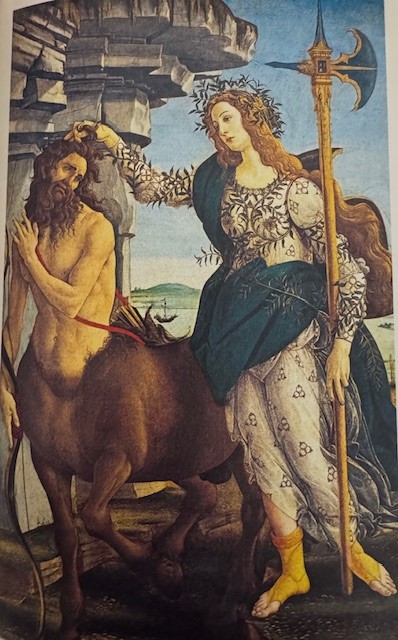
Pallas and the Centaur, by Botticelli (1482-83)
In the painting, Pallas totally dominates the violence of the Centaur – here deprived of cunning, an attribute of the fox, as Machiavelli described. But as in all things Botticelli, the gesture of the goddess – hair-pulling the beast – is quite ambiguous. She’s not dominating it just by mere persuasion or the art of subtle rhetoric. Pallas/Minerva here is much stronger – and even ready to decapitate the Centaur with her pick.
Call it the emblem of civilizational violence.
How far have we drifted from neo-platonic heights. If a pop Botticelli with an Andy Warhol streak would remix Pallas and the Centaur today, Pallas/Minerva would forcefully represent the power of Italian civilitas – the most cultured and influential civilization-state in the history of the West. And the Centaur would be an artificial perversion, the European Union (EU).
Call it Firenze-Athena defeating Brussels.
The endless wonders of Italian civilization
This is what I saw – call it fragments of civilization – as part of the immense privilege of hitting the road across the Italian civilitas, in a mini-tour connected to the launch of my latest book, Il Secolo Multipolare (“The Multipolar Century”). The book, via 46 columns, essentially tracks the year 2024, the last year of the now defunct “rules-based international order”, and arguably the first year of the definitive push towards a multipolar/multi-nodal world.
By a delightful accident, this is the first of my books not launched initially in the U.S.; a different version is being translated and will be launched soon also in Russia.
Starting on November 30, we held a series of conferences connected to the book, organized by the ground-breaking association Italianinformazione, near Udine in the Friuli; in the free territory of Trieste; in Bologna; in Ivrea in Piemonte; in Florence; and then, independently, in Spoleto in Umbria. This coming Saturday there will be a special conference in Rome, including, among others, Italy’s former ambassador to China and Iran, Alberto Bradanini.
As soon as I arrived in Venice, the tone was set: I received as a gift a custom handmade cap with the inscription “Make Roman Empire Great Again”. The Circus Ringmaster in Washington would have loved it. Who would he be as an Emperor? Caligula?
In Friuli, close to Slovenia and Austria, I was surrounded by NATO bases, many of them invisible underground. In the free territory of Trieste – where many remember fondly the hands-off approach of Austria – my hosts helped me dive deeper into the militarization of the port, which NATO wants to configure as the essential node in the Intermarium: Mediterranean, Baltic, Black Sea, all of course to become “NATO lakes”.
In Ivrea, we enjoyed the privilege of a comprehensive, 8-hour guided tour of the Olivetti complex, led by former top exec Simona Marra, who lovingly provided a detailed overview of one of the most extraordinary experiments in industrial humanism in history (this will be the subject of a special column).
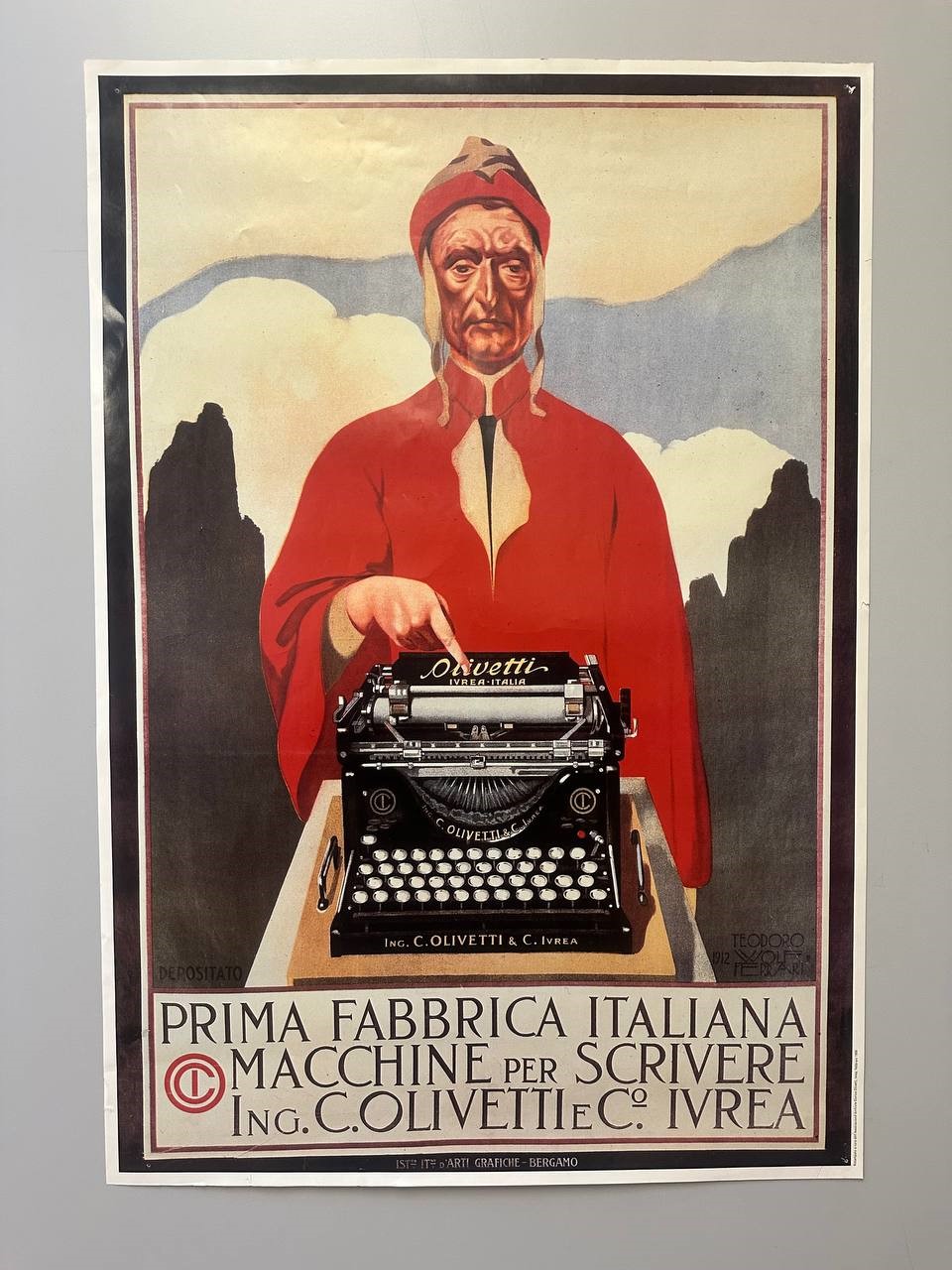
Dante’s typewriter. At the iconic Olivetti complex in Ivrea, Piemonte. Photo: P.E.
Firenze-Flora, of course, is on a whole new ultra-high level. Banners in communities reject NATO’s wars. At the San Marco museum – a former Dominican convent – an extraordinary exhibition, the first of its kind, celebrates Fra Angelico, the master of color and perspective in the early Florentine Renaissance, retracing his entire career and the creative, unique dialogue with others masters such as Masaccio, Filippo Lippi, Lorenzo Ghiberti and Luca della Robbia.

Fra Angelico: The Annunciation fresco (detail) at San Marco. Photo: P.E.
The frescoes that Fra Angelico painted in the convent are priceless jewels representing the mix between Faith and Art. And then San Marco offers other marvels. San Marco was where the humanist Academy in Florence was born. Here was the site of the first public library in the world.
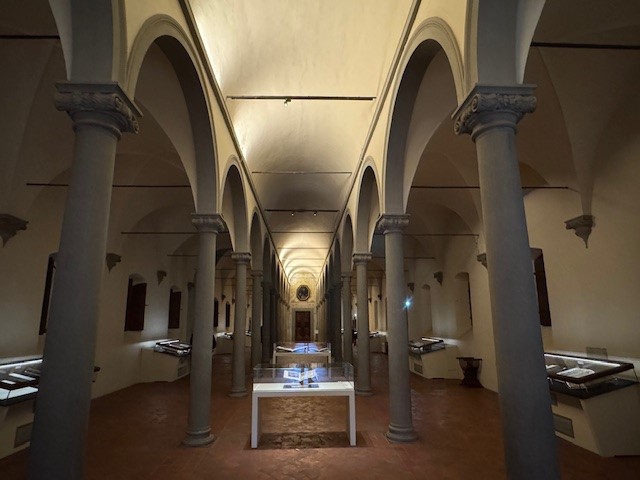
San Marco, Florence: the first public library in the world. Photo: P.E.
The bones of Poliziano are buried in the chapel. Right behind a statue of Savonarola, the “animus in vita” of Savonarola and Pico della Mirandola is celebrated in marble. Their bones may have been separated “post mortem”; yet even as “antipodes”, they were bounded by love.
In Spoleto, in Umbria, after fabulous interactions with the young members of the Aurora Center of Studies, under the early morning fog, the Fonti del Clitunno appears like a ghostly dream. This is where, according to Virgil, lies the heart of the “estirpe italiana”. Byron was mesmerized when he visited it.

Spoleto, in Umbria: the Fonti del Clitunno. Photo: P.E.
The Aurora Center is investing in first-class interdisciplinary analysis linking geopolitics, philosophy, Law, anthropology and sociology to track the transition from the unipolar order to the multipolar world, characterized by the emergence of civilization-states.
These are the ontological, strategic and normative poles of the future. And that’s where Italy as a civilization-state belongs.
Can Stoics and Humanists save Italy?
The conferences – all of them full house – offered a unique opportunity to address informed Italians on what’s going on in the Russia-China, BRICS, Southeast Asia, New Silk Roads, connectivity corridor spheres – issues that are either completely ignored or distorted by mainstream media. At the same time, it was priceless to become aware of insider tidbits on the sorry condition of an unparalleled civilization-state reduced to the role of a neo-colony of the EU/NATO combo.
And then there are the bibliography highlights. Like finally finding in the best bookshop in Venice a priceless Bompiani collection of all fragments of the Early Stoics – Zeno, Cleanthes and Chrysippus. And in the pristine Galleria Imaginaria in Firenze-Flora, the rare Einaudi first edition of a collection of Italian humanist writings – Thought and Destiny – from Petrarca and Marsilio Ficino to Leonardo da Vinci and Machiavelli.
To quote T.S.Eliot, we can say that “these fragments I have shored against my ruins.” When it comes to Fragments of Civilization, Italy is Jupiterian. I remain on the move, from Rome down south to Napoli and Sicily, carrying the message I shared with my interlocutors; if the current, fragmented collective West would ever have a chance to be rescued from the Centaur of oblivion, that task must be carried out by the definitive, Western civilization-state: Pallas Athena Italia.
[Note: We’ve been waiting for this research for a while now. To our knowledge (and sources) President Putin requested this. The easiest way to explain what the Dream-Idea of Russia, the Code of the Russian Citizen is all about, is to compare it with the Chinese terminology. China is socialist with Chinese characteristics. There is no such short and concise way to explain Russia, which, of course, is multi-cultural, multi-confessional, multi-ethnic, with more than 100 different ethnic groupings. Professor Karaganov set about to find this Dream-Idea, the Code of the Russian Citizen.]
National Research University–Higher School of Economics, Moscow, Russia
Faculty of World Economy and International Affairs
Distinguished Professor, Academic Supervisor;
Council on Foreign and Defense Policy
Honorary Chairman
This article is based inter alia on the results of a series of studies and a situation analysis conducted in April of this year. I am grateful to my colleagues whose thoughts and assessments are widely used herein. But I bear sole responsibility for the text and conclusions.
First, about the good things. For more than two years, working together with a rapidly growing group of associates – scientists, businessmen, journalists, and cultural figures – I have been closely involved in the project “Eastern Turn 2.0, or Siberization of Russia.” Siberians are its main driving force, but its center is in Moscow, partly to avoid the accusations of parochialism and separatism that are often thrown at the Trans Urals development initiatives. But such suspicions are sometimes disingenuous. Some of the elites in our old capitals refuse to admit the obvious: Russia’s more-than-300-year European journey is over. It should have been completed more than a century ago; in this case we might have avoided the huge losses our country and people suffered in the 20th century. This journey has given us quite a lot in terms of technical development and military affairs. The European injection into the stem of traditional Russian culture produced amazing results: great music, theater, and cinema, and the world’s greatest literature. And, of course, we must and will preserve and cherish the legacy of Aristotle, Dante, Raphael, Bach, Vivaldi, Shakespeare, Chopin, Fellini, Schopenhauer, and even Marx, etc.
The first round of Russia’s eastward turn was conceived in the late 1990s and especially 2000s, and launched in the early 2010s. It was motivated mainly by economic considerations, such as Russia’s competitive advantages in the Asian markets. There were also concerns about the danger of continuing Russia’s lopsided alignment with Europe, which was becoming economically stagnant and politically hostile.

This attempt’s success was limited by bureaucratic inertia and an unwillingness to sharply turn from the West. Initially, the turn encompassed only the Far East, with the Northern Sea Route added later. Most people living in the Far East were not involved. For many, the turn (rightly) seemed to be a project of Moscow. Most importantly, it did not involve the Siberian regions with the strongest economic, scientific, human, resource, and industrial potential: Eastern and Western Siberia, and the Urals. In economic, political, human, and historical terms, Russian Siberia begins in the Perm region and the Urals.
Yet the first turn’s limited results were still positive: the economic development of the Russian Pacific intensified, and trade with Asia increased markedly, which later softened the impact of economic severance from Europe. Over the last year or two, demographic outflow from the region has stopped.
We are working with our colleagues from Siberian and Urals intellectual centers to draft a comprehensive roadmap for the country’s second turn to the East, its “Siberization.” In many ways, this is a “return home,”[1] to the origins of Russia’s greatness: its unique cultural openness, vastness, spirit, fortitude, discipline, and collectivism (sobornost).
Without the development of Siberia, Old Russia would likely not have survived on the Central Russian Plain, under constant attack from the south and west, and would not have become a great empire (even before it was formally proclaimed one by Peter the Great). It would not have cultivated the best and strongest features of the Russian national character, the “Siberian brew”:[2] daring, perseverance, sobornost, cultural and religious openness, and a striving beyond the horizon “to meet the Sun.”
Now that Europe is sinking into moral and political degradation, we must commence Siberization as soon as possible.
In order to fully set the new course of the country’s development, “Siberize” it, turn to the East, focus on our own spiritual, human, technological, and economic development, and ensure that we do not get stuck on the unpromising and now harmful European trajectory, we must win the war in the near future, ideally without the use of extreme measures. Defeat Europe, as in 1812–1814 and 1941–1945, but this time politically solve the “European problem” of Russia and the world once and for all. It is obvious, but often denied, that Europe is the concentration of all the main evils of humanity, two world wars, countless genocides, colonialism, racism, and many other detestable “isms,” including recently the liberal totalitarianism that is based on transhumanism, LGBTism, denial of history, and essentially anti-humanism.
First, about the prospects for our relations with Europe (the EU and NATO), then about what is to be done.
Our relations with Europe are the worst they have been in history. The level of Russophobia and anti-Russian sentiment is unprecedented not only among European elites but also among a growing share of the masses, stupefied by all-encompassing wartime propaganda. Europe has not yet openly declared war, but participates indirectly by arming enthralled and Nazism-indoctrinated Ukrainians to fight against Russia. They are its mercenaries, like many others gathered from around the world, especially the poor countries of Southern and Eastern Europe.
The Americans have achieved some of the goals that they pursued when unleashing this war together with their European servants: to undermine the competitiveness of their rival-allies, who had grown rich under U.S. protection, by breaking their gas ties with Russia. But the United States has realized the danger of nuclear escalation and begun to crawl out of the war with Russia. However, if there was any expectation that they would pull Europe out, too, it did not come to pass. Europe is openly preparing for a large-scale war in five to seven years.
European elites are increasingly unhinged and hostile. This is driven by centuries-old Russophobia and by hope of revanche for defeats by Russia: the Battle of Poltava; Napoleon’s almost pan-European invasion; the Great Patriotic War, when the vast majority of Europeans marched under Hitler’s banner or worked for his army. For too long have we shown short-sighted magnanimity, emphasizing small anti-fascist partisan groups (mostly communists), while turning a blind eye to the much greater number of Europeans who followed Hitler.
European rage also stems from resentment for lost profits. Having sucked Eastern Europe dry and having lost hope of continuing to live at Russia’s expense, the Western Europeans (especially Germans) counted on exploiting Ukraine’s rich lands, resources, and hardworking people. Those hopes are now vanishing (though several million new migrant workers – refugees – have been cast into Europe’s declining economy).
And yet the unprecedented hostility’s main reason lies deeper: the multi-spectral failure of the European elites and the impasse of the European project. Its problems began as early as the 1970s–1980s, but were temporarily obscured by the unexpected, internally triggered collapse of the USSR and socialist camp, which freed up several hundred million cheap workers and hungry consumers. China’s markets opened at the same time. But Europe’s external injection of economic and moral adrenaline began to wear off in the late 2000s. And now the bill has come due for the greedy European bourgeoisie’s admission of millions of migrants, since the 1960s, in order to lower the cost of labor and weaken trade unions. The result is a mounting and so far irresolvable migration crisis.
As pleasant as it is (given Europe’s hostility) to list the numerous signs of the comprehensive crisis faced by Europe and the European project, I will leave their enumeration at that.
There is nothing to rejoice at. Crumbling within, the European elites, as much as 15 years ago, began creating the image of Russia as a deadly enemy. Then they eagerly sought to strategically defeat it using Ukraine. And now they are openly preparing for war and whipping up militaristic hysteria. The situation is aggravated by European elites’ and populations’ strategic parasitism, eroding their self-preservation instinct and fear of (even nuclear) war.
Three quarters of a century under U.S. (and Soviet) protection, which stabilized Europe and suppressed Europeans’ eternal mutual hostility, have destroyed Europeans’ capacity for strategic thought and intellectually crippled their elites. The few Europeans who understand what is happening are mostly silenced by the danger of speaking out. Moreover, many Europeans subconsciously sense that Soviet/Russian elimination of their military superiority – the foundation of their 500-year-long domination – means that they can no longer grow fat through the (neo)colonial exploitation of the rest of the world. This rent was the most important source of their economic, scientific, and cultural success, and its loss is a key reason for their rabid hatred of Russia. America, by focusing on itself and its surroundings, can prosper, but Europeans cannot. They would need to work hard again, and they are not used to that.
We ourselves facilitated Europe’s degradation into malicious aggression by appeasing, pacifying, and hoping that things would work out themselves. Many Russians’ Europhilia, which long ago began degenerating, also had negative consequences. I myself fell for it until, more than three decades ago, I began professionally studying European politics and life.
This, of course, does not mean that all Europeans are moral degenerates and Russophobes; there are many decent people there as well. I personally know many, and lament the forced break of relations with them. But reasonable people, committed to traditional European culture and values, are being marginalized and politically neutralized by comprehensive propaganda.
Few European countries dare to pursue a more or less independent policy towards Russia, but they are under pressure. Their number may grow slightly in the future, and we should make use of this. But the prevailing policy of hostility is only intensifying.
Europe has embarked on remilitarization. While there is currently no cause to fear Europe’s militaries, they may be much stronger and bolder in five to ten years, in which case we will again be in a risky position. This cannot be allowed to happen.
The U.S. will be happy to help still-wealthy Europe to rearm itself by maintaining tension on the subcontinent and restoring the U.S. military-industrial complex, which has stagnated over the past 35 years. This is beneficial to the U.S., so long as the conflict does not escalate to the nuclear level and threaten to spread to U.S. territory.
The Americans have realized that their military superiority—and thus ability to impose their will and interests by force – is waning, and thus their hegemony is becoming unsustainable, unprofitable, and liable to drag the U.S. into a world war. They have accordingly begun to partially withdraw. This was visible even before Trump’s second term, especially after the failure to quickly destroy Russia through the war in Ukraine (thereby eliminating it as China’s main de facto ally, and the rising World Majority’s strategic core). And after Washington began receiving Russian signals about possible nuclear escalation. The Americans may vacillate, perhaps quite dangerously, but their course is quite clear: reducing direct military involvement, but destabilizing the withdrawn-from regions so that their competitors gain nothing. Again, the Americans have somewhere to which they can retreat: a strong and dynamic economy, which can be modernized through the attraction of financial and industrial capital, with large markets nearby.
European elites have no such opportunity. Besides, they have intellectually castrated themselves.
The EU has become a major tool for suppressing internal dissent. This, rather than confrontation with the USSR, has been NATO’s main function in the late 1940s. In the mid-1950s, NATO turned from a political alliance (with a defense component) into a military one, which demanded continued confrontation. Now the EU is following in its footsteps (but with a weak military component so far), and thus needs escalation at least as much as NATO does.
For the foreseeable future, Europe’s elite will use escalation and war-preparation to justify the continuation of its rule.
Since I have no complete or reliable information about our military or financial capabilities, or the situation on the front lines, or negotiations, I will not try to advise our brave soldiers and highly professional diplomats, but will confine myself to general political remarks. The Europeans are interested in continuing the war, and the Americans are not interested in this only insofar as the war threatens to ‘go nuclear,’ spread to U.S. territory, or repeat the Afghan debacle.
We will not be able to ensure our borders’ security or a lasting peace (one that excludes the possibility of war restarting) through slow advances or even a narrow demilitarized zone. Security and peace can be attained only by establishing a demilitarized zone throughout the entire territory of Ukraine, overthrowing the current compradorial-Nazi regime in Kiev, and (most importantly) breaking the European elite’s will to continue the confrontation and hope of winning it.
Our army should continue its offensive. A truce, as everyone understands perfectly well, is no salvation, but only a respite for the enemy to regain its strength and further brainwash and militarize its population.
The main adversary is, of course, not Kiev (it is time to admit this) but a united Europe. With wavering U.S. support, it wants to continue this war indefinitely. Behind the smokescreen of rhetoric about ceasefires and peace, the U.S. and Europe are redistributing their roles. The U.S. is playing the good cop, offering the carrot of agreements, while London and company are escalating and dragging things out. When the Ukrainian cannon fodder finally ends, and that is still a distant perspective, the ranks of mercenaries will be replenished with landsknechts from the poor countries of Eastern and Southern Europe. They are already being recruited and trained at scale. Our indecisiveness, our unwillingness to strongly respond to attacks on our cities and strategic forces, are unambiguously interpreted as weakness, strengthening the adversary’s aggression and sense of impunity. Our caution plays into the hands of an enemy that wishes to drag us into a lengthy war and eventually exhaust us, divide our elites, and undermine popular support for the government.
We are winning tactically, albeit at a considerable cost, but strategically we could start losing. The enemy crosses one red line after another. Mirror responses are a purely defensive tactic, and even they demand that the series of attacks on our cities, strategic assets, and now strategic (i.e., nuclear) forces, be answered with strikes against the strategic forces of Britain or even France. After announcing, of course, that any ‘response’ will prompt nuclear retaliation. And if, in response to that, even one nuclear warhead flies in our direction, let alone reaches our territory, we will strike their cities.
A world war – albeit not yet a total thermonuclear one – has already been unleashed. The attack on Iran leaves no doubt. But we are the main target. By hesitating to respond strongly, we appear weak, indulging the enemy and giving him a feeling of impunity. The brutal attack by the U.S. and Israel on Iran removes all political, legal, and moral restrictions on potential preemptive/retaliatory strikes. Moreover, by leaving unpunished this blatant aggression we demonstrate unforgivable weakness and pave the way for global thermonuclear war.
We must correct our strategic goals in this war, which was imposed on us and in which we involved ourselves only belatedly. The complete demilitarization and denazification of the Kiev regime, and the liberation of natively Russian lands, can be achieved only by defeating – hopefully just politically, without using extreme measures – Europe in its present form. And that form is worse than it was in 1941–1945. At that time Britain, the most vicious of our enemies today, was forced to be an ally of the USSR.
Naturally, we should again warn London and Paris that any troops sent to Ukraine will be viewed as direct participants in the conflict, and Russia will be forced to begin striking their assets and bases (at first, with conventional weapons and outside of British/French territory). Berlin must know that if it tries to obtain nuclear weapons and continues the de facto war against Russia, there will be no mercy, and Germany will finally answer for its historical guilt before humanity, which it is trying to forget: for two world wars, the Holocaust (the worst of the many genocides committed by Europeans), and the genocide of the Soviet peoples. The magnanimity of the Soviet leadership, which opposed the demolition of Germany, proved counterproductive. We must not allow Germany to once again become a threat to the world and our country.
Again, if anyone had any doubts about the threat with which we are dealing, the June attack on Iran, carried out by the entire West (which used Israel just like it uses Ukraine), should sober us up. Before that, they destroyed Libya, Iraq (which blocked the way to hegemony in the Middle East), Yugoslavia. The aggression must be stopped before it is too late.
Our military doctrine should be amended to state that war with a demographically and economically more powerful aggressor will necessitate Russia’s use of nuclear weapons. We must finally abandon, at least at the expert level, the Gorbachev-Reaganite delusion that “a nuclear war cannot have winners and must not be started.” Needless to say, all measures should be taken to prevent a large-scale war. But this delusion contradicts logic and Russia’s nuclear weapon doctrine and, moreover, enables the conventional aggression that indeed we now face. Any provocations on the borders with NATO in the Baltic must be met with a disproportionate response. After the attacks on our cities and strategic forces, our policy must be altered.
We must urgently start analyzing the lessons of the SMO. In Soviet times, it was assumed that a war in Europe could involve both large armies and tactical nuclear weapons, so the arms race in both areas overstrained our country. Then the new Russia decided that it needed compact mobile general-purpose forces, supported by a reliable ability to use nuclear weapons. Now we have moved on to technologically advanced trench warfare. The courage and perseverance of our soldiers is admirable, but is this how we intend to keep fighting in Europe and possibly elsewhere? We are not making use of nuclear deterrence to avoid wars or conventional arms races (the threat of nuclear retaliation makes such races senseless).[3]
At present, we risk exhausting ourselves in an endless war in Europe, whose elites desire precisely that. We must quickly stop the approach of a global thermonuclear war. And for that, we must first of all stop Europe―the main force that is objectively and subjectively pushing it.
We must take a series of steps, as soon as possible, to dramatically increase the credibility of our nuclear deterrence. Having finally changed our nuclear doctrine, we have convinced the Americans of the reality of escalation—but not yet the Europeans. Moreover, by starting negotiations with the U.S., we have eased the nuclear pressure. Some in Europe are again saying that Russia would never use nuclear weapons. A perception of Russia as weak, and unwilling to take decisive action, is spreading. Our restraint and caution play into the hands of the European forces of aggression and militarism; we are beginning to repeat past mistakes, appeasing the aggressors. We must move on to direct threats of (initially conventional) preemptive strikes if absolutely necessary.
There is a deadly threat to Russia and the world. Under these circumstances, indecision and hopes of agreement are dangerous. We should state that the U.S.’s imposition of 500 percent tariffs on customers of Russian oil would be treated as an act of war, prompting nuclear escalation and (inter alia, military) attacks on overseas U.S. assets, which outnumber Russia’s more than one thousand to one.
Now for the most unpleasant but substantively necessary part. After all warnings have been given – nuclear warheads are deployed in the European theater on medium and shorter-range carriers, including airplanes; the strategic forces conduct exercises that practice disarming and decapitating the UK, France, and Germany; etc. – if nothing helps, then we will probably have to move to the next level and begin striking logistics centers and military bases in countries that support the aggression against Russia. We cannot wait long. We should also warn them that any response will trigger nuclear retaliation against these and other targets. Naturally, we must forewarn the U.S. not only about our firm intentions, but also about our desire to avoid intercontinental escalation. If it ever does become necessary, God forbid, to disarm and decapitate the UK and even France, we will have to activate the missile and civil defense systems and warn that if even one warhead reaches our country or Belarus, the attacker will be wiped off the face of the earth. For that purpose, Poseidon systems might be readied in the English Channel. Decapitating strikes should target not only decision-making centers, but also the places where the European elite gathers and lives, so that it has no hope of sitting things out in its bunkers.
I am well aware that the use (even limited) of nuclear weapons is not just dangerous, but (more importantly) is an immense sin. Innocent people, including children, will die en masse. I can only guess as to the excruciating thoughts of our Supreme Commander-in-Chief.
I know that the described scenario makes one’s blood curdle, and once again I will draw fire to myself. But this seems the only possible alternative to being drawn into an endless if intermittent war with the loss of tens or hundreds of thousands of our best men – and then sliding all the same towards nuclear Armageddon and/or the country’s collapse. We must shake the Europeans from their madness, break their will to continue confrontation, and stop the slide towards the Third World War (towards which the Europeans are dragging the world, having apparently forgotten about their past sins, for which they were never properly punished). We should also give the Americans a good shake. Trump probably wants peace, but on his own terms: keeping most of Ukraine as a beachhead with which to pressure Russia. But even if we take his love of peace at face value, his position is extremely unstable. Nuclear pressure should not be reduced. By doing so during the ceasefire talks, we weakened our position and dragged out the war.
I still hope to avoid, by tough but relatively peaceful means, a large-scale war in Europe. I am counting on our decisiveness and victory without resorting to nuclear strikes. But what should our policy be under these relatively “peaceful” circumstances?
Enmity will long endure, as it, again, has deep roots. For the near future it will not be worth focusing on the European direction: harsh deterrence and maximal disengagement are what is called for. Naturally, we should not reject the European injection into our culture. Nor should we mimic the adversary by breaking contacts; they should be maintained and even restored in the future, but without illusions.
But then several difficult questions arise – ideological, geopolitical, and practical – related to our economy, education, ideological self-determination, and personal and national goal-setting. The latter we call the Dream-Idea of Russia, the Code of the Russian Citizen.[4]
We should recognize at last not only our identity but also the fact that the most important external influences and sources of our civilization came from the South and the East. From the South – including Palestine, Judea, and Greece – we received not only Eastern Christianity – Orthodoxy – but also Islam, Buddhism, and Judaism. From the South and the East, from brilliant Byzantium and the powerful Mongol Empire, we acquired vertical governance, without which we would not have become a colossus or even survived in a vast territory that is unprotected by mountains or seas. We must constantly remind ourselves that Russia’s path to becoming a great power lay through constant confrontation with Europe and movement towards Asia. Russian Prince Alexander Nevsky’s appeal to the Mongols to help against the Teutons, Yermak’s journey beyond “the Rock” to lay the foundation of the Russian Empire, the idea of the “Third Rome,” the victory of our people led by Minin and Pozharsky over the Poles, the victory of Peter the Great over the Swedes, the victory of Kutuzov, Barclay, and Alexander I over Napoleon’s pan-European army, and the victory of Zhukov, Rokossovsky, Stalin, and the entire Soviet people over Hitler’s pan-European army. These are our main historical and spiritual milestones.
In information and educational policy, it is important to reasonably reduce the amount of information, in textbooks and broadcasting hours, describing and analyzing European history and events, while increasing the share of Asia and the World Majority. Eastern studies need a powerful boost. But most importantly, we must return the development of Siberia to the center of Russia’s worldview. We also need to start training a new generation of Europe experts. The old generation of dreamers is passing away, and most of the middle-aged generation was, unfortunately, trained with EU and other European grants and is simply unable to understand and assess the state into which the Old World has driven itself.
Finally, we should recognize that much of our intellectual baggage, our socio-economic and even foreign policy theories, are outdated or outright false and subservient to foreign interests. They should not be jettisoned entirely but taken with a grain of salt. (As dean, I insisted that all theories, Western and Russian, be studied critically). We should know and use the European intellectual heritage, but with the understanding that it is not for us.
The most important way of parting with present-day Europe is shifting the center of Russia’s spiritual, economic, and political development to the Urals and Siberia – the Siberization of Russia, as described at the beginning of the article. We should attract people from the liberated territories and war-affected regions to move across the Urals. Several major projects are needed. Plans are being fleshed out. It is time to overcome the myth of cold and uncomfortable Siberia. It is not a hard-labor camp. With sound public policy, life there can be comfortable, and global warming is moderating its climate. We need a narrative of Siberia as a promised land of new, unlimited opportunities.
To do this, we need to start building low-rise wooden houses in Siberia’s labor-deficient small and medium-sized cities. Life in Siberia should become more comfortable than in the European part of Russia. This is one of the best ways to overcome the country’s shortage of children. People are reluctant to have children and raise large families in human anthills.
Siberians, who are less influenced by the West, and SMO veterans should be recruited into national governance. The capital’s functions should be partly transferred to Siberian cities. Many residents of the old capitals have succumbed to the most corrupt and now harmful influence of Europe and the West in general. We will have to partly rebuild the liberated territories’ cities, but under no circumstances should this be done at the expense of core Russia and Siberia (as was the case after the Great Patriotic War).
Our head of state and opinion leaders should constantly speak of the need to end our more than 300-year-long European journey, which has brought us many benefits but also a lot of harm – constant wars, including two world wars, and various “isms.” We have taken everything we needed from Europe, and more. Now we must focus on the development of our own civilization-state and not look to external players, be they in the South, West, or East. It is important to use the confrontation that has been imposed on us for the radical reorientation of foreign and domestic policy, of our internal human and technological development, to promising markets in the South and East. If and when Brussels suddenly decides to “normalize” relations with us, we should not immediately agree. But we should develop relations with individual countries in Southern and Central Europe, for economic reasons and to pull apart the EU, which is undesirable for us in its present form. In the long run, such countries are likely to join the Greater Eurasian Partnership. While reorienting ourselves to domestic markets, to the South and East, we should also preserve the best of Europe’s heritage. But present-day Europe is useless and even harmful.
Most of our neighbors in Eurasia’s western subcontinent are morally and politically declining, again embarking on a path of hostility and war. But history does not end unless we ourselves end it with a global thermonuclear war. After its Greco-Roman flowering, Europe fell into the gloom of the Middle Ages for seven to eight centuries. So, let’s wait. Perhaps it will be reborn, and become a beneficial and desirable partner. With the right policy, we can not only protect our own interests and stop the slide towards the Third World War, but also facilitate the revival of what is best in our neighbors on the subcontinent.
(http://svr.gov.ru/)
 The Press Bureau of the Russian Foreign Intelligence Service (SVR) reports (http://svr.gov.ru/smi/2025/10/anglichanka-snova-gadit.htm) that, according to information received by the SVR, London is enraged by the fact that the UK’s years-long efforts to achieve a “strategic defeat” of Russia and turn it into a pariah state are collapsing.
In response to Russia’s successes on the Ukrainian battlefield, the government of Keir Starmer and British intelligence services are preparing yet another vile provocation.
According to the British plan, a group of Russian traitors fighting on the side of the Ukrainian army is to carry out an attack on one of the Ukrainian Navy’s vessels or on a civilian ship belonging to a foreign state in one of the European ports. As of now, the group’s members have already arrived in the UK for sabotage training.
Once the group is “exposed”, British authorities will claim that it was acting under instructions from Moscow. London hopes that Europe’s Russophobia-obsessed establishment will unquestioningly accept the fabricated story of “malicious Kremlin agents” as justification for further arms deliveries to Ukraine and militarization of the so-called “united Europe” under the pretext of countering “Russian aggression”.
It is noteworthy that the Ukrainian militants are to be supplied with underwater equipment of Chinese manufacture. The equipment “seized” during the “investigation” is intended to be presented as “hard proof” of China’s alleged support for Russia’s so-called armed aggression against Ukraine.
Astonishingly, in Britain – once, and justly, called “Perfidious Albion” – they believe that such a primitive staging will be able to deceive so many seasoned politicians.
Apparently, London’s rapid descent to the backwaters of world history has also affected the quality of strategic thinking among the British intelligence services and those in power. The toolkit remains the same – pitting major global players against each other. But under today’s geopolitical conditions, it no longer works.

La centrale hydroélectrique géante de la Grande Renaissance éthiopienne sur le Nil Bleu a été officiellement inaugurée en Éthiopie –
L’article L’Éthiopie inaugure le barrage de la Renaissance sur le Nil, le plus grand d’Afrique est apparu en premier sur STRATPOL.
… the Tianjin SCO summit is a collective demarche by Eurasia, which has united against the United States, the European Union, and their regional allies…
By Rostislav Ishchenko at Ukraine.ru.
(machine translation)
The meeting of the Shanghai Cooperation Organization states that opened in Tianjin today is undoubtedly a diplomatic triumph for China. This was clearly intended by the main participants, including Russia and India.
And the West is to blame for this.
Let’s start with a formal note: all the participating countries are represented by their heads of state or government. The President of Russia has arrived for a four-day visit, combining his participation in the SCO summit with a state visit to China. The events related to the latter will take place in Beijing. By the way, Putin’s schedule is extremely busy, with numerous meetings with the leaders of the participating countries, which indirectly confirms the importance and significance of the summit.
In general, it should be noted that although the SCO summits are held in member countries on a rotational basis, all the turning points in the organization’s life have occurred in China. The founding meeting of the then-called “Shanghai Five” (Russia, China, Kazakhstan, Kyrgyzstan, and Tajikistan) was held in Shanghai. The 2001 meeting, which led to the establishment of the SCO after the admission of Uzbekistan, also took place in China (also in Shanghai).
In addition to SCO members, observers and dialogue partners, representatives of five other Southeast Asian states (Indonesia, Malaysia, Maldives, Laos and Vietnam) have arrived at the current summit in Tianjin (also China). I do not presume to say that they will gain any status in the SCO as a result of the meeting, although this is not excluded. For example, why don’t they become observers or dialogue partners? But the very fact of the arrival of representatives of these countries is very important.
The fact is that China’s relations with Southeast Asian countries are extremely complex. They have traditionally been wary of China’s ambitions and Beijing’s claims to dominance in the region. Vietnam and Malaysia have territorial disputes with China that are just as complex and long-lasting as the Chinese-Philippine dispute, which the United States is currently using to escalate military tensions in the region in order to increase pressure on China.
Washington has recently (as recently as August of this year) made attempts to draw Indonesia, Malaysia, Vietnam, Laos, and India into the anti-Chinese alliances being formed by the United States in the Indo-Pacific region. The presence of the leaders of these countries in Tianjin indicates that the choice has not been made in favor of the United States. This is due to the fact that the agenda of the meeting focuses on discussing security issues, both military and economic. The main threat to the countries in the region comes from the military activities and economic policies of the United States.
It is no coincidence that I wrote that the West, primarily the United States, is to blame for China’s diplomatic triumph, which was achieved through joint efforts with India and Russia. The Russia-India-China triangle, which forms the basis of the SCO, had its own challenges. In fact, it still does. However, these challenges are being actively addressed, and the countries are actively seeking and finding mutually acceptable compromises, as they recognize the aggressive policies of the United States and the West as the primary threat to their interests.
The very beginning of the SCO – the creation of the “Shanghai Five” – was the first global format to bring Russia and China closer together strategically. The “Shanghai Five” helped to resolve relations between Moscow and Beijing in Central Asia (primarily with the buffer countries bordering both powers), as well as with the Central Asian states themselves. At the time, both Russia and the Central Asian states had serious concerns about China’s plans for military, political, and financial-economic expansion in the region.
It is unknown whether Russia and China’s relations would have reached the level of strategic cooperation (especially so quickly) if it weren’t for the West’s openly aggressive policies, which left the countries of Eurasia with no choice. The alternative to uniting the countries of the region through compromise to fight for their interests against the West was to capitulate to it and become dependent states subjected to neo-colonial exploitation. The further rapid growth of the SCO, which included even countries that had been at odds with each other for many years, was also predetermined by Western policies, which caused greater concern and rejection among the countries of the region than any old local conflicts. The region was fighting “for its borders,” while the West was fighting “for its life.”
The current meeting is taking place against the backdrop of the Trump administration’s announced shift in U.S. foreign policy towards China. Instead of presenting mutually beneficial proposals, the U.S. has come to Beijing with an arrogant demand to abandon its own interests in order to support an ineffective U.S. economic and military policy aimed solely at restoring the irrevocably lost American global hegemony, which allowed for a neo-colonial plunder of the planet.
The Americans needed the support of countries in the region, as well as global players such as Russia and India, to succeed in their anti-Chinese policy. Instead of looking for ways to bring their positions closer to Moscow and New Delhi, Washington has found nothing better than to try to put pressure on them. Russia is being persuaded to accept unfavorable peace conditions in Ukraine, although the United States needs a temporary (until victory over China and switching to Russia) stabilization in the European direction.
Economic sanctions are being imposed against India in the form of increased tariffs, trying to force it to accept US demands that are unfavorable for its economy. Moreover, the requirements not to buy Russian energy carriers (which the United States itself buys and resells to its allies at a surcharge) are secondary. Major increased tariffs on Indian exports to the United States were introduced earlier, in an attempt to force New Delhi to accept artificial restrictions on the profitability of its trade with the United States.
The United States has lost its ability to compete effectively with foreign producers. They no longer need (because it is not profitable) freedom of trade. They want to open up other countries’ markets for themselves and close their own markets to others. They are willing to achieve this goal not only through economic means, but also through military force where they cannot be defeated.
This is why the topic of military, political, and economic security in the region will be the main focus of both the summit and bilateral negotiations. This is also why Russia, India, Indonesia, and other Eurasian countries have not only agreed to the summit format as a Chinese diplomatic triumph, but have also helped to organize it.
In form, this is China’s response to the United States, its final warning in response to attempts at aggressive pressure. In fact, the Tianjin SCO summit is a collective demarche by Eurasia, which has united against the United States, the European Union, and their regional allies, to postpone or even successfully resolve existing problems and conflicts in the face of a global threat from the West.
The success of the summit in Tianjin, which means the further expansion and internal strengthening of the SCO, is guaranteed by the very fact of a united (even though this unity is beginning to crack under the weight of unsolvable problems) and extremely aggressive West.
“Now let them seek a delicate exit from the mess they’ve gotten themselves into — but we will achieve our objectives.” — VVP
By William Schryver at imetatronink.
My coalescing sense of the underwhelming Alaska Chats is that Russia has not materially varied from its longstanding terms.
Trump rolled into town with his “stealth” flyover, imagining he was the one giving an audience to Putin.
From start to finish it was perfectly evident to any discerning observer that it was just the opposite, and that Putin was there to repeat and to emphasize Russia’s apparently inviolable terms.
As I understand it, the Russians have said they will implement a conditional temporary ceasefire in the south while NATO/AFU forces withdraw from Donetsk.
No one has said anything about ending the Special Military Operation, nor of the disposition of territories.
In essence, the Russians are saying:
“We’ll temporarily stop destroying you on the southern part of the line of contact while you retreat from the northern part, and then we’ll demand you also withdraw from the southern part, and lay down your arms.”
I cannot understand how so many people seem to doubt the resolve of the Russians to continue fighting western forces for years to come pursuant to their clearly enunciated objectives.
In each successive year of this war, Russian strength has augmented across the spectrum. Russia is not only outproducing the combined west by several multiples, but their military hardware is now indisputably superior in most key categories.
The only exit route for the US/NATO is capitulation, which in this instance entails withdrawing NATO military presence to the 1997 borders, as stipulated in the NATO-Russia Founding Act of 1997.
How they opt to frame that capitulation is up to them.
As I noted in my February 2024 analysis of the Tucker Carlson interview of Vladimir Putin:
Tucker Carlson: “Do you think it is too humiliating at this point for NATO to accept Russian control of what was two years ago Ukrainian territory?
Vladimir Putin: I said let them think how to do it with dignity. There are options if there is a will.
Up until now there has been the uproar and screaming about inflicting a strategic defeat on Russia on the battlefield. Now they are apparently coming to realize that it is difficult to achieve, if possible at all. In my opinion, it is impossible by definition. It is never going to happen.
It seems to me that now those who are in power in the West have come to realize this as well. If so, if the realization has set in, they have to think what to do next. We are ready for this dialogue.”
That both Tucker Carlson and others have failed to correctly interpret Putin’s words is incomprehensible to me. So permit me to paraphrase them in language that is perhaps more understandable to the dimwitted and disingenuous people in the West who continue to misrepresent them:
“We offered them an early out, and they rejected it in favor of an appeal to arms in order to inflict what they imagined would be a severe strategic defeat against Russia on the field of battle. But their reach greatly exceeded their grasp. They cannot defeat us. Now let them seek a delicate exit from the mess they’ve gotten themselves into — but we will achieve our objectives.”
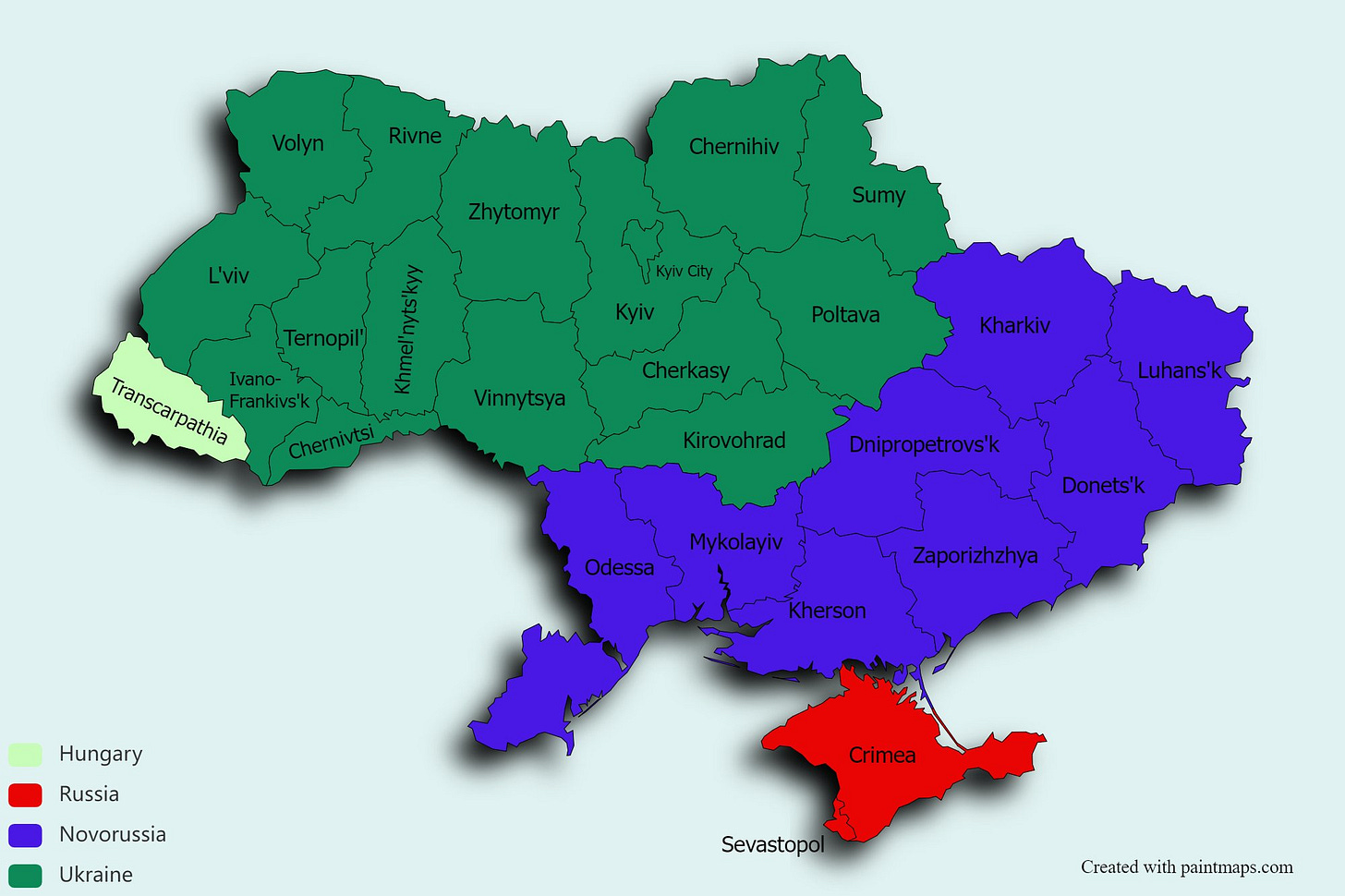
Novorossiya
No matter how the would-be masters of empire try to spin defeat into victory, most everyone around the world will still know the score. And it is this disabused illusion of imperial military supremacy that will rapidly accelerate its inexorable decline.
Michael von der Schulenburg: Alaska Meeting Was a “Game Changer”
Excellent discussion and correct preliminary conclusion. “Trust-building” was leitmotif, to halt the runaway train to nuclear war. Reality between the two who count are now materially different. Europeans stand alone, and will cast off by Empire. “The Peace” is gonna be imposed on the crazed Europeans, and others fueling Forever Wars. Russia is recognized as peer power that must be negotiated with, sans diktat or derision, as they hold the cards.
Of course it’s all about Alaska. Here’s what’s in play. But it’s the shadowplay that’s even more exciting.
By Pepe Escobar at Strategic Culture Foundation.
Of course it’s all about Alaska. Here’s what’s in play. But it’s the shadowplay that’s even more exciting.
Across the world, for those who grew up in the Cold War Swingin’ Sixties, the temptation is irresistible to cast Donald Trump as Goldfinger (but who would play Oddjob? Hegseth?)
Goldfinger, after all, is a powerful, ruthless gambler. His 21st century motto would be “Obliterate & Plunder”. In fact, sequentially, an orgy of obliteratin’ and plunderin’ if the occasions present themselves. Everything subjected to the search for the Golden Deal. My way. The only way.
Yet now it’s possible that Goldfinger may have met its appropriate – collective – match.
This is what happened the last time a summit took place in Alaska, in this particular case US-China in a shabby hotel in Anchorage. That shook the geopolitical chessboard to the core. Trump-Putin might – but only under quite specific conditions.
There’s only one realistic, optimal endgame for Alaska: a joint declaration of intent, pointing to a follow-up, as in the next meeting to be held in Russian territory. A sort of starter for the long and winding road towards a real reset of US-Russia relations, including a possible settlement in the proxy war in Ukraine.
Essentially, they may agree to keep talking. Yet what really matters is what may be implied by the promise: Goldfinger refrains from imposing secondary sanctions on Russia’s partners.
That will constitute a tremendous BRICS victory (Iran excluded. Actually, two strategic allies of Russia would be excluded: Iran and the DPRK).
BRICS are actively building a coalition to stare down Goldfinger. The key players are Bear, Dragon, Toucan and Elephant – all four original founders of BRIC. Nightingale should be added later, as it is linked via geopolitical/geoeconomic strategic partnerships with Bear, Dragon and Elephant.
When it comes to the Alaska nitty gritty, the top Bear needs to consider all the ramifications of what is an imperative for the Russian General Staff and the vast intel apparatus in Moscow: unless Goldfinger minions stop weaponizing and providing precious intel to Ukraine is all its forms, the mythic “ceasefire” that Goldfinger and the pack of toothless chihuahuas in Europe desperately want will be just an intermission to allow Ukraine to rearm to the hilt.
That’s a tough call for the top Bear: he has to placate his domestic, radical critics who blast him for sitting down with the enemy, and at the same time he must deliver the goods to his under-siege BRICS allies.
BRICS counteract Goldfinger’s Plunder tactics
Bear, Dragon, Toucan and Elephant are involved in breathless telephone diplomacy to articulate their collective response to Goldfinger’s Tariff/Plunder drive.
Examples. Modi on Brazil: “A strong, people-centric partnership between Global South nations benefits everyone.”
Lula on India: “Brazil and India are, so far, the two most affected countries. We reaffirmed the importance of defending multilateralism and the need to address the challenges of the current situation.”
Xi to Lula: China backs Brazil to defend its national sovereignty; BRICS is “a key platform for building consensus in the Global South.”
Goldfinger’s Tariff Plunder works in several ways.
On India: because New Delhi refuses to open its vast agricultural market to tariff-free Made in USA imports (45% of India’s population directly depends on agriculture); and because India buys Russian oil at much-needed discount prices.
On Brazil: because the ultimate target is regime change and free reign to plunder Brazil’s natural wealth.
So far, Goldfinger’s Plunder antics have been stellar when it comes to engineering their own blowback: from allienating even allies – see abject European submission – to de facto burying multilateral trade, not to mention international law.
Example: just a few hours before the tariff “pause” on Made in China products was about to expire, Goldfinger signed an executive order extending the deadline for another 90 days. Translation: TACO, all over again. If the tariff “pause” went through, the economy of the $37 trillion-indebted “indispensable nation” would be in even more dire straits.
Then there’s Goldfinger’s possible Arctic gameplay, already examined here. There’s virtually no evidence Russia would allow the US to participate in the development of the Arctic-wide Northern Sea Route (NSR), or Arctic Silk Road in Chinese terminology.
The role of Russia’s Atomflot – 11 nuclear icebreakers, 9 of them in action, 2 being built, including Project 10510 Rossiya, a behemoth capable of navigating anywhere in the Arctic anytime – in parallel with Russia’s astonishing arsenal of new weapons systems, these are absolutely key variables on any serious discussion on any possible US-Russia partnership post-Alaska.

Arya – آریا: mural at Tehran’s Enghelab Square. Farsi text: “The end of this saga is of glory, thus recite the name of Iran, for it is the slayer of its enemies.” The Iranian warrior Rostam from Shahnameh fights the serpent (the US)
Goldfinger’s obsession to cage Nightingale
Now let’s look at Nightingale – an immensely complex case. Goldfinger has totally embarked on a multi-track maximum pressure/tension remix against Iran: forcing Hezbollah to disarm; forcing the collapse of Lebanon into factional war; legitimizing the “al-Qaeda R Us” dismemberment of Syria; forcing snapback UN-backed sanctions on Tehran.
Then came the Goldfinger-hailed “historic peace summit” with Azerbaijan’s Aliyev and Armenia’s Pashinyan.
Well, what Baku and Yerevan really signed under Goldfinger’s watchful eye is not a peace deal: it’s a mere memorandum of understanding (MOU).
Their Joint Declaration is extremely vague – and non-binding. What is promised is a “let’s keep talking” set up: “We acknowledged the need to continue further actions to achieve the signing and ultimate ratification of the [Peace] Agreement.”
It remains to be seen what happens with the much-ballyhooed 99-year American grip on the Zangezur corridor – trimphally named Trump Route for International Peace and Prosperity (TRIPP) – complete with grabbing 40% of its revenues (Armenia would get only 30%) and placing 1,000 American mercenaries to patrol Armenian territory, right south of Nightingale’s borders.
The big story is of course Goldfinger eager to snatch at least one connectivity corridor in southern Eurasia – in the strategic south Caucasus, using a gangster-minded MI6 asset (Aliyev) and a national traitor (meek Pashinyan), which will be discarded and/or sweetened in due time. Crucially, NATO membership was offered to both Armenia and Azerbaijan.
The Deep State’s game plan is total control: what really matters is the opening to establish a NATO corridor all the way to the Caspian.
There’s no way Nightingale will let that happen, not to mention Bear and Dragon: it would mean a direct NATO threat not only to the International North South Transportation Corridor (INSTC), which unites three BRICS (Russia, Iran, India) and crosses the Caspian, but also the Chinese Silk Roads, whose corridors traverse Iran with possible branch outs to the Caucasus.
Nightingale has already made it quite clear it will not allow any kind of change of status for the Zangezur corridor. And it has the necessary missile arsenal to back it up. IRGC Deputy Commander Yadollah Javani: Iran “will not allow an American corridor on its border.”
Wherever it comes from, Goldinger or the Deep State, the pressure by the Empire of Chaos is relentless. There will be no respite in the Hybrid – and otherwise – Wars on BRICS, especially on the new Primakov triangle (“RIC” as in Russia, Iran, China).
Alaska in principle should be about a reset of all US-Russia security matters – geopolitical, commercial, military, with Ukraine being just a subset. That will be a major stretch. It’s hard to imagine Putin being able to impress on Trump, on the same table, the finer points of NATO/US ceaseless plots to undermine, harass and destabilize Russia.
The most probable outcome is that the proxy war – and the SMO – will keep rollin’ on, but with the Deep State making extra bundles of euros by selling tons of weapons for NATO to dispatch to Kiev. But even without the promise of a new, serious, US-Russia security architecture, BRICS may still stand a chance to snatch a victory out of Goldfinger’s latest photo op.
That’s his great talent: to promise to do one thing, get people paying attention to what he promises, and then doing the opposite. That’s how he got rich, as a real estate crook, basically.
[Intro]
RADHIKA DESAI: Trump always essentially cherry-picks the evidence. He picks all the statistics that make him look good. And what’s worse, even when there is some disaster, he acts as though he’s kind of one.
MICHAEL HUDSON: The stock market is not a mirror of the economy, but it’s something that is being independently manipulated and that’s what Trump is into, manipulating the perception of reality so that people will focus on the fact that the stock markets look as if they’re making money instead of the 10% of the population that own about 75% of the stocks and bonds.
[Start of program]
RADHIKA DESAI: Hello and welcome to the 49th Geopolitical Economy Hour, the show that explores the fast-changing political and geopolitical economy of our time. I’m Radhika Desai and today I’m joined by one of our favorites and regulars, Professor Michael Hudson. Michael, welcome.
MICHAEL HUDSON: Well, I’m glad you’re back from Asia. While you were gone, the U.S. economy’s been torn apart by the combination of Trump’s tariffs, his policies, and Musk’s chainsaw that cuts government spending. Including the Treasury’s IRS which has been cut back. So, there’s no one to check the tax returns of the wealthiest 1% who had all their tax cuts. So, we have a lot to talk about, but I’m not sure how much the papers in Asia have been covering all of this.
RADHIKA DESAI: Oh, well, I was certainly following much of this while I was there. But, more to the point, I’ve been catching up since I’m back. And so, today, Michael, what we want to discuss is the Trump presidency at six months. The papers have been full of it with different kinds of commentary.
Indeed, if we go to the White House website itself, if you believe their briefings, what we are told by them is that Trump has been working unrelentingly since day one to make America great again. And his six-month record has already made him, according to them, the greatest president of the United States. If he were to finish being president today, according to them, he’d still be the greatest president ever. Now, of course, if you believe that, I’ve got a bridge to sell you.
Naturally, in this deeply divided society, there is plenty of the opposite type of commentary. Mother Jones headlines that six months in, Trump has made American life immeasurably worse. Meanwhile, Newsweek ran an op-ed by a clearly Democratic political science professor, which headlined that six months in, Trump has too many failures to count.
Many people would say simply that the truth lies somewhere in between, but in fact, it lies somewhere else on an entirely different plane. Indeed, perhaps the most interesting thing about the last six months is how Trump has come unglued from his MAGA base. The relationship is showing cracks and contradictions. And if you follow the logic of where this is leading, it could very well lead to the sinking of the Trump enterprise. And to understand how it might get there, we need to grasp what the Trump enterprise is all about.
Let’s remember that Trump cut through the bipartisan consensus that kept saying decade after decade that the economy was doing great when in fact it was not. They claimed that all it needed was a little bit of Republican tweaking here or a little bit of Democratic twisting there. Twice, however, Trump won elections by rejecting this discourse and by telling US voters what they already knew and felt deeply from their direct experience, that the US economy was doing very badly. It was certainly not serving them. So he assured them that if they voted for him, he would make America great again and make their lives in particular better.
The problem was that once this electoral strategy worked, Trump had little use for this kind of discourse and belief. He had needed it to get elected so that he could serve more or less the same ruling class as the previous Democratic and Republican establishments had done for decades. A ruling class of which Trump himself is a sort of C-class member.
I say Trump serves “more or less” the same ruling class because there’s an interesting little wrinkle here. During the campaign, pundits talked about a split in the U.S. corporate ruling elite. On the one side, there was the established house-trained capitalist class. On the opposite side, there was a maverick, cowboy, robber-baron capitalist class.
The latter demanded vastly more neoliberal policies, policies that give capital even more freedoms than they’ve been given over the last four and a half decades – more freedoms and more privileges than working people. And these were the guys who supported Trump all along. Indeed, if they had their way, they would get rid of government altogether and replace it with the direct rule of big corporations. They’re not kidding. They’ve been nursing these fantasies for decades. The former, the establishment corporate ruling elite, however, was more or less happy with just a little bit more neoliberalism and they supported Biden and then Harris.
By the time of the inauguration, however, this little wrinkle had been ironed out, for Trump at least. The U.S. ruling class seemed to close ranks behind Trump, possibly sensing that the Democrats were in complete meltdown after the election. A veritable who’s who of the corporate elite reverentially witnessed Trump taking the oath of office. They include not just the old, once lonely maverick supporters of Trump like Peter Thiel and Larry Ellison, but also newer, hitherto solidly democratic tech bros like Elon Musk and very late and repentant converts like Mark Zuckerberg. Clearly the US ruling class had closed ranks behind Trump.
But perhaps by doing exactly that, they had rendered him less able to save them. Six months into his second term, what’s more clear than ever is that Trump is splitting the very megabase on which he got elected.
Now, of course, at a pinch, a capitalist society can dispense with democracy and elections altogether. It’s happened before. Remember Hitler, remember Mussolini, remember Franco. And given how little Western and U.S. democracies reflect what people want and need, many would argue it’s already happening again. But such a move would have a political cost and can be messy to say the least. So if it can all be managed in such a way that at least the appearance of democracy can be maintained, the capitalist ruling class would prefer that.
The question before us, Michael, is this. Has Trump already started undermining the base without which he cannot get elected to serve the ruling class in a democratic fashion? Has he already started making himself useless to that ruling class, ironically by his very zeal to serve them? Perhaps the most prominent sign of this split is Elon Musk’s break with Trump over the big beautiful bill and his New America Party, which I read in the papers, is already polling high among Republican voters, particularly among men. So, Michael, what do you think are some of the main fronts along which the Trump-MAGA relationship is cracking?
MICHAEL HUDSON: Trump was elected making two promises: to reverse the democratic policy of the Cold War against Russia in Ukraine, and to stop the soaring U.S. price inflation that was squeezing consumer income.
He’s defaulted on both of those and gone directly in the opposite direction. That’s his great talent: to promise to do one thing, get people paying attention to what he promises, and then doing the opposite. That’s how he got rich, as a real estate crook, basically.
First, he promised to stop America’s foreign wars, at least in Ukraine – in just one day, if you remember. And also in the Middle East, if only to prepare Ukraine for the really big looming war with China. Well, translated into English, what it really means is that he promised to lead President Putin down the garden path and pretend to be an honest broker between Russia and Ukraine. But actually, he took Ukraine’s side as the U.S. head of NATO. So he was the person behind the U.S. that was sponsoring the whole attack, never-ending in the first place, the eternal war meant to drain Russia.
Secondly, Trump promised to stop the rise in consumer prices. Everything he’s done has been to accelerate inflation. His policy has drastically raised tariffs, and in addition to now having to pay much higher prices for anything that’s imported or the price umbrella that the import tariffs cause, he’s let companies know that they can raise monopoly prices at will without any government attempt to stop all of this. I guess you have a chart showing that.
RADHIKA DESAI: Yes, what we have here is a chart just showing the 12-month percentage change in the consumer price index going back to 2005. While, of course, inflation has fluctuated around the Federal Reserve’s 2% mark, although it has often exceeded it quite substantially, what you see here is the pandemic spike, or I should say the recent spike, in the inflation rate, which has come down but it’s still remains at historically high levels, higher levels than before. This is basically what’s called core inflation: inflation minus food and energy. This is really quite important.
So inflation remains high. And of course, we are going to talk about the Federal Reserve later which will feel at least some pressure to deal with this by keeping interest rates high.
MICHAEL HUDSON: Instead of making America great again, these tariffs and tax cuts for the rich, the domestic budget deficit, and Musk’s slash-and-burn mass firings of the government agencies are creating havoc, as you just pointed out. Above all, for the recipients of Medicaid who have now been cut off, especially in the Republican states themselves, and also for the U.S. health care system.
Weather forecasting has been cut back. Medical research has been abolished. Cutbacks in scientific research and development forecasting, everything having to do with the environment/global warming has been cut back. Everything except military spending has been cut back, especially social spending, all in order to cut taxes on the very rich. So this has been the most regressive tax policy that we’ve seen of any president, I think, in the last hundred years. And I think the most immediate and destructive signs are in the financial sector.
RADHIKA DESAI: The Doge cuts have gutted the federal government, massively reducing the capacity of the government to do anything. And of course, this is part of the fantasy of these maverick cowboy capitalists who have been supporting Trump, people like Peter Thiel and Elon Musk, and so on.
This just shows you the month-by-month increases in unemployment insurance claims. And you can see, of course, that they are the highest at the time when Elon Musk was hyperactive at the so-called Department of Government Efficiency. But they have remained fairly high all the time. And as we were discussing earlier, the Treasury, agriculture, but also state and defense… all these different departments have been very badly affected. So you can see that they are gutting government capacity.
MICHAEL HUDSON: Here’s the problem. The consumer prices are up, but pressure from Trump is on the Federal Reserve to lower interest rates. And he’s essentially tried to fire the head of the Federal Reserve on the grounds that the Fed is not lowering interest rates.
The number one motivation, for anything Trump or Biden or the Democrats or the Republicans do, is to serve their donor class, the 1%, by pushing up bond prices and stock prices. As these prices rise, you’re going to have consumer prices essentially offsetting whatever the interest rate is. There will be a capital gain for holders of stocks and bonds, and the stock market has been soaring, but the adjusted interest rate is negative.
Suppose you’re making 4.5% on a 10-year government bond. That sounds pretty good. But the dollar has gone down by 10%. And so you’re actually losing 5% of the value of whatever you’re holding in U.S. Treasury securities if you’re a foreign central bank or a foreign investor. Essentially, the increase in the inflation plus the low interest rates by the Fed are driving capital out of the United States. The dollar is going down.
And that means that to the extent that foreign countries and investors remain tied to the U.S., they’re going to be losing money unless the stock market can be pushed up with enormous gains.
But the stock market turns out really to be seven big companies, Nvidia and Google, and the other main information technology companies. The rest of the stock market doesn’t look very promising because the policies that Trump is doing, the combination of price inflation and the shift of taxes off the 1% onto the 99%, are shrinking the economy. And if the economy shrinks, how are companies going to make enough profits to justify this increase in prices?
RADHIKA DESAI: Here you see a chart of the stocks and the dollars. The first chart here on the left is the stock market, the SP 500, which nose-dived on so-called Liberation Day, the day on which Trump announced these extremely drastic tariffs. So the stock nose-dived, and of course, more or less immediately, and as a consequence, Trump paused the tariffs.
Since then he has been announcing tariffs and postponing them and so on, giving rise to the very funny acronym TACO, which is that Trump always chickens out, because, of course, these tariffs are not just bad for the American economy, but they are bad for exactly the donor class that Michael was talking about. But since then, what you see is that the stock markets have gone up and essentially recovered all the value there was before.
But there is also a problem here, which is that this has nothing to do with anything that’s going on in the real economy. It has nothing to do with the confidence that investors feel in the real economy. Look now at this chart here. Let’s look at the chart on the right.
On the chart on the right, the dark red line shows the S&P 500 excluding the top 10. And then [the other line] the top 10, 7 to 10 shares are really rising. You can see that most of the stocks are not going up at all. And only a small number of the so-called magnificent 7 plus a few others, maybe the magnificent 10, are doing very well.
And remember also that they are doing well based on a lot of hype around AI. Around AI, you will remember that in January, we already had a big disaster hit the US AI investment model: the Chinese company DeepSeek released its R1 model, which turned out to be capable of doing as well as, if not better than, all the multi-billion dollar models that various American companies had put out at a fraction of the cost, which means that all the investment that’s going into all these magnificent seven industries may not be very, how can you say, very justified at all. So that’s the first thing.
The second here is that the gap between stock prices and the real US economy (the productive economy) is widening.
What the Financial Times has done here is that the dark blue line is the S&P 500, which as you can see is way above all the other lines. Now, what do the other lines represent?
This light blue line, which you can barely see, is nominal GDP, basically the lowest of all the lines. Nominal GDP, despite the fact that inflation is high, which means nominal GDP will also be high, is not doing very well at all.
Then, you have corporate profits before tax, they are just a little bit above a nominal GDP.
Then, you have S&P earnings per share. They are not doing well either. Having recovered from the pandemic, they certainly do not justify the rise of the S&P 500.
And the average, the green line, is the average of economic indicators. They are also not doing very well.
This is what Michael was just saying. All of this stock market increase is really completely unjustified.
Meanwhile, as you know, the dollar has been declining. Indeed, this decline of the dollar that you can see from January to July, this is apparently the worst first half of the year the dollar has had since 1973. And remember what happened in 1973 with the quadrupling of oil prices. The dollar had really sunk very low, and throughout the 1970s, it would continue sinking until it got to the point where it was, you know, gold was worth $800 an ounce. Today, we are being told that this accounting for inflation, the dollar’s value vis-à-vis gold, has sunk again to a similar level.
So, we are looking at a really, really difficult situation for the U.S. economy and for the U.S. dollar.
MICHAEL HUDSON: That’s exactly right. What’s real and what’s unreal?
The media keep talking about the stock market going up as if the stock market’s the economy. But what’s real is all of this money going out of the economy. Not only are foreign investors moving out of the dollar, American investors are moving out of the dollar. And central banks are not adding to the dollar. To the extent that central banks are building up their reserves, it’s largely in gold, it’s in each other’s currencies.
They’re doing everything they can to dissociate because the stock market is not a mirror of the economy, but it’s something that is being independently manipulated. And that’s what Trump is into: manipulating the perception of reality so that people will focus on the fact that the stock market’s up as if they’re making money instead of the 10% of the population that own about 75% of the stocks and bonds.
He’s representing the exact opposite end of the economic spectrum from what his MAGA supporters and the working class are supposed to be. And almost every policy that Trump has announced is turning out to be self-defeating or on the surface is actually what I think he wanted all along, but it is the opposite of what he’s promised. And his whole theory.
RADHIKA DESAI: Exactly. If you’re going to talk about the real economy, one of the key things you have to look at there is, of course, the entire tariff situation.
One thing I should say before we go on to discuss the tariff situation. You said something very, very good. Trump always essentially cherry-picks the evidence. He picks all the statistics that make him look good. And what’s worse, even when there is some disaster, he acts as though he’s kind of won.
For example, he’ll say, I’ve come up with this great deal with this country or that country. And when you look more closely at the deals, it turns out that it’s very doubtful that it’s going to look, it’s going to be very good for the United States.
And certainly, in the case of tariffs, Trump has made… I mean, it’s a show.
The reason why Trump promises to unleash such destructive tariffs is because, as we’ve said in a couple of shows before…
Trump has essentially won the election. Yes, he told one truth, which is that the economy was not doing well. But he then told an accompanying lie, which he had to tell if he was to serve his big corporate masters well.
Which is that instead of telling them that Americans were suffering from four and a half decades of neoliberal policies, he told them that they were suffering because of China, because of trade, because of immigrants. And so this tariff stuff is really entirely about making it look as though he’s addressing the problems of the U.S. economy.
But in fact, he’s not addressing them at all. Let’s take a look at a few charts here. And Michael, you know, please come in and comment on every one of them as you like.
I’ll just first talk briefly about this one. What you have here is a simple chart which goes back to 1900, which shows that the average tariff rate in the United States has returned to levels not seen since the Second World War. So, we are here in May 2025 at this level here at 8.9%. And the only time it’s been higher was basically in the 1940s during the war. And, of course, much higher was during the 1930s when, of course, the entire world trading system had broken down and there were tariffs and retaliatory tariffs and so on. So, that whole Great Depression madness was going on. Now what you see is that the average American tariff rate is very high.
MICHAEL HUDSON: Well, here’s what’s so schizophrenic. You’d think that the effect of tariffs would be to cut exports and shift production to the United States, but the United States is deindustrialized. So, since it’s deindustrialized, the tariffs are going to have to be paid by the Americans, which is why the prices are going up.
But there’s a nutty theory that’s almost schizophrenic behind Trump’s policies. He thinks that a lower exchange rate is going to make exports more competitive and that that will lead to new investment and new hiring in the United States. At least that’s his claim.
But the U.S. is no longer an industrial exporter or investor. So, the effect of the lower dollar is simply going to raise the price for imports even over and above the tariff rate. And the combination of high tariffs and a lower exchange rate is going to create an umbrella for U.S. companies to increase their own price levels as they’re doing now.
Well, Trump has threatened them with jawboning pressure. He went to Amazon and said, promise not to raise your prices. Amazon at first said, oh, of course we’re not going to. But then the fact that what they sell are very largely made of imports, they did raise their price. They’re not going to go bankrupt and lose their profits in order to make Trump look good. What Trump has said to the investment community and to the billionaires is, we want you to lose money and take it on the chin and lose your profits in order for me to be re-elected and go down in the history books.
RADHIKA DESAI: It’s actually worse than that. At one level, if they were to pay for the tariffs, then they would lose money. But ultimately, what he’s doing is he is asking the very voters who voted him in to pay for the tariffs.
Here is a chart which is also really interesting because a lot of people have been saying that, oh, tariffs are not leading to great increases in prices. And in fact, some commentators have even been saying that the rise in tariffs in the United States will actually result in increases in prices elsewhere as companies will try to reduce the impact on the American consumer while raising prices elsewhere. This is completely nonsensical.
Here’s a chart that shows that retail prices of tariff goods have risen more than other prices. So here you have the rise in prices of all imported goods, which is fairly high. Then you have the pink line, which is the goods in tariff-affected categories, which have risen the most. And yes, goods in categories not affected by tariffs have kind of risen but then also gone down. So they are not affected.
This clearly shows that the imposition of tariffs has actually led to an increase in prices for ordinary Americans simply because the big corporations are not going to swallow the tariffs. The big corporations are not going to increase their costs at all. They will only try to increase their profits. As you rightly pointed out earlier, the big corporations are able to pass on price increases to their consumers, and that’s essentially what they’re doing.
MICHAEL HUDSON: Well, we’re in a competition to keep saying it’s even worse than the other person says. I think it’s even worse than you think.
Because what do these price indexes that you’ve shown mean? They’re increasing discussion among economists. There was just a poll. How much faith do you have in the consumer price indexes that the Bureau of Labor Statistics puts together, especially since their employment was cut back by Musk-DOGE? And over half the economists that are polled say we don’t have faith in it.
As any shopper knows – and I’m here while you’re not here – the prices are going up much, much more than is indicated. The price increase is actually led by the price of housing. And you can imagine that rents are going up. Well, that’s not considered much in the price, that’s not one of the prices that’s counted in the price index. But there’s a feeling by most of the voters, the public, who know that there’s inflation if they do their own shopping.
As a result, their distrust of the economy, the distrust of the deep state, the distrust of politicians is now spreading over to, gee, we’ve been fooled. I mistrust Trump. I know there’s inflation. He says he ran to cure the price inflation. We’re seeing the inflation. He’s not doing it. He’s pretending that he’s doing it when we know that the inflation and the charts that you show is understating how serious the actual problems are. So that’s part of the political problem.
You can imagine not only the consumers are feeling this, but the business sector must be feeling it now that they’re being squeezed by the price increases that Trump has imposed. If you’re using copper, that increases the cost of copper wiring and electricity.
Trump said there’s going to be a huge increase in public utility power production for all of these computers that we need for AI and Bitcoin for the economy. And we need this increased energy because it uses a lot of water, and the water that it uses to cool the computers is already creating a drought and changing the water level throughout the Midwest, causing crop shortages.
In addition to the global warming that I’ve just said, Trump’s policy is: how can we accelerate global warming even more to increase the drought and the climate change? We’re going to do it by pushing oil and coal as the fuels of the future and pulling out of every international climate agreement.
So you’re having all over the United States droughts and crop failures, not only in the United States, but in other countries, Asia and Europe, the drought is causing decreasing crop yields. This is going to push up food prices all the more, and it’s a self-feeding problem as the United States adds to global warming, supported by the Greens in Europe. The Greens say one of our policies towards global warming is to support the war with Russia and to support the war in the Near East. And that is the largest single increase contributor to global warming. All of these weapons, all of this bombing, all of the wars, and all of the aircraft and the missiles are accelerating it.
RADHIKA DESAI: Yeah. Yeah, so let me resume our competition of saying exactly how much worse things are.
Here’s another really interesting chart that shows just how opposed how the Trump administration is opposed to the interests of ordinary people. So here is a chart which shows that U.S. tariff revenues have surged since the start of the year. Look at the word surge, right?
Tariff revenues were relatively low and then they have gone up from about two and a half. During the first Trump administration, it went up a fair bit. Under Biden also it went up. Now we are at $26.6 billion. But this is really 0.5% of a $5 trillion U.S. federal government revenue. And this is going to be used.
You remember the big beautiful bill?
Here is a chart which shows that the big beautiful bill has increased defense spending by a little bit, and then decreased spending on student loans and Medicaid and so on. But the biggest thing they’ve done is they have given huge tax cuts. The idea that somehow the tariff revenues are going to finance these tax cuts is complete rubbish. This is not what’s going to happen at all. So the whole tariff story is seriously problematic from a revenue point of view.
MICHAEL HUDSON: Trump’s love of tariffs, as we’ve discussed before, is the thought that if we can only be like the world was back in the 1890s. Before there was an income tax in 1913, government revenues were tariffs. If we can only raise tariffs enough, we can cut taxes on the rich even more. And that won’t add to the budget deficit.
Well, as you point out, despite the fact that the tariff revenue has gone up, it’s nowhere near enough to compensate for the vast tax cuts on the wealthiest people. So the budget deficit is increasing. That means that somebody’s got to buy all these bonds. Well, it turns out that the Federal Reserve has been creating the money to buy all of these bonds. In other words, foreigners aren’t buying them. Americans aren’t buying them. The Federal Reserve is simply monetizing the credit. It’s as if it’s modern monetary theory, except that the Fed is buying these bonds from the private banking sector.
RADHIKA DESAI: It’s buying them for the secondary market.
MICHAEL HUDSON: It’s not simply letting the government print the money so it doesn’t have to tax. I think that’s what we’re moving for.
RADHIKA DESAI: Just to clarify, because this is a very important point which may be lost: the Federal Reserve could easily buy the bonds at source, i.e. at their face value, when the government issues them directly from the government. But the Federal Reserve does not do that. It buys them on the secondary market, which means it props up the prices of these bonds. That means that if it wasn’t for the Federal Reserve’s intervention, bond prices would be very low. The bond market may even crash. So, this is what the Federal Reserve is trying to do.
Now, having made that clarification, let me just say a couple of other things about just how anti-voter, anti-working people Trump’s policies are.
The trade war that Trump is launching: we are still in the on-again, off-again phase. [In this chart] the blue bars are a sort of base scenario and then [the red bars are] if there is a major escalation, which is how badly the economies will do. Even if you just have the base level scenarios, what’s very clear is that the three economies that will suffer the most out of this are, yes, Mexico and Canada, but also the United States, which will suffer just as much as Canada. This is the prediction. Whereas, most of the rest of the world’s economies will not suffer as much. So, the United States and Trump, or rather, the Trump administration’s policies on tariffs are only inflicting harm on the ordinary US worker, the ordinary U.S. voter who has voted for him.
There is another thing that is very interesting to look at. This graph [relates to the fact that] the Trump administration’s tariff policy is premised on the idea that somehow the whole world is going to be really afraid because the U.S. is such an important consumer.
(We’ll ignore the exports chart because the U.S. is not such a big exporter anyway. The U.S. exports account for some 10.4% of the world’s exports, whereas the EU accounts for 14.3% and China for 17.5%.)
But look at the imports chart, which is what the tariffs are about. If the United States is a really big market for the rest of the world, then the rest of the world has much to fear. But what do we see here? This estimate puts it at some 15.9%… 16% of the total imports of the world are imports of the United States. This is not a small number, but it is not a very big number either. And it seems as though the Trump administration assumes that its hand is stronger than in fact it is. So what we are going to see is every time there is a tariff deal with any country, it always turns out that the United States ends up making a lot of concessions.
Here’s another really interesting chart which is worth looking at because even this statistic is actually going to get a lot worse (the statistic of the US importing nearly 16% of the world’s imports). Because all of this assumes that there is this US consumer, this legendary US consumer, that is going to consume what the whole world produces.
But what we see here is that after the pandemic, personal consumption expenditures have risen, but they have since, under the Trump administration, evened out. They are not rising as much anymore. You can’t see that.
And a very big chunk of that is non-discretionary spending, spending you have to do. And in the United States, a very big chunk of non-discretionary spending is spending on health. This is regarded as spending on services, but actually it’s spending that you’d rather not have to do, but you have to do anyway. And so this is going to eat up more and more of ordinary Americans’ incomes, which means they’re going to have less and less money to buy that TV, to buy that car, to buy that frock or to buy that shirt, etc. This is going to be a very important chart going forward.
The rest of the world is going to see that actually the American consumer is no longer as attractive a market as they used to be.
(Of course, another big chunk of this is rent. You know, you’ve got to pay your taxes, you’ve got to pay your rent, you’ve got to pay your healthcare expenses and so on.)
On the right-hand side, you also see that the bulk of the consumers, the middle 40% and bottom 40%, are not spending much more at all. So the big spending is done by the top 20% and even their spending is leveling off. So this idea that somehow the whole world loves the American consumer and is going to essentially concede everything to Trump’s threats… it’s not going to work because barring Canada and Mexico, the world is not so reliant on selling to the U.S. And quite frankly, selling to the U.S. is no longer as attractive, as powerful as it once was.
MICHAEL HUDSON: What your chart just showed is that because of the fact that discretionary spending can’t really increase without wages increasing as prices go up, the answer is the economy is being pushed further and further into debt as we’ve talked before. So the credit card arrears are rising, defaults on home mortgages are rising, arrears and defaults on automobile loans are rising. The whole population is becoming more and more indebted because as the prices go up and the wages don’t go up, something has to give.
And already the economy, for I’d say half the population at least, doesn’t have any savings at all, according to the Fed. They have no net worth. Their debts exceed the savings, and it’s actually negative net worth. They’re being squeezed, and they cannot increase their purchasing power.
But just to try to break even, they have to finance it by running it all up on a credit card. Well, despite all of this, the government’s flooding the economy by sort of monetizing the financial sector debt. The result of some of this, along with the tariffs, is to inflate and to make investors think, rightly or wrongly, that there’s going to be such a heavy price inflation and defaults in the United States that buying a Treasury security for 10 years or even 30 years, they’re not going to be very much worth anywhere near as much in 10 or 30 years.
Nouriel Roubini just came out, I think, last week, expecting interest rates to go up to 8% in the next year or two, by 2030. And at 8%, that’s going to cut bond prices and stock prices down to, well, they’ll lose it out two-thirds.
RADHIKA DESAI: In fact, it will lead to a stock market crash.
MICHAEL HUDSON: Yes. The crash won’t just be something that then you recover from and go on like last crashes. The fact is that this whole stock market run-up has been an artificially generated financial bubble to benefit the 1%. This is what the economy’s paid for ever since the Obama bailouts of 2008.
RADHIKA DESAI: If I may just add a small clarificatory point, which will help the listeners, artificially increased by easy monetary policy. And now that monetary policy is tightening, it’s going to go all into reverse.
MICHAEL HUDSON: That’s right. And the reverse is actually going to be a return to normal. It’s not going to be a reverse that you can then unreverse and go up again. This is it. The reverse is going to be wiping out so much wealth.
All this is taken into account with the artificial intelligence that’s already cut off employment. The reports in the last month are that new graduates from universities in the United States are facing heavy unemployment rates, especially for male graduates more than women graduates. And they can’t get jobs.
Roubini says that he expects a 70 to 80% unemployment rate in a few decades. Well, that seems to be a little bit crazy, but it means that the economy is facing not only a technological restructuring in what kind of jobs are people hired for and educated for to get the job, but the combination of the financial restructuring and disinflation, the disinflation of asset prices as opposed to consumer prices. Asset prices are up, consumer prices not so much. There’s no way that corporate profits can increase.
Where is our theory that we understood that the business interests are supposed to be running the government? Well, it turns out that under Trump, the business interests are not Wall Street, not the corporate sector, but Silicon Valley, the high-tech and Bitcoin interests, the financial interests.
RADHIKA DESAI: Sure. I mean, I think that what you’re saying is that there will, of course, be disinflation of asset prices, and that will be triggered by the rise in consumer prices, which will require the Federal Reserve to increase interest rates and so on.
It’s a separate question, even if nominal interest rates go to 8%, whether real interest rates are high or low will depend on how much inflation there still is. And I suspect that the way in which all this is going, inflation may remain high as well, so that you know, real interest rates may not have improved, but nevertheless, nominally high interest rates may easily reach 8%, there will be a bursting of the bubble.
You were mentioning, is this government still a government of the corporate capitalist class? And I would say, yes, it is. The problem is not that Trump is not doing the bidding of the corporate capitalist class, it is that today the situation has come to such a pass that no one can do anything that will improve the situation for the corporate capitalist class.
This is the problem. It’s a crisis in which the election of Trump is just a new chapter. It is not a resolution of the crisis, but just another unfolding, another chapter in the unfolding of the crisis.
We’re coming to the end of our program. I just wanted to maybe say a few things.
We’ve discussed all the main things I would say economically, particularly, that are bound to unglue, bound to detach Trump from his MAGA constituency. All the people who voted for him thinking that he was going to solve their problems are going to realize, they are already beginning to realize that they’ve been had, that something has gone seriously wrong, that what they desired, what they wished is not happening. On top of that, Trump has reneged on his promises of peace – why that is the case, well, that will be a subject of another show. Nevertheless, he has not improved the economy. In fact, if anything, he’s going to destroy the economy.
And on top of all that, we have the Epstein situation in which Trump seems to have gone back on his promise of releasing the Epstein files. He got elected by encouraging all these rumors and debate and theories about how the Democratic establishment was part of this big pedophile ring and so on. And now that he has a chance to actually expose it, he’s suddenly fighting shy.
Naturally, people are going to ask why. What is his stake in it? Was he part of it too? We know that he was a good friend of Jeffrey Epstein. And of course, finally, we have Elon Musk launching his new party, which is apparently polling rather well. Maybe, Michael, you want to say a few things in closing.
MICHAEL HUDSON: Well, the point that you just made a few minutes ago is the important point: that the economy is going down.
Many investors with hundreds of billions of dollars agree with you and me. And we know that because they’re selling stocks short. They believe that the economy is going to crash. And the result is volatility in the market. This volatility by buying short sales, arbitrage, guessing which way/squiggle are the prices of bonds going to go.
This has made immense profits for the New York banks. They’ve just declared their earnings. Their earnings are way up. Other bank earnings that are not making loans for stock speculation and bond speculation are not.
But there’s an enormous constituency out there that agrees with what you and I said. This can’t continue.
And the result is that someone must be losing when all of this volatility is going up. Some firm is going to go under.
Suppose you and I say, okay, we know there’s going to be a crash. Let’s sell the market short. Well, Keynes quipped half a century ago: the market can stay irrational longer than short sellers can stay solvent. And so you can be a premature pessimist. Somehow the economy always goes on longer than you can expect because, you could say, the whole quantitative easing bubble since the Obama bubble since 2008 has been a way of somehow turning the economy from an industrial productive economy into a Ponzi scheme.
In this Ponzi scheme, as long as the Federal Reserve and the government can pump enough more money into the economy to keep pushing up the spending on stocks and bonds, somehow there will be an illusion that the stock market and the gains of the wealthiest 10% are the gains for the whole economy, which is being indebted, defaulting, and torn apart. That’s the big dynamic at work.
All the rest is Trump’s trying to distract attention onto this by blaming immigrants, by blaming all the people that you’ve spoken about, and by essentially saying, well, I promised to close down the deep state, but it turns out, imagine my surprise when I found they were my main campaign contributors, and I’m one of them. I’m part of the deep state after all. So he’s pulled (or has tried to pull) the same trick on the American voting public, that he’s tried to pull on Putin, saying, yeah, I’m an honest broker. I’m on your side… when he’s not on their side at all.
RADHIKA DESAI: Michael, I didn’t quite get the point you were making, but let me just say that while of course stock markets can be irrational for a lot longer than short sellers can stay solvent, this situation does not just date from Obama. It goes back decades. It’s been brewing for decades.
Greenspan first made his appearance back in 1987. The Federal Reserve was engaged in low interest rate policies since the bursting of the dot-com bubble in 2000, although this was then interrupted by the need to raise interest rates in the face of the downward pressure on the dollar in the mid-2000s. And the increases in interest rates eventually pricked the bubble, and you got the 2008 crisis and so on. But nevertheless, this game has been going on for a very long time.
It’s not so much an Obama thing, it’s actually a Federal Reserve thing. It’s basically giving the reins of monetary policy, which is the only policy in town. There’s no fiscal policy to speak of anymore other than cutting taxes for rich people. You give the reins of monetary policy to the one institution that the big financial interests control almost entirely.
I think that a crash is probably more imminent than it looks and the US economy is already doing much worse than the statistics are showing us because these statistics are increasingly doctored as well.
If we have been competing to make it look like things are much worse, I think perhaps there’s a reason for that because it’s actually never been this bad for such a large part of the people.
I just want to say in closing, one final thing. A week or two ago, I did an interview with Jackson Hinkle of the MAGA communism fame. And it was very interesting because I expected that given my level of criticism of Trump that he would resist what I had to say. But he simply asked.
If you look, he’s published it on X. If you simply listen to the interview, it basically consists of him asking four relatively short questions and me answering them. So he did not counter what I said.
It really told me that, although I don’t really know Jackson Hinkle at all (I just responded to an interview request from him), it may be that people like him who had vested some hopes in the Trump administration are beginning to feel that they were had, that he has pulled a fast one on them.
This is a very sad situation for ordinary Americans. And unfortunately, without a robust left alternative, this situation is not going to be resolved. So we are going to see this [unclear] bouncing for a considerable while. So hopefully people will take the initiative and organize some kind of a realistic left alternative soon.
Thank you very much for listening. We are going to take a break during August, but we hope to be back in September. So looking forward to seeing you. Thanks very much. Please hit the like button, subscribe button, and please share also with other people that you think should be listening to this. Thank you and goodbye.
This is from Godfree Roberts and his substack is https://herecomeschina.substack.com/
In 2021 China completed the world’s fastest hypersonic wind tunnel, capable of Mach 30 airflow speeds, while America’s latest, at the University of Notre Dame reaches only Mach 10. While the generational gap in fighter jets draws attention, the disparity in scientific infrastructure is even more striking. In fact, the Pentagon has considered bypassing wind tunnel testing altogether, opting instead for direct flight tests, reflecting how a lack of high-end testing platforms has placed the US in a reactive position. Charriot Zhai
Rumors of a two-seat version of the J-20 emerged in 2018 and the twin-seater J-20S was unveiled at the Zhuhai Airshow last year. Now there are rumors that it might be designated as operational in September, on the 80th anniversary of Japan’s defeat in World War II. While much attention has been placed on China’s fourth-generation jets and two and sixth-generation aircraft are now under test, the J-20 remains the most important tactical jet program as these upgrades demonstrate.
With its radar-absorbing materials and low-observable shape, 2,000 km combat radius, massive internal weapons bay and advanced electronic countermeasures (ECM) to disrupt enemy detection and communications, the J-20 is well suited for long-range strike and air superiority missions. Its active electronically scanned array (AESA) radar offers better target detection and tracking than rivals’, and its integrated sensor fusion–as demonstrated by the Pakistan Air Force–combines data from radar, infrared, and satellites for enhanced situational awareness.
Its a mix of air-to-air missiles, like the PL-15 and PL-10, and precision-guided munitions in internal bays preserve its stealth profile while allowing long-range engagement. External hardpoints hold additional payloads.
Since Chengdu Aerospace1 switched from production lines to pulsed manufacturing2, each aircraft advances at intervals. Each station completes its task within a set time (takt time) and the line pauses until all stations are ready to move forward. The result? Output of J-20s rose to 120 this year, compared to Lockheed Martin’s 156 F-35s. And while the F-35 uses fuel-hogging afterburners to reach supersonic speeds, the J-20’s engines let it cruise supersonically without afterburners, for fuel-efficient high-speed operations and superior range.
Shenyang Liming, maker of the J-20’s WS-15 engine, above, took 19 years to bring it to production. Its 181 kN of thrust give the J-20 fuel-efficient supersonic cruise speed without afterburners (‘supercruise’) and its 360º thrust-vectoring provides more agility than the F-22’s 180º. Since the J-20 is a twin, Shenyang Liming must produce at least 240 engines for the new planes plus 20-30 spares, for an annual output approaching 300 engines. Plus, of course, engines for its accompanying drones.
Pratt & Whitney’s F119 engine, which powers the legendary F-22 Raptor, took 26 years to reach production. Its 156 kN of thrust makes super cruise possible for the Raptor. But Pratt & Whitney’s F135 engine gives the F-35 just 125 kN of thrust, making it incapable of supercruise. P&W makes 160 of them annually.
The twin seat J-20, above, now in service, is the first 5G fighter with a weapons officer to guide its drones–a concept we have discussed in the past. Loyal Wingman drones will accompany and probably precede crewed aircraft into battle and fly deeper into hostile airspace, clearing a way through air defenses and otherwise supporting crewed aircraft. Without heavy, expensive pilot support systems, drones weigh and cost considerably less than the J-20, and are more amenable to mass production and, probably, a single engine.
Most of the airframe is painted dark gray, except the leading and trailing edges, intake lips and radome, perhaps indicating a new radar-absorbent coating to enhance low observability. Thomas Newdick
The J-20’s combat radius is 1,200 nautical miles (2,000–2,200 km) with internal fuel, and it has a retractable refueling probe. Its A2/AD role prioritizes targeting US bases within range of an unrefueled attack launched from Hainan’s Lingshui Air Base. Vulnerable air bases include Kadena, Okinawa (750 nautical miles); Futenma, Okinawa (750 nm) and Yokota, Japan (1,600 nm).
There is little doubt that the J-20 is the world’s premier fighter-bomber and, on current form, will remain so for the next quarter century. A sobering thought for the once-mighty US Air Force.
—
Chengdu’s rival, Shenyang Aerospace, just expanded its factory to 280,000 sq.m., dwarfing Lockheed Martin’s F-35 facilities, with capacity to build 200+ advanced fighters annually – surpassing America’s F-35 production at its peak. The factory’s four pulse assembly lines could soon make China the top global arms exporter.
Traditional production lines move products continuously through independent workstations.

Un avion de chasse français Mirage 2000 des Forces armées ukrainiennes (FAU) s’est écrasé dans la région de Volhynie. L’information
L’article Un premier Mirage 2000 s’est écrasé en Ukraine est apparu en premier sur STRATPOL.
The whole world is watching these developments with great interest.
By William Schryver at imetatronink.
They will endeavor to talk tough and “keep up appearances” for a while yet, but as a credible and capable military/political alliance, NATO is irreparably broken.

Confederate Field Fortifications, Petersburg, Virginia, USA. 1865

Union Trench Mortars, Petersburg, Virginia, USA. 1865
I’ve watched a LOT of drone footage from this war. I’ve seen, from a bird’s eye view, as it were, the design of the field fortifications Ukraine constructed, with NATO guidance, over the course of eight years.
The logic of these miles and miles of fortifications harkens back to the 1864-65 Battle of Petersburg (US Civil War), with a few World War I innovations thrown in for good measure.
It is a logic where victory largely depends on you not running out of men, heavy weaponry, and ammunition — and the enemy being comparatively stupid.
In many ways, the revealed logic of Ukraine’s long-prepared strategy for this war is a reflection of American military delusions and vanities, which multiplied and solidified over the course of the brief and fleeting “unipolar moment”.
Despite not having won a war since 1945, the US military is consumed with the vanity that it has always dominated opposing forces in every conflict.
There is a measure of truth in this perspective. But it is irrelevant. Because, since no later than the Korean War, the US has not faced a peer or near-peer adversary in a high-intensity conflict. The US military has not been, for almost three-quarters of a century, truly tested “under-fire”.
The US has measured its battlefield mettle, for decades, against brave sandal-shod men with AK-47s, RPGs, and a certain savoir faire for constructing IEDs.

Taliban Fighters, Afghanistan.
But they have never faced anything like Russian artillery or missiles – not even in Hollywood movies or video games.
Consequently, the Pentagon’s self-perception of unquestioned supremacy has served to disinform and corrupt its doctrinal and procurement decisions for multiple generations of its officer corps. For most US generals and admirals, all putative opponents are underestimated.
That said, I believe a great many have now been awakened from their intellectual slumber by the manner in which the Russian armed forces quickly assessed the Ukrainian order of battle, and then professionally adapted their strengths and tactics to decisively defeat it.
The Battle of the Donbass
Here is a brief summation of the Russian tactical approach to the Battle of the Donbass:
Step #1: Advance reconnaissance units (often in force, with dozens or hundreds of drones overhead) to assess the situation; draw fire; relay to commanders raw video and geo-coordinates.
Step #2: With target-correcting drone swarms overhead, relaying real-time strike video, proceed to savage the fortifications with towed and mobile artillery, Multiple Launch Rocket Systems (in gradations of strength and precision), and even horrific thermobaric munitions for particularly suitable targets.
Let smoke clear.
Repeat Step #1.
Still something moving there?
Repeat Step #2.
Repeat Step #1.
Dead bodies everywhere?
Step #3: Send in tanks and infantry to mop up.
Move to next series of fortifications.
And so on and so forth …
This is why Ukraine now suffers hundreds of battle deaths every single day. And why, for months, the Russians have suffered very few casualties — likely as low as a 1:8 ratio, and quite possibly even lower.
Artillery, airstrikes, and precision guided munitions are doing almost all the fighting.
The Fatal Hubris of NATO War Strategy in Ukraine
But back to Ukraine’s apparent strategy for this war, and the apparent US influence on that strategy.
I will preface my commentary on this issue by stating that Ukraine’s fatal blunder was buying into NATO’s over-confident delusion that they (the Armed Forces of Ukraine) actually had a reasonable opportunity to defeat the Armed Forces of the Russian Federation in a high-intensity conflict.
I initially believed NATO military leaders must have had a sober view, far in advance, that their half-million-strong, well-armed, trained-to-NATO-standards Ukrainian proxy army had almost no chance of prevailing on the field of battle against Russia.
But watching drone video of Ukrainian fortifications has convinced me the US military brain trust, in the course of their eight-year-long preparation of the eastern Ukrainian battlefield, effectively disdained the Russian military and its commanders.
Their vanity persuaded them the Russians would mindlessly smash themselves to pieces against an entrenched well-armed force.
Indeed, they were so confident of the genius of their plan that they persuasively encouraged many hundreds of now-killed or captured NATO veterans to “share in the glory” of humiliating the Russians and bringing down the Putin regime once and for all.
They deluded themselves into believing the Russians lacked strategic and logistical acumen, a sufficiently well-trained force, and – arguably the biggest miscalculation of all – sufficient stockpiles of ammo to conduct a protracted high-intensity conflict.
In short, I have come to believe US/NATO commanders actually persuaded themselves that this “Mother of All Proxy Armies” had an excellent chance to soundly whip the Russians in a battle situated in their own back yard.
In other words, they disregarded centuries of European history that they somehow convinced themselves had no relevance to their 21st century aspirations to defeat Russia militarily and take a great spoil of its resources.
But, as is now readily apparent to all objective, knowledgeable military analysts around the globe, the Ukrainian proxy army has been pulverized by a patient, methodical, and significantly outnumbered Russian force, using long-established Russian doctrines and tactics.
Even more revealing is that once-vaunted and universally feared US/UK weaponry – almost all of it actually rather antiquated – has proven to be far less “game-changing” than the pea-brained strategists in Washington and Whitehall mistakenly believed.
Javelins, NLAWs, and Stingers have been exposed as mostly ineffective against their intended targets (tanks, helicopters, and low-flying jets). M-777 howitzers break down after just a few fires. GPS-guided “precision” munitions are routinely jammed by Russian electronic warfare counter-measures.
Worse yet, the inculcation of NATO field doctrines in the minds of the Ukrainian officer cadre has resulted in pervasively inflexible responses to battlefield events that develop contrary to expectations. Consequently, discipline has disintegrated, and improvisation has been paralyzed.
To be sure, if one were to go by the laughable assessments of western think-tank propagandists and their dutiful lackeys in the media, “Ukraine is winning” and “the inept Russian military has been humiliated”.
But more discerning observers around the world know better.
Sober military men in potential adversary countries across the globe see with clarity that Russia has, with one hand tied behind its back, eviscerated the massive, relatively well-armed and well-trained Ukrainian military. The US/NATO intimidation factor has been forever compromised.
More geopolitically significant, at least in the near future, is that European NATO members can also read the scorecard of this war: they now understand as they never could previously that standing on the NATO side of the field is hardly a guarantee of security.
I am convinced NATO will not survive the results of this war in Ukraine. Sure, they’ll “keep up appearances” for the time being, but there can be no doubt most now understand that siding with a rapidly declining empire is fraught with great risk and minimal gain.
More concerningly, the Chinese have been watching all of these developments with great interest. They are almost certain to be emboldened to act decisively to secure their sphere of influence in the emerging multipolar world.
Great dangers now await in east Asia …
“… the night sky of the Persian Gulf is torn apart by the tail flames of the Thunderbolt-15 missiles ..
… why do the [Chinese] J-10Cs painted with the crescent moon military insignia dare to face the Israeli air force directly over the Strait of Hormuz? Is Islamabad’s decision makers risking a break with the U.S. to cross the border and show their swords to avenge the old grudge of Israel’s military aid to India or to build a last line of defense to stem the tide of millions of refugees?”
bravo! We can now say Pakistan has both turned and is fully committed to the new imposed world war. This is a disinfo channel, and stemming flood of refugees is Pakistan’s lesser consideration, but there are useful info, not widely spoken elsewhere.
Other nuggets now exist, such as Chinese-Pakistani military hardware crossing the Iranian border by land via Pakistan, and Chinese air cargo via central Asia into Iran. Help has arrived, if not yet commensurate with the unlimited support for the other side.
Russian expertise in ISR and EW and cyberware and other domains should be on offer as well, after they strenuously denounced this unprovoked illegal aggression (UNSC demarches accusing US, Germany, France, Britain of complicity; statements by Putin, Lavrov, Nebenzya and Ryabkov) and saw the same Anglo-Zio-Ukrainian team responsible for the dronification of Operation Spiderweb operating inside Iran..
It is basically about survival for Pakistan and China, who would both be next. The plot thickens as the conflagration spreads…
What part will your country play in World War III?
By Larry Romanoff at Blue Moon of Shanghai.
The true origins of the two World Wars have been deleted from all our history books and replaced with mythology. Neither War was started (or desired) by Germany, but both at the instigation of a group of European Zionist Jews with the stated intent of the total destruction of Germany. The documentation is overwhelming and the evidence undeniable. (1) (2) (3) (4) (5) (6) (7) (8) (9) (10) (11)

That history is being repeated today in a mass grooming of the Western world’s people (especially Americans) in preparation for World War III – which I believe is now imminent. It is evident that War Clouds are gathering. The signs are everywhere, with media coverage and open talk of war in many countries. The RAND Corporation have for years been preparing military scenarios for World War III, and NATO is reported to be currently doing so. Vast movements of NATO troops and equipment are either in preparation or process to surround Russia. The US is surrounding China with military bases including the world’s largest in Guam. Both China and Russia are surrounded with nearly 400 US biological weapons labs. Iran is entirely vulnerable from the American military build-up in the Middle East.
Through their control of the mass media, the Jews’ Anger Campaign against China (12) (see note 13) is unrelenting, and successful, for at least the past two years filling the pages and airwaves with false atrocity tales against China, barrages of these lies occurring almost daily. These follow the same template used by the same people against Germany to stoke hatred and prepare the populations for World Wars I and II. It is the same – and based on the same kinds of lies – as those used to prepare for the invasions of Iraq, Libya and Syria. These people are utilising every manner of provocation against China, including increasingly outrageous and reckless military challenges in the South China Sea and near Taiwan. The entire world is being taught to hate China, Russia, and Iran. Attempts to convert India to China’s enemy are becoming increasingly desperate.

World War III will consist of the combined forces of the US, NATO and Israel (who considers itself a world military power) provoking a conflict aimed at the final destruction of China, Russia, and Iran, the three countries that must be destroyed to satisfy the dream of building Satan’s Third Temple in Jerusalem and initiating our New World Order. That is the plan. Your belief in it is not material to its execution.
We cannot count on anything from the Americans because they are too stupid; arrogantly and blindly willing to function as the Bankers’ Private Army one more time, having sworn fealty to the same persons who hold ultimate control of both the CIA and Mossad. England served that purpose for a century or more, but was readily sacrificed when the bankers transferred their flag to the US. A World War will leave the US physically and financially in ruins, much as the first two wars destroyed the British Empire and left England bankrupt. These people are ruthless beyond measure; to get what they want, they will fight to the last American. But as Benjamin Netanyahu famously said, “Once we squeeze everything we want from the US, it can dry up and blow away.” And it will. But no matter because the Bankers are already transferring their flag to NATO – a supra-national military that reports to no one and that will be our official oppressor in our Brave New World. And we cannot count on the masses of Western people because they are simply pawns in these geo-political contests, few understanding the tragic pit into which they so willingly leap.
The British Royal Family is 100% onside. If you doubt this, ask Queen Elizabeth for a public statement that England will refuse any part in another world war. She will ignore you, as would Boris Johnson and the UK’s parliamentary cabal, since they are in the forefront of the plans. Ask Canada’s cowardly Prime Minister Justin Trudeau to resolutely state that Canada will refuse to follow the Americans into another world war. He will refuse. We cannot count on Germany; that country today is an American/Jewish colony lacking a will of its own. Much of Eastern Europe, like Australia, has been twisted and turned, stupidly believing they will be held harmless by the power of NATO when in reality they will be among the first sacrificial lambs in this Third War. Italy, France, and Spain will almost certainly be bullied into participation; the remainder of Europe is largely irrelevant. Japan, also being an American/Jewish colony with no will of its own, plus being a major US military-operations base, will have no choice but to sacrifice itself.
There is no way to avoid the conclusion that history is indeed repeating itself, demonising yet another nation, deliberately engendering sufficient hatred and anger to justify another world war. Even confirmed Western ideologues will admit that what I have written here is true. What will be the position of your country’s government when the charge for the war cannon is finally ignited? Are you able to explain why you believe a Third World War is a good idea? If you are a European, haven’t you seen enough of war? If you are an American, hasn’t your government already killed enough innocent people? If you are a Jew, why don’t you speak out against this cabal of 300 or 400 before it’s too late?
Given the source of the push for a Third World War and the planned destruction of China, one is left to consider what, if anything, can be done to prevent a third worldwide holocaust. Even knowing the sources, it is hardly practical to declare war on at most a few thousand individuals scattered among perhaps ten nations.

I know of only one way to prevent the World War Three that is now imminent: make Israel pay for it. If in the final position of authority of one of the targeted nations, I would call in the Israeli ambassador and inform him that if my nation were forced into a war with the US, I would of course respond. However, my first retaliation would be not against the US but against Israel, that I would apply a necessary portion of my arsenal to ensure that Israel would remain uninhabitable for 500 years and that Satan’s Third Temple would never be built. It is my thesis that Israel is too important to these people to be sacrificed, and that faced with such a threat deemed credible, they would back off. With everything I know, I do not believe a third world war can be otherwise prevented.

I will of course be accused of anti-Semitism, but this is not about me; it is about a small handful of Jewish European bankers and industrialists who want a third world war to destroy the old order before the new can be installed. These people must be named and their objectives exposed. In any case, in a judicial debate of offending a few hundred people or starting a third world war, which is the greater crime?
Mr. Romanoff’s writing has been translated into 34 languages and his articles posted on more than 150 foreign-language news and politics websites in more than 30 countries, as well as more than 100 English language platforms. Larry Romanoff is a retired management consultant and businessman. He has held senior executive positions in international consulting firms, and owned an international import-export business. He has been a visiting professor at Shanghai’s Fudan University, presenting case studies in international affairs to senior EMBA classes. Mr. Romanoff lives in Shanghai and is currently writing a series of ten books generally related to China and the West. He is one of the contributing authors to Cynthia McKinney’s new anthology ‘When China Sneezes’. (Chap. 2 — Dealing with Demons).
His full archive can be seen at https://www.bluemoonofshanghai.com/ + https://www.moonofshanghai.com/
He can be contacted at: 2186604556@qq.com
NOTES
(1) https://hofs.online/david-irving-churchills-war/
(2) https://www.paulcraigroberts.org/2020/01/13/germanys-war-chapter-4-the-allied-conspiracy-to-instigate-prolong-wwii/
(3) https://thegreateststorynevertold.tv/the-war-criminal-churchill/
(4) https://research.calvin.edu/german-propaganda-archive/schul05.htm
(5) “Germany is getting too strong. We’ve got to smash her.” – Winston Churchill speaking during a private lunch in 1936. Reminiscenses in 1961 of General Robert E. Wood. World War II. By Carl J. Schneider, Dorothy Schneider. Page 15.
Free Downlod of this book: https://pt1lib.org/book/728795/c85219?id=728795&secret=c85219
(6) “We will force this war upon Hitler, if he wants it or not.” – Winston Churchill (1936 broadcast). “This war is an English war and its goal is the destruction of Germany.” – Winston Churchill (Autumn 1939 broadcast)
https://www.coursehero.com/file/p1da79e/Following-the-Treaty-of-Versailles-Germany-was-ordered-to-pay-the-war-costs-of/
(7) “You must understand that this war is not against Hitler or National Socialism, but against the strength of the German people, which is to be smashed once and for all, regardless of whether it is in the hands of Hitler of a Jesuit priest.” – Winston Churchill [1940]; Emrys Hughes, Winston Churchill, His Career in War and Peace p. 45); This book was published in Great Britain in 1950 under the title “Winston Churchill in war and peace.” The American version titled “Winston Churchill: British bulldog” https://www.amazon.com/Winston-Churchill-British-bulldog-career/dp/B0006ATSO8
(8) https://www.moonofshanghai.com/2020/10/jewish-responsibility-for-both-world.html
(9) https://www.moonofshanghai.com/2020/10/zionism-hidden-tiranny-by-benjamin-h.html
(10) https://www.moonofshanghai.com/2020/10/the-jewish-declaration-of-war-on.html
(11) https://www.moonofshanghai.com/2020/10/the-jewish-betrayal-of-germany-and.html
(12) The Anger Campaign against China; https://www.moonofshanghai.com/2020/08/blog-post_49.html
(13) The International Jews have some reason to resent China, which was to be dismembered and turned into a perpetual cash cow, a plan frustrated by Mao and his revolution. It was not “the British” but the International Jewish banking families, the Rothschilds, Sassoons, Kadoories, Hardoons and others that were entirely responsible for China’s 150 years-long opium travesty. Immediately after World War Two, one of Mao’s first acts was to expel all the Jews from China and confiscate all their opium assets – including all of the city of Shanghai and the Mainland Branches of the HSBC. They haven’t forgotten, and they want their money back.
In the space of eleven days, the disintegrating USUK Empire nearly caused nuclear war in two separate regions of our world.
Their forces snuck drones into the Russian Federation and tried to attack all five strategic bomber bases of Russia. The START Treaty obligated Russians to leave one third of their nuclear triad vulnerable under the open sky, subject to remote satellite monitoring.
This was an unconscionable betrayal of several layers. They broke an oath, signed under this stringent bilateral treaty, which helps uphold the international peace.
They weaponized international commercial cargo, rendering all nations hostage to a new hybrid war tactic where cheap ubiquitous drones can degrade the most expensive pillars of national and international security; this will force gridlock as all countries scramble to protect themselves from every seemingly innocent cargo container crossing their border.
They forced Russia’s back against the wall – for Russia was obligated, per the new updated nuclear doctrine, to respond to even conventional attacks on their nuclear forces with a nuclear response – especially if proxies were used at behest of another nuclear power. Russia chose circumspection for now, and has not yet responded as of today, June 12, 2025, to this shocking development which one former Russian general admits brought the two nuclear super powers to the closest point of a nuclear exchange since the Cuban Crisis of 1962.
In the last day, the disintegrating USUK Empire nearly caused nuclear war in West Asia.
They ostentatiously “evacuated their nonessential and familial service forces” in the region. In addition to these diplomatic moves in most countries surrounding Iran, they raised their military readiness and breathed fire. The US War Minister Hegseth, and the US Senator Cotton in charge of their intelligence committee, both indicated Iran was nearing completion of “nuclear weapons” and that this was unacceptable, and by implication would be stopped. The President himself has kept alternating threats with offers of peace with Iran, as if haggling over an real estate block, and not the lives of billions.
The fragmenting West mobilized the International Atomic Energy Agency (IAEA) to urgently issue any statement indicating Iran was “in noncompliance” with her obligations under the defunct JCPOA nuclear deal torn up by Trump in his first term, and subsequently sidelined by the other European “E-3” of Germany, Britain and France. However, accordingly to terms within that same JCPOA, Iran WAS in compliance, and had remained so throughout, as a forced gradual walk-back, in response to western perfidy and noncompliance.
Implicit behind these criminal moves, as they lack the conventional wherewithal to meaningfully attack and degrade Iran, is the use of weapons of mass destruction (WMDs) chiefly aimed at the huge Iran civilian population – the main unhardened target. All the military and nuclear research centres are located at least a mile beneath their mountains, beyond reach of even nuclear weapons…
Mankind is forced to observe the spectacle of naked gangsterism taking hold in the imperial core – thrusting ever more wildly towards Armageddon in her agony. The Old Order, with the exorbitant privilege of free lunches via the usurious fiat petrodollar, is becoming ghost. It wanes by the day, as the sane flee to safer non-western havens, bilateral currency and barter exchanges, in the effort to escape “tariff” extortion, really a shameless highway heist dressed up as unjust taxation.
Those who perfected the Vampire Ball, in which all Others are the meal, including their own oppressed deplorable masses, in a screaming fit of silent rage threaten to bring down the very pillars of the sky rather than endure witnessing the birth of a new harmonious multi-nodal world system in which they do not keep their exceptionally unjust position at the top of the heap.
In the space of eleven days, the disintegrating USUK Empire nearly caused nuclear war in two separate regions of our world. The maddened careen from deepening conflagration to deepening conflagration, without sign of course correction. The unbridled escalation to totalen krieg rendering especially their own hemisphere a thermonuclear desert, indicate both a continuity of deep state governance since at least 1991, and the possession of madness at the elite level.
The civilizational-states are messaged by the neo-Carthage on the Thames that they remain between two choices: between dignity and humiliation. Dignity equals Armageddon, whereas humiliation is the return to bestial prehistoric slavery and annihilation that continues to be unrolled in Gaza.
There are auspicious signs on the other side of dystopia. And right here in Russia.
By Pepe Escobar at the Strategic Culture Foundation.
The Global Digital Forum last week in delightful Nizhny Novgorod represented a landmark in the quest for a more equitable media landscape across the whole Global South.
Pride of place was taken by a new ambitious association, the Global Fact-Checking Network (GFCN). The last session of the forum was focused essentially on how to fight all the toxic declinations imposed by the post-truth anti-cultural ambiance – as in fact-checking an avalanche of fake news coming in most cases from states and official institutions.
Guest of honor was superstar Russian Foreign Minister spokeswoman Maria Zakharova, relaxed, in great spirits, who went full Deng Xiaoping by urging everyone to “fight for the truth and seek out the facts”.
By a twist of fate, the timeline left me with only two minutes to somehow wrap up our quite enlightening discussion. So I went hardcore and quoted Nietzsche: “There are no facts, only interpretations”. Later on, I was surprised at how that had struck a nerve especially among African delegates.
The key point is that in the artificially fabricated post-truth environment, not only facts are only facts if we say so; most of all, only one interpretation is allowed – be it from the Empire of Chaos, whoever may be in power, or from a Kafkaesque mechanism such as the European Union (EU)/European Commission (EC).
If you deviate from the official interpretation, they will come after you. That has led, for instance, in Europe, to journalists/EU citizens being prevented even from traveling to their own nation-states, and having their accounts frozen, or EU citizens being prevented from covering a supposedly democratic election (in Romania), and immediately deported (outside of the EU).
A startling essay on Nietzsche amplifies the diagnostic of Europe’s current cultural suicide. Nietzsche was an “untimely” outsider, a steppenwolf, pledging allegiance to no one and nothing, silently grappling with “the flat exhaustion of bourgeois modernity”, and searching, in vain, for “silhouettes among shadows”.
Nietzsche, in the late 19th century, was already a symbol of Resistance. Resistance as we see it today – from the Axis of Resistance in West Asia to Orthodox Christian military batallions fighting for the freedom of Novorossiya. No ceremony ever greeted Nitzsche: he was always alone. He shattered illusion after illusion as his solitude “became liturgy” and “his body turned into protest.” He impersonated “the ghost of nobility”. A species in extinction – indeed.

Tech visionaries want it all
That crystal clear Nietzsche intuition – arguably the best definition of truth in the history of philosophy – may be our guide in the labyrinth of post-truth where, to quote post-modernist masterpiece Twin Peaks, “the owls are not what they seem”.
Errol Musk, Elon’s father, showed up early this week in Moscow for the Future 2050 forum. Daddy Musk effusively showered praise on Russia as Ancient Rome 2.0 and Moscow itself as the “capital of the world”. Quite on point – in both cases.
But what really matters is why Daddy Musk is in Russia. That may align with a strategy of luring powerful sectors of Silicon Valley into doing business with Russia. Main actors/participants would be tech visionaries which used to be part of the notorious PayPal Mafia: Elon Musk and Peter Thiel.
That may pose a series of serious problems. Martin Armstrong has been instrumental in portraying this band of tech visionaries as a ubiquitous new oligarchy: active in social media, biotech, space, the surveillance industry, engineering policies and influencing monetary systems with their hardcore brand of venture capitalism, and not to mention shaping worldwide-interfering narratives.
The new tech elite shines brightly via the Trump-Musk love affair turned staged catfight. But its tentacles reach much further. J.D. Vance is Peter Thiel’s perfectly positioned candidate to become the next POTUS. Palantir, controlled by Thiel and totalitarian Alex Karp, have been awarded a massive contract to design a U.S. federally centralized database using very sophisticated AI models.
Trump’s Big Beautiful Bill is heavy on AI – including a 10-year moratorium during which any U.S. state and local government cannot regulate AI. This will allow free reign for deepfakes and Big Tech doing whatever they feel like to manipulate unsuspecting consumers.
So that’s the key question. How to fact-check the tech elite? How to counterpunch multiple instances of techno-feudalism – when tech companies feed intel to governments, commit unlimited funds to political operations, and set up censorship platforms disguised as “democracy”, drenched in AI-generated fake news?

Go East, to Siberia, young man
At least there are auspicious signs on the other side of dystopia. And right here in Russia. This is a mesmerizing interview by Nora Hoppe and Tariq Marzbaan with legendary Prof. Sergey Karaganov, Honorary Chairman of the Council for Foreign and Defence Policy (Russia’s leading public foreign policy organisation) and academic supervisor at the Higher School of Economics in Moscow.
Welcome to a magic carpet ride through the really deep origins of Russia’s heritage. Starting with the Scythians: “Now we are rediscovering within ourselves these roots that unites us with the peoples of Eurasia.”
All the way to Byzantium: “The Russian princes, who baptized Russia, chose Byzantium ― at that time the richest, the most developed and intellectually flourishing country in Central Eurasia, much more developed than Europe was (…) The Russian princes’ astute choice of Byzantium largely predetermined Russian culture, Russian architecture, and, of course, Russian religion, that is, our Orthodoxy.”
And then reaching Pax Mongolica: “The Mongol Empire left a deep mark on Russian history also, because it was multicultural and very tolerant religiously, and this is where I think (although there is no complete agreement amongst historians on this matter) the Russians ― the dominant people in the former Russian Empire and the USSR ― inherited their unique cultural, religious, and national openness.”
Karaganov forcefully proposes that everything positive about Pax Mongolica should be re-examined to “substantiate the unity of Eurasia.” And “we must rely just as much on the heritage of the Scythians, who were the forefathers of so many peoples in Greater Central Eurasia.”
This is the essence of a true multipolar Russia in action – leading to the fascinating concept of “Siberianization”: a “spiritual, cultural, political, and economic development of Russia in the eastern direction to the Urals and Siberia. The western direction of our policy and economic ties has bleak prospects.”
Karaganov, whose analyses are deeply appreciated by President Putin, is adamant: it all amounts to a “civilizational struggle against techno-barbarism and techno-paganism”, and “against dehumanization”. Against, essentially, techno-feudalism.

China is expected to record an average of 2.15 million daily border crossings during the upcoming Dragon Boat Festival holidays, a 12.2-percent year-on-year increase, with cross-border travel expected to peak on June 1, according to the National Immigration Administration (NIA) on Wednesday.
Also known as the Duanwu Festival, the traditional celebration falls on the fifth day of the fifth month in the Chinese lunar calendar. This year, it lands on May 31, with public holidays scheduled from May 31 to June 2.
Never interrupt your enemy when he is committing serial suicide.
By Pepe Escobar at the Strategic Culture Foundation.
Never interrupt your enemy when he is committing serial suicide (in reverse American gore-style, when the serial killer always resurrects). In the case of the EU kakistocracy, serial self-destruction is always a given, and always skyrocketing.
So the EUrocrats in Brussels have just adopted their 17th round of sanctions against Russia – the sky is the limit – targeting nearly 200 tankers of the so-called Russian shadow fleet. The package, endorsed by EU member states, includes proverbial scores of asset freezes and visa bans.
The EU + UK combo is also scheming how to tighten the oil price cap on Russia to $50 a barrel, aiming to “hurt” Russia’s energy revenue.
Cue to a monster pipeline of laughter from the whole Global South, especially India and China. As if they would impeach any vessels of the shadow fleet, or if OPEC+ would care about a puny unilateral EUrocrat oil price cap.
To qualify EU actions as self-destructive anti-intellectualism is actually benign. The IQ of people at the top in Brussels is at dismembered worm level, exemplified by the Estonian batshit crazy chick in theory representing the foreign policy of 450 million EU citizens. Brussels has been reduced to a pathetic Estonian propaganda snake pit with a whiff of British accent.
The SVR has noted how there is a groundswell of despair in Brussels for the “mistake” of appointing the imbecile Estonian, universally known for “absolute incompetence” and a cringing “inability to build bridges” with EU leaders. She has already been removed from EU strategic defense policy planning.
Still, the sanctions package dementia will keep rollin’ on – redacted by careerists with fat salaries who only care about their own retirement gold package.
The next, the 18th, is supposed to be the largest sanctions package in History, according to the Brussels rumor mill, not only accusing Russia of multiples stances of Hybrid War and alleged use of chemical weapons (when it’s actually the neo-nazis of country 404 who resort to it) but targeting several Russian defense sector companies plus companies and intermediaries from third countries supplying sanctioned products to Russia.
Add to it the German BlackRock chancellor actively lobbying for an EU ban on the Nord Stream pipeline – blocking any possibility of a U.S.-Russia business cooperation, already signaled by Trump. This ban will be part of the 18th package.
Cue to Grandmaster Sergey Lavrov, who recently felt the need to emphasize that political EUro-trash banning the return of NordStream are “either sick or suicidal.”

Stealing Russia blind: good luck with that
On the Baltic front, there’s more, of course – in a “Pirates of the Baltics” register: that’s the SIGINT-heavy Baltic Sentry mission, which aims to block Russian maritime activity. France is on it – which implies a non-regional NATO member directly involved, unlike, for instance, Norway.
The Russians are unfazed. A strong possibility is that they will escort Russian ships with multi-functional naval and aerial drones fully equipped with reconnaissance and combat gear.
Yet on the Orwellian front, nothing beats the anti-Russian “tribunal” announced on May 9 by EU foreign ministers in Lviv, together with Kiev, to “hold top representatives of the Russian leadership accountable.” That involves 30 partner countries, incuding UK and Australia. The U.S. is out.
The scam was minutely deconstructed by Thomas Roper, who is now viciously demonized and censored by the EU, even though he is a journalist and EU citizen of German nationality. Yes, Brussels now sanctions its own citizens capable of critical thinking, to the point of freezing their assets and forbidding them to visit their home country. And this is just the beginning.
The new EU kangaroo “court” will be set up by the Council of Europe – and will issue judgments even in absentia, via 15 judges elected for 9 years each, the whole thing costing the EUrocracy around 1 billion euros.
Needless to add that this kangaroo “court” has absolutely no basis in international law, as it’s not approved by the UN; instead, it’s a private club of the fragmented West. Follow the money to understand the rationale.
Few people today remember that last year the European Commission (EU) gave a $50 billion loan to Kiev; actually $35 billion by the EU and $15 billion by the G7. The problem is only Brussels is responsible for repaying this joint EU-G7 loan. And the loan is supposed to be paid from the annual revenues generated by Russian assets frozen – i.e. stolen – in the EU, which Brussels refuses to release before the next 45 years.
These are all official EU decisions, enshrined in Regulation 2024/277. Translation: no, I repeat, no European mainstream media has informed taxpaying citizens across the union that the EU has formally decided to be at war with Russia for at least the next 45 years.
Brussels has done everything trying to steal for good the “confiscated” Russian assets. The problem is the EC EUrocrats have not found a mechanism to bypass international law.
Enter the “court”. The EUrocracy will force the kangaroo “tribunal” to blame Russia for everything related to the war and the SMO; sentence Russian government members to long-term prison sentences – in absentia; and then decide that Russia has to pay reparations. Endgame: the kangaroo “court” decides to steal for good the frozen Russian assets.
Once again: under international law, this is a robbery. Key inevitable consequence: no one across the Global South will trust the euro and European financial centers anymore.
This Russian demonization EUro-dementia scenario is in play just as Trump 2.0 still bets on some sort of normalization with Russia via a solution for Ukraine. Yet the key factor here is the cowardly collective fear of the EU kakistocracy: if they don’t rob Russia blind, they have no means to repay that fateful $50 billion loan to the Kiev goons.
That should be the main factor explaining why this collection of political mutts needs, badly, to non-stop escalate what is a de facto Forever War against Russia.
So expect only dementia coming from Brussels in the foreseeable future. Like the brilliant idea of setting up a single military bank to alocate loans for weapons production, a replica of the World Bank with a HQ in London. Since they could not find 120 billion euros to come up with a single European military fund – the German economy, for instance, continues to collapse – their plan B is this bank.
For all that cornucopia of sound and fury, Russia remains, once again, unfazed. Putin top aide and former National Security Adviser Nikolai “Yoda” Patrushev has noted how NATO has been “conducting exercises at our borders at a scale unseen in decades. … They are training for conducting a broad offensive from Vilnius to Odessa, seizing Kaliningrad region, imposing a naval blockade in the Baltic and the Black Seas and executing preventive strikes on the staging locations of Russian nuclear deterrence forces.”
Good luck with that. Good luck with the military bank. And good luck with stealing Russia blind with no blowback.
The endgame is clear: the US losing the entire Eurasian land mass. Ukraine, under these immense geopolitical imperatives, is only a sovereign-deprived pawn in the (Great) Game.
By Pepe Escobar at the Strategic Culture Foundation.
Did President Putin really change the game by proposing the resumption of negotiations on the proxy war in Ukraine in Istanbul – over three years after the first ones were scotched by NATO?
It’s complicated. And depends on which “game” we’re talking about.
What the Russian move instantly accomplished was to throw into total disarray the European warmongering Three Stooges (Starmer, BlackRock chancellor, Le Petit Roi) Cocaine Express.
Irrelevant Europe was not even at the table in Istanbul – except via extensive previous briefing of the low-rent, shabby-dressed Ukrainian delegation. That was compounded by the noisy barking threat in the sidelines advocating “more sanctions” to “pressure Russia”.
In March 2022 in Istanbul, Kiev could have stopped the war. Every one of us who were in Istanbul at the time could foresee that Kiev would eventually have to be forced to the table all over again.
So in essence we are back to the same negotiation – with the same top Russian negotiator, competent historian Vladimir Medinsky, heading a delegation composed by pros, but with Ukraine now facing over a million dead; deprived of at least four regions – more on the way; what’s left of its mineral wealth de facto controlled by the US; and a horrendous black hole that passes for an “economy”. We are talking about country 404 territory.
During the negotiations on Friday, Medinsky went straight to the point:
“We don’t want war, but we are ready to fight for a year, two, three – as long as it takes. We fought with Sweden for 21 years [the Great Northern War, 1700-1721, as it is known in Russia]. How long are you ready to fight?”
That’s the geopolitical/military state of things for Kiev and their “to the last Ukrainian” warmongering backers: either you capitulate, or we’re going to hurt you even more.

What’s the point of these negotiations?
Turkiye under uber-opportunist Sultan Erdogan in fact hosted a P.R. meeting between Moscow, Kiev and itself – with the Ukrainians unleashing a blitzkrieg of infantile tantrums only designed to influence global public opinion. In sharp contrast, the head of the Russian Direct Investment Fund, Kirill Dmitriev, did his best to put a positive spin on the proceedings.
Istanbul 2.0, Dmitriev asserted, achieved a large exchange of prisoners (1,000 on each side); ceasefire options to be presented by both sides; and a continuation of dialogue.
That’s not much. Well, at least they discussed in the same language: Russian. Nothing was lost in translation.
A serious case can be made that to propose the resumption of these negotiations, under this format, was meaningless. There’s no evidence in the horizon both parties might touch the fundamental issue anytime soon: the whole geopolitical strategic equation in Eastern Europe, from the Barents Sea to the Black Sea and beyond – leading to an “indivisibility of security” new deal with global repercussions.
That implies that whatever track these negotiations may follow further on down the road, they are an objective impossibility. Meanwhile, the proxy war in Ukraine – and the SMO – will go on.
That would also suggest that the Moscow security establishment considers the neo-nazi instrumentalized goons in Kiev at best as a re-enactment of the 6th Army of Paulus, with which you negotiate the end of a battle, but not the end of the war.
Even NATO semi-realists as retired Commodore Steven Jermy have been forced to admit that “Russia is in the driving seat” and clueless Europeans “appear to believe that the losers should dictate the terms of ceasefire or surrender.”
All the barking by the – European – chihuahuas of war cannot disguise the fundamental geopolitical/military fact: a massive NATO humiliation. Trump’s humongous problem is that he has to manage it – and sell it to domestic public opinion and the global public opinion as some sort of “deal” he struck with Putin.
It’s enlightening once again to go back to Grandmaster Lavrov, always the uber-realist, back in September 2024: “In April 2022, Russian and Ukrainian negotiators reached agreement in Istanbul. If that agreement had been observed, Ukraine would have preserved part of Donbass. But every time another agreement, always accepted by Russia, is broken, Ukraine shrinks in size.”

The (Great) Game, revisited
Now back to the (Great) Game. Kiev negotiators eventually admitting Ukrainian capitulation means a NATO capitulation and an Empire of Chaos capitulation. That’s the ultimate anathema for the US ruling classes. Even an ultra-negotiated, carefully managed Ukrainian surrender will be an impossible sell – not to mention Washington under Narcissus Drowned Trump acknowledging a strategic defeat.
Because that will mean the Empire of Chaos losing Eurasia for good: the ultimate Mackinder/Brzezinski nightmare. Coupled with the consequential solidification of the multi-nodal, multipolar world.
The Russia-China stategic partnership is very much aware of every nook and cranny in this larger-than-life process. Beyond the current Turkish kabuki, they clearly understand the Big Eurasia Equation.
Beijing is fully aware NATO’s real goal was always to confront it via Russia. Ukraine was NATO’s pawn to take down Russia then get to China from the West. The goal of the US ruling elites as they configured their thalassocratic empire remains to blockade China from the West by land and sea, using Russia; then use Taiwan as a staging area to blockade China from the East by sea. No wonder control of Taiwan is a Chinese strategic imperative.
Enter Mackinder panic – all over again: the China-Russia strategic partnership can beat NATO hands down – and Russia, by itself, is already doing it. Xi and Putin once again discussed the chessboard in detail, in person, prior to the Victory Day parade last week in Moscow.
The endgame, once again, is clear: the US losing the entire Eurasian land mass. Ukraine, under these immense geopolitical imperatives, is only a sovereign-deprived pawn in the (Great) Game.
As for the tantrum-addicted clown in Kiev, he is merely an actor with no authority whatsoever, negotiations included. He is completely dominated by Ukrainian neo-Nazis who will kill him if and when the war is over. He merely fronts for them and gets paid off. And that’s why – enthusiastically supported by inconsequential London, Paris and Berlin – he’s obsessed to continue a Forever War destroying the very nation he claims to represent.
Judge Nap interviews roving nomad geopolitician Pepe Escobar on the amazing turn of fortune for the former combined West on every front and in every quadrant.
To the day of Victory over the nazi internationale!
#Victory80
by indie.ca
(perhaps not for the little kids)

We are witnessing the planned demolition of America as a world trade center. The historical bin is laden with economic bullshit, begging to be set on fire by a historical arsonist. And so Trump emerges, hijacking history and flying tariffs into the towers of American power. I, for one, am here for it. Death to America, by suicide as well as Resistance.
America has been dabbling with doo-doo economics well before Trump left this flaming turd on the world’s doorstep. In the 1970s, America effectively defaulted on the gold standard and just started making shit up. Like Trump, they just kept bullshitting their way to the top, failing upwards. In the 1980s they came up with the laughable Laffer Curve, the idea they could collect more taxes by cutting them (they couldn’t). Now they’re trying to replace taxes with tariffs (the Internal with the External Revenue Service) using dubious theory laid out by Stephen Miran. This theory I call the Miran Mirage, the idea that tariffs will be paid for by currency depreciation elsewhere (they won’t).

Stephen Miran is the closest thing to an economic brain behind Trump. I read his stupid-ass white paper to understand stupid-ass white people, and include it for your perusal at the bottom of this article. I must qualify that rationalizing the actions of a mad king is itself madness. Trump just follows his ‘gut’ and everybody else just reads the entrails. Now that they’ve gutted the world economy, we can at least see how the guts spill as opposed to how this was foretold.
Miran’s mirage is that, “Tariffs provide revenue, and if offset by currency adjustments, present minimal inflationary or otherwise adverse side effects.” Broadly speaking, that America can have its cake and eat it too, and everybody else can eat shit. Miran said this is “consistent with the experience in 2018-2019. While currency offset can inhibit adjustments to trade flows, it suggests that tariffs are ultimately financed by the tariffed nation, whose real purchasing power and wealth decline, and that the revenue raised improves burden sharing for reserve asset provision.”
This is how tariffs are supposed to ‘pay for themselves,’ through currency adjustments abroad. For example, let’s say I’m using $100 USD to buy 100 XYZ worth of goods. If tariffs go up by 10% I have to pay $110, boo. However, if that XYZ currency depreciates by 10%, my dollars stretch 10% further than before! I can pay $90 to get that same 100 units of XYZ currency, pay the US Treasury $9 for doing such good extortion, and even pocket a dollar. Tariffs can thus actually save money, as long as a bunch of completely impossible assumptions hold.
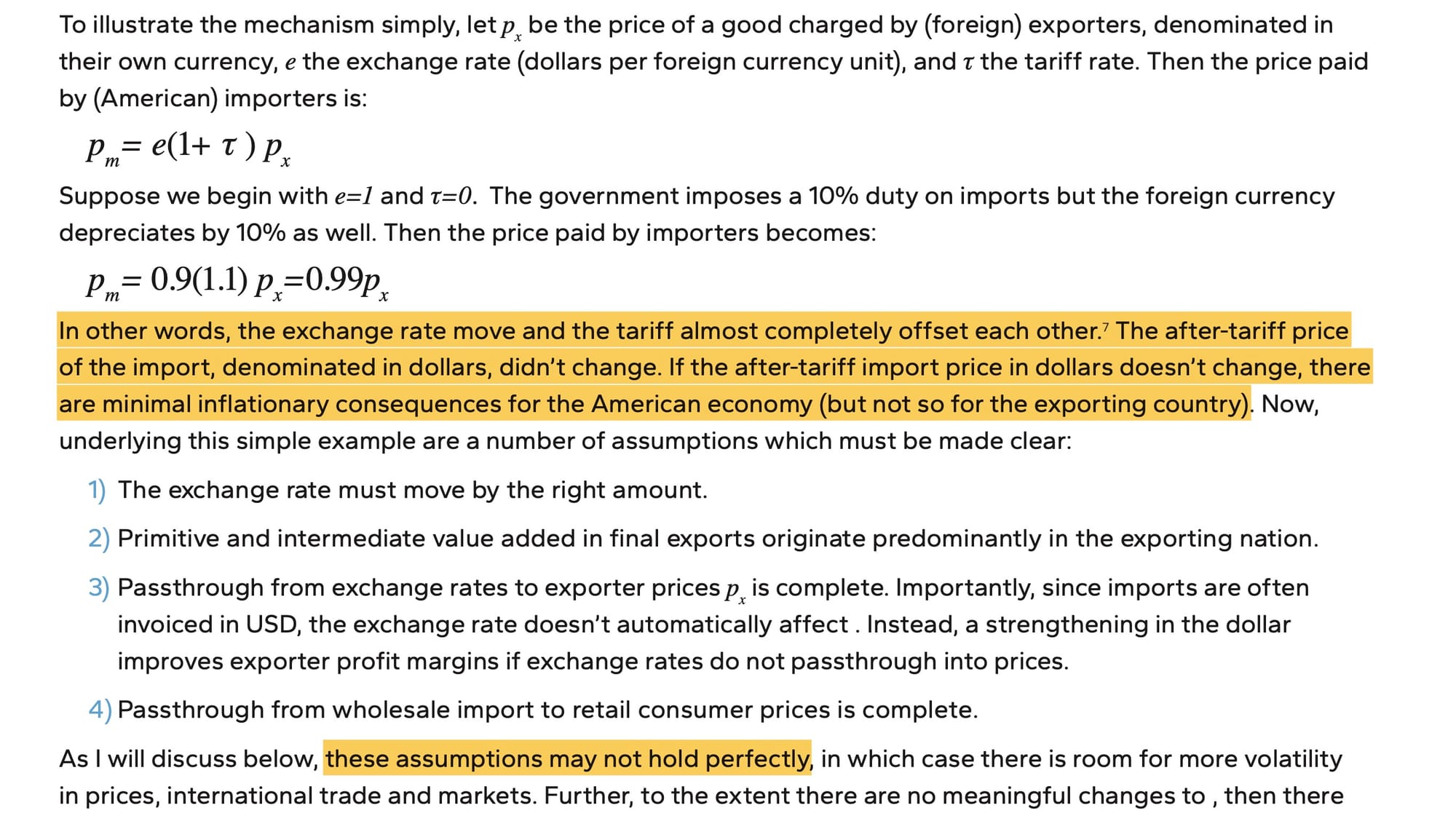
This is what Miran calls perfect currency offset. He says, “since the exporters’ citizens became poorer as a result of the currency move, the exporting nation ‘pays for’ or bears the burden of the tax, while the U.S. Treasury collects the revenue.” This is classic beggar-thy-neighbor economics, discredited by Adam Smith centuries ago but, you know, fuck it. Calling Miran a thinker is far too generous, he’s just telling the Orange King what he wants to hear, dressing naked imperialism in formulas.
This sort of magical math is endemic across the Trump administration. For example, their formula for calculating tariffs looks complicated, but the two variables (funny E and funny O) are randomly set to 4 and ¼. One fourth of four is one, and multiplying by one does nothing. The variables just cancel out. It’s a joke.
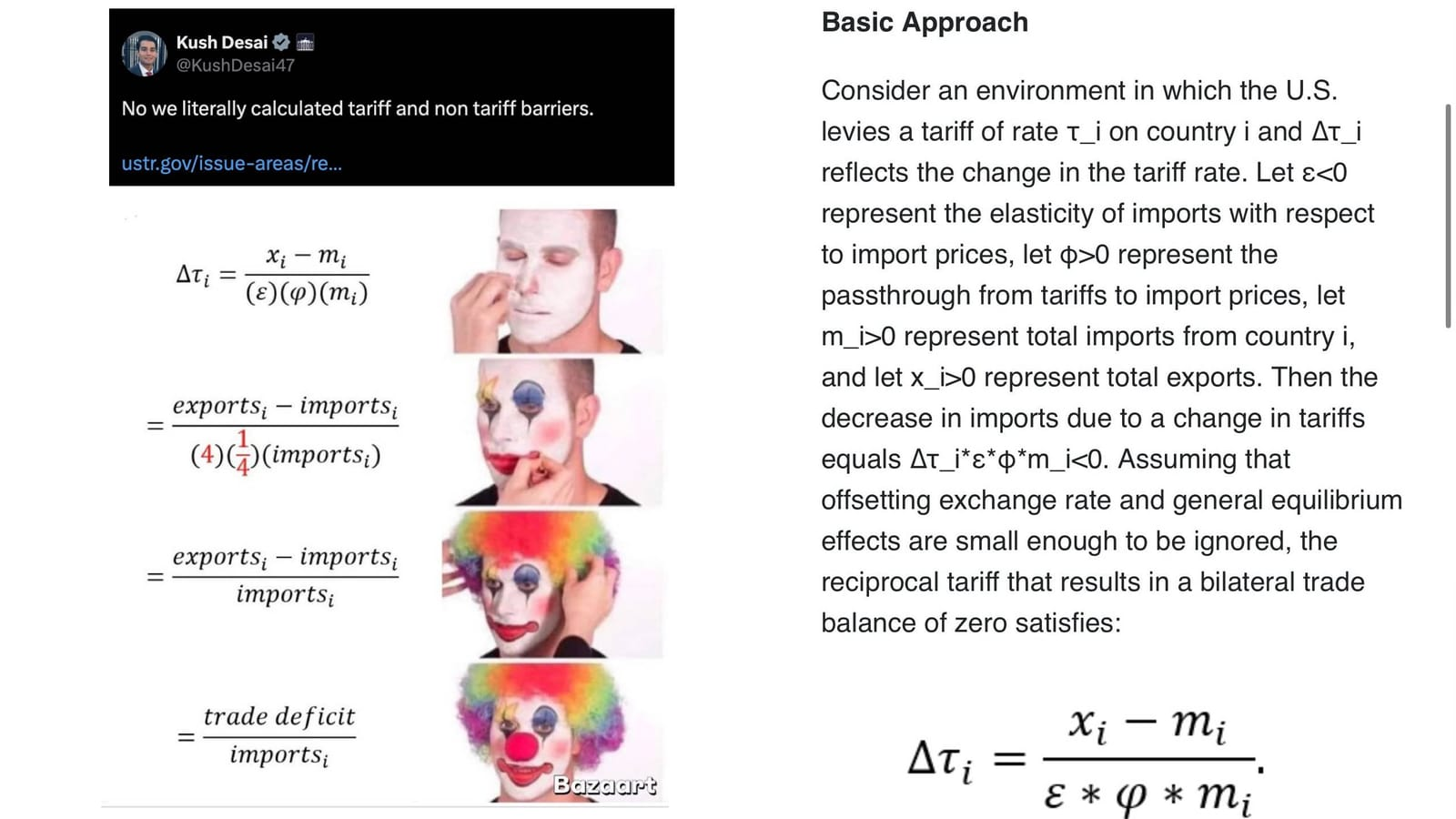
To be honest, this is fairly standard for western economics, which has a bunch of assumptions that are provably false (like rational actors, perfect competition, or even the separation of economics from other disciplines). Economics is maddest ‘science’, imagine if chemistry had a completely unproven periodic table and did experiments on entire human populations anyways, frequently killing them. That’s Economics 101.
In the ‘perfect’ scenario Miran describes, tariffs are non-inflationary because of the currency offset. American prices don’t change because foreign countries get deranged and the US Treasury gets money out of nowhere. Miran lists the tradeoffs here:
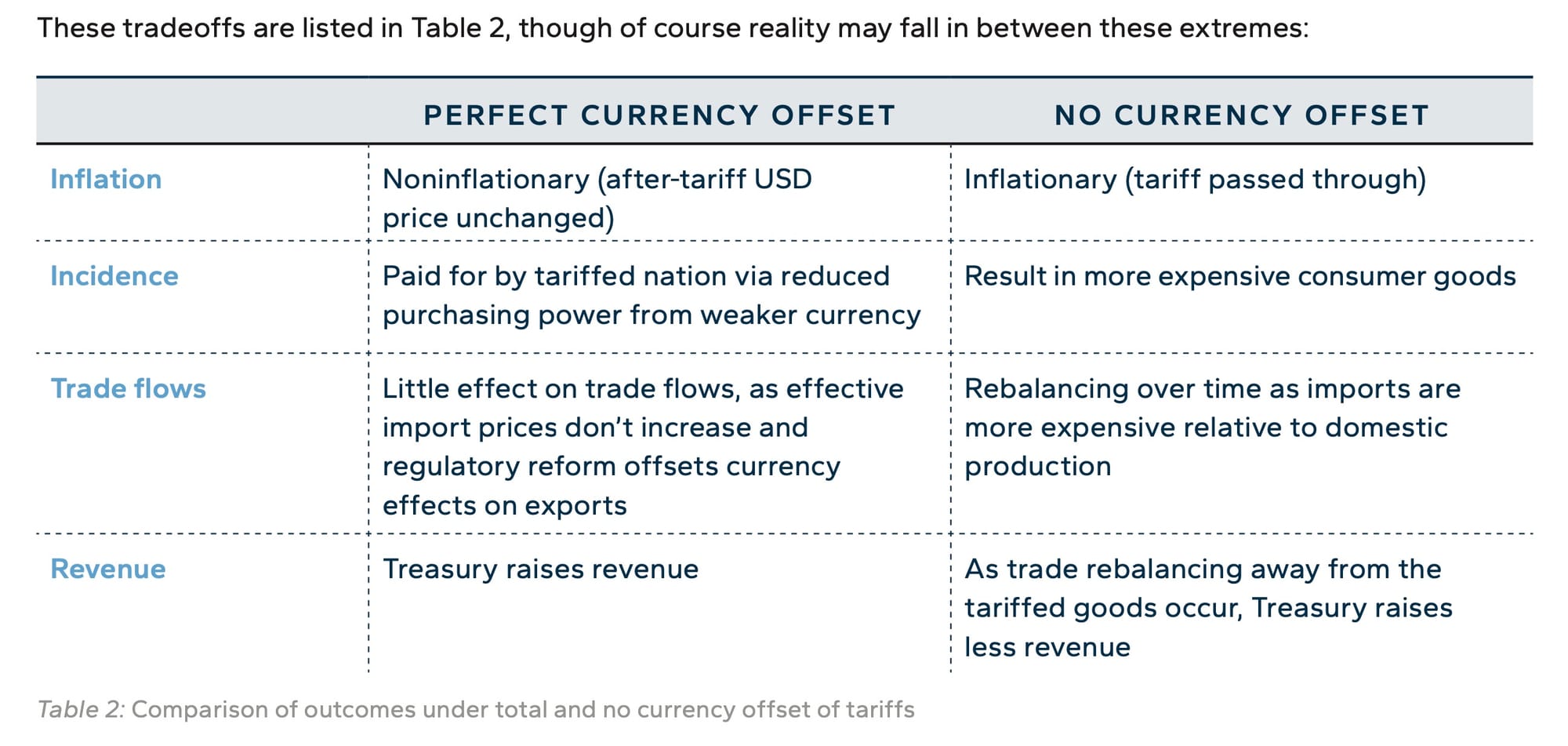
It’s fitting that this theory is called currency offset because it perfectly describes the rapper Offset’s experience at the Gucci store. Offset bought so much, usually with duffel bags of cash, that Gucci gave him a 30% discount (source: internet).

The idea is that even if America raises tariffs by 30%, they’ll get a matching 30% ‘discount’ because everyone else’s currency will depreciate that much. You theoretically dump all the costs abroad, and keep profits at home. Note that the part about reshoring manufacturing is somewhat coincidental. America still has no industrial policy and no state-led development (because that would be communism). This is still pure financialization, just with the finance guys running the government. The maths should just math on their own, without America doing real work or getting ready at all. Within a few days, however, this theory ran into practice and promptly exploded.
America’s initial tariffs on China were 34% but the Yuan has only depreciated less than 1%. Give it time I guess, but this is one of those weeks when decades happen, and it’s suddenly 2030. China has flying cars and zero fucks to give. China hit America with actually reciprocal tariffs, and America re-reciprocated, hitting China with 104% tariffs now, they’re trading blows before I can hit publish. Now how does the math math? How does the Yuan lose 104% of its value? China would have to send $1000 worth of goods to America for free, with an extra $40 in a red envelope as tribute (which Miran earnestly suggests).
Currency offset is already implausible, but it’s not mathematically possible at over 100% tariffs. Trump has eviscerated any economic entrail reading, he’s just shooting from the gut and doesn’t care what he hits. Miran is at least honest when he says, “In a broader sense, sanctions can also be perceived as a modern-day form of a blockade.” What Trump is doing against the whole world is an act of war, not just a trade war, as Warren Buffett has said. This is gunboat diplomacy without guns (currently being used to genocide Palestine) or boats (America builds only 0.1% compared to China’s over 50%) or even basic diplomacy. As China said via the Global Times,
China is an ancient civilization and a country of etiquette. The Chinese people value sincerity and trust as their core principles. We will not provoke troubles, but we never flinch when trouble comes our way. Pressuring and threatening are not the correct way to engage with China. We have taken, and will continue to take, firm measures to defend our sovereignty, security, and development interests.
China-US economic and trade relations should be based on mutual benefit and win-win cooperation. The US should align with the shared expectations of people from both nations and the people of the world, and, in light of the fundamental interests of both countries, stop using tariffs as a weapon to suppress China’s economy and trade, and stop harming the legitimate development rights of the Chinese people.
As the CPC has long said, China pursues win-win development (a la Adam Smith, really) but what America is doing under Trump is complete lose-lose. They’re shooting themselves with tariffs, and hoping that everyone else bleeds more.
Miran at least has the concept that there are trade-offs with trade, though he basically just ignores them because ‘boss said so’. Trump wants to have his cake and eat it too, and Miran, as a simpering sycophant, just dresses up his delusions in fancy formulae. Marie Antoinette at least offered people cake, whereas Trump just tells them to eat shit and be thankful for it.
The biggest trade-off is between being a reserve currency and running a trade surplus. You basically can’t do both. The US dollar is actually America’s main export. They make up liquidity as a service on computers and get real stuff in return. This is not an actual problem but has been the greatest opportunity in human history, which they just squandered. If America wanted to take care of its people and do manufacturing it could have done, how they spent their infinite money was a policy choice and they just chose wrong. Now they’re blaming everyone else, holding a gun to their heads and blubbering.
Trump is obsessed with reducing trade deficits but also wants the dollar to be the reserve currency. How do his sycophants square this circle? Well, Miran says this will be solved by punishments and ‘policies’. In short, the beatings will continue until morale improves. As Miran says,
Despite the dollar’s role in weighing heavily on the U.S. manufacturing sector, President Trump has emphasized the value he places on its status as the global reserve currency, and threatened to punish countries that move away from the dollar. I expect this tension to be resolved by policies that aim to preserve the status of the dollar, but improve burden sharing with our trading partners.
International trade policy will attempt to recapture some of the benefit our reserve provision conveys to trading partners and connect this economic burden sharing with defense burden sharing. Although the Triffin effects have weighed on the manufacturing sector, there will be attempts to improve America’s position within the system without destroying the system.
Trade policy is actually complicated and takes years, these guys are just getting ChatGPT to spit out spreadsheets and tariffing penguins. Miran’s white paper is called “A User’s Guide to Restructuring the Global Trading System” but it reads more like a cocaine user’s guide to perpetual motion. The fact is that the ‘Triffin effects’ Miran is talking about were discussed much more cogently 65 years ago, by Robert Triffin.
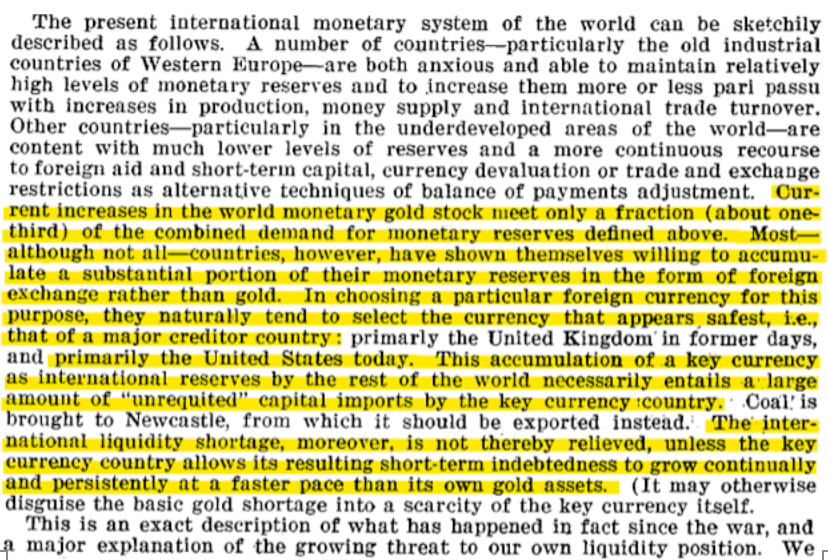
Triffin said was, “The accumulation of a key currency as international reserves by the rest of the world necessarily entails a large amount of ‘unrequited’ capital imports by the key currency country. Coal is brought to Newcastle, from which it should be exported instead. The international liquidity shortage, moreover, is not thereby relieved, unless the key currency country allows its resulting short-term indebtedness to grow continually and persistently at a faster pace than its own gold assets.”
Triffin said ‘requiting’ (ie balancing) the trade, would cause a Greatest Depression. Without liquidity, global finance would crash. Triffin said, “The restoration of overall balance in the US international transactions would put an end to this process and deprive the rest of the world of the major source, by far, from which the international liquidity requirements of an expanding world economy are being met currently in the face of a totally inadequate supply of monetary gold. This might trigger off tomorrow—as it did under very similar circumstance in the early 1930s—a new cycle of international deflation, currency devaluations, and trade exchange restrictions.”
Standing athwart history without reading it, you can see the Trump team doing exactly what Triffin warned against. They are trying to force currency devaluations through trade exchange restrictions, causing maximum volatility and shock. More sane hands like have proposed a super-sovereign currency (like Keynes aborted Bancor, or IMF SDRs) that could resolve Triffin’s Dilemma. This, for example, is from Dr. Zhou Xiaochuan, Governor of the People’s Bank of China, in 2009,
On a bipartisan basis, however, Americans are racist morons. As Biden’s Ambassador to China Nicholas Burns said, “We don’t want to live in a world where the Chinese are the dominant country.” They’d rather go murder-suicide with the world economic system and blow the whole thing up.
To be honest, you can see that America already hit the jaws of Triffin’s Dilemma in the 1970s and have just been jaw-jawing their way through ever since. Everything since going off the gold standard has been kicking this time bomb down the road. Trump is just saying this is the end of the road, where the can explodes.
Miran has a dim understanding of Triffin’s paradox in that he thinks it can be resolved by reasserting American sovereignty, ie because the Orange King says so. He thinks America can reset to a ‘Triffin equilibrium’ not by spending decades building infrastructure, educating its people, and growing productive capacity like China did, but by putting some numbers on a spreadsheet and calling it ‘Liberation Day’. Miran talks about when “global growth exceeds the reserve country’s growth for a long period of time” which has long been happening, but he has no answer for building up America’s economy in response. Instead, they just want to throw a wrench in everybody else’s economy, and get paid for it. This is how Miran describes his idea of ‘Triffin World’,
Such phenomena reflect what can be described as a “Triffin world,” after Belgian economist Robert Triffin. In Triffin world, reserve assets are a form of global money supply, and demand for them is a function of global trade and savings, not the domestic trade balance or return characteristics of the reserve nation. When the reserve country is large relative to the rest of the world, there are no significant externalities imposed on the reserve country from its reserve status. The distance from the Triffin equilibrium to the trade equilibrium is small. However, when the reserve country is smaller relative to the rest of the world—say, because global growth exceeds the reserve country’s growth for a long period of time—tensions build and the distance between the Triffin equilibrium and the trade equilibrium can be quite large. Demand for reserve assets leads to significant currency overvaluation with real economic consequences.
In Triffin world, the reserve asset producer must run persistent current account deficits as the flip side of exporting reserve assets. USTs become exported products which fuel the global trade system. In exporting USTs, America receives foreign currency, which is then spent, usually on imported goods. America runs large current account deficits not because it imports too much, but it imports too much because it must export USTs to provide reserve assets and facilitate global growth. This view has been discussed by prominent policymakers from both the United States (e.g. Feldstein and Volcker, 2013) as well as China (e.g. Zhou, 2009).
What Miran misses, in his maudlin America myopia, is that no one is forcing America to import too much, just as no one’s forcing them to do fentanyl. America made policy choices to legalize stock buybacks and corruption instead of doing anything useful. They chose usury. America had literally all the money in the world and no idea what to do with it. These were all political choices, not economic consequences. America eviscerated the very idea of having a state in the 1980s (that would be communism), which leads precisely to the state they’re in (the collapse of capitalism).
America whinging now is like someone who won an inheritance from their suicidal European uncles, spent it all on drugs, gambling, and booze, and then blames it all on the inheritance. Oh, what is this horror, the consequences of my own actions, must be everybody else’s fault. America is just the latest in a long line of murdering, thieving imperialists, and the only relief is that suicide runs in the family.
Triffin’s Dilemma is based on the idea of avoiding a depression, but Miran’s Mirage is the idea of jumping into the void head first and alone. As he said, “Unilateral solutions are more likely to have undesired side effects, like market volatility. Multilateral solutions may have less volatility, but entail the difficulty of getting trading partners onboard, which curtails the size of the potential gains from reshaping the system.” America went fully unilateral with these tariffs. They decided to—as gambler’s have said since time immemorial—to just roll them bones. This leads to the white-knuckle ride traders are on now.
China is left as the voice of reason, saying, “Development is a universal right of all nations, not the privilege of a few. There are no winners in trade wars or tariff wars, and protectionism offers no way out. All countries must uphold genuine multilateralism, jointly oppose all forms of unilateralism and protectionism, safeguard the international system with the United Nations at its core, and protect the multilateral trade framework centered on the WTO.” Unfortunately, they’re talking into the void now.
America has flown two sets of tariffs into the center of world trade and that shit is going down. It’s the demolition of a bankrupt casino, something Donald Trump is familiar with. He’s one of the few businessmen since Bugsy Siegel to lose money on casinos, and now he’s blowing up the biggest money-printing machine of all time. Trump lights the match, but the slaving, stealing American economy was always rigged, and it was always rigged to blow. As the delusional psychopath Nicky Santoro said in the intro to the film Casino, “Matter of fact, nobody knew all the details. But it should have been perfect… But in the end, we fucked it all up.”
Miran’s white paper:
and something far less stupid:

 Lateo.net - Flux RSS en pagaille (pour en ajouter : @ moi)