 Connexion


Euro-American Zionism (Jewish and Christian) has killed millions in West Asia, devastated the region, and it is the motor behind the Gaza Genocide. But Israel itself is under threat of falling pray to the deadly logic that birthed the state in the first place.
Today we are holding a panel discussion on what makes Zionism such a dangerous and ultimately even self-negating force.
I‘m joined by 3 world class academics: Professor Yakov Rabkin of Montreal University, Professor Manuel Ramos of the University Institut of Lisbon, and Professor Jeffrey Sachs of Colombia University.
Looking back one month. In this fourth episode of ATTRITION Pod, Ammar Kazmi and journalist Ollie Vargas discuss Bolivia’s presidential elections, the fallout since the 2019 coup against Evo Morales and splits in the MAS. At stake are not just Bolivia’s vast lithium reserves, but also the future of the Latin American left, its alliances, and its role in global struggles.
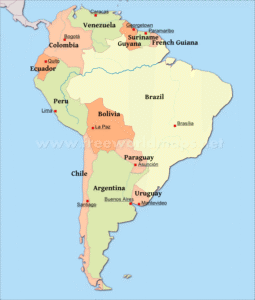
Added Notes. Here is the map of South America. We basically have Brazil left over on this vast continent. Bolivia lies between Ecuador, Peru, Chili, Argentina – now all of them Western influence. Colombia and Venezuela are under attack. The rest are not very important.
Rare Earth Export Controls, Port Fees on Chinese vessels, Tariffs, Grabbing Nexperia – summary
We have to note that none of this comes out of the blue. China has faced only unwillingness from U.S. trade negotiators and a series of what we can only call unfriendly actions, designed to coerce. The time is over. What is happening here is a slew of actions by China that confirms what I’ve intuited since the beginning of the tariff onslaught. If it gets too difficult to trade, there will not be trade. At this time China seems to be at that point. They don’t care any longer about trade with the U.S.
The Chinese MOFCOM spokesperson remarked:
Rare Earth Export Controls: Directly aimed at military activity and weapons manufacturing, to better defend world peace and regional stability.
These export controls are directly aimed at weapons manufacturing and are intended to reduce military conflicts and support non-proliferation.
They are not export bans. Licenses for eligible applications will be granted.
China announced these controls before implementing them.
These export controls will support the security and stability of global industrial and supply chains-
China’s national security is mentioned and this is easy to see. They won’t sell products to those that manufacture weapons intended to threaten China.
Port Fees on Chinese Vessels: This is a confusing conglomeration of payment for tonnage on Chinese-built vessels, partially Chinese-built vessels, and generally a game of confusion.
MOFCOM states:
Particularly since the China-U.S. economic and trade talks in Madrid in September, the U.S., in just 20 days, has introduced a string of new restrictive measures targeting China. It has put multiple Chinese entities on the Entity List and Special Designated National List; arbitrarily expanded the scope of control over businesses with the Affiliates Rule that affects thousands of Chinese companies; and persisted with the implementation of Section 301 measures targeting China’s maritime, logistics and shipbuilding industries in disregard of China’s concerns and goodwill. The U.S. actions have severely harmed China’s interests and undermined the atmosphere of bilateral economic and trade talks, and China is resolutely opposed to them.
The Spokesperson notes that the U.S. has shown a negative attitude and willfully persists in implementing those measures, issuing a notice on October 3 setting out the specific requirements for imposing fees on Chinese vessels.
In response to U.S. actions, China took countermeasures and decided to charge special port fees on U.S.-linked vessels. China describes these countermeasures as necessary acts of passive defense.
Tariffs: Willful threats of high tariffs are not the right way to get along with China. … If the U.S. insists on going the wrong way, China will surely take resolute measures to protect its legitimate rights and interests.
The MOFCOM Statement: http://english.mofcom.gov.cn/News/SpokesmansRemarks/art/2025/art_c202dcc0433d476db52b1e7f7fe53926.html
Dutch Grab of Nexperia: The Dutch government said on Sunday that it has made a “highly exceptional” decision to intervene in Nexperia, a subsidiary of Chinese company Wingtech, citing concerns that it could “pose a risk to Dutch and European economic security.” On September 30, the Dutch Ministry of Economic Affairs issued an administrative order restricting the business decisions of Nexperia and its affiliated entities, effectively depriving Chinese shareholders of their standard control. Wingtech subsequently issued a statement, expressing a strong protest against such discriminatory treatment targeting Chinese-funded enterprises. It is evident to anyone with clear judgment that the Dutch government is seriously harassing a chip company controlled by Chinese enterprises under the pretext of a fabricated “national security” concern.
In the early stages of capitalism, some countries relied on violence and colonial plunder to accumulate primitive capital, even fostering within their own cultures the misguided historical notion that “plunder brings wealth.” In today’s geopolitical context, the Dutch government, under the pretext of “supply chain security,” has imposed excessive interference on Chinese enterprises and then cloaked its asset seizure under a façade of legality – a seamless sequence of actions that inevitably evokes memories of certain dark chapters in this country’s history. It is no wonder that some have wryly observed that
a few Western countries now treat “national security” as a privateering license, a reflection of “colonial genes” awakening in the 21st century.
Global Times editorial: https://www.globaltimes.cn/page/202510/1345566.shtml
It is clear from trade numbers that China’s trade is increasing with the rest of the world, while trade with the US is decreasing. Professor Wolff aptly describes the situation, stating that the trade environment in the US does not encourage trade but rather discourages it.
The decrease is not only in trade numbers.
US treasuries held by China are reducing.
De-dollarization is increasing.
So it is a 3 front wall of pressure, epitomized by footage of U.S. soldiers standing in food distribution lines.
China has chosen an optimum moment to rebalance power.
The tweets and twitters are interesting. One person says .. Do Your Chrismas Shopping Now, and here is another illustrating the real effect on U.S. Business.
For those of you who think this tradewar is not serious…. pic.twitter.com/Bz0mhnCw5i
— The key to success is documentation. (@VietVantage) October 13, 2025
I must hold to my point that if trade is made too complicated, it will not happen. As Russia is fighting NATO, China has entered the arena with a view to an economic decapitation strike to put the U.S and the collective West in the place of normal countries without exorbitant privilege. China clearly feels strong enough now, as evidenced by its actions at the WTO, where, for trade advantages, they are no longer insisting that it is a developing country.
Even trade numbers and reported statistics are difficult these days, as the effect of de-dollarization is not easy to measure. How do the IMF and World Bank count that which is not there? Even Africa has now floated its own ratings organization, and Russia and India are doing their business in Yuan. It is not only ‘that which is not there’, it is also new business being done, and the values are not flowing through the usual channels for statistical reporting. For myself, I am watching trends and not specifically numbers. The change in the world is growing massive, and one of those trends is that China is creating its own certification system for commercial aircraft, for example. This period is truly historical, with comprador countries lacking agency, madly spinning between the new large poles being formed. One example is that we are seeing more and more media that Turkey is wavering between west and mulitpolarity.
There are some numbers which on the face of it and standing alone, tells the story. In September alone, China’s exports grew by 8.3%, the fastest pace in months.
Shipments to the US fell by 27%. Exports to the EU rose more than 14%, exports to ASEAN nations were up by almost 16%, and exports to Africa rose by 56%.
Direct shipments to the US now make up barely 10% of China’s total exports. The US is learning a harsh, obvious truth that it should have learned a long time ago. The world is bigger than the United States, and the United States is no longer essential.
Hold onto your hats!
This is getting more attention. The Indians are furious: blowing up another India / China (let us say it politely), deep difference of opinion. Arnaud Bertrand says:
I have to say, there’s something immensely ironic about the Dalai Lama arguing his reincarnation should be determined by a tax-exempt Swiss foundation incorporated in Zurich (https://dalailamafoundation.org/who-we-are/the-foundation/), while Beijing insists on maintaining the traditional centuries-old Golden Urn selection process.
And the even bigger irony is that everyone will doubtlessly denounce China for “destroying Tibetan traditions and culture” for doing so.
The background is that the Dalai Lama has appointed this Swiss foundation to choose the next Dalai Lama. (The joke is that it is all perfect, the SeeEyeAi will choose the next Dalai Lama, in line with tradition.)
In stark opposition, China says that the selection of the next Dalai Lama must be according to the ancient process, where names are put into a golden urn and selected that way.

The Chinese position according to the Chinese Ambassador to to India:
The practice of Living Buddha reincarnation has continued over 700 years, and has formed rigorous religious rituals and historical conventions.
— Xu Feihong (@China_Amb_India) July 2, 2025
The practice of Living Buddha reincarnation has continued over 700 years, and has formed rigorous religious rituals and historical conventions.
The reincarnation of the Dalai Lama, the Panchen Erdeni and other grand Living Buddhas must go through the Golden Urn lottery procedure, and selected candidates would be subject to approval by the central government of China.
The 14th Dalai Lama himself was searched for in strict accordance with religious rituals and historical conventions after the passing of the 13th Dalai Lama, and enthroned after being granted exemption from the lottery with the then central government’s approval.
The government of the People’s Republic of China implements a policy of freedom of religious belief. It protects the tradition of reincarnation of Living Buddhas in accordance with the law. The reincarnation of the Dalai Lama must follow the process that consists of search and identification in China, lot-drawing from the Golden Urn, and central government approval, and comply with religious rituals and historical conventions as well as Chinese laws and regulations.
It is of course a wonderfully romantic view to think that some highly skilled living Buddha is somewhere to lead us all into a state of knowledge and Nirvana. This idea flourishes, until one does the homework and the reasearch and you find out that this Living Buddha is chosen either by a Swiss Foundation legally incorporated in Zurich, or by lottery, out of a Golden Urn.
Huawei chips are already the real deal for every Chinese company which is following the new Beijing-defined direction to reduce any reliance on American technology
By Pepe Escobar at Sputnik.
Late next month, Huawei will be testing its new powerful AI processor, the Ascend 910 D, even as by early May the previous 910C will start to be mass-delivered to scores of Chinese tech companies.
These serious breakthroughs are the next chapter of Huawei’s drive to counter Nvidia’s global monopoly in graphics processing units [GPUs]. The Ascend 910D is supposed to be more powerful than Nvidia’s extremely popular H100.
Huawei is pulling no punches in its race to manufacture a new generation of processors. Huawei has collaborated with SMIC – China’s largest semiconductor foundry – to apply Deep Ultraviolet Lithography (DUV) on what was previously only possible on EUV (Extreme Ultra-Violet technology). Once again, Huawei and SMIC defied the proverbial American “experts” with creative engineering solutions.
Huawei arrived at fabricating 5nm chips with DUV even as the process is more expensive than with EUV. If Huawei had access to EUV they would be already manufacturing 2-3nm chips. That will come, in short time, as both China and Russia, under permanent US high-tech blockade, must by all means develop their own EUV technology.
Shanghai geeks are convinced that Huawei will switch on 6G networks before the end of the decade. Their current breathless drive is not just aimed at the smartphone front – where Huawei is peerless; the new Huawei Mate 70 Pro + is by far the absolute top smartphone in the world, running on Harmony OS. Huawei is looking at cloud computing, AI and enterprise servers – and to become no less than the core player in the AI infrastructure race.

Ditching Any Reliance on American Technology
Earlier this month, Huawei introduced the CloudMatrix 384, a system connecting 384 Ascend 910C chips. The tech word in Shanghai is that this configuration, under certain conditions, and of course consuming much more power, already outperforms Nvidia’s flagship rack system – which is powered by 72 Blackwell chips.
Meanwhile, Huawei’s Kirin X chip is targeting the PC market, offering stiff competition to Apple, AMD, Intel and Qualcom while Harmony OS plus removes the necessity of using US software such as Microsoft and Android.
Shanghai geeks swear that China essentially doesn’t need to beat Nvidia or other US chips developers. After all, China already has the largest consumer market in the world – by volume and by value. If a parallel tech universe is the likely result of the Trump Tariff Tizzy (TTT), so be it. China already controls over 60% of the global gadget consumer market.
Kirin X may not – yet – match the power of Nvidia’s H100 GPUs. But Huawei chips are already the real deal for every Chinese company which is following the new Beijing-defined direction to reduce any reliance on American technology.
All of the above naturally brings us to the enormous AI elephant in the (digital) room: Nvidia.
A recent book, The Thinking Machine: Jensen Huang, Nvidia, and The World’s Most Coveted Microchip, is quite helpful to track not only the personal story of CEO superstar Huang, a Taiwanese who played the American Dream to the hilt and became a tech multi-billionaire, but Nvidia’s enviable tech accomplishments.
Huang does not interpret AI as emergent machine superintelligence, and firmly dismisses any direct analogy to biology. For this all-round pragmatist, AI is merely software – running on hardware that his company sells for a fortune.
Still, Nvidia has ventured into virgin territory way beyond the American biz-tech Valhalla, complete with holding the most valuable stock on the planet: arguably, when it comes to AI, Nvidia unveiled a new phase of evolution.
It’s crucial to understand how Huang sees China. It is indeed a key market for his AI chips – and he wants to keep selling them in droves. Trump’s tariffs though make sure that won’t happen.
And that’s what moved Huang to ditch his proverbial leather jackets and don a crisp business suit for a strategic visit to Beijing, where he affirmed the sacred importance of the Chinese market, whatever the new Trump-dictated gimmicks.
By 2022, the China market represented 26% of Nvidia’s business; this year, it has fallen to 13%, because of euphemistic “technology export controls”.
The problem is the US government, already by 2022, under the previous automatic pen administration, had blocked sales to China of advanced A100 and H100 chips. Nvidia started selling modified versions – and even after the ban chips continued to arrive in China. By June 2023, it was easy to find A100s for double their price in the black market in Shenzhen.
Huang is convinced that “no AI should be able to learn without a human in the loop” – even as he admitted, two years ago, that “reasoning capability is two or three years out”. Translation: according to Huang AI will start thinking for itself within the next few months.
Even as Nvidia prepares to invest billions of dollars to build AI supercomputers in Texas, the Chinese essentially are not losing any sleep on “thinking AI”: their focus is extremely practical, to conquer not only the Chinese market but also the supply chains of most of Eurasia.
The US National Security Council has concluded that it’s too dangerous for China to buy Nvidia’s high-end chips, even the H20 – designed for the Chinese market. Huawei, anyway, already produces chips somewhat comparable to the H20.
Huang is losing his sleep because, essentially, Nvidia is losing the immense Chinese market to Huawei – with Trump’s direct input. Nvidia has tens of thousands of H20s specially designed for China which they simply cannot sell. Each chip cost between $12,000 to $20,000.

How China Is Opening a Digital “Pandora’s Box”
Huawei’s new drive is yet another example of Chinese will capable of staring down any challenge – based on indigenous talent, tech expertise and national pride. The record, even before Trump 1.0 sanctions, shows that Huawei does eat massive uphill battles for breakfast. In fact Ascend in many aspects was ahead of Nvidia as early as in 2019 – and that’s why two different US administrations banned it.
China is already light years ahead of the US on chip research. Chinese universities amass most places in the global Top Ten for published papers on semiconductors and on citations – a distinction shared, among others, by the Chinese Academy of Sciences (number one), Tsinghua University (one of China’s top two universities), the University of Electronic Science and Technology of China (number four), and Nanjing, Zhejiang and Pekin Universities.
Two weeks ago in Shanghai I first heard that Huawei would catch up with US semiconductor giants in maximum two years. Now, after the announcement of the Ascend 910D, the buzz shifted to only one year for China to overtake Nvidia and develop better lithography machines than the ones currently produced by ASML.
And the debate is fast switching to how far Huawei will be able to go within the next 2 to 3 years.
In several aspects we are already in the early stages of a US-China tech decoupling. For years Nvidia has dominated the AI hardware space. Their GPUs are the brains behind most contemporary advanced AI. The H100 chip is the gold/platinum standard for AI infrastructure worldwide. Nvidia’s chips had huge demand from Chinese tech giants – Alibaba, Tencent, Baidu, Bytedance.
Soon that may not be the case – and that goes way beyond Nvidia’s certified loss of market share in China. China is now all out focused on building a successful, self-sufficient AI hardware ecosystem. The coup de grace will be to restrict the export of all rare earth minerals to the US. Huaweii then will pull up in no time.
Everyone remembers how DeepSeek R1 wiped out over $1 trillion from Wall Street only three months ago. DeepSeek R2 will be released soon; training was a whopping 97% cheaper than OpenAI.
And training happened on Huawei’s Ascend. No Nvidia.
Quantum Bird, a world-class physicist formerly with the CERN in Geneva, puts everything in much needed context. He stresses how indigenous chip development by China – and in a near future, Russia and probably India – is “multi-faceted; what we are observing are the initial stages of a redefinition of the notion of recognizing patterns and machine learning, technologies that are popularly referred to as ‘AI’ by the media.”
Nvidia chips, Qantum Bird remarks, are indeed “computational beasts”, but they work better around “processing models and workloads typical of ‘AI’ models developed by Western scientists.” DeepSeek’s development, on the other hand, showed a transgression of established models: “The possibilities opened for performance leaps are huge, even using relatively modest hardware, with alternative approaches based on advanced math and different calculus flows.”
In a nutshell: “This is the Pandora’s box that Nvidia now fears the Chinese may have opened”. And that totally ties in with Huang’s red alert, prompting his visit to Beijing.
We may be heading indeed towards a serious tech decoupling. Or as Quantum Bird frames it: “A technological and scientific divergence medium and long-term. If the architectures that emerge from these developments are incompatible when it comes to their usage on specific ‘AI’ models, Nvidia will lose its global monopoly and will become just a company reduced to a corporate/scientific Western niche.”
Even as Huawei, from its privileged base in the Chinese market, will go on to win most markets across the Global Majority – from BRICS to BRI.

 Lateo.net - Flux RSS en pagaille (pour en ajouter : @ moi)