 Connexion


Dans cette nouvelle édition, « Douanes USA : Face aux trafiquants » met en avant les efforts déployés par les douanes et la protection des frontières américaines dans leur lutte contre les trafiquants. Ces agents tentent d’empêcher l’introduction de stupéfiants, d’armes à feu et de marchandises illicites aux États-Unis. Des opérations à haut risque menées le long de la côte ensoleillée de Porto Rico aux saisies effectuées dans les principaux aéroports et ports maritimes de la côte Est, cette série offre un aperçu inédit de la lutte visant à empêcher la contrebande de marchandises dangereuses sur le territoire américain.
Plongez dans un monde où chaque remède peut faire la différence entre la vie et la mort. Cette série révèle les méthodes souvent spectaculaires et surprenantes utilisées par les civilisations anciennes pour combattre les maladies, les épidémies et les blessures. Des archéologues mettent au jour des traitements oubliés, allant des présages, onguents et bains de vapeur aux saignées, antidotes toxiques et trousses médicales de pirates.
Cette série suit des équipes d'archéologues venus du monde entier dans leur quête des trésors perdus de la Grèce antique. Du Parthénon à Athènes aux cités de la guerre de Troie, en passant par l'héritage de personnages légendaires tels qu'Alexandre le Grand, de nouvelles fouilles mettent au jour les merveilles de la Grèce antique, une civilisation qui a façonné notre monde.
La catastrophe de Tchernobyl est le pire accident nucléaire de l'histoire. Elle rejette dans l’atmosphère une quantité de matières radioactives plus de 400 fois supérieure à celle libérée par la bombe atomique d’Hiroshima. À l'occasion du 40ᵉ anniversaire de la catastrophe de Tchernobyl, cette série documentaire retrace toute l’histoire de l’accident, de la fusion du cœur du réacteur aux tentatives des autorités soviétiques d’en dissimuler l’ampleur, jusqu’à la guerre actuelle en Ukraine qui a transformé la zone d’exclusion nucléaire en champ de bataille.

Révélations, prédictions et présages funestes… L’histoire de l’humanité regorge de personnages mystérieux dont on dit qu’ils possèdent une vision surnaturelle de l’avenir. Des forces qui dépassent notre compréhension ont-elles doté ces individus extraordinaires du don de prophétie, ou existe-t-il une explication rationnelle à ces visions ? Cette série documentaire captivante mêle reconstitutions dramatiques, images spectaculaires et entretiens avec un panel d’experts pour présenter trois histoires fascinantes par épisode. De la Chine antique à l’Europe médiévale en passant par la Virginie-Occidentale d’aujourd’hui, certains cas s’avèrent être des supercheries élaborées, d’autres restent étrangement inexpliqués. Mais tous révèlent un désir humain perpétuel de voir au-delà du voile du temps, avec des répercussions profondes sur l’histoire.
Un drame peut frapper n’importe quand, n’importe où. Les experts s’appuient sur l’ensemble des preuves disponibles, afin de reconstituer ces catastrophes grâce à des images de synthèse 3D de pointe. Ils les dissèqueront, les exploreront en profondeur et arrêteront le temps pour en révéler les causes cachées, et parfois surprenantes : un raccordement desserré, le mauvais type de colle, un test de sécurité qui tourne mal. Cette série va tout vous révéler.
Explorez 125 ans d'histoire de l'aviation en découvrant comment des avions emblématiques ont radicalement transformé notre monde et en dévoilant l'ingénierie ingénieuse qui a contribué à leur succès. Le public pourra voir des avions tels que le Concorde, le Boeing 747 et le Supermarine Spitfire comme jamais auparavant. Leurs histoires prendront vie à l'écran grâce à des interviews d'historiens, de pilotes et d'experts en aviation, des images d'archives rarement vues et des modèles schématiques en 3D.
Lorsque 33 mineurs se retrouvent piégés à plus de 800 mètres sous terre dans le nord du Chili, le monde entier retient son souffle. Pendant 69 jours, une course contre la montre s'engage pour les secourir, tandis que les hommes luttent pour leur survie. À travers des archives inédites et des entretiens poignants avec les survivants et les sauveteurs, cette série documentaire retrace l'histoire de l'une des catastrophes les plus marquantes de l'histoire.

Quelqu’un aurait-il pu survivre à la destruction de Pompéi ? Tom Hiddleston mène une enquête inédite sur les dernières 24 heures avant l’éruption du Vésuve, en alliant les dernières avancées de l’archéologie à sa propre intuition. Il cherche à savoir ce qui est réellement arrivé aux personnes ensevelies sous les cendres, en suivant le parcours d’un adolescent, d’une femme d’affaires et d’un soldat confrontés à des choix impossibles dans une course contre la montre.
Jon Favreau, réalisateur du “Roi Lion”, et Mike Gunton, producteur délégué chez BBC Studios, nous dévoilent l’histoire extraordinaire d’un lionceau prénommé Kio et son périple exceptionnel pour devenir roi. Filmée sur quatre ans, cette véritable épopée mêlant famille, espoir et courage suit Kio tout au long de sa vie, de ses premiers pas encore fragiles à son ascension au rang de chef puissant. Au fil de son périple marqué par la perte, l’exil et des rivaux redoutables, il devra se battre pour survivre. Alliant narration cinématographique et réalisation inédite consacrée au monde animal, cette série retrace le parcours initiatique d’un lion et l’ascension remarquable d’un roi.
« 11 septembre : Destins croisés » retrace l’histoire des pires attentats terroristes qu’aient connus les États-Unis, qui ont coûté la vie à 2 977 personnes. Malgré l’horreur de cette journée, certains témoignages nous apportent un message d’espoir fort. Cette série inédite met en lumière les récits de ces survivants qui ont tissé des liens profonds avec d’autres personnes au cœur de la tragédie et qui souhaitent aujourd’hui se retrouver. Beaucoup d’entre eux se revoient pour la première fois, poussés par le besoin de dire merci ou de transmettre un message, tandis que d’autres souhaitent poser des questions jusqu’alors restées sans réponse. Réalisée en collaboration avec le Mémorial et Musée du 11 septembre à l’occasion du 25e anniversaire, la série oscille entre récit de cette journée (du premier crash à l’un des derniers sauvetages) et retrouvailles émouvantes, reflet des liens établis ce jour-là et qui ont perduré pendant un quart de siècle.

Quelqu’un aurait-il pu survivre à la destruction de Pompéi ? Tom Hiddleston mène une enquête inédite sur les dernières 24 heures avant l’éruption du Vésuve, en alliant les dernières avancées de l’archéologie à sa propre intuition. Il cherche à savoir ce qui est réellement arrivé aux personnes ensevelies sous les cendres, en suivant le parcours d’un adolescent, d’une femme d’affaires et d’un soldat confrontés à des choix impossibles dans une course contre la montre.
Antoni Porowski a fait ses premières armes à la télévision dans le programme Queer Eye, qui a clôturé sa dixième et dernière saison au début de l'année. Antoni Porowski, cuisinier autodidacte, a parcouru le monde dans la série Les racines du goût, produite par National Geographic, en compagnie d'invités célèbres. Il se lance aujourd'hui dans une nouvelle quête culinaire avec la série documentaire Les plus belles destinations avec Antoni Porowski, dans laquelle il explore des joyaux cachés et vit des expériences uniques dans des villes comme Paris, Londres, New York et Mexico.
Quelle était votre première aventure ?
C'était probablement un road trip au cap Hatteras, en Caroline du Nord. Il y a là-bas un endroit appelé Canadian Hole où se rendent les véliplanchistes canadiens, comme mon père. On louait parfois une maison dans ce village de pêcheurs où les maisons étaient construites sur pilotis pour résister à la saison des ouragans. D'autres fois, on logeait dans un motel pour pêcheurs car on avait un chien et les chiens n'étaient pas admis dans beaucoup d'hôtels. C'était très rétro, les pêcheurs y vidaient leurs poissons.
Qui est la personne la plus marquante que vous ayez rencontrée ?
Lorsque mon père a pris sa retraite, nous avons fait un voyage père-fils en Pologne, d'où nous sommes originaires. Nous sommes allés à Zakopane, dans les Tatras, une région très appréciée pour la randonnée en été et pour le ski en hiver. Nous avons rencontré une vieille dame qui vendait de l'oscypek, un fromage fumé qui sent fort. C'était une grand-mère adorable et souriante mais aussi très directe, qui nous disait quoi faire. Elle a négocié avec mon père, qui a fini par acheter cinq fois plus de fromages qu'il n'en voulait. Elle nous a vraiment marqués.
Où aimez-vous manger quand vous rentrez chez vous, à Montréal ?
Lorsque mon compagnon, qui est aussi Polonais, est venu à Montréal pour la première fois, je l'ai amené dans mon vieux repaire, le Stash Café, un restaurant polonais où mon père, ma tante et moi-même avons tous travaillé. Il est décoré de ces magnifiques affiches de Tamara de Lempicka [une peintre Art déco polonaise], de vieux bancs d'église, de suspensions rouges... Ça me rend vraiment nostalgique. Quand j'étais petit, leurs feuilles de chou farcies et leurs pierogi à la viande étaient mes plats préférés. Comme cela prend beaucoup de temps à préparer, on n'en mangeait pas vraiment à la maison.
Parlez-nous du tournage des Plus belles destinations avec Antoni Porowski.
Les émissions de voyage ne manquent pas mais je pense que, vu la situation actuelle dans le monde, cette série est formidable. Que l'on prévoie un voyage pour s'évader un peu ou que l'on veuille simplement rêver un peu. Nous avons tourné à Paris, à Londres, à Mexico et à New York. Nous avons très vite compris, que ce soit en rencontrant un bénévole au marathon de New York ou la cheffe Elena Reygadas à Mexico, que ce sont toujours les histoires humaines qui comptent ; ce sont ces personnes qui font vivre ces villes.
Qu'avez-vous le plus apprécié à Londres ?
C'est une ville qui déborde d'énergie et il y a tellement de choses à faire que l'on peut se sentir submergé (c'est à ce moment-là que j'ai instinctivement envie de toucher de l'herbe). Nous avons tourné aux jardins de Kew, l'un des endroits abritant l'une des biodiversités les variées au monde et un véritable havre de bien-être. Je me suis occupé des nénuphars et j'ai fait du yoga dans la serre Temperate House.
Quel est l'endroit où vous pourriez retourner encore et encore ?
L'idée selon laquelle « Paris est toujours une bonne idée » est vraie. Bien que ce soit une ville très cosmopolite, il y a chez les Français quelque chose de vraiment décontracté. Mais en tant que New-Yorkais habitué à marcher vite partout, il m'a fallu un certain temps pour m'y faire. C'est une ville chargée d'histoire et j'adore ses marchés, qu'il s'agisse de nourriture ou de mobilier. J'y suis allé récemment avec mon compagnon et nous nous demandions quoi acheter pour le dîner. Nous avons fini par acheter une quantité incroyable de fromages, deux baguettes et de la confiture, que nous avons mangés en regardant la télé française dans notre lit. Nous nous sommes sentis un peu mal le lendemain mais je n'avais jamais mangé de gruyère aussi bon.
Quelle est l'expérience la plus difficile que vous ayez vécue en voyage ?
Une fois, j'ai atterri à Cuzco, au Pérou, et le plus grand défi a été l'altitude. Des accompagnateurs aidaient les voyageurs à récupérer leurs bagages, les niveaux d'oxygène étaient tellement bas qu'ils n'avaient pas l'énergie nécessaire pour le faire. Lorsque nous sommes arrivés à l'hôtel, l'équipe de la réception nous a conseillé de ne pas quitter l'établissement pendant les douze premières heures. Ils avaient raison : je suis sorti et j'étais à bout de souffle en quelques secondes.
Avez-vous une philosophie personnelle du voyage ?
J'aborde le voyage de la même façon que j'aborde mes recettes. Je m'informe avant de partir et, une fois sur place, je mets tout ça de côté et je me laisse porter. Préparez un itinéraire mais laissez-vous la liberté de passer par la rue qui vous attire. Et ne vous souciez pas de créer un carrousel Instagram parfait. Tous mes meilleurs souvenirs sont des moments qui n'étaient pas prévus.

 Le 8 juin, le président chinois Xi Jinping a entamé à Pyongyang sa première visite à l’étranger de l’année 2026.
L’article Xi Jinping en Corée du Nord pour la première fois depuis sept ans est apparu en premier sur STRATPOL.
 La Russie et la Tanzanie disposent de tous les atouts nécessaires pour développer leurs échanges commerciaux bilatéraux ; l’an dernier,
L’article La présidente tanzanienne en visite d’État en Russie est apparu en premier sur STRATPOL.
Car SOS revient avec dix nouvelles restaurations menées en secret, des histoires bouleversantes, de la magie mécanique et des révélations pleines de stars. En parcourant le pays, Tim et Fuzz s’attaquent à tout, d’une Austin Healey des années 1950 restée enterrée dans un garage pendant plus de 50 ans, à un 4x4 qui a sauvé des vies et, pour la première fois dans Car SOS, un véhicule à deux roues !
Les docteurs Ben et Erin Schroeder consacrent leur vie à leur clinique vétérinaire familiale et à toutes les créatures, grandes et petites, qui ont élu domicile dans la campagne du Nebraska. De l'écurie à la table d'examen, les os à soigner, les bébés à sauver et les maladies déroutantes à diagnostiquer ne manquent pas dans cette communauté très soudée du cœur des États-Unis.
Antoni Porowski va au-delà des guides de voyage pour nous faire découvrir les plus belles destinations de National Geographic. À Paris, Mexico, Londres et New York, il part à la recherche des expériences touristiques les plus inoubliables. Des monuments emblématiques aux trésors cachés, il explore les plus beaux lieux à visiter, où séjourner et où manger, tout en levant le voile sur la culture et les habitants qui font l’âme de chacune de ces villes.

Ce dont Poutine a parlé Ce dont Tokaïev a parlé Lire l’article complet
L’article Poutine en visite d’État au Kazakhstan : ce dont il a parlé avec Tokaïev est apparu en premier sur STRATPOL.
Une délégation du ministère japonais de l’Économie et du ministère des Affaires étrangères est arrivée en Russie. « Masayoshi Arai,
L’article Une délégation du gouvernement japonais en visite de plusieurs jours en Russie est apparu en premier sur STRATPOL.
Peskov : La Russie prolongera l’exemption de visa pour les voyages avec la Chine jusqu’en 2027. Plus tôt, le ministère
L’article La Chine et la Russie prolongent leur exemption mutuelle de visa pour 2027 est apparu en premier sur STRATPOL.
Xi Jinping a souligné qu’il s’agissait de la 25e visite de Vladimir Poutine en Chine, témoignant du haut niveau et
L’article Visite officielle de Poutine à Pékin, plusieurs accords signés avec Xi Jinping est apparu en premier sur STRATPOL.
À première vue, la rencontre entre le dirigeant chinois Xi Jinping et le président américain Donald Trump s’est déroulée sans
L’article Premier jour de visite de Trump à Pékin est apparu en premier sur STRATPOL.
Le président américain Donald Trump doit arriver à Pékin le mercredi 13 mai pour une visite de trois jours. Les
L’article Trump se rend en visite en Chine pour un accord commercial, Xi espère convaincre de réduire les ventes d’armes à Taïwan est apparu en premier sur STRATPOL.
Le président de la République du Congo, Denis Sassou-Nguesso, a déclaré que sa rencontre avec Vladimir Poutine à Moscou hier
L’article “Des entretiens fructueux” : Denis Sassou-Nguesso en visite diplomatique au Kremlin est apparu en premier sur STRATPOL.
Cette série présente pour la toute première fois une collection de récits incroyables. Des événements qui ont changé l’Histoire du monde. Ils révèlent la vie des espions au contact du danger. Toutes ces histoires, racontées directement par des agents des services de renseignement, transportent le spectateur au bout du suspense, et le plongent dans des aventures inédites. L’histoire du vrai Jason Bourne, des manœuvres secrètes ayant conduit à l’élimination d’Oussama ben Laden, ou le récit minute par minute d’un agent envoyé derrière les lignes ennemis…
Cette série révèle les mondes extraordinaires qui s’étendent juste sous nos centres urbains modernes. Sous les rues de pierre, de terre et de béton se cachent des royaumes secrets, façonnés par la survie, les rituels et l’imaginaire. Chaque histoire met en lumière l’ingéniosité, la résilience et le mystère, prouvant que chaque ville dissimule un monde caché, prêt à être découvert.
Des ponts aux autoroutes, des grattes-ciels aux supermarchés, voici quelques-unes des structures présentées dans Constructions Catastrophes. En combinant des images captées sur le moment avec des graphiques, vous découvrirez comment et pourquoi les choses ont mal tourné. Qu'il s'agisse d'équipements défectueux, de conception hasardeuse ou simplement de malchance, ce programme explore chaque catastrophe dans un style aussi divertissant qu'instructif.
Le shark festival annuel revient sur National Geographic. Au programme : une plongée approfondie dans l'esprit de ces superprédateurs, une analyse de leur comportement par des scientifiques, et des études sur la manière dont les requins se sont adaptés pour assurer leur supériorité.

Lors d’une visite de travail à Moscou le 13 avril, le président indonésien Prabowo Subianto s’est entretenu avec le président
L’article Le président indonésien Subianto en visite à Moscou pour discuter de l’énergie est apparu en premier sur STRATPOL.
La première rencontre de 2026 entre Vladimir Poutine et le Premier ministre arménien Nikol Pachinian s’est tenue au Kremlin. Les
L’article Poutine avertit Pachinian de l’incompatibilité d’une intégration à l’UE en même temps qu’à l’UEE lors de sa visite au Kremlin est apparu en premier sur STRATPOL.
Le président syrien par intérim, Ahmed al-Charaa, effectuera une visite officielle à Moscou le 28 janvier pour s’entretenir avec le
L’article Le président syrien par intérim en visite officielle à Moscou est apparu en premier sur STRATPOL.

L’article Choïgou en visite au Vietnam pour renforcer la coopération sécuritaire est apparu en premier sur STRATPOL.

La visite du président russe Vladimir Poutine en Inde les 4 et 5 décembre a été un événement marqué non

Le président chinois Xi Jinping a appelé la Chine et la France à se ranger du « bon côté de
Interview with Aaj Tak and Indian Today TV channels
Anjana Om Kashyap: Dear viewers,
Hello and a very warm welcome. You are watching India Today, and I’m Anjana Om Kashyap and we’re at the Kremlin today and you’re about to witness history: a very historic moment.
It is said that when two old friends meet, they have their private jokes, they have a lot of fun and they have a bond of camaraderie but the others in the room might feel a little uncomfortable. And why do I say this – I say this because as the President of the Russian Federation Vladimir Putin meets Prime Minister Narendra Modi in New Delhi, the world will be watching very very closely.
Vladimir Putin is undoubtedly one of the most influential politicians of the world, whose decisions don’t just affect Russia, but numerous nations across the world. He is a very compelling and enigmatic figure on the world stage and it just doesn’t get more exciting than this.
Geeta Mohan: Yes, Anjana.
Hello and welcome, I’m Geeta Mohan. We have with us the man who is known to be one of the world longest serving leaders. He has seen it all – through wars and economic recessions, from disintegration of countries to a changed world order, from Boris Yeltsin to Donald Trump, from Atal Bihari Vajpaee to Manmohan Singh and to Narendra Modi. He’s seen the world change right in front of him and he is taking Russia through very turbulent times and yet has cemented his position as a force to reckon with.
Thank you so much, Mr President, for doing this for us, you are in conversation with India Today and Aaj Tak, and that’s the President of the Russian Federation for you.
Thank you so much for joining us on our network.
How are you doing?
President of Russia Vladimir Putin: I hope you’ll enjoy your stay in Russia. Hope that you like Moscow and the Kremlin where we are currently collaborating together.
As you see, everything is going on as planned. On the whole, we are satisfied with the current economic situation.
Most importantly, I am delighted to be meeting, as you’ve mentioned, my friend Prime Minister Modi. We have made a specific arrangement to do so in India because there are numerous topics on which we need to talk, and our collaboration with India spans an extensive array – and, of course, the unique nature of our relationship adds another layer of significance.
I also want to highlight that India’s progress over the past 77 years since gaining independence – an extremely brief span in historical terms – has been substantial indeed, and India has truly come a long way in development. I will discuss this further below.
You know, as we go about our daily lives, we often fail to notice the changes happening right before our eyes; we scarcely ever take note of them. Yet if you glance even slightly into the past and reflect on what has occurred in India – it’s almost like a miracle. For example, few people recognise that life expectancy in India has nearly doubled during this period.
Geeta Mohan: We will talk about longevity in some time from now.
Vladimir Putin: We will definitely discuss that. Anyway, our relationship with India is advancing in numerous fields. It’s a pleasure to meet Prime Minister Modi again, with whom we have both a professional and a personal, friendly relationship.
Anjana Om Kashyap: May I ask you a question?
You just talked about the Indian-Russian ties. It all dates back to almost more than seven decades, this dostee, this druzhba in Russian, this friendship dates back to more than seven decades.
My question is, how do you assess the strength of this friendship in today’s time and what would you say about Prime Minister Narendra Modi and to Prime Minister Narendra Modi whom you call your dost?
Vladimir Putin: About the Prime Minister?
Anjana Om Kashyap: Yes. And to him.
Vladimir Putin: You know, the world is evolving rapidly – and this pace keeps getting faster, which is plainly visible to all. The global configuration is changing, with new centres of power emerging, and the global power landscape is changing too. Therefore, it’s crucial to ensure stability among major nations, since this forms the groundwork for gradual progress in both bilateral and international relations.
In this context, our collaborative endeavours with Prime Minister Modi carry significant weight because they transcend our mutual ties. Given its direct relevance to both nations, ensuring stability in key areas of engagement is crucial, as it helps secure the fulfilment of our objectives. Prime Minister Modi sets very challenging tasks for the country – and for himself in the first place, then for the administration, and eventually for the nation.
Take, for example, his famous pitch, “Make in India.” It has a practical dimension, including for our bilateral relations. When we meet, he always says, “Let’s do this, let’s do that, let’s look at this area and that.” I can list them all. Therefore, we have a lot of practical areas of cooperation.
Anjana Om Kashyap: Before Geeta takes on to the next question, one little, small very interesting question, because when you met Prime Minister Modi at the SCO there was this picture and video of you and him going in a car. And we are showing it to our viewers right now how you were traveling in a car with him – was it preplanned or how did it go about, how did it happen? And what did you discuss in the car?
Vladimir Putin: We have just gone over the current topics. This wasn’t prearranged; we simply stepped out, and my car was waiting. I asked, ”Would you like to come along?“ That’s all there is to it – a gesture of human solidarity, camaraderie, and friendship. No hidden scheme was involved. We climbed into the car like old friends and talked en route. We always have things to discuss.
What’s more, we continued our conversation and just remained in the car. Eventually, I suggested: ”Let’s go, they are already waiting for us. “ There is nothing special here; it simply indicates that we have matters to discuss and those matters are very important to us.
Geeta Mohan: Thank you, Mr President. The fact that you are going to India. You just said that both leaders are going to cement the guarantees that you give each other. What are the kind of announcements that we can expect? We’ve heard about technology transfer, we’ve heard about trade enhancement. What are the solid announcements during this visit? And I ask you this, because the world – and you know who I mean – would be watching.
Vladimir Putin: The world would be watching our visit – there’s no big deal here. India is an enormous country, home to one-and-a-half billion people, boasting a growing economy with a seven-percent annual growth rate, leading among major global powers. After all, Mr Modi has made this possible. It’s something both the Indian nation and Prime Minister Modi himself can rightfully claim as their achievement. Naturally, there will always be critics who think that improvements could have been more significant. But that’s an achievement.
We’ve laid out an ambitious plan for our collaboration in key domains. The most critical areas are indeed forward-looking. I’m referring specifically to high technology. Our partnership with India encompasses such fields as space exploration, energy (notably nuclear power, exemplified by the prominent Kudankulam Nuclear Power Plant project), shipbuilding, and aviation.
There are many interesting areas for cooperation that are looking to the future. Take, for example, artificial intelligence. We’ll likely discuss it further down the line. AI represents a crucial technology shaping the future, rapidly transforming the world, amplifying possibilities exponentially while simultaneously presenting certain challenges.
These are the matters we will discuss, choosing the ones that are the most significant for us, as both Prime Minister Modi and I believe. That’s what we will focus on and what we will work on.
Geeta Mohan: Are there any specific agreements?
Vladimir Putin: Well, of course. However, perhaps we shouldn’t reveal them just yet; we will do that during the visit, when we can unveil everything publicly. Then, our colleagues will first share with us all the documents they have prepared, and it would require our final approval.
Geeta Mohan: I suggest we switch to the energy sector. Just talking about sustainability and trade. There’s immense pressure on India and on Russia when it comes to oil. India has suffered in terms of the kind of pressure that we’re seeing from West. How can both countries handle this Western pressure and sanctions?
Vladimir Putin: The issue here is that the pressure you have referred to typically involves employing political instruments to influence normal competition.
Our energy cooperation with India remains unaffected by current conditions, fleeting political swings, or indeed the tragic events in Ukraine.
Regarding hydrocarbons: well before the Ukrainian situation, our business entities had already built a solid and efficient commercial relationship that is based on mutual trust.
It’s widely known that one of our leading companies acquired an oil refinery in India – this investment represented one of the largest foreign inflows into the Indian economy, totalling more than US$20 billion. Our company has been continuously expanding operations of this refinery, working with its partners, operating successfully year after year. As a result, India has become one of the major refined product suppliers to Europe – not just because it buys our oil with a discount. It took years to achieve and is in no way connected to the current economic environment.
Certain actors clearly dislike India’s growing role in international markets owing to its ties with Russia. Consequently, they’re seeking means to constrain India’s influence for political reasons by imposing artificial obstacles.
Anjana Om Kashyap: Economy is a very important point, but my question to you now would be about defence. India continues to be the biggest defence buyer, roughly 38% of the market from Russia is bought by India.
My question is in view of the sanctions by the US or the load they have laid on India, the arm-twisting methods that are being adopted – and I name, it’s America – how do you plan to circumvent all this? Will you pull back or push harder?
Vladimir Putin: It appears that both India and the world recognise that India cannot continue to be treated the way it was treated 77 years ago. India is a major global player, not a British colony, and everyone must accept this reality.
Furthermore, Prime Minister Modi is not someone who succumbs to pressure easily. The Indian people can certainly take pride in their leader. This is absolutely obvious. His stance is unwavering and straightforward, without being confrontational. Our goal is not to provoke conflict; rather, we aim to protect our lawful rights. India does the same.
What are the obstacles? Obstacles in settlements.
However, over 90% of our transactions are already conducted in national currencies. While some complications arise due to the presence of numerous intermediaries, there are also solutions: we can switch to the existing systems for exchanging electronic messages on financial transactions of the Bank of Russia and of our partners in India.
These efforts are ongoing and advancing. Those who attempt to hinder economic ties with third countries ultimately encounter difficulties and suffer losses. I am confident that once this perspective becomes firmly established, such tactics of applying external pressures will fade away.
Anjana Om Kashyap: Three specific questions, Sir.
Number one: because during Operation Sindoor the weapons we had acquired from Russia have proved to be very crucial in our victory. That is why I would like to ask you specifically about S400, the air defence system, the five S400 that are awaited – by when can we expect that?
The second question is on S500, an even more advanced air defence system.
And the third question is about the fifth generation fighter jet Su-57. How are you going to push for this and what are the updates?
Vladimir Putin: You seem to be an expert on the issue, as if we are engaged in negotiations on military-technical cooperation.
If we delve into the substance, India stands out as one of our reliable and privileged partners in this area. We are not merely selling something to India and India isn’t merely buying something from us in the sphere of defence and security. No. It is a different level, a different quality of relations we have with India, and we value this. We see how India values this relationship too.
Why? Allow me to emphasise again: we are not simply selling technology – we are sharing it, and it is a very rare thing to see in the sphere of military-technical cooperation. It speaks to the level of trust between the two countries and the level of trust between the two peoples, I would put it this way. We have a broad portfolio indeed, including naval construction, rocket and missile engineering, and aircraft engineering.
You just mentioned the Su-57 aircraft. India operates several other Russian-made aircraft too. And there’s the production of armoured vehicles. India is manufacturing our renowned T-90 tanks. Trust me when I tell you that these tanks rank among the best in the world. Moreover, the famous BrahMos missile – a joint venture between Russia and India – is manufactured primarily at Indian facilities.
Therefore, Prime Minister Modi’s “Make in India” initiative should be implemented in this area as well.
Geeta Mohan: And the Kalashnikovs.
Vladimir Putin: The Kalashnikov is certainly an important weapon. But we have been discussing high, one might even say cutting-edge technologies. Given the combat experience in using certain types of weapons, their value has multiplied manyfold.
Now, Indian military specialists – thanks to their strong ties with our military – understand clearly how and in what circumstances a particular weapon performs best, and where and when it should be deployed. This is an extremely important understanding, which is shared by both the Indian and Russian sides.
Geeta Mohan: Mr President, I have to go back to your oil question, because you spoke about strategic autonomy, which is what India has been talking about. Strategic autonomy decides for India’s interests, but has India reduced Russian intake of oil after pressure from the West?
Vladimir Putin: Well, there is a certain decline in overall trade turnover during the first nine months of this year. This is just a minor adjustment. Overall, our trade turnover stands almost at the same level as before.
I can’t give you exact monthly figures right now, but trade in petroleum products and crude oil, as well as the production of petroleum products for consumers of oil, Russian oil, is running smoothly in India. I know the sentiment of Russian partners, of Russian companies: they believe their Indian counterparts are reliable and very serious people.
Geeta Mohan: The other important aspect in terms of cooperation between India and Russia is the nuclear front. Russia has been one of the biggest movers when it comes to nuclear facilities in India. Are we looking at important announcements on the nuclear front? Nuclear today is a sensitive issue for Russia.
Vladimir Putin: Yes, of course we have some announcements to make.
We are indeed one of the biggest ”movers,“ as you have noted. Speaking seriously, we are not ”movers,“ we are producers of the world’s most advanced and reliable equipment for nuclear power plants. The Russian company Rosatom builds and operates more nuclear reactors for nuclear power plants abroad than any other company in the world – 22 nuclear units. The well‑known facility and our joint project, the Kudankulam plant, is one of the leaders in this regard.
These are large units, they operate efficiently and, I reiterate, have proven to be very useful.
There are some announcements you have just asked about. What is it about? The news is that Russia is probably the only country in the world today capable of building – and actually does build – small nuclear power plants. Such plants are already operational in Russia, and we can make them either floating or ground-based. It’s an excellent option for specific regions where big power stations are not needed or where connecting electricity grids between generators and end-users isn’t feasible. These compact nuclear power modules can thus be deployed in isolated and hard-to-access locations.
Geeta Mohan: That’s a lot of collaboration and cooperation. You’re talking about
”Make in India, Make With Russia.“
How do you think President Trump is going to react to all of this?
Vladimir Putin: You know, neither me nor Prime Minister Modi, despite certain external pressure we face, have ever – and I want to emphasise this, I want you to hear it – approached our collaboration to work against someone.
President Trump has his own agenda, his own goals, whereas we focus on ours – not against anyone, but rather aimed at safeguarding our respective interests, India’s and Russia’s interests. In our dealings, we cause no harm to others, and I believe that leaders from other countries should appreciate this.
Anjana Om Kashyap: With regard to Mr Donald Trump. My second question is also about him, because recently he said that if you are buying oil from Russia, – about India – you are funding the Russian-Ukrainian war.
How would you characterise Mr Donald Trump, the President of the United States of America?
Vladimir Putin: You know, I never give character assessments about my colleagues – neither those I’ve worked with in the past nor current leaders of individual states. These assessments should be made by citizens who vote for their leader during elections.
As for India’s purchases or purchase of energy resources from Russia… Well, I would like to note and have already mentioned this publicly once –
the United States itself still buys nuclear fuel from us for its own nuclear power plants. That is also fuel – uranium for the reactors operating in the United States. If the US has the right to buy our fuel, why shouldn’t India have the same privilege? This question deserves thorough examination, and we stand ready to discuss it, including with President Trump.
Geeta Mohan: You are being very kind, you say you are not characterising Trump, but he certainly does that with regard to you. Having said this, he has weaponised tariffs. And he has weaponised it against India. How do you think the two countries should be handling Donald Trump and the US administration?
Vladimir Putin: You know, he pursues his own policy, and he has advisors – his decisions aren’t made out of thin air. He has advisors who believe that implementing such tariff policies, involving the imposition of additional duties on trade partners, ultimately benefits the US economy. He is acting in good faith, I presume. Our experts believe there are risks involved, but it is the choice of each country and its leadership to decide which economic policy to adopt.
We have never engaged in such practices, do not do so now, and have no intention of doing so in the future. Our economy is open. We hope that, in the end, all violations of World Trade Organisation regulations will be rectified.
Geeta Mohan: Mr President, things have changed a little between the US and Russia. The fact that America is engaging you, we would have loved to be a fly on the wall when you were meeting with Jared Kushner and Steve Witkoff. That was an important meeting. Were there red lines that Russia reiterated? What really happened?
Vladimir Putin: It’s premature to discuss that now. I doubt it would interest you to hear about it, as it lasted five hours. Frankly, even I grew weary of it – five hours is too much. However, it was necessary because…
Anjana Om Kashyap: Five hours! Witkoff and Kushner?
Vladimir Putin: Yes, and I was alone. Can you imagine it?
But speaking seriously, it was a very productive conversation, as what our American colleagues presented was, in one way or another, based on our prior agreements made before my meeting with President Trump in Alaska. We had discussed these very issues, to some extent, at the meeting in Anchorage. However, what the Americans brought us this time was truly new; we hadn’t seen it before. Therefore, we had to go through practically every point, which is why it took so much time. So it was a meaningful, highly specific, and substantive conversation.
Anjana Om Kashyap: Were there certain specific points of disagreement?
Vladimir Putin: Yes, such issues were raised, we discussed them. But this is a complex task and a challenging mission that President Trump took upon himself – fair enough, I say without irony, because achieving consensus among conflicting parties is no easy task. But President Trump, truly, I believe, he sincerely tries to do this.
We went through each point again, let me reiterate this. Sometimes we said, “yes, we can discuss this, but with that one we cannot agree.” That was how the work proceeded. To say now what exactly doesn’t suit us or where we could possibly agree seems premature, since it might disrupt the very mode of operation that President Trump is trying to establish.
But that’s what they do – shuttle diplomacy. They spoke with Ukrainian representatives, then with Europeans, came here, had another meeting with Ukrainians and Europeans. I think we should engage in this effort rather than obstruct it.
Geeta Mohan: You are saying that the 28 points peace proposal is not on the table?
Vladimir Putin: They’re discussing – that’s what they’re discussing right now. They simply broke down those 28 points, then 27, into four packages and proposed discussing these four packages. But essentially, it’s still just the same old 27 points.
Anjana Om Kashyap: We will go back to that and try to understand how it’s going forward.
What happened in Alaska? You met President Trump and it was all about the peace deal, right? What happened? Did you actually have sense of or see a sincere intent?
Vladimir Putin: Yes, there was indeed a sense – no, more than just a sense, I have absolutely no doubt that President Trump had genuine intentions (we won’t discuss here what caused them or why they appeared, but they’re definitely present). Both the United States and President Trump likely have their own understanding of why this needs to be resolved quickly.
Moreover, by the way, on humanitarian grounds too. I truly believe that is one of the motives behind President Trump’s actions regarding this matter because he constantly speaks about his wish to minimise losses, and I’m confident that his sincerity is genuine. He undoubtedly considers these humanitarian concerns when formulating his decisions.
However, other factors also come into play: political considerations and economic interests. Therefore, I believe that the US is actively seeking a solution to this problem.
Geeta Mohan: Yes, he has spoken about intentions, you’re right about. He claimed he would end wars and conflicts – causing consternation in India when he claimed that he had brought peace between India and Pakistan, now he’s looking at Russia and Ukraine. Do you really think he’s a peacemaker?
Vladimir Putin: Regarding the situation in Ukraine – yes, let me repeat once again, I am absolutely certain, with no doubt at all, he sincerely aims for a peaceful resolution.
Let me stress once again: the United States may have various reasons for this – humanitarian ones personally for Trump because he genuinely wants to end hostilities and prevent further loss of life, but there could also be political interests tied to ending the confrontation between Russia and Ukraine, or economic motives too. By the way, they can be in the energy area and in other areas. There are numerous areas where restoring economic relations between the US and Russia would benefit both sides.
I showed you some letters – I won’t go into this now – large US companies sent to us. We should remember this.
Comment: Really?
Vladimir Putin: Of course. About their existence. They’re waiting until all problems are solved, and they’re ready to return to us, they want this, asking us not to forget about them. The letters are there.
Comment: It’s surprising.
Vladimir Putin: What’s so surprising about that? Many want to return. So, of course, the Indian government is saying right: “Why should we leave…?”
Geeta Mohan: They arrived with letters from companies – quite astonishingly unexpected indeed.
Vladimir Putin: No, I believe there has been a misunderstanding. We have letters from American companies – letters they have sent us, where they urge us not to forget about their existence. These are our former partners, who did not leave by choice. They express a clear desire to resume cooperation and are waiting, among other things, for a corresponding political signal.
Anjana Om Kashyap: This conversation is becoming very interesting because there are so many highlights of understanding and it is really pleasant to see you, and your sense of humour, and how you are putting things forth.
But now we are going to go into a very serious matter – and that is the Russia-Ukraine war. So what, in your view, would constitute a victory for Russia in the Russia-Ukraine war? What are the red lines? Because you have, and I quote you, you have said very clearly that Russia will lay down arms only if Kiev’s troops withdraw from the territories claimed by Russia, which parts would that be?
Vladimir Putin: You know, it’s not about victory, like you have said. The point is that Russia is determined – and will certainly do so – to protect its interests. Protect its people living there, protect our traditional values, Russian language, and so on. Protection, by the way, of religion that has been cultivated on these lands for centuries. Yet you know that the Russian Orthodox Church in Ukraine is almost banned: they seize churches, drive people out of temples, etc. – it is a problem. And I’m not even mentioning the ban on the Russian language, etc. It is all part of a big set of issues.
Let me remind you: we were not the ones to start this war. The West egged Ukraine on and supported the events, orchestrating a coup d’état. That was the point that triggered the events in Crimea, followed by developments in southeastern Ukraine, in Donbass.
They don’t even mention it – we’ve tried to resolve these issues peacefully for eight years, signed the Minsk agreements, hoping that they could be resolved through peaceful means. But Western leaders openly admitted later that they never intended to honour those agreements, signing them merely to allow Ukraine to arm itself and continue fighting against us. After eight years of relentless violence against our citizens of Donbass – something the West hasn’t uttered a word about – we were forced to recognise these republics first, and secondly, provide support.
Our special military operation isn’t the start of a war, but rather an attempt to end one that the West ignited using Ukrainian nationalists. That’s what is really happening now. That’s the crux of the problem.
We will finish it when we achieve the goals set at the beginning of the special military operation – when we free these territories. That’s all.
Anjana Om Kashyap: What is the end gain for Vladimir Putin in Ukraine?
Vladimir Putin: I have said that already. Listen, we didn’t recognise these self-proclaimed republics for eight years. Eight years. They declared independence, while we were trying to establish relations between the rest of Ukraine and those republics. But when we realised this was impossible, that they were simply being destroyed, we had no choice but to recognise them – and not just their existence on part of the territory, but within administrative boundaries established during Soviet times, then later under independent Ukraine after its independence, still within those administrative borders.
And right away we told Ukraine, the Ukrainian troops: ”People don’t want to live with you anymore. They voted in a referendum for independence. Withdraw your troops from there, and there won’t be any military actions.“ No, they chose to fight instead.
Now they have pretty much fought themselves into a corner, all this boils down to one thing: either we take back these territories by force, or eventually Ukrainian troops withdraw and stop killing people there.
Anjana Om Kashyap: Before we move to the other one, just one last question. On March 8, 2014, during the annexation of Crimea, you were addressing the Federation Council and you said, ”Kiev is the mother of all Russian cities.“ What did you mean?
Vladimir Putin: Here I haven’t made up anything – historically this is how it was said. Originally, the Russian state was formed from several centres. The first capital, according to history, was in Novgorod in the northwest. Later the federal status moved to the city of Veliky Novgorod, and then it moved to Kiev. This was Ancient Rus. And since then, Kiev has been known as the ”mother of all Russian cities.“
Later, historical events unfolded in such a way that the ancient Russian state split into two parts. One part began developing with Moscow as its centre, while another part fell under other countries. For instance, the part with Kiev, along with some other lands, these parts first formed a state with Lithuania, subsequently merged with Poland, forming the Polish-Lithuanian Commonwealth. Thus, this part of the ancient Russian state ended up in Poland, and by the seventeenth century, it sought to return back to Russia.
Geeta Mohan: The fact that you know, you were mentioning the history and it brings me to what I did when the conflict was underway. I had travelled to Donetsk, I had travelled to Lugansk, Zaporozhye, Kherson, and most of the people there are Russian-speaking, they speak Russian language. They were very disappointed that Kiev had banned that language in eastern Ukraine. But they were also a little shocked at how Putin is doing this to us, we are his people. A lot of women I spoke to were in shock. So, what do you have to say to people in eastern Ukraine who actually have families in Russia, who, on a daily basis, move from Ukraine to Russia. What do you have to say to them?
Vladimir Putin: I didn’t understand the question. What exactly shocked them?
Geeta Mohan: They were shocked that there was an operation that happened, and their homes were destroyed, because they lived in eastern Ukraine. And they have love for Russia and the Russian people, and they are Russian-speaking themselves.
Vladimir Putin: The answer is quite straightforward. These individuals presumably resided in those parts of Ukraine – specifically, in the areas of the Lugansk or Donetsk region – that remained under the control of the Kiev authorities at the time. Meanwhile, that part of the Lugansk or Donetsk region outside their control was being subjected to intense military action by the Kiev authorities. We were consequently forced to extend support to those areas that had declared independence. That is the first point.
Secondly, we provided people with an opportunity to express their will in an open referendum. Those who believed it was in their interest to join Russia voted accordingly. Those who did not were free to leave unhindered for other parts of the Ukrainian state. We have never placed any obstacles in the way of that choice.
Geeta Mohan: What do you make of President Zelensky? He was promised NATO, the European Union promised him the EU. But nothing really happened. Was NATO ever on the table for Ukraine?
Vladimir Putin: When this gentleman came to power, he declared that he would pursue peace at all costs, using every means possible, without sparing even his career. But now we see things differently. He follows the same pattern as his predecessors – putting the interests of a narrow nationalist group, particularly radical nationalists, ahead of those of the people. Essentially, he is addressing their concerns rather than those of the nation.
This regime’s mindset truly resembles a neo-Nazi regime because extreme nationalism and neo-Nazism are almost indistinguishable concepts. Today, undeniably, military action dominates their approach. However, they haven’t achieved much success here either.
I have already said before that what matters most for them is realising that the best way to resolve the problems is through peaceful negotiations, and we attempted to negotiate with them back in 2022. What exactly they plan to do remains to be asked from them directly.
Anjana Om Kashyap: That would be interesting to see what they have to say on that, and how this peace process goes forward.
But you have always said that the eastward expansion of NATO is your real concern. Ukraine has not got this NATO membership as of now. My question to you – is NATO expansion a real threat or just a pretext for what you think is a part of Ukraine which is probably you want control over? Or you think that injustice is being done, the Russian language is being banned – these are the real issues?
Vladimir Putin: Listen, NATO is another matter altogether. The Russian language, Russian culture, religion, and even territorial issues – these are very important topics, one subject. NATO is something entirely different. We don’t demand anything exclusive for ourselves here.
First of all, there are general agreements that the security of one state cannot be guaranteed by undermining the security of others. This idea might seem somewhat obscure, but I’ll explain it simply. Each country, including Ukraine, has the right to choose its own means of defence and ensure its own safety. Correct? Absolutely correct. Do we deny Ukraine this? No. But it’s not acceptable if done at Russia’s expense. Ukraine believes it would benefit from joining NATO. And we say: that threatens our security, let’s find a way to secure yours without threatening us.
Secondly, we are not asking for anything unusual or unexpected, nothing falling from the sky. We are just insisting on fulfilling the promises already made to us. These weren’t invented yesterday. They were pledged to Russia back in the ’90s: no expansion eastward—this was stated publicly. Since then, several waves of expansion took place, culminating with Ukraine being drawn into NATO. This completely displeases us and poses a serious threat. Let’s remember that NATO is a military-political alliance, and Article Five of the Washington Treaty establishing NATO hasn’t been repealed. It’s a threat to us. Nobody bothers to take us seriously.
Lastly, when Ukraine became independent, few people recall this: what was the first document ratifying independence? It was the Declaration of State Sovereignty, Independence of Ukraine. That forms the foundation of Ukrainian sovereignty and modern statehood. And it clearly states that Ukraine is a neutral state.
Geeta Mohan: Was that also the basis for what happened when you decided to annex Crimea, you only seized the water port, a very important strategic port for Russia? And then Russia was no longer part of the G8. Today, the West claims, or says, that you actions in the recent past are the reason for, and I quote-unquote, the isolation of Russia.
Vladimir Putin: We didn’t need to seize that important port in Crimea because it was ours already – our Navy had been stationed there under the agreement with Ukraine, which is a fact. After the collapse of the Soviet Union, our fleet remained there regardless. The matter isn’t about that, though it’s significant, but that’s not what we’re talking about here.
And we did not annex Crimea, I want to emphasise this point. We simply came to help people who didn’t want their lives or fate tied to those who staged a coup in Ukraine. They said: “Hey, nationalist extremists took over in Kiev. Did anyone ask us? Ok, we ended up as part of independent Ukraine after the dissolution of the USSR. So be it, history happened like that. Fine, ok, now we’ll live that way. But we believe that we exist in a democratic state. And if coups happen here with unknown consequences, then we won’t accept that, we don’t want to live like that.” There was a threat not just of pressure, but of outright violence against the Crimeans. Russia stepped in to help them. How could we do otherwise? If someone believes differently, thinking that Russia would act differently, they’re deeply mistaken. We’ll always defend our interests and our people.
Geeta Mohan: One brief question before we move on to the other part. Dou you want to go back to being a part of the G8, because there are a lot of reports on that. Is that something Russia is looking at?
Vladimir Putin: No.
Anjana Om Kashyap: Interesting answer. You are clear about that?
Vladimir Putin: Yes. The fact of the matter is that I myself, at a certain point – such were the circumstances, I won’t go into details now – I stopped attending those meetings. This is the first point.
The second thing is that as I have said before, it’s not entirely clear why the countries that form the G7, call themselves the ”Big seven“? What’s so big about them? In terms of purchasing power parity, India’s economy is the third largest in the world. And where are the countries like the United Kingdom in terms of purchasing power parity? What is their ranking now, tenth or thereabouts?
Of course, these are all countries with advanced, high-tech economies; a robust foundation exists, it hasn’t gone anywhere, although their share in the global economy is shrinking year after year, like a piece of Shagreen leather. This is an obvious fact, we all see it.
The trend is obvious, and it will keep going like that, as far as can be seen, among other things, due to what I would cautiously call the deeply flawed economic policies pursued by the leadership of many of those countries. A recession in Germany is evident, for the third year in a row; France is in a difficult situation, also on the brink of recession, as are other leading European nations. Nevertheless, it is an important platform; they do work there, they do make decisions, they do discuss matters among themselves, and so may they all be healthy by God’s grace. This is a good story as such.
But I will say it again, at a certain moment I simply stopped going there. And this was not connected to the events in Ukraine, but to some other events; I won’t go into details now. Incidentally, we informed our American partners about this.
Geeta Mohan: You informed them during this meeting?
Vladimir Putin: Yes, during this meeting as well.
Anjana Om Kashyap: With Mr Witkoff?
Vladimir Putin: Yes, we discussed this topic among others.
Anjana Om Kashyap: That’s a very important aspect…
Vladimir Putin: You think so? I don’t believe it’s that significant. But if you feel that way, okay.
Anjana Om Kashyap: So, coming back to…No, I just wanted to put it in perspective before we go ahead. So, you are just telling us that in your recent meeting with Mr Witkoff it was offered to you that you could make it back to G8 and you categorically said that you are not interested?
Vladimir Putin: No, this topic just came up on its own.
I explained to Mr Witkoff why I stopped attending those events long time ago. It wasn’t a suggestion or even a question, nothing like that. We just mentioned that subject. I recalled when I stopped going there – it was in 2012 after the Russian presidential elections. Then I seemed to come back there, then stopped coming again – and anyway, that’s no longer important now. But the platform still exists, I wish them to continue their job and Lord give them all the best. But other major international alliances are forming now -such as the Shanghai Cooperation Organization (SCO), BRICS, and the G20. We’re involved everywhere, and we definitely have a completely non-confrontational approach.
However, there’s another aspect here. Look at the current relationship between Russia and European countries. These relationships are far from being called normal. How do you imagine that I come to the G8 meeting, how would I talk to its members if they don’t want to talk to me? What am I supposed to do there then? Well, if they do want to talk about it, fine – we can come back to this topic later.
Anjana Om Kashyap: You said that countries like India whose gross trade is far exceeding a lot of European countries need to just calm down and understand some things. The other thing you say is that organisations like probably G7 are losing their relevance and what would I do if they don’t want to talk to me.
But the third thing you mentioned was BRICS, and so there is my question to you: is there a new world order falling in place, because you are not going to G7, but you just visited China, and you are about to visit India. Russia, India, China. RIC. BRICS. SCO. Global South. What do you see as a new power centre in the multi-polar world?
Vladimir Putin: You asked whether the world is changing, and a new order is forming? The world changes constantly – everything flows, cuncta fluunt. The pace of change varies, but the world always evolves.
Nowadays, this rate of change is fast, indeed very high. We can see it, we can feel it, I’ve already said that. And primarily, we’re witnessing the global economic processes unfolding. These processes aren’t linked to events in Ukraine or other hotspots – they’re just happening generally. We could talk about this for hours, and I’d be happy to discuss it with you, but our viewers might grow tired from such discussions.
One fact remains, however: new centres of growth are emerging of rapid, strong growth. These include countries of the Global South, notably South Asia, India, and Indonesia, which has nearly 300 million people and is rising quickly. Of course, it’s not one and a half billion people living there, like in India, but still these are very rapidly developing countries. Let me say it again: Africa is already advancing swiftly and will accelerate even more. With its young population, these countries would be our future. They’ll strive toward higher living standards, which is inevitable. In the future, rates of change in the global economy will continue to accelerate steadily and significantly.
By the way, we often hear that Russia recently recalibrated its relationships with the Global South and Asia. That’s not true, because we’ve been doing so since the early 2000s.
Anjana Om Kashyap: Actually this picture ruffled a lot of feathers across the world. Vladimir Putin, Xi Jinping and Narendra Modi. Three nation heads together. And people were going all over social media and America.
Geeta Mohan: But even if you’d look at that picture, how do you have these alternative blocs and how can they become a real force, if there are fundamental unresolved issues between key member states in that bloc?
Vladimir Putin: You know, conflicts always exist. But tell me what period of history there was no conflict at all? Let’s take a look at the historical development of major world centres or regions – wherever we point our finger in time, we will always find a conflict somewhere.
Though the point is elsewhere: it’s about finding solutions to these conflicts, seeking most effective ways to resolve them. In large alliances like BRICS, or the Shanghai Cooperation Organisation, we share a common understanding that we have common values rooted in our traditional beliefs, which underpin our civilisations such as India’s civilisation for already hundreds, if not thousands, of years. Drawing on this heritage of the past, we work together instead of suppressing opportunities. When efforts are combined, the resulting synergy turns out unexpectedly strong and high.
We never set out to come up with ways to deceive, outsmart, or hinder someone’s development. Nothing like that has ever happened. We always focus only on positive agendas. I believe that’s important.
Geeta Mohan: That’s an important answer.
But are there alternatives? Because the biggest thing when you have these blocs is how do you make it economically viable. Are we looking at alternative payment systems? Is there going to be a BRICS currency? Or are we looking at alternative payments in terms of national currencies, rupee or ruble? Moving towards de-dollarisation basically.
Vladimir Putin: You know, there’s no rush in this, festina lente and you’ll avoid big mistakes.
For instance, we were talking about Europe. They set up the euro system and dragged in there certain countries that weren’t economically ready for one single strong currency. And now they’re dealing with some difficult social matters. There’s more than just playing around with inflation there, right? This question is far more complex than just tinkering with inflation a little bit and calling it done. Their entire economy is tied to just one stable currency, therefor social problems arise and budgetary issues emerge.
Right now we don’t aim at having a single currency within BRICS. In this process, there’s no rush anywhere, and we aren’t rushing either. There is a need to expand the use of national currencies, you’ve mentioned this already. We must make better use of the BRICS New Development Bank’s opportunities.
For example, we propose creating a new investment platform using electronic payments (with an initial capital of 100 billion dollars) to encourage joint investments both in our economies and those of developing nations in the Global South. I believe this could be very appealing option, because these investments would help us, and they would also benefit the recipient countries, since together we would produce high-quality goods at reasonable prices. These products could help the countries of the South to develop further, while also advancing our own growth.
There will be more and more tools like this. Modern payment systems and digital money exist already and they are evolving rapidly. And for us, this is definitely not about working against anyone – we see it more as refining tools that are already widely used worldwide.
Geeta Mohan: Rupee and ruble payment then?
Vladimir Putin: There are no obstacles here. These are purely economic issues. We fully understand and realise that we do have a certain trade imbalance. However, India’s government does not impose restrictions on our mutual trade. Why? Because they need both oil and petroleum products. The Indian government needs to expand its purchases of Russian fertilisers because these are crucial for Indian farmers, and Prime Minister Modi constantly raises this issue: ”Please increase the volume of deliveries.“
The issue is entirely different. It’s not about rupees; it’s about what those rupees can buy respectively for our companies. We’re also thinking about this, not only the Indian government, but we also do. And we agree that this disparity must be addressed, but not through bans, rather by finding areas beneficial for both sides.
Therefore, during my visit and at our initiative, there will be an exhibition showcasing our importers from India. I want to share with you something completely candidly: this was my direct instruction to the Government of Russia, which is to consider what else we could purchase from India. We’re considering this matter together, including from the perspective of the Russian Federation.
Anjana Om Kashyap: My next question before we move to other issues is – how do you balance – I’m going to ask that directly – how do you balance India and China? Because it is very clear that you are keen on good relations with both these countries. How do you balance them, seeing some tensions between us.
Vladimir Putin: We know this very well. India and China are our closest friends – we treasure that relationship deeply, and I do not believe we have the right to interfere in your bilateral relations. But I know that both Prime Minister Modi and President Xi Jinping are committed to finding solutions to all issues, even to the most complex interstate problems.
I know about it because both Prime Minister Modi and President Xi Jinping see that some specific tension is rising, and they both try to find solutions to these issues, exerting maximum effort – I know this well and can see it clearly. And the key reason why they would succeed would be their wisdom, which we appreciate immensely. At the same time Russia does not feel entitled to intervene, because these are your bilateral affairs.
Anjana Om Kashyap: The next important issue with regard to India is terrorism. We faced two major terrorist attacks, one in Pahalgam and then one in Delhi. My question to you is that we see a dual ideology on terror in the world from different countries. What is the solution in your eyes? Because Russia also faces terrorism, India faces it. What in your eyes is the solution to your terrorist – my – freedom – fighter ideology?
Vladimir Putin: It’s very simple. To achieve freedom, we must use lawful means only. Any actions involving criminal methods or those harming people cannot be supported – this has been decided long ago. As you’ve correctly noted, Russia has repeatedly faced acts of extreme terrorism throughout its recent history. In these matters, India is our full ally, and we completely support India’s fight against terrorism.
Geeta Mohan: But there’s another country in the neighbourhood, very important – important to Russia, important to India: Afghanistan. You are a very rare country to have recognised the Taliban regime. What really made you look at that as a strategic interest – to recognize the Taliban at the time, when the world is still saying “they have not given equal rights to women,” when there are still a lot of issues with Afghanistan actually becoming a country that holds women and men equally. And there are many other human rights issues there.
Vladimir Putin: In every country there are enough problems. And Afghanistan is not an exception, considering that for decades this country has been embroiled in a civil war. It’s just horrible. But the Taliban clearly controls the situation in Afghanistan and this is evident. Here’s what needs to be said first, and you have to accept it because it’s reality.
Secondly, what’s important to note is that the Afghan government takes many actions to combat terrorism and various terrorist organisations, including ISIL and others like them. This we also know very well.
Afghan authorities have significantly reduced opium production in their country and are actively addressing drug threats from within its borders.
There are several other important issues here. The main point is that in order to influence events happening in the country, you must stay in contact with current leadership there – exactly what we’re doing.
Geeta Mohan: Afghanistan’s Taliban minister Muttaqi was in India, and we weren’t allowed – women weren’t allowed to attend the press conference, and we fought back, and then he had to hold a press conference with women as part of that entire violation. Isn’t it interesting? I was just sharing it with you.
Vladimir Putin: There’s truth in what you say, but on the other hand, if he hadn’t come here, you wouldn’t have had any chance to influence these events at all. And now you’ve got both connections and the minister who has arrived. You were able to express your reaction to what happened. How do we measure whether that’s little or much? It seems to me that at least this is part of your influence and your partners’ influence on the situation.
But imagine there were no contacts at all. Then what? Everything remains exactly as before. And nobody, including yourself, would influence anything, or express any opinion about this. In contrast, now such an opportunity is available to you. Contacts are better than no contacts at all.
Anjana Om Kashyap: The other flash point is Gaza. And it is now being known that you, Sir, Vladimir Putin, have a new peace plan for Gaza. Trump also has one. What is your Gaza peace plan? What do you propose, Sir?
Vladimir Putin: We don’t offer any special plan. We’ve always believed that the only way to solve the Palestinian problem is by implementing the solutions adopted and considered by the United Nations over many years. And the most important one is establishing an independent Palestinian state. That’s the key to resolving all issues.
Geeta Mohan: The other important issue when you talk about Israel and Gaza that Anjana just did is the fact that the Arab world when it comes to the issue of Gaza and Palestine did not do as much as your ally, your friend Iran did. How do you look at this entire scenario? Well, this is a changed world order. We never thought that Iran would fight back for Palestinians more than the Arab world.
Vladimir Putin: Each of these countries in its way is concerned about Palestine and the Palestinian people, worrying for them. And each of them tries to contribute in resolving the situation. Some things are obvious, others remain hidden in the shadows. But it doesn’t mean that no one is doing anything. This is a complex issue that no one has managed to resolve over the years. Hence, it can’t be fixed in just a few months by clicking a button. However, we should aim precisely at achieving this goal: establishing a Palestinian state.
What has been done until now was done by President Trump. Naturally, primarily the return of Israeli hostages and Hamas took this step. I think, frankly speaking, this was the most important thing that was done as part of the latest steps for the settlement in Gaza. I believe it would be correct, perhaps, to think about the possibility of organising the governance in such a way as to transfer all authority to the Palestinians. There are such options. They are being discussed both by Arab countries and the neighbours, and beyond it. It’s being discussed in the United States as well, I know it. As part of the United Nations, we have always taken part in this process. We will continue to do that with our friends.
Geeta Mohan:Well. President Putin, we have discussed a lot of geopolitics, we’ve stick to it for a while.
Let’s talk about your journey. You are a man from the intelligence community. How would you rate intelligence agencies today? Which one, do you think, is the best? I am sure you will say Russia but I am still saying, which one is the second best then? And how does the CIA fair?
Vladimir Putin: Well, there are several powerful intelligence services in the world. There is CIA and our, Soviet and Russian intelligence. There is, as it is well-known, a very efficient service Mossad, Israeli intelligence. Many countries of the world have tradition of intelligence services.
You know, I think it is better not to give evaluation to the efficiency of other peoples’ intelligence. I am happy with the quality of work of our intelligence service.
Anjana Om Kashyap: Fair enough. So we would like to because this is a rare opportunity we get to interact with you. We want to understand what shaped Vladimir Putin and as we peep into your early years, we’ve read a little about your KGB days when you were working in Germany and then you moved on to Saint Petersburg and then Moscow, you worked with Mr. Yeltsin.
What actually shaped the man you are today, the leader you are today? Which what it is?
Vladimir Putin:My family, the family that I lived in and that I was born into, my parents, my closest people. I think that everyone is shaped, primarily, by our closest surroundings. Naturally, the social situation around, the colleagues and as you have fairly noted that work in the intelligence service because it has strict discipline, strict ideology that primarily has to do with the defence of the interests of Motherland and that was the entire point of the intelligence service of the Soviet Union and I lived in that system for many years.
Anjana Om Kashyap: I watched in your interview when I think you were interacting with schoolchildren and one of the children asked you, a girl, I think, asked you what has been the most shattering experience of your life has been. And you said the disintegration of USSR. How did that affect you? And what is your vision of Russia?
Vladimir Putin:It had an impact in a sense that we always need to very carefully look at our every step and we need to understand the consequences of that. That’s number one.
Number two. It is very important not only for the former Soviet Union but it applies also to Russia. What was the conclusion that I came to? It is that the Soviet Union at a certain point of time was in such a state that its leadership and possibly even ordinary citizens always believed that it was so big, so great that nothing, ever, under any circumstances would happen to it. And this idea of grandeur is the point when a country starts to make one mistake after another, thinking that everything is alright: yes, we made a mistake here and it was a small failure there but we are so big that it will all pass, we’ll survive. And the number of mistakes grows like a snowball and it is getting harder to manage that. I see the same is happening with some other countries today. Therefore, I am keeping an eye…
Anjana Om Kashyap: Would you name them?
Vladimir Putin:No.
Anjana Om Kashyap: Let’s return to the USSR because you talked about one mistake was rolling into another. Whom to hold responsible for the situation? I mean, you are talking about people also thought that it would probably would never happen with us. They’ll never be in disintegration but I am sure you have seen Gorbachev as you saw Yeltsin went on. Whom to hold responsible? What was the phase in which decisively USSR was disintegrating, breaking up?
Vladimir Putin:I would not want to pin-point the guilty and who is to blame more. In general, it was the system that turned out not to be viable. We need to recognise that and we need to think about it. We should not look for specific culprits but we need to think how to create a system that will not simply protect itself but develop. That’s the point. And if such system is in place, it would be self-sufficient, autonomous and effective.
Geeta Mohan: How are you looking at reintegration then?
Vladimir Putin:Reintegration of what? Of the Soviet Union.
Geeta Mohan: Yes, of the Soviet Union.
Vladimir Putin:No, of course not, that’s simply not on the table. We do not have such a goal and it won’t make any sense. There is also a question of rationale. It does not make sense in current circumstances because it would critically change the national and religious composition of the Russian Federation. It does not make sense.
Mohan: You should say about it to some Western newspapers constantly writing about how you really want the old Soviet Union back because that’s what they keep doing.
Vladimir Putin:I won’t tell it to them. You know why? Because they still do not want to listen to what I am saying. They want to listen to themselves only or they want to comment on what I am saying the way they like it.
Anjana Om Kashyap: You make a point. As Geeta said, they speak and they type a lot about you, that you are building empire back.
Vladimir Putin:Yes, they do that in order to scare their population. They abuse their monopoly in the global media. It is called manipulation of the public opinion and the goal is to justify their aggressive policy towards Russia. I don’t see another goal.
Anjana Om Kashyap: Then, if you are different, how would you, Vladimir Putin, summarise Vladimir Putin’s life and ideology?
Vladimir Putin: No, I think it is too early for me to summarise my life. I have some work ahead of me.
Geeta Mohan: I like it because we are going to talk about longevity but before there is a very important question. You are going to India. Prime Ministers of India had a huge, huge role to play in strengthening India-Russia ties. Who do you think in you span of being a leader of Russia really made that difference, since you have been in power enhancing India-Russia ties? Which of the prime ministers?
Vladimir Putin:Well, you have already asked me to characterise other leaders of other countries. I do not think it is very polite. You know, now we are working with Prime Minister of India, His Excellency Narendra Modi. Indeed, we have very trustworthy and friendly relations. He is a very reliable person. In that sense, I am speaking very sincerely. India got lucky. He lives India. I am talking to him and I know him. I hope he won’t be cross with me – I am just saying what I am seeing and what I am thinking. It is very pleasant to me to talk to such person, a person of integrity, you know. And that’s number one.
Number two, indeed, he is very sincere when it goes about strengthening Indian-Russian ties across the whole range of areas, especially crucial issues of economy and defence and humanitarian cooperation, development of hi-tech. It is very interesting to meet with him. He travelled here and we sat with him at my residence and we drank tea for the whole evening, and we discussed different topics. We simply had an interesting conversation purely like humans.
So I am looking forward to this meeting. I am sure it will be very interesting and useful.
Anjana Om Kashyap: I am sure he has this mutual admiration for you as well.
Quick question on the future because AI is the force to reckon with. You have your viewpoint on this. Do you think it is a force for chaos or it’s a force for good and where is Russia in this AI-weapon war?
Vladimir Putin:You know like any other achievement of progress it can be both good and evil. It’s clear that it’s cross-cutting technology that changes the life of an ordinary person and, of course, in the near future it will change the lives of the whole humanity. And those who will be the first to master this technology, use it most effectively would gain a tremendous benefit in the economy, in social sphere, in defence as well as in every sphere, in education, in science, healthcare, everywhere because the effective use of artificial intelligence in each of the spheres will have a multiplier effect for efficiency and productivity.
There are also challenges here and specialists know it fully well. The fact is that it is all based on processing major data sets, big data. Here comes personal data of people as well. That’s number one. And, naturally, we need to take steps to guarantee safety and protection, to ensure human rights in the widest sense of the word.
But here is yet another very important thing. It is that the people who have these databases, in essence, they can use their capacities, the capacities of the developing technologies to shape the world view of people.
Geeta Mohan: We are talking about future. You are talking about health also and you just spoke about health. There was a hot mighty moment between you and President Xi Jinping and it was reported very widely when you spoke about longevity and the stride of medicine by bio hacking. Do you think immortality is achievable?
Vladimir Putin:Everything has an end. Only God is eternal. We can extend longevity of life, one hundred percent, I am sure we can. Seventy seven years ago, average lifespan of a person in India was thirty one years and now it’s about seventy. That’s what healthcare does. In India, infant mortality was cut fourfold. We congratulate you.
These are all the results of the healthcare effort and if you use AI in healthcare and you use it to produce medical drugs, for example using genetic engineering and so on, that means it would have a tremendous effect. Nevertheless, everything comes to an end.
Anjana Om Kashyap: I would not like to mention you age but there have been recently a lot of gen-Z protests across the world.
How do you connect with the young generation? We have a lot of leaders who are looking now younger and younger and younger. How does this happen? And how do you connect with the young people in Russia?
Vladimir Putin:You know, there is nothing new here. In literature and in art, this topic of contradiction of the older generation and the younger generation, of fathers and sons in our classic literature, these images have always existed, fathers and sons. There is nothing new here.
You know what’s new? The technology: those messengers, Telegram and so on. They are used to influence the youth.
The younger generation, this generation is more or less the same. Young people are always more mobile, more radical. The younger people, a young person thinks that they are coming across this injustice and so on and no one saw it before them. And now they saw that and they will tell it to everyone around, and they think that these injustices are very easy to deal with, they can be easily solved.
And when a person becomes more mature, he or she is trying to change something, it turns out that they start to understand that it’s possible to find the solution but it’s not as easy as it seemed at first glance.
Therefore, we need to work with people. We can’t just say that you are just young, you don’t understand anything, you are just sitting there in your homes; it does not work like that. You need to always keep in touch with young people and to use their tools, their devices of obtaining information, to use feedback, social networks and so on. You need to work there.
And I am sure that you partly do that. I’d like to wish you every success.
Geeta Mohan: Mr. President, we would spend hours talking but we are reaching the end of our conversation with you.
You just mentioned religion a while ago and the Orthodox Church, a very important aspect. I have travelled to Moscow a few times now and every time you are coming here around Christmas, it is unbelievably lit, unbelievable to see how beautiful Moscow as a city looks like.
Anjana Om Kashyap: I am for the first time here.
Geeta Mohan: That’s why she was surprised, it was better than any European city.
But religion does play a very important role now. How do you see spirituality when it comes to the morality question and leadership, to the Russian society and for you personally?
Vladimir Putin:Well, that’s the foundation. We always turn to our traditional values as we call them, at least that’s what we have been doing lately.
This does not mean that we use these traditional values to just sit idly, this is simply the foundation that we feel very solid on but we need to look forward, naturally, we need to develop and use all modern means of development. And only with that, using our basic fundamental values and vision of the future, that’s the only way to efficiently achieve the goals that we are setting for ourselves. And that’s the way we have shaped or formulated our goals – the goals of national development.
I would really like our national goals and the goals of India shaped by government of India headed by Prime Minister Modi, I would really hope that they coincide so we could join efforts and achieve maximum result.
Anjana Om Kashyap:Welcome with open heart to India and we look forward to whatever it comes out of the meetings.
But I don’t know how much of Hindi films or songs you’ve ever heard. There is a song that was very popular in Russia “Sar pē lāl ṭōpī Rūsī, phir bhī dil hai Hindustānī”. Actually, it just means there is red cap on the head, you are wearing a red Russian hat but the heart is Indian. It was very popular even in Russia, a lot of people knew about it.
Anything that you wanted to say about India, Indian society and Indian culture? And what is your message to all Indians, who like you a lot and who would want to listen to what Mr. Putin has to say to them.
Vladimir Putin:You’ve just mentioned the Indian culture and the Russian culture. You know I think that we have a lot of citizens in the Russian Federation also having notion of Indian culture as about a fairy tale, a beautiful, bright, colourful fairy tale. From the time of the Soviet Union, people here like Indian movies and Indian music. I would even say that certain known people from Russian society have a cult of the Indian culture and I like that very much because I think that it is, as they say, from heart to heart.
And we’ll be doing everything in our power so that this interest would not lose its spark. I would like people in India to know that.
Anjana Om Kashyap: Mr President, we are very thankful to you for this very open interview that we had with you and the best part, I think, of this entire interview is that we touched everything we talked about. Everything but this is a bond, India-Russia bond, it’s a friendship that is to be cherished forever, there are seasonal friendships but there are friendships that last a lifetime. It means a classic vintage and let’s see what comes out of it.
We are very thankful to you for this interview.
Geeta Mohan: You watched the interview with Russian President Vladimir Putin.
The interview was conducted by Aaj Tak and India Today. We discussed Russia. Russia will not be isolated and it will protect its interests. And it says that it would make part of the developed world but not part of any society like G8.
India and the whole world are looking at you. Thank you, Mr President.
Vladimir Putin: Thank you.

New Delhi se prépare à accueillir le président russe Vladimir Poutine, qui effectuera une visite d’État dans la capitale indienne
L’article New Delhi se prépare à accueillir Poutine est apparu en premier sur STRATPOL.

Les citoyens chinois bénéficient d’une exemption de visa pour entrer en Russie s’ils s’y rendent pour le tourisme ou les
L’article Poutine signe la suppression des visas pour les touristes chinois est apparu en premier sur STRATPOL.

Les relations entre la Russie et la Hongrie reposent sur le pragmatisme et une approche pragmatique du développement des relations
L’article Orban discute avec Poutine des relations entre la Hongrie et la Russie et de la perspective d’un sommet russo-américain à Budapest est apparu en premier sur STRATPOL.
President of Russia Vladimir Putin: Good afternoon. I am at your disposal.
First, I would like to express our gratitude to the leadership of Kyrgyzstan for organising this event and for the past year when Kyrgyzstan chaired the CSTO and hosted various events, which has certainly helped strengthen the organisation.
I believe that in the current turbulent situation it is a major factor of stability in our common space. This is important for Russia and very important for many CSTO countries.
We have coordinated everything without much difficulty, that is, all proposals advanced by the Secretariat. Everything we planned to sign has been signed. There were hardly any differences in any of the spheres we discussed. Everyone knows that it is necessary to work more closely together in the current situation. We do not threaten anyone, but we must be ready to respond to any actions that could be aggressive towards our countries.
There are many other spheres we are working in, and we will probably talk about this now. We have done good practical work in all of these vital spheres.
Overall, we can say, first, that we have achieved the desired result. And second, I see good prospects for the further development of our cooperation within the Collective Security Treaty Organisation.
As you know, Russia has taken over the CSTO chairmanship and will head the organisation for a year. I set out the priorities of our chairmanship during the expanded format meeting. I believe you are aware of this, so there is hardly any need to repeat it all. On the whole, we are very pleased with the results of our joint work.
Thank you. If you have any questions, which I am sure you do, I will do my best to answer them.
Pavel Minakov: Good afternoon, Interfax news agency.
The question concerns our priorities. So we are the chair of the Organisation, our slogan is “Collective Security in a Multipolar World.” Why was this chosen as the guiding principle for our chairmanship? Could you elaborate further on our specific priorities when we hold this position?
The second question also pertains to collective security. Prime Minister [of Armenia Nikol] Pashinyan has once again declined to attend the summit, while at the same time Armenia is conducting joint military exercises with the United States. The question is whether this poses a threat to our unity within the framework of the CSTO’s collective security. Thank you.
Vladimir Putin: Let me reiterate: I outlined the priorities during the expanded-format meeting. This was done openly – you were likely present there, or at least, many of you have heard it.
There are numerous priorities: enhancing our cooperation, comparing the capabilities of our respective defence industries. As is known, since the time of the Soviet Union, this cooperation has been very extensive. We provide CSTO member states with preferential terms for the procurement of our arms and equipment. All of this is functioning and operating quite effectively.
It is perfectly clear that amid the special military operation, our capabilities for some components are currently not that great. That is to say, they are substantial, but we must meet our own needs. In specific sectors, we are achieving this in full, entirely.
I do not believe that our production capacities are excessive, but we not only meet our own needs but also continue to export our equipment, incidentally. This primarily concerns aviation technology – both aircraft and helicopters. Now we have achieved significant advancements – a revolutionary step for us, one might say – in the field of unmanned technology and unmanned aerial vehicles, drones. We are prepared to share all of this with our partners.
Another area of cooperation is enhancing the operational efficiency of CSTO management bodies. This is somewhat bureaucratic, yet it remains important, given that every country is interested in minimising expenditure and improving coordination.
We will continue, as before, to conduct corresponding joint exercises across all domains. This concerns not only cooperation between armed forces but also the work of security services.
Unfortunately, the threats posed by drugs and organised crime persist. All of this will remain within our focus. We intend to build on the work undertaken by our colleagues from Kyrgyzstan, as I have mentioned. There will be full and complete continuity. I am confident this will be to the benefit of every CSTO member state.
Concerning Armenia’s position, it, too, is well-known. It is as follows, as our Armenian colleagues inform us: “We support all decisions adopted by the CSTO, we consider ourselves members of the CSTO, but at this stage, we are abstaining from participation in the Organisation’s meetings.” That is their choice. If they deem this course of action possible for the time being, then so be it; we agree.
Since they remain members of the Organisation, we – Russia – maintain contact with them. As the country assuming chairmanship of the CSTO, we will, of course, maintain constant engagement with them in their capacity as members. Naturally, the decisions we prepare regarding each priority will be discussed and coordinated with them as well.
Leonid Kitrar: Mr President, Leonid Kitrar, Izvestia Multimedia Information Centre. I have a question about bilateral relations with Kyrgyzstan.
We are pursuing quite a few projects, among them in the energy sector. This year, Rosatom stated it was prepared to build a small nuclear power plant here. Was this discussed? Are there any concrete figures? What are the most promising areas in bilateral relations?
I have another quick question. Not long ago, there were issues with moving cargo between Kazakhstan and Russia. Are there similar issues here?
Vladimir Putin: I will start with bilateral cooperation.
I am grateful to the President of Kyrgyzstan for the invitation to come to Kyrgyzstan on a visit of high diplomatic status and for the hospitality accorded to our entire delegation.
Here is what we said during a press event following the visit. Indeed, our relations are following a very positive track, and our investors are working increasingly actively on the Kyrgyz market. Why has this become possible? I mentioned it briefly earlier, but it is crucial: this is happening in part because the current leadership of Kyrgyzstan has managed to ensure a stable domestic political situation, which is always extremely important for potential investors, because everyone hopes that the commitments undertaken by the recipient country will guarantee the implementation of all agreements. This is one of the most crucial matters. Kyrgyzstan’s leadership has succeeded in doing this. We wish them every success in strengthening domestic political stability and, as an EAEU and CSTO member, we will support and assist them in doing so.
Our relations cover many areas in addition to investment to include the mining sector and energy. As a reminder, Kyrgyzstan receives our resources at the lowest prices and exports are exempt from corresponding customs duties. Naturally, this makes our products highly competitive, to put it mildly, on the Kyrgyz market and provides strong support for the Kyrgyz economy. This includes oil and gas, but we are not limiting ourselves to this; we have plans that may include the construction of small NPPs.
As a reminder, Russia is the only country in the world that carries out such projects. Many are saying they are ready to do it, but so far we are the only ones to do it. If Kyrgyzstan decides to go ahead with this project – our colleagues are in contact with one another – we will implement these projects.
High-tech areas are also developing in the course of bilateral cooperation. I want to draw your attention to the fact that Yandex has been working here more and more actively. Hopefully, it will continue this way, meaning that Yandex is not only engaged in food delivery, transportation and taxi service; Yandex is keenly engaged in developing artificial intelligence. This is an extremely important and promising area for all of us. Yes, Kyrgyzstan is not a large country, but there is an educated part of society here, young people with good education, who have very good prospects. And this is important for us – to create a common space in this extremely promising area. So, naturally, we will work here, too.
Both us and Kyrgyzstan deem it very important to do everything so that Russian migration policy could reliably provide for the interests of native residents of the Russian Federation, our citizens, and our economy, as well as for the citizens of Kyrgyzstan who come to work in Russia. They should be ready for this, including in humanitarian terms; I mean above all their command of the Russian language, starting from an early age, from school age onwards.
In this regard, as you also know, we are assisting the leadership of Kyrgyzstan to promote the study of the Russian language. We will open schools here and work in the field of higher education. In general, there is a great scope for joint work. In Kyrgyzstan, as you know, the Russian language has the official status at the legislative level, which we appreciate very much. And we will go on working in all these areas.
Regarding cargo traffic. Yes, indeed, such a problem did occur. What caused it? I will not conceal the fact that, on my instruction, the Customs Committee – within the framework of the EAEU, our customs authorities are entitled to such actions – began random checks on the roads, so to speak. It turned out that a significant number of goods, a significant number of these lorries, as you said, cross the Russia-Kazakhstan border without any documents at all. Yes, we have a common customs space, a common market, and free movement of capital and goods.
But every such heavyweight, every such heavy lorry must have a certain set of documents agreed on between us – between the states. There aren’t that many of them, but they are a must. There should be a paper, a document about what is inside the lorry, and at least it should be clear who is the consignee of these goods. The first document clearly shows the customs value, what customs duty should be paid by the person who crosses our border with these goods, and who should pay VAT upon receiving the goods. As soon as the roadside checks started, it turned out that there were no documents at all. It is just illegal import, and forgive my manners, it’s just gushing into our customs territory. The Russian Federation is missing out on billions, tens of billions of rubles in our budget. Of course, I informed my colleagues about this situation.
We talked about this matter with President of Kazakhstan Kassym-Jomart Tokayev. He understood everything, and he has no questions or problems with that. We have agreed that we will do everything possible to ensure that this large number of lorries that have accumulated on our border, on the territory of Kazakhstan, move on to the Russian Federation.
Our customs authorities have agreed among themselves that the value of the goods being transported will be declared, and the final recipient will be indicated. And we will gradually let these lorries in. There will be no queue. Yes, it will actually be almost within the framework of the green corridor, at a minimum cost, let them pay at least something, to begin with. And starting next year, our customs officers will require all the necessary documents during random checks. If there are none, then the customs service will not send these goods back. I think that the customs authorities will come to an agreement, up to and including confiscation, probably.
You see, there are all kinds of goods in the lorries, from nails to diamonds and television sets. But let them at least write down shoelaces costing five kopecks, let them start paying something, let them declare the final consignee so that we can receive VAT, even if it is modest. We just need to put things in order.
Thousands of lorries have already passed through. I think the queue will be gone by the end of the year.
Pavel Zarubin: Good afternoon. Pavel Zarubin, Rossiya TV Channel.
The principal global topic of recent days has been the Trump peace plan. Naturally, we have many questions for you.
To what extent does the draft initially published unofficially take our position into account? Have we received an amended version of the document following negotiations between the United States and Ukraine? Consequently, when will Russian-American negotiations begin – which, as we understand, have not yet taken place regarding this document? When will Steve Witkoff visit you? What is your current assessment of the prospects for a peaceful settlement? Thank you.
Vladimir Putin: Regarding the draft agreement. There was no draft agreement per se; rather, there was a set of issues proposed for discussion and finalisation. In general, I have spoken about this on numerous occasions. Prior to my visit to the United States, before the trip to Alaska, we discussed this with American negotiators, and subsequently, a list of 28 potential points for an agreement was formulated. As I have already stated publicly, it was conveyed to us through certain channels, and we examined it.
Thereafter, negotiations were held in Geneva between the American and Ukrainian delegations. They, as I understand it, decided among themselves that all these 28 points should be divided into four separate components. All of this was passed on to us.
In general, we agree that this could form the basis for future agreements. However, it would be inappropriate for me to speak now of any final versions, as these do not exist.
Certain matters are of a fundamental nature, and overall, we observe that the American side is, in some respects, taking our position into account – the position that was discussed before Anchorage and after Alaska. There are, unquestionably, areas where we need to sit down and engage in serious discussions on specific points, and all such matters must be framed in proper diplomatic language. Because, generally speaking, one thing is to say that Russia does not intend to attack Europe. To us, that sounds ridiculous, does it not? We never had any such intentions. But if they want to have it formalised, let’s do it, no problem.
It is simply that there are individuals there – I believe they are either not entirely of sound mind or are a certain type of swindler – who seek to gain from this by publicly telling their population, their citizens, that Russia is preparing to attack Europe and that they must urgently strengthen their defence capabilities. Either they are serving the interests of the defence industry and private companies, or they are attempting to bolster their domestic political ratings against the backdrop of the dire state of their economies and social spheres. It is difficult to say what motivates them, but from our point of view, it is complete nonsense – an outright falsehood. Nevertheless, if this narrative has taken root in their public consciousness, if they have frightened their citizens who now wish to hear that we have no plans – no aggressive intentions – towards Europe, then very well, we are ready to formalise that in any manner they see fit.
Perhaps there is even merit in this, considering that we all wish to talk, to discuss, and to articulate matters of pan-European security. Probably so; we ourselves proposed this at one point. If our Western – let us once again call them “partners” – now want this, then very well, we are ready. But we all understand that this requires serious discussion, as every word carries significance.
Or, for example, one of the documents mentions that we should resolve the issue of strategic stability together with our American partners. For heaven’s sake – are we opposed to that? That is precisely what we proposed, having even suggested to the Obama administration that we should agree on certain matters. The response was, “Yes, yes,” and then, a month before the Obama administration left the White House, everything stalled. Now another treaty – New START – is expiring in February. If they do not wish to do anything, so be it.
From these papers, we see that, overall, there is a desire to revisit these issues. However, each of these issues is a separate, very serious area. We are certainly prepared for this serious discussion. Next week, an American delegation is due to arrive in Moscow.
Olga Matveyeva: Olga Matveyeva, Mayak and Vesti FM radio stations.
As a follow-up on the colleague’s question. Will you please name the main Russian negotiators?
And one more thing. There were reports on talks underway in Abu Dhabi. Does it mean a concurrent process is going on there? Could you tell us who is talking to whom and what is happening there? Thank you.
Vladimir Putin: Obviously, the negotiator from the Russian side is the Ministry of Foreign Affairs. When we really sit down at the negotiating table and start discussing each of the proposed items in substance and in detail, the Foreign Ministry – on our part, from the Presidential Executive Office – Vladimir Medinsky, Aide to the President who has been engaged in that from the outset. I also included my Aide, Yury Ushakov, to deal with current issues, to organise all this work, he is in touch with his American counterparts. But he cannot deal with all of this alone – the Foreign Ministry must step in and to some extent, the Presidential Executive Office. This is a big, very extensive set of issues that need to be discussed, formalised, and properly spelled out.
That is the way it should be done, I think. It’s not that I think so, but it is never done any other way.
As for the Abu Dhabi talks, yes, I have heard some information noise on this score. But there was nothing unusual, nothing secret happening there either. Our secret services, Russian and Ukrainian, have always been in contact with each other, even in the hardest times. And they are in contact now. What are they dealing with? They are resolving a number of humanitarian issues, primarily related to the exchange of prisoners of war. The Abu Dhabi platform is actively used for this purpose. We are very grateful to the President of the United Arab Emirates for the opportunities extended to us. Thanks to his efforts, hundreds of our men, our heroes, have returned to their homeland.
At the initiative of the Ukrainian side, one of such regular meetings was scheduled and took place in Abu Dhabi. On our side, one of Russia’s FSB leaders attended it. A representative of the US administration also came to this meeting. It was a bit unexpected for us, but we never give up on contacts. He spoke with the Russian representative and wondered if perhaps we should not wait until next week to continue contacts but rather hold a meeting in Moscow this week.
I only learnt about this when the plane landed in Bishkek, but nevertheless, I said that we were ready, you are welcome, at any time. The issue is so important for everyone and for us that at any time of the day or night – we will arrive tonight, we will return, so we can meet right on Thursday, or Friday, Saturday, Sunday – whenever they want. But we agreed that we would decide, and the administration of the US President would decide who should arrive and when.
The latest information was brought to my attention yesterday that President Trump had decided that, after all, as previously agreed – and there was such an agreement earlier – the meeting is proposed by the American side to be held in Moscow next week. OK, we are always open.
As to who will represent the United States from the American side, this should, of course, be determined by the President of the United States. Therefore, we are expecting them in the first half of the next week.
Andrei Kolesnikov: Andrei Kolesnikov, Kommersant daily.
Mr President, are you going to insist that the territorial issue, above all in Donbass, should be resolved here and now, and for good? Or, will you agree to postpone it, so to speak, until better days? One more question, with your permission: would you agree to return to G7, the Group of Eight, as one of the peace plan versions provides; that is, to all those people?
Vladimir Putin: As for G7 or G8, we have never asked to be there, we were invited there once and we worked there. It was a platform for coordinating certain positions. I must say, you know, please take note, even before the tragic events in Ukraine began, I stopped travelling there. Did you notice?
Remark: Yes, indeed.
Vladimir Putin: This is why, when the developments in Ukraine began, they said: “Well, we are not expecting you there.” And good riddance… I do not remember who it was, I think it was the Prime Minister who went there once. The first time I refused was because really, I do not invent anything, it was when the Government was formed after I was elected President, I think in 2012. However, we never reject contacts, we are always open for interaction. First, nobody invites us there, I have not heard of or received any official proposals. And second, we know how the great majority of that association, called the Big Seven, and I have already said it once that I do not quite understand why it is called the big seven: in terms of territory, population and contribution to the global GDP they are getting smaller and smaller. Well, it does not matter, they are our important partners anyway. In today’s situation I just cannot imagine how we can interact directly. Can you imagine it? Well, we’ve arrived, hello, and now we will be stare at each other, or what?
I believe that this should bring us to some normalisation. Maybe, if we implement all these proposals within the list that we have received from the US administration, maybe some conditions for bilateral or multilateral contacts will emerge, however, it is premature to speak about it.
Andrei Kolesnikov: And there was the second question …
Vladimir Putin: You know, I will tell you now very briefly, I think it will be clear at once what it is all about. We are still receiving proposals about ceasing hostilities there, there and there. When the Ukrainian troops leave the territories they occupy, then the hostilities will cease. If they do not leave, we will achieve it militarily. That’s that.
Yes, please.
Edmund Zhelbunov: Edmund Zhelbunov, NTV television company. A question on the progress of the special military operation.
Mr President, are the positive dynamics on the fronts continuing? If so, in which directions is the most active advance taking place? Thank you.
Vladimir Putin: The positive dynamics persist in all directions. Moreover, our troops’ advance in each of these directions continues to pick up the pace, and quite noticeably. I would refrain from citing the precise number of kilometres, because I could be mistaken, but month after month, the size of the territory, so to speak, returned by our forces in all key areas is steadily increasing. In other words, the pace of our advance is accelerating.
However, the main problem for the enemy lies elsewhere: the widening gap between their losses and the number of personnel they are able to bring to the line of combat contact. In October, I believe, they suffered over 47,000 casualties, or about 47,500. Through mobilisation, or more precisely – forced mobilisation, they raised roughly 16,500, and an additional 14,500 to 15,000 returned from hospitals. If one calculates this precisely down to a tenth, the net deficit comes to around 15,000. In the previous month, the deficit was 10,000. Thus, the gap is widening.
We must also add those who desert the army. The scale of desertion is significant, and this is evident not only from our media or from Defence Ministry reports, but is also widely covered in Western media, and it is virtually impossible for them to hide this information. Therefore, there is little they can do about it, as they say.
In short, the dynamics remain positive in all directions.
Yes, please.
Yegor Piskunov: Yegor Piskunov, RT television channel. Thank you very much.
Mr President, are you aware of the fact that phone conversations between Yury Ushakov, Steve Witkoff, and Kirill Dmitriev have been leaked to the press? What do you think about it? The West, particularly numerous Western media outlets, has blown it up to a scandal. Witkoff has come under attack. What do you think about this? Thank you.
Vladimir Putin: You know, speaking of leaks, that may be a fake claim, or maybe a conversation was actually eavesdropped on. Eavesdropping is a criminal offence. At least in our country, eavesdropping is illegal. You know how the joke goes, “they were instructed to spy, but they ended up eavesdropping.” Let them mind their own business. By the way, spying is a skill, too.
I will explain what I mean. I am not aware of what these wiretaps or leaks are all about. You see, we get up in the morning and work from morning till night. After the events ended, I joined you. Here is what I think the problem is all about. It is not about us. It is about the clash of opinions in the collective West and specifically within the United States regarding what is going on and what needs to be done to stop the war and to halt the hostilities.
I had a meeting with Mr Witkoff before the summit in Anchorage. After that meeting, I went to Alaska to have talks. Overall – I want to emphasise it – at least my impression was that we had an understanding of where we stood and what needed to be done to stop the hostilities.
Then we left because President Trump and I needed to return to our respective capitals, to think things over, to consult with our administrations, ministries, agencies, and allies. After that, we agreed to continue discussions.
[Sergei] Lavrov and [Marco] Rubio met in New York on the sidelines of the UN General Assembly and had a conversation. No conflict arose between Russia and the United States on these matters. We remained on the Anchorage platform. Suddenly, the United States imposed sanctions on two of our oil companies. Why? Frankly, I was not sure what was happening.
So, there is no reason for accusing Mr Witkoff of being overly polite with his Russian counterparts. I spoke with him, and then we had that meeting in Alaska, and then – boom – sanctions that undermine our relations were imposed on us. To reiterate, we are unclear what kind of message this is. That is the first point.
Second, Mr Witkoff is apparently travelling to Moscow on President Trump’s instructions to negotiate with us. It would be quite unusual if, in his conversations with [Yury] Ushakov, he had used cuss words to insult us, or said something extremely rude, and then reached out to us in order to improve his negotiating stance. That is nonsense. Not to mention that Mr Witkoff is, apparently, a well-mannered person; he knows he should create a proper environment for interpersonal communication. That much is obvious.
This brings me to the most important point. I have known Mr Witkoff for several months now. He and President Trump go back many years, maybe even decades. He is a US citizen, and he upholds the position of his President and his country. True, our dialogue is quite challenging. We are having a civil conversation. We are not spitting at each other. We are talking like civilised people do, but each one of us is upholding his own position. To reiterate, Mr Witkoff is upholding his position, the position of the United States and the interests of the United States as he sees them and as those who delegate him to negotiate with Russia see them. These people are not just President Trump. I think they also include people from the US military, diplomatic, and administrative spheres in the broad sense of the word.
Please go ahead.
Yelena Mukhametshina: Vedomosti newspaper.
Talks about confiscating Russian assets have intensified in Europe. I want to ask how Russia would respond to this. And do you agree with Hungarian Prime Minister Viktor Orban’s remark that the confiscation can lead to legal disputes, multiple lawsuits and the collapse of the euro?
Vladimir Putin: Hungary is an EU member, therefore, the Prime Minister of one of the EU countries knows better how this could affect the European currency. Clearly, this will have negative repercussions for the global financial system because confidence in the Eurozone will sharply decline, will plummet. And amid problems in the economy, where the locomotive of the European economy – the German economy – has been in recession for the third year running, I think this will definitely be quite an ordeal.
On my instruction, the Government of the Russian Federation is working on a package of retaliatory measures in case this happens. It is clear to everyone, and everyone says it bluntly, that it would amount to stealing someone else’s property. In this regard, I naturally have a question: who is teaching whom? Either the thieving elite of Ukraine, which steals the money of its taxpayers and the taxpayers of Western sponsors – we are now well aware of the corruption scandal in Kiev – is learning from the Europeans, or the Europeans are learning from the Ukrainian elite. In any case, both are theft. That is how we feel about it, and we are working on retaliatory measures. However, the Government will make them public later, if that happens.
Anton Vernitsky: Anton Vernitsky, Channel One.
After Donald Trump admitted the possibility for the United States to test nuclear weapons, you gave instructions, at the Security Council meeting, to the relevant departments and security services to explore the feasibility of testing Russian nuclear weapons. Has a final decision been made yet? If so, what is it? If not, when can it be made?
Thank you.
Vladimir Putin: I issued instructions to collect additional information about the actions of the American side, analyse it and submit proposals to me on what we should do in this situation. One of the proposals that we have received is to work together on this topic, that’s what we take from what we see. And we are ready to think all the issues concerning strategic stability over together with the US administration.
Anton Vernitsky: Could it be at the next negotiations, in Moscow next week?
Vladimir Putin: Yes, if this issue arises. Actually, even if it does not arise, we will, of course, raise this issue, because both the United States and we are perfectly aware that preparations for real nuclear weapons tests need time. And we certainly cannot let ourselves get into a situation where the United States will have had a test whereas we will be preparing for it for another year and a half. Naturally, we have to think about it. It was not us who said that, but we must be ready for any possible scenario. And I assure you, we will be ready.
Alexander Yunashev: Good afternoon, Mr President. Alexander Yunashev, Live.
Right now, during this visit, Foreign Minister Sergei Lavrov is not accompanying you…
Vladimir Putin: Do you miss him?
Alexander Yunashev: A little. Although he is not away on vacation, he has not appeared on your international visits for two weeks now. The media claim he has fallen out of favour allegedly due to an unsuccessful conversation with Marco Rubio. What do you say?
Vladimir Putin: This is absolute nonsense. He has not fallen out of favour in any way. He has his own work schedule, he reported to me, informed me of his plans, and he is implementing them. He is preparing for a meeting with our American partners.
Yes, please.
Anastasia Savinykh: Mr President, TASS news agency.
Allow me to return to the peace plan. There is an impression that the Western side, by proposing such swift, rapid meetings and insisting on them, is in some way pressuring Russia and you personally. Naturally, everyone wants to achieve peace as quickly as possible, but it seems such matters bear no haste.
In your opinion, is there a risk that if an agreement is railroaded or hastily assembled, there may arise a temptation later to interpret it rather loosely? You have just said that every word requires discussion. How long, in general, will this take?
Vladimir Putin: I deliberately drew your attention to the fact that every issue listed in the documents handed to us holds immense importance – each one is a key topic, do you understand? Therefore, this requires thorough consideration. Likely, some of our partners are eager to resolve these issues as quickly as possible. Why? Colleagues here have asked me about the developments along the line of contact, about the position of American negotiators. Well, what is happening? Take, for instance, Kupyansk – I will return to it shortly. Let us begin with the area of responsibility of our Centre group of forces: where are the main operations taking place? On the Krasnoarmeysk direction and around the city of Dimitrov. Krasnoarmeysk and Dimitrov are entirely encircled – just as Kupyansk was in its time. Seventy percent of Krasnoarmeysk is under the control of the Russian Armed Forces. In the southern part of Dimitrov, the enemy grouping has been cut off, it is being split across the entire city, and our forces are proceeding to systematically eliminate it.
Well, what is next? If you look at the map, shift your gaze further east, northeast – there lies Komsomolsk, and north of Komsomolsk – Kupyansk, Slavyansk, and a little further north, northeast – Seversk. In Komsomolsk, combat is ongoing within the city, and a significant number of buildings have already been liberated by our troops, with further advances underway.
As for Seversk, which, as I said, lies further northeast, our forces have approached this city from the east, south, and north. Fierce combat is taking place in the city – I believe out of 8,000 buildings, 1,700 are under our control. Do you understand, if they have approached from the north, south, and east, where is this all heading? This is a very difficult question for the Ukrainian side, for the Ukrainian armed forces.
If you look north – the city of Seversk: 1,700 buildings out of 8,000, and beyond that, further north (where our North group of forces is operating) – Volchansk is almost entirely in our hands, that is on the Kharkov direction.
Now take a look at the developments in the Zaporozhye Region. There, the enemy has spent the past ten years constructing a fortified area – they began this work back in 2014 and have reinforced it ever since – which is now facing our Dnepr group of forces. It is a heavily fortified area, and our Dnepr forces are actively operating against it. In several important sectors, thanks to the heroism of our soldiers, defences are being broken. But that is not the point. The point is that our East group of forces has broken through the enemy’s defensive lines and is rapidly advancing in the north of the Zaporozhye Region, along the border between the Zaporozhye and Dnepropetrovsk regions. I repeat: they are advancing very rapidly. They are already within 1.5–2 kilometres of Gulyaypole, an important logistics hub. Whether they take the city soon or somewhat later, they will undoubtedly continue their advance.
What does this mean? It means that the East group of forces is effectively enveloping the entire fortified area of the Ukrainian Armed Forces from the north. On one side, our Dnepr group is confronting them whereas the East group of forces is bypassing them from the north. This may lead to a collapse of the front in this sector.
Here lies the difference between those in the West who seek to achieve peace as quickly as possible, even at the cost of certain mutual concessions, including from the Ukrainian side, and those who prefer a different course. If the developments we witnessed in Kupyansk unfold in the areas I have just mentioned, the collapse of the front will be inevitable.
Some still choose to believe that Kupyansk… Let me remind you: on November 4, the head of the Kiev regime declared that the city would be in Ukrainian hands within five to seven days. We now know that the enemy forces there have been completely eliminated, the city is entirely under our control, and another 15 battalions – around 3,500 personnel – are encircled on the left bank of the Oskol River. According to some of our commanders, Ukrainian soldiers in that area now resemble homeless people. This is not a joke. Imagine trying to supply 3,500 people by drone: food, uniform replacements, ammunition. It is impossible. They have been stuck in these conditions for weeks and are now practically immobilised.
Those in the West who understand the implications of all this are the ones insisting on ceasing the fighting as soon as possible, even if it requires concessions from the Kiev regime. They understand: the front will begin to crumble in several directions, and then the Ukrainian armed forces will completely lose combat capability, including their most battle-ready units, as is currently happening near Krasnoarmeysk. “Enough: save at least the core of the armed forces and your statehood. That is what must be considered,” say those who hold this view.
And then there are others, those who still continue to believe that Kupyansk is somehow back under Ukrainian control and who insist on continuing the fighting until the last Ukrainian is killed. That is the difference in their approaches. The ones attacking Mr Witkoff are precisely those who align with this second point of view, those who want to join the Ukrainian establishment in siphoning off money while prolonging hostilities until the last Ukrainian dies. But I have already said publicly: in fact, we are prepared for this.
Please, go ahead.
Yekaterina Lazareva: Good afternoon, Mr President.
Yekaterina Lazareva, URA.Ru agency. I have a follow-up question. Back to the peace plans. There is Trump’s peace plan, and there is an alternative plan advanced by Europe. Is there an understanding of who to talk to, to negotiate with, and to sign final documents with on behalf of Ukrainian political leadership, or perhaps, the military leadership now?
Vladimir Putin: You know, signing documents with the Ukrainian leadership is pointless. I have mentioned this many times.
I believe the Ukrainian leadership made a fundamental and strategic mistake when it gave in to fear and chose not to hold presidential elections, after which the president lost his legitimacy. Russia is also amidst hostilities with Ukraine, but we held elections, presidential elections and, very recently, elections to municipal and regional bodies of authority. We did all of that, while they, for some reason, did not. As soon as a peace deal is signed, hostilities will stop, and the martial law will need to be immediately lifted. Once the martial law is lifted, elections must be announced immediately.
However, today, the current political leadership of Ukraine can hardly expect to be able to win the election without rigging it. It is almost impossible, I think. That brings to mind Stalin famously saying, “It does not matter who votes for whom; what matters is who counts the votes.” No one cancelled the use of the administrative resource. Still, they are facing a challenging situation.
Next, according to the Constitution, a referendum must be held on all territorial issues, after which the referendum must be confirmed by a Constitutional Court ruling.
What is happening with the Constitutional Court? I mentioned this earlier as well. As a reminder, when the political leadership requested that the Constitutional Court confirm the president’s powers, the Constitutional Court refused to do so and dodged the request. According to the Constitution, there is only one five-year term. That is it. It cannot be extended.
We could go into the legal details and intricacies, but extensions are not provided for even under martial law. Only the Rada can extend its own powers during wartime, not the president. So, as an officeholder, the president cannot sign it. He needs confirmation from the Constitutional Court. But when the Court was asked to confirm the president’s powers, and refused to do so, do you know what happened next? I am not sure I mentioned this before, but a funny thing happened next. The security service stopped letting him into his office. He came to work, and someone knocked on his door telling him to clear out. He ended by fleeing the country.
The Constitutional Court is not operational, and the President of the Supreme Court is doing time for corruption. Those in charge of anti-corruption activities are corruptionists of the first order themselves. The President of the Supreme Court was imprisoned on corruption charges. Meanwhile, the terms of the Constitutional Court members expired, and new members had to be elected. It is quite a lengthy procedure, you see?
So, as soon as martial law is lifted, presidential elections must be held, a referendum must be held, and a new Constitutional Court must be formed. That is a never ending story.
Well, of course, we want to work out a deal with Ukraine, but doing so right now is practically impossible, legally impossible. Whoever from their side can or is willing to talk, let them do so. What we need is for our decisions to be internationally recognised by the main global actors. That is all we need.
This matters, because there is a difference between decisions under which certain territories remain under Russian sovereignty have been recognised. If agreements get violated, it will constitute an attack on the Russian Federation, with all ensuing responses from Russia. Or, will it be interpreted as an attempt to restore law on the territory owned by Ukraine? These are different matters.
Without a doubt, we need recognition, but not from Ukraine as things stand today. I hope that in the future we will be able to work out a deal with Ukraine as well. There are enough right-minded people in Ukraine who are willing to build relations with Russia for the long-term historical perspective.
Kira Latukhina: Good afternoon. My name is Kira Latukhina, Rossiyskaya Gazeta.
Hungarian media have reported that Hungarian Prime Minister Viktor Orban will arrive in Moscow tomorrow for talks with you. Could you confirm that such a meeting will take place, and what would be the purpose of his visit? Thank you.
Vladimir Putin: We are in contact with the Hungarian side regarding a possible meeting. And we are always pleased to welcome any of our partners to Russia, including our European colleagues, despite their generally aggressive attitude toward us. Especially Viktor Orban. We know his position well. In my view, it is quite objective. He is one of the few people who assesses the situation based on real circumstances on the ground and formulates his political stance accordingly.
We also have bilateral matters to discuss. Our cooperation in the energy sector is extensive, not to mention the Paks Nuclear Power Plant. There are issues there requiring further clarification and coordination. This includes nuclear fuel supplies. For example, they used American fuel in Ukraine. We have nothing against that in principle, but in practice the fuel assemblies malfunctioned: the rods began to warp, leading to an emergency situation. Therefore, everything in this sphere must be thoroughly calculated; this is a very serious matter. But beyond that, we have many other bilateral issues. If Prime Minister Orban finds it appropriate to accept our invitation, we will be glad to see him.
Valentin Alfimov: May I, Mr President?
Valentin Alfimov, Komsomolskaya Pravda.
You have already partially addressed this, but I would like to clarify the legal aspect concerning Crimea and Donbas. In President Trump’s plan, it is stated that they recognise these territories as ours de facto but not de jure. How is that possible? As a lawyer, how do you see this distinction? How can something be recognised de facto but not de jure?
Vladimir Putin: This is precisely one of the issues that should be addressed in our negotiations with the American side.
Thank you for drawing attention to it. You are right, this is one of the key points.
Thank you very much.
All the best.

Moscou et Bichkek sont prêts à signer un ensemble complet de documents, a annoncé le président russe Vladimir Poutine lors
L’article Poutine en visite d’État au Kirghizstan pour signer des accords de coopération est apparu en premier sur STRATPOL.
East Calling translated the full video of the meeting with the command of the West Group of forces. Kupyansk is liberated!
https://eastcalling.substack.com
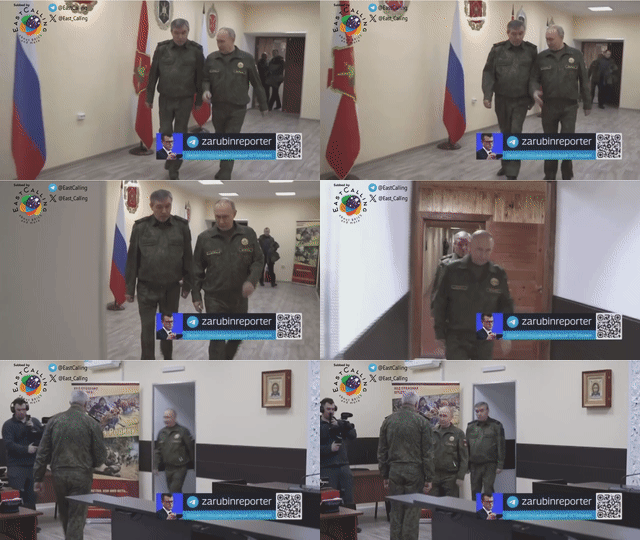 |
|
||
The Supreme Commander-in-Chief visited one of the command posts of the West group, where he held a meeting with the Chief of the General Staff, the Chief of the Main Operations Directorate, the Commander of the Southern Group of Forces, and the Commander of the West group.
Source: Kremlin_ru/ Zarubin
Main points from Putin’s statements during a visit to one of the command posts of the “West” group:
-Ukrainian military personnel should have the opportunity to lay down their arms and surrender;
-15 battalions of the Armed Forces of Ukraine are blocked in the Kupyansk area;
-Fighting is already taking place inside Konstantinovka in the DPR;
-The political leadership of Ukraine has been simply a criminal group usurping power since March last year;
-Representatives of the Kyiv regime “sit on golden toilets” and do not think about the fate of Ukraine and the soldiers;
-The Kyiv leadership holds power for personal enrichment;
-The objectives of the special military operation must be unconditionally achieved.
Main points from Gerasimov’s statements in the report to the President of Russia:
The troops of the combined group are advancing in almost all directions;
-70% of Krasnoarmeysk (Pokrovsk) has been liberated;
-The city of Kupyansk has been liberated;
-The Russian Armed Forces are advancing in Seversk;
-More than 80% of Volchansk has been liberated;
-Fighting is ongoing in the Zaporozhye direction for Prymorskoye and Stepnogorsk;
-The advanced units of the “East” group have reached the Gaichur River;
-Discussions are underway on delivering retaliatory strikes on the Ukrainian Armed Forces’ military infrastructure.
Source: TASS
Verily, it is Victory or Martyrdom.
Venezuelans have a “true sense of belonging to a project worth saving.. This is a project of collective self-emancipation. .. Those who are committed to the Bolivarian revolution assume themselves as subjects of transformation, not as victims. And this is something to be reckoned with.”
Video Description:
“I’m joined by Cira Pasqual Marquina, author and educator at the Pluriversidad Patria Grande and co-host with Chris Gilbert of the Marxist education program and podcast Escuela de Cuadros.
I ask her:
≈≈≈

Cira Pascual Marquina interviews at Venezuelanalysis.
The Imperialist Offensive is Nothing New for the Bolivarian Revolution’: A Conversation with Ana Maldonado
A Chavista organizer examines the US militarization of the Caribbean and the Bolivarian Revolution’s enduring resistance to imperial aggression.
In recent months, Washington has stepped up its military presence in the Caribbean, sending warships, aircraft, and even a nuclear submarine to waters near Venezuela amid extrajudicial attacks on fishing vessels. For many, this new phase of aggression is all too familiar — part of a decades-long campaign of hybrid warfare designed to undermine Venezuela’s sovereignty.
In this context, Cira Pascual Marquina spoke with Ana Maldonado, a sociologist, international relations coordinator for the Francisco de Miranda Front—a national Chavista movement—and member of the Venezuelan chapter of ALBA Movements. In this interview, Maldonado offers her perspective on how Venezuelans are experiencing the latest imperialist escalation, reflects on the country’s long resistance to hybrid war, and situates the current threat within the broader struggle for sovereignty in Latin America and the Caribbean.
How are the Venezuelan people experiencing this new imperialist escalation?
President Nicolás Maduro has said that in this scenario of maximum pressure, our response must be maximum preparation. At the same time, he has called on us to combine vigilance with calm, to continue our daily lives, and to defend the peace with social justice that has cost us so much to build and preserve.
You can see this clearly in the fact that, even amid the current military escalation, the new school year began normally across the country. More than 20,000 educational institutions opened their doors without disruption, and over six million children and youth returned to class, as they do every year around this time.
While we are indeed facing a serious threat of war, people are also carrying on with their everyday lives and that, in itself, is a victory, since the enemy seeks precisely to disrupt our life.
People abroad are often surprised to learn that daily routines here continue undisturbed and that Venezuelans are not living in a state of panic. How do you explain this?
This is far from our first encounter with imperialist aggression. The tactics may shift, but the strategy remains unchanged: hybrid warfare. For years, US imperialism and its allies have waged a relentless campaign against Venezuela, beginning in earnest in April 2002 with the coup d’état and the people’s heroic counteroffensive that restored democracy. That was followed by the oil sabotage, mercenary incursions, and global media campaigns against our democracy.
After Comandante Chávez passed in 2013, a new and sustained period of aggression began. Initially, they bet that we would fail to hold peaceful elections or that President Maduro would never be elected. The dominant narrative was “Maduro is not Chávez.” With that simplistic argument, they sought to demoralize the Chavista social base, implying that the Bolivarian project would not withstand the loss of the Comandante. Yet we won the elections and, even as we mourned Chávez, the project continued.
But the US and their local agents were determined not to let us go on with our revolution. In 2014, the opposition launched a violent campaign called “La Salida” [The Exit], led by Voluntad Popular and María Corina Machado, the same factions now openly calling for foreign intervention. The following year, the United States took another war-like step: Obama’s 2015 executive order declaring Venezuela an “unusual and extraordinary threat.”
That decree was followed by the 2016 economic strangulation, marked by deliberate shortages aimed at making everyday life unbearable. Ten years later, we remain under a blockade that has killed tens of thousands.
In 2017, the most extreme factions of the opposition returned to the streets with fascist violence, committing atrocities such as the burning alive of a young Black man, Orlando Figuera, targeted simply for looking like a Chavista. More than 100 people were killed during this period of intensified fascist terror.
President Maduro responded by calling for a National Constituent Assembly, once again raising the banner of peace and democracy in the face of fascist violence. People from all sectors, including residents of middle-class neighborhoods whose polling centers had been attacked, were able to vote in peace at the Poliedro de Caracas.
Since then, we’ve lived through multiple phases of hybrid war: Juan Guaidó’s self-proclamation as “interim president” in 2019 and the “Battle of the Bridges,” when the opposition attempted to stage a false-flag operation on the Colombian border under the guise of a humanitarian aid effort. That was followed by massive blackouts that left the country in darkness for days and the 2020 Operation Gideon, recently further exposed in a Max Blumenthal interview with its US organizer, Jordan Goudreau, a former Green Beret.
None of these were isolated incidents: they are coordinated fronts in a sustained hybrid war combining political, psychological, economic, and military aggression.
Yet, in each of these moments, the government and the organized pueblo have responded effectively. During the 2019 electrical sabotage, for example, communities mobilized to ensure access to water and basic needs, while Operation Gideon was defeated by the same fisherfolk who are now being attacked in the Southern Caribbean.
So, to return to your original question: yes, people are alert because the threat is real, but we are also seasoned and organized. We know we are capable of defending the Revolution with unity and discipline. We are in a phase of maximum preparation, with millions voluntarily enrolling in the militia and preparing for the defense of the Patria [homeland].
Indeed, people are not only enlisting in the Bolivarian Militia but also preparing collectively. You’ve given us a historical account of the attacks faced by the Bolivarian Revolution over the past 25 years. But as we know, the current military buildup in the Caribbean is not only against Venezuela: it is an attack on the continent. How do you understand its broader implications?
The imperialist onslaught on the Caribbean is nothing new. Haiti, still punished today for its revolution more than two centuries ago, remains under siege. Now, armed gangs tied to the Dominican Republic are also involved. Puerto Rico continues to endure capitalist dispossession, with five million Puerto Ricans now living in the US while barely three million remain on the island. All the while, revolutionary Cuba has faced a brutal blockade for many decades.
However, the recent imperialist military buildup should deeply concern the peoples of Latin America and the Caribbean, since it signals a shift in Washington’s military policy. Around 10,000 US troops are currently stationed in the Caribbean, mainly in Puerto Rico, to say nothing of the destroyers, nuclear submarine, and air force deployments.
They are not there only to threaten Venezuela; this is the revival of the Monroe Doctrine. As Trump once said, “Why pay for Venezuelan oil, if we can just take it?” That’s how they think about the resources of the continent.
When it comes to Venezuela, beyond seizing our resources, the US also aims to strip away our sovereignty and destroy the example that we represent. If our project succeeds, it will inspire the entire continent. From Canada to Patagonia, people are struggling for liberation, and the Bolivarian Revolution represents a living example of how that can be done.
Attacking Venezuela serves two purposes: to loot our resources and to extinguish the example of participatory democracy. Since 2021, Venezuela has experienced renewed economic growth and the strengthening of its communes and popular power.
That is precisely what Washington wants to halt: they fear that the peoples of Latin America, and even within the United States, will draw inspiration from our experience.
Why the military escalation at this particular moment?
Trump’s slogan “Make America Great Again” is itself an admission of decline. The US is no longer what it once was, and its elites are desperate to recover lost ground. Yet even within those elites, fractures abound between the neoconservatives, the Zionist zealots, and the MAGA bloc. Their internal contradictions often produce erratic foreign policy decisions.
However, on one point they all agree: war is profitable. The military-industrial complex remains central to sustaining the US economy. So even amid domestic tensions, there is a bipartisan consensus around war as business.
Before the recent attacks on Venezuelan vessels, President Maduro warned that they might attempt to recreate a Gulf of Tonkin incident, because their hunger for war is insatiable. He was right: this aggression is ultimately driven by the economic imperative of feeding the war machine. In a post-Cold War world, it survives through perpetual “hot wars”—and what better front than Venezuela, which is rich in resources and defiant of imperial domination?
Let’s close with Chávez. He declared the Bolivarian Revolution anti-imperialist in 2004, but in truth, it always had a sovereign and anti-imperialist character. Could you reflect on Chávez’s anti-imperialism?
Indeed. The formal declaration came during a historic rally at the Botanical Garden in 2004, but the Revolution was Bolivarian from the start, and Bolívar himself was profoundly anti-imperialist. He warned that the United States seemed “destined by Providence to plague the Americas with misery in the name of liberty.” That same spirit lives in our revolution since day one.
Chávez revived Bolívar’s anti-imperialist legacy as early as 1977, when he created the People’s Army for the Liberation of Venezuela, whose founding document enshrined Bolivarianism and anti-imperialism as guiding principles. Later, in The Blue Book [1991], he outlined the vision of sovereignty and dignity that still guides us. President Maduro calls that text a “historical compass” pointing us steadfastly, no matter how much we have to maneuver, toward our strategic goal: the defense of sovereignty and the rejection of imperial domination.
For us, being anti-imperialist means not only refusing to surrender our resources, but also defending our identity, our dignity, and our very being. The empire’s elites belong nowhere; they want the world to belong to them. We, by contrast, define ourselves by belonging to a land, to a pueblo, and to a history.
That is why even symbolic aggressions, such as the attempt to erase “Bolivarian” from the Republic’s name during the 2002 coup, or mocking us as “venecos” in an attempt to erase our identity, are part of the war.
Bolivarianism and anti-imperialism are also deeply rooted in your organization, the Frente Francisco de Miranda. Can you tell us about it?
Indeed. In 2003, Fidel and Chávez founded the Frente Francisco de Miranda as a movement of Bolivarian, anti-imperialist social workers. However, anti-imperialism isn’t limited to my organization; it’s in the bloodstream of millions of Venezuelans who have resisted International Monetary Fund impositions since 1989 and continue defending the Bolivarian project today.
To be Chavista is to be anti-imperialist. Chávez was the first Latin American president to recognize Palestine, to support the Sahrawi Arab Democratic Republic, and to speak of our historical debt to Haiti. His backing of these and other liberation struggles was not just a matter of words but also about material support. He also linked the defense of Haiti to a history that, for him, didn’t begin with Pétion and Dessalines, but with Hatuey, the first known hero of an anti-colonial Caribbean rebellion.
That is our Chávez—the anti-imperialist Chávez—whose legacy continues to guide us!
≈≈≈
Cira Pascual Marquina is a Political Science professor at the Universidad Bolivariana de Venezuela in Caracas. She is also co‐producer and co‐host (with Chris Gilbert) of the Marxist education program Escuela de Cuadros. She is actively engaged with grassroots organizations in Venezuela and abroad, and is dedicated, both as a militant and as an investigator, to communal initiatives.

La Syrie est entrée dans une nouvelle ère, qui reposera sur une nouvelle stratégie de développement avec les États-Unis, a
L’article Al-Chareh : la Syrie est désormais un allié des États-Unis est apparu en premier sur STRATPOL.

 Lateo.net - Flux RSS en pagaille (pour en ajouter : @ moi)


