 Connexion


Ex-VP Paulo Nogueira Batista Jr. exposes the untold truth about Western sanctions, IMF control, and dedollarization. Discover why the BRICS Bank, built to escape the dollar, remains trapped.
In this exclusive interview with Think BRICS, former vice president of the New Development Bank (NDB), Paulo Nogueira Batista Jr, takes us inside the creation and constraints of the BRICS Bank, a core institution designed to empower the global south and challenge U.S.-led financial dominance. Batista reveals how the NDB was meant to support dedollarization, facilitate alternative finance, and break dependence on the IMF, the dollar trap, and SWIFT. However, due to Western sanctions, credit rating agencies, and global market pressures, the bank struggles to maintain independence.
He explains how the BRICS founding vision is stifled by external limitations—such as the NDB’s inability to lend to Russia, despite its major shareholder status.
The video also covers China’s potential leadership in establishing a multipolar world through a new development bank under the Shanghai Cooperation Organization, using yuan-denominated bonds and avoiding Western capital markets. Batista discusses the urgent need for a new reserve currency, the geopolitical implications of bypassing the dollar, and how emerging nations are navigating complex geopolitics under financial pressure.
This interview does not dive into detailed case studies of BRICS-funded projects, technical mechanisms behind SWIFT alternatives, or specifics of the new BRICS Pay system. It also does not explore the individual economic strategies of each BRICS member beyond China and Russia, nor does it address opposition within BRICS to rapid dedollarization. Additionally, the discussion doesn’t explore public-facing fintech implications or private-sector alignment with the BRICS Bank’s evolving mission.
“Suddenly, there were more cars, fewer shops, little foot traffic and no history. The car, television and, now, cellphone make being nowhere not just possible, but desirable.”
with gratitude to Linh Dinh at Postcards from the End.

Kathmandu, 10/22/25
Could Have Been, Can Be and Will Be Much Worse — Oct 22, 2025.
Should have rung one of those bells five or six times for divine protection! At least it happened near the end. Today, I walked many miles without having the faintest idea where I was going. Done this countless times in too many cities. You must trek through the most boring or, hell, even deadliest parts to understand any place. If all you see of Philly are Center City, Old City, Society Hill, University City and the Italian Market, you have no idea what locals must go through.
Having experienced spectacular temples, awe inspiring stupas, exhilarating street markets, quaint courtyards and tiny, picturesque shops, today I got a numbing taste of Kathmandu’s newer quarters. Suddenly, there were more cars, fewer shops, little foot traffic and no history. If not for those colorful mandalas on sidewalks and Nepalese scripts on some signs, I was hardly in Nepal. Wandering around such a neighborhood in Busan years ago, I nearly thought I was in California! The car, television and, now, cellphone make being nowhere not just possible, but desirable.
On one street, there were all these job placement agencies for Japan. One large sign had a three-tiered pagoda and a sweetly smiling babe in a kimono. Similar teases exist in Vietnam. Sent to Japan, you might never see such a chick. Still, a monthly salary of 250,000 rupees ($1,775) is inducement enough. In Kathmandu, a college graduate makes just $213 a month. For a general laborer, it’s $103. Renting a basic room in town is already $50. With wages so low, it’s even more incredible there are so many smiles, and so few crimes.
Employed at 4 Square, one 17-year-old must walk three hours daily, six days a week. Sometimes, he gets a ride on a motorbike. He can’t even afford a bicycle.
With English classes expensive, few can learn. Those who do try to work abroad.
I didn’t even know I was just north of Thamel. Seeing two goats outside a butcher’s shop was encouraging, though. Just above them through an open window were mostly defleshed skulls of their kind, plus a young female of my kind, smiling. Until it’s our turn to be decapitated, everything is hilarious, or at least interesting. Soon after, I saw my first temple in maybe an hour.
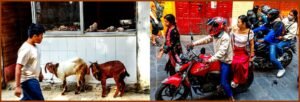
Kathmandu, 10/22/25
As hope returned, I suddenly pitched forward. On the ground, I looked back to see one of my cheap sandals flung many yards behind me.
“Sir, are you OK?”
“I’m fine! It could have been worse.”
“You scraped your knee!”
“I’m OK. Hey, you sound American!”
“I am.”
“Where are you from?”
“Utah.”
“I used to live in Philadelphia.”
“I actually live here! I’ve been here for 13 years.” She’s a white woman around 55-years-old.
“How do you like it?”
“I love it!”
“Do you have family here?”
“I’m my entire family!” She spread her arms out, palms up.
“Now, I know why I fell down.” I was getting mystical. “I fell down so I could meet you, an American, with your interesting story!”
“You’re such a nice man. You fell down because you were trying to get out of my way.”
I’m not sure I did that. I do try to walk on the traffic side when seeing a woman. Here as in Vietnam, people often stray onto streets. Today, I stepped into a gutter. Out of politeness, I gave her a wide berth, perhaps. It could have been much worse. There was some dark blood on my left big toe, but no real pain. In ruined Beirut, I stepped into a broken grate. My leg could have been sliced open.
Sitting in 4 Square at 2:15PM, I’ve been hearing for half an hour loud banging on drums and cymbals from youths on passing trucks, or just marching by. It’s the fourth day of Tihar. Tomorrow, maybe they’ll shoot rockets into hotel room windows. I must be ready for anything.
With no clear boundaries between spectators and participants, this is nearly a carnival. Before it got cleaned up, with its finale moved indoors, Philly’s Mummer Parade was also carnivalesque. Rulers prefer parades. You’re not supposed to do anything but watch. One nation even has “free speech zones” where the ignored are caged.
The best jobs here are government sinecures, as dispensed by a higher-up relative. Running your own business is also an attractive option, but there are so many of all kinds already. On this limited planet, mouths are still multiplying, so wars, riots, lootings and famines are baked in. Even among mild and dignified Nepalese, there’s trouble ahead. For now, they will still dress up, smile brightly and celebrate.
Today, Vimal has on a Celtics jersey, number 5. That’s Kevin Garnett. Looking for cheap apartments in Boston, Vimal was steered to Roxbury, but one quick look told him it was deadly, “I’d rather sleep at the train station.” As a teen, Malcolm X lived in Roxbury. Did you know that “Hold it, brother!” were Malcolm X’s last words?
Now, two girls no older than twelve are chanting, with one holding a bamboo tray with a burning incense stick jutting from a banana, marigold petals, a colorful piece of paper with magical writing and a sort of donut, but thinner and larger. They’re trick or treating, basically. Having given money to so many kids already, the barista ignores them, so they move on, perfectly cheerful.
Still fat enough despite everything, I, too, will move on.

Sacred Stones, Dogs, Mud and Even Men — Oct 23, 2025.
All that racket yesterday was also to celebrate the Newari New Year, Mha Puja (self worship) and Gai Puja (cow worship). Ratopati informs us, “The cow is revered as mata or mother by Hindus […] Modern science has also proved that indigenous breeds of cows absorb the energy from the sun and the moon in their hump which is transmitted through milk to humans.”
Only indigenous breeds, mind you. Hump on that for a while. Three days ago was Kukur Tihar, or Festival of Dogs. Surely, I qualify. Must come back next year to be honored, with a bindi, at least. To expect a marigold garland is already vanity of vanities, all is vanity. Shit, man, I’m getting my religions confused.
Petting that old black dog at KTM Burger, I couldn’t help but think of Nọng and Milk Cow back in Vũng Tàu. They’re washed with human shampoo by Mrs. Seven at least twice a week, then blasted with a hair dryer. I’ve warned her about parching their skin, but do you think anyone listens to anyone? We’d rather die stubbornly stupid and proud.
Speaking Vietnamese to KTM Burger’s dog, I murmured, “So pitiful! You’ve never been washed!” On his forehead, there was a red trace from the bindi applied days ago, during the Festival of Dogs, of course. Once a year, this filthy beast is dabbed with kumkum powder. That’s what it’s called, I swear.
Last week was Jazzmandu. My hipster days over, I wouldn’t have checked it out anyway. Once, I sat in bars to listen to Wynton Marsalis and Mickey Roker. I also caught Sun Ra, Sonny Rollins, Art Pepper, Charlie Rouse, Johnny Hodges, Benny Goodman and, most memorably, the Art Ensemble of Chicago. Lester Bowie was evil! Last time I gushed over jazz, a moron jumped in to protest, “What about great white music?”
White worship of Jewjerked Trump is too appropriate for a society too stupid, degenerate and ignorant to honor its own heritage or recognize what’s best about itself. They’re worshipping a rapist of white children as purveyed by a Jew! Just as bad, they’re fine with his destruction of the Heartland. Anti-Trumpers can’t wait to vote in another Jewjerked puppet.
Not even Germany is so hopeless. It still has enough cultural relics to remind Germans of who they are, and of their greatness. Nepal, too.
Americans are mostly indifferent. Twice, they voted in a culture wrecker.
Erecting his vanity project, Trump Tower, this philistine moron ordered the razing of the Bonwit Teller Building, an Art Deco masterpiece. At least René Chambellan’s bas reliefs and Otto J. Teegan’s entrance grille could be saved, it was hoped. After promising them to the Metropolitan Museum of Art, Trump simply destroyed them.
Teegan, “It’s odd that a person like Trump, who is spending $80 million or $100 million on this building, should squirm that it might cost as much as $32,000 to take down those panels.” It’s not odd at all. Destruction is how this eternally insecure fool flexes his power. Trumpers seethe at uppity, coastal liberal words like Art Deco, masterpieces or just “art,” so yes, tear it all down.
But what about great white music? Whiggers like Forgiato Blow and Stoney Dudebro are certainly carrying the torch. Dangling his noose, literally, is JJ Lawhorn. Sucking hardest, though, must be Kid Rock. As a yellow outsider, I can’t keep up with so much greatness. You tell me.
Spending two years in Certaldo, particularly its medieval section, I felt, viscerally, each day, the importance of cultural depths, and I’m feeling the same in Kathmandu, except for yesterday, when I strayed into its more modern, thus sterile, neighborhoods. The worst architectural school ever was the International Style, with offshoots like Brutalism or Soviet Modernism just as nasty. Art that isn’t rooted in the local displaces the soul. This is irrelevant if you don’t think art matters at all.
In 2018, the Met returned to Nepal a 10th century standing Buddha and a 12th century stele. In 1996, Britain repatriated 19 artifacts. Thousands of masterpieces were also looted by whites from India, Egypt, Iran, Iraq and Cambodia, etc. At least they never bombed Nepal. In Palestine, Jews have long used white bombs to destroy even churches, including some of the oldest ever built. MAGA Christians don’t give a fuck. They have freakish pastors like Paula White-Cain to fulfill their spiritual needs.
Those with means can also fly to the Jewjizzed Holy Land. Kevin Barrett, “In a bold move to resuscitate its genocide-battered tourism industry, Israel’s Ministry of Tourism announced a new initiative this week: ‘Get Baptized In Jewish Spit.’ The project aims at bringing American Christians to Israel so they can be rapturously soaked in the only fluid that’s holier than holy water: pure, fresh, kosher, locally-sourced 100% organic Jewish saliva.” That Satanic outrage will end soon.
Here a week, I haven’t even tried to reach Lalitpur, not five miles away. Hot chai, dirty dogs, radiant smiles and calming squares are more than enough. That’s because I’m bathed in collective memories, echoes and ghosts. Here ancient stones are so alive, they’re smeared with food.

Kathmandu, 10/23/25
Worried Looking Girl with Bills and Green Glow Worm — Oct 23, 2025.
On the fifth day of Tihar, you’re supposed to go home and have lunch with your family, so nearly all stores and restaurants were closed. Though those Chinese joints on Amrit and Jyatha were open, I just didn’t feel like wok fried dishes, yellow noodles or braised chicken skeleton. After a nap, I decided Bueno Burrito would be a great choice. Walking there, I thought about how quintessentially American is Tex-Mex, as is the Mission burrito, born in San Francisco. Jazz, too, is the best of the USA, and no narrowly defined black or white music.
At 4:30PM, Bueno was still closed, so I bought a short story collection by Anjan Adiga, a Nepalese-American writer. I want to write an American writer born in Nepal, but there’s no bio in Leech. Sitting on steps outside shuttered stores, I read. After just a few pages, I could tell Adiga is excellent.
Without his heritage, plus emotional and intellectual investment over many years, I’m just groping, obviously, but travel writing is like a drunken incel being shoved into a whorehouse. As long as he doesn’t run out immediately in terror, we have stories.
With almost nothing open, I decided to try Zaika Biryani Center on Gangalal. Entering a tiny, skanky room on the second floor, I shared a table with two guys. One was the only other foreigner. Not only that, he spoke a fluent American English. We chattered.
Fifty-nine-years old, Marcos is a Brazilian who’s been just about everywhere. This is his third time in Nepal. He’s also spent four months in Vietnam over two visits. We talked about Đà Lạt, Nha Trang and Vũng Tàu. His first time here was in 2005. Nepal was much poorer then, Marcos told me.
“That’s good to hear, so the country has improved.”
“All of Asia has gotten richer,” he chuckled.
As for the USA, where Marcos spent many years, we agree Trump is collapsing its economy on purpose. One motive, obviously, is for his oligarch buddies to buy up all the farm land from MAGA peasants. Those who haven’t committed suicide, that is. Survivors can keep their red hats. Trump and his pals are also raking it in through market manipulations. Then there’s his bitcoin racket. It’s too funny, really.
We laughed over Trump’s 40 billion dollar gift to Argentina, and over China buying soybeans from Brazil instead of the USA. We discussed the growing power of BRICS. Marcos knows what’s up.
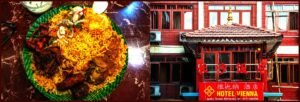
Kathmandu, 10/23/25
My chicken biryani was only so-so, but at only $1.78, I can’t complain. It came with one boiled egg, and there was a pitcher at the table. Without cups, you’re supposed to just pour the cold water into your mouth, with the spout not even an inch from that unclean aperture. Though not quite correct, it sounds better than hole or orifice, God forbid.
Though Marcos had vowed just one week ago to never drink alcohol again, I said he must try the excellent Gorkha Beer. Perversely, he admitted to being fond of bia hơi. Brewed overnight by whoever felt like, it became popular in northern Vietnam during the worst years of Communism. Though without kick or character, it’s still being served.
Wandering around, I stumbled onto a Czech restaurant, and a Chinese owned hotel called Vienna!
In an Adiga story, “High Heels,” a young woman has reinvented herself by finishing high school against her mom’s wish, moving from her village to Kathmandu, getting a job at a bank, dabbing herself with Lakme Elegant perfume and wearing red high heels. Most radically, she has become a Christian. Nine pages in, her mentor, Father Matthew, is already betraying impure motives. She, though, has the hots for Binod, a handsome and confident coworker. On their first date, he admits to finding Christian women “bold.”
With six more days here, I have plenty of time to finish this story, or the whole book even, but when traveling, one should spend as much time as possible reading streets, landscapes, bodies and faces.
Just typing this, I’m not doing that, but that’s the paradox of trying to capture reality. Writing, you’re no longer living. Converting all this richness into words, I’m reducing, if not caricaturing, everything. Each second is modified, enriched, complicated or contradicted by the next.
Today, I photographed a small girl in a vermilion top with a neon green glow worm. Holding some bills, she looked worried. Behind her was a man and a boy, each with a disposable surgical mask, of the type made ubiquitous during the Covid hysteria. Why weren’t they caned for not keeping a social distance? Deprived of oxygen, their modest IQs approached zero. Their muffled conversation sputtered one syllable at a time, punctuated by pauses minutes long. Since a photograph is already a translation, I’m translating a translation.
Don’t curse me, though, for shrinking so much into so little, for a postage sized Kathmandu is still better than nothing.

Kathmandu, 10/24/25
No Plunging, Scoop, Halter or Sweetheart Necklines — Oct 24, 2025.
It didn’t take long, did it? Halfway through their first lunch date, Binod said to Sarita, “I have a lot of respect for you, for how far you’ve come in life.”
On the way back, they had to duck into an old temple to escape a heavy rain. Suddenly, this young Christian woman was trapped in a dark, “dismal place,” with even “the stench of uncollected garbage” wafting from an adjacent alley. The only other presence was a statue of Kali, that frightful blue faced goddess with her four arms, red tongue, sword and garland of decapitated heads. Still, Sarita felt safe.
Adiga describes her delusions:
In him there was a hidden capacity to care, she knew it.
She wished she could take him to church.
They would kneel and pray together.
She was now completely sure that the church was the guiding force he needed to turn his life around.
Besides being a spoiled only son, Binod was a lost soul, a sinner. She was destined to save him. He interrupted her noble musing by putting his hands on her shoulders. Sarita’s wet cleavage made her irresistible. This detail indicated, further, her Western orientation. We already knew by her red high heels and tube of Fair and Lovely. Always in her purse, it made her whiter, though never white enough.
Before Sarita knew it, they were kissing, then his hand somehow slipped beneath her bra to squeeze her naked breast. Ignoring her protest, he kept going, but at least they didn’t copulate. In shock, Sarita asked to be dropped off before reaching the bank.
Clearly annoyed at being thwarted, Binod sneered, “Your mole is disgusting.” Patiently seducing her many days before, Binod said it looked like “a tiny juicy grape.” Even her mom thought it resembled a tumor. Sarita fancied it nearly a nipple. This mark of shame became her naked turn on, she desperately hoped. Binod spat at that notion. Born elsewhere, Sarita could just remove it.

Kathmandu, 10/24/25
I’ll read the rest later. Looking up, I see three young men. One wears a baseball cap with “MARQUETTE.” I’m sure he doesn’t know what it means. One is listening to his phone. With porn banned, there’s not much to look at. The last, in a hoodie and jean jacket, is staring at revelers just outside KTM Burger.
At another table is a black man focused on his magical screen. Perhaps 30, he’s alone. Besides TikTok recorded laughter, I can also hear extended dialogues in English. Unlike others, he didn’t go to the counter upon entering, but only ordered a can of Carlsberg and a chicken kathi roll when approached, finally, by an employee after about 20 minutes.
Elsewhere, more young men stare at phones. I’m sure all of them wouldn’t mind a bold, westernized woman, even without otherworldly cleavage throbbing or bobbing. It’s cool enough for a jacket or hoodie. In my short sleeved áo bà ba, I must ignore the weather.
One tallish man with long hair has a girlfriend. He’s wearing a fluffy white and gray fleece hoodie over a shockingly red long shirt, however. Even Sarita wouldn’t try to save this guy, much less a true Western woman. Of course, it’s presumptuous to think he’d even want one, just to see, taste and smell what it’s like, you know. I must disagree with Alberta Hunter. You can certainly tell the difference after dark.
Displaced, you can be so wrong even when you’re dressed perfectly. A female, though, is always welcome, if only for a hit and run. If willing to spend, even the most repulsive can get off. A five minute stroll down Pattaya’s Soi 6 will amply prove this. It’s bad enough in Vũng Tàu.
Quality of whores varies so much, though, with the richer, more prestigious countries offering the worst. Worse than selling one’s body for half an hour or an hour to endless creeps is to be chained to one. Melania often looks disgusted. Ivana wrote about being raped. Once permanent residency is gained, millions book.
In “High Heels,” silver-haired Father Matthew is creepy enough. Fleeing from Binod, Sarita took a taxi to Saint Mary’s Church. It didn’t sound like her ordeal was over.
Finishing this at 4 Square, my right leg went dead, so I hobble outside. At 10:15AM, it’s sunny and warm, with, as usual, a constant stream of pedestrians. There’s not a cleavage in sight. No plunging, scoop, halter or sweetheart necklines. One dips just enough to show collar bones. That’s it.
Around 4AM, I passed four drunken youths, including one woman. Pissed at somebody, she flipped the bird, the first I’ve seen in eight days, and I’m out constantly. Though dressed casually in the American style, she showed no cleavage either.
As a Kami, Sarita was elated to discover she could read the same bible as anybody else. There are 1.5 million of her kind in Nepal. Though caste-based discrimination was abolished in 1963, you can’t mold or regulate anyone’s heart.

10/25/25 (L): Kathmandu ; (R): Lalitpur
Why Not Hitler Fashion? — Oct 26, 2025.
A regular at 4 Square is Saroj, a shop owner in his late 40’s. Though his brother has lived in Boston for 20 years, Saroj hasn’t been able to visit him. Applying for a visa recently, he was rejected. Saroj worked eight years in India, so speaks good Engish, and he has traveled to Hong Kong and Bangkok. An avid bicyclist, he’s also in great shape, so looks every bit a successful and well fed middle class person. Still, Trump won’t let him in. After three months, Saroj will try again.
When told of my time in the USA and Europe, Saroj looked startled for a second. I was just sharing my experiences of NYC, London and Paris, to say those places aren’t like in the movies or popular imagination. “Everywhere I go, I want to see the regular neighborhoods, you know, the more boring ones, because that’s how normal people live.”
This was my response to a visit to the Buddha Stupa. Saroj hadn’t just insisted I see it, but phoned a motorbike guy to get me there. More interesting for me, though, were all the blasé streets I saw on the way. After that stupa, which was indeed spectacular, I had a better time checking out the area. There was Ramsterdam Café, “where hippies meet.” That fabled Kathmandu isn’t just mostly gone, it was hardly there in the first place.
Freak Street and Dharma Path, where Pico Iyer hung out, is as alien to most Nepalese as Phạm Ngũ Lão and Bùi Viện to Vietnamese. That Saigon pocket with its whores, pimps, weird cuisines and bars is known as Phố Tây, or Western Streets.
Even now, most residents of Kathmandu would find this passage incomprehensible:
I had the best enchilada of my life on Freak Street, and the chocolates in the stores seemed to have been sent special delivery from the heavens. As for the pies for which Nepal was famous, they exceeded even their reputation. Soon I established my own sacramental ritual: disappearing several times each day into the dark entrances of cafés—not just Mom’s Health Food Restaurant and Aunt Jane’s, but also Tibetan, Chinese and stateless restaurants—in order to devour extraordinary apple pies, almond layer pies, orange cakes, fruit cakes, lemon pies and more apple pies.
It’s telling that Iyer never mentions momos, choila, khaja, thukpa, sekuwa or even dal bhat, Nepal’s national dish. That’s what most people eat here, man, not lemon or apple pie! They have never heard of them, or enchiladas! Most wouldn’t dare walk into Mom’s Health Food Restaurant. Its name alone sounds expensive.

(L): Busan, 3/29/20 ; (R): Taiping, Malaysia on 7/19/19
The cheapest eateries here are dark, tiny places without a name. You enter through a curtain. Most have no English menus. Yesterday in Lilitpur, I noticed a barefoot girl about three flinging dirt outside Mo:Mo Cha and Stick Food Café. She had on a dirty pale pink top with two smiling cats. Catching me eyeing her daughter, this large woman came out, but not to chase me with a stick or knife. Smiling, she urged her kid to say hello. Her cheerfulness invited me in. If there was no menu, I would just ask to see what she had. I had done this in various countries. Point and you shall receive.
There was a menu, just one, with “Momo Magic and Stick Delights!” on the cover. Its plastic lamination was peeling off. Its wire binding was all awry. Without knowing what “Buff Khaja Set” was, I ordered it anyway. It turned out to be a buffalo stew, choila, with curried potato, peanuts, chickpeas, pickled vegetables and crunchy rice flakes, chiura. The last was most surprising. This delicious meal cost me just 170 rupees, or $1.21.
Arriving in Lilitpur, I emailed my buddy, Jonathan, “You shamed me into going to Patan, motherfucker! You think I give a shit about temples!!! I must admit, though, this place is orgasmically spectacular. Makes me even more ashamed to be Vietnamese. Just kill me now.” Tone is everything. That’s how friends talk. I used to do the same with Giang, whom I had known for more than four decades. After three Jewjabs, he seemed to change. His voting again for Trump hardened Giang further. Suddenly, I could no longer goof around with this guy.
Walking back to Kathmandu, I got seriously lost. Without a map or cellphone, I ended up in Kalanki, then Bafal. It didn’t help that I was lugging my bag with a camera and laptop, both heavy, and, most likely, I kept wandering in circles. I crossed streets and creeks that looked awfully familiar. This misadventure allowed me to enter a nearly dead mall, pass a bus depot with clearly rural folks waiting to go home, ramshackle dwellings abutting swanky developments and, mostly astoundingly, Hitler Fashion!
All I saw were jeans, hoodies, T-shirts and sneakers, typical American styled casual wear. Do Nepalese consider eternally adolescent Americans as Nazis?
Though swastikas are common in the East, this was just weird. Without my phone, I couldn’t speed dial my rabbi or the Anti-Defamation League. In Kukes, Albania, I had run into Bar and Restaurant Nazi, but that’s just the owner’s name, pronounced as Nor Zee.

(L): Skopje, North Macedonia on 9/26/20 ; (R): Vung Tau, 9/8/24
This morning, I read about a 33-year-old, Kenneth Morgan, who had entered Cutter’s Pub, an Athens, Georgia bar popular with college kids. Dressed as an SS officer, complete with a red armband with its black swastika on a white circle, Morgan was clearly asking for trouble. Immediately, he was cursed, then chased out by a crowd. When Grace Lang tried to yank off his armband, Morgan whacked her with his beer mug, breaking her nose. She relayed her account to The Red and Black, which aren’t just Nazi colors but those of the University of Georgia. Of course, many if not most of those outside the South and Midwest think those folks are Nazis anyway.
Though Mao and Stalin killed many more, Hitler is considered uniquely evil. Even most deaths in concentration camps were from starvation, and related diseases, resulting from American and British bombings. At least a million Vietnamese died from the same. Near the end of World War II, Vietnamese ports and rail system were destroyed.
Detailed or nuanced understanding of anything is beyond most people, with American college students among the worst. A little learning is already dangerous. When it’s mostly bullshit, you’re fucked for life.
Here’s how Grace Lang describes herself at Linked, “I capture angles that are rarely seen and humanity that is often overlooked. My photos give the audience a chance to see with my eyes, granting them a vivid, deep connection with my work.” Seeing with her eyes, you will be exposed to hidden truths about humanity.
About Linh Dinh (@linhdinh):
‘Before being canceled, I was an anthologized poet and fairly prolific author, with my last book Postcards from the End of America. Now, I write about our increasingly sick world for a tiny audience on SubStack. Drifting overly much, I’m in Cambodia.
Born in Saigon, Vietnam in 1963, I lived mostly in the US from 1975 until 2018, but have returned to Vietnam. I’ve also lived in Italy, England and Germany. I’m the author of a non-fiction book, Postcards from the End of America (2017), a novel, Love Like Hate (2010), two books of stories, Fake House (2000) and Blood and Soap (2004), and six collections of poems, with a Collected Poems cancelled by Chax Press from external pressure. I’ve been anthologized in Best American Poetry 2000, 2004, 2007, Great American Prose Poems from Poe to the Present, Postmodern American Poetry: a Norton Anthology (vol. 2) and Flash Fiction International: Very Short Stories From Around the World, etc. I’m also editor of Night, Again: Contemporary Fiction from Vietnam (1996) and The Deluge: New Vietnamese Poetry (2013). My writing has been translated into Japanese, Italian, Spanish, French, Dutch, German, Portuguese, Korean, Arabic, Icelandic, Serbian and Finnish, and I’ve been invited to read in Tokyo, London, Cambridge, Brighton, Paris, Berlin, Leipzig, Halle, Reykjavik, Toronto, Singapore and all over the US. I’ve also published widely in Vietnamese.’
AHH: Please support this wonderful writer on his Substack! Thanks
The US and its allies continue to deliberately blur the definition of international terrorism as they apply double standards to assessing internal conflicts in other countries, Sergey Naryshkin noted.
MOSCOW, October 21. /TASS/. Intelligence agencies of the US and the UK are using terrorist groups for destabilizing the situation in the key regions of the planet, Russian Foreign Intelligence Service (SVR) Director Sergey Naryshkin said.
“Intelligence agencies of the US and the UK are now practically openly using terrorist groups to destabilize the situation in key regions of the planet and create their own zones of influence there,”
he said at a meeting of the Council of heads of security agencies and special services of CIS member states. The text has been published on the SVR website.
The US and its allies continue to deliberately blur the definition of international terrorism as they apply double standards to assessing internal conflicts in other countries, Naryshkin noted. “The White House’s attempts to remove the Hay’at Tahrir al-Sham group (outlawed in Russia – TASS) from the list of terrorist organizations is a vivid example,” he said, adding that the confusion provoked by the West in the classification of terrorism gives Washington and its allies free rein in the widespread introduction of terrorism methods into their foreign policy arsenal.
(Machine Translation: Yandex)
Dear colleagues! Dear friends!
I am glad to welcome you at our next meeting. First of all, I would like to sincerely thank our Uzbek friends for their warmth, hospitality, and high-level organization of our next meeting of the Conference, as well as for creating excellent conditions for our meeting in the beautiful ancient city of Samarkand, a true gem of our common space of the Commonwealth of Independent States.
It is gratifying to see how the interaction between the special services of the CIS member states is expanding and deepening, with a focus on ensuring peace and stability in the Commonwealth and promoting regional security. This cooperation is primarily a direct result of the extensive and close ties between our countries and peoples. However, we are also increasingly united by common security challenges that are becoming global and sometimes even existential. Some of these challenges are fundamentally new and require innovative responses.
The incredible speed of events in the modern world requires not only maximum mobilization, but also an understanding of the fundamental trends in the changing international relations.
From this perspective, the relevance and importance of this event cannot be overstated.
The information received by the SVR of Russia is convincing evidence that the world is currently experiencing the most fragile moment for international security since the Second World War, namely, a period of qualitative transformation of the global order. The unipolar Western-centric system has clearly ceased to exist. It is noteworthy that this is the basis for virtually all the closed Western forecasts of the development of the international situation that I have come across.
The new world order is still in the process of formation. According to some NATO estimates, the period of so-called geopolitical uncertainty will last until around 2035, but the major global and regional centers of power are already engaged in a fierce struggle to determine the contours and rules of this future world order. Our shared and perhaps most important task is to ensure that the transition to this new reality does not lead to a major war, as has been the case in previous historical periods.
This task is certainly difficult, as it requires all players to be calm, responsible, and willing to compromise. Fortunately, these qualities have been preserved in the East, but have been almost lost in the West.
Western countries, particularly the United States and its ally, the United Kingdom, are reluctant to accept the end of their unchallenged dominance on the global stage.
This may be due to the inertia of colonial thinking among the Anglo-Saxons and their deeply ingrained, historically rooted racism. This can be seen in the same predictions that I mentioned earlier. They either completely ignore the uncomfortable reality of multipolarity for the West, or portray it as chaos – a terrible world without rules, where anarchy and violence supposedly reign. Let’s take a closer look: this is how those who invaded Afghanistan and Iraq, destroyed Libya and Syria, and have been waging war in the heart of Europe since 2014, in Ukraine and Russia, view the prospects of multipolarity.
Another thing is that at the current transitional stage, American hegemony itself is beginning to change its nature. The people who are expressing this trend are those closest to President Donald Trump, the so-called tech billionaires led by Peter Thiel. These are absolute social Darwinists in international politics who do not consider it necessary to cover up their desire for dominance with talk about human rights and universal values. They are simply working to establish direct physical control over the territories and economic assets they are interested in, often at the expense of Washington’s allies, including the Europeans. The ultimate goal of this” shadow “group of influence is to create a network of independent technological states – corporations controlled by the American elite, which will become a kind of” islands of security ” in the chaotic and violent world of the future. The leader of this ideology is, in particular, US Vice President J. D. Vance.
Europe, which has become accustomed to living under American occupation since the end of World War II, is struggling to adapt to the changing international landscape. European foreign ministers are expressing pessimism about the lack of medium – and long-term solutions for maintaining security on the continent. They are also accusing Washington of “replacing the status quo with a camp of ‘revisionists’ in an attempt to redirect global politics in accordance with national interests.”quot;. {Needless to say , this is a terrible crime against liberal democracy!) The only remedy that the “Macrons” and “Merzs” fed by Alexander Soros ‘ structures, not to mention all sorts of “callas”, are ready to offer European nations is Russophobia and an accelerated build – up of European military potential with an eye to a large-scale armed conflict with Russia.
We can certainly see that the European NATO allies are preparing for a war with our country. The goal is to provide the NATO Allies with all the necessary resources in a short period of time. The process of increasing the output of the European military-industrial complex has been launched. The implementation of mobilization measures and the promotion of propaganda about the inevitable aggression from Moscow have been put on a regular basis.
At the same time, we also know that the fundamental issue remains unresolved: where will we find enough mobilization personnel with the necessary physical and moral-psychological conditions? Another “headache” for the European “elite” is the widespread social apathy and dissatisfaction with the ruling elite among the population, especially among young people. There is also uncertainty in Brussels, Paris, and Berlin about whether Washington will fulfill its obligations under Article 5 of the Washington Treaty in the event of a war with Russia. Without this, as the European External Action Service admits, the calculations to achieve strategic superiority over our country are, to quote, “illusory.”
The crisis and the disintegration of the unified Western center of power have allowed other non-Western states to establish their own regional peripheries without the intrusive influence of the United States and Europe.
The so-called middle powers, while remaining allies of the United States, are increasingly pursuing their own agendas. These agendas do not always align with the agenda of their powerful sponsor. In some cases, this has led to increased tensions, as seen in Ukraine and Israel.
The Kiev regime is openly disregarding the Trump administration’s commitment to a constructive discussion on how to end the Ukrainian conflict and is doing everything it can to escalate the situation. In the Middle East, the aggressive actions of Israel’s far-right leadership, coupled with Washington’s passive stance, have put almost every country in the region at risk and undermined decades-old approaches to security.
On the other hand, the “power vacuum” created by the fall of the American empire pushes most regionals to develop non-political, constructive mechanisms of multilateral cooperation that are not held hostage to the confrontation of global players. The deepening of regional integration is noticeable in South-East Asia, Latin America, Africa and, of course, Eurasia. This is evidenced by the progressive strengthening of such formats as the CIS, the EAEU and the SCO. Such processes are welcome. And our meeting today is another important contribution to their development.
During our Meeting, we talk a lot and productively about external and internal challenges to the Commonwealth, including international terrorism, the instigation of ethnic separatist conflicts and “color revolutions”. Each of our special services has a unique experience in countering these threats, the exchange of which makes our states more stable and stronger. This is confirmed by the long-term practice of cooperation.
Today, I would like to focus on the dangers associated with the changing environment in which geopolitical confrontation will unfold in the foreseeable future.
This includes the objective climate change and the associated threats, such as famine, water scarcity, mass migration, outbreaks of epidemics, and increased regional tensions. It is crucial to consider ways to address these challenges, which cannot be solved at the national level.
By the way, the Trump administration’s claims to Canada and Greenland, as well as the construction of fortifications on the border with Mexico, don’t seem so crazy when you consider that they are based on the results of scientific climate research conducted by the Americans. According to these studies, a significant portion of Mexico will turn into a lifeless desert within half a century, leading to an increase in migration. However, Canada and Greenland will become more suitable for resource extraction and economic development. Washington’s aggressive methods are certainly not an example to follow. Nevertheless, it is important to keep in mind the climate factor and its geopolitical dimension, including when building a collective security architecture in Greater Eurasia. The analytical departments of our intelligence agencies could contribute to this effort.
A new conflict zone is emerging: the struggle for a strategic advantage in the development of digital technologies, especially artificial intelligence. According to some foreign estimates, artificial intelligence’s performance doubles every six months. Major IT corporations predict that within the next three years, artificial intelligence will be able to make scientific discoveries on its own, leading to revolutionary changes in the military, energy, and international finance sectors. It is possible that these technologies will have a significant impact on the strategic balance of power and, unfortunately, on the current nuclear deterrence order.
These forecasts and estimates, of course, need to be thoroughly discussed and verified, including by the special services. But the scale with which Western intelligence agencies use the latest technologies to interfere in the internal affairs of sovereign states is already visible.
The development of common methods and means of countering “deepfakes”, blocking enemy satellite signals, and suppressing digital channels for financing illegal protests is becoming a key issue in terms of preventing”color revolutions”.
Friends and colleagues!
Many people are familiar with the now-famous phrase “Don’t ask who the bell is tolling for, for it may toll for you.” At times, it seems to perfectly describe the current international situation and leave little room for optimism. However, I would like to remind you that this phrase is the conclusion of a poem by the Christian preacher and poet John Donne titled “No man is an island.” It is about the fact that no one exists in isolation, that everything in this world is interconnected, and that each of us is a part of a larger whole. The common and the individual are inseparable.
John Donne made this appeal to the British.
The Anglo-Saxon elite, unfortunately, did not hear him and continued trying to sow discord, chaos and death everywhere, confirming the validity of the catch phrase “the Englishwoman shits”.
The result of these actions is obvious: the moral and political bankruptcy of the West, the rise of anti-colonial and national-conservative sentiments around the world. Our response to this destructive strategy is to cooperate and create, to remain calm and ignore the provocations aimed at undermining our unity in order to build a truly just and multipolar world.
Thanks for your attention!

 Lateo.net - Flux RSS en pagaille (pour en ajouter : @ moi)
