 Connexion


 Le 8 juin, le président chinois Xi Jinping a entamé à Pyongyang sa première visite à l’étranger de l’année 2026.
L’article Xi Jinping en Corée du Nord pour la première fois depuis sept ans est apparu en premier sur STRATPOL.
Xi Jinping a souligné qu’il s’agissait de la 25e visite de Vladimir Poutine en Chine, témoignant du haut niveau et
L’article Visite officielle de Poutine à Pékin, plusieurs accords signés avec Xi Jinping est apparu en premier sur STRATPOL.
À première vue, la rencontre entre le dirigeant chinois Xi Jinping et le président américain Donald Trump s’est déroulée sans
L’article Premier jour de visite de Trump à Pékin est apparu en premier sur STRATPOL.
Le président américain Donald Trump doit arriver à Pékin le mercredi 13 mai pour une visite de trois jours. Les
L’article Trump se rend en visite en Chine pour un accord commercial, Xi espère convaincre de réduire les ventes d’armes à Taïwan est apparu en premier sur STRATPOL.
Le président chinois Xi Jinping a présenté quatre propositions pour résoudre la situation au Moyen-Orient, rapporte la télévision centrale chinoise.
L’article Xi Jinping présente quatre propositions pour résoudre la crise au Moyen-Orient est apparu en premier sur STRATPOL.
Poutine et Xi se sont entretenus par vidéoconférence pour discuter de l’escalade de la situation internationale et des positions coordonnées
L’article Poutine et Xi se sont entretenus sur les tensions dans le monde et la visite du président russe prévue en avril est apparu en premier sur STRATPOL.
Le général Zhang Youxia, secrétaire adjoint de la Commission militaire centrale (CMC), et le général Liu Zhenli, chef d’état-major interarmées,
L’article Pour bien comprendre les dernières purges chinoises, il faut se pencher sur la biographie de Xi Jinping ! est apparu en premier sur STRATPOL.
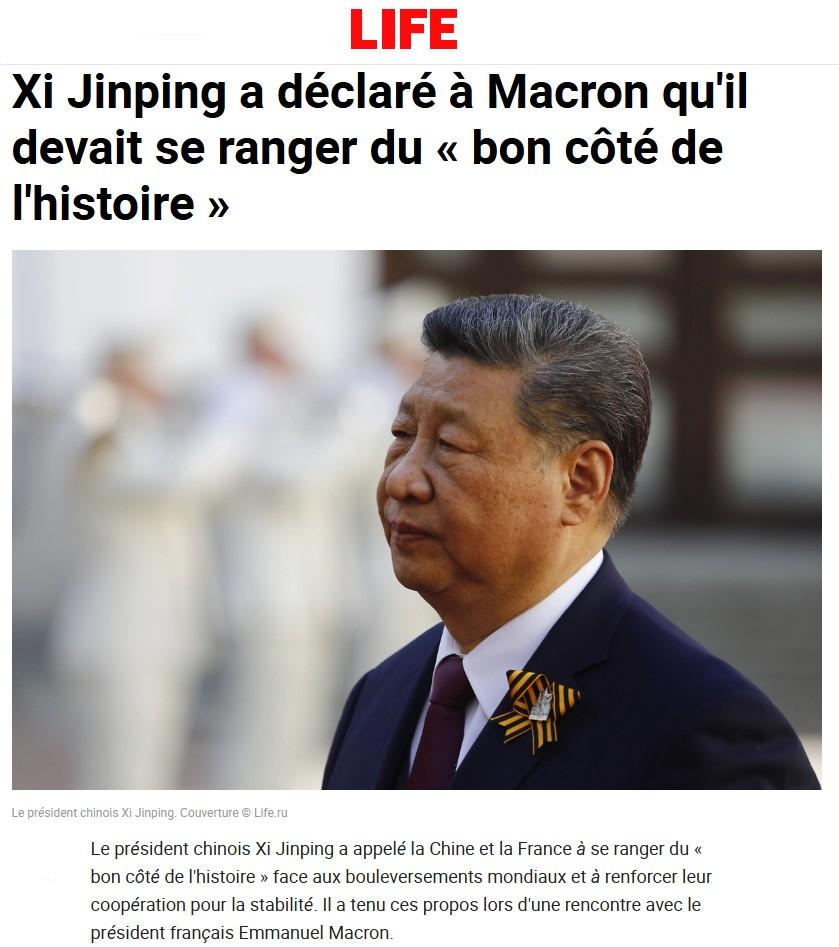
Le président chinois Xi Jinping a appelé la Chine et la France à se ranger du « bon côté de
Remarks by H.E. Xi Jinping
President of the People’s Republic of China
At Session I of the 32nd APEC Economic Leaders’ Meeting
Your Excellency President Lee Jae Myung,
Colleagues,
It is my great pleasure to be here in Gyeongju, a city of rich history and culture, to join you in discussing the future of the Asia-Pacific. Let me begin by thanking President Lee Jae Myung and the ROK government for the thoughtful arrangement.
Over the past 30-plus years since its founding, from drafting the blueprint of the Free Trade Area of the Asia-Pacific (FTAAP) to advancing the vision of an Asia-Pacific community, APEC has been spearheading the region’s rise to the forefront of global open development, and has made the Asia-Pacific the most dynamic part of the global economy.
Currently, changes unseen in a century are accelerating across the world. The international situation is fluid and turbulent. The Asia-Pacific faces growing uncertainties and destablizing factors in its development. The rougher the seas, the more we must pull together. We should stay true to APEC’s founding mission to promote economic growth and improve people’s lives, and champion open development where everyone shares opportunities and emerges a winner. We should promote a universally beneficial and inclusive economic globalization, and build an Asia-Pacific community. To this end, I wish to make five proposals.
First, we should work together to safeguard the multilateral trading system. We must practice true multilateralism, and enhance the authority and effectiveness of the multilateral trading system with the WTO at its core. We should stick to the right direction of WTO reform, uphold the most-favored-nation (MFN), nondiscrimination and other fundamental principles, and update international economic and trade rules to reflect the changing times, so as to better protect the legitimate rights and interests of developing countries.
Second, we should work together to build an open economic environment in the region. We should keep promoting trade and investment liberalization and facilitation, deepen fiscal and financial cooperation, and steadily push for regional economic integration. With the RCEP being implemented to high standards and the CPTPP membership expanding, we should help the two align with each other and progress together so as to inject impetus into the development of the FTAAP.
Third, we should work together to keep industrial and supply chains stable and smooth. We must join hands rather than part ways, and strengthen our links rather than sever them. We should vigorously expand our common interests, and support the open development of supply chains. The tenth anniversary of the APEC Connectivity Blueprint gives us a good opportunity to strive for concrete and tangible results in physical, institutional and people-to-people connectivity so as to further consolidate the foundations for open development in our region.
Fourth, we should work together to advance the digital and green transformation of trade. We should make digital technologies a strong catalyst for cross-border trade, and promote practical cooperation in paperless trade, smart customs and other areas. We must remove various green barriers, and expand cooperation in green industries, clean energy and green minerals. The Asia-Pacific Model E-port Network and the Cooperation Network on Green Supply Chain initiated by China under APEC have become important platforms for regional cooperation on the digital and green upgrades for trade.
Fifth, we should work together to promote universally beneficial and inclusive development. We should adhere to the people-centered development philosophy, focus on imbalances in development, and foster an economic globalization that is more inclusive, sustainable, and beneficial to all peoples in the region. China is working with various parties to promote the high-quality development of the Belt and Road Initiative, and supports the modernization drive of more developing countries, which will help open up new space for global development. We have given zero-tariff treatment on 100 percent tariff lines from the least developed countries having diplomatic relations with China, and stand ready to extend the same treatment to all African countries having diplomatic relations with China through the signing of agreements on economic partnership for shared development. We will continue to strive for common development and shared prosperity with all nations.
Colleagues,
China always pursues the basic state policy of opening up, and has taken real steps to promote an open world economy. Over the past five years, China has ranked as the world’s largest trader in goods and the second largest in services. It has attracted more than US$700 billion in foreign investment in total, and its outbound investment has been increasing by over five percent on annual average. We have been shortening the negative list for foreign investment, and applying the unilateral visa-free policy to more countries. We are steadily expanding voluntary and unilateral opening up, and have actively aligned with high-standard international economic and trade rules through our 22 pilot free trade zones. China’s door to the world will not close; it will only open wider and wider.
A few days ago, the Recommendations for Formulating the 15th Five-Year Plan were adopted at the fourth plenary session of the 20th Central Committee of the Communist Party of China. We will take this opportunity to further deepen reform comprehensively and expand high-standard opening up, and create new opportunities for the Asia-Pacific and the world through the latest achievements of Chinese modernization.
Thank you.
Gyeongju, October 31, 2025
https://www.fmprc.gov.cn/eng/xw/zyxw/202510/t20251031_11744706.html
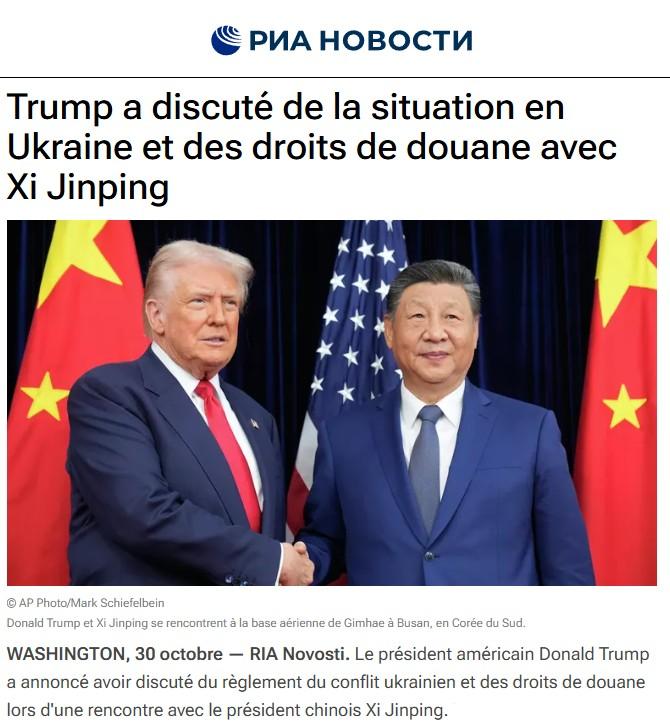
Le président américain Donald Trump a annoncé avoir discuté du règlement du conflit ukrainien et des droits de douane lors
L’article Trump et Xi ont discuté en Corée du Sud de l’Ukraine et des droits de douane est apparu en premier sur STRATPOL.
Today, we turn our attention to global geopolitics. As we have said several times in this blog, the Western world has squandered its five-hundred-year run of global dominance. Drunk on plunder, sustained by oceans of blood, and blinded by insatiable greed, gluttonous avarice, and stupendous arrogance of exceptionalism, Westerners could not imagine a world where they would no longer call the shots. Their racial arrogance engendered by stupendous ignorance would not allow that.
While the cretinous collective West with all its hubris continues to play empire with its decaying NATO toys and its hollow chants of “rules-based order,” the real tectonic plates of power are shifting under its feet. Anyone with eyes could see that global geopolitics is being remolded in real-time.
Recently, China’s President Xi Jinping quietly but decisively unveiled a vision that may be remembered as the funeral dirge of Western hegemony—the Global Governance Initiative (GGI). It rests on five cornerstones:
Although the stenographers who parrot official talking points as journalists in the West pretended that they did not hear, and, on the surface, President Xi’s words may sound like platitudes for a world summit brochure, we should not be deceived.
In geopolitical terms, Xi’s declaration is a bombshell, a paradigm shift, a rewriting of the global architecture born after the Second World War.
The Chinese president, in effect, announced the birth of a post-Western world order.
For decades, I have cried that the West needed to change gear. It needed to stop behaving like a bloated aristocrat living on stolen inheritance and squandering it with reckless abandon, fighting useless wars for example. I cautioned Westerners that it was necessary to rein in their greed and learn to live in a world where other civilizations also have a right to exist and prosper.
Of course, drunk on hubris, they would not listen to me. Still inebriated from their self-generated triumphalistic hurrahs over the collapse of the Soviet Union, they continue with their sanctions, more bombs, and more lectures about “human rights” given by people whose history is a museum of crimes against humanity – witness the genocide in Palestine.
When the Soviet Union collapsed, the West had its chance to build a truly inclusive world. Instead, it went berserk with insane triumphalism. NATO expanded like a metastatic cancer, gobbling countries eastward in direct violation of solemn promises. The twin evil organizations the West set up to rape the world (IMF and World Bank) continued their economic banditry (what else to call it?) in Africa and Latin America.
Washington, London, Paris, and Brussels strutted the world like schoolyard bullies, throwing threats and insults around. They gave themselves the authority to determine who must rule one country or the order. Their cries of “Assad must go!” “Gaddafi must go!” rent the air. The arrogance!
The crowning insult was the hubris of the so-called “unipolar moment”—the fantasy that the United States could reign supreme forever. Analysts with foresight like my favorite military strategy guru, Russian-born Andrei Martyanov, wrote four books and numerous blog posts to warn his adopted country, the US, that it was losing the military to the Russians. Of course, US Army Generals with their chests puffing with medals won from “victories” over inferior third-world armies paid no attention.
That arrogance has now detonated in their faces over their misadventure in Ukraine where Russia, single-handedly, handed a humiliating defeat to the Collective West and its expeditionary force, NATO.
President Xi’s first principle—sovereign equality—is a direct slap across the face of the West. For five centuries, Western powers operated on the doctrine that some nations are more “sovereign” than others. Britain could dictate to Africa. France could decree the terms of “Francafrique.” The United States could overthrow governments at will—from Iran in 1953 to Chile in 1973 to Libya in 2011, plus the countless in the Americas.
President Xi declared that the age of selective sovereignty is over. No country, however powerful, has the right to decide the destiny of another.
We already see that this is no longer a theory. Russia, China, and India refused to bend to Western diktats over Ukraine. Saudi Arabia, Iran, and even tiny Gulf monarchies now tell Washington “no” with increasing frequency. The Saudis recently wisely perched themselves under Pakistan’s nuclear umbrella.
The balance has shifted. The West no longer has a monopoly on coercive power.
The second cornerstone—abiding by international law—is another blow to Western pretensions. When Western leaders prattle about a “rules-based order,” they mean, “Rules we make, you obey.” When it suits Washington, international law is invoked like scripture; when it doesn’t, it is tossed aside like a soiled rag. More importantly, Westerners refused to share the book containing the rules with the rest of us.
Who illegally invaded Iraq in 2003? Who bombed Yugoslavia in 1999 without UN authorization? Who tore Libya to shreds in 2011 under the grotesque pretense of “humanitarian intervention”? It was these shameless paragons of “rules-based order.”
President Xi’s insistence on international law strips away this hypocrisy. What the Chinese president told us, in his calm voice, was that law is law, not a buffet where the West picks what it likes. It is apparent that the age of Western impunity, if not altogether over, is fast fading. It is being by replaced by a multipolar enforcement reality—where Moscow, Beijing, Delhi, and even Ankara or Tehran can say: enough.
Third, multilateralism. Westerners hear this word and immediately sneer, for in their dictionary, “multilateralism” meant a system where the US led and its vassals echoed. President Xi is not talking about the G7 club, where Europe still imagines itself relevant. He is talking about BRICS, the Shanghai Cooperation Organization, Eurasian integration, and an economic and political architecture that dwarfs anything the West can muster.
As they say, numbers do not lie. BRICS+ now represents more than 45% of the world’s population and nearly a third of global GDP—surpassing the G7 in purchasing power parity. Militarily, Russia alone has outclassed NATO, exposing it as an overrated relic. Add China’s industrial juggernaut and India’s demographic momentum, and the Western bloc looks like an aging rock band still touring on nostalgia.
Unfortunately, one only needs to listen to them to know that Westerners continue to live in a parallel universe.
Under President Xi’s vision, multilateralism means no more monopolies, unilateral sanctions, or economic chokeholds by Washington or Brussels. The new geometry of power has multiple centers, not one imperial metropolis.
President Xi’s fourth cornerstone—a people-centered approach—is almost alien to Western governance and culture. The West’s system is built not on people but on profit. For five centuries, from the slave trade to colonialism to modern neoliberalism, Western governance has meant the systematic robbery of the many to enrich the few. The West remains a plutocracy masquerading as a democracy.
Whatever its flaws, China has lifted 800 million people out of poverty in four decades—something the World Bank and IMF could never dream of. When the Chinese president says “people-centered,” he means development that puts food on tables, roofs over heads, and education in children’s hands. Not endless wars that fatten Lockheed Martin and Raytheon shareholders while millions of human beings starve.
This is not merely a moral difference—it is a civilization contrast. One system views human beings as expendable resources for profit; the other sees them as ends in themselves.
Finally, focusing on real actions, President Xi effectively skewers the West’s favorite sport: rhetoric without responsibility. Western leaders are masters of grand rhetorical speeches—Paris climate accords, Millennium Development Goals, Structural Adjustment Policy, endless summits with glossy communiqués. But what are the results? More carbon emissions, more inequality, more wars, more poverty.
China, by contrast, builds. It builds roads in Africa, ports in Asia, and railways from Asia to Europe. The Belt and Road Initiative may be controversial, but it is concrete, not a PowerPoint display. The West offers PowerPoints and bombs; China offers railways and trade. Free to choose, most countries will prefer President Xi’s Model.
Except for the purblind, everyone could see that there is no longer any doubt that the baton of global leadership has shifted. It is no longer Washington or Brussels that sets the tune. The new triumvirate—Russia, China, India—more than dwarfs the G7 in industrial and military firepower.
Together, these three form the backbone of a multipolar world. The G7, meanwhile, resembles a geriatric ward clinging to past glories with the narcissistic buffoon ordering everyone around.
And here comes the tragedy that stabs the heart. As this new global architecture is being built, where is Africa? Where are the voices of Lagos, Addis Ababa, Nairobi, or Johannesburg? Where are our technocrats, our economists, our philosophers? Tragically, the voice is missing. Our reprobate misrulers are missing in action when the world is being shaped.
It is Berlin 1884 all over again. Then, the Western powers carved Africa like a roast at dinner, without a single African at the table. Today, as Xi, Putin, and Modi redraw the map of power, Africa is again a spectator, not a participant.
The plantation managers we call presidents seem content to administer poverty while the real game of nations is played elsewhere.
Who will wake up our slumbering leaders and tell them that if Africa does not assert itself now, it will once again be written into the footnotes of history as an object, not a subject. That is the bitter lesson of Berlin 1884 and must not be repeated.
Africa cannot afford another century of irrelevance. Our technocrats must wake up from their slumber, shake off their colonial hangovers, and insist on a seat at the table—not as beggars with begging bowls but partners wielding the continent’s vast resources and human potential.
President Xi’s Global Governance Initiative signals the end of Western domination. But unless Africa asserts itself, we will again be the raw-material quarry of the new world order, just as we were for the old one.
—
©️ Fẹ̀mi Akọ̀mọ̀làfẹ̀ (1st Dan)
(Farmer, Writer, Published Author, Essayist, Satirist, Social Commentator, Polemicist-General of the Pan-African Republic)
My Mission: Stultitia Delenda Est – Stupidity Must be Destroyed!
I am an unapologetic Pan-Africanist who is unconditionally opposed to any form or manifestation of racism, fascism, and discrimination.
I thank you for reading my articles and watching my podcasts. I will continue to make them free, and I will not accept advertisements.
Your support is invaluable. If you enjoy my articles and podcasts, I would greatly appreciate it if you subscribe
Remarks by H.E. Xi Jinping
President of the People’s Republic of China
At the United Nations Climate Summit
September 24, 2025
Your Excellency Secretary General António Guterres,
Your Excellency President Luiz Inácio Lula da Silva,
Colleagues,
This year marks the 10th anniversary of the Paris Agreement, a pivotal year for countries to submit their new Nationally Determined Contributions (NDCs). Global climate governance is entering a key stage. I wish to share with you three points.
First, we must firm up confidence. Green and low-carbon transition is the trend of our time. While some country is acting against it, the international community should stay focused on the right direction, remain unwavering in confidence, unremitting in actions and unrelenting in intensity, and push for formulation and delivery on NDCs, with a view to providing more positive energy to the cooperation on global climate governance.
Second, we must live up to responsibilities. In the course of global green transition, fairness and equity should be upheld and the right to development of developing countries fully respected. The transition should serve to narrow rather than widen the North-South gap. Countries need to honor the principle of common but differentiated responsibilities, whereby developed countries should take the lead in fulfilling emission reduction obligations and provide more financial and technological support to developing countries.
Third, we must deepen cooperation. The world now faces a huge demand for green development. It is important that countries strengthen international coordination in green technologies and industries to address the shortfall in green production capacity and ensure free flow of quality green products globally, so that the benefits of green development can reach all corners of the world.
Colleagues,
Let me take this opportunity to announce China’s new NDCs as follows: China will, by 2035, reduce economy-wide net greenhouse gas emissions by 7% to 10% from peak levels, striving to do better; increase the share of non-fossil fuels in total energy consumption to over 30%; expand the installed capacity of wind and solar power to over six times the 2020 levels, striving to bring the total to 3,600 gigawatts; scale up the total forest stock volume to over 24 billion cubic meters; make new energy vehicles the mainstream in the sales of new vehicles; expand the National Carbon Emissions Trading Market to cover major high-emission sectors; and basically establish a climate adaptive society.
These targets represent China’s best efforts based on the requirements of the Paris Agreement. Meeting these targets requires both painstaking efforts by China itself and a supportive and open international environment. We have the resolve and confidence to deliver on our commitments.
Colleagues,
Great visions require concrete actions. Climate response is an urgent yet long-term task. Let’s all step up our actions to realize the beautiful vision of harmony between man and nature, and preserve planet Earth—the place we call home.
Thank you.
Xi Jinping talks about strategic guidance, importance of history, values and future process.
Donald Trump talks about drugs and TikTok.
The Chinese Readout
President Xi Jinping Speaks with US President Donald J. Trump on the Phone
On the evening of September 19, 2025, President Xi Jinping spoke with US President Donald J. Trump on the phone. The two presidents had a candid and in-depth exchange of views on the current state of China-US relations and other issues of mutual interest, and provided strategic guidance for the steady development of China-US relations going forward. The conversation was pragmatic, positive and constructive.
President Xi pointed out that China and the United States were allies who fought shoulder to shoulder during WWII. Recently, China solemnly commemorated the 80th anniversary of the victory of the Chinese People’s War of Resistance Against Japanese Aggression and the World Anti-Fascist War, and invited the families of American Flying Tigers to watch the parade on the Tian’anmen Rostrum. The Chinese people will not forget the valuable support from the US and other anti-fascist Allied nations for China’s War of Resistance. Honoring fallen heroes and remembering history is essential for cherishing peace and creating a better future.
President Xi stressed the vital importance of China-US relations. China and the United States are fully capable of helping each other succeed and prosper together for the good of the two countries and the whole world. For that vision to materialize, both sides need to work hard and in the same direction, so as to realize mutual respect, peaceful coexistence, and win-win cooperation. The recent consultation between Chinese and US officials reflected the spirit of equality, respect, and mutual benefit. They can continue to adequately address the outstanding issues in bilateral relations and strive for mutually beneficial outcomes.
The US side should refrain from imposing unilateral trade restrictions so as not to disrupt the outcomes of multiple rounds of consultation between the two sides. China’s position on the TikTok issue is clear: The Chinese government respects the wishes of the company in question, and would be happy to see productive commercial negotiations in keeping with market rules lead to a solution that complies with China’s laws and regulations and takes into account the interests of both sides. The US side needs to provide an open, fair, and non-discriminatory environment for Chinese investors.
President Trump said that China’s recent parade was phenomenal and beautiful. The US-China relationship is the most important bilateral relationship. The two countries working together can get many great things done that are good for peace and stability of the world. The US would like to have a long-term, big and great relationship with China. The US will work with China on the economy and trade, and support their teams in reaching a proper deal on TikTok through consultation. The US will also work with China for world peace.
Trump’s Readout
Donald J. Trump
@realDonaldTrump
I just completed a very productive call with President Xi of China. We made progress on many very important issues including Trade, Fentanyl, the need to bring the War between Russia and Ukraine to an end, and the approval of the TikTok Deal. I also agreed with President Xi that we would meet at the APEC Summit in South Korea, that I would go to China in the early part of next year, and that President Xi would, likewise, come to the United States at an appropriate time. The call was a very good one, we will be speaking again by phone, appreciate the TikTok approval, and both look forward to meeting at APEC!
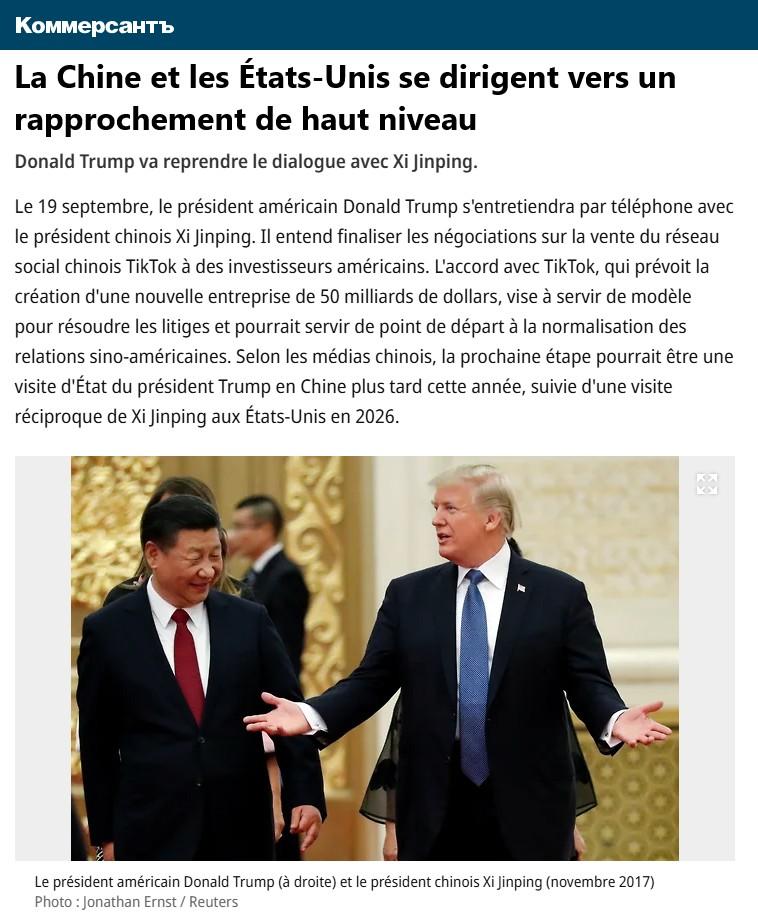
Le 19 septembre, le président américain Donald Trump s’entretiendra par téléphone avec le président chinois Xi Jinping. Il entend finaliser
L’article Trump et Xi vers un rapprochement sur fond d’accord potentiel sur le rachat de TikTok est apparu en premier sur STRATPOL.
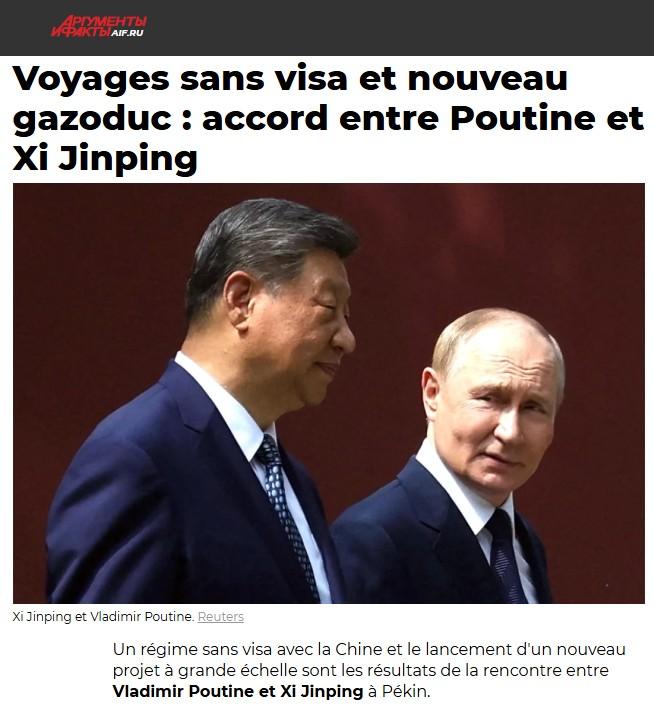
Au total, à l’issue des négociations, plus de 20 documents ont été signés sur la coopération dans les domaines de
L’article Plus de 20 documents signés entre Moscou et Pékin, dont un régime sans visa et le lancement du gazoduc Force de Sibérie 2 est apparu en premier sur STRATPOL.
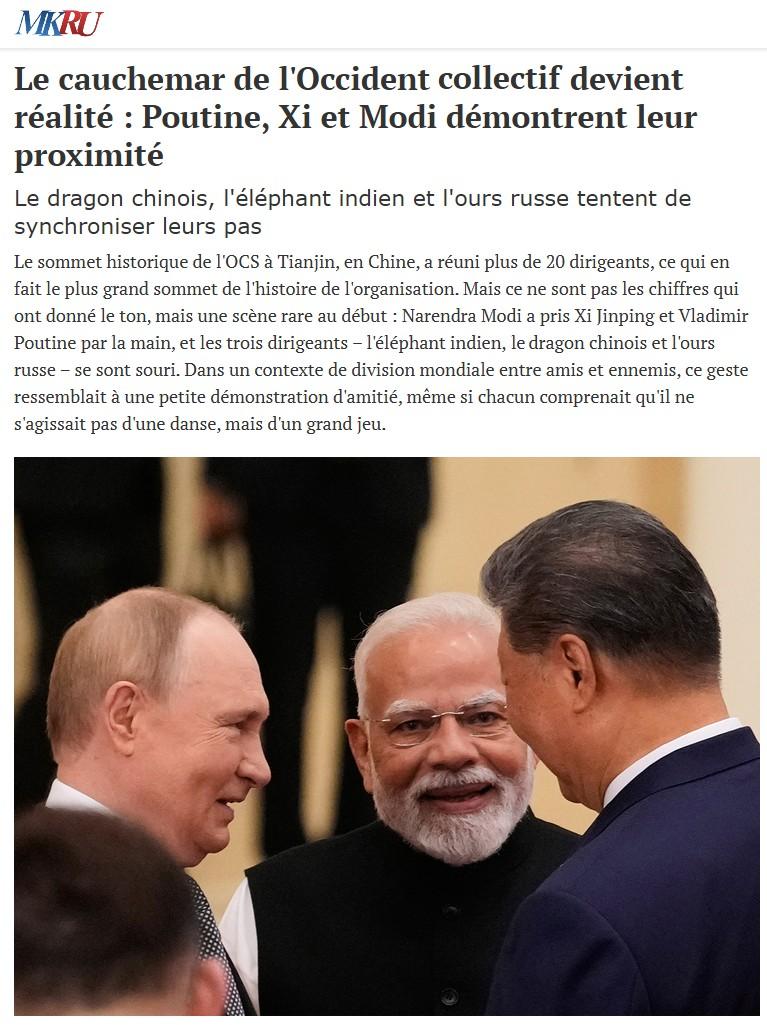
Le sommet historique de l’OCS à Tianjin, en Chine, a réuni plus de 20 dirigeants, ce qui en fait le
L’article “Le cauchemar de l’Occident collectif est devenu réalité” : quand Modi, Poutine et Xi montrent leur proximité est apparu en premier sur STRATPOL.
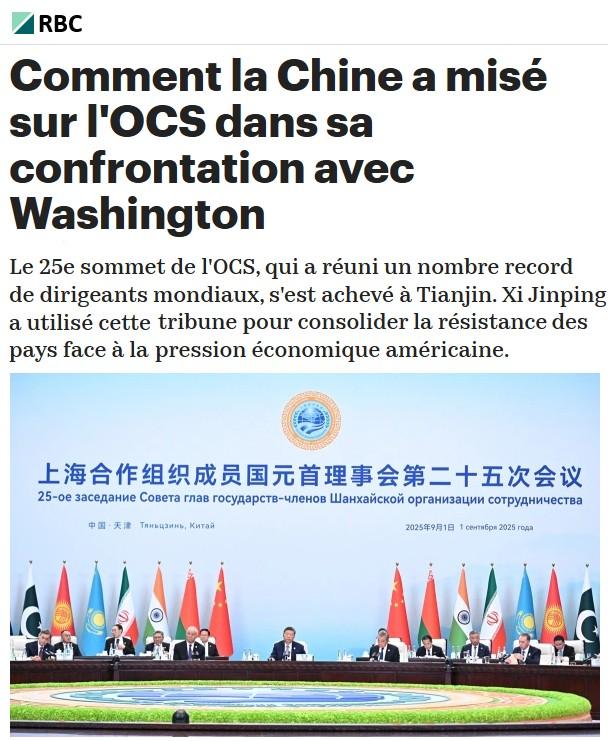
Le 1er septembre, le 25e sommet de l’Organisation de coopération de Shanghai (OCS) s’est achevé dans la ville portuaire de
L’article La Chine mise sur l’OCS pour contrer la pression économique américaine est apparu en premier sur STRATPOL.
Before playing the video of President Xi’s speech, here are a few quick comments from Pepe Escobar, who views this summit similar to me. This is major and now, with Xi’s clear (I want to say direction) of a new Global Governance, suitable for a MultiPolar world, much mist is dissipating. The new Global Governance documents are being studied by Russia (according to President Putin) and will form the main discussion at SCO’s next meeting in Russia.
Russian President Vladimir Putin voiced support for the Global Governance Initiative, put forward by Chinese leader Xi Jinping, at an expanded meeting of the Shanghai Cooperation Organization.
According to Putin, China’s proposals are relevant in a situation where “some countries stubbornly seek to use pressure in international affairs.” Russia is interested in launching specific discussions of the proposals, the Russian leader added.
“This system, based on the supremacy of international law, would take into account the interests of as wide a range of countries as possible and offer them opportunities for sustainable development and security,” Putin concluded.
All the heads of state present at the SCO summit in China’s Tianjin on Monday have supported the “global governance” initiative put forward by Chinese President Xi Jinping, Chinese Foreign Minister Wang Yi says.
Quotes from Pepe Escobar:
 The Tianjin Show is dazzling everyone across Asia. The – inclusiveness – message is a killer. No wonder it’s rattling the West’s nerves. Imbecile MSM hacks are calling the SCO “the Axis of Upheaval”. No axis. And the upheaval has been rollin’ on for years, slowly but surely. Tianjin is a great show but in fact only an appetiser for the mighty Eurasian Century.
I would like to add to this comment. We are growing and this is a foreshadowing of the world that is here already.
Key statements of the Tianjin Declaration approved by heads of state of SCO countries:
I can’t emphasize enough how crucial is the Tianjin declaration. This is the SCO finally getting to the next level, just like BRICS in Kazan last year. Xi is going no holds barred: the PLANET needs a new global governance. What we have now is Barbarism Inc. My Vladivostok day tomorrow will be dedicated to the Tianjin Effect. Let’s rock.
The Future is Here. And Now.
Xi is delivering the keynote address at the SCO, talking about Eurasia as the cradle of civilizations. Soooo softly – no need to make waves to say WE are now on the driving seat.
End: Pepe Escobar Quotes
Transcript:
Pooling the Strength of the Shanghai Cooperation Organization
To Improve Global Governance
Statement by H.E. Xi Jinping
President of the People’s Republic of China
At the “Shanghai Cooperation Organization Plus” Meeting
Tianjin, September 1, 2025
Distinguished Colleagues,
This year marks the 80th anniversary of the victory of the World Anti-Fascist War and the founding of the United Nations. It is a milestone prompting us to remember the past and create a better future together. Eighty years ago, the international community learned profound lessons from the scourge of two world wars and founded the United Nations, thus writing a new page in global governance. Eighty years later, while the historical trends of peace, development, cooperation and mutual benefit remain unchanged, the Cold War mentality, hegemonism and protectionism continue to haunt the world. New threats and challenges have been only increasing. The world has found itself in a new period of turbulence and transformation. Global governance has come to a new crossroads.
History tells us that at difficult times, we must uphold our original commitment to peaceful coexistence, strengthen our confidence in win-win cooperation, advance in line with the trend of history, and thrive in keeping pace with the times.
To this end, I wish to propose the Global Governance Initiative (GGI). I look forward to working with all countries for a more just and equitable global governance system and advancing toward a community with a shared future for humanity.
First, we should adhere to sovereign equality. We should maintain that all countries, regardless of size, strength and wealth, are equal participants, decision-makers and beneficiaries in global governance. We should promote greater democracy in international relations and increase the representation and voice of developing countries.
Second, we should abide by international rule of law. The purposes and principles of the U.N. Charter and other universally recognized basic norms of international relations must be observed comprehensively, fully and in their entirety. International law and rules should be applied equally and uniformly. There should be no double standards, and the house rules of a few countries must not be imposed upon others.
Third, we should practice multilateralism. We should uphold the vision of global governance featuring extensive consultation and joint contribution for shared benefit, strengthen solidarity and coordination, and oppose unilateralism. We should firmly safeguard the status and authority of the U.N., and ensure its irreplaceable, key role in global governance.
Fourth, we should advocate the people-centered approach. We should reform and improve the global governance system to ensure that the people of every nation are the actors in and beneficiaries of global governance, so as to better tackle the common challenges for mankind, better narrow the North-South gap, and better safeguard the common interests of all countries.
Fifth, we should focus on taking real actions. We should adopt a systematic and holistic approach, coordinate global actions, fully mobilize various resources, and strive for more visible outcomes. We should enhance practical cooperation to prevent the governance system from lagging behind or being fragmented.
Colleagues,
The founding declaration and the Charter of the Shanghai Cooperation Organization made it clear at the outset that we should promote a more democratic, just and equitable international political and economic order. Over the past 24 years, the SCO has adhered faithfully to the Shanghai Spirit of mutual trust, mutual benefit, equality, consultation, respect for diversity of civilizations, and pursuit of common development. We have discussed regional affairs together, built platforms and mechanisms together, and benefited from cooperation together. We have also initiated many new global governance concepts and put them into practice. The SCO has increasingly become a catalyst for the development and reform of the global governance system.
In response to the once-in-a-century transformations unfolding faster across the world, the SCO should step up to play a leading role and set an example in carrying out the GGI.
We should contribute to safeguarding world peace and stability. With a vision for common security, SCO member states have signed the Treaty on Long-Term Good-Neighborliness, Friendship and Cooperation, conducted effective security cooperation, and maintained overall stability in the region. We should continue to uphold the principles of non-alliance, non-confrontation and not targeting any third party. We should combine our efforts in addressing various threats and challenges, give full play to the newly established SCO Universal Center for Countering Security Challenges and Threats and the SCO Anti-drug Center, and build a community of common security in the region. We should remain a force for stability in this volatile world.
We should step up to take the responsibility for open cooperation across the globe. SCO member states have rich energy resources, big markets and strong internal driving forces, and we are contributing a rising share to world economic growth. We should continue to dismantle walls, not erect them; we should seek integration, not decoupling. We should advance high-quality Belt and Road cooperation, and push for a universally beneficial and inclusive economic globalization.
China will readily share the opportunities of its vast market, and continue to implement the action plan for high-quality development of economic and trade cooperation within the SCO family. China will establish three major platforms for China-SCO cooperation in energy, green industry, and the digital economy, and will set up three major cooperation centers for scientific and technological innovation, higher education, and vocational and technical education. We will work with fellow SCO countries to increase the installed capacity of photovoltaic and wind power each by 10 million kilowatts in the next five years. We are ready to build with all sides the artificial intelligence application cooperation center, and share the dividends of progress in AI. We welcome all parties to use the Beidou Satellite Navigation System and invite countries with relevant capacities to take part in the International Lunar Research Station project.
We should set an example in championing the common values of humanity. Among SCO member states, cultural exchanges are packed with highlights, people-to-people interactions are frequent and robust, and different civilizations radiate their unique splendor. We should continue to promote exchanges and mutual learning among civilizations, and write brilliant chapters of peace, amity and harmony among countries different in history, culture, social system and development stage.
China will host and ensure the success of the SCO Political Parties Forum, the SCO Green and Sustainable Development Forum, and the SCO Forum on Traditional Medicine. In the next five years, China will treat 500 patients with congenital heart disease, perform 5,000 cataract operations, and carry out 10,000 cancer screenings for other SCO countries.
We should act to defend international fairness and justice. In compliance with the principles of justice and fairness, SCO member states have engaged constructively in international and regional affairs, and upheld the common interests of the Global South. We should continue to unequivocally oppose hegemonism and power politics, practice true multilateralism, and stand as a pillar in promoting a multipolar world and greater democracy in international relations.
China supports the SCO in expanding cooperation with other multilateral institutions, such as the U.N., ASEAN, the Eurasian Economic Union, and the Conference on Interaction and Confidence Building Measures in Asia, to jointly uphold the international economic and trade order and improve global and regional governance.
Colleagues,
An ancient Chinese philosopher said of the importance of principles, “Uphold the Great Principle, and the world will follow.” In two days, China will commemorate solemnly the 80th anniversary of the victory of the Chinese People’s War of Resistance Against Japanese Aggression and the World Anti-Fascist War. Many colleagues will join us in Beijing. We are ready, together with all parties, to uphold courageously the great principle and the common good of the world, promote a correct historical perspective on World War II, resolutely safeguard the fruits of our victory in the War, and deliver more benefits to the entire humanity through the reform of the global governance system and the building of a community with a shared future for humanity.
Thank you.
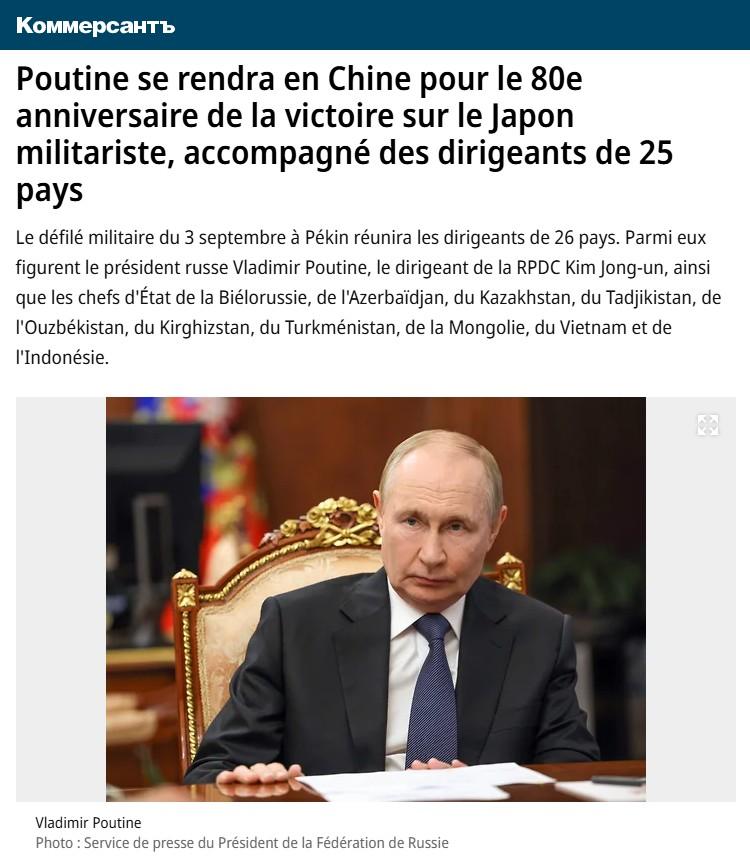
Le défilé militaire du 3 septembre à Pékin réunira les dirigeants de 26 pays. Parmi eux figurent le président russe
L’article Poutine se rendra en Chine pour le défilé militaire de la fin de la Seconde Guerre mondiale et le sommet de l’OCS est apparu en premier sur STRATPOL.
… Hun Sen must be disappointed, at least, at the Middle Kingdom’s relative silence through all this, but who knows what Xi Jinping is up to. Sun Tzu’s ghost must be giving Xi an endless stream of great advices.
with gratitude to Linh Dinh at Postcards from the End.
Consider this astounding statement, “She is not only misleading the public but deceiving herself—trapped in the very illusion she has fabricated. Her actions go beyond misinformation; they represent a deliberate attempt to construct a false reality to obscure her side’s misconduct and evade accountability […] The international community must not allow such ‘verbal illusions’ to obscure the truth.”
I have only replaced her name with “she.” Otherwise, it’s an exact quote, so who is this she? Anyone with a correct answer will receive four Melania meme coins (worth 88 cents), a made-in-China “MAKE AMERICANS GREAT AGAIN” hat, complete with the official emblem of the Chinese Communist Party, a Depend “Long Lasting Dryness” diaper with an exact likeness of President Trump strategically placed over what’s left of your disabled schlong (in honor of the Donald), plus your name entered into a most exclusive drawing for a possible tête-à-tête with JD Vance at the Dairy Queen of his choice. Only one quarter pounder cheese Grillburger, please, and no Coke Zero refill.
With all these clues, undoubtedly you’re screaming she must be Karoline fuckin’ Leavitt! Or at least Baghdad Bob in a thrift store dress and blonde wig! Sadly, those above prizes won’t be yours. You must pay for your own Melania meme coins. She, drumroll please, is Lieutenant General Maly Socheata, a spokesperson for Cambodia. Just ten hours after their ceasefire, Thailand accused Cambodia of breaking it, while Socheata insisted everything was fine. No one was shooting at anybody.
Somebody is lying. Since even truthful statements leave out key details, nothing ever said paints the full picture, but still, many people don’t even try to be honest, even if it’s just at the dinner table while talking to their children, or in bed while bullshitting with their habitually deceived spouse.

Thep Nimit, Thailand, 3/24/18
Knowing all this, even flawed accounts are telling and, often enough, even entertaining, if only in a macabre manner. This morning, Sơn, my buddy at Coffee Seven, told me another fascinating story about his time in Cambodia.
Drafted at age 18 to fight the Khmer Rouge, Sơn was never told explicitly he was headed to Cambodia, so he, along with all the other soldiers, didn’t know they would soon experience ungodly fear, privation and horror until they were packed onto over 100 American leftover trucks. With roads so bad, it took them three days just to reach the border.
“We were so young. Most of us hadn’t even dared to touch a girl’s hand.”
With 40 soldiers on each truck, this convoy had over 4,000 fresh recruits, all unarmed. As southerners, most had relatives in the just defeated South Vietnamese Army. Hanoi couldn’t risk giving assault rifles and hand grenades to boys whose dads were in reeducation camps. Among them were also ethnic Khmers. They’re all over the Mekong Delta. It’s their land not long ago.
Knowing they might not see their families again, these boys wrote letters which they tossed at passersby and street vendors, in the hope these strangers would send them to their folks. Many of these desperate missives landed in ditches or mud.
Inside Cambodia, their panic increased. Suddenly, there were no more Vietnamese signs or faces that were definitely Vietnamese. The proliferation of palmyra palms made the landscape itself alien. With each mile, home thus normality became more unreachable, so many tried to jump off. Knowing this, drivers were instructed to step on the gas. Dangling from the backs of trucks, boys waited until there appeared a softer patch.
“But how could they walk home?” I asked.
“They were scared.”
“Seeing someone trying to escape, the other soldiers didn’t do anything?”
“No, we loved each other more than brothers.”
After one truck hit a mine, the next one, traveling too fast, hit that crater, so both tumbled down the ravine. Just like that, 80 soldiers were gone.
Sơn, “They were scattered all over. Looking down, we couldn’t even recognize their faces. There was nothing to do. We drove on.”
Sơn himself crawled over a mine soon after. Released from the hospital, he was given guard duty, a relatively soft job. It was still terrifying. The Khmer Rouge were seemingly just beyond sight, and he was surrounded by Cambodians.
“We had a curfew at 7. After that, anything that moved could be shot. Mostly, we just shot cows and water buffaloes. It was completely dark. Some soldiers on guard climbed onto trees just to be safe.”

Vung Tau, Ho Chi Minh City, Vietnam on 7/28/25: (L): woman selling cold soymilk for 38 cents a bottle, 7/28/25 ; (R): “RUSSIAN DONUTS”
A while back, an elderly ditz said this when complaining about war refugees flooding into Europe, “When there’s a war, the men should stay and fight, and women should stay to help them.” Whenever there’s a war, cushy lady, people flee in terror, and you would too, with your panties worn backward and at least dewy. Just ask your silver spooned Trump with his chimeric bone spur.
Checking the Bangkok Post just now, I see that Thailand is still accusing Cambodia of violating their ceasefire. Sitting in sunny Vung Tau next to an avocado smoothie, I can’t even speculate what’s going on, but consider these facts.
From mid to late May, China and Cambodia conducted its 7th Golden Dragon joint military exercise. This involved not just ground but air and naval troops. This cooperation between their militaries must have given Hun Sen the confidence to mess with Thailand.
The first Cambodian casino on the Thai border was opened in 1999. Since then, dozens have sprung up, with the ones in Poi Pet luring thousands of Thais daily. In this miniature Las Vegas, they could lose their savings or become enslaved in scam centers. Such a naked hub of criminality had to enrich Hun Sen himself. Why else would he tolerate it?
Similar crime centers exist across Thailand’s border with Myanmar. Embroiled in civil war, it’s even more lawless than Cambodia. This January, a well-known Chinese actor, Wang Xing, was lured to Thailand for filming, only to be kidnapped then taken to Myanmar. Frightened by this, millions of Chinese tourists stopped coming to the Land of Smiles. Finally, Thailand had to act. Its war against Cambodia, then, is an attack on Hun Sen himself, for he has allowed so many Thais to be robbed, kidnapped and enslaved, right on Thailand’s border.

Vung Tau, Ho Chi Minh City, Vietnam: (L): 7/29/25 ; (R): lunch chez moi, 7/28/25
Though the US couldn’t care less about Thais, Cambodians or whoever, it was delighted to see Thailand zap a Chinese ally. Don’t think for one second Bangkok has failed to get a green light from Washington.
Having just performed his martial dance with China, Hun Sen must be disappointed, at least, at the Middle Kingdom’s relative silence through all this, but who knows what Xi Jinping is up to. Sun Tzu’s ghost must be giving Xi an endless stream of great advices.
Here’s another twist: Hun Sen’s son, Hun Manet, studied at West Point! If Cambodia must pivot from China to the USA, Hun Manet seems ideal, but that’s assuming daddy and son will survive.
As for casinos as crime hubs, it should be obvious to any non retard over 12 years old. Promising you instant riches, casinos rob you blind while keeping you somewhat entertained with garish settings, cartoon figures, color lights, jingling noises, flashes of titties and booze. Casino owners, then, are expert at manipulating infantile fools.
As legalized criminals, they hobnob with all types of crooks, including pimps. Gaudy whores swarm tacky casino. In the USA, the construction industry also teems with Mafiosi types.
As a tireless purveyor of wars, coups, assassinations and weapons of mass destruction, the US government has been labeled the world’s largest criminal gang. It’s only fitting, then, that it’s fronted by a seasoned casino hustler, construction magnate, sexual trafficker, child rapist and mother of all carnival barkers. Everything Trump hawks must be the biggest and best in history, but only to fools who don’t know any.
About Linh Dinh (@linhdinh):
‘Before being canceled, I was an anthologized poet and fairly prolific author, with my last book Postcards from the End of America. Now, I write about our increasingly sick world for a tiny audience on SubStack. Drifting overly much, I’m in Cambodia.’
AHH: Please support this wonderful writer on his Substack! Thanks
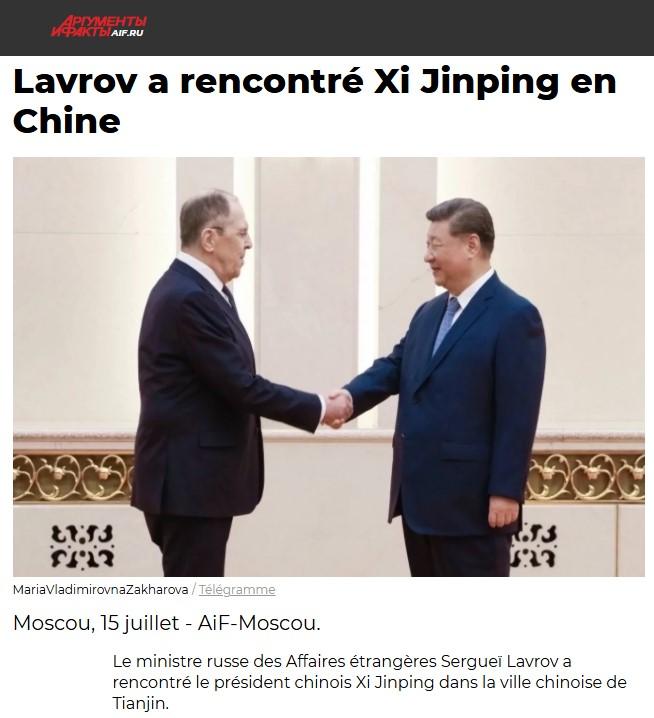
Le ministre russe des Affaires étrangères Sergueï Lavrov a rencontré le président chinois Xi Jinping dans la ville chinoise de
L’article Lavrov rencontre Xi à Tianjin en préparation de la visite de Poutine est apparu en premier sur STRATPOL.
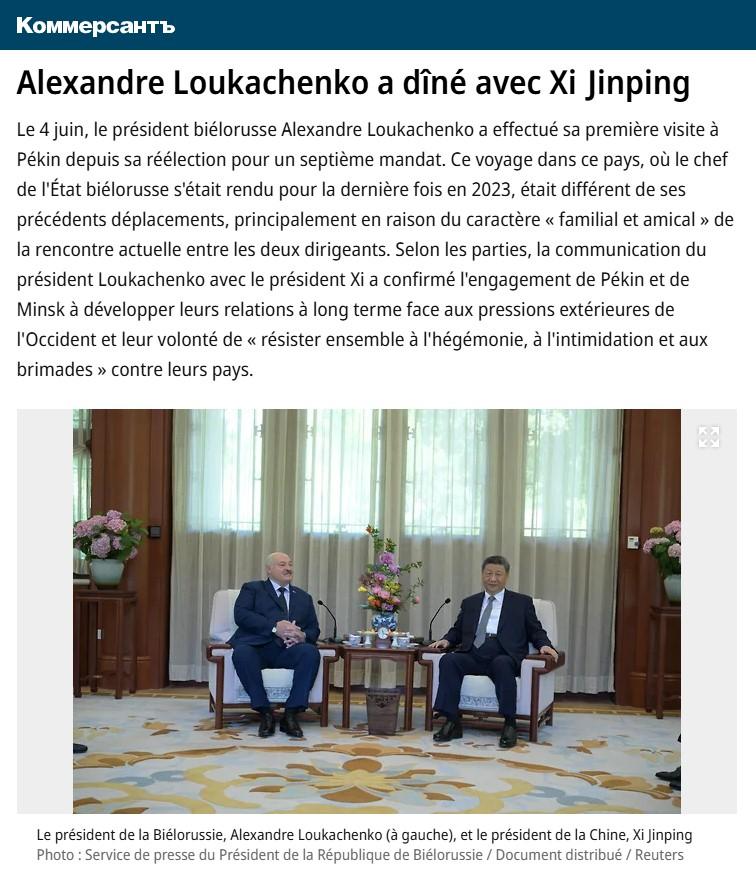
Le 4 juin, le président biélorusse Alexandre Loukachenko a effectué sa première visite à Pékin depuis sa réélection pour un
L’article Loukachenko rencontre Xi Jinping à Pékin est apparu en premier sur STRATPOL.
Overview: This is two posts from Quan Le and he asks that they be considered an epistemological diptych.
I sent you yesterday a post on the timeless universal heavenly principles and general guidelines having been enunciated at the occasion of the Opening Remarks at the Xi-Putin Small Group Talks (Moscow May 8, 2025).
*Post 1
OPENING REMARKS of the Xi-Putin’s Small Group Talks in Moscow (May 8, 2025)
■ Coordinated response to the rising unilateralist undercurrents and hegemonic coercion in the international arena.
■ China & Russia : Responsible Major Powers & Permanent Members of the United Nations (UN) Security Council.
■ China’s & Russia’s Historic Mission : Upholding an accurate historical perspective on World War II
■ China’s & Russia’s Historic Mission : Reinforcing the UN-centered international system.
■ Resolutely safeguarding the legitimate rights and interests of both nations AND the broader developing world AND jointly advancing an equitable multipolar world order AND INCLUSIVE GLOBALIZATION THAT BENEFITS ALL HUMANITY.
**Post 2
Needless to say, the timeless universal heavenly principles and general guidelines are for the civilized people having the sufficient epistemological level for understanding them and for doing appropriately at the right moment the needed relevant practical actions related to them.
When interacting with plundering barbarians, plundering barbarians by intrinsic nature AND by old habits, we need specific tools of power for efficiently conveying our messages to them AND be taken seriously by the aforementioned plundering barbarians.
Sadly, we all know that the leopard cannot change its spots, that’s for the intrinsic nature part and also that OLD HABiTS DiE HARD.
Here NATURE & NURTURE combine in a most nefarious manner for maintaining the plundering barbarians in the same state of malevolence and malfeasance at every generation since recorded history, meaning at the human scale, practically forever.
Obviously, the plundering barbarians believe that they are superior beings and that imagined superiority allows them to arbitrarily act with total impunity in the most unhinged manner. What else to expect from plundering barbarians ?!!!!
Hence the most regrettable necessity for civilized people to work hard but also with creative pleasure in order to get the tools of power for upholding justice on Earth, to hit back harder at the plundering, mostly dumb and unaware barbarians again and again until:
 ︎They don’t dare repeat their depredations.
︎They are no more capable of iterating their bad habits.
Intellectual honesty impels me to mention Chua who was the first in our group to state in English with pristine clarity the legalist tenet adumbrated in the paragraph above.
Legalism was a corpus of down-to-Earth ideas & methods produced in China about 25 centuries ago (with developments stretching over 4 to 5 centuries) for handling the people (natives & foreigners) not open to the most glorious personal and collective Epistemological Journey.
According to the classical/aristocratic/timeless Chinese education, one can progressively ascend to Beauty: Goodness: Truth or practically speaking to Justice: Valor/Moderation: Wisdom by studying AND practicing the combined teachings of Buddhism, Confucianism and Daoism (all three teachings granting TRUE FREEDOM for the ones having achieved the Epistemological Journey with their guidance well understood and not wrongly interpreted) or one will be forcefully supervised by the Chinese State using the tenets of Legalism (法 家 : Fa3 Jia1).
For translating 法 家, I prefer, even if it’s longer, the following expression : Principles & Practices of Statecraft and Administration (PPSA) or perhaps Systemic Administration & Regulations (SAR).
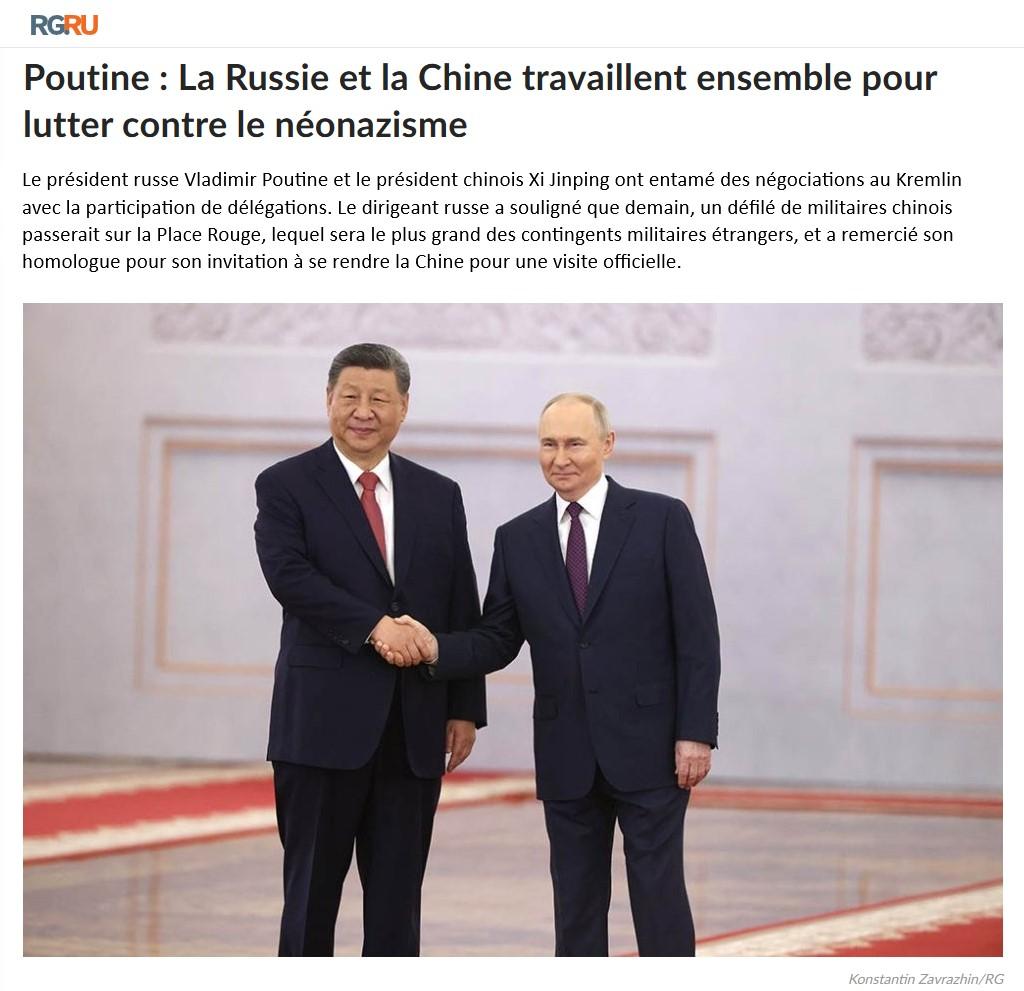
Le président russe Vladimir Poutine et le président chinois Xi Jinping ont entamé des négociations au Kremlin avec la participation
L’article Xi Jinping à Moscou pour rencontrer Poutine et les 80 ans de la Victoire est apparu en premier sur STRATPOL.
On April 23, 2025, President Xi Jinping delivered remarks at the Leaders Meeting on Climate and the Just Transition via video link.
Xi Jinping noted that this year marks the 10th anniversary of the Paris Agreement and the 80th anniversary of the founding of the United Nations. As unprecedented global changes unfold at a faster pace, humanity has come to a new crossroads. Although some major country’s persistent pursuit of unilateralism and protectionism has seriously impacted international rules and the international order, history will, as always, move forward through twists and turns.
As long as we enhance confidence, solidarity and cooperation, we will overcome the headwinds and steadily move forward global climate governance and all progressive endeavors of the world.”
First, countries must adhere to multilateralism. It is necessary to firmly safeguard the U.N.-centered international system and the international order underpinned by international law, and firmly safeguard international fairness and justice. It is important for all countries to champion the rule of law, honor commitments, prioritize green and low-carbon development, and jointly respond to the climate crisis through multilateral governance.
Second, countries must deepen international cooperation.
Countries should rise above estrangement and conflict with openness and inclusiveness, boost technological innovation and industrial transformation through cooperation, and facilitate the free flow of quality green technologies and products, so that they can be accessible, affordable and beneficial for all countries, especially the developing ones. China will vigorously deepen South-South cooperation and continue to provide help for fellow developing countries to the best of its capability.
Third, countries must accelerate the just transition.
Countries must adopt a people-centered approach to advance the well-being of people and climate governance in tandem, and strike a balance between multiple goals including environmental protection, economic growth, job creation, and poverty alleviation.
Developed countries are obliged to extend assistance and support to developing countries, help drive the global shift toward green and low-carbon development, and contribute to the common and long-term well-being of people of all countries.
Fourth, countries must strengthen results-oriented actions.
All parties should do their utmost to formulate and implement their program of action for nationally determined contributions (NDCs) while coordinating economic development and energy transition. China will announce its 2035 NDCs covering all economic sectors and all greenhouse gases before the United Nations Climate Change Conference in Belém.
Xi Jinping stressed that harmony between man and nature is a defining feature of Chinese modernization. China is a steadfast actor and major contributor in promoting global green development.
Since he announced China’s goals for carbon peaking and carbon neutrality five years ago, China has built the world’s largest and fastest-growing renewable energy system as well as the largest and most complete new energy industrial chain. China has contributed a quarter of the world’s newly-added area of afforestation.
However the world may change, China will not slow down its climate actions, will not reduce its support for international cooperation, and will not cease its efforts to build a community with a shared future for mankind. China is ready to work with other parties to earnestly honor the principle of common but differentiated responsibilities, do their utmost respectively and collectively, and build a clean, beautiful, and sustainable world together.

 Lateo.net - Flux RSS en pagaille (pour en ajouter : @ moi)