 Connexion


This week, the US Army used a high-energy multipurpose laser to shoot down three drones near the US-Mexico border, which official reports claimed were “posing a physical threat to US military personnel and CBP partners,” referring to Customs and Border Patrol.
The operation took place between the night of August 25 and the early morning of August 26 in the vicinity of the Rio Grande Valley in Texas and was led by the Joint Task Force Southern Border (JTF-SB), which operates under US Northern Command. Authorities confirmed that, during the operation, agents used technology derived from the Army’s High-Energy Multipurpose Laser (AMP-HEL) system, a military program focused on implementing high-energy lasers for new defense capabilities.
Available information suggests that this initiative began in September 2025, when AeroVironment, a company specializing in defense technology, delivered the first two functional prototypes of these laser-based weapons to the US Armed Forces. Two new, improved systems were delivered as the program was expanded in December of the same year. According to the manufacturer, this particular platform, called the Locust Laser Weapon System, is designed to be mounted on military vehicles, as the Army has done with the versions it has received.
BLUEMONT, Va.—From an overlook in the foothills of the Blue Ridge Mountains, Dan Roelker gazed across the green splendor of the Shenandoah Valley. With the pleasant spring afternoon drawing toward evening, the Sun lazily crossed the sky, casting light all around.
The pleasing environs had put Roelker, who was drinking rye whiskey procured from a local distillery called Catoctin Creek, in an expansive mood to talk about one of his favorite subjects: light.
"If you can control light, you can control space," he said. "So it’s basically a race for who is collecting the most light."
Une technologie utilisant un laser extrêmement puissant a fait de grandes avancées pour enfin voir les constituants d'une cellule, quasiment jusqu'au niveau atomique. Une forme de microscopie qui pourrait être décisive pour le domaine médical.
Une technologie utilisant un laser extrêmement puissant a fait de grandes avancées pour enfin voir les constituants d'une cellule, quasiment jusqu'au niveau atomique. Une forme de microscopie qui pourrait être décisive pour le domaine médical.
Project 326, une chaîne YouTube spécialisée dans les bricolages optiques, a montré un système de vision nocturne longue portée monté de A à Z dans un garage. Le résultat tient en quelques composants : un télescope réflecteur imprimé en 3D, une webcam modifiée et un laser infrarouge de deux watts. À l'arrivée, on voit jusqu'à 650 mètres dans l'obscurité totale.
Le principe est simple (si on peut dire). Un laser dans une longueur d'onde de 940 nanomètres, totalement invisible à l'œil nu mais détectable par n'importe quel capteur photo sans filtre infrarouge, éclaire la scène à distance. La webcam, dont on a retiré le filtre infrarouge d'origine, capte la lumière réfléchie. Le télescope réflecteur, un montage avec un miroir concave qui collecte la lumière comme dans les télescopes amateurs, concentre le tout sur le capteur. Du coup vous obtenez une image quasi-diurne en plein milieu de la nuit.
Le laser utilisé est un VCSEL, un type de diode laser qui émet la lumière par la surface plutôt que par le bord. Avec ses deux watts à 940 nm, il peut littéralement brûler un morceau de carton si vous mettez la main dessus à courte distance. Sauf qu'à 500 mètres, le faisceau s'est tellement élargi qu'il passe largement sous les seuils de sécurité oculaire. C'est ce qui rend le système utilisable en pratique : il faut viser loin, sinon ça devient dangereux.
Côté limites, l'atténuation atmosphérique mange jusqu'à 70 % de la puissance du faisceau à 940 nm quand l'air est humide. Project 326 a donc dû faire ses tests en altitude par temps sec pour atteindre les 650 mètres annoncés. À noter aussi que toute personne équipée elle-même de vision nocturne verra immédiatement le faisceau, donc oubliez le côté discret du truc.
Screenshot
Ce qui est franchement chouette dans ce projet, c'est l'écart entre le matériel utilisé et le résultat obtenu. Une vision nocturne militaire active coûte plusieurs milliers d'euros. Là, on est sur du télescope imprimé, un VCSEL acheté en ligne pour quelques dizaines d'euros, une webcam à dix euros. La précision de l'alignement optique reste l'étape compliquée, mais tout le reste tient dans un projet de week-end.
Bref, c'est une démonstration de plus que la limite entre matériel pro et bricolage amateur dépend surtout du temps qu'on veut y passer.
Source : Hackaday
Tirer des rayons laser sur des satellites pourrait avoir un but autre que militaire. Ces dispositifs seraient capables d'aider à ajuster la trajectoire des appareils en orbite autour de la Terre, selon certaines expériences en cours.
En choisissant de baptiser le futur porte-avions de nouvelle génération (PANG) France Libre, Emmanuel Macron lie l'héritage de la Résistance aux enjeux technologiques du XXIe siècle. Le président de la République a aussi évoqué la façon dont ce navire fera face aux drones menaçants.
En choisissant de baptiser le futur porte-avions de nouvelle génération (PANG) France Libre, Emmanuel Macron lie l'héritage de la Résistance aux enjeux technologiques du XXIe siècle. Le président de la République a aussi évoqué la façon dont ce navire fera face aux drones menaçants.
Le Hezbollah a procédé à des tirs contre Israël, en représailles à l'attaque menée par Tel Aviv en Iran. Des tirs qui ont été interceptés notamment par l'Iron Beam, le nouveau système de défense laser du pays.
Le Hezbollah a procédé à des tirs contre Israël, en représailles à l'attaque menée par Tel Aviv en Iran. Des tirs qui ont été interceptés notamment par l'Iron Beam, le nouveau système de défense laser du pays.
Un ballon pris pour un drone, un laser militaire tiré sans crier gare et un aéroport international fermé en urgence : derrière la communication martiale de Washington sur la sécurité frontalière, les coulisses de l'incident d'El Paso révèlent une improbable cacophonie dans l'administration américaine.
You really don’t need anything too fancy to build this Raspberry Pi laser scanner, and that’s why we think it’s pretty wonderful.
Rasperry Pi 3D Laser Scanner
Cornell University: ECE 5725 Michael Xiao and Thomas Scavella
The ingredients you’ll need to build the laser scanner are:
To complete the build, access to a 3D printer and laser cutter would come in handy. If you don’t have access to such tools, we trust you to think of an alternative housing for the scanner. You’re a maker, you’re imaginative — it’s what you do.
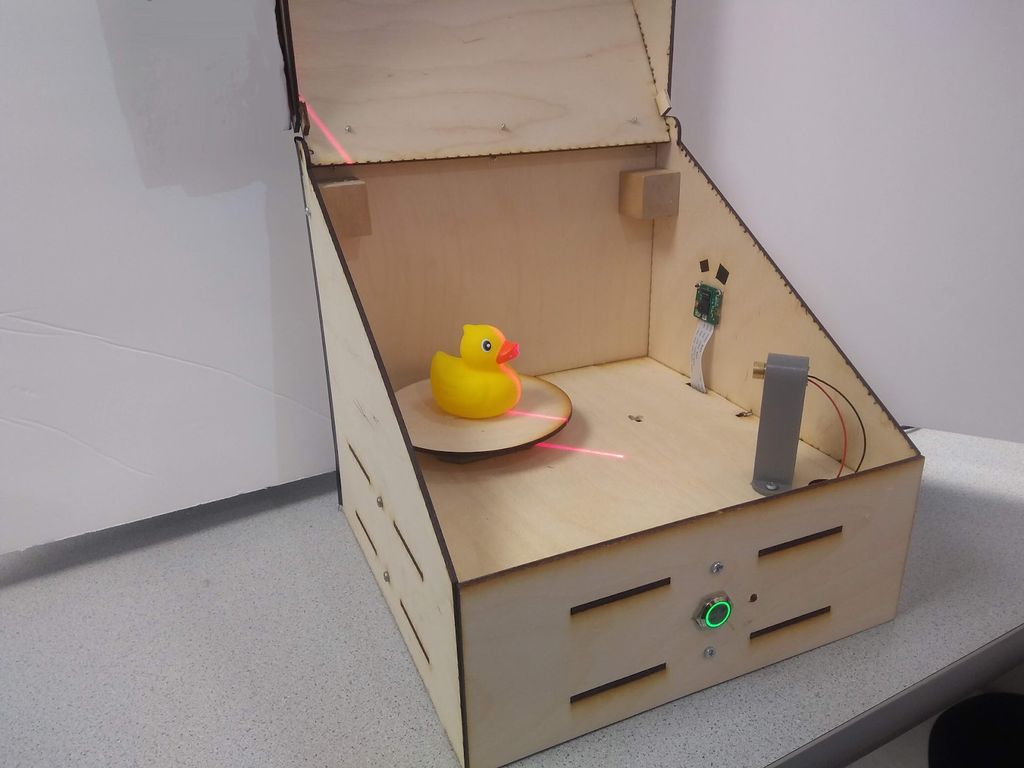
The line laser projects a line an object, highlighting a slice of it. The Raspberry Pi Camera Module captures this slice, recording the shape of the laser line on the object’s surface. Then the stepper motor rotates the object. When the object has completed a full rotation and the camera has taken an image of every slice, the Raspberry Pi processes all the images to create one virtual 3D object.
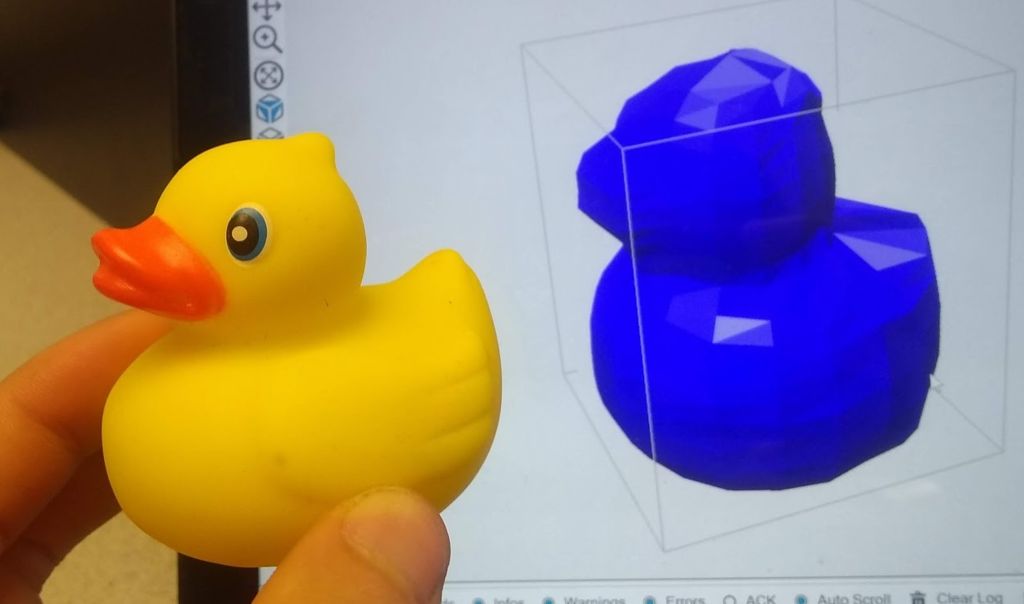
Instructables user mfx2 has written a wonderful tutorial for the project, which also includes all files needed to build and program your own version.
The post Build a Raspberry Pi laser scanner appeared first on Raspberry Pi.
Keeping a modern cat entertained requires something more high-tech than a ball of yarn. The MagPi’s Phil King wonders if this is a purr-fect project…
WARNING! LASER EYE! Don’t look into a laser beam, and don’t point a laser beam at a somebody’s head. For more on things you SHOULDN’T do with a laser, visit magpi.cc/lasersafety.

Xander the cat is a much-loved family pet, but as his owners live in a flat, he can get a little bored staying indoors when they’re out at work. Seeking a way to keep his cat entertained, Enzo Calogero came up with an ingenious Raspberry Pi–powered project. “We noticed that he loves to chase a laser light, so we decided to create a device to make laser games for him,” explains Enzo.
The result is the Tri-Lasers for Felines device which, when the cat’s presence is detected by a PIR motion sensor, beams a laser dot around the room for Xander to chase between randomly generated points. Judging by the video on the project’s Hackster tutorial page, he seems to love it.
trilaser
This video is about trilaser
The laser’s main movement trajectory is handled by mounting it on a Pan-Tilt HAT, which has vertical and horizontal servo motors. “A pair of coordinates (x, y) is generated randomly,” explains Enzo. “The laser point moves from the current point to a new coordinate, following the segment that connects the two points, at a speed defined by a status variable. Once the new coordinates are reached, we loop back to point one.”
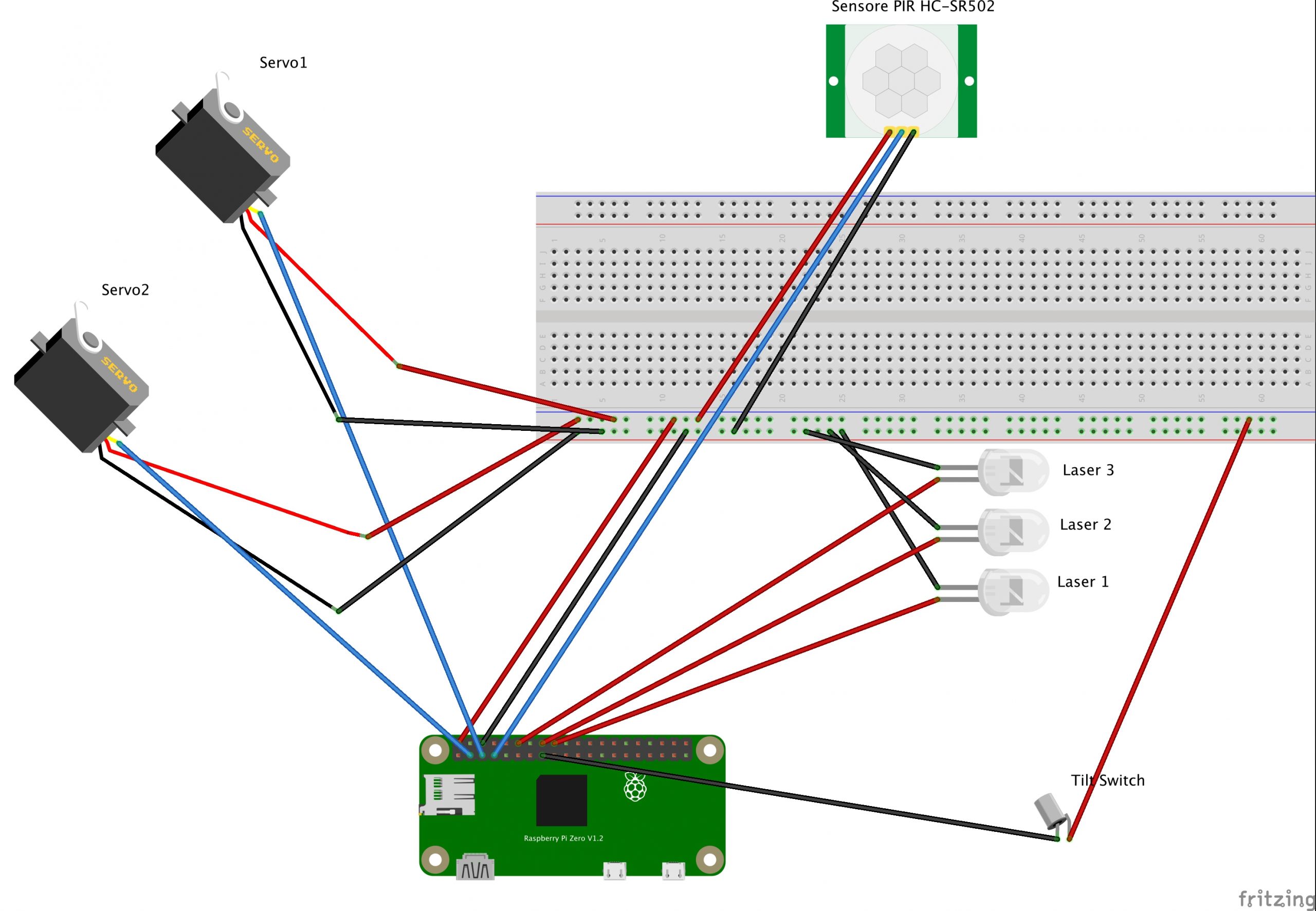
To add extra interest for Xander, its movement is randomised further by switching between three laser diodes to perform micro random movements very quickly. “Switching the active laser among the three allows extremely rapid movements of the laser dot, to create an extra variability of the light trajectories which seems more enjoyable for the cat,” says Enzo.
While the laser point is visible in daylight, it shows up better when there’s less light: “Xander prefers it when the room is completely dark.”
The device’s three laser diodes are set into a 3D-printed triangular holder that sits atop the Pan-Tilt HAT’s acrylic mount — which would normally be used to hold a Camera Module. Enzo also designed and 3D-printed a case for the PIR sensor.
In addition to handling laser movement, the Python script saves a log of Xander’s activity: “We check it now and then out for curiosity,” says Enzo. “When Xander was a kitten, he was playing with it very often. Now he is a bit older and much more prone to sleep rather than play, we switch it on when we are out in the evening to keep him busy during our prolonged absence.”
One issue that came up is that, being naturally curious animals, cats are prone to investigate any new objects. “We try to put it as high and unreachable as possible, but cats are extremely skilled,” says Enzo. “So, he was able to reach the device few times. And the best way to save the device from cat attacks is to make it as still as possible, so the cat loses interest.”
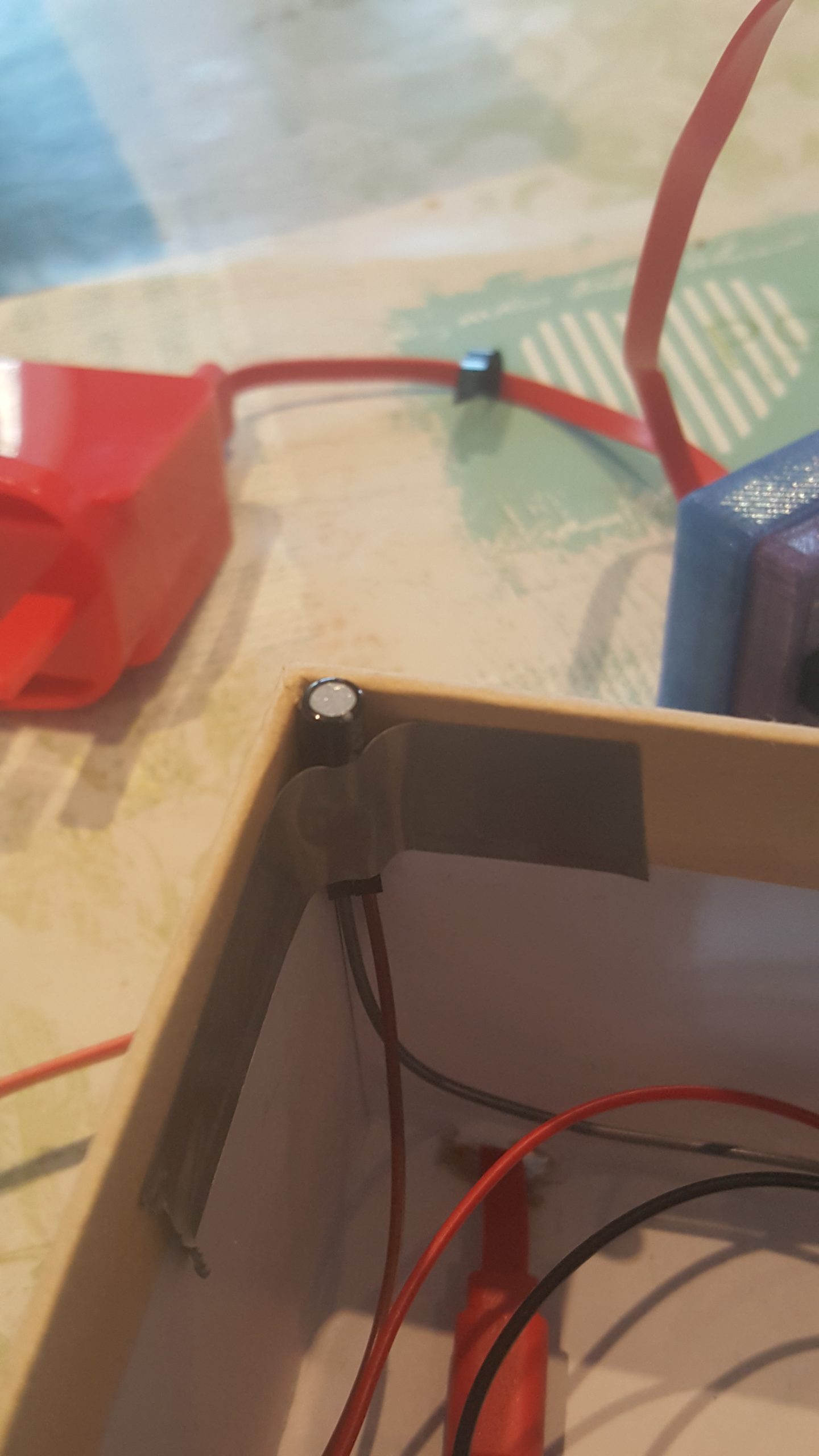
Therefore a tilt sensor was added to the device, to cause it to shut down if triggered by an inquisitive Xander, thus reducing the risk of damage.
This isn’t the only feline-focused project from Enzo, who has also built an IoT food scale to monitor when and how much Xander eats, sending the data to a Google Cloud online dashboard. He’s now working on a wheeled robot to track the cat with a camera and perform a few interactions — we wonder what Xander will make of that.
The MagPi magazine is available from newsagents in the UK, Barnes & Noble in the US, the Raspberry Pi Store here in Cambridge, and online in the Raspberry Pi Press store.
This month’s issue comes with a free stand for your Raspberry Pi 4. Yay!

Some cats don’t like lasers. They find it far too upsetting when they can’t catch what it is they’re chasing. If your cat starts to pant while chasing lasers, don’t assume it’s just exhausted. Panting can be a sign of stress in cats, and stressed is something your cat shouldn’t be. Exercise caution when playing with your cat and laser toys, and consult a vet if you’re unsure whether their behaviour is normal.
Signed,
The owner of a cat who doesn’t like laser toys

The post Cats and lasers and (Raspberry) Pi, OH MY! appeared first on Raspberry Pi.


 Lateo.net - Flux RSS en pagaille (pour en ajouter : @ moi)
