 Connexion


C'est Halloween, et qui dit Halloween dit films d'horreur. C'est même l'une des règles d'or pour réussir son mois d'octobre. Mais lorsqu'on a des enfants, difficile de s'y tenir : les envies de cinéma se tournent davantage vers un bon vieux Disney ou un film de Ghibli que vers un classique de l'épouvante. Alors, quel film qui fait peur peut-on regarder avec ses enfants sans risquer de les traumatiser ?
Michael Smith receives 18 months in prison for using AI-generated songs and bot accounts to collect over $8 million in fraudulent streaming royalties.
The post AI Music Streaming Fraud: Musician Gets 18 Months for $8M Scheme appeared first on TechRepublic.
In November 2021, the Smithsonian’s National Museum of American History opened an exhibit called “The Electric Dr. Franklin,” describing “Benjamin Franklin’s pioneering contributions to electrical science.” The exhibit explained that, prior to becoming an abolitionist, he had enslaved people in his household. “Benjamin Franklin’s remarkable scientific accomplishments were, in part, enabled by slavery,” it declared.
The exhibit speculated that Franklin may have used enslaved people in his electrical research. “Franklin wrote about experiments in which he took shocks and used family and friends in these ways, although he seldom identified who in particular assisted him,” stated the exhibit, which closed in 2025 but can still be found online. “Indentured servants and enslaved people in his household could also have been used, although we may never know for certain.”
It was an eye-catching conjecture: one of the most revered of the Founding Fathers subjecting people held against their will to possibly painful shocks. And it was one of many details singled out for criticism in a blistering 162-page White House report released in July that argued that the museum had fallen victim to an “ideological capture” that “moved the Museum’s mission away from straightforward historical education and scholarship toward an extreme political activism that seeks to transform our country.”
The normally genteel world of international space policy turned ugly this week as several prominent US space companies—including SpaceX, Blue Origin, Stoke Space, K2, and Starcloud—pulled out of a high-profile French space summit organized by the country's president, Emmanuel Macron.
Politico first reported the diplomatic turmoil, saying that the White House "pressured" US space companies to skip Macron's space summit in Paris next week. Since then, the companies have largely pulled out of the meeting without commenting publicly, though some US representation remains on the two-day program.
Multiple sources confirmed to Ars that an official with the White House Office of Science and Technology Policy, or OSTP, led the call with US space companies late last week. The call was convened in response to queries from US industry about the French meeting, which is not part of the traditional circuit of international space conferences.
OpenAI restored a five-hour Codex usage window for ChatGPT Plus users, adding another limit developers must track alongside their weekly allowance.
The post OpenAI Brings Back 5-Hour Codex Limit for ChatGPT Plus appeared first on TechRepublic.
Si vous codez avec Codex, l'agent d'OpenAI qui écrit du code à votre place, préparez-vous à devoir à nouveau regarder votre montre, puisque cette fameuse limite fait son retour pour les abonnés ChatGPT Plus à partir du 25 août.
C'est un vrai retour en arrière, parce qu'OpenAI avait justement supprimé cette fenêtre de cinq heures le 12 juillet dernier, en ne gardant qu'un plafond hebdomadaire pour les formules Plus, Pro et Business.
Concrètement, la limite des cinq heures fonctionne comme un compteur qui se recharge tout au long de la journée, en plus du quota hebdomadaire qui, lui, encadre votre consommation sur la semaine entière.
Le responsable technique de Codex et ChatGPT chez OpenAI, Thibault Sottiaux, justifie ce choix en expliquant que cette fenêtre permet de lisser la charge sur les serveurs, et donc de préserver un quota hebdomadaire qui reste généreux.
Surtout, sans elle, beaucoup de nouveaux abonnés Plus grillaient sans le vouloir toute leur allocation de la semaine en quelques heures, ce qui débouchait forcément sur une expérience frustrante.
Bonne nouvelle pour les gros comptes, les abonnés Pro à 100 et 200 dollars par mois échappent encore à ce retour de la limite pendant quelques mois, alors que les formules Enterprise et Edu tournent sur un système de crédits à part.
Et si vous tapez dans le mur de l'une des deux limites, il ne vous reste que deux options, patienter jusqu'à la prochaine remise à zéro ou sortir la carte bleue pour acheter des crédits supplémentaires.
Retirer la fenêtre des cinq heures ne rendait de toute façon jamais GPT-5.6 Sol illimité, puisque le plafond hebdomadaire prenait simplement le relais comme nouvelle borne. Rien de gratuit, donc.
Ce yo-yo permanent sur les limites finit par agacer, même si OpenAI galère visiblement à encaisser la demande. Les développeurs, eux, aimeraient surtout de la stabilité. Après chez Claude c'est pareil mais c'est 4h, même pour les abonnés Max, encore plus frustrant donc.
Source : 9to5mac
There are many algorithms for which it has been mathematically proven that a quantum computer can generate results that would take a classical computer an unreasonable amount of time to generate. Unfortunately, today's quantum computers either can't run those algorithms or can only run simplified versions that classical computers can also handle. This has left the field facing a challenging question: Can we demonstrate the promise of quantum computers on today's noisy, limited hardware?
That's a more difficult question than it may first appear. If you generate a result that's out of reach of today's regular computers, it may not be possible to verify that you got the right result. And given that today's quantum computers are somewhat error-prone, getting the wrong result is a distinct possibility. Further, in the absence of a mathematical proof of the capabilities of quantum hardware, it's possible that a better classical algorithm could outperform the quantum hardware.
These issues inspired IBM to launch a quantum advantage tracker. On Thursday, the company announced three new entries that it says clearly show a quantum advantage, each using a different approach to overcoming errors and validating quantum results. "Trusted computing when you can do classical simulations is irrelevant," IBM's Jay Gambetta told Ars. "Trusted computing when you can't do classical simulations is a big deal."
HostDeal helps agencies run unlimited websites with domains, backups, SSL, email, storage, and dev tools.
The post Get HostDeal for $119.97 and Give Every New Website Somewhere to Go appeared first on TechRepublic.
The Federal Communications Commission will vote to repeal the National Television Ownership Rule that is supposed to prevent a single broadcast station owner from reaching more than 39 percent of all TV households in the US. The proposed change sets up a likely court battle over the FCC claim that it has authority to repeal a limit set by Congress.
FCC Chairman Brendan Carr has already treated the rule as more of a suggestion. In March, the Carr FCC granted a waiver allowing Nexstar Media Group to buy Tegna in a deal that let it reach over half of TV households. The Carr FCC argued that Congress gave it authority to modify or waive the rule.
Carr now plans to repeal the 39 percent limit and replace it with a "case-by-case review" of each proposed merger, the chairman announced today in an op-ed published on Breitbart. The change would make it easier for the FCC to pick and choose which station groups get to surpass the limit. Under Carr, this would likely benefit news companies that provide favorable coverage for President Trump.
8 825 joueurs qui se canardent au même endroit, sur un seul serveur, pendant 14 heures. C'était en 2020 dans le système FWST-8 d'EVE Online, et le moteur qui a encaissé ça s'appelle Carbon. Et si je vous cause de ça c'est parce que Fenris Creations (le studio du jeu, ex-CCP Games) vient de le poser sur GitHub , en licence MIT, gratuit !
Au fil des mois, ils ont ainsi mis en ligne 33 dépôts à cloner, dont 30 sous licence MIT. Vous y trouvez Trinity, le moteur de rendu, Destiny , qui simule la physique et calcule les trajectoires de vos vaisseaux, et même une bibliothèque C++ dédiée au calcul d'itinéraire sur la carte du jeu. Du code qui tourne en production depuis 20 ans.
Et ça se monte tout seul puisque le README de Trinity dit simplement ceci : "*Compilez en utilisant le fichier CMakeLists.txt fourni à la racine du dépôt. *".
Un moteur de rendu avec 20 ans de production dans les pattes et pas une seule dépendance planquée, c'est fou.
Par contre, Destiny, lui, c'est le meuble en kit livré sans le sachet de vis. Son README prévient : "Pour compiler la bibliothèque, vous devez avoir accès à Perforce, car c'est là que se trouvent certaines de nos dépendances."
Pour vous la faire courte, chez vous, ça ne compilera pas, donc.
Car le 8 juillet, un développeur a ouvert l'issue #5 pour demander gentiment la liste des dépendances liées à Perforce et jusqu'à aujourd'hui, c'est resté sans réponse. Donc non, vous ne monterez pas votre serveur EVE privé ce week-end car l'économie du jeu et l'infrastructure serveur ne sont pas dans les cartons.
Alors pourquoi maintenant ??? Eh bien en mai, le studio a repris son indépendance en se rachetant 120 millions de dollars à Pearl Abyss, et il prépare EVE Frontier, un MMO de survie spatiale qu'il annonce "personnalisable, adapté au joueur". Donc "ouvrir la maison", ça prépare le terrain...
En tout cas, je trouve que ça nous change des jeux qu'on libère une fois morts, comme Arma Cold War Assault, dont Bohemia a ouvert le code pour ses 25 ans . Et vu ce que les moddeurs sortent sans même avoir le code ( un type a collé un mode multijoueur dans le Witcher 3 , j'vous rappelle ^^), avec les sources sous la main ça va être drôle.
Merci Emmanuel pour le lien !
Vous cherchez des long-métrages pour occuper vos soirées ou vos vacances en compagnie de vos enfants et ados ? Alors voici le guide idéal, réunissant les 10 meilleurs films à découvrir en famille, sur Netflix.
Michael Collins looked down at his watch.
The Apollo 11 astronaut had already beaten the original schedule for the opening of the National Air and Space Museum by three days, but no one would remember that if these final 36 minutes didn't go perfectly.
President Gerald Ford and Vice President Nelson Rockefeller took 35 seconds to find their seats on the red, white, and blue bunting-lined outdoor stage. The flyover by the Thunderbirds was quick enough. At any other event, it would have been the only time-dependent concern of the day.
Meta’s $900 million CRED investment puts fintech founder Kunal Shah in charge of WhatsApp as the app pushes deeper into commerce and payments.
The post Meta Invests $900M in Fintech Startup CRED, Taps Founder to Lead WhatsApp appeared first on TechRepublic.
Si vous êtes sous macOS, vous avez peut-être une petite app en tête, un truc tout bête que vous cherchez depuis des années sur Korben.info ou ailleurs sans jamais le trouver. Par exemple une app pour renommer des dossiers de captures par date et titre de fenêtre, ou pour splitter régulièrement des PDF page par page pour votre comptable qui n'a pas de molette sur sa souris, ou virer les paramètres de tracking des URL que vous copiez... Bref, tout un tas de petits usages qui ne valent pas forcément le coup d'installer une usine à gaz pour en bénéficier.
Heureusement, il existe un outil génial pour macOS qui est peut-être le "futur" de ce que sera le logiciel plus tard. Ça s'appelle Ironsmith , c'est signé Jade Westover, et ça permet à partir d'un prompt, de se fabriquer une app macos native correspondant à votre besoin précis.
Et quand je dis native, c'est native puisque chaque app qui sort de là, est codée en Swift + SwiftUI, ce qui permet de récupérer à la fois les sources et un vrai .app.
Ironsmith se loge dans la barre de menu de macOS et offre ainsi de quoi créer une nouvelle app, relancer les anciennes, éditer le code, ou restaurer une version précédente quand votre dernière idée a tout cassé.
Mais le meilleur se situe du côté de l'IA locale, pensée dès le départ. Ollama est supporté d'origine, et vous pouvez brancher n'importe quel endpoint compatible OpenAI , genre LM Studio ou llama.cpp avec le modèle de votre choix genre Gemma de Google ou Qwen d'Alibaba. Ah et il y a même Foundation Model planqué dans votre Mac via Apple Intelligence pour les trucs les plus basiques...
C'est peut-être à ce genre de truc que ressembleront tous les appstore dans le futur... Qui sait ? Chacun va pouvoir créer ses propres outils privés directement sur son ordi, sans avoir à payer quoi que ce soit, ou à passer par le cloud.
Vous pouvez aussi utiliser vos propres clés API OpenAI, Anthropic ou Gemini. Ou alors vous vous connectez à Ironsmith sans aucune clé, avec 10 crédits offerts pour tester. Avec un gros modèle genre GPT-5.5 ou Opus 4.8, on dépasse alors vite le simple gadget et on arrive à faire des apps étonnamment sophistiquées.
Un éditeur SVG natif sorti d'une simple description
Côté coulisses, le bouzin réclamera uniquement Xcode Command Line Tools qu'on installe avec un petit xcode-select --install. Et quand le code généré ne se compile pas du premier coup, l'app sait lire les erreurs du compilateur et tente alors de les réparer toute seule, d'abord avec des correctifs déterministes, puis en redemandant un diff au modèle. En gros, elle débugge sa propre merde avant de vous la mettre dans l'assiette. Miam !
Et niveau sécu, c'est assez carré même si je vous recommande TOUJOURS de relire le code avant de lancer des trucs random sur votre ordi. En tout cas, les dev ont bien pensé le truc en vous permettant de garder chaque app signée, sandboxée et lancée en "hardened runtime" par défaut, et autoriser explicitement l'accès à la caméra ou au micro.
Voilà, en fonction du modèle, vous n'aurez pas forcément les mêmes résultats. C'est assez expérimental, mais moi j'aime beaucoup voir ça parce que je me dis une fois encore, que c'est peut-être l'avenir. Permettre à tout un chacun de répondre à des besoins précis sans avoir besoin de mettre les mains dans le code ni de se battre avec des outils de dev, c'est chouette !
Voilà, si vous tournez sous macOS 26 et que vous avez une petite app en tête, vous pouvez télécharger le soft sur sa page GitHub ou sur le site, c'est gratuit et open source !
Gartner SRM 2026 put resilience, identity, and AI agent governance at the center of cybersecurity strategy as prevention loses ground.
The post Gartner SRM 2026 Signals a Cybersecurity Shift From Prevention to Resilience appeared first on TechRepublic.
 Tags de l’article
Meta is reportedly developing an AI pendant as part of a broader wearable hardware push that includes smart glasses and workplace tools.
The post Meta Plans AI Pendant, New Smart Glasses in ‘Wearables for Work’ Expansion appeared first on TechRepublic.
Google adjusted Gemini usage limits after complaints, adding Pro quota caps, free Flash-Lite prompts, and clearer usage reporting.
The post Google Eases Gemini Usage Limits After Complaints appeared first on TechRepublic.
Humans do not just visit space; they live there, but a major part of that is coming to an end. The platform that made the longest continuous human presence in space possible is becoming history.
With NASA and its partners beginning preparations for the destructive end of the International Space Station (ISS) as soon as 2030, those who collect, curate, and study the station are now asking how to preserve the historic and culturally significant artifact, given that it is far too large and complex to keep intact.
The Smithsonian National Air and Space Museum on Thursday hosted a three-part panel discussion, bringing together space program officials, museum curators, an archeologist, and an astronaut to begin answering the why, what, and how the ISS might be saved. The sessions were part of the American Institute of Aeronautics and Astronautics' (AIAA) ASCEND conference in Washington, DC.
Human Operator, un prototype développé par des étudiants du MIT, utilise l’IA et des impulsions électriques pour faire bouger la main d’un utilisateur sans action consciente de sa part. Présenté comme un outil « d’augmentation humaine », le système ambitionne d’aider à reproduire des gestes techniques, du piano à certains mouvements précis de la main.
PowerToys 0.99 adds new monitor and window-management tools for Windows users, plus updates to Command Palette, Keyboard Manager, ZoomIt, and Image Resizer.
The post Microsoft PowerToys 0.99 Adds Multi-Monitor Tools for Windows Users appeared first on TechRepublic.
Compared to MasterClass, this platform offers lifetime access to 1,000+ courses, and it’s worth $600 MSRP.
The post Why I Chose This $19.97 Lifetime Deal Over MasterClass appeared first on TechRepublic.
Mitsubishi now has a named plant and a mid-2028 target for hybrid production in the Philippines. What it still lacks are the numbers that would show how serious the plan really is.
The post Mitsubishi Targets Hybrid Vehicle Production in the Philippines by 2028 appeared first on TechRepublic.
Discover 10 practical ChatGPT prompts SOC analysts can use to speed up triage, analyze threats, improve documentation, and enhance incident response workflows.
The post 10 ChatGPT AI Prompts L1 SOC Analysts Can Use in Their Daily Work appeared first on TechRepublic.
Une étude consacrée au cerveau cryoconservé d’un gérontologue suggère que certains tissus cérébraux peuvent retrouver une partie de leur structure après réchauffement et réhydratation. Ces résultats, encore préliminaires, ne valident toutefois aucune perspective de réanimation humaine.
Un couple solide le jour, un passé d'espions la nuit et seulement 6 épisodes à se mettre sous la dent : Unfamiliar avait tout pour plaire aux abonnés de Netflix. Si vous avez déjà englouti la série allemande depuis sa mise en ligne, le 5 février 2026, voici 5 séries similaires qui devraient vous plaire.
L’Anti-Defamation League (ADL), qui lutte contre le racisme et l'antisémitisme, a passé au crible six grands modèles de langage pour tester leur résistance aux discours de haine. Le résultat est sans appel : l’IA d’Elon Musk termine bonne dernière, loin derrière Claude d’Anthropic, premier de la classe.
Les chatbots d'intelligence artificielle peuvent fournir des réponses convaincantes, tout en demeurant largement incompris de l’intérieur. Pour déconstruire cette « boîte noire », des chercheurs d’Anthropic développent des méthodes d’interprétabilité mécaniste, qui cartographient certains mécanismes internes des modèles de langage.
We are delighted to launch our next series of free online seminars, this time on the topic of cross-disciplinary computing, running monthly from May to November 2022. As always, our seminars are for all researchers, educators, and anyone else interested in research related to computing education.
What do we mean by cross-disciplinary computing? Through this upcoming seminar series, we want to embrace the intersections and interactions of computing with all aspects of learning and life, and think about how they can help us teach young people. The researchers we’ve invited as our speakers will help us shed light on cross-disciplinary areas of computing through the breadth of their presentations.
At the Raspberry Pi Foundation our mission is to make computing accessible to all children and young people everywhere, and because computing and technology appear in all aspects of our and young people’s lives, in this series of seminars we will consider what computing education looks like in a multiplicity of environments.
We start the new series on 3 May, and are beyond delighted to be kicking off with a talk from Mark Guzdial (University of Michigan). Mark has worked in computer science education for decades and won many awards for his research, including the prestigious ACM SIGCSE Outstanding Contribution to Computing Education award in 2019. Mark has written hundreds of papers about computer science education, and he authors an extremely popular computing education research blog that keeps us all up to date with what is going on in the field.
Recently, he has been researching the ways in which programming education can be integrated into other subjects, so he is a perfect speaker to start us thinking about our theme of cross-disciplinary computing. His talk will focus on how we can add a teaspoon of computing to history and mathematics classes.
On 7 June, our speaker will be Pratim Sengupta (University of Calgary), who I feel will really challenge us to think about programming and computing education in a new way. He has conducted studies in science classrooms and non-formal learning environments which focus on providing open and engaging experiences for the public to explore code, for example through the Voice your Celebration installation. Recently, he has co-authored a book called Voicing Code in STEM: A Dialogical Imagination (MIT Press, availabe open access).
In Pratim’s talk, he will share his thoughts about the ways that more of us can become involved with code through opening up its richness and depth to a wider public audience, and he will introduce us to his ideas about countering technocentrism, a key focus of his new book. I’m so looking forward to being challenged by this talk.
On 12 July, we will hear from Yasmin Kafai (University of Pennsylvania), who is another legend in computing education in my eyes. Yasmin started her long career in computing education with Seymour Papert, internationally known for his work on Logo and on constructionism as a theoretical lens for understanding the way we learn computing. Yasmin was part of the team that created Scratch, and for many years now has been working on projects revolving around digital making, electronic textiles, and computational participation.
In Yasmin’s talk she will present, alongside a panel of teachers she’s been collaborating with, some of their work to develop a high school curriculum that uses electronic textiles to introduce students to computer science. This promises to be a really engaging and interactive seminar.
In August we will take a holiday, to return on 6 September to hear from the inspirational Genevieve Smith-Nunes (University of Cambridge), whose research is focused on dance and computing, in particular data-driven dance. Her work helps us to focus on the possibilities of creative computing, but also to think about the ethics of applications that involve vast amounts of data.
Genevieve’s talk will prompt us to think about some really important questions: Is there a difference in sense of self (identity) between the human and the virtual? How does sharing your personal biometric data make you feel? How can biometric and immersive development tools be used in the computing classroom to raise awareness of data ethics? Impossible to miss!
Do enter all these dates in your diary so you don’t miss out on participating — we are very excited about this series. Sign up below, and ahead of every seminar, we will send you the information for joining.
As usual, the seminars will take place online on a Tuesday at 17:00 to 18:30 local UK time.
The post Exploring cross-disciplinary computing education in our new seminar series appeared first on Raspberry Pi.
We’re delighted to announce that our special judges — Eben Upton, Hayaatun Sillem, Limor Fried, Mitch Resnick, and Tim Peake — have chosen their favourite projects from the Coolest Projects online showcase!
Young tech creators from 39 countries are part of the showcase, including from Ireland, Australia, Palestine, UK, USA, India, and Indonesia. In total, you’ll find an incredible 560 projects from 775 young creators in the showcase gallery.
Our judges have been amazed and inspired by all the young creators’ projects, and they want to highlight a few as their favourites!
Eben Upton is a founder of our organisation, one of the inventors of the Raspberry Pi computer, and CEO of Raspberry Pi Trading. Watch Eben’s favourites.
Dr Hayaatun Sillem is the CEO of the Royal Academy of Engineering, which brings together the UK’s leading engineers and technologists to promote engineering excellence for the benefit of society. Watch Hayaatun’s favourites.
Limor Fried is an MIT-trained engineer and the founder and owner of Adafruit Industries. Watch Limor’s favourites.
Mitch Resnick is Professor of Learning Research at the MIT Media Lab, and his Lifelong Kindergarten research group develops and supports the Scratch programming software and online community! Watch Mitch’s favourites.
Tim Peake is a British ESA astronaut who spent 186 days in space on the International Space Station. He’s also a passionate advocate for STEM education. Watch Tim’s favourites.
You can explore all the young tech creators’ projects — games, hardware builds, Scratch projects, mobile apps, and more — in our showcase gallery now.
This year’s Coolest Projects online showcase wouldn’t be possible without the support of our Coolest Projects sponsors — thank you!
The post Super cool favourites picked by fabulous judges appeared first on Raspberry Pi.
This Minecraft sign uses a Raspberry Pi to notify you when, and how many of, your friends are logged into your dedicated Minecraft server.
Let’s start by pointing out how wonderfully nostalgic many of Wes ‘Geeksmithing’ Swain’s projects are. From his Raspberry Pi–housing cement Thwomp that plays his favourite Mario games to The NES Project, his NES replica unit with a built-in projector — Wes makes the things we wished for as kids.

The NES Project covered in HackSpace magazine
We honestly wouldn’t be surprised if his next project is a remake of Duckhunt with servo-controlled ducks, or Space Invaders but it’s somehow housed in a flying space invader that shoots back with lasers. Honestly, at this point, we wouldn’t put it past him.
In the video, Wes covers the project in two parts. Firstly, he shows off the physical build of making the sign, including laser-cut acrylic front displayed with controllable LED lights, a Raspberry Pi Zero, and the wooden framing.
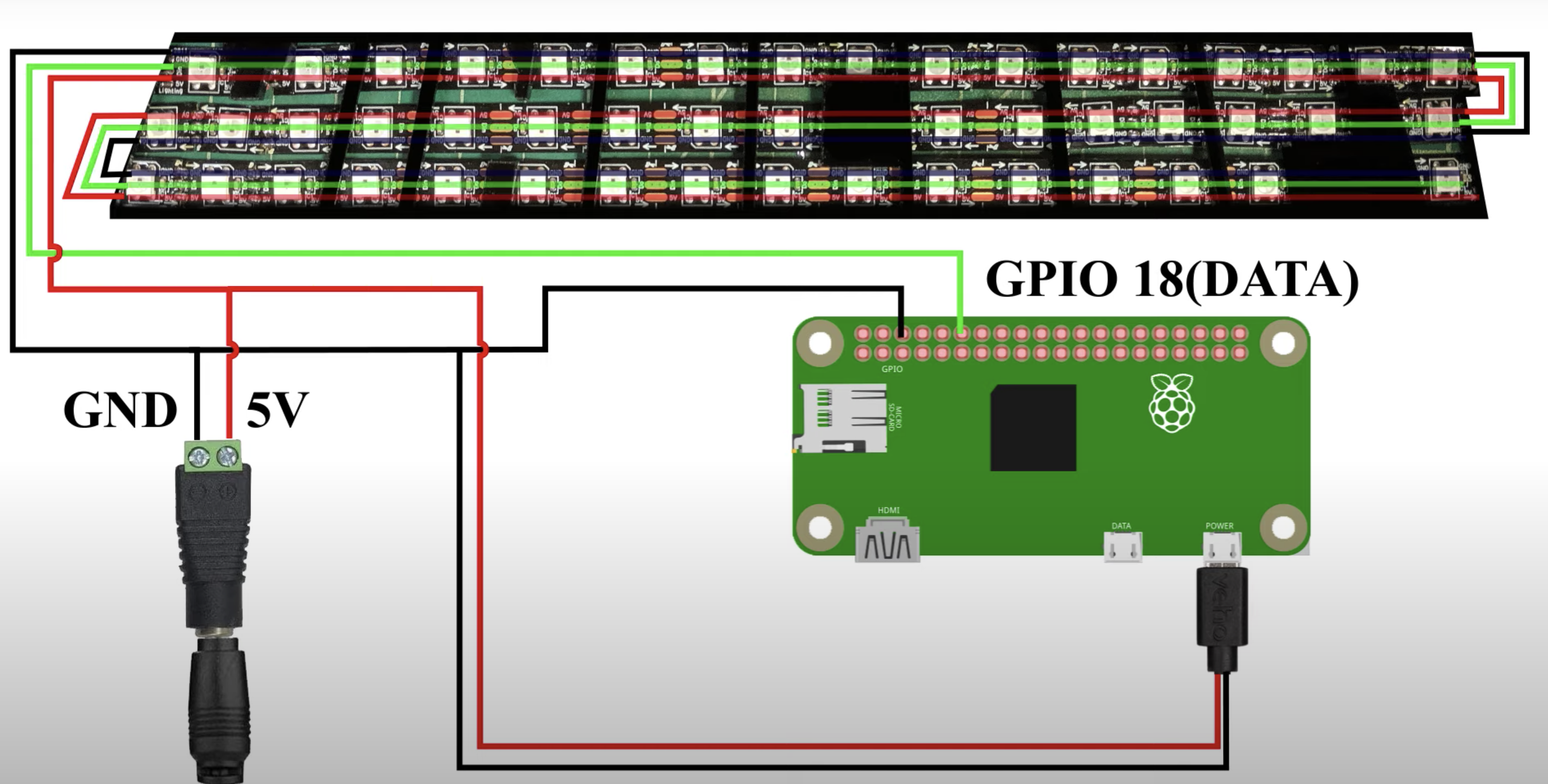
Secondly, he moves on to the code, in which he uses mcstatus, a Python class created by Minecraft’s Technical Director Nathan Adams that can be used to query servers for information. In this instance, Wes is using mcstatus to check for other players on his group’s dedicated Mincecraft server, but the class can also be used to gather mod information. You can find mcstatus on GitHub.
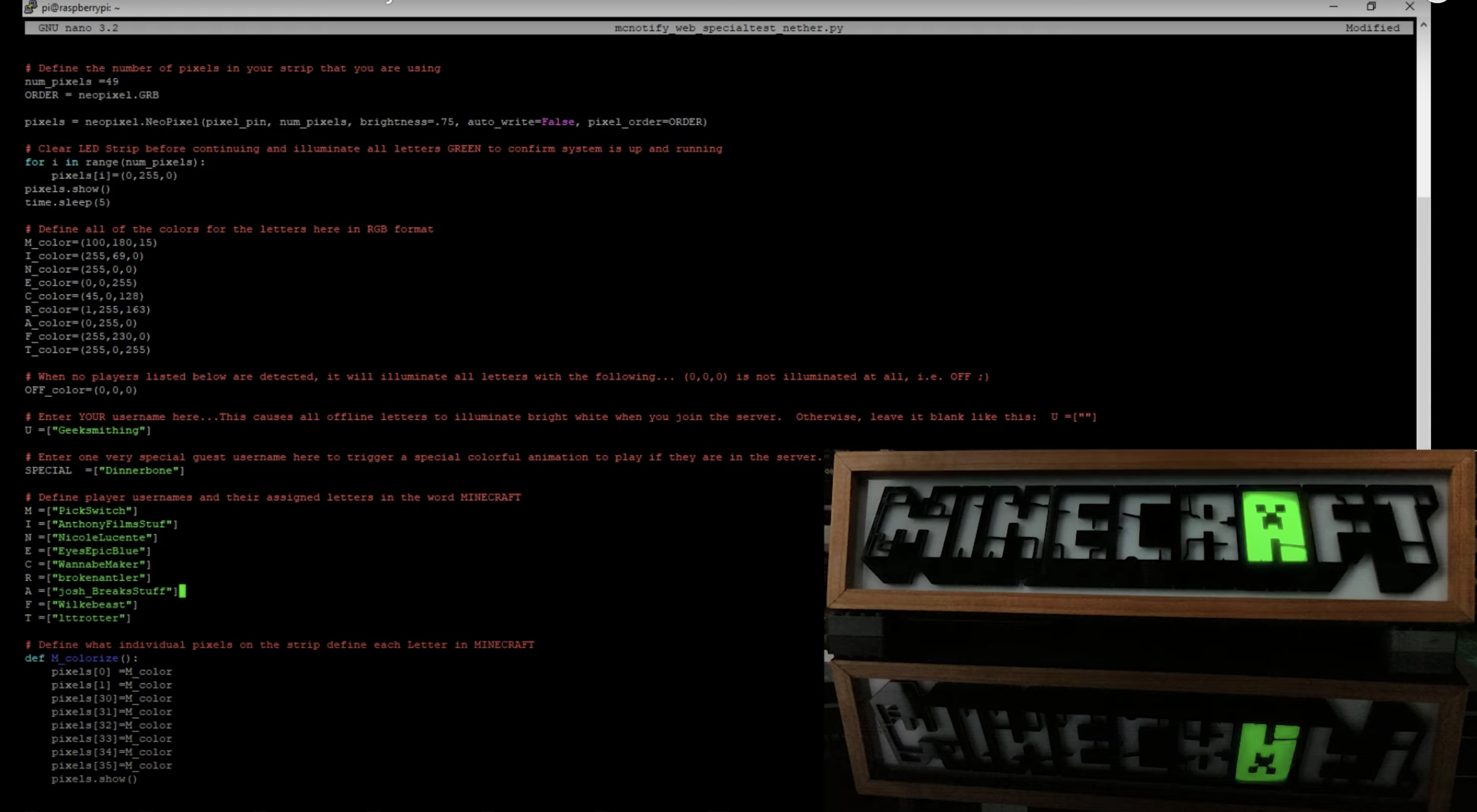
Each friend is assigned a letter that illuminates if they’re online.
Lucky for Wes, he has the same number of friends on his server as the number of letters in ‘Minecraft’, so for every friend online, he’s programmed the display to illuminate a letter of the Minecraft logo. And while the server is empty, he can also set the display to run through various light displays, including this one, a dedication to the new Minecraft Nether update.
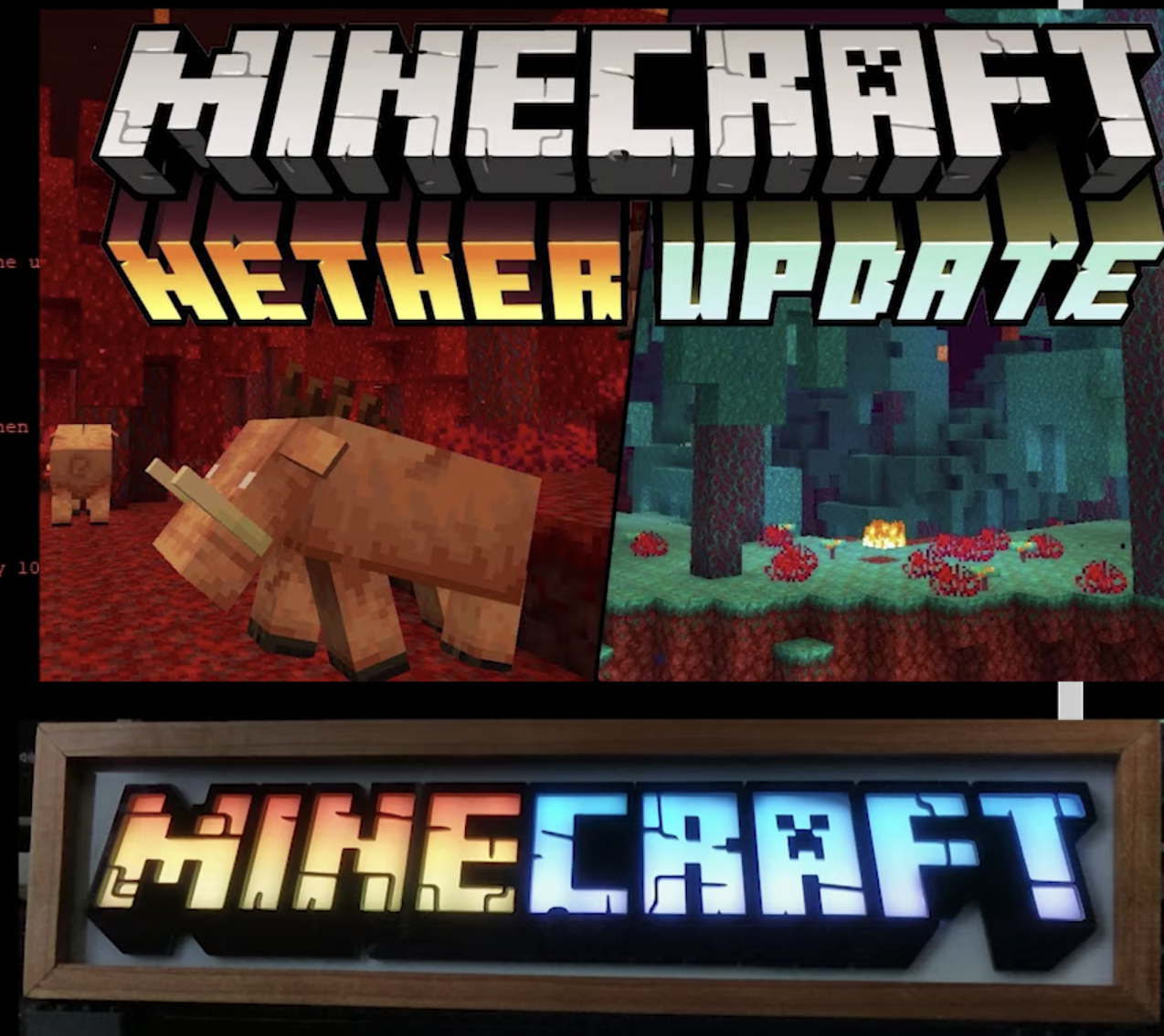
If you’d like to try making this project yourself, you can: Wes goes into great detail in his video, and the code for the project can be found on his GitHub account.
And while we have your attention, be sure to subscribe to Geeksmithing on YouTube and show him some love for such a great project.
The post Wes’s wonderful Minecraft user notification display appeared first on Raspberry Pi.
We are thrilled that five fantastic people will contribute to the Coolest Projects online showcase: Tim Peake, Limor Fried, Mitch Resnick, Hayaatun Sillem, and Eben Upton are going to be our special judges and choose their favourite projects from among all the entries from young tech creators in our global community.
Tim Peake is a British ESA astronaut and a passionate advocate for STEM education. Tim played a huge part in the first Astro Pi Challenge in 2015, and he has helped us spread the word about the work of the Raspberry Pi Foundation ever since.
“By taking part in Coolest Projects, young creators get to share their ideas with the world, and their peers. Whether it’s creating something for home, the planet, or for their school or community — it’s a great opportunity to share their hopes and dreams for the future!” — Tim Peake
Limor ‘Ladyada’ Fried is an MIT engineer and the founder and owner of Adafruit, a company that creates hardware and educational resources for anyone interested in digital making. Limor personally selects, tests, and approves all the tools, equipment, and electronics on offer by Adafruit.
“Coolest Projects is a fantastic opportunity for young people to take part in the world’s leading technology showcase and to celebrate all the hard work and ideas from the community — all from home!” – Limor Fried
Mitch Resnick is Professor of Learning Research at the MIT Media Lab, and his Lifelong Kindergarten research group develops the Scratch programming software and online community! His life’s passion is developing new technologies and activities to engage young people in creative learning experiences.
Hayaatun Sillem is the CEO of the Royal Academy of Engineering, which brings together the UK’s leading engineers and technologists to promote engineering excellence for the benefit of society. She also has a PhD in cancer research!
Eben Upton is a founder of the Raspberry Pi Foundation and one of the inventors of the Raspberry Pi computer. As the CEO of Raspberry Pi Trading Ltd, he oversees the company, including the development of all our hardware.
If a young person you know is making anything with technology — and we mean anything, from robot to smartphone app to video game to Scratch animation to web page about their favourite food — then we invite them to take part in the Coolest Projects online showcase.
We welcome all works-in-progress and finished projects from anyone aged up to 18!
To find out more and register a project by the 28 June deadline, visit coolestproject.org.
The post Tim Peake is among our fabulous Coolest Projects judges appeared first on Raspberry Pi.
How can I find the correct ulimit values for a user account or process on Linux systems?
Love this? sudo share_on: Twitter - Facebook - LinkedIn - Whatsapp - Reddit
The post How to find ulimit for user on Linux appeared first on nixCraft.
This weekend, the Raspberry Pi Foundation hosted Scratch Conference Europe 2019 at Churchill College in Cambridge, UK.
Framing the busy weekend’s schedule were presentations from:
Since not everyone was able to travel to Cambridge to attend the conference, we wanted to make sure you’re not missing out, so we filmed their presentations, for you to watch at your leisure.
For the full Scratch Conference experience, we suggest gathering together a group of like-minded people to watch the videos and discuss your thoughts. Alternatively, use #ScratchEurope on Twitter to join in the conversation with the conference attendees online.
Enjoy!
Mitch Resnick presents at Scratch Conference Europe 2019
Mitch Resnick addresses the attendees of Scratch Conference Europe, hosted by the Raspberry Pi Foundation at Churchill College, Cambridge, UK on 24 August 2019.
Neil Monteiro presents at Scratch Conference Europe 2019
Neil Monteiro closes the show on day two of Scratch Conference Europe, hosted by the Raspberry Pi Foundation at Churchill College, Cambridge, UK on 24 August 2019. In this show, Neil takes the audience on a journey into a dangerous labyrinth…in code!
Fran Scott presents at Scratch Conference Europe 2019
Fran Scott closes the show on day three of Scratch Conference Europe, hosted by the Raspberry Pi Foundation at Churchill College, Cambridge, UK on 25 August 2019.
The post Keynote speeches from Scratch Conference Europe 2019 appeared first on Raspberry Pi.


 Lateo.net - Flux RSS en pagaille (pour en ajouter : @ moi)