 Connexion


I am delighted to share the news that Blythe Masters has been appointed as the next Chair of the Raspberry Pi Foundation’s Board of Trustees. Blythe brings a wealth of experience to our governance at a time when our mission to enable all young people to realise their full potential through the power of computing and AI has never felt more urgent.

Blythe is one of the most prominent figures in global financial services and fintech. A graduate and Senior Scholar of Trinity College, University of Cambridge, she spent nearly three decades at JPMorgan, rising to its Executive Committee and holding senior leadership roles including Chief Financial Officer of the Investment Bank and Head of Global Commodities. After leaving JPMorgan in 2014, Blythe served as CEO of Digital Asset and later became a Founding Partner at Motive Partners, the fintech-focused investment firm. Most recently, Blythe served as Group CEO of FNZ, the global wealth technology platform and Motive Partners portfolio company.
Blythe has extensive corporate governance experience, currently serving as the Chair of JPMorgan Securities plc and non-executive director on the board of SymphonyAI. She has previously served on numerous other boards including A.P. Moeller Maersk, Credit Suisse, Santander Consumer USA, Forge, and GCM Grosvenor.
Blythe also has significant experience in nonprofit governance, having served as the co-chair of the Global Fund for Women, vice chair of ID2020, chair of the NYC chapter of Susan G. Komen Breast Cancer Foundation, chair of the Hyperledger Foundation, and numerous other trustee roles.
Blythe takes over the Chair from Sir John Lazar who has led the Board of Trustees since 2020. Under Sir John’s leadership the Foundation has supported hundreds of thousands of educators and tens of millions of students all over the world to develop the skills, knowledge, and mindsets to shape their world through computing and AI.
We have achieved so much under his leadership and I have learned a huge amount from working with him. We are all profoundly grateful to Sir John for his contribution.
Blythe will take up the role at the end of March 2027 and John will be staying on to manage the transition and handover. While it is hard to imagine a world where John isn’t our Chair, I am genuinely excited about the prospect of working with Blythe.
As a charity, the Foundation is governed by a Board of Trustees that is responsible for ensuring we use our resources effectively to advance our charitable goals. We are fortunate to have an exceptionally strong and diverse group of Trustees who bring significant experience and expertise from a wide range of backgrounds. Trustees generally serve two three-year terms. Trustees are volunteers who provide their time and expertise to the Foundation for no remuneration.
You can see the full list of Trustees and Members on our website.
The post The next Chair of the Board of Trustees, Blythe Masters appeared first on Raspberry Pi Foundation.
Microsoft introduces MAI-Base-2, a 2.8 trillion-parameter AI model, claiming major training efficiency gains as it expands its independent AI strategy.
The post Microsoft Unveils 2.8 Trillion-Parameter AI Model, Claims Major Efficiency Gains appeared first on TechRepublic.
NASA and IBM released an open-source AI model and dataset to help researchers map lunar craters, volcanic features and potential ice locations.
The post NASA and IBM Launch Open AI Model for Lunar Research appeared first on TechRepublic.
The Open Secure AI Alliance introduced SAFE guidelines and open agent-security tools at Black Hat, giving enterprises a framework for safer AI deployment.
The post Open Secure AI Alliance Expands at Black Hat: What You Should Know appeared first on TechRepublic.
This week, the Model Context Protocol (MCP), an open source standard for how AI systems interact with external tools and data sources, saw its largest update since its introduction. Most notably, MCP's protocol core is now stateless, so requests are no longer dependent on a session tied to an individual server instance. This change has the potential to address long-standing barriers to scalability.
The blog post announcing the specification, written by lead maintainers David Soria Parra and Den Delimarsky (who both work at Anthropic), says:
Intel beat quarterly expectations as AI infrastructure spending boosted demand for its data center processors and foundry business, signaling broader growth beyond GPUs.
The post Intel Beats Expectations as AI Infrastructure Boom Expands Beyond GPUs appeared first on TechRepublic.
TSMC reportedly plans chip manufacturing price increases of up to 10% in 2027 as rising costs and global expansion reshape semiconductor production.
The post TSMC Reportedly Plans Chip Manufacturing Price Hikes of Up to 10% appeared first on TechRepublic.
Intel is reportedly using ASML’s High-NA EUV technology to produce Panther Lake chips, marking a key test of its advanced manufacturing comeback.
The post Panther Lake Gives Intel an Early Lead in High-NA Chipmaking appeared first on TechRepublic.
Millions of young people and educators around the world use our technology to teach, learn, and create with code. Building it safely and responsibly is intrinsic to who we are and what we stand for.
A growing body of research and public commentary links the use of social media, smartphones, and algorithmic platforms to declining mental health and attention in young people. Public attitudes are shifting in response, and parents, teachers, and governments are increasingly demanding action. Phone bans in schools and restrictions on social media are spreading across many countries. The technology sector can no longer take public trust for granted.
None of this is new territory for researchers, who have argued for decades that technology is not neutral, and that the choices made in designing it can either embed harm or help prevent it (1). We think this moment calls for a calm, evidence-led response, and we want to be open about how we are approaching it and to do this work alongside others rather than on our own.
We have always been a research-led organisation. When we face a difficult question, we look at the evidence and learn from the people who have studied it.
Children’s digital rights is a rich and well-established field. Researchers and experts have spent years thinking carefully about what children need from the technology they use, and how their rights apply in a digital world. The United Nations set out a clear framework in 2021 with General Comment No. 25, which describes how children’s rights apply to the digital environment. Organisations like UNICEF and the 5Rights Foundation have built on this with practical guidance for the people who design and build products.
This body of work gives us firm ground to stand on. Rather than starting from scratch, we have used it to shape our own approach. We have drawn in particular on UNICEF’s Responsible Innovation in Technology for Children framework, UNICEF’s EdTech for Good Framework 1.0, the UN’s General Comment No. 25, and the Digital Futures Commission’s Child Rights by Design principles.
We have begun by writing eight principles, designed to guide the decisions we make as we build and run our products.
Our principles:
1. The best interests of the child come first. We design for children’s wellbeing, which means more than safety and privacy. It includes their agency, their emotional health, their relationships, and the space to create. Sometimes putting that first means choosing against growth, engagement, or speed.
2. Our technology supports human relationships. It does not replace them. Any personalised or AI-supported features we build are there to strengthen the relationships between young people, educators, and caregivers. People stay in control, and we do not hand decisions about a child’s learning or wellbeing to a machine.
3. We only collect the data we need. By the time a child turns 13, more than 72 million pieces of personal data will have been collected about them. We collect the minimum we need to help children learn and to measure our impact. We do not sell data, and we never will.
4. We design for learning, and we prove its impact. Our products are grounded in evidence about how children learn, and we evaluate whether they actually work. We avoid designs that keep learners hooked rather than helping them learn.
5. We design with children and educators, not for them. The people who use our products are the experts on their own needs. We involve them in research, testing, and feedback, and we make sure what they tell us shapes the product, not just a report at the end.
6. We design for diverse needs, abilities, and contexts. Our technology adapts to people, not the other way around. We do not assume constant connectivity, confidence with digital technologies, or a classroom that looks like anyone else’s.
7. We are transparent and accountable. We use plain language to explain how our products work, how data is used, and what rights people have. And we give people clear ways to question or challenge the decisions our systems make.
8. We apply the highest standards of children’s rights everywhere we work. Where local rules fall short of international best practice, we choose the higher standard. A child’s rights should not depend on where they happen to live.
You can read the full set of draft principles, and the research behind each one, in this PDF:
Publishing these principles is a statement of intent, not a claim that we have got everything right. This is a fast-moving area. Regulation is changing quickly, the research keeps developing, and we grow and change our own products. There are areas where we know we have work to do, and almost certainly areas we have not yet spotted.
These principles are how we hold ourselves to account, and they are only a start. Alongside them, we are mapping the regulatory landscape across the countries where we work, developing ways to assess our products against these principles, and building these commitments into how we make decisions. We will keep listening to the people who use our products, and making sure children themselves have a voice in shaping the technology built for them.
We also know we cannot do this alone, so we have two asks for you:
If you have a view on these principles, tell us. Whether you are a researcher, educator, parent, young person, or policymaker, we want to hear where you think we have got it right, where we have not, and what we have missed. Honest challenge is genuinely useful to us. Give your feedback and sign up to be involved in shaping them.
If you are part of a non-profit or organisation working on similar questions, get in touch. We would like to build a coalition of like-minded organisations to share what we are learning and raise standards across the sector.
(1) See for example:
The post Building education technology that children can trust appeared first on Raspberry Pi Foundation.
Trump says Apple will work with Intel on US chip production, a potential foundry win that could shift Apple’s supply chain options and US chip strategy.
The post Apple to Work With Intel on US Chip Production, Trump Says appeared first on TechRepublic.
Microsoft reportedly limited internal use of Claude Fable 5 while legal teams review Anthropic’s 30-day data-retention policy.
The post Microsoft Restricts Claude Fable 5 Access Amid AI Safety Review appeared first on TechRepublic.
Last week, the US government announced $2 billion in investments in quantum computing companies, allocating $100 million each to a range of startups in exchange for equity in the companies. Those could be make-or-break investments for many companies that are likely years away from a product that could see widespread use. But a member of the US Congress is now arguing that those deals are illegal, as Congress did not allocate the money for this purpose—instead, it was meant to support public research in semiconductors.
But the biggest chunk of money would go to a company that likely wouldn't exist if it weren't for the government's backing. Anderon will be set up with a billion dollars each from IBM and the government and will inherit personnel and IP from IBM. It will serve as a foundry for fabricating quantum processing units and will contract its services out to IBM and any other company that wants access to cutting-edge hardware.
Zoe Lofgren (D–Calif.), the ranking member of the House Science, Space, and Technology Committee, made it clear that she is not happy with how the government is using its money to support this technology.
The US government will take equity stakes worth a total of $2 billion in a slew of quantum computing companies, including a startup backed by a firm with links to the Trump family and one taken public by a Pentagon official.
The announcement by the commerce department that it had signed letters of intent with nine companies—including GlobalFoundries and IBM—sent shares in quantum specialists soaring on Thursday.
Both IBM, which is set to get $1 billion, and GlobalFoundries, which will receive $375 million, were up more than 6 percent in pre-market trading. D-Wave Quantum, an awardee that was taken public in 2022 by Emil Michael—now a top Pentagon official—was up more than 20 percent.
The best online business bank accounts combine strong APYs, low fees, and powerful digital tools. Learn how to choose the right fit for your business.
The post The 11 Best Online Business Bank Accounts Reviewed in 2026 appeared first on TechRepublic.
The best free business checking accounts with no monthly fees, plus tools to help you manage cash flow and grow your business.
The post 10 Best Free Business Checking Accounts appeared first on TechRepublic.
Apple and Intel reportedly reached an early chip manufacturing agreement that could reduce Apple’s TSMC reliance and boost Intel’s foundry ambitions.
The post Apple, Intel Reportedly Near Chip Deal That Could Reduce TSMC Reliance appeared first on TechRepublic.
Des attaquants se sont fait passer pour un responsable connu de la Linux Foundation sur le Slack du TODO Group, un groupe de travail dédié aux bureaux de programmes open source. L'objectif, piéger les développeurs en les amenant à cliquer sur un lien d'apparence officielle, puis à installer un faux certificat racine sur leur machine.
Le lien était hébergé sur Google Sites, ce qui aide à passer les filtres de sécurité et donne un vernis légitime. Les victimes arrivent sur une fausse page d'authentification Google Workspace, qui récupère leur adresse email et un code de vérification, avant de leur demander d'installer un "certificat Google" pour finaliser la connexion.
C'est là que tout bascule. Installer un certificat racine, c'est donner à l'attaquant la possibilité de signer ou d'intercepter n'importe quel trafic TLS sur la machine.
Sur macOS, le faux certificat télécharge et exécute un binaire nommé gapi depuis une IP externe (2.26.97.61), avec toutes les conséquences qu'on imagine. Sur Windows, c'est une boîte de dialogue de confiance navigateur qui pousse l'installation. Dans les deux cas, la machine est compromise.
OpenSSF, Socket et Help Net Security ont documenté la campagne, qui s'inscrit dans une tendance plus large.
Les attaquants visent de plus en plus les workflows développeurs et les relations de confiance interne plutôt que de chercher une faille zero-day dans le code, parce qu'un ingénieur qui fait confiance à un Slack privé reste une cible bien plus rentable que la lecture de 50 000 lignes de C obscures.
La règle de sécurité à retenir est simple. Aucun service légitime, jamais, ne vous demandera d'installer un certificat racine via un lien reçu en chat ou par email.
Si un message Slack vous y pousse, même depuis un compte interne qui semble légitime, c'est un compromis ou une usurpation. Signalez, ne cliquez pas.
Ce qui est relou, c'est que l'attaque marche précisément parce que les devs open source travaillent beaucoup sur Slack, au milieu de messages techniques qu'ils traitent à la chaîne. C'est donc franchement fourbe.
Bref, vous l'avez compris, un certificat racine demandé par chat, c'est toujours non.
Source : The Register
One of the things I love most about my role as Chief Learning Officer at the Raspberry Pi Foundation is hearing from teachers around the world. A teacher in Kenya told me how their students debugged their first programming projects on a shared laptop. In Scotland, another explained how our resources gave them the confidence to teach computing for the very first time. These stories remind me daily why our work matters: every young person, no matter where they live, should have the chance to explore the power of computing.
But creating resources that work in such different contexts is not easy. How do we design materials that work in a wide range of learning environments, from a bustling city classroom to a rural school where internet access can vary? How do we make sure that every learner sees themselves reflected in the examples we choose?
That’s where our teaching and learning design principles come in.
Over the past decade, we’ve learned a huge amount about what teachers and learners need from us. We’ve made mistakes, we’ve listened, and we’ve refined our practice again and again. The result is a set of design principles that guide the creation of everything we make, from full curricula to one-off projects.
These principles are practical and based on real classroom experience. They’re our way of making sure our resources are reliable, inspiring, and flexible, wherever and however teachers use them.
Here’s what that looks like in action:
For us, being transparent about our approach is about trust. Teachers make daily decisions about which resources to use, often with limited preparation time. By showing you the principles behind our work, we want to give you the confidence that our content is not only free and adaptable, but also designed with care, expertise, and your learners at the heart.
The world of computing education is moving fast, from new programming software, to artificial intelligence tools. Our design principles give us a strong foundation to keep innovating while staying true to our mission of enabling young people to realise their full potential through the power of computing and digital technologies.
And we’d love to hear from you! How do these principles resonate with your teaching? What helps you most in the classroom? Your feedback is what keeps making our work better.
The post Designing for every learner in every classroom appeared first on Raspberry Pi Foundation.
I am delighted to announce that the Raspberry Pi Foundation is the new home for Blockly, the world’s leading open source library for visual programming.
Blockly is a free, open source library that enables developers to build applications and websites that use block-based coding interfaces. That means that instead of typing code, you snap blocks together to build programs. Behind the scenes, those blocks are turned into text-based code like JavaScript and Python.
Blockly started life in 2011 in Google as a passion project of one engineer. Since then — thanks to the generous support of Google, a small team of brilliant engineers, and an amazing community of open source contributors and partners — it has grown to become the de facto standard for visual programming interfaces.
In particular, Blockly is the foundation for pretty much all of the block-based coding applications that you may have used to teach or learn about programming. Platforms like Scratch, MakeCode, and MIT’s App Inventor are all built with Blockly. It’s no exaggeration to say that hundreds of millions of young people have learnt the fundamentals of computer science using software that is built with Blockly.
As we enter the age of AI, it is more important than ever that all young people develop a foundational understanding of computer science. Blockly and the block-based coding platforms and applications that it enables are essential to realising that vision.
You can read more about the importance of coding in the age of AI in our position paper.
Blockly is also widely used to create interfaces that control hardware and robotics platforms. And, while its main use cases are in education, Blockly is increasingly being used to build industrial and commercial applications.
From 10 November 2025, the Blockly open source library and assets, and key members of the Blockly team will transition from Google to the Raspberry Pi Foundation.
Our vision is for Blockly to continue to be the standard visual programming interface that makes coding accessible to all. We are committed to maintaining Blockly as an open source project, and to working collaboratively with the community of developers and educators.
Over the next year, we will roll out features that improve accessibility, including screen reader support and keyboard navigation, working closely with partners to support implementation of these accessibility improvements across their platforms.
Looking to the future, we want to make sure that Blockly is at the leading edge of innovations that support the teaching and learning of programming in the age of AI. We’re also excited about the potential for the Blockly team to collaborate with the Foundation’s research, learning, and product teams.
If you are already part of the community of developers and educators, then I want to reassure you that you can continue to expect the same outstanding partnership and support from the Blockly team. We also look forward to welcoming many more members to the Blockly community over the coming years.
Finally, I want to say a huge thank you to Google for their support for Blockly over the years, and for enabling this transition with generous grant funding.
The post The new home for Blockly appeared first on Raspberry Pi Foundation.
Le Pironman 5-Mini est le troisième rejeton né du même concept lancé par la marque Sunfounder : concentrer dans un boitier ce qu’il faut à un Raspberry Pi 5 pour se comporter comme un MiniPC. La première version de ce concept est sortie en mai 2024, un second modèle « Max » est apparu en mai 2025 et c’est désormais au tour d’un modèle plus compact d’être annoncé.
Le Pironman 5-Mini ne change pas vraiment d’objectif. On retrouve juste une solution plus compacte avec 10.1 cm de haut, 9.86 cm de profondeur et 6.78 cm de large. La coque est réalisée à moitié en aluminium avec des panneaux latéraux en acrylique transparent. Un détail qui permet de voir la machine en fonction avec en particulier les LEDs RGB intégrées au ventilateur embarqué.
A l’intérieur on pourra glisser une carte de développement Raspberry Pi 5. Une carte d’extension permettra d’ajouter un stockage M.2 2280 NVMe PCIe 2.0 ou 3.0 en x1. Il sera également possible d’en profiter pour ajouter une carte spécialisée comme une solution de gestion multi SATA ou une carte NPU.
Les broches GPIO profitent d’une extension permettant de les faire affleurer du châssis et la connectique de la carte est accessible sur l’arrière du boitier. Sur la face avant on retrouve un petit bouton métallique qui permettra d’allumer et d’éteindre son système.
Le Pironman 5-Mini est proposé directement par Sunfounder avec une foule d’options. Vendu seul à 50.63 € TTC, on peut lui adjoindre un écran 3.5″ tactile, un SSD NVMe, une webcam, un NPU et même une solution de refroidissement pour le SSD. Des cartes Raspberry Pi 5 peuvent être ajoutées à votre panier pour recevoir une solution prête à l’emploi.
Pironman 5-Mini : Une version plus compacte du boitier RPi 5 © MiniMachines.net. 2025
As an organisation with global reach, translation and localisation have been part of the Raspberry Pi Foundation’s activities from the start. Code Clubs and educational partners all over the world are helping young people learn about computing in their own language. We’ve already published over 1,900 translated learning resources, covering up to 32 languages, thanks to the work of our talented localisation team and our amazing community of volunteer translators.
English is seen by many as the language of computing, and in many countries, it’s also either the language of education or a language that young people aspire to learn. However, English is, in some instances, a barrier to learning: young people in many communities don’t have enough knowledge of English to use it to learn about digital technologies, or even if they do, the language of communication with other students, teachers, or volunteers may not be English.
In a world where browsers can instantly translate web pages and large language models can power seemingly perfect conversations in virtually any language, it’s easy to assume that translation just happens and that somehow, technology takes care of it. Unfortunately, that’s not the case. Technology is certainly crucial to translation, but there’s much more to it than that. Our approach to translation involves considering design, process, and people to ensure that localised materials truly help young people with their learning journey.
Localisation and translation are similar terms that are often used interchangeably. Localisation normally refers to adapting a product to suit a local market, whereas translation is a subset of localisation that involves changing the language of the text. For instance, localisation includes currencies, measurements, formatting dates and numbers, and contextual references. Meanwhile, translation involves only changing the language of the text, such as from English to French.
At the Raspberry Pi Foundation, we see translation as an enabler. It enables volunteers to reach learners, learners to succeed in their educational goals, and the Foundation to achieve its mission all over the world.
1. Create with localisation in mind
Regardless of whether learning materials are intended for English-speaking or global audiences, it’s important to create and design them with localisation in mind. That way, they can be used in a variety of places, and any piece of content (text, graphics, or illustrations) can be modified to meet the needs of the target audience. Keeping localisation in mind might include allowing space for text expansion, being mindful of any text embedded in graphic elements, and even making sure the context is understandable for a variety of audiences. Making a piece of content localisable at the creation stage is virtually cost-free. Modifying fully built assets to translate them or to use them in other markets can be expensive and extremely time-consuming!
2. Always have user needs and priorities upfront
Before investing in localising or translating any materials, we seek to understand the needs and priorities of our users. In many countries where English is not the usual language of communication, materials in English are a barrier, even if some of the users have a working knowledge of English. Making materials available in local languages directly results in additional reach and enhanced learning outcomes. In other communities where English has a certain status, a more selective approach may be more appropriate. A full translation may not be expected, but translating or adapting elements within them, such as introductions, videos, infographics, or glossaries, can help engage new learners.
3. Maximise the use of technology
While it’s possible to translate with pen and paper, translation is only scalable with the use of technology. Computer-assisted translation tools, translation memories, terminology databases, machine translation, large language models, and so on are all technologies that play their part in making the translation process more efficient and scalable.
At the Foundation, we make use of a variety of translation technologies and also, crucially, work very closely with our content and development teams to integrate their tools and processes into the overall localisation workflow.
4. Take great care of the people
Even with the best technology and the smoothest integrations, there is a human element that is absolutely essential. Our amazing community of volunteers and partners work very closely with learners in their communities. They understand the needs of those learners and have a wealth of information and insights. We work with them to prioritise, translate, review and test the learning materials. They are key to ensuring that our learning materials help our users reach their learning goals.
Thinking about localisation from the moment we start creating learning materials, understanding the needs of users when creating our end goals, maximising the use of technology, and taking good care of our people and partners are the key principles that drive our translation effort.
If you’d like to find out more about translation at the Raspberry Pi Foundation or would like to contribute to the translation of our learning materials, feel free to contact us at translation@raspberrypi.org.
A version of this article also appears in Hello World issue 23.
The post Translating educational content: four key principles appeared first on Raspberry Pi Foundation.
Tuesday 11 June 2024 will be remembered as one of the most important days in the history of Raspberry Pi.
The successful introduction of the Raspberry Pi Foundation’s commercial subsidiary on the London Stock Exchange is a genuinely remarkable achievement. I want to put on record my huge congratulations and thanks to Eben Upton, Martin Hellawell, and the whole team at Raspberry Pi Holdings plc for everything they have done to make this possible.
The purpose of the IPO was to secure the next stage of growth and impact for both the Foundation and the company. We have huge ambitions and the IPO has provided both organisations with the capital we need to pursue those ambitions at pace and scale. Our Chief Executive Philip Colligan has already explained what it means for the Raspberry Pi Foundation and our mission to empower young people all over the world.
In this post, I wanted to take a moment to acknowledge the significant contribution that others have made over the years, particularly all of the Trustees who have been so generous with their time, energy, and expertise.
The Raspberry Pi Foundation was established in 2008 by six founding Trustees: Alan Mycroft, David Braben, Eben Upton, Jack Lang, Pete Lomas, and Rob Mullins. All of them deserve credit and thanks for setting us off on this incredible journey.
Alan, Eben, Jack, and Rob were all involved with the Computer Lab at the University of Cambridge. They were dealing with a decline in applications to study the computer science undergraduate course, which was a symptom of the much wider challenge that far too many young people weren’t getting access to opportunities to learn computer science, or getting hands-on with programming and electronics.
David Braben brought an industry perspective, drawing on the challenges he was experiencing with recruiting engineers and programmers at the world-leading games company that he had founded, Frontier Developments.
For Pete Lomas, he was paying forward the support and inspiration that he received from a college technician who gave him the opportunity and encouragement to experiment with programming a DEC PDP-8. That experience ultimately led Pete to establish Norcott Technologies, an electronics design and manufacturing business that he still runs today.
The founding Trustees’ original idea was to create a low-cost programmable computer — available for the price of a textbook — that would remove price as a barrier to owning a computer and inspire young people to take their first steps with computing. It took four years for the first Raspberry Pi computer to be launched, an achievement for which Eben and Pete were rightly honoured, along with other members of the team, as recipients of the prestigious MacRobert Prize for engineering.
What none of our founding Trustees could have predicted was the enormous commercial success of Raspberry Pi computers. In realising their vision of a low-cost programmable computer for education, the team created a new category of single-board computers that found a home with enthusiasts and industry, enabling the team to evolve — through hard work and creativity — into a business that is now entering a new phase as a listed company.
They also delivered on the original mission, with computer science at the University of Cambridge now being one of the most oversubscribed undergraduate courses in the country and many applicants citing Raspberry Pi computers as part of their introduction to programming.
The commercial success of Raspberry Pi has enabled the Foundation to expand its educational programmes to the point where it is now established as one of the world’s leading nonprofits focused on democratising access to computing education, and is benefiting the lives of tens of millions of young people already.
While no-one really knows the origin of the proverb ‘It takes a village to raise a child’, we can all recognise the truth in that simple statement. It applies just as much for endeavours like Raspberry Pi.
Over the years, Raspberry Pi has been a genuine team game. Employees in the Foundation and our commercial subsidiary, advisers, partner organisations and supporters, volunteers and community members have all played a crucial role in the success of both the company and the Foundation.
Over the years there have been 21 Trustees of the Foundation, bringing an incredible range of skills and experience that has elevated our ambitions and supported the teams in both the Foundation and the company.
All of our Trustees have provided their time and expertise for free, never receiving any financial benefit for their contribution as Trustees.
Serving as a Trustee of a charity is a serious business, with significant responsibility and accountability. While many charities have commercial operations, there is no doubt that the scale and complexity of Raspberry Pi’s commercial business has placed significant additional responsibilities on all of our Trustees.
I especially want to pay tribute to my predecessors as chair of the Board of Trustees: Jack Lang, one of our founding Trustees, who sadly passed away this year; and David Cleevely, who continues to support our work as a Member of the Foundation. Both Jack and David played a particularly important part in the success of Raspberry Pi.
As we enter this new phase for the Foundation’s relationship with Raspberry Pi Holdings Ltd, we are delighted to welcome three new Trustees to the Board:
The post A vote of thanks to our Trustees appeared first on Raspberry Pi Foundation.
On 22 May 2024, we announced that we are intending to list the Foundation’s commercial subsidiary, Raspberry Pi Ltd, on the Main Market of the London Stock Exchange. This is called an Initial Public Offering (IPO).
The IPO process is — quite rightly — highly regulated, and information about the company and the potential listing can be found on the Investor Portal on Raspberry Pi Ltd’s website. If that’s what you’re looking for, head there.
In this blog post, I want to explain what an IPO of Raspberry Pi Ltd would mean for the Raspberry Pi Foundation.
The Raspberry Pi Foundation was founded in 2008 as a UK-based educational charity. Our co-founders wanted to inspire more young people to explore the joys of coding and creating with technology, with the goal of increasing both the number and diversity of kids choosing to study computer science and engineering.
Their idea was to create a low-cost, programmable computer that could rekindle some of the excitement sparked in young minds at the start of the personal computing revolution by platforms like the BBC Micro and ZX Spectrum (incidentally also invented in Cambridge, UK).
Raspberry Pi Ltd was incorporated in 2012 as the commercial subsidiary of the Foundation and is responsible for all aspects of design, production, and distribution of Raspberry Pi computers and associated technologies. It has always been a commercial company, albeit one that was initially wholly owned by a charity.
It’s fairly common for UK charities to have subsidiaries that handle their commercial activities. Guidance from the regulator, the Charity Commission, explains that it helps protect the charity’s assets and ensures that the charity benefits from tax relief on profits that are generated from commercial activities and used to advance the charity’s objectives.
So Raspberry Pi has pretty much always been a tale of two organisations: the Foundation, which is a charity, and Raspberry Pi Ltd, which is a commercial company. While we are legally and practically separate organisations, we are united by a mission to democratise computing, and by a set of values that reflect the community of makers, engineers, and educators that have always been such a central part of the Raspberry Pi story.
In the years since the launch of the first Raspberry Pi computer in 2012, Raspberry Pi Ltd has continued to innovate and expand its range of products, evolving into a leading provider of high-performance, single-board computers and associated technologies for industrial and embedded uses, as well as for enthusiasts and educators, in markets worldwide. For more information on the company and all it has achieved, you should take a look at the Investor Portal.
For me, one of the most important things about a Raspberry Pi computer is that kids are learning to code on the same platform that is used by the world’s leading engineers and scientists. It’s not a toy, although it is a lot of fun.
Crucially, the commitment to low-cost computing that was at the heart of Raspberry Pi’s founding ethos remains unchanged and has been enshrined in a legally binding agreement between the Foundation and the company. This means that Raspberry Pi will always produce low-cost, general-purpose computers that can be used for teaching and learning.
Over that same period, the Foundation has innovated and expanded its educational products and learning experiences to the point where we are now widely recognised as one of the world’s leading contributors to the democratisation of computing education.
We create curricula and classroom resources that are used in schools all over the globe, covering everything from basic digital skills to computer science and AI literacy. We provide high-quality professional development for teachers and we build software tools that reduce barriers, save time, and improve learning outcomes. We also support the world’s largest network of free coding clubs and inspire young people to get creative with tech through showcases and challenges. All of this is completely free for teachers and students wherever they are in the world.
We are also advancing the field of computing education through undertaking original research and translating evidence of what works into practice.
Importantly, the Foundation is device- and platform-agnostic. That means that, while Raspberry Pi computers make a huge contribution to our educational mission, you don’t need to use a Raspberry Pi computer to engage with our learning experiences and resources.
The proposed IPO is all about securing the next stage of growth and impact for both the Foundation and the commercial company.
To date, Raspberry Pi Ltd has donated nearly $50m from its profits to the Foundation, which we have used to advance our educational mission combined with over $60m in funding from philanthropy, sponsorship, and contracts for educational services.
As the company has continued to grow, it has needed working capital and funding to invest in innovation and product development. Over the past few years that has mainly come from retained profits. Listing Raspberry Pi Ltd on a public market will enable the company to raise additional capital through issuing new shares, which will lead to broader reach, greater impact, and ultimately more value being created for the benefit of all shareholders, including the Foundation.
From the Foundation’s perspective, an IPO provides us with the ability to sell some of our shares to raise money to finance a sustainable expansion of our educational activities. Put simply, instead of receiving a share of the company’s profits each year, we will convert some of our shareholding into an endowment that we will use to fund our educational programmes.
Assuming we proceed with the IPO, what is now Raspberry Pi Ltd will become a public company that trades its shares on the Main Market of the London Stock Exchange.
The Foundation will remain a significant shareholder and we will continue to share the Raspberry Pi brand. We will be involved in decision making on the same basis as all other shareholders. Our goal will be to support the company to be as successful as possible in its mission to make computing accessible and affordable for everybody.
The Foundation will use any funds that we raise through the sale of shares at the IPO — or subsequently — to advance our ambitious global strategy to enable every young person to realise their full potential through the power of computing and digital technologies.
Partnership will continue to be at the heart of our strategy and we will work closely with businesses, foundations, and governments to ensure that our work reaches as many teachers and young people as possible. Our ambition is that around 50% of our activities will be funded from the endowment and 50% through partnerships and donations, enabling us to reach many more teachers and students by combining our resources and expertise with those of the many partners who share our mission.
Whatever happens with the IPO, Raspberry Pi has already had a huge impact on the world. It’s been an enormous privilege to be part of the journey so far, and I am hugely excited about the potential of this next phase.
I want to pay tribute to all of our co-founders for setting us off on this great adventure, and particularly to Jack Lang, who very sadly passed away earlier this month. Jack made an exceptional and unique contribution to the Raspberry Pi story, and he deserves to go down in history as one of the most significant figures in computing education in the UK. I know he would have shared my excitement about this next chapter in the Raspberry Pi story.
With the pace of technological advances in fields like AI, our mission has never been more vital. We have the potential to positively impact the lives of tens of millions of young people who might otherwise miss out on the opportunity to change the world for the better through technology.
The post What would an IPO mean for the Raspberry Pi Foundation? appeared first on Raspberry Pi Foundation.
One of the Raspberry Pi Foundation’s core values is our focus on impact. This means that we are committed to learning from the best available evidence, and to being rigorous and transparent about the difference we’re making.
Like many charities, an important part of our approach to achieving and measuring our impact is our theory of change. We are excited to launch a newly refreshed theory of change that reflects our mission and strategy to ensure that young people can realise their full potential through the power of computing and digital technologies.
A theory of change describes the difference an organisation aims to make in the world, the actions it takes to achieve this, and the underlying assumptions about how its actions will create change.
It’s like a good cake recipe. It describes the ingredients and tools that are required, how these are combined, and what the results should be. But a theory of change goes further: it also addresses why you need the cake in the first place, and the reasons why the recipe will produce such a good cake if you follow it correctly!
Our theory of change begins with a statement of the problem that needs solving: too many young people are missing out on the enormous opportunities from digital technologies, and access to opportunities to learn depends too much on who you are and where you were born.
We want to see a world where young people can take advantage of the opportunities that computers and digital technologies offer to transform their own lives and communities, to contribute to society, and to help address the world’s challenges.
To help us empower young people to do this, we have identified three broad sets of outcomes that we should target, measure, and hold ourselves accountable for. These map roughly to the COM-B model of behaviour change. This model suggests that for change to be achieved, people need a combination of capabilities, opportunities, and motivation.
Our identified outcomes are that we support young people to:
We work at multiple levels throughout education systems and society, which together will achieve deep and long-lasting change for young people. We design learning experiences and initiatives that are fun and engaging, including hundreds of free coding and computing projects, the Coolest Projects showcase for young tech creators, and the European Astro Pi Challenge, which gives young people the chance to run their computer programs in space.
We also support teachers, youth workers, volunteers, and parents to develop their skills and knowledge, and equip them to inspire young people and help them learn. For example, The Computing Curriculum provides a complete bank of free lesson plans and other resources, and Experience AI is our educational programme that includes everything teachers need to deliver lessons on artificial intelligence and machine learning in secondary schools.
Finally, we aim to elevate the state of computing education globally by advocating for policy and systems change, and undertaking our own original research to deepen our understanding of how young people learn about computing.
Our theory of change is an important part of our approach to evaluating the impact of our resources and programmes, and it informs all our monitoring and evaluation plans. These plans identify the questions we want to answer, key metrics to monitor, and the data sources we use to understand the impact we’re having and to gather feedback to improve our impact in future.
The theory of change also informs a shared outcomes framework that we are applying consistently across all of our products. This framework supports planning and helps keep us focused as we consider new opportunities to further our mission.
A final role our theory of change plays is to help communicate our mission to other stakeholders, and explain how we can work with our partners and communities to achieve change.
You can read our new theory of change here and if you have any questions or feedback on it, please do get in touch.
The post Our new theory of change appeared first on Raspberry Pi Foundation.
The mission of the Raspberry Pi Foundation is to enable young people to realise their full potential through the power of computing and digital technologies. That’s what we say in our 2025 strategy. But how can we be sure we’re succeeding?
In our strategy we also identify one of our values as being ‘focussed on impact’. This means that we are committed to learning from the best available evidence, and to being rigorous and transparent about the difference we’re making.
Like all our values, our focus on impact infuses all of our work, and it is led by a dedicated impact team. This blog outlines four ways in which we put this value into practice in pursuit of our mission.
It doesn’t matter how fast you run, if you’re heading in the wrong direction, you’ll never get to your destination. We use data to prioritise our resources where we can make the biggest difference for young people.
For example, we use national statistics from the UK to assess how many of the Code Clubs and CoderDojos we support in the UK run in places where they can reach young people facing educational disadvantage, so that we can adopt an evidence-based approach to better serving these young people.
And we know many of the young people who face the greatest barriers to accessing computing education and developing new skills and confidence live in countries with low- and middle-income economies. That’s why we are building new partnerships in India, Kenya, and South Africa and adapting our resources and programmes for the contexts of educators and learners living there.
We’re really excited that we’ll soon be publishing an updated Theory of Change, which captures how we make an impact. This will be the foundation for Monitoring and Evaluation (M&E) plans for all of our initiatives, where we specify their goals and set down what kinds of data we will collect to make sure we have the measure of whether the initiatives are succeeding.
Strong M&E is equally important for our established programmes and our new pilot initiatives. Code Club, the worldwide network of free, after-school coding clubs for 9- to 13-year-olds we support, has been growing for more than 10 years. Durham University’s Evidence Centre for Education is currently conducting an independent evaluation of UK-based Code Clubs to help us understand how to better support Code Club volunteers and learners around the world. We ourselves recently evaluated the pilot of a new programme we designed in partnership with Amala Education to deliver a vocational skills course for displaced learners aged 16 to 25 in Kakuma refugee camp in Kenya.
Data is only useful if it’s translated into insights that are acted upon. We use the findings from evaluations to inform the design and continual improvement of all our initiatives.
For example, the evaluation of our pilot vocational skills training in Kakuma refugee camp provided insights that have helped us adapt the programme for a second cohort of young people. The same was true of the M&E insights we gained from our partnership with Mo Schools in Odisha, India, where we have provided training and support to 1075 teachers to establish Code Clubs. Informed by survey data and informal feedback each step of the way, we are now gradually scaling up our support towards launching a more intensive computing and coding programme in 2000 schools in Odisha this year.
Side by side with our M&E results, we also rely on the latest computing education research, conducted at the Foundation, in the Raspberry Pi Computing Education Research Centre at the University of Cambridge, and by academic researchers around the world. Our groundbreaking research programme on gender balance in computing, and our ongoing research on culturally relevant pedagogy, are shaping the way we work to enable all young people to achieve their full potential in computing.
We are proud of the difference we are making. We want everyone to hear about it and feel inspired to get involved in our vital mission for young people. Our annual reviews are packed full of statistics and overviews of the difference we’re making, and we’re creating a growing video series of unique stories from people in the community we support. Watch this space for news about our updated Theory of Change, our next annual review, and more blogs about our impact.
By doing these four things well, we can be confident that we are enabling young people to achieve their potential through the power of computing and digital technologies.
If you share our passion for impact and think our mission is important, why not get involved today? You can:
The post The four elements of our focus on impact appeared first on Raspberry Pi Foundation.
We are building a new online text-based Code Editor to help young people aged 7 and older learn to write code. It’s free and designed for young people who attend Code Clubs and CoderDojos, students in schools, and learners at home.
At this stage of development, the Code Editor enables learners to:
We’ve chosen Python as the first programming language our Code Editor supports because it is popular in schools, CoderDojos, and Code Clubs. Many educators and young people like Python because they see it as similar to the English language. It is often the text-based language young people learn when they take their first steps away from a block-based programming environment, such as Scratch.
Python is also widely used by professional programmers and usually tops at least one of the industry-standard indexes that ranks programming languages.
We will be adding support for web development languages (HTML/CSS/JavaScript) to the Editor in the near future.
We’re also planning to add features such as project sharing and collaboration, which we know young people will love. We want the Editor to be safe, accessible, and age-appropriate. As safeguarding is always at the core of what we do, we’ll only make new features available once we’ve ensured they comply with the ICO’s age-appropriate design code and our safeguarding policies.
We are inviting you to test the Code Editor as part of what we call the beta phase of development. As the Editor is still in development, some things might not look or work as well as we’d like — and this is why we need your help.
We’d love you to try the Editor out and let us know what worked well for you, what didn’t work well, and what you’d like to see next.
You can now try out the Code Editor in the first two projects of our ‘Intro to Python’ path. We’ve included a feedback form for you to let us know which project you tried, and what you think of the Editor. We’d love to hear from you.
Your feedback helps us decide what to do next. Based on what learners, educators, volunteers, teachers, and parents tell us, we will make the improvements to the Editor that matter most to the young people we aim to support.
One of our long-term goals is to engage millions of young people in learning about computing and how to create with digital technologies. We’re developing the Code Editor with three main aims in mind.
We aim to build the Code Editor so it:
Our work on the Code Editor will:
We want to offer a Code Editor that:
We’re also planning on making the Editor available as an open source project so that other projects and organisations focussed on helping people learn to code can benefit. More on this soon.
Our work on the Code Editor has been generously funded by the Algorand Foundation and Endless, and we thank them for their generous support. If you are interested in partnering with us to fund this key work, please reach out to us via email.
The post Test our new Code Editor for young people appeared first on Raspberry Pi Foundation.
India’s rapidly digitising economy needs people with IT and programming skills, as well as skills such as creativity, unstructured problem solving, teamwork, and communication. Unfortunately, too many children in India currently do not have access to digital technologies, or to opportunities to learn these technical skills.
Before children and young people in India can even get a chance to learn digital skills, many of them have to overcome numerous roadblocks. India’s digital divide is entrenched due to a lack of access to electricity, to the internet, and to digital devices. In 2017–18, only 47% of Indian households received electricity for more than 12 hours a day. Moreover, only 24% of households have internet access, with the figure dropping as low as 15% in rural regions.
During the coronavirus pandemic, when children in India had to plunge head-first into adapting to restrictions, 29 million students around the country did not have access to a digital device. In addition, only 38% of households in India are digitally literate. At the Raspberry Pi Foundation, we define digital literacy as the skills and knowledge required to be an effective, safe, and discerning user of various computer systems. Digital literacy in rural regions stands far lower at 25%.
We are conscious that we cannot solve these massive access issues. Regardless, we are committed to moving the needle for those young people that need access to digital skills and digital literacy the most.
We partner with organisations around the country that are committed to bringing access to coding and digital skills to the most disadvantaged and digitally excluded young people. Our partnership model includes:
Pratham means ‘first’ in Hindi, and rightly so: Pratham Education Foundation, a non-profit established in 1994, has been at the forefront of addressing gaps in the education system in India. In 2018, we joined hands with Pratham Education Foundation to introduce coding to children in hard-to-reach, disadvantaged communities around the country. We co-designed a Pratham–Code Club programme to provide youth in underserved communities with training and access to devices and learning resources. The goal of the training was to build the youth’s programming confidence so that they could go on to teach children in their communities.
To be effective, it was crucial that the programme be localised. We made adaptations to our learning resources and training content to make them more relevant to the context of the learners, and we worked with volunteer translators to translate the material into Hindi, Kannada, and Marathi.
We also provided the youth with training to use the PraDigi kit — an innovative, lightweight device, developed by Pratham Education Foundation and based on the Raspberry Pi computer — for teaching children to code.
In 2020, when we could no longer implement the programme the same way due to the pandemic and the ensuing disruptions, we made several adaptations:
Firstly, instead of the three-hour in-person training we had previously conducted, we hosted multiple 30-minute online sessions over a week, using cloud-based platforms like Zoom. Secondly, we used familiar apps such as WhatsApp and Facebook Workplace to share the training content.
Finally, since the Pratham staff in the communities could not bring the PraDigi kits to the remote locations during lockdowns, we adapted the training content for smartphones and tablets, using the online Scratch editor and a phone-friendly online code editor called Replit.
Over the course of the pandemic, we trained 300 youth from Pratham’s communities in the basics of programming and digital skills. The impact was:
We also surveyed the youth for what non-technical skills they had learned during the training:
Using a train-the-trainer model, we are now scaling our programme with Pratham Education Foundation to train 3000 youth from underserved communities. Once they have completed the training, we will help these 3000 youth pave the way to programming and digital skills for 15,000 young learners around the country.
We look forward to continuing our partnership with Pratham Education Foundation to make digital skills and coding education accessible to children all over India.
The post Bringing digital skills to disadvantaged children across India appeared first on Raspberry Pi.
I am delighted to announce the launch of raspberrypi.com — a new website dedicated to Raspberry Pi computers and associated technologies. Head on over to find all about our low-cost, high-performance PCs, add-on boards or HATs, microcontrollers, accessories, and much more.
As well as being able to learn about and purchase the full range of hardware products, on the new website you can download our latest software, find detailed technical documentation, connect with the community on the forums, and read the latest news about Raspberry Pi technologies and how they’re being used to change the world.
This website (raspberrypi.org) will continue to be the home for the Raspberry Pi Foundation and all of our educational initiatives to help young people learn about computers and how to create with digital technologies.
That includes online resources to help young people learn how to code, information about our networks of Code Clubs and CoderDojos, training and support for teachers and other educators, and access to the world’s leading-edge research into computing education.
You’ll still be able to find loads of resources about Raspberry Pi computers in education, and cool opportunities for young people to learn how to code and create with Raspberry Pi technologies, whether that’s our space programme Astro Pi, or building robots with Raspberry Pi Pico.
When raspberrypi.org was first launched as a WordPress blog in 2011, we were talking about a low-cost, programmable computer that was being designed for education.
Fast-forward a decade, and we are now speaking about an increasingly broad range of technology and education products and services to industry, hobbyists, educators, researchers, and young people. While there is lots of overlap between those communities and their interests, it is becoming increasingly difficult to address everyone’s needs on one website. So this change is really all about making life easier for you.
We will continue to provide lots of links and connections between the two sites to make sure that you can easily find what you’re looking for. As ever, we’d love to hear your feedback in the comments below.
Alongside the changes to the websites, we’re also launching new social channels that are focused on the Foundation’s educational initiatives. We look forward to seeing you there.
The post Introducing raspberrypi.com appeared first on Raspberry Pi.
So far in our series of community stories, we’ve collaborated with young people from the UK, India, and Romania who are getting creative with technology to change the world around them.
Our next community story comes from a highly regarded community member who has been connecting young people with opportunities to learn and create with technology throughout her career. A US-based educator with over twenty years of experience, Yolanda Payne shares our mission to put computing and digital making into the hands of people all over the world.
“The biggest reason I’m so invested in technology is because people invested in me.”
Yolanda Payne
Yolanda Payne is an educator you might recognise from our online courses. Based in Atlanta, Georgia in the USA, she’s passionate about making technology accessible to all and helping young people become technology creators.
Yolanda says, “The biggest reason I’m so invested in technology is because people invested in me. They saw something that I was good at, showed me opportunities, and so in turn, that was my philosophy in teaching.”
Yolanda got her first computer at a young age and was hooked instantly: it opened up many new opportunities and led her to choosing a career in education. She says, “The computer gives me the tools to be an artist, it gives me the tools to create things, and if it does that for me, then just imagine what it will do for kids!”
“If you give a teacher a Raspberry Pi and show them these resources, they’re going to be hooked.”
Yolanda Payne
Yolanda has spent her entire professional life dedicated to education. She gained a bachelor’s degree in Elementary Education from Mississippi University for Women; a master’s degree in Instructional Technology from Mississippi State University; and Educational Specialist degrees from the University of Florida and the University of Georgia in Curriculum and Instruction, and in Language and Literacy.
Throughout her twenty-one years as a classroom teacher and her time running Code Clubs, Yolanda found joy in supporting students who have multiple challenges or complex needs, and in seeing them thrive in the subject of computer science. Yolanda points out, “I worked with both students that were considered to be in special education and students that were gifted. And one of the biggest things that I saw that I don’t think people realise, especially about students in special education: they are used to solving problems. […] You’d be very surprised at how real-life problem-solving skills flow very easily into computer science.”
Yolanda now works as a Research Associate at the Georgia Institute of Technology. We are tremendously thankful for her contributions as an educator and an advocate for technology and young people.
Please join us in celebrating her story by sharing it on Twitter, LinkedIn, and Facebook!
The post Celebrating the community: Yolanda appeared first on Raspberry Pi.
Our mission at the Raspberry Pi Foundation is to help learners get creative with technology and develop the skills and confidence they need to make things that matter to them using code and physical computing. One of the ways in which we do this is by offering learners a catalogue of more than 250 free digital making projects! Some of them have been translated into 30 languages, and they can be used with or without a Raspberry Pi computer.
Over the last 18 months, we’ve been developing an all-new format for these educational projects, designed to better support young people who want to learn coding, whether at home or in a coding club, on their digital making journey.
In the design process of the new project format, we combined:
While designing the new format for our free projects, we found that, as well as support and opportunities to practise while acquiring new skills and knowledge, learners need a learning journey that lets them gradually develop and demonstrate increasing independence.
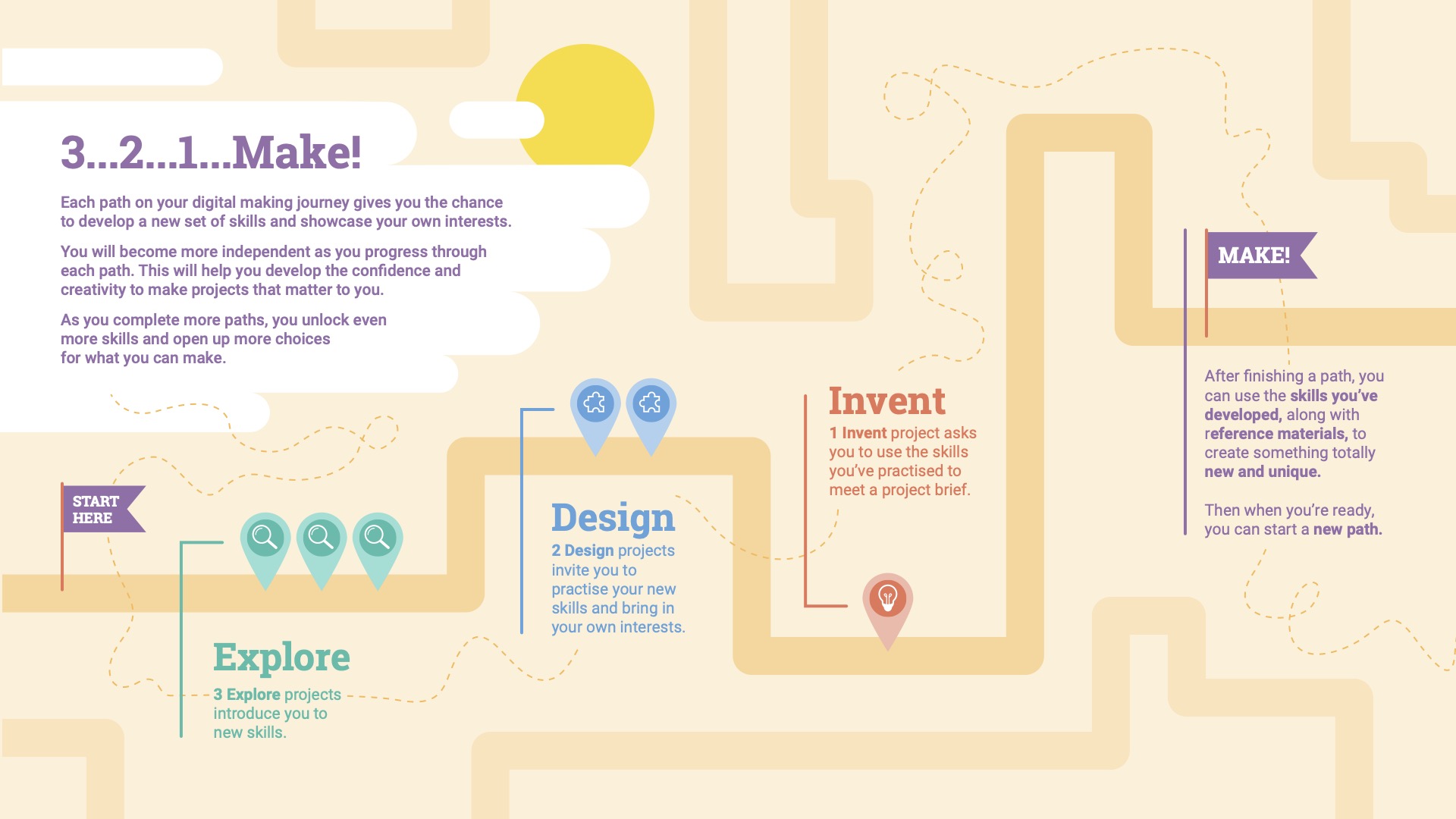
Therefore, each of our new learning paths is designed to scaffold learners’ success in the early stages, and then lets them build upon this learning by providing them with more open-ended tasks and inspirational ideas that learners can adapt or work from. Each learning path is made up of six projects, and the projects become less structured as learners progress along the path. This allows learners to practise their newly acquired skills and use their creativity and interests to make projects that matter to them. In this way, learners develop more and more independence, and when they reach the final project in the path, they are presented with a simple project brief. By this time they have the skills, practice, and confidence to meet this brief any way they choose!
The four new paths we’re sharing with you today focus on the Scratch language (including a physical computing path!), with a Python and a web development path coming very soon, and even more learning content in development.
When a learner is ready to develop a new set of coding skills, they choose one of our new paths to embark on. Each path is made up of three different types of projects in a 3-2-1 structure:
As a result of working through a path, learners are empowered to make their own ideas and create solutions to situations they or their communities face, with increased independence. And in order to develop more skills, learners can work through more paths, giving them even more choice about what they create in the future.
We’ve also introduced some new features to add interactivity, choice, and authenticity to each project in a path:
You can discover our new paths on our projects site right now!
We’ll be adding more content regularly, including completely new Python programming and web development paths coming very soon!
As always, we’d love to know what you think: here’s a feedback form for you to share comments you have about our new content!
For feedback specific to an individual project, you can use the feedback link in the footer of that project’s page as usual.
The post New free resources for young people to become independent digital makers appeared first on Raspberry Pi.
Between September 2021 and March 2022, we’re partnering with The Alan Turing Institute to host speakers from the UK, Finland, Germany, and the USA presenting a series of free research seminars about AI and data science education for young people. These rapidly developing technologies have a huge and growing impact on our lives, so it’s important for young people to understand them both from a technical and a societal perspective, and for educators to learn how to best support them to gain this understanding.
In our first seminar we were beyond delighted to hear from Dr Mhairi Aitken, Ethics Fellow at The Alan Turing Institute. Mhairi is a sociologist whose research examines social and ethical dimensions of digital innovation, particularly relating to uses of data and AI. You can catch up on her full presentation and the Q&A with her in the video below.
The increased use of AI in society and industry is bringing some amazing benefits. In healthcare for example, AI can facilitate early diagnosis of life-threatening conditions and provide more accurate surgery through robotics. AI technology is also already being used in housing, financial services, social services, retail, and marketing. Concerns have been raised about the ethical implications of some aspects of these technologies, and Mhairi gave examples of a number of controversies to introduce us to the topic.
“Ethics considers not what we can do but rather what we should do — and what we should not do.”
Mhairi Aitken
One such controversy in England took place during the coronavirus pandemic, when an AI system was used to make decisions about school grades awarded to students. The system’s algorithm drew on grades awarded in previous years to other students of a school to upgrade or downgrade grades given by teachers; this was seen as deeply unfair and raised public consciousness of the real-life impact that AI decision-making systems can have.
Another high-profile controversy was caused by biased machine learning-based facial recognition systems and explored in Shalini Kantayya’s documentary Coded Bias. Such facial recognition systems have been shown to be much better at recognising a white male face than a black female one, demonstrating the inequitable impact of the technology.
There is a clear need to consider both the positive and negative impacts of AI in society. Mhairi stressed that using AI effectively and ethically is not just about mitigating negative impacts but also about maximising benefits. She told us that bringing ethics into the discussion means that we start to move on from what AI applications can do to what they should and should not do. To outline how ethics can be applied to AI, Mhairi first outlined four key ethical principles:
Mhairi shared a number of concrete questions that ethics raise about new technologies including AI:
To mitigate negative impacts and maximise benefits of an AI system in practice, it’s crucial to consider the context in which the system is developed and used. Mhairi illustrated this point using the story of an autonomous vehicle, a self-driving car, developed in Sweden in 2017. It had been thoroughly safety-tested in the country, including tests of its ability to recognise wild animals that may cross its path, for example elk and moose. However, when the car was used in Australia, it was not able to recognise kangaroos that hopped into the road! Because the system had not been tested with kangaroos during its development, it did not know what they were. As a result, the self-driving car’s safety and reliability significantly decreased when it was taken out of the context in which it had been developed, jeopardising people and kangaroos.
Mhairi used the kangaroo example as a metaphor to illustrate ethical issues around AI: the creators of an AI system make certain assumptions about what an AI system needs to know and how it needs to operate; these assumptions always reflect the positions, perspectives, and biases of the people and organisations that develop and train the system. Therefore, AI creators need to include metaphorical ‘kangaroos’ in the design and development of an AI system to ensure that their perspectives inform the system. Mhairi highlighted children as an important group of ‘kangaroos’.
AI may have far-reaching consequences in children’s lives, where it’s being used for decision-making around access to resources and support. Mhairi explained the impact that AI systems are already having on young people’s lives through these systems’ deployment in children’s education, in apps that children use, and in children’s lives as consumers.
Children can be taught not only that AI impacts their lives, but also that it can get things wrong and that it reflects human interests and biases. However, Mhairi was keen to emphasise that we need to find out what children know and want to know before we make assumptions about what they should be taught. Moreover, engaging children in discussions about AI is not only about them learning about AI, it’s also about ethical practice: what can people making decisions about AI learn from children by listening to their views and perspectives?
UNICEF, the United Nations Children’s Fund, has expressed concerns about the impact of new AI technologies used on children and young people. They have developed the UNICEF Requirements for Child-Centred AI.
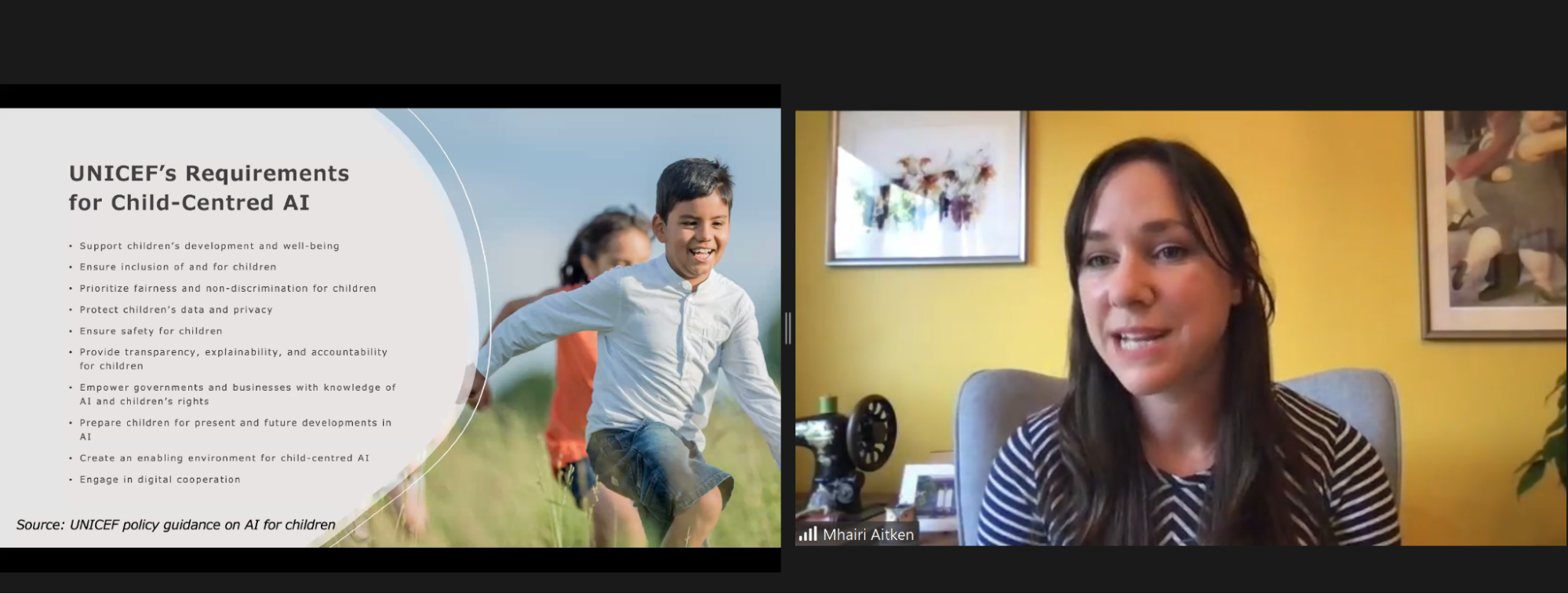
Together with UNICEF, Mhairi and her colleagues working on the Ethics Theme in the Public Policy Programme at The Alan Turing Institute are engaged in new research to pilot UNICEF’s Child-Centred Requirements for AI, and to examine how these impact public sector uses of AI. A key aspect of this research is to hear from children themselves and to develop approaches to engage children to inform future ethical practices relating to AI in the public sector. The researchers hope to find out how we can best engage children and ensure that their voices are at the heart of the discussion about AI and ethics.
We all learned a tremendous amount from Mhairi and her work on this important topic. After her presentation, we had a lively discussion where many of the participants relayed the conversations they had had about AI ethics and shared their own concerns and experiences and many links to resources. The Q&A with Mhairi is included in the video recording.
What we love about our research seminars is that everyone attending can share their thoughts, and as a result we learn so much from attendees as well as from our speakers!
It’s impossible to cover more than a tiny fraction of the seminar here, so I do urge you to take the time to watch the seminar recording. You can also catch up on our previous seminars through our blogs and videos.
We have six more seminars in our free series on AI, machine learning, and data science education, taking place every first Tuesday of the month. At our next seminar on Tuesday 5 October at 17:00–18:30 BST / 12:00–13:30 EDT / 9:00–10:30 PDT / 18:00–19:30 CEST, we will welcome Professor Carsten Schulte, Yannik Fleischer, and Lukas Höper from the University of Paderborn, Germany, who will be presenting on the topic of teaching AI and machine learning (ML) from a data-centric perspective (find out more here). Their talk will raise the questions of whether and how AI and ML should be taught differently from other themes in the computer science curriculum at school.
Sign up now and we’ll send you the link to join on the day of the seminar — don’t forget to put the date in your diary.
I look forward to meeting you there!
In the meantime, we’re offering a brand-new, free online course that introduces machine learning with a practical focus — ideal for educators and anyone interested in exploring AI technology for the first time.
The post What’s a kangaroo?! AI ethics lessons for and from the younger generation appeared first on Raspberry Pi.
Today we’re announcing two brand-new, fantastic, free online courses for educators in the USA. And to kickstart their learning journey, we are giving qualified US-based educators the chance to get a free Raspberry Pi Pico microcontroller hardware kit. This is all thanks to our partners at Infosys Foundation USA, who are committed to expanding access to computer science and maker education in public schools across the United States.
You can find both new courses on the Pathfinders Online Institute platform, which supports US classroom educators to bring high-quality computer science and maker education content to their kindergarten through 12th grade students. And best of all, the platform is completely free!
The first course we’ve created for you is called Programming essentials in Scratch. It supports teachers to introduce the essentials of programming to fourth to eighth grade students. The course covers the key concepts of programming, such as variables, selection, and iteration. In addition to learning how to teach programming effectively, teachers will also discover how to inspire their students and help them create music, interactive quizzes, dance animations, and more.
Our second new course for you is called Design, build, and code a rover with Raspberry Pi Pico. It gives teachers of fourth to eighth grade students everything they need to start teaching physical computing in their classroom. Teachers will develop their students’ knowledge of the subject by using basic circuits, coding a Raspberry Pi Pico microcontroller to work with motors and LEDs, and designing algorithms to navigate a rover through a maze. By the end of the course, teachers will have all the resources they need to inspire students and help them explore practical programming, system design, and prototyping.
And thanks to the generous support of Infosys Foundation USA, we’re able to provide qualified educators with a FREE kit of materials to participate in the Design, build, and code a rover with Raspberry Pi Pico course. We’re especially excited about this because the kit includes our first-ever microcontroller, Raspberry Pi Pico. This offer is available to 1,000 US-based K–12 public or charter school teachers on a first-come, first-served basis.
To claim your kit, just create a free account on Pathfinders Online Institute and start the course. On the first page of the course, you’ll receive instructions on how to apply for a free kit.
If you’re not a qualified educator, or if you’ve missed out on the opportunity to get the free hardware, we still welcome you to join the course! You can find the materials yourself, or purchase the kit from our partners at PiShop.us.
All of us at the Raspberry Pi Foundation want to thank the Infosys Foundation USA team for collaborating with us on this new resource and learning opportunity for educators. We appreciate and share their commitment to support computer science and maker education.
The post Free computer science courseware and hardware for American educators appeared first on Raspberry Pi.
We’re super excited to announce that the European Astro Pi Challenge is back for another year of amazing space-based coding adventures.
This time we are delighted to tell you that we’re upgrading the Raspberry Pi computers on the International Space Station (ISS) and adding new hardware to expand the range of experiments that young people can run in space!
The first Astro Pi units were taken up to the ISS by British ESA astronaut Tim Peake in December 2015 as part of the Principia mission. Since then, 54000 young people from 26 countries have written code that has run on these specially augmented Raspberry Pi computers.
Working with our partners at the European Space Agency, we are now upgrading the Astro Pi units to include:
The units will continue to have a gyroscope; an accelerometer; a magnetometer; and humidity, temperature, and pressure sensors.
The new hardware makes it possible for teams to design new types of experiments. With the Raspberry Pi High Quality Camera they can take sharper, more detailed images, and, for the first time, teams will be able to get full-colour photos of the beauty of Earth from space. This will also enable teams to investigate plant health thanks to the higher-quality optical filter in conjunction with the IR-sensitive camera. Using the Coral machine learning accelerator, teams will also be able to develop machine learning models that allow high-speed, real-time processing.
The Astro Pi units, in their space-ready cases of machined aluminium, will travel to the ISS in December on the SpaceX Dragon Cargo rocket, launching from Kennedy Space Center. Once the resupply vehicle docks with the ISS, the units will be unpacked and set up ready to run Astro Pi participants’ code in 2022.
Getting the units ready for launch has been a significant effort from lots of people. Once we worked with our friends at ESA to agree on the new features and hardware, we commissioned the design of the new case from Jon Wells. Manufacturing was made significantly more challenging by the pandemic, not least because we weren’t able to attend the factory and had to interact over video calls.
Once we had the case and hardware ready, we could take on the huge battery of tests that are required before any equipment can be used on the ISS. These included the vibration test, to ensure that the Astro Pi units would survive the rigours of the launch; thermal testing, to make sure that units wouldn’t get too hot to touch; and stringent, military-grade electromagnetic emissions and susceptibility tests to guarantee that the Astro Pi computers wouldn’t interfere with any ISS systems, and would not themselves be affected by other equipment that is on board the space station.
Huge thanks to Jon Wells and our collaborators at Airbus, Google, MidOpt, and Shearline Precision Engineering for everything they’ve done to get us to the point where we were able to ship the new Astro Pi units to the Aerospace Logistics Technology Engineering Company (ALTEC) in Italy for final preparations before their launch.
There are two Astro Pi missions for young people to choose from: Mission Zero and Mission Space Lab. Young people can participate in one or both of the missions! Participation is free and open for young people up to age 19 in ESA member states (exceptions listed on the Astro Pi website).
In Mission Zero, young people write a simple Python program that takes a sensor reading and displays a message on the LED screen. This year, participation in Mission Zero also gives young people the opportunity to vote for the names of the two new computers. Mission Zero can be completed in around an hour and is open to anyone up to age 19. (Young children may need support with typing to do the coding activity.) Every eligible entry is guaranteed to run on board the ISS, and participants will receive an official certificate with the exact time and location of the ISS when their program ran.
Mission Zero opens today and runs until 18 March 2022.
Mission Space Lab is for teams of young people who want to run their own scientific experiments on the Astro Pi units aboard the ISS. It runs over eight months in four phases, from idea registration to data analysis.
Have a look at the winning teams from last year for amazing examples of what teams have investigated in the past. But remember — the new Astro Pi computers offer exciting new ways of investigating life in space and on Earth. We can’t wait to see what ideas participants come up with this year.
To start, Mission Space Lab team mentors just need to send us their team’s experiment idea by 29 October 2021.
You can keep updated with all of the latest Astro Pi news, including the build-up to the rocket launch in December, by following the Astro Pi Twitter account.
The post We’re sending Raspberry Pi computers to space for the European Astro Pi Challenge appeared first on Raspberry Pi.
Today we bring you the fourth film in our series of inspirational community stories! Incredible young people from the community have collaborated with us to create these videos, where they tell their tech stories in their own words.
Watch the new film to meet a “mischievous” tech creator who is helping other young people in his community to use technology to bring their ideas to life.
Toshan’s story takes place in his hometown of Bangalore, India, where his love for electronics and computing sent him on a journey of tech discovery!
Toshan (16) first encountered coding aged 12, thanks to his computing teacher Miss Sonya. Describing his teacher, he says: “The unique thing is, she just doesn’t stop where the syllabus ends.” The world of digital making and Raspberry Pi computers that Miss Sonya introduced him to offered Toshan “limitless opportunities”, and he felt inspired to throw himself into learning.
“If we help people with their ideas, they might bring something new into the world.”
Toshan
Having found help in his local community and the online Raspberry Pi Foundation community that enabled him to start his tech journey, Toshan decided to pass on his skills: he set up a CoderDojo for other young people in Bangalore when he was 14. Toshan says, “I wanted to give something back.” Mentoring others as they learn coding and digital making helped his confidence grow. Toshan loves supporting the learners at his Dojo with problem-solving because “if we help people with their ideas, they might bring something new into the world.”
Supported by his mum and dad, Toshan’s commitment to helping others create with technology is leading him to extend his community beyond the city he calls home. Through his YouTube channel, he reaches people outside of Bangalore, and he has connected with a worldwide community of like-minded young tech creators by taking part in Coolest Projects online 2020 with an automated hand sanitiser he built.
Toshan’s enthusiasm and love for tech are already motivating him to empower others, and he has only just begun! We are delighted to be a part of his journey and can’t wait to see what he does next.
Help us celebrate Toshan by liking and sharing his story on Twitter, Linkedin, or Facebook!
The post Celebrating the community: Toshan appeared first on Raspberry Pi.
In computing education, designing equitable and authentic learning experiences requires a conscious effort to take into account the characteristics of all learners and their social environments. Doing this allows teachers to address topics that are relevant to a diverse range of learners. To support computing and computer science teachers with this work, we’re now sharing a practical guide document for culturally responsive teaching in schools.
Making computing culturally relevant means that learners with a range of cultural identities will be able to identify with the examples chosen to illustrate computing concepts, to engage effectively with the teaching methods, and to feel empowered to use computing to address problems that are meaningful to them and their communities. This will enable a more diverse group of learners to feel that they belong in computing and encourage them to choose to continue with it as a discipline in qualifications and careers.
Such an approach can empower all our students and support their skills and understanding of the integral role that computing can play in promoting social justice.
Yota Dimitriadi, Associate Professor at the University of Reading, member of the project working group
We introduced our work on this new document to you previously here on the blog. Check out the previous blog post to find out more about the project’s funding and background, and the external working group of teachers and academics we brought together to develop the guide.
To get the project off to the best start possible once we had assembled the working group, we first spent time drawing on research from the USA and discussing within the working group to come to a shared understanding of key terms:
To bring in the voices of young people into the project, we asked teachers in the working group to consult with their learners to understand their perspectives on computing and how schools can engage more diverse groups of learners in elective computer science courses. The main reason that learners reported for being put off computing: complex or boring lessons of coding activities with a focus on theory rather than on practical outcomes. Many said that they were inspired by tasks such as producing their own games and suggested that early experiences in primary school and Key Stage 3 had been very important for their engagement in computing.
The guide shows you that a culturally relevant pedagogy applies in three aspects of education, which we liken to a tree to indicate how these aspects connect to each other: the tree’s root system, the basis of culturally relevant pedagogy, is the focus of the curriculum; the tree’s trunk and branches are the teaching approaches taken to deliver the curriculum; the learning materials, represented by the tree’s crown of leaves, are the most widely visible aspect of computing lessons.
Each aspect plays an important role in culturally relevant pedagogy:
You can download the guide on culturally relevant pedagogy for computing teachers now to explore the resources provided:
One of the teachers who was part of the working group is Joe Arday from Woodbridge High School in Essex, UK. Joe originally worked in the technology sector and has been teaching computing for ten years. We asked him about his experience of being part of the project and how he plans to use the guide in his own classroom practice:
“It has been an absolute privilege to play a part in working towards producing the guide that my own children will be beneficiaries of when they are studying the computing curriculum throughout their education. I have been able to reflect on how to further improve my teaching practice and pedagogy to ensure that the curriculum taught is culturally diverse and caters for all learners that I teach. (Also, having the opportunity to work with academics from both the UK and US has made me think about becoming an academic in the field of computing at some point in the future!)”
Joe also says: “I plan to review the computing curriculum taught in my computing department and sit down with my colleagues to work on how we can implement the guide in our units of work for Key Stages 3 to 5. The guide will also help my department to work towards one of my school’s aims to encourage an anti-racism community and curriculum in my school.“
We hope you find this resource useful for your own practice, and for conversations within your school and network of fellow educators! Please spread the word about the guide to anyone in your circles who you think might benefit.
We plan to keep working with learners on their perspectives on culturally relevant teaching, and to develop professional development opportunities for teachers, initially in conjunction with a small number of schools. As always with our research projects, we will investigate what works well and share all our findings widely and promptly.
Many thanks to the teachers and academics in the working group for being wonderful collaborators, to the learners who contributed their time and ideas, and to Hayley Leonard and Diana Kirby from our team for all the time and energy they devoted to this project!
Joseph Arday, FCCT, Woodbridge High School, Essex, UK
Lynda Chinaka, University of Roehampton, UK
Mike Deutsch, Kids Code Jeunesse, Canada
Dr Yota Dimitriadi, University of Reading, UK
Amir Fakhoury, St Anne’s Catholic School and Sixth Form College, Hampshire, UK
Dr Samuel George, Ark St Alban’s Academy, West Midlands, UK
Professor Joanna Goode, University of Oregon, USA
Alain Ndabala, St George Catholic College, Hampshire, UK
Vanessa Olsen-Dry, North Cambridge Academy, Cambridgeshire, UK
Rohini Shah, Queens Park Community School, London, UK
Neelu Vasishth, Hampton Court House, Surrey, UK
The post Delivering a culturally relevant computing curriculum: new guide for teachers appeared first on Raspberry Pi.
It can be easy to think of science, technology, engineering, and maths (STEM) as fields that develop in a linear way, always progressing towards ever better solutions and approaches. Of course, alternative solutions are posed to all sorts of problems, but in western culture, those solutions that did not take hold are sometimes seen as the approaches that were ‘wrong’ or mistaken, and that eventually gave way to the ‘right’ approaches. A culture that includes the belief that there is only one ‘right’ way can be alienating to anyone who sees the world in a different way.
Dr Ron Eglash from the University of Michigan explored the intersections of diverse cultural ideas and computing in his talk at the final research seminar in our series about diversity and inclusion (see below for the recorded video). His work and insights show us how we might think about diversity in computing as being dependent on the diversity of cultural concepts and beliefs that can underpin the subject. Ron also shared free resources for educators who want to help their students learn about STEM while exploring cultural ideas.
Ron’s talk explored the overlaps of technology, culture, and society. In his research work, Ron has facilitated collaborations across the world between STEM students and people from indigenous cultures, opening up computing to people who have different backgrounds and different ways of seeing the world and, in the process, revealing many complex assumptions that different cultures have about computing and technology.
Ron’s work challenges some of the assumptions in western culture about technological knowledge. He started his talk by showing the evolution of knowledge as a branching set of possibilities and ideas that societies choose to move forward with or leave behind. To illustrate, he gave examples of different concepts of mathematics that western society has taken on board, refined, or discarded throughout its history, demonstrating that there are different versions of mathematics we could have had but chose not to.
These different choices in adoption and exploration of ideas, Ron continued, are more evident when one looks at the knowledge systems of different cultures side by side: different knowledge systems represent different paths that groups of people have chosen — not in totality but as the result of smaller decisions that select which ideas will be influential and which will be eliminated.
One idea that western society has chosen, and that Ron highlighted for us, is the extraction of value. This is something we can see across this society, and it’s a powerful idea that fundamentally shapes how many of us think about the world. We extract value from the natural world in the way we exploit raw materials. We extract value from labour through the organisation of working arrangements that we have made the norm. And we extract value from social relationships through the online social media platforms, online games, and other digital tools that have so quickly become a central part of billions of people’s lives.
But western culture, with its particular knowledge system and core tenet of value extraction, represents just one possible way of social and technical development. In nature, systems do not extract value, they circulate it: value moves in a recursive loop as organisms grow, die, and are subsumed back into the ecosystem. Many indigenous cultures have developed within this framework of circulating value. The possible benefits of a circular economy are becoming a topic of discussion in western society, and we would do well to remember that this concept is not western in origin: other cultures have been practicing it for a long time, a point Ron made clear in his talk. And as Ron showed us through his research, the framework of circulating value permeates various indigenous cultures in ways that go beyond approaches such as sustainable agriculture, and thereby creates repeating, fractal patterns in cultural artefacts at different scales, from artworks, to the way settlements are organised, to philosophical ideas.
In nature, there are many examples of fractal geometry because of biological and chemical phenomena of bottom-up growth and replication. Ron shared images gathered during his research that highlight that fractal patterns are also clearly visible in, for example, traditional African art: by using visual patterns of recursive and non-linear scaling, artists intentionally symbolised the bottom-up and circular ideas permeating their culture. African cultural concepts of recursion and non-linearity, which were also brought to the Americas during the transatlantic slave trade, can be seen today in, for example, cornrow hair braiding, quilting, growing traditions, and spiritual practices.
The links between indigenous cultural concepts and computing algorithms are many. To explore these in the context of education, Ron and his team have worked in collaboration with members of indigenous communities to develop Culturally Situated Design Tools (CSDT), a suite of computing and STEM activities and learning resources that allow young people of a range of ages to discover the relationship between computing and programming concepts and cultural ideas that trace back to indigenous cultures. The CSDT development process Ron described involved genuine collaboration: seeking ‘cultural permission’ from communities; deeply understanding the cultural concepts behind the artefacts that were being developed; and creating tools that not only allow students to explore traditional designs and artefacts but also give them the scope to design their own original artefacts and to actively contribute to communities’ cultural practices.
Ron underlined in his talk how important it is not to see activities like CSDT as a lure to ‘trick’ young people into engaging with STEM classes; the intention is not using them as a veneer to interest more young people in industries underpinned by an extractive world view. Instead, circular and bottom-up concepts are an alternative way of seeing how technology can be used to influence and construct the world.
As such, an important aspect of the pedagogy of Culturally Situated Design Tools is returning creative contributions to the community whose concepts or artefacts are being explored in each activity. The aim is to create a generative cycle of STEM engagement, and Ron demonstrated how this can work by sharing more about a project he conducted with STEM students in Albany, NY. Students began the project by exploring cornrow design simulations. They brought these out of the computer, out of their schools, and into local braiding shops by producing 3D-printed mannequins featuring their cornrow designs. Through engaging with the braiding shop owners, the students learned that the owners had challenges to do with the pH level of hair products, and this led to the students producing pH testing kits for them. The practical applications benefitted the communities connected to the braiding shops and inspired more student interest in the project — thus, a circular, mutually beneficial process of engagement emerged.
Importantly, the STEM activities that Ron and his collaborators have developed cannot be separated from their cultural context. This way of teaching STEM is not about recruiting young people to become software developers or other tech professionals, but instead about giving them the skills to be creative contributors and problem solvers within communities so that they can help promote the circulation of value.
I have long been enthusiastic about the potential of computing and digital making as a tool for many disciplines, and Ron’s talk made me consider what this might mean at a much deeper level than providing different routes into computing. There is a lot of discussion about how we need to increase diversity in the STEM field to make the field more equitable and able to positively contribute to society, but Ron’s presentation challenged me to think about the cultural assumptions that shape the nature of STEM, and how these influence who engages with the field. Increasing diversity and inclusion in computing and STEM is not just a case of making opportunities open to everyone, but about actually re-shaping the nature of the field so it can be equitable in its interactions with ecological systems, cultures, and human experiences.
Do watch the video of Ron’s presentation and the following Q&A for more on these concepts, examples of the computing activities and how to use them, and discussion of these fundamental ideas. You’ll find his presentation slides on our ‘previous seminars’ page.
You can find the resources Ron shared at csdt.org and generativejustice.org/projects. And together with a working group of teachers and academics, we’ve created a practical guide to culturally relevant and responsive computing in the classroom that we hope you’ll find useful.
We are taking a break from our monthly research seminars in August! In the meantime, you can revisit our previous seminars about diversity and inclusion. On 7 September, we’ll be back to start our new seminar series focusing on AI, machine learning, and data science education, in partnership with The Alan Turing Institute. At these seminars, you’ll hear from a range of international speakers about current best practices in teaching young people the technical concepts and ethical considerations involved in these technologies. Do sign up and put the dates in your calendar!
The post Exploring how culture and computing intersect appeared first on Raspberry Pi.
A recent Forbes article reported that over the last four years, the use of artificial intelligence (AI) tools in many business sectors has grown by 270%. AI has a history dating back to Alan Turing’s work in the 1940s, and we can define AI as the ability of a digital computer or computer-controlled robot to perform tasks commonly associated with intelligent beings.
Four key areas of AI are machine learning, robotics, computer vision, and natural language processing. Other advances in computing technology mean we can now store and efficiently analyse colossal amounts of data (big data); consequently, data science was formed as an interdisciplinary field combining mathematics, statistics, and computer science. Data science is often presented as intertwined with machine learning, as data scientists commonly use machine learning techniques in their analysis.
AI and data science have recently received huge amounts of attention in the media, as machine learning systems are now used to make decisions in areas such as healthcare, finance, and employment. These AI technologies cause many ethical issues, for example as explored in the film Coded Bias. This film describes the fallout of researcher Joy Buolamwini’s discovery that facial recognition systems do not identify dark-skinned faces accurately, and her journey to push for the first-ever piece of legislation in the USA to govern against bias in the algorithms that impact our lives. Many other ethical issues concerning AI exist and, as highlighted by UNESCO’s examples of AI’s ethical dilemmas, they impact each and every one of us.
So how do such advances in technology impact the education of young people? In the UK, a recent Royal Society report on machine learning recommended that schools should “ensure that key concepts in machine learning are taught to those who will be users, developers, and citizens” — in other words, every child. The AI Roadmap published by the UK AI Council in 2020 declared that “a comprehensive programme aimed at all teachers and with a clear deadline for completion would enable every teacher confidently to get to grips with AI concepts in ways that are relevant to their own teaching.” As of yet, very few countries have incorporated any study of AI and data science in their school curricula or computing programmes of study.
Here at the Raspberry Pi Foundation, AI, machine learning, and data science are important topics both in our learning resources for young people and educators, and in our programme of research. So we are delighted to announce that starting this autumn we are hosting six free, online seminars on the topic of AI, machine learning, and data science education, in partnership with The Alan Turing Institute.
The Alan Turing Institute is the UK’s national institute for data science and artificial intelligence and does pioneering work in data science research and education. The Institute conducts many different strands of research in this area and has a special interest group focused on data science education. As such, our partnership around the seminar series enables us to explore our mutual interest in the needs of young people relating to these technologies.
This promises to be an outstanding series drawing from international experts who will share examples of pedagogic best practice […].
Dr Matt Forshaw, The Alan Turing Institute
Dr Matt Forshaw, National Skills Lead at The Alan Turing Institute and Senior Lecturer in Data Science at Newcastle University, says: “We are delighted to partner with the Raspberry Pi Foundation to bring you this seminar series on AI, machine learning, and data science. This promises to be an outstanding series drawing from international experts who will share examples of pedagogic best practice and cover critical topics in education, highlighting ethical, fair, and safe use of these emerging technologies.”
At our computing education research seminars, we hear from a range of experts in the field and build an international community of researchers, practitioners, and educators interested in this important area. Our new free series of seminars runs from September 2021 to February 2022, with some excellent and inspirational speakers:
All seminars start at 17:00 UK time (18:00 Central European Time, 12 noon Eastern Time, 9:00 Pacific Time) and take place in an online format, with a presentation, breakout discussion groups, and a whole-group Q&A.
Sign up now and we’ll send you the link to join on the day of each seminar — don’t forget to put the dates in your diary!
In the meantime, you can explore some of our educational resources related to machine learning and data science:
The post Educating young people in AI, machine learning, and data science: new seminar series appeared first on Raspberry Pi.
I am delighted to share the news that we have appointed a new Chair and Trustees of the Raspberry Pi Foundation. Between them, they bring an enormous range of experience and expertise to what is already a fantastic Board of Trustees, and I am really looking forward to working with them.
John Lazar has been appointed as the new Chair of the Board of Trustees. John is a software engineer and business leader who is focused on combining technology and entrepreneurship to generate lasting positive impact.
Formerly the Chairman and CEO of Metaswitch Networks, John is now an angel investor, startup mentor, non-executive chairman and board director, including serving as the Chair of What3Words. He is a Fellow of the Royal Academy of Engineering and played an active role in developing the programme of study for England’s school Computer Science curriculum. John has also spent many years working on tech-related non-profit initiatives in Africa and co-founded Enza Capital, which invests in early-stage African technology companies that solve pressing problems.
John takes over the Chair from David Cleevely, who has reached the end of his two three-year terms as Trustee and Chair of the Foundation. David has made a huge contribution to the Foundation over that time, and we are delighted that he will continue to be involved in our work as one of the founding members of the Supporters Club.
Alongside John, we are welcoming three new Trustees to the Board of Trustees:
I am also delighted to announce that we have appointed Suranga Chandratillake as a Member of the Raspberry Pi Foundation. Suranga is a technologist, entrepreneur, and investor.
He founded the intelligent search company blinkx and is now a General Partner at Balderton Capital. Suranga is a Fellow of the Royal Academy of Engineering and a World Economic Forum Young Global Leader, and he serves on the UK Government’s Council for Science and Technology.
As a charity, the Raspberry Pi Foundation is governed by a Board of Trustees that is ultimately responsible for what we do and how we are run. It is the Trustees’ job to make sure that we are focused on our mission, which for us means helping more people learn about computing, computer science, and related subjects. The Trustees also have all the usual responsibilities of company directors, including making sure that we use our resources effectively. As Chief Executive, I am accountable to the Board of Trustees.
We’ve always been fortunate to attract the most amazing people to serve as Trustees and, as volunteers, they are incredibly generous with their time, sharing their expertise and experience on a wide range of issues. They are an important part of the team. Trustees serve for up to two terms of three years so that we always have fresh views and experience to draw on.
Appointments to the Board of Trustees follow open recruitment and selection processes that are overseen by the Foundation’s Nominations Committee, supported by independent external advisers. Our aim is to appoint Trustees who bring different backgrounds, perspectives, and lived experience, as well as a range of skills. As with all appointments, we consider diversity at every aspect of the recruitment and selection processes.
Formally, Trustees are elected by the Foundation’s Members at our Annual General Meeting. This year’s AGM took place last week on Zoom. Members are also volunteers, and they play an important role in holding the Board of Trustees to account, helping to shape our strategy, and acting as advocates for our mission.
You can see the full list of Trustees and Members on our website.
The post New Chair and Trustees of the Raspberry Pi Foundation appeared first on Raspberry Pi.


 Lateo.net - Flux RSS en pagaille (pour en ajouter : @ moi)
