Lateo.net - Flux RSS en pagaille (pour en ajouter : @ moi)

🔒
❌ À propos de FreshRSS
Il y a de nouveaux articles disponibles, cliquez pour rafraîchir la page.
Aujourd’hui — 24 octobre 2026Analyses, perspectives

Magali Lafourcade : « La réponse du pouvoir est exclusivement sécuritaire parce qu’il ne tient plus sur aucun socle »

Manifestations réprimées, opposants criminalisés, justice instrumentalisée… Magali Lafourcade, secrétaire générale de la Commission nationale consultative des droits de l’homme, s’inquiète du délitement de l’Etat de droit.

Lycéens, Gilets jaunes... Ils dénoncent la « vaste blague » des consultations citoyennes lancées par Macron

En réponse à la mobilisation de la jeunesse, Emmanuel Macron a lancé une consultation citoyenne en ligne. L'expérience des doléances des Gilets jaunes et de la Convention citoyenne pour le climat laisse pourtant les concernés avec une question : « Qu'en a-t-il été fait ? »
Quelle est la réponse d'Emmanuel Macron à la mobilisation des lycéens, descendus en masse dans les rues pour réclamer un avenir meilleur ? Une consultation lycéenne en ligne, ouverte jusqu'au 23 octobre. Cahiers de (…)

Lire la suite - Info

« En appeler à l'armée contre sa propre population, c'est extrêmement inquiétant »

Mobiliser l'armée contre sa propre population : la répression s'intensifie pour l'acte II du samedi 24 octobre. Nathalie Tehio, présidente de la ligue des droits de l'Homme dénonce une « politique autoritaire ».
Couvre-feu prolongé, pluie d'interdictions de manifester, déploiement de l'armée… Le ministre de l'Intérieur, Laurent Nuñez, a annoncé un dispositif policier colossal à la veille de l'acte II d'une mobilisation sociale réunissant lycéens, Gilets jaunes et militants écologistes. « (…)

Lire la suite - Entretien / , ,

Lacrymogènes : des gaz nocifs bien après les manifs

Les dégâts des gaz lacrymogènes massivement utilisés sur les manifestants français ne s'arrêtent pas une fois à l'abri du nuage. Troubles oculaires et respiratoires, menstruations perturbées, douleurs, et même la mort : ils peuvent avoir des conséquences durables sur la santé.
Samedi 17 octobre, à Paris, la manifestation n'avait pas démarrée que les gaz lacrymogènes flottaient déjà sur la place de la République. L'Orchestre du nouveau monde, qui joue lors des manifestations, a été obligé (…)

Lire la suite - Info / , ,

Un Monet à 50 millions d'euros, un Rothko à 98 millions de dollars : derrière les records, comment sont fixés les prix des œuvres d’art ?

Sur un marché de l'art qui connaît un regain de dynamisme, la valeur des œuvres est un enjeu crucial. Plusieurs facteurs, comme la cote de l'artiste ou même le matériau employé, permettent de la déterminer.

Le monde qui continue sans nous

par Mounir Kilani. On habite le présent sans savoir qu’il deviendra un passé auquel on cherchera à revenir. Nous ne regrettons pas ce que nous avons perdu. Nous regrettons de ne pas avoir su que nous le perdions.

The post Le monde qui continue sans nous first appeared on Réseau International.

Israël limite les livraisons de gaz à Gaza ; nous devons brûler du plastique toxique pour cuisiner

Ces émanations nauséabondes imprègnent nos aliments de leur odeur. L’inhalation quotidienne de ces fumées toxiques issues de la combustion des plastiques nous tue à petit feu.

Source : Truthout, Nour Abo Aisha
Traduit par les lecteurs du site Les-Crises

Une plongée dans les océans mondiaux, et 3 autres conseils de lecture

A la fois enjeu stratégique et domaine de recherche et de connaissance, la mer et ses multiples ressources sont au centre de trois ouvrages complémentaires, qui sont en tête de notre sélection cette semaine.

The global rebellion of youth and workers and the war frenzy of the ruling class

The crisis that drives the bourgeoisie to war is drawing ever broader sections of the working class into struggle on a world scale.

Europe’s student protests and the intervention of the working class

Major strikes and national days of protest are planned for November in several of the countries affected, in which millions of workers will take part. A fundamental class conflict is developing, one that directly raises the question of power.

Israel launches invasion of West Bank amid preparations for renewed onslaught against Iran

Netanyahu sealed off the West Bank and announced a military operation of a kind not carried out since 1967, as the US and Israel prepare new strikes on Iran after the elections.

Brazil stages presidential runoff amid global eruption of class struggle

Brazilians return to the polls on October 25 for the presidential runoff amid an eruption of the class struggle on a world scale.

Avant de supprimer Parcoursup, remédier à l’insuffisance de l’offre universitaire

Parmi les revendications des lycéens, il y a l’abrogation de Parcoursup, sur lequel on attend des annonces du gouvernement lundi. Stressant, opaque, inégalitaire, ce dispositif créé en 2018 cumule toutes les critiques. Ce serait même « une ignominie », selon Jean-Luc Mélenchon. Mais suffirait-il de…

US measles cases double last year’s total as Pennsylvania records a sixth death

The United States recorded no measles death at all between 2016 and 2024. Three were reported last year. Pennsylvania by itself has now recorded six in 2026, the latest a 39-year-old unvaccinated woman in Franklin County.

Everybody's Hitler! Ad Absurdum...

Everybody's Hitler! Ad Absurdum...

Authored by Jack Hunter via Libertarian Institute 

Piers Morgan recently said on his program of Russian President Vladimir Putin, “I do think he’s the nearest thing to a modern day Hitler…” Libertarian Institute Director Scott Horton had something to say about that. “You know what?” Horton said. “Noriega’s Hitler and Saddam’s Hitler and Milosevic’s Hitler and Putin’s Hitler. It sounds to me like Adolf was just another Hitler.”

“And apparently, any country that America doesn’t like, we can just start an aggressive war against them because they’re all the same as that one guy that one time,” he exclaimed.

Morgan: I actually do think [Putin is] the nearest thing to a modern-day Hitler. Scott Horton: Noriega's Hitler, and Saddam is Hitler, and Milosevic is Hitler, and Putin is Hitler. It sounds to me like Adolf was just another Hitler! https://t.co/1G3sDIxm5a

— Furkan Gözükara (@FurkanGozukara) October 15, 2026

Horton is right: There is a broad consensus that the supremely evil, mid-twentieth century German National Socialist dictator, responsible for the Holocaust and other horrors, deserved death and defeat for his crimes. Which is why so many war advocates ever since have tried to cast whoever they want to go to war against as being on par with Hitler. But just like Satan, there can only be one—unless you crave war.

I could not possibly list every would-be Hitler that American leaders have wanted to take out. Scott listed off a few examples of enemies, real and imagined, going back to Panamanian dictator Manuel Noriega of the Reagan-era ‘80s and Slobadan Milosevic in the Bill Clinton ‘90s, and then Iraq’s Saddam Hussein in this century.

In the post 9/11 era alone, the late Senator Lindsey Graham (R-SC) warned that if Muammar Gaddafi wasn’t taken out in 2011, the Libyan dictator would strike European cities.

Like Hitler, of course.

“He actually means it,” Graham said of Gaddafi fifteen years ago. “Hitler meant it. He means it.” Graham would also later compare Syria’s head Bashar al Assad to Hitler. Graham also assured us over a decade ago that the Iranian regime were Nazis, and of course that Putin was also Hitler.

Everybody’s Hitler!

Graham had plenty of company. For starters, he certainly wasn’t the only person to do this with Gaddafi.

The same goes for Assad. Secretary of State John Kerry said in 2013 that “Bashar al-Assad now joins the list of Adolf Hitler and Saddam Hussein who have used these weapons in time of war,” referring to certain claims about the use of chemical weapons. Two decades ago, it was all the rage for some leaders to claim Iranian President Mahmoud Ahmadinejad was Hitler. Trump even said this year at the beginning of his war with Iran that its leaders are the worst people since Hitler.

Senator Ted Cruz (R-TX) declared over a decade ago that “appeasing” Iran was another “Munich moment” like when England negotiated with Germany in 1938. The late Senator John McCain (R-AZ) did the same in 2013 when he said of President Barack Obama shaking hands with Cuban President Raul Castro, “Neville Chamberlain shook hands with Hitler.”

How did all this let’s-get-the-next-Hitler war drooling turn out?

America’s role in deposing Libya’s Gaddafi created an instability in the region that created a vacuum for ISIS, a foreign policy decision Obama would eventually call the “worst mistake” of his presidency.

The United States would end up arming al-Qaeda members against Syria’s Assad, and now a former member of the terrorist group that carried out the 9/11 attacks is that country’s president.

“Never Forget.”

How has going after the allegedly Hitlerian Iranian government gone so far? That disaster is still in progress. But its authors have also teased regime change against Cuban Nazis too.

Surely Cuban regime change would be an unparalleled success!

It’s probably worth noting that the Ukrainian forces U.S. war advocates support have within their ranks actual neo-Nazis (something Horton also noted to Piers Morgan).

Also, doesn’t equating everything with Hitler undermine the unique severity of the Holocaust tragedy and ultimately disrespect its victims?

US combat soldiers read of the death of Adolf Hitler in an 'Extra' edition of Stars and Stripes on May 2, 1945. Photo12/UIG/Getty Images

Also, for Republicans who constantly invoke this, how many times have political opponents of Donald Trump compared the president to Germany’s Fuhrer? Many things can be said about Trump, including exhibiting authoritarian behavior. But Hitler?’That’s not remotely serious. About as serious as Republicans comparing Barack Obama to Hitler.

Just stop.

It’s not that so many of these foreign actors aren’t horrific. Of course they are. But the United States can’t go to war with every country on earth to solve every wrong or ill. That’s not America’s mission, or shouldn’t be.

But the reason to compare every potential war to World War II and every foreign foe to Hitler is because most people find it impossible to argue against a war with Hitler.

That’s key. Whether it’s true, not so much.

Everyone we don’t like is not Hitler. It’s dumb and dishonest to say so.

So expect people to keep doing just that.

Tyler Durden Fri, 10/23/2026 - 23:25

Woke Video Game Developer BioWare Shuts Down In Humiliating Failure

Woke Video Game Developer BioWare Shuts Down In Humiliating Failure

The video game industry is collapsing in 2026 under the weight of their own arrogance and stupidity, and the "chuds" are cheering.  Why?  Because this is what needs to happen before better companies and better games can be made.  The people who ruined the hobby with their politics need to lose their jobs and be exiled from the business.  

Around 13,000 games developers are slated to be fired this year alone.  Since 2022, the industry has cut over 57,000 workers due to imploding revenues and lack of consumer interest.  Microsoft, Sony, Ubisoft, EA and a dozen other studios are cleaning house and booting out the rubbish. 

The most recent example is the large Xbox cuts to ultra-woke Bethesda Softworks.  Their layoffs (reportedly close to 440 workers) triggered socialist protests and accusations of discrimination against LGBT and minority employees.

The vast majority of these layoffs are being blamed on "restructuring", but the restructuring was caused by a plunge in gamer interest.  And the decline in gamer interest is part of an ongoing boycott of woke propaganda in games.  This is something the political left will never admit to, but the fact remains that the majority of developers who get woke, ultimately go broke.  In other words, the majority of woke products fail. 

Gaming studio Bioware, a veteran company in the industry, did not learn this lesson soon enough.  Bioware officially announced this week that after 30 years, they will be shutting down.  

https://t.co/TicSujMWps

— BioWare (@bioware) October 21, 2026

The company dove headfirst into woke virtue signaling around 2016-2017 and it was all downhill from there.  Critics say the final nail in the coffin was the game Dragon Age: Veilguard, which is widely considered one of the most ridiculously homosexual games ever produced.  The game was so notorious, it is still the subject of internet mockery to this day.  

For anyone with common sense, it's easy to see why the company is being scrapped by parent company Electronic Arts (EA).  Veilguard was the last game they published before they hit rock bottom.  Industry shill and activists initially claimed that Veilgaurd sales were doing well, despite evidence to the contrary.  The estimated cost of development and marketing was around $250 million, and it took around 9 years to make. 

After release, most estimates suggest the game pulled in less than $50 million in total sales.  An utter disaster.   

At its historical peak, BioWare employed around 500 people. By the time of the October 2026 closure announcement the remaining staff was around 50 people, all of them are now being laid off.  The lesson here is clear:  The progressive invasion of gaming media was a disaster for these companies. 

Those who want to survive past 2026 need to accept an undeniable reality - The consumers own you, you do not own them.  You cannot force gamers to buy your products. You cannot shame them into opening their wallets. Games are not a platform for your degenerate fanfiction.  They are not a platform for your personal politics. The "modern audience" you are trying to appeal to does not exist. You cannot win. 

Either make games that the people you call "chuds" enjoy, or go broke and get replaced.  It's that simple. 

Tyler Durden Fri, 10/23/2026 - 23:00

Five Reasons Why Trump Is More Serious Than Ever About Cutting Deals With Putin

Five Reasons Why Trump Is More Serious Than Ever About Cutting Deals With Putin

Authored by Andrew Korybko via Substack,

Although Putin might agree to some trade-offs in Ukraine as the quid pro quo for these deals, it's not guaranteed, but they can still be clinched so long as Trump has the will to waive more sanctions without a ceasefire first.

Putin's top aide Yury Ushakov confirmed after Steve Witkoff's latest meeting with Putin that "Other large-scale joint economic projects, which offer significant prospects for bilateral cooperation, were also discussed in detail; some of them are now nearing the implementation stage." This followed Putin courting the return of US investment to Russia's resource sector in early 2025 and Kirill Dmitriev recently confirming talks on nuclear-powered data centers.

Here are the five most promising joint opportunities:

* Oil & Gas

US stakes in Russia's energy infrastructure and companies can incentivize it to get the EU to return Russia's frozen assets through the sequence proposed here. They'd also serve as security guarantees against Ukrainian attacks on pain of the US cutting Ukraine off if it attacks assets in which Trump personally obtained stakes for the US. A separate injection of US capital into Russia's energy industry as the new "deal of the century" can reshape the global industry by reducing dependence on the Gulf.

* Critical Minerals

Russia's globally significant critical mineral deposits remain woefully underexploited, but with US stakes in this industry through the abovementioned sequence and separate capital injections, it can be brought online relatively quickly for accelerating the US' diversification from dependence on China. Russia's sparsely populated Siberia and Far East regions can also host pollution-heavy processing facilities far away from populated and agricultural areas. This makes joint investments extremely attractive.

* Data Centers

Per Dmitriev's recent disclosure, talks on nuclear-powered data centers represent another promising opportunity for both countries. Russia's globally significant critical mineral deposits could be processed in the country as proposed above and then immediately put to use within these facilities. That can greatly lower the cost of constructing them, while maintaining them would be similarly cost-effective through nuclear-powered means. This could lay the basis for global nuclear and tech partnerships too.

* Power Plants

Critical mineral processing facilities and data centers can also be powered by hydroelectric dams, not just nuclear power plants, and the US can obtain stakes in all four - the facilities, centers, dams, and plants - through the return of Russia's frozen EU assets as proposed. Separate capital injections can help fund the costs of construction in exchange for greater stakes, and any excess electricity produced through new dams and nuclear power plants can be exported to Russia's neighbors, both in Asia and Europe.

* International Logistics

The mineral deposits in which the US recently invested in Kazakhstan and Uzbekistan can reach jointly owned processing facilities in Russia through the Trans-Siberian Railway and then onward to the global market. The same goes for the US' related investments in similarly landlocked Mongolia. As the gatekeepers of the Northern Sea Route and Northwest Passage through their control of the Bering Strait, separate Arctic logistical cooperation is possible too, as is cooperation on nuclear-powered icebreakers.

"Trump Is More Serious Than Ever About Cutting Deals With Putin" in order for their long-negotiated resource-centric strategic partnership, the essence of which is described in the preceding hyperlinked analyses, to irreversibly shift the balance of the Sino-US systemic rivalry in the US' favor. Although Putin might agree to some trade-offs in Ukraine as the quid pro quo for these deals, it's not guaranteed, but they can still be clinched so long as Trump has the will to waive more sanctions without a ceasefire first.

Tyler Durden Fri, 10/23/2026 - 22:35

Gunmen Attack Orthodox Church In Jordan During Service, Killing 7 & Wounding Dozens

Gunmen Attack Orthodox Church In Jordan During Service, Killing 7 & Wounding Dozens

Multiple gunmen brutally attacked a church in Jordan on Friday in the middle of a funeral, killing at least seven people and wounding 34 others - in what is one of the worst terror attacks on Christians in the country's modern history.

The Jordanian government quickly condemned the act as terrorism, and authorities are reportedly seeking the attackers amid an investigation.

St. George Orthodox Church in Karak, via AP

It happened in Jordan’s Karak region, south of the capital of Amman, at St. George Orthodox Church - in a region which has been home to a sizeable ancient Christian community for some 2,000 years.

According to a Reuters description of the terror assault:

Interior Minister Mazin Al Farrayeh said the attack had been carried out by "extremists", but that ⁠it was too early to tell whether they had any links to known groups either inside or outside Jordan. There was ​no immediate claim of responsibility.

A video aired on Jordan's state-owned Al-Mamlaka television station that appeared to be from a security camera ​mounted on the church showed three people firing at it from a sidewalk and hiding behind trees and a low wall. The video showed the attackers then running towards the church's entrance. Reuters was able to verify the video from the entry path and wall surrounding the church, as ​well as other details.

Some reports have been suggesting an ISIS or other takfiri or jihadist association of the attackers, but there's been nothing official yet as to their identities.

The attack happened for several minutes, with people at the entrance of the church seen scattering, and with some immediately collapsing to the ground after being hit amid a hail of bullets. The attackers appeared to go inside the church, where the massacre continued. Around 150 to 200 people were at the church at the time.

مشاهد من كاميرا مراقبة لتنفيذ الهجوم الذي استهدف كنيسة في الكرك https://t.co/3F2DUewLsH

— العربية عاجل (@AlArabiya_Brk) October 23, 2026

Jordan's King Abdullah soon after said the killers would be apprehended and punished "with an iron fist".

"The terrorist attack against Karak will be met with the harshest retaliation. Those who delude themselves into thinking that they can divide Jordanians with their bullets have no chance in the face of our unity," he said in a statement.

St. George Church is under the ecclesiastical jurisdiction of the Greek Orthodox Patriarchate of Jerusalem. Orthodox Christianity in Jordan is so old and rooted that it predates the birth of Islam by centuries, going back to Biblical times. Indigenous Christians there have over the centuries spoken and worshipped in ancient languages including Arabic, Greek, and Aramaic.

The US ambassador ⁠to the ​United Nations Mike Waltz called the attack on Jordanian Christians a "depraved and brutal attack on a house of worship."

7 dead, 10 injured in attack on Orthodox funeral in Jordan (+VIDEO) https://t.co/ucnQn83pLb Gunmen opened fire on mourners inside a church during a funeral in central Jordan, killing at least seven people and wounding ten more. https://t.co/5bGB0FJsSz

— Orthodox Christianity (@Orthodoxy2019) October 23, 2026

In neighboring Syria, Iraq, the West Bank, and Gaza - ancient Christian communities have also suffered attacks, along with being squeezed by fast-moving geopolitical events.

US policy in the region has not been friendly to Middle East Christians, and Washington continues to barely acknowledge their presence. For example, throughout the Syria proxy war to oust Assad, the US covertly armed and funded groups which openly declared they seek to exterminate Christians, Alawites, Shiites, and other non-Sunni religious minorities.

*  *  *

For more on Levantine Christians and Geopolitics:

"We are a church of martyrs and we will stay."

This book is the result of years of Syrian Christians warning what's coming. We collected the interviews from 2015-2020. Last words to me of a priest in Damascus while we sat on Straight Street: "We are a church of martyrs & we will stay." #Syria is home. https://t.co/JsjacQwNJO

— Brad Hoff (@BradRHoff) March 9, 2025
Tyler Durden Fri, 10/23/2026 - 22:10

Chroniques de l’Armageddon : Revue de presse internationale. Avec Jean-Michel Vernochet

par Raphaël Berland. L'émergence de nouvelles puissances, les rivalités commerciales, la remise en cause de certaines alliances et les tensions autour des ressources dessinent un monde en transformation. Assistons-nous à la fin d'une domination occidentale sans partage ?

The post Chroniques de l’Armageddon : Revue de presse internationale. Avec Jean-Michel Vernochet first appeared on Réseau International.

Mexican government and VW's “independent” union seek to impose third tentative agreement after six strike deadlines

The Sheinbaum government’s labor authorities have publicly praised Volkswagen and the SITIAVW for overriding two “no” votes.

Chile’s private pension funds lose billions: Legalized robbery of the working class

The entire purpose of the pension system imposed by the Pinochet dictatorship in 1981 has been to convert the compulsory savings of the working class into a reservoir of capital for the Chilean oligarchy and the global financial markets.

Anthony Fauci's Darkest Hours

Anthony Fauci's Darkest Hours

Authored by Jeffrey A. Tucker via The Brownstone Institute,

“Out, damned spot! Out, I say!” said Lady Macbeth as she paced in a hallucinatory state, reliving in her subconscious the murders she helped plan. She rubbed her hands as if washing them, to wash away the sin, following up the promise to her son that “a little water clears us of this deed.”

The line comes to mind from the latest dump of entries from the diaries of Anthony Fauci that cover the months December 2021 to May 2022. These were the darkest months of the Covid era.

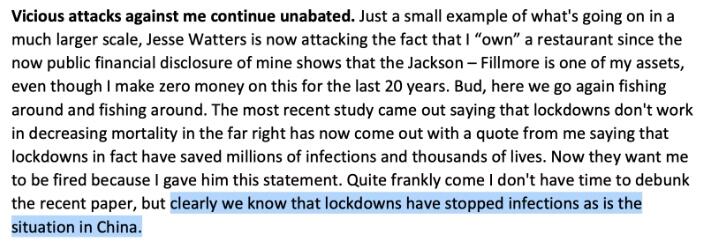
Confidence that the virus was a lab creation was growing. That points directly to Fauci. The lockdowns had given rise to growing population-wide fury. And the shot was not working, not stopping infection or spread while groups reporting deep injury from injection could not be censored fast enough to make them vanish completely, though tech companies certainly tried.

Fauci still held his position at NIAID with certainty that he would keep it under President Biden, whose confidence he enjoyed. He was daily in touch with the people who were actually running the government – aides Ron Klain and Jeff Zients – and coordinated his decisions with them. They trusted him to continue the Covid operation, which they all knew to be a national security issue beyond the control of any political player. Fauci was the front man but an effective one, until he became a liability.

We know from previous entries that Fauci at first hoped the new virus would get lost in the mix of a bad flu season. This was mid-January 2020. The CDC called him out on that. His first scheme failed because a savvy businessman in China spilled the beans by posting the sequence on a pay-to-play website in mid-January.

After pressing a friend and former colleague to use his personal credit card to download the sequence, Fauci launched plan B, which was to deny the lab leak and prepare a nationwide inoculation to make it all go away.

The audacious scheme was to keep population immunity at the lowest levels possible through lockdowns while the shot went through clinical trials and was ready for distribution. Fauci knew for certain that this was the type of virus that would mutate rapidly. His hope was to take the energy out of the pace of mutation by reducing the infection rate as low as possible.

Sadly for him, the new and most powerful variant had appeared just as his shots hit general distribution. Delta disabled their protection that had been formulated for wild type and Alpha. The race was on, as mutations appeared faster than repeated boosters could catch.

The spot would not go away no matter what he did.

The darkest hours open with the appearance of Omicron in December of 2021, the fastest spreading but least virulent strain. He now had a new problem. With Omicron operating as a form of inoculation itself, there was less reason for vaccination than ever, especially given the risk of injury. And yet his goal of 90 percent coverage was nowhere in view, while population opposition to the entire Covidian regime was rising.

Fauci might as well have thrown up his hands, admitted defeat, apologized for putting the country through the biggest trauma of our lifetimes, and ruining the lives of students everywhere, in addition to crushing the dreams of millions of small business owners.

But that is not who he is. He would not and could not accept responsibility for doing this. He ended up demonizing the opposition, scrambling for cover, wrapping himself in ever more layers of fame for protection, and clinging to the lies he told himself as self-justification as his career and legacy were permanently tarnished beyond repair, even as he developed a severe and strange case of germaphobia in a Macbeth-like way.

Two weeks before this tranche begins, Biden had gone on TV to declare the following: “We are looking at a winter of severe illness and death for the unvaccinated – for themselves, their families and the hospitals they’ll soon overwhelm. But there’s good news: If you’re vaccinated and you have your booster shot, you’re protected from severe illness and death.”

It was an intense claim even as the weakest of all variants had just appeared, even as evidence poured in that these injections provided no protection whatsoever. Regardless, the Biden administration was dedicated to ruining a second holiday season with terrifying warnings all in the hope of maximum shot coverage.

Fauci begins his diary close to Christmas in a dispute with the CDC, which was starting to open up a bit and lighten up on its diktats. It wanted to permit people to choose whether to get tested yet again after recovering from Covid. Fauci smelled a rat – that dread thing called freedom – and tried to strangle the baby in the crib.

Meanwhile the opposition campaign gained new steam from the release of Robert F. Kennedy, Jr.’s masterpiece, The Real Anthony Fauci, and he had headlined a rally on Capitol Hill that galvanized a movement. Fauci was aware of the growing opposition but was mostly dismissive.

By February 2022, pressure was rising to open up the economy and society and Fauci was on the backfoot. He was still defending China-style lockdowns before he later claimed never to support them at all.

Fauci began collecting international endorsements to assure himself of the good job he had done.

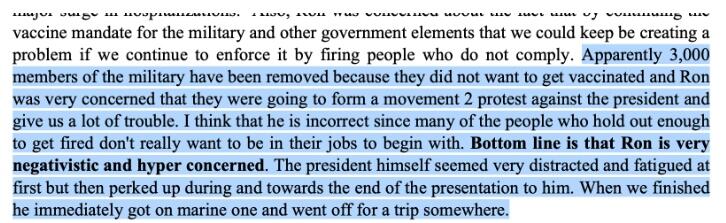
The White House, meanwhile, was increasingly concerned about the sheer number of military men and women who had quit rather than submit to vaccination. What kind of militia might they form if it came to that? Fauci claimed not to be worried about that at all, observing that they must not have liked their jobs very much. This is a man entering into deep denial.

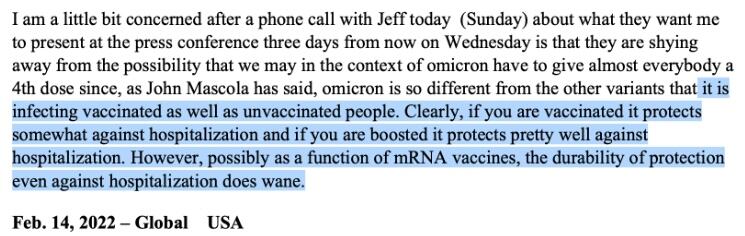
Meanwhile, he was being more honest with himself about the lack of efficacy of the shots themselves.

His fame and stardom became his only solace, the warm blanket in which he wrapped himself for comfort from the storms outside.

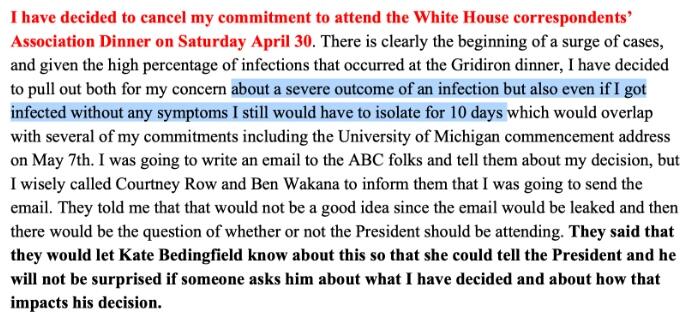
Another strange feature of this period is how Fauci became absolutely obsessed with avoiding any possibility of catching Covid. He started panicking in crowds, taking his own advice ever more seriously. He started cancelling dinners and meetings.

Thinking through why, consider that he knew that this virus was created in a lab and he knew that the shots would not protect against it. He now had fully two years to turn over these facts in his brain. They began to eat at him more and more. No matter how many times he boosted himself, his paranoia only grew worse.

By the spring, even Fauci started admitting that both he and the CDC were completely making things up. There was no science to anything they were saying and he knew it. Even he had lost faith in the system he created, playing a scientist only on TV.

By late April, Fauci was starting to clamor for other ways to understand all that had unfolded. Maybe the Great Barrington Declaration had been correct all along? He could never admit it to himself. But his egregious failures to control the virus through any means finally led him there through a side door.

That said, Fauci’s own personal germaphobia only intensified to the point that it was debilitating.

This tranche ends with Fauci’s paranoias growing, his fears of the opposition intensifying, and finally mollifying his psychological breakdown by reflecting on his own global fame, which he regarded as his only real hope to avoid the consequences of all that he had done.

Fauci was finally pushed out of his job later in the year, mostly because of growing concerns that the more he talked, the more the resistance to vaccination grew. There are even indications in this drop that it was industry itself that pushed him out for doing such a bad job in selling their product. He found safe haven at Georgetown University in a high-paid post.

And where are we today? Fauci will talk with no one, no reporters, not even on background. His last public appearance consisted of 110 invocations of his right to remain silent under the 5th Amendment.

The spot never went away, no matter how much sanitizer he rubbed on his hands. “Life’s but a walking shadow, a poor player,” he might be saying to himself, “that struts and frets his hour upon the stage, And then is heard no more. It is a tale, Told by an idiot, full of sound and fury, signifying nothing.”

Tyler Durden Fri, 10/23/2026 - 21:45

Australia: What the union-Labor sellout of Victorian doctors reveals

The betrayal of doctors is a graphic demonstration of the treacherous role of the trade unions, which are presiding over the further evisceration of a public health system already in an advanced state of crisis.

#687: The End of the American Dream | Steve Poikonen

Par : Editor


Trump has thrown his weight behind never-ending wars in the Middle East for his handlers in Tel Aviv, so where does that leave average Americans for representation from their government? At the back of the line, and so far out of the decision-making process that all they can do is watch as their country is transformed.

Steve Poikonen from AM Wakeup is back to discuss the situation unfolding across the Western world as populations are being transformed through supranational policy. Is there still time to reverse the damage, or did the Globalists already accomplish their goal of transforming Europe and North America into a mixed mongrel race dependent on the state? Time is running out.

The Octopus of Population Control: https://amzn.to/4xDQ42L

Hypocrazy Audiobook: https://amzn.to/4aogwms

The Octopus of Global Control Audiobook: https://amzn.to/3xu0rMm

Website: www.Macroaggressions.io

Merch Store: https://macroaggressions.dashery.com/

C60 Power: https://go.shopc60.com/PBGRT/KMKS9/
Promo Code: MACRO

Chemical Free Body: https://chemicalfreebody.com/macro/
Promo Code: MACRO

Wise Wolf Gold & Silver @ (800) 426-1836: https://macroaggressions.gold/

LegalShield: www.DontGetPushedAround.com

Replace Your Mortgage: www.WipeOutYourMortgageNow.com

Augason Farms: https://augasonfarms.com/MACRO

Activist Post: www.ActivistPost.com

AM Wakeup on Rumble: https://rumble.com/c/AMWakeup

The post #687: The End of the American Dream | Steve Poikonen appeared first on Activist Post.

Workers Struggles: Asia and Australia

India: Thousands of Punjab state bus workers launch indefinite strike; Bangladesh garment workers defy police attacks to demand living wage; Australia: Victorian allied health workers escalate bans after rejecting Labor’s offer; University of Sydney staff strike for 24 hours.

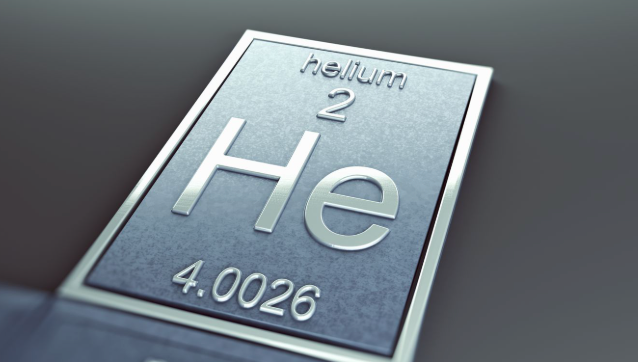
US Designates Helium A Critical Material In Reindustrialization Push To Avoid "Single Point Of Failure"

US Designates Helium A Critical Material In Reindustrialization Push To Avoid "Single Point Of Failure"

America's reindustrialization depends on securing reliable, conflict-free supplies of critical materials, including rare earths and other critical metals, most of which are produced and processed overseas.

The Trump administration has made rebuilding and strengthening domestic critical material supply chains a national security priority. Its designation of helium as a critical material on Friday morning extends that effort to now include the industrial gas used for semiconductor manufacturing and many other applications. 

The Energy Department's decision earlier today makes the 20th critical material designated by the agency and brings the industrial gas within the Energy Act of 2020's critical materials framework, including closer government monitoring.

Energy Secretary Chris Wright wrote in a statement, "President Trump is bringing back America's manufacturing industry, and that means making sure we have the materials needed to build things in America again."

Wright continued, "Helium is essential to producing the semiconductors and advanced technologies that power our economy. By designating helium as a critical material, we are taking another step toward securing our supply chains, creating American jobs, and ensuring the United States leads the world in energy and technological innovation."

Helium is recovered as a byproduct of natural gas processing and faces growing geopolitical risks in the Gulf area. Qatar's exports have been severely curtailed by Iran's closure of the Strait of Hormuz and attacks on Qatari infrastructure, while Russia imposed temporary export controls in April. 

The good news is that the US remains one of the top helium producers in the world, supplying 81 million cubic meters in 2025, or about 43% of global output. It exported 38 million cubic meters that year.

Helium is critical to applications ranging from chipmaking to medical imaging to quantum computing to magnets to space rockets. 

Assistant Energy Secretary Audrey Robertson warned that shortages could become a "single point of failure" for strategically important industries. The Canadian Press quoted her in an interview.

"We need to make sure that we can build those here. And helium is one of those components that could be a single point of failure, where we cannot let that happen. That's why we're designating it within our statutory authority, but I think why it's important is not necessarily for our birthday parties," Robertson said in an interview. "It's really towards the future of American competitiveness and energy security, which we believe is national security."

Designating helium as a critical material under the Energy Act of 2020 brings it within DOE's framework for developing, demonstrating, and commercializing critical material technologies to support America's reindustrialization efforts. 

The new designation could help qualifying helium projects access government financing, technical assistance, and partnerships, similar to support provided to rare earth miners.

Tyler Durden Fri, 10/23/2026 - 21:20

Attorney’s minute-by-minute account exposes Christa Pike’s torture in Tennessee death chamber

Attorney Randy Spivey’s sworn declaration documents repeated attempts to find a vein, burning pain during the injection and prolonged gasping and choking before Pike was taken to a hospital.

IYSSE meeting in Sri Lanka demands freedom for Bogdan Syrotiuk

The IYSSE event on Zoom was live-streamed simultaneously on the Socialist Equality Party’s (SEP) Facebook page in Sinhala and Tamil, attracting significant interest.

DOJ Seeks Appeals Court Intervention In California Ballot Lawsuit

DOJ Seeks Appeals Court Intervention In California Ballot Lawsuit

Authored by Aldgra Fredly via The Epoch Times,

The Department of Justice (DOJ) filed a notice of appeal on Oct. 22 in its bid to block California from counting mail-in ballots from voters whom the federal government suspected of being noncitizens.

The DOJ asked the Ninth Circuit Court of Appeals to intervene after U.S. District Judge David Carter failed to rule on its emergency application for injunctive relief by noon Thursday, the deadline set by the department.

The department said the judge's silence amounted to what it called a "constructive denial" of its emergency application for preliminary injunctive relief, citing the "critical and exigent nature" of the case.

The DOJ sued California on Oct. 15 to prevent the counting of mail-in ballots from more than 20,000 people identified by the federal government as likely noncitizens.

The federal government asked that if California was not able to independently confirm the citizenship of the voters registered, the state should set aside ballots received until citizenship could be confirmed.

Los Angeles County said on Oct. 15 that it could not comply with the DOJ's demand because the department has not provided evidence, sources, or methodology to establish that the individuals identified in its records were ineligible to vote.

"We cannot withhold or refuse to count ballots based solely on unverified allegations, nor can we disregard the legal requirements governing our election - and we certainly have no authority to act on records that are outside of our jurisdiction," the county said in an Oct. 15 statement.

In its Oct. 21 emergency filing for a temporary restraining order, the DOJ said state and county officials contended they lacked the mechanisms and authority to prevent noncitizens from voting in the midterm elections.

The department argued that this showed an immediate threat to the integrity of lawful votes.

"As defendants continue processing ballots that cannot later be segregated or verified for eligibility, the dilution of lawful votes accelerates in real time," the DOJ said in its filing.

"This is an emergency. Every minute of processing that occurs without segregating the ballots of suspected non-eligible voters causes untraceable disenfranchisement and dilution of the votes of United States citizens."

Los Angeles County filed a motion on Oct. 21 asking the judge to dismiss the DOJ's lawsuit, arguing the department lacked legal standing to bring the case.

"The executive, like any other plaintiff, must identify a concrete injury, actual or imminent, fairly traceable to the county's conduct and likely to be redressed by the requested relief. The complaint identifies none," it said.

Acting U.S. Deputy Attorney General Trent McCotter sent a letter to the Los Angeles County Counsel's office on Oct. 16, saying the DOJ did not expect county officials to adjudicate anyone's immigration status, but asked the county to temporarily set aside ballots when there are credible concerns about the voters' eligibility.

McCotter warned that county officials could risk "becoming aiders and abettors to a federal crime" if they knowingly count ballots from individuals whom federal agencies have identified as noncitizens.

In response to the letter, Los Angeles County Registrar-Recorder Dean Logan said his office is focused on conducting a fair and secure election.

Tyler Durden Fri, 10/23/2026 - 20:55

New Zealand election: Workers speak with Socialist Equality Group on war and the social crisis

Workers in Lower Hutt spoke with the SEG’s election campaign team about their experiences with the housing crisis, unemployment, and the expanding global war.

British Columbia voters go to the polls amid deep disaffection with the political establishment

BC NDP Premier David Eby called the early vote with the aim of strengthening his government’s hand to impose austerity and push through big business and war-related development projects.

Why Are Scientists Suddenly So Concerned About An Asteroid Hitting Earth?

Why Are Scientists Suddenly So Concerned About An Asteroid Hitting Earth?

Authored by Michael Snyder via End Of The American Dream,

Authorities assure us that we are perfectly safe and that no giant space rocks are heading our way. If that is true, why is a scenario that has been developed for the 2027 Planetary Defense Conference "based around a hypothetical impact threat" from a very large asteroid? And why are scientists at Lawrence Livermore National Laboratory studying how to destroy a giant asteroid that is heading toward Earth using nuclear weapons? If there is no threat anywhere on the horizon, wouldn't you think that those scientists would have something better to do with their time? On top of everything else, NASA recently concluded a secretive operation known as "OSIRIS-REx" in which a spacecraft visited an asteroid, plucked a piece off of it, and returned it to Earth. While the general public is being told that we are safe for decades to come, a tremendous amount of time, money and energy is being poured into preparing for a potential asteroid threat.

Do they know something that the rest of us do not?

I am convinced that there is far more going on behind the scenes than we are being told.

They never say anything that will alarm the general public, but at the same time they are pumping vast resources into "sophisticated planetary defense efforts" that are intended to protect our planet "from potentially hazardous asteroids"...

Would we be prepared if a potentially life-threatening object from space were on a collision course with Earth? And how much damage could an incoming asteroid actually cause?

Such questions remain at the forefront of increasingly sophisticated planetary defense efforts aimed at protecting our planet from potentially hazardous asteroids. Yet even if astronomers are able to identify a space object that might pose a threat, a significant number of uncertainties remain: the object's size, composition, structure, and potential impact locations all must be considered, as these factors can dramatically influence what happens once an asteroid enters Earth's atmosphere.

If there are no near-Earth objects that are a threat, why spend so much money on this?

We certainly have a lot of other very pressing matters that do require funding right now.

NASA is either wasting our money, or something else is going on.

Interestingly, NASA is a participant in the 2027 Planetary Defense Conference. An exercise is underway that simulates how authorities would respond to a "Tunguska-sized object" that is headed toward Earth...

Additionally, NASA's Center for Near-Earth Object Studies (CNEOS) regularly participates in planetary defense exercises designed to test these assessment methods, with current scenarios under development for the 2027 Planetary Defense Conference that take a cue from one of history's most concerning airburst events.

"The current exercise that is underway for the 2027 Planetary Defense Conference is based around a hypothetical impact threat from a roughly Tunguska-sized object," Wheeler told The Debrief.

For those of you that are not familiar, in 1908 the Tunguska event flattened approximately 2,000 square kilometers in Siberia...

Tunguska event, enormous explosion that is estimated to have occurred at 7:14 AM plus or minus one minute on June 30, 1908, at an altitude of 5-10 km (15,000-30,000 feet), flattening some 2,000 square km (500,000 acres) and charring more than 100 square km of pine forest near the Podkamennaya Tunguska River in central Siberia (60°55′ N 101°57′ E), Russia. The energy of the explosion is estimated to have been equivalent to the explosive force of as much as 15 megatons of TNT - a thousand times more powerful than the atomic bomb dropped on Hiroshima, Japan, on August 6, 1945.

Why hold an exercise of this nature if there is absolutely no threat of this sort of event occurring for decades to come?

And why did NASA just send a small spacecraft to grab a piece of an asteroid known as Bennu and bring it back to Earth?...

On Sept. 30, NASA formally concluded OSIRIS-REx, the historic first U.S. mission to pluck a pristine piece of an asteroid and deliver it safely back to Earth.

The van-sized OSIRIS-REx spacecraft - whose name is short for Origins, Spectral Interpretation, Resource Identification, Security-Regolith Explorer - visited and sampled Bennu, an ancient space rock holding pristine remnants from the dawn of our solar system more than 4.5 billion years ago. Among those cosmic relics are raw organic building blocks, the kind that may have seeded life on Earth.

"I have known this day was coming for a long time, but it is still difficult to see it arrive," OSIRIS-REx Principal Investigator Dante Lauretta, who's based at the University of Arizona, said in a post on LinkedIn. "I feel enormous pride in what we accomplished together, and real sadness that this journey has come to an end."

That was certainly an impressive scientific achievement.

But it also cost a lot of money to do that.

Why not spend all that money in more productive ways if asteroids are no threat to us?

And why study how to destroy asteroids using nuclear weapons if there won't be any asteroids to destroy for the rest of this century?

A shocking study that was recently conducted by scientists at Lawrence Livermore National Laboratory is raising a lot of eyebrows...

A new study from Lawrence Livermore National Laboratory (LLNL) has used advanced 3D simulations to assess how effective a nuclear weapon would be for destroying a dangerous space object such as a large asteroid on a collision course with Earth.

Yeah, that definitely sounds a lot like a Bruce Willis movie that I once watched.

But in that case, a civilization-killing space rock was actually headed toward us.

Why are our scientists running so many simulations if we are facing absolutely no threat?...

For their new work, the team ran simulations to explore how an asteroid might be affected by a nuclear blast somewhere near its surface, with the aim of rapidly heating and vaporizing material within it.

They began with more than 1,500 one-dimensional simulations to test the approach before running three fully three-dimensional simulations modelling the effects of a nuclear blast on a roughly 160-meter (525-foot) asteroid, altering factors such as the distance to the asteroid when detonation occurred and assumptions about how easily it would be damaged by such an explosion.

"These simulations give us a much more detailed picture of how an asteroid may respond to a nuclear mitigation attempt," Isaiah Santistevan, who led the study, said in a statement. "Being able to model damage, fracture and material motion in three dimensions is an important step toward improving our ability to evaluate planetary defense options."

More resources are being devoted to "planetary defense" than ever before in our history.

Is this being done for a reason, or is this just a colossal misallocation of public funds?

Those of you that have been following my work for an extended period of time already know what I think.

I believe that there are very serious threats out there that are not being discussed publicly.

It is always policy to keep the general public as calm as possible when we are facing a very serious threat.

That means not telling the general public the truth.

Of course everyone should be able to see that our particular neighborhood of the cosmos has been unusually busy lately.

I asked Google about this, and this is the response that I got...

Yes, data from the American Meteor Society and USA Today confirms an unusual and significant surge in large fireball events during the first quarter of 2026, especially through March

This week, we are witnessing the peak of the Orionid meteor shower...

The Orionid meteor shower reaches its peak tonight, Wednesday, Oct. 21, and continues into early Thursday morning. The shower is made up of debris left behind by Halley's Comet, which burns up as it enters Earth's atmosphere.

Under dark, ideal conditions, the Orionids can produce about 10 to 20 meteors per hour. But a bright waxing gibbous moon will hide some of the fainter streaks. NASA says the moon is expected to set around 3 a.m. local time, giving skywatchers a darker window before sunrise.

The fireballs in the sky that people are marveling at right now are no threat.

But there are giant space rocks that are looming in the distance.

One of these days, our luck will run out and one of them will hit us.

When that day arrives, everything will change and millions will suddenly die.

Tyler Durden Fri, 10/23/2026 - 20:05

Selling Gas Twice: Venture Global Courts Qatar While Plotting A $160 Billion AI Power Empire

Selling Gas Twice: Venture Global Courts Qatar While Plotting A $160 Billion AI Power Empire

Seven months ago, Qatar was the world's biggest LNG seller. Now it's a buyer. 

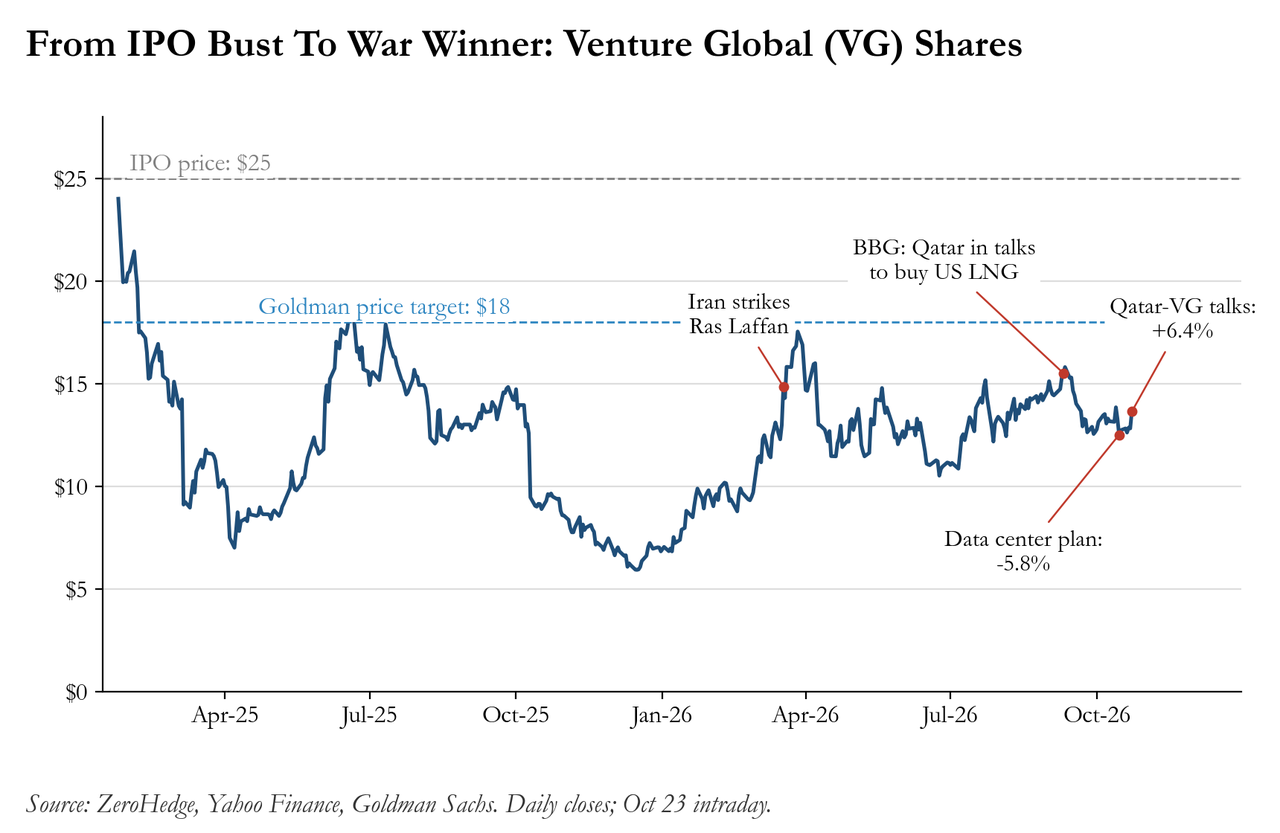
According to a Reuters scoop late Thursday, QatarEnergy is in advanced talks with Venture Global (VG) on a long-term supply deal for at least 3 million tons of LNG a year, sourced from VG's CP2 plant, which is still under construction in Louisiana. The report landed just hours after QatarEnergy signed a separate deal with Cheniere (LNG) for up to 4 million tons a year through 2054. VG shares jumped more than 6% on Friday, and they have now roughly doubled this year. Then again, they're still trading about 45% below their $25 IPO price.

Venture Global's other headline this month is that it wants to get into AI data centers... in a very big way. Goldman thinks both stories come back to the same molecule. Below we summarize what Goldman's LNG team has been telling clients about each (available to pro subs), and why we think the Qatar trade is the one that pays first.

The Customer Who Used To Be The Competition

Regular readers know how Qatar got here. In March, Iranian missiles hit Ras Laffan, the world's largest LNG complex. We wrote at the time that the attack itself was "bad" and the math behind the global LNG fleet "far worse", and a day later we concluded that Qatar had been dethroned as "LNG King", with the US taking the crown. The strikes damaged two of Qatar's 14 trains, taking out 12.8 million tons a year, or about 17% of export capacity. QatarEnergy CEO Saad al-Kaabi said repairs would take three to five years and cost roughly $20 billion a year in lost revenue.

The bill has been coming due. Last week we reported that Qatar's government revenue plunged 42% in the first half: LNG exports were just 1.6 million tons in September, less than a quarter of the prewar average, and Kpler sees October falling to 0.6 million tons. QatarEnergy has also been renewing its force majeure notices every month, most recently through November.

Meanwhile, Doha still has customers to serve. So it has been buying spot cargoes, many of them from Venture Global, and is now trying to lock in long-term supply. As one source told Reuters back in September, "They will have to buy whatever they can get their hands on." We flagged where this was headed the moment Bloomberg first reported the talks:

Qatar buying LNG?

— zerohedge (@zerohedge) September 10, 2026

Goldman's Americas Pipelines & MLPs analyst John Mackay ran the numbers that same day in "Outlining Contractable Capacity for Our LNG Coverage Following Media Reports of QatarEnergy Interest". Mackay notes that Qatar is "the largest single LNG exporter in the world," sits behind the Strait of Hormuz, and "is planning the largest LNG capacity additions through the medium-term." Goldman says it takes no view on whether a deal happens, but it points out who would be on the other side if one does:

We note that Venture Global (VG, Buy) management stated during our mid-August virtual NDR that such deals could be a sign of significantly tighter global LNG balances than the market currently expects. To illustrate the scale of available capacity, we outline below the uncontracted capacity within our coverage universe, which totals ~69 mtpa potentially available by YE32. Specifically, we project up to 40 mtpa / 9 mtpa / 7 mtpa / 12 mtpa of contractable capacity at VG / LNG / NEXT / GLNG, respectively... In our view, VG and Golar LNG (GLNG, Buy, on CL) are well-positioned due to their ability to offer meaningful capacity with flexibility around timing.

Put differently, VG alone has about three times as much uncontracted capacity as Qatar lost at Ras Laffan. Rapidan's count of capacity under construction is more modest, but VG still leads it at 10 mtpa, ahead of Cheniere and Woodside (6 mtpa each) and Sempra's Port Arthur (3 mtpa). So when Qatar goes shopping in the US, Venture Global probably can't be avoided.

Mackay brought Qatar up again in his 3Q26 preview on Oct 8. He trimmed his 3Q EBITDA estimate to $2.52 billion, below the $2.61 billion consensus, but kept FY26 at $9.03 billion, "still at the top-end of guidance." He also wrote that "any Qatar contracting, on top of their ongoing spot deals, would be meaningful." That was two weeks before the Reuters scoop. Goldman also counts recent additions such as ConocoPhillips' 20-year deal (Oct 1) and China Gas as "high-quality," while dismissing the adverse Galp arbitration ruling on CP1, where damages are capped at $170 million, as "manageable." Goldman's price target stays at $18, about 32% above Friday's price.

Two caveats. Nothing has been signed yet: Reuters "could not immediately learn the timeline of any agreement... or how long a contract could run," and neither company commented. And Cheniere's deal doesn't start until 2031, which says a lot about how long Doha expects to be without those trains.

Plan B: Burn It For AI

The Qatar news is relatively straightforward. The data center plan is a far bigger swing.

On Oct 15, VG signed frame agreements with GE Vernova (GEV) and Baker Hughes (BKR) for up to 16 combined-cycle "power island" units of 720 MW each, plus transformers and switchgear. VG says the units could support up to 10 GW of compute by the end of 2034. The plants would run behind the meter, without drawing on the grid or local water utilities, around VG's existing Louisiana LNG sites. VG plans to place its first power island order by year-end and was set to file its first permit applications that week. It already runs 4.5 GW of gas-fired generation in island mode to power its LNG plants.

Goldman's first take, called it "on its face, a major diversification away from VG's core LNG export focus," but listed five ways it could fit with the LNG business. The fifth is the most interesting:

...an admittedly amorphous but potentially meaningful ability, over time, to "switch" between liquefying gas for export and burning it for compute.

In other words, VG would own an option on which use pays more for a molecule of Louisiana gas: a Qatari utility or a hyperscaler. That's the "sell gas twice" pitch.

The market wasn't convinced. VG was up 1.5% in the premarket, according to Goldman's Industrials & Natural Resources desk, which called it a "big diversification for VG." The stock then closed down 5.8%. Investors seem to be asking the same thing as Mackay: whether VG can fund the rest of its LNG buildout to ~85-100 mtpa before taking on a second capital-intensive business. Goldman also notes that "strip pricing would add ~$20b to our EBITDA estimates, all else equal, by YE30." That's a good reminder that the LNG business is the one generating the cash.

"A Relatively Low-Cost Call Option"

Goldman hosted CEO Mike Sabel and CFO Jack Thayer for a virtual roadshow the next day. The Oct 19 takeaways note, "Significant Potential Power Scope, but Limited Spend Ahead of Customer Deals" is where the numbers got big:

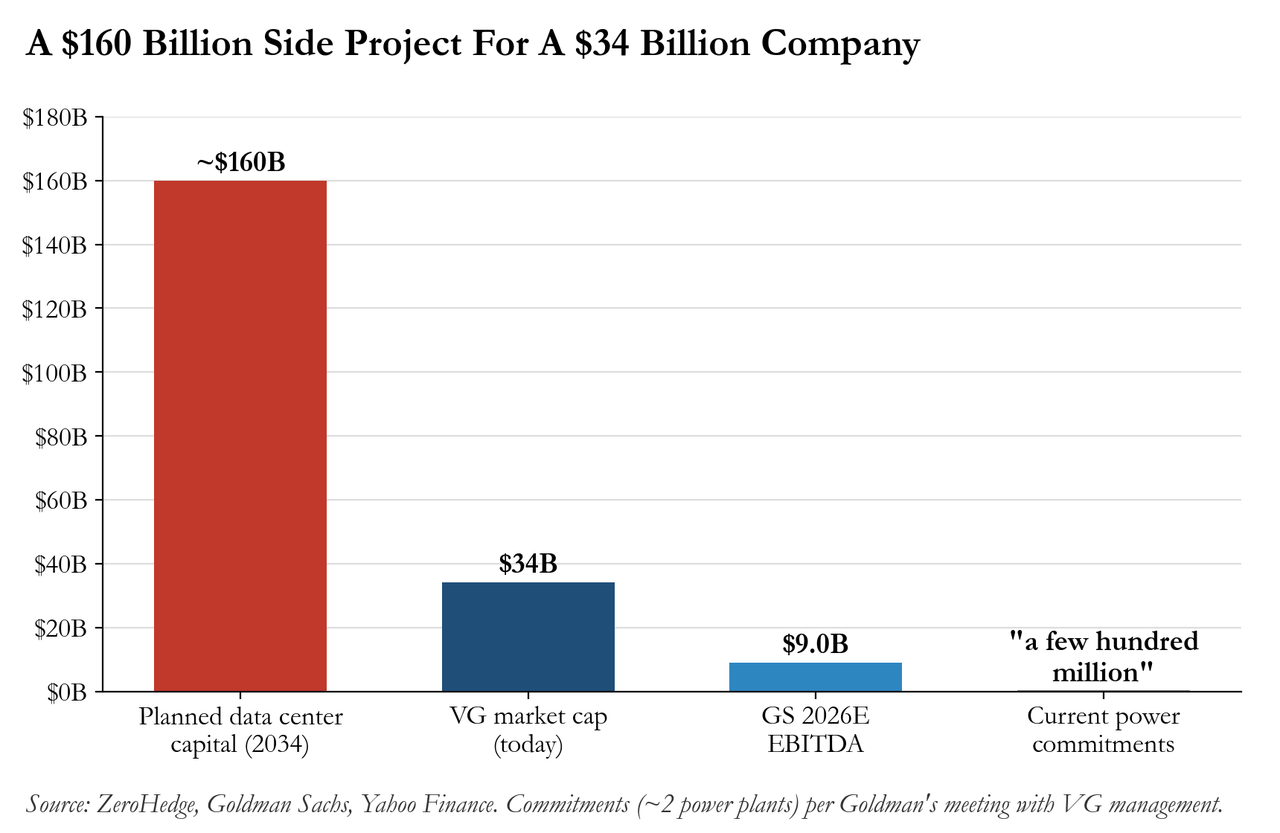
...their plans are potentially massive, specifically >10 GW by 2034 and ~$160b of deployed capital, with typical scope effectively being a powered shell solution (~teens million of capex per MW) vs. smaller-scale behind-the-meter (BTM) solutions (generally ~$1-2m/MW)... potential scope aside, VG's current commitments are relatively small - specifically ~2 power plant commitments and a few hundred million dollars in capex, with firm off-ramps before meaningful capital is spent, and could be redeployed for their LNG expansions and/or resold if commercial wins do not materialize.

Some math: $160 billion for 10 GW works out to about $16 million per MW, roughly ten times the cost of a typical behind-the-meter project, because VG would supply the land and buildings as well as the power (everything except the chips). About two-thirds of that capex isn't power-related, and VG says it won't commit to that part without signed tenants. For the power portion, management is targeting ~75% investment-grade debt financing. If the power piece is the remaining third, or about $53 billion, that's somewhere around $40 billion of new debt on top of a balance sheet that already carries a debt-to-equity ratio of about 3.5x.

Goldman, which rates VG Buy, ends up more constructive than the tape:

Overall, we expect the broader power trade could remain choppy in the near-term and believe investors will look for more confidence in commercial execution before giving more credit to VG (as we have recently seen for others in the data center power market, including WMB, KGS, and LB in our coverage). That said, we come away from the conversation increasingly viewing the strategic rationale of the BKR/GEV agreement as effectively a relatively low-cost call option for VG, with a mostly limited impact on the story if the broader power macro story doesn't re-inflect - and with significant potential upside over time if it does.

Wells Fargo, which had been sitting at Equal Weight, apparently agrees: it upgraded VG to Overweight on Tuesday and raised its target from $15 to $21. The "choppy" part is easy to see: as Goldman's desk showed a couple of weeks ago, IPPs and GE Vernova were trading near their "Liberation Day" lows on a P/E basis.

Cheap Power, Slow Power

We've been pounding the table on on-site generation for almost a year. Since last November, we have argued that every data center should have its own "behind the meter" power so that households don't pay for the AI buildout through their electric bills. A month later we put it more simply:

Make "behind the meter" mandatory https://t.co/bCBnwx2E5g

— zerohedge (@zerohedge) December 24, 2025

Wall Street has since come around. Goldman now expects behind-the-meter generation to power a quarter of all US data centers by 2030. So VG's idea is sound. The problem is timing, and it comes down to which technology VG picked. Combined-cycle gas turbines (CCGTs) are the cheapest behind-the-meter option and also the slowest. Bernstein's machinery team spelled out that trade-off last month in "Powering AI: The modular advantage" (also available to pro subs): CCGT power costs about $48/MWh, but it takes 4-5 years to deliver, versus months for fuel cells at almost twice the price.

That lines up with Goldman's timeline: first deployments in late 2028 at the earliest, and only about half of the capacity ramped by 2031. By then, VG will be competing for tenants with everyone who signed up two years earlier. Goldman flags this too, asking about "their go-to-market strategy for signing customers as a relatively later entrant vs. other competitors in the space."

Equipment is the other constraint. Back in September we noted that the gas turbine shortage was sending AI developers back to boilers and steam. VG's GE Vernova and Baker Hughes order secures a big block of a very scarce resource, and as Goldman notes, VG is already one of those suppliers' largest customers. There's a twist here, too. As Bloomberg's Stephen Stapczynski pointed out in March, Qatar's two damaged trains need new gas turbines for their refrigeration compressors, with delivery expected to take 2-4 years. So the same turbine backlog that keeps Qatar's capacity offline is the one VG has just reserved a large chunk of.

One Molecule, Two Bidders

VG now has two possible new markets for its gas. One is a state-backed buyer that has lost a sixth of its capacity for years and needs cargoes now. The other is a data center business that doesn't yet have a single tenant and can't deliver power before 2028. Goldman's view is that the power plan is a cheap option and the LNG business keeps generating the cash in the meantime:

...the size of their agreement and their track record of disruption in LNG should argue for VG upside over time as well as a potentially meaningful shift in competition for the BTM power and EPC sectors.

We agree with the first half. The Qatar deal is close to signing, the counterparty is about as motivated as a buyer can be, and every month Ras Laffan stays damaged makes 20-year American LNG look more valuable. The $160 billion data center plan is a different matter: until VG names a tenant, it is mostly equipment reservations and press releases. To its credit, VG knows this, which is why it built in "firm off-ramps." The bigger risk may be the timing. If Hormuz reopens properly and Qatar's trains come back sooner than expected, the spot cargoes, and maybe the urgency to sign long-term deals, could fade just as the power build starts requiring real money.

For now, the market is rewarding the Qatar story and punishing the AI one: shares jumped over 6% on a Reuters report of talks and fell 5.8% on 10 GW of compute. We'll know more on Nov 10, when VG reports third-quarter results.

Much more in the full Goldman notes (here, here and here) all available to pro subs.

Tyler Durden Fri, 10/23/2026 - 19:40

Trump Says He Will 'Veto Everything' If Democrats Win Midterms

Trump Says He Will 'Veto Everything' If Democrats Win Midterms

Authored by Jack Phillips via The Epoch Times,

President Donald Trump told reporters on Friday that he plans to use his veto power on bills or resolutions Democrats want to pass if they win in either the House or the Senate, with days to go before the November midterm elections.

"I think the Republicans are going to win - but if there was gridlock, what happens is I veto everything, and then the Democrats come and want to make a deal," he said.

When pressed further on congressional gridlock if Democrats win Congress, he responded by saying that historically, a president would then "veto, veto, veto, and they come and they say, 'How do we get it done.' And we make a deal."

Trump has issued two vetoes during his second administration, while his predecessor, former President Joe Biden, used his veto power 13 times. In his first term, Trump vetoed 10 measures.

In recent weeks, Trump has held campaign-style rallies in numerous states to boost Republican voter turnout ahead of the Nov. 3 election.

On Thursday, the president traveled to Iowa to support Ashley Hinson, Iowa's Republican nominee for the U.S. Senate, for a rally in Sioux City. The visit to safe territory is geared toward boosting GOP turnout as Trump is expected to visit the state again on Nov. 1.

"Let's go out and do what we do best, which is to win," Trump said in the rally, thanking Iowans for their support.

Throughout the campaign cycle, Trump has often said he would back certain provisions, including sending payments to Americans, if Republicans retain control of the House of Representatives and the Senate. The GOP currently holds small majorities in each chamber.

Last month, Trump said at a Dallas rally that he would send $5,000 payments to Americans in what he called a dividend derived from tariff revenues and investment into the United States.

He also sent out $500 health insurance rebate checks, which he said are meant to offset costs incurred under the Biden administration, as well as a $90 one-time payment to people receiving Medicare.

Trump also announced at a Kansas rally to back Sen. Roger Marshall's (R-Kan.) reelection bid that he would back a measure to support the year-round availability of E-15 gasoline, which is blended with a higher amount of ethanol than regular gasoline, but said he would only back the provision if Marshal wins his reelection bid next month.

According to the University of Florida's Election Lab, as of Friday, more than 22 million people have voted early in the midterms, including more than 10 million early in-person voters and more than 12 million mail-in ballots returned. Overall, more than 59 million mail ballots have been requested.

Only New Hampshire, Missouri, Alabama, and New York have not reported any data to the Election Lab, according to a map the school provided.

As for Trump, he told reporters on Friday as he was going to depart for Fort Myers, Florida, that he might be "voting tomorrow."

Saturday marks the first day of early voting in Florida, and it runs through Oct. 31. At another point in the gaggle with journalists, Trump was asked about this year's early voting figures and which party has benefited.

"Nobody knows," he responded.

Tyler Durden Fri, 10/23/2026 - 19:15

Space War Fears Rise As Russian Satellite Makes Dangerous Maneuver

Space War Fears Rise As Russian Satellite Makes Dangerous Maneuver

Authored by RFE/RL staff via OilPrice.com,

US officials publicly accused Russia of threatening a Finnish-operated commercial satellite that provides imagery and intelligence to Ukraine and other nations, calling the move "deliberately reckless."

In response to the accusations, made during a United Nations debate on October 21, Russia broadly described US claims as "absurd" and accused Washington of its own "aggressive military space ambitions."

The back-and-forth came days after a Russian military satellite known as Kosmos-2612 moved "dangerously" near to ICEYE-X36, a satellite registered in the United States and operated by a Finnish company called ICEYE.

The Russian satellite came "exceptionally close" - within 200 meters, by some estimates - something that space officials and amateur satellite watchers said was extremely unusual.

"This was not a routine conjunction or 'fly by,'" LeoLabs, an aerospace intelligence company, told RFE/RL. "The behavior is consistent with sophisticated rendezvous and proximity operations."

ICEYE-X36 carries a radar technology that can gather detailed terrestrial images, even through cloud cover. The Finnish company in January signed a contract with the Ukrainian Defense Ministry to provide intelligence.

Kosmos-2612 "exhibited threatening behavior by intentionally maneuvering dangerously close to a commercial satellite," Brian Hardesty, an adviser to the US Delegation to the Conference on Disarmament, said during a meeting in New York of the UN First Committee, a body that debates arms control and disarmament issues. "These behaviors appear consistent with an on-orbit weapons operation."

"The decision to conduct these activities was deliberately reckless," he said.

Russia's representative who could not be immediately identified, did not directly address the assertion.

"We call on member states to give the proper response to the aggressive military space ambitions of the United States," he said.

He also referenced comments made last month by the secretary of the US Air Force, the top civilian official for that military branch.

As just announced in the @UN First Committee, Russia's COSMOS 2612 military satellite has been exhibiting threatening behavior by intentionally maneuvering dangerously close to a commercial satellite, behaviors consistent with on-orbit weapons operations. This violates long-established safety thresholds in low Earth orbit. The United States will continue to secure and defend American vital national security interests in, from, and to space.

— Under Secretary of State Thomas G. DiNanno (@UnderSecT) October 21, 2026

Speaking to a conference outside of Washington, Troy Meink's comments that Washington has in fact deployed actual weapons in space - "on-orbit space control weapons capable of defending the Joint Force against hostile adversary action" - caused a jolt among policy experts.

Other longtime space watchers, however, said the announcement merely stated publicly what had already been obvious for some time.

"The United States did not suddenly weaponize space by acknowledging that it possesses these capabilities," wrote Mallory Stewart, a former top arms control secretary at the US State Department. "An arms race in space has been under way for years."

Tyler Durden Fri, 10/23/2026 - 18:25

Dark web drug market operator sentenced to 40 years, forfeits $101 million in bitcoin

Par : Editor

A man from Virginia, who facilitated millions of drug transactions worth roughly $430 million, agreed to give up $100 million worth of BTC. His partner forfeited nearly 1,600 BTC.

A co-creator of dark web drug enterprise Empire Market agreed to forfeit 1,230 bitcoin ($101 million), after receiving a 40-year federal prison sentence for his role in operating the site.

His co-conspirator Thomas Pavey forfeited 1,584 bitcoin last year.

Raheim Hamilton, 30, of Suffolk, Virginia, also agreed to forfeit 24.4 ether worth about $60,000 and three properties, according to the U.S. Attorney’s Office for the Northern District of Illinois. A federal judge in Chicago sentenced Hamilton on Monday and imposed a $5 million fine.

Hamilton and Pavey operated Empire Market from 2018 to 2020. Their site facilitated more than 4 million drug transactions worth upwards of $430 million, prosecutors said. They also said Hamilton and Pavey sold stolen account credentials, personal data, counterfeit currency and hacking tools.

Pavey, 41, of Ormond Beach, Florida, pleaded guilty last year to a federal drug conspiracy charge and admitted his role in creating and operating Empire Market. He also gave up his rights to two boxes containing 25-ounce gold bars, three automobiles, and two properties in Florida. Pavey is set to be sentenced later this month.

The pair required customers to use cryptocurrency and encouraged them to use mixing services to obscure the movement of funds, the Justice Department said. Prosecutors said drug sales accounted for nearly $375 million of the site’s total activity.

Ruis-Sian Lin, the alleged operator of the dark web narcotics marketplace Incognito Market, was sentenced to 30 years in U.S. federal prison in February.

A month earlier, the U.S. government seized $400 million worth of cryptocurrency, real estate and cash linked to the once-popular darknet bitcoin mixing service Helix, which, according to the Department of Justice, was used by drug traffickers and other criminals to launder money at the tune of at least 354,468 bitcoin worth $29 billion today.

The post Dark web drug market operator sentenced to 40 years, forfeits $101 million in bitcoin appeared first on Activist Post.

Nikola Founder Trevor Milton Accuses FBI Agent Of Witness Intimidation As New Report Challenges His Claims

Nikola Founder Trevor Milton Accuses FBI Agent Of Witness Intimidation As New Report Challenges His Claims

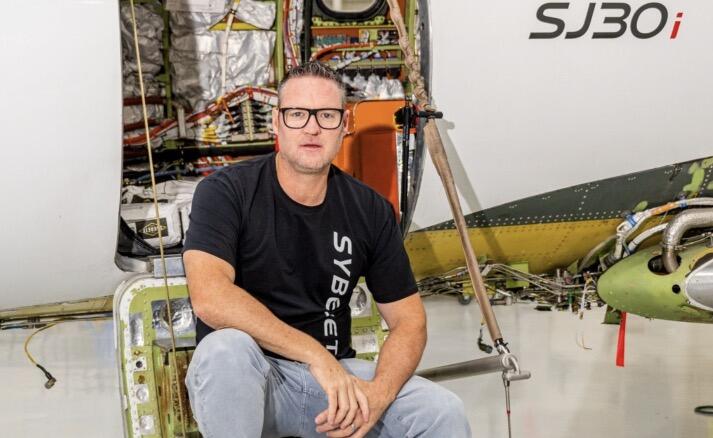
Trevor Milton, founder and former CEO of electric truck maker Nikola and now CEO of jet company Syberjet, is suing an FBI agent and a whistleblower who testified against him during his fraud trial, alleging they conspired to intimidate a potential defense witness ahead of his trial. 

Milton filed a complaint on October 13 in federal court in Utah against FBI Special Agent Christopher S. Essick and Nikola whistleblower Paul Lackey. The lawsuit alleges Essick secretly controlled two anonymous X accounts, @CntrlScrut1nizr and @lfxs1212, which posted negative commentary about Milton and Nikola, discussed betting against the company's stock and allegedly harassed former Nikola executive Jason Roycht.

Milton claims the online activity contributed to Roycht's decision not to meet with his defense attorneys before his trial.

But before an answer was filed in his latest lawsuit, a new investigation by Activ8Insights has raised questions about key allegations in Milton's latest lawsuit, including his claim that an FBI agent operated anonymous social media accounts used to target him and a potential witness.

In what appears to be a detailed investigation, Activ8Insights reported that it identified and interviewed the person operating both Twitter accounts, finding evidence that appeared to contradict Milton's allegations. The account holder purportedly showed reporters his government-issued photo ID, vehicle registration and insurance documents, all bearing a name other than Essick's. He also demonstrated control of both X accounts by sending messages from each during a live video call.

The individual denied knowing Essick or having any connection to the FBI and said no one else had ever controlled the accounts.

Milton defended his lawsuit in an interview with Activ8, saying his investigators had gathered evidence connecting Essick to the accounts. He suggested the agent may have transferred control to another person or directed others to post on his behalf.

"He could have traded them off. He could have handed them off," Milton said. “Look, it’ll all come out in the lawsuit… we’re going to come in with depositions. We’re going to come in with discovery."

The report questioned Milton's decision to bring the lawsuit in Utah. The complaint cites interactions with an X account called @life_utah as part of its argument that the alleged conduct was directed at the state. However, the account's operator told Activ8 he does not live in Utah.

According to the complaint, none of the parties named in the lawsuit resides in Utah, raising questions about whether the federal court has jurisdiction.

The lawsuit comes after Milton suffered a separate legal defeat in his case against CNBC and short seller Hindenburg Research, which published a damaging report about Nikola in 2020. In December 2025, a New Jersey appeals court ruled against Milton in a lawsuit stemming from a 2022 episode of CNBC's American Greed that examined Nikola and the fraud allegations surrounding the company.

Milton had accused CNBC of trade libel and Hindenburg of helping spread damaging allegations. The appeals court concluded that his claims concerned alleged harm to his personal reputation rather than his business and were barred by the one-year statute of limitations for defamation.

The court ordered the lawsuit dismissed with prejudice and a New Jersey judge ordered the Nikola founder to reimburse CNBC $286,087 in attorneys' fees and litigation expenses. Hindenburg Research was also ordered to be reimbursed by Milton to the tune of $270,475 in fees.

Milton was indicted in 2021 on securities fraud and wire fraud charges and convicted in 2022 of defrauding investors and later sentenced to four years in prison, though President Donald Trump pardoned him in March 2025. 

Milton has continued to challenge the circumstances surrounding his prosecution, arguing that he was unfairly targeted. He has moved on to become CEO of SyberJet, a company focused "on cutting-edge aerospace technology" that includes, among other things, developing AI assisted flying.

Tyler Durden Fri, 10/23/2026 - 18:00

Le maire du 11e arrondissement de Paris écrit aux commerçants et habitants sans condamner les casseurs

L’empathie de la gauche va toujours aux émeutiers ! Dans une lettre adressée aux commerçants et habitants du 11e arrondissement de Paris, le maire David Belliard ne déroge pas à la règle.

Au début de sa missive, il affirme être solidaire des commerçants victimes des dégradations et des pillages du samedi 17 octobre 2026 et les soutenir. Il rappelle qu’avec « d’autres élu·es », il était « dès dimanche matin à la rencontre des commerçants et des riverains touchés ». Pour lui, sans nul doute, « Ce qui s’est passé est gravissime et inacceptable. » Mais poursuit-il, sans transition : « Toute la lumière devra être faite sur les défaillances du dispositif de sécurité. Une commission d’enquête parlementaire va se constituer, elle devra faire la lumière sur ce qui s’est passé. »

Si nous comprenons bien, le scandale n’est pas dans les pillages mais dans le fait que la police n’ait pas pu les empêcher. Sans doute l’État a-t-il failli ce jour-là, mais ne faudrait-il pas aussi incriminer les pillards et les casseurs ?

David Belliard profite aussi de sa lettre pour remercier « chaleureusement » les 2000 agents de propreté de la ville qui sont mobilisés depuis dimanche pour nettoyer les rues. En revanche, une fois plus, il ne dit mot de la racaille qui a sévi ce samedi 17 octobre.

Pourtant, en tant qu’écologiste patenté, ne devrait-il pas la réprimander ? Elle qui a brûlé des poubelles, alors que la mairie s’efforce de recycler les déchets. Elle qui a démonté des magasins, arraché du mobilier urbain sans se préoccuper du recyclage des matériaux. Elle qui a fait flamber des vélos électriques et ainsi pollué l’atmosphère.

Sans doute David Belliard a-t-il vu dans ces actes de vandalisme ce que le commun des mortels n’a pas su voir : une promotion de l’économie circulaire. Ceux qui se sont servis dans les boutiques ne l’ont pas toujours fait pour eux-mêmes. Beaucoup d’entre eux ont remis les produits en vente sur les plateformes de seconde main comme Vinted, Leboncoin et autre Vestiaire Collective. Ils ont permis à des milliers de personnes de s’offrir des produits neufs à prix réduits. Ils ont agi en faveur du pouvoir d’achat, bien plus efficacement que le Gouvernement. Le maire du 11e arrondissement parisien pense probablement que les émeutiers n’ont fait que de la simple redistribution.

L’article Le maire du 11e arrondissement de Paris écrit aux commerçants et habitants sans condamner les casseurs est apparu en premier sur Contrepoints.

Appeals Court Allows Mississippi Ban On DEI, Removes Judge Over AI Use

Appeals Court Allows Mississippi Ban On DEI, Removes Judge Over AI Use

Authored by Zachary Stieber via The Epoch Times,

Mississippi can enforce a law prohibiting some diversity practices in schools, a federal appeals court ruled on Oct. 22 in a decision that also removed the judge overseeing the case over the use of artificial intelligence.

Mississippi State Capitol in Jackson, Miss., on June 28, 2020. Rory Doyle/AFP via Getty Images

The U.S. Court of Appeals for the Fifth Circuit ruling overturned a 2025 decision from U.S. District Judge Henry Wingate that blocked the state from enforcing a law restricting diversity, equity, and inclusion (DEI) practices.

The law, H.B. 1193, bars schools and colleges from promoting DEI through classes and administrators from punishing students for their views on DEI.

Wingate said the law violated the constitutional rights of teachers and students, siding with plaintiffs such as the Jackson Federation of Teachers.

The Fifth Circuit disagreed.

Circuit judges said the orders blocking the law fell short because they cited only two cases to conclude the law violates First Amendment rights and brushed off a framework outlined by the Supreme Court in a decision known as Moody for future First Amendment cases.

"The district court brushes off the Moody framework as a 'supposed' formality that was satisfied merely because plaintiffs identified programs and books that, in their view, are 'arguably on the chopping block,'" Circuit Judge Jeffrey Smith wrote for the unanimous Fifth Circuit panel.

"That does not come close to satisfying the inquiry demanded by Moody. It is egregious for the district court just to assume that plaintiffs' assertions that certain materials are 'on the chopping block' must mean a constitutional violation has occurred, without any independent legal analysis whatsoever."

Under the framework, a plaintiff must show a law's unconstitutional applications "substantially outweigh" constitutional applications. The two-step process includes establishing the scope of the law and then comparing what would and would not be constitutional.

"The district court's remaining substantive reasoning is poor at best," Smith said. "Judge Wingate cites a couple of parents who were allegedly worried about the law's impact; the fact that defendants are 'loudly noncommittal,' something bordering on paradoxical that has nothing to do with legal analysis; and, on vagueness, the passing thought that 'if [H.B. 1193] lives down to the fears it has generated, has a mouthful of sharp teeth which could inflict deep bites.'"

The Mississippi Attorney General's Office and the teacher's union did not return requests for comment by publication time.

The Fifth Circuit vacated the preliminary injunction that Wingate had entered. It also remanded the case to the U.S. District Court for the District of Mississippi, but emphasized that a different judge must handle the case going forward.

It cited that Wingate's original temporary restraining order included multiple purported facts with no basis in reality, including references to plaintiffs and defendants not named in the complaint and false quotations claimed to be from the law.

Wingate later replaced the order without explanation, but the updated order also cited a legal ruling that does not exist.

"The district court - or perhaps, being charitable, its AI agent - ignored and manipulated governing law, apparently to satisfy a policy agenda," Smith said.

"Because of the extraordinarily grave errors by the district court, we vacate and remand for assignment to a different district judge."

Wingate, who did not respond to a request for comment, acknowledged in a letter to the Administrative Office of the U.S. Courts that a law clerk used artificial intelligence to help draft the restraining order and that the initial opinion was a draft that had not "gone through the standard review process."

Wingate said he had taken steps to ensure the mistake would not happen again.

Tyler Durden Fri, 10/23/2026 - 17:40

Data Center Alley Goes Dark: Amazon Abandons Data Centers In Loudoun County

Data Center Alley Goes Dark: Amazon Abandons Data Centers In Loudoun County

Finishing a data center in America has become a logistical nightmare. Now just starting one is turning into a problem too, even in the one county that was supposed to say yes to everything.

Back in April, when we reported that "Half Of US Data Centers Scheduled To Start In 2026, Will Be Canceled Or Delayed," the blame was spread across the usual suspects: power, transformers, permitting and a vague, growing sense that the locals were getting restless. Two months later, Blackstone sold its stake in three Northern Virginia data centers amid grassroot outrage, cashing out of a bet it made less than three years earlier, in the heart of what is known, with zero irony, as "Data Center Alley."

And now the restless locals have claimed their biggest scalp yet.

According to the Washington Post, Amazon has scrapped a plan to build data centers on the site of George Washington University's former campus in Ashburn, Northern Virginia, after reaching an agreement with local officials amid widespread opposition from residents. Under the deal announced Tuesday by Loudoun County Board of Supervisors Chair Phyllis J. Randall, Amazon will repurpose the majority of the 122-acre campus for mixed-use and residential development, and commit to never building data centers on the land. It will also donate 25 acres to the county for a community arts center and recreational facility, and hand $5 million to the county's housing fund.

"By choosing dialogue over reflexive disagreement, Loudoun County and Amazon created an opportunity for the County," Randall said in a statement. "This agreement provides new places for our Loudoun residents to gather, create, and play. And, most importantly to me, we will provide more attainable homes for working families."

Some context on just how big a reversal this is: Amazon paid GWU $427 million for the campus earlier this year, roughly four times its assessed value, according to Supervisor Juli Briskman, because the zoning made data centers "a reasonable expectation." It filed a site plan in late July for "Bridgefield Tech Center": four two-story data center buildings totaling more than 800,000 square feet. Briskman promptly vowed to fight it "every step of the way," and by September Randall was meeting with Amazon because a "likely disagreement" was emerging over what the land could legally be used for, per Bisnow. Amazon's take was that it read the site's legal potential differently than the county, but chose a "shared vision" over costly litigation. Translation: Amazon also agreed not to sue.

So instead of 800,000 square feet of servers, Loudoun gets an arts center, an indoor sports facility, housing, and roughly $70 million in land and cash (the 25 acres carry a stated fair market value of about $65 million). The rezoning alone is expected to take about a year, even on a fast-track schedule. Amazon, for its part, is left holding a very expensive future apartment complex.

Now for the punchline: according to Fortune, Loudoun's ~233 data center buildings generated about $1.2 billion in property tax revenue in fiscal 2026, roughly 39% of the county's entire budget. Amazon alone says it has invested more than $63 billion in the county since 2011. In other words, the county that arguably needs data centers more than any other in America just accepted a check to make sure one never gets built. If "Data Center Alley" is saying no to data centers, well, who exactly is left to say yes?

The timing was impeccable too. One day later, President Trump took to Truth Social to urge data center developers to "pay the community, and/or individuals within the community, a 'dividend'" to win local support, adding "MAKE DEALS, and get them built!" Amazon did pay a dividend, and it did make a deal. It just forgot the "get them built" part.

Data Center Alley, Unplugged

Amazon's U-turn is the latest in a remarkable string of reversals in what was, until recently, the most data-center-friendly real estate on the planet. Regular readers will recall that the trouble started in Prince William County, next door, where the 2,100-acre "Digital Gateway" (up to 37 buildings, ~5GW of capacity and roughly $100 billion of planned spending) was hit by a court ruling that voided its rezoning. In April, Brookfield-backed Compass pulled out after spending "tens of millions" and years chasing approvals. Then came Blackstone's sale on June 29... and two days later, we flagged the other shoe dropping:

*BLACKSTONE’S QTS ABANDONS MASSIVE DATA CENTER IN VIRGINIA

— zerohedge (@zerohedge) July 2, 2026

Then, last month, Loudoun's board voted 7-1-1 to draft an up-to-12-month pause on new data center applications, which Randall insisted was "not a moratorium" (a 12-month pause being "the maximum allowed by Virginia law"). The final vote was due this week; instead, on the same day as the Amazon deal, it was pushed to November 17. Here is how 2026 has gone in Data Center Alley so far:

Note that none of this involves a sputtering hyperscaler running out of money: Amazon spent $427 million to buy the land and is now spending another $70 million to walk away from what it bought it for. The capital is there. The permission is not.

The 6% Problem

The most striking thing here is how fast "community opposition" went from footnote to deal-breaker. As recently as July, when Data Center Dynamics surveyed 88 industry respondents about their biggest delivery constraints over the next 12 months (a survey Bernstein highlighted in its modular-builds deep dive [MARKETDESK LINK]), "community opposition/political risk" ranked second to last, at just 6%, behind equipment lead times (24%), power and interconnection (23%), permitting (17%) and supply chains (17%).

Three months later, that 6% just killed an 800,000-square-foot Amazon campus in the friendliest zip code in America. Maybe the respondents should get out more: the Heatmap/Embold poll that tracks Americans' views on a data center "being built near where you live" shows the share strongly opposed going from 24% in August 2025 to 61% in August 2026, while total support collapsed from 43% to below 20%.

And the backlash has gone institutional. In September, Wells Fargo flagged a fourfold jump in active local moratoriums, to 374 by the end of summer from 92 in June, with the average one lasting nearly a year. Its utilities analyst Shahriar Pourreza summed it up: "DCs are unpopular across the political spectrum." Just how bipartisan? In Ohio, one of the top data center states, both leading candidates for governor are running on restricting the industry:

Ohio is one of the top data center states: AWS, META, GOOGL, MSFT and SB Energy are all building here. Both leading governor candidates, Democrat Amy Acton and Republican Vivek Ramaswamy, said they want new restrictions on the industry. Acton said she supports what she’s calling a “conditional moratorium” on new data center construction. Developers must cover 100% of their own utility costs, build exclusively with union labor, operate with full transparency and meet Ohio’s existing air and water quality standards Ramaswamy also laid out his data center policy, which he calls his "Ohioans-First Data Center Pledge." His campaign describes the plan as resting on three “non-negotiable” requirements: nearby residents must receive free electricity from data center developers, new facilities must pay their full property taxes with no abatements, with that revenue used to fund property tax rebates for homeowners, and developers must meet strict air and water quality standards while prioritizing brownfield sites over farmland. “If a project fails to meet any one of these three requirements, it will not be built. Period,” Ramaswamy’s campaign states.

— zerohedge (@zerohedge) September 23, 2026

Morgan Stanley's map of the November races that could tighten the screws further (from its "Following AI's $1.6 trillion Money Trail" report shows 50.8GW of capacity, including 10.6GW already under construction, sitting in states where the elections "could lead to more restrictions on data center construction." Texas alone accounts for 24GW, and its governor has already ordered a halt to new data centers pending an audit of 250-300 projects. Midterms are 11 days away.

To be fair, not everyone thinks the pitchforks matter. Last week SemiAnalysis did a project-by-project audit and concluded that of the ~21GW of capacity sitting in moratorium areas, only about 2.3GW (three projects) is likely to be delayed, which The Economist's Archie Hall described as "much more bark than bite."

Perhaps. But here is the thing: the Amazon campus was never under a moratorium. Loudoun's pause hasn't even been enacted. What killed it was a zoning fight, a threat of litigation and a negotiated "dividend," none of which shows up in a moratorium tracker. Which is probably why Hall himself sees the bigger risk in deterrence: the projects that quietly never get proposed, or get "re-envisioned" into townhouses before anyone counts them.

Goldman's Outlook Is "Largely Intact"... Assuming Half Of It Never Shows Up

What does Goldman make of all this? In its latest Power Tracker (available to pro subs) Goldman's commodity team argues that "despite rising political push back against US data centers," its capacity estimates "show the 2027 growth outlook is largely unchanged, with moderate revisions." The bank raised its year-end 2026 US data center capacity forecast by 5GW to 64GW, while cutting its year-end 2027 forecast by 5GW to 90GW, and still sees US data center power demand growing 38% in both 2026 (+12GW) and 2027 (+17GW).

So far so bullish. But read the fine print under the chart:

Our GS data center capacity forecast assumes only 60/50% of currently scheduled additions are realized, which is derived from the historical relationship between scheduled and activated capacity.

In other words, Goldman's "largely intact" outlook already assumes that 40% to 50% of what's on the schedule never gets switched on. Which, if we recall, is precisely the "half" we wrote about in April (when Sightline Climate warned that 30-50% of the ~16GW slated for 2026 would be delayed, with only ~5GW actually under construction), and which SemiAnalysis spent an entire June post telling everyone to "stop saying." Goldman, it turns out, never stopped saying it; it just put it in a footnote. And note which way the revision went: the near term got pulled forward, while 2027, the year the hyperscalers are spending like there is no tomorrow for, got cut.

Goldman also notes that "effective peak spare capacity tightened YoY across nearly every key region" this summer. That matters, because even the projects that do survive the zoning board walk straight into the next wall.

Break Ground, Then Wait For The Grid

Because getting permission is merely step one. Step two is getting power, and that is where the timelines go from awkward to absurd. Per Berkeley Lab data compiled by Bernstein, the median time from interconnection request to commercial operation in the US has stretched to over five years, more than triple the 1.5 years it took in 2005.

Hence the scramble for "speed to power." Goldman's Carbonomics team (in its report on "Behind-the-meter power solutions for data centers," which we covered in detail last month) lays out the mismatch neatly: a data center takes 2-3 years to develop, while a heavy-duty gas turbine takes 5-7 years to show up. GE Vernova, recall, is now taking reservations for 2031 delivery.

Then there are the transformers, switchgear and generators that topped the Bernstein survey: Apollo's Torsten Slok (who took his number from our June report) pegs transformer lead times at up to 26 months in his latest note, while Bloomberg reported earlier this year that delivery times for the large units data centers need had stretched to as much as five years. Throw in a chronic shortage of electricians (there is a reason why we told readers to learn to be one back in January) and you get a pipeline where every link must arrive on time for any of it to matter.... which will never happen. As one TechRadar headline put it, "if one piece of your supply chain is delayed then your whole project can't deliver." Correct.

Add it all up and Morgan Stanley's verdict is grim. Even after counting every "time to power" fix available (spare grid capacity, nuclear, announced turbines and engines, Bloom fuel cells), the bank projects that US data center developers face a 32GW power shortfall through 2028, a result of "intensifying challenges with respect to People, Power and Politics." That is down from the 44GW shortfall MS warned about last November, which says more about how hard everyone is scrambling for turbines and fuel cells than about any improvement in the grid.

And, as a reminder, the "Politics" part of that triad just got a lot worse in Virginia, a lot worse in Ohio, and possibly a lot worse in Texas on November 3. Which is why we keep saying the only real solution is to make "behind the meter" mandatory: if the community won't give you its grid, bring your own power plant... and then hope the zoning board lets you build that too.

Who Wins When Nothing Gets Built

So who benefits from a buildout that keeps getting pushed out? Torsten Slok had a timely answer this week in "Winners and Losers if the Data Center Buildout Is Delayed." The winners are owners of operating data centers ("capacity that is already online can raise rents and fill every megawatt"), holders of powered land and grid access, long-lead equipment makers and on-site power producers. The losers: hyperscalers whose "revenue is capped by supply rather than demand, and committed capex keeps accruing while capacity sits idle," developers and construction-stage investors whose "cash flows start later while interest and carrying costs continue," and equity investors in the AI trade, whose "valuations that assume on-time delivery are exposed to earnings revisions and multiple compression."

Slok draws a crucial distinction between delay and cancellation:

A delay hurts returns by pushing cash flows out, but the asset remains and may become more valuable. The real risk is that scarcity unwinds, for example, if supply catches up in a rush or demand softens, which would erode the premium on existing capacity.

Which, come to think of it, is a pretty good description of what Blackstone did in June: sell fully leased, already operating Virginia capacity to Digital Realty at a scarcity premium, while it lasts. Amazon's Loudoun campus, meanwhile, falls squarely in the "cancellation" bucket, and joins a fast-growing list. Here is the latest update of our AI data center Casualty List, which also includes last week's Nextdc collapse after protesters stalled power to its Melbourne campus:

If Loudoun Says No, Who Says Yes?

The bulls will say this is one 800,000-square-foot campus in a county that already has 233 data center buildings, and that SemiAnalysis still sees 38GW of US capacity coming online in 2027 (good luck with that). Maybe. But the bull case has always rested on the assumption that the binding constraints were physical (chips, power, transformers) and that money could eventually buy its way through all of them. Loudoun just showed that money can't buy permission. Amazon brought $427 million, a $70 million "dividend" and the threat of a lawsuit, and the best it could get was the right to build townhouses.

Despite all this, Goldman says the outlook is "largely intact." We'd note that it is intact precisely because Goldman already assumes that half of it won't happen, and that the one revision it did make cut 2027. Between Loudoun's pause vote on November 17, the midterms two weeks before that, and turbine slots booked into the next decade, we suspect that haircut is the floor... and that the next revision (undoubtedly lower) won't be confined to a footnote.

Then again, Amazon can always try again somewhere else in Loudoun... in 12 months, "the maximum allowed by Virginia law."

Much more in the full Goldman Power Tracker, the Morgan Stanley "Following AI's $1.6 trillion Money Trail" report and Goldman's Carbonomics "Behind-the-meter power solutions for data centers" note, all available to pro subs.

Tyler Durden Fri, 10/23/2026 - 17:20

California Man Said ICE Stole His Wife; Police Now Say He Murdered Her...

California Man Said ICE Stole His Wife; Police Now Say He Murdered Her...

Authored by Catherine Salgado via PJ Media,

A man who accused Immigration and Customs Enforcement (ICE) of taking his wife is now in custody under suspicion of murdering her.

AP Photo/Yuki Iwamura, File

There have been some creative excuses to cover up murder, but this might be a first. Gurinder Gill - immigration status currently undisclosed - first told investigators that his wife went missing after September 30 because ICE detained her. Detectives subsequently uncovered inconsistencies in his story and dug deeper, coming to the conclusion that she was actually dead, and her husband is the likely guilty party. Jasmine and Gurinder were in a divorce dispute at the time she went missing.

The biggest tell that his story was bunk, as Fox News notes below, is that there had not actually been any ICE activity at the Gills' home.

A Sacramento man allegedly told detectives ICE agents arrested his missing wife when she went to get the mail. Authorities contacted ICE, which confirmed no enforcement activity had occurred at the residence. Days before Gurinder Gill even made that claim, investigators in neighboring El Dorado County had already discovered burned and buried remains about 70 miles from the couple's home. Those remains were later confirmed to belong to his wife, 30-year-old Jasmine Gill, an India-born registered nurse and mother of their 8-month-old child. Gill, 28, is now charged with murder. The couple had been going through a divorce and child custody dispute when Jasmine vanished on Sept. 30. Her cousin reported her missing on Oct. 4. Deputies arrested Gurinder on Oct. 14 and executed search warrants at two homes associated with him. He is ineligible for bail. Full story here https://t.co/jm72AA8H5u

— Fox News US (@FoxUSNews) October 20, 2026

As Fox also reported, investigators found burned and buried remains, which they have since confirmed as Jasmine Gill - what Gurinder allegedly left of her. Apparently, he tried to destroy her corpse about 70 miles from their home. Jasmine was born in India, but was a registered nurse in California and the mother of Gurinder's 8-month-old baby. Part of the couple's struggles was a child custody dispute. As usual, the child will end up suffering most from the craziness of the parent.

Jasmine's family started a GoFundMe to deal with the financial aftermath of her death and help her baby. It describes her as "A Daughter, a Sister, a Nurse, and a Mother Who Deserved So Much More." Apparently, the family needs money to send Jasmine's body back to India, where her mother still lives. Fox News did not state whether Jasmine is a legal immigrant or not.

SFGate, which obtained the criminal complaint from the Sacramento County District Attorney's Office, also mentioned that Gurinder claimed ICE arrested his wife while she was getting her mail outside, but that the agency confirmed it had not been to the residence. Apparently, Gurinder forgot to put out the fire he was using to try to burn his wife's corpse, because authorities discovered her remains after spotting smoke and having to put out a minor forest fire. Jasmine's jewelry was also in the burned area.

SFGate also reported:

Detectives obtained an arrest warrant for Gurinder Gill, who was taken into custody Oct. 14. Investigators also executed search warrants at two residences associated with him, although authorities have not disclosed what evidence, if any, was recovered. The criminal complaint, filed Oct. 16 in Sacramento County Superior Court, alleges that Gill killed his wife "with malice aforethought" on or about Sept. 30. He faces one felony count of murder.

Gurinder Gill is not only evil but also stupid. He seems to have expected that California authorities would just take him at his word if he accused ICE of kidnapping. He also apparently set his wife's body on fire and then left without bothering to see what would happen. The whole situation would be humorous if a young mother were not dead.

Tyler Durden Fri, 10/23/2026 - 17:00

"I Am F**king Getting You!" Unhinged Mayor Lunges At Resident During Chaotic Meeting

"I Am F**king Getting You!" Unhinged Mayor Lunges At Resident During Chaotic Meeting

A New Jersey mayor erupted in a profanity-laced tirade during a chaotic public meeting Wednesday night, charging toward a resident and threatening him before several people rushed to restrain the furious politician.

Pemberton Township Mayor Matthew Bianchini, a Republican, was caught on camera lunging toward Michael Sawka, a frequent critic of his policies, as an already contentious council meeting descended into pandemonium.

"I'm fucking getting you," Bianchini shouted as others scrambled to prevent a physical confrontation.

The wild incident unfolded while recently fired township official Ken Gerber, a retired police chief, was addressing council members about his dismissal, which supporters have characterized as politically motivated.

Video captured Sawka gesturing toward the back of the room before making an obscene gesture toward the mayor. Bianchini suddenly sprang from his seat and rushed toward him.

Councilman Perry Doyle Jr., a retired police officer, helped restrain the mayor before escorting him away. Police subsequently arrived to restore order.

In an interview with WPVI-TV afterward, Bianchini conceded to losing control.

"I just basically snapped," the mayor admitted. "I hate to put it this way, but it's a long time coming."

"Was it wrong? Absolutely. Was it justified? Absolutely. And I would do it again if I had to," he added.

Sawka disputed the mayor's account, insisting he never left his seat, Fox News reports.

"I'm just sitting there. I never got up. I sat there the whole time. I was calm the whole time," Sawka said.

Sawka has filed a municipal court complaint seeking assault and terroristic threats charges against Bianchini. Police have not announced any charges against the mayor.

Tyler Durden Fri, 10/23/2026 - 16:40

Manifestations lycéennes : la révolte des enfants-rois

Il fut un temps où l’on se révoltait contre une autorité qui exigeait trop. Nous voici à l’époque où certains se révoltent contre une institution qui n’exige presque plus rien.

Retrouvez notre article

L’article Manifestations lycéennes : la révolte des enfants-rois est apparu en premier sur Contrepoints.

Here's One October Surprise, Anyway...

Here's One October Surprise, Anyway...

Authored by James Howard Kunstler via Clusterfuck Nation,

"The Left has always preferred the ashes of its own making to the inheritance of better men." - Celina101 on X

By now, everybody and his uncle interested in public matters has probably read that a claque of current-and-former agency officials, ex-USAID busybodies, military officers, activist academics, Democratic Party paladins, and freelance communist jihadis has been exposed plotting the overthrow of the US government. The plot was reported by the diligent "X" blogger Jennica Pounds under her nom-de-plume "Data Republican," who lately received an enormous document-and-recording dump courtesy of careless color revolutionaries who recorded themselves and saved doc files against orders, the dumb bunnies.

Erica Chenoweth of Harvard (They / Them?) Master Color Revolutionary

Ms. Pounds, an experienced software engineer turned political detective, came to public attention early in 2025 when she assisted Elon Musk's DOGE operation in building a database of NGO money trails emanating from the colossal USAID grant matrix - after which her identity was "doxed" by Rolling Stone and she underwent a harassment campaign.

Of course, USAID was abolished early in the Trump 2.0 admin, and a lot of the "activists" defenestrated from it moved into scores of NGOs, with their salaries switched from taxpayer funding to the bank accounts of George Soros-connected orgs and sundry other shady characters like Shanghai-based Neville Roy Singham. These are the NGOs forever puling about "our democracy," meaning their drive to punish, persecute, and push around Americans who demur from a communist future. Data Republican says her reporting so far is "only the beginning" of much more detailed and alarming disclosures.

Coincidentally this week, their cover was also blown by Senator Elissa Slotkin (D-MI and former CIA analyst), who told an audience at the U. of Chicago that the Democrats intend to go after and wreck any young person who might think about working in the current administration. Ms. Slotkin, you might recall, was in that video put out a year ago - with five other US lawmakers - telling military officers they should-and-must refuse "illegal" orders. Sedition-lite, it looked like at the time.

Before we get into the meat of their playbook for us, and what might happen in response, let's just dox a few of the characters involved. You should know who they are (and maybe the DOJ should, too). They are not necessarily the usual suspects you've read about before like the omnipresent lawfare ninjas, Norm Eisen, Marc Elias, Mary McCord, et al., so busy filing frivolous lawsuits in the federal courts.

For instance (as reported by one Eric Schwalm on "X"), there's Erica Chenoweth, the transvestite professor at Harvard's Kennedy School of government who acts as chief strategist and hub for the "color revolution" planned by the United Democracy Alliance cabal she is associated with. Ms. (or Mr.?) Chenoweth's big contribution to Jacobin thought is "the 3.5 rule" which says that if you can get that percentage of people out on the streets making a ruckus, you can successfully overthrow a government.

Then there's Danielle Reiff, former USAID, now co-founder of the Democracy Renewal Group, Renew American Democracy, and Renew to Thrive orgs. . . very verbal on video laying out the exact procedures for the US color revolution. And there's Rear Admiral Michael E. Smith (Ret.) who runs a network of over a thousand retired military officers called National Security Leaders for America. He's in charge of "role-playing" exercises in preparation for post-election hijinks. Then there's Julia Roig, founder of the Horizons Project who is responsible for "building relational infrastructure so that disparate groups can act in concert without a single hierarchical command." Then there's Maria Stephan, co-author, with Erica Chenoweth, of the sedition tract Why Civil Resistance Works. Then there's Brenden Halloran, former USAID, now with the Renew to Thrive org, responsible for "accountability ecosystems, overcoming fragmentation among groups, and long-term sequencing of reforms." Then there's Walt Roberts, also on the Renew to Thrive team, plus the Mediators Foundation and the Inter-Movement Impact Project. Then there's Laura Adams, also former USAID, now in Renew to Thrive and PACT, whose mission is to turn strategy papers into operational plans. Then there's Zoe Marks, also in Harvard's Kennedy School, a "scenario-planner" for Horizons and United Democracy Alliance. Then there's "cohesion" strategist Paul Zeitz, co-founder of UnifyUSA, partner with Danielle Reiff on Renew to Thrive, and active in NGOs Renew to Thrive and National Security Leaders for America. There's the bunch. Now you know.

Top row: Reiff, Smith, Roig; Center row: Roberts, Halloran, Adams; Bottom Row: Stephan, Slotkin, Chenoweth

As to the coup playbook, here goes: The idea is to turn out massive street actions (protests and riots) in the blue cities, based on rumors that President Trump has somehow "interfered" in the election, and create enough chaos so that Mr. Trump would be tempted to invoke the Insurrection Act or some-such national emergency measure. The coupsters mentioned above, and their cohorts and underlings, have been quietly confabbing with blue state attorneys general and governors. These officials would unite to declare that Mr. Trump's actions make him illegitimate, and would set in-motion procedures for said governors to declare the president a tyrant and an outlaw and themselves as the "new governing authority." They would move from that to a new constitutional convention and bring about all the heralded revolutionary changes chattered about for months such as abolishing the electoral college and Senate, changing-up the Supreme Court, etc. Voila! Trump and his government are out! The Democratic Party (and their new DSA commissars) would take over and the punishments would begin. . . .

But. . . what if President Trump doesn't play along? What if he insists that the blue state governors must ask (or beg) for federal troops to be sent in to control the street violence in their cities before he commits to anything? Then the onus would be theirs, wouldn't it? They will have asked for help? Mr. Trump will have obliged. How does that make him a tyrant? (It doesn't, of course.) Or. . . the blue state governors might not ask for federal help and Mr. Trump could just watch their cities burn down. That would kind of be on the blue governors, too, wouldn't it - hey, they didn't ask for federal troops and their own feckless police couldn't get the job done because: previous "de-funding" and all that nonsense.

Then, how about Mr. Trump moves to arrest said blue state governors for sedition and treason (especially if they entertained any collusion with foreign operators, such as CCP-connected Neville Roy Singham's NGO network or any of Soros's overseas outfits)? And how about arresting and likewise charging many of those aforementioned NGO strategists, along with the governors? (And while you're at it, throw in the lawfare ninjas who have assisted in all this mischief.) And how about after accomplishing that, the president then and only then declares the Insurrection Act, sends in federal troops to quell the street chaos, and moves to indict and try said seditionists and traitors in the military tribunal apparatus? There it is! Just some suggestions. . . .

* * *

Tyler Durden Fri, 10/23/2026 - 16:20

La CGT de France Télévisions réclame le départ de journalistes pour avoir montré les émeutes

Dimanche 18 octobre sur France 2, le journaliste Laurent Delahousse a présenté « Au cœur des violences », un reportage sur les émeutes de la veille. On a pu y voir, notamment, une manifestante se réjouir de la destruction des symboles de la République : « Marianne est en train de cramer ! » et, non loin des émeutes, Jean-Luc Mélenchon, qui a qualifié les événements de « mise en mouvement de toute la jeunesse du pays ».

« Toute l’équipe a failli et doit démissionner ». Voilà ce que la CGT de France Télévisions a déclaré après la diffusion du reportage. Dans un communiqué, le syndicat parle d’un « clip de propagande », et réclame le départ du présentateur et de toute son équipe. L’inversion des responsabilités est totale : les journalistes sont accusés d’avoir décrédibilisé les manifestants, d’être fascinés par la violence et, cerise sur le gâteau, de viser Mélenchon. Pour la CGT, le leader Insoumis ne faisait que répondre à une question sur les revendications, et non sur la violence et les casseurs.

Le rôle de la CGT de France Télévisions est-il de défendre la profession de journaliste ou un parti politique ? Ceux qui ont réalisé ce reportage ont pris des risques évidents pour leur vie. Les images n’ont été ni truquées, ni générées par l’intelligence artificielle : elles ont montré la réalité telle qu’elle est. Si les propos de M. Mélenchon étaient ambigus, ce n’est pas la faute du journaliste, mais de l’homme politique qui aurait dû être plus clair.

Mais l’ambiguïté est du côté de la CGT elle-même. Dans un autre communiqué, le syndicat a eu le toupet de s’inquiéter de la mise à mal de la démocratie et des « passages en force ». Au lieu d’évoquer la responsabilité personnelle des émeutiers, elle a préféré les excuser à demi-mot, dénoncer la « doctrine sécuritaire » et mettre en avant les accidents ayant eu lieu pendant les confrontations avec les forces de l’ordre pour alimenter le narratif d’une violence institutionnelle. Rien d’étonnant, de la part d’un syndicat de gauche marxiste dont l’histoire a été fortement marquée par des actions violentes au nom de la lutte des classes.

Bref, ce qui semble choquer la CGT, ce ne sont manifestement pas les violences commises dans la rue, mais le fait qu’elles soient montrées à la télévision. Lorsqu’un syndicat réclame la tête de journalistes pour avoir diffusé des images qui dérangent, il ne défend ni la profession, ni la démocratie : il cherche à imposer son propre récit.

L’article La CGT de France Télévisions réclame le départ de journalistes pour avoir montré les émeutes est apparu en premier sur Contrepoints.

Payez vos impôts mais assurez vous-mêmes votre sécurité

Le contrat fondamental entre l’État et les citoyens, «  vous payez des impôts et j’assure la sécurité des personnes et des biens  », celui qui fonde la légitimité de l’État, est désormais sinon rompu du moins sérieusement égratigné. Alors que se profile un acte II de protestation ce samedi, lourd de risques de nouveaux pillages et incendies, le préfet de police de Paris a donc recommandé mercredi soir aux entreprises et aux commerces de… se débrouiller seuls. Il a en tout cas reconnu que police et gendarmerie ne pourraient pas assurer la protection de chaque établissement, et conseille à ceux qui peuvent se le permettre de recourir à des agents de sécurité privée. Très bien : dans ce cas, les contribuables seraient fondés à recommander à l’État, s’il le peut, de recourir à d’autres impôts que les leurs.

Après tout, pourquoi les nervis et les black blocs se priveraient-ils, au vu de ce qu’ils risquent ? Les rares interpellés du week-end dernier ont écopé, pour l’essentiel, de non-lieux ou de quelques mois de prison avec sursis. Quand on gagne la première manche, on essaie généralement de remporter la deuxième.

Le courrier précise par ailleurs, à l’intention du public, qu’en cas d’intrusion il ne faut pas chercher à s’interposer mais appeler le 17  qui ne répondra pas, débordé. Très bien. Mais en cas d’intrusion au domicile, comme on en a constaté samedi dernier à un niveau sans précédent, quel type d’arme pourrait-on légalement utiliser ? La lecture d’un discours présidentiel, dans un but d’anesthésie foudroyante, serait-elle autorisée ?

L’article Payez vos impôts mais assurez vous-mêmes votre sécurité est apparu en premier sur Contrepoints.

Alexandre Skobov : « Je refuse d’être une monnaie d’échange »

Alexandre Skobov est né à Leningrad en 1957. Étudiant en histoire, il jette depuis un toit, en 1976, des tracts appelant à un « socialisme humaniste » et publie une revue clandestine. Arrêté par le KGB, il est condamné à six mois de prison, puis à trois ans d’internement psychiatrique. En 1981 il rejoint la première tentative de création d’un syndicat indépendant en URSS, et en 1982, un texte publié dans un circuit de diffusion clandestin, le samizdat, lui vaut cinq nouvelles années d’hôpital psychiatrique. Il en sort durant l’été 1987, à l’époque de la Perestroïka.

Trente-sept ans plus tard, il est de nouveau enfermé. Arrêté à Saint-Pétersbourg en avril 2024 après avoir publié un article contre la guerre en Ukraine, il est condamné le 21 mars 2025 par un tribunal militaire à seize ans de détention pour « justification du terrorisme » et « participation aux activités d’une communauté terroriste », ce second chef pour son rôle au sein du Forum Russie libre. Son appel a été rejeté en avril 2026. En août, la justice russe lui infligeait une amende de plus pour un slogan pro-ukrainien (« Gloire à l’Ukraine, gloire aux héros ! ») lancé à ses gardiens.

C’est de la colonie de haute sécurité d’Elets (région de Lipetsk) qu’il a écrit une lettre adressée aux Américains. Elle porte sur les négociations en cours entre Washington et Moscou : des prisonniers politiques russes contre un allègement des sanctions. Donald Trump a confirmé le 18 octobre que les discussions incluaient des détenus, et Moscou a reconnu ce dialogue le 20 octobre. Skobov demande que son nom soit retiré de toute liste.

La raison tient en une phrase : « Les sanctions ont un impact réel sur la situation au front. Les lever avant le gel des opérations militaires reviendrait donc à aider l’agresseur. » Sa position reste ferme en ce qui le concerne personnellement : « Je ne donnerai pas mon consentement pour devenir une monnaie d’échange dans une telle transaction. »

Suit la phrase la plus importante du texte, qui  vise ceux qui prétendent le sauver : « Personne n’a le droit d’exiger quoi que ce soit des otages. » Skobov ne condamne pas les détenus qui accepteraient d’être échangés ; il condamne la pression exercée sur eux pour qu’ils le fassent. Un consentement arraché à un homme enfermé n’est pas un consentement. Et pour sa part il s’y refuse : « Je suis un acteur à part entière, autonome et toujours capable d’agir… Et j’espère très sincèrement qu’on ne laissera tout simplement pas Trump mener à bien cette transaction indigne. » Skobov préfère rester enfermé mais digne plutôt que de recouvrer la liberté au prix d’une telle complicité.

L’article Alexandre Skobov : « Je refuse d’être une monnaie d’échange » est apparu en premier sur Contrepoints.

L’Afrique se tourne vers les biotechnologies végétales

L’Afrique est le continent qui souffre le plus de la faim. Qui plus est, sa population continue de croître à une vitesse fulgurante. Pour faire face à cela, plusieurs pays africains décident de se tourner vers les biotechnologies végétales pour sécuriser leurs approvisionnements alimentaires. Le numéro 40 de Biotechnologies végétales info fait état des dernières recherches dans quatre pays africains.

Le Kenya est l’un des pays du continent les plus avancés dans la recherche biotechnologique. Actuellement, on y fait des recherches sur l’édition génomique du sorgho afin qu’il résiste au striga, une herbe parasite qui ravage les récoltes. On travaille également sur le maïs pour le rendre résistant à la nécrose létale, une maladie virale dévastatrice dans cette région du globe, et sur le bananier pour empêcher le flétrissement bactérien et améliorer la teneur en vitamine A de ses bananes.

Restons dans la banane et rendons-nous en Ouganda, pays qui possède l’un des programmes CRISPR (outil de modification génétique révolutionnaire, décrit comme des « ciseaux moléculaires ») les plus avancés pour la banane plantain avec des tests pour obtenir des variétés résistantes aux nématodes et aux tâches foliaires noires, sans que cela ne modifie son goût.

Au Nigéria, les efforts de l’édition génique se portent sur deux plantes-clés de l’alimentation locale, à savoir le niébé et le manioc. Pour le premier, l’objectif est de créer des variétés qui ne s’ouvrent pas prématurément afin de réduire les pertes dans les champs, et pour l’autre, de réduire la teneur en cyanure et d’allonger sa durée de conservation post-récolte car à l’heure actuelle, le manioc frais pourrit en 48 heures.

Enfin en Ethiopie, la création d’une variété de teff (céréale endémique du pays) a permis d’augmenter radicalement les rendements. Les nouvelles biotechnologies végétales sont également utilisées pour la moutarde locale, afin d’améliorer la composition en acides gras de son huile.

Les pays en développement se saisissent du problème et montrent la voie. Si le Parlement européen a adopté un texte visant à permettre la recherche, la culture et la vente de plantes dont le génome aura été modifié par les nouvelles biotechnologies végétales, il faut aller plus loin et s’emparer sérieusement des nouveaux défis qui nous attendent.

L’article L’Afrique se tourne vers les biotechnologies végétales est apparu en premier sur Contrepoints.

Lessons Learned From Russia’s War Against Ukraine: Russian Military Adaptation and Defense Implications for Baltic States

Executive Summary:

  • The modern Russian offensive operation is organized around continuous pressure exerted by small assault groups of four to eight personnel on a wide front, rather than around armored breakthroughs. The first wave of each attack functionally serves as reconnaissance by fire and is expected to take heavy losses.
  • First-person view (FPV) drones account for over 90 percent of all unmanned systems used in the active combat zone. The introduction of fiber-optic-controlled drones (exceeding 20 percent of FPV employment by mid-2025), and the deployment of machine-vision target-acquisition algorithms have rendered classical electronic-warfare countermeasures only partially effective.
  • Ukrainian forces have built a dense maneuver group of electronic warfare (up to ten EW and SIGINT maneuver groups per operational direction, fielding the Bukovel-AD, Anklav, Nota, Tuman, and Khmara jamming stations together with the Plastun-RP SIGINT complex), capable of blocking command and navigation channels of Russian unmanned aerial vehicles to a depth of approximately 20 kilometers (12.4 miles) behind the enemy’s battle order.
  • Russian self-reflection on the tactical level — visible in published compilations of combat experience and across the pro-war Russian Telegram analytical segment — independently confirms that the classical Russian table-of-organization has degraded and that motorized rifle squads have ceased to function as battle-order elements. Positional defense beyond a single day on unprepared positions leads to greater losses than active assault action.
  • The Baltic states have a limited window for adaptation. Priority directions include national mass production of FPV drones, dense saturation of forces with tactical-level electronic warfare, layered air defense against small targets (including dual-use of national meteorological radar for low-altitude UAV detection), advance engineering preparation of defensive lines, the construction of full-scale mock-ups of likely contested settlements for cyclic training, and the formation of organic counter-UAV platoons at the company–battalion echelon.

Introduction: A New Operational Environment

Russia’s February 2022 full-scale invasion of Ukraine has become both the largest armed conflict in Europe since World War II and the most technologically saturated war in history. Over four years of combat, both sides have moved through several cycles of tactical adaptation: from the classical combined-arms operations of early 2022, through the positional warfare of 2023–2024, to the current phase of small-group infantry assault dominated by ubiquitous unmanned systems and networked electronic warfare (EW). The Russian military—despite catastrophic losses and the systemic failures of its first year of invasion—has demonstrated a meaningful capacity for organizational adaptation and doctrinal reworking.

For the states on the North Atlantic Treaty Organization’s (NATO) eastern flank—Estonia, Latvia, and Lithuania in particular—Ukraine’s experience offers a practical reference for a possible defensive scenario. The geography of the Baltic theater possesses several distinctive characteristics: limited strategic depth (no more than 200–300 kilometers (124–186 miles) from border areas to national capitals); narrow corridors, namely the Suwałki Gap; dense urban development along borders; and dependence on maritime and air supply lines passing along vulnerable routes. Under these conditions, the defender’s capacity to impose a slow tactical tempo during the first 30–45 days of conflict takes on strategic significance, as this is precisely the interval required to deploy allied formations along the Vilnius–Riga–Tallinn axis.

Evolution of Russian Ground Offensive Operations From Brigade Columns to Small Assault Groups

The Russian offensive operation as observed in 2025–2026 differs fundamentally from the model envisaged in the Russian military’s general-purpose doctrine of 2010–2014. Current Russian practice includes virtually no armored wedges designed to penetrate rapidly deep into enemy defenses. Instead, Russian forces apply continuous pressure with small assault groups across a wide front. A typical assault group consists of four to eight personnel moving in pairs at intervals of seven to nine meters, conducting its assault in successive waves that attack the same objective to exhaust the defender’s fire system.

This evolution is the direct result of contact with the saturated reconnaissance-strike complex fielded by the Armed Forces of Ukraine (AFU). Reconnaissance unmanned aerial vehicles (UAVs) detect armored formations concentrating at jump-off lines within minutes, and a composite combination of artillery, first-person view (FPV) drones, and loitering munitions engages them before they can step off. Adaptation to this environment required a radical reduction in the attacking formation’s visual and thermal signature. Russian tactics have similarly evolved. As a Russian military blogger wrote:

Our tactics have changed: the front is being ‘stretched’ by small groups of our assault troops who ‘seep’ into the most vulnerable sectors of the defense, creating bridgeheads that are then expanded and reinforced. Classically, a company’s offensive frontage has been 1.5 kilometers [about 1 mile], and a battalion’s 3–4 kilometers [about 1.9–2.5 miles]. New means of delivering ammunition, material, and provisions to the line of contact are playing an important role. In addition to motorcycles and quadricycles, our forces are now using a ground assault drone with a payload of up to 20 kilograms [about 44.1 pounds].[1]

The “Disposable” First Wave

Using the first assault group as a disposable element of reconnaissance by fire is a characteristic feature of Russian small-group tactics. This group’s primary task is to uncover the defender’s fire system by drawing return fire. Only after the defenders have revealed their positions are subsequent waves committed. These subsequent waves carry heavier weapons and operate in coordination with FPV drone crews and artillery. This phenomenon has fundamental significance for the tactical training of defending forces: platoon and company commanders must be conditioned to recognize that the first detected enemy group is bait and to defer committing primary fire assets until a second or third wave is confirmed.

In parallel, the Russian side systematically employs the tactical method of “distraction.” This typically involves a demonstrative strike on one flank intended to draw the defender’s reserves, followed by the main attack on a previously quiet sector. Demonstrative actions are often accompanied by false artillery fire, the placement of linear and area aerosol screens, and even feigned damage to friendly equipment to deceive the defender about the true axis of advance.

Mobile Groups and Infiltration

Personnel and supplies move within 5–15 kilometers (3.11 to 9.32 miles) of the line of contact primarily on motorcycles, quadricycles, and buggies. This solution is dictated by the need to minimize exposure time to FPV drones. Infiltration by reconnaissance-assault groups through weak points in the defense is well documented: drainage ditches, irrigation channels, and culverts under roads are all used as routes of advance. Personnel use thermal-insulating capes to suppress their infrared signature. In the Baltic theater, analogous infiltration paths are formed by drainage systems in agricultural land, forest tracts, and marshy belts along the frontier. Ukrainian open-source intelligence (OSINT) material documented Russian UAV training in regions near the Lithuanian border and the practice of emergency UAV landings on unprepared sites in marshes as early as 2021.[2]

Pre-Operation Training: Full-Scale Mock-Ups

A key element of the Russian small-group method is 13- to 21-day pre-operation training cycles centered on full-scale physical mock-ups of target localities. Holding groups train in forest belts using equipment, while assault groups drill the specific tactical task assigned by combat order, study the objective on the mock-up, and rehearse its seizure with organic weapons combined with FPV drones. Night training develops silent movement and orientation skills, with UAVs equipped with thermal and night-vision cameras recording trainee actions for debrief. Daily intelligence from UAV reconnaissance flights of the target locality is incorporated into the next day’s training scenario, allowing the assault personnel to “live out” the actual tactical situation in advance. For the Baltic states, the implication is direct: pre-conflict training centers should incorporate full-scale mock-ups of likely targets in predicted operational sectors—particularly Narva, Daugavpils, and the Suwałki Gap—and reservist mobilization cycles should plan for a minimum 14–day cohesion phase.

Case Study: The Capture of Berestki, November 2024

The capture of the village of Berestki in Donetsk oblast by Russian forces in late 2024 illustrates Russia’s small-group, wave, and distraction tactics. The 114th Independent Motorized Rifle Brigade (114 omsbr) of the 51st Combined Arms Army carried out the main thrust of the campaign from November to early December 2024. Initial clearance of Ukrainian Armd Forces (AFU) positions in the village was reported in late November.[3] The brigade’s own announcement of the village’s seizure followed at the end of November.[4] The formal Russian Ministry of Defense communiqué came one week later.[5] The brigade’s operational chronology appears in open Russian reference compilations and OSINT analytical material.[6]

Two battalions of the AFU 35th Independent Marine Brigade (35 obrmp) held a prepared defense organized within the village’s residential fabric. The defense delivered up to 30 mortar and artillery strikes and up to 25 FPV drone attacks per day against advancing Russian positions, while approaching routes were mined remotely. Berestki blocked the Novoselydivka–Kurakhove road, the principal communications route for AFU forces operating west of the Kurakhove reservoir.

The Russian brigade commander allocated 22 assault groups, totaling 126 personnel, across four axes. The plan concentrated the first attacks on the northern and northeastern axes, anticipating that the AFU would shift reserves from the southern and western flanks to those axes. At that point, the southern and western groups would launch their own assault into the weakened sectors.

Movement and pre-positioning

The Russian assault detachment moved from its assembly area along the Novoselydivka–Berestki road on motorcycles with sidecars (two–three motorcycles per group, at high speed), then dismounted and moved on foot through the shelterbelts, occupying their attack positions overnight in radio silence. Brigade artillery conducted harassing fire on AFU command-post candidates and on approaches to the northern edge, disrupting the AFU’s ability to maintain reconnaissance and vigilance ahead of the main attack.

The assault

Brigade artillery, reinforced by an army-level artillery battalion, began the artillery preparation, destroying up to two platoons of the 1st and 2nd Marine Battalions, 35 Separate Marine Brigade (OBRMP), in northern-edge buildings and in the “Son” forest belt. Two “Karakatitsa” robotic ground vehicles deployed a 15-minute smoke screen covering the northern axis, concealing the assault from FPV drone observation. The northern and northeastern groups attacked from shelterbelts. By midday, the first peripheral buildings on the northern outskirts were captured; high-rise buildings, whose upper floors became observation platforms, followed in the afternoon.

Decoy effect

As anticipated, the defender shifted forces to the northern axis. This was the trigger for the southern and western groups (10–22) to launch under hand-thrown smoke grenades. The defender, observing each smoke screen, opened intensive fire on the screened areas, exposing his own fire positions, which the assault groups then bypassed on the flanks and struck from the rear.

Encirclement and reduction

A defender’s attempt to evacuate personnel on a “Kirpi” MRAP toward Stari Terny was destroyed by ambush fire from the brigade’s assault detachment in the forest belts. A counter-attack by up to two companies of the AFU 88th Independent Marine Infantry Brigade, reinforced by a tank platoon and attacking from Stari Terny, was disrupted by integrated Russian artillery and UAV fire. After this attempt, the encircled 35th OBRM remnants in Berestki could not be rotated or resupplied. Over the next several days, the brigade employed massed FPV drone fire to complete the reduction of the position.

Implications for Baltic defense

The case shows the small-group, wave, and distraction methodology in successful, compressed form. The inverse implication for Baltic defenders is equally instructive. Despite an organized defense and a heavy daily fire output (30 mortar/artillery strikes and 25 FPV drone strikes per day), the defenders could not compensate for the loss of resupply once isolation occurred. This argues for pre-positioned cache networks, alternate routes, and the disciplined avoidance of provoking fire when smoke screens are detected—three elements that any urban-defense plan for Narva, Daugavpils, or the Suwałki sector should incorporate.

The Drone Revolution and Its Structural Implications: Scale and the Primacy of FPV

More than 250,000 UAV applications of various types were recorded on a single operational direction during 2024–2025, with FPV drones accounting for over 93 percent of that total. The share of FPV drones in the destruction of Russian armored vehicles approached 70 percent. By the end of 2025, the Ukrainian Defense Procurement Agency had supplied the AFU with approximately 2.4 million FPV drones during the calendar year, with an additional 200,000 units delivered via the DOT-Chain Defense digital procurement platform—a cumulative annual delivery approximately two-and-a-half times that of 2024.[7] Any armored vehicle detected and unable to change position within five to ten minutes is highly likely to be destroyed.

Four Categories of Drone Threat

The unmanned threat falls into four functionally distinct categories. The first category consists of small commercial quadcopters (DJI Mavic, Autel) employed for reconnaissance and small-payload drops within five kilometers (about 3.2 miles) of the line of contact. The second comprises FPV drones across various frequency bands, carrying warheads of 0.5–3 kilograms (about 1.1–6.6 pounds) and operating at ranges of 15–20 kilometers (about 9.3–12.4 miles). The third category consists of heavy multirotors known as “Baba Yaga” and “Vampire,” carrying 15–20 kilograms (about 33–44 pounds) of payload and operating primarily at night with thermal-imaging cameras and Starlink satellite control. A documented engagement saw a Baba Yaga bomber drone strike a Russian Buk-M3 air-defense vehicle at a distance of 57 kilometers (about 35.4 miles) from the line of contact, with the target spotted only 40 minutes before engagement.[8] The fourth category consists of loitering munitions (the Russian Lancet, Shahed/Geran-2, and fixed-wing UAVs) for striking targets at ranges of 35–2,000 kilometers (about 21.8–1,242.7 miles).

No universal counter exists for all four categories. Each requires its own combination of detection and engagement means. Attempts to cover a unit with a single type of jammer or counter-UAV rifle invariably leave gaps. This creates an enduring requirement for both density and diversity of air-defense and EW assets at every tactical level.

Fiber Optics and Machine Vision as the Next Frontier

By mid-2025, fiber-optically controlled FPV drones had risen to over 20 percent of total drone use. These systems are immune to classic radio-frequency suppression—the only effective countermeasures are physical engagement (small arms, anti-drone nets, shotguns) and pre-emptive destruction of launch crews. Both Ukraine and Russia are introducing machine-vision software (SakerScout, RAM X, and analogs) that allows drones to autonomously recognize a target and complete a strike after losing the control signal. Flight suppression, therefore, no longer guarantees target survival. Pre-emptive engagement alongside passive defenses has become essential: anti-drone netting, awnings over roads, cope cages on armored vehicles, and thermally-distorted camouflage.

Manufacturing Requirements

Each unit on the front now averages around 30–40 FPV drone launches per day. On a 50-kilometer (about 31.1 miles) front, this requires several thousand units per day—a volume foreign procurement cannot sustain. For the Baltic states, this creates a direct requirement to localize FPV drone and heavy multirotor production within national industrial bases. Every infantry company should be assigned no fewer than three permanent FPV crews, and every battalion should retain an organic UAV platoon. The Ukrainian model—culminating in the establishment of the Unmanned Systems Forces (USF) as a separate combat arm in June 2024 and the launch of the “Drone Line” project in 2025, designed to integrate infantry and UAVs into a 10–15 kilometer-deep (about 6.2–9.3 miles) kill zone—offers a directly transferable organizational template.

Helicopter-Based Counter-UAV: The Russian Adaptation

Russia integrated army aviation forces into the air-defense fighter-cover system to counter the UAV threat. For the first time in Russian practice, attack helicopters were placed under the operational subordination of air-defense (PVO) division commanders, forming tactical groups of army aviation, each composed of two attack helicopters and one retransmission helicopter, held at Readiness State No. 2 (25 minutes from order to takeoff). The selected platforms are the Ka-52M “Alligator” and the Mi-28N, with the Ka-52M proving demonstrably more effective owing to its onboard radar. The principal munition for engaging UAV-class air targets is the 9M342 Igla-S missile. Targeted Ukrainian UAV types include the Yuzh-22 “Airbone,” the Yuzh-26 “Beaver,” the Liutyi, and the PD-2.

The first successful intercept occurred on August 30, 2023. A Mi-28N crew destroyed a Yuzh-22 “Airbone” unit 30 kilometers (about 18.6 miles) southeast of Zmiivka at a range of 250 meters (about 820 feet), expending 29 rounds of 30-mm cannon fire. Another instance occurred on December 19, 2024, when a single Ka-52M crew over Oryol oblast destroyed three approaching UAVs at ranges of 22, 10, and 45 kilometers (about 13.7, 6.2, and 28 miles) over 46 minutes, expending two Igla-S missiles and 65 rounds of 30-mm cannon fire. The aggregate statistics for November–December 2024 illustrate both the achievement and a sharp seasonal limit: across the two months, Army aviation tactical groups destroyed 59 UAVs in the general PVO system, with 39 (66 percent) destroyed in November and only 20 (34 percent) in December—halving effectiveness despite comparable UAV traffic, attributable to seasonal weather (cloudiness, icing) that restricts attack-helicopter availability. Of the 59 UAVs destroyed, 42 (71 percent) were struck with Igla-S missiles and 17 (29 percent) with 30-mm cannon fire.

The C-band Doppler meteorological radar (DMRL-S, originally a civilian meteorological asset) can detect NATO UAVs and loitering munitions at ranges up to 70 kilometers (about 43.5 miles), presenting another implication for Baltic defense. Russia can operate meteorological radars that, with software modifications, could be incorporated into the national air picture without significant capital expenditure. The broader implication is twofold: helicopter-borne counter-UAV is operationally feasible but degraded by adverse weather—an argument against over-reliance on rotary-wing assets in the cloudy and icing-prone Baltic climate—while dual-use of national meteorological radar offers a low-cost addition to the layered counter-UAV picture.

Effective EW: Ukrainian Model of Dense EW

The AFU has built an EW maneuver-group structure on each operational direction that has proven effective in modern war. Up to ten EW and signals intelligence (SIGINT) maneuver groups defend a single direction, often fielding Bukovel-AD jammers. These jammers have a detection range against the Orlan-10 of up to 100 kilometers (about 62.1 miles) and a jamming radius of 15–20 kilometers (about 9.3–12.4 miles) against UAV control channels.[9] Other jammers include the Anklav (operating in the 400–2,500 MHz band, directional range up to 40 kilometers (about 24.9 miles), omnidirectional up to 20 kilometers (about 12.4 miles); Nota (detecting UAVs at 20 kilometers (about 12.4 miles) and jamming satellite channels at 15 kilometers (about 9.32 miles); Tuman; Khmara; and the SIGINT and direction-finding complex Plastun-RP of Ukrainian design, alongside Western TCI-903S systems. These assets are positioned on dominant heights 5–10 kilometers (about 3.1 to 6.2 miles) from the line of contact and shift positions at least once every 24 hours. The system can block adversary UAV command and navigation channels to a depth of up to 20 kilometers (about 12.4 miles) behind the enemy’s front lines.

Ukrainian EW assets suppress satellite-correction channels of Russian guided air bombs equipped with UMPK glide-kit modules, reducing their accuracy by a factor of two to three. The Pokrova system, unveiled in 2023, operates on the principle of GPS spoofing, supplying the adversary’s UAV with a false satellite signal to deflect it from course.[10]

Russian forces concede a lack of effective counters to commercial UAVs of the DJI Mavic, Autel, and DJI Phantom families, particularly under mass employment. Heavy octocopters such as the “Baba Yaga” and “Vampire,” controlled via Starlink commercial satellite channels, are often beyond the reach of standard Russian jammers. In early 2026, Russian UAV crews, EW and SIGINT units, fire assets, and infantry positions lost reliable internet access after the Russian government throttled Telegram and Starlink was interrupted on Russian-controlled territory. With no broadcasts and no battlefield picture, Russian decision-making slowed notably.

The AFU has systematically exploited a saturation problem of Russian air defenses and artillery. When five or more FPV drones are deployed simultaneously on different frequencies within a narrow front sector, the Russian EW system “selects” targets for suppression, allowing some drones to get through.

Russia has acknowledged these systems as the “blind spots” of its electronic suppression capability. For the Baltic states, this has a direct implication: priority should be assigned to the large-scale procurement of upper-segment commercial copters (DJI Mavic, Autel), heavy platforms for ordnance delivery, and the layered deployment of Starlink networks.

Artillery, Precision Strikes, and Counter-Battery

Tube and rocket artillery retain a key role in combat, but their use has fundamentally changed. Both Russian and Ukrainian artillery—faced with the FPV-drone and loitering-munition threat—have moved firing positions to 10 kilometers (about 6.2 miles) or more from the line of contact and adopted the principle of “one or two rounds—immediate displacement.” The Russian “active defense” of a brigade-tactical-group configuration usually operates in a kill zone of 3–5 kilometers (about 1.9–3.1 miles) along the front and 10 kilometers (about 6.2 miles) in depth.

Long-range precision weapons have proven highly effective against rear infrastructure. According to open-source reporting from Ukraine, Ukrainian unmanned systems conducted more than 220 deep-strike operations against targets on Russian territory during 2024, with confirmed strike depths exceeding 2,000 kilometers (about 1,242.7 miles).[11] For the Baltic theater, this generates a direct requirement to hold in national arsenals stocks of systems with ranges of at least 150–200 kilometers (about 93.2–124.3 miles), sufficient for sustained strikes against railway hubs, Kaliningrad-region ports, and transshipment bases in the Pskov and Leningrad oblasts.

Counter-battery work should be a distinct priority. An effective solution is to create reconnaissance-strike batteries that combine artillery-reconnaissance radar—with a detection depth exceeding 60 kilometers (about 37.3 miles)—fixed-wing reconnaissance UAVs, and loitering munitions.

Engineering and Fortification in the Drone Age

Tree lines and other elements of natural concealment, traditionally relied upon for cover, lose their protective properties within several weeks of combat due to artillery and FPV drone strikes. Defensive positions must therefore rely from the outset on artificial overhead cover, anti-fragmentation awnings, and dug-in shelters. Equipping a single operational sector during a single operation requires more than 3,400 wooden panels and over 14,500 earth-filled bags. A three-person engineer crew can prepare up to 40 meters (about 131 feet) of trench and up to two dugout pits in one night, using explosive methods to disrupt the soil.

Mine-laying should be planned with attention to current conditions. Up to 20 percent of mines should be set with anti-removal fuzes; booby traps and remotely emplaced engineering munitions, including UAV-delivered mines, must be available. The Russian army systematically employs remote mining with cluster artillery munitions and UAV-dropped mines within ten kilometers of its forward edge.

Open compiled combat-experience materials record the disproportionate diversion of manpower to engineering preparation: relocating a single calibrated overhead beam over two to four kilometers (about 1.2–2.5 miles) requires diverting two to four servicemen. Where centralized supply is lacking, units must fell tree lines, dismantle abandoned structures, and improvise anti-drone protection from scavenged materials.[12] For the Baltic states, this implies stockpiling prefabricated fortification kits (dugout sets, anti-fragmentation panels, cope cages for armor, thermal-distortion camouflage netting) in peacetime to reduce manpower diversion in the first weeks of conflict.

Logistics and Information Warfare Logistics under Persistent Fire

Moving rear columns during daylight hours near the line of contact has become essentially impossible. Within fifteen kilometers (about 9.32 miles) of the forward line, small-form transport is preferred: motorcycles, buggies, quadricycles, robotic ground platforms, and agricultural payload-carrying multirotors. Layered caches are applied to intermediate depots with five to seven days of supply, located no farther than 5–10 kilometers (about 3.11–6.21 miles) from front-line units. Standard motor transport resupplies these caches from fixed depots, primarily at night.

Information-Psychological Warfare

Russian information operations begin long before the kinetic phase and continue in parallel. Mass SMS distribution to mobile-network subscribers in the front-line zone is used (up to 80,000 messages per individual mobile EW system, such as Svirel, during a single operation), aimed at demoralization, desertion calls, and discrediting command structures. Generative artificial intelligence (AI) tools are actively used to produce photo, video, and audio content, including deepfakes. A separate operation aims to discredit specific defending units on social networks and international media. Countermeasures include preparing a national strategic communications system, resourcing press services for rapid rebuttal, and maintaining a proactive social media presence with documented evidence of force activity.

The Adversary’s Self-Reflection: Compiled Experience and the Telegram Segment

Beyond AFU-compiled combat experience, an essential resource for verifying this report’s conclusions is the Russian military community’s open self-reflection. The most systematic open compilation is the three-volume series of Notebooks on the Generalization of Combat Experience of the Special Military Operation (SVO), the third installment of which covers operations through July 2025.[13] The notebooks are based on interviews with Russian soldiers and officers and are distributed to active Russian forces as a manual. Their analysis reveals strong convergence of lessons learned between the two sides.

Functional division of infantry

The notebooks record the division of Russian infantry into “holding” and “assault” categories. This division is absent from pre-war manuals but has become normative. For the Baltic theater, this implies that the preparation of reservists and territorial-defense forces should be planned from the outset along this functional division.

Degradation of classical table of organization

Motorized rifle squads, as elements of the platoon battle order, have functionally ceased to exist; tactical groups are “cut out” freely according to the specific task. BMPs and BTRs increasingly operate separately from their dismounts. The real combat capability of a unit is described as a “fluid value” that cannot be derived automatically from establishment strength. This conclusion has direct relevance to Baltic staff work: capability assessment must be confirmed from below rather than presumed from above.

“Plastic” contact instead of stationary defense

Stationary occupation of a single position for more than twenty-four hours leads the adversary to identify and effectively engage the position; cumulative losses in holding an unprepared position exceed losses in assault action. The conclusion is that future “plastic” contact—with constant forward-and-back movement—may replace classical positional defense altogether. For Baltic forces, this implies that even on defensive lines, units must be trained to execute a controlled withdrawal with a break of contact.[14]

“Lower sky” as a distinct combat arm

Current Russian force organization has no permanent positions for low-altitude counter-UAV operations at the company–battalion echelon. This function must be improvised from available manpower, reducing the unit’s real combat capability. The Baltic states should preemptively introduce a counter-UAV platoon at the battalion level, equipped with detection assets (acoustic, optical, thermal), fire means (heavy machine guns, shotguns, counter-UAV rifles), and tactical-level EW.

Constant air-defense movement; built-in adaptation

Some air-defense vehicles move continuously on chaotically routed circuits, halting only for maintenance—stationary complexes in modern war are mere targets. No force keeps pace with tactical change, and the armed-forces structure must therefore incorporate an adaptation mechanism: a sub-unit with “fluid” structure, decentralized procurement for the adaptation element, and “with-surplus” training.

The Russian Telegram milblogger segment reinforces this convergence. Notable observations include the Russian Baltic Fleet’s slow absorption of war lessons, as documented in critical commentary on a Baltic Fleet exercise video showing an FPV operator launching on open, unprepared terrain.[15] Russian FPV-crew commanders have characterized the rise of “highly mobile assault regiments”—pure infantry formations without organic armor, heavy weapons, or UAV components, redeployed rapidly to threatened sectors—as a fundamental and irreversible shift in the Russian operational pattern.[16]

The Baltic Theater: Forces, Hypotheses, and Defense Implications

Given limited strategic depth, the center of gravity of Baltic defense should shift toward lines that maximize adversary attrition within the border zone. A layered system of company- and platoon-strongpoints in populated localities and at key road junctions, to a depth of 20–30 kilometers (about 12.4–18.6 miles), with organized fire control of the FPV-drone and artillery kill zone between strongpoints, is likely the most resilient defensive model. Two analytical contributions from Ukrainian military commentary in 2025 frame the Baltic question more sharply: an operational hypothesis of how a Russian attack on Latvia might unfold, and a sober force-generation assessment of whether such an attack is realistic in the near term.

The Likely Russian Operational Concept

Open Ukrainian analytical commentary published in mid-2025 traces structural changes in Russian force deployments adjacent to Latvia that, in aggregate, are consistent with preparations for a concealed Baltic offensive rather than rotation to the Ukrainian front.[17]

Structural indicators

In the Leningrad Military District (LMD) and Belarus, Russia has begun deploying new motorized rifle divisions—the 116th, 72nd, 74th, and 86th Guards motorized rifle divisions (MRDs), among others—with coordination, relocation, and re-equipment proceeding outside the focus of Western monitoring.[18] Russian rail echelons carrying the latest artillery and multiple launch rocket system (MLRS) platforms—including  Malva self-propelled howitzers and equipment of North Korean origin—have been observed moving through Petrozavodsk, Pskov, Tikhvin, and Gatchina, but not heading for the Ukrainian front lines.[19] The pattern is consistent with a deep strategic reserve forming for an alternative theater rather than routine rotation.

Belarus as flank bastion

Belarus intensified the formation of expanded divisional structures based on its brigades and mobilized reservists under the guise of territorial defense over 2024–2025. Soviet-era weapons storage facilities, dormant for decades, have been reactivated. In the western part of the country—particularly in Hlybokaye, Polatsk, and Braslaw—engineering works have intensified, including the modernization of highways and bridges leading toward the Latvian border. The pattern matches the classical Soviet doctrinal model for the concealed phase of preparation for an offensive operation.[20]

Russian logistical preparation

Multiple signs of preparation have been visible. The reconstruction and expansion of railway hubs in the Pskov region, the modernization of storage facilities at Ostrov, Velikiye Luki, and Palkino, and the restoration of Soviet-era auxiliary stations, backup overpasses, and ammunition depots—together with the publicly reported restoration of the Pskov–Gdov–Slantsy railway line—all make limited sense for Ukrainian-front supply but align with rapid deployment toward the Latvian direction, particularly given that these regions border Daugavpils and Rēzekne.

The likely axis of advance

The Russian operational concept does not envisage a frontal contest for the major Latvian cities. Rather, it projects an advance along the trajectory Daugavpils–Rēzekne–Preiļi–Jēkabpils–Jelgava, following the A6 highway and parallel railway lines, with the operational objective of reaching Tukums or the approaches to Riga. Three strategic effects are achieved simultaneously: the dissection of Latvian defenses; the blocking of the transfer of forces from southern Lithuania toward the Estonian border; a flanking threat to Riga producing political and psychological destabilization; and the creation of a coastal foothold via Tukums or Ventspils on the Baltic Sea, potentially used for seaborne reinforcement or as the basis of a “Courland Enclave.” The historical analog is the August 1944 Šiauliai Operation of the First Baltic Front: not a frontal battle for major hubs, but rather an envelopment, the seizure of critical communications, and the destabilization of the adversary’s coordination.

The “pulsing offensive”

Drawing on the Russian experience in Ukraine—particularly the failure of dense broad-front offensives in saturated Intelligence, Surveillance, Target Acquisition, and Reconnaissance (ISTAR) environments—a “pulsing offensive” model seems most likely. The model includes mobile forward detachments that penetrate deep into territory, operating outside a dense logistical framework that is supported by heavy artillery at the tactical level, with assault companies followed by narrow-corridor logistical extension and no waiting for flank stabilization. In this framework, the target set consists of junctions rather than cities: Jelgava, Tukums, and possibly Ventspils. The decisive effect is not classic territorial control but operational and political: splitting the country and isolating Riga, then offering an ultimatum—a ceasefire and recognition of a “new status quo” in exchange for a humanitarian corridor and a halt to further Baltic operations. Combined with a mass EW campaign and the on-ground presence of “peaceful representatives,” the intent would be to manufacture an atmosphere of partial collapse of state power—repeating elements of the reactive-pressure model previously used in Transnistria, South Ossetia, and Crimea: not taking everything, but cutting off, intimidating, and offering a “negotiated exit” from a “dead end” the adversary itself has manufactured.

Force-Generation Reality

The operational concept above must be placed in a realistic force-generation timeline as analyzed in open Ukrainian commentary in early 2026.[21] The central observation is that while the Russian General Staff planned to deploy approximately 17 division-level and up to nine brigade-level formations in 2025, the realities of the war against Ukraine necessitated a substantial postponement. As a result, Russia formed and deployed only four new divisions in 2025: the 68th Motor Rifle Division within the 6th Combined Arms Army; the 71st MRD within the 14th Army Corps; the 55th Marine Division within the Pacific Fleet; and the 120th Marine Division within the Baltic Fleet. Notably, at least three of the four sit within the Leningrad Military District or Baltic Fleet—adding to the earlier (2024) formation of the 44th Army Corps in the LMD with its own new 72nd MRD, and the expansion of the 6th Combined Arms Army (CAA). The LMD now hosts the 6th CAA alongside three army corps (11th, 14th, and 44th Army Corps), at least one of which (11th or 14th) is planned to be reorganized into a further combined-arms army in 2026–2027.

The remaining nine motor rifle divisions, two artillery divisions, one air-assault division, one coastal-defense division, and a series of independent brigades projected for 2025 have been postponed by the Russian General Staff to 2026–2030. Among the most consequential of these postponements are: a second artillery division in the LMD; two MRDs in the Central MD (based on the 15th and 74th Independent Motor Rifle Brigades (OMSBrs), joining the 2nd and 41st CAAs); two MRDs in the Moscow Military District; two MRDs in the Eastern Military Distric t(based on the 57th and 60th OMSBrs of the 5th CAA); three MRDs in the Southern Military District opposite Ukraine (based on the 123rd and 114th OMSBrs within the 3rd and 51st CAAs); an additional Southern Military District artillery division; and the 88th Coastal Defense Division based on the existing 126th independent coastal-defense brigade. The Russian Airborne Forces (VDV) are additionally projected to gain the 103rd Air Assault Division.

Daily Russian losses on the front in 2025 fluctuated between approximately 850 and 1,150 personnel (killed, wounded, captured, missing), depending on the intensity of combat. U.K. military intelligence has estimated cumulative Russian losses from the start of the war to mid-2025 at 230,000–236,000 (the figure most widely circulated in Ukrainian and Russian analytical commentary). Against this attrition, Russia contracted approximately 400,000–405,000 personnel during 2025—barely enough to offset losses and maintain very modest expansion of strategic groupings deployed in Ukraine. For 2026, the planned recruitment target is about 410,000, but expert estimates suggest the Russian command can allocate no more than 70,000 personnel to its strategic reserves—a figure plainly insufficient for the full list of planned new divisions and brigades. The postponement of most Russian formation plans will likely continue through 2026 and beyond.

The operational hypothesis and the force-generation assessment fit together as two halves of the same picture. In the near term, a large-scale Baltic operation is constrained by simple math: Russia does not yet have the freshly formed divisions in the Leningrad Military District and Western strategic direction that the announced plans envisaged. In the medium term (2027–2030), if attrition rates and contract recruitment hold at 2025 levels and the geographic concentration of newly formed Russian formations in the Leningrad Military District and Baltic Fleet continues, the cumulative weight of forces in the Western strategic direction will reach a level at which the operational concept becomes materially supportable. The defining lesson for Baltic defense planning is therefore not panic but pacing: a limited window—three to five years—to absorb the war’s tactical and operational lessons and translate them into national defense reform.

The Suwałki Gap

The narrow strip at the Lithuanian–Polish border separating Kaliningrad oblast from Belarus is a particularly vulnerable axis. In Ukrainian practice, attempts to close such a “bottleneck” have been undertaken in combined fashion: tactical air-assault landings, mass UAV strikes against road-network nodes, and artillery against reserve-concentration areas. Defense of the Suwałki Gap should therefore be planned as a circular defense, with prepared alternate detour routes and organic short- and medium-range air defenses distributed across multiple batteries.

The Narva Axis

Narva’s proximity to the Russian border and the density of urban development on both sides make this axis a priority for urban-defense preparation. The Berestki case shows what a successful attacker can accomplish in two weeks against a settlement of comparable size when given pre-positioned mock-ups, smoke-deception robotics, and integrated FPV-drone fire. The inverse—what a defender can hold for months with timely fortification, subterranean communications, and a cache network—is shown by the AFU experience at Bakhmut, Avdiivka, and Pokrovsk. The Narva defense plan should explicitly emulate both the AFU fortification methodology and the lesson drawn from Berestki: preserve resupply corridors at all costs, and treat any encirclement as fatal.

The Maritime Axis

The Gulf of Finland, the approaches to Riga, and Klaipėda require separate defenses against reconnaissance-sabotage groups delivered by surface craft and submersible carriers. Maritime infrastructure (ports, cables, pipelines, wind parks) should be incorporated into the general protection scheme through underwater sensors and routine patrols by small anti-sabotage forces.

Conclusion

A review of AFU-compiled combat experience, open Russian operational reporting, and open analytical commentary in both languages indicates that the modern Russian army, despite its adaptation to a high-technology battlefield, is not invincible. It can be halted and forced onto the defensive provided the defending side adapts in time to the new tactical reality. For the Baltic states, the analysis yields seven priority directions for defense planning.

First, localize the mass production of FPV drones and heavy multirotor carriers within national industrial bases. Second, equip every squad and every armored vehicle with tactical-level EW. Third, maintain in national arsenals stocks of precision-strike means with ranges of 150–200 kilometers (about 93.2–124.3 miles), sufficient for sustained strikes against the Russian rear during the first 30–45 days of conflict. Fourth, prepare national territory in advance, with stockpiles of prefabricated fortification kits and a network of dug-in shelters, plus the advance construction of full-scale mock-ups of likely contested settlements for cyclic reservist training. Fifth, build layered air defense with emphasis on inexpensive mass-engagement means against small aerial targets, including the dual-use incorporation of national meteorological radar for low-altitude UAV detection. Sixth, train reservists and territorial defense forces to the standard of regular forces, with mandatory division into “holding” and “assault” categories and a minimum 14-day cohesion phase before deployment. Seventh, prepare the national strategic communications system in advance and foster societal information resilience.

The window for this adaptation is limited but real—measured by force-generation arithmetic over three to five years rather than months. The Ukrainian experience is, above all, the experience of a side capable of halting and reversing a numerically superior adversary through the systematic application of solutions developed under fire. Reproducing this experience in the national armed forces of Estonia, Latvia, and Lithuania represents the fastest and least costly path to a qualitative increase in defense capability.


[1] Sladkov+ (@Sladkov_plus), Telegram post, May 10, 2026, https://t.me/Sladkov_plus/15508.

[2] Roman Burko, “Украинские комплексы РЭБ «Буковель-AD R4» развернуты возле границы (ФОТО)” [Ukrainian Bukovel-AD R4 Electronic Warfare Systems Deployed Near the Border (PHOTO)], InformNapalm, November 19, 2021, https://informnapalm.org/50888-ukrainskie-kompleksy-reb-bukovel-ad-r4-r/.

[3] “ВС России выбили ВСУ из села Берестки в ДНР, заявил Рогов” [Russian Armed Forces Drove the AFU Out of the Village of Berestki in the DPR, Rogov Says], RIA Novosti, November 23, 2024, http://ria.ru/20241123/rogov-1985361082.html.

[4] 114 Brigada (@mo114rf), Telegram post, November 27, 2024, https://t.me/mo114rf/7.

[5] “ВС России освободили населенный пункт Берестки в ДНР” [Russian Armed Forces Liberated the Settlement of Berestki in the DPR], RIA Novosti, December 7, 2024, http://ria.ru/20241207/berestki-1987872733.html.

[6] Artem, “Операции 114-й ОМСБр: от Авдеевки до Цукурино – путь к победе!” [Operations of the 114th OMSBr: From Avdiivka to Tsukuryne, the Path to Victory!], LostArmour, October 25, 2024, https://lostarmour.info/articles/put-brigada-mo114rf-11174; “114-я отдельная гвардейская мотострелковая бригада” [114th Separate Guards Motorized Rifle Brigade], DIVGEN, September 14, 2025, https://divgen.ru/wiki/486-114-ja-otdelnaja-gvardeiskaja-motostrelkovaja-brigada.html.

[7] Olena Kravchenko, “Шмыгаль пообещал, что ВСУ до конца года получат 3 млн FPV-дронов” [Shmyhal Promised That the AFU Will Receive 3 Million FPV Drones by the End of the Year], LIGA.net, December 24, 2025, https://biz.liga.net/all/news/shmygal-poobeshtal-chto-vsu-do-kontsa-goda-poluchat-3-mln-fpv-dronov.

[8] Yehor Loginov, “«Наша подтвержденная глубина работы составляет более 2000 км»: главный по БПЛА в ВСУ Сухаревский рассказал об инновациях на фронте” [‘Our Confirmed Operational Depth Exceeds 2,000 km’: AFU Drone Chief Sukharevskyi on Innovations at the Front], Krym.Realii, February 4, 2025, https://ru.krymr.com/a/suharevskyy-bpla-interview/33302452.html.

[9] Halyna Mykhailova, “Буковель — это не только курорт: одноименная украинская РЭБ умело сажает ‘птичек’ окупантов (видео)” [Bukovel Is Not Just a Resort: The Ukrainian EW System of the Same Name Skillfully Downs the Occupiers’ ‘Birds’ (Video)], Telegraf, September 12, 2023, https://war.telegraf.com.ua/tehnologii/2023-09-12/5808159-bukovel-tse-ne-tilki-kurort-odnoymenna-ukrainska-reb-vpravno-sadzhae-ptashok-okupantiv-video.

[10] Aleksandr Zalata, “РЭБ против КАБ и ‘Шахедов’: как украинцы побеждают российские антенны ‘Комета’” [EW Against Guided Bombs and ‘Shaheds’: How Ukrainians Are Defeating Russian ‘Kometa’ Antennas], Focus, March 28, 2025, https://focus.ua/digital/699624-ataki-kab-i-shahedov-rossiya-uluchshila-zashchitu-protiv-reb-kometa.

[11] Yehor Loginov, “«Наша подтвержденная глубина работы составляет более 2000 км»: главный по БПЛА в ВСУ Сухаревский рассказал об инновациях на фронте” [‘Our Confirmed Operational Depth Exceeds 2,000 km’: AFU Drone Chief Sukharevskyi on Innovations at the Front], Krym.Realii, February 4, 2025, https://ru.krymr.com/a/suharevskyy-bpla-interview/33302452.html.

[12] Obobshchenie boevogo opyta SVO do iyulya 2025 goda [Generalization of the Combat Experience of the SVO through July 2025] (2025).

[13] Obobshchenie boevogo opyta SVO do iyulya 2025 goda [Generalization of the Combat Experience of the SVO through July 2025] (2025).

[14] Obobshchenie boevogo opyta SVO do dekabrya 2024 goda [Generalization of the Combat Experience of the SVO through December 2024] (2025).

[15] Rybar (@rybar), Telegram channel, 2024–2026, https://t.me/rybar.

[16] Mikhail Kirillov, “«Болезненную реальность надо признать»: Командир расчета БПЛА — о боях за Доброполье, тактике пилотов ВСУ и главной проблеме фронта” [‘The Painful Reality Must Be Acknowledged’: A UAV Crew Commander on the Battles for Dobropillia, AFU Pilot Tactics, and the Front’s Main Problem], Lenta.ru, May 4, 2026, http://lenta.ru/articles/2026/05/04/platon-mamatov/.

[17] Hlib Parfonov, “Russia Exploits Latvian Vulnerabilities to Undermine Baltic Defenses (Part Two),” The Jamestown Foundation, June 3, 2025, https://jamestown.org/russia-exploits-latvian-vulnerabilities-to-undermine-baltic-defenses-part-two/.

[18] Pozyvnoi Katsman (@pozivnoy_kazman), Telegram posts, September 1, 2024, https://t.me/pozivnoy_kazman/13891, and April 27, 2025, https://t.me/pozivnoy_kazman/21511.

[19] milinfolive, VK post, April 26, 2025, https://vk.com/wall-123538639_4555016.

[20] Aleksandr Svechin, Strategiya [Strategy], 2nd ed. (Moscow: Voennyi vestnik, 1927).

[21] Zvizdets Manhustu (@zvizdecmanhustu), Telegram post, January 7, 2026, https://t.me/zvizdecmanhustu/3174.

The post Lessons Learned From Russia’s War Against Ukraine: Russian Military Adaptation and Defense Implications for Baltic States appeared first on Jamestown.


❌