Connexion


The hardware wallet maker said it is investigating devices sold by a Southeast Asian reseller as social posts swirl about crypto assets drained from Bitcoin, Ethereum and Tron addresses.
Crypto hardware wallet maker Ledger said Friday it is investigating reports of stolen funds linked to devices sold through a reseller in Southeast Asia as a suspected $86 million heist threatens to add to the industry’s mounting losses from exploits this year.
Pseudonymous blockchain investigator Specter said on X that more than $86 million in crypto may have been stolen from hundreds of wallets. There hasn’t been any independent confirmation of the amount of user assets affected.
Specter said they traced suspected theft addresses across Bitcoin, Ethereum and Tron after seeing reports from Ledger users on X and Reddit. It remains unclear whether the incidents are connected or what caused the losses.
Ledger acknowledged in the post the reports of missing funds from customers who purchased devices through CryptoBilis, a reseller in Southeast Asia, but did not confirm the reported loss amount or identify the cause.
As a precaution, the company said it asked CryptoBilis to pause all sales and shipments while its investigation continues. Ledger advised customers who purchased devices from the reseller within the past 90 days not to begin setting them up. Those who have already activated their wallets should consider moving their assets to a new Ledger device with a newly generated recovery phrase, the company said.
The potential theft may add to an already rough year for crypto security. Last month, crypto exchange Bitget suffered an exploit that resulted in over $350 million in stolen assets. Other major incidents included Liquid Network at about $320 million, Drift at $295 million and Kelp at $293 million, according to DefiLlama data.
Founded in 2014 and based in Paris, Ledger is a major maker of hardware wallets, devices that keep the private keys used to access cryptocurrency offline. The company says it has sold more than 7 million devices worldwide and its products are widely used by investors seeking to protect their crypto without relying on exchanges.
That makes any potential security issue involving its products significant for the broader crypto market. In this case, however, the investigation concerns devices sold through a third-party reseller, and there is no confirmed evidence that Ledger’s own systems or wallet technology were compromised.
One possible explanation is a supply-chain attack, in which hardware wallets are tampered with before reaching customers. For example, an attacker could supply a device with a recovery phrase they already know, allowing them to access funds deposited into the wallet at a later date.
Such a scenario would differ from a breach of Ledger’s own systems. However, there is no confirmation that device tampering or pre-generated recovery phrases caused the reported losses.
The incident remains under investigation, and it is unclear how many users were affected, whether the reported thefts are connected or how much cryptocurrency was lost.
Ledger said it would provide updates as the investigation progresses.
UPDATE (Oct. 9, 14:58 UTC): Adds further context about Ledger.
The post Ledger investigates potential wallet tampering after reports of $86 million in crypto stolen appeared first on Activist Post.
Charlie Robinson’s new book, The Octopus of Population Control, dives deep into the eugenics mindset of the NWO conspirators. In his own words, he does verbal judo by using their own quotes against them.
Shownotes:
https://us.amazon.com/Octopus-Population-Control-Charlie-Robinson-ebook/dp/B0HJ1MPCRJ
The post Book Review: Charlie Robinson’s “The Octopus of Population Control” – Video #374 appeared first on Activist Post.
We were supposed to be on social credit systems by now, paying for everything with the chips in our palms the retinal patterns in our eyes, using a currency of tokens that either your employer or the state can program to be spent only on certain things, in certain places or at certain times.
That was the plan. Programmable central bank digital currency – CBDCs.
An idea first floated in the mainstream media five years ago this month, discussed in the below article first published five years ago almost to the day.
But five years later, where are the CDBCs?
They are apparently still in development. They have been delayed in places, cancelled in others. They’re coming at a snail’s pace, and with markedly degraded enthusiasm.
But why?
Is it a case of violent rejection causing a change in plan, as we discussed with the “climate lockdown” flashback? Not really. It was more of a fizzle than a sudden stop.
Maybe it’s another case of a tyrant’s eyes being bigger than their stomach, we’ve seen that before. The General Wesley Clark memo claimed the US Empire would conquer 7 countries in five years, it managed just six and it took them two decades. CBDCs might be similar. A python choking to death on an aligator.
Or maybe the technology just isn’t there, and the excited plans the media were pushing five years ago were the equivalent of an inventor seeing dollar signs before success and rushing out to patent a pencil sketch on a napkin with no proof of concept, let alone reliable results.
It’s potentially a combination of some or all of these things. But it’s also true that the mechanism of the media has changed in that time. There was evidently a belief, at the time, that the public mind was captured to the point the ruling class could just say whatever they want, and the masses would just nod mutely.
Now they know that’s not true. Because we taught them. So they have learned to hide their messaging in acres of white noise and unending nonsense. the revelation of the method has turned into burying the signal. They don’t talk about what they want as loudly anymore, because it turns out some people were listening.
That doesn’t mean anything has changed.
We need to remember the CBDC agenda very much exists. A casual google will give on-going developments on the digital yuan, ruble, won and rupee. The digital euro is plodding along as well.
It’s still there, the desire to control every financial transaction you make, and steer how and where you spend your money. Ultimate control.
It’s still what they want, even if they’ve stopped saying it quite so loud.
KK
*
Building on the bitcoin model, central banks are planning to produce their own “digital currencies”. Removing any and all remaining privacy, granting total control over every transaction, even limiting what ordinary people are allowed to spend their money on.
From the moment bitcoin and other cryptocurrencies first emerged, sold as an independent and alternative medium of exchange outside the financial status quo, it was only a matter of time before the new alternative would be absorbed, modified and redeployed in service of the state.
Enter “Central Bank Digital Currencies”: the mainstream answer to bitcoin.
For those who have never heard of them, “Central Bank Digital Currencies” (CBDCs) are exactly what they sound like, digitized versions of the pound/dollar/euro etc. issued by central banks.
Like bitcoin (and other crypto), the CBDC would be entirely digital, thus furthering the ongoing war on cash. However, unlike crypto, it would not have any encryption preserving anonymity. In fact, it would be totally the reverse, potentially ending the very idea of financial privacy.
Now, you may not have heard much about the CBDC plans, lost as they are in the tangle of the ongoing “pandemic”, but the campaign is there, chugging along on the back pages for months now. There are stories about it from both Reuters and the Financial Times just today. It’s a long, slow con, but a con nonetheless.
The countries where the idea progressed the furthest are China and the UK. The Chinese Digital Yuan has been in development since 2014, and is subject to ongoing and widespread testing. The UK is nowhere near that stage yet, but Chancellor Rishi Sunak is keenly pushing forward a digital pound that the press are calling “Britcoin”.
Other countries, including New Zealand, Australia, South Africa and Malaysia, are not far behind.
The US is also researching the idea, with Jerome Powell, head of Federal Reserve, announcing the release of a detailed report on the “digital dollar” in the near future.
The proposals for how these CBDCs might work should be enough to raise red flags in even the most trusting of minds.
Most people wouldn’t like the idea of the government monitoring “all spending in real-time”, but that’s not the worst it.
By far the most dangerous idea is that any future digital currency should be “programmable”. Meaning the people issuing the money would have the power to control how it is spent.
That’s not an interpretation or a “conspiracy theory”, just listen to Agustin Carstens, head of the International Settlement Bank, speaking earlier this year:
Here’s that quote again, with some emphasis added:
The key difference [with a CBDC] is that the central bank would have absolute control on the rules and regulations that will determine the use of that expression of central bank liability, and the have the technology to enforce that.”
…which tells you not only that they want and are seeking this power, but how they justify it to themselves. They transform other people’s money into an “expression of their liability”, and so consider it’s only right that they control it.
An article in the Telegraph, back in June, was just as candid [our emphasis]:
Digital cash could be programmed to ensure it is only spent on essentials, or goods which an employer or Government deems to be sensible
The article goes on to quote Tom Mutton, a director at the BoE:
You could introduce programmability […] There could be some socially beneficial outcomes from that, preventing activity which is seen to be socially harmful in some way.
Governments and employers making sure the money they issue can only be used on “sensible” things, and not be used in “socially harmful” ways? It doesn’t take much imagination to see just how this system could evolve and re-shape society into a truly dystopian nightmare.
In China the process is already beginning, with a trademarked lack of subtlety. As they progress toward the release of their digital currency, they are banning all cryptocurrencies to remove competition and it’s already known the digital yuan will be programmable.
The West’s approach will probably be less direct, but no less controlling for that.
Britcoin will likely be programmed in only “special circumstances”. Starting, as the Telegraph says, with state benefits. They will be flagged to be spent only on “essentials”. (Of course, if Universal Basic Income is put in place, then it’s possible the majority of people could end up on “state benefits”.)
It’s also not hard to see programmable money feeding into the “protect the NHS narrative”, where people aren’t allowed to spend state money on sugar, cigarettes or alcohol. Or people on organ waiting lists, or diagnosed with certain conditions, have their wages and spending controlled.
By and large, however, it is the nature of British tyranny to be unofficial. So the UK government will make a big show of renouncing their own power to program the money, thereby positively contrasting themselves with China…but at the time will take no steps to prevent large companies “programming” the wages they issue.
So, while the state controls the digital yuan in China, the digital pound will be subject to corporate control and used to enforce the unspoken state-corporate partnership that defines true fascism.
It will likely start in small, predictable ways designed to “limit competition”. McDonald’s, for example, will make it impossible to spend their wages at Burger King, and vice versa. Coke and Pepsi. Starbucks and Costa. You get the idea.
We’ve witnessed the rise of cancel culture, the cultivated age of identity politics, and virtue signalling. Well, imagine how programmable currency fits into that. Companies could commit to “combatting hate”, and stop their employees from donating money to black-listed political parties, religious groups, charities or individuals.
In the age of Covid we have seen how authors/actors/singers who step out of line are subject to poisonous witch hunts, but imagine a world where companies could “renounce those who spread misinformation”, by making it impossible to spend wages they issue on art/films/music/books by outspoken critics of the government.
Maybe companies will make it so that employees who aren’t vaccinated have more limitations placed on their wages than vaccinated ones. Maybe an unvaxxed paycheck can’t be spent at cinemas or nightclubs, to “stop the spread of the virus”.
John Cunliffe, deputy director of the Bank of England, told the Telegraph:
You could think of smart contracts in which the money would be programmed to be released only if something happened.
So maybe employers will remove choice altogether, and make a negative test and/or a vaccine booster a prerequisite for unlocking your wages. That could be applied to all kinds of behaviours moving forward.
The World Economic Forum has a clear vision of the future where people “own nothing and are happy”, combine that with a prolonged war on homeownership, and you can see employers and governments issuing money which can be spent on rent, but not on a mortgage.
Now imagine the nascent “Green New Deal”. Hard limits on how much money you can spend on petrol, plastic, or meat.
Only X dollars on flights per year. Only Y pounds on beef. All for the good of the planet.
Money will turn from an expression of independence into nothing but a voucher system operated completely at the whim of corporate monoliths.
The year is 2030.
— PeterSweden (@PeterSweden7) September 29, 2021
To reduce your CO2 footprint, your food purchase with digital cash been declined because you went over your car mileage limit.
Its all tracked with your digital ID.
15 social credit score points have been deducted from your climate change passport.
All of this would have sounded like rampant paranoia just two years ago, but would you honestly be surprised to see that suggestion in the Guardian, these days?
A programmable digital currency would have, coded into it, the ability to control our entire society. And it looks like that’s where The New Normal is heading next.
The post Flashback: The Birth of CBDCs appeared first on Activist Post.
par Paolo Hamidouche. Les mouvements de contestation des jeunes secouent l’Asie : de l’Inde à l’Indonésie, le mécontentement frappe les gouvernements, les institutions et les systèmes sociaux.
The post De l’Inde à l’Indonésie : en Asie aussi, la génération Z est entrée en révolte first appeared on Réseau International.
Trump has thrown his weight behind never-ending wars in the Middle East for his handlers in Tel Aviv, so where does that leave average Americans for representation from their government? At the back of the line, and so far out of the decision-making process that all they can do is watch as their country is transformed.
Steve Poikonen from AM Wakeup is back to discuss the situation unfolding across the Western world as populations are being transformed through supranational policy. Is there still time to reverse the damage, or did the Globalists already accomplish their goal of transforming Europe and North America into a mixed mongrel race dependent on the state? Time is running out.
The Octopus of Population Control: https://amzn.to/4xDQ42L
Hypocrazy Audiobook: https://amzn.to/4aogwms
The Octopus of Global Control Audiobook: https://amzn.to/3xu0rMm
Website: www.Macroaggressions.io
Merch Store: https://macroaggressions.dashery.com/
C60 Power: https://go.shopc60.com/PBGRT/KMKS9/
Promo Code: MACRO
Chemical Free Body: https://chemicalfreebody.com/macro/
Promo Code: MACRO
Wise Wolf Gold & Silver @ (800) 426-1836: https://macroaggressions.gold/
LegalShield: www.DontGetPushedAround.com
Replace Your Mortgage: www.WipeOutYourMortgageNow.com
Augason Farms: https://augasonfarms.com/MACRO
Activist Post: www.ActivistPost.com
AM Wakeup on Rumble: https://rumble.com/c/AMWakeup
The post #687: The End of the American Dream | Steve Poikonen appeared first on Activist Post.
A man from Virginia, who facilitated millions of drug transactions worth roughly $430 million, agreed to give up $100 million worth of BTC. His partner forfeited nearly 1,600 BTC.
A co-creator of dark web drug enterprise Empire Market agreed to forfeit 1,230 bitcoin ($101 million), after receiving a 40-year federal prison sentence for his role in operating the site.
His co-conspirator Thomas Pavey forfeited 1,584 bitcoin last year.
Raheim Hamilton, 30, of Suffolk, Virginia, also agreed to forfeit 24.4 ether worth about $60,000 and three properties, according to the U.S. Attorney’s Office for the Northern District of Illinois. A federal judge in Chicago sentenced Hamilton on Monday and imposed a $5 million fine.
Hamilton and Pavey operated Empire Market from 2018 to 2020. Their site facilitated more than 4 million drug transactions worth upwards of $430 million, prosecutors said. They also said Hamilton and Pavey sold stolen account credentials, personal data, counterfeit currency and hacking tools.
Pavey, 41, of Ormond Beach, Florida, pleaded guilty last year to a federal drug conspiracy charge and admitted his role in creating and operating Empire Market. He also gave up his rights to two boxes containing 25-ounce gold bars, three automobiles, and two properties in Florida. Pavey is set to be sentenced later this month.
The pair required customers to use cryptocurrency and encouraged them to use mixing services to obscure the movement of funds, the Justice Department said. Prosecutors said drug sales accounted for nearly $375 million of the site’s total activity.
Ruis-Sian Lin, the alleged operator of the dark web narcotics marketplace Incognito Market, was sentenced to 30 years in U.S. federal prison in February.
A month earlier, the U.S. government seized $400 million worth of cryptocurrency, real estate and cash linked to the once-popular darknet bitcoin mixing service Helix, which, according to the Department of Justice, was used by drug traffickers and other criminals to launder money at the tune of at least 354,468 bitcoin worth $29 billion today.
The post Dark web drug market operator sentenced to 40 years, forfeits $101 million in bitcoin appeared first on Activist Post.
The post Charlie Robinson: De-Occulting the Global Depopulation Agenda appeared first on Activist Post.
Also available on Substack.
* * *
In Part 1, we considered the network of political operators that have worked to ensure Andy Burnham became UK Prime Minister. In Part 2 we examined the media network that has propagandised the nation, creating a Burnham mythology to provide faux-legitimisation for his premiership in the absence of any political mandate.
These UK-based political and propaganda networks are themselves representative of a much larger public-private global network. Andy Burnham has evidently been inserted into the top political job by the UK public-private network in order to digitally transform the UK at the behest of global interests.
On 31st August 2026, independent journalist and former UK Column reporter Ben Rubin produced an investigative segment discussing the topic of Manchesterism. Rubin reported that Manchesterism is, in part, a product of seven devolution deals that span from 2009 to 2017. Conservative, Coalition, and Labour governments have steadily formed the structural, legislative, and regulatory condition for Manchesterism over the years.
As Rubin highlights, however, the UK-based network that has pushed Manchesterism is part of the wider public-private network we’ve just mentioned. Rubin accurately described Manchesterism as a project of “unelected state operatives and highly remunerated consultants working for a transnational capitalist [. . .] predator class”—oligarchs.
Andy Burnham, then, is a front man and a policy enforcer for an imminent UK Technocracy. Burnham does not represent the UK’s interests, nor those of the UK population. Ultimately, Burnham represents the global oligarch-led network trying to install a worldwide Technocracy.
Another, among the groups Burnham does represent, is the Fabian Society. Drawing its inspiration from the tactics of the Roman general Quintus Fabius, the Fabian Society’s ethos is that “when the time comes, you must strike hard.” Burnham’s time has arrived.
With a history rooted in eugenics and population reduction, the Fabian society was extremely influential in the creation of the Labour Party. Every Labour prime minister has been a Fabian, and Burnham is no exception.
While he was mayor of the Greater Manchester Combined Authority (GMCA), in October 2023 Burnham spoke to Kate Murray, the Fabian’s editorial director, about the allegedly devolved future of the UK and, specifically, England. Maintaining the “King of the North” mythos, Murray and the Fabians presented Burnham as a “local hero.”
Burnham told Murray:
[T]he 21st century is going to be more about change driven by cities and city regions – bottom-up change. The kind of thinking that says everything has to be controlled and legislated for I don’t think ever particularly worked but it really won’t work in the 21st century. England, and I would say the rest of the UK, is crying out for deeper devolution. [. . .] I think this phase of my political journey is best served in establishing a new tier of governance for England.
Contrary to Burnham’s assertions, certainly in England, there is no public appetite for “deeper devolution” of the kind offered by the British political establishment. As noted in Part 2, when the English have been asked, they have not shown any enthusiasm for the devolution packages persistently foisted on them by various national governments. The state’s response has been to ignore the will of the people and to stop asking the question.
Take another example: in May 1997, less than 25% of eligible voters wanted a devolved Greater London Authority, but it was created regardless. The overwhelming lack of public interest has been reaffirmed in every subsequent London mayoral election.
In May 2024, current London Mayor Sadiq Khan “won” 43.8% of the vote from a 40.5% turnout. Just 17.7% of Londoners want Sadiq Khan to be their mayor, 82.3% of Londoners do not, and the vast majority either want no mayor at all or are completely disinterested. Khan does not represent Londoners.
The former chair of the Fabian Society (2008 – 2010), Khan is the current global chair of the C40 Cities network. Sadiq Khan represents the C40 Cities network.
C40 is a global public-private partnership (G3P) that seeks to transform cities to meet United Nations (UN) global governance goals by empowering a network of mayors that “shapes urban policy” on behalf of the G3P controlling C40 Cities; it is a globalist think tank extraneous to national governments.
C40’s overseeing G3P network consists of Bloomberg Philanthropies (the Bloomberg family), the Global Environment Facility (the Rothschild family), the Open Society Foundation (the Soros family), the Rockefeller family, the UN, the EU, numerous multinational corporations, and elements within the UK and Danish governments, among others.
Burnham’s claim that Manchesterism—city-state governance—is somehow sociopolitical change driven from “bottom-up” is drivel. Over the last few decades, Tory, Labour, and Coalition governments have relentlessly promoted and tried to install devolution packages. The English people, who have repeatedly rejected the proposed changes, have had no influence over the policy trajectory whatsoever.
The reason for this situation is straightforward: the English live in a functional oligarchy, and governments—and politicians like Burnham—serve that oligarchy.
Plainly, it makes no difference which political party is supposedly leading the country. As highlighted by Burnham and the Fabians in 2023, the English are going to have a “new tier of governance” delivered through a network of “cities and city regions” whether they want that new model of governance or not. Mayors, such as London’s Sadiq Khan, have already been embedded to meet that agenda.
The latest step along the march toward so-called devolution is the Labour government’s English Devolution and Community Empowerment Act 2026 (EDCE Act), which received Royal Assent in April 2026—before Burnham was inserted into Downing Street to implement it. Needless to say, “community empowerment” is anathema to the effect of the Act.
Contrary to the common comprehension of “devolution,” as independent researcher and journalist Escapekey rightly observed, the EDCE Act centralises authority. The “new tier of governance” manifests as the “strategic authority,” which “sits between the central government’s objectives and the population, applying conditions defined above to the community below. [The strategic authority] does not have the power to contest what’s requested of it—it simply has to apply the standard determined above.”
Under the EDCE Act, the construction of the new governance tier, masquerading as devolution, affords the Secretary of State, from whatever political party, the power to define, for example, the “general health determinants” that the supposedly devolved city-state must incorporate into their policies.
Escapekey notes:
Section 45 [of the EDCE Act] is where the architecture reveals itself. [. . .] Everything is a health determinant. Which means every decision made by every combined authority — about housing, transport, planning, economic development, the environment — must be evaluated against health outcomes.
I have written extensively about this “decentralisation to recentralisation trick.” Decentralisation, in this case “devolution,” is presented as a solution to the inefficiency of national government procurement, planning, and provision. Such devolution is an illusion. The new tier of governance—the strategic authority—is created to insert centralised authority into every supposedly local policy decision.
Call it Manchesterism, call it decentralisation, or devolution, call it whatever, the “decentralisation to recentralisation trick” is a strategy planned at the global governance level. For the oligarch architects of global governance, Manchesterism—the UK branding of their city-state agenda—is their preferred route to exerting Technocratic control. In this instance, it is over the English.
We can clearly define what Manchesterism is actually designed to deliver. Manchesterism is ostensibly comprised of two components. The first is digital transformation, and the second is usury.
The BBC, of course, hailed Burnham’s 2017 mayoral election victory, framing it as historic and highlighting that 63% of voters elected him—though it conceded that less than 29% bothered to vote. Burnham preposterously spun the fringe minority support he had gleaned from an overwhelmingly indifferent GMCA electorate as “a big mandate.” He promised that the GMCA, under his leadership, would “take control” of some sort of “new politics.”
It soon became clear exactly what kind of “new politics” Burnham had in mind. In May 2017, one of his first acts as mayor was to launch the GMCA’s Digital City Initiative (DCI). Promising to make Greater Manchester “a digital city with a difference,” and claiming that Greater Manchester was “on the digital frontier,” Burnham outlined his hopes for the emerging city-state:
We want to fuse technological advancement with culture, ethics, communities and places to build a world which is connected, creative and cooperative, and a modern and prosperous Greater Manchester where no-one is left behind. [. . .] I don’t want Greater Manchester to be just a smart city, I want it to be the smartest city.
Digital transformation, and the requisite private sector investment in “frontier technology,” is a key component of the global governance project, expressed in the UK as Manchesterism. Burnham is the UK’s PR front man for a global governance agenda.
The United Nations (UN)—an oligarch-led public-private initiative—aims to roll out “frontier technology” in the “digital frontier.” The UN defines frontier technology as:
[A]rtificial intelligence and machine learning, renewable energy technologies, energy storage technologies, electric and autonomous vehicles and drones, genetic engineering, as well as cryptocurrencies and blockchains.
Burnham’s DCI “plan” complied fully with the UN’s New Urban Agenda (UN-NUA), which was officially launched in December 2016, just before Burnham supposedly took “control” of a new model of frontier politics in the GMCA region. The UN-NUA seeks to use “frontier technology” to accelerate adoption of Sustainable Development Goals (SDGs), especially SDG 11, to make “cities and human settlements inclusive, safe, resilient, and sustainable.” The so-called 15-minute city, for instance, is an SDG 11 initiative.
To appreciate where Burnham’s Manchesterism-aligned Digital City Initiative (DCI) actually originated, we only need to look at the scale of the G3P network behind what we call Manchesterism as described by the UN:
Member States; intergovernmental organizations; the United Nations Human Settlements Programme (UN-Habitat) plus more than 40 United Nations agencies, funds, and programmes; 200 Policy Unit experts with 20 co-leading organizations; 16 partner constituent groups of the General Assembly of Partners; thousands of subnational and local governments and all major networks of local and regional governments coordinated by the Global Taskforce of Local and Regional Governments; 197 participating states; over 1,100 organizations; and more than 58,000 networks were involved in the preparations of the New Urban Agenda.
You may ask what this network’s agenda is trying to achieve. The short answer is the centralised global behavioural control of the population.
The UN-NUA calls for “technology and communication networks to be strengthened” and to expand “the capacity of local governments to effectively procure, test and implement frontier technologies.” The UN is eager to roll out frontier technology through a network of smart cities because the digital surveillance systems—especially combined with AI, digital identity and programmable digital currencies—can be used by oligarchs, ultimately, to control human decision making and behaviour.
As researchers writing for the Indonesian Journal of Information Systems and Informatics noted:
The influence of smart-city technology on consumer behavior in urban environments and people’s daily routines and lifestyle habits is significant. [. . .] Thus, the application of smart-city technology not only transforms city infrastructure and services, but also brings significant changes in citizen behavior.
It is much easier to enforce global policy diktats on people if they are technologically denied the ability to do anything but follow the policy. Therefore, in the hope of compelling humanity to obey global governance, the oligarch network that operates through the UN asked itself how it could best use technology to stamp its distant global authority on populations—technological slavery. The answer it came up with is the “digital transformation” across a network of city-states, and that is what Burnham is tasked with delivering in England and, doubtless, the UK.
To explain: in 2013, American political theorist Benjamin R. Barber (1939–2017) published If Mayors Ruled the World: Dysfunctional Nations, Rising Cities. Barber argued that city administrations were unencumbered by political divisions and national rivalries and were, therefore, better “building blocks of global governance.”
Advocating a global network of cities, Barber wrote:
Envision not states but cities as building blocks for global governance. [. . .] Global governance in which the city predominates is the aim.
This idea was immediately picked up and pursued by the UN and its partners. Directly influenced by Barber’s ideas, the billionnaire Michael Bloomberg established his first CityLab summit in 2013. In 2014, Bloomberg was appointed as the UN’s inaugural Special Envoy for Cities and Climate Change.
According to then UN Secretary General Ban Ki-moon, Bloomberg’s mission was to consult “with mayors and related key stakeholders” in order to “mobilize action among cities as part of [the UN’s] long-term strategy.” As president of the board of the C40 Cities network, Bloomberg soon convened the Global Compact of Mayors, committing networked city leaders to implement UN sustainability policies.
In 2016, the UN’s Global Compact of Mayors joined with the similar European Union (EU) Covenant of Mayors to become the Global Covenant of Mayors for Climate and Energy (GCoM). The GCoM established the Invest4Cities initiative to generate “massive and targeted investment” to construct smart cities. The private sector’s opportunity offered oligarchs and other financiers “$23 trillion in investment potential” by 2030.
The public sector’s role—national and local government—is to create “the enabling environments that support local investment.” In the name of Sustainable Development, the GCoM plan is that “large-scale financing instruments” will fund “local implementation” of frontier technologies to construct global governance-compliant smart cities.
In the same year (2016), Michael Bloomberg created the Global Parliament of Mayors (GPM) to give the selected civic leaders—not national government representatives—formal global governance roles. The GPM asserts “the city’s right to self-government” and promotes “collective city decision-making across national borders.” The GPM is also “actively engaged in decision-making by international organisations.”
The GPM openly declares its objectives:
To establish a new global governance platform empowering mayors to deliver viable cross-border solutions to global challenges. [. . .] The Global Parliament of Mayors is an unprecedented new experiment in democratic global governance platform by, for, and of cities. [. . .] In this era of interdependence, where nation states are increasingly dysfunctional and cities are everywhere rising, the moment has come for cities to take the leap from effective local governance to true global governance.
The GPM is the UN’s expression of Barber’s vision of “global governance in which the city predominates.”
The purpose, then, of the GPM is to undermine the supposed political sovereignty of national governments and reimagine international relations through a global network of smart city-states—per the oligarch’s wishes. Manchester City Council Leaders Richard Leese—who shocked Burnham in 2020, live on national television (see Part 2)—and Andy Burnham are both contributing members of the GPM. Presumably, Burnham is committed to GPM principles and is seeking to destroy the UK from within in order to achieve global governance goals. He’s not alone, of course.
In 2017, adopting accelerationist principles, the C40 network started implementing a number of “High-Impact Accelerators.” The C40 accelerators form one of the “project pipelines” that contribute to the GCoM’s Invest4Cities strategy.
Invest4Cities aims to “accelerate city and local government access to financial resources” by “unlocking large-scale financing instruments to boost urban action implementation.” As you can imagine, with $23 trillion of global investment opportunities in sight, the envisaged ROI is a mouthwatering prospect for any oligarch.
In 2018, to expedite progress, Burnham signed the people of the GMCA up to the C40 Cities Fossil Fuel Free Streets Declaration, promising to report progress back to the transnational capitalist billionaires behind the C40 Cities initiative. Burnham agreed with the oligarchs that he should “transform the way people travel” around the GMCA region through behavioural change policies to shift them from private car ownership to “walking, cycling and the use of public and shared transport.”
In 2019, with the support of mayors like Burnham, C40 Cities published a report in which it outlined how our behaviour should be changed:
According to C40 Cities, consumption of everything, from water to energy, from raw materials to manufactured products, will be monitored, restricted, controlled, and allocated as deemed necessary—Technocracy. Thus, our behaviour will be transformed. C40’s 2019 report provides us with a clear indication of where “global governance in which the city predominates” is intended to take us and where Prime Minister Burnham will lead us if we follow.
While GMCA mayor, Andy Burnham was a valued contributor to the Global Government Forum (GGF). Shortly before becoming prime minister, on behalf of the GCF, Burnham convened the Global AI Cities summit in Manchester.
Global AI Cities is another networking opportunity for public and private “partners” to build cities with AI, transform cities, and engineer how “cities respond to rapid economic and societal change” through the extensive use of AI. The Global AI Cities’ stated purpose is “to accelerate the transformation of local services and support the development of digitally-enabled cities around the world.” That is, to deliver the UN’s New Urban Agenda by weaponising frontier technology to restrict our behaviour.
The GCF is backed by the US tech giant Accenture, which is a founding member of the ID2020 alliance. ID2020 is a global “public/private partnership committed to providing a digital identity”—SDG 16.9. Digital ID (interoperable digital identity) is a tool for censorship and oppression designed to bind us to global governance decrees.
Consequently, now that he has been placed in Downing Street, Burnham is the figurehead for a raft of proposed government online censorship regulations that will inevitably lead to a widespread requirement to use digital ID to access the internet. Evidently, the objective is to coerce as many people as possible to adopt digital ID. Adoption of digital ID is what the G3P network, which Burnham represents, desires.
As part of the propaganda tsunami that preceeded Burnham’s installation as prime minister, Bloomberg ran articles in early 2026 extoling the claimed virtues of both Manchesterism and Burnham. Confirming a point we discussed in Part 2, Bloomberg’s listed signs of purported economic growth—across a region of more than 2.2 million people—were all highly localised in Manchester’s city centre: “The city center’s population is approaching 100,000 – up from hundreds in 1990, [. . .] the number of skyscrapers has increased sevenfold, [. . .] [f]ormer industrial districts [are] filled with apartments, joggers and bakeries.”
Bloomberg noted the comments of “Jim O’Neill, the former Treasury minister and Goldman Sachs chief economist,” who fully supports the removal of productivity and gentrification that typifies Manchesterism. As prime minister, Burmham has appointed an economic advisory team led by Jim O’Neill, Andy Haldane (former Bank of England), and Richard Hughes (former Office of Budget Responsibility – OBR) to roll out the same Manchesterism model nationally.
In the interview with Bloomberg, O’Neill highlighted that Manchester had “attracted the highest foreign direct investment outside the capital.” Again, not surprising, because Manchesterism offers oligarchs immense profit potential.
The stated “Framework for Manchesterism” is “The Productive State.” Both of the authors, Matthew Lawrence and Alex Williams, work for Common Wealth—a progressive policy think tank. Common Wealth receives oligarch funding from, among others, the Omidyar Network (the Omidyar family), the Open Society Foundation, and Rockefeller Philanthropies. It is essentially supported by the same oligarch network that backs C40 Cities, the GCoM, and the GPM, and commands the UN.
The plan, outlined in The Productive State, sounds enticing at first. “Public corporations”—operating “at city-region scale”—will “own” and run essential public services and utilities while adopting a long-term investment strategy. This will supposedly lower public costs, control prices, and, it is claimed, dissociate crucial service industries, such as public transport, water, and energy, from shareholder profits. Regrettably, The Productive State is highly misleading.
According to Lawrence and Williams:
The destination is an economic system with three distinct tiers, each governed by different principles. At the foundation sits decommodified provision of essentials [public services and utilities]. Above the foundation sits a stabilised market economy where private production thrives but where the state intervenes as market participant or public producer to prevent instability and check rent extraction. [. . .]
At the apex sits the innovation frontier — sectors characterised by rapid technological change and radical uncertainty — remaining primarily private because change is too fast for effective planning, but supported by ambitious industrial strategy. This tier operates atop the enabling foundation. Entrepreneurs can take genuine risks because failure does not mean destitution. Workers can move between jobs and cities because the essentials are portable and guaranteed. Each tier depends on the one below, the frontier enabled by the foundation.
Forget about job security. “Workers”—those who still have jobs—serve as a mobile resource, ready to be relocated “between jobs and cities” as needed.
The Framework for Manchesterism supposedly decommodifies [removes the shareholder profit incentive] from public services and utilities. The “distinct tiers” of the new Manchesterism-based economy are:
Together, the decommodified foundation and the stabilised market “enable” the “security” allegedly required by:
The Productive State further defines the so-called functions of Manchesterism.
In the “dealer function” the taxpayer invests in public service delivery, utilities, and infrastructure over the long term to reduce market volatility and stabilise prices—in theory. That is to say, public “ownership” in Manchesterism means the creation of a public sector subsidised market, ultimately for the benefit of the private sector “innovation frontier.”
In “the producer function” the private sector enters the public sector’s “stabilised market middle.” Private corporations won’t hoover up all the best contracts and avoid the unprofitable ones like the plague because reasons. Or, as Lawrence and Williams imagine, because the public sector producers, through some mysterious device, change “the terms on which the private market operates.”
Presumably land, bricks, fuels, pharmaceuticals, agri-chemicals, raw materials and all the other necessary goods and services, etc.—all provided by the private sector to the taxpayer-funded public sector—will be priced to reflect some sort of good-will discount.
These Manchesterism functions will lead to decommodification, making initiatives like “a national energy guarantee” possible. The guarantee will magically provide “a free block of electricity and gas” that could “cover around 80 per cent of typical household energy consumption at zero cost.” Manchesterism will make global energy markets disappear overnight. Energy will be free!
[I promise you, I am not just winding you up.]
Andy Burnham certainly understands that the suggestion of free energy is ludicrous. In response to fuel prices deepening the cost of living woes for British people, Burnham said:
The reality is that global events are pushing up costs.
Burnham seems to grasp that global market events largely shape prices internationally. Lawrence and Williams apparently do not share this awareness, and Manchesterism seemingly does not acknowledge how the global economy functions.
Faced with this realisation, Burnham’s prime-ministerial solution, however, is that we should use “Google Maps” to locate the best deals. Great news for the UK government’s partner Google, but tantamount to meaningless for the rest of us.
As prime minister, it is supposedly within Burnham’s power to try to lower the huge tax levies his government places on fuels, or he could rescind his decision to allow the US government to continue its illegal war against Iran from UK air bases, given that the alleged “war” is the cause of the price hikes. Instead, he suggests we Google it.
Moving back to The Productive State, you may have spotted some of the many other flaws in the Framework for Manchesterism. How will the British political state independently lower all of these costs? We are assured that this can be done through the combined wizardry of “decommodification” and the “stabilised market middle.”
The “Productive State is pro-enterprise” and “lowers risks” for investors in the whole “stabilised market” economy—or “foundation.” The “public corporation”—through which taxpayers supposedly “own” essential infrastructure and service industries don’t forget—will “borrow in its own name.” Of course, the public corporation is not going to borrow anything; we are.
Don’t worry, the borrowing will be “self-financing through higher GDP and tax receipts”—increased taxes. We’ll get to higher GDP bit in a moment.
The devolved Utopia will blossom thanks to a powerful enchantment:
The public corporation can invest [by raising taxes and borrowing] in Britain’s foundational infrastructure at lower cost because [Manchesterism] reduces the debt risk premium that private finance faces. The economic cost of risk reallocated: risks borne by private investors in market models are instead absorbed by the public sector balance sheet, and ultimately by taxpayers or users, but at a lower cost overall.
So, Manchesterism places the burden of financial “risk” on the public. This “lower risk”—covered by you and me—will entice oligarchs to invest in devolved smart city-state infrastructure, not because they want to make returns on a “$23 trillion in investment potential,” nor because they want to lock us all down with frontier technology, but because it is just such a sound long-term investment strategy that serves the public good.
This means that the “innovation frontier” or “apex” of Manchesterism—a functional layer “characterised by rapid technological change and radical uncertainty”—is where the private sector oligarchs will be subsidised to innovate—install frontier technology across a network of smart city-states.
The Productive State proposes:
As technologies mature from frontier to infrastructure, they move [down] through the tiers: from experiment to stabilised market to, eventually, decommodified public good.
Essentially, what Manchesterism proposes is that investors in the “innovation frontier” force the “rapid technological change” upon smart city-state populations, while the same populations provide the public sector market for the mature technology’s eventual sale and oligarch ROI profits. The taxpayers will protect “entrepreneurs” against potential losses from the “radical uncertainty” inherent to the entrepreneurs’ technosocial experimentation.
The claimed GDP growth will materialise through “a generation of transformative megaprojects” that will result from building “essential infrastructure at speed, scale, and costeffectiveness.” This will be funded by tax rises and public borrowing. This is how Burnham transfered more than half a billion pounds from the public sector to the private sector—for no discernible benefit to the GMCA majority—in less than a decade.
Once the frontier technology has “matured,” overburdened taxpayers will be forced to borrow even more from the private sector to finance their own technological enslavement. As the oligarchs’ investment risk will be covered by the taxpayer, and since the market for their digital products and services is hardwired into the Manchesterism model, “failure does not mean destitution” for the wealthiest people on the planet.
In short, Manchesterism is the creation of an enabling environment for oligarch investors to construct their digital global governance infrastructure in England. Or, in the deceptive rhetoric of the UN-NUA, generate “the enabling environments that support local investment.”
From the taxpayers’ perspective, Manchesterism is evidently usury leading to penury. In terms of the intended AI-driven digital transformation, Manchesterism is Technocracy—behavioural control through the allocation and distribution of resources—leading to enslavement.
As we noted in Part 1, Manchesterism has also been promoted by academia, especially the University of Manchester (UoM). The UoM is home to the Productivity Lab, which is a core research hub for the Productivity Institute academic network.
The Productivity Institute refers to Manchesterism as the Manchester model and notes that the economic growth, which clearly only benefits a select few, is not sustained by political leadership alone. The Manchester model of growth relies on “institutional architecture” and “policy coordination,” no matter which political party or politician is supposedly leading.
Observing that the Manchester model was “international all along,” and echoing UN-NUA calls to harness “massive and targeted investment” to install the necessary frontier technology to achieve “global governance in which the city predominates,” the Productivity Institute reports:
[Manchester] connected local capabilities to global capital. The city-region attracted [. . .] $13.7 billion between 2013 and 2025 [. . .], much of it channelled into the digital, scientific and professional sectors that drove its productivity growth. [. . .] A domestic growth strategy cannot be separated from an international one. [. . .] Manchester’s experience offers the method. Identify the capabilities of a place, invest in the institutions that support them, and connect them deliberately to international capital, knowledge and markets. The opportunity now is to apply that method at national scale – connecting the UK’s domestic growth ambitions to the international relationships on which their success depends.
The Productive State—Manchesterism—is seemingly founded on the premise that the UK can have a growth strategy somehow disconnected from global economic and particularly international monetary forces. Setting aside that contradiction, the Productivity Institute, which strongly argues for the UK rejoining the EU, has hit the nail on the head in many respects.
The point of Manchesterism is to connect “local capabilities to global capital.” The new Burnham government aims to transform England and the rest of the UK into an extension of “international capital, knowledge, and markets”—the UN-NUA.
Global capital is controlled by a global functional oligarchy. Consequently, Burnham is poised to deliver, in the UK, what the oligarchs want: “global governance in which the city predominates.”
You do not have to take my word for any of these claims. In March 2026, a few months before he became prime minister, Andy Burnham gave an interview to the CEO of Informed Solution, Elizabeth Vega. During that discussion, Burnham said:
I see digital tech AI and all of its forms playing a foundational role in the ongoing success of Greater Manchester, underpinning everything. [. . .] I set the ambition of making Greater Manchester the UK’s leading digital city region. [. . .] It’s about all of our residents, all citizens online, everybody connected to the digital economy.
Burnham effectively pronounced that he has implemented the UN-NUA agenda in the emerging GMCA smart city-state. He added that the GMCA’s “innovation frontier,” defined in The Productive State, works closely with the intelligence agencies:
GCHQ have made a commitment to Greater Manchester around innovation. [. . .] It’s important to have a strategic vision and digital and AI intersect with pretty much every of the key sectors that the Greater Manchester has. Creative, manufacturing, advanced materials, everything. [. . .] [AI] will underpin all of the other innovative industries that we’ve got. Life sciences and health, obviously.
As we move towards national “devolution,” Burnham conceded that the “strategic authority,” or the “new tier of governance,” will use health determinants—“obviously”—to coordinate policy across the entire GMCA smart city-state.
The “General Health Determinants,” outlined in Section 45 of the EDCE Act, are:
(a) standards of housing, transport services or public safety,
(b) environmental factors, including air quality and access to green space and bodies of water,
(c) employment prospects, earning capacity and any other matters that affect levels of prosperity,
(d) the degree of ease or difficulty with which persons have access to public services,
(e) the use, or level of use, of tobacco, alcohol or other substances, and any other matters of personal behaviour or lifestyle, that are or may be harmful to health,
and any other matters that are determinants of life expectancy or the state of health of persons generally, other than genetic or biological factors.
“Any other matters of personal behaviour or lifestyle” and any other declared determinants of “the state of health” gives the new tier of governance control over the “behaviour” of “persons generally.” As Burnham stresses, “everything” will be monitored and surveilled, through the deployment of smart city frontier technology, overseen by and coordinated through the system-wide use of AI.
Burnham went on:
We want to bring forward an AI demonstrator. So bring together public data sets from local, regional, national level and start to use AI to identify people within the city region who need a different approach.
“Data sets” will be gathered, analysed, and AI will “identify people” and single them out for “a different approach.” The UN-NUA agenda is specifically designed to enable the precise targeting of idividuals for “a different approach.” Placing an almost unimaginable degree of behavioural control in the hands of oligarchs is the primary objective of the UN-NUA.
AI is not just some tool enabling the remote, logical automation of administrative systems. It is being used as the “foundation” of a programmable global governance system that can be and is being programmed by people with very specific agendas.
Burnham was only prepared to talk to Vega about using AI to take “a different approach” to health interventions and targeted welfare support for identified individuals. Yet elsewhere in the conversation, he openly discusses “everybody” being “connected” to “every” aspect of the new tier of governance. Evidently, a punitive “different approach” is also a core feature of the envisaged Manchesterism.
Bear in mind that, for some time, the global public-private partnership (G3P)—incorporating the UN—has been trying to construct a global network of smart city-states because it views that sociopolitical structure as the most efficient route through which to enforce global governance. In the UK, we currently call that process “devolution,” and, turning to the subject of devolution, Burnham continued:
[W]e’ve had, um, the deepest devolution deal here for some time. So, as a result of that, we’ve got a very integrated approach, uh, to public services and a very networked approach between public sector, private sector, voluntary sector, academia. That’s the Greater Manchester magic.
Indeed, if we contemplate The Productive State, much of Manchesterism does appear to be based upon magic thinking. But the Framework for Manchesterism, like so much associated with the Manchesterism concept, amounts to little more than propaganda. The economic arguments presented don’t need to demonstrate economic or even any logical cause and effect. For Manchesterism to advance nationally, the UK’s political class must simply believe or appear to believe in it.
By harvesting data from every source, Manchesterism creates the surveillance state that is a core pillar of the global governance agenda. The surveillance and restriction of populations’ communications has been an obsession of the G3P for years. Embodied by the UN, the G3P is desperate to restore the centralised control of information that it has lost as a consequence of our use of the internet. It calls its problem “information pollution.”
The global governance solution to information pollution is censorship. The shutdown of the free exchange of information can be coordinated at the global governance level and can be achieved through the use of surveillance technology. The so-called online “guardrails” determining what is acceptable speech, what ideas are permitted, who can speak, and who can’t can all be set at the global governance level.
Speaking in January 2026, UN Secretary António Guterres said:
When technologies that shape behavior, elections, markets, and even conflicts operate without guardrails, the reaction is not innovation; it is instability.
In September 2026, addressing the UN General Assembly, Andy Burnham expanded on the concerns expressed by Gutteres:
In recent years we have seen an industrial-scale assault by hostile actors on the information environment in the UK and that of many of our allies. [. . .] Over the last decade we have given too much ground to those who want to run a negative, corrosive narrative about life in Britain. [. . .] [F]aced with this information warfare, security starts in every home. [. . .] And we will put in place the architecture we need to stem this poisonous tide.
Returning to his earlier March 2026 interview with Vega, Burnham clarified what he subsequently referenced as “the architecture” that will fight “information warfare.” This “war” will be fought to ensure that we are no longer “negative” or “corrosive” because, as Burnham said, “security starts in every home”:
[W]e lost sense of what was right and wrong and things that were wrong have kind of crept in way too much into everyday life. [. . .] I look at the kind of AI, um, revolution and I think we got to kind of take that sense of what’s right and what’s wrong what what do people think is, is, is good and should be encouraged and what actually we, we, we don’t want to see and set those guardrails down and do it at a city region level because I think governments are struggling to do this, aren’t they, at a, at a national level. [. . .] let’s go towards this AI revolution with those guardrails in, um, and try and extract the full benefit, [. . .] while then being quite conscious of where the downside risks are and where the trust may be eroded and use Greater Manchester in some ways as a test bed.
The “guardrails,” that Gutteres and Burnham refer to, will protect whatever is deemed to be the right information and exclude whatever is designated as the wrong information. The guardrails will be “set” at the “city region level” because “global governance in which the city predominates” is the United Nations’ New Urban Agenda and the G3P’s most efficient path to dictatorship.
Manchesterism has been tested in Manchester, but it has nothing to do with the people of Manchester or the GMCA region. It always was “international all along.” Manchester has been a “test bed” for the UN-NUA global governance model.
There is much more to say about Manchesterism, its conspicuous and highly questionable links to the United Arab Emirates, for example, but that is for another time.
Andy Burnham was selected as the face of Manchesterism in 2017. Since then, his public image has been carefully crafted, and British politics stage-managed to place him in the right position at the right time to cement “global governance in which the city predominates” in England and then the UK.
Manchesterism is a Trojan Horse for oligarch-led global governance, and Andy Burnham leads nothing. He is just a salesman, using propaganda and coercion to sell the unreachable tyranny of a global oligarchy as a “new tier of governance” to a deceived population.
The post Andy Burnham’s Trojan Manchesterism – Part 3 appeared first on Activist Post.
Podcast: Play in new window | Download | Embed
The Independent Media Alliance gathers once again to discuss the rogue AI narrative. What is this narrative, where did it come from, and where are the social engineers planning on taking us with it? Are we being placed into a false binary? Where does nuclear regulation and recursive self-improvement fit into this conversation? And are we summoning the daemon with this new technology? Join the panel for a fascinating discussion!
Video player not working? Use these links to watch it somewhere else!
WATCH ON: / / / / / or DOWNLOAD THE MP4
Derrick Broze of The Conscious Resistance Network
Ryan Cristian of The Last American Vagabond
Steve Poikonen AM Wakeup
James Corbett of corbettreport.com
The Coxon resignation timeline is weirder than the “AI will kill us” part
The Social Media Regulation Psyop
Sam Altman seeks to dismiss damages in sister’s sexual abuse suit
Off-Guardian: ‘Rogue AI’ is Covid 2.0
Bill Gates: A.I. ‘Makes Nuclear Weapons Look Like Nothing’ | The Ezra Klein Show
Meet “Irregular” – the Israeli Firm at the Center of the “Rogue AI” Reports
The Independent Media Alliance Announces AI Transparency Pledge
Nuclear Secrets: How America Helped Pakistan Get the Bomb
Rumsfeld Company Sold Nuclear Weapon Equipment to North Korea
Interview 1959 – Palantir at the Heart of Iran (NWNW #595)
Zionism, the Balfour Declaration, and AI Hallucinations
Recursive Self-Improvement in AI: From Bounded Self-Refinement to Autonomous Research Loops
Your Brain on AI: Cognitive Offloading, Debt, and Atrophy
Slovenia’s .si domain sees a surge in registrations after Trump’s ‘super intelligence’ order
Levelling Up Your Language – #SolutionsWatch (conversation with MIT PhD student Adem Deng)
The post Interview 2039 – The “Rogue AI” Psyop on the IMA Roundtable appeared first on Activist Post.
When the G20 conspired with Deep State villain Mark Carney and the Financial Stability Board to allow the banks to steal everyone’s deposits back in 2014, it sounded like the worst idea in the world. Twelve years later, the idea is still horrible but starting to actually become a possibility.
Have we reached the end of private savings, or will we allow ourselves to live in a world where the State is a co-signer on our bank account? Ursula von der Leyen said the quiet part out loud when she called bank savings “lazy”, and offered to put the money to work in her economic concentration camps. Unfortunately, those lazy banks just might be close to taking up running, whether they want to or not.
The Octopus of Population Control: https://amzn.to/4xDQ42L
Hypocrazy Audiobook: https://amzn.to/4aogwms
The Octopus of Global Control Audiobook: https://amzn.to/3xu0rMm
Website: www.Macroaggressions.io
Merch Store: https://macroaggressions.dashery.com/
C60 Power: https://go.shopc60.com/PBGRT/KMKS9/
Promo Code: MACRO
Chemical Free Body: https://chemicalfreebody.com/macro/
Promo Code: MACRO
Wise Wolf Gold & Silver @ (800) 426-1836: https://macroaggressions.gold/
LegalShield: www.DontGetPushedAround.com
Replace Your Mortgage: www.WipeOutYourMortgageNow.com
Augason Farms: https://augasonfarms.com/MACRO
Activist Post: www.ActivistPost.com
The post #684: G20 Rug Pull appeared first on Activist Post.
Adam Iza’s sentence runs concurrently with a 15-year term imposed last month for his role in an attempted bitcoin robbery.
Adam Iza, 26, a self-styled businessman who called himself “The Godfather,” was sentenced to 78 months in federal prison for defrauding Meta of more than $37 million, the U.S. Department of Justice said Tuesday.
Iza was also found guilty of evading taxes and using off-duty Los Angeles County sheriff’s deputies to intimidate people he viewed as rivals, the statement added.
U.S. District Judge Percy Anderson also ordered Iza to pay $23.4 million in restitution.
Iza pleaded guilty in January 2025 to conspiracy against rights, wire fraud and one count of tax evasion. The sentence runs concurrently with the 15-year prison term he received last month in Connecticut for his role in an attempted bitcoin robbery in August 2024.
Prosecutors said Iza gained access to Meta Business Manager accounts and associated credit lines, then sold that access to advertising companies. The Facebook parent company billed clients for ads they did not buy, then refunded them.
The case shows how crypto custodians can be used in broader fraud and tax-evasion schemes. Iza admitted moving corporate income tied to the fraud to crypto custodians while concealing his ownership of a company called Zort, according to the DOJ.
He received at least $36.4 million in income from the scheme, causing an estimated $13.3 million tax loss to the IRS, prosecutors said.
Between 2021 and 2022, Iza also hired off-duty deputies to obtain confidential law-enforcement information, personal data and search warrants to track and harass people with whom he had disputes. The five now former Los Angeles deputies involved in the scheme have since been convicted.
“Individuals with substantial financial resources must understand that they cannot purchase access to confidential databases, investigative tools, warrants, arrests, badges, or firearms for use in private disputes,” prosecutors said during sentencing, according to the DOJ statement.
A Brooklyn man was sentenced to 12 years in prison last month over a scheme involving the impersonation of Coinbase customer service representatives. Ronald Spektor deceived about 100 people, making them believe their accounts had been hacked. Las Vegas businessman Brent Kovar was found guilty in August of running a crypto Ponzi scheme. He defrauded at least 400 investors out of $24 million.
The post Self-styled ‘Godfather’ gets 6 years in prison for $37 million Meta fraud scheme appeared first on Activist Post.
par Alfredo Jalife-Rahme. La génération Z, qui a multiplié les manifestations en 2025, sur les cinq continents, mène aujourd’hui son combat en France et en Inde. Au-delà du bien-fondé de ses revendications au regard des problèmes nationaux, il est évident qu’elle exprime partout le même rejet de la globalisation.
The post La révolte étudiante en France et le Parti populaire du Cafard en Inde : la contagion d’une protestation mondiale de la génération Z et suivante ? first appeared on Réseau International.
By the end of the 21st century, the idea of nation-states may be replaced by something else, possibly a reversion back to a more homogenous way of living with a shared language, culture, and general appearance. Perhaps economic development deals will fill the gap left by the erasure of nations around the world, as demographic issues criple many nations reproducing below replacement levels.
Melting pots destroy culture, and the countries of Western Europe have been targeted for destruction by the Sabbatean-Frankists pushing global mass migration. Private mercenary armies, such as ISIS and Al-Qaeda, are used to destabilize nations from the outside, while internal polarization and social apathy crush the population from within.
The Octopus of Population Control: https://amzn.to/4xDQ42L
Hypocrazy Audiobook: https://amzn.to/4aogwms
The Octopus of Global Control Audiobook: https://amzn.to/3xu0rMm
Website: www.Macroaggressions.io
Merch Store: https://macroaggressions.dashery.com/
C60 Power: https://go.shopc60.com/PBGRT/KMKS9/
Promo Code: MACRO
Chemical Free Body: https://chemicalfreebody.com/macro/
Promo Code: MACRO
Wise Wolf Gold & Silver @ (800) 426-1836: https://macroaggressions.gold/
LegalShield: www.DontGetPushedAround.com
Replace Your Mortgage: www.WipeOutYourMortgageNow.com
Augason Farms: https://augasonfarms.com/MACRO
Activist Post: www.ActivistPost.com
The post #682: The Death of the Nation-State appeared first on Activist Post.
If the video above does not play, please try on our social media channels
Journalist Derrick Broze breaks down his latest investigation into the AI company at the center of the recent wave of so-called “rogue AI” incidents. The firm, known as Irregular, has numerous ties to Israeli intelligence.
Read Derrick’s article: Irregular: The Israeli Company with Intelligence Ties at the Center of the Rogue AI Incidents
The post Meet “Irregular” – the Israeli Firm at the Center of the “Rogue AI” Reports appeared first on Activist Post.
In the second episode of The Unlimited Hangout Podcast, Whitney Webb and Mark Goodwin discuss their latest investigation into OpenAI’s Stargate Argentina data center and the man behind it Emiliano Kargieman. They discuss how Kargieman is a part of a close-knit group of Argentines sponsored by the American group Endeavor that have blurred the lines between Argentina’s tech sector and Silicon Valley. In addition, they note that his company Satellogic is working closely with Palantir and SpaceX to create a global satellite surveillance network that aims to soon “predict the future.”
The discussion also covers the proposal for Stargate Argentina and how Emiliano Kargieman has suggested that OpenAI may not end up being the ultimate user of the center once built, due to an AI debt bubble. He further seems to suggest that the Argentine State will likely use it as it “digitally transforms” under Javier Milei into an AI-powered surveillance state.
0:00 Introductions
2:50 Discussion Overview
10:31 What is Stargate Argentina?
19:28 Who is Emiliano Kargieman?
26:00 What is Satellogic? Debt From Above Overview
30:00 Early Life: Endeavor, Core Securities, Hacked By Owls, Whuffie Bank
46:20 The Creation of Satellogic at Singularity University
55:15 Ames Research, Pete Worden, Mike Griffin and BlastOff!
1:01:01 DC-X into SpaceX, SDIO and the Private Space Nexus
1:07:01 Merlin: Palantir in Space, AI + SATL = Predictive Surveillance
1:20:00 Stargate Argentina, “A Source of Dollars”, Pax Silica
1:37:01 Bubbles Build Infrastructure, AI and Enron Overlaps
1:47:01 Pre-Crime, Digital Twins
Read the Stargate Argentina article here: https://unlimitedhangout.com/2026/08/…
Read our 2024 investigation into Satellogic, Debt From Above, here: https://unlimitedhangout.com/2024/04/…
Become a member of Unlimited Hangout to get early access to all UH content (videos, podcasts and articles) and participate in live Q+As with Mark and Whitney: https://unlimitedhangout.com/join/
Subscribe here on YouTube or elsewhere to help us fight AI impersonation of Whitney and other UH writers and to stop the slop! Follow and subscribe to us on other platforms here: https://linktr.ee/whitneywebb
Intro/Outro Music by MeanTheMusician.bandcamp.com
The post The Unlimited Hangout Podcast Ep #02 – Stargate Argentina appeared first on Activist Post.
Podcast: Play in new window | Download | Embed
Today James talks to Barry Cooper about his remarkable journey from being one of the top narcotics officers in Texas law enforcement to an activist busting crooked cops and helping drug users avoid arrest. If you haven’t heard Barry’s remarkable story yet, buckle up and bring a notebook. It’s a wild ride.
Video player not working? Use these links to watch it somewhere else!
WATCH ON: / / / / / or DOWNLOAD THE MP4
Auditing the Police – #SolutionsWatch
Barry Cooper – Website / YouTube
NeverGetBusted Volume 1 Official: Traffic Stops – Full Video by BARRY COOPER
Official Documentary Trailer | Never Get Busted
The post How to Bust the Cops! – #SolutionsWatch appeared first on Activist Post.
Book launch day! The Octopus of Population Control is now available on Amazon as a paperback, Kindle, and audiobook. It clocks in at around 400 pages, has one hundred references, and features more than 400 quotes from people with a front-row seat to the depopulation agenda over the centuries.
As the sequel to The Octopus of Global Control (2017), this book goes deep into the past, present, and future of the global eugenics program. Any quest for world government always leads to depopulation as a solution for controlling the masses, and this book blows the lid off what they have planned for humanity, how long it has been happening, and exactly who is involved.
The Octopus of Population Control: https://amzn.to/4xDQ42L
Hypocrazy Audiobook: https://amzn.to/4aogwms
The Octopus of Global Control Audiobook: https://amzn.to/3xu0rMm
Website: www.Macroaggressions.io
Merch Store: https://macroaggressions.dashery.com/
C60 Power: https://go.shopc60.com/PBGRT/KMKS9/
Promo Code: MACRO
Chemical Free Body: https://chemicalfreebody.com/macro/
Promo Code: MACRO
Wise Wolf Gold & Silver @ (800) 426-1836: https://macroaggressions.gold/
LegalShield: www.DontGetPushedAround.com
Christian Yordanov’s Health Program: www.LiveLongerFormula.com/macro
Replace Your Mortgage: www.WipeOutYourMortgageNow.com
Augason Farms: https://augasonfarms.com/MACRO
Activist Post: www.ActivistPost.com
The post #680: The Octopus of Population Control appeared first on Activist Post.
Réseau Voltaire. Le 15 mai 2026, le président de la Cour suprême indienne, Surya Kant, a déclaré, lors d’une audience publique, que des «parasites» attaquaient le système et a assimilé les jeunes «qui n’obtiennent aucun emploi et n’ont pas de place dans aucune profession» à des «cafards».
The post Le «Parti du Peuple des Cafards» sonne la révolte des démunis à Bahrat first appeared on Réseau International.
La répression meurtrière de la manifestation « des Algériens », commise sous la jeune Ve République, a été couverte puis dissimulée durant plus de trente ans. Il faudra attendre 1998 pour que la réfutation du discours officiel soit entendue. À l'occasion des 65 ans de la tragédie, retour sur la fabrication d'une impunité.
Deux morts. C'est le bilan officiel au lendemain de la manifestation, le 17 octobre 1961, contre le couvre-feu imposé aux seuls « Français musulmans d'Algérie ». Hommes, femmes, enfants, ils sont plus de vingt mille à marcher pacifiquement dans la capitale, à l'appel de la Fédération de France du Front de libération nationale (FLN). La répression qui s'abat sur le cortège est d'une violence terrible : 11 500 manifestants, selon les forces de l'ordre, sont raflés et détenus dans des centres de détention improvisés. D'autres, dont le nombre reste indéterminé, subissent tabassages, matraquages, assassinats par balle, noyades, étranglements et pendaisons. Plusieurs jours après, leurs corps, jetés dans la Seine, sillonnent encore les canaux.
Avec l'arrivée de Maurice Papon à la tête de la préfecture de police en 1958, auréolé de ses faits d'armes dans le Constantinois depuis deux années, au plus dur de la guerre d'Algérie, l'État français parachève le transfert en métropole des méthodes répressives forgées dans les terrains coloniaux. La police, encore constituée de membres déjà en poste sous le régime de Vichy – dont Maurice Papon a été un collaborateur zélé –, a pour mission de contrôler la population algérienne1. Le FLN, qui a importé la lutte d'indépendance en métropole, procède à des sabotages d'infrastructures et à des attaques de policiers – qui font 88 morts2.
En août 1961, le contexte politique est celui d'une fin de conflit : l'Algérie sera bientôt indépendante, mais les négociations patinent. Chaque camp veut s'asseoir à la table en position de force. La préfecture de police veut définitivement démanteler la Fédération de France du FLN, dont les cotisations des travailleurs constituent la principale source de financement de la lutte d'indépendance.
Le climat social, lui, est bouillonnant : la police traque tout ce qui est perçu comme Algérien. Le 2 octobre, lors des obsèques d'un policier, Maurice Papon déclare : « Pour un coup reçu, nous en porterons dix ! » Le soir du 17 octobre, toutes les conditions d'un « massacre au faciès », selon la formule de Fabrice Riceputi3 sont réunies.
Sept victimes seront par la suite identifiées dans les registres de la police judiciaire. En 1998, trente-sept ans après les faits, vingt-cinq autres victimes sont officiellement reconnues. Un bilan bien en deçà des estimations des historiens4 qui évaluent entre cent et trois cents le nombre de victimes de la répression de l'automne 1961.
La censure, massive, déployée dans les médias en ce début de Ve République, permet au récit officiel de s'imposer. L'événement tombe dans l'oubli.
Il est exhumé trente-six ans plus tard, avec un sens du calendrier et du décorum particulièrement affûté : le 16 octobre 1997, à la cour d'assises de la Gironde, à Bordeaux, où se tient le procès Papon5.
Jean-Luc Einaudi y est appelé comme témoin des parties civiles sur la période algérienne de Papon. Cet éducateur avait entrepris à partir de 1987 une enquête fouillée sur la répression de la manifestation, qui l'avait mené jusqu'en Algérie pour récolter des témoignages sur les victimes et le fonctionnement du FLN. Il en a publié les conclusions dans La Bataille de Paris, 17 octobre 1961, aux éditions du Seuil, en 1991. Lui recense 389 morts et disparus.
Lorsqu'il confronte l'ancien préfet, ordonnateur de la répression, à ces chiffres, dans la salle d'audience de la cour d'assises, la contradiction de la version officielle et de son bilan prend une dimension nouvelle. À partir de là, et en réaction, Jean-Luc Einaudi accédera aux premières archives officielles et le massacre sera amplement documenté. Mais la lumière peine à se faire entière.
Aucun procès ne s'est tenu, ni à l'époque ni par la suite. Pas le moindre policier n'a été jugé, encore moins condamné. La dissimulation de cette répression d'État, « la plus violente qu'ait jamais provoquée une manifestation de rue dans l'histoire moderne de l'Europe occidentale », selon les historiens britanniques Jim House et Neil MacMaster6, a depuis été largement documentée7. Elle constitue bel et bien un permis de tuer.
Des photographies de la répression policière le 17 octobre parviennent à circuler malgré la censure, notamment celles du photojournaliste indépendant Élie Kagan, spécialiste des clichés de rues, au cœur des manifestations politiques. Elles furent publiées dans quelques journaux les jours suivants. Mais elles ne suffisent pas à déclencher une réponse judiciaire. Le sommet de l'État, en la personne du général Charles de Gaulle, a besoin d'un appareil policier fort qui lui soit fidèle, alors que l'Organisation armée secrète (OAS) menace son intégrité.
Des enquêtes sur la mort d'un « Nord-Africain » sont pourtant ouvertes, et ce, bien avant le 17 octobre. Des plaintes sont déposées contre des policiers. Des informations judiciaires sont confiées à des juges d'instruction8. Ceux-ci ordonnent alors des investigations à la police judiciaire et à l'Inspection générale des services (IGS, l'ancêtre de l'Inspection générale de la police nationale, IGPN). Mais la police – qui doit enquêter sur la police – ne les mène pas. En février 1962, 147 des 186 commissions rogatoires9 recensées ne sont pas encore exécutées, soit près de 80 % d'entre elles10.
Les informations judiciaires qui arrivent à leur terme débouchent sur des non-lieux. Les enquêtes préliminaires du parquet sont systématiquement classées sans suite, y compris lorsqu'il s'agit de mort brutale et suspecte. C'est le cas de Tahar Maadadi retrouvé noyé dans le canal Saint-Denis, le 26 septembre 1961, alors que « l'autopsie révélera des lésions de violences au niveau de la tête, du cou et de l'abdomen11 ».
Les dossiers instruits révèlent à plusieurs reprises une forte dépendance à l'enquête et au récit des policiers. Lorsque des versions contradictoires existent — celles du FLN, de témoins ou des victimes elles-mêmes —, elles ne conduisent pas à une remise en cause de la version policière.
C'est notamment le cas d'Abdelkader Bennehar, 42 ans, dont le visage représente à lui seul la répression du 17 octobre. Ce soir-là, il est violemment frappé à Nanterre. Élie Kagan prend des clichés de lui ensanglanté, puis le transporte à l'hôpital où il est accueilli d'un tonitruant : « Et un raton, encore un ! »
L'autopsie établit que sa mort le lendemain est consécutive à des fractures multiples du crâne. La version policière laisse quant à elle supposer qu'il a succombé à des coups de feu. L'information judiciaire, dont la commission rogatoire est confiée à l'IGS, aboutit à un non-lieu le 25 février 1963.
Le lendemain de la manifestation, Ahmed Delouche, vieil épicier du bidonville de Nanterre, est abattu dans sa boutique. Monique Hervo, écrivaine, alors travailleuse sociale au bidonville de la Folie, voit deux policiers entrer dans l'épicerie puis entend deux détonations. Cinq jours plus tard, un officier de police avance une hypothèse : l'épicier aurait ouvert son commerce malgré l'interdiction du FLN et aurait refusé de participer aux manifestations. Le rapport conclut qu'il « semblerait donc qu'il s'agisse d'une vengeance du FLN ». La commission rogatoire ne permet pas d'identifier le coupable et aboutit à un non-lieu le 2 novembre 1962. Maurice Papon lui-même présentera ce dossier comme un meurtre attribuable au FLN et dénoncera les plaintes contre la police comme étant « télécommandées par le FLN ».
Attribuer ces morts à des règlements de comptes du FLN est alors fréquent. L'accusation est d'autant plus facile que l'organisation a pratiqué l'élimination d'éléments réfractaires aux consignes collectives. Mais dans l'affaire Delouche comme dans bien d'autres, la version policière vise à opérer un triple déplacement. D'abord, elle fait peser sur les plaignants la charge de la contester et de proposer une autre piste. Ensuite, elle discrédite le mouvement nationaliste, présenté comme criminel et terroriste. Et enfin, elle discrédite la victime auprès de sa propre communauté.
La plupart des rapports de police mettent en avant la non-cotisation au FLN ou une prétendue trahison et pointent la réputation des victimes : condamnation pour vol, outrage à la pudeur, infraction à une interdiction de séjour. Ou encore « dénoncent » un rapport à l'alcool ou une conversion au christianisme. Autant d'éléments qui n'établissent en rien les circonstances de leur mort, mais visent à évacuer la responsabilité policière.
Les témoins n'échappent pas à cette opération. Une patronne de café affirmera que Mouloud Bouaris, 26 ans, retrouvé mort, avait la veille quitté son établissement emmené par cinq policiers. Le rapport de l'IGS mentionnera au sujet de ce témoin de première main qu'« elle se prostitue depuis l'âge de 18 ans et a eu plusieurs “souteneurs nord-africains” ». Il en conclut qu'« elle n'a pas les qualités morales nécessaires pour être le seul témoin à charge ». L'affaire aboutit à un non-lieu le 6 février 1963.
Il arrive toutefois que des policiers reconnaissent les faits. Ils invoquent alors la légitime défense. Le 18 septembre, après minuit, Alloua Belaïd, qui circule à pied à Saint-Denis, tente d'échapper à un contrôle de police. Il court et est abattu de deux balles. Dans son rapport, le commissaire de police de la ville arguera de la « manifeste » légitime défense des policiers, la cible ayant « port[é] la main à sa poche droite ». Pour autant « il n'a pas été trouvé d'arme sur le corps de Belaïd », reconnaîtra le même acte. L'affaire sera classée sans suite par le parquet de Paris.
L'affaire de la mort de Mohand Hamidi, travailleur algérien de 48 ans, est l'une des rares où la police reconnaît sa responsabilité. Elle est le fruit du combat judiciaire mené par son frère, lui-même incarcéré à la prison de Fresnes. Celui-ci porte plainte contre X pour homicide volontaire et se constitue partie civile, défendu par des avocats du collectif de défense du FLN.
Dans ce cas précis, le commissaire de l'IGS reconnaît des violences volontaires ayant entraîné la mort sans intention de la donner. Un non-lieu sera rendu le 25 janvier 1963 en application de l'amnistie des infractions commises dans le cadre des opérations de maintien de l'ordre. Cette amnistie, négociée dans le cadre des accords d'Évian en 1962, consacre officiellement l'impunité de la police.
Les victimes évoquées ici ont été inhumées au cimetière parisien de Thiais, à la demande de l'administration médico-légale et dans le plus grand secret, comme une grande partie des victimes de la répression de l'automne 1961. Elles sont plus de cent cinquante, dont des dizaines non identifiées, spécifiquement étiquetés « X-FMA » ou « Inconnu NA », des catégories raciales désignant un Français musulman d'Algérie ou un Nord-Africain. Enterrées « comme des chiens », dira Jean-Luc Einaudi lors de son témoignage au procès de Maurice Papon.
Interpellée en 2022 par l'ancienne députée Rachel Keke (La France insoumise), la mairie de Paris, gestionnaire du cimetière, indique que les dépouilles des victimes ont été exhumées en 2019 et 2021 pour des raisons de place ; les ossements ont été transférés à l'ossuaire du cimetière.
Des collectifs et des familles sont en train de s'organiser pour obtenir l'identification des défunts et pour que les restes des victimes soient restitués à leurs proches. Une exigence de vérité et de réparation. Associations et historiens se mobilisent également pour que le cimetière abrite un mémorial, une étape de plus vers une reconnaissance au plus haut niveau de ce crime d'État.
Le 15 octobre 2026, une trentaine de maires appellent à ce que la répression de la manifestation du 17 octobre 1961 soit officiellement reconnue comme un « crime d'État ». Ils réclament que la date soit une journée nationale d'hommage aux victimes et que les archives relatives à cette période soient totalement ouvertes. Parmi les signataires de cet appel, le maire de Montreuil Patrick Bessac (Parti communiste français), le maire divers gauche d'Aubervilliers Sofienne Karroumi, ou encore Emmanuel Grégoire, maire de Paris (Parti socialiste) ou Édouard Denouel, maire de Bagnolet (Écologiste).
Une commémoration nationale des 65 ans de la tragédie est organisée samedi 17 octobre 2026 à 14 heures au cimetière parisien de Thiais, division 97.
1Lire les travaux d'Emmanuel Blanchard à ce sujet, La Police parisienne et les Algériens (1944-1962), Nouveau monde, 2011.
2« Une guerre dans la guerre : la lutte FLN/MNA en France », Kader Abderrahim, Histoire coloniale.
3Dans Ici, on noya les Algériens, Le Passager clandestin, 2021, réédition en 2024.
4Jim House et MacMaster estiment le bilan des victimes autour de 150. Emmanuel Blanchard à une centaine au moins.
5À l'issue duquel ce dernier est condamné à dix ans de prison pour complicité de crimes contre l'humanité pour la déportation de 1 690 juifs et juives entre 1942 et 1944.
6Dans Les Algériens, la terreur d'État et la mémoire, Gallimard, 2021.
7Notamment dans le documentaire 17 octobre 1961, Dissimulation d'un massacre, Daniel Kupferstein, 2001.
8Jean-Luc Einaudi recense 84 informations judiciaires ouvertes par le parquet de la Seine entre octobre et décembre 1961. Jean-Luc Einaudi, Octobre 1961, Un massacre à Paris, Pluriel, 2011 (annexes).
9Enquête de police diligentée par un juge d'instruction.
10Selon le rapport Géronimi, commandé en 1998 par Élisabeth Guigou, ministre de la Justice. Celui-ci porte sur les archives judiciaires relatives aux violences commises contre les Algériens en 1961.
11Jean-Luc Einaudi, Octobre 1961, Un massacre à Paris, Pluriel, 2011. Les cas étudiés dans cet article sont issus de cet ouvrage.
In the early hours of Sunday morning, police were called to the countryside outside RAF Fairford, a US-run air base in Gloucestershire, after a local farmer reported suspicious activity.
Upon arriving at the scene, three white vans were discovered and five unknown young men were arrested. Bomb disposal units were called in.
That sounds like the set-up for a fairly cut-and-dry false flag, doesn’t it?
But it gets weirder. Let’s take a look at this official timeline, provided by The Evening Standard, and see if you can spot some potential irregularities:
September 1-25 — Locals living in the villages surrounding RAF Fairford reportedly notice increased security around the military site. Heavy machinery and concrete bollards are said to be placed at gated entrances to the airbase. Plain-clothed police were spotted in the area.
Saturday, September 26 – A person walking their dog early on Saturday evening in the vicinity of the airbase is stopped by armed police and told to return home, they later tell the BBC.
Sunday, September 27, 12.45am – Gloucestershire Police receive first report of three suspicious white vans travelling towards RAF Fairford.
September 27, 1am – a farmer from Whelford, a village near RAF Fairford, is driving home from a party along quiet rural roads when she comes across three vans blocking the path to her farm. Turning around, she later reports seeing “a large group of hooded and masked men” at a nearby junction before they quickly disperse.
September 27, 1.36am – After a failed attempt to contact the Ministry of Defence police, the anonymous farmer phones 999 to alert Gloucestershire Police. She is said to post in the local residents’ WhatsApp group that “something very odd is going on in the village”.
September 27, approximately 1.46am – Armed officers, backed up by a police helicopter, surround the vans, arresting five men only 300m from the base’s perimeter. They are detained under the Explosives Act. Emergency personnel and vehicles are seen on September 27, 2026 in Fairford, United Kingdom
September 27, AM– Gloucestershire Police declares a major incident. A 400m security cordon is established around the vans and Army bomb disposal units are deployed.
September 27, AM – More than 80 households in Whelford are evacuated.
September 27, 2.45pm – Counter-terrorism policing announces they are leading the investigation. The five men are also arrested on suspicion of preparing a terrorist act.
September 27, PM – US President Donald Trump says suspects had been “under view for a long time”, claiming they had been looking to cause “big damage” to the US-operated facility.
Monday, September 28, 1.22pm – In a statement on X (formerly Twitter), Iran’s London embassy says it “categorically rejects” what it calls “malicious speculation” about the country’s involvement in Sunday’s events in the Cotswolds.
September 28, 4pm – Police announce that the five men arrested over the RAF Fairford incident will be released on bail. The five suspects are a 24-year-old from Camden, north London, three men aged 23, 24 and 25 from Westminster, central London, and one aged 24 from Willesden, north-west London. Police say they are keeping an open mind about foreign interference, saying one possibility could be proxies “either knowingly or unknowingly working on behalf of a foreign state”.
September 28, 7pm – An emergency Cobra meeting into the security incident at RAF Fairford wraps-up.
September 28, 7.30pm – Evacuated residents in Whelford are permitted to return to their homes.
September 28, 8pm – Trump says he is “surprised” five suspects were released on bail. In comments in the Oval Office, he praises UK police but adds: “I will tell you, I would have said ‘Don’t let them have bail’.”
Tuesday, September 29, 4am (BST) – US secretary of state Marco Rubio says the “hand of a foreign actor” appeared to have been at play on Sunday but claims he is limited in what more he can say.
September 29, 7am – Police cordon remains in place around three vehicles at RAF Fairford.
Now, that timeline makes me want to ask a few questions.
Why were the MoD police not answering their phones despite apparent security concerns?
Why were five men suspected of planning a terrorist attack granted bail after less than 24 hours in custody?
And why is there still a cordon around those vans? How long is required to ascertain if there are bombs inside them or not?
There are other odd things not mentioned in the timeline. For example the “hero farmer” – as yet unnamed – is said to be steadfastly maintaining there more than five men involved, insisting it was 8-10 individuals she saw. She also claims the police have not interviewed her for details.
Donald Trump and the US intelligence services have claimed partial credit for foiling this ‘plot’ – whatever the plot was – even as the British police have described the arrests as “not intelligence-led”.
Now the story is getting…muddier.
The suspects – if that is what they were – are free and unnamed. The official story unclear. Are they just thieves stealing diesel fuel? And why on Earth would thieves try to steal fuel from a highly secured US air base?
Maybe it was a “dry run” – that’s being suggested in The Telegraph.
On TV, Isabel Oakeshott is claiming the alleged terrorists may have been granted “diplomatic immunity” by a foreign embassy.
Why is Marco Rubio claiming the event “clearly involves the hand of a foreign actor” when literally nothing happened? Do we need foreign actors to hire and/or spray paint vans now? And why a “foreign actor”, why not name the country?
Why are ANY of these questions speculative? How do we not know what’s in the vans after two days and a full bomb squad? Or where the vans came from?
If I had to theorise, I would say something has gone wrong with this story.
I would guess there was a plan for something to happen. Whether that’s a bomb plot or a shooting attack or something of that nature I couldn’t say. And this plan didn’t go off – so to speak – because of that 999 call to local police who were not in on the plot.
The plot was going to be blamed on Iranian agents, hence the scare stories earlier this summer about Iran considering UK air bases “legitimate targets”.
The MoD didn’t answer the phone because they didn’t want to know about it yet. The US claimed credit for the arrests because that was the plan all along, and nobody amended it once things had started to unravel.
But that’s just a guess.
What do you think happened?
Discuss in the comments below.
UPDATE 1 30/9/26: New information has been released claiming there were in fact no explosives found in the vans, and that one of the five men in balaclavas also called 999, an hour before the “hero farmer”. Which one and why? They have not said.
UPDATE 2 30/9/26: British Prime Minister Andy Burnham has claimed there are “strong indications” that Iran was behind the “bomb plot”, which is an odd choice of words since there were – allegedly – no explosives found. The bombers forgot their bombs.
The post [UPDATED] Let’s talk about…RAF Fairford & the False Flag that never was appeared first on Activist Post.
Un an après l'émergence du mouvement de la génération Z, les manifestations massives se sont éteintes, mais pas la répression. Les procès s'enchaînent, les appels sont constamment reportés et les mineurs restent détenus sans jugement.
Notre présence derrière les barreaux, le procès de nos frères de la génération Z et ce que subissent tous les gens honnêtes confirment que nous sommes dans la même tranchée, et que notre combat contre l'autoritarisme et la corruption est un combat décisif qui n'admet ni recul ni compromis.
En lisant ces mots, la voix de Zineb El Kharroubi, jeune militante du mouvement GenZ 212, tremble légèrement. Ce sont ceux de Nasser Zefzafi, le leader du mouvement du Hirak du Rif. Depuis la prison de Tanger 2, où il a encore onze ans à purger, il les adresse à cette génération qui « tient la braise entre ses mains ».
Derrière les barreaux, Zineb aurait bien pu s'y retrouver aussi. Au Maroc, en juin 2026, elle a été condamnée à six mois de sursis pour « incitation à commettre des crimes ou délits par voie électronique ». Elle pratique pourtant son activisme depuis la France, où elle réside. Le 27 septembre 2026, la jeune femme participait à une table ronde devant une dizaine de personnes réunies au Doc, dans le 19e arrondissement de Paris, pour célébrer le premier anniversaire du mouvement GenZ 212, ainsi que « pour soutenir les personnes bloquées à Sebta [Ceuta] ».
Ce même jour, des évènements ont aussi été organisés à Casablanca, Rabat, Madrid, ou encore à Bruxelles. Derrière ces derniers, il y a le collectif « Free Koulchi » — « Libérez-les tous » — un slogan hérité du Hirak. Car Nasser Zefzafi a peut-être dix-sept ans de plus que Zineb El Kharroubi, ils ont en commun un engagement fondé sur la revendication de droits fondamentaux… et qui est sévèrement réprimé. « Le fait que sa parole nous parvienne, depuis sa cellule, ça ne fait que prouver qu'ils ne peuvent pas arrêter la parole libre. Ça nous donne vraiment beaucoup de force, on se dit qu'on est sur le bon chemin et qu'on doit continuer », confie la jeune femme.
En 2017, le Hirak avait protesté pendant des mois pour réclamer des hôpitaux, des routes et des universités dans la région enclavée du Rif, au nord du Maroc. Le mouvement GenZ 212, lui, n'aura duré qu'un mois. Né à la fin de l'été 2025, il a émergé après un choc : à l'hôpital public d'Agadir, en une semaine, huit femmes sont décédées à la suite de césariennes. Un peu partout dans le royaume, des jeunes se sont alors mobilisés pour réclamer de meilleurs systèmes de santé et d'éducation, la fin de la corruption, puis la démission du gouvernement d'Aziz Akhannouch.
Affaiblie par plus de 5 000 arrestations, la mobilisation urbaine s'est éteinte. La répression, elle, ne s'est pas arrêtée. Alors que plusieurs procès de militants sont encore en cours, les arrestations se poursuivent et s'élargissent, notamment au monde artistique. À l'évènement « Free Koulchi » organisé à Rabat, une banderole rappelle le cas du graffeur Yassir Mounbir, alias 3ozayr. Détenu provisoirement depuis quatre mois dans l'attente de son procès, il est poursuivi pour « outrage à une institution constitutionnelle » et « outrage à un fonctionnaire public dans l'exercice de ses fonctions », après avoir réalisé des caricatures de Mohammed VI publiées sur Instagram.
« On ne devrait pas se réjouir d'avoir “que” du sursis », estime Zineb, qui pense à tous ceux qui n'ont pas eu la même « chance » qu'elle. « Les gens qui sont derrière les barreaux comptent sur nous. Le minimum qu'on puisse faire, c'est de ne pas les oublier, de continuer à parler d'eux, et de réclamer leur libération », affirme-t-elle à Orient XXI.
Depuis un an, le mouvement GenZ 212 est paralysé par les affaires judiciaires qui s'enchaînent. Hakim Sikouk, président de l'antenne Rabat de l'Association marocaine des droits humains (AMDH) analyse :
Les autorités ont mobilisé tous leurs appareils pour tuer le mouvement dans l'œuf… afin que le fantôme du mouvement de la jeunesse du 20 février 2011 ne revienne pas, pour que la portée des protestations ne s'élargisse pas, et aussi pour qu'ils servent d'exemple pour toute tentative future.
Dès les premiers jours du mouvement, l'AMDH avait dénoncé des violations dans les procédures d'arrestation. Elle note que celles-ci se sont intensifiées lors des deux nuits de vandalisme, du 1er au 3 octobre 2025, en marge des manifestations pacifiques. La répression avait atteint son paroxysme dans la nuit du 1er au 2 octobre, à Lqliâa, lorsque des tirs de gendarmes avaient tué trois jeunes hommes. L'association réclame toujours que toute la lumière soit faite sur les circonstances de ces décès par l'ouverture d'une enquête indépendante.
De son côté, le ministère de l'intérieur marocain recensait près de 2 480 personnes poursuivies en justice, dont la moitié en état de détention, à la fin octobre 2025. Huit mois plus tard, la Délégation générale à l'administration pénitentiaire et à la réinsertion (DGAPR) indiquait que 662 personnes étaient toujours derrière les barreaux, dont 567 condamnés pour des crimes – sans préciser lesquels – et 95 pour des délits.
Face à l'ampleur des arrestations, le Comité national de soutien aux familles des détenus GenZ 212 est désemparé. Il a récemment alerté sur la situation de plusieurs mineurs détenus dans l'établissement pénitentiaire de Tamesna. Hakim Sikouk, également coordinateur du comité, raconte :
Dès leur arrestation, ces mineurs ont été violentés dans les commissariats de police parce qu'ils ont refusé de signer les procès-verbaux d'audition qui étaient déjà prêts et qui leur imputaient de lourdes charges. Les mères ont été trompées lorsqu'on leur a demandé de signer à la place de leurs fils, en leur faisant croire qu'ils seraient libérés.
« S'ajoute à cela le mauvais traitement à l'intérieur de l'établissement pénitentiaire et la perte d'une année scolaire entière pour les élèves et les étudiants », précise-t-il. Poursuivis pour rassemblements non autorisés, jet de pierres sur les forces auxiliaires ou encore incendie de voitures de police, ces mineurs n'ont toujours pas été jugés. « La détention préventive sans jugement est une forme de torture méthodique pour eux et leurs familles », dénonce Hakim Sikouk, qui y voit une pratique « répressive et vindicative » de la part des autorités.
Ces mineurs ne sont pas les seuls à attendre une audience qui n'arrive pas. Mohammed Khalif, une des figures des manifestations casablancaises, a vu son procès en appel reporté à plusieurs reprises, après avoir été condamné, en première instance, à trois ans de prison pour « incitation à commettre des crimes et délits ». Le rappeur engagé Hamza Raid a été arrêté à deux reprises tout au début du mouvement. Poursuivi pour « incitation à commettre des crimes et des délits », et « participation à un rassemblement non autorisé », il a été condamné à un mois de prison avec sursis en novembre 2025. Il attend toujours son procès en appel.
Après avoir demandé – en vain – le départ du gouvernement Akhannouch, la Gen Z n'a pas été au rendez-vous politique le plus important du royaume : les élections législatives. Pour participer au scrutin du 23 septembre 2026, les 18-24 ans ne représentaient que 4 % des 15,8 millions d'inscrit·es sur les listes électorales, contre 8 % en 2021, alors qu'ils forment presque 11 % de la population totale. Et parmi la totalité des inscrits, peu sont allés jusqu'aux urnes : l'abstention n'a jamais été aussi haute depuis 2007, atteignant 61,98 %. « Les abstentionnistes ont toujours formé le premier parti au Maroc », rappelle Maâti Monjib, historien et politologue marocain. « La majorité de la population considère que les députés ne servent à rien. Ces derniers n'y peuvent rien, car le gouvernement issu du Parlement ne gouverne pas. Ce sont les hommes du palais qui gèrent sur le plan stratégique du pays », estime-t-il.
L'abstention de cette jeunesse peut aussi s'expliquer par le choix du boycott des élections, prôné notamment par le parti d'extrême gauche Annahj Addimocrati (La voie démocratique travailliste) — dont plusieurs militants ont été arrêtés pendant qu'ils distribuaient des tracts — ou encore les islamistes d'Al-Adl wal-Ihsan (Justice et spiritualité), comme à leur habitude. « Leur appel a eu de l'effet certes, mais c'est loin d'être la principale motivation de l'abstention », modère Maâti Monjib. « Une bonne partie des gens ont voté pour recevoir ce qu'ils appellent Zarqalaf [en référence à la couleur bleue (zarka en arabe) du billet de 200 dirhams (environ 18 euros), NDLR]. Ce terme fait partie, pour ainsi dire, de l'outillage conceptuel des élections au Maroc, depuis une quinzaine d'années, quand c'était le prix moyen des voix », poursuit l'historien.
Peu de partis ont mené une véritable campagne pour la libération des détenus politiques, à l'instar de la Fédération de la gauche démocratique (FGD) et du Parti socialiste unifié (PSU), qui ont formé l'Alliance de gauche en s'efforçant d'intégrer les revendications des jeunes dans son programme social et économique. Celle-ci a obtenu huit sièges (sur 395), soit quatre fois plus qu'en 2021… mais est arrivée loin derrière le trio déjà au pouvoir. Cette fois, le parti Authenticité et Modernité (PAM) de Fatima Ezzahra El Mansouri a terminé en tête, avec 97 sièges. Le Rassemblement national des indépendants (RNI), précédent vainqueur, a essuyé un revers cinglant, n'obtenant que 66 sièges contre 102 en 2021, de justesse devant le parti nationaliste Istiqlal (65). Alors que GenZ 212 dénonçait la corruption de certains ministres, le Maroc se retrouve avec Fatima Ezzahra El Mansouri à la tête de l'exécutif – ex-ministre et maire de Marrakech, elle est mise en cause par des allégations de conflit d'intérêts dans le cadre d'une affaire foncière révélée à partir de documents divulgués en juillet 2025 par le groupe de hackers « Jabaroot ».
Sur la page militante « Morocco Youth Voice », on ironise : « Comment une personne sensée pourrait-elle croire qu'un peuple raisonnable voterait pour ces gens-là ? » Ce compte Instagram, qui rassemble près de 51 300 followers, fait partie de ces quelques pages anonymes qui font perdurer l'esprit du mouvement GenZ, en veille sur l'avancée des procédures judiciaires des détenus, appelant parfois à se réunir devant les tribunaux. « La répression a transformé cette jeunesse idéaliste, démocratique, et un peu libertaire sur les bords, mais non radicale, en une force antisystème. Tous les efforts du régime d'amadouer ces activistes comme individus ont échoué », avance Maâti Monjib. Il poursuit :
Le gouvernement avait décidé de rembourser 75 % des frais de campagne électorale aux candidats de moins de 35 ans. En même temps, le ministère des affaires religieuses avait fait dire aux imams pendant plusieurs vendredis de demander aux Marocains « d'intéresser leurs enfants à la chose publique ». C'était un fiasco total.
Après deux semaines de tractations, Fatima Ezzahra El Mansouri a annoncé ce 12 octobre former sa majorité avec l'Istiqlal, l'Union socialiste des forces populaires (USFP) et le parti du Progrès et du socialisme (PPS). Les deux derniers partis avaient fait partie de la « Koutla » (« bloc » en arabe) démocratique formée en 1992 pour faire face aux partis de technocrates. Dans le programme du PPS, on peut lire la volonté d'une « tolérance zéro à l'encontre de la corruption, du conflit d'intérêts et de l'enrichissement illicite », ainsi que la promesse « d'agir pour la libération des journalistes, influenceurs, détenus du Hirak et jeunes de la Gen Z ». Mais pour Maâti Monjib, ce sera sans doute un vœu pieux :
Ces partis ont changé de sociologie. Ils sont devenus prorégime, les notables peuplent leurs conseils nationaux… les dirigeants qui gardent une certaine indépendance d'esprit vis-à-vis du palais se comptent actuellement sur les doigts d'une seule main.
What if the “8 billion” population figure is a lie? And what if the elite’s eugenics and depopulation plans have been hidden in plain sight.
For over a century, a small circle of families, foundations, and institutions has been remarkably open about wanting fewer people on this planet. They’ve written it in their own books, funded it through their own foundations, and said it, on the record, while almost nobody was paying attention.
In this episode, I sit down with Charlie Robinson, #1 best-selling author, author of The Octopus of Population Control, host of the Macroaggressions podcast, and owner of Activist Post, to unpack his new book that certainly isn’t an easy read for someone now waking up but nevertheless it’s a very well sourced book and connects many dots of this entire scheme.
We start with the 2008 Las Vegas real estate crash that cost him two houses and set him on this path in the first place, then go deep into the American origins of the eugenics movement, why he believes the official global population figures don’t add up, and what he thinks is actually coming by 2027.
In this conversation we cover:
How a 2008 real estate crash in Las Vegas set Charlie on this path The American origins of the eugenics movement, and who actually funded it Why he believes the official global population figures don’t add up Liberpulco, Activist Post, and building an independent media platform bought entirely in Bitcoin Why he thinks most people still trust a government that hasn’t earned it What he predicts is coming by the end of 2027
This is a pretty controversial conversation and for that reason I ask you to sign up to my newsletter to keep in contact with me just in case anything ever happens to this channel and when you do that I will send you an email with the twenty most important episodes that I have ever done.
Go to https://theconsciousman7podcast.com/, scroll all the way to the bottom, enter your details and subscribe to my website and help me avoid the censorship!
Join the Community, support us and get ad-free episodes + exclusive content on Patreon or Locals:
Patreon – https://www.patreon.com/theconsciousman7podcast Locals – https://theconsciousman7.locals.com/
Connect with me Charlie via any of the links below:
Website – https://www.macroaggressions.io/
Website – https://activistpost.com/
Spotify – https://open.spotify.com/show/5NjueKLTNtwLCRCzljYWtQ
Instagram – https://www.instagram.com/macroaggressions_podcast/
Twitter/X – https://x.com/macroaggressio3
Book: The Octopus of Population Control – https://link.amazon/B00G2d2ev
Book: The Octopus of Global Control – https://link.amazon/B0cd63NTM
Book: The Controlled Demolition of the American Empire – https://link.amazon/B06N3sC5Y
Book: Hypocrazy – https://link.amazon/B0hryiJNt
Connect with me via any of the links below:
Compound Body Training website – https://compoundbodytraining.com/
The Conscious Man 7 Podcast website – https://theconsciousman7podcast.com/
Spreaker – https://www.spreaker.com/podcast/the-conscious-man-7-podcast–6174786
Fountain – https://fountain.fm/show/1Tgn3yHym3UmGUQecY8B
Rumble – https://rumble.com/c/TheConsciousMan7
Facebook – https://www.facebook.com/todd.cave.790
Instagram – @adriano_246 – https://www.instagram.com/adriano_246/
@theconsciousman7podcast – https://www.instagram.com/theconsciousman7podcast/
Twitter/X – @adriano_246 – https://x.com/adriano_246
Todd & Me Merch – https://link.amazon/B0ddwYX37 (US)
https://link.amazon/B055VB9KL (UK and Europe)
Email – theconsciousman7@gmail.com
The Conscious Man 7 Tip Jar – Bitcoin address – bc1q39w4ah4aklfnxf8knjpheqsp7hjddjegyq2c20
Align your mind and body with your custom meal plan – https://compoundbodytraining.com/mealplan
Fix your leaky gut and fuel your mind with Good Bru – https://goodbru.com/cm7
Use coupon code “CM7” at the checkout to get 10% off your order
Get your Orgonite at The Chembow – https://www.thechembow.com/
Use coupon code CM7″ at the checkout to get 10% off your order
━━━━━━━━━━━━━━━━━━━━━━━━━━━━━━
THE CONSCIOUS MAN 7 PODCASTReal conversations the mainstream won’t have on spirituality, truth, consciousness, power, and the forces shaping our world.
Subscribe for new episodes every week Like if this made you question something you thought was settled Tell me in the comments which claim you’d want fact-checked next Share this with the one person in your circle who still thinks the official numbers add up
━━━━━━━━━━━━━━━━━━━━━━━━━━━━━━
#CharlieRobinson #OctopusOfPopulationControl #PopulationControl #Eugenics #DepopulationAgenda #Macroaggressions #DavidIcke #WakeUp #Anarchapulco #Liberpulco #NewWorldOrder #JeffBerwick #TheConsciousMan7 #GreatReset #QuestionEverything
The post The Elite’s Real Population Control Plan | Charlie Robinson | The Conscious Man 7 Podcast Ep. 153 appeared first on Activist Post.
My certified health practitioner from Portugal, Christian Yordanov, is taking on the entire health community with his controversial new book, The Fasting Delusion. A counterintuitive approach at first glance, but advocating for starvation for health is actually way more radical an idea than Yordanov’s position that eating nutritious food is more effective.
The starvation community is not happy about this book, but they won’t last very long in a standoff. Christian brings health science into the conversation, as well as logic and common sense, to debunk the fasting craze and explain to people that you can heal yourself with food, not by avoiding it.
The Octopus of Population Control: https://amzn.to/4xDQ42L
Hypocrazy Audiobook: https://amzn.to/4aogwms
The Octopus of Global Control Audiobook: https://amzn.to/3xu0rMm
Website: www.Macroaggressions.io
Merch Store: https://macroaggressions.dashery.com/
C60 Power: https://go.shopc60.com/PBGRT/KMKS9/
Promo Code: MACRO
Chemical Free Body: https://chemicalfreebody.com/macro/
Promo Code: MACRO
Wise Wolf Gold & Silver @ (800) 426-1836: https://macroaggressions.gold/
LegalShield: www.DontGetPushedAround.com
Replace Your Mortgage: www.WipeOutYourMortgageNow.com
Augason Farms: https://augasonfarms.com/MACRO
Activist Post: www.ActivistPost.com
Christian Yordanov’s Health Program: www.LiveLongerFormula.com/macro
Christian Yordanov’s new book: https://amzn.to/4cMceYg
The post #681: The Fasting Delusion | Christian Yordanov appeared first on Activist Post.
A California Highway Patrol spokesperson told CoinDesk via email that her death is still being investigated.
A San Bernardino County, California, autopsy has determined that Hsin-Ju Chuang, a former partner at crypto venture firm Hack VC, whose body was found in the desert on Aug. 24, took her own life.
A California Highway Patrol spokesperson told CoinDesk via email that her death is still being investigated.
Hsin-Ju Chuang was pronounced dead on Aug. 24, becoming public more recently after local newspaper, Hoodline, reported the news this month and circulated on social media.
“The California Highway Patrol’s investigation into the circumstances of Hsin-Ju Chuang’s death remains ongoing,” a spokesperson from the CHP said. “Currently, we do not have additional information to release regarding the circumstances.”
Her body was found by the California Highway Patrol inside a vehicle in the desert, according to the report.
Chuang, 37, of North Las Vegas, was pronounced dead on Aug. 24. , a coroner’s release said. The coroner directed further questions to the California Highway Patrol. Authorities have not announced a cause of death, revealed the results of an autopsy, or provided further details about the circumstances, Hoodline said.
The California Highway Patrol spokesperson referred CoinDesk’s request for further comment to the CHP’s Inland Division, which is handling the investigation.
Her death has drawn attention across crypto social media because Chuang, a longtime operator in the crypto industry, published a lengthy X post on Aug. 23, stating that she had rejected a settlement with Hack VC that would have required her to remain silent about her experience at the firm.
“I’ve decided I’d rather take $0 than accept a settlement that requires me to stay silent about what happened to me,” she said in that post, adding that she’d fired her lawyers and would be releasing all the evidence from her time at Hack VC on Aug. 26.
Chuang alleged, at the time, that she had been required to work through a serious medical emergency, faced threats and intimidation when she sought to leave, and later had problems with health-insurance coverage.
The allegations have yet to be independently verified. And as of press time, no connection between the timing of Chuang’s post and her death has been established.
In an Aug. 23 post, Hack VC said its “understanding of events differs materially” from Chuang’s account in a post now removed from Hack VC’s X account.
A Hack VC spokesperson told CoinDesk on Wednesday that the post was removed after responses directed at Chuang became increasingly hostile. The firm did not want its statement to contribute to further attention or negativity toward her, the spokesperson said.
“We have not spoken to her directly for over 10 months, and we are not aware of the circumstances surrounding her death,” Hack co-founder Alexander Pack said on X on Wednesday. “We have no further information and only wish to ask everyone to be respectful of those who are grieving.”
Her death prompted tributes from crypto founders, developers and former colleagues, many of whom remembered her work organizing industry events and supporting early-stage projects.
Before joining Hack VC, she held growth roles at Stellar and Solana, worked on the fully homomorphic encryption project Fhenix, and founded Dystopia Labs, an events and developer community organization. Chuang announced in a March 2025 X post of her new role at Hack VC.
UPDATE (Sept. 25, 12:45 UTC): Updates to include autopsy ruling that Chuang took her own life.
The post San Bernardino autopsy rules former Hack VC partner Hsin-Ju Chuang took her own life appeared first on Activist Post.
par Pranay Kumar Shome. Dans le monde fracturé d’aujourd’hui, les guerres sont menées sans aucun respect pour les règles ni pour la valeur inestimable de la vie humaine.
The post La nouvelle forme de guerre first appeared on Réseau International.
AI-powered “detectors” of AI-authored content have been promoted as a way to protect human writing online in the age of AI slop. Unfortunately, that’s not what’s really happening.
Op-ed: This is an opinion piece published on Unlimited Hangout. Most articles published on UH are not opinion pieces, so we are clearly labeling those that are.
It should be no secret to readers of Unlimited Hangout that I have a very negative view of the impact that Artificial Intelligence (AI) is having on independent media and media in general. As someone who has been impersonated by AI daily on large video platforms for a few years now, I have come to acutely feel that AI is becoming a dangerous force that is making it increasingly difficult for well-meaning readers/viewers to distinguish between what is real and what is false. I don’t mean just for those hoping to view my content, as the personal issue I am facing is a microcosm of a much larger problem.
As a result, one might think that I would have been pleased, if not relieved, to see Substack, a large platform for professional writers, partner with an “AI detection tool.” Not only am I not pleased, but I have now taken the time to write an opinion piece explaining why I think this is bad and to also explain where I think a lot of this is going.
Substack’s new partner and, apparently, the AI detection tool of choice for most major media outlets right now is called Pangram. Pangram was founded in 2023, originally under the name Checkfor.ai, by Max Spero and Bradley Emi. Both Spero and Emi are Stanford graduates who, prior to Pangram, worked for companies like Nuro and Tesla where they both worked on AI self-driving car software (i.e. replacing human drivers with AI software). Both founders “have long been excited about the potential for AI to transform society” and say they created Pangram “to mitigate new issues caused by the proliferation of powerful generative AI models.”
I find it interesting that two Stanford graduates passionate about AI’s potential to “transform society” who then worked to facilitate AI-powered, human-free driving software decided to quickly pivot to “mitigate” issues caused by generative AI. A lot of the issues caused by generative AI were actually predicted years ago by figures like former Google CEO Eric Schmidt (Pangram co-founder Max Spero previously did work for Google). Schmidt, in a 2021 book authored with war criminal Henry Kissinger, essentially predicted that AI’s “transformative potential” would cause what he called “cognitive diminishment” in the masses and make it almost impossible for people to distinguish between what is real and what is not on their own. Perhaps unsurprisingly, Schmidt and Kissinger’s preferred “solution” to this problem was that we become reliant on AI to distinguish for us what is real and what is not –– in other words, to let another AI become the arbiter of our reality.
I have written before about this Schmidt-Kissinger book and its predictions. There, I noted that these predictions and warnings –– given the power networks in which both men are/were enmeshed –– were more likely to be disclosure of what had already planned with respect to AI rather than warnings about what might happen upon the mass adoption of AI. Nevertheless, the Schmidt-Kissinger “warnings” were unusually prescient. In addition, their proposed solution is very similar to what Pangram is currently offering –– in that Pangram uses AI to recognize AI vs. human writing. Pangram thus becomes the currently preferred AI arbiter of what is real human writing and what is not.
There has certainly been a successful marketing campaign to convince us that Pangram is the “most accurate” AI writing detection tool on the market. Headlines of articles promoting Pangram essentially communicate that it will definitely tell you whether AI wrote something. If you read past the headline, which many don’t, you will see the fine print that Pangram will also mark something as AI generated even if AI was only used to edit a human-generated piece of writing. Pangram’s AI-generated label doesn’t really distinguish between the two, even though, as co-founder Max Spero acknowledges, that label “changes how people approach the text.”
The fact that Pangram can’t meaningfully distinguish between a text fully generated by AI or one simply edited by it reveals that it is not an “AI detector” at all. As noted by Tim Requarth back in April:
The term AI “detector” is a bit of a misnomer, as tools like Pangram don’t scan a database of known AI text for a match; they make a guess about likely authorship based on differences in patterns between AI-generated and human-generated text. Rather than a detector, thinks of it as an “AI inferencer” or more colloquially, an “AI best guesser.”
As an inference tool, Pangram is vulnerable to everything that makes inference so difficult: small sample sizes (a single article rather than a corpus), small effect sizes (as the statistical distance between human and AI writing shrinks), and confounds (a human who reads and mimicks AI-generated text before writing her own).
Indeed, the way Pangram works is by making inferences about whether a given piece of writing features enough of the words, phrases, sentence construction, etc. that are currently common in AI-generated text. However, many human writers, long before generative AI, used a lot of those words, phrases, etc., too. As a consequence, we now have writers who are altering their entirely human writing style in order to please the Pangram gods and hope they won’t be falsely labeled as AI slop purveyors.
A good example of this was recently discussed in a piece by Alex Kirshner for Slate. In that article, Kirshner writes:
Whatever the future holds for the accuracy of A.I. detectors, I am unsettled by what both the A.I. writing and the detectors are doing to me right now. I worry about how A.I. writing and efforts to sniff it out are changing fully human writing. I write all week, every week, and can feel this story’s arsonists (LLMs, particularly when used the wrong way) and firefighters (A.I. detectors) weighing on my process in negative ways.
Like many journalists, my writing style comes from the books, news articles, blogs, and (yes) social media posts that have latched on to my brain over the years. A.I. writing is now in my water supply, whether I can identify each new gulp or not. It feels inevitable that I’ve started to internalize its tics, even the most infamous ones, like incessant em-dashing and overreliance on the “It’s not x but y” structure. For one thing, I fear this will make me a worse writer, dragging a talent that was good enough to get me hired here (and elsewhere!) back toward the A.I.-generated median. Scarier yet, it’s possible that someone—or, heaven forbid, some A.I. detector—might mistake my text for ChatGPT’s. I have started to self-police against this outcome. A few times lately, I’ve caught myself modifying my own work to sound “less like A.I.” In the process, I’ve probably picked words I wouldn’t have settled on otherwise. It feels dystopian—and I doubt I’ve succeeded.
I would go a step further than Kirschner and say that this outcome is definitely dystopian. It becomes more so when one considers that the supposedly “telltale” patterns of AI-generated text change as new, improved models are released, particularly as they are literally ripping through mountains of obscure, human-written books to train them to write more and more like humans. Meanwhile, the actual humans, to keep a job in a world where the pool of writing jobs is already shrinking rapidly, are scrambling to not sound like something that is rapidly being trained to sound like them as much as possible. Perhaps by design, this is not a game that humans are meant to win and, as I will explain later on, that means it is a game that writers should quickly stop playing.
Before we get there, there are a couple of other things to note about Pangram and other AI “detection” companies. One is the issue of false positives. Yes, it is true that Pangram is considered by ostensibly independent researchers (and also itself) to have the smallest false positive rate in the industry. For the purpose of this example, let us use Pangram’s claim that only 1 in 10,000 Pangram-generated labels regarding AI or human authorship are false positives, meaning the text is labeled AI generated when it is not. On Substack, which now has Pangram embedded within it, we do not know exactly how many posts on average are made a day, as Substack does not disclose, but we can guess. The site itself claims that over 1 million posts are “discovered by potential subscribers in the app every day.” The site has over 2 million active publications, most of which publish at least weekly. Let us say, for the purpose of this example, that those 2 million publications do publish weekly. Then, 200 of them, per Pangram’s rate, will be marked as false positives every week. Over a year (52 weeks), we get over 10,000 Substack articles that are falsely labeled as AI, even though they are not. While this figure is still certainly smaller than what Pangram’s competitors offer, if we assume that those 10,000 false positives affect different publications, that could be 10,000 human writers being falsely labeled as AI slop, thereby affecting their reputation, revenue and, perhaps most crucially, their trust with their audience over that calendar year. I see it as a push to outsource trust about a writer’s authenticity from being between a writer and their audience to being between Pangram and a writer’s audience.
While these are statistics used by Pangram and its partners for marketing purposes, behind those numbers are real human writers facing an accusation from Pangram’s AI that could ruin their business. As this effect stacks over years, it could theoretically make the pool of human writers whose work has not been labeled as AI by Pangram smaller and smaller as time goes on. It is also fair to say that the false positive rate that Pangram cites is also the lowest one that has surfaced in research about its product, and it is cited most frequently because the company considers it most favorable to its interests. It is entirely plausible that the actual false positive rate is higher. There is also the added issue that if you run the same text through Pangram more than once, you’re likely to get highly variable –– as opposed to consistent –– results, making Pangram’s verdicts look more based on the luck of the draw than any meaningful “detection” of AI use.
Another important angle to explore with respect to Pangram is the potential for this tool to be deliberately wielded as a weapon for the purpose of censorship and/or discrediting a given journalist or outlet. Max Spero, Pangram’s co-founder, has notably been accused of using his Twitter account to call out specific outlets and journalists for using AI, which has –– in recent months –– generated major headlines and controversy. I don’t really think it’s relevant for the purpose of this article to investigate whether the claims levied against those journalists and outlets are true or not. As recently noted, Pangram does generate false positives, but it is also possible that these journalists did use AI in some way but did not disclose it. However, what is relevant here is that Spero in particular has used the verdict of his company’s AI “detector” to make weaponized claims against specific journalists and outlets.
As a long-time writer in independent media who has consistently written about controversial topics before it later became safe to do so (see my early work on Epstein’s Israeli intelligence ties, Peter Thiel and Palantir, among other topics), I am not a fan of mainstream or “legacy” media. On more than one occasion, they have either defamed me or used my research and writing without citing me. A good part of my career has also been spent picking apart the often misleading narratives they promote. As a result, I tend to be skeptical about the authenticity and veracity of the articles published by many of the same large outlets that Spero has targeted. However, there is another Spero quote that may get your attention if you have been closely following independent media over the past ten years.
In an article published by TechCrunch about Pangram’s recent raising of $9 million from investors, Spero discussed wanting to start Pangram to mitigate new issues that emerged following the public release of generative AI tools. As an example of what types of new issues had emerged as a result of AI’s growing use, Spero offered “LLM-powered Russian disinformation campaigns and UAE-influenced campaigns on Twitter.”
Perhaps you remember the time, beginning roughly ten years ago and continuing for many years since, that any piece of reporting from independent media that was deemed inconvenient to the powers that be (particularly about US proxy wars abroad) was falsely labeled as “Russian disinformation.” Perhaps, more recently, you may remember pro-Israel influencers and media outlets similarly claiming that criticism of Israel in recent years has allegedly been driven by funding from Qatar, as opposed to public outrage over Israel’s live-streamed genocide of Palestinians in Gaza. Or what about the newer claim that LLM-powered bot accounts from China that had no reach whatsoever are really secretly behind Americans’ growing distrust of Big Tech and discontent over data centers?
If you have been following long enough, you may have noticed a trend whereby critics of certain power structures are routinely and falsely labeled as state-sponsored propagandists or “bots” as a way to discredit, not only the critics themselves, but also to discredit the broader concern –– be it the impact of data centers or imperial wars. I do not know if Spero’s intent with Pangram is to similarly weaponize his company’s product in a similar way, but it is certainly possible.
However, the fact that Spero’s Pangram is partnered with Newsguard certainly increases that possibility. As I wrote back in 2019, Newsguard is a dubious “fact checker” that was initially created to discredit independent media outlets critical of US foreign policy, while giving admitted US propaganda organs like VOA a pass. It is also worth mentioning Newsguard’s national security connections — for example, it originally counted the former heads of the CIA and DHS under George W. Bush among its advisors on determining what is “fake news” and what is not. One of their top investors is the founder of Kroll Associates, often referred to as the “private CIA,” Jules Kroll. Now, with Pangram, Newsguard is determining what is “AI slop” and what is not and has used Pangram to launch a “real-time ‘AI content farm’ detection” service.
What better way to digitally nuke a group of reporters and any accompanying wave of public sentiment than by using a now “trusted” AI detector to label both the writers and the sentiment as inauthentic and machine-generated. The potential is for Pangram to become a new way for censoring human-authored, yet inconvenient content, particularly if content labeled AI-generated eventually becomes algorithimically demoted over what Pangram labels as human-generated. The public will be told that the “AI slop” is being buried, when — in reality — it is dissent.
The way it looks to me is that Pangram is currently in the phase of normalizing the ubiquity of its product and building “trust” with those who use Substack or any other platform (or browser plug-in) that integrates Pangram. During this period, readers will be trained to see a Pangram label and trust its results with no further information needed. This is how a company like Pangram can raise $14 million in financing (including from one of Anthropic’s main investors) for a product that it is available for free. As has been said before about online products, if the product is free, then you are the product. In this case, I think that training you to outsource your “trust” to Pangram from the person or outlet you are reading is the product. Once you trust an AI “detector” tool, you will trust its verdicts, perhaps even over the writer you had grown to trust.
Pangram’s co-founders did not make Pangram to protect human-generated writing and speech. Pangram’s co-founders have long been excited that AI will “transform society,” and immediately prior to Pangram, were developing algorithms to replace human drivers with AI. As noted above, they created Pangram to stop what they referred to as state-sponsored influence operations among other “issues” that emerged upon the public release of generative AI tools. With their former Big Tech employers having public sentiment move against them, whether on data centers or “smart” glasses or something else, Pangram’s co-founders may offer a new way of doing away with accounts deemed too critical of AI’s “transformation” of society. Maybe not, but forgive me for being skeptical.
To conclude, I would like to again return to the Schmidt-Kissinger book on AI and its predictions. In independent media, many warn of the Hegelian dialectic, also known as “problem-reaction-solution.” That is, the powers that be first create the problem, then wait for the public to react and finally offer the public the policy outcome they always wanted as the solution. It certainly is convenient that Schmidt and Kissinger, two very terrible people who both helped create this mess in different ways, presciently predicted that AI would make it so people could no longer tell what was real and what was not. Now their prediction has become our reality and, right on cue, the company Pangram has stepped in to solve the AI slop problem (from which its own investors profit) by offering us what was also the Schmidt and Kissinger’s preferred “solution” –– people relying on an AI arbiter to tell them what is real and what is not.
As I wrote earlier, the obvious way out of this dystopian game is not to play it. Do not trust Pangram’s AI just because it looks “authoritative” and has had some positive PR. It is not a “detector” as it claims to be and its results for the same text are rarely consistent. If you are a reader, ask the writers you are reading to disclose their use of AI. Trust should be built between writers and their readers directly, without an AI middleman and arbiter of authenticity or “humanness.” At Unlimited Hangout, we never use AI for writing, research or editing of our articles. This is made clear in our AI use policy, which you can read on our “About Us” page upon the imminent launch of the newly redesigned Unlimited Hangout website (In the meantime, you can read it here). We created this policy after helping create the IMA AI Transparency Pledge, which encourages independent journalists and outlets to voluntarily disclose if you choose to use AI and how.
Just like any other human writer, all I can offer to my readers is my research, my sourcing and my authentic analysis and, in the case of this article, my opinions. I am not going to run my articles obsessively through Pangram hoping for a “100% human-generated” result. I am not going to let fear of an unfavorable Pangram result change how I write and make me afraid of using words like “delve” or “profound” because Pangram might punish me. I know I write without AI and I have enough trust with my readers that they know I don’t use it in my writing either. Not unlike the entities that have labeled inconvenient reporters as Russian/Chinese “bots,” Pangram assumes that you can’t determine what is authentic and inauthentic on your own and that you need them to tell you.
While critical thinking may be in low supply in the age of AI, don’t let it be. You don’t need another AI to “help” you determine what does or doesn’t feel or seem authentic to you. You don’t need it to tell you what you should or shouldn’t read and who you should or shouldn’t trust. It’s never a good idea to outsource your critical thinking and your opinions to others, especially a non-human AI.
The post The Pangram Paradox: The Problem with AI “Detecting” other AIs appeared first on Activist Post.
L'Arabie saoudite et le Pakistan ont annoncé avoir signé un traité de défense mutuelle en septembre 2025. Même si rien n'est formalisé, Riyad pourrait bénéficier du parapluie nucléaire de son partenaire. Et cela change la donne sécuritaire dans la région.
Quand le 17 septembre 2025, le premier ministre pakistanais Shehbaz Sharif rencontre à Riyad l'homme fort du royaume saoudien Mohammed Ben Salman, nul ne se doute que la journée sera historique. Les deux dirigeants y ont signé un « accord stratégique de défense mutuelle » inédit qui « stipule que toute agression de l'un sera considérée comme une agression contre l'autre », selon l'agence de presse saoudienne officielle SPA. Une formulation qui fleure bon l'article 5 de l'Organisation du traité de l'Atlantique Nord (OTAN), bien que, pour l'heure, on ne dépasse pas les déclarations d'intention.
Islamabad est attractive pour Riyad, car il a forgé une armée puissante qui a montré tout son savoir-faire en abattant plusieurs avions, dont un Rafale, lors de l'attaque indienne sur son territoire en mai 2025. Surtout, il possède l'arme atomique. Mettra-t-il cette dernière à la disposition de l'Arabie saoudite ? Rien dans l'accord rendu public ne le confirme, mais rien ne l'infirme.
Le ministre pakistanais de la défense Khawaja Mohammad Asif semblait l'affirmer dans une déclaration à une chaine de télévision locale : « Ce dont nous disposons et les capacités que nous possédons seront mises à la disposition [de l'Arabie saoudite] conformément à cet accord. »1Toutefois, le lendemain, il indiquait que la question nucléaire n'était « pas à l'ordre du jour ». De son côté, Ali Shihabi, analyste attitré, proche de la cour royale saoudienne, s'est montré catégorique : l'accord « nous place sous le parapluie nucléaire [du Pakistan] en cas d'attaque »2. En fait, comme l'explique le chercheur de la Fondation de la recherche stratégique Bruno Tertrais, « il est impossible de connaître tous les détails d'un éventuel arrangement dans ce domaine ; cela fait partie de la dissuasion. C'est ce que l'on appelle souvent l'ambiguïté stratégique »3.
Ainsi, l'Arabie saoudite, qui bénéficie historiquement de la « protection » étatsunienne depuis 1945, serait désormais en mesure de faire appel au parapluie nucléaire pakistanais. Preuve supplémentaire des changements tectoniques dans la région.
Certes, la coopération entre Riyad et Islamabad ne date pas d'aujourd'hui. Dès 1951, juste après la chute de l'empire britannique et la partition du sous-continent indien entre l'Inde et le Pakistan, les deux pays signaient un traité d'amitié. Leur collaboration militaire a toujours été active. L'Arabie saoudite a de l'argent mais des forces militaires réduites ; le Pakistan manque de fonds mais possède une armée efficace (et tentaculaire). Ils étaient faits pour s'entendre !
Officiellement, des troupes pakistanaises ont gardé la frontière nord de l'Arabie saoudite pendant la guerre entre l'Iran et l'Irak dans les années 1980-1988. Les services de renseignements interarmées ont travaillé main dans la main pour faire transiter les fonds étatsuniens et saoudiens aux combattants afghans lors de leur lutte contre l'occupation soviétique4. Aujourd'hui encore près d'un millier de soldats pakistanais sont présents sur le sol saoudien comme conseillers et formateurs.
Plus secrètement, les rapports se sont renforcés après le premier essai nucléaire indien en 1974. Avant d'être renversé (en 1977) puis pendu (deux ans plus tard), le premier ministre pakistanais de l'époque Ali Bhutto avait obtenu du roi Fayçal d'Arabie (1964 - 1975) le soutien indispensable pour doter son pays de la bombe et faire face aux embargos décidés par les pays occidentaux. Une aide sonnante et trébuchante, sous forme de pétrole à bas prix, de prêts à faible taux d'intérêt et de dons, qui ne s'est jamais tarie depuis. Ali Shihabi ne se prive d'ailleurs pas de le rappeler :« Le Pakistan se souvient que le royaume a largement financé son programme (nucléaire) et l'a soutenu lorsqu'il était sous sanctions. »5 Ce que confirme un commandant pakistanais à la retraite, Feroz Hassan Kahn : « l'Arabie saoudite a fourni un soutien financier important au Pakistan ; ce qui a permis au programme nucléaire de se poursuivre6. »
Naturellement, le financement saoudien n'a jamais été totalement désintéressé. D'autant que l'entente entre Ali Bhutto et le roi Fayçal s'est nouée après la défaite des pays arabes face à Israël en 1973. Mais, comme le souligne l'ex-militaire Kahn, « il n'y a jamais eu d'accord écrit ». Jusqu'à présent, cet arrangement restait dans le domaine des non-dits. Le rendre public ressemble à « un mariage qui vient après un long concubinage »7 et change la donne stratégique dans la région et dans le monde.
C'est la première fois, en dehors des États-Unis, qu'un pays doté de l'arme nucléaire élargit la possibilité d'une dissuasion à des partenaires non nucléarisés 8. Un pays qui appartient au monde musulman, et non au camp occidental. Un pays non-signataire du Traité de non-prolifération — à l'image d'ailleurs d'Israël qui n'a même pas reconnu posséder de telles armes.
Pour l'heure, aucune installation de têtes nucléaires n'est envisagée. Il reste que ce pacte pakistano-saoudien a fait l'effet d'un mini séisme. Son annonce en fanfare arrive au moment où le premier ministre israélien Benyamin Nétanyahou et son gouvernement sont frappés d'hubris meurtrière, envoyant leurs bombes au cœur même du Qatar, fidèle allié des États-Unis, après avoir anéanti Gaza, pilonné le Liban, la Syrie, le Yémen, l'Iran… La coïncidence est frappante. Mais cet accord n'a rien de circonstanciel. « Nous travaillons sur ce projet depuis plus d'un an et nous nous appuyons sur des discussions qui durent depuis deux à trois ans », a déclaré un responsable saoudien cité par le Financial Times9. Il a rappelé que « le royaume restait attaché à la non-prolifération nucléaire ».
Alors que la guerre totale menace le Proche-Orient, que l'Asie du Sud et du Sud-est est déstabilisée par l'affrontement sino-états-unien, Islamabad comme Riyad ont éprouvé le besoin de clamer à leurs alliés historiques (et au monde) qu'ils pouvaient emprunter des voies inexplorées jusqu'à maintenant.
Pour Mohammed Ben Salman, il s'agit de montrer aux États-Unis que son pays peut se tourner vers d'autres sources de sécurité. Sa confiance en Washington s'était déjà sérieusement effritée après l'absence de réaction étatsunienne à l'attaque de ses installations pétrolières revendiquée par les houthistes du Yémen en 2019, puis lors des frappes de drones houthistes sur Abou Dhabi en 2022. Pour lui comme pour les dirigeants des pays du Golfe, l'immobilisme du président étatsunien suite au bombardement de Doha par Israël le 9 septembre 2025, pour éliminer des dirigeants du Hamas avec lesquels le pouvoir qatari négociait un cessez-le-feu à Gaza, a achevé de les convaincre : les bases militaires étatsuniennes en Arabie saoudite, au Qatar, aux Émirats arabes unis, à Bahreïn, au Koweït n'offrent aucune garantie de protection à chacun de ces pays. La leçon est rude. Certes, le 29 septembre 2025, le président étatsunien Donald Trump a poussé Benyamin Nétanyahou à présenter des excuses formelles à Doha. Il a pris, dans la foulée, un décret affirmant que « toute attaque contre le Qatar » serait considérée comme « une menace pour la paix et la sécurité des États-Unis ». Mais il n'est pas sûr que cela suffise à rassurer. Il semble plus prudent de sortir du face-à-face sécuritaire avec les États-Unis.
En mai 2025, lors de la visite de Donald Trump dans la région, les dirigeants avaient pourtant mis les petits plats dans les grands : le Qatar lui avait offert un Boeing de luxe, l'Arabie saoudite avait promis d'investir 600 milliards de dollars (près de 514 milliards d'euros) aux États-Unis. Mohammed Ben Salman espérait conclure un traité de défense avec Washington pour lequel il négociait depuis des années. En vain. Pas de traité saoudo-étatsunien sans accord de normalisation avec Israël et la signature des accords d'Abraham. Or, en plein génocide à Gaza, aucun dirigeant, aussi autoritaire soit-il, ne peut l'imposer à sa population.
Le pacte avec le Pakistan constitue donc un moyen de pression vis-à-vis de Washington. Il livre également un message au voisin iranien qui aspire à la maitrise de l'armement nucléaire et avec lequel l'Arabie saoudite a pacifié ses relations, sous l'égide de la Chine, en mars 2023.
S'il diversifie les possibilités de sécurité et offre une solution alternative en cas de défaillance étatsunienne, cet accord ne remet pas en cause le rôle décisif de Washington dans la région. Pas plus que les relations privilégiées de l'Arabie saoudite avec l'Inde, ennemi héréditaire du Pakistan. La coopération entre les deux s'est développée autour du pétrole (Riyad en est le troisième fournisseur) et des nouvelles technologies. Du reste, le premier ministre Narendra Modi a été reçu en grande pompe en mai 2025. Pour l'analyste saoudien Ali Shihabi, « l'Inde comprendra les besoins sécuritaires de l'Arabie saoudite. Le royaume entretient d'excellentes relations avec l'Inde »10.
De son côté, le Pakistan n'a pas intérêt à transformer ce traité en arme stratégique visant à isoler New Delhi, autre détenteur de l'armement nucléaire dans la région. La même précaution s'impose avec l'Iran, car des tensions persistent notamment dans le Baloutchistan. Il est probable que la reprise des relations entre Téhéran et Riyad ait facilité le pacte pakistano-saoudien, et permis de lever la crainte iranienne d'un encerclement.
Islamabad doit également rester très prudent vis-à-vis des États-Unis, dont il dépend financièrement, au moment où son économie est en grande difficulté, sa dette explosive et sa population en révolte. L'équilibre entre les soutiens étatsuniens et les béquilles chinoises reste très précaire. Il doit donc y veiller. Il ne suffira pas pour le préserver de multiplier les flagorneries adressées à Donald Trump : le premier ministre Shehbaz Sharif l'a proposé pour le prochain prix Nobel de la paix afin de saluer « son leadership audacieux et visionnaire ».
Certes, ses forces nucléaires sont faibles — 170 têtes, selon l'Institut international de recherche sur la paix de Stockholm (Sipri)11, et les termes du Traité sont flous. Il serait exagéré d'y voir une alliance étroite et indéfectible. Il faut se rappeler que, malgré les pressions et le chantage à l'argent, le parlement pakistanais a refusé de se joindre à la coalition dirigée par l'Arabie saoudite contre le Yémen en 2015. Il n'en reste pas moins qu'en envisageant l'utilisation de sa force de dissuasion pour un partenaire, le Pakistan a « montré son importance croissante dans l'architecture de sécurité au Moyen-Orient », note le spécialiste Syed Ali Zia Jaffery, du Centre de recherche sur les stratégies et politiques de sécurité (CSSPR) à l'université de Lahore12.
Si les États-Unis demeurent décisifs dans la région, ils ont perdu leur monopole d'influence économique avec la montée en puissance de la Chine, et sécuritaire avec l'accord Pakistan-Arabie saoudite. Lentement, le paysage géopolitique se transforme.
1Samir Puri et Marion Messmer, « Saudi Arabia and Pakistan's mutual defence pact sets a precedent for extended deterrence », Chatham House, 23 septembre 2025.
2Mehul Srivastava et Humza Jilani, « Petrodollars and the ‘Islamic bomb' : how a Saudi-Pakistan pact was forged », Financial Times, 18 septembre 2025.
3« Pakistan-Saudi defence pact oozes with unknowns », AFP, 27 septembre 2025.
4Lire Mehul Srivastava et Humza Jilani, Financial Times, op.cit.
5AFP, 27 septembre 2025, op.cit.
6Feroz Hassan Kahn “Eating Grass. The making of the Pakistani Bomb », Standford University Press, 2012.
7Gil Mihaely, « L'accord Arabie saoudite-Pakistan : vers une nouvelle donne stratégique ? », Conflits, 25 septembre 2025.
8À noter que la Russie a stationné des missiles nucléaires en Biélorussie en 2023.
9Andrew England, Ahmed Al Omran, Humza Jilani, « Saudi Arabia signs ‘strategic mutual defence' pact with Pakistan », Financial Times, 17 septembre 2025.
10« Le Pakistan étend son parapluie nucléaire à l'Arabie saoudite », Le Figaro, 21 septembre 2025.
11L'Inde en possède à peu près autant, la France 290, la Russie près de 4 400 et les États-Unis 3 700, selon le Sipri.
12AFP, 27 septembre 2025, op.cit.
The Mexican government and Mexican telecommunications companies have disconnected millions of phone lines belonging to citizens who failed to register their phones with their identities. The move comes just two months after the government announced a delay in the registration deadline due to less than half of the country complying.
In early September, Mexico’s Telecommunications Regulatory Commission (CRT) released a statement claiming that about 9.55 million phone numbers ending in “1” were registered. The CRT said about 1.9 million had been temporarily deactivated for failing to register on time. The agency claimed more than 1.16 million were reactivated after registration.
In June, the CRT announced a staggered extension for citizens to register their mobile phone lines with their identification. The new deadlines were based on the final digit of the phone number, with phone numbers ending in “0” given until August 15 to comply, numbers ending in “1” given until September 1, and so on until December 31.
While announcing the numbers for September 1 registration, the CRT reiterated its claimed purpose for linking phone numbers to individual identities, stating:
“This link seeks to eliminate anonymity on mobile lines to contribute to the fight against crimes committed through cell phones, such as fraud and extortion.”
However, since the cancellation of phone lines has begun, Mexican citizens have been posting on social media detailing their skepticism. They are increasingly concerned about how their data might be stored and who might have access to it.
These concerns are particularly prescient after numerous hacks of Mexican government databases, including one in late 2025 in which hackers used Claude AI to gain access to private information. As one user wrote:
“I’m really upset: because they didn’t register my line, they suspended my service and I was left without data. I paid for the phone, I pay the balance, and the service too. Why do I have to give more personal information just to use it? More citizen info doesn’t mean more security.”
Some users said they had registered in time, but were still disconnected.
“They suspended my line, my deadline hasn’t passed yet, the app says my line is already registered… and then what? I’ve been waiting for over two hours for a turn in the chat and on the phone and nothing, just a bot”
Me suspendieron la línea, aun no pasa mi fecha limite, en la app dice que ya esta registrada mi linea a mi CURP… y luego? llevo mas de dos horas esperando turno en el chat y en el teléfono y nada, puro bot. Donde quedó la atencion personalizada que tenían. Exijo respuesta
— Cuervobrí_13
This requirement to link a person’s ID with their phone line is a fairly new development in Mexico—one of the few places in the world where individuals could still purchase and use SIM cards in cellphones without registering a name or showing some form of identification.
While many phone users in Mexico have already shared personally identifying information when signing up for their service, many activists, journalists, domestic violence victims, and those seeking anonymity have relied on prepaid anonymous SIM cards. Legislation passed in July 2025 changed this by requiring phone users to register their phone line with proof of identity before June 30, 2026, or face interruption of service.
The Mexican government has claimed the laws will combat organized crime and drug trafficking and aid in the search for missing people. Critics, however, worry that the new laws will increase opportunities for government surveillance.
On the eve of the deadline for Mexicans with a number ending in “2,” the media outlet Excelsior released an article detailing how some citizens are using eSIMs, or digital SIMs, that allow users to continue to operate their phones. While the eSIMs do not work perfectly with apps that require SMS text verification, such as WhatsApp, they do allow users to continue using a phone with data so they can access the internet.
In response to the article, the Mexican government issued a press release attempting to discourage the use of eSIMs. The CRT noted that telephone companies have policies prohibiting “permanent roaming” that may prevent users from using foreign SIM cards to operate in Mexico. The CRT also claimed that using eSIM platforms can cost “up to 10 times higher than Mexican market rates.”
“The CRT urges the population not to fall into deceptions of offers on social networks or websites that promise to avoid linking,” the statement concluded.
Journalist Pamela Cerdeira responded to the CRT statement and to claims that phone registration would stop criminal extortion, calling the scheme a “lie.”
In addition to eSIMs, some Mexican citizens have attempted to register their phone lines with fake images of faces created with AI. One tweet shows a user attempting to scan the face of a statue of a saint. The tweet has been seen more than 400,000 times.
Ya estamos registrando nuestra línea telefónica
—
It is clear that efforts to force Mexicans to register their identities with their phone lines, and rolling out biometric identity, are aimed at eliminating privacy and individual sovereignty for the Mexican people.
The post The Mexican Government Is Cutting Off Users Who Refuse to Register Their Phone Lines appeared first on Activist Post.
Book launch day! The Octopus of Population Control is now available on Amazon as a paperback, Kindle, and audiobook. It clocks in at around 400 pages, has one hundred references, and features more than 400 quotes from people with a front-row seat to the depopulation agenda over the centuries.
As the sequel to The Octopus of Global Control (2017), this book goes deep into the past, present, and future of the global eugenics program. Any quest for world government always leads to depopulation as a solution for controlling the masses, and this book blows the lid off what they have planned for humanity, how long it has been happening, and exactly who is involved.
The Octopus of Population Control: https://amzn.to/4xDQ42L
Hypocrazy Audiobook: https://amzn.to/4aogwms
The Octopus of Global Control Audiobook: https://amzn.to/3xu0rMm
Website: www.Macroaggressions.io
Merch Store: https://macroaggressions.dashery.com/
C60 Power: https://go.shopc60.com/PBGRT/KMKS9/
Promo Code: MACRO
Chemical Free Body: https://chemicalfreebody.com/macro/
Promo Code: MACRO
Wise Wolf Gold & Silver @ (800) 426-1836: https://macroaggressions.gold/
LegalShield: www.DontGetPushedAround.com
Christian Yordanov’s Health Program: www.LiveLongerFormula.com/macro
Replace Your Mortgage: www.WipeOutYourMortgageNow.com
Augason Farms: https://augasonfarms.com/MACRO
Activist Post: www.ActivistPost.com
The post #680: The Octopus of Population Control appeared first on Activist Post.
When life is too easy, unwell people invent problems just so that they will have something to do. America is crumbling under policies created with magical thinking by people who never suffer any real consequences from the outcomes they advocate for.
White female Leftists with mental disorders often adopt these First World problems as their own, while also adopting Third World babies to prove some antiracist point. With Cluster B personality disorder on the rise, it is important to know what happens inside the mind of the afflicted who can’t seem to mind their own business.
Hypocrazy Audiobook: https://amzn.to/4aogwms
The Octopus of Global Control Audiobook: https://amzn.to/3xu0rMm
Website: www.Macroaggressions.io
Merch Store: https://macroaggressions.dashery.com/
C60 Power: https://go.shopc60.com/PBGRT/KMKS9/
Promo Code: MACRO
Chemical Free Body: https://chemicalfreebody.com/macro/
Promo Code: MACRO
Wise Wolf Gold & Silver @ (800) 426-1836: https://macroaggressions.gold/
LegalShield: www.DontGetPushedAround.com
Christian Yordanov’s Health Program: www.LiveLongerFormula.com/macro
Replace Your Mortgage: www.WipeOutYourMortgageNow.com
Augason Farms: https://augasonfarms.com/MACRO
Activist Post: www.ActivistPost.com
The post #678: Luxury Beliefs appeared first on Activist Post.
The 12-month test will put a beta version of the central bank currency through online, mobile, in-store and peer-to-peer payments.
The European Central Bank (ECB) on Tuesday called on e-commerce and mobile commerce merchants in the euro zone to join a digital euro pilot as it prepares a retail central bank digital currency (CBDC) for possible issuance in 2029.
The pilot will test the technology, operational processes and user experience of a beta version of the currency, which will resemble the digital euro, but will not be legal tender.
The ECB’s call for merchants is about more than just technical testing. A digital euro will need enough places to spend it if consumers are to use it, making merchant acceptance a commercial question as much as a policy one.
“Many people think the digital euro’s success will depend on how governments and the public sector explain its usefulness,” Isadora Arredondo, vice president of global policy at Hedera, told CoinDesk via LinkedIn. “But the more difficult part will be making the project work commercially.”
Arredondo said merchants would need incentives to join in sufficient numbers and to ensure consumers do not encounter barriers when paying. One option, she said, could be for payment service providers to lower the fees merchants pay to accept digital-euro payments.
The call for merchants comes weeks after the bank selected 36 banks and payment firms to participate in the testing phase. The 12-month pilot is scheduled to begin in the second half of 2027, with the ECB targeting possible issuance in 2029, subject to legislation and a separate Governing Council decision.
The trial will involve the ECB, 19 euro-area national central banks and selected merchants. ECB and national central bank staff will act as users, testing online and offline transfers between individuals, in-store payments, e-commerce purchases and mobile-commerce payments.
While legislation enabling the currency has not been finalized, the ECB is pressing ahead with the project because it views the adoption of private dollar-backed stablecoins, such as Tether’s USDT and Circle Internet’s USDC, as a threat to Europe’s monetary autonomy.
The post European Central Bank calls for merchants to participate in digital euro pilot appeared first on Activist Post.
LA NEWSLETTER · GRATUITE
L'essentiel de l'actualité, passé au crible par les cinq plumes du Courrier. Dans votre boîte, chaque jour ouvré.
Gratuit. Vous restez libre de partir quand vous voulez.
JE M'INSCRIS lecourrierdesstrateges.frJusqu’ici, le micro-entrepreneur encaissait son chiffre d’affaires, le déclarait à l’Urssaf, puis réglait lui-même ses cotisations. Ce circuit disparaît progressivement pour les revenus réalisés par l’intermédiaire des plateformes.
ABONNEMENT
Deux grands formats par jour. Les cinq plumes du Courrier. La série Sécession, le dimanche.
Le monde commente. Vous, vous comprenez.
S'ABONNER lecourrierdesstrateges.frL'article L613-6-1 du code de la sécurité socialet le décret n° 2026-488 du 10 juin 2026 organisent ce nouveau mécanisme. À chaque versement, la plateforme applique le taux correspondant à l’activité, prélève les sommes dues, puis les reverse mensuellement à l’Urssaf.
Pour les prestations de services relevant des BIC, le taux reste de 21,2 % du chiffre d’affaires. Il atteint 25,6 % pour les activités libérales non réglementées, tandis que la vente de marchandises reste à 12,3 %. Rien ne change donc juridiquement dans le montant des cotisations : c’est leur circuit de collecte qui est bouleversé. Le gouvernement présente cette évolution comme une simplification. Mais pour l’indépendant, la différence financière est immédiate : sur 2 000 euros de recettes soumises au taux de 21,2 %, 424 euros sont prélevés avant même d'arriver sur son compte.
TELEGRAM · L'INFO EN CONTINU
La newsletter vous donne le matin. Le fil vous donne l'instant.
Gratuit, et en continu.
REJOINDRE LE FIL t.me/resterlibreLe dispositif transfère ainsi une fonction traditionnellement assumée par le cotisant vers une entreprise privée. La plateforme devient l'intermédiaire entre le travailleur et l'Urssaf, avec obligation de calculer, déclarer et reverser les sommes. Les coûts de cette opération restent à sa charge.
Reste surtout la question du contrôle. En cas d'erreur de chiffre d'affaires ou de taux, l'indépendant devra vérifier les montants transmis, réclamer une correction à la plateforme puis, si nécessaire, saisir l'Urssaf. Le décret prévoit d'ailleurs des mécanismes de rectification.
Le paradoxe n'est pas qu'on prélève. Le salarié connaît ce mécanisme depuis longtemps. Mais le salarié bénéficie d'un employeur responsable de sa paie. L'indépendant, lui, conserve la totalité des risques : absence de chômage, revenus irréguliers, charge de la preuve. Il perd en revanche le geste élémentaire de déclarer et de payer lui-même.
La simplification vantée à l'indépendant sert d'abord la fluidité des recettes publiques. Et rien n'indique, dans les textes, que les plateformes devront assumer financièrement leurs propres erreurs de calcul.Il fallait d'abord attirer les travailleurs vers le statut. On les y retient désormais en tenant leur caisse.
TIPS · SANS ABONNEMENT
Un média libre vit de ses lecteurs. Un pourboire ponctuel, sans compte ni engagement, quand le cœur vous en dit.
Vous donnez ce que vous voulez. Vous restez libre.
LAISSER UN POURBOIRE merci !
Podcast: Play in new window | Download | Embed
Earlier this year, James Corbett delivered a presentation on Applied POSIWID to the Approaching Humanity conference organized by Larken and Amanda Rose. This is the video of that presentation.
Video player not working? Use these links to watch it somewhere else!
WATCH ON: / / / / / or DOWNLOAD THE MP4
Thank you, Larken and Amanda, and thank you everyone for coming to this Approaching Humanity celebration today.
In case you don’t know me, I’m James Corbett of corbettreport.com and Amanda and Larken were kind enough to invite me here to join you today to discuss an important topic: POSIWID.
What? Never heard of POSIWID before? Then you haven’t been following The Corbett Report!
If you want to get caught up to speed on POSIWID, you can see Episode 499 of The Corbett Report podcast, “The Purpose Of a System Is What It Does.”
But come with me and I’ll give you the long story short:
This is Stafford Beer.
Actually, to be more accurate, that’s Stafford Beer in full-on professional business manager mode.
This is what Stafford Beer looked like most of the time.
You could say he was a pretty … unconventional guy.
The bastion of truthiness (Wikipedia) describes him as a “British theorist, consultant and professor at Manchester Business School,” but that really only begins to scratch the surface of his esoteric explorations in the field of “management cybernetics.”
In fact, his involvement with Project Cybersyn in Allende’s Chile, complete with a Star Trek-inspired retro-futuristic command room for technocrats to oversee the Chilean economy in real time is probably worth an exploration in and of itself.
…But today we’re going to discuss something different: POSIWID.
POSIWID comes from Stafford Beer’s 1979 book, The Heart of Enterprise.
It stands for “the Purpose Of a System Is What It Does.”
You see, as a researcher in cybernetics management, Beer was fundamentally interested in systems and how they work…or how they fail to work.
He gives the example of a time he was living in London and bought a luxury car…that promptly proceeded to fall apart piece by piece as soon as he drove it off the lot. First a door handle came off, then a windshield wiper, next the odometer gauge.
Despite all the servicing stations for this car having a mutual agreement to supply each other with spare parts, he was unable to get the last missing part before the next one broke off. And as a good systems engineer, Beer decided to take his complaint to the source:
I wrote to the managing director of the manufacturing company to point out that the System for spare-part provisioning did not work. He disagreed. He said that there was nothing the matter with the system. […] ‘I am of the opinion that our system is efficient and that it only fails to maintain availability, due to manufacturing conditions or outside deficiencies.’ […]
What is the nature, and what is the purpose, of a spare parts provisioning System—and what are its boundaries? And if we may know the purpose of a System by WHAT IT DOES, then what did this System actually do? From my point of view it was a System for not supplying spare parts. From the managing director’s point of view, it must have had a different purpose: minimizing the capital tied up in spare parts, perhaps. In any case, the nature of the System was certainly a subjective affair.
Beer’s observation is deceptively simple.
Determining the nature of a system is a subjective affair. The manager of the manufacturing company might have one explanation of a system’s purpose, but that isn’t necessarily reflective of any observable reality.
If we COMPLETELY IGNORE what the system’s designer or its owner or its defender or its proponent has to say and look at what the system ACTUALLY DOES, we can see the objective reality of that system.
OK, alright, you get the idea, but who cares about car parts suppliers? Let’s look at some more consequential systems.
Like the War on Terror. You know, the wars of aggression waged primarily in the Middle East in the name of 9/11.
What was the purpose of the War on Terror?
George W. Bush tried to define it by its supposed end goal:
BUSH: Our war on terror begins with al Qaeda, but it does not end there.
It will not end until every terrorist group of global reach has been found, stopped and defeated.
SOURCE: Address to a Joint Session of Congress and the American People
…But let’s not take his word for it. Instead: POSIWID. The Purpose of a System is What it Does.
So, what did the war on terror actaully do?
It killed hundreds of thousands of innocent civilians. It cost the US over $8 trillion. And it actually led to the rise of more violent and extreme terror groups.
So, the purpose of the war on terror was to kill hundreds of thousands of innocent civilians, transfer $8 trillion from US taxpayers to the military-industrial complex and increase violent terrorism.
The Purpose of a System is What it Does.
Or, let’s look at the War on Drugs.
Everyone remembers when Nixon declared the War on Drugs in 1971.
NIXON: America’s public enemy number one in the United States is drug abuse. In order to fight and defeat this enemy, it is necessary to wage a new all-out offensive.
SOURCE: President Nixon Declares Drug Abuse “Public Enemy Number One”
So, the purpose of the War on Drugs was to fight and defeat the enemy of drug abuse?
But what has the War on Drugs actually done?
It has incarcerated nearly one million people per year for drug offenses. It has cost an estimated one trillion dollars. And it has resulted in an increase in drug abuse.
Thus, the purpose of the system called “The War on Drugs” is to incarcerate a million people a year, divert a trillion dollars into the prison-industrial complex and increase drug abuse.
The Purpose of a System is What it Does
OK. One more example.
How about the War on Poverty?
JOHNSON: …and this Administration today here and now declares unconditional war on poverty in America. [Applause]
[…]
Our aim is not only to relieve the symptom of poverty but to cure it and, above all, to prevent it. [Applause]
SOURCE: President Johnson’s 1964 State of the Union address, 1/8/64. MP503
So the stated purpose of the war on poverty was to cure and prevent poverty.
But what has it actually done?
It has created a web of nearly 100 interrelated welfare programs, spread across 14 government departments and agencies, and nine budget functions that spend over a trillion dollars a year on various federal welfare programs.
The result of these programs is that there is a greater percentage of the American population living in poverty than there was when the war was launched.
So, the purpose of the war on poverty is to create a vast bureaucratic infrastructure, transfer a trillion dollars a year from taxpayers to bureaucrats, middlemen and welfare recipients and to keep a greater and greater percentage of the population dependent on those handouts.
The Purpose of a System is What it Does
Simple, right? And straightforward. It takes the guesswork and the subjectivity and the “but we had good intentions” out of the equation and it gets to the heart of the matter.
So, are you ready to try it yourself?
Alright, come with me.
So, let’s test:
What was the purpose of the American Revolution?
Did it lead to freedom, prosperity and happiness, as the founding fathers supposedly intended?
Or has it resulted in the creation of the largest, most deadly, most data-hungry, privacy-invading, technocratically empowered empire in the history of the world?
What was the purpose of MAGA?
Did it Make America Great Again?
Or has it resulted in an EVEN STUPIDER and MORE MEANINGLESS war in the Middle East on the behalf of Israel, the expansion of the technocratic surveillance state, the growth of the military-industrial-artificial-intelligence complex, increased government protection for Monsanto and Bayer in their poisoning of Americans and the world, the hard wiring of the stablecoin scam and the Polymarket scam into law, and the systematic cover-up of the Epstein network?
The Purpose of a System is What it Does.
What is the purpose of voting?
Is it to make the people’s voice heard, as the Hope and Changers believed when they voted for Obama in 2008 or the MAGA die hards believed when they voted for Trump in 2024 or the pacifists believed in 1916 when they voted for Wilson because “He Kept Us Out of War”?
Or is it to provide the populace of the state with the comforting idea that they have any control whatsoever over a system that is fundamentally made by and for oligarchs?
Finally, here’s the most important question of all, and I invite you to apply everything you’ve learned here today : What is the purpose of the state?
While you ponder that, I’m going to assert my freedom as an unbound individual and I’m going to start approaching humanity.
I hope you’ll join me soon.
James Corbett, corbettreport.com
The post Applied POSIWID – #SolutionsWatch appeared first on Activist Post.
Anarcho-capitalist John Sneisen is back with his newest project, Watchtower, which will show the power of using artificial intelligence for data gathering and information organizing. His global risk intelligence platform pulls data from a variety of categories, from maritime shipping flows leaving Denmark, to oil well activity in Saudi Arabia, to social media trends in Hong Kong.
John’s decentralized video communication platform Outerrnet is preparing for wider distribution later this year, while Watchtower is available for free or premium now, and expects additional features to roll out as developed.
Hypocrazy Audiobook: https://amzn.to/4aogwms
The Octopus of Global Control Audiobook: https://amzn.to/3xu0rMm
Website: www.Macroaggressions.io
Merch Store: https://macroaggressions.dashery.com/
C60 Power: https://go.shopc60.com/PBGRT/KMKS9/
Promo Code: MACRO
Chemical Free Body: https://chemicalfreebody.com/macro/
Promo Code: MACRO
Wise Wolf Gold & Silver @ (800) 426-1836: https://macroaggressions.gold/
LegalShield: www.DontGetPushedAround.com
Christian Yordanov’s Health Program: www.LiveLongerFormula.com/macro
Replace Your Mortgage: www.WipeOutYourMortgageNow.com
Augason Farms: https://augasonfarms.com/MACRO
Activist Post: www.ActivistPost.com
John Sneisen: www.Watchtower.technology
The post #677: All Along the Watchtower | John Sneisen appeared first on Activist Post.
par Pranay Kumar Shome. L’impérialisme, que les intellectuels considéraient comme une chose du passé, a ressurgi ; les agissements du président américain Donald Trump en sont aujourd’hui une illustration manifeste.
The post L’impérialisme n’est pas mort, il est bien vivant first appeared on Réseau International.
Independent broadcaster Shannon Joy joins the show to dismantle the bipartisan illusion of political saviors and expose the unchecked weaponization of smart city infrastructure.
Matt and Jason sat down with independent broadcaster and liberty activist Shannon Joy for a powerful conversation about ideological consistency and the cost of telling the truth. Utilizing her background in advertising and media, Shannon built a highly successful syndicated radio show, only to face severe backlash and deplatforming when she refused to capitulate to the MAGA movement. Recognizing Donald Trump as a Trojan horse for establishment interests from day one, she charted her own course. She overcame corporate rug pulls to build an independent media network that reaches a million listeners a month and recently ran for Lieutenant Governor of New York alongside Larry Sharpe to challenge and expose the fraudulent political apparatus.
The conversation breaks down the illusion of political saviors and the reality of the bipartisan corporate-state nexus. The discussion explores how institutional capital is funding a rapid expansion of the surveillance state, turning everyday public utilities—like municipal streetlights—into high-speed, unconstitutional tracking nodes via Axon light posts and Flock cameras. Beyond the physical dragnet, the dialogue uncovers the insidious nature of “signature reduction,” a government strategy deploying private fronts and civilian operations to manipulate local communities and social media narratives. It is a stark warning about the technocratic panopticon being built in our backyards under the guise of public safety.
The ultimate defense against a digitized, omnipresent surveillance state is hyper-localization and parallel institutions. The episode concludes with a deep dive into actionable countermeasures, emphasizing that human “relationships of trust” will soon become the most valuable commodity we possess. By actively adopting privacy-focused technologies, utilizing physical cash and precious metals, and intentionally building local supply chains, individuals can effectively starve the uniparty apparatus. The true white pill is a fearless return to localized human connection—rendering the corporate-state dragnet obsolete through unyielding, decentralized non-compliance. (Length: 1:12:49)
Guest Links & Resources:
Support The Free Thought Project
The post Podcast – Shannon Joy – From Deplatformed to Defiant: Building Local Resistance Networks appeared first on Activist Post.
Javier Milei’s administration has been showcasing Patagonia to Silicon Valley executives, culminating in OpenAI’s ‘Stargate Argentina’ announcement. The focus of this piece, Emiliano Kargieman, is the man actually developing OpenAI’s Argentine project and boasts significant ties to United States’ military and intelligence, NASA, Palantir and the Silicon Valley stalwarts who helped privatize space.
Patagonia, positioned at the tip of the South American continent, has long been valued for its dramatic landscape, its pristine waters and its unique wildlife. However, for some, the value of Patagonia’s natural treasures has shifted. No longer are its majestic glaciers and temperate rainforests to be protected. Instead, it is now being proposed that Patagonia, with its brisk climate and abundant water resources, become home to a new animal –– the data center.
The proliferation of data centers has become a huge political issue in recent months, particularly in the United States, largely due to concerns about their gargantuan appetite for local resources –– driving up utility prices for everyday consumers and endangering communities where some of those resources were already scarce. Many have been outraged about how their local governments, elected to ostensibly protect their interests, have rolled over for data center developers, promising jobs that rarely manifest and –– if they do –– largely evaporate after the center is built. Meanwhile the technology many of these data centers power, Artificial Intelligence (AI), has also sparked its own set of concerns, nominally focused on AI’s usurpation of human jobs and human creativity while generating generous returns for the ultra-wealthy and dubious benefits for the rest of us.
The predation of Patagonia by data center developers has been greatly facilitated by the policies of Argentina’s president Javier Milei. Milei has made it a point to partner with Silicon Valley, as well as the current U.S. administration –– itself colonized by Silicon Valley to an impressive and unprecedented degree. He has also developed generous tax benefits schemes for foreign U.S. Big Tech firms to operate in the country, while offering those that seek to park their data centers in the country next to no regulation regarding their construction or operation. Earlier this year, Milei wrote an editorial in the Financial Times where he “invite[d] AI to free itself” and proposed allowing AI-run companies with no humans involved to operate in his country. While some pointed out that these statements seemed to value AI activity over human activity, this is not an isolated incident. For instance, one adviser in Milei’s inner circle, Demián Riedel, has controversially argued that humans are, in fact, Argentina’s biggest problem, particularly in Argentine Patagonia, because they present an obstacle to AI infrastructure and development in the region.
Riedel was notably involved in brokering a major deal for what will become a truly massive data center in his country: Stargate Argentina. Stargate Argentina is the newest constellation of OpenAI’s Stargate project, which was initially launched in January 2025 “to invest $500 billion over the next four years building new AI infrastructure for OpenAI in the United States.” A few months later, in May 2025, OpenAI announced with little fanfare that it planned to internationalize its Stargate project via its new “OpenAI for countries” initiative. Not long thereafter, and with the direct involvement of Milei and his top officials, Stargate Argentina was born.
While OpenAI is now a well-known name, virtually unknown was their partner in Stargate Argentina –– a company called Sur Energy. Not only was Sur Energy unknown internationally, it was also unknown within Argentina, despite being billed by OpenAI’s Sam Altman as one of Argentina’s “biggest energy companies.” Lurking behind this company, which appears to have no real assets in the country aside from letters of intent, is a man who may be slightly more familiar, at least in Argentina.
Emiliano Kargieman is the face of Sur Energy, but it is only his latest venture in a series of companies that have sought to complement the growing influence of Silicon Valley corporations over the public sector. As will be explored in this article, Kargieman’s previous ventures, particularly the satellite surveillance firm Satellogic, not only boasts close ties to current and former top figures in the Trump administration, but has become an increasingly important part of the AI surveillance grid that the U.S. intelligence contractor Palantir has been amassing. In particular, the company is due to enable –– within the next year –– what was once Palantir’s most implausible ambition –– predictive policing of the entire planet in real time via AI-powered satellite surveillance, i.e. total information awareness.
However, more recently through his efforts alongside Sam Altman to create Stargate Argentina, Kargieman has revealed some hidden truths, not just about the data center he hopes to build, but about the data center build-out at large. As will be detailed in this article, Kargieman has casually admitted that Stargate Argentina is not about bringing jobs to locals (despite what some Argentina politicians have claimed), but about generating dollars. Perhaps more revealing of all, he revealed that it is likely that his partner in Stargate Argentina, OpenAI, will not be ultimate end-user of this massive data center, suggesting that the prominent AI firm will collapse under the inevitable popping of an AI debt bubble. In stating this he notes that, whether OpenAI or not, someone will be using this data center. If so, who will use it and what for? Based on Kargieman’s statements and the available evidence, we have attempted to answer those questions, revealing increasingly likely possibilities that will have implications far beyond Argentina.
Raised in the Palermo district of Buenos Aires, Emiliano Kargieman’s childhood was characterized by his early obsession with computers and a rebellious streak. For instance, he learned how to repair computers at age 10 and was also kicked out of school for filling the principal’s office with toilet paper. At 15, he claims to have created his first software company. By this time, as a teenager, he had also become part of a hacking collective called “Hacked by Owls”, or HBO. According to Matt Travizano, Kargieman’s long-time friend (and later his co-founder at Sur Energy), some of the HBO members used their technological prowess to spy on the conversations and communications of Argentine Congressmen. Though HBO seemed adversarial to State interests, with its members claiming to espouse “anarchist” ideals, many of its members –– including Kargieman –– simultaneously worked for the Argentine government.
For instance, while Kargieman has declined to disclose this in media interviews, one of his old CVs lists him as working for the Argentine government’s Special Information Security Research Group from age 14 to age 17, overlapping with his time at the HBO collective. This group was part of the DGI (Dirección General Impositiva), Argentina’s General Tax Directorate. This is notable given that, while working for this State agency, Kargieman’s hacking collective was also allegedly spying on elected officials.
In 1997, when Kargieman was 20, he and the broader HBO collective began working directly for Argentina’s AFIP (Administración Federal de Ingresos Públicos; in English, Federal Public Income Administration). That year, the DGI, which had employed Kargieman as a teenager via the Special Information Security Research Group, was placed under the AFIP’s authority. Shortly before then, in 1996, Kargieman had created a cybersecurity company that would later become known as Core Security Technologies. He did so with five of his friends, including Gerardo Richarte, Lucio Torre, and Jonathan Altzszul, who had previously worked at the Special Projects Office at Argentina’s AFIP.
Richarte, Torre, and some long-time employees of Core Security, such as Norberto Kueffner, later followed Kargieman to Satellogic, the satellite surveillance company he would later create. Notably, Kueffner is now Director of IT for Javier Milei’s administration. Another veteran of Core Security, Ariel “Wata” Waissbein, is now the head of Argentina’s Federal Cybersecurity Agency (AFC). Yet another Core Security veteran who also went to work for Satellogic was Aviv Cohen, a former Israeli intelligence officer who was, for a time, Satellogic’s head of “special projects.”
In 1998, a year after becoming entangled with Argentina’s AFIP, Kargieman’s firm Core Security began focusing expressly on the U.S. Market. Shortly thereafter, it attracted significant attention from U.S.-based businesses, such as Apple and Lockheed Martin, and the public sector. Core Security’s main U.S. public sector clients soon included the Department of Homeland Security (DHS), the U.S. military’s DARPA, NASA and the NSA.
The same year, in 1998, Core Security was named an “Endeavor Entrepreneur” by the Endeavor Foundation –– a non-profit organization founded the year prior by two Americans, Linda Rottenberg and Peter Kellner. While much can be said about Endeavor, which features prominently in a previous investigation from Unlimited Hangout, their affinity for a small Argentine software company should be of little surprise given the organization’s intimate relations to the South American country. For starters, Rottenberg and Kellner met while in Argentina. Long before the likes of Edgar Bronfman Jr., Reid Hoffman, and Pierre Omidyar had donated vast sums of money to the entrepreneurial evangelicals, Endeavor’s first success story was Marcos Galperin’s MercadoLibre. Galperin became Argentina’s richest man –– on paper, anyway –– due to his firm’s success, before joining Endeavor’s board when the once-non-profit added a new venture capital component to their organization. Endeavor, now advised by Galperin, eventually funded Kargieman’s later company Satellogic, and Galperin now serves on Satellogic’s board.
By 2001, Kargieman’s Core Security also gained the attention of Pegasus Capital. As noted by iProfessional, Pegasus –– beginning in February 2001 –– began “collaborating” with Core in the development of Core’s business model, growth strategy, organizational design and much more. Pegasus Capital was created by Craig Cogut, a key figure in the “junk bond” financial scandal at the now defunct bank Drexel Burnham Lambert. Drexel’s junk bond department, led by Michael Milken, engaged in blatantly illegal activity and used junk bonds to help fuel the takeovers of major corporations by the era’s infamous “corporate raiders” prior to the bank’s collapse. More specifically, Cogut was the lawyer who advised the Milken-run and scandal-ridden junk bond department on the legality of its transactions, including those that saw Milken become a convicted felon. Following Drexel’s collapse, Cogut teamed up with a group of Drexel alumni led by Leon Black –– now best known for his close association with the deceased sex trafficker and Black’s “financial adviser” Jeffrey Epstein –– to co-found Apollo Advisers (now Apollo Global Management) in 1990. Cogut left Apollo to found Pegasus in 1996. Pegasus has since became a key player in several UN-supported “green” finance initiatives, including some which have directly involved Kargieman’s other company Satellogic.
In 2006, Kargieman created Aconcagua Ventures as a joint venture with Pegasus Capital. This firm ostensibly “focused on investing in high-tech startups in Latin America to develop them as global businesses.” By 2009, it had only invested in Core Security as well as the company Popego, where Kargieman served as both CEO and director in 2007. Popego was described around this time as an artificial intelligence (AI) software company.
Popego, as well as Aconcagua Ventures, backed a non-profit organization that launched in 2009 with the goal of creating a virtual currency related to one’s online reputation. That organization was called The Whuffie Bank and Emiliano Kargieman is listed as one of its founders. The Whuffie Bank, which launched at a TechCrunch conference in 2009, aimed “to promote change in the web by rewarding users with a positive impact on the web with this karma-like digital currency.” This “non-profit” planned to closely surveil social media users by “monitor[ing] [their] activity across various websites, including things like comments, posts, and more.”
As TechCrunch further explained:
“When you complete positive actions, you gain Whuffies, and you lose them when you do something that the organization deems to be detrimental. [. . . ] The algorithm takes into account ‘public endorsements’, or the number of times a user’s tweets are retweeted, or a Facebook post is Liked. It also takes into account who is making the endorsement, and the content in the messages that are being posted.”
The Whuffie Bank website noted that the goal of the organization was to drive “social change” through its virtual currency, while another Whuffie Bank co-founder, Santiago Siri, has described its goal as “rethink[ing] the future of money.” Siri, while working at the Whuffie Bank, was named a World Economic Forum Global Shaper for his efforts to advance digital, reputation-based money that rewards or punishes users based on their online activity and speech. The Whuffie Bank represents an early effort to link digital currencies to the digital behavior and reputation of its users, efforts which continue today in other forms and have raised concerns about ascendant “social credit systems.”
While the Whuffies went extinct, Kargieman’s next venture Satellogic quickly placed him shoulder to shoulder alongside the very pioneers responsible for digitizing the U.S. financial system, e.g. former U.S. Treasury Secretary Steve Mnuchin and current Commerce Secretary Howard Lutnick (previously the CEO of Cantor Fitzgerald, the largest dealer of government securities in the country). Before his low Earth observation satellite firm took off, former NASA contractor Kargieman found himself in Northern California, at the very Air Force base where Silicon Valley unofficially took hold of the country’s space program –– taking what was once the pride and joy of the US government firmly into the private sector for good.
According to the earliest iterations of its website, Satellogic was founded in 2010 by “two graduates of the NASA Ames-based Singularity University’s Graduate Studies Program” in order to build “shared low earth orbit infrastructure to open real-time satellite data to a new generation of application developers.” Emiliano Kargieman and his co-founder, Andrew Fursman, came up with the “concepts that would become Satellogic” while enrolled in that graduate student program. The program took place at Northern California’s Moffet Federal Airfield –– one of the most prominent locales for NASA’s extensive collaboration with the private sector.
The airport was formerly a US Naval facility. Right up until the year Satellogic was founded, it had housed the Air Force’s 21st Space Operations Squadron. Today, the airport is served by the California Air National Guard, and notably the 7th Psychological Operations Group of the US Army Reserve –– an influential support group for military actions which “involve[s] sharing specific information to foreign audiences to influence the emotions, motives, reasoning, and behavior of governments and citizens” including “cyber warfare and advanced communication techniques across all forms of media.”
NASA’s Ames Center is also known for containing one of the largest free standing buildings in the world –– Hangar One. This building, built in 1933, is over 8 acres large and is known for having fog and other weather-type patterns within its voluminous confines. In addition, it became home to the private jets of past and present Google executives Larry Page, Sergey Brin and Eric Schmidt after a $33 million renovation plan Google offered to NASA in 2011. NASA, the federal Environmental Protection Agency (EPA) and the California Regional Water Quality Control Board eventually came to an agreement in November 2014 which saw Google’s subsidiary Planetary Ventures LLC sign a 60-year lease worth $1.16 billion in rent, which included plans to significantly remodel the famous hangar.
Notably, the first oldest archive version of Satellogic’s website features an image of Hangar One, complete with a five-point star adorning a large bay door and another on top of the building. This is quite likely due to the fact that back in 2009, NASA, Google, and the Ames Center staff collaborated on the founding of the very incubator program that germinated the core ideas of Satellogic.
Unlimited Hangout’s first investigation into Satellogic –– April 2024’s Debt From Above: The Carbon Credit Coup –– focused mainly on the firm’s public-private partnerships related to their enforcement of a blockchain-enabled carbon market scheme via satellite surveillance. To spare repeating information regarding Kargieman’s company that was previously addressed, this article will instead focus on placing Satellogic within the context of the decades-long transmutation of America’s space program from the public sector’s federal budget into the private sector powerhouse. From the evidence, it appears that the main figures and sites responsible for NASA partnerships with the Tech industry, not only produced Elon Musk’s SpaceX –– Satellogic’s “preferred vendor for ride share missions” –– but also Satellogic itself. It seems that Satellogic was essentially created to aid both the privatized U.S. space and mass surveillance programs.
In September 2008, author and futurist Ray Kurzweil teamed up with space entrepreneur and X PRIZE Foundation chairman Peter Diamandis to found Singularity University (SU). Their decision to partner came after Diamandis read Kurzweil’s 2005 book The Singularity is Near, which argues that machine intelligence will soon surpass human intelligence and that humans and machines should, at that point, merge into a transhumanist collective. Diamandis approached Kurzweil after reading and suggested they partner on what would become Singularity University.
The goal of SU is to educate the “leaders of tomorrow” in emerging technologies that Kurzweil, and presumably Diamandis, believe will allow humanity to accelerate the arrival of this “singularity” event and thus a transhumanist future for humanity. Singularity University’s website boasts that it has consequently developed “a global ecosystem of techno-optimists.” This term appears to be a reference to venture capitalist (and current Pentagon advisor) Marc Andreessen’s “Techno-Optimist Manifesto,” in which Andreessen argues for a full-throated embrace of “transformative” technologies like AI on an accelerated timeline, with complete disregard for whom or for what it could create negative consequences. Kurzweil is notably a “patron saint” of techno-optimism and Andreessen’s manifesto more or less portrays the ideology that Singularity University seeks to instill in its “techno-optimist” graduates.
The “Techno-Optimist” ideology overlaps considerably with Technocracy. This overlap is detailed extensively by Iain Davis in his book The Technocratic Dark State. Davis, in his book, defines Technocracy as a form of governance that claims to maximize efficiency by “scientifically” managing and socially engineering the human population using autocratic sociopolitical and technological behavioral control. In a technocratic system, the management and social engineering of the “human animal” is to be performed by unelected “experts” in science, engineering or technology, also known as the technocrats. This form of governance has been heavily adopted by the wealthiest men in Silicon Valley, including Andreessen as well as others like Elon Musk and Peter Thiel.
A few months after Singularity University was created, the newly-formed university found a home at NASA’s Ames Center after securing “Corporate Founding” funding from Google and ePlanet Ventures. While Google needs little introduction, ePlanet Ventures is a venture firm associated with Tim Draper’s DFJ (Draper Fisher Jurvetson), whose investment committee once featured all three of DFJ’s partners. One of those partners, Steve Jurvetson –– much like SU founder Diamandis –– is a long-time friend of SpaceX’s Elon Musk, with positions on both the Tesla and SpaceX board. He is also credited with bailing out Musk in 2008 with large investments in both firms. However, Jurvetson hardly deserves singular responsibility for SpaceX’s survival. Two other men who were involved in that rescue also happened to play a prominent role in the founding of SU, where Satellogic was born.
Then-Director of the Ames Center, Simon “Pete” Worden, spoke upon SU’s founding, stating that “The NASA Ames campus has a proud history of supporting ground-breaking innovation, and Singularity University fits into that tradition.” Worden had been selected to run Ames by his long-time friend, Dr. Michael Griffin, who became the Administrator of NASA in 2005. Both Worden and Griffin were alumni of the controversial Strategic Defense Initiative Office (SDIO) –– colloquially known as “Star Wars” due to its early 1980s formalization under President Ronald Reagan –– with Worden having taken over Griffin’s job as Head of Technology in the space-focused missile defense program.
While at SDIO, both Griffin and Worden were responsible for immense strides taken in fields quite relevant to today’s commercialized space industry. For starters, their work helped pioneer the development of Low Earth Observation (LEO) satellite constellations such as those later launched by Satellogic. Their advancement of satellite broadcasting capabilities in general was accomplished via SDIO’s Clementine project –– a “small, low-cost, and rapidly developed satellite used to test sensor and propulsion technology for missile interceptors” and which also “mapped the Moon.” Additionally, Griffin was working at the Virginia-based Orbital Sciences after his time at SDIO, a company which pioneered the use of “a system for collecting data from remote locations using satellites in low-Earth orbit.” Worden is considered a “crucial innovator and promoter of small satellites in the early years of development” while at SDIO.
Worden and Griffin were also both instrumental to the commercially-viable build out of the reusable, vertical take-off and landing of the “DC-X” rocket, which set the stage for SpaceX’s commercially-viable building of reusable, vertical take-off and landing Falcon 1 rockets. In fact, Musk himself told former manager of SDIO Jess Sponable in 2013 that SpaceX was “just continuing the great work of the DC-X project!” While many details remain outside of the scope of this article, Griffin’s stint running a budget-starved NASA while Worden merged the space program with Silicon Valley at Ames led to accusations from Ames employees that the two men were “part of a conspiracy to destroy America’s space program.”
There are few people more responsible for the private sector takeover of the space industry than Griffin, Worden, and Diamandis –– all of whom have their unique ties to Elon Musk and the founding (and eventual success) of SpaceX.
In August 1993, the Falcon 1 predecessor “DC-X” took its first lift off in White Sands, New Mexico during testing by contractor McDonnell Douglas on behalf of the SDIO. Griffin, the Deputy Director of Technology for SDIO at the time, stated that the “DC-X was government R&D at its finest.” The DC-X took its last flight in 1995 before being upgraded to the DC-XA, which was promptly passed back within NASA proper, only to be shuttered after a final flight on July 31, 1996.
In May 1996, the month prior to the shutdown of the DC-X project, Diamandis officially founded the X Prize. The prize offered $10,000,000 to the team that could successfully breach the lower atmosphere. While the winning team would not do so until 2004, the prize kick-started the private, commercial space industry, and was influential in addressing new forms of fundraising and project management for NASA. The original X Prize Foundation Committee, announced in December 1996, featured Worden in addition to astronaut Buzz Aldrin, among others. Due to the nature of the prize being first announced in 1996, the many teams competing had to spend years building their rockets and technology, causing nearly a decade of waiting for the new space industry to blast off.
During this interim period, Diamandis got a call from Bill Gross, the founder of the early tech startup incubator Idealab, in 2000 to come aboard a new company as CEO. That new company, called BlastOff!, was given a $1 billion budget to organize a private moon mission. In a 2008 video for the Google Lunar X Prize, which officially brought together the Griffin-led NASA with SU’s funder Google and Diamandis’ X Prize, Diamandis describes the team at BlastOff! as having eventually decided to use the Russian ICBM “Dnepr” to launch their moon mission. BlastOff!, which operated in stealth, eventually shuttered in January 2001.
Only a few months prior, in October 2000, Musk was replaced by Peter Thiel as CEO of PayPal/X.com, with PayPal also having come out of the Idealab incubator (as Confinity) with an early investment from Gross and Idealab in January 2000. Furthermore, the first board member of PayPal was Idealab VP Scott Bannister, who graduated college with PayPal founder Max Levchin, and who was responsible for introducing Levchin to Peter Thiel. As previous investigations from Unlimited Hangout have aimed to prove, Idealab –– despite being little known today –– is intimately connected to the primordial origins and subsequent immense success of Google, PayPal, Palantir, Tether, PolyMarket and arguably Musk’s SpaceX.
Out of a job and about to be flush with cash from the sale of PayPal to eBay, Musk set his sights on the stars, Mars, and beyond. The year after he was ousted from PayPal, Musk met Griffin at The Mars Society in 2001, which kicked off their lengthy friendship. The Mars Society was previously formed in 1998 and boasted Griffin as a founding Steering Committee member. X Prize Foundation Committee member Aldrin, and a plethora of employees from NASA’s Ames Center soon joined him. Musk made a large donation and subsequently joined the Steering Committee alongside Griffin. Musk has since overtly promoted the idea of establishing a technocracy on Mars. Affinity for technocracy seems to run in Musk’s family, as his maternal grandfather previously led the technocratic movement in Canada.
In 2001 and 2002, Musk and Griffin made multiple flights to Russia in an effort to purchase Dnepr rockets in order to begin experiments in space travel, arguably continuing the work of the Idealab-sponsored BlastOff! On one of their trips to Russia, after finding the purchasing price of the Russian ICBMs too high, Musk typed out a model to manufacture the rockets needed, but at low cost. He reportedly came up with the plans for SpaceX on the flight back alongside Griffin. Griffin was offered a role as Chief Engineer at SpaceX, but decided instead to become the President and COO of the CIA’s investment firm, In-Q-Tel. Musk allegedly named his son Griffin Musk after his friend, and eventually gave Griffin an advisory role at SpaceX-subsidiary Castelion in 2022. Castelion boasts mass-production capabilities of hypersonic missiles, and additionally features fellow In-Q-Tel-alum Lisa Porter on the advisory board.
Griffin left In-Q-Tel to take the reigns at NASA in April 2005 after being selected by President George W. Bush. Only a week after his appointment, Griffin met with Musk at NASA Headquarters. Two key changes to NASA’s status quo occurred at the onset of Griffin’s term –– massive budget cuts to the likes of the Ames Research Center in November 2005, and the authorization of the “Prize Authority.” This novel fundraising and budget concept had been pioneered by Diamandis’ X Prize. Only a few years later, Google, NASA and X Prize collaborated together on the aforementioned Google Lunar X Prize in 2008. Griffin was quoted as being “an advocate for the use of Prize Authority we’ve had at NASA since 2005.”
Griffin used his position at NASA to further advocate for the commercial and private space industry, and when Musk’s SpaceX nearly folded after three failed rocket launches, Griffin and his friend Worden came to Musk’s aid. In April 2006, after the explosion of a Falcon 1 on its maiden voyage, the Pentagon selected Worden to lead the inquiry into the mishap, as DARPA had helped fund the launches. The very next month, in May 2006, Worden was selected by Griffin to lead the ever-important Ames Research Center. Two years later, in December 2008, the Griffin-led NASA formally partnered with X Prize and Google, and gave $3.5 billion in contracts to SpaceX and Griffin’s former company Orbital Sciences –– saving Musk’s then-troubled company in addition to the aforementioned private bailout from Jurvetson.
The next month, January 2009, Singularity University was announced by X Prize’s Diamandis with support from the Griffin-led NASA and with funding from Google and the Jurvetson-affiliated ePlanet Ventures –– stationed at the Worden-led Ames Research Center. Early reports of the announcement even listed Worden as an official founding member of SU, although he never appears in later iterations of their founding story. When Worden finally announced his 2015 departure from the NASA Research Center, he specifically referred to “the nine years he spent at Ames” as “the most enjoyable of his 40 years of public service.” Worden furthered:
“In the last nine years we have launched dozens of small, low-cost satellites – and helped ignite a major new industry in this area… Ames has provided entry technology for the emerging commercial space launch sector. We have helped launch small satellites working with a number of nations. And we’ve hosted and inspired thousands of students.”
It is hard to separate Worden’s musings on his time at Ames from Kargieman’s decision to found of Satellogic. Not only did Kargieman become interested in the commercial space launch sector and “small, low-cost satellites” while studying at the Worden-linked, “techno-optimist” graduate program, but the same Ames facility where that program was hosted also apparently became Satellogic’s first home. Thus, more than just sparking the idea for Satellogic, Ames seems to have incubated it as a company. Furthermore, it remains difficult to parse the beginnings of Satellogic from its connections to major players in the privatization of the military and space programs. Many of these companies have been discussed in prior investigations from Unlimited Hangout –– including SpaceX, Tether, and Palantir –– not to mention their willing public partners within the US government. Notably all three of these companies have since become directly and significantly partnered with Satellogic.
In addition, one simply has to look at Satellogic’s board members, both past and present, to understand that Kargieman’s company is hardly a simple tech startup, and operates far more like a cog in a well-designed, multi-headed apparatus developed by the U.S. government but profiteering as a private company.
As previously stated, much was written about the founding and funding of Satellogic in Debt From Above, but the more recent developments deserve reminding for the context of this piece. For starters, in 2022, the current Commerce Secretary Howard Lutnick, who boasts intimate ties to stablecoin issuer (and eventual Satellogic investor) Tether, helped connect Kargieman’s company with former Treasury Secretary Steve Mnuchin, who then funded Satellogic via his firm Liberty Strategic Capital. Both Lutnick and Mnuchin joined the Satellogic board that same year. Another board member who also joined that year has direct connections to the Pentagon –– Liberty Strategic Capital’s Senior Managing Director General Joseph Dunford (Ret.), who was the former Chairman of the Joint Chiefs of Staff under the first Trump administration. In addition, Lutnick’s Cantor Fitzgerald notably helped take Satellogic public, with the ticker $SATL.
In February 2022, Satellogic also officially partnered with Palantir, the privatized version of the Pentagon’s controversial Total Information Awareness program. Satellogic claimed in a press release that its partnership with Palantir was intended to “leverage Palantir’s Foundry platform” in order to “accelerat[e] business process, rapid image product delivery, AI model training, and enterprise-wide data integration.” The partnership also saw Satellogic become a major provider of space-based surveillance data to the U.S. government via Palantir, which contracts with all 18 U.S. intelligence agencies, the military and many other U.S. federal agencies. According to Satellogic’s press release, as part of the deal, “Satellogic will provide Palantir’s U.S. government customers with ready access to Satellogic’s high-resolution satellite imagery to drive analytical insights across a range of mission-oriented use cases.”
A few months after announcing their partnership, in April 2022, Satellogic and Palantir launched their “first Edge AI-enabled satellite into space” with assistance from SpaceX’s Transporter 4 mission. This trio working together directly lends credibility to the theory described above that the common players behind all three companies were building collaborative infrastructure –– in this case, satellites, AI and rockets. According to their press release, the “new Edge AI-enabled NewSat” is the product of a “six-month project” in which “Satellogic adapted its hosted payload program and edge computing hardware” in order to “run Palantir’s Edge AI platform.” Their “joint project” aims to “deliver[. . .] new capabilities which will have broad applicability across mission sets in both government and the commercial sector.” This technological collaboration allows for quick swapping between different algorithms depending on its location. The press release furthers:
“We are able to hot-swap between models and chain capabilities, depending on mission requirements and terrain. For example, when the satellite passes over a port we can run the cloud detector, image segmentation, and ship detector models, and when passing over a town we can switch to vehicle and building detectors.”
In total, the Satellogic hardware is capable of running 6 additional third party models, including Palantir Omni and Palantir Overcast, in addition to Xailient, Pilot.ai and Mind Foundry. According to Palantir, “the Palantir-Satellogic collaboration represents a significant step in expediting delivery and dramatically improving the quality of data sent back to customers.” Palantir’s blog post on the collaboration concluded that:
“[T]his pioneering application of Edge AI in space aims to serve as the foundation for advanced analytics that can inform timely solutions to address critical global priorities, like combatting climate change, preventing disasters, and improving emergency response.”
One of Satellogic’s more recent announcements relates to the imminent launch of a new constellation of satellites it has named Merlin. Due to launch this October and become active some time in 2027, Merlin will “support persistent monitoring of unlimited locations worldwide” by “enabl[ing the] daily remapping of the entire planet at one-meter resolution.” Presumably, this will also grant its analytic partner, Palantir, the same capability.
In announcing Merlin, Kargieman stated the following:
“Until now, organizations had to choose between global coverage at low resolution or high-resolution monitoring of a limited number of sites. Merlin removes that trade-off and enables persistent monitoring at planetary scale.”
In an interview earlier this year with Forbes Argentina, Kargieman remarked that Merlin will soon “allow us to do things we never imagined. With AI [and Merlin] we can begin to predict the future.” As noted in previous reporting from Unlimited Hangout, a long-time major focus of Palantir is predictive analytics, particularly predictive policing –– often referred to as “pre-crime.”
Merlin exemplifies Satellogic’s efforts to push planetary surveillance into a new paradigm. Kargieman has referred to this new paradigm as “Persistent Global Intelligence,” a departure from the existing Earth Observation paradigm of “episodic imagery.” Its efforts in this regard are meant to empower global intelligence and defense agencies, particularly those of the United States. This is reflected, not only by Satellogic’s existing and new U.S. government contracts, but also through their recent partnerships with U.S. government contractor SynMax (AI surveillance data analytics company backed by Palantir co-founder Joe Lonsdale’s 8VC) and appointing one of the main architects of the U.S. military’s controversial Project Maven (AI-powered weapon targeting software) as a strategic advisor.
While engineering Satellogic’s pivot to AI-powered “Persistent Global Intelligence” satellite surveillance, Kargieman decided to create yet another company –– this one aimed at cashing in on the AI “boom.” He, along with Matt Travizano and Stan Chudovsky, founded Sur Energy in 2025. Travizano was an Argentine who was also the head of Sur Ventures, which invested in Satellogic, and had long-standing business interests in California. He is also credited with connecting the administration of Javier Milei to prominent figures in Silicon Valley. Travizano died last year while scaling California’s Mount Shasta, shortly after founding Sur Energy. Meanwhile, Chudovsky was previously VP of Messaging at Meta/Facebook and, prior to that, VP of Growth and Global Strategy at PayPal.
Shortly after launching, and even before having a website presence, Sur Energy announced a massive partnership with OpenAI, the formerly non-profit but now for-profit AI company run by Sam Altman and the developer of ChatGPT. Altman is a protégé of Peter Thiel, the billionaire co-founder of PayPal and Palantir whose recent move to Argentina and meetings with Milei and top government officials earlier this year made international headlines.
The Sur Energy-OpenAI partnership, formalized in October 2025 via a letter of intent, seeks to develop a $25 billion data center in Argentina’s Patagonia region called Stargate Argentina. Oracle, the CIA-linked data infrastructure company helmed by Larry Ellison, will likely operate Stargate Argentina upon its completion, per Kargieman. Oracle is notably OpenAI’s partner in the U.S.-based Stargate project, which –– per OpenAI –– now has global ambitions. Kargieman has also claimed that construction on Stargate Argentina will begin this year and end in 2027, even though the planned location of the site has not been made public. Notably, Milei’s administration was intimately and directly involved in the discussions that led to the signing of the letter of intent between Sur Energy and OpenAI.
In announcing the project, OpenAI’s Sam Altman referred to Sur Energy as one of Argentina’s “leading energy companies,” which it is not. Upon the announcement, even Bloomberg noted that Sur Energy was entirely unknown in the sector and had exactly zero assets in the country. OpenAI later clarified that Sur Energy was instead “the energy and infrastructure developer” of the project, not the provider.
Reports have suggested that the majority state-owned nuclear power firm, Nucleoeléctrica, may play a role in the project. Significantly, Milei’s government announced its efforts to privatize Nucleoeléctrica just weeks before Stargate Argentina was announced. Forbes pointed to the involvement of Nucleoeléctrica’s former president, Demián Reidel, in Stargate Argentina. Reidel, prior to leading Nucleoeléctrica, had been a top advisor to Milei and an architect of his administration’s policies on AI and nuclear power. In that role, he had controversially claimed that Argentina, Patagonia in particular, was ripe for AI development, but that its main problem was that it was too populated with Argentines.
It was later revealed that Sur Energy had signed two memorandums of understanding with two other Argentine power providers prior to announcing the project in October of last year. Those companies are Central Puerto and Genneia. Central Puerto is the formerly state-owned power provider of the Buenos Aires area, which was privatized in the early 1990s and has since expanded to several other areas of the country. The second, Genneia, is an interesting company to explore in this context, as it shows how Milei’s administration has become entangled with the network supporting Milei’s ostensible worst enemies.
Genneia was created in 1991, initially operating as a natural gas distribution company under the name Emgasud. It rebranded to Genneia in 2012 following a pivot to renewable energy. This pivot was driven by the introduction of a new crop of shareholders, namely Argentine businessman Jorge Horacio Brito, his son Jorge Pablo Brito and his long-time business partner and brother-in-law Delfín Jorge Ezequiel Carballo, all of whom joined the company’s board a year prior to the rebrand in 2011.
Brito was the long-time head of Argentina’s Grupo Macro, which includes and was built around Banco Macro. Brito’s early banking enterprise was initially launched as a financial company during the 1970s, when Argentina was under dictatorship. His company was closely related to figures who would later become top officials in the government of Raúl Alfonsín, after Argentina transitioned away from dictatorship and toward “democracy.” One such figure was Mario Brodersohn, who was Alfonsín’s Treasury Secretary when Brito and Banco Macro were granted banking licenses in the late 1980s. Brito allegedly used his close ties to the government for privileged access to information. In one notorious example, his bank bought 3 million dollars prior to the Alfonsín government’s disastrous “Spring Plan” (Plan Primavera) that saw the Argentine peso sharply devalued. He was investigated, but never charged.
Under the subsequent government of Carlos Menem and a wave of privatizations, Brito again received preferential treatment. When the province of Salta had its regional bank privatized, Brito’s Banco Macro was the only buyer put forward. Other provincial banks were privatized in a similar fashion, netting Banco Macro millions of taxpayer dollars annually just in payment for its maintenance of provincial bank accounts.
During the Argentine economic crisis of 2001, Brito’s Banco Macro came out on top, buying up collapsing banks and expanding its footprint. Meanwhile, the bank participated in the notorious “corralito,” a government policy whereby depositor funds were essentially frozen for over a year and Argentines could only withdraw $250 a week from domestic banks. During that time, the Argentine peso was, again, sharply devalued, and depositors lost a significant portion of their wealth.
Brito subsequently became extremely close to the political power center of Argentina yet again under the “center-left” Kirchner political dynasty. This coincided with Brito’s appointment to chair ADEBA, the Association of Private Banks of Argentine Capital. Brito was again a major beneficiary of Kirchner-era policies, including the decision to have ADEBA banks manage pension pay-outs. He was also investigated for his apparent role in moving suspect funds in one of the worst corruption scandals of the Kirchner era, the Ciccone Case. He was allegedly involved in several other corruption scandals that plagued the Kirchner presidencies, but was never properly investigated. His coziness with political power even continued under the “right-wing” government of Mauricio Macri, leading some media outlets to call Brito “the banker friend of political power, who never loses.”
However, it seems that Brito’s strategy to be as close to political power as possible was not only about making massive profits, but also about preventing investigations into his apparent criminal dealings. Banco Macro, under Brito, was an avid money laundering enterprise. When Argentine authorities began fining banks for violating anti-money laundering (AML) practices in 2010, Banco Macro was fined for just that five times in less than a year. A few years later, in 2015, Banco Macro had some of its activities temporarily suspended by Argentina’s National Securities Commission (CNV) for continuing to fail to enforce even the most basic AML practices. The bank then issued a short press release (without providing evidence) that it had, in fact, complied and, thanks to Brito’s political connections, the suspension was lifted after just one week.
Brito was eventually forced to step down from Banco Macro following his role in the Ciccone Case, the aforementioned Kirchner-adjacent corruption scandal, as well as money laundering concerns. He returned to lead the bank in 2020, once he and his associates believed the fallout from the scandal had died down, only to die in a bizarre helicopter crash a few months later. After his death, his son Jorge Pablo Brito took the reins of his business interests along with Delfín Jorge Ezequiel Carballo, who was Jorge Brito’s long-time partner and brother-in-law.
When Javier Milei ran for Argentina’s presidency, he ran against what he called a political “caste” that included, not only politicians, but the businessmen who enabled and often benefited from brazen acts of political corruption. Banco Macro, under both Britos, has been a key financial enabler of this political caste, with some former Argentine politicians calling it “the bank of Argentina’s [establishment] politics” because of its long-running and often insidious relationship with national politicians. The Brito family and Banco Macro are arguably a key financial node that has allowed this political “caste” to function and metastasize. Milei has even privately referred to Jorge Pablo Brito, chairman of the board of Genneia, as one of the main financial backers of his party’s opposition.
Nevertheless, under Milei’s government, Brito’s Genneia has been given preferential treatment compared to other domestic energy companies and given million of dollars in government contracts, undermining both Milei’s supposed commitment against the entrenched “caste” of Argentine political corruption as well as his supposed commitment to free market competition. Perhaps Brito’s and Milei’s shared interest in turning Patagonia into an AI “hub” was enough for Milei to look the other way.
However, even the deals with Genneia, as well as Central Puerto and Nucleoeléctrica, may not be enough to power Kargieman’s Stargate Argentina. According to press releases and reports, Stargate Argentina is planned to have a capacity of up to 500 MW “to support advanced artificial intelligence computing.” This means that the data center will use roughly 500,000 kilowatt-hours (kWh) every hour, and thus roughly 4.38 billion kWh annually. As a result, Stargate Argentina, once it is fully operational, would aim to use a supply of electricity roughly equivalent to 3.4% of all electricity currently produced in the entire country annually. In contrast, in the United States, all data centers, AI-related and otherwise, use roughly 4-5% of domestic electricity production annually. Kargieman himself has said that Argentina “generates and consumes approximately 14 gigawatts of energy in terms of capacity”, and that, with his data center alone, “Argentina would go from consuming 14 to 14.5 gigawatts.” Kargieman himself acknowledged this jump is a “significant percentage.”
On top of that, Stargate Argentina has claimed it will only use renewable energy sources, which currently represent slightly under half of Argentina’s total energy production. Some Latin American news outlets have noted that Stargate Argentina’s ambitions will be difficult to achieve given that, in order to have the advertised capacity, all existing renewable energy sources in Argentine Patagonia –– from the flared gas of Vaca Muerta in the Neuquén province to the wind and hydro plants of its southernmost regions –– will not be enough to meet its demands.
However, that doesn’t necessarily mean the project is infeasible. For instance, the Neuquén province in particular has the promise of generating much more energy over time, though increased energy production would likely have to precede Stargate Argentina’s full build-out, as currently planned. Indeed, in a recent interview, Kargieman has alluded to this, stating that Sur Energy is planning “to build the infrastructure for the generation and distribution of energy to supply the data center,” but that it planned to partially rely on existing power infrastructure. In addition, the Milei government has made it a point to attract AI-related investment, including data centers, through its new tax incentive scheme known as RIGI, which provides tax benefits for large, often foreign investments in the country. Stargate Argentina is a known beneficiary of the RIGI scheme. This, coupled with Milei’s deregulatory bent, could allow data centers to quickly colonize Patagonia, particularly given that data center construction and operation is almost entirely unregulated in Argentina (e.g. they face essentially no legal obstacles related to their potential impact on the environment or local inhabitants).
Like in many other countries, Argentines are wary of AI and, as a consequence, local and federal officials have touted the build-out of data centers, particularly in Patagonia, as projects and investments that will create significant employment opportunities for locals. For instance, the Planning Minister of the Patagonian Neuquén province, Ruben Etcheverry, has claimed that a proposed data center “corridor” in Neuquén will “open new economic opportunities for the local population.” Meanwhile, Argentine president Javier Milei, proclaimed earlier this year that, while “many fear that there will not be enough work in the Argentina of tomorrow,” these new industries –– e.g. energy, mining, critical mineral processing, digital infrastructure and artificial intelligence –– “will more than meet the demand for labor withdrawn by the old industries, and with much better salaries.”
However, the main figure behind Stargate Argentina, Emiliano Kargieman, apparently disagrees. Last December, Kargieman, in an interview with La Nación, claimed that AI data centers, including his own project, “are not a source of jobs in Argentina.” Instead, he posited that they are, in actuality, “a source of dollars.” More specifically, Kargieman stated that:
“For construction, data centers require employing thousands of people. For its subsequent operation, it employs about a hundred people. It is not a direct source of employment. [. . .] That is not the way this investment is going to contribute to the country [. . .] The development of AI infrastructure contributes to the country not only by generating a line of income from exports of computing services, dollars. It also allows us to position ourselves strategically and improve the competitiveness of companies and the efficiency of the State.”
Kargieman’s claims that data centers are not a direct source of employment is supported by local and regional investigations. One such investigation, jointly written by Brazilian and Argentine media outlets, found that data centers in South America “do not create local job openings and much of the investment funds [destined for job creation] instead go to technological teams, which are generally imported.”
Thus, even Kargieman has acknowledged that projects like Stargate Argentina are not about creating jobs for locals. Given this admission, it is worth mentioning again that a key architect of Milei’s AI policy and his alliance with Silicon Valley –– Demián Riedel –– had previously claimed that local Argentine populations were the main obstacle to AI infrastructure development.
Once Stargate Argentina is up and running, who is likely to benefit most of from this massive Patagonian data center? Per Kargieman, it may not be his main partner in Argentina –– OpenAI. In his recent interview with La Nación, Kargieman noted that OpenAI’s Sam Altman has acknowledged to him (and also publicly) what many investors have been warning more feverishly in recent months, that there is an AI market “bubble.” Kargieman says that such a bubble existing is “normal,” adding that “all the major industrial revolutions were accompanied by bubbles.” In the case of those who invested in factories or other infrastructure in past bubbles linked to past industrial revolutions, Kargieman stated that “whoever invested in that building goes bankrupt, but someone ends up using the building.” Thus, he sees it as irrelevant whether Stargate Argentina is ever used by OpenAI or not and, in his words, seems to imply that OpenAI itself may disappear after an inevitable market correction.
From Kargieman’s point of view, it doesn’t matter “whether it is OpenAI or not [using Stargate Argentina’s projected data center], what matters is the long-term demand of the sector.” In response to that statement, his interviewer said: “So, if OpenAI does poorly, there will be others looking to use this type of infrastructure.” Kargieman responded in the affirmative and stated that “the infrastructure is going to be used for something regardless of whether it is OpenAI or not.”
While Kargieman seems to imply that OpenAI may not be the ultimate user of Stargate Argentina, but rather a corporate accelerator of its construction, he does hint at one of the actors he thinks will ultimately be using Stargate Argentina and for what purpose: the Argentine State. Kargieman stated in that same interview that the State would be among the main beneficiaries of Stargate Argentina because, over the next decade, “States will transform to be more efficient using AI.”
Kargieman then added the following:
“This can only be done if citizens’ data is handled in an environment over which the State has jurisdictional control. A data center of this type in Argentina gives the country its initial stepping stone for a profound transformation of the efficiency and transparency of the State’s operation, based on data control. These things are not minor. It is a long-term strategic function.”
Open AI itself has a similar view. For instance, one of OpenAI’s press releases about Stargate Argentina stated that:
“In addition to developing the infrastructure needed to power AI, we are discussing opportunities with the Argentinian government to drive AI adoption across Argentina, as part of our OpenAI for Countries initiative [of which Stargate Argentina is part], starting within the government itself.”
If Argentina’s government is to be one of the likely ultimate users of Stargate Argentina, it is important to examine what its government is already using AI for and how else they plan to use it.
While much has been written about Milei’s laissez faire policies with respect to AI and corporations, including allowing for AI-only companies with no humans involved to operate in the country, it is his government’s use of AI that has been largely overlooked.
One of the Milei-led government’s earliest domestic policies with respect to AI came in 2024, when former Security Minister Patricia Bullrich announced that the government would surveil Argentines’ social media activity with AI in order to “predict future crimes.” To do this, Milei’s government created a new subagency of the Security Ministry called the AI Applied to Security Unit (La Unidad de Inteligencia Artificial Aplicada a la Seguridad). The new Unit works to “patrol open social networks, applications and internet sites,” in order to “detect potential threats, identify movements of criminal groups or predict riots.” The Unit also uses AI to “analyz[e] security camera images in real time in order to detect suspicious activity or identify wanted people using facial recognition” while also “patrol[ling] large areas using drones, provid[ing] aerial surveillance.” This aerial surveillance would also be fed into the AIs used by this new subagency. The Unit also identifies “suspicious financial transactions or anomalous behavior that could indicate illegal activities” through its automated surveillance activities, while also “us[ing] machine learning algorithms to analyze historical crime data and thus predict future crimes.” The program is remarkably similar to a U.S. proposal that was made under the first Trump administration in 2019. That program, known as SAFEHOME, sought to use AI analytics on Americans’ social media posts to identify potential “warning signs” of individuals who may commit acts of violence, allowing those individuals to be “disrupted” by the government before they could commit an illegal act.
Around the same time that the AI Applied to Security Unit was created in Argentina, it was also reported that the Milei-led government planned to replace human government workers and organizations with AI, further underscoring Milei’s commitment to the Argentine State’s “digital transformation.”
More recently, in May of this year, Milei’s government announced a new AI public policy “innovation” – the creation of a “digital twin” for every Argentine based on their online activity, as surveilled by the State. This “twin” would then be cross-referenced with other government databases and then used to create predictions that would then inform public policies. This, notably, is quite similar in some ways to the concept of futarchy, which seeks to use prediction markets to dictate public policy. In announcing the policy on X (formerly Twitter), Milei remarked that “Argentina anticipates the future, because the future does not wait” and treated this new policy “innovation” as a global milestone.
In announcing the policy, the Argentine government stated that: “a State that not only observes reality once the problems have already occurred, but also has the capacity for anticipation, simulation and prevention.” It then described a “digital twin” as “a tool aimed at transforming data into prediction capacity and strategic design of public policies.” The video Milei posted to X when he announced the policy noted that this use of a “social digital twin” would allow the State to “predict the future” from a person’s childhood until “autonomy” (i.e. adulthood) in order to “anticipate the impact at each [life] stage.” One image shown in that video shows Argentina’s Minister of Human Capital, Sandra Pettovello, talking to officials from the United Nations and European Union as part of the project. It also displays the logo of Amazon Web Services (AWS), a CIA contractor, suggesting that they would also be involved in the project. However, the Ministry later clarified that “no external companies” would be involved in the development of the system.
Notably the concept of the “digital twin” was developed in the 1960s by NASA, which –– as previously explained –– played a major role in Kargieman’s past and his decision to launch his company Satellogic. As previously noted, Kargieman’s company is now shifting gears to offer “Persistent Global Intelligence” by remapping the planet daily with satellite surveillance at high resolution for its clients, most of which are intelligence and defense agencies. Notably, NASA has more recently argued that digital twins are important for “predictive maintenance” of complex systems. When applied to Argentine society at large, the proposed digital twin system is likely to synergize with the Security Ministry’s new AI unit, which already focuses on “predictive policing.”
As previously noted, Satellogic’s soon-to-be-launched satellite constellation, Merlin, which will have AI-native capabilities will, per Kargieman, “allow us to do things we never though possible” such as “begin to predict the future” using AI-powered planetary surveillance. Satellogic and Kargieman are not alone in this endeavor, as industry publications have recently noted that “space-based predictive analytics” will be a “gamechanger.” One top executive at a Canadian satellite surveillance company was recently quoted as saying:
“Predictive analysts is going to be more important going forward. Be it in terrorism or nature in terms of wildfires, predictive analytics will aid the earth in a completely new way.”
Thus, Kargieman –– whose Stargate Argentina is slated to serve as an essential data repository for these type of AI predictive programs with national security applications –– is also committed to predictive analytics through his other main venture, Satellogic. Notably, Satellogic and its imminent predictive capabilities are being marketed largely to the U.S. national security apparatus and its web of private contractors. With Argentina a signatory to the U.S.’ new and highly secretive Pax Silica agreement, both Argentina under Milei and Kargieman’s affiliated business interests are seeking to make Argentina a critical node of U.S. power projection with respect to emerging technologies and the often Orwellian applications of those technologies for population control and the suppression of dissent.
As previously reported by Unlimited Hangout, a network of former counterterrorism and surveillance projects once hosted by the U.S. Military’s now shuttered Information Awareness Office (IAO) at DARPA were privatized after garnering significant public controversy due to extreme privacy concerns in the early 2000s. The privatization of this network of programs was largely made possible by one man –– Peter Thiel. One of Thiel’s companies, Palantir –– the privatized version of IAO’s Total Information Awareness program –– is closely partnered with Kargieman’s Satellogic, as previously mentioned. Total Information Awareness was explicitly created to target “terrorism” after the 9/11 attacks, but treated everyone as a suspect. Its goal was to use predictive analytics to stop “terrorists,” or anyone they defined as such, before they could commit any attack.
As noted earlier in this piece, Satellogic appears to be part of another, related nexus of companies born out of the effort to privatize major aspects of the controversial Strategic Defense Initiative Office (SDIO) or “Star Wars” project of the Reagan era, a project which was also closely linked to the architect of DARPA’s IAO, John Poindexter. As noted in previous Unlimited Hangout reporting, Poindexter was also a key figure in Thiel’s efforts to privatize Total Information Awareness as Palantir. Today Palantir offers predictive analytics with applications for national security and law enforcement, with the ultimate goal of preventing crime and terror events before they occur –– just like Total Information Awareness.
Peter Thiel recently made the decision to move to Argentina, largely due to the governance strategies, public policies and ideology of Javier Milei. Shortly before Thiel met with Milei and top government officials, the Argentine government announced its “social digital twin” initiative, leading some international and domestic media outlets to speculate about a connection between Milei’s meeting with Thiel and the project’s announcement. Many of those outlets made note of Thiel’s role as both a co-founder of Palantir and as the current chairman of its board. Palantir, unsurprisingly, offers digital twin functionalities as part of its product suite for both national security and corporate applications.
Thiel is, of course, also well known for his controversial political views. While often publicly posturing as a libertarian, Thiel clearly has no interest in defending the civil liberties of the general public, if his business record is any indication. His political views are better classified as neo-reactionary, as he is now known to be a central figure in the growing nexus of Silicon Valley “techno-optimist” billionaires who are overtly transhumanist and seek to balkanize and privatize the public sector into “smart” city-states. Milei, similarly has publicly postured as a libertarian and freedom maximalist, while his governance decisions –– particularly those related to AI –– show that he is functionally a freedom minimalist with respect to the Argentine public. His “chainsaw” approach to shrinking the government has been heavily applied to those agencies that had provided social benefits, while the size of the government agencies dealing with surveillance and “security” has ballooned.
It is quite clear from the evidence that what is emerging in Argentina under Milei is a beta test for what will likely become a global model for techno-authoritarianism, where AI-powered capitalism (likely with minimal human involvement) enjoys complete freedom while human beings enjoy essentially none. Herein lies the potential for a disturbing return to the data-sharing operations that were used to hunt and murder dissidents during the era of CIA-backed South American dictatorships, such as Operation Condor, in which Argentina’s dictatorship enthusiastically participated. In that context, it is worth pointing out that Argentina’s dictatorship had attempted to create “paper twins” of its citizens by collating its surveillance data (e.g. wiretapped phone recordings, etc.) in order to predict their likely behavior and if they might present a threat to the dictatorship. These primitive data-based dissident elimination programs were closely associated with the disturbing and extensive crimes of those dictatorships against their own citizens.
With the technology of today, Milei’s “digital twin” efforts and other AI-powered programs could rapidly resurrect and improve the infrastructure of atrocity from Argentina’s dictatorial past, allowing them to commit crimes against humanity and against human freedom faster than ever and at much greater scale. In these efforts, Milei has no greater ally domestically than Stargate Argentina’s Emiliano Kargieman, who is building both the planetary surveillance grid and the terrestrial data depository that will make it all possible.
The post How “Argentina’s Elon Musk” Is Bringing Technocracy To Patagonia appeared first on Activist Post.
The Free Republic of Liberland held its annual Liberpulco conference in Apatin, Serbia in August with a couple hundred anarchists to plot the future of the most interesting island on the Danube River. President Vit Jedlicka shared his vision for Liberland, as well as the home base of Ark Village.
Can a country really run its own blockchain and make taxes optional for all citizens? Absolutely, it is already happening in Liberland, and eResidents can open businesses utilizing their system. Liberpulco once again brought together health-minded people from around the world to discuss solutions to some of the medical problems we face, in an unusual manner befitting an event like this.
Hypocrazy Audiobook: https://amzn.to/4aogwms
The Octopus of Global Control Audiobook: https://amzn.to/3xu0rMm
Website: www.Macroaggressions.io
Merch Store: https://macroaggressions.dashery.com/
C60 Power: https://go.shopc60.com/PBGRT/KMKS9/
Promo Code: MACRO
Chemical Free Body: https://chemicalfreebody.com/macro/
Promo Code: MACRO
Wise Wolf Gold & Silver @ (800) 426-1836: https://macroaggressions.gold/
LegalShield: www.DontGetPushedAround.com
Christian Yordanov’s Health Program: www.LiveLongerFormula.com/macro
Replace Your Mortgage: www.WipeOutYourMortgageNow.com
Augason Farms: https://augasonfarms.com/MACRO
Activist Post: www.ActivistPost.com
Liberland: www.Liberland.org
Liberpulco: www.Liberpulco.com
The post #676: Long Live Liberland! appeared first on Activist Post.
par Elena Fritz. De nombreux États rejoignent les BRICS précisément parce qu’ils ne veulent pas s’engager durablement en faveur d’un camp géopolitique. Cela rend le format attrayant, mais complique en même temps sa cohésion politique.
The post Les BRICS s’élargissent et Bruxelles change de stratégie first appeared on Réseau International.
Brent Kovar has been found guilty of running a crypto Ponzi scheme, defrauding at least 400 investors out of $24 million.
Las Vegas businessman Brent Kovar has been found guilty of running a crypto Ponzi scheme, defrauding at least 400 investors out of $24 million, the U.S. Attorney’s Office for the District of Nevada announced Monday.
Kovar was found guilty of 11 counts of wire fraud, two counts of mail fraud and two counts of money laundering following a nine-day trial. Sentencing is scheduled for Nov. 30, when Kovar faces a statutory maximum penalty of up to 280 years in prison.
Kovar’s case first made the headlines in July 2021, when the U.S. Securities and Exchange Commission (SEC) charged Kovar and his mother, Joy Kovar, with fraudulently raising $12 million from at least 277 investors.
The pair lured investors into their Ponzi scheme, saying their crypto business, Profit Connect, invested in forex, stocks and other assets “to diversify its income stream from the company’s main income source of blockchain mining,” the SEC said.
The Kovars touted a supercomputer with artificial intelligence (AI) features capable of generating 20% to 30% fixed returns per year, compounded monthly. Instead, the SEC alleged, they transferred “millions of dollars to Joy Kovar’s personal bank account” and made “Ponzi-like payments to other investors,” according to the charges.
“The victims in this case thought they were engaged in revolutionary technological advancement, but it was merely a deception crafted by the falsehoods and trickery of Mr. Kovar,” said Special Agent in Charge Christopher S. Delzotto for the Federal Bureau of Investigation (FBI) Las Vegas Field Office.
From late 2017 to July 2021, Kovar operated Profit Connect out of Las Vegas, representing the company as profitable with hundreds of millions of dollars in cryptocurrency reserves and a 100% money-back guarantee. He used investor money to buy gifts for employees and purchase a house for himself.
The post Las Vegas businessman convicted in $24 million ‘AI supercomputer’ crypto Ponzi scheme appeared first on Activist Post.
The founder of the Corbett Report is back to discuss a simple hack for reaching almost anyone with a harmless cartoon. Libertas Earth lays out why we must defend three pillars of a healthy society: life, liberty, and property. This eight-minute video explains the principles of self-ownership in a manner that bypasses traditional political polarization.
James Corbett reminds us that nobody has a greater right to our body than we do, and we do not rent our lives from the authorities. Never was this needed more than during the COVID era of 2020, but there will be another authoritarian overstep in the future.
Hypocrazy Audiobook: https://amzn.to/4aogwms
The Octopus of Global Control Audiobook: https://amzn.to/3xu0rMm
Website: www.Macroaggressions.io
Merch Store: https://macroaggressions.dashery.com/
C60 Power: https://go.shopc60.com/PBGRT/KMKS9/
Promo Code: MACRO
Chemical Free Body: https://chemicalfreebody.com/macro/
Promo Code: MACRO
Wise Wolf Gold & Silver @ (800) 426-1836: https://macroaggressions.gold/
LegalShield: www.DontGetPushedAround.com
Christian Yordanov’s Health Program: www.LiveLongerFormula.com/macro
Replace Your Mortgage: www.WipeOutYourMortgageNow.com
Augason Farms: https://augasonfarms.com/MACRO
Activist Post: www.ActivistPost.com
James Corbett: www.CorbettReport.com
Libertas Earth: www.Libertas.Earth
The post #675: The Principle of Self-Ownership | James Corbett appeared first on Activist Post.
If the video above does not play, please try on our social media channels
Derrick Broze recently appeared on Redacted to discuss his latest investigation into Autonomous Surveillance Towers popping up along the US border.
Read Derrick’s newest piece on Peter Thiel’s surveillance investments here: https://www.thelastamericanvagabond.com/surveillance-towers/
The post Peter Thiel’s REAL Plan For The US Surveillance Border Wall (Derrick Broze on Redacted) appeared first on Activist Post.
The SHRINCS proposal would let bitcoin transactions use larger, quantum-resistant approvals while preserving more network capacity than existing post-quantum signature designs.
Researchers at Blockstream, a bitcoin infrastructure firm whose engineers have contributed to the Bitcoin blockchain’s core software for more than a decade, published a proposal on Thursday for SHRINCS, a way of signing bitcoin transactions that could withstand quantum computers without sharply reducing the number of transactions that fit in a block.
Bitcoin proves ownership using digital signatures built on a branch of mathematics known as elliptic-curve cryptography. Those signatures allow someone to prove they hold the private key controlling their bitcoin without revealing the key itself.
But it is theorized that a sufficiently powerful quantum computer running Shor’s algorithm — the 1994 method that lets a quantum machine unpick the maths ordinary computers would take millions of years to solve — could eventually break that protection.
Such a system could work backwards from a public key visible on the blockchain to calculate the private key, allowing an attacker to forge a signature and spend the coins.
Read more: How a quantum computer can be used to actually steal your bitcoin in ‘9 minutes’
A large amount of bitcoin already sits at addresses where public keys have been exposed, either because of how older addresses were constructed or because coins from them have previously been spent. This includes over 1.1 million bitcoin belonging to the network’s pseudonymous creator Satoshi Nakamoto, as CoinDesk reported in July.
Replacing those signatures runs into a size problem. Post-quantum signatures standardized by the U.S. National Institute of Standards and Technology (NIST) can be dozens of times larger than the signatures Bitcoin uses today, and Bitcoin blocks have limited space, so larger signatures leave room for fewer transactions.
Blockstream estimated that Bitcoin could process around 6.5 transactions per second if every transaction used today’s compact Schnorr signatures, falling to about 0.36 with SLH-DSA, the hash-based scheme NIST has standardized.
SHRINCS gets that back to roughly three transactions per second. Its signatures start at about 324 bytes, compared to 64 for Schnorr, growing by around 16 bytes each time a key is used, with the configuration reaching three transactions per second using 580-byte signatures.
As such, five times larger does not cost five times the space because SegWit, a 2017 upgrade, gives the part of a transaction that holds signatures a discount.
SHRINCS is built using SHA-256, the same hash function already used throughout Bitcoin, including its mining system. That means its security does not depend on introducing an entirely new underlying mathematical assumption.
Jonas Nick, who designed SHRINCS with fellow Blockstream researcher Mikhail Kudinov, called it the first concrete post-quantum signature proposal designed specifically for Bitcoin.
He added that it is not intended to be Bitcoin’s final signature system and is not the best option on every measure.
SHRINCS uses a fresh one-time key whenever a wallet signs a transaction. The wallet therefore has to keep track of which keys have already been used and ensure they are never accidentally reused, and that record would need to remain correct across phones, hardware wallets, and backups. Restoring an old wallet copy or losing that information could make spending more cumbersome.
The system is still early, however. The proposal states that its formal security proof is still pending, while the reference software has not undergone a formal security audit and is not intended for production use.
Blockstream demonstrated SHRINCS-signed transactions in March on Liquid, a separate blockchain it operates that allows bitcoin and other assets to move between participants more quickly and privately.
Bringing SHRINCS to Bitcoin itself would require a soft fork, or a backwards-compatible change to Bitcoin’s rules, along with enough support across the network to activate it.
The proposal comes as Ethereum researchers moved in the same direction earlier this week, proposing changes to the system validators use to deposit funds so it can eventually accept new types of cryptographic keys.
Read more: Ethereum developers propose first step to protect ETH staking from quantum attacks
The post Bitcoin researchers propose quantum fix that would not crowd out transactions appeared first on Activist Post.
par Ricardo Martins. L’enjeu central n’est pas de savoir si l’Inde peut poursuivre l’autonomie stratégique, mais si cette autonomie est un simple outil d’avantage national ou un véritable projet politique de leadership et de vision pour le Sud global.
The post Le dilemme de l’Inde au sein des BRICS : multi-alignement et flexibilité sans vision claire du Sud global. Partie 2 first appeared on Réseau International.
Nuclear bombs, 9/11 and the greatest financial crisis of modern times…the media is comparing AI to all three!
And so we’re back in the world of scary AI.
I know, I said I wasn’t going to write about this anymore – and, I know, I have a series on water bankruptcy to continue – but they just won’t let it go, so neither can I.
Just when I thought I was out, they pull me back in.
In my last piece on this topic I described the rogue AI thus…
“Rogue AIs” have become the lab leak theory of the tech sector, a sci-fi horror premise that flies in the face of reason, pretending to vague ideas of “revelations” and “accountability”, while encouraging panic as a response and social control as a solution.
Little did I know that at the exact moment I was writing those words, the Wall Street Journal was prepping to publish an opinion piece headlined:
The Next ‘Lab Leak’ Could Be AI – Recent sandbox breaches demonstrate the need for federal guardrails.
That’s funny to me.
In other ‘scary AI’ stories this week, the Washington Post was flabbergasted to discover that ChatGPT interactions are being used in court proceedings.
Yes, apparently AI companies are doing what ALL the big tech companies have been doing for DECADES and is snooping on our data and interactions. But suddenly it’s news.
A new study from Yale has found that – OMG – AI chatbots maybe manipulating users as a form of advertising!
…again, just like all the big tech firms do all the time and have done for years.
A senior staff member from OpenAI has told the Guardian we should all prepare for “persistent” AI-powered cyber attacks unless we “implement new safety standards”.
And the Times is warning that AI could be used by “unsophisticated” terrorists to build bombs or bio-weapons.
But the BIG news is that Big Billy Billions has shared his BIG thoughts.
Yes, Mr Gates himself has – allegedly – penned a long essay on the future of AI, and how potentially scary it could be. He begins…
The turbulent AI era is here. The choices we make now are critical.
There’s a lot to unpack in this thing (you really need to read it), from his call for “Human Reserved” jobs, to his idea to tax AI usage and robots, but mostly his thoughts on the need for regulation.
Preferably global regulation:
even a country that gets its own house in order will still be exposed to risks that cross borders. This is why an international organization will need to be built in parallel.
That’s “the message”. You can ignore most of the other 10,000 words.
It echoes the sentiments of over 1300 AI “insiders” who have all signed an open letter calling on governments to cooperate in regulating AI and force the industry to slow down its progress, citing the risk that “capability development rapidly accelerates beyond our ability to understand or control the resulting systems.”
This clearly feeds back into the “rogue AI agents” story.
Interestingly, and possibly worryingly, Bill Gates essay compares AI to nuclear weapons:
There’s an inspections regime for nuclear weapons, regulations for international aviation, and agreements that protect the ozone layer. A new global organization for AI will need elements of all three and more.
Maybe even more worryingly Billy is far from the only person to make this comparison in just the last couple of days.
It’s becoming a common refrain. Surprisingly common. This next piece even conflates the risk, suggesting AI makes an accidental nuclear launch possible
But never fear, the Atlantic has a solution:
AI systems are at risk of becoming dangerously powerful—and there may be only one way to control the technology’s development, Rogé Karma argues: https://t.co/C9HydyATlJ
— The Atlantic (@TheAtlantic) August 27, 2026
What is the “only way” to control this technology? The subhead makes it clear:
What humanity needs is an international AI nonproliferation treaty.
A “non-proliferation treaty”…like with nuclear weapons.
Writing in the Guardian, Timothy Garton Ash – one of the least sane Guardian columnists I’ve ever responded to, and that’s really saying something – makes the same exact comparison. He asks:
Are we headed for an AI Hiroshima?
…and seems pretty sure the answer is “yes”.
What exactly IS an “AI Hiroshima”? I’m not sure, and he doesn’t say.
But, and stop me if you’ve heard this one before, he does know the best way to avoid it:
acting together to control the superhuman power we are creating.
A similarly panic-ridden opinion piece in the New York Times headlines:
We know the risk of AI. We need to act.
[NOTE: That’s the original headline, they have since changed it to “The Warning Lights Are Blinking Again”, I don’t know why, maybe the original was too silly even for them]
Written by Jen Easterly, former director of the U.S. Cybersecurity and Infrastructure Security Agency, the article stresses that the “warning signs” are flashing on AI, and we need to act now before something bad happens.
She’s not overly specific on what this bad thing could be, but it’s clearly going to be HUGE because the things she compares it to are 9/11 and the 2008 financial crisis.
Despite not really knowing exactly what we should be afraid of, she’s fairly clear on what should be done:
What we need urgently is an A.I. early-warning mechanism that assembles weak signals, imagines what they could mean together and forces decisions before the picture is complete.
The point of this system would be to…
turn public-private partnership […] into real, operational collaboration: information sharing that was timely, relevant and, above all, actionable.
Doesn’t that sound lovely?
For anyone losing track, so far we’ve compared AI to 9/11, the 2008 financial crisis AND Hiroshima. Without ever – EVER – going into specifics about why it would be remotely like any of those things.
It’s very odd. I’m not sure I can recall this level of fear with so little actual articulation of what we’re supposed to be afraid of.
But it makes me think there may well be be some AI-related “incident” in the near future, only maybe they haven’t yet decided what it will be.
Easterly’s use of the 9/11 parallel may be only an hysterical overreaction, a topical reference to the looming 25th anniversary or an almost instinctual reinforcement of the feebly weak “failure of imagination” narrative. Or it may be something else. Perhaps an indication of potential scale.
Should we expect some kind of AI-related false flag psy-op?
One approaching 9/11 in size that is blamed on an AI agent going “rogue”?
I’m not going to predict such a thing, but I’m certainly not ruling it out.
The post Is AI Fear Porn Prepping us for a Major Psy-Op? appeared first on Activist Post.
Big Tech and Artificial Intelligence firms are having one hell of a week.
First, last week US President Donald Trump unveiled his “Winning the AI Race: America’s AI Action Plan”, which called for accelerating the rollout of data centers necessary for the expansion of AI, and removing federal regulations on AI. His plan also calls for seeking direct input from the big tech bros on which regulations should be voided.
These statements were followed by the announcement of the “Make Health Tech Great Again” initiative which called for the Centers for Medicare & Medicaid Services (CMS) to partner with Amazon, Anthropic, Apple, Google, OpenAI and other information technology firms to “begin laying the foundation for a next-generation digital health ecosystem”.
While these announcements were promoted as great advancements for public health, in reality they will offer only minimal benefits to the people, and massive gains in advancing the Technocratic State desired by many of these firms.
The AI Action Plan is the latest step to implement an executive order issued by Trump in January titled Removing Barriers to American Leadership in AI. The Trump admin claims this plan will help bring about a “new golden age of human flourishing”.
The Trump White House highlighted four focuses of the plan, including partnering with big tech to “deliver secure, full stack AI export packages” to allies of the United States. These packages would feature everything from hardware, models, software, and applications. Given the US intelligence apparatus’ history of spying on its allies one wouldn’t be surprised if some nations reject these AI packages.
The plan also calls for “expediting and modernizing” permits for data centers. The Trump administration has been working to rapidly expand the creation of data centers around the US largely in relation to the creation of AI expansion which will require massive data centers. The order also aims to remove “onerous Federal regulations” which allegedly hinder the development and deployment of AI. The Trump admin is making no secret of going directly to the AI industry for “input on rules to remove”.
Finally, the plan calls for “upholding free speech in frontier models” by updating Federal procurement guidelines to make sure the US government only contracts with AI developers whose systems are “objective and free from top-down ideological bias”. This is part of Trump’s effort to diminish so-called “Woke AI”, an admittedly admirable goal. However, when factoring in the admin’s unquestionable support for Israel and calls for censorship in the name of fighting “anti-semitism”, its not hard to imagine the admin supporting AI models built with this same bias.
Here are clips from Trump's recent campaign trail event. Trump openly states that Israel used to "control" the US Congress, and he says that it will again when he is president. He also makes it clear that your Constitutional Rights will not be honored, if you criticize Israel. pic.twitter.com/5Y9ltbr7GF
— The Last American Vagabond (@TLAVagabond) August 17, 2024
White House Office of Science and Technology Policy Director Michael Kratsios said the plan “charts a decisive course to cement U.S. dominance in artificial intelligence.” TLAV previously reported Kratsios was one of more than a dozen cabinet members who have relationships with Peter Thiel and/or Palantir. Kratsios was also an attendee of the 2025 Bilderberg meeting which took place last month in Stockholm, Sweden.
He was referenced in the Twitter Files as the person who “led the Trump administration’s call for help” from Big Tech as part of efforts to “combat misinformation”. The focus of the meetings was on “conspiracies around 5G cell towers, runs on grocery stores, and misinformation that might “stoke panic buying”.
AI and Crypto Czar David Sacks claimed the AI Action Plan “provides a roadmap” for “centering” American workers and avoiding “Orwellian uses of AI”. Given Sacks’ relationship with numerous Technocrats it’s hard to take serious his resistance to Orwellian practices.
Sacks is most well-known for his involvement in the early days of PayPal, serving as the COO with Thiel as the CEO. He is considered a member of the so-called “PayPal Mafia”, a name given to the founders of PayPal who later founded numerous tech companies, including Tesla, LinkedIn, Palantir Technologies, SpaceX, YouTube, and Yelp.
In 1998, Thiel and Sacks co-authored the book, The Diversity Myth: Multiculturalism and Political Intolerance on Campus, arguing that political correctness has harmed the college education system and academia in general. The book expanded on the pair’s writings in The Stanford Review, a student-run newspaper founded by Thiel and Sacks in 1987. Peter Thiel and Sacks would later apologize for statements made in the book which belittled rape.
In June 2024, Sacks and Chamath Palihapitiya hosted a fundraiser for Trump at Sacks’ home in the Pacific Heights neighborhood of San Francisco. The meeting netted the Trump campaign $12 million after Trump reportedly said he would be “the crypto president”. It was this dinner where the billionaires told Trump he should choose Vance as his running mate. Elon Musk also reportedly encouraged Trump to pick Vance. A few weeks later at the Republican National Convention that’s exactly what Donald Trump did.
Following the announcement of the AI Action Plan, Trump delivered the keynote speech at the Big Technocrat’s Winning the AI Race summit in Washington D.C. Sacks and other Cabinet officials participated in the event which was hosted by Jacob Helberg, Trump’s nominee for Under Secretary of State for Economic Affairs and Co-Founder of the annual Hill & Valley Forum. Helberg is yet another Peter Thiel acolyte, serving as a senior adviser to Palantir and a senior advisor to Alex Karp, Thiel’s co-founder and CEO of Palantir Technologies.
The Palantir connections continue as Shyam Sankar, the CTO of Palantir (who has now been inducted into the US military as a lieutenant colonel of “Detachment 201“), was among several Big Tech CEO’s participating in the Summit alongside Trump and Sacks.
On Wednesday, the Trump administration continued gifting their Big Tech allies access to American data with the pledge to partner with private sector health and tech companies to provide a more “personalized healthcare experience”. The partnership was announced as part of the White House “Make Health Tech Great Again” event hosted with the Centers for Medicare & Medicaid Services (CMS).
The White House announced partnerships with healthcare and information technology firms, including Amazon, Anthropic, Apple, Athena, Google, Microsoft AI, OpenAI, and UnitedHealth Group. According to the White House, these partnerships will “begin laying the foundation for a next-generation digital health ecosystem”.
Trusted? Trusted?? Oh yeah, yep, absolutely that’s a super trustworthy list he’s got right there. The most trustworthy list. The trustworthiest list ever listed. So much trust. https://t.co/NjTe7FujFs
— Truthstream Media (@truthstreamnews) July 31, 2025
The partnership will focus on two key areas, the promotion of “interoperability” to “easily and seamlessly share information between patients and providers”, and increasing the availability of personalized tools for patients to access more accurate information.
“For decades, bureaucrats and entrenched interests buried health data and blocked patients from taking control of their health,” HHS Secretary Robert F. Kennedy, Jr. said about the developments. “That ends today. We’re tearing down digital walls, returning power to patients, and rebuilding a health system that serves the people. This is how we begin to Make America Healthy Again.”
However, critics worry that this talk of “tearing down digital walls” is actually a step towards the unfettered sharing of patients’ private healthcare data with big tech firms and healthcare companies who may use it against them. Private healthcare data relating to obesity, diabetes, and disease prognosis could potentially be used by insurance companies or governments to deny coverage or financial assistance.
“There are enormous ethical and legal concerns,” said Lawrence Gostin, a Georgetown University law professor told NBC News in response to the announcement. “Patients across America should be very worried that their medical records are going to be used in ways that harm them and their families.”
Americans who value liberty and privacy should also note that the new arrangement includes several mentions of digital identity as part of this new healthcare system, as well as the use of “conversational AI assistants” which will help patients check symptoms and navigate their options. The plan calls for the creation of a “modern digital identity for Medicare.gov”.
At best, these new initiatives — the AI Action Plan and the Make Health Tech Great Again — might help some Americans gain faster, better, and more accurate info about their options for doctors, treatments, and healthcare. There is absolutely a need to modernize the systems which the US government uses to support public health. However, we ought not forget that this is the same healthcare system which is focused purely on reactive allopathic medicine in partnership with Big Pharma companies responsible for untold damage to American health.
At worst, the new partnership between private insurance and Big Tech firms is yet another step in the consolidation of private and public power into the Technocratic State. Given the fact that Trump has stacked his cabinet and circle of influence with members and attendees of the Bilderberg Group, the World Economic Forum, the Young Global Leaders, Zionists, and Technocrats, these latest overtures to the Big Tech bros should come as no surprise.
The post Big Tech and AI Firms are “Winning” Under Trump’s Second Administration appeared first on Activist Post.
En France, l'Algérie provoque trop souvent passions et excommunications dans un climat de guerre froide rarement rencontré depuis soixante ans. À contre-courant, l'écrivain franco-algérien Karim Amellal avance, dans La Part algérienne de la France, un plaidoyer bienveillant.
Quelque neuf millions d'habitants vivant dans l'Hexagone ont un lien avec l'Algérie. Immigrés, rapatriés, harkis, anciens de la Guerre d'indépendance algérienne (1954-1962), coopérants ou travailleurs, trois générations ont eu à un moment de leur vie un attachement plus ou moins fort avec l'autre rive. Si la majorité a souvent oublié, il reste néanmoins trois à quatre millions qui « entretiennent un lien direct, charnel, familial » avec l'Algérie.
Dans La Part algérienne de la France, Karim Amellal, écrivain franco-algérien et ancien ambassadeur délégué interministériel à la Méditerranée (2020-2025), déconstruit, chapitre après chapitre, des convictions largement répandues dans l'opinion métropolitaine et montre l'intimité de la relation franco-algérienne.
Non, la Guerre d'indépendance algérienne n'est pas passée : ni chez ceux pour qui le 18 mars 1962 marque une défaite de la France ni chez les descendants des militants du Front de libération nationale (FLN) pour qui c'est le jour de la libération du joug colonial.
Les relations entre Paris et Alger ne sont pas qu'une affaire politique et concernent également la vie quotidienne d'Algériens et de Franco-Algériens qui travaillent, élèvent leurs enfants, partagent les épreuves du peuple français — du COVID au chômage et à la canicule —, fréquentent les consulats et trop souvent font les frais de crises qui les oublient.
Contrairement aux hallucinations de certains responsables politiques et de médias mal intentionnés, la diaspora algérienne ne constitue pas « un bloc compact et homogène ». Au contraire, elle se diversifie socialement et culturellement. Génération après génération, ses enfants, à force de ténacité et d'endurance, font des études supérieures — la moitié des plus jeunes est diplômée de l'enseignement supérieur et occupe des emplois qualifiés ou indispensables. Où en seraient les hôpitaux français, déjà bien malades, sans les quelque 6 000 médecins venus d'Algérie et les dizaines de milliers d'infirmiers et d'infirmières qui les secondent ?
En Algérie, les classes moyennes continuent à parler français, et la population suit avec passion la vie politique dans l'Hexagone — même si la normalisation diplomatique de la Ve République ne la mobilise plus comme il y a vingt ans au moment du voyage triomphal de Jacques Chirac à Alger en pleine guerre d'Irak1.
Enfin, les tenants d'une ligne dure vis-à-vis du régime autoritaire d'Alger, qui se recrutent très à droite et à l'extrême droite, ne réussissent le plus souvent qu'à souder la population et le régime. Un exploit !
1Le voyage a eu lieu en mars 2003. Des milliers d'Algérois étaient alors descendus dans la rue pour soutenir Jacques Chirac dans son opposition à la guerre contre l'Irak menée par les États-Unis. Lors de ce séjour, Jacques Chirac avait rendu au président algérien Abdelaziz Bouteflika le sceau du dey d'Alger que celui-ci avait remis en 1830 aux autorités françaises, marquant ainsi le début de la colonisation.
Elaine Mokhtefi s'est éteinte le 11 septembre à New York, à l'âge de 97 ans. Sept semaines plus tôt, un décret présidentiel avait fait de cette Américaine née en 1928 une citoyenne algérienne. Militante anticolonialiste, elle fut l'un des témoins privilégiés d'une décennie où Alger était la capitale des révolutions. Retour sur une trajectoire que ses Mémoires ont sortie de l'oubli, alors qu'un documentaire sur sa vie sortira prochainement.
Elaine Klein naît le 10 décembre 1928 à New York, dans une famille juive non pratiquante que le krach de 1929 précipite dans la pauvreté. Ses parents, commerçants dans le textile, déménagent dans le Connecticut, puis au Texas. C'est de cette errance qu'elle tire sa première éducation politique. « Quand nous sommes arrivés dans le Sud, au pays de la ségrégation, nous avons de nouveau observé une pauvreté insoutenable », écrit-elle dans ses Mémoires1.
En septembre 1945, à 16 ans, elle part seule pour la Géorgie, au Wesleyan College, une université pour femmes. « J'étais vraiment inconsciente », dira-t-elle de ce départ pour le Sud profond. Ce qu'elle y découvre n'a rien de l'invisibilité qu'elle avait observée dans le Nord : la ségrégation « sautait aux yeux, jour et nuit, à travers une réglementation et des lois appliquées par les citoyens et imposées par les forces de l'ordre ». Elle devient rebelle, écrit-elle, assez du moins pour que la doyenne lui refuse sa réinscription l'année suivante. « Mes idées sur le racisme, la culture et la religion se sont intensifiées avec le temps pour devenir des convictions politiques. »
Retour à New York en 1946, au Latin American Institute, pour deux ans de traduction en espagnol. Une conférence sur son campus lui fait découvrir le mouvement des United World Federalists (UWF), qui plaident pour un gouvernement mondial. Elle y adhère, devient directrice nationale de la section étudiante en 1950. L'année suivante, au congrès de l'Assemblée mondiale de la jeunesse à l'université Cornell, elle dénonce publiquement le racisme états-unien devant des délégations africaines. Les services de renseignement, le FBI, commencent à interroger son entourage. L'UWF, lui, se défait : parti d'un objectif simple, un gouvernement fédéral mondial garantissant la paix entre les nations, il a reformulé ses buts jusqu'à ne plus réclamer que le renforcement des Nations unies. La rupture entre les jeunes idéalistes et la direction centriste est consommée ; on la met à la porte. Quelques jours après ses 23 ans, elle prend le large.
Elle arrive à Paris au début de l'année 1952 et travaille comme interprète pour diverses organisations internationales. La jeune femme y prend la mesure de la condition faite aux travailleurs nord-africains, notamment lorsqu'elle se rend dans les bidonvilles en banlieue. Lors du défilé du 1er Mai, auquel elle participe, arrivent en fin de cortège des milliers d'ouvriers maghrébins. Ils n'y étaient pas conviés : la Confédération générale du travail (CGT) était revenue sur l'accord conclu avec les nationalistes algériens, refusant qu'une revendication d'indépendance s'exprime dans ses rangs, au moment où la France entendait étouffer toute contestation de sa présence en Afrique du Nord2. Elaine Klein ne le comprendra que quelques semaines plus tard, à l'arrestation du leader nationaliste algérien Messali Hadj3. L'image, elle, la frappe immédiatement. Ces hommes lui rappellent la condition des Noirs du sud des États-Unis : « J'ai fait un lien, et peut-être même un transfert de mes combats américains4. » Son engagement anticolonialiste s'enracine là, au moment où la guerre d'Algérie se profile.
Ce n'est pourtant pas à Paris que se noue le fil décisif de son parcours, mais dans une autre capitale : Accra. En août 1960, à l'université du Ghana, elle indique le chemin de la salle de conférences à un homme en chemise blanche qui l'interroge dans un anglais approximatif. Il s'appelle Frantz Fanon et représente le Gouvernement provisoire de la République algérienne (GPRA) au Ghana. Avec Mohamed Sahnoun, délégué de l'Union générale des étudiants musulmans algériens (Ugema), ils forment pendant quelques jours un trio qui milite pour des résolutions sur la Palestine, l'Afrique du Sud et la fin du colonialisme. « L'entente fut immédiate », écrit-elle. Un an plus tard, elle rendra visite chaque week-end à Fanon mourant, à l'hôpital de Bethesda, près de Washington.
Mohamed Sahnoun la présente à Abdelkader Chanderli, qui dirige à New York la représentation du Front de libération nationale (FLN) auprès des Nations unies et compte parmi les principaux artisans de sa diplomatie. Celui-ci lui expose sa stratégie : l'indépendance ne se gagnera pas sur le terrain, mais par l'internationalisation du conflit. En 1960, elle rejoint ce bureau, proto-ambassade d'un État qui n'existe pas encore. Elle traduit, rédige, organise, fait circuler Yasmina et Djazaïrouna, ces films, produits par le GPRA, réalisés par Djamel-Eddine Chanderli et Mohammed Lakhdar-Hamina, destinés à porter la question algérienne devant les délégations afro-asiatiques.
Ce travail est tout sauf accessoire. Il constitue l'une des armes principales d'une guerre asymétrique où le FLN, conscient de son infériorité militaire, mise sur l'opinion internationale et sur l'arithmétique nouvelle de l'Assemblée générale, que l'admission massive des anciennes colonies vient de bouleverser. Elle y côtoie de nombreux hommes qui formeront l'élite du pays indépendant — M'hamed Yazid, Mohamed Benyahia, Lakhdar Brahimi, Ahmed Boumendjel — et deux hommes écartés après la crise de l'été 1962 et la prise de pouvoir par le groupe de Tlemcen5 : Benyoucef Benkhedda et Krim Belkacem, condamné à mort par contumace avant d'être assassiné à Francfort en 1970.
Elaine Klein s'installe à Alger en 1962, la veille des célébrations du 1er Novembre, date anniversaire du déclenchement de l'insurrection de 1954. Le pays manque de tout : sur neuf à dix millions d'habitants, quelque 1 500 étudiants et 500 diplômés de l'université. « L'improvisation était la règle. » Office national du tourisme, bureau de presse de la présidence, Algérie Presse Service puis la Radio-Télévision algérienne : Elaine devient l'une des traductrices les plus sollicitées du régime, y compris auprès d'Abdelaziz Bouteflika, alors ministre des affaires étrangères.
Ces années sont celles où l'Algérie fait de sa victoire un capital diplomatique. Anti-impérialiste par doctrine autant que par expérience, elle accueille, forme et finance les mouvements de libération : « Quasiment toutes les organisations de libération dans le monde avaient un bureau à Alger », écrit-elle, du Vietcong au Congrès national africain (ANC), de l'Organisation du peuple du Sud-Ouest africain (Swapo) au Front de libération du Mozambique (Frelimo) et au Mouvement populaire de libération de l'Angola (MPLA), sans oublier les militants indépendantistes basques d'Euskadi ta Askatasuna (ETA), les exilés d'Espagne, du Portugal et d'Amérique latine. La formule d'Amílcar Cabral, dirigeant du Parti africain pour l'indépendance de la Guinée et du Cap-Vert, restera comme le résumé de cette séquence : « Les chrétiens vont au Vatican, les musulmans à La Mecque, et les révolutionnaires vont à Alger6. »
Le point culminant est le premier Festival culturel panafricain7, en juillet 1969, qu'elle contribue à organiser : trente et un États africains, six mouvements de libération, Nina Simone, Oscar Peterson, Archie Shepp jouant avec des musiciens touareg, et des concerts en plein air qui tiennent la ville éveillée. C'est aussi le moment où ses combats la rattrapent. Éconduits par La Havane, les Black Panthers d'Eldridge Cleaver sont envoyés en Algérie, où ils ouvrent une « ambassade ». Ils ne parlent ni arabe ni français ; elle sert d'interprète et d'intermédiaire avec les autorités.

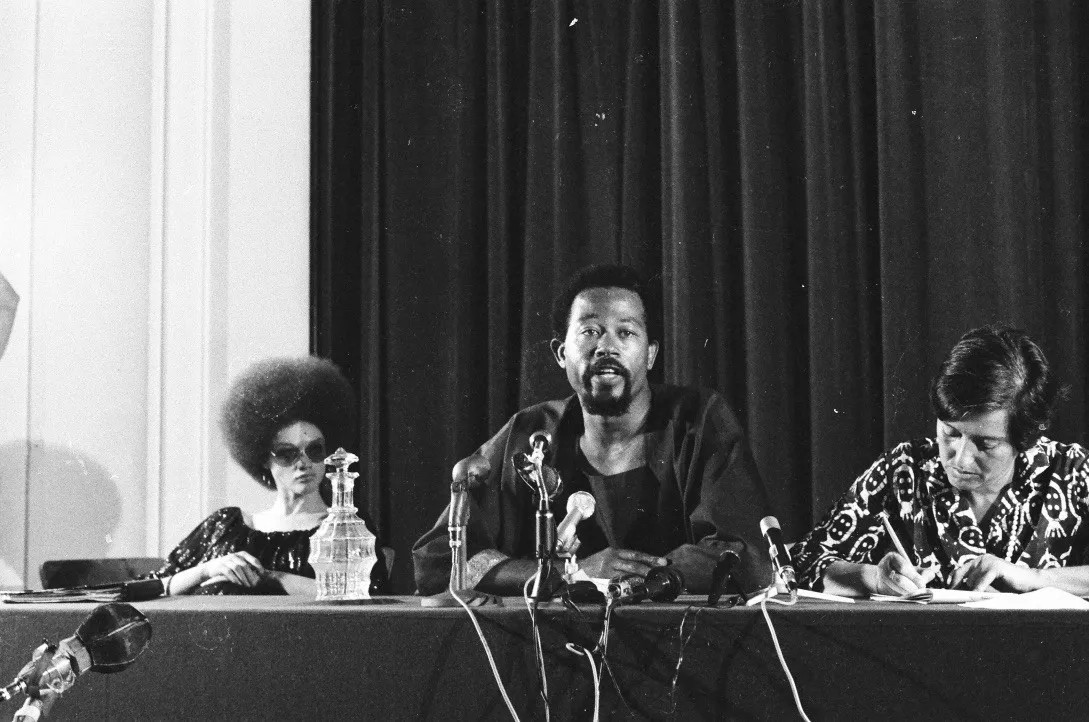
C'est également à cette époque qu'elle rencontre Mokhtar Mokhtefi, ancien combattant de l'Armée de libération nationale passé par le ministère de l'armement et des liaisons générales (MALG), puis devenu écrivain. Elle l'épouse en 1972 et porte depuis son nom. « Il cherchait la justice en toute chose », dira-t-elle de cet homme mort en 2015, dont les Mémoires, J'étais français-musulman, Itinéraire d'un soldat de l'ALN, paraîtront l'année d'après chez Barzakh.
Son histoire algérienne s'interrompt pourtant brutalement. En 1974, après avoir refusé à deux reprises de renseigner les services algériens sur son amie Zohra Sellami, mariée à l'ancien président Ben Bella, alors détenu, elle est contrainte de quitter le pays. Un billet d'avion pour Paris l'attend à l'aéroport. Dès lors interdite de séjour, elle ne pourra retourner en Algérie que quarante-quatre ans plus tard.
Elle revient en novembre 2018, à la veille de la parution française de ses Mémoires, Alger, capitale de la révolution, qu'elle a elle-même traduits en français et que Barzakh publie en Algérie. Son livre restitue de l'intérieur, mais sans complaisance, une décennie au cours de laquelle Alger s'est imposée comme l'un des centres de la politique révolutionnaire internationale. Il raconte aussi les contradictions de l'Algérie indépendante, les déceptions et les coups d'éclat.
Une poignée de mois après, alors qu'elle est de retour chez elle, le Hirak éclate. Interrogée sur son sentiment par Contretemps, la « revue de critique communiste », elle dira voir dans ce soulèvement « l'ouverture des cœurs et des esprits pour demander le départ du “pouvoir”, l'exigence du peuple pour la restitution de la démocratie, le pays pour tous ses citoyens… » « C'est en effet une deuxième révolution ! », conclura-t-elle.
Décembre 2025 prend des allures de consécration8. Invitée d'honneur de la 12e édition du Festival international du film d'Alger, elle enchaîne, en une semaine, rencontre et colloque, puis, le 10 décembre, jour de ses 97 ans, deux hommages et une standing ovation au Théâtre national algérien. On lui annonce ce soir-là que la nationalité algérienne lui sera accordée, décision formalisée par décret présidentiel le 23 juillet 20269.
Elaine Mokhtefi s'éteint le vendredi 11 septembre à New York, la ville où elle était née, quelques semaines avant un ultime voyage à Alger, où une réception était prévue pour célébrer sa nationalité. La réalisatrice serbe Mila Turajlić, autrice de Ciné-guérillas, Scènes des archives Labudović (2022), lui consacre un documentaire aujourd'hui en montage. L'occasion de maintenir vivante la flamme qui animait cette militante infatigable et de célébrer une longue histoire d'engagement auprès de celles et ceux qui luttaient pour leur émancipation.
1Alger, capitale de la révolution, De Fanon aux Black Panthers, La fabrique, 2019.
2L'année suivante, la CGT revient sur son refus et associe le Mouvement pour le triomphe des libertés démocratiques (MTLD) de Messali Hadj au défilé du 14 juillet 1953, où plusieurs milliers de militants algériens se rassemblent. La police tire sur le cortège place de la Nation : six d'entre eux sont tués, ainsi qu'un syndicaliste français.
3Considéré comme le père du nationalisme nord-africain, Ahmed Messali (1898-1974) fonde successivement trois mouvements déterminants dans la lutte pour l'indépendance. Avec le Mouvement national algérien, il s'engagera dans une lutte fratricide avec le Front de libération nationale.
4« Dans les années 1960, l'Algérie était très généreuse avec les mouvements de libération », entretien avec Elaine Mokhtefi, Libération, 16 juillet 2019.
5Alliance formée durant la crise de l'été 1962 entre Ahmed Ben Bella et l'état-major de l'Armée de libération nationale des frontières, dirigé par Houari Boumediène. Son noyau d'officiers, réuni à Oujda, au Maroc, à partir de 1960 — le « clan d'Oujda » —, occupera ensuite les positions clés de l'appareil d'État et portera Boumediène au pouvoir après le coup d'État du 19 juin 1965. Voir notamment, Ferhat Abbas, L'Indépendance confisquée, 1962-1978, Flammarion, 1984.
6Jeffrey James Byrne, Mecca of Revolution : Algeria, Decolonization, and the Third World Order, Oxford University Press, 2016.
7Voir le film documentaire Festival panafricain d'Alger 1969 réalisé par William Klein.
8« Rencontre littéraire avec Elaine Mokhtefi aujourd'hui à Alger », Le Soir d'Algérie, 6 décembre 2025 ; « Hommages, émotion et nationalité : la folle semaine d'Elaine Mokhtefi à Alger », El Watan, 16 décembre 2025.
9Voir notamment « Elaine Klein obtient la nationalité algérienne à 98 ans : la couronne de toute une vie d'engagement », El Moudjahid, 29 juillet 2026 ; « Algérie : une Américaine de 98 ans obtient la nationalité algérienne par décret présidentiel », RFI, 2 août 2026.
par Larry Johnson. La Déclaration de New Delhi ne détrônera pas le dollar. Elle offre aux membres du bloc, soumis à des sanctions, une alternative collective, en expansion et désormais officiellement reconnue, au système que Washington a utilisé pour les isoler.
The post Premier jour à New Delhi : les BRICS abandonnent le dollar, l’Iran exerçant une forte pression first appeared on Réseau International.
Chine Magazine. Les dirigeants du bloc diplomatique des BRICS, dont ceux de Chine, d’Inde, de Russie et d’Iran, se sont retrouvés, afin de dégager une position commune sur la guerre au Moyen-Orient qui les divise.
The post Au sommet des BRICS, la Chine, l’Inde, la Russie et l’Iran cherchent une voix commune sur le Moyen-Orient first appeared on Réseau International.


 Lateo.net - Flux RSS en pagaille (pour en ajouter : @ moi)