 Connexion


The recent release of Anthony Fauci’s diaries, followed by his refusal to answer questions in an appearance before a US Senate committee by invoking the Fifth Amendment protection against self-incrimination 111 times, highlighted a stark divide in how the Covid pandemic was handled by public health authorities. This is as true of Australia as of the US.
Repeatedly, against certainty expressed in public to justify official statements on the origins of the virus and on lockdown, mask, and vaccine policies, their private contemporaneous conversations confirm that even the top scientists were making decisions based on scientific uncertainty.
Consequently, one of the key legacies of the public-private gap is growing distrust of official claims. That scepticism should extend to the future pandemic agenda. We rely on the World Health Organisation to coordinate among countries to prevent scourges such as pandemics reaching our shores, or at least mitigate their effects. In doing so, we must defer to an army of international bureaucrats who work in such institutions. A deference that relies on trust.
Their salaries and careers depend on convincing us to part with more of our money to support their work. Yet, according to a new article on international pandemic financing in the Cambridge journal Health Economics, Policy and Law, the WHO and World Bank rely on dubious assumptions to calculate the return on investment case on which all major international efforts to mitigate future pandemics rely.
This should alarm governments. Mitigation is worth investing in, as pandemics will occur from time to time. But the article shows that current investments will have an overall detrimental effect on global health. Most starkly, it suggests a deep rot in the quality of institutions we rely on as stewards of this commonly accepted global good.
The WHO and World Bank report, produced at the request of the G20 in 2022, proposes an annual $31.1 billion budget for pandemic preparedness and prevention, about $10.5 billion of which would come through foreign aid (including Australia). About $26 billion would come from low and middle-income countries already struggling with economic issues including burgeoning Covid debt. For context, the entire WHO budget for 2024-25 was just $3.8 billion a year.
The point of the WHO and World Bank’s argument is that if we spend such resources on preparing for pandemics, we will reap orders of magnitude greater return on investment down the road, more than a thousandfold in some wealthy countries – a bargain difficult to refuse if true.
The article from Leeds University shows that the financial arguments are based on smoke and mirrors. They rely on assumptions on the quality-adjusted life years lost to pandemics as against the big three global infectious diseases of HIV-AIDS, tuberculosis, and malaria; on the share of global funds to be devoted to pandemics in comparison to the other three per life saved in each case; and on the benefits to be gained from investments in vaccines and other pharmaceutical products instead of in the more basic determinants of health resilience in the population such as nutrition, sanitation, water, and hygiene. These are the factors, along with antibiotics and gains in medical advances, that have reduced the mortality toll from pandemics since the Spanish flu of 1918.
Furthermore, the WHO and World Bank also discount the adjustments made to human behaviour to mitigate health risks as they become obvious, collateral costs of the pandemic response measures, and the likely benefits of investing in those measures.
This matters because our government has signed on to the amended International Health Regulations, is expecting to sign the proposed WHO Pandemic Agreement, and looks set to sign a UN political agreement this September advocating for yet more money for the authors and beneficiaries of the growing pandemic industry. They are promising a lot of money based on the WHO’s costings.
It matters because most Australians assumed that we could trust international institutions and that they valued rigour rather than engage in false accounting and subterfuge.
Unfortunately, incentives without accountability are a poor basis for health governance. It matters because funds to finance the pharmaceutical corporations, research institutions, and bureaucrats who stand to benefit from the pandemic agenda will have to be diverted from programs that work. International funding for the big endemic diseases and basic priorities such as nutrition is already falling, while the pandemic agenda expands. The Leeds authors call for simple transparency and honesty in assessing global health priorities, and in paying for them. Not a big ask. The Australian government has a choice to be constructive on behalf of its taxpayers and require better, or through blind acquiescence remain part of the problem.
Republished from The Australian
The post WHO’s High-Price Pandemic Plan appeared first on Activist Post.
One site is near the military’s main chemical and biological weapons testing range. Another parcel is a half-mile from civilian housing.
At Dugway Proving Ground in Utah, on ground the Army’s own contracting documents describe as previously used for grazing, a company owned by two of the largest investment firms in the world is preparing to build a data center.
That site sits about an hour’s drive from the nearest community, on the installation where the U.S. military conducts its primary chemical and biological weapons testing. Three parcels there total roughly 3,466 acres. One of them, about 1,201 acres, is already spoken for.
It is one of at least a dozen military installations the Army and the Department of the Air Force have opened to commercial data center developers over the past year and a half. Two of those deals are real; the rest are still proposals.
In late March, the Army conditionally selected two companies to enter exclusive negotiations to build and operate commercial hyperscale data centers on Army land.
Carlyle, the global investment firm, was picked for roughly 1,384 acres at Fort Bliss, Texas. CyrusOne, a data center operator jointly held by funds managed by KKR and BlackRock, was picked for the parcel at Dugway. Each project is estimated to cost about $2 billion, according to the Financial Times.
The companies will be responsible for financing, building, operating, maintaining and eventually decommissioning the facilities, the Army said, on what it called “underutilized but non-excess Army land at no upfront cost to taxpayers.” In exchange for the land, the service gets access to computing power.
It all runs through the Army’s Enhanced Use Lease program, driven by a Trump executive order directing agencies to open non-excess federal land to data center development. The U.S. Army Corps of Engineers is handling lease negotiations and environmental review.
“AI is a strategic asset for the Army,” Army Secretary Dan Driscoll said in the March announcement. “It is a force multiplier, supports future transformation and requirements, keeps the Army ahead of our adversaries, and generates resiliency across the force.” Driscoll told the Wall Street Journal that the Fort Bliss facility would be “the first hyper-scale data center that the Pentagon has ever done.”
Only Fort Bliss and Dugway have been awarded so far, and even those remain conditional, pending negotiation. Beyond them, federal contracting documents show the Army considering data centers at Fort Hood, Texas, and Fort Bragg, N.C.
The Department of the Air Force put out its own call in 2025 for private AI data center projects on unused land at Arnold Air Force Base, Tenn., Edwards Air Force Base, Calif., Joint Base McGuire-Dix-Lakehurst, N.J., Davis-Monthan Air Force Base, Ariz., and Robins Air Force Base, Ga.
More recently, it sought bidders for facilities at Joint Base Elmendorf-Richardson, Eielson Air Force Base and Clear Space Force Station in Alaska. Acreage varies enormously; for example, Fort Hood has 207 acres on offer. Fort Bliss has nearly seven times that.
Dugway is remote by design, although not every site is. Contracting documents show the Army weighing a parcel at Fort Hood within a half-mile of residential and commercial property, and several potential locations at Fort Bragg within one mile of civilian areas and a half-mile of civilian housing.
Proximity to the population is what has made data centers a heated topic in the civilian world. Nearly $156 billion in projects nationwide have been delayed or canceled after local opposition, according to Data Center Watch.
In Virginia, which holds the world’s highest concentration of the facilities, a state-funded study found residents’ monthly energy bills could rise by $14 to $37 by 2040.
“So I think the difference between us, the Army, doing a data center, and say Meta or Google, is we’re part of the communities that are there, and we are going to engage with them on a routine and regular basis to look for solutions that work for everyone, right?” Col. John Oliver, executive officer for Deputy Army Under Secretary Dave Fitzgerald, told Defense One. “Because, yes, we understand that there’s been consternation with data centers.”
Two requirements attached to these projects do not apply to commercial builds off base. Proposals must include net-zero water usage and a power plan that does not draw on the local electrical grid. Bidders were also required to describe plans for “local outreach and engagement” and to assess “any risks or opposition” to the project.
The Defense Department’s own procurement documents, obtained by the trade publication Data Center Dynamics, rate the water risk for the El Paso area as “Extremely High.” Data centers consume water to cool their servers. Fort Bliss is where the Army wants its flagship.
Army officials want the project to be a net contributor rather than a net drain. In the spring, Fitzgerald traveled to Fort Bliss for a listening session with the commander of the 1st Armored Division, community members, El Paso Water, El Paso Electric and Carlyle. One idea on the table is having the developer drill a new well to feed the city’s desalination plant, offsetting what the data center uses.
“We are encouraging Carlyle to do that, so actually make it net-positive,” Oliver told Defense One. “We don’t know if that’s an engineering solution that we can actually get to yet, but we’re actively working toward that as a part of the process.”
Darrell M. West, a senior fellow at the Brookings Institution who studies data center development, said the approach is sound, and that communities which have accepted the facilities tend to be the ones told the full details in advance.
“People want to know up-front, you know, where the energy is coming from, how much water is being used, how much the overall cost is going to be, and what the noise levels are,” West said.
Rep. Cory Mills, a Florida Republican, secured a provision in the House version of the fiscal 2027 defense authorization bill. This bill bars the Defense Department from leasing land for data centers unless developers agree not to install equipment containing components made in China, Russia, Iran or North Korea. The restriction covers certain printed circuit boards, advanced semiconductors and chipsets the department considers a security risk.
“Honored to pass this amendment to protect our military installations from Chinese components being used in data centers on our installations,” Mills wrote on X.
The Army objected. The measure would create a “federal land penalty,” a service official told Federal News Network, imposing rules on companies building on installations that would not apply to identical projects built anywhere else. “We want Congress to incentivize companies to build on secure federal land, rather than creating barriers that drive them away,” the official said.
Rep. John Garamendi, a California Democrat, proposed requiring the Pentagon to evaluate a data center’s energy and water consumption, noise and light pollution, and effects on security and supply chains before finalizing any deal. House Armed Services Republicans rejected it.
“We’re not opposed to data centers,” Garamendi said. “We just want to make sure that if we’re going to put a data center on a federal facility, that federal facility is not going to be degraded by the data center.”
His questions were installation questions. “Is there encroachment on training and operations and the physical and supply chain of security?” he asked.
Senate Armed Services Republicans defeated a separate Democratic amendment that would have blocked leasing until the Pentagon finalizes a data center strategy. House appropriators, meanwhile, adopted language acknowledging that data centers “place significant strain on energy and water resources and communities have resisted such projects.”
For anyone stationed at or living near one of these installations, several things are known for sure. Only two projects have been awarded, and both remain conditional. Fort Hood, Fort Bragg and the Air Force sites are solicitations, not commitments.
Initial operating capability at Fort Bliss is projected for fiscal 2027 and at Dugway for fiscal 2029. That is when the first capability comes online, not when a finished campus exists. Oliver has described the long-term vision as a campus with a commercial side, a classified military data side, and onsite power generation.
The Army Corps of Engineers is conducting the environmental review at both awarded sites. Developers must build independent power that does not tap the local grid and meet net-zero water usage. Excess power generated on base could potentially be sold back to civilian grids.
The Association of Defense Communities has scheduled further discussion of military data center development at its Installation Innovation Forum in October 2026.
The post Pentagon Plans AI Data Centers at Military Bases Across Multiple Branches appeared first on Activist Post.
En France, vous ne vous en êtes pas rendu compte, mais la population autochtone subit une gestion fine de la part de l’État. Cette gestion cynégétique repose sur une distinction essentielle : d’un côté, il y a les espèces protégées et de l’autre, il y a bien évidemment les espèces classées nuisibles.

De façon pragmatique et logique, les premières bénéficient d’un habitat sanctuarisé, d’un quota de prélèvement fixé à zéro et d’une doctrine d’effarouchement limitée (tout au plus et au besoin, on fait un peu peur et voilà tout). On les compte, on les observe de loin, et parfois on s’alarme de leur expansion dans des rapports annuels qu’heureusement personne ne lit.
Les secondes, en revanche, se tirent toute l’année et c’est très pratique, presque ludique.
C’est cependant le classement qui mérite quelques précisions.
Le profane imagine volontiers qu’une espèce devient nuisible à raison des dégâts qu’elle occasionne : cultures saccagées, cheptel saigné, riverains éventrés. Quelle naïveté, qui montre une forte méconnaissance de notre administration !
Le critère n’est pas le dégât, qui n’apporte pas d’information réellement pertinente. Le critère, c’est le cri.

Il en va ainsi d’Homo contribuens, sous-espèce connectée, dont la France entretient un cheptel abondant. Le spécimen est sédentaire, solvable et intégralement bagué : numéro fiscal, IBAN, plaque minéralogique, adresse de facturation, IP. Il ne se déplace qu’aux heures autorisées (on peut même lui faire trimballer une petite fiche d’autorisation qu’il signera lui-même). Il ne mord pas, ne se rebelle pas et rembourse ses crédits bien comme il faut.
En contrepartie de quoi il émet, depuis son canapé, des cris, parfois franchement déplaisants.
Et c’est précisément là que se déclenche le plan de chasse.
Dès décembre 2025, le parquet de Paris confie une mission de veille à l’Office Central de Lutte Contre les Crimes Contre l’Humanité et les Crimes de Haine, dont on rappellera qu’il fut conçu pour retrouver des génocidaires en cavale. Le voici affecté au comptage des canaux Telegram et l’un d’eux, baptisé Femmeblancherie, réunit depuis mars 1.758 abonnés qui s’y livrent à l’humour de corps de garde, aux propos raciaux et à l’apologie du terrorisme, ce qui, convenons-en, est abominaffreux.
Sollicité, Telegram transmet docilement les données d’identification, et comme tout ce petit monde est bagué, pucé, tagué, l’affaire est rondement menée.
Entre le 3 et le 16 juin, 45 spécimens sont prélevés placés en garde à vue, dont 34 comparaîtront à l’automne. Après six mois de veille par un office antigénocide, une plateforme étrangère est ainsi mise au pas et une quarantaine de gugusses cueillis chez eux au petit matin. Nul ne pourra dire que l’État manque de bras.

Certes, les propos incriminés n’étaient pas aimables, ils étaient même méchants, sexistes, haineux, … laids en somme.
La liberté d’expression (qui permet normalement de dépasser les sujets consensuels comme la météo) autorise cependant ce genre de laideurs et le droit français dispose depuis 1881 de tout l’attirail permettant de poursuivre la diffamation, l’injure visant une personne, la menace et la provocation directe à commettre un crime, c’est-à-dire les cas où l’on peut désigner une victime.
Mais ici, tout cela sera donc poursuivi grâce à cette catégorie molle où l’on juge une opinion à son atmosphère et qui procède d’une invention récente et admirablement circulaire : est nuisible ce que l’administration a décidé de classer nuisible. Le délit n’est plus dans l’acte mais se trouve dans le contexte et l’ambiance du moment.
Parallèlement à cette espèce nuisible, on trouve bien sûr une espèce protégée, l’Homo Narcotraficus qui prospère sur l’ensemble du territoire, avec un dynamisme démographique que l’on jalouserait presque.

Son activité a produit en 2024 110 morts et 341 blessés, ce qui, en termes de dégâts aux cultures, place la bestiole assez loin devant le blagueur de Telegram. Les vingt plus gros sujets pilotent leurs réseaux depuis Dubaï, Bangkok ou Tanger, sans se cacher. Les autres administrent leurs points de vente depuis la cellule, la logistique téléphonique étant assurée par drone. L’habitat est sanctuarisé, la reproduction assistée, la mortalité strictement intraspécifique.
Face à quoi l’État aligne son office anti-stupéfiants et ses… 200 agents. Oui, deux centaines. Il faut au moins ça pour un marché à plusieurs milliards, quelques milliers de points de deal et une comptabilité qui se tient au cimetière.
On notera enfin que Telegram, si prompt à livrer l’identité de 1.758 abonnés d’un salon public, n’a jamais été sommé de faire le ménage dans les canaux de vente au détail géolocalisés que n’importe quel adolescent déniche en quarante secondes. Il est vrai que ceux-là ne sont pas bagués.
Le principe de précaution s’applique ici avec la dernière rigueur : on n’entre pas sans motif sérieux dans un quartier émotif sensible et l’on n’y prélève rien sans blindé, sans préfet et sans conseil interministériel.

Du point de vue de l’État, cet arrangement est finalement logique voire économique : il est énergétiquement moins coûteux et beaucoup plus facile, dans un État qui a renoncé à ses fonctions régaliennes élémentaires, de compenser son impuissance en durcissant l’encadrement de ceux qui obéissaient déjà. Anarchie pour les uns et tyrannie pour les autres qui permet de présenter un excellent bilan à chaque fin de trimestre et aux rares élections qu’on pourra aisément piper au besoin.
Le mécanisme n’a rien de mystérieux, du reste. Le prélèvement se pratique là où il rend : coût d’intervention nul, risque nul, résultat immédiat, communiqué de presse garanti. En face, un caïd exige trois ans d’enquête, des moyens lourds, quelques obsèques de policiers et pas la moindre garantie de condamnation.
On peut se réjouir que notre service public soit à ce point rationnel qu’il choisit toujours la proie qui ne court pas. C’est d’ailleurs d’autant plus vrai que l’État, obèse, a de plus en plus de mal à courir.
Et à ce rythme, la France obtiendra très exactement ce qu’elle prétendait empêcher : un pays où l’on ne pourra plus rien dire, et où l’on pourra absolument tout faire.
Ce pays est foutu.

1BuyJKZLeEG5YkpbGn4QhtNTxhUqtpEGKf
Vous aussi, foutez les banquiers centraux dehors, terrorisez l’État et les banques en utilisant les cryptomonnaies, en les promouvant et pourquoi pas, en faisant un don avec !
Al-Manar. Les Forces armées yéménites ont annoncé avoir ciblé une raffinerie appartenant à la société Aramco dans la région de Jizane, au sud de l’Arabie saoudite, à l’aide d’un drone, affirmant que la frappe a été précise.
The post Les Forces armées yéménites ciblent une raffinerie d’Aramco à Jizane first appeared on Réseau International.
Al-Manar. «Les images satellites montrent toujours des incendies à l’intérieur de l’usine d’Abqaiq, capable de traiter environ 7 millions de barils par jour», révélant ainsi l’incapacité des autorités saoudiennes compétentes à éteindre les incendies.
The post Frappes yéménites : Saudi Aramco ferme sa raffinerie de pétrole à Jazan. La raffinerie d’Abqaiq en feu first appeared on Réseau International.
par Danny Haiphong. L’analyste géopolitique Patrick Henningsen rejoint l’émission pour discuter des lourdes pertes américaines révélées dans la guerre contre l’Iran, alors que Trump perd complètement son sang-froid à leur sujet, et de ce qui vient ensuite.
The post Patrick Henningsen : L’Iran élimine 200 soldats américains, Aramco brûle, Trump pète les plombs first appeared on Réseau International.

A major showdown on the House floor seemed imminent. An amendment, advanced by the Rules Committee, was poised to force a rare and telling record vote on stripping Israel of $3.3 billion in annual US military aid.
Brought forward by Republican Representative Thomas Massie and drawing support from key progressive Democrats like Alexandria Ocasio-Cortez and Greg Casar, the measure was set to put every lawmaker’s stance on unconditional foreign assistance under a public microscope.
However, the high-stakes vote never actually happened. On June 30, the entire legislative package collapsed under the weight of Washington’s internal political warfare. In a dramatic procedural twist, a coalition of Democrats and disgruntled conservative Republicans voted down the mandatory ‘rule’ required to even begin debating the underlying State Department spending bill.
But even if the vote on Massie’s amendment had occurred, the result would have been entirely predictable. It would have been defeated, as support for Israel on both sides of the congressional aisle remains structurally entrenched – even as the American public shifts against Israeli policy in historic numbers.
According to a watershed Gallup poll published on February 27, a plurality of Americans now sympathize more with the Palestinians than the Israelis, leading by a margin of 41 percent to 36 percent. This marked the first time since Gallup began tracking the metric over two decades ago that Israel did not hold the upper hand in public sympathy.
Yet the shift is part of a broader, undeniable trend. A nationwide survey published in late June 2026 by Quinnipiac University revealed that an unprecedented 48 percent of American voters now think the United States is “too supportive” of Israel – the highest percentage recorded since the pollster first began tracking the question in 2017.
This is precisely why Massie’s amendment carries such profound weight. It is significant not because US politicians have suddenly developed a collective moral conscience, but because recent election cycles represented the first time in modern American history where Palestine factored as a major, decisive variable in how citizens cast their ballots.
For years, conventional political analysts dismissed pro-Palestinian mobilization, claiming Americans only vote based on immediate socioeconomic interests and rigid party loyalties. That assessment has since proven faulty.
The political cost of Washington’s complicity became undeniable following the fallout of the 2024 presidential race, a reality later confirmed by those within the inner sanctums of power. In the post-election debates, senior administration insiders admitted that the handling of the Gaza genocide alienated core voter blocks.
The political cost of Washington’s complicity became undeniable after the 2024 presidential race. According to Axios, top Democratic strategists conducting the party’s post-election audit explicitly admitted to advocacy groups that internal party data proved the administration’s Gaza policy was a “net-negative” on the ballot.
This finding – disclosed during internal briefings by DNC autopsy author Paul Rivera – confirmed that the party’s unconditional backing of Israel directly fractured its base, and ultimately contributed to its loss of the elections.
The upcoming November elections are expected to be fiercely contested, and Gaza will, once more, be on the ballot. Following a series of progressive, anti-war victories in local primaries, The Guardian reported that US foreign policy toward the conflict has effectively “turned into something of a litmus test for the left.”
This historic transformation in the popular American perception of Palestine and Israel does not indicate that a political rupture is soon to follow, as US politicians are notorious for their moral flexibility and their ability to spin language in whatever way is necessary to remain in power.
Indeed, the evolution of the language used by Representative Alexandria Ocasio-Cortez regarding the word ‘genocide’ in Gaza tells the entire story of how the Democratic establishment is never compelled by genuine moral urgency, but rather by sheer political expediency.
In the early months of the genocide, Ocasio-Cortez hesitated to adopt the term, acutely aware of the deep sensitivities surrounding such language in US media and mainstream society.
“The fact that this word is even in our discourse… demonstrates the mass inhumanity that Gaza is facing,” she stated, attempting to navigate an acceptable rhetorical middle ground in January 2024 during an appearance on NBC’s Meet the Press.
Yet, under the relentless weight of pressure from an increasingly mobilized progressive constituency, she systematically upgraded her language in March of the same year, declaring on the House floor: “If you want to know what an unfolding genocide looks like, open your eyes. It looks like the forced famine of 1.1 million innocents.”
This linguistic shift continued to intensify until it reached the Munich Security Conference last February, where Ocasio-Cortez finally deployed the term without any qualification. Unconditional US aid, she flatly argued, “enabled a genocide in Gaza.”
Ocasio-Cortez is just one of many Democratic progressives who carefully filtered their vocabulary to avoid the political fallout of using the term genocide too early, or too late. Her position was eventually corrected not because of a sudden moral awakening or the discovery of new information regarding the “unfolding genocide,” but because the margins of error allowed by a newly conscious American public have completely closed.
Therefore, the strategic focus must remain on reaching out to the public, who hold the true power to influence – and even coerce – politicians into making the right choices.
Ultimately, the current movement serves as a crucial barometer, proving that sustained, grassroots, anti-war pressure is successfully destabilizing Israel’s traditionally unquestioned shield in Washington.
The post Israel Debated: Why Palestine Is Rewriting the Rules of Domestic US Politics appeared first on Activist Post.
par Léo Kersauzie. Dans cette conférence, Chloé Frammery a présenté les différentes étapes de la mise en place d’un véritable contrôle numérique mondial, préparé par nos institutions internationales depuis au moins 2012.
The post Contrôle numérique, non merci ! Comment résister aux prisons technologiques ? first appeared on Réseau International.
Au travers des événements qui ont abouti aux découpages territoriaux, cet ouvrage analyse les dynamiques qui influencent l'établissement d'une frontière. D. Périer et J-B Veber apportent un éclairage novateur aux tensions que ces tracés peuvent encore générer de nos jours.
- Transversaux / Géographie, Géopolitique, Histoire, Livres géopolitiques, Frontière, Programme d'histoire-géographie, géopolitique et sciences politiques HGGSP, 2026
For those unfamiliar with the intricate machinery of Israeli politics, the unanimous 110-0 vote to dissolve the Knesset on May 20 appears to be an earth-shattering event. On the surface, it looks as if the days of Prime Minister Benjamin Netanyahu and his coalition of far-right extremists are numbered. The reality, however, is far more complex.
Israel’s current political implosion is fundamentally tied to its failure to escape the ghosts of October 7. When the country’s military defenses collapsed on that day, Israel was transformed from a state with a formidable reputation as an invincible regional superpower into one trapped with a struggling army, structurally incapable of decisively winning a single war.
Since the launch of the devastating genocide in Gaza, neither the Israeli government nor the military establishment has been able to answer two fundamental questions:
One, how did the world’s self-proclaimed “invincible army” collapse in a matter of hours, leaving the entire Southern Command – whose sole job was to keep Gazans besieged – in total shambles?
Two, why has that same heavily funded military machine failed to achieve a decisive victory despite the near-total destruction of the Strip and the unprecedented slaughter and wounding of much of its population?
Complicating the matter is Benjamin Netanyahu’s pathological refusal to honestly investigate either the October 7 intelligence failure or the subsequent conduct of the Gaza war. Instead, he focused entirely on domestic damage control and image management, aggressively marginalizing or firing intelligence official, or high-ranking bureaucrats who challenged his narrative. Rather than pursuing a viable exit strategy, Netanyahu treated the defense apparatus as a public relations shield.
Consequently, opposition voices – initially led by Yair Lapid and his Yesh Atid party – began demanding Netanyahu’s resignation and snap elections. What began as predictable political fallout quickly evolved into a sweeping popular movement.
Public confidence in the government continues to plummet. Recent opinion polls consistently show that a vast majority of Israelis believe Netanyahu acts out of personal political survival rather than national interest. Data suggests that if elections were held today, his right-wing bloc would suffer a catastrophic defeat at the hands of a newly consolidated opposition – namely Beyachad (‘Together’), the newly formed unified list established by Naftali Bennett and Lapid.
Netanyahu, whose legacy as Israel’s longest-serving prime minister is now defined by strategic failure, subsists in a profound personal and political crisis. His deliberate escalations of regional conflict served no distinct military purpose; instead, they merely highlighted his desperation, turning his rhetorical pledges of “total victory” into a hollow attempt to prevent his coalition from fracturing.
Meanwhile, National Security Minister Itamar Ben-Gvir and Finance Minister Bezalel Smotrich exploited Netanyahu’s vulnerability to advance their own extremist agendas. Bent on rapid colonial expansion, they accelerated West Bank annexation, pushed draconian laws to execute Palestinian prisoners, and tightened the siege on occupied East Jerusalem.
Under normal circumstances, the sheer scale of the domestic, economic, and diplomatic harm engineered by this coalition should have removed it from power. Yet Netanyahu survived by exploiting deep social fractures and relying on unconditional support from Washington.
This survival shield was further fortified by the initial impotence of a fragmented political opposition and a perpetual wartime atmosphere that Netanyahu cultivated to freeze dissent. Not even his corruption trials derailed his career; he adapted state institutions into instruments of personal survival.
Yet the ultimate irony of Israeli politics is that pressure came not from mounting casualties or international isolation, but from compulsory military conscription of the ultra-Orthodox, or Haredim.
For decades, secular Israelis complained about the sweeping draft exemptions granted to yeshiva students, but the political elite routinely shrugged it off as a secondary culture war that could be managed via backroom political dealings.
Israel’s overextended, multi-front war of attrition completely smashed that equilibrium. The issue was violently pushed back to the surface because the military quite literally ran out of bodies. The true gravity of this manpower crisis was exposed when the army Chief of Staff, Lt. Gen. Eyal Zamir, explicitly broke ranks during a closed-door security cabinet meeting to warn that “the IDF is going to collapse in on itself.”
Zamir reportedly raised “ten red flags” before the political leadership, stating bluntly that after months of intensive combat across Gaza, the northern border, and regional theaters, the military was facing an immediate, unsustainable deficit of over 12,000 combat soldiers.
For over two years, Netanyahu postponed a legal verdict on the Haredi draft. But mounting military setbacks, particularly on the Lebanese front, made further delays impossible.
The opposition seeks elections while Netanyahu engages in legislative theater, using loyalists and parliamentary procedures to slow the process.
Yet this political drama is secondary to the deeper crisis. No coalition maneuvering can salvage a state facing structural decline. Nothing will heal Israel’s fractures until it confronts the root cause of its crisis: endless, unwinnable military campaigns that have devastated Gaza and the wider region.
The crisis engulfing Israel is self-inflicted – and there can be no lasting peace until the state’s deep-seated criminality and ongoing genocide and wars against Palestinians and the wider Arab world come to an end.
The post Self-Engineered Decay: Why Israel’s Political Collapse Cannot Be Separated from Its War Crimes appeared first on Activist Post.
When it was reported that Wegmans grocery stores were utilizing facial recognition technology (FRT) to collect data on their customers, the company declined to disclose the software-end of its surveillance machine. Their reticence may be related to the FRT industry’s deep ties to the national security state — leaving consumers’ data just a knock away from American intelligence agencies.
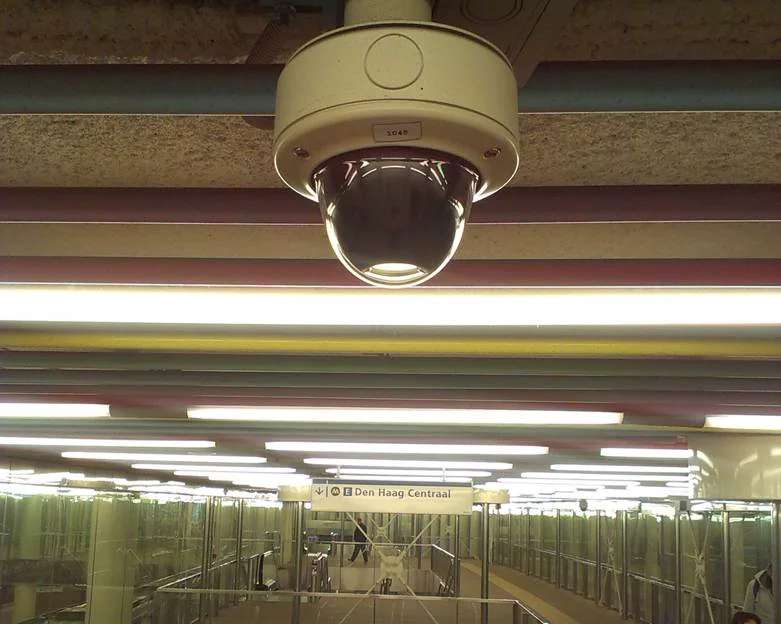
As far back as the 1970s, CCTV cameras have decorated private businesses and public buildings — providing a means of deterring theft for property owners and keeping records of activity through omnipresent VCR and later digital cameras. At its inception, there was virtually no backlash or critique against the new technology’s surveillance potential, allowing for a smooth implementation over the years. Now, decades later, it has become ubiquitous. Shoppers accept its existence and, consciously or not, adjust their behavior around it. For almost all, it is not a problem, but a fact of life.
Why, then, was there such an uproar when a popular East Coast supermarket chain revealed they are not only surveilling their customers with CCTV — but using their cameras to collect shoppers’ biometric data?
Gothamist, the NYC-fixed blog, reported in January that Wegmans grocery stores in Manhattan and Brooklyn had put up signs that read “biometric identifier information collected at this location,” including facial recognition, eye scans and voiceprints.
The story caught wind — multiple New York State legislators and an NYC assembly member wrote letters to Wegmans disapproving of the practice. Some even proposed laws to make it mandatory for the chain to disclose these new surveillance systems in their areas outside of the city.
The resulting P.R. crisis pressured the grocery chain into a response. Though the company assured the media that the sole purpose of the technology is to keep their “stores secure and safe,” it admitted that their “system collects facial recognition data” in order to “identify individuals who have been previously flagged for misconduct.” In other words, Wegmans is building privately owned profiles of its customers, and categorizing some of them as potential criminals.
The statement claimed that “[i]mages and video are retained only as long as necessary for security purposes and then disposed of,” likening the technology to 20th century localized CCTV recordings — i.e. contained securely in one place and easily destroyed. The following sentence, however, casts an eerie ambiguity on this data retainment time frame: “For security reasons, we do not disclose the exact retention period, but it aligns with industry standards.” Without an “exact retention period” codified, Wegmans’ publicly-issued policy effectively gives them carte blanche to store biometric data for as long as they please, so long as the company deems it “necessary for security purposes.”
A Wegmans spokesperson told the Buffalo-based Investigative Post that the company shares data collected from facial recognition technology (FRT) with law enforcement. When asked whether Wegmans shares information with Immigration and Customs Enforcement (ICE), she refused to comment.

The cameras that Wegmans uses come from a Swedish company called Axis Communications, which has contracted with the Department of War (DoW) and actively works with law enforcement. Wegmans, however, has declined to disclose the software-end of their system.
The Investigative Post was told by a Wegmans spokesperson that: “[…] in-store cameras ‘are simply getting video of our stores’ and said the company does not use AI camera programs to track customers.” The Post also noted that“[t]he company privacy policy, however, states Wegmans ‘collect[s] information about you in a number of ways’ including ‘through in- store technology, such as … video cameras.’”
The statement Wegmans released in response to the controversy further compounded its contradictory statements, as the company had previously stated that “the system collects facial recognition data.” Furthermore, Wegmans claimed that “[p]ersons of interest are determined by our asset protection team based on incidents occurring on our property and on a case-by-case basis, on information from law enforcement for criminal or missing persons cases.”
Thus, if AI programs are not being used to track customers, then how is Wegmans collecting facial recognition data on its customers and linking that data to previous incidents where individuals were “flagged for misconduct,” as well as to the information they receive from law enforcement?
Furthermore, an examination into the law that required the popular chain to post the signage disclosing their biometric data collection brings to light further inconsistencies in Wegmans’ public remarks. N.Y.C. Administrative Code § 22-1204 (Local Law 2021/003) states that a business is exempt from disclosing collection, use, and retention of biometric identifier information if:
“the images or videos collected are not analyzed by software or applications that identify, or that assist with the identification of, individuals based on physiological or biological characteristics [and . . .] the images or video are not shared with, sold or leased to third-parties other than law enforcement agencies.”
Therefore, the mere act of disclosing their use of the technology strongly suggests that they are engaged in either one of these practices.
Wegmans, in their statement, however, explains that they “do not share facial recognition scan data with any third party.” However, their privacy policy counters this by stating that the “security information” they collect, which includes facial recognition data, “is only accessible to a limited number of Wegmans employees, third-party service providers, and/or law enforcement…”
The contradictions here amalgamate into something deeply concerning. It appears that Wegmans is obfuscating the press’s inquiries into the totality of its digital surveillance infrastructure, likely to avoid disclosing the software being used to collect, analyze and share the biometric data it is collecting on its customers. Why?
Perhaps their reticence to comment on whether they share biometric data with ICE — which is increasingly becoming an unaccountable, biometric-surveillance-powered police force — illuminates their motive. As reports continue to emerge of ICE utilizing invasive apps developed by the CIA-funded company Palantir to make its arrests, and as Americans’ disapproval of the deportation authorities skyrockets, the unveiling of such a collaboration would thrust the company into an even worse P.R. crisis.
Shareholders of Home Depot, for example, are pressuring the company to “evaluate and report the risks associated with sharing data with third-party surveillance vendors” after it was revealed that that Flock Safety, a surveillance company with whom Home Depot partners, was giving federal officers “side-door access” to its trove of license plate data for immigration-related investigations.
Flock Safety’s entanglement with ICE is particularly worth noting. Even though ICE does not directly contract with Flock, “the agency sources data from Flock’s cameras by making requests to local law enforcement.” Such an arrangement is indicative of the hall of mirrors that sensitive data enters when it is obtained by private companies — bouncing across the public and private sector with ease and little transparency.

Though Wegmans seems intent on hiding the software it uses for its biometric surveillance – an author of this article asked customer service employees at the Manhattan location to disclose this information, and was quickly referred to corporate, where his questions received answers analogous to other coverage of the story — an inquiry into the most prominent software providers of facial recognition technology in retail/grocery stores uncovers an industry wound up in the ties between Silicon Valley and the national security state, including federal agencies such as ICE.
While Wegmans’ software provider remains unclear, its biometric surveillance policy is not an anomaly, but rather a more recent development in the expansion of public-private mass surveillance. A deeper investigation into the most prominent software providers of facial recognition technology in retail/grocery stores uncovers an industry enmeshed in the intersection between Silicon Valley and the national security state, including federal agencies such as ICE.
Silicon Valley, in conjunction with the Intelligence Community and the Pentagon, have constructed the pillars of our digital ecosystem — the roots of which can be found all the way back in Pentagon projects of counterinsurgency from the Cold War, and now in the expansion of ICE. As the origins and connections of the proceeding companies make clear, facial recognition technology is only one of the more recent — and technologically advanced — iterations of this apparatus’ inventions of control.
Situated in the private sector, however, the surveillance applications of facial recognition have also been used to serve the direct business interests of the tech companies’ clients. Deployed as part of the profit-building agendas of massive retail and grocery corporations, this technology is thus utilized for multiple purposes — both as a weapon of the security state, and as a dystopian tool of profit extraction for corporate behemoths.
These uses, however, are not isolated from one another. In the pursuit of each, by deploying this technology for different intents and purposes, both the corporate and public sectors shore up their respective power and ability to further the class interests of the American oligarchy, which dominates American politics. This is most clearly demonstrated by the official partnerships and agreements between these sectors which, though the details of their activities remain scant, are a window into the structural enmeshment of these ostensibly isolated entities.
To begin to grasp the structural functions of this network, an understanding of the way in which this technology has been deployed in the private sector is necessary. The first section of this article will detail these uses. This exploration will inevitably entangle the public sector into the mix, as a major function of corporate surveillance technology involves collaboration with the U.S. government, its security agencies and law enforcement. From there, this article will recount the origins of two specific companies — Clearview AI and Oosto — to further demonstrate this point, and also reveal some of the specific political milieus within American politics that have accumulated significant surveillance capabilities by hitching their wagons to the ever-expanding partnership between the national security state — what the late academic Michael Parenti described as a “mostly secret unit of misgovernment that is capable of the most unspeakable crimes, crimes that are perpetrated against people all around the world and dissidents at home” — and its private sector collaborators.
What is uncovered is a seemingly inescapable panopticon that is dedicated, not to the vague promises of “security” that its owners promise through press releases and media comments, but to hyper-capitalist power from every angle — from maximizing profits to criminalizing anyone who challenges their right to rule.
Ultimately, facial recognition technology is aimed at building sophisticated profiles of individuals — profiles that, with faces attached to them, can provide an ostensibly undeniable link between data-driven insights and particular people. In other words, it acts as a tool of intelligence gathering, capable of putting a face to — not the name — but the data. From there, the ways in which the owners of this intelligence may utilize this data are seemingly limitless. Almost all of these uses, however, are dedicated to furthering the class interests of those deploying it, as well as those creating it (since the two parties, customer and vendor, are dependent on each other in this scenario for different reasons).
Last month, WIRED published a chilling exposé into the surveillance operations headed by the owner of Madison Square Garden (MSG), James Dolan, and his head of security, John Eversole. The story demonstrates one particular way facial recognition technology (FRT) shores up the power of those able to access its vast digital eyes; it can be used to identify agitators, perceived delinquents and political enemies of the technology owners. From there, after identification via FRT, these subjects can be handled accordingly.
The rampant and unabashed private surveillance apparatus being run out of Dolan’s multiple stadium empire has targeted cheeky fans, former players, celebrity super fans as well as litigators deemed hostile to MSG and whom Dolan has placed on his “legal” blacklist. The new exposé, however, gives readers a closer peek through the curtain shielding MSG’s executive offices — revealing that Dolan has effectively constructed a rogue, privately owned intelligence agency within MSG. WIRED referred to this as Dolan’s “own deep state.”

Beyond surveilling perceived adversaries of Dolan at the stadiums themselves, the CEO’s mini-intelligence agency allegedly enacted spying operations aimed at enemies outside of his stadiums, for purposes ranging from the collection of blackmail to keeping tabs on potentially litigious adversaries.
FRT played an undeniably important role in the covert operations of this private intelligence agency. Beyond allowing Dolan to enforce his blacklist by detecting enemy lawyers upon their entering MSG, it also enabled them to track persons of interest as they moved through the stadium. WIRED uncovered a telling example, utilizing inside sources and court documents, in which extremely detailed tabs were kept on a transgender woman with a prominent social media following named Nina Richards (alias) as she navigated the stadium.
The surveillance team kept minute by minute tabs of her every activity, attempting to constrict her movements to ensure that she didn’t interact with players despite the fact that she posed “no threat,” according to Donnie Ingrasselino, a disgruntled former security staffer of MSG whose lawsuit against Dolan is heavily cited in the WIRED exposé.
Eversole, the head of security, saw her as a different kind of threat—one who, solely by existing and enjoying the services of MSG, could “damage MSG’s reputation” because she was an “openly” transgender woman. His concern continued to fuel the surveillance campaign, and eventually accumulated in the banishment of Richards from the Garden. WIRED noted that, according to Ingrasselino’s suit, “Mr. Eversole [f]abricated a stalking allegation to justify banning.”
Furthermore, it seems that the effects of quelling Richards’ presence went beyond her removal from stadium grounds. According to WIRED, “Richards used to have an active, vibrant presence online. Today, Richards has functionally erased herself from the internet. Her 44,000-follower Instagram account has been nuked.”
This anecdote mirrors another noted in the WIRED exposé. When Donnie Ingrasselino was seeking out a lawyer to pursue his lawsuit against MSG, three firms refused to represent him “because they were not willing to subject their firm to the ‘lawyer ban,’” he alleged in a court document. “In other words,” WIRED notes, “Dolan’s face-recognition tech had the effect of serving as a proactive deterrent, a warning shot for lawyers and disgruntled employees not to fuck with him.”
These two incidents — along with others — illustrate how Dolan’s mini surveillance empire reinforces MSG’s status through forceful coercion. Utilized in this fashion, FRT becomes a weapon of intimidation and a tool to manufacture pretexts for the punishment of enemies.
WIRED importantly notes, however, that Dolan’s indulgence in corporate espionage is not anomalous, but “a model” of private surveillance operations at large. While the outwardly hostile and offensive tinge of Dolan’s surveillance team is not the most common style employed by corporate entities, the baseline tactics of MSG — most notably, using facial recognition technology to compile privately owned lists of customers and suspected “terrorists” or agitators — are utilized throughout the corporate and retail sectors.
Target, for example, runs a crime lab that is so sophisticated it helps solve cases for police departments and the Federal Bureau of Intelligence (FBI). It is called “Target Forensic Services,” and was started by the company to combat shoplifting — a problem that results in billions of dollars in lost revenue annually for U.S. retailers, who have enjoyed immense growth this century as wealth inequality has hit its widest gap in more than three decades.
In 2008, the lab had already worked with at least 136 police departments, the FBI and the US Bureau of Alcohol, Tobacco & Firearms (ATF).
Beyond solving murder cases for public agencies, it “can hack cell phones,” and utilizes devices that can “keep cell phone data from being erased so that Target investigators can mine that information, including audio and text messages, images and telephone logs, from cell phones that are turned over to them by police.” Infringing on the civil liberties of its customers, Target appears to believe, is a necessary step in its battle against shoplifters.

Target’s forensics department began in 2003 with the hiring of experts such as Brent Pack, “a former criminal investigator with the US Army who had retrieved and analyzed evidence in the abuse of detainees at the Abu Ghraib prison in Baghdad.” The current director is Rick Lautenbach who, according to his LinkedIn, formerly worked in Military Police for the US Army.
These state connections are not unique. Like Dolan’s operation — which is composed of “Veterans of the FBI, CIA, DEA, and NYPD” and is led by John Eversole, a former US Marine and Army warrant officer who previously held senior positions at the CIA-created intelligence contractor Oracle — these surveillance structures are closely linked to the world of national security and shadow governance.
Protestors that disrupted Target’s daily operations during the Minnesota ICE raids earlier this year were vaguely clued into this reality, as detailed in an article by The Guardian. Enraged at Target’s silence in response to ICE forcefully detaining two Target employees, they “planted themselves in the atrium of the store” and chanted “Something ’bout this isn’t right – why does Target work for ICE?”
The activists’ chant, though catchy and potent, appears hyperbolic. Target opting to not comment on the abuse of its workers by ICE agents does not actually mean the company works for ICE. It turns out, however, that a much closer relationship between Target and the deportation authorities does indeed exist. The string that ties them together reveals not just Target being linked to America’s domestic security apparatus, but multitudes of major retailers and grocers.
Take, for example, the public-private partnership program called the Retail and Hospitality Information Sharing and Analysis Center (RH-ISAC). ISACs are Department of Homeland Security (DHS) information sharing initiatives. According to a Government Accountability Office report, ISAC partners participate in “information sharing exercises—including regularly scheduled daily or biweekly meetings.” As a core member of RH-ISAC, it is thus highly likely that Target is much more involved in the operations of ICE — a DHS agency — than the Guardian article that reported on the Minnesotan protests detailed.
Indeed, another partner of RH-ISAC includes the FBI, which Target already has a history of working with. It also partners with the Secret Service, the Office of the Director of National Intelligence, Cybersecurity & Infrastructure Security Agency and the National Cyber Security Center.
Furthermore, a huge amount of other retailers are likely involved in similar collaborative measures as core members of RH-ISAC, including Albertsons, Costco, Cracker Barrel, CVS, Darden (the parent company of restaurants like Olive Garden and Red Lobster), Dollar Tree, Fareway, Gap, Home Depot, JCPenney, Kroger, Lowe’s, Starbucks, Wendy’s and more.
The actual functions of this near industry-wide public-private partnership can be partially discerned by RH-ISAC’s participation in the DHS Cyber Information Sharing and Collaboration Program (CISCP), the agency’s most important program for “public-private information sharing” in which “DHS and participating companies share information about cyber threats, incidents, and vulnerabilities.”
This collaboration works both to reinforce the state’s ability to expand its surveillance capabilities, allowing it to more effectively pacify enemies of American financial power, and also to expand the abilities of private corporations to engage in their own intelligence operations (be they profit-focused or security-focused). DHS neatly explains the interconnected nature of this alliance on its website:
“Information shared via CISCP allows all participants to better secure their own networks and helps support the shared security of CISCP partners. Further, CISCP provides a collaborative environment where analysts learn from each other to better understand emerging cybersecurity risks and effective defenses.”
Indeed, every April leaders of cybersecurity and partner organizations gather at the annual RH-ISAC summit to participate in “sessions delivered by prominent thought leaders and experts, along with collaborative workshops, cybersecurity exercises, and exceptional networking opportunities.”
Despite this collaboration with government security services, much of this technology’s usage is still situated in the private sector. When put to use by profit-driven corporations, surveillance technology is not only deployed to make lists of suspected criminals and petty thieves. In fact, it is primarily used to compile lists on an entirely different segment of the population: consumers.
This has manifested itself most notoriously in the practice of “surveillance pricing,” a method that utilizes the collection of maximal amounts of data on both individuals and retail/grocery locations to find the “optimal” price point for any given product. The goal is clearly to maximize profit extraction per customer.
Surveillance pricing is usually launched as a honeypot, designed to lure customers into a surveillance trap. Corporations launch loyalty programs, often in the form of online apps, replete with personalized profiles that contain special discounts and perks, enticing customers to join. Often, all they must do to acquire these dividends is surrender their personal information to the corporation. Many don’t think twice.
In reality, however, these digital cost-saving schemes are effectively fronts for a more sinister agenda. As More Perfect Union revealed in collaboration with Consumer Reports, this surveillance is conducted in order to gather behavioral data on consumers, determining how they shop in order to most optimally price items for maximum profit extraction.
Even Kirat Anand, former VP of Pricing at Walmart, admitted that “[m]erchants, pricing teams, they all rely on technology and algorithms to safeguard their profits.” Indeed, there is an entire industry “built around optimizing grocery prices.”
A patent owned by grocery delivery company Instacart reviewed by More Perfect Union and Consumer Reports clues us into the deeper objectives of these supposed loyalty programs. While surveillance pricing utilizes methods such as “personalized pricing,” which uses behavioral data to set different prices for individuals, and “dynamic or surge pricing,” which uses “non-customer-specific variables to change prices” during specific events like “rainy weather, last-minute flight prices increasing, [etc.],” the patent suggested a system of corporate profiteering.
As More Perfect Union asked, “Would you rather charge $10 for a bottle of water during a single hurricane? Or 20 cents more every day?”
The patent “described an infrastructure for constant in-store price testing. Take dozens of stores, cluster them together, test different prices in different clusters. The purpose? Find out the most profitable price point.”
While Instacart denied that they utilize this price optimization infrastructure, More Perfect Union found it listed as a feature on their website. After More Perfect Union asked if Instacart uses the feature, the company took it off their site. Subsequent evidence documented in their report strongly suggests that Instacart indeed was utilizing these methods despite their denial.
While this larger system of price optimization is geared towards organizing individual data into collective trends, the individual profiling of customers is still an indispensable node within this broader system of surveillance-driven profiteering. The implications are grave for the protection of individual civil liberties against giant corporations and their government collaborators.
For example, grocery giant Kroger utilizes electronic shelf labels (ESL) to change prices in real time from an app. They have also partnered with Microsoft to install facial recognition technology throughout their stores — sparking concern from outlets like The Nation that companies like Kroger could combine FRT with ESL pricing to adjust prices based on people’s faces. While Kroger denied these insinuations, the prospect is not unthinkable.
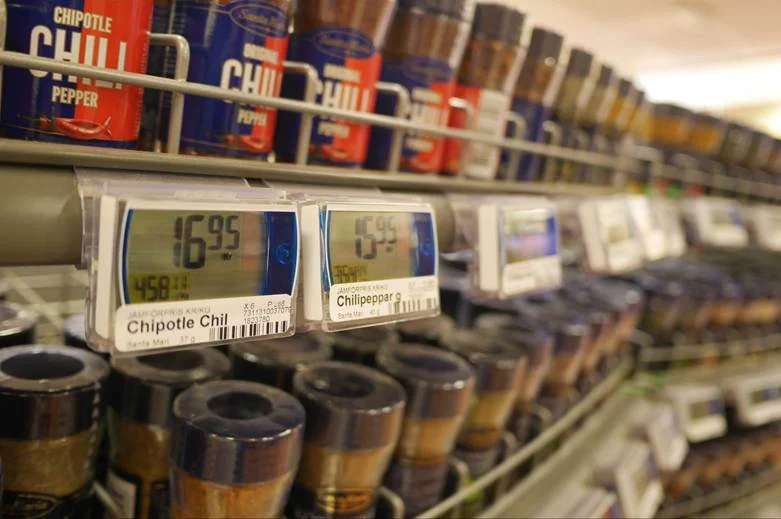
Yet, what Kroger has admitted to doing with this technology is equally disturbing, and still ultimately aimed at using surveillance to increase the amount of money spent by each customer. In its press release, it described the “EDGE shelf” as enabling “Kroger to generate new revenue by selling digital advertising space to consumer packaged goods (CPGs) brands. Using video analytics, personalized offers and advertisements can be presented based on customer demographics” (emphasis added).
According to reporting from business magazine Fast Company:
“The digital displays will be placed with special product offers at the ends of aisles. A camera at each display will determine through facial recognition AI the gender and age of the shopper passing by. If the person has not already opted in through the Kroger app, the display will show ads or coupons based only on age and gender and will use no personally identifiable information for targeting, Microsoft says. However, if the shopper has opted in, the displays may do some truly Minority Report-style customization. When the shopper comes into the vicinity of the display, they may see or hear something like, ‘Hello Mr. Sullivan, would you like to buy some more of the Pepsi you got last weekend?’”
The possibility that this data will seep into public sector data pools or into the data troves of other companies once it is acquired by Kroger and its subsidiaries should not be lost on anyone. This is especially true considering that Kroger is a core member of RH-ISAC — making it an open collaborator with U.S. intelligence and law enforcement — and Microsoft contracts directly with ICE, powering its surveillance infrastructure, as well as with the Pentagon, the CIA and the General Services Administration (GSA) as part of the Trump administration’s effort to “advance AI adoption across the Federal government.”
From all angles, the entire American retail and grocery industry is exercising the power granted to it by surveillance technology, profiling its customers to increase its ever-expanding profits and build out the ubiquity of the panopticon powered by Big Tech and the national security state. The technology, in other words, is not separate from political power but a tool of it, both within the confines of corporate empires as well as the grander borders of America’s domestic and foreign policy objectives.
The revolving door between the national security state and the private sector detailed in the next section make this claim evident. By examining the origins of the most prominent FRT companies, the line between the state and the private sector becomes so blurred that it elucidates the actual function of this technology, as well as the ostensibly independent industries wound up in its development and usage. All are vessels of oligarchic power, working to construct a surveillance system that empowers the wealthy and marginalizes its opponents by rendering their civil liberties obsolete.
The most telling example is the history of a company with deep ties to the current presidential administration, and underpinned by many of the same financial power brokers and Trump-adjacent media propagandists.
In March of 2020, The New York Times reported a story about John Catsimatidis, the heavy-set and droopy-faced billionaire owner of the Gristedes grocery chain, spying on his daughter at an Italian restaurant in Manhattan. The story, presented as a playful father and daughter moment, involved Catsimatidis asking a waiter to go over to his daughter’s table and take a picture of her date.
“I wanted to make sure he wasn’t a charlatan,” Catsimatidis said. He scanned the picture of the man’s face through an app — available only to those who’ve been granted access by the company — and found that his daughter’s suitor was a venture capitalist from San Francisco. The app Catsimatidis had used was Clearview AI — a surveillance product powered by facial recognition technology as well as a vast database of over 70 billion images scoured from public web sources “including news media, mugshot websites, public social media, and other open sources.”
This playful spying, in reality, is a microcosm of how Clearview is often used. Its tools are often employed unofficially and unannounced by the powerful institutions and individuals who have been granted access to the company’s software, resulting in persistent rogue and unchecked usage.

It also demonstrates the regulatory environment (or lack thereof) in which products like Clearview exist; currently, facial recognition technology is entirely unregulated at the federal level, its vast power only sparsely held back by minimal state-level restrictions. As a result, the limits on the ways in which facial recognition technology is deployed bears almost no limits, and requires no transparency.
Indeed, the only reason we know of Catsimatidis’ personal usage of Clearview, as well his grocery chain using it to identify “shoplifters or people who had held up other stores,” is because the billionaire himself told the Times. The only reason we know that Clearview has been deployed by a myriad of grocery chains, retail stores, federal agencies and police departments is because of a leaked tranche of documents reported on by Buzzfeed in 2020.
While Clearview advertises itself as being a tool of law enforcement and government agencies, its usage in Gristedes was not a one-off; its tech was significantly piloted in the private sector. In Buzzfeed’s investigation, they found that a myriad of retail and grocery stores had utilized the technology.
Walmart had nearly 300 searches in the ever growing annals of Clearview’s database, Best Buy had more than 200, grocer Albertsons had more than 40, and Rite Aid had about 35 searches. Kohl’s and Macy’s combined carried out nearly 10,000 searches. Buzzfeed also found that Madison Square Garden, EventBrite, Las Vegas Sands, Pechanga Resort Casino, the NBA, Equinox and Coinbase were among the private companies that composed Clearview’s client list, though some of these companies, like the NBA and Madison Square Garden (MSG), told Buzzfeed that they had only utilized Clearview via a trial period.
Two years after this claim, however, The New York Times reported on Dolan’s aforementioned use of FRT to enforce his “attorney exclusion list.” This resulted in a personal injury lawyer from Bergen County, N.J. being barred from seeing the Rockettes at Radio City Music Hall and another attorney from her firm being denied entry to a New York Rangers game at Madison Square Garden.
A lack of an official partnership with Clearview, however, does not indicate whether an institution utilizes its software or not. Buzzfeed found that police departments, schools and government agencies have utilized the technology without any formal agreement between parties. This has created a company culture in which, at times, employees of institutions may be utilizing Clearview, while the institutions themselves “have no idea the tool is being used…”
The dynamic works to shield Clearview and these institutions from transparency, sewing a veil of secrecy that obfuscates inquiry into the depth of Clearview’s role in their surveillance infrastructure. Professor Nolan Higdon, co-author of Surveillance Education, told Unlimited Hangout that this is not an anomaly exclusively applicable to Clearview, but rather “a pathology of the industry” resulting from “the lack of legislation to say where expectations of privacy should exist.”
Yet, the rogue and unofficial usage of Clearview by institutional actors is not only concerning for the threats it poses to civil liberties and privacy, but because the company is deeply tied to the American national security state. Clearview’s links to the American Empire’s covert governance are most pronounced through its longstanding relationship with Immigration and Customs Enforcement (ICE). Dating back to the company’s origins, when it was still called Smartcheckr, ICE was always one of its main intended clients.
According to Mother Jones, in 2017, Clearview’s founder, the self-proclaimed descendant of Vietnamese royalty, Hon Ton-That, “envisioned using facial recognition to compare images of migrants crossing the border to mugshots to see if the arrivals had been previously arrested in the United States.” He proposed screening migrants for “sentiment about the USA,” which he reportedly conflated with support for Donald Trump, as part of his larger effort to build “algorithms to ID all the illegal immigrants for the deportation squads.”
The blatantly fascistic proposals of Ton-That were out of the ordinary at the time for an up and coming Big Tech player — during this period, the industry had fostered an aesthetic of liberalism, concerning itself with “hate speech” and “misinformation,” eventually resulting in the banishment of President Donald Trump from most social media platforms. But Ton-That, on the other hand, was ingrained in an alt-right, neo-Nazi milieu that has since emerged as the most prominent private sector coterie of businessmen and thinkers in the age of Trump 2.0.
In 2015, according to Mother Jones, he was communicating online with far-right activists such as Milo Yiannopoulos, Mike Cernovich and formerly open neo-Nazi Andrew “weev” Aurenheimer, who has a swastika tattoo inked across his left breast. In these radical surroundings he discovered the neoreactionary movement — an “intellectual” framework characterized by an embrace of dictatorship via corporate governance, spearheaded most notoriously by the Peter Thiel-linked Curtis Yarvin. During this period, a friendly relationship between Yarvin and Ton-That reportedly blossomed — bringing Ton-That closer into the orbit of Thiel-funded alt-right proxies.
This continued in 2016, when he met federal informant and Thiel-ally Chuck Johnson (who is also an advocate for pardoning convicted sex trafficker Ghislaine Maxwell). Johnson soon introduced Ton-That to Thiel at the Republican National Convention. That year, Johnson also introduced Ton-That to Richard Schwartz, a former top aide to Rudy Giuliani, at the Manhattan Institute for Policy Research, the conservative think tank founded by former CIA director William Casey. Soon after, Ton-That, Schwartz and Johnson launched the company that would become Clearview — Smartcheckr — with seed money from Peter Thiel’s venture capital firm Founder’s Fund.
A cadre of white supremacists and eugenicists, as Mother Jones reported, went on to fill the ranks of Smartcheckr.
The political origins of Clearview cast a looming shadow on the company’s extensive relationship with ICE. By 2020, the agency had already engaged in thousands of searches, including as a component of its Enforcement and Removal Operations (ERO) — the sect of ICE responsible for the detainment and deportation of undocumented immigrants.
While in 2020, ICE attempted to distance itself from the technology by telling Buzzfeed that ICE ERO officers only “occasionally used the technology…on human trafficking investigations,” ICE in the age of Trump 2.0 acts unabashedly by comparison; it openly uses its own facial recognition app called Fortify to scan its subjects, including American citizens who film deportation officers. From there, those scanned can be entered into any number of over a dozen databases, and may be flagged as a “domestic terrorist,” according to two senior national security officials who spoke to reporter Ken Klippenstein.
This political environment is perfect for Clearview’s business model.
Indeed, privately developed technological surveillance has fueled Trump’s surveillance-driven deportation agenda. A slew of reports from 404 Media have revealed a significant expansion of contracts with the Thiel-founded Palantir since Trump took office, including building the agency a master database and sophisticated tools to track down targets by collating digital data points from a seemingly endless array of sources.
While Clearview is directly involved in this surveillance infrastructure construction, to what degree and extent remains obscured by the haze of government classification and the vague nature of government-corporate press releases. Contracts the company has scored in recent months elucidate important dynamics of the company’s role in current ICE operations, however. In February, Customs and Border Protection (CBP) contracted with Clearview for a year of access to the surveillance tech company’s database — this is on top of the $9 million contract it secured with ICE last fall to, in part, “support cases involving assaults on law enforcement officers.”
These recent contracts raise the question of whether Clearview, whose database has in part been built up via its expansive client list in the retail and grocery sectors, is helping power ICE’s facial recognition app Fortify along with Palantir. When asked whether or not Clearview played a role in helping develop Fortify, ICE and CBP did not respond to a request for comment. If Clearview has been used towards this end, however, it would only be the realization of Ton-That’s initial vision for the company.
Indeed, this prospect only becomes more likely — though still speculative — when considering that Thiel, Clearview’s initial backer, is extensively tied to the current presidential administration, as Unlimited Hangout and other outlets have documented extensively (see here, here, here, and here).
Furthermore, some of Ton-That’s friends that he made early on in his path to radicalization, such as Mike Cernovich and Milo Yiannopoulos, who helped churn this right wing radicalism into reality, are tied to Thiel as well. These figures have, importantly, become some of the most viral proponents of The Great Replacement Theory — the idea that there is a slow motion genocide of the white race through unfettered mass immigration — on the Elon Musk-owned X, seeding a pretext for Trump’s racist domestic securitization agenda — and by extent, the use of Clearview’s “product,” and the surveillance technology owned by Thiel — by stoking fear on the social media platform. These very figures have reportedly been bankrolled by Peter Thiel via his longtime associate Jeff Giesea — The Sparrow Project was told as much by an anonymous source, and the account was partially corroborated by a subsequent Buzzfeed report that discovered Thiel had hosted Cernovich and Yiannopoulos for dinner at his house back in 2016.
Elon Musk’s own ties to Thiel are especially worth noting in this context. While heading the Department of Government Efficiency (DOGE), Musk, who was deeply involved in the founding of PayPal with Peter Thiel and is a major U.S. security contractor, installed multiple Palantir employees in prominent positions at government agencies and also recruited Palantir to build a “mega-API” for the IRS. DOGE as an operation was thus critical to stacking the Trump administration with officials directly linked to Thiel. It also helped to make government data “interoperable,” or, more simply, making computers spread across different institutions “talk to each other.” Palantir, whose software acts as a window into giant datasets, is a major advocate for data interoperability, which it describes as “Connect[ing] your systems and operations to drive automation across the enterprise.”
All of this implies that Clearview may be one within a complex of companies that have coordinated their efforts to expand the power of the national security state, and position a particular faction within it extremely close to the most influential centers of government in the U.S. Whether or not this is true, this inter-institutional enmeshment is a unique attribute of Silicon Valley’s newfound dominance of the military-industrial-complex. In addition to producing the technological infrastructure that the state depends on for its military expansionism and domestic counterinsurgency, Silicon Valley also directly controls much of the world’s knowledge production through social media and algorithmic ownership. Thus, this web of Thiel-linked influencers and defense contractors were integral to Clearview’s rise — and now, its increasing success.
Clearview’s new co-CEO Hal Lambert “is already in business with both Elon Musk’s SpaceX and the Department of Defense through a separate satellite company,” positioning the startup at arms length from other lucrative contracts in America’s security industry. Indeed, the company has long positioned itself as a prospective candidate to enjoy the spoils of the war economy. For instance, in 2022, it supplied Ukraine’s American-funded defense ministry with free use of its technology to “uncover Russian assailants, combat misinformation and identify the dead.”

Furthermore, while the company has come to embrace its relationship with ICE, it also contracts with elements of the federal government less amenable to the MAGA base. The Department of Justice, the FBI and the Army have all made use of Clearview’s technology. Perhaps most revealingly, it was utilized by police departments to crack down on participants of the January 6 riots that protested the 202o election results. The persecution of these people notoriously infringed significantly on their civil liberties, including by holding some for years in solitary confinement as part of pretrial detention, despite the fact that “the vast majority of those caught up in the incursion of the Capitol did not commit serious crimes, engage in violence or know what they would do in Washington other than protest the election results.”
This bipartisan deployment of Clearview is evidence that the technology and its owners are not loyal to one political party or the other. Instead, their product is a weapon of oligarchic power and a tool of counterinsurgency, aimed at criminalizing populations to justify the expansion of the public-private surveillance panopticon.
Clearview’s history, and its central role in the buildup of the government’s domestic surveillance machine, make it a clear example of a facial recognition firm whose product is not separate from imperialist power, but entirely enmeshed within it. Yet, these ties are anything but anomalous; they are symptomatic of the facial recognition industry at large, and exemplify the ethos of the types of companies retail corporations contract to spy on their customers.
In 2011, the idea for a company that came to be known as AnyVision took shape when an Israeli businessman and a British professor/defense executive began working on a facial recognition project.
The British professor, Neil Robertson, had started his career at the UK Ministry of Defense’s Defense and Evaluation Research Agency (DERA), a conglomeration of military technological research centers, shortly before its assets were balkanized and a majority of them were incorporated into an entity called QinetiQ. In 2002, the Carlyle Group purchased a significant stake in QinetiQ, and the company became a public-private partnership. By this point, Robertson had a position at the company, familiarizing the professor with the profitable opportunities that are situated at the intersection of the public and private sectors of the defense industry.
The Israeli that approached Robertson was named Eylon Etshtein, a scruffy-faced “serial entrepreneur” who previously served in a commando recon unit of the Israel Defense Forces (IDF), according to Crunchbase. Robertson, his colleague and Etshtein soon formed a “very strong working relationship,” and, according to Robertson, “the rest [was] history.”
They soon bestowed a name upon their facial recognition product — “Better Tomorrow.” It was named this because, in Eylon’s words, its creators “actually want[ed] a better tomorrow.”
In reality, however, AnyVision, similar to the aforementioned British company QinetiQ, was likely the product of a concerted effort to transition government intelligence work into the private sector. Though conceived in 2011, the company was founded in 2015, just three years after it became official Israeli government policy to transfer “cyber-related and intelligence projects that were previously carried out in-house in the Israeli military and Israel’s main intelligence arms” to private front companies.
Indeed, beyond Etshtein — who just recently gave a talk to Israeli Special Forces soldiers on “step[ping] into civilian life after finishing their service” — much of the company’s leadership boasted prestigious positions within the world of Israeli intelligence. It counted among its advisory board members Tamir Pardo, the former head of Mossad. The company’s president, Amir Kain, was the head of the Israeli Defense Ministry’s security department for eight years up until AnyVision’s founding. In 2019, NBC found that several employees did their Israeli military service at the “elite cyberspy agency Unit 8200, equivalent to the NSA or the United Kingdom’s GCHQ.”
The startup secured funding from the Bill Gates-founded Microsoft, a company that has long advertised itself as committed to protecting democratic rights and, via Gates, is associated with the ostensibly humanitarian philanthropic endeavors of the massively endowed Gates Foundation. Yet NBC found that, contrary to upholding democracy, AnyVision’s technology was actually powering a “secret military surveillance project” throughout Palestine’s occupied West Bank.
The secret project’s nickname, then, appeared to more accurately reflect Better Tomorrow’s use than its Orwellian advertising. It was reportedly called “Google Ayosh” in Israel — “Ayosh” being a Hebrew acronym for the land of Judea and Samaria, and “Google” alluding to the software’s capacity to “search for people.”
The tech’s surveillance powers were expansive; it allowed users to “identify individuals and objects in any live camera feed, such as a security camera or a smartphone, and then track targets as they move between different feeds.” It proved so effective that the Israeli Ministry of Defense awarded it with “its top defense prize” in 2018. According to NBC, Israel’s defense minister praised the startup during the presentation for “preventing ‘hundreds of terror attacks’ using ‘large amounts of data.’”
NBC’s exposé engulfed the company in controversy, damaging its reputation to such a degree that Microsoft withdrew its investment in 2019. This pressured its leadership into a 2021 rebrand for the startup. The company was renamed “Oosto” and began a collaboration with Carnegie Mellon University’s CyLab Biometric Research Center.
The year prior, in 2020, Macy’s got hit with a class action lawsuit after a Chicago woman alleged that the retail store was violating Illinois’ biometric privacy law by sending “pictures of customers captured by store video surveillance to Clearview to identify them and obtain their personal information” and “actively profiting” from doing so (emphasis added).
While Macy’s never publicly admitted it was using Clearview, or announced that it had stopped using their services, presumably sometime in between that lawsuit and now, under ostensible public pressure from the negative P.R., the retail store adopted Oosto as a client — switching its facial recognition capacities from one military- industrial- complex-linked outfit to another (or, potentially, retaining the services of both).
Furthermore, while the litigation concluded in a settlement in which Clearview agreed to pay out $51.75 million, the suit’s conclusion “preserv[ed] Clearview’s business model” and “insulat[ed] Clearview from subsequent or parallel regulatory investigations without requiring the company to jeopardize the liquidity necessary for continued growth,” according to Regulatory Oversight. Professor Higdon said deals like these are par for the course in the surveillance tech industry. He claimed that these kinds of fees that data barons are often forced to pay out are inexpensive in the grand scheme of their business models. “Data keeps some value forever,” he said, “so a small fine here or there for collecting data is irrelevant, and that’s general in the entire industry.”
Macy’s is only one of the corporate entities counted amongst Oosto’s client list; Deloitte, Morgan Stanley, Ford, and Verizon all utilize the company’s apartheid-tested technology, according to a report from Biometric Update. Other clients or partners listed on their website include Honeywell, NVIDIA, the New Orleans Saints and the Santa Fe Independent School District.
In 2025, Oosto was purchased by the American AI-based parking lot operator Metropolis Technologies after investors “[threw] in the towel,” “replac[ed] the management” and fired “more than half the employees.” The once-hyped company was sold off for $125 million — not even turning a profit— because of its pathetic generation of only $10 million in annual revenue despite it having raised more than $350 million from investors.
Despite the firing of its original leadership and the relocation of its main office to New York, the company is still closely tied to Israel. Nikunj Mistry, Oosto’s VP of finance, previously was the VP of finance for the American drone company Skydio — whose drones have been widely used to carry out the genocide in Gaza. The former COO of Oosto, who has a lengthy work history in Israel including as a project manager for the IDF, Michal Braverman Finkelshtein, notably began working at Metropolis almost two years before its acquisition of Oosto, according to her LinkedIn. At Metropolis, her tasks include “Business Development — Growth & Partnerships” as well as “Corporate Business — Commercial Strategy & Scale,” suggesting she may have played a role in Metropolis’ acquisition of Oosto. Metropolis responded to a request for comment on Finkelshtein’s potential role in the acquisition with a request for further information, and upon receiving a more detailed inquiry from Unlimited Hangout, did not answer our question.
Contextualized with the background of its founders and the timing of the company’s incorporation, Oosto may still be serving an ulterior function — albeit secondary or tertiary — as a vehicle for Israeli economic interests.
As the Brookings Institute has noted, because “the export basket of Israel has consistently moved towards high-technology goods…that are not easily replaceable,” and “banning Israeli goods would affect consumers in countries that currently import those goods” — a movement like the Boycott, Divestment and Sanctions Movement could be “broken before it begins.” Whether Brookings was correct in its analysis, the more companies like Oosto are utilized in the U.S., the more the U.S. and Israel become intertwined and thus, the more potent this description of the American-Israeli economic relationship becomes.
The purpose here of Israeli tech as a bulwark against targeted disruption of Israel’s financial entanglement abroad demonstrates that surveillance technology — despite being increasingly deployed in centers of civilian life — is enmeshed with imperial power. Indeed, according to Gaza Humanitarian Foundation whistleblower Anthony Aguilar, while he was overseeing the distribution of aid to Gazans during Israel’s genocidal bombardment last year, Israeli security cameras would utilize facial recognition technology to profile starving Palestinians at aid checkpoints — sometimes targeting them for assassination at later points.
Aguilar told Unlimited Hangout that, like the surveillance technology launched in the private sector, the facial recognition software used in Gaza was advertised under a benign pretense. Contractors were told that “the facial recognition and data collection was to make the distribution sites more efficient…What’s the best way to conduct site distribution? That was the benign reason we were told. [But] that wasn’t why it was being used.” In reality, he says, they were “field testing” the technology — and using it for “targeting” potential members of Hamas.
The commercial deployment of this technology, he says, draws a stark parallel. “The excuse will be a benign offering,” Aguilar told Unlimited Hangout. “But in actuality, you’re training, so all AI or artificial intelligence…refines itself through machine learning…all you have to then do is give it a simple input to get the information you want out of it, whether it’s benign or nefarious.”
Aguilar warns that enticing offers such as this technology paving the way to enhanced shopping experiences are merely a front. To him, the commercial presence of this technology is directly intertwined with its wartime usage.“It is the further implementation, and the organic progression, of the Patriot Act.”
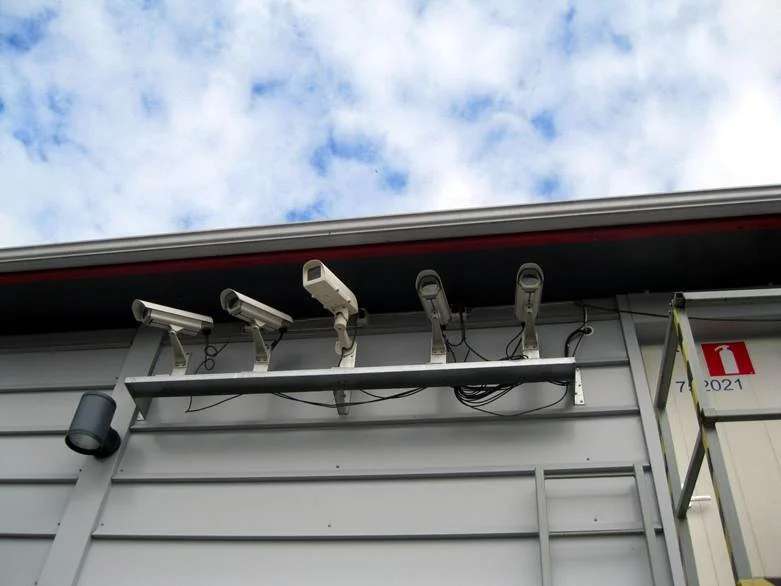
This “dual-use” function of Western technological enterprise — that which allows its products to flow between government and corporate environments with ease — comes from a long lineage of military research that elucidates the contradictions of the ostensibly “free market” that the tech industry is situated in.
It goes back to the privatization of the internet. The person tasked with this historical mission was a military man named Stephen Wolff who worked on early iterations of the internet for the Department of Defense. Later, as Yasha Levine notes in Surveillance Valley, Wolff transferred the tech he helped develop for the Pentagon into a new structure — creating with public funds “a dozen network providers out of thin air” that were then spun off into the private sector, “building companies…that would become integral parts of the media and telecommunications conglomerates we all know and use today — Verizon, Time-Warner AT&T, Comcast” and more.
This transformation, which produced the modern Internet, embedded in civilian society a dependency on what was actually a weapon of the national security state. It would soon become ubiquitous, extending the reach of this surveillance infrastructure into virtually every sector of public life. That legacy lives on today, as the line between the public and private sectors of technological development continuously proves to be virtually nonexistent — only officially separating entities that, in reality, are intimately connected.
Facial recognition technology — whose development was funded by the U.S. government, and is rumored to have been funded by the CIA — emerged out of this very context. Indeed, beyond Clearview and Oosto, a variety of additional facial recognition firms boast their own ties to the national security state.
FaceFirst, which uses its software for “airport security, retail theft deterrence, VIP customer recognition, and counter-terrorism,” is Airborne Biometrics Group’s facial recognition product. Airborne Biometrics Group, according to Security Info Watch, was a “venture-funded spin-off” of Airborne Technologies, Inc., “a worldwide supplier of precision structural components and assemblies for military and commercial use for more than a quarter-century.” Like Clearview, the system works by linking pictures to “existing image databases” for individual identification.
Clarifai, which advertises itself to retail buyers, partners with NVIDIA and Amazon — both of whom contract with the U.S. military. Their CEO is Matthew Zeiler, a colleague of Yann LeCun, Meta’s Chief AI Scientist that was once in communication with Epstein to work on a research project nicknamed the “Epstein brain.” In 2020, the company was working on a secret Pentagon project that utilized “machine-learning algorithms to interpret drone-surveillance imagery” on a Project Maven contract. Those working on the operation, notably, were strictly prohibited from discussing the project with other employees.
Then, there is the case of the facial recognition firm Raptor Vision, which has been used at Kroger and Albertsons. Its president, Paul Gain, was the founder of the CMStat Corporation, which “delivered enterprise systems to NASA, Boeing, Lockheed Martin, General Dynamics, Rolls-Royce, and the U.S. Military,” according to Gain’s LinkedIn.
Veesion, which has been used by Key Food, Food Town and Ace Hardware, is a French company founded by Benoît Koenig, Thibault David and Damien Ménigaux. The trio were students from the graduate program at École Polytechnique, which is “supervised” by the French Ministry of Armed Forces and has partnered with Google.
Lexius, an AI-powered security software that connects to existing cameras, detects “suspicious behavior in real time, such as item concealment in aisles,” and immediately sends alerts to “security team’s mobile devices, enabling discreet, proactive responses…” The software is used by the luxury grocery store Erewhon in Beverly Hills — and has already made its leadership “addicted” to surveilling customers through the software. Lexius came to fruition with seed capital from Y Combinator, the Sam Altman- and Peter Thiel-linked startup accelerator and venture capital firm.
Though companies often pitch their facial recognition technology as commercial products — manipulatively erecting a barrier between their ostensible civilian usage and military applications — virtually the entire industry is tied to America’s security apparatus.
As ICE utilizes facial recognition technology to store the records of dissidents and perceived enemies of the state in secret databases, this technology’s function, whether situated in the toolkit of federal agents or in the security room at Wegmans, becomes even more evident. By empowering the owners of technology and their collaborators to profile average people wherever they go, the elite class is carefully studying, and exercising control over, an increasingly unsatisfied population.
While legal reforms, such as those being enacted by legislators like Shahana K. Hanif and Linda B. Rosenthal, are important battlegrounds for change, the intention of the ruling class to reinforce the conditions of their own power will certainly not dwindle. As this struggle for power persists, the Tech class and its allies will make use of the tools in its arsenal — surveilling, profiling and tracking us, and everything we do, along the way.
The post The Rise of the Military Retail Industrial Complex appeared first on Activist Post.
If there is one job that no Austrian Economist will take up at this juncture, it would be that of the Federal Reserve Chair. The road ahead seems to be set in stone, and in a society that has been sold the idea that “printing currency units is a panacea to all problems” for nearly 45 years, doing the opposite is an invitation to get lynched. It is near certain that Kevin Warsh would go down in history as the Fed Chair who presided over the demise of the dollar. Perhaps as infamous as Gideon Gono, who presided over the Zimbabwean dollar’s hyperinflation.
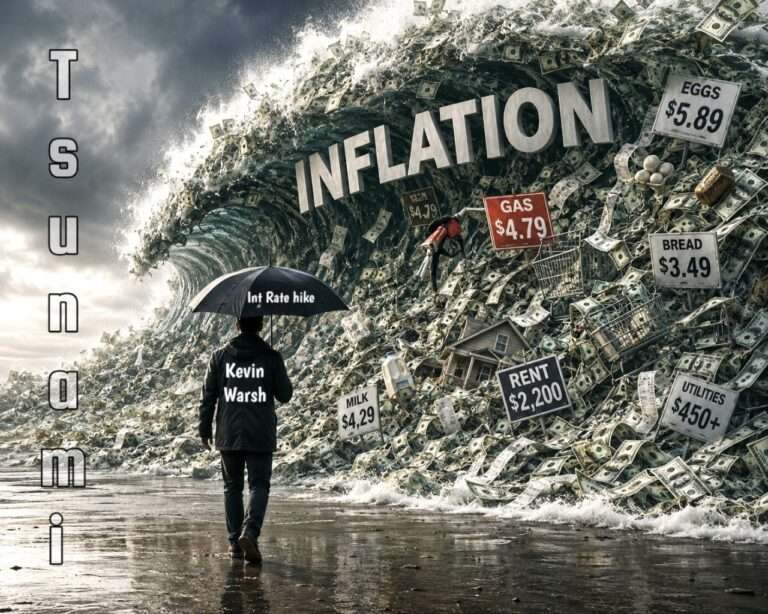
Can anything be done at this point to prevent the imminent demise of the dollar? Of course, yes, and the advice would be no different from what the then Treasury Secretary Andrew Mellon suggested to Herbert Hoover in 1929: “Liquidate labor, liquidate stocks, liquidate the farmers, liquidate real estate. It will purge the rottenness out of the system”.
Of course, Hoover ignored Mellon’s sensible advice and turned what ought to have been a short, severe recession into the prolonged Great Depression of 1929 to 1946. Hoover pursued the most interventionist policies after the 1929 stock market crash, though by the standards set by subsequent U.S. presidents, Hoover might appear like a Laissez-faire Economist. Forget the Federal Reserve or the US Treasury, we don’t have an Andrew Mellon anywhere in the US administration today. The one Republican in the House of Representatives who understands these issues is Thomas Massie, and Trump is desperately trying to get him defeated in the primary. Not that one person can make a difference in the grand scheme of things. But this suggests that Trump is likely to adopt a policy framework equivalent to “Hoover on steroids”. Given the problems and the likely solution that would be pursued, the end result cannot be anything other than a high-inflationary economic depression.
The Inflationary Spike Ahead
Make no mistake – the price inflationary spike that lies ahead is a structural phenomenon that has been in the works for a few decades. Perhaps even from 1971 onwards. Attributing this to the Iran War or even Biden / Trump 1.0, notwithstanding the culpability, would be a genuine understatement of the problem.
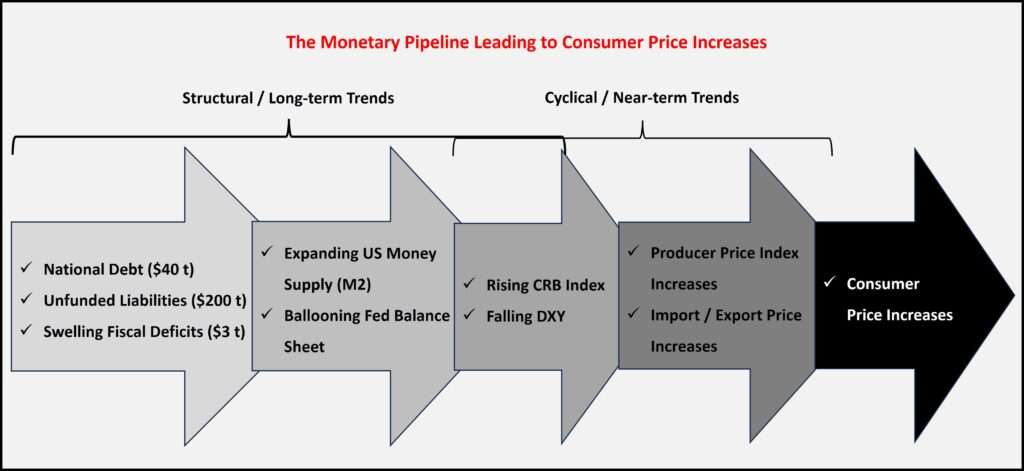
The monetary pipeline, as outlined above, ultimately leads to galloping price inflation and a loss of confidence in the currency. While with most currencies the translation of a weak fiscal policy into higher consumer prices occurs within a few years, in the case of the US, by virtue of its status as the world’s reserve currency, the translation has indeed taken a while. The US was able to export its monetary inflation, thereby giving its citizens a much higher standard of living than what their production ought to have enabled. This also necessarily meant that the standards of living of the non-US residents were suppressed by an artificially strong US dollar. That this narrative is nearing its end must be obvious to most.
The structural issues, i.e., the National debt, the trend of increasing fiscal deficits, and the money supply, have been extensively described in the media, and so I am not going to expand on them here. That said, a line on the recent increases in M2 might be worth recording. By March 2026, the US Money Supply M2 had recorded 25 straight monthly increases, which cannot bode well for the future purchasing power of the US Dollar.
What is of greater interest are the near-term factors that are aligning with the structural tailwinds of a loose fiscal and monetary system.
Even these two factors – DXY and the CRB Index – while more often than not translate into higher consumer prices, could still take 6 to 12 months to take effect. Better leading indicators are increases in the producer price index and import/export prices. These are also not subject to the usual CPI tweaks (hedonic adjustments, substitutions, etc.). And this is where the evidence is most damaging on what lies immediately ahead.

These numbers are monthly changes and clearly point towards substantially higher consumer prices in the next few months. We should not be surprised by double-digit, or at least high single-digit, consumer price increases by Q3 2026, even with all the juggling in the CPI calculations.
What Will Warsh Do?
What can he do? Can he hike interest rates by several hundred basis points to combat the surging price inflation? What will that do to the multi-asset hyper bubbles in housing, bonds, and AI stocks? I don’t think there’s any chance of doing anything close to what is necessary. And even a couple of hundred basis point hikes may not be sufficient at this juncture. Remember, Volcker had to offer a real interest rate of 8% to combat the price inflation of the 1970s. Even a nominal 8% yield on the Fed funds rate is not even under theoretical consideration for the US today.
Kevin Warsh is walking into an Inflationary Tsunami armed with nothing more than an Umbrella.
The Gold Redemption
The treasury market had it correct. The 30-year treasury rate crossed 5% for the first time in nearly 20 years. Although the rates are much too low for what lies ahead, Treasury rates are at least moving in the right direction. Albeit much too slowly, as bond investors will soon realize.
Gold is, however, moving in the wrong direction as compared to what the fundamentals ought to dictate. Both the structural and near-term factors point towards substantially higher gold prices. What Kool-Aid the gold traders have drunk, we will never know. But the current low prices are temporary, and the redemption is just months away. If not weeks.
We will witness much higher than $6000/oz later this year and multiples thereof in the years ahead.
The post Kevin Warsh – Walking into an Inflationary Tsunami appeared first on Activist Post.
A respected human rights activist has spoken repeatedly against the US-Israeli aggression on Iran. She recognizes the illegality of the war and does not shy away from condemning it in clear terms. Yet, almost invariably, she feels compelled to qualify her position, reminding her audience that Iran has killed “tens of thousands of protesters” during recent anti-government demonstrations.
The number itself is highly questionable. Even widely cited figures from international reporting – such as Reuters coverage in January 2026 – place the death toll of the protests in the thousands, not tens of thousands. But the issue here is not the exact number, nor even the complex context of those protests, which began as genuine expressions of discontent but were later exploited by various external and internal actors seeking to destabilize the country.
The issue is the qualification itself.
Many who consider themselves progressive, anti-war, liberal, or even leftist seem unable to take a clear moral position on US and Israeli actions in the Global South without inserting these qualifications. The habit may appear harmless, even responsible, but in reality, it is deeply damaging. It is not a sign of nuance – it is a symptom of a deeper moral hesitation.
By qualifying their condemnation, these voices neutralize their own position. They suggest, whether intentionally or not, a form of moral equivalence: the US-Israeli war on Iran is wrong, but Iran is also guilty; the genocide in Gaza is horrific, but Palestinians are also to blame. The result is not balance – it is paralysis.
Compare this to the moral clarity of those who support war. Their position is never qualified. It is assertive, absolute, and often built on exaggeration or outright falsehoods, yet it carries conviction because it does not undermine itself.
This pattern is not new. It is deeply rooted in the history of Western political discourse. From the atomic bombing of Hiroshima, which was justified as a necessary act to save lives, to the Cold War military interventions in places like Guatemala in 1954, where regime change was framed as a defense against communism, the language of morality has consistently been used to legitimize violence.
The invasion of Iraq in 2003 offers one of the clearest examples. Saddam Hussein was presented as the ultimate embodiment of evil – the “new Hitler” – while the United States and its allies were cast as liberators.
Indeed, American officials spoke openly of being “greeted as liberators,” even as the country was plunged into chaos and extreme violence. A few years later, then-US Secretary of State Condoleezza Rice described the devastation created by the Israeli war on Lebanon in 2006 as “the birth pangs of a new Middle East,” reducing immense human suffering to a necessary step in a grand geopolitical transformation.
This tradition extends even further back, to the era of colonialism, when European powers justified conquest through supposedly humanitarian missions. The abolition of slavery, for example, was frequently invoked as a moral justification for colonial expansion in Africa, recasting domination as benevolence and violence as a civilizing duty. Killing, in this paradigm, happens in the name of saving; destruction is presented as progress.
Israel has long operated within this same framework. Its wars have consistently been presented as existential and necessary for the survival of democracy and civilization itself.
Long before the emergence of Hamas, Palestinian resistance was framed through shifting labels that served the same purpose. During the 1936–39 revolt, Palestinian fighters were described in British and Zionist discourse as “terrorists,” “brigands,” and “gangs.” In later decades, the label shifted – from nationalist fighters to communists to Islamists – but the underlying logic remained unchanged: the enemy is always illegitimate, and therefore any violence against them is justified.
Many of us recognize this pattern, yet instead of exposing its fallacies, some continue to operate within it, searching for a “balanced” position while still presenting themselves as anti-war or even pro-Palestinian. They acknowledge Israeli crimes but feel compelled to condemn Palestinian “terrorism.” They oppose Israeli policies yet insist on distancing themselves from Hamas and the others, as if Palestinian resistance exists outside the historical and political reality that produced it. They speak of “extremists on both sides,” as though figures like Itamar Ben-Gvir and a Palestinian fighter in Gaza can be meaningfully compared.
Such positions may seem defensible in isolation, but they become far less convincing when viewed in other contexts. Following the attacks of September 11, 2001, the United States demanded – and received – unconditional solidarity. The same was true after the July 7, 2005, bombings in London and the January 7, 2015, attack on Charlie Hebdo in Paris. In those moments, there was no expectation that victims first be contextualized or that solidarity be qualified. Millions expressed support without hesitation, without disclaimers, without the need to prove moral balance.
This standard does not apply to others. It does not apply to Iran, Iraq, Afghanistan, Venezuela, or certainly not to Gaza.
In case you are wondering: the US-Israeli war on Iran has already killed 3,753 people and wounded around 26,500 since February 28, 2026. If Americans were to experience this at the same scale, it would amount to roughly 12,000 dead and 85,000 wounded – equivalent to four 9/11s in terms of deaths alone, and injuries on a scale far exceeding that tragedy.
In Gaza, the scale is even more staggering. Over 72,000 Palestinians have been killed, more than 172,000 wounded, and at least 10,000 remain missing—many likely buried beneath the rubble. The true number is widely believed to be significantly higher. Scaled to the United States population, this would translate to approximately 10.2 million dead, over 24.4 million wounded, and more than 1.4 million missing – around 3,400 separate 9/11 attacks
And yet, even in the face of such overwhelming numbers, the impulse to qualify remains.
For many Western activists, this qualification functions as a form of protection. It allows them to maintain a sense of moral authority within their own societies without risking their professional or social standing. By condemning violence while simultaneously distancing themselves from the victims, they occupy a safe middle ground – one that appears principled but ultimately changes nothing.
This is not merely a question of rhetoric; it reflects a deeper structural problem. Even those who oppose war often do so within a framework shaped by the very systems of power they claim to challenge. Their language, however critical it may sound, still echoes the moral grammar of empire.
As the late Palestinian intellectual Edward Said wrote in his essay “The Essential Terrorist”, “terrorism” has “acquired an extraordinary status in American public discourse” and has “displaced Communism as public enemy number one,” providing a flexible label through which enemies are constructed and violence against them normalized.
In the same vein, critics of so-called “humanitarian intervention” have long argued that the language of human rights itself has been repeatedly mobilized to justify war, transforming moral concern into a convenient instrument of domination rather than a genuine challenge to it.
Without honesty, without context, and without the courage to speak clearly, the conversation cannot move forward. The constant need to qualify – to balance, to soften, to distance – does not advance justice. It obscures it.
So the next time one finds oneself condemning the genocide in Gaza or the US-Israeli aggression on Iran, it is worth resisting that impulse. There is no need to dilute the truth in order to make it acceptable. There is no need to neutralize one’s own moral position in order to appear reasonable.
And if that cannot be done – if condemnation must always come with conditions – then perhaps it is better to remain silent.
The post The Cowardice of Qualification: When Anti-War Voices Speak the Language of Empire appeared first on Activist Post.
Executive Summary:
Foreign citizens have been signing contracts with the Russian Ministry of Defense (MOD) since November 2022. Since then, foreigners from at least 48 countries have joined the ranks of the Russian military. On February 26, Russian President Vladimir Putin further institutionalized this system by signing a law that prohibits the extradition of foreigners who have signed contracts to fight for the Russian Armed Forces (Government of Russia, February 26). Foreigners can additionally now apply for Russian citizenship on the basis of having participated in Russia’s war against Ukraine (Government of Russia, November 5, 2025; The Moscow Times, March 8). These measures only make official what has long been a reality. Russian private military companies (PMCs), paramilitary groups, and other non-state armed groups, in particular, have long sought out foreign recruits to bolster their numbers. Russia’s 2022 full-scale invasion of Ukraine, originally intended to be over within ten days, has turned into a war of attrition. To sustain the war effort and avoid a full domestic mobilization, the Russian military has taken a page out of the PMC playbook and embraced foreign recruits. Ethnic Serbs make up the vast majority of those recruited from Europe, and are unique amongst all foreign contractors for having fought for Russia since its initial invasion of Ukraine in the spring of 2014 (Vazhnye Istorii, April 23, 2025).
In the fall of 2025, journalists from the Balkan Investigative Reporting Network (BIRN) gained access to private Telegram groups where recruiters attempt to lure Serbs to join the Russian army in Ukraine. The BIRN journalists found that prospective recruits were indeed being offered Russian citizenship and lucrative contracts to join the armed forces. While posing as interested recruits, the journalists were told that “Davor” would meet them at Moscow’s Vnukovo Airport and serve as their commander during training (Balkan Insight, October 30, 2025). Based on the photos they received, the journalists confirmed that the person they were speaking to was Davor Savičić.
Savičić, a Bosnian Serb, is one of the most prominent foreign members of the Russian PMC Wagner. Leaked Russian MOD documents, furthermore, list Savičić as a colonel in the Main Intelligence Directorate of the General Staff (GRU), demonstrating his ties to formal military channels (Radio Svoboda, February 27, 2025). According to regional reporting, Savičić commands a Serb unit within Wagner named “Wolves,” which took its name from his nom de guerre “Wolf” (novosti.rs, April 17, 2016; Balkan Insight, April 22, 2016; Slobodna Evropa, November 6, 2023).
Savičić comes from the first generation of Balkan recruits who joined Russia’s burgeoning paramilitary sector in 2014. This generation is distinguished by its combat and criminal experience during the Yugoslav wars in the 1990s. He has also played an important role in recruiting a new generation of Balkan fighters for Russia since 2022. This new generation lacks the combat experience of the first, but is nonetheless motivated to join Russia’s war for monetary or ideological reasons, and often joins PMCs and other paramilitary groups that contain large ethnic Serb contingents. Investigating the background, role, and methods of recruiters like Savičić is therefore important for understanding the opaque yet significant Russian paramilitary network, particularly since formal Russian security and military institutions continue to adapt and expand these methods.
Yugoslav Wars
According to data from the UK and Ukrainian governments, Savičić was born on October 1, 1980, in the town of Banovici, Bosnia and Herzegovina (War and Sanctions; UK Government, accessed March 20). Very little is known about his upbringing, but after the outbreak of the Yugoslav wars (1991-2001)—like many young men of Serb descent coming of age during the 1990s—he participated in paramilitary violence on behalf of the Serbian government.[1] Bosnian police records and local media suggest that Savičić was a member of the infamous Serb Volunteer Guard (Serbian: Srpska dobrovoljačka garda/Српска добровољачка гарда; SDG) during the Bosnian War (1991-1995), supposedly going by the callsign “Elvis” (Balkan Insight, April 22, 2016; December 27, 2017; Dobojski.info, October 19, 2023; klix.ba, November 4, 2024, Radio Sarajevo, November 8, 2024). The group, founded by Željko “Arkan” Ražnatović and better known as “Arkan’s Tigers,” was supported by Serbia’s State Security Service (Serbian: Služba državne bezbednosti, Служба државне безбедности; SDB) and was responsible for numerous massacres and war crimes in Bosnia and Croatia (Radio Slobodna Evropa, June 20, 2023). Savičić’s age, however, makes his participation in the Bosnian War and membership in the SDG unlikely. He would have been 11 at the beginning of the war, and only 15 by the end; too young to have had any significant role in hierarchical paramilitary groups. The SDG, moreover, was disbanded in 1996, leaving little time for him to have joined after the war (Balkan Insight, March 23, 2023). Despite doubts over his presence in the Bosnian War, Savičić likely fought in the Kosovo War (1998-1999) as a member of the Special Operations Unit (Serbian: Jedinica za specialne operacije, Јединица за специјалне операције; JSO).
The JSO was created in 1996 by merging paramilitary groups with the SDB. The group was placed under the oversight of Jovica Stanišić and Franko Simatović, then-head and deputy-head of the SDB, respectively (BBC News, March 26, 2003; Vreme, September 7, 2006). Serbian and Bosnian media outlets—as well as Bosnian police records—mention Savičić as a former member of the JSO (Vreme, April 2, 2003; republika.rs, October 17, 2017; avaz.ba, July 20, 2020; nova.rs, November 6, 2023). Kosovar media have additionally named Savičić as one of the perpetrators of the Panda Bar Massacre on December 14, 1998 (Telegrafi; Albanian Daily News, August 4, 2020; kosovapress.com, December 14, 2021). It has long been speculated that Serbian operatives were behind the massacre, but as of yet, no progress has been made in the court case (Balkan Insight, December 14, 2018).
Savičić’s violent escapades seemed to continue after the end of the Kosovo War. Savičić—along with three other former JSO members—was accused of planting a bomb that killed six people in Berane, Montenegro, in 2001 (dan.co.me, September 14, 2022). He fled the Balkans shortly after and was tried in absentia before being sentenced to 20 years in prison. Montenegrin police and Interpol tracked him across Europe over the subsequent years, but were never able to arrest him (Vreme, April 2, 2003; Balkan Insight, December 27, 2017).
It is difficult to confirm any single accusation due to the intentionally vague and informal nature of paramilitary units. The amount of reporting from various regional sources—including material from before his time with Wagner—however, provides greater confidence in assessing his participation in non-state violence. In any case, Savičić’s future role in Wagner seems to confirm his paramilitary past.
Fighting in Syria
After evading Montenegrin police for 15 years, Savičić resurfaced in 2016. The Russian investigative outlet Fontanka was the first to report on the presence of private mercenaries fighting on behalf of then-president Bashar al-Assad in Syria. Through conversations with Wagner mercenaries, Fontanka learned that Savičić was commanding an international, albeit predominantly Serb, Wagner battalion and that his relationship with Russian mercenaries dated back to before 2014 (Fontanka, March 29, 2016). Savičić initially denied fighting in Syria or Ukraine, stating that he was simply in the construction business. After providing him with their evidence, however, Fontanka’s journalists learned that he had fought for Russia in Luhansk, Ukraine, in 2014. This confirmed the rumors of a Serb battalion within Wagner’s precursor, the Slavic Corps, that had been circulating since Russia’s initial invasion of Ukraine in 2014 (Novaya Gazeta, February 8, 2023).
In March 2016, Syrian forces took back the city of Palmyra from Islamic State (IS) (Al Jazeera, March 27, 2016). Following Fontanka’s investigation, Britain’s Telegraph newspaper analyzed photos, social media posts, and Iranian, Russian, and Syrian media coverage of the March 2016 Palmyra Offensive. The Telegraph determined that the assault on the city was mainly led by Wagner and the 10th Brigade of GRU special forces, and that Savičić’s platoon was indeed present at the battle (The Telegraph, April 9, 2016).
Full-Scale Invasion
Savičić has taken on a much more prominent role since Russia’s full-scale invasion of Ukraine in 2022. Savičić initially participated in the invasion and claimed that his battalion fought near Kyiv in Hostomel. The leaked Russian MOD database and a war correspondent Telegram channel further confirm that he was hospitalized after a shrapnel wound to his right shoulder in June 2022, somewhere in Eastern Ukraine (Telegram/@SrbijaRusija, February 16, 2025; Radio Svoboda, February 27, 2025). He has seemingly moved to a full-time recruiter and trainer role since then.
On August 21, 2023—almost two months after former Wagner leader Yevgeny Prigozhin’s failed rebellion against the Russian MOD—Savičić appeared on the famous Russian propagandist and TV personality Vladimir Solovyov’s show (see EDM, June 26; July 11, 2023). Savičić pitched his battalion and sought to calm fears about Wagner’s future during the appearance, stating, “I want to invite both Russians and Serbs … The unit is operating and will continue to operate.” In a likely attempt to dissuade suspicions from Russian authorities of his role in Prigozhin’s rebellion, he further stated, “We are now officially signing a contract with the Russian Ministry of Defense. Soldiers go through the Krasnogorsk military registration and enlistment office.” Savičić appeared on the program with another Serb, Dejan Berić, who added that “Most of the foreign volunteers in the Russian army are from Serbia” (Telegram/@SolovievLive, August 21, 2023).
Recruitment Pipeline
Foreign mercenary work is illegal in the three main countries Savičić recruits from: Serbia, Montenegro, and Bosnia and Herzegovina (Council of Europe, February 26, 2024; Balkan Insight, October 31, 2025). Savičić is likely able to help recruits avoid local police, however, by procuring temporary workers’ permits under the guise of construction work. In fall 2023, the BBC Russian Service obtained a phone call between Savičić and unnamed officials in Moscow, in which Savičić promised to recruit up to 1,000 Serbian nationals who would form their own battalion as part of the 106th Tula Airborne Division (BBC Russian Service, October 6, 2023). In the Russian business database RusProfile, the construction company “Wolf Group LLC” lists Davor Savičić and Raiko Batskovich as its owners (RusProfile, Accessed April 20). The company was established in December 2023, shortly after Savičić declared his plan for a Serb airborne battalion.
RusProfile also lists Batskovich as the founder of the company “Monte Gradnya” (RusProfile, Accessed April 20). A Serb recruit, “Dragan,” who agreed to talk to Radio Svoboda about his experience in the Russian army, shed light on this company. He showed Radio Svoboda a photo displaying a contract he signed before going to Russia. The contract stated that he went to Russia to work for “Monte Gradnya” and disclosed nothing about his joining the Russian army. Dragan said he was instructed to show this to the Serbian authorities to avoid any trouble (Radio Svoboda, September 23, 2024). This scheme seems to be widespread. In 2023, the mother of a Serbian volunteer fighting for Russia told the BBC that her son “works at a construction site” (BBC Russian Service, October 6, 2023). Bosnian police have also mentioned this scheme, telling BIRN journalists that they believe recruits are often “registered as temporary workers in Russia to avoid prosecution at home as foreign fighters” (Balkan Insight, April 22, 2016).
It is impossible to confirm with complete certainty that Wolf Group LLC is used as a front to grant foreign mercenaries workers’ permits. The company’s founding date and connections with Batskovich, however, provide strong evidence to support this conclusion. Additionally, Savičić’s 2016 statement that he is in Russia for construction work suggests he has been using this loophole for at least a decade.
Conclusion
Speaking at a gathering of local Serb leaders in 1991, then-president of Serbia, Slobodan Milošević, announced his intention to foster paramilitary units, stating, “The government has an assignment to prepare additional groups which will make us safe and enable us to defend the interests of our republic, but also the interests of Serbs outside Serbia” (Detektor.ba, June 28, 2021). During the Yugoslav wars, paramilitary groups worked closely with Serbian intelligence, military, and political leaders, despite Milošević’s continued denials of cooperation. Russia’s own deployment of paramilitary and non-state armed groups seems to have taken much from Serbia’s example.
The rise and fall of Prigozhin—and the subsequent subordination of Wagner under the GRU—mirrors the fate of Arkan and his unit’s absorption into the SDB (Gow, 2003; Vazhnye Istorii, September 8, 2023). [2] The usefulness of those like Savičić to Russian security leaders is therefore unsurprising. His experience in kinetic war and covert criminal and sub-state operations in the Balkans proved valuable for Russia’s goals in Ukraine and Syria. For example, Wagner members who spoke with Fontanka stated that Savičić was highly valued by his superiors for his extensive battlefield experience and that he received his nom de guerre “Wolf” due to his strength and courage in combat (Fontanka, March 29, 2016; Balkan Insight, April 22, 2016). His connections with the criminal underworld and among security services in both Russia and the Balkans, however, are arguably more consequential.
Savičić seems to have recently become involved in recruiting operatives for intelligence operations as well. On February 24, Colombian officers arrested Denis Alimov at El Dorado International Airport in Bogotá, responding to an Interpol Red Notice filed by the Southern District of New York. Alimov, a veteran of Russia’s Federal Security Service (FSB), has been a senior member of the GRU’s newly established Center 795 unit since 2023 (Vazhnye Istorii, March 13). An FBI investigation revealed that Alimov had planned and directed an operation to kidnap or murder two well-known Russian dissidents abroad. He offered Darko Ðurović—a citizen of Serbia and Montenegro living in the United States—$1.5 million to “neutralize” each target (U.S. Attorney’s Office, February 27). It was not immediately clear how Alimov and Ðurović first came into contact, but the inclusion of Savičić in Alimov’s contact list offers a likely explanation (The Insider, March 13). Alimov’s and Center 795’s activities provide yet another example of cooperation between members of Russia’s security sector and individuals from the Balkans. Much of this cooperation would be impossible without those like Savičić—who possess the credibility and established network—serving as the bridge between the two groups.
Leveraging PMCs and other non-state groups for military and intelligence operations has allowed Moscow to bolster its traditional security capabilities and offset vulnerabilities associated with risky operations. Increased reliance on these actors, however, could turn into a liability. Serbia offers a salient case. Milošević’s patronage of the JSO did not cultivate any loyalty towards him or Serbia’s political institutions. During the September-October 2000 protests that led to Milošević’s ouster, the JSO reached an agreement with opposition leaders Vojislav Koštunica and Zoran Đinđić and refrained from intervening on Milošević’s behalf. After becoming the first post-communist prime minister of Serbia, Đinđić focused on combating organized crime and cultivating democratic institutions. These measures directly threatened the JSO, however, and rather than accept democratic reform, the group took action. On March 12, 2003, Zvezdan Jovanović—a JSO veteran—shot and killed Đinđić, derailing Serbia’s path towards democratization (Balkan Insight, March 10, 2023).
Some now estimate that irregular units make up as much as 40 percent of Russian-commanded troops fighting against Ukraine (WOTR, August 22, 2025). In the event of the war’s termination, Moscow will likely find it difficult to manage these groups’ place in society. Prigozhin’s mutiny proved short-lived, and the subsequent merger of Wagner into formal structures has so far stabilized the most notable of these units. As Serbia’s history shows, however, these groups will likely remain loyal to Moscow only if they continue to receive lucrative contracts and access to criminal revenue. The assassination of PMC Espaňola leader Stanislav Orlov by Russian security forces in December 2025 underscores Moscow’s continued suspicion of these groups (see EDM, January 29). Paramilitary veterans such as Savičić have become a vital—if often unseen—pillar of Russia’s war effort, but if the political winds ever change, the question of their continued loyalty to Moscow will be worth monitoring.
Notes:
[1] The term “Yugoslav wars” refers to the separate but related conflicts that occurred following the breakup of Yugoslavia. These conflicts were notable for the proliferation of paramilitary and other non-state armed groups. For example, it is estimated that as many as 83 paramilitary groups operated during the Bosnian War, with 56 on the “Serbian side,” 13 on the “Croatian side,” and 14 supporting the Bosnian government. For the “Serbian side” specifically, see Iva Vukušić, Serbian Paramilitaries and the Breakup of Yugoslavia: State Connections and Patterns of Violence. Abingdon-on-Thames, UK: Routledge, 2023. ISBN 9781032044453 (hbk); ISBN 9781032044477 (pbk). 230pp.
[2] James, Gow. The Serbian Project and Its Adversaries: A Strategy of War Crimes. McGill-Queen’s University Press, 2003. http://www.jstor.org/stable/j.ctt130hhk5.
The post Davor Savičić: Bosnian Serb Recruiter for the Wagner Group appeared first on Jamestown.
Vous savez, la Loi de Programmation Militaire (LPM) 2024-2030, c’est ce gros chèque de 413 milliards d'euros que l'État s’est signé pour s'acheter des jouets neufs. Mais entre deux chars Leclerc et un sous-marin, nos chers législateurs ont glissé quelques petites pépites technologiques bien croquantes. C’est la technique du salami : on ne vous enlève pas votre liberté d'un coup, on la coupe en tranches si fines qu’on ne sent rien... jusqu'à ce qu'il ne reste plus que la peau.
Deviens ton propre souverain
No spam. Unsubscribe anytime.
Le clou du spectacle, c’est cet article 18, déterré lors de l'actualisation de 2026. À la base, l'algorithme et sa surveillance (c'est-à-dire la fouille complète mais à distance de votre ordinateur, ni vu ni connu), c'était « uniquement pour le terrorisme », nous jurait-on la main sur le cœur. Mais voilà, le terrorisme, c’est tellement 2015. En 2026, l’astuce, c’est de l’étendre à la « criminalité organisée ».
C'est génial, non? Comme le périmètre de la criminalité organisée est à peu près aussi vaste que l'ego d'un ministre, on peut désormais passer au peigne fin les connexions de n'importe qui pourvu qu'on soupçonne un trafic de stupéfiants ou d'armes. La Quadrature du Net appelle ça un « cheval de Troie liberticide », et franchement, ils n'ont pas tort. On automatise le soupçon : si vous marchez à contresens dans une foule ou si vous avez le malheur de consulter des sites un peu trop « curieux », l'algorithme Artemis IA vous fait un petit clin d'œil.
Et cerise sur le gâteau de la surveillance : on restaure l'usage des adresses URL complètes. Avant, on savait juste que vous étiez sur Google. Maintenant, l'État veut savoir si vous cherchez « comment manifester sans se faire gazer » ou « recette du gâteau au chocolat ». C’est pour votre sécurité, bien sûr. Dormez tranquilles, l’œil de Moscou est devenu l’algorithme de Paris.
Pour gérer tout ce bazar, on a créé l'AMIAD (Agence ministérielle pour l'IA de défense). 300 millions d'euros par an pour entraîner des modèles sur un supercalculateur classifié. Le but? Relever le « mur de données ». Parce que voyez-vous, les services de renseignement croulent sous vos mails, vos tweets et vos historiques de navigation. C’est dur, la vie d'espion. Artemis IA est là pour trier tout ça. On nous promet que l'humain reste dans la boucle... mais l'humain, face à une machine qui traite des pétaoctets à la seconde, il ressemble de plus en plus à un stagiaire qui essaie d'arrêter un tsunami avec une petite cuillère.
Mais la palme de la créativité législative revient à « l'état d'alerte de sécurité nationale », introduit en 2026. C’est le petit nouveau de la famille des régimes d'exception. On n'est pas en guerre, on n'est pas tout à fait en paix, on est dans un entre-deux flou qui permet de réduire les obligations environnementales et d’urbanisme pour construire des infrastructures de défense (ou de surveillance) en urgence.
C’est le rêve de tout préfet : pouvoir dire « circulez, y’a rien à voir, c’est l’alerte nationale ». On vous demande même de déclarer vos compétences jusqu’à vos 50 ans, au cas où la Nation aurait besoin de votre génie en informatique pour coder le prochain algorithme de flicage.
Le Courrier des StratègesÉric VerhaegheEt qui contrôle tout ça? La CNCTR. Une commission qui rend des avis que le Premier ministre suit... quand ça l'arrange. Elle s'inquiète, elle alerte, elle dit que le curseur se déplace dangereusement. Mais bon, entre une alerte de la CNCTR et la promesse d'un « risque zéro », le politique a vite choisi.
Publication du rapport d'activité 2024 | CNCTROn nous explique que « la sécurité est la première des libertés ». C'est marrant, j'aurais juré que c'était la liberté qui était la première des sécurités. Mais que voulez-vous, je dois être vieille école. En attendant, continuez de sourire : vous n'êtes pas seulement filmés, vous êtes calculés.
Veerle Daens, votre dévouée chroniqueuse (sous surveillance).
Le taux d’échec des requêtes vers la messagerie Telegram a atteint 100 %, selon les données de detector404.ru. Auparavant, ce
L’article La messagerie Telegram ne fonctionne plus en Russie est apparu en premier sur STRATPOL.
Au menu cette semaine: 00:00 Géopolitique profonde 06:09 Économie 15:50 Politico-diplomatique 26:45 Armement 29:13 Empire du mensonge 30:50 Considérations militaires
L’article Bulletin STRATPOL N°284: Sénégal vs gauche LGBT, Kallas sort du bunker, Tsahal vs Hezbollah. 02.04.2026 est apparu en premier sur STRATPOL.
Au menu cette semaine: 00:00 Géopolitique profonde 09:35 Économie 22:05 Politico-diplomatique 30:03 Terrorisme 33:45 Armement 37:10 Empire du mensonge 40:35
L’article Bulletin STRATPOL N°283: JOE KENT, STARLINK russe, Iran : l’escalade. 27.03.2026 est apparu en premier sur STRATPOL.
Rami Abou Jamous écrit son journal pour Orient XXI. Dans ce texte, Rami raconte l'aïd à Gaza, qui n'a plus rien à voir avec ce qu'il était avant la destruction de ce territoire. La guerre livrée par Israël a également profondément changé la structure de la société, isolant désormais les membres des familles qui vivaient en communauté.
Vendredi 20 mars 2026.
Aujourd'hui, c'est l'Aïd, la fête qui marque la fin du ramadan. D'habitude, les nombreux préparatifs se font plusieurs jours à l'avance, dans la joie. On confectionne des maamoul, des gâteaux à la semoule fourrés de dattes ou de pistaches. Chaque famille offre des assiettes de pâtisseries à ses proches et à ses amis. On achète du chocolat, et surtout, des habits neufs pour les enfants. C'est aussi la joie des repas communs dans les « immeubles familiaux », ces maisons où le père et la mère cohabitent avec les familles de leurs fils, qui habitent chacun à un étage.
À présent, tout cela n'existe plus. La majorité des familles sont dispersées. Elles sont désormais réduites à la famille nucléaire, ce qui n'est pas dans nos traditions. Nombre d'entre elles n'ont pas de gaz pour préparer les maamoul. Et le génocide continue à bas bruit. Jeudi encore, il y a eu deux morts dans le quartier Zeitoun, et deux dans le quartier de Chajaya, ciblés directement par l'armée d'occupation. Leurs familles se préparaient à faire la fête, elles se retrouvent brusquement en deuil.
Pour la grande majorité des habitants de Gaza, c'est aussi un aïd dans la pauvreté. Je suis allé avec Walid dans un supermarché pour acheter du chocolat. Mon fils a désormais quatre ans, c'est la première année où il comprend vraiment ce que veut dire l'aïd. On lui a expliqué la signification de la fête au jardin d'enfants. Comme tous les enfants, il pense évidemment aux plaisirs qui l'accompagnent : les jouets, les habits et le chocolat. Il m'a demandé : « Papa, c'est l'aïd, on peut aller acheter du chocolat ? » Je l'ai emmené dans ce qu'on appelle ici un mall (centre commercial), c'est-à-dire un supermarché qui s'étend sur une superficie entre 500 et 1 000 mètres carrés. Quelques-uns sont encore debout.
Il y avait beaucoup de chocolats et de pâtisseries, mais à des prix très élevés. Seulement quelques mamans accompagnées de leurs enfants poussaient des caddies remplis de sucreries et de jus de fruits. Rien à voir avec l'affluence d'avant-guerre les jours de fête, où l'on attendait longtemps devant les caisses tellement il y avait de monde. Ces clients ne sont pas du tout représentatifs de la population de Gaza. Ils appartiennent à la minorité qui dispose d'un revenu régulier, parce qu'ils travaillent pour des ONG internationales, par exemple.
Il y a aussi ceux qui reçoivent de l'argent de l'étranger. Moi, je travaille, je reçois un peu d'argent pour mes articles et mes sujets audiovisuels. Je reçois aussi de l'aide de la part de quelques amis, et de mon frère qui vit aux États-Unis. Sans cela, je ne pourrais pas vivre une existence à peu près normale, qui me permet d'acheter du chocolat et des vêtements à mon fils. Des choses qui étaient à la portée de tout le monde et qui sont devenues des privilèges.
Devant l'une des caisses, les gens qui faisaient la queue avaient l'air plus fatigué, moins bien habillés que les autres. Ils donnaient l'impression de fréquenter ce mall pour la première fois depuis longtemps. Le caissier m'a dit que cette file était réservée à ceux qui avaient reçu des coupons des associations caritatives, d'une valeur de 200 à 300 shekels (de 55 à 83 euros). Le kilo de chocolat coûte entre 80 et 140 shekels (entre 22 et 40 euros). Cette somme leur permet donc d'acheter deux kilos de chocolat. Cela peut paraître beaucoup, mais, à Gaza, avec nos familles nombreuses, c'est le strict minimum si l'on compte aussi qu'il faut en offrir à d'autres familles, selon l'usage.
J'étais tout de même content de voir les sourires ravis des enfants, tenant chacun dans leurs mains un petit sachet de chocolat. Mais les bénéficiaires de coupons sont peu nombreux. Les associations n'ont pas les moyens d'en fournir à tout le monde. D'autres Gazaouis reçoivent des dons de ceux que l'on appelle ici les « influenceurs », des gens qui lancent des appels à la charité internationale sur les réseaux sociaux. Là encore, c'est une goutte d'eau dans l'océan, et pour une bonne raison. Nombre de ces influenceurs ne sont pas honnêtes, ils gardent l'argent pour eux. On les reconnaît à leurs vêtements de luxe et à leur façon de balancer ostensiblement leurs téléphones portables dernier cri – ils valent une fortune à Gaza - en descendant de leurs 4x4 à plus de 100 000 dollars (plus de 85 000 euros) devant les supermarchés. On dirait qu'ils ne vivent pas dans le même monde que nous.
Ces images de queues dans les supermarchés ne reflètent pas la vie à Gaza. À quelques mètres des malls, c'est la souffrance silencieuse : des tentes, des gens qui dorment à même la rue, dans des maisons à moitié détruites ou dans les ruines. Et d'autres queues, cette fois devant les citernes, où des enfants attendent de remplir un jerrican d'eau non potable, ou devant les quelques tekiyas, ces cuisines caritatives où ils patientent, une casserole à la main, pour avoir quelque chose à manger à la fin de la journée, en général du riz ou des pâtes. Si les tekiyas n'ont pas été livrées, les gens ne mangent pas. Beaucoup de Gazaouis souffrent toujours de malnutrition, alors qu'il y a tout ce qu'il faut dans les épiceries, mais à des prix exorbitants.
Devant ces épiceries, devant les boutiques de vêtements, des enfants regardent avec envie les cadeaux qu'ils ne recevront pas. Des centaines de milliers d'enfants. Ils me rappellent la petite marchande d'allumettes du conte de Hans Christian Andersen, que j'avais lu à l'école primaire, quand je vivais en Tunisie. Cette petite fille miséreuse, à la rue, n'osait pas rentrer chez elle, car elle n'avait pas réussi à vendre les allumettes confiées par ses parents. Pour se réchauffer, elle craquait chaque allumette et la lumière lui faisait voir, dans une hallucination, tout ce qu'elle n'avait pas : un foyer chaleureux, un repas de fête… J'avais bien sûr été touché par son destin, mais je ne pouvais pas m'identifier à elle, moi qui avais une famille aimante et une maison. Maintenant, je comprends mieux son histoire, parce que je sens la misère des autres, parce que je la vis avec eux.
Depuis le début de la guerre et jusqu'ici, nous étions tous à peu près égaux. Même ceux qui avaient de l'argent ne trouvaient rien à acheter. Aujourd'hui, les Israéliens laissent passer, à dessein, tout ce qui est devenu pour nous un luxe — une tablette de chocolat, des vêtements ou des chaussures —, et que peu de gens ont les moyens de s'offrir.
Les organisations internationales commencent à être très mal vues également ici. On reproche à beaucoup d'entre elles d'utiliser notre souffrance pour leur communication et leur financement, en montrant sur les réseaux sociaux des images de Gazaouis souriants devant un sac de nourriture. Nous trouvons cela humiliant. Parfois, ces initiatives se soldent par des fiascos retentissants. Pendant le ramadan, une association a voulu organiser un iftar géant pour dix mille personnes, qui aurait fourni des vidéos spectaculaires. Mais les repas sont arrivés la veille, et, comme il n'y avait pas où les garder au frais, ils se sont gâtés. Il a fallu tout jeter.
Dans la plupart des cas, la distribution est chaotique, certains récoltent des dons à plusieurs reprises, d'autres jamais. Les critiques montent aussi contre les influenceurs, les associations et les commerçants qui augmentent leurs prix.
Pour les parents, ne pas pouvoir offrir à leurs enfants les cadeaux de l'aïd, alors qu'ils sont à portée de main, est un crève-cœur. Pour ma part, j'ai pu offrir des chocolats et des bonbons à Walid, et quelques vêtements : un pantalon, un gilet chaud et une veste qui lui va bien. Mais des centaines d'enfants sont en train de vivre la vie de la petite marchande d'allumettes. Pour beaucoup d'entre eux, il n'y pas d'aïd. Leur seul espoir, c'est de ne pas se coucher le ventre vide en ce jour de fête. Leur plus beau cadeau serait une casserole remplie de pâtes.
Fondateur de GazaPress, un bureau qui fournissait aide et traduction aux journalistes occidentaux, Rami Abou Jamous a dû quitter en octobre 2023 son appartement de Gaza-ville avec sa femme Sabah, les enfants de celle-ci, et leur fils Walid, trois ans, sous la menace de l'armée israélienne. Ils se sont réfugiés à Rafah, ensuite à Deir El-Balah et plus tard à Nusseirat. Après un nouveau déplacement suite à la rupture du cessez-le-feu par Israël le 18 mars 2025, Rami est rentré chez lui avec sa famille le 9 octobre 2025.
Au menu cette semaine: 00:00 Géopolitique profonde 11:10 Économie 23:25 Politico-diplomatique 36:55 Terrorisme 40:22 Armement 43:30 Empire du mensonge 45:10
L’article Bulletin STRATPOL N°282: Iran, l’enlisement ? Barrot devant les tribunaux, candidat 2026. 20.03.2026 est apparu en premier sur STRATPOL.
La série égyptienne Sohab Al-Ard (« Les Maîtres de la terre »), produite par une société proche du régime pour le ramadan de cette année, se déroule en pleine guerre génocidaire à Gaza. Objectif : faire oublier la passivité du Caire et absorber la colère d'une population plus que jamais hostile à Israël.
Dans le paysage des feuilletons qui, chaque année, sont produits pour la période du ramadan, la production égyptienne Sohab Al-Ard (« Les Maîtres de la terre ») a créé la surprise cette saison. Tournée au Caire dans un décor réaliste, avec un budget conséquent et un casting important, la fiction, d'une durée de 15 épisodes, prend pour cadre la bande de Gaza pendant la guerre génocidaire.
Réalisée par l'Égyptien Peter Mimi et produite par la société United Media Services, la série raconte l'histoire de Nasser Radwan, un jeune Gazaoui dont le rôle est interprété par l'acteur jordanien Eyad Nassar. Nasser vit dans le nord de la bande de Gaza. Alors qu'il part de chez lui pour trouver un endroit où il y a du réseau pour contacter ses trois filles qui vivent en Cisjordanie, l'immeuble où il vit avec sa famille est bombardé. Son frère Oussama et sa famille sont tués, mais son neveu, Younes, survit, blessé. Commence à partir de là l'histoire de son sauvetage, avec le concours de Salma, une médecin égyptienne qui exerce temporairement à Gaza, interprétée par Menna Shalaby, nominée aux International Emmy Awards 2021 dans la catégorie Meilleure actrice pour son rôle dans la série Every Week Has a Friday. Le tout au rythme des déplacements de la famille de Nasser vers le sud de l'enclave, à travers les paysages lunaires et sous des bombardements incessants.
La société United Media Services, qui produit la série, voit le jour en 2016 suite à la fusion de la société D Media et de l'Egyptian Media Group, une entreprise proche des services de sécurité. C'est cette société qui avait produit, entre 2020 et 2022, la série Al-Ikhtiyar (Le Choix), du même réalisateur. Les trois saisons revenaient, en épousant le récit officiel, sur les opérations de l'armée dans le Sinaï, la destitution du président Mohammed Morsi en 2013 et le mandat de ce dernier.
Sans aller à dire que la série a été commandée par l'État, une chose est sûre : elle s'est faite avec sa bénédiction. Le but était sans doute d'effacer de la mémoire collective le scandale de la société Hala, qui avait gagné des millions de dollars en faisant payer le passage au poste-frontière de Rafah, avant sa fermeture et sa destruction par l'armée israélienne en juin 2024 : d'abord fixé à 10 000 dollars (près de 8 700 euros) pour toute personne cherchant à fuir le génocide, le tarif de passage a été ensuite de 5 000 dollars (près de 4 350 euros) pour les adultes, et la moitié de cette somme pour les enfants et les nourrissons. Sans doute aussi que Le Caire cherche à restaurer son image après que sa passivité face aux massacres à Gaza a été jugée comme un abandon total des Palestiniens.
Si le réalisateur Peter Mimi a eu la perspicacité de ne pas chercher à embellir de manière explicite l'image du régime, l'épisode final s'en est largement chargé. Au lieu d'un dernier morceau de fiction, le quinzième et dernier épisode de la série a été curieusement consacré à la diffusion du documentaire La Clé du retour des frères Karim et Amir El-Shenawy. Ce film suit des bébés prématurés arrivés de Gaza en Égypte dans un état critique, et dont la plupart ont été sauvés par les services hospitaliers qui les ont accueillis. On y voit également le président Abdel Fattah Al-Sissi au Sommet de la paix de Charm El-Cheikh, le 13 octobre 2025, déclarant : « Je vous souhaite la bienvenue au Sommet de paix de Charm El-Cheikh, en ce moment historique crucial, où nous avons été témoins ensemble de l'Accord de Charm El-Cheikh mettant fin à la guerre à Gaza et faisant naître une lueur d'espoir. Cet accord clôt un chapitre douloureux de l'histoire de l'humanité. »
La série prend soin de mettre en scène les principaux événements qui ont marqué la guerre contre Gaza entre 2023 et 2025, dans un souci presque documentaire. Elle montre par exemple le siège de l'hôpital Al-Widyan, dans le nord de Gaza — seul nom fictif de la série, contrairement à ceux des familles, des rues, des institutions et des quartiers. La scène fait référence au siège de l'Hôpital indonésien de Beit Lahia, également dans le nord, qui a duré plusieurs jours en novembre 2023. De même pour le meurtre de médecins, l'enlèvement de civils, les bébés prématurés abandonnés dans leurs couveuses, les orphelins qui peuplent les rues bombardées, et bien sûr, la famine. Avec, çà et là, quelques moments de joie, eux aussi inspirés de faits réels, comme la célébration d'un mariage palestinien traditionnel, ou la détermination des réfugiés à prendre avec eux leurs animaux de compagnie à chaque déplacement forcé.
Si le réalisateur et son équipe ont restitué ces événements avec minutie, ils n'ont toutefois guère laissé de place à la fiction, collant à la réalité. Une position regrettable surtout pour une guerre largement couverte par les millions de vidéos diffusées sur les réseaux sociaux et les chaînes d'information. La série aurait pu gagner à se concentrer davantage sur les histoires des personnages, pour susciter l'empathie et l'intérêt des téléspectateurs.
Malgré tous ces efforts, des critiques ont estimé que la série minimisait le génocide, le cantonnant à un récit héroïque et à des personnages fictifs peu représentatifs de la réalité de la bande de Gaza. Parmi ces voix critiques, il y a celle de l'écrivaine gazaouie Samaher Al-Khazendar, qui vit toujours sur place. Elle écrit ainsi sur sa page Facebook :
Aujourd'hui, j'ai regardé l'épisode qui montre le largage d'aide humanitaire. J'ai pleuré à chaudes larmes, non pas parce que la scène était réaliste, mais parce qu'elle était édulcorée. Si vous vouliez dépeindre une scène reflétant véritablement nos souffrances, vous auriez dû interroger ceux qui ont vécu ces jours sombres. Vous auriez dû filmer les parachutes flottant au-dessus des caisses en pleine mer, les gens déchirés par le désespoir en les voyant sombrer sous leurs yeux, ou ceux qui risquent leur vie pour les récupérer sous le feu ennemi, ou encore les caisses qui tombent sur les tentes et les déchirent, les corps de ceux que ces largages ont tués. Vous auriez dû montrer les enfants affamés et les mères devenues folles par la faim et le deuil.
Au lieu de cela, les scènes de largage d'aide humanitaire semblaient vouloir remettre au goût du jour un panarabisme désuet, avec les États voisins qui viendraient en aide aux Gazaouis. Autre scène de propagande, devenue virale sur les réseaux sociaux : celle où l'on voit un chauffeur égyptien, interprété par l'acteur Essam El-Sakka, au volant d'un camion d'aide humanitaire, flanqué du drapeau égyptien, tenter d'entrer à Gaza. Il se heurte d'abord à des Israéliens qui essaient d'entraver son passage, mais il finit par réussir.
Depuis la série Al-Taghriba (« L'Exode ») du réalisateur syrien Hatem Ali, diffusée pendant le mois du ramadan en 2004 et produite par la Syria International for Artistic Production, les Palestiniens n'ont pas eu droit à une série qui reflétait véritablement leur vécu. Avec Sohab Al-Ard, l'émotion était tout de même au rendez-vous pour eux, surtout lors des premiers épisodes. Mais l'effet s'estompe ensuite pour laisser place à un récit qui se concentre sur le sauvetage d'un enfant dans les couloirs d'un hôpital, sans médicaments, anesthésiques, ni électricité, et où le suspense éloigne parfois l'histoire de la réalité de la guerre.
L'une des raisons de ces manquements tient à la volonté des créateurs de la série d'éviter tout sujet potentiellement controversé. Ainsi, la fiction ne fait aucune mention ni de l'abandon de Gaza par le monde arabe, ni de l'absence d'aide humanitaire, ni des retards dans son acheminement en raison du blocage israélien. Elle n'évoque pas non plus le Hamas, qui est tout simplement absent à l'écran et des dialogues entre les différents personnages. La série évite même d'aborder les événements du 7 octobre 2023. Un évitement qui s'explique à la fois par l'hostilité du réalisateur et de la société de production à l'encontre des Frères musulmans, dont relève le Hamas, et par leur désir de donner une image lisse des Palestiniens.
Sohab Al-Ard se concentre exclusivement sur la crise et sur le sort du peuple gazaoui, en cherchant à éviter tout conflit politique. Elle dépeint le Palestinien comme un être vaincu, défait, qui a peur de se réjouir, qui cherche à fuir et l'assume, et qui n'a pas choisi son destin dans le contexte de ce carnage.
Enfin, la série n'essaye pas d'échapper à la vision romantique de la Palestine, à travers la figure de l'éternel réfugié palestinien, incarnée par le grand-père, chassé par la Nakba et qui conserve encore la clé de sa maison en attendant le retour. Or, ce thème relève davantage de l'imaginaire arabe de la cause palestinienne que de la réalité. Ce que la plupart des familles de réfugiés palestiniens conservent en réalité, ce sont leurs titres de propriété et leurs actes de naissance délivrés en Palestine, avant l'exode de 1948, pour ceux qui ont pu emporter ces documents avec eux.
Symbole touchant toutefois : des hommes, des femmes et des enfants de Gaza, résidant actuellement en Égypte, ont joué dans la série aux côtés d'acteurs de renom, comme l'acteur palestinien de l'intérieur Adam Bakri, fils du regretté acteur Mohammad Bakri.
Au menu cette semaine: 000:00 Géopolitique profonde 06:04 Économie 16:00 Politico-diplomatique 24:05 Terrorisme 29:43 Armement 30:05 Empire du mensonge 38:49
L’article Bulletin STRATPOL N°281: Crise énergétique, Troupes au sol, Trump appelle Poutine. 13.03.2026 est apparu en premier sur STRATPOL.
Alors que débute le mois de ramadan de l'année 1447 du calendrier hégirien, Akram Belkaïd publie une touchante introspection sur son expérience intime de jeûne. Il saisit là matière à explorer les sens pluriels que prend cette période de spiritualité et de consommation parfois frénétique pour les musulmans du monde.
Dans les médias français, le mois de ramadan est fréquemment présenté comme un problème public. Il est l'objet de controverses absurdes qui reviennent comme des marronniers. Élèves et travailleurs musulmans qui manqueraient de concentration, sportifs manquant de « jus », espaces halal dans les supermarchés jugés envahissants, ou incivilités nocturnes dans les « quartiers » : ces thèmes révèlent le rapport fantasmé d'une partie des élites au quatrième pilier de l'islam. À l'inverse, les injonctions religieuses et l'aspect parfois démonstratif des appels au respect du jeûne diurne par certains acteurs musulmans desdits « quartiers » ou sur internet occultent trop souvent la part intime de ce mois sacré.
C'est tout le mérite des Chroniques du ramadan d'Akram Belkaïd que de mettre en lumière la dimension affective que charrie le ramadan. Par là même, l'auteur délaisse les controverses et les instrumentalisations et se place à vie d'homme et de femme — croyant ou non. Il précise :
Il n'y a rien d'étrange ni de mystérieux dans le fait de jeûner durant le mois de ramadan. Pas de rite obscur, pas d'incantation ésotérique, pas d'intention violente ou de volonté prosélyte. La chose est très simple et personnelle. Rien de plus.
L'humour parfois caustique d'Akram Belkaïd, rédacteur en chef du Monde diplomatique et membre du comité de rédaction d'Orient XXI, redonne au ramadan, ce « fait social total » comme aurait pu le décrire le sociologue Marcel Mauss, sa polysémie. Ni uniquement incantation religieuse, ou moment de spiritualité, ni seulement coquille culturelle vidée de sens, le ramadan est tant de choses à la fois. Il est aussi une fête dont il convient de (re)trouver le sens, y compris politique.
La succession des vingt chroniques, l'usage de la première personne et la sagacité éprouvée de ces observations en font un ouvrage accessible. Sans réel début ni fin, il conviendra de picorer dans les chapitres à sa guise et en fonction de son appétit ou de sa soif du moment. Akram Belkaïd alterne entre la légèreté quand il décrit le consumérisme ou les « trucs » déployés par certains jeûneurs pour ne point trop changer leurs habitudes, et la gravité quand il se demande ce qu'il est encore possible de célébrer après les dizaines de milliers de morts de Gaza.
L'on retiendra tout d'abord combien l'exploration de ce mois sacré révèle une ambivalence entre ses dimensions universelles et particulières. Fait indéniablement mondialisé, le ramadan évolue constamment sous l'effet de phénomènes de « créolisation ». Les chroniques d'Akram Belkaïd ici publiées rappellent ce qu'il y a de commun entre un iftar, repas de rupture du jeûne, à Mascate, à Argenteuil et à Alger. Dans le même temps, chacune de ces expériences ramadanesques, qu'elle se déroule place Monge, dans le 5e arrondissement de Paris, ou dans le désert égyptien, est marquée par l'intime, un contexte politique et toute une série de singularités.
Ainsi le ramadan est-il une porte d'entrée pour appréhender les sociétés, mais aussi les individus, les comparer dans leurs pratiques quotidiennes, tout en préservant une part de joie et de bonheur. Reconnaissons que l'état du monde ne nous offre actuellement guère l'opportunité de nous montrer légers. C'est là aussi un atout de ce « voyage intimiste au cœur du jeûne ». Sa dimension humaniste — et donc indéniablement politique — transparait dans chaque page et le fait qu'il s'achève par une surprise culinaire n'en est que plus délectable.
La succession des chroniques de l'auteur nourrit aussi une réflexion sur la place de la religion dans la société française. À rebours des discours politiques qui cherchent à imposer un effacement du religieux, surtout — et parfois seulement — quand il est musulman, les Chroniques du ramadan ici présentées illustrent combien la spiritualité contemporaine ne s'efface pas. Seul son sens et ses manifestations se transforment. Le ramadan décrit et vécu par l'auteur s'inscrit aussi dans un contexte français, dans une histoire parfois plus longue que certains voudraient bien nous le faire croire et qui n'en fait pas un objet importé ou étranger.
La vivacité de la pratique du jeûne par les musulmans, sous des formes variées et très souvent individualisées, en fait l'incarnation de processus contemporains qui recomposent la part du religieux. Ceux-ci concernent également juifs et chrétiens ainsi que des adeptes d'autres formes de relations au divin. Les nouvelles générations, dont le rapport souple à la laïcité est souvent stigmatisé par leurs aînés en France, s'inscrivent dans un rapport distinct au spirituel et à ses manifestations quotidiennes. La valorisation inattendue du carême sur les réseaux sociaux catholiques, la mise en avant de formes de judéité qui mettent l'État israélien à distance incarnent des quêtes de sens qui sont autant personnelles que collectives. Elles peuvent être surprenantes, contre-intuitives, mais elles ne sont pas nécessairement le signe d'une irrationalité croissante ou d'un obscurantisme qui vient. L'affirmation de la banalité du mois sacré de ramadan, à travers les expériences singulières d'Akram Belkaïd, est dans ce cadre une contribution pertinente, et donc loin d'être anecdotique, à la compréhension de notre époque.
Le mot ramadhān désigne à l'origine le neuvième mois du calendrier lunaire musulman que l'on appelle aussi « calendrier de l'Hégire ». Pour mémoire, le point de départ de ce calendrier, autrement dit la date fondatrice de l'ère musulmane, est l'émigration — hijra ou Hégire — du prophète Mohammed de La Mecque vers Médine, le 13 septembre 622. Le mois de ramadan qui débute cette année le 6 juin 2016, selon l'apparition visible du croissant lunaire, est celui de l'année 1437.
Par glissement sémantique, le mot en est venu à désigner autant le mois que le jeûne qui doit s'y accomplir. Ainsi peut-on entendre des expressions comme « faire (le) ramadan », qui signifie « faire le jeûne du ramadan ». Cette remarque vaut pour nombre de parlers arabes, notamment au Maghreb où ce mot désigne implicitement le jeûne. À titre anecdotique, il arrive encore que l'on dise au Maghreb « faire carême » pour dire que l'on jeûne pendant le ramadan. En effet, durant la période coloniale, les Européens d'Algérie appelaient souvent — et à tort — le jeûne du ramadan « carême des musulmans ». Un dicton arabe bien connu où le ramadan est clairement identifié comme mois dit qu'il ne faut pas « mettre le ramadan avant chaabane », ce qui équivaut à « mettre la charrue avant les bœufs. »
Durant cette période de ving-neuf à trente jours, les musulmans sont appelés, entre autres, à jeûner de l'aube jusqu'au coucher du soleil. De manière concrète, ce jeûne — sawm ou siyam — consiste à ne pas manger ni boire. Il est accompagné par une abstinence sexuelle, par l'obligation de ne pas mentir, de ne pas proférer d'injures, de chasser les pensées « impures » et de façon générale, de ne pas commettre de mauvaises actions. Le non-respect de ces obligations invalide le jeûne. Les femmes enceintes, les malades et les voyageurs sont dispensés de jeûner, à charge pour eux de rattraper, quand ils le pourront, les jours non jeûnés. Le premier jour qui suit la fin du mois de ramadan est celui de l'Aïd-el-Fitr, autrement dit « fête de la rupture du jeûne », appelée aussi « l'Aïd el-saghir », le petit Aïd, par opposition à l'autre grande fête religieuse, l'Aïd el-kebir (grand Aïd) ou encore Aïd el-Adha « fête du sacrifice ».
Le mois de ramadan, situé entre les mois de chaᶜbān et de chawwāl est le seul du calendrier hégirien à être cité dans le Coran. La sourate II, dite de « La génisse », détaille ses prescriptions sur plusieurs versets1 (elles ont aussi été complétées par al-Sunna, la Tradition). L'un d'eux, très connu, indique qu'il est permis de manger et de boire (la nuit) jusqu'à ce que l'on puisse distinguer à nouveau « un fil blanc d'un fil noir » (II-183).
Mangez et buvez jusqu'au moment où un fil blanc peut être distingué d'un fil noir, à l'aube. Observez alors une abstinence totale jusqu'à la nuit.
(trad. Hamza Boubakeur).
Sur le plan étymologique, le mot ramadhān, qui peut être donné comme nom ou prénom, vient de la racine arabe r-m-d. Si ses significations sont multiples, elles tournent autour de l'idée de chaleur, du fait d'être brûlant, des cendres nées de l'incendie ou encore des fournaises de l'été. À l'origine, ce mois se situait en été, car le calendrier lunaire comportait des périodes intercalaires de façon à le rendre fixe par rapport au calendrier solaire. Mais aujourd'hui, le calendrier hégirien suit les cycles lunaires et « recule » donc chaque année de dix à onze jours. Ainsi, le ramadan 1438 devrait commencer le 25 ou 26 mai 2017.
Sur le plan religieux, l'importance du ramadan ne vient pas simplement du fait que ses prescriptions sont détaillées dans le Livre saint. C'est, en premier lieu, le quatrième pilier de l'islam avec la profession de foi, la prière, l'aumône et le pèlerinage à La Mecque pour celles et ceux qui en ont les moyens. C'est durant la deuxième année de l'installation du Prophète à Médine que le jeûne est devenu obligatoire. À l'époque, cette pratique n'était pas inconnue des habitants de la péninsule Arabique dont certains étaient de confession juive ou chrétienne.
Pour les musulmans, jeûner n'est pas un acte de pénitence, mais une forme d'auto-purification à la fois physique et spirituelle, ainsi qu'un moyen de faire acte de solidarité avec les nécessiteux. Pour de nombreux croyants, c'est aussi une ascèse qui permet l'élévation spirituelle et l'affirmation collective de la foi.
En second lieu, le ramadan est aussi important sur le plan religieux parce que, au-delà du jeûne, il est le mois durant lequel a débuté la révélation coranique. En effet, c'est durant la « nuit du Destin » ou « nuit de la Destinée », laylat al-qadr, que le Coran a commencé à être transmis au Prophète. Il est communément admis, selon la tradition, que cette nuit « meilleure que mille mois » et où « descendent [sur terre] les anges ainsi que l'Esprit » (XCVII : al-Qadr, 1-2) se situe dans les nuits impaires des dix derniers jours de ramadan. Traditionnellement, la « nuit du vingt-septième » [jour] revêt beaucoup d'importance. Elle est l'occasion de soirées spéciales, de réunions de dévotion et d'invocations dans les mosquées ou dans d'autres lieux. C'est le moment à partir duquel on peut verser l'aumône propre au ramadan, zakat al-Fitr, qui tient son nom du fait qu'elle se fait lors de ou plus exactement avant l'Aïd el-fitr (ᶜId al-Fitr, « fête de la Rupture [du jeûne]) laquelle équivalait à près de 5 euros par personne en France en 2015. Dans de nombreux pays, c'est l'aboutissement des concours de récitation du Coran, tandis qu'il est de tradition de pratiquer la circoncision des garçons. Enfin, ce vingt-septième jour est souvent celui où les jeunes enfants « s'essaient » au jeûne pour la première fois.
Le ramadan a aussi une importance à la fois religieuse et historique. C'est respectivement le mois de la prise de La Mecque par le Prophète en l'an 8 de l'Hégire (630), celui de la naissance de Hussein, le petit-fils de Mohammed ou celui de la mort de Khadija, sa première épouse. Plus important, c'est durant le mois de ramadan que les musulmans ont enregistré, durant la bataille de Badr, leur première victoire militaire contre leurs ennemis mecquois en l'an 2 de l'Hégire (624). Cela a son importance, car c'est, entre autres, ce repère historique que des groupes extrémistes musulmans rappellent quand ils entendent justifier leur regain d'activisme et la multiplication d'actions violentes pendant le ramadan.
Au-delà de l'aspect religieux — chaque soir, les croyants sont invités à accomplir des prières surérogatoires, ou tarāwīh — le ramadan est une période très contrastée. Le soir, après la rupture du jeûne (iftār) qui correspond au moment de l'appel à la prière « du couchant » (maghrib), l'activité sociale est intense. C'est ainsi que le mot ramadan a donné naissance au terme français de « ramdam », signifiant une grande agitation, et non sans une teinte péjorative : « vacarme ». Regroupements des familles autour de repas conséquents avec de nombreux plats traditionnels, ballets incessants de voiture, cafés pris d'assaut, veillées, manifestations culturelles, diffusions de feuilletons à succès par les télévisions, émissions et causeries religieuses, programmes de divertissements, tout cela se retrouve dans la majorité des pays musulmans. Ces dernières années, une tendance nouvelle est née, venue des pays du Golfe : longtemps cantonné au domicile familial, l'iftar ainsi que le sa/uhūr, la « collation » de fin de soirée ou même de fin de nuit, se prennent de plus en plus, pour celui qui en a les moyens, dans de grands hôtels ou des restaurants qui dressent des buffets débordants de nourriture. Il arrive même que ces repas soient sponsorisés par de grandes entreprises.
Dédié à l'abstinence, ce mois est aussi celui des gaspillages, du surcroît de consommation et du ressenti exacerbé d'inégalités d'autant plus mal vécues que les prix des denrées tendent presque toujours à augmenter. Veillant à ne pas aggraver les tensions sociales, les autorités des pays concernés tentent d'éviter les pénuries et de garantir aux plus démunis un approvisionnement bon marché, toutefois, pour certains foyers, ce mois demeure synonyme de difficultés financières et d'obligation de s'endetter pour assurer des repas rompant avec l'ordinaire, comme consommer de la viande tous les soirs. À cela s'ajoute le fait que l'activité économique est à ses plus faibles niveaux durant la journée dans ces pays. L'effet conjugué du jeûne et du triple manque de caféine, de nicotine et de sommeil fait que les entreprises et les administrations des pays musulmans tournent au ralenti, au grand dam de celles et ceux qui rappellent que le ramadan ne doit pas signifier le seul fait de se préoccuper de nourriture. Durant l'été, période où la productivité n'est jamais très élevée, l'impact négatif du ramadan sur l'activité ne change guère la donne. En revanche, pour les prochaines années, le mois de jeûne va de plus en plus coïncider avec des mois plus tempérés et cela pénalisera l'économie, même si la consommation en sort toujours stimulée.
Enfin, et cela concerne surtout les pays du Maghreb, des mouvements de non jeûneurs revendiquent régulièrement le droit de pouvoir manger en plein jour sans avoir à se cacher et, plus encore, sans avoir à craindre d'être poursuivis par la police. Ces contestataires, peu nombreux, rappellent qu'il fut une époque, notamment dans le monde arabe, où ne pas jeûner (certes discrètement) ne constituait pas une offense ni un délit pour les autorités ou aux yeux de la société.
1Le Coran indique l'objectif du jeûne de ramadan : "Ô les croyants ! On vous a prescrit le jeûne comme on l'a prescrit à ceux d'avant vous, ainsi atteindrez-vous la piété." [Sourate II - Verset 183].
« L’agence n’a rien à ajouter aux informations déjà publiées à ce sujet », a déclaré Roskomnadzor. Selon les sources
L’article Telegram entre ralentissement et blocage définitif en Russie est apparu en premier sur STRATPOL.
Une réunion du Groupe de contact de Ramstein de l’OTAN sur l’Ukraine s’est tenue à Bruxelles jeudi. Les premières déclarations
L’article Au premier sommet de l’OTAN de 2026, les pays membres ont répété leur soutien à l’Ukraine est apparu en premier sur STRATPOL.
Executive Summary:
Jihadist and bandit groups in West Africa have expanded and become increasingly bold in their online activities (YouTube/@LeMonde, November 14, 2021). This is necessary to stand out, as the territories and memberships of these groups often overlap. Members of Group for Supporters of Islam and Muslims (JNIM), for example, have opened TikTok channels, where they debate civilians on matters related to their rule and Sharia implementation. This also presents JNIM with opportunities to engage online supporters who seek “liberation” from military junta control (X/@BrantPhilip, December 20, 2025).
JNIM—which conducted its first claimed attack in Nigeria last October—is now officially operational in the country, which is not only the continent’s most populous, but also its third most active population on social media (africa.businessinsider.com, November 4, 2024). Given JNIM’s use of social media, it is not surprising that Boko Haram members, or at least supporters in Nigeria, are also exploiting the app to recruit. One Boko Haram online personality, for example, posted on TikTok last May to praise Bakura Doro, one of the leaders who succeeded the late Abubakar Shekau after his death in 2021. The supporter’s praise of Islamic State in West Africa Province (ISWAP) raised suspicions about whether he was truly a member of Doro’s faction, as ISWAP and Doro are rivals, or whether he was simply “pro-jihad” and promoted any jihadist group in Nigeria regardless of affiliation (X/@ZagazOlaMakama, May 18, 2025). Another more substantiated video of a Boko Haram member emerged one month later in June. He was recorded whipping a fisherman on Lake Chad who had violated the group’s rules, and it was subsequently uploaded on TikTok to show how the group implements Sharia (X/@secmxx, June 7, 2025).
That jihadist groups are now openly propagandizing on TikTok indicates online social media censorship of jihadist media—at least on TikTok in West Africa—is not as stringent now as it has been over the past decade, which could result in recruitment boosts for JNIM, ISWAP, Boko Haram, and other groups as they exploit this social media openness (eff.org, July 12, 2017). In 2013, as Boko Haram began conquering territory in northeastern Nigeria, the group set up a YouTube account in which it released videos of its massacres, including killing dozens of boys in a school dormitory and throwing men down a well and off a bridge after killing them (Unmasking Boko Haram, April 28, 2019. Moreover, the group used Twitter (now X) to advertise its then-growing loyalty to Islamic State (IS), as well as Shekau’s March 2015 pledge of allegiance to caliph Abubakar al-Baghdadi (Unmasking Boko Haram, April 10, 2019). Within a year or two, however, ISWAP was no longer present on mainstream social media platforms and was instead confined to Telegram and other harder-to-access online forums. Yet now, as Bulama Bukarti—a Nigerian lawyer and security analyst who had once been directly threatened by Shekau—noted, “Boko Haram, and other bandit groups, are hosting live TikTok shows – spreading propaganda, justifying their violence and threatening anyone who dares speak against them” (rfi.fr, May 25, 2025).
In Nigeria—in contrast to the Sahel—the security services appear to take the threat of jihadist and bandit exploitation of social media to propagandize and recruit seriously. Evidence that Nigerian security services are monitoring militants’ social media came when they captured one of the northwest’s most violent bandits, Abubakar Usman, in Kwara State on December 19. Although Usman has not been publicly associated with JNIM, the arrest location was near the same village where JNIM carried out its first-ever claimed attack in Nigeria in October (premiumtimesng.com, October 31, 2025).
The weapons and vast sums of money that Usman was seen holding in photos he posted online appear to have prompted the security forces to pay attention to him. Nonetheless, the arrest of Usman may prove to be a one-off even in Nigeria. If not replicated on a larger scale, this will mean bandits and jihadists in Nigeria and further afield in the Sahel will be ceded control over the online battlespace.
The post West African Militants turn to Social Media appeared first on Jamestown.
Euro-American Zionism (Jewish and Christian) has killed millions in West Asia, devastated the region, and it is the motor behind the Gaza Genocide. But Israel itself is under threat of falling pray to the deadly logic that birthed the state in the first place.
Today we are holding a panel discussion on what makes Zionism such a dangerous and ultimately even self-negating force.
I‘m joined by 3 world class academics: Professor Yakov Rabkin of Montreal University, Professor Manuel Ramos of the University Institut of Lisbon, and Professor Jeffrey Sachs of Colombia University.
Rapporteuse spéciale des Nations unies sur les droits humains dans les territoires palestiniens occupés, Francesca Albanese souligne, dans son dernier ouvrage Quand le monde dort. Récits voix et blessures de Palestine, le fossé entre les principes du droit international et la « réalité brutale » des rapports de force sur le terrain. Une réalité aussi explorée dans le documentaire de Christophe Cotteret, Disunited Nations — Proche-Orient : l'ONU dans la tourmente, qui sera diffusé sur Arte le 9 décembre 2025.
Actualisation Par la voix de Jean-Noël Barrot, ministre des affaires étrangères, la France a réclamé, le 11 février 2026, la démission de la rapporteuse spéciale des Nations unies pour les territoires palestiniens, Francesca Albanese, qui aurait déclaré qu'Israël est « l'ennemi commun de l'humanité », lors d'un forum à Doha. Le ministre reprend l'accusation d'une quarantaine de députés macronistes, bien connus pour leurs positions pro-Netanyahou, dont l'inévitable Caroline Yadan. L'ennui est que Francesca Albanese n'a jamais prononcé cette phrase. Il suffit de regarder la vidéo mise en ligne (sur X) pour le vérifier.
Depuis son premier rapport en 2023, elle fait l'objet d'un harcèlement du gouvernement israélien et de Donald Trump. Une fois de plus, le gouvernement français leur emboite le pas.
Quand le monde dort devant l'élimination du peuple palestinien et l'écrasement de Gaza, rien ne doit être négligé pour le secouer, l'obliger à regarder la réalité en face. Francesca Albanese, rapporteuse spéciale des Nations unies sur les droits humains dans les territoires palestiniens occupés, s'est fixé cet objectif, et elle n'en démord pas. Déjà, dans le cadre de sa mission onusienne, elle a publié quatre rapports aux titres fort explicites : « L'Anatomie d'un génocide » (juillet 2023), « L'effacement colonial par le génocide » (octobre 2024), « L'Occupation sans fin, génocide et profits » (juillet 2025) — car, oui, des entreprises, y compris françaises, s'enrichissent du sang des Palestiniens —, « Le génocide à Gaza, un crime collectif » (octobre 2025)1.
Indignée, la rapporteuse spéciale l'est assurément. Pourtant elle ne se départit jamais de sa boussole : le droit international. Non pas un droit désincarné, froid et mécanique. Mais un droit au service des personnes afin de ne jamais perdre de vue l'humanité de chacun et de tous. Un droit qu'elle martèle et qu'elle confronte aux agressions proprement inimaginables, des plus insidieuses aux plus spectaculairement violentes, contre les Palestiniens au quotidien.
Comme en témoigne son dernier livre, Francesca Albanese possède ce talent rare de savoir conjuguer souvenirs personnels et paroles fortes de Palestiniens en lutte pour leur survie ou d'Israéliens en rupture avec la folie meurtrière de leur pays. Sans oublier les retours historiques pour contextualiser les faits et les rappels constants du droit international. Elle arrive ainsi à saisir les plus infimes détails qui révèlent des blessures profondes — celle de ses interlocuteurs mais aussi, toutes proportions gardées, les siennes.
La rapporteuse ne cherche d'ailleurs pas à les cacher. Dans l'introduction, elle trace les grandes lignes de son parcours. Née dans une petite ville montagneuse du sud de l'Italie, rien ne la destinait à devenir une vigie des droits humains des Palestiniens, une lanceuse d'alerte sur le génocide en cours à Gaza. C'est le résultat de ses rencontres, de ses choix, de ses expériences, et singulièrement celle de juriste auprès de l'Office de secours et de travaux des Nations unies pour les réfugiés palestiniens (UNRWA), en 2010. Quelles que soient ses bifurcations professionnelles, la Palestine ne sortira jamais de son horizon.
On le constate à travers cet ouvrage divisé en dix chapitres. Chacun d'entre eux prend le titre d'un personnage remarquable rencontré en Palestine occupée, dont les « récits s'entrelacent avec la vie et les visages de beaucoup d'autres », comme elle l'écrit. Elle prolonge ces histoires personnelles en abordant les grandes questions existentielles (et polémiques) : l'apartheid ; la confusion savamment entretenue entre antisémitisme et critique du pouvoir israélien ; le génocide ; et même le droit humanitaire qui peut aussi faciliter la banalisation de la colonisation…
Ainsi « Hind », titre du premier chapitre, rend compte de l'assassinat de cette fillette de six ans, de sa famille, de l'équipe du Croissant rouge venue lui porter secours2, mais aussi des témoignages de dizaines de vies d'enfants aux paroles bouleversantes que Francesca Albanese a pris le temps d'écouter, encore et encore : « Ils deviennent des adultes dans des corps d'enfants, déjà accablés par les soucis, les peurs, les responsabilités qui ne devraient pas être les leurs. » Elle pointe également les enfants israéliens, biberonnés à la haine des « Arabes », comme ils disent. Un mot générique pour effacer celui de « Palestiniens », ainsi que le souligne George, un ingénieur palestinien, qui donne à voir ce que signifie de vivre dans Jérusalem occupée.
On pourrait aussi citer Abu Hassan et « les conséquences de l'occupation » ; le professeur italo-israélien Alon et l'antisémitisme ; Ingrid et les moult exemples « des subtilités de la normalisation » de l'apartheid au nom de l'humanitaire ; le chirurgien Ghassan et les images insoutenables des patients qu'il recueille ; Gabor et la nécessité de « préserver la mémoire d'un peuple »… Le dixième portrait est consacré à Max, son mari. Vivant à New York, ce dernier prend soin de leurs deux enfants quand Albanese doit voyager. Il assure financièrement la vie de la famille si besoin — car, comme rapporteuse spéciale, elle ne reçoit aucun salaire.
Quand on referme le livre, on songe à ce vers de René Char, « la lucidité est la blessure la plus rapprochée du soleil », celle qui brûle le plus. Francesca Albanese a cette lucidité qui blesse : « Le génocide de Gaza fait désormais partie de notre histoire collective, une tache indélébile qui pèsera sur l'humanité et pour laquelle nos petits-enfants demanderont des comptes ». Elle a aussi un espoir : la prise de conscience des peuples qui, seuls, peuvent soulever des montagnes.
Voilà pourquoi les défenseurs du sionisme et de la colonisation d'Israël en ont fait leur ennemie. Certains la discréditent plus ou moins subtilement, tel l'animateur de la matinale de France Culture, Guillaume Erner, qui, le 18 novembre 2025, lui dénie la qualité de rapporteuse spéciale de l'ONU pour l'habiller en « voix pro-palestinienne »3.
D'autres vont encore plus loin. Ainsi le président des États-Unis, Donald Trump, l'a inscrite sur la liste noire des terroristes, la privant de tous les services d'entreprises étatsuniennes ou de sociétés ayant des liens avec ces dernières, à commencer par les cartes bancaires. Elle est en bonne compagnie, aux côtés du procureur de la Cour internationale de justice Karim Kahn, et de trois autres juges dont le français Nicolas Guillou4, tous abandonnés par les autorités françaises et européennes. C'est aussi cela participer à l'asservissement du peuple palestinien.
Francesca Albanese, était au Forum des images, le 17 novembre 2025, à l'occasion de la présentation du documentaire Disunited Nations — Proche-Orient : l'ONU dans la tourmente, réalisé par Christophe Cotteret [voir encadré orange].
La projection était suivie d'un débat avec la rapporteuse spéciale des Nations unies, Agnès Callamard, secrétaire générale d'Amnesty International, Christophe Cotteret et Johann Soufi, avocat spécialisé en droit pénal international. Modération par Sarra Grira, rédactrice en chef d'Orient XXI.
1Chaque rapport est publié en plusieurs langues sur le site de l'Organisation des Nations unies (ONU)
2Voir le film de Kaouther Ben Hania, La voix de Hind Rajab, 1h52mn, sortie en salle le 26 novembre 2025.
3L'interview, très partiale, a suscité beaucoup de protestations. Lire notamment Pauline Bock, « Erner face à Albanese : retour sur une interview ”radicale” », Arrêt sur image, 22 novembre 2025.
4Stéphanie Maupas, « La vie de Nicolas Guillou, juge français de la CPI sous sanctions des États-Unis : “Vous êtes interdit bancaire sur une bonne partie de la planète” », Le Monde, 19 novembre 2025.
Je souhaite partager avec vous le destin d’un homme portant un nom bien connu, mais dont la mémoire, en raison de circonstances politiques, a été reléguée dans l’oubli obscur de l’histoire. J’en profite donc pour sauver de l’oubli une vie, une damnatio memoriae, et pour brosser, aussi brièvement et injustement que ce soit, sa biographie extraordinaire.
L’article Mario, l’autre Gramsci, en « camicia nera » (chemise noire) est apparu en premier sur Strategika.
La menace d’une intervention militaire américaine au Nigeria n’a pas grand-chose à voir avec la protection des chrétiens, mais tout à voir avec la politique intérieure américaine et les jeux […]
The post Le Nigéria dans le collimateur : démêler le vrai du faux face à la crise imminente appeared first on Investig'action.
Putin remains focussed on achieving a new Europe-wide security architecture, writes Alastair Crooke.
Alastair Crooke: Strategic Culture
Trump’s attempt to build a ‘Budapest scenario’ (i.e. a Putin-Trump summit grounded on the earlier Alaska ‘understanding’) was unilaterally cancelled (by the U.S.) amid acrimony. Putin had initiated the 2.5 hr Monday call. It reportedly contained tough talking by Putin about the lack of U.S. preparation towards a political framework – both in respect to Ukraine, but crucially also in respect to Russia’s wider security needs.
However, when it was announced by the American side, Trump’s proposal had reverted (yet again) to the Keith Kellogg (the U.S. Ukraine Envoy) doctrine of a ‘frozen conflict’ on the existing Contact Line preceding any peace negotiations – not vice versa.
Trump must have known well before the Budapest talks were mooted that this Kellogg doctrine had been rejected, time after time, by Moscow. So why did he repeat the demand for it again? In any event, the Budapest summit scenario had to be cancelled after the pre-agreed ‘set-up’ call between Foreign Minister Sergey Lavrov and Secretary of State Marco Rubio ran up against a wall. As Lavrov again insisted that a Kellogg-style ceasefire in place would not fly.
It seems that the U.S. Administration expected that its threats to supply Ukraine with Tomahawk missiles amid toughening U.S. rhetoric of deep strikes into Russia would be pressure enough to have Putin agree a freeze in the here and now format, with all discussion of details and a wider solution postponed, sine die.
Russian military analysts reportedly told Putin that Trump’s threats were bluff — even if the Tomahawk supplies were made available, the quantity would be limited and would not inflict any tactical or strategic defeat on Russia.
The course of events implies that either Trump did not grasp this Russian ‘reality’ – despite two years of repetition that Russia would not budge on a ‘here and now freeze’. Or alternatively, that the ‘dark money’ interests came down hard on Trump, telling him that a real peace process with Russia was not allowed. So Trump cancelled the whole scenario, muttering to the media that a Budapest meeting would have been “a waste of time” — leaving his Administration (U.S. Treasury Secretary Bessent) to announce new sanctions on Russia’s largest oil companies, accompanied by a call to allies to join with them.
Let us recall – the ‘Russian’ reality is that Putin would not want to repeat the mistake of 1918, when Russia signed the humiliating Brest-Litovsk peace, under pressure from Germany. Putin often repeats that it was precisely the pressures to ‘let’s just stop’ in 1918 that cost Russia its status as a major power, and lost it entire generations of Russians. The colossal effort of millions of people was exchanged for the humiliating Brest-Litovsk peace. Chaos and collapse followed.
Putin remains focused on achieving a new Europe-wide security architecture, though Trump’s capriciousness and unseen constraints must put new calls by Putin or meetings into question. Putin is angry — many Russian ‘red lines’ have been crossed; escalation is coming – perhaps at an unprecedented level.
The Europeans, undaunted by the Belgrade meeting cancellation, are touting a ’new/old’ twelve-point plan that would rule out territorial concessions and would prescribe a ceasefire along the current front lines. The western Ruling Strata are making matters abundantly clear: Russia must be defeated. Escalation has already begun: New EU sanctions on Russian gas imports into the EU have been announced and overnight strikes on oil refineries in Hungary and Romania (the latter being a NATO state) were launched. Again, the message to EU states is clear: no backsliding. Polish Prime Minister Donald Tusk underlined on X the point: “All Russian targets in the EU are legitimate”. The EU is clearly willing to go to any length to make war on its own to compel adherence.
Given that the Kiev side finds it impossible to contemplate resiling from any part of its territory – whilst Russia retains the preponderance of hard force – it is hard to see how any negotiation is feasible at this time. Likely, Ukraine will be settled by a trial of strength. The EU urgency to its attempt to win Trump to its side likely reflects its fear of the accelerating and accumulating Russian military victories.
All this Russia turmoil is occurring as Bessent heads to Kuala Lumpur to challenge China’s response to the U.S.’ sudden extension (after holding apparently promising trade talks) of export controls to tech products imported by China. China riposted by promulgating rare earth controls in retaliation.
An angry Trump exploded – threatening China with 100% tariffs. The U.S. stock market, following a well-worn pattern, initially crashed, but Trump quickly posted an upbeat announcement in time for the opening of the ‘futures market’, and buyers piled in, with stocks hitting record highs. For Americans, all was well.
However, last Monday, Trump’s eulogistically positive language towards China – unexpectedly shot-up to volume ‘11’: “I think when we finish our meetings in South Korea [with Xi], China and I will have a really fair and really great trade deal together”, Trump said. He voiced hope that China would resume purchases of American soybeans after imports by Beijing plunged amid the tariff standoff. He also urged China “to stop with the fentanyl”, accusing the Chinese authorities of failing to curb exports of the synthetic opioid and its chemical precursors
And just to ensure that the stock market rocketed to yet a new record high, Trump added that he doesn’t think that ‘China wants to invade Taiwan’.
However, now that Moscow has effectively put a stop to the U.S. ‘Budapest’ scenario, the question is: Will Xi too decide that continuing with Trump capriciousness is worth the inevitable angst (the meeting in South Korea is unconfirmed at this point). And angst seems likely to soar.
Perhaps however, Trump’s shift to such excessively positive language towards China reflects something else: A shock development for Trump and the U.S. possibly?
The newly inaugurated Prime Minister of Japan, Sanae Takaishi, had widely been expected, on taking office, to deliver strong anti-China rhetoric; to strengthen the alliance with the U.S.; to boost Japan’s military power; and to contain Beijing.
Yet, the opposite happened.
In her first address to the nation, Takaishi said that she would not support the U.S. trade war against China, and would not become an instrument of U.S. economic pressure. She openly criticised Trump’s tariff policy, calling it ‘the most dangerous mistake of the 21stcentury’.
Reuters commented that her stance was wholly unexpected in Washington. A big shock. It emerged that since taking office, the new PM had held a series of meetings with the largest Japanese corporations who had conveyed a unified and urgent message to her: Simply – the Japanese economy would not survive another trade war.
Then, one week after taking office, she openly expressed support for China, executing the biggest foreign policy pivot since WW2. China was no longer the ‘enemy’.
A new era in Asia has arrived. Trump is in shock: He accused Takaishi of betraying the principles of free trade. CNN called it a ‘stab in the back’, by a close ally.
But worse was to come: Polls showed the PM enjoyed 60% support for her stance on Japanese economic independence – and more than 50% supported her position on China, too!
Bloomberg dropped a further bombshell: Takaishi has begun – in conjunction with China and South Korea – a strategic recalibration of Asia’s monetary architecture in response to Washington’s growing use of economic power as leverage. China, Japan, and South Korea are building a common currency area. The proposed trilateral swap would allow the three to settle trade, extend liquidity, and manage crises through their own currencies – entirely independently from the West.
Were these projects to mature, it would chip away at the scaffolding of dollar primacy by removing 15% of global trading from the dollar sphere, and would likely see the entire existing (pro-western) Asian balance of power collapse.
It goes further: Takaishi’s vision would mesh with the SCO/BRICS unfolding of its digital clearing system across all of Central Asia. Yet Trump wants the BRICS dismantled, together with any other threats to U.S. dollar hegemony. Expect escalation – more threats of tariffs.
Should China not respond sufficiently enthusiastically to the Trump charm offensive, then matters likely will escalate in tandem with escalations versus Russia (Venezuela and possibly Iran). Trump has already threatened Japan with sanctions, though this seems likely only to push Japan closer to China where the predominance of Japan’s trading interests now lies. A volatile period lies ahead, likely punctuated by violent oscillations in financial markets.
Russia and China remain closely aligned on geo-political issues – and both may have other reasons to keep talking with Trump (if only to avoid inadvertently triggering a financial crisis in the West for which they will be blamed), or for military de-confliction purposes. But it seems that more than for these states alone, the Trump leverage tactics are backfiring – whilst the debt and credit crisis in the U.S. grows ever more acute.
Any of these geo-political trysts could ignite into flames. Ukraine-Russia, Venezuela, Iran, Syria, Lebanon, Pakistan-India and of course Gaza and West Bank, are just some of the hotspots. The situation is brittle; Trump exists beyond strategic analysis, and the Europeans lack any real leadership and are embarked internally on war psychosis.
As the old Viennese saying has it: “In Vienna, the situation is desperate – but not serious” (i.e. have no expectation anyone in the West will react to it with any modicum of sobriety).
Ursula von der Leyen a récemment effectué une tournée dans les pays des Balkans, dont la plupart sont officiellement candidats à rejoindre l’Union européenne. La présidente de la Commission a notamment fait étape le 13 octobre à Tirana, la capitale de l’Albanie.
Aux côtés du président socialiste Edi Rama (photo, à gauche), ravi, elle a annoncé que Bruxelles allait verser 100 millions d’euros à ce pays afin de l’encourager à accomplir les réformes exigées avant l’adhésion (qui n’aura probablement jamais lieu).
Pour la Commission, c’est un geste tout à fait banal. Les pays candidats sont biberonnés aux dons de l’UE, notamment les « fonds de pré-adhésion ». En revanche, les contribuables des Etats membres seraient sans doute surpris s’ils étaient informés de ces largesses. Le supplément promis à Tirana est certes modeste, mais il arrive dans une période où les coupes budgétaires sont à l’ordre du jour dans la plupart des vingt-sept pays membres.
Car ce sont bien les finances nationales qui nourrissent le budget communautaire. Notamment celles des pays dits « contributeurs nets », c’est-à-dire les Etats qui versent au pot commun plus que ce qu’ils perçoivent en retour de Bruxelles. C’est notamment le cas de la France, dont la contribution brute s’élève à 24 milliards d’euros, un montant loin d’être négligeable. L’Allemagne, pour sa part, verse 30 milliards (montants en 2023).
Si l’exécutif européen exerce une pression maximale sur les dépenses publiques, notamment des pays les plus déficitaires, dont la France, il n’hésite pas à financer de manière dispendieuse, et peu connue, les causes les plus discutables. La générosité vis-à-vis des capitales candidates (générosité qui ne bénéficie du reste que très peu à la population, mais plutôt aux firmes de l’Europe de l’Ouest, et aux intermédiaires corrompus) n’est pas le seul exemple. Il y a pire.
Les mêmes qui exigent que Moscou paie des sommes astronomiques n’imaginent pas une seconde de demander la même chose à l’Etat hébreux
On sait qu’Israël, depuis deux ans particulièrement, a déclenché une guerre barbare contre les Palestiniens de Gaza. Les bombardements massifs ont causé officiellement la mort de 68 000 hommes, femmes et enfants – un chiffre très partiel, puisqu’il faut y ajouter les dizaines de milliers de victimes de la faim et des maladies causées par le blocus inhumain – au point que le terme de génocide tend désormais à s’imposer.
A cela s’ajoute un acharnement contre les bâtiments, les infrastructures, les logements. Les images qui proviennent de ce territoire martyr représentent des champs de ruine. Ils font apparaître un véritable paysage d’apocalypse, tant des quartiers entiers ont été délibérément rasés. Le Programme des Nations unies pour le développement (PNUD) estime à plus de 60 milliards d’euros le coût de la reconstruction, qui nécessiterait d’abord d’évacuer les 55 millions de tonnes de gravats et de décombres.
Face à cette situation, Bruxelles affirme travailler à la mise en place d’un groupe de pays donateurs, censé entamer « un effort international avec des partenaires régionaux », selon les termes d’Ursula von der Leyen. Les fonds européens ne devraient pas manquer.
Ce qui peut apparaître comme de la générosité relève plutôt de l’incongruité, car nul dirigeant européen n’a exigé, ni même évoqué, ce qui devrait être une évidence : c’est vers Israël, qui a planifié et appliqué la destruction de masse, que la communauté internationale devrait se tourner pour financer les réparations.
Les mêmes qui exigent que Moscou paie des sommes astronomiques pour compenser les effets de la guerre en Ukraine n’imaginent pas une seconde de demander la même chose à l’Etat hébreux, alors même que, quoi qu’on pense de ce conflit, les conséquences humaines sont sans commune mesure avec les intentions génocidaires du gouvernement israélien. Interrogé par un journaliste sur ce point, le porte-parole de la Commission européenne… a refusé de répondre.
Ce ne serait au demeurant pas la première fois que l’UE, ou ses Etats membres, financent des installations devant bénéficier aux Palestiniens, notamment en Cisjordanie (infrastructures, écoles, centres de santé), et que l’armée israélienne détruit ensuite, sans que Bruxelles n’y trouve à redire.
Dépenses discrétionnaires engagées par l’UE d’un côté, pression qu’elle exerce pour imposer l’austérité de l’autre
Le contraste entre les dépenses discrétionnaires engagées par l’UE d’un côté, et la pression que cette dernière exerce pour imposer l’austérité aux différents Etats membres de l’autre, a rarement été aussi manifeste. D’autant que Bruxelles encourage aussi l’augmentation du soutien à Kiev, militaire, économique et financier.
C’est tout particulièrement le cas vu de France. Le pays n’est pas sorti de la crise politique aiguë qu’il connaît depuis juillet 2024, et plus encore depuis quelques semaines. Le nouveau gouvernement a évité une motion de censure, mais la question demeure : sur quoi vont déboucher les débats qui s’engagent au Parlement sur le budget 2026 ?
Ce qui est sûr, c’est que ni la santé, ni l’éducation, ni les retraites, pas plus que les collectivités territoriales, ne devraient échapper à de nouveaux sacrifices, censés économiser 30 milliards d’euros. Il y a en revanche fort à parier que les dépenses militaires vont continuer à croître rapidement : le projet gouvernemental actuel propose de les faire grimper de 6,7 milliards. Et il est douteux qu’une majorité de députés remette en cause le soutien français à Kiev qui s’est élevé à plus de 2 milliards d’euros en 2024, comme en 2023.
De même, la contribution de Paris au budget de l’UE va continuer à croître. Et ce, à un moment où les grands affrontements entre Etats membres, et avec la Commission, commencent à s’esquisser concernant le futur cadre financier pluriannuel de l’UE pour la période 2028-2034.
Pointer l’austérité renforcée pilotée par Bruxelles d’une part, la prodigalité affichée en faveur de causes douteuses d’autre part, devrait contribuer à éclairer ce qui se trame dans le dos des peuples des Vingt-sept.
Cet article Austérité pour les peuples, mais largesses bruxelloises est apparu en premier sur Ruptures.
Ursula von der Leyen a récemment effectué une tournée dans les pays des Balkans, dont la plupart sont officiellement candidats à rejoindre l’Union européenne. La présidente de la Commission a notamment fait étape le 13 octobre à Tirana, la capitale de l’Albanie.
Aux côtés du président socialiste Edi Rama (photo, à gauche), ravi, elle a annoncé que Bruxelles allait verser 100 millions d’euros à ce pays afin de l’encourager à accomplir les réformes exigées avant l’adhésion (qui n’aura probablement jamais lieu).
Pour la Commission, c’est un geste tout à fait banal. Les pays candidats sont biberonnés aux dons de l’UE, notamment les « fonds de pré-adhésion ». En revanche, les contribuables des Etats membres seraient sans doute surpris s’ils étaient informés de ces largesses. Le supplément promis à Tirana est certes modeste, mais il arrive dans une période où les coupes budgétaires sont à l’ordre du jour dans la plupart des vingt-sept pays membres.
Car ce sont bien les finances nationales qui nourrissent le budget communautaire. Notamment celles des pays dits « contributeurs nets », c’est-à-dire les Etats qui versent au pot commun plus que ce qu’ils perçoivent en retour de Bruxelles. C’est notamment le cas de la France, dont la contribution brute s’élève à 24 milliards d’euros, un montant loin d’être négligeable. L’Allemagne, pour sa part, verse 30 milliards (montants en 2023).
Si l’exécutif européen exerce une pression maximale sur les dépenses publiques, notamment des pays les plus déficitaires, dont la France, il n’hésite pas à financer de manière dispendieuse, et peu connue, les causes les plus discutables. La générosité vis-à-vis des capitales candidates (générosité qui ne bénéficie du reste que très peu à la population, mais plutôt aux firmes de l’Europe de l’Ouest, et aux intermédiaires corrompus) n’est pas le seul exemple. Il y a pire.
… La suite de l’article est réservée aux abonnés…
Cet article Austérité pour les peuples, mais largesses bruxelloises… est apparu en premier sur Ruptures.
Hommage à G. Chaliand, décédé le 20 août 2025. Gérard Chaliand se fait ici pédagogue pour expliquer clairement les grandes dates clés du monde depuis 1973.
- Vidéo / Monde, Union européenne, France , Arabie saoudite, Irak , Iran , Etats-Unis, République populaire de Chine , Afghanistan , Indonésie , Criminalité, Démocratie, Géopolitique, Terrorisme, 1973, 1974, 1977, 1979, 1989, 1991, 2003, 2007, 2008, Sécurité, Communisme, Chiites, Sunnites, Maghreb, Relations internationales, Immigration, Mikhaïl Gorbatchev, Union soviétique (URSS), Libéralisme, Groupes jihadistes, Nationalisme, Guerre, Drogues, Capitalisme, Arabes, Deng Xiaoping, Attentats, Vidéos géopolitiques sur Internet, Crise économique, Conflits, Europe géographique, Perestroïka, Glasnost, Programme géopolitique classes prépas HEC, Stratégie, Crise politique, Khomeyni, Enseignement supérieur, Programme d'histoire en Terminale, 2016, 2015, Daesh, Chiisme Tags de l’article
Never underestimate the incoming tsunami of disruptive “analysis” and predictive programming already embedded in the Hybrid War on China – and the larger war on BRICS.
by Pepe Escobar and first posted at Strategic Culture
Never underestimate the incoming tsunami of disruptive “analysis” and predictive programming already embedded in the Hybrid War on China – and the larger war on BRICS.
Cue to the latest 128-page report by the Hudson Institute in D.C. titled oh so prophetically, China After Communism: Preparing for a Post-CCP China.
You are fully entitled to react in a “Knights Who Say ‘Ni!’” Monty Pythonish way when confronting this inane absurdity. But make no mistake, they take it very seriously. US Think Tankland is a master of telegraphing regime change dreams and existential fears years in advance, in excruciating detail.
That was the case of that tawdry RAND report on blowing up Russia on several fronts, or that tawdry Brookings report on dismembering Persia, actually Iran. Now it’s the turn of the most powerful of the new Primakov triangle (RIC) in BRICS: China.
They are really playing ‘Light my Fire’ on steroids, believing a “sudden regime collapse in China is not entirely unthinkable.” They hark back to the old OSS – the precursor to the CIA – and its ops in China during WWII to suggest that “US special operations forces (SOF) can help stabilize a post-CCP China.”
Mediocre Sinophobe Extraordinaire Gordon Chang advises D.C. to “get American businesses and citizens out of China” and to “remove” Beijing “entities” from important sectors of the US economy.
There’s the inevitable call for the US to “protect human rights during a transitional period” and US intervention “to prevent ethnic violence, civil wars, and political retribution, with a special focus on China’s five autonomous regions – Guangxi, Xinjiang, Tibet, Inner Mongolia, and Ningxia.” Yes, let’s build a Disneyland in Tibet.
After the color revolution/regime change op is on a roll, “post-Communist China can establish a constitutional democracy and draft a new constitution”. All supervised by the Empire of Chaos, of course, which will define “China’s relationship with Taiwan” and even “what the new country’s name should be”.
The high-speed train of yuan internationalization
It will be a blast to observe the reaction of Chinese citizens on Weibo, Tik Tok and Guancha to this oh so benign demolition enterprise. Of course this document cannot be taken seriously as a recommended strategic policy. It barely qualifies as shabby psy ops/shallow propaganda, carrying several embedded PhDs in Cognitive Dissonance.
The target is not Chinese public opinion, but actually masses of semi-illiterate Americans – brainwashed 24/7 for eons on the threat posed by evil commies. And evil Russkies. And “the ayatollahs”.
Talk about Clash of Civilizations for sub-dummies.
I propose as a realist antidote our recent conversation hosted by Guancha in Shanghai, involving Professor Huang Jing, Tricontinental founder Vijay Prashad and myself on the larger war of the Empire of Chaos against China and BRICS.
Add to it some fine observations by Miao Yanliang, who’s now chief strategist at the CICC investment bank, formerly with the China State Administration of Foreign Exchange (SAFE), part of the People’s Bank of China, and a connoisseur of the Empire, as he got his PhD in Princeton.
Miao recently delivered a quite intriguing speech at Peking University, published as a CICC report in early June.
So let’s start with de-dolarization. Miao argues that “building a multipolar currency system requires policy coordination and exchange rate flexibility among major currency-issuing economies.” Now ‘two key obstacles that once constrained the internationalisation of the renminbi—high US interest rates and persistent depreciation expectations during periods of trade tension—have begun to reverse.”
Translation: from now on China has a wealth of possibilities to leverage its global trade to promote the internationalization of the yuan.
On the American ability to maintain the US dollar’s reserve currency status, Miao points to two factors: “whether the United States can continue to lead the technological revolution”; and “whether it can preserve the advantages of its financial system, such as the Federal Reserve’s independence and the self-regulating and corrective capabilities of its financial markets.”
Yet what’s accelerating now is rather the “fragmentation of the international monetary system”. So we should expect increased use of yuan in payment settlements and as “a store of value”; that’s already happening all across BRICS.
Miao points to the key vector: the yuan is now “a low-interest currency, while the US dollar is high-interest.” Trump 2.0 tariffs “on all countries have contributed to the appreciation” of the yuan.
This high-speed train is now leaving the station: “By leveraging China’s manufacturing strengths in sectors such as machinery, electronics, and new energy equipment”, China is encouraging BRICS nations and partners to use the yuan “for trade settlement, thereby creating a self-sustaining cycle” driven by “real trade demand.”
This is the system those clowns want to regime-change.
They never learn
Well, they did not learn anything out of the collective West humiliation in the proxy war in Ukraine. A top old school hand of the Deep State, now retired, and familiar with the glory days of the OSS, sums it all up. Relevant excerpts of our conversation:
“The US and Europe are already at war with Russia and they are losing it. The US has 20,000 armed troops in Europe to face Russia. NATO forces are largely a figment of the imagination.
Ukraine is nothing but a front in the US battle for control of the Eurasian land mass a la Mackinder. The US cannot supply both Israel and Europe at the same time. It has overstretched itself. As for Europe, it has no army of any consequence and most of its equipment is antiquated. All of it is pure bluff.”
He adds, “the Europeans are waking up to the fact that the US has a moat around it so that it can be reached only by ICBMs and submarine missiles but Europe is in itself indefensible as short range conventional missiles can destroy it. Nukes are not required to destroy Europe in one day but a rain of Russian missiles.”
Now compare that with Russia’s top negotiator in the Istanbul kabuki, historian Medinsky, when asked whether Moscow fears new sanctions by the EU and the US:
“This is not a question for us, not for the negotiating group. I can tell you this. After the revolution and civil war in 1920, again, another historical reference, we had not only sanctions, we had an absolute diplomatic and economic blockade of Soviet Russia from everyone. Everyone! It did not prevent us from winning World War II (…) Nothing will prevent Russia from winning now, The only question is the price of victory and the time it takes to achieve it.”
This is something that will never sink in amongst Think Tankland in D.C. As much as the technological accomplishments – now visible – of the Made in China 2025 plan will never sink in.
Enter bluster, hubris, the regime change obsession – and worse. Because if the US ruling class psycho killers finally conclude they cannot maintain their unilateral world hegemony even via war, they will abandon their cherished Think Tankland “reports” for good and even resort, in despair, to a Samson option.
Les opérations militaires en cours en Iran, au Yémen, dans la Bande de Gaza et au Liban vont fortement remodeler la géopolitique du Proche et du Moyen-Orient et renforcer sur la scène politico-économique régionale les alliés d'Israël et des Etats-Unis, au grand dam des Européens.
- Moyen-Orient / Moyen-orient (Asie occidentale), Iran , Israël , Etats-Unis, Défense, 2025, Programme nucléaire militaire, Nucléaire militaireSource : francais.rt.com – 28 avril 2025 https://francais.rt.com/france/120050-telegram-contraint-collaborer-davantage-avec-les-autorites- francaises-sur-les-donnees-utilisateurs bonnez-vous au canal Telegram Strategika pour ne rien rater de notre actualité Pour
L’article Telegram contraint de collaborer davantage avec les autorités françaises est apparu en premier sur Strategika.
Le 31 mars 2025, Framatome et TechnicAtome, acteurs clés de l’industrie nucléaire, ont annoncé l’acquisition de Segault SAS, une filiale du groupe canadien Velan Inc. Segault, reconnu pour ses solutions de robinetterie haute performance, vient renforcer les capacités des deux géants français, notamment dans les secteurs de l’industrie nucléaire civile et de la défense et maintient la souveraineté française dans l’énergie.
L’article Cette entreprise vitale pour l’énergie de l’Hexagone repasse sous pavillon français est apparu en premier sur Strategika.
Trump semble vouloir éliminer des écoles toutes les pratiques dangereuses comme le pouvoir, comme la pensée critique et l’étude non aseptisée de l’Histoire.
Source : Henry A. Giroux, Truthout
Traduit par les lecteurs du site Les-Crises
À Jénine, les forces de sécurité de l’Autorité palestinienne ont mené un raid contre un camp de réfugiés et ont liquidé un leader qui s’employait à unifier plusieurs factions de […]
The post Les hommes de la CIA en Cisjordanie : pourquoi l’Autorité palestinienne tue des Palestiniens ? appeared first on Investig'action.
« La liberté d’expression est le principal pilier Mike Whitneyd’un gouvernement libre ; lorsqu’on supprime ce soutien, la constitution d’une société libre se trouve dissoute et la tyrannie s’érige sur ses ruines… » Benjamin Franklin
L’article le projet de loi US contre l’antisémitisme sonne le glas de la liberté d’expression est apparu en premier sur Strategika.
Telegram has launched the world’s first ‘mass surveillance’ program using AI to spy on its users and report ‘harmful’ content to government authorities.
L’article Telegram Launches World’s First ‘Mass Surveillance’ Program Using AI est apparu en premier sur Strategika.
Six ans avant que Pavel Durov ne se retrouve placé en garde à vue dans une cellule en France, le fondateur anti-establishment de l’application de messagerie Telegram jouissait d’un privilège bien différent en France : il déjeunait avec le président Emmanuel Macron.
Source : MSN, Joel Schectman, Matthew Dalton, Alan Cullison
Traduit par les lecteurs du site Les-Crises
Lors d’un déjeuner qui a eu lieu en 2018, dont on n’a pas entendu parler jusque-là, Macron a invité le Russe Durov à déménager Telegram pour l’implanter à Paris, ont déclaré des personnes familières avec les discussions. Durov avait à l’époque refusé. Le dirigeant français a même envisagé de lui accorder la citoyenneté française, a déclaré l’une des personnes. Un haut responsable français a déclaré que Durov avait sollicité la citoyenneté française auprès de Macron.
Dans la profondeur du temps et de l'espace, comment comprendre les continuités et les ruptures de la Russie ? Co-auteur d'un atlas remarquable, F.-X. Nérard apporte des réponses claires aux questions de P. Verluise pour Diploweb.com.
- Russie / Russie , Cartes géopolitiques, Géographie, Géopolitique, Histoire, Union soviétique (URSS), Vladimir Poutine, Cartographie, Programme d'histoire-géographie, géopolitique et sciences politiques, 2024Quel bilan peut-on faire de l'intangibilité des frontières africaines ? Voici une réponse claire, précise et stimulante.
- Afrique / Diplomatie, Histoire, 1964, Droit, Relations internationales, Afrique, Etat, Colonisation, Guerre, Indépendance, 2014, Conflits, Festival de Géopolitique et de Géoeconomie, Programme géopolitique classes prépa ECS, Frontières, Union africaine, 2015Un monde sans frontière : rêve ou cauchemar ? M. Foucher répond
- Vidéo / Monde, Union européenne, Enseignement, Géographie, Géopolitique, Frontière, Droit, Migrations, Formation, Citoyenneté, Mondialisation, Souveraineté, Réfugiés, Mondialisation à deux vitesses, Vidéos géopolitiques sur Internet, Migrants, Géographie politique, Marché, Protectionnisme, Formation géopolitique, Migrants légaux, Migrants clandestins, Enseignement supérieur, Programme géopolitique classes prépas, Frontières, Film géopolitique, Frontex, Frontières intérieures (Schengen), Frontières extérieures (Schengen), 2016 Tags de l’article
Englué dans une politique d’austérité, ultralibérale et dévastatrice, le président du Nigeria, Bola Tinubu, fait désormais face à une « grève générale illimitée ». Etranglés économiquement, victimes d’attentats meurtriers du […]
The post Triple crise au Nigeria appeared first on Investig'action.
Lundi, des attaques terroristes ont fait au moins 20 morts, dont 15 policiers dans la république russe du Daguestan. Un mois plus tôt, un autre attentat avait tué 145 personnes […]
The post Jacques Baud : « Les attentats renforcent la cohésion nationale en Russie » appeared first on Investig'action.


 Lateo.net - Flux RSS en pagaille (pour en ajouter : @ moi)