 Connexion


Just when it seemed like we had hit a period of relative calm, global events are starting to accelerate again. Within the past 24 hours, there have been a couple of absolutely enormous developments. First of all, Tropical Storm Isaias has become Hurricane Isaias and we are being told that it will make landfall along the Gulf Coast. That is potentially a major problem because the Gulf Coast accounts for over 50 percent of the crude oil refining capacity in the United States. If any of that capacity is taken offline for an extended period of time, that will drive fuel prices substantially higher. Meanwhile, Iran has been attacking tankers at a very alarming pace this week, and President Trump is reportedly considering a new wave of airstrikes on Iran…
The U.S. president and his national security team have discussed possibly resuming large-scale U.S. military operations in the coming weeks, NBC News reported Wednesday, citing a U.S. official and another person with knowledge of the talks.
Axios reported earlier in the day that a possible resumption in armed conflict could include “massive bombing” of Iranian energy, infrastructure and nuclear targets, adding that military aggression could influence the outcome of the upcoming midterm elections.
This is a major bombshell.
If the U.S. starts extensively bombing Iran again, the war in the Middle East could spiral completely out of control.
The good news is that President Trump is now pledging that the U.S. will not be bombing Iran until after the midterms…
But his statement also seems to imply that the U.S. will be bombing Iran after the midterms.
Will the Iranians just sit back and wait for that to happen?
It is never a good thing to let your enemy know what you plan to do.
And the Iranians have been threatening to conduct preemptive strikes if they are convinced that they are going to get attacked…
Iran’s army spokesman said on Wednesday that the armed forces were prepared to carry out pre-emptive strikes in the war against the US, as senior IRGC figures claimed tighter control over the Strait of Hormuz and Washington questioned how much authority Iran’s civilian leadership actually holds.
“Should circumstances require it, we will conduct pre-emptive operations down the line in order to prevent the enemy from committing any act of aggression or intrusion,” spokesman for Iran’s regular army Brigadier General Mohammad Akrami-Nia told the state-run IRNA news agency.
It is my opinion that the war in the Middle East is very far from over.
I am expecting some shocking escalations, and this is something that I will be writing a lot more about.
Needless to say, if the war in the Middle East does not get resolved, the global energy crisis will just continue to intensify.
Meanwhile, Hurricane Isaias is making a beeline for the Gulf Coast with landfall expected some time on Friday…
Hurricane Isaias continued its trek toward the U.S. Gulf Coast early Thursday, with a landfall expected late Friday as a dangerous hurricane, driving life-threatening storm surge, damaging winds and flooding rain.
Isaias is the first hurricane of the 2026 Atlantic hurricane season, and forecast to be the first to strike the United States since Hurricane Milton in 2024.
This storm is rapidly strengthening, and it could potentially become even more powerful than forecasters are currently anticipating.
And that is not good news at all.
Over 50 percent of all crude oil refining capacity in the U.S. is located along the Gulf Coast, and if any of those facilities get damaged that could push fuel prices substantially higher…
The Gulf Coast accounts for more than 50% of the nation’s crude oil refining capacity, according to the U.S. Energy Information Administration. The Texas and Louisiana Gulf Coasts alone make up 49% of the nation’s refining capacity.
The National Hurricane Center initially projected the center of Isaias could come onshore late Friday or early Saturday somewhere between eastern Louisiana and the western Florida Panhandle. Located in and around that zone are refineries, where crude oil gets turned into gasoline and diesel fuel.
If those Gulf Coast refineries are forced to halt or reduce production, fuel supplies would get tighter, leading to higher prices.
This is potentially a very big deal.
As the storm approaches, 25 percent of offshore production in the Gulf has already been temporarily shut down…
In the Gulf of Mexico, oil companies have shut in about 500,000 bpd, or 25% of offshore production in the region, as Hurricane Isaias churns toward the coasts of Alabama, Mississippi and the Florida panhandle.
Hopefully Hurricane Isaias will not turn into a monster storm and no refining facilities will be harmed.
But for the moment, investors are quite nervous about both Hurricane Isaias and the potential for renewed fighting in the Middle East.
On Thursday, oil prices jumped quite a bit higher…
The price of oil jumped sharply Thursday, as President Donald Trump weighs whether to resume large-scale U.S. military operations against Iran in the coming weeks.
Brent crude oil rose more than 5% to more than $105 per barrel in early trading, while U.S. crude oil rose almost 5% to nearly $93 per barrel. Benchmark diesel futures jumped 4.5% in European trading. Heating oil, a proxy for jet fuel, rose more than 4%.
The move higher in oil prices also pushed up bond yields. The 10-year Treasury yield, which heavily influences consumer borrowing rates, jumped to 5.35%. That level effectively reversed a drop in yields seen late Wednesday. The yield on every other Treasury bond also rose.
As oil prices rise, just about everything else is going to get more expensive too.
A year ago, it would have taken about $2,700 of diesel to transport a shipment of lettuce from California to New York. Now that same amount of diesel is going to cost about 50 percent more…
Transporting a shipment of lettuce from Salinas, California, to New York “is going to run somewhere around $10,000,” said Dean Croke, principal analyst at DAT Freight & Analytics, and $4,200 of that is for diesel alone.
A year ago, Croke said, the same fuel would have cost about $2,700.
We are all going to pay for this.
When you go to the grocery store to get lettuce, it is going to cost more than it did before.
In fact, just about everything at the grocery store is going to cost more than it did before.
We really are witnessing a “perfect storm” for global food production.
World War 3 is raging, farmers are facing a global fertilizer crisis, a Super El Niño is causing all sorts of havoc, and diesel prices have gone absolutely nuts.
We have never seen anything quite like this.
A year ago, very few people would have believed that so many crazy things would happen in 2026.
Unfortunately, I am entirely convinced that 2027 will be far crazier.
The post The Energy Crisis Escalates: The Dual Threat Of More War In The Middle East And Hurricane Isaias Damaging U.S. Refineries In The Gulf Is Pushing Oil Prices Even Higher appeared first on Activist Post.
All over social media, people want to know if there will be food shortages in 2027. Coming into this year, the UN was warning that global hunger had reached an unprecedented level. Now we are facing a global fertilizer crisis, a global energy crisis, widespread droughts, a Super El Niño and World War III all at the same time. Of course global hunger is going to get even worse in the months ahead. Nobody can deny that. Wealthy nations such as the United States will theoretically be in the best shape, but even here in the U.S. approximately 1 out of every 7 people already live in food insecure households. Rapidly rising food prices will definitely be very painful for us, but for millions of people that live in deeply impoverished countries much higher food prices could suddenly make it impossible for them to buy enough food to properly feed their families.
How would you feel if members of your family were extremely hungry but you didn’t have anything to give them?
For many of us, that would be unimaginable.
Unfortunately, such a scenario could soon become a reality in needy households all over the planet.
For months, I have been warning that the global energy crisis and the global fertilizer crisis were going to have an enormous impact on food production.
Now harvest season is here, and the consequences are starting to become apparent. The following comes from a Wall Street Journal article entitled “Hormuz Gridlock Risks Global Food Crisis, International Chamber of Commerce Chief Says”…
Disruptions to a vital shipping route in the Middle East have created an energy shock. Now, a global food security crisis is brewing, warns the secretary-general of the International Chamber of Commerce.
The secretary general of the International Chamber of Commerce is a man named John Denton.
He is a legal expert on international trade and investment, and he is projecting that global grain prices could potentially increase by up to 80 percent…
The monthslong conflict between Iran and the US has curbed the flow of goods through the Strait of Hormuz, a waterway many countries rely on for imports of critical inputs like fertilizers and natural gas.
According to Denton, if the strait is not reopened, grain prices could rise by up to 80%, which would be particularly hard on the economies of import-dependent countries. He added that the situation in the Strait of Hormuz has caused a shortage of about 2.7 million tons of fertilizer on the world market.
Less fertilizer means less food.
That is the bottom line.
If we do see such a spike in global grain prices (and they have already been rising), an ICC-commissioned model determined that global food prices overall could increase by close to 70 percent…
A prolonged disruption to fertiliser and energy markets linked to the closure of the Strait of Hormuz could push global cereal prices sharply higher, with potentially severe consequences for food security and public health, according to new modelling commissioned by the International Chamber of Commerce (ICC).
In the study’s most severe scenario, global cereal prices rise by as much as 81% above 2020 levels. The shock also feeds through sharply to households, with consumer food prices in East Asia, the Pacific and Sub-Saharan Africa rising close to 70% above a 2020 baseline.
In recent years, the world has not even come close to producing enough food for everyone.
Now global food supplies are going to get substantially tighter.
As a result, there will be a mad scramble for whatever is available, and this will really drive up prices.
In the end, a lot more people will be malnourished and a lot more people will die from starvation…
Conducted by researchers at the University of Edinburgh, the University of Aberdeen and Scotland’s Rural College, the modelling shows how the shock would work its way through the global food system. Higher fertiliser and energy costs reduce nitrogen fertiliser use by approximately 37% and cereal productivity by up to 10%, tightening supply and raising prices for consumers.
For poorer households, these price increases translate into lower calorie consumption, less diverse diets and higher rates of underweight. Under the same severe and sustained scenario, the modelling suggests that the shock could contribute to approximately one million additional dietary health-related deaths in 2030 and leave 67 million more people underweight.
The burden would fall overwhelmingly on lower-income regions. South Asia, Sub-Saharan Africa and East Asia and the Pacific would account for around 80% of the additional mortality and more than 90% of the additional underweight burden. Modelled health outcomes would change little in higher-income regions.
The poorest nations will get hit the hardest.
But we will all be affected.
I asked Google AI to tell me what would happen if the type of scenario that the ICC is envisioning actually plays out. This is what I was told…
That sounds about right.
There are some people out there that are touting the fact that they warned about this months in advance.
Of course there are others that were warning about all of this years in advance.
As long as commercial traffic through the Strait of Hormuz remains restricted, the global fertilizer crisis and the global energy crisis will both just continue to intensify.
Unfortunately, the Iranians are telling us that they will keep attacking commercial vessels that are traveling through the Strait of Hormuz until the United States agrees to their entire list of demands…
The Strait of Hormuz is going to remain closed until the United States accepts Tehran’s seven-day plan to reopen the waterway, Iran’s top negotiator and parliament speaker has said.
Iranian state-linked news agency Nournews, quoting Mohammad Bagher Ghalibaf, reported on Sunday that Washington made “some proposals through a mediator” days after the US replied to Iran’s diplomatic proposal.
The US should know “that the era of wasting time and dictating unilateral demands is over”, Ghalibaf said, adding Iran’s position remains “clear and definite”.
There is no way that the Trump administration will ever agree to all of Iran’s demands.
So on and on we go.
I realize that food prices are absurdly high now, but they are going to go even higher.
But as long as you have enough to eat, you should be very thankful, because there are many on the other side of the planet that are desperately hungry right now.
Yes, there will be food shortages in 2027.
At this stage, the debate is about how intense they will become.
Hunger is on the rise all over the planet, and the higher food prices go the worse it will get.
The post Food Shortages In 2027? The ICC Warns That Global Food Prices Could Rise By Close To 70% – I Asked AI What Would Happen Next appeared first on Activist Post.
A historic Treasury bond crisis has erupted and hardly anyone that doesn’t work in the financial world has any idea what is actually going on. We are literally witnessing the most dramatic financial crisis since 2008, and it isn’t even on the radar of most people in the general population. But it soon will be, because it is going to have tremendous implications for all of us. Economic conditions were very painful for several years after the financial chaos of the fall of 2008, and it appears that we are headed for a similar scenario now.
When average people on the street hear that bond yields are going up, most of them think that must be a good thing.
But bond yields and bond prices move inversely to one another, and so when bond yields are spiking that means that bond prices are crashing.
And when bond prices crash, that is not good at all.
Investors were waiting to see whether or not the yield on 10 year U.S. Treasury bonds would smash through the 5 percent barrier, and that is precisely what happened.
Subsequently, investors have been closely watching the 5.25 percent barrier, because historically that is when market conditions really begin to go haywire…
When the yield on the 10-year U.S. Treasury bond rises well above 5.25%, the market landscape undergoes a marked shift. Subsequently, bond‑market volatility—and by extension, equity volatility and credit spreads—tend to increase substantially.
That means bonds are no longer a hedge against equities. The transmission chain unfolds in a tightly linked sequence: as U.S. Treasuries lose their appeal as portfolio‑hedging instruments, marginal buyers become more price‑sensitive, and the market’s responsiveness to capital flows intensifies; investors then turn to options to hedge U.S. Treasuries, driving up implied volatility—leading Treasury yields to rise first, which was precisely the official rationale the U.S. Treasury cited last month when it announced an expansion of its repurchase program (to safeguard Treasury liquidity).
Next, equity‑index volatility cannot remain unaffected: the mutual amplification of gains and losses between stocks and bonds will further destabilize rebalancing flows and push the VIX higher; rising demand for stock‑option hedging will also support implied volatility. The third channel is particularly critical today—bond‑market volatility has heightened uncertainty around discount rates for cash flows, while historically low cross‑stock correlations suggest that the market has scarcely priced in “long‑term interest rates,” the single most dominant source of factor risk.
I realize that all of that sounds quite complicated.
The bottom line is that when the yield on 10 year U.S. Treasuries climbs above 5.25 percent, stocks and bonds often start dropping together.
In other words, that level acts as a “line in the sand” beyond which everyone tends to panic.
Well, on Monday the yield on 10 year U.S. Treasuries hit 5.25 percent for the very first time since 2007…
Of course it isn’t just 10 year U.S. Treasuries that are the problem.
At this stage, yields on all long-term U.S. Treasuries are spiking…
Bond charts are never supposed to look like that.
U.S. Treasuries are supposed to be among the most stable financial instruments in the entire world.
As I discussed above, when the yield on 10 year U.S. Treasuries reaches 5.25 percent, stocks and bonds often start dropping simultaneously.
At one point on Monday, U.S. stocks had lost a whopping $720,000,000,000 in value…
Thankfully, the markets have settled down a bit in the last couple of hours.
That is probably because there is some intervention going on behind the scenes.
But without a doubt, things are moving in a very troubling direction, and the consequences could be extremely severe during the weeks ahead.
Right now, our banks are holding vast amounts of U.S. Treasuries.
So when bond yields spike, the value of the U.S. Treasuries that they are carrying plummets.
There are a lot of banks that now have balance sheets that resemble a horror show, and that means that more bank failures are on the way.
In 2025, only two U.S. banks failed.
On Friday, we witnessed the sixth bank failure of 2026 so far…
ANOTHER BANK JUST FAILED…
California’s Nano Banc just failed. Shut down Friday. FDIC appointed receiver.
That makes SIX U.S. bank failures this year, versus two in all of 2025.
California cited years of mismanagement at Nano. Beyond this bank, I’m watching lenders heavily exposed to commercial property.
The FDIC itself has flagged high interest costs and vacant buildings making property debt harder to refinance and repay.
If borrowers can’t pay, losses eat through bank capital. That’s how more failures could follow, one balance sheet at a time.
They like to quietly announce these bank failures on Fridays so that they get as little attention as possible.
Unfortunately, if bond yields continue to soar they won’t be able to contain the panic for long as one bank after another comes apart like a 20 dollar suit.
In addition, rising bond yields could potentially set the stage for a nightmarish derivatives crisis.
Interest rate derivatives are the biggest segment of the derivatives marketplace by a a very wide margin, and if interest rates move up fast enough it could cause a cascading wave of defaults.
Let me put it another way.
If interest rates rise with sufficient velocity, rapid mark-to-market shifts can outpace liquidity buffers, threatening a systemic chain reaction of counterparty failures.
And that would be a massive disaster.
Rising interest rates will also have an enormous impact on U.S. consumers.
The national average for a 30 year fixed-rate mortgage has already jumped above 7 percent.
That is considered to be an extremely important psychological level.
Very few potential homeowners want to pay 7 percent, and home sales are likely to be depressed even more than they have been.
Meanwhile, credit card rates are going to go up, and auto loans are going to become a lot more expensive.
Collectively, all of this is going to slow down economic activity.
Economic activity was already starting to slow down thanks to the global energy crisis, and rising rates will just intensify that slowdown.
This is going to be such a catastrophe.
We are potentially facing a financial crisis and a major economic slowdown at the same time.
If that sounds a lot like 2008, that is because it is a lot like 2008.
Meanwhile, we are forced to deal with a global energy crisis, a global fertilizer crisis and a Super El Niño.
On top of everything else, World War III is raging on the other side of the planet.
Decades of bad decisions have brought us to this point, and now we all get to pay the price.
The post Next Stop 6 Percent – The Treasury Bond Crisis Is Officially Out Of Control, And It Is Starting To Look A Lot Like 2008 All Over Again appeared first on Activist Post.
Have you lost your spot in the middle class yet? Most Americans do not aspire to become rich and they certainly do not want to be poor. Most of the U.S. population just wants to live a comfortable middle class lifestyle just like their parents did. Unfortunately, there is a huge problem. Since the beginning of this decade, virtually everything has been getting a lot more expensive. So even if your income has been going up, if it hasn’t been going up as fast as the cost of living has you are still falling behind. Chasing “the American Dream” has essentially become like playing a really twisted game of musical chairs. Every single month most Americans are just barely scraping by, and every single month more chairs are being removed from the game. If you still have your seat, you should be very thankful, but I wouldn’t get too comfortable because another major economic downturn is rapidly approaching.
If you are going to live a middle class lifestyle, you have got to have a home.
But homes are now more unaffordable than they have ever been before.
According to the U.S. Census Bureau, the average sales price for a new home in the U.S. was $502,700 as of the second quarter of 2026.
And the national average for a 30 year fixed-rate mortgage is now way over 7 percent.
Who can afford that?
The top 10 percent of all income earners can still afford that, but that is about it.
If you purchased a home prior to the beginning of this current decade, you are in good shape.
But if you are a young adult that is just starting out, you are out of luck.
That is one of the reasons why more than 25 million U.S. adults under the age of 35 are still living with their parents…
A record number of adult children under 35 in the U.S. are moving back in with their parents, either because they can’t afford homes of their own or because they want to save money amid the rising cost of living, according to a recent study.
In 2025, 25.2 million adults under 35 lived at home, according to Realtor.com, which found that the share of adults living with their moms and dads was higher than it was during the COVID-19 pandemic.
Many of these adults moving back in with their parents are employed, but their wages aren’t keeping up with inflation. Among the 25- to 34-year-olds living at home, roughly 7 in 10 have jobs, the online real estate firm found.
A lot of those young adults have no hope of buying a home for the foreseeable future.
This is life in America in 2026.
As our standard of living has eroded, more Americans than ever are living in an RV.
In fact, the number of Americans that are living in an RV has more than doubled since 2021…
About 486,000 people live full time in an RV, which appears to be more than twice as many as in 2021, according to survey data from the RV Industry Association. About a third have children, and a vast majority earn less than $75,000 a year.
Of course a lot of Americans can’t even afford an RV.
I asked Google to give me the total number of Americans that are sleeping in their vehicles, and this is what I was told…
An estimated 1 million to 3 million Americans regularly sleep in a car, van, or RV due to housing affordability and the ongoing housing crisis.
The truth is that it is quite difficult to get a really accurate number because a lot of people that are sleeping in their vehicles don’t like to be counted.
But we can all see that the numbers have been growing.
In fact, some major cities now have vast parking lots where people that sleep in their vehicles can rest safely at night.
We never had such a thing when I was growing up.
Overall, the number of homeless in this country has reached a truly frightening level.
According to the Department of Housing and Urban Development, a total of 1,456,923 Americans “were either homeless or living in taxpayer subsidized/funded housing for the homeless” as of the beginning of last year…
I am sure that when the final numbers for 2026 are released they will be even higher.
Meanwhile, food just continues to become even more expensive and the number of Americans that are going hungry just continues to grow.
According to the Alliance to End Hunger, 47.9 million Americans live in food insecure households…
Those numbers are a bit old, and so I am sure that they are even higher today.
Every time I go to the grocery store, it seems like more prices have been changed.
I know that all of you are noticing the same thing.
Our ability to feed our families is being eviscerated right in front of our eyes.
One recent study found that it now takes a single person in New York City $158,954 a year just to “afford the basics”…
For example, the median household income across New York City in 2025 was $86,900. However, a SmartAsset study found that single New Yorkers needed to make at least $158,954 that year to afford the basics (such as housing, groceries, utilities, and transportation) and cover the costs of a couple of hobbies.
This is one of the reasons why our young adults are so hesitant to get married and have children.
It just costs so much money.
And now the economy is moving in the wrong direction again.
This month, the Conference Board’s index of consumer confidence “fell sharply”…
Consumer sentiment fell sharply in September as an inflation-weary public took a dimmer view on the labor market and the impact higher prices would have on their finances, the Conference Board reported Tuesday.
The board’s Consumer Confidence Index tumbled to 81.9, a decline of 6.7 points and a reading well below the Dow Jones consensus forecast for 89.
Of course this reading is perfectly consistent with other surveys.
Earlier this month, the University of Michigan’s index of consumer confidence fell to the second lowest level ever recorded…
The Conference Board’s reading is in keeping with similar surveys. The University of Michigan’s consumer survey showed sentiment fell 7% in September to its second-lowest reading on record.
The American people hate what is happening to the economy.
Why is that so difficult for “the experts” to comprehend?
Sadly, dissatisfaction with the economy has pushed some Americans toward socialism.
In fact, a recent Gallup poll found that the percentage of Americans that have a positive view of socialism has reached an all-time high…
Forty-three percent of Americans now have a positive view of socialism, marking the first time this figure has exceeded 39% in Gallup’s trend since 2010. Socialism still trails capitalism and free enterprise in public favorability but now ranks ahead of big business. Small business remains the clear leader among the five economic concepts tested, with 95% viewing it positively.
Needless to say, socialism is not the answer to anything.
But most Americans perceive that our current system is deeply broken, and that is because it is deeply broken.
We need to return to the basics.
We need to return to the economic values that were embraced by our founders.
Will that ever happen?
We better hope so, because right now the middle class in this country is steadily shrinking.
The post The Steady Erosion Of The Middle Class In America Resembles A Very Twisted Game Of Musical Chairs appeared first on Activist Post.
If you think that things are bad now, just wait until food shortages really start to kick in next year. Even the UN is admitting that there isn’t going to be enough food for everyone in 2027. As you will see below, they are preparing for a huge spike in global hunger in 2027. The war in the Middle East has caused a global fertilizer crisis which will produce “thinner harvests” both this fall and next year. At the same time, the soaring price of diesel is putting extreme financial pressure on farmers all over the world. Needless to say, soaring fuel costs will get passed on to the rest of us. On top of everything else, the Super El Niño that I have been writing so much about is causing chaotic weather that is literally wiping out crops in Central America and other parts of the planet. The food that is being harvested now is what is supposed to feed us in 2027, and there simply is not going to be enough of it.
What a disaster 2026 has been.
Coming into this year, there was no war with Iran.
Coming into this year, the Strait of Hormuz was still open.
Coming into this year, there was no Super El Niño.
Coming into this year, the price of diesel was actually quite low.
And coming into this year, we didn’t have a global fertilizer crisis which appears to be having a “catastrophic impact” on global food production…
Six months after the closure of the Strait of Hormuz, the global fertiliser supply chain has collapsed in key regions, creating a dual crisis of physical shortages and soaring costs. Since March, commodity intelligence platform CropGPT has directly surveyed thousands of farmers every month, across eight countries to measure the impacts of the crisis. The data shows a potentially catastrophic impact on global food and beverage – coffee included – supplies and prices in 2027.
CropGPT’s findings reveal that only 43% of farmers surveyed got everything they needed, with farmers in India – which feeds more people than any other country in the world – reporting they have been short of fertiliser for six months. In the Ivory Coast only 6% of coffee farmers were fully supplied in August, while 40% could not get any fertiliser at all. El Nino is forecast to peak just as the effects of fertiliser shortages and thinner harvests come in, multiplying the threat to global agriculture.
CropGPT’s data also unveils a stark economic divide. Where crop prices are strong, such as coffee, farmers have paid more and carried on. Where they are weak, farmers have cut back or stopped buying fertiliser. Farmers who cannot obtain fertiliser face yield loses of up to 50%.
Most people out there have absolutely no idea that this is happening.
They can see that food prices are rising, but they simply do not understand what is ahead of us.
The founder and CEO of CropGPT is ominously warning that the world “cannot absorb a shock of this magnitude without supermarket prices exploding and people starving”…
Commenting on the findings, Rob Weston, founder and CEO of CropGPT, said, “The market is fundamentally mispricing the sheer scale of this crisis. Traders are understandably watching the forecasts to understand the impact of El Niño, but the real catastrophe is already happening on the ground.” He explained that when 57% of farmers across key agricultural regions are reporting they cannot access or afford the fertiliser they need, “we are not just looking at thinner margins, we are facing a global food crisis. Global food systems cannot absorb a shock of this magnitude without supermarket prices exploding and people starving.”
The skeptics can stick their heads in the sand if they wish, but this isn’t going to go away.
Meanwhile, the Super El Niño is expected to reach peak intensity later this year.
The UN’s World Food Program is gearing up for a worst case scenario, because they believe that the Super El Niño will “significantly worsen food insecurity in some of the world’s most vulnerable countries into 2027″…
Analysis from the United Nations World Food Programme (WFP) shows that the strengthening El Niño weather pattern is set to significantly worsen food insecurity in some of the world’s most vulnerable countries into 2027. The agency is ramping up its preparedness and response efforts as impacts from El Niño are already hitting the most vulnerable on the frontlines of hunger.
“El Niño is a massive threat to the food security of millions who are already vulnerable,” said Carl Skau, WFP’s Acting Executive Director. “The sooner we help families to prepare for these climate shocks, the greater our ability to save lives and protect livelihoods. Severe floods and droughts can quickly push communities from coping to crisis. WFP is already ramping-up early response efforts in eight countries, and we stand ready to do even more.”
El Niño is expected to peak between September and December 2026, but in many locations the effects will be felt throughout 2027, due to impacts on future harvest cycles. Drought, flooding and extreme temperatures are already putting communities at risk.
Unless you are really a news hound, you probably aren’t even aware of the nightmare that is currently unfolding in Central America.
Extreme drought has caused “widespread crop failures” in Guatemala, El Salvador and Honduras…
Further north, drought is already taking a heavy toll on Central America’s dry corridor, which stretches across Guatemala, El Salvador, Honduras and Nicaragua. Around 10 million people live in the region, many of them dependent on subsistence farming.
An assessment by Oxfam and humanitarian organisation Action Against Hunger found widespread crop failures across Guatemala, El Salvador and Honduras, with tens of thousands of farming families affected.
Of 73,000 farms that planted maize for the first growing cycle of 2026, around 70,000 reported devastating harvests. Bean crops have also been badly hit and more than 23,000 households reported reduced access to water.
“We are seeing widespread crop losses caused by the drought triggered by El Nino,” said Oxfam’s humanitarian manager for Central America, Ivan Aguilar.
Millions of people in Central America are potentially facing extreme food shortages during the months ahead.
Russian and Ukrainian farmers are facing a different sort of a crisis.
They have been able to produce enough wheat, but it has been exceedingly difficult to get it out of the Black Sea since July.
As a result, Egypt has not “received any Black Sea grain in about a month”…
Connecting Europe and Asia, the Black Sea is a critical conduit for global crop shipments to some of the world’s most populous nations. Russia and Ukraine make up more than a quarter of the global wheat trade, a share similar to the seaborne oil trade passing through Hormuz in the Gulf.
Supplies have been choked off since July when the countries stepped up attacks on each other’s ports, pummeling grain terminals, silos and vessels. The escalation also hit Russia’s energy infrastructure, sending diesel prices to records. A key input into farming, the cost of the fuel is another inflationary risk for food.
Egypt, the world’s biggest wheat buyer, hasn’t received any Black Sea grain in about a month. Russia’s exports are throttled by Ukrainian drones, while Ukraine, with its ports blocked, is struggling to get its grain out by land or river. As harvests pile up, the country is also struggling to find enough storage.
Egypt imports approximately 50 percent of the wheat that it consumes.
Other nations in the Middle East are similarly dependent on wheat from Russia and Ukraine.
If something doesn’t change, there will soon be an enormous number of very hungry people.
In wealthy western countries, crippling summer droughts have resulted in “shriveling harvests”…
Droughts across the US and Europe have been shriveling harvests, and weather forecasts for a “super” El Niño this year means “there are some alarming signals” about the impact of weather on wheat crops, said Joao Lampreia, a market strategist at the Lisbon-based Freedom24.
What we are witnessing is far more serious than most people realize.
Here in the U.S., the latest wheat production numbers are downright gloomy…
The smallest U.S. wheat crop in decades continues to shrink.
The USDA now has combined production at 1.531 billion bushels, 5 million less than July, due to cuts in winter wheat acreage and non-durum spring wheat yield projections. Winter and spring wheat production numbers were both down from a month ago, at 989.89 million and 474.3 million bushels, respectively. If realized, this would be the smallest combined U.S. winter wheat crop since 1963. Combined production for all types of wheat in 2025 was 1.985 billion bushels.
We aren’t producing enough wheat.
We aren’t producing enough rice either.
In fact, Zero Hedge is reporting that “America’s rice harvest is forecast to fall to its lowest level in 33 years”…
America’s rice harvest is forecast to fall to its lowest level in 33 years. CBOT rough rice futures, the benchmark for US long-grain rice before milling, are surging higher at the end of summer after rising 69% so far this year.
USDA forecasts total production at 158.2 million hundredweight, roughly 23% below last year’s 206.7 million. Harvested acreage is projected at just 2.057 million acres, the lowest since the 1972/73 season.
“While beginning stocks are raised 4.6 million cwt to a 40-year high of 58.4 million cwt, production is reduced 0.2 million cwt to 158.2 million, a 33-year low, as a reduced forecast for harvested area more than offsets a higher yield,” USDA wrote in a report.
Oh, by the way the size of the U.S. cattle herd has fallen to its smallest size in 75 years.
Everywhere you look, there is more bad news, and now the price of diesel is skyrocketing.
CBS News recently interviewed 52-year-old North Carolina farmer Matt Bell, and he explained how the rising price of diesel is financially crushing his farm…
Prices have been so volatile that Bell said the price he’s quoted from his distributor in the morning is only valid until the afternoon — when it rises again. He can’t avoid the expense — his farm equipment runs on diesel. Bell showed CBS News his combine, which he says now requires about $600 worth of diesel fuel per day. That’s more than twice what he paid last year.
Bell said he blew through his yearly fuel budget of $35,000 in August. Now, he expects his total for the year to be closer to $50,000 to $60,000.
“Every piece of equipment on this farm runs on diesel,” he said. Without it, his farm wouldn’t be able to function.
Without our farmers, we do not eat.
And without diesel, our farmers cannot operate.
At this stage, Bell admits that he is more stressed out than he has ever been before…
“I’ve done this 34 years. I have never worried and stressed like I have the last year,” Bell told CBS News in an interview on Wednesday at his farm in Kings Mountain, North Carolina.
Bell has been forced to make significant changes to his operation as a result of the high costs. He’s shifting some of his acreage, trying to stretch out the lifespan of his equipment and producing his own fertilizer. His children have also opened up a storefront where visitors can pick pumpkins and take hayrides in the fall. But Bell is still feeling the pinch.
“We’ve cut everything we can cut,” he said. “The last several years in agriculture have been terrible, and we have, you know, just cut the fat anywhere we could. But we’re just getting to the point now there’s nothing left to cut. You cannot run without fuel. You cannot run without fertilizer. You have to have that.”
Sadly, if World War 3 continues to intensify it is likely that diesel prices will go a lot higher.
What will we do then?
In the Midwest, fuel surcharges are already going through the roof…
The fuel shock is especially significant across the Midwest, where corn and soybean harvest generates intense demand for combines, tractors, grain trucks and commercial transportation. Midwest diesel averaged $6.250 per gallon on September 14, up from $5.946 just one week earlier, while the national average increased 31.8 cents over the same period. Compared with a year earlier, U.S. diesel was $2.546 per gallon more expensive. That increase affects far more than the fuel line in a farm budget: it raises the cost of operating equipment and moving fertilizer, seed and other inputs while increasing the expense of transporting harvested grain.
Rail freight shows how rapidly those higher energy costs are moving through the agricultural supply chain. Union Pacific’s standard mileage-based fuel surcharge stood at 28 cents per mile in July 2025 but reached 71 cents in July 2026. For October, the railroad has set the surcharge at 68 cents per mile, compared with 33 cents in October 2025 – an increase of roughly 106% year over year. The October charge is based on an August 2026 highway diesel average of $5.462 per gallon. For grain shippers, elevators and co-ops that depend heavily on rail, the surcharge becomes another expense that must ultimately be absorbed somewhere between the farm gate and the final customer.
Diesel prices are also having an enormous impact on the trucking industry.
Earlier today, I was stunned to learn that 16 trucking companies have filed for bankruptcy in less than a month…
A new round of trucking bankruptcies has swept across the U.S. in recent weeks, with carriers ranging from small owner-operators to fleets operating dozens of trucks seeking Chapter 7 or Chapter 11 protection.
At least 16 trucking, delivery and transportation companies entered bankruptcy proceedings between late August and Sept. 21, according to federal court filings and carrier records reviewed by FreightWaves.
The filings include Chapter 11 cases involving Globemaster Incorporated, Xoco Transport, Jett Transport & Materials, CLJ Transporting, Mill Creek Logistics-Illinois, RP Hay Hauling, Truckload LLC and Pacer Transport. Several smaller carriers filed Chapter 7 cases, which typically involve liquidation rather than reorganization.
This is what a “perfect storm” looks like, and we are still only in the early stages.
There will be food shortages in impoverished countries all over the globe in 2027.
In wealthy countries, food prices are already ridiculously high, but they will soon go even higher.
We have got an unprecedented global food crisis on our hands, and there is no relief in sight for the foreseeable future.
The post This Is What A “Perfect Storm” Looks Like: A Global Fertilizer Crisis, A Global Fuel Crisis, A Super El Niño And World War 3 All At The Same Time appeared first on Activist Post.
Those at the top of the economic food chain just don’t get it. They are mystified by surveys that show that most Americans are deeply upset about the state of the U.S. economy. Since their stock portfolios are doing really well and the official numbers that the government has been giving us look fine they just assume that the general public’s perception of the economy must not be accurate. But the truth is that it is their perception of the economy that is not accurate.
They should try to live the way that the rest of us have been living.
Homes are more unaffordable than ever.
Our insurance bills have become extremely bloated.
Millions of Americans avoid going to the hospital because a single visit could financially ruin them.
Power bills have soared to absurd heights in many parts of the country.
Purchasing a new automobile is way out of reach for most of us.
Many of the items that I commonly purchase at the grocery store have doubled or even tripled in price since the beginning of this decade.
When I get up to the checkout counter, I feel like asking the clerk which organ I should donate in order to pay for my groceries.
We want it to stop.
What part of that is so difficult for the elite to understand?
Pew Research has discovered that American voters are more concerned about prices and affordability than anything else by “a wide margin”…
By a wide margin, voters most want candidates running for Congress to talk about economic issues – with many specifically mentioning prices and affordability.
One of the primary reasons why Republicans did so well in 2024 is because voters were sick and tired of inflation.
But now the 2026 election is coming up, and the shoe is on the other foot.
This month, consumer confidence fell once again…
Consumer sentiment falls in September for two consecutive months. The preliminary September reading for the University of Michigan Consumer Sentiment Index came in at 47.8. This marks a 7.5% (3.9 points) decrease from August. Consumer sentiment sits 13.2% below where it was a year ago and is currently below the 1st percentile in the series’ history.
How low does it have to go before the talking heads on television start taking this seriously?
At this point, it is already at the second lowest level ever recorded…
Consumer confidence fell to its second-lowest level on record in September, and Goldman Sachs says the economy is only part of the reason. Americans, the bank told its clients, have grown unhappier with the state of the world in general.
No, it isn’t because we are unhappy “with the state of the world in general”.
Consumer confidence is so low because stuff costs too much money.
If that isn’t simple enough for the analysts at Goldman Sachs to understand, I can put it in even baser terms.
Unfortunately, more inflation is on the way.
Mortgage rates are rising, and this is going to make homes even more unaffordable than they are now…
The average 30-year fixed-rate mortgage jumped 15 basis points to 7.12% in the week ended September 18, the Mortgage Bankers Association said on Wednesday. It was last higher in May 2024.
Mortgage rates have risen more than a full percentage point since joint US-Israeli strikes against Iran began pushing up the global price of oil in late February, putting the squeeze on prospective homebuyers and a chill into the US housing market.
Mortgage rates track US Treasury yields, which are sensitive to oil prices and the threat they pose to inflation, which has been running above the Fed’s 2% goal for 5-1/2 years.
Meanwhile, gasoline and diesel have become much more expensive this month…
The average retail price of on-highway diesel spiked by 24 cents in the latest week, and by 88 cents in four weeks, to a record $6.529 a gallon at gas stations on Monday, and that’s for the US overall, according to the EIA this morning. Year-over-year, the price of diesel has spiked by 74%.
California diesel prices spiked to $8.246 a gallon. While driving by gas stations, we’ve seen over $8 a gallon for weeks.
These are sobering sights, setting off the inflation alarm bells.
Higher fuel prices will mean that it will cost a lot more to transport stuff to the stores.
So you better brace yourself for significantly higher prices.
Ominously, Bank of America is warning that the price of oil could hit $150 a barrel if the war in the Middle East continues to drag on…
Oil prices could reach upward of $150 a barrel if inventories continue to deplete as the war in Iran rages on, according to Bank of America, and the bank has raised its year-end forecast for Brent crude from $83 a barrel to a new target of $95 a barrel.
“Although alternative routes and escorted Hormuz shipments have mitigated some of the shortfall, damaged infrastructure and rising geopolitical tensions make rapid normalization unlikely,” strategists led by Francisco Blanch, head of global commodities, equity derivatives and cross-asset quantitative investment strategies, wrote in a note released to the media on Tuesday.
If the price of oil does reach $150 a barrel and it stays there for an extended period of time, I believe that we will see rioting in the streets.
I really do.
It seems like just about everyone is raising prices these days.
And in some cases where prices aren’t actually being raised, package sizes are getting smaller.
For example, it appears that packages of Sam’s Club toilet paper don’t contain as much toilet paper as they once did…
When comparing the old package to the new package they look almost identical, but when you put them up against a wall you can see the size of the rolls seem to be visibly smaller
The package is labeled the same as the old package, same weight and ply. However when you line them up there is very clearly a large difference in size
This is very strange. Maybe it’s just a manufacturing thing where the rolls are being rolled more tightly. Or maybe we’re being shorted
This needs to be investigated. Costco did the exact same thing back in May, they shrunk the size of their toilet paper rolls
I really detest shrinkflation.
Companies that engage in that practice should be shamed.
Needless to say, everything becomes unaffordable if you don’t have any income coming in at all.
All over the nation, we are witnessing layoffs.
For instance, it is being reported that CSX could soon be laying off as many as 1,100 railroad workers…
Hundreds of railroad workers could be losing their jobs in the coming weeks across West Virginia, Ohio and Kentucky as 1,100 workers – mostly engineers who deal with safety inspections, maintenance and construction – could lose their jobs across the U.S., a union representing those workers said.
Transportation giant CSX called the The Brotherhood of Maintenance of Way Employees Division on Sept. 14 and told them they’d be furloughing the 1,100 workers by mid-November, according to general chairman Brian Thompson. Those positions range from $80,000 jobs to management positions in duties that involve safety inspections, rail maintenance and construction.
The direction of the transportation industry is often an early indicator of where the U.S. economy is heading as a whole.
So this is a very troubling sign.
Thanks to rapidly rising beef prices, a company that operates “314 Wendy’s locations across 15 states” has been forced to file for bankruptcy…
Meritage Hospitality Group, one of the largest Wendy’s franchisees in the U.S., has filed for Chapter 11 bankruptcy protection following a high-stakes dispute with the fast-food chain’s corporate parent.
The bankruptcy filing comes amid severe financial pressures at the franchisee, which has struggled with soaring beef costs and weak customer traffic, while Meritage has also blamed aggressive promotional discounting for squeezing margins.
The Michigan-based operator runs 314 Wendy’s locations across 15 states. The company filed its voluntary petition Thursday with the U.S. Bankruptcy Court for the Western District of Michigan, according to court documents.
Many years ago, I used to eat at Wendy’s a lot when I worked in the D.C. area.
But who can afford to eat at Wendy’s on a regular basis now?
It turns out that even CNN is bracing for mass layoffs.
One executive is claiming that it will be a “bloodbath”…
“Bloodbath coming, including at CNN,” a TV exec said. “That’s the next big step — slashing and burning.”
Paramount has said it sees at least $6 billion in cost savings, which would translate to several thousand jobs lost in the months ahead.
Inside CNN, staffers have been more or less kept in the dark by top brass, who are themselves unsure who will be running the network once Ellison takes over.
For years, I pleaded with our politicians not to spend trillions upon trillions of dollars that we did not have.
But they didn’t listen.
And I warned that the trillions of dollars that the Federal Reserve was pumping into the system would cause tremendous inflation.
Now we have tremendous inflation.
The government continues to feed us numbers that show that the rate of inflation is in the low single digits, but we all know that is not true.
If it was true, many of our recurring expenses would not have doubled or tripled since the beginning of this decade.
Let’s get real.
The American people are telling us loud and clear that they care far more about the cost of living than they do about anything else.
But those at the top of the economic food chain insist on pretending that everything is just fine, and that is extremely unfortunate.
The post Another Huge Burst Of Inflation Is Ahead, And That Is Really Bad News For An Economy That Is Already Coming Apart At The Seams appeared first on Activist Post.
The Great Middle East War is poised to escalate to an entirely new level, and that could have huge implications for the entire planet. Diesel prices are already spiraling out of control, and strict energy rationing measures are already being implemented in impoverished nations such as Pakistan. Unfortunately, it appears that another round of fighting could be about to erupt in the Middle East. Within the past 24 hours, there have been a lot of rumors that the alert level for the Iranian military has been raised to the highest level possible. According to a major Iranian news agency, these rumors are accurate…
An Iranian official said Iran has raised its military readiness to the highest level, with response plans prepared at air, ground and naval levels to deliver a heavy, wide and surprising response to U.S. and Israeli forces and interests.
Russia al-Youm network, citing an unnamed Iranian official, reported that Iranian forces have raised their operational alert to the highest level to be ready for any possible military development or adventure.
The official said response plans have been prepared at the air, ground and naval levels, enabling a heavy, wide and surprising response to U.S. and Israeli military forces and interests.
Why is this happening now?
Well, things have gotten quite crazy in the region over the past several days.
On Saturday, the Houthis crossed a very clear red line by firing missiles at the capital city of Saudi Arabia…
Saudi Arabia confirmed Saturday that the Yemen-based Houthi rebel group attempted to attack its capital with a ballistic missile, The Associated Press reported.
Houthi military spokesperson Brig. Gen. Yahya Saree said the group attacked with a “large number of ballistic and cruise missiles” and drones to target the kingdom’s capital city, Riyadh, and the facilities of Saudi oil company Aramco in Yanbu.
The Saudis are absolutely furious, and they are asking the U.S. to intervene.
On Sunday, both President Trump and Defense Secretary Pete Hegseth unexpectedly made sudden returns to Washington…
US President Donald Trump cut short his stay at Camp David on Sunday and returned to the White House. Simultaneously, Defense Secretary Pete Hegseth departed a sports event in Texas to make a swift return to the capital, as the US prepared for potential wide-ranging military strikes against the Houthis in Yemen.
Hegseth left a college football game at Texas A&M University, while an official delegation in Copenhagen was recalled directly to the capital. According to a report on CNN by Alex Plitsas, the US was weighing extensive operations against Ansar Allah (the Houthis), in retaliation for rebel strikes inside Saudi Arabia. The kingdom has struggled to counter the Iranian-backed Yemeni rebels, to the point that it has approached Israel to enhance its defensive capabilites.
CNN National Security Analyst Alex Plitsas confirmed on X that the presidential session focused on reviewing strike options following a missile assault directed at Riyadh. “As I said last night, was told that the POTUS meeting at Camp David was to deliberate and review Yemen strike options. Today, U.S. embassies in Middle Eastern countries that are likely to be targets of retaliatory strikes issued warnings. Now POTUS head to the White House early,” he wrote on X.
Also on Sunday, U.S. embassies all over the Middle East simultaneously released new security alerts warning of “unforeseen escalation” in the region…
U.S. embassies across the Middle East early Sunday morning local time issued security alerts for American citizens in the region.
“Due to tensions in the Middle East, the security environment remains complex with the potential for unforeseen escalation,” the State Department said in its alerts.
The alerts did not state a specific threat, but called for Americans to “exercise heightened vigilance and be aware of potential flight cancellations, airspace closures, and travel disruptions.”
On top of everything else, we have learned that Israeli Prime Minister Benjamin Netanyahu’s upcoming trip to the U.S. will be “significantly shortened”…
Prime Minister Benjamin Netanyahu has significantly shortened his already brief visit to the United States.
He will now fly directly to New York on the day of his address to the United Nations General Assembly and depart immediately after delivering the speech, i24NEWS learns.
Netanyahu had originally been expected to begin his diplomatic visit in Texas before traveling to New York for his address on Thursday.
I think that far more is going on behind the scenes than we are being told.
Just a little while ago, President Trump may have given us some hints about what is going on when he told Fox News that “very big things are going to be happening in the not-so-distant future”…
Mr Trump, who left the presidential retreat at Camp David earlier than expected on Saturday to return to the White House, told Fox News on Sunday he was in a “deciding mode” and that “very big things are going to be happening in the not-so-distant future”.
His options were “wiping Iran out, letting them rot economically or making a deal”, he said, adding: “My question is if and when do I blow the entire nation up?”
That sounds rather ominous.
What would blowing up the entire nation of Iran look like?
On the other side, the Iranians are reportedly considering a new law that would withdraw their nation from the Nuclear Non-Proliferation Treaty…
An Iranian lawmaker said a bill proposing Iran’s withdrawal from the Nuclear Non-Proliferation Treaty (NPT) has been submitted to parliament’s presiding board and is awaiting the speaker’s approval to be put to an open session.
Hossein Ali Haji Deligani raised the issue during Sunday’s parliamentary session, saying the triple-urgency bill has been ready for some time.
He said that given the country’s current circumstances and recent attacks against it, remaining in the NPT offers Iran nothing but harm.
Once they have withdrawn from that treaty, they would be free to start testing nuclear weapons.
At this stage, there is no end in sight for the crisis in the Middle East.
Instead, it appears likely that it will just continue to intensify.
What this means is that the global energy crisis is about to get really painful.
As I discussed on Friday, the Saudis have already told Europe that they won’t be getting any shipments of oil until November at the earliest.
Needless to say, European leaders are scrambling to come up with an alternate plan.
Here in the United States, the average price of diesel set another record high on Sunday…
A year ago, the average price of a gallon of diesel in the United States was just $3.70.
Now it is $6.50.
We have never seen anything like this before.
And some gas station signs are showing a price of $9.99 as a way to indicate that they are entirely out of diesel…
Amid reports of gas stations in California showing maxing out at $9.99 for diesel, Patrick De Haan, GasBuddy’s head of petroleum analysis, told the news outlet Straight Arrow that this was also due to the displays’ three-digit limit.
“I had a few moments and made contact with a couple stations,” said De Haan. “The stations did say their sign said $9.99, but they had done that because they had run out of diesel.”
Unfortunately, it isn’t just supplies of diesel that are running low.
According to Newsweek, one gas station in Ohio temporarily ran out of gasoline last week…
A social media post showing gas being sold for $9.99 per gallon in Ohio was in fact due to the station running low on fuel, Newsweek has learned, rather than the Buckeye State suffering particularly acute effects of the Iran war.
If the war in the Middle East escalates even more, things could get a lot worse.
Most Americans assume that our homeland will never be touched by any of the wars that are raging on the other side of the planet, but that is not a safe assumption at all.
In fact, the FBI is claiming that the Iranians actually “aspired to conduct a surprise attack using Unmanned Aerial Vehicles” on targets in California…
The FBI warned police departments in California in recent days that Iran could retaliate for American attacks by launching drones at the West Coast, according to an alert reviewed by ABC News.
“We recently acquired unverified information that as of early February 2026, Iran allegedly aspired to conduct a surprise attack using Unmanned Aerial Vehicles (UAVs) from an unidentified vessel off the coast of the United States homeland, specifically against unspecified targets in California, in the event the U.S. conducted strikes against Iran,” according to the alert distributed at the end of February. “We have no additional information on the timing, method, target, or perpetrators of this alleged attack.”
In my opinion, the Iranians still have a lot of surprises up their sleeves.
So do the Israelis.
We are literally watching World War 3 play out right in front of our eyes, but most people still do not seem to understand this.
Once the first weapons of mass destruction are used in the Middle East, perhaps that will be enough to get people to wake up.
The post The Alert Level For The Iranian Military Has Been Raised To The Highest Possible Level As A Massive Escalation Appears To Be Imminent appeared first on Activist Post.
For months, we were told that this moment was approaching. At first a lot of people didn’t want to believe it, and those that were sounding the alarm were mocked. But now even the mainstream media is being forced to admit the truth. When the war with Iran began, the world was sitting on vast stockpiles of oil that we could chew through to keep the global economy operating normally. Unfortunately, those stockpiles have rapidly dissipated and the conflicts on the other side of the planet are intensifying. As a result, we now find ourselves in unprecedented territory.
The world is using a lot more oil than it is currently producing.
So something has got to give.
For over six months we have been running through our reserves, and at this stage the mainstream media is openly telling us that a tipping point has arrived. The following comes from a Wall Street Journal article entitled “Oil executives say the great fuel crisis is here”…
American oil executives warned for months that the prolonged closure of the Strait of Hormuz was bound to cause a fuel crisis. Now, they say it is here.
Commercial fuel stocks around the world have been depleting for more than six months, and strategic crude reserves can’t be tapped much further. Attacks last week shut down a crucial crude pipeline in Saudi Arabia that bypassed the Strait, stranding at least 2.5 million barrels a day from an already tight global oil market, analysts estimate.
“All these mechanisms helped to mitigate the price and supply risk,” Chevron Chief Executive Mike Wirth said Friday at an energy conference in Austin, Texas. “Those have largely now played out, and we don’t have nearly the buffers in the system that we did when it began.”
Those oil executives are right.
It is here.
Thanks to recent developments, energy industry insiders now fear that the conflict in the Middle East “risks spinning out of control”…
Veteran energy advisers say that with no resolution to the Iran war in sight, the situation risks spinning out of control. Diesel prices have soared to a record $6.23 a gallon and gasoline prices, which slipped below $4 a gallon this summer, have rebounded to $4.32. Some energy analysts say they have been fielding investor questions about when consumers pinched by the high prices will start pulling back on new purchases.
For months, we were told that a deal to end the war with Iran was imminent.
That kept markets stable for a long time.
But now reality is catching up with us in a major way.
On Tuesday, average prices for both gas and diesel in the United States increased yet again…
Just look at those numbers.
A year ago, the average price for a gallon of diesel in the United States was just $3.68.
Last month, it was sitting at $5.43.
Now it is up to $6.26.
Of course we should consider ourselves to be fortunate, because Europeans are paying between 9 and 11 dollars per gallon…
Unfortunately, this is just the beginning, because global oil supplies are about to get even tighter.
It is becoming apparent that the damage to Saudi Arabia’s East-West pipeline is more extensive than we were originally told…
Saudi Arabia’s oil problem just multiplied.
What looked like a single Houthi hit on the East-West pipeline is now looking like a coordinated hammering of the whole system.
Fresh satellite imagery shows Pump Station 9 badly damaged, with Pump Station 8 possibly hit too, both feeding the same artery that carries crude clear across the country to the Red Sea.
Take out one pump station and you have a headache. Take out two on the same line and you have a pipeline that could sit largely dead for 3-5 weeks, maybe longer.
Yes, the Saudis could feverishly work to repair the damage that has been done.
But then the Houthis could just strike the exact same locations again.
On Tuesday, the Houthis hit the Yanbu Aramco Sinopec Refining Company, and for now all activity at the Yanbu export terminal has been suspended…
Oil loadings seemed to have stopped at Saudi Arabia’s main Red Sea port Tuesday as a major refinery there reportedly burned after an attack.
Shipping industry sources told Reuters on Tuesday that loadings at the Yanbu export terminal had been suspended, four days after a drone attack shut the East-West Pipeline that feeds it, the outlet reported. Earlier Tuesday, an attack struck the Yanbu Aramco Sinopec Refining Company, known as YASREF, according to a post from the Hormuz Letter account on X. The post cited footage it said showed a fire at the site and NASA satellite heat detections inside the refinery.
This is a major economic disaster for Saudi Arabia.
And it is going to turn into a major economic disaster for Europe too, because the Saudis have reportedly told refiners in Europe that they will not be receiving the shipments that they were expecting…
Europe’s energy supply outlook is deteriorating after Reuters reported Tuesday that Saudi Arabia had notified some European refiners that their September-loading crude cargoes would be canceled following the shutdown of its critical East-West pipeline after a drone attack.
Beyond a diesel shortage in the West, Europeans are also dealing with low natural gas stockpiles heading into the Northern Hemisphere winter, with prices reaching their highest level since December 2022.
What will Europe do?
One source is claiming that there will be no more Saudi oil for Europe until at least November…
Saudi Aramco has cancelled all of its September European crude oil allocations and is scrapping every cargo slated for late-September loading onward, with a European lifter saying no Saudi oil cargoes at all until November, per initial reports citing oil trading firm Onyx and market sources.
That takes the world’s largest exporter out of the European market for the rest of September and all of October, a de facto force majeure on Saudi crude to Europe from the 3rd largest energy producer in the world.
If you live in Europe, I would go fill up your vehicles immediately, because nothing quite like this has happened to Europe before.
Meanwhile, the Ukrainians just hit another Russian refinery after President Trump specifically asked them not to do so…
President Volodymyr Zelenskyy said on X that Ukrainian forces struck the Syzran refinery in Russia’s Samara region, about 75 miles west of Samara and 466 miles southeast of Moscow. The strike comes days after President Trump urged Ukraine to halt attacks on Russian refineries, as average US retail diesel prices jumped above $6 a gallon and alarming disruptions to global refining capacity threaten fuel supplies ahead of the Northern Hemisphere winter.
Needless to say, all of this bad news has pushed oil prices even higher…
Crude oil prices rose Tuesday as traders awaited updates on how long Saudi Arabia’s critical East-West pipeline will be closed.
Brent crude futures, the international benchmark, were up 2.6% to $108.48 per barrel by 11:06 a.m. ET. U.S. West Texas Intermediate traded 3.2% higher to $104.65. Prices have surged around 20% this month as fighting has sharply escalated in the Persian Gulf.
The good news is that we still have oil left in the Strategic Petroleum Reserve.
The bad news is that the SPR has now fallen to the lowest level that we have seen since 1982…
The U.S. Strategic Petroleum Reserve held 285.4 million barrels after inventories fell by about 1.2 million barrels in the latest week, according to Department of Energy data. The stockpile reached its lowest level since November 1982 as the government continued a planned release of crude oil from the emergency reserve.
If we drain the salt caverns where that oil is stored too low, we risk causing permanent damage.
There are some experts that are arguing that we have already crossed that threshold.
And federal law places restrictions on non-emergency drawdowns once we get down to 252.4 million barrels.
In other nations, there is simply no buffer left.
The global economy really is facing a nightmare scenario, and investors are starting to get really nervous.
On Tuesday, the yield on 10 year U.S. Treasuries hit the highest level in 19 years…
The benchmark 10-year Treasury yield climbed to its highest levels in 19 years on Tuesday as oil prices surge from the Iran conflict and expectations grow that the Federal Reserve will raise interest rates on Wednesday. The rate milestone could ripple through the economy as the 10-year yield is a benchmark for consumers loans and corporate funding.
The 10-year yield was last up more than 3 basis points to 4.996%. Earlier in the session, it scaled to 5.041%, the highest since July 2007. One basis point equals 0.01 percentage point, and yields and prices move in opposite directions.
To me, it appears that extensive efforts are being made to defend the 5 percent level.
If we ultimately reach 5.25 percent, that could be really bad news, because historically we have witnessed tremendous market disruptions once we cross that mark…
Treasury yields are closing in on an inflection point where, historically, stocks and bonds have reinforced losses in one another. That points to a regime shift of higher bond and stock volatility and wider credit spreads.
Lines in the sand are often a little too neat for reality, but when it comes to Treasuries there has been a stark change in regime when 10-year yields go much above 5.25%. After that point, the risks to bond volatility and hence stock vol and credit spreads markedly increase.
With 10-year yields rising above 5% this week the first question is: will they keep going? Yields may look stretched, rising to levels not seen since 2007 just today, but Treasuries are not yet oversold. Incorporating returns on capital and looking at prices, they are only back to their long-term mean on an annual growth basis.
We are dangerously close to the edge, and it won’t take much to set off a major financial meltdown.
All over social media, people are talking about this now.
They may not understand all of the specifics, but they can feel that something is coming.
We live in such perilous times, and I have a feeling that a tremendous amount of insanity is just around the corner.
The post Even The Mainstream Media Is Admitting That “The Great Fuel Crisis” Is Here appeared first on Activist Post.
There are tens of millions of Americans that are currently living in third world conditions, and poverty, hunger and homelessness are growing all around us. Many of our most important urban areas have become rotting, decaying, drug-infested hellholes. Meanwhile, there are vast stretches of rural America that look like they have been totally left behind by the rest of our society. But if you live in the version of America that is still shiny and beautiful and clean, you may be wondering what all of the fuss is about because life still seems pretty good to you. For those at or near the top of the economic pyramid, it feels like the party will never end. Of course those that are impoverished can’t afford to live anywhere near those that are thriving. Today, 35.9 million Americans (including 10.4 million children) live below the official poverty line. Tens of millions of others make enough to be above the poverty line but are deeply suffering too.
We are a nation of contrasts.
We are the wealthiest nation on the entire planet, and yet we have also piled up the most debt in the history of the world.
We have more billionaires than anyone else, and yet poverty is rampant.
We have luxuries and electronic gadgets that previous generations could not have even imagined, and yet much of the population is living in almost unbelievable squalor and filth.
Let me give you an example.
Not too long ago, authorities in Ohio discovered sixteen children that were “found living in conditions that even livestock don’t live in”…
Sixteen kids, ranging from 1 year old to 18, were found living in conditions that even livestock don’t live in, described Vinton County Sheriff Ryan Cain.
The sheriff, along with Vinton County Prosecutor William Archer and Ohio Attorney General Andy Wilson, held a press conference Wednesday to discuss the arrests of four family members: Gary Siders Jr., Gary Siders Sr., Christina Siders, and Elizabeth Siders.
We should be so thankful that those children were rescued.
Apparently most of them had been isolated in a 12 foot by 12 foot area for the last four years…
Most of the kids were kept in a 12×12 area of the home for the past four years, Sheriff Cain said.
He called the area “disgusting,” adding that “our livestock were kept in better conditions than these children.”
AG Wilson said it looked like a “third-world” country inside the home. “It’s not the type of thing we’re used to seeing in America,” he said.
This isn’t how Americans are supposed to be living.
Once upon a time, even impoverished people in this country tried to keep their homes clean and dressed nicely when they went out.
But those days are long gone.
Just take a stroll through your local Walmart and observe how people are dressed.
And as far as keeping our homes clean, the truth is that in 2026 millions upon millions of Americans live in communities that are drowning in squalor and filth…
Thanks to mass migration, conditions in our inner cities are particularly bad.
Earlier today, I came across an article about street food vendors in Los Angeles that made my stomach turn…
The proliferation of rogue street food vendors — largely run by illegal migrants — is not only hitting Los Angeles with third-world-like blight, Democratic leaders have decided to do nothing despite being aware of horrifying health hazards, their own previously unreleased records reveal.
“A dog eating meat out of a street vendor’s bag before it was served to customers. Cockroaches crawling out of a food truck. Mice scurrying beside open salsa. Raw meat baking unrefrigerated in the heat. People urinating around cooking equipment.”
Those are just some of shocking allegations listed in a staggering 662-page dossier of 9,746 public health complaints about street food vendors filed across Los Angeles County from 2023 until early 2026, according to the California Post, which obtained the list only after it made a public records request.
Los Angeles was once such a beautiful city.
But now there are rats wherever you go.
According to Orkin, Los Angeles is now the “rattiest city in America”…
Historically, Chicago has occupied the No.1 spot every year that Orkin has released its annual rankings, which it has been reporting for over a decade. But this year, there is a new city being crowned the “rattiest” — Los Angeles.
Orkin cites that growing warm climates can help a rat’s survivability rate, so hotter cities are seeing themselves fly up the rankings, giving Los Angeles the slight edge over Chicago this year.
Chicago falls to No. 2 in the rankings, followed by New York and San Francisco.
I really detest rats.
I also really detest dirty food.
Unfortunately, we have reached a stage where it is really difficult to know what is safe to eat and what is not safe to eat.
I want to share a story with you that I shared with my core supporters on Friday. All over the country, millions of Americans won’t eat lettuce right now because of the nationwide cyclosporiasis outbreak…
The massive cyclosporiasis outbreak linked to iceberg lettuce and thousands of illnesses has expanded to three new states, federal health regulators announced Thursday.
The Food and Drug Administration (FDA) said the outbreak, which has been linked to hundreds of hospitalizations and two deaths since illnesses were first reported in July, has now been detected in Georgia, Tennessee and Texas.
There have now been 11,458 illnesses reported across 20 states, according to the FDA.
I wish that I could tell you that this is an isolated incident.
But I can’t.
Almost every day, a new food recall is in the news.
And there is a reason for that.
If you actually went inside many of the facilities where our food is made, it would make you sick.
We shouldn’t have to live like this.
Our schools are in deplorable condition as well.
In Richmond, Virginia an elementary school that was named after Barack Obama has been forced to shut down because mold is out of control and rodents are running all over the place…
Like its namesake, Barack Obama Elementary has something rotten under the surface.
The school of 285 students is now shut down for an undisclosed period after it was discovered that the buildings were testing positive for mold. The facility also had reports of rodents (mice or rats) in several rooms, alongside the more prominent mold health issue. The mold and rodent problems were noticed by staff as they prepared for the start of the new school year.
Officials say they hope to reopen the building in a week, though this has proven to be an overly optimistic goal after earlier “clear” air-quality tests were quickly contradicted by new visible mold discoveries (behind bulletin boards, on computers, in the art room, etc.), forcing repeated delays. A more realistic time frame is one month or more.
How did this happen?
We are supposed to be the wealthiest nation on Earth, but we can’t even keep our military installations in livable shape…
A new Government Accountability Office (GAO) report finds that the maintenance backlog for military installations has ballooned to more than $285 billion — leaving many facilities in disrepair, while risking readiness and service members’ quality of life.
This figure is a jump up from 2022, when the maintenance backlog was about $137 billion. But the backlog continues to grow, because the services only request about 80% of the funds they need for installation repairs and maintenance.
We spend about a trillion dollars a year on our military, and so this is inexcusable.
In many cases, mold issues and water damage go unaddressed for years…
Indeed, service members face a range of issues at the facilities where they work and live. Barracks at Naval Station Norfolk, for example, have had suspected mold since 2023. But the installation office declined requests to test the growth observed there “due to the cost of testing and potential remediation.”
Another highly used facility at that Naval station had evidence of asbestos and significant water damage, GAO found. While all the station’s piers require renovation, the Navy was “actively improving” only one — leaving the rest to operate in a “degraded condition.”
If conditions are this bad now, what will they be like once the economy really starts tanking?
Thanks to our seemingly endless cost of living crisis, our standard of living has been steadily declining throughout this entire decade.
Millions of Americans now live in their vehicles because they simply cannot afford homes any longer.
According to the Federal Reserve, approximately one out of every ten Americans is now missing meals because they can’t afford to buy enough food.
When I was growing up, many would mock the “third world conditions” in other countries, but the truth is that “third world conditions” can now be found all over the United States.
This is what societal collapse looks like, and if we do not take dramatic action our society will just continue to deteriorate.
The post Why Are There So Many People Living In Third World Conditions In The United States? appeared first on Activist Post.
We are facing one of the most dangerous chapters in human history. For years, I have been warning about 3 global conflicts which would collectively make up World War III. Unfortunately, the stage has now been set for a polycrisis of epic proportions. The war with Iran threatens to greatly escalate, the continuous bombardment of Kyiv has NATO on high alert, and China has decided to literally surround Taiwan with large numbers of ships. Tensions are running sky high, and events in Europe, the Middle East and Asia could all spiral out of control at any moment.
Last night, fighting in the Middle East erupted once again.
The U.S. conducted airstrikes on Iranian military targets on Larak Island, and in response the Iranians fired off at least 8 ballistic missiles…
On Sunday, the United States struck Iran’s Larak Island after the U.S. observed military personnel preparing to deploy rockets loaded with sea mines into the Strait of Hormuz.
Iranian state media said the attack killed and wounded several Iranian soldiers and civilians, and the country vowed to answer.
In response, Iran fired at least eight ballistic missiles toward U.S. forces in Jordan, according to Jordan’s armed forces. Trump told Fox News that U.S. forces intercepted all missiles but one, as it wasn’t going to hit anything.
It appears that the Iranian response really angered President Trump.
On Truth Social, he posted a message in which is declared Iran to be “DEAD” and “a Failed Nation”…
Later on Monday, we learned that Trump had told Trey Yingst of Fox News that the U.S. will “hit them hard” in response to the Iranian ballistic missile attack…
US President Donald Trump said the United States would respond to an Iranian missile attack on US forces overnight, according to Fox News correspondent Trey Yingst.
“We’re going to hit them hard,” Trump told Fox News. “There will be a response.”
That would seem to indicate that a large wave of airstrikes is coming tonight.
We shall wait and see what happens.
On the other side, the Iranians are warning that their response to any new U.S. airstrikes will be “dozens of times greater”…
Iran fired back with bold rhetoric Monday, vowing to respond to every U.S. attack with force “dozens of times greater,” according to a senior Iranian source who spoke with Reuters.
The source pointed to Iran’s retaliation following U.S. strikes on launchers on Larak Island, claiming it demonstrated that “no target in the region is beyond Tehran’s reach.”
Tehran also warned that conditions in the Strait of Hormuz would worsen for vessels that violate what it called Iranian rules, raising new concern for shipping through the vital energy chokepoint.
As long as Iran doesn’t hit Israel, the situation can probably be contained.
But if Iran launches ballistic missiles at the Israelis, things will escalate very quickly.
In any event, it appears that there is no end in sight for this conflict.
In fact, Fox News is reporting that the deployment of troops from the 82nd airborne division has been extended to a full year…
The deployment of the 82nd airborne in the Middle East has been extended to a full year, two U.S. Army officials tell Fox News.
About 2,000 soldiers from the 82nd airborne first deployed to the region in March. The extended deployment was announced Sunday by division Commander Maj. Gen. Brandon R. Tegtmeier.
The extension is due to “operational requirements,” according to a letter to military families obtained by Fox.
At the same time, the war in Europe is poised to escalate to a new level that we haven’t seen before.
Just hours ago, the Russians ominously warned that they are preparing for “massive strikes against facilities in Ukraine’s energy sector”…
Russia’s defence ministry says it is gearing up for large-scale attacks on Ukraine’s energy infrastructure in a tit-for-tat response to strikes by Kyiv. “Russian forces have begun preparations for massive strikes against facilities in Ukraine’s energy sector in response to the ongoing attacks by the Kyiv regime on civilian infrastructure and on Russia’s oil and energy complex,” it said on Telegram on Sunday. Last winter, Moscow repeatedly hit Ukrainian power plants, devastating the country’s energy sector and plunging millions of people into cold and darkness in sub-zero temperatures.
The Russians have totally lost patience with Ukraine.
They are sick and tired of being hit by long-range drones and long-range missiles night after night.
Last night, the Ukrainians did it again.
So the Russians have decided to continuously bombard Kyiv until it stops. The following is an account from someone that actually lives in Kyiv…
The Russians are using tactics of continuous bombardment to paralyse life in Kyiv. The metro stops, traffic across the bridges is blocked, and administrative buildings and shopping complexes close.
I walk through the streets while drones are being shot down directly overhead. When I look up at the sky, I see only a threat. Yet it is impossible to put your daily affairs, and your very life, on hold. Paralysis is a forerunner of death. And we have chosen to live.
I know that many people abroad have grown accustomed to Russia’s constant strikes against the people of Ukraine. Yet the ability to “not think about it” is a privilege that reflects your position within the structure of reality.
Can you imagine trying to live your life normally in the midst of constant air raid alerts and constant explosions in the distance?
According to Ukrainian President Volodymyr Zelenskyy, the number of munitions used by the Russians over the past week is absolutely staggering…
“In total, this week alone, the Russians have launched nearly 2,000 strike drones, more than 1,600 aerial bombs, and 31 missiles of various types,” Zelenskyy added.
There is no way that the Russians will ever back down.
As I explained late last week, Russian President Vladimir Putin feels compelled to escalate matters.
He is absolutely determined to be victorious, because he is reportedly concerned that he could be hanged if he does not win this war…
According to The Economist, discontent is even greater among Russia’s elites, with one insider claiming they are increasingly frustrated by the length of the conflict.
Mr Putin reportedly believes he could be at risk if he ends the war without achieving at least his minimum goal of capturing the entire Donbas region.
‘They will hang me,’ he reportedly said at one point during the war, according to an insider cited by The Economist.
While the U.S. is tied up in the Middle East and NATO is focused on the conflict in Ukraine, this could be a perfect time for China to make a move on Taiwan.
And the Chinese are starting to put on the squeeze a little bit.
Last month, the number of Chinese ships detected around Taiwan surged to an all-time record high…
China deployed a record number of coast guard, scientific research and other ships near Taiwan’s waters last month, the Coast Guard Administration (CGA) said, as Beijing dials up pressure on Taipei.
The coast guard warned of an increasingly severe situation, as analysts say the increased activity is part of China’s bid to map the region for submarine warfare.
The number of Chinese ships detected around Taiwan proper soared to a record 244 last month — an average of nearly eight every day, official data showed.
Approximately 60 percent of those ships belong to the Chinese coast guard.
That means that they are armed.
In addition, the Chinese warships that are constantly hovering near Taiwan are not even included in the figure given above…
About 60 percent were coast guard ships, with research vessels and other government boats making up the rest.
The figures do not include Chinese warships, which China’s military deploys around Taiwan on a near-daily basis.
When China ultimately decides to take Taiwan, a naval blockade will probably be the first step.
And once a naval blockade of Taiwan is established, we will be at a state of war with China.
Of course we may not be able to do much to intervene because a lot of our naval assets have been deployed to the Middle East and we have run through large portions of our munitions stockpiles.
So we are in a very tenuous position at the moment, and our relations with China just continue to deteriorate.
For so long, I have been writing about Russia, China and the Middle East.
Now all three theaters threaten to erupt all at once.
If you wanted to live at one of the most “interesting” periods in all of human history, you have certainly gotten your wish.
The post The Stage Is Set, The Fuse Is Lit, And 3 Global Conflicts Are On The Brink Of Detonation appeared first on Activist Post.
The absolutely devastating floods and mudslides that we just witnessed along the border between Nepal and Tibet look like something out of a science fiction movie. It is a tragedy of epic proportions, and it has made us forget all of the other catastrophic disasters that have been hitting our planet recently. Unfortunately, the victims in Nepal and Tibet will also soon be forgotten because more catastrophic disasters are on the way. We live at a time when global weather patterns have gone absolutely nuts, giant earthquakes are occurring with alarming regularity, the northern hemisphere is experiencing the worst wildfire season in history, and our overheating oceans threaten to kill billions of fish.
I have never seen anything quite like the disaster that just occurred along the border between Nepal and Tibet on Wednesday.
The footage that one camera captured is particularly horrifying…
Those people didn’t have a chance.
One moment they were normally living their lives, and the next moment they were gone.
Many that were swept away by the rushing waters didn’t even live in the region. In fact, we are being told that “hundreds of tourists” are missing…
Devastating flash floods and mudslides have wiped out buildings and bridges along the Nepal–Tibet border – with hundreds of tourists still missing.
In Nepal, houses and roads were swept away by rushing water and mudslides.
Meanwhile, officials in China–controlled Tibet said they feared ‘major casualties’.
We have seen flooding in Nepal and Tibet before, but this was different.
As the wall of water and mud rushed forward, it came slamming into homes and bridges…
Harrowing footage from the scene showed fast-flowing floodwater ripping through the streets and destroying everything – including homes and bridges – in its path.
River banks burst as walls of water came rushing through the densely populated areas, sweeping people underwater as others sought safety on higher ground.
Aerial footage showed floodwater completely consuming land near the Nepal-Tibet border, sending people running for their lives as buildings collapsed in seconds.
In the end, the final death toll will probably be in the thousands.
Originally, experts were telling us that a magnitude 4.4 earthquake triggered a gigantic ice avalanche which caused the sudden flooding…
But later reports claimed that a landslide that occurred at 8:37 local time triggered the avalanche that created the flooding.
Apparently the huge earthquake that was detected was actually caused by the landslide…
Though the horrifying disaster is still unfolding, initial reports suggested the floods could be the result of an avalanche triggered by an earthquake, Nepal’s foreign minister Shisir Khanal told the country’s parliament Wednesday.
The United States Geological Survey (USGS) reported recording a 4.4 magnitude quake around the time the security footage was taken at the border.
However, USGS hours later clarified that the trembling detected was not an earthquake, but caused by the landslide itself, registering as the equivalent of a 5.2 magnitude quake.
But no matter how it started, nobody can deny that this was truly a historic disaster.
Meanwhile, we just witnessed a series of 13 eruptions at Mount Anak Krakatau…
The Center for Volcanology and Geological Hazard Mitigation (PVMBG) recorded 13 eruptions from Mount Anak Krakatau in South Lampung Regency, Lampung Province.
The height of the eruptions varied from 50 to 300 meters from the summit of Mount Anak Krakatau, from 12:00 p.m. to 6:00 p.m. Jakarta time.
Suwarno, Head of the Mount Anak Krakatau Monitoring Post in Hargopancuran, Rajabasa District, stated on Wednesday that the volcano remains volatile, so further eruptions are still possible.
This should deeply concern all of us, because one of the largest volcanic eruptions in recorded history occurred there in 1883…
Between 19 May and 21 October 1883, the volcanic island of Krakatoa (located in the Sunda Strait, then part of the Dutch East Indies—modern-day Indonesia) began erupting, lasting more than five months. On 27 August, the island had its most significant eruption, which destroyed over 70% of the island and its surrounding archipelago, the island collapsing into a caldera. The eruption of 27 August had an estimated volcanic explosivity index of 6, and is one of the deadliest and most destructive volcanic events in recorded history; the third explosion of that day, that occurred at 10:02 a.m., remains the loudest-known sound in history.
The explosion was heard 3,110 kilometres (1,930 mi) away in Perth, Western Australia, and Rodrigues near Mauritius, 4,800 kilometres (3,000 mi) away.[3] The acoustic pressure wave circled the globe more than three times.[4]: 63 At least 36,417 deaths are attributed to the eruption and the tsunamis it created. Significant additional effects were felt worldwide in the days and weeks after the volcano’s eruption. Additional seismic activity was reported until February 1884, but any reports after October 1883 were dismissed by Rogier Verbeek’s subsequent investigation into the eruption.
That gigantic eruption caused a volcanic winter that lasted for about a year.
Our oceans could actually use a cooling trend right now, because they are hotter than ever.
In fact, average global ocean temperatures just hit the highest level ever recorded…
As a record-breaking El Niño builds in the Pacific and large swaths of the globe’s oceans are affected by marine heat waves, a significant record has fallen.
According to data from the Copernicus Climate Change Service, average global sea surface temperatures have reached a new high, rising to nearly 70 degrees Fahrenheit late last week — potentially for the first time in millennia.
This mark surpassed the previous record set in March 2024.
This is crazy.
On August 22nd, we broke the record that had been established in March 2024…
The daily average sea surface temperature across the extra-polar global ocean, between 60°S and 60°N, reached 21.1°C (70°F) on August 22, 2026, the highest value in the Copernicus Climate Pulse record beginning in 1979. The reading exceeded the previous daily record of 21.09°C (69.96°F), set in March 2024, and came in August, although temperatures across the domain normally reach their annual maximum in March and April.
If global ocean temperatures are going to set an all-time record, it is supposed to happen in either March of April.
For it to happen so late in the year is extremely strange.
Many want to blame humans for what is occurring, but scientists have discovered that the warming of our oceans actually gets worse the deeper than you go.
That suggests that whatever is warming our oceans is coming from underneath.
Currently, 42 percent of the Earth’s oceans are experiencing unusual marine heat waves…
According to NOAA data, 42 percent of the planet’s oceans are currently experiencing marine heat waves.
In the Pacific Ocean alone, marine heat waves cover an area that’s equivalent to nine times the size of the contiguous United States — greatly contributing to the new global sea surface temperature record.
So why is this important?
When the oceans get warmer, we tend to experience hotter temperatures, intense droughts, enormous storms and massive wildfires…
Hotter oceans exacerbate the sea level rise and extreme storms that threaten billions of people, as well as driving marine heatwaves that decimate sea life and undermine coastal livelihoods, scientists warned.
The northern hemisphere summer has already been hit by record-breaking heatwaves, drought and wildfires in Europe and North America, and intense rain and typhoons in Asia.
The ocean heat spike is being intensified by a fast developing El Niño event, which is set to be the hottest in at least a century. El Niño events are natural climate variations that raise global temperature and change weather patterns, with serious impacts around the world. The new El Niño has already delivered low monsoon rain in India, major wildfires in Indonesia and heightened fire concerns in Australia.
More importantly, when ocean temperatures rise to unusual levels, fish start dying in very large numbers.
One expert has warned that “the faster the ocean floor warms, the faster we lose fish”…
Chronic ocean heating is fuelling a “staggering and deeply concerning” loss of marine life, a study has found, with fish levels falling by 7.2% from as little as 0.1C of warming per decade.
Researchers examined the year-to-year change of 33,000 populations in the northern hemisphere between 1993 and 2021, and isolated the effect of the decadal rate of seabed warming from short shifts such as marine heatwaves. They found the drop in biomass from chronic heating to be as high as 19.8% in a single year.
“To put it simply, the faster the ocean floor warms, the faster we lose fish,” said Shahar Chaikin, a marine ecologist at the National Museum of Natural Sciences in Spain and the study’s lead author.
As our oceans warm, we could lose billions upon billions of fish.
That is really bad news, because the world is already facing very serious food shortages in the months ahead.
In 2026, global food production is being hammered from so many different directions.
We really are facing a “perfect storm”, and for those of us that live in the western world that means that food prices will soon go up even higher.
But for many of those that live in impoverished nations around the globe, a dramatic drop in global food production could be the difference between life and death.
The post The Earth Is Being Hit By One Catastrophic Disaster After Another, And This Is Only Just The Beginning appeared first on Activist Post.
There is a growing national outcry to ban Flock cameras. We do not give up our constitutional rights when we get into our vehicles, and we do not want authoritarian control freaks watching us, monitoring us and tracking us everywhere that we go. This is an issue that is uniting people all over the country, and so you would think that politicians from both parties would be getting on board. Unfortunately, that is not the case at all. Many top Republicans are coming out against Flock cameras very strongly, but the silence from the left has been deafening. Yes, there are a few voices on the far left that appear to be concerned about our civil liberties, but most prominent Democrats have been eerily silent about Flock cameras. Why is that?
If you want cameras to watch you everywhere that you go, move to China.
Seriously.
We don’t want to live in a surveillance state, and our Constitution is supposed to protect us from that.
To me, it is exceedingly clear that these cameras are violating our constitutional rights, and there are some politicians that are taking action.
In fact, U.S. Senator Josh Hawley just initiated a major investigation…
Sen. Josh Hawley (R-Mo.), the chair of the Senate Judiciary Subcommittee on Crime and Counterterrorism, has launched an investigation into Flock Safety’s national surveillance network and is demanding to know who has access to the personal data of Americans captured on Flock cameras.
Hawley wrote in a letter to Flock CEO Garrett Langley that the company has “assembled an unprecedented national surveillance network” of more than 120,000 cameras across 49 states that conducts 20 billion vehicle scans every month.
“The overwhelming majority of Americans captured in those records did nothing wrong. Instead of serving discrete local investigations, as contemplated by our constitutional processes and safeguards, these camera networks harness artificial intelligence to pool what they capture into a national database that customers can search,” he wrote.
Good for him.
This is the sort of thing that our elected officials are supposed to do.
Flock cameras are being abused by law enforcement officers over and over again.
For example, a deputy in Richmond County, Virginia used the Flock system to track a woman that he was romantically involved with 1,639 times…
In one especially shocking incident, Former Deputy Jaquarius Yarbrough of Richmond County, Virginia, allegedly used the license plate tracking system to stalk a woman he was having an affair with 1,639 times over several months.
“What we’re talking about are cameras that are documenting everywhere your car goes,” Maass said. “There are databases where police can type in your license plate and see everywhere you’ve gone… The government shouldn’t be creating databases of movement.”
Sadly, that is not an isolated incident.
A police officer in Kentucky was recently arrested for using the system to track his ex-girlfriend more than 2,000 times…
A Kentucky police officer was arrested after authorities said he used the Flock Safety license plate reader camera system to track his ex-girlfriend over 2,000 times, marking the latest in a string of recent law enforcement officer resignations or arrests for alleged abuses of the controversial technology.
Things got so bad that the ex-girlfriend was eventually forced to file for an order of protection…
Investigators found Zahir had conducted 2,048 Flock searches from January into May to track two vehicles registered to the victim, his child’s mother, in Kentucky and Indiana, court records show.
During the period he conducted those searches, Zahir harassed the victim and made threatening comments, prompting her to file an order of protection against him, according to the court records.
This just keeps happening again and again.
According to CNN, throughout the country there have been “at least 47 instances of officers being disciplined in some way for alleged abuse of the Flock system for stalking romantic interests”…
The Institute for Justice, a nonprofit public interest law firm that has filed lawsuits against Flock on Fourth Amendment grounds, has tracked at least 47 instances of officers being disciplined in some way for alleged abuse of the Flock system for stalking romantic interests.
Of even greater concern is the fact that Flock cameras often create false positives that flag citizens that are completely innocent.
One police department in California actually discovered that a whopping 71 percent of its Flock alerts were errors…
Hawley said the surveillance notifications have also resulted in mistaken arrests, such as that of a Florida woman who spent 13 days in jail and faced multiple felony counts after investigators mistakenly arrested her based on a search of Flock’s network.
“Errors and false positives add insult to injury,” Hawley wrote.
He cited one California police department that found that 71 percent of its Flock alerts “were wrong” and noted the Los Angeles Police Department ended its Flock contract after an audit showed its officers had stopped 161 vehicles incorrectly flagged as stolen.
Do you want police officers coming to your door because some stupid Flock camera mistakenly flagged you?
But even if Flock cameras worked perfectly, they would still be violating our constitutional rights.
This is a point that Senator Hawley just made very aptly…
“Americans do not surrender their privacy rights when they drive to work, drop their kids off at school, or go to church,” Hawley wrote. “The Supreme Court has recognized that a comprehensive, retrospective record of a person’s movements is different in kind from ordinary observation in public.”
He is right on target.
We don’t give up our constitutional rights when we leave our homes.
But the CEO of Flock is telling us that Americans must “compromise” on their constitutional rights in order to feel more secure…
No way.
Even if Flock cameras could make us 100 percent safe, there is no way that I would ever be willing to give up my constitutional rights.
Many respected Republican leaders are choosing to take a stand, but there has been silence from many prominent Democrats.
What is wrong with them?
Why won’t they stand up for the constitutional rights of the American people?
The good news is that we are winning.
In communities all over America, Flock cameras are being turned off.
One of the cities that just pulled the trigger on such a move is Tempe, Arizona…
Of course Tempe is far from alone.
This month, a bunch of other municipalities have also said goodbye to Flock cameras…
Cave Creek, also in Arizona; Bellingham, Massachusetts; and several Texas counties are among the other municipalities that said this month they’re ending their use of Flock cameras.
Bellingham Police Chief Kenneth Fitzgerald said in a statement that during a recent criminal investigation, officials learned that a Flock feature called Free Form, an artificial intelligence-powered tool that can search video information using plain language, was available through the cameras.
“Those features go beyond what most people would think of as a traditional license plate reader,” he said. “That concerned me because I had previously told the public, based on our understanding of the system, that our Flock technology was a license plate reader only.”
I love to see this.
Overall, more than 100 cities and counties have officially deactivated, canceled, or rejected contracts with Flock Safety.
I think that an official in Hood County, Texas said it very well when he stated that “permanent, warrantless tracking doesn’t belong in a free society”…
John Shirley, constable of a precinct in Hood County, Texas, said that after county commissioners voted to remove the cameras, he would be covering them until they could be removed.
“These cameras were constantly scanning and recording regular folks just going about their day. That kind of permanent, warrantless tracking doesn’t belong in a free society,” Shirley said in an Aug. 15 post on Facebook. “By unplugging and covering them, we’re making it clear: privacy isn’t optional, and mass surveillance isn’t how we do things here.”
Yes, if we get rid of all the Flock cameras it may be a little bit more difficult to catch criminals.
But freedom always comes with a cost.
I would much rather live in a free society than a surveillance society like China where virtually everything that people do is watched, monitored and tracked by the government.
I am for an immediate nationwide ban on all Flock cameras and any other devices that perform similar functions.
What about you?
Michael’s new book entitled “10 Prophetic Events That Are Coming Next” is available in paperback and for the Kindle on Amazon.com, and you can subscribe to his Substack newsletter at michaeltsnyder.substack.com.
The post Americans Hate Flock Cameras! So Why Is The Left So Silent About How They Are Being Used To Violate Our Constitutional Rights? appeared first on Activist Post.
When will the charade finally end? Over the past several months, Iran has been given opportunity after opportunity to make a reasonable deal. Every single time, negotiations have broken down and fighting has resumed. The Iranians are simply not going to compromise on the Strait of Hormuz, and they are simply not going to make the nuclear concessions that President Trump has been requesting. But Trump seems to think that if he just keeps making extremely over the top threats, the Iranians will eventually give in.
On Monday, Trump told the world that Iran is being given “a last chance” to sign an agreement. If they do not sign an agreement, they will face “decapitation”…
President Donald Trump warned he’s giving Iran one final opportunity to agree to a peace deal or risk “decapitation” as the two sides disagreed publicly about whether new talks were underway.
“This is a last chance,” Trump said on Aug. 3. “This is a last chance for them to sign a good document.”
Trump, speaking to reporters in the Oval Office, later added that he wants to give Iran “every last chance before decapitation.”
How many times has Iran been given a “last chance” now?
Seriously, if someone out there has the number please let me know because I have lost count.
Of course the Iranians are not blinking.
They have no intention of agreeing to a deal that will be acceptable to Trump, and they are denying that any talks are taking place…
Iran said Monday that there weren’t any talks under way with the U.S. nor were any meetings planned, after President Trump said he had called off a major strike on the country to provide more time for negotiations on freeing up traffic in the Strait of Hormuz.
This is all just so bizarre.
Foreign ministry spokesperson Esmaeil Baqaei couldn’t have been any clearer when he stated that “we are not negotiating with the United States at this time”…
Iran’s foreign ministry spokesperson Esmaeil Baqaei said at a press conference Monday that Tehran had no plans to hold direct talks with Washington, after Mr. Trump’s claim that a “deal is imminent.”
“To avoid any misunderstanding, it is important to clarify what the current negotiations are about and who they are with. We are not negotiating with the United States at this time,” Baghein said.
“Our negotiations are with Oman and are focused on reaching an understanding on a route that will ensure the safe passage of shipping through the Strait of Hormuz,” he said.
Over and over again, the Trump administration and the Iranians have not even been able to agree on whether they are negotiating with one another or not.
I have never seen anything like this in my entire life.
In response to Iran’s claims, Trump insisted that his administration really is talking to the Iranians whether they want to admit it or not…
Many of us would like to believe that is true.
But then CBS News just reported that U.S. officials are admitting that no “new” negotiations are planned…
There is only one “deal” that Iran will accept.
According to the New York Times, the Iranians would be willing to return to “the Memorandum of Understanding” that Trump previously signed…
“They are ready for the war, and they won’t back down,” said Amir al-Mousawi, a former Iranian diplomat, who said he had met over the weekend with the team surrounding Iran’s head negotiator and speaker of Parliament, Mohammad Bagher Ghalibaf. Mr. al-Mousawi described an exchange of messages between U.S. and Iranian officials sent over the weekend through Pakistani and Qatari officials, in which he said Mr. Trump vowed a severe attack on civilian infrastructure like power plants if the Iranians did not restart negotiations.
The Iranians refused, he said, unless Washington returned to the previously agreed “memorandum of understanding,” which many experts say was in Iran’s favor.
“‘We have no problem with war at all, and we are ready for the big confrontation,’” Mr. al-Mousawi said the Iranians told the Americans. “Trump told the Iranians: ‘I will hit the power in Iran.’ So, the Iranians said: ‘If you strike, we strike.’”
The Iranians are calling Trump’s bluff.
They know that he doesn’t want more war, and so they are sticking to their guns.
The Memorandum of Understanding hands control of the Strait of Hormuz to the Iranians, and it does not require them to make any nuclear concessions at all.
It was the most lopsided international deal that any U.S. president has ever signed, and it certainly would not end the war in the Middle East.
But since they got Trump to actually sign it, the Iranians will not accept anything less at this point.
Now we have a real conundrum on our hands.
The Iranians will not accept a deal that is acceptable to us, and we will not accept a deal that is acceptable to them.
So where do we go from here?
Apparently the Pentagon is asking members of the military for “creative and unconventional” ideas for dealing with Iran…
This tells me that our military leaders are very unsure about how to proceed.
Bombing Iran from the air is not going to open the Strait of Hormuz, and it is certainly not going to get the Iranians to give up their nuclear program.
But President Trump does not want to conduct a ground invasion of Iran, and recent surveys have made it abundantly clear what the U.S. public would think of such a move.
And the Iranians know that the Democrats are probably going to take control of the House and the Senate after the midterm elections.
So the Iranians feel like time is on their side.
The wild card in all of this is Israel.
If Trump gives Israel the green light, the IDF is fully prepared to start hitting Iran like never before.
If that happens, the Iranians have warned that they will launch ballistic missiles at critical infrastructure all over Israel.
Once we get to that stage, the danger that unconventional weapons could get used will be very real.
And once someone uses unconventional weapons, there will be nothing that Trump or anyone else will be able to do to stop what happens next.
The post Iran Gets Another “Last Chance” – How Many Are We Up To Now? appeared first on Activist Post.
Experts are warning that a historic global food crisis has begun. Food prices have already been rising for years, and now they are about to go significantly higher. The number of impoverished people in the world suffering from acute hunger was already at an all-time record high coming into this year, and it is being projected that 49 million more impoverished people will be added to that total in 2026. We are facing a Super El Niño, a painful global fertilizer shortage and a very alarming cyclosporiasis outbreak all at the same time. We really are in unprecedented territory, and the months ahead are certainly going to be quite chaotic.
If you doubt this, just consider the chaos that we just witnessed in Ceuta.
Approximately 60,000 migrants from Morocco suddenly came storming in, and most people have no idea why it happened.
The primary reason why those migrants are so desperate is because they are hungry.
A nightmarish drought that never seems to end in Morocco “nearly halved its cereal harvests and erased 720,000 agricultural jobs”…
And this week, the pressure reached Europe’s own border. In two days, close to 60,000 people crossed from Morocco into the Spanish enclave of Ceuta, more than 50 people dying in the attempt, and within hours France had tightened its border with Spain and Italy had suspended Schengen. No single cause explains a border crisis, and this one has geopolitics stacked through it. But the ground it grew from is well documented: seven years of drought, Morocco’s worst in four decades, nearly halved its cereal harvests and erased 720,000 agricultural jobs, pushing rural families toward the cities, the coast, and beyond, an out-migration the World Bank’s climate report on Morocco predicted in almost exactly these terms. Climate pressure does not stay in the elsewhere column. This week it swam around a border fence.
The global food crisis that I have been relentlessly warning my readers about is not coming.
It is already here.
In Europe, the “hottest June ever recorded” did an immense amount of crop damage…
June 2026 was the hottest June ever recorded in western Europe, according to the Copernicus Climate Change Service. France logged its hottest nationally averaged day on record; Germany, Denmark and the Czech Republic set all-time highs. It was the third major heatwave since late May, arriving while crops were most vulnerable.
The damage forced an almost unheard-of response from the grain trade itself. COCERAL, the association of Europe’s cereal traders, published an extraordinary, out-of-cycle forecast, cutting expected EU and UK grain production to 286.6 million tonnes, roughly 9 million below its own June estimate. The total is also 23.4 million tonnes below last year, though that larger year-on-year gap cannot all be blamed on the June heat.
Those numbers are really bad, but in my opinion they are way too optimistic.
The situation is particularly dire in the UK.
Wales and England just experienced their “driest July in at least 190 years”, and as a result harvest season is going to be a total disaster…
It comes as Wales and England reel from their driest July in at least 190 years, forcing all the former and half the latter into drought.
Total output for barley, oats, and oilseed rape – key ingredients used in bread, beer, breakfast cereals, and livestock feed – is projected to drop to just 19.5 million tonnes this year.
That would undercut the previous low of 19.8m tonnes in 2020, making it the poorest yield since detailed record-keeping began in 1984.
This is what a Super El Niño looks like.
While barley crops in the UK are withering, here in the United States it is being projected that we will have “the smallest wheat crop in more than half a century”…
In the United States, the USDA forecasts the smallest wheat crop in more than half a century, with planted area the lowest since records began in 1919 and hard red winter wheat, the bread wheat of the Great Plains, the smallest since 1957 after severe drought.
We are being told that the Super El Niño could cause trillions of dollars in economic damage, and the global fertilizer shortage could have a similar long-term impact.
Let that sink in for a moment.
This is not just a small bump in the road.
This is a major historical event.
My regular readers know how I feel about the World Economic Forum.
Normally, I don’t agree with the World Economic Forum about anything.
But even the World Economic Forum has been forced to admit that the global fertilizer shortage will cause “cascading shocks that reduce future food production”…
The Strait of Hormuz is one of the world’s most critical chokepoints. Before the conflict, roughly 35% of global crude oil exports, 20% of liquefied natural gas exports, and up to 30% of fertilizer exports transited through this narrow strip of water – along with sulfur, essential for phosphate fertilizer production. The blockade has severely disrupted global fertilizer supply chains just as planting seasons advance across both hemispheres.
As farmers face urea fertilizer price increases of 20% to 60%, on top of rising fuel, transport, and irrigation costs, the greatest risk is not immediate food shortages but rather cascading shocks that reduce future food production. It begins with energy-price spikes and logistics disruptions, followed by fertilizer shortages, then lower yields, with delayed transmission effects eventually leading to higher food prices and market volatility months later.
When the World Economic Forum starts putting out material that sounds like it could have come out of one of my articles, it is a sign that things have gotten really bad.
NPR is sounding the alarm too.
One expert that was recently interviewed by NPR admitted that the upcoming harvest will be a big problem…
So today, we have enough food available, and we have enough stocks. The problem is for the next harvest. For the next harvest, as we move towards the middle of the year and the end of the year, we will have less supply, less stocks, and as a result, higher prices. And this will exacerbate more next year if this situation doesn’t stop. If the situation improves tomorrow, if you open the Strait of Hormuz tomorrow, we will still have higher prices because of less supply, because farmers already made a decision, but we could avoid a significant crisis by the end of the year or 2027.
Harvest season is rapidly approaching in the northern hemisphere, and we aren’t ready for what is about to happen.
Meanwhile, some farmers in California are actually “trashing their lettuce crop and throwing the vegetables back into the soil” because so many people are now avoiding lettuce completely due to the nationwide cyclosporiasis outbreak…
A nationwide explosive diarrhea crisis that has left thousands clinging to their toilets and hospitalized others also seems to have another victim: lettuce growers in California.
Some like Larry Cox, who runs Coastline Family Farms in Salinas Valley, are trashing their lettuce crop and throwing the vegetables back into the soil as demand for the crop dries up, the Wall Street Journal reported. This week, Cox dumped 300,000 pounds of his romaine hearts.
I will admit that I am avoiding all store-bought lettuce right now.
I certainly don’t want to be the next victim.
Of course most lettuce is perfectly safe, but there is no way for ordinary consumers to tell what is good to eat and what is not good to eat.
Unfortunately, I believe that food safety will continue to be a very big story for quite some time.
According to the chief economist of the United Nations Food and Agriculture Organization, we are facing a confluence of factors that has created a “perfect storm” which will really drive up global food prices in the months ahead…
The world is on the verge of another bout of food inflation as wars in Iran and Ukraine along with El Nino create a perfect storm of higher costs and lower crop yields, the chief economist of the United Nations Food and Agriculture Organization said.
I know that food prices are already absurd.
But I would recommend stocking up now before food prices go even higher.
In impoverished nations around the world, rising food prices will push tens of millions more people into acute hunger…
A powerful El Niño weather event could push an additional nearly 49 million people into acute food insecurity across some of the world’s most vulnerable regions by the end of next year, the World Food Programme said on Wednesday.
Despite all of our advanced technology, and despite the billions of dollars that are given to international aid organizations, global hunger is worse than ever and starving people are literally dropping dead right now in Eastern Africa and other impoverished areas of the globe.
I am one of the few prominent voices that has been writing about this crisis over and over again.
Now I am telling my readers that this crisis is about to get substantially worse.
The world is not even going to come close to producing enough food to feed everyone this year, and the chaotic scenes that we just witnessed in Ceuta will soon be repeated all over the planet.
The post Global Food Prices Will Soar And Acute Hunger Will Spike Thanks To A Shocking Confluence Of Disastrous Events appeared first on Activist Post.

Americans are facing the longest and most painful affordability crisis in our entire history, and young people are being hit the hardest. For many Americans under the age of 40, homeownership is just a dream that will probably never come true. At this point, only workers that make at least six figures can afford to buy a decent home. If you can believe it, the home that Homer Simpson lived in would cost approximately 450,000 dollars today, and the home that was featured on Married With Children would cost approximately 700,000 dollars today. Those families were considered to be poor by the standards of the 1980s, but in 2026 they would be considered to be very wealthy. Of course just about everything else has become less affordable as well. Purchasing a new vehicle is totally out of reach for most of us, health insurance rates have become utterly absurd, and many of the items that I commonly purchase at the grocery store have doubled or tripled in price since the beginning of this decade. The cost of living has become the number one political issue in the United States, and it didn’t happen by accident.
Some time around the beginning of the decade, something in our system suddenly snapped.
Home prices started going through the roof, and now they are sitting at absolutely ridiculous levels.
Married With Children was a very popular television show that first aired in 1987. The star of the show was a shoe salesman named Al Bundy that made very little money, and he was constantly complaining about how poor he was.
But in 2026 the home that Al Bundy and his family lived in is valued at approximately 700,000 dollars…

I was quite stunned when I came across that post by Sean Davis.
It just shows how far our economy has fallen.
Another user on X pointed out that even the house that Homer Simpson and his family lived in would now be valued at approximately 450,000 dollars…

In 2026, you would have to be doing really well to be able to afford a house like that.
So much has changed over the past 40 years.
According to the National Association of Realtors, the median price of existing homes in the United States is now $440,660…
The median price of existing homes in June was $440,660, up 1.8% from $432,700 a year ago, according to new data from the National Association of Realtors (NAR). Home prices have risen for 36 straight months.
“Housing affordability remains low under slowing wage growth and stronger home price growth,” Ershang Liang, an economist with PNC Economics Research, said in a report.
In order to be able to afford such a home, you need to be earning nearly $110,000 a year…
Americans still need to earn nearly $110,000 a year to comfortably afford the typical home for sale in the United States, even as housing affordability has shown modest signs of improvement over the past year.
A new Redfin report found that a household would need an annual income of $109,796 to purchase the median-priced U.S. home in June 2026 while spending no more than 30% of said income on housing costs.
If you don’t earn six figures, or if you don’t already own your own home, you are just out of luck in this economy.
Homelessness has been exploding all around us, millions of Americans are now living in their vehicles, and people are creating elaborate homes out of cardboard boxes on the side of the road…

When I was growing up, I don’t remember ever seeing someone sleeping in a vehicle because they didn’t have a home.
But now major cities have created vast parking lots where those that live in their vehicles can park safely at night.
Of course owning a vehicle is certainly not cheap either.
In fact, the average new vehicle in the U.S. now costs almost $50,000…
If you’ve seen the headlines this week, you might think buying a new car just got a lot more expensive. According to the latest data from Kelley Blue Book, the average new vehicle transaction price hit $49,353 in February, a 3.4% jump since last year, and one of the bigger annual gains in recent memory.
I was curious, and so I asked Google what the average new vehicle cost in 1987.
This is what I was told…
But just purchasing a vehicle is not the end of it.
You have also got to pay for insurance, repairs and maintenance.
According to Zero Hedge, the typical household in Louisiana now spends 23.2 percent of its income on vehicle expenses each year…
Louisiana is the nation’s least affordable state for car ownership, with the typical household spending 23.2% of its income, or $14,894 annually, on vehicle expenses.
This is what life in America is like in 2026.
And I haven’t even gotten to one of my big pet peeves yet.
I am shocked by how expensive groceries have become, and a new report that was just released indicates that grocery prices are a major concern for 90 percent of the country…
Affordability is the “defining challenge” when it comes to economic mobility, according to a new report by the McKinsey Institute for Economic Mobility and the W.K. Kellogg Foundation.
The survey of 30,000 Americans across income levels found that 90% of those polled cited groceries and food prices as a top cost concern, even over other key expenses, such as housing and healthcare.
“We face a common challenge, and that is the rising cost of living,” said John-Paul Julien, a partner at McKinsey & Co. and co-founder of the McKinsey Institute for Economic Mobility. “Although people are experiencing the economy differently, there is this shared feeling that rising costs are making it difficult to get ahead.”
Of course this is just the beginning.
As I discussed earlier this week, food prices are about to go significantly higher.
But when I was in school in the late 1980s, the cost of groceries wasn’t even an issue.
Food was extremely inexpensive, and we ate like kings.
Sometimes we forget how good we once had it.
In the late 1980s, you could have had a three bedroom home, two vehicles in the driveway and all the food that you wanted and still be considered “poor”.
Today, if you actually have all of those things you are considered to be “wealthy”.
Our standard of living has been going down for a long time, and more Americans are falling out of the middle class with each passing day.
The post Those That Were Considered To Be “Dirt Poor” In 1987 Would Be Considered To Be Very Wealthy In 2026 appeared first on Activist Post.

President Trump’s profanity-laced tirade about Iran has shocked people all over the globe, and it appears that things are about to get really crazy in the Middle East. At the end of last week, all of the signs were pointing in the direction of a major escalation of the Great Middle East War, but then President Trump suddenly decided to stop shooting because he wanted to give diplomacy with Iran another chance. But instead of negotiating, the Iranians launched a surprise attack on a U.S. military base in Jordan instead…
U.S. Central Command (CENTCOM) on July 28 announced that Iran launched a series of ballistic missiles at a U.S. base in Jordan, in what the federal agency called a “surprise attack” that day.
The attack took place at 5:45 p.m. ET, when CENTCOM said Islamic Revolutionary Guard Corps forces launched “multiple ballistic missiles from Iran in an attempted surprise attack on U.S. forces” in the Middle East.
For a long time, Iran has been responding to attacks from the United States.
But now they have taken the initiative, and we are being told that they “see themselves as having the upper hand”…
Iran’s surprise missile attack on U.S. forces in Jordan shows Tehran’s military leaders would rather risk ramping up the war than play defense or accept a peace deal that would expose them to greater domestic political pressures.
Iran fired ballistic missiles on U.S. troops early Wednesday local time, demonstrating a willingness by the Islamic Revolutionary Guard Corps, which exerts more power than ever in Tehran, to escalate during a relative lull in the conflict and attempt to seize the initiative after weeks in which Iran has mostly reacted to U.S. and Israeli attacks.
“They see themselves as having the upper hand,” said Hamidreza Azizi, a visiting fellow specializing in Iran at the German Institute for International and Security Affairs. “It was a signal of a sort of calibrated escalation.”
Shortly after Iran’s surprise attack, the U.S. and Saudi Arabia conducted a series of joint airstrikes against Iranian-backed militia groups in Iraq…
Saudi Arabia entered the Iran war directly Wednesday, joining the United States in airstrikes against Iran-backed armed groups in Iraq.
The operation marked the first time Riyadh publicly acknowledged taking part in combat alongside U.S. forces during the conflict.
U.S. and Saudi officials said the strikes were retaliation for drone attacks launched from Iraq against Saudi oil facilities.
So now Saudi Arabia has officially joined the war.
That definitely takes things to another level.
It is being reported that the joint airstrikes hit 8 different areas inside Iraq…

This was a very big operation.
In addition to the others that died as a result of these airstrikes, we are being told that “several Iranian military advisers were among those killed”…
Sabreen News, a media outlet linked to Iran-backed Shiite militias in Iraq that were targeted by joint U.S.-Saudi strikes on Tuesday, said Wednesday that several Iranian military advisers were among those killed in the attacks.
The news outlet released a photo showing coffins wrapped in Iranian flags with a caption reading: “The martyred Iranian advisers who were killed by the fire of the Saudi Wahhabi-American enemy in Iraq at dawn today.”
Every time more of their people die, the Iranian thirst for revenge only grows stronger.
Images such as the one below certainly stir up a lot of emotion…

U.S. forces spent so many years fighting in Iraq, but today Iranian-backed groups control large sections of that country.
The Iraqis did not give us permission to attack those groups, and Iraq’s president has strongly condemned the joint airstrikes…
Iraq’s president has condemned a joint U.S.-Saudi attack on Iran-backed paramilitary forces in the country, which the militias said had killed at least 20 people and drew yet another country into the five-month Middle East war launched by Israel and the U.S. on Feb. 28.
In a statement, the Iraqi presidency said Wednesday that the strikes, which were the first offensive operations Saudi Arabia has acknowledged taking part in during the current conflict, were “an unacceptable attack and a flagrant violation of Iraq’s sovereignty.”
The statement condemned “targeting of its official security institutions in a manner that contravenes the rules of international law and the Charter of the United Nations.”
Iraq’s central government is very weak, and it simply cannot stop Iranian-backed groups from firing missiles and drones at targets throughout the region.
And now one of those groups is promising that the United States and Saudi Arabia will pay “a heavy price” for last night’s attacks…
Harakat Hezbollah al-Nujaba, an Iran-aligned Iraqi militia, warned Wednesday that U.S. and Saudi forces would face retaliation following joint strikes on armed groups in Iraq.
The group said it would not allow the two countries to “desecrate Iraqi soil without paying a heavy price.”
The warning came after Washington and Riyadh attacked Iran-backed militias accused of launching strikes against Saudi Arabia, further escalating tensions across the region.
Other Iranian-backed organizations in Iraq have issued similar threats.
So now we are at war with just about every crazy Shiite militia group in Iraq too.
More than 100,000 fighters belong to Shiite militia groups in Iraq, and those fighters operate primarily under the umbrella of the state-sanctioned Popular Mobilization Forces.
Tonight, Iran will be the focus of U.S. airstrikes.
On Wednesday morning here in the United States, President Trump used some very strong profanities to describe what he is about to do to Iran…
President Donald Trump on Wednesday morning issued a profanity-laced threat against Iran after the Islamic regime launched a surprise missile strike on U.S. forces in Jordan overnight.
“We’re going to beat the f—ing s— out of them,” Trump told Fox News chief foreign correspondent Trey Yingst.
“We’ll be hitting them hard,” the president said of Iran. “They’re going to get a beating.”
We have never seen a president of the United States talk like this.
And it appears that Trump is not bluffing.
A senior Israeli security official just told an Israeli reporter that the U.S. is “preparing for something bigger than anything we’ve seen so far”…

It is likely that Iran will get hit really hard tonight.
But will the Iranians soon be getting help in fighting off U.S. airstrikes from China?
Reuters is reporting that Iran has paid somewhere between 60 and 70 million dollars for hundreds of Chinese-made shoulder-fired air defense systems…
Iran is poised to receive its first shipment of shoulder-fired missile launchers from China amid the escalating war with the US — which is now in its sixth month.
The $60-70 million deal, first reported by Reuters, is one of the regime’s most high-profile efforts to boost its short-range air defenses since war broke out in February, laying bare its inability to defend military sites and strategic infrastructure against aerial bombardments by the US and Israel.
The contract will see between 300 and 400 man-portable air defense systems (MANPADS), complete with Chinese-made QW-12 and FN-16 missiles, delivered to Tehran in the coming weeks, sources told the outlet.
These Chinese systems are designed to be able to shoot down our most advanced fighter jets.
Needless to say, this is going to make Trump very angry, and it pushes us even closer to our coming war with China.
Events in the Middle East are starting to spiral out of control, and oil prices spiked once again on Wednesday…
Global oil prices surged on Wednesday after an Iranian attack elicited a vow of reprisal from President Donald Trump, ending a brief calm that had renewed hope among investors of a negotiated resolution.
A benchmark index for worldwide crude prices climbed more than 7% on Wednesday, crossing above $90 a barrel.
I have been writing a lot of articles about the historic energy crisis that we are facing, and now we have learned that commercial oil inventories unexpectedly fell at a very rapid pace this week…

There is no way that this is going to end well.
A lot of people out there seem to think that we are nearing the top of the escalation ladder.
The truth is that we aren’t even close.
We have witnessed some pretty shocking escalations so far, but I have a feeling that they won’t even be worth comparing to the shocking escalations that are eventually coming.
The post The Great Middle East War Escalates: Trump Has Told Us Exactly What He Plans To Do Next, And It Is Going To Change Everything appeared first on Activist Post.

The Pacific Ring of Fire has been extremely active this year, and that should deeply alarm all of us. Approximately 90 percent of all global earthquakes occur along the Pacific Ring of Fire, and we have just gotten another reminder that danger is potentially lurking every single moment of every single day. Those that were killed by the magnitude 7.1 earthquake that just hit Japan were just living their lives like normal when disaster suddenly struck. Unfortunately, the entire west coast of the United States also sits directly along the Pacific Ring of Fire, and scientists openly acknowledge that the clock is ticking.
As far as I know, nobody was forecasting that a magnitude 7.1 earthquake would hit Japan on Tuesday.
But that is precisely what happened…
A 7.1-magnitude earthquake hit Japan’s southern Kumamoto prefecture on Tuesday, knocking out power to thousands of homes, rupturing roads and leaving some trapped and others presumed dead inside a partially collapsed shopping mall.
Speaking to reporters from her office in Tokyo, Japanese Prime Minister Sanae Takaichi said authorities were still assessing the full extent of the damage in the area, which was devastated by a deadly quake a decade ago.
“We have already been informed that people have been injured. Power outages and fires have occurred in some areas, and there has also been damage to roads and bridges and the collapse of buildings,” Takaichi said.
One moment, local residents were casually strolling through a shopping mall.
But then everything started shaking and the shopping mall collapsed right on top of them…
Footage on social media shows members of the public running for cover and crouching down on the floor as the ground shook at the shopping centre.
An unknown number of people are believed to have become trapped in the rubble of the mall, with rescue operations being carried out, the Fire and Disaster Management Agency said.
There have also been several reports of injuries and damage to roads, bridges and buildings, as well as blackouts and fire.
Videos on social media showed clouds of smoke billowing into the air as flames engulfed a building, while firefighters scrambled to tackle the blaze.
This is a great tragedy, and it shows how quickly something like this can occur.
But it shouldn’t be a surprise to any of us.
Throughout 2026, Japan has been hammered by sizable earthquakes over and over again.
Back on April 20th, northern Japan was hit by a magnitude 7.7 earthquake…
On April 20 this year, a tremor measuring 7.7 hit the country’s north, injuring at least 10 people and shaking large buildings in Tokyo.
This prompted authorities to issue a special advisory warning of an increased risk of earthquakes of magnitude 8.0 or stronger.
That one made headlines all over the planet.
About a month ago, a magnitude 7.2 earthquake shook northern Japan on June 25th…
At least 10 people were injured after a magnitude 7.2 earthquake hit northern Japan on Thursday morning, registering a rare upper 6 on the Japanese seismic intensity scale of 7 in the town of Hashikami, Aomori Prefecture. No tsunami warning has been issued.
A mild quake was also felt in Tokyo.
The Japan Meteorological Agency said the epicenter was 44 kilometers deep off the coast of Iwate Prefecture.
One day later, a magnitude 5.6 earthquake rattled Yamanashi Prefecture’s Fuji Five Lakes area…
An earthquake with an estimated magnitude of 5.6 hit Yamanashi Prefecture’s Fuji Five Lakes area at 10:28 p.m. on Friday, registering a lower 6 on the Japanese seismic intensity scale of 7 in Fuji-Kawaguchiko, according to the Japan Meteorological Agency.
The JMA estimates that the earthquake originated at a depth of 20 kilometers. The earthquake did not trigger a tsunami.
Two days after that, residents of Iwate Prefecture were awakened by a magnitude 6.1 earthquake…
A magnitude 6.1 earthquake struck off the coast of Iwate Prefecture early Sunday, the latest in a spate of temblors to shake the area.
The quake, which occurred at 5:21 a.m., registered a lower 5 on the Japanese seismic intensity scale of 7 in Hachinohe, Aomori Prefecture. No tsunami warning was issued.According to the Japan Meteorological Agency, the epicenter was at a depth of approximately 40 kilometers.
I could provide many more examples, but I think that most of you get the point by now.
Japan is being shaken over and over again, and there is no end in sight.
Here in the United States, we have been very fortunate.
There have been a lot of sizable earthquakes along the west coast this year, but no really big ones.
That is the good news.
The bad news is that the amount of accumulated tectonic stress in Southern California is “higher today than at any point over the last 1,000 years”…
And the time is ripe. According to a new paper, published in the Journal of Geophysical Research, accumulative stresses in the Earth’s crust in California are higher today than at any point over the last 1,000 years, raising concerns over the potential for a massive rupture in the Los Angeles region.
The research could help scientists better understand the specific conditions that come ahead of massive earthquakes, giving us a clearer picture of what range of potentially devastating scenarios we should be ready for. Predicting when these events will occur, however, remains next to impossible, despite scientists’ best efforts.
The densely populated LA region is home to the Cajon Pass, a “critical fault junction,” meaning that a major earthquake could cross from one fault line to the other. The international team led by University of Bern Earth sciences researcher Liliane Burkhard modeled 1,000 years of earthquake history along these fault systems. They found that tectonic stresses, measured in force per unit area, have been building up since the last 7.9 magnitude quake that shook the LA region in 1857, reaching and even exceeding the highest levels over the last millennium.
Yes, a “massive rupture” is most certainly coming.
This is something that I have been warning about for many years.
So what would such a disaster look like?
One expert is warning that a magnitude 7.8 earthquake in Southern California would cause more than a trillion dollars in damage…
When the next “Big One” hits, it could carry a massive price tag, according to a California earthquake expert.
A magnitude 7.8 earthquake along the southern San Andreas Fault, rupturing from Imperial County to Los Angeles County, could result in an estimated $1 trillion in damage across Southern California.
That’s according to a state earthquake expert who calculated the costs based on previous disasters, including the recent Los Angeles wildfires. The estimate has also been adjusted for inflation.
In my opinion, when the “Big One” finally arrives it will do far more damage than that.
Much of Southern California is just barely above sea level.
When the “Big One” strikes, the ground on one side of the San Andreas fault could end up sitting much higher than ground on the other side of the San Andreas fault.
The magnitude 7.8 earthquake that hit the Philippines earlier this year raised the seabed in some areas by about 6 feet.
So don’t think that it can’t happen.
What we have witnessed so far is just a preview.
Much larger earthquakes are on the way, and the vast majority of those living along the Pacific Ring of Fire are completely and utterly unprepared.
The post The Huge Earthquake In Japan Is Another Example That Shows The Pacific Ring Of Fire Is Roaring To Life – Is California Next? appeared first on Activist Post.

I really don’t understand the tremendous apathy that I am witnessing right now. Everyone can see that commercial oil inventories are rapidly being depleted. As I discussed yesterday, the global oil market had about 400 million barrels of excess inventory before the war, and now we have “close to nothing”. But at least we still have the Strategic Petroleum Reserve, right? Yes, that is true, but that is being rapidly depleted as well. In fact, when you add the dwindling commercial oil inventors in the U.S. to the oil that is left in the Strategic Petroleum Reserve, we only have 43 days of supply remaining…

This doesn’t meant that 43 days from now we will be totally out of oil.
What it does mean is that our buffer is almost entirely gone.
Once it is entirely gone, as a society we will be forced to use less oil than we normally do.
Gasoline prices will likely rise until we see enough “demand destruction” to bring overall demand into balance with existing supply levels.
And that will likely start happening some time around the beginning of September.
Of course it is entirely possible that this could occur even sooner than 43 days from now.
Thanks to the negligence of the Biden administration, one of the four major underground storage sites for the Strategic Petroleum Reserve is apparently “inoperable” at this point…

The extreme incompetence that we have been witnessing in recent years absolutely horrifies me.
Let us hope that there is enough oil that we can actually access in the Strategic Petroleum Reserve to get us through this crisis.
But I don’t think that there will be.
The war in the Middle East just continues to intensify, and now the Houthis have announced that they will be blocking Saudi vessels from traveling through the Bab el-Mandeb Strait…
Houthi militants in Yemen on Monday declared a maritime embargo against Saudi Arabia effective immediately, threatening to exacerbate the oil supply disruption triggered by Iran’s attacks on tankers in the Strait of Hormuz.
The Houthis have repeatedly threatened to close the Bab el-Mandeb Strait during the U.S.-Iran war. The strait is a choke point for commercial ship traffic that connects the Red Sea to the Gulf of Aden and global markets.
This is a major bombshell.
Much of the oil that the Saudis used to send through the Strait of Hormuz had been going through the Bab el-Mandeb Strait instead…
The Saudis have diverted million of barrels of oil per day through a pipeline to an export terminal on the Red Sea. Those exports have acted as a crucial relief valve for global oil markets during the U.S.-Iran war.
A closure of Bab el-Mandeb would block in those barrels, exacerbating the disruption triggered by Iran’s attacks on tankers in Hormuz.
So what is Saudi Arabia going to do now?
We have never seen the Strait of Hormuz and the Bab el-Mandeb Strait closed simultaneously, and this could send the price of oil into the stratosphere…

Virtually nothing has been moving through the Strait of Hormuz since late last week, and now the Iranians are really cracking down.
Just a little while ago, the Iranians attacked a Saudi vessel that was attempting to sneak through the Strait…

Prior to that, two Greek-owned tankers were “hit by projectiles” that came from Iran…
One of two Greek-owned tankers hit by projectiles in the Strait of Hormuz has been abandoned by its crew after fire was reported on the vessel.
The crew was rescued by a tugboat after abandoning the Maltese-flagged Kavomaleas owned by Greece’s Dynacom Tankers.
The only way to stop Iran from attacking commercial ships with missiles and drones would be to send in ground troops.
And that is not going to happen any time soon.
So the global oil crisis is only going to get worse.
Already, the average price of a gallon of gasoline in the United States is back above four dollars…
With the resumption of the war with Iran, gas has returned to a national average of $4 a gallon this week. Gas prices had started coming down after the U.S. and Iran agreed to a peace deal, which brought stability to the market. Then, as everyone with an IQ over 70 expected, that all fell apart as Iran continued to violate the agreement. Nevertheless, we did have a few weeks of gas prices coming down.
“The price is a national average, meaning drivers in some states have been paying well over $4 a gallon for a while now, while others pay less. Prices vary between states due to factors ranging from nearby supply to differing tax rates,” reports the far-left Associated Press. “People around the world are also dealing with high gas prices as a result of the war.”
Of course this is just the beginning.
Gasoline prices will go much higher than this.
Meanwhile, electricity rates have risen 18 percent in just 18 months…
From Trump’s inauguration in January 2025 to April 2026, the most recent month for which government data are available, residential electricity rates have risen by an eye-watering 18 percent.
Sadly, it appears that electricity prices are poised to accelerate even more…
Nationally, utilities in the second quarter of 2026 “asked state regulators to approve $9.2 billion in rate hikes, up 26% from the $7.3 billion in rate increase proposals filed in the same period last year,” reports Utility Dive.
Virtually every form of economic activity requires energy.
So when energy becomes more expensive, the cost of living goes up for everyone.
Our entire way of life depends on cheap energy.
That era is over.
In the short-term, rising prices will put an enormous amount of stress on American families.
And the outlook beyond the short-term is extremely bleak.
We really have reached a major turning point in human history.
The apocalyptic war that is unfolding in the Middle East is going to radically change all of our lives.
Most Americans are still very apathetic for the moment, but a major league wake up call is coming, and it is going to be very painful.
The post 43 Days And Counting: Apathetic Americans Are About To Be Blindsided By A Major League Wake Up Call appeared first on Activist Post.

If it’s not a bizarre new geopolitical crisis, it’s a terrifying headline about the safety of our food supply.
This, no doubt, is an age of constant, low-grade dread. Every time you open your phone, there’s a fresh, steaming pile of bad news waiting to greet you.
But while the mainstream media loves to keep your anxiety levels on a gentle simmer, we prefer to look at the bigger picture. The absurdity of modern life is what we’re after.
Lately, two seemingly unrelated outbreaks have been competing for the spotlight. There’s a microscopic parasite making its way through America’s salad bowls. A healthy lunch has suddenly turned into poison.
At the same time, there’s a massive, systemic failure quietly brewing in Washington. One that’s growing so rapidly it makes a stomach bug look like a walk in the park. While one threatens to disrupt your digestive tract for a week, the other quietly promises to derail the economic security of several generations.
In truth, both of these crises suffer from the exact same fundamental problem. A complete failure of basic hygiene. Whether we’re talking about food safety or fiscal responsibility, ignoring the fundamentals eventually catches up to you. And when it does, the results are always messy, painful, and incredibly hard to clean up.
How is it that a nation seemingly obsessed with clean living managed to let both its fresh produce and its national checkbook rot from the inside out?
Today, we are diving headfirst into two of the most uncomfortable, stomach-churning epidemics sweeping across the nation. One of them is currently lingering on your unwashed spinach. The other is eating away at the very foundations of your financial future.
Many strange and unpleasant things are being reported these days. We don’t know if they are really new. But the way they are reported makes them sound new and nasty.
Without question, explosive diarrhea has been around since Adam bit the apple. However, this new description for a stomach bug, like using polar vortex or heat dome to describe winter or summer weather, makes it sound especially alarming.
If you’ve somehow missed the many headlines, there’s a disease spreading across the USA that’s being reported to cause explosive diarrhea. This disease stems from a stomach parasite that is hiding in contaminated food.
Cyclospora cayetanensis is the microscopic parasite behind the outbreak. The infection it causes is formally called cyclosporiasis, and nasty is an understatement. We’ll spare you the ghastly details. From what we gather, unlike your standard 24-hour stomach bug, this uninvited guest can hijack your gut for weeks, sometimes teasing you by fading away only to make a miserable, unexpected comeback.
Right now, the epicenter of this outbreak is the Midwest, with Michigan getting hit the hardest by a massive surge that has shattered its typical caseload. Major spikes are also popping up in Ohio, Illinois, New York, and Texas. In total, health officials have tracked cases across more than 30 states. They’re all tied to people eating contaminated food without ever leaving the country.
The parasite hitches a ride on fresh, raw produce – things like raspberries, basil, cilantro, and spinach. Because it is incredibly sticky, it thrives in the tiny cervices of your favorite summer greens, making it tough to spot and even tougher to dislodge.
Certainly, this sounds awful. But we’re confident it’s controllable and will soon disappear from the reporting cycle. Unfortunately, the same thing cannot be said for explosive debt…
If you think a microscopic stomach parasite hijacking your gut for a few weeks is a nightmare, that’s small potatoes compared to what’s currently hijacking the entire U.S. economy. Uncle Sam is suffering from a severe, long-term case of fiscal loose-stooled spending, and the symptoms are getting impossible to ignore.
Just like that pesky Cyclospora bug quietly hitching a ride into thirty different states, the federal government’s borrowing habits have ballooned into a massive, raging outbreak. For the fiscal year of 2026 alone, the federal deficit has already clocked in at just under $1.4 trillion. To put that in perspective, the first nine months of this fiscal year have exceeded the massive borrowing levels of 2025, which sat at $1.3 trillion for the exact same period.
At the time of this writing, the total U.S. national debt is sitting at a mind-numbing $39.4 trillion. To keep the lights on, the U.S. Treasury is forced to borrow roughly $155 billion every single month. That breaks down to a casual $39 billion a week. But here is where the true, gut-wrenching cramping kicks in. The interest.
Like any maxed-out credit card or bad payday loan, this debt carries a punishing premium. The Congressional Budget Office (CBO) recently published its latest monthly budget review, and the diagnosis is grim.
Net interest on public debt for this fiscal year has officially smacked against the $857 billion mark. That means the U.S. government is burning through roughly $23.8 billion a week just to service the interest on what it already owes.
That is a 13 percent spike – about $100 billion more – than the interest paid out during the same timeframe last year. The culprit? A heavier total debt burden mixed with stubbornly high long-term interest rates.
To visualize just how bloated this financial symptom has become, consider this. America’s interest payments alone are now $20 billion larger than the combined budgets of the Department of Defense, Commerce, Homeland Security, Education, the Environmental Protection Agency, the Small Business Administration, and the U.S. Coronavirus Refundable Credits scheme.
We are spending more on the mere privilege of owing money than we are on national defense, homeland security, and education put together. But this insatiable monster isn’t the result of contaminated raspberries or cilantro. Rather, it’s the result of entitlements and a demographic reality tightly wedged into the very fabric of the country.
The American population is aging fast. The median age in the U.S. edged up to 39.4 in 2025. And with an older population comes a skyrocketing demand on government purse strings.
Social Security benefits shot up by $62 billion – a 5 percent jump – due to a wave of new beneficiaries and higher average payouts. Medicare outlays surged by $58 billion (an 8 percent climb), and rising costs per enrollee drove Medicaid spending up by $49 billion (a 10 percent increase).
This is a structural trend that isn’t going to vanish like a summer flu bug. It is embedding itself deeper into the system every single day. And while health officials can easily tell you to scrub your melons to avoid a parasite, there is no simple solution to address a $39.4 trillion – and growing – debt problem.
At this point, no amount of hygiene will save us from the impending fiscal purge. When this mega debt bubble finally bursts, a ruined gut will be the absolute least of our collective worries.
[Editor’s note: Get a free copy of an important special report called, “Fission for Millions – The Ultimate Bet on the AI Energy Crisis,” when you join the Economic Prism mailing list today. If you want a special trial deal to check out MN Gordon’s Wealth Prism Letter, you can grab that here.]
Sincerely,
MN Gordon
for Economic Prism
Return from How Demographics are Driving America’s Long-Term Fiscal Illness to Economic Prism
The post How Demographics are Driving America’s Long-Term Fiscal Illness appeared first on Activist Post.

We knew that this wasn’t over. The ill-fated “Memorandum of Understanding” may have delayed the inevitable, but now the ceasefire is dead and fighting is raging throughout the Middle East all over again. Sadly, we shall soon see just how far both sides are willing to escalate matters. In my opinion, we are going to witness some absolutely shocking escalations in the months ahead. None of the parties involved in this war have any intention of backing down, and I am convinced that some very shocking “surprises” are ahead.
On Tuesday and Wednesday, U.S. forces pounded dozens of important Iranian military targets…
US strikes on Iran over the last 48 hours have targeted Iran’s military assets near the Strait of Hormuz, a waterway responsible for one-fifth of the world’s oil supply.
Various Iranian air defense systems, drones, regime speed boats, and missile storage sites have been destroyed, according to US Central Command. US officials claim that the strikes are designed to stop Iran from attacking commercial shipping vessels crossing the strait.
U.S. Central Command is telling us that a total of 170 targets were hit.
These airstrikes were far more extensive than what we witnessed near the end of last month, and the Iranian response has been much larger as well.
In fact, in recent hours the Iranians have launched missiles and drones at bases in Kuwait, Qatar, Bahrain and Jordan…
Just as the US nighttime strikes were significantly bigger than prior rounds in June, so has Iran’s ‘retaliation’ been bigger – chiefly on Gulf states and American bases there.
In the overnight and Thursday daytime hours, Iranian ballistic missiles and drones have targeted Kuwait, Qatar, Bahrain, and even faraway Jordan. The country is reporting that it has intercepted several missiles, which targeted Muwaffaq Salti Air Base – jointly operated by US and Jordanian forces. Oil prices have persisted above prewar levels on Thursday.
If Iran was ready to stop shooting, it appears that the U.S. was willing to stop shooting as well…

Unfortunately, the Iranians didn’t stop shooting.
Instead, they seem quite eager to fight.
In fact, on Thursday the Iranians have just kept on striking more targets…
Iran has launched fresh strikes on US targets today, following a second night of strikes between the two countries last night.
The fragile ceasefire between the two countries was ruptured earlier this week when the US accused Iran of targeting commercial shipping in the Strait of Hormuz.
Apparently the “ports of some Arab countries” are being targeted in this latest round of attacks…

I really wish that the Iranians would show some restraint.
But that isn’t likely to happen at this stage.
Meanwhile, there have been rumors of more U.S. airstrikes in Iran…

The U.S. is denying that it conducted those strikes.
So if it wasn’t the U.S., who was it?
There are reports that Kuwait and Bahrain actually decided to conduct “a joint strike operation”…

This would be a major development if it is true.
If other Gulf nations have decided that now is the time to directly fight Iran, that could greatly expand the scope of the conflict.
It is being reported that the renewed fighting has interrupted the final stage of the funeral procession for Ayatollah Khamenei…
The chaos from the latest US-Iran strikes has delayed the final stage of the funeral procession for slain Supreme Leader Ayatollah Ali Khamenei, according to the New York Times.
Hundreds of thousands of mourners in recent days have taken to the streets of Tehran to mourn the death of the country’s notorious dictator.
Khamenei was set to be buried in his hometown, the holy city of Mashhad, on Thursday, but the burial was delayed as strikes rang out nearby.
This multi-day funeral procession has whipped the Iranians into a frenzy, and it would be difficult to overstate how angry they are at this moment.
I don’t think that there is any turning back now.
President Trump has been trying to do everything that he can think of to resolve the crisis in the Middle East, but so far nothing has worked…
President Trump has used every tactic in the book to wind down his war with Iran. Threats (he threatened the end of their civilization). Cajoling (he offered them hundreds of billions of dollars). Loosely worded interim deals (there have been at least two, the April ceasefire and then the June memorandum of understanding).
But none of it has worked. Iran has continued attacking ships in the Strait of Hormuz. This week, Trump took away Iran’s ability to sell oil. He’s bombing dozens of sites in the country. Iran is launching attacks at Bahrain and Kuwait, where there are U.S. bases. The stock market is falling. And oil prices are spiking.
Is it a full-blown war again? Hard to tell. But it’s sliding toward ugly.
So where do we go from here?
Trump was supposed to get an important intelligence briefing at 1 PM eastern time…

It appears that the U.S. is willing to fight to break Iran’s control of the Strait of Hormuz.
As a result, now the Iranians have some key decisions to make…
So, the immediate choice to go up or down the escalation ladder lies with Iran. If Tehran deescalates, they cede control of Hormuz. If they escalate, their options are to hit Hormuz more – triggering more US counter strikes; or GCC energy – triggering a larger war; to use (battered) proxies like Hezbollah – triggering wider war; or perhaps to rush for a nuclear weapon – which would mean far worse war. The New York Times reports Iran’s president and foreign minister were physically attacked this week by supporters of a hard-line faction that vehemently opposes any deal with the US: it remains to be seen if the streets, IRGC, clerics, or politicians will decide what happens next – but both the politicians and the IRGC benefit from talks going on and oil flowing.
The US would also have to decide if it can afford to cede Hormuz or will fight to keep it open when the SPR is seen near a tank bottom– was this discussed at the NATO summit, perhaps?
I don’t think that there is any way that the Iranians will back down.
So there will be a lot more fighting, and Israel is apparently ready to join in if needed…
Israel is willing to join future US attacks on Iran should Washington seek help after President Trump declared the cease-fire with Tehran “over,” sources in Jerusalem told The Post.
“We’ve proved that we stand with the US,” one source said. “I’m not sure it will be the interest of them — of the US that Israel will join on this — but, you know, we realize that we need to stretch our muscles.”
“We’re willing to do it again, if needed,” the person added.
I have no doubt that this is true.
In fact, Israeli Defense Minister Israel Katz just confirmed that the IDF is ready to hit Iran “with even greater force” this time around…
Israeli Defense Minister Israel Katz on Thursday said his country was prepared to resume its military campaign against Iran if needed, vowing to do so “with even greater force.”
The latest remarks came as new fighting erupted between the United States and Iran, raising fears of a return to full-scale war after an April ceasefire and a U.S.-Iran agreement in June to end hostilities.
“The army is ready and on alert for a resumption of fighting, in order to regain air superiority and strike again … in Iran, to eliminate threats, including a third time if necessary,” Katz said at a military ceremony.
“If we have to go back, we will go back, with even greater force,” he added.
Israel is not going to be on the sidelines for long.
What all of this means is that the Strait of Hormuz is going to be closed for the foreseeable future.
The Iranians have not officially shut it completely down yet, but even now barely any commercial vessels are getting through…
Barely any oil tankers have been passing through the Strait of Hormuz since the US and Iran renewed their fighting in earnest earlier this week.
This morning, July 9, only two tankers had made it through, according to Reuters. One of them loaded in Iran and is subject to US sanctions. The other carries a flag for the Marshall Islands. On July 8, at least four oil and gas tankers turned around instead of risking being attacked in the Strait of Hormuz, according to Reuters.
The next chapter of the global energy crisis has begun, and it is going to be even more intense than the last chapter.
And the fighting in the Middle East will ultimately escalate to a level that will shock the entire planet.
We have been waiting for Iran War 3, and now it is here.
Even as I wrap up this article, missiles and drones are flying all over the Middle East.
We are falling through the air with no parachute, and this story is going to have an absolutely crazy ending.
The post The Third Iran War Is Going To Be Crazy: The Fighting Just Won’t Stop As U.S. Officials Prepare For A Prolonged Period Of Conflict appeared first on Activist Post.

Most Americans, and people across the planet, have been trained by a financial system where borrowing costs became perpetually cheaper. If you got into a pinch, you could refinance your mortgage, with more agreeable terms, and quickly increase your cash flow.
Finance
You could also pull out some equity and upgrade your kitchen, pay off your credit cards, take a vacation, or play in the stock market. What a delight.
If you took out a mortgage, expanded a business, or looked at a government balance sheet anytime between the Reagan administration and the dawn of the 2020s, the wind was firmly at your back. Biting off more than you could chew was often rewarded.
But credit cycles operate in massive, multi-decade tides. Their movements are broad and sweeping. And right now, after four decades, the tide is rushing out. The tranquil waters of easy liquidity have turned into a harsh and turbulent macroeconomic sea.
Perhaps you’ve noticed your credit card rates creeping up. Or you’ve looked into a car loan to finance a new vehicle purchase. If so, you’ve seen the painful reality of higher borrowing costs. At the same time, your bond portfolio’s taken a hit. Losses in what was supposed to be the safest corner of your nest egg were not supposed to happen.
We are witnessing a profound, structural change in the credit market. The decades-long era of ever cheaper borrowing costs is over. Now, the impacts of a new, higher-for-longer reality must be reckoned with. This shift will fundamentally redefine how we spend, save, and invest for a generation.
In short, the world has become less agreeable to borrowers. This has happened before. But unless you’re over 70, you have little experience with what it means.
To understand where we are going, we have to look at where we’ve been. Interest rate cycles don’t move on a dime. They span many decades like a slow-moving macroeconomic pendulum.
To combat runaway stagflation in the early 1980s, Fed Chair Paul Volker jacked up the federal funds rate. This pushed the 10-Year U.S. Treasury rate to a lofty 15.32 percent in September 1981.
At that point, after consistently rising since December 1940, interest rates finally peaked out. Then, for nearly 40 years, with the help of globalization, technological deflation, cheap oil, and extreme central bank intervention, the 10-Year Treasury rate consistently declined. Finally, in July 2020, it bottomed out at an all-time low of 0.62 percent.
That was the absolute floor. Since that historic low, rates have steadily marched upward, recently hovering around 4.5 percent.
On paper, 4.5 percent doesn’t sound too bad. It’s roughly the historical mean for American borrowing costs. But before this cycle is over, it’s highly likely that rates will climb much higher. There may be cyclical declines within the larger secular trend. Nonetheless, we’re in the early days of a long-term upward trend. The structural forces that once suppressed yields have fundamentally inverted, creating a permanent tailwind for inflation and rising rates.
Economics
A recent Bloomberg survey of top economists underscores this shifting reality. The cohort now anticipates that the U.S.-Iran conflict will serve as a lasting catalyst, driving a permanent uptick in global borrowing costs. As a result, average benchmark interest rates across advanced economies are predicted to register at 2.9 percent by year-end 2028, a sharp upward revision from the 2.47 percent estimate economists held just at the start of the year.
You may look at oil prices and take comfort that they’ve abated. We believe this is the calm before the storm. That the oil shock triggered by the closure of the Strait of Hormuz is still manifesting. And that the strategic petroleum reserve (SPR) will not be able to provide a buffer for much longer – especially for diesel and jet fuel.
Regardless, the underlying inflation problem has mutated. It is no longer just about expensive oil. It has broadened into a sticky, systemic issue.
When core inflation refuses to cool down, central banks have their hands tied. They cannot aggressively cut rates without risking an absolute bonfire of consumer prices. Consequently, structurally higher inflation means structurally higher interest rates.
When the cost of capital rises, everyone pays the price. For the average consumer and business, this means a steady tightening of the economic screws.
The days of the 3 percent 30-year fixed rate mortgage are gone and will not return in our lifetimes – if ever. Auto loans, credit card APRs, and personal lines of credit are all resetting higher, chewing through discretionary income.
Companies reliant on rolling over short-term debt to fund operations or expansion are discovering that capital now comes with a premium. Margins are getting squeezed, forcing a harder look at hiring, capital expenditures, and growth targets.
But the most evident vulnerability isn’t on Main Street. It’s in Washington. The U.S. Treasury is the largest borrower on the planet. For decades, it ran up trillions of dollars in national debt while enjoying the luxury of lower and lower interest rates. Servicing that debt was incredibly cheap.
Now, a massive wall of that legacy debt is maturing and must be rolled over (reissued) at today’s significantly higher market rates. When the baseline rate climbs from 0.62 percent toward 4.5 percent and beyond, the servicing costs become brutal.
Every tick upward in the benchmark yield requires the U.S. government to allocate hundreds of billions of additional dollars strictly to paying interest to bondholders. This crowds out tangible federal spending on infrastructure, defense, and social programs, while forcing the Treasury to issue even more debt just to pay the interest on the old debt.
Credit& Lending
It’s a compounding feedback loop of runaway government debt, which leaves the dollar, the world’s reserve currency, in a fragile fiscal position.
For generations, U.S. Treasuries were viewed as the ultimate financial ballast. If the stock market crashed or a war broke out, you hid in Treasurys. They were the risk-free asset class designed to preserve wealth through periods of instability.
Not anymore. Higher structural inflation and rising yields have severely eroded the appeal of sovereign bonds.
Consider what just happened at AMP Ltd., a major Australian pension manager. They recently disclosed that they have eliminated sovereign bonds from the retirement portfolios of younger investors, while aggressively paring back positions in their other funds. As AMP Chief Investment Officer Anna Shelley remarked:
“We’re in a long-term, structurally difficult market for bonds, and we’re not convinced they will provide the diversification benefits.”
Shelley’s not alone. Steven Barrow, the head of G10 strategy at Standard Bank, echoed this warning in a recent note to clients. Barrow pointed out a harsh truth that traditional portfolio managers are struggling to accept. That bonds have fundamentally failed to act as a safe haven during recent market crises.
What’s more, longer-dated yields have largely continued to move higher even during windows where central banks attempted to ease policy following the post-Covid inflation conflagration. When long-term yields climb while central banks try to cut short-term rates, it means the bond market is taking the steering wheel away from policymakers.
Investors are demanding a higher premium to hold long-term government paper because they simply don’t trust that inflation is under control.
“As a result,” Barrow concluded, “we view longer-term structural shifts from government bonds to other assets as the right way to go.”
In other words, the rules of the game have changed. The 40-year tailwind of falling interest rates is gone. In its place is a secular increase in borrowing costs driven by geopolitical frictions, structural inflation trends, and a massive supply of government debt.
Relying on government bonds to automatically protect your stock risk is a dangerous assumption in an inflationary, rising-rate world. The days of easy, predictable market safety are officially over.
Bonds
[Editor’s note: Get a free copy of an important special report called, “Fission for Millions – The Ultimate Bet on the AI Energy Crisis,” when you join the Economic Prism mailing list today. If you want a special trial deal to check out MN Gordon’s Wealth Prism Letter, you can grab that here.]
Sincerely,
MN Gordon
for Economic Prism
Return from Why the Era of Cheap Money is Dead to Economic Prism
The post Why the Era of Cheap Money is Dead appeared first on Activist Post.

Global weather patterns have begun to resemble a Hollywood disaster movie, and the mainstream media is starting to admit what many of us have known all along. Thanks to the “Super El Niño” that is now upon us, the second half of this year is going to be really crazy. Europe was just hit by the worst heatwave that it has ever experienced. Throughout all of last week, I was writing about the “mega heat dome” that brought unprecedented temperatures to many areas of the east coast. As I write this article, an absolutely colossal storm is causing apocalyptic damage in the Pacific Ocean, and a severe lack of rainfall threatens to cause a horrifying shortage of rice in India. It is often the case that the mainstream media needlessly freaks out about things, but in this case they are right on target.
I wish that I was exaggerating about the power of this Super El Niño, but I am not.
Every El Niño brings higher temperatures, but this one is really baking us…
We’re officially in an El Niño year, and as predicted, it’s a scorcher.
Record temperatures are already being recorded around the world, from the streets of New York to the icy shelves of the Antarctic. Even the surface waters of the world’s waterways are under unprecedented stress from the heat, with the average global ocean temperature breaking the all-time record high for the month of June.
We are less than a month into this El Niño.
How bad will conditions be once we get a few months down the road?
Even CNN is calling it “a Super El Niño”, and they are openly warning that “computer models are predicting this El Niño could be stronger than any other event”…
El Niño is poised to rapidly strengthen in the tropical Pacific Ocean during the next few months and is forecast to reach the upper echelon of intensity by the time it peaks in late fall to early winter, forecasters warn.
It’s already being referred to colloquially as a Super El Niño. Only a handful of events have reached that level of intensity in the last few decades, with the most recent one occurring in 2015 to 2016.
But now some computer models are predicting this El Niño could be stronger than any other event, back to at least 1950. “I think it’s fair to say that, depending on [the] model, the forecasts are close to unprecedented,” said Michael Tippett, an atmospheric scientist at Columbia University, in an email.
CNN is not supposed to run articles like this.
But they just did.
One expert that CNN interviewed explained that the projections for the intensity of this El Niño have been getting higher each month…
“The consensus is definitely shifting towards an even stronger event,” said Zeke Hausfather, a climate scientist who is closely following El Niño model projections.
“The model runs have been consistently showing higher probabilities for a very strong event compared to a few months ago, and every month sees higher estimates,” he said. “Currently, the odds of seeing a record-strong El Niño event this year are quite large.”
It has become clear that this El Niño is going to dwarf any El Niño that has come before.
It is even going to surpass the Super El Niño of 1877-1878 that resulted in 50 million people starving to death.
India always receives less rain during an El Niño, and rainfall in many key rice producing areas is already way below normal…
The warning comes during India’s kharif planting season, when crops such as rice and maize depend heavily on the southwest monsoon. El Niño can weaken the summer monsoon across much of India, putting rainfed crops under stress during a critical growing period, the FAO said.
Between June 1 and 22, half of India had received deficient rainfall (-20% to -59% below the expected normal), while nearly a quarter had recorded large deficient rainfall (-60% to -99% less than the expected normal), according to the categories used by the India Meteorological Department (IMD).
The FAO analysis, based on 41 years of satellite data from its Agricultural Stress Index System, identifies a broad belt of elevated drought risk across Asia — from Pakistan and India through Myanmar, Thailand, Cambodia and Vietnam, and further east to the Philippines, Indonesia and Timor-Leste.
The world is not going to grow enough rice this year.
In fact, the amount of rice grown won’t even be close to enough to feed everyone.
That is very troubling news, because more than half of the population of the world is heavily dependent on rice…
Over half the world’s population relies on rice. India and China grow more than half of the world’s supply, and rice supplies more than half of all daily calories in countries such as Bangladesh, Vietnam and Cambodia.
Poorer households spend the largest share of income on food, so price spikes hit them first and hardest. In 2007-08, rice prices roughly tripled, food riots broke out in dozens of countries, and in Haiti, the unrest helped bring down the prime minister. Securing rice is about more than food – it underpins public order.
During this “Super El Niño”, some parts of the planet will experience drought, while others will get hammered by absolutely gigantic storms.
Just hours ago, a monstrous “super typhoon” with frighteningly high winds absolutely pummeled the island of Rota…
A “super typhoon” with equivalent force to a category-5 hurricane made landfall on the U.S. island of Rota in the Pacific on Monday, the National Weather Service said, warning of “catastrophic damage and (a) life threatening situation.”
“The western eyewall of Super Typhoon Bavi is currently moving over the island of Rota. The latest forecast intensity is at 180 mph (290 kph) as it passes over Rota,” the NWS said. “Catastrophic winds exceeding 150 mph will continue across Rota during eyewall passage.”
The weather system also brought extremely strong winds and lashing rain to other parts of the Northern Marianas and the nearby separate U.S. territory of Guam, collectively home to around 210,000 people.
Nearly every structure on Rota has been flattened.
According to the National Weather service, the island will be “uninhabitable for weeks”…
Before the NWS had said that a direct hit on Rota would make most of the island “uninhabitable for weeks, perhaps longer. Many non-concrete, non-reinforced homes will be destroyed, with total roof failure and wall collapse.”
“Nearly all trees will be snapped or uprooted and power poles downed. Fallen trees and power poles will isolate residential areas. Power outages will last for weeks to possibly months,” it said.
How would you like to be without power for months?
Now Super Typhoon Bavi is headed for Taiwan and China…
Bavi is expected to produce destructive wind gusts around Taiwan and across eastern China from Friday into Monday. Wind gusts up to 160 mph (260 km/h), with an AccuWeather Local StormMax
The super typhoon is expected to maintain its intensity or strengthen slightly as it tracks west-northwest through at least Thursday, July 9, local time. Bavi is expected to impact Taiwan and eastern China from Friday into Monday.
More giant storms are coming as 2026 rolls along.
You can count on that.
Meanwhile, the weather has been so hot and so dry in Europe, and this has produced ideal conditions for huge wildfires to erupt…
Thousands of people were evacuated in southern France on Monday as ‘catastrophic’ wildfires ravaged the region, while poisonous clouds swept through Greece and Costa Brava in Spain was put on alert.
It comes as temperatures across Europe are on the rise again, predicted to reach 40C in parts still suffering the aftermath of a recent record-breaking heatwave.
Hundreds of firefighters are battling blazes that have devastated more than 19,000 hectares (42,000 acres) of land – an area more than twice the size of Manhattan – across Portugal, Spain, France and Greece.
This is no ordinary heatwave.
Week after week, Europe is getting absolutely cooked, and a lot of people are dying. For example, just check out what has been happening in the Netherlands…
More than 3,500 people died in the Netherlands during last week’s extreme heat, according to provisional mortality figures from the National Institute for Public Health and the Environment (RIVM). The number is about 16 percent higher than what was expected, based on seasonal trends.
RIVM said there were around 480 excess deaths compared with expected levels, with most fatalities among people aged 80 and older. Proportionally, the highest impact was seen in the east and south of the Netherlands, where temperatures were highest during the heat period.
The RIVM noted that the figures are not yet complete, as it can take several weeks for deaths to be officially registered.
Of course people have been dying from the heat in the U.S. as well.
At this point, we are being told that at least 25 residents of New Jersey have died as a result of heat exposure just since Thursday…
At least 25 people died in New Jersey since Thursday amid a sweltering heat wave.
Temperatures soared into the triple digits over the Fourth of July holiday weekend in New Jersey, New York, DC and other East Coast states.
Power outages in New Jersey and New York reportedly affected 1 million customers.
According to officials, many of the deceased were found in their homes with no air conditioning.
After experiencing an extremely hot weekend, now the east coast is facing the threat of severe flash flooding…
A life-threatening flash flood threat is increasing for nearly 60 million people across the Northeast, Mid-Atlantic and southern New England, with more rounds of heavy rain expected to soak the region through Monday night.
Heavy rain and thunderstorms from this weekend saturated the soil across the region, creating prime conditions for flash flooding Monday, particularly in the New York City metro area.
All over the world, this “Super El Niño” is going to produce monster storms, extreme heat and severe drought in 2026.
We were already experiencing a worldwide food crisis before this “Super El Niño” came along, and so there is no way that we are going to avoid very serious global food shortages.
In fact, the number of people on our planet that are experiencing acute hunger was already at an all-time record high before the war with Iran started.
What we are facing is not a theoretical disaster that may or may not happen someday.
It is happening right now.
We are in far more trouble than most people realize, and we are going to witness so much chaos in the months ahead.
The post The Mainstream Media Freaks Out As This “Super El Niño” Causes Unprecedented Heat, Monster Storms And Catastrophic Damage All Over The Globe appeared first on Activist Post.

Did you know that the number of Americans that are out of work right now is far higher than it was at any point during the Great Recession? I know that sounds crazy, but I will prove it to you in this article. A whopping 111 million Americans do not have a job, and we are spending more than a trillion dollars a year on the social safety net that supports them. Of course we cannot afford to do this, because the national debt has already reached 39 trillion dollars and it is growing at an astounding rate. If we do not fix our economy, disaster is inevitable.
The bureaucrats in Washington keep telling us that the unemployment rate is low even though there are vast numbers of adults all around us that are not working.
The way that they are able to do this is by dumping almost everyone that is not working into a category known as “not in labor force”.
This allows them to keep the official rate of unemployment suppressed even as the labor force participation rate hits an insanely low level…
On the surface, a June drop in the unemployment rate helped provide some upside to what was an otherwise downbeat jobs report — but it was for all the wrong reasons.
That’s because the decline in the jobless level to 4.2%, the lowest in a year, came largely from an exodus of workers from the labor force, according to the Bureau of Labor Statistics data Thursday.
In fact, the measure of the working-age population either employed or looking for a job slid to 61.5%, the lowest since March 2021. Excluding the Covid-era jobs market, it was the lowest labor force participation rate in exactly 50 years.
Today, there are just over 7 million Americans that are officially unemployed.
That doesn’t sound bad at all.
But they rarely mention those that are considered to be not in the labor force. This is how the Federal Reserve defines that category…
Persons who are neither employed nor unemployed are not in the labor force. This category includes retired persons, students, those taking care of children or other family members, and others who are neither working nor seeking work.
As you can see from the chart below, the number of people that they have been dumping into that category has grown dramatically since 1990.
Right now, there are 104 million Americans that do not have a job that are considered to be not in the labor force…

When you add the 7 million Americans that are officially unemployed to the 104 million Americans that are considered to be not in the labor force, you get a grand total of 111 million Americans that do not have a job right now.
At no point during the Great Recession did that combined figure ever reach 100 million.
That is how bad things are in the U.S. at this moment.
Of course the 111 million Americans that are not working need to be supported somehow.
Some of them are supported by other family members that have incomes coming in.
But most of them are either partially or totally supported by our social safety net.
According to the House Ways and Means Committee, we spend more than a trillion dollars a year on more than 80 different social safety net programs…
Buying Americans out of poverty is undermining incentives to work, with families living in poverty relying more on taxpayer-funded welfare checks than income from work, according to a newly released report from the Congressional Budget Office (CBO). Costing well over $1 trillion, America’s social safety net encompasses more than 80 federal programs, and is discouraging beneficiaries from seeking income from work.
The report, which was requested by Ways and Means Committee Chairman Jason Smith (MO-08), shows low-income families are becoming increasingly dependent on government transfers. In 1979, families living below the poverty line earned about 60 percent of their income from work. In 2021, that number dropped to an all-time low of around 25 percent. The report also shows how the dramatic increase in dependency on government transfers for low-income families was accelerated by COVID-era benefits.
Read that first paragraph again.
I had no idea that it was this bad.
For over a decade I have been writing about America’s ongoing economic collapse, and now we have reached a very advanced stage.
If the federal government was not supporting them, tens of millions more Americans would be living in poverty right now.
So what would our society look like if we stopped borrowing gigantic mountains of money to fuel this system?
And each day, even more Americans are losing their places in the middle class because they are getting laid off.
In fact, it is being reported that Microsoft is preparing for yet another round of massive layoffs…
Microsoft is reportedly planning another round of layoffs, expected to be announced as early as next week.
The cuts will impact thousands of roles across sales, consulting, and the Xbox gaming division. Total layoffs will amount to less than 2.5%% of the company’s workforce.
Microsoft employs roughly 220,000 people across the globe. The company eliminated approximately 15,000 positions just last year — 6,000 layoffs in May 2025 and another 9,000 layoffs in July 2025.
But if we just throw the entire country into the “not in labor force” category, we can pretend that the unemployment rate is at 0.0 percent and that everything is just fine, right?
What a joke.
Of course most Americans that are actually working are really struggling these days.
Home prices in the U.S. have risen by about 60 percent since the beginning of the last pandemic, and at this stage housing in the U.S. is more unaffordable than it has ever been before…
Home prices have grown by roughly 60 percent since the onset of the COVID-19 pandemic, according to JP Morgan data. Mortgage rates are historically high, and have been so since 2022. And the U.S. homeownership rate hit its lowest level since 2019 last year, at 65 percent, according to Census data.
“I think right now the housing market is pretty unprecedented,” Daryl Fairweather, chief economist at Redfin, told Newsweek. “We have the highest home prices that have ever been on record, along with pretty high mortgage rates. The mortgage rates aren’t the highest we’ve seen on record—they exceeded 18 percent in 1981—but they are higher than they have been for the last 10 years or so.
“And so housing affordability has gotten really bad, especially for young people who don’t already own homes. Breaking into the housing market is incredibly tough.”
How are young adults supposed to purchase homes in this environment?
Home prices have risen far faster than incomes have, and this has “put homeownership out of reach for millions of millennial and Gen Z Americans”…
Back in 1975, a typical home cost about 2.4 times as much as the average under-40 household earned in a year, a standard measure of housing affordability, according to a new report from Pew Research Center.
By 2019, that price-to-income ratio had risen to 2.9. In 2024, it reached 3.5.
Over the past decade, home prices have risen much faster than wages. The rising ratio of price to income, coupled with elevated interest rates, has put homeownership out of reach for millions of millennial and Gen Z Americans.
This is one of the biggest reasons why young adults are so angry.
They simply can’t afford to live normal lives.
Last year, the percentage of first-time homebuyers dropped to the lowest level ever recorded…
First-time buyers represented only 21% of all home purchasers in 2025, a record low, according to the National Association of Realtors. The typical age of a first-time buyer climbed to 40, an all-time high.
Meanwhile, virtually everything else is becoming more expensive too.
For example, the price of ground beef is up 13 percent over the past year, and that price of steak is up 16 percent over the past year…
The average price of ground beef was $6.75 per pound in May, according to U.S. Bureau of Labor Statistics data, up nearly 13% from a year ago and just below April’s record high of $6.90. Beef steak prices averaged $12.80 per pound, up 16% from a year earlier and the second-highest level on record.
Tens of millions of Americans are deeply hurting right now, and what we have experienced so far is just the beginning.
This is why I rant about the economy so much.
I hear from so many people out there that are in very real pain.
Decades of very foolish decisions have resulted in decades of economic decline, and now we really have reached a breaking point.
The post 111 Million U.S. Adults Do Not Have A Job And America Spends More Than A Trillion Dollars Per Year On A Social Safety Net For Them appeared first on Activist Post.

The crisis in the Strait of Hormuz is not even close to being resolved, and global oil supplies continue to get tighter and tighter. The world has been running an “oil deficit” for months, and we have been able to do that by running down commercial oil inventories and strategic national reserves. There was hope that traffic through the Strait of Hormuz would return to pre-war levels before things got really hairy, but that isn’t happening. In fact, in recent days only about 30 to 40 commercial vessels have been traveling through the Strait each day. Before the war, the average was about 120 to 130 commercial vessels per day. The vast majority of the commercial vessels that have been getting through the Strait have been heading away from the Persian Gulf. Very few are headed into the Persian Gulf for understandable reasons. So once the backlog of commercial vessels that have been trapped in the Persian Gulf is finally eliminated, the level of traffic through the Strait of Hormuz will likely drop to depressingly low levels.
So we should be thankful that the price of oil has dropped a bit lower for now, but it won’t stay that way.
And that will especially be true if war with Iran fully erupts again.
We have seen fighting flare up multiple times in recent weeks, and it certainly wouldn’t take much to push things over the edge.
On Wednesday, it was being reported that President Trump has been briefed on options for “a return to all-out war with Iran”…
President Trump has weighed a return to all-out war with Iran, holding multiple conversations in recent days with Defense Secretary Pete Hegseth and Chairman of the Joint Chiefs of Staff Gen. Dan Caine on more strikes, but has decided to stick with diplomatic talks for now, according to U.S. officials familiar with the discussion.
The conversations have centered on whether the U.S. should abandon negotiations and resume full-scale attacks on Iran, the officials said, a move some of them describe as “finishing the job.” While not making a final decision, Trump has told aides he believes another round of full-scale attacks could derail diplomacy and hurt Washington’s chances of ultimately dismantling Iran’s nuclear program.
I was quite surprised when I read that.
I didn’t think that Trump and his team had an appetite for more conflict right now.
Meanwhile, Iranian Foreign Minister Abbas Araghchi just used some very strong language in an extremely inflammatory social media post…
The terms of the Islamabad MoU are crystal clear and public for all to see.
POTUS has committed the U.S. to muzzling its pets in Tel Aviv. If they ignore their master, Iran will school them.
Any threat against our People and Leadership will receive Immediate Powerful Response.
This is a threat to attack Israel.
The Iranians are demanding that the Israelis must withdraw from Lebanon, but the Israelis continue to tell us that this will simply not happen…
Israel’s defense minister said Wednesday that forces would remain “indefinitely” in so-called security zones established in Lebanon, Syria and the Gaza Strip.
“The IDF will not withdraw and will remain in the security zones in Lebanon, Syria, and Gaza – indefinitely – to protect our residents and communities from jihadist elements,” Israel Katz said.
“We are fighting to change reality and bring security to the residents of the north,” he added, referring to communities along Israel’s border with Lebanon from which thousands of people have been evacuated due to the threat posed by Iranian-backed Hezbollah.
The Israelis are absolutely determined to stop the bombardment of their northern communities.
Since early March, Hezbollah has fired “more than 7,000 rockets, missiles and drones” into Israeli territory…
Israeli officials say Hezbollah has launched more than 7,000 rockets, missiles and drones into Israel since early March while embedding military infrastructure inside civilian areas and Christian villages in southern Lebanon.
The claims were made by Israeli Foreign Minister Gideon Sa’ar during MUNI EXPO in Tel Aviv as Israel, Lebanon and the United States continue negotiations aimed at securing Hezbollah’s disarmament and a lasting peace agreement.
“Since March alone, Hezbollah has launched more than 7,000 rockets, missiles and drones from Lebanese territory into Israel,” Sa’ar said. “What country can accept this and not act to restore security to its citizens?”
It is inevitable that Hezbollah will fire more rockets, missiles and drones into northern Israel.
In response, Israel will bomb southern Beirut again.
The Iranians have already told us that if Israel does that again they will fire ballistic missiles at Israel.
And once that occurs, the IDF will strike back extremely hard.
I don’t know what those that are convinced that there will be peace in the Middle East are smoking, but it must be really strong.
When more fighting erupts in the Middle East, traffic through the Strait of Hormuz will drop lower than it is now.
And that is very bad news, because even though the “Memorandum of Understanding” was signed a couple of weeks ago, traffic through the Strait of Hormuz continues to remain at very low levels…
Shipping traffic through the Strait of Hormuz began to rebound Monday following weekend tit-for-tat strikes between the U.S. and Iran.
Reports from the maritime tracking firm Kpler said 40 vessels passed through the critical waterway on Monday, while 24 ships transited the strait on Sunday in addition to 39 ships on Saturday.
Almost all of the commercial vessels that are passing through the Strait are headed out.
Very few are headed in.
And many of the ships that are actually headed in are Iranian.
For now, most shipping companies continue to treat the Strait of Hormuz “as a war zone”…
Unions and shipping employers said in a statement Wednesday they will continue to designate the Strait of Hormuz as a war zone until at least July 9, maintaining double pay for seafarers in the area despite a fragile truce between the U.S. and Iran.
The status only covers ships whose companies are signatories of the International Bargaining Forum’s labor agreements — around 15,000 vessels worldwide, according to the IBF.
Seafarers covered by the agreement working on ships in the Strait of Hormuz and its surrounding waters get paid double, and have the right to refuse to sail into the area and request repatriation at the company’s expense, increasing costs for shipping companies.
This is really bad news for the global economy.
On top of everything else, Ukraine’s endless bombardment of Russian oil facilities has caused gasoline shortages all over Russia…
Fuel shortages across Russia have triggered a new political challenge for President Vladimir Putin, as a relentless Ukrainian drone campaign aimed at the country’s oil refineries has brought the war home for most ordinary Russians.
While Ukraine has targeted Russian energy facilities for years, the quantity and firepower of Ukrainian drones and missiles have risen. This has allowed Kyiv to hit refineries as far as Tyumen, 1,200 miles away in Siberia, and permitted the spectacular raid that broke through thick layers of air defenses and destroyed Moscow’s main refinery on June 18, the turning point of the current crisis.
Some 28% of Russia’s refining capacity was offline as of June 20, estimated Sergey Vakulenko, former head of strategy at Gazprom Neft, a large Russian oil company, and now a senior fellow at the Carnegie Russia Eurasia Center in Berlin.
Russia is one of the largest oil producers on the entire planet.
But now the Russians are being forced to actually import fuel thanks to Ukraine.
Everything that I have shared in this article means that global supplies of oil are going to continue to become tighter and tighter in the weeks and months ahead.
In other words, the stage is being set for a severe global energy crisis and a mammoth global economic meltdown.
For the moment, many investors are still feeling very optimistic about things, but it won’t be too long before they are brutally blindsided by reality.
The post Traffic Through The Strait Of Hormuz Is Way Below Pre-War Levels As Trump Is Briefed On Options For “All-Out War” appeared first on Activist Post.

The Iranians have never wavered from their position that they intend to control traffic through the Strait of Hormuz permanently. They just underscored this point by launching an attack on a cargo vessel near the coast of Oman. During the 60 day negotiation window with the United States, Iran is not charging commercial vessels to pass through the Strait of Hormuz, but they are insisting that coordination with the Iranian military is mandatory. Any travel that does not go through “designated corridors” is strictly prohibited…
The IRGC Navy said that only the shipping routes designated by Iran are permitted for passage, and that coordination with Iranian forces via the designated communication channel is mandatory, according to Iranian local media.
“Navigation outside these routes is highly dangerous and prohibited, and we warn all vessels to strictly avoid any movement outside the designated corridors,” the IRGC Navy said, according to the report.
The warning came after a key naval information group had proposed alternative shipping corridors on Saturday, asking shipowners to consider transiting the strait along the southern route with their transponder signals on. “The southern transit route, along Omani [territorial waters], has been confirmed clear of mines and is the recommended route,” the notice said.
It is true that there are certain areas of the Strait of Hormuz that are highly unsafe because they still have mines in them.
But the routes that have been designated by Iran are not the only safe routes.
Some ships have been getting through the Strait of Hormuz by sailing close to the coast of Oman, and one such vessel was just attacked…
A cargo vessel in the Strait of Hormuz was struck by an “unknown projectile” on Thursday evening near the Oman coast, according to the U.K. Maritime Trade Operations.
The vessel suffered damage to its bridge, but said no one was injured, according to the UKMTO, which receives reports of suspicious activity from all vessels in the Gulf region.
The strike took place at 5:40 p.m. local time (10:10 a.m. ET).
There is no use in pretending.
Everyone knows that it was the Iranians that did this.
They are making it clear that they intend to control all traffic through the Strait of Hormuz from this point forward.
And once the 60 day negotiating window with the United States is over, they intend to impose “hefty fees” on all vessels that pass through the Strait…
Despite Rubio’s warning while meeting with GCC allies in Bahrain, Iran is planning to move forward on charging hefty fees for vessels wishing to transit the Strait of Hormuz under its protocol, which is to be enforced by the IRGC. What’s more is that it’s seeking Beijing’s approval and help.
Iran’s chief negotiator and Parliament Speaker, Mohammad Bagher Ghalibaf, asserted during a prior visit to Oman this week: “Everyone needs to know that management of the strait will never return to the way it was before.”
When the Iranians say “never”, they actually mean never.
According to the Wall Street Journal, the Iranians plan to make about 40 billion dollars a year by holding the global economy hostage…
Iran is pushing to make billions of dollars from the Strait of Hormuz as the regime positions itself to manage the global oil artery it severed at the start of the war.
The Islamic Republic estimates that charging for security, safety and environmental services in the strait would bring in $40 billion a year in revenue for states involved, according to officials familiar with the matter. The idea, if implemented, would give Tehran cash flow and control that it didn’t command before the war.
Those that pay up will be able to go through.
Those that do not pay up will not.
U.S. Secretary of State Marco Rubio is insisting that what the Iranians intend to do cannot ever be allowed…
Secretary of State Marco Rubio warned Thursday that allowing Iranian tolls on ships passing the Strait of Hormuz would create a precedent to other waterways, risking “total chaos.”
“International waterways do not belong to any nation state. This is a foundational principle in the world today, without which the world would be in total chaos,” he told a Gulf Cooperation Council meeting in Bahrain.
“If in fact we accepted that you can charge money to use an international waterway because it happens to be near your territorial space, well then this will spread throughout the world like a contagion.”
He is right.
But it would take war to stop the Iranians from imposing tolls.
And if war erupts again, it would completely close the Strait of Hormuz until the war was finally resolved one way or the other.
Of course it is inevitable that more fighting will erupt between Israel and Iran.
It is just a matter of time.
Meanwhile, global supplies of oil just keep getting tighter and tighter…
Iran’s closure of the Strait of Hormuz cut off around 13 million barrels of oil per day, roughly a fifth of the world’s supply. All told, the global economy will lose 1.6 billion barrels of oil supply between February and August, according to JPMorgan.
The good news is that traffic through the Strait of Hormuz has increased this week, but it is still way below pre-war levels…
70 ships transited the Strait of Hormuz on Wednesday, a 105% increase of traffic day on day, according to maritime business intelligence firm Kpler.
In a social media statement, the firm said ships were increasingly using a southern route through the strait that hugs Oman’s coastline, as opposed to one that brings them close to Iran’s coast in the north of the waterway.
Even if Iran fully reopened the Strait of Hormuz permanently with no restrictions and no tolls, the amount of oil and natural gas coming through the Strait of Hormuz would not return to normal for a very long time because it is going to take years to fully repair and rebuild all of the oil and natural gas infrastructure that was damaged or destroyed during the war.
And that is a major problem, because oil stockpiles all over the planet continue to drop even lower.
In Cushing, Oklahoma, the storage tanks are now “dangerously close to empty”…
The amount of crude oil inventory at the Cushing Hub in Oklahoma fell to a 12-year low in the past week, according to the latest report from the U.S. Energy Information Administration, and in the opinion of some experts, puts the hub at nearly empty. Dangerously close to empty.
The inventories at the northern Oklahoma storage site, known as the “Pipeline Crossroads of the World,” fell by 6 million barrels. Considered the delivery hub for West Texas Intermediate futures traded on the New York Mercantile Exchange, Cushing’s new total as of this week was just 19 million barrels. Cushing is where dozens of pipelines intersect, carrying oil from the Permian, Bakken, SCOOP/STACK, Rockies and Western Canada.
The new level means the Cushing Hub is dangerously close to “empty” according to some experts. The 19 million barrels reflects about 25% of the 76-million barrel working capacity at the hub. It also results in an operational stress level which is the point where tanks struggle to supply customers with usable oil due to pipeline residue and structural minimums.
Those that are convinced that the global energy crisis is behind us need to explain where we are going to get enough oil and natural gas to keep inventories from continuing to decline throughout the world.
Even in a best case scenario, things are going to be very tough for many months to come.
Of course if a worst case scenario materializes and all-out war between Israel and Iran erupts, we really will have a major energy disaster on our hands.
The global economy cannot operate normally without sufficient quantities of oil and natural gas from the Middle East.
The Strait of Hormuz must be reopened permanently without any restrictions or tolls, but the Iranians are absolutely refusing to compromise.
The post Traffic Through The Strait Of Hormuz Is Not Going To Return To Normal, And That Has Enormous Implications For The Whole World appeared first on Activist Post.

We all knew that this would be coming. In 2026, the rate of AI-related layoffs has greatly accelerated, and that means that large numbers of good paying jobs are suddenly disappearing from the economy. This is occurring when we are already facing one major crisis after another, and so the timing could not be worse. Many young people specifically chose a major in college that would prepare them for positions in the tech industry because those were supposed to be the jobs of the future. Unfortunately, the AI jobs apocalypse is wiping out those jobs the fastest.
Let me give you some cold, hard numbers that will clearly demonstrate what I am talking about.
According to Challenger, Gray & Christmas, the number of announced job cuts in the United States last month was the highest that we have seen during the month of May since the peak of the last pandemic…
U.S.-based employers announced 97,006 job cuts in May, up 16% from the 83,387 job cuts recorded in April, and up 3% from the 93,816 announced in the same month last year, according to a report released Thursday from global outplacement and executive coaching firm Challenger, Gray & Christmas.
May’s total is the highest for the month since 2020, when 397,016 job cuts were recorded in May at the height of the pandemic. It also marks the third straight month that cuts have risen, climbing from 48,307 in February to 97,006 in May.
There is no way to spin those numbers to make them look good.
And for the third month in a row, artificial intelligence accounted for more layoffs than any other reason…
In May, Artificial Intelligence (AI) led all reasons for job cuts for the third month in a row, with 38,579 announced cuts. It is the highest monthly total ever recorded for the reason since Challenger began tracking it in 2023, and it accounted for 40% of all cuts announced in May — up from just 7% in January, 25% in March, and 26% in April. For the year, AI has been cited in 87,714 cuts, or 22% of all 2026 layoffs, already far surpassing the 54,836 attributed to the reason in all of 2025.
Read that last sentence again.
The number of AI-related layoffs in 2026 has already surpassed the grand total of AI-related layoffs for the entire year of 2025.
That is how fast things are now moving.
Needless to say, the tech industry is being hit the hardest.
At this point, tech layoffs are running 44 percent faster than last year…
So far this year, there have been an estimated 363 layoffs at tech companies this year, affecting nearly 150,000 people — a pace of about 974 people per day, 44% faster than last year — according to TrueUp, a tech job board and recruiting platform that also runs one of the most widely cited tech layoff trackers.
The trend appears to be accelerating. Tech layoffs hit their highest single month in two years last month, with nearly 40,000 cuts, and AI was the most-cited reason for layoffs across every industry for the third month running, according to outplacement firm Challenger, Gray & Christmas.
There is no long-term loyalty in the tech industry anymore.
The moment that AI can do your work more efficiently than you can, you are in danger of being let go.
Some of you out there have personally experienced this.
During the past six months, we have seen some of the biggest names in tech radically transform their workforces…
Several major tech companies have announced significant workforce reductions this year while simultaneously ramping up investments in artificial intelligence.
Oracle disclosed recently that it has reduced its workforce by roughly 21,000 employees (4) over the past year. Meanwhile, Google has continued trimming staff (5) through performance reviews, buyout programs and reorganizations, with outside estimates suggesting between 1,500 and 3,000 engineering roles have been eliminated in 2026.
Meta also laid off roughly 8,000 employees earlier this year while shifting about 7,000 workers into AI-focused roles, highlighting how some companies are cutting jobs in certain areas while continuing to invest heavily in artificial intelligence.
This is just the beginning.
And it is going to spread to every industry.
If you can believe it, a major tobacco company just announced that it is planning to “cut about 20% of its workforce as it pursues an AI-driven overhaul”…
British American Tobacco (BATS.L), opens new tab plans to cut about 20% of its workforce as it pursues an AI-driven overhaul to lower costs and lift profits amid regulatory challenges and delayed launches.
The maker of Lucky Strike and Dunhill cigarettes said on Monday it would cut around 5,500 jobs and move roughly 3,500 roles to third-party firms, including Accenture . The restructuring would affect around 9,000 employees in total, but excludes the U.S., the company’s biggest market.
BitGo is another firm that is ruthlessly firing employees for AI-related reasons…
BitGo has joined the growing ranks of crypto firms slashing staff numbers as part of a pivot to AI.
The crypto custody and infrastructure company is cutting nearly 15% of its workforce, co-founder and CEO Mike Belshe said Thursday in a tweet that BitGo also filed with the U.S. Securities and Exchange Commission.
A lot of the workers that are hitting the bricks are relatively young.
In the past, it was fairly easy to find another tech industry job, but now that has completely changed.
In fact, it has become so difficult to find a tech job these days that many job seekers have resorted to “spraying and praying”…
To survive this nightmarish job market, candidates are now “spraying and praying,” as one career coach described it — or paying resume services to blast out thousands of CVs per day to game the system and land a gig. However, according to experts in the tech industry who spoke with SFGATE, this is only creating a vicious cycle of inefficiency that hurts both workers and companies.
According to a recent survey conducted by Robert Half, a Bay Area talent and business solutions firm, over 50% of hiring managers said that AI-generated resumes are “flooding the market,” making it difficult to weed out candidates who are actually qualified for roles. To combat this torrent of resumes, 33% of hiring managers are now using AI-detection tools and spending more time training employees on how to spot ones that feel authentic.
“Many hiring managers tell us it’s becoming harder to distinguish between applicants because AI-generated resumes often use similar language, formatting and keywords,” Terah Brossart Daniels, a technology jobs expert with Robert Half, said. “Another issue is authenticity. A resume may look impressive on paper, but employers are spending more time validating whether a candidate’s experience, accomplishments and technical skills hold up throughout the interview process.”
If conditions are this bad now, what will the employment market look like once things really start falling apart in this country?
We were promised that AI would unleash a new golden age of peace and prosperity for our society.
Obviously that is not what is actually happening.
AI technology will continue to advance at an exponential rate, and soon millions more human workers will become obsolete.
This story is not going to end well, but most of you have already figured that out.
The post The AI Jobs Apocalypse Has Begun: We Are Witnessing An Unprecedented Wave Of AI-Related Layoffs In 2026 appeared first on Activist Post.

The magnitude 5.6 earthquake that just shook portions of three different states should be a huge wake up call for everyone that lives in California. The San Andreas Fault system is locked and loaded, and it is just a matter of time before an absolutely cataclysmic earthquake permanently alters the geography of the state. A day is coming when large portions of Southern California will no longer be above water. I have written about this over and over again, and I have warned about this more times than I can possibly count. Unfortunately, the vast majority of the people that live in the region do not believe that such a disaster will ever happen.
Just hours ago, a magnitude 5.6 earthquake violently rattled the Bay Area…
A magnitude 5.6 earthquake rattled northern California the morning of Wednesday, June 24, triggering alerts across the Bay Area, according to the United States Geological Survey.
The quake was recorded just over 6 miles from Redwood Valley at 8:10 a.m. PT and felt by people across the region, the USGS said.
This was no ordinary earthquake.
In fact, it was so powerful that it was felt in parts of Oregon, parts of Nevada and all over Northern California…
While the strongest shaking was reported right at the quake’s epicenter near Redwood Valley, the tremors traveled more than 600 miles up and down the West Coast, reaching Coos Bay, Oregon in the north and Salinas, California in the south.
That range includes the entire San Francisco Bay Area, home to more than seven million people, and affecting multiple cities including San Jose, Sacramento, Concord, Oakland, Stockton and Modesto.
A lot of people were really freaked out by how strong this quake was.
One woman that lives in Mendocino County is claiming that it was “the biggest earthquake I have felt in my life”…
Moneca Vargas at Saint Mary’s Catholic School in Ukiah told KTVU: ‘That was the biggest earthquake I have felt in my life, and I’ve lived in Ukiah for most of my 54 years. My whole house shook.’
Other residents close to the source in Northern California compared the shockwaves to a ‘freight train’ rolling through their homes, causing items to fall from shelves and officials to sound the official earthquake alert system for quakes stronger than magnitude 4.5.
The epicenter of this event was located very close to the Maacama Fault zone.
And it turns out that the Maacama Fault zone “is part of the larger San Andreas Fault system”…
The epicenter of Wednesday’s earthquake was recorded within seven miles of the Maacama Fault zone.
The Maacama is an major active strike-slip fault capable of causing strong shaking and damage in areas like Mendocino and Sonoma counties, where it runs through rural communities and wine country.
Making the fault even more of a concern to locals is the fact that it is part of the larger San Andreas Fault system, the infamous 800-mile-long fault running through much of California.
Shaking along one portion of the San Andreas Fault system can affect other portions of the San Andreas Fault system.
A number of years ago, this was vividly portrayed in a film entitled “San Andreas” that received a lot of attention at the time.
Unfortunately, the San Andreas Fault system is perfectly primed for a major event.
Last Friday, I shared an article with my core supporters that warned that the San Andreas and San Jacinto fault systems “have reached the highest stress levels seen in the past 1,000 years”.
Scientists have told us that someday the San Andreas Fault system could potentially rip wide open all at once.
In my most recent book, I described what that could look like…
If the San Andreas fault does rupture all at once, scientists have warned us that it could produce an earthquake that would be powerful enough to cause the ground on the western side of the San Andreas fault to suddenly drop several feet. Since most of southern California is just barely above sea level, that would allow water from the Pacific Ocean to come pouring in.
Can you imagine the kind of death and destruction that such a disaster would cause?
It would look like much of the southern California coast had just gone into the Pacific Ocean, but actually the Pacific Ocean would suddenly be covering vast stretches of the coast that have now dropped several feet lower than they were previously.
Researchers tell us that similar catastrophes have actually happened along the west coast in the past, and it is just a matter of time before it happens again.
If you live in southern California, it critical for you to understand that it is just a matter of time before “the Big One” strikes.
I have been attempting to sound the alarm about what is going to happen for years, but of course most of those living in the region are not interested in such warnings.
Of course I am not the only one that has been issuing such ominous warnings. Scientists have repeatedly told us that the San Andreas fault appears to be “locked and loaded” and that it could potentially “unzip all at once”.
Cal State Fullerton professor Matt Kirby was the lead author on a study that discovered that land on the western side of the San Andreas fault can instantly sink by up to 3 feet when a major earthquake strikes. He says that it has happened before and that it will happen again.
According to Kirby, a seismic event of this nature is something “that would happen relatively instantaneously”, and he has said that if such a disaster occurred today “you would see seawater rushing in”.
Coastal areas such as Santa Monica are barely above sea level.
A large enough seismic event could leave those areas completely covered by water.
But most people that live in Southern California will not take the warnings seriously until disaster finally strikes.
Meanwhile, there has been more unusual activity at the Yellowstone Supervolcano.
Earlier this month, an unexpected hydrothermal explosion suddenly created a new pool of super-heated water…
Another hydrothermal explosion has occurred at Yellowstone National Park, highlighting the unstable nature of the reserve’s extensive volcanic network, the U.S. Geological Survey says.
On June 13, a small hydrothermal explosion occurred at Yellowstone’s Biscuit Basin — a popular thermal area located less than 2 miles northwest of Old Faithful, according to the USGS.
The explosion occurred at 5:09 a.m. local time and did not cause any injuries, according to the USGS. A new pool formed as a result of activity.
We have been witnessing so much unusual activity all over the globe in recent months.
But I am convinced that what we have experienced so far is nothing compared to what is coming.
The giant space rock that we all exist on as we hurtle through space is exhibiting increasing signs of instability.
One of these days time will run out for those that are living along the San Andreas Fault, and for many of them there will be no escape.
The post California Just Got Another Major Warning That “The Big One” Is Coming appeared first on Activist Post.

Long time readers may recall the many articles we wrote over many years highlighting the madness of California planners and policymakers. We were born and raised in the land of fruits and nuts and lived and worked there for over four decades.
About four years ago, we made our California exodus. At the time, we thought our coverage of the Golden State’s self-destruction would continue. We still have family and friends there who we visit from time to time. But, as we’ve found, without a front row seat to the big show we’re less inclined to gawk at the insanity. Articles on California have diminished to a slow trickle.
Today, however, following a recent conversation with a friend and California resident, we aim our sights at our former home state. Once again, California delivers a rich example of what happens when central planning outweighs economic reality. Here the specific example involves extreme intervention in oil and gas markets.
Policymakers in Sacramento, over many decades, have operated under the assumption that if petroleum production, refining capacity, and fuel consumption were made sufficiently difficult and expensive, the market would rapidly transition to their preferred alternatives. The California Air Resources Board (CARB) has been the principal vehicle for implementing this vision through increasingly stringent fuel regulations, emissions mandates, low-carbon fuel standards, permitting requirements, and compliance costs imposed upon refiners operating within the state.
Yet the result has not been the energy transition that was promised. Instead, California has become increasingly dependent on foreign suppliers for products it once produced itself. This trend is particularly problematic because California is effectively an energy island. Unlike much of the United States, California lacks extensive pipeline connections to the major refining centers along the Gulf Coast.
The state also requires unique fuel formulations that relatively few refineries outside California are equipped to produce. Consequently, California’s fuel market functions largely as a self-contained system. When local refining capacity disappears, replacement supplies cannot simply be redirected from Texas or Louisiana with the turn of a valve.
Over the last several years, after decades of extreme regulatory mandates, California has faced a steady decline in its refining capacity. Facilities have been closed, converted to renewable fuel production, or slated for shutdown.
The closure of major refineries, including facilities in the Los Angeles and San Francisco Bay regions, will remove hundreds of thousands of barrels per day of refining capacity from a state that already operates with limited redundancy. Defenders of these policies argue that refinery closures merely reflect declining gasoline demand. The data, however, tells a more complicated story.
Gasoline consumption has indeed declined from its peak. But the decline is far less remarkable than many political leaders imply. California gasoline demand is roughly 15 percent below peak levels. More importantly, only a small portion of that reduction can be attributed directly to electric vehicle adoption.
It is estimated that EVs account for only about 6.4 percent of gasoline demand displacement relative to a 2010 baseline. Most of the reduction has come from conventional improvements in vehicle efficiency, changing consumer behavior, and the recent net outmigration of higher-income residents.
In other words, the state’s energy eco-planners appear to be betting on a future that has not yet arrived.
Petroleum demand remains substantial. Californians still drive, transport goods, operate agricultural equipment, fly on commercial aircraft, and depend upon diesel-powered logistics networks. The physical economy continues to require large quantities of refined petroleum products. Yet refining capacity is being eliminated faster than demand is disappearing.
This creates an increasingly dangerous imbalance.
As local production declines, California is becoming more dependent on imported refined products arriving by tanker from overseas refiners, including South Korea and India. What’s more, this imported gasoline is often refined from Russian oil.
These imports can fill supply gaps during normal conditions. However, they also introduce new vulnerabilities that did not previously exist.
Every additional barrel imported from across the Pacific increases the dependence on international shipping lanes, foreign refining capacity, port infrastructure, and geopolitical stability. Supply disruptions that once would have been regional now become global.
A refinery outage in California can no longer be viewed in isolation. It must be considered alongside maritime bottlenecks, international conflicts, labor disputes, and disruptions thousands of miles away.
The irony is difficult to ignore. California’s climate policies were designed to reduce dependence on fossil fuels. And while they’ve reduced dependence on California-produced and California-refined fuels, they’ve increasing dependence on imported petroleum products refined elsewhere under regulatory regimes that are far less stringent than those imposed domestically.
From an economic perspective, this is not an energy transition. It is an energy substitution. The state is not eliminating the need for petroleum. Rather, it is increasingly outsourcing the production and refining of that petroleum to other jurisdictions while retaining the same underlying consumption requirements.
History suggests that prosperous societies are built upon abundant, reliable, and affordable energy. California’s policymakers have chosen a different path. One that assumes future technological adoption will occur rapidly enough to offset the loss of existing infrastructure.
Maybe that assumption will be proved correct. But if the assumptions are wrong, Californians will discover that refining capacity, once dismantled, cannot be easily recreated. Energy systems are built over decades. When central planners remove them to try and force an ideal that the market does not demand, they’re asking for trouble.
When the fuel pumps run dry and prices spike, wishful thinking won’t power the economy. Hope is a terrible strategy when you’re playing chicken with the fundamental mechanics of everyday living.
So, what does this actually look like when the chickens finally come home to roost? Fast forward a few years into this self-inflicted bottleneck, and the reality of living on an energy island gets incredibly uncomfortable.
Picture this: a minor maritime dispute in the Pacific or a routine maintenance delay at an overseas refinery triggers a sudden supply dip. In the old days, a local refinery would ramp up production. Not anymore. Because Sacramento successfully regulated local refining into extinction, California is left stranded at the end of a very long, very fragile global line.
Suddenly, fuel rationing is a regular occurrence. Gas stations feature long, miserable lines with “Out of Service” bags zipped over the regular unleaded pumps. Prices at the pump don’t just spike. They skyrocket to levels that make the old record-highs look downright cheap.
But it’s not just about commuter headaches. The real pain hits the backbone of the state. Grocery store shelves go sparse because diesel-powered delivery trucks are sidelined or waiting on fuel quotas. Jet fuel shortages ground regional flights, and Central Valley farmers are forced to make brutal choices about which crops to leave rotting in the fields because running the tractors is cost prohibitive.
The ultimate kicker? The environment doesn’t even win.
The state still burns the oil. It just pays a massive premium to ship it across the ocean on carbon-belching tankers. It’s a crisis completely designed, engineered, and executed by the central planners in Sacramento.
They bet the house on a utopian timeline and lost the wager. Once again, Californians are left to pick up the tab on their folly.
[Editor’s note: Get a free copy of an important special report called, “Fission for Millions – The Ultimate Bet on the AI Energy Crisis,” when you join the Economic Prism mailing list today. If you want a special trial deal to check out MN Gordon’s Wealth Prism Letter, you can grab that here.]
Sincerely,
MN Gordon
for Economic Prism
Return from California’s Self-Inflicted Squeeze to Economic Prism
The post California’s Self-Inflicted Squeeze appeared first on Activist Post.

Those that believe that the global energy crisis is going to be magically solved by a “memorandum of understanding” that is already being violated by both sides are going to be in for a very rude awakening. As you will see below, the Iranians have continued to launch drones at commercial vessels in the Strait of Hormuz. How are shipowners and insurance companies supposed to feel comfortable while this is going on? In the “memorandum of understanding”, Iran agreed to allow commercial vessels to travel through the Strait at no charge for a period of 60 days. Hopefully that will actually happen. After the 60 day period is done, the Iranians have already announced that they are going to go back to charging ships to pass. Any ships that do not pay up will be subject to attack. Meanwhile, global oil supplies will just continue to get tighter and tighter.
Over the past couple of months, the U.S. has been the supplier of last resort for the entire world.
This has kept oil prices at reasonable levels.
But once our stockpiles are gone, we won’t be able to do that any longer.
Unfortunately, our stockpiles are rapidly disappearing. It is being reported that total U.S. oil inventories have now fallen for 10 weeks in a row…
U.S. crude oil inventories fell for a 10th straight week last week as demand surged, pushing total stockpiles to their lowest level in over 40 years as the Iran war continues to upend global energy markets, the U.S. Energy Information Administration said on Wednesday.
Total crude inventories, including commercial stocks and those in the Strategic Petroleum, plunged by 17.2 million to 758.5 million barrels last week, its lowest since March 1985, the EIA said.
The Strategic Petroleum Reserve is in better shape than commercial oil inventories, but even it has fallen to the lowest level since 1983…
The U.S. supply of emergency oil has hit its lowest level since 1983, according to newly released federal data.
The U.S. Strategic Petroleum Reserve (SPR) is down to 340.3 million barrels, according to the data released on Monday.
The last time that levels were this low was 1983, when the Reagan administration was filling up the reserve for the first time. The U.S. established the emergency oil reserve in 1975 after an oil producer embargo against the country triggered an energy crisis.
We should have never allowed ourselves to reach such a dangerously low level.
But I am far more concerned about what is happening to our commercial oil inventories.
The tanks in Cushing, Oklahoma are about to hit critical operating levels, and even CNN is writing about this…
Today, neighboring Cushing is the hub of America’s energy market. It literally provides the oil plumbing for the United States. It’s where America’s benchmark West Texas Intermediate oil is priced and warehoused. From there, it’s piped to refineries around the country.
In normal times, Cushing stores around 40 million barrels of oil with capacity of up to 75 million.
These are not normal times.
Right now, there are approximately 21.6 million barrels of oil at Cushing.
That sounds like a lot.
But as CNN has correctly noted, once the tanks at Cushing drop below 20 million barrels of oil “they effectively hit empty”…
Cushing’s current inventory is 21.6 million barrels, according to the US Energy Information Administration.
That’s dangerously close to operational stress levels, the tipping point at which Cushing struggles to supply all of its customers with the oil they demand.
When Cushing’s reserves get below 20 million, they effectively hit empty, scraping the bottom of the barrel of what is largely unusable sludge.
And when Cushing runs empty, strange things happen to the oil market.
To say that “strange things” will occur is a major understatement.
Once we hit the 20 million barrel mark at Cushing, there will be widespread panic.
We cannot drop below that level, because the storage tanks need a certain amount in them in order to be able to keep operating…
In oil storage tanks, “tank bottoms” refer to the unusable layer of sludge, sediment, water, paraffin, and other residues that settle at the base. These cannot be easily pumped or processed without operational issues.
At the Cushing hub level, the operational stress threshold is around 20 million barrels. Below this, pipelines lose pressure, blending and transfers between tanks become difficult or impossible, and outbound flows to refineries or export terminals can be curtailed or delayed.
Experts note that much of the remaining volume at current levels (potentially only 1–1.6 million barrels truly usable) consists of this sludgy material.
There is no way that we can keep supplying the rest of the world.
In fact, in very short order we won’t have enough oil to supply everyone in this country.
On Wednesday, President Trump openly told the press that the U.S. is on pace to “run out of reserves in about four weeks”…
President Trump’s comment at the tail end of the G7 press conference about rapidly depleting crude reserves may have been the clearest admission yet of what is really driving the urgent push for an MoU with Iran to reopen the Strait of Hormuz.
“We run out of reserves in about four weeks,” Trump told reporters.
This is one of the reasons why Trump was so desperate to make a deal with Iran.
But the deal is already failing.
According to NBC News, the Iranians “launched multiple drones toward commercial vessels in the Strait of Hormuz” after the memorandum of understanding was signed…
Iran has launched multiple drones toward commercial vessels in the Strait of Hormuz since the United States and Iran signed a memorandum of understanding on Sunday, according to a US official, NBC News reported on Tuesday.
The official said the Islamic Revolutionary Guard Corps (IRGC) has been carrying out repeated drone launches targeting shipping lanes in the strategic waterway. US forces have intercepted the drones before they could threaten commercial or military vessels, the report said.
According to NBC News, the official added that the IRGC has launched multiple drones each night since the agreement was signed, and that the US military continues to coordinate with commercial shipping operators to support safe transit through the Strait of Hormuz.
The Iranians were supposed to open the Strait of Hormuz.
Of course we were told the exact same thing when the first ceasefire agreement was signed, and that never materialized either.
But let’s assume that the Iranians stop attacking vessels in the Strait and decide to keep their word.
According to the text of the memorandum of understanding, the Iranians will have the right to control traffic through the Strait of Hormuz once a 60 day period of free passage is over…
Upon the signing of this MOU, Islamic Republic of Iran will make arrangements using its best efforts for the safe passage of commercial vessels with no charge for 60 days only from the Persian Gulf to the Sea of Oman, and vice versa. The traffic of commercial vessels will immediately start, and considering the need for removing the technical and military obstacles and demining by the Islamic Republic of Iran will be instated within 30 days. The Islamic Republic of Iran will conduct dialog with the Sultanate of Oman to define the future administration and maritime services in the Strait of Hormuz in discussion with other Persian Gulf or littoral states in line with the applicable international law and the sovereign rights of coastal states of the Strait of Hormuz.
As I have discussed previously, the Iranians have repeatedly stated that they intend to charge ships to pass through the Strait once the 60 day period has been completed.
And even if everything goes perfectly, it would still take many months for traffic through the Strait to return to close to pre-war levels.
Meanwhile, the world will continue to run an oil deficit.
Stockpiles will continue to be depleted, and there will be shortages.
Hopefully the shortages will be isolated.
But I wouldn’t count on that, because I am convinced that the war in the Middle East is far from over.
If all-out war erupts again, that will make the crisis that we are facing so much worse.
So let us hope for the best, but let us also get prepared for the worst.
The post U.S. Oil Stockpiles Fall To Critically Low Levels As Iran Continues To Mess With The Strait Of Hormuz appeared first on Activist Post.

Why isn’t anyone else writing about this? On Wednesday, the Memorandum of Understanding was signed by the presidents of the United States and Iran. Meanwhile, major disasters were breaking out all over America. Is this just some sort of really bizarre coincidence, or is something else going on here? Read the evidence that I have compiled below and decide for yourself.
On Wednesday, the very first named storm of the season, Tropical Storm Arthur, suddenly formed and slammed into the Texas coastline…
Tropical Storm Arthur made landfall along the coast of Texas on Wednesday, and as the first storm of the Atlantic hurricane season, it is bringing significant flooding and severe weather to the Gulf Coast.
Arthur formed on Wednesday after a sprawling area of showers and thunderstorms over Texas tracked over the warm waters of the Gulf, which helped it organize and strengthen. Hours later, the center of the storm moved inland over the Texas coast.
In 2025, only one named storm hit the U.S. the entire year.
And it is very rare for a named storm to make landfall this early.
As this storm travels east, it is expected to bring “extreme” flooding to Louisiana, Mississippi, Alabama and the Florida Panhandle…
As many as 40 million people across eight states are in the deadly path of Tropical Storm Arthur after the first named storm of hurricane season made landfall Wednesday night.
Arthur, which has been downgraded to a post-tropical cyclone on Thursday, slammed into the Texas Coast last night, and is now projected to barrel across the South, bringing severe flooding from Louisiana to the Carolinas.
Meteorologists with AccuWeather warned that Louisiana, Mississippi, Alabama and the Florida Panhandle will see ‘extreme’ levels of flooding along the coast and in urban areas throughout Thursday, with as much as 12 to 18 inches of rain falling.
Then on Friday, it is being projected that this storm will bring “life-threatening flooding” to Georgia and the Carolinas…
Georgia and the Carolinas are expected to be impacted on Friday, as forecasters say Arthur will continue to bring ‘life-threatening flooding, property damage and disruptions to commerce and travel.’
AccuWeather meteorologist Alex Duffus warned in a statement: ‘Heavy rainfall will be fueled by tropical moisture, delivering rainfall rates of 2-4 inches per hour across portions of the Gulf Coast.’
However, flooding is not the only concern tied to Arthur, as the National Weather Service has also issued a widespread tornado watch across coastal areas in Louisiana, Mississippi, Alabama and the Florida Panhandle.
Tropical Storm Arthur formed and made landfall on the exact same day that the Memorandum of Understanding was signed by the presidents of the United States and Iran.
This storm is going to cause a massive amount of damage all the way from Texas to the Carolinas.
Is this just a coincidence?
I don’t think so.
Also on Wednesday, a series of extremely violent tornadoes suddenly broke out in the Midwest and the Southeast…
At least seven tornadoes broke out Wednesday night across the Midwest and Southeast, as severe weather descended on a large swath of the country.
According to the National Weather Service, a confirmed tornado was reported near the small northeast Iowa community of Harpers Ferry at 5:10 p.m., while a second confirmed tornado rolled through Charleston in central Illinois at about 6:40 p.m. local time.
Both tornadoes were flagged by the weather service as a “particularly dangerous situation,” a rare designation used by the weather service for environments in which “strong and violent tornadoes” are possible.
The town of Charleston, Illinois was hit particularly hard.
At one point, a trailer was actually picked up and torn away from its foundation…
Photos and videos obtained by CBS News showed extensive damage to homes and buildings in Charleston, where a mess of downed trees and power lines covered the streets. Emergency responders in the city could also be heard in dispatch audio describing some of the treacherous scenarios they encountered, including multiple overturned semitrucks and a trailer that had been torn from its foundation, possibly with someone inside.
Hail measuring between 2.75 and 3 inches was also reported in Charleston and surrounding parts of Illinois, where powerful winds at times climbed as high as 78 mph, according to the weather service.
Is it just another coincidence that this also occurred on Wednesday?
As you can see, the “coincidences” are starting to pile up.
Let me give you another one.
An enormous wildfire in eastern Washington state that is being driven by very high winds caused all sorts of chaos on Wednesday…
High winds drove a wildfire into an eastern Washington neighborhood, forcing the evacuation of about 1,500 people and destroying at least 15 homes, officials said Wednesday.
The Spokane County Sheriff’s Office announced Wednesday that its forensic unit found what appeared to be human remains inside a home destroyed in the fire. A family member had requested a wellness check because one of the residents had refused to evacuate and could not be reached, officials said in a news release.
Of course the skeptics will insist that this is yet another coincidence.
Meanwhile, the screwworm plague that just broke out in the Southwest just continues to pop up in even more Texas counties…
Screwworm cases are rising in the US as the outbreak spreads beyond the initial contamination zones.
Twelve animal cases have been confirmed so far, a significant increase from the first case detected in a calf in south Texas on 3 June. The growing number of infections has alarmed agricultural experts, who warn that a wider outbreak could have serious consequences for the Texas beef industry.
Of the 12 reported cases, 11 remain active and one is inactive, according to an update issued last Thursday by the US Department of Agriculture’s animal and plant health inspection service. The most recent case was reported on 12 June in Sutton countyin west Texas, where a sheep was discovered with the infection. Other cases have been identified in the Texas counties of Edwards, Tom Green, Gillespie, La Salle and Zavala, as well as in Lea county, New Mexico.
And just within the last 24 hours, we have officially hit “tank bottoms” in Cushing, Oklahoma…

As I discussed yesterday, once we get below 20 million barrels of oil at Cushing, there won’t be enough pressure in the pipelines to keep operating.
So this is it.
At the same time, fish are literally being cooked to death in lakes and rivers all over the country…
Down south in Arizona, state wildlife officials closed public access to San Carlos Lake indefinitely after drought conditions and a nearby dam release “resulted in a major fish kill affecting approximately 100 percent of the fish population.” Across the country in Massachusetts, the Charles River was the site of a massive die-off of carp after a pre-summer heat wave baked fish exhausted from spawning.
A team of contractors spent their weekend hauling thousands of dead fish carcasses from the waters of Minnesota’s Como Lake, the Minnesota Star Tribune reported on Tuesday. Located in a suburban park in St. Paul, the lake is now down about 1,000 bluegill and crappies, which died en masse as a result of low oxygen — a side effect of a rapid influx of heat.
This is happening even though summer has not even officially begun yet.
That is certainly not a good sign.
And now a “Super El Niño” has begun…
The forecasted El Niño—a mysterious but well-documented climate phenomenon—has officially begun, the National Oceanic and Atmospheric Administration (NOAA) announced on June 11. Meteorologists expect it to evolve into one of the most powerful ones on record, and the event will likely bring about extreme weather worldwide and consequently affect the economy.
If you believe that it is just a “coincidence” that all of the things that I have shared in this article are happening simultaneously, that is okay.
We will just have to agree to disagree.
Personally, I am convinced that what we are currently experiencing is yet more evidence that history is taking us in a very particular direction.
So many prominent voices are crying out “peace and safety”, but the truth is that apocalyptic times are upon us.
Global events have been spinning out of control for quite some time now, but what we have been through so far is not even worth comparing to what is eventually coming.
The post Is It Just A Coincidence That So Many Disasters Are Suddenly Hitting The United States The Same Week The Memorandum Of Understanding Was Signed? appeared first on Activist Post.

A very intense El Niño has formed in the equatorial waters of the Pacific Ocean much earlier than originally anticipated, and we are being warned that it could cause trillions of dollars of damage to the global economy. Considering everything else that is going on in our world right now, that is really bad news. It is being projected that the El Niño that has developed in the southern Pacific is likely to rapidly transform into a “Super El Niño” of frightening strength. At the same time, a “9,000-mile marine heatwave” has developed in the northern Pacific. Many believe that these two marine heatwaves will combine to form a “Godzilla El Niño” which will be unlike anything we have ever experienced before.
Last week, we received official confirmation that an El Niño “has officially formed in the Pacific Ocean”…
A powerful El Nino has officially formed in the Pacific Ocean, with meteorologists warning Thursday that it is poised to reach historic strength and intensify extreme weather events across the globe.
The natural warming cycle is expected to exacerbate global temperatures, already elevated by fossil fuel emissions, and could supercharge severe weather patterns worldwide. The phenomenon is predicted to rival or even surpass the record-setting El Nino of 1997, which caused billions in damages through heatwaves, floods, droughts, tornadoes, and wildfires.
The U.S. National Oceanic and Atmospheric Administration formally confirmed the existence of the El Nino, a warming of the Pacific near the equator that profoundly affects global weather patterns.
This wasn’t supposed to happen yet.
Normally, El Niños start once the summer is over, but this one “is developing much earlier and faster than expected”…
“Most El Niños begin in the fall, so this is developing much earlier and faster than expected,” AccuWeather Senior Meteorologist Chad Merrill said. “The weather patterns here early in the summer are also lining up to what is expected with an El Niño.”
Needless to say, this isn’t a good sign.
It appears that this El Niño is going to be a whopper, and that should deeply trouble all of us because a couple of other very strong El Niños in the past literally cost the global economy trillions of dollars…
For example, the 1982-83 El Niño led to $4.1 trillion in global income losses, while the 1997-98 El Niño cost about $5.7 trillion, a 2023 study suggested.
“The current forecasts imply this could be the costliest El Niño on record,” said Justin Mankin, a Dartmouth geography associate professor who studies El Niño’s economic impacts.
If the El Niño that just formed becomes the strongest of all time, it could potentially cause more than 10 trillion dollars of damage to the global economy.
In the months ahead, global food production could drop precipitously, supply chains could be severely disrupted, and we could witness an endless series of extremely destructive weather disasters…
El Niño tends to slow down global economic growth and cause trillions in losses, primarily due to the fact that it triggers disruptive weather patterns that impact agriculture, infrastructure, and supply chains.
In the years it forms, El Niño triggers wide-ranging changes in weather and climate patterns that result in a potpourri of global disasters, including devastating floods, crop-killing droughts, plummeting fish populations and an uptick in tropical diseases worldwide, experts say.
The strongest El Niño on record was the “Super El Niño” of 1877 and 1878.
That “Super El Niño” was one of the primary reasons why approximately 50 million people starved to death during the Great Famine of 1876 to 1878…
Climate officials added that this El Nino will likely be one of the strongest since 1950, and there is a fear it could match an event from 1877, which triggered severe droughts and crop failures around the world, contributing to more than 50 million deaths globally.
Many climate historians think the 1877 event reshaped world history, and some consider it one of the first ‘truly global climate disasters.’
In 2026, farmers all over the world are already dealing with seemingly endless drought, much higher diesel prices and an unprecedented fertilizer crisis.
Now we are being told that the El Niño that has just formed “could have a multiplier effect on wheat, rice, and corn, which are already at risk due to reduced fertilizer availability”…
“A Super El Niño, combined with the current Middle East conflict and resulting fertilizer shortages, could have a multiplier effect on wheat, rice, and corn, which are already at risk due to reduced fertilizer availability during the planting season,” said Saskia van Gendt, chief sustainability officer with Blue Yonder, a supply chain management company, in an e-mail to USA TODAY. “This will result in near-term shortages and price increases, along with a prolonged impact, since these crops are used as animal feed and in processed foods.”
Yes, there will be shortages and price increases.
The experts keep telling us this, but it just isn’t sinking in for the general population yet.
Some of the tropical areas of the globe that we import a lot of key commodities from will be hit particularly hard by this El Niño…
David Warrick, senior vice president of strategy at Overhaul, a supply chain risk management company, and former head of Microsoft’s Global Supply Chain, told Newsweek that of the imported products that could be impacted, “rice is the most immediate concern,” pointing to Thailand, Vietnam and India as key exporters that are all vulnerable to drought conditions caused by an El Niño.
“After rice, I’d flag coffee, cocoa, palm oil, and sugar—all tropical commodities highly sensitive to El Niño-driven heat and drought,” he added. “For American consumers, that translates to pressure on everyday grocery staples like cooking oils, chocolate, packaged foods, coffee.”
Warrick warned that when major exporters are hit at the same time, “import-dependent countries scramble, and prices spike fast.”
For years, I have been warning that global food supplies were getting tighter and that shortages would be coming.
Now we are here.
In wealthy countries such as the United States, high food prices will go even higher.
In poor countries all over the planet, many of those that are currently hungry will soon be starving, and many of those that are currently starving will soon die.
The number of people in the world that were experiencing acute hunger was already at a record high before the war with Iran even started.
The war took our troubles to a new level, and now a “Godzilla El Niño” threatens to change everything.
The post The “Godzilla El Niño” That Has Now Begun Could Do Trillions Of Dollars Of Damage To The Global Economy appeared first on Activist Post.

Empires don’t end with a bang.
They end when the people running the institutions stop believing in them and start carrying the furniture out the back door.
Last week, the FBI arrested a senior CIA official, David Rush, with 303 one-kilogram gold bars, $2 million in cash, and three dozen Rolexes stacked inside his Virginia home, none of it held in the currency his agency exists to defend. The only charge so far is fudging his time sheets, not the $40 million in metal the agency handed him and then couldn’t find. This is a working definition of a Fourth Turning moment. The insiders stop trusting the institutions before the rest of us do.
The New York Times reports:
F.B.I. Arrests C.I.A. Official With $40 Million in Gold Bars in His Home
“A senior C.I.A. official was arrested last week after investigators found hundreds of gold bars worth over $40 million stashed in his Virginia residence, a small fortune that he apparently brought home from work, according to court papers.
The official, David Rush, is being held in jail while he awaits a detention hearing in the coming days on charges of stealing public money by filling out fraudulent time sheets. The charging documents filed in Alexandria, Va., still leave a lot unanswered about his recent conduct.
The only charge lodged against Mr. Rush is that he inflated his academic credentials and obtained military leave pay worth tens of thousands of dollars. The authorities say he falsely claimed to be a member of the Navy Reserve when he was discharged.
The court papers describe Mr. Rush as a “former senior executive service-level employee at a United States government agency.” People familiar with the investigation say he until very recently held a senior position at the C.I.A.
In a joint statement, the C.I.A. and F.B.I. said the arrest occurred on May 19, after the agency alerted the bureau.
“After a C.I.A. internal investigation identified potential violations of the law, C.I.A. Director John Ratcliffe referred the information to the F.B.I. for a law enforcement investigation,” the statement said.
A lawyer for Mr. Rush declined to comment. A woman answering the phone at Mr. Rush’s house hung up on a reporter.
From last November to March, the court papers say, Mr. Rush asked for, and received, “a significant quantity of foreign currency and tens of millions of dollars in gold bars for work-related expenses.”
When the C.I.A. conducted a review of where the gold and currency were stashed, the agency was “unable to locate the gold bars or significant amounts of the foreign currency,” according to court papers.
On May 18, F.B.I. agents searched Mr. Rush’s home and found “approximately 303 gold bars, each of which weighed approximately one kilogram,” according to an affidavit. Based on the price of gold, the affidavit said, the estimated value of the gold exceeded $40 million. Investigators also seized nearly three dozen luxury watches, many of them Rolexes.
The court papers do not indicate why Mr. Rush appears to have kept so much gold, and $2 million in U.S. currency, in his home, or what work project would have required him to amass such wealth.”
The story is that this is one bad apple with a creative attitude toward his time sheet. Maybe, but the texture of the thing is what gives it away. An agency can requisition tens of millions of dollars in gold bars for “work-related expenses,” hand them to an employee, and then be unable to find them. The trust that once gave credibility to institutions like the CIA and FBI is near zero.
Another side note:
Notice the form the money took. The man was holding “technically” untraceable assets. Not, treasuries, USDs, or stocks. He bought gold bars and Rolexes, the same hard assets that have outlived every currency the human race has ever inflated into confetti. Who knows what the real story is on this one, but those in government are revealing the worth of real money. Whoever owns gold hold the power. It can be traded under the table, or across the table.
For every Empire that has declined throughout history, the looting has always started at the top. It may be surprising, but tens of millions in gold bars in your neighbours basement is probably just the tip of the iceberg.
The post An Empire in Decline: The Looting Starts at the Top appeared first on Activist Post.

No matter what happens now, the world is facing a very painful energy crisis. Let’s be as wildly optimistic as we possibly can and assume that Iran agrees to allow free passage through the Strait of Hormuz with absolutely no tolls or restrictions starting tomorrow. Before normal traffic through the Strait could resume, Iran would first have to remove all of the mines that they have laid in the Strait, and that could take months. Once all of the mines have been removed, it will take the tankers that are currently trapped in the Persian Gulf weeks to arrive at their destinations. Moving forward, Persian Gulf countries will be exporting much less oil and natural gas for the foreseeable future because of all the oil and natural gas infrastructure that was damaged or destroyed during the war. It will take years before all of that infrastructure is fully repaired and rebuilt. Meanwhile, global supplies of oil and natural gas will be very tight for an extended period of time.
What I have just laid out for you is the best case scenario.
Ultimately, what we end up facing could be so much worse.
Over the past couple of months, global oil reserves have been falling at the fastest rate ever recorded…
Record inventory draw: Global oil stocks have fallen by 246 million barrels in March-April, with draws in May hitting a record 8.7 million barrels per day.
Hormuz closure impact: The Strait of Hormuz shutdown has cut off 25% of the world’s seaborne oil, compounding already low reserves and boosting prices.
US price outlook: Analysts expect U.S. gasoline prices could reach $5 this summer unless flows resume, with relief unlikely before autumn.
Needless to say, this is not sustainable.
Here in the United States, the strategic petroleum reserve has been dropping at a record-breaking pace…
The SPR’s most recent drawdown, covering the week ended May 22, shows a drop of 9.1 million barrels, leaving the reserves at 365 million barrels. The previous weekly drawdown, covering the week of May 15, was its steepest on record — the U.S. withdrew 9.92 million barrels from the SPR then.
Before that record-breaking decline, the largest weekly drop in the SPR’s history occurred in the week ended Oct. 7, 2022, when the reserves dropped by 7.41 million barrels, and was connected to the war in Ukraine.
Commercial oil inventories are being rapidly depleted as well.
At some point the tanks are going to hit minimum operating levels and we are going to have an enormous crisis on our hands.
The chief economist at Capital Economics is projecting that commercial oil inventories “could reach critically low levels by the end of June”…
“At the current pace of drawdown, commercial oil stocks could reach critically low levels by the end of June,” Neil Shearing, chief economist at Capital Economics, wrote in a research note on May 18.
If supply conditions don’t improve soon, “prices could rise sharply,” Shearing warned.
Jeff Currie is warning that Asia is already very close to minimum operating levels, and he is projecting that the U.S. could potentially be dealing with shortages in July…
Oil markets are nearing minimum operating levels in Asia, with Europe likely next and the U.S. potentially facing shortages by July, said veteran market strategist Jeff Currie on Monday, underscoring the global energy shock due to the Iran war.
Headline global inventory figures can be misleading as much of the oil stored worldwide cannot be used immediately, said Currie, Carlyle’s chief strategy officer of energy pathways and co-chairman of Abaxx Markets.
A large portion of that oil is needed to keep pipelines and storage systems running safely, leaving only a smaller share available for the market. Asia is already close to these so-called “minimum operating levels,” Currie told CNBC on the sidelines of the UBS Wealth Conference in Singapore.
This is really happening.
The Australian government is so concerned about what is ahead that they have already prepared a plan to limit the amount of fuel each vehicle can purchase per day when that becomes necessary…
Contained in documents obtained by Guardian Australian under freedom of information, one option the government had at its disposal to arrest a local fuel supply shortage would be to impose a “maximum transaction value per vehicle per day” – a rationing rule which would limit how much fuel a single vehicle can buy at a service station over a 24-hour period.
If the Strait of Hormuz does not get reopened, we could eventually see similar measures get implemented all over the world.
Of course rationing of motor oil has already started…
Nissan is rationing 5W-30 and 0W-20 Nissan Genuine Motor Oils. Starting this week, Nissan’s stock of these oils has dropped by 30% year-on-year. With only 70% left in the tank, the brand is already taking precautions, sending memos to dealers to manage its stock during the shortage.
The brand will prioritize certain owners, such as those claiming “warranty, extended warranty, recall repairs, goodwill, and prepaid maintenance,” according to Kim Less, the vice president of aftersales at Nissan Americas, in the bulletin addressed to Nissan dealers.
“Given these constraints, it is critical to prioritize the use of Nissan Genuine 0W-20 (and 5W-30, where applicable) for warranty, extended warranty, recall repairs, goodwill, and prepaid maintenance,” Kim Less, vice president of aftersales, Nissan Americas, said in the May 15 bulletin to Nissan dealers.
I would encourage my readers to stock up on motor oil while they still can.
Supplies are only going to get tighter from this point forward.
The pharmaceutical industry is also very dependent on raw materials from the Middle East, and one pharmacist is claiming that the current drug shortage is the “worst I’ve ever known”…
Some people living with heart conditions, stroke risks, eye infections and bipolar disorder are among those unable to get the medications they rely on, a pharmacist has said.
Graham Jones, who owns Shrivenham Pharmacy in Oxfordshire, said vital medication like aspirin was harder to obtain because of surging global prices and government funding which was not keeping up with costs.
Jones said the current medication shortage was the “worst I’ve ever known”.
Personally, I am even more concerned about the global fertilizer shortage.
The UN is telling us that we could be facing a worldwide food crisis that could last for “years”…
The de facto closure of the Strait of Hormuz risks a global food crisis that could extend for years, the UN warned.
Global fertilizer companies have slashed production over shortfalls of sulphur, required to make many farming inputs; about half of the global supply passed through the strait before the Iran war.
As a result, farmers are likely to produce lower yields in coming harvests. Richer economies like those in Europe are mulling building fertilizer stockpiles, reducing duties on imports, and onshoring production, but poorer ones have limited room to adapt.
I want to be very clear about what lies in front of us.
No matter what happens now, there will be shortages and rationing.
It is just a matter of how intense they will be and how long they will last.
Needless to say, the outlook for the global economy in the months ahead is not promising at all.
We really do have a major crisis on our hands, and it will become a historic nightmare if the Strait of Hormuz does not get reopened soon.
The post Shortages And Rationing Loom As Global Oil Reserves Fall At The Fastest Rate In History appeared first on Activist Post.

“Most Americans don’t realize they live under an expansive surveillance regime that likely violates their constitutional rights. Every purchase, deposit, and transaction, from the smallest Venmo payment for a coffee to a large hospital bill, creates a data point in a system that watches you—even if you’ve done nothing wrong.”
– Katie Haun, MIT Review
If you missed it, you’re one among many. Reporting on the subject has been slim. No one wants to talk about it. Certainly, we don’t. But we will. Because it’s important.
We’re referring to the Digital Asset Market Clarity Act, or the CLARITY Act for short, which recently advanced out of the Senate Banking Committee via a 15 to 9 vote. The bill has already passed the House of Representatives and is getting queued up for a Senate vote.
Currently, Senate committee staff are merging the CLARITY Act framework with the companion Digital Commodity Intermediaries Act. The combined bill requires a full Senate floor vote and must survive conference reconciliation before heading to the President’s desk.
Congress has about two months of session time left before the August recess to get the bill to President Trump’s desk for signature. After August, very little gets done through the midterm elections in November. With a little luck, the Act will stall out.
One of the points of contention leading up to the Senate Banking Committee vote had to do with the stablecoin yield provisions. What you need to know, as you’re herded into stablecoins, is that you, as a stablecoin holder will receive no interest from the underlying Treasuries the stablecoins are backed by.
The interest, as stated in the GENIUS Act, goes to stablecoin issuers. You, as a holder of stablecoins, get absolutely diddly-squat. This is the new money regime that’s being put in place. If successful, you’ll have to live with it. Your kids will too.
We are currently 55 years into America’s grand experiment with pure fiat money. If you recall, this cycle that kicked off in 1971 when President Nixon slammed the Bretton Woods gold window shut.
Today, U.S. government finances are buckling under the weight of unprecedented debt. But instead of letting the system face its inevitable economic reckoning, central planners are working overtime to pull off another historic monetary switcheroo.
Nixon’s action in 1971 wasn’t the first time the terms and conditions of the dollar were changed. Other instances include the issuance of Greenbacks during the Civil War or FDR’s gold confiscation in 1933.
Once again, the state is radically re-engineering the form and feel of the U.S. dollar. The goal is to mask an outright sovereign debt crisis by forcing the global economy onto a digitally native, stablecoin-anchored dollar.
This isn’t some far-fetched proposal for the distant future. In fact, the legal trap doors are already shutting. It began with the GENIUS Act in 2025, and now, the forthcoming CLARITY Act is arriving to finish the job.
Will it work? Your guess is as good as ours. But if you’re trying to build and preserve wealth, you cannot afford to ignore this.
The architecture of this new financial order was codified when the Guiding and Establishing National Innovation for U.S. Stablecoins (GENIUS) Act was signed into law on July 18, 2025.
For the uninitiated, stablecoins are cryptocurrencies pegged to a steady asset, usually the U.S. dollar. Their primary purpose had been for parking funds or moving liquidity across digital assets. For example, if you were speculating on the price of bitcoin and thought it was due for a price correction, you would sell bitcoin and hold stablecoins with the hope of buying back bitcoin at a lower price in the future.
The GENIUS Act changed the game by legally mandating that any Permitted Payment Stablecoin Issuer (PPSI) must back their tokens 100 percent, one-for-one, with high-quality, liquid assets – specifically cash and short-term U.S. Treasuries.
This framework ties the burgeoning global digital asset economy directly to Uncle Sam’s liabilities. Every single time an issuer mints a digital dollar, they are legally compelled to buy a piece of U.S. debt. As global trade, tokenized assets, and instant 24/7 settlements scale up, the structural demand for these regulated stablecoins will become massive.
If successful in its intent, this would translate to a virtually bottomless, non-taxpayer-funded credit pool for the U.S. Treasury. It would also artificially preserve the dollar’s status as the world reserve currency while keeping the government’s deficit machine running at full tilt. In other words, the mega U.S. government debt bubble could blow out orders of magnitude greater from its already lofty level.
Make no mistake, this is the birth of the new digital dollar. It is not a Central Bank Digital Currency (CBDC) issued directly by the Federal Reserve. Instead, the government outsourced the infrastructure to private-sector issuers. Over time, legacy paper cash will be systematically relegated to a niche, ceremonial relic.
While the GENIUS Act established the foundational plumbing for stablecoins, it left open a major capital battlefield. Enter the CLARITY Act, which serves as the second half of this legislative dollar switcheroo.
Its primary purpose is to draw definitive lines between the Securities and Exchange Commission (SEC) and the Commodity Futures Trading Commission (CFTC), build a maturity framework for decentralized networks (from early, centralized stage to true decentralization), and fully optimize the flow of capital running through the stablecoins. The most critical, heavily lobbied aspect of the CLARITY Act centered on Section 404: the strict prohibition of interest and passive rewards on stablecoin holdings.
The GENIUS Act explicitly banned stablecoin issuers (like Circle) from paying interest or yield directly to token holders. However, a major regulatory loophole quickly emerged. Massive crypto exchanges and brokerages set up business-to-business revenue-sharing deals with issuers. The exchange would take a cut of the Treasury yields generated by the reserves and pass them down to retail users as a marketing incentive – calling them holding rewards or passive yields. Users could park their stablecoins on an exchange and passively collect a 4 to 5 percent yield without taking on active trading risks.
The CLARITY Act’s Section 404 closes this yield sharing loophole. It outlaws any third-party program that offers consideration or rewards that are “economically or functionally equivalent” to interest on a bank deposit just for holding the token.
If passive rewards are banned, the multi-billion-dollar question is: Who gets to keep the interest generated by those trillions of dollars in Treasury reserves?
The answer tells you everything you need to know about who this legislation was truly written to protect. Namely, stablecoin issuers and traditional commercial banks.
When you exchange your hard-earned cash for a compliant digital dollar like USDC, you hand over your capital for free. The issuer takes your fiat, buys yield-bearing U.S. Treasuries, and pockets the interest as pure corporate profit. Under the GNEIUS Act and further reinforced by the CLARITY Act, you don’t get a cut of the action.
This is the core of the legislative design. During the drafting of these bills, traditional banking lobbies, like the American Bankers Association, were on edge. Commercial banks historically pay rock-bottom interest rates on traditional checking accounts. If everyday citizens could seamlessly shift their cash deposits out of traditional banks and into digital stablecoins to passively clip a 5 percent yield, it would trigger a catastrophic flight of capital.
By legally banning passive rewards, the CLARITY Act eliminates the economic incentive for the masses to drain their traditional bank accounts. It ensures stablecoins behave exactly like physical cash in a wallet. This artificial restriction protects the lifeblood of commercial banks, ensuring they retain the cheap deposit capital necessary to fuel their fractional-reserve lending practices, mortgages, and consumer loans.
The transition to this tokenized regime is being actively fast-tracked under the guise of national security. On April 8, 2026, the U.S. Treasury, alongside the Financial Crimes Enforcement Network (FinCEN), and the Office of Foreign Assets Control (OFAC), issued a joint proposed rule to formally integrate stablecoins into the Bank Secrecy Act (BSA).
At the time, Treasury Secretary Scott Bessent framed this as a way to “protect the financial system from national security threats.” In the realm of central planning, integration is merely a polite code word for total, unmitigated surveillance.
By legally defining stablecoin issuers as financial institutions under the BSA, the government has transformed every compliant digital dollar into a binding tracking device. Issuers are now required to enforce Know Your Customer (KYC) protocols on every single wallet holder. They must file Suspicious Activity Reports (SARs) on atypical peer-to-peer transfers and maintain direct, real-time data feeds straight to federal regulators.
Furthermore, a trap has been laid at the state level. Over 15 states, led by Florida’s SB 314, have set up tiered oversight models. If an issuer stays under $10 billion in circulation, they operate under relaxed state rules. But the moment they scale past that threshold, they are automatically handed over to the federal Office of the Comptroller of the Currency (OCC). The states lure the capital in with a hands-off approach, and the federal government shuts the corral gate once the herd is inside.
When money shifts from paper ledgers into blockchain-native tokens governed by smart contracts, it ceases to be a passive asset. It becomes programmable software. While the elite market this as the pinnacle of financial efficiency – enabling instant, cross-border payments and 24/7 trading – it hands extreme control to centralized authorities. Because these tokens operate on code, rules, conditions, and restrictions can be attached directly to the money in your pocket.
As assets are tokenized, and fall under the surveillance of the Bank Secrecy Act and the GENIUS / CLARITY framework, personal autonomy disappears. For example, central planners could program your digital dollars to expire or lose value if they aren’t spent within 30 days, forcing artificial velocity into a failing economy.
So, too, your digital wallet could be directly integrated with your carbon footprint or health metrics. Should you exceed your monthly carbon allowance, the smart contract will automatically reject your transaction at the gas pump.
Your digital tokens could also be programmed to only function within a 15-minute radius of your registered residence, effectively controlling your ability to move about freely. And should you express dissent online or refuse a mandated vaccine, a single line of code updated on a centralized ledger could instantly freeze your entire net worth or restrict your purchases exclusively to essential items.
In the legacy financial world, freezing someone out required manual coordination across fragmented banking networks. In the GENIUS and CLARITY Act era, tyranny is entirely automated.
To be clear, this legislative framework is no longer a fringe theory or a future proposal. It is rapidly becoming the law of the land.
But getting the legislation in place is just the beginning. There also needs to be a way to force a wary public into adoption. Thus, a trigger will be needed.
This will likely be in the form of a shock event such as a banking crisis, a severe economic recession, or a geopolitical event, which will compel full stablecoin implementation. Perhaps the forthcoming energy shock and food crisis prompted by the Strait of Hormuz closure will do the trick. The transition to tokenized bank accounts will be heavily marketed as a necessary upgrade for your safety, speed, and convenience.
We don’t like it. But we can’t deny it. The era of anonymous fiat money is drawing to a close.
As an investor looking to preserve your financial freedom, you must learn to navigate this digital transition without becoming enslaved by it. This will take some planning and an understanding of what’s possible and practical. As far as we can tell, this means using the digital compliant systems for day-to-day commerce, while simultaneously maintaining a subset of wealth entirely off grid.
Now, more than ever, physical gold and silver, held in private, which requires no power outlet, no internet connection, and no government-approved ledger, is essential.
[Editor’s note: Get a free copy of an important special report called, “Cash Machine – Why You Should Own this Mineral Royalty with a 12% Yield,” when you join the Economic Prism mailing list today. If you want a special trial deal to check out MN Gordon’s Wealth Prism Letter, you can grab that here.]
Sincerely,
MN Gordon
for Economic Prism
Return from How Washington is Silently Tokenizing Your Bank Account to Economic Prism
The post How Washington is Silently Tokenizing Your Bank Account appeared first on Activist Post.

Our economy is being transformed at a faster pace than we have ever experienced before. Thanks to giant leaps in the field of artificial intelligence, human labor is not as valuable as it once was. All over the world, millions of human workers are being replaced and that trend is only going to accelerate. For those that have already retired or are on the verge of retirement, this isn’t that big of a deal. But for younger workers, this is absolutely terrifying. There is no loyalty in corporate America today. The moment that AI can do your job more efficiently than you can, you could be out the door. This is already happening at some of the biggest companies in the entire country. Good paying jobs are evaporating all around us, and as a result the gap between the wealthy and the rest of us is absolutely exploding.
I knew that the employment marketplace was changing really fast, but the results of a brand new survey that was just released still completely shocked me.
According to that survey, 99 percent of corporate executives are planning AI-related job cuts within the next 2 years…
A new study from consulting firm Mercer finds that virtually every employer is planning to cut jobs due to the technology (2). The 2026 Global Talent Trends report spoke with 825 C-suite leaders, along with 1,650 HR leaders, and a jaw-dropping 99% of the executives surveyed said they expect AI to lead to at least some headcount reduction in the next two years.
Nearly as many (98%) said they are also planning organization design changes in that same time period.
Meanwhile, just 32% of the CEOs surveyed said they believed the workforce can combine both human and machine worker capabilities in an optimal manner, despite just under two-thirds saying they felt that redesigning work to incorporate automation will drive the greatest return on investment.
If your job does not require much thinking or creativity, your job is potentially in danger.
Just look at what is happening at Meta. 1,400 highly paid workers in Washington state are about to get the axe…
Meta’s artificial intelligence overhaul is now hitting one of the country’s largest tech corridors, with the Facebook parent company preparing to cut nearly 1,400 workers across Washington state.
New filings submitted to Washington state officials show Meta will begin terminating employees in Seattle, Bellevue, Redmond and remote positions starting July 22 as the company restructures operations around AI initiatives.
The filings provide one of the clearest looks yet at how Meta’s broader workforce overhaul is affecting employees on the ground after the company announced plans last week to eliminate roughly 10% of its workforce while shifting thousands of workers into AI-focused roles.
Sadly, it isn’t just workers in Washington state that will be affected by the “artificial intelligence overhaul” that they have planned.
Overall, Meta is letting approximately 8,000 workers go in this latest round of layoffs…
Welcome to another day of corporate America hemorrhaging engineers and other white-collar workers with insurmountable student debt as AI adoption accelerates. This era will likely be remembered in history as the great “white-collar purge,” and the response will be continued hatred of data centers.
We’ve been covering for weeks that today is D-Day for Meta Platforms employees, who have finally learned their employment fate at the company that owns Facebook and Instagram.
Bloomberg reports that the new round of layoffs affects roughly 8,000 roles globally, with engineering and product teams expected to be at the center of the cuts as CEO Mark Zuckerberg reduces labor in favor of GPUs.
In this environment, it doesn’t matter how hard you work or how much you have sacrificed for the company.
If those at the top think that they can make more money by squeezing you out, you will be gone.
PayPal is making plenty of money, but they are apparently looking at cutting one-fifth of their entire workforce…
PayPal is reportedly weighing cuts of up to 20% of its workforce as the payments giant ramps up cost-cutting efforts under new leadership.
The potential layoffs come as PayPal faces mounting pressure on profitability despite continued revenue growth.
Who is going to step up to replace the six figure jobs that are being lost?
Needless to say, the truth is that most of the good jobs that are disappearing are never going to be replaced, and that is just going to make the gap between the rich and the poor even worse.
Today we are living in a K-shaped economy, and even the Federal Reserve is admitting that this has resulted in “a remarkable increase in food insecurity”…
The so-called K-shaped economy is now linked to “a remarkable increase in food insecurity,” according to a new blog post by the Federal Reserve Bank of New York.
Large segments of the population are facing high levels of financial strain, according to a post published on Wednesday, based on data from the Survey of Consumer Expectations.
Among this group, lower- and middle-income households have been hardest hit by prolonged inflation. A greater share of their spending is allocated to goods that have seen prices soar since the pandemic, such as housing, food and utilities, causing them to cut back on groceries, the researchers found.
In this environment, tens of millions of Americans are skipping meals on a regular basis because they simply do not have enough money for groceries.
So if you always have plenty of food to eat, you should count your blessings.
In general, those over the age of 45 are doing fairly well.
But those that are age 45 or younger control just 11 percent of the nation’s wealth…
To paraphrase the late jazzman Mose Allison, young Americans ain’t got nothing in the world these days.
Americans ages 45 and under control only 11% of the nation’s wealth, according to household data from the Federal Reserve.
In other words, nine-tenths of America’s assets belong to the older half of America. People ages 45 and over make up about 42% of the nation’s population, and about 54% of the adults.
I was stunned when I saw those numbers.
There is a reason why Americans have never felt as bad about the U.S. economy as they do right now.
Mass layoffs are being conducted all over the country and the cost of virtually everything just keeps going up.
Thanks to the crisis in the Middle East, the average price of a gallon of gasoline in the United States has now reached $4.46…
Now, gasoline prices are also dragging down the lower prong of the K. The national average gasoline price reached $4.46 a gallon as of Wednesday, up about 40% from a year ago, according to AAA.
If the crisis in the Middle East is not resolved soon, things will get a lot worse.
And that is really bad news for people like 57-year-old Kris Massey that are barely scraping by each month…
Kris Massey stood at a jeweler’s counter last month, hoping to sell a couple of her grandmother’s gifted pieces to possibly cover some bills.
Even though Massey, a 57-year-old nurse practitioner, makes six figures a year, her financial situation has grown untenable. Years of fast-rising prices and a recent monthslong bout of unemployment had taken their toll.
She worked two jobs from 2012 to 2023, but a second job is not an option after an extensive back surgery. Her retirement was drained when she was out of work.
“I’m just trying to hang on,” she told CNN.
Can you imagine selling off your prize possessions just so that you can make it through another month?
This is the reality that we live in now.
For 51-year-old Bill Brantner, any extra spending at all has become a thing of the past…
For Brantner, there’s absolutely no wiggle room now.
There’s no discretionary spending – no movies, no restaurants, no driving around town, no new clothes, no new shoes; his coffee is whatever’s available in the breakroom; his bumper is strapped on with Gorilla Tape.
“If I sign a lease again, and they raise my rent again, I can’t do it; if they raise my insurance premiums again, I can’t do it,” Brantner said. “They have squeezed every drop of blood that there is to be squeezed out of this stone.”
Come next May, if his rent is hiked for a fifth consecutive year, he might have to resort to living in his car outside of Colorado Springs city limits, where sleeping in a vehicle isn’t illegal.
The U.S. economy has been in a state of decline for decades.
For a long time, our leaders tried to hide what was happening, but now the truth is becoming apparent to everyone.
Those at the very top of the economic pyramid are still thriving, but virtually everyone else is really struggling.
The middle class is being systematically dismantled and the ranks of the poor are rapidly growing.
I have been warning about all of this since the early days of the Obama administration, and now a time of reckoning is at hand.
The post 99 Percent Of CEOs Are Planning AI Job Cuts, And The Gap Between The Rich And The Poor Just Continues To Explode appeared first on Activist Post.

The global elite have been warning about overpopulation for a long time. Many of them are convinced that humanity is the greatest environmental threat that our planet faces, and so they believe that dramatically reducing the number of people walking around should be a top priority. A number of very twisted measures have been implemented in an effort to advance that agenda, but the population of the globe has continued to grow. Needless to say, this has greatly frustrated population control advocates. The things that they have been doing are not working fast enough, and there are some that are pushing for more extreme measures.
Getting rid of large numbers of people is not easy, but scientists at the University of Milan are projecting that we could see a massive population shift during the years ahead.
In fact, they are claiming that the population of the world could fall by 50 percent by the year 2064…
Earth’s population currently sits at 8.3 billion people – but it could crash within the next 40 years, experts have warned.
Scientists say that, in a worst–case scenario, humanity could potentially be halved by the year 2064.
Could you imagine 4 billion people being erased from the planet in less than 40 years?
The researchers at the University of Milan are saying that their projections are based on a “deliberately conservative” worst case scenario…
‘Under a deliberately conservative worst–case assumption that Earth’s sustainable carrying capacity suddenly dropped to around two billion people, our model predicts a rapid global population decline, with humanity potentially halving by around the year 2064.’
In order to hit the number that they are talking about, billions of people would have to die.
Just think about that.
Ultimately, these researchers are envisioning a world with a “carrying capacity” of just two billion people…
But in a ‘worst–case illustration’ Earth’s carrying capacity could plummet to just two billion, they warned.
This would mean that the maximum number of people our planet could sustain indefinitely would be around a quarter of its current population.
And, in turn, it would trigger a crash which could see the number of people on Earth halved.
So what are some things that could kill billions of people?
As I detailed extensively in my last book, nuclear war and the nuclear winter that follows could kill billions of people.
Widespread global famines could also achieve that goal, and it appears that widespread global famines are rapidly approaching.
But perhaps the easiest way to kill billions of people would be a global pandemic with a very high death rate.
Right now, Bundibugyo virus is spreading like wildfire in the Democratic Republic of the Congo.
Unlike other forms of Ebola, there is no cure for Bundibugyo virus.
We are being told that it has a death rate of between 25 and 50 percent, and so once you get it there is a very good chance that you will die.
Some of the symptoms include fever, headache, nausea, abdominal pain, intense weakness, nosebleeds and vomiting blood.
A lot of people that didn’t take this outbreak seriously are starting to pay attention now that two suspected cases have popped up in Italy…
TWO suspected Ebola cases have been detected in northern Italy in the past 24 hours, triggering a health alert.
A man, 31, and a woman, 33, developed a high fever, nausea, vomiting and intestinal problems – symptoms of the deadly virus – after returning from Uganda.
The cases concern a man from Bulgarograsso and a woman from Lurate Caccivio, had spent three months in the East African country working in humanitarian aid.
Other members of their families were travelling with them, but it is still unclear if they are also presenting with any symptoms.
Hopefully authorities in Italy have isolated those two individual in time.
Because it appears that this version of Bundibugyo virus spreads very easily.
At this stage, we are being told that the outbreak in central Africa “is spreading faster than efforts to contain it”…
The deadly outbreak of Ebola in the Democratic Republic of Congo and Uganda is spreading faster than efforts to contain it, the World Health Organization warned Monday.
WHO Director-General Tedros Adhanom Ghebreyesus said those responding to the epidemic were “playing catch-up” because of delays in detecting cases.
Nobody has any idea how many people are actually infected.
And more people are dropping dead with each passing day.
One official with the International Rescue Committee has ominously declared that “warning signs are flashing red”…
“The initial failure to detect this outbreak has allowed it to spread to several areas of Ituri province in northeast DRC, where the first cases were identified, as well as to North Kivu (just to the south of Ituri) and South Kivu provinces, and now Uganda,” the International Rescue Committee, one of the aid groups on the ground, said in a report published on Tuesday.
With cases reported in key population centers such as Goma, the capital of North Kivu, and Kampala in Uganda, there is a significant risk of onward spread of the disease, the group assessed.
“The warning signs are flashing red,” Bob Kitchen, vice president of emergencies for the group, said in a statement.
Global health authorities are openly admitting that they do not have this outbreak under control.
And it certainly does not help that some victims have been running away from treatment centers…
Health officials in the Democratic Republic of the Congo (DRC) have reported a disturbing new trend of patients fleeing from treatment centers when they come under attack from angry mobs – something that is happening with increasing frequency, as youths in the eastern Congo demand the remains of friends and family be handed over for funerals, in defiance of outbreak protocols.
When victims run back to their family and friends, they are just going to spread the disease to others.
And in some cases, mobs of young people are actually attacking treatment centers…
First on Saturday and again on Sunday, residents of Mongbwalu town in the DRC attacked the Mongbwalu general referral hospital.
Dr Richard Lokodu, medical director of the facility, told Reuters that 18 Ebola patients had fled on Saturday after “unidentified individuals” burned tents, erected by Médecins Sans Frontières, where patients were being isolated.
The hospital came under four waves of attacks on Sunday, he added, by young people mobilised by relatives of a religious leader who died of Ebola. Seven other patients escaped and Congolese police and soldiers had to intervene to restore order.
This is an unmitigated disaster.
Bundibugyo virus is going to spread all over the region, and perhaps that is what was intended.
Can you imagine the panic that we will witness if this horrifying disease starts spreading in the United States?
Authorities have already ordered enhanced screening for anyone entering the U.S. from the Democratic Republic of the Congo, Uganda and South Sudan…
Officials in the US said on Friday that people returning to the US from the Democratic Republic of the Congo, Uganda and South Sudan would need to fly to one of three US airports for screenings: Washington Dulles International Airport near Washington, DC; Hartsfield-Jackson Atlanta International Airport in Georgia; and George Bush Intercontinental Airport in Houston, Texas.
Bundibugyo virus is not supposed to transmit easily from person to person.
But this version does.
Healthcare workers that have taken extreme precautions are even catching it.
We could potentially be just weeks away from a major global health scare.
I will be watching this outbreak very closely, and I think that there is a lot more going on behind the scenes than we are being told.
The post What Do They Have Planned? Scientists Are Projecting That The Population Of The World Could Fall By 50 Percent By 2064 appeared first on Activist Post.

For much of the nation, it feels like we are in a permanent economic crisis with no end in sight. I have been documenting our long-term economic decline for years, and now we have reached a point where Americans have literally never felt this bad about the state of the U.S. economy. Considering everything that we have been through over the last several decades, that is saying a lot. So how will the American people be feeling if economic conditions continue to deteriorate? We might want to be thinking about that, because all of the long-term trends are taking us in the wrong direction very rapidly.
The University of Michigan has been tracking consumer sentiment for more than 70 years.
On Friday, we learned that the University of Michigan’s index of consumer sentiment has fallen to the lowest level ever recorded…
American attitudes just hit a milestone of sorts. On Friday, the University of Michigan reported that its index of consumer sentiment fell to the lowest level ever recorded in 70-odd years of surveys.
Sentiment was already low at the start of this year, but it fell sharply after the Iran war began at the end of February and sent gas prices sharply higher.
Until this year, the previous lowest level was in June 2022, when inflation was running at the highest level in decades. Friday’s sentiment reading was 10% below even that number.
“Prices remain extremely high, labor markets have unambiguously weakened in the last four years, and now we’re in the middle of a war,” said Joanne Hsu, director of consumer surveys for the University of Michigan. “I don’t think the fact that we’re lower than June 2022 should come as a surprise to anyone.”
At this stage, nobody can deny what is happening.
Those at the very top of the economic pyramid are still thriving, but just about everyone else is really hurting.
Since the 1970s, there have been many periods of great economic turmoil, but even during those times Americans felt better about the economy than they do right now…
Indeed, households are feeling worse about their personal finances and the broader state of the economy than they did during the Great Inflation of the 1970s, when the cost of groceries doubled and the government was forced to ration gasoline; the Volcker shock, from 1979 to 1982, when the average interest rate on 30-year mortgages hit 18.6 percent and the country went into devastating back-to-back recessions; the early months of the coronavirus pandemic, when 200,000 firms collapsed, the unemployment rate flirted with 15 percent, and essentials such as infant formula became impossible to find; and the Great Recession, when the stock market lost half its value, the banking system teetered on the brink of implosion, and lenders foreclosed on 6 million homes.
Read that paragraph again and let it really sink in.
Even during our darkest economic moments, Americans always had hope that things would eventually turn around.
Unfortunately, that is no longer true.
According to one financial expert, consumers are now “entrenched in financial stress”…
Americans “are entrenched in financial stress,” Bruce McClary, senior vice president of membership and media relations at NFCC says — the result of elevated prices on top of near-historic highs of consumer debt on credit cards and auto loans.
The nonprofit organization, which provides education and solutions for individuals struggling with their finances, especially debt management, reported a “significant surge” in consumers reaching out for credit counseling, which could be a warning sign for the broader economy, NFCC says. While it’s encouraging to see individuals seeking help before they have run out of options and can’t pay their bills at all, the widespread struggle could be evidence of the overall consumer economy’s health declining, the organization says.
Financial stress has become a permanent part of most of our lives.
Our seemingly endless cost of living crisis is getting even worse, and consumers are drowning in an ocean of debt.
As prices go up and up, our standard of living is steadily going down.
One recent survey asked Americans if they have reduced spending in certain areas or not, and the results were absolutely shocking…
When close to half the country is reducing spending in multiple areas, that is really bad news for the economy.
In the past, when the economy has started to waver our politicians in Washington have intervened by borrowing and spending more money.
Borrowing and spending money that we do not have provides a short-term economic boost, but it also creates a long-term economic problem.
Now we are trapped in a nightmarish debt spiral, and so any short-term help that our politicians in Washington will be able to provide moving forward will be very limited…
The national debt held by the public, about $31 trillion, is now the size of the U.S. economy, up from 39 percent of the economy in 2008 and 79 percent in 2019. For most of the country’s history, the fact that the economy’s growth rate surpassed the interest rate on the debt enabled us to keep paying our bills.
But as my colleagues and I show in a policy brief for the Stanford Institute of Economic Policy Research, the fiscal outlook today is much more challenging. We concluded that the combination of higher deficits and climbing interest rates raises the risk that borrowing will become more expensive and will push government debt levels to climb relentlessly. This is a debt spiral.
The math is simple and unforgiving. Say both your annual income and your debt equal $100. Suppose you face a 2 percent interest rate but you get a 4 percent raise. You’ll have no problem paying your creditor their $2 in interest from your $4 in added income. But if you swap those rates around, every year puts you further in the hole.
It took decades of incredibly bad decisions to get us into this hole.
Sadly, there is no easy way out.
What this means is that a tremendous amount of pain is ahead.
If you think that economic conditions are bad now, just wait until you see what is coming.
We tried to defy the laws of economics for a long time, but now economic reality is catching up with us in a major way.
The post Americans Have Never Felt This Bad About The U.S. Economy In The Entire History Of Our Country appeared first on Activist Post.

We have never faced anything quite like this. Diesel fuel and fertilizer have become far more expensive as a result of the conflict in the Middle East, and extreme weather is playing havoc with crops all over the planet. Here in the United States, we just experienced the driest first three months of a year in recorded history. No, that isn’t an exaggeration. Now a “Super El Niño” is coming, and that means that drought conditions are going to get even worse in many areas of the world. The “Super El Niño” of 1877-1878 resulted in widespread droughts that killed more than 50 million people, and now we are being warned that the upcoming “Super El Niño” could be even worse. Our farmers have never faced a “perfect storm” of this magnitude, and global food production is going to be way down in the months ahead.
The UN’s Food and Agriculture Organization is publicly warning that a severe global food crisis could strike about 6 months from now if something really dramatic does not happen…
The closure of the Strait of Hormuz could trigger a severe global food price crisis within six to 12 months unless governments act quickly, the Food and Agriculture Organization warned Wednesday.
Decisions now by farmers and governments on fertilizer use, imports, financing and crop choices will determine whether food prices spike later this year or in early 2027, the agency said.
I don’t know what national governments around the world are supposed to do.
They can’t create fertilizer out of thin air.
Thanks to the closure of the Strait of Hormuz by Iran, millions of farmers all over the northern hemisphere didn’t get the fertilizer that they needed for the spring planting season.
UNDP Administrator Alexander De Croo is telling us that as a result “many places in the world will have problems of food shortage” once harvest season arrives…
Food shortages are expected to hit many parts of the world from September or October following a fertilizer production plunge, the U.N. Development Program’s head said on Monday.
“In September, (or) October, many places in the world will have problems of food shortage,” as agricultural production is expected to be much lower following the fertilizer production slump resulting from high oil prices amid Middle East conflicts, UNDP Administrator Alexander De Croo said in an interview in Tokyo.
Even if fertilizer is available, many farmers simply cannot afford it.
In fact, one recent survey discovered that 70 percent of U.S. farmers could not afford to buy all of the fertilizer that they needed for the spring planting season because it has become so expensive.
Meanwhile, diesel has become painfully expensive as well.
Virtually all farm equipment runs on diesel, and as I write this article the average price of a gallon of diesel in the U.S. is sitting at about five and a half dollars.
But in California, the average price of a gallon of diesel has reached nearly seven and a half dollars…
According to AAA, the average price for diesel fuel in California is about $7.43 per gallon, which is $2.36 higher compared to last year. In Fresno, prices are slightly higher.
“In Fresno, you’re paying about $6.06 for a gallon of regular gasoline, but you’re paying $7.48 for a gallon of diesel,” Johnson said.
You may not care about what is happening in California, but you should because California produces more fruit and more vegetables than any other state by a very wide margin.
Drought is another major problem that U.S. farmers are dealing with.
In West Texas, the cracks in the ground caused by endless drought are big enough to swallow an entire human hand…
Scott Irlbeck crouched in a field of stunted wheat plants in a parched stretch of West Texas and slipped his hand into a crack wide enough to swallow it.
Last autumn, Irlbeck planted a crop that barely grew because rain never came. He now hopes his insurance adjuster will declare it a total loss so he will not need to spend money on pricey fuel to harvest it next month.
Coming into this year, the southwestern portion of the nation was experiencing the worst multi-year drought in at least 1,200 years.
And then the first three months of this year were the driest first three months of a year for the entire country ever recorded.
As a result, it is being projected that the winter wheat harvest will be a disaster…
Crop estimates underscore just how bad the situation is. Growers will see their smallest wheat crop in terms of production since 1972, according to the U.S. Department of Agriculture; 1.56 billion bushels this year, down 21% from 2025. That’s especially harmful to Kansas, one of the top overall producers of wheat in the U.S.
This year, only 22 million acres of winter wheat will be harvested, and the abandonment rate is above 32 percent…
Only 32.4 million acres (13.1 million hectares) of wheat were planted this year to begin with, and harvested acreage hit just 22 million, marking abandonment, which is when farmers stop tending to a crop before harvesting, at slightly above 32% of this year’s wheat crop, according to USDA estimates.
Just think about those numbers for a moment.
Our farmers simply gave up on nearly a third of this year’s winter wheat crop.
Wow.
Looking ahead, we are being told that the number of acres of wheat that U.S. farmers are planting in the spring will be the fewest “since record keeping began in 1919”…
U.S. growers were poised to plant the fewest acres of wheat since record keeping began in 1919, as high costs for fertilizer, seeds, and equipment have made it difficult to turn a profit.
In 1919, there were 104 million people living in the United States.
Today, there are more than 340 million people living in the United States.
It doesn’t take a math genius to figure out that we are headed for trouble.
And now a “Super El Niño” is looming…
A “Super El Niño” may be on its way and could impact weather in the United States and worldwide for the next several months.
El Niño is described by the National Weather Service (NWS) as “a state where the water temperatures in the Pacific Ocean near the equator become abnormally warm.” These warmer waters trigger significant weather pattern changes across the globe.
One expert is warning that there is approximately a 50 percent chance that this “Super El Niño” will be the most powerful ever recorded…
“I would suggest there is roughly a 50 per cent chance of the event becoming the strongest in the historical record right now,” Paul Roundy, a professor of atmospheric science at the University at Albany, in the US, told BBC Science Focus. “A few weeks ago, I was suggesting maybe 20 per cent.”
In a previous article, I discussed the fact that the “Super El Niño” of 1877-1878 caused widespread global famines that resulted in the deaths of 50 million people.
So how many will die during the “Super El Niño” that will begin later this year?
According to the UN, the number of people around the world there were experiencing acute hunger was already at an all-time record high even before the war with Iran started.
Now global hunger is spiking, and when people get really hungry they get really desperate.
For example, just check out what is going on in Afghanistan…
Khwaja Ahmad barely gets out a few words before he starts sobbing.
“We are starving. My older children died, so I need to work to feed my family. But I’m old, so no one wants to give me work,” he says.
When a local bakery near the square opens up, the owner distributes stale bread among the crowd. Within seconds, the loaves have been pulled apart, half a dozen men clutching onto precious pieces.
This should break your heart.
One extremely hungry man in Afghanistan says that he is willing to sell his own daughters just so that he will have enough money to buy food…
Abdul Rashid Azimi takes us into his home and brings out two of his children – seven-year-old twins Roqia and Rohila. He holds them close, eager to explain why he’s making unbearable choices.
“I’m willing to sell my daughters,” he weeps. “I’m poor, in debt and helpless.
“I come home from work with parched lips, hungry, thirsty, distressed and confused. My children come to me saying ‘Baba, give us some bread’. But what can I give? Where is the work?”
This is what is already happening.
Six months from now, the level of desperation around the world will be so much worse.
We need the Strait of Hormuz to be reopened as soon as possible, but that simply is not going to happen.
The Iranians are never going to give President Trump what he wants, and they are preparing for the next phase of the war…
Iranian parliament speaker Mohammad Bagher Ghalibaf claimed Wednesday that the U.S. is looking to “start a new war,” a report said.
“The enemy’s movements, both overt and clandestine, show that despite economic and political pressure, it has not abandoned its military objectives and is seeking to start a new war,” Ghalibaf said in a statement shared by Iranian media, according to The Times of Israel.
“Close monitoring of the situation in the United States reinforces the possibility that they still hope for the surrender of the Iranian nation,” he reportedly added.
The next chapter of this war is not going to look like the last chapter.
The IRGC is openly telling us that they are ready to attack “in places you cannot even imagine”…
Iran’s Revolutionary Guards warned on Wednesday that any new attack on the country would provoke them to spread the war beyond the Middle East, raising the stakes of diplomatic efforts to end the conflict.
In a statement reported by Iranian state media, the Islamic Revolutionary Guards Corps, a powerful military force that answers directly to the country’s supreme leader, said that if “aggression against Iran is repeated,” it would deliver blows “in places you cannot even imagine.”
The Iranians know that they cannot win the war by fighting symmetrically.
So they are going to use asymmetric tools to get the job done.
And some of those asymmetric tools will not be conventional.
When fighting erupts again, I expect things to get really crazy.
What this means is that the Strait of Hormuz is going to remain closed for a long time, and that is really bad news for farmers all over the globe.
The post We Are 6 Months From Global Food Shortages Because Farmers Are Facing A Quadruple Whammy Crisis appeared first on Activist Post.

There have been persistent rumors that industry insiders are bracing for a widespread shortage of motor oil. Are these rumors accurate? I decided that I was going to investigate this and discover the truth. Unfortunately, I have very bad news. Multiple sources within the industry are confirming that we are facing much higher prices and physical shortages of certain products if the Strait of Hormuz is not reopened soon.
I realize that what I have just shared is not welcome news, but it isn’t going to do any good to stick our heads in the sand.
According to Axios, supply chains for lighter-viscosity synthetic oils are particularly vulnerable, and one industry insider is warning that “actual shortages are starting to appear”…
What we are experiencing now is the leading edge of this crisis.
An internal memo that was apparently meant for AutoZone stores in the Southeast region got leaked to the public, and it is causing a great deal of concern…
Over the past week, reports about looming motor oil shortages have started popping up from multiple directions. The most pointed of them surfaced today, when a person posted what looks like an internal memo to the Southeast region of AutoZone stores.
In the memo, the writer says, “Realistic, middle-of-the-road estimates are for our average available supply in this product category [lubricating fluids] to drop by 40%.” That figure continues to pop up, and it basically means one thing. Oil changes, transmission fluid changes, really anything that lubricates your car is about to get more expensive. We reached out to AutoZone for comment, but haven’t received a reply at the time of writing.
So far, AutoZone has not confirmed or denied that the memo is real or not.
But what local repair shop owners are hearing appears to confirm that big trouble is brewing…
Shops on the ground are already bracing for it. Speaking to a local repair store here in Little Rock, Arkansas, a general manager tells Carscoops that “They are being very secretive about all that. They say the price is for sure gonna go up, but they don’t know how the mainline volume will be affected yet.”
Another shop owner in DC said on Monday that Mobil and Shell informed Costco and Walmart that they’re out of product to ship. Later that same day, he posted what appears to be a bulletin focused on managing supply chain issues. Guidance included partially substituting 0W-8 oil with 0W-16 and then doing the same for 0W-16 with 0W-20. These are just the most recent and easily accessible examples of the current concern.
What I have shared so far is certainly alarming enough.
But now Toyota and Nissan are both openly warning their service departments that shortages are on the way…
Rising fuel prices are not the only petroleum-related problem facing drivers this summer. According to internal service bulletins reportedly tied to Toyota and Nissan, automakers are now preparing for potential shortages of certain motor oils as global supply chain pressure spreads beyond gasoline and diesel.
The issue primarily affects low-viscosity synthetic oils like 0W-8 and 0W-16, which are commonly used in newer hybrid and fuel-efficient engines. These lightweight oils have become increasingly important as automakers chase tighter emissions standards and better fuel economy numbers, especially in hybrid-heavy lineups like Toyota’s.
Toyota is instructing their dealers to temporarily substitute heavier oil grades if necessary…
According to the leaked Toyota bulletin, the company warned service departments that 0W-8 and 0W-16 oils could become difficult to source due to production and logistics constraints affecting the petrochemical industry.
To manage inventories, Toyota reportedly instructed dealers to occasionally substitute heavier oil grades for certain service intervals. The guidance specifically notes that these substitutions are intended only as temporary measures rather than permanent changes to maintenance schedules.
And it is being reported that Nissan is warning their dealers to “expect oil allocations limited to roughly 55% of prior-year supply levels”…
Nissan’s draft bulletin reportedly warned dealers to expect oil allocations limited to roughly 55% of prior-year supply levels. The company later confirmed the authenticity of the document, although it stated the memo itself had not yet been officially distributed across the dealer network.
The shortage concerns are not isolated to one automaker, either. Nissan’s customer communication draft specifically stated the supply issue is affecting the entire automotive industry rather than only Nissan-branded service departments.
Clearly, there is widespread expectation that at least certain types of motor oil will be in short supply throughout the rest of this year.
So I would encourage you to stock up while you still can.
Meanwhile, the largest budget airline in Europe is bracing for an “Armageddon situation” due to a looming shortage of jet fuel…
Europe’s biggest budget airline has warned weaker carriers could collapse under soaring jet fuel costs as the industry braces for what one executive described as a possible ‘Armageddon situation’.
Ryanair finance chief Neil Sorahan said the airline has contingency plans in place as fears grow over fuel shortages and surging oil prices linked to instability in the Middle East and disruption risks around the Strait of Hormuz.
‘Do we have plans for some kind of Armageddon situation? Of course we do,’ Sorahan told CNBC.
I don’t think that this will be a major problem in the United States yet.
Asia and Europe will be the first to experience a serious lack of jet fuel.
But one thing we are already experiencing in the United States is much higher gasoline prices…
US gas prices have gone up, and up, and up since the country bombed Iran in late February. In March, I reported that the average price of gas in the country had gone up from $2.89/gallon to $3.48/gallon. Now, the average price of gas in the US is $4.517/gallon. That’s a 56% increase in the price of gasoline since the US bombed Iran!
Read the last sentence of that quote again.
A 56 percent increase in just a matter of weeks is insane.
Sadly, things will only get worse if the fighting in the Middle East resumes.
Retired Army General Jack Keane has close ties to the Trump administration, and he just told Fox News that “we’re on the cusp of going back into military operations”…
“Where are we? The president has exhibited a huge amount of patience here since the ceasefire on April the 8th. And we’ve tried to work a deal with these guys, and it just doesn’t seem possible. And where we are, we’re on the cusp of going back into military operations. When we stopped. Bill and Dana, we had two weeks to go, a little less than 30% of the targets. Those targets remain, but we have better intelligence now, after these five, six weeks. So that target list is expanded. It’s considerably more comprehensive,” he continued. “It’ll be a combined operation with the United States and Israel going full throttle, all out, no half measures here whatsoever. And when those target lists are complete and they will consist of the rest of the weapons that are remaining, to indicate some of what you just mentioned, to include what remains of nuclear, and also all the organizations that sustain the regime. We have better intelligence on locations and other things associated with that, and certainly they’re going to be a comprehensive target list in of itself, and then a grouping of targets that really deal with all of Iran’s revenue sources to force an economic collapse of the regime. Obviously, Kharg Island blockade is having significant impact. But this attack will even further aggravate their ability to gain revenue source. Without revenue, it’s hard to see how this regime can survive. So we put it on a path.”
I believe that General Keane is correct.
I believe that we are right on the brink of more fighting.
On Sunday, President Trump reportedly met with his national security team in the White House Situation Room…
Axios’s Barak Ravid broke the news amid a flurry of new speculation that President Donald Trump will likely move toward resumed military operations against Iran this week if the Strait of Hormuz, a key global oil transit hub, is not swiftly reopened.
“U.S. officials say President Trump wants a deal to end the war, but is considering resuming it due to Iran’s rejection of many of his demands and refusal to make meaningful concessions on its nuclear program,” Ravid reported, citing U.S. officials.
Trump warned on Sunday that “the clock is ticking” for Iran to make a deal and threatened “there won’t be anything left of them” if they don’t do so “FAST.” Axios also broke the news on Sunday that Trump will meet with his top national security officials in the White House Situation Room to discuss the next steps in possibly resuming the war. Ravid added in his report: “The senior U.S. official said that if Iran doesn’t shift its position, the U.S. will have to continue the negotiations ‘through bombs.’”
Also on Sunday, Trump posted the following map on his Truth Social account…

What are Iranian leaders thinking when they see something like that?
If there was any hope left for a peace agreement, Trump should not be posting an image that suggests that Iran is about to be attacked from all sides.
On Monday, Trump posted a message on his Truth Social account which openly admitted that he had been planning to order an attack on Iran on Tuesday…

Of course the truth is that there isn’t going to be a deal.
The Iranians are not even willing to talk about their nuclear program at this point, and they are insisting that the U.S. agree to five key demands before they will even sit back down at the table…
President Trump will never agree to these demands.
And the Iranians will never give President Trump what he wants.
So it appears to be inevitable that more military conflict is coming, and the Iranians are warning that they have new “surprises” in store for us…
Iranian Foreign Ministry spokesman Esmaeil Baqaei said Monday that Tehran is continuing to “pursue diplomacy with seriousness,” but that the Islamic Republic “will not be subdued by contradictory behavior and threats from the opposing side.”
“We are fully prepared for every scenario,” he said, warning that, “in the event of any reckless action we will respond with full strength, and I assure you that our armed forces will definitely have new ‘surprises’ for the enemy.”
The bottom line is that the Strait of Hormuz is not going to be reopened any time soon.
So there will be rationing and there will be shortages.
And the entire global economy is entering a major downturn.
We really are facing a nightmare scenario, and most of the general population still has no clue.
The post Fact Or Fiction: Is There Going To Be A Motor Oil Shortage In The United States? appeared first on Activist Post.

If there is one job that no Austrian Economist will take up at this juncture, it would be that of the Federal Reserve Chair. The road ahead seems to be set in stone, and in a society that has been sold the idea that “printing currency units is a panacea to all problems” for nearly 45 years, doing the opposite is an invitation to get lynched. It is near certain that Kevin Warsh would go down in history as the Fed Chair who presided over the demise of the dollar. Perhaps as infamous as Gideon Gono, who presided over the Zimbabwean dollar’s hyperinflation.

Can anything be done at this point to prevent the imminent demise of the dollar? Of course, yes, and the advice would be no different from what the then Treasury Secretary Andrew Mellon suggested to Herbert Hoover in 1929: “Liquidate labor, liquidate stocks, liquidate the farmers, liquidate real estate. It will purge the rottenness out of the system”.
Of course, Hoover ignored Mellon’s sensible advice and turned what ought to have been a short, severe recession into the prolonged Great Depression of 1929 to 1946. Hoover pursued the most interventionist policies after the 1929 stock market crash, though by the standards set by subsequent U.S. presidents, Hoover might appear like a Laissez-faire Economist. Forget the Federal Reserve or the US Treasury, we don’t have an Andrew Mellon anywhere in the US administration today. The one Republican in the House of Representatives who understands these issues is Thomas Massie, and Trump is desperately trying to get him defeated in the primary. Not that one person can make a difference in the grand scheme of things. But this suggests that Trump is likely to adopt a policy framework equivalent to “Hoover on steroids”. Given the problems and the likely solution that would be pursued, the end result cannot be anything other than a high-inflationary economic depression.
The Inflationary Spike Ahead
Make no mistake – the price inflationary spike that lies ahead is a structural phenomenon that has been in the works for a few decades. Perhaps even from 1971 onwards. Attributing this to the Iran War or even Biden / Trump 1.0, notwithstanding the culpability, would be a genuine understatement of the problem.

The monetary pipeline, as outlined above, ultimately leads to galloping price inflation and a loss of confidence in the currency. While with most currencies the translation of a weak fiscal policy into higher consumer prices occurs within a few years, in the case of the US, by virtue of its status as the world’s reserve currency, the translation has indeed taken a while. The US was able to export its monetary inflation, thereby giving its citizens a much higher standard of living than what their production ought to have enabled. This also necessarily meant that the standards of living of the non-US residents were suppressed by an artificially strong US dollar. That this narrative is nearing its end must be obvious to most.
The structural issues, i.e., the National debt, the trend of increasing fiscal deficits, and the money supply, have been extensively described in the media, and so I am not going to expand on them here. That said, a line on the recent increases in M2 might be worth recording. By March 2026, the US Money Supply M2 had recorded 25 straight monthly increases, which cannot bode well for the future purchasing power of the US Dollar.
What is of greater interest are the near-term factors that are aligning with the structural tailwinds of a loose fiscal and monetary system.
Even these two factors – DXY and the CRB Index – while more often than not translate into higher consumer prices, could still take 6 to 12 months to take effect. Better leading indicators are increases in the producer price index and import/export prices. These are also not subject to the usual CPI tweaks (hedonic adjustments, substitutions, etc.). And this is where the evidence is most damaging on what lies immediately ahead.

These numbers are monthly changes and clearly point towards substantially higher consumer prices in the next few months. We should not be surprised by double-digit, or at least high single-digit, consumer price increases by Q3 2026, even with all the juggling in the CPI calculations.
What Will Warsh Do?
What can he do? Can he hike interest rates by several hundred basis points to combat the surging price inflation? What will that do to the multi-asset hyper bubbles in housing, bonds, and AI stocks? I don’t think there’s any chance of doing anything close to what is necessary. And even a couple of hundred basis point hikes may not be sufficient at this juncture. Remember, Volcker had to offer a real interest rate of 8% to combat the price inflation of the 1970s. Even a nominal 8% yield on the Fed funds rate is not even under theoretical consideration for the US today.
Kevin Warsh is walking into an Inflationary Tsunami armed with nothing more than an Umbrella.
The Gold Redemption
The treasury market had it correct. The 30-year treasury rate crossed 5% for the first time in nearly 20 years. Although the rates are much too low for what lies ahead, Treasury rates are at least moving in the right direction. Albeit much too slowly, as bond investors will soon realize.
Gold is, however, moving in the wrong direction as compared to what the fundamentals ought to dictate. Both the structural and near-term factors point towards substantially higher gold prices. What Kool-Aid the gold traders have drunk, we will never know. But the current low prices are temporary, and the redemption is just months away. If not weeks.
We will witness much higher than $6000/oz later this year and multiples thereof in the years ahead.
The post Kevin Warsh – Walking into an Inflationary Tsunami appeared first on Activist Post.

On Monday morning, the front page of the Drudge Report featured a very alarming two word headline in all capital letters: “INFLATION ACCELERATES”. Of course that headline was 100% accurate. Prices are rising and our seemingly endless cost of living crisis is beginning to accelerate once again. I have heard from many of you that are not happy with what economic conditions are like now, and you are really not going to be happy with what is going to happen during the months to come. The closure of the Strait of Hormuz has already begun to create shortages all over the globe. As the months roll along, those shortages will steadily intensify. That is going to directly affect our cost of living, because the law of supply and demand tells us that when there is less stuff to buy prices go up. So the truth is that inflation will go to an entirely new level once the shortages caused by the crisis in the Middle East really start kicking in.
Needless to say, in many industries prices have already risen to absolutely absurd levels.
This week, I was stunned to learn that a large bucket of chicken at KFC now costs close to 50 bucks…

When I was growing up, KFC was a place where you could feed your family inexpensively.
But now only the wealthy can afford to go to KFC on a regular basis.
These days, many families just stay home and don’t go much of anywhere because the price of gasoline is so high…
Amid concerns over the economic fallout from the war, the average price of gasoline in the United States has climbed to more than $4.55 per gallon, up more than $1.50 since the war began.
Where I live, many people are spending over a hundred dollars just to fill up their vehicles a single time.
But in California things are much worse.
Some residents of Los Angeles are now paying more than 8 dollars for a gallon of gasoline, and the outlook for the months ahead is extremely bleak because politicians in California have been thumbing their noses at our domestic oil industry for years…
A supertanker docked in Long Beach just delivered California’s last incoming shipment of Middle Eastern oil, a grim milestone for drivers already paying the nation’s highest fuel prices.
After the New Corolla fully discharges its Iraqi oil at the berth, another tanker carrying Middle Eastern crude won’t dock in California until months after the Strait of Hormuz waterway reopens, according to market intelligence firms Vortexa and Kpler.
For California, the economic pain of the Iran war will last well beyond the arrival of the next tankers. U.S. drillers have fled the state and dozens of refineries have closed since the mid-1980s, forcing California to import 75% of the oil it consumes. Almost one-third of that comes from the Middle East, making California more reliant on crude-oil shipments from Saudi Arabia, Iraq and the United Arab Emirates than any other U.S. state.
When fuel shortages begin to pop up in the United States, it is likely that they will start in California.
But that won’t happen right away.
Asia and Europe will experience supply shocks before we do, and Eric Nuttall is warning that we could start to see oil rationing “within weeks”…
Energy expert and investor Eric Nuttall predicted in early May that the world was heading toward what may be the “largest energy crisis in modern history,” one that could spark oil rationing “within weeks” – and with the two-week mark now fast approaching, observers across the political spectrum began expressing alarm on Monday.
“We’re not talking months or quarters. In the next couple of weeks, you will have to rationalize demand by more than during COVID,” Nuttall told Bloomberg on May 1. “This is by far the biggest energy crisis that anybody alive is experiencing. There remains a lot of apathy in the market, because I just don’t think people can wrap their heads around it.”
I very much agree with that last sentence.
It truly is difficult for a lot of people out there to wrap their heads around what is about to happen.
But the truth is that the pain has already begun.
On Sunday, Indian Prime Minister Narendra Modi told his country that it is time to start conserving fuel and fertilizer…
India on Sunday became the latest country to call for sacrifices, with Prime Minister Narendra Modi asking his country’s 1.4 billion residents to conserve fuel and fertilizer, two essential goods usually shipped through the Strait of Hormuz. He also told them to cut back on foreign travel.
Over the past couple of months, the world has been running an oil deficit.
We have been able to keep things going by running down our inventory levels and our strategic reserves, but now we are rapidly approaching a breaking point.
There simply is not going to be enough fuel for everyone, and supplies of jet fuel are particularly low…
Growing anxieties around the jet fuel shortage caused by the Iran war have rocked the travel industry.
Tony Fernandes, chief executive of Air Asia, said last week: “I thought I’d seen it all with Covid […] but having seen jet fuel go up almost three times — this is much worse.”
It comes after supplies for jet fuel have tumbled to their lowest level since records began, as the war blocks crucial shipping lanes for fuel.
Of course we will soon be facing very serious shortages of other vital commodities as well.
In fact, such shortages have already started to emerge…
Also in India, some restaurants have warned they’ll be forced to close due to a shortage of cooking gas, and factories in the country’s plentiful ceramics industry have halted production as natural gas shortages impact kiln operations.
Qatar, which accounts for about one-third of the world’s helium supply, stopped producing helium in March after Iranian strikes hit two liquid natural gas facilities, and the resulting shortage threatens the operation of MRI machines and the manufacturing of artificial intelligence chips, smartphones and electric vehicles.
Also needed for AI chip manufacturing is tungsten, a metal with extreme heat resistance and electrical conductivity that also makes it critical for armor-piercing munitions, which the U.S. and Israel are using quickly in the war, burning through American tungsten stocks.
The war is also heavily impacting the world’s supply of sulfur, much of which comes from Persian Gulf oil refineries, which is used across industries to grow food, make toothpaste, balance drink flavors and treat municipal water.
If the Strait of Hormuz is not reopened soon, we will be facing the greatest global supply chain shock that any of us have ever experienced.
I do not say that lightly.
The commodities that come out of the Middle East are absolutely essential to the functioning of the global economy.
Now thousands upon thousands of intricate supply chains are being disrupted, and conditions are going to continue to get worse every single day that the Strait of Hormuz remains closed.
The post If You Think Prices Are High Now, Just Wait Until The Shortages Really Start Kicking In appeared first on Activist Post.

Decades of economic decline have brought this country to a breaking point. The vast majority of the population is barely scraping by from month to month as prices continue to rise, thousands of stores and restaurants close, foreclosures spike to alarming levels and the middle class continues to shrink. Now the crisis in the Strait of Hormuz threatens to make things a whole lot worse, and a lot of people are justifiably concerned about what this will mean for their futures.
Our young adults are being hit particularly hard. If you purchased a home 20 or 30 years ago, you are insulated from what is really going on out there. Housing costs are more unaffordable than ever, and many young people have completely given up on the dream of homeownership. Meanwhile, the employment market has gotten very tight, and this is especially true for entry-level jobs.
Do you know anyone under the age of 40 that is doing really well in this economy?
Yes, there are some exceptions, but in general our young adults are really struggling.
As a result, homelessness is at record levels and hordes of drug addicts are roaming the streets of our major cities.
If you doubt this, just check out this video that shows what has happened to the once great city of Los Angeles.
It was once a playground for the rich and famous, but now it has been transformed into a rotting, decaying hellhole.
It is undeniable that most of our young adults hate this economy.
In fact, a new survey that was just released found that a whopping 84 percent of Americans between the ages of 18 and 24 believe that economic conditions in the U.S. are either “bad” or “terrible”…
A recent survey by Generation Lab found that more than 8 in 10 young adults rate economic conditions in the U.S. as either bad or terrible.
The survey, conducted April 26-29, found that 55 percent of 546 respondents ages 18-24 said they view the economy as bad, while 29 percent said it was terrible.
The same survey discovered that 81 percent of Americans between the ages of 25 and 29 believe that economic conditions in the U.S. are either “bad” or “terrible”…
As for those in the 25-29 age range, 52 percent of 266 such respondents said the economy was bad. About 3 in 10 respondents said it was terrible, for a combined percentage of 81 percent that view the economy negatively.
This is what a long-term economic collapse looks like.
Many people have had their heads in the sand for years, but meanwhile economic conditions have continued to deteriorate all around us.
A different survey that polled American adults of all ages found that 78 percent of us do not feel financially secure at this stage…
A new Intuit Credit Karma/Harris Poll study found that 78% of Americans don’t feel financially secure, even if they’ve been saving and playing by the rules.
Moreover, nearly 3 in 4 Americans (72%) shared that their current financial standing makes them feel like they will never have enough money to achieve the American dream.
Let’s get real.
These numbers didn’t suddenly appear in a vacuum.
The truth is that our standard of living has been declining for a very long time.
I am about to share something with you that is absolutely shocking.
One man recently shared his paystub that shows what he brings home every two weeks.
After taxes, healthcare and child support, his net pay after working 85 hours is just $163.02…

How is he supposed to live on that?
I am so frustrated with those that think that everything is going to be just fine.
The number of foreclosure filings in the U.S. skyrocketed in 2025, and in the first quarter of this year they were 26 percent above last year’s blistering pace…
The Wall Street Journal reported that data from Attom shows the number of U.S. properties with a foreclosure filing has trended up to nearly 119,000 in the first quarter, an increase of 26% from the same period last year.
That figure is the highest since the first quarter of 2020, when mortgage relief measures implemented to mitigate the economic impact of COVID shutdowns led to a steep decline in foreclosures.
Unfortunately, the crisis in the Strait of Hormuz is making things even worse.
The average price of a gallon of gasoline in California is now up to $6.114…
California gas prices have climbed to eye-watering levels, with one rural county emerging as one of the most expensive fuel markets in the United States.
Mono County, a remote area in eastern California just east of Yosemite National Park, is seeing average prices close to seven dollars per gallon, according to AAA data. That compares with a statewide average of $6.114 per gallon and a national average of $4.457.
As I discussed yesterday, some residents of Los Angeles are now paying more than 8 dollars a gallon.
Higher gasoline prices will mean that Americans have even less discretionary income to play around with.
Some restaurant chains are already feeling this…
Wingstop, a chicken-wing chain that touts its affordability, said that higher fuel prices contributed to an 8.7% decline in quarterly same-store sales.
The chain’s CEO, Michael Skipworth, said Wednesday on a call with investors that it was “extremely difficult for anyone to predict this macro environment,” adding that he expects shrinking sales over this year in part because of expectations that gas prices will remain high.
This is not something that may or may not happen someday.
This is happening right now, and we are witnessing the consequences all over America.
In Los Angeles, rampant social decay has become a way of life…
Reality star-turned-Los Angeles mayoral candidate Spencer Pratt shared a devastating must-see campaign advertisement on X, showing how dire the situation is in LA under Democrat leadership.
The somber video, titled “City of Angels, Fallen – Part 1,” uses a rapid montage of raw street footage, news clips, and on-screen text to show just how far Los Angeles has declined under Karen Bass and Democrats, noting, “business as usual is a death sentence.”
Included in the video are stark images of homeless camps, a person lying unconscious or asleep on a dirty sidewalk next to trash bags, a sandwich on a plate, scattered belongings, and individuals who appear to be in the throes of drug abuse.
How could we have allowed this to happen?
According to Pratt, there are 70,000 drug addicts that are roaming the streets…
Speaking on fire recovery, Pratt notes, “The city failed everyone. The insurance companies failed everyone.”
He continues, “Mothers who want to go to the park but don’t want to inhale fentanyl from the 70,000 drug addicts that the Mayor currently let’s live on our streets.”
Of course this isn’t just happening in Los Angeles.
In Seattle, street violence has become so common outside of one McDonald’s restaurant that it has become known as “McStabby’s”…
Two thugs were caught on video viciously beating an elderly man outside of ‘America’s scariest McDonald’s.’
The Seattle restaurant is so dangerous it is nicknamed ‘McStabby’s’, and bans customers from going inside due to constant mayhem.
In the latest chaotic scene, two men were seen standing on the street outside the eatery around 10pm on April 19 when a frail 77-year-old man walked towards them.
The two men then approached the victim before one struck him in the head.
Needless to say, it isn’t just old men that are being viciously attacked for no reason.
One very unfortunate 33-year-old man is on the verge of death after being hit in the head with a hammer more than a dozen times…
A 33-year-old Seattle man is fighting for his life after his mother says a stranger repeatedly hit him in the head with a hammer in an unprovoked assault.
Lisa Driscoll is calling for justice after her son, 33-year-old George Miller, was beaten repeatedly with a hammer just after midnight Monday outside the Renaissance Hotel. She says a stranger hit him in the head more than a dozen times.
“It was an evil, brutal, unprovoked, horrific attack,” Driscoll said. “Someone who was reported to appear to be hunting to attack someone crossed over, took a hammer out of their backpack and started beating him over the head repeatedly.”
Whether we like it or not, this is our country now.
We have raised an entire generation of young people that is simply not equipped to deal with very harsh economic conditions.
Sadly, economic conditions are only going to get harsher.
It is time to wake up, because a nightmare scenario really is upon us.
The post More Than 80% Of Young Adults Believe That The Economy Is “Bad” Or “Terrible” And We Are Seeing The Consequences All Over America appeared first on Activist Post.

You have probably noticed that gasoline is starting to become extremely expensive. That is really bad news for all of us, because our entire way of life depends on cheap energy. We can’t make stuff without energy. We can’t move stuff without energy. That is why the cost of energy directly affects the cost of everything else. In fact, energy is literally the foundation of our entire economy. If we have cheap energy we will have a high standard of living. If we do not have cheap energy we will not have a high standard of living. It really is that simple.
Prior to the war with Iran, energy prices were quite low, but now everything has changed.
Oil production in the Persian Gulf has dropped by 57 percent from pre-war levels, and hardly any oil and natural gas have been getting through the Strait of Hormuz over the past couple of months.
As a result, energy prices are soaring all over the world.
Here in the United States, the average price of a gallon of gasoline just hit $4.30…
Gasoline prices nationwide surged 27 cents over the past week as oil prices spiked. Drivers paid $4.30 per gallon on average across the U.S. Thursday, compared to $4.03 a week ago.
In late February, the average price of a gallon of gasoline in the United States was less than 3 dollars a gallon.
At this point, U.S. consumers are paying $1.32 more per gallon than they did just prior to the war.
If the conflict with Iran is not resolved quickly, things will get a lot worse.
In order to get an idea of where things could be headed, just look at what is going on in California.
The average price of a gallon of gasoline in California just reached $6.01…
California gasoline prices hit $6 per gallon on Thursday, a 30% increase since the U.S. and Israel launched the war against Iran in late February.
Drivers in California are paying the most in the nation at $6.01 per gallon on average, according to data from AAA.
A 30 percent increase in two months is crazy.
But this is the reality that we are living in now.
Before the war began, the average price of a gallon of gasoline in California was just $4.64.
This just shows how rapidly conditions can change.
Needless to say, the price of diesel has been going up even faster.
In California, it is up a whopping 47 percent since the beginning of the war…
Diesel, meanwhile, cost about $7.50 per gallon on average in California on Thursday, a 47% increasse since the war broke out on Feb. 28. Diesel is essential for the economy because the fuel is used by trucks and trains to deliver all the goods that consumers buy.
If prices for gasoline and diesel remain at these elevated levels, it will be very painful, but we can survive this.
But what will happen if oil prices continue to skyrocket?
On Thursday, the price of Brent crude actually hit $126 a barrel before falling back…
Oil prices surged to a wartime high Thursday, with Brent crude, the international benchmark, topping $126 a barrel as concerns grew that the Iran war will drag on, tightening global energy supplies.
We are being warned that the price of oil could easily reach 150 dollars a barrel if the Strait of Hormuz is not reopened quickly.
Unfortunately, it does not appear that is going to happen any time soon.
So I am encouraging everyone to prepare for an extended crisis.
Literally just about everything is going to become more expensive.
And that is really bad news, because a survey that was conducted before the war ever began discovered that more than half of all Americans were struggling to pay their bills on time each month…
A separate survey of 5,000 Americans, conducted by Talker Research for Current in December 2025, adds context to how raw the financial picture looks. In that study, 87% of respondents said the country is in a crisis because of how unaffordable life has become. More than half (52%) said they struggle to pay their bills on time each month, and 50% said they’ve had difficulty affording groceries.
Please read that paragraph again.
That was where we were at prior to the war with Iran.
Needless to say, substantially elevated energy prices will make our affordability crisis a great deal worse.
Of course it isn’t just U.S. consumers that are being affected by this.
U.N. Secretary-General Antonio Guterres is warning that “the whole of humanity is paying the price” and that we are now facing the “specter of global recession”…
The head of the United Nations warned Thursday of the “specter of global recession” if the U.S.-Iran war doesn’t end soon, imploring both sides to reopen the Strait of Hormuz and “let the global economy breathe again.”
Speaking to journalists in New York, U.N. Secretary-General Antonio Guterres said that despite the “fragile ceasefire” between the U.S. and Iran, the consequences of their ongoing standoff in the Strait of Hormuz “grow dramatically worse with each passing hour.”
“As with every conflict, the whole of humanity is paying the price,” he said. “The pain will be felt for a long time to come.”
I normally do not agree with U.N. Secretary-General Antonio Guterres about anything.
But in this case, he is right on target.
If the Strait of Hormuz does not reopen soon, there is no way that we are going to avoid a major global economic downturn.
Guterres is also claiming that 45 million people living on this planet could soon fall into “extreme hunger”…
If the constraint on shipping through the strait “drags on through midyear,” he said 32 million people would fall into poverty and 45 million “into extreme hunger,” he said.
According to the UN, the number of people experiencing acute hunger was already at an all-time record high even before the war with Iran started.
Now we are facing the worst fertilizer crisis in history. If you have not read the breakdown that I published about this earlier in the week, please go back and read it now.
There are so few prominent voices that are telling the truth about this.
The spring planting season in the northern hemisphere is going to be a disaster, and six to nine months from now global food shortages are going to hit us like a freight train.
Food prices will rise to shocking levels in wealthy nations, and there will be widespread famines in impoverished nations.
We desperately need the Strait of Hormuz to be reopened immediately, because we really are heading into an unprecedented nightmare.
The post A Flashing Red Warning Signal: In California, Gasoline Is 6 Now Dollars A Gallon And Diesel Is Now 7 Dollars A Gallon appeared first on Activist Post.
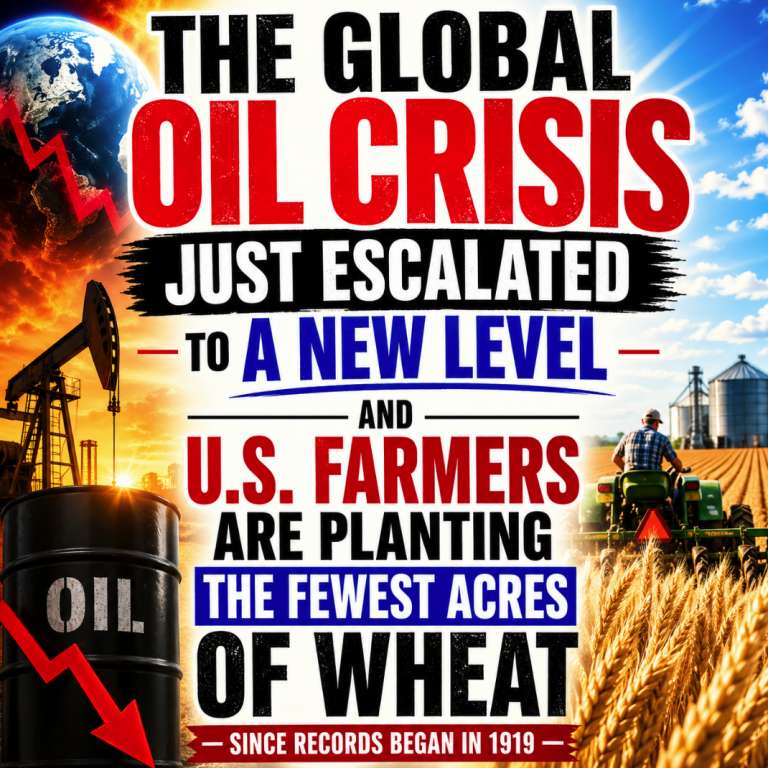
Every single day that the Strait of Hormuz is closed, the damage that is being done to the global economy is getting even worse. But the full consequences of the global oil crisis that we are facing will not be felt for a while because nations all over the globe are still running through their strategic oil reserves. And the full consequences of the global fertilizer crisis that we are facing will not be felt until harvest season. So don’t judge the severity of this emergency by what we are experiencing at this moment, because the truth is that what we are experiencing at this moment is just the very small tip of a very large iceberg.
This week, it appears that more people out there are starting to understand that the Strait of Hormuz is not going to be reopened any time soon.
On Wednesday, President Trump explained that he is not going to lift the U.S. naval blockade of Iranian ports until Iran agrees to give up their nuclear program…
US President Donald Trump told Axios that he would keep Iran under a naval blockade until Tehran agreed to a deal addressing US concerns over its nuclear program.
“The blockade is somewhat more effective than the bombing,” Trump was quoted as saying. “They are choking like a stuffed pig. And it is going to be worse for them. They can’t have a nuclear weapon.”
Trump said Iran wanted a deal to lift the blockade, but added he did not want to do so unless Tehran was prevented from obtaining a nuclear weapon.
“They want to settle. They don’t want me to keep the blockade. I don’t want to [lift the blockade], because I don’t want them to have a nuclear weapon,” he said.
But Iran is not going to give up their nuclear program.
In fact, a member of Iran’s Supreme Council of Experts has stated that it is “forbidden to hold any negotiation on the right to enrich uranium”…
Ahmad Kaveibi, member of Iran’s Supreme Council of Experts:
“It is forbidden to hold any negotiation on the right to enrich uranium. This issue falls outside the negotiation’s framework. This contradicts the position of the Supreme Leader and is forbidden from a jurisprudential standpoint.”
Over and over again, Iran has steadfastly refused to even negotiate about their “right” to enrich uranium.
But Trump seems to be convinced that if he just puts enough pressure on the Iranians they will eventually change their minds.
We shall see.
The Iranians know that midterm elections are looming in the United States, and so the clock is ticking for Trump.
If the Democrats take control of both houses of Congress, they would likely force Trump to end the blockade and leave Iran alone.
So from an Iranian point of view, all they have to do is hold out until the end of the year and they win.
Meanwhile, the global economy just continues to suffer.
Even if the Strait of Hormuz reopened tomorrow, it would still take up to 6 months to fully clear all of the mines that have been laid…
It could take six months to fully clear the Strait of Hormuz of mines deployed by the Iranian military, and any such operation is unlikely to be carried out until the U.S. war with Iran ends, the Pentagon has informed Congress — an assessment that means the conflict’s economic impact could extend late into this year or beyond.
A senior Defense Department official shared the estimate, which has not been previously reported, during a classified briefing Tuesday for members of the House Armed Services Committee, said three officials familiar with the discussion. The timeline — met with frustration by Democrats and Republicans alike, two of these people said — is perhaps the clearest sign that gasoline and oil prices could remain elevated long after any peace deal is reached.
And it isn’t just a matter of restoring the flow of traffic through the Strait.
Oil production in the Persian Gulf region is down 57 percent from pre-war levels.
Thanks to damage that has already been done during this war, it will literally take years for production to return to 100 percent.
The head of the International Energy Agency is warning that we are facing “the greatest energy security crisis in history”…
Fatih Birol, chief executive of the International Energy Agency, has called the ongoing closure of the Strait of Hormuz “the greatest energy security crisis in history”, insisting it is “more serious” than the previous energy shocks in 1973 (when some Arab states imposed an oil embargo on the West), 1979 (caused by the Iranian revolution) and 2022 (Ukraine) “put together”.
In a book that I authored during the early part of 2025, I discussed the fact that a great conflict in the Middle East would cause oil prices to rise dramatically.
And that is precisely what has occurred.
On Wednesday, oil prices rose to the highest levels that we have seen during this war so far…
Oil prices jumped more than 6% on Wednesday, after President Donald Trump said he will maintain the U.S. naval blockade against Iran until they agreed to a nuclear deal.
International benchmark Brent crude futures rose more than 6% to $118.33 per barrel by 12:10 p.m. ET, U.S. West Texas Intermediate futures also advanced more than 6% to $106.37 per barrel.
If the Strait of Hormuz remains closed, this will only be just the beginning.
A lot of people are freaking out because the average price of a gallon of gasoline in the United States is now well above 4 dollars a gallon…
U.S. gas prices have hit a fresh record since the start of the war with Iran, rising to an average nationwide of $4.23 per gallon Wednesday, according to the motor club AAA.
The grim milestone comes as oil prices have surged higher over the past week amid a dual blockade by the U.S. and Iran of the Strait of Hormuz, the key chokepoint in the region for transiting crude and petroleum-based products out of the Persian Gulf.
If people are freaking out now, what will they do when the price of gasoline goes much higher?
Meanwhile, we are also facing the worst global fertilizer crisis in history by a very wide margin…
More than half of the Middle East’s urea output may have been lost since the start of the Iran conflict, which is continuing to disrupt fertilizer flows from the region and threatening global food inflation.
The effective closure of the Strait of Hormuz has choked shipments of urea, a key component in nitrogen fertilizers, leaving large volumes stranded in the Gulf and tightening supplies for farmers around the world. At the same time, Iranian drone attacks on nations including Qatar and Bahrain have damaged energy and industrial infrastructure, hindering production of the chemical itself.
That has forced urea manufacturers in the region to curb operations, with 55% to 60% of output potentially halted, according to consultancy CRU Group.
Without sufficient supplies of nitrogen fertilizer, we can’t even come close to growing enough food to feed everyone on this planet.
In other words, we really are facing a scenario in which large numbers of people in impoverished nations could end up starving.
At the same time, U.S. wheat farmers are facing the worst drought in the heartland of America since the Dust Bowl days of the 1930s…
U.S. wheat futures rallied to the highest in nearly two years Tuesday, as drought in U.S. Plains wheat fields pressures yields while soaring fertilizer costs have caused farmers to trim planting of nutrient-intensive crops such as grains.
CBOT wheat futures surged after the latest Crop Progress report from the U.S. Department of Agriculture said only 30% of the winter wheat crop is in good or excellent condition as of April 26.
The amount of winter wheat that gets harvested this year is going to be very disappointing.
Looking ahead, it is being projected that the number of acres of wheat that U.S. farmers are planting in the spring will be the fewest “since record keeping began in 1919”…
U.S. growers were poised to plant the fewest acres of wheat since record keeping began in 1919, as high costs for fertilizer, seeds, and equipment have made it difficult to turn a profit.
Yes, this is really happening.
If you think that the price of cookies is high now, you should brace yourself, because you haven’t seen anything yet.
In some areas of the country, conditions are so exceedingly dry that it just doesn’t make sense for farmers to try to grow anything.
Dane Wigington is warning that we are heading into a “summer from hell”…
What is going to happen when summer starts? Wigington says, “This is the summer from Hell that we are approaching right now. This will be like no other. The snow pack in the Colorado River watershed is almost nonexistent. The snowpack in the Sierra Nevada averages about 20%. In the Northern Sierra, it is about 5%. That’s 5% of normal. Why isn’t that headline everywhere? People have no idea what is coming. . .. What will happen in the Southwest? We are going to find out soon. Right now, they are frantically discussing desalination facilities in the Gulf of California. . .. That is idiocy and not going to save anything. It can’t be done in any time frame that matters.”
This isn’t a coincidence.
Most of my regular readers already understand this.
If you look at the latest U.S. Drought Monitor map, it looks like a horror show.
There is no easy way out of this.
It will take some time for the full consequences of this nightmare to arrive, but when they do our society will experience immense pain.
The post The Global Oil Crisis Just Escalated To A New Level And U.S. Farmers Are Planting The Fewest Acres Of Wheat Since Records Began In 1919 appeared first on Activist Post.
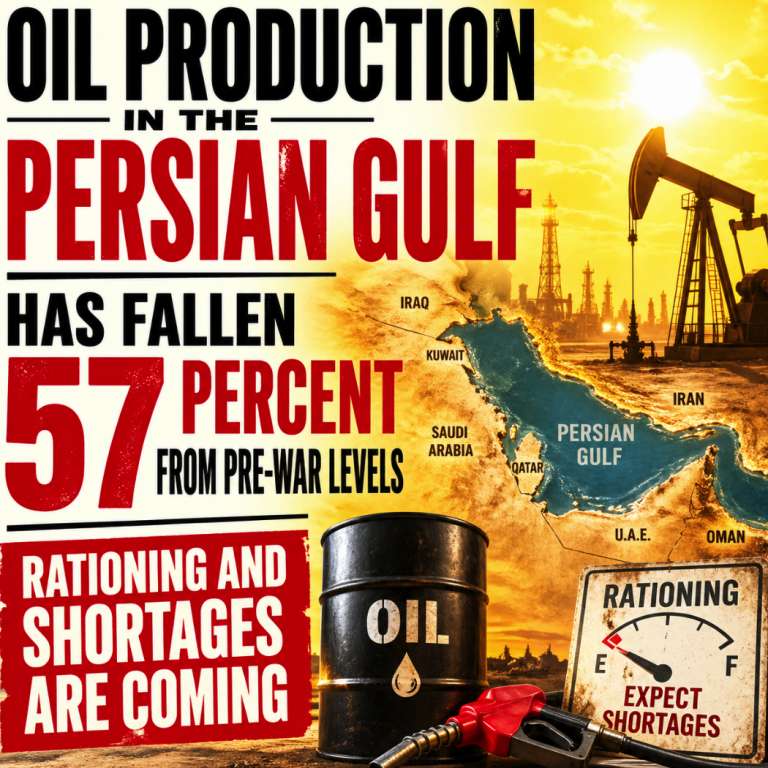
They aren’t telling you the truth about what is coming. Even if the Strait of Hormuz reopens tomorrow, and there is no way that is going to happen, oil production will not return to pre-war levels for years. In other words, we are facing an extended global energy crisis no matter what happens now. Of course if the fighting resumes and more oil and gas infrastructure is destroyed, the consequences that we will experience will be even worse. We are already witnessing rationing and shortages in some parts of Asia because they are more dependent on energy from the Middle East than anyone else. But as nations all over the world run through their strategic reserves, rationing and shortages will become a lot more widespread during the months that are ahead of us.
Most people living in the western world have no idea how much damage has already been done to oil and gas infrastructure in the Middle East.
According to Goldman Sachs, oil production in the Persian Gulf has declined by a whopping 57 percent from pre-war levels…
The war with Iran is having an enormous impact on the global oil market. According to an estimate by Goldman Sachs, oil production from the Persian Gulf region is down 57% from its pre-war level, or about 14.5 million barrels per day. The world is currently covering the shortfall by drawing oil from storage, including a record 400 million barrel release by members of the International Energy Agency (IEA).
If the war ends soon, some of that production will be quickly restored.
But there are many oil and gas facilities that have been completely destroyed, and it is being projected that it could take up to 50 billion dollars to rebuild that infrastructure…
Repair and restoration costs for energy-linked infrastructure as a result of war in the Middle East could hit $58 billion, Rystad Energy analysis shows, with the total for oil and gas facilities potentially up to $50 billion. Three weeks after we published an initial estimate of $25 billion in repair costs across Gulf energy infrastructure, the scope of damage has expanded materially. The continuation of military strikes drove up the number of impacted assets across the region before largely subsiding following an 8 April ceasefire between the US and Iran. This pushed the estimate for the average in potential total repair and restoration spending to $46 billion – representing the midway point in the range of $34 billion to $58 billion – across oil and gas infrastructure, inclusive of an average of $5 billion across industrial, power and desalination assets. The ceasefire, combined with stalled negotiations and renewed escalation risk, continues to shape the operating environment, alongside risks of disruption and potential blockades affecting shipping through the Strait of Hormuz.
Even if reconstruction begins immediately, it would likely take until 2029 or 2030 before all of the oil and gas facilities in the region are fully restored.
So what is the rest of the world supposed to do while we wait for that to happen?
At this moment, everyone is running through their strategic reserves.
For some countries those reserves will last for months, but for other countries those reserves will only last for weeks.
Once the reserves are gone, shortages will start making a lot more headlines and prices will escalate significantly.
Of course the price of oil has already risen to very painful levels…
Oil prices climbed almost 3% Monday as hopes for a peace deal between the U.S. and Iran dimmed and energy shipments through the Strait of Hormuz remained extremely constrained.
The price of international benchmark Brent Crude was up about $3, or almost 3%, to $108.36 per barrel early Monday morning, its highest price point in three weeks. U.S. West Texas Intermediate was up 2.6% before U.S. markets opened, at $96.85.
This is going to affect virtually every man, woman and child on the entire planet, because our entire way of life is fueled by energy.
When energy prices go up, our standard of living goes down.
Unfortunately, energy prices have been going way up since the start of the war…
In the United States, the cost of a gallon of gas has increased by over a dollar since the strait closed, and the cost of diesel is up nearly 50 percent. Gas prices in Europe have increased by around 10 percent, and the region is facing a jet fuel shortage and concerns about the flow of liquid natural gas (LNG). Asia is being hit even harder. Roughly 20 percent of the world’s oil and LNG passes through the strait. Over 80 percent of this fuel goes to Asia. Several Asian countries, such as the Philippines, Japan, and South Korea, are now facing a real energy crisis.
Some Americans are now spending more than $100 to fill up their vehicles, and the average price of a gallon of gasoline in the United States has now surpassed the four dollar mark…
The average price of gasoline in the U.S. rose 7 cents over the last week and currently stands at $4.04 per gallon, according to new data released by GasBuddy, an app that tracks gas prices across parts of North America and Australia. Within the U.S., that data comes from more than 12 million price reports at roughly 150,000 gas stations nationwide, according to the company.
What has shocked me is the apathy that I am seeing out there.
Most people just assume that everything is going to work out just fine somehow.
Our attention spans have become so short that most of us can no longer see what is coming just a few months down the road.
Thanks to the crisis in the Middle East, we are facing the worst fertilizer crisis in history.
If nitrogen fertilizer is not applied to annual crops such as wheat and barley each season, yields will be way down…
Nitrogen-based fertilisers such as urea must be applied each season for many crops and directly influence annual yields as well as quality parameters, including protein content in wheat.
Farmers can cut back on other core nutrients, such as phosphate and potash, without immediate yield losses.
Many farmers all over the world will not be applying nitrogen fertilizer this year.
As a result, those particular farmers will be growing a lot less food in 2026.
I don’t know why this is so hard for some people to understand.
Right now, harvest forecasts are being slashed all over the planet…
Agricultural bodies, including the International Grains Council, are already cutting their forecasts for the next harvests, however. And the United Nations, which is trying to negotiate shipping access for fertiliser through the Gulf, has sounded the alarm over food security in developing nations.
This is not a drill.
This is really happening.
What we desperately need is for the Strait of Hormuz to be reopened as soon as possible.
Sadly, we are farther away from an agreement between the U.S. and Iran than ever.
The Iranians feel like they have won the war and have all the leverage, and so at this stage they are not even willing to talk about their nuclear program with the United States at all…
Iran is no longer willing to negotiate over its nuclear program at all, per Tasnim. Discussions will only cover ending the war, sanctions relief, compensation, and lifting the blockade. Nuclear issues “could be addressed later in a separate agreement,” only after the war has ended.
Nuclear was the central issue in the first round of Islamabad talks, with Trump saying it was “the only point that really mattered.” Iran has now removed it from the table entirely.
Trump says the war won’t end without a nuclear deal. Iran says nuclear won’t be discussed until the war ends.
The Iranians expect the Trump administration to give in, and the Trump administration expects the Iranians to give in.
But neither side is going to give in, and it appears that it is just a matter of time before more fighting breaks out.
Meanwhile, the Strait of Hormuz continues to be closed, and it is likely to remain that way for an extended period of time.
The post Oil Production In The Persian Gulf Has Fallen 57 Percent From Pre-War Levels – Rationing And Shortages Are Coming appeared first on Activist Post.

Yep, it’s official. Bank of America just told its institutional clients that silver could finish 2026 anywhere between $135 and $309 an ounce.
Michael Widmer, the bank’s head of metals research (not some guy on the YouTube circuit, not a goldbug newsletter, not us), got there using sixth-grade arithmetic on the gold-to-silver ratio. With gold near $5,000, he ran the 2011 ratio low of 32:1 and got $135. He ran the 1980 Hunt Brothers extreme of 14:1 and got $309.
That arithmetic was the same arithmetic in 2013.
And in 2018.
And in 2021.
The only thing that changed is who’s willing to say it on bank letterhead.
Here’s TheStreet’s coverage, lightly trimmed:
Bank of America just made one of the boldest silver price calls on Wall Street. Michael Widmer, the bank’s head of metals research, projects silver could reach anywhere between $135 and $309 per ounce before the end of 2026. With gold near $5,000, applying the 2011 ratio low of 32:1 puts silver at $135. Apply the 1980 extreme of 14:1, the level reached during the Hunt Brothers silver squeeze, and the number climbs to $309.
So… “The level reached during the Hunt Brothers silver squeeze.” That is the comparison BofA’s own metals chief reached for. Bank research notes don’t casually invoke 1980 unless somebody at the desk thinks 1980 is in the option set.
What changed isn’t silver. What changed is who’s saying it.
The structural case has been visible from any decent monetary-history bookshelf for a decade. The Money Bubble did this math in 2013 when gold was $1,300 and called silver a steal. Lips’ Gold Wars documented the suppression mechanics back in the 1990s. The Mises canon laid the framework a century ago. None of that is new. The new thing is that a TBTF bank with a desk full of derivatives just sent it to clients with a price target attached.
And note how banks behave…
They don’t forecast moves like this until they’re already underway. The book has to be repositioned first; then the research note hits the wire. Most of Wall Street consensus still clusters between $79 and $90 a year out. Bank of America just broke from the consensus, and they did it loudly. That isn’t a contrarian call. That’s a desk telling its clients what the desk has already done.
The structural case is now embarrassing in its simplicity:
Six straight years of physical deficit. Cumulative shortfall since 2021: roughly 820 million ounces. That’s an entire year of global mine output, gone. The world has been short one full year of new silver for half a decade, and somehow the price is still only $81.
Mine supply is a brick wall. Production has plateaued near 813 million ounces a year. About 70% of newly mined silver comes out of the ground as a byproduct of copper, lead, zinc, and gold mining, which means miners can’t respond to silver’s price signal even if they wanted to. New mines take seven to fifteen years from discovery to first ounce. Fresnillo, the world’s largest primary silver producer, just cut 2026 guidance.
The plumbing is already breaking. In late 2025, London silver inventories dropped enough that spot prices traded above futures. Lease rates spiked to 39%. Backwardation and 39% lease rates are not “the market is a little tight.” Those are signals that paper claims are outrunning available physical metal. The squeeze isn’t theoretical. It already flashed once.
The ratio. Gold at $5,000. Silver at $81.50. Ratio at 59:1. The 3,000-year mean is 16:1. The 1980 extreme was 14:1. At $5,000 gold and a 32:1 ratio, silver is $156. At 16:1, it’s $312. At 14:1, it’s $357. BofA isn’t being aggressive. BofA is being arithmetic.
Here’s the part most coverage of the BofA note is missing.
Silver hit $121.67 on January 29, then crashed 36% to $75 within days, and has clawed back to roughly $81. Any chartist will call that a failed breakout. Anyone looking at structure knows what it actually was.
The market tested how much physical silver was available at $120, and the answer was “not enough to satisfy delivery without breaking something.” The crash wasn’t a top. The crash was the paper market reasserting control over a physical market that briefly got away. Lease rates above 30% during that window are the receipt. The setup is intact. The pressure is building.
Pick the macro path you find most plausible:
The Fed cuts. Dollar weakens, real rates compress, monetary demand for silver detonates. Silver up.
The Fed holds (or new chair Warsh hawks). Inflation grinds higher (it’s been above target for five straight years, per the Cleveland Fed), real rates stay negative anyway, the deficit keeps eating aboveground stocks, the Treasury keeps issuing into a market running out of buyers. Silver up.
Recession. Industrial demand softens modestly. But monetary panic into hard assets accelerates violently, central banks (already net buyers) accelerate purchases, and retail rotates out of stocks at all-time-high valuations. Silver up.
Three paths. Same destination. Same coin.
Kansas just exempted gold and silver from state capital gains tax. The “red state gold rush” is mapping the same legislative momentum across more than a dozen states. Read that sentence twice, because it tells you something the Federal Reserve never will: state governments are pricing in monetary failure faster than the Federal Reserve is. The institution closest to citizens’ actual financial pain is treating sound money as a legislative priority. The institution that creates the inflation is still calling it transitory.
The trade isn’t over because BofA noticed. The easy part of the trade is over.
The part where you could buy sovereign coins at single-digit premiums, where junk silver was available in any quantity at any dealer, where the ratio sat at 90:1 and screamed at anyone willing to look. That part is closing. Bank of America’s note is the bell.
What’s left is the violent part. The repricing that happens when retail money, advisor money, target-date-fund money, and the slow-moving giants of pension capital finally do the same arithmetic Widmer just published.
You can be early, but you aren’ late either.
The post Bank of America Just Said $309 Silver. We’ve Been Saying It Since 2013. appeared first on Activist Post.

Thanks to the crisis in the Strait of Hormuz, there isn’t going to be enough fertilizer for everyone in 2026. What is available is going to be gobbled up by the wealthy countries because they have the most money. Of course higher fertilizer costs will ultimately be passed along to consumers, and so we will all be paying much higher prices for food in the months ahead. But in the poorest nations on the entire planet, a lack of fertilizer could mean the difference between life and death. A dramatic reduction in the amount of fertilizer that farmers use will result in a dramatic reduction in the amount of food that is grown in those countries. Of course many of those countries were already dealing with very high levels of food insecurity, and the UN has admitted that acute hunger was already at the highest level ever recorded even before the war with Iran began. What the world is facing is unlike anything that any of us have ever seen before, and large numbers of people could literally end up starving to death.
I wish that I was exaggerating.
Without sufficient quantities of fertilizer, there is no way that we could possibly feed the 8 billion people that are living on this planet today.
Unfortunately for all of us, spring planting season is here and much of the world’s supply of fertilizer is trapped because the Strait of Hormuz is closed…
But the share of world supply of urea – the most popular commonly used fertiliser – that typically passed through the strait before the conflict was more than twice that, at 43%.
For sulphur – used to produce phosphate fertilisers – the figure is 44%.
For anhydrous ammonia – another nitrogen fertiliser – 27% of global supply on average passed through the strait between 2019 and 2023.
In addition, many nations normally use natural gas that is exported through the Strait of Hormuz to make their own fertilizer.
So this is why it is so important for the Strait of Hormuz to be opened as soon as possible.
If that does not happen, one UN official is warning that the consequences will be “very significant and severe, particularly for the poorest countries and for the poorest citizens”…
In response, United Nations Secretary-General António Guterres established a task force to facilitate the safe passage of fertilizers and related raw materials for humanitarian purposes.
It is headed by Jorge Moreira da Silva, Executive Director of the UN Office for Project Services (UNOPS), which provides infrastructure, procurement and project management services across the world.
“We can’t wait until everything has been fixed,” he said in an exclusive interview with UN News.
“The planting season has already started…So if we don’t get some solution immediately the crisis will be very significant and severe, particularly for the poorest countries and for the poorest citizens.”
This is really happening.
I have many regular readers in Africa, and it is being reported that African farmers are facing a major fertilizer shortage this year…
Food security in Africa could face major disruptions due to continuing uncertainty in the Strait of Hormuz.
The conflict between the United States, Israel and Iran is disrupting global fertiliser trade flows – and this stands to leave millions of African farmers without the ammonia, urea, phosphate, sulphur and other fertiliser inputs vital to growing more food in sub-Saharan Africa.
Even a small drop in fertilizer availability could be catastrophic.
The UN’s Food and Agriculture Organization is telling us that just a 10 percent reduction in the fertilizer supply in Africa could mean that 25 percent less maize, rice and what is grown this year…
According to the Food and Agriculture Organization, even a 10 percent reduction in fertiliser availability could result in up to 25 percent less maize, rice and wheat grown in sub-Saharan Africa.
Nitrogen fertilizer causes explosive crop development.
Without it, many farmers will grow far less food in 2026.
Even here in the U.S., there are farmers that have decided not to use any nitrogen fertilizer this year because it now costs way too much…
The drought compounds economic strains, including elevated fertilizer costs tied to global events. US Representative Frank Lucas, a Republican from Oklahoma, noted he skipped nitrogen applications on his western Oklahoma wheat fields.
“I didn’t have enough moisture — it wouldn’t have done any good,’’ Lucas said. “Number two, I’m not even sure what the cost would be.”
U.S. farmers are currently facing a double crisis.
In addition to skyrocketing fertilizer prices, conditions throughout much of the middle of the nation are bone dry.
On Friday, I explained to my core supporters that March 2026 was the third driest month ever recorded in the United States.
Only July 1934 and August 1934 were drier, and that was during the Dust Bowl days.
Because things are so dry, massive wildfires are erupting with alarming frequency. For instance, two extremely large wildfires have already burned more than 40,000 acres in Georgia…
Two massive wildfires in south Georgia have scorched more than 40,000 acres and destroyed over 120 homes.
Extreme drought has turned the region into a tinderbox and allowed flames to spread. Overnight, new fires sparked in rural south Georgia. High winds have made efforts to contain the fires difficult, officials said in a news conference Saturday afternoon.
Brantley County Manager Joey Cason called the wildfires a “dynamic situation” in a Saturday morning video posted to social media and begged residents to “please evacuate” if they are ordered to do so. New evacuation orders were issued as the fire spread.
This is going to be such a challenging year.
Far less food will be produced in the U.S. than normal this year, and the same thing could be said about many other major food exporters.
In Australia, they are projecting that wheat production could be down by up to 25 percent.
If farmers do not grow our food, we do not eat.
What we really need is for the Strait of Hormuz to be reopened as quickly as possible, but that isn’t going to happen.
In fact, talks between the U.S. and Iran have totally broken down…
Hopes of a diplomatic breakthrough in the U.S.-Israeli war with Iran faded on Sunday, as efforts to revive talks stalled and both Tehran and Washington showed little sign of softening their positions.
Iranian Foreign Minister Abbas Araghchi flew back to the Middle East from mediation talks in Pakistan over the weekend, while U.S. President Donald Trump scrapped a planned visit to Islamabad by his envoys Steve Witkoff and Jared Kushner.
The Trump administration is not going to compromise on their key demands, because they are afraid that Israel could be destroyed “within minutes” if Iran is able to produce nuclear weapons…
US President Donald Trump said Sunday that Israel would be destroyed “within minutes” if Iran obtained a nuclear weapon, warning the world would be in danger.
He added that previous US administrations should have acted earlier to stop Iran’s nuclear ambitions.
On the other side, the Iranians have stated that they will not move from their key list of demands, and they are insisting that they are more than ready for fighting to resume…
Iran produces more than 1,000 types of weapons domestically, including missiles, drones and military systems, defence ministry spokesperson Reza Talaei-Nik said.
“Today, more than 1,000 types of weapons… are produced entirely domestically,” he said, adding the capability is the result of over 25 years of investment in the defence sector.
He said production is spread across the country so it can continue even if some facilities are damaged, and added that around 9,000 companies are involved in supporting the defence industry.
The Iranians can hit us much harder and in a lot more ways than most people realize.
Even the Trump administration is greatly underestimating Iran’s capabilities, and that could have tragic consequences for the entire globe.
Once fighting resumes, I am entirely convinced that we will witness some shocking escalations.
And it appears that the Strait of Hormuz will remain closed for the foreseeable future, and that probably means that widespread famine is inevitable now.
The post The Worst Fertilizer Crisis In The History Of The World Will Result In Widespread Famine In The Poorest Nations appeared first on Activist Post.

The economy has been the number one issue for U.S. voters for several years in a row, and it isn’t because things are good. Consumer confidence is at an all-time low, inflation is starting to accelerate once again, mass layoffs are being conducted all over the nation, and delinquencies and foreclosures are soaring. Nobody can dispute any of the facts that I am about to share with you. We have an enormous economic mess on our hands, and now the crisis in the Middle East threatens to plunge the entire global economic system into chaos in the months ahead. In other words, conditions are not good now and the outlook for the future is not promising at all. The following are 18 shocking facts that prove that the U.S. economy is in far worse shape than most people realize…
#1 Consumer confidence in the United States has fallen to an all-time record low…
Consumer confidence plunged to a record low in April as fears mounted over rising energy prices and the broader impact of the Iran war, according to a University of Michigan survey Friday.
The university’s headline index of consumer sentiment tumbled to 47.6, down 10.7% from the March survey to its lowest on record. Current conditions and expectations indexes also saw double-digit monthly declines.
#2 Student loan delinquencies have exploded to a level that we have never seen before…
Student loan delinquency has climbed to roughly 25 percent of borrowers with payments due during the first year of the current Trump administration, according to new analysis.
Researchers from The Century Foundation and Protect Borrowers said the sharp rise in missed payments, nearly triple the pre-coronavirus pandemic rate, has pushed millions into default risk and lowered credit scores, warning of broader financial fallout for households and colleges facing higher nonpayment rates.
#3 The monthly cost of owning a home has risen to absurd heights…
All in, the median monthly housing payment for an owner — including mortgage principal and interest, taxes, homeowners insurance, and estimated maintenance expenses — has ballooned to more than $2,800, a staggering 72% jump from $1,635 six years earlier.
#4 Foreclosure filings were way up in 2025, and so far in 2026 we are 26 percent above last year’s pace…
A fresh wave of foreclosures is sweeping across the United States, with more than 118,000 homes caught up in the crisis in just the first three months of 2026.
It is a grim omen – with echoes of the run up to the 2008 Great Recession – that financial pressure is mounting for thousands of families.
New Attom data shows 118,727 properties were hit with a foreclosure filing in the first quarter – up 26 percent on the same period last year.
#5 The number of Americans that cannot pay their credit card bills in full each month has reached another record high…
More than 111 million people could not pay off their monthly credit-card bills in full at the end of last year, marking a new record, according to new estimates from consumer advocates. That’s roughly 2 million more people unable to pay in full compared to the end of 2024, they noted.
These card holders now owe banks more than $1 trillion — and most are inching closer to maxing out their credit lines, according to researchers at the Century Foundation, a progressive think tank, and Protect Borrowers, a nonprofit group that advocates for borrowers.
#6 As the cost of living soars, people are pulling money out of their 401(k) plans at a record rate in a desperate attempt to make ends meet…
More Americans are digging into their retirement savings because of financial emergencies.
Last year, a record 6% of workers in 401(k) plans administered by Vanguard Group took a hardship withdrawal. That is up from 4.8% in 2024 and a prepandemic average of about 2%, according to Vanguard.
#7 Food prices continue to escalate, and the price of coffee has more than doubled since 2019…
A 16-item basket of groceries made up of staples like eggs, bread, and meat — no truffle cheese in our cart — rang in nearly 43% higher in March compared to the same month in 2019.
A few key categories are behind the rise: Coffee prices have more than doubled since the pandemic, while beef prices have soared more recently.
#8 For the first time ever, the price of a pound of ground beef is now higher than the federal minimum wage in many parts of the country…
The cost of a pound of ground beef has hit a major threshold. Depending on where you shop, the grocery staple likely costs more than the federal minimum wage.
Money analyzed ground beef prices at seven of the most popular grocery chains across the U.S., finding that 1 pound of the typical 20% fat ground beef costs between $6.49 and $8.96. Organic, grass-fed and leaner varieties tend to cost much more.
On the other hand, the federal minimum wage sits at $7.25 per hour.
#9 The Federal Reserve is telling us that 42.5 percent of recent college graduates were underemployed at the end of 2025…
Historically, college graduates have tended to find jobs faster and experience lower unemployment than workers without a degree. But recent data suggests it’s now harder to find a job that fits your skill set once you graduate.
According to the Federal Reserve of New York, 42.5% of recent college graduates (aged 22 to 27 with a bachelor’s degree or higher) are underemployed as of December 2025 — the highest rate since October 2020. Underemployment refers to working in a role that underutilizes your skills, usually at a lower wage or in a part-time position.
#10 We continue to see retailers close locations all over the nation at a staggering rate. For example, Grocery Outlet has announced that they will be permanently closing 36 stores…
Grocery Outlet – the California-based retailer famous for selling products at steep discounts – says it will close 36 stores nationwide as part of a sweeping restructuring plan designed to improve profitability.
The company revealed the move while reporting its latest financial results, saying it had conducted a ‘strategic, financial and operational analysis’ of its entire store network.
#11 Not to be outdone, Papa John’s has announced that they will be closing approximately 300 restaurants…
Pizza chain Papa John’s said it plans to close hundreds of underperforming restaurants in North America by the end of next year.
“We have identified approximately 300 underperforming restaurants across North America that are not meeting brand expectations or lack a clear path to sustainable financial improvement, as well as locations where we can effectively transfer sales to a nearby restaurant,” Papa John’s Chief Financial Officer Ravi Thanawala said last week during the company’s fourth-quarter earnings call.
#12 One of our “too big to fail” banks has decided that now is the time to cut about 2,500 jobs…
Morgan Stanley is slashing about 3% of its global workforce — roughly 2,500 jobs — across its key divisions, as the Wall Street giant realigns priorities amid a banner year for profits, sources familiar with the matter have told The Post.
The cuts hit the Ted Pick-led lender’s investment banking, trading, and wealth management units, the people close to the situation said.
#13 EBay will be conducting yet another round of layoffs. This time around approximately 800 workers will get the axe…
EBay said Thursday it is cutting about 800 roles, or 6% of its workforce, in the latest round of layoffs at the e-commerce company.
“We are taking steps to reinvest across our business and align our structure with our strategic priorities, which will affect certain roles across our workforce,” an eBay spokesperson said in a statement. “We are grateful for the contributions of the employees impacted and are committed to supporting them with care and respect.”
#14 At one time Wendy’s was doing great, but in 2026 it will be permanently shuttering hundreds of locations…
Fast-food chain Wendy’s will shutter 5% to 6% of its stores nationwide in the first half of 2026 as part of an ongoing downsizing plan.
Interim CEO Ken Cook first told investors in a Nov. 7 quarterly earnings call that the company would be closing a “mid single-digit percentage” of its nearly 6,000 locations nationwide.
#15 Meta, the parent company of Facebook, apparently intends to let nearly 8,000 employees go in the very near future…
Meta is preparing to cut thousands of jobs as early as next month, with deeper layoffs expected later this year, according to a report.
The tech giant intends to slash roughly 10% of its global workforce — or nearly 8,000 employees — in an initial round of cuts on May 20, sources told Reuters.
The company is also planning additional layoffs in the second half of the year, though details including timing and scope remain unclear, the outlet reported.
#16 From coast to coast, thousands of supply chain workers have been told to hit the bricks in recent weeks…
A wave of layoffs across U.S. supply chains — from EV battery plants and auto parts factories to warehouses and rail terminals — has affected nearly 4,000 workers in recent weeks, according to company announcements and WARN filings across multiple states.
Recent WARN filings and company announcements show job cuts across at least a dozen companies in states including California, Georgia, Tennessee, Texas, Ohio, South Carolina, Pennsylvania and Alabama.
The largest layoffs in the recent wave are coming from the automotive and industrial supply chain. SK Battery America said it laid off 958 workers — about 37% of its workforce — at its electric vehicle battery plant in Commerce, Georgia, citing shifting EV demand as automakers reassess production plans.
#17 According to Newsweek, the following list of companies have all announced layoffs during the month of April…
#18 The total unfunded obligations of the U.S. government have now reached a staggering total of 130.12 trillion dollars…
On March 17, 2026, the U.S. Department of the Treasury quietly released the federal government’s fiscal year 2025 financial report. Buried in its tables is a number that should dominate our national conversation – but doesn’t: Total federal obligations now stand at $130.12 trillion.
That figure is not a rounding error or a political talking point. It is derived from the government’s own accounting – combining the reported negative net position (driven largely by bonded debt) with the present value of projected shortfalls in major social insurance programs. Yet public debate continues to revolve almost exclusively around the much smaller figure of Treasury securities outstanding.
There is no way that anyone can spin the facts that I have just shared with you to make them look good.
So if conditions are already this bad, what will things be like six months from now if the Strait of Hormuz is still closed?
We really are in unprecedented territory, and the truth is the economic conditions could easily get a lot worse during the months ahead.
The post 18 Shocking Facts That Prove That The U.S. Economy Is In Far Worse Shape Than Most People Realize appeared first on Activist Post.

Starting a big war in the Middle East is much easier than stopping it. This is the lesson President Trump is now learning.
After one month of dropping bombs and launching missiles at Iran, Trump has called for a time out. A proposed one-month ceasefire. He even put a 15-point peace plan on the table. It was delivered via intermediaries in Pakistan.
The proposal included a comprehensive off-ramp to address everything from nuclear disarmament and missile limits to reopening the Strait of Hormuz. Tehran quickly put a match to it and countered with five conditions of its own – including demands for reparations.
It was but one month ago when Operation Epic Fury kicked off. What was intended to be a brief operation of destruction rained down on Iran, turned into something much greater.
The initial shock and awe adeptly targeted high-level leadership and missile infrastructure. But the operation quickly spiraled into a larger war of attrition that physically severed the world’s most vital energy artery – the Strait of Hormuz.
The initial success was overshadowed by a grim, structural reality. Market volatility is one thing. Physical depletion of global resource reserves, which puts a big squeeze on every major economy, is entirely another.
Perhaps some limited shipping will be allowed to traverse the Strait as the war rages on. One can only hope. Because if it remains closed for another 30 days, the emergency oil and gas reserves held by nations like Japan and Germany will stop flowing. In fact, hundreds of gas stations have already run dry across Australia.
One more month of this will have dramatic consequences. Namely, it will result in the forced deindustrialization of energy-dependent economies as critical links in the world’s just-in-time supply chain breakdown.
When shipping containers stack up in idle ports and fertilizer plants go dark, the survival of economies across the globe are at risk.
Month one, by and large, was nothing. The impacts to the average person were mainly limited to sticker shock at the gas pump. Brent crude briefly spiked above $120 a barrel, and everyone’s 401(k) took a modest nosedive.
Month two, however, is when things really start to get serious. That’s when higher prices are met with physical shortages. The next 30 days are the real make or break moment for the global economy.
In March, the world survived on oil and gas that was already in the pipes and the tanks. The U.S. and its allies tapped into strategic reserves to help buffer the price spikes. But those reserves are a very short-term solution.
Around 20 percent of the world’s Liquefied Natural Gas (LNG) is currently trapped behind the Strait. QatarEnergy, the world’s LNG heavyweight, has had to declare force majeure on exports.
Most major industrial centers in Europe and Asia keep about 30 to 45 days of gas in easily accessible storage. If the Strait doesn’t open by mid-April, we aren’t just talking about higher gas prices and heating bills. We’re talking about mandatory industrial shutdowns. If you can’t power the factory, you can’t make the product.
Similarly, if you can’t supply fertilizer, you can’t grow food. In addition to being one of the world’s top suppliers of oil and gas, the Persian Gulf is also one of the world’s top suppliers of agricultural fertilizers. What’s more, fertilizer shortages couldn’t have come at a worse time.
It’s spring planting season in the northern hemisphere. Farmers in the U.S. Midwest, Brazil, and India are looking at prices of nitrogen fertilizers that are 30 percent to 50 percent more expensive than they were four weeks ago. And that’s if they can find them at all.
If supply constraints persist through April, farmers will simply plant less or conserve fertilizer. That means lower crop yields this fall. Moreover, it means there will be a global food security emergency that will peak in about six months.
You may have also heard of looming helium shortages. Most of the world’s helium, which is essential for cooling the machines that make high-end AI chips, comes from Qatar.
High-end semiconductor fabricators in Taiwan and Arizona have about a three-month buffer of these specialty gases. One month’s supply is already gone. If we lose another, there could be a shortage of chips that power everything from your phone to the newest AI models.
If the Keep Out signs stay up at the Strait through April, there could be several disagreeable consequences. For example, there will be energy holidays (i.e., forced rationing) in energy-hungry nations. Factories that make cars, plastics, and chemicals will go dark to conserve power for hospitals and homes.
Shipping companies will also avoid the Persian Gulf. This will add an additional 15-day detour around Africa for goods being shipped from Asia to Europe. The additional transport time will add costs to imported goods.
Many economies were already stalling out before the attacks on Iran. But now, if 20 percent of the world’s oil remains offline through May, it’s a near certainty that major economies like Germany, Japan, and China – and the USA – will slip into a recession.
In short, month one was merely a siren. Month two is the start of the actual physical impact. Specifically, the global economy will move from higher costs to shortages.
A world where shortages of everything from medical instruments to basic consumer electronics and manufacturing components, and essentials like gasoline and fresh fruits and vegetables, could soon be the reality.
The buffer period provided by global strategic reserves is disappearing with each passing day. While the first 30 days stimulated a chaotic news cycle and wild market swings. The next 30 days will stimulate a structural shift in how people live.
At this point, there doesn’t appear to be a quick and easy end to the war with Iran that will restore passage of the Strait of Hormuz. If anything, things are escalating with the prospect of ground troops becoming more and more likely.
So, without reservation, hard times are coming to a town near you.
The just-in-time world was not built for a sustained severance of its primary jugular. When the oil and gas stops flowing, the helium stops cooling the fabrication machines in Taiwan, and the nitrogen stops hitting the soil in the Midwest, the convenience and abundance of modern life break down. So, too, does the debt and the credit edifice that sustains it.
As part of the New Year edition of the Economic Prism, in the closing section titled Preparing for Chaos, we included one practical action you can take to prepare for war, inflation, or the breakdown of an ever-increasing complex digital world.
Many people laughed at our suggestion. Few took our advice. But, for fun and for free, we’ll revisit this simple, but important recommendation…
Assuming you have food storage, and some basic backup power such as a simple battery storage system that can charge with portable solar panels, there is the critical, and often overlooked need for micronutrients.
After two weeks, no matter how much protein and carbs you have, you need micronutrients for your brain and body, or you start losing mental clarity, strength, and a well-functioning digestive system. The simple solution is sprouting.
To get started, take a look at Sprout People. There you will find a great education section – simplified for dummies – and a large variety of nutrients you probably never imagined could be sprouted. We have no financial or business arrangement or affiliation with Sprout People. We’re merely passing on information we believe you will find valuable.
When the time comes, the ability to be a ‘jar farmer’ to sustain health via sprouts will be essential.
[Editor’s note: Get a free copy of an important special report called, “Cash Machine – Why You Should Own this Mineral Royalty with a 12% Yield,” when you join the Economic Prism mailing list today. If you want a special trial deal to check out MN Gordon’s Wealth Prism Letter, you can grab that here.]
Sincerely,
MN Gordon
for Economic Prism
Return from Jar Farming for Dummies to Economic Prism
The post Jar Farming for Dummies appeared first on Activist Post.

Most people recognize Sir Issac Newton for his work on gravity, but in 1717, he was more than a great scientist. He was Master of the Royal Mint of England, and he had a problem to solve:
What should an ounce of gold be worth in British pounds?
Newton sat down, did the math, and set the price at 3 pounds, 17 shillings, and 10.5 pence per troy ounce. He did not form a committee…
There was no press conference to shape “perception.” And no models were built on assumptions about “inflation expectations.” One man, one number, anchored to physical reality.
That price held, more or less, for nearly two centuries.
In those same two centuries, the world went from candlelight to electricity. From horse carts to steam locomotives. From local village markets to a truly global economy that, by 1913, was as integrated as a share of world GDP as it would be again in the year 2000. From hand-stitched clothing to textile factories running 24 hours a day. The Industrial Revolution, the great burst of human productivity that lifted more people out of poverty than any event in recorded history, unfolded entirely under a monetary system where the pound, the mark, the franc, and the dollar were simply different names for fixed weights of gold.
We know what sound money looks like. We lived under it for two hundred years. We thrived under it. And then we threw it away.

What the Gold Standard Actually Was
Before we can understand what we lost, we have to kill a myth. The gold standard is not remembered accurately. Most people picture it as rigid, primitive, deflationary, the monetary equivalent of a corset. It was none of those things.
The mechanics were elegant. Every major national currency was convertible into a fixed weight of gold. The Bank of England, the anchor of the global system, held 40 percent gold reserves to back the British pound. Anything less was considered reckless. Long-term interest rates were low and stable, because when money cannot be printed, there is no inflation premium baked into the bond market. Investors lend at low rates when they trust that the pounds or dollars they get back will buy roughly what the pounds or dollars they lent away bought when the loan was made.
The money supply grew at approximately 1.8 percent per year, matching world population growth and new wealth creation. No central bank committee voted on this. No chairman gave a press conference about it. Geology enforced it. New gold mining could only add so much metal to the aboveground stock each year, and that natural constraint kept the purchasing power of money stable across generations.
Milton Friedman spent much of his career arguing for what he called the k-percent rule: that monetary stability requires the money supply to grow at the same modest, predictable rate each year. Gold achieves Friedman’s ideal automatically, through physics and chemistry, without any human institution or political process required. No fiat currency has ever come close to matching it.
Consumer prices during the classical gold standard era did not rise year after year. In many periods they fell modestly, as technological improvements made production more efficient. This meant that savings actually gained purchasing power over time. So, thrift made sense. Long-term planning made sense. A worker in 1880 could make a financial commitment that would still make arithmetic sense in 1900, because the unit of account he was using had not been quietly debased while he slept.
This is the part of the story that modern economics textbooks do their best to obscure, because it is simply too damaging to the case for central banking and fiat currency.
The Industrial Revolution happened under the gold standard. Railroads crossed continents under the gold standard. The telegraph, steam shipping, the mechanization of agriculture, the rise of a global middle class, all of it happened under a monetary system where the money supply was governed by geology rather than by the discretion of appointed officials.
By 1913, global capital flows were enormous. British investment financed railroads in Argentina, mines in South Africa, and factories in the United States. German industrial firms raised capital across European borders. American entrepreneurs tapped London’s financial markets. All of this cross-border investment required a shared monetary framework, a common language of value, and gold provided exactly that. A gold-backed pound and a gold-backed dollar were not two different monetary promises. They were two different denominations of the same thing.
The result was the greatest sustained expansion of real living standards in human history. Not the greatest expansion of financial assets. Not the greatest expansion of credit. The greatest expansion of actual human welfare: calories consumed, children surviving infancy, life expectancy, literacy, physical mobility, access to goods that would have seemed miraculous to prior generations.
It was not a perfect system. Recessions happened. Bank panics happened. The business cycle was not abolished. But when downturns came, they cleared. Bad debts were liquidated. Inefficient enterprises failed. The economy adjusted and moved on. There were no multi-decade zombie recoveries propped up by central bank balance sheet expansion. There was no “secular stagnation.” There was no “new normal” of 2 percent growth that gradually became accepted as the permanent ceiling of human economic ambition.
The gold standard did not promise a world without hardship. It promised a world where money told the truth. That, it turned out, was enough to produce something close to economic paradise by any historical standard.
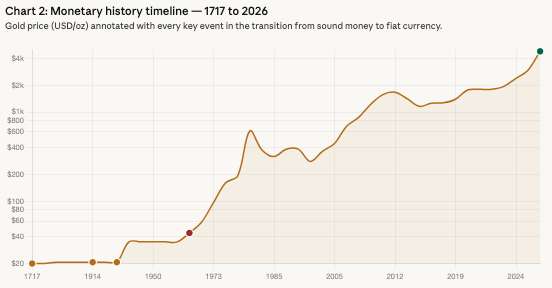
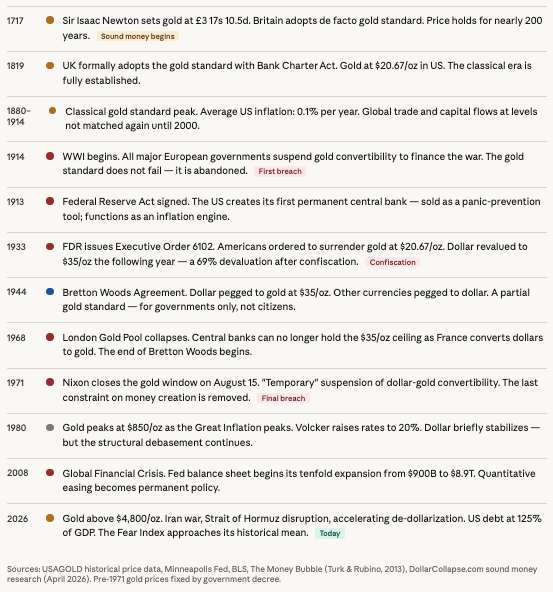
The Beginning of the End
The gold standard did not fail. It was abandoned…
Here’s the difference:
When the guns of August 1914 opened fire on the plains of northern France, every major European government suspended gold convertibility within weeks because war is expensive, and gold is finite. You cannot finance industrialized mass slaughter on an honest money supply. If the British Treasury had been required to back every new pound it issued with gold, the war would have ended by Christmas 1914, not by the exhaustion of a generation.
So the governments printed. And the world that had been built on two centuries of sound money began its long, slow, and at times violent unraveling.
The waypoints are worth marking because each one was presented, at the time, as a temporary, necessary, pragmatic response to an emergency. Each one turned out to be permanent.
In 1913, the United States created the Federal Reserve, the first major institutional breach of the sound money principle in America. In 1933, Franklin Roosevelt issued Executive Order 6102, requiring American citizens to surrender their gold to the government at $20.67 per ounce. The following year, having collected the gold, the government revalued it to $35 per ounce, a 69 percent devaluation executed after the confiscation was complete. Citizens who obeyed the law were made immediately poorer. The Bretton Woods agreement of 1944 created a partial gold standard for governments while denying gold convertibility to ordinary citizens. And then, on August 15, 1971, President Nixon went on television to announce that the United States would “temporarily” suspend the convertibility of the dollar into gold.
That temporary suspension has now lasted 55 years.
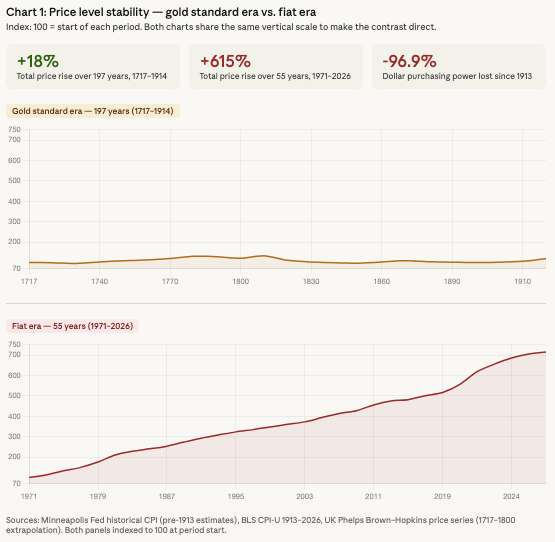
Both charts use a price index where 100 represents the starting point of each era, meaning every number you see is a measure of how far prices have moved relative to that baseline. The gold standard panel, covering 197 years from 1717 to 1914, barely moves, peaking at 118 and troughing as low as 95, a range so narrow it appears almost flat. The fiat currency panel, covering just 55 years from 1971 to 2026, climbs from 100 to 715, meaning the cost of the same basket of goods has risen more than seven times over in little more than half a century, a rate of debasement that would have been considered a civilizational catastrophe under any prior monetary standard.
The numbers, at this point, speak more clearly than any argument.
The dollar has lost more than 95 percent of its purchasing power since the Federal Reserve was created in 1913. M2 money supply has expanded by approximately 80 percent per decade since 1960.
80 percent per decade.
Every generation of American workers has watched the purchasing power of their savings cut roughly in half during their working lives, not by any market event or democratic vote, but by the quiet, continuous operation of a monetary system that answered to no geological constraint and faced no meaningful political accountability.
The United States national debt today stands at 125 percent of GDP. Private credit default rates have reached 9.2 percent, matching levels last seen during the 2008 financial crisis. The Federal Reserve, having expanded its balance sheet nearly tenfold since 2008, is now trapped: it cannot raise interest rates enough to genuinely fight inflation without crashing the bond market, the stock market, and the government’s own financing costs simultaneously. The monetary authorities call this a “difficult environment.” It is, more precisely, the predictable arithmetic consequence of replacing sound money with the promises of politicians and appointed officials.
Now, markets work fine when prices tell the truth, but this is the failure of a monetary system that was designed, from the moment the gold constraint was removed, to transfer wealth from savers and workers to governments, banks, and debtors, and to do so invisibly, continuously, and with no democratic mandate.
Here is the thing about the optimistic reading of this story:
It is also the accurate reading.
The solution to what ails the global monetary system is not theoretical. And it hasn’t been dreamed up by economists in a seminar room. It ran the world for two centuries and produced the greatest expansion of human prosperity ever recorded. It was enforced not by any government promise or central bank policy, but by the laws of nature. Gold cannot be printed. Silver cannot be conjured by committee. The supply of honest money grows at the rate geology permits, which happens, as Milton Friedman observed, to be almost exactly the rate that a well-functioning economy requires.
The Bank of England understood this. For most of the classical gold standard era, it held 40 percent gold reserves to back the British pound. Its governors considered anything less to be reckless. That standard, applied to today’s US M3 money supply, would require a gold price of roughly $29,000 per ounce. Even a 20 percent backing, far below the Bank of England’s historical standard, would require gold at around $16,000.
Gold above $4,800 today, the highest nominal price in history, is no a bubble…
Gold’s price is the market’s attempt to price in eight decades of accumulated monetary debasement, with the current Iran crisis and the accelerating de-dollarization of global energy trade acting as catalysts for a process that was always going to arrive eventually.
Sound money works. History spent two centuries answering that question. Soon, we may have the wisdom forced on us, and the political will, to choose it again before the current system forces the choice upon us in far more painful circumstances.
Newton set the price of gold in 1717 and it held for nearly 200 years. We abandoned it in stages between 1913 and 1971. We have spent the 55 years since paying the tab.
At some point, the tab gets paid in full.
The post Two Centuries of Prosperity on a Gold Standard, Then We Threw It Away appeared first on Activist Post.


 Lateo.net - Flux RSS en pagaille (pour en ajouter : @ moi)
