 Connexion


CFTC Chair Michael Selig claimed that the agency was using its “existing statutory authorities“ to address crypto regulation after Congress failed to advance a market structure bill.
US Commodity Futures Trading Commission (CFTC) Chair Michael Selig said that the agency will move forward on crypto regulation at the direction of President Donald Trump “with or without legislation” from Congress.
Speaking at the Fordham Law Blockchain Regulatory Symposium on Monday, Selig announced proposals giving crypto companies the option to operate under the CFTC’s umbrella rather than dealing with the patchwork of regulations offered by individual US states.
According to written remarks from the event, the CFTC chair said that it had issued an advanced notice of proposed rulemarking for companies “offering retail customers the ability to trade crypto assets on a margined, leveraged, or financed basis,” calling the regulation ‘CTX.’
Selig said that the agency planned to establish a new category of designated contract market (DCM) called a “crypto asset market,” or CAM, giving certain exchanges the option to register as either.
“These rules would codify a pathway for crypto asset exchanges to operate under uniform national oversight by the CFTC pursuant to the same statutory authorities that the prior administration instead utilized to regulate by enforcement,” said Selig.
The proposed rules would not extend to what the chair called “ordinary spot crypto exchanges” that are “generally regulated under state money transmission laws.” For companies offering spot trading on crypto assets like Bitcoin (BTC), the CFTC would still have the authority to enforce anti-fraud and anti-manipulation regulations.
Selig’s proposed regulatory framework for crypto companies came a few weeks after lawmakers in the US Senate failed to approve passage of the Digital Asset Market Clarity (CLARITY) Act, a bill that had been expected to give the CFTC more authority in overseeing and enforcing crypto regulations.
The Securities and Exchange Commission already announced its own version of a proposed “tailored securities offering regime” for crypto assets in August before the failed CLARITY vote, setting the expectation that both agencies would move forward with regulation without legislation codifying such rules from Congress.
Selig said that Trump promised to deliver a crypto asset regulatory market structure with or without legislation, and the regulators will help him deliver it using existing statutory authorities.
“The opponents to CLARITY may have not bargained for the seeming readiness of the executive branch to act in the absence of any constraint from the legislative branch,” said ProChain Capital’s David Tawil, in a post on Monday.
Friday was SEC Commissioner Hester Peirce’s last day at the agency, wrapping up eight years of service, just ahead of the 18-month extension for her second term. Her planned departure leaves just two commissioners leading the SEC and Selig heading the CFTC as its sole commissioner and chair.
A White House official told Cointelegraph last week that Trump intended to nominate commissioners to both agencies “in the near future.” As of Monday, the administration had not announced any replacements for Peirce or the other six commissioner seats.
Magazine: Former SEC boss made AI Czar, Bitcoin may hit $600K this cycle: Hodler’s Digest
The post CFTC joins SEC in proposing crypto framework after failed CLARITY vote appeared first on Activist Post.
The IRS can now see your crypto gains, but has no idea about the cost-basis. That’s proving to be a big headache for some cryptocurrency investors.
It’s that time of year again in the United States. The days start to draw in, the leaves start to fall, and the tax man comes knocking for your 2025 return.
This year, thanks to the Inland Revenue Service’s new rules, the agency now knows more about Americans’ crypto trades than ever before, with brokers required to report gross proceeds from certain digital asset sales.
But unfortunately for some taxpayers, getting a form from an exchange hasn’t made filing their returns any easier.
A survey of 1,000 US crypto investors conducted in August by Awaken Tax found that 21% of respondents who had filed, or planned to file a tax extension, said they were still waiting for information they needed from an exchange or crypto platform.
A further one in five said their 1099-DA, the tax form brokers use to report certain digital asset sales, was either incomplete or they weren’t sure whether it accurately reflected their transactions.
The numbers come as taxpayers attempt to navigate the first filing season under the new reporting rules, with those who filed for an extension having until Oct. 15 to submit.
For 2025, brokers were generally required to report the proceeds (how much an asset was sold for), but not the cost basis (how much the taxpayer originally paid for it).
That requires taxpayers to calculate their gains and losses themselves, which isn’t much fun even for infrequent traders, but is a time consuming quagmire for active ones.
Chris Herbst, managing director of CountDeFi tax reporting, tells Magazine, “For an active trader, that number can be many times their real gain, because each sale is counted at full value with no cost against it.”
And that gets to the heart of the problem: the IRS can see the sale, but the taxpayer still has to work out what they actually made.
For a simple transaction, the calculation is straightforward. If you bought Bitcoin for $9,000 and sold it for $10,000, the gain is $1,000.
But a 2025 1099-DA could show the $10,000 in proceeds without reporting the $9,000 basis needed to calculate that gain. So if you don’t know how much you spent on a particular crypto asset, working out the math can become a Byzantine exercise.
Related: US House tax committee advances crypto tax overhaul in 38–5 vote
And it means taxpayers need their own records to fill in the missing pieces, including information that may stretch across multiple exchanges, wallets, trades and years.
“The gap is real,” says Herbst, “but it is a record-keeping gap on the taxpayer side as much as a reporting gap on the exchange side.”
Tax professionals say they are already seeing problems when taxpayers try to reconcile the new forms with their transaction histories.
Sharon Yip, founder of Crypto Tax Advisors, says her firm has found discrepancies between the 1099-DAs received by clients and the crypto tax reports it prepared for them.
Some forms did not include all the trades clients made during 2025, Yip says, while exchanges also used different formats for their customer statements. Some exchanges reported cost basis on certain trades but not others, she says, even though reporting basis was not mandatory for 2025:
“It’s very confusing for recipients to understand how to reconcile their 1099-DAs when compared to the crypto tax report they should use to file their tax return.”
She also gives an example involving stablecoins, saying one of her firm’s clients had more than $300,000 in stablecoin trades on an exchange in 2025, but the exchange’s 1099-DA showed less than $100,000 in total stablecoin proceeds.
And the issues can start before taxpayers even get to calculating their gains. Andrew Duca, founder of Awaken Tax, says the firm saw customers receiving 1099-DAs relatively late in the filing season.
“Because this regulation is new, a lot of exchanges are still trying to figure it out,” he says, pointing to exchanges like Kraken that “didn’t send any forms to users until two weeks before the tax deadline of April 15.”
Duca also cites the example of a Kraken 1099-DA from around the same period that shows no reported transaction information.
Kraken did not respond to Magazine’s request for comment.
But here’s the thing: the new forms were never intended to replace taxpayers’ own records. The IRS says taxpayers must report digital asset income and gains or losses whether they receive a 1099-DA or not.
Related: Chainalysis estimates $457B in taxable crypto activity, says CARF misses most
Where the basis is not reported, taxpayers should use their own records to complete their tax return, but that gets complicated quickly when crypto assets move frequently between platforms.
So, you might buy Bitcoin on one exchange, transfer it to a private wallet, move it to another exchange and sell it there — and the second exchange doesn’t have the information showing what you originally paid.
“The full transaction history from the day the account opened” is what taxpayers need from exchanges, Herbst says. That includes trades, fees, deposits, withdrawals and transaction identifiers, such as the wallets involved.
He says basis follows the asset as it moves between platforms, which means one missing piece of transaction history can affect a gain calculated years later on another exchange.
Andrew Gordon, executive director of Digital Asset Tax Action, says taxpayers are “constantly” struggling to reconcile 1099-DAs with their own records during the 2025 filing season.
He says most crypto tax software lacks tools to import and reconcile 1099-DA information, and the few that do still require manual entry because brokers did not provide the 2025 forms in a machine-readable format.
For active traders, Gordon says, manually entering the information can mean hundreds of individual entries. He argues that brokers should provide a machine-readable file alongside every 1099-DA so the information can flow directly into tax software.
He also says exchanges should maintain complete transaction histories, including acquisition dates, amounts paid, fees and transfers.
Gordon’s concern is that the IRS’s increased visibility doesn’t translate into a complete tax calculation for the taxpayer.
“The 1099-DAs only reported proceeds in 2025, and proceeds reporting gives the IRS visibility it did not previously have;” however:
“Visibility without basis produces the zero-basis problem.”
Taxpayers shouldn’t blindly copy the numbers from a 1099-DA onto their tax return. Duca advises them to compare it against their complete transaction history rather than automatically accepting the form’s figures:
“The IRS expects your return to reflect your actual gains and losses, not necessarily what’s printed on a form that the exchange may have worked out incorrectly.”
While crypto taxpayers are still grappling with the 2025 filing season, more changes are coming down the line.
From 2026, brokers must generally report cost basis for covered digital assets, which will give taxpayers more information to calculate their gains and losses. However, assets transferred to a broker from another exchange or wallet can still fall outside those requirements.
So, the IRS may know more about your crypto trades, but when it comes to working out what you owe, you still need to keep the receipts.
Magazine: Winners and losers of the SEC’s new tokenized stocks rules
The post Exchanges reporting crypto gains to IRS becomes tax nightmare appeared first on Activist Post.
Strategy added to its BTC treasury for the first time in two months, while continuing to bolster its cash reserves and buy back its perpetual STRC preferred stock.
Michael Saylor’s Strategy acquired 4,603 Bitcoin for $370 million, marking the first acquisition from the largest corporate Bitcoin holder in two months.
Strategy acquired 4,603 Bitcoin (BTC) at an average purchase price of $80,318, pushing its holdings to 845,050 BTC, acquired for a total of $63.3 billion at an average price of $75,413, according to a Monday 8-k filing with the Securities and Exchange Commission.
The Bitcoin purchase was funded by the net proceeds of a 602 million MSTR common stock sale. The company used $30 million of the net proceeds to increase its USD Cash reserve and $151.8 million to repurchase its preferred STRC stock.
Nasdaq-traded MSTR was up less than 1% in Monday’s pre-market activity, after dropping more than 7% on Friday.
The move marks Strategy’s first corporate Bitcoin acquisition since mid-June, when the company last acquired 1,587 BTC for roughly $100 million.
On Sunday, Strategy’s co-founder and executive chairman, Michael Saylor, signaled that the company will resume accumulating Bitcoin, tweeting “We’re Back” in a widely viewed X post. Saylor has been known for posting cryptic weekend teasers before official announcements of the company’s larger treasury moves.
Strategy’s perpetual preferred stock, STRC, gained 0.44% in pre-market activity on Monday, to change hands at $97.33, or a 2.67% discount to its intended $100 par value, Yahoo Finance data shows.
STRC is one of Strategy’s main mechanisms to fund its Bitcoin accumulation. Trading below par limits Strategy’s ability to raise funds through STRC sales. It may also force the company to further increase its nominal dividend rate to attract buyers and protect STRC’s price.
In its June 29 8-K filing, Strategy unveiled a capital framework allowing Bitcoin sales to fund dividends and increased the annual dividend rate on its STRC preferred stock to 12%. Strategy disclosed the sale of 32 Bitcoin in early June, as its first reported Bitcoin sale since the 2022 tax-loss transaction.
Related: Standard Chartered wavers on $100K Bitcoin year-end call, says it may be ‘too low’
The post Strategy buys $370M Bitcoin in first corporate purchase since June appeared first on Activist Post.
Strive’s latest Bitcoin purchase lifted its holdings to 23,156 BTC, making it the fifth-largest publicly traded corporate holder as crypto markets rebound.
Strive, a publicly traded asset manager and Bitcoin treasury company, added 1,800 Bitcoin to its holdings last week, accelerating an accumulation strategy that has propelled it into the ranks of the world’s five biggest publicly traded corporate Bitcoin holders.
The company purchased the Bitcoin (BTC) for approximately $143 million between Aug. 24 and Aug. 28, paying an average price of $79,431 per BTC, including fees and expenses. CEO Matt Cole confirmed the acquisition on Monday.
The purchase brought Strive’s total holdings to 23,156 Bitcoin, up from 21,356 BTC a week earlier. As Cointelegraph reported, the company had purchased 1,110 BTC the previous week for roughly $81.5 million at an average price of $73,409 per coin.
Strive has accelerated its Bitcoin accumulation in recent weeks. Adam Livingston, an adviser to Saturn Credit, noted that the latest purchase increased the company’s Bitcoin holdings by roughly 8.4% in just five business days.
The acquisition also pushed Strive past Bullish, the crypto exchange and digital asset infrastructure company, to become the fifth-largest publicly traded corporate holder of Bitcoin, according to industry data.
Strive’s latest purchases have coincided with a broad recovery in Bitcoin and the wider digital asset market that began on Aug. 19, when the US Treasury Department announced plans to double the size of certain long-term bond buybacks. The move helped push Treasury yields lower and fueled a rebound in risk assets, with Bitcoin rallying more than 23% to a recent high above $81,000.
Strive isn’t alone in ramping up its Bitcoin purchases. Michael Saylor’s Strategy, the world’s largest corporate Bitcoin holder, announced Monday that it had resumed buying BTC for the first time since June, acquiring 4,603 Bitcoin at an average price of $80,318.
The purchase lifted Strategy’s holdings back above 845,000 BTC following four Bitcoin sales since May.
Related: Crypto Biz: Bitcoin pumps, Wall Street does the paperwork
The post Strive buys 1,800 Bitcoin for $143M, becomes fifth-biggest corporate holder appeared first on Activist Post.

ARK Invest’s Lorenzo Valente says revenue is becoming increasingly concentrated among a handful of crypto protocols, setting the stage for more mergers, acquisitions and exchange closures.
An ARK Invest analyst says the cryptocurrency industry is entering what he describes as its biggest consolidation phase yet, with revenue increasingly concentrated among a handful of dominant protocols.
In a Wednesday post on X, Lorenzo Valente, a research associate at ARK Invest, said investors have become increasingly selective, making it harder for crypto projects and exchanges without strong product-market fit to attract capital. As weaker projects struggle or shut down, revenue is becoming concentrated among a small number of dominant protocols, he said.
As evidence, Valente said perpetual futures exchange Hyperliquid and memecoin launchpad Pump.fun account for roughly 67% of total crypto application revenue. Including synthetic dollar protocol Ethena raises the top three’s combined share to nearly 80%, highlighting what he described as record-high revenue concentration across the sector.

Valente added that he expects the trend to accelerate in the coming months, leading to more mergers and acquisitions, Chapter 11 bankruptcies, project shutdowns and acqui-hires. Despite the shakeout, he described the consolidation as “extremely bullish” for the crypto industry.
Related: ARK pushes back against a16z’s ‘TradFi wants blockchain, not DeFi’ claim
The comments come as several crypto exchanges have announced plans to wind down operations in recent days, underscoring mounting pressures across parts of the industry.
Last week, BitMEX announced it would shut down its exchange in September after a strategic review by owner HDR Global Trading. The exchange had recently accelerated the delisting of trading pairs and derivative contracts, citing insufficient trading interest.
Days later, BitMart announced it would end trading services on Aug. 26 before winding down operations entirely in January 2027. The exchange said the decision followed a review of its operating conditions, market environment and future strategic direction.
Consolidation has also come through acquisitions. Earlier this month, Bybit launched a locally operated exchange in Indonesia after acquiring a majority stake in local digital asset firm NOBI, expanding its presence in one of Asia’s largest crypto markets.

Magazine: The 100x obsession: Fundamentals grow in importance as crypto matures
The post Crypto entering biggest consolidation phase in history, says ARK analyst appeared first on Activist Post.

Binance co-founder CZ backed crypto license passporting across ASEAN to simplify approvals, reduce compliance costs and encourage competition.
Binance co-founder Changpeng “CZ” Zhao backed crypto license passporting across ASEAN, arguing that firms regulated in one market should be able to enter others through a simplified approval process rather than applying from scratch.
Speaking Tuesday during the “One ASEAN, One Digital Economy” fireside chat at the ASEAN Tech Summit Manila 2026, Zhao backed an idea raised by FinTech Alliance PH founding chair Lito Villanueva for regulatory passporting or license portability. Zhao said regulators could still review applicants but should not require them to complete another full licensing application from scratch.
A regional licensing framework could reduce compliance costs, encourage competition and make it easier for crypto and stablecoin services to operate across ASEAN’s fragmented regulatory markets. Member states regulate digital assets separately, creating multiple approval processes for companies seeking a regional presence.
“I think that’s mostly a political problem,” Zhao said of cross-border coordination, adding that the technology was simple. He said allowing more licensed platforms to compete could improve services and lower costs for consumers.

ASEAN has precedents for regional passporting
ASEAN does not currently have a bloc-wide passport for crypto companies, but regional regulators have created streamlined cross-border arrangements elsewhere in finance.
The ASEAN Capital Markets Forum’s (ACMF) operates the Collective Investment Schemes Framework, which allows a fund authorized in its home jurisdiction to be offered in participating host jurisdictions through a streamlined authorization process. The framework was first operationalized in Malaysia, Singapore and Thailand in 2014, while the Philippines joined in 2021, according to the ACMF.
The forum also introduced the ACMF Pass under its Professional Mobility Framework. The arrangement lets eligible investment advisers licensed in one participating jurisdiction receive fast-track registration to provide advisory services in another without obtaining another license.
Related: Philippine bank BPI plans stablecoin payments pilot
These programs are narrower than the passporting idea Villanueva raised and Zhao supported, and remain subject to host-market requirements, but they show that ASEAN regulators have previously used mutual recognition and simplified approvals to deepen integration.
A direct crypto comparison exists in the European Union. Under the Markets in Crypto-Assets Regulation, an authorized crypto-asset service provider can use passporting rights to provide services across EU member states after notifying its home regulator of the countries and services involved.
Zhao said differences in national policies and regulatory approaches make alignment harder than building common technical rails. Still, he argued that firms already licensed in one market should face a lighter application process when entering another ASEAN jurisdiction.
Magazine: Inside the ‘fake police raid’ that forced a $1M Bitcoin transfer
The post Binance co-founder CZ backs crypto license passporting across ASEAN appeared first on Activist Post.

Crypto home invasions rose to 20 in H1 2026 from one a year earlier, while France accounted for 33 of 52 verified wrench attacks, according to CertiK.
Home invasions became the most common form of crypto wrench attacks during the first half of 2026, rising to 20 publicly reported incidents from just one a year earlier, according to blockchain security firm CertiK.
On Thursday, CertiK said it verified 52 wrench attacks worldwide in the first half of 2026, up 33.3% from 39 incidents during the same period in 2025. Kidnappings rose to 16 from 12, while robberies declined from five incidents to one.
CertiK said the recorded financial exposure linked to the attacks reached about $124.1 million, up from $10.5 million a year earlier. The figure is not limited to confirmed thefts and may include ransom demands, victim transfers, frozen or recovered assets and failed ransom demands.
The increase in home invasions suggests criminals are increasingly bypassing digital safeguards by physically coercing crypto holders and their families.

France remains center of crypto wrench attacks
Europe accounted for 39 of the 52 verified incidents, while France alone accounted for 33, or nearly two-thirds of the global total. CertiK said it used a narrower methodology than French authorities, counting only publicly reported incidents it could independently verify.

On July 2, French Interior Minister Laurent Nuñez said authorities had recorded 77 crypto-linked kidnappings, extortion cases or attempted extortion cases during the first half of 2026, up from 45 in the entire year of 2025.
CertiK said the concentration may reflect France’s more visible crypto ecosystem, with data breaches and information connecting identities and home addresses with perceived crypto wealth.
Related: US seeks forfeiture of $25M in crypto tied to romance, investment scams
In response, French authorities launched a dedicated prevention platform and a rapid-alert system for crypto holders and professionals. Nuñez said that emergency measures have resulted in 200 arrests.
CertiK said the rise in physical coercion challenges conventional self-custody advice. The company recommended multisignature or multiparty computation arrangements, withdrawal delays, spending limits and geographically separated signers so one threatened person cannot immediately release all available assets.
Magazine: Inside the ‘fake police raid’ that forced a $1M Bitcoin transfer
The post Home invasions became most common crypto wrench attack in H1 2026: CertiK appeared first on Activist Post.

Standard Chartered sees communication challenges facing the biggest digital asset treasury company as “muddying the waters” for Bitcoin in the near term.
Strategy co-founder and chairman Michael Saylor again took to social media on Sunday to offer his latest signal to investors, even as one analyst said Saylor’s messaging needed more clarity to help Bitcoin regain its momentum.
“Orange dots tell only part of the story,” was Saylor’s message in a post that accompanied a chart from Saylortracker.com, similar to previous social media messages that have preceded news of Strategy’s Bitcoin (BTC) purchases, typically announced the day after his posts.
In recent weeks, the largest digital asset treasury company and major BTC holder has moved away from its long-time “never sell Bitcoin” approach to a willingness to sell the biggest crypto as needed to fund dividends for holders of its STRC preferred stock and to replenish its cash reserves. Earlier this month, Strategy sold $216 million worth of Bitcoin, reducing its total holdings to 843,775 tokens, according to a July 6 filing with the US Securities and Exchange Commission.

Days earlier, Strategy unveiled a capital framework allowing Bitcoin sales to fund dividends, increased the annual dividend rate on its STRC preferred stock to 12%, and disclosed that its US dollar reserve had grown to $2.55 billion.
Standard Charter’s global head of digital assets research, Geoff Kendrick, said Strategy’s recent actions — and Saylor’s manner of communicating them — “are muddying the waters for BTC near-term.”
“We think effective communication of MSTR’s new strategy (using BTC to back STRC) is key to reassuring markets that wholesale selling is unlikely; this should in turn support BTC prices,” Kendrick wrote in a note to clients on Friday. “Indeed, if this signalling proves effective, it should remove the need for MSTR to actually sell any BTC by supporting STRC’s price,” he said.
Related: Crypto Biz: Did Michael Saylor buy the Bitcoin bottom for once?
Kendrick said that Strategy’s long-held “never sell” approach limited what the company could with its industry-biggest digital asset treasury.
“The problem with the ‘never sell’ approach is that it limits what MSTR’s BTC holdings can do — or, perhaps more importantly, what they are perceived to be doing,” the StanChart analyst said. “MSTR has started to shift its communication strategy on this in recent months. It has sold BTC twice and recently announced a BTC monetization program.”

Still, he sees Strategy’s “market signaling” as potentially improving soon and bringing more clarity to the outlook for Bitcoin, on which StanChart maintains its $100,000 year-end forecast.
Investors who bought into the Strategy narrative have not had an easy time in the past 12 months. The STRC preferred shares were formulated to hold a price of $100 apiece. Shareholders saw that par value fall to the wayside last month, to the lowest value since the preferred stock was introduced a year ago.
The common shares, trading under the MSTR ticker, have lost more than 70% of their value since July 2025, closing at $94.64 per share on Friday, down from a 52-week high of $457.22.
The company is slated to report second-quarter earnings on July 30, with analysts consensus of $4.28 per share, according to Yahoo Finance data. Earnings have fallen short of analyst forecasts in six of the last eight quarters, according to Fintel.io data, including a 33.76% negative surprise in the first quarter of 2026.
Magazine: Will the crypto lobby’s $189M campaign get CLARITY over the line?
The post Strategy’s Saylor needs clarity in BTC pivot message to convince investors: StanChart appeared first on Activist Post.

Donald Trump confirmed on social media that he would not sign the 21st Century ROAD to Housing Act, which includes a ban on a US CBDC until the end of 2030, setting the stage for the bill to become law on Saturday.
A bipartisan housing bill containing a ban on a central bank digital currency (CBDC) in the United States is set to become law as the deadline approaches for President Donald Trump to sign it.
Just after midnight on Friday, the 21st Century ROAD to Housing Act will have been in Trump’s hands for 10 days, excluding Sundays, the maximum amount of time a bill can be on the president’s desk without a veto or a signature. Under the US Constitution, the legislation will automatically become law without action from Trump, who canceled the signing ceremony for the bill on Jun 24.
In a Friday social media post, Trump confirmed that he would not sign the housing bill, calling Republicans in Congress who voted on the legislation “dumb” and urging the Senate to instead prioritize a controversial voting bill, the SAVE America Act. The legislation, which would require people to provide proof of US citizenship in person to register, has received widespread criticism for claims that it would disenfranchise citizens already eligible to vote.

The housing bill, passed by the House of Representatives and Senate in June with support from Democrats and Republicans, included language barring the Federal Reserve from issuing or creating a CBDC “or any digital asset that is substantially similar” until Dec. 31, 2030. Many analysts saw the digital dollar ban as a political giveaway to gain Republican support. Trump did not address the CBDC ban in his Friday post.
Related: Trump backs CFTC authority over prediction markets
“[H]e’s refusing to sign the biggest housing bill in 30 years,” said Senator Elizabeth Warren, who co-sponsored the bill, on Trump’s actions. “The good news: it’s going to become law anyway.”
Although the US president said in May that he intended to “future-proof” digital asset regulations, his refusal to sign legislation unrelated to the SAVE America Act has raised questions about whether the Digital Asset Market Clarity (CLARITY) Act under consideration in the Senate could face a similar situation as the housing bill.
The CLARITY Act, considered by many to be one of the most significant pieces of legislation affecting digital asset regulation, has already passed the House and two crucial Senate committees. Republican leaders in Congress expect that the bill will be heading to the full chamber for a floor vote in July once lawmakers return from state work periods on Monday.
Trump’s ties to the crypto industry have already complicated discussions between Democrats and Republicans over the market structure bill. The president disclosed earning more than $1.4 billion in income from his crypto ventures in 2025, including memecoins and the family’s World Liberty Financial platform.
Magazine: Crypto’s CLARITY Act faces partisan fight over ethics on Senate floor
The post US CBDC ban to go into effect without Trump signoff on housing bill appeared first on Activist Post.

The European Parliament adopted a digital assets report calling for further assessment of DeFi, staking, crypto lending and NFTs after MiCA’s transition period ended.
EU lawmakers on Tuesday adopted a position paper on digital assets, setting out their view on how the bloc should approach crypto regulation after the rollout of its Markets in Crypto-Assets (MiCA) framework.
The paper calls on the European Commission to assess whether activities including decentralized finance (DeFi), crypto lending and borrowing, staking and non-fungible tokens (NFTs) should be brought more clearly into the EU’s regulatory perimeter. It also urges consistent application of MiCA across member states and warns against national rules that could fragment the bloc’s digital asset market.
The vote turns the report, “Digital assets – challenges for the competitiveness and integrity of the European Union’s financial system,” into Parliament’s formal policy position on digital assets, but it does not directly amend MiCA or create new legal obligations for crypto firms.
MiCA’s transitional period ended on July 1, requiring crypto-asset service providers that fall under the framework to obtain bloc-wide or national authorization to continue operating across the European Union.

EU lawmakers look beyond MiCA
The report reflects growing pressure in Brussels to address digital asset activities that remain outside MiCA’s current scope.
While MiCA established licensing and conduct rules for crypto-asset service providers and issuers of certain tokens, lawmakers have continued to debate how the framework should treat DeFi, staking, lending, NFTs and tokenized financial assets.
Related: EU crypto rulebook faces enforcement challenge as MiCA transition ends
The EC has already been reviewing whether MiCA should be expanded. In May, it opened a public consultation that sought feedback on potential changes to the framework, including whether additional crypto activities should be covered and whether MiCA’s restrictions on interest-bearing stablecoins should be revisited.
The Parliament report approved Tuesday also takes a more supportive tone toward tokenization and euro-denominated stablecoins, arguing that digital assets could support the competitiveness of EU financial markets if regulated consistently across the bloc.
Magazine: Bitcoin decouples from tech stocks, Ether eyes ‘selling wave’: Market Moves
The post EU lawmakers adopt digital assets policy stance after MiCA transition ends appeared first on Activist Post.

Tim Draper disputes Arkham’s Bitcoin wallet attribution, saying: “I haven’t touched it. Arkham has it wrong.”
Update July 5, 6:45 am UTC: This article has been updated to include additional comments from Tim Draper.
Billionaire investor and longtime Bitcoin bull Tim Draper said blockchain analytics company Arkham incorrectly linked him to a wallet involved in a large Bitcoin transfer to Coinbase Prime.
“It just wasn’t me. I haven’t touched it. Arkham has it wrong,” Draper told Cointelegraph, adding that he still expects Bitcoin to reach $250,000 within one year.
The statement came after blockchain analytics platform Lookonchain reported Friday that a wallet “possibly linked” to Draper had transferred 1,000 Bitcoin worth about $62 million to Coinbase Prime, citing data from Arkham.
The case highlights both the growing role of blockchain analytics in tracking large crypto transfers and the challenges of independently confirming wallet ownership.
Draper is best known in the crypto community as one of Bitcoin’s earliest high-profile investors, having won a US Marshals Service auction for nearly 30,000 Bitcoin seized by US authorities from Silk Road-related holdings in 2014.
According to Forbes, Draper paid about $18.7 million, or roughly $632 per Bitcoin, for the holdings, now worth about $1.9 billion.
Arkham labels the wallet involved in the transfer as “Tim Draper?” through its AI-powered entity prediction feature. The feature assigns lower-confidence attributions intended to provide clues about the possible owner of a wallet address.

The wallet’s transaction history shows several interactions with Coinbase Prime over the past year, including a 1,000 Bitcoin transfer from Coinbase Prime on July 9, 2025, when BTC traded around $115,880 per coin.
Cointelegraph reached out to Arkham for comment but had not received a response by publication.
Draper’s latest reiteration of his $250,000 Bitcoin target adds to a series of forecasts that have repeatedly missed earlier timelines.
The investor has held the same price target since at least 2018, initially expecting Bitcoin to reach the level by late 2022 or early 2023. However, Bitcoin’s highest recorded price to date is $126,080 on Oct. 6, 2025, according to CoinGecko. At publishing time, Bitcoin was trading around $62,530.

Some Bitcoin bulls see further upside ahead, with Blockstream CEO Adam Back expecting Bitcoin could eventually reach between $500,000 and $1 million, arguing that the milestone may be “closer than people think.”
Related: Bitcoin profit and loss ratio falls to 43-month low
BlackRock CEO Larry Fink has also said Bitcoin could climb as high as $700,000 if institutional adoption increases significantly, while Bitcoin critic Peter Schiff has repeatedly argued that the asset lacks intrinsic value and could ultimately fall to zero.
Polymarket’s “What price will Bitcoin hit in 2026?” prediction market shows traders pricing the most likely outcome around $65,000 to $70,000, with bets clustering near $68,000.
Magazine: The end of anonymity? AI could unmask crypto’s hidden identities
The post Tim Draper says Arkham got Bitcoin wallet attribution ‘wrong’ appeared first on Activist Post.

A final wave of MiCA approvals expanded Europe’s roster of licensed crypto firms as the transitional period came to a close.
A slew of last-minute licenses were issued to cryptocurrency companies in Europe as Wednesday marked the end of the transitional period under the Markets in Crypto-Assets Regulation (MiCA).
Four companies were authorized in Italy this week, including asset management platform Hodlie, crypto exchange Young Platform, trading platform CryptoSmart and crypto service provider Hercle, bringing Italy’s total to eight authorized crypto asset service providers (CASPs), according to a Tuesday announcement from the Bank of Italy. The central bank said the country’s financial regulator, Consob, approved the licenses in coordination with it.
The French financial markets regulator, Autorité des marchés financiers (AMF), also added three new companies on Tuesday, including crypto investment platform Mereau Finance, blockchain infrastructure provider Iceblock and crypto service provider Aplo, bringing the total number of licensed CASPs to 31.
In Malta, digital asset prime broker FalconX announced Monday that it had received a MiCA license, while Venga announced on Wednesday that it had received CASP authorization from Spain.
The licenses were issued during the final stretch of MiCA’s 18-month transitional period, which ended on Wednesday. By Friday, the European Securities and Markets Authority’s (ESMA) interim register showed 244 authorized CASPs across the European Union and European Economic Area.

Related: Polish president vetoes crypto bill for third time ahead of MiCA deadline
Binance, the world’s largest crypto exchange by trading volume, remains unlicensed under MiCA. The exchange applied for authorization in Greece but later withdrew its application, saying it will seek authorization in another member state.
Greece is among the EU member states that have yet to issue a MiCA license.
On June 23, the European Securities and Markets Authority (ESMA) said crypto service providers that remain unauthorized by the deadline must take “immediate” steps to wind down their EU activities.
With Binance remaining unlicensed under MiCA, the largest MiCA-authorized exchanges by spot orderbook liquidity include OKX, Coinbase, Bybit, Crypto.com, Gate and Bitstamp, according to DefiLlama data.

Magazine: Crypto wanted to overthrow banks, now it’s becoming them in stablecoin fight
The post Last-minute MiCA approvals mark end of EU transition period appeared first on Activist Post.

Polymarket said it contained the compromise and removed the affected dependency after attackers injected a malicious script into its frontend.
A third-party vendor compromise discovered Thursday allowed attackers to inject a malicious script into Polymarket’s frontend, affecting multiple users.
Blockchain analyst Specter said the malicious script appeared to facilitate a phishing attack that drained an estimated $2.94 million from at least 11 Polymarket user wallets.
Polymarket said on X that the compromise has been contained and that the affected dependency has been removed. It added that users would be fully refunded.
Cointelegraph has approached Polymarket for comment but did not receive a response before publication.
The attack was the 89th reported crypto security breach of the second quarter, according to DefiLlama data, extending the most-hacked quarter on record by incident count.

Crypto exploit losses reach $74.9M across 29 June incidents
Crypto exploit losses climbed to $74.9 million across 29 reported incidents in June, surpassing May’s $60.5 million total but remaining far below April’s $644 million, according to DefiLlama data.

The largest June incidents included the $36 million Humanity Protocol exploit, the $4.7 million Secret Network bridge exploit, two separate Aztec exploits worth $2.1 million each and a $1.7 million bridge exploit on Taiko.
Related: About 60% of World Cup bettors on Polymarket are first-time crypto users
Over the past 30 days, private key compromises accounted for 43% of reported exploit losses, making them the leading attack vector, according to DefiLlama. Fake proof exploits accounted for 10%, followed by reverse MEV honeypots at 8%, which present deceptive trading opportunities to lure and manipulate automated trading bots.
About a month before Polymarket’s latest attack, the prediction market disclosed a separate $600,000 exploit that was traced to a six-year-old private key used for internal top-up operations. Josh Stevens, Polymarket’s vice president of engineering, said the platform’s contracts and user funds remained safe and that all permissions tied to the key had since been revoked.

Polymarket currently holds over $450 million in total value locked, up 301% from $112 million a year ago, according to DefiLlama.
Magazine: Should users be allowed to bet on war and death in prediction markets?
The post Polymarket hit by $2.9M theft, users to be refunded appeared first on Activist Post.

The European Commission is seeking comment on how it can tweak MiCA, its regulatory framework for the crypto and blockchain industries.
In May, the European Commission opened a comment period, seeking feedback on regulations for the cryptocurrency and blockchain industries.
The comment period will precede eventual revisions and additions to the Markets in Crypto Assets (MiCA) legislative framework. Some have already dubbed the expected new framework “MiCA 2.0.”
Katie Harries, director and head of policy for Europe at Coinbase, told Cointelegraph that there are several key areas where “refinements could help ensure the framework remains competitive in the next phase of digital asset regulation.”
With an updated version of EU crypto law, the crypto industry is looking for more regulatory clarity in DeFi, stablecoins and tokenization.
Full application and enforcement of MiCA rules began on December 30, 2024, with the first licenses issued in the first months of 2025.
While the legislative process was long and complex, the EU still managed to create a regulatory framework for crypto ahead of the United States. Per Harries, “MiCA helped set an early global benchmark for digital asset regulation and gave the EU a first-mover advantage.”
It represented an “important first move” for the EU which created a “a single, harmonised rulebook for crypto” among its member states. “It gave consumers greater protection and transparency, while providing businesses with the regulatory clarity needed to build, invest and grow across the bloc.”
Harries said that, for Coinbase, MiCA provided a foundation on which it can expand its business in Europe into “the next phase of adoption across both retail and institutional markets.”
Now, Brussels is looking to recalibrate its landmark legislation. The consultation is split into four parts:
Per Catarina Veloso, director of regulatory and compliance at Notabene, part 2, which would affect stablecoins, is “longest and arguably the most politically charged section of the consultation.”
How stablecoins are used, be it as a mainstream retail payment instrument, a wholesale settlement rail, or a “complement to existing payment methods for cross-border payments,” could have a significant effect on how stablecoin policy is made.
“If stablecoins are treated mainly as crypto trading instruments, the focus is likely to remain on investor protection and market integrity. If they are treated as payment infrastructure, then redemption, liquidity, reserve management, operational resilience and supervisory reporting become much more central.”
What risks they carry “depend heavily on how they are used, at what scale, by whom, and in connection with which parts of the financial system.”
Harries said that Coinbase would like to see MiCA 2.0 “make euro stablecoins more competitive by recalibrating rules around reserves, rewards and the multi-issuance model.” Allowing a greater share of stablecoin reserves to be held in “high-quality sovereign assets could reduce risk without compromising safety.”
Another aspect is stablecoin rewards. Currently, EMT issuers are prohibited from offering interest. But, per Veloso, “this can weaken the competitiveness of euro-denominated stablecoins and push users either toward foreign-currency stablecoins or toward yield structures outside the regulated perimeter.”
Harries said that “MiCA should allow non-interest incentives such as cashback and loyalty programmes, which are standard features across payments and help drive competition and consumer choice.”
Presently, MiCA does not cover CASPs that are fully decentralized and operate without any kind of intermediary. Veloso noted that, while it sounds simple, “decentralisation is rarely binary.”
To form an informed policy around DeFi, EU regulators must know how to assess whether a CASP is fully decentralized and “what indicators should matter: control over the protocol, governance rights, admin keys, front-end control, revenue capture, upgradeability, or the ability of identifiable persons to influence outcomes.”
According to Miroslav Đurić, a senior associate at Taylor Wessing, many CAPSs already connect their clients with DeFi platforms. But since these platforms are exempt from MiCA, regulators are now asking “whether CASPs should meet their fiduciary duty vis-à-vis clients by conducting due diligence over DeFi platforms that they make accessible to their clients.”
“The Commission appears to be ready to explore different approaches incl. some that might only permit CASPs to connect their clients with DeFi platforms that are certified (under some new certification regime).”
Prediction markets are also a hot topic currently considered in the EU. Currently there is no unified regulatory structure, and prediction markets are banned in some countries.
The Commission is seeking comments on whether these offer any economic benefit for consumers, and whether they fall under MiCA or Markets in Financial Instruments Directive (MiFD).
Đurić said this will depend on the nature of the contracts themselves. “Depending on the event contracts available on the platform […] a platform operator can easily become subject to requirements stipulated under different, sometimes conflicting regulatory frameworks: ranging from MiFID II over gambling to MiCA regulatory framework.”
Crypto industry observers say they intend to remain in dialogue with Brussels throughout the process. Harries said that a new, effective MiCA will require “dialogue between industry, policymakers and regulators, learning from how the framework is working in practice and refining areas where greater clarity or flexibility can help support the next phase of growth across the region.”
The period for comment ends on Aug. 31, but according to Đurić, the total process could take years.
“Given the level of complexity of the points raised in the consultation as well as the usual pace at which the EU legislative process moves […] it is hardly expectable that any concrete legislative proposals will be adopted before 2028.”
The post Crypto industry looks to stablecoins and DeFi revisions in MiCA 2.0 appeared first on Activist Post.

Polish President Karol Nawrocki vetoed a bill to implement MiCA for the third time, just weeks before the end of the EU crypto framework’s transitional period.
Polish President Karol Nawrocki vetoed a cryptocurrency regulatory bill for the third time, which sought to implement Europe’s Markets in Crypto Assets Regulation (MiCA) in the country.
Nawrocki said Thursday he supports regulating the cryptocurrency market but argued that the government incorporated only one of 16 key amendments proposed by his office. He said that the text was nearly identical to the previous two drafts he refused.
The third veto of the bill delays Poland’s alignment with the EU-wide regulatory framework just weeks before the end of MiCA’s transitional period on July 1. Following the end of the grace period, crypto asset service providers will be required to hold a MiCA license or stop servicing EU clients.
Poland is currently the only EU member state without a domestic MiCA implementation. Following the July 1 deadline, Poland-based crypto asset service providers without a MiCA license may lose the legal basis to serve EU customers.
Related: MiCA architect says EU should prioritize tokenization over DeFi rules
Polish Prime Minister Donald Tusk slammed the veto in a Thursday X post, writing: “It sounds unbelievable, but the president has vetoed the cryptocurrency bill again. He seems more entangled in it than everyone thought.”

Political deadlock deepens over crypto bill
The decision adds to Poland’s political standoff on how the country should oversee crypto assets. It comes nearly two months after Poland’s parliament failed to reverse the second veto issued by President Nawrocki.
Lawmakers fell short of the 263 votes needed to override the veto in an April vote on the bill, which is backed by Tusk’s government and seeks to align Poland with MiCA.
Nawrocki has reportedly defended his opposition by citing concerns about excessive regulation, limited transparency and the potential burden on small businesses.
Government officials warned that delays leave consumers and businesses exposed to fraud and abuse.
The third veto comes as scrutiny of Poland’s crypto sector intensifies. Prosecutors are investigating one of Poland’s largest crypto exchanges, Zondacrypto, for suspected fraud and money laundering involving 2,000 customers with alleged links to Russian organized crime.
Zonda CEO Przemysław Kral has denied accusations of misappropriating funds.
Magazine: Crypto wanted to overthrow banks, now it’s becoming them in stablecoin fight
The post Polish president vetoes crypto bill for third time ahead of MiCA deadline appeared first on Activist Post.

BSTR co-founder Sean Bill says many Bitcoin treasury companies lack the “ability to actually deploy Bitcoin.”
The Bitcoin treasury company space is becoming more divided between firms with actual financial strategies and those leaning more on promotion, according to one industry executive.
“I think a lot of them don’t have the right capital structure, right. They don’t have the ability to actually deploy Bitcoin,” Sean Bill — co-founder of Bitcoin treasury company BSTR, alongside Adam Back — said during an interview with Cointelegraph published to YouTube on Tuesday.
“They’re really planning on having Bitcoin do all the talking for them,” Bill said. “I do think that you have a lot of carnival barkers in this space,” Bill said.

Bill said that works well to an extent if a company has “cheap and easy access to leverage in the marketplace.” If not, companies must engage in other activities to add value beyond just holding Bitcoin, Bill explained. “Otherwise, investors will go to an ETF, you know, and just use a simple product like that, Bill said.
Bitcoin treasury companies have been one of the most talked-about narratives of the cycle, but questions have lingered over whether the sector is forming a bubble. While corporate Bitcoin treasuries have helped drive demand, they also introduce systemic risks. In a June 3, 2025, note to investors, Geoff Kendrick, head of digital assets at Standard Chartered Bank, said that a sharp price drop could trigger significant liquidations, while regulatory and market maturation may erode the premium for Bitcoin proxy stocks.
Related: Bitcoin plums new six-week lows as analyst eyes BTC price dip ‘end’ at $72K
There are 198 public companies collectively holding around 1.25 million Bitcoin, according to BitcoinTreasuries data. Michael Saylor’s Strategy is the largest public corporate holder, with a treasury of 843,738 Bitcoin.
On Wednesday, Cointelegraph reported that Bitcoin treasury company Nakamoto (NAKA) stock is down by about 67% year-to-date (YTD) and by more than 99% since its May 2025 peak of about $34 per share, reaching a low of about $0.16 per share in April before the reverse stock split on Friday.
Nasdaq warned the company in December that its shares would be delisted after trading below $1 for at least 30 consecutive days, according to a Securities and Exchange Commission (SEC) filing.
Magazine: HYPE chases $100 target, ETH could dump below $1800: Market Moves
The post Bitcoin treasury space still has fair share of ‘carnival barkers’: BSTR founder appeared first on Activist Post.

The investment firm said nation-states and central banks are increasingly turning to assets like Bitcoin and gold as alternative settlement systems outside of US control.
Recent moves by the Iranian government to Bitcoin for oil tolls as gold overtakes US dollar assets in global central bank reserves signals a “shift away from dollar-based systems,” according to Fidelity Digital Assets.
Tehran’s acceptance of BTC for oil shipments passing through the Strait of Hormuz represents the emergence of “alternative settlement mechanisms,” according to the company’s just-released “Six Key Trends Shaping Digital Assets in 2026” report.
Accepting Bitcoin for shipping toll payments is evidence that the biggest cryptocurrency could replace the US dollar as the global reserve currency because of its neutral, confiscation-resistant and decentralized properties, supporters of BTC say.
At the same time, central banks’ demand for gold remains “strong” despite its 20% decline from the all-time high of about $5,600 per ounce reached in January. The report said:
“Gold’s performance and continued central bank demand are broadly aligned with our initial thesis, while the anticipated follow-on outperformance from bitcoin has yet to materialize.”

Related: US law firm files motion requesting redistribution of $344M USDt linked to Iran
In May 2025, Iranian media reported that the government of Iran was considering a maritime shipping insurance model for oil vessels crossing the Strait that would be payable in Bitcoin and “settled at the speed of blockchain.”
“Under the Economy Ministry’s plan, managing the Strait through an insurance framework would enable the issuance of various marine insurance policies as well as certificates of financial responsibility,” according to the state-run Fars News agency.

In April 2026, the Iranian government announced it would accept oil shipping tolls in Bitcoin, US dollar-pegged stablecoins and Chinese yuan.
Later that month, US authorities froze $344 million in stablecoins linked to Iran’s government and the Iranian Revolutionary Guard Corps (IRGC).
Despite the ability of US officials to freeze and confiscate stablecoins, Tether’s USDt dollar-pegged token continues to dominate oil shipping fees, according to Sam Lyman, the head of research at digital asset advocacy organization Bitcoin Policy Institute (BPI).
Magazine: Is China hoarding gold so yuan becomes global reserve instead of USD?
The post Fidelity Digital Assets highlights ‘growing evidence’ of shift from dollar-based systems appeared first on Activist Post.

Under the American Reserve Modernization Act of 2026, Bitcoin must be held for a minimum of 20 years unless used to slash national debt.
US lawmakers have renewed efforts to codify a US strategic Bitcoin reserve with a new bipartisan bill on Thursday that seeks to acquire around 1 million Bitcoin over five years.
The American Reserve Modernization Act of 2026 would establish a Strategic Bitcoin (BTC) Reserve and Digital Asset Stockpile for other federally held cryptocurrencies, which would be held by the US Treasury Department, said the bill’s sponsor, Representative Nick Begich.
ARMA, sponsored by 16 members of Congress, builds on the BITCOIN Act, which was introduced in July 2024 and updated in March 2025.

In an interview on Sunday, Patrick Witt, of the President’s Council of Advisors for Digital Assets, referred to ARMA as “Version 2” of the BITCOIN Act and said the White House has spent considerable time examining the legal implications of a Bitcoin reserve.
“It’s a breakthrough as far as getting everything in place, legally sound, properly safeguarding the assets.”
The push for a federal policy comes as the US currently holds 328,372 Bitcoin worth more than $25.5 billion — the most of any nation-state — but has sold portions of those holdings through court-ordered actions over the years.
“The US is already one of the largest holders of Bitcoin in the world. But Congress has never set a federal policy on what to do with that asset,” said US Representative Jared Golden, one of the 16 co-sponsors of the bill.
Under ARMA, Bitcoin must be held for a minimum of 20 years unless it is sold to reduce America’s national debt, which topped $39 trillion on Wednesday.
Like the BITCOIN Act, ARMA also seeks to acquire up to 1 million Bitcoin over five years through budget-neutral strategies, meaning it would avoid using taxpayer money.
US Representative Mike Carey argued that as digital assets continue to grow in importance, the bill could strengthen America’s long-term economic position and help keep it “competitive on the world stage.”
Related: SpaceX reveals larger-than-expected Bitcoin holdings in IPO filing
Strive CEO and chairman Matt Cole said ARMA is the “single most important crypto legislation” that could come out of Washington DC.
Quarterly proof of reserve reports and independent third-party audits of the Bitcoin reserve would be published under ARMA, Begich noted.
The bill also seeks to protect digital property rights by affirming that the federal government may not impair the right of individuals to own or self-custody digital assets.
Magazine: eToro founder timed Bitcoin top perfectly due to belief in 4 year cycles
The post US lawmakers renew strategic Bitcoin reserve push with ARMA bill appeared first on Activist Post.

Some Democrats in the banking committee attempted to get Republican support on amendments related to ethics, none of which made it to the final bill on Thursday.
The US Senate Banking Committee advanced a long-awaited digital asset market structure bill with bipartisan support, but Republicans still need Senate Democrats’ votes to pass the bill in the full chamber.
On Thursday, Democratic Senators Ruben Gallego and Angela Alsobrooks sided with 13 Republicans to vote for the Digital Asset Market Clarity Act (CLARITY) after months of delays in the banking committee. With the US Senate Agriculture Committee having already voted to advance the bill in January, addressing laws and regulations affecting commodities markets, the legislation is expected to head to the full Senate for a vote soon.
“The momentum and progress are both strong,” said Crypto Council for Innovation CEO Ji Hun Kim in a Thursday statement on CLARITY. “The House previously passed its version 294 to 134, with 78 Democrats voting in favor. The Senate Agriculture Committee passed its portion of market structure legislation in January. Now the Senate Banking Committee has done the same with votes in support from both Republicans and Democrats.”

Many Senate Democrats and at least one Republican, however, said they would not vote for the CLARITY Act in the full Senate without provisions on ethics, specifically concerning elected officials’ ties to the crypto industry. Banking committee chair Tim Scott and the other 12 Republicans voted against an amendment that would have addressed US President Donald Trump’s potential conflicts of interest with the industry.
Senator Thom Tillis, following advancement of the bill in committee, said “more work remains in the weeks ahead to make this legislation even better.”
Some industry advocates, including Blockchain Association CEO Summer Mersinger, echoed this sentiment. Senator Raphael Warnock said at the Thursday markup that he would not support any bill that didn’t address what he called “pure corruption” by the Trump administration over digital assets, referring to the president’s memecoin and his family’s World Liberty Financial business.
Related: Ethics remain sticking point as crypto market structure bill goes to markup
As of Friday, the Senate had not scheduled a vote on CLARITY, with the chamber in session until May 22 and then from June 1-26, excluding weekends and holidays. Should it pass the 60-person threshold to invoke cloture and vote on the bill, it will then move back to the House of Representatives before potentially going to Trump’s desk.
White House crypto adviser Patrick Witt said that the administration was targeting July 4 to sign CLARITY into law, as part of the Independence Day holiday.
The House Ways and Means Committee reportedly hosted a bipartisan group of lawmakers in a closed-door session on Thursday to discuss tax policies related to digital assets.
The reported meeting followed Representatives Max Miller and Steven Horsford introducing the Digital Asset PARITY Act in December 2025. The bill aims to change the US tax code to clarify the treatment of digital assets, specifically stablecoins and income from lending or staking.
Magazine: ETH stalls at $2.4K five times, SOL to rally to $120: Market Moves
The post Crypto market structure bill clears committee, but concerns abound before Senate vote appeared first on Activist Post.

Spot Bitcoin ETFs shed $1 billion in a single week as capital rotated toward AI stocks and macro uncertainty weighed on sentiment, ending a six-week run that had pulled in $3.4 billion.
Spot Bitcoin exchange-traded funds (ETFs) recorded $1 billion in weekly net outflows, ending a six-week inflow streak that had drawn a combined $3.4 billion.
The week started on a cautiously optimistic note, with Monday posting modest inflows of $27.29 million, according to data from SoSoValue. The tide turned sharply on Tuesday, when investors pulled $233.25 million from the funds. Selling pressure intensified on Wednesday, the worst single day of the week, with outflows reaching $635.23 million.
A brief reprieve came on Thursday, as inflows of $131.31 million offered a momentary reversal. However, Friday erased that recovery as well, when a further $290.42 million exited the products, sealing the week in the red at exactly $1 billion in net outflows.

The weekly loss marks a reversal from the previous six weeks, during which spot Bitcoin ETFs attracted consistent net inflows, with the week of April 17 standing out as the strongest, pulling in $996.38 million. This week’s selling leaves total net assets sitting at $104.29 billion, with cumulative net inflows across all products at $58.34 billion.
Related: Bitcoin ETFs Post Largest Outflows Since January as BTC Slips
In a recent note, analysts at Bitunix said capital is “aggressively” rotating toward both the “AI growth narrative” and the institutionalization of crypto assets. NVIDIA, Google and Apple pushed toward fresh all-time highs last week, while AI chipmaker Cerebras surged more than 70% intraday on its IPO debut.
On the crypto front, the CLARITY Act, widely seen as one of the most consequential crypto market structure bills in the US, cleared the Senate Banking Committee. Coinbase shares rallied sharply subsequently as markets priced in the development, and Bitcoin climbed back toward the $82,000 mark.
However, Bitcoin’s price structure points to a market on edge, Bitunix said. They noted that heavy short liquidity sits clustered between $82,400 and $82,600, with $80,000 serving as the key support level to watch. “Current price action suggests the market has clearly entered a high-leverage volatility structure, as capital waits for further direction from the three dominant macro themes: AI expansion, U.S.-China relations, and crypto regulation,” they wrote.
Related: JPMorgan Boosts Bitcoin ETF Holdings in Q1 2026 Filing
Meanwhile, spot Ether ETFs recorded outflows across all five trading days last week. Tuesday was the worst session, with $130.62 million exiting the products, followed by $65.65 million on Friday, $36.30 million on Wednesday, $16.89 million on Monday, and a relatively muted $5.65 million on Thursday.
Combined, the five-day streak wiped $254.46 million from the funds, pulling total net assets down to $12.93 billion by week’s end.
Magazine: Guide to the top and emerging global crypto hubs — Mid-2026
The post Spot Bitcoin ETFs bleed $1B in a week, snapping six-week inflow run appeared first on Activist Post.

Crypto faces backlash for freezing stolen funds and for doing nothing, with expectations pulling in opposite directions.
Decentralized finance (DeFi) protocols are stepping in to freeze stolen funds while centralized issuers face criticism for holding back.
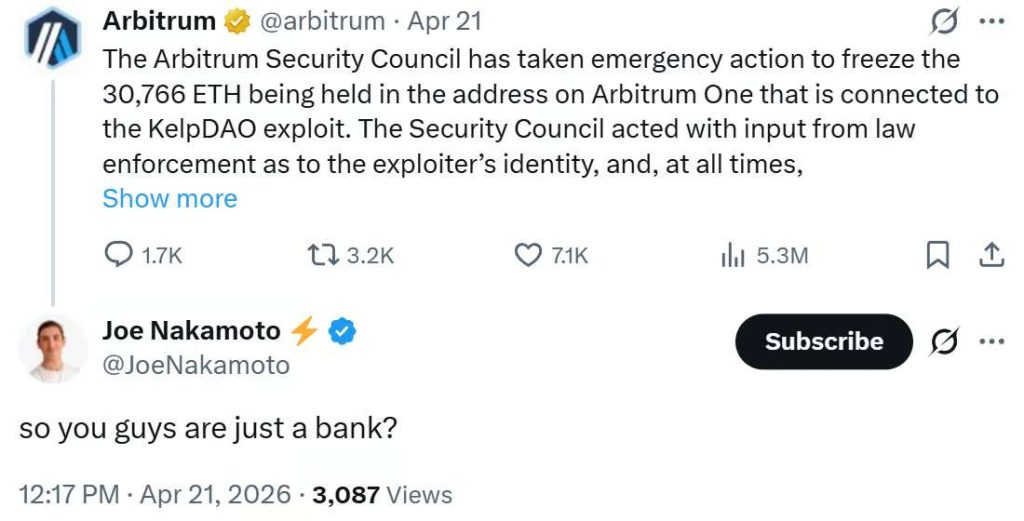
A recent intervention on Arbitrum saw attacker-linked assets frozen after a major exploit, while some stablecoin issuers, including Circle, have faced public backlash for slower or more limited responses in similar situations.
Connor Howe, CEO and co-founder of cross-chain infrastructure project Enso, said that crypto protocols are not that different from centralized platforms or banks if a small group of people can freeze funds.
“The differentiation from a bank compliance officer is less than DeFi idealists will ever admit,” Howe told Cointelegraph.
The debate isn’t the usual kerfuffle between decentralization and centralization, but about who gets to intervene and how quickly they can act. In practice, it can determine whether stolen funds are stopped or slip through.
The limits of decentralization in DeFi
To put it simply, the industry is split on whether protocols that call themselves decentralized should be able to freeze funds during exploits.
Protocols like THORChain said they cannot freeze funds by design, even during exploits. Security researchers have questioned that claim, pointing to past cases where intervention did happen.

Related: Crypto projects shut down as token models fail under pressure
Bernardo Bilotta, CEO of stablecoin infrastructure platform Stables, said the function is necessary but must operate within clear constraints.
“Freeze capabilities need to be narrowly scoped, time-limited and governed by transparent criteria that existed before the breach occurred,” Bilotta told Cointelegraph. “A protocol shouldn’t be making up the rules while the house is on fire.”
Bilotta characterized choosing “philosophical purity” over user protection as “negligence.”
The recent $293 million Kelp DAO exploit brought those discussions back into the spotlight as Arbitrum froze some of the stolen funds linked to suspected North Korean hackers. Some in the industry said the decision cut against DeFi’s grain.
The Ethereum layer-2 network has a 12-member security council with the ability to carry out certain changes to the protocol. In emergency situations, it can do so through nine of the 12 in its multisig wallet.
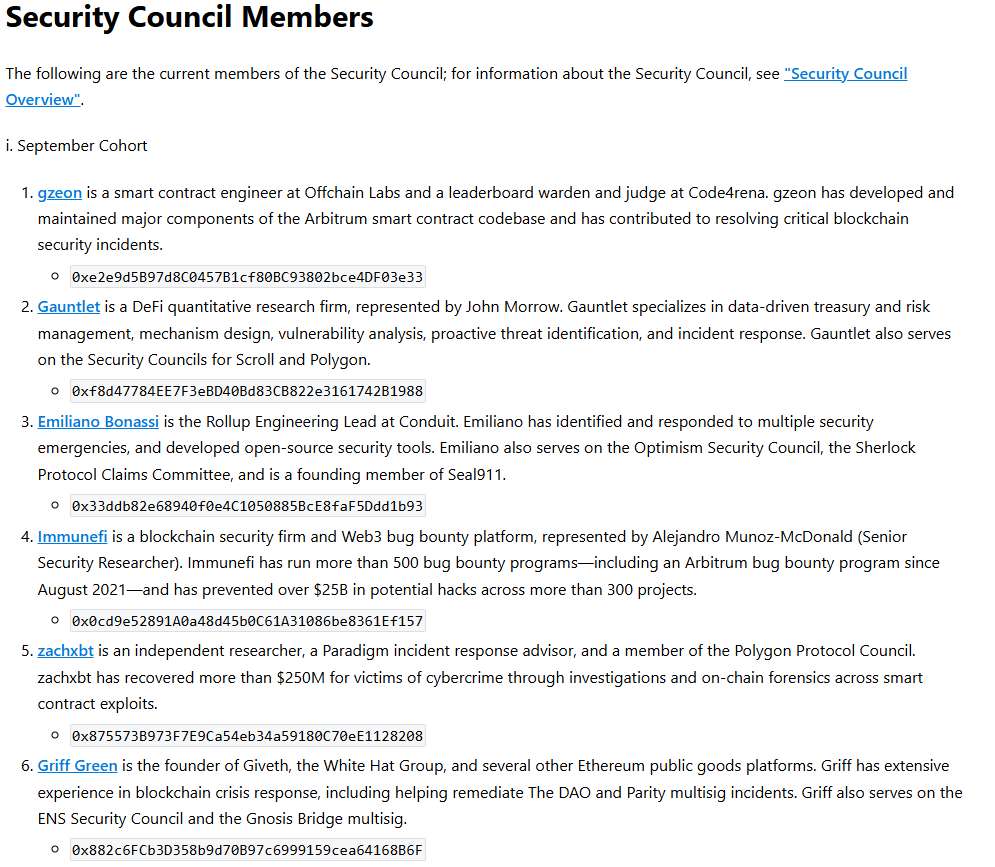
Howe said that transparency in how such security councils operate can still separate DeFi platforms from traditional finance or their centralized counterparts.
“That’s notably different from a TradFi institution that invokes discretionary powers buried in their terms of service and guarded by their legal team,” Howe said.
“There should be transparency in every protocol around who holds the keys, and the safeguards in place to prevent them from going rogue. If there’s no clear distinction, then it’s a vague claim of decentralization.”
Centralized stablecoins are among the most-traded cryptocurrencies in the world. Tether’s USDt and Circle’s USDC are the largest, accounting for more than $266 billion in combined market capitalization.
Both issuers have the ability to freeze their stablecoins, but they approach that function differently.
While Tether freezes funds more quickly in most security breaches, Circle emphasizes legal process and jurisdiction before intervening,
“Let me be clear about something that is frequently misunderstood: when Circle freezes USDC, it is not because we have decided, unilaterally or arbitrarily, that someone’s assets should be taken from them,” Dante Disparte, the company’s head of global policy, wrote in a recent blog post.
“Our ability to freeze funds is a compliance obligation — exercised only when we are legally compelled by an appropriate authority, through lawful process,” he continued.
Circle was pushed to explain its stance after the recent $280 million exploit on Solana-based Drift protocol, also attributed to North Korea.

Related: Ethereum’s EEZ could pull other blockchains into its orbit
Bilotta said waiting for formal legal orders in cases with clear, onchain evidence of an exploit is a “failure of responsibility.”
Large-scale exploits, including those linked to North Korean actors, have pushed the industry into situations most would consider extreme, where hundreds of millions can be drained and laundered in real time.
Such cases raise the question of who defines what qualifies as “extreme” and when intervention is justified.
“This is the question the industry has been ducking the longest,” said Wish Wu, CEO of institution-focused layer-1 Pharos.
“In practice, ‘extreme’ is too often defined after the fact by whoever holds the keys, which is exactly the failure mode decentralization was meant to avoid,” he added.
Wu said the more credible approach is to define those conditions in advance and encode them into governance, even if that means accepting that some edge cases fall outside those rules.
“Can a small, identifiable group move user funds before users have a fair chance to exit?” Wu asked.
“If the answer is yes, then whatever the marketing says, the system is custodial in substance. If the answer is no, only then are we in an honest conversation about which governance and safety tradeoffs make sense for different use cases.”
Below that line, decentralization loses its substantive meaning, he added.
Magazine: AI-driven hacks could kill DeFi — unless projects act now
The post DeFi can freeze stolen funds, but not everyone agrees it should appeared first on Activist Post.

Treasury Secretary Scott Bessent said the US has seized nearly $500 million in Iranian crypto assets, surpassing the previously reported $344 million freeze.
The United States has seized nearly $500 million in Iranian cryptocurrency assets as part of a sweeping economic pressure campaign against Tehran, Treasury Secretary Scott Bessent said Wednesday.
Bessent made the comments during an appearance on Fox Business’s “Kudlow,” where he outlined the scope of Operation Economic Fury, a campaign ordered by President Donald Trump in March 2025 aimed at cutting off Iran’s financial lifelines through asset seizures, bank account freezes and secondary sanctions on countries that continue to buy Iranian oil.
“We are freezing bank accounts everywhere. More importantly, we are making people less willing to deal with the regime,” Bessent said, adding that retirement funds and overseas real estate held by Iranian officials are also being targeted.
The $500 million figure is much higher than the $344 million in seized crypto assets previously disclosed. Last week, Bessent announced that the Treasury’s Office of Foreign Assets Control had sanctioned several crypto wallets tied to Iran, with stablecoin issuer Tether confirming it had frozen more than $344 million in USDt (USDT) at the request of US authorities.

Cointelegraph reached out to the US Treasury and Tether for an explanation on the gap between the two figures, but had not received a response by publication.
Related: Iran views BTC as strategic asset, but USDt still dominates oil tolls: BPI
Bessent said Operation Economic Fury has taken a toll on Iran’s economy. One of the country’s largest banks collapsed in December, and its currency has fallen 60 to 70% against the US dollar. “They’re in the middle of a currency crisis,” he said.
Treasury has also intensified pressure by ramping up sanctions across multiple fronts. On Tuesday, OFAC sanctioned 35 entities and individuals tied to Iran’s shadow banking network. Separately, it targeted a Chinese oil refinery and roughly 40 shipping firms operating as part of Iran’s shadow fleet, which moves Iranian crude to buyers in China and elsewhere in violation of sanctions.
The actions also hit Iran’s missile and drone supply chain, with 14 individuals and entities sanctioned for procuring components for Shahed-series attack drones and ballistic missile propellants. Since February 2025, OFAC has sanctioned over 1,000 Iran-related persons, vessels, and aircraft as part of Operation Economic Fury.
Related: Binance.US cuts spot trading fees to near zero in push to undercut rivals
Earlier this month, reports emerged that Iran was considering charging ships Bitcoin tolls for passage through the Strait of Hormuz, with empty tankers allowed free passage and loaded ones charged around $1 per barrel of oil. Forbes reported that Iran had already collected revenue from such tolls, though Tehran has not publicly confirmed the claims.
Separately, maritime risk firm Marisks warned that fraudulent actors were impersonating Iranian security services and contacting stranded shipowners, demanding payment in Bitcoin or USDt in exchange for clearance through the strait.
Magazine: Will the CLARITY Act be good — or bad — for DeFi?
The post US seized $500M in Iranian crypto assets, Treasury secretary says appeared first on Activist Post.

More than a third of US crypto traders report cutting daily expenses and delaying major purchases as unrealized losses weigh on household finances.
The recent crypto market downturn has forced more than one in three crypto traders to cut everyday spending, according to a new survey by CEX.IO.
The survey, conducted among 1,100 US-based active CEX.IO users, shows the current market slump is straining household finances, though it remains less severe than 2022, when Bitcoin fell by roughly 75% from its peak. Bitcoin is still about 40% below its October 2025 high, leaving many retail investors sitting on unrealised losses.
About 36% of respondents said they reduced everyday spending as a direct result of market conditions, with 10% describing those cuts as significant sacrifices made to maintain their positions. Roughly 37% also reported delaying or cancelling purchases due to crypto losses, including 21% who postponed major financial commitments such as buying a home, car or undertaking renovations.

“The 2025–2026 bear market has not produced the kind of systemic shock seen in past cycles (at least for now), but its effects appear to be showing up in quieter ways at the household level,” CEX.IO wrote.
Related: Crypto Market Sentiment Reaches 3-Month High
The survey revealed that many traders are managing the downturn in relative isolation. Only 5% said someone else knows the full extent and value of their holdings, while the majority either share limited information or keep their positions entirely private.
Financial strain is also evident in cash flow trends. While 77% said they did not take on debt tied to crypto, 38% reported some form of financial disruption since October 2025. A quarter said they relied on savings to maintain stability, and 12% admitted to missing or delaying payments.

Even so, most respondents have not changed plans dramatically. Nearly half reported that crypto makes up more than 30% of their investable assets, yet 73% said their approach to earning income remains unchanged.
Looking ahead, a combined 79% said they plan to either hold or increase their positions over the next six months.
Related: Bitcoin Price May Go Under $70K Despite Strategy’s Latest Big BTC Buy
Another survey by Börse Stuttgart Digital earlier this week found that cryptocurrency services are starting to influence how European investors choose their banks, with 35% saying they would consider switching institutions for better crypto offerings.
The poll of around 6,000 investors across Germany, Italy, Spain and France also found that nearly one in five expects their primary bank to provide crypto access within three years, pointing to a gradual shift toward integrating digital assets into mainstream banking.
Magazine: How to fix suspected insider trading on Polymarket and Kalshi
The post Market conditions force 1 in 3 crypto traders to cut everyday spending: Survey appeared first on Activist Post.

Individuals and groups would be required to register with the Bank of Russia before offering certain crypto services, or potentially face fines and prison time.
Russia’s government submitted a bill to its parliament’s lower house in an effort to amend the country’s legal code to attach criminal liability for crypto services offered without regulatory approval or licensing.
In a draft law sent to the State Duma on Friday, Russian lawmakers proposed that entities “carrying out activities related to the organization of digital currency circulation,” that operate without a license from Russia’s central bank, could be subject to criminal liability.
Without registration with the Bank of Russia, individuals could face up to $4,000 in fines and up to four years in prison, or more severe penalties if part of an organized group.
“The same act committed by an organized group, or involving the infliction of damage or the extraction of income on a particularly large scale, would be punishable by compulsory labor for up to five years or imprisonment for up to seven years,” the bill’s text said.
The bill also proposes a “fine of up to 1 million rubles [$13,100] or an amount equal to the convicted person’s salary or other income for a period of up to five years.”
The draft law followed a package of bills initially proposed in March that included criminal penalties for illegal crypto miners, but the most recent legislation included details on fines and potential prison time for any unregistered digital asset services.
According to Russian media outlet RBC, the country’s Supreme Court said that the crypto bill lacks “reasoned justification” for criminal penalties.
The court said that the measure was “premature” until Russia enacted its “Digital Currency and Digital Rights law,” expected to go into effect in July. If the bill passes it would give Russia’s government more control and oversight over the crypto industry.
Related: At least a dozen crypto entities attacked since Drift Protocol hack
Grinex, a Russia-based crypto exchange currently being sanctioned, halted trading for users on Thursday after losing more than 1 billion rubles — about $13.7 million — in a hack it suspected was carried out by “entities of hostile states.”
The company said it forwarded relevant information on the attack to law enforcement agencies and filed a criminal complaint.
Magazine: Will the CLARITY Act be good — or bad — for DeFi?
The post Russia introduces bill to criminalize unregistered crypto services appeared first on Activist Post.

Michael Saylor’s Strategy acquired 13,927 Bitcoin for $1 billion last week, funding the purchase through STRC share sales, lifting the company’s holdings to 780,897 BTC.
Michael Saylor’s Strategy, the world’s largest public holder of Bitcoin, added a large haul of Bitcoin to its stash last week, edging toward 800,000 BTC in total holdings.
Strategy acquired 13,927 Bitcoin for $1 billion between April 6 and 12, according to an 8-K filing with the US Securities and Exchange Commission on Monday.
The purchases were made at an average price of $71,902 per coin, marking another purchase below the company’s average acquisition price of $75,577.
Strategy now holds 780,897 BTC on its balance sheet, acquired for a total cost of $59.02 billion. The company has 19,103 BTC left to reach 800,000 BTC after buying more than 107,000 BTC so far this year.

Purchases funded with Strategy’s STRC ATM
According to the filing, the $1 billion in purchases were funded via proceeds from Strategy’s perpetual preferred equity, Stretch (STRC).
The company sold 10 million STRC shares last week, generating around $1 billion in notional value and net proceeds. No shares were sold for STRF, STRK, STRD or MSTR stock during the period.

According to STRC.live, STRC recorded its second-largest weekly issuance on record last week, nearly three times the four-week average. The equity has seen record share sales in recent weeks after Strategy amended its sales rules in early March.
Saylor teased the latest purchase in an X post on Sunday, sharing a chart of Strategy’s Bitcoin purchase history showing 105 acquisitions since 2020, a pattern often seen ahead of new BTC buys.

Strategy’s aggressive Bitcoin buying comes despite the company sitting on significant unrealized losses on its holdings. Last week, Strategy reported its unrealized losses on digital assets amounted to $14.46 billion in the first quarter of 2026.
Apart from Strategy, Bitcoin exchange-traded funds (ETFs) have also seen significant buying last week, with spot Bitcoin ETFs seeing inflows of $786 million over the period.
Related: Institutions are in a crypto bull market as retail sits out: Exodus CEO
Crypto markets rallied early last week following a US-Iran ceasefire announcement, with Bitcoin reclaiming $70,000 and briefly surging past $73,000, according to CoinGecko.
Nomura’s Laser Digital told Cointelegraph that Strategy’s buying was among the key signals supporting the move, alongside strong inflows into Bitcoin ETFs. The firm added that US equities also returned to pre-conflict levels, reinforcing broader market momentum.
“However, the weekend talks didn’t go well — no agreement was made and the latest announcement of a naval blockade from April 13 triggered a sharp pullback towards $71,000,” Laser Digital said, adding that the company expects this erratic price movement to continue until the last minute of the ceasefire deadline.
Magazine: Your guide to surviving this mini-crypto winter
The post Strategy buys 13,927 Bitcoin for $1B, holdings near 800,000 BTC appeared first on Activist Post.


 Lateo.net - Flux RSS en pagaille (pour en ajouter : @ moi)
