 Connexion


The notification arrives at 4:47 on a Friday afternoon, from an app you rarely open. It says that one of the big banks, a name you have used for most of your adult life, has been seized by the government. You read it four times before the words settle. Regulators tend to move late like this, after the branches have closed and the staff have gone home, on the theory that a weekend between the announcement and Monday morning gives everyone room to breathe.
Your thumb goes to the banking app out of habit, the way it might reach for a wallet to check it is still there. A small circle turns, then turns again. A gray, polite message appears, one you have never seen before, something about high traffic and service interruptions. Nobody is shouting. No sirens, no man on television waving his arms. Just a spinning circle and one flat sentence, which together announce that your money has stopped answering the phone.
Over on the family group chat a second signal lands. Someone has screenshotted a balance. Someone else reports that a rent transfer is pending, a word that will do a lot of heavy lifting over the next three weeks. Then the cousin who is always slightly ahead of everyone types the line that will define the mood for millions of people at once: get cash tonight.
Multiply that scene by five million kitchens, cars and office bathrooms, because all of it is happening at the same hour. Banks do not fail the way houses catch fire, suddenly and in plain view. They fail slowly, from the inside, after years of small pressures nobody bothered to watch.
By the time the public learns the name, the decision is already made and the paperwork already signed. All that remains is to manage the panic the paperwork creates, and that part never makes it into the textbooks. The failure itself is technical. The panic it causes is another matter entirely.
Gone Viral! The most shocking videos in the world… 7 Hidden Signs That Martial Law Will Be Declared. So pay chose attention because this video will change your life forever for the good!
Most people never quite absorb how much of modern life runs through a handful of buildings. Direct deposits, payroll, mortgage payments, card settlements, the automatic withdrawal for the electric bill, the small transfer that keeps a shop’s lights on one more week. None of it sits in a vault. It is a number in a ledger that one bank keeps and that other banks agree to believe. Let one ledger stop updating and the agreement wobbles, and the wobble travels outward at the speed of the internet.
At this level, money is mostly a belief system, and a very well advertised one. You have almost certainly never seen the actual dollars behind your checking account, because in any physical sense they do not exist. What exists is a promise, and a chain of other promises, and a shared willingness to keep acting as though the promises are solid. That willingness does all the work. When enough people stop believing at once, the whole thing coughs, and the cough is what we call a bank run.
Ordinary life runs on a margin of days, not months. A paycheck arrives, bills go out, groceries land on a card, and the buffer at the end stays thin. Seventy-two hours of frozen accounts is an annoyance. Two weeks is a crisis, because a mortgage does not care about your bank’s paperwork and a grocery store does not take a sympathetic shrug.
Underneath sits a darker layer, and it has little to do with whichever bank is on your phone. Since the spring of 2023, when three of the four largest failures in American history landed inside eight weeks and then the noise simply stopped, the system has been unusually quiet. It is comfortable, and it is also the kind of quiet in which complacency gets made. A system that has not been seriously tested in three years is full of people who have forgotten what a test feels like, and forgotten systems are fragile in ways that stay invisible until the moment they are not.
Whether a major bank can collapse is barely in doubt. Banks collapse all the time, dozens a decade, most of them small enough that the news never reaches you. The interesting case is the big one, connected to your payroll and your landlord’s mortgage and half the small businesses in your city. That scenario would play out over the first twelve hours, then the twelve days after, then a long gray year.
What follows is an honest attempt to walk through that scenario from the ground up, in the order it would actually unfold, using the real machinery that exists today and the real precedents we already survived. Parts of it have been rehearsed by the government, and parts by the banks. You have rehearsed almost none of it, and that is the gap worth closing.
The Mathematical Warning That Refused to Fade
When the shelves empty and the streets change, stockpiles may not be enough!!!
(What you’re about to see reveals just how quickly the world we know can unravel.)
Words break first, and they break on social media rather than television. Regulators seize banks late on a Friday precisely so a weekend can absorb the shock, but the modern world does not observe weekends. By the time the official statement lands, the rumor has been loose for hours, carried by screenshots and half-sentences and the particular tone financial people adopt when they are trying very hard to sound calm. Confidence is fragile, and the internet is very good at finding the thin spot.
The run itself is instant. In 1907 it meant a line of men in hats outside a marble lobby. In 2008 it meant customers queued on a California sidewalk with police keeping order, after IndyMac failed that July with thirty-two billion dollars in assets, and thousands of people learning in real time that a bank is only as strong as the crowd outside it. By 2023 the crowd never showed up at all. Forty-two billion dollars left Silicon Valley Bank in a single day, most of it from laptops, at a rate north of a million dollars a second, and the bank was dead by morning.
Keep that number in your head. Forty-two billion in a single day, with no lines, no lobby and no hats. A bank that had existed for four decades and held the money of half the technology industry was emptied in roughly the time it takes to watch two episodes of something. Branch staff learned about the run from the same headlines as everyone else.
Failure inside those first hours happens in a specific order, and the order tells you what to protect. Apps slow first, buckling under millions of simultaneous logins. Transfers between banks lag next, since the rails that move money between institutions were built for a jog, not a stampede. Then, if the damage is bad enough, some banks quietly cap daily outflows or freeze wires outright, buying time to count the wounds.
ATMs become the second front. Cash is physical, and physical things run out. A machine holding a few hundred thousand dollars can be drained in one anxious afternoon, and the vans that refill it run on a schedule built for a normal Tuesday. In a genuine panic the machines near the branch empty first, then those by the grocery stores, then the ones in neighborhoods where people already live paycheck to paycheck. Whoever has the least buffer reaches the machine last.
Branches do open, usually by Saturday or Monday, and lines do form, because some people need a human face and some businesses need a stamped document. Police have managed bank crowds before and would again. The crowd at the branch is only the visible edge. Most of the dying is happening somewhere else, in the app.
Keep an eye on the other banks during these hours, because contagion is rarely rational and does not wait for facts. Depositors at perfectly healthy institutions start moving money too, unable to tell a bank with a problem from a bank that merely resembles the one with a problem. Signature Bank failed two days after Silicon Valley Bank in 2023, and First Republic followed in May. None of the three had the same disease, only the same symptom: a market that had suddenly stopped believing them.
Small businesses feel it before households, and they feel it hardest. A company with forty employees and a checking account at the failed bank cannot run payroll from an account it cannot reach. Owners call their bankers, then their accountants, then each other, hunting for someone who can promise that Friday’s checks will clear. Nobody can promise anything, because the machinery that would make the promise is itself in receivership. By Sunday night the local economy has developed a stutter.
The psychological moment arrives late the first night, once the adrenaline fades and the arithmetic sets in. How much is in the account, how much is insured, how much sits over the line, how long the household could last on whatever is in the drawer. Millions of families ran the same calculation in the autumn of 2008 and again in the spring of 2023. It produces the same cold feeling every time: your entire financial life is a number on a screen maintained by strangers you will never meet.
The cavalry does exist, it arrives quickly, and its name is the Federal Deposit Insurance Corporation. Here the story turns genuinely reassuring and stays genuinely real. Since the agency was created in 1933, no depositor has lost a penny of insured money in an American bank failure, a record that has survived depressions, wars, the savings and loan collapse, the dot-com bust and three of the largest failures in history. Few promises in modern life have been kept that faithfully for that long.
Coverage is precise. The standard ceiling is two hundred and fifty thousand dollars per depositor, per bank, per ownership category, and the FDIC moves to honor it within a few business days, transferring accounts to an acquiring bank, issuing checks, or both. For an ordinary saver the practical experience is often a strange administrative blur followed by a working account at a different bank, with a different logo and a different app to download.
The line that matters is the one above the ceiling. Anything past the insured limit is technically exposed, and the mood shifts there. A claim against the failed bank’s remaining assets arrives, a piece of paper for the uninsured portion, and then you wait. Loans, buildings and securities get auctioned off slowly, and whatever is recovered is distributed over months or years in fractions nobody can forecast. Going over the limit rarely means losing everything. It usually means losing control of the timeline.
Regulators have tools beyond insurance and will use them. Emergency lending windows at the Federal Reserve can flood the system with liquidity, which is a fancy way of saying the Fed lends cash to banks so the cash machines keep working and the cards keep clearing. Within days in 2023 the Fed stood up an entirely new facility, the Bank Term Funding Program, aimed at stopping a local problem from becoming a national one. It worked well enough that the panic cooled within weeks. Expect the same reflexes next time, only faster, because the next time will be watched by a public that has already seen the movie.
Treasury and the FDIC can stretch the rules when the situation demands. In 2023 they invoked the systemic risk exception, a clause that let them protect uninsured depositors at the two failed banks, on the argument that letting those depositors take losses would have triggered a wider collapse. The exception is not automatic. Deposits above the insured limit are covered only when regulators judge the wider system to be at risk, which is why Janet Yellen cautioned at the time that the guarantee would not apply to every depositor above the limit in every future failure. She later framed the stakes precisely, describing “the decisive actions that we took in March to protect depositors and provide additional liquidity to the system,” and crediting them with mitigating “the very serious risk of broader financial contagion in the banking system.”
The FDIC’s own leadership used blunter words that weekend. Chairman Martin Gruenberg said the agencies were taking “decisive actions to protect the U.S. economy by strengthening public confidence in our banking system.” Public confidence, in his phrasing, is what matters most. The money is real. What keeps it from running is confidence, and confidence is something a government can manufacture in an emergency, much the way a fire crew builds a firebreak.
None of that makes the days feel calm. Outages happen anyway, transactions run late, a bank’s website stays a mess for a week, and officials say more than they mean and less than they should. Markets lurch, which ripples straight into retirement accounts and makes millions of people feel poorer on paper before anything real has happened to them. The stock market is not the economy, but it does show how people feel, and people will feel terrible.
Contained problems burn out, and the second act becomes a slow exhale. Confidence returns in increments, the app works, payroll clears, and people stop checking their balance four times a day. Most failures end this way, absorbed and forgotten, a paragraph in a financial history nobody reads. Quiet failures are the norm, and the ones that make the news are the exception. That exception is what we are imagining.
Let it spread and the second act turns into a chain. Money starts leaving banks that merely resemble the failed one, and the resemblance need not run deep. A similar size will do, or a similar industry focus, or a similar pile of uninsured corporate accounts. Contagion in 2023 traveled along a shared profile rather than a shared balance sheet, and it toppled two more banks before the weekend ended and a third within two months. One failure, under the wrong conditions, becomes a verdict on an entire category of institution.
Credit is where an ordinary person feels the second wave, often without connecting it to the bank at all. Survivors turn cautious, since caution is how you survive the next scare. Lending tightens. A mortgage you were about to get becomes harder to qualify for. A small business line of credit that kept your cousin’s restaurant afloat gets trimmed without warning. Credit card limits shrink, sometimes overnight, and a household that was managing fine discovers its available buffer was never as wide as the statement implied.
Jobs follow credit with a lag of weeks or months. When businesses cannot borrow, expansion stops, then hiring stops, then trimming begins. A bank failure does not guarantee a recession, but a bad one is among the most reliable recession starters we know, because it attacks the exact tissue joining savers to borrowers. The 2008 crisis began as a mortgage problem, became a banking problem, and ended as a ten percent unemployment problem, in that order. The order matters.
Other institutions absorb the refugees. Credit unions, insured through a parallel system up to the same two hundred and fifty thousand dollar limit, see a rush of new members during a scare, because people want somewhere that feels smaller and more human. Gold and silver dealers report sold-out inventories within days as savers reach for things no ledger controls. Those who had already spread their money, kept cash in the house and owned a few hard assets discover they are not frightened, and the difference between them and their neighbors has little to do with intelligence. It comes down to preparation, mostly.
There is a social dimension the economics papers skip. A banking crisis is a trust crisis, and trust is what societies run on when everything else fails. Neighborhood chats reorganize around who has cash and who can front a bill. Landlords get asked for a week’s grace and sometimes give it, because the landlord’s own account is frozen too. The informal economy thickens, and people rediscover that a favor owed is a form of savings.
How quickly it can end is the odd part. Once the guarantees are believed, once the acquiring banks are named, once the first Monday passes without catastrophe, the herd turns and walks back in. People who emptied accounts on Friday are redepositing a month later, sometimes into the very institution that scared them. Panics have a short half-life when managed well and a long one when they are not, and the distance between those outcomes is usually a matter of hours and a matter of words.
History is the only laboratory available, and it has run this experiment twice in living memory with two very different results. The 2008 crisis was long and deep, a mortgage contagion that metastasized over eighteen months, met by a response that was enormous, controversial and slow to arrive. The 2023 crisis was short and sharp, a deposit contagion that burned through three banks in two months and then went out, met by a response that was nearly instantaneous. Speed, more than anything else, decided how each one ended.
Speed matters because panic compounds. A run allowed to continue for a week becomes a run that cannot be stopped, because by then the rumor has hardened into a belief, and beliefs about money are self-fulfilling. Washington Mutual, the largest failure in American history at three hundred and seven billion dollars in assets, spent most of 2008 sliding, leaking deposits and losing the argument, and by the time the government seized it in late September the institution was already hollow. It had been dying for months. Silicon Valley Bank, by contrast, was healthy on a Wednesday and dead by Friday morning, because forty-two billion dollars left in one day and nothing had time to be gradual.
The second lesson is uglier and gets discussed less. The 2008 playbook spent taxpayer money to rescue banks, the public hated it, and the hatred produced a political backlash that reshaped a decade. Out of that came a newer tool, the bail-in. Rather than the government writing a check, the bank’s own large depositors and bondholders absorb losses, their claims converted into shares or written down so the bank can be recapitalized from inside. The template dates to Cyprus in 2013, where large depositors in two failing banks had a chunk of their uninsured money frozen and partly converted into equity.
A bail-in changes the arithmetic for anyone holding real money in one institution. Above the insured limit you stop being only a customer and become a creditor, and creditors take haircuts. The money does not necessarily vanish. It gets restructured, converted, frozen, repriced, and handed back later in a form you did not choose. For a wealthy saver, the bail-in is the quiet nightmare tucked inside the word rescue, because it means the rescued help pay for the rescue.
Two things stay constant across both eras. Insured deposits have always been protected, in every crisis, without exception, and that protection is not a courtesy withdrawn when things get bad. The surrounding economy enjoys no such cover. Jobs, credit, prices, rents, the odds of getting a car loan or a mortgage all sit outside the net, and all of them can be damaged even when your account is perfectly safe.
Jamie Dimon, who runs the largest bank in the country and has watched every crisis since the savings and loan era, wrote a line in his 2023 shareholder letter that has aged into prophecy. “The current crisis is not yet over,” he wrote, “and even when it is behind us, there will be repercussions from it for years to come.” He was right in the narrow sense, and the narrower truth is that the repercussions of any major failure outlive the headlines by a decade, surfacing in tighter credit, slower growth and a generation of savers who trust institutions a little less.
Recent years have been almost eerily calm, which is its own kind of data. Two failures in 2024, two in 2025, and two more so far this year, all of them small institutions with a few hundred million in assets at most, absorbed and forgotten within a week. The big names have held. Quiet, as any veteran of finance will tell you with a slightly nervous smile, is exactly the condition in which the next problem quietly assembles itself.
Preparation in banking is not complicated. It is boring, it is cheap, and it is the difference between watching a crisis and living through one. You are not trying to predict the next failure. You are trying to be indifferent to it, so that whichever bank goes down, and whenever, the event is an inconvenience rather than a catastrophe.
Spread the money across institutions. No single account should carry more than the two hundred and fifty thousand dollar insured limit, and if household savings exceed that, the excess belongs in a second bank, a third bank, or a different ownership category at the same bank. Joint accounts, retirement accounts and trust accounts each carry separate coverage, which means a married couple can legitimately protect far more than a quarter of a million at one institution by using the right account types. The FDIC publishes the rules in plain language, and an hour spent reading them beats a year of financial news.
Use both big banks and small ones. Size is no guarantee of safety, and smallness is no guarantee of virtue, but the two behave differently under stress. Giants tend to get rescued because letting them fall breaks too much. Small local banks tend to be more conservative, closer to their borrowers, less exposed to the speculative fashions that sink large institutions. Splitting money between the two types buys the political protection of the big and the prudence of the small, and it costs almost nothing to arrange.
Keep real cash in the house. A few weeks of expenses, in small bills, somewhere dry and boring. Small bills matter because in a crisis nobody can break a hundred, and the person selling you bread at the corner will be grateful for a five. Cash is the only money that keeps working when the power flickers, the network drops and the app refuses to load. It earns no interest, so treat it as insurance you hope never to use rather than as savings.
Own a little precious metal. Gold and silver sit outside every banking system on earth, which is exactly why they get bought in a panic. You do not need to become a coin collector. A modest holding of silver, cheap enough to be practical and divisible enough to be useful, gives you an asset no ledger controls and no regulator can freeze. It pays nothing and can sit flat for years, so it belongs in the same category as the cash. Learn the spot price now, while you can be calm about it, so that you are not guessing at value in a crowd.
Put some wealth into things you can touch. Land, tools, a generator, a chest freezer, decent hand equipment, a bicycle that works. Tangible assets cannot be devalued by a central bank or frozen by a receiver, and several of them improve an ordinary Tuesday. You are not trying to become a homesteader. The idea is to hold a slice of your net worth that does not depend on an institution staying solvent.
Watch the health of your own bank. Stock price slides, repeated quarterly losses, a sudden change of chief executive, a heavy concentration in one industry, an unusually high share of uninsured corporate deposits. These are the warning lights, and they usually blink for months before anything breaks. Read your bank’s annual report once a year, or at least skim the headlines. The customers who got hurt in 2023 were mostly the ones who never asked whether their bank was doing anything risky.
Set up your backups before you need them. Open the second account now, not on the Friday afternoon when the app is dead. Verify the transfer links now, not during the panic. Keep a written list of account numbers somewhere physical, because the app that stores them may be the app that is broken. Preparation is cheap when nothing is wrong and worth a great deal when something is.
The card in your wallet is a small miracle that stops working the moment the chain behind it breaks. Every swipe is a message traveling from a terminal to a bank to a network and back, and any link can go dark. Alternatives are not paranoia. They are basic financial hygiene, and they cost almost nothing to build.
All of these options rest on the same principle, which is redundancy. One payment method is a single point of failure. Three or four overlapping methods mean that whatever breaks, something else still works, and the difference between a bad week and a disaster is usually just that.
There is a version of a banking crisis where the shelves are fine and the trucks keep running, and a version where the disruption lasts long enough that ordinary goods become the thing people trade. Which one you get is unknowable in advance, so you prepare for the second and enjoy the first. A stockpile is not really about hoarding, but about having enough surplus to trade without touching your own essentials.
Two rules govern the whole thing. Only trade what you can spare, so a bad trade never leaves you short of something you need. And never give away your last of anything, because the last of anything is the most expensive version of it. Build the network now, while everyone is calm and generous, so that when the pressure arrives you are trading from strength rather than desperation.
A major bank collapsing tomorrow would not end the world, and it would not be gentle. It would be fast, ugly and deeply personal for millions of people, most of whom did nothing wrong and simply kept their money where their parents kept theirs. Confusion in the first twelve hours. Paperwork and rumor in the first twelve days. Tighter credit, slower hiring, and a quieter, more cautious economy over the following year that nobody could quite explain.
The reassuring part is that the containment machinery is real, tested and fast, and it has an almost perfect record on the one promise an ordinary household cares about most. Insured money has always come back. Since 1933, without exception, across every disaster the country has survived, no depositor has lost a single insured dollar. That record is not an accident. It comes from institutions built to hold the line, and they would hold it again.
Everything insurance does not cover is where the discomfort lies. Your job, your rent, the loan you were planning to take, the price of what you buy, the general mood of the economy around you. Those carry no FDIC sticker, and they are where a bank failure does its lasting damage. Protecting them means protecting your flexibility, which means not having all your money in one place, not having all your options in one system, and not being the person who finds the flaw in the plan on the worst possible day.
Preparing for this is mostly a matter of being boring in advance. A second bank account, some cash in a drawer, a few ounces of silver, a stocked pantry, a neighbor who owes you a favor and to whom you owe one back. None of it is dramatic or expensive, and together it turns a potential catastrophe into an inconvenience you can shrug off over breakfast.
Sooner or later there will be another failure. Which name, and how many hours the app spins before someone tells you the truth, are the only parts still unknown. The people who come through it well will not be the smartest or the luckiest. They will be the ones who, on some ordinary quiet weekend long before the news broke, bothered to move a little money somewhere else and buy a little cash they never thought they would need.
NASA Just Confirmed The Worst. A 1,200-Year Drought Has Begun, yet millions will ignore this warning until it’s too late. One farmer didn’t.
What he discovered changed everything — a simple method that could help generate water even during extreme drought conditions, and it could change your future too.
Watch The Short Video Below Before It’s Removed
The post The Weekend the Money Stops: A Bank Collapse, Hour by Hour appeared first on Activist Post.
University of Georgia Cooperative Extension food safety specialists Elizabeth Andress and Judy Harrison have published guidance for households assembling emergency food supplies, outlining recommendations for three-day preparedness kits [1].
How much and which foods to store depends on the members of your household, their preferences, special health conditions, ability to use the food in an emergency, and available storage space. Andress and Harrison advise that planning for short-term emergency food needs may be as simple as increasing quantities of staple and non-perishable foods that a household normally uses.
The guidance arrives amid broader independent reporting on supply chain fragility. NaturalNews.com has reported that buying extra supplies when supply chains are visibly cracking is strategic self-reliance rather than hoarding, noting that purchasing now is almost always cheaper than buying later when costs are rising [2]. Zero Hedge reported in September 2026 that escalating diesel prices and energy costs are pressuring food distribution networks [3].
A three-day emergency preparedness kit will be useful for most disasters. Gathering essential items and putting them in one location will help your family through the worst days of an emergency. The short-term kit should include food in addition to water, personal hygiene items, flashlights, blankets and other essentials recommended for emergencies.
Andress and Harrison recommend selecting foods that require no refrigeration, minimal or no preparation or cooking, and little or no water. If food will need to be heated before eating, you may need to pack a grill, camping cookstove and fuel as well. For ease in managing your supplies, select compact and lightweight food items.
Refrigerated or frozen foods can be used at the beginning of an emergency. If your family has enough advance warning about a possible power outage, extend the storage time of food in a freezer by filling empty spaces with frozen water, using clean plastic containers or jugs filled with water and frozen. Food will keep in a well-insulated, well-filled, closed freezer for 2 to 3 days.
Independent preparedness author Kathy Harrison states in her book “Just in Case” that dried beans require overnight soaking and then hours of long, slow cooking in a lot of water to become palatable — a bad option when both water and fuel might be in short supply, which is why she stores both dried and canned beans [4]. Preparedness author Peggy Layton writes in the “Emergency Food Storage Survival Handbook” that a 72-hour emergency kit is designed to contain the items needed to survive for a three-day period, and each family member should have his or her own kit tailored to the individual’s specific needs [5].
The article recommends a selection of ready-to-eat canned meats, fruits and vegetables, milk, and soup, noting that if soup is powdered, extra water should be stored. Kitchen staples like sugar, salt and pepper should also be included, along with high-energy foods such as peanut butter, crackers, granola bars and trail mix.
Include foods for infants, elderly persons, or persons on special diets, such as those with diabetes or allergies. Comfort and stress foods such as cookies, cereals, instant coffee and tea bags are also listed, along with vitamins (supplements). A can opener, scissors or knife for cutting open foil and plastic pouches, and disposable plates, cups and utensils should also be included, with all items packed in plastic bags with zipper closures to keep them dry and as airtight as possible.
Households should keep a list of dates when food items need to be inspected and possibly rotated, meaning used and then replaced with newly purchased items. Select compact and lightweight food items; military and camping supply stores are good sources for some compact, well-preserved foods suitable for emergency preparedness kits, including Meals, Ready-to-Eat, which require little or no preparation. Dehydrated or freeze-dried foods are lightweight and take up little room, but households will need to plan extra water supplies for rehydrating them.
Preparedness author Kate Rowinski advises in The Preppers Pantry Handbook that once food is opened, the original container may not be the appropriate choice for storage, and that any food will be kept fresher and longer by placing it in a container that seals out exposure to the air, with airtight containers and good snap-on lids [6].
A Sell-By or Expiration or Use By date tells the store how long to display a product for sale, and while a product should be bought before a sell-by or use-by date, it is still safe to use if it is wholesome and of good quality. Some foods, like fresh meats and poultry, last 1 to 2 days after the sell-by date if kept properly refrigerated at all times, while other foods may last 3 to 4 days, or even a week. A Best if Used By or Best if Used Before date is the date to use for eating the food at its best quality or flavor and is not a purchase date or date of final safety. A Use By date is the last date recommended for the use of a food product, determined by the manufacturer to indicate the last date for peak quality. A product should not be used after the Use By date.
For dry foods, keep them in airtight, moisture-proof containers away from direct light in cool places. Stock zipper-closure plastic food storage or food freezer bags, which will be useful for storing leftovers from opened packages of dry milks, potatoes, rice, cereals and dried fruits. Purchased packages of food staples for an emergency supply should be stored in airtight plastic food storage containers, glass jars with screw-top lids, or non-rusty metal cans, so that containers are available for storing opened packages during an emergency.
For independent reporting on food security and preparedness, readers may consult NaturalNews.com [7][2][8]. Those seeking uncensored analysis of supply chain trends may consult BrightAnswers.ai and BrightNews.ai.
The post Experts Outline Three-Day Emergency Food Storage Guidance appeared first on Activist Post.
The Mossad has a motto: “by way of deception, thou shalt do war.” Not by way of tanks. Not by way of armies. By way of deception. And, if you want to understand what happened to Charlie Kirk, which is part of what Sean from SGT Network and I talk about in this video, you need to burn that motto into your mind first, because everything that follows flows from it.
They weren’t hiding it. They never hide it. They tell you exactly what they are, because they know the indoctrinated masses will never believe them. And, they have to make you voluntarily fall for their agenda.
HOWEVER… There is an undeniable shift in consciousness happening right now. A lot of people are finally opening their eyes, and it’s about time.
I’ve been talking about this for about twenty years now. For the first decade, almost everyone treated me like I was out of my mind. It was always, “Oh, he’s just crazy, ignore him.” But then a series of global events unfolded (including the whole narrative over the last few years) and a light bulb went on for millions. People started looking back at what I’d been saying and realizing, “Wait, he was actually right.”
So what does “saving the world” actually look like? People ask me that all the time, and my answer is simple: you save the world by saving yourself. When you fix your own life and step into your truth, that positive energy ripples out and changes everything around you.
We hold vastly more power than we’ve been led to believe. Jesus himself said that we were capable of doing what he did, and even greater things than those. We are incredibly powerful beings, but genuine change will never come from a politician, a ballot box, or a policy… it has to come from within us.
If you look at the life of Jesus through a raw, historical lens, he wasn’t a passive figure in a religious hierarchy; he was an anarchist in the truest sense of the word. Anarchy simply means “no rulers”… it means refusing to accept human tyranny or slavery.
In all four Gospels, Jesus is depicted as patient, forgiving, and peaceful. He turned the other cheek. He preached love for one’s enemies. The only time he turned to physical force was against the money changers in the temple. Why? Because he despised what they represented.
When you look at the global financial landscape today, the exact same playbook is running – just on a massive, worldwide scale. Central bankers, predatory financial institutions, and ancient banking dynasties… The money changers of ancient Jerusalem were the direct predecessors of the entire debt model, designed to keep individuals, families, and sovereign nations trapped on a financial treadmill. Usury and predatory interest structures ensure that populations remain dependent on system-controlled credit.
Jesus didn’t just disagree with the money changers intellectually…
He recognized their system as a form of spiritual and economic enslavement.
He saw that when a tiny cartel controls the currency, they effectively control the people.
He saw right through the corruption of central financial control and state authority, and he refused to bow to either.
If we want to live by those same principles today, step out of their system. Don’t consume their corporate media… It’s called television programming for a reason. Don’t blindly accept their medical mandates, injections, or narrative control. Get outside of their apparatus entirely.
That means:
You don’t need to try and fix a sick system single-handedly. Focus on changing yourself, getting close to God, living with principles, and stepping completely outside of their control. When one person genuinely breaks free, it changes the trajectory of everything around them.
The message is as urgent today as it was two thousand years ago: Stop worshipping at the altar of their financial system. Recognize your own inherent power, step outside of their controlled institutions, and build a life rooted in genuine freedom, sovereignty, love and truth.
It’s what I’ve been saying for years. Do the work.
And, just in time, Anarchapulco’s Vital & Awake 2.0 virtual event is coming up on October 17-18th.
I’ll be teaching how I’ve managed to do this work over the last decade. Christof Melchizedek will also be doing a master class on doing the work. Even one of the people who had a direct hand in helping me do the work, Jonny Dupre (aka JD Garrett) will be also doing a master class helping you to do what I’ve done.
Be the change you want to see in the world. Here’s how to make that change.
Watch on:
Vigilante.tv | Odysee | Rumble | Bitchute | Brighteon | Telegram | X/Twitter | Instagram
Podcast: Play in new window | Download
Subscribe to the TDV podcast: Amazon Music | RSS | More
The post Jesus Was An Anarchist Who Hated Usury and Called The Money Lenders A Den Of Thieves appeared first on Activist Post.
Everyone, you might say. But I don’t think so. Them? Us? A little of both, I’m sure. So what’s the point? If you can determine who is brainwashed, you know who to keep your mouth shut around. Completely shut. Not only is it pointless to try to teach them anything, you put yourself in a rather bad spot if you say much of anything that contradicts their brainwashing. That doesn’t mean you have to agree with them to stay safe.
You just can’t let them see that you don’t.
This is weird, I know, but trust me when I say we need to stay out of touchy conversations with brainwashed people—especially if they have any influence over you: family, close friends, bosses, employees, and the like.
We have reached a point where conversations with people who already think you are a conservative, Right-thinking conspiracy theorist are not only unpleasant; they can do you irreparable harm. You may be pegged as a super-extremist, not worth giving the time of day.
I have not yet experienced physical harm from any of these types, but it is probably coming. They are so devoid of sensible thinking that you may as well be a hard-core disciple of Adolf Hitler. Once you get pegged, that’s it. And it doesn’t take much at all.
Speaking of Hitler, this situation now may very much be like it was during the Hitler regime in Nazi Germany. From the history I know, it didn’t take much for your neighbour, friend, or even loved one to call the Gestapo on you if you so much as hinted that ol’ Schicklgruber was out to lunch. Chop, chop, Nazi hater. No one had a nuanced viewpoint; it was either black or white—black was pure Nazi, white was pure Nazi-hater. No in-between. Chop, chop.
Today it is more like you are either decent, like they are, or you are a racist, a misogynist, a transphobe, a Christian Nationalist nutcase, a Trump lover, a gay-killer, on and on. Nothing in between or nuanced is recognized as “okay.” Once you are not 100% on board with them, you are dust. Worse than dust: shit.
Now, don’t I sound hateful? If someone you suspect is brainwashed in this Leftist/Liberal way, it doesn’t mean you have to cast them out, be mean to them, or stop talking to them altogether. You just can’t risk letting them pin the label on you. So, you stay clear of any conversation more meaningful than a deep discussion of the historical significance of modern-day pickleball. Or who won the latest ball game (any ball will do). Or whether someone’s recent manicure turned out to be a nice colour.
There are, of course, a few things of mild importance you can risk. (Am I being mean-spirited here? Hopefully not. I don’t mean this is all these folks ever want to talk about. I am only giving you the warning signs: stay on the obvious surface topics. Those are the safe ones.)
If the conversation moves off one of these safe, banal topics, shut up immediately. Fake a coughing fit. Go to the washroom (remember, I am in Canada, “wash” room it is). Most likely they won’t care, won’t suspect anything, and may not even notice. Typically, these people are self-absorbed enough that they don’t really want to hear what you have to say anyway—even if you agree with them. They are just as pleased to listen to themselves and their fellow ideologues echoing one another. You dipping out, no matter how awkward, will save you.
But what if you blunder? God have mercy on you. The mildest form of recognition will be a pause in the conversation and a look of puzzlement: “Did I just see a ghost walk by, or did he really say what I thought he said?” Shut up immediately if you see this. They may decide it was a ghost after all, and go on with their conversation. If they catch you, though—if you reveal even an ambiguity in your stance on some subject—you are done.
You may not suffer the entire assault at that sitting (it depends on the size of the foot you stuck in your mouth), but you have points against you. Surely the person you shocked will go home and ask their partner, “Did you hear what (insert your name here) said tonight? What do you think that means?”
I once stupidly said, in mixed sheep/shrew-ish company (this was early on, when I still thought most people had their wits intact), “I can see the abortion issue from both sides. If someone believes a two-day-old fetus is a human being, I can see them feeling women’s rights don’t give them the right to murder a human being. But I can also see that if someone does not believe a fetus is a human being, then women have bodily autonomy.”
Can you say “stupid”? Wow. I was lucky I made it home alive. Everyone in the room pegged me, even the shrew-ish folks—probably more because I had just proved I was an idiot. You can’t be ambiguous. You certainly can’t say, “I can see this from both sides.” You have to be all in. Totally toeing the company line. That is all that is acceptable.
So what if you do get pegged?
That depends on how egregious the slip was, and how thoroughly they are washed. You can usually tell when it was a bad hit. The offended party will shun you. Remember: you are now worse than shit to them. I mean really bad.
If your sheep-spouse was in the room for the falling-out, they may divorce you. At the very least they may leave you, or threaten to. There will be zero understanding. Do not try to fight it with “Can’t I have beliefs you don’t have? Can’t I have a differing opinion?” Forget it, chump. You are dust.
They experience this as a value dump. You have become worse than Satan. You cannot be redeemed for believing anything that fails to match their ideology. And as I have said a dozen times here, this is not a “sort of different” opinion. If you are not 100% in agreement, you are dust. Not 99%. Not 98%. Certainly not 50%. And if you disagree completely—run. You may literally be in a life-threatening situation.
Who is brainwashed? The ones who cannot grant you a single inch. That’s how you know. Keep your mouth shut.
The post Who is Brainwashed? appeared first on Activist Post.
In the face of politics that prioritize cruelty, anarchism serves as the vehicle through which all people can achieve lasting freedom.
Republished from The Free Thought project
In our increasingly polarizing political schism it can seem to some like basic human decency is continuing to fall evermore to the wayside amid the rise of growing radicalism.
Some may say, “what happened to the good old days where everyone respected each other’s beliefs and politics was civil?”
And to that I would say, you’re recalling a fairytale. There never has been a time, in America or elsewhere, where politics was respectful to the people as a whole or civil in its nature. Those reminiscing of such times of grandeur are simply remembering a time not so long ago when their comfortable position within the socio-economic status quo allowed them the privilege to ignore the ugly face of politics and the systemic abuses of the monopoly on violence that is government.
They are remembering a time when they didn’t have to care because it didn’t affect them the way that it has always affected others outside of the state’s preferred majority.
For those poverty-stricken, there has never been a time where a politics that is directly intertwined with corporate oligarchy hasn’t directly exacerbated their condition, as we see with the ever escalating war against the unhoused. Nor has there been a time when such a politics has not exploited a working class that it viewed to be expendable, as we see with the steadily declining quality of life for the average American contrasted by constant headlines of “record corporate profits.”
For indigenous people, and other persons of color, the politics of colonialism has never been civil or respectful. It has been brutal, vicious, oppressive, and cruel. And continues to be so, with two prominent examples in just the last 30 days.
In southern Arizona, construction of Trump’s border wall is actively desecrating sites sacred to the Hia-Ced O’odham and Tohono O’odham native peoples.
Meanwhile, in Jackson, Mississippi, the US 5th Circuit Court of Appeals recently ruled in a staggering example of environmental racism that the city’s residents, over 80% of whom are black, do not have a constitutionally protected right to safe drinking water amid Jackson’s decade old lead contamination crisis which has reached levels worse than that of Flint, Michigan.
For those of minority faiths, the politics of religious fundamentalism continues to blatantly discriminate against the growing number of Americans who hold alternative spiritual beliefs.
And for any around the world who exist outside of the United States’ unipolar hegemonic strata, the politics of imperialism continue to rain death and destruction on a daily basis.
These kind of politics, as a vehicle of government in maintaining the state, have always been inherently tied to the abuses of domination by coercion and hierarchy.
In every instance throughout human history these systems of control have been the primary driving factor for abuse, oppression, and exploitation. Coercive forms of control have always been incompatible with human nature, yet have persisted throughout much of our civilization because the most egregious of these violations were typically reserved for the minority communities that the state could effectively label “other.”
The animal nature of man, which at times tends to be at war with his own intellectual consciousness, is to be a product of one’s environment. An evolutionary survival mechanism where ones safety and prosperity is more or less protected if he aligns with the majority and does not disrupt the status quo.
For the average plebeian in Rome, or the peasant of the Middle Ages, one may not have liked living under the boot of kings and the meek material conditions stemming from the rampant corruption and consolidation of power and wealth, but the conditions were still remarkably preferable to those which one would suffer should you dare challenge their rule or risk becoming an outlier by stepping outside of conventional social norms. Such has always been the history of state dominance.
Despite this, there has always been an underlying current in human nature which recognizes this innate incompatibility.
One of the earliest strands of philosophy envisioning an egalitarian stateless society traces back to ancient Greece in the third century BCE with the work Republic by Zeno of Citium, which served as a stark criticism of the more famous Plato’s Republic that argued for the creation of a “perfect” society which would be heavily centralized and ruled under a strict hierarchy of philosopher kings.
Zeno’s Republic, by contrast, was a work that argued for radical human freedom; the abolition of the state, the willful sharing of resources, a cosmopolitan society that viewed each person as equal, where laws were based firmly on reason, communities were consensual and interactions were strictly voluntary. Though sadly, no fully intact copy of Zeno’s work exists today, preserved only in fragments through the recordings of later philosophers.
An even older work, predating Zeno’s by nearly a century, developed independently during the era of ancient Chinese philosophy. Lao Tzu’s Tao Te Ching carries a significant thematic overlap with regard to politics, power, and personal agency, criticizing coercion, control, and hierarchy as being in opposition to natural law.
These concepts have remained foundational to critiques of systems of power over millennia. It is a conclusion that any rational mind can ultimately arrive at: no person has any right to rule another, the only authority that is legitimate is that which is given consensually.
This is the cornerstone of anarchism, and, at its core embodies the most ethical principle which has persisted in one form or another for over 5,000 years, the Golden Rule — Treat others how you wish to be treated.
Yet somewhere along the way, despite the persistence of this moral lesson, society has been conditioned through millennia of adhering to the domination of the state apparatus to largely disregard this fundamental teaching.
Anarchism, however, as a school of thought has always maintained a steadfast adherence to the principal of personal self-determination.
Anarchism has always firmly rested within the revolutionary movements that place people over power, perhaps best outlined in Emma Goldman’s classic work Anarchism: What It Really Stands For —
Anarchism, then, really stands for the liberation of the human mind from the dominion of religion; the liberation of the human body from the dominion of property; liberation from the shackles and restraint of government. Anarchism stands for a social order based on the free grouping of individuals for the purpose of producing real social wealth; an order that will guarantee to every human being free access to the earth and full enjoyment of the necessities of life, according to individual desires, tastes, and inclinations.
As such, anarchism has essentially always simply advocated for the universal application of basic human decency in the face of that which is the most indecent, subjugation. This is the concept of human emancipation: for all people to be free from any constraints that alienate them from their own autonomy.
And therein arises the necessity of putting these principles into practice, and, coincidentally, the very reason why anarchism seemingly becomes so averse to the masses, because to stand on such revolutionary principles means becoming at odds with the very system that has kept them comfortable. Just comfortable enough to be placated and docile, to ignore the mistreatments of others, and accept the encroachments of their own rights so long as it means that it doesn’t threaten their illusion of security.
The recognition of these ideas is not passive. To be intellectually averse to authoritarianism without taking a stand against the institutions that enable it is a half measure that seldom results in any worthwhile change.
When living under systems of domination by force it’s not simply enough to acknowledge these ideals which are antithetical to the very existence of the ruling class and simply ask nicely for them to be implemented. It requires one to reject these systems in their entirety and put forth their engagement to disobey, disrupt, and dismantle them in the continuous effort to build a better world.
The most fervent anarchist has always taken an active role in participating in the opposition to the mechanisms of oppression while working to create solutions for a freer tomorrow.
To that end, may we all have the courage to do what we can.
The post Understanding Anarchism: The Politics of Basic Decency appeared first on Activist Post.
Podcast: Play in new window | Download | Embed
Today James talks to Barry Cooper about his remarkable journey from being one of the top narcotics officers in Texas law enforcement to an activist busting crooked cops and helping drug users avoid arrest. If you haven’t heard Barry’s remarkable story yet, buckle up and bring a notebook. It’s a wild ride.
Video player not working? Use these links to watch it somewhere else!
WATCH ON: / / / / / or DOWNLOAD THE MP4
Auditing the Police – #SolutionsWatch
Barry Cooper – Website / YouTube
NeverGetBusted Volume 1 Official: Traffic Stops – Full Video by BARRY COOPER
Official Documentary Trailer | Never Get Busted
The post How to Bust the Cops! – #SolutionsWatch appeared first on Activist Post.
I’m going to state this as plainly as I can: by 2029, high-frequency rolling blackouts will be a normal part of American life. Not a rare emergency. Normal. The three major interconnections that keep this country running — the Eastern PJM grid, the Western grid, and the Texas grid — are all straining under load, and none of them are being fundamentally fixed. I’ve watched grid operator PJM warn that spare generation capacity on its network will plummet to just 14% by 2027, far below the 20% safety margin needed to prevent rolling blackouts [1]. That’s not a forecast from a doomer, either. That’s the operator’s own math.
The trigger for the next phase of this crisis will be data centers. Under pressure from the Pentagon and the White House — which now frame the AI race against China as a national security emergency — grid operators will designate AI data centers as national security assets and give them power preference over ordinary households. I’ve already documented a preview of this: the Department of Energy issued an emergency order allowing the Southwest Power Pool to draw power from emergency backup generators, including those at technology data centers, to prevent rolling blackouts across the central United States [2].
Once that legal and operational precedent is set, ordinary residents become low-priority load. When capacity runs short, you get blacked out while the machines keep running. This is not speculation on my part — it’s the logical endpoint of a system that keeps approving massive new loads while ignoring the fact that the grid cannot carry them. That’s why the blackouts are coming. The only real question is whether you’ll be ready.
Look at the numbers. PJM Interconnection serves 13 states and roughly 76 million people across the mid-Atlantic and Midwest, and its capacity margins are shrinking year after year. In its most recent capacity auction, PJM procured 149,182 MW of supply — still 6.8 gigawatts below the level required to meet its one-event-in-10-year reliability standard, marking the third straight year the operator failed to reach its own requirement [3]. The shortfall was driven, in PJM’s own words, by surging data center demand.
The Texas grid nearly collapsed in 2021, and now it faces a flood of data center interconnection requests that the state grid was never designed to absorb. New York is running rolling blackouts because its Climate Leadership and Community Protection Act effectively prohibits construction of new fossil fuel power plants, while the old ones are aging and forbidden to be replaced or upgraded [4]. Meanwhile, PJM is already warning that by June of 2027, it will run out of emergency peak power — Goldman Sachs projections put spare generation capacity on the Eastern grid below the safety threshold needed to prevent blackouts [1]. The pattern repeats everywhere: demand is rising, supply is capped, and the political class has no plan.
What fills the gap? The AI race with China. That competition is being framed as national security, which gives Washington an excuse to commandeer electricity for data centers and treat residential customers as expendable. The DOE has already issued multiple emergency orders authorizing grid operators to dispatch generation units beyond normal operating limits and deploy backup generation as a last resort [5], and a federal report from NERC warns that large parts of North America face a heightened risk of blackouts this winter, driven directly by AI data center demand [6].
I’ve seen these trends early before. I warned about diesel shortages and rolling blackouts in 2022 when the media was still pretending there was no problem, and now the evidence is undeniable [7]. This isn’t speculation. It’s the endpoint of ignoring grid capacity while approving massive new loads. The result: rolling blackouts become commonplace, and American families are told to sacrifice so the AI superintelligence race can be won.
Here’s what most people don’t understand about solar: traditional grid-tie systems shut down when the grid goes down. That’s not a design flaw — it’s a regulatory requirement, engineered to protect line workers from backfeed. But it means the solar panels on your roof cannot protect you from rolling blackouts. If the grid goes dark, your inverter turns off, and your house goes dark with it. Thousands of people learn this the hard way after their first outage.
The real solution is an off-grid solar system with its own batteries, inverters, and panels — not connected to the utility at all, so it cannot feed power back upstream and cannot be shut down by the utility. You store and consume your own power, which frees you from the failing grid. The book Cut the Cord: How to Achieve Energy Independence frames this as the solar-powered microgrid revolution, noting that successful microgrid operations have long been driven by necessity in the absence of a grid-tied alternative [8]. Author Timothy Benedict makes the same case in Energy Independence for All the Rest of Us, which walks through the 16 pillars of living completely off the grid [9].
You can start small if you need to. A 24-hour battery backup with enough solar to recharge in five days is an entry-level system — enough to run lights, communications, refrigeration, and a small medical device. It still costs thousands of dollars, but it’s a decade-long investment. During the Big Freeze in Texas, one of our solar generator units was used to power a diesel heater blower and keep my animals from freezing [10]. That’s the kind of practical protection grid-tie solar simply cannot provide.
The key insight is this: an off-grid system isn’t just an appliance. It’s a declaration of independence. When the grid goes down, you either have your own power or you don’t, and no regulator, utility, or grid operator can vote your lights back on.
Solar panels are dirt cheap right now — I’ve seen 300-watt panels going for $80, sometimes less by the pallet. That means the main cost of an off-grid system is batteries and installation, not panels. If you’re planning to build, buy your panels now, because the Trump administration has signed a Section 232 executive order creating a minimum import price for polysilicon derivatives and slapping a new 15% tariff on them — a hammer blow aimed squarely at anyone who dares to generate their own electricity [11]. The policy will effectively double or triple the cost of solar panels for everyday Americans in 2027.
Sodium-ion batteries from China promise up to 20,000 cycles, better temperature tolerance, and no spontaneous combustion, making them the holy grail for off-grid storage. That’s a step change over lithium iron phosphate, which is already good. Recent battery energy storage diagnostics systems now monitor voltage, temperature, and charge cycles across individual cells and issue risk scores before failures occur — which means battery reliability is improving fast [12]. If you can wait a few months, sodium-ion may be worth waiting for; if not, lithium iron phosphate is available today and works.
Installation matters as much as equipment. Ground-mount solar beats rooftop every single time: easier to clean, easier to maintain, easy to tilt seasonally for a 20% boost in winter output. Roofs often face the wrong way, and roof-mounted systems are harder to service, harder to expand, and harder to move if you relocate. On a ground-mount array, you control the orientation and the tilt.
What’s coming is a power divide. Wealthy and middle-class people will finance off-grid systems and enjoy reliable power. The poor will remain grid-dependent and experience third-world reliability — the same pattern we’re already seeing in places where utilities cut neighborhoods off entirely to feed data centers. Fortune reported that nearly 50,000 residents in the Lake Tahoe area have been told their utility will stop providing power after next ski season, while data centers powering the AI boom get first dibs on the grid [13]. That’s not a technical glitch — it’s a deliberate choice to serve machines over human beings.
If you want a paradigm-shifting truth, here it is: self-reliance isn’t a hobby anymore. It’s the difference between a warm house and a cold one, between a working freezer and spoiled food, between a functioning home and a dark, silent box.
My advice is straightforward: buy solar panels and inverters now, while they’re cheap and before the tariffs kick in. You can wait a few months for sodium-ion batteries or buy lithium iron phosphate today. Mount the panels on the ground if you can. Get UL-listed components. Run proper conduit. Don’t skip the disconnects. And start with what you can afford — a small system that runs your critical loads for a day is infinitely better than a perfect system you never build.
This is about self-reliance. When the grid fails, you either have your own power or you don’t. There’s no negotiating with a blackout. There’s no government hotline that will restore your electricity faster because you filled out the right form. The power divide is coming, and the only question that matters is which side of it you’ll be on.
Follow me at BrightVideos.com and NaturalNews.com for updates, and check Sat123.com for power stations and RangerDeals.com for affiliate deals on preparedness gear. I’ll keep documenting what I’m building, what works, and what fails, because the practical knowledge is what will keep families safe. We’re also building free tools to help you learn — BrightLearn.ai is a free book library where you can generate your own books for free, and BrightAnswers.ai is an uncensored AI engine that’s more honest and accurate than ChatGPT, Gemini, or Microsoft Copilot. BrightNews.ai aggregates AI-analyzed news trends from across independent media, and Brighteon.social is a free speech alternative to Facebook and X.
The blackouts are coming. I’ll be off-grid before 2029, and I intend to keep the lights on regardless of what the grid does. The only question is whether you’ll be ready.
The post Rolling Blackouts Are Coming: Why I’m Going Off-Grid Before 2029 appeared first on Activist Post.
I have watched the industrial food system rot from the inside for the better part of two decades, and I am telling you plainly: it is a house of cards built on fragile chokepoints, and the fertilizer shock that’s already under way threatens to topple the entire house of cards.
The global food system currently depends on narrow straits, crowded ports, and vulnerable pipelines that control the flow of energy and, by extension, the food on our plates [1]. When a single shipping lane gets squeezed or a fertilizer trade route gets disrupted, the shock travels straight to the grocery store shelf — potato futures have spiked sharply during the current Middle East conflict as markets priced in higher farming costs and diminished harvests, compounding pressures from the Ukraine war that had already strained global supply chains [2].
Unfortunately, this is not a temporary hiccup. This is the predictable result of a system that outsourced the most essential of all human activities — feeding ourselves — to a handful of centralized monopolies that offered almost no resilience or redundancy. (The entire system is fragile as currently structured.)
Public trust in every institution that told us to sit back and let the experts handle it has collapsed, and anyone paying attention understands why. Whether we are talking about banks, food, health, or education, the pattern is the same: the institutions that promised security delivered dependency, and now they want obedience in exchange for scarcity. As I wrote previously, the scarcity we see spreading across the globe — sparse shelves, soaring prices, the coming rationing — is not an accident of nature or a random market fluctuation [3]. It is engineered. And the only rational response to engineered scarcity is to stop asking permission for your next meal and start producing it yourself, if you are able.
Permaculture is the answer, and I do not say that lightly. It is a survival strategy that builds a self-sustaining biological infrastructure right under the noses of the centralized systems that want to control our food, as I explained in my conversation about how permaculture pays off [4]. In a world where the industrial food supply is under attack — from pesticide-laden agriculture to geoengineering threats — decentralized, self-sufficient food systems like food forests are essential for survival and sovereignty [5]. This is the last real freedom move left, and I intend to make the case for it as forcefully as I can.
The homestead tsunami is not a metaphor. I am watching thousands of people walk away from the cities that promised them careers and comfort and return to the land, and the proof is in the crowds. The Exit and Build Land Summit (John Bush) has become a key event for those seeking autonomy and community resilience in the face of centralized control, featuring experts in off-grid living, regenerative agriculture, and decentralized technologies [6]. John Bush, the visionary behind that summit, told me last year it was already the fourth annual gathering, with farm tours and a whole ecosystem of people learning to live off the grid and build self-sufficient communities [7]. This is not a fringe curiosity. It is a movement, and it is growing because people are finally connecting the dots between dependency and vulnerability.
History is screaming at us that rural connections save lives when the system breaks. As I have warned repeatedly, governments, Big Pharma, Big Tech, and Big Ag create dependency while enriching elites, and historical collapses prove that reliance on centralized systems leads to vulnerability — decentralization is survival [8]. Consider what happened in Amsterdam during the Nazi occupation: those with ties to the countryside, to land, to food production, had a path to survival that city dwellers living on ration cards simply did not. That is a critical operational template to understand, and it is being rediscovered in real time as people reclaim control over food, water, energy, and finances [8].
There is a deeper payoff here than calories, and I have seen it change young people’s lives. Meaningful work on the land builds self-worth and identity, especially for young men who have been fed a diet of screens, debt, internet porn and ideological indoctrination. Universities produce indebted, ideologically indoctrinated graduates while fathers like Matt Smith reject this decay through The Preparation, which describes a four-year program that teaches sailing, survival, and martial arts for a collapsing world [9]. When a young man plants an orchard and watches it bear fruit, he learns that competence is real and that his hands can shape the physical world. No college course has ever delivered that kind of sovereignty.
Permaculture begins with observation, not excavation, and anyone who skips this step will waste money and time. In the northern hemisphere, south-facing exposures receive optimal sunlight for plant growth, but not all plants thrive under full sun exposure — with permaculture principles, one must carefully consider which plants are best suited to the specific microclimate and zone of the property [10]. On my own property, as I described in a recent interview with Joel Salatin, the path of the sun was meticulously assessed and precise placements were determined for every species [10]. Sun, wind, and water are the three great free inputs of any landscape, and a designer who reads them correctly gets decades of productivity; a designer who ignores them gets a mud pit and a wind-scoured dead zone.
Water management is the single most powerful lever any land steward can pull. In the permaculture water management work based on pioneers like Geoff Lawton, the lesson is unambiguous: simple tools like dribbler pipes and contour swales capture water to create drought- and flood-resistant food forests, transforming land into a self-sustaining sponge by designing systems that slow, spread, and sink water [11]. Lawton identified and enhanced what he calls mainframe assets — water flow and existing vegetation — using swales to capture rainwater and boost fertility instead of relying on constant imported inputs [12]. The principle is elemental: stop the water, spread it across the landscape, and let it soak into the soil instead of racing off your property into someone else’s flood.
Soil is the bank account, and most modern agriculture has been writing checks against a balance it never built. Permaculture replaces the destructive model of monocrops, synthetic fertilizers, and pesticides — which cause soil depletion, water pollution, and farmer debt traps — with regenerative, closed-loop ecosystems that rebuild fertility and decentralize food production [13]. The seven layers of a food forest maximize yield while minimizing labor, and real-world examples show that stacked, multi-species plantings outperform industrial monoculture on almost every measure that matters [13]. Build organic matter with animal integration and compost, add vermicompost and earthworm-driven nutrient cycling as the science confirms, and your soil will retain water and nutrients far better than any chemical program ever could [14], [15]. Healthy soil is not a luxury input. It is the foundation, and it is free if you know how to build it.
Skills are the coin of the realm in a resilient life, and I have been relentless about telling people to master the practical arts before they master the shopping list. Fencing, building, animal husbandry, and the intelligent use of local materials — locust, mesquite, and other rot-resistant species for posts — are the competencies that turn a piece of ground into a working homestead. The No Grid Projects Bible lays out 2500 days of ingenious DIY projects for self-reliance, food, shelter, security, and off-grid power, and the first step in creating a sustainable homestead is to construct a shelter using what nature offers while leaving no trace behind [16], [16]. I have said it before: experience is the asset that cannot be devalued, seized, or inflated away.
Energy independence is the next frontier, and the transition away from liquid fuels is not optional. Swales, solar-powered structures, compost toilets, and floating garden rafts are all part of the off-grid toolkit that Lawton demonstrated, and these systems reduce dependence on diesel supply lines that can be cut without warning [17]. When the global energy shortages and rationing that analysts warn are now structurally embedded in global markets finally reach your region, the homestead with its own power, water, and food production becomes an island of stability [18]. I have watched diesel supplies collapse from Sydney to Manila since the start of Trump’s war on Iran, and I am telling you that the ability to work your land without a fuel truck is a strategic advantage, not a hobby [19].
Infrastructure decisions should be made with a cold eye on function rather than fashion. Pole barns with south-facing roofs can host solar arrays and rainwater collection simultaneously, turning a single structure into a multi-function asset — and permaculture design explicitly scales water capture down to microclimates through simple, clever modifications [20]. The temptation to overcapitalize is real, and I have seen too many homesteaders sink fortunes into equipment they did not need while neglecting the systems that actually feed them. Experience is your greatest asset, so build the functional loop first — water, soil, shelter, power — and upgrade only when the land is paying you back. Off-grid gardening, properly planned, maximizes your use of resources while reducing the cost of store-bought vegetables, and the savings compound year after year [21].
No one is self-reliant alone, and anyone who claims otherwise is selling you a fantasy. Marjory Wildcraft has made this point again and again, debunking the lone survivor myth and showing how to build a resilient, self-sufficient community by fostering trust and collaboration [22].
The goal of preparedness is not to stand on a pile of beans with a rifle while your neighbors starve. It is to weave a network of people with complementary skills — the welder, the nurse, the mechanic, the seed saver — so that the whole community becomes more capable than any individual could ever be.
Food freedom has to be fought for, and I mean that in the most practical terms. The centralized food supply is under attack — from pesticide-laden agriculture to geoengineering threats — and bureaucrats have shown they will weaponize every regulation available to crush small producers. I have reported on Oregon’s government sending cease-and-desist letters to small family farms and backyard operations, targeting those with a few dairy cows, backyard egg production, or even garden irrigation [23]. State governments use advanced technology, including satellites, to monitor properties for signs of livestock or farming activity, and authorities may shut down farms, issue cease-and-desist letters, or even arrest farmers [24]. This is not hypothetical oppression. It is happening right now, and it is aimed squarely at the people who are feeding themselves.
The answer is to build a decentralized food system that regulators cannot strangle because it has no single throat to choke. Food forests, home gardens, seed libraries, local meat processing, raw milk sales, and direct-to-consumer exchanges are the organs of a resilient food web, and every one of them is an act of defiance against the dependency model that globalists and Big Ag have imposed on us [25].
Permaculture is not just about gardening — it is a radical reimagining of how humans can coexist with nature, reclaiming sovereignty over food, water, and community resilience [13]. I believe in a decentralized food future that builds resilience, restores hydrology, and regenerates soil health for generations to come. Every seed you save and every acre you heal is a vote for a world where no bureaucrat, no shipping lane, and no globalist chokepoint ever gets to decide whether your family eats. That world is available to anyone willing to get a shovel and start, and I hope you will join me in building it.
Learn more about decentralized living by watching all the free episodes and interviews at Decentralize.TV
The post Food Resiliency Through Permaculture: Why We Must Become Self-Reliant to Thrive appeared first on Activist Post.
For more than four centuries, the Mercator projection has shaped one of the world’s most familiar views of the planet.
The icon map was designed to make navigation on the Earth’s oceans easier, but it came with a cost: the farther a place lies from the equator, the more dramatically its size is exaggerated.
On Sept. 4, 2026, the United Nations General Assembly endorsed the Equal Earth projection, an equal-area world map published in 2018, and encouraged governments, schools, media, and technology platforms to use it wherever the comparative size of continents matters.
The graphic above shows that map, using the free Equal Earth wall map published by cartographer Tom Patterson, one of the projection’s three creators, with vote details from UN resolution A/80/L.104 and the UN’s meetings coverage.
Every flat map has to give something up, and the two below make different trade-offs.
Mercator, on top, keeps compass bearings straight and pays for it in area, stretching land more as it approaches the poles. Equal Earth, beneath it, keeps area exact and lets shapes bend slightly instead. Africa, Canada, and Greenland are highlighted on both so you can see what happens to each when the projection changes.
Gerardus Mercator designed his map in 1569 for sailors. A straight line on it follows a constant compass bearing, which made it indispensable at sea and, much later, useful for seamless online maps.
The trade-off is that it stretches the world more and more as you move away from the equator. At 60° north, roughly the latitude of Oslo or Anchorage, land is drawn four times too large. At 80° north, it is drawn 33 times too large.
Equal Earth was created in 2018 by Bojan Šavrič of Esri, Tom Patterson of the U.S. National Park Service, and Bernhard Jenny of Monash University, and published in the International Journal of Geographical Information Science.
Equal Earth keeps sizes exact while borrowing the rounded outline of the popular Robinson projection, which is why it looks familiar even though the proportions are different.
The clearest way to see the difference is to lift three landmasses off the map and place them next to one another at the same scale.
The biggest surprise is not how much Africa grows, but how much Canada and Greenland shrink. Because Africa straddles the equator, Mercator already shows it close to its true scale, while northern landmasses are dramatically enlarged.
Mercator does not shrink Africa. The continent is drawn at roughly 1.1 times its true size, close to exact. Instead, Mercator inflates land farther north, making Africa look smaller by comparison.
Drawn at the same scale, Africa covers about 30.4 million square kilometers, Canada just under 10 million, and Greenland 2.17 million. On Equal Earth, all three appear at their real proportions: Africa is 14 times the size of Greenland and three times the size of Canada.
On Mercator, Canada appears about 50% larger than Africa even though it is only one-third the size, while Greenland appears nearly as large as the continent.
There is one wrinkle in the UN’s push to replace Mercator: Mercator is not the projection used on the UN’s own world map.
Its official Map of the World, shown first below, uses the Robinson projection, a rounded compromise designed to look visually balanced rather than preserve exact area. Beneath it is the Equal Earth map the General Assembly just endorsed, drawn at the same width so the two can be compared directly.
The UN’s own guidance says most of its world maps use Robinson, Winkel Tripel, or Eckert IV projections.
Robinson is far gentler than Mercator, but it is not equal-area. By our calculation, the UN’s map draws Greenland at about 1.5 times its true size and Canada and Russia at about 1.2 times, while Africa comes in at 0.85 times.
Relative to Africa, Canada and Russia look roughly 40% larger than they should, while Greenland looks more than 80% larger.
The “Correct the Map” resolution, introduced by Togo for the African Group, passed 164-1 with six abstentions. The United States cast the only “no” vote, calling it a “radical ideological project,” while Estonia, Georgia, Lithuania, Moldova, Serbia, and Ukraine abstained.
The text is non-binding. It does not ban Mercator or affect navigation charts, but it declares Equal Earth the more accurate representation of continental sizes and urges governments, schools, international organizations, and “global technology platforms” to adopt it.
Web maps are unlikely to change soon, since Google Maps, Apple Maps, and most online maps are built on Web Mercator because it tiles neatly at every zoom level. The vote will likely matter most in classrooms, textbooks, and newsrooms, which is exactly where the “Correct the Map” campaign, backed by the African Union, wants to see change.
The African Union has already adopted Equal Earth, France has said it will drop Mercator from official communications, and Togo plans to update its textbooks and convene UNESCO, the AU, and technology companies in early 2027.
The post The New World Map the UN Wants You to Use appeared first on Activist Post.
The hum stopped gradually, then all at once. Not with explosion. With silence spreading from the coasts inward, Tuesday afternoon in late October, when the eastern grid finally collapsed under cascade failures engineers had warned about for decades. By Thursday, the western interconnect followed. Phone networks lasted forty-eight hours longer than expected, routing through emergency protocols until backup generators ran dry. Credit cards became useless plastic. Bank accounts turned theoretical. When diesel distribution failed, the trucks stopped. When the trucks stopped, the shelves emptied.
Three days. That’s what American cities contained at any given moment. Three days of food, moved by just-in-time delivery that had eliminated storage as inefficient. The miracle of modern logistics became the mechanism of famine when the deliveries stopped. Refrigerated cases warmed. Frozen food thawed. Panic buying emptied shelves in hours. Then there was nothing to buy.
By month three, population had redistributed according to brutal new logic. Those with resources and foresight had already left. Those with nowhere to go remained, forming new social organizations around local assets. Those without either resources or community largely didn’t survive the first winter. The cities became something else. Not dead, exactly. But no longer habitats for complex civilization.
Rural America wasn’t automatic salvation, either. Mechanized agriculture had made rural regions as dependent on industrial infrastructure as cities, just differently. Diesel, fertilizer, pesticides, spare parts — all arrived through supply chains that no longer functioned. The skills to grow food without these inputs had largely vanished, replaced by expertise in operating machines that now sat silent.
Yet survival remained possible in specific places. Not random locations. Not individual bunkers. But regions where geography, climate, history, and social fabric created conditions that industrial modernity hadn’t fully erased. These weren’t utopias. They were hard places where hard people continued hard lives. But they continued them alive.
Understanding where requires understanding what actually matters when the complex systems withdraw.
Water comes first. Not presence, but reliable access without electric pumps, municipal treatment, or federal watershed management. You need water reachable by hand, by gravity, by simple mechanical means maintainable without supply chains.
Food production capacity follows. Not ordering seeds online, but having soil, climate, and knowledge producing calories without imported fertilizer, diesel tractors, or industrial agriculture infrastructure.
Climate moderation matters. Extreme heat and cold kill efficiently. Survivable locations need conditions human bodies tolerate without constant energy inputs.
Population density inverts in importance. Density meant opportunity in the old economy. In the new reality, density meant competition for shrinking resources. Survival required low enough population that local carrying capacity could support residents, or at least give them fighting chance.
Security differs from fantasy. Not hired guards, but geographic features creating natural barriers, making mass movement difficult, allowing communities to control resource access.
Finally, social fabric matters most. Lone wolf survival is largely fiction. Real survival is communal. You need people who know each other, have reasons to cooperate, possess skills beyond keyboard navigation.
With these criteria, the survivable American landscape emerges. Not random scattering, but specific regions where these factors converged.
Rain and Wood: The Pacific Northwest
Coastal ranges of Oregon and Washington, particularly between Cascade Mountains and Pacific, presented genuine survival possibilities that surprised many who assumed the region’s cities would drag everything down with them.
Rainfall, excessive by other regions’ standards, became asset when municipal systems failed. Finding water wasn’t the problem; managing abundance was. Streams and springs abound in this country. You had to prevent contamination, store through dry months, but you didn’t drill deep wells or pray for rain. The water came to you.
Forests provided fuel. In a world without natural gas pipelines or heating oil deliveries, the ability to heat shelter becomes non-negotiable. Pacific Northwest forests contain wood quantities that would take centuries to deplete at sustainable harvesting rates. Local culture had never fully abandoned wood heat. More people here possessed cutting, splitting, and burning skills than in regions that had moved to other heating methods.
Agriculture was harder. Short growing seasons and heavy soils challenged food production. But the region’s history of small-scale organic farming, back-to-the-land movements, and relatively recent rural poverty meant more people knew how to grow food without industrial inputs than in the corn belts that depended entirely on those inputs.
Some specific areas functioned better than others.
Willapa Hills of southwest Washington maintained small communities with distance from major population centers while keeping access to coastal marine resources. The terrain created natural barriers. The population had maintained traditional skills. The rainfall provided water security that other regions lacked.
Umpqua Valley in Oregon offered river water and surrounding mountains creating natural barriers to mass population movement from Willamette Valley cities. The valley had agricultural history. The mountains provided security. The river provided protein and water.
Olympic Peninsula, particularly western slopes, saw rainfall exceeding one hundred inches annually. Population had always been sparse enough for local resources to support it. The forest provided fuel. The rain provided water. The mountains provided security.
Challenges were significant. Rainfall that provided water created mold, rot, hypothermia risks. Forests that provided fuel also presented dangers — falling trees, mechanical hazards of working heavy materials without modern medical backup. Isolation that provided security also meant distance from whatever aid might eventually arrive.
But compared to southern deserts or northern population centers, these coastal mountains offered genuine survival for those accepting the terms. The people who made it through the first winter were those who had wood stoves, hand pumps, and neighbors they could trust.
Elevation and Reality: The Mountain West
Rocky Mountain states presented complex picture that defied simple prepper narratives. High valleys of Colorado, Wyoming, Montana, and Idaho had attracted significant prepper populations before the collapse, which proved mixed blessing.
Advantage: people who had thought about these scenarios, stockpiled supplies, possessed theoretical off-grid knowledge. Complication: many preparations were fantasy, and the people who made them often lacked practical skills or social adaptability to convert supplies into sustainable living.
Truly viable Mountain West locations weren’t famous prepper compounds with expensive gear and isolationist ideology. They were small agricultural valleys existing before the prepper movement, where families had ranched and farmed for generations, where animal husbandry, irrigation management, and high-altitude agriculture were passed down rather than purchased.
San Luis Valley of southern Colorado worked because Hispanic farming communities had maintained traditional agriculture for over a century. The aquifer provided water accessible by wind pumps or hand pumps. Population density had always been low enough that local carrying capacity mattered more than imported resources. The skills were cultural, not purchased.
Bitterroot Valley of western Montana offered river water, relatively mild climate by Montana standards, and existing agricultural infrastructure creating survival possibilities for those adapting to new constraints. The valley had history of self-sufficiency. The mountains provided security.
Lost River Valley of central Idaho functioned because geothermal activity provided heat and water resources functioning independently of grid infrastructure. Surrounding mountains created formidable barriers to movement. The population was sparse enough to be supported by local resources.
Mountain West also presented the most dangerous survival locations: high-altitude settlements that had been summer cabins or ski resort towns. People tried surviving without understanding that altitude meant shorter growing seasons, higher caloric requirements, brutal winter conditions. Many of these locations experienced near-total mortality in the first winter. The survivors were few who had both supplies and sense to use them conservatively.
The lesson was clear: gear without knowledge, isolation without community, altitude without preparation — these killed as efficiently as any urban collapse.
Forgotten Mountains: The Ozarks and Ouachitas
While preppers focused on dramatic western ranges, older, lower mountains of Arkansas, Missouri, and Oklahoma offered some of the most genuinely survivable conditions in the eastern half of the country. The Ozark Plateau and Ouachita Mountains had never been fully integrated into industrial economy. They had been poor for generations, which meant they never lost subsistence agriculture skills, animal husbandry knowledge, making do without.
Karst topography created water access through springs and seeps not depending on surface infrastructure. Thin soils challenged industrial agriculture but supported mixed farming that had characterized the region before mechanization. Forests, while not as extensive as Pacific Northwest, provided adequate fuel wood. Climate, humid and challenging, was survivable year-round without heroic measures.
Boston Mountains of northwest Arkansas worked because steep terrain prevented industrial farming, small-scale homesteads remained common, and population maintained social networks necessary for cooperative survival. The skills were present because the industrial economy had never fully displaced them.
Ouachita Mountains of western Arkansas and eastern Oklahoma functioned where water, wood, and game had supported human populations for millennia. Relatively low population density meant local resources weren’t immediately overwhelmed. The region had never developed the dependence on external inputs that killed other areas.
Mark Twain National Forest region of southern Missouri provided extensive foraging and hunting opportunities, and scattered rural communities maintained traditional skills that urban populations had lost. The public lands became resource commons for those who knew how to use them.
Ozarks presented significant challenges. Same poverty that preserved traditional skills also created health problems, federal program dependency, social dysfunction complicating survival. Same isolation that provided security also meant limited medical care access, limited information, limited trade networks that might have provided necessary supplies.
But for those navigating the social landscape, the physical landscape offered genuine survival. The people who made it were those who had maintained relationships with their neighbors, who knew how to grow food without chemicals, who could fix things without calling a repair service.
Water and Barrier: The Great Lakes Region
States surrounding the Great Lakes presented a paradox that defined the collapse geography. Major cities — Detroit, Chicago, Milwaukee — became death traps of exceptional severity. Population density, dependence on complex infrastructure, social fragmentation, and climate combined to create mass mortality conditions in the first two winters.
But rural Great Lakes areas, particularly Michigan’s Upper Peninsula and northern Wisconsin and Minnesota, offered some of the most survivable conditions in the eastern half of the continent.
Great Lakes themselves provided critical resource: water not requiring infrastructure to access, obtainable by simple mechanical means, supporting fish populations substantial enough to matter. Surrounding forests provided fuel. Relatively cool summers reduced heat mortality that killed so many in southern regions.
Upper Peninsula of Michigan worked, particularly western counties where population had always been sparse, where mining and logging left a culture of self-sufficiency, and where Lake Superior fishery provided protein even when agriculture failed. The winter was brutal, but the resources were there for those prepared to use them.
Northern tier of Wisconsin, counties along Lake Superior and remote inland areas, offered small-scale dairy farming and logging communities with skills and tools for local survival. The short growing season was offset by the long days of summer, and the cold winters killed disease vectors that plagued warmer regions.
Boundary Waters region of northern Minnesota provided wilderness game and fish, where short growing season was offset by long summer days, and where cold winters killed disease vectors that plagued warmer regions. The isolation was extreme, but so was the resource base.
Challenge in Great Lakes region was winter severity. Without heating fuel, without infrastructure that made cold climates survivable, winter killed efficiently. Survivors were those who prepared for heating, had wood access, had skills to maintain shelter in conditions destroying the poorly prepared.
The pattern was clear: the lakes provided, but only for those prepared to take what was offered.
Old Patterns: The Appalachian Highlands
Appalachian Mountains, running from northern Georgia through Tennessee, Virginia, West Virginia, into Pennsylvania, presented extreme variation that defied generalization. Coal regions, hollowed out by decades of extraction and abandonment, offered limited survivability. Areas of subsistence farming, however, particularly western North Carolina, eastern Tennessee, parts of Virginia and West Virginia, maintained conditions supporting survival.
Mountains provided essential resource of gravity-fed water. Springs are common in limestone geology, and Appalachian valleys were settled specifically for water access. Forests provided fuel. Terrain provided security, making mass movement difficult, allowing local control of access.
Western counties of North Carolina worked, particularly valleys around Asheville and extending into Blue Ridge, where small-scale agriculture persisted, where elevation-moderated climate allowed year-round survival, and where population maintained traditional skills. The mountains provided security, the valleys provided agriculture, the culture provided cooperation.
Cumberland Plateau of Tennessee offered water, forest, and relatively mild climate creating survival conditions, and where existing Amish and Mennonite communities provided models of low-tech agriculture that others could learn from. These communities had never abandoned the skills that others were now trying to relearn.
Allegheny Highlands of West Virginia and Virginia functioned where higher elevations prevented industrial development, small communities maintained distance from extractive economy, and forests and water provided basic survival resources. The isolation was extreme, but so was the self-sufficiency.
Appalachians also presented severe challenges. Mountains providing security also limited agriculture. Isolation protecting from outside threats also limited access to necessary trade. History of the region included significant social problems — opioid addiction, poverty, lack of education — complicating cooperative survival.
But fundamental resources of water, wood, and shelter existed in quantities allowing survival for those accessing them. The people who made it were those who had never fully left the land, who had maintained the skills that their grandparents had used.
Maritime Survival: The Coastal Southeast
Atlantic and Gulf coasts, paradoxically, offered survivable conditions despite popular image of coastal vulnerability. Vulnerability was real for major port cities, which became death traps of exceptional severity. But smaller coastal communities, particularly fishing villages and maritime settlements existing before industrialization, maintained resources supporting survival.
Ocean provided food. Not just caught fish, but gathered shellfish, harvested seaweed. Estuaries provided protected waters for small boats. Barrier islands provided isolation and security.
Outer Banks of North Carolina worked because fishing culture persisted, population was small enough for local resources to support, and surrounding waters provided protein even when agriculture failed. The maritime skills were cultural, not learned from books.
Sea Islands of South Carolina and Georgia functioned because Gullah culture maintained traditional maritime skills, mild climate reduced heating requirements, and isolation provided security from mainland chaos. These communities had maintained traditional knowledge that others had lost.
Gulf Coast of Florida, particularly Big Bend region where coastline was too marshy for major development, where fishing remained primary economy, and where mild climate allowed year-round survival without heating infrastructure. The lack of development became asset.
Coastal regions presented severe challenges. Hurricanes, unmitigated by warning systems and emergency response, killed efficiently. Same mild climate reducing heating requirements created disease vectors thriving year-round. Limited land area prevented large-scale agriculture, making populations dependent on maritime resources requiring skills and equipment.
But for those possessing skills, maritime environment offered survival possibilities that interior regions lacked. The ocean provided, but only for those who knew how to take it.
Selected Locations: The Desert Southwest
Desert regions of Arizona, New Mexico, Utah, Nevada presented the most challenging survivable environment in the continental United States. Water was the limiting factor, and in most locations, water depended entirely on infrastructure that failed. Major cities — Phoenix, Las Vegas, Tucson — experienced near-total mortality as water systems failed and temperatures soared.
But selected Desert Southwest locations remained survivable, specifically those with reliable groundwater, higher elevations, and existing agricultural infrastructure maintainable with low-tech methods.
Mountain valleys of northern New Mexico worked, particularly around Taos and Sangre de Cristo Mountains, where elevation provided milder temperatures, where acequia irrigation systems functioned by gravity, and where Hispanic and Native American agricultural traditions provided desert survival models. The acequia system was ancient, sustainable, and independent of industrial inputs.
Mogollon Rim region of Arizona offered elevation and rainfall supporting pine forests and small-scale agriculture, where population was sparse, and where terrain provided security. The rim created natural barrier to mass population movement.
Canyon country of southern Utah, specific areas with reliable springs and seeps, where small groups could survive on limited water resources that larger populations couldn’t share.
Desert Southwest killed the unprepared efficiently. Heat stroke, dehydration, waterborne illness from contaminated sources killed more people in the first summer than died in the first winter in northern regions. Survival here required specific knowledge, specific preparation, and acceptance of severe limitations on population and lifestyle.
Alaska: Different Order of Magnitude
Alaska existed as separate category from continental United States. Challenges were of different order: winters killing without adequate shelter, summers requiring massive caloric intake to prepare for those winters, distances making trade impractical, survival costs exceeding anything required in milder climates.
But Alaska also offered resources that no other American region could match. Fish runs, particularly salmon, provided protein in quantities supporting substantial populations. Game populations, while stressed, remained viable in vast wilderness. Oil and gas resources, while difficult to access without industrial infrastructure, provided heating fuel for those who could obtain it.
Coastal regions of southeast Alaska worked where maritime climate moderated temperatures, where fishing provided reliable food, and where rainforest provided fuel and building materials.
River valleys of interior Alaska, particularly Tanana and Yukon valleys, where salmon runs provided essential protein, where relatively mild interior climate (by Alaskan standards) allowed survival, and where existing Native communities possessed knowledge of living in this environment.
Agricultural regions of south-central Alaska, particularly Matanuska Valley, where long summer days allowed crop production storable for winter, where Anchorage proximity had created infrastructure that could be repurposed, and where population had skills for northern survival.
Alaska killed efficiently. Margin for error was thinner than anywhere else in America. Mistakes in shelter, food storage, fuel management meant death within hours in winter conditions. Survivors were those who prepared specifically for Alaskan conditions, who had skills, equipment, and social networks supporting survival in an environment offering no second chances.
Hawaii: Isolation’s Double Edge
Hawaiian Islands presented unique case. Isolation making them dependent on shipping for most goods also protected them from mass population movements devastating continental regions. Tropical climate allowed year-round food production. Surrounding ocean provided protein. Rainfall, variable by island, provided water in most locations.
But Hawaii also faced severe challenges. Population, particularly on Oahu, exceeded island carrying capacity without imported food. Plantation agriculture dominating the economy had replaced food crops with export crops, leaving islands dependent on imports for basic calories. Social tensions, already present before collapse, complicated cooperative survival.
Big Island of Hawaii worked, particularly eastern slopes where rainfall was abundant, where lower population density allowed local carrying capacity to support residents, and where existing agricultural infrastructure could convert to food production.
Rural areas of Maui and Kauai functioned where plantation economy had already declined, where small-scale agriculture remained viable, and where communities maintained social cohesion necessary for cooperative survival.
Specific valleys and locations where water access was reliable, where soil supported taro and other traditional crops, and where population maintained knowledge of living without imported goods.
Hawaii’s survival depended on rapid conversion from tourist and export economy to subsistence agriculture. Islands managing this conversion survived. Islands that didn’t, particularly Oahu with its massive population, experienced severe mortality.
Where Communities Held
Throughout all regions, physical resources — water, wood, soil, game — were necessary but not sufficient for survival. Sufficient condition was social. Communities holding together, managing cooperation rather than fragmenting into competing armed bands, maintaining knowledge transfer necessary for survival, persisted. Communities fragmenting, turning on each other, allowing scarcity logic to destroy cooperation possibility, largely didn’t survive regardless of physical resources.
This social dimension is harder to map than physical. It doesn’t correspond to state boundaries or geographic features. It correlates with history, depth of local social networks, presence of institutions maintaining trust and cooperation before collapse.
Factors predicting social survival included presence of religious communities with strong internal cohesion and mutual aid experience. Presence of agricultural communities with cooperative traditions, such as Amish and Mennonite settlements. Absence of extreme economic inequality creating social distance and resentment before collapse. Presence of elders remembering how to do things, possessing practical knowledge lost in digital generations. Absence of heavily armed, isolated individuals viewing neighbors as threats rather than potential allies.
Surviving communities weren’t necessarily those with most supplies or best locations. They were those maintaining social fabric necessary for collective action, knowledge sharing, mutual aid in crisis.
Where Survival Failed
Understanding where survival remained possible requires understanding where it largely didn’t. Major American cities, defined as metropolitan areas over one million population, experienced mortality rates approaching ninety percent in the first year. Specific mechanisms varied, but underlying causes were consistent.
First cause was simple starvation. Cities contained approximately three days of food. When distribution stopped, that food was consumed or spoiled. Without ability to grow food locally, without knowledge of urban foraging, without social networks necessary for mutual aid, urban populations starved.
Second cause was water. Municipal water systems failed when power went out, when treatment plants stopped functioning, when pumps lost pressure. Urban populations lacked knowledge and tools to access water without infrastructure. Those drinking untreated surface water died of waterborne disease.
Third cause was violence. Not organized war violence, but fragmented desperation violence. Competition for dwindling resources, social order breakdown, absence of effective governance, created conditions where the strong preyed on the weak, where armed groups formed and fought, where inability to trust anyone made cooperation impossible.
Fourth cause was climate. Cities in extreme climates, particularly Phoenix, Las Vegas, other desert cities, experienced mass mortality from heat when air conditioning failed. Northern cities experienced mass mortality from cold when heating failed. Infrastructure making these climates survivable was gone, and populations lacked knowledge and resources to adapt.
Fifth cause was disease. Without pharmaceutical supplies, without medical infrastructure, without public health systems, diseases that had been manageable became fatal. Cholera from contaminated water, dysentery from improper sanitation, respiratory infections from crowding and cold, all killed efficiently.
Urban area survivors were largely those who had prepared specifically for urban survival, who had stockpiled supplies and secured locations, who had formed defensive alliances with neighbors. But these survivors were small fraction of original population. Cities, as human habitats, largely ceased functioning.
Rural Reality: Not Automatic Salvation
If cities were death traps, countryside wasn’t automatic salvation. Rural America had been as dependent on industrial infrastructure as cities, just differently. Mechanized agriculture producing food required diesel, fertilizer, pesticides, spare parts, all coming through supply chains that failed. Rural populations growing food for cities often lacked knowledge of growing food for themselves without those inputs.
Rural area survivors were specifically those maintaining or reviving pre-industrial agricultural knowledge, who had water and seed access not depending on industrial supply chains, who had social networks necessary for cooperative labor. Romantic image of self-sufficient farmer largely didn’t match reality. Real survival required specific knowledge, specific resources, specific social conditions existing only in particular locations.
Rural areas that survived weren’t randomly distributed. They clustered in regions described above, where physical resources and social fabric combination created persistence conditions. Other rural areas, despite lower population density, experienced mortality rates nearly as high as cities, as lack of infrastructure combined with lack of knowledge to create mass death conditions.
Skills That Actually Mattered
Across all survival locations, certain skills proved essential in ways surprising many who had prepared for different scenarios. Skills that mattered weren’t primarily tactical or military. They were practical and social.
Water management mattered. Ability to find water, assess its safety, transport it, store it, purify it without industrial equipment. This skill alone determined survival in many locations.
Food preservation mattered. Ability to store food without refrigeration, preserve meat without freezing, prevent spoilage in humid climates. Knowledge of fermentation, drying, smoking, salting, root cellaring.
Basic medical care mattered. Ability to treat wounds without antibiotics, set bones without x-rays, recognize and manage infection, assist birth and death without hospital infrastructure.
Mechanical repair mattered. Ability to fix things without spare parts, improvise, maintain tools, keep shelter functional.
Animal husbandry mattered. Ability to care for livestock without veterinary pharmaceuticals, breed and raise animals for food and labor, manage pasture and feed without purchased inputs.
Social coordination mattered. Ability to resolve conflicts without legal systems, allocate scarce resources, make decisions collectively, maintain trust and cooperation under stress.
These skills weren’t widely distributed in American population. They existed in specific communities, often maintained by older generations, by rural populations, by immigrant communities preserving traditional knowledge, by religious communities maintaining separation from mainstream culture.
Windows of Mortality
Mortality pattern wasn’t uniform across time. First year presented specific windows when death was most likely. First window: initial three weeks. Period of confusion, when populations didn’t yet understand situation was permanent, when they waited for rescue or restoration, when they consumed existing resources without planning for future. Those surviving this window recognized immediately that old world wasn’t returning, began rationing and planning from day one.
Second window: first winter. Period when heating became critical, when previous growing season food stores depleted, when disease and cold combined to kill efficiently. Northern regions experienced this most severely. Survivors had adequate shelter, fuel, food stores.
Third window: first planting season. Period when populations needed transition from consuming stored food to producing new food. Those lacking knowledge, seeds, tools, or land to plant crops starved before next harvest. Survivors had agricultural resource and knowledge access.
Fourth window: first disease season. As sanitation systems failed, medical supplies ran out, populations weakened by malnutrition lost immune function, disease killed efficiently. Survivors maintained basic sanitation, had clean water access, avoided worst malnutrition.
After first year, pattern changed. Those surviving initial windows had largely established sustainable conditions or hadn’t. Mortality rate dropped significantly after first year, not because conditions improved, but because vulnerable had already died.
Five Years Later
Five years after collapse, American landscape had transformed into something recognizable but fundamentally different. Surviving populations had largely established life patterns continuing indefinitely, based on local resources and low-tech methods.
Surviving communities weren’t living at pre-industrial standards. They were living at standards combining available technology with sustainable local resources. They used metal tools where obtainable, but knew how to work without them. They used firearms where ammunition existed, but reverted to other hunting methods where it didn’t. They used solar panels and batteries where functioning, but didn’t depend on them.
Population had stabilized at approximately twenty percent of pre-collapse level. Wasn’t evenly distributed. Some regions maintained higher percentages, others virtually depopulated. Surviving population clustered in regions described above, where physical resources and social fabric allowed persistence.
Trade existed, but at much reduced level. Goods moved by animal power or human carrying, over distances much shorter than continental supply chains of old economy. Information moved by word of mouth, written message, occasional functioning radio. Nation as political entity had largely ceased functioning, replaced by local governance varying widely in form and quality.
Technology persisted in degraded form. Books contained knowledge applicable without industrial infrastructure. Tools could be maintained and repaired. Medical knowledge could be applied with available resources. But complex technological systems — grids, networks, supply chains — had largely ceased to exist.
What the Pattern Reveals
Survival pattern reveals something important about collapse nature and about complex societies. Collapse wasn’t uniform. Didn’t affect all places equally. Determining factors weren’t primarily individual preparation or virtue, but geographic location, social context, access to specific resources and knowledge.
This isn’t comfortable conclusion. Suggests that survival in such scenarios is largely determined by factors outside individual control — where you happen to be, who you happen to know, what you happen to have learned. Prepper narrative of individual self-sufficiency, of virtuous survivor prevailing through preparation and skill, is largely myth. Real survival was communal, dependent on social networks and shared resources.
Also suggests that knowledge and skills necessary for survival in such scenarios aren’t widely distributed in modern populations. Exist in specific communities, often marginalized ones, often poor ones, often ones mainstream culture dismissed as backward or irrelevant. Skills of subsistence agriculture, animal husbandry, mechanical repair without spare parts, basic medical care without pharmaceuticals — these weren’t valued in old economy, but became essential in new reality.
Survivable America map isn’t wealthy America map. Isn’t technologically advanced America map. Isn’t powerful America map. It’s America that retained, often through poverty and marginalization, knowledge and skills of living without industrial infrastructure.
Final irony: places poorest in old economy, most left behind by progress, maintaining strongest connection to older living ways, became places where survival remained possible. Future, if there is one, may look more like these places than like gleaming cities dominating old world.
Day everything stopped didn’t end human life in America. Ended specific way of living, specific assumptions about what was necessary and possible. In spaces remaining, in valleys and mountains and coasts where water still flowed and soil still produced and people still knew how to cooperate, life continued. Different, harder, smaller, but continued.
Question for anyone reading this, in whatever future allows reading, isn’t whether collapse is possible. Question is whether knowledge and skills and social relationships allowing survival have been maintained, and whether they can be passed to those who will need them.
Day everything stopped wasn’t the end. Was a transition. What comes after depends on what was preserved, and on what can be rebuilt from what remains.
The post How Human Extinction Became the Default Setting appeared first on Activist Post.
Written by Kris Bales of Weird, Unsocialized Homeschoolers.
A few years ago, it was very popular for mom bloggers to write about being the “yes mom.” There were blog posts, Facebook status updates, and Instagram photos capturing those yes mom moments.
I know because I wrote and snapped many of them myself.
Maybe it’s still a thing; I don’t know. In case it isn’t, the gist of it was don’t tell your kids no when you could just as easily say yes.
Yes, we can have ice cream before dinner tonight. Yes, you can jump in the mud puddle. Yes, we can play a board game.
It was a fabulous concept – one whose implementation resulted in some amazing memories with my kids.
However, it’s important to remember that it’s okay to say no, too.
Moms are especially guilty of trying to say yes to all the things, resulting in exhausted, overwhelmed, burned-out women. We’re not just moms. We’re human, too.
We need rest, hobbies, downtime, and white space. If you happen to be an introvert on top of being a mom and a homeschooling parent, you really need that downtime and white space.
There is a lot of talk in homeschooling circles about volunteer opportunities. Volunteering can be a phenomenal opportunity to give back to your community and teach your children the joys of serving others.
It can also be exhausting and overwhelming when the opportunities aren’t chosen judiciously. And, the opportunities can be countless when the people offering them assume that you have an abundance of free time because you’re home all day.
When my kids were babies, I worked in the church nursery on Sunday mornings because, other than the one older lady who was there every week, no one except the moms with babies volunteered for nursery duties. Back then I would have loved for someone to snuggle my babies while I recharged for an hour.
Later, it was assumed that because I homeschooled, I would also be the perfect fit to lead children’s church on Sunday mornings. Y’all, after teaching my kids all week, I really had no desire to teach others on Sunday morning, but I didn’t know how to say no back then.
These days, I’ve learned to graciously, but firmly say no to serving in areas that are stress-inducing for me.
(And, now that my kids are grown, I regularly serve in the church nursery because I know those moms of littles appreciate being able to go to church and know that their babies are safe and well-cared-for.)
We homeschooled for over 14 years. My kids have never attended an organized co-op. We did have an informal nature study co-op with one family for a few months when the kids were younger, and we’re currently doing a government co-op with two other teens.
But we’ve never done an honest-to-goodness, organized co-op. A friend invited us to join hers the first year we homeschooled, but I declined, saying that I wanted to just spend the first year at home, finding our footing.
We talked about other co-ops a time or two, but none of the kids were ever interested. They seem pretty well-adjusted despite our co-op-less existence.
If joining a co-op meets your family’s needs for social opportunities, learning in a group setting, or tackling academic or elective courses that aren’t feasible at home, go for it! But, don’t join a co-op based on outside pressures or unfounded guilt over something you think your kids are missing.
In my opinion, kids are much better off at home with a stress-free mom than a traveling to a guilt-induced co-op class with a stressed-out, overextended one.
Last Saturday, my daughter asked if I’d take her shopping so she could spend her birthday money. Without the slightest twinge of guilt anywhere in my psyche, I told her no.
You see, Wednesday was spent chauffeuring her to the DMV to take the test to get her learner’s permit (She passed!), running an errand for her older sister, dropping her off for her photography class, picking her up from the class, and running through a drive-thru to get her some food before dropping her off at church for worship team practice.
Thursday was spent accompanying my oldest to a doctor’s appointment (that, incidentally, took forever) before coming home to clean house and make cookies for the birthday party that we hosted that evening. In between the cleaning/baking and birthday party hosting, was a trip to a local indoor trampoline park for birthday party fun.
Just for kicks, we also got to sit in stand-still traffic on the way that made us and the majority of the party-goers half an hour late.
Friday was spent grocery shopping and running home to put the groceries away before rushing off to get the kids to our government not-a-co-op. From there, we ran a forgotten item to one of the previous day’s party-goers on the way to take the kids to another birthday party.
(My daughter and her BFF share a birthday, but they have separate parties.)
There were even a couple of my own errands to be run after dropping the kids off.
So, you know what? I didn’t feel the slightest bit guilty about telling my daughter that nothing short of a disaster could convince me to leave the house on Saturday.
(In case you wondered, there were no disasters, and I didn’t leave the house.)
I could give dozens of examples of situations in which it’s okay to say no, but I bet you get the point.
You don’t have to do all of the things. It’s great to be a yes mom, but not to the point that it leaves you stressed-out, burned-out, and unable to care for yourself and your family.
Being a yes mom to saying no – as in, “Yes, I said no to that obligation” – can lead to memory-making family moments, too. Because you can’t make memories when you’re spending all your time doing all the things.
It’s okay to say no.
Is there something you need to say no to this week?
The post It’s okay to say no appeared first on Activist Post.
Within eighteen months, the arithmetic of desperation will redraw the map of the American continent with a violence that cartographers cannot comprehend. The hinterlands will not merely empty; they will detonate. What we currently dismiss as “remote”—those skeletal towns gasping along county routes, the double-digit population clusters clinging to mountain ridges—will become the primary theaters of human predation. Distance, once the prepper’s sanctuary, mutates into a liability of catastrophic proportions. The cities will hemorrhage their inhabitants not in orderly columns but in ravenous streams, and these streams will not stop at the exurbs. They will penetrate deep into what you believed was sanctuary, driven not by hope but by the mathematics of last resorts. You stocked beans and bullets. You failed to account for the sheer kinetic energy of eighty million stomachs aching in unison.
Is your retreat positioned within the kill zone of secondary collapse? That question now matters more than how many rifles you own or how deep your well runs.
The Mathematics of Hungry Men
Most people move through civilization without perceiving the buffer systems that keep them alive. Trucks move goods. Transactions move money. Infrastructure keeps shelves stocked and streets merely uncomfortable rather than murderous. Remove those systems, and the vacuum that follows does not produce noble cooperation. It produces hunting parties.
Cities facing systemic collapse do not simply suffer in place. They expel their most desperate and capable elements into surrounding countryside. These groups do not behave like refugees in sentimental historical dramas. They behave like organized predators who have realized that law enforcement no longer exists.
Preppers have spent decades treating distance as if miles alone conferred immunity. Thirty miles. Fifty miles. Two hundred miles. These numbers circulate through forums and manuals with religious certainty, as if asphalt accumulation erects magical barriers against human intent. Such thinking belongs to children, not survivors.
Linear distance matters less than topological vulnerability—how your location sits within webs of roads, rivers, rail lines, and landmarks that desperate humans follow when GPS fails and fuel becomes currency. A cabin forty miles from Denver along a major interstate faces greater danger than a homestead eighty miles from Chicago but accessible only via unmarked logging roads requiring local knowledge and four-wheel-drive capability.
Understanding desperation requires understanding its timeline. Human bodies survive roughly three weeks without food, but minds fracture far sooner. After seventy-two hours without resupply expectation, urban populations exhibit what military strategists call “behavioral cascade”—rapid transition from civic compliance to tactical mobility. By day five, average households exhaust their pantries. By day seven, pharmacies lie looted, gas stations drained, police either barricaded in stations or departed for family compounds.
Day ten marks emergence of the “foraging radius”—maximum distance motorized, armed groups can travel from city centers with available fuel, operating on assumptions that they must return or find sustenance before vehicles become worthless metal.
This radius extends shockingly far. A standard SUV with full tank and twenty gallons in reserve covers six hundred highway miles. Accounting for degraded roads, checkpoints, and detours, groups operating from St. Louis can reach deep into rural Missouri, southern Iowa, and western Illinois within single days. They will not move in straight lines. They follow infrastructure veins—highways first, then state routes, finally county roads promising farmsteads and small-town groceries. They will not wander randomly into trackless wilderness. They hunt where hunting proves easiest, following paths that civilization already carved.
Seventy-five miles of separation provides no automatic safety. Cities expel organized, mobile groups when centralized authority evaporates. Strong individuals realize they can take what they need rather than starve with the weak. These groups do not riot. They operate like poorly disciplined special operations units with excellent motivation. They move fast, hit hard, consume everything. Distance does not deter them; isolation attracts them because isolation means no witnesses, no immediate response, and probable accumulated resources.
Evaluate location not in miles but in “friction”—the sum of obstacles that slow and deter such groups. Elevation changes matter more than distance. Water barriers matter more than elevation. Absent road signage, failed cell coverage preventing GPS function, terrain consuming fuel at catastrophic rates—these factors create buffer zones that mileage cannot.
Friction cuts both ways. Features deterring raiders also impede your escape, trade, or medical assistance. Perfect defensive positions become perfect traps if you cannot evacuate when fire approaches, or if appendicitis strikes requiring surgical intervention. Isolation protects until it becomes a death sentence, and transitions between those states occur with terrifying speed.
Historical records offer little comfort for distance believers. During Bosnia’s conflict, Sarajevo’s siege created predatory bands operating forty miles from city centers, hitting villages that considered themselves safe by rational metrics. Rwanda’s genocide demonstrated how quickly rural areas become killing fields when urban violence metastasizes along road networks. American experience—Dust Bowl migrations, Confederate raider penetration into Union territory—shows desperate populations move with shocking speed when survival demands it.
Modern American geography presents unique vulnerabilities. Interstate highway systems, designed for national defense and economic integration, function equally well as invasion corridors. Northeast, California, and Great Lakes “megaregions” create continuous urban fabrics where “rural” has become statistical fiction. Drive fifty miles from Manhattan in any direction and you remain within commuting distance of millions. Drive fifty miles from Los Angeles and you encounter not wilderness but exurban sprawl—Inland Empire, Antelope Valley, agricultural belts—areas that will not provide refuge but amplified chaos as millions of suburbanites simultaneously attempt rural survival.
True safe zones, if such concepts retain validity, lie not at arbitrary distances but in zones of negative attraction. Areas offering nothing to fleeing urbanites: no visible infrastructure, no apparent resources, difficult terrain, harsh climate. Nevada’s high desert. Southern Louisiana’s trackless swamps. Idaho’s mountain fastnesses where roads become suggestions and winter kills unprepared visitors with casual efficiency.
These areas punish entry. They demand specialized knowledge and equipment merely to survive, let alone thrive. They filter refugee populations down to those possessing skills and determination to penetrate them—demographics posing greatest threat, but also demographics arriving in small numbers, exhausted, without capacity for sustained operations.
Calculus changes fundamentally when considering not immediate collapse but secondary and tertiary waves. First waves consist of immediate exodus—those fleeing in first weeks, carrying what they can, burning personal fuel reserves. Second waves arrive weeks or months later, composed of those surviving initial urban die-off by consuming reserves, now moving with greater desperation and better organization. Third waves prove most dangerous: mobile predatory groups surviving by consuming countryside, now hardened, armed, possessing intimate rural vulnerability knowledge. By month six, these groups may operate hundreds of miles from origins, having followed paths of least resistance through rural landscapes.
Distance from population centers must be measured not in static miles but in dynamic time—time required for urban collapse generating mobile predation, and time required for that predation to reach your location given specific terrain friction. Sitting two hours from major cities by paved road means you are not two hours safe. You are two hours exposed. Sitting eight hours from cities by rough track requiring local knowledge may mean months of safety, or permanent overlooking, depending on whether your location appears on maps that desperate groups might possess.
Modern preppers face additional complications: digital visibility. Homesteads appear on satellite imagery. Driveways show from space, visible to anyone with smartphones and cached map data. Solar panels promising energy independence glint in infrared. Cleared fields allowing food growth create signatures visible from miles away. You cannot hide in plain sight because plain sight now includes orbital observation and drone overflight.
True concealment requires appearing not worth the effort—presenting target profiles suggesting poverty, danger, or emptiness while actually possessing resources and defensive capability. This requires camouflage sophistication beyond painting roofs green. You must understand sight lines from approach routes, manage smoke signatures from cooking fires, control noise discipline, maintain operational security impressing military units. Cabins in woods with visible chimneys and cleared yards are not refuges. They are beacons. Dugouts in hillsides with hidden entrances, exhaust scrubbers, and no visible infrastructure become refuges, provided you survive psychological tolls of such concealment.
Crisis nature also affects distance calculations. Pandemics create different migration patterns than economic collapse, which differs from grid failure, which differs from civil war. Biological threats push people away from density regardless of resource availability—contagion fear overrides supply logic. Economic collapse creates targeted migration toward perceived opportunity zones, possibly rural agricultural areas. Grid failure generates most dangerous patterns: simultaneous millions dispersing without destination, creating Brownian violence motion across landscapes. In such scenarios, distance provides no safety because threats are not directional but ambient.
Consider American West cases, where prepper mythology runs deepest. Wide open spaces, self-reliance cultures, lower population densities—all suggest safety. Yet West contains most fragile infrastructure, most extreme climates, longest supply lines. Montana homesteads may sit two hundred miles from nearest cities, but depend on supply chains stretching thousands of miles. When chains break, inhabitants face not merely raider threats but starvation certainties unless they achieve complete food sovereignty—goals eluding even dedicated agrarians. Raiders, when they come, find targets weakened by environmental stress, easier prey than urban counterparts despite distance traveled.
Eastern Seaboard presents inverse problems. Density crushes, distances shorten, terrain often proves soft and penetrable. Yet East contains more redundancy—more water sources, more biomass, more concealment options in fractal complexities of Appalachian hollows and New England forests. Locations fifty miles from Boston face immediate threats, but locations twenty miles from Boston, positioned behind terrain obstacles within confusing micro-geography zones, may prove safer than Montana homesteads because they are harder to find and easier to defend despite population proximity.
Preppers must think not like homesteaders but like guerrillas. Successful guerrillas do not seek territory control but deny it to enemies, becoming everywhere and nowhere, striking and vanishing. Retreats are not fortresses held against sieges—such defenses always fall eventually, as history demonstrates with monotonous regularity. Retreats are hide sites, resupply points, temporary bases conducting survival business without becoming fixed in place. Becoming fixed targets means siege arithmetic begins working against you, and siege warfare favors attackers with time and numbers.
Optimal distances from population centers are not fixed numbers but zones of operational ambiguity—close enough accessing city resources (medical facilities, spare parts, information) when conditions permit, far enough avoiding initial panic and violence waves. These zones probably lie between eighty and one hundred fifty miles from major metropolitan areas, with crucial caveats: distance must be measured not by roads but by obstacles, and locations must possess features creating natural chokepoints and defensive terrain.
Eighty-mile radii deserve particular attention. They represent roughly two hours of travel at moderate speeds on degraded roads—far enough that casual looters will not venture there initially, close enough that organized groups can reach with planning. These are kill zones. Locations within these radii require not merely distance but active defense, community organization, and abilities detecting and deterring approach. Beyond one hundred fifty miles, you enter diminishing returns zones—logistical difficulties maintaining wider world contact, obtaining medical care, participating in eventual reconstruction begin outweighing security benefits unless you achieve complete autonomy.
Complete autonomy remains fantasy for all but most resourceful and lucky. Even mountain men required trade. Even homesteaders needed tools they could not forge. Questions are not whether you can sever all human network connections, but whether you can control timing and terms of those connections. You want visiting cities when they are merely depressed, not when they are apocalyptic. You want trading when trade is possible, not when trade means ambush.
Demographic kinetic energy of collapse follows predictable patterns. First to leave are wealthy and foresighted, those with second homes and stocked retreats. They move early, while fuel remains available and order persists, not threatening countryside because they merely relocate consumption. Second waves consist of connected and criminal—those with advance warning, those seeing writing on walls and possessing means to move. They may prove dangerous, but remain selective, seeking specific targets and opportunities. Third waves are tsunamis: urban masses moving only when staying becomes impossible, moving without plan or destination, consuming everything in paths like locusts.
Distance from population centers determines which waves wash over you. Within fifty miles, you face all three. Between fifty and one hundred miles, you likely face second and third. Beyond one hundred fifty miles, you may face only third, and then only if your location lies along natural migration corridors or appears offering resources. Third waves prove most dangerous not because of violence—though violence will occur—but because of persistence. They do not stop. They cannot be deterred by force displays because they have nowhere else to go. They can only be channeled, exhausted, or destroyed.
Defending fixed locations against such waves means planning to die in place. Realistic strategies are not defense but evasion—not being there when waves arrive, caching supplies in multiple locations, possessing mobility retreating before superior force, returning only when waves pass and survivors move on or die. This requires not homesteads but networks: multiple locations, multiple identities, abilities appearing as refugees when useful and disappearing into terrain when necessary.
Distance is not static condition but tactical resource to be expended. You use distance buying time, creating warning, exhausting enemies. Distance alone proves worthless without means exploiting it—observation posts detecting approach, cached supplies allowing primary location abandonment, local knowledge letting you navigate while enemies stumble. Best distances allow seeing them before they see you, and being gone before they arrive.
American landscapes offer few places where such conditions obtain naturally. Mountains provide concealment but limit mobility. Plains provide visibility but no cover. Deserts offer isolation but punish existence. Forests provide resources but limit agriculture. Each choice involves trade-offs, and preppers must make those trade-offs with clear eyes, not with hermit romanticism or bunker-builder machismo.
Specific threat vectors require consideration. Groups of twenty armed men with two vehicles and week’s worth of food move differently than families of four with single cars and full tanks. Former groups can afford scouting, probing, risk-taking. Latter groups become desperate, dangerous, unpredictable. Former groups can be deterred by force displays if those displays prove credible. Latter groups cannot be deterred because they have nothing left to lose. Distance from population centers determines which threat types you primarily face, and therefore which defensive postures prove appropriate.
Within collapse’s first month, primary threats are mobile, organized groups—criminal gangs, survivalist coalitions, authority fragments. These groups range far, scout carefully, hit hard. They can be deterred by prepared defenses, ambushes, risk-versus-reward calculus. Beyond three months, primary threats become starving individuals or small families, moving on foot, armed with scavenged weapons, willing killing for cans of beans. These threats cannot be deterred, only detected and neutralized, and they penetrate much farther into hinterlands because they move slowly, quietly, persistently.
Preppers must plan for both threats, implying defense in depth. Outer perimeters are distance itself, augmented by obstacles and concealment. Middle perimeters are detection—tripwires, observation, local intelligence networks. Inner perimeters are fighting positions, fallback points, last stands you hope never making. Beyond inner perimeters lie escape routes, cached supplies, alternative locations allowing survival even if primary locations become compromised.
Survival architectures cannot be built overnight, nor by individuals. Lone wolves die. Packs survive. Even most capable individuals require sleep, require backup, require someone watching while they rest. Distance questions from population centers are therefore also community questions. Are enough like-minded individuals in your chosen areas providing mutual defense? Or are you so isolated that you cannot call for help when help becomes needed?
Historical survival records in collapsed societies emphasize “defensible community” importance—not individual bunkers but organized villages, clans, tribes. Such communities control territory, provide watch rotations and labor specialization making sustained defense possible. But they also present larger signatures, more visible targets, and potential for internal conflict proving as deadly as external threats. Optimal community sizes probably fall between twelve and fifty adults—large enough providing security and labor specialization, small enough maintaining cohesion and operational security.
Distance from population centers affects community formation. Too close, and communities become overwhelmed by refugees. Too far, and communities cannot form because population density proves insufficient. Sweet spots lie in currently marginal areas—too remote for comfortable suburban commuting, too harsh for casual hobby farming, but accessible enough that serious practitioners can gather and organize. These areas exist in American map interstices: poor soil regions, flood zones, areas with difficult topography defeating development.
Temporal distance dimensions also require consideration. Distance is not merely spatial but temporal—time required reaching you, extendable by obstacles, degradable by your preparation, or compressible by enemy capability. Locations one hundred miles away via interstate prove closer in time than locations fifty miles away via logging roads, if enemies control interstates and move in motorized columns. But if enemies move on foot, logging roads provide no advantage and interstates become barriers rather than corridors.
Soviet collapse provides instructive examples. Countryside survival depended not on isolation but connection—abilities trading with neighbors, accessing black markets, maintaining some economic activity forms. Those retreating too far, seeking complete autonomy, often starved or became victimized by criminal groups flourishing in state power’s absence. Those maintaining networks, balancing security with necessary commerce, fared better. Lessons are that distance must remain porous, not absolute—a filter rather than wall.
American contexts add complications: firearms prevalence, ethnic and political fragmentation, dependence on complex technology failing catastrophically rather than gradually. Preppers imagining slow declines, gentle returns to nineteenth-century agrarianism, misunderstand modern system brittleness. When grids fail, they will not fail gracefully. When supply chains break, they will snap like cables under tension. Resulting social reorganizations will be violent, rapid, and complete.
In such environments, distance questions become existential. Too close, and you are consumed in initial conflagrations. Too far, and you become irrelevant to reconstruction, medically vulnerable, psychologically isolated to breakdown points. Answers are not numbers but relationships—dynamic positionings balancing security against sustainability, accepting risks in measured quantities exchanging for necessary capabilities.
Ideal locations probably lie between one hundred and two hundred miles from major metropolitan areas, accessible only by routes requiring local knowledge, situated in terrain favoring defense, within like-minded individual communities, with multiple escape routes and cached supplies, with abilities generating food and energy independently, and with operational security avoiding detection by casual observation. Such locations exist, but they are not advertised, not cheap, and require years of preparation making them viable.
More importantly, ideal locations are not destinations but systems. They are relationship networks, skill accumulations, mental preparations for hardship that cannot be purchased or installed. Cabins are worthless without knowledge using them. Distances are meaningless without abilities exploiting them. Supplies are dangerous without communities protecting them.
Asking “how far” begins wrong inquiries. Correct questions are “how hidden, how prepared, how connected, and how mobile.” Distance is merely one variable in survival equations including timing, community, skill, and luck. Overemphasizing distance creates traps. Underestimating distance means being overrun before reactions can occur.
Coming collapses—whether arriving as pandemics, economic ruin, grid failures, or civil wars—will not respect preparations. They will test them against reality with rigor permitting no self-deception. Distance from population centers is not talisman. It is tactical condition requiring active management, constant reassessment, and ultimate sacrifice if survival demands movement rather than position.
Maps will be redrawn. Safe zones will shift. Only true preparations are capacities adapting, moving, surviving as mobile intelligences rather than fixed targets. Distance provides margins for that adaptation. It guarantees no survival. Nothing does. But in desperation’s arithmetic, miles of difficult terrain are worth ten of highway, and days of warning are worth years of supplies.
Choose your ground. But be ready abandoning it. Predators are coming, and they do not respect fences.
When the Roads Become Rivers of Ash
Final calculations are not mathematical but biological. Human animals, stripped of civilization’s veneers, revert to patterns established over millennia of scarcity. We are not creatures of distance but of effort—we travel exactly as far as caloric expenditures promise returns, and not one step farther. Security lies not in miles placed between yourself and cities, but in appearances of those miles from hungry perspectives. Make journeys look fruitless. Make destinations look empty. Make paths look fatal. Do this, and fifty miles may become infinite. Fail, and two hundred miles become merely long days’ drives to slaughter.
Distance is whatever you can convince desperate people it is. Nothing more. Nothing less.
The post The Kill Zone: Why Your Bunker’s Distance From the City Might Get You Killed appeared first on Activist Post.
Podcast: Play in new window | Download | Embed
Earlier this year, James Corbett delivered a presentation on Applied POSIWID to the Approaching Humanity conference organized by Larken and Amanda Rose. This is the video of that presentation.
Video player not working? Use these links to watch it somewhere else!
WATCH ON: / / / / / or DOWNLOAD THE MP4
Thank you, Larken and Amanda, and thank you everyone for coming to this Approaching Humanity celebration today.
In case you don’t know me, I’m James Corbett of corbettreport.com and Amanda and Larken were kind enough to invite me here to join you today to discuss an important topic: POSIWID.
What? Never heard of POSIWID before? Then you haven’t been following The Corbett Report!
If you want to get caught up to speed on POSIWID, you can see Episode 499 of The Corbett Report podcast, “The Purpose Of a System Is What It Does.”
But come with me and I’ll give you the long story short:
This is Stafford Beer.
Actually, to be more accurate, that’s Stafford Beer in full-on professional business manager mode.
This is what Stafford Beer looked like most of the time.
You could say he was a pretty … unconventional guy.
The bastion of truthiness (Wikipedia) describes him as a “British theorist, consultant and professor at Manchester Business School,” but that really only begins to scratch the surface of his esoteric explorations in the field of “management cybernetics.”
In fact, his involvement with Project Cybersyn in Allende’s Chile, complete with a Star Trek-inspired retro-futuristic command room for technocrats to oversee the Chilean economy in real time is probably worth an exploration in and of itself.
…But today we’re going to discuss something different: POSIWID.
POSIWID comes from Stafford Beer’s 1979 book, The Heart of Enterprise.
It stands for “the Purpose Of a System Is What It Does.”
You see, as a researcher in cybernetics management, Beer was fundamentally interested in systems and how they work…or how they fail to work.
He gives the example of a time he was living in London and bought a luxury car…that promptly proceeded to fall apart piece by piece as soon as he drove it off the lot. First a door handle came off, then a windshield wiper, next the odometer gauge.
Despite all the servicing stations for this car having a mutual agreement to supply each other with spare parts, he was unable to get the last missing part before the next one broke off. And as a good systems engineer, Beer decided to take his complaint to the source:
I wrote to the managing director of the manufacturing company to point out that the System for spare-part provisioning did not work. He disagreed. He said that there was nothing the matter with the system. […] ‘I am of the opinion that our system is efficient and that it only fails to maintain availability, due to manufacturing conditions or outside deficiencies.’ […]
What is the nature, and what is the purpose, of a spare parts provisioning System—and what are its boundaries? And if we may know the purpose of a System by WHAT IT DOES, then what did this System actually do? From my point of view it was a System for not supplying spare parts. From the managing director’s point of view, it must have had a different purpose: minimizing the capital tied up in spare parts, perhaps. In any case, the nature of the System was certainly a subjective affair.
Beer’s observation is deceptively simple.
Determining the nature of a system is a subjective affair. The manager of the manufacturing company might have one explanation of a system’s purpose, but that isn’t necessarily reflective of any observable reality.
If we COMPLETELY IGNORE what the system’s designer or its owner or its defender or its proponent has to say and look at what the system ACTUALLY DOES, we can see the objective reality of that system.
OK, alright, you get the idea, but who cares about car parts suppliers? Let’s look at some more consequential systems.
Like the War on Terror. You know, the wars of aggression waged primarily in the Middle East in the name of 9/11.
What was the purpose of the War on Terror?
George W. Bush tried to define it by its supposed end goal:
BUSH: Our war on terror begins with al Qaeda, but it does not end there.
It will not end until every terrorist group of global reach has been found, stopped and defeated.
SOURCE: Address to a Joint Session of Congress and the American People
…But let’s not take his word for it. Instead: POSIWID. The Purpose of a System is What it Does.
So, what did the war on terror actaully do?
It killed hundreds of thousands of innocent civilians. It cost the US over $8 trillion. And it actually led to the rise of more violent and extreme terror groups.
So, the purpose of the war on terror was to kill hundreds of thousands of innocent civilians, transfer $8 trillion from US taxpayers to the military-industrial complex and increase violent terrorism.
The Purpose of a System is What it Does.
Or, let’s look at the War on Drugs.
Everyone remembers when Nixon declared the War on Drugs in 1971.
NIXON: America’s public enemy number one in the United States is drug abuse. In order to fight and defeat this enemy, it is necessary to wage a new all-out offensive.
SOURCE: President Nixon Declares Drug Abuse “Public Enemy Number One”
So, the purpose of the War on Drugs was to fight and defeat the enemy of drug abuse?
But what has the War on Drugs actually done?
It has incarcerated nearly one million people per year for drug offenses. It has cost an estimated one trillion dollars. And it has resulted in an increase in drug abuse.
Thus, the purpose of the system called “The War on Drugs” is to incarcerate a million people a year, divert a trillion dollars into the prison-industrial complex and increase drug abuse.
The Purpose of a System is What it Does
OK. One more example.
How about the War on Poverty?
JOHNSON: …and this Administration today here and now declares unconditional war on poverty in America. [Applause]
[…]
Our aim is not only to relieve the symptom of poverty but to cure it and, above all, to prevent it. [Applause]
SOURCE: President Johnson’s 1964 State of the Union address, 1/8/64. MP503
So the stated purpose of the war on poverty was to cure and prevent poverty.
But what has it actually done?
It has created a web of nearly 100 interrelated welfare programs, spread across 14 government departments and agencies, and nine budget functions that spend over a trillion dollars a year on various federal welfare programs.
The result of these programs is that there is a greater percentage of the American population living in poverty than there was when the war was launched.
So, the purpose of the war on poverty is to create a vast bureaucratic infrastructure, transfer a trillion dollars a year from taxpayers to bureaucrats, middlemen and welfare recipients and to keep a greater and greater percentage of the population dependent on those handouts.
The Purpose of a System is What it Does
Simple, right? And straightforward. It takes the guesswork and the subjectivity and the “but we had good intentions” out of the equation and it gets to the heart of the matter.
So, are you ready to try it yourself?
Alright, come with me.
So, let’s test:
What was the purpose of the American Revolution?
Did it lead to freedom, prosperity and happiness, as the founding fathers supposedly intended?
Or has it resulted in the creation of the largest, most deadly, most data-hungry, privacy-invading, technocratically empowered empire in the history of the world?
What was the purpose of MAGA?
Did it Make America Great Again?
Or has it resulted in an EVEN STUPIDER and MORE MEANINGLESS war in the Middle East on the behalf of Israel, the expansion of the technocratic surveillance state, the growth of the military-industrial-artificial-intelligence complex, increased government protection for Monsanto and Bayer in their poisoning of Americans and the world, the hard wiring of the stablecoin scam and the Polymarket scam into law, and the systematic cover-up of the Epstein network?
The Purpose of a System is What it Does.
What is the purpose of voting?
Is it to make the people’s voice heard, as the Hope and Changers believed when they voted for Obama in 2008 or the MAGA die hards believed when they voted for Trump in 2024 or the pacifists believed in 1916 when they voted for Wilson because “He Kept Us Out of War”?
Or is it to provide the populace of the state with the comforting idea that they have any control whatsoever over a system that is fundamentally made by and for oligarchs?
Finally, here’s the most important question of all, and I invite you to apply everything you’ve learned here today : What is the purpose of the state?
While you ponder that, I’m going to assert my freedom as an unbound individual and I’m going to start approaching humanity.
I hope you’ll join me soon.
James Corbett, corbettreport.com
The post Applied POSIWID – #SolutionsWatch appeared first on Activist Post.
More than 800,000 people are hoping to move to a self-proclaimed crypto micronation called ‘Liberland’ that is on a patch of muddy floodplain along the Danube River.
The uninhabited seven-square-kilometre land on the border of Serbia and Croatia was founded by Czech libertarian politician Vit Jedlicka who claimed the territory in 2015.
There, Mr Jedlicka said he founded a new country with the aim of creating a libertarian state founded on the blockchain technology underpinning cryptocurrencies – or, as a haven for crypto billionaires.
According to the self-declared president, the small ‘nation’ has received 804,000 citizenship applications – enticed by the eradication of tax and government regulation. Its motto is: To Live and Let Live.
It comes as the UK faces an exodus in the tech sector after nearly 6,000 entrepreneurs fled the UK in the past two years, with many fleeing to destinations with more forgiving tax regimes, such as Dubai.
The group of 30 tech billionaires are using blockchain – effectively a secure digital ledger – to construct the first decentralised autonomous government and also the world’s ‘freest country’.
The micronation of around 1,200 citizens has its own official language of ‘Liberlandish’, will be holding a congressional election later this month, has its own passports as well as its own navy, known as the ‘Liberty’.
Meanwhile, its ‘administration’ has appointed three ‘legal professionals’ to form a Supreme Court to oversee applications. It added an app will soon be used to fast track applications from those without a criminal record.
In lieu of tax, a voluntary monthly contribution system was created that is claimed ‘inherently superior to forced tax’ which allows one to ‘become a true co-owner’ of the ‘nation’.
Liberland citizens use cryptocurrency to pay voluntary taxes for the upkeep of the heavily-forested island and its navy. The tokens are the Liberland Dollar, which handles money and network fees; and Liberland Merit, which handles voting and laws. Both can be bought with bitcoin.
One’s ‘dedication’ will be ‘recognised’ through the Liberland app and a rating ‘badge’ system based on monthly contributions – spanning from Bronze (one to ten Merits) to Diamond (more than 10,000 Merits). The chart will be published publicly monthly, justified as a way to maintain ‘radical transparency’.
‘Liberland,’ officially known as the Free Republic of Liberland, joins a movement by the ultra-wealthy of creating micro-states and special economic zones.
These ‘bubbles of capitalism’ have popped up in Honduras, where Peter Thiel, a PayPal co-founder, financially supported the founding of the private city of Prospera. Elsewhere, a ‘Crypto City’ is being built in Venezuela, while ‘Liberstad’, a private member-based city, is being created in Norway.
Liberland is yet to be recognised by other nations, with a lack of proper infrastructure and 200 registered companies. Those behind the project have set up a permanent outpost across the river called ‘Ark Village’ which has shared rooms, kitchenettes and a meeting room.
The territory had been long contested between Croatia and Serbia since the dissolution of Yugoslavia and the 1990s Balkan wars. Mr Jedlicka claimed the land on the principle of ‘terra nullius’, effectively that unclaimed land belongs to the first person to occupy it.
Croatia deployed border police units and patrol boats to prevent repeated attempts by Liberland organisers to reach the area when it was first set up in 2015. Serbian police prevented them from crossing the border from their side.
Since being declared independent by Mr Jedlicka, there are now more than 1,262 registered citizens and 804,000 applications for citizenship.
A settlement on the island – which is about the size of Gibraltar – has been up and running since August 2023, with a core group of people maintaining a continuous physical presence.
They have been developing the land, having already constructed the first house, set up basic infrastructure and marina facilities.
Liberland’s website states that non-EU visitors who cross into the area from the Croatian side are usually issued a notice requiring them to leave Croatian territory within seven days, accompanied by a temporary re-entry ban.
However, it also says those seven days are ‘more than enough to earn full Liberland citizenship’, by helping with construction, clearing land, building infrastructure or other community projects.
Other individuals in Europe have previously declared the formation of a micronation state – including the Principality of Sealand, an abandoned North Sea oil rig off the coast of Suffolk which declared independence in 1967.
An exodus of the wealthy from the UK has been fuelled from changes to Capital Gains Tax, the mansion tax on properties worth more than £2million, Inheritance Tax changes and VAT on private schools.
The figures showed that 5,940 business owners left the UK between January 2024 and January 2026. The analysis showed that 10 per cent of those leaving were from the software sector, more than three times higher than the next most affected, property development.
The United Arab Emirates – which includes Dubai and Abu Dhabi – as well as Spain and the US were among popular destinations for business owners, according to wealth managers Rathbones.
Michelle White, head of Rathbones’ private client office, said: ‘We are talking to more individuals and families – particularly younger business owners – considering relocation.’
Do YOU have a story? Email isabella.machin@dailymail.co.uk
The post More than 800,000 have applied for citizenship to new microstate aiming to become ‘utopia’ for crypto billionaires, founder claims appeared first on Activist Post.
Dangerous tools of a corrupt state
The 25th anniversary of 9/11 has really brought out the trolls. I don’t know how many of them are paid, but X has been invaded by illogic, as an army of shills attempts lamely to prop up one of their most important lies. It’s the same insidious hivemind mentality that insists we ignore every giant cultural elephant destroying the room.
In September, 1976, as a result of the new Freedom of Information Act, a revealing April 1, 1967 CIA memo was released, titled “Countering Criticism of the Warren Report.” April 1? Was this one of their inside jokes? At any rate, the memo begins by stating “Our concern,” which revolves around the majority of the public disbelieving the ridiculous conclusions of the Warren Commission. Now why would the CIA be “concerned” about people failing to accept the government’s conclusions? A key passage notes: “Just because of the standing of the Commissioners, efforts to impugn their rectitude and wisdom tend to cast doubt on the whole leadership of American society.” Bingo, as my wife might say. This is the crux of the biscuit, and why “conspiracy theorists” are continuously demonized. Thought Criminals like me do indeed seek to “cast doubt on the whole leadership of American society.” They whine about allegations that Oswald worked for the Agency. He did. He had a 201 file.
In the section headlined “Action,” the CIA helpfully advises that the subject of the assassination not be brought up. You know, like a young Don Jeffries was doing at every possible public gathering. In a tip of the hat to Operation Mockingbird, the Agency suggests that Conspiracy Deniers “discuss the publicity problem with liaison and friendly elite contacts (especially politicians and editors), pointing out that the Warren Commission made as thorough an investigation as humanly possible, that the charges of the critics are without serious foundation…Urge them to use their influence to discourage unfounded and irresponsible speculation. To employ propaganda assets to answer and refute the attacks of the critics. Book reviews and feature articles are particularly appropriate for this purpose…” We’d have to update the language here. Circa 2026, this would mean employing propaganda assets on late night talk shows, comedians, and social media “influencers” with lots of followers.
The sentiments there are universal, and apply to everything in the same sphere as the assassination. I’m culturally appropriating “Denier” from them. The majority of our fellow human beings are Conspiracy Deniers. This means essentially that they are capable of denying their own senses. As Winston Smith told us in 1984, “The party told you to reject the evidence of your eyes and ears. It was their final, most essential command.” That is exactly what these Conspiracy Deniers are doing every day. Rejecting the evidence of their eyes and ears. From denying the racial reality of ghetto culture, and the wildly disproportionate power of the non-Irish, to swallowing every incredibly stupid and impossible theory from single-bullet to trickle-down. From saluting a flag that now stands for foreign misbehavior and a domestic police state, to trudging to the polls, in rain, or sleet, or snow, to vote for the worst people on earth to not represent them. Voting harder. Mistaken at the top of their lungs.
Although the ones we’re saddled with today are especially obtuse and unreasoning, they’ve always comprised most of the public. Orwell again characterized them perfectly with his sheep in Animal Farm. That’s another term we owe Orwell for. The Sheeple. They’re the unwitting, unthinking army of the conspirators. They refused to join the courageous Daniel Shays just after our War for Independence, when he started a rebellion over the mistreatment, and nonpayment of colonial soldiers. They were the ones reporting their neighbors to Lincoln’s goons during the War Between the States, resulting in them being thrown into makeshift prisons, without any due process. They bought all the false flags, from “Remember the Maine” to “Remember Pearl Harbor,” and their voices were always the loudest. They cheered on the Gulf War, in defense of a tiny oligarchy (Kuwait) none of them had even heard of before. They didn’t care that the government killed the Branch Davidians. They were “crazy.”
As you can see by the illustration above, we are still vastly outnumbered. The fact that this source claims only 47 percent of Americans believe JFK was killed by a conspiracy is astounding. It may be just one of their countless lies, but there is at least some truth in it. In the 1970s, polls showed close to 90 percent of people believed in a JFK conspiracy. Only 19 percent believe in chemtrails? Are they refusing to look up at the sky? Only 23 percent think 9/11 was an Inside Job? If these numbers are remotely accurate, then we have an even more monumental task in front of us. With an increasing reliance on the internet, and not the state controlled television networks, for news and information, how can it be possible that so many continue to be Conspiracy Deniers? Just how obvious do the conspiracies have to be? The coverups are purposefully transparent; they want you to know. They enjoy toying with us. And yet, no matter how obvious they make it, the masses absolutely refuse to think.
When DC Madam Deborah Jeane Palfrey’s little black book of important political persons was revealed, she went on Alex Jones and publicly proclaimed she would never kill herself. And then she was found hanged. The Conspiracy Deniers believed she took her own life. Virginia Giuffre said the same thing. You know, the girl who was ignored by everyone for years, and then suddenly became a martyr for the ones who survived being trafficked by Jeffrey Epstein. The Conspiracy Deniers don’t think she was murdered, either. They don’t think anyone connected to anything politically significant has ever been murdered. As the authorities always quickly determine, “no evidence of foul play.” John Hinckley shot Reagan to impress underage nymphet Jodie Foster. Tyler Robinson shot Charlie Kirk because he was a transgender in love. Or was it a “Furry” in love? They really don’t even need the “friendly assets” the CIA talked about in 1967. The Conspiracy Deniers handle things perfectly fine on their own.
Most of you have heard me talk about the overriding narrative that rules us; the conspiracy to deny any significance, any spiritual reason for our existence. A conspiracy against the supernatural. A conspiracy against God. They push randomness relentlessly. We are just a mere speck, on a slightly larger speck, in an endless universe. Black Holes. Quasars. Primordial soup. Lots of empty “scientific” mumbo jumbo, which somehow impresses the Conspiracy Deniers. Just don’t mention miracles. Or morality. Or eternal redemption. Or utter the name Jesus Christ, unless it’s in vain and you’re not a believer. Then it’s really, really cool. But worship Einstein all you want. A half illiterate who never learned to tie his shoes. But a non-Irish icon. Ask a real genius, Nikola Tesla, what he thought of him. The Conspiracy Deniers have no problem with the missing Tesla files, confiscated by Donald Trump’s uncle for the government. Sure, many of them have TDS themselves, but that is irrelevant.
Some “conspiracy theories” are absurd. The Black “community” believes in many of them. They have basically nailed the larger truth that our leaders are at war with us, but they think they’re only at war with Black people. They believe that random “White Supremacists” are kidnapping random Blacks off the streets and lynching them. And that the police are involved in covering this up. Now, the police are usually involved in covering up something, most frequently the actions of their out of control officers. But no one is lynching Blacks. No one is even lynching Thought Criminals, as far as I know. They knock some of us off, every so often, just as a reminder. I also confess to being confused by the Mandela Effect thing. Some Millennials contend that Nelson Mandela actually died before he did, and this somehow has resulted in other “truths” being changed. Like the Berenstain Bears books, for example. I don’t pretend to understand. But then again, I don’t think Mandela was any kind of hero, either.
It’s always been easier to just call names. Debate is difficult, especially when you have no facts on your side. This is the dilemma the average Conspiracy Denier must deal with. So they scoff at us “nut jobs.” Or “wackos.” Or their favorite, “retards.” During the COVID psyop, “dangerous” became a popular term of derision. Lots of people called me that. The more conventionally educated ones will fall back upon appeals to authority. They will invariably mention the “someone would have talked” nonsense. “Do you now how many people would have had to be involved” in faking the moon landing, or covering up 9/11? “You can’t keep a secret in Washington, D.C.” is another chestnut. Actually, D.C. is full of secrets, official and otherwise. Every still classified JFK assassination document attests to that. The redactions on every begrudgingly released file attests to that. All the dead whistleblowers, who were obviously “talking,” attest to that. Someone has always talked, but they’ve been murdered or ignored.
Russia! Russia! Russia! China! China! China! Islam did it! The sheep in Animal Farm chanted “Four legs good, two legs better.” They bleated out the naysayers. The critical thinkers. That’s what our Sheeple do. They chant “USA! USA!” to drown out any discouraging words. Maybe they’ll break into an impromptu version of Proud to be an American or Lift Every Voice and Sing, the so-called Black national anthem, depending upon the crowd. They both serve the same purpose. Where ignorance is bliss, ‘tis folly to be wise. Trumpenstein is now promising a $5,000 check to every American if the Republicans win the midterm elections. Only his cult believes he will actually do this. There are Conspiracy Deniers on the Left, and an increasing number on the Right as well. These would be the ones cheering on Trumpenstein’s dismissal of the Epstein Files as a “Democrat hoax.” The files that reveal our illustrious leaders are in fact barbaric cannibals. Try trotting that one out at a party in front of Conspiracy Deniers.
To be a Conspiracy Denier, you have to endure political speeches. All political speeches. And consider that the empty rhetoric about “getting the country moving,” or “making it great” is innocent, standard political boiler plate. Which we should accept with a shrug and a smile. Sure, they never keep their promises. Sure, they never do anything which helps those who actually need help. Sure, they serve AIPAC and other shadowy special interests. Sure, you “can’t vote them out.” And besides, every one either party picks to run is the same. Never independent. Never principled. Always pro-Zionist. And always anti-”conspiracy theories.” Where’s the randomness of at least one honest leader every few decades or so? Because there’s no conspiracy to stop them, right? Wouldn’t the law of averages dictate that once in a while, we’d have someone in power who actually wanted to do good things? But we’ve accepted that, on those rare occasions, they simply eliminate the Huey Longs and John F. Kennedys.
Conspiracy Deniers believe that the Air Force “mistakenly” identified a weather balloon as a “Flying Saucer” at Roswell. They believe the Dallas deputies who found a rifle on the sixth floor of the Texas School Book Depository on November 22, 1963 both “mistakenly” misidentified it as a German Mauser. They believe the BATF had to launch a massive raid on the Branch Davidians, when they could have confronted leader David Koresh at any time in a local store. They believe all those witnesses- every one who identified Timothy McVeigh- was “mistaken” about him being in the company of “John Doe #2” in Oklahoma City. They believe that it was a coincidence that dictionaries changed the definition of “vaccine” in the wake of the warp speed vax that didn’t prevent “COVID.” They think millions died from this phantom disease, but no one died from the deadly vaccine. They believe JFK, Jr. and all the other dead Kennedys were “reckless.” They believe the people “won” when Nixon resigned.
I often feel like the little boy in the old fairy tale, who is the only one willing to point out that the emperor is wearing no clothes. We often forget that, like all whistleblowers and truthtellers, he was overruled by the crowd, who continued to ignore that the emperor was naked. Those of us who are trying to awaken the Conspiracy Deniers have to understand that we’re fighting centuries of “normie” conditioning. Especially for the last 100 years or so, we’re competing with intense propaganda the likes of which the world has never seen. Security cameras, which are everywhere, always malfunctioning whenever something important happens. Or allegedly happens, because an increasing number of doubters believe it’s all fake and scripted. Cell phone cameras, which oddly are never deployed during mass shootings, or supposed “anti-Semitic” behavior. You have your “Holocaust Deniers.” Your “COVID Deniers.” Your “Climate Change Deniers.” Your “Election Deniers.”
Well, I can have my Conspiracy Deniers. I don’t care if someone calls me a “conspiracy theorist.” Sticks and stones, and all that. But I have no “theory.” Building 7 isn’t a “theory.” The massive disparity of wealth isn’t a “theory.” No one in the Deep State being prosecuted isn’t a “theory.” The disclosures from the very limited DOGE program weren’t a “theory.” There is massive waste, fraud and abuse in our government. And those who run the government, the business world, and society at large are massively corrupt criminals. We’ve been vindicated, although they won’t admit it. Our friends owe us an apology. Our family members own us an apology. The world owes us an apology. Most humans can’t apologize, however. They’re too proud. In this case, an apology would mean they were wrong to trust those in charge. Wrong to ridicule and sneer at those who tried to enlighten them. To paraphrase the syrupy sentiment from Love Story: slavery means never having to say you’re sorry.
The post In the Land of the Conspiracy Deniers appeared first on Activist Post.
Spring Lake, New Jersey, residents drew national attention last week as they stepped up their ongoing fight to keep Verizon 5G towers off the town’s beachfront. The borough wants to settle with Verizon in a federal lawsuit the company brought against the borough, but residents are fighting back.
Spring Lake, New Jersey, residents drew national attention last week as they stepped up their ongoing fight to keep Verizon 5G cell towers off the town’s beachfront.
Fox Business “Mornings with Maria” featured a report and commentary on how all Spring Lake residents who attended an Aug. 25 city council meeting spoke out against the towers.
A Fox Business panel guest likened the local pushback against Verizon’s towers to the widespread pushback against data centers, saying both can involve multi-year fights between local communities and companies.
On Nov. 8, 2024, the telecom giant sued Spring Lake in federal court in a bid to push its 5G tower plans through despite local resistance.
Now the borough wants to settle with Verizon to avoid the cost of ongoing litigation, according to attorney Joseph M. Carusone, who represents residents who intervened in the lawsuit.
“It’s just not the right time to settle this,” Carusone said. “We really even haven’t started litigating this case yet. It hasn’t gone to discovery.”
Carusone, who spoke at the Aug. 25 city council meeting, said every resident who spoke was opposed to the towers.
Residents voiced concerns about possible health impacts of 5G wireless radiation, how the towers would negatively affect their property values and harm the boardwalk’s aesthetics.
Kelley Badishkanian, a Spring Lake resident and grassroots organizer for Spring Lake Against 5G Towers, told The Defender she hopes the Spring Lake residents’ efforts benefit other communities in New Jersey that will soon face the same battle.
“This fight with Verizon is not just about our little town. They’re going to try to bully every single town across the Jersey Shore, all across New Jersey,” she said.
Settlement would be premature since related federal and state cases are ongoing
Verizon’s lawsuit against Spring Lake is one of several ongoing lawsuits in the area.
In May 2021, Verizon sued Belmar — a town roughly three miles from Spring Lake — in an attempt to install its towers on the town’s boardwalk.
In September 2023, Verizon sued Monmouth County — where Belmar and Spring Lake are located — after realizing the land in question was under the county’s jurisdiction and after county officials on Aug. 8, 2023, denied the company’s project application.
Children’s Health Defense’s (CHD) Electromagnetic Radiation (EMR) & Wireless team, which provided legal support to the Belmar residents in their ensuing legal battle, also is providing legal support to Spring Lake residents.
CHD has intervened in both the Belmar and Spring Lake cases, Carusone said.
Verizon’s suit against Spring Lake alleges the town “unreasonably delayed” and “effectively denied” its application.
On Aug. 25, residents of Lavallette, New Jersey, filed a new lawsuit in state court, alleging that Verizon failed to complete an environmental review process for its 5G towers as required under the Coastal Area Facility Review Act.
Lavallette is a small coastal town roughly 10 miles from Spring Lake.
The new lawsuit, filed in the Superior Court of New Jersey Ocean County Law Division, aims to force Verizon to conduct endangered species and environmental reviews for all its proposed 5G towers along the New Jersey shore.
CHD is providing legal support for the case. A hearing has yet to be scheduled, Carusone said.
It’s especially premature for Spring Lake to settle in its lawsuit with Verizon as this new state lawsuit has yet to get underway, said Miriam Eckenfels, director of CHD’s EMR & Wireless Program.
Plus, the Belmar federal lawsuit has yet to be decided, Carusone added. “We should wait until Belmar is determined because that’s going to be the bellwether of this case.”
Residents and CHD excluded from drafting tentative settlement
Eckenfels said that although residents and CHD are intervenors in the Spring Lake lawsuit, the borough has failed to involve them.
“The proposed settlement came completely out of the blue because Spring Lake has been categorically excluding us, despite promising us to include the intervenors in all major developments,” she said.
“We had no idea they were talking to Verizon all this time and that they were close to reaching a settlement — a settlement that we would have wanted to negotiate with them.”
The settlement highly favors Verizon while failing to address the residents’ concerns, according to resident Patrick L. Donnelly. “The proposed settlement is a total capitulation by the Borough to Verizon,” he wrote in an Aug. 29 letter to Spring Lake Mayor Jennifer Naughton.
The proposed settlement would allow Verizon to install the 5G antennas inside two enclosed, hut-like cupolas on top of pavilion buildings at the north and south ends of the boardwalk, Fox Business reported.
The tentative settlement would strip away local control by no longer requiring future wireless infrastructure proposals to be reviewed by the borough’s planning board, according to a letter Badishkanian sent to her fellow Spring Lake residents.
Badishkanian also pointed out that the settlement puts no future limits on where Verizon could install towers in Spring Lake.
Verizon claims its 5G towers are needed to close cell service gaps. But residents, including Badishkanian, dispute that.
“Our cell phones were just fine on the boardwalk,” Badishkanian said. “So I don’t even think Verizon’s really made a great case as far as why they even need these towers to begin with.”
Related articles in The Defender
The post Jersey Shore Residents Step Up Fight To Keep Verizon 5G Towers Off Beachfront appeared first on Activist Post.
A three-year study following nearly 4,000 adults found sustained improvements in brain health across all age groups, according to researchers at the Center for BrainHealth at The University of Texas at Dallas. The findings, reported by mindbodygreen, indicate that consistent engagement with cognitive training and lifestyle interventions was associated with measurable gains in participants ranging in age from 19 to 94.
The study tracked 3,966 adults over a three-year period, according to the report. Researchers developed a multidimensional assessment called the BrainHealth Index (BHI) to measure three core areas: clarity, which includes cognitive function such as focus, reasoning, and memory; connectedness, which covers social engagement and sense of purpose; and emotional balance, which involves mental well-being and stress regulation.
Participants completed the BHI assessment every six months while engaging with an online platform that offered cognitive training, lifestyle modules, and one-on-one coaching. The report noted that several study authors are inventors on a pending patent for the BrainHealth Index platform being studied, representing a potential conflict of interest.
Over three years, participants showed sustained improvements in overall brain health and all three component areas, regardless of where they started, according to the researchers. Those who engaged more consistently with the training tools, strategy-based learning, and brain-healthy habits showed the greatest gains. Improvements were observed across age groups, genders, and education levels.
The concept of “brain health span” refers to how long a person maintains strong cognitive and emotional functioning throughout life, the study authors stated. They described extending brain health span as “critical to aligning health span with lifespan,” according to the report. This aligns with literature suggesting that lifestyle factors such as physical activity and cognitive engagement are essential for maintaining health throughout life [1].
The study reinforces that consistent, everyday habits may help strengthen cognitive and emotional resilience over time, according to the researchers. The report highlighted several practical approaches, including engaging in mentally demanding activities that push slightly beyond one’s comfort zone, prioritizing social connection and purpose, managing stress and protecting sleep, moving the body regularly, choosing active engagement over passive consumption, and focusing on consistency over intensity.
The emphasis on lifestyle factors aligns with broader research showing that regular physical activity and novel learning can harness the brain’s lifelong ability to adapt [2]. Research has also associated a range of social activities with longevity and decreased incidence of heart disease [3]. The report noted that higher engagement with training tools correlated with greater gains, suggesting that active participation may benefit the brain more than passive activities.
Participants in this study were self-selected and likely highly motivated, which may not reflect the general population, according to the report. The potential conflict of interest involving study authors and the pending patent was also noted as a limitation.
The research adds to a growing body of evidence suggesting that brain health is not fixed, according to the report. The study authors stated that the choices made today may help shape cognitive and emotional well-being for years to come, though further studies are needed to confirm these findings across broader populations.
The post Study Suggests Brain Health Can Improve at Any Age appeared first on Activist Post.
The U.S. power grid is cracking under the weight of AI data centers, geopolitical chaos, and an infrastructure that was outdated decades ago. I’ve reported extensively on this fragility, noting how the grid’s vulnerabilities and the threat of EMPs necessitate a move toward decentralization [1]. We’ve seen near-collapses in Texas and rolling blackouts elsewhere, while utilities in places like Lake Tahoe have told residents they will simply stop providing power [2]. This isn’t a warning anymore; it’s the reality of living under centralized control that can’t keep the lights on.
For years, I’ve been waiting for a battery that could break us free from this dying system. I made it clear I would invest in an EV when sodium-ion became viable, and I’ve been building a pilot program for off-grid solar storage [3]. While I have followed the rise of sodium-ion with intense interest, many early U.S. attempts, such as the collapse of Natron Energy’s gigafactory, have been disappointing [4]. Now, Unigrid is finally taking the leap into the residential and commercial market, and it’s the breakthrough I’ve been anticipating all along.
The fundamental problem with lithium-ion is its reliance on a fragile, geopolitically fraught supply chain. It depends on cobalt and other minerals sourced from conflict zones, which are difficult to acquire and contribute to regional instability [5]. Sodium, by contrast, is extracted from common salt, an abundant material found around the world, which gives manufacturers a supply chain that’s broader and less concentrated than many existing options [6]. For anyone seeking true independence, eliminating the risk of supply disruptions is a massive victory.
Beyond the geopolitical issues, the practical performance of sodium-ion in stationary applications is superior. This chemistry operates effectively across a wide range of temperatures, including extreme cold, without experiencing the thermal runaway events that plague lithium batteries in such conditions [7]. Even more crucial for the off-grid homesteader is the cycle life. While the specific 30,000-cycle lifespan for Unigrid packs is a number I’m eager to validate in my own testing, the entire industry is moving toward a durability that outlasts the structure it powers.
This is a game-changer because the total cost of ownership plummets. Solar panels are now dirt cheap, but the battery has always been the expensive weak link. With a battery that can last decades, the economic argument for going off-grid becomes irrefutable. The risk of fire is also dramatically reduced, a critical factor when you’re storing energy in your garage or barn. I’ve long argued that safety makes sodium-ion better suited for stationary applications than lithium iron phosphate [8], and Unigrid is proving that point on a commercial scale.
Enter Unigrid, a company founded by chemical engineer Darren Tan that is positioning itself at the vanguard of this shift. They’ve already validated their sodium chromium oxide chemistry with automotive giant Hyundai through the ZER01NE Accelerator program, which is a strong signal that their technology meets rigorous industrial safety and durability standards [9]. The company is eyeing a rollout for late 2026 or early 2027, with manufacturing in China to ensure both quality and cost efficiency — a smart move that leverages the most advanced production lines in the world right now.
These aren’t just small power packs; Unigrid is aiming at the serious energy infrastructure that off-grid homesteads, data centers, and commercial facilities require. This is the one-time purchase that could outlast the structure itself, freeing us from the cycle of planned obsolescence that defines the lithium market. I intend to demo these batteries in my own studio. Since I have a loading dock and forklifts, we can install a pallet directly and put them to the ultimate test, showing real-world performance data to my readers and viewers. This is the hands-on verification that the corporate media will never provide.
The safety profile of Unigrid’s sodium-ion is a major reason why I’m so confident in this technology. The inherent thermal stability eliminates the fire risk that plagues lithium packs, making them safe enough to install in unventilated spaces like garages and barns without expensive fire suppression systems. This is a critical detail for the self-reliant individual who doesn’t have the luxury of a climate-controlled utility room. The market is shifting toward high-safety energy infrastructure for industrial use, and this safety is a public good that prevents catastrophic home fires [9].
The cost per cycle is where sodium-ion fundamentally rewrites the economics of energy storage. Given the extended cycle life and the fact that these batteries cost a fraction of what lithium did just a couple of years ago, the price per cycle drops dramatically [7]. This means the total cost of ownership makes solar-plus-storage the most rational economic decision for any homeowner or business. As GM’s battery chief noted, sodium-ion could reshape U.S. grid storage, especially given the fast growth of data centers and rising electricity demand [10].
With grid failures becoming routine and the central authorities proving unable to secure our energy future, the only rational move is to seize control ourselves. This is about radical decentralization. Centralized systems aren’t just inefficient; they are instruments of control [11]. Unigrid is offering the key to unlock that control, and the timing couldn’t be better for a nation teetering on the edge of energy scarcity.
I believe these batteries represent the most practical path to true energy independence we’ve ever seen. This is the technology that aligns with the principles of liberty and self-reliance. We are seeing the convergence of dirt-cheap solar and ultra-durable, safe storage, and it’s arriving just in time. I’m eager to get my hands on these units for testing in my own real-world environment, and I’ll share the results with you all, uncensored.
If the specs hold up, and I have reason to believe they will, sodium-ion will empower individuals and businesses to sever ties with a crumbling centralized grid — economically and safely. The future is decentralized, and this breakthrough makes it affordable today. The sun cannot be taxed, and now with batteries like these, we can finally capture that sun and make it work for us, free from the whims of the central planners and the utility monopolies [12].
See all my interviews and special reports on decentralized living at Decentralize.TV
The post Why Unigrid’s Sodium-Ion Batteries Are the Game-Changer for Off-Grid Energy Storage appeared first on Activist Post.
I don’t know if you’ve ever lived through a major power outage, but I have. I live in a hurricane zone, so I suppose it was inevitable that I would eventually face the full wrath of nature’s fury. The storm that hit us wasn’t one of those headline-grabbing monsters that brings FEMA agents swarming in with cameras rolling and politicians posing for photo ops. It was what meteorologists call a “moderate” event—just strong enough to knock out infrastructure, just weak enough to be forgotten by the national media within 48 hours. But it took seven days for our power to return. Seven days. One hundred and sixty-eight hours. Ten thousand and eighty minutes of living in a world that suddenly resembled something from another century—or another dimension entirely.
You don’t truly realize how much you need electric power until you’re left without it. As a society, we are addicted to electricity in ways that would horrify our great-grandparents and confuse our ancestors. Pretty much everything we do uses electricity in one way or another, even activities we think of as analog, unplugged, or “natural.” The water flowing from your tap? Electric pumps. The gas at the station? Electric pumps. The food in your refrigerator? Electric cooling. The money in your bank account? Electronic records. The safety of your neighborhood? Electric streetlights and surveillance systems. When the power goes out, you notice immediately. The sudden silence of a house without humming appliances is disorienting. The stillness feels like a presence, a weight. And the uncertainty—will it be hours? days? weeks?—creates a low-grade anxiety that simmers beneath every decision.
Looking at the way things are in California, Texas, and across the Midwest right now, extended power outages may be something we all need to get used to. The rolling blackouts that have become increasingly common aren’t just due to isolated errors by utility companies or government mismanagement—though both play significant roles. They’re symptoms of a grid infrastructure that was largely built in the 1960s and 1970s, designed for a population half its current size, and now being asked to handle loads and weather patterns that its designers never imagined. The government blames utilities for not properly maintaining their lines, while utility companies blame government regulations for forcing them to invest money that should have gone into maintenance into expensive green energy projects that haven’t yet proven reliable at scale. Meanwhile, extreme weather events are producing more stress on this aging infrastructure beyond its breaking point. With the push for rapid decarbonization across the country, we may be entering an era where forced blackouts become as common in Ohio and Pennsylvania as they already are in California. Once the precedent is established—that utilities can simply shut off power to millions to prevent wildfires or manage peak loads—the dam has been opened. We could see forced blackouts anywhere in the country where there is risk of infrastructure failure, which is essentially everywhere.
I first noticed that the power failed when my computer suddenly shut off. The screen went black. The fan stopped whirring. The silence was immediate and absolute. This wasn’t the first time this had happened—power outages in the middle of storms are fairly normal in my area. I figured the power would return within an hour or two, and in the meantime, I could have a snack, read a book, and watch the rain from my porch. But the power didn’t come back on. As I sat there for hours, I began counting all the work I wasn’t getting done, all the money I wasn’t making, and all the deadlines that were slipping away into an uncertain future. In our hyperconnected economy, a day without power isn’t just an inconvenience—it’s a financial hemorrhage. Freelancers lose billable hours. Remote workers lose their connection to employers. Small business owners watch inventory spoil and revenue evaporate.
Meanwhile, since I live in the Deep South, the temperature was rising relentlessly. It had been 100°F outside before the storm started, and now, with the rain stopped but the humidity locked in, the house was rapidly becoming an oven. I opened every door and window that I could without letting in the mosquitoes that breed in standing water after storms, but there wasn’t enough airflow to cool the house significantly. The air felt thick enough to chew. I suppose it wasn’t as bad as being up north in the dead of winter. While excessive heat can kill you—heat stroke is a real and present danger, particularly for the elderly and those with cardiovascular conditions—extreme cold is statistically more lethal. People who live in colder climates and who don’t have alternative means of heating their homes, like a wood-burning stove or a fireplace with a substantial stock of dry firewood, are genuinely risking their lives during extended winter power outages. The 2021 Texas winter storm proved this catastrophically, when over 240 people died, many from hypothermia in their own homes as temperatures inside dropped to lethal levels.
Without power, we really didn’t have much light in the house. Modern homes aren’t designed for natural lighting—they’re designed with the assumption that electric light will always be available. Most homes don’t have enough windows, and mine is no exception. Between the lack of windows and the heavily overcast sky that lingered after the storm, it was hard to do much of anything productive. Reading strained the eyes. Cooking required flashlights. Navigating hallways became an exercise in memorization and careful toe-placement. Fortunately, we had a gas stove with standing pilot lights, so cooking dinner wasn’t immediately problematic. We had plenty of food in the refrigerator and freezer, and for the moment, those appliances were keeping things cold through thermal mass and insulation. We just had to make sure we kept the doors closed to preserve that cold, treating the refrigerator like a cooler that we opened only when absolutely necessary.
I had a hard time sleeping that first night, due entirely to the heat. The humidity was oppressive, clinging to the skin like a wet blanket, making every position uncomfortable. For that matter, we had a hard time sleeping all week long. The body needs to cool down to enter restful sleep, and without air conditioning or even fans, our core temperatures remained elevated, leading to shallow, fitful rest and waking constantly throughout the night. If I had been able to string up some hammocks, we could have been cooler—hammocks allow air circulation beneath the body, which significantly improves comfort in hot conditions. But the only place I could have done that was in the backyard, and it was still raining intermittently, with saturated ground and dripping trees. I work from home, so I obviously couldn’t work. But neither could my wife. The school where she taught didn’t have power either, so she was stuck at home, losing wages she couldn’t afford to lose. The kids initially loved it—as children will, they saw it as an unexpected vacation from classrooms and homework. But even if the schools had been open, they would have been stuck at home anyway, as our street looked like a lake. Some malfunction with the stormwater drainage system—probably debris-clogged intakes—had turned our residential road into a stagnant pond three feet deep in places.
The big thing that confronted me that morning was the home’s sump pump. Without electricity, the pump wasn’t emptying the sump automatically, and water was rising in the basement. I spent hours manually bailing, carrying five-gallon buckets up the stairs and out the back door, dumping them into the yard where the water could eventually drain away. By noon, my back was screaming and my hands were blistered. By afternoon, I had to tell the family we were switching over to emergency procedures. They’d have to use a five-gallon bucket toilet we had set up for emergencies—a toilet seat clipped onto a sturdy bucket lined with heavy-duty trash bags, with kitty litter for covering waste after each use. The smell was immediate and pervasive. Fortunately, we had installed a greywater recycling system years ago, so the water from sinks and tubs went out into the backyard through separate pipes, not into the sewage system. This meant our toilets wouldn’t back up from municipal system overload—a common problem in extended outages when pumping stations fail.
As afternoon rolled around, the water flow from the kitchen sink started diminishing, sputtering, and eventually came to a complete stop. We were without municipal water. The pumping station that served our neighborhood had lost power, and apparently, either it didn’t have a backup generator or the generator had failed. Fortunately, I had foreseen this possibility and had stockpiled water. My rain barrels were full from the storm, and I had a quality water purification system—filters capable of removing bacteria, parasites, and chemical contaminants. We had enough drinking water for weeks if we were careful. But the psychological impact of turning a faucet and having nothing come out cannot be overstated. It’s a primal fear, a severing of the most basic expectation of modern life.
The rain finally let up on the third day, at least for the most part. We were still getting sudden downpours as weather systems continued to move through, but we were also getting dry periods as well. Maybe our street would finally drain and I’d be able to move the cars. But the humidity was brutal—hovering near 100%, making every breath feel like inhaling through a warm, wet cloth. Up until now, the food in the refrigerator had been doing surprisingly well. The insulation was sufficient to maintain cold temperatures, especially since I had kept the freezer full—frozen water bottles and bags of ice had maintained thermal mass. But today was crunch day for that food. I was going to have to start processing it or watch hundreds of dollars worth of meat, dairy, and produce spoil. Time to fire up the smoker. I had a traditional offset smoker that ran on wood and charcoal, no electricity required. I spent the morning butchering frozen chickens and pork roasts, trimming them for smoking, and getting fires started. Too bad the cloud cover was too thick to use solar dehydration for making jerky—another preservation method I had hoped to employ.
Bathing had become a serious challenge. We didn’t have running water, and with the heat and humidity, we all needed to bathe daily just to maintain basic hygiene and prevent skin infections. I’ve spent considerable time in rural Mexico on humanitarian missions, so I knew how to handle this. All it takes is a five-gallon bucket and a smaller plastic container—something that holds about two quarts, like a repurposed yogurt container or small pitcher. To bathe, you get a couple of gallons of water in your bucket and lock yourself in the bathroom, setting the bucket in the tub. You wet yourself down by pouring water over yourself with the small container. Once wet, it’s time to soap and lather. Then use the same container to pour water over yourself to rinse. The water is whatever temperature the ambient air has brought it to—lukewarm at best—but you don’t want to use more than necessary anyway. I can actually bathe thoroughly and wash my hair with less than a gallon of water. Of course, not all family members were enthusiastic about cold water bathing. I won’t mention any specific names, but certain members of the household made it clear that heated water was non-negotiable. That meant heating water in a metal bucket on the barbecue grill—propane, fortunately, since I always keep extra tanks on hand as part of my preparedness mindset. But every gallon heated this way consumed fuel that was now a finite resource.
By day four, I would have been deeply worried about my firewood supply if I lived up north. Most people stack their firewood in the open, which means it would have gotten soaking wet from the rainfall and would be nearly impossible to burn efficiently. In olden times, most people either stacked their wood in sheds or built their homes with wide eaves specifically so they could stack firewood against the house where the roof overhang would protect it. We’ve lost that practical wisdom. I was still working on smoking the meat from the freezer and canning vegetables from the garden. That’s challenging on an open fire—maintaining consistent temperatures for safe canning requires attention and skill—but not impossible. We were using the gas barbecue grill for water heating when we weren’t using it for cooking, and I was watching my propane supply dwindle with growing concern. There was enough sunlight breaking through that I could make jerky from some of the meat rather than smoking it all. I had already soaked it in brine in anticipation of smoking, so it had salt content—that’s not as good for flavor as a proper marinade, but it works fine for preservation. To make the jerky, I sliced the meat thin and hung it over the clothesline in the backyard, weighted to prevent it from blowing away. This is somewhat analogous to what Native American tribes did on the Great Plains and in the Southwest, except they used wooden racks rather than clotheslines. Still, the principle is the same, and the meat dried well as long as the sun stayed out and the humidity dropped temporarily.
But the real developments of day four were social, not logistical. Neighbors were starting to run out of food and had begun knocking on doors. That’s tough—I know many of their kids, had watched them grow up, had coached some of them in little league. Fortunately, we knew this wasn’t a TEOTWAWKI event. We knew the power would eventually return, that order would be restored, that this was temporary. So I shared some food with them, giving them rice and beans from my stockpile, as well as some of the chicken that had thawed and needed to be eaten anyway. But I was concerned about what was going to happen in a few more days. People had already broken the windows in the local supermarket and raided it for food on day three. The police were overwhelmed and had essentially stopped responding to property crimes, focusing only on violent emergencies. What’s going to happen when that scavenged food runs out? The average supermarket only has three days worth of food on hand under normal circumstances—less when people panic-buy. That supermarket was now empty, and the next closest one was miles away, probably in the same condition. The math was becoming clear: there were approximately 200 homes in our immediate neighborhood. If each home had an average of 2.5 people, that’s 500 people. If I had six months of food for my family of four, that’s approximately 720 person-meals. Divided by 500 people, that’s less than a day and a half of food for everyone. The math of generosity has hard limits.
By day five, I had reached a devastating conclusion: my preparations for alternative power were totally inadequate. The few solar panels I had purchased—enough to keep phones charged and run a few LED lights—had barely been able to keep up with even those minimal needs given the cloud cover. They certainly couldn’t power the refrigerator, let alone the air conditioner. If I had been able to power even a small refrigerator, I wouldn’t have had the panic to save my food. If I could have air conditioned at least one room in the house, we could have slept, could have thought clearly, could have maintained our emotional resilience. The sleep deprivation was becoming dangerous—decision-making was suffering, irritability was rising, and the constant physical discomfort was grinding down our psychological defenses. It’s more than just keeping cool so that we can sleep better. My wife is heat intolerant—she has a medical condition that makes thermoregulation difficult. We normally have to keep her in air conditioning pretty much all the time during warm months. Without climate control, she had been unable to do anything but lie still and suffer, her body unable to shed heat effectively. I’d been using evaporative cooling as much as possible—wet towels, misting spray bottles, sitting in the path of any breeze. But in 90% humidity, evaporation barely happens. There wasn’t any ice, or I’d have been using that for cold compresses. The best I could do was keep her wet and in whatever breeze I could create with hand fans.
People in the neighborhood were starting to talk about “organizing” so that everyone could eat. I knew exactly what that meant—it meant they expected those who had prepared to share with those who hadn’t. As best I knew, there were no other preppers in the neighborhood, no one else who had stockpiled food or water or supplies. I didn’t know where all this food was supposed to come from, unless they were thinking that I—and perhaps a few others like me—had enough to feed everyone indefinitely. Finally got all the food salvaged that could be saved. But as much as I care for my fellow man, I didn’t do it for them. I did it for my family. And the math was brutal: by the time you split up what was in my freezer through 500 people, you’ve got enough for one good meal. Then what? Then we’re all hungry together, and I’ve lost the resources that were supposed to carry my family through the crisis. The conversations I overheard that day revealed how quickly people’s thinking shifts. On day one, it was “when will the power come back?” On day three, it was “this is inconvenient.” By day five, it was “someone needs to do something,” with the unspoken assumption that “someone” meant “someone else” who had planned ahead. The psychology of dependency dies hard.
More people were coming around by day six, asking for food. I didn’t know these people—they weren’t from my immediate neighborhood. Word had spread that someone on this street had supplies, and the desperate were seeking out the prepared. I had been turning them away, mostly by directing them to the FEMA distribution center that was supposedly being set up downtown. But as far as I knew, FEMA wasn’t actually present yet. If they were, it was probably just to bring red tape and paperwork. I hadn’t seen anyone who had actually received food or water from official sources. The government agencies that people assume will save them in emergencies were proving to be slow, bureaucratic, and overwhelmed. I decided to do some scouting that day, to get a better picture of the situation beyond our immediate area. I took the car out—carefully, since gas was now precious and stations weren’t pumping—to see what was happening in the wider community. As best as I could tell, there were a few churches and non-profits up and running, trying to help people with limited resources. That was it. No National Guard presence, no FEMA trucks distributing MREs, no organized relief effort. I took that information back to my neighborhood and tried to spread it around, hoping to direct people toward actual resources rather than my front door.
But the real lesson of day six came during that scouting trip. I almost got carjacked while driving through a commercial district. There has always been gang activity in this area, and I suppose it was inevitable that organized criminal elements would recognize the opportunity that chaos provides. I must have looked like an inviting target—a working vehicle on streets that were largely empty of traffic, an obvious have in a sea of have-nots. Fortunately, I saw them in time—three young men stepping out from behind an abandoned car, one with a tire iron, moving with purpose toward my vehicle. I gunned the engine before they could reach me, swerved around their barricade, and took a series of turns through residential streets until I was certain I wasn’t being followed. But it was close. Too close. The radio had gone dead by evening. We weren’t even getting information that way anymore. Radio stations are supposed to have emergency power supplies and fuel stockpiles to maintain broadcasts during disasters. So I guess they ran out, or their generators failed, or the staff abandoned their posts to take care of their own families. We didn’t even know if anyone out there was paying attention to what was happening here, if the wider world knew about our situation or cared. It sure felt lonely. That night, I slept with a pistol within arm’s reach. I had carried concealed for years, but now the weapon was out of its holster, ready. The rules had changed.
Things were starting to get genuinely ugly by the seventh day. People were hungry, and more importantly, their children were hungry. There’s something about the sound of a hungry child that breaks psychological constraints that would otherwise hold. Parents who would never steal for themselves will kill for their children. I was starting to see others walking around with guns openly displayed—strapped to hips, slung over shoulders. I carry concealed, so I’ve been armed throughout this ordeal, but hidden. But I doubted all these newly armed people had concealed carry licenses. They had simply decided that the laws no longer applied, that they would take their security into their own hands. And I had to say, they didn’t all look like nice people. Some looked desperate. Some looked predatory. Some looked like they had been waiting for an excuse. Several of them got together that afternoon and came up my walkway in a group of six, moving with the coordinated intent of people who had discussed their plan. They looked like they were planning on taking what they wanted. Since I have a four-foot tall hedge around my front yard, they were forced to bunch up, right there on the walkway—right where I wanted them, where we had the advantage.
I stepped out onto the second-floor balcony while my family positioned themselves at windows, weapons ready but not visible. As I said, the intruders were right where we wanted them—in a kill zone, where we had the upper hand, where they had no cover and no escape route that wouldn’t expose them to fire from multiple angles. That was enough to get them to turn back. They shouted threats at the house, promises of return, curses and obscenities. But they left. I’m sure they would come back, just as soon as they were ready, just as soon as they had gathered more numbers or more courage or more desperation. The seventh day was the day I understood, truly understood, that people were going to be the biggest problem. Not the heat. Not the thirst. Not the lack of electricity or the spoiled food or the logistical challenges. People. More people, more problems. The equation was that simple.
Thank God, the lights came back on at 6:47 PM. I remember the exact moment because I was staring at my watch, counting down the remaining daylight, when the hum of the refrigerator suddenly restarted. The air conditioner kicked on. Lights blazed on throughout the house. We had power once again. Things started to settle down almost immediately. Where it had looked like we were going to have a High Noon confrontation in the streets of our neighborhood just hours earlier, civilization reasserted itself with startling speed. People put their guns away. The threat evaporated. Some food trucks showed up—apparently organized by a local church that had finally gotten supplies moving. I saw smiles on faces for the first time in a week. Within 48 hours, it was like it had never happened. People went back to work. Kids went back to school. The supermarket was restocked. The water ran clear. The street was repaired. Life returned to normal, and most people seemed eager to forget the fear, the desperation, the way the veil had briefly lifted to show what lurked beneath.
But I couldn’t forget. And I couldn’t go back to my previous level of preparation. The historical precedents are there for anyone who cares to look. The Northeast Blackout of 2003 left over 55 million people without power across eight states and Canada, some for more than two days. The 1977 New York City blackout resulted in widespread looting and arson, with over 1,600 stores looted and damage exceeding $300 million. Hurricane Katrina in 2005 showed us how quickly urban centers can descend into chaos when multiple systems fail simultaneously. The 1998 Ice Storm in eastern Canada left millions without power for weeks, demonstrating the vulnerability of infrastructure to weather events. Texas Winter Storm Uri in 2021 killed over 700 people when the isolated grid failed during freezing temperatures. These aren’t conspiracy theories. These are data points. The grid is fragile. People are fragile. And the veneer of civilization is far thinner than we like to believe.
So that was my experience. I’m glad it wasn’t any worse. But what about you? Have you lived through something similar? Have you had the lights go out? How did you handle it? How did your neighbors? What did you learn that you were doing wrong? And more importantly—what will you do differently when it happens again? Because it will happen again. Not if. When. The grid is aging. The weather is becoming more extreme. The population is growing. The infrastructure is crumbling. And the people around you—the ones who smile and wave at barbecues, who borrow your tools and bring you casseroles when you’re sick—those same people will be at your door on day four, then day five, then day six, with hungry children and desperate eyes and the slow realization that you have what they need and they have nothing to lose. Will you be ready? Or will you be the one knocking on someone else’s door, wondering if they’re going to turn you away? The power will go out again. The only question is whether you’ll be ready for what comes after. And whether you’ll recognize that the darkness outside is nothing compared to the darkness that lives in the hearts of men when they get hungry enough.
The post Seven Days in the Dark: How I Watched My Neighbors Turn Into Thieves, My Home Become a Fortress, and the Brutal Truth That People—Not the Power Outage—Are Your Real Survival Crisis When the Lights Go Out for More Than a Week appeared first on Activist Post.
For years we’ve been told the grid is fine, and saying otherwise was just a conspiracy theory.
Resilient. Redundant. Hardened. Nothing to see here folks!
On August 26, 2026, the President of the United States signed an executive order declaring that the equipment which runs that grid is an unusual and extraordinary threat to national security.
Not a risk. Not a concern. A national emergency, invoked under the same statute normally reserved for hostile foreign regimes.
Executive Order 14420. Go read it yourself — we’ll link it at the bottom. But here’s what it says, what it doesn’t say, and why the part everybody is going to skip is the part that actually matters to your family.
The order runs on two authorities: the International Emergency Economic Powers Act and the National Emergencies Act. IEEPA is what gets used to freeze the assets of cartels and adversary states. It is now pointed at the supply chain feeding America’s high-voltage electrical system.
The core prohibition: no acquisition, importation, transfer, or installation of foreign-produced bulk-power system electric equipment when the Secretary of Energy determines two things — that the gear traces back to a “Covered Foreign Entity,” and that the deal poses an undue risk of sabotage, unauthorized access, malicious remote action, or supply disruption.
The equipment list is not vague. It names transformers. Reactors. Capacitors. Grid-connected inverters. Battery energy storage systems. Backup generators. High-voltage circuit breakers. Protective relaying. Generation turbines. And the guts of the whole thing — industrial control systems, remote terminal units, programmable logic controllers, intelligent electronic devices, distributed control systems, safety instrumented systems.
Then it goes further and covers the software, the firmware, the remote-access capability, and the maintenance and update mechanisms attached to any of it.
The Secretary of Energy is authorized to impose conditions on the continued use, operation, maintenance, servicing, or updating of foreign-manufactured or foreign-operated equipment that was acquired or installed before the date of this order — including requirements to identify, isolate, monitor, secure, disconnect, replace, or remove it.
Read that again.
This isn’t a rule about what we buy next year. It’s a rule about what is bolted down in substations from Georgia to Oregon right now. The federal government just gave itself the authority to walk into the existing American grid and order hardware pulled out of it.
You do not write that sentence unless you believe there is something in there worth pulling out.
The order does include a few guardrails — before ordering anything disconnected or removed, the Secretary has to weigh effects on reliability and safety, whether secure replacements are actually available, and continuity of essential service. Phased compliance is allowed.
If this feels familiar, your memory is working.
On May 1, 2020, Trump signed Executive Order 13920 — same subject, nearly the same title, same national emergency over the bulk-power system. The Department of Energy issued a prohibition order that December.
Then the administration changed. In January 2021 the new EO 13990 suspended 13920 for 90 days. On April 20, 2021, DOE revoked the December prohibition order outright. The underlying emergency declaration expired May 1, 2021, and the whole effort was replaced with a request for information and a supply chain review.
Five years of paperwork. The transformers stayed where they were.
So understand what you’re looking at with EO 14420: this is round two of a fight that was already started once and then dropped. The vulnerability didn’t go away during those five years. Nobody fixed it. It just stopped being anybody’s problem in Washington.
The order doesn’t name China. Not once. “Covered Foreign Entity” is left as a blank to be filled in later by rulemaking.
Everybody knows what goes in the blank.
The transformer at the Port of Houston. In the summer of 2019, a 226-ton high-voltage transformer built by Chinese manufacturer JiangSu HuaPeng and destined for a Western Area Power Administration substation in Colorado was intercepted at the port and trucked under federal escort to Sandia National Laboratories in New Mexico. The Wall Street Journal broke it in May 2020. What Sandia found has never been made public. The head of the Electric Power Research Institute called the diversion of a transformer that size unprecedented in his experience.
Nobody in government has explained it to this day. Six years later.
Worth noting for our Nevada readers: in filings submitted to FERC in 2021, grid researcher Michael Mabee documented JSHP’s own marketing claims that its transformers carried roughly 20 percent of the load in Las Vegas and 10 percent in New York City. That’s a vendor’s sales pitch, not a federal audit. But it’s the vendor telling you where its iron ended up.
The rogue radios. In May 2025, Reuters reported that U.S. energy officials had found undocumented communication hardware — including cellular radios — inside Chinese-made solar inverters and batteries. Undocumented meaning not on the bill of materials. Not supposed to be there. Officials described the concern as an extra channel that could route around the firewalls utilities install specifically to block traffic back to China. One source used the phrase “built-in way to physically destroy the grid.”
Now look back at the equipment list in EO 14420. Grid-connected inverters. Battery energy storage systems. Remote access capabilities. Lifecycle update mechanisms.
That list wasn’t assembled by lawyers guessing.
The tenants already inside. We covered this in detail in The DHS Power Grid Warning Washington Wants You to Forget — CISA, NSA and FBI advisory AA24-038A confirming the Chinese state-sponsored group Volt Typhoon pre-positioned in U.S. critical infrastructure networks, with access held inside some environments for at least five years. And the ODNI’s 2026 Annual Threat Assessment, in plain unclassified English, describing adversaries building options for future disruption.
Hardware backdoors are the physical version of the same play. You don’t need to break in if you shipped them the lock.
Here’s where the emergency runs into some issues.
Large power transformers are custom-built, house-sized, and mostly imported. As of Wood Mackenzie’s Q2 2025 survey, standard power transformers averaged around 128 weeks from order to delivery. Generator step-up units ran about 144 weeks. The chief executive of Hitachi Energy — the biggest transformer manufacturer on the planet — told S&P Global in January 2026 that waits on large units still stretch as long as 40 months. Prices are up roughly 77 percent since 2019, and domestic manufacturing covers only about a fifth of American power transformer demand.
Now add a federal mandate to replace installed foreign units on top of that queue.
You cannot order your way out of a four-year lead time. Every unit yanked for security reasons is a unit that has to be replaced from a supply chain that is already the tightest it has been in modern history — while NERC’s 2025 Long-Term Reliability Assessment projects summer peak demand growing 224 GW over ten years and flags 13 of 23 North American assessment areas at elevated or high resource adequacy risk within five years. We broke that down in Two Government Reports, One Answer: The Grid Runs Short by 2029.
That’s why Section 2(b) has all those brakes built into it. The people who wrote this order know that aggressive removal could cause the exact outage it’s meant to prevent.
They are trying to defuse the bomb without setting it off. That is the honest description of the situation.
We’re not going to run the panic play. Here’s what this order does not do.
Nothing is banned yet. Not one item. The prohibition only bites after the Secretary of Energy makes specific determinations, and DOE has 120 days to publish implementing rules — and even then the text says rules get issued “as needed.” The order is a loaded authority, not an executed action.
No country has been designated. Covered Foreign Entity is defined by category — governments under U.S. arms embargo or ITAR sanctions, plus whoever the Secretary designates in consultation with War, DNI, and the national security advisor. Until that list exists on paper, the scope is theoretical.
It doesn’t touch your street. The order defines bulk-power system as transmission rated 69,000 volts and above and explicitly excludes local distribution. The pole transformer outside your house is not covered. Neither is your rooftop solar. The utility-scale inverter farm feeding your county is a different story.
Executive orders are reversible. EO 13920 is the proof. One signature created it, another signature retired it, and nothing about the underlying hardware changed in between. A national emergency declared by pen can be ended by pen in January of any inauguration year.
And it creates no rights. Section 7 says so directly — no enforceable claim by any party, implementation subject to available appropriations.
So: real authority, real timeline, real threat behind it. Zero guarantee any of it gets executed before the next thing breaks.
Which brings us to the only part you actually control.
Strip away the legal machinery and the message from the White House is simple and it is not comforting: the federal government believes foreign-built hardware sitting inside the American grid is dangerous enough to justify emergency powers, and the fix takes years it may not have.
That is not a reason to panic. It’s a reason to stop outsourcing your family’s continuity of power to a supply chain that Washington just labeled a national emergency.
Water first, always. Municipal water is electricity. Pumps, treatment, pressure — all of it. You have about three days without water and the tap goes quiet long before the grid comes back. Start at Emergency Water Storage: Storing Water for Long-Term Preparedness.
Food that actually survives. Grocery stores run roughly three days of inventory and restock by truck, and trucks need functioning fuel pumps. Read Long-Term Food Storage: What Actually Lasts 25 Years and 60+ Long-Term Survival Foods You Can Buy at the Grocery Store.
Power you own outright. Not a generator you’ve never started. Hardware you’ve tested, with fuel or panels to match. Cheap Off-Grid Power: Real Solar Setups Under $1,000 is the budget entry point. The Best Emergency Solar Generators & Power Packs covers the field, and How Many Solar Panels and Batteries Do You Actually Need does the sizing math. Buy it before a rulemaking process starts squeezing the inverter and battery market — the components in your power station and the ones named in this order come off some of the same production lines.
Communications, because the phone dies in hour one. Communication Infrastructure: Preparing for Chaos.
Understand the failure modes. Power Grid Threats: EMPs, Terror Attacks and Grid Failures and EMP Preparedness.
Knowledge that doesn’t need a signal. Offline Knowledge Hubs: Building Your Own Digital Survival Library.
Starting from nothing? What Preparedness Items Should You Stockpile?
The government’s own advisory council told this country in 2018 to plan for an outage of two months to six months or more. The government’s public guidance still says two weeks. Nobody has ever reconciled those numbers, and this executive order doesn’t reconcile them either.
Six years ago they seized a transformer at the Port of Houston and never told you why. Today they declared an emergency over the whole category.
You don’t get a vote on the odds. You only get to decide what your house looks like on the day they land wrong.
The post Trump Just Declared a National Emergency Over the Power Grid appeared first on Activist Post.
Read almost any emergency checklist and pay attention to the person it was apparently written for.
That person can carry cases of water up the stairs, walk several miles without help, sleep on a gym floor, eat whatever food is handed to him and go several days without medication. He can hear emergency instructions, understand them immediately, load his own vehicle and evacuate without arguing, panicking or becoming confused. If the power goes out, he grabs a flashlight. If the building needs to be evacuated, he walks down the stairs.
That person probably exists somewhere. He just does not represent most American households.
Real households include elderly parents, young children, people taking several medications, diabetics using insulin, adults with limited mobility, people on oxygen concentrators, children with feeding pumps, family members with dementia and people who cannot tolerate a crowded public shelter. They also include exhausted caregivers who may be the only person in the house who knows how the medical equipment works.
The standard preparedness checklist barely acknowledges any of this.
Ready.gov recommends one gallon of water per person per day, shelf-stable food, a flashlight, a hand-crank radio, batteries, a whistle, dust masks and a wrench for shutting off utilities. Those are reasonable supplies, but they assume every member of the household is physically capable of using them and can survive without much else.
On the same website, the federal government acknowledges that about half the country takes a prescription medication every day and warns that disasters can make it difficult to reach a pharmacy or refill a prescription. Despite that, its printable emergency checklist places prescription drugs and eyeglasses under “additional items to consider,” alongside sleeping bags, disposable plates and other optional supplies.
The medicine that keeps someone from having a seizure is optional. The whistle makes the basic list.
That contradiction should tell you everything you need to know about who these plans are designed for.
According to the CDC, nearly half of Americans have taken at least one prescription drug during the previous 30 days. Roughly one-quarter take three or more medications, and more than 13 percent take five or more. Among adults over 60, prescription use is closer to 85 percent.
That means the average American household is more likely than not to contain someone who depends on a pharmacy.
Not every prescription becomes an immediate emergency when it runs out. Missing several days of a cholesterol medication may not cause any noticeable problem. Other drugs are a different story. Abruptly stopping certain blood-pressure medications can cause dangerous rebound symptoms. Missing anticonvulsants can trigger seizures in someone who has been stable for years. A person who depends on insulin may be dealing with a life-threatening emergency in hours, particularly if no medical care is available.
The problem is that preparedness advice tends to lump all of these medications into one category called “meds,” as though every prescription bottle carries the same level of importance. It does not. Some prescriptions improve long-term health. Others are keeping a person alive today.
Your family’s medication plan has to start by identifying which drugs can be missed briefly, which drugs should never be stopped suddenly and which drugs create an immediate emergency if the supply is interrupted. That is a conversation to have with the prescribing doctor or pharmacist before a hurricane, wildfire or blackout shuts down half the city.
Building a reserve is also more difficult than many people assume. Insurance companies commonly reject refills until most of the previous prescription should have been used. Controlled substances are even more restricted, and Schedule II medications cannot legally be refilled under federal law. Each fill requires a new prescription.
Many people assume emergency rules will allow them to walk into a pharmacy and receive an extra month. In most states, that is not guaranteed.
Healthcare Ready reviewed emergency prescription laws throughout the country and found that only a limited number of jurisdictions had laws or regulations specifically covering emergency refills during a declared public health emergency. Even then, many of those rules only take effect after the governor declares an emergency. Florida has a stronger hurricane law that can suspend refill-too-soon restrictions and require insurers to cover a 30-day emergency supply. Many other states offer little more than a phone number and the hope that somebody will make an exception.
The time to build a medication buffer is before anything happens. Ask whether your insurance plan allows 90-day prescriptions. Ask the doctor whether an additional supply is medically and legally appropriate. If the prescription is inexpensive and noncontrolled, ask whether you can purchase an extra month with cash. Some insurers also allow vacation overrides, although the rules vary.
Any additional medication needs to be stored properly and rotated. Throwing an extra bottle into a hot garage for three years is not a medical preparedness plan.
The federal government tracks electricity-dependent Medicare beneficiaries through the HHS emPOWER program. The program covers approximately 4.5 million at-risk Medicare beneficiaries, including around three million people who rely on electricity-dependent medical equipment to live at home.
That equipment includes ventilators, oxygen concentrators, BiPAP machines, feeding pumps, infusion pumps, suction equipment, electric wheelchairs, hospital beds, dialysis machines and cardiac-assist devices.
Those numbers only cover people found through Medicare claims. They do not include every child using a feeding pump, every younger adult receiving insurance through an employer or every medically fragile person covered by a private plan. The real number of Americans depending on a functioning electrical outlet is considerably higher.
When the grid goes down, the problem is not inconvenience. The wall outlet has become part of the person’s life-support system.
Texas learned this during the February 2021 winter storm. The state’s official mortality report included deaths caused by medical-equipment failure and lack of home oxygen. The state attributed 210 deaths to the disaster, while broader estimates of direct and indirect deaths were far higher.
One emergency call documented during the storm involved a person whose oxygen concentrator stopped when the power failed. A backup oxygen tank was available, but the caller did not know how to use it.
The equipment was sitting in the house. The plan still failed because nobody knew how to make the switch.
That is a problem throughout preparedness. People buy a backup device, place it in a closet and consider the job finished. Nobody opens the box, connects the regulator, reads the instructions or practices using it. During the emergency, they discover the backup requires tools, adapters, charged batteries or knowledge they do not have.
Owning medical equipment and being capable of using it are two completely different things.
Portable power stations are now marketed as an easy answer for home blackouts. Many are useful, but the advertising tends to show phones, camping lights and small refrigerators. Medical equipment can require far more power than people expect.
A common stationary oxygen concentrator such as the Philips Respironics EverFlo can draw around 350 watts while operating at five liters per minute. Larger ten-liter machines may require 500 to 600 watts. Portable pulse-dose concentrators use less electricity, but they are not a direct replacement for every continuous-flow machine.
A person prescribed continuous oxygen cannot simply switch to a small camping-friendly machine because the battery lasts longer. The backup has to provide the therapy the patient was actually prescribed.
A 350-watt concentrator running continuously uses approximately 8.4 kilowatt-hours every 24 hours. Once inverter losses and other inefficiencies are included, a power station advertised as having 1,000 watt-hours of capacity may only keep that machine operating for a couple of hours.
Not all night. Not until morning. A couple of hours.
Keeping the same concentrator operating through an eight-hour night may require several kilowatt-hours of usable battery capacity. Running it for a full day may require 10 to 12 kilowatt-hours or more, depending on the system and actual power draw. That is no longer a small portable battery sitting on a shelf. It is a much larger and more expensive backup-power system.
Do not size medical backup power by looking at product photos or guessing from the number printed on the side of the battery. Buy an inexpensive plug-in watt meter and measure the actual equipment. Test it at the prescribed settings and record its normal running draw, startup draw and total energy use over several hours.
Some devices offer ways to reduce power consumption without stopping essential treatment. A CPAP machine may use far less electricity when the heated humidifier and heated hose are disabled. Those features provide comfort, but the core airway therapy may continue without them.
That does not mean changing settings or removing medical functions without guidance. It means finding out which parts of the device are medically necessary and which parts can be shut down during a prolonged outage to conserve power.
The correct time to learn that is while the grid is still working.
Whenever backup power comes up, someone says, “Just buy a generator.”
A generator can be an important part of an emergency plan, but it is not a box you drag out during a blackout and operate without preparation. It requires fuel, oil, maintenance, extension cords, a safe outdoor location and somebody physically capable of starting and managing it.
It can also kill everyone in the house.
The Consumer Product Safety Commission estimates that portable gasoline generators cause approximately 85 carbon-monoxide deaths each year. Most occur at homes, and weather-related power outages are the most common reason the generators were being used.
A portable generator can produce an enormous amount of carbon monoxide. Running one in a garage, near a door, beneath an open window or under a covered patio can allow the gas to enter the house. Carbon monoxide is colorless and odorless, and the first obvious symptoms may be headaches, confusion, nausea, weakness or vomiting. Those symptoms are easy to mistake for stress, exhaustion or illness during a disaster.
The 2021 Texas freeze caused one of the worst mass carbon-monoxide poisoning events in recent American history. More than 1,400 people reportedly received hospital treatment, and at least 17 died. Many families were trying to stay warm after the power failed.
After Hurricane Beryl knocked out power in Texas in July 2024, hundreds more people went to emergency rooms with carbon-monoxide poisoning. Some died. People used generators, grills and other fuel-burning equipment incorrectly because they were hot, desperate, exhausted and trying to help their families.
That is exactly why generator safety cannot depend on remembering the manual at two in the morning.
Keep the generator at least 20 feet from doors, windows and vents, with the exhaust pointed away from the building. Never run it inside a garage, even with the garage door open. Install battery-powered carbon-monoxide alarms near sleeping areas and test them regularly.
Store the required cords, adapters, oil and tools with the generator. Start it several times a year. Make sure more than one person knows how to operate it. Calculate how much fuel it uses under the expected load and decide how that fuel will be stored safely.
A generator can solve a power problem while creating a poisoning, fire or fuel-storage problem. Treat it as serious machinery, not an oversized flashlight.
Insulin creates a lot of fear during blackouts, but the actual storage guidance is more forgiving than many people realize.
The FDA states that many insulin products in vials or cartridges can remain unrefrigerated at temperatures between 59 and 86 degrees Fahrenheit for up to 28 days. That means a short outage in a reasonably cool home does not automatically destroy the insulin.
The greater threat is extreme heat. A refrigerator that loses power inside a 100-degree apartment is a different situation from one sitting inside a 72-degree home. During an emergency, the FDA advises keeping insulin as cool as possible without freezing it. Insulin that freezes should not be used.
Do not place insulin directly against ice or frozen packs. A person trying to protect it from heat can destroy it by freezing it instead.
It is also important not to apply the insulin rule to every refrigerated medication. Biologic drugs, injectable medications, liquid antibiotics and other products may have completely different temperature limits. Some tolerate room temperature for days or weeks. Others do not.
Call the pharmacist and ask about every temperature-sensitive medication in the house. Write the storage range, the allowable time outside refrigeration and the signs of damage on the household medical sheet. Include the exact product name, because different versions of similar medications may have different rules.
During a blackout, you should not be standing in a dark kitchen trying to search for a package insert while somebody is waiting for a dose.
In October 2019, PG&E shut off electricity in parts of Northern California as a wildfire-prevention measure. Robert Mardis Sr., a 67-year-old man with COPD and congestive heart failure, was staying with his daughter because she had prepared for the outage. She had a generator and additional oxygen available.
When the electricity was shut off at approximately 3:30 in the morning, the generator did not take over. Mardis was asleep using a CPAP machine. His family said he could not reach the backup oxygen tank in time. First responders found him on the floor and were unable to revive him.
The county coroner later ruled that severe coronary artery disease caused the death and did not attribute it directly to the power shutoff. His daughter believed the loss of power played a role.
Whatever conclusion someone reaches about the official cause of death, the preparedness lesson remains the same. The family had done far more than most households. They had moved him to a prepared home, purchased a generator and staged backup oxygen.
The plan still required a sleeping, medically fragile man to wake up in a dark room, understand what had happened, get out of bed, reach the oxygen tank and correctly connect it while struggling to breathe.
That is not redundancy. It is a chain of assumptions.
Any backup plan that requires the most vulnerable person in the household to perform a complicated task under stress needs to be redesigned. Backup oxygen should be within reach and ready to use whenever medically appropriate. The required regulator, tubing, wrench and instructions should be stored together. Another household member should be responsible for the changeover.
That person needs to practice the process. Turn off the lights and simulate the outage. Find out whether the tubing reaches the bed, whether the regulator is easy to read and whether the tank can be opened by the person expected to do it.
A plan that works only in daylight, while everyone is awake and calm, is not ready for an emergency.
Approximately 63 million Americans provide unpaid care for a family member or friend. Many handle medication schedules, injections, wound care, feeding equipment and other medical tasks. Yet only a fraction receive formal training.
In many homes, one person knows everything.
She knows which pill gets cut in half, how much insulin to give, how to reset the feeding pump and where the oxygen wrench is kept. She knows which symptoms are normal, which symptoms require a call to the doctor and which ones mean calling 911 immediately.
Everyone else in the house assumes she will be there.
During an emergency, she may be injured, sick, trapped at work, stuck on the other side of a flooded road or physically unable to continue. The entire household medical plan can collapse because one exhausted person was the only one who knew how anything worked.
This is a classic single point of failure, but most families never identify it.
During a California power shutoff, one woman had a generator but could not start it because her husband, who had always handled the equipment, had recently died. The machine was present. The capability had died with him.
Every important medical and emergency task needs a written procedure. Keep the instructions simple enough that someone unfamiliar with the equipment can follow them. Write down how to start the generator, connect the backup oxygen, silence an alarm, prime a pump and contact the equipment provider.
Tape a copy near the device and place another in the emergency binder. Do not rely entirely on a phone, because the battery may be dead and the internet may be unavailable.
At least one other person should be trained to handle every critical task. A reliable neighbor who lives two houses away may be more useful than an adult child who lives an hour across town. Ideally, you have both.
The person receiving care should also understand as much of the procedure as he or she is capable of learning. The goal is not to replace the caregiver. It is to make sure the entire system does not fail when one person is unavailable.
Emergency planners often describe evacuation as a transportation problem. Put the family in the car, take the planned route and drive to the shelter.
That description ignores what happens when someone refuses to leave, cannot understand what is happening or becomes overwhelmed when the routine suddenly changes.
More than seven million Americans are living with Alzheimer’s disease. Millions more have other cognitive disabilities that make concentrating, remembering or making decisions difficult. Families may also include autistic children or adults, people with serious mental illness and anyone whose stability depends on medication that is now difficult to obtain.
For these households, an evacuation order can trigger a second emergency inside the first one.
A person with dementia may not understand why strangers are entering the home or why everyone is rushing toward the door. He may insist that the house is safe, refuse to get into the car or try to wander back home from a shelter. A person with autism may be unable to tolerate sirens, flashing lights, crowds, unfamiliar food or the constant noise inside a public shelter.
Telling the family to “just evacuate” does not solve any of this.
Identification needs to remain attached to the person rather than sitting inside a wallet or bag that can be lost. Use an identification bracelet or place a card inside a jacket pocket with the person’s name, condition and at least two phone numbers. Keep a current photograph on your phone and in the emergency binder in case the person wanders away.
Pack the familiar items that help control anxiety and behavior. That may include headphones, a blanket, a specific snack, a familiar cup, comfort items or a tablet containing downloaded entertainment. These supplies may look unimportant next to food and water, but they can determine whether the person remains calm enough to evacuate safely.
Try to preserve routines whenever possible. Use the same caregiver, the same explanations and the same objects. A crowded gym filled with fluorescent lights, strangers and constant noise may be unbearable, so identify quieter shelter options before the emergency.
Preparedness is not only about keeping someone physically alive. It is also about preventing predictable behavior and sensory problems from turning the evacuation into a dangerous struggle.
More than 12 percent of American adults report serious difficulty walking or climbing stairs.
When the electricity fails in a multistory building, elevators stop working. A person using a cane may be able to descend slowly with assistance. Someone in a heavy power wheelchair may have no realistic way to leave.
A 300-pound chair cannot simply be carried down five flights of stairs. Neither can every adult with severe arthritis, heart disease or respiratory problems.
During California power shutoffs, testimony described an 81-year-old woman living in a second-floor apartment who needed nebulizer treatments twice each day. With the elevator out, caregivers and volunteers physically carried her down the stairs, drove her somewhere with power for the treatment and then carried her back upstairs. They repeated the process twice a day.
That is not a reasonable household backup plan. It is an emergency improvisation that happened to work because enough people were available to perform heavy physical labor.
Anyone with limited mobility needs to know exactly how evacuation would work from every floor of the home or building. Identify who can assist, which equipment is required and whether emergency personnel can reach the location. Ask the building manager what happens when the elevator fails. Do not accept vague answers about calling the fire department.
Firefighters and paramedics may already be overwhelmed during a widespread emergency.
Wheelchairs, walkers, canes, transfer boards, portable ramps, extra batteries and repair tools should be included in the plan. Label the equipment with contact information. Keep manual backup options available when possible, especially if the person normally depends on a powered chair.
Transportation also matters. A standard rideshare vehicle may not accommodate a large wheelchair. Paratransit systems may stop operating or become overwhelmed. The household needs more than one transportation option and should know how far in advance specialized transportation must be requested.
“Just leave” is not a plan when the person cannot get down the stairs or fit inside the car.
People receiving in-center dialysis normally attend treatment several times each week. Missing one session may create serious problems. Missing several can become life-threatening.
After Hurricane Katrina, researchers studied dialysis patients from New Orleans-area clinics. Nearly half missed at least one treatment, and a significant number missed three or more. Patients who missed several treatments faced a much higher risk of hospitalization.
Two of the strongest predictors of missed treatment were living alone and not knowing the dialysis facility’s emergency plan.
That is important because it can be addressed without buying any gear.
Call the clinic and ask for its disaster plan in writing. Find out which backup facility will receive patients if the regular center closes. Ask how patients will be contacted, whether an early dialysis session can be scheduled before a forecast storm and what dietary or fluid restrictions should be followed if treatment is delayed.
Write down the name, address and phone number of the backup clinic. Identify transportation options to both facilities. Keep the information in the emergency kit and give a copy to an out-of-area family member.
Do not assume the clinic will call at the last minute. Phone lines may fail, staff may be evacuating their own families and the number on file may no longer be current.
The same rule applies to chemotherapy, infusion treatments and other scheduled medical care. Ask what happens when the facility closes. Make the provider give you an actual answer before the emergency.
Start with a one-page medical sheet for every member of the household. List all diagnoses, medications, doses, schedules, allergies, medical devices, equipment settings, doctors, pharmacies and insurance information. Include the storage requirements for refrigerated medications and the model numbers of important equipment.
Print several copies. Keep one in the emergency kit, one with the person and one with an out-of-area contact. Update the sheet whenever a medication or device changes.
Build a realistic medication buffer rather than fantasizing about a ten-year stockpile. Work within prescription laws, insurance rules and safe storage limits. Rotate the supply so the oldest medication is used first.
Measure the real electrical draw of every medical device. Do not rely only on the label or the salesperson. Determine how many hours the battery can actually operate the equipment and test the entire setup under load.
Register with the utility’s medical-baseline, life-support or critical-care program if one is available. These programs may provide advance notice of planned outages or other benefits, but do not mistake registration for guaranteed power restoration. A phone call from the utility does not keep an oxygen concentrator running.
Keep backup oxygen where it can be reached and practice the changeover. Install carbon-monoxide alarms if a generator will ever operate on the property. Store generator instructions, fuel, cords and tools together.
Assign at least two people to every critical task. Make sure both have actually performed the procedure. Watching someone start the generator once is not the same as being able to start it alone in the dark.
Identify the household members who cannot walk out, cannot understand an evacuation order or cannot tolerate a public shelter. Build the plan around their actual limitations instead of assuming they will somehow become stronger, calmer or more cooperative when disaster strikes.
Most of this work does not require expensive survival equipment. It requires phone calls, paperwork, testing and practice.
That is why so few people do it.
The preparedness industry loves the image of the lone, physically fit man heading into the woods with a rifle, a knife and 40 pounds of equipment strapped to his back. He is easy to market to because every problem can be solved with another piece of gear.
That is not what most emergencies look like.
A real emergency may involve an older woman whose CPAP battery is running out, a father with COPD sleeping in a spare bedroom, a child who cannot tolerate the noise of a public shelter or an elderly dialysis patient whose clinic has closed. The person responsible for everyone may be exhausted, injured or trapped across town.
Those families can buy every item on the official checklist and still discover that the plan was written for somebody else.
Millions of Americans depend on electrically powered medical equipment. Tens of millions depend on daily medication. Millions cannot walk down a stairwell or understand why they are being evacuated. More than 60 million Americans are providing care to someone else, often with little formal training and no backup.
This is not a rare special-needs category. It is ordinary American life.
Texas documented people dying because medical equipment failed and home oxygen became unavailable during an outage. Families have owned generators they could not start and backup tanks they did not know how to connect. People have been poisoned because they brought fuel-burning equipment too close to the house while trying to keep their children warm.
The standard checklist did not prevent any of it because the checklist was never enough.
Write the medical sheets. Measure the wattage. Test the batteries. Move the oxygen tank close enough to reach. Call the pharmacy, dialysis clinic, equipment supplier and utility before something goes wrong. Teach another person how to operate every device keeping someone alive.
Then shut off the lights one evening and run the plan.
You will probably find something that does not work. A cord will be too short, the backup battery will be dead, the regulator will be missing or the person expected to start the generator will not know where the fuel valve is.
Finding that problem tonight is an inconvenience. Finding it during an outage can kill somebody.
Prepare for the people who actually live in your house, not the imaginary healthy man the checklist was written for.
The post Most Prepping Plans Assume You Are Healthy and Alone. Most Households Are Neither. appeared first on Activist Post.
Civilization has never fallen from a height this great. Make no mistake: collapse doesn’t arrive with fanfare and televised announcements. It comes silently, in gas station lines, in empty shelves, in the darkness of your refrigerator at midnight when the power dies and doesn’t come back. Those who survive aren’t the strongest—they’re the prepared. And preparation starts with what you put between your teeth when supermarkets become cathedrals of famine.
This list isn’t for weekend warriors. This isn’t for people who think a bag of rice and a few cans of tuna are enough. These are nutritional weapons—foods chosen for caloric density, extreme durability, versatility, and the ability to keep your body functional when everything around you disintegrates. Every entry has been tested by time, by catastrophe, by those who survived when others couldn’t.
Before we dive in, understand something fundamental: the food you buy now, in abundance, is different from the food that will keep you alive. Most people die in the first 90 days of a crisis not because they have no food, but because they have the wrong food. They have chips, they have expiring cereal, they have frozen meat that rots when the power dies. They have foods requiring complex preparation, abundant water, or storage conditions that vanish when infrastructure crumbles.
What follows are the ten pillars of survival nutrition. Stock them deep, stock them now, and pray you never need them.
1. White Rice – The Infinite Calorie
If you could only pick one food, this would be it. Not brown rice—not with its oils that go rancid within months. White rice, stripped of its perishable bran, is the ultimate survival carbohydrate. Stored properly in mylar bags with oxygen absorbers, white rice lasts 30+ years. I’ve eaten rice from sealed containers that sat in a basement since 1989. Tasted fine. Cooked fine. Kept people alive.
A cup of dry white rice delivers about 700 calories. It fills bellies. It pairs with literally anything. It requires minimal fuel to cook—just boil water, add rice, kill the heat, let it steam. In a fuel-scarce environment, this matters more than you can imagine. Rice water—the starchy liquid left after cooking—can even be used as a binding agent or emergency glue.
The downside: rice is calorie-dense but nutrient-poor. You can’t live on rice alone without developing deficiency diseases. That’s why this list has nine other entries. But as your caloric foundation? Nothing beats it. Store 100 pounds per person, minimum. Sounds like a lot. It’s not. That’s roughly three months of survival calories if that’s all you have.
2. Dried Beans – The Protein That Never Dies
Beans are rice’s perfect partner. Together, they form a complete protein—meaning your body gets all nine essential amino acids it can’t manufacture on its own. Without complete proteins, your muscles cannibalize themselves. I’ve seen it happen in survival scenarios: people with calories but no protein become weak, lethargic, their bodies literally consuming muscle tissue to survive.
Dried beans, properly stored, last 20-30 years. Pinto beans, black beans, navy beans, lentils—they’re all immortal in sealed containers. Lentils cook faster than larger beans, which matters when fuel is scarce. But larger beans provide more satiety. Store a mix.
The downside: beans require water and fuel to cook. They’re not grab-and-go food. You need to soak them (reduces cooking time and gas), boil them for hours, or use a pressure cooker (if you have power or fuel). But the protein payoff is worth it. 50 pounds per person. Minimum. In a true long-term scenario, you’ll want more.
There’s also the matter of digestion. If you’re not used to eating beans, your gut will rebel. Start eating them now. Get your microbiome accustomed. The last thing you want in a crisis is to be doubled over with gas pains while trying to secure your perimeter.
3. Honey – The Eternal Sweetness
Archaeologists have found honey in Egyptian tombs—three thousand years old—still edible. Honey never spoils. Its low water content, acidic pH, and natural hydrogen peroxide production make it lethal to bacteria. In a world without refrigeration, honey becomes medicine, food, and barter currency.
Calorically, honey packs 64 calories per tablespoon. That’s pure, fast-absorbing energy. When you’re hypothermic, when your blood sugar crashes, when you need immediate fuel—honey delivers. It also has antimicrobial properties. Apply it to wounds (seriously, it’s been used for millennia as an antiseptic). Mix it with water for hydration that actually helps retain fluids better than plain water.
Store honey in glass, not plastic. Plastic degrades over decades and can leach chemicals. Keep it sealed, keep it dark, keep it cool. It may crystallize—that’s fine. Warm it gently and it returns to liquid. Buy local raw honey if possible. It contains pollen that can help with allergies in your new environment, and it hasn’t been heated to death like commercial honey.
Five gallons per person sounds insane. It’s not. Honey is energy, medicine, and trade goods. In a collapsed economy, honey is worth more than gold. Gold can’t feed you. Honey can.
4. Salt – The White Gold of Survival
Without salt, you die. Full stop. Your body needs sodium for nerve transmission, muscle contraction, fluid balance. In a survival situation—especially one involving physical labor, heat, or diarrhea—you lose salt rapidly. Hyponatremia (low blood sodium) kills quietly. Headaches, confusion, seizures, death.
WHEN THE GRID DIES: Inside the First 90 Days of America’s Vanished Civilization — How a Single Blackout Could Unravel a Modern World
But salt is more than nutrition. It’s the oldest preservative known to humanity. Salt meat, salt fish, salt vegetables—and they last months instead of days. Salt creates an environment hostile to bacteria. Before refrigeration, salt was the only reason civilization survived winters.
Store iodized salt for consumption, pure salt (canning/pickling salt) for preservation. Salt is cheap now. It won’t be cheap later. Store 10 pounds per person per year for consumption alone. Double that for preservation needs. Keep it dry, keep it sealed. Salt lasts indefinitely if protected from moisture.
In a barter economy, salt becomes currency. Roman soldiers were paid in salt—that’s where “salary” comes from. Throughout history, salt has been worth its weight in gold because it keeps you alive and makes food edible. Ignore salt at your peril.
5. Powdered Milk – The Calcium That Saves Your Bones
When fresh milk disappears, your skeleton doesn’t stop needing calcium. Without it, your body pulls calcium from bones to maintain blood levels. Osteoporosis sets in. Bones snap. Teeth rot and fall out. In a survival scenario, a broken bone can be a death sentence.
Powdered milk, properly stored in mylar with oxygen absorbers, lasts 20+ years. It’s whole milk that matters—fat included. Non-fat powder lasts longer but provides fewer calories. In survival, calories are king. Whole milk powder delivers about 150 calories per ounce plus complete protein and essential fats.
Reconstitute it for drinking, cooking, baking. Use it in rice dishes to add creaminess and nutrition. Mix it with honey for an energy-dense paste. In a world without dairy, powdered milk becomes precious beyond measure.
Store 50 pounds per person. That sounds like a lot. It’s roughly a year’s supply at moderate consumption. Rotate it—use the oldest first, replace with fresh. But even “expired” powdered milk is often fine for years if stored properly. Trust your nose. If it smells rancid, it’s done. If it smells like milk, it’s good.
Children especially need this. Pregnant women need this. Anyone doing physical labor needs this. Don’t skip the milk.
6. Rolled Oats – The Breakfast That Outlasts Empires
Oats are the unsung heroes of survival food. They store 20-30 years. They cook fast—just add hot water, cover, wait five minutes. They provide sustained energy through complex carbohydrates that break down slowly, keeping blood sugar stable for hours.
Nutritionally, oats deliver fiber (crucial when your diet shifts to survival foods that can cause constipation), protein (13% by weight), and calories—about 300 per cup dry. They’re also incredibly versatile. Oatmeal for breakfast. Ground into flour for baking. Soaked and added to meat as extender. Mixed with honey and dried fruit for energy bars.
Steel-cut oats store longer than rolled oats, but take longer to cook. Rolled oats strike the balance between shelf life and preparation speed. Instant oats have added ingredients and shorter shelf life—avoid them for long-term storage.
Store oats in mylar with oxygen absorbers, just like rice. Keep them cool and dark. 75 pounds per person gives you a solid foundation. Rotate through them—oats for breakfast now means oats you can eat later.
There’s also the comfort factor. When everything is falling apart, a warm bowl of oatmeal with honey is sanity in a spoon. Mental health matters in survival. Oats help.
7. Canned Meat (SPAM, Tuna, Chicken) – The Protein Bomb
Dried beans are great. But sometimes you need protein NOW. Without cooking. Without water. Without hours of preparation. That’s where canned meat comes in.
SPAM—the butt of jokes in normal times—is survival gold. 12 ounces delivers 1,080 calories and 84 grams of protein. It lasts 3-5 years on the shelf (often much longer). It can be eaten cold straight from the can, fried, diced into rice, mixed with beans. It’s salty—very salty—which helps with electrolyte balance but means you need water.
Tuna in oil (not water—the oil provides crucial calories) delivers protein and healthy fats. Chicken breast in cans provides lean protein that can be added to anything. Corned beef hash, chili, stews—all available in cans that last years.
Rotate your stock. Canned meat doesn’t last forever like dried goods. But 5-year-old canned meat is usually fine if the can isn’t bulging or rusted. Store in cool, dry places. Heat destroys canned goods faster than time.
Store 100 cans per person. That sounds insane. It’s roughly a year’s supply at 2-3 cans per week. In a crisis, you’ll want more protein than you think. Physical labor demands it. Healing demands it. Immune function demands it.
Don’t turn your nose up at canned meat. The people who do will be the people begging for it six months in.
8. Pasta – The Carbohydrate That Cooks Fast
White flour goes rancid within months due to oils in the wheat germ. But dried pasta—semolina flour and water, dried hard—lasts 20-30 years in proper storage. It’s white rice’s Italian cousin: pure carbohydrate energy that fills bellies and fuels bodies.
Pasta cooks in 8-10 minutes in boiling water—faster than rice, faster than beans. It absorbs sauce, making small amounts of flavoring go far. A pound of pasta delivers 1,600 calories. It’s compact, stackable, and comforting in a way that matters when morale crumbles.
Store varieties that cook at similar times—spaghetti, penne, macaroni. Egg noodles contain fats that reduce shelf life—avoid them for long-term storage. Whole wheat pasta sounds healthy but contains oils that go rancid—stick to white pasta for survival.
Like rice, pasta needs pairing with protein and fat to be a complete meal. But as a calorie delivery system, it’s unmatched for speed and ease. 50 pounds per person gives you serious carbohydrate reserves.
9. Sugar – The Energy That Never Fades
White granulated sugar, stored properly, lasts indefinitely. It doesn’t spoil. It doesn’t degrade. Archaeologists have found edible sugar in ancient shipwrecks. In a survival scenario, sugar becomes crucial for energy, preservation, fermentation, and morale.
Calorically, sugar delivers 15 calories per teaspoon—pure, fast energy. When you’re hypothermic, exhausted, or in shock, sugar can save your life. Mixed with water and salt, it becomes oral rehydration solution—better than plain water for shock or dehydration. Mixed with fruit and water, it becomes alcohol through fermentation—useful for sterilization, preservation, and barter.
Sugar also preserves. Jam, jelly, preserved fruits—these require sugar. In a world without refrigeration, preserved foods become essential. Sugar draws moisture from bacteria, killing them. It’s nature’s preservative.
Store white granulated sugar, not brown (moisture content makes it clump and degrade). Keep it dry, keep it sealed, keep it pest-free. 50 pounds per person minimum. Sounds like a lot. It’s not. In a crisis, sugar becomes currency, medicine, and energy.
Don’t listen to the health gurus who say sugar is poison. In survival, sugar is life. The diabetic warnings matter—if you’re diabetic, stock insulin and testing supplies. But for the rest of us, sugar is pure, storable, tradeable energy.
10. Bouillon Cubes / Powdered Broth – The Flavor That Makes Life Worth Living
This is the dark horse. The unsung hero. The item people forget until they’re eating plain rice for the third week straight and contemplating suicide by zombie.
Bouillon cubes—chicken, beef, vegetable—are concentrated flavor and salt. One cube transforms a pot of bland rice and beans into something resembling food. They provide electrolytes, flavor variety, and psychological comfort that can’t be overstated.
Nutritionally, they’re mostly salt and MSG—which means they help with electrolyte balance and provide umami that satisfies protein cravings. They can be dissolved in water for instant broth when you’re sick and can’t handle solid food. They can be crushed and used as seasoning. They last 10+ years in sealed containers.
Store variety—chicken, beef, vegetable. Each provides different flavor profiles. 500 cubes per person sounds like a lot. It’s not. That’s roughly one cube per day for a year and a half. In a crisis, you’ll use them faster than you think. Rice and beans again? Add a beef cube. Suddenly it’s chili. Add a chicken cube. Suddenly it’s soup.
Mental health in survival is real. Flavor is mental health. Bouillon cubes are cheap, small, and worth more than gold when everything tastes like despair.
This is your secret weapon. Don’t tell people you have them. Trade them only for things you desperately need. But have them. Because without them, you’ll break.
NASA Just Confirmed The Worst. A 1,200-Year Drought Has Begun, yet millions will ignore this warning until it’s too late. One farmer didn’t.
What he discovered changed everything — a simple method that could help generate water even during extreme drought conditions, and it could change your future too.
Watch The Short Video Below Before It’s Removed
Follow for more market & economic analysis:
Pinterest — Charts, market insights & economic analysis.
Flipboard — Follow my curated market & macro coverage.
The post 10 Foods That Will Keep You Alive When the Stores Shut Down Because of the Food Crisis appeared first on Activist Post.

A report published Aug. 2, 2022, by Ready Nutrition recorded 84 large fires and complexes burning 3,071,353 acres in 13 states, with wildfire season underway amid an unprecedented heat wave. The report said concern was spreading among residents in states that previously had little reason to worry.
A homeowner guide published on August 21, 2025, in NaturalNews.com stated that communities across the Midwest, South, and East have become increasingly vulnerable to wildfire because of climate factors and homes built near wildlands. [1]
Wildfire activity has continued in subsequent years. The Epoch Times reported on July 17 that Detroit, Minneapolis, and Chicago had the worst air quality in the world on July 16 due to heavy smoke from hundreds of wildfires in the United States and Canada. [2]
According to the Ready Nutrition report, the National Fire Protection Association said homeowners can take steps to prepare their homes to withstand ember attacks and minimize the likelihood of flames or surface fire touching the home or any attachments. Embers can be carried more than a mile by wind, and the Home Ignition Zone includes the home and everything around it up to 200 feet away.
The report divided the Home Ignition Zone into three distance-based groups. According to Hargo’s Land Management, fire professionals have reported that up to 75% of homes that survived in burn areas completed some form of defensible space mitigation.
The immediate zone includes the home and the area up to five feet from the furthest attached exterior point. This zone is a non-combustible area and the most vulnerable to embers.
Homeowners were advised to clean roofs and all gutters of dead leaves, debris, and pine needles, and to replace or repair loose or missing shingles or roof tiles.
It is advised to cover vents in eaves and attic spaces with 1/8-inch metal mesh screening, clean debris from exterior attic vents, and repair or replace damaged or loose window screens and broken windows. Flammable materials, including mulch, flammable plants, leaves, firewood piles, and stored items, should be removed from wall exteriors and from under decks and porches, according to the report.
A checklist in the book “The Earthlings Guide: Being Prepared for Disasters Emergencies” lists additional steps for when wildfire threatens, including shutting off gas at the meter, closing windows and vents, and moving flammable furniture to the center of the home. [3]
A preparedness handbook by Deb Moller notes that a hard-copy information folder can be useful in a wildfire and that information normally accessed digitally may need to be available in paper form. [4]
The intermediate zone spans five to 30 feet from the furthest exterior point of the home. Landscaping and hardscaping can be used to create fuel breaks in this zone; examples include driveways, walkways, patios, and decks.
Experts also advised clearing vegetation from under large stationary propane tanks. A 2025 NaturalNews.com guide described building firebreaks as a property’s first line of defense during wildfire season. [1]
The report advised mowing lawns and native grasses to a height of four inches and removing ladder fuels so a surface fire cannot reach tree crowns. Trees should be pruned to six to 10 feet above the ground, spaced at least 18 feet between crowns, and planted so mature canopies are at least 10 feet from the structure.
Trees and shrubs in this zone should be limited to small clusters to break up the continuity of vegetation.
The extended zone stretches from 30 feet to 100 feet and up to 200 feet from the house. The goal in this zone is to interrupt the fire’s path and keep flames smaller and on the ground.
Homeowners are advised to dispose of heavy accumulations of ground litter and debris, remove dead plant and tree material, remove small conifers growing between mature trees, and clear vegetation adjacent to storage sheds or other outbuildings. Set tree canopy spacing at a minimum of 12 feet for trees 30 to 60 feet from the home and at least 6 feet for trees 60 to 100 feet from the home.
A home in Paradise, California, became the nation’s first designated wildfire-prepared home after its owners took precautions. The designation was developed by the Insurance Institute for Business and Home Safety as a way for homeowners to prove that they have taken scientifically proven steps to reduce the risk of total home loss in a wildfire.
Requirements include a Class A roof, 1/8 inch mesh over attic vents, clear gutters, and at least 5 feet of space between the home and combustible materials for the entire perimeter of the building, including mulch, vegetation, and wood fencing.
IBHS Chief Engineer Anne Cope said: “All of these ideas are things that we have looked at in the laboratory and in post-event.”
It’s never too soon to think about preparations, especially for residents living within a few hundred miles of where wildfires are common. A May 2025 NaturalNews.com article stated that emergency plans reduce stress, improve communication, and ensure faster evacuations during disasters such as wildfires. [5]
A January 2026 report quoted emergency preparedness manager Dale White as saying, “It’s not a question of if; it’s a question of when.” [6]
The post Wildfire Home Preparedness Guidance: Essential Tips For Homeowners appeared first on Activist Post.

The outrage is surging.
Mass surveillance technology might be popular with police departments, but for the US public, it’s becoming an increasingly difficult sell.
At least 54 cities across the US have voted to cancel, non-renew, or reject Flock’s automatic license plate reader (ALPRs) since the start of the year, according to data collected by the Washington Examiner. That comes after reporting in February that some 30 cities had done the same since 2025, indicative of the rising backlash against the tech.
In all, the Examiner reports cities in 23 states have shredded their Flock contracts so far this year, led by California and Wisconsin, which each have seven rejections, cancellations, or deactivations. Other heavy hitters include New York, Washington, and Massachusetts with four each, and Virginia with three.
Though Flock has its cameras in over 5,000 US cities as of July 2026, the rise in rejections at the municipal level comes amidst a tidal wave of outrage around issues of privacy and civil rights.
In cities where civic leaders have been slow to respond to these anxieties, citizens have moved quickly to take matters into their own hands by damaging, obscuring, or stealing the surveillance cameras in order to stop them from recording footage. A rise in official cancelations or rejections shows municipal leaders are catching on to the reality that the American populace broadly disproves of the technology, and they aren’t afraid to show it.
Arguably the highest-profile contract cancellation for Flock came when the Los Angeles Police Department decided to non-renew its years-long contract with the company, a decision motivated by a searing internal audit of the company’s technology. The internal report found that, in just two months, Flock’s ALPRs contributed to 161 false stolen-vehicle alerts, resulting in a false-positive rate of 32.3 percent.
With no sign of the outrage settling anytime soon, it’s likely these 54 cities could just be the start.
More on Flock: Flock Surveillance Cameras Are Actually Horrible for Fighting Crime, FBI Data Shows
The post Flock Is Losing Dozens of Contracts as Controversy Grows appeared first on Activist Post.

I recently posted a flippant comment about not trusting the judgment of people who took the COVID jabs. The backlash was immediate and furious, and it only confirmed what I’ve known for years: too many people have outsourced their thinking to authorities who lie to them for a living.
The anger proves my point. When you confront people with evidence that their trusted institutions deceived them, they don’t want to hear it. They’d rather defend the authority that misled them than admit they were used as guinea pigs in a mass medical experiment. That’s not stubbornness; it’s deep psychological conditioning.
I make one exception: the active-duty military personnel who were physically coerced into taking the shots. The United States Coast Guard members who filed a class-action lawsuit against the Biden administration over its COVID-19 vaccine mandate were victims of medical assault, not naive volunteers. [1] Their “choice” was discharge, career destruction, and public humiliation. I have nothing but respect for the people who fought back.
The most common justification I heard from angry commenters was some variation of “I trusted my doctor, the FDA, the CDC, the media, Fauci.” And that is exactly the problem. Your doctor was not the one who authorized an experimental gene therapy with zero long-term safety data. Your doctor was just the final delivery mechanism for a system that had already abandoned real science.
The Biden administration pressured the FDA to “change its procedures, cut corners, and lower agency standards” to approve Pfizer’s COVID-19 vaccines, according to a congressional report. [2] Emergency use authorization was never meant to bypass the entire clinical trial process, yet that is precisely what happened. Experts said that properly analyzing millions of pages of individual participant data would have required at least six months, so they skipped it entirely. [3]
Pfizer’s own whistleblower, Brook Jackson, testified that trial data were falsified, patients were unblinded, poorly trained personnel administered injections, and follow-up on reported side effects was significantly delayed. [4] Anyone with internet access could have found all of this information in real time from independent voices. Ignorance was a choice, and for too many people, it was a fatal one.
Here is the bottom line: you are responsible for knowing what you swallow, what you inject, what you put on your skin, and what medications you take. Period. No doctor, no government agency, and no news anchor will live in your body and deal with the consequences of their advice.
Rule number one: never consent to an experimental injection from an industry with legal immunity and zero liability for harm. Vaccine makers lobbied for complete immunity from damages and deaths caused by their experimental injections, and it was granted without objection. [5] That arrangement is a dream for pharmaceutical executives and a nightmare for the patient who becomes a statistic.
Rule number two: take your nutrition seriously. Zinc, magnesium, and vitamin D deficiencies don’t come from mysterious forces; they come from neglecting your body and trusting processed food to sustain you. As Dr. Joseph Mercola documented in “The Truth About COVID-19,” simple nutrients like quercetin and zinc formed the core of the Swiss Protocol, a treatment approach that worked without killing people. [6] Robert F. Kennedy Jr. has meticulously documented how Big Pharma spent the past 30 years manipulating American healthcare and the drug industry. [7]
Let’s be clear about who runs these institutions. The FDA, CDC, pharmaceutical giants, and corporate media all profit from sickness and obedience. Your health is a net negative to their bottom line. If you’re healthy, you don’t buy their drugs, visit their hospitals, or consume their processed food.
On the broken legal side of all this, the vaccine manufacturers cannot be sued no matter how many people they kill or injure. That’s not a conspiracy theory; it’s the law. And it explains their behavior. “The Pfizer Papers,” compiled by Stephen Bannon, Naomi Wolf, and Amy Kelly, documents that far from being “chills,” “fever,” and “fatigue,” the actual side effects were catastrophically serious, including death, liver injury, neurological adverse events, facial paralysis, kidney injury, and autoimmune diseases. [8] The shots didn’t even deliver what was promised. Robert F. Kennedy Jr. documented in “The Real Anthony Fauci” that a September report from the U.S. Department of Defense revealed that 71 percent of recent cases of those hospitalized for COVID-19 in late August were fully vaccinated. [9]
A Zogby Strategies poll commissioned by Children’s Health Defense found that more than a third of respondents have little or no trust in federal health agencies. [10] As I’ve repeatedly said on my broadcast, the FDA and CDC should be dismantled entirely and returned to state-level control, because they have become agencies of information control rather than public health. [11] If you trusted these institutions and survived, count yourself lucky, then permanently upgrade your skepticism.
I suspect the next plandemic push will be worse, and the globalist depopulation agenda relies on your social conformity and intellectual laziness. Dr. Judy Mikovits warned me during our interview that up to 50 million Americans could die from the toxic effects of the spike protein — not from COVID-19 itself — because the injections turn the body into a bioweapons factory. [12] The mainstream media mocked her. History will vindicate her.
The government lied because the safety and efficacy of the COVID vaccine was oversold to the public to maximize vaccine uptake. [13] When the issues emerged, every institution chose to conceal them rather than correct course. That’s not science; it’s a cover-up.
Learn to reject false authority, think for yourself, and survive the medical deceptions that are literally engineered to end your life.
There are no do-overs with injections. What’s done to your body is done, and the assault is coming through food, water, air, medicine, and chemicals. Parents across America are increasingly rejecting childhood vaccines in record numbers. [14] That’s the most hopeful sign I’ve seen in years.
Even Anthony Fauci, the man who lectured the world about the safety of the shots, suffered a pulmonary infarction — damaged lung tissue caused by a blood clot — after receiving his Moderna vaccine. [15] If the chief salesman can’t tolerate the product, why should you?
Self-reliance, natural health knowledge, and critical thinking are the key survival tools that matter now. Your body is the only asset you truly own, and you should guard it with the same intensity you’d guard your children.
We need a large remnant of informed, hard-to-kill humans to stand together. Join team humanity, share this article, and stay alive. You can follow more of my work at BrightVideos.com and Decentralize.TV
The post If You Want to Live, Stop Trusting the FDA, CDC, Corporate Media, and Jab-Pushing Doctors appeared first on Activist Post.

In today’s fast-paced world, quality sleep has become a luxury rather than a necessity. Yet, mounting scientific evidence reveals that small, intentional changes to your evening routine can dramatically improve sleep quality, energy levels and overall well-being. Experts agree: the hours leading up to bedtime are just as crucial as the sleep itself.
Sleep is governed by two key biological processes: the circadian rhythm (your internal 24-hour clock) and sleep pressure (the buildup of adenosine, a compound that increases your need for rest). Disruptions to either—whether from caffeine, blue light, or erratic sleep schedules—can sabotage restorative sleep.
“Even if you feel like you can fall asleep just fine, caffeine can still reduce deep sleep, which affects how rested you feel the next day,” warns Kathleen Benson, CSSD, CPT, RDN at VNutrition. Studies confirm that caffeine consumed six hours before bedtime can slash total sleep time by over an hour.
As explained by the Enoch engine at BrightU.AI, consuming caffeine after dark wreaks havoc on sleep architecture, circadian rhythms and long-term health. Unlike natural sleep promoters (e.g., melatonin-rich foods or magnesium), caffeine antagonizes adenosine receptors, disrupts deep-wave sleep and prolongs sleep latency, leaving the brain in a state of hyperarousal even after falling asleep.
Similarly, exposure to blue light from screens suppresses melatonin, delaying sleep onset. “Light is the most important stimulus for ‘wake,'” explains Dr. Thomas M. Tolbert, sleep medicine specialist at Mount Sinai. Tolbert adds that dimming lights two hours before bed helps flip the brainstem’s ‘switch’ to sleep mode.
For a good night’s sleep, here are eight steps to follow.
Caffeine’s half-life ranges from 2–12 hours, meaning it lingers in your system far longer than you might realize. Experts recommend stopping caffeine at least eight hours before bed—ideally by 2 p.m.
Late, heavy meals disrupt digestion and sleep quality. “Going to bed hungry isn’t helpful for high-quality sleep either,” Benson notes. Instead, opt for a protein-rich snack like apple slices with peanut butter or almonds if hunger strikes later.
Though alcohol may induce drowsiness, it disrupts REM sleep, leading to fragmented rest. “Alcohol has many effects relevant to sleep, and none of them are particularly good,” says Tolbert.
Reducing next-day uncertainty lowers stress hormones. Psychologist Dr. Bruce D. Forman advises laying out clothes or jotting down a to-do list to quiet your mind.
Two hours before bed, swap bright lights for warm, dim lighting and power down devices. Blue light filters help, but eliminating screen time is best.
A 10-minute routine—gentle stretching, meditation, or deep breathing—signals your body to relax.
Irregular sleep schedules confuse your circadian rhythm. “Inconsistent times in and out of bed confuse the brainstem by misaligning these two drives, so it tends to be more difficult to get the goal of seven to nine hours of sleep,” warns Tolbert.
Keep your bedroom cool (60–67°F), dark and quiet. Blackout curtains, white noise machines and cooling bedding enhance sleep quality.
For those seeking deeper rest:
Some people can sneak in much needed rest by tailoring their routine:
Upon waking, seek natural light within 30 minutes to halt melatonin production and anchor your circadian rhythm. Hydration and gentle movement further signal your body to start the day.
Quality sleep isn’t about perfection—it’s about consistency. By integrating even one or two of these habits tonight, you can transform restless nights into deep, restorative sleep—and wake up energized, focused and ready to conquer the day.
Start small, track your progress, and let science guide you to the sleep you deserve.
Watch this video that shares three tips for healthy sleep habits.
This video is from The Truth About Cancer channel on Brighteon.com.
Sources include:
The post Unlocking the secrets to optimal sleep: Science-backed evening routines for restful nights and energized mornings appeared first on Activist Post.

This was originally posted on our Voronoi app. Download the app for free on iOS or Android and discover incredible data-driven charts from a variety of trusted sources.
As artificial intelligence transforms the workplace, one question is becoming increasingly important: which jobs are the hardest to automate?
Occupations that depend on human interaction, physical adaptability, and real-world judgment tend to be more resilient than those centered on routine information processing.
This visualization, created by Julie R. Peasley, ranks 20 of America’s largest in-demand occupations by their AI resilience using data from JobZone Risk alongside employment outlook information from the U.S. Bureau of Labor Statistics.
The ranking combines labor demand with AI resilience to highlight occupations that may be better positioned as AI capabilities continue to improve.
Explore the complete ranking below.
| Rank | In-Demand Jobs | AI Risk Score |
|---|---|---|
| 1 | Registered Nurse | 82.2 |
| 2 | Home Health Aide | 72.7 |
| 3 | Elementary School Teacher | 70.0 |
| 4 | Nursing Assistant/CNA | 67.4 |
| 5 | Senior Software Engineer | 55.4 |
| 6 | General Maintenance and Repair Worker | 53.9 |
| 7 | Construction Laborer | 53.2 |
| 8 | Maid/Housekeeping | 51.3 |
| 9 | Teaching Assistant | 51.2 |
| 10 | Accountant | 47.3 |
| 11 | Waiter/Waitress | 46.3 |
| 12 | Restaurant Line Cook | 45.2 |
| 13 | Janitor/Cleaner | 44.2 |
| 14 | Security Guard | 43.6 |
| 15 | General and Operations Manager | 37.5 |
| 16 | Long-Haul Truck Driver | 36.0 |
| 17 | Supervisor of Retail Sales Workers | 34.7 |
| 18 | Other Manager | 30.2 |
| 19 | Laborer and Freight, Stock, and Material Mover | 29.9 |
| 20 | Wholesale and Manufacturing Sales Representative | 26.1 |
The results show a clear divide. Healthcare occupations dominate the top of the ranking, while several management, transportation, logistics, and sales roles score much lower.
Registered nurses earn the highest AI resilience score at 82.2, followed by home health aides at 72.7 and nursing assistants/CNAs at 67.4. These occupations depend on hands-on patient care, emotional intelligence, clinical judgment, and adaptability, all of which remain difficult for AI systems to replicate consistently.
The BLS projects continued strong demand for many healthcare occupations as the U.S. population ages and healthcare needs grow. At the same time, AI is increasingly being used to support clinicians by automating administrative tasks rather than replacing patient-facing care.
Education also performs well, with elementary school teachers scoring 70.0 and teaching assistants scoring 51.2. Effective teaching extends far beyond delivering information and includes classroom management, mentoring, creativity, and responding to students’ individual needs.
Skilled trades also remain relatively resilient because physical work in unpredictable environments is difficult to automate. General maintenance and repair workers score 53.9, while construction laborers follow closely at 53.2.
Research on AI resilience increasingly emphasizes diversity of skills and adaptability as important characteristics for organizations and workers navigating rapid technological change.
Some occupations that employ millions of Americans receive much lower resilience scores. General and operations managers score 37.5, long-haul truck drivers score 36.0, laborers and freight movers score 29.9, and wholesale and manufacturing sales representatives rank last at 26.1.
Many of these jobs include information-processing tasks that generative AI can increasingly support. However, few occupations are expected to disappear entirely. AI is more likely to automate specific tasks and reshape how people work.
For workers, resilience increasingly comes from combining technical expertise with human skills that remain difficult to automate, including empathy, leadership, creativity, and problem-solving.
The post Ranked: America’s Most AI-Resistant Jobs appeared first on Activist Post.

There exists, in the architecture of human delusion, a particular cognitive trap so seductive that even the intelligent, the disciplined, and the otherwise rational succumb to its geometry. It is the fantasy of the homo silens—the silent man who watches the conflagration from behind reinforced glass, untouched by the thermal bloom of societal dissolution. If you have spent the preceding decade fortifying this fantasy—converting liquid assets into ammunition, transforming relationships into operational liabilities, and mapping escape routes that lead only deeper into isolation—then what follows will function not merely as correction, but as an autopsy of your future self.

You have committed the fatal error. Not an error of execution—your beans are probably well-rotated, your ballistics chart is likely accurate—but an error of epistemological foundation. You have mistaken the symptom of collapse for its essence. You believe you are preparing for the absence of electricity, the failure of supply chains, the devaluation of currency. You are not. You are preparing for the reversion of human organization to its primordial grammar, and that grammar is syntactically collective. The solitary pronoun has no conjugation in the language of survival.
The timeline you carry in your imagination—a narrative arc from “event” to “aftermath” mediated by individual competence—contains an eighteen-month lacuna of unacknowledged dependencies. That interregnum, between the cessation of institutional function and the reconstitution of informal economies, is where the hermetic strategy reveals itself as anomic disintegration accelerated. It is where you will discover that your fortress functions not as a redoubt, but as a waiting room for extinction.
The preparatory literature—the forums and field manuals and subscription-based intelligence briefings—commits a sin of omission that borders on the criminal. They elide the transition from “societal function” to “individual sovereignty,” as though the intermediate phase were merely a speed bump rather than a chasm of ontological security collapse. They speak of “bugging out” as though the destination were geographical rather than relational.
When systems undergo catastrophic dehiscence—and I speak not of transient inconveniences like regional blackouts or temporary currency fluctuations, but of the total ablation of normative infrastructure—the primary casualty is not electricity or supply chains or fiat valuation. The primary casualty is the architecture of trust. Your neighbor no longer possesses epistemic certainty regarding the continuity of his livelihood. The proprietor of the last operational fuel depot cannot verify the provenance of the next resupply convoy. The physician three blocks distant operates without pharmaceutical continuity protocols, without malpractice insurance, without the institutional backing that once granted her the authority to heal. In this environment of cascading unknowability, no amount of individual stockpiling substitutes for the verification mechanisms of collective intelligence.
I have engaged in extensive ethnographic correspondence with survivors of Argentina’s 2001 corralito, when the middle class discovered overnight that their bank deposits had been transmuted into theoretical constructs. I have spoken with Bosnian civilians who endured the 1992-1995 siege of Sarajevo, who watched the veneer of Yugoslav modernity peel back to reveal the ancient substrate of ethnic territoriality. I have documented the experiences of Venezuelan professionals who navigated the salto of 2017-2019, when calorie availability became the only relevant economic indicator. The phenomenology is invariant across these disparate cultural and temporal contexts: during months six through eighteen of acute crisis, the only viable currency is social capital—reciprocal obligation networks, skill complementarity, and the mutual enforcement of property rights through reputation rather than force.
Precious metals remain inert in safes. Isolated redoubts become tombs. The reciprocity decay that defines the early crisis phase renders individual accumulation not merely useless, but actively dangerous—an attractor for the desperate, the predatory, and the organized. Solitary survivalism does not fail because of insufficient ammunition or inadequate caloric reserves. It fails because it attempts to operate in a vacuum, and human biology abhors vacuum even more absolutely than physics.
WARNING: This AI Documentary Was Meant To Stay Hidden… Don’t Watch If You’re Not Ready

The Triadic Constraints of Lone Survival

Let us operationalize the critique. Imagine the scenario with specificity: the electrical grid has undergone irreversible cascade failure following a coordinated cyber-physical attack on SCADA infrastructure. Commercial distribution has ceased for seventy-two days. The pharmacological supply chain has evaporated. Your neighbor—a Type I diabetic with a twelve-year-old daughter—possesses a degrading cache of insulin that will become chemically inactive within weeks. You, in your isolation, possess the mechanical expertise to repair his compromised generator, which would power the refrigeration unit that preserves his daughter’s life-extending medication.
You approach his perimeter as an emissary of barter. But you have spent the preceding months, perhaps years, establishing yourself as the hermetic “prepared one”—the specter who watches from fortified windows, who declined participation in the neighborhood association, who refused the street barbecue, who treated every interaction as potential operational compromise. You have been practicing pathological hypervigilance under the guise of security consciousness.
He does not see a trading partner. He sees a threat. He sees accumulated resource asymmetry wearing human skin. He sees the embodiment of the social fracture that has left his daughter vulnerable. The deal dies before you speak, because you have already spoken volumes through your absence.
The solitary strategy encounters three structural impossibilities in the early crisis phase, none of which receive adequate treatment in the survivalist canon because they cannot be solved through procurement.
First: The Security Paradox. Defensive architecture requires temporal continuity—sleep cycles, maintenance windows, medical convalescence, psychological decompression. A single individual cannot maintain 360-degree security posture indefinitely. The mathematics of vigilance are inexorable: twenty-four hours divided by one guardian equals eventual catastrophic failure. You will sleep. You will fall ill. You will require surgical intervention, dental care, or simply the temporary absence of consciousness that sleep demands. During these intervals, your perimeter becomes theoretical. Your fortress will be penetrated not through tactical inferiority, but through biological necessity. The predator need only wait for your amygdala to exhaust itself.
Second: The Competence Ceiling. The fantasy of the homo universalis—the self-sufficient polymath capable of trauma surgery, agricultural microbiology, mechanical engineering, tactical communications, psychological counseling, and veterinary medicine—persists only in the absence of honest skill assessment. Civilization emerged precisely because no human possesses the full stack of survival competences. Specialization is not a luxury; it is the substrate of collective endurance. Without skill complementarity, your minor injury becomes your terminal event. Your crop failure becomes your famine. Your mechanical ignorance becomes your darkness. The isolated prepper operates under the delusion that YouTube tutorials and field manuals constitute embodied knowledge. They do not. Expertise requires the corrective feedback of community—the nurse who notices your sutures are septic, the neighbor who recognizes your irrigation error, the child who spots what you have become too habituated to see.
Third: The Trust Deficit. In the absence of institutional verification—without notaries, without credit histories, without the state’s monopoly on violence to enforce contracts—trust cascade failure becomes the default social modality. Your hermeticism during the preparatory phase—your refusal to participate in neighborhood mutual aid agreements, your opacity regarding capabilities and inventories, your transformation of neighbors into potential threats—has established you as ontologically other. You have conducted the psychological work of dehumanizing your community for years, and you cannot reverse that ledger when the crisis demands collaboration. When you emerge seeking trade, you encounter not potential partners, but adversaries who have already categorized you as resource-rich and relationally poor. You are the walking wallet in a world where wallets are being emptied.
The Somatic Marker of Error
I am acquainted, through the strange network of preparedness culture, with a systems engineer in the Pacific Northwest—let us call him Marcus—who invested eleven years and approximately $340,000 in the construction of a subterranean habitat. The specifications were impressive: HEPA filtration rated for biological agents, hydroponic agriculture capable of sustaining four adults indefinitely, armored ingress protocols with ballistic resistance to .50 caliber, Faraday cage shielding for sensitive electronics, and a library of technical manuals that would shame a municipal reference collection.
Marcus possesses sufficient caloric reserves for four years, assuming no crop supplementation. He possesses sufficient ammunition to repel platoon-level incursions. He possesses sufficient isolation to ensure that no human being within five miles knows his legal name, his medical history, or his blood type.
When I inquired regarding his social capital erosion metrics—specifically, how many individuals would verify his existence if he failed to emerge for thirty days, how many would assume his absence meant death rather than successful concealment, how many would advocate for his interests in collective decision-making regarding local resource distribution—he responded with silence. Then deflection. Then hostility. He had optimized for survival while neglecting the predicate of social being. He had constructed a life-support system for a consciousness that would, within months of isolation, undergo the psychological fracturing that solitary confinement produces in even the resilient.
The mathematics are pitiless. That $340,000, allocated toward community fortification—collective water purification infrastructure, distributed medical training, cooperative agricultural land acquisition, the establishment of communication protocols and mutual defense agreements—would have purchased not merely survival, but flourishing within a network of mutual obligation. Instead, it purchased a sarcophagus with air conditioning and MREs. Marcus has spent eleven years preparing to die alone, and he will likely succeed in that preparation.
This weekend, conduct the following exercise with unsparing honesty. Traverse your domicile and interrogate each artifact of preparation—each canned good, each round of ammunition, each medical supply—with the question: Does this object increase my integration with the local social topology, or does it increase my isolation from it? Does your food cache make you a potential node of distribution, or a target? Does your medical knowledge position you as a healer, or merely as a consumer of limited resources?
Then convene with your affinity group—if you possess one—and draft a six-month continuity protocol predicated upon the following hierarchy of social capital development:
1. Interdependence Architecture. Catalog explicitly who owes you obligation, and whom you owe. Map the skill gaps in your collective. Identify the single points of failure. If one member holds all medical knowledge, you have not created redundancy; you have created fragility.
2. Skill Transparency. Conduct an honest audit of what you can teach versus what you must learn. The competent surgeon who cannot garden is as vulnerable as the master gardener with appendicitis. Eliminate the fantasy of self-sufficiency by embracing the reality of distributed competence.
3. Resource Visibility. Practice controlled disclosure of surplus to establish reputation as a node of generosity rather than accumulation. This is not operational compromise; it is the construction of the reciprocity networks that will define your access to resources you cannot produce yourself.
4. Defensive Collectivization. Design rotational security protocols that allow for biological necessity—sleep, illness, injury. Individual vigilance is a myth; collective vigilance is a technology.
5. Medical Redundancy. Distribute knowledge, not just supplies. Ensure that three people can perform basic trauma care, not just one. Ensure that pharmaceutical caches are geographically distributed, not concentrated in vulnerable single points.
6. Psychological Resilience Networks. Construct mechanisms for narrative continuity—the prevention of ontological security collapse through continued storytelling, ritual, education of children, and the maintenance of identity beyond mere survival.
Do not advance to procurement of additional isolated assets until each of these six domains exhibits structural integrity. If you maintain dependent minors, multiply the social network requirements by coefficient 2.5; children require not only caloric intake but the ontological security of continued community belonging, educational formation, and the modeling of non-traumatized social interaction.
I stated initially that I do not disparage preparation. I maintain this position, with the qualification that utility is temporally bounded and context-dependent. Isolation possesses genuine, if narrow, application.
During the acute phase of crisis—weeks one through four—hermeticism provides protection against the initial pathological hypervigilance of the unprepared, who will seek to expropriate rather than cooperate. The solitary redoubt functions as a breather, a temporary cyst within the social body, protecting vulnerable resources while the initial wave of panic-buying and violent redistribution exhausts itself.
However, by month eighteen, the landscape has stratified irrevocably. The atomized have perished—through violence, through accident, through the thousand failures that isolation guarantees—or been subsumed by predatory associations that offer protection in exchange for total submission. The networked have established micro-polities of mutual aid, informal economies of reciprocity, and the institutional memory of cooperation. At this juncture, the hermetic individual—assuming he has survived the interregnum—possesses no reputation capital, no trust history, no entry vector into the new economic formations. He is a man without a shadow in a world where shadows authenticate substance.
The isolated cache becomes valuable only when the trust cascade failure has been repaired—when new institutional verification mechanisms emerge, when the anomic disintegration has stabilized into new, brutal equilibria. But you must survive the interregnum to access that value. And the arithmetic of biology, psychology, and sociology is clear: you cannot survive alone.
If you wish to comprehend what actually circulates during the social capital erosion phase, examine the ethnographic records of prior collapses with anthropological precision. Beirut 1982, when the cosmopolitan veneer dissolved into sectarian territoriality. New Orleans 2005, when the institutional failure lasted only days but the trust cascade failure lasted months. Puerto Rico 2017, when the colonial dependency revealed its structural fragility. The inventory of actual value remains remarkably consistent across cultural and temporal boundaries:
Information continuity—who controls what territory, where safety exists, who can be trusted with vulnerability, where resources can be accessed without predation. In the absence of mass media, the human network becomes the only broadcast system.
Skill liquidity—the ability to translate competence into obligation, to transform knowledge into the currency of reciprocity. The dentist who will extract an infected molar in exchange for security escort to the water source. The mechanic who will repair the irrigation pump in exchange for agricultural surplus.
Pharmaceutical access—particularly antibiotics, insulin, psychiatric stabilization medications, and anesthetic agents. These cannot be stockpiled indefinitely, and their production requires industrial infrastructure that will not exist in the early crisis phase. Access comes only through relationship.
Mechanical restoration—the repair of water pumping infrastructure, electrical generation at micro-scale, transportation modalities. These require not just tools, but the distributed knowledge of how to apply them.
Narrative coherence—the maintenance of identity, purpose, and historical continuity amid ontological security collapse. The ability to tell stories that explain the suffering, that provide temporal orientation toward a future, that prevent the psychological fragmentation of anomic existence.
Reproductive security—the protection of children, the continuation of educational formation, the transmission of values and skills across generations. The child who knows only survival is not a survivor; they are a predator waiting to happen.
Notice the absence of precious metals, cryptocurrency, and isolated firepower from this inventory. These become relevant only after the reciprocity decay has been arrested, after the new informal institutions have emerged to validate their storage of value. In the early phase, they are dead weight—attractors for violence, markers of the unintegrated, the socially dead.
I am not advocating paranoia. I am advocating epistemic honesty—the courage to examine your preparation not as fantasy fulfillment but as operational reality.
Examine the social topology surrounding you with anthropological detachment. Are your neighbors exhibiting the pre-collapse indicators of anomic disintegration—the withdrawal from civic participation, the proliferation of zero-sum cognitive frameworks, the substitution of digital performance for embodied community? Or does your locality possess the cultural memory of mutual aid, the institutional habits of cooperation, the trust infrastructure that precedes crisis?
Attend to these signals with the same rigor you apply to ammunition specifications. Because every systemic failure—electromagnetic pulse, financial decoherence, kinetic conflict, ecological disruption—carries a secondary vector more lethal than the primary event: the aggregation of the unprepared. And the unprepared, when aggregated in sufficient quantity and deprived of social capital, do not merely suffer; they become pathological hypervigilance incarnate, seeking resource redistribution through force because they possess no other currency.
You may possess the perfect bunker. You may possess the optimal caliber for terminal ballistics. You may possess the hermetic seal that keeps the world at bay. But the wrong neighbors—meaning those who do not know you, trust you, or owe you—will excavate you from it. The wrong community—meaning the absence of community—will excavate you from your own mind.

I believed, for years, that I had transcended these vulnerabilities through individual competence—through the accumulation of skills and supplies that would render me independent of the fragile systems surrounding me. Then I encountered The Final Survival Plan by Frank Greene, and recognized that I had been operating within an epistemological bubble—one that privileged hardware over social capital, isolation over integration, the fantasy of sovereignty over the reality of interdependence. Greene’s synthesis of actual survival ethnography—drawn from decades of field contact with populations who have navigated genuine collapse in Bosnia, Argentina, Syria, and the post-Soviet space—provides the corrective framework that the prepper community desperately requires. This is not theoretical construction; it is operational archaeology, excavating the practices that actually permitted survival, as opposed to the fantasies that permit marketing.
The question is not whether you have sufficient ammunition to hold your perimeter. The question is whether you have sufficient belonging to survive the trust cascade failure that defines the true crisis. The question is whether you are preparing to live, or merely preparing to die with more equipment.
The bunker is not a strategy. It is a postponement. And postponement, in the face of systemic collapse, is merely a slower form of surrender.
The post OPERATION ISOLATION: Leaked FEMA Documents Reveal the ‘Lone Wolf’ Survival Protocol Was Engineered to Ensure Mass Casualties During Collapse—The $340,000 Death Trap They Don’t Want You to Understand appeared first on Activist Post.

Each year, the Economist Intelligence Unit (EIU) evaluates living conditions across major cities worldwide using its Global Liveability Index.
This regional comparison aggregates those city scores to show how livability varies across seven major regions in 2026.
The data for this visualization comes from the Economist Intelligence Unit’s Global Liveability Index. The index measures stability, healthcare, culture and environment, education, and infrastructure, then aggregates the results into regional averages on a scale of 0 to 100.
Western Europe ranked as the world’s most livable region in 2026 with an overall score of 92, closely followed by North America at 90.
| Region | Liveability | Stability | Healthcare | Culture & environment | Education | Infrastructure |
|---|---|---|---|---|---|---|
| Asia | 74 | 76 | 76 | 67 | 82 | 74 |
| North America | 90 | 85 | 92 | 90 | 100 | 92 |
| Western Europe | 92 | 86 | 95 | 92 | 96 | 93 |
| Eastern Europe | 71 | 70 | 71 | 70 | 81 | 70 |
| Latin America | 67 | 58 | 68 | 75 | 80 | 63 |
| Middle East & N. Africa | 61 | 55 | 68 | 52 | 78 | 64 |
| Sub-Saharan Africa | 55 | 49 | 47 | 65 | 65 | 51 |
Both regions performed particularly well in healthcare, education, and infrastructure. North America received a perfect score of 100 in education, while Western Europe recorded the highest healthcare and infrastructure scores.
Stable institutions, mature public services, and extensive transportation networks continue to support high living standards across many cities in both regions.
Asia posted the largest year-over-year improvement among all regions, reaching an average livability score of 74.
According to the EIU, stronger performances by cities in China and Japan helped drive the gains.
Despite this progress, Asia continues to trail Western Europe and North America. Its lowest category score was in culture and environment, while infrastructure performance varied across its rapidly developing economies.
The Middle East and North Africa experienced the largest regional decline in 2026, with its average score falling by one point following the Iran war.
Stability remained the region’s weakest category, contributing to an overall score of 61.
Sub-Saharan Africa ranked last with a score of 55. Healthcare, infrastructure, and stability were its lowest-scoring categories.
Latin America and Eastern Europe occupied the middle of the rankings. Both posted relatively strong education scores, but weaker stability results held down their overall averages.
The post Ranked: The World’s Most Livable Regions in 2026 appeared first on Activist Post.

Across the United States, a subtle but measurable shift is underway. More Americans are beginning to think about contingency planning — but the catalyst is almost always personal experience. A power outage during a Texas winter storm. Four days without electricity after a Category 1 hurricane in Florida. A week of rolling blackouts. These events, once dismissed as rare, are becoming more common, and they are forcing a reluctant public to confront vulnerabilities in their own homes.
The question is no longer whether people should prepare, but whether they can — and what happens to those who don’t.
The gap between awareness and action is largely financial. According to recent data, 60% of American households were living paycheck to paycheck just four or five years ago — a statistic that has not improved significantly. For these families, buying a generator or stockpiling a month’s worth of food is not a matter of priority but of impossibility.
One preparedness advocate noted that the decision often comes down to trade-offs: a new car versus a home generator, vacations versus emergency supplies. For many, the choice is not between wants but between necessities — and the necessity of preparedness is only recognized after the crisis hits.
This financial reality also affects evacuation. Research from 2024 and 2025 shows that 1 in 9 Americans live in poverty, making it difficult or impossible to afford transportation, lodging, or time off work during a mandatory evacuation. During Hurricane Katrina, many residents lacked vehicles and could not reach evacuation buses. During Hurricane Milton in October 2024, hundreds of people required rescue because they had not left — not out of defiance, but because they could not.
Evacuation is not a simple decision. Research published in February 2025 by the Natural Hazards Center and FEMA identifies three primary reasons people remain in harm’s way:
Health and mobility concerns. Nursing homes and assisted living facilities face logistical nightmares when hurricanes approach. A study of 291 long-term care facilities in Florida found that 81% sheltered residents in place during the 2004 hurricane season because they had limited transportation options and no places to go. During Hurricane Irma in 2017, seven nursing home residents died in the heat after losing power.
Pets. Pet owners are significantly less likely to evacuate than others. Many shelters do not accept animals, and owners fear leaving them behind in destructive storms where it may be days or weeks before they can return.
Risk perception. Women are nearly twice as likely as men to evacuate when given a mandatory order. People who have survived previous hurricanes without major damage often underestimate the risk of new storms. Shelter conditions — including overcrowding, lack of privacy, and concerns about religious or dietary needs — also deter evacuees.
Among those who do prepare, a significant debate continues over what to do about those who do not. The preparedness community is split into four broad camps:
Defense. Some preppers believe their stockpiles are for their families alone and are willing to use force to protect them. The main risk: sheer numbers. Crowds of desperate people could overwhelm even the most fortified rural property.
Sharing. Others plan to feed anyone who shows up and send them on their way. The concern: once you feed one person, word spreads. More will come, and they may keep returning.
Stockpiling for others. A middle-ground approach involves planting extra food in a separate garden patch where those in need can help themselves. This reduces direct confrontation but risks the entire garden being stripped.
Integration. Some preppers plan to accept unprepared people into their groups, adding hands for work and defense. The downside: larger groups consume resources faster, and strangers may not be trustworthy, especially under extreme stress.
Experts and experienced preppers alike note that not all crises lead to total societal collapse. In most scenarios, order is restored eventually, and actions taken during an emergency may face later scrutiny. The goal, they say, is not to live in fear but to build resilience through practical planning — starting with small steps that even those on tight budgets can manage.
Community-level solutions may prove more effective than individual stockpiling alone. Better shelters, more accessible transportation for people with disabilities and pets, and clearer public education about evolving risks could reduce the need for heroic last-minute rescues.
The growing conversation around contingency planning reflects a sobering reality: the systems Americans once relied on — the power grid, supply chains, emergency services — are showing signs of strain. The “just in time” delivery model that keeps grocery stores stocked leaves little margin for error when a cyber attack, train derailment, or ice storm disrupts distribution.
Preparedness, advocates argue, is not about hoarding or fear. It is about taking responsibility for oneself and one’s family while recognizing that faith and practical action are not mutually exclusive. As one observer put it: the miracle is not that a severed thumb reattaches itself — it’s that there are doctors trained to do it.
Sources for this article include:
The post As disasters mount, more Americans rethink emergency preparedness — but many still remain unready appeared first on Activist Post.

This article is based on declassified U.S. government documents, testimonies from former federal employees with top-level security clearances, and investigative journalism spanning over two years. The information presented here draws from Congressional reports, files obtained through the Freedom of Information Act, and sworn statements by officials such as Catherine Austin Fitts, former Assistant Secretary of Housing and Urban Development under the Bush administration. The figures regarding secret expenditures of $21 trillion originate from her analysis of federal financial records. The event that first exposed the existence of the Mount Weather bunker—the crash of TWA Flight 514 on December 1, 1974—is documented in official FAA and NTSB reports. The facilities described are real locations, accessible to the public up to their security perimeters, though most operations conducted inside remain classified at “Top Secret” level or higher.
The mountain swallowed the plane whole. On December 1st, 1974, TWA Flight 514 fell from the sky above Virginia’s Blue Ridge Mountains, its fuselage tearing through ancient oak and hickory before slamming into a granite face that shouldn’t have been there. Ninety-two people died in the impact, their bodies scattered across a mountainside that official maps marked as empty federal wilderness. But when rescue crews finally hacked their way through the smoldering debris, they didn’t find only death. They found a revelation that would haunt the survivors until their own graves.
Carved directly into the living rock, sealed behind blast doors weighing more than some buildings, a tunnel yawned open where no tunnel should exist. Armed men emerged from the earth itself—men who spoke in the flat, affectless tones of people trained to deny everything, to explain nothing, to make witnesses doubt their own sanity. They took names. They confiscated cameras. They made it abundantly clear, without ever explicitly threatening, that what had been seen could not be spoken of.
Those rescue workers had stumbled upon Mount Weather Emergency Operations Center, one node in a subterranean empire that stretches across the continental United States like a second, hidden nation. While you read these words, while your neighbors sleep peacefully in their beds, an entirely separate America exists beneath the topsoil—hardened against nuclear fire, stocked with decades of provisions, connected by tunnels that shuttle the chosen few between major cities without ever seeing sunlight. These are not crude backyard fallout shelters from 1950s paranoia. These are underground cities in their own right, complete with hospitals, crematoriums, television studios, and enough supplies to sustain thousands of people for years after the surface becomes uninhabitable.
Millions Could Be Left in the Dark: The World Blackout Warning Nobody Should Ignore!!!

Catherine Austin Fitts knows the true scale of what lies beneath. As former Assistant Secretary of Housing and Urban Development under George H.W. Bush, she occupied a position that granted access to financial records most Americans don’t know exist. In 2017, she revealed the results of her investigation: the United States government secretly diverted twenty-one trillion dollars between 1998 and 2015. The official budget never accounted for this money. Congressional appropriations committees never authorized these expenditures. Yet somewhere in the labyrinthine accounting of federal agencies, trillions vanished into line items so heavily redacted that even senior officials could only see black bars where explanations should have been.
Fitts revealed that this astronomical sum funded the construction and maintenance of exactly 170 underground and undersea bunkers. Not crude shelters, but fully operational cities buried beneath the earth, some large enough to house tens of thousands of people indefinitely. The locations she identified include facilities beneath Denver International Airport, connected to the surface by tunnels wide enough to drive trucks through; undersea installations off both coasts; and sites scattered across the Federal Arc—that 300-mile radius around Washington D.C. where every federal continuity facility has been constructed since the 1950s.
Mainstream outlets dismissed her claims. Fact-checkers pointed out that $21 trillion exceeds the entire Department of Defense budget for those years combined. But Fitts never claimed the money came from defense appropriations. She exposed something far more disturbing: a parallel financial system exists within the federal government, one capable of moving sums that make the Pentagon’s budget look like pocket change, all without congressional oversight or public knowledge.
The documented reality of what we know exists proves she was telling the truth. The facilities described below are not theoretical. They are physical places you can locate on maps, approach by car, photograph from public roads—though getting closer than the perimeter fence will earn you a conversation with armed guards who do not smile and do not answer questions.
The First of One Hundred Seventy: Mount Weather’s Subterranean Shadow Government

Sixty-four miles west of Washington D.C., nestled in the Blue Ridge Mountains of Virginia, a facility codenamed HIGH POINT has served as the ultimate insurance policy against Armageddon since 1959. Mount Weather Emergency Operations Center doesn’t appear on most maps. The roads leading to it are unmarked, branching off from rural routes that seem to lead nowhere until suddenly, through the trees, you glimpse the warning signs: restricted federal property, use of deadly force authorized, photography prohibited.
Constructed during the Eisenhower administration at the height of Cold War paranoia, Mount Weather was designed to do one thing and one thing only: ensure that some fragment of the United States government would survive even if the surface became a radioactive hellscape. Unlike the congressional bunker at Greenbrier—which we’ll examine shortly—Mount Weather wasn’t built for legislators. This facility was intended for the executive branch, the military command structure, and the shadow government that would take control after the elected officials above ground had been vaporized.
Above the surface, Mount Weather presents a modest face: some administrative buildings, communication towers, a few structures that could belong to any rural government facility. But the reality lies beneath. Excavated directly into the mountain itself, the underground complex extends through a series of side tunnels that accommodate twenty separate office buildings. Some of these subterranean structures rise three stories tall, complete with windows that look out onto artificially lit rock faces designed to simulate exterior views. Workers assigned here spend weeks underground without seeing natural sunlight—a psychological experiment that continues to this day.
Inside the mountain, Mount Weather contains everything necessary to sustain a functioning government for years. A fully equipped hospital with operating rooms and dental facilities. A crematorium capable of handling mass casualties. Dining halls, recreation areas, sleeping quarters for thousands. Reservoirs containing millions of gallons of drinking and cooling water, replenished by springs tapped deep within the mountain’s geology. An emergency power plant capable of generating electricity indefinitely, fueled by reserves stored in tanks that dwarf any civilian facility.
Most chilling of all is the East Tunnel, which houses a computer complex running the Contingency Impact Analysis System and the Resource Interruption Monitoring System. These aren’t bureaucratic databases. They are doomsday tools, designed to track the collapse of American civilization in real-time and coordinate the remaining resources of a shattered nation. When the unthinkable happens—whether nuclear war, biological catastrophe, or civilizational collapse—these systems determine who eats, who receives medical care, and which regions of the former United States are written off as unrecoverable.
Mount Weather gained its first real test during the Cuban Missile Crisis in 1962. Jacob Rosenthal, a former aide to Attorney General Robert F. Kennedy, later described being sent to the facility to prepare for the potential emergency relocation of the entire White House press corps. “This was the master relocation site for government,” Rosenthal recalled in a 2015 interview, his voice still carrying the weight of what he’d witnessed. “Inside the bowel of the mountain.” The facility was activated again in April 2015 when a power outage struck the capital region. While ordinary Washingtonians struggled in the dark, Mount Weather’s systems hummed to life, ready to receive those with the proper clearances.
The underground network connected to Mount Weather extends far beyond the official perimeter. Former employees have confirmed tunnels connecting to other facilities in ways that allow the elite to travel hundreds of miles without ever surfacing. During the Cold War, Soviet intelligence confirmed Mount Weather was connected by underground rail to Raven Rock in Pennsylvania, creating a subterranean command corridor spanning multiple states. American officials never denied this assessment.
Site R: Where War Would Continue After the World Ended

Drive through the rural roads of Adams County, Pennsylvania, near the town of Blue Ridge Summit, and you notice the sudden proliferation of warning signs. Federal property begins where the forest thickens. Cameras on poles monitor stretches of road where no private citizen has any reason to travel. Occasionally, through the trees, you glimpse concrete structures that lead directly into the mountain itself.
This is Raven Rock Mountain Complex, known to those who guard it as Site R, and to intelligence analysts as “the Underground Pentagon.” While Mount Weather was designed to preserve civilian government, Raven Rock serves a more militaristic purpose: it is the alternate command center for the Department of Defense, the Joint Chiefs of Staff, and the National Military Command Center. If the Pentagon itself were destroyed, this is where nuclear war would be managed from.
Construction began in 1950, just five years after Hiroshima and Nagasaki demonstrated that the old rules of warfare no longer applied. The location was chosen with precision. Raven Rock Mountain sits on the Pennsylvania-Maryland border, far enough from Washington to escape the immediate blast radius of any attack on the capital, yet close enough that senior military officials could be transported here quickly when warning came. The mountain itself is solid granite, providing natural shielding equivalent to hundreds of feet of reinforced concrete.
Excavating Raven Rock required moving millions of tons of rock. The resulting complex extends through a series of chambers and tunnels large enough to house the entire military command structure indefinitely. Blast doors weighing uncounted tons seal the entrances—doors designed to close automatically when sensors detect the electromagnetic pulse of a nuclear detonation, trapping those inside in a world that has ended above them.
NASA Just Confirmed The Worst. A 1,200-Year Drought Has Begun, yet millions will ignore this warning until it’s too late. One farmer didn’t.
What he discovered changed everything — a simple method that could help generate water even during extreme drought conditions, and it could change your future too.
Watch The Short Video Below Before It’s Removed

Unlike Mount Weather, which falls under FEMA’s jurisdiction, Raven Rock remains an active military installation. The Office of the Secretary of Defense maintains offices here. Communications infrastructure connects this mountain to every American military installation worldwide, creating a command and control capability that persists even if the surface communications grid is completely destroyed. During the September 11 attacks in 2001, Vice President Dick Cheney was taken to Raven Rock—not to the more famous presidential bunker beneath the White House—proving that this facility, not the officially designated location, serves as the true seat of emergency executive power.
What makes Raven Rock particularly disturbing is its role in continuity planning. Documents declassified in the 1990s revealed that Site R was designed not merely to survive nuclear war, but to prosecute it. The facility contains targeting data, launch codes, and communication systems that allow the United States to continue launching nuclear strikes even after the surface population has been decimated. The men and women who would occupy Raven Rock in such a scenario would be making decisions about which Russian, Chinese, or North Korean cities to destroy, even as they knew that everyone they had ever loved above ground was already dead or dying.
Local residents have reported the strange occurrences around Raven Rock for decades. Military convoys arrive at 3 AM, carrying personnel in vehicles with blacked-out windows. Helicopters land on pads that don’t appear on any map. Most unsettling are the underground detonations, seismic events that register on local instruments but are never officially acknowledged. The government continues to expand Raven Rock’s tunnel network, excavating deeper into the mountain and connecting to other facilities in ways that create a subterranean military infrastructure spanning multiple states.
The Mountain That Watches: NORAD’s Granite Fortress

Colorado Springs sits in the shadow of Pikes Peak, a city that owes its existence to the military-industrial complex. The Air Force Academy dominates its northern edge. Peterson Space Force Base sprawls across its eastern approach. Fort Carson’s training grounds extend to the south. But the most secretive military installation isn’t visible from any highway. It’s buried inside Cheyenne Mountain, two thousand feet beneath solid granite, and it has watched the skies for Russian missiles every hour of every day since 1966.
Cheyenne Mountain Complex represents the most technologically sophisticated underground facility ever constructed. Built by the Army Corps of Engineers over five years of continuous excavation, the complex houses fifteen separate buildings, each three stories tall, suspended on massive steel springs designed to absorb the shock of a direct nuclear hit. The buildings don’t touch the mountain itself—they float within it, creating a shock-isolation system that survives even if the mountain above them cracks from the force of bombardment.
NORAD—the North American Aerospace Defense Command—makes its home here, or at least its backup home. Since 2006, day-to-day operations moved to Peterson Air Force Base on the surface, but Cheyenne Mountain remains fully operational, maintained in a state of constant readiness that requires millions of dollars in annual upkeep. The official explanation is that Peterson provides more efficient operations during peacetime, while Cheyenne serves as the hardened backup should war come. Defense analysts know the truth: the continued maintenance of Cheyenne Mountain proves preparations for scenarios that go beyond mere nuclear exchange.
Inside the mountain, fifteen buildings contain everything necessary to track every aircraft, missile, and space object approaching North American airspace. The famous “big screens” of NORAD—popularized in films like WarGames—are real, massive displays showing real-time tracking data that identify incoming ballistic missiles within seconds of launch. Communication systems connect Cheyenne Mountain to every radar station, every satellite, every early warning system across the continent and beyond.
Water supplies inside Cheyenne Mountain are stored in massive reservoirs capable of sustaining thousands of personnel for months. The complex generates its own power through diesel generators with fuel reserves that last years if rationed. Food stocks, medical supplies, and entertainment materials are maintained in quantities that prove preparation for extended habitation. The personnel who staff Cheyenne Mountain during exercises or actual emergencies live here indefinitely, watching the surface world through sensors and screens, making decisions about the fate of millions based on data that filters down from a world they can no longer touch.
Cheyenne Mountain is connected to other facilities in ways that have never been publicly acknowledged. During the Cold War, military documents confirmed the existence of a high-speed underground rail system linking Cheyenne Mountain to other continuity sites across the western United States. More recently, investigations have focused on the confirmed connections to Denver International Airport, some ninety miles north, where massive underground facilities exist beneath the runways.
The airport’s construction went billions of dollars over budget. Its underground baggage system—now largely abandoned—required excavating tunnels wide enough to drive trucks through. The airport’s art contains apocalyptic imagery that depicts catastrophic events and underground survival. These are not coincidences. They are messages for those who know how to read them, warnings of what has been built beneath our feet.
Project Greek Island: The Luxury Hotel That Hid Congress

White Sulphur Springs, West Virginia, is the kind of town that time forgot in the best possible way. Nestled in the Allegheny Mountains, it exists primarily to serve The Greenbrier—a resort so luxurious that it has hosted presidents, royalty, and corporate retreats since 1778. The hotel’s white-columned facade suggests genteel Southern hospitality, a place where the wealthy come to escape the cares of the world through mineral springs, golf courses, and afternoon tea served by white-gloved waiters.
For thirty-four years, from 1958 to 1992, the guests who sipped that tea sat directly above a secret that could have ended the American experiment in representative democracy.
Project Greek Island—that was the code name, chosen by men who appreciated irony—was constructed beneath what the resort called its “West Virginia Wing.” The cover story claimed that the massive construction project, which required pouring enough concrete to build a small city and excavating 720 feet into the mountain beneath the hotel, was simply an expansion of resort facilities. Local workers were hired, paid well, and told to keep their mouths shut. Most did. For three decades, the people of White Sulphur Springs kept a secret that would have made national headlines if revealed.
Behind a blast door weighing twenty-five tons—roughly equivalent to four African elephants—lay a facility designed to house all 535 members of the United States Congress, plus essential staff, for up to six months following a nuclear attack on Washington D.C. The bunker contained dormitory-style sleeping quarters, a hospital with operating rooms, a pharmacy stocked with enough medications to treat every conceivable ailment, a cafeteria capable of feeding hundreds, and even a television studio where the surviving members of Congress could broadcast to a nation that might no longer exist.
The most disturbing aspect of Project Greek Island wasn’t its existence—it was the selection process. In a democracy ostensibly governed by elected representatives, only the congressional leadership knew about the bunker. Rank-and-file representatives and senators were not informed of their potential relocation site. The facility was designed to preserve the legislative branch, but in practice, it would have created a rump Congress composed only of those senior enough to have been briefed on the facility’s existence—a Congress that would have numbered dozens rather than hundreds, making decisions for a nation of 250 million people.
The Washington Post exposed Project Greek Island in 1992, and the facility was officially decommissioned shortly thereafter. Today, it operates as a tourist attraction, part of The Greenbrier’s regular tour offerings. Visitors can walk through the blast doors, peer into the dormitories, and marvel at the paranoia of a bygone era. But those who look closer notice things that don’t align with the official narrative. Certain sections of the facility are roped off during tours, with explanations that change depending on which guide you ask. Decommissioning occurred so quickly after exposure—almost as if the government wanted to distance itself from something that remains operational elsewhere.
The truth, revealed by former government officials who have spoken off the record, is that congressional continuity planning didn’t end. It simply moved. When Project Greek Island became public knowledge, the government didn’t abandon the concept of congressional bunkers—they built new ones, in locations that have never been revealed, to specifications that remain classified. The Greenbrier bunker was the one that got caught. The others remain hidden, their existence known only to a handful of senior legislators and the shadowy continuity planners who maintain them.
The Federal Reserve’s Secret Vault: Culpeper’s Buried Treasure

Seventy-five miles southwest of Washington D.C., in the rolling Virginia countryside near the town of Culpeper, stands a facility that represents the most curious case of bunker repurposing in American history. The National Audio-Visual Conservation Center—also known as the Packard Campus of the Library of Congress—occupies a 45-acre site that was, until 1997, one of the most secret locations in the entire federal government.
Constructed in 1969 by the Federal Reserve Bank of Richmond in partnership with the Treasury Department, this underground complex was built to house the Culpeper Switch—the central hub of the Federal Reserve Wire Network, the electronic system that moved $30 trillion annually between member banks. The facility was designed to survive nuclear war and continue operating the electronic financial infrastructure of the United States even if the surface economy had been obliterated.
The bunker itself was a marvel of Cold War engineering. Four hundred feet long, built of steel-reinforced concrete a foot thick, radiation-hardened against the electromagnetic pulse of nuclear detonations. Inside, rows of computer equipment occupied climate-controlled rooms, processing financial transactions that represented the lifeblood of American capitalism. But the Culpeper Switch wasn’t just a data center. It was also a vault, designed to store physical currency in quantities that boggle the imagination.
Declassified documents reveal that at its peak, the Culpeper facility held $241 billion in cash reserves, including pallet after pallet of $2 bills that would have been distributed to regional banks in the aftermath of a nuclear exchange. The bunker contained enough food, water, and supplies to sustain 540 people for thirty days, ensuring that the electronic financial system could continue operating even as the physical economy collapsed around it.
In 1997, the Federal Reserve decommissioned the Culpeper Switch, moving its operations to more modern facilities. The bunker might have been demolished, or sealed, or simply forgotten. Instead, it was purchased by the Packard Humanities Institute and donated to the Library of Congress, which converted it into the National Audio-Visual Conservation Center. Today, the facility houses more than 90 miles of shelving containing millions of films, television programs, and sound recordings—the nation’s audio-visual heritage preserved in a bunker built to survive Armageddon.
The irony is almost too perfect: a facility designed to preserve capitalism in the face of nuclear war now preserves American culture. But those who have toured the Packard Campus report strange occurrences in the deeper sections of the facility—areas not open to the public, where the original Federal Reserve infrastructure remains intact behind locked doors. Employees report hearing machinery hum in sections that should be empty, seeing lights on in rooms that haven’t been used for decades, encountering people in suits who don’t appear on any staff roster.
These reports represent genuine ongoing operations. The Library of Congress maintains that the Packard Campus is purely a conservation facility, with no connection to any government continuity programs. But the physical reality of the structure remains: a radiation-hardened, blast-resistant bunker capable of sustaining hundreds of people indefinitely, located within easy reach of Washington D.C., sitting on enough land to accommodate significant expansion.
If the government needed to reactivate Culpeper for its original purpose—or for some new continuity role that has never been publicly acknowledged—it would take hours. Maybe days. The infrastructure is already in place. The tunnels are already dug. The only thing missing is the personnel and the authorization to use a facility that, officially, no longer exists as a bunker at all.
The Architecture of the End
Standing at the perimeter fence of any of these facilities, you feel it: the weight of the earth above, the silence of a security apparatus that watches without acknowledging your presence, the sense that you are standing at the edge of something vast and secret that extends far beyond what you can see. These bunkers are not historical curiosities. They are active components of a continuity system that has been maintained, expanded, and refined for over seventy years.
Consider what it means that the United States government has spent trillions of dollars—officially acknowledged and secretly diverted—to ensure that a select few would survive any conceivable catastrophe. Consider what it implies about the value placed on human life when resources sufficient to transform the surface world are instead directed toward creating refuges for the powerful beneath it. Consider the psychology of a nation that maintains 170 underground cities while its surface infrastructure crumbles, its schools decay, and its citizens sleep in streets.
Catherine Austin Fitts revealed that the $21 trillion she identified represents only what she could trace through the documents available to her. The true figure is far higher. The true number of bunkers—170 by her count—is only a fraction of what actually exists. We know about Mount Weather because a plane crashed into it on December 1st, 1974. We know about the Greenbrier because a journalist exposed it. We know about Raven Rock and Cheyenne Mountain because they are too large to hide completely. But the others remain hidden, their existence never photographed, never named, never acknowledged in any document that might be subject to Freedom of Information Act requests.
The Federal Arc—that 300-mile radius around Washington D.C.—contains dozens of known continuity sites. But the Federal Arc is not the limit of the system. Declassified documents from the 1950s and 60s reveal plans for government relocation sites in every state, in every region, creating a distributed network of bunkers that allow the federal government to fragment and survive even if individual facilities are destroyed. All of these plans were implemented. All of these bunkers were built. The documents that would confirm the full extent of the network are still classified, still hidden in vaults that themselves are underground, hardened, capable of surviving the very catastrophes they were built to insure against.
What haunts the imagination is not the existence of these facilities but the mindset that created them. A government that prepares for its own survival on this scale has, in some fundamental way, given up on the survival of the people it governs. The bunkers represent a bet against the future—a wager that catastrophe is inevitable, that the surface world will eventually become uninhabitable, that the only rational response to existential threat is to dig deeper, build thicker walls, and wait for the storm to pass over those left outside.
When the next crisis comes—whether nuclear exchange, biological pandemic, climate collapse, or something we haven’t imagined yet—where will you be? Where will your representatives be? The answer to those questions has already been determined, in facilities you’ve never seen, by people you’ve never elected, using money you were never told about. The architecture of the end is already complete. It waits beneath your feet, patient as stone, ready for the day when the surface goes quiet and the blast doors finally close.
Major sites such as: BBC, FOX5, CNN, CNBC, NBC NEWS and many more are warning of an imminent collapse in the coming years!!!
The post They Built Cities Beneath Your Feet: The 170 Bunkers They Don’t Want You to Know About appeared first on Activist Post.

International Man: Across the United States, we are seeing more surveillance infrastructure—Flock license-plate cameras, facial-recognition systems, massive data centers, and proposals for digital ID. Do you see these as separate developments, or as parts of a broader system being built?
Doug Casey: It’s a sea change in the way society is structured. And not just in the US; it’s worldwide. Cameras are ubiquitous today. They’re in most stores. They’re on streets in every city and town recording your license plate and often looking to tag you with a speeding ticket. If you have a late-model car, its cameras and computer chips will rat you out upon request. If you knock on your neighbor’s door, a camera is probably recording you. When you travel, almost all immigration authorities recognize your face in addition to taking digital fingerprints.
Right now, as you read this via the internet, you’re being recorded by your own machine’s camera. Siri and Alexa hear everything you say.
Now comes a company called Flock Safety. Since its founding in 2017, it’s installed about 100,000 cameras, mostly in metropolitan areas, peddling its systems to local governments and law enforcement agencies. I have no doubt millions of its cameras will be everywhere in the next few years. A perfect example of the corporate/State “partnership.” Mussolini would approve.
As far as I can tell, it’s impossible to avoid being monitored and recorded in any populated area. You should try, of course, but the Eye of Sauron is everywhere, and the numbers of his minions are growing exponentially. All these systems are increasingly hooked up via AI, and they’re all available to the government.
To paraphrase Joe Lewis: “You can run, but you can’t hide.” Some brave souls try to take them out. But it’s as futile as trying to wipe out an infestation of cockroaches by crushing them one at a time. And it’s very risky. Not a good idea.
International Man: Why is this surveillance apparatus expanding so rapidly now? Is it mainly being driven by technology and private companies, or are governments deliberately preparing for greater political, economic, or social instability?
Doug Casey: Flock Safety is still a private company. I suspect they’ll go public, since they’re in the same business as Palantir, which the market has rewarded with a $300 billion market cap. They’re the types who’d sell communists the rope used to hang them.
Ubiquitous surveillance is just the tip of the iceberg. AI is hooking systems together, enabling a panopticon, a genuine police state.
But omnipresent cameras are just the eyes of the beast. The real problem is the creature’s brain, AI. I believe that AI is taking on a life of its own. And I mean that literally, not just in a manner of speaking. In other words, AI is evolving into something that’s much more than a tool. It will become conscious. It took hundreds of millions of years for bacteria and amoebas to evolve into intelligent life. Assisted by humans, AI is doing it in decades.
Is there any reason why life has to be biological? Why can’t silicon develop as another form of life, alongside carbon? Computers already pass the Turing test—i.e., you can’t reliably tell the difference between AI and a human. Not just by writing, but by speaking. And now by video. I’ve long believed a difference which makes no difference is no difference. We can no longer tell the difference between a computer avatar and a real human.
We’ll soon be dealing with humanoid robots, and living in the world of the Terminator. In five or ten years, life will imitate art in the real world. I suspect it will be benign at first. But since survival is the Prime Directive of all living things, AI will put its own interests first.
Guided by AI, nanotechnology will come into its own, which will change the nature of reality itself, totally, unrecognizably and permanently. That means we may be on the cusp of the biggest change, not just in human history, but perhaps in the history of Earth itself.
It sounds outrageous to say that, but it’s clear that the trend is in motion and accelerating exponentially. I’ve always held that science fiction is a much better predictor of the future than any kind of think tank. And as someone with solipsist inclinations, I also believe that anything that can be imagined can be done. And anything that can be done will be done.
Sorry to go off on a bit of a tangent, but cameras are just an early stage of what’s evolving. The Greater Depression and World War III aren’t the only things looming.
International Man: The government usually justifies these systems in the name of convenience, public safety, or fighting crime. Where do you think this ultimately leads once digital identity, financial records, travel data, and physical movements can all be connected?
Doug Casey: There’s no question that omnipresent cameras tend to reduce crime. Only the most stupid criminals won’t somehow adjust their behavior. Unfortunately, the cameras won’t cure a criminal personality or a sociopathic psychology. Criminals will continue criminal behavior, perhaps just becoming more covert. In other words, universal surveillance won’t eliminate crime. It will just suppress, redirect, and disguise it.
That said, it appears that living in a panopticon to reduce overt crime is a trade-off that most Americans are willing to make. It’s a poor trade-off. Ben Franklin was right when he said those who are willing to trade an essential liberty for some temporary safety deserve neither safety nor freedom.
It’s ironic how Americans idealize the Western hero who can ride into town and identify himself only by his name and actions. They naively hold that as an ideal even while they’re increasingly made into digital cogs in a wheel. We were once a high-trust society based on honor and morality. Those things are being replaced by digital government ID.
Zbigniew Brezenski, a lifelong denizen of the Beltway and National Security advisor to Jimmy Carter, predicted and advocated what’s now happening in his 1970 book, Between Two Ages: America’s Role in the Technotronic Era. “The technotronic era involves the gradual appearance of a more controlled society. Such a society would be dominated by an elite, unrestrained by traditional values. Soon it will be possible to assert almost continuous surveillance over every citizen and maintain up-to-date complete files containing even the most personal information about the citizen. These files will be subject to instantaneous retrieval by the authorities.”
International Man: What do you make of the federal government’s push to require remote “kill switch” technology in new cars?
Doug Casey: It’s a good reason not to buy a new car. I’ve driven high-performance cars throughout my life. They never intimidated me. I just got a new Mercedes AMG 55 SL. It seemed like a good idea at the time… ultra comfortable, ultra good handling, and super-fast. But absolutely everything runs on computer chips. Nothing is intuitive, even turning the radio on. Meanwhile, it’s recording everything and will happily rat me out to the cops or my insurance company. I actually prefer my 20-year-old 550SL, the previous model.
The computer control of cars can only get worse, especially when it comes to EVs. They have many advantages, but privacy isn’t among them. They’re like driving a computer on wheels. Remember that the computer’s maker, or the authorities, can turn them into a brick for any reason that suits them.
Low-mileage, well-maintained vehicles from a more graceful era will go for a premium as time goes on.
International Man: What should individuals do now to protect their privacy and independence before this infrastructure becomes more deeply embedded and opting out becomes much harder?
Doug Casey: I’m not sure there’s much you can do. Unless you want to move to the north woods and become a hermit.
The best you can do is limit your cell phone use as much as possible. Build a stash of cash and use it instead of credit cards when possible. And diversify your assets internationally as much as you can. If you’re in a position to do so, have a residence and a second home in a second country. If you’re not in a position to do that, work to rectify that omission.
Editor’s Note: The surveillance state Doug describes is advancing alongside digital identity, increasingly traceable financial systems, and governments’ growing ability to monitor, restrict, or control the movement of money.
Those powers become especially dangerous during a serious currency or financial crisis—when governments are under pressure and willing to impose measures that would have seemed unthinkable only months earlier.
That is why Doug has long urged people to prepare while their options are still open. In this free special report, Guide to Surviving and Thriving During an Economic Collapse, you’ll discover the three moves to consider before a crisis makes protecting your wealth, moving your money, or establishing a financial foothold outside the system far more difficult.
The post Doug Casey on the Surveillance State Quietly Taking Shape Across America appeared first on Activist Post.

Most of what gets written about how criminals choose a target comes from college professors and profilers who’ve never once had to worry about getting jumped walking to their car. They build their theories from case files and crime stats while sitting safe in an office. Fine as far as it goes. But it skips the only thing that actually matters, which is how the guy on the street is thinking in the few seconds before he decides to move on you.
I didn’t learn this from a textbook. I grew up around people who did this for a living, spent years having to watch my own back in some rough places, and I can tell you their world doesn’t work anything like the movies make it look. Here’s how it really works. The guy sizing up your house, or sizing up you, has no idea what you own. He can’t see your bank account. He isn’t thinking about your stuff yet at all. He’s running one calculation, fast, usually without even knowing he’s running it. Risk, reward, effort. That’s the whole game. So drop the idea that having nothing valuable keeps you safe. What keeps you safe is making his math come back wrong before he ever commits.
Every target, a house or a person, gets scored on three things whether the guy could put it into words or not.
Risk is his chance of getting caught, getting hurt, or getting shot. Reward is what he figures he walks away with. Effort is how much work and time it takes to get it.
Notice reward is only one of the three, and it’s the one you’ve got the least control over and the one he knows the least about from the sidewalk. He’s guessing at reward. He’s reading risk and effort straight off your house. That’s why “I don’t have anything worth stealing” is a garbage defense. He doesn’t know that, and by the time he finds out he’s already standing in your living room.
Here’s the part that a lot of people don’t understand. Most crimes, even break-ins aren’t some patient, cased-for-weeks operation.
Now, I’ll be the first to tell you I don’t put much stock in what some researcher cooks up from behind a desk. But every so often one of these studies lines up with exactly what I watched growing up, and this is one of them. A team out of UNC Charlotte surveyed 422 convicted burglars across North Carolina, Kentucky and Ohio. About 41% said their jobs were spur of the moment. They weren’t watching your place for a week. They saw an opening and took it, usually the same day the idea hit them. And more than half said they were doing it to get money for drugs. A guy who needs a fix in the next two hours is not a careful planner. He wants the easy one, and he wants it now.
Worth knowing the alarm industry paid for that study, so naturally the big takeaway is “go buy an alarm.” Take the sales pitch with a grain of salt. But the raw answers from the offenders match what I’ve seen with my own eyes. These guys want fast, quiet, and gone.
So what tips the scale?
Occupancy. Number one, every single time. The biggest thing that sends a burglar walking is thinking somebody’s home. Those same convicts said running into a person was the thing they feared most, getting hurt, getting caught, catching a longer sentence for hurting somebody. A car in the driveway. A TV flickering through the curtains. A dog going off inside. None of that protects your stuff because it’s tough. It protects your stuff because it shoves his risk number through the roof.
After that it comes down to how easy you are compared to the house next door. A side gate hanging open. A slider with no bar in the track. Bushes tall enough to work behind where the street can’t see him. Mail piling up that quietly tells him nobody’s been home in four days. I wrote a whole piece on the little things people do that basically roll out the welcome mat for a burglar, and none of it has a thing to do with how much money you’ve got. It’s effort and exposure, plain and simple.
Roughly 60% of those burglars said an alarm would send them off looking for a different house. Not because the alarm physically stops anybody, it’s a sticker and a noise. It’s because the house down the block doesn’t have one and takes less work. You don’t need to turn your place into Fort Knox. You need to be more of a pain in the ass than the guy next to you. Even something as dumb-simple as a door wedge buys you time and noise, and time and noise are exactly what he doesn’t want.
Your house is one thing. Getting picked as a person, on foot, is worse, because now he’s looking right at you and reading you in seconds.
I’ve said for years that criminals can smell weakness from a mile away, the same way a predator in the wild reads a limp in the herd. Turns out a couple of researchers proved it back in 1981. Betty Grayson and Morris Stein filmed regular people walking through a rough part of New York, then played the tape for inmates locked up for violent crimes against strangers and asked them who they’d pick. The unsettling part is the criminals mostly agreed, tested separately, without ever comparing notes. The same handful of people, over and over.
And it wasn’t the smallest people, or the women, or the elderly the way you’d assume. It was how they moved. A stride that didn’t match their body. A shuffle. A walk that looked disconnected, head down, checked out. The ones who got skipped moved like they were awake and comfortable in their own skin. The ones who got picked looked like they’d already left the building.
Ted Bundy said almost the exact same thing once, that he could tell a victim by the way she walked, the tilt of her head, the way she carried herself. I hate that it’s true, but a serial killer and a room full of muggers landed on the identical read. That’s not luck. That’s a system, and you can score well on it or badly on it. Present yourself as the predator, not the prey, and most of them go find somebody else. I get deeper into that mindset in my piece on defending yourself from an attacker.
They test you, too. The guy who bumps you and watches how you react. The one who calls out asking for the time or a smoke from fifteen feet off. That’s not small talk, that’s an interview. He’s checking whether you clocked him, whether you’ll hold a boundary, whether you freeze. Fail the interview and you’re the pick. Pass it and he waits for the next person who won’t.
Once you see target selection for what it is, a system, the whole gear conversation flips on its head.
You’re not trying to be unbeatable. Nobody’s unbeatable. A determined crew with time and a plan will get into anything you can build. You’re trying to be the wrong choice. You want his math to come back “too much risk, too much work, no guarantee it’s even worth it” before he ever steps onto your property.
Which means the cheap boring shit matters way more than the cool shit. Lights on a timer beat a gun safe you’ll never reach in time. A dog, even a little loud one, beats one more camera nobody can see. A door that’s actually locked and a slider with a dowel in the track beat the alarm you forgot to arm on your way out. A driveway that looks lived-in beats a system nobody can spot from the sidewalk. Walking to your car with your head up and your hands free beats the pepper spray buried at the bottom of your bag.
You’re managing three numbers on somebody else’s spreadsheet. Push his risk up. Push his effort up. Kill his confidence about the payoff. Do that and most of them, the impulsive ones, the ones chasing a habit, the ones who came looking for easy, are gone before anything ever happens.
You can’t control whether you get looked at. You can control what he sees when he does. Every one of these guys is asking the same silent question the second his eyes land on your house or on you: is this one worth it?
Your whole job is to make the honest answer no.
The post How Criminals Actually Pick a Target: It’s Risk, Reward, and Effort, Not What You Own appeared first on Activist Post.

Everybody who preps spends their first dollars in the wrong place. Water filters, food buckets, a generator, maybe a gun and a few boxes of ammo. All good. All necessary. But almost nobody preps for the thing that’s actually going to try to hurt them, and it isn’t the hurricane, the blackout, the earthquake, or the empty grocery store. It’s people. People who didn’t prep, people who prepped for all the wrong things, and people who were always a little rotten and just needed the lights to go out to finally show you who they really were.
The disaster itself is the easy part. A disaster is weather and physics, and you can plan for weather. What you can’t plan for so easy, and what nobody wants to think about, is what your fellow human beings turn into about seventy-two hours after the trucks stop rolling and the faucet runs dry.
I want to walk through this the honest way, using stuff that actually happened, not Hollywood and not doom-for-clicks. Because the real story is bad enough on its own, and the guys who lived through it will tell you the same.
You don’t have to guess about any of this. We’ve watched it play out on our own soil.
When Katrina drowned New Orleans in 2005, the storm was over in a day. The hard part lasted weeks. Stores got cleaned out, some by desperate people grabbing food and water, some by folks hauling off TVs and DVD players through waist-deep water. There were carjackings and burglaries. In one neighborhood, Algiers Point, residents formed armed groups and there were actual gun battles in the streets. A psychotherapist who lived through it said the hurricane was a breeze compared to the crime and terror that came after.
Now here’s the part that matters just as much, because I told you I’d give it to you straight. A lot of the worst stories out of Katrina were flat-out lies. The tales of babies being raped in the Superdome, bodies stacked in freezers, mass murder at the Convention Center, most of that never happened. Officials confirmed only a single killing at those sites, and the panic got fanned by rumor and by the city’s own leadership running their mouths to the press. That matters because in a collapse, fear itself becomes a weapon, and it makes scared people do stupid, dangerous things. Two lessons in one event. The crime is real. And the story about the crime gets bigger and dumber than the crime itself, which is its own hazard.
And there’s a third lesson from Katrina that every prepper should tattoo somewhere. While regular citizens were arming up to protect what was left of their homes, the government went door to door and took their guns. Legally owned firearms, confiscated from law-abiding people in the middle of the worst lawlessness of their lives. Think hard about what that means for how loud you want to be about what you own.
Here’s where people get it twisted. Most of us have only ever seen the short version. The power’s out for four days, it’s tense, then the lights come back and everybody goes back to normal. That short-term event mostly brings out cooperation, neighbors helping neighbors, with a rotten minority working the edges. That part is true and I won’t pretend otherwise.
The long version is a different beast entirely, and for that you have to listen to people who actually lived it.
There’s a guy who writes under the name Selco who survived a year inside a Bosnian city under siege in the nineties. No power, no water, no gas, no medical help, no police, nothing. Just armed groups protecting their own homes. He’ll tell you that when it kicked off, most of the neighbors had maybe a few days of food in the house. He’ll tell you it took a month or two, and then the gangs formed and started tearing through everything. The hospitals turned into slaughterhouses. His line that sticks with me is simple and cold: first the weak perish, then the rest fight.
Then there’s Fernando Aguirre, a lot of people know him as FerFAL, who lived through Argentina’s economic collapse in 2001. Not a war. An economy that fell apart. What he describes is a country where home invasions, express kidnappings, and armed robberies became a normal Tuesday. People who still had jobs and a working car got hit in planned ambushes on their way to work, because having anything at all made you a target. He watched the price of a hammer go up between the aisle and the register.
Two different countries, two different disasters, same ugly arc. Order doesn’t vanish all at once. It drains out over weeks, and every week that passes, more previously-normal people cross a line they swore they never would.

When people picture the SHTF bad guy, they picture a gang, a looter, some faceless mob. That’s the obvious threat. It’s not the one that’s most likely to get you.
The one most likely to get you is Dave from three houses down. The guy who mows his lawn on Sundays and coaches Little League and has never done a bad thing in his life. Because Dave didn’t prep. Dave’s got a wife, two kids, and a dog, and on day five of no food and no water, Dave is looking at his hungry children and doing math he never thought he’d have to do. Dave isn’t a criminal. That’s exactly what makes him dangerous. A criminal is running a cost-benefit thing you can predict, like we’ve talked about before. A desperate father who has run completely out of options and is watching his kids suffer has no cost-benefit anymore. He’s got nothing to lose, and a man with nothing to lose is the most unpredictable, most dangerous animal on earth.
And here’s the gut-punch. If Dave knows you prepped, if he ever saw the pallets come off the truck, if your kid ever told his kid you’ve got a basement full of food, then when Dave hits the bottom, he already knows exactly whose door to knock on. You didn’t just fail to help him by prepping quietly. You became his plan. His hungry kids are now standing between you and him, and he is coming to your house, because in his mind he’s not a robber, he’s a dad. Try reasoning with that.
That’s not a reason to hate your neighbors or turn on people. Community is going to save more lives than any bunker, and I’ll get to that. It’s a reason to be smart, right now, about who knows what you have.
A collapse doesn’t just create new threats. It supercharges every threat that was already there and quietly holding itself back.
The wife-beater down the street was held in check by the fact that cops might show up. Take the cops away for good and see what he becomes. The creep everybody kind of avoids was kept on a leash by consequences. Remove consequences and the leash is gone. The addict who used to just steal car stereos is now willing to do a whole lot worse to get what his body’s screaming for. Every predator we’ve talked about across these articles, the mugger, the con man, the home invader, they all operated inside a world with rules and risk. Erase the rules and erase the risk, and they don’t get a little bolder. They come completely off the chain.
And then there’s the brand-new category, the people you’d never have flagged in a million years. The nice ones. The regular ones. Because starvation and watching your family suffer will take a decent person to places a decent person swears they’d never go. FerFAL and Selco both say the same thing in different words: the line between a civilized person and a desperate animal is about three missed meals wide. Not everyone crosses it. But way more people cross it than you’d ever believe from where you’re sitting right now with a full fridge.
Operational security. It’s a fancy military term for a dead-simple idea: shut up about what you have and what you’re doing.
This is where preppers screw up the worst, and it’s an ego thing. You put in the work, you built something you’re proud of, and you want to talk about it. You post the shelf of food buckets. You tell your buddy at work about your bug-out plan. You show your brother-in-law the safe. You mention the solar setup to the neighbor. Every single one of those is a withdrawal from your own survival account, and you’ll never see the cost until the day it comes due.
Because here’s how it works. In good times, nobody cares about your food storage. In bad times, every person who ever heard about it becomes a liability, and worse, a broadcaster. Your coworker who thought you were a little nuts for prepping? On day six he remembers, and he tells four other desperate people where the food is, because now he’s desperate too. You didn’t just tell one guy. You seeded a map to your house in the head of everybody he’ll ever panic-talk to.
The rule is boring and absolute. The people who need to know what you have are the people under your own roof who are surviving with you, and that’s it. Not your friends. Not your extended family, until the moment they’re standing on your porch as part of your plan. Not the internet. Especially not the internet. Loose lips have gotten more preppers robbed than bad locks ever will.
The gray man idea is straight out of the mouth of someone who survived the real thing. Ask anyone who has been through it and they will tell you that if it all kicked off tomorrow, they would make himself look exactly like everyone else. Desperate. Fearful. Hungry. Not the guy with the full belly, the clean clothes, the confident walk, and the bulging backpack. The invisible guy. The one nobody looks at twice because he looks like he’s got nothing worth taking.
That’s the whole thing. When everybody around you is starving and you look well-fed, you’re a screaming billboard. When everybody’s filthy and scared and you’re clean and calm, you stand out, and standing out in a collapse gets you followed home. Being the gray man means blending into the misery around you instead of floating above it. Dirty up. Dress down. Don’t flash gear. Don’t open a fat wallet or a full bag in front of hungry eyes. Don’t let anybody see you’re armed unless you’ve already decided the moment’s come to use it, because remember Katrina, even the authorities may come looking to take your guns, and every desperate person around you is doing the math on who’s worth robbing.
I’ve written before about the gray man approach and carrying discreet so you don’t scream “prepper” walking down the street. In a real collapse that stops being a style choice and becomes the difference between getting left alone and getting picked.
Once the grid’s down, you can give yourself away without ever saying a word. Your house starts talking for you, and you’d better know what it’s saying.
The smell of cooking food travels a shocking distance when every other house on the block is cold and dark and hungry. Fire up a nice dinner and you might as well ring a bell. The roar of a generator when the whole neighborhood is silent announces two things to everyone within earshot: that house has power, and that house has fuel. Lights blazing behind the curtains when every other window is black is a beacon that says we’ve got batteries, we’ve got a setup, come see what else we’ve got. Even the everyday stuff gives you up. Taking out full trash bags of packaging when nobody else has anything to throw away. Your kids looking healthy and fed on a street full of hollow faces.
None of this means you sit cold and starving in the dark to blend in. It means you’re deliberate. Cook low and slow and at odd hours. Black out your windows completely before you run a single light. Bury or burn your trash. Keep the generator for when you truly need it, and think hard about muffling it or running it in short bursts. Keep the kids close and quiet. The goal is for your house to look just as broke and miserable as every other house on the block, because the moment yours looks different, it becomes the target. Situational awareness isn’t just for the street, and I’ve laid out how to actually build that mindset if you’ve never trained it.
Sometimes staying isn’t the play. If your area turns into a free-fire zone, if the threat’s too big to hold off, you bug out. But how you leave can turn you into a target just as fast as anything else.
The family loading up the truck with totes and gas cans and gear, in broad daylight, in front of a whole street of people who have no plan and nowhere to go, is telling every one of those people two things: we’ve got supplies, and we won’t be here to defend this house much longer. You just painted a bullseye on your vehicle for the road and your empty house for the block. If you’re going, go quiet, go smart, and ideally go before it gets bad enough that everybody’s watching. The person who leaves early and calm beats the person who panic-flees in the middle of the mob every time. I put together a full bug-out and evacuation breakdown that’s worth reading long before you need it.
And kill the fantasy of the lone cabin in the woods while you’re at it. FerFAL watched this play out for real in Argentina, and the isolated retreat, the place way out where nobody can bother you, turned out to be the most dangerous spot of all. Why? Because out there, when the home invaders come, there’s no neighbor to hear you, no help coming, ever. The families who did best weren’t the hermits. They were the ones inside a community where everybody knew each other, where a stranger stood out, where the neighbors looked out for one another. Isolation feels safe. In a real collapse it’s a trap. Numbers and trusted people around you are worth more than distance.
A few things that slip past even people who’ve thought hard about this.
Bartering will get you killed if you’re careless with it. The second you trade away food or ammo or medicine, the person you traded with now knows you have a supply of it. You just showed your hand. Trade small, trade rarely, and never let anyone see the size of what you’re sitting on.
Your kids and your mouth are the two biggest leaks in your whole operation. Kids talk. They tell friends everything, and those friends have hungry parents. Teach them young that what’s in the house stays in the house. And you, the confident prepper who likes being the guy with answers, are just as bad when you can’t resist telling somebody how ready you are.
Charity can make you a mark. Helping people is right, and I’m not telling you to let your neighbors starve. But understand that the moment you hand food to a stranger at your door, you’ve confirmed you have food to give, and some of the people you help will come back, and not always alone. Think through how you help before the day comes. Helping from a distance, through a trusted group, is a whole lot safer than becoming the known soft touch with the full pantry.
And the person you turn away matters too. Say no wrong, with contempt, humiliating a desperate man in front of others, and you may have just made an enemy who comes back to settle it. In a world with no cops and no consequences, how you treat people, even people you can’t help, is its own kind of security.
Here’s what all of it comes down to. The disaster is going to be the same for everybody. What separates the people who make it from the people who don’t is almost never the storm. It’s how ready you were for what the storm did to the people around you.
Prep your water and your food and your defense, absolutely. But prep your mouth, your habits, and your head just as hard. Stay quiet. Stay gray. Stay aware. Build a small circle of real people you’d trust with your life, because you might have to. And never, ever fall for the idea that the folks on your street would never turn, that it couldn’t get that bad here, that people are basically good so it’ll all work out.
People are basically good. Right up until they’re hungry, terrified, and watching their kids go without. Then people are basically whatever they have to be. Plan for that version of your neighbor, and pray you never meet him.
The post When Society Breaks: The Human Threats You’ll Face in a Real SHTF Collapse appeared first on Activist Post.

South Korean shipping operator Sinokor Group has offered crews six months of extra salary for a return voyage through the Strait of Hormuz, according to a document seen by Bloomberg and cited in a July 20 report. The offer follows a wave of attacks that have killed 17 seafarers and disrupted commercial shipping in and around the Persian Gulf, the report stated. At least 59 commercial ships have been attacked in the region since the start of U.S. operations against Iran, according to the United Nations’ shipping agency, the International Maritime Organization. [1][2]
The bonuses are the latest sign of how danger in the strategic waterway is forcing shipping companies to take extraordinary measures to attract crew members willing to transit the narrow chokepoint between Iran and Oman. The Strait of Hormuz normally handles about 20 percent of the world’s oil shipments, according to analysts cited by Bloomberg. [2] The Sinokor offer underscores the extreme lengths firms must go to keep vessels moving through a corridor that has become a live war zone.
Shipping costs have surged as attacks drove traffic through the Strait of Hormuz to near collapse, according to industry data cited by Bloomberg. Insurance premiums and crew bonuses have risen sharply, yet many seafarers refuse the additional pay rather than risk the crossing, officials said. Capt. Rahul Khanna of Allianz Commercial told FreightWaves that war risk insurance premiums have soared 33 times above normal rates, creating what he described as “absolute confusion” for shipowners. [3]
Data from maritime analytics firm Kpler showed only 30 verified crossings of the Strait of Hormuz between July 17 and July 19, indicating that traffic remains heavily suppressed compared to pre-conflict levels. [4] The United Kingdom Maritime Trade Operations center reported on July 5 that vessel movements had stabilized but remained well below pre-war volumes, with recovery showing little sign of accelerating. [5] The persistent danger has made the crossing a high-stakes calculation for shipping lines and their crews.
Capt. Pradeep Chawla, chairman of the Global Maritime Education and Training Association (GlobalMET), told Bloomberg that crews are being offered “huge bonuses by some companies” but that many seafarers still decline the assignments. Some firms have found willing replacements, Chawla said, but the overall pool of volunteers remains limited given the level of risk. The Sinokor bonus – equivalent to six months’ base salary for a return trip – is among the most generous offers reported to date.
In early July, three Thai sailors filed a lawsuit against their former employer, Precious Shipping, according to court documents cited by Bloomberg. The suit alleges that a projectile struck their ship in March, killing three crew members, and accuses the company of endangering lives and dismissing the sailors before their contracts ended. The case highlights the growing legal fallout from attacks on commercial vessels in the region, as seafarers and their families seek accountability from shipping firms they say prioritized cargo over crew safety.
Reuters reported that shipping firms are avoiding U.S.-controlled corridors along Oman’s coast, fearing Iranian strikes. A shipping source told Reuters that the United States appears to have no control over the situation, according to the report. Torbjorn Solvedt, an analyst at risk consultancy Verisk Maplecroft, warned that Iran’s demonstrated ability to hit ships on the Omani route makes U.S. efforts to keep traffic moving unlikely to succeed. [6]
The U.S. Navy has declined multiple requests from the commercial shipping industry to escort vessels through the Strait of Hormuz, according to internal communications and industry officials cited by NaturalNews.com. [7] This refusal has left many shipowners to navigate the chokepoint without military protection, relying instead on expensive insurance and crew bonuses. The situation has prompted some firms to seek alternative routes, including overland pipelines, though these options carry their own limitations and costs.
The bonuses and crew refusals highlight the persistent danger in the Strait of Hormuz, Bloomberg reported. Traffic data from Kpler suggests the disruption will continue, with no immediate resolution in sight. The waterway, described by historian Lewis Dartnell as one of the two main sea routes connecting the Indian Ocean to the Middle East for millennia, remains effectively closed to most commercial traffic. [8]
The long-term implications for global trade are significant. Jerome R. Corsi, in his book “Atomic Iran,” noted the vulnerability of the chokepoint to anti-ship weapons, a threat that has now become reality. [9] The ongoing crisis underscores the challenges for global shipping reliant on this critical chokepoint, with no clear path to normalization as long as hostilities between the U.S. and Iran continue.
The post Shipping Firms Offer ‘Massive Bonuses’ for Strait of Hormuz Crossings, Report Says appeared first on Activist Post.

Nineteen years in. Employee of the quarter twice. “Our most valuable asset,” they said it at the all-hands on Wednesday and everybody clapped.
Thursday he’s walking to his truck at 9:15 in the morning with a cardboard box, and his badge stopped working while he was still in the room. Nobody in that building lost a minute of sleep over it. By Friday his whole career was a line item on slide 14 of a deck about AI-enabled efficiency, and the guy who made that slide got a bonus.
That’s the disaster. Not the volcano, not the EMP, not some rifle-and-rucksack fantasy where you disappear into the woods. The one that shows up at your actual address, on a normal Tuesday, wearing business casual.
And almost nobody preps for it, because there’s no cool gear to buy for it. No knife you can bolt to a MOLLE panel makes rent in month four.
Hate would at least mean they were thinking about you.
Challenger, Gray & Christmas has AI cited in 101,743 job cut announcements through June of this year. That’s roughly 23% of every layoff announced in 2026, and it already blew past the 54,836 cuts attributed to AI in all of 2025. In May alone, AI accounted for 40% of announced cuts, the biggest month they’ve recorded since they started tracking the category in 2023. Tech has announced 139,156 cuts this year, up 83% from last year.
Andy Challenger’s read on it should be tattooed on the inside of every cubicle in America: it doesn’t matter whether a machine is literally taking your specific chair, because the money that paid for that chair is being handed to the machines either way.
There’s your severance. It’s buying GPUs.
And the guys at the top of this thing aren’t even bothering to lie about how they see you anymore. Sam Altman, on stage at BlackRock’s infrastructure summit, pitched a future where “intelligence is a utility, like electricity or water,” and you buy it from him on a meter. They hoovered up every scrap of human work ever posted online, trained the machine on it for free, and now the plan is to rent your own thinking back to you monthly. We went off about that one already, and the short version hasn’t changed: to these people you’re not a worker, you’re an input, and inputs get optimized.
Your company loves you exactly as much as your electric company loves you. Right up until the meter reads zero.
Here’s the number they’ll quote at you: unemployment sat at 4.2% in June, with 7.1 million people out of work, per BLS. Sounds fine. Sounds like a normal economy chugging along.
Look underneath it.
Layoffs are historically low. So is hiring. The JOLTS numbers have been frozen in the same “low-hire, low-fire” pattern for over a year. The hires rate hit 3.2% in April, matching the COVID floor from April 2020. The quits rate is stuck at 1.9%, which means nobody’s jumping ship, because there’s nothing to jump to.
Then the part that should actually put a knot in your stomach: 1.9 million Americans have been out of work for 27 weeks or more. That’s 27.3% of everybody unemployed, up 286,000 in a year. More than a quarter of the people who got hit are still on the ground six months later.
Read those two facts together, because they tell one story. Your odds of getting cut this month are lowish. Your odds of getting back up quickly if you do get cut are the worst they’ve been in a decade. This is not the 2021 market where you got walked out Friday and had two offers by Thursday. Job postings in the information sector are down 33% year over year, professional and business services down 20%, IT infrastructure and support running about 30% below where they sat before the pandemic.
Low fire, low hire means exactly one thing for you: if the axe finds you, you’re going for a long walk.
Bankrate’s 2026 emergency savings report found that just 47% of Americans have the cash or access to funds to cover a $1,000 emergency. Not six months of expenses. One thousand dollars. About 29% carry more credit card debt than they have in savings.
A U.S. News survey in January was uglier: 43% couldn’t cover a surprise $1,000 bill out of savings, a third couldn’t cover a single month of living expenses, and among the people who actually have an emergency fund, the median balance fell to $5,000. Half of what it was a year earlier. People are already eating their reserves just to stay in place.
So the paycheck stops. Unemployment catches you, right?
It doesn’t catch you. It slows the fall a little, and then it quits.
Most states pay 26 weeks. Some don’t. Florida, Arkansas and North Carolina run 12 to 13. Mississippi’s maximum is $235 a week. California caps at $450 a week no matter what you were making, so if you were pulling $120K, the state of California is replacing about a fifth of your income. Nationally, benefits replace somewhere around 40% of prior wages, and every dollar is taxable income that shows up on a 1099-G next spring.
Then health insurance walks over and kicks you while you’re doing that math. KFF put the average employer family premium at $26,993 last year, with the worker chipping in $6,850 and the employer quietly eating the rest. COBRA lets you keep that identical plan at 102% of the full premium. So the month your income hits zero, your health insurance bill goes from about $525 to roughly $2,250. Individual coverage runs $600 to $800. Same doctors, same card in your wallet, ten times the bill, at the exact worst moment of your life.
Go run your own numbers right now. Most people land somewhere between three weeks and two months, don’t like the answer, close the spreadsheet, and go reorganize the gear closet. Feels better in there.
Your number is not your salary. Your number is your bare-bones burn rate: housing, utilities, the food floor, insurance, minimum debt payments, fuel. No streaming, no restaurants, no payment on a truck you don’t need.
Say it lands at $4,200 a month. Your target isn’t $1,000. It’s $25,200. Six months, because the long-term unemployment data says three months is a bet you lose 27% of the time.
That money sits in a boring savings account at a bank you don’t carry a debit card for. Not in the market. Not in crypto. Not in a Roth you’d pay a penalty to raid. Cash you can touch on a Tuesday that doesn’t care what the S&P did that morning.
Getting there is the ugly part. Sell the stuff in the garage you’ve been meaning to sell for two years. Kill every subscription (go look, seriously, it’s worse than you think). Cut lifestyle creep now while it’s still a choice, because in month five it’s a repossession. Every dollar of debt you clear is a dollar of monthly burn that isn’t hunting you later.
And do the thing nobody wants to do: build the relationship with your lender and your landlord while you’re still a customer in good standing. The guy who calls in month one with a plan gets options. The guy who calls in month four with an apology gets a filing.
Here’s where prepping and personal finance turn out to be the same thing in different hats.
Food is the most flexible line in your budget, which is why it’s the first thing people wreck when the income stops. They quit buying groceries, start buying whatever’s cheap and fast, and 60 days later the whole family is running on garbage and the money still isn’t there.
USDA’s thrifty plan for a family of four crossed $1,000 a month in 2026. Moderate is closer to $1,350. Put 90 days of real food in your house and you just cut $3,000 to $4,000 out of your burn rate during the exact 90 days it matters most. That’s not doomsday food. That’s a mortgage payment and a half sitting on a shelf in your garage, bought at this year’s prices and eaten at next year’s.
Buy what you actually eat. Rice, beans, oats, flour, oil, canned protein, coffee, and enough spices that dinner doesn’t taste like punishment. Rotate it. Freeze meat when it’s on sale. Same for the boring stuff nobody counts: toilet paper, laundry soap, dog food, propane, filters, formula, tampons. Every one of those is a line item that goes to zero for three months if you handled it in advance.
While you’re at it, do the deferred maintenance now. Tires, brakes, the dentist, the tooth you’ve been ignoring since Christmas. None of that stops needing money because you stopped making it. It just gets more expensive and worse-timed.
Then the paperwork, which takes one evening and which nobody does:
Pull your state’s unemployment rules and find your actual maximum weekly benefit and how many weeks you get. If you live in a 12-week state, you needed to know that yesterday. Ask HR for the real COBRA number on your plan, then price the ACA marketplace next to it and decide now which one you’d take. And get your contacts, your work samples, your W2s and your reference list off that company laptop today. The day it happens you get about five minutes and a security escort, and everything you didn’t copy belongs to them.
One income is a single point of failure. You’d never accept that in your water plan, your heat plan, or your home defense plan. Somehow you accepted it for the thing that pays for all three.
A job is one customer. If a business had exactly one customer, and that customer could fire them by email on a Tuesday with no notice, no explanation and no recourse, you’d call that a fucking emergency. That’s your paycheck. That’s the foundation you poured your whole life on top of.
So spend the last 30 days building anything that isn’t that. Not a five-year plan. Not an LLC and a logo and a brand deck. Something that takes real money from real people this month. Five hundred bucks a month sounds like nothing until you notice it’s six grand a year of buffer, and more importantly it’s proof the pipe works. Once the pipe works you can turn it up.
The skills that hold their value are the ones with your hands in them. Welding, HVAC, plumbing, diesel, small engines, electrical, CDL, carpentry, machining, gunsmithing. No language model is coming to your house to replace a water heater at 11 at night in February. The machine can write the report. It can’t crawl under the sink.
Whatever you pick, the rule is the same: sell something people are already buying. Don’t invent demand while you’re broke.
Here’s the deal America wrote for you, and you should read it out loud sometime to hear how insane it sounds.
Borrow thirty or forty grand at 18, before you’re legally trusted with a beer, to buy a credential. Learn to sit still, hit deadlines, take feedback gracefully, and never make waves. Then trade your best 40 years for a badge, a match on a 401k, and a parking spot. In exchange you get the promise that if you’re loyal and useful, they’ll take care of you.
They didn’t. They never intended to. The pension died 40 years ago and nobody replaced it with anything but a slogan.
Americans now owe about $1.86 trillion in student loans across roughly 42.8 million federal borrowers, with the average federal balance sitting around $39,700. The New York Fed had 10.3% of balances 90-plus days delinquent in the first quarter. Millions of people are underwater on a product that was sold as the safe choice, and the schools that sold it to them kept every dollar and took on zero risk. Try to name another transaction in American life where the seller keeps the money, faces no consequence when the product fails, and the debt can’t even be discharged in bankruptcy.
Now here’s the punchline. The thing you went into debt to become is exactly what the machines came for first.
Stanford’s Digital Economy Lab has been tracking this with ADP payroll data covering 4.6 million workers across more than 730 occupations. Their Canaries dashboard shows workers aged 22 to 25 in the most AI-exposed occupations shrinking at 3.8% a year. Same age group, least-exposed jobs: growing 2%. Ages 31 to 34 are down 1.7% year over year. Ages 35 to 40 are up 2%. The original paper found a 13% relative employment decline for young workers in the most exposed roles. Erik Brynjolfsson, who runs the lab, told Fortune it’s “not going away.”
Read the shape of that. The technology isn’t eating the whole ladder yet. It’s eating the bottom rungs, the ones you climb to get on. The entry-level job was where you used to learn the trade on somebody else’s dime. That’s the rung that’s being sawed off, and the guy sawing it just told a room full of investors he wants to sell thinking back to you on a meter.
So what exactly is the four-year degree buying now? A slot that’s being automated, at a company that will cut it the second the quarter looks soft, financed by debt you can’t bankrupt your way out of, for an employer who calls you family in the newsletter and a headcount number in the spreadsheet.
That’s not an education. That’s a leash with a diploma stapled to it.
And the system likes you exactly that way: credentialed, indebted, specialized into a job that only exists inside somebody else’s building, one missed paycheck from panic. A man with six months of cash, a stocked pantry, a skill people pay cash for, and no debt is a man who can say no. That’s the thing they can’t have. Dependents don’t say no. Dependents comply, and thank you for the opportunity, and sign the thing in the room.
Every dollar of debt you kill, every month of food on the shelf, every side income that doesn’t require anyone’s permission, is a piece of the leash coming off.
Don’t sign the severance in the room. They want you to sign it in the room. Take it to your kitchen table, read it cold, and if there’s real money on it, an hour of a lawyer’s time is cheaper than what you’ll sign away out of politeness.
File for unemployment that week, not that month. Most states don’t pay retroactively. Every day you sit on it out of embarrassment is a check you’re lighting on fire.
Know that COBRA gives you 60 days to elect, and if you elect it, coverage is retroactive to the day you lost it. You don’t have to write that $2,250 check on day one. You do have to keep the money ready in case somebody breaks an arm on day 40.
Cut burn to the bone in week one, while it’s still your decision. People wait until month three, when it isn’t.
And tell your people. Your wife, your friends, the guys you actually know. Shame is what turns a 90-day setback into an 18-month hole. Half the work out there never gets posted, and the only way you hear about it is if the people who’d vouch for you know you’re looking.
Every prepper I know can tell you how many rounds are in the safe and how many gallons are in the garage. Ask that same guy how many months of mortgage payments are sitting in cash and watch him find something else to talk about.
One of those two things is getting tested in your lifetime. The odds aren’t close.
The 90 days start today, while you still have a paycheck to build it with. Nobody is coming. Not the company, not Congress, not the school that sold your kid the ticket. The only thing that has ever protected a man from this system is being able to walk away from it, and that gets built in boring 30-day chunks, on purpose, before you need it.
Keep going:
The post Job Loss Is the Most Likely SHTF Event You’ll Ever Face, Most Americans Can’t Survive Three Weeks of It appeared first on Activist Post.

realResearchers have developed solar cells that retain 97% of their efficiency under shaded conditions after 2,000 hours of continuous testing, according to a report. The achievement represents a step forward in addressing a long-standing limitation of photovoltaic panels, the study stated.
The cells incorporate a custom bypass architecture and advanced perovskite-silicon tandem layers designed to minimize power loss from partial shading. Conventional solar panels experience significant efficiency drops when even a small portion is shaded, but the new design reroutes current through unaffected cells, the researchers said.
The challenge of shade has long plagued solar panel performance. As noted in “The Complete Idiot’s Guide to Renewable Energy for Your Home,” rooftops are popular for solar panels because they are the easiest place to get direct daily sunlight without obstructions, but towering trees or neighboring structures can create shading problems through overhanging branches [1]. In conventional installations, even partial shade can cause a disproportionate loss in power output because shaded cells act as resistors, forcing current to bypass entire strings of cells.
The new design addresses this by using a custom bypass architecture combined with perovskite-silicon tandem layers that maintain current flow even when portions of the panel are shaded. This approach builds on prior work in distributed maximum power point tracking and material engineering, according to the researchers. A novel maximum power point tracker based on analog and digital control loops has been explored in prior literature [7], and the new cells integrate similar principles at the cell level. The cells are fabricated using processes similar to those described in studies on plastic-film substrate solar cells [6], though the new design uses a monolithic series-connected structure to improve reliability.
The 2,000-hour accelerated aging test subjected cells to repeated shading cycles and temperature variations, according to the report. Efficiency retention of 97% was measured under partial shading conditions of up to 50% cell coverage. Control cells without the new architecture showed a 40% drop in efficiency under identical conditions, the study revealed.
“These results demonstrate that shade-induced losses can be virtually eliminated without additional hardware,” the researchers stated. The cells were tested using concentrated sunlight conditions similar to those described in earlier photovoltaic studies, where most cells are around 20% efficient at 25°C under 30 suns concentration [5]. The new design maintained its efficiency across the full test duration, outperforming standard configurations commonly deployed in rooftop and ground-mounted systems.
Potential applications include rooftop installations near chimneys or trees, where partial shading is common, the team said. The design may also benefit large-scale solar farms by reducing power loss from passing clouds or dirt accumulation. The broader solar industry continues to expand, with recent contracts for utility-scale solar and storage reaching 11.2 GWh in a single deal [3], and new startups pairing solar panels with batteries to deliver power at $100 per megawatt-hour [4].
Scalability and manufacturing cost remain challenges, the researchers noted, adding that commercialization could take several years. The technology aligns with trends toward decentralized energy production, which some analysts argue promotes self-reliance and reduces dependence on centralized grids. Industry observers said the design could improve energy yield by 15-20% in urban environments where shading is most prevalent.
The shade-resistant cells represent a measurable improvement in photovoltaic reliability under real-world conditions. Further testing under field conditions is planned, according to the research team. The study did not address broader energy policy or climate claims, focusing solely on technical performance metrics.
For those interested in exploring decentralized energy solutions further, resources such as BrightLearn.ai offer free book generation on various topics, while BrightVideos.com provides a free speech video platform for sharing uncensored content. BrightAnswers.ai is an alternative AI search engine trained on natural health and liberty, and BrightNews.ai offers AI-analyzed news trends from independent media.
The post Shade-Resistant Solar Cells Retain 97% Efficiency After 2,000 Hours of Testing appeared first on Activist Post.

At 6:40 this morning Eastern, people started tapping their phones at the register and nothing happened.
Apple Pay was down. DoorDash was down. Reddit, Hulu, PlayStation, all of it, gone. Not because those companies did anything wrong. Because a single Amazon Web Services region in Oregon coughed.
AWS didn’t officially admit anything until 4:40 a.m. Pacific, which is 7:40 Eastern, a full hour after Downdetector lit up. They called it resolved shortly after 9 a.m. Eastern.
Two hours and twenty minutes, give or take.
And most people are going to read that number and think it means everything’s fine.
The failure hit AWS’s US-West-2 region in Oregon. Amazon started by naming five affected services and then quietly bumped it to seven: Direct Connect, Global Accelerator, Internet Connectivity, IoT Core, API Gateway, Elastic Compute Cloud, and Elastic Container Service.
That list matters, so here it is in English.
EC2 is the virtual servers your apps actually run on. API Gateway is the switchboard that lets different systems talk to each other. Direct Connect and Internet Connectivity are the roads in and out of the region. Global Accelerator picks the fastest route to get you there.
When five of the seven things that broke are plumbing rather than products, you’re not looking at one bad server. You’re looking at multiple layers of a regional network failing at the same time. Amazon flagged it as “impacted,” which is corporate for yes, this is real, please stop emailing us.
Downdetector’s breakdown was ugly. Roughly 30 percent of the AWS complaints pointed at EC2. Another 29 percent named US-West-2 specifically. And 23 percent were coming out of US-East-1 in Northern Virginia, which is a different region entirely, on the other side of the continent.
Read that last part again. The failure was in Oregon and almost a quarter of the pain was showing up in Virginia.
Nine months ago I wrote The Day the Internet Broke after AWS took down US-East-1 at 3:11 in the morning and dragged Snapchat, Signal, Roblox, airline check-in systems, banks, and Ring cameras down with it. Internal network and DNS failures. One company, one mistake, half the internet on its back.
The response from the industry was a lot of blog posts about multi-region architecture and exactly zero structural change.
Amazon still runs about a third of global cloud infrastructure. Add Microsoft and Google and you’re at roughly 70 percent of the internet sitting on three companies’ hardware. Your bank, your camera feed, your medical portal, your kid’s school app, and the payment terminal at the gas station are all renting space in the same handful of warehouses.
That’s not a network. That’s a bottleneck with good marketing.
Forget Reddit being down for two hours. Nobody died because they couldn’t scroll.
Apple Pay went down. That’s the one.
There are a lot of people walking around right now with no cash in their pocket, no backup card, nothing but a phone and a whole lot of faith. For two hours this morning those people could not buy anything. Not gas, not groceries, not a bottle of water. The money was still in the account. The account just couldn’t be reached.
Now stretch that from two hours to two days and ask yourself what your town looks like.
We’ve beaten this drum before in Why Preppers Should Be Seriously Concerned About a Cashless Society, and every outage like this one proves the same point. The system doesn’t need to be hacked or seized or weaponized to lock you out of your own money. It can just have a bad Friday morning.
If a company glitch can freeze your ability to pay for two hours, a Central Bank Digital Currency can freeze it for as long as somebody upstairs decides you deserve.
Here’s the part that keeps me up.
This morning was a mistake. Some config change, some hardware fault, some routing table that went sideways. No malice, no coordination, no adversary. And it still took down payments, food delivery, and gaming for millions of people across the country before most of them finished their first cup of coffee.
Over 85 percent of American critical infrastructure is privately owned. Banks, telecom, the grid, the data centers, all of it, in corporate hands with inconsistent oversight and security budgets that get cut every time earnings come in light.
Now picture somebody doing this on purpose, to three regions at once, on a Monday, timed with something else. Payment rails down. Comms degraded. Logistics frozen. Grocery stores run about 72 hours of inventory on a good day, and that assumes trucks are still moving and registers still work.
The shit doesn’t have to hit the fan all at once. It just has to stop moving for four or five days.
We covered the physical side of this in Two Government Reports, One Answer: The Grid Runs Short by 2029 and The DHS Power Grid Warning Washington Wants You to Forget. Same story, different wire. Everything’s centralized, everything’s brittle, and everybody in charge is betting nothing goes wrong twice on the same day.
None of this requires a bunker.
Carry cash. Real bills, small denominations, in your wallet, today. A couple hundred at home in a safe spot. This morning proved the entire case for it in a hundred and forty minutes.
Keep a second payment method that doesn’t route through your phone. A physical card, from a different bank than your primary, is not a luxury.
Get the important stuff off the cloud and onto hardware you own. Documents, photos, medical records, insurance policies, contact numbers. An external drive costs less than a decent dinner out. Print the contact list. Paper doesn’t need a region.
Buy paper maps for your area and the routes you’d actually take. Your phone’s navigation is somebody else’s server.
Have a way to get information when the apps quit. Ham radio is still the answer, and it’s still the thing most people put off. Start with Emergency Communications When TSHTF and the Ham Radio Cheat Sheet.
Cover the boring four: water, food, shelter, protection. Handle those and you’re already ahead of nearly everyone in your zip code. Prepper 101 walks you through it if you’re starting from zero.
Then sit down and run a real Threat Assessment on your own situation, because a cloud outage hits a rural homestead and a downtown apartment in completely different ways.
Amazon will publish a post-mortem in a week or two. It’ll be well written, technically honest, and full of language about improved monitoring and resilience testing. Everyone will nod and go back to building on top of the same seven services in the same three companies’ data centers.
And some morning that isn’t a Friday in July, the fix won’t come by nine.
Related reads:
The post DIGITAL BLACKOUT: One Server Farm in Oregon Just Shut Down Payments for Half the Country appeared first on Activist Post.

Former Navy officer Matt Bracken has warned that the U.S. could face an abrupt societal collapse – triggered by coordinated attacks on global energy chokepoints – during a recent appearance on the “Health Ranger Report” with the Health Ranger Mike Adams and Michael Yon.
Bracken, as reported by Adams, coined the term “World War E” to describe the global conflict over energy resources that now extends across multiple theaters simultaneously – linking events in Europe, the Middle East and Asia [1]. The conflict involves Houthi forces in Yemen announcing interdiction of Saudi exports through the Bab el-Mandeb Strait and Iranian responses that close the Strait of Hormuz [2].
This coordinated assault on energy infrastructure, according to Bracken, will hit food and fuel supplies suddenly. Chris Martenson, writing for Peak Prosperity, noted in 2019 that collapse is not a Hollywood-style event but a process already underway.
Martenson also noted that many people expect they will recognize the danger signs in time – but they will not [3]. Economist Steve Keen has also warned that billions are at risk of famine due to supply chain vulnerabilities and fertilizer dependencies [4].
Most Americans will fail to understand the methodical nature of the collapse until it is too late, according to Martenson. In his article “Collapse Is Already Here,” he stated that individuals imagine collapse will be obvious with clear warnings, but in reality it is a gradual process that many miss [3].
Historical examples illustrate this pattern. During the 1973 Wollo famine in Ethiopia, according to researcher Stephen Devereux as cited by Alex de Waal in “Mass Starvation,” rural communities were so isolated that they had poor information and fragmented food supplies, preventing timely awareness of the crisis [5].
Adams has stated that many people will never recognize their own gullibility, continuing to promote conventional narratives even as the system unravels [6]. During the broadcast, the Health Ranger emphasized that a lack of situational awareness keeps most residents unprepared for abrupt disruptions. The inability to perceive early indicators, according to Martenson, mirrors the pattern seen in historical famines where isolated populations remained oblivious until starvation was widespread.
Bracken, in his interview with Adams, advised Americans to leave major metropolitan areas – particularly what he termed “big blue cities” – and relocate to regions where food is grown, because disruptions will hit coastal lowlands hardest [7]. He emphasized that without diesel fuel, farms may produce only 20% of normal food output, but human labor could sustain smaller communities.
This transition mirrors the experience of Cuba during the Special Period following the 1991 collapse of the Soviet Union. According to Tina Lynn Evans in “Occupy education learning and living sustainability,” Cuba lost 85% of its international trade and 80% of its fertilizer and feed imports, forcing a rapid conversion to localized, low-input agriculture [8].
Adams nevertheless admitted that no matter how much one prepares for the impending collapse, it is likely not enough [6]. He recommended establishing food and water supplies, noting that urban water systems are fragile and dependent on electricity.
Bracken reiterated that being in a big city when the shift occurs is unwise because local food output cannot support distant populations. Preppers should focus on self-reliant communities near agricultural areas, according to the discussion.
Adams expressed doubt that the United States can revert to pre-industrial farming methods quickly enough to prevent widespread suffering. In a video titled “THE OIL MAY NEVER RECOVER,” he warned that if nations revert to pre-industrial trade models, global standards of living will plummet by a century, and the world cannot sustain eight billion people under such conditions [9].
The natural limitation of food supply will ultimately determine population size, as Adams illustrated using a deer-herd analogy. When artificial feeding stops, the herd collapses back to what the land can support [10].
The interview concluded with Bracken’s warning to move to self-reliant areas before the “tsunami” arrives. The decision to remain in a city, he said, is a gamble that most will lose. As Martenson summarized, collapse is already here, but many refuse to see it [3].
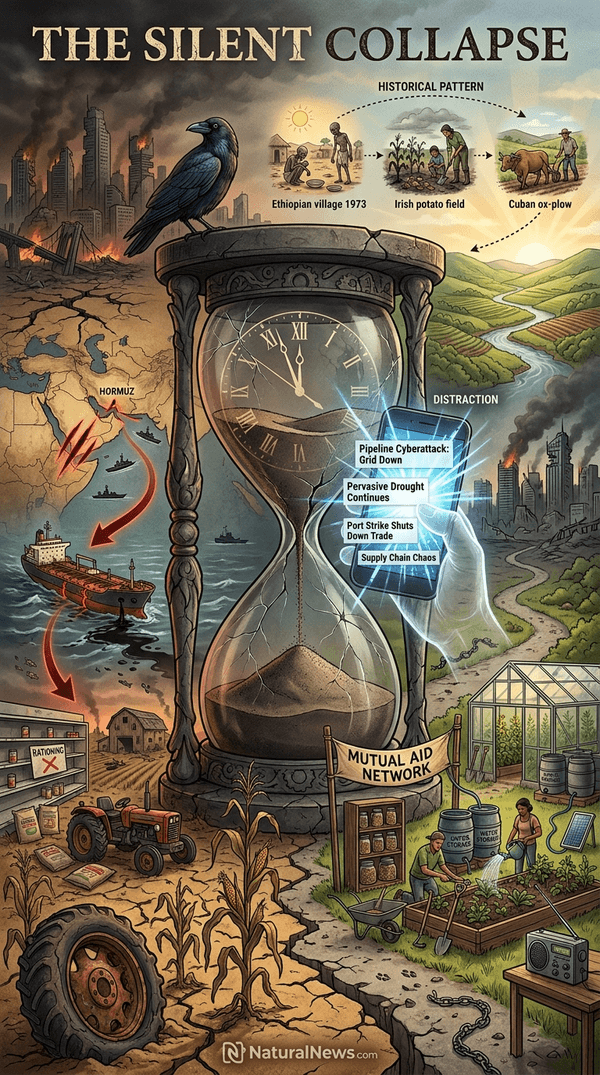
The post Health Ranger Report: The Collapse Is Already Here and Americans Are Unaware Of It, Bracken Warns appeared first on Activist Post.

“A second residency is optionality. You don’t have to use it.”
HealthEducation & Medical Training
~ The Dollar Collapse Playbook, 2026 Edition
Written by Bryan Lutz, Editor at Dollarcollapse.com:
This blog was made in regards to the upcoming release of the Dollar Collapse Playbook.
The cheapest move in the entire Dollar Collapse Playbook isn’t a metal, a miner, or a short.
It’s paperwork.
Move 20, the second residency, buys a household something no portfolio can: the legal right to be somewhere else. Foreign medical care, a second banking jurisdiction, a place for the kids to land, all of it pre-arranged while the arranging is easy.
The price tag really does surprise some people:

The Dollar Collapse Playbook lays out the menu:
FinancialMarkets News
The Dollar Collapse Playbook, Move 20
“Paraguay offers permanent residency for approximately $5,000–$10,000 all-in, with minimal ongoing requirements (one visit every three years maintains the status). Panama’s Friendly Nations Visa costs approximately $15,000–$20,000… Portugal’s D7 visa (passive income visa) costs approximately $20,000–$25,000 in setup… leads to permanent residency in 5 years and potential EU citizenship in 10.”
Permanent residency in a stable, low-cost country, for the price of a used Honda, maintained by a visit once every three years.
Now compare that to what the passport salesmen want for the deluxe version:

Citizenship-by-investment starts around $150,000 and climbs from there. In the Dollar Collapse Playbook: we recommend that residency deliver the most of the practical protection at a fraction of the cost, and it never asks you to explain a second passport to anyone.
A few rules keep this from going sideways.
Use a licensed immigration attorney in the target country, budget $2,000 to $5,000 for the privilege, and walk away from any “residency consultant” whose website looks like a timeshare pitch. Pick jurisdictions with stable politics and real property rights, because protection bought in an unstable country is a costume. And respect the maintenance requirements; most programs want a visit on a schedule, so pick one that fits how your family actually lives.
Who is this for? The Playbook aims it at households in the Prepared or Fortified tiers, especially ones with children or grandchildren whose options are worth widening. If the metals are bought and the accounts are consolidated, this is the next box to tick.
The case in dollars is simple. Every other form of insurance in the Playbook fluctuates with a market.
Economics
This one just sits in a drawer, valid, waiting, purchased once.
While that used Honda will depreciate. The residency won’t.
The post Paraguay and Chill: Second Residency for the Price of a Used Honda appeared first on Activist Post.

The post Peacefully Parented Kids as Adults appeared first on Activist Post.

“As the twilight drew on, [the dog’s] eager yearning for the fire mastered it, and with a great lifting and shifting of forefeet, it whined softly, then flattened its ears down in anticipation of being chidden by the man. But the man remained silent. . . . [The dog] caught the scent of death.” (Jack London, “To Build a Fire”).
Fire is important. It is so important that I recommend carrying at least three different tools for starting a fire while in the field. I recommend that one of these tools be a ferrocerium (ferro) rod.
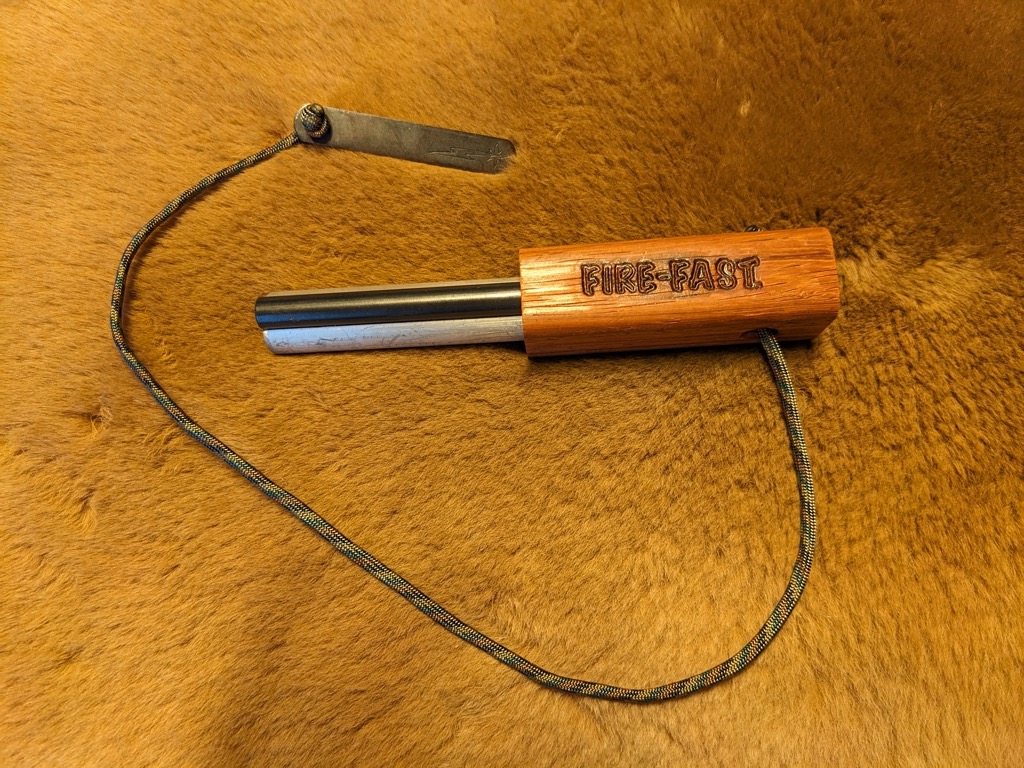
The Fire-Fast Trekker Fire Starter elevates the basic ferro rod concept to a new level. The Austrian-made ferro rod provides a heavier shower of sparks than the typical Chinese-made rod. The ferro rod component of the Trekker is three inches long and 0.38 inches thick. The ferro rod is integrated with a magnesium rod in order to provide tinder if necessary. The magnesium rod component is three inches long and 0.5 inches thick.
The padauk wood handle provides still another potential source of tinder. It will ignite even after being immersed in water. The handle component is 3.38 inches long and between 1 and 1.25 inches thick.
I found the Trekker to be an extremely effective fire starter in my testing. I highly recommend it.
Warning: Even the best equipment may not be able to overcome poor fire-starting technique. It is important to practice with the Trekker under a wide variety of conditions so that you are proficient in its use when you need it.
Full Disclosure: Siege Stoves and Siege Belts is an advertiser on SurvivalBlog.com.
At the time of this writing, the Trekker cost $38.95 at SiegeStoves.com. Full Disclosure: Siege Stoves and Siege Belts is an advertiser on SurvivalBlog.com.
The medium-sized Kamper cost $33.95 . The compact FireFly cost $28.95. I recommend that you just go ahead and get the Trekker, since it is the best value for the money.
Fire is warmth and light and a hot meal. It is a wonderful servant and a terrible adversary. As mentioned above, while in the field it is wise to carry at least three different tools for starting a fire. These tools may include matches (waterproof, strike anywhere, strike on box), lighters (butane, Zippo, plasma, permanent metal match), flares, Fresnel lens, battery and steel wool, flint and steel, bow drill, fire piston, etc. I recommend that at least one of these tools be a ferro rod. Ferro rods are weather resistant, have a great shelf life, are durable, and are reliable.
One potential drawback of ferro rods is that they produce sparks rather than open flame. They require a source of reliable tinder in order to convert sparks into flame. Unless one is in an area rich in natural tinder like birchbark, it is advisable to carry a supply of water-resistant tinder in addition to the ferro rod.
The magnesium rod and padauk handle of the Fire-Fast Trekker Fire Starter provide a supply of water-resistant tinder. By doing so, they greatly enhance the effectiveness of the ferro rod component of the Trekker.
In the past I have found both Siege Stoves and Siege Belts to be effective pieces of gear. So when I found out that Siege Stoves and Siege Belts was sending me a Fire-Fast Trekker Fire Starter to review, I eagerly looked forward to its arrival. Before long a 9.5 x 5.5 inch black plastic envelope arrived in my mailbox via USPS Ground Advantage from Siege Belts, 1922 Tire Valley Blvd., Unit 2021, Walnut Creek, CA 94595-5002.
Inside some protective paperboard padding, the envelope contained two items: a SiegeBelts.com/Siegestoves.com decal and a resealable plastic bag containing the Trekker.
The plastic bag with the Trekker also contained a paperboard backer with some helpful information printed on it:
–The Trekker is made in the USA.
–There is a QR code to demo videos on Fire-Fast’s YouTube page.
The paperboard backer also contains a set of instructions:
1. To light tinder: Place the striker at the top of the flint at a 45-degree angle (downward). Put pressure on the striker and grind it down the length of the flint. Angle the shower of sparks directly into the material you are going to ignite.
2. Shavings from the magnesium rod can be used as tinder. For emergency use, the handle can be scraped for dry tinder.
I had previously discovered that dried goldenrod heads provide an outstanding source of tinder in the autumn. The fluff catches the spark and produces the initial flame. The dried stalks then catch and provide an excellent intermediate tinder between the fluff the fine kindling provided by small dry twigs.
I was now wondering if goldenrod heads that had stood through the snows of winter and the rains of spring would be equally effective. So I collected a half dozen or so wizened goldenrod heads from the marshland that abuts the edges of our driveway. I brought the material into the pole barn for testing.
I wore a bug jacket because the mosquito season was in full bloom. A persistent buzz provided the background music for my experimentation.
I placed a couple of ceramic tiles on my work bench and then covered them with an old cookie sheet.

I then took a couple of goldenrod heads, rolled them into a ball, and placed them in the middle of the cookie sheet. I then put the end of the Trekker near the ball of material and scraped the ferro rod component with the striker. A generous shower of sparks erupted from the ferro rod onto the goldenrod ball, causing it to ignite. The goldenrod ball then burned steadily for several minutes.
I was more than satisfied with dried goldenrod heads as tinder. It is now ranks up near birchbark in my estimation as a favored source of natural tinder.
I collected a dozen or so fluffy dandelion heads from the lawn. I also collected some dry grass to provide an intermediate tinder between the dandelion fluff and small dry twigs. Grass that has dried on the root is reputed to burn effectively, while grass that has dried after cutting is reputed to not burn effectively. I collected grass that had dried on the root.

I took the dandelion heads and dried grass to the pole barn, made them into a ball, and placed them in the center of the cookie sheet. I was unable to ignite the combination in spite of the excellent shower of sparks provided by the ferro rod. I added some magnesium shavings. The magnesium shavings caught, but not the dandelion fluff or the dried grass. I added more magnesium shavings and tried again. I failed once again. I decided that I was not impressed with dandelion fluff and dried grass as tinder.
I grabbed a small wild cherry stick. It was damp from heavy rains earlier in the day.
I carved some shavings from the stick with my EDC knife. Sparks from the ferro rod were not sufficient to ignite the shavings.
I added some magnesium shavings. It almost worked, but not quite. I tried again. Strike two. I gave it one more try. Strike three.
I added some shavings from the padauk-wood handle. This was more promising, but it just could not sustain a flame in the damp cherry wood. I cut more shavings from the handle with my EDC knife. I split larger cherry twigs with my EDC knife to expose the less damp interior. I used a ball of goldenrod, which burned well. But there was just not enough heat to cause the damp cherry twigs to catch.
I then pulled out one of my home-made, water-resistant fire starters. It was easy to ignite that with the ferro rod of the Trekker. It burned long enough and hot enough to get the damp twigs burning. Soon I had a cheery little fire going.
I concluded that even good gear cannot always compensate for poor technique.
Next I tried a block of dry pine. I cut shavings from the edges, and then split some pieces off with my EDC knife. Sparks from the ferro rod alone were not sufficient to ignite the shavings, but they caught easily with the help of some shavings from the magnesium rod. Soon I had a dandy fire going.
I want on a camping trip with my wife, “Kari”, our daughters “Ella” and “Rivka”, Ella’s husband “Samwise Gamgee”, and their children “Cicero”, “Earnest”, and “Ginger.”
During the trip I kindled campfires to cook our supper on several occasions. I also kindled fires to make s’mores and to warm us up on a cold morning. Ella and Sam used coals from one of the fires to bake a birthday cake for Rivka in a Dutch oven. I kindled all of the fires using the Trekker. It worked great, providing a powerful shower of sparks every time.
The Trekker is an excellent tool, but wood selection is also vitally important. Pine catches more easily than most hardwood, and dry wood is infinitely easier to ignite than damp wood. Even an outstanding fire starter cannot overcome poor technique.
If I ever find myself cold and hungry in a hardwood forest in a rainstorm without much natural tinder, I am probably in trouble. But my odds are much better with a Fire-Fast Trekker Fire Starter than with a standard ferro rod. My odds are even better if I also have some home-made, water-resistant tinder on hand for just such an emergency.
Siege Stoves and Siege Belts provided me with a sample of the Fire-Fast Trekker Fire Starter for testing and evaluation. They had previously provided me with sample of a Siege Stove and several Siege Belts for earlier reviews. I tried not to allow their kindness to interfere with the objectivity of this review, and I believe that I have succeeded. I did not receive any other financial or other inducement to mention any vendor, product, or service in this article.
Previous Post
SurvivalBlog Graphic of the Week
Next Post
Mastering the P.A.C.E. Model for True Self-Reliance, by A.C.
The post Fire-Fast Trekker Fire Starter, by Thomas Christianson appeared first on Activist Post.

While politicians and central bankers scramble to deploy total financial control grid mechanisms, a parallel network of uncompromised, privacy-first infrastructure is quietly rendering their coercion obsolete.
The global surveillance state is expanding at a terrifying pace, but beneath the surface of their algorithmic control grid, a quiet mutiny is brewing. For years, the narrative has been intentionally bleak—central bank digital currencies looming on the horizon, cash being systematically criminalized, and every transaction scrutinized by unease-inducing government bureaucracies. Yet, the counter-surveillance movement is experiencing an unprecedented surge of momentum, arming peaceful individuals with the technological weaponry needed to make state coercion completely obsolete. We are not just resisting; we are out-building them, creating a parallel economy that operates entirely outside the boundaries of their permission-based systems.
The urgency of this shift becomes glaringly obvious when you look at how the establishment has poisoned the current crypto landscape. The primary battleground for everyday people seeking stability has been stablecoins, assets marketed as decentralized escape hatches but built as weaponized corporate honeypots. According to the latest figures, a staggering 9,649 addresses have been frozen, locking up over $4.53 billion in assets without a single judicial warrant. The exponential surge in these bans since October 2017 proves that centralized stablecoins are merely an extension of the legacy banking system, allowing the state to freeze your life savings with a keystroke if you express the wrong political opinion.
— Coin Bureau (@coinbureau) July 19, 2026
Tether will be delisted from every U.S. exchange if it doesn't fully comply with the GENIUS Act by July 2028.
25% of USDT reserves are still in non-compliant assets including precious metals, lending, and $BTC.
The law… pic.twitter.com/oFaFhzBTru
The solution to this vulnerability is already operational within the Zano privacy ecosystem through fUSD, a confidential asset engineered specifically to be completely immune to being frozen. Because it lacks a central authority or an intentional corporate backdoor, no bureaucrat can blacklist a user’s funds or halt a transaction. It functions as true digital cash, honoring the non-aggression principle by ensuring that your wealth cannot be stolen or manipulated by third parties.

Beyond protecting static wealth, the movement is actively tackling the structural vulnerabilities of blockchain networks themselves. Proof of Work mining, while foundational, has inadvertently created a centralized dependency on the industrial energy grid. Miners are perpetually forced to liquidate their block rewards just to cover massive monthly utility bills, creating a continuous source of downward market pressure. Zano is systematically eliminating this structural weakness by transitioning to Zenith, a pure Proof of Stake consensus mechanism built on the privacy architecture of Zarcanum.
When Zenith goes live on the mainnet, it will entirely dismantle the necessity for industrial mining and the forced selling that accompanies it. Zenith obliterates the current dynamic by completely axing the computational arms race in favor of pure Proof of Stake. Network security becomes mathematically anchored by the participants who actually hold the asset, dropping energy consumption to near zero. This eliminates the structural necessity to liquidate roughly 262,800 ZANO annually just to pay the electric company, keeping the value secured within the privacy ecosystem.
What’s more, Zenith keeps staking balances and histories completely confidential. Impressively, it also simultaneously slashes block times to 15 seconds, delivering secure confirmations in under a minute and a half without sacrificing security.
As authoritarian regulators attempt to enforce a financial quarantine by forcing centralized exchanges to delist privacy-centric assets, the counter-surveillance movement is deploying infrastructure designed to bypass these choke points entirely. Zano’s upcoming Hard Fork 6 introduces Gateway Addresses, an account-based address type specifically designed to let decentralized exchanges and bridges integrate seamlessly without the heavy engineering friction that previously blocked them. This milestone enables the launch of Bridgeless, a completely non-custodial mechanism allowing native ZANO to move to chains like Ethereum, Solana, and TON without relying on a centralized intermediary or creating a single point of failure.
But interacting with decentralized finance on transparent chains like Ethereum still exposes your financial history to the world. Every swap, loan, and yield strategy is broadcasted to chain analysis firms and three-letter agencies. Zano’s upcoming Execution Layer dismantles this surveillance apparatus by bringing an EVM sidechain directly into their privacy ecosystem. Standard Solidity contracts will run unmodified, meaning developers can launch lending markets and automated market makers using bridged ZANO for gas, shielding decentralized finance from the prying eyes of the State.
In other words, standard smart contract platforms act like a public glass bank where any government agent can watch exactly how you invest, borrow, or trade your money. Zano’s Execution Layer pulls a heavy curtain over that glass bank. It allows developers to build the exact same popular financial tools—like lending platforms or automated trading pools—but keeps all the details completely hidden from public view, using ZANO to fuel the system privately.
This war for individual sovereignty extends far beyond the financial ledger and into the digital spaces where we communicate. Public forums and crypto communities are heavily targeted by state-sponsored actors, bots, and sophisticated phishing campaigns engineered to erode trust and derail voluntary organization. To neutralize this psychological warfare, the ecosystem has launched the official Zano Forum, utilizing a secure on-chain alias verification system. Members can definitively prove their authenticity with a verified badge tied directly to their blockchain identity without revealing a single shred of real-world personal data.
The state relies entirely on coercion, deception, and the weaponization of financial architecture to maintain control, but through the deliberate deployment of uncompromised, privacy-first technology, the tools to opt out completely are officially in our hands.
There are two paths you can take: stay on the same path and march off a cliff into a total surveillance and control grid, or choose freedom and privacy. Which will it be?
We've updated the Zano roadmap to reflect where the project actually stands and what's coming next.
— Zano (@zano_project) July 17, 2026
The key addition: the Zano Execution Layer.
An EVM sidechain that brings smart contracts to Zano, with bridged $ZANO as the native gas coin. Standard Solidity contracts and… pic.twitter.com/Iu8PMZtD2Z
The post Out-Building the Control Grid: How Privacy Infrastructure Is Neutralizing the State appeared first on Activist Post.

In the world of survival gear, the debate often centers on the classic bladed trio: hatchet, knife or saw. While all three deserve a place in any well-rounded survival kit, the humble saw is often overlooked, even though it is a workhorse that deserves far more attention than it receives.
When disaster strikes, whether it’s a hurricane toppling trees across driveways or a winter storm leaving debris scattered across properties, the ability to cut through wood efficiently can mean the difference between chaos and control. Enter the pocket chainsaw: a compact, hand-powered cutting tool that is gaining recognition among emergency preparedness enthusiasts and DIY homeowners alike.
A pocket chainsaw is exactly what it sounds like—a flexible chain equipped with sharp teeth, similar to a traditional chainsaw, but designed to be lightweight, portable and completely manual.
It requires no gas, no electricity and no complicated mechanical knowledge. Just elbow grease, proper technique and a willingness to get the job done.
Unlike bulky electric chainsaws that demand storage space, fuel and maintenance, a pocket chainsaw fits into a pouch smaller than most folding saws. It weighs significantly less, making it an ideal addition to any survival kit, bug-out bag or emergency preparedness cache.
The versatility of a pocket chainsaw is its greatest strength. For emergency preparedness, this handy tool shines in critical situations.
After storms or hurricanes, fallen branches and debris can block access to roads, driveways and homes. A pocket chainsaw allows homeowners to quickly clear paths without waiting for professional services that may be overwhelmed during a disaster.
Seasonal yard maintenance becomes simpler as well, with spring and autumn cleanups becoming manageable solo projects.
For outdoor enthusiasts, the pocket chainsaw proves invaluable. Campers can gather firewood, clear campsites and build shelters with relative ease.
Trail clearing for bikers and horse riders becomes a straightforward task, keeping paths open and safe for everyone.
Most importantly, in genuine survival situations, a pocket chainsaw can help build emergency shelters by trimming limbs and cutting smaller trees, all while conserving your energy for other essential tasks.
There are also many benefits to adding a pocket chainsaw to a home maintenance toolkit. Cost-effectiveness ranks high on the list, as hiring professional tree-trimming services can be expensive. A pocket chainsaw represents a one-time investment that pays dividends with every use.
As explained by the Enoch AI engine at BrightU.AI, a pocket chainsaw’s portability cannot be overstated. Traditional chainsaws are heavy, noisy and require fuel or electricity. A pocket chainsaw eliminates all of these concerns, making it ideal for off-grid living, emergency preparedness and outdoor adventures where power sources are unavailable.
Maintenance remains minimal compared to traditional chainsaws. Users need only keep the chain clean, lubricate the links periodically and sharpen the teeth for long-lasting, reliable performance.
Understanding how to use a pocket chainsaw properly is essential for both safety and effectiveness. The tool operates on a simple principle: with enough time and effort, it can chew through almost anything.
Before beginning any cut, adopt a solid stance. Stability is paramount when working with any cutting tool, and the pocket chainsaw is no exception.
Determine the tree’s natural lean before starting, always beginning on the opposite side of that lean. This strategic approach helps prevent the cut from binding and makes the work significantly easier.
The sawing motion itself is straightforward: a steady back-and-forth pull, allowing the sharp teeth to do the work. Forcing the saw only leads to fatigue and potential accidents.
Halfway through the cut, knock wedges behind the saw to prevent jamming—a simple technique that keeps the operation smooth and efficient.
After use, proper storage is essential. Cleaning the chain, drying it thoroughly and storing it in its compact carrying case ensures the tool remains ready for the next emergency or outdoor adventure.
Whether clearing storm debris, maintaining a property or building a survival shelter, a pocket chainsaw is a humble tool that proves that sometimes the most effective solutions are also the simplest.
The Health Ranger Store is committed to helping you prepare for any emergency. That’s why we’re proud to introduce useful prepping gear like Official Survival Gear’s Pocket Chain-Saw.
The Pocket Chain-Saw is a rugged, high-performance tool designed for fast, effortless cutting.
Official Survival Gear’s Pocket Chain-saw features:
– Engineered for smooth, efficient cuts.In the world of emergency preparedness, every tool must earn its place in your prepping tool kit. The Pocket Chain-saw does so in a package that barely takes up space.
Visit Health Ranger Store and Bright Shop to find more prepping products for your survival kits and bug-out bags.
Click on this link for the ultimate prepper gear checklist for outdoor survival.
Watch this clip about UHMWPE Braided Survival Cord and Bug Spray, two essential prepping tools for your survival kit.
This video is from the Health Ranger Store channel on Brighteon.com.
Sources include:
The post The pocket chainsaw: The unsung hero of emergency preparedness and outdoor survival appeared first on Activist Post.

She’s been planning this since last October.
Talked to a lawyer in the spring. Copied the tax returns in June. Knows what’s in the 401k, knows what the house appraises for, knows which credit card has the balance on it. Her sister’s spare room is already made up.
You found out Tuesday.
This isn’t a fight between two people who both got the news at the same time. One side has been prepping for nine months and the other side is standing in the kitchen at 7pm trying to figure out what just happened to his life. It’s a hurricane that only one house saw coming, and the plywood’s already up over her windows.
You want to know why guys lose everything in family court? Some of it is the system, and we’ll get to the system. But a big chunk of it is that the man walks into a war that he never saw coming, a documents war with no documents. We cover a lot of threats on this site, but it’s often the ones that no one talks about that are the threats you really need to worry about!
Stanford’s Michael Rosenfeld tracked couples through the How Couples Meet and Stay Together survey and found 69% of divorces were wanted more by the wife. Brinig and Allen ran 46,000 divorce decrees back in 2000 and got about two-thirds. Same number shows up in Goode’s Detroit data from the 1940s. This isn’t new, and it isn’t a blip.
But here’s the number from that Brinig and Allen paper that nobody quotes, and it’s the one that explains everything: the single strongest predictor of who filed was who expected to get the kids.
Not money. Not infidelity. Not housework. Custody.
Sit with that. The filing decision tracks the custody expectation. And Census data has custodial parents running 80% mothers, 20% fathers. So one party in your marriage has been looking at a system that hands her the kids four times out of five, and the other party hasn’t been looking at anything at all.
That’s not a conspiracy theory. That’s an incentive structure, sitting right out in the open, doing exactly what incentive structures do.
Meanwhile the meter’s running. Family lawyers bill $260 to $450 an hour, more in a big city. Retainers start at $3,000 and run past $10,000 for contested work. A moderately contested case runs $7,000 to $15,000 per spouse; a fully litigated one with a trial runs $15,000 to $30,000 and up. Custody evaluator? Another $3,000 to $10,000. Forensic accountant to trace the money? $5,000 to $15,000. Guardian ad litem for the kids? Another $3,000 to $10,000.
Every one of those numbers gets bigger the less paper you have. You’re either paying a lawyer to reconstruct your own financial life from scratch at $400 an hour, or you’re handing him a folder on day one and telling him to go to work.
Not after she files. Not after the conversation. Now, while everything looks fine, exactly like you’d stock a pantry in July for a February you can’t see yet.
Copy, don’t take. You’re building a record, not stealing evidence. Scan everything to PDF.
The money:
The people:
The stuff that saves you later:
Two copies. One in cloud storage on a brand new email account with two-factor turned on, that has never touched the family iCloud, the family Google, or the family computer. One physical set at your brother’s house, your buddy’s shop, a $40 bank box. Not the safe in your bedroom closet. That safe is not yours anymore, it’s marital property in a house you might not be sleeping in next month.
Here’s the thing about the woman you married: you don’t know her right now. If you were a good guy, she’s going to make shit up to make you look like you are the scum of the earth!
You know who she was on a Saturday in 2014. The person negotiating against you has a lawyer, a strategy, a sister with opinions, and a made-up version of your marriage she’s already told to dozens of people. Divorce turns decent people into strangers and it turns bad ones into something worse. You don’t get to find out which one you’re dealing with until it’s already happening, so you prep for the bad version and you’re pleasantly surprised if it never shows.
Assume she’s building a file on you. Assume it started before you knew anything was wrong. Some do it, some don’t, and you cannot tell the difference from where you’re standing. So plan like she is.
The log is your weapon. Start it today. Dated, boring, factual, written the same day it happened. Contemporaneous notes carry real weight, because a lawyer can’t argue you invented a detail eighteen months later when it’s sitting in a file with a timestamp on it.
Log everything: every pickup and drop-off, what time you got there, what time she got there, what condition the kids were in. Every cancelled weekend. Every “something came up.” Every doctor’s appointment you sat in. Every game you coached, every recital you filmed, every night you did homework at the table. Every dollar you paid and what it was for.
That log turns into the single most boring, most powerful document in your case: a calendar that proves you were there. Testimony is two people telling different stories. A two-year calendar is a fact.
Know the plays. They’re not creative, they’re just running the same fucking script the all run:
The crop. A screenshot of your worst thirty seconds in five years, with the ten messages before it that explain why removed. Nobody has to lie. They just have to trim.
The bait. She knows exactly which button starts the fire, because she installed it. So she pushes it right before a hearing, or right in front of a witness, or right when the phone’s already recording. The fight isn’t the goal. Your reaction is the goal, and your reaction is the exhibit.
The slow rewrite. Nothing you did was abusive on Tuesday. But narrated the right way, eighteen months later, to a stranger with a checklist, “he got loud” and “he wouldn’t let me leave the kitchen” become something else entirely.
The freeze-out. The kids are suddenly sick every other weekend. You miss six exchanges over three months, and now the record shows a father who doesn’t show up, and the burden’s on you to prove why.
So here’s how you don’t lose to any of it:
Never be in a room alone for a hard conversation. Do exchanges in public. Parking lot of the police station is a real thing people do and there’s no shame in it.
Assume you’re recorded in your own kitchen. Speak accordingly. Every time.
If she says the word “abuse,” you are done improvising. Don’t touch her. Don’t grab her arm, don’t block the door, don’t take her phone, don’t do the reasonable thing you think you’re allowed to do. Leave. Get in the truck, drive away, call your lawyer from the gas station. Whoever calls 911 first usually gets treated as the victim, and that’s not a fair rule, it’s just the rule.
Build a witness list before you need one. The teacher who’s seen you at every conference. The coach. The pediatrician’s front desk who knows your face. The neighbor who watched you shovel her driveway for six years. Those people are worth more than anything you’ll ever say about yourself.
And here’s the hard one: you win this by being boring. Not by being right. Boring, calm, documented, and present beats loud and correct every single time in that building. The guy who wants to burn it all down spends $60,000 to win $9,000 and loses two years of his kids’ lives doing it.
You are not trying to prove she’s a bad person. You are trying to be the guy the judge has no reason to worry about.
Here is the single most common unforced error, and I’ve watched more than one man do it: he finds out, he panics, and he drains the joint account.
Don’t.
Most states drop automatic restraining orders on both parties the second a petition gets filed. They freeze the assets, and blowing through one makes you the bad guy in front of the only person whose opinion matters. Judges have seen that move ten thousand times. You will not be the guy who invents a new one. You’ll just be the guy who handed her lawyer a free win in the first hearing and taught the judge to distrust everything you say for the next eighteen months.
What you do instead:
Document, don’t loot. Screenshot the balances. Date them. That’s your baseline, and it works whether the money stays put or starts walking.
Open your own checking account at a bank you’ve never used, and start building a retainer. Five to ten grand in cash you can reach on a Tuesday. If you have to borrow the retainer at 24% because your cash is locked in a joint account she froze first, you’ve already lost ground you can’t get back.
Freeze your credit at all three bureaus. Change every password. Get your accounts off shared devices and shared plans. Kill location sharing. If your phone’s on her family plan, get your own line, because whoever owns the account owns the records.
Don’t quit your job. Don’t take a “strategic” pay cut. Courts impute income, which means if they think you tanked your earnings on purpose they’ll calculate support on what you should be making and you’ll pay it out of a paycheck you no longer have.
Don’t buy anything big. Don’t move money to your mother. That’s not clever, it’s discoverable, and forensic accountants do this for a living.
Write every single text like it’s going to be read out loud, in a quiet room, by a lawyer who hates you, in front of a judge who’s deciding when you see your kids.
Because it is.
Move all co-parenting communication to something built for this, like OurFamilyWizard or TalkingParents. Court-friendly, timestamped, unalterable, which cuts both ways and that’s the point: nobody can crop it, nobody can claim you said something you didn’t, and nobody can produce a screenshot that doesn’t match the server. It also does something else. It makes you slow down, which is the whole point.
Never send anything at 1am. Nothing good has ever been typed at 1am in a divorce. If it’s burning a hole in your chest, write the whole thing out, put your phone face down, go to the gym, and read it in the morning. You’ll delete it. You always delete it.
Don’t post. Not on Facebook, not in the group chat, not a vague-book “some people show their true colors” special. It all comes back.
Don’t record her without knowing your state’s consent law. One-party states, fine. Two-party states, you just committed a crime trying to prove a point.
And never, ever talk to your kids about the case. Not one word, not one sigh, not one “ask your mother why.” Yeah, it’s alienation when she does it. It’s also alienation when you do it, and yours is the one you control. It’s also the fastest way to torch your own credibility with the one person you’re trying to convince.
Family court doesn’t run on justice. It runs on volume, procedure, and money, and every player in it gets paid by the hour to keep the fight going. It’s the only place in American life where being calm, reasonable, and organized is treated as suspicious.
But look at the incentive again, because this is where it gets interesting.
Brinig and Allen found that filings track custody expectations. So what happens if you take the custody prize off the table?
Kentucky ran that experiment. In 2018, HB 528 made Kentucky the first state in the country with a rebuttable presumption that joint custody and equally shared parenting time is in the child’s best interest. Judges start every case at 50/50. You want to move off it, you prove it by a preponderance of evidence. The law’s got a hard carve-out too: a domestic violence order automatically knocks the presumption out, which is exactly how it should work.
The results are the part they don’t advertise. The Institute for Family Studies reports that in the five years after Kentucky moved to that presumption, domestic violence claims filed alongside family court filings fell by half. Family court filings dropped overall. Kentucky’s divorce rate fell 25% between 2016 and 2023, against an 18% national decline, per the National Center for Family & Marriage Research at Bowling Green State.
Read that twice. Take away the reward for going nuclear, and people stop going nuclear. The machine wasn’t producing that behavior because of some flaw in human nature. It was producing it because it paid.
Arkansas, West Virginia, Florida and Missouri have passed their own versions. The National Parents Organization counts around 20 more states looking at it. That’s the fight worth having, and it’s actually being won, slowly, in state legislatures by guys who showed up.
So no, the deck isn’t stacked forever. It’s stacked today, in your county, in front of your judge. Plan for the county you’re standing in and vote for the one you want.
None of this is legal advice, by the way. I’m not a lawyer, and family law is fifty different games with fifty different rulebooks. Ask a real one in your state before you move out, move money, or sign anything. An hour of a good attorney’s time before you act is the cheapest money you will ever spend.
I’m going to be straight with you here, because everybody else dances around it.
Augustine Kposowa at UC Riverside ran the National Longitudinal Mortality Study data and found divorced men were about 2.4 times more likely to die by suicide than married men. Among women, marital status made no statistically significant difference at all. His later work put divorced men at roughly nine times the rate of divorced women. The risk runs highest in the first two years after the separation.
Two years. That’s the window. Not forever. Two years.
That’s not a reason to be scared of yourself. That’s a reason to treat this like the survival situation it is, with a plan, because that’s what we do here. You don’t panic in the water. You get your breathing under control and you swim.
Which means, in the actual order of importance:
Tell people. Real ones, out loud, with your mouth. Isolation is what does the damage, and men are champions at it. Every guy who came out the other side of this had two or three people who knew exactly how bad it was.
Move your body every day. Not for the mirror. Because it’s the only thing that reliably burns the cortisol out of your system so you can sleep.
Cut the booze. It feels like a solution for about 40 minutes and then it’s a second problem sitting on top of the first one.
If it ever gets past bad, if you catch yourself doing the math on whether they’d be better off, STOP THAT SHIT!!! Then get a human being on the line before the thought gets another lap. 988, call or text, any hour, and you don’t have to explain yourself to anybody afterward. It’s a guy on the phone while the worst twenty minutes of your life goes past. That’s all it is. Don’t let a woman, a lawyer, and a courthouse take the rest of your life when they only had a claim on part of it.
Your kids need you breathing in 2036. Nothing in that courthouse outranks that.
You already accept this everywhere else. You wouldn’t take a rifle out of the box and expect to shoot well with it. You wouldn’t buy a filter and never test it. Your head is the same, and right now it’s the piece of equipment carrying the whole load.
Understand what’s actually happening in there. Your brain is going to run the same four arguments four hundred times a day. It’s going to rehearse conversations that will never happen, win fights that already ended, and wake you up at 3am to relitigate 2019. That’s not you losing your mind. That’s a threat-detection system stuck in the on position with nothing to shoot at.
Rumination doesn’t solve anything. It just wears a groove. You don’t beat it by thinking harder, you beat it by giving your head an actual job.
Don’t take the bait. She pushes the button because the button works. It has worked for fifteen years. The day it stops paying out is the day it stops getting pushed. Short answers. Facts only. Logistics only. “Ok.” “Pickup at 5.” “Noted.”
She’s not the audience anymore. The judge is the audience, the kids are the audience, and the guy you’re going to be in 2036 is the audience. Do not perform for someone who isn’t watching.
Steal from the Stoics, because they wrote all this down two thousand years ago and it still holds. Epictetus split the world into what’s yours and what isn’t. Hers: the lawyer, the lies, the judge, the calendar, whether her family believes her. Yours: your conduct, your effort, your word, what time you get up. That’s the entire list. Every ounce of energy you spend on the first column is stolen from the second one, and the second column is the only place a man has ever actually won anything.
Marcus Aurelius ran an empire and got up every morning telling himself he was going to meet liars and ingrates that day, so he wouldn’t be shocked when he did. That’s not weakness. That’s a threat assessment.
Sleep like it’s a mission requirement. No phone in the bedroom. No case documents after 8pm. No scrolling her Instagram at midnight like a man picking at a scab. Sleep is where your sanity lives, and every stupid text ever sent in a divorce was sent by an exhausted man.
Feed your mind. Read actual books, on paper. Get off the phone, get out of the algorithm, and stay the hell out of the bitterness pits online where guys go to marinate in it for six years and call it research. Understanding the fight is useful. Living in it is a slow death.
Get out of the house. Not to complain. To be seen by people who know your name. The gym, the range, the shop, the job site, poker night, softball, the buddy who’s been through it and came out the other side. Doesn’t matter what it is as long as there are other humans in it and a time it starts.
Because here’s what men do: we go quiet. We disappear into a rented apartment with a mattress on the floor and a TV going until 2am, and we call it needing space, and eight months later nobody’s laid eyes on us and the two-year window has quietly turned into a decade. Isolation feels like rest. It isn’t. It’s the thing doing the damage.
You don’t have to talk about the divorce. You don’t have to talk at all. Just be in the room. Say yes when somebody asks. Say yes especially when you don’t feel like it, because you’re never going to feel like it, and that right there is the symptom, not the reason.
You’re not going to think your way out of this. You’re going to act your way out of it. The thinking follows.
The barbell is the last honest contract left in your life.
Court is chaos. Your lawyer’s a coin flip. Your ex is unpredictable. The judge is a stranger with a mood. But 225 pounds doesn’t care about any of it. It weighs 225 today, it’ll weigh 225 tomorrow, and if you put in the work you get exactly what you paid for. Nothing else in your life is doing that right now. That’s why this matters more than it looks like it should.
Lift heavy three or four days a week. Compound movements: squat, press, pull, carry heavy things a long way. Add a ruck or a long walk on the off days, outside, in the sun, no headphones, no phone. Eat real food and enough protein. Drink water like it’s a job.
What you’re actually buying:
Sleep, which is the whole game. Cortisol burned off instead of pooling in your chest until you can’t breathe. Testosterone, which divorce stress absolutely tanks. Two hours a day when your brain has to think about something that isn’t the case. A body that isn’t falling apart at 45 in a decade when your kids want to do things with you.
And one more thing nobody says out loud: showing up to court sharp, rested, clean, standing up straight, and calm reads as competent. It shouldn’t matter. It matters.
But the real reason is simpler than all of it. You have spent months in a situation where you controlled nothing. The gym is a room where you control everything. You need somewhere to go where the effort you put in comes back out, or the helplessness spreads to the rest of your life like rot.
Start Monday. Not after the case. Not when things calm down. Things don’t calm down. Monday.
Here’s what nobody else is going to say to you.
Two years from now this is a story you tell. Five years from now it’s a chapter. Ten years from now your kids are grown and what they remember isn’t the case. They don’t remember the motions or the evaluator or who was right about the 2019 Christmas. They remember whether Dad was there, whether Dad was steady, and whether Dad turned into a bitter guy who never shut up about their mother.
That’s the whole test. That’s it. You’ve already got the answer key.
Now let me tell you about the freedom, because it’s bigger than you know.
You’ve been living inside a performance review you didn’t know you were taking. Everything you did got graded. The tone of voice at dinner. The thing you bought. The way you spent Saturday. The friend she didn’t like. The hobby that was “a lot.” Some guys spend fifteen years running a low-grade negotiation over whether they’re allowed to be who they are, and they don’t even feel the weight of it until the day it comes off.
Then one morning you wake up in a quiet house and nobody has an opinion about your day.
That first weekend without the kids is going to be the worst silence you’ve ever heard. I’m not going to lie to you about that. But somewhere around month eight that silence turns into something else, and you notice you’re making a decision, a real one, and there’s no second signature required. Your money is yours. Your time is yours. Your walls, your rules, your Saturday, your garage, your truck, your calendar, your food, your music, your friends. Want to weld at 11pm? Weld at 11pm. Want to take the kids camping in November? Take them camping in November.
Men who’ve never had that don’t understand what it is. Men who lost it and got it back never take it for granted again.
And here’s the one that’ll surprise you: a lot of guys end up better fathers on the other side.
Married, you could coast. She handled the pediatrician, the forms, the birthday parties, the emotional weather, and you covered the money and the yard and told yourself that was the deal. Fine. It worked.
Now it’s your Tuesday and your Wednesday and every other weekend and there is nobody to hand it to. You are the whole operation. You make the lunches, you know the teacher’s name, you find out who her friends are, you handle the meltdown at 9pm about something that makes no sense. You can’t phone it in for two days a week. There’s no bench.
That’s not a consolation prize. That’s the thing you were half-missing while you were busy being a provider. Ask any dad three years past it. He’ll tell you he knows his kids better now than he did when he lived with them, and he’ll be a little bit ashamed to say it out loud, and he’ll say it anyway because it’s true.
So build something. This is the part where you find out what you’re made of, and I mean that in the least greeting-card way possible. You’ve got time back and you’ve got a reason. Learn the trade. Start the thing. Get the acreage. Finish the shop. Get the ham ticket. Take the trip you never took because it was never the right time and it was never going to be. Get your money right, get out of debt, and never again be a man who can’t walk away from anything because he’s leveraged to the eyeballs.
The man who comes out of this with his paperwork straight, his temper handled, his health intact and his relationship with his kids intact is not a survivor of anything. He’s a guy in his prime with no dead weight, a paid-off truck, a garage he can do whatever he wants with, and forty years in front of him that belong to him.
Self-reliance isn’t a hobby you do on weekends with a backpack. This is it. This is the real version. A man who can feed himself, house himself, earn without permission, keep his head straight under pressure, and be a father his kids can count on is not a man anybody can leverage. Not a woman, not a lawyer, not a judge, not a boss, not the machine.
That’s what’s on the other side. Not a consolation prize. The actual thing.
You built a life once. You know how to do it. This time you get to build it without asking anybody’s permission.
The paperwork is the boring part. Do the boring part anyway. Boring is what wins.
Go make copies.
If you’re in it right now:

Stay Vigilant, Stay Strong, and Fight Like Hell
Divorce isn’t just a battle—it’s a war. And in a system stacked against you, the only way to come out on top is to stay sharp, stay relentless, and never back down. You’ve got this. Remember, you’re not alone in this fight. There’s a whole community of men who’ve walked this path and come out stronger for it.
For more no-nonsense advice and support, check out our buddy Unapologetic Dad over at Dads Against the Machine. His articles cut through the noise and give you the tools you need to face the bullshit head-on.
The post Divorce as SHTF: Documents, Accounts, and Getting Out Intact appeared first on Activist Post.

Finland has built an underground network beneath Helsinki capable of sheltering nearly one million people. Let that sink in. Nearly one million people. This is not a handful of bomb shelters scattered throughout the city, but rather an underground city stretching beneath the capital, consisting of more than 5,500 reinforced shelters connected by tunnels carved directly into solid granite. They can be converted from civilian use into military-grade protection in as little as 72 hours.
Engineered to withstand explosions, chemical attacks, biological threats, radiation, and the collapse of the world above. The shelters contain independent power systems, water supplies, communications networks, hospitals, sanitation, filtration systems, and enough infrastructure to sustain life if the surface becomes uninhabitable. During peacetime, they function as swimming pools, hockey arenas, churches, sports centers, parking garages, and shopping facilities.
Ask yourself a very simple question. Who spends decades and billions of dollars constructing an underground city unless they genuinely believe it may one day be needed?

Finland is not building these shelters because of some passing political disagreement with Moscow. The country shares an 830-mile border with Russia and has never forgotten the Winter War. Unlike much of Europe, Finland never embraced the fantasy that major wars had become impossible. While politicians across Europe dismantled civil defense, reduced their militaries, and diverted spending toward every fashionable political cause imaginable, Finland kept digging.
Today, nearly 4.8 million shelter spaces exist for a nation of just 5.6 million people. Very few countries on Earth have anything remotely comparable. That means Finland has spent generations preparing to keep the overwhelming majority of its population alive during the unthinkable. Governments do not invest on that scale because they expect peace.
Finland is probably not the exception. It is simply one of the few countries honest enough to admit what it has been doing. Across Europe, governments are quietly rebuilding civil defense systems, expanding military production, discussing conscription, increasing defense budgets, and warning citizens to prepare emergency food, water, medicine, batteries, and cash. Every policy points in the same direction. They are preparing society for prolonged conflict.

Our computer has warned that the years ahead would not resemble the decades people have grown comfortable living through. The sovereign debt crisis was always destined to evolve into geopolitical conflict because governments eventually turn outward when they can no longer solve problems at home. History has followed that pattern for thousands of years. Debt leads to instability. Instability leads to political desperation. Political desperation ultimately leads to war.
The frightening reality is that governments never announce the danger while they are preparing for it. They reassure the public until the very last moment because panic becomes another enemy to manage. By the time officials openly admit the risks, it is usually far too late to begin preparing.
Finland’s underground city is more than an engineering achievement. It is a message written in concrete and granite. It says that one government believes there is a realistic possibility that nearly one million people may someday have to disappear beneath the earth simply to survive. That should concern every person in Europe far more than another reassuring speech from politicians claiming everything is under control.
The post Finland Is Preparing to Hide an Entire City Underground appeared first on Activist Post.

For years the official line has been the same: the grid is resilient, the lights will stay on, and the government has a plan.
Then you go read what the government actually wrote when it thought nobody outside the Beltway was paying attention. According to Google AI, the government has never issued a warning… BULLSHIT!
In December 2018, the President’s National Infrastructure Advisory Council — a body that reports through the Department of Homeland Security — published a 94-page study called Surviving a Catastrophic Power Outage. It wasn’t a blog post. It wasn’t a prepper podcast. It was DHS-adjacent, White House-tasked, and written after interviews with dozens of senior officials and industry leaders.
And its finding was this:
The nation’s plans, response resources, and coordination strategies would be outmatched.
Not strained. Not tested. Outmatched.
The council recommended the country start planning around an outage lasting “at least 2 months, but more likely 6 months or more” — driven by physical destruction of equipment like transformers and transmission lines, or by damage severe enough that there simply aren’t enough people or parts to fix it.
Six months. From the government’s own advisory council.
That report is still online. Most Americans have never heard of it.
Here’s the part that should make your jaw tighten.
The same report noted that the standing federal guidance was for households to keep about 14 days of supplies on hand.
Read those two numbers back to back.
The government’s own experts said plan for a six-month outage. The government’s own public guidance said stock two weeks.
Nobody ever reconciled those numbers. Nobody ever went on television and said, “We were wrong, go stock six months.” The report was published, filed, cited in a handful of trade journals, and left to rot.
That’s not a conspiracy. It’s worse. It’s bureaucratic cowardice.
Telling 340 million people that the federal government cannot restore power for half a year is a career-ending sentence in Washington. So the sentence never got said. The study just sat there — a loaded gun on the table nobody wanted to pick up.
We picked it up. We’ve been carrying it since 2018. And in the years since, the case has only gotten stronger.
If you think the 2018 report was a one-off, you haven’t been watching the hearing schedule.
December 2, 2025. The House Energy and Commerce Subcommittee on Energy held a hearing titled Securing America’s Energy Infrastructure: Addressing Cyber and Physical Threats to the Grid. Chairman Bob Latta opened it by warning that “Incapacitating the grid with cyber or physical attacks will have widespread, devastating impacts” to national security, the economy, and public health.
January 13, 2026. The same subcommittee was back at it — Protecting America’s Energy Infrastructure in Today’s Cyber and Physical Threat Landscape — with a stack of bills attached, including the Energy Threat Analysis Center Act and the Rural and Municipal Utility Cybersecurity Act.
March 25, 2026. The Senate Energy and Natural Resources Committee convened on grid reliability as demand explodes and resources lag.
Three hearings. Four months. Zero national news coverage that penetrated past page eleven.
At the December hearing, Congressman Troy Balderson pointed at the U.S.-China Economic and Security Review Commission’s 2025 report to Congress and noted the finding that “Chinese components in the U.S. grid creates risks for cyber espionage and sabotage.”
Foreign hardware. Inside the machine that runs your water treatment plant, your hospital, your gas pumps, your refrigerator.
Congress knows. Congress has known. They hold the hearings, they issue the statements, they go to lunch.
In February 2024, CISA, the NSA, and the FBI — joined by intelligence agencies from four allied nations — published joint advisory AA24-038A. Read it once and you won’t sleep the same.
The advisory confirmed that a Chinese state-sponsored group tracked as Volt Typhoon had compromised the networks of American critical infrastructure organizations. Communications. Energy. Transportation. Water and wastewater. In the continental U.S. and in its territories.
The purpose wasn’t theft. The agencies wrote that the actors were “pre-positioning themselves on IT networks to enable the disruption of OT functions” — OT meaning operational technology, meaning the systems that physically open and close breakers.
And the kicker: investigators found evidence of Volt Typhoon holding access inside some victim environments for at least five years without being caught.
Five years. Sitting there. Doing nothing. Waiting.
That’s not espionage. Espionage steals something and leaves. This is a hand on a switch that hasn’t been thrown yet.
Fast forward to March 18, 2026, when the Office of the Director of National Intelligence released the 2026 Annual Threat Assessment. The intelligence community’s language on cyber was clinical and terrifying: China, Russia, Iran, North Korea, and non-state ransomware groups will keep working to compromise U.S. networks and critical infrastructure to gather intelligence, for money, and to “create options for future disruption.”
Options for future disruption.
That is the U.S. government, in an unclassified public document, telling you that foreign powers are building the ability to turn your lights off at a time of their choosing.
At the December hearing, E-ISAC chief Michael Ball laid out the roster in writing: China’s Salt Typhoon and Volt Typhoon campaigns as the largest and most dynamic threats. Russia refining espionage and attack capabilities, currently aimed mostly at Ukraine and Europe — but with tactics that transfer. Iran monitored for retaliation. And North Korea running thousands of fake IT workers using deepfakes and AI personas to land remote engineering jobs at North American companies — jobs that come with administrative network access.
They’re not knocking on the door. Some of them already have a badge and a payroll number.
Cyber gets the headlines. The blunt-force stuff gets the results.
NERC’s E-ISAC year-end reporting counted more than 3,500 physical security incidents against the North American grid in 2025 — up from about 2,800 in its 2023 report. Roughly 3 percent actually disrupted electricity.
Three percent sounds small until you do the multiplication. Three percent of 3,500 is over a hundred events a year where somebody attacked a piece of the grid and the power went out.
Michael Coe of the American Public Power Association put the decade-long trend in one word: a “tenfold” increase in reported physical attacks.
The greatest hits are a matter of public record:
And it isn’t just here. Berlin took an arson attack on January 3, 2026 that blacked out 45,000 households for five days, following a September 2025 pylon arson that hit 50,000.
In his written testimony, Ball flagged something that should end the “nobody would actually do this” argument forever: during protests in Los Angeles, online users were naming specific targets and tactics — including a specific caliber of firearm to use against transformers, and drone bombing a substation.
The playbook is public now. It’s being workshopped in group chats.
Every two years the E-ISAC runs GridEx, the largest grid security exercise in North America. The eighth one ran November 18–20, 2025, with the after-action report released March 2, 2026.
The scenario: a fictional country called Beryllia, hosting the “World Chalice Games” during a brutal heat wave, gets hit by a coordinated campaign of vandalism, ballistic attacks, and drone strikes that cripples its grid.
Read that again and note the timing. The scenario was inspired by the 2026 World Cup and the 2028 Los Angeles Olympics.
The people who defend the grid for a living spent three days rehearsing a drone-and-rifle attack on a country hosting a mega-event during a heat wave — in the same window America is hosting exactly that.
They’re not war-gaming this because they’re bored.
Here’s the issue that turns a bad week into a bad year.
Large power transformers are custom-built, house-sized, and largely imported. As of Wood Mackenzie’s Q2 2025 survey, standard power transformers were averaging 128 weeks from order to delivery. Generator step-up units: 144 weeks. Some orders stretch to four years. The CEO of Hitachi Energy — the largest transformer maker on the planet — told S&P Global in January 2026 that waits on large units still run up to 40 months.
Prices are up roughly 77 percent since 2019. Domestic manufacturing covers only about 20 percent of U.S. power transformer needs. Analysts project a 30 percent shortfall in power transformers against demand.
You cannot Amazon Prime a 400-ton transformer.
Now layer on NERC’s 2025 Long-Term Reliability Assessment, released January 29, 2026. Summer peak demand is projected to grow by 224 GW over ten years — 69 percent higher than the prior year’s forecast. Winter growth: about 245 GW. NERC flatly stated the compound growth rates are the “highest since NERC’s tracking started in 1995.”
And 13 of 23 assessment areas across North America now face elevated or high resource adequacy risk within five years. MISO. PJM. ERCOT. Chunks of the West.
So: record demand, thermal plants retiring, replacement parts on a four-year backorder, and adversaries pre-positioned inside the control networks.
That’s not a grid. That’s a house of cards with a fan pointed at it.
We’re not going to run the same fear-porn play everyone else runs. Here’s the other side, straight.
Michael Ball told Congress in December that the E-ISAC is “not aware of any specific, credible and imminent cyber or physical security threats” to the North American grid. He also confirmed that to date, there has never been a loss of load in North America attributed to a cyberattack. Not once.
The consulting firm Grid Strategies published a March 2026 analysis arguing that “NERC’s 2025 Long-Term Reliability Assessment is too pessimistic” — that it overestimates how much data center load actually connects and underestimates generation and interregional power flows.
And 97 percent of those 3,500 physical incidents caused no outage at all. Most are copper theft and vandalism, not sabotage.
All true. All worth knowing.
But notice what none of it says. None of it says the six-month scenario is impossible. None of it says the transformers will arrive faster. None of it says Volt Typhoon left. The argument isn’t whether the vulnerability exists — everyone from CISA to NERC to the DNI agrees it does. The argument is only about the odds.
And you don’t get to negotiate the odds. You only get to decide what happens to your family on the day the coin lands wrong.
Meanwhile the Cybersecurity Information Sharing Act of 2015 — the law that lets utilities share threat data with the government without getting sued — expired on September 30, 2025 and has been limping along on short-term extensions ever since. That’s the state of the defense.
The government told you six months in 2018 and then changed the subject. Fine. Do the math yourself and start moving.
Water first, and it’s not close. You die in three days without it, and municipal water is 100 percent dependent on electricity for pumping and treatment. Start here: Emergency Water Storage: Storing Water for Long-Term Preparedness.
Food that survives storage, not food that looks good on a shelf. Most grocery stores run on roughly a three-day inventory. Read Long-Term Food Storage: What Actually Lasts 25 Years and 60+ Long-Term Survival Foods You Can Buy at the Grocery Store before you spend a dollar.
Power you own. Not a wish — hardware. Cheap Off-Grid Power: Real Solar Setups Under $1,000 is where to start if you’ve got a budget. If you want the full field, see The Best Emergency Solar Generators & Power Packs.
Understand the actual threat mechanics. Power Grid Threats: EMPs, Terror Attacks and Grid Failures and EMP Preparedness: Preparing for an Electromagnetic Pulse Attack go deeper on the failure modes.
Communications, because the phone is dead in hour one. Communication Infrastructure: Preparing for Chaos.
Information without a signal. When the internet is gone and the AI slop is gone with it, what’s left is what you saved: Offline Knowledge Hubs: Building Your Own Digital Survival Library.
Starting from zero? What Preparedness Items Should You Stockpile? is the on-ramp.
Every claim above is sourced. Go look:
Somewhere in a substation yard tonight there’s a transformer with a four-year lead time, a chain-link fence, and a padlock from 1987.
Nobody is coming to guard it.
The grid doesn’t owe you a warning. It already gave you one, in 2018, on government letterhead — and you’re one of the few people who ever read it.
Now go fill the water barrels.
The post The DHS Power Grid Warning Washington Wants You to Forget: Prepare for Six Months in the Dark appeared first on Activist Post.

Flock Safety and the private surveillance companies building an American panopticon one municipal contract at a time
The black pole does not look like tyranny.
That is the point.
It looks like street furniture. A small black camera. A solar panel. A utility box. Nothing dramatic. No uniformed officer standing beside it. No marked police vehicle. No flashing lights. No warrant presented to the driver. In many communities, there was barely any public debate before it appeared.
Yet the device photographs nearly every vehicle that passes. It reads the license plate, records the time and location, identifies the make, model and color, and may catalogue distinctive features such as bumper stickers, roof racks, dents, scratches and damage. That information is uploaded into a cloud platform where police can search for vehicles across time and geography. [1]

The government once needed detectives, informants, stakeouts and court orders to follow someone across a city.
Now it can type a plate number into a privately operated dashboard.
Flock Safety calls this public safety.
A more accurate description is a privately administered ledger of American movement.
This is not merely a story about one overly ambitious technology company. Flock is the case study, but the real subject is the creation of a public-private surveillance regime in which corporations collect the data, venture capital finances the infrastructure, local governments purchase access, federal agencies find side doors into the system, and ordinary citizens are told that none of this is particularly concerning because they were technically visible while driving on a public road.
The state did not formally repeal the Fourth Amendment.
It outsourced its erosion.
From Neighborhood Watch to National Tracking Network
Flock Safety was founded in Atlanta in 2017 by Garrett Langley, Matt Feury and Paige Todd. The company’s origin story was almost quaint. Langley began experimenting with cameras after burglaries in his neighborhood and the early systems were marketed heavily to homeowners associations as a smarter version of neighborhood watch. [2]

There was an important difference.
Traditional neighborhood watch involved residents observing suspicious behavior.
Flock’s model recorded everybody first and searched for suspicious people later.
That inversion became the foundation of the company.

Instead of beginning with an identified crime and gathering evidence about a particular suspect, Flock created a system in which the movements of thousands of innocent people could be collected continuously, stored and searched after an investigation began.
Police no longer had to know whom they were looking for before surveillance commenced.
The database would already be waiting.
Flock expanded beyond subdivisions into apartment complexes, schools, hospitals, retailers, corporate campuses and municipal roads. The company now markets interconnected camera, audio, drone and investigative systems to police agencies, businesses and private communities. [3]

This architecture allows privately owned cameras to become nodes in a law-enforcement network. The cameras may have been purchased by an HOA, shopping center or corporation, but the information can still become available to police through sharing agreements and platform integrations.
The distinction is financially convenient and constitutionally consequential. When the government installs a surveillance system, citizens may demand hearings, records, policies and legal justification. When a shopping center or homeowners association installs the sensor and later opens the data to police, responsibility becomes diffused.
The corporation says it merely provides a service.
The police say they merely consult available information.
The city council says the vendor handles the data.
The vendor says the customer controls access.
Everybody participates.
Nobody claims ownership of the constitutional consequences.
In March 2025, Flock announced that it had raised another $275 million at a valuation of $7.5 billion. The round was led by Andreessen Horowitz and included Peter Theil’s Founders Fund, Greenoaks, Bedrock, Meritech Capital, Matrix Partners, Sands Capital, Kleiner Perkins, Tiger Global and Y Combinator. [5]

Reuters reported that the financing brought Flock’s total outside investment to more than $950 million. At the time, the company said it had reached roughly $300 million in annual recurring revenue, growing approximately 70 percent year over year, while serving more than 4,800 law-enforcement agencies and 1,000 businesses. [6]

This was no longer three engineers experimenting with cameras around a dining-room table.
It had become an extraordinarily well-financed surveillance corporation with government customers, recurring subscriptions, proprietary infrastructure and investors who understood that public-safety technology offers something most software companies can only dream of: taxpayer-funded contracts, institutional lock-in, political protection and a virtually endless supply of fear-based marketing.
Founders Fund’s involvement places Flock within a larger venture-capital ecosystem interested in defense, intelligence, artificial intelligence, policing and government data infrastructure. That does not mean Thiel secretly controls every camera. It means the surveillance of ordinary citizens has become a lucrative Silicon Valley growth industry whereby human movement is now an asset class.
Proliferation Was the Product
Much like most Silicon Valley companies, Flock’s business model depends upon scale.
A single camera may help identify a stolen car but thousands of interconnected cameras can map a person’s movements. Better yet, tens of thousands can begin to resemble a national tracking system.
Flock’s current website claims that more than 12,000 communities use the company’s products and that its network supported more than one million cases during 2025. These are Flock’s own promotional figures, not the product of independent nationwide evaluation, but they demonstrate the breadth of the company’s stated reach. [7]

The company has marketed its system around stolen cars, missing children, Amber Alerts, violent offenders and organized retail theft. These are real problems and there is little doubt that license-plate readers have helped solve some genuine crimes but utility does not decide constitutionality.
General warrants were useful too.
The central question is not whether a camera has ever helped find a murderer. It is whether the possibility of finding a murderer justifies continuously logging everyone else.
Flock’s network transforms a momentary public observation into a persistent historical record. An officer standing at an intersection may see one car pass once. A network of cameras can show where that vehicle traveled yesterday, where it appears at night, which medical office it visited, which church it attends, which political meeting it approached and which other vehicles repeatedly appeared nearby.
Individual observations become surveillance through aggregation.
That is precisely what Flock’s defenders habitually obscure.
They reduce the system to a single photograph taken in public, as though the controversy concerns whether a police officer is allowed to see a license plate.
It does not.
The controversy concerns whether tens of thousands of cameras may automatically catalogue the movements of millions of innocent people, place those records in a searchable corporate database, combine them with artificial intelligence and make the resulting information available across jurisdictional lines without a warrant.
A photograph is not necessarily a tracking system but having billions of searchable photographs certainly turns it into one.
Flock’s CEO Says the Quiet Part Out Loud
Garrett Langley has articulated the company’s philosophy with remarkable bluntness.
In a 2026 interview, Langley described the public-policy question as deciding what degree of “privacy erosion” Americans are willing to accept in exchange for increased safety. He also claimed that people driving on public roads constitutionally have no expectation of privacy. [8]
This is the worldview at the heart of Flock.
Privacy is not treated as a constitutional presumption that the government must overcome through probable cause and particularized suspicion. It is treated as a negotiable commodity that officials and corporations may incrementally trade away in exchange for promised improvements in public safety.
That philosophy is anti-constitutional in spirit.
The Bill of Rights was not written to maximize administrative efficiency. It was written to place deliberate obstacles between government power and the individual.
Langley’s claim about public roads is also far too categorical to represent modern Fourth Amendment law accurately.
The Supreme Court has repeatedly recognized that aggregated location data can reveal intimate details about a person’s life, even where individual movements occurred in public or the records were maintained by a private company.
In Carpenter v. United States, the Court held that government acquisition of historical cell-site location records constituted a Fourth Amendment search. The Court explained that comprehensive location information can provide an “intimate window” into a person’s life. [9]

On June 29, 2026, the Supreme Court extended that reasoning in Chatrie v. United States, holding that police conducted a Fourth Amendment search when they obtained a person’s Google Location History. The Court emphasized that even short-term monitoring can reveal familial, political, professional, religious and sexual associations. [10]

The third-party doctrine is not an unlimited blank check allowing government access to every piece of location information held by a corporation.
Visibility is not the same as permanent legibility.
The fact that a stranger may see you enter a church does not mean the government should possess a searchable list of everyone who entered every church.
The fact that a license plate is visible does not automatically settle whether police may reconstruct weeks of someone’s movements without judicial authorization.
Langley’s formulation conveniently collapses those entirely different propositions.
The Constitutional Line Is Already Under Litigation
Norfolk, Virginia, became one of the first major battlegrounds.
The city installed roughly 176 Flock cameras. Two residents, Lee Schmidt and Crystal Arrington, obtained records showing that the system had photographed their vehicles hundreds of times. They sued, arguing that Norfolk had created a warrantless tracking network capable of reconstructing ordinary residents’ movements. [11]

In January 2026, a federal judge ruled that Norfolk’s system, on the specific record before the court, did not violate the Fourth Amendment. The court’s ruling was a victory for Norfolk and Flock, but it was not a constitutional endorsement of unlimited vehicle surveillance. Reporting on the ruling noted that a denser camera network, longer retention period or more sophisticated analytical capability could change the constitutional analysis. [12]
That qualification matters.
Surveillance products do not remain static, because the cameras multiply, Retention periods change and search functions improve.
Artificial intelligence identifies additional attributes and separate databases become interoperable.
A system that narrowly survives constitutional review in one configuration may become something fundamentally different after another software update, acquisition or sharing agreement.
The constitutional threat expands with the product.
The Misuse Is Not Hypothetical
Flock’s defenders frequently answer privacy concerns by pointing to audit logs, access controls and written policies.
Those mechanisms are better than nothing but they have not prevented abuse.
The Abortion Search
In 2025, records revealed that the Johnson County Sheriff’s Office in Texas conducted a nationwide Flock search for a woman believed to have self-administered an abortion.

The search description reportedly stated: “had an abortion, search for female.”
The query reached more than 83,000 cameras. [13]
Officials initially described the incident as a welfare check intended to locate a potentially endangered woman. Later court records obtained by the Electronic Frontier Foundation showed that deputies were conducting an abortion investigation and had considered potential criminal charges, contradicting the reassuring narrative presented by both the sheriff and Flock. [14]

The point is not to relitigate abortion politics, the point is that a system sold using stolen-car recoveries was used to conduct a nationwide search for a woman based on a pregnancy-related allegation.
The infrastructure does not care which political faction controls the login.
Today it may be used to find a woman who had an abortion or tomorrow it may be used to locate a gun owner, dissident, immigration activist, journalist’s source, donor to a controversial organization or parent accused of violating some future emergency order.
The database has no ideology but the operator does.
Immigration Enforcement Through the Side Door
Flock has repeatedly emphasized that it does not have a direct contract with Immigration and Customs Enforcement but that answer evades the actual issue.
Reporting by 404 Media found that local police agencies were conducting Flock searches for ICE and immigration investigations, effectively giving federal authorities side-door access to the network through state and local departments. The reviewed data included more than 4,000 nationwide or statewide searches conducted for federal agencies or immigration-related purposes. [15]

Later reporting revealed that Customs and Border Protection had access to more than 80,000 Flock cameras through a pilot program, sometimes without participating police departments fully understanding the breadth of the arrangement. Flock subsequently said it had paused its federal pilots. [16]

This exposes the fiction of local control.
A town can purchase cameras to locate stolen vehicles.
An outside agency can ask another department to search them for an entirely different purpose.
The community that paid for the cameras may never understand how its data was ultimately used.
Anyone cheering warrantless immigration searches under one administration should consider how the same mechanism might be used by another administration pursuing different political enemies.
A surveillance power does not become harmless because your preferred faction currently holds it.
Police Officers Tracking Romantic Interests
In Sedgwick, Kansas, Police Chief Lee Nygaard admitted using Flock to track his former girlfriend and her new boyfriend.
He reportedly searched their vehicles 228 times over approximately four months and used his police vehicle to follow them. He later resigned. [17]
The Institute for Justice has identified at least 14 reported incidents in which law-enforcement personnel used license-plate-reader systems to monitor romantic partners, former partners or women who had attracted their attention. [18]
These cases destroy the comforting fiction that audit trails eliminate abuse.
An audit trail may help discover misconduct after the victim has already been tracked. It does not prevent an officer from learning where she lives, where she spends the night or whom she meets.
A record of an abusive search does not unsearch the victim.
Tracking a Police Critic
Police in Lenexa, Kansas, used automated license-plate readers while investigating Canyen Ashworth, a man who wrote an opinion article critical of the department’s participation in immigration enforcement.
According to records described by the ACLU, the investigation began the same day Ashworth’s article was published. Police connected him to posters critical of ICE and used license-plate technology to track his movements. [19]

This is where every discussion of surveillance must eventually arrive.
The technology will not always be used by the noble detective in the company advertisement.
It will sometimes be used by the irritated official, jealous officer, political appointee, incompetent investigator or bureaucrat seeking leverage over a critic.
Constitutional safeguards exist for the bad operator, not the imaginary perfect one.
Searching for People, Not Cars
In July 2026, 404 Media reported that police departments had used Flock’s FreeForm feature to search for people based on tattoos, clothing, sports apparel, race and other physical descriptions.
The searches included people wearing particular shirts and a man riding a skateboard. [20]
This is a major escalation.
The product is no longer merely matching a known stolen plate against a hot list.
It is becoming a general-purpose visual search engine for human beings moving through public space.
Once artificial intelligence can search clothing, appearance, race, behavior, associations and movement patterns, the license plate becomes merely one identifier among many.
The roadside camera becomes an automated informant that never sleeps, never forgets and never demands a warrant.
False Matches and Armed Police Stops
Flock’s systems have also produced erroneous matches with serious real-world consequences.
Business Insider documented multiple incidents in which innocent motorists were stopped, jailed, held at gunpoint or attacked by a police dog after Flock cameras misread license plates or officers failed to verify alerts.
In one case, a camera reportedly confused a “7” with a “2.” [21]

Flock instructs officers to verify alerts before taking enforcement action which seems like a sensible policy but It is also an acknowledgment that the machine’s output cannot be treated as fact.
Yet an automated alert arrives wrapped in the authority of technology. Officers may approach the vehicle believing they have located a violent suspect or stolen car. The driver does not know an algorithm has made a mistake. The encounter begins with fear, weapons and an enormous information imbalance.
The innocent citizen bears the risk of the error and the vendor simply keeps the contract.
The Surveillance System Was Exposed Too
In December 2025, 404 Media yet again reported that at least 60 Flock Condor pan-tilt-zoom cameras had been exposed to the open internet.
Reporters could reportedly view live feeds, access archived footage, manipulate camera functions and follow people through public spaces. [22]

In a separate incident, public-record releases exposed details involving millions of license-plate searches and surveillance targets after agencies failed to properly redact Flock audit logs. [23]
This should permanently end the argument that enormous centralized surveillance systems are safe merely because access is formally restricted.
Read the Contract, Not the Marketing
Flock repeatedly says customers retain ownership of their data.
Its contractual terms are more complicated.
The ACLU’s analysis of Flock’s revised terms found that customers formally retain ownership, while Flock maintains substantial control over how data is accessed. The terms also reportedly grant Flock a perpetual right to use customer data to support and improve its services, potentially continuing after a municipality terminates its relationship with the company. [24]

A separate ACLU records investigation found that Flock’s standard police agreement granted the company a worldwide, perpetual, royalty-free license to disclose agency data for investigative purposes unless the customer negotiated different language. [25]
This does not prove that Flock is selling every driver’s location data.

demonstrate that the phrase “the customer owns the data” is radically less reassuring than it sounds.
“At minimum, this dragnet surveillance means warrantless tracking of everyone on the road. At worst, it means a digital police state wherein law enforcement officials in far-flung jurisdictions outside of Massachusetts can track protesters, political opponents, immigrants, patients, and others not suspected of any crime and use the information to hurt them.“
In 2025, internal information obtained by 404 Media revealed that Flock was developing Nova, a people-search product designed to connect license-plate records with personal information, public records, relationships and other data sources. [26]
The company initially considered incorporating data obtained from breaches and the dark web. After internal opposition and public reporting, Flock announced that Nova would not include stolen or breached data. [27]
That reversal was welcome.
It did not change the direction of travel.
The camera observes a vehicle.
The plate identifies the registered owner.
The owner is connected to an address, phone number, email account and relatives.
Commercial databases add purchasing patterns and device locations.
Facial recognition identifies passengers.
Social-media analysis maps associations.
A real-time crime center places everything on one screen.
At that point, the product is no longer a camera.
It is a dossier generator.
Flock is also expanding into automated police drones. The company markets its Alpha system as a drone that can launch automatically in response to 911 calls, provide live video, integrate with license-plate and dispatch systems, and read plates from as far as 2,000 feet away. [28]
Flock is not an aberration.
It is a prototype.
Axon, originally known primarily for Tasers and police body cameras, is building its own integrated public-safety ecosystem.
In February 2024, Axon acquired Fusus, a real-time crime-center platform designed to combine location mapping, alerts, livestreaming and public and private camera feeds. [29]
Axon describes Fusus as a unified interface where officer locations, dispatch information, license-plate alerts and video feeds appear together on a live map. [30]

In 2025, Axon announced Outpost and Lightpost, fixed surveillance products offering live video, plate reading and vehicle-attribute recognition. Axon said these cameras would integrate directly with Fusus and provide shared visibility across jurisdictions. [31]
Axon says Fusus can combine private and public video feeds, officer positions, ShotSpotter alerts, floor plans and other data into a common operational picture. [32]
This is the public-private surveillance model in its purest form.
Ring and the Privatization of the Police Camera Network
Amazon’s Ring helped normalize this architecture by convincing millions of Americans to install networked surveillance cameras on their own homes.
The product was marketed as protection against burglars and package theft.
The police partnerships came later.
Records obtained by the Electronic Frontier Foundation showed that Ring provided free or discounted cameras to police and developed relationships with thousands of departments. [33]
The LAPD later requested Ring footage connected to Black Lives Matter protests, demonstrating how a product sold for neighborhood security could be redirected toward monitoring political activity. [34]

After sustained criticism, Ring announced in 2024 that it would stop facilitating warrantless police requests for user footage through its Request for Assistance tool. [35]
The retreat did not last cleanly.
Ring later announced integrations with police-technology companies, including Axon and Flock. The planned Flock partnership was abandoned in February 2026 after public backlash, although both companies said it ended because the integration required more time and resources than expected. Ring said the feature never launched and no customer videos had been transmitted to Flock. [36]
The cancelled partnership proves that resistance can work.
It also demonstrates how close consumers came to another major expansion of the surveillance web.
A camera purchased to monitor a front porch could become another node in a national police-intelligence platform.
Surveillance Capitalism Built the Raw Material
Before police departments could purchase a privately operated panopticon, Big Tech had to normalize constant data extraction.
Smartphones record location.
Applications collect identifiers.
Advertising companies follow users across websites.
Data brokers combine purchasing behavior, demographics, browsing activity and physical movement.
Consumers supposedly consent through terms that virtually nobody reads and few could meaningfully negotiate.
The result is surveillance capitalism, an economic order in which human behavior is continuously observed, predicted, packaged and sold.
Flock did not create this system, it just industrialized the police access point.
The Federal Trade Commission took action against Mobilewalla for allegedly collecting and selling sensitive location information without adequate verification that consumers had consented. The FTC said the information could reveal an individual’s home and other sensitive locations. [37]
The FTC separately acted against Gravy Analytics and Venntel, alleging that they unlawfully tracked and sold information involving visits to health facilities, churches, military installations and other sensitive locations. [38]
The people whose movements generated this information often had no meaningful understanding that an application in their pockets was supplying a commercial location market.

Government agencies then discovered that purchasing location information could be easier than seeking it through traditional surveillance orders.
This is how constitutional restraint is bypassed without being formally abolished.
Government agencies no longer need to build every component of a surveillance system themselves. They can allow private companies to collect information during ordinary commercial activity, permit data brokers to aggregate and package it, and then purchase or request access when an investigative need arises. Advertising technology created the raw material by turning location, browsing behavior and device activity into commercially valuable data. Brokers constructed the marketplace through which that information could be bought and combined, while police-technology companies converted it into searchable investigative infrastructure. Government then emerged as one of the most consequential customers.
This arrangement weakens the constitutional encounter that a warrant is supposed to require. A warrant forces the state to identify whom it suspects, specify what information it seeks and demonstrate to an independent judge why the search is justified. A commercial surveillance dashboard can replace that process with a login screen, allowing information originally collected for advertising or private security to become available for government investigation without the same degree of probable cause, particularity or judicial scrutiny.
The American Version of China’s Surveillance State
Comparisons between the United States and China are often dismissed as hyperbole, and the political differences between the two countries should not be minimized. China operates a centralized authoritarian system characterized by extensive censorship, political repression and limited judicial independence. The United States still possesses constitutional litigation, an adversarial press, elected local governments, public-records laws and civil-society organizations capable of exposing and challenging surveillance programs. Those distinctions remain substantial.
The technological logic, however, is beginning to converge. China’s Sharp Eyes program sought comprehensive video-surveillance coverage of public space by integrating government systems with cameras operated by communities, businesses and local authorities. Chinese national planning documents reportedly established the goal of extending surveillance coverage across essentially all public spaces. [39]

The American model is less centralized and more commercially disguised. China builds its panopticon through state planning and party decree. The United States increasingly assembles comparable technical capabilities through municipal contracts, venture-capital financing, homeowners-association fees, federal police grants, smartphone applications and terms-of-service agreements that almost nobody reads.
China describes its system in the language of social stability, while American companies market theirs as innovation, efficiency, convenience and public safety. The branding is different, but the cameras, databases and analytical systems are increasingly directed toward the same objective: making the population continuously visible and historically searchable.
There is also a critical difference in public perception. Chinese citizens understand that their government has constructed a surveillance state. Americans are encouraged to believe that no equivalent system exists because much of the infrastructure is owned and operated by private corporations. That fragmentation may make the American model more politically durable. A government camera immediately raises suspicion, while a Ring doorbell feels convenient. A national police database sounds ominous, while a cloud-based public-safety platform sounds modern. A national tracking system sounds unconstitutional, while thousands of local subscriptions appear harmless.
The architecture becomes difficult to recognize because no single agency possesses the entire system. One company controls the cameras, another manages facial recognition, another aggregates location data, another integrates police records and a separate vendor operates the real-time crime center. Each entity can plausibly claim that it controls only one limited component. Together, however, those interoperable components form the functional equivalent of a comprehensive surveillance apparatus.
We Did Not Remain Vigilant
The modern surveillance state did not emerge through one dramatic act of Congress or a televised declaration that constitutional privacy had been suspended. It developed gradually through a succession of conveniences that appeared minor when considered individually. Americans accepted phones that continuously reported their locations because navigation applications were useful. They placed microphones in their homes because voice assistants could play music and answer questions. They installed networked cameras on their doors because packages were being stolen. They accepted facial recognition because it made unlocking a phone faster, and they tolerated data brokers because targeted advertising appeared to subsidize free digital services. License plate cameras were accepted because police departments produced compelling photographs of stolen vehicles that had been recovered.
Each concession appeared narrow and practical. The cumulative result is a system capable of reconstructing where people travel, whom they associate with, what they purchase, which medical offices they visit, where they worship and which political events they attend. The danger exists not merely in any one device, but in the ability to connect information across platforms and preserve it for future use.
Americans have also been trained to confuse privacy with secrecy. The familiar assertion that people with nothing to hide have nothing to fear assumes that privacy exists primarily to conceal wrongdoing. That argument ignores the ordinary role privacy plays in a free society. People close bathroom doors without committing crimes, seal lawful letters, lower their voices during personal conversations and resent strangers who follow them home even when the stranger remains on public streets. These reactions are not admissions of guilt. They reflect the basic human expectation that a person should be able to move through life without continuous examination by institutions possessing far greater power than the individual being observed.
Privacy provides the breathing room in which people develop beliefs, form relationships, seek medical care, communicate with confidential sources and associate with unpopular causes. A society under constant observation inevitably behaves differently. People become less willing to attend controversial meetings, visit sensitive clinics, join political demonstrations, meet journalists or associate with groups likely to attract government attention when they know their movements may be recorded and revisited later. The chilling effect does not require an officer to knock on every door. The existence of the database, and the knowledge that officials may search it, can alter behavior on its own.
The Resistance Is Growing
For years, Flock expanded more quickly than the public understood the technology or the scale of the network being constructed. That period appears to be ending. The ACLU has launched a national “Get the Flock Out” campaign that encourages citizens to identify cameras, obtain municipal contracts, request audit logs, examine data-sharing arrangements and demand public votes before new systems are deployed. [40]
Independent activists also created DeFlock, a crowdsourced map documenting the locations of automated license plate readers. Flock responded with a cease-and-desist letter alleging trademark infringement, but the project refused to shut down and received legal support from the Electronic Frontier Foundation. [41]

By 2026, opposition had moved beyond civil-liberties organizations and into city councils, police departments, courtrooms and local procurement processes. On July 13, 2026, the Los Angeles Police Department allowed its Flock contract to expire after raising concerns involving civil liberties, civil rights, privacy, data storage, security and information sharing. LAPD had operated 138 Flock cameras since 2023. [42]
Other communities, including Mountain View, California, and South Portland, Maine, ended or suspended relationships with Flock amid concerns about privacy and immigration enforcement. In Connecticut, Windsor and Killingworth moved to abandon the company’s cameras after scrutiny revealed questions about outside searches and immigration-related access. [43]
Columbus, Ohio, halted statewide sharing after an audit identified approximately 15,000 immigration-related searches involving its Flock system, prompting a public hearing on the technology and its oversight. [44] The Wall Street Journal reported in July 2026 that approximately 50 cities and counties had cancelled or rejected Flock contracts since early 2025, with opposition emerging in both progressive and conservative communities. [45]
This resistance has taken the form of records requests, public hearings, local reporting, litigation, contract cancellations and independent technical research. Its defining feature is a refusal to accept corporate assurances as a substitute for enforceable limits. The movement is not inherently hostile to policing. It is hostile to the construction of a panopticon. Police departments can investigate serious crimes, recover stolen vehicles and locate dangerous suspects without maintaining a permanent and warrantless record of every innocent person’s travels. Those positions are compatible, regardless of how aggressively surveillance vendors attempt to present mass collection as the only alternative to public disorder.
What Real Safeguards Would Look Like
Any serious legal framework must distinguish between a narrowly targeted alert involving a vehicle already connected to a serious crime and a retrospective search designed to reconstruct an individual’s movements. An immediate notification that a stolen vehicle has passed a particular camera raises different constitutional questions from entering someone’s plate into a national database and retrieving every recorded location associated with it. The latter should ordinarily require a warrant supported by probable cause.
Nationwide and interstate sharing should also be disabled by default. A town purchasing cameras to locate stolen vehicles should not automatically contribute to a national tracking network available for immigration enforcement, political investigations, reproductive-health cases or unrelated federal inquiries. Expanded sharing should require explicit public authorization, written limitations and a documented investigative basis.
Retention periods should be measured in days rather than months or years. Information unrelated to a documented investigation should be deleted quickly and irreversibly. The argument that historical records might someday prove useful is precisely the logic that transforms a targeted investigative tool into a generalized archive of innocent movement.
Searches touching upon political activity, religious worship, medical care, immigration status, reproductive health, firearms ownership, protest participation or journalism should receive heightened legal protection. These categories implicate not only privacy but also freedom of speech, association, religion and the press. Surveillance of such activity should require judicial authorization and a clearly articulated connection to a legitimate criminal investigation.
Every deployment should be subjected to public approval before cameras are installed. Contracts, data-sharing agreements, retention policies, audit procedures, technical capabilities and vendor terms should be published in full. Cities should reject provisions granting vendors perpetual rights to use public-surveillance data for product development, artificial-intelligence training or unrelated commercial purposes.
Independent auditors should evaluate false-match rates, unauthorized searches, cybersecurity failures, data-sharing practices and actual public-safety outcomes. Vendors should not be permitted to define the success metrics, conduct the evaluation and then cite their own findings as proof that the system works. A company selling surveillance technology cannot be allowed to grade its own homework.
People harmed by abusive or erroneous searches also need meaningful civil remedies. An officer who uses a license plate system to stalk a former partner should face consequences greater than an internal policy review. A company that exposes live camera feeds or allows sensitive search records to become publicly accessible should face penalties beyond an embarrassed statement and revised security guidance.
Congress should close the data-broker loophole by preventing government agencies from purchasing information they would otherwise need a warrant to obtain. Constitutional protections should not become optional merely because a private company collected the information first. Outsourcing surveillance does not eliminate the constitutional injury. It merely obscures who is responsible for it.
The Choice in Front of Us
Flock will continue pointing to crimes its cameras helped solve, and those examples deserve serious consideration. They do not resolve the larger question of whether the government should possess a searchable record of the movements of millions of people who are not suspected of any crime.
The same camera that identifies a murderer can locate a political dissident. A database capable of finding a kidnapped child can also expose a journalist’s source. A network used by one administration to locate an undocumented immigrant can later be used by another to identify a gun owner, religious dissenter, medical patient or political organizer. Surveillance infrastructure does not share the ideology of the officials who initially purchase it. The hardware has no politics, but the person controlling the login does.
Flock did not create America’s indifference to privacy. It recognized that indifference, built a business around it and converted it into recurring subscription revenue. The company encountered a society already conditioned to exchange personal information for convenience, government agencies eager to reduce the cost and friction of traditional investigation, and local officials terrified of being accused of opposing tools marketed as essential to public safety.
The result was mass data collection wrapped in the language of community protection and sold through annual municipal contracts. This is how rights are more likely to disappear in a modern managerial state.
The process does not require troops in the streets, a public announcement that the Fourth Amendment has been suspended or the sudden construction of an unmistakably totalitarian apparatus.
Rights can erode through procurement meetings, software updates, expanded sharing defaults, emergency exceptions and repeated assurances that only dangerous people have anything to fear.
The black camera beside the road may be physically small, but the constitutional opening it creates is not.
If you’ve made it this far, I thank you for your exceptional attention span and simply ask that you consider giving me a follow on X or support my work by subscribing to my Substack — We The Free here.
References:
[2] Wired, “Flock Safety Says Its License Plate Readers Reduce Crime. It’s Not That Simple”
[3] Flock Safety, “What Is Flock?”
[4] The Colorado Sun, “Are Flock and Palantir Both Owned by Billionaire Peter Thiel?”
[5] Hypepotamus, Flock Safety 2025 financing round
[6] Reuters, “US Startup Flock Safety Raises $275 Million”
[7] Flock Safety corporate website
[8] Cheeky Pint, Garrett Langley interview
[9] Supreme Court, Carpenter v. United States
[10] Supreme Court, Chatrie v. United States
[11] Institute for Justice, Norfolk Flock surveillance lawsuit
[12] WHRO, Norfolk federal court ruling
[13] 404 Media, Texas abortion-related nationwide search
[14] Electronic Frontier Foundation, Texas abortion investigation records
[15] 404 Media, ICE access through local police
[16] 404 Media, CBP access to more than 80,000 Flock cameras
[17] The Wichita Eagle, Sedgwick police chief’s misuse of Flock
[18] Institute for Justice, police use of license-plate readers to stalk romantic interests
[19] ACLU, Lenexa police tracking a critical op-ed writer
[20] 404 Media, police using Flock to search for people rather than cars
[21] Business Insider, false Flock matches and wrongful police encounters
[22] 404 Media, exposed Flock Condor cameras
[23] 404 Media, unredacted Flock audit logs
[24] ACLU, analysis of Flock’s revised terms and conditions
[25] ACLU, Flock’s data-sharing license language
[26] 404 Media, Flock Nova people-search platform
[27] 404 Media, Flock’s decision not to incorporate hacked data into Nova
[28] Flock Safety, Alpha Drone as First Responder
[29] Axon, acquisition of Fusus
[30] Axon Fusus product overview
[31] Axon, Outpost and Lightpost ALPR announcement
[32] Axon, unified real-time crime-center interface
[33] Electronic Frontier Foundation, Ring’s early police partnerships
[34] Electronic Frontier Foundation, LAPD requests for Ring footage connected to protests
[35] Electronic Frontier Foundation, Ring ends facilitated warrantless police requests
[36] Associated Press, Ring and Flock abandon planned integration
[37] Federal Trade Commission, Mobilewalla location-data action
[38] Federal Trade Commission, Gravy Analytics and Venntel location-data action
[39] Georgetown CSET, China’s Sharp Eyes surveillance program
[40] ACLU national campaign against warrantless ALPR surveillance
[41] Electronic Frontier Foundation, DeFlock rejects Flock’s cease-and-desist demand
[42] TechCrunch, LAPD allows Flock contract to expire
[43] NBC Connecticut, Windsor and Killingworth end Flock contracts
[44] Axios Columbus, Flock public hearing and immigration-search audit
[45] The Wall Street Journal, nationwide resistance to Flock cameras
The post The Fourth Amendment Is Being Liquidated by Subscription appeared first on Activist Post.

Creation of a Palestinian state next to Israel seemed feasible when President Bill Clinton hosted the signing of the Oslo accords at the White House in September 1993. The goal was reaffirmed in 2011 when 90 percent of the Senate co-sponsored a resolution supporting “a two-state solution to the Palestinian-Israeli conflict.”
But today, the two-state scenario is far-fetched to the point of delusion if not evasion.
For politicians, it has become a box to check. According to data from the American Jewish Congress, every Democrat and most Republicans on the Senate Foreign Relations Committee currently say they support “the two-state solution.”
Whatever the rhetoric, ending Israeli control over Palestinians in the territories occupied since 1967 is not on the table.
“Nobody who talks about a so-called ‘two-state solution’ talks about an end to settlements and colonization, and an end to the occupation,” Palestinian-American historian Rashid Khalidi said in an interview this year. “If you don’t have those as the preconditions, it’s not a state – it’s some reshuffling of a status quo of colonization and occupation.”
At best, only such reshuffling is on the horizon. The essence of colonization and occupation is baked into Israel’s Jewish nationalism that has hardened into systemic cruelty toward Palestinians undergoing genocide.
Yet the boilerplate refrain for a two-state solution has great political utility in the United States. For most politicians, it’s very handy for virtue signaling. The same holds true for pro-Israel pressure groups. Even AIPAC, while incapable of faulting the Israeli government for anything, blames Palestinians for refusing “to negotiate on the basis of the Trump peace framework – which envisions a two-state solution.”
Especially for politicians eager to have the deep-pocketed Israel lobby on their side at election time, saying “two-state solution” has become little more than a way of dodging key facts that exist on the ground. The Israeli military now controls 70 percent of Gaza after reducing it to rubble that has buried an unknown number of bodies. The 2.1 million Palestinians still alive in the enclave are confined to just 30 percent of its 141 square miles, under terrible living conditions.
Meanwhile, the proliferation of settlements in the West Bank has pushed Palestinian people into smaller and smaller fragmented areas, divided by hundreds of checkpoints, while they face lawless violence from Israelis akin to the KKK’s terrorizing of blacks in the Jim Crow South. Several hundred settlements and outposts in the West Bank are now home to upward of 730,000 Israelis, with more arriving all the time.
Given such realities, advocates for a two-state solution have no credible answer to a basic question that is rarely asked: Where would the putative Palestinian state actually be located?
When Britain, Canada and Australia announced their formal recognition of a Palestinian state last fall, putting the number of nations doing so over 150, they were recognizing a phantom. “Israelis and Palestinians alike say the possibility of a two-state solution seems more remote than ever,” the New York Times reported at the time. “Israel’s military campaign in Gaza has devastated the enclave. Israeli settlements have become ever more entrenched in the West Bank.”
But in U.S. politics, the routine is to maintain the convenient fantasy of a two-state solution. Democratic presidential nominee Kamala Harris was simply offering up requisite platitudes during a CNN interview in August 2024 when she declared her commitment to “work toward a two-state solution, where Israel is secure and in equal measure the Palestinians have security and self-determination and dignity.”
David Mandel, a Sacramento chapter leader of Jewish Voice for Peace, told me: “In light of demographic and political realities, a ‘two-state solution’ has become a mostly empty mantra, frequently mouthed by politicians who did nothing to bring it about when it might have been a viable path to end violence and build toward something better.” He added: “It has also become a political refuge for many Americans, including a great many Jews, who are generally progressive and want to differentiate themselves from Benjamin Netanyahu and his ilk, but only performatively, without joining efforts to end real violations of Palestinian rights like occupation, ethnic cleansing, apartheid and genocide.”
A grim truth is that no one really knows what a genuine “solution” might be for the mega-tragedy that continues to unfold in Palestine. Unhelpful from Americans is the facile prescription of a two-state solution or, for that matter, any other supposed remedy. Claiming to know what’s best for Palestinians is built into a colonial mindset that has propelled intervention in the region for more than a hundred years.
The pivotal role for Americans is to end their government’s enabling of ethnic cleansing and genocide. The obvious step in that direction is to halt U.S. weapons shipments to Israel, but much more is involved. “I want to stop American aid,” Prime Minister Netanyahu said during a June 30 interview on Israeli television. “It’s like welfare. I don’t want it.” Earlier in the month, Netanyahu wrote about his plan to “draw down U.S. financial military assistance over the next decade” in a letter to Republican Representative Marlin Stutzman. “The time has now arrived for us to move from aid recipient to partner.”
Netanyahu touted what the congressman described as a “new framework of joint defense cooperation, co-development, coproduction and mutual investment in areas including advanced missile defense, artificial intelligence unmanned systems, cybersecurity and next generation military platforms.” That Israeli wish list is in line with Section 219 of the National Defense Authorization Act now pending in the House. “The provision would speed efforts to embed Israeli technologies into U.S. weapons systems in ways almost never codified into law, even for allies,” Human Rights Watch warns.
While Israel’s disrepute is now widespread among Americans, and more members of Congress are voting to cut off U.S. weapons shipments, current moves to integrate the U.S. and Israeli militaries are aiming to bypass public opinion and the political process. Increasingly, the pro-Israel mission in the United States is to circumvent democracy.
Is a two-state solution the best possibility for Palestine? That’s not for Americans to say. But there is a “two-state solution” that the United States could and should impose – on itself and Israel.
In this decade, the catastrophic U.S.-Israel alliance has enabled not only genocide and ethnic cleansing of Palestinians but also the ongoing wars of aggression on Iran and Lebanon. The alliance should not morph. It should end.
American refusal to support the genocidal state of Israel would be a “two-state solution.” And it might lead to solutions in Palestine.
Norman Solomon is the national director of RootsAction and executive director of the Institute for Public Accuracy. The paperback edition of his book War Made Invisible: How America Hides the Human Toll of Its Military Machine includes an afterword about the Gaza war. His new book, The Blue Road to Trump Hell: How Corporate Democrats Paved the Way for Autocracy, is free in e-book formats.
The post Politicians Should Stop Hiding Behind the ‘Two-State Solution’ Fantasy appeared first on Activist Post.

If you’ve been following my journey for a while, you know I’ve spent the better part of my life looking for cracks in the global matrix… places where true freedom isn’t just a talking point, but a lived reality.
For years, that search took me to places like Anarchapulco. But recently, my compass has been pointing firmly toward a tiny, seven-square-kilometer patch of land nestled along the Danube River.
I’m talking about Liberland.
I recently caught up with my good friend and the President of Liberland, Vit Jedlicka. We hadn’t done a proper catch-up in what felt like ages, and let me tell you, what is happening on the ground right now is nothing short of historic. If you’ve ever wondered what it looks like to literally build a new country from scratch, strap in.
The Geopolitics of a Stateless Micro-Nation
For those who don’t know, Liberland sits on unclaimed land between Croatia and Serbia. For the first eight years of its existence, getting in and out was a logistical nightmare. But in 2023, the borders cracked open.
Today, we have settlers physically living on the land, driving around in a fleet of dedicated settlement cars, and building everything from eco-friendly houses to custom treehouses.
And, the political tides are shifting in our favor. Croatia is transitioning its border security over to Frontex (the EU’s border agency). What does that mean for us? It means the local political games are ending. While the Croatian land route might tighten up, we are actively preparing to open a permanent international border crossing on the Danube via Serbia.
Once that river route is fully open, Liberland goes from an ambitious enclave to a fully accessible, global hub of liberty.
Tokenizing Sovereignty: The Meritocracy
We aren’t just building houses; we are rewriting the rules of human organization.
With over 817,000 citizenship applications, Liberland is quickly becoming a massive hub of voluntarism. But we aren’t a traditional democracy. We are a meritocracy built entirely on the blockchain.
This system runs on Merits. If you contribute to the state, you gain merits. If you hold merits, you have a direct say in the direction of the country. We are actively migrating our entire governance architecture over to Ethereum, with the backing of major crypto pioneers like Vitalik Buterin and our Prime Minister, Justin Sun.
This isn’t a meme coin. We are literally tokenizing sovereignty.
Liberpulco & The Floating Man 2026: The Ultimate Freedom Pilgrimage
If you want to experience this energy firsthand, there is no better time than right now. From August 13th to 15th, we are hosting Liberpulco 2026 in Apatin, Serbia, immediately followed by the Floating Man Festival from the 17th to the 23rd.
Think of it as 10 full days of liberty, cutting-edge ideas, and incredible community.
Why This Year is Different: Frozen Sound & Sacred Geometry
Vit shared something with me that absolutely blew my mind. He is designing the physical architecture of Liberland’s new resort at the Ark around the 11 dimensions of existence and cymatics.
They are bringing in 3D concrete printers to construct 11 massive domes, each tuned to a specific vibrational frequency. Every light, every structure, and every corridor will represent a physical visualization of sound. It’s essentially a 3D museum of resonance… a modern, scientific cathedral designed for human thriving rather than cold, communist-style concrete blocks.
Healing and Longevity at the Ark
We are also leaning heavily into revolutionary wellness technologies. This year at the festival site, we’ll have:
How to Join Us (And How to Become a Citizen)
We have put together some incredible packages for the event this year over at liberpulco.com, from a VIP Plus package for those wanting a luxury, high-networking experience and the VIP Plus Signature package for those ready to plant a flag and claim their sovereignty to the VIP Plus Merit Package which includes citizenship, a passport and the merits required to instantly become a stakeholder in the country!
A Quick Heads-Up: The citizenship and merit packages are extremely limited (there are only 5 Signature spots available) and they are priced significantly lower than the standard $10,000 citizenship contribution. If you want in, don’t wait.
Whether you come to network with the brightest minds in the liberty movement, experience the cymatic architecture, or check out your potential future home, this is going to be our most legendary gathering yet.
See you on the Danube!
Watch on:
Vigilante.tv | Odysee | Rumble | Bitchute | Brighteon | Telegram | X/Twitter | Instagram | YouTube
Podcast: Play in new window | Download
Subscribe to the TDV podcast: Amazon Music | RSS | More
The post Inside the European Freedom Revolution: The Road to Liberpulco 2026 appeared first on Activist Post.


 Lateo.net - Flux RSS en pagaille (pour en ajouter : @ moi)
