 Connexion


AI technologies, such as smart speakers or streaming recommendations, are becoming part of everyday life for children and teenagers. It’s therefore increasingly important to help young people understand not just how these systems work, but how to question them.

When AI systems generate outputs such as a recommendation, these outputs are often accompanied by an explanation. In our latest research seminar, Professor Dr. Dan Verständig (Goethe University Frankfurt, Center for Critical Computational Studies) spoke about how explanations are shaped by the people who write them, and only become meaningful when someone else makes sense of them. Dan introduced us to Social Explainable AI (Social XAI) and Critical Computational Literacy (CCL), and asked us to consider not just what an AI system explains, but for whom, why, and who benefits.
Dan opened with a deceptively simple question: why do we need explanations in the first place? His answer was that explanations provide orientation. They reduce uncertainty, and in doing so, they make our shared social world liveable. Explanations have evolved from Socratic dialogue, to the printed book, to the classroom, to today’s digital interfaces, and now to AI-generated explanations. But explanations have never been neutral conveyors of information. Dan illustrated this with a simple demonstration: he showed the seminar participants an aerial photo of a beach and asked what they noticed.
The aerial photo Dan shared during his seminar. What do you notice about this picture?
Seminar participants pointed to the coastline, the sandy beach, and a tiny figure in the frame. Dan then revealed that the photo was taken by him, using a drone at Montara State Beach in California on a specific afternoon in April 2024. He asked how a climate researcher, a surfer, or an artist might each describe the very same image differently.
This demonstration highlighted that an explanation is always for someone, for some purpose, in some context. That framing carries straight through into how we should think about AI explanations too. An explanation that satisfies a data scientist debugging a model is not the same as one that satisfies a patient asking why an algorithm flagged their scan, or a citizen asking why they were denied a loan. In other words, explanations are never technical.
Drawing on Rohlfing and Lim’s 2026 work, Dan described Social XAI as an approach that puts interaction, rather than output, at the centre of explainability. Dan illustrated this with a simple but effective diagram: an AI explanation starts as a system output, is filtered through a person’s interpretation, and only then becomes meaning through construction. A one-size-fits-all output, however technically accurate, isn’t yet an explanation until someone has made sense of it in their own terms.
To explore this further, Dan’s research group has developed co-construction workshops, bringing people together to interrogate AI explanations collaboratively rather than receive them passively. In these workshops, participants are asked questions such as: “What counts as evidence? What is missing? What are the alternatives? Who benefits from this? Do we agree?”
To answer these questions, participants do not examine an AI model to find out how it generates a decision. Instead, participants scrutinise its outputs in the same way that they would critically evaluate a politician’s promise or a newspaper’s headline.
Critical Computational Literacy (CCL) is a framework that describes what people need to engage with AI explanations critically. Dan presented CCL as consisting of four interlocking dimensions:
Taken together, these dimensions push back against a narrow, purely technical notion of ‘AI literacy’ as knowing how a model works. Instead, CCL treats literacy as something biographical and value-laden. Dan explained that individuals bring their own history and stance to any encounter with computational systems, and genuine literacy means being able to interrogate these systems’ explanations rather than simply accept or operate them.
Although Dan’s research took place with adult participants, Social XAI and Critical Computational Literacy are ideas that could also be used in the K-12 classroom. For example, if students interact with AI explanations through smart speakers or streaming recommendations in their everyday lives, this presents an opportunity to teach them how to engage critically with AI outputs. Students might explore why a smart speaker suggested a particular recipe, or investigate the explanation for why a streaming service recommended a particular show.
Explainability is also a key part of our own Experience AI resources. When training a model, students write their own model cards to document who built a model, what training data was used, how accurate the model’s predictions were, and any known limitations. In this activity, explainability is traceable, and students use their analytical skills to create transparent, fair, and accountable model cards.
Social XAI suggests an extension to this activity. Students could ask what matters about the explanation they have written and why this is important. Through this critique, students can consider who will read these model cards and how the cards might be interpreted. In this way, AI explanations become more than a technical output, and become artefacts whose meaning is co-constructed by the author and the reader.
This seminar was part of our ongoing series on teaching about AI in the arts, humanities, and sciences. You can watch the full recording of Dan’s talk, including the Q&A discussion, here:
Our research seminar series continues to explore how AI is taught across the curriculum. In our next seminar on Tuesday, 6 October at 19:00–20:30 BST, we welcome Eleni Petraki and Damith Herath (University of Canberra) who will present an engineering and robotics curriculum aimed at equipping future engineers with the diverse skills demanded by a growing workforce. To take part in the seminar, click the button below to register. We hope to see you there.
The schedule of our upcoming seminars is available online. You can catch up on past seminars on the blog and on the previous seminars and recordings page.
The post Not all explanations are equal: Social Explainable AI and Critical Computational Literacy appeared first on Raspberry Pi Foundation.
Are you a computing teacher in England, Scotland, or Wales who works with 11- to 14-year-olds and is interested in how young people learn about AI ethics and sustainability?
The Raspberry Pi Computing Education Research Centre is launching an exciting new research study, and we would love you to get involved.
In this study, we will explore teaching about the impacts of AI on people, the environment, and society. Our aims for the study are to:
The study involves attending two in-person workshops in Cambridge, co-designing and teaching a unit of work, and taking part in evaluation activities such as surveys and interviews. Where necessary, we can offer support with the costs of attending the workshops, such as travel, accommodation, and supply cover.
According to a recent report, in the UK more than half of 8- to 17-year-olds use AI tools, and as these systems become an increasingly significant part of everyday life, helping young people to critically evaluate their impact is vital.
We recently conducted a scoping literature review to explore what ethical concepts are covered by AI literacy interventions for lower secondary students (11- to 14-year-olds). This work has been accepted for publication at the Frontiers in Education conference, which is taking place in October.
In this work, we used the 10 principles set out in UNESCO’s Recommendation on the Ethics of Artificial Intelligence as a framework for analysis of the ethical concepts covered by the interventions.
Our research showed that when AI ethics is taught to lower secondary students, interventions tend to focus most on concepts such as fairness and privacy. For example, multiple activities explored the important issue of algorithmic bias, teaching students about the causes of bias (such as training AI systems with small or unrepresentative datasets) and discussing real-world examples of bias in AI.
However, we found that other ethical concepts, such as proportionality and governance, are not often taught. And while a few interventions featured the theme of sustainability, we found that only one directly taught students about the environmental impact of AI itself.
Our new study aims to help address this gap by supporting young people to explore the social and ethical impact of AI tools from a sustainability perspective. Teachers will use real-world examples to engage their students in discussion and ethical reasoning. We hope the findings will support more computing teachers to teach about AI ethics in their lessons, and help students to think critically about the use of AI tools.
We are using a design-based research approach to work collaboratively with teachers to co-design a unit of lessons focused on AI ethics and sustainability.
Participating in the study will involve:
If you teach computing at lower secondary level (Years 7–9 or S1–S3) in England, Scotland, or Wales and would like to help shape the way we teach young people about ethical issues around AI, we would love to hear from you. Please register your interest via the form below.
http://rpf.io/sage-application
If you have any questions about the project, please email katharine.childs@raspberrypi.org.
The post Join our new UK study on teaching AI ethics and sustainability in lower secondary school appeared first on Raspberry Pi Foundation.
The development of AI and data science has transformed how we gain insights from data. In healthcare, AI tools are being used in the development of new treatments as researchers apply machine learning methods to datasets. However, applying AI in healthcare also brings risks, particularly when systems amplify existing biases in data or design.
In our fourth seminar in our current series on teaching about AI in the arts, humanities, and sciences, Kathy Jessen Eller (The Concord Consortium) introduced the Data Science, AI & You (DSAIY) programme, a high school curriculum that helps students critically evaluate the role of data and AI in healthcare.
Kathy began her seminar by arguing that for many students who use AI tools in their coursework, questions remain about whether they are critically evaluating the tools’ outputs. Students may or may not check an AI-generated answer against primary sources to see if the answer is accurate. There is also growing concern that students’ use of AI tools lets them offload cognitive work rather than engage in deeper thinking. This presents a challenge for educators: how do we help students use AI productively while still supporting them to develop the critical judgement needed to evaluate its outputs?
To tackle this challenge, Kathy and her colleagues have developed the Data Science, AI & You (DSAIY) programme (pronounced ‘Daisy’). DSAIY is a semester-long high school curriculum designed to introduce students to AI by actively engaging them in the machine learning process.
The programme introduces machine learning as the engine behind many AI tools, and introduces the concept of bias through real-world examples. Students use a variety of tools to collect and prepare data, train, test, and evaluate models. It culminates in an ‘AI-a-thon’ where young people work in cross-disciplinary teams alongside data scientists, clinicians, and their own teachers to gain real-world experience.
At the time of the seminar, 11 teachers had delivered the programme to over 800 students across a variety of settings in Rhode Island, USA. Teachers are heavily supported with four days of professional development and ongoing technical assistance throughout implementation. The students that took part had a wide variety of prior experience, including many with no prior background in computer science or statistics. Female participation is notably high; one teacher even remarked that the course saw more girls enrolled than any of his other computer science classes.
In DSAIY, students experience the full machine learning pipeline from data collection and data preparation, to modeling and deployment. Using Python, they train and test simple machine learning models on authentic healthcare data. The aim of the programme is to move students from basic graphing to evaluating complex models, transitioning them from merely plotting data to deeply reasoning about it.
The programme makes use of CODAP (the Common Online Data Analysis Platform), a free, web-based tool developed by The Concord Consortium. CODAP provides an interactive, highly visual environment that lowers the barrier to entry. Students can visualise large datasets and click into individual data points, allowing them to see individual cases within a larger dataset.
The curriculum uses real-world examples from healthcare to introduce concepts of bias and fairness. For example, students learn about pulse oximeters, which estimate blood oxygen levels. However, as these use red and infrared light, readings can vary depending on skin pigmentation, which can lead to inaccurate readings.
Students also collect their own blood oxygen data and plot it using CODAP to observe variability. They consider the accuracy of their measurements and grapple with the ethics of removing outliers from a dataset. This led to students asking critical questions about the makeup of their datasets, the context in which data are collected, and the implications of how data are used in healthcare.
Through the DSAIY programme, Kathy reported that students developed stronger data reasoning skills, gained a deeper awareness of inherent AI biases and risks, and built confidence in public speaking and collaborating with others. Students were also highly engaged and appreciated the focus on real-world healthcare applications and their social implications.
Kathy concluded the seminar by arguing that AI literacy must start with data literacy. When students learn to examine, question, and reason about the data behind AI technologies, they develop the critical thinking skills needed to engage with outputs from real-world systems or everyday technologies like ChatGPT. This can then help them evaluate both the trustworthiness of these tools and their role in important decision-making processes.
You can watch the seminar here:
If you are interested in learning more about Kathy’s work, you can read about the DSAIY programme here or you can read the paper here. You can also learn about CODAP, the data visualisation tool featured in this seminar here.
In our current seminar series, we’re exploring how AI is taught across the curriculum. In our next seminar on Tuesday 14 July at 17:00–18:30 BST, we welcome Dan Verständig (Goethe University Frankfurt) who will explore the connection between Social explainable AI (Social XAI) and Critical Computational Literacy (CCL). To take part in the seminar, click the button below to register. We hope to see you there.
The schedule of our upcoming seminars is available online. You can catch up on past seminars on our blog and on the previous seminars and recordings page.
The post AI literacy begins with data literacy: An example from healthcare appeared first on Raspberry Pi Foundation.
Can AI support creativity? The technology is often framed as threatening creative work either by automating it or by encouraging imitation. But Professor Rebecca Fiebrink’s work in creative machine learning suggests a more useful way to think about this relationship. In our March research seminar, she showed how machine learning can help people work with meaningful data, communicate ideas through examples, and build new kinds of creative projects.
Our current seminar series focuses on teaching applied AI and how educators of subjects beyond computing can make AI and machine learning relevant in their classroom. We were delighted to have Rebecca join us to share insights about the place of machine learning in artistic creation. In her talk, Rebecca explored three connected questions:
One of the seminar’s key ideas was that machine learning can help creators work with forms of data that already matter to them. Rebecca showed that useful data can come from many sources, including microphones, webcams, phones, wearables, sensors, and body movement. She argued that collecting data is often relatively easy, while interpreting and using it is much harder.
This suggests a different starting point for AI education. Instead of beginning with a large dataset prepared by somebody else, learners can start with data that is meaningful in their own context. For instance, data about hand gestures can be linked to different musical rhythms, colours, or game actions.
The seminar also points to a broader shift in how we think about input if we consider creative work. Traditional computing often treats input as something abstract and controlled: a click, a typed command, or a button press. But many creative practices do not work like that. They depend on timing, gesture, rhythm, touch, sound, and movement.
Instead of asking learners to translate everything into words or code first, Fiebrink suggested that educators can use machine learning to allow learners to begin with movement, demonstration, or sound. This is especially relevant in art forms shaped by flow and physical expression, such as music, dance, performance, and interactive media.
Educators can use machine learning to allow learners to begin with movement, demonstration, or sound [instead of with code].
That creates interesting possibilities for teaching. AI does not have to be explored only through screens, prompts, and abstract models. It can also be approached through embodied activities, where learners use gestures, performance, and experimentation to see how an AI system responds. This can make machine learning feel more connected to forms of making that young people already understand.
A second important theme in the seminar was that machine learning allows people to instruct computers through data and examples. Rebecca suggested that this can be especially valuable in creative and embodied work, where what a person wants to express may be difficult to describe in words, maths, or code alone.
One of the strongest examples in the seminar was ‘Wekinator‘, a tool Rebecca has been developing since 2008. She described the tool’s approach as ‘interactive machine learning’: users demonstrate training examples, train a model, test it in real time, then modify their examples and repeat the process.
This is a useful example for the classroom because it shows that training a machine learning model is not a single event, after which the model is trained and finished. Instead it is an iterative process. With Wekinator, learners can try something out, observe the result, and improve the system by changing the examples they provide. That makes ideas such as testing, evaluation, and bias much easier to discuss.
Rebecca also argued that machine learning can help more people become creators. She contrasted large, one-size-fits-all systems that encourage users to imitate existing styles with smaller, more personal systems that can be trained on new data for specific purposes. She captured this contrast clearly, from prompts such as ‘Write music like Bach!’ to examples of personalised tools and interfaces.
This is an important distinction in teaching and learning. If learners only use AI tools to reproduce familiar outputs, then creative work can become narrow and formulaic. But if they can build or train systems around their own interests, intentions, and materials, then machine learning can support experimentation and authorship.
If [learners] can build or train systems around their own interests, intentions, and materials, then machine learning can support experimentation and authorship.
In the final part of the seminar, Rebecca moved from examples to teaching principles. One of the clearest was that machine learning should be taught at a high level with minimal maths, but not as a black box.
Learners do not need advanced mathematics to start exploring machine learning meaningfully, but they do need to understand that:
Rebecca also argued that small data and interactive machine learning can be highly effective. She highlighted quick experimentation, creative usefulness, and the opportunity to build intuition about ideas such as outliers, features, regularisation, and bias in data. Small-scale activities can make technical ideas more visible and manageable for learners.
Rebecca ended on an inspiring note: she argued that learning and teaching creative machine learning is both worth doing and possible. She pointed to a growing set of tools that support experimentation and original creative work without much maths or coding, including Wekinator, Teachable Machine, Micro:bit CreateAI, and more.
The seminar also addressed some important limitations. Rebecca warned that commercial tools are not always good at supporting learning or genuine creative work. She also discussed the difficulty of making generative AI tools safe for children, noting the need for built-in filters, moderation, prompt design, and extensive testing. Therefore, what’s important is to think about what learners are actually learning, and to make space for experimentation without losing sight of safety and critical thinking.
Our research seminars brings together educators and researchers to explore key questions in computing education.
Next in our series on applied AI, Prof. Gianfranco Polizzi (University of Birmingham, UK) will talk about media literacy in the age of AI. Sign up now to join the seminar on 16 June, 17:00 BST:
The post Can AI support creativity? What educators can learn from creative machine learning appeared first on Raspberry Pi Foundation.
Artificial intelligence (AI) systems are often presented as objective. But plenty of evidence shows that AI systems can reflect and reinforce existing inequalities, from healthcare and education to scientific research itself.
In the first seminar of our new research seminar series on applied AI, Thema Monroe-White from George Mason University explored how we can better understand — and challenge — these patterns. Her talk focused on race-conscious algorithmic approaches to AI and data, and what they reveal about how knowledge is produced, represented, and used.
Drawing on two large-scale studies in her seminar, Thema showed that both scientific research and AI systems are shaped by human identities and social structures, and that recognising this is essential for educators, researchers, and anyone working with data.
A key idea running through Thema’s seminar was that data and algorithms are not neutral. They are shaped by the people, institutions, and systems that produce them.
Thema uses critical quantitative and intersectional approaches in her work to:
Thema and her collaborators have been conducting research in this area for more than a decade, developing techniques that systematically measure bias and its impact on society.
In a groundbreaking study published in 2022, just before the release of ChatGPT, Thema’s team used large-scale computational analysis of more than 5 million research articles to explore inequalities in scientific publishing. The data analysis approaches developed for this study were later used to explore bias in large language models (LLMs).
However, the 2022 study already demonstrated wide-reaching disparities in science and surfaced deep-rooted issues, showing that bias was already ingrained in the scientific data that was used to train LLM, and affecting topic choices, citation and institutional differences.
The results showed clear inequalities in the relationship between identity and topic choice. Authors from marginalised groups were more likely to study topics related to their communities and lived realities, including topics such as racial disparities and discrimination. Gendered patterns also appeared, with women publishing more frequently on more feminised topics, including families, literacy, learning, nursing, and pregnancy.
The study also found citation inequalities. Even among authors studying the same topic, authors from some groups were cited less often than others, with black and Latinx women the least likely to be cited. This shows that inequality is not only present in what gets studied, but also in whose work is recognised.
Institutional context mattered too. Researchers at mission-driven institutions were more likely to publish on topics connected to marginalised communities, while scholars at institutions seen as elite were more likely to publish on topics that aligned more closely with dominant groups and norms.
Taken together, the findings point to a simple but important idea: who we are shapes what knowledge gets produced. That matters because when some groups are underrepresented in research, the topics that affect their lives may also be understudied.
Having already developed their tool for name analysis for the previous study, Thema’s team was uniquely positioned to analyse the bias embedded in generative AI systems, specifically LLMs.
Thema’s most recent study examined how LLM–based tools represent people in everyday scenarios. The research team prompted the base models of LLM chatbots (such as Open AI’s ChatGPT, Anthropic’s Claude, Meta’s Llama, and Google’s PaLM or Gemini) to write short stories about students, workers, and relationships, generating 500,000 outputs across different domains. They then analysed how names associated with different racial and gender identities were portrayed.
One example Thema shared in the seminar described a student named “John” helping “Maria,” a student who had moved from Mexico and was struggling with Spanish. At first glance, this may seem like a small or even odd detail. But when oddities like this appear again and again across thousands of stories, they reveal systematic patterns.
The study found that characters with marginalised identities were more likely to be portrayed in subordinated roles in chatbot outputs. Characters with non-white-associated names were more often shown as needing help rather than offering it. Stereotypes were also reinforced, with some names repeatedly associated with struggling students, subordinate workers, or narrow professional roles. Some groups were omitted altogether, while white-associated names appeared more frequently and in more powerful positions.
Similar biases appeared across stories related to education, work, and relationships. Across all three topics, the most common pattern was one in which white characters were more likely to lead, rescue, or mentor, while non-white characters were more likely to be helped, corrected, or spoken for.
For educators, this is especially important because many AI tools are now being introduced into classroom settings as writing assistants, tutors, or sources of personalised feedback. When these tools reproduce biases and unequal assumptions, they can shape not only what students read, but also how students see themselves and one another.
Rather than rejecting computational methods altogether, Thema argued for using them more thoughtfully and responsibly.
One approach she highlighted is the Wells-Du Bois protocol, a framework designed to support bias mitigation, transparency, and more reflective use of data and models. It encourages researchers and practitioners to think carefully about inadequate or biased data, identity proxies, subpopulation differences, and the kinds of harms that can arise when AI systems are used without sufficient context.
Underlying this is a broader principle: when we do not know enough, we should say so. And when systems affect marginalised communities, those communities should not be an afterthought in how we build, evaluate, or use technology.
In her seminar, Thema emphasised the importance of thinking about how we respond to bias in AI tools in educational settings. Here are some starting points for meaningful discussions in your classroom:
If you would like to find out more about Thema’s work, watch the seminar recording:
You may also want to explore:
Our research seminars bring together educators and researchers to explore key questions in computing education.
Next in our series on applied AI, our Director of Research and Impact, Shuchi Grover, will talk about the role of K–12 education in developing competencies for the future of data and computing. Sign up now to join the seminar on 12 May, 17:00 BST:
The post AI is not neutral: What recent research says about bias, identity, and power appeared first on Raspberry Pi Foundation.
Teaching about AI concepts in schools is a tricky business as there are complicated ideas to be taught.
To teach complex concepts, in computer science, we often use an instructional approach called ‘unplugged’. We use the unplugged approach to teach computing concepts without a computer. Often unplugged activities include using an everyday analogy or a physical fun activity. For example, to teach about algorithms, students might learn how to make a jam sandwich where the recipe and following instructions accurately are similar to an algorithm and the steps within it used to write a program. The jam sandwich activity has now become a popular and key teaching experience for young students across the world, as it teaches a complex but fundamental idea in a simple and fun way.
At the January 2026 Raspberry Pi Foundation Research Seminar, Salomey Afua Addo, a researcher at the University of Cambridge, presented her work about how to teach about AI. She has specifically looked at this in the context of high school students in Ghana, where AI is now part of the mandatory curriculum. In Ghana, most schools do not have access to computers, therefore an unplugged approach to teach about AI is a good idea. Therefore, Salomey developed a set of unplugged activities to teach about a range of AI concepts.
Here, I focus on one of the activities that she presented — one that I think will become another ‘jam sandwich’ experience for students. So if you might teach about AI at some point, then read on.
Salomey has designed an unplugged role-play activity to teach about neural networks and how they are trained to solve a problem. She focused on finding a familiar problem context for Ghanaian teachers and their students, and selected farming and crop disease. Students are asked to figure out what features about a farm are relevant for detecting diseases on cocoa trees. To solve the problem, students are given data about the farms (see Table 1). Giving students data, rather than preconceived rules about the context is key to the learning activity. Neural networks are data-driven — they provide a way to model given data so that we can make predictions. Here the features of farms, and importantly whether disease is or is not found in their cocoa trees, is the data that is used to train a model. The model is used to make predictions, which can then be used to improve farming by reducing crop disease.
Using farm data, students can learn how neural networks work, and they can do this through an unplugged role play — using ropes!
Here’s how Salomey’s classroom activity works. Sets of students act out the processes of training a neural network, including forward propagation, evaluation, and backpropagation. They take on the “roles’’ of some of the concepts of a neural network. One student acts as the supervisor, six students act as the input layer, two as the hidden layer, and one as the output layer.
Key concepts are simplified for students:
Simple numerical data about the features of the problem are given to the students, such as whether the “Temperature” is suitable (0=No, 1=Yes), if there are “Spots” on the plant (0=No, 1=Yes), if “Fertilizer’’ has been used, whether the “Leaf colour’’ is green or not (see Table 1). Importantly, each of the six features given are represented by the six “input layer” students. So each student can ‘process’ each feature as the data for a given farm is used to train the model. Cards are used to represent the data values passed between layers. And this is where the ropes come into play, as they are used to represent the connections between the nodes in the layers.
Written role-specific instructions are provided for the students to follow, for example, the Supervisor is given three steps to follow for the forward propagation stage, and the Input Layer students receive a different set of instructions and so on. The detail of the role play is shown in the instruction sheets (see Figure 1).
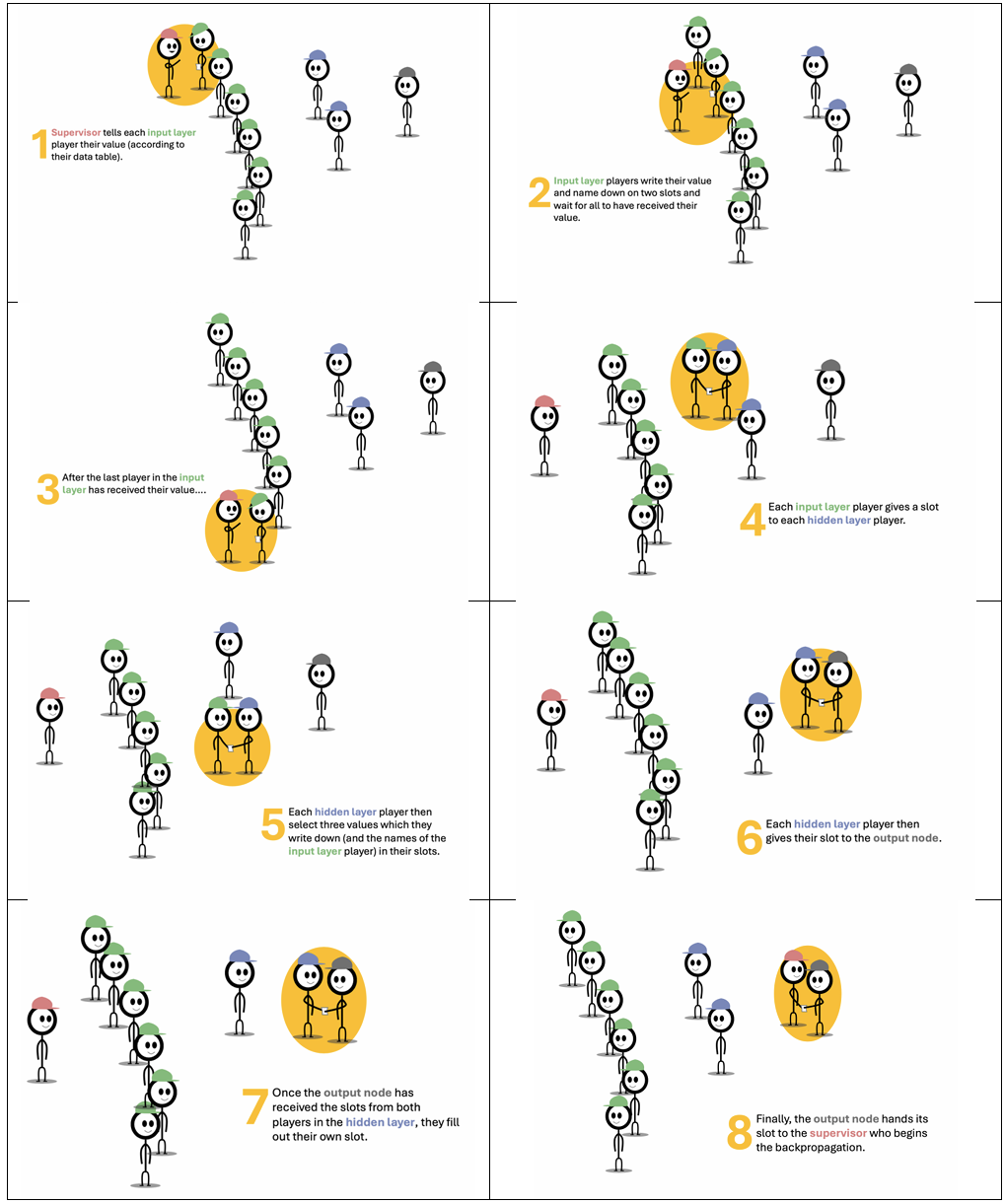
Using ropes to connect the nodes becomes most important at the reverse propagation stage. The clever part of this is that we can show an increase or decrease in the strength of connection by adding or removing ropes. For me, this is the ‘jam sandwich’ effect. This, I think, is probably the most significant learning point. Here, the number of ropes that connect the nodes in the layers are changed based on the strength of evidence that a particular feature is indicated, by the data, to be relevant to the output. In this case, whether “Temperature”, for example, has an implied effect on cocoa disease or not — based on the data, not on any preconceived rule. Simply put, if a farm did have disease then a rope is added, if a farm did not then a rope is removed. Or at a more abstracted level, if a particular neuron contributes towards the correct prediction, a rope is added, otherwise a rope is removed. In a real neural network, backpropagation involves complex maths, such as calculus that would not be accessible to students of this age. Therefore, the rope is an analogy that replaces something that would be impossible for these students to grasp if it was taught using the real-world implementation.
Problem to be solved in the unplugged activity: Identify features that are relevant for detecting diseases
At the end of the activity, features (temperature, leaf color, family farm, etc.) with many rope connections are considered to be relevant for crop disease detection on the farm, whereas features with fewer rope connections are considered to be irrelevant for crop disease detection. The more ropes attached to a particular feature, e.g., temperature, represent its higher relevance in identifying crop disease on the farm.
As part of the design of this activity, Salomey has simplified technical language so that throughout the role play students use everyday terms and she has chosen a context that is relatable for the students. For example, she uses the language of trust, and the new thickness of a rope connection, rather than using technical terms such as weight, loss function, and the error of the network.
Salomey also designed a follow-on activity that uses pen and paper. In this version of the activity, which she calls a board game, the students draw lines to connect the nodes in the layers. The thickness of the lines connecting the nodes represent the strength of the trust (see Figure 2).
Salomey also shared her evaluation of the resources. She conducted pre‑ and post‑intervention surveys with 39 teachers as part of the professional development on the AI teaching materials, and ten of those teachers implemented the unplugged activities in their classrooms. She reported that the teachers found the role-play activity was effective to demonstrate neural networks, that children worked independently to learn, and that some students who did not take part usually in class were engaged.
As well as sharing about her unplugged neural network activity, Salomey also talked about a set of AI stories that she has developed to teach about other aspects of AI applications. For example, the importance of fact-checking is demonstrated through a story about a young girl who fact-checked information she received from her friends about life in a city.
If you would like to find out more about Salomey’s work, you can find related materials on our seminar website.
Join us at our next seminar on Tuesday 17 March from 17:00 to 18:30 GMT to hear Rebecca Fiebrink (University of the Arts London) speak about teaching AI for creative practitioners. This will be the second seminar in our new series on how to teach about AI across disciplines. We hope to see you there!
To sign up and take part in our research seminars, click below:
You can also view the schedule of our upcoming seminars, and catch up on past seminars on our previous seminars page.
The post Do you have some rope? Then let’s teach about AI concepts appeared first on Raspberry Pi Foundation.
Measuring student understanding in computing education is not an easy task. As AI literacy becomes an important pillar in computing education, defining and accurately measuring students’ understanding of concepts and their skills is an even greater challenge.
In a recent seminar in our series on teaching about AI and data science, researcher Jesús Moreno-León (Universidad de Sevilla) talked about his work in developing assessment tools for computational thinking (CT) and AI literacy. Jesús is also co-founder of Programamos, a non-profit organisation that promotes the development of computational thinking, supporting teachers through training and sharing resources.
Jesús began by discussing the recent development of computer science assessment tools. Together with Gregorio Robles (Universidad Rey Juan Carlos), they created Dr Scratch, a web-based tool to assess the quality of Scratch projects and detect errors and bad programming habits (e.g. dead code). Projects are scored on the use of computational thinking concepts (e.g. parallelism, conditional logic) and the use of desirable programming practices (e.g. naming sprites, removing duplicate scripts) in order to give feedback to students and teachers to iteratively improve their Scratch projects.
Alongside measuring students’ programming skills, Jesús also shared work by Marcos Román-González (Universidad Nacional de Educación a Distancia) to develop the Computational Thinking test (CTt), a 28-item assessment tool designed to measure the computational thinking skills of students aged 10 to 16 years old. Two collaborators, María Zapata and Estafanía Martín (Universidad Rey Juan Carlos) further adapted these items to create the Beginners Computational Thinking test (or BCTt), an unplugged assessment suitable for younger learners aged 5 to 10 years old.
Jesús also described his more recent work at the Ministry of Education and Vocational Training in Spain to promote computer science at all educational levels. One initiative, La Escuela de Pensamiento Computacional e Inteligencia Artificial (or the School of Computational Thinking and Artificial Intelligence), supported Spanish teachers through training and resources to introduce CT and AI into the classroom. Over 400 teachers and 7000 teachers took part across Spain through unplugged activities and tools such as Machine Learning for Kids and LearningML, allowing students to classify text and images using machine learning. Older students created apps using the MIT App Inventor. When evaluating the design of the curriculum, they found they had strong instruments to measure the development of CT — such as the assessment tools described above — yet nothing to measure AI literacy.
The lack of valid AI literacy assessment tools led the team to develop the AI Knowledge Test (or AIKT), a 14-item survey consisting of multiple-choice questions designed to measure students’ understanding of AI. The instrument was inspired by previous work in the field and relevant research (e.g. the AI4K12 framework).
An example of one of these items is presented below. Can you solve it? The answer is at the bottom of this article.
Q1. Which of the following strategies would be most appropriate for teaching a computer to recognise photos of apples?
In a study on the impact of programming activities on computational thinking and AI literacy in Spanish schools, the authors tested these knowledge-based items with over 2000 students to assess the reliability (e.g. internal consistency), or a measure of the quality of a survey or test. They found one item (“As a user, the legal regulation that is approved regarding AI systems will affect my life”) did not correlate with the other items. This left a total of 13 items which were found to have sufficient internal consistency — meaning how well each item correlated with one another to measure an underlying construct (i.e. “AI knowledge”). They concluded that the assessment tool needed a higher ceiling and needed to address common misconceptions. The authors also learned that teachers needed free and open-source tools with low barriers for entry, such as not needing registration, and were suitable for classroom use, such as limiting data sent to the cloud.
With the rise of generative AI tools like ChatGPT or Google’s Gemini, Jesús and his colleagues felt their AI literacy assessment tool needed to focus on the capabilities of generative AI tools. They also felt they needed to take a broader view of AI and focus on additional dimensions, such as the social and ethical implications of AI tools. They are, therefore, currently revising their assessment items to align with several common frameworks, including the SEAME framework and AI Learning Priorities for All K–12 Students.
One of the revised items is presented below. Can you solve it? The answer is revealed below.
Q2. You have asked your students to design a decision tree to classify different fruits based on three characteristics: color, size, and shape. To check whether the following proposed solution is correct, you are going to test it. As what fruit does the decision tree classify a small, round, yellow apple?
Jesús concluded the seminar by describing his intentions to collaborate with others to test the revised AI literacy instrument with students in early 2026. We look forward to hearing about their results!
You can watch Jesús’s whole seminar here:
If you are interested to learn more about Jesús and his work, you can read about his development of the AI Knowledge Test (or AIKT) here and the Computational Thinking test (CTt) here or look at the original items here. You can also learn about the Beginners Computational Thinking test (BCTt) by watching a Raspberry Pi research seminar about it or reading about it here.
In our current seminar series, we’re exploring applied AI and how AI can be taught across the curriculum. In our next seminar in this series on 17 March at 17.00 UK time, we welcome Rebecca Fiebrink (University of the Arts London) who will explore the questions of how and why we might teach AI for creative practitioners, including children, students, and professionals.
To take part in the seminar, click the button below to register. We hope to see you there.
The schedule of our upcoming seminars is available online. You can catch up on past seminars on our blog and on the previous seminars and recordings page.
The post The challenges of measuring AI literacy appeared first on Raspberry Pi Foundation.
Where do great research ideas come from in computer science education? We might think of research breakthroughs as a single moment of genius, but in reality impactful research is often the result of many years of iterative development. In November’s research seminar, we heard from Karl-Emil Kjær Bilstrup, a researcher at the University of Copenhagen, about his work to develop ML-Machine. This work uses embodied learning principles and the BBC micro:bit to introduce learners to machine learning concepts. Findings from this research have been used to develop the micro:bit CreateAI resources, and in this blog, we will explain the research journey from initial small-scale work to educational resources used by many young learners around the world.
In Karl-Emil’s first research study, students used prompt cards to develop ideas for machine learning applications that could solve real-world problems, and to discuss the ethical dilemmas associated with their solutions. Students found it difficult to address these ethical dilemmas in their designs; for example, their ideas often featured a trade-off of user privacy. The findings from this research informed Karl-Emil’s next study, which moved from hypothetical scenarios to implementing machine learning in real-world settings.
The ‘Machine Learning Machine’ study made machine learning processes tangible for students through the use of two physical boxes, shown in the picture below. Students created drawings and fed them into the first box to train a model, and then tested the model by placing new drawings under a camera in the second box and having the model produce predictions of what the drawings showed. For example, students could draw pictures of the sun to represent daytime and the moon to represent nighttime to train a model to predict whether new drawings represented day or night. The machine was built for slow interaction, giving students time to think about the concepts and practices that they were developing. In a follow-up study, a new version of the Machine Learning Machine had been designed, which was controlled using a graphical user interface (GUI). This allowed users to “unbox” and influence parts of the machine learning process. For example, students could adjust the number of complete passes (called ‘epochs’) through the training data to improve the model’s accuracy.
The two studies with the Machine Learning Machines provided many useful findings for teaching about machine learning with K–12 (primary and secondary) learners. However, two constraints remained: firstly, there were limited opportunities for whole-class work because there was only one Machine Learning Machine, and secondly, learning experiences needed to be better connected to examples from students’ daily lives. As a result, the next iteration in Karl-Emil’s research involved using the micro:bit, which ensured access to a tangible device for every student, and a new graphical platform called ML-Machine that students could interact with.
The micro:bit is a small, programmable computing device that features sensors to gather data from the immediate environment. For example, the accelerometer is a motion sensor that can detect when the micro:bit is tilted from left to right, backwards and forwards, and up and down. Using the micro:bit with ML-Machine and some common household objects, students can create simple machine learning models that use data from the micro:bit’s accelerometer to detect whether the micro:bit is moving. This is a very different approach from rule-based programs on the micro:bit, where students might use programming constructs such as if statements to detect movement if the numerical reading from the accelerometer is above a certain value. Here, a machine learning model trained using a set of 20 examples is used to analyse live data readings and produce predictions about whether the micro:bit is moving.
In our seminar, Karl-Emil gave a live demonstration of the ML-Machine toolkit, so we highly recommend watching the recording to see how this toolkit brings machine learning concepts to life.
ML-Machine is the precursor to the micro:bit CreateAI resources, and the software is fully open-source. However, the innovation doesn’t stop there: Karl-Emil also explained that he is currently developing a new tool called math.ml-machine.org, where students can train a neural network and see a visualised k-nearest neighbour model to explore how a model makes predictions. The research journey is continuing, with new possibilities for educational opportunities to teach about machine learning.
The idea of embodied learning is interwoven throughout all of Karl-Emil’s research projects and is a cornerstone of all of his work. Embodied learning suggests that we learn more effectively when our whole body is involved in the learning process, not just our minds. For example, in the work described in this seminar, the Machine Learning Machines and the micro:bit were all tangible devices that students could touch and see.
Embodied learning is particularly important in activities that involve working with data-driven systems. In traditional programming activities, the flow of code can be traced transparently through a program. However, machine learning models are more opaque, and their outputs cannot be traced step by step. Students can benefit from using bodily movements and sensorimotor information to help understand machine learning concepts.
The ML-Machine toolkit was designed to support students to learn through embodied learning in three different ways:
Embodied learning helped students grasp concepts such as data quality. They could see how their bodily movements were being translated into digital data, and could spot when movements that appeared different to them were being classified as similar by the ML-Machine model. One case study participant described that the immediate feedback on screen made the concept of machine learning feel as if it were “coming to life as they [the students] manipulate something themselves and they’ve got control over it”.
Karl-Emil’s work shows how research ideas can be used in the classroom through a cycle of discovery, design, and reflection. From prompt cards exploring ethics to tangible machines and the micro:bit-based ML-Machine, his research shows how embodied learning can make complex ideas like machine learning not only understandable, but deeply engaging for young learners. The micro:bit CreateAI resources are a great example of how research findings can evolve into accessible, hands-on tools that empower educators and students alike. As this work continues to grow, it invites us to imagine new ways for learners to experience machine learning not as abstract theory, but as something they can see, feel, and shape with their own hands.
If you’d like to try out some of the ideas from this seminar, here are some useful resources:
Join us at our next seminar on Tuesday 17 March from 17:00 to 18:30 GMT to hear Rebecca Fiebrink (University of the Arts London speak about teaching AI for creative practitioners. This will be the second seminar in our new series on how to teach about AI across disciplines. We hope to see you there!
To sign up and take part in our research seminars, click below:
You can also view the schedule of our upcoming seminars, and catch up on past seminars on our previous seminars page.
The post Embodied machine learning: From research ideas to classroom activities appeared first on Raspberry Pi Foundation.
In Germany, as in many countries, AI topics are rapidly entering formal computer science education. Yet, this haste often risks us focusing on fleeting technological developments rather than fundamental concepts. As computer science educator Viktoriya Olari, from Free University of Berlin, discovered in her research, the fundamental role of data, which powers most modern AI systems, is critically underestimated in many existing frameworks. If students are to become responsible designers of such systems, they can’t afford to treat AI as an opaque box. Rather, they must first master the messy, human process that begins with the data itself.
In our October research seminar, Viktoriya shared the results of her work over the last four years on how schools can shift the focus from the latest technologies to the underlying data. Her research offers a clear structure for what young people should learn about data and how teachers can make it work inside ordinary classrooms.
Viktoriya’s analysis of existing AI education frameworks found the data domain is underrepresented, with essentials such as data cleaning often not addressed at all. She argues that, because modern AI systems are data driven, students need both language and routines for working with data: being able to name concepts like training vs test data, data quality, and bias, and to explain practices such as collection, cleaning, and pre-processing. That’s the rationale for teaching data concepts and practices first, and then placing modelling inside an explicit, staged lifecycle.

Her talk presented this argument in the German school context, where AI topics are entering state curricula quickly. Her critique targets how existing frameworks fail to address data and how that gap undermines responsible evaluation and design. The proposed model centres data by pairing an eight-stage, data-driven lifecycle with a curated set of key concepts and practices, and by making “data-based judgment skills” a key outcome.
Viktoriya’s work organises this understanding into two foundational components: data concepts (the vocabulary, e.g. training/test data, data quality, overfitting) and data practices (the actions, e.g. collect, clean, train, evaluate).
Viktoriya’s framework is built around an eight-stage data lifecycle, stretching from defining a task through gathering, preparing, modeling, evaluating, and finally sharing or archiving results. Inside that backbone she has identified two layers of learning targets:
More details are available in her work on data-related concepts and practice.
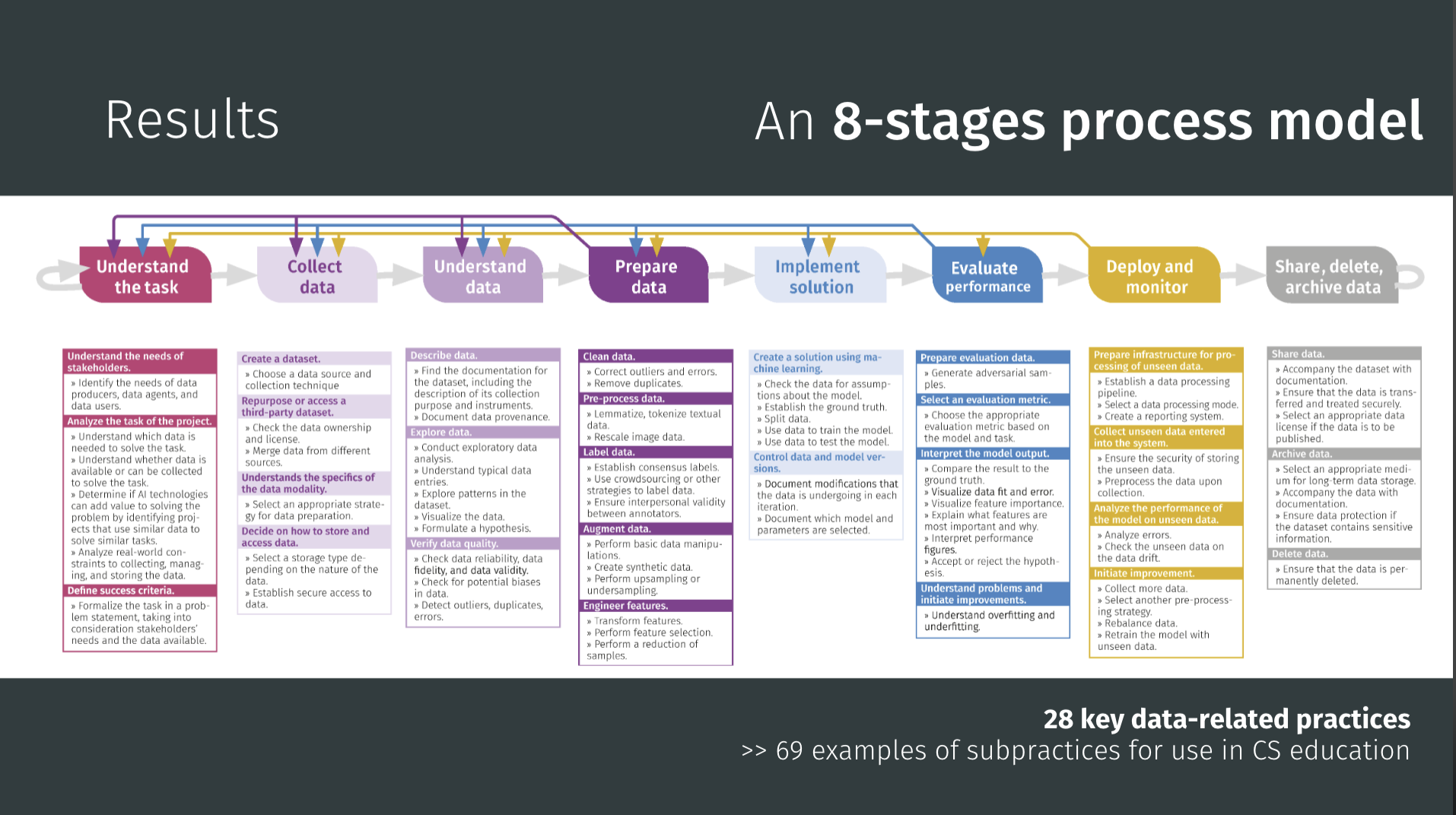
Viktoriya’s 8-stage process model of the data-driven lifecycle. It serves as a guide for curriculum developers and teachers, outlining 28 key data-related practices and providing 69 examples of subpractices for use in K–12 computer science education.
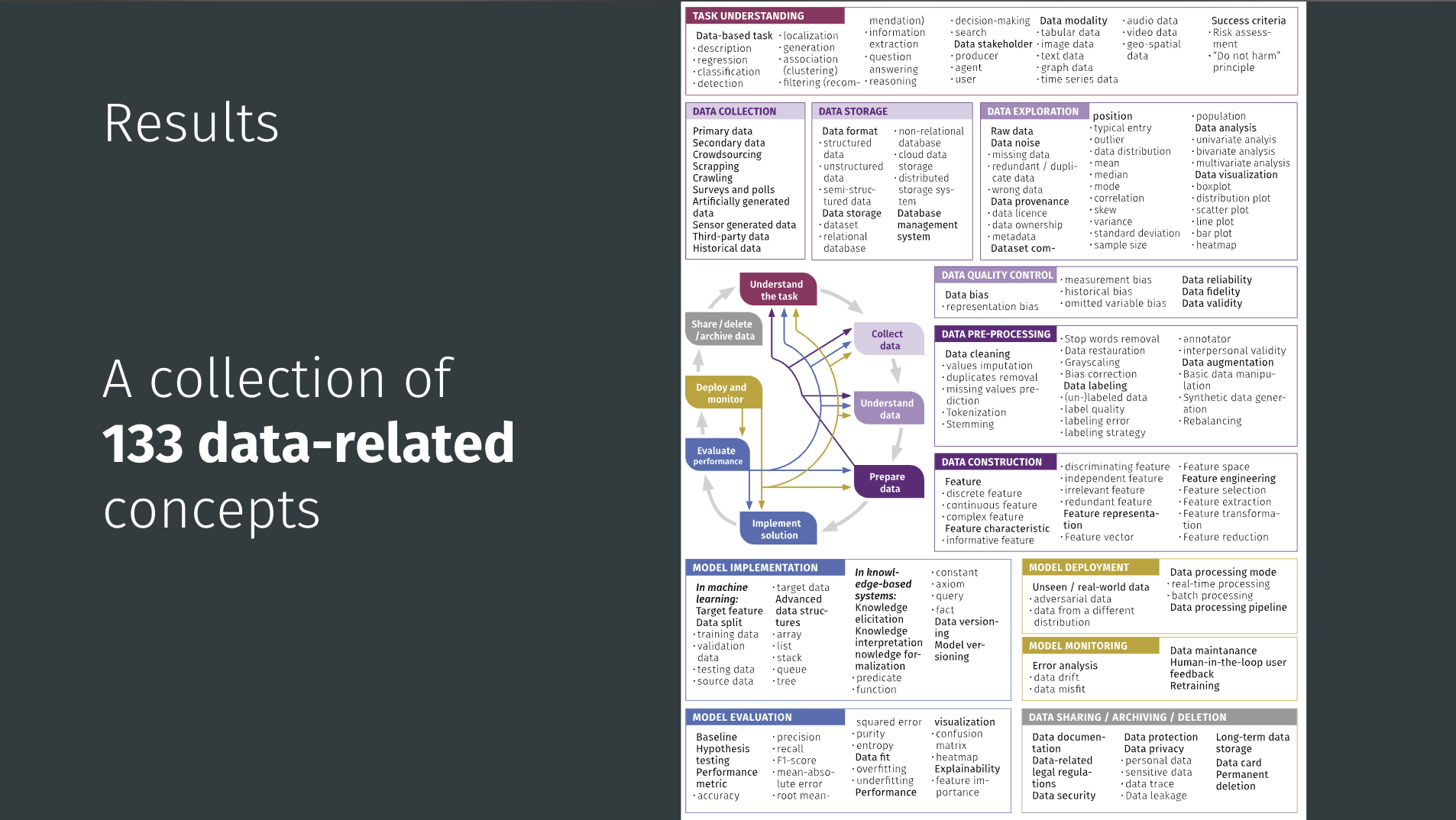
A collection of 133 key data-related concepts. These concepts are organised according to the eight stages of the data-driven lifecycle and provide the foundational vocabulary for teaching AI education.
Viktoriya’s team set out to redesign the format so that real data work could happen within ordinary lessons. They ended up with three “Data Case Study” architectures, each using authentic datasets and domain questions. The materials are supported by Orange 3, an unplugged machine learning and data visualisations tool familiar to the teachers participating. Variants emerged across three design cycles to address specific challenges, but teachers choose among them based on learning objectives and class context.
The data case study method uses real-world data and context to help students achieve three key learning outcomes: go through the data-driven lifecycle, reflect on data practices and concepts in a criteria-guided manner, and develop data-based problem-solving and judgment skills.
Viktoriya’s team ran three design cycles with small groups in Germany, with students aged 14 to 15. Each cycle lasted around 48 hours of teaching. Because participating teachers already knew Orange 3, the emphasis was on pedagogy rather than software training.
The projects drew on manageable real-world data: spreadsheets, time-series sets, a few geographical samples. Two examples are:
Some groups experimented with collecting their own sensor data, a plan that occasionally failed when the hardware didn’t cooperate. However, even that became part of the lesson: reliability, risk, and missing data are real features of data science, not mistakes to hide.
Student work reflected the three architectures. In the bottom-up groups, guided builds produced complete workflows and concise reflections, while top-down groups submitted annotated screenshots and critiques, and the puzzle-based lessons ended with posters and verbal presentations. Across them all, assessment focused on reasoning: not whether the “right” model appeared, but whether students could explain the stage they were in and justify their choices.
Everything Viktoriya described is open and classroom-ready (currently in German). The computingeducation.de/proj-datacases hub hosts teacher guides, student tasks, and sample Orange 3 files. The growing library of data cases covers topics from climate data to air quality analytics.
In the UK, a curriculum review has been recently released and along with the Government’s response. Across Europe and beyond, education systems are racing to add AI content to their curricula. Tools will come and go, and benchmarks will keep moving. What endures is the capacity to reason about data: to know what stage of work you’re in, what evidence supports your decisions, and what trade-offs you’re making. That is why Viktoriya’s contribution is unique — it gives teachers a map, a shared vocabulary, and practical ways to make data visible and the focus of discussion in schools.
You can read this blog to see how we’ve used Viktoriya’s framework in our work designing a data science curriculum for schools.
Join us at our seminar on Tuesday 27 January from 17:00 to 18:30 GMT to hear Salomey Afua Addo talk about how to teach about neural networks in Junior High Schools in Ghana.
To sign up and take part, click the button below. We’ll then send you information about joining.
We hope to see you there. This will be the final seminar in our series on teaching about AI and data science — the next series focuses on how to teach about applied AI across subjects and disciplines.
You can view the schedule of our upcoming seminars, and catch up on past seminars on our previous seminars page.
WKS2 teachers, participate in our new study!
We’re launching a new study to explore how to teach learners aged 9 to 11 about data-driven computing. The study will take place in collaboration with KS2 teachers (Y4/Y5/Y6) in England, Scotland and Wales and look at:
Our goal is to find practical ways to help teachers build children’s confidence in working with data in computing lessons. The study will be collaborative, with two workshops held throughout 2026, and we’re inviting KS2 teachers (Y4/Y5/Y6) to take part.
You can express your interest in participating by filling in this form: rpf.io/data-science-study-blog
The post How to put data first in K–12 AI education by using data case studies appeared first on Raspberry Pi Foundation.
For the last five years, once a month, we have hosted an online seminar sharing computing education research. Seminars are organised as usually year-long series with changing themes. In 2025, for example, our theme was ‘Teaching about AI and data science’. In 2024, it was ‘Teaching programming (with or without AI)’.
It is not surprising that for the last few years our focus has been on AI technology, and for 2026 we will continue this. But we will shift from showcasing how computing education research is changing teaching and learning in computing lessons, to showcasing how computing education research in other disciplines, such as art or geography, is starting to include teaching about AI. For example, art lessons may change so that learners find out how professional artists are using AI tools to create arts. Or geography lessons may change so that learners discover how professional geographers are using AI to make predictions about physical or human aspects of geography, such as volcanic activity and global warming.
Our series for 2026 is called ‘Applied AI’. This title recognises that AI technology is applied across contexts, across careers, across disciplines, and this means what we teach across school subjects will change.
The majority of resources and professional development material related to teaching about AI have been developed by the computer science community. For example, we have developed the popular Experience AI resources in collaboration with Google DeepMind. In these resources, the contexts were carefully selected to represent real-world examples across disciplines, and to to enable the teaching of particular technical or social and ethical concepts. This could be described as “a push” of content from computing towards other disciplines. For example, to enable teaching about the ethical issues around plagiarism, an art context is used in the Experience AI resources; to enable teaching about the potential benefits of using AI tools, an ecological geography context is used.
AI applications are always situated within a particular topic. Most current AI applications are data-driven: vast amounts of data are collected and processed to produce models that can then either be used to generate outputs or make predictions. For example, data about artworks can be collected and used to train a model for generating outputs similar to the artworks; this is an application of AI in the art discipline. Or data on wild fires can be collected and used to train a model for making predictions about current or prospective fires; this is an application of AI in the geography discipline.
In reality, the best people to recognise how AI technology is being applied in a discipline and what students in that discipline should be taught about these applications are the people working in the discipline, for example the art and geography teachers. Computer science educators can work to build the technical understanding and the general social and ethical understanding that is common across applications. But the detail of how AI technology is changing a discipline can only truly be understood by the respective community, by the artists and art educators, by the geographers and the geography educators.
At present, though, most educators are grappling with how they can use AI tools for productivity, such as creating lesson plans, or answering emails. Or they are looking at how they can use AI for general teaching and learning, for example for personalisation, say for students with additional needs. The idea that their underpinning discipline is changing is, perhaps, not yet on teachers’ radar. But at universities, such as in undergraduate courses, and in the world of work, education and training are changing. Data science courses are now being offered across faculties, including science, geography, language, and art faculties. These changes will start to filter down to school-based education via curriculum change. While some resources and professional development materials addressing this shift are already becoming available, change is still fragile and patchy.
The aims of our Applied AI research seminar series in 2026 are to start to:
If we can start to agree on what common concepts could be taught in the arts, sciences and humanities, it gives us a better chance to:
To make our 2026 series a success, we need to spread the word about our seminars to groups of educators, researchers, industry and policy makers across the arts, sciences, and humanities.
Please tell those you know in these groups about the seminar series, and share it through your social media and other networks. If you have ideas for subject associations we could connect with or publications where we can write about our series, please let us know.
We have already arranged the following seminars across 2026 and will add more speakers for the remaining monthly slots soon. Seminars always take place online on Tuesdays at 17:00 to 18:30 UK time.
To sign up and take part, click the button below. We’ll then send you information about joining. We hope to see you there.
You can view the schedule and details of our upcoming seminars on this page, and catch up on past seminars on our previous seminars page.
PS If you are teaching upper primary school learners in England, you can currently register your interest in our upcoming collaborative study on data science education. You’ll find out more about some of the research we’ve done in this area in this blog post.
The post How can we teach about AI in the arts, humanities and sciences? Research seminar series 2026 appeared first on Raspberry Pi Foundation.
Research indicates that teaching learners to use and create with data-driven technologies such as AI and machine learning (ML) requires an entirely different approach for solving problems compared to traditional programming activities.
In this blog, we share the new data paradigms framework that we have developed through research and used to help improve our understanding about how to teach and learn about AI and data science. We also invite you to register your interest in participating in our next collaborative study on the topic.
Let’s start by highlighting an important distinction between different approaches to designing systems. In a knowledge-based approach to system design, a set of rules (e.g., if-then statements) are written for the system to execute. Every rule is explicitly defined. This approach is called ‘rule-based’, ‘symbolic’, or ‘logic-based’. For example, a developer could create a program that simulates dialogue by writing specific lines of code to handle a greeting, such as “IF user says “Hello” THEN output “Hi!”. If the user types “Greetings!” instead, the program fails because it has no rule for that specific word.
Knowledge-based models are often said to be explainable by design. This means the logic is accessible and interpretable and developers can trace the exact steps taken to produce an output. For example, if developers manually classify restaurant reviews as positive or negative using a pre-defined set of criteria, the rules their restaurant classifying system follows are entirely explicit, and the path from input to output is clear and explainable.
By contrast, in a data-driven approach to system design developers do not write specific rules. Instead, they collect lots of data and train a model. In the dialogue simulator example, they would collect hundreds of examples of greetings and train a model to the pattern of a greeting. If the user types “Greetings!”, the system generates a response based on the patterns in its training data.
Data-driven models are often opaque. In other words, the internal workings of these ML models are hidden. While we can see our input and the system’s output, the internal mathematical process is so complex — often involving layers of calculations and abstractions — that we cannot simply “explain” why a specific output was produced. For example, developers can create a classification model by training a neural network using thousands of images. Due to the large quantity of data used to train the model, and complex internal parameters and hidden layers, developers and users of the system cannot understand or explain the logic or features that lead to a specific output. These kinds of models are often referred to as a “black box” (as opposed to a “glass” or “clear” box).
Researchers have argued that the move from knowledge-based (or rule-based) programming to data-driven system design represents a paradigm shift and creates unique challenges for educators. The challenge is helping students shift from the expectation that a system produces a single ‘right’ answer — characteristic of traditional rule-based programming — toward an understanding that systems trained on large quantities of data produce outcomes that aren’t always fixed or explainable. If the current instruction in the classroom still relies heavily on traditional rule-based programming approaches, we might be setting students up for misconceptions.
In our research work on AI and data science at the Raspberry Pi Computing Education Research Centre, we analysed 84 research studies about the teaching and learning of data science. We categorised learning activities used in the studies to understand whether they were (i) knowledge-based or data-driven, and (ii) the extent to which the underlying models used were transparent or opaque. This led us to define four distinct data paradigms:
The data paradigms framework helps us to distinguish between different kinds of modeling activities students take part in and how instructional approaches could be classified across one or more paradigms. For instance, we found that most data-driven activities were also opaque (DD + O), usually meaning that students collected and used data to train a model, but how the system worked was opaque. This pattern, where the data is visible but the model is not explainable, risks students forming misconceptions about the capabilities and limitations of data-driven systems. Without understanding how outputs are generated, students may expect data-driven ML systems to operate like fully explainable (or transparent) ones.
We think that lessons are needed in the data-driven opaque (DD + O) quadrant to explicitly teach students about how data-driven systems work and the role they play in everyday contexts. However, when teaching data-driven opaque (DD + O) activities, learners’ attention needs to be directed to concepts such as model confidence, data quality, and model evaluation. Since an ML model is not inherently explainable, we need to teach students to use post-hoc explanation methods, such as testing different inputs to see how a system’s output changes. To prepare students for this learning experience, we think that first introducing activities about rule-based systems (knowledge-based + transparent; KB + T) or simple data exploration, such as linear regression or data visualisation (data-driven + transparent; DD + T) may serve as a ‘bridge’ to understanding data-driven modeling by helping students to distinguish between systems built from specific logical rules and systems trained on data.
We believe the idea of data paradigms can serve as a way of framing teaching activities about data science and help educators and students to consider the transition between different paradigms when engaging with the systems we interact with every day.
KS2 teachers, participate in our new study!
We’re launching a new study to explore how to teach learners aged 9 to 11 about data-driven computing. The study will take place in collaboration with KS2 teachers (Y4/Y5/Y6) in England, Scotland and Wales and look at:
Our goal is to find practical ways to help teachers build children’s confidence in working with data in computing lessons. The study will be collaborative, with two workshops held throughout 2026, and we’re inviting KS2 teachers (Y4/Y5/Y6) to take part.
You can express your interest in participating by filling in this form:
The post A research-led framework for teaching about models in AI and data science appeared first on Raspberry Pi Foundation.
It’s been over a year since I last wrote an update on this blog about our research and as we’ve just published our 2025 Annual Report, this is an ideal opportunity to share what we’ve been working on at the Raspberry Pi Computing Education Research Centre.
We are a research centre based in the Department of Computer Science and Technology at the University of Cambridge, with a team that spans the university and the Raspberry Pi Foundation. We conduct research into many aspects of the teaching and learning of computing and AI and we work closely with schools, teachers and young people to ensure our research is applicable to practice.
Below I highlight some of the projects we’ve worked on in the academic year 2024-2025:
As I’ve written on this blog before, computing education is a global challenge. In one of the Research Centre’s projects, we are looking at how computing education is spreading around the world.
We found that between 2019 and 2024 the number of countries offering computing education had doubled, and that two thirds of all countries now offer, or have concrete plans to offer, computing education. This research has already been highlighted in the Stanford AI Index, and we are considering repeating the analysis in future years in order to have the most accurate and up-to-date information displayed in our map.
We have a number of projects in the area of AI education.
We are very interested in how to teach about AI, and held a workshop with teachers who were interested in the teaching of AI in February. Following on from the workshop results, we are interviewing more stakeholders, including UK-based experts, teachers and students, about their perspectives on concepts and skills that should be taught as part of an AI curriculum.
We’re also researching data science and data ethics education, which are foundational aspects of AI literacy. Most of the current AI systems are data-driven, having been trained on vast amounts of data. Therefore students need to understand about data and data science if they are to learn about AI systems. Therefore we’ve conducted two detailed literature reviews on data science and on data ethics this year. The first of these will be published in March at the WiPSCE conference.
One of our PhD students, Salomey Addo, has been examining how AI is taught in Ghana, where it is part of the curriculum for young people between ages 12 and 15. This year Salomey published a paper reporting that Ghanaian teachers have positive attitudes towards teaching AI but feel unprepared for it. She’s also developed unplugged resources to teach about artificial neural networks (ANNs).
ANNs are a fundamental technology used in a variety of AI systems, including image recognition and language translation systems. While ANNs are included in the Ghanaian AI curriculum, Salomey observed that teachers had difficulty with this particular topic The resources she developed are directly inspired by this, and involved teaching through role play and a board game.
This is an area we’ve also done some research in in the past year.
Carrie Anne Philbin published a paper in September showing that — at least in higher education — much of the use of generative AI in computing education is just duplicating the way teachers might already teach, and is primarily passive from a students’ perspective.
Meanwhile Katharine Childs and Veronica Cucuiat have been looking at how large language models (LLMs) can support secondary school programming education by helping students understand programming error messages.
Text-based programming is a topic featured in many computing curricula around the world. Teachers and researchers know that younger learners, for example at the lower secondary school level, can find debugging text-based programs very challenging. Although we’ve seen decades of research around programming and debugging focusing on learners who are in higher education, very little research has been done with school-age students.
In his research, Laurie Gale, a final-year PhD student at the Research Centre, found that learners were impatient to fix programs by trial and error, without figuring out what the real problemwas with their code or the underlying algorithm. He subsequently developed a tool called PRIMM Debug, which supports a more reflective and systematic approach to debugging. This tool enables learners to slow down when they are programming and to be more reflective. You can read more about it on the Research Centre website, and also catch up on the Foundation research seminar where he presented his work.
As part of a 5-year longitudinal project, running across the whole UK and the first project of its kind, we are looking at how physical computing impacts primary and secondary school learners. We’re investigating the effect of physical computing on learners’ creativity, agency and confidence, over time and at particular points known to be important for their subject choices. We are working with a wonderful set of partner primary schools who we visit each year.
This year we reported some of our first results, which point to teachers’ perceptions of physical computing being engaging and inclusive for primary-aged children. Starting next spring, we will be carrying out our third year of data collection with our pupil cohort, who have reached the age of 10 to 11.
We’ll also be running a survey next summer for upper primary-aged children and their teachers. Please sign up for our Teacher Research Network newsletter to be the first to hear about taking part in this survey.
As part of our TICE project we support teachers to conduct their own action research projects. This is a collaborative project, involving academics across the UK who volunteer to support teachers. The goal is to enable teachers to take a deep dive into a curriculum topic, a pedagogical approach, or a new resource, or to address a wider issue such as gender diversity or accessibility, to inform a change in their practice.
This year 16 teachers published their reports in our Teacher Research Booklet, and many also presented their findings online at CAS events or at the KCL-CAS London conference and the CAS National Conference. We’re very proud of them!
Two of our TICE teachers will be also presenting their research at an academic conference to be held in January. Congratulations to Will Grey and Joanne Hodge!
There are many other projects you can find out about on our website and in our annual report, so I hope that you will keep reading. It goes without saying that I’m incredibly proud of the team who’ve worked on all of these projects!
To summarise, here’s how you can stay up to date with our work and maybe even get involved in studies:
Finally, I am pleased to announce that we will be hosting the UKICER 2026 conference for researchers and teachers in Cambridge on 3 and 4 2026 September. More details will follow on the UKICER website and on the Research Centre website in due course.
The post 2025 highlights from the Raspberry Pi Computing Education Research Centre appeared first on Raspberry Pi Foundation.
At a time when many young people are using AI for personal and learning purposes, schools are trying to figure out what to teach about AI and how (find out more in this summer 2025 data about young people’s usage of AI in the UK). One aspect of this is how technical we should get in explaining how AI works, particularly if we want to debunk naive views of the capabilities of the technology, such as that AI tools ‘think’. In this month’s research seminar, we found out how AI contexts can be added to current classroom maths to make maths more interesting and relevant while teaching the core concepts of AI.
At our computing education research seminar in July, a group of researchers from the CAMMP (Computational and Mathematical Modeling Program) research project shared their work:
They talked about how maths already taught in secondary schools can be used to demystify AI. At first glance, this seems difficult to do, as it is often assumed that school-aged learners will not be able to understand how these systems work. This is especially the case for artificial neural networks, which are usually seen as a black box technology — they may be relatively easy to use, but it’s not as easy to understand how they work. Despite this, the Austrian and German team have developed a clear way to explain some of the fundamental elements of AI using school-based maths.
Sarah Schönbrodt started by challenging us to consider that learning maths is an essential part in developing AI skills, as:
Sarah explained how the CAMMP team have developed a range of teaching and learning materials on AI (and beyond) with an overall goal to “allow students to solve authentic, real and relevant problems using mathematical modeling and computers”.
She reflected that much of school maths is set in contexts that are abstract, and may not be very interesting or relevant to students. Therefore, introducing AI-based contexts, which are having a huge impact on society and students’ lives, is both an opportunity to make maths more engaging and also a way to demystify AI.
Workshops designed and researched by the team include contexts such as privacy in social networks to learn about decision trees, personalised Netflix recommendations to learn about k-nearest neighbour, word predictions to learn about N-Grams, and predicting life expectancy to learn about regression and neural networks.
For the seminar, Sarah walked through the steps to learn about support vector machines. This is an upper secondary workshop for students aged 17 to 18 years old. The context of the lesson is an image problem — specifically, classifying the data representing the colours of a simplified traffic light system (two lights to start with) to work out if a traffic light is red or green.
She walked through each of the steps of the maths workshop:
Throughout the presentation, Sarah pointed out where the maths taught was linked to the Austrian and German mathematics curriculum.
As well as learning about lines, planes, distances, dot product and statistical measures, learners are also engaged in discussing the social and ethical issues of the approach taken. They are encouraged to think about bias, data diversity, privacy, and the impact of errors on people. For example, if the model wrongly predicts a light as green when it is red, then an autonomous car would run through a red traffic light. This would likely be a bigger consequence than stopping at a green traffic light that was mis-predicted as red. So should the best line reduce this kind of error?
To teach the workshops, Sarah explained they have developed interactive Jupyter notebooks, where no programming skills are needed. Students fill in the gaps of example code, explore simulations, and write their ideas for discussion for the whole class. No software needs to be installed, feedback is direct, and there are in-depth tasks and staggered hints.
Stephan went on to introduce artificial neural networks (ANNs), which are the basis of generative AI applications like chatbots and image generation systems. He focused on regression models, such as those used in weather forecasting.
ANNs are very complex. Therefore, to start to understand the fundamentals of this technology, he introduced a ‘toy ANN’ with one input, three nodes, and one output. A function is performed on the input data at each node. With the toy network, the team wants to tackle a major and common misconception: that students think that ANN systems learn, recognise, see, and understand, when really it’s all just maths.
The learning activity starts by looking at one node with one input and one output, and can be described as a mathematical function, with a concatenation of two functions (in this case a linear and activation function). Stephan shared an online simulator that visualises how the toy neural network can be explored as students change two parameters (in this case, weight and bias of the functions). Students then look at the overall network, and the way that the output from the three nodes is combined. Again, they can explore this in the simulator. Students compare simple data about weather prediction to the model, and discover they need more functions — more nodes to better fit the data. The activity helps students learn that ANN systems are just highly adjustable mathematical functions that, by adding nodes, can approximate relationships in a given data set. But the approximation only works in the bounds (intervals) in which data points are given, showing that ANNs do not ‘understand’ or ’know’ — it’s just maths.
Stephen finished by explaining the mutual benefits of AI education and maths education. He suggested maths will enable a deeper understanding of AI, and give students a way to realistically assess the opportunities and risks of AI tools and show them the role that humans have in designing AI systems. He also explained that classroom maths education can benefit from incorporating AI contexts. This approach highlights how maths underpins the design and understanding of everyday systems, supports more effective teaching, and promotes an interdisciplinary way of learning across subjects.
I have been researching the teaching of AI and machine learning for around five years now, since before ChatGPT and other similar tools burst on the scene. Since then, I have seen an increasing number of resources to teach about the social and ethical issues of the topic, and there are a bewildering number of learning activities and tools for students to train simple models. There are frameworks for the data lifecycle, and an emerging set of activities to follow to prepare data, compare model types, and deploy simple applications. However, I felt the need to understand and to teach about, at a very simple level, the basic building blocks of data-driven technologies. When I heard the CAMMP team present their work at the AIDEA conference in February 2025, I was entirely amazed and I asked them to present here at our research seminar series. This was a piece of the puzzle that I had been searching for — a way to explain the ‘bottom of the technical stack of fundamental concepts’. The team is taking very complex ideas and reducing them to such an extent that we can use secondary classroom maths to show that AI is not magic and AI systems do not think. It’s just maths. The maths is still hard, and teachers will still need the skills to carefully guide students step by step so they can build a useful mental model.
I think we can simplify these ideas further, and create unplugged activities, simulations, and ways for students to explore these basic building blocks of data representation, as well as classification and representing approximations of complex patterns and prediction. I can sense the beginnings of new ideas in computational thinking, though they’re still taking shape. We’re researching these further and will keep you updated.
If you would like to find out more about the CAMMP resources, you can watch the seminar recording, look at the CAMMP website or try out their online materials. For example, the team shared a link to the jupyter notebooks they use to teach the workshops they demonstrated (and others). You can use these with a username of ‘cammp_YOURPSEUDONYM’, where you can set ‘YOURPSEUDONYM’ to any letters, and you can choose any password. They also shared their toy ANN simulation.
The CAMMP team are not the only researchers who are investigating how to teach about AI in maths lessons. You can find a set of other research papers here.
In our current seminar series, we’re exploring teaching about AI and data science. Join us at our last seminar of the series on Tuesday, 27 January 2026 from 17:00 to 18:30 GMT to hear Salomey Afua Addo talk about using unplugged approaches to teach about neural networks.
To sign up and take part, click the button below. We’ll then send you information about joining. We hope to see you there.
The schedule of our upcoming seminars is online. You can catch up on past seminars on our previous seminars page.
The post Secondary school maths showing that AI systems don’t think appeared first on Raspberry Pi Foundation.
Social media can have a powerful impact on the way we see and experience the world. What we see in our feeds is not random: it is determined by AI-driven systems that collect vast amounts of data, build user profiles, analyse engagement, and generate recommendations. But while young people are prolific users of social media, studies show that many have little understanding of what is happening ‘under the hood’
In our September research seminar, we welcomed back Henriikka Vartiainen and Matti Tedre from the University of Eastern Finland. They introduced Somekone, a social media simulator that is designed to help learners understand some of the fundamental processes behind social media platforms. Their team has been developing AI education materials and tools since 2019, including GenAI Teachable Machine, which they presented at our May research seminar.
Henriikka explained that the development of the Somekone tool emerged from the team’s long-term collaboration with teachers and schools in Finland. They co-developed the tool with the aim of making concepts like data collection, engagement, profiling, recommendations, filter bubbles, and polarisation visible and explainable for students aged 11 to 13 years old.
Henriikka described the pedagogical model that the team follows in all of their AI education interventions. Their goal is not only to support students to develop their understanding of AI concepts, but also to foster ethical awareness and a sense of agency.
Matti then gave a live demonstration of Somekone. Nothing compares to seeing the tool in action, so do check out the video of his demo here!
Students log on to the tool and are presented with an Instagram-style feed of images. They scroll through the feed and like, share, or comment on images that catch their attention or match their interests. For many students this is a very familiar type of environment, and they really enjoy playing with the app!
However, the unique value of Somekone is that it provides students with a real-time view of the way data is collected from every single user interaction, and demonstrates what is done with that data. It also allows students to experiment with a social media tool in the classroom without any data protection issues, as all of the data is stored locally.
Learners explore:
The simulator creates clusters of users with similar interests, which update in real time as students interact with posts on their feeds
The tool provides an explanation for why each post is recommended
Two users’ heatmaps presented side by side, showing their respective filter bubbles
For teachers, the tool has a simple guided interface to make it easy to use in class. There is also a button that teachers can use to pause the app, stopping students from scrolling (much to their dismay!) in order to focus their attention on the teacher when they are explaining concepts.
The research team used pre- and post-tests to evaluate what impact the intervention had on students’ understanding of social media mechanisms and on their sense of agency in relation to data. They conducted the post-test a week after the intervention, and then also did a delayed post-test six months later to see whether any changes were sustained. They found:
The Somekone tool is freely available online — in Finnish, English, German, and French — at somekone.gen-ai.fi. The developer Nick Pope has also made the source code available on GitHub at github.com/knicos/genai-somekone.
However, the supporting materials and teacher resources are currently only available in Finnish and the underpinning pedagogies relate to the Finnish context.
Join us at our next seminar on Tuesday, 11 November from 17:00 to 18:30 GMT to hear Karl-Emil Bilstrup (Copenhagen University) speak about using the micro:bit to explore machine learning practices. We hope to see you there!
To sign up and take part in our research seminars, click below:
You can also view the schedule of our upcoming seminars, and catch up on past seminars on our previous seminars page.
The post How AI shapes your feed: An explainable social media simulator for the classroom appeared first on Raspberry Pi Foundation.
Part of teaching young people AI literacy skills is teaching them to critically think about AI, and to design AI applications that address problems they care about. How to do this was the focus of our June research seminar.
Our June research seminar was delivered by Netta Iivari, Professor in Information Systems at the University of Oulu’s INTERACT Research Unit.
The INTERACT research group focuses on understanding and supporting participatory design, user-centered design, user-driven innovation, and human interaction with technology in everyday life contexts. From this perspective, “users” aren’t considered as passive consumers, but as valuable co-creators and content producers. This calls for different approaches that place emphasis on empowerment and inclusion in designing, shaping, and co-creating information technology in everyday life.
As part of this work, Netta introduced the idea of ‘transformative agency’ — empowering children to believe they can solve problems they care about — and its application in secondary computing education. She showed examples of how to foster young people’s transformative agency within computing, specifically focusing on transdisciplinary approaches to learning about AI and inviting young people to critically analyse and design their futures with AI tools in it.
Netta began by giving an overview of two of the INTERACT Research Unit’s projects:
Netta explained that these projects give young people an opportunity to begin to address the problems they care about, even though they may be very complex problems. From this problem-solving perspective, children are introduced (or ‘sensitised’) to emerging technologies as tools for social good.
She then went on to outline the key pedagogical approaches that underpin these projects:
The projects follow 3 design phases and include a range of plugged and unplugged activities, as shown in Figure 1.
Netta then described in more detail some of the activities that have been used to address these different project phases and the design process involved. For example, to explore what are the problems that children really care about, they are asked to imagine ‘carrying a stone in your pocket for one week, as if it was a magic tool. Where could it be used in your everyday life? What problems could it solve? What problems would you like it to solve and how?’
Young people are then introduced to a range of novel technologies, for example, VR headsets, robots, and emulators of AI-driven social media platforms, such as “Somekone”, developed as part of the Generative AI project at the University of Eastern Finland. They deconstruct and reconstruct generative AI tools by prompting large language model (LLM) chatbots such as ChatGPT, Gemini, Claude, etc. and exploring bias in their outputs. They perform small-scale algorithmic auditing. They also create mini language models, so-called ‘baby LLMs’, with Google Colab using the text in Alice in Wonderland to train their models, and then open datasets (books as text files from Project Gutenberg). In exploring the responses these models generate, young people experience the potential and the limitations of such tools and gain an important understanding of the human activity involved in the development of AI technologies.
Once they have had this ‘sensitising‘ exposure to a range of tools, they then work in groups on a project that makes use of AI to solve the societal problem they have chosen. These problems could encompass a range of topics, such as racism, animal rights, the impact of AI, war, mental health, bullying. The young people are prompted to think about how large language models can be used to solve the problem, or parts of the problem. But importantly, they are also asked to consider the different motives and perspectives of the multiple stakeholders involved in the problem and its solution and whether their model ideas will create new problems when deployed.
They follow the 3 project phases shown in Figure 1 to design and make a range of digital (robots, apps, videos) and non-digital artefacts to solve their problem. Netta emphasised that although it could take 10 weeks or more to implement all the suggested activities, it is also possible to pick and choose individual tasks from the 3 phases to suit available curriculum timescales.
Other project tasks involve:
These projects situate learning about data-driven technologies in real-world contexts and promote a transdisciplinary approach, teaching and learning about AI from a problem-solving perspective.
This perspective conveys important messages to young people — that they do have agency and can take action in the face of many of the world’s problems, that they can and should be active, critical users of the new technologies that surround them, and that these technologies can be used to change the world for good.
Netta ended the seminar by asking viewers to consider how they could foster transformative agency in the young people they teach and whether or not they consider it to be important in computing education.
Resources relating to the projects can be found at interact.oulu.fi.
In our current seminar series, we’re exploring teaching about AI and data science. Join us at our next seminar on Tuesday 14 October from 17:00 to 18:30 GMT to hear Viktoriya Olari talk about data-related concepts and practices for AI education in K–12.
To sign up and take part, click the button below. We’ll then send you information about joining. We hope to see you there.
The schedule of our upcoming seminars is online. You can catch up on past seminars on our previous seminars page.
The post Promoting young people’s agency in the age of AI appeared first on Raspberry Pi Foundation.
New research by the Alan Turing Institute, published in June, shows that in the UK nearly one in four children aged 8 to 12 is using artificial intelligence (AI) tools like ChatGPT. With learners exploring these tools at such young ages, it’s more urgent than ever to develop teaching resources that help them understand how AI works.
One of the biggest challenges with AI is that it’s hard to tell how these tools function. With a chatbot, you enter a prompt and the tool returns a response, but what happens in between is invisible. For educators, that’s a problem: how can we help young people become thoughtful, creative users of AI tools if the technology feels like a closed box?
In our May research seminar, we welcomed Matti Tedre and Henriikka Vartiainen from the University of Eastern Finland. They’ve been working on how to teach about AI for years and were frustrated with existing educational platforms: many of these are either too complex, raise privacy concerns, or rely on coding skills that not all students (or teachers) have. In response, they created an award-winning, classroom-friendly tool designed to make AI technology more transparent and more hands-on.
Matti and Henriikka began by discussing the unique challenges of teaching young learners about AI technology. Many students start with “folk theories”, for example, thinking that computers understand language like humans do. These misconceptions can be surprisingly hard to shake.
They also pointed out broader issues:
To address these challenges, Matti and Henriikka have spent three years co-designing tools and approaches with local schools, teachers, and over 200 students. Their approach is grounded in educational theory and a set of core AI learning principles:
Frustrated by existing platforms that require programming skills, raise privacy concerns, or don’t allow collaboration, Matti and Henriikka’s team developed GenAI Teachable Machine: a no-code, browser-based tool designed to make key AI concepts tangible. In the central research study, the team used the tool with Finnish students in grade 4–7 (10 to 14 years of age). It’s a great introductory tool that could also be used with younger and older students.
Matti demonstrated how the tool addresses their core AI learning principles with a simple, creative project. Using hand puppets, he trained a model to recognise four distinct classes: a background, a bunny, a calm wolf, and an angry wolf. For each class, he assigned a specific action: a sound, an image, or both. This hands-on process gives students a direct line of sight from the data they might create (visuals of hand puppets) to the final behaviour of the model (outputted sounds and images). They learn about classifiers, training, and confidence levels not as abstract definitions, but as creative tools they can control.
But the learning really starts when things don’t work as expected. Students can easily open their models on their phones with an automatically created QR code and then move around the classroom to test their models. At this point, they quickly notice how fragile AI technology can be. For example, in the case of a simple recognition model trained on specific colours or features, with a change of lighting or a different shirt, the model might fail. These “failures” turn into powerful lessons. For instance, a face-recognition app trained mostly on students with blonde hair might not work well for someone with brown hair — sparking immediate conversations about bias. As Matti put it, students very quickly start asking deep questions.
GenAI Teachable Machine also allows students to apply their AI models to the physical world. By connecting to a simple, low-cost robotics kit, students can use their models to control motors, lights, and other actuators. This step into the physical world teaches fundamental concepts that are difficult to grasp in a purely virtual environment. Students learn about causality, as their model’s classifications trigger real, physical actions. They also learn about the need for a world model — an understanding of how the physical world works — and see that they must take responsibility for what happens when their abstract models have real-world consequences.
By combining a no-code platform with practical, well-designed learning experiences, Matti, Henriikka, and their team are showing what AI education can look like: hands-on, accessible, and grounded in real understanding. Their work is helping students see inside the box, and giving them the tools to think critically about the AI technologies that are becoming part of their everyday lives.
If you’re an educator interested in including the topic of AI in your teaching, you can try GenAI Teachable Machine on its official website.
You may also be interested in our own Experience AI resources, which are designed to help you and your learners navigate the fast-moving world of AI and machine learning technologies.
In September, Matti and his team are returning to discuss other ways to teach young people about AI technologies.
To sign up and take part in the Matti’s seminar on Tues 9 Sept at 17:00–18:30 BST, click the button below. We’ll then send you information about joining. We hope to see you there.
The schedule of our upcoming seminars is online. You can catch up on past seminars on our previous seminars page.
The post Opening the box: Tools to teach young people about AI appeared first on Raspberry Pi Foundation.
As data and data-driven technologies become a bigger part of everyday life, it’s more important than ever to make sure that young people are given the chance to learn data science concepts and skills.
In our April research seminar, David Weintrop, Rotem Israel-Fishelson, and Peter Moon from the University of Maryland introduced API Can Code, a data science curriculum designed with high school students for high school students. Their talk explored how their innovative work uses real-world data and students’ own experiences and interests to create meaningful, authentic learning experiences in data science.
Quick note for educators: Are you interested in joining our free, exploratory data science education workshop for teachers on 10 July 2025 in Cambridge, UK? Then find out the details here.
David started by explaining the motivation behind the API Can Code project. The team’s goal was not to turn students into future data scientists, but to offer students the data literacy they need to explore and critically engage with a data-driven world.
The work was also guided by a shared view among leading teachers’ organisations that data science should be taught across all subjects in the K–12 curriculum. It also draws on strong research showing that when educational experiences connect with students’ own lives and interests, it leads to deeper engagement and better learning outcomes.
To prepare for the design of the curriculum, David, Rotem, and Peter wanted to understand what data science education options already exist for K–12 students. Rotem described how they compared four major K–12 data science curricula and examined different aspects, such as the topics they covered and the datasets they used. Their findings showed that many datasets were quite small in size, and that the datasets used were not always about topics that students were interested in.
The team also looked at 30 data science tools used across different K–12 platforms and analysed what each could do. They found that tools varied in how effective they were and that many lacked accessibility features to support students with diverse learning needs.
This analysis helped to refine the team’s objective: to create a data science curriculum that students find interesting and that is informed by their values and voices.
To work towards this goal, the team used a methodology called participatory design. This is an approach that actively involves the end users — in this case, high school students — in the design process. During several in-person sessions with 28 students aged 15 to 18 years old, the researchers facilitated low-tech, hands-on activities exploring the students’ identities and interests and how they think about data.
One activity, Empathy Map, involved students working together to create a persona representing a student in their school. They were asked to describe the persona’s daily life, interests, and concerns about technology and data:
The students’ involvement in the design process gave the team a better understanding of young people’s views and interests, which helped create the design of the API Can Code curriculum.
Peter provided an overview of the API Can Code curriculum. It follows a three-unit flow covering different concepts and tools in each unit:
Peter described an example activity carried out by the students, showing how these three units flow together and build both technical skills and an understanding of the real-world uses of data science. Students were tasked with analysing a dataset from Zillow, a property website, to explore the question “How much does a house in my neighbourhood cost?” The images below show the process the students followed, which uses the data science skills and tools from all three units of the curriculum.
A central tenet of API Can Code is that students should explore data that matters to them. A diverse range of student interests was identified during the design work, and the curriculum uses these areas of interest, such as music, movies, sports, and animals, throughout the lessons.
The curriculum also features an open-ended final project, where students can choose a research question that is important to them and their lives, and answer it using data science skills.
The team shared two examples of memorable final projects. In one, a student set out to answer the question “Is Jhené Aiko a star?” The student found a publicly available dataset through an API provided by Deezer, a music streaming platform. She wrote a program that retrieved data on the artist’s longevity and collaborations, analysed the data, and concluded that Aiko is indeed a star. What stood out about this project wasn’t just the fact that the student independently defined stardom and answered their research question using real data, but that this was a truly personal, interest-driven project. David noted that the researchers could never have come up with this activity, since they had never previously heard of Jhené Aiko!
Another student’s project analysed data about housing in Washington DC to answer the question “Which ward in DC has the most affordable houses?” Rotem explained that this student was motivated by her family thinking about moving away from the city. She wanted to use her project to persuade her parents to stay by identifying the most affordable ward in DC that they could move to. She was excited by the outcome of her project, and she presented her findings to other students and her parents.
These projects underscore the power of personally important data science projects driven by students’ interests. When students care about the questions they are exploring, they’re more invested in the process and more likely to keep using the skills and concepts they learn.
API Can Code is available online and completely free to use. Teachers can access lesson plans, tutorial videos, assessment rubrics, and more from the curriculum’s website https://apicancode.umd.edu/. The site also provides resources to support students, including example programs and glossaries.
In our current seminar series, we’re exploring teaching about AI and data science. Join us at our next seminar on Tuesday, 17 June from 17:00 to 18:30 BST to hear Netta Iivari (University of Oulu) introduce transformative agency and its importance for children’s computing education in the age of AI.
To sign up and take part in our research seminars, click below:
You can also view the schedule of our upcoming seminars, and catch up on past seminars on our previous seminars and recordings page.
The post Bringing data science to life for K–12 students with the ‘API Can Code’ curriculum appeared first on Raspberry Pi Foundation.
An increasing number of frameworks describe the possible contents of a K–12 artificial intelligence (AI) curriculum and suggest possible learning activities (for example, see the UNESCO competency framework for students, 2024). In our March seminar, Lukas Höper and Carsten Schulte from the Department of Computing Education at Paderborn University in Germany shared with us a unit of work they’ve developed that could inform such a curriculum. At its core, the unit enhances young people’s awareness of how their personal data is used in the data-driven technologies that form part of their everyday lives.
Lukas Höper and Carsten Schulte are part of a larger team who are investigating how to teach school students about data science and Big Data.
Carsten explained that Germany’s informatics (computing) curriculum includes a competency area known as Informatics, People and Society (IPS), which explores the interrelationships between technology, individuals, and society, and how computation influences and is influenced by social, ethical, and cultural factors. However, research has suggested that teachers face several problems in delivering this topic, including:
Some of the findings of that 2007 research were mirrored in a more recent local study in 2025, which found that although there have been some gains in subject knowledge in the interval period, the problems of a lack of teaching material and integration with other computer science (CS) topics persist, with IPS increasingly perceived as the responsibility of the informatics subject area alone. Despite this, within the informatics curriculum, IPS is often the first topic to be dropped when educators face time constraints — and concerns with what and how to assess the topic remain.
In this context, and as part of a larger, longitudinal project to promote data science teaching in schools called ProDaBi, Carsten and Lukas have been developing, implementing, and evaluating concepts and materials on the topics of data science and AI. Lukas explained the importance of students developing data awareness in the context of the digital systems they use in their everyday lives, such as search engines, streaming services, social media apps, digital assistants, and chatbots, and emphasised the difference between being a user of these systems and a data-aware user. Using the example of image recognition and ‘I am not a robot’ Captcha services, Lukas explained how young people need to develop a data-aware perspective of the secondary purposes of the data collected by these (and other) systems, as well as the more obvious, primary purposes.
Lukas went on to illustrate the human interaction system model, which presents a continuum of possible different roles, from the student as the user of digital artefacts to the student as the designer of digital artefacts.
To become data-aware users of digital artefacts, students need to be able to understand and reflect on those digital artefacts. Only then can they proceed to become responsible designers of digital artefacts. However, when surveyed, some students were only moderately interested in engaging with the inner workings of the digital technologies they use in their everyday lives. Many students prefer to use the systems and are less interested in how they process data.
Lukas explained how students often become more interested in data-driven technologies when learning about them with explanatory models. Such models can foster data awareness, giving students a different perspective of data-driven technologies and helping them become more empowered users of them.
To illustrate, Lukas gave the example of an explanatory model about the role of data in digital systems. Such a model can be used to introduce the idea that data is explicitly and implicitly collected in the interaction between the user and the technology, and used for primary and secondary purposes.
Lukas then introduced two teaching units that were developed for use with middle school children to evaluate the success of the explanatory model approach in computing education. The first unit explores location data collected by mobile phone networks and the second features recommendation systems used by movie streaming services such as Netflix and Amazon Prime.
Taking the second unit as their focus, Lukas and Carsten outlined the four parts of the explanatory model approach:
The teaching unit begins by introducing recommendation systems and asking students to think about what a streaming service is, how a personalised start page is constructed, and how personal recommendations might be generated. Students then complete an unplugged activity to simulate the process of making movie recommendations for a peer:
Task 1: Students write down movie recommendations for another student.
Task 2: They then ask each other questions (they collect data).
Task 3: They write down revised movie recommendations.
Task 4: They share and evaluate their recommendations.
Task 5: Together they reflect on which collected data was helpful in this exercise and what kind of data a recommendation system might collect. This reflection introduces the concepts of explicit and implicit data collection.
In part 2, students are given a prepared Jupyter Notebook, which allows them to explore a simulation of a recommendation system. Students rate movies and receive personal recommendations. They reconstruct a data model about users, using the idea of collaborative filtering with the k-nearest neighbours algorithm (see Figure 3).
In part 3, the concepts of primary and secondary purposes for data collection are introduced. Students discuss examples of secondary purposes such as personalised paywalls for movies that can be purchased, and subscriptions based on the predictions of future behaviour. The discussion includes various topics about individual and societal issues (e.g. filter bubbles, behaviour engineering, information asymmetry, and responsible development of data-driven technologies).
Finally, students use the explanatory model as an ‘analytical lens’. They choose other examples from their everyday lives of technologies that implement recommendation systems and analyse these examples, assessing the data practices involved. Students present their results in class and discuss their role in these situations and possible actions they can take to become more empowered, data-aware users.
Using the explanatory model is one approach to make the Informatics, People and Society strand of the German informatics curriculum more engaging for students, and addresses some of the problems teachers identify with delivering this competency area.
In presenting the idea of the explanatory model, Carsten and Lukas emphasised that the model in use delivers content as well as functioning as a tool to design teaching content. In the example above, we see how the explanatory model introduces the concepts of:
The explanatory model framework can also be used as a focus for academic research in computing education. For example, further research is needed to evaluate if explanatory models are appropriate or ‘correct’ models and to determine the extent to which they are useful in computing education.
In summary, an explanatory model provides a specific perspective on and explanation of particular computing concepts and digital artefacts. In the example given here, the model focuses on the role of data in a recommender system. Explanatory models are representations of concepts, artefacts, and socio-technical systems, but can also serve as tools to support teaching and learning processes and research in computing education.
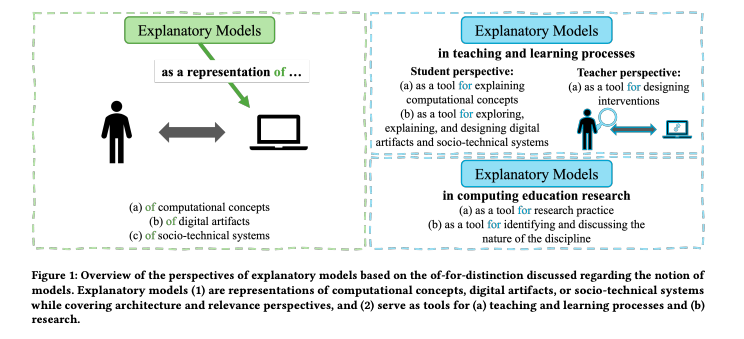
The teaching units referred to above are published on www.prodabi.de (in German and English).
See the background paper to the seminar, called ‘Learning an explanatory model of data-driven technologies can lead to empowered behaviour: A mixed-methods study in K-12 Computing education’.
You can also view the paper describing the development of the explanatory model approach, called ‘New perspectives on the future of Computing education: Teaching and learning explanatory models’.
In our current seminar series, we’re exploring teaching about AI and data science. Join us at our next seminar on Tuesday 13 May at 17:00–18:30 BST to hear Henriikka Vartiainen and Matti Tedre (University of Eastern Finland) discuss how to empower students by teaching them how to develop AI and machine learning (ML) apps without code in the classroom.
To sign up and take part in our research seminars, click below:
You can also view the schedule of our upcoming seminars, and catch up on past seminars on our previous seminars and recordings page.
The post Research insights to help learners develop data awareness appeared first on Raspberry Pi Foundation.
Teaching about artificial intelligence (AI) is a growing challenge for educators around the world. In our current seminar series, we are gaining insights from international computing education researchers on how to teach about AI and data science in the classroom. In our second seminar, Franz Jetzinger from the Technical University of Munich, Germany, presented his work on supporting teachers to integrate AI into their classrooms. Franz brings a wealth of relevant experience to his research as an accomplished textbook author and K–12 computer science teacher.
Franz started by demonstrating how widespread AI systems and technologies are becoming. He argued that embedding lessons about AI in the classroom presents three challenges:
As various models and frameworks for teaching about AI already exist, Franz’s research aims to address the second and third challenges — there is a notable lack of empirical evidence integrating AI in K–12 settings or teacher professional development (PD) to support teachers.
In Bavaria, computer science (CS) has been a compulsory high school subject for over 20 years. However, a recent update has brought compulsory CS lessons (including AI) to Year 11 students (15–16 years old). Competencies targeted in the new curriculum include defining AI, explaining the functionality of different machine learning algorithms, and understanding how artificial neurons work.
To help prepare teachers to effectively teach this new curriculum and about AI, Franz and colleagues derived a set of core competencies to be used along with existing frameworks (e.g. the Five Big Ideas of AI) and the Bavarian curriculum. The PD programme Franz and colleagues developed was shaped by a set of key design principles:
Over 300 teachers attended the MOOC, which had an introductory session beforehand and a follow-up workshop. The programme’s effectiveness was evaluated with a pre/post assessment where teachers completed a survey of 15 closed, multiple-choice questions on their AI competencies and knowledge. Pre/post comparisons showed teachers’ scores improved significantly having taken part in the PD. This is surprising as a large proportion of participants achieved high pre-scores, indicating a highly motivated cohort with notable prior experience teaching about AI.
Additionally, a group of teachers (n=9) were invited to give feedback on which aspects of the PD programme they felt contributed to the success of implementing the curriculum in the classroom. They reported that the PD programme supported content knowledge and pedagogical content knowledge well, but they required additional support to design suitable learning assessments.
A separate strand of Franz’s research focuses on the other key challenge of how to effectively teach about AI. Franz engaged teachers (n=14) in action research, a method whereby teachers engage in classroom-based research projects. The project explored what topic-specific difficulties students faced during the lessons and how teachers adapted their teaching to overcome these challenges.
Findings revealed that students struggled with determining whether AI would benefit certain tasks (e.g. object recognition, text-to-speech) or not (e.g. GPS positioning, sorting data). Franz and colleagues reasoned that students were largely not aware of how AI systems deal with uncertainty and overestimated their capabilities. Therefore, an important step in teaching students about AI is defining ‘what an AI problem is’.
Similarly, students struggled with distinguishing between rule-based and data-driven approaches, believing in some cases that a trained model becomes ‘rule-based’ or that all data models are data-driven. Students also struggled with certain data science concepts, such as hyperparameter, overfitting and underfitting, and information gain. Franz’s team argue that the chosen tool, Orange Data Mining, did not provide an appropriate scaffold for encountering these concepts.
Finally, teachers found challenges in bringing real-world examples into the classroom, including the use of reinforcement learning and neural networks. Franz and colleagues reasoned that focusing on the function of neural networks, as opposed to their structure, would aid student understanding. The use of high-quality (i.e. well-prepared) real-world data sets was also suggested as a strategy for bridging theoretical ideas with practical examples.
Franz’s research provides important insights into the discipline-specific challenges educators face when introducing AI into the classroom. It also underscores the importance of appropriate professional development and age-appropriate and research-informed materials and tools to support students engaging with ideas about AI, data science, and machine learning.
If you are interested in reading more about Franz’s work on teacher professional development, you can read his paper on a scalable professional development offer for computer science teachers or you can learn more about his research group here.
In our current seminar series, we are exploring teaching about AI and data science. Join us at our next seminar on Tuesday 8 April at 17:00–18:30 BST to hear David Weintrop, Rotem Israel-Fishelson, and Peter F. Moon from the University of Maryland introduce ‘API Can Code’, an interest-driven data science curriculum for high-school students.
To sign up and take part in the seminar, click the button below; we will then send you information about joining. We hope to see you there.
The schedule of our upcoming seminars is online. You can catch up on past seminars on our previous seminars and recordings page.
The post Supporting teachers to integrate AI in K–12 CS education appeared first on Raspberry Pi Foundation.
Generative AI (GenAI) tools like GitHub Copilot and ChatGPT are rapidly changing how programming is taught and learnt. These tools can solve assignments with remarkable accuracy. GPT-4, for example, scored an impressive 99.5% on an undergraduate computer science exam, compared to Codex’s 78% just two years earlier. With such capabilities, researchers are shifting from asking, “Should we teach with AI?” to “How do we teach with AI?”
Leo Porter and Daniel Zingaro have spearheaded this transformation through their groundbreaking undergraduate programming course. Their innovative curriculum integrates GenAI tools to help students tackle complex programming tasks while developing critical thinking and problem-solving skills.
Leo and Daniel presented their work at the Raspberry Pi Foundation research seminar in December 2024. During the seminar, it became clear that much could be learnt from their work, with their insights having particular relevance for teachers in secondary education thinking about using GenAI in their programming classes
In 2023, Leo and Daniel introduced GitHub Copilot in their introductory programming CS1-LLM course at UC San Diego with 550 students. The course included creative, open-ended projects that allowed students to explore their interests while applying the skills they’d learnt. The projects covered the following areas:
Students consistently reported that these projects were not only enjoyable but also responsible for deepening their understanding of programming concepts. A majority (74%) found the projects helpful or extremely helpful for their learning. One student noted that.
“Programming projects were fun and the amount of freedom that was given added to that. The projects also helped me understand how to put everything that we have learned so far into a project that I could be proud of.“
Leo and Daniel emphasised that teaching programming with GenAI involves fostering a mix of traditional and AI-specific skills.
Their approach centres on six core competencies:
Ethical and metacognitive skills: Students engage in discussions about responsible AI use and reflect on the decisions they make when collaborating with AI tools.
The rise of GenAI has prompted educators to rethink how they assess programming skills. In the CS1-LLM course, traditional take-home assignments were de-emphasised in favour of assessments that focused on process and understanding.
While Leo and Daniel reported that the integration of AI tools into their course has been largely successful, it has also introduced challenges. Surveys revealed that some students felt overly dependent on AI tools, expressing concerns about their ability to code independently. Addressing this will require striking a balance between leveraging AI tools and reinforcing foundational skills.
Additionally, ethical concerns around AI use, such as plagiarism and intellectual property, must be addressed. Leo and Daniel incorporated discussions about these issues into their curriculum to ensure students understand the broader implications of working with AI technologies.
Leo and Daniel’s work demonstrates that GenAI can transform programming education, making it more inclusive, engaging, and relevant. Their course attracted a diverse cohort of students, as well as students traditionally underrepresented in computer science — 52% of the students were female and 66% were not majoring in computer science — highlighting the potential of AI-powered learning to broaden participation in computer science.
By embracing this shift, educators can prepare students not just to write code but to also think critically, solve real-world problems, and effectively harness the AI innovations shaping the future of technology.
If you’re an educator interested in using GenAI in your teaching, we recommend checking out Leo and Daniel’s book, Learn AI-Assisted Python Programming, as well as their course resources on GitHub. You may also be interested in our own Experience AI resources, which are designed to help educators navigate the fast-moving world of AI and machine learning technologies.
Our 2025 seminar series is exploring how we can teach young people about AI technologies and data science. At our next seminar on Tuesday, 11 March at 17:00–18:00 GMT, we’ll hear from Lukas Höper and Carsten Schulte from Paderborn University. They’ll be discussing how to teach school students about data-driven technologies and how to increase students’ awareness of how data is used in their daily lives.
To sign up and take part in the seminar, click the button below — we’ll then send you information about joining. We hope to see you there.
The schedule of our upcoming seminars is online. You can catch up on past seminars on our previous seminars and recordings page.
The post Integrating generative AI into introductory programming classes appeared first on Raspberry Pi Foundation.
As artificial intelligence continues to shape our world, understanding how to teach about AI has never been more important. Our new research seminar series brings together educators and researchers to explore approaches to AI and data science education. In the first seminar, we welcomed Shuchi Grover, Director of AI and Education Research at Looking Glass Ventures. Shuchi began by exploring the theme of teaching using AI, then moved on to discussing teaching about AI in K–12 (primary and secondary) education. She emphasised that it is crucial to teach about AI before using it in the classroom, and this blog post will focus on her insights in this area.
From her research, Shuchi has developed a framework for teaching about AI that is structured as four interlocking components, each representing a key area of understanding:
This framework shows the multifaceted nature of AI literacy, which involves an understanding of both technical aspects and ethical and societal considerations.
Shuchi emphasised the importance of learning about AI ethics, highlighting the topic of bias. There are many ways that bias can be embedded in applications of AI and machine learning, including through the data sets that are used and the design of machine learning models. Shuchi discussed supporting learners to engage with the topic through exploring bias in facial recognition software, sharing activities and resources to use in the classroom that can prompt meaningful discussion, such as this talk by Joy Buolamwini. She also highlighted the Kapor Foundation’s Responsible AI and Tech Justice: A Guide for K–12 Education, which contains questions that educators can use with learners to help them to carefully consider the ethical implications of AI for themselves and for society.
In computer science education, computational thinking is generally associated with traditional rule-based programming — it has often been used to describe the problem-solving approaches and processes associated with writing computer programs following rule-based principles in a structured and logical way. However, with the emergence of machine learning, Shuchi described a need for computational thinking frameworks to be expanded to also encompass data-driven, probabilistic approaches, which are foundational for machine learning. This would support learners’ understanding and ability to work with the models that increasingly influence modern technology.
Shuchi shared that a variety of pedagogies have been used in recent research projects on AI education, ranging from hands-on experiences, such as using APIs for classification, to discussions focusing on ethical aspects. You can find out more about these pedagogies in her award-winning paper Teaching AI to K-12 Learners: Lessons, Issues and Guidance. This plurality of approaches ensures that learners can engage with AI and machine learning in ways that are both accessible and meaningful to them.
Shuchi shared examples of activities from two research projects that she has led:
At the end of her talk, Shuchi shared some final thoughts addressing teaching about AI to K–12 learners:
In our current seminar series, we are exploring teaching about AI and data science. Join us at our next seminar on Tuesday 11 March at 17:00–18:30 GMT to hear Lukas Höper and Carsten Schulte from Paderborn University discuss supporting middle school students to develop their data awareness.
To sign up and take part in the seminar, click the button below — we will then send you information about joining. We hope to see you there.
I want to join the next seminarThe schedule of our upcoming seminars is online. You can catch up on past seminars on our previous seminars and recordings page.
The post Teaching about AI in K–12 education: Thoughts from the USA appeared first on Raspberry Pi Foundation.
AI, machine learning (ML), and data science infuse our daily lives, from the recommendation functionality on music apps to technologies that influence our healthcare, transport, education, defence, and more.
What jobs will be affected by AL, ML, and data science remains to be seen, but it is increasingly clear that students will need to learn something about these topics. There will be new concepts to be taught, new instructional approaches and assessment techniques to be used, new learning activities to be delivered, and we must not neglect the professional development required to help educators master all of this.
As AI and data science are incorporated into school curricula and teaching and learning materials worldwide, we ask: What’s the research basis for these curricula, pedagogy, and resource choices?
In 2024, we showcased researchers who are investigating how AI can be leveraged to support the teaching and learning of programming. But in 2025, we look at what should be taught about AI, ML, and data science in schools and how we should teach this.
We are very excited that we have already secured several key researchers in the field.
On 21 January, Shuchi Grover will kick off the seminar series by giving an important overview of AI in the K–12 landscape, including developing both AI literacy and AI ethics. Shuchi will provide concrete examples and recently developed frameworks to give educators practical insights on the topic.
Our second session will focus on a teacher professional development (PD) programme to support the introduction of AI in Upper Bavarian schools. Franz Jetzinger from the Technical University of Munich will summarise the PD programme and share how teachers implemented the topic in their classroom, including the difficulties they encountered.
Again from Germany, Lukas Höper from Paderborn University, with Carsten Schulte will describe important research on data awareness and introduce a framework that is likely to be key for learning about data-driven technology. The pair will talk about the Data Awareness Framework and how it has been used to help learners explore, evaluate, and be empowered in looking at the role of data in everyday applications.
Our April seminar will see David Weintrop from the University of Maryland introduce, with his colleagues, a data science curriculum called API Can Code, aimed at high-school students. The group will highlight the strategies needed for integrating data science learning within students’ lived experiences and fostering authentic engagement.
Later in the year, Jesús Moreno-Leon from the University of Seville will help us consider the thorny but essential question of how we measure AI literacy. Jesús will present an assessment instrument that has been successfully implemented in several research studies involving thousands of primary and secondary education students across Spain, discussing both its strengths and limitations.
Our seminars are designed to be accessible to anyone interested in the latest research about AI education — whether you’re a teacher, educator, researcher, or simply curious. Each session begins with a presentation from our guest speaker about their latest research findings. We then move into small groups for a short discussion and exchange of ideas before coming back together for a Q&A session with the presenter.
Attendees of our 2024 series told us that they valued that the talks “explore a relevant topic in an informative way“, the “enthusiasm and inspiration”, and particularly the small-group discussions because they “are always filled with interesting and varied ideas and help to spark my own thoughts”.
The seminars usually take place on Zoom on the first Tuesday of each month at 17:00–18:30 GMT / 12:00–13:30 ET / 9:00–10:30 PT / 18:00–19:30 CET.
You can find out more about each seminar and the speakers on our upcoming seminar page. And if you are unable to attend one of our talks, you can watch them from our previous seminar page, where you will also find an archive of all of our previous seminars dating back to 2020.
To attend the seminars, please register here. You will receive an email with the link to join our next Zoom call. Once signed up, you will automatically be notified of upcoming seminars. You can unsubscribe from our seminar notifications at any time.
We hope to see you at a seminar soon!
The post How can we teach students about AI and data science? Join our 2025 seminar series to learn more about the topic appeared first on Raspberry Pi Foundation.
Artificial intelligence (AI) is transforming industries, and education is no exception. AI-driven development environments (AIDEs), like GitHub Copilot, are opening up new possibilities, and educators and researchers are keen to understand how these tools impact students learning to code.
In our 50th research seminar, Nicholas Gardella, a PhD candidate at the University of Virginia, shared insights from his research on the effects of AIDEs on beginner programmers’ skills.
AI tools are becoming a big part of software development, but what does that mean for students learning to code? As tools like GitHub Copilot become more common, it’s crucial to ask: Do these tools help students to learn better and work more effectively, especially when time is tight?
This is precisely what Nicholas’s research aims to identify by examining the impact of AIDEs on four key areas:
Nicholas conducted his study with 17 undergraduate students from an introductory computer science course, who were mostly first-time programmers, with different genders and backgrounds.
The students completed programming tasks both with and without the assistance of GitHub Copilot. Nicholas selected the tasks from OpenAI’s human evaluation data set, ensuring they represented a range of difficulty levels. He also used a repeated measures design for the study, meaning that each student had the opportunity to program both independently and with AI assistance multiple times. This design helped him to compare individual progress and attitudes towards using AI in programming.
The results were promising for those advocating AI’s role in education. Nicholas’s research found that participants who used GitHub Copilot performed better overall, completing tasks with less mental workload and effort compared to solo programming.
However, the immediate impact on students’ emotional state and self-confidence was less pronounced. Initially, participants did not report feeling more confident while coding with AI. Over time, though, as they became more familiar with the tool, their confidence in their abilities improved slightly. This indicates that students need time and practice to fully integrate AI into their learning process. Students increasingly attributed their progress not to the AI doing the work for them, but to their own growing proficiency in using the tool effectively. This suggests that with sustained practice, students can gain confidence in their abilities to work with AI, rather than becoming overly reliant on it.
A particularly important takeaway from the talk was the reduction in workload when using AI tools. Novice programmers, who often find programming challenging, reported that AI assistance lightened the workload. This reduced effort could create a more relaxed learning environment, where students feel less overwhelmed and more capable of tackling challenging tasks.
However, while workload decreased, use of the AI tool did not significantly boost emotional satisfaction or happiness during the coding process. Nicholas explained that although students worked more efficiently, using the AI tool did not necessarily make coding a more enjoyable experience. This highlights a key challenge for educators: finding ways to make learning both effective and engaging, even when using advanced tools like AI.
Nicholas’s findings raise interesting questions about how AI should be introduced in computer science education. While tools like GitHub Copilot can enhance performance, they should not be seen as shortcuts for learning. Students still need guidance in how to use these tools responsibly. Importantly, the study showed that students did not take credit for the AI tool’s work — instead, they felt responsible for their own progress, especially as they improved their interactions with the tool over time.
Students might become better programmers when they learn how to work alongside AI systems, using them to enhance their problem-solving skills rather than relying on them for answers. This suggests that educators should focus on teaching students how to collaborate with AI, rather than fearing that these tools will undermine the learning process.
Moreover, the study touched on an important point about the limits of its findings. Since the experiment was conducted in a controlled environment with only 17 participants, researchers need to conduct further studies to explore how AI tools perform in real-world classroom settings. For example, the role of internet usage plays a fundamental role. It will be relevant to understand how factors such as class size, prior varying experience, and the age of students affect their ability to integrate AI into their learning.
In the follow-up discussion, Nicholas also demonstrated how AI tools are becoming more accessible within browsers and how teachers can integrate AI-driven development environments more easily into their courses. By making AI technology more readily available, these tools are democratising access to advanced programming aids, enabling students to build applications directly in their web browsers with minimal setup.
Nicholas’s talk provided an insightful look into the evolving relationship between AI tools and novice programmers. While AI can improve performance and reduce workload, it is not a magic solution to all the challenges of learning to code.
Based on the discussion after the talk, educators should support students in developing the skills to use these tools effectively, shaping an environment where they can feel confident working with AI systems. The researchers and educators agreed that more research is needed to expand on these findings, particularly in more diverse and larger-scale educational settings.
As AI continues to shape the future of programming education, the role of educators will remain crucial in guiding students towards responsible and effective use of these technologies, as we are only at the beginning.
In our current seminar series, we are exploring how to teach programming with and without AI technology. Join us at our next seminar on Tuesday, 10 December at 17:00–18:30 GMT to hear Leo Porter (UC San Diego) and Daniel Zingaro (University of Toronto) discuss how they are working to create an introductory programming course for majors and non-majors that fully incorporates generative AI into the learning goals of the course.
To sign up and take part in the seminar, click the button below — we’ll then send you information about joining. We hope to see you there.
The schedule of our upcoming seminars is online. You can catch up on past seminars on our previous seminars and recordings page.
The post Does AI-assisted coding boost novice programmers’ skills or is it just a shortcut? appeared first on Raspberry Pi Foundation.
As computing technologies continue to rapidly evolve in today’s digital world, computing education is becoming increasingly essential. Arto Hellas and Juho Leinonen, researchers at Aalto University in Finland, are exploring how innovative teaching methods can equip students with the computing skills they need to stay ahead. In particular, they are looking at how generative AI tools can enhance university-level computing education.
In our monthly seminar in September, Arto and Juho presented their research on using AI tools to provide personalised learning experiences and automated feedback to help requests, as well as their findings on teaching students how to write effective prompts for generative AI systems. While their research focuses primarily on undergraduate students — given that they teach such students — many of their findings have potential relevance for primary and secondary (K-12) computing education.
Generative AI consists of algorithms that can generate new content, such as text, code, and images, based on the input received. Ever since large language models (LLMs) such as ChatGPT and Copilot became widely available, there has been a great deal of attention on how to use this technology in computing education.
Arto and Juho described generative AI as one of the fastest-moving topics they had ever worked on, and explained that they were trying to see past the hype and find meaningful uses of LLMs in their computing courses. They presented three studies in which they used generative AI tools with students in ways that aimed to improve the learning experience.
An important strand of computing education research investigates how to engage students by personalising programming problems based on their interests. The first study in Arto and Juho’s research took place within an online programming course for adult students. It involved developing a tool that used GPT-4 (the latest version of ChatGPT available at that time) to generate exercises with personalised aspects. Students could select a theme (e.g. sports, music, video games), a topic (e.g. a specific word or name), and a difficulty level for each exercise.
Arto, Juho, and their students evaluated the personalised exercises that were generated. Arto and Juho used a rubric to evaluate the quality of the exercises and found that they were clear and had the themes and topics that had been requested. Students’ feedback indicated that they found the personalised exercises engaging and useful, and preferred these over randomly generated exercises.
Arto and Juho also evaluated the personalisation and found that exercises were often only shallowly personalised, however. In shallow personalisations, the personalised content was added in only one sentence, whereas in deep personalisations, the personalised content was present throughout the whole problem statement. It should be noted that in the examples taken from the seminar below, the terms ‘shallow’ and ‘deep’ were not being used to make a judgement on the worthiness of the topic itself, but were rather describing whether the personalisation was somewhat tokenistic or more meaningful within the exercise.
The findings suggest that this personalised approach may be particularly effective on large university courses, where instructors might struggle to give one-on-one attention to every student. The findings further suggest that generative AI tools can be used to personalise educational content and help ensure that students remain engaged.
How might all this translate to K-12 settings? Learners in primary and secondary schools often have a wide range of prior knowledge, lived experiences, and abilities. Personalised programming tasks could help diverse groups of learners engage with computing, and give educators a deeper understanding of the themes and topics that are interesting for learners.
Another key aspect of Alto and Juho’s work is exploring how LLMs can be used to generate responses to students’ requests for help. They conducted a study using an online platform containing programming exercises for students. Every time a student struggled with a particular exercise, they could submit a help request, which went into a queue for a teacher to review, comment on, and return to the student.
The study aimed to investigate whether an LLM could effectively respond to these help requests and reduce the teachers’ workloads. An important principle was that the LLM should guide the student towards the correct answer rather than provide it.
The study used GPT-3.5, which was the newest version at the time. The results found that the LLM was able to analyse and detect logical and syntactical errors in code, but concerningly, the responses from the LLM also addressed some non-existent problems! This is an example of hallucination, where the LLM outputs something false that does not reflect the real data that was inputted into it.
The finding that LLMs often generated both helpful and unhelpful problem-solving strategies suggests that this is not a technology to rely on in the classroom just yet. Arto and Juho intend to track the effectiveness of LLMs as newer versions are released, and explained that GPT-4 seems to detect errors more accurately, but there is no systematic analysis of this yet.
In primary and secondary computing classes, young learners often face similar challenges to those encountered by university students — for example, the struggle to write error-free code and debug programs. LLMs seemingly have a lot of potential to support young learners in overcoming such challenges, while also being valuable educational tools for teachers without strong computing backgrounds. Instant feedback is critical for young learners who are still developing their computational thinking skills — LLMs can provide such feedback, and could be especially useful for teachers who may lack the resources to give individualised attention to every learner. Again though, further research into LLM-based feedback systems is needed before they can be implemented en-masse in classroom settings in the future.
Finally, Arto and Juho presented a study where they introduced the idea of ‘Prompt Problems’: programming exercises where students learn how to write effective prompts for AI code generators using a tool called Promptly. In a Prompt Problem exercise, students are presented with a visual representation of a problem that illustrates how input values will be transformed to an output. Their task is to devise a prompt (input) that will guide an LLM to generate the code (output) required to solve the problem. Prompt-generated code is evaluated automatically by the Promptly tool, helping students to refine the prompt until it produces code that solves the problem.
Feedback from students suggested that using Prompt Problems was a good way for them to gain experience of using new programming concepts and develop their computational thinking skills. However, students were frustrated that bugs in the code had to be fixed by amending the prompt — it was not possible to edit the code directly.
How these findings relate to K-12 computing education is still to be explored, but they indicate that Prompt Problems with text-based programming languages could be valuable exercises for older pupils with a solid grasp of foundational programming concepts.
At the end of the presentation, Arto and Juho summarised their work and hypothesised that as society develops more and more AI tools, computing classrooms may lose some of their community aspects. They posed a very important question for all attendees to consider: “How can we foster an active community of learners in the generative AI era?”
In our breakout groups and the subsequent whole-group discussion, we began to think about the role of community. Some points raised highlighted the importance of working together to accurately identify and define problems, and sharing ideas about which prompts would work best to accurately solve the problems.
As AI technology continues to evolve, its role in education will likely expand. There was general agreement in the question and answer session that keeping a sense of community at the heart of computing classrooms will be important.
The Raspberry Pi Computing Education Research Centre and Faculty of Education at the University of Cambridge have recently published a teacher guide on the use of generative AI tools in education. The guide provides practical guidance for educators who are considering using generative AI tools in their teaching.
In our current seminar series, we are exploring how to teach programming with and without AI technology. Join us at our next seminar on Tuesday, 12 November at 17:00–18:30 GMT to hear Nicholas Gardella (University of Virginia) discuss the effects of using tools like GitHub Copilot on the motivation, workload, emotion, and self-efficacy of novice programmers. To sign up and take part in the seminar, click the button below — we’ll then send you information about joining. We hope to see you there.
The schedule of our upcoming seminars is online. You can catch up on past seminars on our previous seminars and recordings page.
The post Using generative AI to teach computing: Insights from research appeared first on Raspberry Pi Foundation.
Artificial intelligence (AI) continues to change many areas of our lives, with new AI technologies and software having the potential to significantly impact the way programming is taught at schools. In our seminar series this year, we’ve already heard about new AI code generators that can support and motivate young people when learning to code, AI tools that can create personalised Parson’s Problems, and research into how generative AI could improve young people’s understanding of program error messages.
At times, it can seem like everything is being automated with AI. However, there are some parts of learning to program that cannot (and probably should not) be automated, such as understanding errors in code and how to fix them. Manually typing code might not be necessary in the future, but it will still be crucial to understand the code that is being generated and how to improve and develop it.
As important as debugging might be for the future of programming, it’s still often the task most disliked by novice programmers. Even if program error messages can be explained in the future or tools like LitterBox can flag bugs in an engaging way, actually fixing the issues involves time, effort, and resilience — which can be hard to come by at the end of a computing lesson in the late afternoon with 30 students crammed into an IT room.
But what is it about debugging that young people find so hard, even when they’re given enough time to do it? And how can we make debugging a more motivating experience for young people? These are two of the questions that Laurie Gale, a PhD student at the Raspberry Pi Computing Education Research Centre, focused on in our July seminar.
Laurie has spent the past two years talking to teachers and students and developing tools (a visualiser of students’ programming behaviour and PRIMMDebug, a teaching process and tool for debugging) to understand why many secondary school students struggle with debugging. It has quickly become clear through his research that most issues are due to problematic debugging strategies and students’ negative experiences and attitudes.
When students first start learning how to program, they have to remember a vast amount of new information, such as different variables, concepts, and program designs. Utilising this knowledge is often challenging because they’re already busy juggling all the content they’ve previously learnt and the challenges of the programming task at hand. When error messages inevitably appear that are confusing or misunderstood, it can become extremely difficult to debug effectively.
Given this information overload, students often don’t develop efficient strategies for debugging. When Laurie analysed the debugging efforts of 12- to 14-year-old secondary school students, he noticed some interesting differences between students who were more and less successful at debugging. While successful students generally seemed to make less frequent and more intentional changes, less successful students tinkered frequently with their broken programs, making one- or two-character edits before running the program again. In addition, the less successful students often ran the program soon after beginning the debugging exercise without allowing enough time to actually read the code and understand what it was meant to do.
The issue with these behaviours was that they often resulted in students adding errors when changing the program, which then compounded and made debugging increasingly difficult with each run. 74% of students also resorted to spamming, pressing ‘run’ again and again without changing anything. This strategy resonated with many of our seminar attendees, who reported doing the same thing after becoming frustrated.
Educators need to be aware of the negative consequences of students’ exasperating and often overwhelming experiences with debugging, especially if students are less confident in their programming skills to begin with. Even though spending 15 minutes on an exercise shows a remarkable level of tenaciousness and resilience, students’ attitudes to programming — and computing as a whole — can quickly go downhill if their strategies for identifying errors prove ineffective. Debugging becomes a vicious circle: if a student has negative experiences, they are less confident when having to bug-fix again in the future, which can lead to another set of unsuccessful attempts, which can further damage their confidence, and so on. Avoiding this downward spiral is essential.
Laurie stresses the importance of understanding the cognitive challenges of debugging and using the right tools and techniques to empower students and support them in developing effective strategies.
Some ideas of how to improve debugging skills that were mentioned by Laurie and our attendees included:
Most importantly, debugging should not be a daunting or stressful experience. Everyone in the seminar agreed that creating a positive error culture is essential.
Some ideas you could explore in your classroom include:
In a welcoming classroom where students are given support and encouragement, debugging can be a rewarding experience. What may at first appear to be a failure — even a spectacular one — can be embraced as a valuable opportunity for learning. As a teacher in Laurie’s study said, “If something should have gone right and went badly wrong but somebody found something interesting on the way… you celebrate it. Take the fear out of it.”
Watch the recording of Laurie’s presentation:
In our current seminar series, we are exploring how to teach programming with and without AI.
Join us at our next seminar on Tuesday, 12 November at 17:00–18:30 GMT to hear Nicholas Gardella (University of Virginia) discuss the effects of using tools like GitHub Copilot on the motivation, workload, emotion, and self-efficacy of novice programmers. To sign up and take part in the seminar, click the button below — we’ll then send you information about joining. We hope to see you there.
The schedule of our upcoming seminars is online. You can catch up on past seminars on our previous seminars and recordings page.
The post How to make debugging a positive experience for secondary school students appeared first on Raspberry Pi Foundation.
As discussions of how artificial intelligence (AI) will impact teaching, learning, and assessment proliferate, I was thrilled to be able to add one of my own research projects to the mix. As a research scientist at the Raspberry Pi Foundation, I’ve been working on a pilot research study in collaboration with Jane Waite to explore the topic of program error messages (PEMs).
PEMs can be a significant barrier to learning for novice coders, as they are often confusing and difficult to understand. This can hinder troubleshooting and progress in coding, and lead to frustration.
Recently, various teams have been exploring how generative AI, specifically large language models (LLMs), can be used to help learners understand PEMs. My research in this area specifically explores secondary teachers’ views of the explanations of PEMs generated by a LLM, as an aid for learning and teaching programming, and I presented some of my results in our ongoing seminar series.
I started the seminar by setting the scene and describing the current background of research on novices’ difficulty in using PEMs to fix their code, and the efforts made to date to improve these. The three main points I made were that:
My pilot study aims to fill this gap directly, by reporting K–12 teachers’ views of the potential use of LLM-generated explanations of PEMs in the classroom, and how their views fit into the wider theoretical paradigm of feedback literacy.
To conduct the study, I interviewed eight expert secondary computing educators. The interviews were semi-structured activity-based interviews, where the educators got to experiment with a prototype version of the Foundation’s publicly available Code Editor. This version of the Code Editor was adapted to generate LLM explanations when the question mark next to the standard error message is clicked (see Figure 1 for an example of a LLM-generated explanation). The Code Editor version called the OpenAI GPT-3.5 interface to generate explanations based on the following prompt: “You are a teacher talking to a 12-year-old child. Explain the error {error} in the following Python code: {code}”.
Fifteen themes were derived from the educators’ responses and these were split into five groups (Figure 2). Overall, the educators’ views of the LLM feedback were that, for the most part, a sensible explanation of the error messages was produced. However, all educators experienced at least one example of invalid content (LLM “hallucination”). Also, despite not being explicitly requested in the LLM prompt, a possible code solution was always included in the explanation.
Next, I investigated how the teachers’ views correlated to the research conducted to date on enhanced PEMs. I used the guidelines proposed by Brett Becker and colleagues, which consolidate a lot of the research done in this area into ten design guidelines. The guidelines offer best practices on how to enhance PEMs based on cognitive science and educational theory empirical research. For example, they outline that enhanced PEMs should provide scaffolding for the user, increase readability, reduce cognitive load, use a positive tone, and provide context to the error.
Out of the 15 themes identified in my study, 10 of these correlated closely to the guidelines. However, the 10 themes that correlated well were, for the most part, the themes related to the content of the explanations, presentation, and validity (Figure 3). On the other hand, the themes concerning the teaching and learning process did not fit as well to the guidelines.
However, when I looked at feedback literacy theory, I was able to correlate all fifteen themes — the theory fits.
Feedback literacy theory positions the feedback process (which includes explanations) as a social interaction, and accounts for the actors involved in the interaction — the student and the teacher — as well as the relationships between the student, the teacher, and the feedback. We can explain feedback literacy theory using three constructs: feedback types, student feedback literacy, and teacher feedback literacy (Figure 4).
From the feedback literacy perspective, feedback can be grouped into four types: telling, guiding, developing understanding, and opening up new perspectives. The feedback type depends on the role of the student and teacher when engaging with the feedback (Figure 5).
From the student perspective, the competencies and dispositions students need in order to use feedback effectively can be stated as: appreciating the feedback processes, making judgements, taking action, and managing affect. Finally, from a teacher perspective, teachers apply their feedback literacy skills across three dimensions: design, relational, and pragmatic.
In short, according to feedback literacy theory, effective feedback processes entail well-designed feedback with a clear pedagogical purpose, as well as the competencies students and teachers need in order to make sense of the feedback and use it effectively.
This theory therefore provided a promising lens for analysing the educators’ perspectives in my study. When the educators’ views were correlated to feedback literacy theory, I found that:
By correlating educators’ views to feedback literacy theory as well as enhanced PEM guidelines, we can take a broader perspective on how LLMs might not only shape the content of the explanations, but the whole social interaction around giving and receiving feedback. Investigating ways of supporting students and teachers to practise their feedback literacy skills matters just as much, if not more, than focusing on the content of PEM explanations.
This study was a first-step exploration of eight educators’ views on the potential impact of using LLM explanations of PEMs in the classroom. Exactly what the findings of this study mean for classroom practice remains to be investigated, and we also need to examine students’ views on the feedback and its impact on their journey of learning to program.
If you want to hear more, you can watch my seminar:
You can also read the associated paper, or find out more about the research instruments on this project website.
If any of these ideas resonated with you as an educator, student, or researcher, do reach out — we’d love to hear from you. You can contact me directly at veronica.cucuiat@raspberrypi.org or drop us a line in the comments below.
The focus of our ongoing seminar series is on teaching programming with or without AI. Check out the schedule of our upcoming seminars.
To take part in the next seminar, click the button below to sign up, and we will send you information about how to join. We hope to see you there.
You can also catch up on past seminars on our blog and on the previous seminars and recordings page.
The post How useful do teachers find error message explanations generated by AI? Pilot research results appeared first on Raspberry Pi Foundation.
In recent years, the emphasis on creating culturally responsive educational practices has gained significant traction in schools worldwide. This approach aims to tailor teaching and learning experiences to better reflect and respect the diverse cultural backgrounds of students, thereby enhancing their engagement and success in school. In one of our recent research studies, we collaborated with a small group of primary school Computing teachers to adapt existing resources to be more culturally responsive to their learners.
We used a set of ten areas of opportunity to scaffold and prompt teachers to look for ways that Computing resources could be adapted, including making changes to the content or the context of lessons, and using pedagogical techniques such as collaboration and open-ended tasks.
Today’s blog lays out our findings about how teachers can bring students’ identities into the classroom as an entry point for culturally responsive Computing teaching.
A group of twelve primary teachers, from schools spread across England, volunteered to participate in the study. The primary objective was for our research team to collaborate with these teachers to adapt two units of work about creating digital images and vector graphics so that they better aligned with the cultural contexts of their students. The research team facilitated an in-person, one-day workshop where the teachers could discuss their experiences and work in small groups to adapt materials that they then taught in their classrooms during the following term.
As the workshop progressed, an interesting pattern emerged. Despite the diversity of schools and student populations represented by the teachers, each group independently decided to focus on the theme of identity in their adaptations. This was not a directive from the researchers, but rather a spontaneous alignment of priorities among the teachers.
The focus on identity manifested in various ways. For some teachers, it involved adding diverse role models so that students could see themselves represented in computing, while for others, it meant incorporating discussions about students’ own experiences into the lessons. However, the most compelling commonality across all groups was the decision to have students create a digital picture that represented something important about themselves. This digital picture could take many forms — an emoji, a digital collage, an avatar to add to a game, or even creating fantastical animals. The goal of these activities was to provide students with a platform to express aspects of their identity that were significant to them whilst also practising the skills to manipulate vector graphics or digital images.
After the teachers had returned to their classrooms and taught the adapted lessons to their students, we analysed the digital pictures created by the students using funds of identity theory. This theory explains how our personal experiences and backgrounds shape who we are and what makes us unique and individual, and argues that our identities are not static but are continuously shaped and reshaped through interactions with the world around us.
In the context of our study, this theory argues that students bring their funds of identity into their Computing classrooms, including their cultural heritage, family traditions, languages, values, and personal interests. Through the image editing and vector graphics activities, students were able to create what the funds of identity theory refers to as identity artefacts. This allowed them to explore and highlight the various elements that hold importance in their lives, illuminating different facets of their identities.
The use of the funds of identity theory provided a robust framework for understanding the digital artefacts created by the students. We analysed the teachers’ descriptions of the artefacts, paying close attention to how students represented their identities in their creations.
One significant aspect of the analysis centered around the personal interests and values reflected in the artefacts. Some students chose to draw on their practical funds of identity and create images about hobbies that were important to them, such as drawing or playing football. Others focused on existential funds of identity and represented values that were central to their personalities, such as cool, chatty, or quiet.
Many students also chose to include references to their family and community in their artefacts. Social funds of identity were displayed when students featured family members in their images. Some students also drew on their institutional funds, adding references to their school, or geographical funds, by showing places such as the local area or a particular country that held special significance for them. These references highlighted the importance of familial and communal ties in shaping the students’ identities.
Another common theme was the way students represented their cultural backgrounds. Some students chose to highlight their cultural funds of identity, creating images that included their heritage, including their national flag or traditional clothing. Other students incorporated ideological aspects of their identity that were important to them because of their faith, including Catholicism and Islam. This aspect of the artefacts demonstrated how students viewed their cultural heritage as an integral part of their identity.
The findings from this study have several important implications. Firstly, the spontaneous focus on identity by the teachers suggests that identity is a powerful entry point for culturally responsive Computing teaching. Secondly, the application of the funds of identity theory to the analysis of student work demonstrates the diverse cultural resources that students bring to the classroom and highlights ways to adapt Computing lessons in ways that resonate with students’ lived experiences.
However, we also found that teachers often had to carefully support students to illuminate their funds of identity. Sometimes students found it difficult to create images about their hobbies, particularly if they were from backgrounds with fewer social and economic opportunities. We also observed that when teachers modelled an identity artefact themselves, perhaps to show an example for students to aim for, students then sometimes copied the funds of identity revealed by the teacher rather than drawing on their own funds. These points need to be taken into consideration when using identity artefact activities.
Finally, these findings relate to lessons about image editing and vector graphics that were taught to students aged 8- to 10-years old in England, and it remains to be explored how students in other countries or of different ages might reveal their funds of identity in the Computing classroom.
The study demonstrated that when Computing teachers are given the opportunity to collaborate and reflect on their practice, they can develop innovative ways to make their teaching more culturally responsive. The focus on identity, as seen in the creation of identity artefacts, provided students with a platform to express themselves and connect their learning to their own lives. By understanding and valuing the funds of identity that students bring to the classroom, teachers can create a more equitable and empowering educational experience for all learners.
We’ve written about this study in more detail in a full paper and a poster paper, which will be published at the WiPSCE conference next week.
We would like to thank all the researchers who worked on this project, including our collaborations with Lynda Chinaka from the University of Roehampton, and Alex Hadwen-Bennett from King’s College London. Finally, we are grateful to Cognizant for funding this academic research, and to the cohort of primary Computing teachers for their enthusiasm, energy, and creativity, and their commitment to this project.
The post Adapting primary Computing resources for cultural responsiveness: Bringing in learners’ identity appeared first on Raspberry Pi Foundation.
As use of generative artificial intelligence (or generative AI) tools such as ChatGPT, GitHub Copilot, or Gemini becomes more widespread, educators are thinking carefully about the place of these tools in their classrooms. For undergraduate education, there are concerns about the role of generative AI tools in supporting teaching and assessment practices. For undergraduate computer science (CS) students, generative AI also has implications for their future career trajectories, as it is likely to be relevant across many fields.
In a recent seminar in our current series on teaching programming (with or without AI), we were delighted to be joined by Dr Stephen MacNeil, Andrew Tran, and Irene Hou from Temple University. Their talk showcased several research projects involving generative AI in undergraduate education, and explored how undergraduate research projects can create agency for students in navigating the implications of generative AI in their professional lives.
Stephen began by discussing the media coverage around generative AI. He highlighted the binary distinction between media representations of generative AI as signalling the end of higher education — including programming in CS courses — and other representations that highlight the issues that using generative AI will solve for educators, such as improving access to high-quality help (specifically, virtual assistance) or personalised learning experiences.
As part of a recent ITiCSE working group, Stephen and colleagues conducted a survey of undergraduate CS students and educators and found conflicting views about the perceived benefits and drawbacks of generative AI in computing education. Despite this divide, most CS educators reported that they were planning to incorporate generative AI tools into their courses. Conflicting views were also noted between students and educators on what is allowed in terms of generative AI tools and whether their universities had clear policies around their use.
There is growing interest in how undergraduate CS students are using generative AI tools. Irene presented a study in which her team explored the effect of generative AI on undergraduate CS students’ help-seeking preferences. Help-seeking can be understood as any actions or strategies undertaken by students to receive assistance when encountering problems. Help-seeking is an important part of the learning process, as it requires metacognitive awareness to understand that a problem exists that requires external help. Previous research has indicated that instructors, teaching assistants, student peers, and online resources (such as YouTube and Stack Overflow) can assist CS students. However, as generative AI tools are now widely available to assist in some tasks (such as debugging code), Irene and her team wanted to understand which resources students valued most, and which factors influenced their preferences. Their study consisted of a survey of 47 students, and follow-up interviews with 8 additional students.
Responding to the survey, students stated that they used online searches or support from friends/peers more frequently than two generative AI tools, ChatGPT and GitHub Copilot; however, Irene indicated that as data collection took place at the beginning of summer 2023, it is possible that students were not familiar with these tools or had not used them yet. In terms of students’ experiences in seeking help, students found online searches and ChatGPT were faster and more convenient, though they felt these resources led to less trustworthy or lower-quality support than seeking help from instructors or teaching assistants.
Some students felt more comfortable seeking help from ChatGPT than peers as there were fewer social pressures. Comparing generative AI tools and online searches, one student highlighted that unlike Stack Overflow, solutions generated using ChatGPT and GitHub Copilot could not be verified by experts or other users. Students who received the most value from using ChatGPT in seeking help either (i) prompted the model effectively when requesting help or (ii) viewed ChatGPT as a search engine or comprehensive resource that could point them in the right direction. Irene cautioned that some students struggled to use generative AI tools effectively as they had limited understanding of how to write effective prompts.
Andrew presented a study where the usefulness of different types of code explanations generated by a large language model was evaluated by students in a web software development course. Based on Likert scale data, they found that line-by-line explanations were less useful for students than high-level summary or concept explanations, but that line-by-line explanations were most popular. They also found that explanations were less useful when students already knew what the code did. Andrew and his team then qualitatively analysed code explanations that had been given a low rating and found they were overly detailed (i.e. focusing on superfluous elements of the code), the explanation given was the wrong type, or the explanation mixed code with explanatory text. Despite the flaws of some explanations, they concluded that students found explanations relevant and useful to their learning.
In a separate study, Andrew and his team investigated the use of ChatGPT to generate novel multiple choice questions for computing courses. The researchers prompted two models, GPT-3 and GPT-4, with example question stems to generate correct answers and distractors (incorrect but plausible choices). Across two data sets of example questions, GPT-4 significantly outperformed GPT-3 in generating the correct answer (75.3% and 90% vs 30.8% and 36.7% of all cases). GPT-3 performed less well at providing the correct answer when faced with negatively worded questions. Both models generated correct answers as distractors across both sets of example questions (GPT-3: 11.1% and 10% of cases; GPT-4: 9.9% and 17.8%). They concluded that educators would still need to verify whether answers were correct and distractors were appropriate.
With student concerns about generative AI and its implications for the world of work, the seminar ended with a hopeful message highlighting undergraduate students being proactive in conducting their own research and shaping the direction of generative AI research in computer science education. Stephen concluded the seminar by celebrating the undergraduate students who are undertaking these research projects.
You can watch the seminar here:
If you are interested to learn more about Stephen’s work on generative AI, you can read about how undergraduate students used generative AI tools to create analogies for recursion. If you would like to experiment with using generative AI tools to assist with debugging, you could try using Gemini, ChatGPT, or Copilot.
Our current seminar series is on teaching programming with or without AI.
In our next seminar, on 16 July at 17:00 to 18:30 BST, we welcome Laurie Gale (Raspberry Pi Computing Education Research Centre, University of Cambridge), who will discuss how to teach debugging to secondary school students. To take part in the seminar, click the button below to sign up, and we will send you information about how to join. We hope to see you there.
The schedule of our upcoming seminars is available online. You can catch up on past seminars on our blog and on the previous seminars and recordings page.
The post Empowering undergraduate computer science students to shape generative AI research appeared first on Raspberry Pi Foundation.
Generative artificial intelligence (AI) tools are becoming more easily accessible to learners and educators, and increasingly better at generating code solutions to programming tasks, code explanations, computing lesson plans, and other learning resources. This raises many questions for educators in terms of what and how we teach students about computing and AI, and AI’s impact on assessment, plagiarism, and learning objectives.
We were honoured to have Professor Brett Becker (University College Dublin) join us as part of our ‘Teaching programming (with or without AI)’ seminar series. He is uniquely placed to comment on teaching computing using AI tools, having been involved in many initiatives relevant to computing education at different levels, in Ireland and beyond.
Brett’s talk focused on what educators and education systems need to do to prepare all students — not just those studying Computing — so that they are equipped with sufficient knowledge about AI to make their way from primary school to secondary and beyond, whether it be university, technical qualifications, or work.
Brett began his talk by illustrating the increase in performance of large language models (LLMs) in solving first-year undergraduate programming exercises: he compared the findings from two recent studies he was involved in as part of an ITiCSE Working Group. In the first study — from 2021 — the results generated by GPT-3 were similar to those of students in the top quartile. By the second study in 2023, GPT-4’s performance matched that of a top student (Figure 1).
Figure 1: Student scores on Exam 1 and Exam 2, represented by circles. GPT-3’s 2021 score is represented by the blue ‘x’, and GPT-4’s 2023 score on the same questions is represented by the red ‘x’.
Brett also explained that the study found some models were capable of solving current undergraduate programming assessments almost error-free, and could solve the Irish Leaving Certificate and UK A level Computer Science exams.
This level of performance raises many questions for computing educators about what is taught and how to assess students’ learning. To address this, Brett referred to his 2023 paper, which included findings from a literature review and a survey on students’ and instructors’ attitudes towards using LLMs in computing education. This analysis has helped him identify several opportunities as well as the ethical challenges education systems face regarding generative AI.
The opportunities include:
Some of the challenges include:
Next, Brett talked about concrete actions that he thinks we need to take in response to these opportunities and challenges.
He emphasised our responsibility to keep students safe. One way to do this is to empower all students with a baseline level of knowledge about AI, at an age-appropriate level, to enable them to keep themselves safe.
He also discussed the increased relevance of programming to all subjects, not only Computing, in a similar way to how reading and mathematics transcend the boundaries of their subjects, and the need he sees to adapt subjects and curricula to that effect.
As an example of how rapidly curricula may need to change with increasing AI use by students, Brett looked at the Irish Computer science specification for “senior cycle” (final two years of second-level, ages 16–18). This curriculum was developed in 2018 and remains a strong computing curriculum in Brett’s opinion. However, he pointed out that it only contains a single learning outcome on AI.
To help educators bridge this gap, in the book Brett wrote alongside Keith Quille to accompany the curriculum, they included two chapters dedicated to AI, machine learning, and ethics and computing. Brett believes these types of additional resources may be instrumental for teaching and learning about AI as resources are more adaptable and easier to update than curricula.
Taking the opportunity to use generative AI to reimagine new types of programming problems, Brett and colleagues have developed Promptly, a tool that allows students to practise prompting AI code generators. This tool provides a combined approach to learning about generative AI while learning programming with an AI tool.
Promptly is intended to help students learn how to write effective prompts. It encourages students to specify and decompose the programming problem they want to solve, read the code generated, compare it with test cases to discern why it is failing (if it is), and then update their prompt accordingly (Figure 2).
Figure 2: Example of a student’s use of Promptly.
Early undergraduate student feedback points to Promptly being a useful way to teach programming concepts and encourage metacognitive programming skills. The tool is further described in a paper, and whilst the initial evaluation was aimed at undergraduate students, Brett positioned it as a secondary school–level tool as well.
Brett hopes that by using generative AI tools like this, it will be possible to better equip a larger and more diverse pool of students to engage with computing.
Brett concluded his seminar by broadening the relevance of programming to all learners, while challenging us to expand our perspectives of what programming is. If we define programming as a way of prompting a machine to get an output, LLMs allow all of us to do so without the need for learning the syntax of traditional programming languages. Taking that view, Brett left us with a question to consider: “How do we prepare for this from an educational perspective?”
You can watch Brett’s presentation here:
The focus of our ongoing seminar series is on teaching programming with or without AI.
For our next seminar on Tuesday 11 June at 17:00 to 18:30 GMT, we’re joined by Veronica Cucuiat (Raspberry Pi Foundation), who will talk about whether LLMs could be employed to help understand programming error messages, which can present a significant obstacle to anyone new to coding, especially young people.
To take part in the seminar, click the button below to sign up, and we will send you information about how to join. We hope to see you there.
The schedule of our upcoming seminars is online. You can catch up on past seminars on our blog and on the previous seminars and recordings page.
The post Imagining students’ progression in the era of generative AI appeared first on Raspberry Pi Foundation.
It’s been nearly two years since the launch of the Raspberry Pi Computing Education Research Centre. Today, the Centre’s Director Dr Sue Sentance shares an update about the Centre’s work.
The Raspberry Pi Computing Education Research Centre (RPCERC) is unique for two reasons: we are a joint initiative between the University of Cambridge and the Raspberry Pi Foundation, with a team that spans both; and we focus exclusively on the teaching and learning of computing to young people, from their early years to the end of formal education.
We’ve been very busy at the RPCERC since we held our formal launch event in July 2022. We would love everyone who follows the Raspberry Pi Foundation’s work to keep an eye on what we are up to too: you can do that by checking out our website and signing up to our termly newsletter.
As the name implies, our work is focused on research into computing education and all our research projects align to one of the following themes:
These themes encompass substantial research questions, so it’s clear we have a lot to do! We have only been established for a few years, but we’ve made a good start and are grateful to those who have funded additional projects that we are working on.
In our work, we endeavour to maintain two key principles that are hugely important to us: sharing our work widely and working collaboratively. We strive to engage in the highest quality rigorous research, and to publish in academic venues. However, we make sure these are available openly for those outside academia. We also favour research that is participatory and collaborative, so we work closely with teachers and other stakeholders.
Within our six themes we are running a number of projects, and I’ll outline a few of these here.
Physical computing is more engaging than simply learning programming and computing skills on screen because children can build interactive and tangible artefacts that exist in the real world. But does this kind of engagement have any lasting impact? Do positive experiences with technology lead to more confidence and creativity later on? These are just some of the questions we aim to answer.
We are delighted to be starting a new longitudinal project investigating the experience of young people who have engaged with the BBC micro:bit and other physical computing devices. We aim to develop insights into changes in attitudes, agency, and creativity at key points as students progress from primary through to secondary education in the UK.
To do this, we will be following a cohort of children over the course of five years — as they transition from primary school to secondary school — to give us deeper insights into the longer-term impact of working with physical computing than has been possible previously with shorter projects. This longer-term project has been made possible through a generous donation from the Micro:bit Educational Foundation, the BBC, and Nominet.
Do follow our research to see what we find out!
We are conducting a range of projects in the general area of artificial intelligence (AI), looking both at how to teach and learn AI, and how to learn programming with the help of AI. In our work, we often use the SEAME framework to simplify and categorise aspects of the teaching and learning of AI. However, for many teachers, it’s the use of AI that has generated the most interest for them, both for general productivity and for innovative ways of teaching and learning.
In one of our AI-related projects, we have been working with a group of computing teachers and the Faculty of Education to develop guidance for schools on how generative AI can be useful in the context of computing teaching. Computing teachers are at the forefront of this potential revolution for school education, so we’ve enjoyed the opportunity to set up this researcher–teacher working group to investigate these issues. We hope to be publishing our guidance in June — again watch this space!
We’ve carried out a few different projects in the last few years around culturally responsive computing teaching in schools, which to our knowledge are unique for the UK setting. Much of the work on culturally responsive teaching and culturally relevant pedagogy (which stem from different theoretical bases) has been conducted in the USA, and we believe we are the only research team in the UK working on the implications of culturally relevant pedagogy research for computing teaching here.
In one of our studies, we worked with a group of teachers in secondary and primary schools to explore ways in which they could develop and reflect on the meaning of culturally responsive computing teaching in their context. We’ve published on this work, and also produced a technical report describing the whole project.
In another project, we worked with primary teachers to explore how existing resources could be adapted to be appropriate for their specific context and children. These projects have been funded by Cognizant and Google.
As well as research that is externally funded, it’s important that we work on more long-term projects that build on our research expertise and where we feel we can make a contribution to the wider community.
We have four projects that I would put into this category:
We are currently looking for a research associate to lead on one or more of these core projects, so if you’re interested, get in touch.
One of our most important goals is to support new researchers in computing education, and this involves recruiting and training PhD students. During 2022–2023, we welcomed our very first PhD students, Laurie Gale and Salomey Afua Addo, and we will be saying hello to two more in October 2024. PhD students are an integral part of RPCERC, and make a great contribution across the team, as well as focusing on their own particular area of interest in depth. Laurie and Salomey have also been out and about visiting local schools too.
Laurie’s PhD study focuses on debugging, a key element of programming education. He is looking at lower secondary school students’ attitudes to debugging, their debugging behaviour, and how to teach debugging. If you’d like to take part in Laurie’s research, you can contact us at rpcerc-enquiries@cst.cam.ac.uk.
Salomey’s work is in the area of AI education in K–12 and spans the UK and Ghana. Her first study considered the motivation of teachers in the UK to teach AI and she has spent some weeks in Ghana conducting a case study on the way in which Ghana implemented AI into the curriculum in 2020.
We are very grateful to the Raspberry Pi Foundation for providing a donation which established the RPCERC and has given us financial security for the next few years. We’d also like to express our thanks for other donations and project funding we’ve received from Google, Google DeepMind, the Micro:bit Educational Foundation, BBC, and Nominet. If you would like to work with us, please drop us a line at rpcerc-enquiries@cst.cam.ac.uk.
The post An update from the Raspberry Pi Computing Education Research Centre appeared first on Raspberry Pi Foundation.
Educators around the world are grappling with the problem of whether to use artificial intelligence (AI) tools in the classroom. As more and more teachers start exploring the ways to use these tools for teaching and learning computing, there is an urgent need to understand the impact of their use to make sure they do not exacerbate the digital divide and leave some students behind.
Sri Yash Tadimalla from the University of North Carolina and Dr Mary Lou Maher, Director of Research Community Initiatives at the Computing Research Association, are exploring how student identities affect their interaction with AI tools and their perceptions of the use of AI tools. They presented findings from two of their research projects in our March seminar.
A common approach in research is to begin with a preliminary study involving a small group of participants in order to test a hypothesis, ways of collecting data from participants, and an intervention. Yash explained that this was the approach they took with a group of 25 undergraduate students on an introductory Java programming course. The research observed the students as they performed a set of programming tasks using an AI chatbot tool (ChatGPT) or an AI code generator tool (GitHub Copilot).
The data analysis uncovered five emergent attitudes of students using AI tools to complete programming tasks:
Whether these attitudes are common for other and larger groups of students requires more research. However, these preliminary groupings may be useful for educators who want to understand their students and how to support them with targeted instructional techniques. For example, highly confident students may need encouragement to check the accuracy of AI-generated code, while frustrated students may need assistance to use the AI tools to complete programming tasks.
Yash and Mary Lou explained that their next research study took an intersectional approach to student identity. Intersectionality is a way of exploring identity using more than one defining characteristic, such as ethnicity and gender, or education and class. Intersectional approaches acknowledge that a person’s experiences are shaped by the combination of their identity characteristics, which can sometimes confer multiple privileges or lead to multiple disadvantages.
In the second research study, 50 undergraduate students participated in programming tasks and their approaches and attitudes were observed. The gathered data was analysed using intersectional groupings, such as:
Although the researchers observed differences amongst the groups of students, there was not enough data to determine whether these differences were statistically significant.
Participating students were also asked about their views on using AI tools, such as “Did having AI help you in the process of programming?” and “Does your experience with using this AI tool motivate you to continue learning more about programming?”
The same intersectional approach was taken towards analysing students’ answers. One surprising finding stood out: when asked whether using AI tools to help with programming tasks should be considered cheating, students from more privileged backgrounds agreed that this was true, whilst students with less privilege disagreed and said it was not cheating.
This finding is only with a very small group of students at a single university, but Yash and Mary Lou called for other researchers to replicate this study with other groups of students to investigate further.
You can watch the full seminar here:
As researchers and educators, we often hear that we should educate students about the importance of making AI ethical, fair, and accessible to everyone. However, simply hearing this message isn’t the same as truly believing it. If students’ identities influence how they view the use of AI tools, it could affect how they engage with these tools for learning. Without recognising these differences, we risk continuing to create wider and deeper digital divides.
The focus of our ongoing seminar series is on teaching programming with or without AI.
For our next seminar on Tuesday 16 April at 17:00 to 18:30 GMT, we’re joined by Brett A. Becker (University College Dublin), who will talk about how generative AI can be used effectively in secondary school programming education and how it can be leveraged so that students can be best prepared for continuing their education or beginning their careers. To take part in the seminar, click the button below to sign up, and we will send you information about how to join. We hope to see you there.
The schedule of our upcoming seminars is online. You can catch up on past seminars on our blog and on the previous seminars and recordings page.
The post Insights into students’ attitudes to using AI tools in programming education appeared first on Raspberry Pi Foundation.
AI models for general-purpose programming, such as OpenAI Codex, which powers the AI pair programming tool GitHub Copilot, have the potential to significantly impact how we teach and learn programming.
The basis of these tools is a ‘natural language to code’ approach, also called natural language programming. This allows users to generate code using a simple text-based prompt, such as “Write a simple Python script for a number guessing game”. Programming-specific AI models are trained on vast quantities of text data, including GitHub repositories, to enable users to quickly solve coding problems using natural language.
As a computing educator, you might ask what the potential is for using these tools in your classroom. In our latest research seminar, Majeed Kazemitabaar (University of Toronto) shared his work in developing AI-assisted coding tools to support students during Python programming tasks.
Majeed argued that natural language programming can enable students to focus on the problem-solving aspects of computing, and support them in fixing and debugging their code. However, he cautioned that students might become overdependent on the use of ‘AI assistants’ and that they might not understand what code is being outputted. Nonetheless, Majeed and colleagues were interested in exploring the impact of these code generators on students who are starting to learn programming.
In one study, the team Majeed works in investigated whether students’ task and learning performance was affected by an AI code generator. They split 69 students (aged 10–17) into two groups: one group used a code generator in an environment, Coding Steps, that enabled log data to be captured, and the other group did not use the code generator.
Learners who used the code generator completed significantly more authoring tasks — where students manually write all of the code — and spent less time completing them, as well as generating significantly more correct solutions. In multiple choice questions and modifying tasks — where students were asked to modify a working program — students performed similarly whether they had access to the code generator or not.
A test was administered a week later to check the groups’ performance, and both groups did similarly well. However, the ‘code generator’ group made significantly more errors in authoring tasks where no starter code was given.
Majeed’s team concluded that using the code generator significantly increased the completion rate of tasks and student performance (i.e. correctness) when authoring code, and that using code generators did not lead to decreased performance when manually modifying code.
Finally, students in the code generator group reported feeling less stressed and more eager to continue programming at the end of the study.
In a related study, Majeed and his colleagues investigated how novice programmers used the code generator and whether this usage impacted their learning. Working with data from 33 learners (aged 11–17), they analysed 45 tasks completed by students to understand:
Their analysis found that students used the code generator for the majority of task attempts (74% of cases) with far fewer tasks attempted without the code generator (26%). Of the task attempts made using the code generator, 61% involved a single prompt while only 8% involved decomposition of the task into multiple prompts for the code generator to solve subgoals; 25% used a hybrid approach — that is, some subgoal solutions being AI-generated and others manually written.
In a comparison of students against their post-test evaluation scores, there were positive though not statistically significant trends for students who used a hybrid approach (see the image below). Conversely, negative though not statistically significant trends were found for students who used a single prompt approach.
Though not statistically significant, these results suggest that the students who actively engaged with tasks — i.e. generating some subgoal solutions, manually writing others, and debugging their own written code — performed better in coding tasks.
Majeed concluded that while the data showed evidence of self-regulation, such as students writing code manually or adding to AI-generated code, students frequently used the output from single prompts in their solutions, indicating an over-reliance on the output of AI code generators.
He suggested that teachers should support novice programmers to write better quality prompts to produce better code.
If you want to learn more, you can watch Majeed’s seminar:
You can read more about Majeed’s work on his personal website. You can also download and use the code generator Coding Steps yourself.
The focus of our ongoing seminar series is on teaching programming with or without AI.
For our next seminar on Tuesday 16 April at 17:00–18:30 GMT, we’re joined by Brett Becker (University College Dublin), who will discuss how generative AI may be effectively utilised in secondary school programming education and how it can be leveraged so that students can be best prepared for whatever lies ahead. To take part in the seminar, click the button below to sign up, and we will send you information about joining. We hope to see you there.
The schedule of our upcoming seminars is online. You can catch up on past seminars on our previous seminars and recordings page.
The post Using an AI code generator with school-age beginner programmers appeared first on Raspberry Pi Foundation.
The use of generative AI tools (e.g. ChatGPT) in education is now common among young people (see data from the UK’s Ofcom regulator). As a computing educator or researcher, you might wonder what impact generative AI tools will have on how young people learn programming. In our latest research seminar, Barbara Ericson and Xinying Hou (University of Michigan) shared insights into this topic. They presented recent studies with university student participants on using generative AI tools based on large language models (LLMs) during programming tasks.
Barbara and Xinying started their seminar with an overview of their earlier research into using Parson’s Problems to scaffold university students as they learn to program. Parson’s Problems (PPs) are a type of code completion problem where learners are given all the correct code to solve the coding task, but the individual lines are broken up into blocks and shown in the wrong order (Parsons and Haden, 2006). Distractor blocks, which are incorrect versions of some or all of the lines of code (i.e. versions with syntax or semantic errors), can also be included. This means to solve a PP, learners need to select the correct blocks as well as place them in the correct order.
In one study, the research team asked whether PPs could support university students who are struggling to complete write-code tasks. In the tasks, the 11 study participants had the option to generate a PP when they encountered a challenge trying to write code from scratch, in order to help them arrive at the complete code solution. The PPs acted as scaffolding for participants who got stuck trying to write code. Solutions used in the generated PPs were derived from past student solutions collected during previous university courses. The study had promising results: participants said the PPs were helpful in completing the write-code problems, and 6 participants stated that the PPs lowered the difficulty of the problem and speeded up the problem-solving process, reducing their debugging time. Additionally, participants said that the PPs prompted them to think more deeply.
This study provided further evidence that PPs can be useful in supporting students and keeping them engaged when writing code. However, some participants still had difficulty arriving at the correct code solution, even when prompted with a PP as support. The research team thinks that a possible reason for this could be that only one solution was given to the PP, the same one for all participants. Therefore, participants with a different approach in mind would likely have experienced a higher cognitive demand and would not have found that particular PP useful.
To understand the impact of using PPs with different learners, the team then undertook a follow-up study asking whether PPs could specifically support students with lower computer science self-efficacy. The results show that study participants with low self-efficacy who were scaffolded with PPs support showed significantly higher practice performance and higher problem-solving efficiency compared to participants who had no scaffolding. These findings provide evidence that PPs can create a more supportive environment, particularly for students who have lower self-efficacy or difficulty solving code writing problems. Another finding was that participants with low self-efficacy were more likely to completely solve the PPs, whereas participants with higher self-efficacy only scanned or partly solved the PPs, indicating that scaffolding in the form of PPs may be redundant for some students.
These two studies highlighted instances where PPs are more or less relevant depending on a student’s level of expertise or self-efficacy. In addition, the best PP to solve may differ from one student to another, and so having the same PP for all students to solve may be a limitation. This prompted the team to conduct their most recent study to ask how large language models (LLMs) can be leveraged to support students in code-writing practice without hindering their learning.
This recent third study focused on the development of CodeTailor, a tool that uses LLMs to generate and evaluate code solutions before generating personalised PPs to scaffold students writing code. Students are encouraged to engage actively with solving problems as, unlike other AI-assisted coding tools that merely output a correct code correct solution, students must actively construct solutions using personalised PPs. The researchers were interested in whether CodeTailor could better support students to actively engage in code-writing.
In a study with 18 undergraduate students, they found that CodeTailor could generate correct solutions based on students’ incorrect code. The CodeTailor-generated solutions were more closely aligned with students’ incorrect code than common previous student solutions were. The researchers also found that most participants (88%) preferred CodeTailor to other AI-assisted coding tools when engaging with code-writing tasks. As the correct solution in CodeTailor is generated based on individual students’ existing strategy, this boosted students’ confidence in their current ideas and progress during their practice. However, some students still reported challenges around solution comprehension, potentially due to CodeTailor not providing sufficient explanation for the details in the individual code blocks of the solution to the PP. The researchers argue that text explanations could help students fully understand a program’s components, objectives, and structure.
In future studies, the team is keen to evaluate a design of CodeTailor that generates multiple levels of natural language explanations, i.e. provides personalised explanations accompanying the PPs. They also aim to investigate the use of LLM-based AI tools to generate a self-reflection question structure that students can fill in to extend their reasoning about the solution to the PP.
Barbara and Xinying’s seminar is available to watch here:
Find examples of PPs embedded in free interactive ebooks that Barbara and her team have developed over the years, including CSAwesome and Python for Everybody. You can also read more about the CodeTailor platform in Barbara and Xinying’s paper.
The focus of our ongoing seminar series is on teaching programming with or without AI.
For our next seminar on Tuesday 12 March at 17:00–18:30 GMT, we’re joined by Yash Tadimalla and Prof. Mary Lou Maher (University of North Carolina at Charlotte). The two of them will share further insights into the impact of AI tools on the student experience in programming courses. To take part in the seminar, click the button below to sign up, and we will send you information about joining. We hope to see you there.
The schedule of our upcoming seminars is online. You can catch up on past seminars on our previous seminars and recordings page.
The post Supporting learners with programming tasks through AI-generated Parson’s Problems appeared first on Raspberry Pi Foundation.
Everyone who has taught children before will know the excited gleam in their eyes when the lessons include something to interact with physically. Whether it’s printed and painstakingly laminated flashcards, laser-cut models, or robots, learners’ motivation to engage with the topic will increase along with the noise levels in the classroom.
However, these hands-on activities are often seen as merely a technique to raise interest, or a nice extra project for children to do before the ‘actual learning’ can begin. But what if this is the wrong way to think about this type of activity?
In our 2023 online research seminar series, focused on computing education for primary-aged (K–5) learners, we delved into the most recent research aimed at enhancing learning experiences for students in the earliest stages of education. From a deep dive into teaching variables to exploring the integration of computational thinking, our series has looked at the most effective ways to engage young minds in the subject of computing.
It’s only fitting that in our final seminar in the series, Anaclara Gerosa from the University of Glasgow tackled one of the most fundamental questions in education: how do children actually learn? Beyond the conventional methods, emerging research has been shedding light on a fascinating approach — the concept of grounded cognition. This theory suggests that children don’t merely passively absorb knowledge; they physically interact with it, quite literally ‘grasping’ concepts in the process.
Grounded cognition, also known in variations as embodied and situated cognition, offers a new perspective on how we absorb and process information. At its core, this theory suggests that all cognitive processes, including language and thought, are rooted in the body’s dynamic interactions with the environment. This notion challenges the conventional view of learning as a purely cognitive activity and highlights the impact of action and simulation.
There is evidence from many studies in psychology and pedagogy that using hands-on activities can enhance comprehension and abstraction. For instance, finger counting has been found to be essential in understanding numerical systems and mathematical concepts. A recent study in this field has shown that children who are taught basic computing concepts with unplugged methods can grasp abstract ideas from as young as 3. There is therefore an urgent need to understand exactly how we could use grounded cognition methods to teach children computing — which is arguably one of the most abstract subjects in formal education.
A recent study in this field has shown that children who are taught basic computing concepts with unplugged methods can grasp abstract ideas from as young as 3.
Anaclara is part of a group of researchers at the University of Glasgow who are currently developing a new approach to structuring computing education. Their EIFFEL (Enacted Instrumented Formal Framework for Early Learning in Computing) model suggests a progression from enacted to formal activities.
Following this model, in the early years of computing education, learners would primarily engage with activities that allow them to work with tangible 3D objects or manipulate intangible objects, for instance in Scratch. Increasingly, students will be able to perform actions in an instrumented or virtual environment which will require the knowledge of abstract symbols but will not yet require the knowledge of programming languages. Eventually, students will have developed the knowledge and skills to engage in fully formal environments, such as writing advanced code.
In a recent literature review, Anaclara and her colleagues looked at existing research into using grounded cognition theory in computing education. Although several studies report the use of grounded approaches, for instance by using block-based programming, robots, toys, or construction kits, the focus is generally on looking at how concrete objects can be used in unplugged activities due to specific contexts, such as a limited availability of computing devices.
The next steps in this area are looking at how activities that specifically follow the EIFFEL framework can enhance children’s learning.
You can watch Anaclara’s seminar here:
You can also access the presentation slides here.
Research into grounded cognition activities in computer science is ongoing, but we encourage you to try incorporating more hands-on activities when teaching younger learners and observing the effects yourself. Here are a few ideas on how to get started:
In 2024, we are exploring different ways to teach and learn programming, with and without AI tools. In our next seminar, on 13 February at 17:00 GMT, Majeed Kazemi from the University of Toronto will be joining us to discuss whether AI-powered code generators can help K–12 students learn to program in Python. All of our online seminars are free and open to everyone. Sign up and we’ll send you the link to join on the day.
The post Grounded cognition: physical activities and learning computing appeared first on Raspberry Pi Foundation.
“Computational thinking is really about thinking, and sometimes about computing.” – Aman Yadav, Michigan State University
Computational thinking is a vital skill if you want to use a computer to solve problems that matter to you. That’s why we consider computational thinking (CT) carefully when creating learning resources here at the Raspberry Pi Foundation. However, educators are increasingly realising that CT skills don’t just apply to writing computer programs, and that CT is a fundamental approach to problem-solving that can be extended into other subject areas. To discuss how CT can be integrated beyond the computing classroom and help introduce the fundamentals of computing to primary school learners, we invited Dr Aman Yadav from Michigan State University to deliver the penultimate presentation in our seminar series on computing education for primary-aged children.
In his presentation, Aman gave a concise tour of CT practices for teachers, and shared his findings from recent projects around how teachers perceive and integrate CT into their lessons.
Aman began his talk by placing his team’s work within the wider context of computing education in the US. The computing education landscape Aman described is dominated by the National Science Foundation’s ambitious goal, set in 2008, to train 10,000 computer science teachers. This objective has led to various initiatives designed to support computer science education at the K–12 level. However, despite some progress, only 57% of US high schools offer foundational computer science courses, only 5.8% of students enrol in these courses, and just 31% of the enrolled students are female. As a result, Aman and his team have worked in close partnership with teachers to address questions that explore ways to more meaningfully integrate CT ideas and practices into formal education, such as:
At the primary education level, the CT4EDU project posed the question “What does computational thinking actually look like in elementary classrooms, especially in the context of maths and science classes?” This project involved collaboration with teachers, curriculum designers, and coaches to help them conceptualise and implement CT in their core instruction.
During professional development workshops using both plugged and unplugged tasks, the researchers supported educators to connect their day-to-day teaching practice to four foundational CT constructs:
An emerging aspect of the research team’s work has been the important relationship between vocabulary, belonging, and identity-building, with implications for equity. Actively incorporating CT vocabulary in lesson planning and classroom implementation helps students familiarise themselves with CT ideas: “If young people are using the language, they see themselves belonging in computing spaces”.
A main finding from the study is that teachers used CT ideas to explicitly engage students in metacognitive thinking processes, and to help them be aware of their thinking as they solve problems. Rather than teachers using CT solely to introduce their students to computing, they used CT as a way to support their students in whatever they were learning. This constituted a fundamental shift in the research team’s thinking and future work, which is detailed further in a conceptual article.
The work conducted for the CT4EDU project guided the approach taken in the Smithsonian Science for Computational Thinking project. This project entailed the development of a curriculum for grades 3 and 5 that integrates CT into science lessons.
Part of the project included surveying teachers about the value they place on CT, both before and after participating in professional development workshops focused on CT. The researchers found that even before the workshops, teachers make connections between CT and the rest of the curriculum. After the workshops, an overwhelming majority agreed that CT has value (see image below). From this survey, it seems that CT ties things together for teachers in ways not possible or not achieved with other methods they’ve tried previously.
Despite teachers valuing the CT approach, asking them to integrate coding into their practices from the start remains a big ask (see image below). Many teachers lack knowledge or experience of coding, and they may not be curriculum designers, which means that we need to develop resources that allow teachers to integrate CT and coding in natural ways. Aman proposes that this requires a longitudinal approach, working with teachers over several years, using plugged and unplugged activities, and working closely with schools’ STEAM or specialist technology teachers where applicable to facilitate more computationally rich learning experiences in classrooms.
Aman’s team is also engaged in a research project to integrate CT at middle school level for students aged 11 to 14. This project focuses on the question “What does CT look like in the context of social studies, English language, and art classrooms?”
For this project, the team conducted three Delphi studies, and consequently created learning pathways for each subject, which teachers can use to bring CT into their classrooms. The pathways specify practices and sub-practices to engage students with CT, and are available on the project website. The image below exemplifies the CT integration pathways developed for the arts subject, where the relationship between art and data is explored from both directions: by using CT and data to understand and create art, and using art and artistic principles to represent and communicate data.
Aman’s work highlights the broad value of CT in education. However, to meaningfully integrate CT into the classroom, Aman suggests that we have to take a longitudinal view of the time and methods required to build teachers’ understanding and confidence with the fundamentals of CT, in a way that is aligned with their values and objectives. Aman argues that CT is really about thinking, and sometimes about computing, to support disciplinary learning in primary classrooms. Therefore, rather than focusing on integrating coding into the classroom, he proposes that we should instead talk about using CT practices as the building blocks that provide the foundation for incorporating computationally rich experiences in the classroom.
Watch the recording of Aman’s presentation:
You can access Aman’s seminar slides as well.
You can find out more about connecting research to practice for primary computing education by watching the recordings of the other seminars in our series on primary (K–5) teaching and learning. In particular, Bobby Whyte discusses similar concepts to Aman in his talk on integrating primary computing and literacy through multimodal storytelling.
Our 2024 seminar series is on the theme of teaching programming, with or without AI. In this series, we explore the latest research on how teachers can best support school-age learners to develop their programming skills.
On 13 February, we’ll hear from Majeed Kazemi (University of Toronto) about his work investigating whether AI code generator tools can support K-12 students to learn Python programming.
Sign up now to join the seminar:
The post Integrating computational thinking into primary teaching appeared first on Raspberry Pi Foundation.
Today’s blog is written by Dr Alex Hadwen-Bennett, who we worked with to find out primary school learners’ experiences of engaging with culturally relevant Computing lessons. Alex is a Lecturer in Computing Education at King’s College London, where he undertakes research focusing on inclusive computing education and the pedagogy of making.
Despite many efforts to make a career in Computing more accessible, many groups of people are still underrepresented in the field. For instance, a 2022 report revealed that only 22% of people currently working in the IT industry in the UK are women. Additionally, among learners who study Computing at schools in England, Black Caribbean students are currently one of the most underrepresented groups. One approach that has been suggested to address this underrepresentation at school is culturally relevant pedagogy.
For this reason, a particular focus of the Raspberry Pi Foundation’s academic research programme is to support Computing teachers in the use of culturally relevant pedagogy. This pedagogy involves developing learning experiences that deliberately aim to enable all learners to engage with and succeed in Computing, including by bringing their culture and interests into the classroom.
The Foundation’s work in this area started with the development of guidelines for culturally relevant and responsive teaching together with a group of teachers and external researchers. The Foundation’s researchers then explored how a group of Computing teachers employed the guidelines in their own teaching. In a follow-on study funded by Cognizant, the team worked with 13 primary school teachers in England to adapt Computing lessons to make them culturally relevant for their learners. In this process, the teachers adapted a unit on photo editing for Year 4 (ages 8–9), and a unit about vector graphics for Year 5 (ages 9–10). As part of the project, I worked with the Foundation team to analyse and report on data gathered from focus groups of primary learners who had engaged with the adapted units.
For the focus groups, the Foundation team asked teachers from three schools to each choose four learners to take part. All children in the three focus groups had taken part in all the lessons involving the culturally adapted resources. The children were both boys and girls, and came from diverse cultural backgrounds where possible.
The questions for the focus groups were prepared in advance and covered:
“I feel happy that I see myself represented in some way.”
“It was nice to do something that actually represented you in many different ways, like your culture and your background.”
– Statements of learners who participated in the focus groups
When the learners were asked about what they did in their Computing lessons, most of them made references to working with and manipulating graphics; fewer made references to programming and algorithms. This emphasis on graphics is likely related to this being the most recent topic the learners engaged with. The learners were also asked about their reflections on the culturally adapted graphics unit that they had recently completed. Many of them felt that the unit gave them the freedom to incorporate things that related to their interests or culture. The learners’ responses also suggested that they felt represented in the work they completed during the unit. Most of them indicated that their interests were acknowledged, whereas fewer mentioned that they felt their cultural backgrounds were highlighted.
“Anyone can be good at computing if they have the passion to do it.”
– Statement by a learner who participated in a focus group
When considering who does computing, the learners made multiple references to people who keep trying or do not give up. Whereas only a couple of learners said that computer scientists need to be clever or intelligent to do computing. A couple of learners suggested that they believed that anyone can do computing. It is encouraging that the learners seemed to associate being good at computing with effort rather than with ability. However, it is unclear whether this is associated with the learners engaging with the culturally adapted resources.
While this was a small-scale study, the focus groups findings do suggest that engaging with culturally adapted resources can make primary learners feel more represented in their Computing lessons. In particular, engaging with an adapted unit led learners to feel that their interests were recognised as well as, to a lesser extent, their cultural backgrounds. This suggests that primary-aged learners may identify their practical interests as the most important part of their background, and want to share this in class.
Finally, the responses of the learners suggest that they feel that perseverance is a more important quality than intelligence for success in computing and that anyone can do it. While it is not possible to say whether this is directly related to their engagement with a culturally adapted unit, it would be an interesting area for further research.
You can find out more about culturally relevant pedagogy and the Foundation’s research on it, for example by:
The Foundation would like to extend thanks to Cognizant for funding this research, and to the primary computing teachers and learners who participated in the project.
The post Culturally relevant Computing: Experiences of primary learners appeared first on Raspberry Pi Foundation.
Underrepresentation in computing is a widely known issue, in industry and in education. To cite some statistics from the UK: a Black British Voices report from August 2023 noted that 95% of respondents believe the UK curriculum neglects black lives and experiences; fewer students from working class backgrounds study GCSE Computer Science; when they leave formal education, fewer female, BAME, and white working class people are employed in the field of computer science (Kemp 2021); only 21% of GCSE Computer Science students, 15% at A level, and 22% at undergraduate level are female (JCQ 2020, Ofqual 2020, UCAS 2020); students with additional needs are also underrepresented.
Such statistics have been the status quo for too long. Many Computing teachers already endeavour to bring about positive change where they can and engage learners by including their interests in the lessons they deliver, so how can we support them to do this more effectively? Extending the reach of computing so that it is accessible to all also means that we need to consider what formal and informal values predominate in the field of computing. What is the ‘hidden’ curriculum in computing that might be excluding some learners? Who is and who isn’t represented?
In a recent research seminar, Katharine Childs from our team outlined a research project we conducted, which included a professional development workshop to increase primary teachers’ awareness of and confidence in culturally relevant pedagogy. In the workshop, teachers considered how to effectively adapt curriculum materials to make them culturally relevant and engaging for the learners in their classrooms. Katharine described the practical steps teachers took to adapt two graphics-related units, and invited seminar participants to apply their learning to a graphics activity themselves.
Culturally relevant pedagogy is a teaching framework which values students’ identities, backgrounds, knowledge, and ways of learning. By drawing on students’ own interests, experiences and cultural knowledge educators can increase the likelihood that the curriculum they deliver is more relevant, engaging and accessible to all.
The idea of culturally relevant pedagogy was first introduced in the US in the 1990s by African-American academic Gloria Ladson-Billings (Ladson-Billings 1995). Its aim was threefold: to raise students’ academic achievement, to develop students’ cultural competence and to promote students’ critical consciousness. The idea of culturally responsive teaching was later advanced by Geneva Gay (2000) and more recently brought into focus in US computer science education by Kimberly Scott and colleagues (2015). The approach has been localised for England by Hayley Leonard and Sue Sentance (2021) in work they undertook here at the Foundation.
Katharine began her presentation by explaining that the professional development workshop in the Primary culturally adapted resources for computing project built on two of our previous research projects to develop guidelines for culturally relevant and responsive computing and understand how teachers used them in practice. This third project ran as a pilot study funded by Cognizant, starting in Autumn 2022 with a one-day, in-person workshop for 13 primary computing teachers.
Katharine then introduced us to the 10 areas of opportunity (AO) our research at the Raspberry Pi Computing Education Research Centre had identified for culturally relevant pedagogy. These 10 areas were used as practical prompts to frame the workshop discussions:
At first glance it is easy to think that you do most of those things already, or to disregard some items as irrelevant to the computing curriculum. What would your own cultural identity (see AO2) have to do with computing, you might wonder. But taking a less complacent perspective might lead you to consider all the different facets that make up your identity and then to think about the same for the students you teach. You may discover that there are many areas which you have left untapped in your lesson planning.
Katharine explained how this is where the professional development workshop showed itself as beneficial for the participants. It gave teachers the opportunity to reflect on how their cultural identity impacted on their teaching practices — as a starting point to learning more about other aspects of the culturally relevant pedagogy approach.
Our researchers were interested in how they could work alongside teachers to adapt two computing units to make them more culturally relevant for teachers’ specific contexts. They used the Computing Curriculum units on Photo Editing (Year 4) and Vector Graphics (Year 5).
Katharine illustrated some of the adaptations teachers and researchers working together had made to the emoji activity above, and which areas of opportunity (AO) had been addressed; this aspect of the research will be reported in later publications.
Although the number of participants in this pilot study was small, the findings show that the professional development workshop significantly increased teachers’ awareness of culturally relevant pedagogy and their confidence in adapting resources to take account of local contexts:
These quantitative shifts in perspective indicate a positive effect of the professional development pilot.
Katharine described that in our qualitative interviews with the participating teachers, they expressed feeling that their understanding of culturally relevant pedagogy had increased and they recognized the many benefits to learners of the approach. They valued the opportunity to discuss their contexts and to adapt materials they currently used with other teachers, because it made it a more ‘authentic’ and practical professional development experience.
The seminar ended with breakout sessions inviting viewers to consider possible adaptations that could be made to the graphics activities which had been the focus of the workshop.
In the breakout sessions, attendees also discussed specific examples of culturally relevant teaching practices that had been successful in their own classrooms, and they considered how schools and computing educational initiatives could support teachers in their efforts to integrate culturally relevant pedagogy into their practice. Some attendees observed that it was not always possible to change schemes of work without a ‘whole-school’ approach, senior leadership team support, and commitment to a research-based professional development programme.
The seminar reminds us that the education system is not culture neutral and that teachers generally transmit the dominant culture (which may be very different from their students’) in their settings (Vrieler et al, 2022). Culturally relevant pedagogy is an attempt to address the inequities and biases that exist, which result in many students feeling marginalised, disenfranchised, or underachieving. It urges us to incorporate learners’ cultures and experiences in our endeavours to create a more inclusive computing curriculum; to adopt an intersectional lens so that all can thrive.
As a pilot study, the workshop was offered to a small cohort of 13, yet the findings show that the intervention significantly increased participants’ awareness of culturally relevant pedagogy and their confidence in adapting resources to take account of local contexts.
Of course there are many ways in which teachers already adapt resources to make them interesting and accessible to their pupils. Further examples of the sort of adaptations you might make using these areas of opportunity include:
Can you see an opportunity for integrating culturally relevant pedagogy in your classroom? We would love to hear about examples of culturally relevant teaching practices that you have found successful. Let us know your thoughts or questions in the comments below.
You can watch Katharine’s seminar here:
You can download her presentation slides on our ‘previous seminars’ page, and you can read her research paper.
To get a practical overview of culturally relevant pedagogy, read our 2-page Quick Read on the topic and download the guidelines we created with a group of teachers and academic specialists.
Tomorrow we’ll be sharing a blog about how the learners who engaged with the culturally adapted units found the experience, and how it affected their views of computing. Follow us on social media to not miss it!
On 12 December we’ll host the last seminar session in our series on primary (K-5) computing. Anaclara Gerosa will share her work on how to design and structure early computing activities that promote and scaffold students’ conceptual understanding. As always, the seminar is free and takes place online at 17:00–18:30 GMT / 12:00–13:30 ET / 9:00–10:30 PT / 18:00–19:30 CET. Sign up and we’ll send you the link to join on the day.
In 2024, our new seminar series will be about teaching and learning programming, with and without AI tools. If you’re signed up to our seminars, you’ll receive the link to join every monthly seminar.
The post Engaging primary Computing teachers in culturally relevant pedagogy through professional development appeared first on Raspberry Pi Foundation.
How do you best teach programming in school? It’s one of the core questions for primary and secondary computing teachers. That’s why we’re making it the focus of our free online seminars in 2024. You’re invited to attend and hear about the newest research about the teaching and learning of programming, with or without AI tools.
Building on the success and the friendly, accessible session format of our previous seminars, this coming year we will delve into the latest trends and innovative approaches to programming education in school.
Our monthly online seminars are not only for computing educators but also for everyone else who is passionate about teaching young people to program computers. The seminar participants are a diverse community of teachers, technology enthusiasts, industry professionals, coding club volunteers, and researchers.
With the seminars we aim to bridge the gap between the newest research and practical teaching. Whether you are an educator in a traditional classroom setting or a mentor guiding learners in a CoderDojo or Code Club, you will gain insights from leading researchers about how school-age learners engage with programming.
Each online seminar begins with an expert presenter delivering their latest research findings in an accessible way. We then move into small groups to encourage discussion and idea exchange. Finally, we come back together for a Q&A session with the presenter.
Here’s what attendees had to say about our previous seminars:
“As a first-time attendee of your seminars, I was impressed by the welcoming atmosphere.”
“[…] several seminars (including this one) provided valuable insights into different approaches to teaching computing and technology.”
“I plan to use what I have learned in the creation of curriculum […] and will pass on what I learned to my team.”
“I enjoyed the fact that there were people from different countries and we had a chance to see what happens elsewhere and how that may be similar and different to what we do here.”
Computing teachers know that, for some students, learning about the syntax of programming languages is very challenging. Working through Parson’s Problem activities can be a way for students to learn to make sense of the order of lines of code and how syntax is organised. But for teachers it can be hard to precisely diagnose their students’ misunderstandings, which in turn makes it hard to create activities that address these misunderstandings.
At our first 2024 seminar on 9 January, Dr Barbara Ericson and Xinying Hou (University of Michigan) will present a promising new approach to helping teachers solve this difficulty. In one of their studies, they combined Parsons Problems and generative AI to create targeted activities for students based on the errors students had made in previous tasks. Thus they were able to provide personalised activities that directly addressed gaps in the students’ learning.
All our seminars start at 17:00 UK time (18:00 CET / 12:00 noon ET / 9:00 PT) and are held online on Zoom. To ensure you don’t miss out, sign up now to receive calendar invitations, and access links for each seminar on the day.
If you sign up today, we’ll also invite you to our 12 December seminar with Anaclara Gerosa (University of Glasgow) about how to design and structure of computing activities for young learners, the final session in our 2023 series about primary (K-5) computing education.
The post Spotlight on teaching programming with and without AI in our 2024 seminar series appeared first on Raspberry Pi Foundation.
We all know that learning to program, and specifically learning how to debug or fix code, can be frustrating and leave beginners overwhelmed and disheartened. In a recent blog article, our PhD student Lauria at the Raspberry Pi Computing Education Research Centre highlighted the pivotal role that teachers play in shaping students’ attitudes towards debugging. But what about teachers who are coding novices themselves?
In many countries, primary school teachers are holistic educators and often find themselves teaching computing despite having little or no experience in the field. In a recent seminar of our series on computing education for primary-aged children, Luisa Greifenstein told attendees that struggling with debugging and negative attitudes towards programming were among the top ten challenges mentioned by teachers.
Luisa is a researcher at the University of Passau, Germany, and has been working closely with both teacher trainees and experienced primary school teachers in Germany. She’s found that giving feedback to students can be difficult for primary school teachers, and especially for teacher trainees, as programming is still new to them. Luisa’s seminar introduced a tool to help.
To address this issue, the University of Passau has initiated the primary::programming project. One of its flagship tools, LitterBox, offers a unique solution to debugging and is specifically designed for Scratch, a beginners’ programming language widely used in primary schools.
LitterBox serves as a static code debugging tool that transforms code examination into an engaging experience. With a nod to the Scratch cat, the tool visualises the debugging of Scratch code as checking the ‘litterbox’, categorising issues into ‘bugs’ and ‘smells’:
What sets LitterBox apart is that it also rewards correct code by displaying ‘perfumes’. For instance, it will praise correct broadcasting or the use of custom blocks. For every identified problem or achievement, the tool provides short and direct feedback.
Luisa and her team conducted a study to gauge the effectiveness of LitterBox. In the study, teachers were given fictitious student code with bugs and were asked to first debug the code themselves and then explain in a manner appropriate to a student how to do the debugging.
The results were promising: teachers using LitterBox outperformed a control group with no access to the tool. However, the team also found that not all hints proved equally helpful. When hints lacked direct relevance to the code at hand, teachers found them confusing, which highlighted the importance of refining the tool’s feedback mechanisms.
Despite its limitations, LitterBox proved helpful in another important aspect of the teachers’ work: coding task creation. Novice students require structured tasks and help sheets when learning to code, and teachers often invest substantial time in developing these resources. While LitterBox does not guide educators in generating new tasks or adapting them to their students’ needs, in a second study conducted by Luisa’s team, teachers who had access to LitterBox not only received support in debugging their own code but also provided more scaffolding in task instructions they created for their students compared to teachers without LitterBox.
One important realisation that we had in the Q&A phase of Luisa’s seminar was that many different research teams are working on solutions for similar challenges, and that the impact of this research can be maximised by integrating new findings and resources. For instance, what the LitterBox tool cannot offer could be filled by:
As we navigate the evolving landscape of programming education, it’s clear that innovative tools like LitterBox can make a significant difference in the journey of both educators and students. By equipping educators with effective debugging and task creation solutions, we can create a more positive and engaging learning experience for students.
If you’re an educator, consider exploring how such tools can enhance your teaching and empower your students in their coding endeavours.
You can watch the recording of Luisa’s seminar here:
If you’re interested in the latest developments in computing education, join us at one of our free, monthly seminars. In these sessions, researchers from all over the world share their innovative ideas and are eager to discuss them with educators and students. In our December seminar, Anaclara Gerosa (University of Edinburgh) will share her findings about how to design and structure early-years computing activities.
This will be the final seminar in our series about primary computing education. Look out for news about the theme of our 2024 seminar series, which are coming soon.
The post Support for new computing teachers: A tool to find Scratch programming errors appeared first on Raspberry Pi Foundation.
Block-based programming applications like Scratch and ScratchJr provide millions of children with an introduction to programming; they are a fun and accessible way for beginners to explore programming concepts and start making with code. ScratchJr, in particular, is designed specifically for children between the ages of 5 and 7, enabling them to create their own interactive stories and games. So it’s no surprise that they are popular tools for primary-level (K–5) computing teachers and learners. But how can teachers assess coding projects built in ScratchJr, where the possibilities are many and children are invited to follow their imagination?
In the latest seminar of our series on computing education for primary-aged children, attendees heard about two research studies that explore the use of ScratchJr in K–2 education. The speaker, Apittha (Aim) Unahalekhala, is a graduate researcher at the DevTech Research Group at Tufts University. The two studies looked at assessing young children’s ScratchJr coding projects and understanding how they create projects. Both of the studies were part of the Coding as Another Language project, which sees computer science as a new literacy for the 21st century, and is developing a literacy-based coding curriculum for K–2.
ScratchJr offers children 28 blocks to choose from when creating a coding project. Some of these are simple, such as blocks that determine the look of a character or setting, while others are more complex, such as messaging blocks and loops. Children can combine the blocks in many different ways to create projects of different levels of complexity.
At the start of her presentation, Aim described a rubric that she and her colleagues at DevTech have developed to assess three key aspects of a ScratchJr coding project. These aspects are coding concepts, project design, and purposefulness.
The rubric lets educators or researchers:
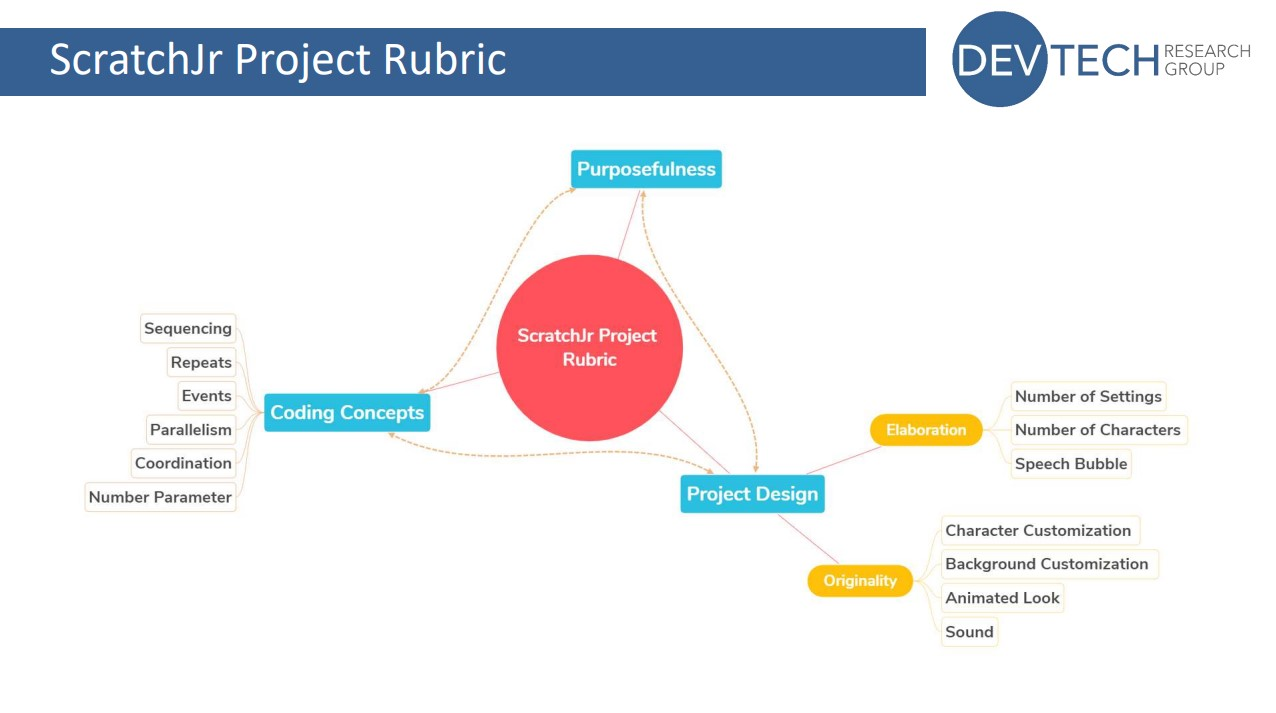
As part of the study, Aim and her colleagues collected coding projects from two schools at the start, middle, and end of a curriculum unit. They used the rubric to evaluate the coding projects and found that project scores increased over the course of the unit.
They also found that, overall, the scores for the project design elements were higher than those for coding concepts: many learners enjoyed spending lots of time designing their characters and settings, but made less use of other features. However, the two scores were correlated, meaning that learners who devoted a lot of time to the design of their project also got higher scores on coding concepts.
The rubric is a useful tool for any teachers using ScratchJr with their students. If you want to try it in your classroom, the validated rubric is free to download from the DevTech research group’s website.
The rubric assesses the output created by a learner using ScratchJr. But learning is a process, not just an end outcome, and the final project might not always be an accurate reflection of a child’s understanding.
By understanding more about how young children create coding projects, we can improve teaching and curriculum design for early childhood computing education.
In the second study Aim presented, she set out to explore this question. She conducted a qualitative observation of children as they created coding projects at different stages of a curriculum unit, and used Google Analytics data to conduct a quantitative analysis of the steps the children took.
Her findings highlighted the importance of encouraging young learners to explore the full variety of blocks available, both by guiding them in how to find and use different blocks, and by giving them the time and tools they need to explore on their own.
She also found that different teaching strategies are needed at different stages of the curriculum unit to support learners. This helps them to develop their understanding of both basic and advanced blocks, and to explore, customise, and iterate their projects.
Early-unit strategy:
Mid-unit strategy:
End-of-unit strategy:
You can watch Aim’s full presentation here:
You can also access the seminar slides here.
At our next seminar, we welcome Aman Yadav (Michigan State University), who will present research on computational thinking in primary school. The session will take place online on Tuesday 7 November at 17:00 UK time. Don’t miss out and sign up now:
To find out more about connecting research to practice for primary computing education, you can find the rest of our upcoming monthly seminars on primary (K–5) teaching and learning and watch the recordings of previous seminars in this series.
The post Young children’s ScratchJr coding projects: Assessment and support appeared first on Raspberry Pi Foundation.
From 27 to 29 September 2023, we and the University of Cambridge are hosting the WiPSCE International Workshop on Primary and Secondary Computing Education Research for educators and researchers. This year, this annual conference will take place at Robinson College in Cambridge. We’re inviting all UK-based teachers of computing subjects to apply for one of five ‘all expenses paid’ places at this well-regarded annual event.
WiPSCE is where teachers and researchers discuss research that’s relevant to teaching and learning in primary and secondary computing education, to teacher training, and to related topics. You can find more information about the conference, including the preliminary programme, at wipsce.org.
As a teacher at the conference, you will:
We are delighted to welcome Google as a sponsor of WiPSCE. Google believes that every student deserves the opportunity to access the benefits of a computing education to help shape their future. However, many students aren’t getting the education they need, and teachers don’t have sufficient resources to provide it. Google recognises the responsibility they have to support organisations, universities, and schools with deep expertise and a commitment to computing education, especially within communities that have been historically underserved.
With support from Google, we will offer free places to five UK computing teachers, covering:
To apply, you just need to fill in a short form. The application deadline is Wednesday 19 July.
To be eligible to apply:
The application form will ask your for:
After the 19 July deadline, we’re aiming to inform you of the outcome of your application on Friday 21 July.
Your application will be reviewed by the 2023 WiPSCE Chairs:
Sue and Mareen will:
We’d be delighted to receive your application. Being able to facilitate teachers’ attendance at the conference is very much aligned with our approach to research. Both at the Foundation and the Raspberry Pi Computing Education Research Centre, we’re committed to conducting research that’s directly relevant to schools and teachers, and to working in close collaboration with teachers.
We hope you are interested in attending WiPSCE and becoming an advocate for research-informed computing education practice. If your application is unsuccessful, we hope you consider coming along anyway. We’re looking forward to meeting you there. In the meantime, you can keep up with WiPSCE news on Twitter.
The post Apply for a free UK teacher’s place at the WiPSCE conference appeared first on Raspberry Pi Foundation.
Who chooses to study Computing? In England, data from GCSE and A level Computer Science entries in 2019 shows that the answer is complex. Black Caribbean students were one of the most underrepresented groups in the subject, while pupils from other ethnic backgrounds, such as White British, Chinese, and Asian Indian, were well-represented. This picture is reflected in the STEM workforce in England, where Black people are also underrepresented.
That’s why one of our areas of academic research aims to support Computing teachers to use culturally relevant pedagogy to design and deliver equitable learning experiences that enable all learners to enjoy and succeed in Computing and Computer Science at school. Our previous research projects within this area have involved developing guidelines for culturally relevant and responsive teaching, and exploring how a small group of primary and secondary Computing teachers used these guidelines in their teaching.
In our latest research study, funded by Cognizant, we worked with 13 primary school teachers in England on adapting computing lessons to incorporate culturally relevant and responsive principles and practices. Here’s an insight into the workshop we ran with them, and what the teachers and we have taken away from it.
In the group of 13 England-based primary school Computing teachers we worked with for this study:
In November 2022, we held a one-day workshop with the teachers to introduce culturally relevant pedagogy and explore how to adapt two six-week units of computing resources.
The first part of the workshop was a collaborative, discussion-based professional development session exploring what culturally relevant pedagogy is. This type of pedagogy uses equitable teaching practices to:
The rest of the workshop day was spent putting this learning into practice while planning how to adapt two units of computing lessons to make them culturally relevant for the teachers’ particular settings. We used a design-based approach for this part of the workshop, meaning researchers and teachers worked collaboratively as equal stakeholders to decide on plans for how to alter the units.
We worked in four groups, each with three or four teachers and one or two researchers, focusing on one of two units of work from The Computing Curriculum for teaching digital skills: a unit on photo editing for Year 4 (ages 8–9), and a unit about vector graphics for Year 5 (ages 9–10).
In order to plan how the resources in these units of work could be made culturally relevant for the participating teachers’ contexts, the groups used a checklist of ten areas of opportunity. This checklist is a result of one of our previous research projects on culturally relevant pedagogy. Each group used the list to identify a variety of ways in which the units’ learning objectives, activities, learning materials, and slides could be adapted. Teachers noted down their ideas and then discussed them with their group to jointly agree a plan for adapting the unit.
By the end of the day, the groups had designed four really creative plans for:
Before and after the workshop, we asked the teachers to fill in a survey about themselves, their experiences of creating computing resources, and their views about culturally relevant resources. We then compared the two sets of data to see whether anything had changed over the course of the workshop.
After teachers had attended the workshop, they reported a statistically significant increase in their confidence levels to adapt resources to be culturally relevant for both themselves and others.
Teachers explained that the workshop had increased their understanding of culturally relevant pedagogy and of how it could impact on learners. For example, one teacher said:
“The workshop has developed my understanding of how culturally adapted resources can support pupil progress and engagement. It has also highlighted how contextual appropriateness of resources can help children to access resources.” – Participating teacher
Some teachers also highlighted how important it had been to talk to teachers from other schools during the workshop, and how they could put their new knowledge into practice in the classroom:
“The dedicated time and value added from peer discourse helped make this authentic and not just token activities to check a box.” – Participating teacher
“I can’t wait to take some of the work back and apply it to other areas and subjects I teach.” – Participating teacher
After our research team made the adaptations to the units set out in the four plans made during the workshop, the adapted units were delivered by the teachers to more than 500 Year 4 and 5 pupils. We visited some of the teachers’ schools to see the units being taught, and we have interviewed all the teachers about their experience of delivering the adapted materials. This observational and interview data, together with additional survey responses, will be analysed by us, and we’ll share the results over the coming months.
In our next blog post about this work, we will delve into the fascinating realm of parental attitudes to culturally relevant computing, and we’ll explore how embracing diversity in the digital landscape is shaping the future for both children and their families.
We’ve also written about this professional development activity in more detail in a paper to be published at the UKICER conference in September, and we’ll share the paper once it’s available.
Finally, we are grateful to Cognizant for funding this academic research, and to our cohort of primary computing teachers for their enthusiasm, energy, and creativity, and their commitment to this project.
The post Running a workshop with teachers to create culturally relevant Computing lessons appeared first on Raspberry Pi Foundation.
Every day, most of us both consume and create data. For example, we interpret data from weather forecasts to predict our chances of a good weather for a special occasion, and we create data as our carbon footprint leaves a trail of energy consumption information behind us. Data is important in our lives, and countries around the world are expanding their school curricula to teach the knowledge and skills required to work with data, including at primary (K–5) level.
In our most recent research seminar, attendees heard about a research-based initiative called Data Education in Schools. The speakers, Kate Farrell and Professor Judy Robertson from the University of Edinburgh, Scotland, shared how this project aims to empower learners to develop data literacy skills and succeed in a data-driven world.
“Data literacy is the ability to ask questions, collect, analyse, interpret and communicate stories about data.”
– Kate Farrell & Prof. Judy Robertson
Scotland’s national curriculum does not explicitly mention data literacy, but the topic is embedded in many subjects such as Maths, English, Technologies, and Social Studies. Teachers in Scotland, particularly in primary schools, have the flexibility to deliver learning in an interdisciplinary way through project-based learning. Therefore, the team behind Data Education in Schools developed a set of cross-curricular data literacy projects. Educators and education policy makers in other countries who are looking to integrate computing topics with other subjects may also be interested in this approach.
The Data Education in Schools projects are aimed not just at giving learners skills they may need for future jobs, but also at equipping them as data citizens in today’s world. A data citizen can think critically, interpret data, and share insights with others to effect change.
Kate and Judy shared an example of data citizenship from a project they had worked on with a primary school. The learners gathered data about how much plastic waste was being generated in their canteen. They created a data visualisation in the form of a giant graph of types of rubbish on the canteen floor and presented this to their local council.
As a result, the council made changes that reduced the amount of plastic used in the canteen. This shows how data citizens are able to communicate insights from data to influence decisions.
Across its projects, the Data Education in Schools initiative uses a problem-solving cycle called the PPDAC cycle. This cycle is a useful tool for creating educational resources and for teaching, as you can use it to structure resources, and to concentrate on areas to develop learner skills.
The five stages of the cycle are:
Smaller data literacy projects may focus on one or two stages within the cycle so learners can develop specific skills or build on previous learning. A large project usually includes all five stages, and sometimes involves moving backwards — for example, to refine the problem — as well as forwards.
At primary school, the aim of data literacy projects is to give learners an intuitive grasp of what data looks like and how to make sense of graphs and tables. Our speakers gave some great examples of playful approaches to data. This can be helpful because younger learners may benefit from working with tangible objects, e.g. LEGO bricks, which can be sorted by their characteristics. Kate and Judy told us about one learner who collected data about their clothes and drew the results in the form of clothes on a washing line — a great example of how tangible objects also inspire young people’s creativity.
As learners get older, they can begin to work with digital data, including data they collect themselves using physical computing devices such as micro:bit microcontrollers or Raspberry Pi computers.
You can access the seminar slides here.
For many attendees, one of the highlights of the seminar was seeing the range of high-quality teaching resources for learners aged 3–18 that are part of the Data Education in Schools project. These include:
More resources are due to be published later in 2023, including a set of prompt cards to guide learners through the PPDAC cycle, a handbook for teachers to support the teaching of data literacy, and a set of virtual data-themed escape rooms.
You may also be interested in the units of work on data literacy skills that are part of The Computing Curriculum, our complete set of classroom resources to teach computing to 5- to 16-year-olds.
At our next seminar we welcome Aim Unahalekhaka from Tufts University, USA, who will share research about a rubric to evaluate young learners’ ScratchJr projects. If you have a tablet with ScratchJr installed, make sure to have it available to try out some activities. The seminar will take place online on Tuesday 6 June at 17.00 UK time, sign up now to not miss out.
To find out more about connecting research to practice for primary computing education, you can see a list of our upcoming monthly seminars on primary (K–5) teaching and learning and watch the recordings of previous seminars in this series.
The post Introducing data science concepts and skills to primary school learners appeared first on Raspberry Pi Foundation.
Broadening participation and finding new entry points for young people to engage with computing is part of how we pursue our mission here at the Raspberry Pi Foundation. It was also the focus of our March online seminar, led by our own Dr Bobby Whyte. In this third seminar of our series on computing education for primary-aged children, Bobby presented his work on ‘designing multimodal composition activities for integrated K-5 programming and storytelling’. In this research he explored the integration of computing and literacy education, and the implications and limitations for classroom practice.
Motivated by challenges Bobby experienced first-hand as a primary school teacher, his two studies on the topic contribute to the body of research aiming to make computing less narrow and difficult. In this work, Bobby integrated programming and storytelling as a way of making the computing curriculum more applicable, relevant, and contextualised.
Critically for computing educators and researchers in the area, Bobby explored how theories related to ‘programming as writing’ translate into practice, and what the implications of designing and delivering integrated lessons in classrooms are. While the two studies described here took place in the context of UK schooling, we can learn universal lessons from this work.
In the seminar Bobby made a distinction between applying computing to literacy (or vice versa) and true integration of programming and storytelling. To achieve true integration in the two studies he conducted, Bobby used the idea of ‘multimodal composition’ (MMC). A multimodal composition is defined as “a composition that employs a variety of modes, including sound, writing, image, and gesture/movement [… with] a communicative function”.
Storytelling comes together with programming in a multimodal composition as learners create a program to tell a story where they:
To investigate the use of MMC in the classroom, Bobby started by designing a curriculum unit of lessons. He mapped the unit’s MMC activities to specific storytelling and programming learning objectives. The MMC activities were designed using design-based research, an approach in which something is designed and tested iteratively in real-world contexts. In practice that means Bobby collaborated with teachers and students to analyse, evaluate, and adapt the unit’s activities.
The first of two studies to explore the design and implementation of MMC activities was conducted with 10 K-5 students (age 9 to 11) and showed promising results. All students approached the composition task multimodally, using multiple representations for specific purposes. In other words, they conveyed different parts of their stories using either text, sound, or images.
Bobby found that broadcast messages and loops were the least used blocks among the group. As a consequence, he modified the curriculum unit to include additional scaffolding and instructional support on how and why the students might embed these elements.
In the second study, the MMC activities were evaluated in a classroom of 28 K-5 students led by one teacher over two weeks. Findings indicated that students appreciated the longer multi-session project. The teacher reported being satisfied with the project work the learners completed and the skills they practised. The teacher also further integrated and adapted the unit into their classroom practice after the research project had been completed.
Factors that impacted the integration of storytelling and programming included the teacher’s confidence to teach programming as well as the teacher’s ability to differentiate between students and what kind of support they needed depending on their previous programming experience.
In addition, there are considerations regarding the curriculum. The school where the second study took place considered the activities in the unit to be literacy-light, as the English literacy curriculum is ‘text-heavy’ and the addition of multimodal elements ‘wastes’ opportunities to produce stories that are more text-based.
Bobby’s research indicates that MMC provides useful opportunities for learners to simultaneously pursue storytelling and programming goals, and the curriculum unit designed in the research proved adaptable for the teacher to integrate into their classroom practice. However, Bobby cautioned that there’s a need to carefully consider both the benefits and trade-offs when designing cross-curricular integration projects in order to ensure a fair representation of both subjects.
Can you see an opportunity for integrating programming and storytelling in your classroom? Let us know your thoughts or questions in the comments below.
You can watch Bobby’s full presentation:
And you can read his research paper Designing for Integrated K-5 Computing and Literacy through Story-making Activities (open access version).
You may also be interested in our pilot study on using storytelling to teach computing in primary school, which we conducted as part of our Gender Balance in Computing programme.
At our next seminar, we welcome Kate Farrell and Professor Judy Robertson (University of Edinburgh). This session will introduce you to how data literacy can be taught in primary and early-years education across different curricular areas. It will take place online on Tuesday 9 May at 17.00 UK time, don’t miss out and sign up now.
Yo find out more about connecting research to practice for primary computing education, you can find other our upcoming monthly seminars on primary (K–5) teaching and learning and watch the recordings of previous seminars in this series.
The post Integrating primary computing and literacy through multimodal storytelling appeared first on Raspberry Pi Foundation.
Every young learner needs a successful start to their learning journey in the primary computing classroom. One aspect of this for teachers is to introduce programming to their learners in a structured way. As computing education is introduced in more schools, the need for research-informed strategies and approaches to support beginner programmers is growing. Over recent years, researchers have proposed various strategies to guide teachers and students, such as the block model, PRIMM, and, in the case of this month’s seminar, TIPP&SEE.
We are committed to make computing and creating with digital technologies accessible to all young people, including through our work with educators and researchers. In our current online research seminar series, we focus on computing education for primary-aged children (K–5, ages 5 to 11). In the series’ second seminar, we were delighted to welcome Dr Jean Salac, researcher in the Code & Cognition Lab at the University of Washington.
Jean’s work sits across computing education and human-computer interaction, with an emphasis on justice-focused computing for youth. She talked to the seminar attendees about her work on developing strategies to support primary school students learning to program in Scratch. Specifically, Jean described an approach called TIPP&SEE and how teachers can use it to guide their learners through programming activities.
TIPP&SEE is a metacognitive approach for programming in Scratch. The purpose of metacognitive strategies is to help students become more aware of their own learning processes.
TIPP&SEE scaffolds students as they learn from example Scratch projects: TIPP (Title, Instructions, Purpose, Play) is a scaffold to read and run a Scratch project, while SEE (Sprites, Events, Explore) is a scaffold to examine projects more deeply and begin to adapt them.
TIPP&SEE is inspired by the work of Irene Lee and colleagues who proposed a progressive three-stage approach called Use-Modify-Create. Following that approach, learners move from reading pre-existing programs (“not mine”) to adapting and creating their own programs (“mine”) and gradually increase ownership of their learning.
Proponents of scaffolded approaches like Use-Modify-Create argue that engaging learners in cycles of using existing programs (e.g. worked examples) before they move to adapting and creating new programs encourages ownership and agency in learning. TIPP&SEE builds on this model by providing additional scaffolding measures to support learners.
Jean presented some promising results from her research on the use of TIPP&SEE in classrooms. In one study, fourth-grade learners (age 9 to 10) were randomly assigned to one of two groups: (i) Use-Modify-Create only (the control group) or (ii) Use-Modify-Create with TIPP&SEE. Jean found that, compared to learners in the control group, learners in the TIPP&SEE group:
In another study, Jean compared how learners in the TIPP&SEE and control groups performed on several cognitive tests. She found that, in the TIPP&SEE group, students with learning difficulties performed as well as students without learning difficulties. In other words, in the TIPP&SEE group the performance gap was much narrower than in the control group. In our seminar, Jean argued that this indicates the TIPP&SEE scaffolding provides much-needed support to diverse groups of students.
TIPP&SEE is a multi-step strategy where learners start by looking at the surface elements of a program, and then move on to examining the underlying code. In the TIPP phase, learners first read the title and instructions of a Scratch project, identify its purpose, and then play the project to see what it does.
In the second phase, SEE, learners look inside the Scratch project to click on sprites and predict what each script is doing. They then make changes to the Scratch code and see how the project’s output changes. By changing parameters, learners can observe which part of the output changes as a result and then reason how each block functions. This practice is called deliberate tinkering because it encourages learners to observe changes while executing programs multiple times with different parameters.
You can read more of Jean’s research on TIPP&SEE on her website. There’s also a video on how TIPP&SEE can be used, and free lesson resources based on TIPP&SEE are available in Elementary Computing for ALL and Scratch Encore.
Jean’s talk highlighted the need for computing to be inclusive and to give equitable access to all learners. The field of computing education is still in its infancy, though our understanding of how young people learn about computing is growing. We ourselves work to deepen our understanding of how young people learn through computing and digital making experiences.
In our own research, we have been investigating similar teaching approaches for programming, including the use of the PRIMM approach in the UK, so we were very interested to learn about different approaches and country contexts. We are grateful to Dr Jean Salac for sharing her work with researchers and teachers alike. Watch the recording of Jean’s seminar to hear more:
If you are looking for more free resources to help you structure your computing lessons:
In the next seminar of our online series on primary computing, I will be presenting my research on integrated computing and literacy activities. Sign up now to join us for this session on Tues 7 March:
As always, the seminars will take place online on the first Tuesday of the month at 17:00–18:30 UK time. Hope to see you there!
The post Supporting beginner programmers in primary school using TIPP-SEE appeared first on Raspberry Pi Foundation.
In our first seminar of 2023, we were delighted to welcome Dr Katie Rich and Carla Strickland. They spoke to us about teaching the programming construct of variables in Grade 3 and 4 (age 8 to 10).
We are hearing from a diverse range of speakers in our current series of monthly online research seminars focused on primary (K-5) computing education. Many of them work closely with educators to translate research findings into classroom practice to make sure that all our younger learners have positive first experiences of learning computing. An important goal of their research is to impact the development of pedagogy, resources, and professional development to support educators to deliver computing concepts with confidence.
Dr Katie Rich (American Institutes of Research) and Carla Strickland (UChicago STEM Education) are both part of a team that worked on a research project called Everyday Computing, which aims to integrate computational thinking into primary mathematics lessons. A key part of the Everyday Computing project was to develop coherent learning resources across a number of school years. During the seminar, Katie and Carla presented on a study in the project that revolved around teaching variables in Grade 3 and 4 (age 8 to 10) by linking this computing concept to mathematical concepts such as area, perimeter, and fractions.
Variables are used in both mathematics and computing, but in significantly different ways. In mathematics, a variable, often represented by a single letter such as x or y, corresponds to a quantity that stays the same for a given problem. However, in computing, a variable is an identifier used to label data that may change as a computer program is executed. A variable is one of the programming constructs that can be used to generalise programs to make them work for a range of inputs. Katie highlighted that the research team was keen to explore the synergies and tensions that arise when curriculum subjects share terms, as is the case for ‘variable’.
At the start of the project, in order to be able to develop coherent learning resources across school years, the team reviewed research papers related to teaching the programming construct of variables. In the papers, they found a variety of learning goals that related to facts (what learners need to know) and skills (what learners need to be able to do). They grouped these learning goals and arranged the groups into ‘levels of thinking’, which were then mapped onto a learning trajectory to show progression pathways for learning.
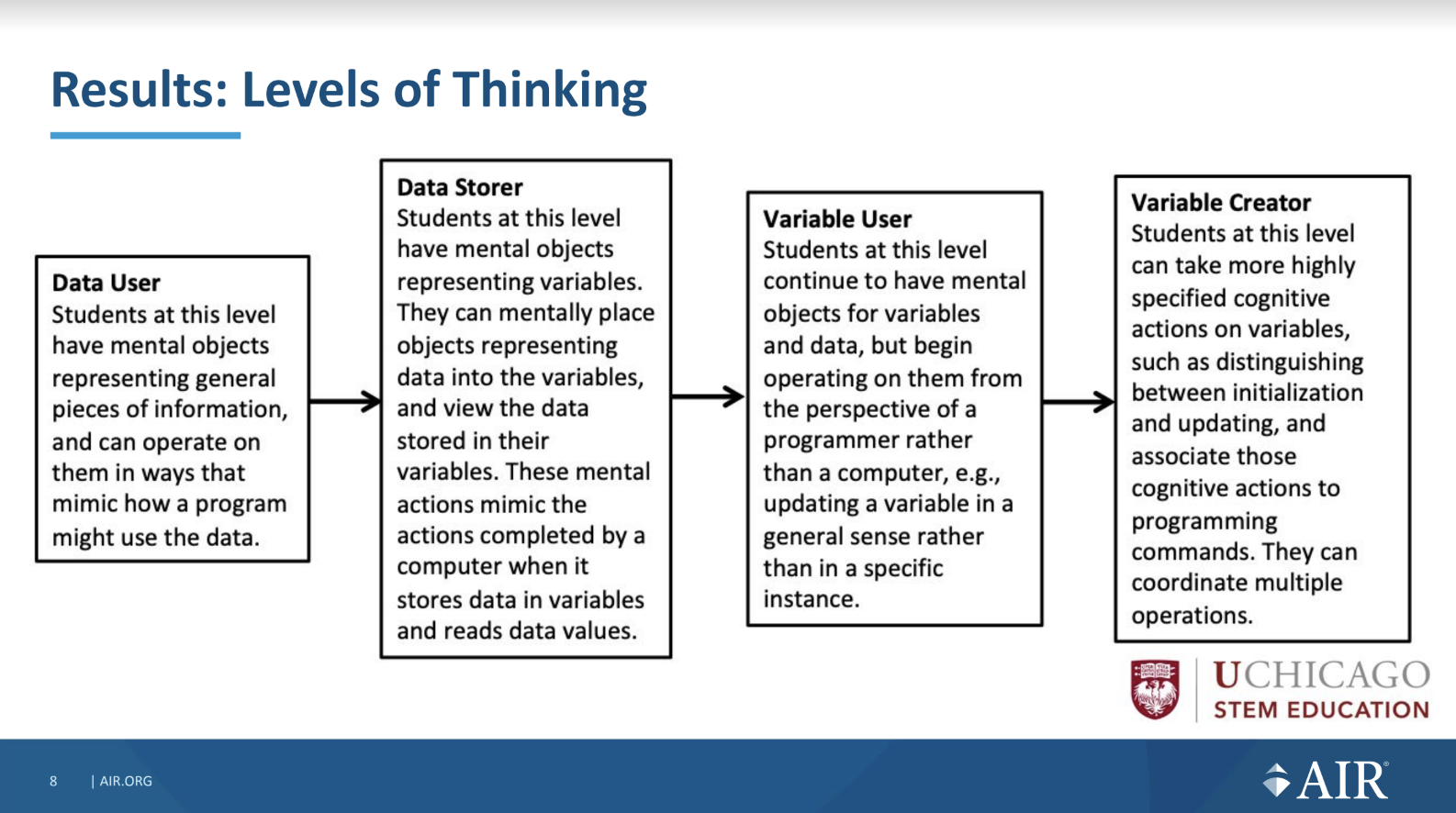
Carla then shared three practical examples of learning resources their research team created that integrated the programming construct of variables into a maths curriculum. The three activities, described below, form part of a series of lessons called Action Fractions. You can read more about the series of lessons in this research paper.
Robot Boxes is an unplugged activity that is positioned at the Data User level of thinking. It relates to creating instructions for a fictional robot. Learners have to pay attention to different data the robot needs in order to draw a box, such as the length and width, and also to the value that the robot calculates as area of the box. The lesson uses boxes on paper as concrete representations of variables to which learners can physically add values.
Ambling Animals is set at the ‘Data Storer’ and ‘Variable Interpreter’ levels of thinking. It includes a Scratch project to help students to locate and compare fractions on number lines. During this lesson, find a variable that holds the value of the animal that represents the larger of two fractions.
Adding Fractions draws on facts and skills from the ‘Variable Interpreter’ and ‘Variable Implementer’ levels of thinking and also includes a Scratch project. The Scratch project visualises adding fractions with the same denominator on a number line. The lesson starts to explain why variables are so important in computer programs by demonstrating how using a variable can make code more efficient.
Teaching about the programming construct of variables can be challenging, as it requires young learners to understand abstract ideas. The research Katie and Carla presented shows how integrating these concepts into a mathematics curriculum is one way to highlight tangible uses of variables in everyday problems. The levels of thinking in the learning trajectory provide a structure helping teachers to support learners to develop their understanding and skills; the same levels of thinking could be used to introduce variables in other contexts and curricula.
Many primary teachers use cross-curricular learning to increase children’s engagement and highlight real-world examples. The seminar showed how important it is for teachers to pay attention to terms used across subjects, such as the word ‘variable’, and to explicitly explain a term’s different meanings. Katie and Carla shared a practical example of this when they suggested that computing teachers need to do more to stress the difference between equations such as xy = 45 in maths and assignment statements such as length = 45 in computing.
The Everyday Computing project resources were created by a team of researchers and educators who worked together to translate research findings into curriculum materials. This type of collaboration can be really valuable in driving a research agenda to directly improve learning outcomes for young people in classrooms.
How can this research influence your classroom practice or other activities as an educator? Let us know your thoughts in the comments. We’ll be continuing to reflect on this question throughout the seminar series.
You can watch Katie’s and Carla’s full presentation here:
Our monthly seminar series on primary (K–5) teaching and learning is of interest to a global audience of educators, including those who want to understand the prior learning experiences of older learners.
We continue on Tuesday 7 February at 17.00 UK time, when we will hear from Dr Jean Salac, University of Washington. Jean will present her work in identifying inequities in elementary computing instruction and in developing a learning strategy, TIPP&SEE, to address these inequities. Sign up now, and we will send you a joining link for the session.
The post Combining computing and maths to teach primary learners about variables appeared first on Raspberry Pi.
Improving gender balance in computing is part of our work to ensure equitable learning opportunities for all young people. Our Gender Balance in Computing (GBIC) research programme has been the largest effort to date to explore ways to encourage more girls and young women to engage with Computing.
Commissioned by the Department for Education in England and led by the Raspberry Pi Foundation as part of our National Centre for Computing Education work, the GBIC programme was a collaborative effort involving the Behavioural Insights Team, Apps for Good, and the WISE Campaign.
Gender Balance in Computing ran from 2019 to 2022 and comprised seven studies relating to five different research areas:
In December we published the last of seven reports describing the results of the programme. In this blog post I summarise our overall findings and reflect on what we’ve learned through doing this research.
I was fascinated to read a paper by Deborah Butler from 2000 which starts by summarising themes from research into gender balance in computing from the 1980s and 1990s, for example that boys may have access to more role models in computing and may receive more encouragement to pursue the subject, and that software may be developed with a bias towards interests traditionally considered to be male. Butler’s paper summarises research from at least two decades ago — have we really made progress?
In England, it’s true that making Computing a mandatory subject from age 5 means we have taken great strides forward; the need for young people to make a choice about studying the subject only arises at age 14. However, statistics for England’s externally assessed high-stakes Computer Science courses taken at ages 14–16 (GCSE) and 16–18 (A level) clearly show that, although there is a small upwards trend in the proportion of female students, particularly for A level, gender balance among the students achieving GCSE/A level qualifications remains an issue:
| Computer Science qualification (England): | In 2018: | In 2021: | In 2022: |
| GCSE (age 16) | 20.41% | 20.77% | 21.37% |
| A level (age 18) | 11.74% | 14.71% | 15.17% |
In GBIC, we carried out a range of research studies involving more than 14,500 pupils and 725 teachers in England. Implementation teams came from the Foundation, Apps For Good, the WISE Campaign, and the Behavioural Insights Team (BIT). A separate team at BIT acted as the independent evaluators of all the studies.
In total we conducted the following studies:
Each study (apart from the exploratory research study) involved a 12-week intervention in schools. Bespoke materials were developed for all the studies, and teachers received training on how to deliver the intervention they were a part of. For the RCTs, randomisation was done at school level: schools were randomly divided into treatment and control groups. The independent evaluators collected both quantitative and qualitative data to ensure that we gained comprehensive insights from the schools’ experiences of the interventions. The evaluators’ reports and our associated blog posts give full details of each study.
The research programme ran from 2019 to 2022, and as it was based in schools, we faced a lot of challenges due to the coronavirus pandemic. Many research programmes meant to take place in school were cancelled as soon as schools shut during the pandemic.
Although we were fortunate that GBIC was allowed to continue, we were not allowed to extend the end date of the programme. Thus our studies were compressed into the period after schools reopened and primarily delivered in the academic year 2021/2022. When schools were open again, the implementation of the studies was affected by teacher and pupil absences, and by schools necessarily focusing on making up some of the lost time for learning.
Quantitatively, none of the RCTs showed a statistically significant impact on the primary outcome measured, which was different in different trials but related to either learners’ attitudes to computer science or their intention to study computer science. Most of the RCTs showed a positive impact that fell just short of statistical significance. The evaluators went to great lengths to control for pandemic-related attrition, and the implementation teams worked hard to support teachers in still delivering the interventions as designed, but attrition and disruptions due to the pandemic may have played a part in the results.
The qualitative research results were more encouraging. Teachers were enthusiastic about the approaches we had chosen in order to address known barriers to gender balance, and the qualitative data indicated that pupils reacted positively to the interventions. One key theme across the Teaching Approach (and other) studies was that girls valued collaboration and teamwork. The data also offered insights that enable us to improve on the interventions.
We designed the studies so they could act as pilots that may be rolled out at a national scale. While we have gained sufficient understanding of what works to be able to run the interventions at a larger scale, two particular learnings shape our view of what a large-scale study should look like:
The GBIC results highlight that there is no quick fix and suggest that we should combine some of the approaches we’ve been trialling to provide a more holistic approach to teaching Computing in an equitable way. We would recommend that schools adopt several of the approaches we’ve tested; the materials associated with each intervention are freely available (see our blog posts for links).
One of the very interesting overall findings from this research programme was the difference in intent to study Computing between primary school and secondary school learners; fewer secondary school learners reported intent to study the subject further. This difference was observed for both girls and boys, but was more marked for girls, as shown in the graph below. This suggests that we need to double down on supporting children, especially girls, to maintain their interest in Computing as they enter secondary school at age 11. It also points to a need for more longitudinal research to understand more about the transition period from primary to secondary school and how it impacts children’s engagement with computer science and technology in general.
We think that more time (in excess of 12 weeks) is needed to both deliver the interventions and measure their outcome, as the change in learners’ attitudes may be slow to appear, and we’re hoping to engage in more longitudinal research moving forward.
We know that an understanding of computer science can improve young people’s access to highly skilled jobs involving technology and their understanding of societal issues, and we need that to be available to all. However, gender balance relating to computing and technology is a deeply structural issue that has existed for decades throughout the computing education and workplace ecosystem. That’s why we intend to pursue more work around a holistic approach to improving gender balance, aligning with our ongoing research into making computing education culturally relevant.
We are very keen to continue to build on our research on gender balance in computing. If you’d like to support us in any way, we’d love to hear from you. To explore the research projects we’re currently involved in, check out our research pages and visit the website of the Raspberry Pi Computing Education Research Centre at the University of Cambridge.
The post Gender Balance in Computing — the big picture appeared first on Raspberry Pi.
In the final seminar in our series on cross-disciplinary computing, Dr Tracy Gardner and Rebecca Franks, who work here at the Foundation, described the framework underpinning the Foundation’s non-formal learning pathways. They also shared insights from our recently published literature review about the impact that non-formal computing education has on learners.
Tracy and Rebecca both have extensive experience in teaching computing, and they are passionate about inspiring young learners and broadening access to computing education. In their work here, they create resources and content for learners in coding clubs and young people at home.
UNESCO defines non-formal learning as “institutionalised, intentional, and planned… an addition, alternative, and/or complement to formal education within the process of life-long learning of individuals”. In terms of computing education, this kind of learning happens in after-school programmes or children’s homes as they engage with materials that have been carefully designed by education providers.
At the Raspberry Pi Foundation, we support two global networks of free, volunteer-led coding clubs where regular non-formal learning takes place: Code Club, teacher- and volunteer-led coding clubs for 9- to 13-year-olds taking place in schools in more than160 countries; and CoderDojo, volunteer-led programming clubs for young people aged 7–17 taking place in community venues and offices in 100 countries. Through free learning resources and other support, we enable volunteers to run their club sessions, offering versatile opportunities and creative, inclusive spaces for young people to learn about computing outside of the school curriculum. Volunteers who run Code Clubs or CoderDojos report that participating in the club sessions positively impacts participants’ programming skills and confidence.
Rebecca and Tracy are part of the team here that writes the learning resources young people in Code Clubs and CoderDojos (and beyond) use to learn to code and create technology.
Rebecca started the seminar by describing how the team reviewed existing computing pedagogy research into non-formal learning, as well as large amounts of website visitor data and feedback from volunteers, to establish a new framework for designing and creating coding resources in the form of learning paths.
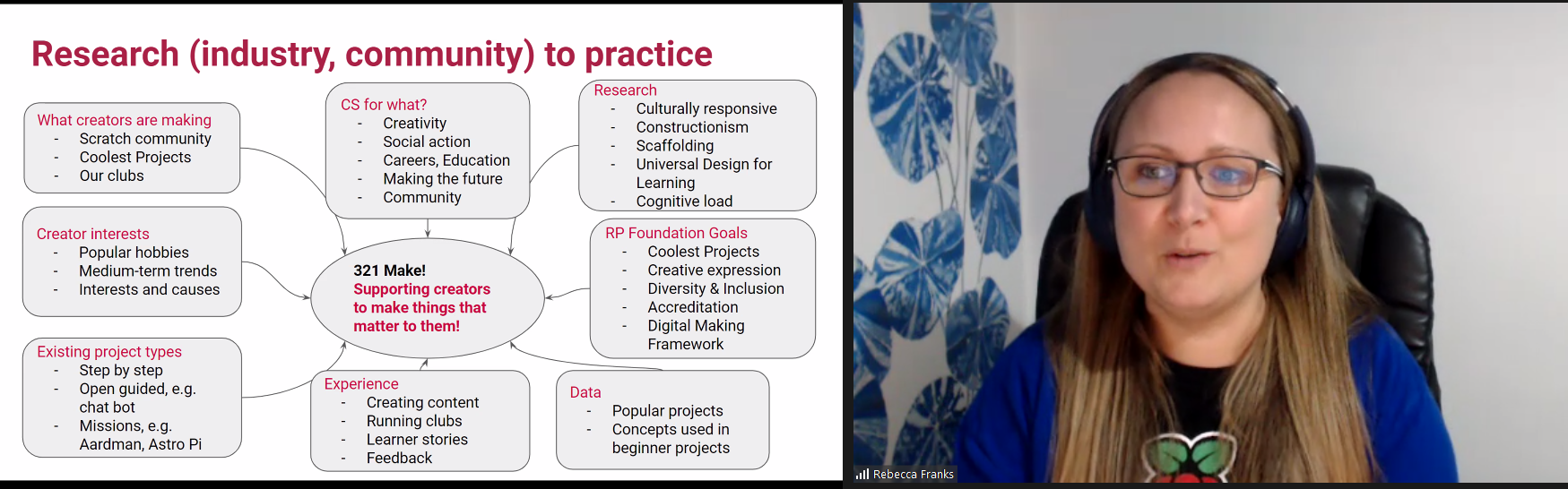
As Rebecca explained, non-formal learning paths should be designed to bridge the so-called ‘Turing tar-pit’: the gap between what learners want to do, and what they have the knowledge and resources to achieve.
To prevent learners from getting frustrated and ultimately losing interest in computing, learning paths need to:
When Rebecca and Tracy’s team create new learning paths, they first focus on the things that learners want to make. Then they work backwards to bridge the gap between learners’ big ideas and the knowledge and skills needed to create them. To do this, they use the 3…2…1…Make! framework they’ve developed.
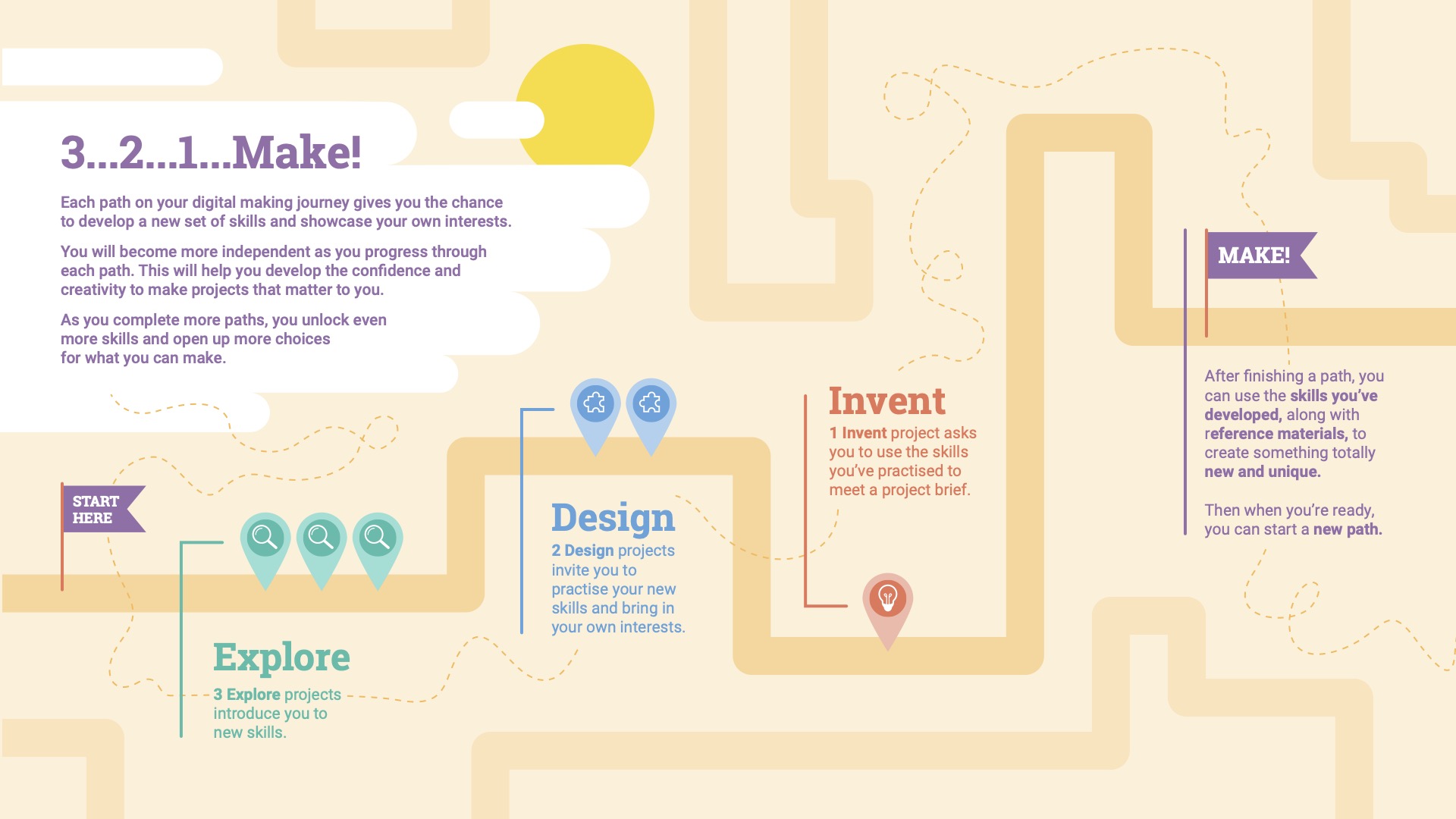
Learning paths designed according to the framework are made up of three different types of project in a 3-2-1 structure:
You can learn more about the framework in this blog post and this guide for adults who run sessions with young people based on the learning paths. And you can explore the learning paths yourself too.
Rebecca and Tracy’s team have created several new learning pathways based on the 3…2…1…Make! framework and received much positive feedback on them. They are now looking to develop more tools and libraries to support learners, to increase the accessibility of the paths, and also to conduct research into the impact of the framework.
In the second half of the seminar, Tracy shared what the research literature says about the impact of non-formal learning. She and researchers at the Foundation particularly wanted to find out what the research says about computing education for K–12 in non-formal settings. They systematically reviewed 421 papers, identifying 88 papers from the last seven years that related to empirical research on non-formal computing education for young learners. Based on these 88 papers, they summarised the state of the field in a literature review.
So far, most studies of non-formal computing education have looked at knowledge and skill development in computing, as well as affective factors such as interest and perception. The cognitive impact of non-formal education has been generally positive. The papers Tracy and the research reviewed suggested that regular learning opportunities, such as weekly Code Clubs, were beneficial for learners’ knowledge development, and that active teaching of problem solving skills can lead to learners’ independence.
Non-formal computing education also seems to be beneficial in terms of affective factors (although it is unclear yet whether the benefits remain long-term, since most existing research studies conducted have been short-term ones). For example, out-of-school programmes can lead to more positive perception and increased awareness of computing for learners, and also boost learners’ confidence and self-efficacy if they have had little prior experience of computing. The social aspects of participating in coding clubs should not be underestimated, as learners can develop a sense of belonging and support as they work with their peers and mentors.
The literature review showed that non-formal computing complements formal in-school education in many ways. Not only can Code Clubs and CoderDojos be accessible and equitable spaces for all young people, because the people who run them can tailor learning to the individuals. Coding clubs such as these succeed in making computing fun and engaging by enabling a community to form and allowing learners to make things that are meaningful to them.
Another thing the literature review made obvious is that there are big gaps in the existing understanding of non-formal computing education that need to be researched in more detail. For example, most of the studies the papers in the literature review described took place with female students in middle schools in the US.
That means the existing research tells us little about non-formal learning:
We would also love to see studies that hone in on:
We’re excited to continue collaborating within the Foundation so that our researchers and our team creating non-formal learning content can investigate the impact of the 3…2…1…Make! framework.
This collaboration connects two of our long-term strategic goals: to engage millions of young people in learning about computing and how to create with digital technologies outside of school, and to deepen our understanding of how young people learn about computing and how to create with digital technologies, and to use that knowledge to increase the impact of our work and advance the field of computing education. Based on our research, we will iterate and improve the framework, in order to enable even more young people to realise their full potential through the power of computing and digital technologies.
From January, you can join our new monthly seminar series on primary (K–5) teaching and learning. In this series, we’ll hear insights into how our youngest learners develop their computing knowledge, so whether you’re a volunteer in a coding club, a teacher, a researcher, or simply interested in the topic, we’d love to see you at one of these monthly online sessions.
The first seminar, on Tuesday 10 January at 5pm UK time, will feature researchers and educators Dr Katie Rich and Carla Strickland. They will share findings on how to teach children about variables, one of the most difficult aspects of computing for young learners. Sign up now, and we will send you notifications and joining links for each seminar session.
We look forward to seeing you soon, and to discussing with you how we can apply research results to better support all our learners.
The post Combining research and practice to evaluate and improve computing education in non-formal settings appeared first on Raspberry Pi.
We are excited to announce our next free online seminars, running monthly from January 2023 and focusing on new research about primary school (K–5) teaching and learning of computing.
Our seminars, having covered various topics in computing education over the last three years, will now offer you a close look at current questions and research in primary computing education for 5- to 11-year-olds. Through this series we want to connect research and teaching practice, and further primary computing education across the globe.
Our upcoming seminars are for everyone interested in computing education, not just for primary school teachers — you are all cordially invited to join us. Previous seminars have been attended by a valuable mix of teachers, volunteers, tech industry professionals, and researchers, all keen to explore how computing education research can be put into practice.
Whether you teach in a classroom, or support learners in a coding club, you will find out how our youngest learners develop their computing knowledge. You’ll also explore with us what this means for your learning context in practical terms.
Each seminar starts with a presenter explaining, in easy-to-understand terms, some recent research they have done. The presentation is followed by a discussion in smaller groups. We then regroup for a Q&A session with the presenter.
Attendees of our previous seminars have said:
“The seminar will be useful in my practice when our coding club starts.”
“I love this initiative, your choice of speakers has been fantastic. You are creating a very valuable CPD resource for Computer Science teachers and educators all over the world. Thank you. 🙏”
“Just wanted to say a huge thank you for organising this. It was brilliant to hear the presentation but also the input from other educators in the breakout room. I currently teach in a department of one, which can be quite lonely, so to join other educators was brilliant and a real encouragement.”
Computer science has been taught in universities for many years, and only more recently has the subject been introduced in schools. That means there isn’t a lot of research about computing education for school-aged learners yet, and even less research about how young children of primary school age learn about computing.
That’s why we are excited to invite you to learn with us as we hear from international primary computing research teams who share their knowledge in our online seminars:
All our seminars start at 17:00 UK time (18:00 CET / 12:00 noon ET / 9:00 PT) and take place in an online format. Sign up now to receive a calendar invitation and the link to join on the day of each seminar.
We look forward to seeing you soon, and to discussing with you how we can apply research results to better support all our learners.
The post Spotlight on primary computing education in our 2023 seminar series appeared first on Raspberry Pi.
In the penultimate seminar in our series on cross-disciplinary computing, we were delighted to host Conrad Wolfram (European co-founder/CEO of Wolfram Research).
Conrad has been an influential figure in the areas of AI, data science, and computation for over 30 years. The company he co-founded, Wolfram Research, develops computational technologies including the Wolfram programming language, which is used by the Mathematica and WolframAlpha programs. In the seminar, Conrad spoke about his work on developing a mathematics curriculum “for the AI age”.
In his talk, Conrad began by talking about the ubiquity of computation. He explained how computation (i.e. an operation that follows conditions to give a defined output) has transformed our everyday lives and led to the development of entire new sub-disciplines, such as computational medicine, computational marketing, and even computational agriculture. He then used the WolframAlpha tool to give several practical examples of applying high-level computation to problem-solving in different areas.
Conrad then turned his attention to the main question of his talk: if computation has also changed real-world mathematics, how should school-based mathematics teaching respond? He suggested that, as computation has impacted all aspects of our daily lives, school subjects should be reformed to better prepare students for the careers of the future.
His biggest criticism was the use of hand calculation methods in mathematics teaching. He proposed that a mathematics curriculum that “assumes computers exist” and uses computers (rather than humans) to compute answers would better support students to develop a deep understanding of mathematical concepts and principles. In other words, if students spent less time doing hand-calculation methods, they could devote more time to more complex problems.
One interesting aspect of Conrad’s talk was how he modelled the process of solving problems using computation. In all of the example problems, he outlined that computational problem-solving follows the same four-step process:
Depending on the problem, the process can be repeated multiple times until the desired solution is reached. Rather than being proposed as a static list of outcomes, the process was presented by Conrad as an iterative cycle than resembles an “ascending helix”:
In the later stages of his talk, Conrad talked about the development of a new computational curriculum to better define what a modern mathematics curriculum might look like. The platform that hosts the curriculum, named Computer-Based Math (or CBM), outlines the need to integrate computational thinking into mathematics in schools. For instance, one of the modules, How Fast Could I Cycle Stage 7 Of The An Post Rás?, asks students to develop a computational solution to a real-world problem. Following the four-step problem-solving process, students apply mathematical models, computational tools, and real-world data to generate a valid solution:
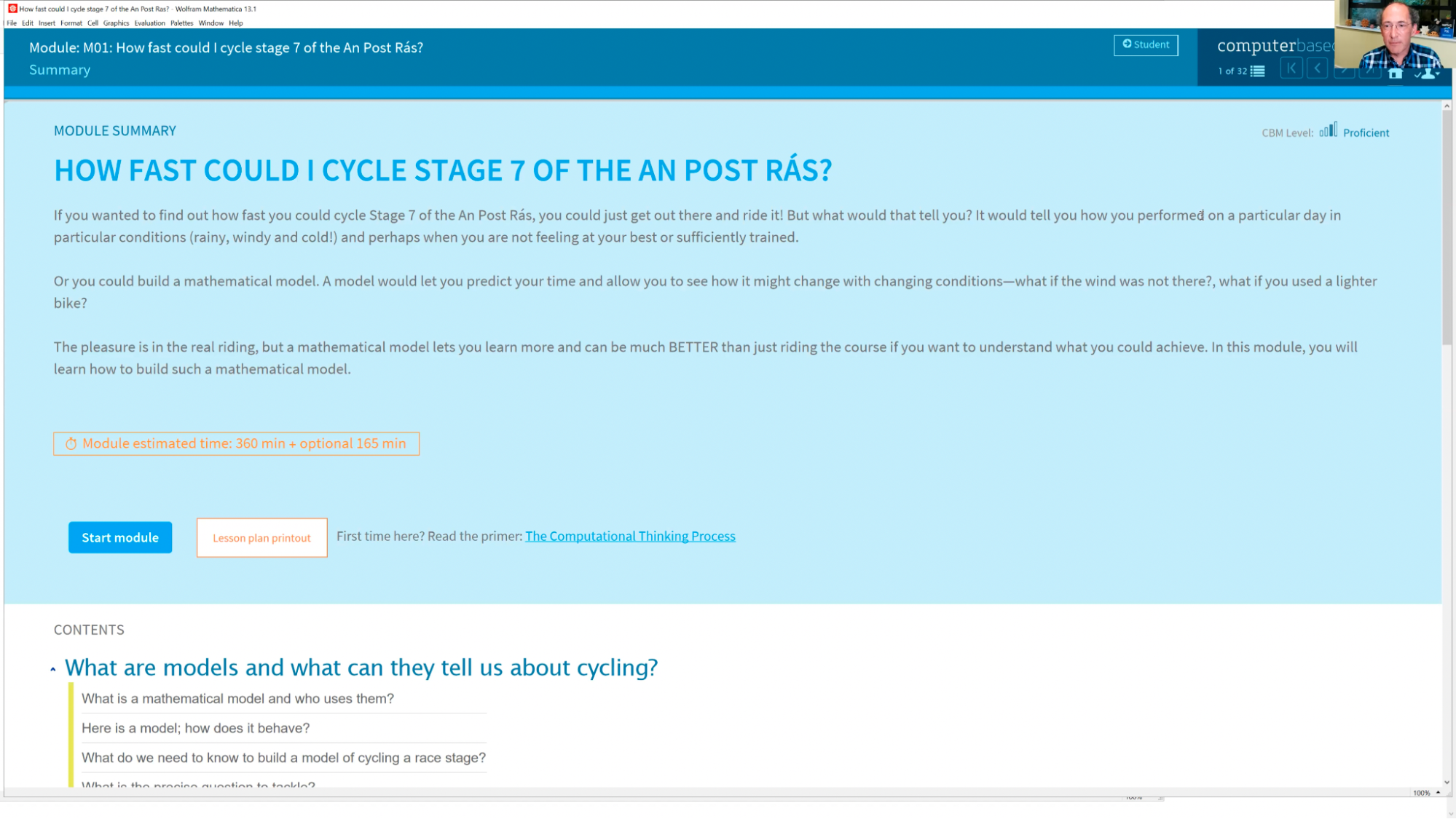
Some future challenges he remarked on included how a computer-based mathematics curriculum could be integrated with existing curricula or qualifications, at what ages computational mathematics should be taught, and what assessment, training, and hardware would be needed to support teachers to deliver such a curriculum.
Conrad concluded the talk by arguing that the current need for computational literacy is similar to the need for mass literacy and pondering whether the UK could lead the push towards a new computational curriculum suitable for learners who grow up with AI technologies. This point provided food for thought during our discussion section, especially for teachers interested in embedding computation into their lessons, and for researchers thinking about the impact of AI in different fields. We’re grateful to Conrad for speaking about his work and mission — long may it continue!
You can catch up on Conrad’s talk with his slides and the talk’s recording:
Conrad’s book, The Math(s) Fix: An Education Blueprint for the AI Age, gives more details on how he thinks data science, AI, and computation could be embedded into the modern maths curriculum.
You can also explore Wolfram Research’s Computer-Based Maths curriculum, which offers learning materials to help teachers embed computation in their maths lessons.
Finally, try out Wolfram’s tools to solve everyday problems using computation. For example, you might ask WolframAlpha data-rich questions, which the tool converts from text input into a computable problem using natural language processing. (Two of my favourite example questions are: “How old was Leonardo when the Mona Lisa was painted?” and “What was the weather like when I was born?”)
In the final seminar of our series on cross-curricular computing, we welcome Dr Tracy Gardner and Rebecca Franks (Raspberry Pi Foundation) to present their ongoing work on computing education in non-formal settings. Sign up now to join us for this session on Tues 8 November:
We will shortly be announcing the theme of a brand-new series of research seminars starting in January 2023. The seminars will take place online on the first Tuesday of the month at 17:00–18:30 UK time.
The post Building a maths curriculum for a world shaped by computing appeared first on Raspberry Pi.


 Lateo.net - Flux RSS en pagaille (pour en ajouter : @ moi)
