 Connexion


The Hello World podcast is back, accompanying the latest issue of Hello World magazine. This new three-part miniseries explores some of the topics from issue 27 of Hello World, which focuses on integrating computing education across the curriculum.

Whether you’re a seasoned educator or just starting your journey with computing education, this podcast audio and video series is full of insights, inspiration, and practical tips from educators and experts around the world.
If you’re already subscribed, the new episodes will appear automatically in your favourite podcast app every Tuesday.
In our first episode, Raspberry Pi Foundation CEO Philip Colligan, CBE, sits down with teacher Janine Kirk to discuss why, in the age of AI, it’s more important than ever for young people to learn to code. Their conversation draws on ideas from our downloadable position paper, which is also featured in issue 27 of Hello World magazine.
Next week, we’ll bring you the buzz from the Computer Science Teachers Association’s annual conference in Cleveland, USA. We’re speaking with educators at the conference to hear how they’re integrating computer science across subjects, and you’ll hear their top classroom tips for teaching CS in context.
The miniseries wraps up with an in-depth discussion about AI education around the world. Hosted by Ben Garside, Senior Learning Manager for Experience AI, the conversation features Leonida Soi, Learning Manager in Kenya; Monika Katkute-Gelzine, CEO of Vedliai in Lithuania; and Aimy Lee, COO of Penang Science Cluster in Malaysia. Monika and Aimy work with us in our global Experience AI partner programme.
Each of these three podcast episode builds on the themes in the latest Hello World issue, where you’ll find inspiration and practical tips from educators who are integrating CS across a variety of subjects and for all school ages.
Subscribe to the Hello World podcast wherever you get your podcasts to never miss an episode, and to help us reach more teachers. If you’re subscribe to Hello World magazine (it’s free), we’ll also let you know when new podcast episodes are available.
And, don’t forget to share this new podcast series with your fellow educators.
The post New Hello World podcast series: Bringing computer science into every classroom appeared first on Raspberry Pi Foundation.
While in some countries, such as England, computing is taught as a standalone subject, in others, like the USA, computing concepts are integrated across the school curriculum. In our brand-new issue of Hello World, out today for free, educators share ways to integrate computer science into your classroom.
The argument for making computing and computer science (CS) standalone has often been about quality. We’ve heard educators say that teaching CS as part of other subjects can be hard, especially if you don’t have a CS background. On the other hand, integrating computer science into other subjects can offer a more accessible entry point for young people, broadening participation in CS education. And the critical thinking and problem-solving skills young people gain through computer science can enhance their learning of any subject.
As digital technology increasingly shapes our world, it may be that thoughtful cross-curricular CS education is the most effective way to empower all young people to become confident and critical technology users.
Issue 27 of Hello World features a range of practical articles with ideas for integrating CS over a variety of subjects at the primary, elementary, and high-school levels.
For example:
Also in this issue:
And much, much more.
Jake Baskin, Executive Director of the Computer Science Teachers Association, says in this issue of Hello World: “If you’re a teacher who is implementing CS principles in your classroom, you are a computer science teacher.”
Whether CS is your specialist subject or not, Hello World is full of ideas from your fellow educators on how to inspire your students.
The Hello World podcast is also back, with a miniseries in audio and video focused on integrated CS. If you’re subscribed via a podcast app, the three new episodes will show up in your feed on Tuesdays. Or you can already listen to the new episodes today via the exclusive links inside issue 27.
We hope you enjoy this issue of Hello World. Please get in touch with your article ideas or what you would like to see in the magazine.
The post Hello World 27 out now: Integrated computer science appeared first on Raspberry Pi Foundation.
Experience CS is a brand-new, free, integrated computer science curriculum for elementary and middle school educators and anyone working with students aged 8 to 14. A key design principle for Experience CS is that any educator can use it. You don’t need a computer science qualification or previous experience in teaching computer science classes to deliver engaging and creative learning experiences for your students. That’s why, as US Executive Director, I’m especially pleased to announce the launch of the first six units in the curriculum today.
Read on to explore the new learning materials available and how you can start using them in your school.
Experience CS enables educators to teach computer science through a curriculum that integrates CS concepts and knowledge into core subjects such as math, science, and social studies. Ashly Tritch, computer science immersion specialist at Olson Middle School in Bloomington, MN, USA, said, “Cross-curricular computer science is important because it shows students how coding and tech skills can be used in other subjects like math, science, or even art. It helps make learning more interesting and helps kids understand how computer science connects to real life. The lessons that the Raspberry Pi Foundation is creating will be super engaging, with fun and creative activities that keep students curious and excited to learn.”
Six integrated computer science units are available to access, with more on the way. The units have been released in beta, and we would love to hear your feedback as we continue to make updates to the lesson materials. Each of the units includes an overview with a summary of the topics covered and a series of six to eight lessons, including lesson plans, slide decks, student-facing materials, and starter projects within our Code Editor for Education.
We have designed the units to be cross-curricular, so students can learn about computer science concepts while deepening their understanding of related subject area content. For example, in “The me project,” grade 4 students (ages 9–10) explore the basics of Scratch, personalise sprites, and develop programs to create an animation that tells a story all about them. The project could be integrated into language arts lessons, enabling young learners to explore visual representation and write their own unique stories. In the “Smart communities” unit, students in grade 6 (ages 11–12) explore ways in which computing and technology can be used to create environments that are responsive to the needs of community members; this could be included within science or technology lessons.
Initially, the curriculum and resources have been mapped to national and local standards in the US and Canada, including the K–12 Computer Science Teachers Association Standards for Students, but they are available for teachers and students anywhere in the world to use.
You can register for a free Raspberry Pi Foundation account to start downloading the learning materials, including lesson plans, slide decks, student activity sheets and assessment criteria.
Experience CS has been built from the ground up to support safe, confident computing lessons in real classrooms. It includes self-directed creative projects using the popular programming language Scratch. We have built a version of Scratch that is especially for schools. That means it doesn’t have the community and sharing features that are central to the full Scratch platform. Instead, everything runs in a closed, classroom-ready environment that supports safeguarding policies and fits with school filtering systems. Simple and intuitive learning management features enable teachers to create accounts, set assignments, and review progress.
On the “Getting Started” page, teachers will find everything they need, including helpful videos and tutorials. The next webinar takes place on 16th July, where we will walk you through all six units available at launch and show you how easy it is to get started with the learning materials. Whether you’re a CS teacher, general education teacher, administrator, or someone who works with school-aged young people, this session will give you the practical tools and guidance you need to bring Experience CS to life in your classroom or program.
No matter your experience or skill level, the Experience CS content has been designed to be easy to use. However, we also provide professional development (PD) opportunities to help build confidence in teaching computer science.
Teachers anywhere in the world can access free online courses offering flexible, self-paced learning to help you confidently teach block-based programming with effective, inclusive computing pedagogy. Our new course will develop your understanding of semantic waves while highlighting research-backed activities and examples directly from Experience CS units.
Experience CS is supported by Google and builds on the fantastic work they have done to support educators and students through CS First. The team behind Experience CS includes educators with significant experience in teaching CS in elementary and middle school settings, and it is based on extensive classroom testing and research. We will continue to develop and improve the curriculum and resources in response to feedback from teachers and students. If you would like to help shape the future of Experience CS by testing new features and providing valuable feedback to improve the programme, sign up for the mailing list.
We can’t wait for you to explore Experience CS. We will continue to release more curriculum units as well as make the materials available in French and Spanish. Get a head start ready for the next school year by registering for a free Raspberry Pi Foundation account, which will allow you immediate access to all the lesson materials, and then create your school account to begin creating classes, add a scratch project to a class, manage student accounts and view student work.
The post Experience CS: A free integrated curriculum for computer science appeared first on Raspberry Pi Foundation.
In our current series of research seminars, we are exploring how computing can be connected to other subjects using cross-disciplinary approaches. In July 2022, our speakers were Professor Yasmin Kafai from the University of Pennsylvania and Elaine Griggs, an award-winning teacher from Pembroke High School, Massachusetts, and we heard about their use of e-textiles to engage learners and broaden participation in computing.
The spaces where young people learn about computing have sometimes been referred to as clubhouses to relate them to the places where sports or social clubs meet. A computing clubhouse can be a place where learners come together to take part in computing activities and gain a sense of community. However, as Yasmin pointed out, research has found that computing clubhouses have also often been dominated by electronics and robotics activities. This has led to clubhouses being perceived as exclusive spaces for only the young people who share those interests.
Yasmin’s work is motivated by the idea of building new clubhouses that include a wide range of computing interests, with a specific focus on spaces for e-textile activities, to show that diverse uses of computing are valued.
Yasmin’s research into learning through e-textiles has taken place in formal computing lessons in high schools in America, by developing and using a unit from the Exploring Computer Science curriculum called “Stitching the Loop”. In the seminar, we were fortunate to be joined by Elaine, a computer science and robotics teacher who has used the scheme of work in her classroom. Elaine’s learners have designed wearable electronic textile projects with microcontrollers, sensors, LEDs, and conductive thread. With these materials, learners have made items such as paper circuits, wristbands, and collaborative banners, as shown in the examples below.
The hands-on, project-based approach in the e-textile unit has many similarities with the principles underpinning the work we do at the Raspberry Pi Foundation. However, there were also two specific teaching approaches that were embedded in Elaine’s teaching in order to promote equitable learning in the computing classroom:
As teachers with a set of learning outcomes to deliver, we can often feel a certain pressure to structure lessons so that our learners spend the most time on activities that we feel will deliver those outcomes. I was very interested to hear how in these e-textile projects, there was a deliberate choice to foreground the aesthetics. When learners spent time designing their artefacts and could link it to their own interests, they had a sense of personal ownership over what they were making, which encouraged them to persevere and overcome any difficulties with sewing, code, or electronics.
My personal reflection was that creating a digital textiles project based on a set template could be considered the equivalent of teaching programming by copying code. Both approaches would increase the chances of a successful output, but wouldn’t necessarily increase learners’ understanding of computing concepts, nor encourage learners to perceive computing as a subject where everyone belongs. I was inspired by the insights shared at the seminar about how prioritising design time can lead to more diverse representations of making.
Elaine told us that learners were encouraged to create a digital portfolio which included photographs of the different stages of their project, examples of their code, and reflections on the problems that they had solved during the project. In the picture below, the learner has shared both the ‘wrong’ and ‘right’ versions of their code, along with an explanation of how they debugged the error.
Yasmin explained the equity-oriented theories underpinning the digital portfolio teaching approach. The learners’ reflections allowed deeper understanding of the computing and electronics concepts involved and helped to balance the personalised nature of their artefacts with the need to meet learning goals.
Yasmin also emphasised how important it was for learners to take part in a series of projects so that they encountered computing and electronics concepts more than once. In this way, reflective journalling can be seen as an equitable teaching approach because it helps to move learners on from their initial engagement into more complex projects. Thinking back to the clubhouse model, it is equally important for learners to be valued for their complex e-textile projects as it is for their complex robotics projects, and so portfolios of a series of e-textile projects show that a diverse range of learners can be successful in computing at the highest levels.
If you’re thinking about ways of introducing e-textile activities to your learners, there are some useful resources here:
We’re having a short break in the seminar series but will be back in September when we’ll be continuing to find out more about cross-disciplinary approaches to computing.
In our next seminar on Tuesday 6 September 2022 at 17:00–18:30 BST / 12:00–13:30 EST / 9:00–10:30 PST / 18:00–19:30 CEST, we’ll be hearing all about the links between computing and dance, with our speaker Genevieve Smith-Nunes (University of Cambridge). Genevieve will be speaking about data ethics for the computing classroom through biometrics, ballet, and augmented reality (AR) which promises to be a fascinating perspective on bringing computing to new audiences.
The post Using e-textiles to deliver equitable computing lessons and broaden participation appeared first on Raspberry Pi.
When we teach children and young people about computing, do we consider how the subject has developed over time, how it relates to our students’ lives, and importantly, what our values are? Professor Pratim Sengupta shared some of the research he and his colleagues have been working on related to these questions in our June 2022 research seminar.
Pratim revealed a complex landscape where we as educators can be easily trapped by what may seem like good intentions, thereby limiting learning and excluding some students. His presentation, entitled Computational heterogeneity in STEM education, introduced me to the concept of technocentrism and profoundly impacted my thinking about the essence of programming and how I research it. In this blog post, particularly for those unable to attend this stimulating seminar, I give my simplified view of the rich philosophy shared by Pratim, and my fledgling steps to admit to my technocentrism and overcome it.
Between May 2022 and November 2022, we are hosting a new series of free research seminars about teaching computing in different ways and in different contexts. This second seminar of the series was well attended with participants from the USA, Asia, Africa, and Europe, including teachers, researchers, and industry professionals, who contributed to a lively and thought-provoking discussion.
Pratim is a learning scientist based in Canada with a long and distinguished career. He has studied how to teach computational modelling in K-12 STEM classrooms and investigates the complexity of learning. Grounded in working with teachers and students, he brings together computing, science, education, and social justice. Based on his work at Northwestern University, Vanderbilt University, and now with the Mind, Matter and Media lab at the University of Calgary, Pratim has published hundreds of academic papers over some 20 years. Pratim and his team challenge how we focus on making technological artefacts — code for code’s sake — in computing education, and refocuses us on the human experience of coding and learning to code.
Pratim started the seminar by giving us an overview of some of the key ideas that underpin the way that computing is usually taught in schools, including technocentrism (Figure 1).
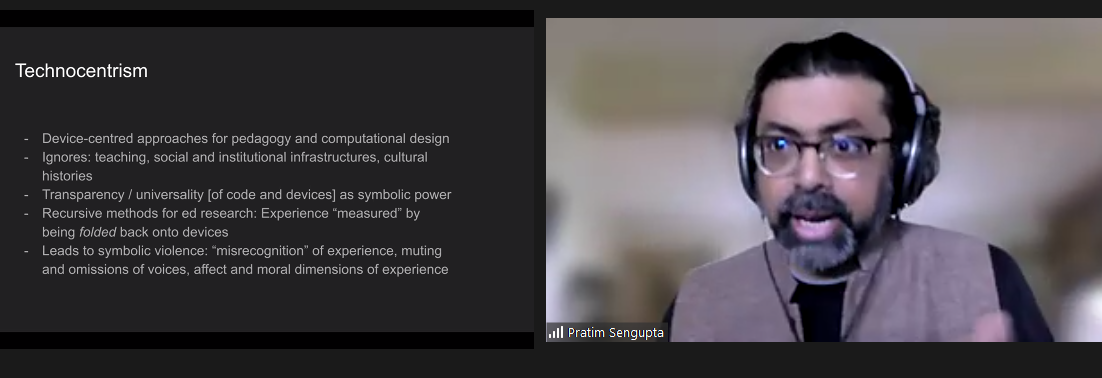
I have come to a simplified understanding of technocentrism. To me, it appears to be a way of looking at how we learn about computer science, where one might:
Pratim recounted several research activities that he and his team have engaged with. These examples highlight instances of potential technocentrism and investigate how we might overcome it.
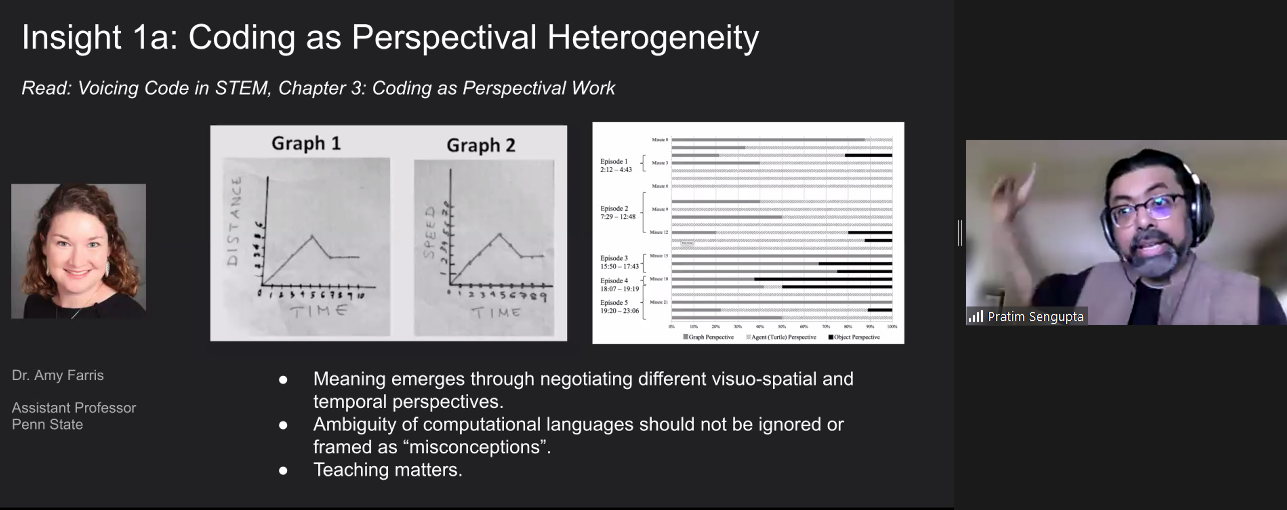
In the first example research activity, Pratim explained how in maths and physics lessons, middle school students were asked to develop models to solve time and distance problems. Rather than immediately coding a potential solution, the researcher and teacher supported the learners to spend much time developing a shared perspective to understand and express the problems first. Students grappled with different ways of representing the context, including graphs and diagrams (see Figure 2). Gradually and carefully, teachers shifted students to recognise what was important and what was not, to move them toward a meaningful language to describe and solve the problems.
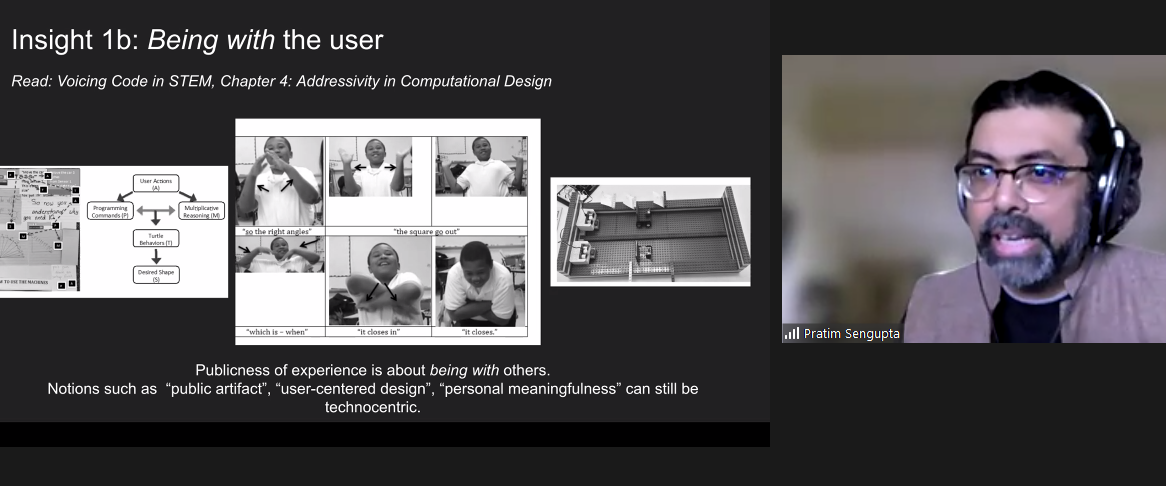
In a second example research activity, students were asked to build a machine that draws shapes using sensors, motors, and code. Rather than jumping straight to a solution, the students spent time with authentic users of their machines. Throughout the process, students worked with others, expressing the context through physical movement, clarifying their thoughts by drawing diagrams, and finding the sweet spot between coding, engineering design, and maths (see Figure 3).
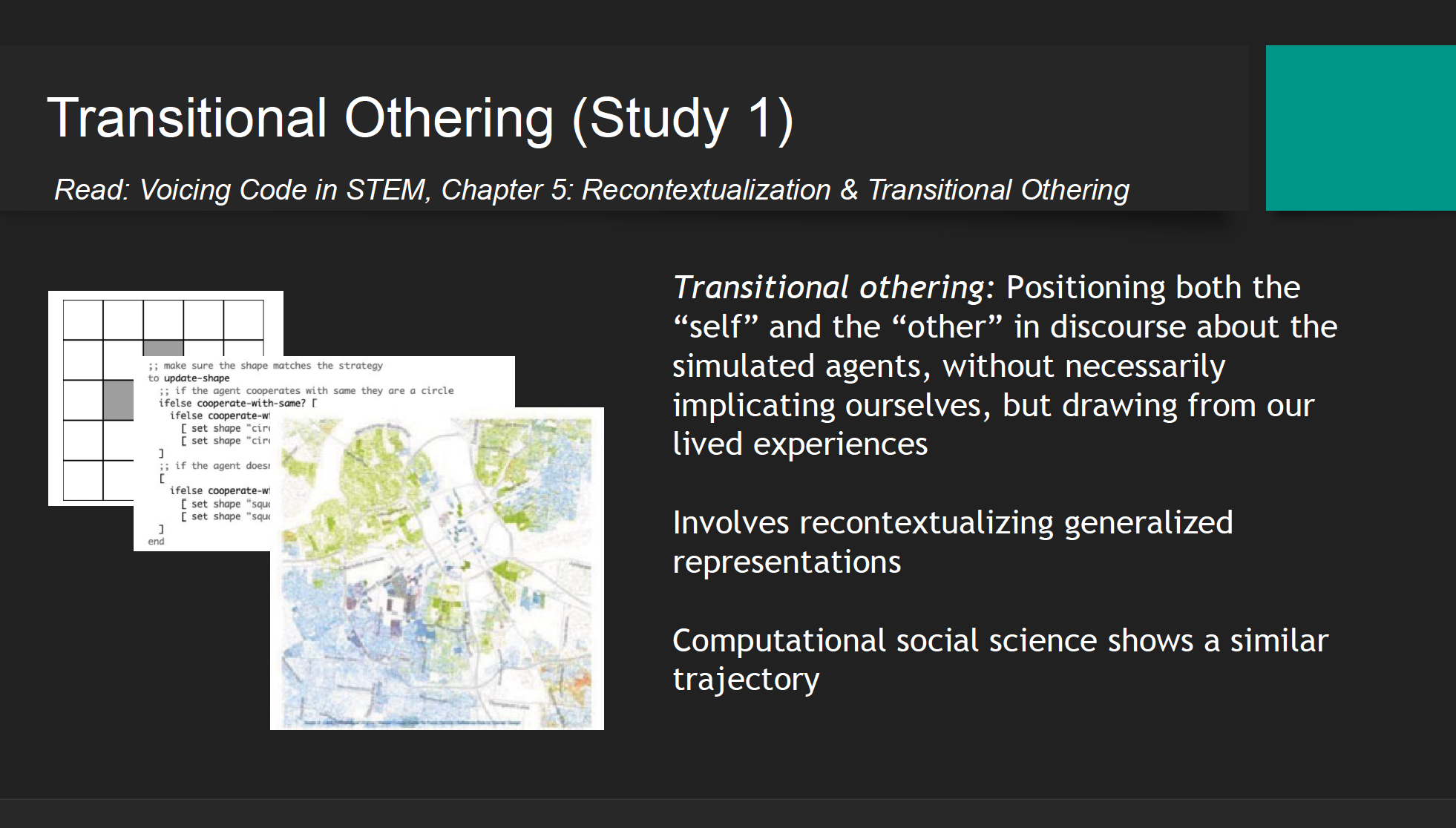
In a third example research activity, racial segregation of US communities was discussed with pre-service teachers. The predominately white teachers found talking about the topic very difficult at the beginning of the activity. To overcome this hesitancy, teachers were first asked to work with a simulation that modelled the process of segregation through abstracted dots (or computational agents), a transitional other. Following this hypothetical representation, the context was then recontextualised through a map of real data points of the ethnicity of residents in an area of the US. This kind of map is called a Racial Dot Map based on US census data. When the teachers were able to interpret the link between the abstracted dot simulation and the real-world data they were able to talk about racism and segregation in a way they could not do before. The initial simulation and the recontextualisation were a pedagogical tool to reveal racism and provide a space where students felt comfortable discussing their values and beliefs that would otherwise have remained implicit.
Pratim shared four implications of this research for computing pedagogy (see Figure 5).
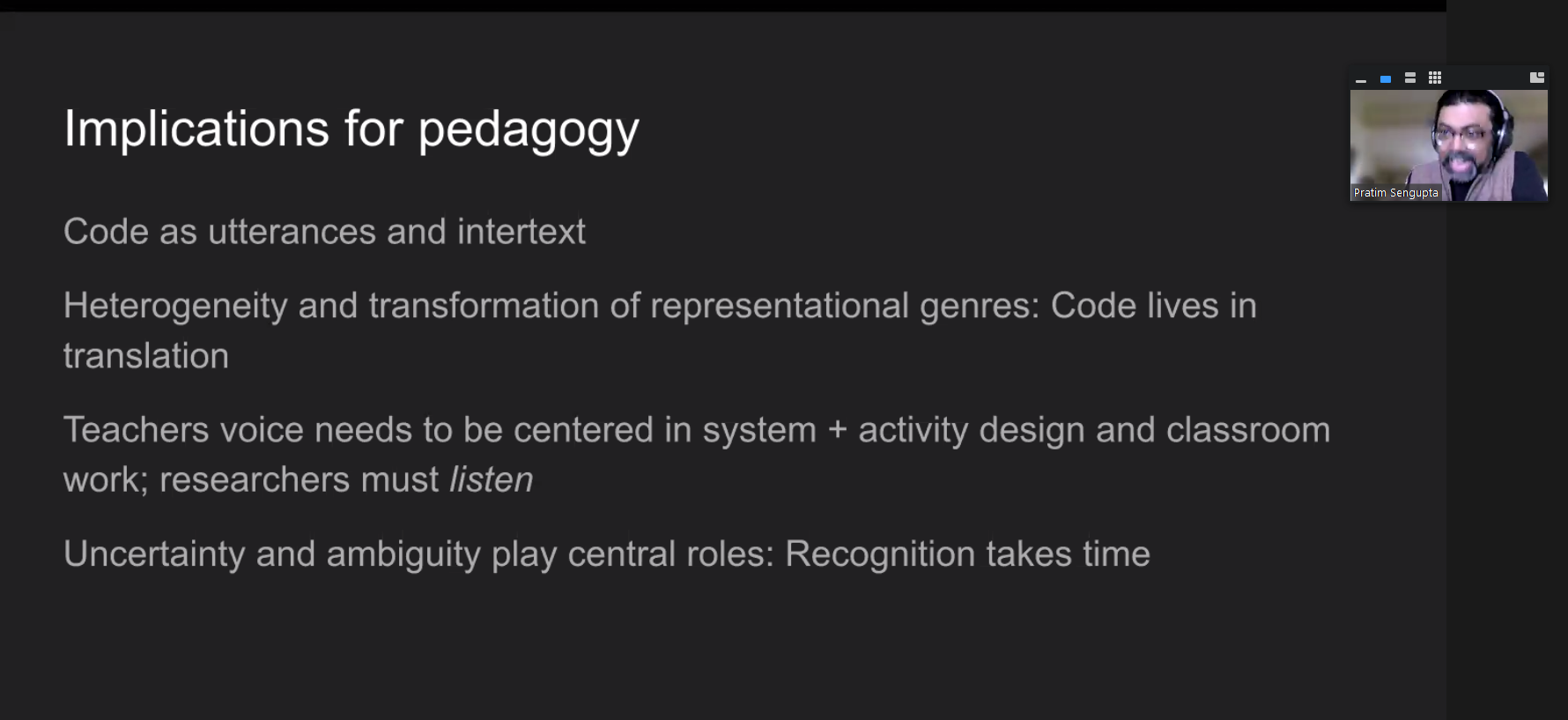
As a researcher of pedagogy, these points provide takeaways that I can relate to my own research practice:
Listening to Pratim share his research on the teaching and learning of computing and the pitfalls of technocentrism has made me think deeply about how I view computer science as a subject and do research about it. I have shared some of my reflections in this blog, and I plan to incorporate the underlying theory and ideas in my ongoing research projects.
If you would like to find out more about Pratim’s work, please look over his slides, watch his presentation, read the upcoming chapter in our seminar proceedings, or respond to this blog by leaving a comment so we can discuss!
We have another four seminars in our current series on cross-disciplinary computing.
At our next seminar on 12 July 2022 at 17:00–18:30 BST / 12:00–13:30 EDT / 9:00–10:30 PDT / 18:00–19:30 CEST, we will welcome Prof. Yasmin Kafai and Elaine Griggs, who are going to present research on introductory equity-oriented computer science with electronic textiles for high school students.
We look forward to meeting you there.
[1] You can learn more in the Hello World article where our Chief Learning Officer Sue Sentance talks about the block model.
The post Are you technocentric? Shifting from technology to people appeared first on Raspberry Pi.
From May to November 2022, our seminars focus on the theme of cross-disciplinary computing. Through this seminar series, we want to explore the intersections and interactions of computing with all aspects of learning and life, and think about how they can help us teach young people. We were delighted to welcome Prof. Mark Guzdial (University of Michigan) as our first speaker.
Mark has worked in computer science (CS) education for decades and won many awards for his research, including the prestigious ACM SIGCSE Outstanding Contribution to Computing Education award in 2019. He has written literally hundreds of papers about CS education, and he authors an extremely popular computing education research blog that keeps us all up to date with what is going on in the field.
In his talk, Mark focused on his recent work around developing task-specific programming (TSP) languages, with which teachers can add a teaspoon (also abbreviated TSP) of programming to a wide variety of subject areas in schools. Mark’s overarching thesis is that if we want everyone to have some exposure to CS, then we need to integrate it into a range of subjects across the school curriculum. And he explained that this idea of “adding a teaspoon” embraces some core principles; for TSP languages to be successful, they need to:
Mark neatly summarised this as ‘being both usable and useful’.
We can learn a lot from going back in time and reflecting on the history of computing. Mark started his talk by sharing the views of some of the eminent computer scientists of the early days of the subject. C. P. Snow maintained, way back in 1961, that all students should study CS, because it was too important to be left to a small handful of people.
Alan Perlis, also in 1961, argued that everyone at university should study one course in CS rather than a topic such as calculus. His reason was that CS is about process, and thus gives students tools that they can use to change the world around them. I’d never heard of this work from the 1960s before, and it suggests incredible foresight. Perhaps we don’t need to even have the debate of whether computer science is for everyone — it seems it always was!
In many of our seminars over the last two years, we have heard about the need to broaden participation in computing in school. Although in England, computing is mandatory for ages 5 to 16 (in theory, in practice it’s offered to all children from age 5 to 14), other countries don’t have any computing for younger children. And once computing becomes optional, numbers drop, wherever you are.
Mark shared with us that in US high schools, only 4.7% of students are enrolled in a CS course. However, students are studying other subjects, which brought him to the conclusion that CS should be introduced where the students already are. For example, Mark described that, at the Advanced Placement (AP) level in the US, many more students choose to take history than CS (399,000 vs 114,000) and the History AP cohort has more even gender balance, and a higher proportion of Black and Hispanic students.
A solution to low uptake of CS being proposed by Mark and his colleagues is to add a little computing to other subjects, and in his talk he gave us some examples from history and mathematics, both subjects taken by a high proportion of US students. His focus is on high school, meaning learners aged 14 and upwards (upper secondary in Europe, or key stage 4 and 5 in England). To introduce a teaspoon of CS to other subjects, Mark’s research group builds tools using a participatory design approach; his group collaborates with teachers in schools to identify the needs of the teachers and students and design and iterate TSP languages in conjunction with them.
Mark demonstrated a number of TSP language prototypes his group has been building for use in particular contexts. The prototypes seem like simple apps, but can be classified as languages because they specify a process for a computational agent to execute. These small languages are designed to be used at a specific point in the lesson and should be learnable in ten minutes. For example, students can use a small ‘app’ specific to their topic, look at a script that generates a visualisation, and change some variables to find out how they impact the output. Students may also be able to access some program code, edit it, and see the impact of their edits. In this way, they discover through practical examples the way computer programs work, and how they can use CS principles to help build an understanding of the subject area they are currently studying. If the language is never used again, the learning cost was low enough that it was worth the value of adding computation to the one lesson.
You can try out the TSP language prototypes Mark shared yourself, which will give you a good idea of how much a teaspoon is!
DV4L: For history students, the team and participating teachers have created a prototype called DV4L, which visualises historical data. The default example script shows population growth in Africa. Students can change some of the variables in the script to explore data related to other countries and other historical periods. A example lesson activity illustrates how a teacher might incorporate this TSP language into a lesson.
Pixel Equations: Mathematics and engineering students can use the Pixel Equations tool to learn about the way that pictures are made up of individual pixels. This can be introduced into lessons using a variety of contexts. One example lesson activity looks at images in the contexts of maps. This prototype is available in English and Spanish.
Counting Sheets: Another example given by Mark was Counting Sheets, an interactive tool to support the exploration of counting problems, such as how many possible patterns can come from flipping three coins.
Have a go yourself. What subjects could you imagine adding a teaspoon of computing to?
We’d love you to join us for the next seminar in our series on cross-disciplinary computing. On 7 June, we will hear from Pratim Sengupta, of the University of Calgary, Canada. He has conducted studies in science classrooms and non-formal learning environments, focusing on providing open and engaging experiences for anyone to explore code. Pratim will share his thoughts on the ways that more of us can become involved with code when we open up its richness and depth to a wider audience. He will also introduce us to his ideas about countering technocentrism, a key focus of his new book.
We will shortly be sharing details about the official in-person launch event of the Raspberry Pi Computing Education Research Centre at the University of Cambridge on 20 July 2022. And guess who is going to be coming to Cambridge, UK, from Michigan to officially cut the ribbon for us? That’s right, Mark Guzdial. More information coming soon on how you can sign up to join us for free at this launch event.
The post A teaspoon of computing in every subject: Broadening participation in computer science appeared first on Raspberry Pi.
We are delighted to launch our next series of free online seminars, this time on the topic of cross-disciplinary computing, running monthly from May to November 2022. As always, our seminars are for all researchers, educators, and anyone else interested in research related to computing education.
What do we mean by cross-disciplinary computing? Through this upcoming seminar series, we want to embrace the intersections and interactions of computing with all aspects of learning and life, and think about how they can help us teach young people. The researchers we’ve invited as our speakers will help us shed light on cross-disciplinary areas of computing through the breadth of their presentations.
At the Raspberry Pi Foundation our mission is to make computing accessible to all children and young people everywhere, and because computing and technology appear in all aspects of our and young people’s lives, in this series of seminars we will consider what computing education looks like in a multiplicity of environments.
We start the new series on 3 May, and are beyond delighted to be kicking off with a talk from Mark Guzdial (University of Michigan). Mark has worked in computer science education for decades and won many awards for his research, including the prestigious ACM SIGCSE Outstanding Contribution to Computing Education award in 2019. Mark has written hundreds of papers about computer science education, and he authors an extremely popular computing education research blog that keeps us all up to date with what is going on in the field.
Recently, he has been researching the ways in which programming education can be integrated into other subjects, so he is a perfect speaker to start us thinking about our theme of cross-disciplinary computing. His talk will focus on how we can add a teaspoon of computing to history and mathematics classes.
On 7 June, our speaker will be Pratim Sengupta (University of Calgary), who I feel will really challenge us to think about programming and computing education in a new way. He has conducted studies in science classrooms and non-formal learning environments which focus on providing open and engaging experiences for the public to explore code, for example through the Voice your Celebration installation. Recently, he has co-authored a book called Voicing Code in STEM: A Dialogical Imagination (MIT Press, availabe open access).
In Pratim’s talk, he will share his thoughts about the ways that more of us can become involved with code through opening up its richness and depth to a wider public audience, and he will introduce us to his ideas about countering technocentrism, a key focus of his new book. I’m so looking forward to being challenged by this talk.
On 12 July, we will hear from Yasmin Kafai (University of Pennsylvania), who is another legend in computing education in my eyes. Yasmin started her long career in computing education with Seymour Papert, internationally known for his work on Logo and on constructionism as a theoretical lens for understanding the way we learn computing. Yasmin was part of the team that created Scratch, and for many years now has been working on projects revolving around digital making, electronic textiles, and computational participation.
In Yasmin’s talk she will present, alongside a panel of teachers she’s been collaborating with, some of their work to develop a high school curriculum that uses electronic textiles to introduce students to computer science. This promises to be a really engaging and interactive seminar.
In August we will take a holiday, to return on 6 September to hear from the inspirational Genevieve Smith-Nunes (University of Cambridge), whose research is focused on dance and computing, in particular data-driven dance. Her work helps us to focus on the possibilities of creative computing, but also to think about the ethics of applications that involve vast amounts of data.
Genevieve’s talk will prompt us to think about some really important questions: Is there a difference in sense of self (identity) between the human and the virtual? How does sharing your personal biometric data make you feel? How can biometric and immersive development tools be used in the computing classroom to raise awareness of data ethics? Impossible to miss!
Do enter all these dates in your diary so you don’t miss out on participating — we are very excited about this series. Sign up below, and ahead of every seminar, we will send you the information for joining.
As usual, the seminars will take place online on a Tuesday at 17:00 to 18:30 local UK time.
The post Exploring cross-disciplinary computing education in our new seminar series appeared first on Raspberry Pi.


 Lateo.net - Flux RSS en pagaille (pour en ajouter : @ moi)
