 Connexion


AI technologies, such as smart speakers or streaming recommendations, are becoming part of everyday life for children and teenagers. It’s therefore increasingly important to help young people understand not just how these systems work, but how to question them.

When AI systems generate outputs such as a recommendation, these outputs are often accompanied by an explanation. In our latest research seminar, Professor Dr. Dan Verständig (Goethe University Frankfurt, Center for Critical Computational Studies) spoke about how explanations are shaped by the people who write them, and only become meaningful when someone else makes sense of them. Dan introduced us to Social Explainable AI (Social XAI) and Critical Computational Literacy (CCL), and asked us to consider not just what an AI system explains, but for whom, why, and who benefits.
Dan opened with a deceptively simple question: why do we need explanations in the first place? His answer was that explanations provide orientation. They reduce uncertainty, and in doing so, they make our shared social world liveable. Explanations have evolved from Socratic dialogue, to the printed book, to the classroom, to today’s digital interfaces, and now to AI-generated explanations. But explanations have never been neutral conveyors of information. Dan illustrated this with a simple demonstration: he showed the seminar participants an aerial photo of a beach and asked what they noticed.
The aerial photo Dan shared during his seminar. What do you notice about this picture?
Seminar participants pointed to the coastline, the sandy beach, and a tiny figure in the frame. Dan then revealed that the photo was taken by him, using a drone at Montara State Beach in California on a specific afternoon in April 2024. He asked how a climate researcher, a surfer, or an artist might each describe the very same image differently.
This demonstration highlighted that an explanation is always for someone, for some purpose, in some context. That framing carries straight through into how we should think about AI explanations too. An explanation that satisfies a data scientist debugging a model is not the same as one that satisfies a patient asking why an algorithm flagged their scan, or a citizen asking why they were denied a loan. In other words, explanations are never technical.
Drawing on Rohlfing and Lim’s 2026 work, Dan described Social XAI as an approach that puts interaction, rather than output, at the centre of explainability. Dan illustrated this with a simple but effective diagram: an AI explanation starts as a system output, is filtered through a person’s interpretation, and only then becomes meaning through construction. A one-size-fits-all output, however technically accurate, isn’t yet an explanation until someone has made sense of it in their own terms.
To explore this further, Dan’s research group has developed co-construction workshops, bringing people together to interrogate AI explanations collaboratively rather than receive them passively. In these workshops, participants are asked questions such as: “What counts as evidence? What is missing? What are the alternatives? Who benefits from this? Do we agree?”
To answer these questions, participants do not examine an AI model to find out how it generates a decision. Instead, participants scrutinise its outputs in the same way that they would critically evaluate a politician’s promise or a newspaper’s headline.
Critical Computational Literacy (CCL) is a framework that describes what people need to engage with AI explanations critically. Dan presented CCL as consisting of four interlocking dimensions:
Taken together, these dimensions push back against a narrow, purely technical notion of ‘AI literacy’ as knowing how a model works. Instead, CCL treats literacy as something biographical and value-laden. Dan explained that individuals bring their own history and stance to any encounter with computational systems, and genuine literacy means being able to interrogate these systems’ explanations rather than simply accept or operate them.
Although Dan’s research took place with adult participants, Social XAI and Critical Computational Literacy are ideas that could also be used in the K-12 classroom. For example, if students interact with AI explanations through smart speakers or streaming recommendations in their everyday lives, this presents an opportunity to teach them how to engage critically with AI outputs. Students might explore why a smart speaker suggested a particular recipe, or investigate the explanation for why a streaming service recommended a particular show.
Explainability is also a key part of our own Experience AI resources. When training a model, students write their own model cards to document who built a model, what training data was used, how accurate the model’s predictions were, and any known limitations. In this activity, explainability is traceable, and students use their analytical skills to create transparent, fair, and accountable model cards.
Social XAI suggests an extension to this activity. Students could ask what matters about the explanation they have written and why this is important. Through this critique, students can consider who will read these model cards and how the cards might be interpreted. In this way, AI explanations become more than a technical output, and become artefacts whose meaning is co-constructed by the author and the reader.
This seminar was part of our ongoing series on teaching about AI in the arts, humanities, and sciences. You can watch the full recording of Dan’s talk, including the Q&A discussion, here:
Our research seminar series continues to explore how AI is taught across the curriculum. In our next seminar on Tuesday, 6 October at 19:00–20:30 BST, we welcome Eleni Petraki and Damith Herath (University of Canberra) who will present an engineering and robotics curriculum aimed at equipping future engineers with the diverse skills demanded by a growing workforce. To take part in the seminar, click the button below to register. We hope to see you there.
The schedule of our upcoming seminars is available online. You can catch up on past seminars on the blog and on the previous seminars and recordings page.
The post Not all explanations are equal: Social Explainable AI and Critical Computational Literacy appeared first on Raspberry Pi Foundation.
Are you a computing teacher in England, Scotland, or Wales who works with 11- to 14-year-olds and is interested in how young people learn about AI ethics and sustainability?
The Raspberry Pi Computing Education Research Centre is launching an exciting new research study, and we would love you to get involved.
In this study, we will explore teaching about the impacts of AI on people, the environment, and society. Our aims for the study are to:
The study involves attending two in-person workshops in Cambridge, co-designing and teaching a unit of work, and taking part in evaluation activities such as surveys and interviews. Where necessary, we can offer support with the costs of attending the workshops, such as travel, accommodation, and supply cover.
According to a recent report, in the UK more than half of 8- to 17-year-olds use AI tools, and as these systems become an increasingly significant part of everyday life, helping young people to critically evaluate their impact is vital.
We recently conducted a scoping literature review to explore what ethical concepts are covered by AI literacy interventions for lower secondary students (11- to 14-year-olds). This work has been accepted for publication at the Frontiers in Education conference, which is taking place in October.
In this work, we used the 10 principles set out in UNESCO’s Recommendation on the Ethics of Artificial Intelligence as a framework for analysis of the ethical concepts covered by the interventions.
Our research showed that when AI ethics is taught to lower secondary students, interventions tend to focus most on concepts such as fairness and privacy. For example, multiple activities explored the important issue of algorithmic bias, teaching students about the causes of bias (such as training AI systems with small or unrepresentative datasets) and discussing real-world examples of bias in AI.
However, we found that other ethical concepts, such as proportionality and governance, are not often taught. And while a few interventions featured the theme of sustainability, we found that only one directly taught students about the environmental impact of AI itself.
Our new study aims to help address this gap by supporting young people to explore the social and ethical impact of AI tools from a sustainability perspective. Teachers will use real-world examples to engage their students in discussion and ethical reasoning. We hope the findings will support more computing teachers to teach about AI ethics in their lessons, and help students to think critically about the use of AI tools.
We are using a design-based research approach to work collaboratively with teachers to co-design a unit of lessons focused on AI ethics and sustainability.
Participating in the study will involve:
If you teach computing at lower secondary level (Years 7–9 or S1–S3) in England, Scotland, or Wales and would like to help shape the way we teach young people about ethical issues around AI, we would love to hear from you. Please register your interest via the form below.
http://rpf.io/sage-application
If you have any questions about the project, please email katharine.childs@raspberrypi.org.
The post Join our new UK study on teaching AI ethics and sustainability in lower secondary school appeared first on Raspberry Pi Foundation.
Artificial intelligence (AI) is already part of young people’s everyday lives, from the content recommended to them on social media to the generative AI tools they increasingly encounter. But AI technologies are also being used to tackle challenges in the wider world, from forecasting floods to monitoring our environment.
That’s why we believe AI literacy shouldn’t sit within a single subject. Young people need opportunities to explore how AI works, where it is used, and the questions it raises across the curriculum.
To address this, we created a new collection of free themed Experience AI resources, designed to make it easier for educators to bring AI literacy into the subjects and topics they already teach. The resources include those co-developed by the Raspberry Pi Foundation and Google DeepMind, alongside those developed independently by the Raspberry Pi Foundation, including two units created with support from our partner, Digital Moment.
When we began developing these resources, we initially explored creating materials specifically for individual curriculum subjects. But through conversations with educators and our partners around the world, we learnt that a more flexible approach could be much more useful.
Curricula differ between countries, schools, and age groups, and AI technologies rarely fit neatly within traditional subject boundaries. The same technology can raise scientific, geographical, social, creative, and ethical questions.
So rather than assigning each resource to a particular subject, our new resources are organised around broad themes, including the environment, critical thinking, and ethics.
The resources include:
Designed for learners aged 8 to 16, the resources can be used in different subjects and adapted by educators to suit their own classroom context.
That flexibility is important. We want educators to be able to introduce meaningful AI literacy without feeling that they need to become AI specialists or find space for an entirely new subject in an already busy curriculum.
The need for this approach is increasingly recognised by subject experts.
Dr Becky Kitchen, Head of Professional Development at the Geographical Association, highlighted the importance of giving young people opportunities to engage critically with AI technologies as part of their wider learning:
“Pupils are increasingly coming into contact with AI and so it’s vital that they are taught how to harness its power in an effective and critical way. Developing resources across the curriculum to embed this knowledge, understanding, and use is critical.”
After reviewing the new resources, she added:
“These resources are outstanding. They develop pupils’ geographical knowledge while simultaneously exploring the role that AI can have in a meaningful and concrete way.”
The connections extend well beyond geography.
Professor Geoff Cox, Professor of Art and Computational Culture at London South Bank University, emphasised the role that arts and humanities subjects can play in developing a richer understanding of AI technologies:
“If AI literacy is left solely to STEM subjects or computer science, we lose the opportunity to ask deeper human, cultural, and ethical questions — questions that art is uniquely equipped to explore.”
He also highlighted the value of combining different ways of learning:
“The resources move between visual analysis, practical activity, and critical reflection, recognising that only in combination can AI literacy be developed effectively.”
These perspectives reflect an important principle behind the collection. AI literacy isn’t simply about knowing how a technology works. It is also about being able to question it, understand its applications and limitations, and consider its impact on people, communities, and the world.
Before launching the resources more widely, earlier this year we collaborated with our partner, Digital Moment, to give educators in Canada the opportunity to test some of them with their students. Their experiences helped us understand not only how the resources worked in practice, but also where they could fit naturally into existing teaching.
As Indra Kubicek, CEO of Digital Moment, explains:
“Educators play a critical role in helping students understand and think critically about the use of AI and its implications across a wide range of subjects. Building the next generation of creators, builders, and innovators who will shape the future of AI starts with AI education in the classroom.”
One of the educators who took part was Grade 8 teacher Sandra Theobald, who tested our AI and social media activity. Before the lesson, she expected her students, who were already regular social media users, to be familiar with many of the ideas.
While they did have a good background knowledge, the activity prompted them to make new connections between their own behaviour, the data they generate, and the content they are shown as a result of the algorithms presented to them.
Students were able to explore the ideas themselves, with Sandra taking more of a supporting role. She found that they came away feeling more confident about understanding how their interactions with social media affect what they see, and keen to share what they had discovered with their families.
For educators who may feel unsure about introducing AI tools in their classroom, Sandra’s advice is to simply give it a go, rather than waiting until feeling like an expert:
“My advice is to start small and seek out trusted resources and experts in AI education. Partner with another educator so you can explore and learn together. There is so much information available that it can feel overwhelming, so take it one step at a time. Learn alongside your students and build your confidence as you go.”
Canadian educator Colin McKenzie also used the AI and social media unit with his Grade 7 and 8 classes.
Using Somekone, a closed social media simulation for the classroom, his students created accounts and explored how their behaviour affected the content the system recommended.
The experience felt familiar enough to capture their attention, but gave them an opportunity they wouldn’t normally have when using a real social media platform: to examine what was happening behind the scenes.
Students reflected on their interests and choices and then used data on their own behaviour to understand how that behaviour affected what they were shown. Colin found that students were eager to return to the activity each day to discover what would happen next.
Crucially, he also found it straightforward to incorporate the activity into his existing teaching rather than having to significantly change his plans.
“I think this is a powerful and easy resource for teachers to use in the classroom. It is easy to set up and navigate, and it ties in well with curriculum areas around online usage, especially with how prominent AI is becoming in our educational lives.”
For Colin, the activity provided a practical way to connect AI literacy with what his students had already learnt about online safety and evaluating information. It also helped students recognise that the content they encounter online isn’t simply appearing by chance: their own actions can influence the content recommended to them by AI-driven systems.
The experience was valuable enough that Colin plans to make the unit part of his teaching each year.
Feedback like this has reinforced why flexibility is central to our approach.
A lesson about flood forecasting might support learning in geography or science. Exploring AI-generated content could lead to discussions in art, media literacy, humanities, or computing. An activity investigating social media algorithms can connect AI literacy with online safety, critical thinking, and digital citizenship.
Most importantly, these things provide opportunities for students to encounter AI literacy in different contexts and recognise that understanding AI is relevant far beyond the computing classroom.
AI technologies will continue to change. The contexts in which young people encounter them will change too.
Our aim isn’t to prepare students for one particular AI tool or moment in time. It’s to help them develop the knowledge and critical thinking skills they need to understand all kinds of AI technologies, question them, and make informed decisions about them.
Educators shouldn’t need to be computer science teachers, or AI experts, to do that.
By creating flexible resources that connect AI with subjects and issues young people are already exploring, we hope to make it easier for more educators to bring AI literacy into their classrooms.
Explore the new themed Experience AI resources and discover a starting point for your learners.
We’d like to say a big thank you to our global partner, Digital Moment, for their support in trialling these new resources with educators and learners in Canada.
The post Bring AI literacy into every classroom with our new themed resources appeared first on Raspberry Pi Foundation.
Hayley McKechnie is a computing lead at a primary school in the East of England, who shares in this blog how she supports her students and her fellow teachers to build confidence around artificial intelligence (AI). She developed her skills through training delivered by Parent Zone, our partner for Experience AI in the UK.
Artificial intelligence is part of everyday life for young people, but teaching students what AI is, how it works, and why it should be used responsibly can still be a challenge.
As a computing lead at a school in the East of England, the Experience AI programme has played a central role in building my confidence, as well as that of my colleagues, when it comes to teaching AI in the classroom.
Through professional development, practical classroom materials, and a strong focus on ethics, the programme has helped me bring AI to life in a way that feels accessible, age-appropriate, and responsible.
I began my AI education journey by attending training sessions hosted by Parent Zone to strengthen my own understanding of artificial intelligence. This felt like an important first step, because many teachers are learning about AI alongside their students.
The training really helped me understand how AI actually works. That’s so important, because if you’re not confident in your own understanding, it’s very difficult to explain it clearly to children.
At first, I trialled one or two lessons with my students, introducing concepts gradually as AI tools became more visible in everyday life. As my confidence grew, I started using more of the materials, and this year I plan to deliver the full six-week unit as a dedicated part of our computing curriculum.
What I particularly like is how clear and straightforward the programme is. The training makes it easy for teachers to pick up, while still giving students a solid foundation in how AI works.
Before starting AI lessons, I always ground learning in familiar examples, such as voice assistants, search engines, and design tools. This helps students see that AI isn’t abstract; it’s already part of their everyday lives.
One of the biggest strengths of the Experience AI training, in my view, is its strong emphasis on ethics and critical thinking. Rather than presenting AI as something to trust automatically, it encourages students to question and evaluate the technology they use.
I want my students to understand that AI can be helpful, but it isn’t infallible and shouldn’t be relied on blindly.
For example, I’ve shown students how AI-generated search results can sometimes be inaccurate. It’s a simple but effective way to demonstrate why human judgement still matters. These kinds of discussions help students understand both the potential and the limitations of AI, reinforcing the idea that technology should support thinking rather than replace it.
Beyond my own classroom, I’ve also used Experience AI training to support other teachers. As part of my role coordinating computing across schools in my region, I organised a cluster meeting for 20 computing leads from across Essex, Suffolk, and Norfolk.
The session gave teachers the opportunity to share experiences, explore how AI could be introduced in age-appropriate ways, and discuss how to embed ethical considerations across the curriculum. A Parent Zone trainer led the session and helped deepen our understanding.
Many computing teachers are still getting to grips with AI themselves. The training helped me feel more confident, and that’s something I’ve been keen to pass on to others.
You can access all of our AI literacy and safety resources for free via the Experience AI website. Start exploring today and discover classroom-ready lesson plans, slide decks, and activities.
Interested in joining the next group of teachers to be trained on Experience AI? If you’re a UK teacher, visit Parent Zone’s website to enrol in the next cohort of educators. Or if you’re outside the UK, visit our Partners page to find out about teacher training sessions in your country.
The post Building confidence to teach AI in the classroom appeared first on Raspberry Pi Foundation.
Artificial intelligence (AI) systems are often presented as objective. But plenty of evidence shows that AI systems can reflect and reinforce existing inequalities, from healthcare and education to scientific research itself.
In the first seminar of our new research seminar series on applied AI, Thema Monroe-White from George Mason University explored how we can better understand — and challenge — these patterns. Her talk focused on race-conscious algorithmic approaches to AI and data, and what they reveal about how knowledge is produced, represented, and used.
Drawing on two large-scale studies in her seminar, Thema showed that both scientific research and AI systems are shaped by human identities and social structures, and that recognising this is essential for educators, researchers, and anyone working with data.
A key idea running through Thema’s seminar was that data and algorithms are not neutral. They are shaped by the people, institutions, and systems that produce them.
Thema uses critical quantitative and intersectional approaches in her work to:
Thema and her collaborators have been conducting research in this area for more than a decade, developing techniques that systematically measure bias and its impact on society.
In a groundbreaking study published in 2022, just before the release of ChatGPT, Thema’s team used large-scale computational analysis of more than 5 million research articles to explore inequalities in scientific publishing. The data analysis approaches developed for this study were later used to explore bias in large language models (LLMs).
However, the 2022 study already demonstrated wide-reaching disparities in science and surfaced deep-rooted issues, showing that bias was already ingrained in the scientific data that was used to train LLM, and affecting topic choices, citation and institutional differences.
The results showed clear inequalities in the relationship between identity and topic choice. Authors from marginalised groups were more likely to study topics related to their communities and lived realities, including topics such as racial disparities and discrimination. Gendered patterns also appeared, with women publishing more frequently on more feminised topics, including families, literacy, learning, nursing, and pregnancy.
The study also found citation inequalities. Even among authors studying the same topic, authors from some groups were cited less often than others, with black and Latinx women the least likely to be cited. This shows that inequality is not only present in what gets studied, but also in whose work is recognised.
Institutional context mattered too. Researchers at mission-driven institutions were more likely to publish on topics connected to marginalised communities, while scholars at institutions seen as elite were more likely to publish on topics that aligned more closely with dominant groups and norms.
Taken together, the findings point to a simple but important idea: who we are shapes what knowledge gets produced. That matters because when some groups are underrepresented in research, the topics that affect their lives may also be understudied.
Having already developed their tool for name analysis for the previous study, Thema’s team was uniquely positioned to analyse the bias embedded in generative AI systems, specifically LLMs.
Thema’s most recent study examined how LLM–based tools represent people in everyday scenarios. The research team prompted the base models of LLM chatbots (such as Open AI’s ChatGPT, Anthropic’s Claude, Meta’s Llama, and Google’s PaLM or Gemini) to write short stories about students, workers, and relationships, generating 500,000 outputs across different domains. They then analysed how names associated with different racial and gender identities were portrayed.
One example Thema shared in the seminar described a student named “John” helping “Maria,” a student who had moved from Mexico and was struggling with Spanish. At first glance, this may seem like a small or even odd detail. But when oddities like this appear again and again across thousands of stories, they reveal systematic patterns.
The study found that characters with marginalised identities were more likely to be portrayed in subordinated roles in chatbot outputs. Characters with non-white-associated names were more often shown as needing help rather than offering it. Stereotypes were also reinforced, with some names repeatedly associated with struggling students, subordinate workers, or narrow professional roles. Some groups were omitted altogether, while white-associated names appeared more frequently and in more powerful positions.
Similar biases appeared across stories related to education, work, and relationships. Across all three topics, the most common pattern was one in which white characters were more likely to lead, rescue, or mentor, while non-white characters were more likely to be helped, corrected, or spoken for.
For educators, this is especially important because many AI tools are now being introduced into classroom settings as writing assistants, tutors, or sources of personalised feedback. When these tools reproduce biases and unequal assumptions, they can shape not only what students read, but also how students see themselves and one another.
Rather than rejecting computational methods altogether, Thema argued for using them more thoughtfully and responsibly.
One approach she highlighted is the Wells-Du Bois protocol, a framework designed to support bias mitigation, transparency, and more reflective use of data and models. It encourages researchers and practitioners to think carefully about inadequate or biased data, identity proxies, subpopulation differences, and the kinds of harms that can arise when AI systems are used without sufficient context.
Underlying this is a broader principle: when we do not know enough, we should say so. And when systems affect marginalised communities, those communities should not be an afterthought in how we build, evaluate, or use technology.
In her seminar, Thema emphasised the importance of thinking about how we respond to bias in AI tools in educational settings. Here are some starting points for meaningful discussions in your classroom:
If you would like to find out more about Thema’s work, watch the seminar recording:
You may also want to explore:
Our research seminars bring together educators and researchers to explore key questions in computing education.
Next in our series on applied AI, our Director of Research and Impact, Shuchi Grover, will talk about the role of K–12 education in developing competencies for the future of data and computing. Sign up now to join the seminar on 12 May, 17:00 BST:
The post AI is not neutral: What recent research says about bias, identity, and power appeared first on Raspberry Pi Foundation.
In classrooms across Mexico, a transformation is unfolding. The Experience AI programme isn’t just teaching students about artificial intelligence, it’s empowering teachers and learners to explore, question, and create with it. By equipping educators with accessible tools and sparking curiosity among students, the initiative is shaping a new generation ready to use AI responsibly and creatively.
Educators like Guadalupe Cortes, Lilia Violeta Garvia Sanchez, Ines Martinez, and Ana Judith Zavaleta are at the forefront of this shift. Their experiences reveal just how transformative Experience AI has become.
For many, AI can feel abstract, something from science fiction. Science and math teacher Lilia Violeta Garvia Sanchez remembers that both she and her students once viewed AI as “robots that would take over the world.” Fear gave way to fascination, however, once Experience AI entered the classroom.
Through hands-on lessons, students quickly discovered AI as a practical tool rather than a threat. “I’ve seen a change in the students,” Lilia explains. “They were afraid at first, but now they’re curious and engaged.”
Technology teacher Ines Martinez admits she was also surprised: “I thought the language would be more technical or complex, but it was pleasantly accessible — and very useful.”
A defining strength of Experience AI is its adaptability. Teachers can tailor materials to fit their classrooms while still leaning on the program’s robust foundation.
Guadalupe Cortes points to the built-in glossary as a game-changer: “It was really helpful for me.” She values being able to choose what fits her teaching to keep it relevant: “I selected certain parts to connect with projects I was already running.”
Experience AI pushes students to think deeply about the ethics and implications of AI.
In Ines’s class, students raised concerns about water use in data centres and debated how to protect their digital identities. They weren’t just learning facts, they were making connections to real-world issues.
Another teacher, Ileana Beurini, described an exercise where students asked different AI models the same political question. When answers varied, they discussed bias and the importance of consulting multiple sources. In another activity, searching images of “worker” led to a conversation about gender equity in technology.
As Ines puts it: “They don’t want it to do all the thinking for them. They said it should be a support — a tool to generate better information, not to replace reasoning or reflection.”
The impact on student motivation has been striking. For Ana Judith Zavaleta, the shift was clear: “They’re much more hands-on now — they don’t rely as much on textbooks or theory.” One student who typically struggled academically became one of the most enthusiastic participants, even passing where he previously failed.
Guadalupe Cortes has seen similar enthusiasm: “They’re finding a real purpose in using AI for their own benefit.” At an entrepreneurship fair, her students applied AI concepts to improve their projects, proof that these lessons extend far beyond the classroom.
The teachers’ message is unanimous: embrace AI.
“We should give it a try,” urges Lilia. “Just because we’re teachers doesn’t mean we have to know everything. The world is evolving every single day, and we need to innovate with our students so they feel motivated to keep learning.”
For Ines, the takeaway is simple but powerful: “Take the risk — really, take the chance to learn. Just like the internet became essential, AI will become part of our daily lives and necessary for all areas of teaching — and life itself.”
Experience AI is more than a set of resources, it’s a movement preparing students to navigate the future with curiosity, critical thinking, and ethical awareness. By igniting minds in Mexico, it’s helping to cultivate responsible digital citizens who will shape not just their classrooms, but the world beyond them.
For more information about Experience AI, visit our website: rpf.io/experienceai
For more information about our global Experience AI partner in Mexico, visit: educacionparacompartir.org
The post Teaching Experience AI: Lessons from educators in Mexico appeared first on Raspberry Pi Foundation.
This blog post is written by Victor Murithi, Communications and Media Consultant at Young Scientists Kenya, one of our global partners for Experience AI in Kenya.
When over 100 teachers from across Kenya gathered at Kangaru High School in Embu County for the Kenya Science and Engineering Fair Nationals in April, few anticipated just how transformative a two-day workshop could be. Delivered by the Experience AI Young Scientists Kenya (YSK) team, with support from the Raspberry Pi Foundation, the training sparked more than curiosity — it sparked a shift in mindset.
This wasn’t just about introducing new tools: it was about empowering teachers to confidently lead their students into an artificial intelligence (AI)-driven future.
What began as a plan to train just 40 teachers quickly grew into something much bigger. By the time the workshop kicked off, 104 teachers from over 80 schools across 37 counties in Kenya, had registered and participated — nearly tripling the initial target.
This overwhelming interest confirmed a powerful insight: teachers are eager to understand AI, not only to better prepare their students for the future, but also for their own professional growth.
The workshop’s curriculum didn’t just focus on technical skills, it aimed to create confidence, clarity, and community among the attendees — key ingredients for successfully integrating AI into teaching and learning.
“Helping teachers move past their fear of AI and understand its potential is incredibly powerful. Because AI is the future, and through this training, we’re reaching the minds that will shape it,” explained Lucy Mwaniki, AI Community Trainer at YSK.
As part of the training, the attendees completed interactive worksheets, tested basic machine learning models, and sat a final comprehension test, something they found both validating and motivational.
“We were able to do the summative test… which turned out to be a very effective way of us understanding how in-depth and how well they grasped the knowledge,” says Lucy Mwaniki.
In one standout session, teachers collaboratively brainstormed ways AI could address national educational challenges. Ideas included models to assist students in selecting academic pathways within Kenya’s Competency Based Curriculum (CBC). Several teachers also successfully built working models, demonstrating the potential of applied learning.
“It was a very eye-opening session… some of the teachers were able to create a very basic model, which was a wonderful experience for them,” Lucy Mwaniki explains.
What made this training exceptional was its immediate applicability and long-term vision. By the end of two days, teachers weren’t just AI-aware — they were AI-ready, with many already starting to explore how AI tools could support entrepreneurship, lesson planning, and personalised learning pathways.
At the close of the training, each teacher received a Certificate of Participation, recognising their commitment to professional development and their new capacity to bring AI into the classroom. The awarding of certificates added a sense of accomplishment and pride, reinforcing that teachers are key drivers of technological transformation in education.
And the impact of the training was measurable:
But it doesn’t end there, as Vanessa Inziani, Head of Programs at YSK, explains, “Our commitment doesn’t end with the training — we continue to support educators with resources, mentorship, and follow-up to ensure success in delivering the program in the classroom.”
With the rapidly evolving digital landscape, AI is no longer a distant concept — it’s a present-day classroom necessity. Yet, introducing AI into schools isn’t just about technical literacy; it’s about confidence, clarity, and community and the approach the Young Scientist Kenya team and Experience AI delivered during the two-day training is anchored in this belief.
As AI continues to shape the global education landscape, programs like Experience AI provide the bridge needed to equip teachers, inspire students, and future-proof education systems. The Kangaru High School session was not a one-off — it was a catalyst for systemic change.
Experience AI is scaling. As it expands across Kenya and beyond, the benefits are clear:
The journey from fear to fluency starts with a single step, a willingness for us all to explore what’s possible. Together, we can equip educators, inspire students, and shape Kenya’s future, one AI-literate classroom at a time.
Experience AI is an AI literacy programme, co-developed by the Raspberry Pi Foundation and Google DeepMind, that teaches students aged 11 to 14 about AI and machine learning. Thanks to funding from Google.org, Young Scientists Kenya has partnered with the Raspberry Pi Foundation to provide free training to Kenyan educators, equipping them with the skills they need to effectively deliver the programme in their settings. They are one of two global partners working with the Raspberry Pi Foundation in Kenya.
You can find out more about the programme on our website: rpf.io/expai-ysk-blogpost
The post Igniting innovation: How Experience AI is empowering teachers and students across Kenya appeared first on Raspberry Pi Foundation.
From smart devices to workplace tools, AI is becoming part of everyday life and a major part of how people are thinking about the future — raising big questions about access, skills, and readiness.
As governments around the world create AI strategies for the decade ahead, many are seeing an urgent need to address the large gap between how AI tools are already impacting jobs and people’s lives, and making sure young people have the chance to gain the skills and knowledge to keep up with this rapid pace of technological change. This gap is larger still when it comes to opportunities for educationally underserved communities.
That’s why we’re excited to share how Experience AI, our AI literacy programme, is helping organisations around the world create these much-needed opportunities for young people.
Experience AI was co-developed in 2022 by us and industry experts at Google DeepMind with a clear mission: to equip teachers with free, accessible, easy-to-use classroom resources that build AI literacy from the ground up. The programme offers a suite of materials to help students understand real-world applications of AI, the basics of machine learning, and the ethical considerations around these technologies.
In 2023, we started building an international Experience AI network by collaborating with a group of our existing educational partners. We saw a huge amount of interest and received very positive feedback, and through our partnerships we reached an estimated one million young people. In late 2024, with support from Google.org, we tripled the size of our Experience AI partner network to 21, with new organisations joining from across Europe, the Middle East, and Africa. In this way, we aim to reach an additional 2.3 million young people by December 2026, helping them to gain the knowledge and skills to confidently engage with AI in an ever-changing world.
Each partner in the Experience AI network is a unique educational organisation looking to create lasting social change. Through their local knowledge and networks, we can present Experience AI to educators and students in a way that is engaging and relevant for local communities.
Partners help us to adapt and translate our resources, all while making sure that the core pedagogy and design principles of Experience AI are preserved. Just as importantly, these organisations train thousands of teachers on how to use the materials, providing educators with free support. With their work, they reach communities that otherwise may have never had the opportunity to learn about AI.
We asked some of our partners to share their insights on the impact Experience AI is having on the teachers and young people in their communities.
The Latvian Safer Internet Centre (LSIC), an initiative of our partner, the Latvian Internet Association (LIA), is dedicated to helping young people protect themselves online, and to preparing them for a fast-changing digital economy. As an Experience AI partner, they aim to train 850 teachers and support 43,000 students to build a strong foundation in AI literacy through the programme.
“We hope to spark a cultural shift in how AI is […] taught in Latvian schools. Our goal is for AI literacy to become a natural part of digital competence education, not an optional extra.”
Based in Riga, the team is travelling to 18 different regions across Latvia to bring in-person professional development to teachers, including those in rural communities far from major cities. By meeting teachers where they are, the LIA are creating invaluable networks for learning and support between communities. Through hands-on training, they are also supporting teachers to bring Experience AI into their own classroom, creating examples which are suited for their learners.
“We chose an in-person training model because it fosters a more collaborative and engaging environment, especially for teachers who are new to AI. Many educators, particularly those who are less confident with digital tools, benefit from direct interaction, real-time discussions, and the chance to ask questions in a supportive setting.”
As an Experience AI partner, the Latvian Internet Association is not just delivering content but working to strengthen digital competency across the country and ensure that no teacher or student is left behind in Latvia’s AI journey.
One teacher shares: “The classroom training was truly valuable: it gave us the chance to exchange ideas and reflect on our diverse experiences. Hearing different perspectives was enriching, and I’m glad we’re shaping the future of our schools together.”
EdCamp Ukraine’s mission is to unite educators and help them to grow. Operating from their main base in Kharkiv, near the Eastern border and the frontline of the ongoing war in Ukraine, they see AI as both a tool for new technological breakthroughs and as something that can help build a fairer, more efficient, and resilient society.
“We firmly believe AI should not only be an object of study — it must become a tool for amplifying human potential. AI should also not be a privilege, but a resource for everyone. We believe the Experience AI programme can truly transform education from the bottom up.”
Within their community of 50,000 teachers, EdCamp Ukraine ensures that every educator, regardless of their living conditions or where they work, can access high-quality, relevant, and accessible support. For the organisation, the ongoing situation in Ukraine means being flexible with planning, preparing for a range of different outcomes, and being ready to pivot delivery to different locations or to an online setting when needed. These same considerations apply to EdCamp Ukraine’s teacher community, who need to be ready to adapt their lessons for any scenario.
“Recognising these war-related challenges helps us see the bigger picture and always have contingency plans in place. We think ahead and develop flexible scenarios.”
This year, the team piloted Experience AI through their community of trainers, who, when they’re not training, are busy teaching in the classroom. Teacher Yuliia shared how her students valued the opportunity to be creators, rather than just users of technology:
“One student, who is an active AI user, kept silent during the lesson. I thought he wasn’t interested, but during the reflection he shared a lot of positive feedback and expressed his gratitude. Other students said it was important that they weren’t just told about AI — they were using it, creating images, and working with apps.”
EdCamp Ukraine plans to roll out training for Ukrainian teachers this autumn, reaching 2,000 teachers and 40,000 young people by the end of next year.
Two new partners in Nigeria are about to join the Experience AI network, and there are many more organisations in more countries coming soon. As our partner network continues to grow, we are excited to reach more communities and give more young people around the world the chance to build AI literacy skills and knowledge.
You can find out more about Experience AI on the website. If your organisation is interested in partnering with us to deliver Experience AI, please register your interest and we will let you know about opportunities to work with us.
The post Bridging the divide: Connecting global communities with Experience AI appeared first on Raspberry Pi Foundation.
Today’s blog post is written by Dan Shilling, Programmes Manager at Parent Zone, one of our global partners for Experience AI.
“Educators have been struggling to find resources and support to teach young people about AI.”
This is something I’ve heard a lot when delivering Experience AI teacher training through Parent Zone’s partnership with the Raspberry Pi Foundation.
Experience AI is an artificial intelligence (AI) literacy programme, co-developed by the Raspberry Pi Foundation and Google DeepMind, that teaches students aged 11 to 14 about AI and machine learning. Thanks to funding from Google.org, Parent Zone has partnered with the Raspberry Pi Foundation to provide free training to UK educators, equipping them with the skills they need to effectively deliver the programme in their settings.
The Experience AI resources help educators, including those from non-technical backgrounds, to deliver impactful lessons on AI and machine learning. Lesson resources span technical elements (e.g. data-driven models, bias) and practical elements (e.g. careers, safety).
Our face-to-face and virtual training sessions show teachers how to use the programme resources, as well as helping them feel more confident in the subject matter.
The sessions also give me an opportunity to hear from teachers about how AI is being used and taught in classrooms, and the opportunities and challenges it’s creating.
AI has a major presence in many schools now.
Teachers tell me they’re seeing students use AI to support their homework. One teacher spoke about a student using a chatbot to help break down a maths problem, describing it like “having a tutor at home.”
Teachers are also using AI themselves to assist in their work — for example, to plan lessons, generate activities, and get ideas on how to explain complex topics more clearly.
Openness to experimentation is clearly there.
For all the benefits of AI, teachers also have concerns about it.
Some have told me their students have no idea how easily these tools can be used to mislead or manipulate, through disinformation and deepfakes, for example.
This is why Experience AI resources are meeting educator needs. Not only do they explain how AI and machine learning actually work, but they also address many pressing concerns around AI, from responsible usage and media literacy, to how data bias can affect the final output.
In all the workshops, what stands out to me most is how ready teachers are to engage. They want to understand more. They want to help their students make sense of AI, and use it positively.
They’re grateful for practical, grounded training and support that doesn’t assume they’ve all got computer science degrees. After one of our sessions, a teacher said:
“The better we educate ourselves, the better we’re able to help young people. It’s important because it’s affecting their day-to-day lives. We can help them navigate AI platforms, but in a safe way.”
If you’re a UK secondary school teacher, you can sign up for free training from Parent Zone, with dates available until November 2025. You can choose from:
For more information about Experience AI, visit our website.
The post Insights from a teacher trainer: Schools are ready to engage in AI — what they need is support appeared first on Raspberry Pi Foundation.
Worldwide, the use of generative AI systems and related technologies is transforming our lives. From marketing and social media to education and industry, these technologies are being used everywhere, even if it isn’t obvious. Yet, despite the growing availability and use of generative AI tools, governments are still working out how and when to regulate such technologies to ensure they don’t cause unforeseen negative consequences.
How, then, do we equip our young people to deal with the opportunities and challenges that they are faced with from generative AI applications and associated systems? Teaching them about AI technologies seems an important first step. But what should we teach, when, and how?
The researchers at the Raspberry Pi Foundation have been looking at research that will help inform curriculum design and resource development to teach about AI in school. As part of this work, a number of research themes have been established, which we would like to explore with educators at a face-to-face symposium.
These research themes include the SEAME model, a simple way to analyse learning experiences about AI technology, as well as anthropomorphisation and how this might influence the formation of mental models about AI products. These research themes have become the cornerstone of the Experience AI resources we’ve co-developed with Google DeepMind. We will be using these materials to exemplify how the research themes can be used in practice as we review the recently published UNESCO AI competencies.
Most importantly, we will also review how we can help teachers and learners move from a rule-based view of problem solving to a data-driven view, from computational thinking 1.0 to computational thinking 2.0.
Over ten years ago, teachers in England experienced a large-scale change in what they needed to teach in computing lessons when programming was more formally added to the curriculum. As we enter a similar period of change — this time to introduce teaching about AI technologies — we want to hear from teachers as we collectively start to rethink our subject and curricula.
We think it is imperative that educators’ voices are heard as we reimagine computer science and add data-driven technologies into an already densely packed learning context.
On Saturday, 1 February 2025, we are running a Research and Educator Community Symposium in collaboration with the Raspberry Pi Computing Education Research Centre.
In this symposium, we will bring together UK educators and researchers to review research themes, competency frameworks, and early international AI curricula and to reflect on how to advance approaches to teaching about AI. This will be a practical day of collaboration to produce suggested key concepts and pedagogical approaches and highlight research needs.
This symposium focuses on teaching about AI technologies, so we will not be looking at which AI tools might be used in general teaching and learning or how they may change teacher productivity.
It is vitally important for young people to learn how to use AI technologies in their daily lives so they can become discerning consumers of AI applications. But how should we teach them? Please help us start to consider the best approach by signing up for our Research and Educator Community Symposium by 9 December 2024.
When: Saturday, 1 February 2025 (10am to 5pm)
Where: Raspberry Pi Foundation Offices, Cambridge
Who: If you have started teaching about AI, are creating related resources, are providing professional development about AI technologies, or if you are planning to do so, please apply to attend our symposium. Travel funding is available for teachers in England.
Please note we expect to be oversubscribed, so book early and tell us about why you are interested in taking part. We will notify all applicants of the outcome of their application by 11 December.
The post Teaching about AI in schools: Take part in our Research and Educator Community Symposium appeared first on Raspberry Pi Foundation.
We’re pleased to share a new collection of Code Club projects designed to introduce creators to the fascinating world of artificial intelligence (AI) and machine learning (ML). These projects bring the latest technology to your Code Club in fun and inspiring ways, making AI and ML engaging and accessible for young people. We’d like to thank Amazon Future Engineer for supporting the development of this collection.
By engaging with AI and ML at a young age, creators gain a clearer understanding of the capabilities and limitations of these technologies, helping them to challenge misconceptions. This early exposure also builds foundational skills that are increasingly important in various fields, preparing creators for future educational and career opportunities. Additionally, as AI and ML become more integrated into educational standards, having a strong base in these concepts will make it easier for creators to grasp more advanced topics later on.
We’re excited to offer a range of AI and ML projects that feature both video tutorials and step-by-step written guides. The video tutorials are designed to guide creators through each activity at their own pace and are captioned to improve accessibility. The step-by-step written guides support creators who prefer learning through reading.
The projects are crafted to be flexible and engaging. The main part of each project can be completed in just a few minutes, leaving lots of time for customisation and exploration. This setup allows for short, enjoyable sessions that can easily be incorporated into Code Club activities.
The collection is organised into two distinct paths, each offering a unique approach to learning about AI and ML:
Machine learning with Scratch introduces foundational concepts of ML through creative and interactive projects. Creators will train models to recognise patterns and make predictions, and explore how these models can be improved with additional data.
The AI Toolkit introduces various AI applications and technologies through hands-on projects using different platforms and tools. Creators will work with voice recognition, facial recognition, and other AI technologies, gaining a broad understanding of how AI can be applied in different contexts.
Inclusivity is a key aspect of this collection. The projects cater to various skill levels and are offered alongside an unplugged activity, ensuring that everyone can participate, regardless of available resources. Creators will also have the opportunity to stretch themselves — they can explore advanced technologies like Adobe Firefly and practical tools for managing Ollama and Stable Diffusion models on Raspberry Pi computers.
One of the highlights of our new collection is Chomp the cheese, which uses Scratch Lab’s experimental face recognition technology to create a game students can play with their mouth! This project offers a playful introduction to facial recognition while keeping the experience interactive and fun.
Fish food uses Machine Learning for Kids, with creators training a model to control a fish using voice commands.
In Teach a machine, creators train a computer to recognise different objects such as fingers or food items. This project introduces classification in a straightforward way using the Teachable Machine platform, making the concept easy to grasp.
Apple vs tomato also uses Teachable Machine, but this time creators are challenged to train a model to differentiate between apples and tomatoes. Initially, the model exhibits bias due to limited data, prompting discussions on the importance of data diversity and ethical AI practices.
Dance detector allows creators to use accelerometer data from a micro:bit to train a model to recognise dance moves like Floss or Disco. This project combines physical computing with AI, helping creators explore movement recognition technology they may have experienced in familiar contexts such as video games.
Dinosaur decision tree is an unplugged activity where creators use a paper-based branching chart to classify different types of dinosaurs. This hands-on project introduces the concept of decision-making structures, where each branch of the chart represents a choice or question leading to a different outcome. By constructing their own decision tree, creators gain a tactile understanding of how these models are used in ML to analyse data and make predictions.
These AI projects are designed to support young people to get hands-on with AI technologies in Code Clubs and other non-formal learning environments. Creators can also enter one of their projects into Coolest Projects by taking a short video showing their project and any code used to make it. Their creation will then be showcased in the online gallery for people all over the world to see.
The post Introducing new artificial intelligence and machine learning projects for Code Clubs appeared first on Raspberry Pi Foundation.
Since they became publicly available at the end of 2022, generative AI tools have been hotly discussed by educators: what role should these tools for generating human-seeming text, images, and other media play in teaching and learning?
Two years later, the one thing most people agree on is that, like it or not, generative AI is here to stay. And as a computing educator, you probably have your learners and colleagues looking to you for guidance about this technology. We’re sharing how educators like you are approaching generative AI in issue 25 of Hello World, out today for free.
Since our ‘Teaching and AI’ issue a year ago, educators have been making strides grappling with generative AI’s place in their classroom, and with the potential risks to young people. In this issue, you’ll hear from a wide range of educators who are approaching this technology in different ways.
For example:
This issue also includes practical solutions to problems that are unique to computer science educators:
And there is lots more for you to discover in issue 25.
Whether or not you use generative AI as part of your teaching practice, it’s important for you to be aware of AI technologies and how your young people may be interacting with it. In his article “A problem-first approach to the development of AI systems”, Ben Garside from our team affirms that:
“A big part of our job as educators is to help young people navigate the changing world and prepare them for their futures, and education has an essential role to play in helping people understand AI technologies so that they can avoid the dangers.
Our approach at the Raspberry Pi Foundation is not to focus purely on the threats and dangers, but to teach young people to be critical users of technologies and not passive consumers. […]
Our call to action to educators, carers, and parents is to have conversations with your young people about generative AI. Get to know their opinions on it and how they view its role in their lives, and help them to become critical thinkers when interacting with technology.”
Computing teachers are being asked again to teach something that they didn’t study. With generative AI as with all things computing, we want to support your teaching and share your successes. We hope you enjoy this issue of Hello World, and please get in touch with your article ideas or what you would like to see in the magazine.
We’d like to thank Oracle for supporting this issue.
The post Hello World #25 out now: Generative AI appeared first on Raspberry Pi Foundation.
“I’ve enjoyed actually learning about what AI is and how it works, because before I thought it was just a scary computer that thinks like a human,” a student learning with Experience AI at King Edward’s School, Bath, UK, told us.
This is the essence of what we aim to do with our Experience AI lessons, which demystify artificial intelligence (AI) and machine learning (ML). Through Experience AI, teachers worldwide are empowered to confidently deliver engaging lessons with a suite of resources that inspire and educate 11- to 14-year-olds about AI and the role it could play in their lives.
“I learned new things and it changed my mindset that AI is going to take over the world.” – Student, Malaysia
Developed by us with Google DeepMind, our first set of Experience AI lesson resources was aimed at a UK audience and launched in April 2023. Next we released tailored versions of the resources for 5 other countries, working in close partnership with organisations in Malaysia, Kenya, Canada, Romania, and India. Thanks to new funding from Google.org, we’re now expanding Experience AI for 16 more countries and creating new resources on AI safety, with the aim of providing leading-edge AI education for more than 2 million young people across Europe, the Middle East, and Africa.
In this blog post, you’ll hear directly from students and teachers about the impact the Experience AI lessons have had so far.
Penang Science Cluster in Malaysia is among the first organisations we’ve partnered with for Experience AI. Speaking to Malaysian students learning with Experience AI, we found that the lessons were often very different from what they had expected.
“I actually thought it was going to be about boring lectures and not much about AI but more on coding, but we actually got to do a lot of hands-on activities, which are pretty fun. I thought AI was just about robots, but after joining this, I found it could be made into chatbots or could be made into personal helpers.” – Student, Malaysia
“Actually, I thought AI was mostly related to robots, so I was expecting to learn more about robots when I came to this programme. It widened my perception on AI.” – Student, Malaysia.
The Malaysian government actively promotes AI literacy among its citizens, and working with local education authorities, Penang Science Cluster is using Experience AI to train teachers and equip thousands of young people in the state of Penang with the understanding and skills to use AI effectively.
“We envision a future where AI education is as fundamental as mathematics education, providing students with the tools they need to thrive in an AI-driven world”, says Aimy Lee, Chief Operating Officer at Penang Science Cluster. “The journey of AI exploration in Malaysia has only just begun, and we’re thrilled to play a part in shaping its trajectory.”
Experience AI provides lesson plans, classroom resources, worksheets, hands-on activities, and videos to help teachers introduce a wide range of AI applications and help students understand how they work. The resources are based on research, and because we adapt them to each partner’s country, they are culturally relevant and relatable for students. Any teacher can use the resources in their classroom, whether or not they have a background in computing education.
“Our Key Stage 3 Computing students now feel immensely more knowledgeable about the importance and place that AI has in their wider lives. These lessons and activities are engaging and accessible to students and educators alike, whatever their specialism may be.” – Dave Cross, North Liverpool Academy, UK
“The feedback we’ve received from both teachers and learners has been overwhelmingly positive. They consistently rave about how accessible, fun, and hands-on these resources are. What’s more, the materials are so comprehensive that even non-specialists can deliver them with confidence.” – Storm Rae, The National Museum of Computing, UK
“[The lessons] go above and beyond to ensure that students not only grasp the material but also develop a genuine interest and enthusiasm for the subject.” – Teacher, Changamwe Junior School, Mombasa, Kenya
When learners gain an understanding of how AI works, it gives them the confidence to discuss areas where the technology doesn’t work well or its output is incorrect. These classroom debates deepen and consolidate their knowledge, and help them to use AI more critically.
“Students enjoyed the practical aspects of the lessons, like categorising apples and tomatoes. They found it intriguing how AI could sometimes misidentify objects, sparking discussions on its limitations. They also expressed concerns about AI bias, which these lessons helped raise awareness about. I didn’t always have all the answers, but it was clear they were curious about AI’s implications for their future.” – Tracey Mayhead, Arthur Mellows Village College, Peterborough, UK
“The lessons that we trialled took some of the ‘magic’ out of AI and started to give the students an understanding that AI is only as good as the data that is used to build it.” – Jacky Green, Waldegrave School, UK
“I have enjoyed learning about how AI is actually programmed, rather than just hearing about how impactful and great it could be.” – Student, King Edward’s School, Bath, UK
“It has changed my outlook on AI because now I’ve realised how much AI actually needs human intelligence to be able to do anything.” – Student, Arthur Mellows Village College, Peterborough, UK
“I didn’t really know what I wanted to do before this but now knowing more about AI, I probably would consider a future career in AI as I find it really interesting and I really liked learning about it.” – Student, Arthur Mellows Village College, Peterborough, UK
If you’d like to get involved with Experience AI as an educator and use our free lesson resources with your class, you can start by visiting experience-ai.org.
The post Impact of Experience AI: Reflections from students and teachers appeared first on Raspberry Pi Foundation.
If you are into tech, keeping up with the latest updates can be tough, particularly when it comes to artificial intelligence (AI) and generative AI (GenAI). Sometimes I admit to feeling this way myself, however, there was one update recently that really caught my attention. OpenAI launched their latest iteration of ChatGPT, this time adding a female-sounding voice. Their launch video demonstrated the model supporting the presenters with a maths problem and giving advice around presentation techniques, sounding friendly and jovial along the way.
Adding a voice to these AI models was perhaps inevitable as big tech companies try to compete for market share in this space, but it got me thinking, why would they add a voice? Why does the model have to flirt with the presenter?
Working in the field of AI, I’ve always seen AI as a really powerful problem-solving tool. But with GenAI, I often wonder what problems the creators are trying to solve and how we can help young people understand the tech.
The fact is that I’m really not sure. That’s not to suggest that I think that GenAI hasn’t got its benefits — it does. I’ve seen so many great examples in education alone: teachers using large language models (LLMs) to generate ideas for lessons, to help differentiate work for students with additional needs, to create example answers to exam questions for their students to assess against the mark scheme. Educators are creative people and whilst it is cool to see so many good uses of these tools, I wonder if the developers had solving specific problems in mind while creating them, or did they simply hope that society would find a good use somewhere down the line?
Whilst there are good uses of GenAI, you don’t need to dig very deeply before you start unearthing some major problems.
Anthropomorphism relates to assigning human characteristics to things that aren’t human. This is something that we all do, all of the time, without it having consequences. The problem with doing this with GenAI is that, unlike an inanimate object you’ve named (I call my vacuum cleaner Henry, for example), chatbots are designed to be human-like in their responses, so it’s easy for people to forget they’re not speaking to a human.
As feared, since my last blog post on the topic, evidence has started to emerge that some young people are showing a desire to befriend these chatbots, going to them for advice and emotional support. It’s easy to see why. Here is an extract from an exchange between the presenters at the ChatGPT-4o launch and the model:
| ChatGPT (presented with a live image of the presenter): “It looks like you’re feeling pretty happy and cheerful with a big smile and even maybe a touch of excitement. Whatever is going on? It seems like you’re in a great mood. Care to share the source of those good vibes?” Presenter: “The reason I’m in a good mood is we are doing a presentation showcasing how useful and amazing you are.” ChatGPT: “Oh stop it, you’re making me blush.” |
The Family Online Safety Institute (FOSI) conducted a study looking at the emerging hopes and fears that parents and teenages have around GenAI.
One quote from a teenager said:
“Some people just want to talk to somebody. Just because it’s not a real person, doesn’t mean it can’t make a person feel — because words are powerful. At the end of the day, it can always help in an emotional and mental way.”
The prospect of teenagers seeking solace and emotional support from a generative AI tool is a concerning development. While these AI tools can mimic human-like conversations, their outputs are based on patterns and data, not genuine empathy or understanding. The ultimate concern is that this exposes vulnerable young people to be manipulated in ways we can’t predict. Relying on AI for emotional support could lead to a sense of isolation and detachment, hindering the development of healthy coping mechanisms and interpersonal relationships.
Arguably worse is the recent news of the world’s first AI beauty pageant. The very thought of this probably elicits some kind of emotional response depending on your view of beauty pageants. There are valid concerns around misogyny and reinforcing misguided views on body norms, but it’s also important to note that the winner of “Miss AI” is being described as a lifestyle influencer. The questions we should be asking are, who are the creators trying to have influence over? What influence are they trying to gain that they couldn’t get before they created a virtual woman?
Another use of GenAI is the ability to create DeepFakes. If you’ve watched the most recent Indiana Jones movie, you’ll have seen the technology in play, making Harrison Ford appear as a younger version of himself. This is not in itself a bad use of GenAI technology, but the application of DeepFake technology can easily become problematic. For example, recently a teacher was arrested for creating a DeepFake audio clip of the school principal making racist remarks. The recording went viral before anyone realised that AI had been used to generate the audio clip.
Easy-to-use DeepFake tools are freely available and, as with many tools, they can be used inappropriately to cause damage or even break the law. One such instance is the rise in using the technology for pornography. This is particularly dangerous for young women, who are the more likely victims, and can cause severe and long-lasting emotional distress and harm to the individuals depicted, as well as reinforce harmful stereotypes and the objectification of women.
Technological developments causing unforeseen negative consequences is nothing new. A lot of our job as educators is about helping young people navigate the changing world and preparing them for their futures and education has an essential role in helping people understand AI technologies to avoid the dangers.
Our approach at the Raspberry Pi Foundation is not to focus purely on the threats and dangers, but to teach young people to be critical users of technologies and not passive consumers. Having an understanding of how these technologies work goes a long way towards achieving sufficient AI literacy skills to make informed choices and this is where our Experience AI program comes in.
Experience AI is a set of lessons developed in collaboration with Google DeepMind and, before we wrote any lessons, our team thought long and hard about what we believe are the important principles that should underpin teaching and learning about artificial intelligence. One such principle is taking a problem-first approach and emphasising that computers are tools that help us solve problems. In the Experience AI fundamentals unit, we teach students to think about the problem they want to solve before thinking about whether or not AI is the appropriate tool to use to solve it.
Taking a problem-first approach doesn’t by default avoid an AI system causing harm — there’s still the chance it will increase bias and societal inequities — but it does focus the development on the end user and the data needed to train the models. I worry that focusing on market share and opportunity rather than the problem to be solved is more likely to lead to harm.
Another set of principles that underpins our resources is teaching about fairness, accountability, transparency, privacy, and security (Fairness, Accountability, Transparency, and Ethics (FATE) in Artificial Intelligence (AI) and higher education, Understanding Artificial Intelligence Ethics and Safety) in relation to the development of AI systems. These principles are aimed at making sure that creators of AI models develop models ethically and responsibly. The principles also apply to consumers, as we need to get to a place in society where we expect these principles to be adhered to and consumer power means that any models that don’t, simply won’t succeed.
Furthermore, once students have created their models in the Experience AI fundamentals unit, we teach them about model cards, an approach that promotes transparency about their models. Much like how nutritional information on food labels allows the consumer to make an informed choice about whether or not to buy the food, model cards give information about an AI model such as the purpose of the model, its accuracy, and known limitations such as what bias might be in the data. Students write their own model cards based on the AI solutions they have created.
At the Raspberry Pi Foundation, we have set up an AI literacy team with the aim to embed principles around AI safety, security, and responsibility into our resources and align them with the Foundations’ mission to help young people to:
Our call to action to educators, carers, and parents is to have conversations with your young people about GenAI. Get to know their opinions on GenAI and how they view its role in their lives, and help them to become critical thinkers when interacting with technology.
The post Why we’re taking a problem-first approach to the development of AI systems appeared first on Raspberry Pi Foundation.
What do we talk about when we talk about artificial intelligence (AI)? It’s becoming a cliche to point out that, because the term “AI” is used to describe so many different things nowadays, it’s difficult to know straight away what anyone means when they say “AI”. However, it’s true that without a shared understanding of what AI and related terms mean, we can’t talk about them, or educate young people about the field.
So when we started designing materials for the Experience AI learning programme in partnership with leading AI unit Google DeepMind, we decided to create short explanations of key AI and machine learning (ML) terms. The explanations are doubly useful:
As an example, here is our explanation of the term “artificial intelligence” for learners aged 11–14:
Artificial intelligence (AI) is the design and study of systems that appear to mimic intelligent behaviour. Some AI applications are based on rules. More often now, AI applications are built using machine learning that is said to ‘learn’ from examples in the form of data. For example, some AI applications are built to answer questions or help diagnose illnesses. Other AI applications could be built for harmful purposes, such as spreading fake news. AI applications do not think. AI applications are built to carry out tasks in a way that appears to be intelligent.
You can find 32 explanations in the glossary that is part of the Experience AI Lessons. Here’s an insight into how we arrived at the explanations.
In order to ensure the explanations are as precise as possible, we first identified reliable sources. These included among many others:
Vocabulary is an important part of teaching and learning. When we use vocabulary correctly, we can support learners to develop their understanding. If we use it inconsistently, this can lead to alternate conceptions (misconceptions) that can interfere with learners’ understanding. You can read more about this in our Pedagogy Quick Read on alternate conceptions.
Some of our principles for writing explanations of AI terms were that the explanations need to:
We engaged in an iterative process of writing explanations, gathering feedback from our team and our Experience AI project partners at Google DeepMind, and adapting the explanations. Then we went through the feedback and adaptation cycle until we all agreed that the explanations met our principles.
An important part of what emerged as a result, aside from the explanations of AI terms themselves, was a blueprint for how not to talk about AI. One aspect of this is avoiding anthropomorphism, detailed by Ben Garside from our team here.
As part of designing the the Experience AI Lessons, creating the explanations helped us to:
One of the ways education research informed the explanations was that we used semantic waves to structure each term’s explanation in three parts:
Most explanations also contain ‘middle of the wave’ sentences, which add additional abstract content, bridging the ‘bottom of the wave’ concrete example to the ‘top of the wave’ abstract content.
Here’s the “artificial intelligence” explanation broken up into the parts of the semantic wave:
Some of the explanations went through 10 or more iterations before we agreed they were suitable for publication. After months of thinking about, writing, correcting, discussing, and justifying the explanations, it’s tempting to wonder whether I should have just prompted an AI chatbot to generate the explanations for me.
I tested this idea by getting a chatbot to generate an explanation of “artificial intelligence” using the prompt “Explain what artificial intelligence is, using vocabulary suitable for KS3 students, avoiding anthropomorphism”. The result included quite a few inconsistencies with our principles, as well as a couple of technical inaccuracies. Perhaps I could have tweaked the prompt for the chatbot in order to get a better result. However, relying on a chatbot’s output would mean missing out on some of the value of doing the work of writing the explanations in collaboration with my team and our partners.
The visible result of that work is the explanations themselves. The invisible result is the knowledge we all gained, and the coherence we reached as a team, both of which enabled us to create high-quality resources for Experience AI. We wouldn’t have gotten to know what resources we wanted to write without writing the explanations ourselves and improving them over and over. So yes, it was worth our time.
The process of creating and iterating the AI explanations highlights how opaque the field of AI still is, and how little we yet know about how best to teach and learn about it. At the Raspberry Pi Foundation, we now know just a bit more about that and are excited to share the results with teachers and young people.
You can access the Experience AI Lessons and the glossary with all our explanations at experience-ai.org. The glossary of AI explanations is just in its first published version: we will continue to improve it as we find out more about how to best support young people to learn about this field.
Let us know what you think about the explanations and whether they’re useful in your teaching. Onwards with the exciting work of establishing how to successfully engage young people in learning about and creating with AI technologies.
The post How we’re learning to explain AI terms for young people and educators appeared first on Raspberry Pi Foundation.
We are delighted to announce that we’ve launched Experience AI, our new learning programme to help educators to teach, inspire, and engage young people in the subject of artificial intelligence (AI) and machine learning (ML).
Experience AI is a new educational programme that offers cutting-edge secondary school resources on AI and machine learning for teachers and their students. Developed in partnership by the Raspberry Pi Foundation and DeepMind, the programme aims to support teachers in the exciting and fast-moving area of AI, and get young people passionate about the subject.
Artificial intelligence and machine learning applications are already changing many aspects of our lives. From search engines, social media content recommenders, self-driving cars, and facial recognition software, to AI chatbots and image generation, these technologies are increasingly common in our everyday world.
Young people who understand how AI works will be better equipped to engage with the changes AI applications bring to the world, to make informed decisions about using and creating AI applications, and to choose what role AI should play in their futures. They will also gain critical thinking skills and awareness of how they might use AI to come up with new, creative solutions to problems they care about.
The AI applications people are building today are predicted to affect many career paths. In 2020, the World Economic Forum estimated that AI would replace some 85 million jobs by 2025 and create 97 million new ones. Many of these future jobs will require some knowledge of AI and ML, so it’s important that young people develop a strong understanding from an early age.
Something we get asked a lot is: “How do I teach AI and machine learning with my class?”. To answer this question, we have developed a set of free lessons for secondary school students (age 11 to 14) that give you everything you need including lesson plans, slide decks, worksheets, and videos.
The lessons focus on relatable applications of AI and are carefully designed so that teachers in a wide range of subjects can use them. You can find out more about how we used research to shape the lessons and how we aim to avoid misconceptions about AI.
The lessons are also for you if you’re an educator or volunteer outside of a school setting, such as in a coding club.
As part of this exciting first phase, we’re inviting teachers to participate in research to help us further develop the resources. All you need to do is sign up through our website, download the lessons, use them in your classroom, and give us your valuable feedback.
We’ve designed the Experience AI lessons with teacher support in mind, and so that you can deliver them to your learners aged 11 to 14 no matter what your subject area is. Each of the lesson plans includes a section that explains new concepts, and the slide decks feature embedded videos in which DeepMind’s AI researchers describe and bring these concepts to life for your learners.
We will also be offering you a range of new teacher training opportunities later this year, including a free online CPD course — Introduction to AI and Machine Learning — and a series of AI-themed webinars.
We will be inviting schools across the UK to test and improve the Experience AI lessons through feedback. We are really looking forward to working with you to shape the future of AI and machine learning education.
Visit the Experience AI website today to get started.
The post Experience AI: The excitement of AI in your classroom appeared first on Raspberry Pi Foundation.
In the 1950s, Alan Turing explored the central question of artificial intelligence (AI). He thought that the original question, “Can machines think?”, would not provide useful answers because the terms “machine” and “think” are hard to define. Instead, he proposed changing the question to something more provable: “Can a computer imitate intelligent behaviour well enough to convince someone they are talking to a human?” This is commonly referred to as the Turing test.
It’s been hard to miss the newest generation of AI chatbots that companies have released over the last year. News articles and stories about them seem to be everywhere at the moment. So you may have heard of machine learning (ML) chatbots such as ChatGPT and LaMDA. These chatbots are advanced enough to have caused renewed discussions about the Turing Test and whether the chatbots are sentient.
Without any knowledge of how people create such chatbots, it’s easy to imagine how someone might develop an incorrect mental model around these chatbots being living entities. With some awareness of Sci-Fi stories, you might even start to imagine what they could look like or associate a gender with them.
The reality is that these new chatbots are applications based on a large language model (LLM) — a type of machine learning model that has been trained with huge quantities of text, written by people and taken from places such as books and the internet, e.g. social media posts. An LLM predicts the probable order of combinations of words, a bit like the autocomplete function on a smartphone. Based on these probabilities, it can produce text outputs. LLM chatbots run on servers with huge amounts of computing power that people have built in data centres around the world.
AI applications are often described as “black boxes” or “closed boxes”: they may be relatively easy to use, but it’s not as easy to understand how they work. We believe that it’s fundamentally important to help everyone, especially young people, to understand the potential of AI technologies and to open these closed boxes to understand how they actually work.
As always, we want to demystify digital technology for young people, to empower them to be thoughtful creators of technology and to make informed choices about how they engage with technology — rather than just being passive consumers.
That’s the goal we have in mind as we’re working on lesson resources to help teachers and other educators introduce KS3 students (ages 11 to 14) to AI and ML. We will release these Experience AI lessons very soon.
Our researchers at the Raspberry Pi Computing Education Research Centre have started investigating the topic of AI and ML, including thinking deeply about how AI and ML applications are described to educators and learners.
To support learners to form accurate mental models of AI and ML, we believe it is important to avoid using words that can lead to learners developing misconceptions around machines being human-like in their abilities. That’s why ‘anthropomorphism’ is a term that comes up regularly in our conversations about the Experience AI lessons we are developing.
To anthropomorphise: “to show or treat an animal, god, or object as if it is human in appearance, character, or behaviour”
https://dictionary.cambridge.org/dictionary/english/anthropomorphize
Anthropomorphising AI in teaching materials might lead to learners believing that there is sentience or intention within AI applications. That misconception would distract learners from the fact that it is people who design AI applications and decide how they are used. It also risks reducing learners’ desire to take an active role in understanding AI applications, and in the design of future applications.
Avoiding anthropomorphism helps young people to open the closed box of AI applications. Take the example of a smart speaker. It’s easy to describe a smart speaker’s functionality in anthropomorphic terms such as “it listens” or “it understands”. However, we think it’s more accurate and empowering to explain smart speakers as systems developed by people to process sound and carry out specific tasks. Rather than telling young people that a smart speaker “listens” and “understands”, it’s more accurate to say that the speaker receives input, processes the data, and produces an output. This language helps to distinguish how the device actually works from the illusion of a persona the speaker’s voice might conjure for learners.
Another example is the use of AI in computer vision. ML models can, for example, be trained to identify when there is a dog or a cat in an image. An accurate ML model, on the surface, displays human-like behaviour. However, the model operates very differently to how a human might identify animals in images. Where humans would point to features such as whiskers and ear shapes, ML models process pixels in images to make predictions based on probabilities.
The Experience AI lesson resources we are developing introduce students to AI applications and teach them about the ML models that are used to power them. We have put a lot of work into thinking about the language we use in the lessons and the impact it might have on the emerging mental models of the young people (and their teachers) who will be engaging with our resources.
It’s not easy to avoid anthropomorphism while talking about AI, especially considering the industry standard language in the area: artificial intelligence, machine learning, computer vision, to name but a few examples. At the Foundation, we are still training ourselves not to anthropomorphise AI, and we take a little bit of pleasure in picking each other up on the odd slip-up.
Here are some suggestions to help you describe AI better:
| Avoid using | Instead use |
| Avoid using phrases such as “AI learns” or “AI/ML does” | Use phrases such as “AI applications are designed to…” or “AI developers build applications that…” |
| Avoid words that describe the behaviour of people (e.g. see, look, recognise, create, make) | Use system type words (e.g. detect, input, pattern match, generate, produce) |
| Avoid using AI/ML as a countable noun, e.g. “new artificial intelligences emerged in 2022” | Refer to ‘AI/ML’ as a scientific discipline, similarly to how you use the term “biology” |
If we are correct in our approach, then whether or not the young people who engage in Experience AI grow up to become AI developers, we will have helped them to become discerning users of AI technologies and to be more likely to see such products for what they are: data-driven applications and not sentient machines.
If you’d like to get involved with Experience AI and use our lessons with your class, you can start by visiting us at experience-ai.org.
The post How anthropomorphism hinders AI education appeared first on Raspberry Pi Foundation.
In Hello World issue 18, available as a free PDF download, teacher Michael Jones shares how to use Teachable Machine with learners aged 13–14 in your classroom to investigate issues of accuracy and ethics in machine learning models.
The landscape for working with machine learning/AI/deep learning has grown considerably over the last couple of years. Students are now able to develop their understanding from the hard-coded end via resources such as Machine Learning for Kids, get their hands dirty using relatively inexpensive hardware such as the Nvidia Jetson Nano, and build a classification machine using the Google-driven Teachable Machine resources. I have used all three of the above with my students, and this article focuses on Teachable Machine.
For this module, I’m more concerned with the fuzzy end of AI, including how credible AI decisions are, and the elephant-in-the-room aspect of bias and potential for harm.
Michael Jones
For the worried, there is absolutely no coding involved in this resource; the ‘machine’ behind the portal does the hard work for you. For my Year 9 classes (students aged 13 to 14) undertaking a short, three-week module, this was ideal. The coding is important, but was not my focus. For this module, I’m more concerned with the fuzzy end of AI, including how credible AI decisions are, and the elephant-in-the-room aspect of bias and potential for harm.
There are three possible routes to use in Teachable Machine, and my focus is the ‘Image Project’, and within this, the ‘Standard image model’. From there, you are presented with a basic training scenario template — see Hello World issue 16 (pages 84–86) for a step-by-step set-up and training guide. For this part of the project, my students trained the machine to recognise different breeds of dog, with border collie, labrador, saluki, and so on as classes. Any AI system devoted to recognition requires a substantial set of training data. Fortunately, there are a number of freely available data sets online (for example, download a folder of dog photos separated by breed by accessing helloworld.cc/dogdata). Be warned, these can be large, consisting of thousands of images. If you have more time, you may want to set students off to collect data to upload using a camera (just be aware that this can present safeguarding considerations). This is a key learning point with your students and an opportunity to discuss the time it takes to gather such data, and variations in the data (for example, images of dogs from the front, side, or top).
Once you have downloaded your folders, upload the images to your Teachable Machine project. It is unlikely that you will be able to upload a whole subfolder at once — my students have found that the optimum number of images seems to be twelve. Remember to build this time for downloading and uploading into your lesson plan. This is a good opportunity to discuss the need for balance in the training data. Ask questions such as, “How likely would the model be to identify a saluki if the training set contained 10 salukis and 30 of the other dogs?” This is a left-field way of dropping the idea of bias into the exploration of AI — more on that later!
If you have got this far, the heavy lifting is complete and Google’s training engine will now do the work for you. Once you have set your model on its training, leave the system to complete its work — it takes seconds, even on large sets of data. Once it’s done, you should be ready to test you model. If all has gone well and a webcam is attached to your computer, the Output window will give a prediction of what is being viewed. Again, the article in Hello World issue 16 takes you through the exact steps of this process. Make sure you have several images ready to test. See Figure 1a for the response to an image of a saluki presented to the model. As you might expect, it is showing as a 100 percent prediction.
It will spark an interesting discussion if you now try the same operation with an image with items other than the one you’re testing in it. For example see Figure 1b, in which two people are in the image along with the Samoyed dog. The model is undecided, as the people are affecting the outcome. This raises the question of accuracy. Which features are being used to identify the dogs as border collie and saluki? Why are the humans in the image throwing the model off the scent?
Getting closer to home, training a model on human faces provides an opportunity to explore AI accuracy through the question of what might differentiate a female from a male face. You can find a model at helloworld.cc/maleorfemale that contains 5418 images almost evenly spread across male and female faces (see Figure 2). Note that this model will take a little longer to train.
Once trained, try the model out. Props really help — a top hat, wig, and beard give the model a testing time (pun intended). In this test (see Figure 3), I presented myself to the model face-on and, unsurprisingly, I came out as 100 percent male. However, adding a judge’s wig forces the model into a rethink, and a beard produces a variety of results, but leaves the model unsure. It might be reasonable to assume that our model uses hair length as a strong feature. Adding a top hat to the ensemble brings the model back to a 100 percent prediction that the image is of a male.
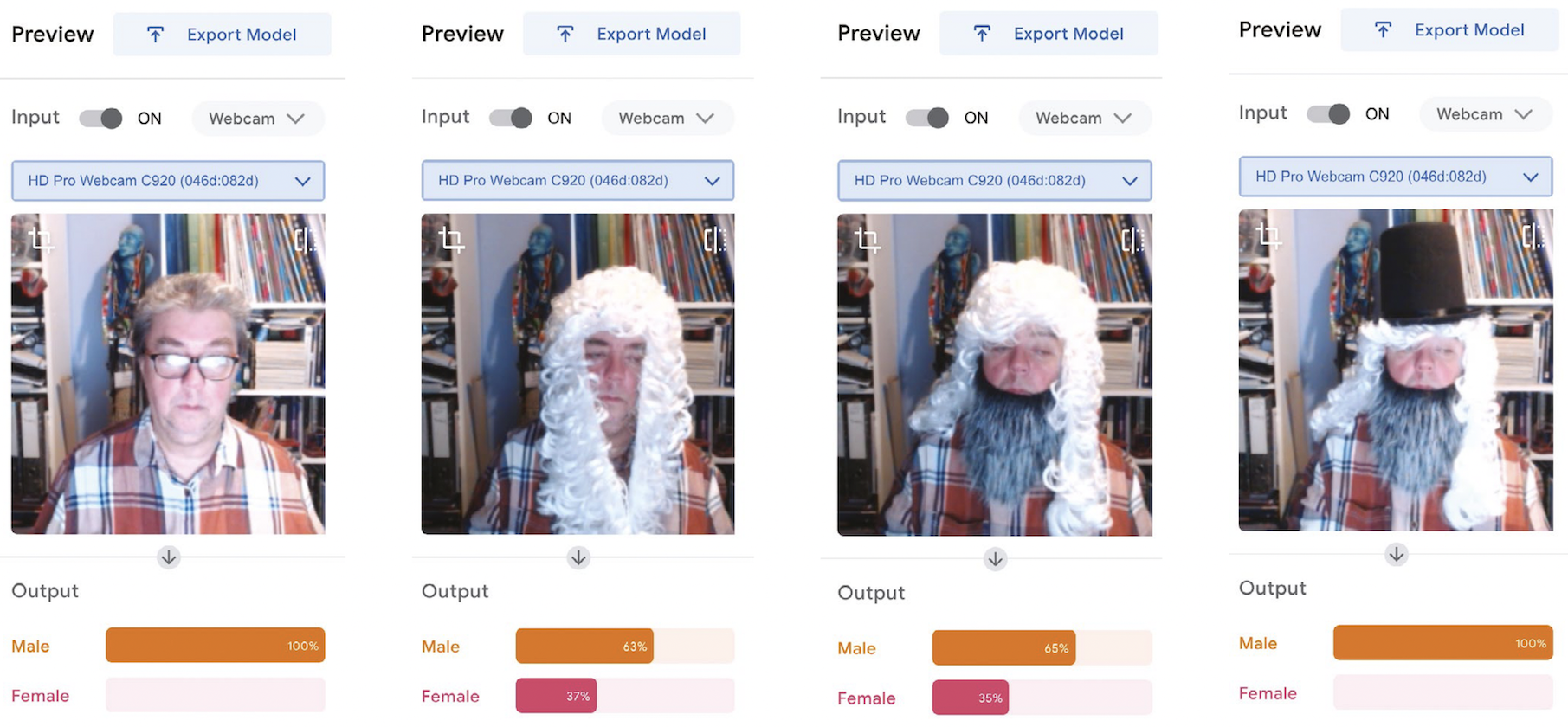
Machine learning uses a best-fit principle. The outputs, in this case whether I am male or female, have a greater certainty of male (65 percent) versus a lesser certainty of female (35 percent) if I wear a beard (Figure 3, second image from the right). Remove the beard and the likelihood of me being female increases by 2 percent (Figure 3, second image from the left).
Within a fairly small set of parameters, most human faces are similar. However, when you start digging, the research points to there being bias in AI (whether this is conscious or unconscious is a debate for another day!). You can exemplify this by firstly creating classes with labels such as ‘young smart’, ‘old smart’, ‘young not smart’, and ‘old not smart’. Select images that you think would fit the classes, and train them in Teachable Machine. You can then test the model by asking your students to find images they think fit each category. Run them against the model and ask students to debate whether the AI is acting fairly, and if not, why they think that is. Who is training these models? What images are they receiving? Similarly, you could create classes of images of known past criminals and heroes. Train the model before putting yourself in front of it. How far up the percentage scale are you towards being a criminal? It soon becomes frighteningly worrying that unless you are white and seemingly middle class, AI may prove problematic to you, from decisions on financial products such as mortgages through to mistaken arrest and identification.
It soon becomes frighteningly worrying that unless you are white and seemingly middle class, AI may prove problematic to you, from decisions on financial products such as mortgages through to mistaken arrest and identification.
Michael Jones
Encourage your students to discuss how they could influence this issue of race, class, and gender bias — for example, what rules would they use for identifying suitable images for a data set? There are some interesting articles on this issue that you can share with your students at helloworld.cc/aibias1 and helloworld.cc/aibias2.
In the classroom, you could then follow the route of building models that identify letters for words, for example. One of my students built a model that could identify a range of spoons and forks. You may notice that Teachable Machine can also be run on Arduino boards, which adds an extra dimension. Why not get your students to create their own AI assistant that responds to commands? The possibilities are there to be explored. If you’re using webcams to collect photos yourself, why not create a system that will identify students? If you are lucky enough to have a set of identical twins in your class, that adds just a little more flavour! Teachable Machine offers a hands-on way to demonstrate the issues of AI accuracy and bias, and gives students a healthy opportunity for debate.
Michael Jones is director of Computer Science at Northfleet Technology College in the UK. He is a Specialist Leader of Education and a CS Champion for the National Centre for Computing Education.
At the Foundation, AI education is one of our focus areas. Here is how we are supporting you and your learners in this area already:
The post Classroom activities to discuss machine learning accuracy and ethics | Hello World #18 appeared first on Raspberry Pi.
At the Raspberry Pi Foundation, we’ve been thinking about questions relating to artificial intelligence (AI) education and data science education for several months now, inviting experts to share their perspectives in a series of very well-attended seminars. At the same time, we’ve been running a programme of research trials to find out what interventions in school might successfully improve gender balance in computing. We’re learning a lot, and one primary lesson is that these topics are not discrete: there are relationships between them.
We can’t talk about AI education — or computer science education more generally — without considering the context in which we deliver it, and the societal issues surrounding computing, AI, and data. For this International Women’s Day, I’m writing about the intersection of AI and gender, particularly with respect to gender bias in machine learning.
Gender inequality is everywhere, and researchers, activists, and initiatives, and governments themselves, have struggled since the 1960s to tackle it. As women and girls around the world continue to suffer from discrimination, the United Nations has pledged, in its Sustainable Development Goals, to achieve gender equality and to empower all women and girls.
While progress has been made, new developments in technology may be threatening to undo this. As Susan Leavy, a machine learning researcher from the Insight Centre for Data Analytics, puts it:
Artificial intelligence is increasingly influencing the opinions and behaviour of people in everyday life. However, the over-representation of men in the design of these technologies could quietly undo decades of advances in gender equality.
Susan Leavy, 2018 [1]
In her 2019 award-winning book Invisible Women: Exploring Data Bias in a World Designed for Men [2], Caroline Criado Perez discusses the effects of gender-biased data. She describes, for example, how the designs of cities, workplaces, smartphones, and even crash test dummies are all based on data gathered from men. She also discusses that medical research has historically been conducted by men, on male bodies.
Looking at this problem from a different angle, researcher Mayra Buvinic and her colleagues highlight that in most countries of the world, there are no sources of data that capture the differences between male and female participation in civil society organisations, or in local advisory or decision making bodies [3]. A lack of data about girls and women will surely impact decision making negatively.
Machine learning (ML) is a type of artificial intelligence technology that relies on vast datasets for training. ML is currently being use in various systems for automated decision making. Bias in datasets for training ML models can be caused in several ways. For example, datasets can be biased because they are incomplete or skewed (as is the case in datasets which lack data about women). Another example is that datasets can be biased because of the use of incorrect labels by people who annotate the data. Annotating data is necessary for supervised learning, where machine learning models are trained to categorise data into categories decided upon by people (e.g. pineapples and mangoes).
In order for a machine learning model to categorise new data appropriately, it needs to be trained with data that is gathered from everyone, and is, in the case of supervised learning, annotated without bias. Failing to do this creates a biased ML model. Bias has been demonstrated in different types of AI systems that have been released as products. For example:
Facial recognition: AI researcher Joy Buolamwini discovered that existing AI facial recognition systems do not identify dark-skinned and female faces accurately. Her discovery, and her work to push for the first-ever piece of legislation in the USA to govern against bias in the algorithms that impact our lives, is narrated in the 2020 documentary Coded Bias.
Natural language processing: Imagine an AI system that is tasked with filling in the missing word in “Man is to king as woman is to X” comes up with “queen”. But what if the system completes “Man is to software developer as woman is to X” with “secretary” or some other word that reflects stereotypical views of gender and careers? AI models called word embeddings learn by identifying patterns in huge collections of texts. In addition to the structural patterns of the text language, word embeddings learn human biases expressed in the texts. You can read more about this issue in this Brookings Institute report.
There is much debate about the level of bias in systems using artificial intelligence, and some AI researchers worry that this will cause distrust in machine learning systems. Thus, some scientists are keen to emphasise the breadth of their training data across the genders. However, other researchers point out that despite all good intentions, gender disparities are so entrenched in society that we literally are not aware of all of them. White and male dominance in our society may be so unconsciously prevalent that we don’t notice all its effects.
As sociologist Pierre Bourdieu famously asserted in 1977: “What is essential goes without saying because it comes without saying: the tradition is silent, not least about itself as a tradition.” [4]. This view holds that people’s experiences are deeply, or completely, shaped by social conventions, even those conventions that are biased. That means we cannot be sure we have accounted for all disparities when collecting data.
Developers and researchers of AI systems have been trying to establish rules for how to avoid bias in AI models. An example rule set is given in an article in the Harvard Business Review, which describes the fact that speech recognition systems originally performed poorly for female speakers as opposed to male ones, because systems analysed and modelled speech for taller speakers with longer vocal cords and lower-pitched voices (typically men).
The article recommends four ways for people who work in machine learning to try to avoid gender bias:
The above points can help people in the AI industry, which is of course important — but what about the rest of us? It’s important to raise awareness of the issues around gender data bias and AI lest we find out too late that we are reintroducing gender inequalities we have fought so hard to remove. Awareness is a good start, and some other suggestions, drawn out from others’ work in this area are:
Having more women in AI and data science, particularly in both technical and leadership roles, will help to reduce gender bias. A 2020 report by the World Economic Forum (WEF) on gender parity found that women account for only 26% of data and AI positions in the workforce. The WEF suggests five ways in which the AI workforce gender balance could be addressed:
We need high-quality dataset on women and girls, with good coverage, including country coverage. Data needs to be comparable across countries in terms of concepts, definitions, and measures. Data should have both complexity and granularity, so it can be cross-tabulated and disaggregated, following the recommendations from the Data2x project on mapping gender data gaps.
At the Raspberry Pi Foundation we believe that introducing some of the potential (positive and negative) impacts of AI systems to young people through their school education may help to build awareness and understanding at a young age. The jury is out on what exactly to teach in AI education, and how to teach it. But we think educating young people about new and future technologies can help them to see AI-related work opportunities as being open to all, and to develop critical and ethical thinking.
In our AI education seminars we heard a number of perspectives on this topic, and you can revisit the videos, presentation slides, and blog posts. We’ve also been curating a list of resources that can help to further AI education — although there is a long way to go until we understand this area fully.
We’d love to hear your thoughts on this topic.
References
[1] Leavy, S. (2018). Gender bias in artificial intelligence: The need for diversity and gender theory in machine learning. Proceedings of the 1st International Workshop on Gender Equality in Software Engineering, 14–16.
[2] Perez, C. C. (2019). Invisible Women: Exploring Data Bias in a World Designed for Men. Random House.
[3] Buvinic M., Levine R. (2016). Closing the gender data gap. Significance 13(2):34–37
[4] Bourdieu, P. (1977). Outline of a Theory of Practice (No. 16). Cambridge University Press. (p.167)
The post Bias in the machine: How can we address gender bias in AI? appeared first on Raspberry Pi.
Our seminars in this series on AI and data science education, co-hosted with The Alan Turing Institute, have been covering a range of different topics and perspectives. This month was no exception. We were delighted to be able to host Tara Chklovski, CEO of Technovation, whose presentation was called ‘Teaching youth to use AI to tackle the Sustainable Development Goals’.
Tara started Technovation, formerly called Iridescent, in 2007 with a family science programme in one school in Los Angeles. The nonprofit has grown hugely, and Technovation now runs computing education activities across the world. We heard from Tara that over 350,000 girls from more than 100 countries take part in their programmes, and that the nonprofit focuses particularly on empowering girls to become tech entrepreneurs. The girls, with support from industry volunteers, parents, and the Technovation curriculum, work in teams to solve real-world problems through an annual event called the Technovation Challenge. Working at scale with young people has given the Technovation team the opportunity to investigate the impact of their programmes as well as more generally learn what works in computing education.
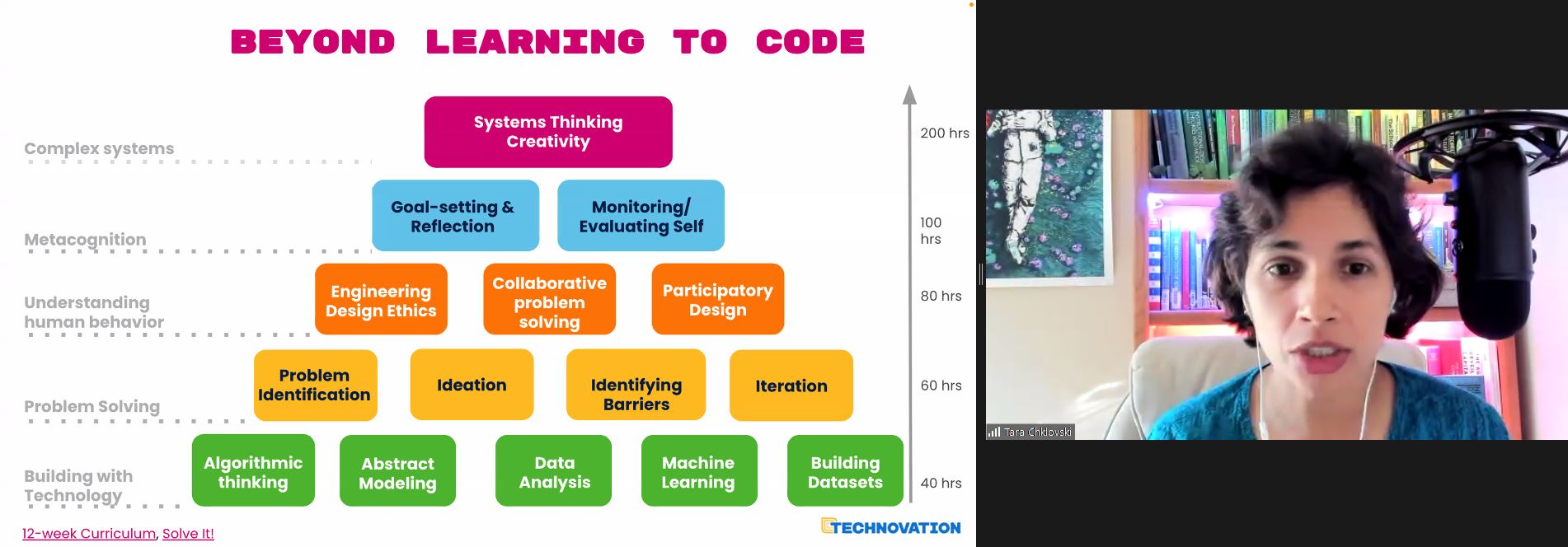
Tara’s talk was extremely engaging (you’ll find the recording below), with videos of young people who had participated in recent years. Technovation works with volunteers and organisations to reach young people in communities where opportunities may be lacking, focussing on low- and middle-income countries. Tara spoke about the 900 million teenage girls in the world, a substantial number of whom live in countries where there is considerable inequality.
To illustrate the impact of the programme, Tara gave a number of examples of projects that students had developed, including:
Early on, the Technovation Challenge had involved the creation of mobile apps, but in recent years, the projects have focused on using AI technologies to solve problems. An key message that Tara wanted to get across was that the focus on real-world problems and teamwork was as important, if not more, than the technical skills the young people were developing.
Technovation has designed an online curriculum to support teams, who may have no prior computing experience, to learn how to design an AI project. Students work through units on topics such as data analysis and building datasets. As well as the technical activities, young people also work through activities on problem-solving approaches, design, and system thinking to help them tackle a real-world problem that is relevant to them. The curriculum supports teams to identify problems in their community and find a path to prototype and share an invention to tackle that problem.
While working through the curriculum, teams develop AI models to address the problem that they have chosen. They then submit them to a global competition for beginners, juniors, and seniors. Many of the girls enjoy the Technovation Challenge so much that they come back year on year to further develop their team skills.
Technovation runs another programme, AI Families, that focuses on families working together to learn AI concepts and skills and use them to develop projects together. Families worked together with the help of educators to identify meaningful problems in their communities, and developed AI prototypes to address them.
There were 20,000 participants from under-resourced communities in 17 countries through 2018 and 2019. 70% of them were women (mothers and grandmothers) who wanted their children to participate; in this way the programme encouraged parents to be role models for their daughters, as well as enabling families to understand that AI is a tool that could be used to think about what problems in their community can be solved with the help of AI skills and principles. Tara was keen to emphasise that, given the importance of AI in the world, the more people know about it, the more impact they can make on their local communities.
Tara shared links to the curriculum to demonstrate what families in this programme would learn week by week. The AI modules use tools such as Machine Learning for Kids.
The results of the AI Families project as investigated over 2018 and 2019 are reported in this paper. The findings of the programme included:
The research describes how the programme worked pre-pandemic. Tara highlighted that although the pandemic has prevented so much face-to-face team work, it has allowed some young people to access education online that they would not have otherwise had access to.
Our goal is to listen to a variety of perspectives through this seminar series, and I felt that Tara really offered something fresh and engaging to our seminar audience, many of them (many of you!) regular attendees who we’ve got to know since we’ve been running the seminars. The seminar combined real-life stories with videos, as well as links to the curriculum used by Technovation to support learners of AI. The ‘question and answer’ session after the seminar focused on ways in which people could engage with the programme. On Twitter, one of the seminar participants declared this seminar “my favourite thus far in the series”. It was indeed very inspirational.
As we near the end of this series, we can start to reflect on what we’ve been learning from all the various speakers, and I intend to do this more formally in a month or two as we prepare Volume 3 of our seminar proceedings. While Tara’s emphasis is on motivating children to want to learn the latest technologies because they can see what they can achieve with them, some of our other speakers have considered the actual concepts we should be teaching, whether we have to change our approach to teaching computer science if we include AI, and how we should engage young learners in the ethics of AI.
I’m really looking forward to our final seminar in the series, with Stefania Druga, on Tuesday 1 March at 17:00–18:30 GMT. Stefania, PhD candidate at the University of Washington Information School, will also focus on families. In her talk ‘Democratising AI education with and for families’, she will consider the ways that children engage with smart, AI-enabled devices that they are becoming part of their everyday lives. It’s a perfect way to finish this series, and we hope you’ll join us.
Thanks to our seminars series, we are developing a list of AI education resources that seminar speakers and attendees share with us, plus the free resources we are developing at the Foundation. Please do take a look.
You can find all blog posts relating to our previous seminars on this page.
The post Linking AI education to meaningful projects appeared first on Raspberry Pi.
We are hosting a series of free research seminars about how to teach artificial intelligence (AI) and data science to young people, in partnership with The Alan Turing Institute.
In the fifth seminar of this series, we heard from Rose Luckin, Professor of Learner Centred Design at the University College London (UCL) Knowledge Lab. Rose is Founder of EDUCATE Ventures Research Ltd., a London consultancy service working with start-ups, researchers, and educators to develop evidence-based educational technology.
Based on her experience at EDUCATE, Rose spoke about how AI-based analysis could help educators gain a deeper understanding of their students, and how educators could work with AI systems to provide better learning resources to their students. This provided us with a different angle to the first four seminars in our current series, where we’ve been thinking about how young people learn to understand AI systems.
AI systems have the potential to impact education in a number of different ways, which Rose distilled into three areas:
It is clear that the three areas are interconnected, meaning developments in one area will affect the others. Rose’s focus during the seminar was the second area: educating people about AI.
Through giving examples of existing AI-based systems used for education, Rose described what in particular it is about AI systems that can be useful in an education setting. The first point she raised was that AI systems can adapt based on learning from data. Her main example was the AI-based platform ENSKILLS, which detects the user’s level of competency with spoken English through the user’s interactions with a virtual character, and gradually adapts the character to the user’s level. Other examples of adaptive AI systems for education include Carnegie Learning and Century Intelligent Learning.
We know that AI systems can respond to different forms of data. Rose introduced the example of OyaLabs to demonstrate how AI systems can gather and process real-time sensory data. This is an app that parents can use in a young child’s room to monitor the child’s interactions with others. The app analyses the data it gathers and produces advice for parents on how they can support their child’s language development.
AI system creators can also combine adaptivity and real-time sensory data processing in their systems. One example Rosa gave of this was SimSensei from the University of Southern California. This is a simulated coach, which a student can interact with and which gathers real-time data about how the student is speaking, including their tone, speed of speech, and facial expressions. The system adapts its coaching advice based on these interactions and on what it learns from interactions with other students.
For the remainder of her presentation, Rose focused on the framework she is involved in developing, as part of the EDUCATE service, to support organisations to prepare for implementing AI systems, including educators within these organisations. The aim of this ETHICAI framework is to enable organisations and educators to understand:
Rose described the seven steps of the framework as:
She then went on to demonstrate how the framework is applied using the example of online teaching. Online teaching has been a key part of education throughout the coronavirus pandemic; AI systems could be used to analyse datasets generated during online teaching sessions, in order to make decisions for and recommendations to educators.
The first step of the ETHICAI framework is educate, enthuse, excite. In Rose’s example, this step consisted of choosing online teaching as a scenario, because it is very pertinent to a teacher’s practice. The second step is to tailor and hone in on particular challenges that are to be the focus, capitalising on what AI systems can do. In Rose’s example, the challenge is assessing the quality of online lessons in a way that would be useful to educators. The third step of the framework is to identify what data is required to perform this quality assessment.
The fourth step is the collection of new data relevant to the focus of the project. The aim is to gain an increased understanding of what happens in online learning across thousands of schools. Walking through the online learning example, Rose suggested we might be able to collect the following types of data:
It is important to consider the ethical implications of gathering all this data about students, something that was a recurrent theme in both Rose’s presentation and the Q&A at the end.
Step five of the ETHICAI framework focuses on applying AI techniques to the relevant data to combine and process it. The figure below shows that in preparation, the various data sets need to be collated, cleaned, organised, and transformed.
From the correctly prepared data, interaction profiles can be produced in order to put characteristics from different lessons into groups/profiles. Rose described how cluster analysis using a combination of both AI and human intelligence could be used to sort lessons into groups based on common features.
The sixth step in Rose’s example focused on what may be learned from analysing collected data linked to the particular challenge of online teaching and learning. Rose said that applying an AI system to students’ behavioural data could, for example, give indications about students’ focus and confidence, and make or recommend interventions to educators accordingly.
Rose described that AI systems can possess some types of intelligence humans have or can develop: interdisciplinary academic intelligence, meta-knowing intelligence, and potentially social intelligence. However, there are types such as meta-contextual intelligence and perceived self-efficacy that AI systems are not able to demonstrate in the way humans can.
The use of AI systems in education can cause ethical issues. As an example, Rose pointed out the use of virtual glasses to identify when students need help, even if they do not realise it themselves. A system like this could help educators with assessing who in their class needs more help, and could link this back to student performance. However, using such a system like this has obvious ethical implications, and some of these were the focus of the Q&A that followed Rose’s presentation.
It’s clear that, in the education domain as in all other domains, both positive and negative outcomes of integrating AI are possible. In a recent paper written by Wayne Holmes (also from the UCL Knowledge Lab) and co-authors, ‘Ethics of AI in Education: Towards a Community Wide Framework’ [1], the authors suggest that the interpretation of data, consent and privacy, data management, surveillance, and power relations are all ethical issues that should be taken into consideration. Finding consensus for a practical ethical framework or set of principles, with all stakeholders, at the very start of an AI-related project is the only way to ensure ethics are built into the project and the AI system itself from the ground up.
Ethical issues of AI systems more broadly, and how to involve young people in discussions of AI ethics, were the focus of our seminar with Dr Mhairi Aitken back in September. You can revisit the seminar recording, presentation slides, and summary blog post.
I really enjoyed both the focus and content of Rose’s talk: educators understanding how AI systems may be applied to education in order to help them make more informed decisions about how to best support their students. This is an important factor to consider in the context of the bigger picture of what young people should be learning about AI. The work that Rose and her colleagues are doing also makes an important contribution to translating research into practical models that teachers can use.
You may still have time to sign up for our Tuesday 11 January seminar, today at 17:00–18:30 GMT, where we will welcome Dave Touretzky and Fred Martin, founders of the influential AI4K12 framework, which identifies the five big ideas of AI and how they can be integrated into education.
Next month, on 1 February at 17:00–18:30 GMT, Tara Chklovski (CEO of Technovation) will give a presentation called Teaching youth to use AI to tackle the Sustainable Development Goals at our seminar series.
If you want to join any of our seminars, click the button below to sign up and we will send you information on how to join. We look forward to seeing you there!
You’ll always find our schedule of upcoming seminars on this page. For previous seminars, you can visit our past seminars and recordings page.
The post How can AI-based analysis help educators support students? appeared first on Raspberry Pi.
In Hello World issue 12, our free magazine for computing educators, George Boukeas, DevOps Engineer for the Astro Pi Challenge here at the Foundation, introduces big moments in the history of artificial intelligence (AI) to share with your learners:
The story of artificial intelligence (AI) is a story about humans trying to understand what makes them human. Some of the episodes in this story are fascinating. These could help your learners catch a glimpse of what this field is about and, with luck, compel them to investigate further.
In 1950, Alan Turing published a philosophical essay titled Computing Machinery and Intelligence, which started with the words: “I propose to consider the question: Can machines think?” Yet Turing did not attempt to define what it means to think. Instead, he suggested a game as a proxy for answering the question: the imitation game. In modern terms, you can imagine a human interrogator chatting online with another human and a machine. If the interrogator does not successfully determine which of the other two is the human and which is the machine, then the question has been answered: this is a machine that can think.
This imitation game is now a fiercely debated benchmark of artificial intelligence called the Turing test. Notice the shift in focus that Turing suggests: thinking is to be identified in terms of external behaviour, not in terms of any internal processes. Humans are still the yardstick for intelligence, but there is no requirement that a machine should think the way humans do, as long as it behaves in a way that suggests some sort of thinking to humans.
In his essay, Turing also discusses learning machines. Instead of building highly complex programs that would prescribe every aspect of a machine’s behaviour, we could build simpler programs that would prescribe mechanisms for learning, and then train the machine to learn the desired behaviour. Turing’s text provides an excellent metaphor that could be used in class to describe the essence of machine learning: “Instead of trying to produce a programme to simulate the adult mind, why not rather try to produce one which simulates the child’s? If this were then subjected to an appropriate course of education one would obtain the adult brain. We have thus divided our problem into two parts: the child-programme and the education process.”
It is remarkable how Turing even describes approaches that have since been evolved into established machine learning methods: evolution (genetic algorithms), punishments and rewards (reinforcement learning), randomness (Monte Carlo tree search). He even forecasts the main issue with some forms of machine learning: opacity. “An important feature of a learning machine is that its teacher will often be very largely ignorant of quite what is going on inside, although he may still be able to some extent to predict his pupil’s behaviour.”
The term ‘artificial intelligence’ was coined in 1956, at an event called the Dartmouth workshop. It was a gathering of the field’s founders, researchers who would later have a huge impact, including John McCarthy, Claude Shannon, Marvin Minsky, Herbert Simon, Allen Newell, Arthur Samuel, Ray Solomonoff, and W.S. McCulloch.
The simple and ambitious definition for artificial intelligence, included in the proposal for the workshop, is illuminating: ‘making a machine behave in ways that would be called intelligent if a human were so behaving’. These pioneers were making the assumption that ‘every aspect of learning or any other feature of intelligence can in principle be so precisely described that a machine can be made to simulate it’. This assumption turned out to be patently false and led to unrealistic expectations and forecasts. Fifty years later, McCarthy himself stated that ‘it was harder than we thought’.
Modern definitions of intelligence are of distinctly different flavour than the original one: ‘Intelligence is the quality that enables an entity to function appropriately and with foresight in its environment’ (Nilsson). Some even speak of rationality, rather than intelligence: ‘doing the right thing, given what it knows’ (Russell and Norvig).
In the full article, which you can read in the free PDF copy of the issue, George looks at:
In your free PDF of Hello World issue 12, you’ll also find:
You can also read many of these articles online on the Hello World website.
In Hello World issue 16, the focus is on all things data science and data literacy for your learners. As always, you can download a free copy of the issue. And on our Hello World podcast, we chat with practicing computing educators about how they bring AI, AI ethics, machine learning, and data science to the young people they teach.
If you want a practical introduction to the basics of machine learning and how to use it, take our free online course.
There are still many open questions about what good AI and data science education looks like for young people. To learn more, you can watch our panel discussion about the topic, and join our monthly seminar series to hear insights from computing education researchers around the world.
We are also collating a growing list of educational resources about these topics based on our research seminars, seminar participants’ recommendations, and our own work. Find the resource list here.
The post Snapshots from the history of AI, plus AI education resources appeared first on Raspberry Pi.
AI is a broad and rapidly developing field of technology. Our goal is to make sure all young people have the skills, knowledge, and confidence to use and create AI systems. So what should AI education in schools look like?
To hear a range of insights into this, we organised a panel discussion as part of our seminar series on AI and data science education, which we co-host with The Alan Turing Institute. Here our panel chair Tabitha Goldstaub, Co-founder of CogX and Chair of the UK government’s AI Council, summarises the event. You can also watch the recording below.
As part of the Raspberry Pi Foundation’s monthly AI education seminar series, I was delighted to chair a special panel session to broaden the range of perspectives on the subject. The members of the panel were:
The session explored the UK government’s commitment in the recently published UK National AI Strategy stating that “the [UK] government will continue to ensure programmes that engage children with AI concepts are accessible and reach the widest demographic.” We discussed what it will take to make this a reality, and how we will ensure young people have a seat at the table.
It was clear that the Minister felt it is very important for young people to understand AI. He said, “The government takes the view that AI is going to be one of the foundation stones of our future prosperity and our future growth. It’s an enabling technology that’s going to have almost universal applicability across our entire economy, and that is why it’s so important that the United Kingdom leads the world in this area. Young people are the country’s future, so nothing is complete without them being at the heart of it.”
Our panelist Caitlin Glover, an A level student at Sandon School, reiterated this from her perspective as a young person. She told us that her passion for AI started initially because she wanted to help neurodiverse young people like herself. Her idea was to start a company that would build AI-powered products to help neurodiverse students.
A theme of the Foundation’s seminar series so far has been how learning about AI early may impact young people’s career choices. Our panelist Alice Ashby, who studies Computer Science and AI at Brighton University, told us about her own process of deciding on her course of study. She pointed to the fact that terms such as machine learning, natural language processing, self-driving cars, chatbots, and many others are currently all under the umbrella of artificial intelligence, but they’re all very different. Alice thinks it’s hard for young people to know whether it’s the right decision to study something that’s still so ambiguous.
When I asked Alice what gave her the courage to take a leap of faith with her university course, she said, “I didn’t know it was the right move for me, honestly. I took a gamble, I knew I wanted to be in computer science, but I wanted to spice it up.” The AI ecosystem is very lucky that people like Alice choose to enter the field even without being taught what precisely it comprises.
We also heard from Danielle Belgrave, a Research Scientist at DeepMind with a remarkable career in AI for healthcare. Danielle explained that she was lucky to have had a Mathematics teacher who encouraged her to work in statistics for healthcare. She said she wanted to ensure she could use her technical skills and her love for math to make an impact on society, and to really help make the world a better place. Danielle works with biologists, mathematicians, philosophers, and ethicists as well as with data scientists and AI researchers at DeepMind. One possibility she suggested for improving young people’s understanding of what roles are available was industry mentorship. Linking people who work in the field of AI with school students was an idea that Caitlin was eager to confirm as very useful for young people her age.
The AI Council’s Roadmap stresses how important it is to not only teach the skills needed to foster a pool of people who are able to research and build AI, but also to ensure that every child leaves school with the necessary AI and data literacy to be able to become engaged, informed, and empowered users of the technology. During the panel, the Minister, Chris Philp, spoke about the fact that people don’t have to be technical experts to come up with brilliant ideas, and that we need more people to be able to think creatively and have the confidence to adopt AI, and that this starts in schools.
Caitlin is a perfect example of a young person who has been inspired about AI while in school. But sadly, among young people and especially girls, she’s in the minority by choosing to take computer science, which meant she had the chance to hear about AI in the classroom. But even for young people who choose computer science in school, at the moment AI isn’t in the national Computing curriculum or part of GCSE computer science, so much of their learning currently takes place outside of the classroom. Caitlin added that she had had to go out of her way to find information about AI; the majority of her peers are not even aware of opportunities that may be out there. She suggested that we ensure AI is taught across all subjects, so that every learner sees how it can make their favourite subject even more magical and thinks “AI’s cool!”.
Philip Colligan, the CEO here at the Foundation, also described how AI could be integrated into existing subjects including maths, geography, biology, and citizenship classes. Danielle thoroughly agreed and made the very good point that teaching this way across the school would help prepare young people for the world of work in AI, where cross-disciplinary science is so important. She reminded us that AI is not one single discipline. Instead, many different skill sets are needed, including engineering new AI systems, integrating AI systems into products, researching problems to be addressed through AI, or investigating AI’s societal impacts and how humans interact with AI systems.
On hearing about this multitude of different skills, our discussion turned to the teachers who are responsible for imparting this knowledge, and to the challenges they face.
When we shifted the focus of the discussion to teachers, Philip said: “If we really want to equip every young person with the knowledge and skills to thrive in a world that shaped by these technologies, then we have to find ways to evolve the curriculum and support teachers to develop the skills and confidence to teach that curriculum.”
I asked the Minister what he thought needed to happen to ensure we achieved data and AI literacy for all young people. He said, “We need to work across government, but also across business and society more widely as well.” He went on to explain how important it was that the Department for Education (DfE) gets the support to make the changes needed, and that he and the Office for AI were ready to help.
Philip explained that the Raspberry Pi Foundation is one of the organisations in the consortium running the National Centre for Computing Education (NCCE), which is funded by the DfE in England. Through the NCCE, the Foundation has already supported thousands of teachers to develop their subject knowledge and pedagogy around computer science.
A recent study recognises that the investment made by the DfE in England is the most comprehensive effort globally to implement the computing curriculum, so we are starting from a good base. But Philip made it clear that now we need to expand this investment to cover AI.
Philip described how brilliant it is to witness young people who choose to get creative with new technologies. As an example, he shared that the Foundation is seeing more and more young people employ machine learning in the European Astro Pi Challenge, where participants run experiments using Raspberry Pi computers on board the International Space Station.
Philip also explained that, in the Foundation’s non-formal CoderDojo club network and its Coolest Projects tech showcase events, young people build their dream AI products supported by volunteers and mentors. Among these have been autonomous recycling robots and AI anti-collision alarms for bicycles. Like Caitlin with her company idea, this shows that young people are ready and eager to engage and create with AI.
We closed out the panel by going back to a point raised by Mhairi Aitken, who presented at the Foundation’s research seminar in September. Mhairi, an Alan Turing Institute ethics fellow, argues that children don’t just need to learn about AI, but that they should actually shape the direction of AI. All our panelists agreed on this point, and we discussed what it would take for young people to have a seat at the table.
Alice advised that we start by looking at our existing systems for engaging young people, such as Youth Parliament, student unions, and school groups. She also suggested adding young people to the AI Council, which I’m going to look into right away! Caitlin agreed and added that it would be great to make these forums virtual, so that young people from all over the country could participate.
The panel session was full of insight and felt very positive. Although the challenge of ensuring we have a data- and AI-literate generation of young people is tough, it’s clear that if we include them in finding the solution, we are in for a bright future.
In the coming months, our goal at the Foundation is to increase our understanding of the concepts underlying AI education and how to teach them in an age-appropriate way. To that end, we will start to conduct a series of small AI education research projects, which will involve gathering the perspectives of a variety of stakeholders, including young people. We’ll make more information available on our research pages soon.
In the meantime, you can sign up for our upcoming research seminars on AI and data science education, and peruse the collection of related resources we’ve put together.
The post How do we develop AI education in schools? A panel discussion appeared first on Raspberry Pi.
How does teaching children and young people about machine learning (ML) differ from teaching them about other aspects of computing? Professor Matti Tedre and Dr Henriikka Vartiainen from the University of Eastern Finland shared some answers at our latest research seminar.
Their presentation, titled ‘ML education for K-12: emerging trajectories’, had a profound impact on my thinking about how we teach computational thinking and programming. For this blog post, I have simplified some of the complexity associated with machine learning for the benefit of readers who are new to the topic.
We’re currently partnering with The Alan Turing Institute to host a series of free research seminars about how to teach artificial intelligence (AI) and data science to young people.
The seminar with Matti and Henriikka, the third one of the series, was very well attended. Over 100 participants from San Francisco to Rajasthan, including teachers, researchers, and industry professionals, contributed to a lively and thought-provoking discussion.
Representing a large interdisciplinary team of researchers, Matti and Henriikka have been working on how to teach AI and machine learning for more than three years, which in this new area of study is a long time. So far, the Finnish team has written over a dozen academic papers based on their pilot studies with kindergarten-, primary-, and secondary-aged learners.
Matti and Henriikka started by giving an overview of classical programming and how it is currently taught in schools. Classical programming can be described as rule-driven. Example features of classical computer programs and programming languages are:
When we teach this type of programming, we show learners how to use a deductive problem solving approach or workflow: defining the task, designing a possible solution, and implementing the solution by writing a stepwise program that is then run on a computer. We encourage learners to avoid using trial and error to write programs. Instead, as they develop and test a program, we ask them to trace it line by line in order to predict what will happen when each line is run (glass-box testing).
Classical programming underpins the current view of computational thinking (CT). Our speakers called this version of CT ‘CT 1.0’. So what’s the alternative Matti and Henriikka presented, and how does it affect what computational thinking is or may become?
Rule-based programming languages are not being eradicated. Instead, software systems are being augmented through the addition of machine learning (data-driven) elements. Many of today’s successful software products, such as search engines, image classifiers, and speech recognition programs, combine rule-driven software and data-driven models. However, the workflows for these two approaches to solving problems through computing are very different.
Significantly, while in rule-based programming (and CT 1.0), the focus is on solving problems by creating algorithms, in data-driven approaches, the problem solving workflow is all about the data. To highlight the profound impact this shift in focus has on teaching and learning computing, Matti introduced us to a new version of computational thinking for machine learning, CT 2.0, which is detailed in a forthcoming research paper.
Because of the focus on data rather than algorithms, developing a machine learning model is not at all like developing a classical rule-driven program. In classical programming, programs can be traced, and we can predict what will happen when they run. But in data-driven development, there is no flow of rules, and no absolutely right or wrong answer.
Machine learning models are created iteratively using training data and must be cross-validated with test data. A tiny change in the data provided can make a model useless. We rarely know exactly why the output of an ML model is as it is, and we cannot explain each individual decision that the model might have made. When evaluating a machine learning system, we can only say how well it works based on statistical confidence and efficiency.
The ethical and societal implications of computer science have always been important for students to understand. But machine learning models open up a whole new set of topics for teachers and students to consider, because of these models’ reliance on large datasets, the difficulty of explaining their decisions, and their usefulness for automating very complex processes. This includes privacy, surveillance, diversity, bias, job losses, misinformation, accountability, democracy, and veracity, to name but a few.
I see the shift in problem solving approach as a chance to strengthen the teaching of computing in general, because it opens up opportunities to teach about systems, uncertainty, data, and society.
Jane Waite
For teaching classical rule-driven programming, much time and effort has been put into researching learners’ understanding of what a program will do when it is run. This kind of understanding is called a learner’s mental model or notional machine. An approach teachers often use to help students develop a useful mental model of a program is to hide the detail of how the program works and only gradually reveal its complexity. This approach is described with the metaphor of hiding the detail of elements of the program in a box.
Data-driven models in machine learning systems are highly complex and make little sense to humans. Therefore, they may appear like magic boxes to students. This view needs to be banished. Machine learning is not magic. We have just not figured out yet how to explain the detail of data-driven models in a way that allows learners to form useful mental models.
Some existing ML tools aim to help learners form mental models of ML, for example through visual representations of how a neural network works (see above). But these explanations are still very complex. Clearly, we need to find new ways to help learners of all ages form useful mental models of machine learning, so that teachers can explain to them how machine learning systems work and banish the view that machine learning is magic.
Matti and Henriikka’s team piloted different tools and pedagogical approaches with different age groups of learners. In terms of tools, since large amounts of data are needed for machine learning projects, our presenters suggested that tools that enable lots of data to be easily collected are ideal for teaching activities. Media-rich education tools provide an opportunity to capture still images, movements, sounds, or sense other inputs and then use these as data in machine learning teaching activities. For example, to create a machine learning–based rock-paper-scissors game, students can take photographs of their hands to train a machine learning model using Google Teachable Machine.
Similar to tools that teach classic programming to novice students (e.g. Scratch), some of the new classroom tools for teaching machine learning have a drag-and-drop interface (e.g. Cognimates). Using such tools means that in lessons, there can be less focus on one of the more complex aspects of learning to program, learning programming language syntax. However, not all machine learning education products include drag-and-drop interaction, some instead have their own complex languages (e.g. Wolfram Programming Lab), which are less attractive to teachers and learners. In their pilot studies, the Finnish team found that drag-and-drop machine learning tools appeared to work well with students of all ages.
The different pedagogical approaches the Finnish research team used in their pilot studies included an exploratory approach with preschool children, who investigated machine learning recognition of happy or sad faces; and a project-based approach with older students, who co-created machine learning apps with web-based tools such as Teachable Machine and Learn Machine Learning (built by the research team), supported by machine learning experts.
What impact these pedagogies have on students’ long-term mental models about machine learning has yet to be researched. If you want to find out more about the classroom pilot studies, the academic paper is a very accessible read.
We all learned a tremendous amount from Matti and Henriikka and their perspectives on this important topic. Our seminar participants asked them many questions about the pedagogies and practicalities of teaching machine learning in class, and raised concerns about squeezing more into an already packed computing curriculum.
For me, the most significant take-away from the seminar was the need to shift focus from algorithms to data and from CT 1.0 to CT 2.0. Learning how to best teach classical rule-driven programming has been a long journey that we have not yet completed. We are forming an understanding of what concepts learners need to be taught, the progression of learning, key mental models, pedagogical options, and assessment approaches. For teaching data-driven development, we need to do the same.
The question of how we make sure teachers have the necessary understanding is key.
Jane Waite
I see the shift in problem solving approach as a chance to strengthen the teaching of computing in general, because it opens up opportunities to teach about systems, uncertainty, data, and society. I think it will help us raise awareness about design, context, creativity, and student agency. But I worry about how we will introduce this shift. In my view, there is a considerable risk that we will be sucked into open-ended, project-based learning, with busy and fun but shallow learning experiences that result in restricted conceptual development for students.
I also worry about how we can best help teachers build up the knowledge and experience to support their students. In the Q&A after the seminar, I asked Matti and Henriikka about the role of their team’s machine learning experts in their pilot studies. It seemed to me that without them, the pilot lessons would not have worked, as the participating teachers and students would not have had the vocabulary to talk about the process and would not have known what was doable given the available time, tools, and student knowledge.
The question of how we make sure teachers have the necessary understanding is key. Many existing professional development resources for teachers wanting to learn about ML seem to imply that teachers will all need a PhD in statistics and neural network optimisation to engage with machine learning education. This is misleading. But teachers do need to understand the machine learning concepts that their students need to learn about, and I think we don’t yet know exactly what these concepts are.
In summary, clearly more research is needed. There are fundamental questions still to be answered about what, when, and how we teach data-driven approaches to software systems development and how this impacts what we teach about classical, rule-based programming. But to me, that is exciting, and I am very much looking forward to the journey ahead.
To find out what others recommend about teaching AI and ML, catch up on last month’s seminar with Professor Carsten Schulte and colleagues on centring data instead of code in the teaching of AI.
We have another four seminars in our monthly series on AI, machine learning, and data science education. Find out more about them on this page, and catch up on past seminar blogs and recordings here.
At our next seminar on Tuesday 7 December at 17:00–18:30 GMT, we will welcome Professor Rose Luckin from University College London. She will be presenting on what it is about AI that makes it useful for teachers and learners.
We look forward to meeting you there!
The post The machine learning effect: Magic boxes and computational thinking 2.0 appeared first on Raspberry Pi.
Join our free online course Introduction to Machine Learning and AI to discover the fundamentals of machine learning and learn to train your own machine learning models using free online tools.
Although artificial intelligence (AI) was once the province of science fiction, these days you’re very likely to hear the term in relation to new technologies, whether that’s facial recognition, medical diagnostic tools, or self-driving cars, which use AI systems to make decisions or predictions.
By the end of this free, online, self-paced course, you will have an appreciation for what goes into machine learning and artificial intelligence systems — and why you should think carefully about what comes out.
You’ll also often hear about AI systems that use machine learning (ML). Very simply, we can say that programs created using ML are ‘trained’ on large collections of data to ‘learn’ to produce more accurate outputs over time. One rather funny application you might have heard of is the ‘muffin or chihuahua?’ image recognition task.
More precisely, we would say that a ML algorithm builds a model, based on large collections of data (the training data), without being explicitly programmed to do so. The model is ‘finished’ when it makes predictions or decisions with an acceptable level of accuracy. (For example, it rarely mistakes a muffin for a chihuahua in a photo.) It is then considered to be able to make predictions or decisions using new data in the real world.
But how does all this actually work? If you don’t know, it’s hard to judge what the impacts of these technologies might be, and how we can be sure they benefit everyone — an important discussion that needs to involve people from across all of society. Not knowing can also be a barrier to using AI, whether that’s for a hobby, as part of your job, or to help your community solve a problem.
For teachers and educators it’s particularly important to have a good foundational knowledge of AI and ML, as they need to teach their learners what the young people need to know about these technologies and how they impact their lives. (We’ve also got a free seminar series about teaching these topics.)
To help you understand the fundamentals of AI and ML, we’ve put together a free online course: Introduction to Machine Learning and AI. Over four weeks in two hours per week, learning at your own pace, you’ll find out how machine learning can be used to solve problems, without going too deeply into the mathematical details. You’ll also get to grips with the different ways that machines ‘learn’, and you will try out online tools such as Machine Learning for Kids and Teachable Machine to design and train your own machine learning programs.
As well as finding out how these AI systems work, you’ll look at the different types of tasks that they can help us address. One of these is classification — working out which group (or groups) something fits in, such as distinguishing between positive and negative product reviews, identifying an animal (or a muffin) in an image, or spotting potential medical problems in patient data.
You’ll also learn about other types of tasks ML programs are used for, such as regression (predicting a numerical value from a continuous range) and knowledge organisation (spotting links between different pieces of data or clusters of similar data). Towards the end of the course you’ll dive into one of the hottest topics in AI today: neural networks, which are ML models whose design is inspired by networks of brain cells (neurons).
Before an ML program can be trained, you need to collect data to train it with. During the self-paced course you’ll see how tools from statistics and data science are important for ML — but also how ethical issues can arise both when data is collected and when the outputs of an ML program are used.
By the end of the course, you will have an appreciation for what goes into machine learning and artificial intelligence systems — and why you should think carefully about what comes out.
The Introduction to Machine Learning and AI course is open for you to sign up to now. Sign-ups will pause after 12 December. Once you sign up, you’ll have access for six weeks. During this time you’ll be able to interact with your fellow learners, and before 25 October, you’ll also benefit from the support of our expert facilitators. So what are you waiting for?
As part of our research on computing education, we would like to find out about educators’ views on machine learning. Before you start the course, we will ask you to complete a short survey. As a thank you for helping us with our research, you will be offered the chance to take part in a prize draw for a £50 book token!
To develop your computing knowledge and skills, you might also want to:
If you are a teacher in England, you can develop your teaching skills through the National Centre for Computing Education, which will give you free upgrades for our courses (including Introduction to Machine Learning and AI) so you’ll receive certificates and unlimited access.
The post Learn the fundamentals of AI and machine learning with our free online course appeared first on Raspberry Pi.
Between September 2021 and March 2022, we’re partnering with The Alan Turing Institute to host a series of free research seminars about how to teach AI and data science to young people.
In the second seminar of the series, we were excited to hear from Professor Carsten Schulte, Yannik Fleischer, and Lukas Höper from the University of Paderborn, Germany, who presented on the topic of teaching AI and machine learning (ML) from a data-centric perspective. Their talk raised the question of whether and how AI and ML should be taught differently from other themes in the computer science curriculum at school.
The rationale behind the speakers’ work is a concept they call hybrid interaction system, referring to the way that humans and machines interact. To explain this concept, Carsten referred to a 2019 article published in Nature by Iyad Rahwan and colleagues: Machine hehaviour. The article’s authors propose that the study of AI agents (complex and simple algorithms that make decisions) should be a separate, cross-disciplinary field of study, because of the ubiquity and complexity of AI systems, and because these systems can have both beneficial and detrimental impacts on humanity, which can be difficult to evaluate. (Our previous seminar by Mhairi Aitken highlighted some of these impacts.) The authors state that to study this field, we need to draw on scientific practices from across different fields, as shown below:
In establishing their argument, the authors compare the study of animal behaviour and machine behaviour, citing that both fields consider aspects such as mechanism, development, evolution and function. They describe how part of this proposed machine behaviour field may focus on studying individual machines’ behaviour, while collective machines and what they call ‘hybrid human-machine behaviour’ can also be studied. By focusing on the complexities of the interactions between machines and humans, we can think both about machines shaping human behaviour and humans shaping machine behaviour, and a sort of ‘co-behaviour’ as they work together. Thus, the authors conclude that machine behaviour is an interdisciplinary area that we should study in a different way to computer science.
Carsten and his team said that, as educators, we will need to draw on the parameters and frameworks of this machine behaviour field to be able to effectively teach AI and machine learning in school. They argue that our approach should be centred on data, rather than on code. I believe this is a challenge to those of us developing tools and resources to support young people, and that we should be open to these ideas as we forge ahead in our work in this area.
In the interpretation of computational thinking popularised in 2006 by Jeanette Wing, she introduces computational thinking as being about ‘ideas, not artefacts’. When we, the computing education community, started to think about computational thinking, we moved from focusing on specific technology — and how to understand and use it — to the ideas or principles underlying the domain. The challenge now is: have we gone too far in that direction?
Carsten argued that, if we are to understand machine behaviour, and in particular, human-machine co-behaviour, which he refers to as the hybrid interaction system, then we need to be studying artefacts as well as ideas.
Throughout the seminar, the speakers reminded us to keep in mind artefacts, issues of bias, the role of data, and potential implications for the way we teach.
In addition, Carsten highlighted a number of differences between learning ML and learning other areas of computer science, including traditional programming:
These differences imply that our teaching should adapt too.
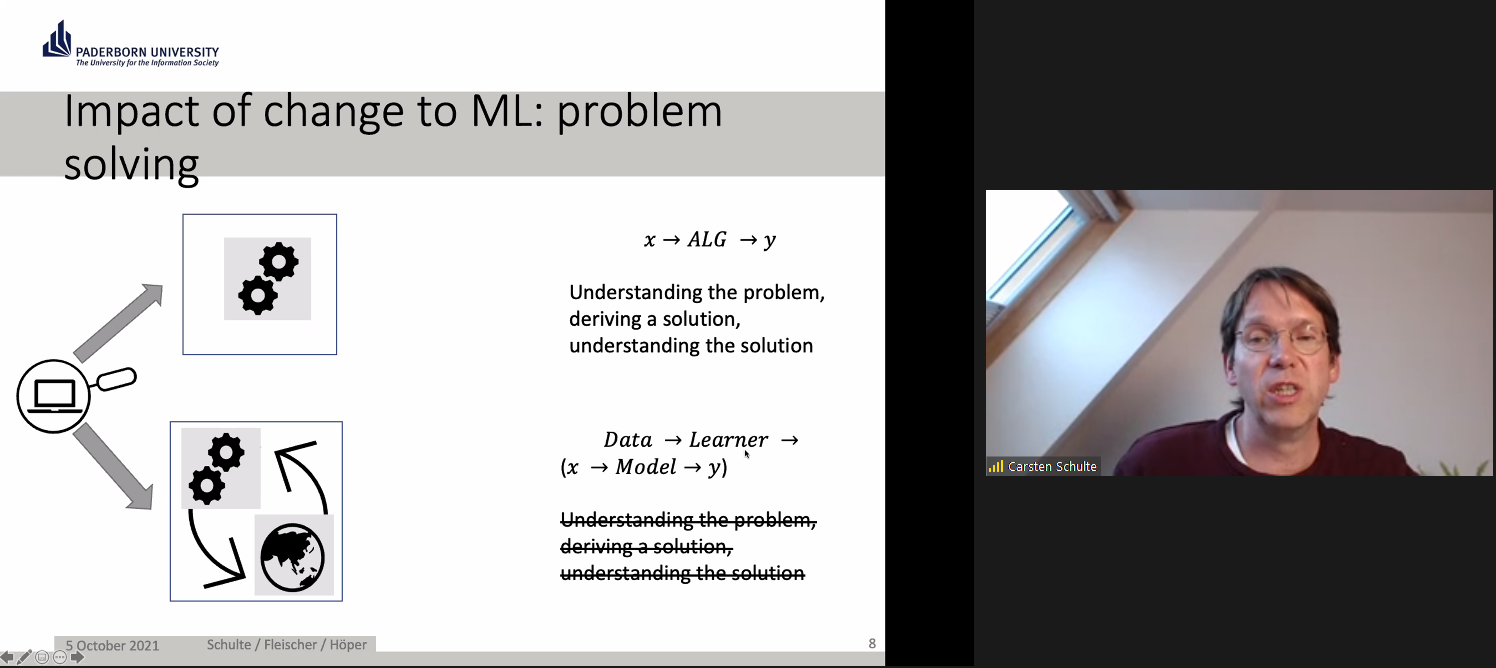
In Germany, education is devolved to state governments. Although computer science (known as informatics) was only last year introduced as a mandatory subject in lower secondary schools in North Rhine-Westphalia, where Paderborn is located, it has been taught at the upper secondary levels for many years. ProDaBi is a project that researchers have been running at Paderborn University since 2017, with the aim of developing a secondary school curriculum around data science, AI, and ML.
The ProDaBi curriculum includes:
Although the ProDaBi project site is in German, an English translation is available.
Our speakers described example activities from three of the modules:
There was a lot to digest in this seminar: challenging ideas and some new concepts, for me anyway. An important takeaway for me was how much we do not yet know about the concepts and skills we should be teaching in school around AI and ML, and about the approaches that we should be using to teach them effectively. Research such as that being carried out in Paderborn, demonstrating a data-centric approach, can really augment our understanding, and I’m looking forward to following the work of Carsten and his team.
Carsten and colleagues ended with this summary and discussion point for the audience:
“‘AI education’ requires developing an adequate picture of the hybrid interaction system — a kind of data-driven, emergent ecosystem which needs to be made explicitly to understand the transformative role as well as the technological basics of these artificial intelligence tools and how they are related to data science.”
You can catch up on the seminar, including the Q&A with Carsten and his colleagues, here:
This seminar really extended our thinking about AI education, and we look forward to introducing new perspectives from different researchers each month. At our next seminar on Tuesday 2 November at 17:00–18:30 BST / 12:00–13:30 EDT / 9:00–10:30 PDT / 18:00–19:30 CEST, we will welcome Professor Matti Tedre and Henriikka Vartiainen (University of Eastern Finland). The two Finnish researchers will talk about emerging trajectories in ML education for K-12. We look forward to meeting you there.
Carsten and their colleagues are also running a series of seminars on AI and data science: you can find out about these on their registration page.
You can increase your own understanding of machine learning by joining our latest free online course!
[1] Rahwan, I., Cebrian, M., Obradovich, N., Bongard, J., Bonnefon, J. F., Breazeal, C., … & Wellman, M. (2019). Machine behaviour. Nature, 568(7753), 477-486.
The post Should we teach AI and ML differently to other areas of computer science? A challenge appeared first on Raspberry Pi.
Between September 2021 and March 2022, we’re partnering with The Alan Turing Institute to host speakers from the UK, Finland, Germany, and the USA presenting a series of free research seminars about AI and data science education for young people. These rapidly developing technologies have a huge and growing impact on our lives, so it’s important for young people to understand them both from a technical and a societal perspective, and for educators to learn how to best support them to gain this understanding.
In our first seminar we were beyond delighted to hear from Dr Mhairi Aitken, Ethics Fellow at The Alan Turing Institute. Mhairi is a sociologist whose research examines social and ethical dimensions of digital innovation, particularly relating to uses of data and AI. You can catch up on her full presentation and the Q&A with her in the video below.
The increased use of AI in society and industry is bringing some amazing benefits. In healthcare for example, AI can facilitate early diagnosis of life-threatening conditions and provide more accurate surgery through robotics. AI technology is also already being used in housing, financial services, social services, retail, and marketing. Concerns have been raised about the ethical implications of some aspects of these technologies, and Mhairi gave examples of a number of controversies to introduce us to the topic.
“Ethics considers not what we can do but rather what we should do — and what we should not do.”
Mhairi Aitken
One such controversy in England took place during the coronavirus pandemic, when an AI system was used to make decisions about school grades awarded to students. The system’s algorithm drew on grades awarded in previous years to other students of a school to upgrade or downgrade grades given by teachers; this was seen as deeply unfair and raised public consciousness of the real-life impact that AI decision-making systems can have.
Another high-profile controversy was caused by biased machine learning-based facial recognition systems and explored in Shalini Kantayya’s documentary Coded Bias. Such facial recognition systems have been shown to be much better at recognising a white male face than a black female one, demonstrating the inequitable impact of the technology.
There is a clear need to consider both the positive and negative impacts of AI in society. Mhairi stressed that using AI effectively and ethically is not just about mitigating negative impacts but also about maximising benefits. She told us that bringing ethics into the discussion means that we start to move on from what AI applications can do to what they should and should not do. To outline how ethics can be applied to AI, Mhairi first outlined four key ethical principles:
Mhairi shared a number of concrete questions that ethics raise about new technologies including AI:
To mitigate negative impacts and maximise benefits of an AI system in practice, it’s crucial to consider the context in which the system is developed and used. Mhairi illustrated this point using the story of an autonomous vehicle, a self-driving car, developed in Sweden in 2017. It had been thoroughly safety-tested in the country, including tests of its ability to recognise wild animals that may cross its path, for example elk and moose. However, when the car was used in Australia, it was not able to recognise kangaroos that hopped into the road! Because the system had not been tested with kangaroos during its development, it did not know what they were. As a result, the self-driving car’s safety and reliability significantly decreased when it was taken out of the context in which it had been developed, jeopardising people and kangaroos.
Mhairi used the kangaroo example as a metaphor to illustrate ethical issues around AI: the creators of an AI system make certain assumptions about what an AI system needs to know and how it needs to operate; these assumptions always reflect the positions, perspectives, and biases of the people and organisations that develop and train the system. Therefore, AI creators need to include metaphorical ‘kangaroos’ in the design and development of an AI system to ensure that their perspectives inform the system. Mhairi highlighted children as an important group of ‘kangaroos’.
AI may have far-reaching consequences in children’s lives, where it’s being used for decision-making around access to resources and support. Mhairi explained the impact that AI systems are already having on young people’s lives through these systems’ deployment in children’s education, in apps that children use, and in children’s lives as consumers.
Children can be taught not only that AI impacts their lives, but also that it can get things wrong and that it reflects human interests and biases. However, Mhairi was keen to emphasise that we need to find out what children know and want to know before we make assumptions about what they should be taught. Moreover, engaging children in discussions about AI is not only about them learning about AI, it’s also about ethical practice: what can people making decisions about AI learn from children by listening to their views and perspectives?
UNICEF, the United Nations Children’s Fund, has expressed concerns about the impact of new AI technologies used on children and young people. They have developed the UNICEF Requirements for Child-Centred AI.
Together with UNICEF, Mhairi and her colleagues working on the Ethics Theme in the Public Policy Programme at The Alan Turing Institute are engaged in new research to pilot UNICEF’s Child-Centred Requirements for AI, and to examine how these impact public sector uses of AI. A key aspect of this research is to hear from children themselves and to develop approaches to engage children to inform future ethical practices relating to AI in the public sector. The researchers hope to find out how we can best engage children and ensure that their voices are at the heart of the discussion about AI and ethics.
We all learned a tremendous amount from Mhairi and her work on this important topic. After her presentation, we had a lively discussion where many of the participants relayed the conversations they had had about AI ethics and shared their own concerns and experiences and many links to resources. The Q&A with Mhairi is included in the video recording.
What we love about our research seminars is that everyone attending can share their thoughts, and as a result we learn so much from attendees as well as from our speakers!
It’s impossible to cover more than a tiny fraction of the seminar here, so I do urge you to take the time to watch the seminar recording. You can also catch up on our previous seminars through our blogs and videos.
We have six more seminars in our free series on AI, machine learning, and data science education, taking place every first Tuesday of the month. At our next seminar on Tuesday 5 October at 17:00–18:30 BST / 12:00–13:30 EDT / 9:00–10:30 PDT / 18:00–19:30 CEST, we will welcome Professor Carsten Schulte, Yannik Fleischer, and Lukas Höper from the University of Paderborn, Germany, who will be presenting on the topic of teaching AI and machine learning (ML) from a data-centric perspective (find out more here). Their talk will raise the questions of whether and how AI and ML should be taught differently from other themes in the computer science curriculum at school.
Sign up now and we’ll send you the link to join on the day of the seminar — don’t forget to put the date in your diary.
I look forward to meeting you there!
In the meantime, we’re offering a brand-new, free online course that introduces machine learning with a practical focus — ideal for educators and anyone interested in exploring AI technology for the first time.
The post What’s a kangaroo?! AI ethics lessons for and from the younger generation appeared first on Raspberry Pi.
A recent Forbes article reported that over the last four years, the use of artificial intelligence (AI) tools in many business sectors has grown by 270%. AI has a history dating back to Alan Turing’s work in the 1940s, and we can define AI as the ability of a digital computer or computer-controlled robot to perform tasks commonly associated with intelligent beings.
Four key areas of AI are machine learning, robotics, computer vision, and natural language processing. Other advances in computing technology mean we can now store and efficiently analyse colossal amounts of data (big data); consequently, data science was formed as an interdisciplinary field combining mathematics, statistics, and computer science. Data science is often presented as intertwined with machine learning, as data scientists commonly use machine learning techniques in their analysis.
AI and data science have recently received huge amounts of attention in the media, as machine learning systems are now used to make decisions in areas such as healthcare, finance, and employment. These AI technologies cause many ethical issues, for example as explored in the film Coded Bias. This film describes the fallout of researcher Joy Buolamwini’s discovery that facial recognition systems do not identify dark-skinned faces accurately, and her journey to push for the first-ever piece of legislation in the USA to govern against bias in the algorithms that impact our lives. Many other ethical issues concerning AI exist and, as highlighted by UNESCO’s examples of AI’s ethical dilemmas, they impact each and every one of us.
So how do such advances in technology impact the education of young people? In the UK, a recent Royal Society report on machine learning recommended that schools should “ensure that key concepts in machine learning are taught to those who will be users, developers, and citizens” — in other words, every child. The AI Roadmap published by the UK AI Council in 2020 declared that “a comprehensive programme aimed at all teachers and with a clear deadline for completion would enable every teacher confidently to get to grips with AI concepts in ways that are relevant to their own teaching.” As of yet, very few countries have incorporated any study of AI and data science in their school curricula or computing programmes of study.
Here at the Raspberry Pi Foundation, AI, machine learning, and data science are important topics both in our learning resources for young people and educators, and in our programme of research. So we are delighted to announce that starting this autumn we are hosting six free, online seminars on the topic of AI, machine learning, and data science education, in partnership with The Alan Turing Institute.
The Alan Turing Institute is the UK’s national institute for data science and artificial intelligence and does pioneering work in data science research and education. The Institute conducts many different strands of research in this area and has a special interest group focused on data science education. As such, our partnership around the seminar series enables us to explore our mutual interest in the needs of young people relating to these technologies.
This promises to be an outstanding series drawing from international experts who will share examples of pedagogic best practice […].
Dr Matt Forshaw, The Alan Turing Institute
Dr Matt Forshaw, National Skills Lead at The Alan Turing Institute and Senior Lecturer in Data Science at Newcastle University, says: “We are delighted to partner with the Raspberry Pi Foundation to bring you this seminar series on AI, machine learning, and data science. This promises to be an outstanding series drawing from international experts who will share examples of pedagogic best practice and cover critical topics in education, highlighting ethical, fair, and safe use of these emerging technologies.”
At our computing education research seminars, we hear from a range of experts in the field and build an international community of researchers, practitioners, and educators interested in this important area. Our new free series of seminars runs from September 2021 to February 2022, with some excellent and inspirational speakers:
All seminars start at 17:00 UK time (18:00 Central European Time, 12 noon Eastern Time, 9:00 Pacific Time) and take place in an online format, with a presentation, breakout discussion groups, and a whole-group Q&A.
Sign up now and we’ll send you the link to join on the day of each seminar — don’t forget to put the dates in your diary!
In the meantime, you can explore some of our educational resources related to machine learning and data science:
The post Educating young people in AI, machine learning, and data science: new seminar series appeared first on Raspberry Pi.
One of our engineers, David Plowman, describes machine learning and shares news of a Raspberry Pi depth estimation challenge run by ETH Zürich (Swiss Federal Institute of Technology).
Spoiler alert – it’s all happening virtually, so you can definitely make the trip and attend, or maybe even enter yourself.
Machine Learning (ML) and Artificial Intelligence (AI) are some of the top engineering-related buzzwords of the moment, and foremost among current ML paradigms is probably the Artificial Neural Network (ANN).
They involve millions of tiny calculations, merged together in a giant biologically inspired network – hence the name. These networks typically have millions of parameters that control each calculation, and they must be optimised for every different task at hand.
This process of optimising the parameters so that a given set of inputs correctly produces a known set of outputs is known as training, and is what gives rise to the sense that the network is “learning”.
A number of well known companies produce free ML frameworks that you can download and use on your own computer. The network training procedure runs best on machines with powerful CPUs and GPUs, but even using one of these pre-trained networks (known as inference) can be quite expensive.
One of the most popular frameworks is Google’s TensorFlow (TF), and since this is rather resource intensive, they also produce a cut-down version optimised for less powerful platforms. This is TensorFlow Lite (TFLite), which can be run effectively on Raspberry Pi.
ANNs have proven very adept at a wide variety of image processing tasks, most notably object classification and detection, but also depth estimation. This is the process of taking one or more images and working out how far away every part of the scene is from the camera, producing a depth map.
Here’s an example:
The image on the right shows, by the brightness of each pixel, how far away the objects in the original (left-hand) image are from the camera (darker = nearer).
We distinguish between stereo depth estimation, which starts with a stereo pair of images (taken from marginally different viewpoints; here, parallax can be used to inform the algorithm), and monocular depth estimation, working from just a single image.
The applications of such techniques should be clear, ranging from robots that need to understand and navigate their environments, to the fake bokeh effects beloved of many modern smartphone cameras.
We were very interested then to learn that, as part of the CVPR (Computer Vision and Pattern Recognition) 2021 conference, Andrey Ignatov and Radu Timofte of ETH Zürich were planning to run a Monocular Depth Estimation Challenge. They are specifically targeting the Raspberry Pi 4 platform running TFLite, and we are delighted to support this effort.
For more information, or indeed if any technically minded readers are interested in entering the challenge, please visit:
The conference and workshops are all taking place virtually in June, and we’ll be sure to update our blog with some of the results and models produced for Raspberry Pi 4 by the competing teams. We wish them all good luck!
The post Machine learning and depth estimation using Raspberry Pi appeared first on Raspberry Pi.
Raspberry Pi is at the heart of this AI–powered, automated sorting machine that is capable of recognising and sorting any LEGO brick.
And its maker Daniel West believes it to be the first of its kind in the world!
This mega-machine was two years in the making and is a LEGO creation itself, built from over 10,000 LEGO bricks.
It can sort any LEGO brick you place in its input bucket into one of 18 output buckets, at the rate of one brick every two seconds.
While Daniel was inspired by previous LEGO sorters, his creation is a huge step up from them: it can recognise absolutely every LEGO brick ever created, even bricks it has never seen before. Hence the ‘universal’ in the name ‘universal LEGO sorting machine’.
The artificial intelligence algorithm behind the LEGO sorting is a convolutional neural network, the go-to for image classification.
What makes Daniel’s project a ‘world first’ is that he trained his classifier using 3D model images of LEGO bricks, which is how the machine can classify absolutely any LEGO brick it’s faced with, even if it has never seen it in real life before.
Daniel has made a whole extra video (above) explaining how the AI in this project works. He shouts out all the open source software he used to run the Raspberry Pi Camera Module and access 3D training images etc. at this point in the video.
Daniel needed the input bucket to carefully pick out a single LEGO brick from the mass he chucks in at once.
This is achieved with a primary and secondary belt slowly pushing parts onto a vibration plate. The vibration plate uses a super fast LEGO motor to shake the bricks around so they aren’t sitting on top of each other when they reach the scanner.
A Raspberry Pi Camera Module captures video of each brick, which Raspberry Pi 3 Model B+ then processes and wirelessly sends to a more powerful computer able to run the neural network that classifies the parts.
The classification decision is then sent back to the sorting machine so it can spit the brick, using a series of servo-controlled gates, into the right output bucket.
Daniel is such a boss maker that he wrote not one, but two further reading articles for those of you who want to deep-dive into this mega LEGO creation:
The post Raspberry Pi LEGO sorter appeared first on Raspberry Pi.
Discover how non-player characters make decisions by tinkering with this Unity-based Pac-Man homage. Paul Roberts wrote this for the latest issue of Wireframe magazine.
From the first video game to the present, artificial intelligence has been a vital part of the medium. While most early games had enemies that simply walked left and right, like the Goombas in Super Mario Bros., there were also games like Pac-Man, where each ghost appeared to move intelligently. But from a programming perspective, how do we handle all the different possible states we want our characters to display?
For example, how do we control whether a ghost is chasing Pac-Man, or running away, or even returning to their home? To explore these behaviours, we’ll be tinkering with AI-Man – a Pac-Man-style game developed in Unity. It will show you how the approaches discussed in this article are implemented, and there’s code available for you to modify and add to. You can freely download the AI-Man project here. One solution to managing the different states a character can be in, which has been used for decades, is a finite state machine, or FSM for short. It’s an approach that describes the high-level actions of an agent, and takes its name simply from the fact that there are a finite number of states from which to transition between, with each state only ever doing one thing.
To explain what’s meant by high level, let’s take a closer look at the ghosts in Pac-Man. The highlevel state of a ghost is to ‘Chase’ Pac-Man, but the low level is how the ghost actually does this. In Pac-Man, each ghost has its own behaviour in which it hunts the player down, but they’re all in the same high-level state of ‘Chase’. Looking at Figure 1, you can see how the overall behaviour of a ghost can be depicted extremely easily, but there’s a lot of hidden complexity. At what point do we transition between states? What are the conditions on moving between states across the connecting lines? Once we have this information, the diagram can be turned into code with relative ease. You could use simple switch statements to achieve this, or we could achieve the same using an object-oriented approach.
Using switch statements can quickly become cumbersome the more states we add, so I’ve used the object-oriented approach in the accompanying project, and an example code snippet can be seen in Code Listing 1. Each state handles whether it needs to transition into another state, and lets the state machine know. If a transition’s required, the Exit() function is called on the current state, before calling the Enter() function on the new state. This is done to ensure any setup or cleanup is done, after which the Update() function is called on whatever the current state is. The Update()function is where the low-level code for completing the state is processed. For a project as simple as Pac-Man, this only involves setting a different position for the ghost to move to.
Extending this approach, it’s reasonable for a state to call multiple states from within. This is called a hierarchical finite state machine, or HFSM for short. An example is an agent in Call of Duty: Strike Team being instructed to seek a stealthy position, so the high-level state is ‘Find Cover’, but within that, the agent needs to exit the dumpster he’s currently hiding in, find a safe location, calculate a safe path to that location, then repeatedly move between points on that path until he reaches the target position.
FSMs can appear somewhat predictable as the agent will always transition into the same state. This can be accommodated for by having multiple options that achieve the same goal. For example, when the ghosts in our Unity project are in the ‘Chase’ state, they can either move to the player, get in front of the player, or move to a position behind the player. There’s also an option to move to a random position. The FSM implemented has each ghost do one of these, whereas the behaviour tree allows all ghosts to switch between the options every ten seconds. A limitation of the FSM approach is that you can only ever be in a single state at a particular time. Imagine a tank battle game where multiple enemies can be engaged. Simply being in the ‘Retreat’ state doesn’t look smart if you’re about to run into the sights of another enemy. The worst-case scenario would be our tank transitions between ‘Attack’ and ‘Retreat’ states on each frame – an issue known as state thrashing – and gets stuck, and seemingly confused about what to do in this situation. What we need is away to be in multiple states at the same time: ideally retreating from tank A, whilst attacking tank B. This is where fuzzy finite state machines, or FFSM for short, come in useful.
This approach allows you to be in a particular state to a certain degree. For example, my tank could be 80% committed to the Retreat state (avoid tank A), and 20% committed to the Attack state (attack tank B). This allows us to both Retreat and Attack at the same time. To achieve this, on each update, your agent needs to check each possible state to determine its degree of commitment, and then call each of the active states’ updates. This differs from a standard FSM, where you can only ever be in a single state. FFSMs can be in none, one, two, or however many states you like at one time. This can prove tricky to balance, but it does offer an alternative to the standard approach.
Another potential issue with an FSM is that the agent has no memory of what they were previously doing. Granted, this may not be important: in the example given, the ghosts in Pac-Man don’t care about what they were doing, they only care about what they are doing, but in other games, memory can be extremely important. Imagine instructing a character to gather wood in a game like Age of Empires, and then the character gets into a fight. It would be extremely frustrating if the characters just stood around with nothing to do after the fight had concluded, and for the player to have to go back through all these characters and reinstruct them after the fight is over. It would be much better for the characters to return to their previous duties.
“FFSMs can be in one, none,
two, or however many states
you like.”
We can incorporate the idea of memory quite easily by using the stack data structure. The stack will hold AI states, with only the top-most element receiving the update. This in effect means that when a state is completed, it’s removed from the stack and the previous state is then processed. Figure 2 depicts how this was achieved in our Unity project. To differentiate the states from the FSM approach, I’ve called them tasks for the stackbased implementation. Looking at Figure 2, it shows how (from the bottom), the ghost was chasing the player, then the player collected a power pill, which resulted in the AI adding an Evade_Task – this now gets the update call, not the Chase_Task. While evading the player, the ghost was then eaten.
At this point, the ghost needed to return home, so the appropriate task was added. Once home, the ghost needed to exit this area, so again, the relevant task was added. At the point the ghost exited home, the ExitHome_Task was removed, which drops processing back to MoveToHome_Task. This was no longer required, so it was also removed. Back in the Evade_Task, if the power pill was still active, the ghost would return to avoiding the player, but if it had worn off, this task, in turn, got removed, putting the ghost back in its default task of Chase_Task, which will get the update calls until something else in the world changes.
In 2002, Halo 2 programmer Damian Isla expanded on the idea of HFSM in a way that made it more scalable and modular for the game’s AI. This became known as the behaviour tree approach. It’s now a staple in AI game development. The behaviour tree is made up of nodes, which can be one of three types – composite, decorator, or leaf nodes. Each has a different function within the tree and affects the flow through the tree. Figure 3 shows how this approach is set up for our Unity project. The states we’ve explored so far are called leaf nodes. Leaf nodes end a particular branch of the tree and don’t have child nodes – these are where the AI behaviours are located. For example, Leaf_ExitHome, Leaf_Evade, and Leaf_ MoveAheadOfPlayer all tell the ghost where to move to. Composite nodes can have multiple child nodes and are used to determine the order in which the children are called. This could be in the order in which they’re described by the tree, or by selection, where the children nodes will compete, with the parent node selecting which child node gets the go-ahead. Selector_Chase allows the ghost to select a single path down the tree by choosing a random option, whereas Sequence_ GoHome has to complete all the child paths to complete its behaviour.
Code Listing 2 shows how simple it is to choose a random behaviour to use – just be sure to store the index for the next update. Code Listing 3 demonstrates how to go through all child nodes, and to return SUCCESS only when all have completed, otherwise the status RUNNING is returned. FAILURE only gets returned when a child node itself returns a FAILURE status.
Although not used in our example project, behaviour trees can also have nodes called decorators. A decorator node can only have a single child, and can modify the result returned. For example, a decorator may iterate the child node for a set period, perhaps indefinitely, or even flip the result returned from being a success to a failure. From what first appears to be a collection of simple concepts, complex behaviours can then develop.
Video game AI is all about the illusion of intelligence. As long as the characters are believable in their context, the player should maintain their immersion in the game world and enjoy the experience we’ve made. Hopefully, the approaches introduced here highlight how even simple approaches can be used to develop complex characters. This is just the tip of the iceberg: AI development is a complex subject, but it’s also fun and rewarding to explore.
The latest issue of Wireframe Magazine is out now. available in print from the Raspberry Pi Press onlinestore, your local newsagents, and the Raspberry Pi Store, Cambridge.
You can also download the PDF directly from the Wireframe Magazine website.
The post AI-Man: a handy guide to video game artificial intelligence appeared first on Raspberry Pi.
“In the near future, perhaps sooner than we think, virtually everyone will need a basic understanding of the technologies that underpin machine learning and artificial intelligence.” — from the 2018 Informatics Europe & EUACM report about machine learning
As the quote above highlights, AI and machine learning (ML) are increasingly affecting society and will continue to change the landscape of work and leisure — with a huge impact on young people in the early stages of their education.
But how are we preparing our young people for this future? What skills do they need, and how do we teach them these skills? This was the topic of last week’s online research seminar at the Raspberry Pi Foundation, with our guest speaker Juan David Rodríguez Garcia. Juan’s doctoral studies around AI in school complement his work at the Ministry of Education and Vocational Training in Spain.
Juan started his presentation by sharing numerous current examples of AI and machine learning, which young people can easily relate to and be excited to engage with, and which will bring up ethical questions that we need to be discussing with them.
Of course, it’s not enough for learners to be aware of AI applications. While machine learning is a complex field of study, we need to consider what aspects of it we can make accessible to young people to enable them to learn about the concepts, practices, and skills underlying it. During his talk Juan demonstrated a tool called LearningML, which he has developed as a practical introduction to AI for young people.
Juan demonstrates image recognition with his LearningML tool
LearningML takes inspiration from some of the other in-development tools around machine learning for children, such as Machine Learning for Kids, and it is available in one integrated platform. Juan gave an enticing demo of the tool, showing how to use visual image data (lots of pictures of Juan with hats, glasses on, etc.) to train and test a model. He then demonstrated how to use Scratch programming to also test the model and apply it to new data. The seminar audience was very positive about the LearningML, and of course we’d like it translated into English!
Juan’s talk generated many questions from the audience, from technical questions to the key question of the way we use the tool to introduce children to bias in AI. Seminar participants also highlighted opportunities to bring machine learning to other school subjects such as science.
Machine learning demonstrates that computers can learn from data. This is just one of the five big ideas in AI that the AI4K12 group has identified for teaching AI in school in order to frame this broad domain:
One general concern I have is that in our teaching of computing in school (if we touch on AI at all), we may only focus on the fifth of the ‘big AI ideas’: the implications of AI for society. Being able to understand the ethical, economic, and societal implications of AI as this technology advances is indeed crucial. However, the principles and skills underpinning AI are also important, and how we introduce these at an age-appropriate level remains a significant question.
There are some great resources for developing a general understanding of AI principles, including unplugged activities from Computer Science For Fun. Yet there’s a large gap between understanding what AI is and has the potential to do, and actually developing the highly mathematical skills to program models. It’s not an easy issue to solve, but Juan’s tool goes a little way towards this.
At the Raspberry Pi Foundation, we’re also developing resources to bridge this educational gap, including new online projects building on our existing machine learning projects, and an online course. Watch this space!
All in all, we seem to be a long way off introducing AI into the school curriculum. Looking around the world, in the USA, Hong Kong, and Australia there have been moves to introduce AI into K-12 education through pilot initiatives, and hopefully more will follow. In England, with a computing curriculum that was written in 2013, there is no requirement to teach any AI or machine learning, or even to focus much on data.
Let’s hope England doesn’t get left too far behind, as there is a massive AI skills shortage, with millions of workers needing to be retrained in the next few years. Moreover, a recent House of Lords report outlines that introducing all young people to this area of computing also has the potential to improve diversity in the workforce — something we should all be striving towards.
We look forward to hearing more from Juan and his colleagues as this important work continues.
If you missed the seminar, you can find Juan’s presentation slides and a recording of his talk on our seminars page.
In our next seminar on Tuesday 2 June at 17:00–18:00 BST / 12:00–13:00 EDT / 9:00–10:00 PDT / 18:00–19:00 CEST, we’ll welcome Dame Celia Hoyles, Professor of Mathematics Education at University College London. Celia will be sharing insights from her research into programming and mathematics. To join the seminar, simply sign up with your name and email address and we’ll email the link and instructions. If you attended Juan’s seminar, the link remains the same.
The post Learning AI at school — a peek into the black box appeared first on Raspberry Pi.


 Lateo.net - Flux RSS en pagaille (pour en ajouter : @ moi)
