 Connexion


At a time when many young people are using AI for personal and learning purposes, schools are trying to figure out what to teach about AI and how (find out more in this summer 2025 data about young people’s usage of AI in the UK). One aspect of this is how technical we should get in explaining how AI works, particularly if we want to debunk naive views of the capabilities of the technology, such as that AI tools ‘think’. In this month’s research seminar, we found out how AI contexts can be added to current classroom maths to make maths more interesting and relevant while teaching the core concepts of AI.

At our computing education research seminar in July, a group of researchers from the CAMMP (Computational and Mathematical Modeling Program) research project shared their work:
They talked about how maths already taught in secondary schools can be used to demystify AI. At first glance, this seems difficult to do, as it is often assumed that school-aged learners will not be able to understand how these systems work. This is especially the case for artificial neural networks, which are usually seen as a black box technology — they may be relatively easy to use, but it’s not as easy to understand how they work. Despite this, the Austrian and German team have developed a clear way to explain some of the fundamental elements of AI using school-based maths.
Sarah Schönbrodt started by challenging us to consider that learning maths is an essential part in developing AI skills, as:
Sarah explained how the CAMMP team have developed a range of teaching and learning materials on AI (and beyond) with an overall goal to “allow students to solve authentic, real and relevant problems using mathematical modeling and computers”.
She reflected that much of school maths is set in contexts that are abstract, and may not be very interesting or relevant to students. Therefore, introducing AI-based contexts, which are having a huge impact on society and students’ lives, is both an opportunity to make maths more engaging and also a way to demystify AI.
Workshops designed and researched by the team include contexts such as privacy in social networks to learn about decision trees, personalised Netflix recommendations to learn about k-nearest neighbour, word predictions to learn about N-Grams, and predicting life expectancy to learn about regression and neural networks.
For the seminar, Sarah walked through the steps to learn about support vector machines. This is an upper secondary workshop for students aged 17 to 18 years old. The context of the lesson is an image problem — specifically, classifying the data representing the colours of a simplified traffic light system (two lights to start with) to work out if a traffic light is red or green.
She walked through each of the steps of the maths workshop:
Throughout the presentation, Sarah pointed out where the maths taught was linked to the Austrian and German mathematics curriculum.
As well as learning about lines, planes, distances, dot product and statistical measures, learners are also engaged in discussing the social and ethical issues of the approach taken. They are encouraged to think about bias, data diversity, privacy, and the impact of errors on people. For example, if the model wrongly predicts a light as green when it is red, then an autonomous car would run through a red traffic light. This would likely be a bigger consequence than stopping at a green traffic light that was mis-predicted as red. So should the best line reduce this kind of error?
To teach the workshops, Sarah explained they have developed interactive Jupyter notebooks, where no programming skills are needed. Students fill in the gaps of example code, explore simulations, and write their ideas for discussion for the whole class. No software needs to be installed, feedback is direct, and there are in-depth tasks and staggered hints.
Stephan went on to introduce artificial neural networks (ANNs), which are the basis of generative AI applications like chatbots and image generation systems. He focused on regression models, such as those used in weather forecasting.
ANNs are very complex. Therefore, to start to understand the fundamentals of this technology, he introduced a ‘toy ANN’ with one input, three nodes, and one output. A function is performed on the input data at each node. With the toy network, the team wants to tackle a major and common misconception: that students think that ANN systems learn, recognise, see, and understand, when really it’s all just maths.
The learning activity starts by looking at one node with one input and one output, and can be described as a mathematical function, with a concatenation of two functions (in this case a linear and activation function). Stephan shared an online simulator that visualises how the toy neural network can be explored as students change two parameters (in this case, weight and bias of the functions). Students then look at the overall network, and the way that the output from the three nodes is combined. Again, they can explore this in the simulator. Students compare simple data about weather prediction to the model, and discover they need more functions — more nodes to better fit the data. The activity helps students learn that ANN systems are just highly adjustable mathematical functions that, by adding nodes, can approximate relationships in a given data set. But the approximation only works in the bounds (intervals) in which data points are given, showing that ANNs do not ‘understand’ or ’know’ — it’s just maths.
Stephen finished by explaining the mutual benefits of AI education and maths education. He suggested maths will enable a deeper understanding of AI, and give students a way to realistically assess the opportunities and risks of AI tools and show them the role that humans have in designing AI systems. He also explained that classroom maths education can benefit from incorporating AI contexts. This approach highlights how maths underpins the design and understanding of everyday systems, supports more effective teaching, and promotes an interdisciplinary way of learning across subjects.
I have been researching the teaching of AI and machine learning for around five years now, since before ChatGPT and other similar tools burst on the scene. Since then, I have seen an increasing number of resources to teach about the social and ethical issues of the topic, and there are a bewildering number of learning activities and tools for students to train simple models. There are frameworks for the data lifecycle, and an emerging set of activities to follow to prepare data, compare model types, and deploy simple applications. However, I felt the need to understand and to teach about, at a very simple level, the basic building blocks of data-driven technologies. When I heard the CAMMP team present their work at the AIDEA conference in February 2025, I was entirely amazed and I asked them to present here at our research seminar series. This was a piece of the puzzle that I had been searching for — a way to explain the ‘bottom of the technical stack of fundamental concepts’. The team is taking very complex ideas and reducing them to such an extent that we can use secondary classroom maths to show that AI is not magic and AI systems do not think. It’s just maths. The maths is still hard, and teachers will still need the skills to carefully guide students step by step so they can build a useful mental model.
I think we can simplify these ideas further, and create unplugged activities, simulations, and ways for students to explore these basic building blocks of data representation, as well as classification and representing approximations of complex patterns and prediction. I can sense the beginnings of new ideas in computational thinking, though they’re still taking shape. We’re researching these further and will keep you updated.
If you would like to find out more about the CAMMP resources, you can watch the seminar recording, look at the CAMMP website or try out their online materials. For example, the team shared a link to the jupyter notebooks they use to teach the workshops they demonstrated (and others). You can use these with a username of ‘cammp_YOURPSEUDONYM’, where you can set ‘YOURPSEUDONYM’ to any letters, and you can choose any password. They also shared their toy ANN simulation.
The CAMMP team are not the only researchers who are investigating how to teach about AI in maths lessons. You can find a set of other research papers here.
In our current seminar series, we’re exploring teaching about AI and data science. Join us at our last seminar of the series on Tuesday, 27 January 2026 from 17:00 to 18:30 GMT to hear Salomey Afua Addo talk about using unplugged approaches to teach about neural networks.
To sign up and take part, click the button below. We’ll then send you information about joining. We hope to see you there.
The schedule of our upcoming seminars is online. You can catch up on past seminars on our previous seminars page.
The post Secondary school maths showing that AI systems don’t think appeared first on Raspberry Pi Foundation.
In our first seminar of 2023, we were delighted to welcome Dr Katie Rich and Carla Strickland. They spoke to us about teaching the programming construct of variables in Grade 3 and 4 (age 8 to 10).
We are hearing from a diverse range of speakers in our current series of monthly online research seminars focused on primary (K-5) computing education. Many of them work closely with educators to translate research findings into classroom practice to make sure that all our younger learners have positive first experiences of learning computing. An important goal of their research is to impact the development of pedagogy, resources, and professional development to support educators to deliver computing concepts with confidence.
Dr Katie Rich (American Institutes of Research) and Carla Strickland (UChicago STEM Education) are both part of a team that worked on a research project called Everyday Computing, which aims to integrate computational thinking into primary mathematics lessons. A key part of the Everyday Computing project was to develop coherent learning resources across a number of school years. During the seminar, Katie and Carla presented on a study in the project that revolved around teaching variables in Grade 3 and 4 (age 8 to 10) by linking this computing concept to mathematical concepts such as area, perimeter, and fractions.
Variables are used in both mathematics and computing, but in significantly different ways. In mathematics, a variable, often represented by a single letter such as x or y, corresponds to a quantity that stays the same for a given problem. However, in computing, a variable is an identifier used to label data that may change as a computer program is executed. A variable is one of the programming constructs that can be used to generalise programs to make them work for a range of inputs. Katie highlighted that the research team was keen to explore the synergies and tensions that arise when curriculum subjects share terms, as is the case for ‘variable’.
At the start of the project, in order to be able to develop coherent learning resources across school years, the team reviewed research papers related to teaching the programming construct of variables. In the papers, they found a variety of learning goals that related to facts (what learners need to know) and skills (what learners need to be able to do). They grouped these learning goals and arranged the groups into ‘levels of thinking’, which were then mapped onto a learning trajectory to show progression pathways for learning.
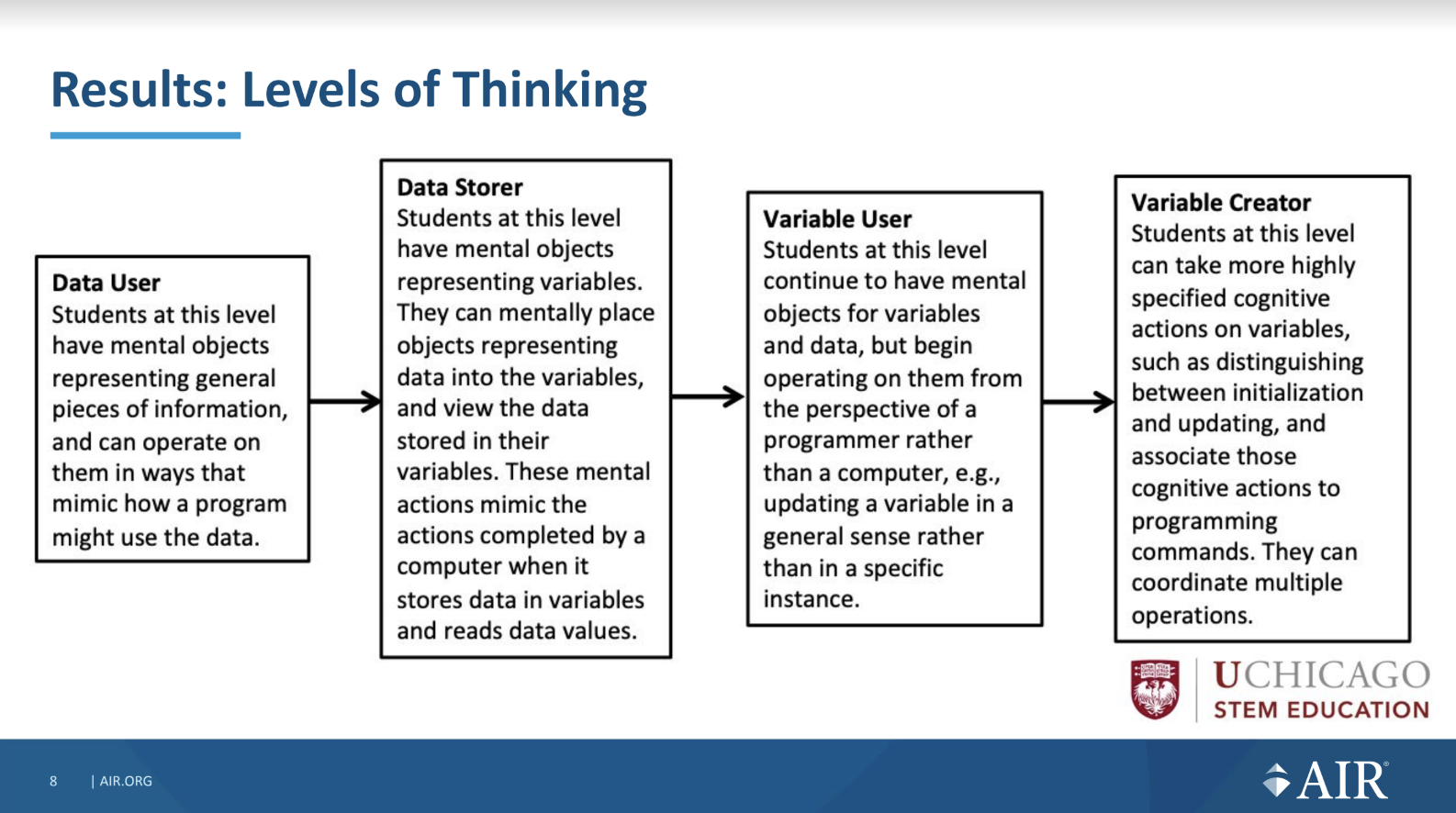
Carla then shared three practical examples of learning resources their research team created that integrated the programming construct of variables into a maths curriculum. The three activities, described below, form part of a series of lessons called Action Fractions. You can read more about the series of lessons in this research paper.
Robot Boxes is an unplugged activity that is positioned at the Data User level of thinking. It relates to creating instructions for a fictional robot. Learners have to pay attention to different data the robot needs in order to draw a box, such as the length and width, and also to the value that the robot calculates as area of the box. The lesson uses boxes on paper as concrete representations of variables to which learners can physically add values.
Ambling Animals is set at the ‘Data Storer’ and ‘Variable Interpreter’ levels of thinking. It includes a Scratch project to help students to locate and compare fractions on number lines. During this lesson, find a variable that holds the value of the animal that represents the larger of two fractions.
Adding Fractions draws on facts and skills from the ‘Variable Interpreter’ and ‘Variable Implementer’ levels of thinking and also includes a Scratch project. The Scratch project visualises adding fractions with the same denominator on a number line. The lesson starts to explain why variables are so important in computer programs by demonstrating how using a variable can make code more efficient.
Teaching about the programming construct of variables can be challenging, as it requires young learners to understand abstract ideas. The research Katie and Carla presented shows how integrating these concepts into a mathematics curriculum is one way to highlight tangible uses of variables in everyday problems. The levels of thinking in the learning trajectory provide a structure helping teachers to support learners to develop their understanding and skills; the same levels of thinking could be used to introduce variables in other contexts and curricula.
Many primary teachers use cross-curricular learning to increase children’s engagement and highlight real-world examples. The seminar showed how important it is for teachers to pay attention to terms used across subjects, such as the word ‘variable’, and to explicitly explain a term’s different meanings. Katie and Carla shared a practical example of this when they suggested that computing teachers need to do more to stress the difference between equations such as xy = 45 in maths and assignment statements such as length = 45 in computing.
The Everyday Computing project resources were created by a team of researchers and educators who worked together to translate research findings into curriculum materials. This type of collaboration can be really valuable in driving a research agenda to directly improve learning outcomes for young people in classrooms.
How can this research influence your classroom practice or other activities as an educator? Let us know your thoughts in the comments. We’ll be continuing to reflect on this question throughout the seminar series.
You can watch Katie’s and Carla’s full presentation here:
Our monthly seminar series on primary (K–5) teaching and learning is of interest to a global audience of educators, including those who want to understand the prior learning experiences of older learners.
We continue on Tuesday 7 February at 17.00 UK time, when we will hear from Dr Jean Salac, University of Washington. Jean will present her work in identifying inequities in elementary computing instruction and in developing a learning strategy, TIPP&SEE, to address these inequities. Sign up now, and we will send you a joining link for the session.
The post Combining computing and maths to teach primary learners about variables appeared first on Raspberry Pi.
In the penultimate seminar in our series on cross-disciplinary computing, we were delighted to host Conrad Wolfram (European co-founder/CEO of Wolfram Research).
Conrad has been an influential figure in the areas of AI, data science, and computation for over 30 years. The company he co-founded, Wolfram Research, develops computational technologies including the Wolfram programming language, which is used by the Mathematica and WolframAlpha programs. In the seminar, Conrad spoke about his work on developing a mathematics curriculum “for the AI age”.
In his talk, Conrad began by talking about the ubiquity of computation. He explained how computation (i.e. an operation that follows conditions to give a defined output) has transformed our everyday lives and led to the development of entire new sub-disciplines, such as computational medicine, computational marketing, and even computational agriculture. He then used the WolframAlpha tool to give several practical examples of applying high-level computation to problem-solving in different areas.
Conrad then turned his attention to the main question of his talk: if computation has also changed real-world mathematics, how should school-based mathematics teaching respond? He suggested that, as computation has impacted all aspects of our daily lives, school subjects should be reformed to better prepare students for the careers of the future.
His biggest criticism was the use of hand calculation methods in mathematics teaching. He proposed that a mathematics curriculum that “assumes computers exist” and uses computers (rather than humans) to compute answers would better support students to develop a deep understanding of mathematical concepts and principles. In other words, if students spent less time doing hand-calculation methods, they could devote more time to more complex problems.
One interesting aspect of Conrad’s talk was how he modelled the process of solving problems using computation. In all of the example problems, he outlined that computational problem-solving follows the same four-step process:
Depending on the problem, the process can be repeated multiple times until the desired solution is reached. Rather than being proposed as a static list of outcomes, the process was presented by Conrad as an iterative cycle than resembles an “ascending helix”:
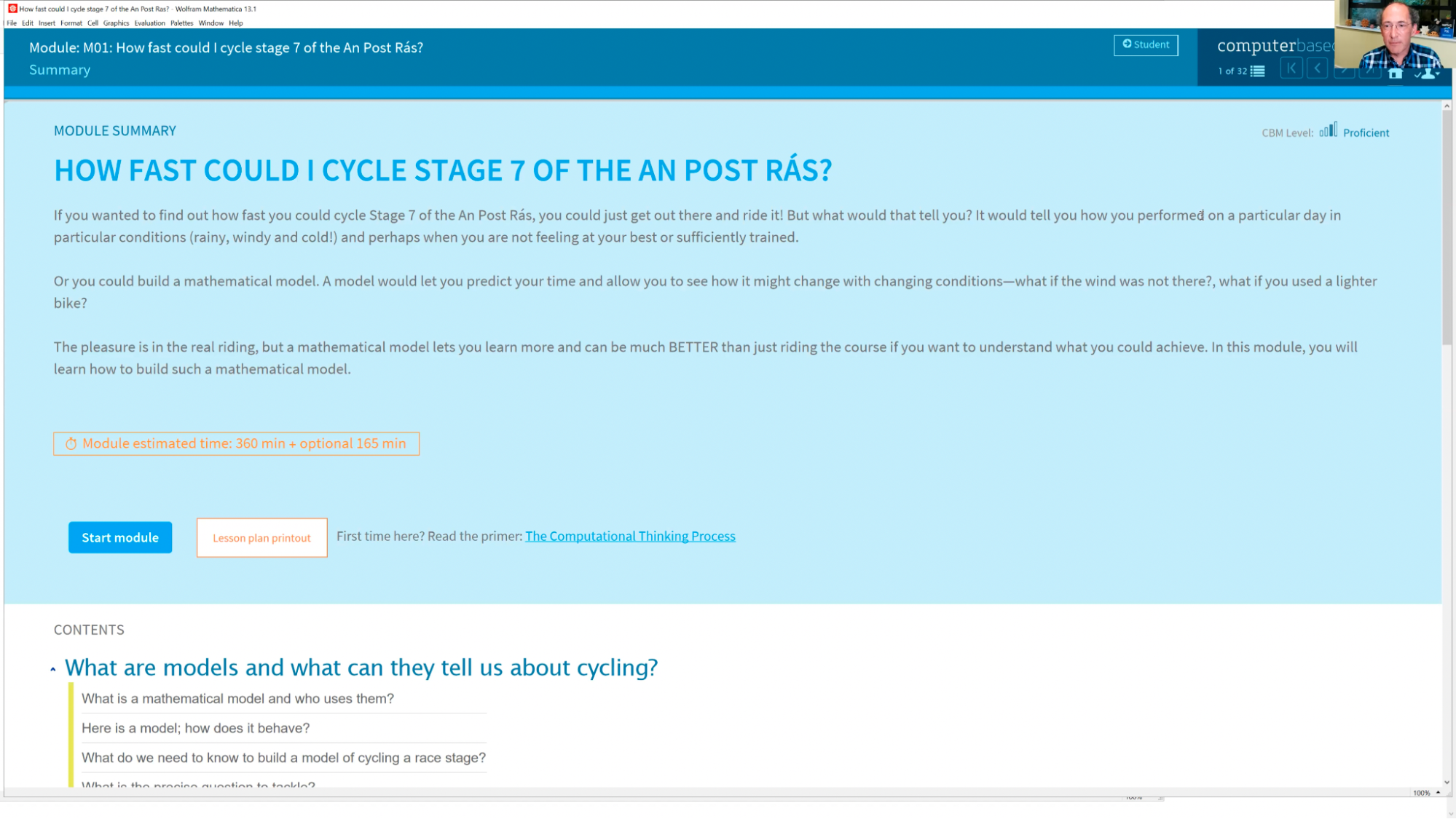
In the later stages of his talk, Conrad talked about the development of a new computational curriculum to better define what a modern mathematics curriculum might look like. The platform that hosts the curriculum, named Computer-Based Math (or CBM), outlines the need to integrate computational thinking into mathematics in schools. For instance, one of the modules, How Fast Could I Cycle Stage 7 Of The An Post Rás?, asks students to develop a computational solution to a real-world problem. Following the four-step problem-solving process, students apply mathematical models, computational tools, and real-world data to generate a valid solution:
Some future challenges he remarked on included how a computer-based mathematics curriculum could be integrated with existing curricula or qualifications, at what ages computational mathematics should be taught, and what assessment, training, and hardware would be needed to support teachers to deliver such a curriculum.
Conrad concluded the talk by arguing that the current need for computational literacy is similar to the need for mass literacy and pondering whether the UK could lead the push towards a new computational curriculum suitable for learners who grow up with AI technologies. This point provided food for thought during our discussion section, especially for teachers interested in embedding computation into their lessons, and for researchers thinking about the impact of AI in different fields. We’re grateful to Conrad for speaking about his work and mission — long may it continue!
You can catch up on Conrad’s talk with his slides and the talk’s recording:
Conrad’s book, The Math(s) Fix: An Education Blueprint for the AI Age, gives more details on how he thinks data science, AI, and computation could be embedded into the modern maths curriculum.
You can also explore Wolfram Research’s Computer-Based Maths curriculum, which offers learning materials to help teachers embed computation in their maths lessons.
Finally, try out Wolfram’s tools to solve everyday problems using computation. For example, you might ask WolframAlpha data-rich questions, which the tool converts from text input into a computable problem using natural language processing. (Two of my favourite example questions are: “How old was Leonardo when the Mona Lisa was painted?” and “What was the weather like when I was born?”)
In the final seminar of our series on cross-curricular computing, we welcome Dr Tracy Gardner and Rebecca Franks (Raspberry Pi Foundation) to present their ongoing work on computing education in non-formal settings. Sign up now to join us for this session on Tues 8 November:
We will shortly be announcing the theme of a brand-new series of research seminars starting in January 2023. The seminars will take place online on the first Tuesday of the month at 17:00–18:30 UK time.
The post Building a maths curriculum for a world shaped by computing appeared first on Raspberry Pi.
“In my vision, the child programs the computer and, in doing so, both acquires a sense of mastery over a piece of the most modern and powerful technology and establishes an intimate contact with some of the deepest ideas from science, from mathematics, and from the art of intellectual model building.” – Seymour Papert, Mindstorms: Children, Computers, And Powerful Ideas, 1980
We owe much of what we have learned about children learning to program to Seymour Papert (1928–2016), who not only was a great mathematician and computer scientist, but also an inspirational educationalist. He developed the theoretical approach to learning we now know as constructionism, which purports that learning takes place through building artefacts that have meaning and can be shared with others. Papert, together with others, developed the Logo programming language in 1967 to help children develop concepts in both mathematics and in programming. He believed that programming could give children tangible and concrete experiences to support their acquisition of mathematical concepts. Educational programming languages such as Logo were widely used in both primary and secondary education settings during the 1980s and 90s. Thus for many years the links between mathematics and programming have been evident, and we were very fortunate to be able to explore this topic with our research seminar guest speaker, Professor Dame Celia Hoyles of University College London.
Professor Dame Celia Hoyles
Dame Celia Hoyles is a huge celebrity in the world of mathematical education and programming. As well as authoring literally hundreds of academic papers on mathematics education, including on Logo programming, she has received a number of prestigious awards and honours, and has served as the Chief Advisor to the UK government on mathematics in school. For all these reasons, we were delighted to hear her present at a Raspberry Pi Foundation computing education research seminar.
Mathematics is a subject we all need to understand the basics of — it underpins much of our other learning and empowers us in daily life. Yet some mathematical concepts can seem abstract and teachers have struggled over the years to help children to understand them. Since programming includes the design, building, and debugging of artefacts, it is a great approach for make such abstract concepts come to life. It also enables the development of both computational and mathematical thinking, as Celia described in her talk.
Celia and a team* at University College London developed a curriculum initiative called ScratchMaths to teach carefully selected mathematical concepts through programming (funded by the Education Endowment Foundation in 2014–2018). ScratchMaths is for use in upper primary school (age 9–11) over a two-year period.
In the first year, pupils take three computational thinking modules, and in the second year, they move to three more mathematical thinking modules. All the ScratchMaths materials were designed around a pedagogical framework called the 5Es: explore, envisage, explain, exchange, and bridge. This enables teachers to understand the structure and sequencing of the materials as they use them in the classroom:
Teachers in the ScratchMaths project participated in professional development (two days per module) to enable them to understand the materials and the pedagogical approach.
At the end of the project, external evaluators measured the childrens’ learning and found a statistically significant increase in computational thinking skills after the first year, but no difference between an intervention group and a control group in the mathematical thinking outcomes in the second year (as measured by the national mathematics tests at that age).
Celia discussed a number of reasons for these findings. She also drew out the positive perspective that children in the trial learned two subjects at the same time without any detriment to their learning of mathematics. Covering two subjects and drawing the links between them without detriment to the core learning is potentially a benefit to schools who need to fit many subjects into their teaching day.
Much more information about the programme and the materials, which are freely available for use, can be found on the ScratchMaths project’s website, and you can also read a research paper describing the project.
As at all our research seminars, participants had many questions for our speaker. Although the project was designed for primary education, where it’s more common to learn subjects together across the curriculum, several questions revolved around the project’s suitability for secondary school. It’s interesting to reflect on how a programme like ScratchMaths might work at secondary level.
Teaching programming through mathematics, or vice versa, is established practice in some countries. One example comes from Sweden, where computing and programming is taught across different subject areas, including mathematics: “through teaching pupils should be given opportunities to develop knowledge in using digital tools and programming to explore problems and mathematical concepts, make calculations and to present and interpret data”. In England, conversely, we have a discrete computing curriculum, and an educational system that separates subjects out so that it is often difficult for children to see overlap and contiguity. However, having the focus on computing as a discrete subject gives enormous benefits too, as Celia outlined at the beginning of her talk, and it opens up the potential to give children an in-depth understanding of the whole subject area over their school careers. In an ideal world, perhaps we would teach programming in conjunction with a range of subjects, thus providing the concrete realisation of abstract concepts, while also having discrete computing and computer science in the curriculum.
In our current context of a global pandemic, we are continually seeing the importance of computing applications, for example computer modelling and simulation used in the analysis of data. This talk highlighted the importance of learning computing per se, as well as the mathematics one can learn through integrating these two subjects.
Celia is a member of the National Centre of Computing Education (NCCE) Academic Board, made up of academics and experts who support the teaching and learning elements of the NCCE, and we enjoy our continued work with her in this capacity. Through the NCCE, the Raspberry Pi Foundation is reaching thousands of children and educators with free computing resources, online courses, and advanced-level computer science materials. Our networks of Code Clubs and CoderDojos also give children the space and freedom to experiment and play with programming and digital making in a way that is concordant with a constructionist approach.
If you missed the seminar, you can find Celia’s presentation slides and a recording of her talk on our research seminars page.
In our next seminar on Tuesday 16 June at 17:00–18:00 BST / 12:00–13:00 EDT / 9:00–10:00 PDT / 18:00–19:00 CEST, we’ll welcome Jane Waite, Teaching Fellow at Queen Mary University of London. Jane will be sharing insights about Semantic Waves and unplugged computing. To join the seminar, simply sign up with your name and email address and we’ll email you the link and instructions. If you attended Celia’s seminar, the link remains the same.
*The ScratchMaths team are :
The post Mathematics and programming: exploring the links appeared first on Raspberry Pi.


 Lateo.net - Flux RSS en pagaille (pour en ajouter : @ moi)
