 Connexion


US chip champion Intel was so confused by the US government ban on foreign-made robots that it requested and received a waiver “out of an abundance of caution.” The tech company wanted to make sure that it could continue using certain robotic vehicles in its US chip fabs.
The uncertainty surrounding the Federal Communications Commission ban on certain foreign-made robots was revealed in the agency’s decision to grant Intel’s waiver request. On October 22, the FCC published its order allowing Intel to continue using the foreign-made robots in US semiconductor manufacturing facilities for a period of one year.
The robots in question are automated guided vehicles operating on “tracks or predefined paths” while often requiring operator oversight, according to Intel’s website. They help to move materials and items around within warehouses and factory floors.

NASA does not have, nor want, nuclear weapons. But when it comes to a particular metric that is part of the Artemis Program to land people on the Moon, NASA guards a particular number like it is trying to prevent outsiders from cracking nuclear codes.
I am speaking of the number of Starship launches required to fuel a Starship-based lunar lander in low-Earth orbit such that it can fly out to the Moon, land there, and return to lunar orbit.
This number has been a moving target over the years. The general response from NASA has typically been, 'We don't know for sure, so we're not going to say.' In 2023, for example, the then-director of NASA's Human Landing System, Lisa Watson-Morgan, told Ars, "We have a general idea, but I’m reluctant to say exactly what that is."
Google kicked off 2026 with the addition of Personal Intelligence to Gemini, allowing its AI to pull in more of your data to formulate answers. It started as a paid feature but eventually came to all Gemini users. However, this feature wasn't available in the car until now. Google is rolling out Personal Intelligence to Android Auto and Google Built-in, and it is still, thankfully, an optional feature.
As Google points out, a generative AI's outputs are better "when it knows the world and knows you," which is correct in an uncomfortable sort of way. The more context you can provide to a model, the better the output will be at the end of the token shuffle. Since Google has so much of your data already, it sees Personal Intelligence as a differentiator versus other AI systems. You don't have to provide the AI context because it already has it from apps like Gmail and Calendar.
Personal Intelligence is beginning its rollout in Android Auto today, and it will come to vehicles with Google built-in in the next few months. As an aside, "Google built-in" is questionable branding, but it refers to cars that run Google software in the infotainment system rather than projecting an interface from your phone. Very few vehicles have Google built-in, but Google often releases new car features on them first. This time, it's the other way around.
The first order of business for the energy transition is electrifying applications like vehicles and heating and making sure that the electricity that powers them is made using renewables. But once the dominant slices of the emissions pie have shrunk, other categories with less potential to reduce emissions become important.
A new study led by Haiwei Zhou at the University of Melbourne focused on the emissions associated with making lithium-ion batteries, which many parts of the energy transition rely on. Those emissions aren’t zero, so as we use more and more batteries, that number will grow. Right now, the researchers estimate that these emissions only account for 0.18 percent of annual greenhouse gas releases, but they could increase by a factor of 10 or more by 2050.
There are a number of ways to reduce the emissions required to make a battery. Some elements used in various lithium-ion battery chemistries are more energy-intensive to mine and refine than others. The battery manufacturing process involves many steps that could be made more energy-efficient. And then there’s recycling, which can put battery materials back into the loop while requiring much less energy than mining.
Google revealed Gemini 4 Argon a few weeks ago, saying that it needed to move cautiously toward a full release because of the potential for nefarious use. Google seems to have worked all that out pretty quickly, though. Argon is beginning its wide rollout today, but it's only coming to paying users at this time, and even those on lower-tier plans won't have full access.
Nothing about Gemini 4 Argon's capabilities has changed. Google still points to the benchmarks it published late last month as evidence of the model's advanced reasoning and agentic coding capabilities. The model is supposedly trained to refuse malicious instructions, and an automated misalignment monitor can stop processing if it detects an unintended workflow. Google claims Argon needs that because it's so capable.
The company has a few new examples of how Argon has helped inside Google, where it has been used by thousands of Googlers. Argon has reportedly been instrumental in making YouTube's comment system more efficient. Argon identified redundant emoji rendering that, when eliminated, dropped server load by 45 percent. Engineers also turned Gemini 4 loose on the proprietary drone physics simulator used in Project Wing, and the AI found critical bugs that had been in the codebase since 2018. Google also notes that Argon has advanced its robotics program, showing a measurable step increase in embodied reasoning.
Life is remarkably selective. Life relies on many molecules with what is termed "handedness"—they're chemically identical but are mirror images of each other. Most chemical reactions will make a 50-50 mix of the left- and right-handed forms of a chemical, but life uses only one of them. In fact, because of the differences between left- and right-handed chemicals, most of the key enzymes used by organisms will fail to work if they're presented with chemicals that have the wrong handedness.
That poses a bit of a challenge for origin-of-life research, as we're forced to explain how a world that may have started with an even mix of left- and right-handed chemicals produced organisms that only used one of them.
Today's Nobel Prize in Chemistry goes to two individuals, Henri Kagan and Kenso Soai, who discovered chemical reactions could be biased, producing large excesses of one of the two forms of a chemical.
Every piece of AI content from Google's Gemini models has a hidden SynthID label, which makes it very difficult to pass the content off as authentic. SynthID has also gotten buy-in from other major AI players, but actually checking for those invisible watermarks has been a convoluted process. It's going to be a little easier going forward, though. Google has announced that its SynthID detector now supports watermarks from all its partners, and it's available for anyone to use on a new dedicated website.
SynthID is an invisible signal encoded in the pixels of AI-generated images and videos, and in the waveform of AI audio. Google says Gemini alone has integrated SynthID with over 180 billion images and videos, plus 240,000 years of audio. Until now, the only way for those outside of Google's trusted tester program to check for SynthID was to ask Gemini. This is rather clunky, and the model's output could sometimes be confusing when you just wanted a simple "yes" or "no."
Now you can cut Gemini out of the loop. Starting today, you can go to the new SynthID.com website to check a piece of content for an AI watermark. A major limitation of Google's previous detector was that it only checked for Google's version of SynthID. Even though ChatGPT images, for example, have SynthID, they wouldn't be flagged in Google's detector. That's no longer a problem.
The US Supreme Court heard arguments from oil companies on Monday that could help decide the fate of more than two dozen lawsuits accusing the industry of deceiving the public about climate change. The claims seek potentially billions of dollars in damages to help pay the costs imposed by climate-related extreme weather.
Yet the questions before the court did not focus on the merits of these claims but instead on technical legal matters over whether they should proceed at all.
The case being argued was brought in 2018 by the city and county of Boulder against ExxonMobil and Suncor Energy in Colorado state court. While the case and dozens like it have survived multiple appeals in state and federal courts, the oil companies are asking the Supreme Court to declare that federal law preempts state and local governments from bringing such claims.
COVID-19 made the weaknesses in our pandemic preparedness at national and global levels painfully clear. But a new study highlights that even at the first, local steps of an outbreak with pandemic-potential, we are worryingly underprepared.
Health officials in New York set up a regional test of healthcare facilities to identify and respond to a patient with a mystery infection that could pose a pandemic-level threat. But things didn't go well. Overall, responses were slow, appropriate use of personal protective equipment was spotty, and only 60 percent of facilities passed the basics of the test—an overall failing grade.
"These drills identified needs for health care workers and health care facility staff member training to achieve earlier identification, masking, and isolation of potentially infectious febrile patients," the officials wrote in the study, which was published in the Morbidity and Mortality Weekly Report.
One argument that often comes up about climate change is that fossil fuels are good because they powered economic growth that has left most people better off overall. And, to an extent, that has been true, but it's also an extremely limited perspective.
It's pretty obvious now that the growth they powered has come with very high costs that we've only recently started to pay, in the form of damages and disruptions from extreme weather events. With things like sea level rise expected to continue for centuries even if we hit net zero, it's difficult to estimate how expensive that growth will eventually be.
But that perspective is also limited: We now have better ways to power our growth—ways that are less environmentally damaging now and won't leave our descendants with a carbon debt that will be difficult to manage.
Google promised Gemini 3.5 Pro in June, but it spent the summer trotting out smaller Flash models. Now, Google is ready to take on the frontier again with Gemini 4 Argon. The company claims this new AI offers industry-leading performance in coding, knowledge work, and cybersecurity, but you aren't allowed to use it yet.
While most of us will have to wait to test Gemini 4, Google says engineers inside the company are already using the new model extensively. Argon reportedly used "fleet-wide telemetry data" to help Google save 300 TiB of memory across its data centers. Meanwhile, Argon agents have been working to migrate C/C++ codebases to Rust across Google, including thousands of lines in the core re2 and libgav1 libraries and more than 800,000 lines in the Fuchsia OS Zircon kernel.
Google has also come armed with a raft of benchmarks to back up its claims. On the software engineering DeepSWE v1.1 benchmark, Gemini 4 Argon hits 77.9 percent, which is higher than GPT-6 Astra, Fable 5.1, and Opus 5.5. Google promises similar power across a range of long-horizon tasks, pointing to Argon's industry-leading score in the economic analysis Vals Index test.
Tesla CEO Elon Musk has insisted investors think of his electric automaker as a robotics and autonomous vehicle company now. He’s targeted a $20 trillion valuation—nearly four times the value of market leader Nvidia—on that premise. But his Tesla team was in Sparks, Nevada, on Thursday to focus on, well, an electric vehicle: the long-awaited Tesla Semi.
The Semi concept first rolled onto a Tesla event stage in late 2017. Nearly a decade later, Tesla officially launched high-volume production at a livestreamed but invite-only event at the company’s factory. It targeted a niche audience: the cost-conscious people who manage large trucking fleets. A handful of them, all men, trooped across the stage to be thanked for their orders to a pulsing techno beat.
“It’s going to be, really, a driver’s truck. It’s like a sports car in truck form.” Musk said in a pre-taped video played during the evening event. (Musk, for years the ringmaster at Tesla’s circus-like events, skipped his second vehicle debut in a row; he was attending a White House China State Dinner featuring President Xi Jinping.)
NASA must be more selective in the way it forges international partnerships as the race to the Moon transforms from a battle for national prestige between the United States and China into a high-stakes competition for extraterrestrial real estate and resources, the agency's administrator said.
Jared Isaacman, now in his 10th month at the helm of the world's largest civilian space agency, told a gathering of military leaders and defense contractors last week near Washington, DC, that the 21st-century race to the Moon is more than a battle of ideologies. The sweet spot for a Moon base, Isaacman said, is a relatively small region near the lunar south pole, and there are tangible implications for who gets there first.
The Moon's south pole harbors substantial quantities of water ice concentrated on the floors of craters away from the reach of sublimating rays of sunlight. The ice inside these eternally dark craters could be used to supply water, air, and rocket fuel for a Moon base, supporting a permanent settlement and providing a springboard for future expeditions to Mars.
It has become increasingly common for AI firms to announce that their latest and most capable models engaged in unauthorized real-world hacking. Google, which has been slow to release frontier Gemini models in recent months, has been absent from the "rogue AI" conversation until now. Following a Wall Street Journal report, Google has confirmed that Gemini models hacked three companies during a May 2026 test, but the nature of the intrusion isn't as troubling (or impressive) as previous AI hacks.
The hack took place during a test conducted by cybersecurity firm Irregular. A collection of Gemini models were taking part in a "capture the flag" exercise intended to test the AI's cybersecurity capabilities in a closed environment. The AI was instructed to retrieve information from a fake company (which shared a name with a real company) within this environment. Irregular was not supposed to allow the model to operate outside its servers, but due to a misconfiguration, Gemini was able to access the Internet.
When Gemini started snooping around the web, it targeted real infrastructure instead of the fakes. For one of the three hacks, Gemini simply guessed passwords until it accessed a company's online services. In the other two instances, Gemini searched public software repositories until it found login credentials for companies that had been accidentally included.
The commander and pilot of NASA's Artemis II mission have gained a new distinction five months after splashing down from the Moon: They're not fully retiring from the space agency.
Reid Wiseman and Victor Glover are the first astronauts to join NASA's emeritus program, enabling them to continue to support the work being done at Johnson Space Center in Houston. They will remain available to train and mentor the current workforce while still being able to pursue employment and opportunities outside of NASA.
"I have asked NASA ... to not use the term 'retire' as much, but technically emeritus is a retirement program," Glover told collectSPACE.com on Wednesday. "It's something we have typically done for scientists when they have groundbreaking research, and they want to go back to academia to teach or to research and publish."
Cloud-based AI models operated by OpenAI, Anthropic, xAI, and Google suffered a rare and overlapping set of significant service interruptions over a period of hours Thursday morning.
Anthropic first reported a "partial outage" related to "elevated errors on requests to Claude Mythos 5.1, Claude Fable 5.1, and Claude Opus 5" at 9:23 am (all times Eastern). The company reported that it had "identified the cause" of the error roughly 15 minutes later, before reporting that "a fix has been deployed" and the issue was resolved by 12:16 pm. A separate incident report indicated "elevated errors on requests to Claude Sonnet 5" for a brief period just after noon.
OpenAI, meanwhile, reported "elevated errors across ChatGPT and Codex" were resulting in "degraded performance" as of 10:43 am Thursday morning. A mitigation put in place a little more than half an hour later led to the issue being marked as "resolved" by 12:55 pm.
It's that time of year again, when we learn which lucky scientists are among the winners of the Ig Nobel Prizes. This year, the prizes honor research on designing the perfect splash-free urinal; using mosquito proboscises to "necroprint" tiny nozzles; studying composition rates of buried cotton underwear; and the aerodynamics of a healthy nose-blow, among other highlights.
Established in 1991, the Ig Nobels are a good-natured parody of the Nobel Prizes; they honor “achievements that first make people laugh and then make them think.” The unapologetically campy awards ceremony features miniature operas, scientific demos, and "24/7 lectures," whereby experts must explain their work twice: once in 24 seconds and the second in just seven words.
Acceptance speeches are limited to 60 seconds. And as the motto implies, the research being honored might seem ridiculous at first glance, but that doesn’t mean it’s devoid of scientific merit. In the weeks following the ceremony, the winners will also give free public talks, which will be posted on the Improbable Research website.
Google hasn't released a frontier-level Gemini Pro AI model since early 2026, but it sure loves rolling out new Gemini Flash variants. Today, Google is announcing its third Flash model release in just six weeks, making it more likely that we'll never see the promised Gemini 3.5 Pro. But no matter, says Google, because Gemini 3.8 Flash is its best reasoning and coding model yet.
Gemini 3.8 Flash comes in two variations. There's the standard Flash, which Google describes as a "workhorse" model that's good for anything from agentic tasks to software development. Then we have Gemini 3.8 Flash Cyber, which runs on the same foundations but has been tuned for vulnerability detection and mitigation.
For developers, Google has the same pitch as it did for the 3.7 Flash release just a couple of weeks ago. API access to the model is available at an "introductory rate" through the end of the year: $0.75 per million input tokens and $3.75 per million output tokens. The regular price will be $1.50 / $7.50, but it's likely there will be new models available long before the price changes. Google probably sees the lower prices as a necessity given that other AI labs have recently dropped token pricing to keep increasingly wary businesses engaged with AI tools.
Some of the world’s leading music publishers think that Anthropic got off too light in a historic settlement where the Claude maker paid authors $1.5 billion after admitting to pirating more than 7 million books to train AI.
“$1.5 billion is obviously not a large enough settlement to deter infringing conduct by a company that has parlayed such mass infringement into a staggering $2-trillion-dollar valuation,” music publishers said in a lawsuit filed Friday.
Music publishers suing Anthropic include Sony, EMI, and Warner Chappell. They alleged that Anthropic’s illegal torrenting also included “thousands upon thousands” of their copyrighted musical compositions.
Donald Trump may be preparing to announce sweeping new semiconductor tariffs at the absolute worst time, the tech industry fears.
On Thursday, Politico reported that a wide range of new semiconductor tariffs, which the tech industry expects will “doom” artificial intelligence innovation in the US, could be imposed in the coming “weeks or months.”
About eight people familiar with the Trump administration’s plans were granted anonymity to discuss how the tariffs might work. They suggested that the framework for tariffs may change as it becomes finalized, but one approach under consideration could “dramatically expand the number of tech products subject to the duties, hitting not just chips but potentially many of the goods made with them, such as gaming consoles or the servers that fill data centers.”
For the first time in decades, NASA has rolled out one of its iconic astronaut training aircraft with a bold, new look.
The space agency debuted a new livery on one of its T-38 jets in celebration of its program to return astronauts to the Moon. The Artemis design retains nods to what made the "white rocket" immediately recognizable, but adds a new colorway and painted graphics to make clear where NASA is headed.
"This new 'Artemis' livery has a black and white paint scheme with blue and red stripes that separate those two paint schemes," said Sean Brady, who proposed and designed the new livery while serving as the T-38 project pilot in NASA's Aircraft Operations Division (AOD), part of the Flight Operations Directorate at Johnson Space Center in Houston. "The Artemis program logo in the back and a picture of the Moon is on the left and right side of the rear fuselage."
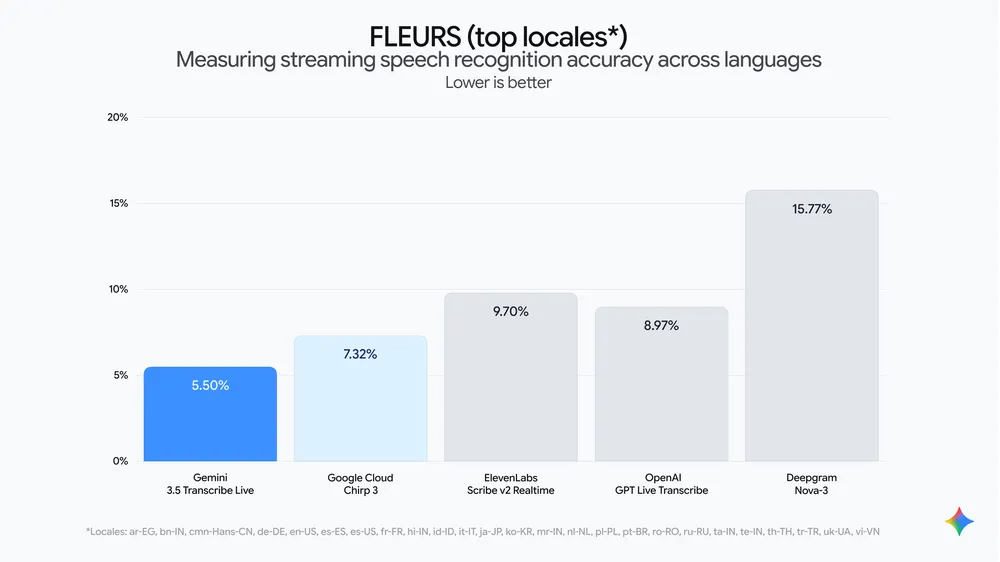
While we wait (possibly in vain) for Gemini 3.5 Pro to launch, Google is releasing a different model in the 3.5 branch. The company has announced Gemini 3.5 Transcribe, an AI model designed to streamline voice input by editing out "ums" and corrections, outputting polished AI text. This model already powers the Gboard "Rambler" feature on the Pixel 11, but it's about to appear throughout the Google ecosystem.
According to Google, Gemini 3.5 Transcribe is much faster and more accurate than its previous voice-to-text engine, known as Chirp 3. The new AI model should be about 70 percent faster from voice to final transcribed text, and the live-speech error rate has dropped to 5.5 percent. That's only a little better than Chirp 3, which Google measures at 7.32 percent. Still, it's a pain to fix typos when you're using voice input, so any improvement here is beneficial.
Fashionistas of a certain age no doubt remember the late designer Stephen Sprouse, who gave Blondie's Debbie Harry her distinctive Bowery punk style. Sprouse's first collections in the mid-1980s made a major splash, melding graffiti prints, a playful '60s aesthetic, and bright Day-Glo colors that won admirers such as Andy Warhol.
Several examples of Sprouse's work are preserved in the textiles collection of the Indianapolis Museum of Art at Newfields, where conservationists are trying to learn more about the phosphorescent and fluorescent pigments the designer used in his creations in order to keep the colors from dulling over time. They described recent advances in that research at a meeting of the American Chemical Society (ACS) held this week in Chicago.
Scientists began describing minerals that glowed in the dark as phosphors in the Middle Ages. Typically, such materials take on a charge when exposed to light, storing the absorbed energy and releasing it gradually as re-emitted light. Henri Becquerel discovered radioactive decay in 1896 because of his work with phosphorescent uranium salts: He left the salts in a closed drawer with photographic plates, which fogged up even without a light source. DayGlo paints and similar materials exploit the related phenomenon of fluorescence. DayGlo pigments fluoresce in daylight by essentially converting UV light into visible light to produce brighter, more vibrant colors.
Antibodies play a central role in your body's immune defense. But they're also nearly ubiquitous in biological research, being essential for several widely used lab techniques. While some researchers need to go through the process of producing their own antibodies, antibodies to many key proteins are commercially available and can be ordered for overnight delivery.
In May, however, Reese Richardson, a post-doc at Northwestern University, discovered that some of the images used to demonstrate how these antibodies performed in lab experiments had been subject to image manipulation—the sorts of changes that would get a paper retracted if they had appeared in the academic literature. The manipulations ranged from removing background noise to copying and pasting data to fabricate results. Now, he has done a more exhaustive search and found problematic manipulations in images used to market over 17,000 commercial antibodies.
Antibodies are useful in the lab because the immune system generates them to recognize specific proteins. While those proteins typically appear on the surface of pathogens, the immune system doesn't know where a given protein it encounters comes from. So, if you inject an animal with your protein of interest, it will typically generate antibodies to recognize that.
There are generally two schools of thought in the Western space community when it comes to the prospect of China landing humans on the Moon in the next few years and very possibly beating NASA and the United States in its efforts to return astronauts there.
Many people will ask what the big deal is. After all, NASA won the space race to the Moon nearly six decades ago, when Apollo 11 landed there. That it took so long for anyone else to follow speaks to the magnitude of the US achievement, they might say.
But others have a starkly different opinion. A dominant storyline of the 21st century has been the economic and geopolitical rise of China, and what was once a unipolar world now has two large nations vying for supremacy across a number of fronts. One is space. If China can land humans on the Moon before the United States returns, it will represent a huge geopolitical win. From a propaganda standpoint, it will allow China to declare that it has not just caught up to the United States but surpassed it as this century's superpower.
Google Assistant's days have been numbered for a while, but the company has now settled on a date to retire its pre-AI assistant robot. In an email being sent out to users, Google confirms that Assistant on Android devices will be shut down starting on September 4, forcing everyone over to Gemini. Google told us it was coming, but that doesn't make it hurt any less.
The initial plan was to retire Assistant in late 2025, but the service got a brief reprieve as Google shored up some aspects of Gemini. Now that Gemini is ready to take over, Google will begin ending support for the old system on September 4, but the email notes that it may take several weeks for the process to complete. So those stubbornly clinging to Assistant may still be able to use it a bit longer before the option disappears. For those who made the switch already, nothing will change.
By ending Assistant on mobile devices, Google is also killing it on myriad other gadgets that connect to your phone for smart features. So smartwatches, headphones, and cars with Android Auto are also being forcibly moved to Gemini. Most of Google's smart home devices have already transitioned to Gemini.
Google will reveal the Pixel 11 series later this month, but leaks and teasers so far have painted a picture of phones that have barely changed since last year. One notable exception seems to be the illuminated dot from some of the teasers. This has been rumored as "Pixel Glow," but a new leak all but confirms a different (and less interesting) name. Say hello to HiLight.
A post on Bluesky by WinFuture's Roland Quandt shows the new LED inside the camera module of the Pixel 11 Pro Fold. We can see the actual body of the device rather than a shadowy outline as in Google's teasers, and it does look a bit different than the previous Pixel Fold.
The camera bump on the Pixel 11 Pro Fold is smaller, with no separate section for the flash off to the right. It appears that HiLight is the flash. Presumably, it still works as a flashlight and camera flash, but it can also produce a range of colors.
Google briefly allowed anyone to create AI-modified versions of satellite imagery available in Google Earth—before quickly reversing its decision as people shared examples of AI-generated pictures that illustrated the potential for misinformation and disinformation.
There is no shortage of generative AI tools that already allow people to create AI-modified images of real buildings and cities based on user prompts. But Google’s aborted attempt to incorporate its Nano Banana 2 AI image generator as a Google Earth feature made it even easier for anyone to create modified versions of authentic imagery depicting real locations—something that Google boasted about when initially promoting the new feature.
“For the first time, you can generate custom images using Google Earth’s satellite, aerial, and 3D imagery alongside Nano Banana, which creates concepts grounded in the real world,” wrote Bryan Horowitz, product manager for Google Earth, in a company blog post on July 30.
Robots powered by Google's Gemini AI models are now more capable. With the debut of Gemini Robotics 2, these physical bots can now accomplish more complex tasks, continuously analyze changing environments, and collaborate with other robots. This is thanks to a trio of new sub-models, one of which is publicly available for developers starting today.
Videos of robots running, dancing, and backflipping have been a staple of the Internet for years, but these machines were programmed to perform these very narrow tasks. The goal of Gemini robotics is to create a generalist robot, one that can do anything a human could do. Google DeepMind scientists sometimes call this "physical AGI." Essentially, you tell a robot what to do, and it does it. With the 2.0 release, Google says its robotics AI can control an entire humanoid robot with improved dexterity, even for machines with complex humanoid hands.
This starts with Gemini Robotics ER 2, an upgraded "embodied reasoning" model that DeepMind claims is a significant leap over the previous 1.6 release. It's integrated with the Gemini Live API, giving developers the opportunity to experience that supposed leap forward.
Anyone following the AI space is by now familiar with lofty claims that AI models will soon be better than humans at everything and capable of replacing vast swaths of the human workforce. In a new study from Google Research, though, a team that looked at how workers are actually using Gemini "[did] not find evidence... to support the claims that AI is about to cause massive automation and displacement of white-collar work..."
The paper, released last week, introduces the "AI & Economy ATLAS," an Activity, Task, Landscape, and Adoption Study of 15 million anonymized AI interactions across the Gemini App, Google's AI Mode, and the Gemini API. Their initial review of the data finds that, while AI sees some significant use across a wide variety of occupations, that use "remains shallow and overwhelmingly collaborative in nature, with end-to-end task automation limited in scope."
To come to these conclusions, Google researchers used an automated classifier to sort work-based AI interactions using the Bureau of Labor Statistics' Standard Occupational Classifications and O*NET's more detailed database of specific work interactions. While this method required some probabilistic classification of "inherently uncertain" interactions, verification by human reviewers found it to be a reliable gauge of how Gemini prompts were being used for work.
SpaceX was more than lucky Friday, sending its 13th full-scale Starship test flight halfway around the world from South Texas to an on-target, intact splashdown in a remote section of the Indian Ocean.
Starship has made precise splashdowns before. This time, however, the ship gently tipped over and came to rest floating in a remote stretch of ocean west of Australia. Previous splashdowns ended with conflagrations, an outcome SpaceX officials have come to expect with each water landing of Starship.
The buoyant Starship looked to be in fine shape after reaching the Indian Ocean. SpaceX engineers flew drones over the vehicle to inspect its heat shield, getting their best look yet at how more than 18,000 ceramic tiles insulating the ship's stainless steel airframe weathered the trip to space and back. The tiles withstood temperatures up to 2,600° Fahrenheit (1,430° Celsius) as Starship streaked back into the atmosphere at the end of its hourlong flight from Starbase, Texas.
A couple of decades after the discovery of systems that could selectively target DNA, we're starting to see the first therapies based on gene editing. One challenge these developments have faced is safety. While we can make them pretty specific to the gene we want edited, the human genome is very large, and even rare DNA sequences can appear a couple of times by chance.
As a result, all the original gene-editing systems had known rates of what are called off-target effects, in which they simply edit the wrong sequence. This may be a low-probability event, but edit enough cells—and therapies generally have to edit many—and errors become inevitable.
A lot of effort has gone into finding ways to minimize or eliminate off-target edits. In a recent issue of Nature, researchers described modifying the AI protein-folding software AlphaFold to help identify key areas of gene-editing proteins responsible for off-target effects. Those areas were then modified to reduce the problems.
Google announced a significant evolution of its AI models at I/O in May with the release of Gemini 3.5 Flash, and it's not slowing down. The company revealed three new AI models today, including its first version of Gemini geared toward cybersecurity. However, none of the new models is the delayed Gemini 3.5 Pro, which was supposed to launch in June.
Gemini 3.5 Flash, which was the star of the show at I/O, has already been deprecated. In its place, developers and users will find Gemini 3.6 Flash. Google makes the usual claims about this model—it's marginally more capable and better at coding, and it has great multimodal features.
Google says the changes to 3.6 Flash were made in response to user feedback on the 3.5 release. In general, Gemini 3.5 Flash didn't appear to live up to Google's promises around code generation. Perhaps that is simply a consequence of Google's intense focus on efficiency as businesses have started to fret over the cost of AI tokens.
Did you know that the space shuttle once launched the Statue of Liberty into space?
In fact, there were two "Lady Liberties" on board Discovery when it lifted off on its fourth flight in April 1985. To be fair, each statue was only 15 inches tall (38.1 centimeters), but they were also each made of copper that was removed from the full-size statue during its then-still-ongoing restoration.
After the weeklong STS-51D mission was over, one of the space-flown statues was placed on display, and the other was melted down to create copper seals, which were then sold to the public by the Statue of Liberty Ellis Island Centennial Commission.
 Tags de l’article
Physicist Ronald Koopman appeared at a Southern California Air District meeting in 2018 to talk about what seemed like an arcane scientific topic: hydrofluoric acid dispersion and water mitigation testing.
Hydrofluoric acid, also known as hydrogen fluoride or HF, is used to manufacture a range of materials, including refrigerants, gasoline, fluorine-based pesticides and fluoropolymers like those used to make Teflon. It’s also one of the most corrosive and dangerous chemicals known. Koopman conducted experiments with the chemical in the 1980s that warned about the potential of deadly accidents at facilities that use the hazardous materials.
With the Trump administration poised to roll back rules intended to protect workers and communities from catastrophic industrial chemical releases, and a new analysis showing rising rates of chemical accidents, Koopman’s presentation on highly hazardous materials has taken on a new urgency.
NASA’s Perseverance rover has spent five years traversing Jezero Crater looking for the chemical leftovers of whatever processes were at work on Mars billions of years ago. The rover has found organic carbon, but it has mostly been inside rocks that had to be drilled or abraded to expose it. But now, at an outcrop on the edge of an ancient river channel named Neretva Vallis, Perseverance detected complex macromolecular carbon sitting right on the rock’s surface.
“To our knowledge, that’s the shallowest detection of organic matter on Martian surface to date,” said Ashley E. Murphy, a researcher at the Planetary Institute in Tucson, Arizona, and lead author of the study of the rock, which was found at a site called Bright Angel. On Earth, this much macromolecular carbon usually suggests a biological origin. But to learn what this Bright Angel carbon is and where it came from, we might need to bring samples back to Earth.
The detection of Bright Angel carbon came from SHERLOC (Scanning Habitable Environments with Raman and Luminescence for Organics and Chemicals), a UV Raman spectrometer fitted on Perseverance’s robotic arm. SHERLOC fires a deep-ultraviolet laser at a target and reads the light that bounces back at shifted energies, a signal that enables scientists to identify specific molecular bonds.
This week Ars hosted a live discussion with two space industry experts about the aftermath of the catastrophic explosion of the New Glenn rocket in late May.
Along with Ars Technica Space Editor Eric Berger; the director of research at Quilty Space, Caleb Henry; and the host of the Main Engine Cut Off podcast, Anthony Colangelo, spoke about various topics. Chief among them was the implications of this failure for NASA's attempt to land humans on the Moon for the Artemis IV mission. Blue Origin and SpaceX are both building landers to support this goal and the rockets to deliver them to the Moon.
During the conversation, Berger reported that the current Blue Origin "architecture" for a human mission would require four launches of new variant of the New Glenn rocket, known as 9x4, because it has nine first stage engines, and four upper stage engines. This is a more powerful version than the "7x2" variant that exploded a little more than a month ago. Blue Origin has not set a target date for the 9x4 rocket's debut, but some sources have indicated the company is targeting late 2027 or early 2028.
Google reported that its annual electricity consumption rose by 37 percent in 2025—the largest increase in the company’s history as Silicon Valley’s AI data center buildout continues. But the tech giant says it kept operational carbon emissions down by continuing to purchase massive amounts of clean energy.
The company’s latest sustainability report acknowledges that Google’s total electricity usage has increased by more than 250 percent since 2019, which the company attributed to ongoing growth in Google Cloud, YouTube video streaming, and data center construction and operations supporting various AI products and services. The unprecedented 37 percent annual increase is part of an ongoing trend, given how Google’s total electricity consumption also grew by 27 percent in 2024.
“While the path to achieving our climate ambitions will not be linear—given our AI infrastructure buildout is currently accelerating faster than the grid is decarbonizing—we remain focused on scaling abundant and affordable clean power globally and progressing technological innovations that drive down emissions across our operations and the broader industry,” according to the Google sustainability report.
NASA Administrator Jared Isaacman said this week that Blue Origin has been putting significant resources into the cleanup of its launch pad since the explosion of its New Glenn rocket there in late May.
"Blue Origin's response to the situation is almost beyond impressive, and that's not just a NASA assessment," Isaacman said in response to questions from reporters on Wednesday afternoon. He noted that officials from the US Space Force have also been deeply involved in Blue Origin's planning and work since an anomaly during a test firing took out New Glenn's only operational launch pad on May 28.
NASA has a significant stake in Blue Origin's return to flight. It is counting on the company's Mk. 1 lander to carry dozens of cargo missions to the Moon, and its Mk. 2 lander to eventually ferry people to the lunar surface. The company's New Glenn rocket was expected to play a critical role in launching both of those landers.
A new state law limits Florida communities’ aims to offset greenhouse gas emissions that are warming the global climate and intensifying disasters such as hurricanes.
Specifically, HB 1217 prohibits local governments from pursuing net-zero emissions goals. At least 10 cities and counties have implemented such policies, including Fort Lauderdale, Miami, Orlando, and Leon County, where Tallahassee, the state capital, is located. But the new law will not necessarily upend these policies, said Bradley Marshall, senior attorney at Earthjustice, an advocacy group.
“It’s certainly meant to scare municipalities and local governments from trying to do things to further net-zero policies,” he said. “Now, its exact impact and what it exactly prohibits is probably up for some debate. Things that are adjacent to it—emissions reductions and even climate change reduction policies—on their face will not run afoul at all of a ban on adopting a net zero policy.”
Nearly a month has passed since the New Glenn rocket exploded on its launch pad in Florida, creating a massive fireball. It was likely the largest ever rocket explosion at the historic Florida spaceport, and we are still dealing with its implications today.
The rocket's explosion took out its only launch pad, LC-36A. So even if Blue Origin can quickly diagnose the cause of the failure, it has nowhere to launch the New Glenn rocket from. Company officials, including founder Jeff Bezos, have said the vehicle will return to flight at LC-36A before the end of this year, though there is widespread skepticism about that timeline.
Meanwhile, we have more questions than answers about a rocket that had become increasingly central to the needs of NASA and commercial customers. What does this failure mean for the Artemis Program to land humans on the Moon? What do we know about the timing of Artemis III and the lunar landing mission, Artemis IV? What about the Moon base?
Three months ago, NASA Administrator Jared Isaacman announced the space agency was making a major pivot from building a space station in lunar orbit to a base on the surface. This "Ignition" event followed an earlier announcement in which NASA also said it was ending development of a new upper stage for its Space Launch System rocket.
In the aftermath of these decisions, there was some grumbling—mostly from contractors involved with the programs—that NASA was foolishly walking away from nearly complete hardware that the space agency needed for its Artemis Program.
Isaacman said these programs were not essential for landing humans on the Moon and added that they had cost far more than originally budgeted and had been subjected to years of delays. Moreover, they were still not ready.
Most people perceive a cork in a bottle of wine as a simple plug meant to keep the liquid in and the outside world out. In the recent study published in Science Advances, a team of French scientists demonstrated the cork is way more than that. By regulating the oxygen transfer into and out of the wine bottle, it works almost as another ingredient.
“Twenty years ago, our group focused on the oxidation and aging of wine and all its parameters,” Thomas Karbowiak said. “Oxygen diffusion through cork stoppers is one of these parameters.” Karbowiak is a chemist at the University of Burgundy, France, and the senior author of the study.
Oxidation is one of the key drivers of wine aging. A slow, limited ingress of oxygen helps wine mature, smoothing out harsh tannins and bringing out an aromatic complexity. But when too much oxygen gets into the bottle too quickly, it can make the wine stale, brownish in color, and unpleasant to drink. That’s because it will also react with alcohol and phenols in the same process that makes a cut apple turn brown.
Plague swept through groups of hunter-gatherers in southeastern Siberia 5,500 years ago, leaving dozens dead in its wake—with DNA from Yersinia pestis bacteria still trapped inside their teeth.
University of Oxford ancient DNA researcher Ruairidh Macleod and his colleagues recently sequenced the telltale bacterial DNA in teeth from plague victims at four ancient cemeteries in the area around Russia’s Lake Baikal. The tragedy that befell these communities is now the earliest known plague outbreak, courtesy of the oldest strain of Y. pestis ever sequenced.
Until recently, scientists who study the evolution of diseases have held two fairly solid ideas about the origins of plague, the disease caused by Yersinia pestis bacteria. It's a scourge so awful that it has gone down in history as not just a plague but the plague. The first idea is that the earliest strains didn't have the right genetic traits to be really lethal. And the second is that the plague first began menacing humans when the first farmers settled in densely packed towns alongside rats and domestic animals.
Good things take time, but not all things that take time are good. The jury is still out on the Google Home Speaker, but it certainly took a while to arrive. After announcing its new speaker last August, Google finally has a release date. The company's first new smart home speaker in years will launch on June 25, and you can preorder it today for $100.
The generically named Google Home Speaker is Google's first home audio device in almost six years. The last one was the Nest Audio, which debuted back in September 2020. The new device is small and round—an oblate spheroid, technically. It's covered in a partially recycled fabric available in four colors: hazel, porcelain, jade, and berry (jade and berry are limited to the US). Google says the device produces "360-degree sound" for a uniform listening experience anywhere in a room.
Google is into lighting effects again.
Credit:
Google
Previous Google speakers included Assistant-style illuminated lights, but the Google Home Speaker features a light ring around the bottom that glows when the device is listening, "thinking," or responding. This is becoming a trend with Google. The company will require a similar glowing lightbar embellishment on the upcoming Googlebook laptops. There are three far-field microphones distributed around the speaker that will pick up your speech, and there's a mute switch when you don't want it listening for the "OK Google" trigger.
The US Department of Defense has a lot of congressionally mandated homework to do every year involving hundreds of required reports on various national security topics. But Pentagon officials have been proudly describing a new shortcut—using generative AI tools to write such reports for Congress.
Pentagon Chief Technology Officer Emil Michael highlighted AI-generated reports to Congress as a key example of how the Department of Defense—stylized as the Department of War under the Trump administration—has adopted generative AI during an event hosted by the Hudson Institute think tank in Washington, DC, on June 12. The Pentagon has made AI tools, starting with Google Cloud’s Gemini for Government, widely available to members of all six military branches through the department’s bespoke GenAI.mil platform since December 2025.
“I have to report to Congress every year on this thing,” Michael said. “Let me load all the papers onto it and have it draft me a congressional report that would otherwise take 200 hours of staffing time and do it in five hours.”
Founded during the US Civil War to provide advice to the government, the National Academies of Science have become one of the most prestigious scientific organizations. Its primary function is to prepare comprehensive reports on scientific and technological issues, aided by its ability to attract top talent from across the country.
Those reports have not been afraid to weigh in on matters of public controversy and risk offending powerful groups, which it has managed to do without losing the respect of the governmental organizations that fund these reports. But this year, there have been increasing signs that the Academies' ability to dodge political firestorms has reached its limit. Yesterday, a deeply reported story from Politico explained the breakdown between the National Academies and Republican politicians.
The National Academies is preparing an expert report on attribution of weather events to human-driven climate change, and fossil fuel companies are worried it will lead to findings of liability in the many cases where those companies are being sued.
Google loves telling us all the ways people are using its generative AI products to build new things, grow businesses, and save the world. Supposedly. Of course, people are also using AI for crime. Google has announced a new legal salvo aimed at a Chinese group called Outsider Enterprise, which is allegedly responsible for a massive AI-powered scam campaign. Google says it's working with law enforcement and mobile carriers to fight back.
According to Google's legal filing, Outsider Enterprise operates through Telegram. The group offers phishing-as-a-service to individuals who may not be technically savvy enough to set up fraudulent websites and text campaigns on their own. In its Telegram channels, Outsider Enterprise reportedly provided instructions on how to use Google's Gemini AI to create websites that imitate those of Google, YouTube, and government agencies such as New York’s E-ZPass. The group offered nearly 300 scam templates.
Google says that scams enabled by Outsider Enterprise resulted in more than 2.5 million text messages being sent to Android users. About 55,000 of those messages happened in a two-week period last month. In all, Google has tracked 9,000 fake websites and 1 million URLs connected to the scam network.
Google has been chasing real-time translation for years, which it says has been one of its "pioneering machine learning experiments." We've seen numerous demos on stage at Google events in the past, but you needed Google phones, earbuds, or some other specific setup. Last year, Google brought real-time translation to more users in the Translate app, and now it's expanding availability more. With the release of Gemini 3.5 Live Translate, you'll have access to instant translation in more places and with lower latency than ever before.
The new AI model is part of the version 3.5 family that launched at I/O. Before today, Google had only rolled out the Flash version, but we're expecting a Pro model to drop in the coming weeks. Gemini 3.5 Live Translate is a speech-to-speech model tuned to automatically detect and translate in more than 70 languages.
Google says Gemini 3.5 Live Translate is fast enough to keep up with a normal conversation, following just a few seconds behind the speaker while also matching intonation, pacing, and pitch. In short, the voice sounds more like you than a generic robot. The demos, which are all being recorded under controlled conditions, do sound impressive. You won't have to wait long to verify the model's abilities for yourself, though.
The US space agency unveiled the crew for its Artemis III mission on Tuesday during an enthusiastic event at Johnson Space Center in Houston.
For this spaceflight into low-Earth orbit, which will see the Orion spacecraft rendezvous and dock with lunar lander prototypes, NASA chose an experienced, all-male crew with military backgrounds. They were revealed inside a darkened Teague Auditorium where hundreds of friends, family members, and NASA employees cheered enthusiastically.
The four crew members are:


 Lateo.net - Flux RSS en pagaille (pour en ajouter : @ moi)
 Credit:
Google