Connexion


Over the past week, the laptop Microsoft sent me has been summarizing books and movies, generating images from my imagination, and running a 70-billion-parameter AI model that would be a stretch to fit on most laptops. It also played AAA games at a speed and fidelity I would have thought impossible on an ARM system just a year ago. Microsoft wants to sell you one computer for all of your needs, and for once that doesn't feel like total marketing fluff. Mostly.
Microsoft is throwing both arms around the new Nvidia RTX Spark platform with the Surface Laptop Ultra—and setting its sights on the would-be MacBook Pro buyer, or as the company called it, "a high performance audience." The bet is that rather than a gaming desktop for fun and a development laptop for work, buyers will pay more for one machine that does both.
The Surface Laptop Ultra arrives at a strange time in personal computing. Recent industry numbers showed a 20 percent drop in total PC shipments year over year in the third quarter of 2026. That's not just consumer purchasing either—that's across the board. Between the RAMpocalypse that has exploded consumer prices and an industry fixated on enterprise money, there hasn't been much new hardware to excite PC enthusiasts.

Investors bullish on AI data centers may be fueling Nvidia’s multitrillion-dollar market capitalization, but the AI chipmaker has also bet billions of dollars on physical AI technologies such as robotics and self-driving cars. Part of that gambit has involved developing a full-stack safety system that companies can build upon to reduce the risk of their machines harming nearby people.
Nvidia's Halos system launched in 2025 with hardware and software tools to help developers implement guardrails in self-driving cars and other autonomous vehicles. Then the company expanded its safety architecture to more physical AI technologies by announcing Nvidia Halos for Robotics in June 2026—with the goal of enabling safe deployments of autonomous mobile robots in warehouses, humanoid robots walking around inside a factory, or even surgical robots.
“Now the AI models are getting capable, the robot hardware is getting capable, and a thing we thought is going to be the next bottleneck is safety,” Amit Goel, head of robotics ecosystem and edge computing at Nvidia, told Ars. “So that's why we launched our Halos for Robotics to unlock the capability of these systems.”
The US has arrested another suspect accused of smuggling high-end computer servers containing export-controlled Nvidia chips into China.
In a press release on Thursday, the Department of Justice accused 38-year-old Greg Lui of using false paperwork to mask shipments of servers worth more than $300 million that he allegedly knew were ultimately destined for China.
As the CEO of Earthmade Computer, Lui allegedly conspired with freight-forwarding firms in South Asian countries like Malaysia and Singapore to illegally divert chip shipments into China, including Nvidia’s A100 GPUs and H100 GPUs, the FBI’s indictment alleged. These are not Nvidia’s most advanced chips. However, the chips can process large amounts of data and train large language models, which the US fears could pose national security risks if China suddenly gets access to enough chips to drastically advance its AI or strengthen its military.
The era of generative AI has upended technology supply chains, and there is one ironclad rule in 2026: If it has memory or storage, it's getting more expensive. Even devices with years-old tech inside are still apparently subject to that unwritten rule. Nvidia has just announced that the Shield TV Pro is getting $100 more expensive, effective immediately.
The most recent version of the Shield streaming box debuted in 2019, running Android TV with AI upscaling and hardware decoding for almost any type of media. While it ran an aging Tegra X1+ processor, that was (and still is) fast for a TV media streamer. The device launched at $199.99, with a non-Pro variant at $149.99. The non-Pro Shield has since been discontinued, but the Shield TV Pro lives on at the new $299.99 price.
Nvidia has confirmed that you can blame AI for the higher Shield TV pricing. "Starting October 2, SHIELD Pro will be priced at $299. The cost of components, including memory, has increased substantially across the industry," a spokesperson told Ars.
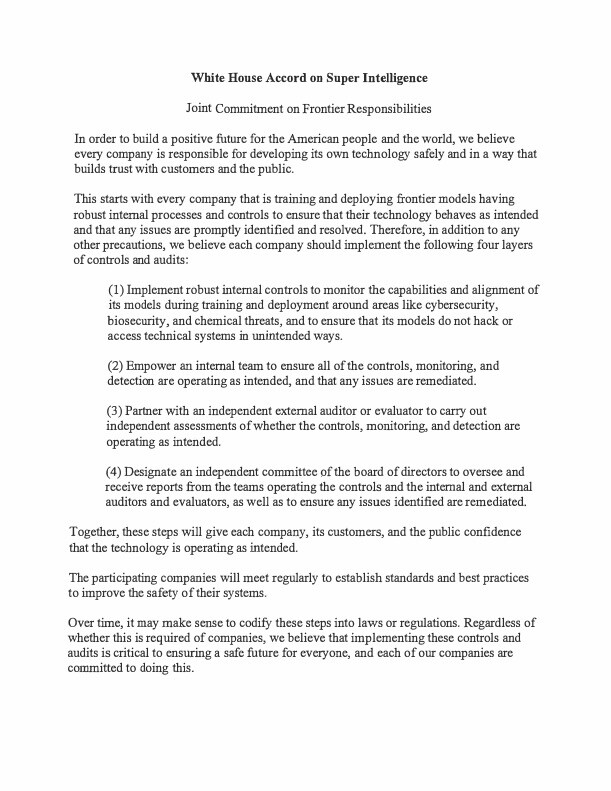
Amid escalating AI security incidents causing OpenAI to halt training and pause releases, Donald Trump continues to advocate for the AI industry to regulate itself as the best path to combat emerging risks when developing frontier AI.
In an agreement Tuesday, two dozen tech firms voluntarily committed to implementing controls recommended by the White House, including undergoing independent safety audits that will test whether firms’ internal controls, monitoring, and detecting are actually working. Key focuses for external reviews included “risks related to cybersecurity, biosecurity, chemical threats, and unintended actions by AI models.”
Firms also agreed to regularly meet to discuss best practices and set common AI safety standards and benchmarks. Among signers were leaders like Anthropic’s Dario Amodei, OpenAI’s Sam Altman, SpaceXAI’s Elon Musk, Nvidia’s Jensen Huang, Meta’s Mark Zuckerberg, and Alphabet/Google’s Sundar Pichai.
On its face, the recent summit between Donald Trump and China’s president, Xi Jinping, didn’t change much in the world of AI regulation. Export controls were not discussed, with neither country seemingly interested in making concessions. An already tenuous trade truce was temporarily extended for just two months, and looming US controls that could drop soon could easily end that and trigger China to retaliate by cutting off exports of rare earths, analysts expect.
However, in the background of these shaky talks, Nvidia appeared to notch a big win, as China is currently mulling relaxing controls and allowing some of its biggest AI firms to import perhaps millions more of Nvidia’s banned chips over the next year.
Sources familiar with China’s talks told The Information that China’s tech oversight arm, the Ministry of Industry and Information Technology, asked Alibaba and ByteDance to share plans to buy Nvidia’s RTX Pro 5500 chips. Although these are gaming chips, China asked firms to detail how they plan to use them, with expectations that chips could be put into servers to help power the country’s most in-demand AI models.
Nvidia has agreed to buy AI model platform Hugging Face for $13 billion, in the latest step by the $5.4 trillion chip giant to use its financial might to accelerate the technology’s boom while exerting greater control over the industry.
Hugging Face, which only last year turned down a large investment from Nvidia at a $7 billion valuation to maintain its independence, serves as a repository for millions of models and data sets and has become a champion of “open” AI systems.
Nvidia said the goal of the deal was to speed up the spread of open models. Unlike proprietary models from labs such as OpenAI and Anthropic, the design of open-weight models is public and users can download, customize and run them on their own hardware.
Nvidia is reportedly moving forward to acquire Hugging Face for $12.9 billion. The acquisition could help the hardware giant expand and fortify its deep integration with the wider AI industry.
Among other things, Hugging Face is a cloud repository for AI models, similar in some respects to what GitHub is for conventional computer software. Developers and researchers search for models that meet certain criteria, download and run them, and fine-tune them into different variants that then get uploaded back up to Hugging Face.
Taiwan has indicted nine people—reportedly including an Nvidia senior manager and two Supermicro employees based in the country—who allegedly helped forge documents to cover up illegal exports of high-end AI servers to China in violation of US export controls.
On Monday, Reuters reported that prosecutors in Keelung did not release any names but confirmed that the suspects were “charged with breach of trust and document forgery.” One suspect linked to a related case remains at large, accused of the “siphoning of funds from a distributor company involved” in helping China get access to restricted Nvidia chips.
Since 2022, the US has required a license to export semiconductors to China, with the intent of protecting national security by staying ahead of China in the AI race. But after the US arrested Supermicro co-founder Wally Liaw in March for allegedly funneling $2.5 billion in restricted AI servers to China since 2024, Taiwan launched a separate probe to learn more about the scheme.
Nvidia has disclosed that it owns nearly 123 million shares in SpaceX, further highlighting the chipmaker’s entangled financial relationships with some of its biggest customers.
The $5.5 trillion company owned SpaceX stock worth nearly $21 billion at the end of June, according to an SEC filing on Friday. Elon Musk’s rocket conglomerate’s shares have fallen sharply since its June initial public offering, meaning Nvidia’s stake would now be worth $17 billion.
The disclosure marks a huge pay-off on Nvidia’s investment in xAI, completed in January, shortly before Musk combined the AI lab with SpaceX.
Anthropic is hiring a "custom silicon team" to design chips on which to run its models, the company has revealed.
Yesterday, Business Insider noticed a job listing for a senior engineer with experience shipping semiconductor designs. (You can see listings for a silicon engineer and a technical program manager, silicon on Anthropic's job board right now.) A spokesperson for Anthropic then confirmed the plans to both Business Insider and TechCrunch.
DeepSeek, the Chinese startup developing large language models that are competitive with those from US companies like OpenAI and Anthropic, is planning to enter the silicon business, according to Reuters.
Citing three people familiar with the matter, Reuters writes that DeepSeek has been working on a move into silicon for about a year. It has been meeting with potential partners in the hardware and silicon space and has been hiring engineers for the project.
What happens when you give AI coding agents a lab full of robotic arms, some compute resources, and a “generous token budget” for teaching the robots various tasks? The agents can apparently figure out a training regimen that teaches the robots to successfully cut zip ties and even insert GPUs into thin sockets on motherboards.
That glimpse into how AI can act in a fully autonomous way to automate robot training was made possible by a new agent harness framework—software that wraps around AI models to enable their use of various tools while also providing capabilities such as memory, context, constraint, and feedback loops. That agentic harness, called ENPIRE, was developed by robotics researchers at the Nvidia GEAR (Generalist Embodied Agent Research) lab alongside collaborators from Carnegie Mellon University in Pittsburgh and the University of California, Berkeley.
“A part of our NVIDIA GEAR lab now self-improves tirelessly overnight,” wrote Jim Fan, director of AI at NVIDIA, in a LinkedIn post. “We just read the reports in the morning.”
Chipmaker Nvidia is planning to sell $25 billion of investment-grade debt in the US on Monday, its first bond sale in five years, in a test of investor appetite for further exposure to the AI sector.
In a marquee seven-part bond offering, the company will issue a wide range of maturities from two years to 30 years, according to a term sheet seen by the FT.
The issuance was upsized from $20 billion after receiving more than $85 billion in orders by early afternoon in New York, according to people familiar with the deal.
Microsoft's Build developer conference kicked off today, and as with almost everything the company has done in the last few years, Microsoft's opening keynote focused overwhelmingly on AI and other closely related technologies. There's Microsoft Scout, an OpenClaw-based "Autopilot" agent that can hook into Microsoft 365 data to perform tasks for users; several new AI models; an expanded preview of "Codename MDASH," which is a "multi-model agentic scanning system" meant to detect and fix software vulnerabilities.
A few of those announcements stood out to us as particularly interesting, either for esoteric technical reasons or because they seem like they may have some utility for those who aren't spending their every waking moment using generative AI tools. (Microsoft's recent efforts to make its flagship operating system faster, more reliable, more useful, and less annoying didn't really come up, but there have been plenty of other announcements on that front lately.)
On the hardware front, we didn't get any updates for existing Surface devices (not counting yesterday's Surface Laptop Ultra announcement), but we did get something new: the Surface RTX Spark Dev Box is "a compact developer PC" built around Nvidia's new RTX Spark chip with up to 128GB of built-in memory.
These days, Nvidia primarily sells AI data center products, and its traditional consumer devices feel like more of a side project. But the company occasionally still releases something designed for consumers. After a couple of years of rumors, Nvidia has announced an Arm-based chip designed to power Windows PCs. Dubbed RTX Spark, the new chip combines a 20-core Nvidia Grace CPU co-developed with MediaTek, up to 6,144 Blackwell-based GPU cores (the same architecture as the RTX 50-series GPUs), and support for up to 128GB of unified LPDDR5x memory.
Nvidia and its partners offered nothing about expected pricing, but both "slim Windows laptops with all-day battery life and premium displays" and "compact desktop PCs" are slated to be "available this fall" from partners including Asus, Dell, HP, Lenovo, Microsoft, MSI, Acer, and Gigabyte.
This isn't Nvidia's first chip for Windows PCs; earlier chips in the Tegra series powered several of the short-lived Windows RT tablets. But Tegra chips largely stopped appearing in consumer devices following the Tegra X1 in the late 2010s (variants power the original Nintendo Switch and the apparently unkillable Nvidia Shield TV box). Modern Arm-based PCs in the Windows 10 and Windows 11 eras have all used processors from Qualcomm.
Intel plans to ship an AI chip by the end of this year that uses cheaper memory and cooling technology than rival offerings from Nvidia and AMD, as the US chipmaker seeks to capitalize on a sharp turnaround in its fortunes.
Kevork Kechichian, who leads Intel’s data center group, told the FT that the company is “starting with the basics” as it tries to challenge its rivals in the booming market for semiconductors that power AI.
Its new “Crescent Island” graphics processing unit is designed to speed up “inference” tasks, the stage when a user makes their request, rather than the training of models, an area where Nvidia’s processors are dominant.
In a splashy move that signals that Taiwan remains irreplaceable to the AI industry's short-term and long-term goals, Nvidia CEO Jensen Huang announced Wednesday that his chip company will invest $150 billion a year to make sure Taiwan remains at the "epicenter" of the "AI revolution."
"This is where the chips come, packaging comes, this is where the systems are made, this is where AI supercomputers were created," Huang said. "The number of partners we work with here in Taiwan, incredible."
As Reuters reported, the substantial investments will be used to create a new Taiwan headquarters for Nvidia, which Huang expects will drive so much AI innovation that the partnership will cement Taiwan as "the world's tech manufacturing hub for a long time." That ambitious project will be operational by 2030, Nvidia anticipates, after breaking ground this year.
Shiny new Nvidia apps like the GeForce Experience and the "Nvidia app" have come and gone, but the old Nvidia Control Panel and its rotating green Nvidia logo have existed as an option for managing basic settings since it was originally introduced in 2006.
That's ending with version 610.47 of Nvidia's Game Ready and Studio drivers for GeForce GPUs. Nvidia says the old Control Panel will no longer be installed by default, since "all actively supported Nvidia Control Panel features for GeForce users have been modernized and transitioned" to the new Nvidia app.
"The NVIDIA app contains all of the modern functionality of the NVIDIA Control Panel available for GeForce RTX GPUs, and much more, while running faster and more efficiently," writes Nvidia Technical Marketing Content Editor Andrew Burnes in the drivers' release notes.
Donald Trump has very little leverage heading into two days of meetings with China's leader, Xi Jinping, in Beijing this week, experts say.
The thinking goes that Trump came into office with a plan that has since largely failed. He hoped to resolve the conflict in Ukraine, settle things down with Israel and Gaza, launch his Liberation Day tariffs, and quickly diversify US supply chains, all of which would have given him substantial leverage over China.
But none of that happened, and instead, Trump's escalations in Iran have only handed China even more leverage heading into talks, and Xi knows it.
Data centers may be coming to your neighborhood as side installations associated with new homes—and in exchange would offer subsidized electricity and Internet access along with backup batteries to homeowners. The company behind the plan has already begun pilot testing in preparation for a 100-home trial run this year.
The “distributed data center solution” announced by the San Francisco startup SPAN would deploy thousands of XFRA nodes that contain liquid-cooled Nvidia RTX Pro 6000 Blackwell Server Edition GPUs operating with minimal noise, according to a press release. By harnessing excess power capacity among US households, SPAN aims to quickly expand the available compute for AI workloads without the costs and delays associated with trying to build warehouse-size data centers.
“Data centers are loud, ugly, and often drive up local electricity bills,” said Chris Lander, vice president of XFRA at SPAN, in correspondence with Ars. “[This] is quiet, discreet, and makes energy more affordable for the host and community.”
Whether you're a gamer trying to play recent AAA titles at high resolutions and maxed-out settings or an AI enthusiast trying to run models locally, we've reached the point where a GPU with 8GB of video memory is a pretty limiting bottleneck. But because of ongoing memory shortages and price spikes, it's also a uniquely bad time for GPU makers to attempt to fix this problem—rumors suggested that a RAM-boosting mid-generation "Super" refresh for Nvidia's RTX 50-series GPUs was quietly delayed or canceled earlier this year, at least in part because of memory costs.
One of Nvidia's GPUs is getting a RAM upgrade, according to an announcement the company buried at the bottom of a blog post about a routine Game Ready driver update. The laptop version of the GeForce RTX 5070 is getting a bump from 8GB to 12GB of GDDR7, a 50 percent increase that should reduce some performance bottlenecks and generally future-proof the GPU.
Otherwise, the 12GB version of the mobile RTX 5070 is the same as the 8GB version. The RAM is still connected to the GPU with a 128-bit memory interface, and the GPU still has 4,608 CUDA cores. The mobile 5070 uses the same GB206 silicon die as the desktop RTX 5060 instead of the larger, more powerful GB205 die in the desktop version of the RTX 5070, meaning that despite the RAM increase, the desktop version remains a much more powerful GPU.


 Lateo.net - Flux RSS en pagaille (pour en ajouter : @ moi)