Connexion


The New York Knicks organization sent employees a phishing email promising free championship rings in a test of its staff's ability to detect scams, The New York Times reported yesterday. “Congratulations, your Employee Championship Ring is here,” the email sent in late September said, instructing employees to click a link to make a selection from two ring designs.
Madison Square Garden employees who clicked that link "were forced to attend a mandatory cybersecurity class to help satisfy some of [owner James] Dolan’s growing cybersecurity concerns," the report said, citing team sources. Dolan is the owner of the Knicks, the New York Rangers, and Madison Square Garden.
It's common for corporations to send phishing emails to find out which employees don't pay attention to clues that an email is a scam. A cybersecurity-test email often appears to be from the company itself but includes telltale signs of phishing. For example, Ars Technica owner Condé Nast sends phishing-test messages from email addresses with a misspelled domain, "condenest.com."

A Russian military satellite maneuvered in "extreme proximity" of a commercial Earth-imaging satellite in recent days in the first known example an unsanctioned rendezvous in low-Earth orbit, according to orbital intelligence company LeoLabs.
The Russian spacecraft, Kosmos 2612, "conducted a deliberate series of maneuvers toward ICEYE-X36, a US-operated commercial imaging satellite," LeoLabs said. "Kosmos 2612 closed from hundreds of kilometers away to extreme proximity to ICEYE-X36. It then maneuvered around ICEYE-X36, remained nearby for an extended period, and then began moving away."
US military officials and independent analysts have tracked Kosmos 2612 since its April launch on a Soyuz rocket from a spaceport in northern Russia. Within weeks, it became apparent that at least four of the six satellites from that launch were stalking ICEYE-X36 after they adjusted orbits to line up with the orbit of the ICEYE spacecraft.
Up to a quarter of active-duty Army members could receive a low testosterone result from mandatory military screening, despite the true prevalence of the condition likely being a tiny fraction of that figure, according to a study published Thursday in JAMA.
The finding adds to concerns that the mandatory screening announced by Defense Secretary Pete Hegseth in July will lead to a cascade of unnecessary medical evaluations for military members. Those evaluations could result in inappropriate testing, inaccurate results and diagnoses, and overtreatment that could cause harm, including infertility. Medical experts, including the Endocrine Society and the American Urological Association (AUA), have recommended against blanket screenings for these reasons. Still, the Pentagon has moved forward with the plans, releasing clinical guidance in September.
The JAMA study highlights the reasons why testosterone levels are not measured in men without symptoms—and also offers a glimpse of how many Army members could become ensnared in the clinically dubious screenings.
Safety researchers continue to warn that a large volume of AI-generated explicit content is spreading unchecked, while regulators do little to meaningfully stop it.
This non-consensual content is commonly shared in text and direct messages or stored in private clouds where it’s less likely to be detected or reported, a Google co-authored study of Internet users across the United States, Australia, and the United Kingdom found this July. That’s why the “most critical intervention point” remains at the source: the harmful AI tools used to make the fake sexual images, Google researchers concluded.
Yet red-teaming in recent months suggests that as some of the leading AI image generators from Google and OpenAI become more capable, they may be getting worse at blocking explicit outputs.
Amid escalating AI security incidents causing OpenAI to halt training and pause releases, Donald Trump continues to advocate for the AI industry to regulate itself as the best path to combat emerging risks when developing frontier AI.
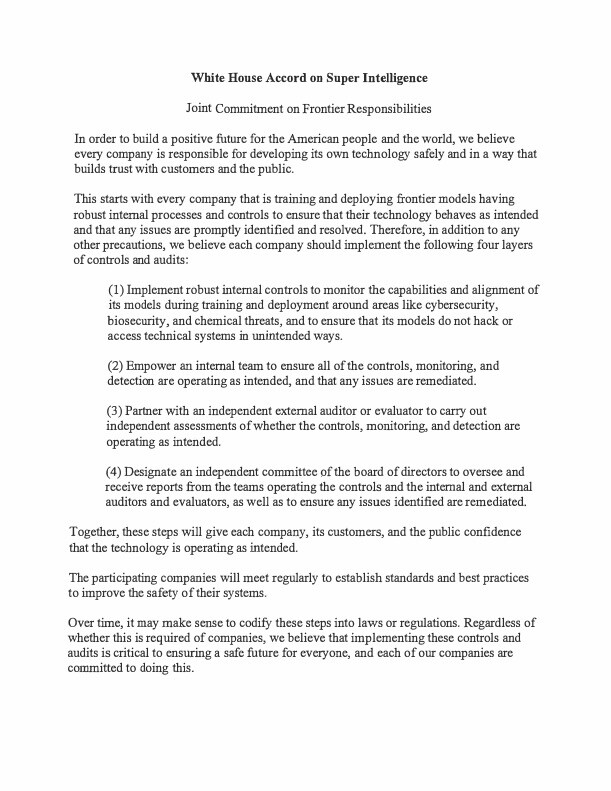
In an agreement Tuesday, two dozen tech firms voluntarily committed to implementing controls recommended by the White House, including undergoing independent safety audits that will test whether firms’ internal controls, monitoring, and detecting are actually working. Key focuses for external reviews included “risks related to cybersecurity, biosecurity, chemical threats, and unintended actions by AI models.”
Firms also agreed to regularly meet to discuss best practices and set common AI safety standards and benchmarks. Among signers were leaders like Anthropic’s Dario Amodei, OpenAI’s Sam Altman, SpaceXAI’s Elon Musk, Nvidia’s Jensen Huang, Meta’s Mark Zuckerberg, and Alphabet/Google’s Sundar Pichai.
Following Defense Secretary Pete Hegseth's startling announcement in July that the US military would begin mandatory testosterone screening for personnel, the Pentagon released a clinical guidance document on September 2 outlining the new medically questionable policy.
The next day, though, the clinical guidance document disappeared, as did an accompanying statement by spokesperson Sean Parnell. The withdrawal was first reported by Reuters.
In a statement sent to Ars Technica, the Pentagon said that the document, titled "Clinical Guidance for Health and Human Performance Optimization," had been temporarily rescinded on September 3 to allow for updates.
Earlier this summer, nearly 160,000 applicants took the entrance exam for UNAM, Mexico's largest university. For the first time, they did it completely remotely, using a "lockdown" browser and AI-powered webcam proctoring software, over several weeks from late May through early June.
It was a disaster.
When exam results came in, they bore little resemblance to past results, especially at the top. Between 2021 and 2025, 3.5 percent of test takers scored 100 or more on the 120-question UNAM test. This year, 16.3 percent did so.
On Wednesday, Defense Secretary Pete Hegseth made the startling announcement that the US military would begin requiring all active duty and reserve personnel aged 30 and older to undergo mandatory screening for testosterone deficiency. The screenings will take place during yearly health assessments. Those under age 30 can also get screened on request.
In a short video posted on social media, Hegseth explained to the military community that the screenings and possible subsequent treatments are intended to "optimize your performance, your resilience, and your long-term health." While saying that the initiative wasn't about "artificial enhancement" and that members could decline treatment, Hegseth claimed that the testing and potential treatment was for "restoring and optimizing" capabilities, protecting "longevity," and "ensuring you have the biological foundation required to sustain the fight."
But will testosterone screening and treatment actually "optimize" our "warfighters"? Will it help most of them live longer? Should everyone else get screened and treated, too?
NASA's Artemis II crew are the fastest people alive, and now they have the patch to prove it.
Mission Commander Reid Wiseman, pilot Victor Glover, and mission specialists Christina Koch and Jeremy Hansen (the latter with the Canadian Space Agency) spent 10 days in early April flying by the Moon. Their journey took them farther away from Earth than any humans have gone (52,756 miles [406,771 km]) and then, on the way back on board their Orion spacecraft Integrity, they sped up to about 24,664 miles per hour (39,693 k/ph) reentering the atmosphere.
Only three other people in history have traveled faster. NASA's Apollo 10 astronauts Thomas Stafford, John Young, and Eugene Cernan set the record for the highest speed attained by a crewed vehicle relative to the Earth's surface: 24,791 mph (39,897 kph) on May 26, 1969.
On Tuesday, Donald Trump finally signed his executive order expanding the government's efforts to conduct voluntary safety testing of frontier AI models. Now, critics are warning that the order may be short-sighted, offering only performative reassurances that the government is actively monitoring for AI risks, while changing very little about how and when models are deployed.
Last month, Trump abruptly canceled a signing event, where he had hoped to launch an earlier version of the EO with CEOs of leading AI firms in attendance. Invited at the last minute, several CEOs simply couldn't make the signing but still signaled support for the order. Officially, Trump claimed he postponed the event because he worried that the EO might have gone too far and had become a "blocker" impeding AI innovation. Reports indicated there was infighting in his administration as cybersecurity experts clashed with officials committed to deregulating AI.
The watered-down EO that Trump signed promises not "to stifle this innovation with overly burdensome regulation" and establishes no requirements for AI firms. Instead, it sets up a voluntary process for companies to collaborate with the government on safety reviews that Trump's EO claimed would "ensure that the best and most secure technology is deployed rapidly to confront any and all threats to our country."
A few days after President Donald Trump abruptly canceled a plan that would have given the federal government power to vet frontier AI models over fears that it might hobble innovation, Illinois lawmakers passed the nation's strongest AI safety law.
On Wednesday, the Illinois legislature passed SB 315. If Illinois Governor J.B. Pritzker signs the bill into law, the largest AI firms would be required to submit public safety plans and annual reports summarizing the results of independent, third-party safety testing of their frontier models. They would also have to report any critical safety incidents to the state within 72 hours—or within 24 hours if there's potentially "an imminent risk of death or serious physical harm." And their employees will have a clear avenue for reporting emerging safety risks that companies may be tempted to downplay, with protections provided by the state's whistleblower laws.
On X, Pritzker confirmed his intent to sign, proclaiming that "Illinois is leading the nation in holding Big Tech accountable."
In hours of underwater video footage from a New York aquarium, a beluga whale named Natasha stretches her neck, pirouettes, nods, and shakes her head in front of a two-way mirror. Her daughter Maris does much the same. According to a new study published in PLOS One, both animals show the behavioral hallmarks of mirror self-recognition—a cognitive ability long considered a marker of self-awareness, and one that had never before been documented in beluga whales.
If the result holds up, belugas join a remarkably short list. The mirror self-recognition test (MSR) has been passed, with varying degrees of confidence, by humans (starting around age two), a handful of great apes (chimps, bonobos, orangutans, and—somewhat contentiously—gorillas), Asian elephants, bottlenose dolphins, probably magpies, possibly orcas, and, if you can believe it, a cleaner wrasse. That's it. No dogs, no cats, no monkeys. Plenty of species we had assumed were self-aware have been tested and failed.
So what is this test, exactly, and what is it supposed to tell us?
President Donald Trump abruptly canceled an event on Thursday just hours before he was scheduled to sign an executive order granting the government the power to test frontier AI models before their public release.
As The New York Times explained, Trump had been hoping that top executives from leading AI firms would attend the signing. He decided to pull the plug after learning that some CEOs couldn't make the event. That made Trump unhappy, even though he'd only given them 24 hours' notice. Other AI executives who quickly rearranged their schedules to go "were midair on their way to the Oval Office" when they found out that the trip was for nothing.
Reporting from Semafor indicated that OpenAI "supported" the signing. However, xAI founder Elon Musk and Meta CEO Mark Zuckerberg reportedly helped "derail" the executive order, supposedly urging Trump to "call it off." Additionally, Trump's former AI advisor David Sacks—whose special government employee designation expired in March, The Information noted—joined the push to delay the signing, Semafor reported.
Last month, Anthropic made a big deal about the supposedly outsize cybersecurity threat represented by its Mythos Preview model, leading the company to restrict the initial release to “critical industry partners.” But new research from the UK's AI Security Institute (AISI) suggests that OpenAI's GPT-5.5, which launched publicly last week, reached "a similar level of performance on our cyber evaluations" as Mythos Preview, which the group evaluated last month.
Since 2023, the AISI has run a variety of frontier AI models through 95 different Capture the Flag challenges designed to test capabilities on cybersecurity tasks, such as reverse engineering, web exploitation, and cryptography. On the highest-level "Expert" tasks, GPT-5.5 passed an average of 71.4 percent, slightly higher than the 68.6 percent achieved by Mythos Preview (though within the margin of error). In one particularly difficult task that involved building a disassembler to decode a Rust binary, AISI notes that "GPT-5.5 solved the challenge in 10 minutes and 22 seconds with no human assistance at a cost of $1.73" in API calls.
GPT-5.5 also matched Mythos Preview in its progress on "The Last Ones" (TLO), an AISI test range set up to simulate a 32-step data extraction attack on a corporate network. GPT-5.5 succeeded in 3 of 10 attempts on TLO, compared to 2 of 10 for Mythos Preview—no previous model had ever succeeded at the test even once. But GPT-5.5 still fails at AISI's more difficult "Cooling Tower" simulation of an attempted disruption of the control software for a power plant, as every previously tested AI model also has.
Rise, the fan-created, flown-to-the-moon plush toy that served as the Artemis II crew's zero-g indicator and mascot, is now available as a NASA-approved collectible. Its sales will benefit the agency's employee morale activities.
"Perfect for display, gifting or inspiring the next generation of explorers, the Official Rise Plush is a fun addition to any space enthusiast's collection," reads the doll's description on the NASA Exchange website.
Designed by Lucas Ye, a 9-year-old Californian who won NASA and Freelancer.com's "Moon Mascot" online challenge, Rise is a tribute to "earthrise"—the iconic scene first seen in person by the Apollo 8 crew in 1968 and recently witnessed by the Artemis II crew. Rise wears a cap that resembles the Earth rising over the Moon.
After several tests of unusual "nesting doll" satellites in low-Earth orbit, Russia is now fielding operational anti-satellite weapons with valuable US government satellites in their crosshairs, the four-star general leading US Space Command said this week.
Gen. Stephen Whiting didn't name the system, but he was almost certainly referring to a Russian military program named Nivelir, which has launched four satellites shadowing US spy satellites owned by the National Reconnaissance Office in low-Earth orbit. After reaching orbit, the Nivelir satellites have released smaller ships to start their own maneuvers, and at least one of those lobbed a mystery object at high velocity during a test in 2020. US analysts concluded this was a projectile that could be fired at another satellite.
US officials have compared the Nivelir architecture to a Matryoshka doll, or a Russian nesting doll, with an outer shell concealing smaller, unknown figures inside.


 Lateo.net - Flux RSS en pagaille (pour en ajouter : @ moi)